
























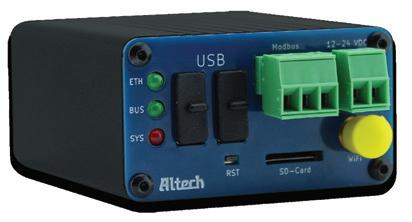



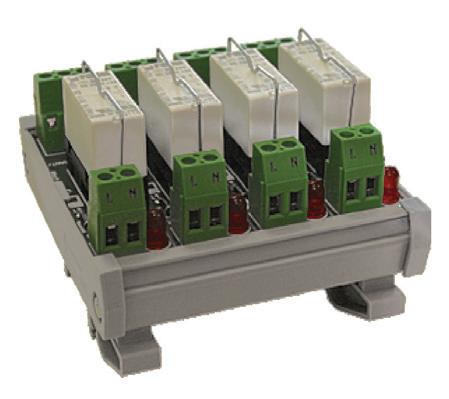


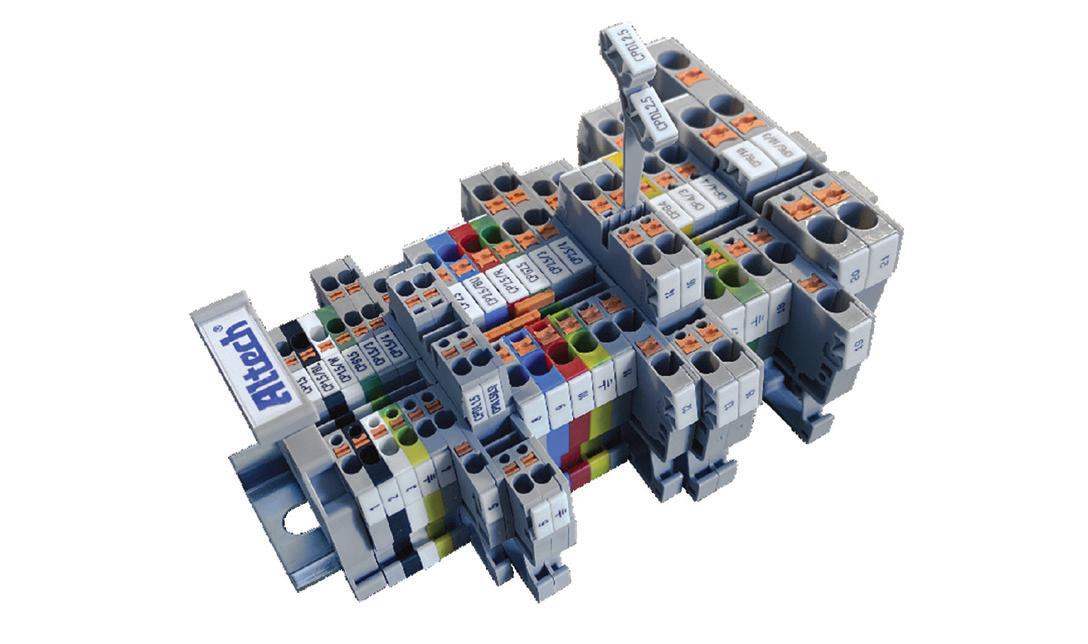






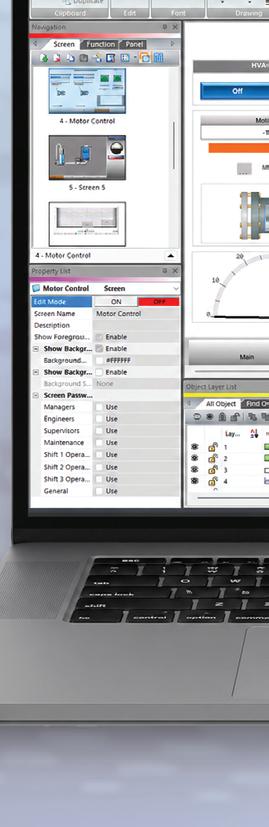
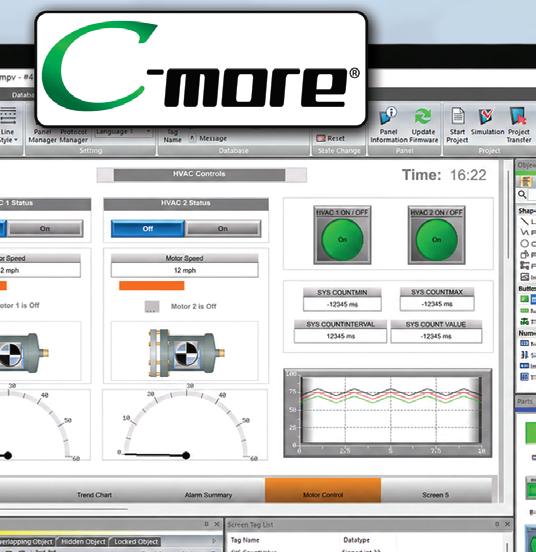

Loaded with new tools, graphics, and features that will make HMI programming easier, faster, and more efficient.
What’s new for version V9.0
• Up to 250% improved screen performance; smoother, more responsive operation
• Powerful visualization tools like advanced line and step charts with dual Y-axes and dynamic scaling
• Streamlined development and improved system performance
• Enhanced modern high-quality SVG-based library
• Productivity enhancing features such as find/replace for tags and text, intuitive object search, and a consolidated object library
Expanded capabilities:
• Dynamic meters and alarms
• Flexible color selection



• Improved data logging with a new log manager
Supported drivers (refer to tech specs for speci c controller details)
• All AutomationDirect PLCs
• Modbus RTU devices

• General Electric PLCs
• Mitsubishi controllers


Starting at $368.00 (CM5-T4W)
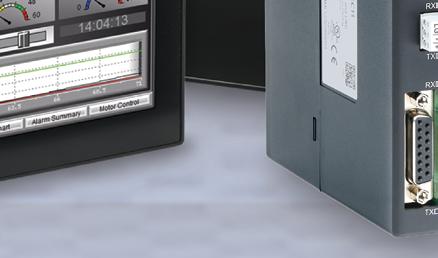
High-performance HMIs that feature ample data storage and fast communication with support for a host of popular protocols (EtherNet/IP, MQTT, etc.) and file types including jpegs.
• Ethernet port included for easy network data sharing
• 16.7M colors and LED backlights
• Models from 4” up to 22” (widescreen) available
• 800MHz or 1.6GHz quad core CPU
• 43MB project memory
• NEMA 4/4X (indoor use only), IP65








Starting at $649.00 (CM5-RHMI)
Need display flexibility? Try the CM5 headless HMI. It easily connects to monitors, televisions, projectors, and most HDMI display devices of any size to display real-time operational data and messages.
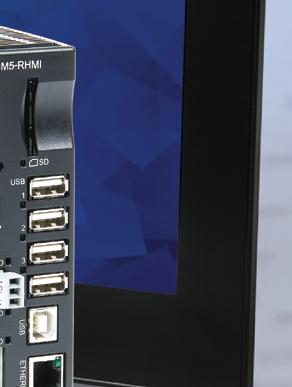
• HDMI video/audio outputs for VGA, SD, XGA, HD, and FHD; USB audio adapter (not included)
• (2) Ethernet, (1) RS232, (2) RS485, & (1) RS422 ports support programming/device connections
• USB-B port for programming and monitoring
• (4) USB-A ports for USB HID devices such as USB hub, pen drives, touch screen displays, keyboard, mouse & scanners
• SD card slot for log files, project memory, or graphic media

• Modbus TCP/IP devices
• Allen-Bradley PLCs
• Fanuc R30-iB controller


• Omron PLCs
• Siemens PLCs
• and more!
• Remote HMI app provides virtual-only functionality for applications that only require remote monitoring










As the inventor of the spiral retaining ring with 100+ years of innovation, here’s why Smalley is The Engineer’s Choice®:
ᘩ 11,000+ standard parts in stock
ᘩ Customizable with No-Tooling-Charges™
ᘩ Trusted performance in 25,000+ applications
ᘩ Award-winning quality backed by leading industry certification
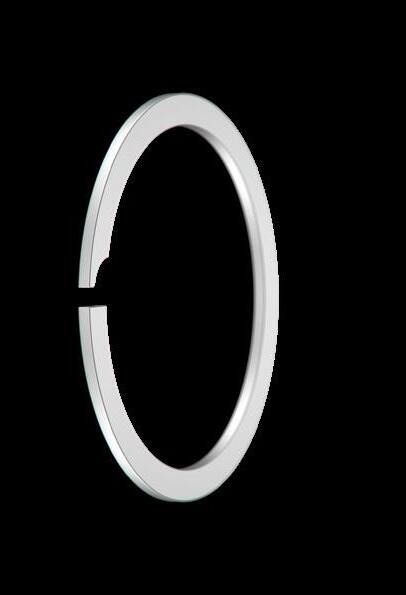
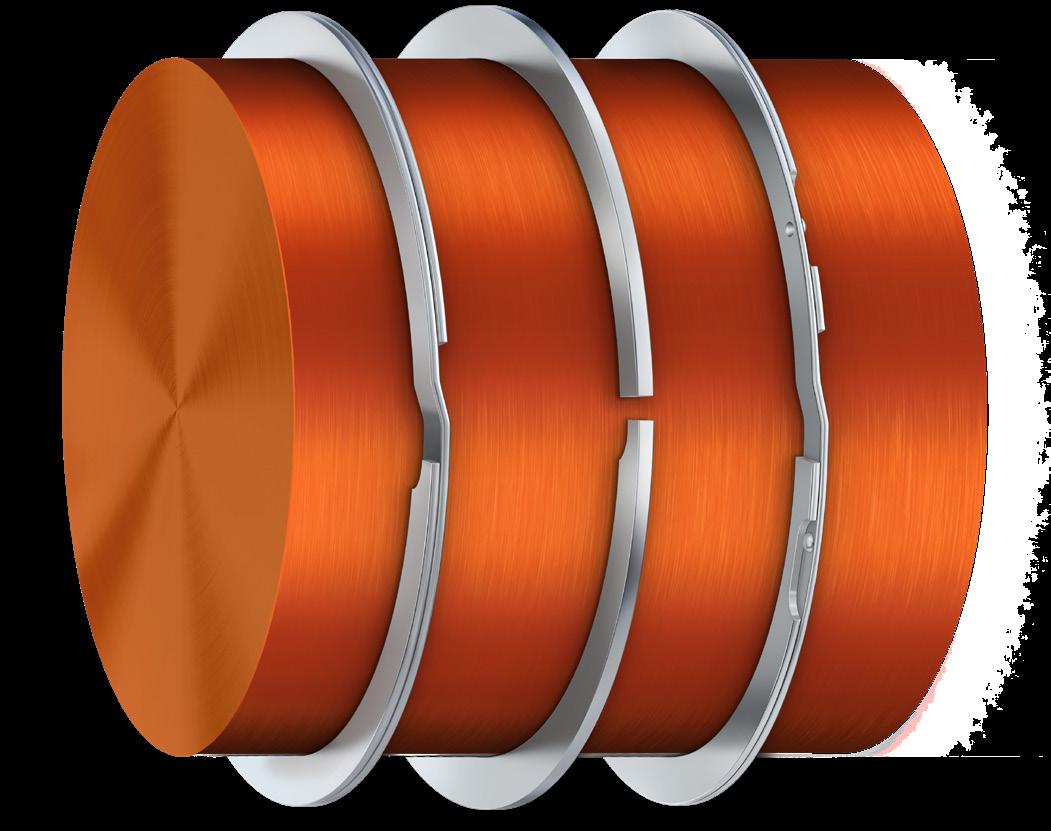
Smalley Retaining Rings
ᘩ No Ears to Interfere®
ᘩ High RPM Capacity
ᘩ Easy install and removal
ᘩ Diameters from .118" to 120" in 40+ materials


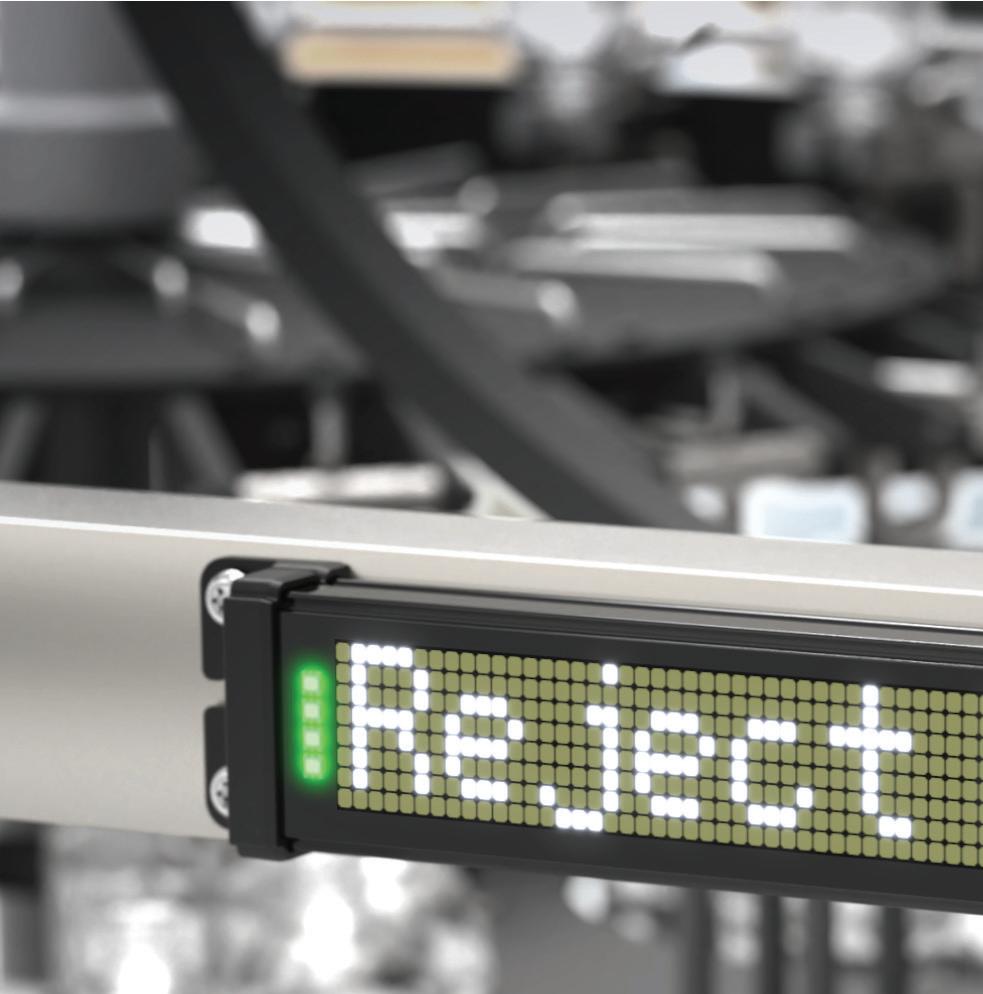
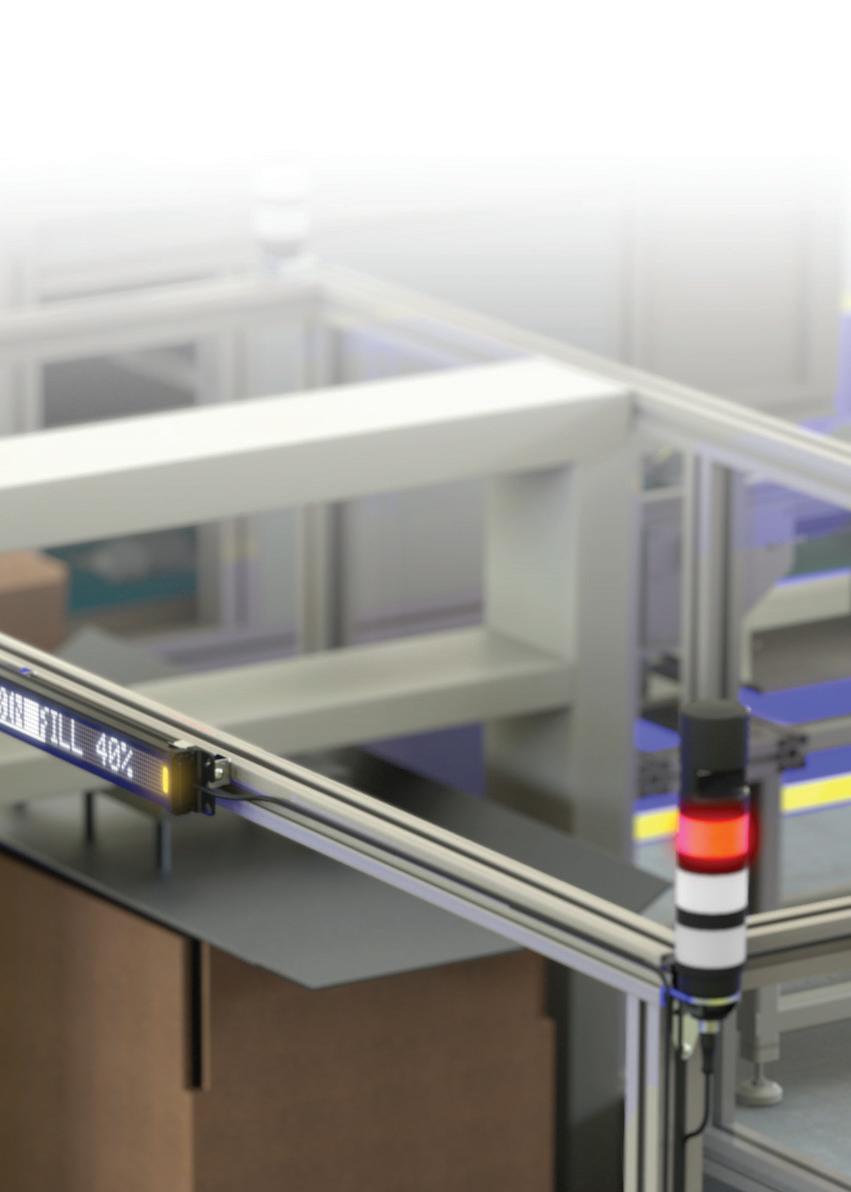
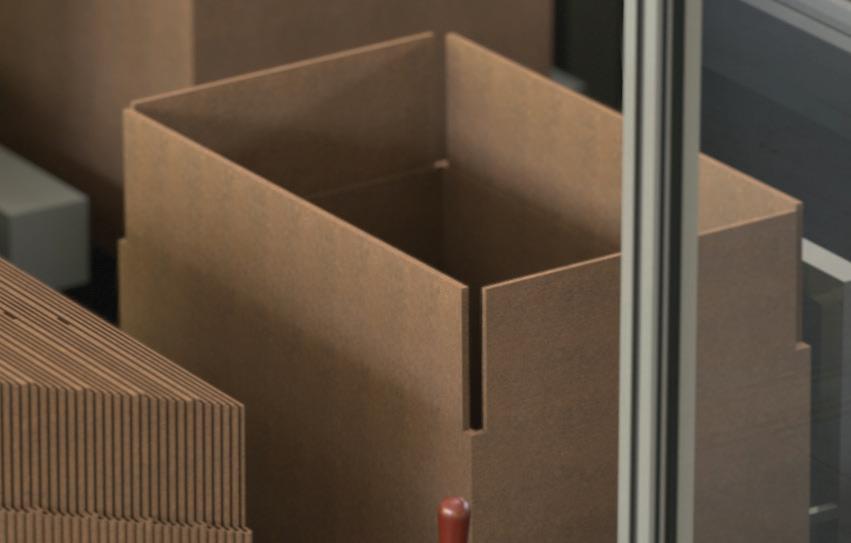
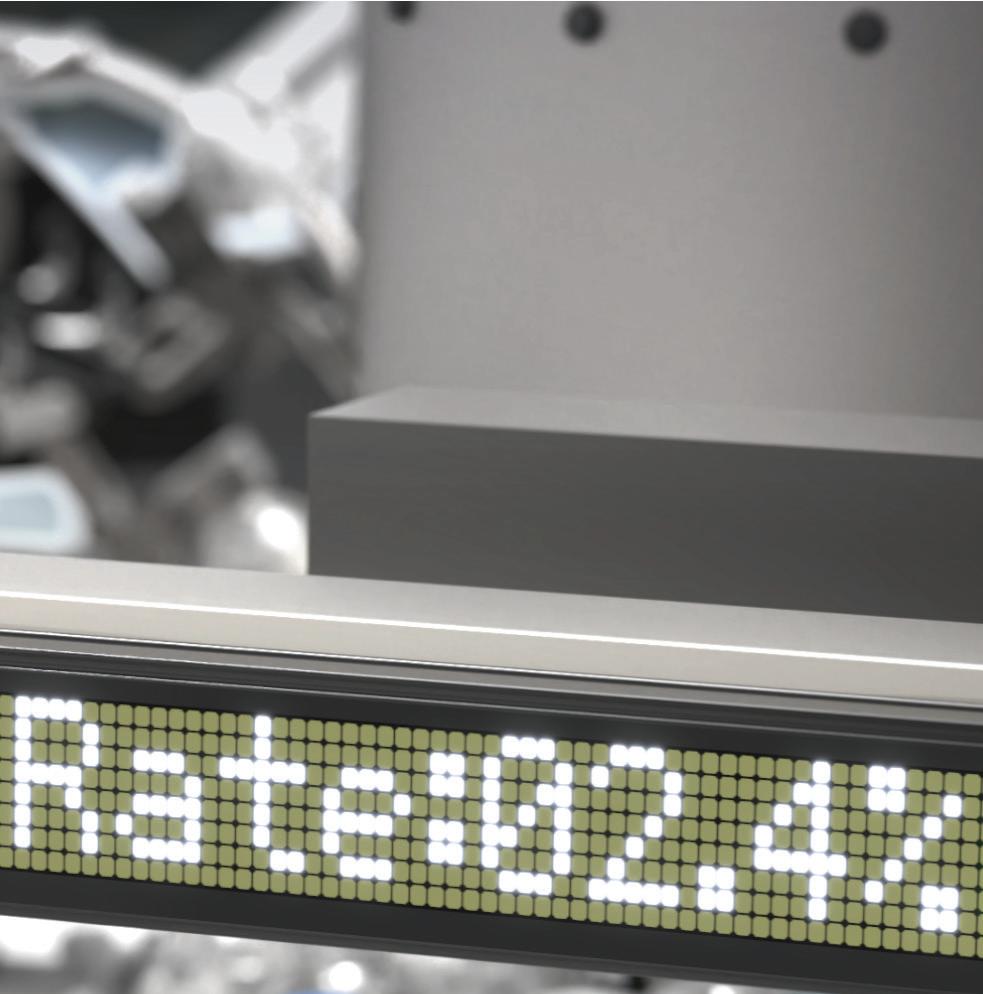
The SD50 combines bright text and multicolor LEDs to communicate machine status where operators need it. Display equipment status, takt time, counts, measurements, and work instructions to help teams respond faster and keep production moving.



MACHINE STATUS COUNTS
Keep everyone informed or real-time machine status. Track output and batch counts to stay on target.

OPERATOR
INSTRUCTIONS
Guide the next step to reduce errors and keep work moving.
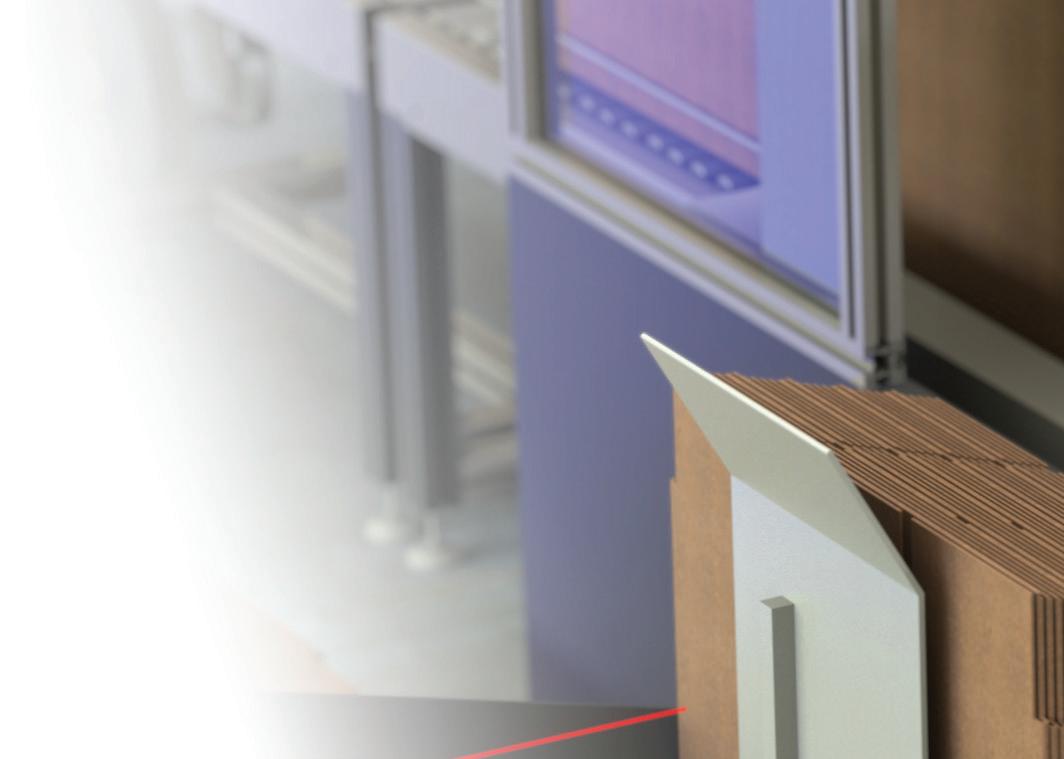








Loving your job is about finding connections between who you are, what you do, and who you work with. It's all these fibers that connect personal values and professional goals; the past, present, and future; and every detail to a larger purpose. It’s also about being willing to work hard, show up for your teammates, continuously mature, and adapt to change.
You may have caught some news in July that our parent company, WTWH Media, is now Arrowfly. Our publications and brands keep their names and missions; only our email addresses are different. The new corporate identity reflects what the company has grown into over the past two decades — an omnichannel B2B media, events, and marketing company where hard-to-reach professional decision-makers gather for trusted journalism, industry intelligence, and high-impact experiences that move their markets forward. That's a considerable achievement for the specialized trade publisher it started out as. As our CEO Matt Logan put it, “the name is new, but the foundation is the same.”
For me, this company is rooted in a memory of a humble front yard in West Park, Cleveland, just a few streets away from my life’s origins. Each time Scott McCafferty told his stories about siblings, basketball games, and terrible hotels on early business trips, more connective fibers emerged, and I felt the heartbeat of what he, Mike Emich, and Marshall Matheson built from scratch with grit and determination. With the help of

many others, they nurtured an idea into a powerhouse company that has influenced numerous industries and individuals worldwide. It’s proof that when people trust each other and work together, opportunities are boundless.
It’s also a reminder that adaptation is critical for success in any context. Comforts of the known turn rancid when they’re left untended for too long, inevitably culturing fear, resentment, and conflict, all of which prohibit long-term growth. When we cling too hard to how it’s always been, we rob ourselves of opportunities and position ourselves at a disadvantage. Now, change for the sake of change isn’t always wise, and change certainly doesn’t imply growth. A company name change doesn’t abracadabra a team into a higher success bracket — that depends directly on individuals’ contributions and on how they ride the rollercoaster of life. (I’m a hands-up kind of person; you probably noticed.)
As you navigate change in your own lives and careers, know that your Design World team embraces the opportunity to grow alongside you. Our editors, designers, sales managers, customer service representatives, production managers, marketers, web developers, and leaders will always be willing to work harder. You, dear readers, have some of the most important jobs in the world, and our mission is to provide more connective fibers that help you weave your own success and continue loving what you do. DW
Rachael Pasini • rpasini@arrowfly.com
linkedin.com/in/rachaelpasini

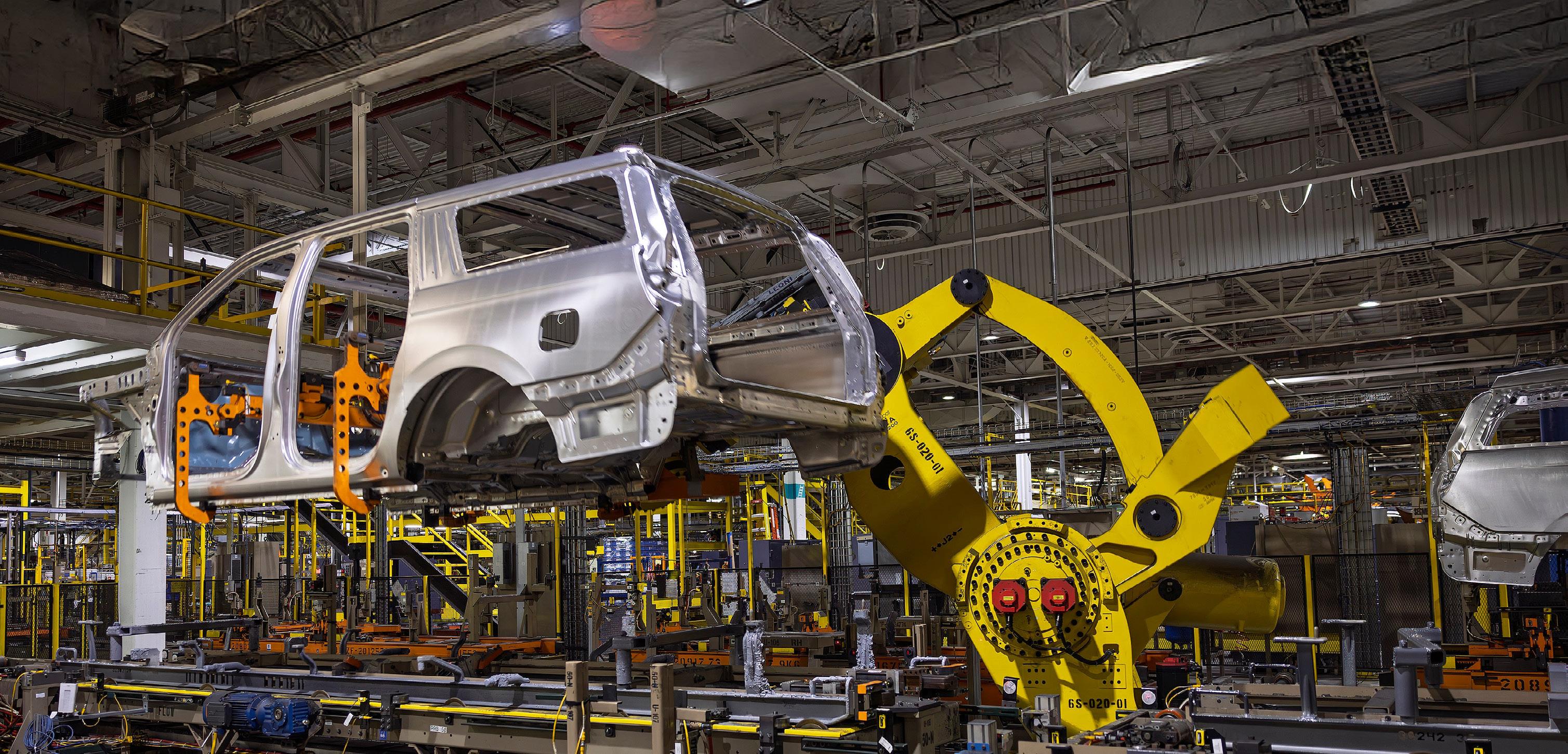
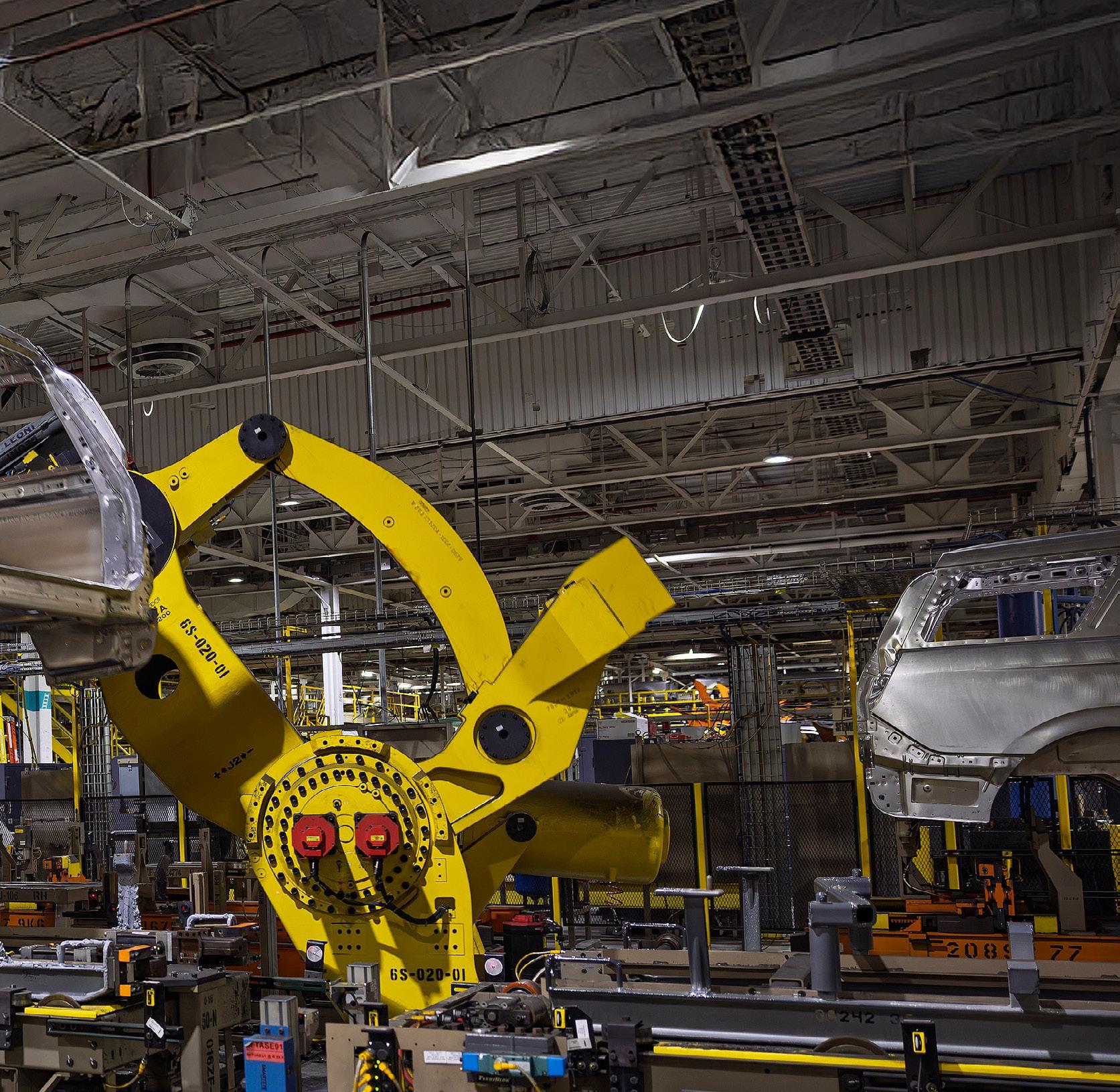
Heavy-duty electric actuation — on large-scale gantries
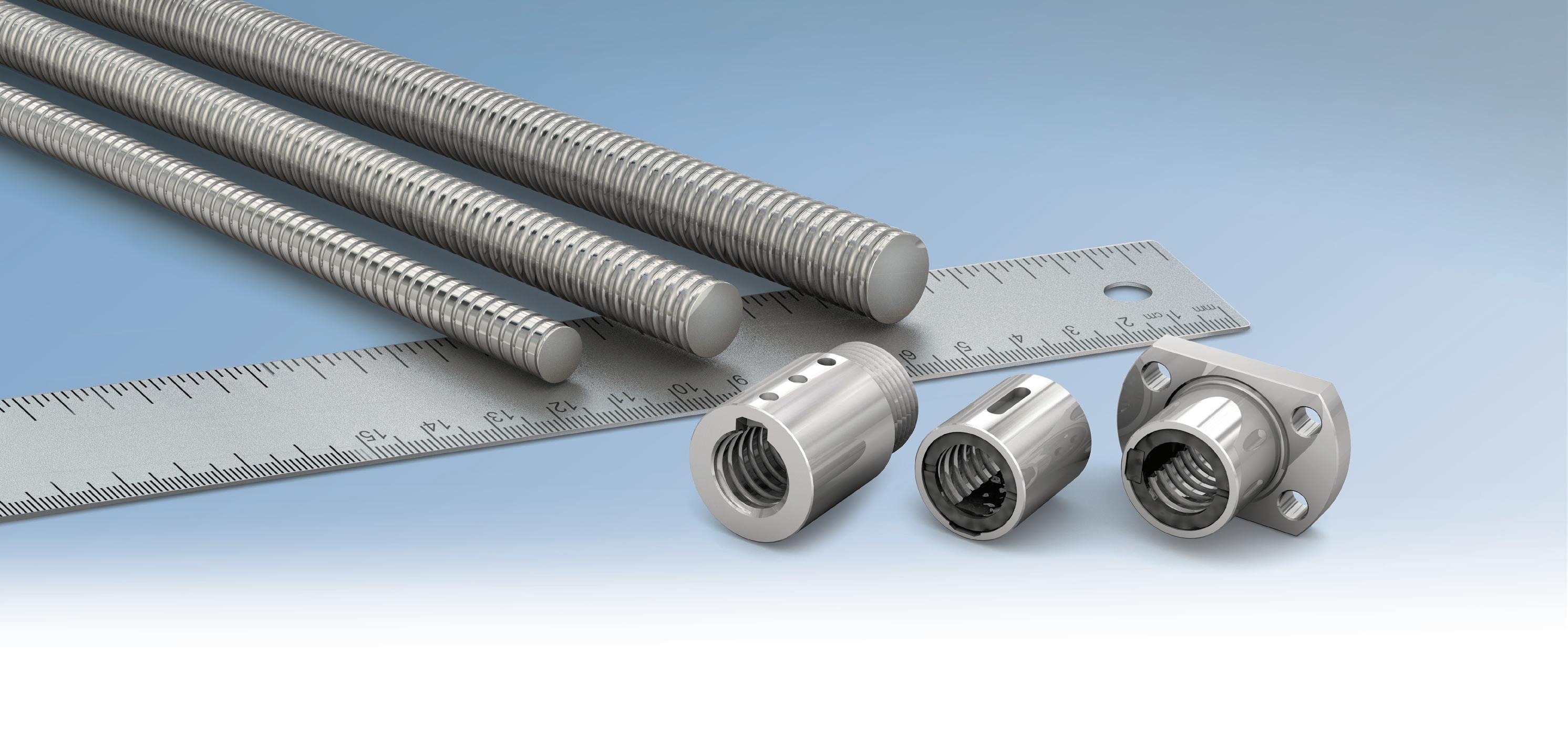
We’ve outlined how screw-based electric actuation increasingly finds use in today’s presses and other machine tools. Other heavyduty machinery also makes copious use of this and other types of electric actuation.
Phillips Corporation, Federal Division, announced the U.S. Navy has expanded its advanced manufacturing training capabilities at the Navy’s Schoolhouse in Danville, Virginia, through the procurement of hybrid and additive manufacturing systems delivered in partnership with BlueForge Alliance, the Navy’s procurement and program management partner.
Design World reports on the vast world of design engineering and machine building with technical, indepth content. We cover semiconductor, medical, factory automation, packaging, off-highway, material handling, simulation, rapid prototyping, and more. By signing up for the Engineer’s Edge, you’ll stay on top of the news and trends happening in the engineering space. Scan the QR code to access three weekly newsletters plus new product announcements!

EDITORIAL
VP, Editorial Director Paul J. Heney pheney@arrowfly.com
Editor-in-Chief Rachael Pasini rpasini@arrowfly.com
Managing Editor Mike Santora msantora@arrowfly.com
Executive Editor Lisa Eitel leitel@arrowfly.com
Senior Editor Mary Gannon mgannon@arrowfly.com
PRINT CREATIVE SERVICES
VP, Creative Director
DIGITAL MARKETING
VP, Marketing Annie Wissner awissner@arrowfly.com
Portfolio Marketing ManagerEngineering & Life Sciences McKenzie Burns mburns@arrowfly.com
PRODUCTION SERVICES
Customer Service Manager Stephanie Hulett shulett@arrowfly.com
Customer Service Rep Tracy Powers tpowers@arrowfly.com
Customer Service Rep JoAnn Martin jmartin@arrowfly.com
DIGITAL PRODUCTION
Digital Production Manager Reggie Hall rhall@arrowfly.com
Digital Production Specialist Nicole Johnson njohnson@arrowfly.com
Digital Design Manager Samantha Goodrich sgoodrich@arrowfly.com
Marketing Graphic Designer Hannah Bragg hbragg@arrowfly.com
Digital Production Specialist Elise Ondak eondak@arrowfly.com
WEB DEVELOPMENT



Over two decades, WTWH Media has grown from its engineering roots into a diversified portfolio of 40+ trusted media brands, 45+ industry events, and marketing solutions serving professionals across Engineering, Healthcare, and Food, Retail & Hospitality. While many know and trust our individual brands, fewer know the company behind them.
Arrowfly gives us a stronger corporate identity that reflects the business we’ve become. The name represents forward momentum, direction, and growth, and our role in helping professionals and partners navigate change and move their businesses forward.
Arrowfly represents where niche professionals gather for trusted journalism, industry intelligence, and measurable outcomes.
Your Trusted Brands:
All 40+ media brands and publications remain unchanged
Our Events:
All 45+ industry events continue with the same teams, content, and quality
Editorial Independence:
Our commitment to credible, independent journalism remains our foundation
Clara Platform:
Our proprietary performance platform continues delivering real-time campaign visibility and measurable results
Arrowfly is the preeminent live and digital destination for professionals across Engineering, Healthcare, and Food, Retail & Hospitality sectors. Editorial authority. Engaged communities. Measurable outcomes.
Recent months have brought a run of motion product introductions aimed at packaging machine builders, and two themes connect most of them: decentralized drives that shrink or eliminate control cabinets, and designs that push servo performance into lower-cost tiers and harsher environments. Here is a sample of international product releases so far this year.
Kollmorgen expanded its Essentials servo drive (KED) for hygienic and washdown applications by pairing it with AKMA anodized aluminum and AKMH stainless steel motors, both of which have IP69K protection. The motors are now available with the company’s SFD-M multi-turn feedback, which uses energy harvesting rather
than battery-backed encoders to retain absolute position through power cycles.
Inovance launched three drive lines for packaging, processing, and printing at Interpack 2026: the QS900 multiaxis servo drive with integrated motion control and AI-driven diagnostics; the IP66-rated DT60N ac drive for conveyors; and the IDM integrated servo motor-drive, which the company claims tolerates up to 450% overload and reduces cabinet volume by up to 70%. A single-cable MSG servo motor developed for the European market rounded out the lineup.
Lenze paired its IE5/IE6 motor drive system with the i650 motec frequency inverter in a decentralized package offering servo-like performance,
sensorless positioning, and regenerative braking. The company also demonstrated a delta robot picking from two rotating tables without stopping them — a rotary-tracking approach built on its FAST Robotics Template, which parameterizes robot motion instead of requiring custom programming.
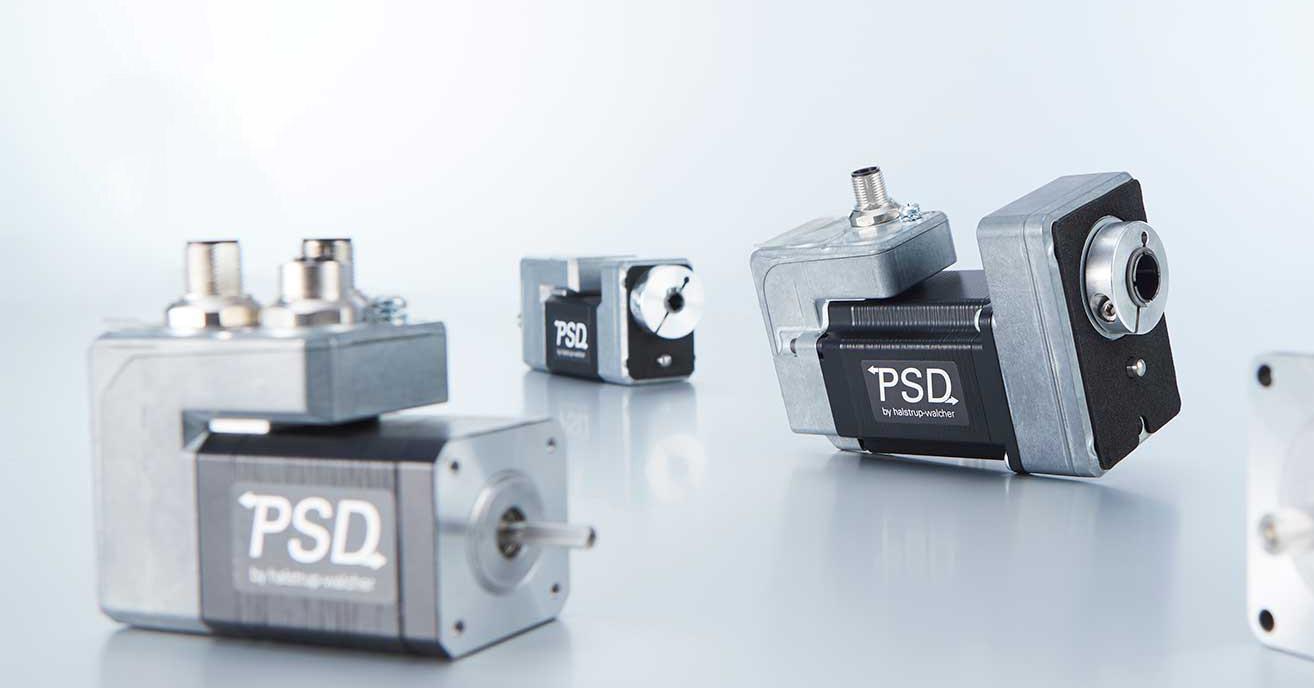
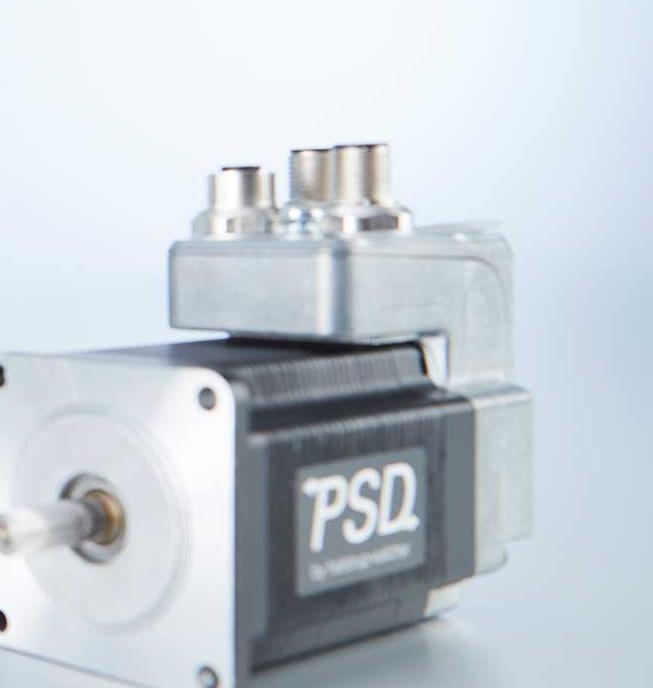
For format changeover, HalstrupWalcher upgraded its PSD-integrated direct drives to operate at either 24 or 48 V. At 48 V, the stepper-based positioning drives deliver double the speed at unchanged torque, or double the force at the original speed, with IO-Link and industrial Ethernet variants available.
Bosch Rexroth’s cabinet-free drive technology powers a new generation of modular packaging machines
from Gerhard Schubert, introduced at Interpack. The company’s Automate exhibit in Chicago centered on its ctrlX automation platform, linear motion, and TS conveyor systems, including the new TS 7plus, which can transport payloads up to 3,000 kg. Energy recovery is surfacing at the machine level, too: IWK’s new CH4 horizontal cartoner uses a servo drive recuperation system that the company says cuts energy consumption by up to 21%. DW
WHITTET-HIGGINS manufactures quality oriented, stocks abundantly and delivers quickly the best quality and largest array of adjustable, heavy thrust bearing, and torque load carrying retaining devices for bearing, power transmission and other industrial assemblies; and specialized tools for their careful assembly.
Visit our website–whittet-higgins.com–to peruse the many possibilities to improve your assemblies. Much technical detail delineated as well as 2D and 3D CAD models for engineering assistance. Call your local or a good distributor.

Wind turbine blades are among the most demanding components to produce and transport. Conventional production depends on enormous stationary molds and labor-intensive composite layup, and each finished blade must then travel to its installation site by specialized transport. That is no small feat when blades on today’s offshore machines can be more than 100 meters long.
RA Wind, an offshore wind startup based in Sandnes, Norway, and member of Energy Transition Norway, aims to sidestep both problems by producing blades where they will be used.
The company recently landed 500,000 NOK in grant funding from Innovation Norway, matched by local investors, to develop robot-controlled 3D printing of wind turbine blades. The concept pairs large industrial robots with additive manufacturing, which would remove the need for oversized road and sea transport and let engineers
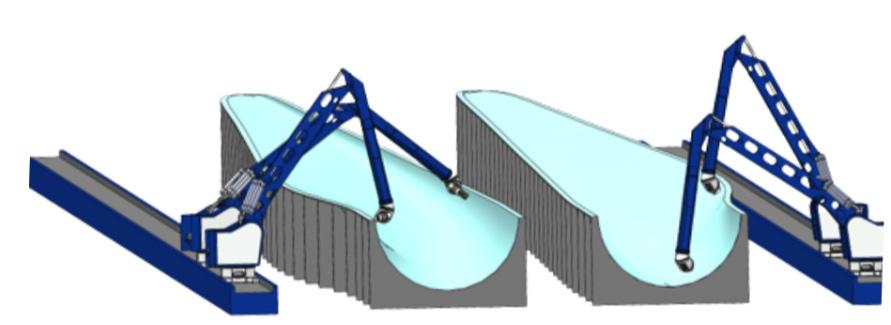
tune blade geometry to individual sites. It would also make room for lighter materials, including some that could be reused when a blade reaches the end of its service life. Blades today rely heavily on composites with no favorable endof-life pathway, so building them from reusable materials from day one would address a disposal problem the industry has mostly postponed.
The grant covers early technical and commercial groundwork. RA Wind plans to print and evaluate small composite test articles and simulate the robotic printing process before scaling up. If that work pans out, the company intends to follow with a pilot factory running as many as four large robots.
CEO Lars Raunholt said the Innovation Norway project is “a deciding factor for moving this innovative project into the prototype stages.”
The printing project also serves RA Wind’s larger target of halving offshore wind’s installation, operations, and maintenance costs. The company has a patented modular turbine design based on standard industrial components and engineered for robotics and AI. DW
RA Wind • rawind.no Energy Transition Norway energytransitionnorway.no
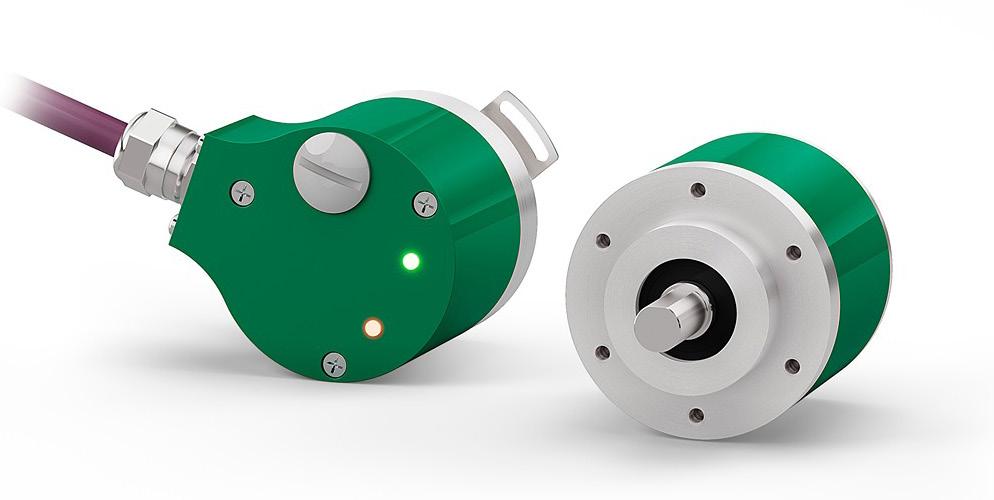
As machine architectures standardize on industrial Ethernet, encoder suppliers are expanding connectivity options across their product lines. Lika Electronic offers a broad family of absolute encoders with Ethernet and fieldbus connectivity for motion control systems, spanning optical and magnetic sensing, hygienic designs, and ATEX-certified versions for hazardous areas.
The Ethernet-based lineup includes single-turn and multi-turn absolute encoders using optical sensing in the EXO series and magnetic sensing in the EXM series. Resolution reaches 18 bits for single-turn versions and 30 bits for multi-turn versions. Supported protocols include Profinet, EtherNet/ IP, EtherCAT, POWERLINK, Modbus TCP, and CC-Link, and compliance with the applicable standards and profiles for each. Available functions include deterministic communication, realtime synchronization, and extended diagnostics.
For food and beverage, chemical, pharmaceutical, and medical applications, the EXO59CK and EXM59CK models follow hygienic design principles and use stainless steel in the housing, flange, shaft, bearings, and cable glands.
On the fieldbus side, models are available for CANopen, Profibus, Modbus RTU, and DeviceNet. The CANopen versions comply with the Device Profile
for Encoders, Class 2, while the Profibus versions comply with the Profibus-DP Profile for Encoders, Class 1 and 2. CANopen and Modbus RTU are also offered in EBO58 and EBM58 point-to-point versions featuring the company’s Energy Harvesting Generator (EHG) technology, already used in the EXO58 and EXM58 Ethernet models. In multi-turn versions, EHG lets the multiturn counter operate without a battery or gears, reducing component count and mechanical wear.
The encoders use a standard 58-mm industrial flange and come in several mechanical configurations. Solid shaft options include 6, 8, 9.52, 10, and 12-mm sizes with a servo flange or clamp mounting. Blind hollow shaft options are available in 14 and 15-mm sizes, with or without a fixing plate. The units are rated IP65 and operate from –13 to 185° F (–25 to 85° C).
Lika also manufactures ATEX-certified XAC77 encoders for Zones 1, 2, 21, and 22, and XAC80 and XAC81 encoders for Zones 2 and 22, all available in Ethernet and fieldbus versions. DW
Lika lika.it

Solid or hollow shaft, high performance, housed and frameless, brushless motors and matching drives for demanding applications.
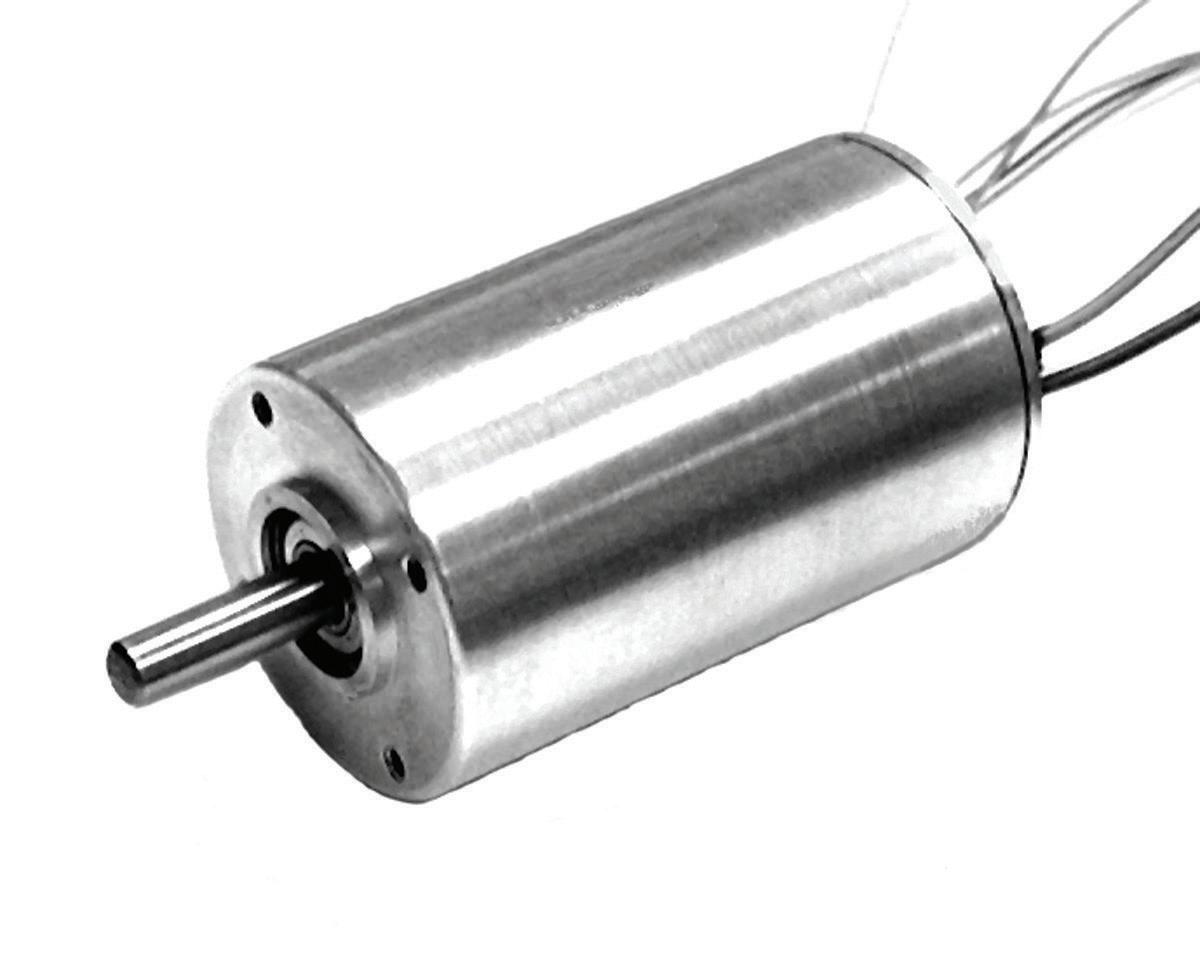
Hall or sensorless motors and drives for surgical tools, aerospace, military, and scientific instrument applications. Custom drive programing and designs available. Motors up to 95% efficient, power up to 1,500 watts. Highest power density in the industry.
Operating temperatures from -73C to 150C
Slotless and slotted designs. Available with encoders and gearheads and separate or integral electronics. Quantities 1 to 5,000.

www.koford.com
Contact us at
mail@koford.com
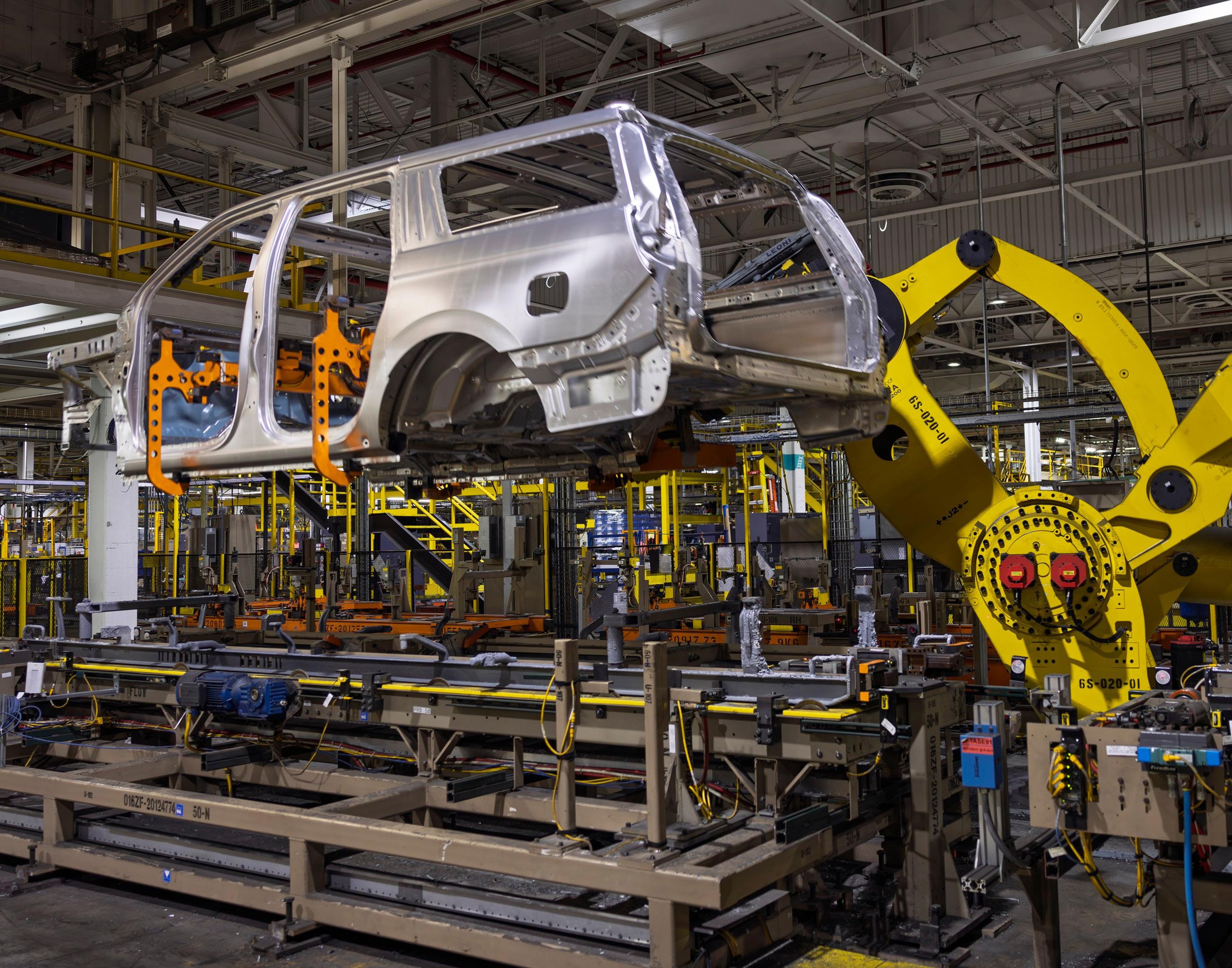
Over the past three years, Ford hired 350 veteran engineers, internally dubbed “gray beards,” to fix quality problems its automated systems could not. Bloomberg broke the story in late June, and then a surge of headlines followed, shouting: AI failed, humans are back. However, this was not a “gotcha” story about a company falling from grace, as J.D. Power’s 2026 Initial Quality Study recently named Ford the top mainstream brand — its first time
leading the ranking in 16 years. Instead, it is a very public lesson-learned story and, quite frankly, an act of humility for the sake of true progress.
Ford’s COO, Kumar Galhotra, told Bloomberg reporters that the company had increasingly leaned on automated quality systems without achieving results. The returning specialists — many former Ford employees, others pulled from suppliers — now run regular quality reviews, mentor younger
engineers, and retrain the AI tools that underperformed. Charles Poon, Ford’s VP of vehicle hardware engineering, was blunt about the mistake, stating the company assumed that introducing AI and feeding it design requirements would produce a high-quality product. It did not, in part because many of the engineers left before their knowledge made it into the systems. Poon said that AI is “only as good as the information you use to train it.”
However, Moritz Maier, CEO of the engineering automation platform Synera, argues that framing this story as an AI failure misses what actually went wrong.
“Companies often become blind to where the real value lies when they become obsessed with replacing human input. So, like most AI failures, this is a focus issue,” Maier said. “Agentic AI frees up time. It increases speed. However, expertise still comes from engineers. This is not something that AI can replace; it is something that AI needs.”
In Maier’s view, the technology changes the job, not the need for the person doing it. “The engineer becomes a curator of AI, not someone AI replaces,” he said.
For companies deploying agentic tools, the order of operations matters more than the ambition.
“The sequencing and use case are everything. Pick one high-volume process with a direct line to revenue — RFQ-to-quote, design-to-cost, simulation prep. Roll it out one department at a time. Our customer IMS Gear started with plastic, its largest business line, before extending to metal and industrial. Standardizing processes before you automate means the LLM interprets, the rules decide, engineers still sign their name to the result. That’s the difference between weeks and minutes. Not replacing engineers. Giving them their judgment back.”
For working engineers, Maier’s advice is to treat agentic AI as a digital
coworker that handles the tedious, repetitive work, and get fluent now. “Job descriptions will shift in the coming months regardless. Learn the tools. Engineers who do will stay ahead. Engineers who don’t will struggle to catch up.”
Ford paid billions to learn what Maier states concisely: “Agentic AI can be a huge competitive advantage if companies stop treating AI as a costsaving exercise. Start viewing it as a force multiplier for the expertise you already have.” DW
Synera synera.ai


Food and beverage manufacturers operate in one of the most complex and tightly constrained production environments — margins are thin, throughput expectations are relentless, and the consequences of downtime or contamination escalate quickly.
With these challenges, incremental improvements at the machine or robotic cell level are no longer enough. At scale, what matters is how the system performs holistically. Food and beverage production floor leaders must know how each process interacts, where risks emerge, and whether changes deliver measurable gains across the full production line. Digital twin technology empowers manufacturers to answer those questions before issues arise and to respond faster when they do.
Traditionally, many operations, food and beverage included, managed change in a reactive way. New equipment is installed, systems are adjusted, and teams tackle issues as they occurred. In some cases, planning relied on spreadsheets, static layouts, or isolated simulations that failed to capture the full complexity of the production environment. It was, and for those not taking advantage of digital twin technology still is, a “wait and
see” approach that depends on rapid response teams to resolve problems after they disrupt production.
By contrast, a digital twin allows manufacturers to validate machine interactions in advance, identifying gaps or inefficiencies before they translate into downtime. The shift from reactive troubleshooting to proactive solutions is one of the most significant advantages the technology brings to the table.
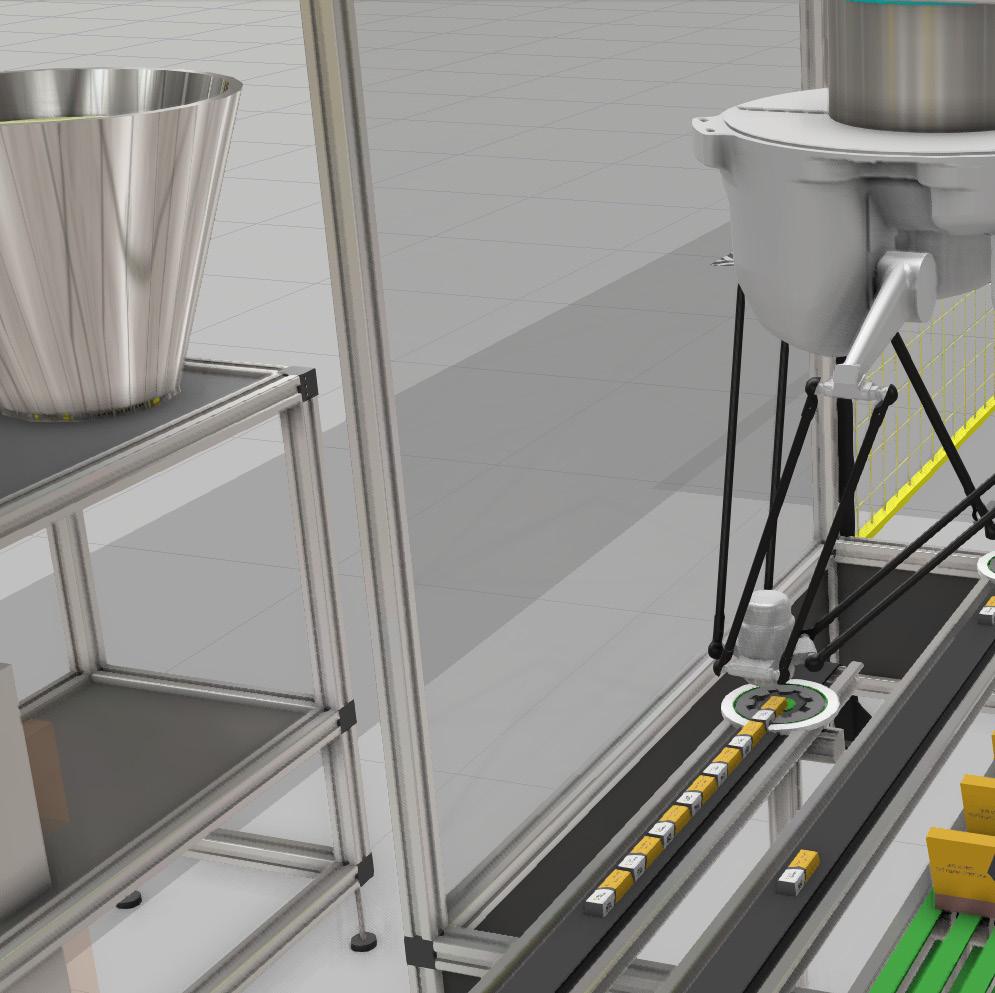
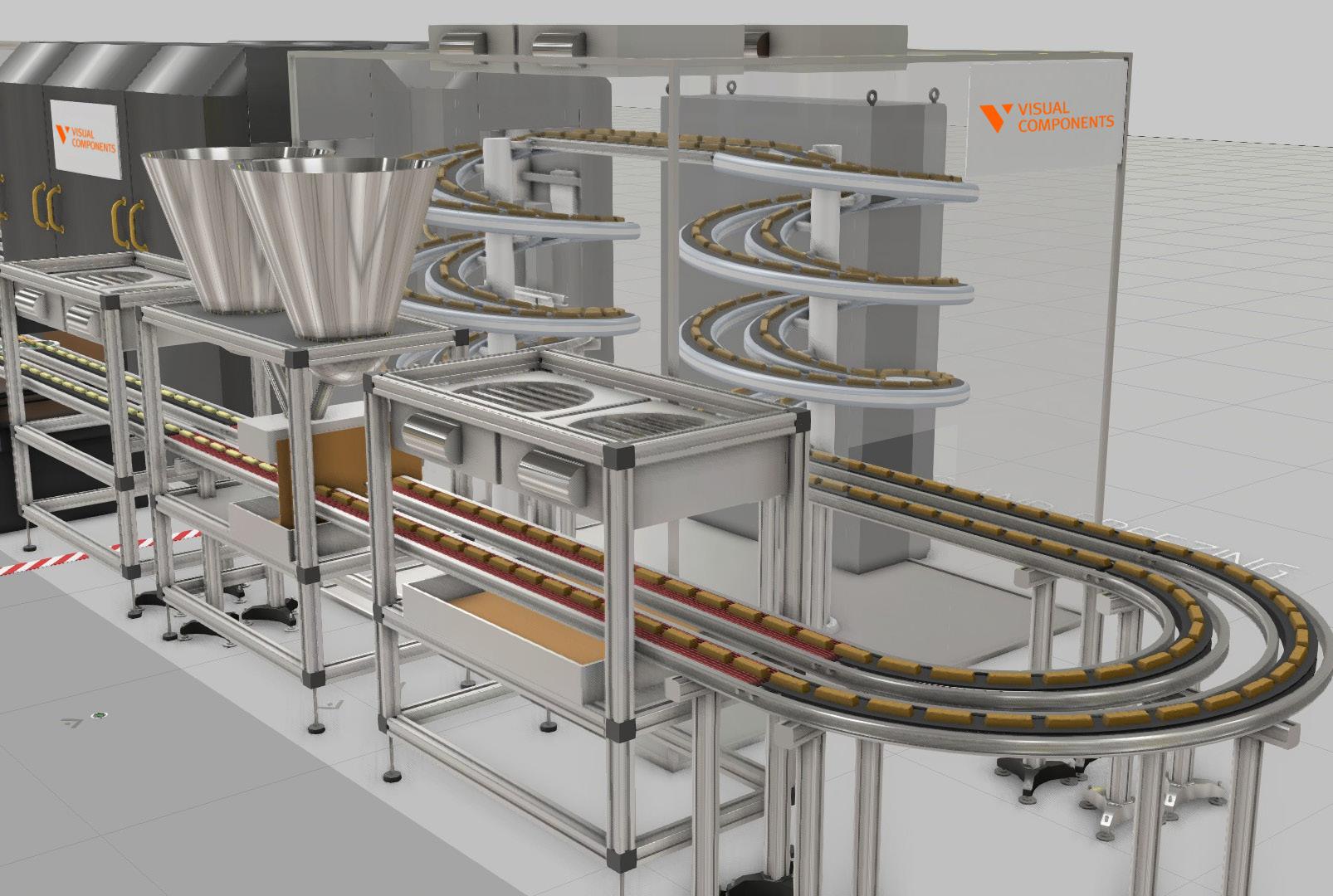
With a virtual representation of an entire production system, manufacturers can evaluate how processes function before purchasing or even placing them on the shop floor. The virtual model can visualize simulated, pre-deployment
environments or a real-time operational mirror. This enables assessment of how new equipment integrates with existing systems, how communication protocols align, and how timing and sequencing affect throughput, all of which are critical for automated facilities.
A persistent challenge in optimizing the shop floor is the tendency to focus on individual components rather than the system as a whole. A new machine may perform exceptionally well when isolated, but if upstream or downstream processes cannot support its output, the overall line sees little to no benefit.
Digital twins provide a powerful tool for achieving this adaptability. By enabling manufacturers to test scenarios, evaluate trade-offs, and optimize performance in a virtual environment, they reduce the risks associated with change.
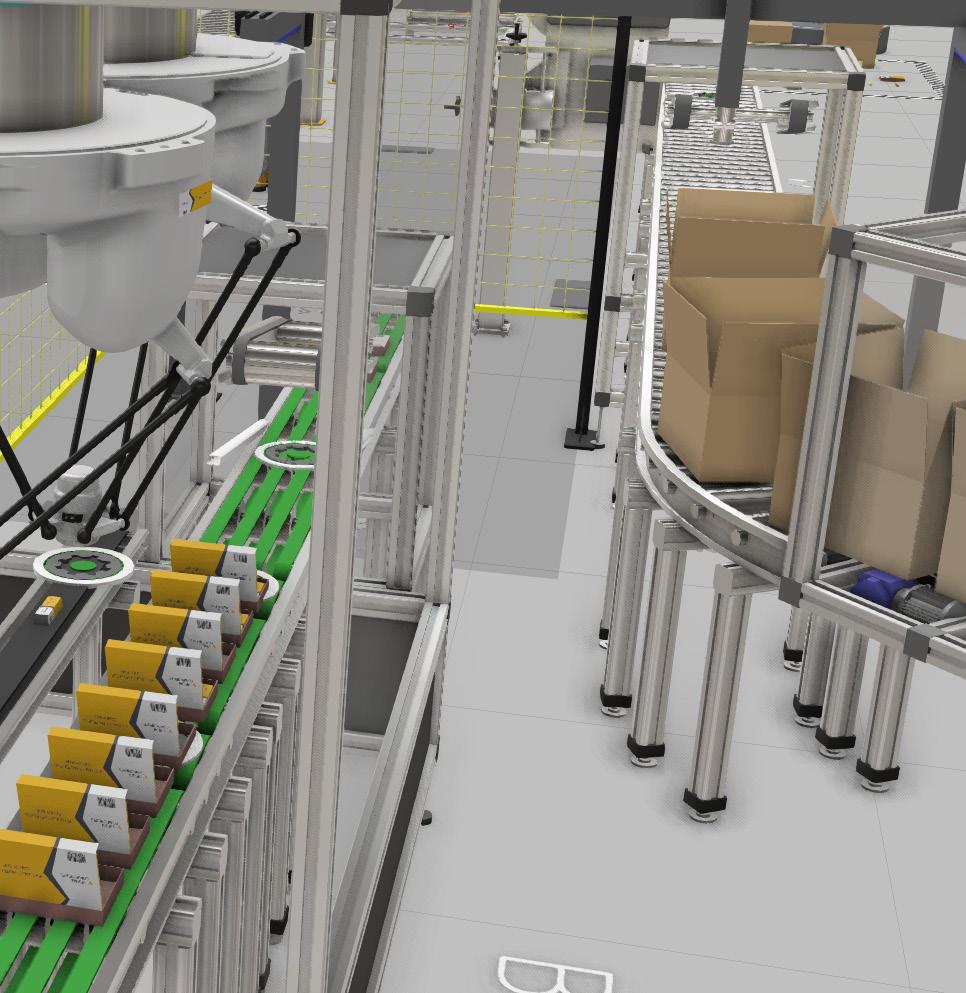
Across food and beverage production, where automation dominates, this disconnect is costly. In snack packaging, for example, a formfill-seal machine may achieve higher cycle speeds, but without synchronized cartoning and case packing, finished bags quickly bottleneck. Without a comprehensive understanding of system dynamics, investments intended to improve performance may fail to deliver meaningful yields.
Digital twins provide a macrolevel perspective because they can integrate multiple systems across the production environment. Instead of evaluating equipment in isolation,
manufacturers simulate end-toend processes to understand how changes affect overall performance. This includes analyzing throughput, identifying holdups, and quantifying net gains across the full system, something individual simulations or OEM-specific tools often cannot capture.
The net gain is central to defining success. Automation investments are intended to increase output, reduce costs, and/or improve quality. A digital twin provides the data and visibility needed to determine whether those objectives are met, and whether alternative configurations might deliver better results.

Even if a UFO-Sasquatch Institute of Technology existed, it likely wouldn’t have the “Interpower Files” which contain worldwide certifications from renowned and real-world terrestrial safety agencies such as UL, VDE, and JET regarding Interpower’s Accessory Power Strips (APS) and IEC 60320 Jumper Cords. Or, how APS and jumper cords meet and exceed all worldwide testing requirements. Nor is it likely an extraterrestrial or Sasquatch would testify under oath that Interpower’s APS and jumper cords come tariff-free and with 1-week U.S. lead times. Note: For orders beyond the Milky Way after 2070, please use the Andromeda app for orbital pickup (subject to change).
Phone: (800) 662-2290 E-mail: info@interpower.com
Business Hours: 7 a.m.–5 p.m. CST Order Online! www.interpower.com
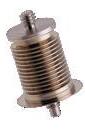
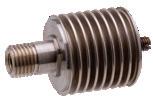
Servometer® - PMG, LLC
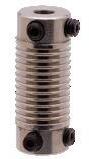
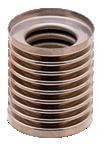
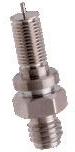
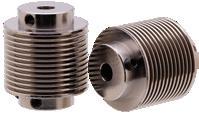
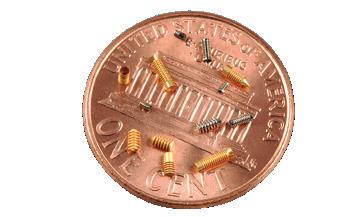
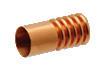
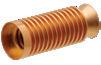
Custom Designed Miniature Electrodeposited Nickel Bellows have diameters as small as 0.020 inch (0.5mm), are ideal for dynamic applications where reliability and long life are critical requirements. Servometer®


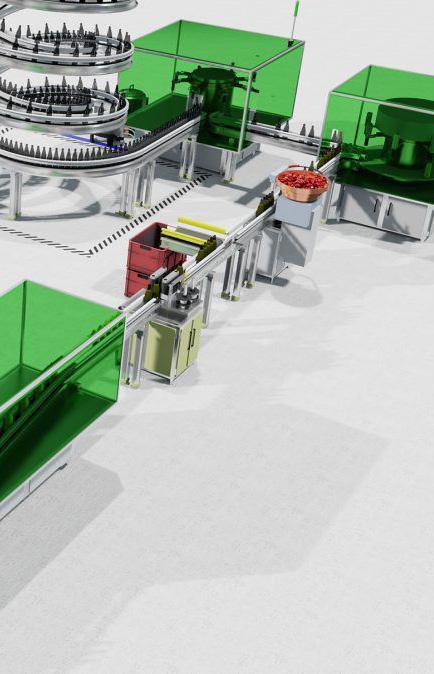
Beyond upfront validation, digital twins also play a critical role in ongoing operations. In large-scale food and beverage facilities, production lines can span hundreds of yards and include dozens of connected processes. Effectively monitoring interlocked performances across multiple football fields is an unrealistic expectation to make of production floor managers.
Real-time digital twins, on the other hand, extend visibility across the entire system. By aggregating data from machines, sensors, and control systems, they provide a centralized view of operations, enabling teams to detect anomalies, track performance, and respond quickly to disruptions.
This capability is especially valuable in high-volume production, where even small inefficiencies can have a significant financial impact. A brief delay in a packaging line, for example, can lead to product backups, reduced throughput, and potential waste. If the root cause is not identified quickly, the negative effects compound.






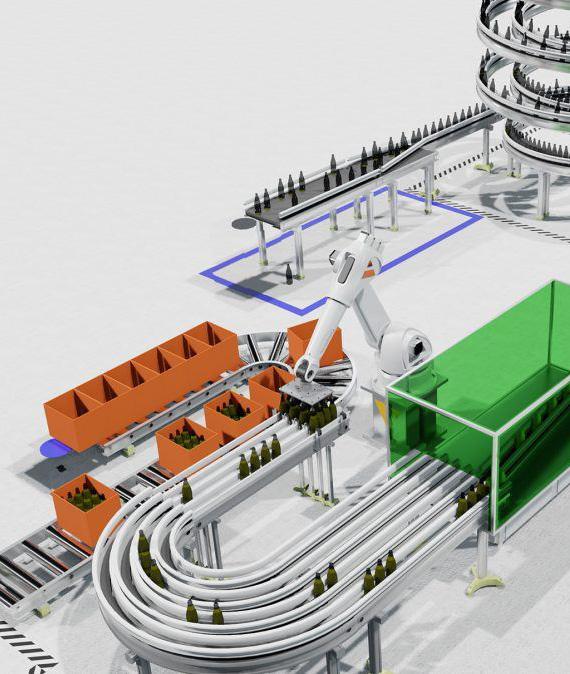
With a digital twin, issues can be flagged immediately, and their sources can be pinpointed using system-wide data. Instead of diagnosing problems through trial and error, teams can identify the exact machine or process responsible and take targeted action. The result is faster resolution, reduced downtime, and more consistent production.
Hygienic
Hygiene defines food and beverage manufacturing, influencing everything from equipment design to facility layout. While digital twins are often associated with performance optimization, they also offer valuable insights into hygienic practices, particularly at the system level.
One key area is product flow. In many facilities, products move through a series of stations, transitioning from processing to packaging to palletizing. These transitions can involve conveyors, lifts, or manual handling, and they may cross boundaries between hygienic and non-hygienic zones.
Without a clear understanding of these flows, it is easy to overlook potential risks. For example, a product may pass through an intermediate area that introduces contamination risk, or handling processes may inadvertently compromise cleanliness standards.
By modeling the full production system, a digital twin allows manufacturers to document these flows and identify vulnerabilities. This includes examining how products move between zones, how materials are handled, and how different processes interact. These insights can reduce risk by informing decisions about layout, automation, and process design.
Additionally, digital twins can highlight opportunities to minimize human intervention in sensitive areas. While personnel remain essential in many parts of the process, reducing unnecessary contact points enhances hygiene and consistency.
Many manufacturers have taken an “a la carte” approach and invested in a range of tools, including product lifecycle management (PLM) systems, process simulators, and other standalone platforms to assist automated production lines. On the surface, these tools address individual functions but may not integrate seamlessly.
This fragmented method creates inefficiencies. Data may need to be regenerated across systems, and inconsistencies can arise when transferring information between

Interpower® Tariff-free Accessory Power Strips (APS) and IEC 60320 Jumper Cords come with 1-week U.S. lead times— why tolerate overseas supply chains and tariffs? Our APS and jumper cords are made from superior raw materials and undergo testing that exceeds UL and VDE testing standards. The APS contains multiple IEC 60320 Outlets allowing IEC 60320 Jumper Cords to connect to multiple devices. Popular APS choices are 4–12 Sheet F outlets or a Sheet F and Sheet J combination. No reconfiguration is needed as the cords plug directly into the wall and equipment straight out of the box.
Phone: (800) 662-2290
info@interpower.com Business Hours: 7 a.m.–5 p.m. CST Order Online! www.interpower.com
platforms. Over time, organizations may accumulate a patchwork of solutions that are adequate but fall short of delivering a cohesive, system-level view. The challenge is not simply technological but also organizational. Transitioning to an integrated system requires alignment across teams and a willingness to rethink established workflows. For companies with high sunk costs in existing systems, the decision to consolidate or upgrade can be complex.
However, the long-term benefits of integration are substantial. A unified digital environment can streamline data management, improve collaboration, and provide a more accurate and comprehensive representation of operations. For manufacturers looking to scale and adapt to future demands, these capabilities are increasingly important.
Implementing digital twin technology is not an all-or-nothing proposition. In fact, attempting to deploy a full, real-time
digital twin without a solid foundation can be counterproductive. A more effective model is phased, aligning investments with specific objectives and levels of growth.
Early stages may focus on simulation through new equipment evaluation, process change testing, and concept validation before implementation. This provides immediate value by reducing risk and improving overall decision-making.
As capabilities develop, companies can expand into more comprehensive system modeling, incorporating additional processes and data sources. This then evolves into real-time digital twins that support ongoing monitoring and optimization.
Throughout this progression, the emphasis should remain on understanding the system as a whole.
Consumer preferences evolve and the food and beverage industry responds with expanded product portfolios. At the same time, regulatory requirements tighten, labor shortages continue, and
supply chain disruptions are ongoing, adding new layers of complexity.
Flexibility and resilience are crucial for the industry. Production systems must be able to adapt quickly to new products, new processes, and new constraints without sacrificing efficiency or quality.
Digital twins provide a powerful tool for achieving this adaptability. By enabling manufacturers to test scenarios, evaluate trade-offs, and optimize performance in a virtual environment, they reduce the risks associated with change. They also support continuous improvement, providing insights needed to refine processes over time.
Ultimately, the value of digital twin technology lies in its ability to shift perspective from individual components to the entire packaging system. Instead of optimizing machines in isolation, manufacturers can see how production, material flow, and downstream packaging interact as one connected system. That visibility uncovers bottlenecks that only emerge under real operating conditions, such as during changeovers, demand shifts, or line imbalances, and addresses them before they impact output. The result is more stable throughput, smarter investment decisions, and packaging operations that perform as a unified whole.
As the industry continues to evolve, those who embrace digital twin technology will be better positioned to navigate uncertainty, meet regulatory demands, and deliver consistent, highquality products at scale. DW
An engineer’s overview: This article dives into the oftenoverlooked challenges faced by design engineers during the development process of robotic systems. By shedding light on these challenges, this article aims to equip engineers with best practices and insights to streamline their product development processes, ultimately leading to more innovative and effective robotic applications.
Advances in robotic technology are continuously enhancing people’s lives by supporting diverse applications in the medical and industrial fields. For instance, surgical robotic technology enables minimally invasive surgeries that improve patient recovery time and minimize scarring; humanoid/inspection robots can perform dangerous and repetitive tasks, providing humans with safer work conditions; and myoelectric prosthetic limbs improve patients’ independence and quality of life.
ANTONIO HERRERA • STRATEGIC MARKETING MANAGER • PORTESCAP
development project more efficiently. Common decision points include:
• which motion control technology can solve my robotic challenge most efficiently?
• what is the best approach to select, test, and validate the subcomponents for my application?
Nevertheless, there are many challenges to overcome during the product development process of robotic applications. This article considers the typical journey faced by OEMs when designing and selecting motion control systems for their robotic devices to raise awareness about best practices to help you execute your next product
• how do I navigate commercial challenges like integration, designing for manufacturability, compliance, and regulation?
• should I execute everything inhouse with my own resources?
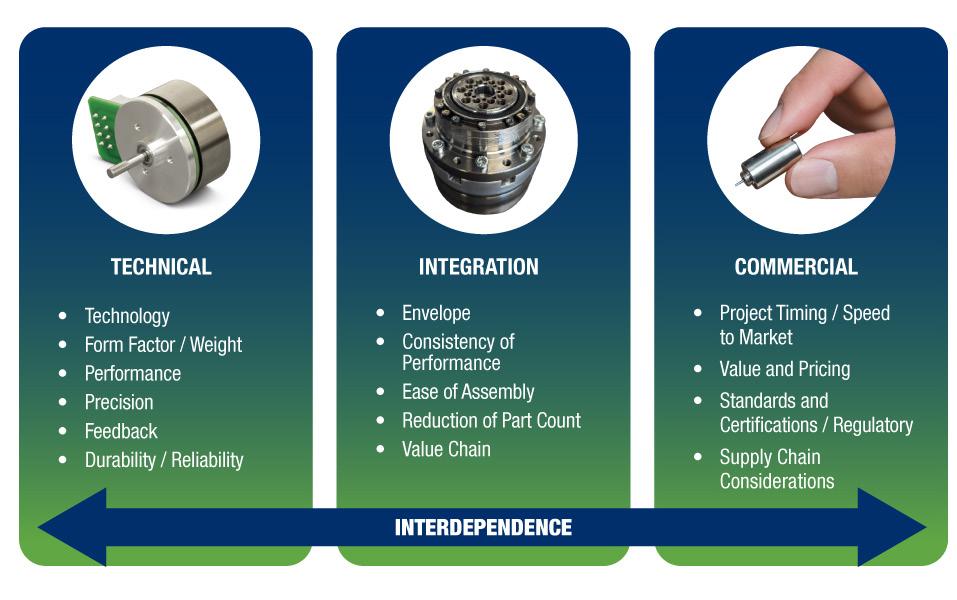
Technical requirements, integration, and commercial needs must be balanced by thoroughly deciding which factors are critical and which are flexible.
development, technical performance, design integration, and commercial needs are interdependent.
Selecting the working point(s) is one of the first steps in a long journey that engineers face when designing electromechanical solutions. Torquespeed, radial, and axial load points quickly become critical items that need careful attention. Along with these technical requirements, the development team will need to consider the physical space and weight
limitations, as well as the desired motion profile of the device, encompassing how smooth, responsive, and precise the movement of each axis should be.
It’s only after spending considerable time and effort on these factors that other considerations typically enter the picture, such as suitability for the application’s environment, design for manufacturability, system integration, and regulations and compliance. Depending on how much time and effort have been involved without considering the latter factors, the project development could hit hurdles and roadblocks, thereby leading to delays and cost overruns due to the need to revise technical attributes and previously selected components.
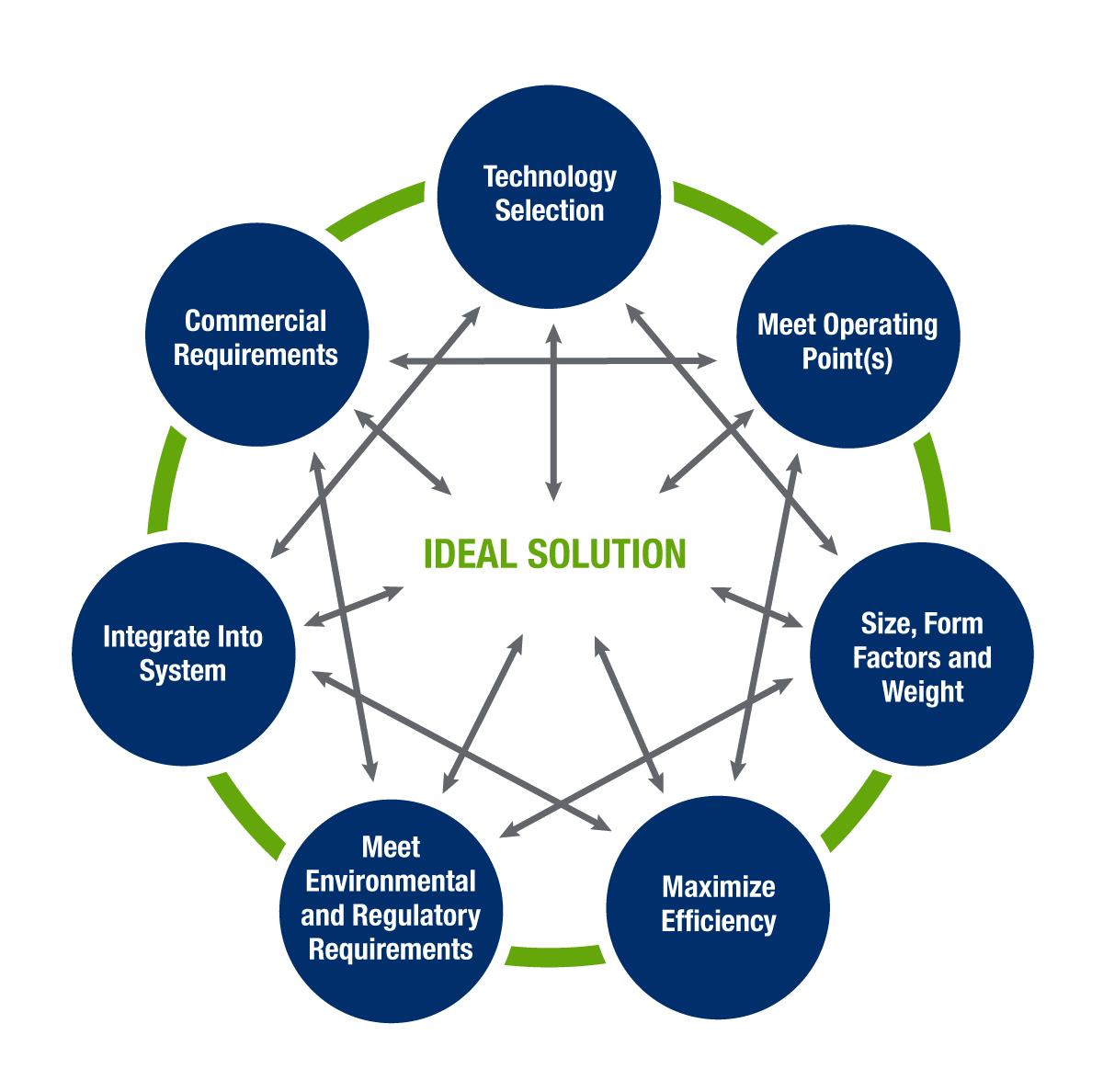
Figure 2 depicts the important interrelationship among all these factors
to develop an optimum solution. Much of this innovation is driven by advanced motion control systems and continual component miniaturization.
Miniaturization plays a crucial role in advancing robotic devices, as it inherently encompasses many technical requirements previously discussed. These include meeting the operating points with the desired motion profile, operating reliably at maximum efficiency, fitting within limited physical space, and integrating smoothly with all other components.
With many robotic devices leveraging miniaturization to support life-critical applications, reliability becomes another
critical factor. To develop products and solutions that are both reliable and compact, engineers must solve complex problems such as minimizing heat, ensuring component compatibility, and considering overload/continuous operation and other failure modes.
It is normal to ask yourself, “Can I have it all?” Instead, consider the question, “What’s most important for the success of my robotic application?” Moreover, this balancing act can be less burdensome with the support of an experienced partner.
FIGURE 2: Finding the ideal robotic motion solution is a balance of interrelated considerations.
2: Finding the ideal robotic motion solution is a balance of interrelated considerations.
Reputable and experienced motion control solution providers recognize these challenges and can support development plans for timely and costefficient execution. Here are a few critical characteristics to consider when seeking out a motion partner:
• technology diversity and capabilities
• application-specific knowledge and understanding
• flexibility to support you and collaborate
• speed-to-market options — COTS, quick-configurations, and samples, custom designs
• leadership in innovation and product development
By relying on motion control experts with diverse solutions and an understanding of manufacturability methods and commercial challenges, you can leverage alternative paths for technology selection, such as Commercial-Off-The-Shelf (COTS) solutions versus customization. Additionally, you can receive technical support throughout the entire development process for maximum reliability and integration.
When considering the motion requirements of your robotic applications, it’s essential to think beyond just speed and torque and beyond the next compliance approval milestone. Seek value-adding partners, not just suppliers. Lasting partnerships are built on collaboration and active engagement, fostering trust and mutual success. DW
Physical space and weight limitations (diameter, length)
Complex motion profiles (smooth, accurate, responsive)
Thermal limitations due to close proximity of motor, gearing, and feedback devices
Minimizing stray field magnetics in compact designs, which might limit the use of some low-cost feedback devices
Assembly, reliability, device lifespan, and integration
Interface with a design-locked component
Commercial concerns for cost and scaling to production
TABLE 1: Solutions and capabilities from leading motion control providers for your next product development project.
Miniature solutions and various form factors, such as outer-rotor flat motors, frameless motors, BLDC, and precision gearheads.
Low/no cogging solutions, zero backlash gearing, feedback devices, and customization capabilities.
Creative motor designs that leverage high torque performance in the smallest form factors.
Advanced electromagnetic designs for optimal design flexibility.
Design for manufacturability and simplicity, reducing part count.
Optimized standard features and sizes to achieve an ideal fit.
Design for manufacturability and design reviews to optimize SWaP-C (Size, Weight, Power, Cost).


EDITED BY: Rachael Pasini, Editor-in-Chief
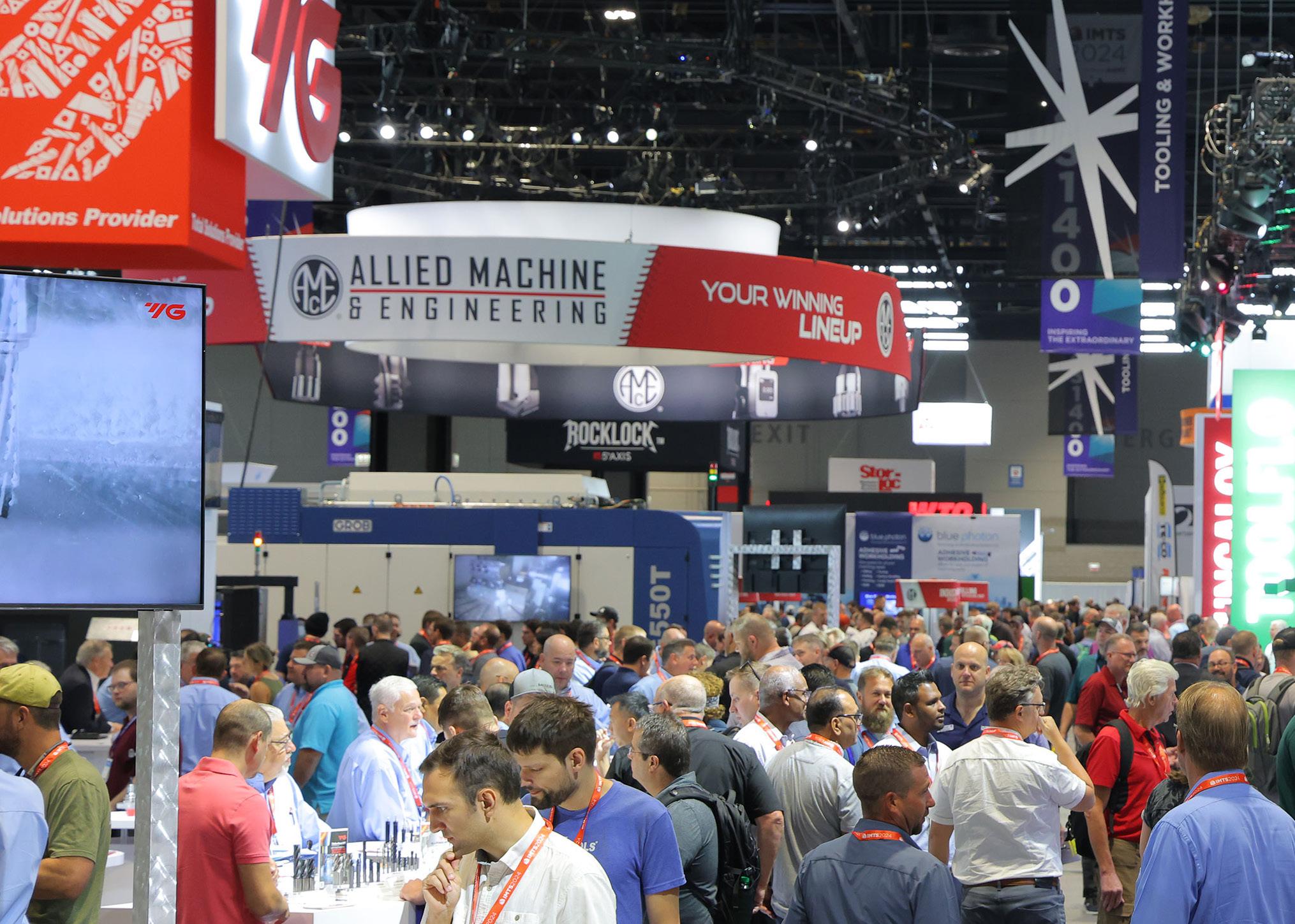
With manufacturing technology orders climbing and productivity showing its strongest gains in years, this year’s IMTS (International Manufacturing Technology Show), produced by AMT (the Association for Manufacturing Technology), will give manufacturers a front-row view of the technologies accelerating the industry’s next wave of growth. Across the show floor, visitors will experience industrial AI, automation, additive manufacturing (AM), digital twins, software, machining, metrology, and connected production systems that are helping companies increase output, improve efficiency, and move faster from design to delivery.
IMTS 2026 runs Sept. 14–19 at Chicago’s McCormick Place, with conferences running Monday through Thursday of the show. The event will bring together more than 86,000 registrants, 1,800 exhibitors, and 10 technology sectors that cover 1.2 million square feet of exhibit space. There will also be nine total conferences, featuring 69 sessions covering automation, artificial intelligence, systems integration, machining, materials, tooling, workholding, metrology, alternative manufacturing, software, cost justification, and more.
One focus this year is on industrial AI as an enabling technology increasingly used by manufacturers
to optimize operations, empower workers, and drive continuous improvement. During the new IMTS Industrial AI Conference, a full-day event on Sept. 16, featured speaker Jay Lee of the A. James Clark School of Engineering at the University of Maryland will share how manufacturers can identify high-impact opportunities, overcome common data challenges, and build the operational foundation needed for successful AI adoption. Sessions will highlight real-world applications that improve productivity, machine performance, and workforce effectiveness.
Technology is already changing what manufacturers can achieve.
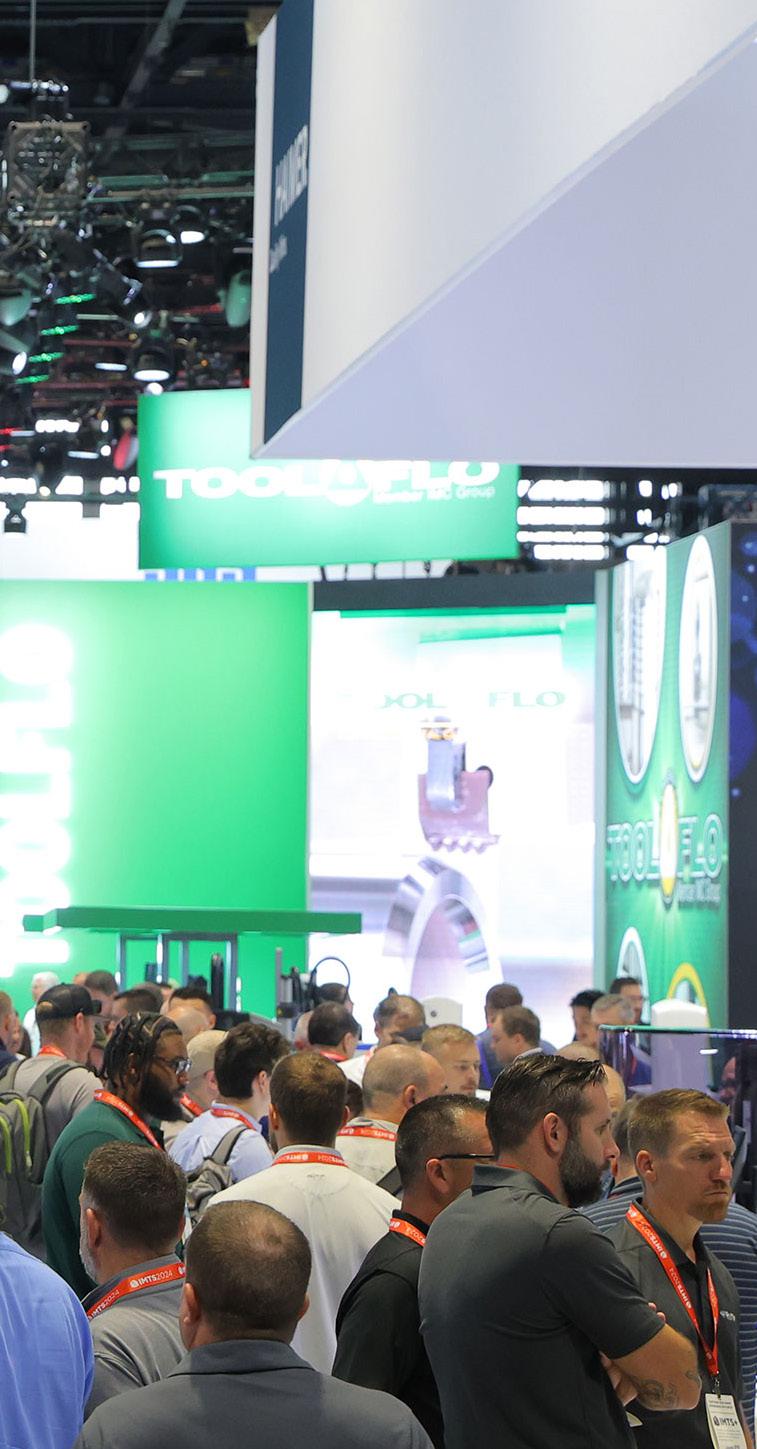
The Association for Manufacturing Technology will welcome more than 86,000 registrants and 1,800 exhibitors to IMTS 2026 at the McCormick Place in Chicago, Sept. 14–19. IMTS
High-performing job shops are using unattended operations to increase machine utilization and revenue, while automation and supply chain efficiencies are helping fuel reshoring and foreign direct investmentrelated jobs. Attendees can see the technologies behind that momentum and evaluate how they can strengthen resiliency, productivity, and growth in their own operations. DW
AN
OUT FOR
WORLD MANAGING EDITOR MIKE SANTORA ON THE SHOW FLOOR!
PART 3 OF 3
We’ve outlined how screw-based electric actuation increasingly finds use in today’s presses and other machine tools. Other heavy-duty machinery also makes copious use of this and other types of electric actuation.
LISA EITEL · EXECUTIVE EDITOR
Heavy-duty machine tools create uniquely challenging conditions for screw-based electric actuation — and yet the benefits of such actuation often justify the extra engineering to migrate from traditional fluid-power solutions.
As we’ve covered, an increasing number of industrial machine tools use screw-type electric actuators rather than hydraulics to apply controlled force over a set distance. These actuators usually combine a rotary electric motor (such as an ac servomotor) and a ballscrew or roller screw to precisely move critical axes.
But what about machine tools involving extremely large workpieces or workcells? Here, rack-and-pinion drives are standard on many long X and Y axes of large installations, because rack
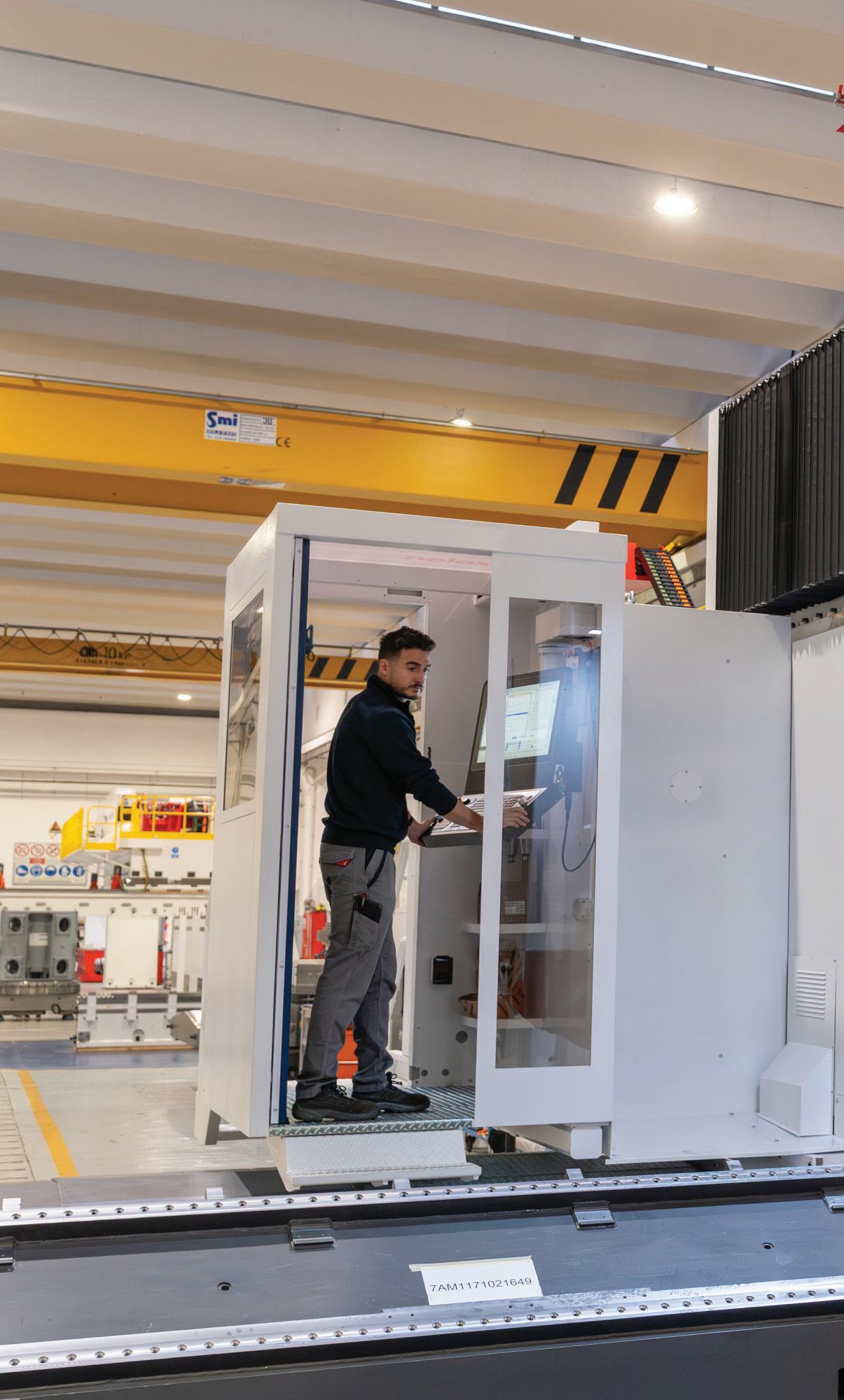
This EMCO milling machine maintains precision with controls that include a Renishaw RMP60 radio probe, kinematic measurement, and laser system for detecting tool length and diameter. This in turn reduces errors and increases operational reliability.
sections can be joined for travel over many meters sans the critical-speed constraints of screw-based solutions.
Consider large-scale straddle gantries that traverse many meters (and even dozens of meters) to assist in the demolding, processing, or other finishing of cast architectural, aerospace, and energy workpieces. These have a bridge-type arrangement to allow especially sizable workpieces through their portal. Large linearmotion systems in the form of rack-andpinion drives carry workpieces over the long travel lengths while maintaining high stiffness and precision.
when used in tandem for a dual-drive format. These setups command two pinioned motors along parallel racks.
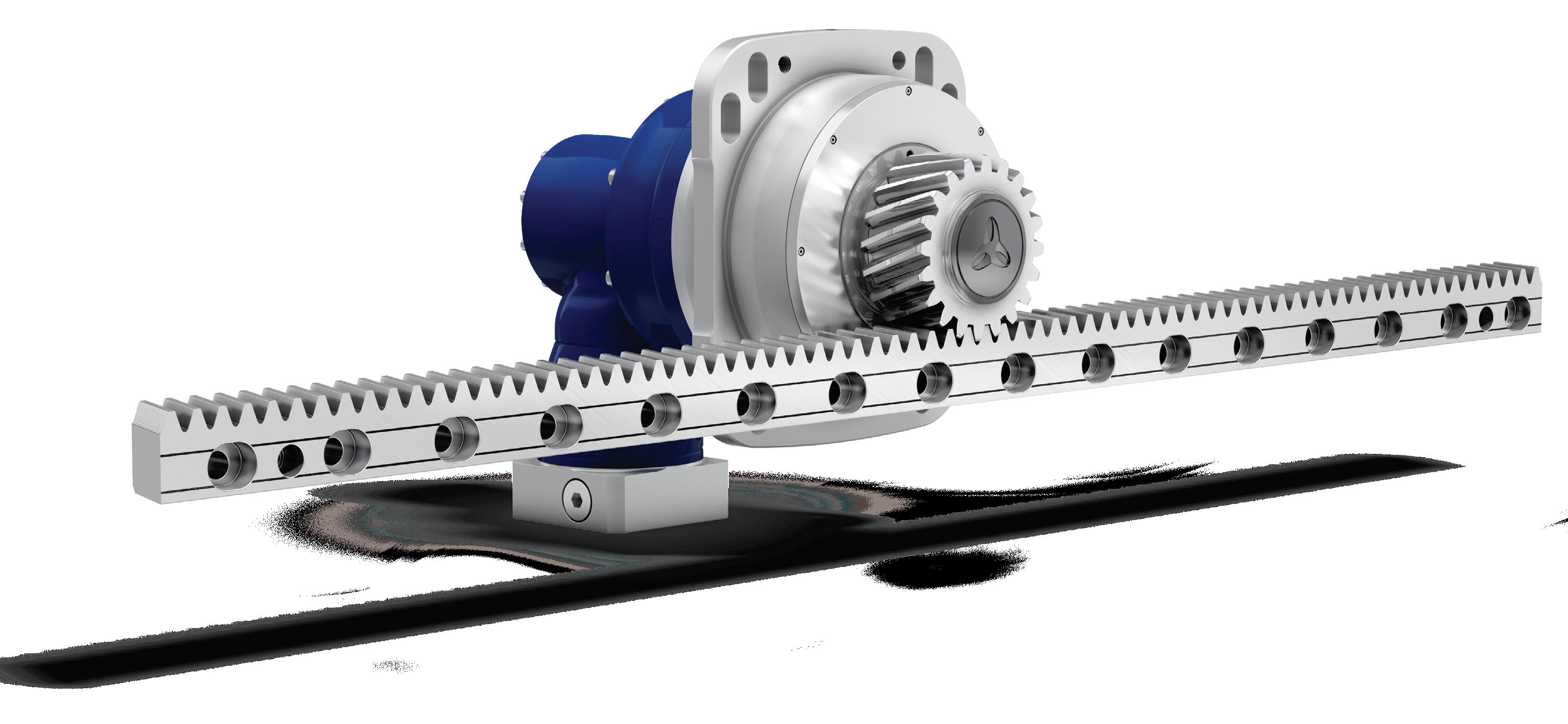
Milling machines beyond a certain size feature rack-pinion drives. Preloading to minimize backlash can impart the stiffness and reversal behavior needed for milling. For example, portal milling machines from Germany-based Zimmermann (with U.S. offices in Michigan) employ rack-andpinion drives in X and Y complemented by linear guides for precise and dynamic motion. More specifically, the machine builder uses Wittenstein HPLS rackpinion drives on certain FZ-series portal milling machines.
Rack-pinion drives deliver especially high thrust at high traverse speeds
All this use of rack-and-pinion solutions doesn’t completely preclude the use of screw-based actuation on large-scale gantries, though. Ballscrews
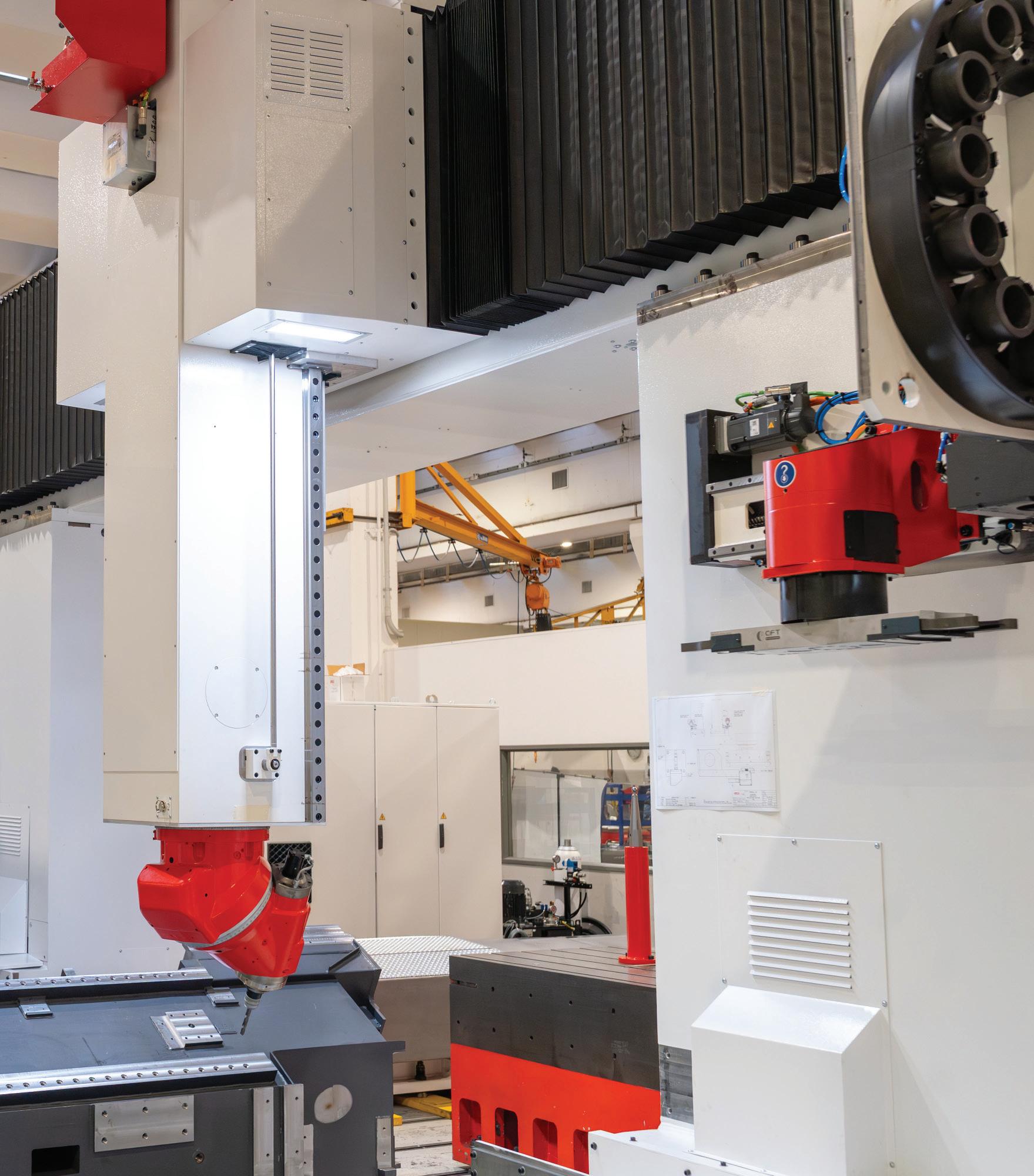
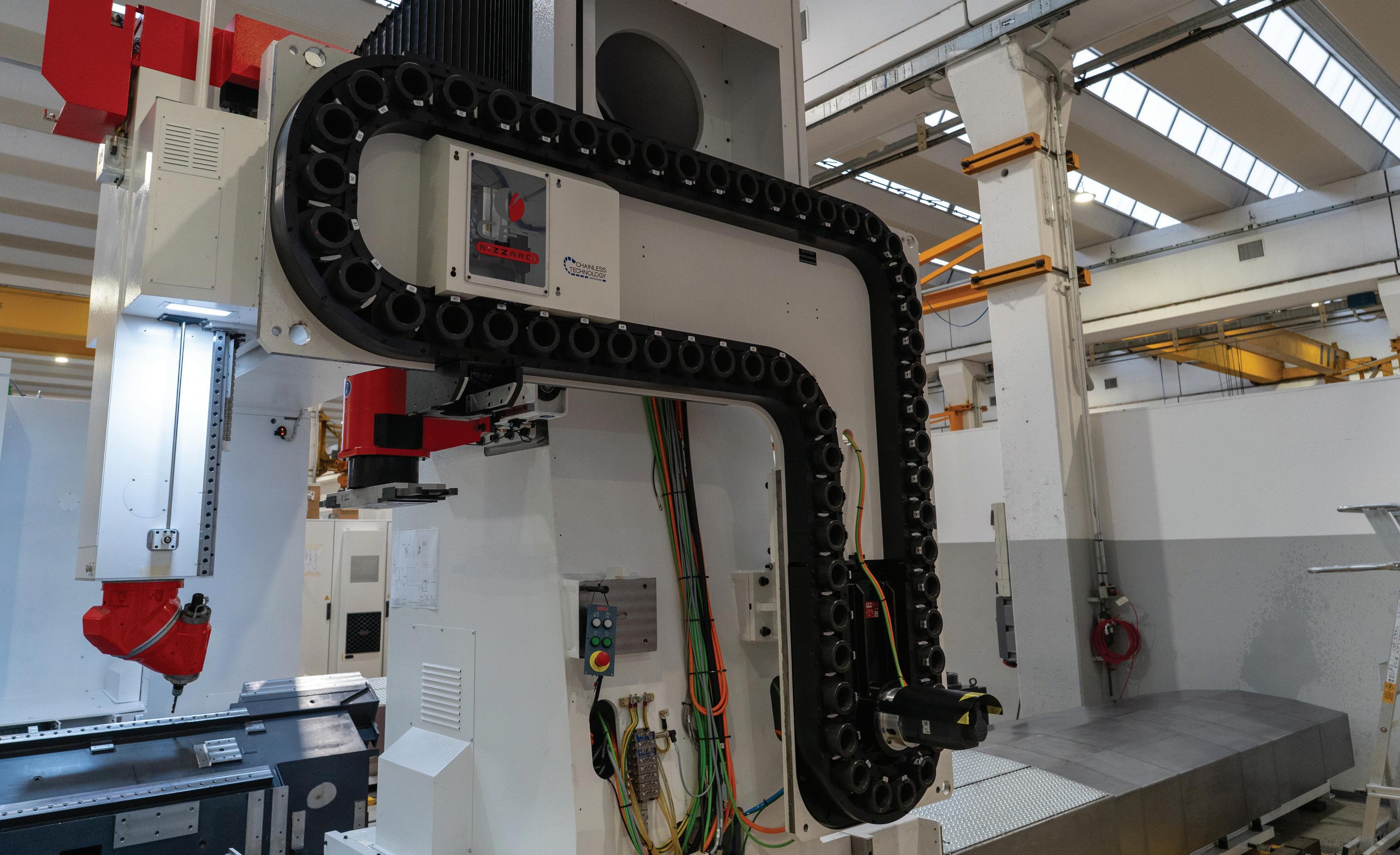
Chip evacuation (often executed in conjunction with cooling) is especially important in heavy-duty machining operations. This EMCO milling machine has dual cooling with 6-bar 28 L/min. external and 40-bar 20 L/min. internal to the spindle subsystems. Completing the circuit are a chip evacuation system, two ramp conveyors along the entire work surface, collection tanks, and a 2000-L filter.
are limited by available screw length, critical speed, and support complexity so they’re more prevalent on moderatetravel portal axes and Z-W rams — where gantry strokes are shorter than about 6 m or so. That’s especially true for Z axes and to a lesser extent Y axes.
As mentioned in previous installments of this series, ballscrews offer high axial stiffness and linear thrust along with predictable behavior that simplifies the control of axes in which they operate. No wonder some gantrytype five-axis machining centers employ ballscrews on all axes.
Where needed on heavy axes, dual ballscrews (like rack-and-pinion sets) can be operated in tandem in dualdrive setups. Besides increasing thrust, certain variations can also prevent racking — the issue of skewing. This occurs when one of the two linear axes mounted and connected in parallel lags behind the other, and the leading drive pulls the laggard along.
Where linear motors are suitable
The most common motors on the linear axes of machine-tool gantries and related heavy equipment are overwhelmingly brushless (permanentmagnet synchronous) ac servomotors paired with gearing of some type. That’s true whether the motor pairs with a screw drive or sports a pinion to ride a toothed linear rack. In contrast, for the rotary axes on five-axis milling machines (whether swivel-head designs that pivot the tool or trunnion designs that pivot the workpiece) direct-drive torque motors (sans gearing) can be more common than gearmotors. For example, certain gantry milling machines from Megatel CNC Solutions Inc. feature direct-drive motors on these milling axes.
But direct drives can be suitable for the linear axes of these machines, too. Linear motors (typically iron-core linear synchronous) offer efficient direct-drive operation with essentially zero backlash,
high acceleration, and top reliability. Linear motors here are most common on high-speed vertical machining centers or VMCs — especially those having shorter travels than say, aerospace-size portals. Linear motors of course are costlier than alternatives and (due to their heat generation) require careful thermal monitoring and management.
For load bearing, rack-pinion linear axes are complemented by:
Profile-rail linear guides with recirculating cylindrical rollers or (less common in these applications) balls. Roller-type profile rails (cylindrical rollers in the carriage) are favored as machine axes get larger because they offer high stiffness and load capacity though at the expense of slightly higher friction and more need for lubrication.

Track-roller (steel wheel on mating track) linear guides. These totally contain the load-bearing arrays (whether balls or cylindrical rollers) within the wheel assembly, so they never directly contact the track … and all the debris that might be on it. Another benefit that track-roller linear guides offer to machine-tool equipment is a geometry that’s forgiving of misalignments that might be present between dual drives operated in tandem on a given axis.
Linear splines or round rail paired with bushings — often integrated in foursomes around the axis. These excel on vertical axes needing to maintain alignment.
Linear slides with boxway or dovetail geometries. In fact, these linear ways handle immense loads and vibrations with large areas of contact for applicability that differs from the other linear bearings mentioned here. No wonder they persist in the largest, heaviest, and highest-force axes.
Hydrostatic (oil-film) linear guides — especially on axes needing vibration damping. Hydrostatic linear guides have carriages featuring an internal circuit of pressurized oil that’s regulated by an external system. The carriage rides the linear guideways upon its circuit’s hydrostatic pockets of oil. Bridgemill OEMs especially employ hydrostatic guideways to avoid stick-slip and wear.
feedback
No matter the actuation type, electromechanical drives are complemented by motor encoders and in some cases linear encoders (scales). The latter appear on precision axes as well as extra-long axes (of many meters) as those on large gantries needing accuracy over the full stroke. That way, position is maintained though closed-loop control to mitigate any effects of rack or screw pitch error, thermal growth, or various forms of mechanical compliance. For example, W Industries’ massive CyberMill gantries use Heidenhain LB 382C sealed linear encoders on all three critical axes. Industrial controls of all types trace their roots to CNC, and so it follows that IIoT technologies lead in the machine-tool industry. Consider the EMCO Mecof Powermill G3 HPC3 that allows milling of large workpieces with strokes of 18 m in X, 4.5 m in Y, and 1.75 m in Z. A DIN 876 class-II workspace of 18 m x 3 m and load capacity to 15,000 kg/m² accommodates a 6,000rpm dual-rotating head. Equipped with Heidenhain TNC 640 HSCI numerical control, EMCO also includes a Heidenhain TNC Remo for remote
loading of instructions and programs. A Heidenhain DNC connects the machine to the company’s logistics systems. Endusers can control and manage the Powermill G3 HPC3 via a Heidenhain HR 550 FS wireless keypad and integrated video surveillance with Bosch cameras and 19-in. touchscreen monitors for realtime monitoring of the work area.
In contrast, the Zimmermann FZU32 five-axis gantry milling machine is controlled with a Heidenhain TNC7 or Siemens SINUMERIK ONE. But maintaining optimized milling over the long term also requires maintenance of the tooling and cooling. So, a BLUM measuring unit monitors tool cutting complemented by a pair of 36-tool changers. For machining challenging materials such as carbon fiber reinforced polymers or CFRP workpieces, flood systems do double duty to both cool and clear away shavings. DW
EDITED BY MIKE SANTORA
Phillips Corporation, Federal Division, announced the U.S. Navy has expanded its advanced manufacturing training capabilities at the Navy's Schoolhouse in Danville, Virginia, through the procurement of hybrid and additive manufacturing systems delivered in partnership with BlueForge Alliance, the Navy's procurement and program management partner.
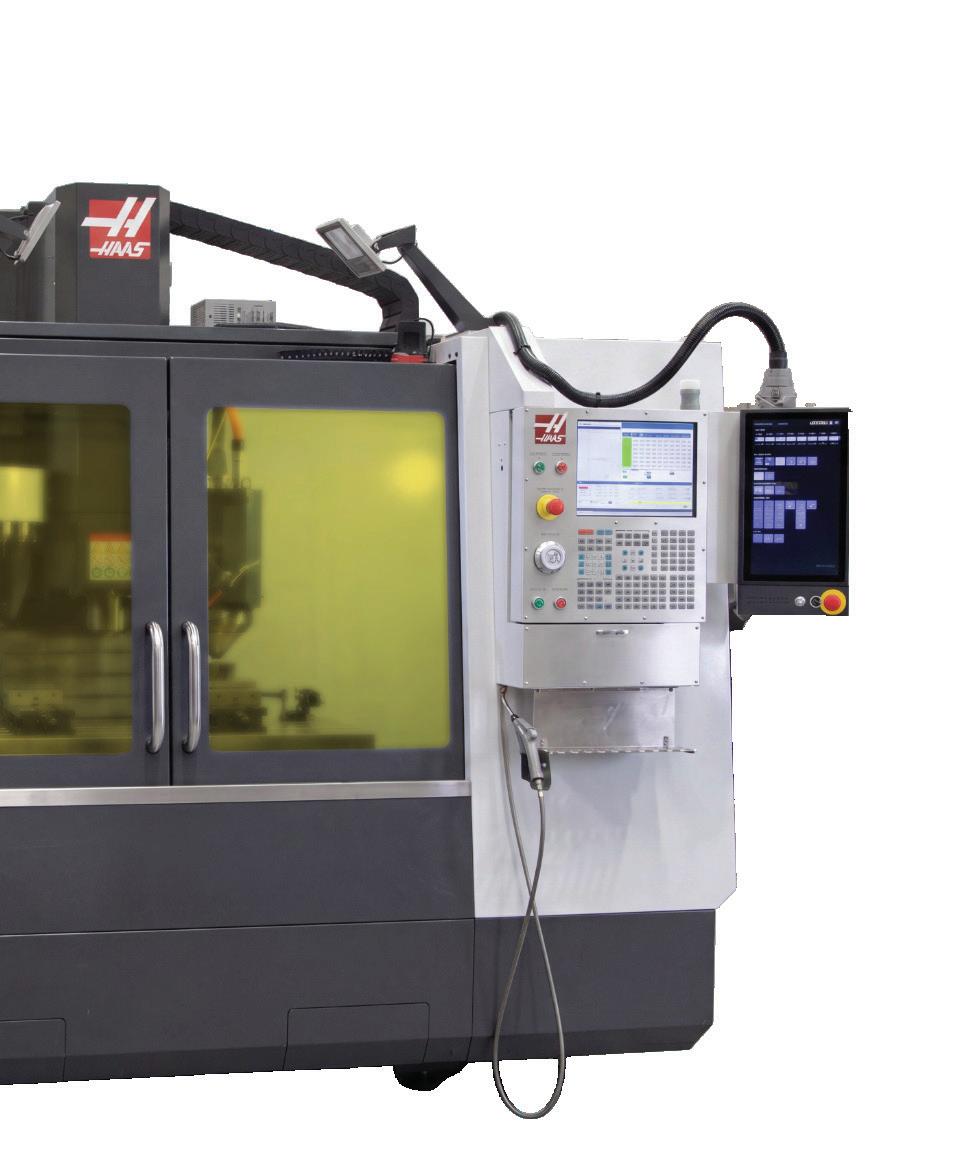
The U.S. Navy recently invested in its schoolhouse in Danville, Virginia, to the tune of 12 Phillips Hybrid Manufacturing Systems and 12 Markforged X7 composite additive manufacturing systems, providing sailors with hands-on experience across metal hybrid manufacturing, composite additive manufacturing, and productionready workflows. The equipment will support Navy personnel participating in the Afloat Training Program and help develop the skilled advanced manufacturing workforce required to strengthen fleet readiness and sustainment capabilities.
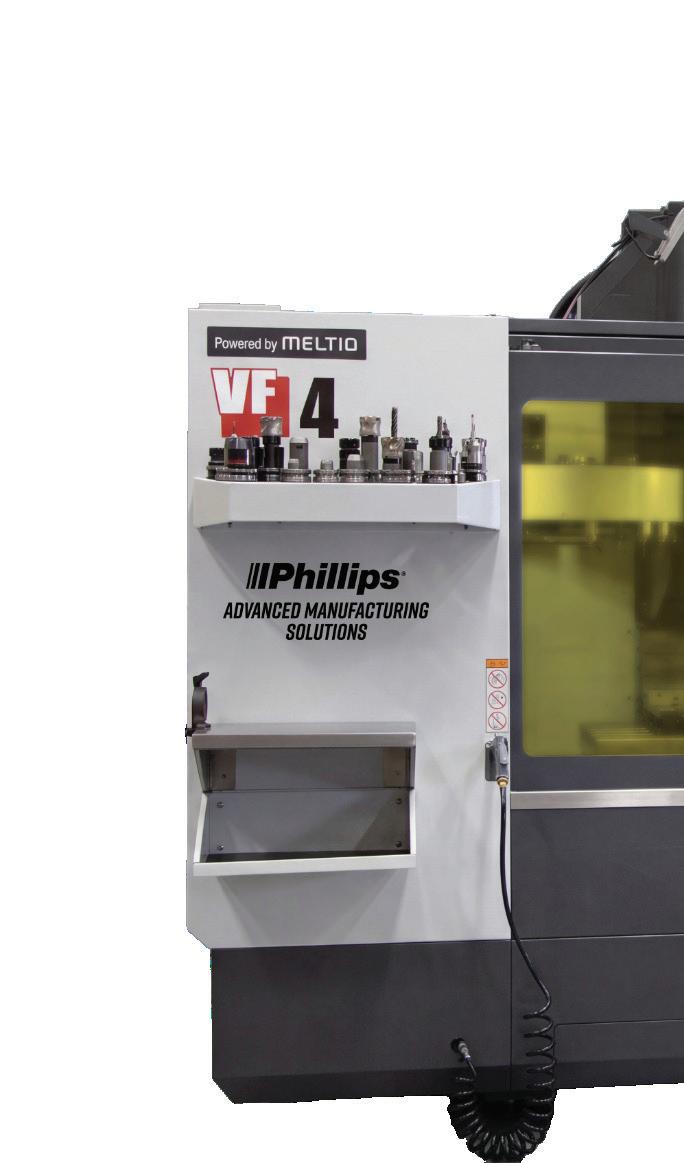
At the core of the deployment are 12 Phillips Hybrid systems built on Haas TM-1P CNC platforms and integrated with Meltio's Directed Energy Deposition (DED) technology. By combining precision CNC machining and metal additive manufacturing in a single platform, the systems enable sailors to manufacture new components, repair worn parts, restore high-value assets, and add material only where needed. This integrated approach provides greater speed and flexibility than traditional manufacturing methods alone while reducing material waste and shortening lead times. For Navy
personnel, these capabilities provide hands-on experience with productionready technologies designed to support fleet sustainment, depot maintenance, and expeditionary manufacturing operations.
Twelve Markforged X7 composite additive manufacturing systems provide advanced 3D printing capabilities, enabling sailors to rapidly produce durable composite parts, tooling, fixtures, prototypes, and replacement components. Together, the hybrid and composite technologies expose sailors to a broad range of advanced manufacturing capabilities supporting
shipboard and shore-based operations.
Together, the systems create a comprehensive advanced manufacturing training environment that mirrors the production capabilities increasingly being deployed throughout the U.S. Navy. By providing hands-on experience with both metal hybrid manufacturing and composite additive technologies, the Danville Schoolhouse will help prepare sailors to manufacture, repair, and sustain critical components closer to the point of need.
BlueForge Alliance executed the procurement on behalf of the U.S. Navy, working closely with Phillips Federal
to deliver a standardized, productionready manufacturing solution aligned with fleet sustainment and workforce development objectives.
The Navy's broader Deployed Advanced Manufacturing initiatives emphasize point-of-need production and workforce development through the integration of polymer and metal additive manufacturing across shipboard and shore-based operations — priorities directly supported by the Danville Schoolhouse training environment. Shipboard success, including the production of a replacement sprayer plate aboard USS
Bataan, underscores the importance of training sailors on production-ready manufacturing technologies before they deploy.
The Navy Schoolhouse is owned by Naval Sea Systems Command (NAVSEA) and operated in collaboration with the Institute for Advanced Learning and Research (IALR).
“This effort reflects a highly collaborative approach between the Navy, BlueForge Alliance, Meltio, Markforged, and Phillips Federal to deliver real-world manufacturing capability for the fleet,” said Bobby Keithley, Vice President of Sales & Product Strategy, Phillips Federal. “By training sailors on the same hybrid and additive systems they will encounter aboard ship, the Navy is accelerating readiness, improving sustainment outcomes, and strengthening its advanced manufacturing workforce. Hybrid manufacturing provides a powerful advantage by combining additive and subtractive processes, enabling sailors to produce new components, repair worn parts, and reduce dependence on traditional supply chains when operating in contested or remote environments.”
“It is difficult to think of a more challenging environment than out at sea, and Meltio’s technology could not be in better hands than the team at the Navy’s Danville Schoolhouse, supported by Phillips Federal,” said Gabriel Ortiz, Americas Channel Manager at Meltio.
“As a retired sailor, I have a special appreciation for what this technology can accomplish when placed in the hands of well-trained sailors and Marines. Equipping the next generation of naval maintainers with advanced manufacturing capabilities will strengthen fleet readiness and help ensure critical parts can be produced whenever and wherever they are needed.” DW
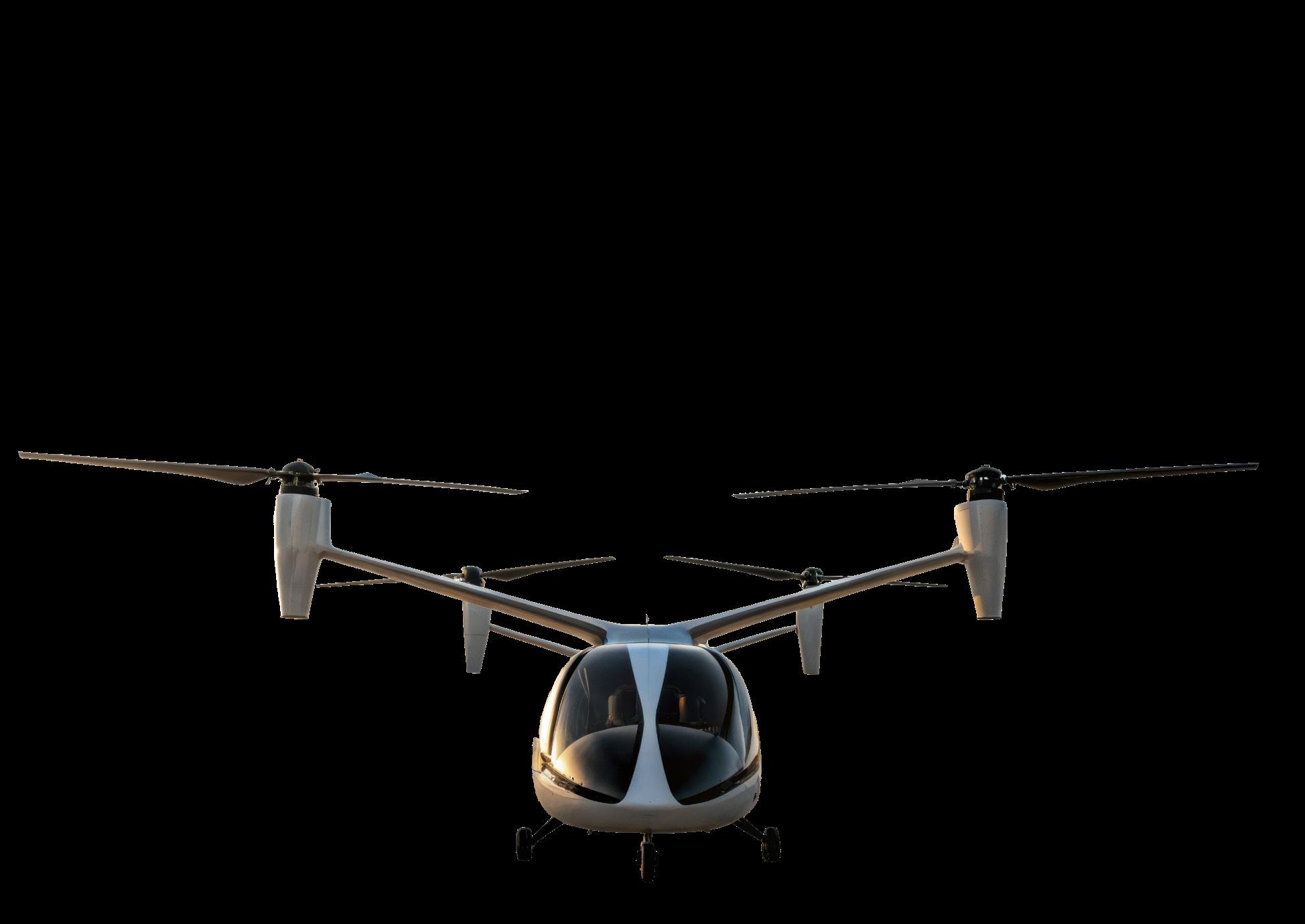
The aerospace industry is entering its most transformative era since the dawn of the jet age. For decades, engineers have steadily advanced aviation by trimming grams and maximizing thrust. Today, the rise of electric vertical takeoff and landing (eVTOL) aircraft has accelerated this pursuit into a masterclass of structural efficiency. Urban air mobility demands vehicles that can hover, transition seamlessly to forward flight, and navigate complex wind fields, all while operating under the tight energy constraints of current battery technology.
To bring these innovative concepts to market successfully, we are moving beyond legacy manufacturing processes and pure statistical AI. While traditional machine learning excels at identifying patterns in historical data, it lacks an inherent understanding of physical reality. The breakthrough transforming aerospace today is physical AI (physics-constrained AI). By embedding the fundamental laws of thermodynamics, fluid dynamics, and structural mechanics directly into neural networks, engineers are unlocking design and manufacturing efficiencies that were once mathematically impossible.
In traditional aerospace engineering, finite element analysis (FEA) and computational fluid dynamics (CFD) are the gold standards for safety and validation. These methods are incredibly accurate but also computationally expensive. A high-fidelity CFD simulation for a complex eVTOL rotor assembly can take days to run on a supercomputing cluster, creating a substantial bottleneck during rapid design iterations.
When generative AI first emerged, it offered the promise of accelerating this pipeline. However, standard neural networks lack an innate understanding of physics. A model trained strictly on thousands of CAD shapes might generate an airframe component that looks sleek, but it has no conceptual awareness of stress concentrations, fatigue limits, or shear forces. It risks creating geometric anomalies that look correct but fail under real-world aerodynamic loads.
Physics-constrained AI reduces this risk by constraining neural network training with partial differential equation (PDE) residuals derived from governing physical laws. Research published by the American Institute of Aeronautics and Astronautics (AIAA) demonstrates how physics-constrained generative networks can parameterize flight profiles and structural shapes, dramatically compressing optimization workflows.
Traditional AI optimizes primarily for statistical patterns, which introduces a risk of structurally non-feasible designs. Physical AI balances data with embedded physical laws, ensuring that every generated solution satisfies core engineering constraints from the outset.
The AI is no longer guessing based on visual patterns; it is strictly bound by the conservation of mass, momentum, and energy. The result is a design tool capable of enabling near-real-time estimation for many design and operational scenarios that would otherwise require computationally intensive simulations. By providing rapid approximations of structural and aerodynamic behavior, these models can dramatically accelerate early-stage design iteration while reducing
dependence on repeated high-fidelity simulations.
The flight profile of an eVTOL vehicle is dynamic and highly complex. During the critical transition phase from a vertical hover to forward fixed-wing flight, the aerodynamic loads on the rotors and airframe shift rapidly, generating turbulent, transient flow fields.
By leveraging physics-constrained AI, engineering teams can build highly responsive, real-time digital twins of these aircraft. While traditional digital twins often function as retrospective data dashboards, an AI-enabled, physicsinformed digital twin uses reducedorder physics-informed models to estimate structural and aerodynamic behavior alongside live operational data. Technical reviews on MDPI highlight how embedding physics-informed neural networks (PINNs) directly into unmanned aerial systems significantly improves real-time system estimation and dynamic control under unpredictable flight conditions.
If an aircraft encounters unexpected wind shear or microbursts in an urban canyon, the onboard physical AI can rapidly estimate structural loading responses and accumulated fatigue exposure. This capability enables highly precise predictive health monitoring. Operators can assess remaining fatigue life based on the exact physics of the stress encountered, rather than relying on generalized, conservative maintenance schedules. This approach maximizes fleet availability and safety without requiring vehicles to be over-engineered and structurally overweight.
When solving the battery-weight challenges inherent to electric aviation, every microgram counts. This is where AI-driven topology optimization serves as a critical lever for pioneering teams. Leading innovators such as Joby Aviation are pushing the boundaries of what fully integrated air taxi networks can achieve, a feat that requires
maximizing every ounce of structural efficiency.
Traditional topology optimization relies on rigid algorithms that subtract material from a design space based on a single, static set of load cases. In contrast, physics-constrained generative AI allows teams to explore a multi-objective design space that accounts for structural rigidity, thermal dissipation, and manufacturing constraints simultaneously.
Consider an inverter housing for an eVTOL powertrain. It must be exceptionally light, structurally sound enough to withstand high-vibration environments, and capable of rejecting massive amounts of heat from the power electronics. Human designers, or even standard optimization scripts, tend to isolate these requirements, separating the cooling fins from the structural brackets.
A physics-informed generative model treats these requirements as a singular, holistic problem. It can generate components with organic, lattice-like structures where the structural load paths double as integrated cooling pathways. These biomimetic geometries optimize material distribution down to the absolute mathematical limit, often achieving weight reductions of 30% to 50% compared to conventionally machined components while simultaneously enhancing thermal efficiency.
Closing the loop with AIenabled additive manufacturing
An elegant, AIoptimized design is only as good as the ability to produce it. The organic, complex geometries generated by topology optimization are notoriously difficult — and often impossible — to manufacture using traditional subtractive
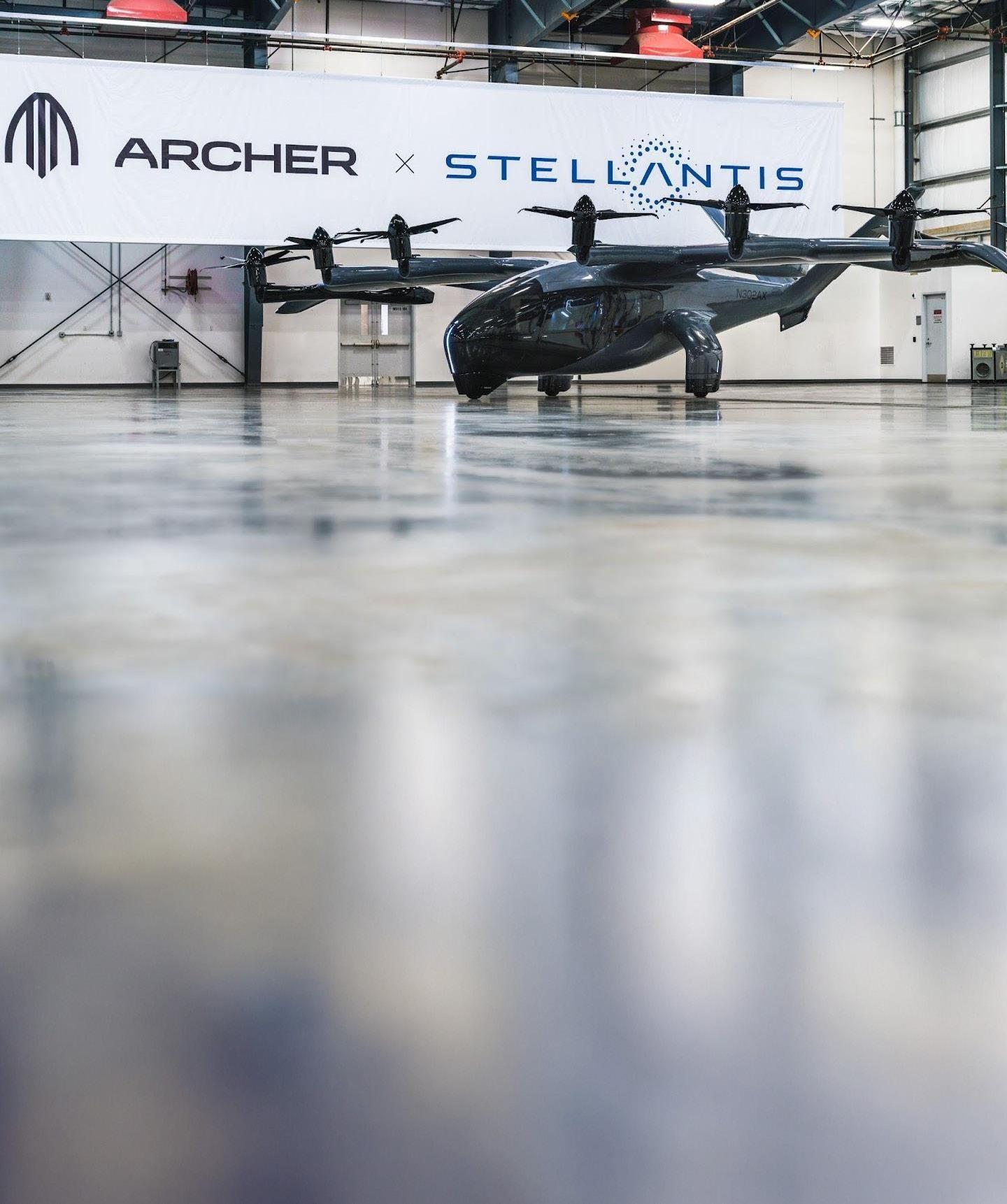
methods such as CNC milling. They require additive manufacturing (AM). Companies focusing on high-volume production efficiency, such as Archer Aviation, recognize that scaling up complex infrastructure requires a radical rethinking of how these components are fabricated and brought to market. However, aerospace-grade additive manufacturing — particularly direct metal laser sintering (DMLS) in titanium or Inconel — presents its own set of physicsbased challenges. During the laser powder bed fusion process, rapid heating and cooling cycles create massive thermal gradients. This can lead to residual stress, micro-cracking, and geometric warping. In an industry where tolerances are measured in microns, warping translates directly to a scrapped part and lost time. Here, physics-constrained AI acts as the connective tissue between design and the factory floor. By simulating the entire build physics in advance, the AI predicts exactly how the metal will solidify, how thermal stress will propagate, and where the part is prone to warp.
Servometer® - PMG, LLC Custom Designed Miniature Electrodeposited Nickel Bellows have diameters as small as 0.020 inch (0.5mm), are ideal for dynamic applications where reliability and long life are critical requirements.
Servometer® bellows can be designed for a variety of stroke and pressure combinations and can be used as:
• Dynamic Hermetic Seals
• Pressure Responsive Device
• Volume Compensation
• Aneroids
• Flexible Couplings
• Dynamic Electrical Contacts
Physics-constrained AI enables near-real-time estimation of structural and aerodynamic behavior, compressing design cycles that otherwise require computationally intensive simulation. Adobe Stock
Instead of relying on trial-and-error print runs, the AI pre-deforms the CAD model in the opposite direction of the predicted warp. When the laser fires and the material cools, the component warps precisely into its intended, perfect geometric shape. Furthermore, in situ monitoring systems equipped with computer vision and physics-informed models can detect defect formation — such as porosity or lack of fusion — in real time, layer by layer. This allows the system to adjust laser power or scan speed on the fly, correcting errors before they become structural failure points.
The true power of this technological convergence is found in the seamless loop these systems create together. Physics-constrained AI designs the component; topology optimization refines it for weight and thermal performance; digital twins validate its operational life; and AI-driven additive manufacturing fabricates it in physical reality with minimal defects. This comprehensive, autonomous lifecycle mirrors the long-term vision of aerospace leaders such as Wisk Aero, who are leveraging autonomous, multipassenger systems to redefine urban flight altogether.
For the engineering community, this evolution elevates the nature of
design work. We are moving away from tedious, iterative cycles of manual CAD drafting, waiting for simulation queues, and modifying fillets. Engineers are increasingly becoming directors of intent. By defining the precise boundary conditions, physical constraints, and performance targets, we allow AI to explore the vast design space and present optimized solutions that human intuition alone could never conceive.
Empowering engineers with a precise, reliable framework to bring complex machines to life efficiently is the ultimate goal of modern industrialization. As the aerospace and eVTOL sectors push into this new frontier, the demand for precision, speed, and design flexibility
will only intensify. The deployment of physics-constrained AI ensures that the industry is not just designing faster but manufacturing smarter.
The power-to-weight challenge of eVTOL is formidable, but physics remains an absolute truth. By embedding those absolute truths directly into the DNA of artificial intelligence, we are engineering the future of flight with greater confidence, speed, and physical fidelity. A&D
Misumi USA • us.misumi-ec.com Fictiv • fictiv.com
HTX8045C
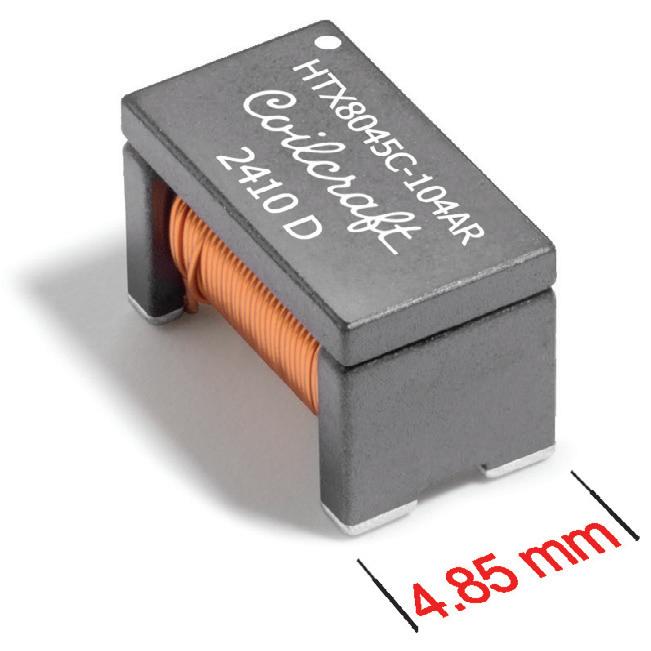
• Low interwinding capacitance (as low as 0.55 pF) to minimize EMI and achieve high CMTI (Common Mode Transient Immunity)
• Optimized for isolated bias supplies for SiC and GaN gate drivers, such as the UCC25800-Q1 from Texas Instruments and the MPQ18913 from Monolithic Power Systems
• Ideal for automotive OBC and traction inverters in EV/HEV
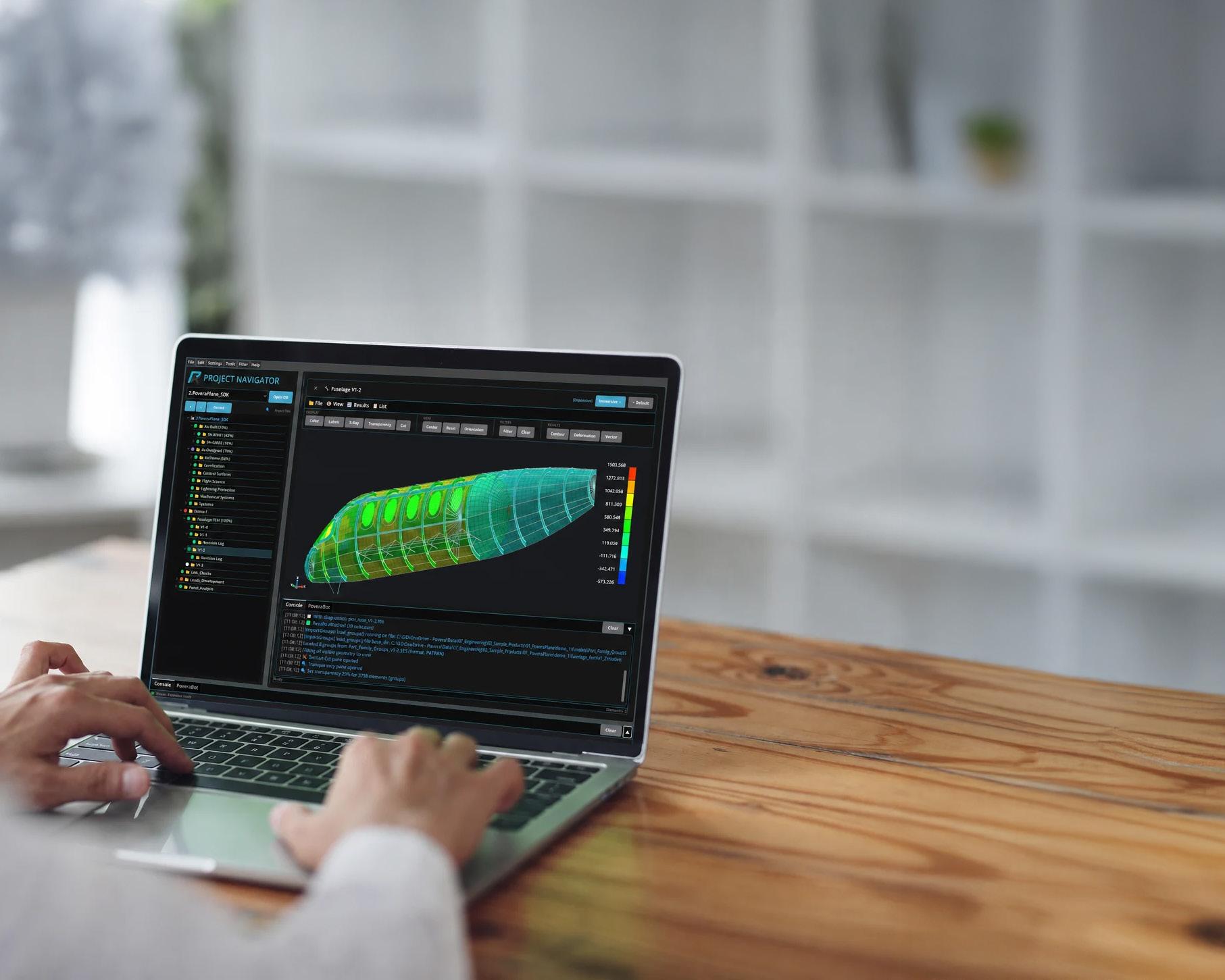
For most engineers, the day-today reality of a complex project looks less like innovation and more like an endless cycle of copying, pasting, and redoing. Even at the dawn of artificial intelligence (AI), they find themselves spending an exorbitant amount of time extracting data, reformatting it, and manually moving it between tools. One configuration change upstream suddenly prompts downstream work to start over. And if the original engineer who built a method leaves, their knowledge goes with them.
David Doherty, an aerospace engineer with 20 years of experience in structural substantiation and commercial aircraft certification, has spent much of his career watching that cycle repeat. Now, through his company Povera, he’s building the tool he wishes had existed — an integrated
Aerospace engineer David Doherty is building the orchestration layer that complex projects need to keep engineers focused on designing.
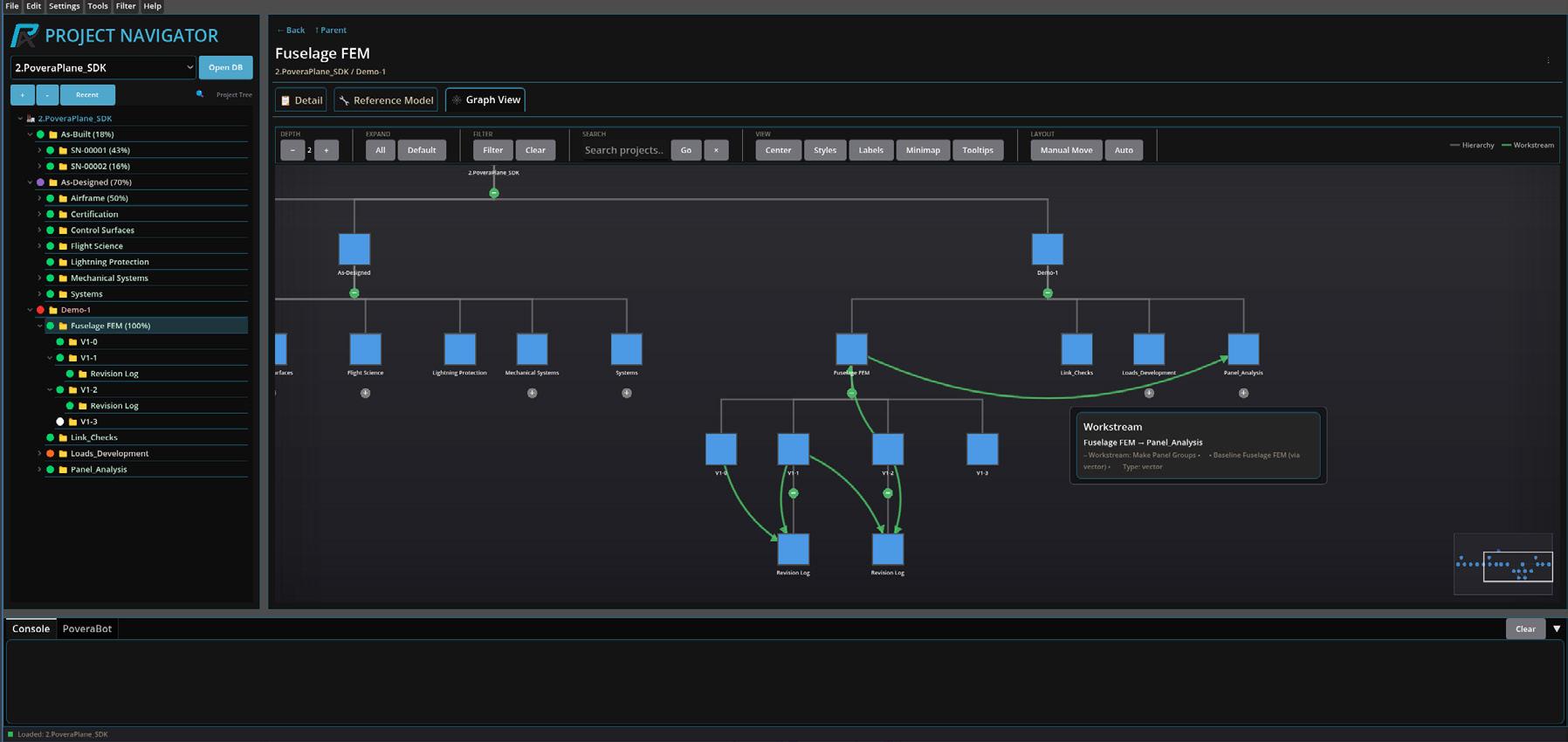
engineering environment that turns complexity into an interconnected, navigable graph.
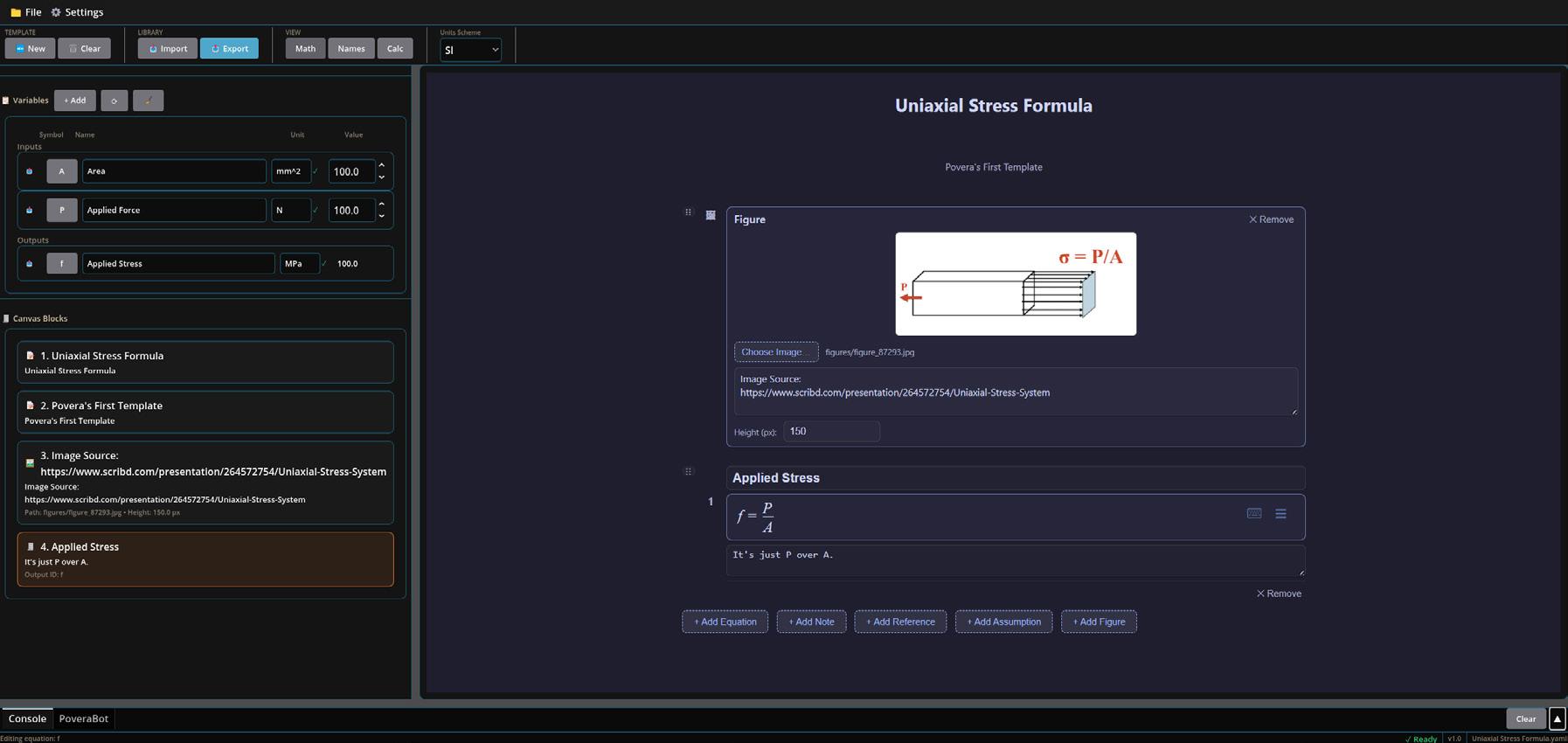
“Once we get into our environment, once a method is developed, it can be very quickly re-instantiated onto a new problem, or it can be re-executed,” Doherty said. “What this is going to do is shift the day-to-day function to building and managing a verification system, rather than repetitiously performing verification projects.”
An orchestration layer, not another simulation tool
Povera is not trying to replace the tools engineers already use. Instead, the platform wraps around them, connecting inputs and outputs across tools, data sources, and team members so that when something changes upstream, engineers
receive automatic notifications and can review the impact before approving updates downstream.
“Engineers will have a central location where they can do their chunk of work and then submit it to the platform,” Doherty said. “It’ll connect to its inputs, and its outputs will connect to it, so that whenever something upstream changes, engineers are notified that this is impacted.”
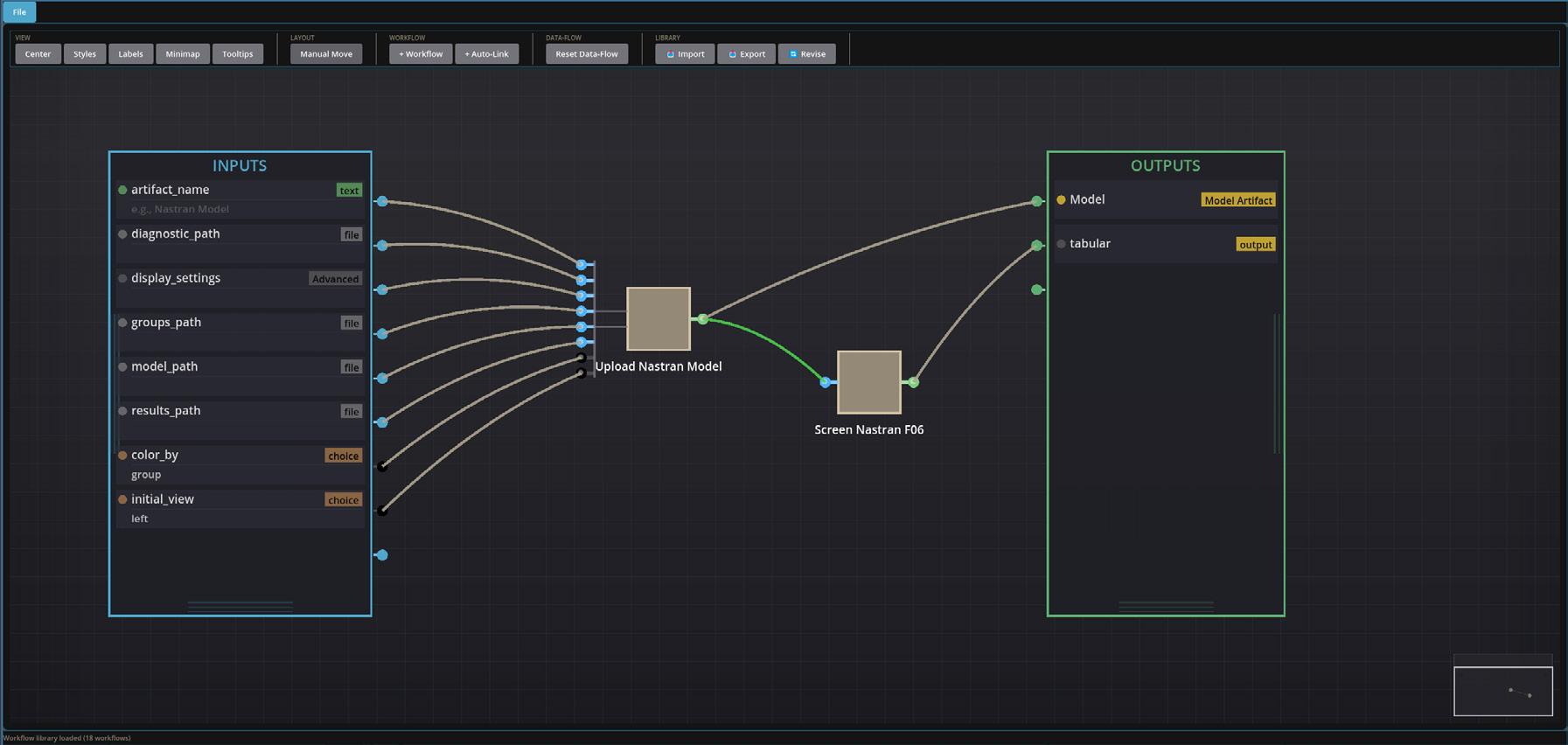
The platform includes a software development kit (SDK) and tools that make it easier for engineers to write and combine small sections of code that can be orchestrated to handle complex workflows, without requiring deep software development expertise to get started.
One of Povera’s central design goals is to enable AI to contribute to safety-critical

engineering work now, even with current limitations.
“A lot of the current engineering tools are trying to rely on AI to do everything. That might work in 10 or 15 years once AI is perfect, but we need to be able to leverage AI before that,” Doherty said.
The platform is designed as a deterministic set of guardrails that keep AI contributions small and reviewable, with humans above the loop.
“We’ll be able to have AI contribute through the same kind of stuff that junior engineers do, in small chunks that can be reviewed and controlled and supervised by humans,” he said.
Currently, AI integration is readonly: engineers can query the system to understand its state, but AI cannot take action within the platform. Clients who want to connect their preferred AI tools, such as OpenAI or Claude, can do so within their own environment and with the associated security responsibilities remaining on their side.
“Our initial product is a desktop application that works inside of the client’s secure environment,” Doherty said. “So, we’re going to inherit the security of their systems.”
That approach also sets the company up for compatibility with military-grade air-gapped environments down the line.
Starting where it matters most Doherty is deliberate about where Povera fits in the market. Large primes such as Boeing or Lockheed Martin have had decades to build their own mature engineering processes and aren’t likely early adopters. Instead, Povera is targeting small- to mid-size OEMs and high-end engineering service providers — companies that have enough engineering complexity to need this kind of infrastructure but lack the resources to build it themselves.
Povera unifies engineering data, simulations, and project execution into a single structured environment that moves complexity to the background and simplifies workflows for engineers and managers.
“These small aerospace companies, they have one of every specialist, because they don’t have enough demand to justify having two,” Doherty said. “When they lose that person, it just crushes the department every time.”
By capturing methods and domain knowledge in code that can be reinstantiated, Povera’s platform reduces such fragility around tribal knowledge.
Povera emerged from stealth earlier this year and released Alpha V1 in July. The platform is designed to support both commercial certification and military programs. Doherty’s next steps are to build his team of developers and extend the platform for flight sciences, requirements management, and broader certification. A&D
Povera povera-lnl.com
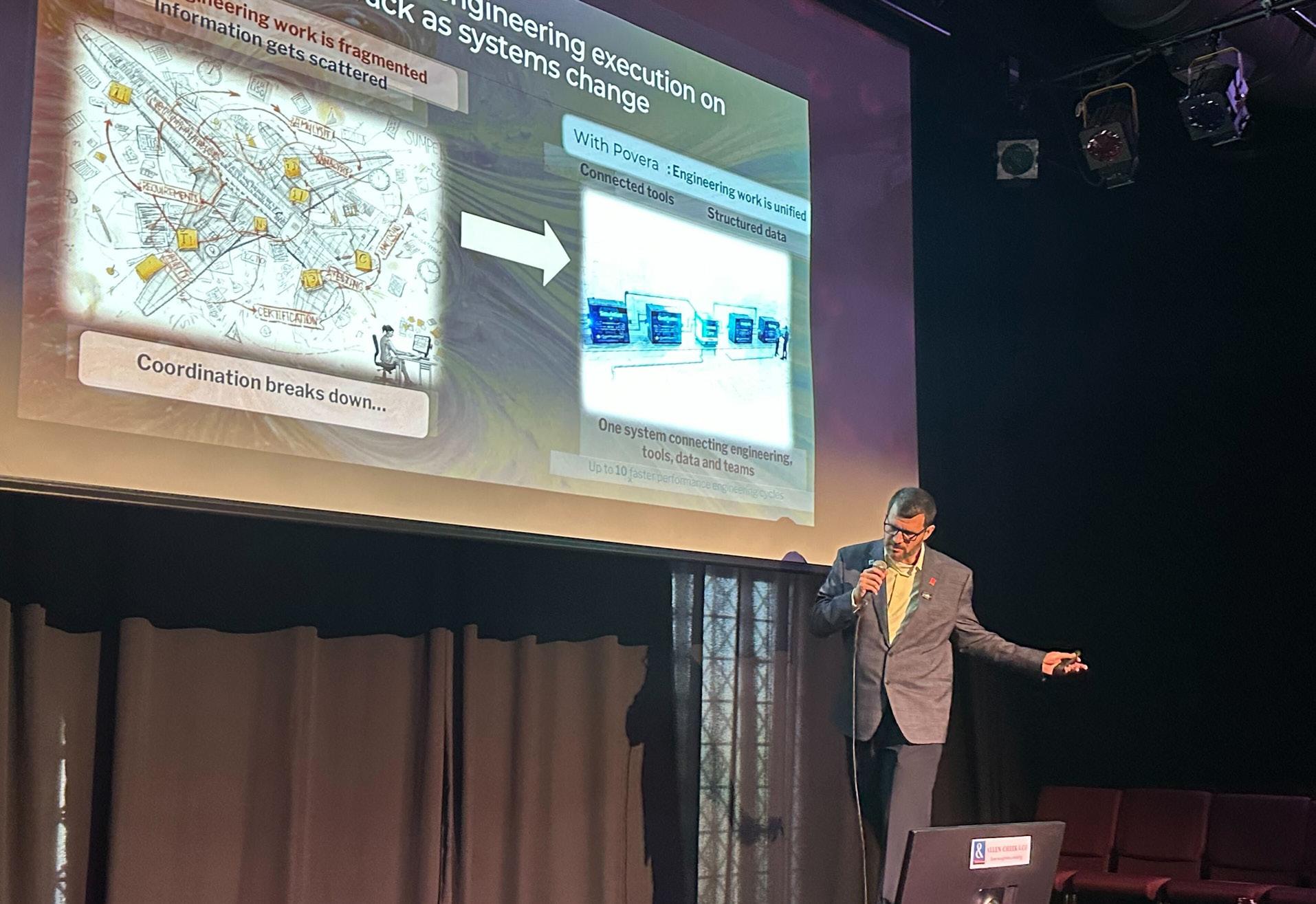
Doherty explains how Povera connects data, tools, and teams, creating a unified engineering project.






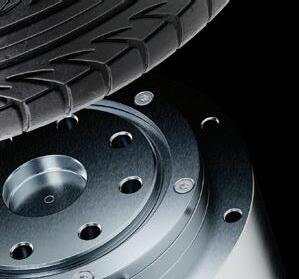
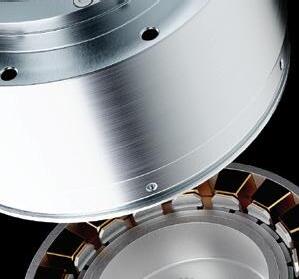
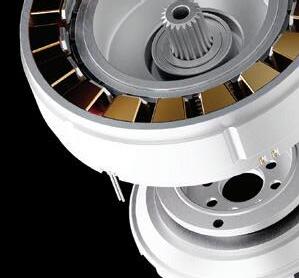

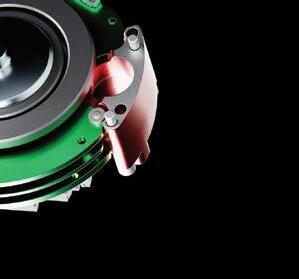
Safety Controller with Safe Motion and Safety Encoder Brake
In logistics, Autonomous Mobile Robots (AMRs) are used for tasks such as transporting goods, packing, order picking, and inventory handling. These applications require compact drive systems that can deliver precise positioning and repeatable motion, even in tight spaces and during continuous operation. maxon motors, together with sensors and safety controllers, support reliable and adaptable operation. Because requirements vary, ranging from moving heavy loads to handling smaller items, modular drive systems allow the configuration of motor type, performance, electronics, brakes, and encoders to match your specific application. We build the drive system. You build your vision.
Find out more: www.maxongroup.us
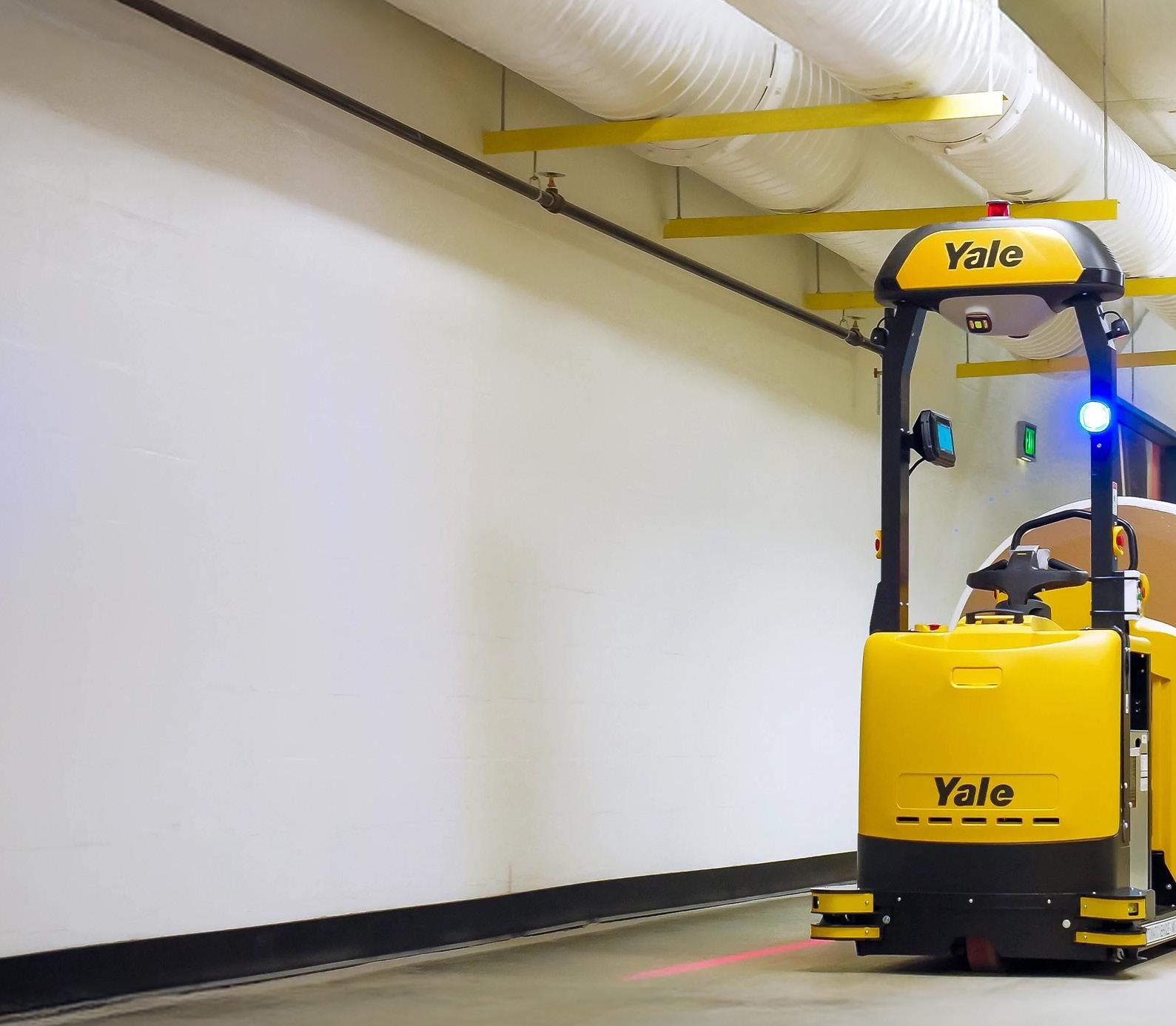
Historically, manufacturing, particularly the automotive industry, has been the biggest early adopter of robotics. This trend has continued, as manufacturers have been some of the first adopters of new technologies such as mobile robots and humanoid robots.
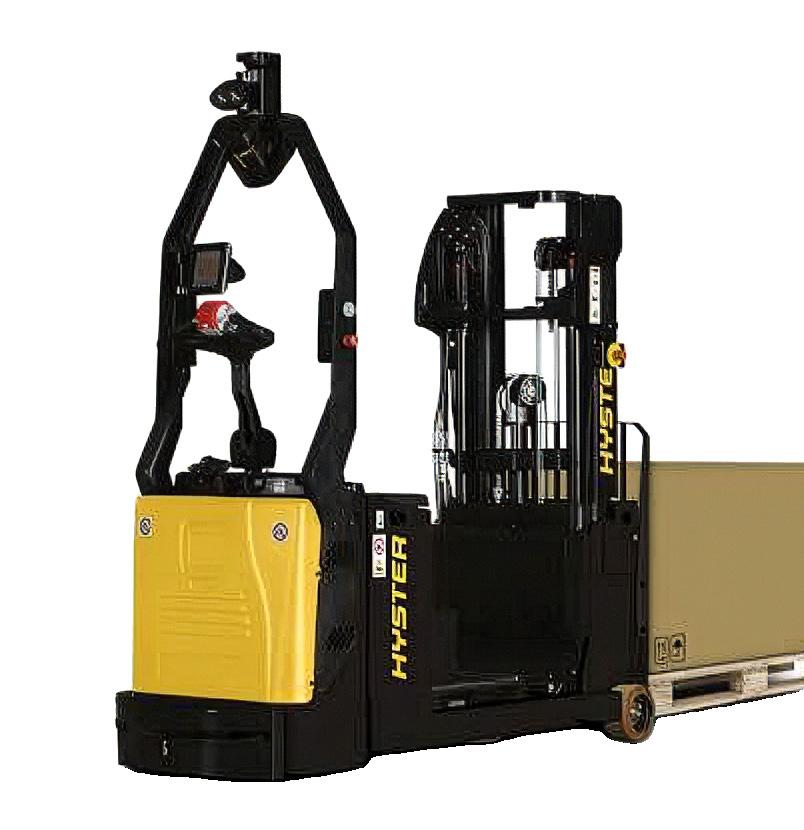
Hyster-Yale Materials Handling Inc. has been serving the manufacturing industry for more than 100 years. Its Hyster division focuses on manufacturing, and Yale serves supply chain and warehousing operations.
Noah Salmonson, a product manager for robotics at the Cleveland, Ohiobased automation provider, shared insights with Automated Warehouse. He
discussed the Hyster unit’s approach to automation, where it is seeing traction for automation, and how it ensures successful deployments.
Labor shortages are driving automation adoption
Around the world, manufacturers are struggling to find enough people to keep up with production. So, they’re turning to automation.
“The No. 1 thing that we hear about time and time again is really just the labor shortage that we see in America and across the world,” Salmonson said. “Businesses are looking for automation to solve some of those issues with labor shortages.”
In addition to filling in labor gaps, he said that automation can bring cost savings and higher efficiency. As more manufacturers also think about reshoring, many want to plan around automation.
“We see a lot of greenfield facilities popping up, and a lot of them are looking for automation,” Salmonson said. These operators are prioritizing getting a return on investment, so they’re starting with automation from the jump.
“You also see more and more customers looking for what we can offer from a reliability standpoint,” he observed. “We’ve been an OEM for over 100 years, and we have a really
Manufacturers may be early adopters of automation, but ease of use remains important. Hyster
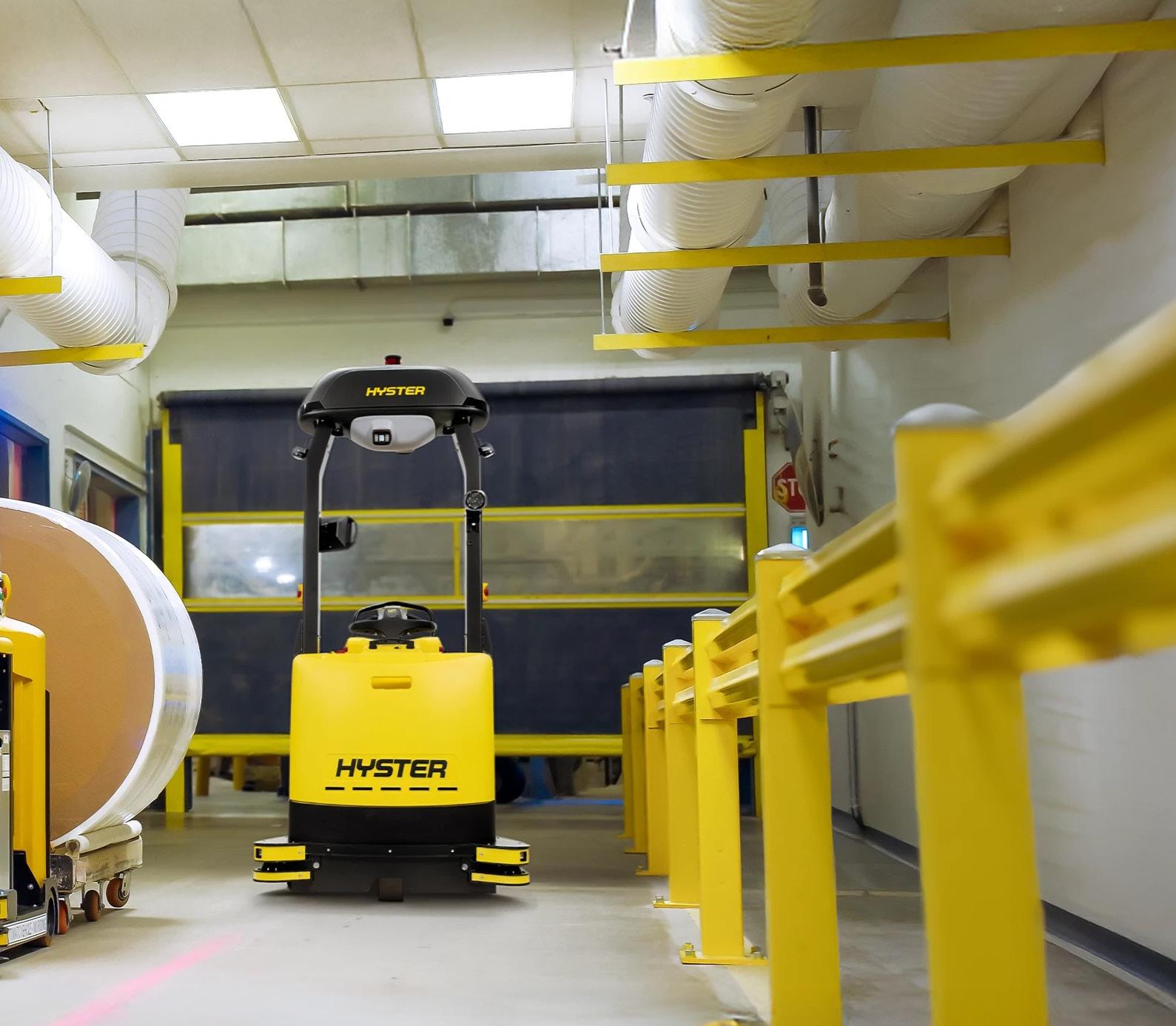
large dealer network which I call our superpower. We’re able to service and get parts and do maintenance on vehicles very easily.”
Applications vary by automation type
Particularly in manufacturing, applications for automation vary depending on the vehicle type, Salmonson said.
“If you’re working with a tow tractor or a tugger, you can see a lot of kitting applications, sometimes trash runs,” explained Salmonson. “Then when it comes to forked options, you might see removals from an ASRS machine, stretch wrapper, or end-of-line picking from a
conveyor and putting into stage lanes to go to a warehouse.
So far, Hyster has seen a lot of traction in automotive, food and beverage, and furniture.
“If you’re moving product in general, it’s always a good opportunity to take a look back and say, ‘How could I move this differently?’ or, ‘How could I move this with automation,’ and ‘How can this support my operation?’” Salmonson said.
Hyster has focused on making its autonomous vehicles flexible and safe to work with. The company’s navigation system is a key part of this effort.

“We’re using 2D lidar to navigate around a facility, and with lidar, you don’t need specific infrastructure,” Salmonson said. “You’ve probably been familiar with wire-guided [systems] or customers needing to put in reflectors or locators within their facility, you really don’t need that with lidar.”
Lidar isn’t just easier to deploy; it’s also easier to maintain, he noted. With lidar, Hyster’s equipment can better adapt to changes in a facility.
“[The lidar] is reading everything at 8-ft. [2.4 m] height, which is where we put our sensor on the vehicle, and that software actually has a really cool learning ability,” Salmonson said. “So as long as you’re able to keep above 20% of the original points, the software actually learns and adapts to changes within the facility. If you’re making minor racking changes, you don’t even have to remap your entire facility.”
Ease of use is key for successful deployments
Depending on the vehicle type, workers might interact with Hyster’s autonomous vehicles every single day, said Salmonson.
“For instance, the tow tractor or tuggers, a lot of the time, if you’re not using an auto-hitch and unhitch assembly that goes on the back of the vehicle, operators are going to have to
interact and work with that truck on every single route that it’s running,” he said.
To make working with the robots easier, Hyster has developed a drag-and-drop portal for route planning.
“In the past, you would have to hire software developers to program your routes and be able to write code to say where you want things to move from Point A to Point B,” said Salmonson. “We’ve made our system almost as simple as doing tasks in Visio or PowerPoint, where you drag and drop what we would call our waypoints or locators within the facility. To draw paths, you don’t need that typical software developer.”
This portal reduces cost and time needed to make changes within your facility, he asserted.
“Being able to [make changes] on the fly, and sometimes make these changes in less than a day or even a couple of hours, can really improve that cost of ownership and the ability to be flexible












within your facility without feeling like you’re constrained to that initial massive investment that might have been required in the past,” Salmonson said. RR
Position, angle and speed measurement
Contactless, no wear and maintenance-free High positioning accuracy and mounting tolerances
Linear and rotary solutions












Safety Controller with Safe Motion and Safety Encoder
Safety Controller with Safe Motion and Safety Encoder
We build the drive system. You build your vision.
We build the drive system.
You
build your vision.
In logistics, Autonomous Mobile Robots (AMRs) are used for tasks such as transporting goods, packing, order picking, and inventory handling. These applications require compact drive systems that can deliver precise positioning and repeatable motion, even in tight spaces and during continuous operation.
maxon motors, together with sensors and safety controllers, support reliable and adaptable operation. Because requirements vary, ranging from moving heavy loads to handling smaller items, modular drive systems allow the configuration of motor type, performance, electronics, brakes, and encoders to match your specific application. We build the drive system. You build your vision.
In logistics, Autonomous Mobile Robots (AMRs) are used for tasks such as transporting goods, packing, order picking, and inventory handling. These applications require compact drive systems that can deliver precise positioning and repeatable motion, even in tight spaces and during continuous operation. maxon motors, together with sensors and safety controllers, support reliable and adaptable operation. Because requirements vary, ranging from moving heavy loads to handling smaller items, modular drive systems allow the configuration of motor type, performance, electronics, brakes, and encoders to match your specific application. We build the drive system. You build your vision.
Find out more: www.maxongroup.us
Find out more: www.maxongroup.us
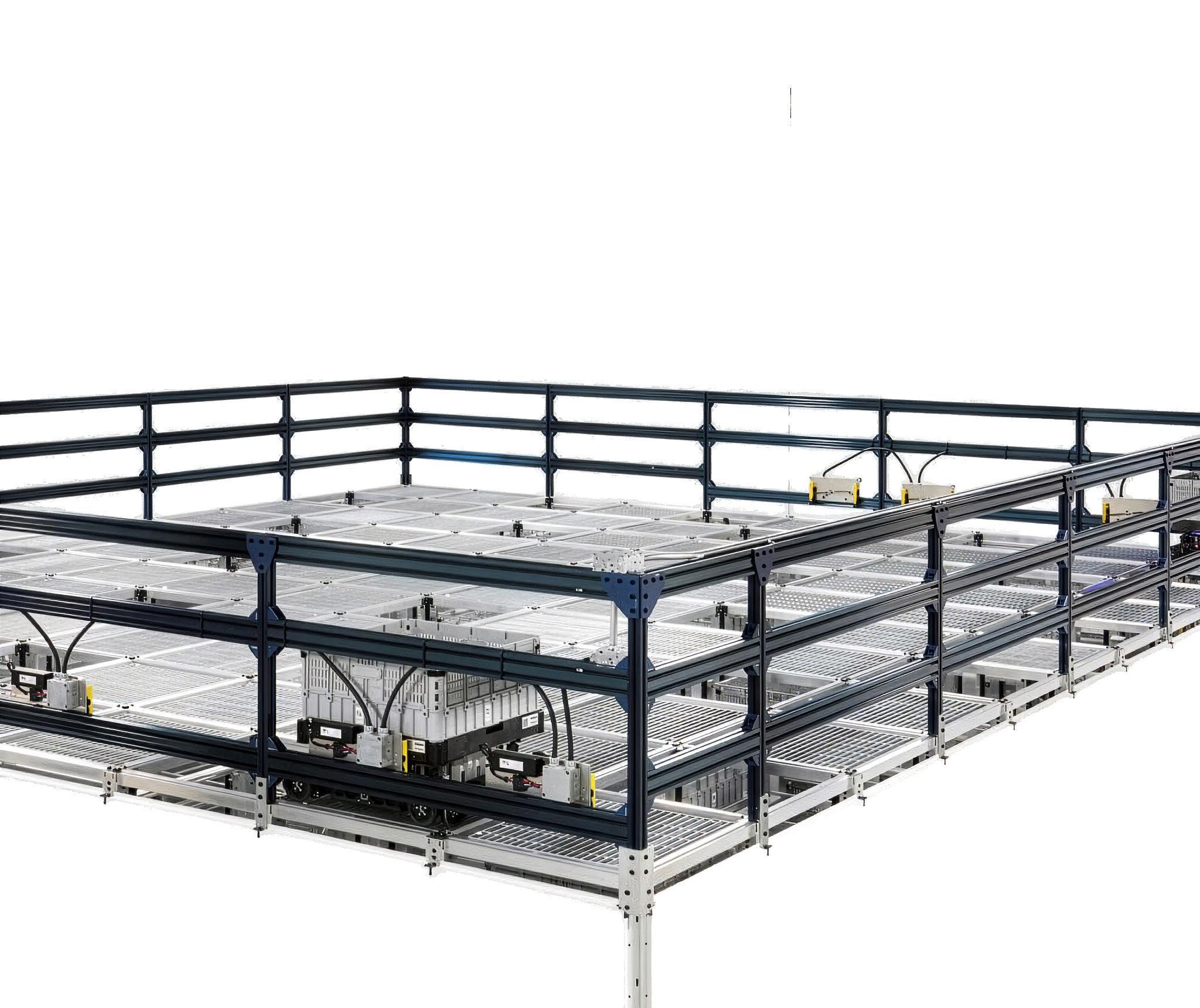
In the past year, Attabotics Inc. has seen a lot of changes. In July 2025, the company laid off most of its staff and filed for bankruptcy. Nearly eight months later, the company announced it had found a new life with LaFayette Systems, material handling automation developer.
Now the company still provides its automated storage and retrieval systems (ASRS) with the backing of a full-solution provider in LaFayette.
Mark Dickinson is the senior vice president and general manager at Lafayette Systems and the former vice president of operations at Attabotics. Dickinson shared insights with Automated Warehouse into the revamped company’s

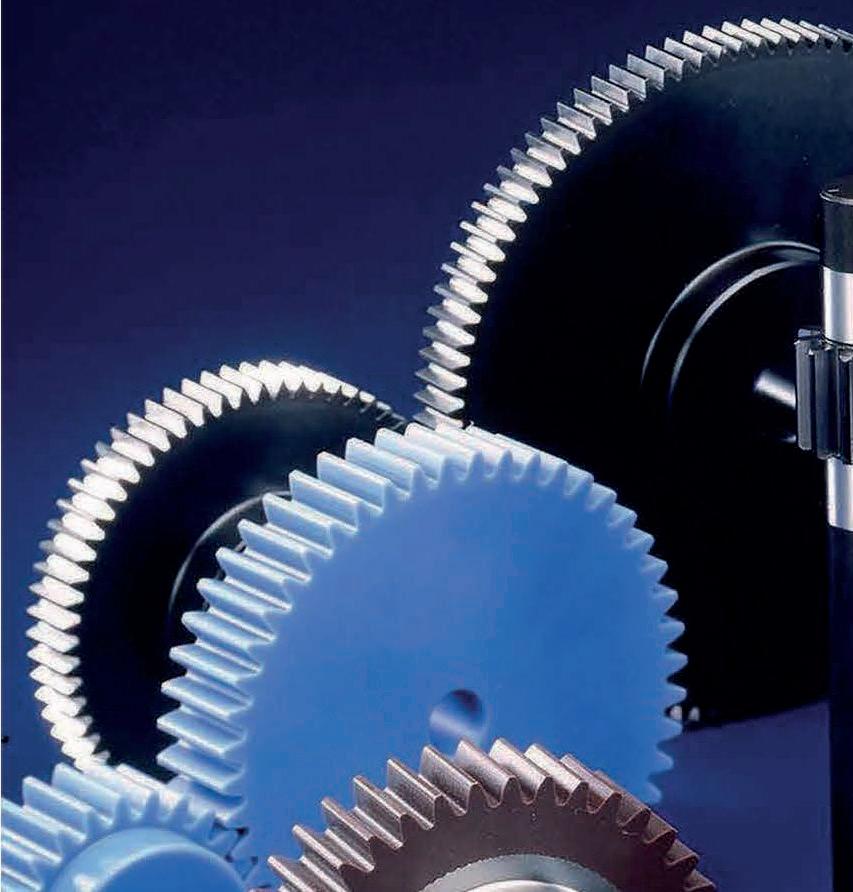
Attabotics offers a cube-based storage system and proprietary software, which handles sequencing, sortation, and conveyance. Attabotics
strategy, what he’s seeing in the market, and how the transition has changed Attabotics.
“Attabotics’ technology is available. It’s there,” Dickinson said. “We’re not the same organization that we were before, but the tech is still there.”
What’s driving automation adoption?
Dickinson said Attabotics uses an acronym to describe why companies turn to automation. They’re looking for space, accuracy, labor, and throughput, or SALT.
“Usually, the reason we do a project is at least one, if not more, of those,” Dickinson said.
Space utilization has become a bigger concern as micro-fulfillment centers
(MFCs) have become more popular. With smaller warehouses, every inch of space becomes more important.
“From a space-utilization perspective, it becomes very impactful when you can use the cubic space within the facility to be able to service as much of those products to those customers as possible,” Dickinson said.
Labor is also a major challenge. Dickinson said there are a couple of factors driving labor shortages.
“One is just inflation in the general economy,” he noted. “Two is labor availability, and that’s something that we see a lot, especially as you start to
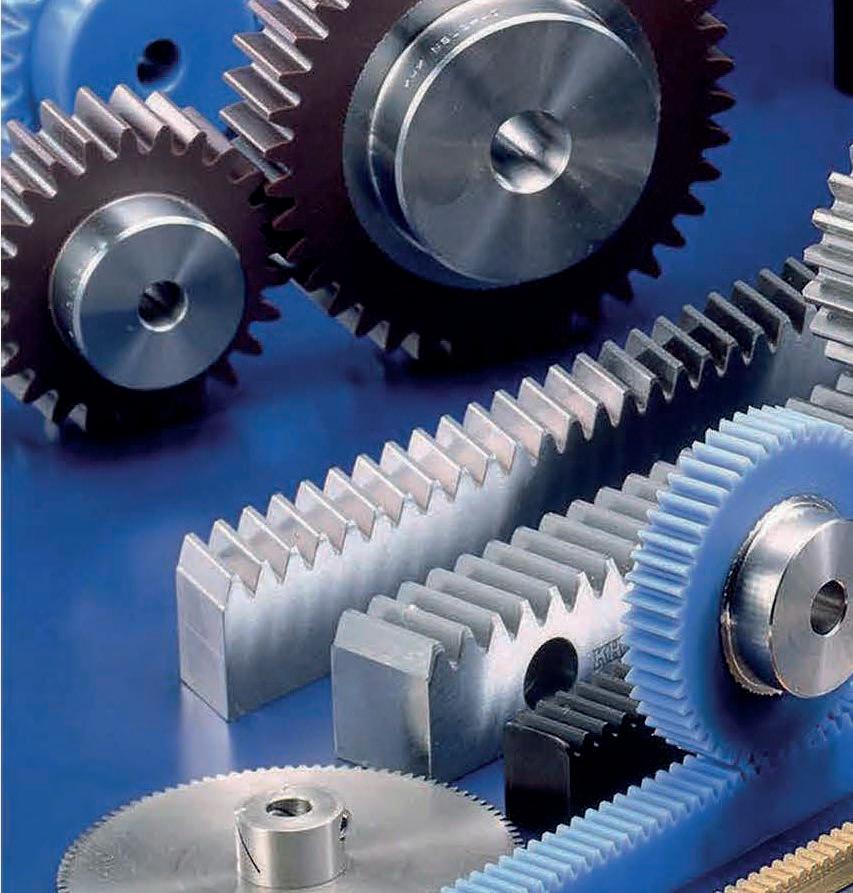
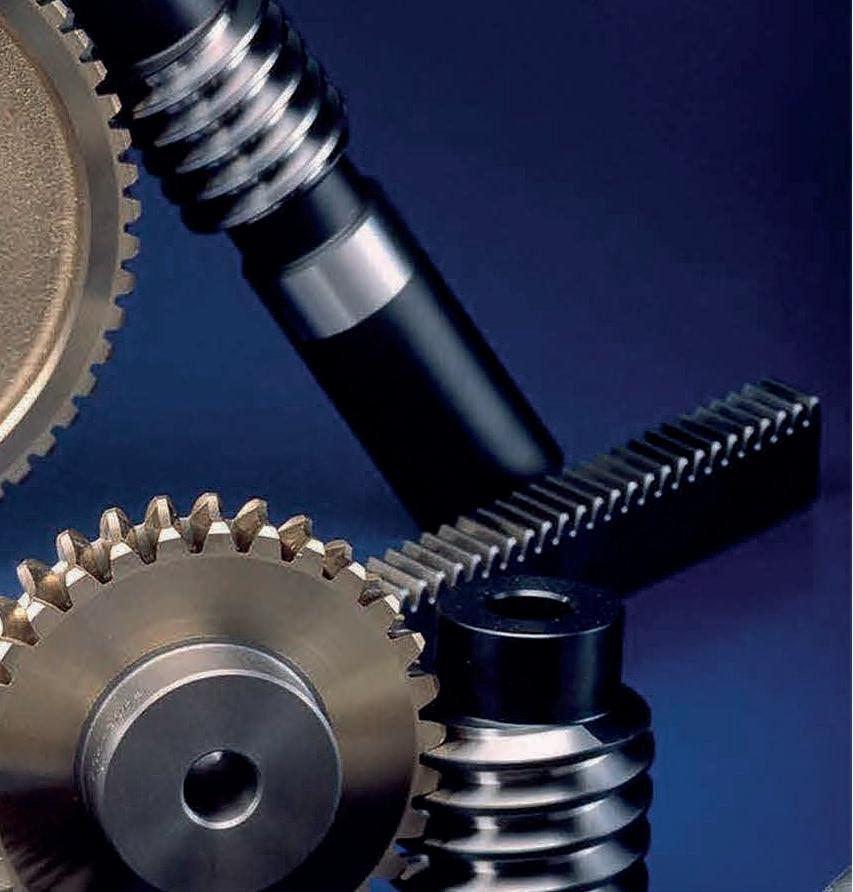
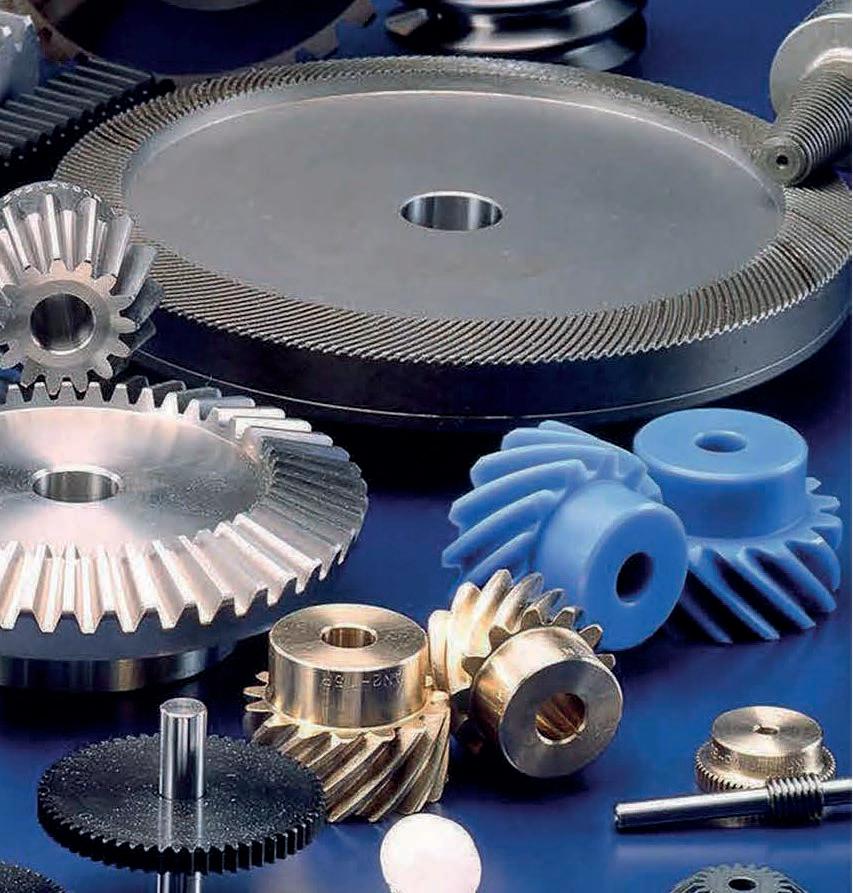
build more of these smaller distribution centers. More, smaller facilities mean you need more people to run them.”
In addition, when it comes to throughput, automation can greatly increase the number of units per hour an operator can pick. Where an operator could pick up to 150 units per hour, with automation, this can increase to anywhere from 300 units per hour, per person to 1,800 units, said Dickinson.
Attabot V5 robot is part of its ASRS for microfulfillment centers and other facilities. Attabotics
“We’re able to really create efficiencies not only around picking, but then also consolidate other functions into that process as a whole, if we get the opportunity to look at the end-to-end kind of operational stream,” he said.
Micro-fulfillment centers ‘never really left’
Many of these drivers center around the rise of micro-fulfillment centers. While they have become a point of debate within the industry, MFCs never really left, said Dickinson.
“Early adopters of automation are looking to put smaller distribution centers
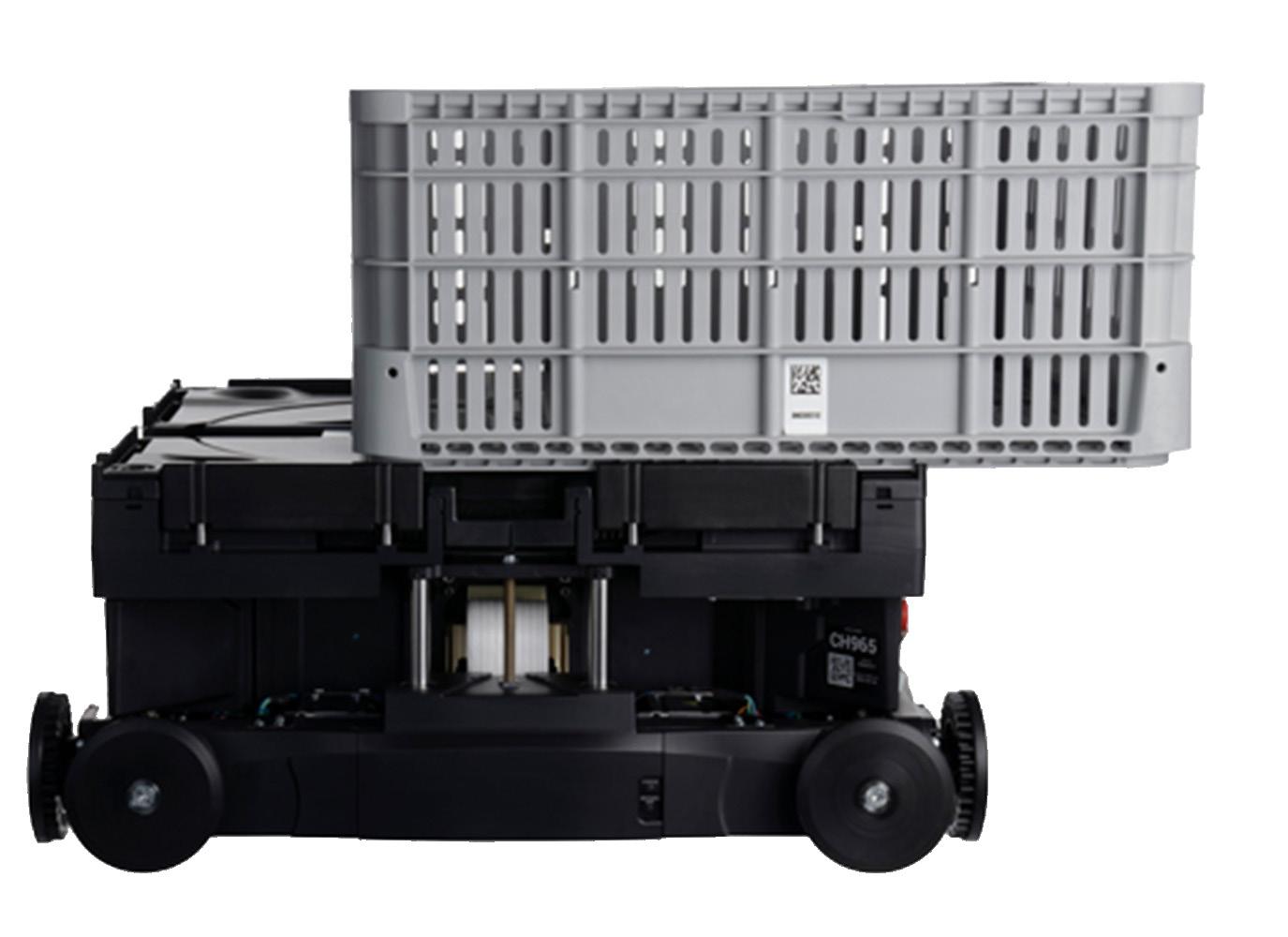
closer to where the people are ordering from,” he said.
However, there are still challenges that come with micro-fulfillment centers.
“One of the things we tend to hear a lot is that they’re calling it quicksand, and it goes towards the system’s implementation,” Dickinson said.
LaFayette has brought Attabotics’ technology forward from bankruptcy. Attabotics
“You have this concept where it was, ‘I just need to put stuff closer to people so that I can get it to them in shorter periods of time and not pay shipping,’ but nobody ever thought through the logistics of that,” he continued.
Working with automation providers who do understand MFCs can help end users to avoid common pitfalls.
“The biggest message I would have there is you have to talk to somebody who understands solutioning and understands the total end-to-end,” Dickinson said. “It starts before we even put stuff in the building.”
“It’s how are we getting orders, how are we aggregating orders, how are we deciding what orders are getting fulfilled?,” he added. “How do we make sure that what’s being ordered is in the right place in the right time, so that we can then perform the operation to get it out?”
Attabotics is using AI to make servicing more efficient
In everyday operations, Attabotics’ technology gathers massive amounts of data about orders, operators, and the system as a whole. Dickinson said turning this data into usable information is at the crux of what the industry is trying to figure out when it comes to AI.
“One of the big things that we’re looking at is, these machines have different cycles and different nuances,”
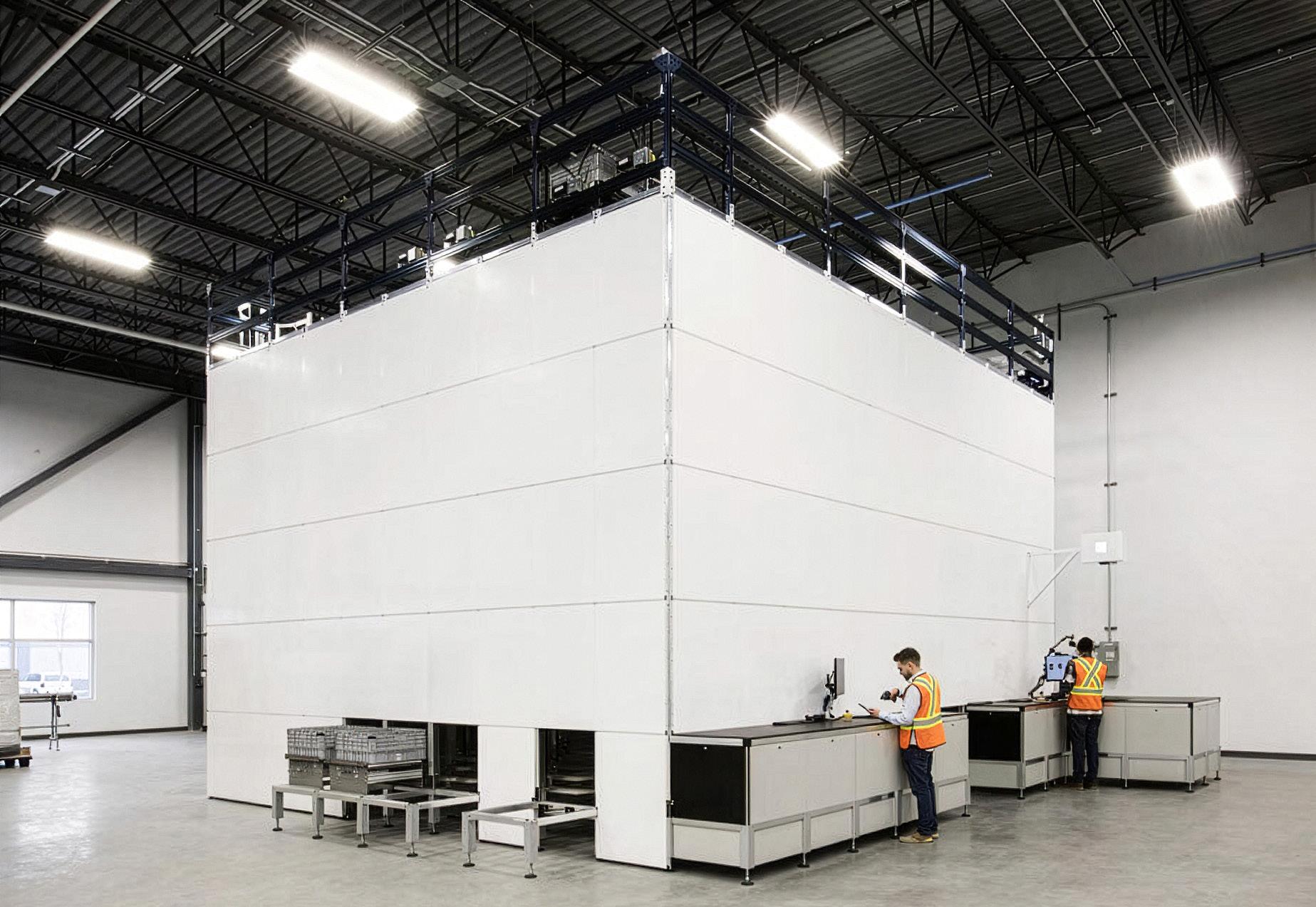
create a proactive message to be sent to the maintenance technicians.”
Attabotics now offers services in addition to automation
Dickinson said. Attabotics is trying to understand what information from the robot matters and how the company can use that information to predict servicing.
Instead of having mechanical systems that call for servicing at regular intervals, Attabotics wants to create intelligent systems that actively diagnose the health of the system. This would help to cut down on unnecessary servicing.
“We create all this telemetry; we’re using it to understand what we need to look at in terms of maintenance,” Dickinson said. “We can, in real time, now see which robots are operating against the tolerance or outside the tolerance and
LaFayette, Dickinson said, encompasses conveyor controls, case handling, unit picking, palletization, and more. This opens new doors for Attabotics.
“As we go through the solution development, if there’s anything specific that we need that’s not off the shelf from an OEM, we can make it,” said Dickinson. “We really provide the customer, effectively, a one-stop shop to be able to provide a solution, and what that means to the customers is a reduction in risk. Instead of the customer having to go buy from a controls company and an ASRS company; all of that comes out of one place now.”
With the acquisition, Attabotics has changed the way it approaches deploying automation.
“One big thing we’ve understood is that we really need to meet the customer where they are. So, instead of the Attabotics technology being the solution, now the Attabotics technology is a portion of the solution,” Dickinson said. “When you look at the order orchestration in the warehouse and the execution of all of this, all the orders inside the facility, Attabotics now supports that rather than attempts to be the be all end all.”
With this change, Attabotics is expanding its relationships with distribution providers and integrators.
“Instead of being a black-box solution, now we’re really looking at the integrators and leveraging their capabilities. From an interface perspective, an integrator is fantastic,” Dickinson said. “They know the end user; they’ve got the relationship; they’re going to do a whole bunch of work inside the building.” RR
Design World Special Report:

Aerospace and defense motion components are the muscles and joints of modern air and space platforms, converting electrical, hydraulic, or pneumatic power into precise mechanical motion for mission-critical functions. This report covers materials influencing aerospace and defense motion systems today.
SALES SALES (CONTINUED)
Ryan Ashdown rashdown@arrowfly.com 216.316.6691
Jami Brownlee jbrownlee@arrowfly.com 224.760.1055
Ashley Burke aburke@arrowfly.com 737.615.8452
Tom Duggan tduggan@arrowfly.com 773.724.1638
Mike Francesconi mfrancesconi@arrowfly.com 630.488.9029
Jack Gillerlain jgillerlain@arrowfly.com 773.909.2718
Adrian Nash anash@arrowfly.com 416-500-6906
Susan Powers spowers@arrowfly.com 708.341.3370
Judy Pinsel jpinsel@arrowfly.com 630.538.2638
Melissa Roberts mroberts@arrowfly.com 440.666.3111
Colton Stefanich cstefanich@arrowfly.com 331.223.2047
LEADERSHIP
Senior VP, Engineering
Amanda Buehner abuehner@arrowfly.com
CEO Matt Logan mlogan@arrowfly.com
CFO Ken Gradman kgradman@arrowfly.com 773.680.5955
DESIGN WORLD does not pass judgment on subjects of controversy nor enter into dispute with or between any individuals or organizations. DESIGN WORLD is also an independent forum for the expression of opinions relevant to industry issues. Letters to the editor and by-lined articles express the views of the author and not necessarily of the publisher or the publication. Every effort is made to provide accurate information; however, publisher assumes no responsibility for accuracy of submitted advertising and editorial information. Non-commissioned articles and news releases cannot be acknowledged. Unsolicited materials cannot be returned nor will this organization assume responsibility for their care.
DESIGN WORLD does not endorse any products, programs or services of advertisers or editorial contributors. Copyright © 2026 by Arrowfly, LLC. No part of this publication may be reproduced in any form or by any means, electronic or mechanical, or by recording, or by any information storage or retrieval system, without written permission from the publisher.
Subscription Rates: Free and controlled circulation to qualified subscribers. Non-qualified persons may subscribe at the following rates: U.S. and possessions: 1 year: $125; 2 years: $200; 3 years: $275; Canadian and foreign, 1 year: $195; only US funds are accepted. Single copies $15 each. Subscriptions are prepaid, and check or money orders only.
Subscriber Services: To order a subscription or change an address visit our website at: www.designworldonline.com
DESIGN WORLD (ISSN 1941-7217) USPS PUBLICATION #25146 is published 11 times per year: January, February, March, April, May, June, August, September, October, November, December by: Arrowfly, LLC; 1111 Superior Ave., Suite 1120, Cleveland, OH 44114. Periodicals postage paid at Cleveland, OH & additional mailing offices.
POSTMASTER: Send address changes to: Design World, 1111 Superior Ave., Suite 1120, Cleveland, OH 44114


By Mark Jones


It was a surprising night for Michigan in April, both warm and clear. With all the lights off, I positioned myself on the patio staring at the sky hoping to enjoy the Lyrid meteor shower. High-country camping during my time in Colorado hooked me on meteor showers. There was no moon and Jupiter was high in the sky and bright. I wasn’t expecting the shows I’d seen above the timberline but thought it still worth a try. I never saw a meteor, but I did see some satellites. I’m now almost 40 years removed from my high-country star gazing. The satellites were a dramatic change. In my time staring at the sky in the mountains, I don’t have a clear memory of seeing anything man-made, save the occasional plane.
I am a chemist by training and have studied the history of chemistry as a hobby. Seeing the satellites caused me to draw parallels to the chemical enterprise. William Perkin started a dye factory in Greenford, England around 1857, only about a year after he inadvertently produced the purple dye, mauveine, while trying to synthesize quinine in a home laboratory. Recognizing the value of a synthetic purple dye ultimately made Perkin a rich man. Many credit Perkin with starting the synthetic chemical industry. He can be credited with unintentional consequences too.
Perkin and other early chemists had no concept of waste management. Water from Perkin’s dye works flowed into the nearest waterway. Water laden with mauveine and other byproducts, both colored and clear, went into the ditches. The River Brent reportedly ran with a distinctly purple hue.
Laws were enacted as early as 1876 to limit discharge of pollutants. It may have been lucky that the unnatural color attracted public ire. The invisible materials in the discharge were far more dangerous. Illness in dye factory workers, particularly bladder cancer, is at the heart of the earliest systematic study to link chemical exposure to disease. The witch’s brew of the dangerous byproducts of dye production was more than just an eyesore.
The chemical industry was on the bleeding edge of questions about protecting the commons. Regulation added cost. Industry didn’t like that. Fouling the river impacted many while a few benefited handsomely. It established a paradigm still followed today. Industry dislikes regulation and society distrusts industry. Chemistry held a unique position among the sciences. Like other sciences, it explains and catalogs the natural world. Chemistry is also creative, allowing creation of things not found in the natural world. It has now been joined by biology, physics, and even
computer science. All are now causing concern. Add companies going into space to the list.
The Kessler Syndrome is a theoretical scenario where the density of space debris in Low Earth Orbit becomes so high that collisions cause a runaway, selfsustaining cascade of further collisions. This chain reaction could render critical orbits unusable for decades, threatening satellite operations, GPS, and space exploration. Back in 2018, the estimate for collisions to begin should satellites in lowearth orbit lose ability to maneuver was 164 days. It is down to 2.5 days today. It is almost a textbook Hardin tragedy.
My observing satellites during my recent star gazing may be analogous to the River Brent running purple. It might be an indication of more serious problems to come. Just as the chemical industry opposed regulations, regulations on satellites are opposed by launch companies. Just as chemists developed technical solutions to counteract problems created by chemists, technical solutions are being proposed by aerospace companies. Several companies are proposing schemes for space junk removal. Just as with the chemical industry, many may be impacted by the actions of a few. DW