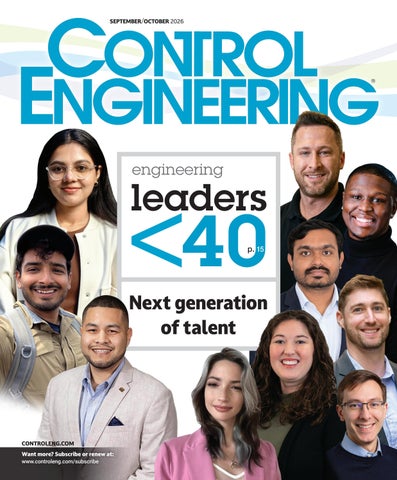
CONTROLENG.COM Want more? Subscribe or renew at: www.controleng.com/subscribe
CTL2610_MAG1_COVER_V2msFINAL.indd 1
9/28/26 10:11 AM
www.controleng.com/ebooks
AI & Machine Learning
Control Systems
Cybersecurity in Smart Factories
Digital Transformation
IIoT Cloud
Industrial Networking
Mechatronics & Motion Control
Motors & Drives
Oil & Gas Engineering
PLCs
Process Instrumentation & Sensors
Protecting Critical Infrastructure
SCADA & HMI
System Integration
Vision Systems
House Ad-Ebook_pgC3.indd 3
9/29/26 11:42 AM
CONTROLENG.COM Want more? Subscribe or renew at: www.controleng.com/subscribe
CTL2610_MAG1_COVER_V2msFINAL.indd 1
9/28/26 10:11 AM
Versatility + Efficiency = Productivity Low-cost PLCs engineered to perform!
Software Efficiencies Productivity Suite is the FREE user-friendly programming software for the Productivity family of controllers. It is packed with tools designed to reduce development time and headaches. Version 4.7 has several NEW enhancements including: •Structured Text programming is now available alongside Ladder Logic, allowing developers to select the most effective programming method for each task or combine both within a single project. • UDI Libraries simplify the reuse and standardization of proven code structures.
Hardware Versatility
PLCs starting at ONLY $123.00
The Productivity family of PLCs offers three distinct series with rack-based and stackable hardware style choices. Each series offers different I/O capacities but all use the same programming software, allowing you to easily scale your control up or down depending on the application or machine build.
• The Delta contact function enables easy detection of changing conditions between program scans.
• NEW! Productivity2000 combination I/O modules deliver increased flexibility by integrating multiple input and output points into a compact footprint, helping reduce both panel space and overall system cost. • NEW! Productivity2000 16-point solid-state relay module enables high-speed, high-cycle switching with extended operational life and reduced electrical noise. • NEW! Productivity2000 isolated analog input modules provide high-resolution 16-bit performance with channel-to-channel isolation, allowing mixed signal type and improving noise immunity in environments where signal integrity is critical.
Productivity1000 P1-412 CPU
www.ProductivityPLCs.com
Order Today, Ships Fast! * See our Web site for details and restrictions.
© Copyright 2026 AutomationDirect, Cumming, GA USA. All rights reserved.
AutoDirect_01.indd 2
1-800-633-0405
the #1 value in automation
9/28/26 2:31 PM
Practical Products. Practical Prices.
Thousands of sensors in stock and ready to ship today! di-soric Ultrasonic Proximity Sensors
AchieVe FBM Series Photoelectric Sensors
NEW! Ultrasonic Proximity Sensors
Contrinex Smart IO-Link Inductive Proximity and Photoelectric Sensors
Schmersal 250 Series Heavy-Duty Limit Switches
Smart IO-Link Sensors
Starting at $210.00 (US18M1500G3-B4)
Starting at $80.00 (ISWE-M18MP-NSS-A0)
di-soric tubular/rectangular ultrasonic proximity sensors are designed for contactless distance measurement and offer IO-Link with ISDU support.
Contrinex Smart IO-Link inductive proximity and photoelectric sensors offer advanced functionality beyond a simple switching output. They feature multiple sensing modes and can be configured to provide rich data and diagnostics.
• Various connections and output options
• 8, 12, 18, & 30mm tubular versions • 12mm rectangular versions • IP67 or IP68 models available
®
• User-configurable outputs • Embedded predictive maintenance
NEW! FBM Series Photoelectric Sensors
Starting at $18.50 (FBM-RE-00-0A)
Dependable detection for common automation applications, these photoelectric sensors offer reliable performance, simple setup, and excellent value. • Multiple sensing styles to choose from • Rugged thermoplastic housing for factory environments • Sensing distances up to 10 meters
• Visible red, pinpoint, or infrared options for easy alignment • Flexible light-on/dark-on operation and voltage options
Encoders
Capacitive Proximity Sensors
Heavy-Duty Limit Switches Starting at $524.00 (TD250-02Z)
Built for the toughest applications, Schmersal 250 series heavy-duty limit switches feature rugged cast iron housings and offer side rotary levers with metal, plastic, or belt alignment rollers. • 4A contact ratings • Up to four snap- or slow-action contacts • Two M25x1.5 cable entry connections
Also Available
• High-speed internal decision-making that removes reliance on a central PLC
• IP65/66/67 protection rating • High temperature models available
Light Grids
Research, price, buy at:
www.automationdirect.com/sensors
Order Today, Ships Fast! * See our Web site for details and restrictions.
© Copyright 2026 AutomationDirect, Cumming, GA USA. All rights reserved.
AutoDirect_02.indd 1
1-800-633-0405
the #1 value in automation
9/28/26 2:32 PM
Trihedral_pg2.indd 2
9/28/26 2:32 PM
Vol. 73 • No. 5
Contents SEPTEMBER/OCTOBER 2026
15 | ON THE COVER:
Engineering Leaders Under 40 recognizes achievements and innovations for younger engineers helping to advance use of automation, controls and instrumentation. See more honorees in this issue with more about each online. Courtesy: Control Engineering
INSIGHTS
ANSWERS
6 | EXTRA web articles: Arrowfly, links at www.controleng.com.
22 | Understand IEC 61131-10 to more easily transfer PLC applications
8 | CTL+ALT+MFG podcast Ep. 21- The Business Behind Automation, with Jeremy Anderson of Process and Data Automation - Control Engineering
25 | PID spotlight, part 33: Managing noise using setpoint gap action
10 | Market Update: Latest automation mergers. Did you see our AI and controls research? 12 | News: Automation and AI can harmonize people, technology progress; Machine vision gets a software surge as AI use scales; New certification scheme targets OT components for NSS use; New hubs and added floor space set up next-wave output; Events calendar 14 | Think Again: What manufacturing is teaching drug discovery
29 | Ensuring safety, security in industrial automation: An IEC 61508-compliant approach
p.25
31 | Data and information management for automation 32 | Five answers about digital transformation for automation, controls and instrumentation 34 | Digital transformation, automation can lead to fact-based decisions 35 | Five fast answers on digital transformation for controls, instrumentation
p.32
36 | Digital transformation enables more autonomous operations
CONTROL ENGINEERING ( Vol. 73, No. 5, ISSN 0010-8049, USPS PUBLICATION #813480 ) is published bimonthly by: Arrowfly; 1111 Superior Ave., Suite 1120, Cleveland, OH 44114. Periodicals postage paid at Cleveland, OH and additional mailing offices. POSTMASTER: Send address changes to CONTROL ENGINEERING, 1111 Superior Ave., Suite 1120, Cleveland, OH 44114. CONTROL ENGINEERING copyright 2026 by Arrowfly. All rights reserved. CONTROL ENGINEERING is a registered trademark of Arrowfly, used under license. Circulation records are maintained at Arrowfly, 1111 Superior Ave., Suite 1120, Cleveland, OH 44114. Telephone: 630/571-4070. Publications Mail Agreement No. 40685520. Return undeliverable Canadian addresses to: Arrowfly, 1111 Superior Ave., Suite 1120, Cleveland, OH 44114. Rates for nonqualified subscriptions, including all issues: USA, $165/yr; Canada/Mexico, $200/yr (includes 7% GST, GST#123397457); International air delivery $350/yr. Except for special issues where price changes are indicated, single copies are available for $30 US and $35 foreign. Please address all subscription mail to: CONTROL ENGINEERING, Arrowfly, 1111 Superior Ave., Suite 1120, Cleveland, OH 44114. Printed in the USA. Arrowfly, does not assume and hereby disclaims any liability to any person for any loss or damage caused by errors or omissions in the material contained herein, regardless of whether such errors result from negligence, accident or any other cause whatsoever. CONTROL ENGINEERING does not endorse any products, programs, or services of advertisers or editorial contributors. Copyright© 2026 by Arrowfly. No part of this publication may be reproduced in any form or by any means, electronic or mechanical, or by recording, or by any information storage or retrieval systems, without written permission from the publisher.
control engineering — www.controleng.com
CTL2610_MAG1_TOC_V2msFINAL.indd 3
September/October 2026
|3 9/28/26 2:28 PM
| MX01USA |
Smart. Modular. Cabinet-free. The MX-System advantage.
Have you taken a serious look at your electrical cabinets lately? Sure, they protect your equipment and have been there right alongside your machines since, well, forever. Maybe you take them for granted, like they just have to be there. They don’t. Our new MX-System has changed automation and controls system design forever. This flexible, space-saving, and intelligent automation hardware platform can completely replace conventional control cabinets and literally transform your machines. Seriously. With pluggable modules for all main areas of automation and control such as the controller, I/O, drives, relays and system modules, the MX-System opens up exciting new possibilities for machine builders, system integrators, and end users alike. Sorry, electrical cabinets, but we think it’s time to retire.
Scan to go cabinet-free and send your enclosures on a permanent vacation!
Beckoff_pg4.indd 4
9/28/26 2:33 PM
Vol. 73 • No. 5
Contents SEPTEMBER/OCTOBER 2026
INNOVATIONS 37 | New Products for Engineers at www.controleng.com/products Software unifies production tracking data; One cable reduces drive wiring; Valve design supports precise dosing; Simple encoder assemblies for multiple wheel sizes; Right-sized servo gears stretch value; Long-range flush-mount sensor; 32 waveform channels in one PXI slot; Advanced pressure transmitter 39 | Back to Basics: Integrating new HMI or SCADA with existing automation
SUBSCRIBE
Control Engineering eBook series
Insights for automation professionals
Get the topical collection you need.
Control Engineering experts cover automation, control, and instrumentation technologies for automation engineers who design, integrate, implement, maintain and manage control, automation, and instrumentation systems, components and equipment to do their jobs better across process and discrete industries.
• Mechatronics & Motion Control • Motors & Drives • Process Instrumentation & Sensors • Industrial Networking • Oil & Gas Engineering
Recent newsletters
These and others are ready to download at www.controleng.com/ebooks
• Sept. 22, Control Systems: PLC application portability, AI controls impact, interoperability • Sept. 17, Motors & Drives: Smarter robots, automation investments, corrosion, functional safety
Control Engineering digital edition
• Sept. 3, AI & Machine Learning: AI and autonomous control, new AI research, industrial AI reality check
www.controleng.com/ magazine
• Aug. 25, IIoT Process Control & Automation: PID, data map, 5 simulation myths, AI research, pump curves
Includes links to more of what you need.
• Aug. 18, Digital Transformation: CESMII interoperability, digital twins, infrastructure security
Choose from among 12 topical newsletters. Trusted newsletters topics you need at: https://www.controleng.com/newsletter-subscribe
Global System Integrator Report
Coming soon with the November/December edition: New views, System Integrator of the Year, System Integrator Giants, new tutorials and advice www.controleng.com/global-system-integrator-report FAQs and answers on the 2026 Global System Integrator Report www.controleng.com/faqs-and-answers-on-the-2026-global-system-integrator-report
control engineering — www.controleng.com
CTL2610_MAG1_TOC_V2msFINAL.indd 5
September/October 2026
|5 9/28/26 2:28 PM
Online Highlights controleng.com
INSIGHTS u Control Engineering hot topics: August 2026
https://www.controleng.com/control-engineering-hot-topics-august-2026 u Latest automation mergers, August 2026: AI-enabled validation and testing,
robotics, SCADA
https://www.controleng.com/latest-automation-mergers-august-2026-ai-enabled-validation-and-testing-robotics-scada u How digital twins simulate the next move before the plant makes it
https://www.controleng.com/simulating-the-next-move-before-the-plant-makes-it
ANSWERS
(A)
(B)
u PID spotlight, part 32: Shaping controller response using
setpoint gap action (A)
https://www.controleng.com/pid-spotlight-part-32-shaping-controller-response-using-setpoint-gap-action u Global machine vision standards update, what you
need to know: summer 2026 (B)
https://www.controleng.com/global-machine-vision-standards-update-what-you-need-to-know-summer-2026 u Why you need to let go of these five simulation myths (C)
https://www.controleng.com/why-you-need-to-let-go-of-these-five-simulation-myths u Ctrl+Alt+Mfg Ep. 19: The Future of System Integration,
with Daren Dieleman of Interstates
https://www.controleng.com/podcast/ctrlaltmfg-ep-19-the-future-of-systemintegration-with-daren-dieleman-of-interstates u Ctrl+Alt+Mfg Ep. 21: The Business Behind Automation,
with Jeremy Anderson of Process and Data Automation
https://www.controleng.com/podcast/ctrlaltmfg-ep-21-the-business-behind-automationwith-jeremy-anderson-of-process-and-data-automation
(C)
u Ctrl+Alt+Mfg Ep. 22: Scaling the Modern System Integrator,
with John Sullivan of DMC (D)
https://www.controleng.com/podcast/ctrlaltmfg-ep-22-scaling-the-modern-system-integrator-with-john-sullivan-of-dmc
EVENTS WEBCAST: How to integrate new HMI or SCADA with existing automation www.controleng.com/webcasts
6 | September/October 2026 CTL2610_MAG1_TOC_V2msFINAL.indd 6
(D)
control engineering — www.controleng.com
9/28/26 2:28 PM
Digikey_pg7.indd 7 260901_TRT_CE_US.indd 1
9/28/26 2:34 PM 8/31/26 2:50 PM
INSIGHTS
SYSTEM INTEGRATION
Ctrl+Alt+Mfg Podcast:
The System Integrator Advantage Mitsubishi Electric Iconics Digital Solutions’ Tak Tarui explains why successful industrial digitalization depends on more than buying technology — it also must be implemented well by system integrators.
M
anufacturers have no shortage of digital technologies to evaluate, from industrial data platforms and cloud services to AI-enabled analytics, robotics and connected control systems. Yet the difference between a promising proof of concept and a production-scale deployment is rarely the technology alone. That was the central message from Tak Tarui, vice president of global business development at Mitsubishi Electric Iconics Digital Solutions (MEIDS), during a live episode of the Ctrl+Alt+Mfg podcast recorded at the 2026 CSIA Conference in Baltimore. Tarui, who has spent 25 years in industrial automation — including about 20 with Mitsubishi Electric — has increasingly focused on software, digital business and partner growth. Today, strengthening the system integrator (SI) ecosystem is one of his top priorities. “In my experience, the best technologies only create value when implemented well,” Tarui said, emphasizing that system integrators serve as the connective tissue between digital platforms, real-world operational requirements and the outcomes manufacturers expect.
The digital implementation gap Manufacturers increasingly seek to leverage operational technology (OT) data across plant-floor assets, enterprise systems and cloud architectures. However, these initiatives can become complicated quickly. A digital project must span controls, industrial networks, cybersecurity, data visual-
8 | September/October 2026 CTL2610_MAG1_Podcast_GC-V3msFINAL.indd 8
ization and changing operator workflows. The real challenge lies in designing a system that operates reliably, is easily maintained by plant personnel and scales beyond one pilot. “Purchasing a software, whether that’s on-prem or a SaaS application ... it’s not just buying a piece of software like that,” Tarui explained. “It’s a digital transformation. If you want to scale a digital business, you need capable system integrators.” While suppliers deliver capable platforms, a manufacturer’s ultimate return depends on how systems are architected, secured and supported after commissioning.
Repeatable integration After Mitsubishi Electric’s 2019 acquisition of Iconics, MEIDS recognized that digital platforms require repeatable implementation models to scale successfully. “One of the lessons we learned through that time was platform-only scales with repeatable integration,” Tarui said.
While every industrial facility has unique needs, a sustainable digital strategy cannot require engineering teams to reinvent solutions from scratch. Reusable architecture patterns, standardized templates, proven methodologies and trained partners can help organizations move faster while preserving technical rigor. www.controleng.com/podcast. ce Gary Cohen is senior editor, Control Engineering, Arrowfly, gcohen@arrowfly.com.
The Ctrl+Alt+Mfg Podcast CHECK OUT OTHER EPISODES of the Ctrl+Alt+Mfg podcast, where hosts Gary Cohen and Stephanie Neil discuss a range of digital transformation insights. Ep. 15: Industrial AI’s reality check, with Josh Peeno of JPeeno Innovation Group Ep. 16: The system integrator playbook, with Daniel Gomez of Omnicon Ep. 17: Rethinking Industrial Data, with Gary Tillery of Skkynet Ep. 18: Audacious Goals for Infrastructure Security, with Danielle Jablanski of STV Ep. 19: The Future of System Integration, with Daren Dieleman of Interstates
control engineering — www.controleng.com
9/28/26 2:29 PM
Learn more
ACOPOS M4 Your drive to lead the future. Scalable. Flexible. Modular. With ACOPOS M4 B&R sets the foundation for the next generation of motion control, enabling automation without limitation. As the first OPC UA FX-ready motion system,ACOPOS M4 introduces a new level of openness and performance, paving the way for truly plug-and-produce automation solutions. br-automation.com
B&R | A member of the ABB Group
B&R_pg9.indd 9
9/28/26 2:35 PM
INSIGHTS
MARKET UPDATE
Latest automation mergers, August 2026: AI-enabled validation and testing, robotics, SCADA Recent automation mergers, acquisitions and investments involve AI-enabled validation and testing, PLC programming, robotics, SCADA and system integration. Bundy Group, an investment bank and advisory firm that specializes in the automation segment, discussed nine August 2026 report transactions. https://www.controleng.com/ latest-automation-mergers-june-2026-system-integration-flow-controls-robotics uVessco Water acquired CM
Controls, Aug. 18 Vessco Water added CM Controls, a Benicia, California-based designer and manufacturer of motor and pump control systems for water and wastewater applications, to its platform. CM Controls provides custom and standardized control panels, PLC programming, SCADA integration, engineering, startup and field-support services. uNewbury Street II Acquisition Corp. combines with Fort Robotics, Aug. 18 Fort Robotics entered into a definitive business combination agreement with Newbury Street II Acquisition Corp., a special-purpose acquisition company (SPAC), that will take the physical-AI safety technology
company public on Nasdaq under the expected ticker FROB. Fort provides safety, security and control technologies for autonomous machines and robots used across manufacturing and other industries. u8/17/2026 Aerotek acquired
The PAC Group, Aug. 17 Aerotek acquired The PAC Group, a Troy, Michigan-based provider of engineering, project management, automation, equipment installation, and construction-management services operating across 19 countries. The acquisition expands Aerotek’s industrial-services capabilities in automation, robotics, manufacturing support, facility management, and equipment installation; PAC will continue under its existing brand and leadership.
uVarley Group acquired Robotic Auto-
mation, Aug. 10 Varley Group acquired Robotic Automation, an Australian provider of industrial robotics and automation solutions serving manufacturing, warehousing, food and beverage, pharmaceutical, healthcare and other industries. The acquisition expands Varley’s automation capabilities while providing Robotic
Automation with greater engineering resources and support. uEmerson acquired Glue, Aug. 6
Emerson has acquired Glue, a Seattle-based software company developing AI-enabled validation and test technology through its Glue Studio platform. The acquisition strengthens Emerson’s NI Test & Measurement portfolio by adding AI-driven test generation, planning, validation and traceability capabilities that will be integrated with NI Nigel AI.
uAmerican Industrial Partners acquired Honeywell Technologies, July 27 American Industrial Partners has completed its acquisition of Honeywell Technologies’ Warehouse and Workflow Solutions business, including the Intelligrated and Transnorm brands. The businesses are combined with AIP-owned Trew to create a warehouse-automation platform. ce
Clint Bundy is managing director, Bundy Group, which helps with mergers, acquisitions and raising capital. Edited by Mark T. Hoske, editor-in-chief, Control Engineering, Arrowfly, mhoske@arrowfly.com.
REMINDER: Get Control Engineering industrial AI research here Control Engineering‘s 2026 AI in Control Systems Report, based on responses from 107 professionals involved in specifying or purchasing control systems, shows an industry shifting from broad interest to targeted experimentation. Only 27% said AI or ML is in full production today, but pilots and proofof-concept projects are widespread, showing manufacturers are looking for practical opportunities rather than waiting on the sidelines. ce See more: https://www.controleng.com/ research-how-industrial-ai-is-impacting-the-plant-floor
10 | September/October 2026 CTL2610_MAG1_MU_V5msFINAL.indd 10
Which industrial AI/ML applications are currently in use or under testing or in evaluation for production at your organization?
control engineering — www.controleng.com
9/28/26 2:03 PM
ai174239649258_DigArch-JournalAd85x10875.pdf
1
3/19/25
11:01 AM
C
M
Y
CM
MY
CY
CMY
K
SMC_pg11.indd 11
9/29/26 3:14 PM
INSIGHTS
NEWS
Automation, AI, people, technology
uSafety, quality and harmonization of people and technologies were among topics at YNOW2026 by Yokogawa Corporation of America. Nicholas Meyer, director of marketing, said the conference featured more than 60 speakers and 14 workshops for credit, with exhibits from Yokogawa and
partners. Kevin McMillen, president and ceo of Yokogawa Corporation of America said the company helps users improve safety, productivity, workforce skills gap, efficiency and sustainability. Learn more www.controleng.com/automation-and-ai-can-harmonize-people-technology-progress
An expert panel discussed technology implementation and human technology interactions at the YNOW2026 conference for Yokogawa Corporation of America. Courtesy: Mark T. Hoske, Control Engineering, Arrowfly
Machine vision software surges with AI THE MACHINE VISION market was valued at about $5.9 billion in 2025 and is projected to reach more than $8.3 billion by 2030, according to Interact Analysis.
AUTOMATION EVENTS
Read more at https://www.controleng.com/machine-vision-gets-a-software-surge-as-ai-use-scales/
See event coverage: www.controleng.com. • IMTS 2026, Sept. 14-19, www.imts.com
New certification for OT components for NSS use THE INTERNATIONAL SOCIETY OF AUTOMATION (ISA) announced that ISASecure, a wholly owned subsidiary of ISA, is partnering with the United States National Security Agency to develop a certification scheme for commercial operational technology components sold by manufacturers and procured by the U.S. government for use in National Security Systems. https://www.controleng.com/new-certification-scheme-targets-ot-components-for-nss-use Edited by Puja Mitra, Arrowfly, for Control Engineering, from a ISA news release.
• Ignition Community Conference (ICC) - Inductive Automation, Sept. 22-24 https:// inductiveautomation.com/events/ignition-community-conference-sacramento-ca-09-22-2026 • Pack Expo International, Oct. 18-21, www.packexpointernational.com • Automation Fair (Rockwell Automation), Nov. 16-19, www.automationfair.com
Long Distance Ethernet Made Easy: Convert, Connect, Control The EIMK-T1L SPE Media Converter enables long- distance IP communication over single-pair cabling, making it a reliable solution for bridging traditional Ethernet networks with T1L infrastructure. • Supports 10 Mbps full-duplex transmission up to 1 km • Reuse existing serial cabling in retrofit applications • Supports link passthrough for RSTP and auto-negotiation • Plug-n-play functionality • UL and c-UL Listed for Control Panels T1L • 24V AC/DC, DIN-Rail Mounting
Learn more at www.ccontrols.com/eimk
CTL2610_MAG1_NEWS_V5msFINAL.indd 12
Providing Solutions to Your Automation Needs +1-630-963-7070 • info@ccontrols.com
9/28/26 2:05 PM
We move your data from the edge to anywhere, securely.
Releasing v11.1
Our version 11.1 released by Skkynet, includes new features like an AVEVA CONNECT interface, auditing capabilities, and better data diode support for secure networking.
Learn more at CogentDataHub.com
Working with AVEVA? Write to and read from AVEVA CONNECT using a new External Historian option. Concerned about compliance? Monitor and record every DataHub configuration change with an all-new Audit feature. Track every detail of who made which changes at what times. Need airtight security? Lock down your OT system completely with UDP support for Tunnel/Mirroring.
SkkynetTM DataHubTM, Cogent DataHubTM, the Skkynet and DataHub logos are either registered trademarks or trademarks used under license by the Skkynet group of companies (“Skkynet”) in the USA and elsewhere. All other trademarks, service marks, trade names, product names and logos are the property of their respective owners.
Skkynet_pg13.indd 13
9/28/26 2:36 PM
INSIGHTS
THINK AGAIN
®
1111 Superior Avenue, 26th Floor, Cleveland, OH 44114
What manufacturing is teaching drug discovery
Content Specialists/Editorial
Robotics, sensing, artificial intelligence modeling, analytics and new workflows aim to change the 9 out of 10 failure rate at clinical trails.
Sheri Kasprzak, executive editor, engineering, automation and controls, SKasprzak@Arrowfly.com
F
ailing faster in drug discovery • Failure distribution: Concentratcould save lives and money. Maned late, the most expensive stage. ufacturing technologies such as process controls, robotics, imagProcess controls, automation ing and sensing, artificial intelligence Failing earlier, without risking modeling and analytics could help human lives, would be preferred. Getimprove how potential drugs are testting drug discovery through clinical Mark T. Hoske ed. These are transforming tissue trials can cost $1.3 billion to $2.8 bilControl Engineering models into measurable, reproducible lion per asset. Less than 10% of phase and eventually autonomous systems, 1 trials make it to FDA approval. Othas explained by Jonny Sexton, a, University of ers fail in later stages. Better testing will help, Michigan medical school associate professor Sexton said. What are standard measurement and co-founder and CEO of Torch Bio Inc., at a systems? Traditionally, he said, drug tests are day-two keynote presentation at YNOW 2026 performed on: from Yokogawa Corporation of America. It’s • 2D cell culture (drawbacks: immortalnot just better technology. It’s treating drug disized cells, isolate human hepatocytes, flat covery as a manufacturing process to improve plastic with stiff substrates, no drug perfuresults and potentially save lives. sion, no tissue architecture and little drug metabolism) • Animal models (often insufficient Automation, analytics because of different drug metabolisms, differPharmaceutical development research aims ent drug distribution, different mitochondrial to use automation and analytics to help simplireactions and different dosing. Animal testfy workflows and provide meaningful insights ing isn’t great at testing human drugs; liver needed with better collaboration. Sexton toxicity concordance is just 55%, slightly betexplained how measurement, imaging and anater than a coin toss.) lytical technologies from Yokogawa helps con• Human patient (full multicellular live nect instruments, data and researchers, so drug architecture, HLA type, CYP polymorphisms, development experts can spend less time manmeasured only after the patient is dosed). aging technologies and more time advancing Until recently, the processes used in testscience. Because current cutting-edge automating have been missing the latest advances in ed systems now can detect severe toxicity levels process instrumentation and controlled proin three fatal human drug discovery trials datcesses, Sexton said. Read more; see graphics. ing back to 1993, Sexton maintains it’s no lonhttps://www.controleng.com/beyond-10ger “a biological problem; it’s a measurement yield-rebuild-drug-discovery-as-a-conand process control problem.” trolled-process Sexton said that looking at drug developWhat can smarter manufacturing processment as a manufacturing process would show: es and technologies do for you? ce • End-to-end cycle time of 10 to 15 years • Cost per approved asset of $1.3 billion to $2.8 billion (estimates vary) Mark T. Hoske is editor-in-chief, Control Engi• Phase 1-to-approval yield: <10% neering, Arrowfly, mhoske@arrowfly.com.
14 |
September/October 2026
CTL2610_MAG1_Think_V3msFINAL.indd 14
Mark T. Hoske, editor-in-chief 847-830-3215, MHoske@Arrowfly.com Gary Cohen, senior editor GCohen@Arrowfly.com
Stephanie Neil, vice president, editorial director engineering, automation and control, 508-344-0620 SNeil@Arrowfly.com Jill Lowe, webinar manager JLowe@Arrowfly.com Amanda Pelliccione, marketing research manager 978-302-3463, APelliccione@Arrowfly.com Puja Mitra, contributing editor PMitra@Arrowfly.com
Contributing Content Specialists Suzanne Gill, Control Engineering Europe suzanne.gill@imlgroup.co.uk Agata Abramczyk, Control Engineering Poland agata.abramczyk@trademedia.pl Lukáš Smelík, Control Engineering Czech Republic lukas.smelik@trademedia.cz Aileen Jin, Control Engineering China aileenjin@cechina.cn
Editorial Advisory Board www.controleng.com/EAB Doug Bell, president, InterConnecting Automation, www.interconnectingautomation.com Daniel E. Capano, senior project manager, Gannett Fleming Engineers and Architects, www.gannettfleming.com
Frank Lamb, founder and owner Automation Consulting LLC, www.automationllc.com Joe Martin, president and founder Martin Control Systems, www.martincsi.com Eric J. Silverman, PE, PMP, CDT, vice president, senior automation engineer, CDM Smith, www.cdmsmith.com Mark Voigtmann, partner, automation practice lead Faegre Baker Daniels, www.FaegreBD.com
WTWH Media Contributor Guidelines Overview Content For Engineers. WTWH Media focuses on engineers sharing with their peers. We welcome content submissions for all interested parties in engineering. We will use those materials online, on our Website, in print and in newsletters to keep engineers informed about the products, solutions and industry trends. * Control Engineering Submissions instructions at https://www.controleng.com/connect/how-to-contribute gives an overview of how to submit press releases, products, images and graphics, bylined feature articles, case studies, white papers and other media. * Content should focus on helping engineers solve problems. Articles that are commercial in nature or that are critical of other products or organizations will be rejected. (Technology discussions and comparative tables may be accepted if nonpromotional and if contributor corroborates information with sources cited.) * If the content meets criteria noted in guidelines, expect to see it first on the website. Content for enewsletters comes from content already available on the website. All content for print also will be online. All content that appears in the print magazine will appear as space permits, and we will indicate in print if more content from that article is available online. * Deadlines for feature articles vary based on where it appears. Print-related content is due at least three months in advance of the publication date. Again, it is best to discuss all feature articles with the content manager prior to submission. Learn more at: https://www.controleng.com/connect/how-to-contribute
control engineering — www.controleng.com
9/28/26 2:06 PM
®
®
®
®
®
C LASS OF 2026
Engineering Leaders Under 40 Meet the 35 rising professionals whose expertise is helping solve problems, strengthen operations and develop the industry’s next generation of talent. Amanda Pelliccione, Marketing Research Manager, Arrowfly
M
odern industry depends on engineers who can turn complex challenges into workable solutions—whether that means bringing a new production system online, restoring a critical process, strengthening quality systems or giving operators better tools to do their jobs. Control Engineering and Plant Engineering are pleased to recognize 35 such professionals in the 2026 class of Engineering Leaders Under 40. The honorees work in settings as varied as chemical processing, food and beverage production, automotive manufacturing, water and wastewater treatment, energy, logistics, aerospace and industrial equipment manufacturing. Their projects span controls upgrades, machinery and process automation, digital transformation, reliability initiatives, new-product development and cybersecurity. Collectively, their work reflects an engineering profession focused on keeping essential operations productive, safe and prepared for change.
control engineering — www.controleng.com
CTL2610_MAG1_ELU40-AP_V3msREVIEW.indd 15
What distinguishes this group is the way they extend their impact beyond the project at hand. They share knowledge with technicians, operators and service teams; mentor students, interns and colleagues; establish standards; and build processes that enable others to succeed. In doing so, they help address a central challenge facing manufacturers: recruiting, training and retaining the skilled people required to sustain industrial progress. The Engineering Leaders Under 40 program celebrates professionals whose contributions are already evident in the facilities, systems and teams they support. Meet the Class of 2026—engineers and leaders helping move industry forward, one solution, one improvement and one colleague at a time. Learn more about this program and how to nominate a colleague for 2027 at www.plantengineering.com/events-andawards/engineering-leaders-under-40 or www.controleng. com/leaders-under-40. Nominations open April 1, 2027.
September/October 2026
| 15 9/29/26 11:37 AM
®
®
®
®
®
Pratik Ainapure, 29
Josh Bryant, 35
Associate Engineering Manager Catalyx
Automation Engineer CDM Smith
Newtown, PA
Boston, MA
—Pratik leads a seven-engineer, cross-disciplinary team developing custom robotic and vision equipment for pharmaceutical and medical device manufacturers. He combines handson automation expertise with mentorship, vendor coordination and workforce development. Pratik redesigned Catalyx’s new-graduate training to cover electrical, mechanical, software and regulatory disciplines, while helping reduce catheter-inspection hardware complexity by approximately 30%.
—Josh designs SCADA systems for per- and polyfluoroalkyl substance treatment facilities, helping communities deliver safe drinking water and meet regulatory requirements. He also built scalable telecommunications expertise at CDM Smith, developing standards and templates that support consistent project delivery and team growth. As a quality assurance specialist and mentor, Josh reinforces rigorous engineering practices across complex infrastructure work.
Fun Fact: Pratik was a foreign exchange student in Japan during high school.
Fun Fact: Josh plans to participate in four triathlons in 2026.
Mattia Cecchetto, 26
Henry Defibaugh, 25
Field Engineer FieldCore Service Solutions
Calibration Technician Advanced Test Equipment Corp.
Florence, Italy
San Diego, CA
—Mattia supports gas-turbine outages, maintenance and commissioning, where disciplined field execution influences power-plant reliability. Drawing on heavy-duty turbine training, transformer R&D, finite element analysis and Python automation, he improves documentation, measurement consistency and analysis workflows. Mattia also modeled grounding-grid connections for a high-power experimental facility, identifying an alternative that reduced modeled inductance by 59%.
—Henry expanded ATEC’s accredited E-field calibration capabilities by calibrating probes and generating Type A data for uncertainty analysis. After assuming responsibility for the NARDA lab, he stabilized radio frequency (RF) probe calibration operations and trained colleagues, strengthening long-term team capability. Henry also advances measurement quality and throughput through RF training, workflow consistency and practical knowledge-sharing with new technicians.
Fun Fact: Mattia’s first major engineering team experience was in Formula SAE aerodynamics.
Fun Fact: Henry’s first language was German.
Stephen Fike, 37
Lane Fisher, 36
Principal Assured NDT
Plant Engineer Joy Cone
West Palm Beach, FL
Flagstaff, AZ
—Stephen develops data-driven electrical inspection and condition-based maintenance programs that help facility operators find hidden risks before failure. Using infrared thermography, nondestructive testing and NFPA 70B-aligned practices, he translates technical findings into prioritized action for owners, operations teams and insurers. Stephen’s work strengthens safety, reliability, compliance and risk-informed maintenance across commercial and industrial facilities.
—Lane leads automation projects that expand Joy Cone’s food manufacturing capacity and flexibility. He completed two automated batching systems, with the latest increasing batch capacity 50% and throughput 33% within the same footprint. Lane also guided a decentralized palletizing and autonomous mobile robot strategy that preserved asset value through redeployment, while teaching industrial automation courses and advancing community STEM engagement.
Fun Fact: Stephen was born and raised in Punxsutawney, PA, home of Groundhog Phil.
Fun Fact: Lane is a hobby welder who incorporates industrial design into home projects.
16 | September/October 2026 CTL2610_MAG1_ELU40-AP_V3msREVIEW.indd 16
control engineering — www.controleng.com
9/29/26 11:37 AM
®
®
®
®
®
®
®
Vince Greczanik, 38
Brian Hamler, 25
Director – Chemical Markets RoviSys
Calibration Technician II Advanced Test Equipment Corp.
Aurora, OH
San Diego, CA
—Vince directs RoviSys’ chemical markets strategy, connecting automation, manufacturing execution system (MES) expertise and customer needs to drive scalable growth. He created a chemical-market MES team with industry-specific technical capability and leads teams through a client-first mindset. Drawing on more than a decade in controls integration, Vince helps chemical manufacturers use batch-control systems to increase throughput, reduce scrap and improve consistent quality.
—Brian advances calibration quality and laboratory capacity by developing procedures, verifying accreditation scope and producing Type A data for ISO/IEC 17025 expansion. He independently solves complex ac/dc calibration challenges and led preparation for flicker and harmonics audit verification. Brian also coordinates workflow and trains technicians on specialized equipment, sustaining turnaround performance while expanding the team’s technical capability.
Fun Fact: Vince was homeschooled through seventh grade with six siblings.
Fun Fact: Brian can run a sub-six-minute mile.
Matthew Holman, 39
Kelsea Hotvet, 38
Sr. Director of Operations Actemium Avanceon
Director of Analytics for Client Solutions Interstates
Exton, PA
—Matthew helps manufacturers connect plant-floor operations with business objectives through manufacturing execution systems, analytics, operational technology cybersecurity and operational-resilience services. He developed a managed-services program spanning backup validation, patch management, incident response and recovery readiness, while launching digital-transformation offerings and execution frameworks. Matthew builds career paths and cross-training programs that prepare engineers for interdisciplinary roles in automation, cybersecurity, data operations and consulting.
Sioux Center, IA
Fun Fact: Matthew is ranked among the top 100 sim racers. globally.
Fun Fact: Kelsea has sorted candy by color or flavor to create “data visualizations” since childhood.
Joshua Jagnanan, 37
Manish Kothawade, 39
Product Manager Toshiba International Corporation
Plant Quality Manager Lear Corporation
Houston, TX
Hammond, IN
—Joshua leads low-voltage adjustable-speeddrive product management, connecting engineering, sales, supply chain and customers to improve execution and guide product development. He built structured onboarding, training and knowledge-sharing systems for application engineers, while introducing dashboards, quoting quality controls and standardized workflows. Joshua also uses voice-of-customer, ROI and market analysis to influence future drive platforms and supplier execution.
—Manish leads quality operations for Lear’s Ford Chicago seating programs, pairing plantfloor experience with standards leadership and practical software development. He led Lear Hammond to zero nonconformances in consecutive IATF 16949 audit cycles and contributed to automotive standards work groups. Manish also donated browser-based quality tools for global evaluation and delivered Copilot training to Lear’s North American quality organization.
Fun Fact: Joshua is a dedicated supporter of the Texas Longhorns and Houston’s professional sports teams. control engineering — www.controleng.com
CTL2610_MAG1_ELU40-AP_V3msREVIEW.indd 17
—Kelsea helps industrial organizations turn data, AI and digital technologies into operational value. She helped define Interstates’ longterm technology vision, created a repeatable framework for developing data-enabled manufacturing solutions, and improved opportunity qualification for technical sales. Her work has accelerated new data-solutions business while helping clients address scalable manufacturing challenges through analytics and innovation.
Fun Fact: Manish has traveled to 37 U.S. states.
September/October 2026
| 17 9/29/26 11:37 AM
®
®
®
®
®
Garret Laugenour, 36
Quentin Leitz, 30
Senior Control Engineer APCO Inc.
Operations Manager Applied Control Engineering
North Salt Lake City, UT
Danbury, CT
—Garret develops durable control-system solutions while investing deeply in the next generation of engineers. He led development of a cloud-hosted, multi-tenant HMI platform for globally deployed equipment and helped create Simtune, process-simulation software for teaching PID tuning. Garret also guided a handson controls training program covering PLCs, HMIs, electrical systems, troubleshooting, testing and quality control.
—Quentin builds capable engineering teams and strengthens project delivery through mentorship, cross-training and operational coordination. During a critical legacy ControlNet failure, he mobilized technical resources, supported on-site recovery and maintained transparent customer communication, restoring operations and creating a companywide learning case study. Quentin also improved office workflow, project visibility and resource planning while training managers on performance-review process changes.
Fun Fact: Garret has skateboarded since childhood and still enjoys it when his knees allow.
Fun Fact: Quentin owns more than 62 board games.
Thomas Manning, 25
Morgan Massino, 27
Controls & Automation Engineer Hargrove Controls & Automation
Lead Engineer Catalyx
Mobile, AL
Horsham, PA
—Thomas has quickly become a Siemens automation resource at Hargrove, delivering control solutions that improve plant productivity, safety and uptime. He integrated nine overhead cranes into a wireless network for remote troubleshooting, developed a container drying system that raised capacity from two to eight containers, and designed crane-vehicle traffic controls. Thomas also develops Siemens training documentation for colleagues.
—Morgan delivers high-quality automation integrations by coordinating clients, contractors and vendors through complex technical challenges. She produced an accurate proposal for a large, evolving project that Catalyx won, mastered a poorly documented programming interface to deliver client time savings, and helped coordinate startup and validation of a complex system on budget. Morgan also mentors new automation and validation engineers.
Fun Fact: Thomas married his high school sweetheart.
Fun Fact: Morgan is perfecting a homemade Twix bar recipe.
David Miller, 29
Avadh Nagaralawala, 37
Product Manager, Industrial Products FS-Elliott
Automation & Control System Consultant Caterpillar Inc.
Export, PA
Tucson, AZ
—David advances industrial compressed air solutions by combining application engineering, product strategy and customer-focused collaboration. He led the design of a heat-of-compression and water-recovery system for EV manufacturing, helping maximize energy efficiency, and developed a cost-effective, energy-efficient compressed-air package for plastics conveying. David also strengthens engineering, sales and customer knowledge through product and application training.
—Avadh applies digital twin control and predictive maintenance methods to improve reliability and performance in mining and heavy industry automation. He engineered a live digital twin framework for rare-earth extraction, reported to increase recovery and reduce operating costs, and led a validated Siemens PLC migration that resolved more than 100 critical issues. Avadh also mentors engineers through PMI Arizona and professional-service activities.
Fun Fact: David grew up minutes from the Big Mac Museum.
Fun Fact: Avadh is an avid skydiver and karaoke enthusiast.
18 | September/October 2026 CTL2610_MAG1_ELU40-AP_V3msREVIEW.indd 18
control engineering — www.controleng.com
9/29/26 11:37 AM
®
®
®
®
®
®
®
Matthew Nedved, 38
Dimitri Novickoff, 38
Lead Control System Analyst
Director of Engineering
Interstates
FS-Curtis
Sioux Center, IA
St. Louis, MO
—Matthew leads 14 automation and controls engineers serving food, beverage and specialty chemical clients, with a focus on quality and workforce development. He guided development of coding and design standards that reduced inconsistency and deployment issues, coached engineers into leadership roles and helped build a key client relationship. Matthew also strengthens engineering practice through CSIAaligned standards and training.
—Dimitri leads FS-Curtis engineering initiatives spanning design, testing, production support and product development. Under his leadership, the team introduced seven products in 2025 and commercialized a patented two-stage centrifugal compressor that fills a product gap. He also helped implement an ISO 1217-guided performance data-acquisition system, improving repeatable testing, quality reporting and compressor performance analysis.
Fun Fact: Matthew has served in the South Dakota National Guard for 21 years.
Fun Fact: Dimitri played drums at a two-week jazz festival in Arcidosso, Italy, in 2025.
Tatum O'Kennedy, 31
Courtney Pickett, 28
Senior Solution Consultant Seeq
Product Specialist, NEMA Motors ABB
Seattle, WA
Fort Smith, AR
—Tatum helps pharmaceutical manufacturers use data to improve engineering workflows, process verification and manufacturing intelligence. She led a program that replaced multiday manual analyses with same-day workflows, with estimated savings of 200 to 500 engineering hours annually. Tatum also developed continued-process-verification and monitoring-by-exception frameworks, while training more than 80 professionals to sustain and expand their data-enabled practices.
—Courtney guides ABB’s severe-duty motor portfolio, bringing engineering and market insight to product development, launch and customer education. She managed development of high-efficiency washdown and pumping motors, a next-generation severe-duty platform and the Terrix patented shaft-grounding device. Courtney also strengthens technical knowledge through training, industry presentations and thought leadership, while leading process improvements that reduced engineering order entry time by more than 18%.
Fun Fact: Tatum is writing a novel set during the 1980s Pacific Northwest timber wars.
Fun Fact: Courtney once worked as an extra in a movie.
Ashley Pickford, 30
Rob Pifer, 31
Automation/Digitalization Engineer Sibelco
MES Solution Architect Applied Control Engineering
Spruce Pine, NC
Newark, DE
—Ashley combines automation, digitalization and cross-functional leadership to improve mineral-processing reliability and performance. She led programmable logic controller, SCADA and historian implementation for a large capacity upgrade and leads reliability improvements for key work centers, where uptime rose from 60% to more than 90%. Ashley uses data to guide improvement priorities, track results and align operations, maintenance and management.
—Rob advances manufacturing digitalization through manufacturing execution system (MES) architecture, operational tools and mentorship. He designed an MES deployment across six global fermentation plants, providing unified performance visibility and custom overall equipment effectiveness and total effective equipment performance calculations. Rob also modernized ACE’s staffing system and helped establish its Manufacturing Systems Intelligence Group, creating a focused practice for MES and manufacturing operations management solutions.
Fun Fact: Ashley loves gardening and gaming.
Fun Fact: Rob races simulated cars from a cockpit in his home office. control engineering — www.controleng.com
CTL2610_MAG1_ELU40-AP_V3msREVIEW.indd 19
September/October 2026
| 19 9/29/26 11:37 AM
®
®
William Poirier, 26 OT/Cybersecurity Specialist Hargrove Controls & Automation Mobile, AL
—William strengthens industrial automation resilience through operational technology infrastructure, cybersecurity and controls modernization for chemical manufacturing clients. He designed a fault-tolerant VMware environment supporting Rockwell PlantPAx, improving availability, recovery and scalability for critical systems. William also automated an ISO/truck loading line and modernized 75 DeltaV operator graphics, improving operator usability, situational awareness and control-room efficiency.
®
®
®
Chandradhar “Chandra” Prasad, 38 Principal Engineer (Control & Automation) – Power Generation NIKO Engineering Ltd Hamilton, New Zealand
—Chandra leads power-generation automation projects that improve geothermal efficiency, reliability and operational safety. He delivered an automated geothermal reinjection pumping station, designing custom control interfaces, motor protection and cascading proportional-integral-derivative controls for parallel pumps. He co-founded Kevee Technology to advance gridaware EV charging, securing a government innovation seed grant.
Fun Fact: William enjoys baking from scratch and regularly brings his creations to the office.
Fun Fact: Chandra developed Bangladesh’s first solar-powered smart EV charge park.
Andrew Reffner, 36
Jon Richardson, 37
Plant Manager Kaishan Compressor USA
Director, Materials Manufacturing Markforged
Loxley, AL
Billerica, MA
—Andrew improves compressor manufacturing performance by combining technical problem-solving with hands-on plant leadership. As Kaishan’s plant manager, he cut delivery lead time from 18 days to eight and helped double oil-free air assembly output while achieving its highest first-pass yield. Andrew also develops supervisors and early-career employees through coaching, accountability and continuous-improvement practices.
—Jon leads manufacturing operations for 3D-printing materials with a focus on resilient production, cost control and workforce engagement. During a material contamination escalation, he directed a rapid cross-functional investigation that isolated the problem and protected customer relationships. Jon also improved production costing and led Culture Forge, an employee-led engagement program credited with increasing production-floor engagement metrics by 60%.
Fun Fact: Andrew has coached his children in wrestling for nine years.
Fun Fact: Jon spends weekends hiking and kayaking with his wife, sons and two dogs.
Divya Srikakulapu, 30
Adam Tokarski, 35
Electrical Engineer II Honeywell Intelligrated Mason, OH
Lead Engineer – New Product Development FS-Elliott
—Divya leads controls integration and reliability improvements for automated distribution networks across global logistics facilities. She directed a six-site warehouse-management-system-to-controls deployment, eliminating more than 650 annual downtime hours, and led rapid recoveries from critical automated storage and retrieval systems and sorter outages. Divya also standardized repositories and escalation workflows, reducing resolution cycles while training 50 engineers in consistent diagnostic practices.
—Adam advances centrifugal compressor innovation through mechanical design, rotor-dynamics expertise and continuous improvement leadership. He contributed to the design, testing and launch of FS-Elliott’s Polaris P650 DF compressor, recognized as a 2026 Plant Engineering Product of the Year gold winner. Adam also champions additive manufacturing, mentors engineers and guides university capstone students through real-world product-development challenges.
Fun Fact: Divya enjoys playing chess to relax and sharpen her strategic thinking.
20 | September/October 2026 CTL2610_MAG1_ELU40-AP_V3msREVIEW.indd 20
Export, PA
Fun Fact: Adam enjoys woodworking partly for the excuse to think quietly in his garage. control engineering — www.controleng.com
9/29/26 11:37 AM
®
®
®
®
®
®
®
Manny Villarreal, 32
Dean Wadley, 26
Electrical Engineer Chance Rides
Controls Engineer FS-Elliott
Wichita, KS
Export, PA
—Manny improves the safety, reliability and manufacturability of electrically driven amusement rides and transportation systems. He has taken ownership of under-resourced areas, correcting legacy electrical designs and strengthening build consistency. A UL Qualified Manufacturer Technical Representative, Manny connects electrical and mechanical teams to resolve design challenges while mentoring interns and encouraging students from underserved backgrounds to pursue engineering careers.
—Dean helped modernize FS-Elliott’s Regulus R3000 control system by developing a new Siemens Unified-panel human machine interface (HMI) and refining scalable programmable logic controller program code. His work improves operator usability, visualization, code quality and future expandability. Dean also led three support engineers through parallel HMI and controls development, incorporated cross-functional feedback and supports service-team training for reliable compressor operation.
Fun Fact: Manny has collected milestone-associated pens since 2009.
Fun Fact: Dean earned the rank of Eagle Scout.
Josh Weitz, 38
Allan Wilson, 24
Manager Blue Origin
Controls & Automation Engineer II Hargrove Controls & Automation
Kent, WA
Houston, TX
—Josh leads factory automation teams that improve rocket-manufacturing speed, repeatability and internal capability. His team automated engine-nozzle fabrication, cutting production time tenfold, and automated casting-mold washing, reducing cycle time fourfold. Josh also managed development of an internal factory-automation build shop and created controls engineering standards spanning four Blue Origin sites, while training teams to navigate changing procurement processes efficiently.
—Allan leads control and automation work from detailed design through commissioning for oil and gas, pulp and paper, and specialty chemical facilities. He directed Honeywell distributed control system, safety instrumented system and programmable logic controller (PLC) integration for a greenfield chemical plant, trained client operations teams, resolved critical PLC communication issues, and rapidly developed DeltaV Batch expertise to meet demanding quality and schedule requirements.
Fun Fact: Josh was aboard the inaugural sea trials of the R/V Neil Armstrong.
Dremere Woods, 26 Supplier Quality Engineer Honda Lincoln, AL
—Dremere strengthens Honda supplier quality through process improvement, digital tools and practical cross-functional support. He helped roll out the NMR database for supplier documentation and approvals, created a Microsoft Excel tool that improves virtual-audit planning, and led barcode and label traceability efforts. His work improves documentation control, audit readiness and identification accuracy across automotive manufacturing operations. Fun Fact: Dremere originally studied aerospace engineering before switching to industrial and systems engineering.
control engineering — www.controleng.com
CTL2610_MAG1_ELU40-AP_V3msREVIEW.indd 21
Fun Fact: Allan developed a passion for cooking after becoming a vegetarian.
Engineering Leaders Under 40 Know someone who qualifies as an Engineering Leader Under 40? Help give them the recognition they deserve. The Engineering Leaders Under 40 program recognizes manufacturing professionals under the age of 40 (as of Sept. 1, 2027) who are making a significant contribution to their plant’s success, and to the control engineering and/or plant engineering professions. Our research shows that finding, training and retaining workers is the biggest issue facing manufacturing today. The goal of the Engineering Leaders Under 40 program is to call attention to these successful young engineers in manufacturing and to show how manufacturers are recruiting and developing the next generation of manufacturing professionals. Nominate someone at: https://www.controleng.com/events-and-awards/ engineering-leaders-under-40/ See past leaders online at the page above, going back to 2010.
September/October 2026
| 21 9/29/26 11:37 AM
ANSWERS
PLC APPLICATION PORTABILITY
Daniel Hollman, Yaskawa America Inc.
Understand IEC 61131-10 to more easily transfer PLC applications As automation systems evolve and become increasingly complex, IEC 61131-10 represents an important step toward a more flexible and open automation ecosystem.
F
or years, transferring an automation project from one PLC platform to another was a complex and time-consuming process. Use of IEC 61131-10 Programmable controllers – Part 10: PLC open XML exchange format can help. Because each engineering environment stored in proprietary formats, migration often required extensive manual rework. Machine builders frequently found themselves redeveloping applications when a customer specified a different control system or when an alternative vendor offered a more suitable solution.
FIGURE 1: Modern controllers, such as Yaskawa’s iC9200, provide the foundation for advanced automation applications where standards like IEC 61131-10 can enable greater application portability and interoperability. Images courtesy: Yaskawa America Inc.
22 | September/October 2026 CTL2610_MAG2_F1_PLC-programming-Yaskawa-DH-mh_V3msFINAL.indd 22
Tag structures, program logic and hardware configurations often had to be recreated from scratch, causing platform migration to be labor-intensive and prone to errors. There has been a lack of a common format for exchanging PLC application data between engineering environments because each automation manufacturer used its own engineering software. Each automation manufacturer used its own software tools and project structures, creating barriers to interoperability and code portability. In 2019, IEC 61131-10 helped address this issue by defining a standardized XML-based format for exchanging PLC applications across different engineering platforms. [XML stands for eXtensible Markup Language, the basis for HTML (Hyper Text Markup Language).]
Brief IEC 61131-3 refresher Before exploring IEC 61131-10, it is critical to understand the foundation upon which it was built, and it helps to know what the IEC 61131-3 Programmable controllers – Part 3: Programming languages standard accomplished. Prior to its adoption, PLC programming varied considerably from one manufacturer to another. IEC 61131-3 established a common framework for PLC development and defining widely recognized programming languages such as: • Ladder Diagram (LD) • Structured Text (ST) • Function Block Diagram (FBD) • Sequential Function Chart (SFC) • Instruction List (IL) This standard dramatically improved consistency across automation platforms that had not previously existed. However, while IEC 61131-3 standardized control engineering — www.controleng.com
9/28/26 2:12 PM
how PLC programs are written, it did not define a common format for exchanging automation projects between various engineering environments. As a result, projects often remained tied to a specific vendor’s software environment. Thus, project portability remained a significant challenge despite the widespread adoption of the standard. This gap ultimately led to the development of IEC 61131-10 (Figure 1).
How can IEC 61131-10 help PLCs? IEC 61131-10 is an international standard that defines an XML-based format for the exchange of PLC applications across various environments. It allows key application components including tasks, variables and data types to be organized within a standardized structure that can be understood by multiple manufacturers. By standardizing the import and export of PLC projects, IEC 61131-10 helps reduce vendor dependency while preserving existing engineering investments when migrating between different control systems. The standard is based on the widely adopted PLCopen XML specification, which was officially released in 2005. While IEC 61131-10 does not guarantee automatic project conversion, it can significantly reduce redevelopment effort by enabling the transfer and reuse of application components to be transferred between compatible systems (Figure 2). IEC 61131-10 versus PLCopen XML Because IEC 61131-10 was implemented using PLCopen XML as its foundation, the two technologies are often viewed synonymously. While they share many similarities, their scopes are not identical. PLCopen XML was originally designed to facilitate the exchange of PLC application logic, including program organization units (POUs), variables, data types and graphical program representations. This provides an effective mechanism for transferring reusable application components between congruent developmental platforms. IEC 61131-10 extends upon these concepts by providing a standardized framework for representing a broader range of product information. In addition to application logic, it provides representations for elements such as tasks, configurations, resources and overall project organization. The added element is exchanging more complete application definitions rather than solely individual program components. As a result, PLCopen XML is commonly viewed as a format for exchanging control engineering — www.controleng.com
CTL2610_MAG2_F1_PLC-programming-Yaskawa-DH-mh_V3msFINAL.indd 23
program content, whereas IEC 61131-10 provides a more comprehensive approach to exchanging PLC applications. Both technologies promote application portability and interoperability between automation platforms, but IEC 61131-10 extends that vision by addressing a wider range of project and application information (Figure 3).
FIGURE 2: This example from Yaskawa’s iCube Engineer platform highlights the available import options for PLCopen XML and IEC 6113110. These options provide engineers with
PLC application portability different methods for One of the key objectives of IEC 61131-10 is to bringing existing PLC address the challenges associated with the portabilapplication data into ity of PLC applications between engineering envian engineering environronments. By providing a standardized XML-based ment. format, the standard enables application assets to be exchanged and reused across compatible systems. This helps preserve existing engineering investments and reduces the amount of redevelopment effort during migration projects. Elements commonly represented within IEC u 61131-10 include Program Organization Units controleng.com (POUs), variables, data types, tasks, configurations KEYWORDS: PLC and project structure information. By capturing more programming, IEC 61131-10, than the exchange of individual program elements, XML schema, programming portability the standard provides a broader representation of a more complete PLC application framework that CONSIDER THIS Ever redo PLC programming defines how a control system is structured and exefor different hardware? This cuted. The level of interoperability achieved is depencould help. dent on the functionality supported by the originating ONLINE and receiving engineering environments. While See another article from software-based elements such as application logic, Daniel Hollman and Control Engineering: How to use C++, reusable code and data structures are generally welldatasets for motion control equipped for migration, platform-specific features programming including vendor-specific libraries, hardware configuhttps://www.controleng.com/ how-to-use-c-datasets-forrations, safety functions and specialized motion conmotion-control-programming trol implementations may require more engineering. Also see from PLCopen and A machine builder developing an application Control Engineering: in a third-party platform may exchange supported https://www.controleng.com/ application information with an automation supbuilding-a-solid-foundationwith-plcopen-iec-61131-3 plier’s programming environment through IEC
Online
September/October 2026
| 23 9/28/26 2:12 PM
ANSWERS
PLC APPLICATION PORTABILITY
FIGURE 3: This example from Yaskawa’s iCube Engineer platform displays a project containing multiple tasks and program organization units (POUs). IEC 61131-10 extends beyond PLCopen XML by supporting the exchange of broader application structures, including tasks, to improve code reuse and application portability.
61131-10 capabilities. This allows engineers to reuse portions of an existing application, including POUs, variables, data types and other supported project information, instead of recreating these elements during a platform transition. IEC 61131-10 is best understood as an interoperable framework designed to facilitate application reuse and migration. While it does not provide complete automatic conversion between automation platforms, it can significantly reduce redevelopment effort by preserving valuable engineering assets.
Future outlook: Open evolution For many years, competitive advantage within the automation industry has often been reinforced through proprietary programming environments and closed application formats. While these approaches provide consistency within individual ecosystems, they also posed challenges when organizations needed to migrate applications, integrate multiple technologies or maintain long-term flexibility. IEC 61131-10 challenges the assumption that application portability must be limited by proprietary formats. By establishing a standardized framework for exchanging PLC applications, the standard demonstrates how greater code portability can be achieved through industry
24 | September/October 2026 CTL2610_MAG2_F1_PLC-programming-Yaskawa-DH-mh_V3msFINAL.indd 24
collaboration and open standards rather than being restricted by technical limitations. As machine builders and end users increasingly prioritize flexibility, scalability and long-term system maintainability, automation platforms will continue to compete through areas such as hardware performance, engineering capabilities and overall system innovation. The ability to support open and interoperable solutions will become an increasingly important factor in the selection of future automation technologies. The continued adoption of standards such as IEC 61131-10 represents a transition toward a more open automation ecosystem where engineering investments remain valuable, application portability improves and organizations have greater flexibility in selecting technologies that best meet applications.
More connected automation future The progression of IEC standards highlights the automation industry's ongoing effort toward greater openness, interoperability and flexibility. IEC 61131-3 established a unified approach for PLC programming, establishing a common framework across automation platforms. IEC 61131-10 builds upon that foundation by addressing the long-standing challenge within the industry by enabling the standardized exchange of PLC applications between engineering environments. Through a common method of representing application information, IEC 61131-10 enables organizations to maintain the value of their existing engineering assets while reducing the time and resources required during platform transitions. The standard does not provide complete project conversion between different systems but does create opportunities for reusing application components and simplifying future development efforts. As automation systems evolve, open standards will become increasingly important in creating adaptable and scalable solutions. IEC 61131-10 represents a movement toward a more interoperable automation ecosystem, one where companies can leverage existing engineering investments while gaining greater freedom to focus on selecting the best technologies for their applications. ce Daniel Hollman is a motion product specialist at Yaskawa America Inc. Edited by Mark T. Hoske, editor-in-chief, Control Engineering, Arrowfly, mhoske@arrowfly.com. control engineering — www.controleng.com
9/28/26 2:12 PM
ANSWERS
ADVANCED PROCESS CONTROL Ed Bullerdiek, process control engineer, retired
PID spotlight, part 33:
Managing noise using setpoint gap action How do I prevent process noise or a sticking control valve from disturbing the rest of my process? What works and how should it be set up?
O
ne of the top rules for reducing variability in a process is to not have the control system add unwanted variability. In the articles on bad control valves and process noise we learned that process noise and bad valves can cause unwanted control valve movement, which will add variability to the process. In the case of process noise, filtering and judicious tuning changes can help, but cannot entirely remove unwanted valve movement. Bad control valves cause limit cycling, which cannot be eliminated by controller tuning, adding unwanted variability to the process. (If you haven’t already, please read PID spotlight parts 18 and 20 on bad control valves and PID spotlight parts 21 through 23 on process noise; link to prior articles at bottom.) Setpoint (SP) gap action can be used to reduce, but not fully eliminate, the addition of unwanted variability to the process by process noise or a bad valve. We also learned that process noise and bad valves can complicate loop tuning efforts, increasing the chance of inadvertently installing unstable tuning constants. As we learned in PID spotlight part 32, adding SP gap action can help stabilize controllers with overly aggressive tuning, which buys us room for mistakes when tuning these controllers.
Managing process noise with SP gap action Generally, adding SP gap action should be considered the last option for managing process noise. Mild noise should be handled through filtering. Significant noise can be handled with heavy filtering if the process is slow enough and slow tuning is acceptable. Candidate processes for SP gap action control engineering — www.controleng.com
CTL2610_MAG2_F1_APC_PID33-EB-mh_V4msFINAL.indd 25
Online
will be very noisy, fast and generally require reau sonably fast control. controleng.com Tuning noisy processes requires the elimination KEYWORDS: Proportionalof derivative and the reduction of controller gain to integral-derivative, PID minimize the passthrough of noise to the controller tutorial output (OP). Integral is sped up to attempt to recapCONSIDER THIS ture some of the performance of the controller, but Thinking about setpoint gap may stimulate creative at the risk of creating oscillation due to excessive thoughts about how to integral speed. While an SP gap can increase apparmanage controller gain to ent deadtime, it will still allow speeding up integral meet process objectives. while maintaining controller stability. ONLINE Five more pages of We are going to work with a fairly fast process explanation and examples with a process gain (Kp) of 1.0, two lags of 10 secappear with this article onds, and a deadtime of 5 seconds. This results online with 10 more graphics. in an overall lag of 18.7 seconds and an apparent deadtime of 7.3 seconds for a calculated lag/deadtime (L/D) ratio of 2.54:1. An online table sum-
Open loop tuning constant calculations Method
Gain
Integral
Derivative
Disturbance rejection PID
2.887
0.241
0.060
Disturbance rejection PI
2.165
0.301
Critically damped
1.203
0.290
Minimum OP movement
0.710
0.311
Ultimate gain and natural period Ultimate gain
4.811
Natural period
0.438
Minutes
TABLE: Tuning constant calculations, ultimate gain (Ku) and natural period (Pn) for a process with a process gain of 1.0, two lags of 10 seconds and a deadtime of 5 seconds. Courtesy: Ed Bullerdiek, retired control engineer
September/October 2026
| 25 9/28/26 2:15 PM
ANSWERS
ADVANCED PROCESS CONTROL
FIGURE 1: Open loop test of a fast self-limiting process with unfiltered complex noise. Graphics courtesy: Ed Bullerdiek, retired control engineer
Planning to manage process noise with SP gap action The first step in managing a noisy process is setting up the noise filter. This is a fast process, and we need to have reasonably aggressive control, therefore the noise filter should be limited to no more than 12 seconds. More will do little to reduce the noise signal while also adversely affecting how fast this controller can be tuned (see PID spotlight part 23). Figure 1 shows us what we are up against in trying to tune this controller. The process has a very wide noise band, nominally about ±13% around the average process variable (PV) value, and the noise doesn’t appear to be white or to have any specific cycle. Based on the step test at the 5-minute mark the process appears to respond quickly to the change in controller output, but any guess at the deadtime and process lag is just that – a guess. Increasing the OP step size might help, but we are already up against the step size limit requested by the process operator. Adding a 6 second filter should get us about a 70% reduction in noise (the control system filter is entered in minutes; 0.1 minutes is a quick and easy entry. If your system measures filter time in seconds, then 5 or 10 seconds will work. Do not overthink this.) A 6 second filter has been added in Figure 2. The visual span of the noise has been reduced to about ±5%, which is approximately a 60% reduction in the noise signal. Because this is not true white noise, the result is not unexpected. The open loop step test results are somewhat ambiguous, but we know that since this is a noisy process, we are going to use a low controller gain and a very fast integral time. The first step test in Figure 2 gives us the lowest recommended controller gain and fastest recommended integral time. These are: K = 0.542 (minimum OP movement) Ti = 0.223 (critically damped)
FIGURE 2: Open loop test of a fast self-limiting process with complex noise. Noise filter = 6 seconds.
marizes the calculated tuning constants, estimated ultimate gain and natural period. (And, as always, real world data will never be this precise.)
26 | September/October 2026 CTL2610_MAG2_F1_APC_PID33-EB-mh_V4msFINAL.indd 26
In deference to the uncertainty in the test results we will round these to K = 0.5 and Ti = 0.25 just to start on the safe side. Note that the true tuning constants in Table 1 would allow a much larger controller gain for minimum OP movement tuning (0.71) and roughly the same control engineering — www.controleng.com
9/28/26 2:15 PM
integral (0.24). However, because we need to reduce the OP movement, we would have likely still reduced the controller gain to 0.5. In this case, it appears the noise hasn’t lead our test results too far astray. Figure 3 shows how this first attempt at tuning worked out. The first thing to note is the process variable noise band hasn’t gotten any smaller. A relatively slow PID controller cannot reduce process noise. But the PV noise band hasn’t gotten larger, which a poorly tuned PID controller can do. The good news is the noise isn’t any worse. Next, the controller output movement band is ± 2.5%. This is as expected for a controller gain of 0.5; it should be half the PV noise band and, since this is a reverse acting controller, the mirror image of the PV noise band. The estimated controller performance is in line with the expected performance for a process with a 1:1 L/D ratio tuned for minimum OP movement performance. (The true process L/D ratio is 2.5:1, but the tuning was set using the most conservative L/D ratio from the testing in Figure 2, which is 1:1.) Ideally, the disturbance rejection effectiveness could be as high as 65%, but this would require considerably raising controller gain and adding derivative. Given the amount of noise, this is simply not possible, which points to the problem with process noise: It puts a hard upper clamp on what we can do to get better performance. Regardless, for this specific process, we still have a requirement to minimize controller output movement to prevent spreading a localized phenomenon, process noise, to the rest of the process through control valve movement. Reducing OP movement can be done using a SP gap, which allows the controller to ignore PV movement within the noise band but still respond to setpoint changes and disturbances. This will also allow us to speed up the controller tuning some, but this will likely not improve overall controller performance. Which SP gap algorithm you use depends on the details of the PID controller algorithm. If you haven’t already, please read PID spotlight parts 31 and 32 for details on SP gap algorithm implementation, how to determine which PID algorithm your system uses and which SP gap algorithm should be used with which PID algorithm. control engineering — www.controleng.com
CTL2610_MAG2_F1_APC_PID33-EB-mh_V4msFINAL.indd 27
FIGURE 3: PI tuning of a process filtered for process noise. Tuning constants are K = 0.5, Ti = 0.25 minutes/repeat, Td = 0 minutes. Noise filter = 6 seconds.
FIGURE 4: SP notch gap PI tuning of a process filtered for process noise. Tuning constants are K = 0.5, Ti = 0.25, Td = 0, SP gap = +/-5%, gap gain multiplier = 0.
Noise filter = 6 seconds.
Notch gap setup for a classical PID controller; velocity form The objective of applying a notch gap to a noisy process is to stop the controller output from moving when the process is stable and centered on the setpoint. To do this the high and low gap limits September/October 2026
| 27 9/28/26 2:15 PM
ANSWERS
ADVANCED PROCESS CONTROL
Insights
u
Insights about PID gap control u Setpoint (SP) gap action
can reduce the spread of disturbances to the rest of the process caused by process noise or a sticking control valve.
u The SP notch and
floating SP gap algorithms work best for reducing the effect of process noise and sticking control valves.
u The SP V-notch and error
squared gap algorithms are less effective at reducing the effect of noise and should not be used to manage a sticking control valve
are set at the noise limits; in this example plus and minus 5%. Then the gap gain is set to zero. We will start with the tuning from Figure 3, but with the understanding that we will very likely make it more aggressive. The effect of adding SP gap action is shown in Figure 4. Adding the SP gap had the desired effect of largely stopping OP movement except after the SP change at the 1-minute mark and the disturbance at the 10-minute mark. However, after adding the gap, the controller performance measures all got worse (as expected). There are also some PV drift issues that suggest tightening up the gap, but we will save that for later.
Reflections on gap control SP gap control is an overlooked topic. It is rarely discussed, and when it is discussed, the focus is on level surge control (which will be discussed later) or managing sticking control valves. Applications here are presented as ideas to stimulate creative thought about how to manage controller gain to meet process objectives.
One of the repeated themes in this series is to test your system. Unfortunately, there is no way to get around the fact that success requires knowing your system’s details. This introduces a level of complexity that gap controller discussions gloss over. Controller gain modification can be a very useful tool to improve performance when applied properly, but applying a gap algorithm that isn’t compatible with your system will result in failure. Finally, if you are willing to do some customization, these articles provide some application suggestions, and you are encouraged to look for more. As always, some planning, documentation and simulation work are recommended before putting anything in service. ce Ed Bullerdiek is a retired control engineer with 37 years of process control experience in petroleum refining and oil production. Send comments and questions to freerangecontrol@ameritech.net. Edited by Mark T. Hoske, editor-in-chief, Control Engineering, Arrowfly, mhoske@arrowfly.com.
Need Benches?
Try Our 3D Build A Bench App Configure a workbench to meet your needs. Configure a work bench to meet your requirements. •Proline’s 3D configurator allows you to choose from four models, eight work surface choices and three frame colors. •Choose from a heavy duty four leg design, cantilever design , hand crank adjustable or electric height adjustable. •We have the workbench you need in stock and ready to ship in five days or less. •With a vast array of modular accessories and options available, you design the bench you need.
Try it today !
www.1proline.com
CTL2610_MAG2_F1_APC_PID33-EB-mh_V4msFINAL.indd 28
9/28/26 2:15 PM
ANSWERS
MACHINE SAFETY, VIRTUALIZATION Franz Walkembach, Sysgo GmbH
An IEC 61508-compliant approach Functional safety in networked industrial environments can have challenges, particularly within a cyber-physical system network of 6-axis robot arms used in automotive assembly.
M
odern industrial applications increasingly rely on Electrical/Electronic/Programmable-Electronic (E/E/PE) systems for various tasks, including safety-critical operations in areas such as automotive production. Ensuring the functional safety of these systems, as mandated by standards like IEC 61508 and its industry-specific derivatives, is paramount for operator protection and risk minimization. There are challenges around achieving functional safety in networked industrial environments, particularly within a cyber-physical system network of 6-axis robot arms used in automotive assembly. There is a growing convergence of safety and cybersecurity requirements in such interconnected systems; using a real-time operating system (RTOS) and hypervisor can help.
IEC 61508: Functional safety overview The IEC 61508 standard is foundational to all functional safety aspects of electrical, electronic and programmable-electronic (E/E/PE) embedded systems in industrial automation. IEC 61508-1 is the first part of the standard that specifies the general requirements for functional safety. It outlines principles, processes and documentation required in the safety lifecycle, from the initial design concept to decommissioning, ensuring that the system functions correctly
and prevents hazards. IEC 61508-2 and IEC 615083 prescribe suitable measures to prevent systematic hardware and software errors in project phases. A key concept in the IEC 61508 standard is the classification by safety integrity levels (SILs), which lays the foundation for ensuring system safety. SILs range from 1 (lowest criticality) to 4 (highly critical). u controleng.com The SIL classification distinguishes between operation in high-demand mode (safety function triggered regTHIS ARTICLE ONLINE has more graphics and ularly) and low-demand mode (safety function trigsections on: gered less than once per year). IEC 61508 provides Functional safety at the precise probability specifications for these modes. hardware level: The processor Several industry-specific variants of the ISO 61508 Functional safety at the standard address certain group safety standards like software level: The execution environment medical electrical equipment, household appliancSafety interacts with other es, transportation and more. Industrial settings have system requirements other targeted product safety variants for things like https://www.controleng.com/ programmable controllers (PLCs) (IEC 61131-6) and ensuring-safety-security-inemergency stop buttons (ISO 13850). ISO 13849, industrial-automation-an-iec61508-compliant-approach widely used in some industrial applications, focuses
Online
FIGURE 1: Hardware and software stack example for safety-critical industrial applications can include Sysgo’s real-time operating system (RTOS) and hypervisor, PikeOS, to help. The PikeOS Separation Kernel version 5.1.3 meets the requirements of the Common Criteria Security standard at the high EAL 5+ level for various architectures. PikeOS covers over 70% of the higher EAL 6 and 7 levels, including the AVA_VAN class at EAL 7 (vulnerability analysis). Images courtesy: Sysgo
control engineering — www.controleng.com
CTL2610_MAG2_F4_MachineSafetyTech-Sysgo-FW-mh_V5msFINAL.indd 29
September/October 2026
| 29 9/28/26 2:17 PM
ANSWERS
MACHINE SAFETY, VIRTUALIZATION
on machine safety. The most specific standard takes precedence. Cybersecurity also plays a crucial role in modern networked devices, particularly with Industry 4.0. While different from safety, these two areas closely influence each other, and ensuring functional safety requires a certain level of cybersecurity.
FIGURE 2: The processor architecture of the Intel Atom x6000 series includes numerous safety features essential for SIL-certified applications compliant with IEC 61508. PikeOS fulfils the requirements of IEC 61508, specifically those described in IEC 61508-3 Annex F, and it is flexible enough to allow communication between partitions if needed, depending on the specific application design.
SIL levels Safe failure fraction (SFF)
Hardware fault tolerance (HFT) 0
1
2
< 60%
Not allowed
SIL 1
SIL 2
60% - < 90%
SIL 1
SIL 2
SIL 3
90% - < 99%
SIL 2
SIL 3
SIL 4
≥ 99%
SIL 3
SIL 4
SIL 4
TABLE: SIL levels are shown based on safe failure fraction (SFF) and hardware fault tolerance (HFT). Intel Atom x6000FE processor series hardware and Sysgo’s RTOS and hypervisor software, PikeOS, help with complex safety projects.
30 | September/October 2026 CTL2610_MAG2_F4_MachineSafetyTech-Sysgo-FW-mh_V5msFINAL.indd 30
Networked systems introduce attack scenarios that can have serious consequences. Although IEC 61508 touches on security, it does not make concrete specifications. With Directives like NIS2 and the Cyber Resilience Act (CRA) and the specific threat situation, a security architecture is no longer just an accessory, but a legal requirement and is urgently needed. Both areas, while different, closely influence each other. To illustrate how these concepts are implemented, consider a typical cyber-physical system network of 6-axis robot arms in automotive production.
Industry 4.0: Robotic Arms Electronically programmable systems, such as articulated robotic arms, are extensively used in the automotive industry for tasks ranging from assembly and welding to painting and quality inspection. These workhorses perform repetitive tasks with high accuracy and speed, reducing human errors and improving product quality, leading to more efficiency and precision. With Industry 4.0 in full swing, these once standalone robotic arms are connected via a highly integrated network for efficient coordination and communication. The technical specifications for such a system are extensive. The robot arms require realtime performance to react quickly to sensor information for precise movements, crucial for high-precision assembly and avoiding collisions. Synchronised coordination maximises assembly line efficiency. Regarding safety requirements according to IEC 61508, the robots must be developed and certified according to the required SILs. This necessitates a comprehensive analysis to identify and mitigate all potential safety risks. A risk scenario could be fragments flying through the assembly hall and injuring people. This mandates safety mechanisms like emergency stop functions, limit sensors to prevent overloading and potentially a machine vision to lower risk. Cyber-physical integration relies on advanced control systems and algorithms. Protocols like OPC Unified Architecture over Time-Sensitive Networking and EtherCAT are used for real-time communication. These protocols create the foundations for implementation of cybersecurity resilient systems. ce Franz Walkembach is vice president marketing and alliances at Sysgo. Edited by Mark T. Hoske, editorin-chief, Control Engineering, Arrowfly, mhoske@arrowfly.com. control engineering — www.controleng.com
9/28/26 2:17 PM
ANSWERS
DIGITAL TRANSFORMATION Brian Bolton, Rockwell Automation
Data and information management for automation Are you turning industrial data into actionable intelligence?
I
ndustrial automation has entered a new era—one where data is no longer a byproduct of operations, but a core asset that determines competitiveness, efficiency and resilience. Manufacturing plants and utilities now generate more data in one shift than they once produced in a year. Data value is realized when transformed into information, insight and, ultimately, better decisions. Data and information management has become the backbone of modern automation. Without it, even the most advanced control systems struggle to deliver consistent performance. With it, organizations unlock predictive capabilities, optimize processes and equip their workforce with real-time intelligence. Data and information management are about how data becomes information, how information becomes knowledge and why that progression is essential to the future of automation.
Data to information to knowledge Automation environments are rich with data (temperatures, pressures, flows, speeds, alarms, events and thousands of other signals) but raw data has limited value. A temperature reading requires context: what asset it belongs to, what the expected range is, if the value is trending up or down, or if it violates a safety limit. The distinction among data, information and knowledge is critical. Data is raw, unprocessed and unstructured – the sensor value, the time stamp and the event code. Information is data with context – organized, validated and structured so it can be interpreted. Knowledge is the insight derived from information – the layer that enables decisions, automation logic and optimization. Automation systems fail when layers are blurred. A historian full of unstructured tags is not information. A dashboard built on inconsistent naming conventions is not knowledge. Value results when data creates meaning. control engineering — www.controleng.com
CTL2610_MAG2_F7_DigitalTransformation-RockwellAuto-BB-mhV3msFINAL.indd 31
Data and information management A robust data and information management strategy includes interconnected components that play a role in enabling data to flow reliably from the plant floor to the people and systems that need it. • Data acquisition is the foundation. Sensors, programmable logic controllers, supervisory control and data acquisition systems and Internet of Things devices capture operational data. The challenge lies in achieving accuracy, consistency and reliability. Poor sampling rates, communication gaps and inconsistent engineering units can undermine everything. • Data storage – Industrial historians provide a repository for time-series data. Hybrid architectures combine on-site historians with cloud storage for scalability and advanced analytics. • Data contextualization, where raw data becomes information. Tools like Asset Framework (AF) or ISA95/ISA-88 models provide structure, naming standards, metadata and relationships. Contextualization u controleng.com enables calculations, event detection and asset insights to support advanced analytics and AI applications. ONLINE SEE MORE ON Architecting a modern • Data governance establishes trust in the data. industrial data infrastructure It includes quality checks, lineage tracking, access How to avoid data pitfalls control, cybersecurity and compliance. Without Turning raw data into governance, even the best models collapse under actionable information the weight of inconsistent or inaccurate data. Data governance: The • Data delivery – Information must reach backbone of reliable the right people and systems. Dashboards, APIs, automation reporting tools and integrations with manufacturDeliver industrial ing execution systems or enterprise resource planinformation to the right people ning systems enable insights to flow. ce
Online
Brian E. Bolton, consultant, Rockwell Automation www.rockwellautomation.com. Edited by Mark T. Hoske, editor-in-chief, Control Engineering, Arrowfly, mhoske@arrowfly.com.
The future of data and information management for automation https://www.controleng. com/digital-transformation/ info-management
September/October 2026
| 31 9/28/26 2:18 PM
ANSWERS
DIGITAL TRANSFORMATION
Ben Swisher, vice president of reliability solutions, Emerson
Five answers about digital transformation for automation
How contextualized data, edge intelligence and targeted roadmaps drive real plant reliability and measurable ROI.
I
n an increasingly competitive industrial landscape, manufacturers must find smarter ways to improve reliability, support lean teams and respond quickly to changing conditions.
1. What value does digital transformation offer? Globalization has increased competition, the supply of expert workers has diminished and market trends have changed frequently, necessitating a shift toward more flexible manufacturing. Adapting quickly, safely and effectively has been hampered by the limitations of legacy technology. Digital transformation closes that gap.
Online
u
controleng.com KEYWORDS: Online Text online text LEARNING OBJECTIVES Explain how digital transformation converts automation and instrumentation data into actionable insights that support reliability, efficiency and decision making. Identify how continuous condition monitoring, edge analytics, AI and connected data systems can help lean plant teams detect and address equipment issues faster. Apply a targeted, roadmapdriven approach to digital transformation that prioritizes critical needs, measurable outcomes and scalable return on investment.
2. How is digital transformation changing work? Today’s lean teams are short on staff and often shorter on expertise. With fewer people, and many needing more time and help to monitor plant health, manual maintenance rounds are no longer the primary go-to for reliability. Digital transformation is empowering organizations to quickly, easily and cost-effectively implement continuous condition monitoring to bring critical data with context to people and systems that need it. Users respond and upskill faster and are more effective problem solvers. 3. How should teams continue to progress? Personnel and expertise shortages that make it hard to complete manual tasks can make it difficult to implement the new technologies. If teams approach digital transformation incrementally, they can see great success with low cost and limited time required. 4. Do you have examples of benefits? A North American oil and gas company that
32 | September/October 2026 CTL2610_MAG2_F6_Data_Info_Management-Emerson-MD-gc_V3msFINAL.indd 32
FIGURE: AMS Asset Monitor delivers AI-Powered Edge Monitoring to help manufacturers detect emerging issues, protect critical equipment, and maximize asset uptime.
deployed wireless technology across a refinery saw initial return on investment in three months. Within the first six months, the system identified a bearing fault in a boiler feed pump, which allowed the team to prioritize maintenance and repair the pump before it ran to failure for estimated savings of more than $60,000. Improvements in reliability and maintainability convinced the team to expand from just over 2,000 sensors to a planned 5,500 sensors by year-end 2026. They deployed software to see the machinery health index on one screen.
5. What parting advice do you have? The most effective teams start with criticality assessments and gap analyses to identify areas where more specific contextualized data would help improve efficiency in existing workflows. Whether they do it on their own or partner with a trusted automation solutions provider, performing such a study and leveraging the results will lead to more targeted projects with clearer metrics for success. See more details at www.controleng.com/digital-transformation. ce Ben Swisher is general manager for Emerson’s Reliability Solutions business. Edited by Gary Cohen, Control Engineering senior editor, gcohen@arrowfly.com. control engineering — www.controleng.com
9/28/26 2:20 PM
TAKE THE OPTIMAL ROAD TO SAFETY SINGLE LOOP LOGIC SOLVERS
SAFETY PLCs
Every safety strategy comes down to choosing a route. Designing your Safety Instrumented System with single loop logic solvers can sometimes limit your options, while Safety PLCs can add complexity and cost you don’t need. Moore Industries built a better road. The exida® certified, SIL 2/3 capable SLA Multiloop & Multifunction Safety Logic Solver and Alarm delivers 17 I/O points, 16 configurable alarms, advanced logic equations, and simple voting logic without safety PLC-style programming. Simple FDT/DTM configuration makes setup straightforward. Get where you need to go without taking the long way around.
Learn Moore! Call 1-800-999-2900 or visit www.miinet.com/sla-ce
Moore_pg33.indd 33
9/29/26 2:47 PM
ANSWERS
DIGITAL TRANSFORMATION
Damon Purvis, AutomationDirect
Digital transformation, automation can lead to fact-based decisions
Identify bottlenecks, uncover chronic downtime contributors, detect underperforming instruments or assets, and even pinpoint workflow inefficiencies.
A
utomation is helping digital transformation, and automation providers see their customers are creating measurable performance improvements. Damon Purvis PLC product manager, AutomationDirect, provides insights.
Online
u
controleng.com KEYWORDS: Digital transformation, automation advantages CONSIDER THIS How is digital transformation driving your performance and competitiveness? ONLINE More from Damon Purvis and Control Engineering Controllers, interfaces provide advanced edge computing capabilities https://www.controleng.com/ controllers-interfaces-provideadvanced-edge-computingcapabilities
Question: What is digital transformation's value? Answer: Digital transformation enables organizations to move from opinion-based decision-making to fact-based operational leadership. By leveraging verifiable, near real-time production data, teams across management, engineering, maintenance, and quality can make informed decisions grounded in measurable performance rather than outdated reports or manually recorded data. Beyond improving visibility, digital transformation integrates traditionally siloed data— controls, instrumentation, maintenance logs, quality metrics, and production counts—into a unified operational view. This holistic perspective reveals how the entire system is performing, not just individual components. With this level of insight, manufacturers can identify bottlenecks, uncover chronic downtime contributors, detect underperforming instruments or assets, and pinpoint workflow inefficiencies. In many cases, the value is realized through better utilization of existing assets. One manufacturer, by implementing a relatively simple overall equipment effectiveness (OEE) monitoring application on the existing line, discovered that capacity existed. The constraint was equipment availability. By addressing downtime and improving availability, they achieved
34 | September/October 2026 CTL2610_MAG2_F7_DigitalTransformation-AutoDirect-DP-mh_V3msFINAL.indd 34
Many practical solutions, such as the various PLC platforms and other products, are available from AutomationDirect, to help users easily apply digital transformation to connect OT with IT and realize greater value from their operational assets. Courtesy: AutomationDirect
the desired throughput without purchasing new machinery. Digital transformation, when applied correctly, does not just generate more data—it drives measurable operational optimization. Q: How is digital transformation changing work? A: When implemented effectively, digital transformation shifts automation and controls professionals from reactive troubleshooting to proactive performance management. Greater access to real-time equipment data—such as runtime hours, cycle counts, vibration trends, temperature and performance deviations—enables condition-based maintenance instead of calendar-based servicing. Rather than responding to unexpected failures, technicians can identify wear patterns, predict service intervals and schedule planned downtime before a disruption impacts production. Find more questions and answers at www.controleng.com/digital-transformation-automation-can-lead-to-fact-based-decisions. ce Edited by Mark T. Hoske, editor-in-chief, Control Engineering, Arrowfly, mhoske@arrowfly.com. control engineering — www.controleng.com
9/28/26 2:22 PM
ANSWERS
DIGITAL TRANFORMATION Jason Pennington, Endress+Hauser
Five fast answers on digital transformation It’s not just digital versus analog instrumentation and controls. Digital transformation means better connections among engineering, operations and maintenance teams, unlocking the technical debt trapped in older automation systems.
A
utomation devices, systems and networks have been moving from analog to digital for years. Alignment of digital transformation efforts with people and business goals moves digitalization beyond a technology buzzword. Five answers below help make digital transformation more effective. Question: What value does digital transformation offer to automation, controls and instrumentation? A: Digital transformation provides a set of technologies and tools that help bridge the gap between traditional control and automation performance and more advanced, predictive operations, while helping reduce the cost of preventive maintenance programs. Question: How is digital transformation changing how experts in automation, controls and instrumentation work? A: It adds new considerations when specifying assets, requesting and managing asset information and identifying ways to connect systems and deliver available data to engineering, operations and maintenance teams. Question: For those who feel stalled in digital transformation or think it's just a buzzword, what do you recommend? A: Revisit the business case (or cases) that started the effort. If one takes “digital transformation” out of the conversation, it may become easier to see the challenges and objectives of most projects or changes. Technology can create impact when it is applied to real challenges and opportunities. control engineering — www.controleng.com
CTL2610_MAG2_F7_DigitalTransformation-EH-mh_V4msFINAL.indd 35
However, its value is limited if direct alignment with people and the business is missing. Question: Do you have examples of digital transformation metrics/benefits for automation, controls and instrumentation? A: Digital assets still require maintenance, just like their analog predecessors. However, using digitalization to unlock the “technical debt” often trapped in analog devices can reveal issues and even suggest remedies. We’ve seen successful key FIGURE: Plant technicians performance indicators (KPIs) showing reduced are increasingly leveraging time to resolution—by as much as four hours per enhanced commissioning, event (such as device out of specification, failure or diagnostic, and troublemaintenance required) by digitalizing equipment shooting technologies availand workflows. Overall personnel efficiency, meaable via wireless devices, sured in people-hours, has improved in cases where such as the Endress+Hauser master data, documentation, and work-order autoField Xpert SMT70B, to help mation were integrated into workflows (Figure). conduct daily work and disQuestion: What parting advice do you havecover valuable instrument about digital transformation? and process insights. A: There is no one-size-fits-all approach. Start Courtesy: Endress+Hauser with a vision that your team and people connect with. Build the umbrella infrastructure that is scalu able and capable. Inject business cases with teams controleng.com that understand the “why” and leverage the infrastructure. With some KPI wins and repeatabiliKEYWORDS: Digital transformation, ty, you can then decide if automation is possible or digitalization, necessary. ce instrumentation, controls
Online
Jason Pennington is director of digital solutions, Endress+Hauser. Edited by Mark T. Hoske, editorin-chief, Control Engineering, Arrowfly, mhoske@arrowfly.com.
CONSIDER THIS Automation infrastructure, business and people-driven advantages make digital transformation more than a buzzword.
September/October 2026
| 35 9/28/26 2:24 PM
ANSWERS
DIGITAL TRANSFORMATION
Johnson Varghese, Yokogawa Corporation of America
Digital transformation enables more autonomous operations Moving from industrial automation to industrial autonomy to help manufacturers unlock efficiency, sustainability and resilience.
D
igital transformation provides value to automation, controls and instrumentation. Control Engineering asked for details from Johnson Varghese, solutions consultant, Certified SIRI* Assessor, Certified COSIRI** Assessor, Yokogawa Corporation of America.
Question: What value does digital transformation offer to automation? Answer: D The value is real, but it doesn't happen automatically. Gartner reports that only 48% of digital transformation initiatives are successful, and Boston Consulting Group (BCG) found that only about 30% reach their targets and deliver lasting business impact. That gap makes it critical to
The journey from semi-automated to autonomous operations provides multiple benefits by fulfilling various needs. Effective digital transformation helps. Courtesy: Yokogawa Corporation of America.
36 | September/October 2026 CTL2610_MAG2_F7_DigitalTransformation-Yokogawa-JV-mh_PRODUCTS_V4msREVIEW.indd 36
understand what digital transformation (DX) genuinely delivers when structured correctly. Yokogawa defines digital transformation as the novel use of digital technology to accelerate business strategy by applying digital technologies to empower people, optimize processes, and automate systems to radically reorient business performance. Through its OpreX portfolio — spanning seven categories of information, control, measurement, consulting, execution, lifecycle and integrated solutions — Yokogawa translates global industrial automation and digitalization expertise into practical value, supporting everything from day-to-day plant operations up to business management and decision-making. For automation, controls and instrumentation (ACI), the value shows up across three levels: At the instrumentation level, smart devices and wireless sensors move teams from periodic, manual data collection to real-time continuous monitoring. Yokogawa documented a case where vibration measurements on 200 pieces of rotating equipment were manually recorded by a third party at $48,000 per year, capturing only a snapshot in time. After deploying wireless sensors connected to an asset performance management system, the plant eliminated those annual fees entirely and gained realtime equipment health monitoring with automated alerts. At the controls and automation level, digital twin technology creates a live digital representation of the plant and its automation algorithms, allowing engineers to test process control changes at an engineering workstation before touching the live plant. Multivariable predictive controls drive the plant continuously to its optimum constraints by reacting to disturbances in a closed-loop manner. Digital transformation also simplifies integration of alarm lifecycle management, functional safety lifecycle management, shift team effectiveness, and permitto-work into unified, data-driven workflows. At the Continued on p. 38 control engineering — www.controleng.com
9/28/26 2:25 PM
Innovations
See more New Products for Engineers www.controleng.com/products
NEW PRODUCTS FOR ENGINEERS
One cable approach reduces drive wiring requirements
New software unifies production tracking data Manufacturing Copilot, manufacturing operations software from Copilot Manufacturing Solutions, helps manufacturers move to real-time production information. It provides real-time production dashboards, hourly production tracking, OEE monitoring, planned-versus-actual performance, downtime tracking, scrap and rework visibility, changeover tracking, operator performance, machine monitoring, supervisor tools, engineering tools and production reporting. Copilot Manufacturing Solutions https://copilotmanufacturingsolutions.com
New valve design Emerson launched the Emerson Tescom RC-X motorized injection rate control valve, designed to provide accurate, repeatable dosing of offshore chemicals to support flow assurance and help optimize chemical injection costs. Flow assurance is an important consideration in the design and operation of offshore production facilities. Operations in these environments can create conditions that restrict flow, including hydrate formation, corrosion and the buildup of wax, asphaltene, scale and emulsion. Refineries use chemical treatment to reduce or prevent these blockages. With a short-stroke design of less than 1/8 inch, Tescom RC-X control valves operate at pressures up to15,000 pounds per square inch (psi) and provide flow rates of 0.02–500 liters per hour and repeatable operation using 4–20 milliampere (mA) control. Emerson, www.emerson.com
control engineering — www.controleng.com
CTL2610_MAG3_PROD_V3msFINAL.indd 37
KEB America Inc.'s KEB S6 servo drives and KEB F6 variable frequency drives are available with One Cable Technology (OCT) system solution. OCT transmits power and encoder signals through one motor cable, eliminating the need for a separate encoder cable and reducing the cabling between the drive and motor. The OCT solution pairs KEB S6 and F6 drives with matching servo motors from the TA and Dynamic Line series, along with OCT motor cables in lengths up to 50 meters. Components form a drive, inverter, motor, encoder and cable package. The system includes S6 servo drives from 0.75 kW to 7.5 kW in housings 2 and 4, and F6 VFDs from 2.2 kW to 37 kW in housings 2 and 3. KEB America Inc., www.kebamerica.com
Simple encoder assemblies support multiple wheel sizes AutomationDirect offers Wachendorff 58V and 36J series encoders with IP67 and IP69K ratings for high-pressure, high-temperature washdown environments. They offer fixed resolutions from 60 to 5000 PPR with universal, open collector or line driver outputs for multiple connection options. Models are rated for shaft loading up to 300 N for 36J models and 100 N for 58V models, supporting use in industrial environments with high shaft loads. Rated service life is 30 billion revolutions for 36J and 10 billion revolutions for 58V models. AutomationDirect, www.automationdirect.com
Right-sized servo gears stretch value without the premium The SEW Eurodrive PxG planetary servo gear portfolio has three performance classes for machine builders and OEMs requiring servo gear units for standard industrial automation applications. P1.G, P2.G and P3.G gear units expand the family below the P5.G, P6.G and P7.G precision models. The new options allow selection based on application requirements and avoid specifying precision, torque capacity or load capability beyond what the machine requires. Uses include packaging equipment, assembly machinery, material handling systems, carton erectors, gantry robots and machine tool portals. Five sizes have peak torque ratings from 11 to 500 Nm. SEW Eurodrive, www.seweurodrive.com
Products continued on p. 38 September/October 2026
| 37 9/28/26 2:26 PM
ANSWERS
DIGITAL TRANSFORMATION
Online
u
controleng.com CONSIDER THIS How is digital transformation driving your performance and competitiveness? ONLINE For more questions and answers: https://www.controleng. com/digital-transformationenables-more-autonomousoperations/
Continued from p. 36 enterprise level, connecting sensor data all the way to business systems gives organizations a clear view of financial, asset, and production data across the value chain — enabling faster decisions and agile response to market changes. Digital transformation using Industry 4.0 is reshaping manufacturing by applying smart, connected technologies across the entire product lifecycle and supply chain — from design and engineering to production, quality, logistics, and customer service — creating unprecedented opportunities for efficiency, agility and competitive advantage. What makes Yokogawa’s digital transformation value proposition unique is how it is delivered: as a one-stop smart manufacturing partner with deep domain knowledge in process industries, IT/OT integration expertise, a standardized and measurable methodology, and a clear pathway from industrial automation to industrial autonomy (IA2IA) — from sensor to enterprise, grounded in operational reality rather than technology hype.
Innovations
Q: Do you have examples of benefits? A: Implementing predictive maintenance strategies delivers cost savings ranging from 10% to 40% through early detection of potential issues and reduction of unplanned downtime. The cost of not acting is equally stark, unplanned maintenance and associated downtime costs can reach upwards of $260,000 per hour. Digital transformation across operations can result in a 10% improvement in human productivity. Poor alarm management contributes to over $20 billion in lost production every year and to major industrial incidents. A 15–20% increase in return on investment can be achieved by introducing big data to enterprise business analytics. High-performing organizations are four to five times more likely to have fully deployed advanced analytics and visualization, and 18 times more likely to have fully deployed AI and cognitive capabilities. ce Edited by Mark T. Hoske, editor-in-chief, Control Engineering, Arrowfly, mhoske@arrowfly.com.
See more New Products for Engineers www.controleng.com/products
NEW PRODUCTS FOR ENGINEERS
32 waveform channels, one PXI slot
Long-range sensor
Pickering 41-625 PXI and Pickering 43-625 PXIe multi-channel waveform generators offer up to 32 independently controlled output channels in one3U PXI/PXIe slot. The modules generate waveforms from DC to 300 kHz for accelerometer simulation and other systems requiring multiple stimulus signals.
Keyence ER series inductive proximity sensor from Keyence Corporation of America is for industrial detection applications where impact, abrasion and contamination can affect sensor performance. An ultra-long-distance model with a detecting range up to four times that of conventional models, to help reduce physical damage and false detection. Keyence Corp. of America, www.keyence.com
Pickering, www.pickeringtest.com
Pressure transmitter, operational confidence Yokogawa Corporation of America introduced the EJX S Series Next Generation Pressure Transmitter. It provides uptime, safety and lifecycle value, turns pressure data into operational confidence and tells users what will happen, rather than what happened. It offers plus or minus 0.025% accuracy, 20 years of stability and 400:1 rangeability. A digital silicon resonant sensor provides direct digital measurements, dynamic compensation for temperature and static pressure. It has excellent repeatability and reduced measurement drift. Yokogawa Corporation of America, www.yokogawa.com
38 | September/October 2026 CTL2610_MAG2_F7_DigitalTransformation-Yokogawa-JV-mh_PRODUCTS_V4msREVIEW.indd 38
control engineering — www.controleng.com
9/28/26 2:25 PM
Back to Basics HMI, SCADA
Integrating new HMI or SCADA with existing automation Get even more answers from the instructors of the Aug. 13 RCEP Control Engineering webcast, on integrating HMI/SCADA with existing automation.
S
ystem integration experts provide more about “How to integrate new HMI or SCADA with existing automation,” also the name of the Aug. 13 RCEP/PDH Control Engineering webcast. Below the two instructors for the course answered more audience questions than webcast time allowed. Expert instructors (Figure) for the HMI/SCADA integration course (and advice below) are: • Jason Israelsen, PE, is a project group lead at APCO. • Isaac Novosad, automation engineer, Huffman Engineering Inc.
Question: What criteria do you recommend for migration of HM/SCADA? Novosad: Some interested parties will usually want the new screens to closely resemble the old ones, so negotiate what you can, but stick with modern HMI best practices as much as politically possible. Israelsen: I've seen this go both ways. Sometimes you recreate the screens and replicate the existing grouping, and sometimes you transition to something totally new. What should stay consistent, though, is the value of approaching the system with a fresh set of eyes. When you do that, you'll usually spot the things worth keeping, the things you can remove and the places where you might need a change in direction. That’s where a standard like ISA-101 Human-machine interfaces https://www.isa.org/ standards-and-publications/isa-standards/isa-101-standards really helps. It gives you a baseline to start from and solid concepts for high-performance, situationally aware screens. A lot of times I'll have a feel for what’s right, and the standard gives me the reasoning behind it. Take a fresh look and be honest about what’s actually important. Not everything can be the same level of importance, because if it all is, then none of it really is. Q: What is the most overlooked technical debt in legacy HMI/SCADA systems? Novosad: One thing we often find is that on an old HMI there are graphics or screens for pieces of equipment that no longer work or even exist. Other things that come up are low availability of equipment and knowledgeable personnel control engineering — www.controleng.com
CTL2610_MAG3_BB_V3msFINAL.indd 39
for testing, and political issues with getting continual buy-in for more radical changes to the HMI. Israelsen: I see this as two questions: what’s the most overlooked piece of technical debt, and what’s the piece that tends to surprise you halfway through. The most overlooked is the tag architecture, or the data architecture depending on your terminology. There’s a lot buried in there: scanning, naming, descriptions, scaling, alarming and the data types themselves, whether a point is an integer, a float or a double. Then there are deadbands and historical deadbands, how points are grouped, whether they live in structures, which alarms are meant to be grouped together, and on and on. There are so many details that it's easy to take the whole layer for granted, and that’s usually where I find the most obsolete material too. These are artifacts that have been carried along for years. The piece that surprises you halfway through tends to be the specialized scripts, calculations or control logic. It catches people off guard because it’s rarely at the forefront. It ends up being more of an afterthought buried down in the HMI/ SCADA system, and you don’t find it until you're already in the middle of the work.
Q: What’s the best variables naming strategy? Israelsen: The best variable naming strategy is the one you’ll stick with and back up with a procedure or standard. I've seen a lot of different naming structures over the years, and they all have their own pros and cons. But the single worst option is to follow no strategy at all. Whichever one you land on, be intentional about the choice, and then the real work is following it and keeping up with it over time. ce Mark T. Hoske is editor-in-chief, Control Engineering, Arrowfly, and webcast moderator, mhoske@arrowfly.com.
Online
u
controleng.com www.controleng.com/webcasts
September/October 2026
| 39 9/28/26 2:27 PM
Connect with our Sales and Marketing Consultants SVP of Engineering Sales & Strategy Amanda Buehner
216-978-8822 ABuehner@Arrowfly.com
Sales manager Ryan Ashdown Sales Account Manager Judy Pinsel
Advertisers' Index COMPANY
PAGE #
Sales Account Manager Jack Gillerlain
WEB
AutomationDirect. . . . . . . . . . . . . . C2, 1 . . . . www.automationdirect.com Beckhoff . . . . . . . . . . . . . . . . . . . . . . 4 . . . . . . www.beckhoff.com B&R . . . . . . . . . . . . . . . . . . . . . . . . . . 9 . . . . . . www.br-automation.com Contemporary Controls . . . . . . . . . 12 . . . . . . www.ccontrols.com Control Engineering eBooks . . . . . C3 . . . . . www.controleng.com/ebooks DigiKey . . . . . . . . . . . . . . . . . . . . . . . 7 . . . . . . www.digikey.com/automation Moore Industries . . . . . . . . . . . . . . . 33 . . . . . . www.miinet.com Proline . . . . . . . . . . . . . . . . . . . . . . . 28 . . . . . . www.1proline.com Skkynet . . . . . . . . . . . . . . . . . . . . . . . 13 . . . . . . www.skkynet.com SMC Corp. . . . . . . . . . . . . . . . . . . . . 11 . . . . . . www.smcusa.com Trihedral . . . . . . . . . . . . . . . . . . . . Belly, 2 . . . . www.vtscada.com Yaskawa . . . . . . . . . . . . . . . . . . . . . . C4 . . . . . www.yaskawa.com STATEMENT OF OWNERSHIP, MANAGEMENT AND CIRCULATION PUBLICATION TITLE Control Engineering ISSUE FREQUENCY Bi-monthly
PUBLICATION NO. 813-480 NO. OF ISSUES PUBLISHED ANNUALLY 6
FILING DATE 9/15/26 ANNUAL SUBSCRIPTION PRICE USA $165, Can/Mex $200, Intl $350
COMPLETE MAILING ADDRESS OF KNOWN OFFICE OF PUBLICATION Arrowfly, LLC, 1111 Superior Ave E, Suite 1120, Cleveland, OH 44114 COMPLETE MAILING ADDRESS OF PUBLISHER’S HEADQUARTERS Arrowfly, LLC, 1111 Superior Ave E, Suite 1120, Cleveland, OH 44114 FULL NAMES AND COMPLETE MAILING ADDRESSES OF PUBLISHER, EDITOR, AND MANAGING EDITOR PUBLISHER: Amanda Buehner, Arrowfly, LLC, 1111 Superior Ave E, Suite 1120, Cleveland, OH 44114 EDITOR: Mark T. Hoske, Arrowfly, LLC, 1111 Superior Ave E, Suite 1120, Cleveland, OH 44114 MANAGING EDITOR: Sheri Kasprzak, Arrowfly, LLC, 1111 Superior Ave E, Suite 1120, Cleveland, OH 44114
847-624-8418 JPinsel@Arrowfly.com 773-909-2718 JGillerlain@Arrowfly.com
Sales Account Manager Susan Powers Sales Account Manager Nina Diamond
847-380-0469 SPowers@Arrowfly.com 831-236-4482 NDiamond@Arrowfly.com
Publication Services McKenzie Burns, Marketing Manager MBurns@Arrowfly.com Rick Ellis, Director, Audience Growth 303-246-1250, REllis@Arrowfly.com Custom reprints, print/electronic: Matt Claney, 216-860-5253, MClaney@Arrowfly.com Art director Mike Smith, MSmith@Arrowfly.com Information: For a Media Kit or Editorial Calendar, go to https://www.controleng.com/advertise-with-us. Letters to the editor : Please e-mail us your opinions to MHoske@Arrowfly.com. Letters should include name, company, and address, and may be edited.
OWNER COMPLETE MAILING ADDRESS Arrowfly, LLC, 1111 Superior Ave E, Suite 1120, Cleveland, OH 44114 Mountaingate Capital, 1225 17th St, Suite 2575, Denver, CO 80202 KNOWN BONDHOLDERS, MORTGAGEES, AND OTHER SECURITY HOLDERS OWNING OR HOLDING 1 PERCENT OR MORE OF TOTAL AMOUNT OF BONDS, MORTGAGES, OR OTHER SECURITIES None ISSUE DATE FOR CIRCULATION DATA BELOW July/August 2026 AVERAGE NO. COPIES EACH ISSUE DURING EXTENT AND NATURE OF CIRCULATION LAST 12 MONTHS
216-316-6691 RAshdown@Arrowfly.com
ACTUAL NO. COPIES OF RECENT SINGLE ISSUE
Arrowfly Engineering Network
15a TOTAL NO. COPIES (NET PRESS RUN) 15,203 15,195 15b PAID/REQUESTED CIRCULATION 15b.1 OUTSIDE COUNTY PAID/REQUESTED MAIL SUBSCRIPTIONS 12,929 10,963 15b.2 IN-COUNTY PAID/REQUESTED MAIL SUBSCRIPTION 0 0 15b.3 SALES THROUGH DEALERS/CARRIERS 0 0 15b.4 REQUESTED COPIES USPS OTHER MAIL CLASSES 0 0 15c TOTAL PAID/REQUESTED CIRCULATION 12,929 10,963 15d NONREQUESTED CIRCULATION 15d.1 OUTSIDE COUNTY NONREQUESTED COPIES 2,071 4,037 15d.2 IN-COUNTY NONREQUESTED COPIES 0 0 15d.3 NONREQUESTED DISTRIBUTED BY OTHER CLASS OF MAIL 66 69 15d.4 NONREQUESTED OUTSIDE USPS 102 91 15e TOTAL NONREQUESTED DISTRIBUTION 2,239 4,197 15f TOTAL DISTRIBUTION 15,168 15,160 15g COPIES NOT DISTRIBUTED 35 35 15h TOTAL 15,203 15,195 15i PERCENT PAID/REQUESTED CIRCULATION 85.2% 72.3% 16 ELECTRONIC COPY CIRCULATION 16a REQUESTED AND PAID ELECTRONIC COPIES 35,566 31,149 16b TOTAL REQUESTED AND PAID PRINT COPIES + REQUESTED/PAID ELECTRONIC COPIES 48,495 42,112 16c TOTAL REQUESTED COPY DISTRIBUTION + REQUESTED/PAID ELECTRONIC COPIES 50,734 46,309 16d PERCENT PAID AND/OR REQUESTED CIRCULATION (BOTH PRINT & ELECTRONIC COPIES) 95.6% 90.9%
Arrowfly’s Engineering network reaches 2 million+ engineers, designers, and technical decision-makers through 20+ specialized brands including Design World, EEWorld, Control Engineering, The Robot Report. We deliver trusted journalism covering automation, robotics, medtech, and renewable energy. Through events like Robotics Summit & Expo and DeviceTalks, we create connections where innovation accelerates. Powered by Clara,
This Statement of Ownership will be printed in the September/October issue of this publication.
every campaign is measurable.
I CERTIFY THAT ALL INFORMATION FURNISHED ON THIS FORM IS TRUE AND COMPLETE. I UNDERSTAND THAT ANYONE WHO FURNISHES FALSE OR MISLEADING INFORMATION ON THIS FORM OR WHO OMITS MATERIAL OR INFORMATION REQUESTED ON THE FORM MAY BE SUBJECT TO CRIMINAL SANCTIONS (INCLUDING FINES AND IMPRISONMENT) AND/OR CIVIL SANCTIONS (INCLUDING MULTIPLE DAMAGES AND CIVIL PENALTIES). Ken Gradman (signed), CFO
Filed on: 9-15-26
40 | September/October 2026 CTL2610_MAG3_AD_INDEX_STATEMENT_V3msFINAL.indd 40
control engineering — www.controleng.com
9/29/26 2:44 PM
www.controleng.com/ebooks
AI & Machine Learning
Control Systems
Cybersecurity in Smart Factories
Digital Transformation
IIoT Cloud
Industrial Networking
Mechatronics & Motion Control
Motors & Drives
Oil & Gas Engineering
PLCs
Process Instrumentation & Sensors
Protecting Critical Infrastructure
SCADA & HMI
System Integration
Vision Systems
House Ad-Ebook_pgC3.indd 3
9/29/26 11:42 AM
ETHERNET-READY OUT-OF-THE BOX G A501 AC M I C R O D R I V E W I T H E M B E D D E D E T H E R N E T
The GA501 AC microdrive is built to simplify installation and connectivity for modern industrial automation. With embedded dual-port Ethernet and support for all major industrial Ethernet protocols, the GA501 eliminates extra hardware, reduces installation time, and simplifies system design. Intuitive interaction, world-class quality, and proven Yaskawa reliability make GA501 the drive you can count on for consistent, high-quality performance across your entire network. Want the flexibility of Ethernet communications for your drive without extra hardware? Call Yaskawa at 1-800-927-5292.
Simple Protocol Selection Quickly select the required Ethernet protocol via an onboard DIP switch under the removable cover.
FOR MORE INFORMATION: https://www.yaskawa.com/ga501
Yaskawa America, Inc. 1-800-YASKAWA Email: info@yaskawa.com | yaskawa.com
Yaskawa_C4.indd 4 YAI-CE_Ethernet-Ready_Out-of-the-Box.indd 1
9/28/26 2:37 PM 8/27/2026 3:02:53 PM