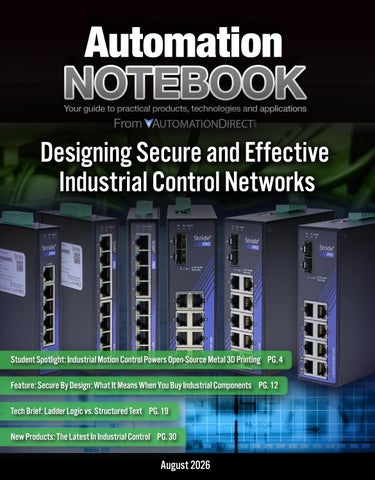
Student Spotlight: Industrial Motion Control Powers Open-Source Metal 3D Printing PG. 4 Feature: Secure By Design: What It Means When You Buy Industrial Components PG. 12 Tech Brief: Ladder Logic vs. Structured Text PG. 19 New Products: The Latest In Industrial Control PG. 30
AN_2608_Cover_V4ms.indd 1
7/20/26 11:32 AM
CAUTION PLC VALUE OVERLOAD! Wi-Fi
Bluetooth
microSD
USB
Ethernet
Built-in Option Module Slot
Serial
For custom stand-alone PLC I/O configurations that exactly match your application (option module sold separately).
(RS-232 & RS-485)
CPU units starting at only
$110
CLICK PLUS PLCs provide the same simple, practical control the CLICK PLC line is known for but with some surprising bells and whistles. Data logging, Wi-Fi connectivity, MQTT communication, and increased security measures are just a few of the impressive features offered with the CLICK PLUS PLC series.
ey-BackG on
Use any CPU with option module(s) as a complete PLC for small systems or expand the I/O with stackable I/O modules for larger applications.
45
e rante ua
45-day M
Using the same FREE streamlined PLC programming software as its predecessor, CLICK PLUS PLCs provide straightforward, no-learning-curve programming. Combine that with a starting at price of just $110.00 and the CLICK PLUS PLC is undoubtedly the unmatched value leader!
www.CLICKPLCs.com TOP RATED
Order Today, Ships Fast! * See our Web site for details and restrictions. © Copyright 2025 AutomationDirect, Cumming, GA USA. All rights reserved.
AN_2608_Ad01_pgC2.indd 2
BY CUSTOMERS
1-800-633-0405
the #1 value in automation
7/16/26 3:37 PM
ED ITOR’S NOTE
Engineering secure and connected systems — by design
A
Stephanie Neil Stephanie Neil VP, Editorial Director sneil@arrowfly.com
at wtwh.me/ notebook
s industrial automation moves into a digitally-enabled connected era, three conversations that once lived in separate silos — network design, devicelevel security, and control programming — are converging. That merge is resulting in systems that are built to be both open and resilient. This issue of NOTEBOOK explores these three topics — and more! Let’s start with our cover story, Designing Secure and Effective Industrial Control Networks, where subject matter experts explain how to optimize network performance. For decades, OT networks were intentionally isolated, designed for determinism and reliability rather than interoperability. That model is quickly fading. Today’s push for data visibility across the plant floor has made OT/IT convergence unavoidable. The result is a fundamental shift in how industrial networks are designed. They are no longer closed systems, but carefully architected environments where data must move freely without compromising performance or security. This shift is elevating the role of the underlying infrastructure. Industrial EtherNet, for example, was once a simple connectivity layer. Now, it is a strategic enabler of secure data exchange. New industrial EtherNet switches reflect this reality, embedding protocol awareness and edge intelligence to simplify integration between factory floor assets and enterprise systems. These technologies are not just about moving packets, rather, they are about making OT data usable, contextualized, and trustworthy in real time. AutomationDirect’s Damon Purvis explores this in a technical brief about a new class of edge-optimized EtherNet switches. Turn to page 16 to learn more. Built-in vs. bolt-on At the same time, the industry is recognizing that secure connectivity cannot be achieved through architecture alone. The concept of “secure by design” is reshaping expectations at the product
www.automationdirect.com
AN_2608_EditorsNote_V5msREVIEW.indd 1
level, emphasizing that cybersecurity begins long before a product is deployed. Engineers developing industrial devices can no longer focus solely on performance and reliability, but also on how transparently and securely they can be configured, maintained, and updated over decades of operation. This perspective is critical in environments where systems outlast the teams that installed them. “Customers want products that are thoughtfully designed for connected industrial environments and supported throughout their operational lifecycle,” says Tim Wheeler, AutomationDirect’s cybersecurity manager, in an interview. Read the full Q&A on page 12. Lastly, well-designed networks and devices depend on the logic that drives them. As control systems become more complex, PLC programming practices are also evolving. The increasing adoption of structured text alongside traditional ladder logic reflects a broader trend as control engineers are being asked to think not just in terms of machine behavior, but in terms of data handling, system integration, and long-term maintainability. On page 19, we break down the strengths and weaknesses of ladder logic vs. structured text to help you decide the best way to program new projects. Taken together, these developments point to a new reality for organizations. Connectivity is no longer optional. Security is no longer an add-on. And simplicity — whether in network architecture, device design, or programming approach — is becoming essential to managing growing complexity. Across all layers, the goal is the same: maintain deterministic, reliable operation while enabling secure, scalable connectivity. That makes industrial system design a more integrated engineering problem where network decisions, device capabilities, and programming choices must align from the start. AutomationDirect is here to help you figure that out! Stephanie Neil
August 2026
AUTOMATION NOTEBOOK
1
7/20/26 11:38 AM
AutomationDirect
NOTEBOOK E D ITO R IA L
STA F F
VP, Editorial Director
Stephanie Neil
sneil@arrowfly.com CO O R D IN ATIN G EDI TORS
Incessant Crescent
Director of Marketing
Joan Welty
Determine the area of the green shaded portion of the diagram, given only the lengths of the three chords on the major axes of the larger circle.
AutomationDirect jwelty@automationdirect.com Technical Marketer
Bill Dehner
AutomationDirect bdehner@automationdirect.com
Demonic Ultrasonics Twelve di-soric® Ultrasonic Proximity Sensors have been laid out in a familiar “3-4-5” triangular pattern, such that the bounded area of the right triangle is 6 (square units). The first challenge is to move four, and only four, sensors to change the bounded area to exactly 3 square units. Extra credit: starting from scratch, move any of the sensors except the diagonal row of five to create a different shape with an area of exactly 3 square units.
Advertising Manager
Tina Gable
AutomationDirect tgable@automationdirect.com Puzzle Master
Chip McDaniel
cmcdaniel@automationdirect.com C R E ATIVE
S ERV I CES
VP, Creative Director
Matt Claney
mclaney@arrowfly.com
Did you know… AutomationDirect now offers a complete line of di-soric IO-Link Compatible Ultrasonic Sensors. di-soric 8, 12, 18, and 30mm tubular and 12mm rectangular ultrasonic proximity sensors are designed for contactless distance measurement and offer IO-Link with ISDU support, a rugged nickel-plated brass construction, high IP67 protection ratings, and sensing distances up to 6,000mm. ISDU (Indexed Service Data Unit) provides on-demand exchange of parameter data (identification, configuration, and diagnostics) between the IO-Link master and the connected device to ensure accurate measuring. Learn More at: www.automationdirect.com/ultrasonic-sensors
Bubble Trouble Find the combined area of the green shaded semicircles in the figure at left, given only the two semicircular areas shown.
Find these answers and more @ library.automationdirect.com/brain-teasers-answers
2
AUTOMATION NOTEBOOK
AN_2608_BrainTeaser_Masthead_V6ms.indd 2
August 2026
Cover Artist
Erika Kinney
ekinney@automationdirect.com CO N TE N T
ST U DI O
Director, Content Studio
Courtney New
cnew@arrowfly.com
AUTOMATION NOTEBOOK does not pass judgement on subjects of controversy nor enter into dispute with or between any individuals or organizations. AUTOMATION NOTEBOOK is also an independent forum for the expression of opinions relevant to industry issues. Letters to the editor and by-lined articles express the views of the author and not necessarily of the publisher or the publication. Every effort is made to provide accurate information; however, publisher assumes no responsibility for accuracy of submitted advertising and editorial information. Non-commissioned articles and news releases cannot be acknowledged. Unsolicited materials cannot be returned nor will this organization assume responsbility for their care. Copyright© 2026, AutomationDirect.com Incorporated/All Rights Reserved. No part of this publication shall be copied, reproduced, or transmitted in any way without the prior, written consent of AutomationDirect.com Incorporated. AutomationDirect retains the exclusive rights to all information included in this document. AutomationDirect 3505 Hutchinson Road Cumming, GA 30040 Ph: 800.633.0405 | 770.889.2858 FAX: 770.889.7896
(produced by) Arrowfly 1111 Superior Ave., Suite 1120 Cleveland, OH 44114 Ph: 888.543.2447 FAX: 888.543.2447
www.automationdirect.com
7/20/26 11:41 AM
| STUDENT SPOT LI G H T |
TAB L E O F CONT EN T S AU G UST 2026 • ISS U E 6 0
8
Designing Secure and Effective Industrial Control Networks
4 Industrial Motion Control Powers OpenSource Metal 3D Printing Reliable off-the-shelf automation components can accelerate the development of prototype projects and ready them for scale-up. | TECH BRIEFS |
16 Unmanaged+ Industrial EtherNet Switches Simplify OT/IT Connectivity A new class of edge-optimized EtherNet switches are purpose-built for industrial environments and protocols, providing a streamlined approach for connecting valuable OT data with enterprise IT resources for improved visibility, analytics, and proactive diagnostics.
19 PLC Programming – Ladder versus Structured Text For decades, ladder logic has been the undisputed leader as a PLC programming language, but today’s controls engineers are taking greater advantage of another option, structured text, for advanced applications incorporating data handling, communications, recipe management, and more. | CUSTO M ER AP P LI CAT I O N |
22 Supporting Small and Specialized Automation Applications
12
Secure by Design: What It Means When You Buy Industrial Components
How a small system integrator relies on proven automation products to reliably and responsively serve clients.
26 A Hands-On Home for Automation Learning How a main-street innovation center is helping small-town utilities, students, and researchers get comfortable with industrial controls.
30 | NEW PROD UCT S | Ad Index IBOCO......................................7
www.automationdirect.com
AN_2608_TOC_V5msREVIEW.indd 3
August 2026
AUTOMATION NOTEBOOK
3
7/20/26 11:44 AM
Industrial Motion Control Powers Open-Source Metal 3D Printing BY DAVID POWELL, AUTOMATION AND CONTROL LEAD
Reliable off-the-shelf automation components can accelerate the development of prototype projects and ready them for scale-up.
T
he shipbuilding industry — where lead times for new vessels often stretch into years and repairs are time and safety critical — often requires large, specialized parts, which are costly and time consuming to manufacture with conventional methods. For this reason, the maritime industry is increasingly pursuing novel manufacturing techniques to obtain parts, as an alternative to the traditional supply chain. One approach is to use additive manufacturing techniques, such as wire arc additive manufacturing (WAAM), to produce large-scale metal parts. WAAM allows complex parts to be quickly constructed on-site, and perhaps even on board in the future, reducing both lead times and supply chain complexity. However, the adoption of WAAM is stymied by the drawbacks of closed-source systems currently available, including high costs and the risk of becoming dependent on a single ecosystem. In response to this problem, a shipbuilder approached the Centre for Applied Research & Innovation (CARI) at the British Columbia Institute of Technology (BCIT), looking to support development of an open-source WAAM system (Figure 1). Our team of three students and engineers from BCIT and Simon Fraser University (SFU) rose to address the challenge and gain hands-on experience unlike anything possible in the All figures courtesy of David Powell.
4
AUTOMATION NOTEBOOK
AN_2608_StudentSpotlight_V8msREVIEW.indd 4
August 2026
Figure 1: The team developed this wire arc additive manufacturing system to support maritime manufacturing of large-scale metal parts, relying on rugged, reliable industry-proven automation components.
www.automationdirect.com
7/16/26 3:35 PM
ST UD ENT SP OTL IGHT
classroom. Achieving the development of a cutting-edge system is an ambitious target for a group of students, and with an 18-month timeline, the team quickly realized they would need to rely on proven, industry-standard hardware and software motion control solutions.
Super-sizing a 3D printer Wire arc additive manufacturing can be compared to a combination of welding and fused deposition modeling (FDM), a technique commonly used on polymer 3D printers where parts are constructed layer by layer. In WAAM, metal filament is melted by an automated welding arm using high-powered electric arcs. This molten metal is then deposited one layer at a time, allowing complex parts to be constructed quickly, with minimal postprocessing required. Unlike other forms of metal additive manufacturing, such as powder bed fusion (PBF) or metal FDM, WAAM allows for significantly larger part geometries, at the expense of surface finish and part tolerance. However, for maritime applications, the large build volume of WAAM is crucial, while the lower accuracy and rougher surface finish are less critical. For the design, our team settled on a gantry system providing three axes of motion, with one vertical (Z) and two horizontal (X/Y) axes. The welding arm is mounted on a gantry, which moves in the horizontal plane, allowing access to the entire surface of the print. The part itself is fused to a large bed. To build depth, the bed is lowered away from the gantry arm as the height of the part increases with each layer. Controlling and synchronizing motion across all three axes is already a complex problem. However, the team faced the added challenge of designing the machine to handle the large volume and heavy weight of the parts, while providing sufficient speed control to perform high-quality welds. Furthermore, the automation would need to stand up to harsh physical and electro-magnetic interference conditions. In addition to the motion requirements, the team needed to consider the machine workflow. An important requirement was that the machine support g-code, which is an industry-standard programming language commonly used on computer numerical
www.automationdirect.com
AN_2608_StudentSpotlight_V8msREVIEW.indd 5
control (CNC) machines and 3D printers. A variety of both open and closed-source platforms are available to facilitate g-code generation. G-code provides the machine with a sequence of coordinates and directives, telling it where to travel and how quickly to move, while controlling actions such as heating, welding, and material deposition rate.
Automating Industrial Reliability While desktop 3D printers use a variety of microcontrollers, many of them consumer-grade, this design required something much more robust. To meet the automation requirements, the team decided to use a commercially available industrial-grade motion controller to provide central control and synchronization of all three axes. The alternative to this would be designing custom electronics and firmware to facilitate the motion control for each motor from scratch, which would be timeconsuming and introduce significant risks and potential for errors. An off-the-shelf motion controller provides accurate closed-loop motion control by interpreting position code, such as g-code, into electrical signals to control the motors. A motion controller provides not only the processing power to control all three axes simultaneously but also provides essential reliability for heavy industry. With these requirements in mind, the team chose the LS Electric XMCE08A programmable motion controller from AutomationDirect (Figure 2). Designed to be extensible, accurate, and robust, the motion controller supports up to eight independent axes and uses g-code out of the box. However, it can also be programmed with a variety of other industry standard programming languages, making it an excellent choice for a wide range of applications. The controller also accepts a variety of methods for homing the machine, including both motor stall and magnetic encoder strips, giving the team further design flexibility. Many small 3D printing systems can get by with economical stepper motors, instead of servo motors. However, this application requires the superior torque and built-in position feedback offered by servos, even though servo systems introduce additional cost and complexity.
Figure 2: The LS Electric motion controller and motor drives from AutomationDirect are shown in the team’s control panel.
For their motors and motor drives, the team selected from the range of compatible LS Electric servo motors and drives, ensuring seamless integration with the motion controller. Each motor was matched with a drive, providing the interface between the motion controller and the motor. Motion control communication used industry-standard EtherCAT, which is a synchronous, high-speed, Ethernet-based protocol, optimized for automation and precise control applications. Implemented with a simple daisy-chain topology using Ethernet patch cords, the team found EtherCAT effective to streamline installation.
Putting things into motion The motors were carefully sized based on torque and rotor/mechanism inertia requirements to drive the mechanisms >>
August 2026
AUTOMATION NOTEBOOK
5
7/16/26 3:35 PM
All figures courtesy of David Powell.
Figure 4: The free LS Electric XG5000 software suite supports several programming languages, and the team found that traditional ladder logic was a convenient way for loading the g-code motion control instructions. Figure 3: The team relied on the LS Electric ecosystem for their motion controller, motors, and motor drives, ensuring a seamless integration.
using pulleys, belts, and ball screws. The team selected two 400 Watt APMCFBL04AMK-AD motors to control the relatively low-load horizontal axes, while the vertical axis uses a pair of 750 Watt APMC-FCL08AMK-AD motors to handle the much more substantial load (Figure 3). Since two motors are used in parallel to drive the vertical axis, it was important to implement synchronized motion control using built-in controller features to prevent mechanical binding, with careful error detection and shutdown in the event of any discrepancy. Homing of all three axes is performed by stalling the motors at the end of the machine’s travel range, a process supported both by the motors and motion controller. Programming the motion controller was accomplished using the XG5000 software suite (Figure 4), a versatile programming software commonly used with the LS Electric programmable logic controller (PLC) and motion controller ecosystem. While the software supports a variety of programming languages, the team chose to use traditional ladder logic for the primary control sequences such as homing the motors and loading the g-code instructions. Regarding the g-code, the workflow for creating a part is to first develop it as a 3D model using any computer
6
AUTOMATION NOTEBOOK
AN_2608_StudentSpotlight_V8msREVIEW.indd 6
August 2026
aided design (CAD) tool. This model is then processed through an open-source “slicer” software tool, to render g-code instructions for printing layers. Standard slicers incorporate information relevant for polymer-based 3D printing, so the team needed to scrub this out to preserve just the X/Y/Z motion commands. The resulting g-code is uploaded to the motion controller, which then follows the instructions to perform the manufacturing process. The final WAAM system design supports a build volume of 3 x 3 x 6 feet, allowing a wide range of maritime parts to be manufactured with ease. With the double-motor driven vertical axis, the machine can support a maximum part weight of 500 kg. It will support the use of several different materials — first mild steel, and later aluminum, brass, and stainless steel.
Building up to success Throughout the project, the team gained valuable experience through exposure to a real-world application and design process, innovative additive manufacturing techniques, and hands-on construction. Using proven, industrystandard automation equipment provided a reliable and straightforward automation experience. The team appreciated the full LS Electric ecosystem, allowing easy motor interconnection, extensibility, programming, and guaranteed compatibility. Using AutomationDirect’s
extensive written documentation and video tutorial library, the team was able to navigate the learning curve of using the LS Electric motion controller with ease. Currently, the team has validated the 3D motion control of the machine by having it perform simple pathing in three dimensions, including attaching a felt-tip marker to it and having it draw pictures on paper. The next step for the team is to qualify the system by testing the welding mechanism and working towards fullscale manufacturing. Furthermore, the team would like to add automated prediction and compensation for welding factors such as heat stress and material flow, which will further improve the manufacturing quality. These features can be added to the existing motion controller platform, allowing the team to continue iterating and improving their design without significant redesign effort. Looking forward, the project will be continued by other students at SFU and BCIT working on the welding and manufacturing systems, before the machine ultimately finds its home in a shipyard. David Powell served as the automation and control lead on the WAAM project. He is completing a Master’s in mechatronics engineering at Simon Fraser University, following on his bachelor’s degree in mechanical engineering.
www.automationdirect.com
7/21/26 9:49 AM
When it comes to wire management, go PRO with IBOCO.
The Pro’s Choice for Comprehensive Wire Management
Your project demands more than just wire routing—it demands resilience, efficiency, and organization. IBOCO products are reliable, professional-grade wire management solutions, designed to perform from the cabinet interior to the machine floor. • Wire Duct: Features clean, quick break-off fingers and non-slip mounting to cut installation time and ensure flawless cabinet aesthetics • Electrical Tubing: Flexible corrugated tubing and fittings provide superior mechanical protection against abrasion, chemicals, and vibration • Spiral Wrap: Neatly bundle and protect cable runs quickly while staying flexible and tightly contained
Explore the full range of IBOCO professional wire management solutions at AutomationDirect.com.
AN_2608_Ad08_pg7.indd 7
7/16/26 3:40 PM
I N D UST R I AL CO N TRO L N ETWO R KS
DESIGNING SECURE AND EFFECTIVE
INDUSTRIAL CONTROL NETWORKS The IT/OT convergence is inescapable in the modern industrial market. Here’s how to optimize performance while maintaining a secure network. BY DAMON PURVIS, ALEXANDER MAERCZ, AND WINN PAULK; AUTOMATIONDIRECT
Image courtesy of AdobeStock
8
AUTOMATION NOTEBOOK
AN_2608_CovStory_PLC_Com_V5msREVIEW.indd 8
August 2026
www.automationdirect.com
7/16/26 3:32 PM
I N DUST R I AL CO N TROL N ETWORKS
F
or decades, the operational technology (OT) networks responsible for industrial controls were kept separate from IT networks. The approach protected critical industrial operations from vulnerabilities introduced by the broader enterprise network. No longer. The modern focus on digitalization and data-driven insights means that manufacturers are increasingly connecting machines, drives, remote I/O, and HMIs with SCADA systems, data historians, MES platforms, and cloud services. Making OT data accessible is evolving from a competitive advantage to table stakes. And the push toward the connected factory has only been accelerated by the emergence of AI. The challenge lies in finding a way to maintain a robust, deterministic, and secure industrial network in the face of this OT/IT convergence. Fortunately, with proper network design and implementation, it’s possible to ensure performance and security while supporting the network access and dataexchange mandates.
Choosing a protocol As in all types of engineering, the choice of hardware and software is driven by the needs of the application. Start by determining the communications model: • Point to point: One device communicates with another. • Master/slave or client/server: Master or client device polls subsidiary devices or pushes down commands. • Scanner/adapter: Scanner (e.g., PLC) manages I/O connection to adapters (e.g., field devices) that exchange data with it; the scanner sets the update rate (requested packet interval) for the cyclic I/O data exchange. • Publish/subscribe: Devices publish data to a broker, while other devices subscribe to receive it. The next step is to decide which protocol best fits the job. The most common options are real-time EtherNet (e.g., EtherNet/IP, PROFINET, etc.),
Modbus TCP, MQTT/MQTTS, and OPC UA. The table below provides general guidelines for matching application to protocol.
Optimizing real-time EtherNet for an industrial environment Although real-time industrial EtherNet protocols can be very effective, they can cause problems with networks running protocols such as Modbus TCP, MQTT, and OPC UA. Issues can be avoided using the following techniques and tools. Quality of Service The EtherNet protocol is based on “best effort” transmission, with all connected
The challenge lies in finding “ a way to maintain a robust, deterministic, and secure industrial network in the face of this OT/IT convergence.
”
Table: Industrial communications protocols Application need
Application communication model
Best-fit protocol candidates
Why?
Fast PLC-to-I/O or PLC-to-drive control
Scanner/adapter
EtherNet/IP
Designed for industrial control networks, scanner/adapter roles, and cyclic I/O messaging
Simple PLC-to-device data exchange
Point to point
Modbus TCP
Simple register-based model, broad multi-vendor support
PLC data to dashboards, cloud, or analytics
Publish/subscribe
MQTTS
Publish/subscribe model reduces tight coupling between PLCs and consuming applications
IIoT with standardized MQTT payloads
Publish/subscribe
MQTTS
Adds structure and state awareness on top of MQTT
SCADA, historian, MES, or enterprise data with context
Various
OPC UA
Structured, vendor-neutral, securityoriented data exchange
Mixed-vendor PLC integration
Various
EtherNet/IP, Modbus TCP, OPC UA
Choice depends on whether the need is control, simple data, or structured supervisory data
www.automationdirect.com
AN_2608_CovStory_PLC_Com_V5msREVIEW.indd 9
August 2026
AUTOMATION NOTEBOOK
9
7/16/26 3:32 PM
I N D UST R I AL CO N TRO L N ETWO R KS
IGMP snooping for multicastheavy networks The Internet Group Management Protocol (IGMP) offers a way to prevent multicast traffic from overwhelming the network and devices. Instead of broadcasting traffic to all devices on the network, a switch can be auto configured by IGMP to send only to certain devices/ ports. Subscribing a device to a multicast group triggers an IGMP message. Because the switch “snoops” on the IGMP traffic, it is then automatically configured to route traffic on a packetby-packet basis only to subscribed ports. Ports can be unsubscribed at any time.
Improving performance with network segmentation
Figure 1: AutomationDirect’s STRIDE PRO Unmanaged+ Gigabit switches provide high-functionality features like IGMP snooping and VLAN support for network segmentation. It can be easily configured via DIP switch.
devices having equal opportunity to send data. In the event of data collision — two devices transmitting data packets simultaneously — one randomly selected packet gets delayed by a few milliseconds. This isn’t a problem for print jobs and videos but it’s unacceptable for highly synchronized industrial operations. The solution is to prioritize time-critical commands using a network switch functionality known as Quality of Service (QoS). In QoS, the switch orders incoming data packets based on criteria like type (e.g., voice calls, video streaming, or file transfers), source, or destination. This prevents data logging, for example, from taking precedence over motion commands. When properly executed, the QoS approach can boost efficiency by reducing latency, jitter, and packet loss for time-critical applications. Take care when applying network prioritization, though. If you designate EtherNet/IP as a high priority protocol, the switch is automatically going to slow down anything that’s designated as lower priority. That could impact communications with legacy devices and HMIs.
10
AUTOMATION NOTEBOOK
AN_2608_CovStory_PLC_Com_V5msREVIEW.indd 10
August 2026
For decades, OT networks were “air gapped” from IT networks to prevent unauthorized access and minimize interference and vulnerabilities. In our modern data-driven era, however, it is no longer practical to physically isolate machine networks from the rest of the facility. Instead, they should be logically isolated in virtual local area networks (VLANs). Switches with VLAN functionality can be used to segment the network into multiple logical subnets by including only designated ports and blocking the others. Segmentation limits port traffic to improve network efficiency and minimizes risk (more on that later). When implementing network segmentation, don’t stop at simply separating IT and OT networks. In larger OT systems, consider dividing the OT network into smaller logical zones using subnets and VLANs, such as by machine, production line, cell/area zone, or function. This can reduce broadcast traffic, improve troubleshooting, and help keep highbandwidth systems like machine vision, SCADA, or data collection traffic from competing with time-sensitive control traffic between PLCs, I/O, and drives. Pay particular attention to isolating real-time EtherNet traffic (e.g., EtherNet/IP) from point-to-point traffic like Modbus TCP. Modbus devices are typically legacy devices and tend to have very limited bandwidth. They can easily be swamped by a multicast message protocol such as EtherNet/IP.
With the convergence of IT and OT, cybersecurity has gone from an option to a necessity. There are a number of techniques and common-sense strategies to improve the organization’s security posture. Look for “secure-by-design” products The best way to achieve a secure system is to incorporate cybersecurity from the beginning, rather than following a “bolt-on” approach after commissioning. Start with secure-by-design products — products with built-in cybersecurity features (see “Secure by Design: What It Means When You Buy Industrial Components”). Products like PLCs, switches, and HMIs are already available with integrated security functionality. Expect to see that trend continue as the EU’s Cyber Resilience Act (CRA) nears its enforcement date of December 2027. The CRA mandates that all digital devices marketed in the EU have pre-installed security functionality. As an example, consider switches with Media Access Control security (MACsec) encryption. Standardized as IEEE 802.1AE, the MACsec protocol is based on the assumption that all ports are inherently trustworthy until proven otherwise. It calls for encrypting an EtherNet frame before it is transmitted from device to device over the physical media. Linked ports on different switches in the network need to exchange and verify matching security keys before any data can be passed. As a result, MACsec encryption can protect against a variety of security threats, such as intrusion, man-in-the-middle, masquerading, and more without adding latency. Implementation may be more complex upfront, but the resulting network is far more robust than if it used only software encryption. Apply network segmentation and security hardening The more tightly coupled the OT network is to the IT network, the more important it is to run the most secure protocol feasible. Certain protocols like real-time EtherNet and Modbus TCP provide operational benefits. Because secure versions of these protocols either don’t exist or are rarely supported, however, consider segregating them from the rest of the network in a separate VLAN.
www.automationdirect.com
7/16/26 3:32 PM
Segmentation makes it possible to have a field network running the fieldbus and intra-machine communications using fast, efficient, and known protocols like Modbus TCP on a VLAN. In this scenario, that VLAN would be logically isolated from other network traffic, while the shop floor would maintain a separate VLAN for external communications using secure protocols such as OPC UA, MQTTS, and HTTPS. Follow through with device hardening and system hardening It’s not enough to buy a device with security functionality or use a protocol that can be secure. None of these measures work unless they’re enabled. During commissioning and troubleshooting, it can be enormously tempting to skip steps like setting port security keys and installing security certificates. The problem arises when the system stays that way after initial tests. Don’t be the reason something gets hacked; take the time to properly configure the available security measures. There needs to be a hard delineation of which ports are allowed to communicate with which other ports. This can take
Image courtesy of AdobeStock
I N DUST R I AL CO N TROL N ETWORKS
“ It’s not enough to buy a device with security the form of physical indications such as cabling colors and dedicated OT and IT ports that don’t share any internal resources. Don’t stop with hardware; include additional virtual guards like whitelisting MAC addresses, ports and IP addresses.
Switch solutions
Figure 2: The WAGO lean managed EtherNet switch from AutomationDirect offers network segmentation and QoS, along with a streamlined web interface and diagnostic toolkit designed for ease of use.
www.automationdirect.com
AN_2608_CovStory_PLC_Com_V5msREVIEW.indd 11
”
functionality or use a protocol that can be secure.
There was a time when techniques like network segmentation and IGMP snooping could only be implemented with highly managed switches that were expensive, power-hungry, and complex to install and configure. Today, even some enhanced unmanaged switches can do the job (see Figure 1). It’s an efficient, economical approach for networks with limited requirements. The next step up in functionality is a lean managed EtherNet switch. Fast becoming a preferred IIoT solution, lean managed EtherNet switches are userfriendly enough to be configured without extensive IT knowledge. Bridging the gap between enhanced unmanaged switches and highly managed switches, lean designs offer a stripped-down feature set to reduce configuration overhead (see Figure 2).
Conclusions Although the convergence of OT networks and IT networks has its challenges, tools and techniques have evolved to address them. Cybersecurity is essential, but don’t feel threatened, as long as you segment your network properly, you can still use the very efficient and fast fieldbus protocols that you know. The key is using the techniques above to keep those subnets secure. Start at the design phase. Choose products that are secure by design and follow through with implementation. Familiarize yourself with how certificates work and how to use them. Look to ISA/IEC 62443 and NIST cybersecurity frameworks for more practical tips on improving cybersecurity posture today while preparing for the future. Finally, take advantage of the expertise of your vendors during set up. Damon Purvis is DM/DL & Networking Silo Product Manager, and Alexander Maercz and Winn Paulk are DM/DL & Networking Silo - Product Engineers at AutomationDirect.
August 2026
AUTOMATION NOTEBOOK
11
7/16/26 3:32 PM
Image courtesy of AdobeStock
S ECUR E BY D ES IG N
SECURE BY DESIGN:
WHAT IT MEANS WHEN YOU BUY INDUSTRIAL COMPONENTS BY TIM WHEELER, CYBERSECURITY MANAGER, AUTOMATIONDIRECT
12
AUTOMATION NOTEBOOK
AN_2608_Feat_1_V3msREVIEW.indd 12
August 2026
W
hen customers purchase industrial components, they’re looking for more than a part number. They want products they can rely on in real-world machines, panels, process lines, and production environments where uptime, maintainability, and predictable operation matter every day. Increasingly, they also want confidence that those products were designed with cybersecurity in mind before they were ever installed on a network. As industrial devices become more connected, cybersecurity is becoming part of the overall product-quality conversation. Controllers, HMIs, drives, communication modules, gateways, and other devices now routinely exchange data with enterprise systems, cloud services, remote operators, and third-party equipment. That connectivity creates
new operational capabilities, but it also introduces new considerations around configuration, maintenance, updates, and long-term support. To help explain what “Secure by Design” means from an industrial customer’s perspective, Automation Notebook spoke with Tim Wheeler, Cybersecurity Manager at AutomationDirect.
Q: What does “Secure by Design” mean in industrial automation?
At a practical level, Secure by Design means cybersecurity is considered during product development instead of being treated as something added later. When a customer buys an industrial component, they’re not just buying hardware. They’re also placing trust in how that product was designed, documented, configured, maintained, and supported throughout its lifecycle.
www.automationdirect.com
7/16/26 3:34 PM
S ECURE BY D ESIGN For industrial customers, that matters because these products often remain in operation for many years. A PLC, HMI, industrial PC, or communication device may still be running long after the original installation team has moved on. The product should be designed so customers can understand how it operates, configure it correctly, maintain it over time, and apply updates when needed. One misconception is that Secure by Design is mainly about compliance or regulations. Standards and regulations are influencing the conversation, but the bigger issue is operational confidence. Customers want products that are thoughtfully designed for connected industrial environments and supported throughout their operational lifecycle. Secure by Design also doesn’t mean a product is automatically “secure” by itself. Customers still need good network design, segmentation, access control, backup procedures, and maintenance practices. What Secure by Design does do is give customers a stronger starting point before the product is ever installed on their systems.
increasingly being treated as part of responsible product development.
Q: How is Secure by Design
different from traditional industrial cybersecurity approaches?
Traditionally, cybersecurity was often treated as something added around the outside of an industrial system. Companies focused heavily on perimeter defenses such as firewalls, segmentation, antivirus software, and remote-access controls. Those things are still important, but Secure by Design shifts some of the focus directly into components themselves. For example, customers shouldn’t have to be cybersecurity experts to avoid obvious mistakes. A product designed with security in mind may disable unnecessary services by default, clearly
“ Industrial systems tend to have very long operational lifecycles compared to many
enterprise IT systems.
Q: Why has Secure by Design
become a bigger topic in industrial automation recently?
Industrial systems today are much more connected than they were even ten years ago. Historically, many industrial devices operated in relatively isolated environments. Now, it’s common for systems to exchange production data with business systems, connect with remote support teams, communicate with cloud platforms, or integrate with Industrial Internet of Things applications. As that connectivity has increased, cybersecurity expectations have also increased. Customers want to know how products are designed and supported because they understand that connected devices can become part of a much larger operational network. At the same time, industry standards and regulations are evolving around products with digital elements. Frameworks like IEC 62443 and regulations such as the Cyber Resilience Act are helping shape expectations around secure development practices, documentation, vulnerability management, and lifecycle support. While most industrial customers don’t need to become experts in every standard or regulation, they should understand that cybersecurity is
www.automationdirect.com
AN_2608_Feat_1_V3msREVIEW.indd 13
when networks, operating systems, and security expectations have changed. Industrial environments also have operational realities that make maintenance more complicated. Many systems can’t simply be shut down during business hours for updates or configuration changes. For example, you wouldn’t want your PLC to do an “automatic” update like what your PC running Windows might do and shut down production as a result. So, having more explicit control of how your device updates is crucial. Maintenance windows may be limited, production schedules may be tight, and some facilities operate continuously. Secure by Design recognizes those operational constraints and tries to make products more manageable within real industrial conditions.
document communication ports, support authentication options, provide a defined update process, and avoid hidden or unexplained access methods. Those kinds of decisions help reduce unnecessary exposure before the product is ever placed into operation. It creates fewer unnecessary doorways into the device while making the product easier to understand and manage over time.
Q: Why is lifecycle support so important in industrial environments?
Industrial systems tend to have very long operational lifecycles compared to many enterprise IT systems. Some industrial devices remain in service for ten, fifteen, or even twenty years depending on the application. Because of that, customers are evaluating more than initial functionality when they purchase a component. They also need confidence that the supplier has considered long-term maintainability, software updates, documentation, and support processes. A product may perform well on the day it’s installed, but customers also need to know how it’ll be maintained several years later
”
Q: What are some practical things customers should look for when evaluating industrial products?
One important area is documentation clarity. Customers should be able to understand how the product communicates, what services are enabled, how updates are handled, and what security-related configuration options exist. Clear documentation can help them make informed decisions during installation and maintenance. Another consideration is whether unnecessary features or services are enabled by default. In many situations, customers only need a subset of a device’s capabilities for a particular application. Minimizing unnecessary exposure helps reduce risk and simplifies deployment. Customers should also look at whether the supplier has a defined vulnerability response process. No product is completely immune from vulnerabilities over time, especially as technologies evolve. What matters is whether the supplier has processes in place for identifying issues, communicating with customers, and providing updates or mitigations when needed. Lifecycle support also matters. >>
August 2026
AUTOMATION NOTEBOOK
13
7/16/26 3:34 PM
Image courtesy of AdobeStock
S ECUR E BY D ES IG N
Customers aren’t just selecting a device. They’re selecting the development practices and long-term support practices that stand behind it.
Q: How does Secure by Design relate to product quality?
Industrial customers already understand product quality very well. They evaluate products based on reliability, uptime, maintainability, documentation, support, and predictable performance. Cybersecurity increasingly fits into that same conversation. If a device is difficult to configure securely, lacks clear documentation, has poorly managed update processes, or exposes unnecessary services, those things can create operational problems just like poor hardware reliability can. From that perspective, cybersecurity becomes part of overall product quality rather than a completely separate IT issue. A well-designed product helps customers deploy and maintain systems more confidently throughout the operational lifecycle.
Q: Why can industrial cybersecurity
be more complicated than traditional IT cybersecurity?
Industrial environments have different operational priorities. In enterprise IT environments, systems can often be updated or restarted more frequently without major operational consequences. Industrial systems are different because they may support continuous manufacturing processes, real-time control functions, or safety-related operations.
14
AUTOMATION NOTEBOOK
AN_2608_Feat_1_V3msREVIEW.indd 14
August 2026
Many industrial environments also include legacy systems that were designed long before modern cybersecurity expectations existed. Customers often need to integrate newer connected technologies with older operational equipment that may still be functioning reliably from a production standpoint. There’s also the challenge of balancing security with operational performance. Industrial systems frequently require deterministic communications and high availability. Any cybersecurity measures need to support those operational requirements without introducing unacceptable latency or instability into the process. Because of those realities, industrial cybersecurity tends to require a more operationally aware approach than many traditional enterprise IT environments.
Q: How is AutomationDirect approaching Secure by Design within its product and support philosophy? One important part is helping customers make informed deployment decisions. That starts with practical documentation, transparency around product capabilities, and guidance that helps customers understand how products communicate and operate within connected industrial environments. AutomationDirect is also mindful of abiding by global cybersecurity standards, such as the ISA/IEC 62443 standards that define requirements and processes for implementing and maintaining electronically secure automation and control systems. Our product development teams are now following
these guidelines at the earliest points of their design and engineering. Another area is reducing unnecessary complexity wherever possible. Customers should be able to configure products appropriately for their applications without having to reverse engineer how a device behaves on a network. Lifecycle thinking is also important. Customers want products that can be maintained and supported over time, especially in industrial environments where systems often remain operational for many years. That includes considering update processes, vulnerability response practices, and long-term product support. Education plays a role, too. Many industrial customers are still navigating how cybersecurity fits into their OT environments. Providing practical resources and guidance can help customers strengthen their overall approach without making cybersecurity feel disconnected from day-to-day operations.
Q: How do you see customer
expectations evolving over the next several years?
Customers are becoming more aware that cybersecurity is part of the overall lifecycle and operational readiness of industrial products. They’re asking more questions about support processes, software maintenance, update procedures, and long-term product management. I also think customers increasingly expect better transparency from suppliers. They want clear information about how products communicate, what capabilities are enabled, and how vulnerabilities are handled when issues arise. At the same time, industrial equipment continues to become more connected. More devices now support APIs, remote communications, cloud integration, and data-sharing capabilities that were uncommon years ago. That connectivity creates significant opportunities for efficiency and operational visibility, but it also means cybersecurity considerations will continue becoming more important during product selection. At the end of the day, Secure by Design is really about helping customers make better-informed component purchasing and deployment decisions. It’s about giving them greater confidence before the product is ever installed on their network or production floor.
www.automationdirect.com
7/16/26 3:34 PM
Dangerous Machinery? Safeguard unsafe areas with affordable safety components from AutomationDirect
Common Sense is Great, but Sure-Fire Protection is Better AutomationDirect has a comprehensive portfolio of certified machine safety components to guarantee your equipment is protected and your personnel are safe. A wide assortment of safety components from trusted brands in the industry is available including cable pull safety switches, hazardous area safety devices, safety relays and much more. All are in stock at low everyday prices, so you can keep your system safe without breaking the bank.
NEW! Schmersal PROTECT PS1 Safety Controller Starting at $777.00
The Schmersal PROTECT PSC1 safety control system is a compact, programmable safety control system with scalable I/O. E-Stops, light grids, and almost any safety device can be monitored with ease. The universal interface ensures instant connection to every standard fieldbus. All of this from a well-known brand in safety equipment. The PSC1 Safety Controllers include the following features: • Safety functionalities up to SIL 3 according to IEC 61508 / IEC 62061, PLe and Cat. 4 according to EN ISO 13849-1 • 14 safe inputs up to PL e or SIL 3, 4 safety semiconductor outputs, 2 relay outputs, and 2 pulse outputs • Modular expansion with up to 216 inputs/outputs, using one part number for each expansion • Built-in fieldbus connectivity without the need to purchase communications modules • The PSC1-C-10 has 2 built-in signaling outputs, and the PSC1-C-100 adds 20 configurable I/O points that can be set as inputs or outputs, and 6 signaling outputs
Safety Relays
Safety Light Curtains
ey-BackG on
Lorem ipsum
45
ee rant ua
Machine Guarding
45-day M
Also Available
Research, price, buy at:
www.automationdirect.com/safety TOP RATED
Order Today, Ships Fast! * See our Web site for details and restrictions. © Copyright 2025 AutomationDirect, Cumming, GA USA. All rights reserved.
AN_2608_Ad02_pg15.indd 15
BY CUSTOMERS
1-800-633-0405
the #1 value in automation
7/16/26 3:38 PM
TEC H N I CAL BR I EFS
Unmanaged+ Industrial EtherNet Switches Simplify OT/IT Connectivity A new class of edge-optimized EtherNet switches are purpose-built for industrial environments and protocols, providing a streamlined approach for connecting valuable OT data with enterprise IT resources for improved visibility, analytics, and proactive diagnostics. BY DAMON PURVIS, AUTOMATIONDIRECT
T
hroughout all aspects of industrial automation, the historical separation between operational technology (OT) and information technology (IT) connectivity is rapidly disappearing. Business environment IT networks have primarily focused on scalability, segmentation, and data accessibility, while networking technology applied to OT applications was engineered for robust and deterministic performance among PLCs, remote I/O, HMIs, and other devices.
However, industrial end user requirements have shifted in recent years to prioritize more enterprise-centric capabilities for remote connectivity, analytics, artificial intelligence (AI), and other needs that all depend on reliable access to machine and process data. As a result, designers are seeking OT network architectures that preserve control performance at the machine level, while exposing operational data to higher-level IT systems in a secure and manageable way, with solutions that: • Enable secure plant-to-enterprise data sharing • Support industrial protocols and IT network standards • Preserve deterministic behavior while improving visibility • Minimize the management burden while maintaining fault tolerance The challenge for both OT and IT personnel is to find effective products and strategies for bridging the two domains, with unmanaged+ industrial EtherNet switches a leading solution.
A delicate balancing act In many facilities, neither OT or IT teams have the time or staffing to fully engineer and maintain a heavily managed industrial network at every Figure 1: AutomationDirect Stride PRO industrial unmanaged+ EtherNet switches enable advanced network monitoring and troubleshooting features via simple DIP switch settings. Image courtesy of AutomationDirect
16
AUTOMATION NOTEBOOK
AN_2608_TechBrief_1_Switches_V5msREVIEW.indd 16
August 2026
www.automationdirect.com
7/16/26 3:36 PM
T ECH N ICAL BRI EFS
Figure 2: Unmanaged+ switches perform essential IT functions including VLANs and port mirroring, in an accessible and selective way suitable for the OT plant floor. Image courtesy of AutomationDirect
machine or cell. This creates demand for edge devices that can enforce essential traffic controls and diagnostics without requiring full IT-style configuration workflows. To address these and related issues, industrial edge switches can fill the gap between basic unmanaged switches and fully managed enterprise infrastructure. The objective is not to replicate the entire IT feature stack at the machine level, but to instead only expose features that matter most in industrial applications, using a deployment model familiar to OT personnel. Some edge switches, usually referred to as lean or lightly managed, take on this task but still require some degree of software configuration. However, there is another category of switch that avoids software settings and instead relies on a plug-andplay design using DIP-switches for provisioning selective capabilities. A representative example is the AutomationDirect Stride PRO industrial unmanaged+ EtherNet switch family. These devices are specifically engineered to work with PLCs, HMIs, VFDs, and distributed I/O, while delivering ITfriendly capabilities. They provide a practical upgrade path from legacy architectures to modern EtherNet-based technologies (Figure 1). From a hardware perspective, unmanaged+ switches must be designed for industrial service: DIN-rail or panel mounting, metal enclosures, 24 VDC operation, extended temperature tolerance, and strong immunity to electrical noise, surge, reverse polarity, and power anomalies. Those requirements are not optional in control cabinets or field enclosures where commercial office-grade switching hardware is likely to underperform or fail
www.automationdirect.com
AN_2608_TechBrief_1_Switches_V5msREVIEW.indd 17
Figure 3: AutomationDirect Stride PRO industrial unmanaged+ EtherNet switches incorporate IT tools like IGMP snooping and port mirroring, along with more OT-focused options such as port disconnect alarms.
Images courtesy of AutomationDirect
August 2026
AUTOMATION NOTEBOOK
17
7/16/26 3:36 PM
TEC H N I CAL BR I EFS
“ For OEMs and manufacturers, the network edge has become a strategic control and monitoring point.” prematurely. But the unique advantage is how they incorporate essential IT networking features.
Merging OT and IT Network segmentation is useful for managing devices, traffic, and cybersecurity risks. Business IT commonly uses virtual local area networks (VLANs) and policy-based controls on managed switches to do this. On the factory floor, OT has historically achieved similar separation with physically distinct networks and simple switching
to contend with multicast traffic from EtherNet/IP scanners and time-sensitive remote I/O communications, for example (Figure 2). Unmanaged industrial edge switches allow these approaches to converge by adding just enough intelligence to manage traffic flows without overcomplicating support. Software configuration, extensive planning, and other management headaches are avoided, shortening initial deployment times and simplifying any subsequent troubleshooting.
Free Online PLC Training No purchase neccesary
Access free video libraries that explain the fundamentals of PLC control as well as provide in-depth training on AutomationDirect’s families of PLCs. No time or viewing limitations.
http://go2adc.com/training Order Today, Ships Fast! the #1 value in automation
1-800-633-0405
* See our Web site for details and restrictions. © Copyright 2024 AutomationDirect, Cumming, GA USA. All rights reserved.
18
AUTOMATION NOTEBOOK
AN_2608_TechBrief_1_Switches_V5msREVIEW.indd 18
August 2026
Core capabilities that matter for OT Key capabilities of unmanaged+ switches include Fast EtherNet and Gigabit uplinks, copper and fiber connectivity, and small form-factor pluggable (SFP) support for longer-distance or electrically noisy installations. Power over EtherNet (PoE), PoE+, and PoE++ reduce installation cost by delivering power and communications over a single cable to edge devices such as cameras, wireless access points, and selected industrial endpoints. Quality of service (QoS) helps prioritize time-sensitive control traffic, while broadcast storm protection limits abnormal traffic conditions that could interrupt automation processes. Protocol-aware traffic handling is equally important, and the unmanaged+ switches are tuned to prioritize industrial protocols such as EtherNet/IP, PROFINET, Modbus TCP, and others. Internet Group Management Protocol (IGMP) snooping controls multicast distribution so that only subscribed ports receive the traffic, while port-based VLANs create isolated broadcast domains without requiring a fully managed switching architecture at every level of the control system. Port mirroring provides nonintrusive packet visibility for diagnostics, cybersecurity monitoring, and commissioning. A dedicated port disconnect alarm accelerates fault isolation for failed devices, loose connectors, and damaged cabling (Figure 3). For OEMs and manufacturers, the network edge has become a strategic control and monitoring point. Remote diagnostics, condition monitoring, machine learning, and enterprise visibility all depend on trustworthy access to production data, yet none of these initiatives can come at the expense of real-time control determinism and stability. Industrial unmanaged+ switches address these and related requirements by combining OT-grade robustness with the specific IT-derived services needed to move data safely and efficiently across domains. Damon Purvis is the PLC Product Manager at AutomationDirect.com. He has over two decades of industrial automation experience. Previous roles have included designing and deploying automated solutions in a variety of industries, and managing product development of manufacturing data management and business intelligence applications.
www.automationdirect.com
7/16/26 3:36 PM
T ECH N ICAL BRI EFS
PLC Programming – Ladder versus Structured Text For decades, ladder logic has been the undisputed leader as a PLC programming language, but today’s controls engineers are taking greater advantage of another option, structured text, for advanced applications incorporating data handling, communications, recipe management, and more.
BY TIM ENSMINGER, AUTOMATIONDIRECT
P
rogrammable logic controllers (PLCs) have served as the preferred machine and factory automation platform for decades. Even though ladder logic (LD) was an original programming language, this method has typically remained as the default approach. However, as automation systems have grown more complex and data-intensive the use of structured text (ST) has increased, not as a replacement, but as a complement. The following information looks at the strengths and weaknesses of LD and ST, to provide some guidance for those developing new projects.
• Debugging in place. PLCs display live ladder diagrams via the programming software, highlighting which contacts are energized in real time for classic discrete logic, so a technician can visualize execution.
Structured text First published in the 1990s, IEC 611313 defined several PLC programming languages, one of them being ST which is a high-level text-based language beneficial for:
• Inertia and trust. Industries like automotive, food processing, and utilities have built decades of proven code, training programs, and certifications around ladder logic.
• More complex machines. Modern automation involves motion control, data handling, recipe management, and networked systems. Loop-heavy or math-intensive logic written in >>
Why program with ladder logic or structured text? This table summarizes the strengths and weaknesses of LD and ST.
Strengths
Ladder Logic
Structured Text
• Designed for the audience; visual relay-style logic diagram familiar to electricians
• Designed for programmers; handles loops, math, and arrays cleanly
• Live rung-by-rung debugging built in
• Reusable functions and function blocks
• Decades of proven legacy code
• Familiar to a new generation of software engineers, and works well with Git and version control
• Scales poorly with complex logic
• Steeper curve for electricians tasked with supporting operations
Ladder logic - the historical standard In the 1960s and 1970s, LD running on PLCs emerged as a direct digital replacement for hardwired relay panels. This combination has dominated the industrial automation market for several reasons: • Designed for the audience. LD mimics drawing-based relay schematics such as contacts, coils, and wiring rungs — the same visual language already used by electrical technicians and engineers, so no new mental model was required.
www.automationdirect.com
AN_2608_TechBrief_2_Structure_V5msREVIEW.indd 19
Limitations
Best For
• Weak data handling and math support • Minimal code reuse or abstraction
• Less visual, harder to trace live conditions
Standard LD programming remains popular and effective for discrete I/O handling, simple sequencing, and legacy maintenance.
ST programming is the best choice for many advanced applications such as motion control, data processing, and complex sequencing.
• Overkill or a poor fit for simple tasks
August 2026
AUTOMATION NOTEBOOK
19
7/16/26 3:36 PM
Image courtesy of AutomationDirect
Image courtesy of AutomationDirect
TEC H N I CAL BR I EFS
Figure 1. This is a relay schematic in digital form. The seal-in contact is self-documenting. Live highlighting shows exactly which contacts are closed at runtime.
Figure 2. The ST version works, but the seal-in behavior — a fundamental safety concept — is implicit. An electrician reviewing this code may miss that Motor retains state between scans. The relay analogy is lost.
Image courtesy of AutomationDirect
ladder quickly becomes complex and unwieldy, while ST handles these functions more naturally. • A new generation of engineers. Graduates entering automation already know C, Python, or MATLAB, so ST’s syntax (similar to Pascal/C) feels more familiar to them than LD. • Better tool support. Modern IDEs now offer ST editing with auto-complete syntax, version control integration, and unit testing.
Examples of LD and ST code Example 1 — Motor Start/Stop with Seal-In (see figures 1, 2) This is the classic use case LD was created for. A seal-in circuit (also called a latch circuit) holds a motor running after a momentary start button is released and stops it when a stop button or overload trips. LD is the better choice here, while ST is possible, but awkward. Example 2 — Analog Scaling and Alarm Banding (see figures 3, 4) This example shows where ST earns its keep. Scaling a raw analog signal to engineering units and applying alarm bands with hysteresis is possible but painful in LD, requiring multiple rungs/ branches, while in ST the entire block lives in roughly 15 readable lines, making this the better choice.
So, should I use LD or ST to program my PLC?
Figure 3. Each LD math or compare operation needs its own rung and the logic.
20
AUTOMATION NOTEBOOK
AN_2608_TechBrief_2_Structure_V5msREVIEW.indd 20
August 2026
Ladder logic and structured text are not rivals — they are complementary tools. The most capable controls engineers today are fluent in both.
www.automationdirect.com
7/16/26 3:36 PM
Image courtesy of AutomationDirect
T ECH N ICAL BRI EFS
Figure 4. The scaling formula and alarm logic are co-located and readable in one block. Hysteresis (deadband) is expressed naturally with ELSIF — no extra rungs needed.
They let the nature of the problem — not habit or preference — decide the language used. They write motor interlocks in LD because when a technician needs to troubleshoot a tripped motor circuit at 2AM, a live ladder diagram is worth more than any amount of elegant text-based code. They write analog scaling, alarm
management, and motion logic in ST because that’s where text-based code earns its keep. The question is no longer “ladder or text.” It’s knowing, for any given block of logic, which language makes the intent obvious to the next engineer who opens the file. Write for both the application and the maintainer, using both LD and ST.
Tim Ensminger is a product manager at AutomationDirect. During his 20-year career, he worked primarily in the petroleum transportation industry designing and commissioning control and power systems for pipeline pump stations, tank farms, and truck loading facilities. Tim has worked at AutomationDirect since 2021, supporting the Productivity Series PLC products. He holds a bachelor’s degree in Electrical Engineering from Bob Jones University and a master’s degree in Electrical Engineering from Clemson University.
1500+ Industrial Control Videos available for FREE
FRE
FREE Sh i
echnicalSup ET
rt po
45
ing - Order pp
ver $49 so
ey-BackG on
e rante ua
http://go2adc.com/videos
45-day M
Whether you’re looking for help programming a PLC, help deciding which pneumatic component you need, help selecting a sensor, or you’re just looking for some new-found knowledge, look no further than AutomationDirect’s video library. This video library is easily accessed from AutomationDirect’s home page and has thousands of videos at your fingertips. All 100% free to watch, so watch when you want as many times as you want.
Located in USA
Order Today, Ships Fast! * See our Web site for details and restrictions. © Copyright 2024 AutomationDirect, Cumming, GA USA. All rights reserved.
www.automationdirect.com
AN_2608_TechBrief_2_Structure_V5msREVIEW.indd 21
1-800-633-0405
the #1 value in automation
August 2026
AUTOMATION NOTEBOOK
21
7/16/26 3:36 PM
Image courtesy of Mike Watkins
CUSTO M ER A P P L ICATIO N
Figure 1: To improve the throughput of this highway guardrail post manufacturing line, a new PLC and HMI would be needed to coordinate material handling with a refurbished FANUC robot.
Supporting Small and Specialized Automation Applications How a small system integrator relies on proven automation products to reliably and responsively serve clients. BY MIKE WATKINS, AUTOWORKS
L
ike enterprises in almost any sector of the economy, industrial automation systems integrators (SIs) come in a wide range of sizes. Many designers and developers, myself included, have worked at a few operations both small and large. And while there was much to appreciate in learning at larger organizations, I discovered my best fit by founding my own small SI company about a decade ago. A one-man systems integration shop often can price jobs more competitively and maintain a tighter relationship with customers than larger businesses. Small operations are a backbone of American manufacturing, able to keep older lines
22
AUTOMATION NOTEBOOK
AN_2608_Customer_App1_V8msREVIEW.indd 22
August 2026
running and taking on the jobs too specialized or too modest for a big SI to bother with. Small SIs do it efficiently, and they do it with accountability. While SIs need to be well-versed in a certain range of products and technologies, a big part of how smaller shops can serve their customers comes down to something pretty simple: stick with products you know won’t let you down.
When a system outgrows itself Since founding AutoWorks about a decade ago, the work mix has been mostly project work, with some ongoing service activities. While about 25%
of project work is on completely new applications, the much larger portion involves upgrading systems that are already running. Sometimes the customer can provide a full scope of work with an I/O list, but much more often the work involves assessing an existing situation and producing the control architecture and work plan from scratch. I can also create the electrical drawings and perform other associated tasks, enabling AutoWorks to take full ownership of the controls design. A recent typical project exemplifies how the work is tackled. In this case, an existing highway guardrail post production line had grown beyond
www.automationdirect.com
7/16/26 3:33 PM
Image courtesy of Mike Watkins
CUSTO M ER AP P L ICATION
Figure 2: The AutomationDirect Productivity PLC and DURApulse VFD control panel was straightforward to design, due in part to the compact footprint of components. The robot controller cabinet is seen underneath the main control cabinet.
what its original setup could handle. To improve throughput, another contractor was supplying and automating a refurbished robot (Figure 1). However, it was necessary to add upstream and downstream material handling automation and integration to coordinate everything. This would include a new programmable logic controller (PLC) and human-machine interface (HMI) assembled into a control panel. For this functionality, the posts first come out of the galvanizing process grouped in batches of 40. Operators use a forklift to position a batch at the start of the handling system, and from there, they use a hoist to lay eight posts at a time down onto an infeed conveyor. Then, they press a foot switch which triggers the first conveyor zone to move the posts into a second zone, where a cylinder-driven pusher and a hard stop work together to collect them into groups and get them ready for pickup. The robot picks up the posts one at a time, and stacks them into 10 rows of 5 each, forming a palletized square bundle of 50. For industrial robots, manipulating materials is done by an end-of-arm tool (EOAT), which is typically custom designed and often involves the use of suction cups or grippers. In this
www.automationdirect.com
AN_2608_Customer_App1_V8msREVIEW.indd 23
case, the EOAT uses an electromagnet to carry the posts. Once the last post layer in the bundle is released at the dropoff, the robot sends a “bundle complete” signal to the PLC. The PLC then uses this signal to cue the outfeed conveyor zones to carry the finished bundle out to a staging area for pickup. A forklift operator picks it up and presses a “clear” button to let the system know it can reset and start the next cycle. In addition to other upgrades facilitating this functionality, the work included adding a variable frequency drive (VFD) to each conveyor zone and a supervisory HMI. The ability to control the speeds and timing of the motors using VFDs comes in handy when integrating with various pieces of equipment, which often don’t sync up with each other naturally due to mechanical gearing or other issues. The HMI provides complete visibility and allows users to make easy operational adjustments.
Tying it all together As with most SI’s, I had already developed hands-on experience with many automation product brands and models. However, when there is no hard specification for a specific project, experience has proven that AutomationDirect is a preferred supplier for all types of devices and components. For PLCs, the CLICK family easily handles smaller jobs, the BRX offers much greater performance, while the Productivity family is very flexible. C-more HMIs and DURApulse VFDs are available in many popular sizes. The fact that AutomationDirect’s programming
software doesn’t require a licensing fee is also a huge benefit, because as a solo operator (and also for many end users), trimming overhead wherever possible isn’t just smart, it’s necessary. AutoWorks is also part of the SI Direct program, which has helped direct interested end users to me. Project development responsibility included interfacing with the end user and the robot SI to define the functionality, developing the PLC program and HMI configuration, generating settings for five VFDs, and establishing the communications interface with the robot. For the network, everything resided on a single EtherNet/ IP (EtherNet Industrial Protocol) backbone, and I designed a control panel to house all the components (Figure 2). Network installation was significantly simplified because each VFD was ordered with an optional two-port EtherNet communications card, so all five could be daisy-chained without adding a separate switch to the installation. One cable in and one cable out per device also makes future troubleshooting easier because there’s no guesswork about what’s connected where.
“Equipment setup
parameters are built into the HMI so operators can adjust them without
”
outside help.
The PLC comes with native instructions for VFD communications, and baseline samples are available online, which provide a reasonable baseline to build on. The actual setup work involved dialing in zone speeds, time delays, and acceleration and deceleration profiles to match the behavior of the conveyor system. One thing that came up during commissioning was that the gearboxes on the various conveyor zones weren’t all the same ratio. On a fixed-speed system that would have created real headaches, but with individual VFDs on each zone it was sorted out through parameter adjustments. >>
August 2026
AUTOMATION NOTEBOOK
23
7/16/26 3:33 PM
Image courtesy of Mike Watkins
CUSTO M ER A P P L ICATIO N
Figure 3: An AutomationDirect C-more delivers clear visualization and easy control for the operators, with the ability to tune the VFD speeds and time delays to keep parts flowing smoothly for multiple part sizes.
Once that was addressed, the connection came up and held. It’s the kind of setting that’s easy to overlook, especially with third-party equipment that has its own communication requirements. Getting the answer in one call, rather than spending hours working through it independently, kept the project on schedule.
Image courtesy of Mike Watkins
The finished product
Equipment setup parameters are built into the HMI so operators can adjust them without outside help (Figure 3). The line handles more than one post length, and each size needs slightly different timing to move and stack correctly. Putting that control on the touchscreen means the end user can switch products and make adjustments themselves. It’s a practical decision that reduces dependency on the SI after the job is done, which most customers appreciate.
The robot handshake
Figure 4: The finished system: PLC-based coordination enables the robot to take newly galvanized posts from the infeed conveyor to be stacked neatly in bundles of 50 before sending them to the forklift staging area.
24
AUTOMATION NOTEBOOK
AN_2608_Customer_App1_V8msREVIEW.indd 24
August 2026
Connecting the PLC to the robot controller over EtherNet/IP went smoothly for the most part. One issue did surface early in setup, though. The robot’s communications weren’t coming up cleanly, and nothing in the configuration pointed to an obvious reason why. A quick call to the AutomationDirect tech support line led to the solution; the issue traced back to a single checkbox in Productivity Suite’s EtherNet/IP hardware configuration, an option called “Include Run/Idle Header.” When connecting to more typical hardware, this setting rarely comes into play. The robot controller, however, needed it to be enabled to properly interpret the incoming data.
Once commissioned, the system delivered consistent, repeatable performance, and operators can easily change product types and perform fine-tuning as needed on the fly. Posts move from the galvanizing area through the infeed, get gathered and picked up by the robot, stacked into bundles, and sent out, without much required of the operator beyond starting each cycle and managing product changeovers from the HMI (Figure 4). This project was fairly typical of day-to-day work: technically involved, but grounded in a set of familiar tools. AutoWorks has built a business around that kind of consistency, and the combination of trustworthy hardware, no-cost software, and accessible technical support is a meaningful part of what makes a one-person shop like this viable over the long haul, and essential for many types of end users. Mike Watkins is the founder of Autoworks, a controls and automation company focused on PLC programming, HMI development, electrical design, troubleshooting, and machine upgrades. Before starting Autoworks, Mike spent eight years in the U.S. Navy Nuclear Power Program, where he built a strong technical foundation in complex electrical, mechanical, and control systems. He also earned an electrical engineering degree from the University of Dayton. Today, Mike uses that experience to help manufacturers modernize equipment, improve reliability, and solve difficult production issues with practical, real-world automation solutions.
www.automationdirect.com
7/21/26 1:44 PM
Stop overpaying for Ethernet with reliable, low-cost, STRIDE PRO switches from AutomationDirect
starting at:
$98.00 (SEP1-SW5U)
NEW! STRIDE PRO Unmanaged Plus Industrial Ethernet Switches Also known as “Smart” switches, these new PRO units are a step up from basic unmanaged models. Designed for PLC, HMI, and drive applications, they provide simplicity, reliability, and low cost, while adding “Rapid Provisioning Technology” for complex network functions.
Rapid Provisioning Technology This technology provides network optimization by seamlessly integrating essential functions such as: • IGMP snooping for bandwidth efficiency • Port mirroring for network troubleshooting and analysis • Port disconnect alarms for proactive monitoring • Traffic prioritization (QoS) for performance control • VLAN support for network segmentation
Also Available Layer 2 and Unmanaged Ethernet Switches
PoE+
FIBER
Affordability to upgrade applications Modern industrial automation is rapidly moving from legacy (RS-232) connections to Ethernet for easier data sharing. This forces a choice between an unmanaged switch that struggles with heavy traffic, or a fully managed switch requiring IT expertise to configure. PROBLEM SOLVED: STRIDE PRO is the perfect solution. It combines essential capabilities of a managed switch with plug-and-play operation, resulting in advanced performance without complexity. • Achieve performance needed for EtherNet/IP and PROFINET with no software setups • Designed for factory floors to allow rapid deployment and ease of maintenance, no network expertise required • Efficiently manage high traffic and ensure your critical control data always gets through • “Rapid Provisioning” provides advanced network protections to keep machines running ey-BackG on
45
ee rant ua
45-day M
Lean Managed Ethernet Switches
IP67
Research, price, buy at: www.automationdirect.com/ethernet-switches
Order Today, Ships Fast! * See our Web site for details and restrictions. © Copyright 2022 AutomationDirect, Cumming, GA USA. All rights reserved.
AN_2608_Ad03_pg25.indd 25
1-800-633-0405
the #1 value in automation
7/16/26 3:38 PM
Image courtesy of CoStream
CUSTO M ER A P P L ICATIO N
A Hands-On Home for Automation Learning
Figure 1: At the heart of the training center is a hands-on test lab that includes a variety of equipment typically found in a water treatment facility, with a majority of devices sourced from AutomationDirect. The components are connected with clearly visible wiring and transparent piping, giving learners a clear picture of what’s going on inside the system.
How a main-street innovation center is helping small-town utilities, students, and researchers get comfortable with industrial controls. BY GREG MARTZ, COSTREAM
S
mall municipal water and wastewater systems are among the quietest success stories in American infrastructure. Some estimates suggest that about 90% of the water systems in the United States fall into the “small” category, serving 10,000 or fewer people, and together they are responsible for providing clean water to a meaningful portion of the population every day. Large metropolitan systems tend to get the attention and the budgets, but the small systems do the quiet work of keeping countless communities running. With this in mind, CoStream was founded in 2014 to provide collaborative support especially aimed at smaller municipal operations, with a unique delivery model. Like the fractional chief
26
AUTOMATION NOTEBOOK
AN_2608_Customer_App2_V6msREVIEW.indd 26
August 2026
financial officer (CFO) concept familiar in the financial world, where an experienced executive works part-time to support several small companies that otherwise couldn’t afford and don’t need a fulltime person in the role, CoStream offers a fractional OT engineering service. It gives small utilities access to experienced integration and cybersecurity professionals without the cost of a fulltime hire. Beyond that, however, the CoStream team cultivates a passion for passing on knowledge. After years of working with small utilities a similar pattern emerges: small teams, existing and often legacy equipment, tight budgets, and a persistent knowledge gap between the automation technology in the field and
the staff expected to keep it running. Many of the operators understand how their equipment is operating, but few truly understand why something functions the way it does, and knowing the why is what makes someone effective at troubleshooting. Closing the knowledge gap is a big part of CoStream’s mission to provide hands-on education and support, not only for small municipalities but the community at large. The work happens in a remodeled innovation center on the main street of a small town, behind a wall of glass windows. The community is proud of the space, and rightly so. Inside is a working test lab that serves as the backbone for training classes, academic research, and product development. It’s an environment where
www.automationdirect.com
7/16/26 3:33 PM
Images courtesy of CoStream
CUSTO M ER AP P L ICATION
Figure 2: The test lab brings together hardware a typical small utility would encounter: (a) A flow trasmitter with transparent piping that lets students see water flow in real time, (b) A tank with float sensors, and (c) motors with their wiring routed for easy access with a clamp meter and a VFD to run them.
operators, students, and engineers can put their hands on real, live equipment, experiment, and gain real-world experience without worrying about bringing down a critical system in the process (Figure 1).
The knowledge gap in small-town utilities Technicians at a small municipal utility tend to be multidisciplinary. The same person will typically address mechanical repairs, chemistry questions, or public works issues on any given day. Of all the skills the job demands, the ones that are most often underdeveloped are those involving electrical controls, automation technology, and information technology (IT). Not for lack of interest, but due to how little structured training these operators have historically had access to. The result shows up consistently in classes. The single most common question from students is “How do I use a multimeter?”. It isn’t a sign of poor hiring or lack of aptitude, but rather that a large portion of essential workers have been handed complex instruments, programmable logic controllers (PLCs), human-machine interfaces (HMIs), supervisory control and data acquisition (SCADA) systems, and more, without ever being shown in a hands-on setting how any of it is supposed to work, let alone how to troubleshoot the issues that inevitably come with them. Cybersecurity is another area where small utilities particularly are exposed and
www.automationdirect.com
AN_2608_Customer_App2_V6msREVIEW.indd 27
lacking in practical knowledge. Although headlines focus on state-level actors and sophisticated external attacks, some industry observers estimate that the majority of operational technology (OT) cyber incidents actually originate inside the fence from unauthorized physical access, shared credentials, or devices that were never properly secured in the first place. Small utilities very rarely have dedicated OT cybersecurity staff and feel this risk acutely.
A space built for learning and automation CoStream’s answer for filling the knowledge gap was to build a physical space for automation education and experimentation, and to open it up to as many people as possible. The innovation center was designed around the idea that students learn best when they can touch the equipment, adjust parameters, take measurements, and see what happens in real time. Comprising the test lab is a large set of equipment that might be found in a typical water treatment facility. On it, you’ll find modulating valves, variable frequency drives (VFDs) operating electric motor-driven pumps, level transducers, flow meters, tanks, filters — the works. All of these are connected using transparent piping so the students can actually see what’s happening inside, giving them an intuition for the effects the electrical controls are having on a system. Wires are intentionally routed to allow trainees to
practice using clamp-on meters and see exactly how power and control signals relate to each device (Figure 2).
The hardware behind the lab The choice of equipment for the test lab mattered a great deal, because it must be reliable enough to support real training and research, and it needs to represent hardware that end users will actually encounter (or can realistically afford) in their own facilities. CoStream is hardware agnostic in client work; if a utility has an installed base of a particular PLC brand, the goal is to work with what is already there. But when building out the lab and recommending equipment for greenfield projects, AutomationDirect products have become the preferred choice. There are two main reasons for this. The first is durability and longevity. The products have been around long enough to establish a track record in the field. The second is cost, specifically software cost. Small municipalities are deeply costconscious, and the prospect of paying thousands of dollars for programming software, then paying again every year to renew the license, is often a nonstarter. AutomationDirect’s free programming software removes that obstacle entirely. The test lab itself is built around an AutomationDirect BRX PLC paired with a C-more HMI. The BRX is programmed with the free Do-more Designer software, and its broad support for industrial communication protocols makes it straightforward to integrate >>
August 2026
AUTOMATION NOTEBOOK
27
7/16/26 3:33 PM
Image courtesy of CoStream
CUSTO M ER A P P L ICATIO N
with the various field instruments in the lab. CoStream also regularly uses AutomationDirect Productivity series PLCs. Process instruments and devices include an Endress+Hauser Picomag magnetic flow meter with a Bluetooth interface, an ultrasonic level transmitter, modulating control valves, and multiple VFD-driven pumps driving water through a piping loop. In the controls cabinet, the wiring is even intentionally messy to a degree, simulating real-world conditions since, unfortunately, controls cabinets with beautifully routed wiring are in the minority (Figure 3). Every device in the lab is live and accessible. Students can change parameters, watch the response on the HMI, and — if the situation calls for it— deliberately misconfigure something to see what failure looks like. That freedom is impossible in a running plant, and it is where most of the real learning happens. AutomationDirect components show up throughout the facility in less visible ways as well, from power supplies and terminal blocks to signaling devices and enclosures. Having a single source for a wide range of proven, cost-effective components simplifies sourcing and keeps the lab easy to maintain and extend as new training modules are added.
A resource for the entire community CoStream’s test lab has helped train public utility operators in automation concepts ranging from basic measurements to tuning a process control PID loop. This training platform has been useful to not only professional utility operators, but also college, middle school, and high school students as well (Figure 4). For instance, Lehigh University’s graduate engineering program has performed research on one of the patents CoStream has recently
28
AUTOMATION NOTEBOOK
AN_2608_Customer_App2_V6msREVIEW.indd 28
August 2026
Image courtesy of CoStream
Figure 3: PLC enclosures include equipment such as switches, breakers, power supplies, the PLC, and even a motion sensor for simulating panel intrusion alarms. The wiring in the test lab BRX PLC cabinet is slightly messy by design to make troubleshooting as realistic as possible.
Figure 4: Students of all ages come to use the test lab and gain process controls experience first-hand.
developed in the lab. Students field tested and verified the flow algorithm of a partial-pipe flow meter that uses a 3D-printed flume insert designed to fit a standard PVC pipe fitting. The device combined an accelerometer and a velocity sensor to produce measurements with less than one percent error in testing. For many of the younger students, it is the first exposure to a career path they had never considered. The full spectrum of learning runs through the building, from a middle-schooler seeing a PLC for the first time to a doctoral candidate collecting data for a dissertation. The innovation center has grown into more than a training space. It serves as a research platform and a proving ground for new ideas in instrumentation and controls. None of this would be sustainable without the AutomationDirect hardware and software products that hold up under constant use and are approachable enough for an operator to learn on and capable enough for a
graduate researcher to publish on. The combination of a permanent, communityfacing facility, a curriculum built around hands-on experience, and a well-chosen set of automation components has produced something that works for everyone who walks through the doors. Small utilities, the students who may one day staff them, and the researchers advancing the state of the art all benefit immensely from having access to better tools and better training. The innovation center on main street is a step toward providing both. Greg Martz is the founder of CoStream, a Pennsylvania-based Cloud SCADA provider focused on management, cybersecurity, and optimization of OT assets across a broad spectrum of industries. He spent more than three decades building a traditional industrial controls integration firm before turning his attention to the training, research, and fractional engineering work that CoStream now provides. More information is available at www.costream.tech.
www.automationdirect.com
7/20/26 12:03 PM
When every dollar counts... count on AutomationDirect. For over 30 years, we’ve been offering a better value on industrial controls by running our direct business efficiently and passing the savings on to you. No complex pricing structures or penalties for small orders, just low everyday prices on everything from fuses to motors.
PLCs - HMIs - Drives - Motors - Motion Control - Enclosures - Wire/Cable - Sensors - Circuit Protection - Fluid Power - Pilot Devices - Communication - Power Products - Safety - Power Transmission - Much More!
You need quality products at great prices...We got ‘em! We’ve shopped around the world to bring you the most practical, reliable industrial control products at the best prices, many of which are sourced from right here in the U.S.A. And we always list current pricing and availability on our webstore, so you know exactly what’s available and the cost without being forced to contact us.
We have fast shipping, and it’s FREE if your order is over $49. We’ve invested heavily into infrastructure, a huge inventory of over 45,000 in-stock items, and warehouse automation so that we can continue to provide you with quality products, at great prices, delivered when you need it.
FREE Sh i
You don’t want to wait for your order...No problem!
ver $49 so
ing - Order pp
You insist on getting better service and you want it FREE...Absolutely! Our FREE phone tech support and customer service reps are available 5 days a week 9am-6pm ET to help you out. Most are industry experts with years of service experience in the field and ready to help answer your questions - before, during or after you buy.
You want complete product information to make the right purchase decision... Consider it done!
45-day
ey-BackG on
45
e rante ua
M
We have exhaustive resources all freely available online, including overviews, technical specifications, manuals, videos, product selectors/configurators, FREE PLC training, and 2D and 3D CAD drawings, always available 24/7/365.
You want to be confident in our products and our commitment to you...That’s guaranteed! We want you to be pleased with your order. That’s why we offer a 45-day money-back guarantee on almost every stock product we sell. We also offer warranties on numerous products, from one-year to lifetime!
Research, price, buy at: www.automationdirect.com TOP RATED
Order Today, Ships Fast! * See our Web site for details and restrictions. © Copyright 2025 AutomationDirect, Cumming, GA USA. All rights reserved.
AN_2608_Ad04_pg29.indd 29
BY CUSTOMERS
1-800-633-0405
the #1 value in automation
7/16/26 3:38 PM
Datalogic Smart-VS vision sensor AutomationDirect now offer Datalogic Smart-VS vision sensor family models with expanded features. The new Smart-VS Plus sensor includes all the features of the standard Smart-VS sensor, including EtherNet communication and several I/O points, but adds additional object classifications for a total of 3 classes, which is useful when Good/No Good/ No Object tests are needed. The SmartVS Plus imager supports up to 20 stored images, and the operating range is expanded to 50-400 mm. Datalogic’s most advanced vision sensor, the Smart-VS EVO, includes everything the Smart-VS Plus offers, with support for a 6-class classification, including anomaly detection, and the imager stores up to a total of 50 images. It provides the same long-range operating distance (50-400 mm) but includes an additional output for a total I/O count of 4 outputs and 2 inputs. These new sensors come with a 3-year warranty and boast the same easy setup as the basic Smart-VS sensor, using a web-based GUI that requires no specialized training or experience. Learn more: https://www. automationdirect.com/vision-sensors
Greenlee® knockout punches, hydraulic drivers, and accessories AutomationDirect now offers Greenlee® knockout punches, hydraulic drivers, and accessories, providing even more ways to create clean, precise holes in a variety of materials without drilling or rework. The expanded selection covers manual, hydraulic, Quick Draw®, and cordless battery powered ram or driver options. Greenlee’s proven Slug-Buster® and standard round punch series are available in complete sets with a driver included, individual punch and die sets, or as replacement punches and dies that can be purchased separately. Built to handle diverse materials, from plastic to stainless steel, and conduit sizes from 1/2 in through 4 in, these additions give electricians and panel builders more flexibility to match the right Greenlee solution to both light duty field work and demanding production applications. Learn more: https://www. automationdirect.com/hole-cuttingtools
Continental hydraulic valves AutomationDirect now offers Continental hydraulic valves which provide rugged, high performance control for industrial hydraulic systems built around NFPA standards. Available in D03 and D05 sizes, these valves support a wide range of circuit requirements while maintaining consistent operation under high pressure and demanding duty cycles. NFPA D03 solenoid valves deliver reliable, compact directional control for machine tools, automation equipment, and general industrial hydraulics. Available in 4 way, 2 or 3 position configurations with open, closed, tandem, or float center options, they support both fixed displacement and pressure compensated pump systems. Cast iron construction, manual overrides, and DIN or conduit wiring options make these valves easy to install and service, with operating pressures up to 5,000 psi. For operator controlled applications, NFPA D03 manual valves provide straightforward, dependable directional control without electrical actuation. These compact 4 way, 3 position valves are offered with closed or float center configurations and rugged cast iron bodies, making them well-suited for industrial environments where simplicity and durability are key. NFPA D05 solenoid valves expand system capability with higher flow capacity while maintaining standard NFPA mounting. Offered in 4 way, 2 or 3 position designs with multiple center conditions, these valves feature robust cast iron construction, manual overrides, and DIN wiring. Rated up to 4,600 psi, they are ideal for presses, material handling systems, and other demanding hydraulic applications. Learn more: https://www. automationdirect.com/hydraulic-solenoidvalves
30
AUTOMATION NOTEBOOK
AN_2608_Products_V7msREVIEW.indd 30
August 2026
www.automationdirect.com
7/21/26 1:49 PM
Metric Cylinders for Precision and Power From just $37.00!
Metal Work ISO 6432 Cylinders
Metal Work Dual Guide Rod Cylinders
starting at $37.00 (1120120050XP)
starting at $151.00 (W143016A010N)
Metal Work ISO 6432 pneumatic air cylinders offer an ideal solution for metric applications where an inexpensive actuator is desired. They feature a magnetic piston for position sensor compatibility.
Metal Work heavy-duty metric dual guide rod cylinders are ideal for applications requiring precision mounting and tolerance to a sideload. These cylinders feature magnetic pistons, bronze bushings, anodized extruded aluminum alloy housing, and switch mounting tracks.
• Double-acting models are interchangeable with other common brands of ISO 6432 cylinders • Bore sizes from 12mm to 25mm • Stroke lengths from 50mm to 300mm • Universal mount dependent on accessories selected to include: foot mount, rod clevis, rod eye, rear clevis, pivot mount, and flange mount • Chamfered 304 stainless steel barrel • 145 psi maximum operating pressure
• Interchangeable with other common brands of metric guide rod cylinders • Bore sizes from 16mm to 63mm • Stroke lengths from 10mm to 400mm • Double-acting • Maximum operating pressure of 145 psi • Maximum sideload of 10N to 250N
AutomationDirect's pneumatic offering includes a wide selection of air cylinders, air prep components, valves, tubing, fittings, and supporting accessories.
Research, price, buy at: www.automationdirect.com/pneumatics
TOP RATED
Order Today, Ships Fast! * See our Web site for details and restrictions. © Copyright 2025 AutomationDirect, Cumming, GA USA. All rights reserved.
AN_2608_Ad05_pg31.indd 31
BY CUSTOMERS
1-800-633-0405
the #1 value in automation
7/16/26 3:39 PM
IronHorse ACM Series AC drives AutomationDirect has added IronHorse ACM Series AC drives provide basic V/Hz and sensorless vector control for lowhorsepower motors when only singlephase power is available. These VFDs accept a 120 VAC or 230 VAC single-phase power source and control motors from 1/8 to 3 horsepower. 5 digital inputs, 2 relay outputs, 2 analog inputs, and 1 analog output are standard, along with dynamic braking circuitry. These drives support advanced features normally only found on more expensive drives, such as PID control, 2-motor control, fire mode, momentary power loss restart, and can be password protected to prevent unauthorized changes to the configuration. Programming can be accomplished through the built-in keypad (remote keypad optional) or with the free VFD Suite software. If you are short on space, these drives support zero-stack installation and don’t require spacing between adjacent ACM drives. Another addition to the IronHorse drives family has been added as part of this launch. The ACN ECAT module enables any IronHorse ACN series drive to communicate effortlessly over EtherCAT for faster, more integrated motion control. Learn more: https://www. automationdirect.com/micro-vfd
METEcon multi-wire connectors AutomationDirect has added METEcon multi-wire connectors that simplify complex industrial wiring while improving long-term reliability. Our expanded offering includes more inserts, housing components (including new 32B size), and configuration options without increasing complexity. With pole configurations from 2 poles plus ground up to 108 poles plus ground, screw or crimp terminations, and support for 26–6 AWG conductors rated 10–80 A, METE connectors adapt easily to control panels, OEM machinery, factory automation, motors and drives, and modular systems. Rugged aluminum or thermoplastic housings, gas-tight crimp contacts, and UL/CE approvals ensure dependable performance in demanding environments, all while reducing wiring time, installation errors, and total system cost. Learn more: https://www. automationdirect.com/multi-wireconnectors
Mindman MVSC and MVSC1 directional control solenoid valves AutomationDirect has added Mindman MVSC and MVSC1 directional control solenoid valves and manifolds which provide reliable, high performance air control for a wide range of automated systems. The MVDC stackable solenoid valve series builds on that capability with a modular design that keeps installations clean and scalable, making it easy to create efficient multi station valve banks. For compact machinery and precision equipment, MVDY miniature solenoid valves offer fast, dependable switching in a space saving form factor ideal for tight layouts. A wide variety of coil voltages, operating pressures, and port sizes are available for Mindman solenoid valves. MVAA pilot valves complement these solenoid families by delivering efficient, low power actuation for larger valves and manifolds, supporting responsive and energy conscious system designs. Available in 5-port (4-way) and 3-port (3-way) designs with 116 psi max operating pressure. For operator controlled applications, Mindman general purpose foot and hand valves provide durable, intuitive manual control suited for a range of industrial environments. Various port sizes, positions, types (rotary lever, push-pull, pushbutton, hand lever, etc.) and pressures are offered. When installations call for simplified panel layouts or compact operator stations, Mindman miniature manual air valves provide clean, precise manual actuation in a small footprint. Rounding out the offering, MVHS 2-port (3-way) manual slide shut off valves give maintenance teams a straightforward way to isolate air supply, helping improve safety and streamline service procedures. Learn more: https://www. automationdirect.com/pneumatics
32
AUTOMATION NOTEBOOK
AN_2608_Products_V7msREVIEW.indd 32
August 2026
www.automationdirect.com
7/21/26 1:50 PM
Affordable Power Transmission Reliable components to keep your projects moving Guide tracks with PTFE bonded plain bearing slides STARTING AT
$48.50 (MR07-0100-1)
Aluminum gearboxes for NEMA or IEC motors STARTING AT
$149.00
(WGA-30M-010-63B5)
Over 2,000 best-value components available starting at just $3.50 (60XL025NG) Power transmission products transfer mechanical motion from its source to where it’s needed to perform a task. Most commonly used in mechanical drivetrains to create movement, these devices can alter the source motion’s direction, torque, and speed. Available components include: • Linear motion slides and actuators • Linear guides & rail systems • Linear shafts and shaft supports • Polymer bearings • Precision gearboxes
• Strain wave gearboxes • Helical gearboxes • Cast iron, stainless, & aluminum worm gearboxes (to fit NEMA and IEC motors)
• Rack and pinions • Linear bearings and rails • Timing belts/pulleys/bushings • A host of shaft couplings, and other mechanical components
Research, price, buy at:
www.automationdirect.com/power-transmission TOP RATED
Order Today, Ships Fast! * See our Web site for details and restrictions. © Copyright 2025 AutomationDirect, Cumming, GA USA. All rights reserved.
AN_2608_Ad06_pgC3.indd 3
BY CUSTOMERS
1-800-633-0405
the #1 value in automation
7/16/26 3:39 PM
Cut your costs, Bulk up on savings Order your cut-to-length and bulk cables today and save with AutomationDirect’s affordable pricing - No gimmicks. No hidden charges. Cable / Wire Cut-to-Length • 600V control • Motor supply • Data & communication • Process & instrumentation
Starting at $4.00/ft. (20 ft. min)
AutomationDirect’s flexible sensor/actuator cables deliver dependable performance for transmitting input signals and powering end-devices in demanding control networks. • Now available in larger gauges (20, 18, and 16 AWG) • 3-, 4-, and 5-conductor versions to fit a wide range of sensor/actuator needs
ey-BackG on
45
ee rant ua
AutomationDirect Sensor / Actuator Cable
45-day M
• Single conductor • Portable cord • Power • Tray rated • Low voltage control & signal
• Flexible stranded bare copper conductors for easy routing and installation • UL and CSA approved for trusted performance
We cut cable to your specified lengths
1
Select it! Select length (or lengths) needed and add to cart
2
Cut It!
3
Our UL certified process ensures you can order up to 6pm EST and we’ll cut it to be ready for 2-day delivery.
Shipped coiled or spooled, depending on length and thickness
Ship it! Out the door and on its way to you!*
*2-day FREE shipping on orders $49 and over to Continental US (not valid to addresses not served by FedEx ground), Freight shipping may be required based on ordered length.
Research, price, buy at: www.automationdirect.com/multi-wire-cable TOP RATED
Order Today, Ships Fast! * See our Web site for details and restrictions. © Copyright 2025 AutomationDirect, Cumming, GA USA. All rights reserved.
AN_2608_Ad07_pgC4.indd 4
BY CUSTOMERS
1-800-633-0405
the #1 value in automation
7/16/26 3:40 PM