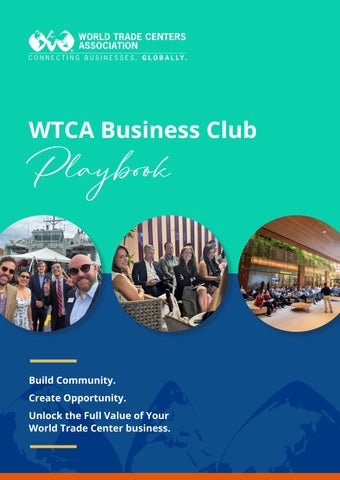
WTCA Business Club
Playbook
Build Community. Create Opportunity. Unlock the Full Value of Your World Trade Center business.
©2026 World Trade Centers Association, Inc. New York, New York, USA Disclaimer The content of this Playbook is furnished for general informational purposes only to World Trade Centers Association, Inc. (WTCA) Members and is not for further distribution. All information contained herein is provided in good faith; however, the WTCA makes no representation or warranty of any kind, express or implied, regarding the accuracy, adequacy, validity, reliability, availability or completeness of any information contained herein. The Playbook does not contain legal or business advice. Accordingly, before taking any actions based upon such information, we encourage you to consult with the appropriate professionals. The use or reliance on any information contained in this Manual is solely at your own risk. This publication could include technical or other inaccuracies or typographical errors. Changes are periodically added to the information herein; these changes will be incorporated in new editions of the publication. The WTCA may make improvements and/or changes in the text or recommendations described in this publication at any time. This Manual contains links to websites or content belonging to or originating from third parties. While such external links contain information that we believe is helpful for the reader, they are not exhaustively investigated, monitored, or checked for accuracy, adequacy, validity, reliability, availability or completeness by us. We do not warrant, endorse, guarantee, or assume responsibility for the accuracy or reliability of any information offered by thirdparty websites linked through our document. FEEDBACK We welcome comments and suggestions for future versions of this Manual. To share, please click here.
From Place to Community Introduction
If a Business Club is part of your vision, this playbook is designed to help you turn that vision into action. Whether you are a new WTCA Member considering how a Business Club could fit into your model, or an established Member looking to strengthen or evolve an existing club, this is a practical guide to help you take the next step. The guidance here comes directly from conversations with nearly 30 WTCA Members across every region of the network. We spoke with Members running mature Business Clubs, those developing new ones, and those adapting their models as their communities and markets evolve. Their clubs look different, but their experiences offer practical lessons on what works, what takes time, what they would do differently, and where to begin. This playbook brings those lessons together so you do not have to start from a blank page. It is designed to help you identify an approach that makes sense for your market, build from the strengths and resources you already have, and turn ideas into concrete next steps. For Members who have not yet considered a Business Club, it also offers a look at the value these communities can create for a World Trade Center (WTC) business, its local community, and the wider network. And while every Business Club is built locally, its value can extend much further. As more WTC businesses develop active, trusted communities, they create more natural connections across the network, giving businesses a place to turn when they enter a new market and local relationships that can help them understand it. Above all, we hope you come away inspired by what other Members have built, equipped with practical ideas you can adapt to your own market, and ready to take your next step.
Table of Contents 5
The Business Club Opportunity: What They Are and Why They Work
8
The WTCA Advantage
10
Choose Your Starting Point
14
Relationship-First Blueprint: Your greatest asset is your people
22
Service-First Blueprint: Your greatest asset is your expertise
32
Destination-First Blueprint: Your greatest asset is your place
41
Notes From the Field: Business Leader’s Advice
44
Where do I Begin? Practical First Steps
45
Putting It Together: Your Business Club Roadmap
47
Additional Resources & Acknowledgements
The Business Club Opportunity What They Are and Why They Work
What is a Business Club? A WTC Business Club is, at its heart, a community where business leaders build trusted relationships and find new ways to support one another through shared experiences. Within the WTCA network, Business Clubs may be built around curating these connections locally, providing business and trade services, or access to a physical destination ‑— or a combination of all three. While no two look exactly alike, each gives your members a more personal way to engage with your WTC business and experience the full benefits of its global reach and local value.
IMPORTANT NOTE Throughout this playbook, we use the term Business Club for consistency, but it may not be the right name for every market. In fact, some of the WTC businesses featured here use different terminology. Choose a name that fits your local culture, audience and purpose. That said, terms such as Club, Hub or Membership can foster a deeper sense of personal investment and belonging. Whatever you call it, what matters most is creating a community that members feel connected to, and want to be part of.
Why Business Clubs Work Think of a Business Club as the front door to your World Trade Center license; elevating it from a place people visit into a community they belong to. It gives your WTC business greater visibility in your local market, welcomes new audiences and provides a clear, inviting way to experience everything you offer. Instead of engaging with a building, an event or a service in isolation, members become part of a connected community. That sense of belonging matters: consistent growth requires consistent engagement and people invest in communities that feel like theirs. Importantly, as members build relationships within the community you’ve created, those connections begin to generate their own momentum. They no longer depend entirely on your team curating every introduction; relationships begin to develop organically. The club creates an environment where collaboration can happen, and where your WTC business becomes the place to be. 5
The Business Club Opportunity How a Business Club Extends Your WTC License: From one-time interactions to lasting relationships and global opportunities. Y O U R W TC B USI NE SS
YOUR WTC BUS IN ES S CL U B
Attend an event
Join a community
People attend a single event or program.
People become members of a community they want to be part of.
Business introductions
Long-term relationships
Connections are made, but may not continue.
Trust grows through consistent interactions and shared experiences.
Ongoing engagement
Individual transactions
Members stay connected through valuable programming and opportunities.
Engagement is tied to a specific need or project.
A connected business network
Individual clients
Members connect with each other, creating new opportunities and referrals, boosting the profile of your WTC business.
Relationships exist between the WTC business and one client.
A destination to return to
A place to do business
Your club programming and community drive repeat visits and make your WTC business a local destination to be.
The physical space supports work, meetings, events or tenancy.
Local opportunities with global reach
Local opportunities
Access to the global WTCA network opens doors to new markets and partners worldwide.
Value is focused within the local market.
Think Local. Connect Global. Business Clubs start by strengthening your local business community. The WTCA network amplifies that value, creating trusted pathways to new markets, new partners and new opportunities around the world.
6
The Business Club Opportunity Why Business Clubs Matter Within the WTCA Network A Community in Every Market A WTC Business Club makes the network personal. Instead of arriving in another market with only a name, building or contact, members can enter an established community of people who understand how business is done there. Across our interviews, members described welcoming visiting businesses, making trusted introductions, sharing local knowledge and turning those relationships into trade missions, referrals and new opportunities. These connections give visiting members firsthand insight into the local business culture and help them build relationships that can continue long after the visit. Each active Business Club brings another destination on the WTCA map into focus — creating a human connection to the facilities, services and opportunities already available in that market. It gives members from across the network a community they can enter, experience and build relationships within. As more WTC businesses build these communities, the network becomes more personal and easier to navigate, with trusted relationships waiting in more markets around the world.
A Business Club Network in Action
Vivek George
Anna Heines
Jeremy Rosendale WTC BALTIMORE
WTC BENGALURU
— Project Manager
— Vice President, Membership & Business Development
— Assistant General Manager
WTC BREMEN
“We hosted a networking reception with our club members, followed by a visit to the seaport in Bremerhaven to explore the container and automobile terminals.” ENTER THE COMMUNITY
WTC Bremen welcomed a business delegation from Dventer, the Netherlands, led by MKB Trade office, into the club and introduced them firsthand to the city’s port and logistics sector.
“They were heading to Nigeria to sign an MOU with the Nigerian government, and I connected them with WTC Abuja.” REACH THE RIGHT PEOPLE A Baltimore company entering Nigeria was connected directly with an active WTC business that understood the local market and could help open doors. 7
“Through our reciprocal arrangements with fellow World Trade Centers, we facilitate cross-border trade opportunities and extend mutual benefits to members across meeting spaces, hospitality, travel and leisure.” HAVE A PLACE TO LAND Reciprocal access gives visiting WTC Members an immediate home base in Bengaluru, Chennai and Kochi.
The WTCA Advantage More Than a Local Club
After speaking with Business Club operators across the WTCA network, one theme became clear — your local market may already have dozens of business clubs, membership programs, and networking opportunities. There is a reason these models are so common. They create a structure for building a community that remains connected and active. A WTC Business Club begins with an advantage no other local organizations can replicate — access to the global WTCA network. No matter where you are starting from, you are not starting from zero. As a WTCA Member, you are already connected to a respected global brand and a network rich with international relationships, shared knowledge, and experience from more than 300 WTC businesses across nearly 100 countries and territories. These are assets that can help strengthen the value you create for your own members.
The WTCA Advantage in Action Local Membership. Regional Reach. Global Opportunity.
Ivan Barrios
Daniella Abreu
Claire Viaggi
— President
— President
— Manager
“The benefit is that we’re part of an association which is globally recognized.”
“Our biggest strength was connecting people outside their city — to another state, then Brasília and São Paulo, and then to New York and Lisbon.”
“You are not only a member of Brest; you are a member of the French WTC community.”
WTC MIAMI
WTC Miami built global recognition and international matchmaking into its membership proposition from the beginning.
WTC CURITIBA
WTC Curitiba uses nearby WTC connections as an accessible bridge from local relationships to international opportunity.
8
WTC BREST
Members gain access to reciprocal event benefits, companies, and opportunities across the wider French WTC community.
The WTCA Advantage. More Than Local Programming
WTCA Resources: Your Business Club Can Offer Members Power your members with global reach, trusted connections, and exclusive opportunities through the WTCA network.
A Trusted & Esteemed Global Brand (With over 300 partner members): Align your Business Club with a respected global brand recognized for integrity, connection and international impact.
Immediate Trade Mission Partners: Tap into a ready network of WTC businesses around the world to co-host trade missions and explore new markets together.
Providing Direct Global Member-to-Member Connections: Connect your members with businesses in the WTCA network for collaboration, referrals, and global opportunities.
Regional Team Support to Facilitate Introductions: Leverage the knowledge and relationships of regional teams who can open doors and make the right connections.
Global Business Forum: Gain access to WTCA’s flagship event, bringing together global leaders, innovators and decision-makers.
WTCA Programming (Sector Salons, Women@WTCA, MAC webinars and panels): Offer members exclusive access to thought leadership, peer learning and conversations that drive business forward.
WTCA Reciprocity Desk: Members enjoy special consideration and access when visiting other WTC businesses globally through the Reciprocity Program.
Local Programming from other WTCA Members Connect Members to trade summits, discovery seminars, State of Trade discussions, webinars and best-practice exchanges hosted by fellow WTC Members around the world.
By leveraging these WTCA resources, your Business Club delivers unmatched value and connects your members to opportunities, around the corner and across the globe.
9
Choose Your Starting Point Start Where You’re Strongest
There is not a single prescription for starting a Business Club or Membership model. Across the WTCA network, WTC businesses have built successful communities around different strengths, opportunities, and most importantly, their local market needs. That said, to simplify your starting point, looking across the various clubs within the WTCA network, three common blueprints emerge:
Relationship First
Service First
Destination First
Build around trusted relationships and meaningful connections to create consistent networking opportunities for your local business community, while also connecting them to the global network.
Build around expertise, programs and business services — such as trade services, SME support, softlaunching businesses, and B2B matchmaking — that solve a clear need for your members.
Build around a physical space that creates a natural home for business activity, connection and community, and can include amenities such as access to exclusive spaces or discounted rates to partner destinations or trade shows.
IMPORTANT NOTE
These are starting points, not fixed models. A Business Club may begin with one and evolve to incorporate all three as its community grows. Mature Business Clubs often bring together relationships, services and destinations to create a broader member experience. As new benefits and offerings are added, they can also create additional revenue streams and new opportunities for growth.
10
Choose Your Starting Point Club Evolution in Action
Starting points can grow into a broader member experience. The examples below show how Business Clubs can build from an initial strength, layering in new elements as their community evolves. “Our WTC business keeps evolving together with our members. Each step we take opens the door to the next one, and that is how the Business Club, trade missions and real estate came to support each other.” — Giovanna Barreto, Vice President, Membership & Business Development
Giovanna Barreto WTC BELO HORIZONTE
RELATIONSHIPS
Networking + content
WTC Belo Horizonte began as a relationship-first club and is now adding trade missions, real estate, meeting space and other services that reinforce one another.
SERVICES
Trade missions + matchmaking
DESTINATION
Real estate + meeting space
WTC Denver built its membership around trade services, then added the monthly 501 Business Club when members needed a consistent, informal way to connect with one another and stay engaged with the WTC team.
Karen Moore WTC DENVER
“The 501 Club has become a great way to engage our members while strengthening our global business community. It’s an informal setting for members to connect, build relationships, and get to know one another beyond traditional business events. It also gives prospective members an opportunity to experience the sense of community within WTC Denver and see the value of being part of our network.” — Karen Moore, Network Growth Manager WTC Denver’s global business expertise remains at the core of its offering. Monthly member gatherings build on that foundation, giving members a reason to stay connected and remain active in the community between service needs.
SERVICES
Trade missions + education
RELATIONSHIPS
Added networking opportunities
11
501 BUSINESS CLUB
Established networking hub
Choose Your Starting Point
You may already have what you need to get started. Think about the people in your circle today. If you started planning your Business Club today, who would you contact first?
Services
Relationships
Destination
I can call...
I can call...
I can call...
•
•
•
•
• •
A well-connected & respected business leader A potential member or board member with a strong peer network A natural community builder who brings people together A collaborative partner ready to help get things started
• •
A trade or economic development partner A trusted subjectmatter expert A chamber, university or government contact
• •
Someone on my real estate, property or tenant team A venue or hospitality partner with a space we can access An event or programming partner who can help activate the space
On the next page, take a deeper look at your WTC business as a whole to see which blueprint best matches your strongest starting point.
12
Self Assessment Where Should You Start?
A quick instinct-based assessment that will help point you towards the blueprint that is your easiest entry into starting a business club — toward Relationship-First, Service-First or Destination-First. This shouldn’t feel definitive; it identifies the model you may want to explore first. Start small and grow as your club does.
Which statements sound most like your WTC business today? Relationship-First • We already have trusted relationships with local business leaders. • We can bring the right people into the room: C-suite executives, thought leaders and government officials who matter most to our market. • Our community would benefit from more consistent opportunities to connect person to person. Service-First • Businesses regularly approach us with trade-related questions or needs. • We have relevant expertise or partners who can provide it. • Our strongest value comes from helping businesses solve practical problems such as business introductions or soft-landing services. Destination-First • We have access to (or plan to build) a compelling physical space or venue partner that we can consistently offer. • The location itself could attract members, clients or visitors. • We see an opportunity to create a recognizable home for the business community. Your result: The section with the most statements checked may be your strongest starting point. If two are equally strong, that may indicate a hybrid opportunity, but begin with the one you can deliver most consistently. You will have the opportunity to grow your offerings as you establish your main value proposition later! Now let’s take a closer look at each blueprint... If relationships are your strongest starting point, jump to page 14. If services are your strongest starting point, jump to page 22. If a destination is your strongest starting point, jump to page 32.
13
Relationship-First
Blueprint
Relationship-First Blueprint Start with who you can bring together.
BEST FOR
WTC businesses with strong local networks, trusted relationships or the ability to convene business leaders, but without the need for a permanent space or established trade services team. Especially strong for WTC businesses that can identify a clear community of decision-makers and create reasons for them to come together consistently.
CO RE V A L U E
Bring the right people together, and strong relationships turn into business, collaboration and growth for your market. Relationship-first clubs create value by bringing the right people together, consistently and intentionally. The goal is not just filling the room. It is to create an environment where members build trust, exchange ideas and form relationships that lead to opportunities over time.
W HAT YO U’ L L N E E D •
A CLEAR PURPOSE AND MEMBER COMMUNITY. Know why the club needs to exist, who it is designed to serve, and what will make it meaningfully different from other local networks. Use that purpose to guide who you invite, how you curate the membership, and what you offer. WTC Belo Horizonte deliberately focuses on decision-makers, including SME owners and executives, so members can have meaningful conversations with peers at a similar level.
•
A CONSISTENT CALENDAR OF CONNECTION. Create a reliable rhythm of meetings, roundtables, networking events, dinners or other recurring touchpoints. Clubs do not need constant programming, but members should understand when, why and how they will continue to engage.
•
A CAREFULLY CURATED AND TRUSTED ENVIRONMENT. Quality matters more than quantity. Bring together a thoughtful mix of people, perspectives and industries to create space for genuine exchange, not simply self-promotion. Establish clear
15
W HAT YO U’ L L N E E D (CO N TIN UE D) expectations, protect confidentiality when appropriate, and intentionally help the right people find one another through thoughtful introductions and facilitated connections.
•
PROGRAMMING THAT MAKES THE TIME WORTHWHILE. Relevant speakers, peer experiences, market trends and locally meaningful topics give members a reason to prioritize the club and keep coming back. Learn what engagement looks like in your market: some communities value dinners, outings, and distinctive experiences, while others primarily want a trusted place to meet and talk.
•
A STRONG COMMUNITY LEADER. Relationship-first clubs need a trusted figure who can bring people together, build credibility and actively steward the community. This person should stay close to members, maintain regular communication, make introductions, follow up and pay attention when engagement begins to drop. Strong communities need someone consistently creating connections and keeping members invested.
•
WAYS FOR MEMBERS TO SHAPE THE COMMUNITY. Invite members to recommend topics, lead discussions, host gatherings, serve on committees or introduce others who could add value. Meaningful participation gives members greater ownership of the club while helping ensure its programming and relationships remain relevant. WTC São Paulo’s Executive Committees demonstrate how member involvement can become an engine for both content and connection.
•
STRONG LOCAL PARTNERS AND CONNECTORS. Government agencies, chambers, universities, associations, and influential business leaders can build credibility, extend the club’s reach, and open doors. WTC Rennes Bretagne specifically recommends establishing a strong partner base and surrounding the club with influential local connectors.
B E N E F IT S & CH A LLE N GE S BENEFITS
CHALLENGES
•
Low infrastructure barrier
•
Requires constant stewardship
•
Creates recurring revenue potential
•
•
Creates recurring engagement
Value can feel intangible if connections are not intentional
•
Strengthens member loyalty
•
Competes for members’ time (personal and professional)
•
Easy to adapt to local market needs
•
Growth can dilute trust and curation without careful strategies
•
Can become a platform for WTCA network connections
•
Events can become repetitive
•
Risk of becoming “just another networking club”
16
Relationship-First Blueprint RE V E NU E O P P O R T U N IT IE S •
BUILD YOUR BASE • • •
•
Individual and corporate membership dues Tiered memberships Member and non-member event fees
EXPAND YOUR OFFERING • • • • • • •
Annual partnerships/sponsorships Committee and program sponsorships Signature events Premium experiences and add-ons Partner-supported programming Learning expeditions Trade missions and international delegations
Build the community first. As engagement grows, strong relationships and a deeper understanding of your members can open new revenue opportunities.
B UIL DIN G T H ROUGH PA RTN E RS H IP: S PON S ORS Let trusted partners help sustain the community. Sponsorships can create room to grow. As your greatest asset is people, sponsorships are one of the most effective ways to grow revenue when membership growth reaches a natural limit.
Be discerning. Look for brands whose services, expertise or resources are genuinely relevant to your members. Protect the trust you have built.
Protect the experience. Members should feel that a sponsor is adding to their experience, not simply advertising to them.
A value exchange for all. A sponsor gains access and visibility, while the club gains financial support and members gain something useful.
Meaningful access. Sponsors connect with potential clients and share relevant expertise with members.
In Practice: Algiers
Relevant value.
WTC Algiers partners with trusted companies that sponsor Business Club gatherings, helping cover the cost of events, cocktails and venues.
Members benefit from insights, resources and connections that support their business.
Sustainable model. Strong partnerships help keep the community vibrant, even in lean times.
17
Relationship-First Blueprint Ambassador Spotlight
Let Members Experience the Community First As a newer Business Club, WTC Antwerp is building its community through concise, moderated monthly “WTC Talks,” with plans to develop member-led committees focused on international business as the club grows. TIP: PUBLISH THE CALENDAR WELL IN ADVANCE. “It is important to have the dates set for at least half a year, so they can already put it in the agenda.” — Freerk Faber, President Senior leaders have limited availability. A visible schedule makes participation easier and signals that the club will operate consistently.
Designing Every Connection with Purpose WTC Belo Horizonte keeps most meetings to 30–40 participants and carefully curates who is in the room. Members receive the participant list in advance, identify who they want to meet, and are intentionally introduced and seated alongside people with relevant business interests. TIP: BEGIN WITH A PURPOSE LARGER THAN NETWORKING. “We believe Business Clubs exist for a singular purpose — to strengthen the competitive position of entrepreneurs and executives. Networking is simply the vehicle through which we build lasting relationships that create real economic value and opportunity.” — Giovanna Barreto, Membership Manager Their broader purpose, strengthening the position of the state and its businesses, guides the club’s programming and growth.
18
Relationship-First Blueprint Ambassador Spotlight
Building a Membership Model That Connects Locally and Globally WTC Miami recognized that it was not starting from zero. By combining the connections, knowledge and credibility of the WTCA network with its own local expertise and programming, it built a membership model tailored to Miami’s international business community. TIP: MEMBERSHIP CAN CREATE INFLUENCE AS WELL AS INCOME. “As our numbers grow, you’ll see us do a little more advocacy for the community. The revenue is great, but it’s not the driver for us.” — Ivan Barrios, President A larger membership gives WTC Miami a stronger mandate to represent the international business community and advocate around shared priorities.
Building Around the Market You Have WTC Rennes Bretagne shapes its club around the realities of its local business community. Accessible pricing reflects the region’s smaller-company base, while programming draws on Brittany’s strongest international ties and local partnerships. TIP: BEGIN BY BUILDING A BROAD PARTNER BASE. “At first, partner with all kinds of structures. They can be cities, chambers, associations, clusters, sports clubs, schools or universities.” — Nicholas Beaty, Manager Financial and nonfinancial partnerships can expand programming, create member benefits and introduce the club to new communities.
19
Relationship-First Blueprint Ambassador Spotlight
Turning Committees into a Business Ecosystem Over nearly 20 years, WTC São Paulo has grown from relationship-led committees into one of the WTCA network’s most mature business clubs. Fifteen Executive Committees provide recurring content and connections, creating a platform that supports membership, sponsorship, trade missions and new business opportunities. TIP: BUILD THE LOCAL NETWORK BEFORE EXPANDING INTO TRADE SERVICES. “We began with the network because we needed a number of members and relationships before making connections with international companies.” — Leonardo Figueiró, CEO São Paulo started with relationship-building, then used that foundation to add trade missions, consulting projects and international opportunities.
Building an Executive Ecosystem WTC Eindhoven is developing a private leadership community for CEOs, founders and international decision-makers. Built around confidential peer exchange, strategic intelligence and carefully curated introductions, the model prioritizes depth, trust and board-level relevance over open networking or frequent public events. TIP: BUILD A STRATEGIC NETWORK, NOT AN EVENT CALENDAR “Don’t fill a calendar. Build a circle of trust where board-level decisions get sharper.” — Lianne Van den Boogard, Director It starts with who you let in. Selection and confidentiality are the foundation. When you offer truly relevant insights and purposeful, one-to-one introductions, senior leaders don’t just attend — they stay. In this model, events don’t define the community; they serve it.
20
Relationship-First Blueprint Assessment: Are You Ready to Build Around Relationships? Do a quick check-in with the questions below: • Can we clearly describe the community we want to bring together? • Do we have a trusted person who can champion and steward the club? • Can we maintain a consistent rhythm of engagement? • Can we offer thoughtful introductions, not simply open networking? • Do we understand what would make members return? Reflection prompt: Who are the first 10 people we would invite, and why would each one want to return? Readiness cue: If several answers are “not yet,” begin by defining the member community and testing one recurring gathering before developing a full membership offer.
21
Service-First
Blueprint
Service-First Blueprint Start with what you can offer.
Turn your expertise, business services and global connections into a reason for companies to join and stay connected.
BEST FOR
WTC businesses that already have expertise, programs or partnerships that help companies solve a clear business need. Especially strong for markets with: •
SMEs building global readiness
•
Exporters and importers looking for commercial connections
•
Companies navigating the practicalities of market entry
•
Strong trade agency, government, institutional or industry relationships
The model works particularly well when a WTC business can build strong links with trade agencies, embassies, chambers and other WTCA Members.
CO RE V A L U E
Solve a problem. Build trust. Create community around the value you provide. •
A Service-First Business Club gives members a trusted place to ask questions, find expertise, make the right connections and access opportunities they may struggle to reach alone.
•
The service is the entry point.
•
The relationships built through that service are what turn it into a club.
23
Service-First Blueprint IMPORTANT NOTE: SERVICES ALONE DO NOT CREATE A CLUB Many WTC businesses already provide trade services and for some, these services are a core source of revenue. The Service-First blueprint builds on that strength, but a Business Club also needs ways for members to engage with one another and develop a shared sense of community. This does not have to mean traditional networking. Members can connect through: •
Member-led workshops and case discussions
•
Mentoring between experienced and emerging exporters
•
Trade missions and delegations
•
Member spotlights and shared content that give members visibility through newsletters, social media, interviews or opportunities to share their expertise with the wider community.
The goal is to create opportunities for members to learn, contribute and work alongside one another, so the value of the club comes from both the services provided and the relationships formed.
24
Service-First Blueprint W HAT YO U’ L L N E E D
A CLEAR NEED Understand what businesses in your market are struggling with before developing services. Validate the need through conversations with prospective members and local partners. A FOCUSED STARTING OFFER Begin with one or two services you can deliver consistently and well. Expand only as member demand, expertise and capacity grow. EXPERTISE Someone who understands and can execute the services you offer or trusted partners who can. Credibility depends on providing reliable, informed support. STRONG PARTNERSHIPS Trade and investment agencies, government, embassies, chambers, industry experts and other WTCA Members can extend your expertise, reach, and market access. A CLEAR SERVICE PATHWAY Define how members request assistance, what is included in membership, what may require an additional fee and who is responsible for each step. FOLLOW-THROUGH Introductions and advice create value only when someone owns the relationship, follows up and helps move the opportunity forward. A REASON TO STAY ENGAGED Connect services with market intelligence, education, events, peer exchange or networking. The immediate service may open the door, but ongoing engagement builds the member relationship. A SIMPLE WAY TO TRACK NEEDS AND OUTCOMES Use a CRM or member-management system to record member needs, participation, introductions, follow-up, renewals and results. This can begin with a well-maintained Excel spreadsheet.
25
Service-First Blueprint B E N E F IT S & CH A LLE N GE S
BENEFITS
CHALLENGES
•
Creates an immediate, tangible reason to join
•
Requires real expertise or trusted partners
•
Positions your WTC business as a trusted business resource
•
Members may disengage once an immediate need is solved
•
Produces measurable business outcomes
•
High-touch delivery can be difficult to scale
•
Naturally leverages the WTCA network
•
•
Creates pathways to missions, matchmaking, education and market access
Requires clear ownership and consistent follow-through
•
Can compete with chambers, agencies and free online resources
•
Builds deep knowledge of members’ business needs
•
Your reputation can depend on partner performance
•
Opens partnership and revenue opportunities
•
Services must evolve as members and their businesses mature
RE V E NU E O P P O R T U N IT IE S •
Membership Dues Corporate or individual memberships built around access to services and expertise.
•
Trade Missions & Delegations Participation or administrative fees for inbound and outbound programs.
•
Education & Certification Paid courses, workshops, masterclasses and certification programs.
•
Events & Forums Member pricing and non-member registration for specialized programming.
•
Premium Services Expanded market-entry, matchmaking, or business support beyond the core membership offering.
•
Indirect Revenue Sponsorships, exhibition participation, referrals, partner services and increased use of other WTC business offerings.
26
Service-First Blueprint B UIL DIN G T H ROUGH PA RTN E RS H IP: A GE N CIE S Let local investment partners help you deliver more. Turn their mandate into shared capacity. Investment agencies are tasked with attracting, landing and retaining businesses, but may not have the capacity to deliver every service internally. Your WTC business can help extend their reach.
1. Start with their priorities.
2. Define the work you can take on.
3. Make the partnership easy to fund.
4. Create an ongoing pathway.
Learn the sectors, markets, investor needs and outcomes the agency is responsible for advancing.
Offer clear services: soft landing, market orientation, business introductions, delegations or investor aftercare.
Package the audience, timeline, outputs, responsibilities and reporting into a program the agency can support.
The agency helps businesses enter the market; your club helps them establish relationships and remain connected.
Extended capacity The club delivers international networking and missions.
International by background. Professional by purpose. Connected through Bremen.
Investor aftercare International companies remain connected after arrival.
In Practice: WTC Bremen The Foreign Business Club operates under the patronage of Bremen Invest. Public economicdevelopment support allows nearly all club activities to remain free.
A trusted local position The club becomes part of the market-entry ecosystem.
Don’t just ask an agency to fund a program. Show how your club can help deliver its mission.
Photo: WFB
27
Service-First Blueprint Ambassador Spotlight
WTC Abuja uses a tiered approach: seven membership categories to provide trade services, spaces and events to businesses ranging from startups to multinationals and diaspora leaders. TIP: AUTOMATE ADMINISTRATION SO STAFF CAN FOCUS ON MEMBERS. “We’re trying to take our hands off the work that can be automated so we can focus on the core work of providing value.” — Goodness Alabi, Programmes and Head of Trade WTC Abuja is developing a membership portal and CRM integration to reduce manual onboarding and free staff for research, facilitation, follow-up and member support.
Turning Trade Mission Participants into Long-Term Members WTC Accra is developing a service-first membership model around businesses that have already experienced its value through trade missions. TIP: CREATE CONTINUITY AFTER A TRADE MISSION OR SERVICE. “You don’t want somebody to just go on one trade mission and then walk away. There has to be continuity — and the continuity is the membership.” — Jeffrey Odame Yeboah, Head, Trade and Investment Services The club gives participants a structured way to remain connected to WTC Accra, receive ongoing support and participate in future opportunities.
28
Service-First Blueprint Ambassador Spotlight
Rebuilding a Statewide International-Trade Community WTC Kentucky uses a tiered membership model to reconnect the state’s international business community, combining valuable local relationships with access to WTC businesses across North America and the wider WTCA network. TIP: KEEP MEMBERSHIP SIMPLE “I wouldn’t do too many tiers. Three is enough.” — Omar Ayyash, President Avoid overwhelming prospective members with too many options or benefits. A simple structure can communicate the club’s value more clearly — connection within the local market, access across the region and participation in a global network.
Combining Business Connections with Practical Trade Support Through the Greater Houston Partnership, WTC Houston combines business development, industry programming, executive connections and export services within a broader regional membership model. TIP: BUILD FOR FINANCIAL PREDICTABILITY “Houston is great because it’s a really generous city and we can all play in the same sandbox really well.” — Sophia Lewis, Manager, International Investment and Trade WTC Houston’s export program thrives because it brings together the SBA, EXIM Bank, U.S. Commercial Service and Port of Houston rather than trying to provide every form of expertise internally.
29
Service-First Blueprint Ambassador Spotlight
Turning Event Participation into Ongoing Business Opportunity WTC Metro Manila connects its Business Club with its conferences and exhibitions business, helping companies move from attending trade fairs to accessing matchmaking, referrals, market information, trade missions and longer-term international support. TIP: GO THE EXTRA MILE FOR EVERY MEMBER “At WTC Metro Manila, we strive to make every member feel that their membership creates opportunities beyond events and networking. By being proactive, responsive and relationship-driven, we encourage our members to participate more actively, connect with fellow members and maximize the opportunities available through the WTCA network.” — Irish Talay, Senior Manager, Membership & Events WTC Metro Manila strengthens participation by providing personal, responsive support that helps members find value beyond events and networking.
Turning Member Experience into Practical Support WTC Lille brings together approximately 120 companies around practical international business support. While Service-First in its purpose, it operates as a hybrid model, using targeted introductions, peer experience, training and trade missions to turn its community into a source of expertise and education. TIP: LET MEMBERS BE THE EXPERTS “The main objective is always to help the company gain time through the exchange of experience.” — Laurie Grzechnik, Executive Director Listen closely enough to understand each member’s markets, expertise and current needs. That knowledge allows the team to connect members with peers who can share practical guidance, trusted contacts and lessons learned from operating in those markets themselves.
30
Service-First Blueprint Assessment: Are You Ready to Build Around Services? Do a quick check-in with the questions below: • Can we identify a specific business or trade challenge we are equipped to address? • Do we have the expertise internally or through trusted partners? • Can we explain the practical value of the service clearly? • Do we have a process for following up after the immediate need is resolved? • Can this service become a pathway into a longer-term member relationship? Reflection prompt: What is one recurring member need we could solve exceptionally well? Readiness cue: If the service offering still feels broad, start with one clearly defined need and build from demonstrated demand.
31
Destination-First
Blueprint
Destination-First Blueprint Start with where people gather
Build around a place people naturally want to spend time, whether it’s a space you own or access you provide through trusted partners. When members return because the experience is valuable, relationships and business opportunities grow naturally.
BEST FOR
WTC businesses that have or can access great spaces and amenities, or strong partnerships with hotels, coworking spaces, venues, airports or other key locations that deliver value to members. Especially strong for WTC businesses that can provide a natural home for business activity, connection and productivity, whether through owned space or trusted locations and access.
CO RE V A L U E
Create a place to belong. Make it easy and valuable for your members to connect, work, meet and grow. Destination-First clubs turn physical access into a member benefit. Your space (whether yours or a partner’s) becomes a hub for business activity and connection, giving members a place to work, to meet, to host and to build relationships. The value is the experience. It’s the convenience, quality and access that make it a place members choose to return to.
33
Destination-First Blueprint W HAT YO U’ L L N E E D
A Destination-First Business Club begins with a place people value. That may be an owned real estate asset, a mixed-use development, a formal hotel or venue partnership, a premium lounge or coworking environment, or a social club provided as a tenant amenity. The destination does not need to generate membership fees directly; it may instead support leasing, tenant satisfaction, retention, hospitality revenue or engagement across a wider property portfolio. •
A CLEAR PURPOSE AND AUDIENCE. Define whom the destination serves and what it is meant to accomplish. Its purpose may be to convene business leaders, support trade, create a home base for members, strengthen a mixed-use development, or improve the tenant experience.
•
A RELIABLE PLACE, OR PLACE-BASED PARTNERSHIP. You do not need to own the destination, but you do need dependable access to it. If working with a hotel, club, coworking facility, restaurant or other venue, establish a clear agreement covering access, benefits, responsibilities, costs and the member or tenant experience.
•
A DEFINED ACCESS MODEL. Clarify who can use which spaces, when and under what conditions. Access may be included with tenancy, tied to paid membership, extended through a partner, offered to visiting WTCA Members, or organized through different levels for residents, tenants, members and guests.
•
USEFUL AMENITIES AND THOUGHTFUL HOSPITALITY. Meeting rooms, lounges, dining, coworking, event venues, wellness facilities, hotel benefits or other amenities should respond to the audience’s actual needs. The experience should feel welcoming, professional, accessible and easy to use.
•
A REASON TO RETURN. Space alone does not create community. Regular events, tenant gatherings, business programming, social experiences, hosted introductions, and informal opportunities to connect keep the destination active and give people a reason to come back.
•
SOMEONE TO ACTIVATE THE COMMUNITY. A visible host or community manager should welcome people, connect tenants or members, coordinate programming, communicate benefits, and notice when participation declines. Even an informal social club requires active stewardship.
•
A SUSTAINABLE OPERATING AND FUNDING MODEL. Determine who pays for the space, programming, staffing, maintenance and benefits. Revenue may come from dues, events, hospitality spending, venue rentals, sponsorships or partner contributions. A tenant club may instead be funded as an amenity because it supports leasing, occupancy, satisfaction and retention.
•
CLEAR MEASURES OF VALUE. Measure success according to the destination’s purpose. This may include utilization, event participation, tenant satisfaction, renewals, occupancy, member retention, hospitality spending, referrals, introductions or new business generated across the wider development.
34
Destination-First Blueprint B E N E F IT S & CH A LLE N GE S BENEFITS
CHALLENGES
•
Creates immediate, tangible value for members, tenants and visitors
•
Requires ongoing activation and community stewardship
•
Positions your WTC business as a recognizable business hub
•
Can require significant operational coordination and investment
•
Supports member or tenant attraction and retention
•
Partner-operated models provide less control over the experience
•
Increases foot traffic, space utilization and engagement
•
Access levels, guest privileges and booking rules can become complex
•
Encourages frequent formal and informal interaction
•
Member and tenant expectations for facilities and service may increase
•
Creates opportunities for events, sponsorships and hospitality revenue
•
Capacity can become strained as participation grows
•
Supports trade missions, delegations and visiting businesses
•
Indirect returns such as retention can be difficult to measure
•
Strengthens local partnerships and the wider property ecosystem
•
Amenities and benefits must remain relevant over time
•
Can generate both direct revenue and indirect real estate value
RE V E NU E O P P O R T U N IT IE S • • • • • • •
Membership dues Premium or layered access tiers Tenant amenity allocations Meeting room rentals Coworking packages and day passes Venue hire Event registrations
• • • • •
Sponsorships and partner-supported programming Hotel and hospitality partnerships Preferred partner commissions Delegation and visiting-business packages Business concierge or premium services
Note: Not every Destination-First model generates revenue directly. Tenant clubs and other property-based communities may instead create value through stronger tenant retention, increased occupancy, greater use of on-site amenities and deeper engagement across the wider development.
35
Destination-First Blueprint Examples of Destination-First Business Club Differentiators: • Coworking access • Meeting rooms • Partner amenities • Business lounges • Concierge services • Exclusive events • Preferred partner discounts • Connectivity and technology
Luciano Menezes
“Use real estate as a platform to build a business community. When a destination brings together workspaces, hospitality, events and international business connections, the property becomes more than a building — it becomes an ecosystem that creates value for its members and tenants.” — Luciano Menezes, CEO
WTC LISBON
B UIL DIN G T H ROUGH PA RTN E RS H IP: DE VE LOPER S A Business Club can become a living showroom for your development. Drives foot traffic
Activates the property
Showcases the value
Regular member activity brings a steady flow of businesses, professionals and decision-makers into the building.
A vibrant, wellused space creates energy, visibility and value, both inside the building and in the community.
Prospective tenants and buyers experience the spaces, amenities and community firsthand, naturally and organically.
The value has to work both ways. Create a place members want to belong to, not simply a space you want them to visit. When the club delivers value regardless of whether a member is a tenant, sustained engagement can benefit both the community and the development.
In Practice: WTC Ribeirão Preto WTC Ribeirão Preto located its Business Club on the ground floor of a high-rise development. Regular member activity brought potential buyers into the building and gave them natural exposure to the available units. The development ultimately pre-sold all of its spaces.
36
Destination-First Blueprint Ambassador Spotlight
Extending the Tenant Experience Beyond the Office Rather than operating a traditional Business Club, WTC Bengaluru connects business tenants to selected dining, meeting, event and hospitality amenities across the mixed-use Brigade Gateway campus, creating a social community around the workplace while supporting the wider destination. TIP: GROW VALUE, NOT JUST MEMBERSHIP “We don’t really chase membership, but we believe in creating more value additions to the existing membership services so that they are retained.” — Vivek George, Assistant General Manager Protect the experience that attracted people in the first place; thoughtful benefits can strengthen retention and encourage greater use of the development’s wider hospitality and real estate portfolio.
Turning the Workplace into a Community Rather than operating a traditional Business Club, WTC Schiphol Airport uses a tenant-funded social club to bring approximately 3,000 people together through recurring social, wellness and family activities, creating a strong sense of belonging within the building. TIP: ASK BEFORE YOU ORGANIZE “Ask the community: What do you want to see in the building?” — Christa Kroon, Community Manager Begin by speaking with tenants about what they want, what they would attend and what their companies are not already providing. Even a small, open activity can make the community visible, begin conversations and provide a foundation for future programming.
37
Destination-First Blueprint Ambassador Spotlight
Creating a Member Home Base Without Operating One Through a partnership with the locally owned Windsor Court, WTC New Orleans gives members a prestigious place to meet, host clients and access hospitality benefits, without assuming the cost and responsibility of operating its own club facility. TIP: LISTEN BEFORE YOU BUILD “Don’t just do something because another WTC business does it. See what your members want and need, and then build something around that.” — Harrison Crabtree, Director Members missed having a place that felt like their own; listening to that need led WTC New Orleans to create a flexible hotel partnership suited to its current market.
Turning a Real Estate Development into an Active Business Hub WTC Ribeirão Preto uses Executive Committees, curated matchmaking and international connections to keep its development active and connected, strengthening the experience for tenants and property owners while supporting the long-term appeal of its real estate assets. TIP: A BUILDING NEEDS AN ACTIVE COMMUNITY. “An iconic building and a global brand represent prestige and credibility, but it is an active business community that transforms them intro a true business hub. creating opportunities and increasing real estate value.” — Rodolfo Guimarães, CEO Recurring programming, trusted relationships and active matchmaking give companies reasons to return, helping the Business Club strengthen the development around it.
38
Destination-First Blueprint Ambassador Spotlight
Creating a Community That Activates the Destination
Through monthly committees, major events, matchmaking and shared meeting spaces, WTC Lisbon brings a steady flow of business leaders into its towers, helping the destination attract tenants and activity while giving members a visible home for connection and international engagement. TIP: USE PARTNERSHIPS TO BUILD YOUR MEMBERSHIP BASE “For me, the number of events is not just a programming decision. It is what creates the critical mass behind the membership model. When people meet frequently, relationships become stronger, participation grows and the community starts generating its own momentum. That gives us the foundation to think bigger: larger events, experiences outside the Business Club and stronger, longer-term partnerships, without having to build every initiative around a one-off sponsor. In the end, the real asset is the community itself.” — Pedro Sampaio, Director of Alliances Consistent gatherings do more than fill a calendar — they strengthen relationships and create the participation needed for the club to grow. Once that foundation is established, operators can expand into larger experiences and long-term partnerships without relying on individual sponsors to sustain every initiative.
39
Destination-First Blueprint Assessment: Are You Ready to Build Around a Place? Do a quick check-in with the questions below: • Do we control a space or have a reliable partner arrangement? • Does the location provide convenience, exclusivity, hospitality or practical business value? • Would members want to engage even if they are not tenants or regular space users? • Can we create consistent reasons for members to visit? • Does the model deliver value for both the member community and the property or venue partner? Reflection prompt: What would make this feel like a place members belong, not simply a space they can access? Readiness cue: If the space is compelling, but the member experience is not yet clear, test programming and benefits before investing heavily in a full club structure.
40
Notes from the Field
What Business Club Leaders Want You To Know.
Successful Business Clubs do not all follow the same model; they build what works in their market, learn from others, adapt and change. That said, after interviewing Business Club leaders across every region of the WTCA network, the advice from those already running clubs is remarkably consistent.
IN ACTION
KNOW YOUR MARKET
Understand your local business community before you build. Look at the major industries, decisionmakers, existing networks and clubs, and gaps in your market. Learn from other Business Clubs in the network, but build for what your market actually needs.
“You have to find your uniqueness and offer a unique product.” — Anna Heines, Project Manager WTC Bremen identified that expatriate professionals lacked an English-speaking business network and built its Foreign Business Club specifically to serve that overlooked community.
BE CLEAR ON YOUR PURPOSE
Know what you want your Business Club to accomplish. A clear purpose should guide who you bring together, what you offer and how the club grows.
IN ACTION
BUILD FROM THE ASSETS ALREADY AROUND YOU
Start with the people, expertise, services, spaces and relationships you can activate now. Hotels, developers, trade agencies, sponsors, chambers and economic development partners can expand what you offer without requiring you to build everything internally. Build a board that can utilize their contacts and profile to attract members aligned with your vision.
CONSISTENCY BUILDS COMMUNITY.
“Leverage your existing network— whether it’s your board or other partners. What skin in the game do they have? Do they give money, resources, or connections?” — Jeremy Rosendale, Vice President, Membership & Business Development WTC Baltimore began with a core group of founding members as their board, drawn from its existing network, using their credibility and connections to grow the community organically.
A dependable calendar gives relationships time to develop and members the ability to build it into their schedule consistently. Clubs do not necessarily need constant programming, but members should understand when, why and how often they will continue to engage.
41
Notes from the Field
What Business Club Leaders Want You To Know. PLAN FOR SUSTAINABILITY FROM THE BEGINNING.
Be realistic about staffing, technology, venue costs and the time required to support members. Dues, sponsorships, partnerships and add-on services should reinforce the member experience, not compromise it.
IN ACTION
BE INTENTIONAL ABOUT WHO IS IN THE ROOM.
“You do not want to have too many consultants. We aim for a 70–30 proportion: 70% companies that produce something and 30% consultants.”
Bring together a thoughtful mix of members who can learn from, support and create opportunities for one another. Protecting that balance keeps the community valuable and prevents it from becoming overly sales-focused. More people do not automatically create more value. Think carefully about who you bring together, make meaningful introductions, and create an environment where the right conversations can happen.
— Nicholas Beaty, Manager WTC Rennes Bretagne carefully manages its membership mix so that members gain access to valuable expertise without feeling that every interaction is a sales pitch.
CURATE CONTENT FOR THE PEOPLE YOU WANT TO ATTRACT.
Choose topics, speakers and formats that reflect the interests of your intended members. Strong content draws the right people into the room and gives them a reason to return. Once the right people are present, don’t leave connections to chance. Learn who members want to meet, make purposeful introductions, and use the format, seating or topic to help productive conversations happen. Over time, these sorts of connections may begin to form organically, but you’ll need to give them a push initially.
PUT SOMEONE IN CHARGE OF RELATIONSHIPS
Business Clubs don’t grow through email invitations alone. Someone needs to be visible, make calls, welcome people, connect members and follow up. That person becomes a familiar point of contact — someone who knows the members, understands what they are looking for and can spot opportunities to bring the right people together. Relationship-building is active work and consistency is what turns individual interactions into a community.
42
Notes from the Field
What Business Club Leaders Want You To Know. IN ACTION
LET PEOPLE EXPERIENCE THE VALUE BEFORE SELLING MEMBERSHIP.
WTC Antwerp, WTC Lisbon, WTC São Paulo and WTC Ribeirão Preto
Invite prospective members into the community, facilitate useful introductions and demonstrate what makes the experience distinctive. Trust and firsthand value make the eventual membership conversation much easier.
invite prospective members to experience the club, often up to three times, before asking them to join. Participating in committees, events and introductions allows prospects to understand the community firsthand, build relationships and recognize the value of membership before making a commitment.
CREATE THE CONDITIONS FOR BUSINESS
Don’t promise instant deals or treat every introduction as a transaction. Bring together the right people, build trust through consistent interaction, and facilitate connections around shared interests and needs. When members have time to exchange ideas, understand one another’s businesses and identify natural areas of alignment, opportunities are more likely to follow.
LISTEN, LEARN AND EVOLVE
Your first membership offer is not your finished Business Club. Pay attention to what members use, what they ask for and what they need next. Add (or subtract as needed) services, programming, international opportunities, signature events or new experiences as the community grows. Membership totals tell only part of the story.
IN ACTION
START BEFORE EVERYTHING IS PERFECT.
Build. Listen. Adjust. Keep going. Even if the first meeting has five people, start there. WTC Denver hosts monthly 501 Club gatherings, with an average attendance of 50 people and a record turnout of 85. Even when attendance is lower in a given month, our team recognizes that smaller groups can foster meaningful conversations and connections. Consistently bringing people together helps build trust, strengthen relationships, and create momentum over time.
“Have it no matter what — even if only ten people show. The people who are there can still have a great experience. It’s all about building community.” — Karen Moore, Network Growth Manager
43
Where Do I Begin? Practical First Steps
Building a strong foundation for your Business Club. Map Your Local Business Community
1.
Start with insight.
• Identify the companies, industries, decision-makers and existing networks shaping your market. • Ask: Who are the people you want in the room and what do they need that they are not getting today? Many members want access to high level decision-makers. How can you attract them and provide benefit to them as well (visibility, thought leadership, strategic partnerships)?
Build Your Local Partner Bench
2.
Find your partners.
• Connect with your city or regional investment agency, chambers, trade agencies, embassies, universities, industry clusters and business associations. • Ask where collaboration makes sense in your market — trade missions, delegations, speakers, introductions or programs.
Activate the People Already Around You
3.
Your existing network is your greatest asset.
• Start with your board, tenants, clients, partners and strongest local relationships. • If you don’t yet have a board, invite a small group of respected leaders to help shape the club, make introductions and open doors. These can be incredibly impactful, especially as you start or begin to upscale your offerings.
Call Another WTC Business
4.
Learn from peers.
• Reach out to a WTC business with a club you admire. Start with the ones in this Playbook. • Ask how they started, what they do differently and what they needed in year one. • Identify one practical way to collaborate: speaker exchange, introductions, missions or joint programs.
Create One Reason to Gather
5.
Start small. Deliver value.
• Choose one clear business need, topic, sector or group of people. • Host a roundtable, dinner or trade conversation. • Set the tone early. What fits your market: casual meetings or larger-scale events? Work within your means, but be mindful of how your local ecosystem prefers to engage.
Show Up Before You Sell Membership
6.
Trust comes first.
• Attend local events, trade shows and industry gatherings. • Build relationships and visibility before asking anyone to join.
T H E B O T T O M L IN E : S TA RT W H E RE Y OU A RE .
44
Putting It Together Your Business Club Roadmap
1. Self-Assessment: Are you ready to begin? Regardless of the model, every Business Club needs a strong underlying foundation. Core questions Yes Can we clearly describe who the club is for? Do we understand what those members need or value? Can we explain why they should participate consistently, not only once? Do we have a person responsible for stewarding the community? Can we deliver a reliable and consistent member experience? Do we have trusted partners who can extend our capabilities? Have we identified a realistic way to sustain the club financially? Can we explain how the club connects members to the wider WTCA network?
Not yet
Your “not yet” answers are not reasons to delay indefinitely. They identify what you need to investigate, test or strengthen next.
2. Make a plan: What is your first step? Choose the statement that best reflects your current position. We are still exploring. First step: Listen. Speak with 5–10 potential members. Ask what business communities they already participate in, what is missing and what would give them a reason to engage consistently. We know our audience, but the value proposition is unclear. First step: Define. Write one sentence completing this statement: Our Business Club brings together __________________ so they can __________________ through __________________. Test the statement with prospective members before building a full program. We have a concept, but need greater capacity. First step: Build your partner bench. Identify organizations that can contribute expertise, space, programming, hospitality, visibility or access to new audiences. We can bring people together, but no one owns what happens next. First step: Assign. Identify one person who will be responsible for welcoming members, staying in touch, finding speakers, curating content and keeping engagement moving between activities. Note: It does not need to be their only role, but it should clearly be someone’s role.
45
Putting It Together Your Business Club Roadmap
We have the relationships and resources, but have not launched. First step: Pilot. Create one small, intentional experience for a carefully selected group. Use it to test demand, gather feedback and observe what makes participants want to return. We already have activities, but they do not feel like a community. First step: Connect. Introduce greater consistency, intentional member-to-member introductions and opportunities for participants to contribute, not simply attend. We have a strong blueprint, but not yet a plan to sustain it First step: Build the business case. Identify what it will cost to deliver the experience consistently and how you will support it over time: through membership fees, sponsorships, services, partnerships or a combination that fits your model. A strong plan will help you to find and sign those partners to help you launch and grow. We have an established club and want to grow. First step: Expand with purpose. Identify whether your next opportunity is to deepen relationships, introduce practical trade services, strengthen the destination experience, activate the WTCA network, or develop new revenue through carefully aligned sponsors and partners.
3. Your 90-day action plan: Answer these essential questions for yourself 1. What is the community we want to serve? 2. What is the primary value we want to provide? 3. What is the strongest asset we already have? 4. What is the most important gap we need to address? 5. What is our first action? 6. Who will lead it? 7. When will it happen? 8. How will we know it worked?
Final prompt What is the smallest meaningful experience you can create now that would test your idea, deliver genuine value and give people a reason to come back?
46
Additional Resources & Acknowledgements Additional Resources: • • • • •
WTCA Trade Services Operating Manual 2025 WTCA Member Catalog 2026 WTCA Member Catalog WTCA Brand Guidelines The Club by Luciano Menezes (deeper insights into building a sustainable and thriving relationshipbased Business Club)
The following WTC Business Clubs were interviewed for this playbook. All of these Members are excellent resources when beginning to create or grow your club. Their insights and experience are invaluable and we thank them for their generosity. • • • • • • • • • • • • • • • • • • • • • • • • • •
WTC Abuja, Goodness Alabi WTC Accra, Jeffrey Yeboah WTC Algiers, Ahmed Tibaoui WTC Antwerp, Freerk Faber WTC Baltimore, Jeremy Rosendale WTC Belo Horizonte, Giovanna Baretto* WTC Bengaluru, Vivek George* (2026 Business Club MAC Chair) WTC Bremen, Anna Heines WTC Brest, Claire Viaggi WTC Curitiba, Daniella Abreu WTC Denver, Karen Moore WTC Eindhoven, Lianne Van den Boogard* (2026 Business Club MAC Vice-Chair) WTC Greater Philadelphia, Thomas Young* WTC Houston, Sophia Lewis & Amanda Trevino WTC Istanbul, Erşan Ertüzün WTC Kentucky, Dr. Omar Ayyash WTC Lille Hauts-de-France, Laurie Grzechnik WTC Lisbon, Luciano Menezes* & Pedro Sampaio WTC Metro Manila, Irish Talay WTC Miami, Ivan Barrios WTC New Orleans, Harrison Crabtree* WTC Paris Ile-de-France, Agnes Gomes WTC Rennes Bretagne, Nicholas Beaty WTC Ribeirão Preto, Rodolfo Guimarães WTC São Paulo, Leonardo Figueiró* WTC Schiphol Airport, Christa Kroon
* A special thanks to the contributing Members of the 2026 Business Club Member Advisory Council.
47
WORLD TRADE CENTER, WTCA and Map Design Logo are registered service marks of World Trade Centers Association, Inc.