Spring 2026 | Edition #24
Artwork - The Yarning Circle used within this publication originated from ‘Those Who Came Before Us’ - In 2020 and 2021 over 120 staff and students, Indigenous and non-Indigenous, contributed to this painting. This activity was cofacilitated by artist Allan McKenzie, a Wiradjuri-Gamilaroi man from Griffith NSW. ‘Those Who Came Before Us’ is owned by none, yet owned by all, and is a great example of reconciliation in practice. Acknowledgement With respect for Aboriginal cultural protocol and out of recognition that its campuses occupy their traditional lands, Western Sydney University acknowledges the Darug, Dharawal, Gadigal, Gundungurra and Wiradjuri peoples and thanks them for their support of its work on their lands (Greater Western Sydney and beyond). Disclaimers The opinions expressed in these articles are those of the authors and contributors, and do not necessarily reflect those of the University or the organisation to which the authors are affiliated. Statements of fact are believed to be true as at the date of publication, and the University accepts no liability for the truth or accuracy of such statements. Aboriginal and Torres Strait Islander readers are warned that the following publication may contain images or names of deceased persons. Publication Enquiries Please contact Matthew Wildig at M.Wildig@westernsydney.edu.au
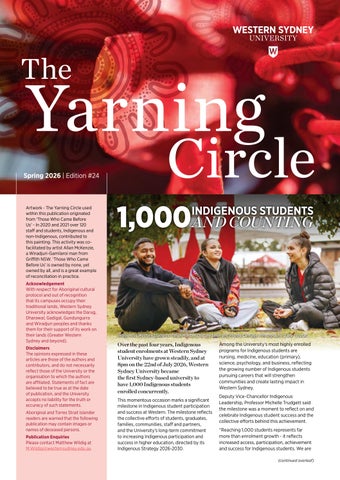
Indigenous Western Students: Tahjin Muldair, Destiny Salah and Reubie Carriage. Photography: Sally Tsoutas.
Over the past four years, Indigenous student enrolments at Western Sydney University have grown steadily, and at 8pm on the 22nd of July 2026, Western Sydney University became the first Sydney-based university to have 1,000 Indigenous students enrolled concurrently. This momentous occasion marks a significant milestone in Indigenous student participation and success at Western. The milestone reflects the collective efforts of students, graduates, families, communities, staff and partners, and the University’s long-term commitment to increasing Indigenous participation and success in higher education, directed by its Indigenous Strategy 2026-2030.
Among the University’s most highly enrolled programs for Indigenous students are nursing, medicine, education (primary), science, psychology, and business, reflecting the growing number of Indigenous students pursuing careers that will strengthen communities and create lasting impact in Western Sydney. Deputy Vice-Chancellor Indigenous Leadership, Professor Michelle Trudgett said the milestone was a moment to reflect on and celebrate Indigenous student success and the collective efforts behind this achievement. “Reaching 1,000 students represents far more than enrolment growth - it reflects increased access, participation, achievement and success for Indigenous students. We are (continued overleaf)
The Yarning Circle | Western Sydney University | Spring 2026
(continued from previous page)
incredibly proud of all of our students and graduates, whose aspirations, achievements and contributions continue to strengthen our University community,” said Professor Trudgett. “This milestone is underpinned by a strong commitment to Indigenous students achieving their educational and career aspirations. The sustained growth highlights the impact of culturally responsive programs and our sector-leading Indigenous centred support models that enable students to thrive throughout their university journey.” Vice-Chancellor and President, Distinguished Professor George Williams AO said the milestone was significant for the University and the communities it serves, which is home to Australia’s largest Indigenous population. “As an anchor institution for our region, we have a responsibility to empower Indigenous students from high school through their university journey into successful careers. Our commitment to the next generation of Indigenous leaders is deep, with Indigenous knowledges and excellence underpinning our teaching, research, and community engagement,” said Professor Williams. The Badanami Centre for Indigenous Education is central to the University’s Indigenous student success and provides a culturally safe environment for students. Through a strengths-based approach, Badanami empowers students across the entire university journey, from aspiration
and entry through to graduation and into early career. Badanami offers Indigenous students a space to decompress, work on assignments or have a snack and a yarn with other Indigenous staff and students. Through the guidance of each of the centre’s student success officers, students benefit from academic guidance, cultural mentoring and connection. Scholarships and financial assistance, together with leadership and career development are other services available at each of the Badanami Centres. Billy Bent-Ngawaka, a proud Anaiwan and Ngunnawal man and third-year Bachelor of Occupational Therapy student at Western Sydney University said being part of Western’s close, connected community has been a significant part of his experience. “Being involved with the Badanami Centre has been a huge part of my university experience and the support I’ve received overall,” he said. Aleyah Joseph, a Bachelor of Paramedicine Graduate, also spoke of Badanami’s continued support throughout her degree. “I always knew Badanami was my space,” she said. Other key initiatives at Western include the Pathways To Dreaming program, which builds aspirations and awareness of university opportunities for Indigenous high school students. The program currently operates in more than 75 South-Western and Western Sydney high schools, including the Campbelltown, Liverpool, Penrith, Seven Hills, Mt Druitt and Blue Mountains regions.
The Aboriginal and Torres Strait Islander Entry Program is an alternative admission pathway into university for Indigenous applicants, recognising the diverse educational journeys and experiences of Indigenous students. The program supports transition into university through connection with Badanami and broader support services. “I first heard about the entry program through Pathways To Dreaming through my high school in Year 9, and I became more involved in my senior school years” said Billy Bent-Ngawaka. “It was helpful for me to know about the options available to me. I completed my HSC as well as participating in the alternative admission pathway program”. Since 2022, Western has celebrated 617 Aboriginal and Torres Strait Islander student completions, with graduates moving into professional careers, further study and community leadership roles, across the greater western region and beyond. Dr Ace De Vera, who recently graduated as a Doctor of Medicine at Western Sydney University said “Seeing more Indigenous students enrol in and complete higher education is a wonderful outcome. The Badanami team plays an important role in fostering connection, belonging and support throughout students’ university journeys.” 1,000 Indigenous students is a moment to celebrate, with the count to 1,500 beginning now.
MESSAGE FROM THE DEPUTY VICE-CHANCELLOR, INDIGENOUS LEADERSHIP It gives me great pleasure to present this edition of The Yarning Circle newsletter. I am delighted to welcome Matthew Wildig, a Palawa man, as our new editor. Matthew is a casual academic and Master’s research student at Western Sydney University, and I look forward to the thoughtful and engaging editions that will be delivered under his leadership. Whether this is your first year or the continuation of your journey with us, I hope you feel a strong sense of belonging, connection and pride as part of our Western community. This year has already been significant for the Division of Indigenous Leadership, both in scale and impact. The Division is responsible for delivering 138 events this year alone, each contributing to stronger Indigenous engagement, celebration, learning and community connection across the University. Among the many highlights have been the NAIDOC Week Gala Dinner and Awards Night, where we formally acknowledged 2
and celebrated the achievements of our award recipients. I also enjoyed cheering on our team at the National Indigenous Games in Newcastle. This edition also marks a truly significant milestone: on the 22nd of July Western became the first university in Sydney to reach 1000 Indigenous students. I want to take this opportunity to sincerely thank everyone who has contributed to this journey. This achievement reflects a substantial collective effort across the University and speaks to the commitment, care and dedication of many people who have worked alongside us to advance Indigenous student success. To our Indigenous students, thank you for choosing Western Sydney University and for entrusting us with your academic journey. I encourage you to connect with the outstanding team at the Badanami Centre for Indigenous Education, who provide academic, cultural and pastoral support. As we look ahead to the remainder of the year, I am proud of what Western
continues to achieve through strong partnerships, dedicated staff and an unwavering commitment to Indigenous excellence. Thank you to everyone who contributes to this important work and to the continued success of our students, staff and communities.
Photography: Sally Tsoutas.
Professor Michelle Trudgett (BA, MPS, EdD) Deputy Vice-Chancellor Indigenous Leadership
with Brody O’Brien, Indigenous Employment Officer
The Bold Conversation segment encourages Indigenous staff and students to share their ideas to promote discussions in a culturally safe environment. They reflect the authors personal views and not that of the University.
Brody O’Brien is a Kamilaroi man and has recently joined the university in the role of Indigenous Employment Officer. Brody was born and raised on Dharawal Country in Campbelltown where he continues to live today. In 2023 Brody completed his training with Lifeline South Coast and began working for 13YARN, a First Nations suicide prevention crisis line. Brody is passionate about mental health and wellbeing and continues to contribute to this field through his ongoing work for 13YARN. In 2025 Brody graduated from University of Wollongong with a double Bachelor of Psychological Science and Social Science (Criminology), where he began his career working with mob as a Student Ambassador. In the following segment, Brody discusses the importance of self-care and the ways in which taking a moment to stop and question how you treat yourself can promote a habit that may improve many areas of your life. For Brody, this is as simple as asking yourself, “am I doing enough for me?”, or going outside and taking a walk through Country. 2026 has been a difficult year for a lot of us, both inside the University and in the broader world. I wanted to take the time to talk about something that is really important to me and something that my work at 13YARN has taught me that not enough people practice. I want to talk about self-care. Self-care is exactly what it sounds like—it means to take care of yourself. Self-care involves understanding that slowing down and attending to your physical, emotional, and spiritual needs is an important part of our lives; a part we often miss. With so much of the world around us feeling outside of our control it’s important to focus on the things that we can control. Taking time to look after ourselves is one of those
things. It’s absolutely essential for keeping ourselves strong, happy and healthy. The 24th of July marked the 16th International Self-Care Day. First established on the 24th of July 2011Self-Care Day acts as an important reminder that taking care of yourself is a priority that should be practiced 24/7. Self-Care Day asks us to check in and ask ourselves, “am I doing enough for me?”. Such a simple question can play a vital role in preventing illness, improving mental health, and can help to regulate how we live our lives. We often practice self-care too late, only stopping to rest when we find ourselves already beaten down and burnt out. In our lives it’s easy to let our mental health fall to the bottom of our priorities; to tell ourselves that we just need to put our heads down and push through, that we can rest later. However, life is a marathon, not a sprint, and by taking care of yourself now you leave yourself better equipped to face challenges later. Remember, you can’t pour from an empty cup and it’s never selfish to stop and take care of yourself. It’s like we run on batteries and self-care is how we recharge. You wouldn’t expect your laptop to be able to power on without being charged; at some point you’re going to have to plug it in. Unfortunately for us it’s not as simple as plugging into a wall. We can only recharge by taking the time to rest. So, what does good self-care look like? There are 5 main areas that are proven to be hugely effective in restoring our energy and improving our mental wellbeing and these are sleep, nutrition, movement, connection and fun. Sleeping enough, eating well, moving our bodies, connecting with people and participating in activities we enjoy. These can seem incredibly simple, yet so many of us struggle to meet even some of these needs, let alone all of them. Self-care is all about what fills your cup, and what works for others might not work for you. It doesn’t
UPCOMING EVENTS
need to be expensive, time consuming, or look anything like what other people do. When we’re struggling, sometimes self-care looks like whatever we can summon the energy to do, even if that’s just making it outside to be in the sun for a moment. Even the smallest amount of self-care can be beneficial. The following are low-cost ideas for selfcare activities that might work for you: → Try out a guided yoga or Pilates session on YouTube → Relax your body with a warm bath → Go for a walk outside, connect with Country → Practice a musical instrument or singing along to your favourite tunes → Look after your garden or indoor plants → Sketch out some ideas in a notebook or fill out a colouring book → Take some time away from technology → Journal your thoughts and feelings → Book an appointment with a therapist.
The Yarning Circle | Western Sydney University | Spring 2026
BOLD conversations
A good practice to take with you from this article is to get into the habit of asking yourself and those around you, what are you going to do for yourself today? Remember, the answer doesn’t always have to be complicated, deeply meaningful or even interesting at all. Sometimes self-care is as simple as having a bath, taking some time to disconnect and listen to some music, or cooking a nutritious meal. Those simple and small acts can sometimes be the difference between keeping it together and falling apart.
13YARN 13 92 76 13yarn.org.au LIFELINE 13 11 14 lifeline.org.au
Western Sydney University has planned a number of face-to-face and digital events in the coming months to showcase Indigenous knowledges, success and stories and empower networking and learning opportunities across all teams and Schools. All events may be subject to change. Click here for updates on Western’s calendar and upcoming events. 3
The Yarning Circle | Western Sydney University | Spring 2026
Award Winners with Vice-Chancellor Distinguished Professor George Williams AO, Deputy Vice-Chancellor Indigenous Leadership Professor Michelle Trudgett, Pro Vice-Chancellor Indigenous Education Professor Susan Page. Photography: Sally Tsoutas.
Western Sydney University has celebrated the achievements of staff, students and community at its annual NAIDOC Week Gala Dinner held at the Parramatta City campus, on Friday 10 July. Bringing together members of the University and the wider community, the event honoured this year’s powerful NAIDOC Week theme, 50 Years of Deadly, recognising five decades of celebrating the voices, cultures and achievements of Aboriginal and Torres Strait Islander peoples.
offers a chance to stand together, listen deeply and honour the stories, strength and future of Indigenous Australians,” said Professor Trudgett. “The NAIDOC Awards celebrate the incredible achievements of our Indigenous leaders, educators, researchers and professionals, who continue to shape this University in ways that are powerful, transformative and grounded in culture.” As part of this year’s Western Sydney University NAIDOC Awards, 15 outstanding
individuals and team members were recognised. The collective achievements of the award winners recognise the exceptional academic achievement, leadership, and commitment to creating positive change for the University and Indigenous communities. Western Sydney University acknowledges the generous support of this year’s award sponsors, including co-sponsors of the Awards Evolve Housing Group and BY Group and event partner Richard Crookes Constructions.
The evening featured the presentation of the Western Sydney University NAIDOC Awards, which recognises excellence across a range of categories and reflect the University’s commitment to Indigenous excellence, cultural recognition and inclusion. The evening commenced with a thoughtful Welcome to Country by Uncle Chris Tobin and featured addresses from Chancellor Professor Jennifer Westacott AC and Deputy Vice-Chancellor Indigenous Leadership, Professor Michelle Trudgett. Vice-Chancellor Distinguished Professor George Williams AO also joined Elders, special guests, staff and students in celebrating the University’s Indigenous community. Professor Trudgett said the event was an opportunity to acknowledge the strength, success and leadership of Indigenous peoples across the University. “The 2026 NAIDOC theme, 50 Years of Deadly, marks a powerful milestone. It 4
Good times at the 2026 NAIDOC Week Gala Dinner. Photography: Sally Tsoutas.
The Yarning Circle | Western Sydney University | Spring 2026
2026 YARRAMUNDI LECTURE
Keynote speaker, Karen Mundine in conversation with Professor Susan Page. Photography: Sally Tsoutas.
On 7 July 2026, Western Sydney University hosted its 28th Yarramundi Lecture at the Parramatta South Campus, bringing together students, staff, community members and distinguished guest speakers for an evening of reflection, celebration and dialogue.
Dr Locke’s message, Ms Mundine celebrated the achievements of Aboriginal and Torres Strait Islander peoples who have challenged Australia to confront difficult truths and acknowledge its history. She highlighted the many hard-won changes that have emerged through generations of advocacy and collective action, both within communities and across the broader Australian society.
The event not only marked the enduring legacy of the Yarramundi Lecture as one of the University’s most significant Indigenous-led forums, but also aligned with the 2026 NAIDOC Week theme, 50 Years Deadly, celebrating five decades of celebrating Aboriginal and Torres Strait Islander histories, cultures, achievements and resilience.
The student address was delivered by proud Wiradjuri third-year medical student Lydia Volkiene, who spoke about the transformative change Aboriginal and Torres Strait Islander peoples have fought to achieve and the leaders who have paved the way. Encouraging the audience to reconsider how they measure their own contributions, Lydia challenged attendees to shift their thinking from asking, “Am I doing good enough?” to “Am I doing enough good?” Through this reframing, she emphasised the importance of recognising and building upon the positive work already occurring within communities, while inspiring individuals to continue contributing to meaningful change.
With the NAIDOC Week theme at the forefront, Darug scholar Dr Michelle Locke opened the event with a moving Welcome to Country that reflected on the purpose and significance of NAIDOC Week. She spoke of celebrating the enduring strength, wisdom and success of Aboriginal and Torres Strait Islander peoples, highlighting not only high-profile athletes and musicians but also the surgeons, lawyers, politicians, teachers, resistance fighters, scientists and journalists whose contributions continue to strengthen communities and shape the nation. Keynote speaker Karen Mundine, a Bundjalung woman and Chief Executive Officer of Reconciliation Australia, reflected on the resilience of First Nations peoples and paid tribute to the leaders, activists, Elders and communities who have fought tirelessly for justice and recognition. Echoing
Professor Michelle Trudgett, Deputy Vice-Chancellor Indigenous Leadership, emphasised the Yarramundi Lecture’s role as a platform for truth-telling, leadership and the celebration of Aboriginal and Torres Strait Islander excellence. She highlighted the importance of creating spaces where Indigenous voices, knowledge and lived experiences are not only heard but centred. “The Yarramundi Lecture was a remarkable success and a powerful celebration of Indigenous voices, knowledge and leadership. The atmosphere was inspiring,
Western student speaker Lydia Volkiene. Photography: Sally Tsoutas.
with an audience deeply engaged in conversations that challenged, motivated and connected us. For me personally, the event was a reminder of why I am so passionate about creating spaces where Indigenous perspectives are centred and celebrated. I was incredibly proud to see the level of interest, enthusiasm and engagement shown by everyone in attendance. Events like the Yarramundi Lecture give me great optimism for the future. Many thanks to everyone involved in making it such a success,” she said. The 2026 Yarramundi Lecture not only reflected the spirit of this year’s NAIDOC Week theme by honouring the achievements, struggles and victories of the past fifty years, but also looked ahead with hope and determination. The event served as both a celebration of progress and a call to continue building a future in which Aboriginal and Torres Strait Islander peoples can thrive, lead and shape the next fifty years and beyond. 5
The Yarning Circle | Western Sydney University | Spring 2026
INAUGURAL CHANCELLORS INDIGENOUS POSTDOCTORAL RESEARCH FELLOW
Deputy Vice-Chancellor Indigenous Leadership Professor Michelle Trudgett, Distinguished Professor Jennifer Westacott AC, Bradley Burns, Vice-Chancellor Distinguished Professor George Williams AO. Photography: Sally Tsoutas.
Western Sydney University is proud to announce Bradley Burns as the inaugural recipient of the Chancellor’s Indigenous Postdoctoral Research Fellowship. Bradley is a Kamilaroi man driven by a passion for supporting Indigenous children and young people. His research explores how the voices of Aboriginal young people can be supported in the systems that affect their lives, including out-of-home care, child protection, youth justice, health, disability and education. The Fellowship supports early-career Indigenous academics to undertake a threeyear research project, providing dedicated time and support to develop high quality research with meaningful social impact. Through the Fellowship, Bradley will build on this important research by working alongside Aboriginal young people with lived experience. Using co-design and participatory approaches, the project will identify opportunities for system reform and develop child-led solutions that support meaningful change across the systems that affect their lives. Bradley said being named the inaugural recipient of the Fellowship was an honour and reflects the growing recognition of Indigenous scholarship and the important role Indigenous researchers play in shaping Australia’s future. 6
“Receiving the Chancellor’s Indigenous Postdoctoral Research Fellowship is a tremendous honour and an opportunity to advance research that is grounded in the voices, experiences and aspirations of Aboriginal children and young people. I am deeply grateful for Western Sydney University and the Chancellor’s commitment to supporting Indigenous research,” said Bradley. Deputy Vice-Chancellor Indigenous Leadership, Professor Michelle Trudgett, congratulated Bradley on receiving the Fellowship. “Bradley is an exemplary early career researcher whose work is making an important contribution to improving outcomes for Aboriginal children and young people. We are proud to support him through this Fellowship and look forward to seeing the impact of his research,” said Professor Trudgett. Chancellor of Western Sydney University, Professor Jennifer Westacott AC, also offered her warm congratulations. “Bradley’s appointment as the Chancellor’s Indigenous Postdoctoral Research Fellow is a significant milestone for the University and a testament to his outstanding scholarship, leadership and commitment to social impact,” said Professor Westacott. With a decade of experience across practice, policy and research in the out-of-home care and child protection sector, Bradley began
his professional career on the frontline of out-of-home care services. He will be submitting his PhD at Western Sydney University in July, where his research focused on empowering the voices of Aboriginal young people in out-of-home care to create system change. Bradley will join the Transforming early Education And Child Health Research Centre (TeEACH) within the Translational Health Research Institute (THRI), where he will continue to build a program of research focused on Indigenous-led solutions and systemic reform. The Chancellor’s Indigenous Postdoctoral Research Fellowship forms part of the University’s broader commitment to advancing Indigenous leadership, research and education, strengthening Indigenous research leadership and capability across the University. The University gratefully acknowledges the generous support of the Medich Foundation, whose landmark $5 million donation in 2023 established the Dr Roy Medich OAM Endowment for Indigenous Arts, Culture, and Education as the founding philanthropic gift to the Indigenous Centre of Excellence, advancing Indigenous leadership, research and education at Western Sydney University, including through the Chancellor’s Indigenous Postdoctoral Research Fellowship.
embark on shared journey to becoming Indigenous doctors For Western Sydney University alumna and general practitioner Dr Tatum Maybir, being a role model to her children took on greater meaning than she could have ever dreamed of.
The proud Indigenous medical graduate saw her two sons, Jamaal and Abdul, graduate with medicine degrees from the University in December 2025, and this year her daughter Ieesha began her own studies in medicine, also at the University. “Education has the power to change not just one life, but an entire family’s trajectory,” said Dr Maybir. “One of the proudest moments of my life has been watching my two sons graduate as doctors from Western Sydney University, and seeing them emerge as strong, capable Indigenous doctors is an honour that is difficult to put into words. Knowing that my daughter’s dream of becoming an Indigenous doctor is within reach fills me with immense pride and hope for the future.” Dr Maybir once thought university was out of reach, being the first in her family to have her sights set on higher education. It was a path that seemed out of reach, an unfamiliar and distant idea that other people did. But Dr Maybir looks to what she has learned from her experience, saying, “where you begin does not determine where you can go. None of this was mapped out for us. It was built through hard work and perseverance.” Fast forward to now, Dr Maybir is working at an Aboriginal Medical Service which she describes as deeply fulfilling. “Providing care within this community has deepened my appreciation for culturally safe practice and the importance of building longterm, trusting relationships with patients. It feels like a privilege to serve in this space and to continue growing as a clinician.”’ For Ieesha, who is just at the beginning of her journey, seeing her mother succeed has shown her that anything is possible if she puts her mind to it. “Watching her raise six children while completing a medical degree showed me, from a young age, that having a family doesn’t mean women have to put their dreams on hold,” said Ieesha. “Her strength, resilience and determination shaped the way I see the world. She never framed it as extraordinary; she simply worked hard and kept going.” But for Ieesha, watching her brothers’ journey has been similarly inspiring. “Being at their graduations was such a proud moment for me. They’ve shown me what dedication and perseverance look like in real time.”
Dr Tatum Maybir with her three children, Jamaal, Abdul and Ieesha. Photography: Sally Tsoutas.
For brothers Jamaal and Abdul, being on this journey as a family has at times felt surreal.
Indigenous Education and the Tutoring for Success (TFS) Program was instrumental.
“Growing up, I saw firsthand the selfdiscipline and sacrifice it takes to pursue medicine, but I also saw the deep sense of purpose Mum carried in her work. She never complained about the long hours, she focused on the impact she could make. That left a lasting impression on me,” said Jamaal.
Western Sydney University’s Badanami Centre provides Indigenous students with an array of programs, services, and facilities that actively encourage and nurture their participation in the many facets of their student journey at Western.
His mother always supported Jamal throughout his degree. From chatting about clinical cases at the dinner table and reminding him what is important, her belief in him was a crucial part of his journey. “Seeing Mum balance family life with such a demanding career taught me that perseverance and faith in your goals can carry you a long way,” said Abdul. “Her strength and quiet determination inspired me not just to enter medicine, but to strive to practise it with the same integrity and care she embodies.” The brothers are now enjoying working as junior doctors in the public health system. Although, like any job, it comes with its challenges and rewards. While the transition from student to doctor can be difficult, they do their best to adjust to the responsibilities they are given and try to apply their learning as best they can.
“Throughout this journey, the support I received from Western Sydney University, particularly through the Badanami Centre has been unwavering and transformative. Their guidance and genuine belief in Indigenous students made it possible for me to persist and succeed, even during the most demanding moments,” said Dr Maybir. “The TFS program provided personalised academic support across all years of study, which made a significant difference.” When reflecting on how Western Sydney University prepared them for real-world practice, the family say that they would not be the doctors they are today without the foundations the university helped lay. The University helped lay the ethical and human foundations of Dr Maybir’s practice, shaping not only how she treats Illness, but how she sees people.
When deciding where to study, Dr Maybir said that Western stood out for not only its strong medical program and placements, but also its approach to community and diversity.
“What I appreciated most was how practical the training felt. We were exposed to clinical environments early on, and that made the jump into hospital work far less intimidating,” added Abdul.
“I wanted to be part of a community that reflects what Australia looks like today—diverse and inclusive—and to learn alongside people with different perspectives and experiences.”
“Western Sydney University prepared me by teaching resilience as much as medicine,” said Jamaal. “Entering the workforce, I felt ready not because I knew everything, but because I knew how to learn, adapt and improve.”
“Choosing Western Sydney University wasn’t just about earning a degree, it was about being part of a community that shared my values.”
Dr Maybir is pleased to have inspired her children but recognises that their success is all their own. “Their achievements are entirely their own, shaped by their hard work and character. That is what makes me most proud.”
Dr Maybir said that throughout her studies, support from the Badanami Centre for
The Yarning Circle | Western Sydney University | Spring 2026
MOTHER AND THREE CHILDREN
7
The Yarning Circle | Western Sydney University | Spring 2026
INAUGURAL INDIGENOUS CAREERS EXPO On 28 July 2026, Western Sydney University celebrated its Inaugural Indigenous Careers Expo.
Taking place in the Janice Reid Pavilion on Parramatta South Campus, the pavilion was transformed from a study space into a thriving array of stalls that showcased the wide range of employment opportunities that are available to Indigenous students. The event was opened with a Welcome to Country from Aunty Ros Fogg, who spoke to the strength of her family, her ancestors, and their unbreakable connection to Darug Country. From there, the inaugural Indigenous Careers Expo was underway. Indigenous students and parents alike perused stalls that spanned a range of industry pathways, featuring employers like National Indigenous Australians Agency, Aboriginal Services Branch Legal Aid NSW, Career Trackers, NSW Health, and the Australian Bureau of Statistics. The stalls provided students the opportunity to look into future jobs that aligned with their current degrees, and a chance to network with companies and discover what employment pathways are available for Indigenous students.
Deputy Vice-Chancellor Indigenous Leadership, Professor Michelle Trudgett is excited regarding the future of the expo and the support and opportunities for growth that it brings to Western Sydney University’s Indigenous cohort.
“The inaugural Indigenous Careers Expo was a fantastic success. The energy in the room was electric, with students, graduates and community members engaging directly with employers and exploring exciting career opportunities. It demonstrated the strength, talent and potential within our communities and I am looking forward to seeing the Expo grow bigger and better every year.”
Gabrielle Talbot-Mundine, Manager of Operations said, “It was incredibly rewarding to see Western’s first Indigenous Careers Expo come to life. Our industry partners were enthusiastic in sharing career pathways and opportunities with Indigenous students and Indigenous prospective students.”
THE CORONERS COURT IN NSW Dr Lindsay McCabe’s research has been focussed on the experiences of Aboriginal families with the Coroners Court in NSW. In NSW, the Coroner is tasked with investigating ‘reportable deaths.’ These include sudden and unexpected deaths, and deaths that occur in different forms of State custody. Given the over-representation of Aboriginal People in State custody, and the horrific numbers of deaths that occur in these forms of custody, Aboriginal families have disproportionate contact with the Coroners Court. Many families face significant issues when interacting with the Coroners Court, including delays between when a person’s passing is reported to the Coroner and the end of the coronial investigation. Where a coronial inquest is required, such as when a passing occurs in custody, this often takes place many years after the person has passed. To address this, in 2025 Dr McCabe worked with the Aboriginal Coronial Information and Support Officer at the Coroners Court, Nicolle Lowe, to develop a ‘script’ that could be used to create a video resource that could help provide some of that information to Mob. It’s important that families and communities know what to expect and who to contact for support during what is often the most traumatic time of their lives. Thanks to the support of Professor Michelle Trudgett and Professor Susan Page, this video is now a reality. In December 2025, students and staff from across 8
the University volunteered their time to take part in this important resource. In an Australian first, there is now a video resource that has been developed by Mob, and made for Mob, that will help ‘fill the gap’ in terms of coronial information. This resource helps families and communities to understand what happens in the hours and days after their person has passed, and their passing is reported to the coroner and explains the reasons behind some of the delays, and who to contact for support.
In recognition of this resource, State Coroner Teresa O’Sullivan sent a letter to all staff and students who were involved, offering her ‘sincere gratitude’ for the resource, which is now linked on the Coroners Court website. In her letter, State Coroner O’Sullivan noted that this contribution ‘will have a lasting and positive impact’, and that the dedication to ensuring this resource is culturally informed is ‘very appreciated’ by the Court, describing this resource as an ‘admirable example’ of how academic institutions can respond to community needs. The Coroner’s Court is often an unfamiliar and overwhelming space, and most people have no idea how it functions or why until they experience the passing of someone they know and love. To have to search for information about what to expect, while navigating grief and bereavement, only adds further complexity to what is already an incredibly difficult time. While this resource is only a small contribution, it begins to fill that information gap.
Dr Lindsay McCabe. Photography: Sally Tsoutas.
Click here to watch the video.
Click here for more information about the Coroners Court and where to find support.
AALIYAH KEARNEY NAMED ABORIGINAL AND TORRES STRAIT ISLANDER STUDENT OF THE YEAR FOR WESTERN SYDNEY AND BLUE MOUNTAINS Less than 18 months after joining Western Sydney University as an Ignite Indigenous Trainee, Aaliyah Kearney, 19, from Quakers Hill, has been named Aboriginal and Torres Strait Islander Student of the Year for the Western Sydney and Blue Mountains region at the 2026 NSW Training Awards. A proud Wiradjuri, Ngiyampaa and Yorta Yorta woman raised on Darug Land, Aaliyah commenced the Ignite Indigenous Traineeship Program in February 2025. She has now completed a Certificate III in Business while working in the Office of the Pro Vice-Chancellor, Learning and Teaching. “This award is a testament to the strength of culture and community, and a reminder that hard work and dedication make a real difference. This traineeship has been life changing, and I am very proud to represent Western Sydney University through this achievement,” said Aaliyah. During her Traineeship, Aaliyah developed expertise in administration, business processes and stakeholder engagement, and supported events and projects. She has also represented her culture on many occasions delivering Acknowledgement of Country speeches at university-wide events.
of Country at the Learning and Teaching Showcase in 2025,” said Professor Stout.
Deputy Vice-Chancellor Indigenous Leadership, Professor Michelle Trudgett, also acknowledged Aaliyah’s achievements. “Seeing Aaliyah’s growth over the last 12 months has been extraordinary. Her journey highlights the impact of culturally responsive training pathways in supporting Indigenous Australians to thrive in education and employment. Her achievements stand as a reflection of both personal determination and the strength of community and cultural connection,” said Professor Trudgett.
The Yarning Circle | Western Sydney University | Spring 2026
Students
WESTERN SYDNEY UNIVERSITY’S INDIGENOUS STUDENTS ACHIEVE GREAT THINGS
The Ignite Indigenous Traineeship Program at Western Sydney University is delivered by the Division of the Deputy Vice-Chancellor Indigenous Leadership and provides a structured and culturally supportive vocational pathway for Indigenous participants to gain paid experience in university operations as Business Administration Trainees. Western Sydney University is proud of Aaliyah’s achievements at the NSW Training Awards, and extends its congratulations, and wishes her every success as she continues her inspiring journey.
A highlight was contributing to the Ignite Traineeship promotional video, encouraging other Indigenous Australians to consider vocational education pathways. Following completion of her traineeship in February 2026, Aaliyah secured ongoing employment as a Learning and Teaching Administrative Assistant, an achievement that reflects her capability and commitment. Pro Vice-Chancellor Learning and Teaching, Professor Brian Stout, praised Aaliyah’s professional growth and leadership. “Aaliyah is an exceptional emerging professional whose growth, commitment, and maturity have been remarkable. She has demonstrated impressive leadership, proudly representing her culture and community through public speaking, including delivering the Acknowledgement
9
The Yarning Circle | Western Sydney University | Spring 2026
Students In late June, Western Sydney University sent a team of talented Indigenous students to Newcastle to compete at Indigenous Nationals 2026. The games aim to bring together Indigenous students from Australian Universities to compete in a variety of sports. Originally, a class project between 13 Indigenous students at the formerly known Wollotuka School for Aboriginal Studies has become a yearly celebration of the sporting culture of Indigenous Australia. Marking the games’ 30th anniversary, all 31 university teams returned to the University of Newcastle to compete in mixed competition across touch football, basketball, netball and volleyball. Throughout the week, Western Sydney University competed strongly across all four sports, and despite tough competition from universities across the country, the team consistently performed at a high level and finished in an impressive overall position of 13th. Along the way, the team faced injuries that tested both individual players and team depth, however, through perseverance and a strong team-first mentality, students continued to compete with determination.
throughout the week. The Spirit Award was presented to team mascot Ryan Coleman, whose infectious enthusiasm, positivity and dedication to team culture embodied the values of Indigenous Nationals and helped unite the team both on and off the field. “Being named an MVP was a real honour, and I’m grateful to have been recognised alongside so many talented players,” said Caleb. “The real experience for me was representing my university and my nation, sharing the journey with an incredible group of teammates. The ups and downs, the wins and losses, made nationals what it was, and I am just so happy that I was able to participate in it.” While the results were important, one of the greatest achievements of the week was the strong sense of camaraderie within the team. Students supported one another throughout
the competition, celebrated each other’s successes and formed lasting friendships while proudly representing Western Sydney University. Josh Mason, Director of Badanami, spoke of the way the students represented Western at the games. “I’m incredibly proud of the way our students represented Western Sydney University at the 2026 Indigenous Nationals. They competed with pride, supported one another and conducted themselves with respectful engagement throughout the week. They were outstanding representatives of the University, their families and their communities and they should all be proud of what they achieved. I hope they enjoyed the experience, made lifelong memories, and embraced the opportunity to connect with other Indigenous students from across the country.”
Individual excellence was recognised through the presentation of team awards. Caleb Kennedy and Jada Papa were named the team’s Male and Female MVPs respectively, in recognition of their exceptional performances and contributions
Kelechi SEVEN DEADLY QUESTIONS: Introducing Grace Onwuegbuchulam Who are you? I’m Kelechi Grace Onwuegbuchulam, a first-year Bachelor of Paramedicine student studying at Campbelltown campus.
Badanami Centre and being around other Indigenous people makes me feel as though I’m slowly rebuilding my identity. When you graduate from Western Sydney University what do you hope to achieve?
Who is your mob? Wiradjuri. What community or cultural events have you been involved in lately or will engage in this year?
I have no idea where my future will lead me. When I leave Western Sydney University, I hope that I can get a job with the degree I bring with me and that my experiences here will benefit me, my coworkers and the people that I’ll help throughout my career.
This year I attended the NAIDOC Gala Dinner, although I’d love to help and volunteer with any upcoming events. Why did you choose to study at Western Sydney University?
10
My Mum completed her Bachelor of Nursing at Western Sydney University, and even though she didn’t enrol through the Indigenous pathway program, throughout her time at the university she got involved with some events and community focused things. She told me that in doing these things she felt very welcomed into the community, and she wanted that for me too.
Have you faced any challenges as an Indigenous student? If so, how did you overcome them?
You are clearly a busy person with lots of commitments, what are your top 5 tips towards success for other Indigenous Western Sydney University students?
I’ve faced many challenges as an Indigenous student, one of which is not being recognised as Indigenous. Before joining Western Sydney University, I felt very left out of Indigenous culture, although in being here, I feel like I’ve become part of a family. Being part of Indigenous spaces like the
Tip 1: It’s okay to set boundaries. Tip 2: Be a social butterfly.. Tip 3: Don’t make University your entire life. Tip 4: Be confident in your own skin. Tip 5: Take advantage of the resources available you, including the Badanami Centre for Indigenous Education.
The Yarning Circle | Western Sydney University | Spring 2026
WESTERN SYDNEY UNIVERSITY’S INDIGENOUS STUDENTS ACHIEVE GREAT THINGS
BADANAMI FUTURES FUND
Western Sydney University is proud to announce the Badanami Futures Fund. The Badanami Futures Fund provides financial assistance to Indigenous students at Western Sydney University. These funds are designed to reduce financial stress, support participation in study, and strengthen student success, wellbeing, belonging and cultural connection. There are two types of support available: Badanami Emergency Grant for urgent, unexpected needs. For example: → I mmediate essential costs affecting attendance or placement →S udden financial hardship or crisis situations →S hort-term support to prevent disruption to study
Badanami Futures Grant for planned or higher-cost study-related needs. For example: →A ccommodation: Rent, bond, arrears, relocation, temporary housing support Up to $2,000 →L iving Expenses: Groceries, utilities, phone/internet, essential household items - Up to $1,000 →S tudy Equipment & Technology: Laptops, software, textbooks, printers, internet setup - Up to $1,000 →P lacement & Professional Experience: Travel, accommodation, uniforms, WWCC, vaccinations - Up to $1,500 →T ransport: Vehicle costs, repairs, fuel, public transport, parking - Up to $1,000 →A cademic Participation & Success: Course materials, field trips, conferences, graduation costs - Up to $2,000
→C ultural Participation & Engagement: Cultural events, Sorry Business travel, community participation - Up to $1,000 →L eadership & Career Development: Workshops, leadership programs, memberships, professional development Up to $2,000 →O ther: Any study-related essential cost not listed above - Up to $1,000 In addition to the Badanami Futures Fund, all eligible Indigenous students can apply for the Indigenous Futures Grant, funding which provides students with a one-off sum of $2000. For any questions or further information on the Indigenous Futures Grant, please contact a member of the Badanami team.
Click here to apply for Futures Fund support. All applications are assessed individually. 11
The Yarning Circle | Western Sydney University | Spring 2026
Students Western Sydney University has a range of scholarships available for Indigenous students. Scholarships cover a range of disciplines, have different renumerations, and can be suitable for new and continuing undergraduate students through to post graduate students. To apply for a scholarship, Indigenous students only need to submit one application through the Western Sydney University Scholarship Application Form. From there, the University will ask you a range of questions, and once we know more about you, we will assess your eligibility for each available scholarship in this category, and in the High Potential category. For example, if you are an Undergraduate nursing student, you may be eligible for the Baxter Healthcare Indigenous Scholarship in Nursing and the Aunty Kerrie Doyle Scholarship in Nursing & Midwifery.
If this is something you need help with, please reach out to your Badanami Student Success Officer for more information.
Submitting one application makes it quick and simple.
The Yarramundi Postgraduate Research Scholarship provides eligible Indigenous postgraduate research students with a max stipend rate of $53,608 per annum, for up to three years for Doctorate studies or two years for Master’s at the full-time rate.
When being assessed Western Sydney University will require Confirmation of Identity documentation to be considered for any scholarships dedicated to Aboriginal and Torres Strait Islanders.
Matt Wildig, a current recipient of the Yarramundi Postgraduate Research Scholarship said the financial support scholarships can provide is one less thing to worry about. “When you’re putting everything into your studies, it’s a relief to not have to stress as much about making ends meet. Whenever I get a chance, I tell Mob to apply. Even if it takes half hour to apply, the benefits are well worth it.”
For more information on Yarramundi Postgraduate Research Scholarship, click here. Alternatively, you can contact the Director of Indigenous Research, Professor Corrinne Sullivan: Corrinne.Sullivan@westernsydney.edu.au
SCHOLARSHIP
VALUE
Aunty Kerrie Doyle Scholarship in Nursing & Midwifery
$10,000 per year for up to 3 years
Charter Hall Indigenous Scholarship
$15,000 per year for up to 3 years
Eucharistic Community Scholarship for Aboriginal Women
$10,000 per year for up to 2 years
GO Foundation Business & Law Scholarships
$10,000 per year for up to three years
GPT First Nations Scholarship
$10,000 per year duration of degree2
Indigenous Achievement Scholarship
$7,500 per year for up to 3 years
Indigenous Australians Master of Clinical Psychology Scholarship
50% of tuition fees for up to two years
Pathways To Dreaming Scholarship
$5,000 per year for up to 4 years
Peter Koning Scholarship
$20,000 per year for up to three years
School of Psychology Scholarships
50% of tuition for up to two years
The table above shows a selection of scholarships that are available for Indigenous students at Western Sydney University. For more information on scholarship availability, click here. 12
CONGRATULATIONS to Western’s June Graduates
Western Sydney University is committed to empowering and supporting Indigenous students to study and graduate from degrees of their choice. Currently, Western Sydney University has over 1,996 Indigenous alumni who have graduated from a variety of degrees across the University’s range of Schools. Graduation is an incredibly important milestone as it celebrates all the hard work and time put into achieving a degree, marking the formal end of tertiary study and the beginning of a new journey. In June 2026, 66 deadly students graduated including 2 Diplomas, 2 Associate Degrees, 54 Bachelor Degrees, 6 Master Degrees and 2 Doctorate. Congratulations to this year’s graduating students, we are so proud of each of you and wish you the best of luck in your future endeavours.
ALUMNI 7 DEADLY QUESTIONS: Introducing: Sarah Swannell Who are you? My name is Sarah Swannell, and I am a proud Indigenous alumna of Western Sydney University. Culture, community, and family are at the heart of who I am and have shaped both my personal and professional journey. Outside of work, I enjoy staying active through sport, spending time with family and friends, and staying connected through cultural and community events. I currently work as a People & Culture Partner at Western Sydney University. Who is your mob? I am a proud Aboriginal woman. My family connections are to the Jingili people of Northern Territory. What community or cultural events have you been involved in lately or will you engage in this year? I enjoy participating in Indigenous community events and opportunities that celebrate culture, connection, and recognition. This year, I was proud to attend Western Sydney University’s Annual Indigenous Staff Conference, and NAIDOC Week events including the Yarramundi Lecture and the NAIDOC Gala Dinner. These events provide valuable opportunities to connect with community, celebrate Indigenous achievements. Staying connected to culture is incredibly important to me, and I look forward to attending the Indigenous Leadership Forum in September, which will provide another opportunity to strengthen connections, learn from Indigenous leaders, and celebrate our culture and communities. What is your current position and why are you passionate about it? I am a People & Culture Business Partner at Western Sydney University. I am passionate about creating positive workplace experiences and supporting people to thrive in their roles. I enjoy building meaningful relationships, partnering with leaders to support their teams, and contributing to initiatives that enhance the employee experience across the University. What I find most rewarding is helping create an environment where people
feel valued, supported, and empowered to do their best work. As both an employee and alumna of Western Sydney University, I am proud to contribute to an organisation that is committed to diversity, inclusion, and making a positive impact in our communities.
The Yarning Circle | Western Sydney University | Spring 2026
Alumni
WESTERN SYDNEY UNIVERSITY’S INDIGENOUS ALUMNI
What degree did you study at Western Sydney University? I completed a Bachelor of Business, majoring in Human Resource Management. What has your experience at Western Sydney University given you that is unique compared to graduates from other universities? Western Sydney University provided me with much more than a qualification, it gave me a strong sense of belonging, a supportive Indigenous community, and opportunities that helped shape my career while I studied. Through the community at Western Sydney University, I was introduced to the CareerTrackers Indigenous Internship Program, and they provided me with valuable Human Resources experience with organisations including Qantas and the Commonwealth Bank of Australia. Above all, the most significant part of my experience at Western Sydney University was the people. From lecturers, and mentors to professional staff, I was surrounded by individuals who genuinely cared about my success and were always willing to provide guidance, encouragement, and support. I was also fortunate to connect with many Indigenous peers and staff who fostered a strong sense of community, cultural connection, and belonging throughout my journey. That network of support, combined with practical experience and academic learning, helped shape who I am today. Who is your role model and why do they inspire you? My greatest role models are my family. Their strength, resilience, and unwavering support have shaped who I am today. They have always encouraged me to work hard, stay connected to my
culture, and make the most of every opportunity that comes my way. I am inspired by their actions. They have taught me the importance of kindness, humility, compassion, and putting others first. Their commitment to family, community, and supporting those around them has shaped the way I approach both my personal and professional life. What would be your top 5 tips towards success for Indigenous graduates from Western Sydney University? My advice to Indigenous graduates is to stay connected to your culture, community, and the people who support you. Some of the most valuable moments in my own journey came from embracing new experiences, developing new skills, and taking on opportunities that challenged me to grow both personally and professionally. I’ve learned that success is not just about personal achievement, but how you treat others. Be kind, be generous with your time and knowledge, and look for ways to give back and support those coming behind you. Make the most of the opportunities available through the University, stay curious, work hard, build relationships, and remember that your perspective, experiences, and cultural identity are strengths that can make a meaningful contribution wherever your career takes you. 13
The Yarning Circle | Western Sydney University | Spring 2026
Elders
SEVEN DEADLY QUESTIONS: Uncle David King What does it mean to be an elder? It is an honour to be seen by my Lore Elders as a person capable and entrusted to carry out the duties for our Country. Whenever I say Country, it encompasses everything. Who inspires you? Effective leaders. I listen to a lot of leadership podcasts to understand their strategies and wellness concepts. Why have you joined the Elder’s Advisory Committee of Western Sydney University? To hopefully enable the University to bring more success with the Indigenous students. To hopefully show the students they have support from Elders and Western Indigenous staff.
Please tell us about yourself. Passionate about native Australian Bush Regeneration and drinking tea. Who is your mob, and where are you from? Gundungurra nation, Burragorang clan, which is basically the Blue Mountains. My clan Country is now commonly known as Warragamba Dam.
What are your hopes for Aboriginal and Torres Strait Islander people in years to come? That they feel connected and a part of community during their studies at Western. No matter what outcomes occur they continue to study and grow. During my time at University, I had to split my course time, but I still managed to complete, and I wasn’t afraid to ask for help. Stay strong and dream. Do you have any advice for the next generation of Aboriginal or Torres Strait Islander people who are striving to make a change in community? No matter how you feel today you have made the right decision. Your choice to engage in study will change our Indigenous futures and opportunities.
Research
CELEBRATING INDIGENOUS RESEARCH AT WESTERN Western Sydney University is very proud of our Indigenous academics and higher degree research students. Please read about some of their outstanding research that was completed earlier this year. Rhonda G. Craven, Georgia Durmush, Alicia Franklin, Diego Vasconcellos, Anthony Dillon, Bronte Powell, Violet Craven-Miller, Alexander Yeung, Jennifer McMullan, Adoni Chessells, Zane Ratcliff, Ryan St John & Katelyn Bell. (2026). Impact Evaluation of the Deadly Indigenous Research Internships: Indigenous Australian University Students’ Perceptions. Journal of Intercultural Studies, 47(3), 477–500. https://doi.org/10.1080/07256868.2026.2666769 Matilda Harry, Michelle Trudgett, Susan Page, & Rhonda Povey, ‘Reclaiming Eldership in the academy: An examination of the Elders in Residence roles in Australian higher education’, Australian Journal of Indigenous Education, 55(1). DOI:10.55146/ajie.v55i1.2049 Kaye Price, Jessa Rogers. & Lindsay McCabe. (Eds.) (2026), Aboriginal and Torres Strait Islander Education: An introduction for the teaching profession, 4th ed., Cambridge University Press. Lindsay McCabe, Amy Davidson, & Brieanna Roy. (Eds). (2026). BlakOut: An Anthology of First Nations Students’ Scholarship, no. 3, https://supra.net.au/wp-content/uploads/2026/07/BlakOut-3-DigitalEdition-1.pdf. Lindsay McCabe. (2026), ‘Racism, social media, and the coronial jurisdiction: an analysis of user interactions on Facebook’, Media, Culture & Society, https://doi.org/10.1177/01634437261435917. 14
Claudia M. LaCaria, Sarah Hanley, Navjot Bhullar, Karen Moses, & Bethany M. Wootton. (2026). A psychometric validation of the Body Dysmorphic Disorder Dimensional (BDD-D) scale in adolescents and young adults. Australian Psychologist, 61(3), 283-293. Gavin A. Surjadinata, Sarah Hanley, Navjot Bhullar, Karen Moses, & Bethany M. Wootton. (2026). Psychometric validation of the Appearance Anxiety Inventory in an adolescent and young adult sample. Clinical Psychologist, 30(1), 42-51. Sasah Bailey, Isabel Zbukvic, Alex Dalton, Steph Odoi, Emily Clarke, K.A McKercher ... Corrinne T. Sullivan, & Magenta Simmons. (2026). CoDevelopment and Validation of a Patient-Reported Experience Measure for Trans and Gender Diverse Young People: A Multi-Stage Participatory Study Protocol. Health Expectations, 29(3), e70678. Corrinne T. Sullivan, Kim Spurway, John Leha, & Karen Soldatić. (2026). Indigiqueer health and well-being in so-called Australia: an anticolonial approach. Health Sociology Review, 1-11. Laura Hammersley, Jessica McLean, Corrinne T. Sullivan, & Fiona Miller. (2026). Storying as repair: Indigenous-led geography education on Wiradjuri Country. European Journal of Geography, 17(2), S-128. Michelle Trudgett, Susan Page, Rhonda Povey, & Matilda Harry (2026). Know Your Worth: valuing Indigenous leadership positions in Higher Education. Journal of Higher Education Policy and Management.
WESTERN SYDNEY UNIVERSITY CONGRATULATES NEWLY APPOINTED DIRECTOR, INDIGENOUS RESEARCH, PROFESSOR CORRINNE SULLIVAN
Western Sydney University would like to congratulate Professor Corrinne Sullivan on her appointment as the Director, Indigenous Research. In her previous role as the inaugural Associate Dean Indigenous of SABEL, Professor Sullivan steps into her new role with a wealth of institutional knowledge and experience in the research and higher education sector. In her role in the Division of Research and Innovation, Professor Sullivan will provide strategic leadership, positioning the division’s outputs in Indigenous research at the forefront of Western Sydney University’s academic portfolio. Professor Ian Anderson said that having Professor Sullivan join the Division of Research and Innovation is an exciting step to situating Indigenous research within the broader Research team. “We share a common purpose with our colleagues in Indigenous Leadership: increase the number of Indigenous researchers and establish a sector-leading Indigenous research concentration. Professor Sullivan will bring new energy and focus to that purpose as an outstanding research leader and advocate for Indigenous research.”
On her appointment, Professor Sullivan looks forward to the expanded opportunities for Indigenous scholars and Western Sydney University’s reputation as a leader in Indigenous research. “Western Sydney University has made a significant commitment to Indigenous research, and I am excited to contribute to the next chapter of that work. I look forward to working with colleagues, students and communities to strengthen Indigenous research, expand opportunities for Indigenous scholars, and continue building Western’s reputation as a leader in Indigenous research” said Professor Sullivan.
The Yarning Circle | Western Sydney University | Spring 2026
Staff
WESTERN SYDNEY UNIVERSITY’S PASSIONATE INDIGENOUS STAFF
Professor Sullivan is a researcher of national standing, serving on the Australian Research Council College of Experts and holding several prestigious grants. She has a strong track record in academic leadership and research development and in fostering collaborative, impactful research initiatives. “Indigenous research has the power to create positive change well beyond the University, and I am excited to be part of creating opportunities for Indigenous students and researchers to shape that future.”
VC EXCELLENCE AWARDS INDIGENOUS ACCELERATION WINNER DR LINDSAY McCABE On Wednesday the 18th of March 2026 Western Sydney University held its annual Vice-Chancellor’s excellence awards. The awards promote the strategic goals of WESTERN 2030, champion the University’s values, encourage professional development, and are a point of recognition for staff who consistently deliver on the mission of success, impactful research, and stronger communities.
recognise the value of education and go to extraordinary lengths to study. The students make me incredibly proud to work here.”
This year, the Vice-Chancellor’s award for Leading Indigenous Acceleration was awarded to Palawa scholar and lecturer for the School of Social Sciences, Dr Lindsay McCabe.
Professor Jason Pandya-Wood, Dr McCabe’s nominator, is delighted to celebrate her win.
Dr McCabe’s research into the barriers that Aboriginal and Torres Strait Islander Peoples experience when engaging with the coronial system and her commitment to advancing Indigenous education, research and community engagement are a testament to the work that she does at Western Sydney University. As a lecturer, Dr McCabe promotes opportunity in and out of the classroom. “Having taught at many different universities, I can say that students at WSU are the best—so many of our students have survived the horrors of war and displacement, many hold significant caring responsibilities within their families, and many students are working more than one job to make ends meet, yet all of them
She notes that the University’s commitment to leadership is a step toward a future where Indigenous-led learning is a fundamental part of practice, and that this can only be met through consistent collaboration in reducing the harms of colonialism.
“Lindsay has made an outstanding and sustained contribution to advancing Indigenous voices, leadership, and outcomes across research, education, and community engagement,” said Professor Pandya-Wood. “Her contributions exemplify boldness, integrity, excellence, fairness, and trust, creating lasting institutional change and empowering the next generation of Indigenous scholars.” When speaking of her award, Dr McCabe emphasised the value in helping Mob with the coronial process. “While there were much more deserving nominees than me, it’s pretty special to know that the University and the VC recognise and value the work seeking to better help Mob move through coronial processes.” 15
Staff
SEVEN DEADLY QUESTIONS: Meg Flavell, Graphic Designer Who are you? Meg Flavell, film/design/music/fashion/ book-loving designer of all the good stuff! Who is your mob? Proud Yorta Yorta woman born on the country of the Dja Dja Wurrung, living and working on the Country of the Darug, Gundungurra and Boorooberongal peoples. What community or cultural events have you been involved in? As a child of the 80s, little Meg is revelling in all of the Mob events I’ve been able to attend at Western. I’ve learnt the beautiful art of weaving from Kelsie, Gabby and Heidi.
Have you always aspired to work in tertiary education? I hadn’t even thought of working in tertiary education! I’ve been a Graphic Designer for over 25 years across print and digital. When I had my son, Alfie, I decided I wanted that piece of paper that said I was OFFICIALLY a Graphic Designer (the twenty five years experience wasn’t enough?). My husband, Alfie and I came along to Open Day back in 2017 and I’ve never left! What is your favourite thing about working at Western Sydney University?
Meeting our wonderful Elders and getting to yarn with them has been incredibly special.
The people. I feel so lucky that I’ve been able to work with all the wonderful teams that I have, and that no matter what campus you are on, it feels like home.
What is your current position at Western Sydney University and how long have you worked at the University?
Do you have any advice for Aboriginal or Torres Strait Islander people wanting to work at Western Sydney University?
I have worked at various roles at Western Sydney University from Digital Communications Officer, Graphic Designer, Project Support Officer and Design Tutor. I can honestly say, hand on heart, that working within each team has felt like being part of the greatest family.
Put yourself out there. Attend any of the wonderful events that the DVCIL or Badanami put on for Mob, you will be welcomed with open arms! That sense of community cannot be manufactured, there is something so magical (yes, I’m a WOO gal!) that happens when Mob gather together at Western.
Staff Updates
Meg and her son Alfie, exploring Darug country. Photography: supplied
Western Sydney University would like to congratulate the following Aboriginal and/or Torres Strait Islander staff members on their new appointments. New staff for this edition include:
→ Siobhan McGeown, Head of Content, Creative & Communications → Kyrah Hennessy, Assistant Curator, Western Sydney Creative → Sarah Swannell, People and Culture Partner, Business Partnering and Workplace Relations
Western Sydney University would also like to thank all the Indigenous staff who continuously demonstrate excellence and support the University’s values, ensuring Western is the place to be.
westernsydney.edu.au/ aboriginal-and-torres-strait-islander