THE WAR STORIES PEACE STORIES JOURNAL FA L L 2 0 2 3
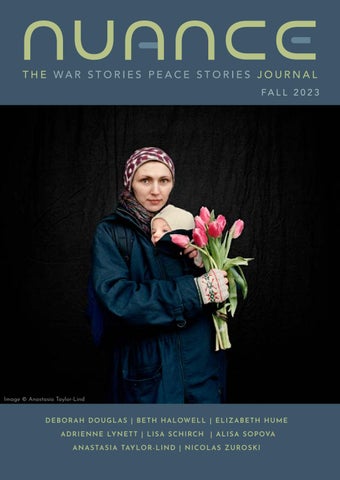
Image © Anastasia Taylor-Lind
D E B O R A H D O U G L A S | B E T H H A LOW E L L | E L I Z A B E T H H U M E A D R I E N N E LY N E T T | L I S A S C H I RC H | A L I S A S O P OVA A N A S TA S I A TAY LO R - L I N D | N I C O L A S Z U RO S K I
CONTENTS 05
Making Room for Nuance
Jamil Simon, Founder and Director
Journalists Breaking the Mold
07
Journalism as A “Brave Space” to Talk about Race A Conversation with Deborah Douglas
13
In Ukraine, War Reporting that Feels Personal An interview with photojournalist Anastasia Taylor-Lind and anthropologist/journalist Alisa Sopova
“Peacebuilding” and Public Understanding
25
What is Peacebuilding? Yeah, We Get That Question a Lot Liz Hume and Nick Zuroski
33
Looking at Public Perceptions of Peace and Conflict Beth Hallowell and Adrienne Lynett
Peace and Technology
38
The Road to Hell is Paved in Code: Designing Tech for Peace Lisa Schirch
1 Photo Credit: UN Photo Library
“I can say it loud and I’m proud: I am a journalist biased towards peace.” — Reza Sayah on Making Peace Visible
2
In THIS ISSUE DEBORAH DOUGLAS Deborah Douglas is the Director of the Medill Midwest Solutions Journalism Hub at Northwestern University in Chicago and the author of US Civil Rights Trail: A Traveler’s Guide to the People, Places and Events that Made the Movement (Moon Travel, 2021). She has served as co-editor-in-chief of The Emancipator, founding managing editor of MLK50: Justice Through Journalism, the Eugene S. Pulliam Distinguished Visiting Professor of Journalism at DePauw University, and a senior leader with The OpEd Project.
BETH HALLOWELL Beth Hallowell serves as American Friends Service Committee’s (AFSC) Director of Research and Analytics. Her research at AFSC aims to develop tools for advocates and journalists to ‘change the narrative’ on war and violence. Prior to AFSC, Beth’s research and program work focused on health inequality in the Americas. She has conducted research on the Affordable Care Act rollout in southeastern Pennsylvania and the impact of public health interventions on maternity care in rural Guatemala. Beth received her PhD from the University of Pennsylvania in 2015.
ELIZABETH HUME Elizabeth (Liz) Hume is the Executive Director of the Alliance for Peacebuilding. Liz is a conflict expert and has more than 25 years of experience in senior leadership positions in bilateral, multilateral institutions, and NGOs. She has extensive experience in policy and advocacy and overseeing sizeable and complex peacebuilding programs in conflict affected and fragile states in Asia, Eastern Europe, and Africa.
Adrienne Lynett Adrienne Lynett is the Research Manager on the Research & Analysis team at ReThink Media. Her expertise is in pairing qualitative analysis (ethnography, interviews, and content analysis) with quantitative research (survey design and analysis), and she applies this knowledge to media analysis, public opinion polling, and messaging projects. Specifically, she has worked on media analyses of nuclear issues, ranked-choice voting, and militarism, as well as polls investigating attitudes around pro-democracy reforms.
3
LISA SCHIRCH Lisa Schirch is Professor of the Practice of Peacebuilding and the Starmann Chair in Peace Studies at the University of Notre Dame’s Kroc Institute for International Peace Studies. She is also a Senior Research Fellow for the Toda Peace Institute where she directs the Institute’s Social Media, Technology and Peacebuilding program to study the impact of social media on conflict dynamics, and to map how new technologies contribute to peacebuilding. Schirch is also a Senior Fellow with the Alliance for Peacebuilding.
ALISA SOPOVA Alisa Sopova is a doctoral candidate in anthropology at Princeton University. Her research focuses on the everyday civilian experiences of the war in Ukraine, through the study of materiality, affect, and improvised strategies of resilience. Alisa combines ethnographic research in Ukraine with journalistic reporting and has written for The New York Times, Time magazine, and The Guardian. Her work includes the #5Kfromthefrontline project, created with Anastasia Taylor-Lind.
ANASTASIA TAYLOR-LIND Anastasia Taylor-Lind is an English/Swedish photojournalist who works for leading editorial publications all over the world on issues relating to women, population, and war. She is a 2016 Harvard Nieman Fellow, a National Geographic Magazine contributor, and also works for TIME, Vanity Fair, The New Yorker, The New York Times, The Sunday Times, The Telegraph and The Guardian. Anastasia’s work has been exhibited internationally in spaces such as The Saatchi Gallery and The National Portrait Gallery in London.
Nick ZuRoski Nick Zuroski is a Manager for Policy & Advocacy at the Alliance for Peacebuilding. Nick’s interests lie at the intersection of peace and stability, gender equality, and grassroots-oriented understandings of human security. He has professional experience in strategic communications, investment research, political economy analysis, and international development. In 2021, Nick received his M.A. in International Affairs — concentrating in Global Gender Policy and International Law & Organizations — from The George Washington University’s Elliott School of International Affairs.
4
WA R S T O R I E S P E AC E S T O R I E S
Making Room for Nuance Jamil Simon, Founder and Director In our conversations with journalists on our podcast Making Peace Visible, we often hear how there simply isn’t enough room for nuance in reporting on peace and conflict. With the limitations of time and space, and the preferences of editors seeking stories that can reliably generate clicks and retweets, many reporters complain that they are unable to cover a story’s full complexity. The result is that far too many stories on peace and conflict are reduced to black and white terms. The War Stories Peace Stories team and I are proud to present this inaugural issue of our seasonal journal, appropriately titled NUANCE. In these pages we explore more thoughtful and inclusive approaches to conflict reporting, new strategies for framing peacebuilding, the impact of unregulated social media platforms on peace and conflict, and so much more. Peacebuilding is an integral and effective practice for the mitigation of war and violence, yet few people have ever heard the word, and even fewer understand what it is or how it works. To this point, Beth Hallowell and Adrienne Lynett share in their essay, “Looking at Public Perceptions of Peace and Conflict,” that the word peacebuilding is, in fact, largely absent from news coverage. Out of 37,000 articles about war in a database from 2011 to the present, the word peacebuilding only appeared only 31 times. Compelled to investigate this broader issue, Elizabeth Hume, CEO of the Alliance for Peacebuilding teamed up with Frameworks Institute to research public perceptions of peace and help reframe the way we talk about peacebuilding. Liz and Nick Zurkowski, AFP’s Manager of Policy and Advocacy, explore this 5
question from several different angles in their essay “What is Peacebuilding? Yeah, We Get That Question a Lot.” When it comes to more thoughtful reporting on conflict, we’ve included two powerful interviews from our podcast, Making Peace Visible. First, Ukrainian journalist and anthropologist Alisa Soprova and her colleague Anastasia Taylor-Lind, a celebrated photojournalist, show a more personal side of the war in Ukraine with powerfully raw images and moving stories of everyday life. Likewise, award-winning solutions journalist Deborah Douglas calls for journalism to be a “brave space” – rather than a “safe space” – to examine the impact of America’s racial history on today’s most polarized political debates. Finally, Lisa Schirch, University of Notre Dame professor and one of the founders of the Council on Technology and Social Cohesion, looks under the hood of our unregulated social media platforms and sheds light the dangers to democracy they pose. In her essay, “The Road to Hell is Paved in Code,” she outlines how algorithms designed to generate clicks actively promote divisiveness. My hope is that this and subsequent issues of NUANCE will make serious, thoughtful contributions to the ongoing dialogue about how we tell stories about peace and conflict. Lastly, I express my heartfelt thanks to all the writers for their generous contributions. Also to Faith McClure, designer and editor of NUANCE, and to Andrea Muraskin, our podcast producer and assistant editor of NUANCE. You have all made this project possible. — Jamil
Protester interviewed in Tahir Square, February 7, 2011, Deirdre Kline, Wikimedia Commons
“It is an investigative job to find these stories. They don’t come to you. These are not stories that are flashing on the police scanner or that are calling for your attention.” — David Bornstein, Co-Founder of the Solutions Journalism Network, on Making Peace Visible 6
“If you’re biased for democracy, then you have to be biased for racial justice, because racial justice is embedded in the democratic promise.” - Deborah Douglas Photo Credit: Ven Sherrod
JOURNALISM AS A “BRAVE SPACE” to talk about race: An Interview with Deborah Doughlas By Jamil Simon and Andrea Muraskin
S
ome of the most polarized political debates in the United States stem from issues of race: from police reform and immigration laws to voting laws and how history is taught in schools.
For award-winning American journalist Deborah Douglas, practicing journalism that includes an analysis of how race functions in our society is engaging with the promise of the American project. The answer to these polarized issues isn’t to cloister ourselves in so-called “safe spaces.” Rather, Douglas sees journalism as a “brave space” to examine the impact of history on today’s pressing issues. A child of the Great Migration, Douglas’ parents were among over 6 million African Americans who moved from the rural South to the urban Northeast, Midwest, and West between 1910 and 1970. Traveling back and forth from Chicago and Detroit, down to Memphis and Jackson on long trips in cars and buses to visit family, Douglas determined as a precocious 8-year-old that she would dedicate her life to journalism. Later, she would write US Civil Rights Trail: A Traveler’s Guide to the People, Places and Events that Made the Movement. Now, as Director of the Medill Midwest Solutions Journalism Hub at Northwestern University in Chicago, Douglas underscores the necessity of a solutions-based journalism when covering pressing social issues. As the
“missing piece of the inclusion puzzle,” solutions journalism offers a systematic problem-solving approach to reporting. Rather than merely covering what’s problematic in society, solutions journalism covers initiatives undertaken to address problematic issues, examining both the effectiveness and the limitations of those efforts. Deborah Douglas is the former co-editorin-chief of The Emancipator, a reimagining of the first abolitionist newspaper in the United States with a focus on explaining and identifying solutions to structural racism. She is also founding managing editor of MLK50: Justice Through Journalism and Jamil Simon: You’ve been part of a movement over the past 10 years initiating a deeper reckoning with the history of race in the United States. At the same time, there’s a countermovement to deny our racial history. How do you make sense of this countermovement? Deborah Douglas: It’s actually quite frightening. The idea that you can have people standing right in front of you, people who created the culture that we all live in, and you deny the beauty of that and just the privilege of being able to access and enjoy that culture. It’s just a frightening thing. I’m actually struggling right now, to be honest. I try to keep my eye on the goal, knowing that significant shifts throughout history have made it so that marginalized people can enjoy 8
NUANCE more freedoms and access enfranchisement. and why,” and a lot of times we do all those It happens along a throughline and there bits except for the “how.” By the time you get are ebbs and flows in terms of the ability of to “how,” you just don’t have enough airtime or progressive policies and laws and norms to take hold. Generally, that’s how I look at it, as a legacy exercise, that these things take time. But right now, just living in this moment, looking at so many of our hard-fought laws fall into destruction, it’s just really hard to take. It’s just one blow after the other. When you consider affirmative action and the attack on LBGTQ rights and voting and now they’re coming for the women. I feel a little bit like I’m on the ropes right now. And not by myself; I’m on the ropes with all progressive-minded people, but on the ropes and just getting beat a little bit. I’m looking for that second wind, so I can stand up and breathe and fight again.
journalism is the only profession mentioned in the Constitution, so that should tell you something about how important it is.
JS: The practice of journalism happens in the present moment. It’s about what’s new. But when you’re covering issues of equity around race, it’s crucial to learn about the past in order to better understand what’s going on in the present. Do you have a philosophy about including history in your journalism? DD: The fact is there is nothing new under the sun. I think that when your reporting is devoid of context, it ends up being superficial coverage. Right now, we’re in a context where a lot of coverage is superficial for a lot of reasons. The media has really been hard hit by failing financial models. Hedge funds are buying up media properties and then picking them for parts, and leaving newsrooms decimated in terms of reporting and professional staff. We have the situation of news deserts. When people lack access to credible information, terrible things can happen. Misinformation and disinformation can fill that gap. In my current role, I’m the director of the newly-created Medill Midwest Solutions Journalism Hub. Solutions journalism is a rigorous approach to covering pressing social problems, and it’s a really great way to cover marginalized communities. For me, it’s the missing piece of the inclusion puzzle. It involves covering the response to a pressing social problem, gathering evidence of the response and how it’s working, including insights about how that response application is working and covering the limitations. In journalism, we have a rubric called “who, what, when, where, how, 9
space on the page to include that. And so, this is a deep invitation to slow the storytelling down, to excavate the “how things are working.” A lot of research by the Solutions Journalism Network shows that when you show the “how,” people understand systems better, processes better, their relationship to those systems and processes. And because you’re not just problematizing something but showing a potential solution or a potential answer to a slice of a systemic problem, it gives them more hope and dignity. A lot of journalists pride themselves on “Oh, here’s something wrong and here’s something wrong, and we gotta hold this person accountable.” You know, slam dunks on catching all the bad people doing all the bad things. To me, the invitation to journalism in this moment is to look at things through the lens of systems and how they’re impacting us. And solutions journalism gives us a way into those systems to understand how they work for some and don’t work for others, but they can. JS: You’re a founder of MLK50, which is a news website with the tagline, “Justice through journalism.” Can you talk a bit about how you see the role of journalism in advancing racial justice? DD: I think that, first of all, journalism is the only profession mentioned in the Constitution, so that should tell you something about how important it is. And I think that because we are a critical part of the American project, if you
don’t include an analysis of race, of how race functions in this society, then you’re not fully engaging with the promise of the American project. As we all know, race is central to how this country came to be and what it’s come to be at every step of the way – the good and the bad. So, if you don’t have a race analysis as part of your journalism, then you’re not doing it right. The fact of the matter is that a lot of individuals, especially professional journalists, are not equipped for that analysis. But we gotta get equipped quick, fast, and in a hurry . JS: Why do you think that’s true?
DD: Yes, I am a co-founding editor-in-chief with Amber Payne of The Emancipator. I’m not at The Emancipator anymore, but I now serve on the advisory board. The idea was created, or excavated, by Ibram X. Kendi, who is the founding director of the Center for Antiracist Research at Boston University, and Bina Venkataraman, who was then the opinion editor at the Boston Globe. In 2020, people were looking around trying to figure out how we can capture the energy and the momentum to do something about these instances of deep racial injustice vis-a-vis George Floyd, Breonna Taylor, impacts from the coronavirus -- to do something in a large way to advance the conversation. So, they came up with this idea to create an evidencebased, scholarly-driven platform to elevate solutions to the problem of racial injustice and its intersections, because it doesn’t just live alone: there’s ableism, xenophobia, misogyny, anti-LGBTQ… So Amber and I came on board to build bones onto that. We were able to create what I think is just a beautiful platform that hosts a very inclusive conversation about how we can pursue these solutions to systemic injustice together.
DD: White supremacy and hubris. People think that if you talk about race, that you’re talking about another group of people. When it comes to whiteness, whiteness is a thing, and it functions in a certain kind of way in this society. It doesn’t mean that you as a white person have to agree that you’re a bad person. We’re talking about a function of a systemic thing in our society and that we’re duty-bound to excavate it in that way. And then some people would like to regard whiteness as a sort of default way to be in the world, a default way to aspire in the world, as opposed to including all the people and all JS: In a way, its goals are in sync with the work the kinds of experiences and all the different you’re doing in solutions journalism. ways that we fall on fault lines of identity in DD: Absolutely. The Emancipator practices this society. solutions journalism. We just spent the last JS: There are some people – news consumers, several months covering health equity. We and maybe even fellow journalists – who had a health equity grant from the Solutions bristle at the idea of journalism advancing Journalism Network. We produced some racial justice. They might say what you’re commentary and videos about maternal health doing is activism, that there should be a clear and breastfeeding access for marginalized line between activism and journalism. What’s women. We produced two health equity your opinion on that, and what do you tell tours, one in the Little Village community of Chicago which is a large Latino community, your students? and we went to the historic Hayti community DD: The one embedded bias that we definitely in Durham, North Carolina. We centered have when we get up every day to cover the news community voices showing how they could be anew is that we’re biased for democracy. So, let’s agents of their own salvation in the face of just admit that. If you’re biased for democracy, then overarching systemic issues that challenge the you must be biased for racial justice because racial ability to be fully healthy. justice is embedded in the democratic promise. JS: Looking at it from the other side, a common JS: You were the editor-in-chief of the complaint about journalists is that they come Emancipator, which is a platform that uses into communities they’re not part of, get the evidence-based opinion and ideas in journalism story they are looking for, and then leave. Do to hasten racial justice. Tell us about the you think there’s something extractive about the way journalism is sometimes practiced? Emancipator and how you started it. 10
NUANCE DD: Oh yeah, absolutely. And it’s so funny that you mention that because with our health equity tours, we hired local tour guides as field producers for those videos. We didn’t want to show up in those communities like vampires. We wanted to be invited in. So, we did research. We did our own reporting because we’re seasoned journalists. We also worked with the field producers to work our way to community members and thought leaders in the community who could really help us uncover the nuances of the health equity situation in those communities. A lot of times you’ll hear people in communities around the country say, “Oh, this national TV show came to town and they talked to these people and these people, and those are the wrong people to talk to because this guy over here, or this woman over here, they’ve been working on that for years.” We didn’t want to be those people. And so there is a way that you can avoid extraction in the way that you plan. Media operates on different levels, from extremely local to globally or nationally. I think there’s a way that you can listen to communities -just be in a constant state of listening. Doing check-ins and meeting new people so that when you do have to show up someplace, you’re showing up invited and not just showing up in that extractive way. That all said, when something goes down, you gotta get in there and tell the story.
engagement is really important. We need to show our work to the audiences that we cover. Sometimes outlets show some of the work -- I can think of instances where the New York Times published a story about why they made the decisions that they did or covered something the way they covered it. I can think of smaller outlets that have done that. That needs to be a regular part of our practice: to show how we actually get our work done and why we made the decisions that we made and why we used the sources that we used. Media literacy is at an all-time low. We need to be working on literacy about the media while we’re doing our journalism, which is a lot of work to do. We’re overworked, but we need to do it.
this is a deep invitation to slow the storytelling down, to excavate the “how things are working.” ...when you show the “how,” people understand systems better, processes better, their relationship to those systems and processes. JS: We’re also battling algorithms of the social media networks that promote divisiveness, anger, and distrust among different groups of people.
JS: What can be done to create a more DD: I think that because misinformation and respectful relationship between mainstream disinformation can thrive on social media, news organizations and underreported, credible media needs to take up more space on those platforms. Instead of just posting underrepresented communities? links, a lot of the journalism needs to be out DD: I think you’re surfacing the fact that there’s there. And that’s one decision that Amber and not a lot of trust in the media these days. For the I made when we launched The Emancipator most part, a lot of people don’t trust national -- we wanted to tell complete stories, so that media. They have a little more trust in local if you never went to the website, you were still media. There’s a Gallup poll that monitors trust educated, and they’re continuing to do that in mass media, and for the first time in all the to this day. I talk to a lot of new CEOs and executive decades they’ve been doing this poll, they found editors who say, “I’m not that into social media, that the percentage of people who distrust mass Julia Roig media is greater than the number of people who but we have a person.” If you’re really stuck in your orthodoxy you really believe that trust it a great deal. So that’s disturbing. Photographer Anastasia Taylor-Lind and writer Alisa Sopovaand create intimate people should continue come to you, then In terms of of Ukrainian what can be done to engender portraits civilians living close to the frontlines of the to Russian invasion. trust, one thing that we can do is to show we’re going to continue to have problems. You up and listen when you don’t actually need gotta go to where the people are. And I’m not something from the community. Community saying they’re all on social media, but they’re 11
on there in a sustained way and we need to it? Could there possibly be an upside to this horror show? really be taking up more space. JS: I loved your talk that you gave in Mississippi called “Forth and Back: The Great Migration Roadmap to Resistance and Reclamation.” In your talk, a black man asked you if there were any true safe spaces for black people in America. You responded that you don’t believe in safe spaces, that instead, you believe in brave spaces. Can you tell us a little more about that idea? Do you regard journalism as a brave space? DD: Oh, it’s definitely a brave space. It’s not at all a safe space. I really don’t believe in safe spaces. If you’re only calibrating for safety, then you’re not getting to truth and transparency and authenticity, and we can’t work our way to the other side of problematic issues. I think that a lot of the massive temper tantrums that we are experiencing right now in this country, like that mothers’ group that keeps going around trying to get socalled critical race theory out of schools and all of that, that’s all centered around their discomfort around being held accountable in any sort of way. Our default can’t be to have complete safety. Of course, we should have safety from violence. But, we need to be able to foster difficult dialogues so that we can deconstruct our systems and then reconstruct them in a way that works for everyone. That should be the goal. It’s so funny that you asked that question because I wrote a piece about this several years ago for Columbia Journalism Review called “No Media Safe Space,” because there was something going on campus, and they didn’t want the journalism students covering the student protests because it was supposed to be a safe space. Down to my bones, I just don’t believe that. JS: Many of our guests on Making Peace Visible are concerned over worsening political polarization in the United States, polarization that sometimes leads to violence like on January 6th. Many of the most divisive issues in this country are questions of justice, equity, and race, like debates over policing, or how American history should be taught in schools. The polarization has been so destructive. America’s almost been paralyzed by it. Do you think there’s anything we can learn from
DD: That’s such a broad question. I wrote the first ever civil rights trail guide to follow the official civil rights Trail in the South. So, of course, I’m all about people ensconcing themselves in our origin story so we can understand our current context and understand where we’re going. We should always be regarding the complete history of this country and providing that context in all of our stories. I don’t have an answer to what’s going to happen. I’m really kind of angry right now, but I’m just trying to let it burn off so I can get that second wind and operate from a sense of possibility. I do think that a kind of creative friction can happen when things are awry in this sort of way, that there can be an opening for some sort of transformation to occur. And I’m always looking for that little glimmer of light that I can work my way to and through. I’m also in a Complicating the Narratives fellowship with Solutions Journalism Network right now, and we’re going to be learning methods developed by Amanda Ripley who is the founder of Good Conflict, on facilitating difficult dialogues, cutting through that tension and engendering trust. So this is really a practice and you never reach a pinnacle and get everything perfect. You have to keep working at it and keep working at it and that’s what I’m committed to doing right now. ◆
Listen to the audio version of this conversation on our podcast.
From Ukraine, War Reporting that Feels Personal Photographer Anastasia Taylor-Lind and anthropologist Alisa Sopova on creating intimate portraits of Ukrainian civilians living close to the frontlines. An interview by Jamil Simon and Andrea Muraskin.
I
n the United States, many think of the current war in Ukraine as beginning on February 24, 2022, when Russia, under the command of Vladimir Putin, launched a full-scale invasion. In fact, Russian and Ukrainian forces have been fighting in eastern Ukraine since 2014, when Russia annexed Crimea following what Ukrainians call the Revolution of Dignity, or the Maidan Revolution. It was in 2014 when Ukrainian journalist Alisa Sopova met Anastasia Taylor-Lind, a British/Swedish photojournalist, in Ukraine’s Donbas region. The two women clicked: they both disagreed with the sensationalist approaches in the war reporting of the time; and they agreed that civilians’ experiences were going underreported. Sopova and Taylor-Lind have been collaborating ever since to document the experience of civilians in Ukraine’s war zones. Much of their work lives on social media, including #welcometodonestk, and their most recent project, 5k from the Frontline. TaylorLind’s photographs and Sopova’s reporting have also been featured together in outlets including The New York Times, The New Humanitarian, NPR.org, and Time. Taylor-Lind and Sopova create intimate, accessible portraits of Ukrainian civilians living close to the frontlines. Sometimes their subjects are picnicking in a park or tending a garden. Other times, they’re repairing a ceiling damaged by shelling or waiting for departure on an evacuation train. As the war has ground on, they’ve returned to visit the same families, witnessing how the war touches men, women, and children over time. Sopova, who is also a doctoral candidate in anthropology at Princeton University, says the methods and philosophy of anthropology have shaped her journalistic work for the better. Alisa Sopova and Anastasia TaylorLind spoke with Jamil Simon in February 2023.
the east of the country, which historically has been more Russian speaking, with many people seeing themselves as having more cultural ties to Russia. And then people in the east kind of saw Maidan as a takeover of power by the other party. There was a lot of discontent in the east when Maidan happened. Russia was also unhappy with Ukraine drifting away from its influence, and Russia kind of took over and began manipulating the sentiments in the east of the country to its own ends. And this is how in 2014, in spring, first Russia annexed Crimea. Then it started supporting separatist movements in the east of the country and eventually created two entities called “Donetsk People’s Republic” and “Luhansk People’s Republic” that have been the epicenter of this kind of military struggle from 2014 until 2022 when the full-scale invasion started. Jamil Simon: Anastasia, I would describe your photography and Ukraine as intimate and humanizing. We don’t see a lot of soldiers with helmets and guns drawn. We see civilians gathered with their families or going about their daily lives. We see faces clearly and the cameras close to the subject. How would you describe your style of covering the war as a photojournalist?
Anastasia Taylor-Lind: When Alisa and I met each other, we suddenly and quite unexpectedly found kinship in our professional approaches to reporting on war. We are both interested in reporting on the war in Ukraine, but we were also both concerned with the stereotypes and the tropes of the visual representation of war. When we think of wars, we think of them as taking place within a war zone, a designated area with frontlines and gray zones and no man’s lands and second lines and third lines. And of course, these things do exist, but media coverage within these spaces tends to focus on the experience of combatants. And that Jamil Simon: For those who might not be really isn’t Alisa’s or my interest. We’re more familiar, could you explain the line going from concerned with what it’s like to live with so the 2014 revolution in Ukraine to the Russian invasion in 2022? Oppostite: At a temporary refugee shelter in Alisa Sopova: Since the early 2000s, Ukraine has been politically pretty divided. It’s a little like the US where there are two parties, one more associated with Western Ukraine, more like pro-Ukrainian, and one associated with
Poland, March 2022, sisters Ludmyla and Nelya Tkachenko from Kyiv fight back tears thinking of their families still in Ukraine. Nelya says she’s neither here nor there. “Half my heart I left behind, half I brought with me. Photograph: Anastasia Taylor-Lind
14
NUANCE many combatants from both sides suddenly in your garden, your street, your neighborhood, your town, and your region. As soon as war arrives in a place, we photographers begin representing the people whose lives are affected by it in different ways. We start putting people into categories within preexisting war stories, if you like. I might be defined by my job as a photographer, by my relationship to my family—I’m Daniel’s sister. Or by the location that I live in—I’m a Hackney resident. But when war arrived in Alisa’s hometown, people were no longer defined in journalistic coverage in those ways. People become stories in a pre-existing framework of war: combatants, civilians, separatists, terrorists. You may notice it now with the coverage of the Russian invasion of Ukraine how often the conflict is compared to the Second World War. We’re taking old narratives and laying new, current stories over the top.
the circumstances of war. The most initial one is war versus peace, right? We think it’s very obvious that war and peace are different things: we assume that war is bad, and peace is good. But when you look at the current war from the perspective of Ukrainians, you begin asking yourself, where is resistance in this dichotomy? Then we look at bad guys against good guys, or oppressor against the oppressed. One of the main equations of journalists, especially in war, is whether you can remain objective or whether you are biased. The ethically sound way is to say that we are biased, but towards the oppressed, against the oppressor, right? But when you look at the dichotomy of the oppressed versus the oppressor, it becomes very hard to identify who exactly falls in which category. It’s kind of a famous historical argument that Stalin’s repressions were suicidal because people who were oppressors, who were persecuting other people today, the next day they were the oppressed. They were persecuted themselves. And in the case of Ukraine, I’m seeing a kind of a hierarchy or loophole of oppressors and the oppressed, because Ukraine is not a single entity, it’s very heterogeneous. And then these people in the east we are writing about, they end up being oppressed by both Russia and Ukraine. On a theoretical level, I’m just always trying to dig into the depths of this, but I can never find the bottom. I try to get over the simplistic understanding where everything is clear, and all the roles are clearly designated because war is a very messy event and a very messy environment. There are no designated roles. Somebody who is a civilian today is a combatant tomorrow. Somebody who’s oppressor today is oppressed tomorrow. I’m just trying to understand this messiness and Jamil Simon: Alisa, your writing is published to communicate it. along with Anastasia’s photographs in both your social media projects and your work Jamil Simon: Your most recent social media that’s been published in news outlets. You project is called #5KfromtheFrontline, where tell poignant stories of individuals that are you’re telling stories about what’s happening rarely found in war coverage. How would you five kilometers from the frontline of the war. If you go on Instagram and look at some of describe the stories you tell? the comments, most are very supportive, but Alisa Sopova: I would say the underlying idea there was one comment that struck me. The of what I’m always trying to do is fighting comment suggested that because you were against binaries and against dichotomies that showing people performing normal activities public discourse gets drawn down to under in the midst of a war, viewers could get the
“Pidi corepudae optat fugita doloreh enistempore esti dolurem quo tenimin ctotatur? Ulaut voles maionse digento be dolores et mo tenihillaut acc”
Anthropologists view war and peace not as opposites but as something that is happening simultaneously. War is happening, but socalled normal life is...happening alongside war. We want to show not just the spectacular events, but also how people live through it on a day-to-day level. But then the ethical question is how to do it without without normalizing it.
15
Alisa Sopova (left) and Anastasia Taylor-Lind (right) in Donbas in 2022 while working on their #5Kfromthefrontline project. Photograph courtesy of Anastasia Taylor-Lind.
idea that the war is not actually so bad. How with it too. Something that we’ve been running would you respond to that concern? into very often is that people who live next to the frontlines feel pressured to perform, to Alisa Sopova: As somebody who has studied suit their lives to the stories they see on the the anthropology of war, this is one of the TV. For example, sometimes they take us to biggest questions that anthropologists a picnic or to a celebration, or we just have struggle with. Anthropologists view war and a nice hearty dinner, you know, with a glass peace, not as opposites, but as the continuity of wine. And then when Anastasia wants to of two things happening simultaneously. War take pictures, people become hesitant and is happening, but normal life, or so-called they say, “Oh, please don’t show us having fun normal life, is happening alongside war. So, while war is happening,” because they feel this we want to talk about and to show not just pressure. They’re afraid to be judged, to be the spectacular events, but also how people immoral by having fun. live through it on a day-to-day level. But then the ethical question is how to do it without Jamil Simon: On our podcast, we often hear normalizing war. There is no one answer. It’s from experts and journalists that black and kind of an ongoing conversation and I think white narratives -- where one side is the hero we are struggling with it every time. Not only and the other is the villain -- not only fail at do we as storytellers struggle with this, but telling the whole story, but they also seem to people who live there, people who work with actually encourage support for violent conflict. civilians, who live in the war zone, they struggle In Ukraine, Russia’s clearly the aggressor, but 16
NUANCE
The Grinik family in their garden in Avdiivka in 2018. Their home is just 50 meters away from a Ukrainian position. Photograph: Anastasia Taylor-Lind
18
NUANCE
Maidan Nezalezhnosti (Independence Square) in Kyiv on 20 February 2014, which became known as ‘Bloody Thursday’ after at least 77 protestors were killed by snipers. Photograph: Anastasia Taylor-Lind
20
NUANCE
Olena Sheremet carrying flowers to lay in memory of murdered protestors, and her 6-month-old baby Ostap. Photograph: Anastasia Taylor-Lind
still some nuance is lost in the international reporting, which tends to be pro-Ukrainian. Anastasia Taylor-Lind: Yes, and I’m thinking even more specifically as it relates to our work in Donbas. It’s a specific concern – that is what happens when territory occupied by Russian forces is then reclaimed by Ukraine. A very pressing question sits around whether the people who stayed there will be seen as hostages of the occupying Russian forces or if they will be seen as collaborators. And this is a question that’s relevant not only to territories of Ukraine that were taken by the Russian Army since the full-scale invasion and 21
then reclaimed by Ukraine, but also these territories that have been occupied since 2014, you know, Crimea and parts of Donbas. I’m afraid about what will happen and I’m afraid about the stories we will tell around that, because using the idea of the good and the bad is simply unacceptable, certainly in terms of journalism. But we see it even now. Even working in Donbas, I would hear other media professionals referencing different towns or villages and describing them as pro-Russian, the insinuation being that it’s a dangerous place to go as a journalist. And this prejudice [is coming] from people who are telling
Yevhen Shulga, one of thousands of people who gathered in Kyiv in 2014 to protest against the government of then president Viktor Yanukovych. Photograph: Anastasia Taylor-Lind
stories. As we already mentioned, we all have biases. None of us are objective because we are human beings. But that specific reporting of the stories that tell about what happens there frightens me. Alisa Sopova: To add to what Anastasia said, we tend to view wars within the dichotomy of good guys vs. bad guys. Russia is obviously doing the wrong thing by attacking Ukraine, and Ukraine is kind of a good guy here. But when we look at Ukraine, again, we expect the good side to be morally right in everything it does, and it’s just not how things work.
What I’m seeing now in Ukraine is that the public discourse is getting increasingly tense. People who speak Russian or people who come from the eastern regions of Ukraine are constantly harassed in the public sphere. I myself am being stopped at the checkpoints or at the border entering the country and being harassed just because I have a residential record from the east of the country. Something that I see in the public discourse all the time are discussions of “whether my hatred is enough.” If you are not saying that all Russians should die, your hatred is not enough. And it’s not that it means that Ukraine is bad, that 22
NUANCE Ukraine should be invaded by Russia. It’s just that the proverbial “good guy” might also make mistakes or go too far. Something problematic here is that Russian propaganda, all the tropes of Russian propaganda are manipulative, but they’re not entirely untrue. They are based on, if not facts, then sentiments of the fact that half of Ukraine is Russian-speaking, and these people might not feel included in the nation-building project of Ukraine if it remains so exclusive. The current resolution that everybody who’s Russian speaking must switch to Ukrainian, everybody should self-flagellate and deny their identity of coming from Donbas region or from Crimea, I don’t think it’s going to work in Ukraine’s interest. Jamil Simon: It’s the nature of war to reduce your opponent to a thing, to a stereotype of some kind. Alisa Sopova: Yes, but the problem here is that we are not reducing just Russia to a thing; we are reducing a part of the Ukrainian population that is suffering equally from Russian aggression. We are also treating them as collaborators and reducing them and dehumanizing them. I mean, the irony of this situation is that most of the theater of war is in the east of the country where all these Russian-speaking people live. They’re getting the worst from Russia and they’re also getting the worst from Ukraine. Jamil Simon: The long-view approach you both take in your reporting flies in the face of this kind of reductive journalism. In images of the Grinik family that you’ve covered for a long time, some of the photos are so prosaic: they’re having a picnic in a field that’s only a few hundred yards from a battle zone. Kids are playing, and meanwhile the war is continuing. Alisa Sopova: Working as a journalist in the past, I felt very bad about just coming and visiting these people. Often, for these people who live in the rural areas, this big team of American journalists with cameras coming in is like a big event. They cook food. Then in half an hour the producer says, “We have to go,” and they just leave and never look back at these people. So, when I started reporting with Anastasia in this slower way, I think we 23
started returning to many of these people. Not necessarily to report, but just because we were back in the same town, and we could just as well return and have tea together and talk about things. Then while we were already there, Anastasia would take out her camera and take some pictures. It was not like a plan to return to the same people, but we were just returning to them as to old friends, as to people we wanted to see again, and then we just took pictures of them and wrote down their stories along the way. Anastasia Taylor-Lind: All this work was selfinitiated and self-financed as well. We weren’t going on assignments for anyone. And as the years went on in this interim period, between the active phase of the war in 2014-15 and the full-scale invasion, editors would ask us, “Okay, you have a new chapter to the project. Nice stories, nice pictures but what’s the news hook? What’s the news angle? What’s changed?” And in reality, very little had changed. If I could have come up with a news angle or a new approach or any of those things, sure, I would’ve done that. But in the absence of anything else to do, we just kind of kept going. And now I don’t see why we should stop. There were times when we just went for dinner, and I took a few pictures, but I never thought to include them in an edit. Now we know they’re not at home anymore, that their house has been hit again, that their neighbors are living in their basement with the dog who’s paralyzed on his back legs and probably won’t last very long -- in a house, incidentally, that was occupied by a German officer in the Second World War. When I find these pictures, those summers, and those dinners that Alisa explained, sitting for hours talking and drinking homemade wine, eating delicious, barbecued food… they’re further away than only three or four years now. Alisa grew up in Donbas but even for me, it’s just the idea of where I spent my summers with my dear friends, you know? Alisa Sopova: I think [photographs] acquire additional meaning post-factum—when we know that they don’t exist anymore. You only have the things that didn’t seem important at the moment and are important now -- you only have them if you kept going to places and people and things that didn’t seem important
A bus departing from the frontline town of Kurakhovo to the entry checkpoint into occupied Donetsk in 2019. After reaching the checkpoint, passengers had to queue for many hours in the middle of a mine field, waiting for their turn to cross. Photograph: Anastasia Taylor-Lind
at the time to anyone and did something that looked very obscure and uninteresting and not newsworthy. This is basically what our project is. After doing both journalism and ethnography, which is the main practice of anthropology, I realized that these two activities are very close, and if they interpenetrated a little more, there could be a lot of useful insights that they could share. For example, something that I think would be very useful to journalism is the method of participant observation. Just kind of being there and trying to become a part of the scene and just doing whatever the people who you study are doing, doing it together with them. You participate and you observe. I think if I just thought this way before, when I did pure journalism, it would be very useful because as a journalist, you often just feel pressured to come and quickly interview somebody. It just didn’t occurred to me 10 years ago that I don’t have to leave when the interview is finished. I could just spend another couple hours and stay there and ask, “Can I just hang out around and look at you doing things? Maybe
I can be helpful with something. Maybe I can make you tea.” You learn through just being there. I think it could be very enlightening for journalism to engage more through such methods. ◆
Listen to the audio version of this conversation on our podcast.
24
What is Peacebuilding? Yeah, We Get that Question a Lot How do we reframe the way we communicate so that peacebuilding is actionable and practical for everyone? By Elizabeth Hume and Nick Zuroski
W
hat is peacebuilding? Yes, we know we have not done a great job communicating what peacebuilding is and why it matters. The Alliance for Peacebuilding (AfP) is a network of more than 190 organizations working in 181 countries to prevent and reduce violent conflict and build sustainable peace. 25
We’re working on how we communicate what peacebuilding is and why everyone should care. And we are showing what people—individually and together—can do to prevent and reduce violent conflict and build sustainable peace, starting with building a dedicated public constituency that advocates
for robust funding for conflict prevention activities, laws, and policies. We believe so much in this work that we commissioned new research along with PartnersGlobal and The FrameWorks Institute that outlines framing strategies for peace and peacebuilding to answer this question. We also developed a new fieldbuilding strategy, which includes a strategic priority to shape new narratives to develop and amplify effective peacebuilding messaging. As a concept, peacebuilding started showing up formally in policies in the United Nations in the 1990s, but with a primary focus on peacekeeping, specifically during and after a conflict. Over the last 30 years, the idea of peacebuilding has become more concrete, as its methods to prevent and reduce violence have proven effective. Eventually, in 2018, “peacebuilding“ was finally recognized as an official word in HarperCollins, Macmillan, and Cambridge University Press. Even so, public understanding of peacebuilding remains sparse, and “official” definitions, which are often complicated and technical, are largely unhelpful in bridging understanding. Here is one example: “Peacebuilding involves a range of measures targeted to reduce the risk of lapsing or relapsing into conflict by strengthening national capacities at all levels for conflict management, and to lay the foundations for sustainable peace and development. Peacebuilding strategies must be coherent and tailored to the specific needs of the country concerned, based on national ownership, and should comprise a carefully prioritized, sequenced, and therefore relatively narrow set of activities aimed at achieving the above objectives.” (from the UN Peacebuilding Support Office, 2010) If this definition doesn’t make sense to you, we don’t blame you—such definitions are difficult to conceptualize and super wonky. Indeed, these definitions are part of the problem. So how do we reframe the way we communicate and tell our peacebuilding stories to the public and policymakers so that peacebuilding is actionable and practical for
everyone—and so that policymakers globally prioritize and resource it? In 2022, the Alliance for Peacebuilding (AfP), PartnersGlobal, and The FrameWorks Institute released new research on framing strategies for peace and peacebuilding to answer this question. This multi-year, multimethod research gathered data from the American public and peacebuilding experts to determine which narrative frameworks best make the case for peacebuilding support for international development and diplomacy globally.
Research shows that messages based in fear or that signify a crisis, trigger the amygdala, the fight-or-flight part of the brain, causing people to try to preserve their security, “often to the exclusion of empathy and openness to others.” The research reviewed deeply ingrained assumptions and mindsets around peace and peacebuilding, such as the belief that violent conflict is inevitable, how crisis messaging motivates people, and seeing the military as the main provider of peace. The researchers then identified narratives and framing techniques that are likely to increase understanding of and support for peacebuilding. These techniques include portraying peace as an active and ongoing process rather than a passive end state and emphasizing that peace and communities worldwide are interconnected by using bridge-building metaphors. Social science research shows that messages based in fear or that signify a crisis trigger the amygdala, the fight-or-flight part of the brain, causing people to try to preserve their security, “often to the exclusion of empathy and openness to others,” (as explained by narrative strategist Krizna Gomez in the video link above). Instead of motivating people, crisis messaging shuts people down. For example, 26
NUANCE
when the World Meteorological Organization and the European Commission’s Copernicus Climate Change Service announced that the first three weeks of July 2023 had been the hottest period ever recorded, UN Secretary General António Guterres stated “Climate change is here. It is terrifying. And it is just the beginning…The era of global warming has ended; the era of global boiling has arrived.” How do you feel when you read this quote from Secretary General Guterres? Does it motivate you to find a solution, or do you feel overwhelmed, stressed, and like you want to hide under your bed? In telling the story of peacebuilding, peacebuilders must avoid focusing immediately on crisis messaging. If we want to avoid shutting down the brains of our audience, we must lead with solutions and successes to bring attention to what anyone can do to work toward a positive outcome. We are not saying do not analyze the problem—rather that starting with crisis messaging overwhelms and shuts people down, and therefore does not effectively motivate them to help contribute to solving the problem. The peacebuilding field must also do a better job of highlighting the interconnectedness 27
between peace efforts and the everyday lives of people around the world. Take, for instance, Russia’s termination of the UN-brokered Black Sea Grain Initiative that allowed Ukrainian grain and Russian food and fertilizer to be exported via the Black Sea even during the war. For a year, the initiative decreased global food prices by 11.6%. But now, the deal’s collapse is expected to increase global grain prices up to 15%—something that people everywhere will see in their grocery expenses. This example shows how we are interconnected, and how what happens over there impacts people everywhere. There are also positive stories of peacebuilding in action everywhere, but they are too often underreported and underemphasized. Award-winning investigative journalist Amanda Ripley notes the lack of “hope, agency, and dignity” reflected in news coverage has a paralyzing effect, and makes people feel that the world’s problems are insurmountable. Focusing on solutions through methods like solutions journalism can avoid communicating about conflict in a way that perpetuates it. In the words of Ripley: “Every story I’ve ever done… there are flickers of dignity, agency, and hope.”
Peacebuilders must also do a better job telling the story of their work in a way that resonates with the broader public. Donors and implementers often recount program successes through individual stories. However, AfP’s framing research finds that this technique attributes the success of peacebuilding interventions to the exceptional traits of a specific individual, instead of the community or organization doing the work. We all cannot be a Malala or Greta, but by highlighting programs writ large, peacebuilders can show that building peace is an active process that needs all of us—both individually and collectively. Another important finding around advocating for peacebuilding funding from AfP’s framing research merits attention. In the United States, peacebuilders should avoid justifying peacebuilding funding by invoking cuts to military spending. It is no secret that the U.S. devotes a significant amount of its budget on military spending, allotting more money to national defense than China, Russia, India, Saudi Arabia, the UK, Germany, France, South Korea, Japan, and Ukraine—combined. The U.S. budget consists of two types of funding: mandatory and discretionary. Sixty-six percent of the U.S. budget goes toward mandatory spending, which is not approved by Congress each year and instead goes toward long-running programs like Social Security and Medicare. Discretionary funding (which Congress votes on annually) accounts for 26% of the U.S. budget, and a staggering 45% of discretionary funding goes toward defense—or $750 billion in 2022. In contrast, the international community only spends 4% of global official development assistance (ODA) on peacebuilding. However, arguing for peacebuilding funding alongside advocating for cuts to military spending is likely to pull individuals in the U.S. into deeprooted partisan reactions. Instead, advocates should make a standalone case for why peacebuilding is critical to reducing and preventing conflict. We can have a strong military and prevent and reduce conflicts both at home and abroad. And there are so many inspiring standalone peacebuilding stories to tell. In Yemen and Libya, the UN is partnering with
startup Remesh to use artificial intelligence (AI) to aid in inclusively brokering peace agreements with large segments of the population in real-time. Rondine Cittadella della Pace’s residential peacebuilding program in Italy hosts young activists representing “both sides” of a conflict from some of the world’s most dangerous conflict zones, offering peacebuilding training and trauma healing. Maria Karapetyan from Armenia took part in the program between 2013 and 2015. She returned to her country as a civil society activist who led the 2018 democratic revolution, ultimately being elected to Parliament. NewGen Peacebuilders’ mission is to make learning peacebuilding a rite of passage for young people within an international network of young peacebuilders. Participants in their programs analyze issues and conflicts in their schools and communities, imagine innovative solutions, and design and implement team peace projects that create positive change. One such project was #RiceForLife, where a team of NewGen Peacebuilders from East Mecklenburg High School in Charlotte, NC organized a drive to collect food donations in a way that builds bridges between students, the community, and diverse, global cultures. Their goal was to help create peace by completely changing their school’s annual hunger drive’s intentions, structure, and process to be more culturally sensitive and inclusive, while also providing food that families need. Reframing how the peacebuilding field tells its story is hard. Changing existing mindsets around peace and peacebuilding is a long process involving a need for greater cultural change and eliminating bad habits, like arguing against military spending and crisis messaging. Even at AfP, we have had to rethink how we talk about peacebuilding, and often find ourselves falling back into our old patterns by starting to talk about the global violent conflict crisis. AfP knows that conflict is inevitable, but violent conflict and violence is not. Peace is more than a state of being or a hand gesture; it is hard work, and it must be built by all of us in neighborhoods just down the street and in faraway places. Now join us! ◆ Images for this essay: Faith McClure and OpenAI’s DALL·E-3, 2023
28
Conversations with journalists, filmmakers, scholars, and changemakers on the frontlines of both peace and conflict. Hosted by Jamil Simon.
Featuring conversations with • Daniel Estrin • Amanda Ripley • Deborah Douglas • Peter Coleman • Suchitra Vijayan • David Bornstein • Elizabeth Hume • Reza Sayah • Andrew Volmert • Lucy Kassa • Paul Solman • Libby Hoffman ...and many more!
Podcast Highlights: “Some of the journalists who worked in the most important media used to work under the premise that the guerrilla groups’ ideologies shouldnt’ be amplified in media coverage. They were not treated as political subjects, but just as enemeies to be killed... I think in recent times, the mindset of journalists has opened the frame. Now we try to understand who these people are and why they do what they do. We understand they are also human beings, and if there’s not justification for their actions, maybe there is some explanation... And there are also ways to bring them into legal society and reduce violence.”
Journalist Daniel Salgar
on a perspective change in the news media in Colombia
“You really have to begin by listening and sharing as honestly as you can. Allow them the space to discover whatever and share whatever. But also it requires us to be honest too. It’s not just listening to take advantage. You need to be honest about the fact that our side doesn’t have all the answers either, and we have our own pathologies and that they’re both true.”
Peter Coleman
Author of The Way Out, on how to understand and learn from someone with different political opionions
“I find it really helpful to talk to journalists in places that have seen a lot of violent conflict, because they see it as part of their job to prevent the escalation of violence; that is how democracies end. Journalists here don’t typically see that as part of their job. I was talking to a journalist who does a lot of work in Sierra Leone, and he was saying… that typically political violence goes up right before and right after an election. So they do a lot of work preparing for that and they do a lot of cooperating and collaborating with competitors around the country…They have to work together [around this] value that preventing the escalation of violence supersedes the value of getting something before your competitor.”
Amanda Ripley
Journalist and author of High Conflict: Why We Get Trapped and How We Get Out
Find Making Peace Visible where ever you listen to podcasts!
“I’m lucky becuase...this is a very vibrant and vivacious, obstinate place, where people get very intimate and very personal very quickly. And it’s easier than you think to just show up somehwere and be welcomed as a guest. You have to know how to navigate the cultural codes, but oftentimes people truly just want to be listened to. So sometimes it’s enough to be able to kind of step over those suspicions...by simply saying I’m here because I just want to understand you and understand what you’re going through. When I hold that in mind, I find that it’s really helpful. Daniel Estrin
International correspondent for NPR, on overcoming suspicions as a reporter in Israel/Palestine
“A leader of a rebel group is ready to die for me not to get arrested by the regime, but he doesn’t mind killing me because I’m not wearing a headscarf. And I was able to see him as these to extraordinary elements. For many others, especially male journalists, I would say they couldn’t. They see those who speak against the rebel’s violations as betrayals, while seeing those who speak about the regime as heroes.” Zaina Erhaim
Journalist and communications specialist on covering the Syrian civil war
Faith McClure and OpenAI’s DALL·E-3, 2023
Looking at Public Perceptions of Peace and Conflict By Beth Hallowell and Adrienne Lynett
Recent polling and research points to a number of openings for peacebuilders, journalists, and advocates to build awareness of what it takes to create a more peaceful world.
W
hen war-mongering headlines and militaristic narratives dominate the news cycle, it can be hard for peacebuilders to break through the noise. Despite years of research from organizations like ReThink Media and the American Friends Service Committee, where we work, and from organizations like Frameworks and the Alliance for Peacebuilding, included in this issue, on how to effectively communicate about peace and diplomacy, we are still working toward a media environment that facilitates public dialogue – and policy solutions – that support peacebuilding. Fortunately, recent research from our respective organizations – like others in this special issue – points to a number of openings for peacebuilders, journalists, and advocates to build awareness of what it takes to create a more peaceful world. In this article, we share insights from polling conducted by ReThink Media and the American Friends Service Committee (AFSC) over the past five years in the hope that our findings can shed light on how we can all communicate more effectively about peaceful solutions to conflict. Insights from ReThink Media Research In 2020, ReThink Media set out to investigate the current public opinion landscape on foreign policy, “endless war,” and America’s role in the world. As part of this project, we conducted a poll on June 11–16, sampling 2,160 Democrats and Democratic-leaning Independents. This population was chosen in order to better understand what sorts of progressive foreign policy messages resonated with people whose support we and our partners might have the best shot at galvanizing. Broadly speaking, this poll revealed that the center of gravity in the Democratic party has moved in a progressive direction. Unlike the centrism of the Clinton era, the reflexive militarism of the post-9/11 years, or the comparatively cautious Obama years (notable for progress on arms control, but also a sharp increase in killing by drone), Democrats want their party and its leaders to articulate a different path by a wide margin. For this population, international cooperation to solve global issues or problems is extremely popular. Eighty-five percent of those surveyed said it’s important to work
together with other countries, and that a “goit-alone” approach is just going to put us at risk down the road. By contrast, just 15% said that in order to maintain peace, the US needs to stay ahead in military spending and to be “too strong to mess with.” Sixty-nine percent of Democrats agreed with the statement, “The Democrats need to make their differences with Republicans clear on national security and champion the message that the US needs to lead through diplomacy, innovation, and development in order to compete with China, Russia, and other world powers.” The remaining 31% of Democrats preferred a statement saying that Democrats should pursue an aggressive and confrontational approach to foreign policy. Where we saw more divergence was when we asked specifically about whether and when to intervene in global conflicts. Fifty-six percent of respondents said the US has an obligation to protect nations from aggressors and that we should always take action to maintain peace. Meanwhile, 44% said that the US should only get involved if we are directly threatened, and that other nations should handle their own conflicts. We also found generational differences in response to questions about intervention. Younger respondents—people under 40 at the time of this survey—were less likely to support intervening to protect other countries, and, by the same token, more likely to agree that other nations should handle their own conflicts.
In ReThink Media’s database of US news coverage of nuclear weapons and war, In more than 37,000 articles from 2011 to the present, just 31 articles mentioned “peacebuilding.” This 40-and-under group also indicated — by a five-to-one majority — that their voices are not sufficiently heard. This is both a warning and an opportunity for party “elites.” 34
NUANCE Progressive Americans trust the experts, but they want their views to be solicited and they want them to count. They respect the views of military leaders and veterans to the same degree that they trust the views of other experts, such as academics, foreign service professionals, and their own members of Congress. Sixty-five percent of Democrats say people like them do not have enough say in US foreign policy, while only 13% say they have the right amount, and 7% say they have too much.
the Race Class Narrative method is a messaging strategy that very astutely responds to the deep-seated division we’re experiencing right now in the United States This knowledge gap, paired with a desire for more involvement in decision-making, presents an opportunity to introduce new ways of discussing and formulating foreign policy. As Americans grow increasingly wary of military intervention, they appear to be open to more cooperative, preventative, and diplomatic approaches to global engagement — and this is particularly true of progressive-leaning Americans. Unfortunately, though perhaps unsurprisingly, one of these alternatives — “peacebuilding” — is largely absent from public discourse in the news media. In ReThink Media’s database of US news coverage of nuclear weapons and war (more than 37,000 articles from 2011 to the present), just 31 articles mentioned “peacebuilding”. By contrast, about 5,000 articles mentioned diplomacy. This initial keyword analysis suggests that Americans are not hearing much about peacebuilding as a possibility for foreign policy. However, some promising avenues for effective messaging about peacebuilding have been researched by organizations such as Frameworks and the Alliance for Peacebuilding. (See page 25.) 35
AFSC Research and Insights In research led by AFSC from 2021 to 2023, we prioritized multiple avenues of inquiry: exploring participants’ thoughts and feelings about specific issues, measuring attitudes on a few of those issues – including change over time – and testing messaging strategies. Over the course of four studies, we’ve garnered significant insights into how the US public thinks about peace and conflict broadly speaking, as well as specific issues like engagement with particular countries and Pentagon spending. One insight that stands out in our research is how effective the Race/Class Narrative framework can be in messaging on these issues. Developed by a coalition of communicators, advocates, and researchers in the wake of the 2016 U.S. presidential election, the Race Class Narrative method is a messaging strategy that very astutely responds to the deep-seated division we’re experiencing right now in the United States. It brings together Americans from across the political spectrum to discuss a variety of divisive issues—education, the economy, policing, healthcare, etc.—in a way that specifically undermines the racial scapegoating which only increases divisions. This messaging toolkit was designed so that communicators seeking to advance social justice initiatives on a number of domestic issues could easily adapt their messages to this frame. Here is how We Make the Future, an organization spearheading the toolkit, defines the Race Class Narrative approach: The Race Class Narrative is an empirically tested narrative on race and class that neutralizes the use of dog-whistle racism to win on the issues we care about. Our opposition regularly uses racial fear as a tool to exploit economic anxieties and turn people against one another, even when their economic interests are aligned, and turn them against a government that works for all. In doing so, they regularly scapegoat communities of color for problems that have been created by self-interested politicians and their greedy corporate donors. The Race Class Narrative messaging architecture fights back at these attacks to build crossracial solidarity and support for issues. (We Make the Future, 2023)
example, one of our most compelling messages could be interpreted as a call for the U.S. to pull back on international humanitarian commitments to focus on domestic issues, which is the opposite of what we were going for. For example, one of our top-performing messages in our survey, was the following: “To make life better for working people we need to invest in education, create better paying jobs, and make healthcare more affordable for Black, Brown, and white people struggling to make ends meet, not the Pentagon and weapons of war.”
Bryan Vana/AFSC
In more general terms, the architecture of this framework includes the following steps: • Intentionally constructing messages based on shared values rather than political orientation • Identifying a clear problem to be solved • Lifting up examples of how everyday people have come together historically to solve similar issues • Quickly pivoting to a clear action step or plan for coming together to solve this problem in the present.
While this message follows some Race/Class Narrative recommendations and was very persuasive to many research participants – and was the number three message out of fifteen tested in our national study overall – qualitative feedback on this message helped us see that this message, while inspiring and compelling, also felt controversial to some respondents and even conveyed to some that people in the U.S. are too self-interested. Similar messages elicited high agreement, but it wasn’t clear if that was because respondents wanted to support peace abroad or turn exclusively to domestic issues. To solve this, we followed up by testing language that explicitly calls out all the investments we want the U.S. to make – domestically and internationally. For example, our number one performing message in a 2023 study worked across demographics: “To make life better for working people in the U.S., we need to invest in education, create better paying jobs, and make healthcare more affordable. But sending weapons and military aid to conflict zones takes away from programs that help people who are struggling to make ends meet. It also takes away from diplomacy and peacebuilding programs that bring people together to solve problems. We need to come together and demand our leaders in programs that help people thrive at home and build peace around the world, not in weapons or war.”
A badly-needed antidote to the polarizing, vitriolic messaging environment on so many social issues in the U.S., we were curious to learn if the framework would translate to foreign policy or other issues that are outside mainstream domestic advocacy messaging. We were thrilled to learn that the insights from the Race/Class Narrative did translate In a 2022 focus group, we explored well to messaging on Pentagon spending and the idea of “people coming together to solve peace and conflict generally, with one major problems” in many different ways – and in caveat: it could sometimes back us into an many different types of messages. As with the isolationist-sounding advocacy position. For Race/Class Narrative research, this idea had 36
NUANCE broad appeal to U.S. audiences in this divisive time, and with some tweaking, translated well between domestic and international contexts. In addition to this key insight, we have observed a few additional trends that have helped our advocates and communicators develop more effective messages. One is that addressing audiences’ real concerns about safety and security with concrete – but briefly articulated – solutions is vital. While solutions-oriented messaging may sound intuitive, we find that advocates – and even some communicators –often fail to address audiences’ fears about conflicts or violence, get lost in the weeds of a policy solution, or manage to do both at the same time. Audiences are generally not experts on peacebuilding issues – indeed, like us, our listeners are usually everyday people leading busy lives with concerns that may or may not align with the goals of advocates and peacebuilders. The trick is to address these audiences in plain language that speaks to their lived experiences, which may well include feelings of fear or insecurity, and then reassure them that there is a solution to the problem at hand. If advocates and peacebuilders can do this using some of the key insights from the Race/Class Narrative and give a little context – but not too much to overwhelm – our research indicates that this messaging is most likely to be effective. This is both a challenge and an opportunity. At a moment when the U.S. public is feeling notably pessimistic about the future, advocates and communicators in this country who are pursuing a more peaceful future have an uphill climb. At the same time, we see significant openings in our research for messages that are hopeful, inclusive — and intentionally trying to bridge racialized and class divides — and include plain-language solutions to problems around the world. Conclusion These findings point towards some key openings for peacebuilders, journalists, and anyone interested in media narratives that support peace over war. New openness to diplomacy, cooperation, and nonmilitary engagement with the world — combined with powerful messaging frameworks like the Race/Class Narrative — can help us cut through the noise of the daily news cycle. While we expect it will take a lot of work to get there, the combined voices in this issue make us hopeful that we can change the narrative on war and militarism. ◆ 37
Join the Conversation Sign-up to receive our bi-weekly newsletters featuring the latest episodes from the Making Peace Visible podcast and news from the fields of peacebuilding and journalism.
SIGN-UP
The Road to Hell is Paved in Code:
Designing Tech for Peace
What if technology fostered trust and collaboration instead of driving polarization and violence? By Lisa Schirch
NUANCE
In the early days of the internet,
optimism ran high. People believed that this revolutionary technology would bring the world closer, fostering collaboration and problem-solving on a global scale. Fast forward to today, and we find ourselves facing a troubling reality. While social media platforms and other digital spaces often serve as news distributors and public platforms for real political discourse — the “digital town square” — disinformation and other harmful content plague these environments as well. Social media has been exploited as a tool for political propaganda, as political actors, “cyberarmies,” and a thriving disinformation industry employ a “divide and conquer” strategy to polarize societies. Tech companies, recognizing the problem, formed “Trust and Safety” teams to combat digital harm, but to no avail. At a time when toxic polarization continues to threaten democracy around the globe, sowing distrust, dehumanizing others with us-vs-them narratives, and justifying violence, digital technologies – particularly social media — play a role in amplifying this divisiveness. But digital platforms can also lay the groundwork for peace and social cohesion. The challenge of our digital age is to harness this very technology to bring people together and transcend the barriers of polarization that threaten our collective well-being. In response this global issue, three distinct solution narratives have emerged, each with its own obstacles and shortcomings: Content Moderation The first narrative primarily echoes the perspective of tech industry workers who view the problem as rooted in the users themselves. They see harmful content on technology platforms as mirrors of society, merely reflecting the content generated by users. While algorithms can demote or moderate content, these tech workers argue that they cannot actively create pro-social 39
content to amplify. If the people who use tech platforms are generating the problem, this approach views “content moderation” as the main solution, wherein tech companies delete content, deplatform some users producing that content, and use algorithms to reduce the spread or amplification of some content. There are several challenges with this narrative. First, content moderation is not keeping pace with a tsunami of harmful content and political propaganda online. Dozens of countries have military-run “cyberarmies” with the intent of generating politically persuasive and manipulative content on their own or foreign populations. Content moderators liken their work to a never-ending game of whack-a-mole, hammering down harmful content only to see it resurface repeatedly. This challenge is particularly acute in regions with fewer tech companies employing staff fluent in local languages. Adding to the concern are recent layoffs in the tech sector, where human rights groups at tech companies have been downsized or eliminated. Content moderation is also expensive and reduces tech company profits. Some companies have tens of thousands of moderators, but they cannot keep pace with the billions of people on their platform and the hundreds of languages that people use on these platforms. Tech companies have been slow to hire people who speak local languages and understand local jargon and code words for hate speech. Content moderation is also polarizing. In some contexts, like the US, foreign propaganda primarily targets Republican users to sway their political views. Tech companies thus moderate or remove more content on the political right, leading to claims of censorship and violations of free speech. Meanwhile on the political left, there is a plea for greater content moderation to remove hate speech targeting minority communities such as Muslims, Jews, and people of color. Tech Regulation The second narrative takes issue with the first. In this view, articulated early on by the Center for Humane Technology and other ethics-based tech experts, the design of technology platforms is not neutral. They reject the notion that technology acts as a
passive mirror. Every aspect of tech design is, in fact, a form of social engineering that guides human behavior. In this view, tech regulation is necessary to address the profit incentives of tech companies that amplify the worst human behaviors online. From this perspective, digital platforms are like coliseums where gladiatorial conflicts play out. Passive audiences cheer on a few “keyboard warriors,” resulting in heightened divisions. The critique here is that tech companies deliberately design their spaces to this effect to maximize profits: the more they can keep users on their site engaging with paid ads, the more revenue they will generate. Conspiracies, online debates, and
emotional and divisive content keep people’s attention more than other types of content. In short, tech algorithms are the architecture that amplifies the most polarizing voices. They act as megaphones for existing societal issues, and their current designs are exacerbating these problems. That computer code shapes human behavior has been a concern for decades. B.J. Fogg, a Stanford psychology professor, in his book “Persuasive Technology” written two decades ago, acknowledges the power of computers to persuade and subtly steer individuals towards specific actions. This concept echoes the insights shared by Harvard Law professor Larry Lessig, who coined the
40
NUANCE
phrase “code is law” in his 1999 book, “Code and Other Laws of Cyberspace,” meaning that computer code literally dictates the rules of interaction online. Unfortunately, digital spaces are resistant to regulation, while digital polarization is undermining policy solutions. Furthermore, democratic governing institutions like the US Congress have been slow to understand how these digital technologies work. Existing laws regulating media outlets have not applied to social media platforms. Tech companies themselves deploy lobbyists to prevent or limit tech regulation by governments. To date, some legislation exists in some countries to limit harmful content online or require tech companies to provide more robust content moderation. But it is not nearly enough.
social engineering. They argued for a “neutral stance” in tech design, affirming again that the problem was users generating harmful content rather than tech companies who design tech platforms that amplify divisive content. This dismissive attitude toward addressing the problems inherent in platform design troubled several attendees at the conference. Fortunately, pro-social tech platforms already exist. Several organizations are already conducting research to develop prosocial tech design libraries and codes. Such initiatives are part of a movement called Peacetech, which refers to technology that both supports the analysis of polarization and bridge-building or peacebuilding interventions to support social cohesion.
Social cohesion is a concept that represents the antithesis of toxic polarization. It is the adhesive that binds societies together.
Harnessing Tech to Promote Social Cohesion Social cohesion is a concept that represents the antithesis of toxic polarization. It is the adhesive that binds societies together. The United Nations defines social cohesion as the extent of trust in government and society, as well as the willingness to collectively pursue a shared vision of sustainable peace and common development goals. Bridge-building and peacebuilding interventions can effectively undermine toxic polarization and promote social cohesion in three primary ways:
Designing Tech for Peace The third narrative advocates for a multifaceted approach. It acknowledges the necessity of content moderation and tech regulation but goes further by emphasizing the need to design technology that fosters social cohesion. At the 2022 Trust and Safety Research Conference at Stanford University, Del Harvey, the former leader of Twitter’s Trust and Safety division, delivered a keynote address stressing the need to approach the issue of digital harm from a public health perspective. Instead of merely combatting the problem after it arises, she urged that we should proactively design technology to support healthy public discourse. However, during the question-and-answer session following her talk, a panel of prominent figures in the tech industry expressed a lack of interest in designing for health, citing past unsuccessful attempts and concerns about 41
• By increasing individual agency: Empowering individuals to act independently and positively within their communities. • By bridging relationships between groups: Fostering connections between disparate groups, bridging divides, and building understanding. • By building public trust: Cultivating trust between society and governing institutions, promoting a sense of shared purpose and collective responsibility. What if the tech world applied these same strategies of effective bridge-building and peacebuilding interventions? Here’s what such an initiative might look like: • Enhancing individual agency: Technology can be designed to provide opportunities for meaningful online civic engagement. Platforms like Ushahidi and Kazm, for
example, enable individuals to contribute information useful to the broader social good. Platforms can also help individuals see the impact of their civic actions so that people perceive them as worthwhile. For example, some digital petition sites report policy changes and impacts to petition signers. Other groups use tech platforms to coach others in effective communication strategies. For example, eBay hired conflict resolution experts to help them coach buyers and sellers on how best to communicate to resolve disputes. Additionally, the Angry Uncle Bot plays a role in helping individuals anticipate the outcomes of their communication choices when talking with family members.
connection between public institutions and society. For example, transparency in institutional performance, often facilitated by blockchain tech products, builds public trust in governance. • Analyzing digital polarization and information ecosystems: Finally, tech platforms also can offer tools and features to identify polarized content, trending topics, hashtags, and key influencers, as seen on platforms like Phoenix and Sparrow.
• Scaling horizontal relationships: Tech platforms can also be designed to strengthen relationships within and between groups with features that humanize others and discourage harmful content. Platforms like Marco Polo, Gatherround, SlowTalk, and Soliya have guardrails to minimize trolling and harmful content. Tech affordances can also enable “listening at scale”—or gathering and analyzing large amounts of user feedback at once—to enhance perspective-taking such as with Reddit’s ChangeMyView. More in Common’s Perception Gap Quiz helps people bridge perception gaps and improve accurate understanding. Additionally, the platforms Pol.is and Remesh visualize shared interests and common ground between people.
Conclusion Steve Jobs once likened computers to bicycles for the mind because they amplify human capability. To extend this metaphor even further, we might say that digital code functions as the road on which the bicycle travels. But in this case, the road to hell is paved with code, and social media is a superhighway for disinformation and polarizing narratives of “us” and “them.” If we want to pave a road out of this hell, we need to think about how to build a different digital road with different code. We also need to dispel skepticism regarding the feasibility and practicality of designing technology for health and well-being. We must reject the notion that technology is a neutral mirror. Instead, we must understand that all tech design inherently involves social engineering, with the code embedding specific values that must be made explicit and transparent. To this end, in February 2023, a group of 100 peacebuilders and 100 tech company staff met together at a conference in San Francisco entitled “Designing Technology for Social Cohesion.” Out of this conference, a new Council on Technology and Social Cohesion was established to build public awareness and support for designing tech for social cohesion. Our goals are to dispel doubts surrounding the feasibility and practicality of designing for digital well-being, and to catalyze the field of prosocial tech designers with broad sources of funding and recognition for their positive impacts on society. If you’d like to get involved in this mission, you can reach out to the Council on Technology and Social Cohesion directly for more information. ◆
• Strengthening vertical relationships: Tech platform designs can also strengthen the
Images for this essay made by: Faith McClure with Midjourney, 2023
Steve Jobs once likened computers to bicycles for the mind because they amplify human capability. To extend this metaphor even further, we might say that digital code functions as the road on which the bicycle travels. But in this case, the road to hell is paved with code.
42
Peace efforts are invisible in the media. We want to change that. We are a bridge-building organization igniting powerful conversations between journalists and peacebuilders about peace, conflict, and the media.
Our Mission How can we help more people understand that peacebuilding is a practice that can work, that can bring an end to conflict? To build understanding of peacebuilding, stories about peace efforts must find their way into the news. To paraphrase the American playwright, Tom Stoppard, if you want to change the world, start with journalists. We take his advice seriously. War Stories Peace Stories is designed to bridge the gap between two vital professional spheres that rarely interact: journalists and peacebuilders. Our aim is to bring journalists and peacebuilders together to share resources, skill sets, and methodologies to 1). co-strategize methods of expanding global coverage of peace and reconciliation efforts in the media, 2). and to inspire a wider range of approaches to conflict reporting.
43
Our Team Jamil Simon, Founder and Director Peter Agoos, Creative Director Faith McClure, Design Manager; Designer & Editor, NUANCE Andrea Muraksin, Producer of Making Peace Visible; Assistant Editor, NUANCE Steven Youngblood, Advisor and Project Collaborator
Our Partners
44