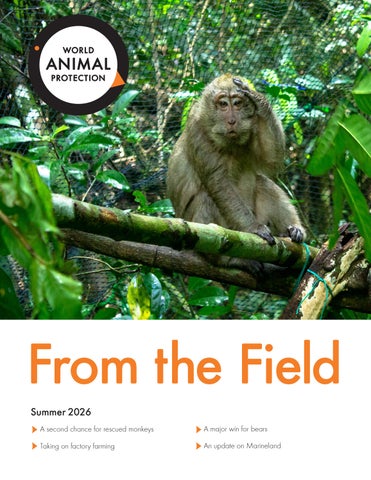
From the Field Summer 2026 A second chance for rescued monkeys
A major win for bears
Taking on factory farming
An update on Marineland
A growing movement for animals Every day, I’m reminded that more people than ever care about creating a better future for animals. Across the country, supporters like you are helping drive real change for wildlife, farmed animals and marine animals. Together, we’re seeing more people speak up, more organizations take action and more animals receive the protection they deserve. The stories in this newsletter are just a few examples of what’s possible when people come together for animals.
Thank you for being part of this growing movement. Your compassion and commitment are helping create a better world for animals everywhere. Together for animals,
Colin Saravanamuttoo Executive Director World Animal Protection Canada
You’re protecting turtles from the exotic pet trade A turtle belongs in the wild, not on a store shelf. Thanks to your support, PetSmart has announced it will no longer sell turtles or tortoises, an important step toward reducing the harm linked to the exotic pet trade. Since 2022, World Animal Protection has been working to strengthen protections for wild animals sold in pet stores. Along the way, we’ve seen stronger animal welfare policies and several species removed from sale. This progress is possible because people like you continue speaking up for animals. Thank you for helping create a future where more wild animals can stay where they belong: in the wild. Photo: Rudy Jr Unsplash
Cover photo: Amel the monkey just before his release back into the wild. Photo: Jakarta Animal Aid Network 2 From the Field | Summer 2026
World Animal Protection is a registered Canadian charitable organization. No. 12791 9076 RR0001 © World Animal Protection 2026
You gave rescued monkeys a second chance Not long ago, Jono and 30 other macaques lived in a world of chains, costumes and tiny wooden boxes. Taken from the wild as babies, they were forced to perform as “dancing monkeys” on the streets of Indonesia for years. When they were finally rescued, many were frightened, injured and deeply traumatized.
Jono in his pre-release enclosure before he and his monkey group were successfully released back into the wild.
But because of compassionate supporters like you, they were given a second chance. Over the past months, our partner Jakarta Animal Aid Network has helped the monkeys slowly heal. They received medical care, formed family groups and learned how to trust, climb, play and groom one another again. Jono himself transformed from a frightened monkey into a calm and confident leader for his new little family. Now, after a long journey of rehabilitation, Jono and several of the rescued monkeys have finally reached their new forest home. Watching Jono explore the trees alongside the other monkeys, grooming, playing and acting like a wild monkey again, was an incredibly emotional sight. Thank you for making moments like this possible. Your support not only helps rescue animals from exploitation but also helps tackle these issues at the source. In Indonesia’s last dancing monkey village, your generosity helped bring monkeys back to the wild and ensures that no more monkeys enter this cycle of suffering, so animals like Jono never have to endure this pain again. Photo: Jakarta Animal Aid Network
Read Jono’s inspiring journey to safety at
worldanimalprotection.ca/JonosJourney From the Field | Summer 2026 3
Because of you, there’s hope for bears For decades, bears on bile farms endured lives of confinement and suffering. Today, there is finally hope for a different future. The Republic of Korea has officially banned bear bile farming, a major step toward ending an industry that harmed generations of bears. As of January 1, 2026, no new bears can be bred into the industry in the country.
After years of suffering on a bear bile farm in Vietnam, Cam and Mo are finally safe, free and thriving at a FOUR PAWS sanctuary, thanks to you.
This progress didn’t happen overnight. Since 2003, World Animal Protection has worked alongside local partner Green Korea United to build momentum for change and push for stronger protections for bears. Throughout that journey, you helped make this milestone possible. But the work isn’t over yet. In Vietnam, an estimated 153 bears remain trapped in the bear bile industry. This year, World Animal Protection and our partners will continue site visits and advocacy efforts to help keep pressure on authorities and move closer to ending bear bile farming for good. We’re also in the early stages of exploring opportunities to help reduce bear bile farming in China, where thousands of bears are still affected. This milestone is a powerful reminder of what people can achieve when they come together for animals. Because of you, more bears now have the chance for a safer future, and we’re continuing to build momentum for bears in Vietnam, China and beyond.
Never miss a story of hope with our free e-newsletter! 4 From the Field | Summer 2026
Photo: FOUR PAWS Sanctuary
Enjoy heartwarming stories, fascinating facts, and proof of your impact for animals. Join thousands of animal lovers who stay connected and inspired. Get the e-newsletter today!
worldanimalprotection.ca/JoinEnews
An update on Marineland
Photo: FotoXab Shutterstock
When an animal has spent years being used for entertainment, what happens when the facility can no longer care for them? It’s a question many Canadians have been asking as the future of the whales at Marineland continues to unfold. Already, at least six belugas have made the move from Marineland to receiving facilities in the United States.
That’s why your support matters.
Earlier this year, conditional approval was granted for a plan that would see the remaining whales moved to facilities in the U.S. and Spain – pending an independent veterinary assessment that they’re fit for transport. While this means the animals are no longer facing the risk of euthanasia by Marineland, it also highlights a much larger issue.
Your support is also helping create better options for whales retiring from captivity. We’re proud to support the Whale Sanctuary Project in Nova Scotia, which is working to create a seaside sanctuary where formerly captive whales can live in ocean waters while receiving expert care.
The fact that facilities in multiple countries are needed to accommodate these animals shows how difficult it can be to care for wild animals in captivity over the long term. Animals who have spent years, or even decades, in captivity often cannot simply be released into the wild and may require specialized care for the rest of their lives.
World Animal Protection is continuing to call on the Ontario government to strengthen protections for captive wild animals and address longstanding gaps in oversight and accountability. We are also urging any facilities receiving these whales to prioritize their welfare by not breeding them or using them for entertainment.
While the future of Marineland’s whales is still unfolding, you’re helping build a future where wild animals are better protected and where safer, more compassionate options exist for animals who need lifelong care. Thank you for helping ensure these animals are not forgotten and have a better chance at the future they deserve. From the Field | Summer 2026 5
How you’re transforming Canada’s food system That’s the idea behind Canada Can’t Wait, a World Animal Protection initiative, funded by an Anonymous gift in honour of Ted and Loretta Rogers and focused on helping build a more humane and sustainable future for farmed animals. Right now, millions of animals in Canada are raised in intensive farming systems.Through the Canada Can’t Wait project, we’re working to change that by tackling the issue from every angle. We’re engaging governments, farmers, businesses and everyday Canadians to help create a food system that is kinder to animals, more sustainable and better equipped to meet the challenges of the future. Over the past year, we’ve made encouraging progress. We’ve brought conversations about: food systems transformation decision-makers,
to
government
encouraged major food companies to expand their plant-based offerings, worked alongside farmers exploring higher welfare and more sustainable farming practices.
At the same time, we’re helping Canadians understand the connection between the food on our plates, animal welfare and the health of our environment. Through educational resources, awareness campaigns and practical tools, thousands of people have taken steps to reduce their reliance on factory-farmed animal products and explore new ways of eating that are better for animals and the planet. The challenges facing animals in our food system won’t be solved overnight. But meaningful change is possible when people come together around a shared vision for the future. Thanks to your support, Canada Can’t Wait is helping build momentum for that change. Every conversation, every policy discussion, every business commitment and every individual action brings us one step closer to a future where animals are treated with greater care and respect. Thank you for being part of this growing movement for animals.
We’ve also helped increase access to plant-based foods in schools, workplaces and public institutions.
Photo: Aleksey Sagitov Shutterstock
6 From the Field | Summer 2026
Photo: Wut Moppie, Shutterstock
Advocating for Canadian farming innovations As part of our strategy to create a more equitable, sustainable food system, we’re building support in Canada for agroecological farming methods. These methods can contribute to positive change in our food system, while ensuring better lives for animals and protecting biodiversity. Generally speaking, agroecological farming is a holistic approach to agriculture that aims to enhance biodiversity, soil health, resilience and local knowledge, while reducing dependence on fossil fuels, synthetic fertilizers and pesticides.
On this experimental farm near Ottawa, Ontario, farmers brought goats to land classified as not suitable for agriculture. By consuming the dense brush, the goats help revitalize the soil, making it viable for future fruit and vegetable crops.
We’re engaging with farmers to explore the potential of agroforestry in a series of case studies. Published research developed across the World Animal Protection organization has shown that this method of farming can be better for animals, while remaining economically viable. Our colleagues in the UK, working with British farmers, have shown that when woodlands are used for grazing, pigs and chickens are better able to express their natural behaviours. Farmers report that these animals are healthier: they don’t need routine antibiotic treatments and require fewer vet visits. In addition to the animal benefits, this style of farming has lower financial costs. Farmers who utilize rich, diverse woodland diets for animals can drastically reduce feed costs. Growing fewer crops to feed farm animals also reduces greenhouse gas emissions. Transforming Canada’s food system is an ambitious undertaking that requires a diverse range of solutions to achieve lasting change. By advancing agroecological farming systems and other sustainable, innovative farming methods, we can achieve this transformation and create a future where animals, habitats and people thrive.
Photo: World Animal Protection
From the Field | Summer 2026 7
A legacy of care and compassion Mary Steele Thomas (1939–2022) lived a life shaped by kindness. She cared deeply for children, animals and the natural world. Those who knew her remember her as generous, thoughtful and determined to make a difference. A long-time resident of Ontario, Mary’s compassion was woven into the way she lived and into the legacy she chose to leave behind. By including World Animal Protection in her Will, Mary made a final gift that speaks to the compassion she carried every day. Her legacy is a meaningful reminder that a gift in your Will is more than a financial contribution; it reflects the life you’ve lived, the values you hold and the future you hope to shape.
Photo: Mary Steele Thomas
Mary’s story shows how legacy giving can create lasting change, helping protect animals for years to come. It is a powerful way to ensure that your care and commitment continue to make a difference for generations.
Interested in leaving a lasting legacy for animals? Visit worldanimalprotection.ca/Leavealegacy to learn more. Connect directly with Tiffany Oliveira at mylegacy@worldanimalprotection.ca or 1 800 363 9772 ext. 122.
Contact us.
We’d love to hear from you! Follow us 8
World Animal Protection 90 Eglinton Avenue East, Suite 960. Toronto, ON M4P 2Y3 TF: 1 800 363 9772 info@worldanimalprotection.ca worldanimalprotection.ca
From the Field | Summer 2026
Mr. John Sample Sample Corporation 123 Main St, PO Box 1234 Ottawa ON K1K 1K1
4625439