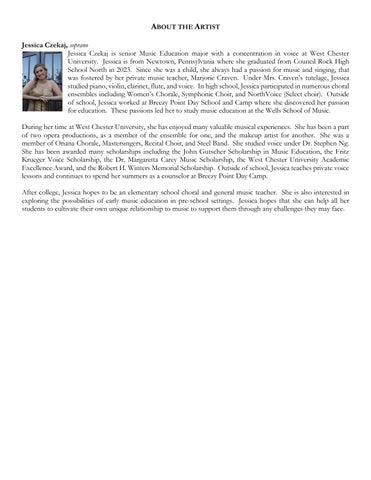
ABOUT THE ARTIST Jessica Czekaj, soprano Jessica Czekaj is senior Music Education major with a concentration in voice at West Chester University. Jessica is from Newtown, Pennsylvania where she graduated from Council Rock High School North in 2023. Since she was a child, she always had a passion for music and singing, that was fostered by her private music teacher, Marjorie Craven. Under Mrs. Craven’s tutelage, Jessica studied piano, violin, clarinet, flute, and voice. In high school, Jessica participated in numerous choral ensembles including Women’s Chorale, Symphonic Choir, and NorthVoice (Select choir). Outside of school, Jessica worked at Breezy Point Day School and Camp where she discovered her passion for education. These passions led her to study music education at the Wells School of Music. During her time at West Chester University, she has enjoyed many valuable musical experiences. She has been a part of two opera productions, as a member of the ensemble for one, and the makeup artist for another. She was a member of Oriana Chorale, Mastersingers, Recital Choir, and Steel Band. She studied voice under Dr. Stephen Ng. She has been awarded many scholarships including the John Gutscher Scholarship in Music Education, the Fritz Krueger Voice Scholarship, the Dr. Margaretta Carey Music Scholarship, the West Chester University Academic Excellence Award, and the Robert H. Winters Memorial Scholarship. Outside of school, Jessica teaches private voice lessons and continues to spend her summers as a counselor at Breezy Point Day Camp. After college, Jessica hopes to be an elementary school choral and general music teacher. She is also interested in exploring the possibilities of early music education in pre-school settings. Jessica hopes that she can help all her students to cultivate their own unique relationship to music to support them through any challenges they may face.
PROGRAM NOTES: SONGS OF THE SKIES: This first set of my recital tells stories of birds. The themes of comfort and beauty in the first two songs represent the beautiful memories I have made in West Chester. The last song represents the end of my time here and the melancholy and hopeful feelings I have about stepping into a new era of my life.
E L’UCCELLINO (1899)
Text by: Renato Fucini (1843-1921) Translation by: Farrell Cleary In the first song, “E L’uccellino,” Puccini musically reflects the joyous and soothing themes in Fucini’s text. Puccini described the piece as a “ninna-nanna” (lullaby) dedicated to the young son of a dear friend, who passed away at a young age. The accompaniment sets the scene with sounds that are reminiscent of the tiny bird leaping and chirping in the trees. These playful moments are complemented with tender moments to create nostalgic and hopeful sentiments. To me, the song feels like the sun setting on a blissful time, knowing that the dawn brings a new era full of promise. It also reminds me that in times of change, I always have my loved ones to support me. E L’uccellino canta sulla fronda: Dormi tranquillo, boccuccia d’amore: Piegala giù quella testina bionda, Della tua mamma posala su cuore. E l’uccellino canta su quel ramo: Tante cosine belle imparerai, Ma se vorrai conoscer quant’io t’amo, Nessuno al mondo potrà dirlo mai! E l’uccellino canta al ciel sereno: Dormi, tesoro mio, qui sul mio seno.
And the little bird sings on the branch: Sleep calmly, Boccuccia my love: Rest your little, blond head on your mother’s heart. And the little bird sings on that branch: You will learn so many beautiful things, But if you want to know how much I love you, No one in the world can ever tell you! And the bird sings to the serene sky: Sleep, my treasure, here on my breast.
LE COLIBRI (1882)
Text by: Charles Marie René Leconte de Lisle (1818-1894) Translation by: Richard Stokes “Le Colibri” is the final song from Chausson’s Sept Mélodies. This piece is a “mélodie,” which is a genre of traditional French art songs from the 19th century. The text features vivid nature imagery that is reflected and augmented in the piano part. Nature was a common theme for composers to explore during the Romantic Era, when this piece was created. This piece in my recital represents the beautiful memories I have made in the last four years. Le vert colibri, le roi des collines, Voyant la rosée et le soleil clair Luire dans son nid tissé d'herbe fines, Comme un frais rayon s'échappe dans l'air. Il se hâte et vole au source voisines, Où les bambous font le bruit de la mer; Où l'açoka rouge, aux odeurs divines, S'ouvre, et porte au cœur un humide éclair. Vers la fleur dorée il descend, se pose, Et boit tant d'amour dans la coupe rose, Qu'il meurt, ne sachant s'il l'a pu tarir. Sur ta lèvre pure, ô ma bien-aimée, Telle aussi mon âme eut voulu mourir Du premier baiser qui l'a parfumée!
The green hummingbird, the king of the hills, On seeing the dew and gleaming sun Shine in his nest of fine woven grass, Darts into the air like a shaft of light. He hurries and flies to the nearby springs Where the bamboos sound like the sea, Where the red hibiscus with its heavenly scent Unveils the glint of dew at its heart. He descends, and settles on the golden flower, Drinks so much love from the rosy cup That he dies, not knowing if he’d drunk it dry. On your pure lips, O my beloved, My own soul too would sooner have died From that first kiss which scented it!
ABSCHIEDSLIED DER ZUGVÖGEL (1844)
Text by: August Heinrich Hoffmann von Fallersleben (1798-1874) Translation by: Richard Stokes The last piece of this set, “Abschiedslied der Zugvögel” is bittersweet and reflective. Mendelssohn was known for writing during the shift from the Classical to Romantic eras, which fits the theme of this piece perfectly. The song is from the perspective of birds at the change of the seasons before they begin their migration, just as Mendelssohn traversed the change from the Classical to the Romantic era. Performing this song with Rebecca Weidner is especially fitting considering that we met at our Freshman Orientation and have taken on all of our studies together since that time. Rebecca has been a pivotal part of my college experience, and I cannot imagine doing this without her. It is truly poignant that we take this last opportunity to perform together, as we prepare to step into the next phases of our life on our own. Abschiedslied der Zugvögel: Wie war so schön doch Wald und Feld! Wie ist so traurig jetzt die Welt! Hin ist die schöne Sommerzeit, Und nach der Freude kam das Leid. Wir wußten nichts von Ungemach, Wir saßen unterm Laubesdach Vergnügt und froh beim Sonnenschein, Und sangen in die Welt hinein. Wir armen Vöglein trauern sehr: Wir haben keine Heimat mehr, Wir müssen jetzt von hinnen fliehn Und in die weite Fremde ziehn.
Farewell Song of the Migrating Birds: How beautiful were forest and field! How sad the world is now! Beautiful summertime has gone, And after joy sorrow has come. We knew nothing of discomfort, Beneath a leafy canopy we sat Content and happy in the sun And sang out into the world. We poor birds are now so sad, We no longer have a homeland, We must now fly far away Into distant lands.
POEMS OF EMILY DICKINSON The works of Emily Dickinson have followed me throughout my time in college. The Hundley setting of “Will There Really Be a Morning?” was my audition piece and, during my time here, I have studied her poetry in numerous classes, through several different lenses and contexts. Her poetry has always resonated with me, and I am excited to share these pieces. Emily Dickinson (1830-1886) was an American poet from Amherst, Massachusetts. In her poems, she explored a variety of topics including, religion, spirituality, death, and belonging. While she did publish a few of her poems, most were published by her family after her death. Her unique voice certainly left a mark on American poetry.
FROM SIX POEMS BY EMILY DICKINSON (1978) The first two pieces of this set are the first two art songs from John Duke’s Six Poems of Emily Dickinson. Duke, an American composer and pianist, set poems by many American poets. He set a total of 10 of Dickinson’s poems and comprised them in two works: Six Poems of Emily Dickinson and Four Poems of Emily Dickinson. “Good morning, Midnight” explores themes of belonging with sharp use of opposites and irony. “Heart! We will forget him!” shares the use of irony and contrast, but focuses on the themes of love and heartbreak.
WILL THERE REALLY BE A MORNING?, Gordon (1995), Hundley (1970) These two versions of “Will There Really Be a Morning?” emphasize different ideas in the text. Many of Dickinson’s works center on the theme of the unknown. Given that Dickinson’s words are so subjective, she has created a sort of unknown within the poem that the two different composers are interpreting differently. It leaves
us to ponder what her true intentions were with this work and if one, both; or neither of these composers have shown it. Gordon, a contemporary composer, emphasizes the questioning nature of the text with his use of text painting. He phrases many of the questions with ascending melodic lines that mimic our natural habit of phrasing questions. This art song includes influences from Musical Theater and Popular music. Gordon’s music blurs the lines between genres in unique ways. Hundley’s setting of the poem creates a build of tension throughout the piece. The melody rises throughout the piece to emphasize the frustration of the speaker almost as if they were shouting. Hundley’s compositional style varied greatly piece to piece, which is a trait he shared with Emily Dickinson, whose style was also unique in this way. LOOKING FORWARD, LOOKING BACK… This set represents the other half of my passion and education. I am naturally reluctant to perform, but I am performing in this recital to allow me to pursue my dream of becoming a music teacher. The children I have taught and worked with are my inspiration. My love for teaching children is the only thing stronger than my performance anxiety. This set also serves as a reminder that everything I have done and will do in the future is for my students. My passion for music and education have become inextricably linked, so it seems fitting to incorporate that passion into this performance.
“I HATE MUSIC!” (1942) The set begins with the last three pieces of Leonard Bernstein (1918-1990)’s work, “I Hate Music!” The title came from an exclamation from Bernstein’s roommate who got tired of his incessant playing. This set is written from the perspective of a ten-year-old girl named Barbara. The piece explores the world through a child’s eye with moments of keen insight woven into the narrator’s winding train of thought.
“GETTING TO KNOW YOU” (1951) “Getting to Know You” from The King and I by Rodgers and Hammerstein represents the end of my recital, and the beginning of my career. The show is set in 1862 in, what is now, Thailand where Anna, a Welsh widow, has come to teach the King’s children. The song is her greeting the children on her first day. I learned this song when I was young with my teacher, Marjorie Craven. Mrs. Craven loved when I sang this song and she always said she could see me singing it to my students one day. Accordingly, this piece is dedicated to Mrs. Craven. Mrs. Craven was my private teacher, mentor, and role model. Throughout the over ten years we worked together, she taught me to sing, play the piano, violin, clarinet, and flute, as well as music theory and literacy, and so much more. She instilled in her students an unconditional love of music. When I was in third grade, Mrs. Craven told me that I would be a music teacher and started training me for that career even before I realized that it was the path I wanted to take. She showed me the power of loving what you do and how your passion can make a better learning environment for your students. Since her passing, she has become my guardian angel guiding me through the last few years. I feel her every time I sing and teach. I know she is here today with me in spirit, so I saved her a seat right in the front. In my last conversation with her, she said that her music will live on in me and in my students long after she is gone. Therefore, it is also her music that you hear today.
ACKNOWLEDGEMENTS Thank you for attending my senior recital. Music has always been a source of hope and bliss for me. I decided to become a music teacher to share that love of music with my students, so it can support them through anything. It is my goal to make music a beacon of light and a fount of knowledge for all my students. When I came to West Chester University, I wanted to find a community of people who could support me through the highs and lows of college. From the second I first entered Swope, I felt the love of the Wells School of Music family. I hope that I can build a supportive and driven community in my classroom like the one I have been lucky enough to be a part of these past four years. I would like to acknowledge people who have shaped me into the musician and person I am today. First, I would like to thank my wonderful accompanist, Chris McCloskey. I am so grateful for all her help and hard work leading up to this recital. I would not be where or who I am today without so many incredible music teachers guiding me along the way, especially Dr. Stephen Ng and Marjorie Craven. My students and campers have brought me such profound joy and cherished memories. The campers I have had the privilege of working with are the reason I found my calling as a teacher. My voice students teach me just as much as I teach them. Their lessons are the highlight of my week. The sisters of Sigma Alpha Iota have embraced and uplifted me from my first day here. I am honored to have been a part of our beautiful sisterhood of dedicated and strong women. Both my friends from West Chester and home have loved me for exactly who I am. I am especially grateful for my roommates, Rebecca and Ry, who gave me a loving home away from home, and my best friends, Sara and Jessica who have protected and loved me for over 10 years. My family has also supported my music financially and emotionally. Their encouragement and love mean the world to me. Thank you for being a part of this journey.