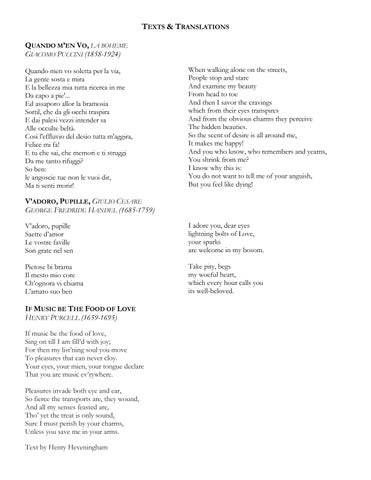
TEXTS & TRANSLATIONS QUANDO M’EN VO, LA BOHEME GIACOMO PUCCINI (1858-1924) Quando men vo soletta per la via, La gente sosta e mira E la bellezza mia tutta ricerca in me Da capo a pie'... Ed assaporo allor la bramosia Sottil, che da gli occhi traspira E dai palesi vezzi intender sa Alle occulte beltà. Così l'effluvio del desìo tutta m'aggira, Felice mi fa! E tu che sai, che memori e ti struggi Da me tanto rifuggi? So ben: le angoscie tue non le vuoi dir, Ma ti senti morir!
When walking alone on the streets, People stop and stare And examine my beauty From head to toe And then I savor the cravings which from their eyes transpires And from the obvious charms they perceive The hidden beauties. So the scent of desire is all around me, It makes me happy! And you who know, who remembers and yearns, You shrink from me? I know why this is: You do not want to tell me of your anguish, But you feel like dying!
V’ADORO, PUPILLE, GIULIO CESARE GEORGE FREDRIDE HANDEL (1685-1759) V’adoro, pupille Saette d’amor Le vostre faville Son grate nel sen
I adore you, dear eyes lightning bolts of Love, your sparks are welcome in my bosom.
Pietose bi brama Il mesto mio core Ch’ognora vi chiama L’amato suo ben
Take pity, begs my woeful heart, which every hour calls you its well-beloved.
IF MUSIC BE THE FOOD OF LOVE HENRY PURCELL (1659-1695) If music be the food of love, Sing on till I am fill’d with joy; For then my list’ning soul you move To pleasures that can never cloy. Your eyes, your mien, your tongue declare That you are music ev’rywhere. Pleasures invade both eye and ear, So fierce the transports are, they wound, And all my senses feasted are, Tho’ yet the treat is only sound, Sure I must perish by your charms, Unless you save me in your arms. Text by Henry Heveningham
SEUFZER, TRÄNEN, KUMMER, NOT, JOHANN SEBASTIAN BACH (1685-1750) Seufzer, Tränen, Kummer, Not, Ängstlichs Sehnen, Furcht und Tod Nagen mein beklemmtes Herz, Ich empfinde Jammer, Schmerz.
Sigh, tears, grief, distress, Anxious yearning, fear and death Gnaw at my constricted heart; I feel misery, pain
FIVE MILLAY SONGS LESLIE ADAMS (1932-2024) TEXT BY EDNA ST. VINCENT MILLAY (1892-1950) III. For you there is no song
I. Wild Swans
For you there is no song, Only the shaking of the voice that meant to sing, The sound of the strong voice breaking.
I looked in my heart while the wild swans went over. And what did I see I had not seen before? Only a question less or a question more; Nothing to match the flight of wild birds flying.
Strange in my hand appears the pen, And yours broken. There are ink and tears on the page. Only the tears have spoken.
I DON'T NEED A ROOF BIG FISH. ANDREW LIPPA (1964-PRESENT) In your face, I see a lifetime In this place, I feel at ease Wallpaper peeling, paint wearing thin Here's where I end and begin I don't need a roof to say I'm covered I don't need a roof to know I'm home There could be a single shingle dangling overhead I don't need a roof to make my bed Close your eyes, I'm still beside you No goodbyes needed today Hear what the rain says, know what it knows After the rain something grows I don't need a roof to say I love you I don't need a roof to call you mine I don't need adventure in some faraway frontier I don't need a roof to feel you near All I need is you and you forever All I feel is true and absolute I don't need a legal deed to help me play my part I don't need a roof to hold my heart Stay with me Stay with me
Tiresome heart, forever living and dying, House without air, I leave you and lock your door. Wild swans, come over the town, come over The town again, trailing your legs and crying!
PROGRAM NOTES Quando m’en Vo, La Bohème, Giacomo Puccini The aria Quando m’en Vo or “When I Walk,” is the audience's introduction to the character Musetta’s fiery and attention-seeking personality. Set in the bustling Café Momus, in Paris’s Latin Quarter on Christmas Eve. Musetta spots her ex-lover, Marcello, and sings this aria to make him jealous. To mimic a flirtatious monologue, the aria’s tempo is famously elastic, and the crisp F-sharp grace notes decorate the words to depict Musetta’s playful behavior.
If Music Be the Food of Love, Third Setting, Henry Purcell Henry Purcell was a leading English composer of the mid-Baroque era. Born in Westminster, England, Purcell was a great figure in English opera. As the son of a Gentleman of the Chapel Royal and Master of the Choristers at Westminster Abbey, Purcell began learning this art from early in life. Purcell wrote three versions of If Music Be the Food of Love in the later years of his life. The opening line is borrowed from William Shakespeare’s play Twelfth Night; the rest of the text is written by poet Henry Heveningham. Purcell invokes several distinct moods throughout the song to resemble the different feelings of love. He uses a melismatic style and distinct soundscapes to evoke the intense feeling of yearning and infatuation.
V’adoro Pupille, Giulio Cesare, George Frideric Handel In Handel’s opera Giulio Cesare, the cunning Cleopatra sings V'adoro Pupille to attract Julius Caesar, the leader of the Romans. Cleopatra’s goal is to win Ceasar’s affection and secure his political backing to conquer the throne of Egypt. This Baroque aria is uniquely lush for its time, featuring two orchestras: a main group plus a stage orchestra. This extended instrumentation is constantly intermixing with the soloist, both embellishing and extending the melody as it snakes through hypnotic sarabande-like rhythms.
Seufzer, Tränen, Kummer, Not, Johann Sebastian Bach The third movement, soprano aria, from Bach’s cantata Ich hatte viel Bekümmernis, which translates to I had much trouble; Seufzer, Tränen, Kummer, Not depicts human sorrow and anxiety through falling appoggiaturas and discomforting suspensions. Unlike many Baroque arias, this piece does not follow a standard da capo (ABA) format. Instead, it is an uninterrupted expression of grief, never leaving the lamenting tone that Bach sets from the first note.
FIVE MILLAY SONGS, Leslie Adams Leslie Adam’s Five Millay Songs is a prominent song cycle composed in 1960. The use of long lyrical vocal lines that meld harmonically with the piano accompaniment mirrors the melancholic text written by Pulitzer Prizewinning poet Edna St. Vincent Millay. For You There Is No Song is one of Adam’s most famous art songs. The heartbreaking text mixed with the hypnotic melody captures a profound vulnerability that communicates pain, heartbreak, and grief-stricken silence. Wild Swans was the first text that Adams set, which inspired the remaining four pieces. The text juxtaposes a confined “tiresome heart” with the free-spirited trajectory of flying wild birds, creating a metaphor for longing and freedom.
I Don't Need a Roof, Big Fish, Andrew Lippa Based on Daniel Wallace’s novel and the 2003 film directed by Tim Burton, the award-winning musical Big Fish by Andrew Lippa and John August premiered on Broadway at the Neil Simon Theater in 2013. The musical explores themes of unconditional love, the power of imagination, and family. I Don’t Need a Roof is sung by the character Sandra Bloom to her ailing husband, Edward. Sandra is comforting Edward, stating that “home” is found in a person, rather than a structure.