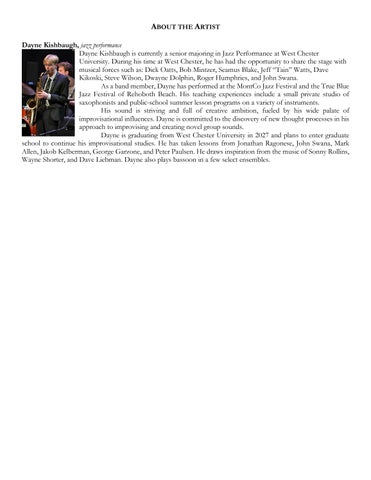
ABOUT THE ARTIST Dayne Kishbaugh, jazz performance Dayne Kishbaugh is currently a senior majoring in Jazz Performance at West Chester University. During his time at West Chester, he has had the opportunity to share the stage with musical forces such as: Dick Oatts, Bob Mintzer, Seamus Blake, Jeff “Tain” Watts, Dave Kikoski, Steve Wilson, Dwayne Dolphin, Roger Humphries, and John Swana. As a band member, Dayne has performed at the MontCo Jazz Festival and the True Blue Jazz Festival of Rehoboth Beach. His teaching experiences include a small private studio of saxophonists and public-school summer lesson programs on a variety of instruments. His sound is striving and full of creative ambition, fueled by his wide palate of improvisational influences. Dayne is committed to the discovery of new thought processes in his approach to improvising and creating novel group sounds. Dayne is graduating from West Chester University in 2027 and plans to enter graduate school to continue his improvisational studies. He has taken lessons from Jonathan Ragonese, John Swana, Mark Allen, Jakob Kelberman, George Garzone, and Peter Paulsen. He draws inspiration from the music of Sonny Rollins, Wayne Shorter, and Dave Liebman. Dayne also plays bassoon in a few select ensembles.
ABOUT THE ARTISTS Joel Austin, jazz performance From birth, everyone around Joel Austin sensed that music would be a large part of his life. Having picked up the drums at age 2 after playing along to songs on pots and pans, it was no surprise that Joel would go on to live a vibrant musical life. He went on to be invited to play with Bill Cosby’s big band at age 6, play in the PMEA district 12 band at age 11 on percussion, win 7 best soloist awards in jazz competitions on bass and piano, as well as receive the Louis Armstrong Award for outstanding Jazz Musicianship in high school. When applying for college, Joel received a large presidential scholarship from the University of the Arts and later a presidential scholarship from West Chester University. Joel is finishing his bachelor's with plans to apply for a master's. Joel has been given opportunities to play in a myriad of places and musical environments. Last year, he played the national anthem in Harrisburg, Reading, PA, and performed numerous gospel concerts in Philadelphia and New Jersey alike, and was flown out to Dallas, Texas, to perform in the “Life After Sunday” Event. Joel has also begun playing for festivals such as “Beard Fest” and “Beer Fest” and the “Harrisburg Arts Fest.” Joel can regularly be seen performing at Time restaurant, Chris’s Jazz Cafe, TMP church, and numerous other venues in Pennsylvania and New Jersey. Austin Snavely, jazz performance Austin Snavely is a young, upcoming, well-versed professional jazz drummer from Douglassville, Pennsylvania. He’s become known throughout Pennsylvania/Philadelphia, and Up-State New York for his eclectic and outgoing drumming style. He started his formal studies with international jazz artist and Sakae-endorsed drummer Larry Marshall. Around that same time, he studied orchestral and symphonic percussion under the esteemed educator, performer, conductor, and Percussive Arts Society Lifetime Achievement award winner, Dr. Willis M. Rapp. He later studied drum set under the guidance of Grammy Award-winning, world-renowned performer, educator, and author John Riley, before heading to the Eastman School of Music, where he now studies with Rich Thompson. Austin has played around many major and small venues throughout New York and Philadelphia, including Smalls Jazz Club, Chris’s Jazz Cafe, Kilbourn Hall, Carnegie Hall, and the Marian Anderson Hall. Austin made many regional and national ensembles during his middle school and high school years. This began with his PMEA (Pennsylvania Music Educators Association) county, district, and regional bands while also achieving the highest recognition by successfully auditioning and being selected as the sole drum set player for the 2022 PMEA AllState Jazz Band. During that same year, Austin made the Philadelphia Youth Orchestra (directed by Maestro Louis Scaglione), the Philadelphia Youth Jazz Orchestra (directed by Justin Faulkner), and the Settlement Music School Helen K. Schwartz Advanced Study Jazz Ensemble (directed by Tony Miceli). He then went a step further to play in the nationally recognized HPS Carnegie Hall Symphonic Band in 2022 and the NAfME All-Eastern Jazz Festival in 2023 under the direction of Bob Stewart. Austin has achieved regional and national level awards for his playing, including the Louis Armstrong Jazz Award, outstanding performance on drums for the 43rd Annual Downbeat International Jazz Magazine’s SMAs, and Large Vocal Ensemble outstanding performance for the 48th Annual Downbeat International Jazz Magazine’s SMA. Austin continues to pursue challenging opportunities, performances, and education that will help solidify himself as a sought-after professional drummer throughout his career in the performing arts.
PROGRAM NOTES JA-DA (1918) An American classic, Ja-Da was a major success at its release and has gone on to thrive as a jazz standard as well as a familiar tune to those who may not yet know its name.
TURNAROUND (1959) BROAD WAY BLUES (1968) WHEN WILL THE BLUES LEAVE (1958) A selection of blues’ written by Ornette Coleman. The first and last tunes can be found in Ornette’s early discography which is tied very closely to bebop’s conception of playing the blues. The middle is recorded almost a decade after the others and abandons the original form and expectation of a normal “12-bar blues”.
ANTHROPOLOGY (c. 1945) Credited to both Charlie Parker and Dizzy Gillespie, “Bird” later denied Dizzy’s involvement in the writing process. The tune is one of bebop’s most recognizable contrafacts over the chord changes to Gershwin’s “I Got Rhythm”.
ONE DANCE (2026) An original composition, borrowing the themes and groove from Latin compositions recorded by Elvin Jones and Wayne Shorter.
On GREEN DOLPHIN STREET (1947) Originally written by Bronisław Kaper for a film of the same name, the tune has been made famous through recordings by Ahmed Jamal, Miles Davis, and Bill Evans.
WILLOW WEEP FOR ME (1932) Written by Ann Ronell, the piece was originally denied publishing for reasons such as abnormal dedication to George Gershwin, its composition by a woman, as well as its original form being too complex for commercial success. Since then, it has been adopted as a jazz standard, recorded by the likes of Paul Whiteman, Art Tatum, Ella Fitzgerald, and Sarah Vaughan.
ACKNOWLEDGEMENTS Dayne would like to thank his friends, family, and professors who have inspired, supported, and invested large sums of time and care throughout his study and practice.