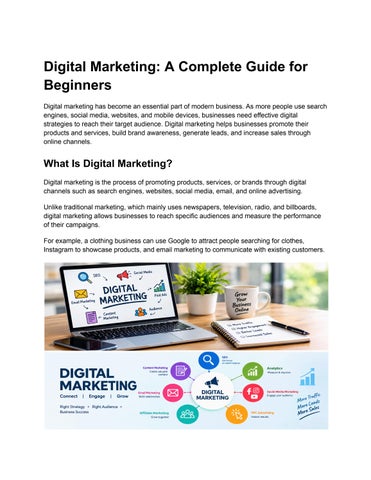
Digital Marketing: A Complete Guide for Beginners Digital marketing has become an essential part of modern business. As more people use search engines, social media, websites, and mobile devices, businesses need effective digital strategies to reach their target audience. Digital marketing helps businesses promote their products and services, build brand awareness, generate leads, and increase sales through online channels.
What Is Digital Marketing? Digital marketing is the process of promoting products, services, or brands through digital channels such as search engines, websites, social media, email, and online advertising. Unlike traditional marketing, which mainly uses newspapers, television, radio, and billboards, digital marketing allows businesses to reach specific audiences and measure the performance of their campaigns. For example, a clothing business can use Google to attract people searching for clothes, Instagram to showcase products, and email marketing to communicate with existing customers.
Major Types of Digital Marketing Digital marketing includes several important areas. Each method has a different purpose, but they can work together as part of a complete marketing strategy.
1. Search Engine Optimization (SEO) SEO is the process of optimizing a website so that its pages can appear more prominently in search engine results. SEO includes activities such as: ● ● ● ● ● ●
Keyword research Content optimization Technical SEO On-page SEO Link building Local SEO
For example, if someone searches for "best digital marketing agency in Pakistan," an SEO-optimized website may appear in the search results.
2. Social Media Marketing Social media marketing involves promoting a business through platforms such as Facebook, Instagram, LinkedIn, TikTok, and other social networks. Businesses can use social media to share educational content, product information, videos, customer stories, and promotional offers. Social media also allows brands to communicate directly with their audiences.
3. Content Marketing Content marketing focuses on creating and distributing useful and relevant content to attract and engage an audience. Common types of content include: ● ● ● ● ● ● ●
Blog articles Videos Infographics E-books Guides Case studies Social media posts
For example, a digital marketing agency might publish a blog about "How to Improve Your Website SEO" to attract people interested in SEO services.
4. Pay-Per-Click Advertising Pay-Per-Click (PPC) advertising allows businesses to display paid advertisements on search engines and other digital platforms. Advertisers generally pay when someone interacts with their advertisement according to the advertising platform's pricing model. Google Ads is a well-known example of a PPC advertising platform. PPC can help businesses reach potential customers quickly, while SEO generally focuses on earning organic visibility over time.
5. Email Marketing Email marketing involves sending emails to customers or subscribers to build relationships and communicate useful information. Businesses can use email marketing for: ● ● ● ● ●
Newsletters Product updates Special offers New product announcements Customer communication
Effective email marketing should provide useful and relevant information rather than simply sending promotional messages.
6. Affiliate Marketing Affiliate marketing is a performance-based marketing method in which individuals or organizations promote products or services and may receive a commission for qualifying sales or actions. For example, a blogger may recommend a product and provide a special affiliate link. If a customer makes a qualifying purchase through that link, the affiliate may earn a commission.
Benefits of Digital Marketing Digital marketing provides several benefits for businesses. One major advantage is the ability to reach audiences beyond a local geographic area. Other benefits include:
● ● ● ● ● ● ●
Reaching targeted audiences Building brand awareness Generating leads Increasing website traffic Measuring campaign performance Communicating directly with customers Supporting online sales
Digital marketing also provides access to data and analytics, allowing businesses to understand how people interact with their campaigns.
Digital Marketing and Analytics Data plays an important role in digital marketing. Businesses can use analytics tools to measure website traffic, conversions, engagement, advertising performance, and other important metrics. For example, a business can analyze which pages receive the most visitors and which marketing campaigns generate the most leads. This information can then be used to improve future marketing activities. Important metrics may include: ● ● ● ● ● ● ●
Website traffic Click-through rate (CTR) Conversion rate Cost per click (CPC) Cost per acquisition (CPA) Engagement rate Return on investment (ROI)
Digital Marketing Strategy A successful digital marketing strategy usually starts with understanding the target audience. Businesses should identify their customers, understand their needs, define marketing goals, and choose appropriate digital channels. A basic strategy can include the following steps: 1. Define your target audience. 2. Set clear marketing goals. 3. Research competitors and the market. 4. Select suitable digital channels. 5. Create valuable content. 6. Launch marketing campaigns.
7. Measure results using analytics. 8. Improve the strategy based on performance.
The Future of Digital Marketing Digital marketing continues to evolve as technology and consumer behavior change. Artificial intelligence, automation, video content, personalized marketing, voice search, and data-driven strategies are influencing the industry. AI tools can assist marketers with tasks such as content ideas, customer analysis, campaign optimization, and workflow automation. However, marketers still need human creativity, strategy, judgment, and an understanding of their audience.
Conclusion Digital marketing is an important part of modern business growth. It combines SEO, social media marketing, content marketing, PPC, email marketing, affiliate marketing, and analytics to help businesses connect with their audiences online. For beginners, learning the fundamentals of SEO, content marketing, social media, paid advertising, and analytics provides a strong foundation. With practical experience and continuous learning, digital marketing can become a valuable skill for businesses, freelancers, and marketing professionals.
For more information visit: Ws CubeTech