FEDERATION World Student Christian Federation
News
2019 • no. 1
UT OMNES UNUM SINT
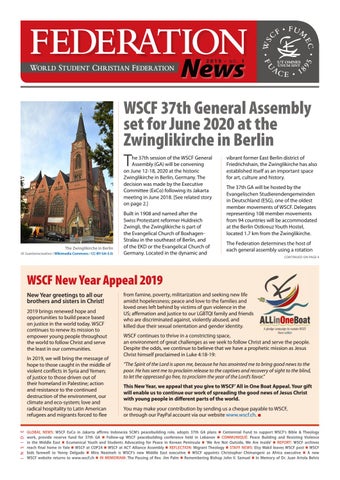
WSCF 37th General Assembly set for June 2020 at the Zwinglikirche in Berlin T he 37th session of the WSCF General Assembly (GA) will be convening on June 12-18, 2020 at the historic Zwinglikirche in Berlin, Germany. The decision was made by the Executive Committee (ExCo) following its Jakarta meeting in June 2018. [See related story on page 2.]
The Zwinglikirche in Berlin (© Juantorocreativo / Wikimedia Commons / CC-BY-SA-3.0)
Built in 1908 and named after the Swiss Protestant reformer Huldreich Zwingli, the Zwinglikirche is part of the Evangelical Church of BoxhagenStralau in the southeast of Berlin, and of the EKD or the Evangelical Church of Germany. Located in the dynamic and
vibrant former East Berlin district of Friedrichshain, the Zwinglikirche has also established itself as an important space for art, culture and history. The 37th GA will be hosted by the Evangelischen Studierendengemeinden in Deutschland (ESG), one of the oldest member movements of WSCF. Delegates representing 108 member movements from 94 countries will be accommodated at the Berlin Ostkreuz Youth Hostel, located 1.7 km from the Zwinglikirche. The Federation determines the host of each general assembly using a rotation CONTINUED ON PAGE 4
WSCF New Year Appeal 2019 New Year greetings to all our brothers and sisters in Christ! 2019 brings renewed hope and opportunities to build peace based on justice in the world today. WSCF continues to renew its mission to empower young people throughout the world to follow Christ and serve the least in our communities.
I N S I D E
In 2019, we will bring the message of hope to those caught in the middle of violent conflicts in Syria and Yemen; of justice to those driven out of their homeland in Palestine; action and resistance to the continued destruction of the environment, our climate and eco-system; love and radical hospitality to Latin American refugees and migrants forced to flee
from famine, poverty, militarization and seeking new life amidst hopelessness; peace and love to the families and loved ones left behind by victims of gun violence in the US; affirmation and justice to our LGBTQI family and friends who are discriminated against, violently abused, and killed due their sexual orientation and gender identity. WSCF continues to thrive in a constricting space, an environment of great challenges as we seek to follow Christ and serve the people. Despite the odds, we continue to believe that we have a prophetic mission as Jesus Christ himself proclaimed in Luke 4:18-19: “The Spirit of the Lord is upon me, because he has anointed me to bring good news to the poor. He has sent me to proclaim release to the captives and recovery of sight to the blind, to let the oppressed go free, to proclaim the year of the Lord’s favor.” This New Year, we appeal that you give to WSCF’ All in One Boat Appeal. Your gift will enable us to continue our work of spreading the good news of Jesus Christ with young people in different parts of the world. You may make your contribution by sending us a cheque payable to WSCF, or through our PayPal account via our website www.wscf.ch. n
GLOBAL NEWS: WSCF ExCo in Jakarta affirms Indonesia SCM’s peacebuilding role, adopts 37th GA plans n Centennial Fund to support WSCF’s Bible & Theology work, provide reserve fund for 37th GA n Follow-up WSCF peacebuilding conference held in Lebanon n COMMUNIQUÉ: Peace Building and Resisting Violence in the Middle East n Ecumenical Youth and Students Advocating for Peace in Korean Peninsula n ‘We Are Not Outside, We Are Inside’ n REPORT: WSCF archives reach final home in Yale n WSCF at COP24 n WSCF at ACT Alliance Assembly n REFLECTION: Migrant Theology n STAFF NEWS: Elsy Wakil leaves WSCF post n WSCF bids farewell to Yenny Delgado n Mira Neaimeh is WSCF’s new Middle East executive n WSCF appoints Christopher Chimangeni as Africa executive n A new WSCF website returns to www.wscf.ch n IN MEMORIAM: The Passing of Rev. Jim Palm n Remembering Bishop John V. Samuel n In Memory of Dr. Juan Artola Belvis
GLOBAL NEWS
WSCF Centennial Fund Board and Executive Committee members at the Opening Program with Indonesian SCM members and senior friends, June 12, 2018, Samadi, Jakarta, Indonesia
WSCF ExCo in Jakarta affirms Indonesia SCM’s peace-building role, adopts 37th GA plans and global priorities
A
mid tensions following the series of suicide bombings of churches on May 13-14 in Surabaya, Central Java, the WSCF Executive Committee met in Jakarta, Indonesia on June 12-18, 2018 to set the Federation’s priorities, discuss plans for the 37th General Assembly, and engage in a capacity-building activity with senior friends and members of the WSCF Centennial Fund Board. The in-face meeting was held at the Samadi Pastoral Centre in Jakarta and was hosted by the Indonesian SCM or the Gerakan Mahasiswa Kristen Indonesia (GMKI). Twenty-eight (28) participants comprising the WSCF global officers, executive staff, regional representatives, and members of the Centennial Fund Board attended the meeting.
Meeting in the Indonesian context The GMKI welcomed the WSCF delegation in an opening program held at the Samadi Auditorium and attended by 50 students, senior friends, guests from churches and ecumenical institutions in Indonesia. GMKI Chairperson Sahat Martin Philip Sinurat thanked the WSCF for its solidarity statement and prayers and “for choosing to meet in Indonesia despite the negative international publicity brought about by the Surabaya bombings”. In response, WSCF General Secretary Necta Montes lauded the GMKI leaders for the movement’s role in promoting dialogue and peace-building in the campuses. Dr. Salters Sterling, WSCF
2
Centennial Board chairperson, also thanked GMKI students and senior friends for their presence, reminding them of the WSCF ecumenical vision that inspired the birth of the movement 123 years ago and which continues to live in the spirit of the current generation. Rev. Dr. Henriette Hutabarat Lebang, general secretary of the Communion of Churches in Indonesia or PGI and a senior friend of GMKI, gave the keynote speech at the opening. “The growing radicalism and extremism in the Indonesian campuses speaks of the important role of SCM in promoting Pancasila, the five principles of the Indonesian society to live in peace and harmony with people of diverse faith”, Dr. Lebang said. Prof. Dr. Lim Mah Hui, economist and senior friend from Malaysia confirmed this trend during his presentation on the topic Global Challenges in the 21st Century. “Global terrorism associated with Wahabism and the US Government policies in the Middle East, including the invasion of Iraq in 1990 and 2001, exacerbated this trend,” according to Prof. Lim.
ExCo capacity-building with senior friends Prior to the ExCo Meeting, capacitybuilding sessions were jointly organized by the ExCo and the Centennial Fund Board members on June 13-14 to share experiences and lessons learned in WSCF leadership from different generations. Six sessions were conducted: panel discussions on “Global Challenges and the Role of the Ecumenical Student
Movement in the 21st Century” and “WSCF History, Current Challenges and the Future”, and skills workshops on Risk Assessment, Leadership, Finance and Personnel Work. Yong Ting Jin, senior friend and former WSCF Asia-Pacific regional secretary, facilitated the sessions.
Panel 1 on WSCF History (L-R): Jannes Hutagalung, Ilari Rantakari, Salters Sterling
The panel on “WSCF History, Current Challenges and the Future” brought together stories and anecdotes from the 1960s to the present. Salters and Ilari Rantakari recalled their experience at the WSCF World Student Conference in Turku and the General Committee Meeting in Otaniemi in 1968 when the conference was suspended as delegates from North America and Europe protested against a pre-planned conference agenda. They also shared their reflections on the decision to regionalize the WSCF structure. Jannes Hutagalung spoke of the important role of SCM founder
GLOBAL NEWS Dr. Johannes Leimena in influencing and building the Indonesian nation when he was elected as Deputy Prime Minister in the ‘60s. Necta Montes and Georgine Kengne Djuetane, representing the ‘80s and ‘90s respectively, shared their critical view of ‘regionalism’ within the Federation and urged the ExCo to begin the dialogue and conversation on regionalization after 50 years. Immanuel Kitnan and Salma Charaf, co-vice chairpersons representing the current generation, agreed with this observation and underscored the importance of ecumenical leadership formation programs in rebuilding the movement and sustaining the members.
Planning towards the 37th GA During the ExCo meeting proper, statutory reports were received from Chairperson Georgine Kengne Djuetane, General Secretary Necta Montes, and Treasurer Bronwyn Claire; regional reports from Sunita Suna for Asia-Pacific, Marcelo Leites for Latin America, Natia Tsintsadze for Europe, Elsy Wakil for Middle East, Yenny Delgado for North America, and Lydia Nabunya for Africa; and the WSCF Centennial Fund Board report from Chairperson Salters Sterling. These reports generated discussions and decisions for the continued transition work of the Federation towards sustainability in the next two years. The life of the 108 member movements were also discussed, recognizing their diverse orientation, historical background and contexts. Regional executive staff shared their preliminary assessments of WSCF ExCo members with GMKI local hosts during the Solidarity Night
Theology whose mandate in the next two years will be focused on the thematic preparations for the upcoming General Assembly.
WSCF Chairperson Georgine Kengne Djuetane thanking GMKI for hosting WSCF
the movements within their regions in terms of their strengths and weaknesses and the opportunities and threats they face. It was noted that while there is visible increase in movement life and activities in the Middle East, there is a decline of the same in Asia-Pacific and Africa where only a few movements are consistently active. On the other hand, movements in Latin America and the U.S. are undergoing a process of revival; and in Europe, half of the movements with institutionalized structures are active. The ExCo determined the Federation’s direction and priorities in the next few years as it adopted the following strategic decisions: 1. The holding of the 37th General Assembly in Germany in June 2020 to be hosted by SCM Germany and WSCF Europe Region. A Thematic Working Group was formed to work and submit to the APC and ExCo the proposal for the 37th General Assembly theme. 2. Strengthening and prioritizing the Federation’s work on Bible and Theology through the creation of a position of Director for Bible and
3. The formation of a new WSCF Staff Model Working Group to continue the preparation of new proposals for the WSCF staff model and to develop the regional processes of discussion leading towards final deliberations at the 37th General Assembly. 4. Approval of the Fundraising Campaign Plan, “ALL in One Boat”, a new approach in building financial solidarity within the family of the Federation involving student members, senior friends and supporters of WSCF to raise funds for the core needs of the Federation in the succeeding years. The ExCo congratulated and thanked outgoing WSCF Executive for the Middle East Elsy Wakil for her long and valuable service to the Federation. In her words of appreciation to Elsy, WSCF Chairperson Georgine Kengne Djeutane highlighted the significance of Elsy’s role as the first woman WSCF staff in the region and her contribution in paving the way for greater women leadership and participation in the life of Federation. The ExCo also welcomed Christopher Alexander Chimangeni from Malawi as the incoming executive for Africa who will be joining the global staff team in July. The meeting was financially supported by the WSCF Centennial Fund, with contributions from ExCo members, GMKI National Executive Committee and GMKI senior friends coordinated by Jannes Hutagalung, GMKI senior friend and WSCF Centennial Fund Board member. n NM
3
GLOBAL NEWS
Centennial Fund to support WSCF’s Bible & Theology work, provide reserve fund for 37th GA
A
matching reserve fund equivalent to 20% of total funds raised for the 37th General Assembly from 2017 until June 2020 will be created from the Centennial Fund. In addition, a named fund will be made available to WSCF to support its work on Bible and Theology. These were the key decisions adopted by the WSCF Centennial Fund Board when it met in Jakarta, Indonesia on June 10-12, 2018 for its annual in-face meeting. The adoption of the 20% matching reserve fund amends the 2017 Board decision to allocate a fixed amount of 20,000 USD for the GA from the Centennial Fund. Salters Sterling, CF Board chairperson, clarified that this fund should be independent from the GA fundraising plan and is therefore not a seed fund but only a reserve fund. Moreover, the Board agreed that CF commitment to the reserve fund is not linked to the depreciation and appreciation of CF investments. The Board also agreed to inform the WSCF leadership that it may utilise the Suzanne de Dietrich Fund—already long overdue—for the Bible & Theology work of the Federation and to invite the same to present a proposal to the CF Board
WSCF 37TH GA SET FOR JUNE 2020 ... CONTINUED FROM PAGE 1
system among the six regions. The last GA hosted by Europe was the 30th Assembly held in Chantilly, France in 1990, almost 28 years ago. The GA is the highest decision-making body of WSCF where representatives of all member movements worldwide convene to review and assess the situation of the movements, regions and the Federation as a whole; determine the objectives and priorities of WSCF; elect its officers and appoint the general secretary; amend its constitution; and accept members into its fellowship.
4
for this purpose. The Board deemed the purpose appropriate as the named fund honours the pioneering work of Suzanne de Dietrich (1891-1981) in Biblical and theological studies within the Federation and the ecumenical movement. A common suggestion that arose from the Board’s discussions was to use the fund to hire a WSCF staff person for Bible & Theology who may be tasked to explore new approaches to Bible Study for the GA, in coordination with the movement in charge of thematic preparations for the assembly; and to oversee the production of materials for theological reflections during the GA. In addition to the reserve fund for the GA and the Suzanne de Dietrich Fund, the Board also approved the CF’s annual contribution to WSCF in the amount of 20,000 USD for programs and another 20,000 USD for administration. The following reports were received and discussed at the meeting: CF 2017 Audited Report, CF 2018 Budget, WSCF 2017 Financial Report, WSCF General Secretary’s Report, Investment Advisory Group (IAG) Report, U.S. Trustees Board Endowment Fund Report, and the WSCF Canada Trustees Report.
Since its founding meeting in 1895 in Vadstena, Sweden, the Federation has convened its member movements once every four years “to unite Christian youth movements or association of students and other members of the academic community in the regions and throughout the world to promote cooperation among them.” (Article I. WSCF Constitution) “This Assembly is a moment of stocktaking and visioning of the future survival and sustainability of the Federation after almost three years of transition,” according to Necta Montes, head of the
The CF Board meeting was held at the Samadi Pastoral Centre in Klender, East Jakarta, Indonesia and hosted by the Indonesian SCM or Gerakan Mahasiswa Kristen Indonesia (GMKI). Attending the meeting were Salters Sterling, chairperson; Jannes Hutagalung, vicechairperson; Bruce Rigdon, treasurer (via GoToMeeting); Shali Kapepo, secretary; Sheryl Johnson, student representative; Ilari Rantakari; Bronwyn Claire, WSCF treasurer; Jean-Luc De La Soujeole, WSCF finance officer; Mathieu Durrleman, IAG (via GoToMeeting); and Necta Montes, WSCF general secretary. Nova Sipahutra, GMKI local host member, and Yenny Delgado, WSCF North America executive, joined the meeting as guests. The Board agreed to hold its next meeting at the Sophia Center in Helsinki, Finland on June 8-12, 2019. A capacity-building activity immediately followed the meeting in which members of the CF Board and the WSCF Executive Committee, together representing different generations, exchanged experiences and perspectives on WSCF leadership as well as their vision for the future of the Federation. n
Assembly Planning Committee (APC). In its 35th GA in Bogotá, the Assembly made a landmark decision to implement a two-year transition plan to stabilize the financial situation of the Federation. The APC, formed in December 2017, is composed of the general secretary, officers, staff, ExCo members, and representatives of the host movement. The APC prepared the recommendations to the Executive Committee on the date, venue, theme and program of the assembly. A page in the WSCF website (www.wscf.ch) will be launched in January 2019 to provide news and information on the upcoming GA. n NM
GLOBAL NEWS
Follow-up WSCF conference on peace-building held in Lebanon
W
SCF gathered around 40 participants in Broumana, Lebanon on October 8-14, 2018 as a follow-up to the 2017 Cairo youth conference on Peace-building and Overcoming Violence. The event was hosted and organized by WSCF Middle East. The participants, some of whom attended the 2017 Cairo conference, came from Bangladesh, Egypt, France, Iraq, Jordan, Lebanon, Madagascar, Palestine, the Philippines, Sudan and Syria. The program had three main objectives: (1) to gather Christian youth from various denominations (Arab and Western countries) to exchange, build vision and action plans about how to combat religious violence from a
Church perspective of building peace in the Middle East and worldwide; (2) to respond to the challenge of religious violence in the Middle East focusing on Palestine and build a common under standing based on Kairos documents I and II; (3) to engage at least 50% of the SCMs of the Middle East in events concerning dialogue, peace-building, combating religious violence through a common elaborated action plan. As a follow-up to the 2017 Cairo conference, the gathering in Lebanon also aimed to enhance the already existing cooperation among SCMs and engage more members in promoting the methods of WSCF on peace-building for youth and students.
“Life Testimony” by Asaad Chaftri, Ziad Saab and Ghassan Bou Diab
The first two days of the six-day conference was spent on lecture presentations followed by small group discussions. The presentations covered four sessions and addressed the following topics: “The Role of WSCF Today in Peacebuilding in the Middle East” led by Necta Montes and Elsy Wakil; “Reconciliation after War and an Introduction to PeaceBuilding Method” by Mr. Fadi Abi Allam; “The Ecumenical Movement and Peace Building in the Middle East” by Zahi Azar; and “Kairos Palestine Documents I and II” by Nidal Abu Zuluf. Bible Study sessions were led by Fr. Nehme Saliba and Necta Montes. Two sessions of Day 3 were devoted for participants’ sharing of stories of their country situations and for group work by country to develop ideas and plan on how to build awareness on peace in their communities in cooperation with churches and NGOs. CONTINUED NEXT PAGE
5
GLOBAL NEWS of the right to study in universities or to go to health centers for medical care, making life in the camp a living hell. They also spent time with the refugee children being schooled by the Association Najdeh, an NGO engaged in educational and developmental projects for the refugees. The group also visited Basmeh and Zeitooneh, a Syrian Lebanese NGO working to help and take care of the Syrian refugees in Sabra and Shatila camp and throughout Lebanon, numbering around 20,000. Day 5 was devoted to deepening the participants’ understanding of conflict resolution and peacebuilding
A participant’s snapshot of a street in the refugee camp
Participants with refugee children studying at the Association Najdeh center in the Sabra and Shatila camp
approaches. Rami Taleb and Walter Nikora talked about the nature of conflict and conflict resolution using Johan Galtung’s three triangle models for conflict, violence and peace. The three elements that give rise to conflict are behaviors, actions, and contradictions. There are three kinds of violence that arise from conflict: cultural violence, direct violence, and structural violence. And there are three processes to peace: peacekeeping (dialogue, negotiations), peacemaking (direct intervention), peacebuilding (peace education, forgiveness and reconciliation). On the last day, the participants discussed further the Palestinian cause, dividing into groups to discuss the following topics: the Kairos II document; role of Christian youth in the Palestinian cause; and the relation of the Palestinian cause to the question of peace in the Middle East and the world. Afterwards, the participants were again divided into groups to develop a curriculum for each of the following themes: Equality between men and women; Life skills; Social justice; Leadership; Leadership training; Knowledge of the rights and the duties; Critical thinking; Social activities; Accepting the other; Learning to think positive; A testimony of life; Strengthening citizenship and belonging; The art of communication; Citizenship; Political participation; The outcome of revenge. The conference took place at the Le Crillon Hotel in Broummana, Lebanon and was supported by the Karibu Foundation, MISSIO, and Bread for the World. n A group work session
Afterwards, the participants had an opportunity to listen to the life testimonies of Assad Chaftari, Ziad Saab and Ghassan Bou Diad, all of whom participated in the Lebanese civil war. They are now actively promoting a culture of peace and non-violent approaches to conflict resolution through the organizations they founded to promote change, peacebuilding, dialogue and reconciliation. On Day 4, the group visited the Sabra and Shatila camp to see first-hand the situation of the Syrian and Palestinian refugees living there, which they found to be dire, lacking in the basic elements of human life. Residents are deprived
6
COMMUNIQUÉ
Peace Building and Resisting Violence in the Middle East 14 OCTOBER 2018
WSCF Youth Conference on Peace Building and Overcoming Violence in the Middle East LEBANON, 8-14 OCTOBER 2018
W
e gathered in Broummana for the Youth Conference Program for the Middle East on Peace Building and Resisting Violence from October 8 to 14 of 2018. Forty-five (45) participants were coming from diverse countries as Sudan, Iraq, Palestine, Egypt, Lebanon, Madagascar, Syria, Philippines, France, Jordan and Bangladesh. In this conference we became more aware of our responsibilities as Christians, as citizens and as human beings towards the absolute necessity to fight for Peace. This week we had the opportunity to listen to a series of lectures delivered by Necta Montes, Elsy Wakil, Fadi Abi Allam, Zahi Azar, Nidal Abu Zuluf, Assaad Chaftari, Ziad Saab, Ghassan Bou Diab and Rami Taleb.
only if we fail in this work of mediation. But war should never be a solution. We must overcome the state of war by the use of non-violent resistance. We had the chance to hear the story of three activists who served during the War in Lebanon: Assad Chaftari, Ziad Saab and Ghassan Bou Diab. They now share their story to help for reconciliation and to convince the youngest generations that War is not the solution. Our goal in this week long workshop is to target the various issues and find suitable short-term applicable solutions that we can apply within our society or NGO or church.
hearts. We listed a series of problems that prevent the population of the camp to benefit from the basic human rights. This includes the access to water and electricity, to basic medical needs, to education and work. The problem of the infrastructures is alarming. We gathered to debate on our impressions and sharing them. We came to the conclusion that we face an emergency state because the place is like a bomb waiting to explode. It is our duty to alert people on what is going on in Sabra and Shatila and to militate so that the Lebanese government takes real account of the situation and act accordingly. It is also a necessity to alert the international community on the condition of the Palestinian and Syrian refugees in the camps. Within several workshops and conferences we studied the origins and purpose of the Kairos Palestine project. This study was a source of inspiration to us, as it confronts the contradictions and failure of international policy on the occupation of Palestinian territories and
The conference began by a Bible study on the story of the Good Samaritan, which embodies the purpose of our interactions. What is good? How do I feel it? How can we help each other? How is God presented in this search? We responded that we must do good without expecting something in return. We help each other because we are different parts of one body, of one spirit. The power of Ecumenism is that it puts our churches together. Its beauty and strength resides in the will to translate in one language the different issues of various countries and confessions and to find keys so that we bring people together and overcome our differences. It must be a life commitment. This commitment applies in everyday life through knowing each other. Because knowing your brother, your neighbor, your adversary is learning to know the other side of Jesus Christ. Every human being is a theologian in the way he/she expresses God. Therefore, we started our search by questioning the very opposite of Peace: War. What is War? What tools can we use to avoid it and overcome it? Mr. Fadi Abi Allam gave us some elements for an answer. It is a long process which includes a political work aside with negotiation and communication. We may justify a war
We focused on the Israeli-Arab conflict embodied by the occupation of Palestinian territories and the constant violation of human rights and international law by Israel. To do so, we worked both on workshop based on the Kairos Palestine project and by visiting Palestinian and Syrian refugees in the Sabra and Shatila camps. The visiting of the Sabra and Shatila camps was undeniably the most touching, heartbreaking and impacting event this week. The discovery about the life in the camp reinforced our engagement and will of action. Beyond the differences we share and the diversity of views, we all looked at Sabra and Shatila feeling the same cry from our
tries to establish a plan in order to resolve the conflict in a non-violent action. Together we set an action plan consisting in joining in one debate the needs and demands of our countries. We related the conclusions to a series of workshops and local action that could help to open people’s mind within education. To conclude we can say that the Youth Conference Program for the Middle East on Peace Building and Overcoming Violence led us to reaffirm the absolute necessity of a regional, national and international mobilization within an intercultural action plan starting from now on. Let’s unite and fight for the Peace in the Middle East! n
7
COMMUNIQUÉ
Ecumenical Youth and Students Advocating for Sustainable Peace in the Korean Peninsula 7 SEPTEMBER 2018
WSCF Asia-Pacific Region – Peace Building and Dialogue Program SEOUL, 17-24 AUGUST 2018
W
e, the representatives of the Student Christian Movement (SCMs) of Australia, Canada, Hong Kong, India, Japan, Myanmar, Pakistan, Sri Lanka, South Korea, and Taiwan, met at the World Student Christian Federation (WSCF) Asia-Pacific’s Regional Program on Peacebuilding and Dialogue held at Marist Education Centre, Seoul, Korea from August 17-24, 2018. We come from diverse identities, culture, and contexts trying to connect our common stories of struggle and committing to journey together in dialogue as we envision sustainable peace on the Korean Peninsula. Through conversation with activists, experts, ecumenical leaders and community visits, we heard the suffering and pain that is present throughout the Korean Peninsula. We acknowledge the historical struggle for liberation, peace and reunification which has drastically influenced the landscape of both North and South Korea. The legacy of the Korean War exists today in the military culture, mandatory conscription and military industrial complex; on-going persecution and imprisonment of political activists; gender inequality and discrimination of sexual minorities; economic disparity and corruption; and, the continued influence of foreign governments on the autonomy of South and North Korea. We celebrate, in the face of this suffering, the role that the church, ecumenical, women’s, and student and youth organizations have played in the peace process on the Korean Peninsula since the Japanese colonial era.
Cultivating a Culture of Peace: Learnings from Our Korean Brothers and Sisters First, we heard that we are all members of a global prophetic circle, called to speak truth in a time when we are coming to grips with the failure of the notion of the nation-state and the neo-liberal capitalist
8
system. Second, we heard the importance of ecumenical groups, such as student groups and civil societies; these offer opportunities for people to share their life stories, for connectivity, and to building new bridges of understanding. As well, we heard that we are called to move beyond “peacekeeping”, which uses violence and intimidation to enforce the status quo, toward becoming “peacemakers” who ensure everyone is able to contribute to the peace process. This “peacemaking”, or “peacebuilding”, calls on the life-giving power of truth, love, and unity in diversity. It resists
the destructive powers of anxiety, fear, control and greed. Peacebuilding comes from a place of “inner peace”, which for us, as Christians and ecumenical partners, is derived from a life of faith and the inspiring story of the radical Jesus Christ. We denounce global powers, like the government and military of the United States of America, which continue to undermine the peace process on the Korean Peninsula by employing violence, fear-mongering, and greed. We celebrate the unique vision for peace that our brothers and sisters in the Korea Student Christian Federation (KSCF) shared with us; their passion for justice, intersectionality, ecumenism, and unification is inspiring. All of our participants will take back a seed of the hope and determination that we have witnessed together this week in Seoul.
Our Call to Solidarity: Working Towards Sustainable Peace on the Korean Peninsula We have been called, by our brothers and sisters in Christ on the Korean Peninsula, to consider, and act in solidarity, on a number of issues: We feel the WSCF is called to advocate for the release of political prisoners, freedom of speech, and transparency across the Peninsula. We call on the governments of the North and South, as well as the United States of America, to demilitarize the border and allow for trade and movement of people, inviting mutual economic development and the reuniting of families divided at the separation.
We also call for the denuclearization of all parties, not just North Korea, moving us towards a nuclear free world—it is unjustifiably dangerous for any government power to hold and intimidate using these weapons of mass destruction. We uphold the 1988 Declaration by the National Council of Churches in Korea (NCCK) by advocating for the governments of North and South Korea to honour the Panmunjom Declaration by signing a peace treaty, bringing an end to the uncertain and anxious era of the 1953 Armistice Agreement. We also call on leaders, both political and grassroots, to continue to work towards ending the polarizing discrimination of North Korean peoples by South Koreans; it is only through mutual respect and trust that true peace can be achieved.
CONTINUED ON PAGE 10
REPORT
WSCF archives reach final home in Yale Divinity Library A report on the completion of the WSCF Archives Project 2018: Securing and preserving the historical legacy of WSCF, now and in the future BY Necta Montes 28 SEPTEMBER 2018
I
t is my great pleasure to report that the WSCF Archives Project was successfully completed in September 2018. As I write this report, the WSCF archives are en route to Rotterdam from Geneva by land before it reaches by sea its final home: the Yale Divinity Library in New Haven, Connecticut, USA. The Archives Project aimed to preserve, secure, update and consolidate in one location WSCF historical materials previously located in different places: materials from 1895 to 1925 including John R. Mott’s personal archives at the Yale Divinity Library; materials from 1925 to 1995 at the WCC Library; and materials from 1995 to present at the WSCF IRO office in Geneva. In due time, all WSCF IRO historical archives, including those of the Frontier Internship in Mission (FIM) and Ruth Rouse’s personal archives, will be in the Yale Divinity Library.
The Project involved several phases and negotiations with individuals and institutions, all leading up to the final phase of reviewing, sorting, organizing and preparing the materials for physical transfer from Geneva to New Haven. Two hundred and sixty-one (261) boxes of books, photos and paper documents were securely transported in a 10-wheeler truck from point to point. The transfer cost of $15,000.00 (land and sea transport, packing, loading and custom duties) was funded by the Yale Divinity School. Geneva-based senior friends Clarissa Balan, Manuel Quintero and Monika Rawcliffe volunteered their time to help me and WSCF Finance Officer Jean-Luc De La Soujeole review, sort, organize and prepare the materials for packing and final loading in the truck. A catalogue or list of all the materials was also prepared. The plan to consolidate the WSCF archives was proposed and subsequently approved in 2008 at the WSCF Executive
Committee meeting in Montreal. A WSCF Archives Committee was formed headed by Geneva-based senior friend and Federation historian Rev. Dr. Thomas Wieser, and then General Secretary Michael Wallace. At this time, preliminary discussions were held with the WCC Library and Archives Coordinator Dynse Leger and Yale Divinity Library Archivist Martha Lund Smalley on the proposal to consolidate the WSCF archives in one location. However, no decision was reached. Prior to this, the former WSCF co-secretaries general, IRO staff and volunteers led by Dr. Wieser already began organizing the archives for the purpose of providing materials for the WSCF Centennial History Project, a series of publications on WSCF’s history, including the well-known WSCF history book, World Student Christian Federation: A Community of Memory and Hope by Philip Potter and Thomas Wieser, launched at the 1995 WSCF Centenary Assembly celebrations in Ivory Coast. When the WSCF Executive Committee decided in 2016 to reduce operational costs in IRO Geneva by closing down three of its offices, 72 running meters of organizational files from 1995 to 2016 have already accumulated in the IRO office. This posed a practical problem of space and time, given the CONTINUED NEXT PAGE
9
REPORT
commencement of the WCC building renovation project in 2019 that included a plan to demolish the WCC Library where the WSCF archives are kept. This prompted the WSCF Centennial Fund during its June 2017 Board Meeting in Ireland to once again express interest in reviving the WSCF Archives Project, also in the context of the on-going changes in the Federation’s life and to ensure that WSCF’s historical documents are secured and included in the transition plan. U.S. Trustees Board members Bruce Rigdon and Ken Guest likewise expressed interest in the revival of the project. Soon after this meeting, I was mandated to resurrect the WSCF Archives Project, gather information on the legal status of the archives at WCC and Yale, consult with Thomas Wieser and former IRO general secretaries on the history of the archives, negotiate an agreement with the WCC and Yale, look for funding, and present a proposal to the WSCF ExCo and Centennial Fund for the transfer.
ECUMENICAL YOUTH AND STUDENTS ... CONTINUED FROM PAGE 8
More Than Mainstream Sustainable Peace: Role of Youth, Women and Sexual Minorities in Peacemaking in Korean Peninsula In the ongoing process of peacebuilding, we would like to call for more interactions and communication of youths from the two Koreas who can contribute to the community-based or grassroots movements of peacemaking. Women must also be involved in the process of decision-making, given all the effort women’s organisations have contributed to reunification in the history of Korea, as the lives of women have been severely and disproportionately impacted by
10
In July 2017, I visited and met with WSCF Archives Committee Chairperson Thomas Wieser in his home in Geneva. In this meeting, Thomas gave his blessing and supported the proposal to transfer the WSCF archives to Yale. Following this meeting, I revived the discussion on the future of the archives with Yale and WCC representatives through their representatives. I visited the Yale Divinity School and met with Martha Smalley and Chris Anderson on March 25, 2018 to present the WSCF archives transfer proposal. At this meeting, a plan was agreed to meet with WCC for the final negotiation and hopefully an agreement. Martha and I met with WCC Library Director Hans Von Ruette and the WCC Archivist in Geneva on April 18, 2018 to discuss the transfer proposal and assess the volume, cost and condition of the WSCF archives. At this meeting, an initial agreement was reached between WSCF, Yale and WCC and further steps were agreed.
In June 2018, the WSCF ExCo approved the proposal I presented on the WSCF Archives Project. A Deed of Gift or a Memorandum of Understanding was immediately signed in July 2018 by Yale and myself representing WSCF to proceed with the planned transfer of WSCF archives from Geneva to Yale. Jean-Luc contacted the moving company in Geneva and facilitated the exchange of information with the finance and technical team at Yale for the final step.
war. The recent sexual assaults, be they in churches or in society, which have triggered the uprise of the #MeToo movement in South Korea, as well as the stigmatisation of sexual minorities calls for gender equity and a place free from violence and discrimination in the process of peacebuilding.
deeply apologetic. They expressed shame that the South Korean government would turn away people who had come to discuss peace for the Korean Peninsula. We are hoping that their government will soon change its discriminatory policies and that it will never happen again.
Additionally, we regret that some of our friends from the member SCMs could not join us due to the denial of visas, as well as unexpected circumstances. We acknowledge that the denial of visas for SCM members from Nepal and Bangladesh was due to racist immigration policies in South Korea, as the country struggles with the recent influx of Yemeni refugees in the south. All of our South Korean friends who heard about this were
On behalf of WSCF, I would to thank the countless number of people, senior friends, staff, officers, and volunteers who—for the love of the Federation— have given time and effort at different periods in our history to consciously preserve, secure and make available our collective story as a Federation to current and future generations of young people. n
Finally, we want to acknowledge the 70 years of work that the KSCF has done on the Peninsula. They continue to be a beacon of light, speaking out against the muddying darkness of corruption, patriarchy, hierarchy, nepotism, “justified” violence against the marginalized, and polarizing political speech. We are honoured to call them friends, brothers and sisters, and partners in this great work of justice. As Jesus said, “ 두려워마라” (Do not be afraid). n
REPORT
WSCF at COP24 on climate change A report on WSCF’s participation in the 2018 UN Climate Change Conference— the 24th Conference of the Parties (COP24) to the UN Framework Convention on Climate Change (UNFCCC)—held on December 2-15, 2018 in Katowice, Poland BY Marcelo Leites DECEMBER 2018
E
ach year, WSCF participates in the Conference of the Parties on climate change (COP), a space where climate negotiations come together so that the Parties (the countries) can discuss the joint future to face climate change and its impacts. In Paris in 2015 (COP21), all the Parties reached a broad legallybinding agreement—commonly called the Paris Agreement—which, among other great things, seeks to limit the increase in global temperature well below 2 degrees Celsius while trying to reach 1.5 degrees Celsius above pre-industrial values. The 29 articles included in the agreement have been working since the last COPs in order to establish the rules and applications (rulebook) for a full implementation of the Paris Agreement after 2020. In this COP, as in the previous ones after the establishment of the Agreement, WSCF participates under the umbrella of the Ecumenical Delegation, composed of ecumenical and faith-based organizations (FBOs) and led by the World Council of Churches (WCC) and ACT Alliance.
The climate chess board is in play and the most vulnerable populations are in check During COP24 in Katowice, Poland, one of the results that civil society sought was the establishment of rules, mechanisms and modalities for the implementation of the Paris Agreement. But in the final text of the COP24 decision, guarantees
on human rights, gender, finances for covering losses and damages caused by the impacts of climate change, and the global goal of 1.5 degree Celsius warming above pre-industrial values are not clearly visible. Taking into account these pillars mentioned and from our perspective of climate and social justice, we went through complex and difficult negotiations where developed countries, which have historically contributed more
to climate change and its effects, are the ones with the least ambitions and political will to take responsibility for financial support, technology transfer and capacity-building for the countries and populations that—being the ones who have contributed the least—are the ones who are suffering and will suffer the most from these impacts. In this sense, the negotiations have been a process of political games where the most powerful have a high blocking power in
the inclusion of guarantees and rights for those who suffer most from climate change. The Paris Agreement is the one that in the first place established legally-binding ways to face these pillars and overcome climate change: mitigation of global emissions, adaptation to the effects of climate change, acknowledgment of loss and damage caused by impacts of climate change, the financial architecture behind the agreement, transparency and periodic evaluations (global stocktake). These are the key and burning points in the negotiations. It has been the function of the Ecumenical Delegation to support and empower the decisions of negotiators,
especially those of allied countries, in terms of ambitions in order to incorporate a solidarity perspective into the rulebook of the Paris Agreement implementation. One of the key points has been the report of the task force on climate change-induced migration, which many members of the Ecumenical Delegation have followed and generated lobbying processes for, both in the negotiations and through side events. However, the effort, although not in vain, did not yield enough of the results what we sought from our perspective and ethical and technical positions. The first text of the final decisions of the COP, completed late night on Saturday, December 15, was not sufficiently ambitious and robust in several of the key points: human rights, gender, and finances for loss and damage. In addition, and as a separate point, the IPCC (Intergovernmental Panel on Climate Change) Special Report on Global Warming of 1.5 °C was set aside and not welcomed. Once again, the Parties failed to bring the position of the populations in the CONTINUED NEXT PAGE
11
REPORT
most vulnerable conditions to the table. The power game was left in the hands of those that historically have contributed the most in emissions, avoided paying for the damage caused, dodged responsibilities and discarded scientific evidence—as in the case of the IPCC report on the catastrophic impacts of climate change on a business-asusual trajectory. These countries have paid more attention to the interests of large corporations—also present at the conference—than to the needs of civil society and the demands of a world in danger. In recent years, with the U.S. leading, we have seen a rise in the number of skeptical, carefree and unambitious countries, generally the richest or those who depend on fossil fuels.
Our passage through COP24 WSCF-LAC, as an organization that promotes the prophetic voice for all creation with the most vulnerable people in the center, has an important role when it comes to bringing a perspective of gender and intergenerational justice; of human rights and understanding that the most affected people by climate impacts are those who contributed least and require special attention. This responsibility is broader than participation in the Conference, and is based on the work our movements carry out on the ground around the world and what they can achieve from national networks, understanding that men, women and creation were created in the image and likeness of God. There are many possibilities to generate dialogues for advocacy at the national level, understanding that the climate agenda is one of the most important, along with the objectives of sustainable development, the Global Compact for Migration, among others. There are spaces so that locally and throughout the year, young people and students can organize and work with civil society to hold governments accountable to the global commitments they have pledged. However, the conference is a strategic
12
space for public political advocacy and networking with civil society, since, during negotiations, we work together with many alliances and groups that fulfill a prophetic role beyond their creed or confession. Our historical journey and our identity impel us to act from an ethical perspective and promote it together with our ecumenical friends. For this reason, it has been part of the work in Katowice to participate in the official negotiations together with civil society groups and there share intelligence on the positions; participate and accompany parallel events on the most complex topics—such as the loss and damage associated with climate change impacts, or the migration induced by the impact of climate change—in addition to the active participation in ecumenical conversations with the local community outside the COP, and in ecumenical and interreligious services to jointly express our faith and our demands. In some of these spaces, representatives of countries or the UNFCC secretariat have participated and the objective has been to witness our commitment from the faith to the
decision-makers. Within the framework of these spaces, the World Council of Churches, on behalf of the observer FBOs, was able to deliver and read a declaration addressed to the leaders of the COP and the country ministers in the central plenary of the COP.
Talanoa Dialogue Among the most important outcomes for the Ecumenical Delegation has been the presentation of the request of FBOs within the framework of the Talanoa Dialogue: a facilitative dialogue established in 2017 that has promoted debate on strategic questions among countries, civil society and FBOs in order to scale up ambitions. Where are we? Where do we want to be in the future? How do we get there? These were among the key questions addressed in this facilitating dialogue that lasted almost a year. These consultations culminated with the working sessions of the Talanoa Dialogue at the COP where organizations, countries and academic sectors were able to make presentations. WSCF was one of the signatory organizations of inputs submitted to the Talanoa Dialogue. n
REPORT
WSCF at the ACT Alliance General Assembly A report on the WSCF chairperson’s participation in the 3rd General Assembly of ACT Alliance, which brought together over 300 representatives of more than 145 churches and church-related member organisations in Uppsala, Sweden from October 28 to November 1, 2018. BY Georgine Kengne Djuetane
T
he General Assembly was preceded by a pre-assembly exposure day on migration and integration hosted by the Church of Sweden, and a two-day youth pre-assembly meeting hosted by the ACT Alliance Youth Community of Practice (CoP). The assembly formally opened on October 28 with a special event on gender justice. The role of faith-based organisations in achieving the 2030 agenda for sustainable development was addressed by a panel of speakers including UN Deputy Secretary-General, H.E. Amina J. Mohammed. Throughout the assembly, ACT members shared their experiences and celebrated their common achievements. Regional meetings were held during which documents tabled for approval where discussed and the regions’ comments sent to the committee in charge of any amendments. Names were sent to the Nominations Committee for election to the alliance’s governing bodies. Member conversations were also held during the assembly. Each of these conversations allowed participants to spend time discussing a particular issue facing the alliance and then bring a recommendation to the Assembly. I attended Member Conversation 3, “Youth Participation: How can ACT make a step change in enabling youth participation across the work of the alliance?” ACT Alliance approved a public statement on gender justice, affirmed a new global strategy for 2019-2026, amended their statute, and finally elected new governing board members, officers, and the Membership and Nominations Committee of the Alliance. On the last day of the Assembly, November 1, which was the first day of the WCC Executive Committee meeting, ACT Alliance and WCC held a Joint Day on Ecumenical Diakonia. The day provided a space to discuss and reflect on ecumenical diakonia and sustainable development where members shared about their diaconal work with refugees and migrants, advocacy for Africa, climate justice, and youth caravan.
Summary of the ACT Alliance 8-year global strategy: Strategy period: 2019-2026 Eight (8) years with an evaluation before the mid-term General Assembly at the end of Year 4 (2022) providing an opportunity for members to discuss progress and agree on any mid-term adjustments
n
ACT’s vision, mission, core values and approach reflect our commitment as a Christian, church-based alliance
n
Our approach will be integrated across humanitarian, development and advocacy work
n
Thematic and programmatic priorities:
n
• Climate Justice • Gender Justice • Peace and Human Security • Migration and Displacement • Emergency Preparedness and Humanitarian Response
Forums at the centre of our work
n
Partnerships are prioritised
n
Amendments to previous drafts included clearer articulation of:
n
• How our Christian faith both informs • • •
•
and influences our work as a churchbased alliance How an integrated approach in humanitarian, development and advocacy work can be realised Our move towards forums as key implementing structures Economic justice as an important consideration in our areas of work How youth can contribute to the life and work of the alliance
Strategy at the 2018 General Assembly and approval by the incoming Governing Board. The implementation plan will include: How to strengthen the nexus between humanitarian, development and advocacy work of the alliance, and to guide the implementation of the Global Strategy in a holistic and integrated manner across the priority thematic and programmatic areas identified;
n
Indicators, responsibilities and timelines for the priority areas of the Global Strategy, further specifying the operationalisation of the results areas and the roles and responsibilities of the different structures within ACT for implementation; n How goals within our thematic and programmatic priority areas (climate justice, gender justice, peace and human security, migration and displacement, emergency preparedness and humanitarian response) will be realised; n Plans for the strategic implementation areas: communications, partnerships, resource mobilisation, and innovation; n Plans for implementation support areas: quality and accountability, measuring change and impact, knowledge management, supporting structures. n
CONTINUED ON PAGE 16
The 2019-2026 Global Strategy will be supported and implemented through a detailed operational implementation plan. Initial planning has been undertaken by the secretariat, and will be further developed after affirmation of the Global
13
REFLECTION The 14-member WSCF North America delegation to the Ecumenical Gathering on Migratory Theology
Migrant Theology WSCF North America put together a 14-member delegation to the “Ecumenical Gathering on Migratory Theology”, a conference organized by the Fraternidad Teológica Latinoamericana on October 24 to 26, 2018 in Mexico City. Some 70 participants from 13 countries throughout the Americas comprising young theologians, university students and religious participated in the conference to reflect collectively on migration and its intersectionality with race, gender, sociological, political and theological frameworks.
WSCF North America 30 OCTOBER 2018
T
he WSCF delegation is participating this week in the conference entitled “Teologia Migrante” of the Fraternidad Teologica Latinoamericana in Mexico City, a conference of theological students and theologians representing countries across the Americas. The following piece is compiled by the North America delegation and includes reflections gathered throughout conversations at the midpoint of the conference. The theme of “Migrant Theology” could hardly be more relevant for its time: news of family separations across the U.S.Mexico border shocked the world into a protest in early summer 2018, and images of a migrant caravan taking strength in its number cut across our news feeds, becoming the polarizing political issue of the day. While these topics have dwelt in the hearts of conference participants, the conference has a much wider breadth. Panels relate migration to themes such as displacement, faith, pastoral care, religious phenomena and more. Upon reflecting on these dense and intense presentations, the overarching sentiments were an awareness and anticipation of the confrontation that comes with such heavy themes: none of the topics are easily digested, and all bring up conflicting emotions: anxiety when we consider the difficult conversations ahead, joy and inspiration
14
upon hearing about the opportunities for connection amidst the struggle, and confusion when we wonder how to proceed in this phenomenon that is at once massive in scope and intensely personal in its effect on individual lives. While experiencing a clash of emotions, we are reminded that migration can be perceived in multiple ways: either subjectively as a problem to be solved, or as a phenomenon consistent throughout human history, an impulse common to the human experience. Today’s human migration cannot be seen isolated from its historical context; this context is one of domination and
destruction—historically of the economic sort as seen through decades-long U.S. policies of dismantling economies and societies of Latin America in favor of political regimes friendly to the U.S. but hostile to their own citizens. While this background is conveniently forgotten by the politicians who would rather dehumanize migrants as scapegoats, today’s insecurity and dysfunction are the fruit of such policies. The question that arises in any conversation of concerned humans is: what can we do to address the humanitarian crisis; what power do we have to challenge structures of injustice? These questions were on our mind as we listened to speakers who encounter migration in their daily work as professors of theology, pastors, social workers, journalists, activists, as compassionate
Some members of the WSCF North America delegation with senior friends from Latin America
STAFF NEWS
Elsy Wakil leaves WSCF post lighting a path for SCM women
E
lsy Wakil faced an uphill struggle when she first assumed the job of WSCF Middle East regional secretary in 2007: only men have held this post until then. In her words at the time: “As the first woman to take up this position, a major challenge will be to integrate the perspective of Christian Arab women into the WSCF mission, to translate this within its work and empower other women as we work to make transformations within both the Church and Arab society.”
The Federation as a whole also benefitted from Elsy’s brand of leadership. Towards the end of her term, Elsy’s scope of responsibility expanded globally as she carried out with characteristic dedication and enthusiasm her new mandate as global director of WSCF’s Peacebuilding and Dialogue Program, successfully launching the program through the first global youth conference on Peacebuilding and Overcoming Violence held in Cairo, Egypt in 2017.
Indeed, Elsy rose to the challenge. As the first woman WSCF executive staff in patriarchal Middle East, Elsy held her own against the existing leadership stereotypes of the Orthodox churches. Aware of her pioneering role, she involved more young women in the programs of WSCF than at any other time in the history of the region. Her background as an ecumenical youth educator informed her work in the WSCF, paving the way for more SCM women to take on leadership roles in the local, national and regional levels. Prior to assuming the post of regional secretary, Elsy had already worked as administrator of the WSCF Middle East regional office from 1995 to 2002. This long involvement with WSCF and her deep background in ecumenical
humans. The common thread woven through all our reflections was the importance of intersectional work, of crossing boundaries, partnering with professionals and organizations who provide an expertise different from one’s own. By deconstructing barriers between professional sectors and building interdisciplinary relationships, our civil society can offer efficient service and care. If we can start by manifesting such a support system, our network can provide the respite needed to continue on the journey of hope toward a better future. n WRITTEN BY ARIEL ACKERMANN Ariel Ackermann earned her MA in Intercultural Theology in Germany with a thesis on the peace theology of the Palestinian Quaker community. She facilitates intercultural communication trainings and is interested human migration, religion, language and identity issues.
into Iraq, Jordan and Syria; and establish the partnerships that would ensure financial support for the region’s ongoing programs. Together with senior friends like Zahi Azar, Elsy also played an important role in the formation of the Ecumenical Institute for the Middle East (EI), which is now an independent institution.
formation work provided Elsy with a vision and a firm grasp of the region’s needs and imperatives, enabling her to institutionalize the region’s capacitybuilding program; expand the movement
Elsy first joined WSCF through the Orthodox Youth Movement of Lebanon in 1995. Her work experience outside of WSCF included working as assistant general secretary for the Middle East Ecumenical Popular Education Programme (2005-2008) where she trained trainers in human rights, popular education and development; coordinator of the Lebanese Coalition of the Global Campaign for Education (2010-present); finance and administration manager for Habitat for Humanity, Lebanon; and teacher of information technology in schools and popular education programs. Elsy is a member of the Greek Orthodox Church. n
WSCF bids farewell to Yenny Delgado
Y
enny Delgado, director for Global Advocacy and Solidarity and regional executive for WSCF North America, ended her term on December 31, 2018. Yenny joined the staff team on January 1, 2018. In her one year of service to WSCF, Yenny organized the team of women who joined the 63rd Session of the UN Commission on the Status of Women in New York, and raised advocacy for justice and peace in Palestine at the global level. Before she finished her term, Yenny led a team of 14 students from Canada and the U.S. to participate in the Ecumenical Gathering on Migratory Theology held in Mexico in October 2018. We thank Yenny for her contribution and commitment to student ministry and leadership. n NM
15
STAFF NEWS
Mira Neaimeh is WSCF’s new Middle East executive and peace-building director
T
he Regional Committee of the WSCF Middle East Region appointed Mira G. Neaimeh as its new executive staff during its annual meeting held on September 20-22, 2018 at St. Marc Educational Center in Nasr City, Egypt. Mira is expected to take over and continue the work of long-time regional staff Elsy Wakil as Middle East executive and global program director for peacebuilding beginning in January 2019.
Mira with Zeid Haddad of Jordan, newly elected chairperson of WSCF-ME Regional Committee, at the annual RCM meeting in Egypt, September 2018
A member of the Orthodox Youth Movement in Lebanon, Mira served as proxy representative of the Middle East region in the WSCF Executive Committee from 2013 to 2017. She has participated in several WSCF programs including the 35th General Assembly in Bogota, Colombia; the series of regional seminars on Muslim-Christian Dialogue in Egypt; and the WSCF Lebanon’s Committee. Beyond the region, Mira has had exposure in the wider international ecumenical movement. She was a speaker at a World Council of Churches (WCC) peacebuilding consultation held in Sweden in 2014, and a WCC co-sponsored side event on empowering refugee women at the 61st session of the UN Commission on the Status of Women in New York in March 2017. She has attended international training courses as well: one on interfaith community building organised by WCC in Switzerland in 2013, and another on poverty by the Ecumenical Youth Council in Europe held in Bulgaria in 2014. Mira has developed strong leadership and organisational skills from her exposure to international ecumenical activities and from her experience in organising mission work and outreach/service programs, and even summer camps from a young age.
WSCF AT THE ACT ALLIANCE ...
The first four thematic areas are also WSCF’s priorities and are therefore workable, with climate justice being our strong hold and may help in securing funding for our actions.
CONTINUED FROM PAGE 13
Lessons learned for the strategic direction of WSCF ACT Alliance is now working on many keys areas. As we know, ACT (Action by Churches Together) Alliance came about as church response to the humanitarian crisis. Today the Alliance will focus on strengthening the nexus between its humanitarian, advocacy and development work in the following thematic and programmatic priorities identified in its global strategy:
n
1. Climate Justice 2. Gender Justice 3. Peace and Human Security 4. Migration and Displacement 5. Emergency Preparedness and Humanitarian Response Advocacy can be WSCF’s entry point to becoming a member of the Alliance.
16
I was sent to the regional meetings instead of the global meeting. I was then told that the global is not yet strong and has only a few members like the Lutheran World Federation (LWF) and the World Association for Christian Communication (WACC) and others. (Ms Patti Talbot connected me with the Lorenzo Vargas Programme coordinator for social change at WACC with whom I had a small chat.) WSCF should apply for global membership. But this should not prevent our regions from joining ACT Alliance in their region and work on any of the key areas identified above. The application process can take one year, and we will need two ACT Alliance members to endorse our application.
n
Mira is expected to bring an interfaith perspective into her work as WSCF peace-building program director, having participated in various interfaith programs and hailing from Lebanon, the most religiously diverse country in the Middle East with its 18 different religions and confessions. WSCF will also surely greatly benefit from Mira’s background as a professional translator with high-level academic training and extensive work experience in the various branches of translation, proficiency in four foreign languages (English, French, Spanish and Deutsch), and a dedication to “clear, simple and direct conveyed message”. n
I met many SCM senior friends and other partners who were all interested to know what is happening with the Federation. Many were positively surprised that we are still alive, sharing with me that in the context of the GA in Bogota, they weren’t sure we will survive. I had a great opportunity to meet Theresa Cariño, spouse of Feliciano Cariño, former WSCF general secretary; met Ms Beate Fergalli briefly, and had a very good chat with Rev Chris Ferguson and others. During the plenary, Patti told participants that on the issue of gender justice and youth participation, they should learn a lot from WSCF. I hope this can be considered as many are saying WSCF is not strong anymore.
n
From this meeting, I have learned that we have survived by God’s grace as WSCF and should continue working to regain our visibility. We should submit our application and join ACT Alliance as a full member. n
WSCF appoints Christopher Chimangeni as Africa executive and Bible & Theology director
T
he WSCF welcomes Christopher Chimangeni from Lilongwe as regional executive for Africa and global program director for Bible & Theology. He joins the WSCF global staff team working from Malawi where he will be hosted by the Christian Youth of Malawi Association (CYMA), WSCF member movement in Malawi.
An all-new more dynamic WSCF website returns to
www.wscf.ch COME AND VISIT!
Christopher has been an active member of the movement and worked as the coordinator of the CYMA for three years until 2017. Prior to this appointment, he worked as capacity-building coordinator for the Don Bosco Youth Center and program manager of the Association of the Christian Educators in Malawi where he devoted his talents and skills to young people. As a journalist for different publications, Christopher shares his passion for youth work through his writings on youth issues in Malawi and the work of CYMA. He became a Regional Executive member for the Youth Consultative Forum (YCF) and communication officer of the National Youth Network on Climate Change (NYNCC) in Malawi. Witnessing how “students and youth feel isolated and their dreams die in vain”, his vision is for “Africa to see many young people educated, responsible, independent and socio-economically empowered as this is a stepping [stone] to their future positive contribution to development.” He describes himself as a “dynamic, creative, self-motivated and energetic leader” of young people, qualities affirmed by the members of the CYMA and the people he worked with. As WSCF executive for Africa, he will lead the revitalization of WSCF member movements and help strengthen the financial base of WSCF in the region. He shares his plan for WSCF with enthusiasm and realism, understanding the current challenges of ecumenical youth work. When asked what experience he will bring to the WSCF, he replied “I will create a forum where young people will interact to share their best practices, experiences, beliefs, knowledge. This will be time to hear immense wisdom from students, witness their struggle and faith.” Christopher will coordinate WSCF’s global Bible & Theology work from Malawi. He will lead the formation of the global Bible & Theology Working Group and prepare theological materials for the forthcoming WSCF 37th General Assembly in June 2020. A graduate of the University of Malawi with a Bachelor of Arts degree in Humanities, he studied Systematic Theology, New Religious Movements, and African Traditional Religion. Christopher is a Roman Catholic and is an active member of the Banja Loyera (Holy Family) Parish in Lilongwe where he is the chairperson of the Radio Alinafe, a branch of the Diocese radio station. WSCF is happy to have Christopher in the team. n NM
17
IN MEMORIAM
The Passing of the Rev. Jim Palm Louise embraced the transformative efforts of transferring leadership roles to their Filipino church partners. These years also saw the strengthening of the University of the Philippines Christian Youth Movement (UPCYM) through their campus ministry programs and the ministry of music and choir led by Louise.
Remembering Bishop John Victor Samuel
After returning to the U.S. to pursue his Ph.D., Jim and his family returned to the Philippines in 1971 and became associate director of the Association of Christian Schools and Colleges in the Philippines.
T
he Rev. James Edward “Jim” Palm, 88, a Presbyterian minister, missionary and former director of Stony Point Center, passed away at home on October 27, 2018 surrounded by his family following a valiant battle with brain cancer. Born to Swedish immigrant parents who settled in Rhinelander, Wisconsin, Jim spent his formative years living the hardship of the Great Depression. As a child of immigrants, he was sensitized at an early age to the injustices that an outsider suffers, bonding him to the struggles of marginalized peoples throughout his life. Jim’s call to ministry was shaped early by the loss of his father at the age of nine and finding comfort in the care of his local church and pastor. He entered Union Theological Seminary in New York City under the tutelage of Reinhold Niebuhr and Paul Tillich whose teachings more closely reflected his growing vision of a church transforming culture and society. In 1956, Jim and his wife, Louise Lloyd, whom he met at the seminary, set out by ship to the Philippines to serve in a student ministry at the University of the Philippines in Los Baños. The ministry was the beginning of a deep love for the Philippines. From 1962 to 1968, Jim and Louise served at the Church of the Risen Lord in the Diliman campus of the University of the Philippines, weaning it from mission dependency to self-reliance. Jim and
18
During these years, Martial Law was declared in the Philippines and the country entered a time of turmoil, drawing Jim and Louise into the important but vulnerable role of human rights defenders. Jim refers to these years as formative to his commitment to bringing these stories to the United States and the American people which he set as his next ministry in life. Jim served as director of the Stony Point Center in New York from 1975 to 1994. During his tenure, he filled the center with events highlighting realities in many troubled parts of the world in an effort to build awareness and solidarity between church people in the United States and partners across the globe. He transformed Stony Point into an international learning center for global education and a sanctuary for understanding social issues from around the world, giving voice to the oppressed and marginalized. The annual summer Global Village was a hallmark of his legacy. It was also during this period that he assumed leadership responsibilities in the United Board of Christian Higher Education in Asia (UBCHEA), World Student Christian Federation (WSCF), Church Coalition for Human Rights in the Philippines (CCHRP), North America Retreat Center Directors Association (NARDA), and the General Assembly of the Presbyterian Church (USA). Jim continued to serve during his retirement years, offering his time to small rural churches as a supply preacher and developing a passion for the Rural Migrant Ministry (RMM), an ecumenical church ministry advocating workers’ rights for migrant farmers. He became active in the mission and outreach committee of the Chevy Chase
W
e are saddened to hear of the passing away of our dear senior friend and an ecumenical leader Bishop John Victor Samuel on August 29, 2018 after a long and brave fight following a stroke last year. Bishop Samuel started his ecumenical journey with the Student Christian Movement (SCM) as general secretary of SCM Pakistan. He served in all levels of the ecumenical movement. He headed the National Council of Churches in Pakistan (NCCP), and served as general secretary and member of the Presidium of the Christian Conference of Asia (CCA). He also sat on various committees of the World Council of Churches (WCC). We thank God for his extraordinary life and ministry at various levels with the people and communities across the globe. Our deepest condolences to the bereaved family. n
WSCF Asia-Pacific Region AUGUST 30, 2018
Presbyterian Church, and took up the cause of gun control, religiously standing out in front of gun shops protesting with other activists. Even in his later years, Jim remained tireless in his love of life and commitment to social change. n
IN MEMORIAM
In Memory of Dr. Juan Artola Belvis
A
lthough we learned belatedly, we cannot fail to communicate to our movements, to the ecumenical organizations and churches of the continent, the sad news of the death in January 2018 in Montevideo of our friend and brother, Juan Artola Belvis, better known as Juancho.
His last position with IOM was regional director for South America, based in Buenos Aires. After retiring from IOM, he worked as an expert on migration issues, collaborating with academic centers in Buenos Aires, Montevideo and Brasilia. He was a professor in the Master’s Program on Migration Policies and Management at the University of Buenos Aires. He served as researcher and coordinator of the Academic Council of the Institute for Migration and Asylum Policies of the National University Tres de Febrero, and a professor of postgraduate studies.
A Uruguayan national, Artola studied Sociology at the University of the Republic in Uruguay and earned a Master’s degree in International Relations from the Central American University of Managua. He was regional secretary of the FUMEC between 1976 and 1980, and was imprisoned and tortured by the military dictatorship when it closed the offices of the FUMEC in Montevideo. Between 1981 and 1987, he was a project consultant for the United Nations Development Program (UNDP) and the United Nations High Commissioner for Refugees (UNHCR) in Nicaragua. Since 1988, he was an official of the International Organization for Migration
WE ARE NOT OUTSIDE ... CONTINUED FROM PAGE 20
4. Our knowledge of matters pertaining to sexual orientations, sexual behaviors, gender identities, gender expressions and sex characteristics (SOGIESC) is constantly evolving. We encourage churches to deepen their understanding of SOGIESC, as well as issues of patriarchy, heterosexism, homophobia, and transphobia; and to listen attentively to the lived experiences of people who are affected by such issues. In this way, churches can become more alive and effective in the lives of people today.
In September 2007, he was a speaker at a WSCF program held in Mexico City, entitled “Migration, Movements and Justice”, which involved students from 16 countries and developed a global plan of action. (IOM), having worked in Nicaragua, Peru, Haiti and the Dominican Republic. From February 2005 to November 2009, he was the IOM Chief of Mission in Mexico.
6. Invisible walls block LGBTIQ people from full participation in their churches and societies. We challenge our churches to be proactive in dismantling these walls. We urge churches to dialogue with LGBTIQ people as interlocutors in the one family of Christ. We especially encourage churches to be courageous in welcoming LGBTIQ people towards full involvement in church ministry and leadership. We implore churches to be particularly vigilant against discrimination, bullying, violence, and suicidal ideations as they affect LGBTIQ people and be supportive of those who go through these experiences.
We thank God for the life and the testimony of this distinguished Mecca. n BY MARCELO LEITES
and spiritualities of people today, regardless of gender identity and sexual orientation. We ask our churches and the Christian community to adopt ways of interpreting and applying the message of the Bible that are affirming for LGBTIQ people. 8. LGBTIQ people experience discrimination, exclusion and violence across religions communities. Our commitment to building an inclusive community for people of different sexual orientations and gender identities compels us to stand in solidarity with LGBTIQ people regardless of spiritual or religious background. We urge churches and Christian faith-based organizations, particularly ecumenical organizations, to explore and initiate interfaith dialogues on sexual orientation and gender identities.
5. Actively learning about, supporting, 7. The Bible is a spiritual resource that welcoming, accepting and is rich and inclusive; nevertheless, journeying with lesbian, gay, we recognize that it is time-bound bisexual, transgender, intersex and and contextual, and had been all other queer people (LGBTIQ) misused to exclude and discriminate enrich our lives and our evolving against members of the LGBTIQ faith as Christians. We invite our Finally, we pray that our churches and community. We ask our churches churches to know, support, welcome, communities will become safe spaces and the Christian community as a accept and journey with the LGBTIQ where all people—including LGBTIQ whole to be open to the Bible’s many people in their congregations and people—will see the face of God reflected interpretations in order that it may communities. We call on the Church to in our actions, values, and beliefs. continue to be relevant in the lives open its perspective and vision to the various forms and expressions IRLTP participants representing the SCMs of Bangladesh, Canada, India, of human existence. Indonesia, Italy, Lebanon, Malawi, Mexico, Philippines, Sri Lanka, and the United States. 6 NOVEMBER 2017, BANGALORE, INDIA
19
COMMUNIQUÉ
‘We Are Not Outside, We Are Inside’ Building an affirming and inclusive Christian community for justice and peace for people of different sexual orientation and gender identities WSCF Inter-Regional Leadership Training Program on Identity, Diversity and Dialogue
W
The question of how to relate to the notion of LGBTIQ rights is a divisive issue that can lead our national constituencies to question each other’s’ commitment to Christian discipleship and to building God’s new world among us. WSCF’s prophetic Christian identity means we are called to advocate for justice, liberation, and peace. Continuing dialogue about sexuality and gender diversity affirms our commitment to this identity. To this end, a dialogue framework grounded on Scripture and enriched by social theories and historical discourse is imperative. We, participants of the WSCF InterRegional Leadership Training Program on Identity, Diversity and Dialogue held on 1st to 6th November 2017 in Bangalore, India, of diverse identities but together belonging to the Federation’s wider ecumenical family of SCMs and churches in Africa, Asia and the Pacific, Europe, Latin America and the Caribbean, Middle East, and North America, commit to carrying forward the process of constructive dialogue we have started in Bangalore in the hope of building an inclusive community for justice and peace where people of different sexual * “Open Letter of the European Forum of LGBT Christian Groups to the Holy and Great Council of the Orthodox Church”, Crete, June 2016
orientations and gender identities are affirmed and celebrated. To this end, we express our shared understanding and prayers that they may serve to ground the framework of this continuing dialogue: 1. Intersectionality is how we understand and live our lives—lives of intersecting identities arising from our different contexts: social-cultural, racial, caste, economic, political realities, and history of colonial and imperialistic subjugation. Our intersecting identities are the lenses from which we understand the systemic and structural root causes of our multiple oppressions, including gender and sexual oppression. They inform our conscious choice as WSCF—as followers of Jesus called to make the preferential option for the poor—to work in solidarity with and join the struggle for the liberation of marginalized and oppressed communities. 2. All human beings are created equally but diversely by God. We affirm that diversity is part of human existence. As such, diversity is a blessing and therefore should be celebrated. 3. All human persons are part of the inclusive community of Jesus Christ, who is himself welcoming and affirming of all human beings. Furthermore, “we, who are many, are one body in Christ” (Romans 12:5). Consequently, we must shun any form of discrimination or judgment against each other. It is our duty as Christians to treat each person equally and to recognize that we are one in Christ as his Church. We urge all Christians to embrace love and justice as the basis of all human interactions and relationships, as it is only love and justice that can banish hatred and fear, and restore the humanity and spirituality of each human person.
FEDERATION NEWS is published by the WSCF Inter-Regional Office .
Ecumenical Centre 5 route des Morillons P.O. Box 2100 CH 1211 Geneva 2 SWITZERLAND phone + 41 22 791 6358 fax + 41 22 791 6152 e-mail wscf@wscf.ch website www.wscf.ch
UT OMNES UNUM SINT
General Secretary’s Office World Student Christian Federation
BANGALORE, INDIA, 31 OCTOBER TO 6 NOVEMBER 2017
SCF has an ecumenical identity, therefore we engage with many people with different ways of thinking, feeling and experiencing the world, including people who are marginalized because of their sexual orientation and gender identity. WSCF exists to accompany students and young people in their contexts and struggles, thus we cannot hold in silence the crisis of conscience that now faces the global and local Christian community around the inability to effectively address differences of perspective on this question and relate to the people especially affected.
WSCF Inter-Regional Office
CONTINUED ON PAGE 19
Issue 2019 No. 1 n Editor: Necta Montes n Editorial support: Bes Rifareal
3rd floor UCCP Building, 877 EDSA Quezon City, PHILIPPINES phone +63 915 478 6463 skype nectamontes e-mail necta.montes@wscf.ch website www.wscf.ch
WSCF Asia-Pacific Office 18/F, Room 1 & 2, 280 Portland Street Commercial Building Mongkok, Kowloon, HONG KONG phone +852 238 52550 fax +852 278 23980 e-mail wscfap@netvigator.com website www.wscfap.org
WSCF Africa Office All Africa Conference of Churches Sir Francis Ibiam House, 4th Floor Waiyaki Way – Westlands PO. Box 14782 – 00800 Nairobi, KENYA e-mail wscf@wscf-africa.org website www.wscf-africa.org
WSCF Europe Office Piazza di Centa 9, 38123 Trento, ITALY phone +39 329 2099 274 e-mail wscf@wscf-europe.org website www.wscf-europe.org
WSCF Latin America and Caribbean Office FUMEC America Latina Camacuá 282 1406 DOF Buenos Aires, ARGENTINA phone +54 11 4631 2194 fax +54 11 4631 8516 e-mail fumec@fumec-alc.org website www.fumec-alc.org
WSCF Middle East Office Sourati Street, Shartouni Building 5th Floor Hamra – Beirut – Lebanon P.O. Box 11-1375, Beirut, LEBANON phone + 96 11 34 1903 fax + 96 11 34 1902 e-mail wscf-me@inco.com.lb website www.wscf-me.org
WSCF North America Office Inter-Church Centre 475 Riverside Drive Suite 810 New York, NY 10115, USA phone +1 212 870 2470 fax +1 212 870 3112 mobile +1 646 246 8936 e-mail wscfna@gmail.com website www.wscfna.org