THE
2017 RED BOOK ANNUAL REPORT
WORLD STUDENT CHRISTIAN FEDERATION
UT OMNES UNUM SINT
20 THE RED BOOK
17
WSCF ANNUAL REPORT
Programs 6 11 20 24
} Ecological Justice } Identity, Diversity and Dialogue } Peace-Building and Dialogue } Interfaith Dialogue
Regional Highlights 29 } Africa 30 } Asia-Pacific 31 } Europe 32 } Latin America and the Caribbean 33 } North America 34 } Middle East
Organisational Report 35 37 38 39 40
} Governance } Membership 2017 } Consolidated 2017 Financial Report } WSCF Centennial Fund Report } Partners and Donors 2017
Global & Regional Activities 41 } 2017 Year in Review
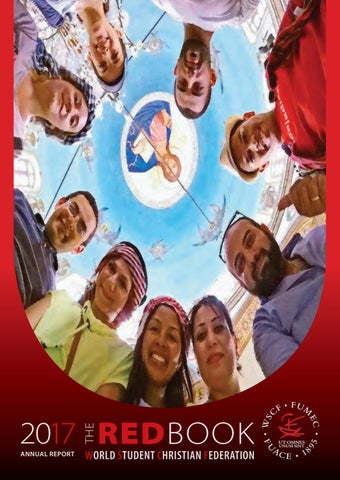
TEXT and PHOTOS culled from submitted reports of the Global Staff Team, as well as websites and social media pages of WSCF regional offices, SCMs and project partners Front cover: Participants at the Youth Conference on Peace-Building and Overcoming Violence in the Middle East, Cairo, Egypt, August 2017 (PHOTO: WSCF AFRICA) Back cover: At a ceremony at the Faith and Climate: Sacred Waters Convergence, Brazil, May 2017 (PHOTO: WSCF-LAC) Inside front cover: Images taken from the Youth Conference on Peace-Building and Overcoming Violence in the Middle East; Cahoots Festival; and Your Faith on Feminism Conference (PHOTOS: WSCF MIDDLE EAST, SCM CANADA, WSCF NORTH AMERICA)
EDITORS
Necta Montes Bes Rifareal FINANCIAL DATA
Jean-Luc De La Soujeoloe DESIGN AND LAYOUT
designworkers.biz
MESSAGES WSCF Chairperson’s Message Dear partners in God’s Vineyard, Dear readers, It is again our joy and pleasure to present and share UT OMNES with you WSCF’s work during the year 2017 briefly UNUM SINT presented in this report. In WSCF, it was a year of continued transformation towards higher performance in terms of governance, programme execution, communication and development of new strategy for fundraising. Our members participated at the national, regional and international level in various significant events, sharing their aspiration and contributing to the unquenchable quest for justice and peace in the world. No year is without its challenges and this one had its share. We are still working toward a process of restructuration for the viable and financial sustainability of the Federation. It is quite important to achieve them to pursue our vision of a transformed society and nations. At the same time, the external environment remains challenging with continuing large-scale conflicts, wars and inequality (income, discrimination); lack of economic opportunities and unemployment for the majority of young people; safety and security with terrorists’ attacks frequently perpetrated on unarmed and innocent civilians. And today, the most common threat standing out: climate change. These challenges are intertwined or linked and need urgent responses. We responded to the school shootings in the United States of America and the exodus of Rohingyas from Myanmar, but had to leave out the issue of the killing of Christians in churches in Egypt, or the new form of slavery in Libya of young Africans migrating through the Mediterranean Sea to Europe searching for greener pastures because of growing poverty and less job opportunities in Africa. In the context of our mission, we should address these issues as much as possible with what we have, human and financial resources. I have seen senior friends, Executive Committee members, staff and SCMers coming together showing determination and driven on by purpose to respond and challenge powers and oppressors. As we move forward in the years to come, we thank God, the Almighty, our provider, our strength, our security and comfort through Jesus Christ our redeemer for what was accomplished by His divine grace alone in 2017. We will continue to work tirelessly implementing all our programmes on Eco-Justice, PeaceBuilding and Dialogue, Interfaith Dialogue, Migration and Ecumenical Transformative Diakonia for the change we are aspiring for in the world, and more so to raise and build more God-fearing and influential leaders who will continue standing up without fear for their life for justice and peace. We thank our financial partners, the Board of Trustees of the Centennial Fund, the U.S. Board of Trustees, the Canadian Board of Trustees, and all the Senior Friends for their unfailing and continued support. Our thanks go as well to the Executive Committee members, the Global Staff team and SCMers for their commitment, energy and impressive drive to always improve our capability as a team for our common goals. But unto you that fear my name shall the Sun of righteousness arise with healing in his wings; and ye shall go forth, and grow up as calves of the stall. (Malachi 4:2) Enjoy your reading!
Georgine Kengne Djeutane WSCF Chairperson
20 THE RED BOOK
17
WSCF ANNUAL REPORT
3
MESSAGES General Secretary’s Introduction Dear SCMers, WSCF friends and partners, We are pleased to share with you our Annual Report, containing the highlights and summary of our work in 2017. As the WSCF moves forward guided by its 2016–2019 Strategic Plan, we present herewith the tangible outcome and results of our collective work on Ecological Justice; Identity, Diversity and Dialogue; Peace-Building, and Interfaith Dialogue. With clearer strategic goals and objectives in 2017, our programs and activities explored the intersections of the programmatic themes of eco-justice and peace in Barranquilla, eco-justice and indigenous people’s rights in Canada, religious diversity and migration in Ireland, peace-building and interfaith dialogue in Cairo, faiths and feminism in Canada, sexuality and religion in India. At the core of these programs lies our distinct identity as a progressive ecumenical Christian organisation. Each program developed our Biblico-theological perspective and defined our advocacy actions for justice and peace. The analysis and plan of actions that came out
4
from these programs demonstrated the depth in the content of our work, the importance of diverse contextual theological analysis, as well as the possibilities for new strategic work within and among our ecumenical partners and networks. In 2017, WSCF organised fifteen (15) international programs and activities at the global and regional levels across the six regions. Each program had a specific thematic focus, bringing together the rich contextual realities and experiences of young people connected to the Federation. These activities combined engaged more than 400 young people from different parts of the world eager to increase their knowledge and capacity, be organised and become advocates for justice and peace in the world. It is in the continuing follow-up work that takes place in the movements where these participants come from that our programmes find fruition; the process by which WSCF ultimately contributes towards the transformation of communities and the world.
CONTINUING WITH THE ORGANISATION TRANSITION TOWARDS STABILITY AND SUSTAINABILITY In 2017, the organisation continued with the task of completing the transition mandate approved in the WSCF Executive Committee Meeting at Palermo 2015. Three major processes where implemented as components of the overall plan for organisational change moving forward: organising the first WSCF Online General Assembly; IRO and regional office location study; and the proposal for a new WSCF Staff Model. In each of these processes, a working group was formed composed of regional representatives, officers, the general secretary, and senior friends who volunteered their time and talent in the work of these groups. A major work accomplished this year was the organising of the first Online General Assembly from May 22 to 28. Sixty (60) delegates from 80 affiliated movements participated in the assembly, which resulted in the amendment of the WSCF Constitution and By-laws with five (5) governance provisions changed or introduced. These governance
provisions were pre-conditions for the changes that were to be introduced in the operational systems of WSCF. While this new online platform proved useful and to some extent successful in adopting new and innovative ways of working, valuable lessons were learned, pointing to the need for prior substantive discussions of organisational changes and affirming the importance of in-face meetings for decisions with major and long-term directional and structural significance for WSCF. Another transition mandate completed during this period was the work done by the regional offices Relocation Working Group. Regional leaders and staff collected information and conducted studies on the cost, sustainability and effectiveness of the current location of the regional offices in New York, Hong Kong, Lebanon, Buenos Aires, Kenya, and Italy. The reports attempted to make a comprehensive study of the seven locations of WSCF offices but fell short of achieving its purpose, including determining the most suitable, economical and sustainable location for the IRO global office. This may be due to the lack of common understanding of the need and urgency for the relocation among those in the leadership of the regions. Of the three processes, the work towards proposing a more sustainable WSCF staff model proved to be the most difficult. In 2017, an initial report from the Working Group was presented to the global staff team and Executive Committee for consideration. The report included inputs collected from the regional chairpersons, staff and ExCo members. Recognising that a new staff model would have a significant impact on the life of the regional bodies and SCMs, therefore the importance of including them in the conversation and decision-making, the ExCo proposed to send the comprehensive report to the member movements for further input and discussion.
KEY CHALLENGES The key challenges that surfaced from these experiences in 2017 can be summarised as follows: 1. Developing a common understanding and analysis of the meaning and intent of “culture change” in the context of organisational transition and its scope within the Federation; and to develop plans or strategies on how to go about this internal change at the global, regional and national levels. 2. Building financial solidarity within the Federation. Resourcing ourselves from within our family remains a challenging task. Our experience in the two years indeed confirmed that we will have to rely on ourselves for our survival especially in this critical period. These varied schemes need to be institutionalised through our membership fees, administrative contributions from regional programs, regional contributions to staff salaries. 3. Centralisation of operations and management, and streamlining of our decisionmaking processes. The transition and change cannot work without the cooperation of the regional bodies. There is a need to develop understanding and synchronise the global and regional structures, and to evaluate the functions and roles of the regional structure vis-à-vis the changes in the global structure in order to function as a cohesive organisation. 4. Reskilling the staff team and ExCo to meet new expectations and requirements of the changes that have been implemented or will be implemented. 5. Preparing for the long-term financial, structural and programmatic implications and practical impact of the new WSCF staff model, as the process of developing this new model will be a key component in the implementation of the Strategic Plan for at least two years post transition.
CONCLUDING REMARKS In 2017, we consolidated and redirected the main thrust of the regional programs based on the thematic objectives set out in the Strategic Plan as overall framework. This became the tool for fundraising for programs, which hopefully will increase our capacity to support core expenses for staff salaries in the coming years. In this period, we explored different ways of working to accomplish the different aspects of the Bogota and Palermo mandates. Senior Friends played significant roles as they worked with ExCo members serving in various capacities in the four working groups formed: Constitutional Commission, Fundraising Working Group, Staff Model Working Group, and the IRO Location/Relocation Working Group. We have planted the seeds of transforming the structure, management and organisational culture in the Federation in order to strengthen the movements, renew our prophetic role, and demonstrate good stewardship of resources. Under very difficult financial circumstances, we have shown our ability to sustain ourselves with a functioning governance structure and to continue with our core programmatic work of leadership formation, movement building, advocacy and solidarity, and networking. The task continues to be challenging, but I believe that the organisation is in the right path towards long-term transformation. In Christ,
Necta Montes Secretary General
20 THE RED BOOK
17
WSCF ANNUAL REPORT
5
PROGRAMS In this report, we highlight the outputs and impacts of activities implemented in 2016 under the thematic programs of Ecological Justice; Identity, Diversity and Dialogue (IDD); Peace-Building and Dialogue; and the emerging themes of migration and racial justice, and religious freedom and interfaith dialogue. This year, we began consolidating and focusing our strategies and activities to achieve the program objectives of our 2016 to 2019 Strategic Plan.
Ecological Justice
WSCF’s Eco-Justice Program aims to promote climate justice through public advocacy processes directed at international governance bodies, working in partnership with ecumenical institutions, churches and various stakeholder networks upholding the youth and student voice on ecological issues.
Youth for Eco-Justice and Peace WSCF-LAC Regional Training Program BARRANQUILLA, COLOMBIA, AUGUST 14–18
WSCF-LAC conducted a regional training under the theme, “Youth for Eco-Justice and Peace: The Challenge We Accept”, on August 14–18 in Barranquilla, Colombia, gathering a group of 25 young people from Venezuela, Cuba, Argentina, Uruguay, Mexico, Bolivia, Peru and Colombia. At this training, the participants—members of SCMs and youth representing churches and faithbased organisations—discussed and learned to analyse from the regional and their respective contexts the relationships among economy, ecology and peacebuilding. The program was held at the headquarters of the Corporación Universitaria Reformada in Barranquilla.
The training was part of the eco-justice and peace-building program of WSCF-LAC and an important step in the formation of young people in the field of eco-justice and peace. As a result of the meeting, a calendar was created for the implementation of local actions in eight Latin American countries, with the objective of building a regional campaign that arises from the local initiatives coordinated by WSCF-LAC and from the perspective of youth and students in favour of an economic and ecological ethic that points towards justice and the construction of peace.
CONTEXTUAL ANALYSIS LINKING ECONOMY AND ECOLOGY The program was facilitated by two international lecturers: Brazilian theologian and Biblical scholar Rev Nancy Cardoso, and Dr Carlos Larrea, professor at Universidad Andina Simón Bolívar and a specialist in political economy and climate change. Dr Larrea addressed the global context of the depredation of the planet’s resources and the exhaustion of the bioreserves necessary to continue life on the planet. He challenged the participants to think about nature and justice not only in the traditional sense of justice between rich and poor, but also justice for future generations and for nature. This, he said, is the idea of eco-justice, that nature
Marisol Perea sharing with the participants the secrets of “enyucado”, a typical dessert in the Caribbean region.
6
THE RED BOOK 20 WSCF ANNUAL REPORT
17
Marisol is a woman with a vital force that is felt from the first greeting. She has a smile that embraces you when you see her for the first time. Her face is the face of hope.
itself has rights. Rev Nancy Cardoso pointed out that there is a relationship between the current dominant mode of production which is capitalism and the problem of life reproduction, of reproducing conditions necessary for life. She said it is important to think of how we organise ourselves so that we can reproduce life in sustainable ways. Other resource persons included Milton Mejía, general secretary of the Latin American Council of Churches (CLAI) and representatives of SCMs, churches, faithbased organisations (FBOs) and local groups sharing Participants during a lecture at the Youth for Eco-Justice and Peace training program. experiences and challenges from their contexts. Discussions from the academic scientific-economic perspective on the incidence of economy, politics and ethics in the quest for an CONNECTING ECONOMY, ECOLOGY AND PEACE ecologic and economic justice were accompanied by Biblico-theological reflection During the group discussions, the from a popular methodology, which helped SCM members set the bases of their participants discussed the intersections response to the complexities of their realities as ecumenical youth. between economy, ecology and peaceCOLOMBIAN INPUT ON PEACE-BUILDING building from a gender perspective and arrived at a common understanding that A relevant part of the gathering was the presentation of an initiative for peaceeco-justice must include the rejection of building work and peace pedagogy, “La PAZteleria del MEC: Recetas para la Memoria”, patriarchy, that the vision of eco-justice wherein an indigenous recipe is presented and participants learn about the different must contain the ecofeminist vision ingredients used for cooking the recipe and are asked to reflect on them, specially that the depredation, intervention and analysing the ways of production, distribution and consumption as well as the destruction of nature are very closely linked conflicts and problems that surround them. At the gathering, Marisol, a farmer from with the power relations between men and the Chocó region who was displaced seven times because of violence in Colombia, women. Economy, ecology and peace also shared her story of resilience and reconciliation as she lead the participants in the intersect on the question of land. Land is preparation of an “enyucado”, a typical recipe from the Colombian Caribbean coast. fundamental for an eco-justice that builds peace. And the participants agreed that Two open conferences were held in cooperation with the Universidad Reformada: defending the struggles of farmers and “Economy, climate justice and good living” by Dr Carlos Larrea and Rev Nancy indigenous peoples and vindicating the Cardoso, and “Challenges in the peace process in Colombia” by Dr Normando Suárez, use and ownership of the land by those an advocate of the peace process. Representatives from FARC-EP and ELN (National who work it must be part of the work of the Liberation Army) shared their perspectives on the implementation of the peace Federation on eco-justice and peace. n process in a dialogue that gave the participants an opportunity to hear a perspective of recent social history from the protagonists themselves.
20 THE RED BOOK
17
WSCF ANNUAL REPORT
7
PROGRAMS Ecological Justice
WSCF solidariy team with the Bear Clan Patrol
WSCF-NAR Indigenous People’s Solidarity Trip WINNIPEG, CANADA, JUNE 15–18
WSCF North America, in partnership with SCM Canada, organised an Indigenous Solidarity Trip to Treaty 1 Territory—home of the Ojibwe, Cree, and Metis Nations—in Winnipeg, Manitoba on June 15–18. The IST, an allies learning program, brought together around 15 students and young adults, a diverse mix of settlers born in North America (6 from Canada, 1 from the U.S.) and more recent settlers from the UK, Italy and Nigeria. It was organised in line with WSCF North America’s thematic priority on racial justice and indigenous solidarity. The organisers partnered with the Mennonite Church Canada, Christian Peacemakers Team, the Indigenous Family Center, and local leaders and community organisations including the Bear Clan Patrol, the Sandy-Saulteaux Spiritual Centre, and Elder Theodore Fontaine of the Sagkeeng First Nation. The program was hosted at the Canadian Mennonite University (CMU) in Winnipeg, an area considered a ripe space for learning because of its high population of indigenous peoples and advances in allies and reconciliation efforts. Manitoba has the highest provincial population of
8
THE RED BOOK 20 WSCF ANNUAL REPORT
17
indigenous people in Canada, with 40% of that population living in the city of Winnipeg. The program was a combination of educational activities, exposure outings, Biblical and theological reflections, and workshops on recommendations for advocacy work on indigenous solidarity. The participants learned about the history of the land where the Canadian Mennonite University currently stands, and about how the indigenous people in Canada have been abused in the residential schools set up by the colonisers to subjugate them from the personal experience of Elder Theodore Fountaine, who also talked about his vision for repairing relationships between Canadian settlers/government and indigenous peoples. The participants visited Indigenous Family Centre & Canadian Museum for Human Rights and a ceremony at the Sandy-Saulteaux Spiritual Centre. They also experienced walking with the Bear Clan Patrol, a group of community members who patrol Winnipeg’s North End every evening to pick up drug paraphernalia and check in with community members.
The combination of workshops and immersive activities exposed and engaged the participants in the social issues facing their indigenous neighbours, as well as the ways in which indigenous communities are working to bring clarity, voice, and solutions to the wider public. The diversity of the group added depth to the discussions and enabled the participants to link the North American indigenous situation with indigenous issues in Nigeria and racial issues facing the African-American communities in the U.S. n
Solidarity Intervention in Jiquí after Hurricane Irma Hurricane Irma, an extremely powerful Category 5 hurricane, made landfall on the off the northern coast of Cuba on September 9, severely affecting 12 of the 15 provinces in the country and forcing the evacuation of 1.7 million people. More than 158,000 homes suffered damage, of which 14,657 were destroyed. Agriculture, housing, infrastructure, the energy sector, and the north coast’s hotel-tourism industry sustained the major damages. WSCF-LAC promptly issued a solidarity call to Senior Friends, SCMs and partner organisations to mobilise support for the work of SCM Cuba in responding to the emergency situation. It has been part of SCM Cuba’s work, especially in recent years, to respond to the onslaught of meteorological phenomena on the spiritual and material life of the Cuban people, including those in the seven cities where the SCM has local presence. The churches and the ecumenical community, coordinated by the Cuban Council of Churches (CIC), immediately responded to the needs of affected communities. But it was not possible to reach every village in the long list of affected areas because of the magnitude and geographical extent of the damage.
SCM CUBA’S SOLIDARITY INTERVENTION In consultation with the regional office, SCM Cuba evaluated how they can reach the areas that suffered the biggest damages and extend direct assistance, especially to the most vulnerable sectors. Information it obtained revealed that Jiquí, a community in the municipality of Esmeralda in the province of Camagüey, was one of the areas worst hit by Irma where agriculture and housing suffered the greatest damage. It has a high number of elderly people and women
who live alone; children and people with disabilities in difficult living conditions due to the state of their homes; and a population highly dependent on agriculture, one of the sectors most devastated by the hurricane. Jiquí has 1,647 inhabitants, with 74 homes registered as being in total collapse after Irma, and almost all residential areas having suffered partial landslides. SCM Cuba organised a solidarity team of 15 young people from all regions of the country to carry out direct intervention in Jiquí. Because SCM Cuba had no local presence in the area, the team worked with the territorial coordinator of the CIC, and local church leaders and authorities. From November 6 to 8, the SCM solidarity team visited the affected families in Jiquí, extending to them material as well as moral and spiritual support. SCMCuba’s assistance was one of the first to arrive in Jiquí. The three-day visit was an initial step for SCM to get to know the community in Jiquí in order to plan future actions. During the visits, the SCM solidarity team delivered humanitarian aid packages to approximately 80 families, prioritising the most critical and vulnerable cases. The packages contained items for basic needs such as food supplies, personal hygiene items, and clothing and other articles for personal and family use. They also helped collect debris and clean the houses of the most vulnerable survivors: the elderly, especially those living alone, people with disabilities living with their caregivers, and children living with their grandparents. The team also provided psycho-social support and accompaniment to the families during the visits. Activities were held by age group, using the methodology of popular
M OV EMENT PROFILE
SCM Cuba education but with a celebratory dimension. Activities for exchanging life experiences, group dynamics, selfassessment and life projections were held among adults, particularly women. For children and adolescents, there were games, confidence and self-esteem building exercises, and sharing of stories and songs.
SCM MEMBERS REFLECT ON THEIR EXPERIENCE Dianet de la Caridad Martinez Valdes, SCM Cuba president, thanked those who responded to the call for support and solidarity, “… the people, churches, political organisations and local authorities in the province of Camagüey, in Esmeralda and Jiquí; WSCF-LAC and the Cuban Council of Churches; CESERSE and the Rainbow World Fund; and all those who gave time and financial support, helped in the planning and management and accompanied the team, doing so with much love to make this effort possible.” The solidarity team members in turn expressed gratitude to SCM Cuba for giving them the opportunity to visit Jiquí and be transformed by their encounter with the people there. Reflecting on their experience in Jiquí, Jorge González of SCM Cienfuegos summed up SCM’s vision of service: “Serving is much more than meeting basic needs. It goes beyond welfare. It is accompanying, giving everything with a happy heart. There is nothing in this world more special than to be able to serve others, to see in their faces the joy of knowing that in the midst of overwhelming need, in the midst of pain, they feel accompanied. […] Jiquí is one of those communities that teach us to live the faith through service, patient listening, creativity. […] That is the SCM of Cuba, a space to serve, laugh, accompany, and be a family.” n
9
SCM er R eflections on
“Youth for Eco-Justice and Peace: The Challenge We Accept” Some of the insights shared by participants on their experience at the regional training, “Youth for Eco-Justice and Peace: The Challenge We Accept”, held on August 14-18 in Barranquilla, Colombia.
It is very important for young people to understand and appropriate the realities in which we live. The regional meeting challenges us not to be mere spectators in society; not to ignore inequality and injustice; not to be indifferent to the clamour of nature that is mistreated, contaminated and exploited; not to be indifferent to the cry of the victims of war and those who long for peace. We have become accustomed to hearing about all these problems worldwide, but we do not change our way of thinking and way of living. SCM C U B A
Jorge González Núñez
We advocate for a society that recognises and respects the rights of nature, where the sacred involves the Earth, justice and peace, where we build fair relationships with all creation, rejecting the anthropocentrism that is imposed today not only by the market and capitalism, but also by science and religion. We want to create fair relationships also among human beings, beyond skin colour, gender identity, sexual orientation, origin, nationality and all characteristics that make us different and unique at the same time. Working every day to achieve all this is the challenge that lies before us, the challenge that will ensure a full life for all. SCM BARRANQUILLA-COLOMBIA
Jenny Fernández Lugo
The planet’s cry for help is imminent. All life on Earth is being extinguished little by Diana Cruz Celis little and I can feel it in my body and my soul of woman-young student-believer and next to that cry I also want to scream. That scares me, that I do not know what to do, that the immensity of the problem overcomes me and overwhelms me. And yet, the magic that is in the bonds and bridges that we build with other humans by becoming community and by training ourselves—overcoming borders, nationalities, ages, beliefs and everything that in other ways could separate us and alienate us—fills me, strengthens me and makes me think that I am one and many at the same time. That is why the challenge I accept is that of the hope that moves, that is not still, the challenge of retaking the love for the small things and of giving value to the small great struggles that magnify and nourish the creation, the challenge of continuing to build community from the values of justice, peace, transparency, solidarity and truth. SCM B O G O TÁ
10
THE RED BOOK 20 WSCF ANNUAL REPORT
17
The regional meeting was Luz Ely Ticona Mamani an opportunity that motivated us to continue working around ecology, justice and peacebuilding. Although we share difficulties in our region, no country is equal to another. Without a doubt, sharing all the experiences that are lived from our contexts originates our desire to be able to raise awareness about these and other issues that are part of our reality. So that we, from the place where we are, are able to contribute to a better society. SCM BOLIVIA
“Faith and Climate: Sacred Waters” Convergence, Brazil, April 30-May 4
PROGRAMS
Identity, Diversity and Dialogue
WSCF’s Identity, Diversity and Dialogue (IDD) Program aims to initiate the process of dialogue, create spaces and develop theological understanding for the SCMs on human sexuality.
We Are Not Outside, We Are Inside
IRLTP 2017 on Identity, Diversity and Dialogue BANGALORE, INDIA, OCTOBER 31 – NOVEMBER 6
Identity, Diversity and Dialogue (IDD) was the focus of the 2017 Inter-Regional Leadership Training Program (IRLTP). The seven-day global leadership program, held on October 31 to November 6 in Bangalore, India, carried the theme, “We Are Not Outside, We Are Inside: Building an affirming and inclusive Christian community for justice and peace for people of different sexual orientations and gender identities.” Twenty-seven (27) young people representing the SCMs of Bangladesh, Canada, India, Indonesia, Italy, Lebanon, Malawi, Mexico, Philippines, Sri Lanka, and the United States attended the training program. The program included the following activities: (1) a public event at the SCMI House that gathered members and Senior Friends of SCM India as well guests coming from the theological colleges, NGOs and civil society networks in Bangalore; (2) inputs and group discussions on the sub-themes of the program; (3) worship and Bible studies on gender and sexuality; (4) panel presentations on SCM work on LGBTIQ issues, IDD and interfaith dialogue, and human rights and the LGBTIQ; (5) storytelling and immersion with local communities; and (6) cultural activities and group work on action planning.
PRESENTATIONS AND DISCUSSIONS Leading the sessions were resource persons and facilitators coming from the Caribbean, Africa and Asia. Rev Dr Collin Cowan, general secretary of the Council of World Mission gave the keynote address; Dr George Zachariah from the United Theological College in Bangalore who led the first thematic input on the topic, “Christian Faith Imperatives and Theological Perspectives on Sexual Orientations
Rev Collin Cowan giving the keynote address top: Opening Ceremony
20 THE RED BOOK
17
WSCF ANNUAL REPORT
11
PROGRAMS Identity, Diversity and Dialogue and Gender Identities”; Dr Joseph Goh from the Monash University in Malaysia on “Social Theories on Gender and Sexuality”; and Dr Philip Peacock from the Calcutta Theological College on “The Church and the Ecumenical Movement’s Historical Journey with LGBTIQ”. The Bible study sessions were conducted by theologians from different countries: Prof Tapiwa Praise Mapuranga from the Zimbabwe Theological Seminary, Dr Aruna Gnanadason, a senior friend from SCM India, and Dr Rohan Gideon from the United Theological College in Bangalore. Three panel discussions and presentations were organised during the program. In the first panel, five participants shared their own movement’s situation, experiences and challenges working on LGBTIQ issues: Isaac Guazo from Mexico, Melissa Bridi from Lebanon, Giulia Dalmonte from Italy, Defli from Indonesia, Livika Chopky from India, and Vicky Guillon from USA. Interfaith issues and IDD was the topic of the second panel: Aizat Shamsuddin from the Progressive Muslims in Malaysia, Fr Philip Kuruvilla from NCCI India, and Ankit Bhuptani, a Hindu gay rights activist. In the third panel, the following speakers addressed the topic, LGBTIQ and Human Rights: Rajesh Srinivas from Sangama, Sana from the transgender community, Aizat Shamsuddin and Ankit Bhuptani.
COMMON UNDERSTANDING During the week-long training, as the participants explored the various issues and perspectives surrounding sexual orientation and gender identities (SOGI), the need to build inclusive communities and to continue and expand the dialogue on the subject became even more apparent and imperative for the participants. They agreed to come out with a statement expressing the common understanding and positions they have forged as a result of the training program. The statement was premised on the following
1. Diversity is part of human existence. All human beings are created equally but diversely by God. 2. Love and justice as the basis of all human interactions and relationships, as all persons are part of the inclusive community of Jesus Christ, who is himself welcoming and affirming of all persons. 3. The systemic and structural root causes of multiple oppressions, including gender and sexual oppression, can be understood from the perspective of the intersectionality of identities and contexts (social-cultural, racial, caste, economic, political, historical).
WSCF’s diverse constituency, “including people who are marginalised because of their sexual orientation and gender identity”, and its obligation to accompany these young people in their varied contexts and struggles
4. To become effective in the lives of people today, the Christian community must expand its knowledge of sexual orientations, sexual behaviours, gender identities, gender expressions and sex characteristics; address issues of patriarchy, heterosexism, homophobia, and transphobia; and listen to the lived experiences of people affected by these issues.
WSCF’s prophetic Christian identity as imperative to advocate for justice and so speak to the Christian community’s “inability to effectively address differences of perspective on this question and relate to the people especially affected”
5. The Church must open its vision to various forms and expressions of human existence, and know, support, welcome, accept and journey with the LGBTIQ people in their congregations and communities.
n
n
The need for “a dialogue framework grounded on Scripture and enriched by social theories and historical discourse” due to the divisive nature of the subject of SOGI and LGBTIQ rights, which has led WSCF members “to question each other’s’ commitment to Christian discipleship”
n
The statement put forward the following perspectives as basis or starting points for developing the dialogue framework:
12
THE RED BOOK 20 WSCF ANNUAL REPORT
17
6. Churches must be proactive in dismantling the invisible walls that block LGBTIQ people from full participation in their churches’ life, ministry and leadership. 7. The Bible is a rich and inclusive spiritual resource, but it is time-bound and contextual, and has been misused to exclude and discriminate against members of the LGBTIQ community. 8. Building an inclusive community for people of different sexual orientations and gender identities cuts across religions as LGBTIQ people experience discrimination, exclusion and violence regardless of spiritual or religious background.
RECOMMENDATIONS In addition to the statement, the IRLTP also came up with the following recommendations that individual members, SCMs and the WSCF may undertake to carry forward the work started at the IRLTP at the regional and national levels: To individual SCMers: Fostering peer-to-peer (pastors to pastors, students to students) interactions on the local level about LGBTIQ rights.
n
Speaking with local church leaders and utilising WSCF to serve as a bridge between church leaders and LGBTIQ communities/individuals.
n
Doing personal research and educating oneself on LGBTIQ issues and the lived experiences of LGBTIQ individuals.
n
Being vocal in our respective homes and communities about LGBTIQ issues while at the same time encouraging LGBTIQ individuals to approach us in confidence.
n
Centering LGBTIQ voices, when applicable, in discussions of issues and lived experiences.
n
To WSCF and SCMs: Monitoring the Federation to ensure continuing WSCF work on SOGI and for the LGBTIQ community and holding it to account for the programmatic mandates of the 2015 General Assembly in Colombia.
n
More interfaith engagement for the decriminalisation of LGBTIQ communities and individuals.
n
Depending on context, holding public demonstrations advocating for the rights of and expressing solidarity with the LGBTIQ community.
n
Focusing on school and education as places that can provide knowledge about LGBTIQ rights and solidarity.
n
Getting involved in local governments to help effect policy changes for the benefit of the LGBTIQ community. n
n
Exchanging knowledge and information with family and friends.
n
Connecting with trans communities and individuals and helping them gain access to resources that can benefit them.
n
Not forcing people to “come out of the closet” but instead creating environments where members of the LGBTIQ community feel safe to be themselves.
n
In local SCM meetings, being intentional in providing safe spaces for LGBTIQ individuals to come and further engage.
n
Interfaith panel presentation
20 THE RED BOOK
17
WSCF ANNUAL REPORT
13
PROGRAMS Identity, Diversity and Dialogue
Asia-Pacific Conference on IDD, Human Sexuality and the Christian Faith BANGKOK, THAILAND, MAY 7–10
SCM leaders from Australia, Bangladesh, Bhutan, Cambodia, Hong Kong, India, Indonesia, Japan, Korea, Myanmar, Nepal, New Zealand, Pakistan, Sri Lanka, Taiwan, Thailand and Timor Leste attended the WSCF Asia-Pacific Conference on “Identity, Diversity and Dialogue (IDD), Human Sexuality and the Christian Faith” on May 7–10 at the Bangkok Christian Guest House in Thailand. Prior to the IDD Conference, the women participants held a two-day program on “Sexuality and Gender Identities” on May 5–6 at the same venue to create a safe space for women to talk about human sexuality, focusing on women sexuality. During the program as a whole, the participants addressed the subject of human sexuality, specifically homosexuality, from different perspectives: social, legal, human rights and their diverse Christian faith backgrounds. They also discussed the response of churches to human sexuality, debating and reflecting on their understanding of homosexuality and the Christian faith based on moral and religious values and the Biblical position on homosexuality as affirmed by mainline churches: that the act of homosexuality is a sin and LGBT people are sinners. This led the participants to a historical review of homosexuality and Christianity, the Bible and sexuality, faith and theology. The most familiar but commonly misunderstood text of the Bible on homosexuality, the story of Sodom and Gomorrah, stirred the participants to revisit the text for a broader and contextual theological understanding and perspective of God’s punishment to the people of Sodom and Gomorrah in the Bible.
14
THE RED BOOK 20 WSCF ANNUAL REPORT
17
The discussions led the participants to acknowledge the following: LGBT people are not outside but inside the churches, inside the SCMs and WSCF.
n
Discrimination and violence against the sexual minorities are the reality in the Asia-Pacific region, including the Christian faith community.
n
The Christian community’s lack of support and solidarity with LGBT people have led many of them to fear ‘coming out of the closet’. They opt to leave the churches and SCMs/WSCF.
n
Those who exclude LGBT people from the Christian community have not acknowledged and welcomed the diverse God-given gifts of LGBT people, barring them from responding to God’s call to perform and fully participate in the mission of the Church.
n
There are differences of opinion and disagreement on the topic of homosexuality within the SCMs and WSCF. But this is not unique. Disagreements around homosexuality have been tearing apart churches and Christian communities in many parts of the world. But a core part of the SCM/ WSCF mission is engaging these differences and allowing them to become opportunities to learn and discover the significance of the deep unity shared within the SCM/ WSCF fellowship. CONTINUED ON PAGE 16
n
Your Faith on Feminism WSCF-NAR Interfaith Feminist Theology Conference EDMONTON, CANADA, OCTOBER 21-23
“Your Faith on Feminism: Intersectional Feminist Theology Responds to the Climate of Fear” was an interfaith feminist theology conference held on October 21-23 at the University of Alberta in Edmonton, Canada. It was organised by WSCF North America Region in cooperation with SCM Canada to further the region’s work on women, gender & sexuality, particularly intersectional feminist advocacy. The conference brought together 35 people from countries including Canada, USA, India, and Mexico. In the words of the participants themselves: “We are Christians, Muslims, Jews, and followers of other spiritual traditions. We are women, non-binary people, and men. We are children, young people, parents, mentors, and elders.”
The conference was held on Treaty 6 land, one of the eleven numbered Treaties in Canada, which had been travelled through centuries by the Nahiyow, Saulteaux, Blackfoot, Metis and Nakota Souix people. Throughout the weekend, workshops, meditations, morning devotions and religious celebrations were led by people from around the world. There were clergy from the Mennonite, Catholic, Presbyterian and local Jewish communities. There was active participation/ collaboration/ communication and dialogue between Christians, Muslims, Jews, queer, trans, indigenous, lesbians, sexually fluid, sexually positive and cisgender men and women.
THE WORKSHOPS The organisers introduced new approaches of doing conference, describing the gathering as a “workshop-based, community-driven, intergenerational and interfaith feminist theology conference”. One of the facilitators was Linda Pelly, an Anishnabee woman, who led the workshop on “Feminism: The Role and Place of Indigenous Women in the Landscape of Change”. Linda is a Cloud woman from Cody First Nation in the Eastern Part of Saskatchewan. She said the role of indigenous women in society was impacted by policy changes due to the onset of colonial influence. Women were denied status and became invisible. Their roles as leaders were removed and their functions were given subordinate status. The workshop on “Muslim-Christian Solidarity” was led by Aruna Gnanadason, a Christian theologian from India, and Ani Zonneveld, president of the Muslims Progressive Values Movement (MPV). Aruna helped the participants realise how a feminist consciousness can lead one to become more aware not only of the human cost of injustice systems but also the cost to the Earth. She shared her formula for the ‘social gospel’, which is feminism +
20 THE RED BOOK
17
WSCF ANNUAL REPORT
15
faith, a theology that “never puts women above men, never places women as the oppressed and man as the oppressor, [but] challenges patriarchy in all forms and moves us away from a pyramid of domination to a community of partnership and sharing.” On the other hand, Ani, an imam, debunked a lot of myths about Islam and the Quran, claiming that the Quran is social justice rooted and includes a feminist theme. She emphasised the need for inclusivity, of including the boys and men because while they are part of the problem, they are also part of the solution. Leading the workshop “Christian Faith Meets Undocumented Migration and the Sex Trade” was Mayra Dominguez, a Mexican woman whose small restaurant of more than ten years near the southern border of Mexico with Guatemala has witnessed the flow of thousands of undocumented migrants from Central America passing through on their journey north to the United States, hoping to find work to support their families and to escape the violence in their home countries. Mayra offers a friendly, caring presence to the migrants, along with delicious Mexican food, listening to the stories and struggles of the migrant women who end up working in the sex trade in the local bars. Mayra has grappled with the ways that gender and economic oppression intersect to marginalise and criminalise women. Her collective of friends built a small house for the women to use for rest and for workshops and sharing sessions.
They have facilitated meetings with immigration authorities to provide the women with some rights and protection.
SUMMARY AND EXHORTATION The following excerpt from the “Summary and Exhortation” contained in the full report on the program published after the conference expresses what the participants experienced and gained from the conference and what they have committed to do when they return to their communities: “We came to create a covenanted space—a safer space, and a brave space to explore the intersections of feminism, faith and justice. We acknowledge the traditions we bring with us. […] We acknowledge the Indigenous traditions tied to this land. […] We have spoken our own truths, knowing that we can only speak for ourselves. We have renewed our commitments to a continuous process of questioning, investigation, and reflection. We have worked to undermine ‘othering.’ We have honored the stories of those who have come before us, and those who will come after. […] We are about to go home to different places, where we have different communities and commitments. We will carry with us the stories we have told and heard, and share with others what we have learned from each other. We will stand in solidarity with the people of our communities, and others across the world. We will hold space for diverse feminist practices of advocacy, community, creativity and healing.” n
ASIA-PACIFIC CONFERENCE ON IDD ... FROM PAGE 14
The participants arrived at a common affirmation that every person equally bears the image of God regardless of race, class, caste, gender, ethnicity and sexual orientation. A broader definition of sexuality formulated by the Asian Women’s Resource Centre for Culture and Theology (AWRC) task group on sexuality in 2000 was affirmed by the SCM women during the women’s program: “Sexuality is not merely about the body, but it incorporates healthy relationships with the opposite sex, with the same sex, within a community, and with God. It is inter-relational. It is the recognition of the sacredness of our bodies. It is honoring the sacredness of all creation. It is God-given. It reflects the image of God. It is the totality of a person’s identity and being.” By the end of the program, the participants agreed that continuing dialogue about sexuality and gender diversity is the way forward. Motivated by the conference and acknowledging the diversity of experiences, realities and identities that exists within SCMs and the WSCF—not as an obstacle but as a gift to be celebrated and embraced—the participants recognised the urgency of going back to and initiating constructive dialogue within their SCMs on the rights of LGBT people and building an inclusive SCM/WSCF. n
PROGRAMS Identity, Diversity and Dialogue
WSCF Delegation to 61st Session of the UN Commission on the Status of Women NEW YORK CITY, USA, MARCH 13–24
WSCF sent an Advocacy and Solidarity delegation to the 61st Session of the United Nations Commission on the Status of Women (CSW) which took place in New York City on March 13–24. The WSCF group, part of a wider delegation called Ecumenical Women, was made up of young women representing the Federation’s six regions: Annie Chinyere (SCM Nigeria), Emmanuel Twagirayezu (SCM Rwanda), Chigor Ebere Ubesie (SCM Nigeria), Melanie Yong (SCM Malaysia), Rana Khoury (SCM Lebanon), Annie Carolina Solis Escalante (SCM Peru), Brandi Friesen (SCM Canada), Jacqueline Elizabeth Zookermany (SCM Canada), Veronica Santana Alvarado (SCM USA), Zillah Wesley (SCM USA) and Aude Isimbi (SCM Rwanda/USA). The CSW is a functional commission of the UN Economic and Social Council (ECOSOC) in which WSCF has NGO consultative status. The CSW has served as a platform for negotiation and collaboration between UN member
states and civil society, which have led to important advances for women’s human rights, the most critical of which include the Convention on the Elimination of All Forms of Discrimination Against Women, the creation of the first International Year of Women, and the adoption of the first Security Council Resolution on Women, Peace and Security. The priority theme for the 2017 session was “Women’s economic empowerment in the changing world of work”, with “Empowerment of indigenous women” as an emerging focus area of discussion. It also evaluated the progress in the implementation of the Agreed Conclusions of the 58th Session (2014) under the review theme, “Challenges and achievements in the implementation of the Millennium Development Goals (MDGs) for women and girls”. Long hours were devoted to representatives of NGOs and government ministries presenting reports on grassroots women participation in the MDGs.
Reflecting on the main theme of women’s empowerment, Melanie Yong, one of the delegates, noted that while the UN has committed itself to including more women in decision-making, in its 72-year history, it still has not had a woman secretary-general. It promotes women’s rights but not feminism and is clearly still behind on intersectionality discussions. During a civil society parallel event on the topic, “Does Work Necessarily Empower Women?” one quote made a mark on Melanie: “The UN has empowered women, but through a neoliberal agenda. Women look empowered but their agency has actually been taken away.” The WSCF delegation to UNCSW61 aimed to engage SCMs/WSCF’s young women leaders on the topic of women’s empowerment, expose them to global policy-making processes, contribute to the development of their leadership skills, introduce a platform for engagement with both governmental and nongovernmental entities, and provide opportunities to network with experts for future collaboration with their respective national movements. Aude Isimbi organised the delegation on behalf of the WSCF global Advocacy and Solidarity Committee. n
20 THE RED BOOK
17
WSCF ANNUAL REPORT
17
SCM er P rofile
M OV E M E N T P R O F I L E
Pretty Mubaiwa
SCM Nigeria
SCM Nigeria’s Women and Children Affairs Department (WACAD) Pretty Mubaiwa, 29 years old, is a member of SCM Zimbabwe, which she has served in various capacities. Her first exposure to the Federation’s global fellowship was at WSCF’s “Overcoming Violence in the Middle East” event in Palestine and Jordan in February and March 2014, which she credits as lifechanging. Being in solidarity with and seeing “the amount of zeal and hope that the youth of Palestine have, their love for each other and their will to set themselves free” were, for Pretty, “the most enchanting thing about this experience... I got to experience a whole new form of being positive.” She said, “I am changed forever. I will never be the same again. And that’s because I got to take part in something that is bigger than all of us.” Today, Pretty reflects on the growing intolerance towards “other” identities dividing communities across the world: “As the Church is called to be at the forefront in the fight for justice, even more in the face of rising injustice and inequality, it’s great to know that the Student Christian Movement is part of leading the Church in this good fight. Issues of identity, diversity and dignity have long divided many nations, and our history as humanity has been “scarred” by “othering”, based on differences in identity, beliefs and sexuality. We as WSCF took a stand to hearken the call to the fight against injustice, to lead the Church in the way of Christ’s love. As the call in Isaiah 1 verse 17, the Lord calls us to “Learn to practice what is good; seek justice, alleviate oppression, defend orphans in court, and plead the widow’s case.” It is our call to help humanity to see the face of Christ and to love without measure or discrimination, to call the world to love and peace, to experience the land which the Lord has promised. We are all made in Christ’s image, therefore, each and every person, no matter how different they are from us, is Christ personified. Our world will look much different, with less pain, if we took the steps to unite in love as Jesus Christ our Lord encourages.” Pretty is also currently involved with the Africa Resource Centre and the Ecumenical Advocacy Alliance. She holds degrees in international relations and international human rights law, and “interested in researching the interaction between state power, development, public health, conflict and human rights. I have done research on the impact of natural resources on conflict in Africa, the impact of conflict on children (child soldiers) in Africa and also how low level conflict including election violence impacts women’s rights in Africa.”
18
THE RED BOOK 20 WSCF ANNUAL REPORT
17
The SCM of Nigeria since inception in 1940 has been actively involved in reaching the youth urgently for Jesus Christ, especially at the secondary and tertiary institution levels, enthroning righteous leadership both in the Church and society by exposing future leaders to the influence of the power of God through purposeful leadership training and discipleship and promoting justice, fairness and gender equality in collaboration with other like-minded organisations. The SCM organises activities such as Bible studies, retreats, conferences of various kinds both at state and national levels, seminars, crusades, workshops, and others.
SCM members and CCN youth at the EVAC rally/march
SCM delegates to the EVAC workshop in Calabar
SCM Nigeria, through her Women and Children Affairs Department (WACAD), is engaged in programmes for women’s empowerment and to end violence against children and women. In 2017, WACAD, led by its coordinator Dr. Chinyere Chigor, organised many activities to promote gender balancing, eradicate prostitution, ending violence against women and children, among others.
ENDING VIOLENCE AGAINST CHILDREN (EVAC) Through WACAD, with direct focus on students and youth, and in partnership with the Christian Council of Nigeria (CCN), the SCM has been actively participating in the campaign to end violence against children in Nigeria by 2030. This is ongoing in three of SCM Nigeria’s six geopolitical zones: South West, South South and North Central. EVAC Nigeria, a UNICEF/CCN program, held a step-down workshop for women in Calabar, Cross River State on August 1. WACAD participated actively in the event by presenting a drama performance and highlighting the point that violence against children is a menace in society that must be eradicated. SCM Nigeria also participated in the EVAC campaign by supporting CCN in organising a rally and seminar on this issue held on August 27 in Lagos State, Nigeria. WACAD Coordinator, Lagos sector, Dr Mrs Tolu Fashina, speaking at a Senior Friends and students’ interactive session in Lagos in June 2017: “It’s helpful and best to catch them young.”
ENTREPRENEURSHIP AND SKILLS ACQUISITION PROGRAMME FOR WOMEN Around 50 women were trained in skills such as shoe-making, beads-making, cake and pastry baking at SCM Nigeria’s Women and Girls Skills Acquisition Centre, which was launched at the recently renovated SCM House in Benin City, Edo State. In 2018, SCM Nigeria will be seeking partners to help expand its service offerings at the Centre.
A female student leading others to read the Bible during a Bible study session in one of SCM’s secondary school branches
Beads-making session, Benin City
The SCM’s Skills Centre in Benin is yet in its infancy but doing its best to equip girls and female youth. Support is required to fully equip and upgrade it and bring in the right calibre of personnel. This has become more urgent as the SCM intends to support the current Edo State government’s renewed fight against girl trafficking and the rehabilitation of Nigerian returnees deported from places like Italy and Libya—many of whom are women from the Edo State—in part by equipping them with skills.
Participants being taught soap-making
Lecture at the Skills Acquisition Centre during the Entrepreneurship Training Programme for Women
One of the participants making shoes, Benin City
High-tech training program for women entrepreneurs in Kogi State
PARTICIPATION AT THE UNCSW61 IN NEW YORK Mrs Chinyere Chigor, WACAD coordinator, and Mrs Ebere Ubesie, national treasurer, were part of the WSCF Solidarity and Advocacy Delegation to the 61st Session of the United Nations Commission on the Status of Women (CSW) held on March 13–24 in New York City, USA. They both suggested that SCM Nigeria should host a Women/Children Conference. A representative at the UNCSW from SCM Nigeria discussing and asking questions about home-made solar oven
The SCM of Nigeria currently runs a network of members from 31 tertiary’ institutions, 800 secondary school branches, 33 primary schools, 19 township fellowships (also known as Christian Movement Fellowships), eight (8) active SCM Alumni groups, international SCM Nigeria Senior Friends networks and support groups (USA, UK and Canada) and nine (9) active Senior Friends networks and support groups in nine states across the geopolitical zones of Nigeria. The Nigerian SCM also has international chapters/networks in other countries, prominent of which is the North America chapter recently granted a 5OI(c) status. The SCM Nigeria is an associate member of the CCN bloc of the Christian Association of Nigeria (CAN). Its headquarters is located at Ibadan, Oyo State, Nigeria.
20 THE RED BOOK
17
WSCF ANNUAL REPORT
19
PROGRAMS
Peace-Building and Dialogue
WSCF’s Peace-Building and Dialogue Program aims to mobilise the Federation on issues pertaining to overcoming violence and building peace with a focus on the situations in the Middle East and Colombia.
SCM Indonesia Chairperson Sahat Martin on the the rising trend of religious extremism in the campuses: It’s “not just in Islam, but in Christianity too.”
WSCF Youth Conference on Peace-Building and Overcoming Violence in the Middle East CAIRO, EGYPT, JULY 31 – AUGUST 4
In an effort to highlight the role of Christian youth organisations in the Middle East in peace-building, WSCF organised a youth conference on the theme “Peace-Building and Overcoming Violence in the Middle East”. The conference, held from July 31 to August 4 at the St Mark Coptic Orthodox Center in Cairo, Egypt, was attended by 45 participants from Indonesia, New Zealand, France,
20
THE RED BOOK 20 WSCF ANNUAL REPORT
17
USA, Canada, Kenya, Egypt, Uruguay, Jordan, Lebanon, Palestine, Iraq, Syria, Madagascar, Switzerland, Cuba and Colombia. The conference also aimed to provide a space for leaders of Christian as well as Muslim youth movements in the Middle East and in other parts of the world to share the daily life concerns and struggles of their faith communities and how they are working to overcome religious violence and build peace.
Addressing the participants at the opening of the conference, His Eminence Bishop Anba Moussa, bishop for youth of the Coptic Orthodox Church in Cairo, congratulated WSCF for successfully bringing together the youth from the region and other countries to work together for peace. Highlights of the five-day conference included inputs and group discussions, panel presentations from students on religious extremism in different campuses, exposure visits to interfaith groups working on peace, and developing an action plan for WSCF’s program on peace-building. Resource persons included Samir Morcos who presented the geopolitical situation in contemporary Middle East; Michel Nseir on the situation of the churches in the context of the different conflicts in the region; Azza Karam on the role of the international community in building peace in the Middle East; Aida Nassif on women and their contribution to the peace-building process; Zahi Azar on how the Middle Eastern churches view their witness today and the role of the ecumenical movement; Nidal Abu
Zuluf on peace-building in Palestine; and Ziad El Sayegh on a peace-building framework in relation to the Middle East refugee crisis. The participants were highly engaged during all the open forum sessions, eager to ask questions and delve deep into the topics introduced by the resource persons, as well as challenge some of the points they presented. They were keen on expressing their feelings, sharing their views and talking about their experiences. For those who were coming from harsh situations like in South Sudan where oppression of Christians is more tangible, or Iraq, where most young people have lived all their life in a warravaged country, or in Palestine where they feel trapped and violated in their home country, the opportunity to share their pain, their anger and their suffering was important as discussions transpired. The variety of topics addressed enabled the youth to have an in-depth grasp of the complexities of Middle East realities as well as their role as Christian youth in the region and in the world. The community created during the week allowed attendees to feel part of a larger entity with a strong commitment to share the good news of the gospel and to promote peace in the world. Overall and perhaps most importantly, the experience of fellowship, solidarity and exposure to a multicultural and diverse group of people having a common yearning for peace in their own communities illustrated how ‘accepting the other’ is an experience of openness, living together and friendships built across language, nationality and cultural boundaries.
“Different cultures; awesome people; beautiful moments in Cairo, Egypt” - WSCF Africa
1. Strengthening existing interfaith cooperation that promotes peace-building through dialogue, common social action and sacred Scripture reading analysis. 2. Engaging members of SCMs in promoting WSCF curricula on peace-building for youth and students and to cultivate in children a living out of the Gospel in a nonoppressive way. 3. Restoring and promoting an authentic narrative and image of the Middle East. 4. Achieving a liberated approach to the Bible by developing critical thinking among the youth. 5. Building and strengthening international solidarity to promote peace-building and the voices of young people in international platforms, such as the UN, interreligious networks and church bodies. n
At the closing session of the conference, the participants adopted an action plan and a communiqué addressed to the churches and to Christian youth across the world. To the youth, the participants stressed the importance of “accepting others” in the task of peace-building; they also challenged the churches to build relationships with members of other faiths on the principle that not one religion can master the truth. The communiqué included a Call to Action which outlined specific objectives and courses of action representing their recommendations for WSCF’s peacebuilding program. The participants committed themselves to these objectives:
20 THE RED BOOK
17
WSCF ANNUAL REPORT
21
PROGRAMS Peace-Building and Dialogue
Syrian Youth Conference: The Church and Contemporary Challenges AIN AL AJOUZ, SYRIA, SEPTEMBER 7–11
The Syrian Youth Conference on “The Church and Contemporary Challenges (Affiliation, Migration, and Renaissance)” was held in Wadi El Nadara, Ain Al Ajouz, Syria on September 7–11. It gathered more than 60 men and women from six different districts in Syria, as well as various sects and denominations. The program included two Bible studies, three working group sessions and seven presentations. The conference was part of WSCF Middle East Region’s ongoing capacity-building program for the youth in Syria. The lectures addressed the following topics: 1) the Ecumenical Movement and its role in serving the youth and the Church today; 2) migration, faith, youth, and the meanings of the witness of the Eastern Church; 3) the role of ‘renaissance women’ in encouraging fellow women to liberate and renovate thought; 4) the possibility of social renaissance and the youth’s role in it; 5) the concept and possibility of secularism here and now; and
22
THE RED BOOK 20 WSCF ANNUAL REPORT
17
Sharing a meal at the Syrian Youth Conference, September 7-11
6) reviving Muslim-Christian dialogue in Syria and the Levant in relation to the renovation of Arab thought. A panel of Syrian youth participants, each of whom offered testimonies of their experience amidst the ongoing war, talked about what it means to be a Christian male or female youth in Syria today and the role of the Church in helping them. Towards the end of the conference, the participants gathered in working groups to write down a plan for a youth initiative that serves the ecumenical work in the region and that will be sent to the churches for support. The working groups also discussed the ideas presented in the conference and drafted a call. n
10th Palestinian Youth Program, Jordan, October 26-29
SCM er P rofile
Fadi Najar
FADI NAJAR PARTICIPATED IN THE SYRIAN YOUTH CONFERENCE ON “THE CHURCH AND CONTEMPORARY CHALLENGES (AFFILIATION, MIGRATION, AND RENAISSANCE)” HELD IN WADI EL NADARA, AIN AL AJOUZ, SYRIA ON SEPTEMBER 7–11.
I have always believed that Christianity cannot have a role in the world or a true message of peace for this world if it does not work on its unity. When we say “unity”, it does not mean that the Church needs to become of one colour and one category, but to be “one in its diversity”. Through the conference held by WSCF-ME, I started seeing the youths coming from different churches as one. I have always believed that the Church is me and you and not the building, and this has led me to believe that the Christian youth can be an active force in society working towards its advancement, using ecumenical work. This Ecumenical Work was appreciated through some of the lectures in the conference, and through the activities and initiatives of the youths in charitable and development work that spread joy, peace and love amidst the noise of war and hatred. There is no doubt that, and as a participant in the Federation’s conference for the first time, I have acquired a new experience and a new vision of Christianity. This was the title of this conference... a title like a dream, we see some of its parts being realised: we were Christian youths coming from various churches in Syria, sitting together and discussing how to become one. At times, a few of us dared to put some salt on the wound about us no longer being one body whose head is Christ… at least in terms of how we deal with one another. I have never thought that my church is the Church of Christ whereas others’ are not. For me, this belief has always been trivial to man in the 21st century, so one of the rays of hope that changed my mind is the incomparable harmony we lived in as youths in the conference, each from a different sect. This motivated me to go to my church and try to share those activities and knowledge with the youth of my parish as well as other churches... not only share but believe that the body consists of diverse organs but has only one head. As such, the churches are diverse organs of one head, Jesus Christ.
Palestinian Youth Conference: The Ecumenical Movement and Current Challenges AMMAN, JORDAN, OCTOBER 26–29
The 10th Palestinian Youth Program entitled “The Ecumenical Movement & Current Challenges” was held at Hotel Toledo in Amman, Jordan on October 26–29. The event included Bible studies, workshops, and 11 sessions addressing several topics. Five resource persons divided the topics among them. Ashraf Peskales’ made three presentations addressing questions related to personal development: 1) How to love oneself correctly? How to change? 2) The art of dealing with the Other; and 3) How do I discover my flaws? Zahi Azar talked about the Church and ecumenism with the topics “What is the Ecumenical Movement?” and “The Church and current challenges”; while Ayman Karam talked about ecumenical Church witness in the 21st century. Tarek Hijjazine addressed emigration as a particular reality for Palestinian youth as a result of the political, economic and social issues they face. The Christian youth’s perspective on Islam was addressed by George Kopti, while two separate youth panels talked about what it means to be a Christian Palestinian youth today, and their role in fulfilling Kairos Palestine. Zahi Azar introduced the participants to the Ecumenical Institute for the Middle East (EI) its history, work, curriculum and criteria for enrolment. One of the participants who was an EI student was asked to share reflections on her experience and journey with the Institute. Additionally, the participants visited the Saint Georges Youth Movement. n
20 THE RED BOOK
17
WSCF ANNUAL REPORT
23
PROGRAMS
Interfaith Dialogue
WSCF Europe brought together 25 young people from grassroots organisations to Vilnius, Lithuania on April 1–6 for an intensive course in human rights education and youth activism in combating racism, xenophobia and discrimination. Organised under the theme, “I Stand up to Hate Speech: Tools for Newcomers”, the capacity-building training was aimed at helping regional staff and officers, volunteers and SCMers from all over Europe develop the skills and knowledge required in becoming human rights activists and running human rights awareness and promotion campaigns.
24
THE RED BOOK 20 WSCF ANNUAL REPORT
17
WSCF’s Interfaith Dialogue Program aims to engage the Federation in creating and providing an interfaith platform for youth and students to dialogue and work with young people from other faiths on environmental, migration and refugee issues.
I Stand up to Hate Speech: Tools for Newcomers WSCF Europe Capacity-Building Training VILNIUS, LITHUANIA, APRIL 1–6
Through non-formal educational methods and tools, the participants learned theoretical and practical knowledge on how to develop and run successful and effective campaigns and interventions at the grassroots, national and European levels. The interaction between the young people and key speakers from the No Hate Speech Movement (NHSM), YMCA and Human Rights Monitoring Institute—experts in the field of human rights activism— also allowed for new partnerships and innovative projects to develop. The training was an opportunity for activists of the WSCF network in Europe to get acquainted with the No Hate Speech Movement—an online youth campaign for human rights initiated by the Council of Europe to reduce the level of acceptance of hate speech. The participants received intensive training in developing necessary competencies (skills, knowledge and attitude) to become activists of human rights education and as part of a wider No Hate Speech Movement. During the activity, they created comprehensive plans
A Year with No Hate:
WSCF-Europe Campaign EUROPE-WIDE, JUNE TO DECEMBER
WSCF Europe dedicated the year 2017 to the campaign, ‘A Year with No Hate’, which focused on the promotion of equal opportunities, human rights and respect for human dignity as core principles of every inclusive and diverse society. This campaign was part of the larger No Hate Speech Movement campaign, an initiative of the Youth Department of the Council of Europe. The campaign was the first time that WSCF Europe coordinated a Europe-wide initiative with a ‘one message’ spirit. The common approach and spirit of the campaign was elaborated during the training in Vilnius where participants were trained to take ownership of their ideas and facilitate projects relevant to their local needs and challenges. Among these were two local projects that received support from WSCF Europe’s small grants programme, which was intended to encourage SCM-organised activities that promote diversity and understanding of how diverse societies can come into being. The first was an activity jointly organised by SCM Finland and SCM Helsinki, which consisted of a study trip to Tallinn, Estonia where students learned about attitudes towards religious, ethnic and sexual minorities in the country. The topics they discussed included migration and asylum seekers, sexual minorities, and the Church’s role in addressing issues of inclusion and protection of minorities. The other activity was organised by SCM Britain, titled ‘A Light for All’, a day trip to the Lancaster University Chaplaincy where Rev. Dr. Anderson Jeremiah delivered to students a talk on the topic: “The Bible as a catalyst for new life: an immigrant perspective”. As part of the campaign, the region also launched the “Diversity and Integration” photo competition, which ran from October to December. WSCF Europe challenged creative young people across Europe to share their best photographs reflecting the
Top 3 photo competition winners TOP:
1st, David Enriquez (Germany) 2nd, Mirjam Balovski (Serbia) RIGHT: 3rd, Diana Yeghiazaryan (Armenia) LEFT:
topics of diversity and integration. The competition was aimed at making young people reflect on the meaning of diversity in their lives. The winners of the competition were announced in December, with the top three winning photos featured in WSCF Europe’s journal Mozaik and in a 2018 calendar that also included photos from activities implemented under the Interfaith Dialogue and Cooperation Programme of the region. Most of the activities organised by WSCF Europe under this campaign were made possible by funding received from the European Youth Foundation. n
of action to bring the message of NHSM to their local realities as well as address the burning issues in their home communities. WSCF-Europe’s ‘A Year with No Hate’ Campaign was launched at this activity, which all the participants felt encouraged and inspired to be part of. The capacity-building training with the campaign launch was intended to set the scene for the rest of the activities of the region throughout the year, with the participants— empowered, motivated and equipped as activists—acting as multipliers, beneficiaries and leaders of these forthcoming initiatives. n
20 THE RED BOOK
17
WSCF ANNUAL REPORT
25
PROGRAMS Interfaith Dialogue SCM er P rofile
Lina Leonaviciute
Hi! I am Lina from Lithuania. I have a bachelor’s degree in nursing from the University of Vilnius as well as master’s degree in public administration. I am currently living and working in Vilnius. My work is in public administration where I’m trying to implement changes at the political level of health politics.
(I)MIGRANT:
My involvement in local SCM started from my school. At the time, I was a participant at various local events and summer camps. Later on I become a youth leader myself in Vilnius Evangelical Lutheran Academic Youth Fellowship. I took part in organising summer camps for children and being a group leader. As well I got involved at various other ecumenical events, such as organising national youth meetings and soup kitchens.
Perspectives on Minority Integration in Europe WSCF Europe Youth Conference PROSPEROUS, IRELAND, OCTOBER 7–13
Also forming part of the ‘A Year with No Hate’ campaign was the youth conference, “(I)migrant: Perspectives on Minority Integration in Europe”, which brought together 20 young people from 13 different countries across Europe to Prosperous, Ireland to take part in a series of workshops, lectures and small group discussions aimed at creating mutual respect and enhancing understanding of building and sustaining diverse communities.
From the year 2011, I got involved in some international ecumenical events and training courses. My first WSCF event took place in Velletri, Italy in 2012. From 2014, I was a member of the Campaign Coordination Team of the Ecumenical Youth Council in Europe (EYCE) working on the three-year campaign, “Break the Chains! A campaign to overcome poverty”. The aim of the campaign was to motivate young people from all over Europe to contribute to the eradication of poverty in Europe.
The conference, which took place on October 7–13, focused on the common challenges of rising racism, extremism and social exclusion of migrants, other minorities and marginalised groups across Europe. The participants explored solutions for overcoming violence and preventing radicalisation in their local contexts, and promoting more tolerant practices towards migrants and refugees in Europe.
I was elected project coordinator for WSCF-Europe during the European Regional Assembly (ERA) in 2017. To me, being a member of a big WSCF family is an adventure and an honor. Only by being and working together and by faith of God can we really change the world!
Through the conference, the participants were given an open and safe space for exchange, discussions and learning, for making friends and creating network of young activists. They also visited and met local organisations engaged in initiatives for minority integration.
IN MARCH 2018, LINA WAS APPROVED TO REPRESENT WSCF-EUROPE AS MEMBER OF THE EXECUTIVE COMMITTEE.
26
THE RED BOOK 20 WSCF ANNUAL REPORT
17
The conference was organised with the following aims: Explore alternative solutions to combat hate speech and promote more inclusive and tolerance practices and policies towards migrants and refugees;
n
Train new leaders and empower youth activism in identifying and overcoming violence and xenophobic tendencies;
n
Exchange and create new tools and good practices for offline and online advocacy and campaigning at local and regional levels;
n
Influence mainstream public opinion by new positive narratives and sharing from migrants’ stories;
n
Explore and spread official statistics and research on many socio-economic and cultural factors that migration positively contributes to and brings enormous added value to societies;
n
Create a network of young activists that will work together more efficiently to improve the flow of information and facilitate common activities and campaigns. n
n
Muslim-Christian Dialogue, Lebanon, October 4-8
Reconciliation in the Arab World
WSCF Middle East Muslim-Christian Dialogue Conference BROUMANNA, LEBANON, OCTOBER 4-8
Thirty (30) Muslim and Christian women and men from across the Middle East—Lebanon, Palestine, Iraq, Jordan, Syria, Egypt, and Sudan—gathered in Broumana, Lebanon from October 4–8 for WSCF-ME’s annual Muslim-Christian dialogue conference entitled, “Reconciliation in the Arab World”. Resource persons from both sides led discussions on the various topics of the conference. Reconciliation—its meaning, implications and preconditions—was the focus of the presentations, in particular, as it pertains to development work, solving conflicts, extremism, national security, public policy and the media. The input on the ecumenical movement drew a parallel between the current efforts at reconciliation and the beginnings of the ecumenical movement, which came into being because of the desire and will of the churches to meet. In the discussion of the concept of reconciliation in religions, it was noted that while there may be differences in doctrinal and political propositions, concepts of God, ethics and ideologies, all religions more or less share the same views in the moral dimension. The conference also became an opportunity to introduce and highlight the work of interfaith reconciliation and peace initiatives such as A Forgiving Society, Reconciliation NGO, Dialogue for Life and Reconciliation, and the March 25 Initiative. The participants, through small group discussions by country, drafted strategies and action plans that would help bring about reconciliation in their respective contexts.
For Egypt, the participants proposed the key strategy of promoting belonging through “citizenship” instead of “sectarian affiliations”. Activities may include creating a ‘citizenship day’ in institutions and schools; and cultivating national affiliation in youth and children through alternative media, social networks, field visits or seasonal events to raise awareness of the philosophy of citizenship and its importance for peaceful coexistence. In Syria, two strategies: humanitarian relief work to help children in need, and holding a dialogue with the clergy. Activities may include giving gifts to children during the holidays, raising awareness in schools, creating convincing informational media to illustrate the importance of dialogue. For Iraq, Jordan and Palestine, the establishment of an interfaith dialogue committee and sub-committees at the national movement level in each country. Activities may include conducting joint courses for students entitled “Coexistence and Respect”, establishment of a dialogue committee at universities; and providing aid to refugees. In Lebanon, establishing a joint committee of Muslims and Christians. Activities may include rehabilitating public schools to deliver civic education and national upbringing; conducting workshops with public schools to educate students on city and civil state as the solution to Lebanon’s political problems; preparing new curricula to amend the subject of civic education in schools, adding the advantages of the civil state; establishing a committee of specialists to deal with foreign funds to secure aid for the development of public schools towards reducing the dependence of education on religious schools; and reducing extremism through holding of development projects in all Lebanese regions. n
20 THE RED BOOK
17
WSCF ANNUAL REPORT
27
MOVEMENT PROFILE
SCM Germany
Evangelischen Studierendengemeinden in Deutschland “Reformation” was the main topic for the 120 local SCMs in Germany. In 2017, we celebrated the 500th Jubilee of the start of the reformation of Martin Luther in Wittenberg. That is why many activities were prepared in the SCM. For example, one of the churches had the idea to celebrate worships at unexpected places. So, the SCM of Cologne was invited into the underground of the sewerage system for their worship. There was also a summer school for students in Wittenberg and the “Kirchentag” in the capital Berlin with a stall at the market. At the stall, the international students wanted to get in contact with the visitors with a game and WSCF Europe put together a jigsaw puzzle of Europe with the visitors.
Meeting of 180 ESG/SCM choir members
The International Youth Camp, in cooperation with the Protestant youth movement in Germany, has been one of the most important events. There were a lot of exchange programs with other countries between the youth groups. They were invited to spend a week with their partner group in Wittenberg. So, 250 young people coming from 25 nations lived together a week in tents, played and prayed together, offered workshops and discussed what reformation means for us today. Students of SCM Germany spent the week with a group of students from Indonesia there. SCM of India was also invited and spent the days with a Waldensian group from Italy, Uruguay and Argentina. The atmosphere was amazing and it was so wonderful how easily the participants get in contact with each other. Our annual assembly was also located in Wittenberg. We had elections for our board and several delegations. My favorite meeting was our choir meeting in November where 180 SCM choir members met for one weekend to sing all together and in workshops. In 2018, we are able to have our normal program. So, our 120 local units will have only their weekly program which is planned by student groups and the chaplains of the SCM. But we will also have fun (without a jubilee ;-). n
A jigsaw puzzle of Europe in WSCF’s stall at the Kirchentag 3rd ESG/SCM General Assembly, Wittenberg, September 13-17
28
THE RED BOOK 20 WSCF ANNUAL REPORT
17
REGIONAL HIGHLIGHTS Africa
Workshop participants holding their certificates of completion
WSCF FUACE
The WSCF-Africa regional office, courtesy of the United Church of Canada, has been on a journey across the continent to conduct Leadership Training and Consultative Workshops, which have seen through the successful training of 92 student Christian leaders in Sierra Leone, Liberia and, in 2017, Madagascar.
The WSCF Africa Leadership and Consultative Workshop was held in Antananarivo, Madagascar on June 1–3 and was attended by 34 selected national SCM members. The program aimed to build the capacity of SCM national leaders in colleges and universities, to empower them to become leaders of integrity, accountability and responsibility. The whole program consisted of three main activities: a meeting with the Senate of Antananarivo; visitation and movement building activity with the SCM; and the three-day leadership training workshop of SCM members. The regional staff also visited with medical students at the Antananarivo University. The visitation and movement building activity was held at the Andasibe Forest in Madagascar. It included discussions on movement administration and strategic planning, and gave the SCM and the regional office staff a chance to discuss in detail the state of the movement. The meeting with the Senate of Antananarivo, which involved the regional staff and three SCM members, addressed key areas of partnership between the government and SCM, the position of Christian youth leaders in society, and women empowerment in the 21st century. Through the three-day leadership training, the participants developed a deeper understanding of leadership and its Biblical foundation. They gained knowledge that would enable them to sustain high morale among the students and youth that they lead, as well as first-hand encounter with esteemed leadership through the ethical government and church leaders they met during the program. The encounters enhanced the SCM’s relations with the government and the church, positioning the movement at a favorable stance to impact society.
An important milestone achieved in 2017 was renegotiating and reigniting a long-term partnership with the Methodist Church in Britain in regards to the region’s Internship and Mentorship program, wherein a platform is created for fresh graduates to gain experience and thus a better position in the professional market. This was made possible by the visit of Dr Bunmi Olayisade of the British Methodist Church, with whom interim Regional Executive Maxwell Omondi held meetings at PROCMURA in Nairobi, Kenya in early 2017. The regional office was also able to account for undischarged reports on programs that Maxwell Ray Omondi meeting with Dr Bunmi Olayisade of the British Methodist Church were undertaken in 2016 at Cameroon, and to submit audited financial reports on programs. Another encouraging development is the awakening that is taking place within SCMs that in previous years were regarded as dormant. And lastly, the WSCF Africa Region website— www.wscf-africa.org—has been finally updated after four years of dormancy. n 2017 has been a blessed year and I believe for a greater season as we work building a solid and better continent through our Christian movements with great insight from our Lord Jesus. — Maxwell Ray Omondi, regional executive for Africa
20 THE RED BOOK
17
WSCF ANNUAL REPORT
29
REGIONAL HIGHLIGHTS Asia-Pacific
The Asia-Pacific Regional Committee, during its 22nd biennial session on May 10–13, agreed to incorporate WSCF’s global thematic goals and strategies into the region’s programs and activities, focusing on the theme, Identity, Diversity and Dialogue (IDD). The Regional Committee Meeting (RCM) followed the AsiaPacific Regional Conference on “Identity, Diversity and Dialogue: Human Sexuality and the Christian Faith”. Both events, hosted by SCM Thailand and held at the Bangkok Christian Guest House, were attended by delegates representing SCMs in Aotearoa/ New Zealand, Australia, Bangladesh, Bhutan, Cambodia, Hong Kong, India, Indonesia, Japan, Korea, Myanmar, Nepal, Pakistan, Sri Lanka, Taiwan, Thailand, and Timor Leste. The Regional Committee, WSCF’s highest regional governance body, meets once every two years to set the region’s program direction and perform other functions mandated by its by-laws. The 22nd RCM was the first time the regional body met since the WSCF Executive Committee formally adopted the 2016-2019 Global Strategic Plan in December 2015 in Palermo, Italy. With the Asia-Pacific regional executive, Sunita Suna, assigned concurrently to develop and lead in the implementation of the IDD global program, the RCM agreed to continue focusing its work on this theme. The region already started implementing the 35th General Assembly mandate on IDD in 2016 through the women’s workshop and the School for Ecumenical Leadership Formation (SELF) held in January and October respectively. For the next two years, the region will focus its efforts on bringing the discourse to the grassroots level by creating spaces in the local SCMs for dialogue on the subject of human sexuality. The region will also link up ongoing local/national activities on eco-justice, peace-building and higher education
30
THE RED BOOK 20 WSCF ANNUAL REPORT
17
in the different SCMs with global efforts on these themes, while also making sure that SCMs in the AP region will engage in and respond to global calls for advocacy and solidarity on these concerns. The RCM also agreed to prioritise movement building, adopting a measure to form a Task Group that will analyse the Liturgy for IWD 2017 prepared by the WSCF-AP Regional Women’s Committee dynamics of each SCM and come up with specific strategies to respond to movement building concerns. The RCM looks forward to further strengthening the movement through this effort, in addition to projects on Ecumenical Transformative Diakonia (ETD), capacity-building trainings, as well as national-level programs and activities. Aside from program decisions, the RCM also performed a variety of statutory functions, including the election of new officers and members of various committees, amendment of by-laws, and adoption of the budget for 2018-2019. The RCM issued a communiqué detailing its decisions as well as the list of delegates and guests who attended the meeting. n
Europe
Youth Conference, “(I)migrant: Perspectives on Minority Integration in Europe”, Ireland, October 7–13
Interfaith Dialogue and Cooperation (IFDC) remains the long-standing regional priority of WSCF Europe. Given the importance and urgency of the current immigration and refugee europe crisis in Europe, the region decided to focus its work in 2017 on this pan-European issue and the challenges related to it, which concern many, if not all, European countries. The immigration and refugee crisis, radicalisation and terrorism have fuelled and triggered racism and xenophobia against Muslims and ethnic minority groups in general. It is essential that in the current situation of growing hate speech and hate crime incidents, WSCF must focus its efforts on challenging such perspectives and fostering intercultural and inter-religious understanding among various groups.
WSCF
The region addressed this issue by promoting equal opportunity, human rights and respect for human dignity as core principles of every inclusive and diverse society. The main approach adopted by the region is the Europe-wide campaign, “A Year with No Hate”, which was launched at the capacity-building training held in Lithuania in April. Aside from the training, the campaign consisted of a number of other activities, including a region-wide photo competition on the theme “Diversity and Integration”; SCM-organised activities at
the national/local level addressing issues such as migration and the Church’s role in the protection and inclusion of minorities; and a regional youth conference in Ireland, which dealt with the theme, “Perspectives on Minority Integration in Europe”. These local activities enabled the message of the campaign to reach an even wider audience of disadvantaged youth groups locally, while also significantly raising the visibility of WSCF-Europe to the wider public. The learning outcomes and achieved results were fed into the daily work of the member movements, most of which formed dedicated youth groups that will continue to work on the European campaign in 2018. Overall, the campaign increased the impact of WSCF Europe’s work at the local level. It led to stronger links and collaboration between the region and the member movements, especially those from the rural areas in Eastern and Central Europe which, having limited resources and experience in youth activism, are now experiencing being part of a wider initiative at the European level. The region has had another amazing year championing the youth voice across Europe, despite the emotional challenge of thinking and planning on how to find answers to some of the tough issues facing the youth in Europe—real grassroots challenges on how to deal with social exclusion, extremism and hate speech against marginalised groups in many European countries. But there have also been some powerful positive steps forward in empowering young people through being directly involved in WSCF activities or reached through dozens of local initiatives. n Whilst positive change we all want to see can take a frustratingly long time, it is tremendous to see the youth voice at the heart of moving forward. This journey of change will continue into 2018, building on the success of 2017 and on the aspirations of hundreds of young people across Europe. — Natia Tsintsadze, regional executive for Europe
WSCF European Regional Assembly 2017, Ireland, October 13–15
20 THE RED BOOK
17
WSCF ANNUAL REPORT
31
REGIONAL HIGHLIGHTS Latin America and the Caribbean
Young church and student leaders in Caracas, Venezuela
One of the more important developments in the work of the WSCF-LAC Region (FUMEC-ALC) in 2017, apart from the Youth for Eco-Justice and Peace regional training, was the start of the process of reviving the historic Student Christian Movement (MEC) of Venezuela. From November 23–26, the FUMEC-ALC regional executive held meetings with members of the Presbyterian Church of Venezuela and with young leaders from different denominations of Caracas and Barquisimeto. The visit to Venezuela was part of the process of construction and strengthening of FUMEC-ALC. On Saturday, November 25, an encounter was held at the American College of Caracas with the presence of young ecclesial and university referents where the work of FUMEC in Latin America was widely presented. The space was supported by Rev María Jiménez, Senior Friend of MEC Venezuela, who brought the historical perspective of the movement’s work and the value of its ecumenical Christian identity. During the series of meetings, a conference was held on the topic, “Human Rights: Venezuela in the concert of the nations” with the presence of Fernando Bello, president of the foundation, Embassy of Human Rights, who spoke about the situation of Venezuela in terms of human rights. The meeting was a first approach to contextual and critical reflection with the group of young people and students, especially in the promotion of spaces that propose an ethos
32
THE RED BOOK 20 WSCF ANNUAL REPORT
17
Marcelo Leites in Venezuela, sharing about WSCF
and ecumenical action, that facilitate encounter, dialogue and cooperation in a very polarised society. These values have been highlighted by the participants of the meeting as an urgent need in Venezuelan society and to reach more young people and students. As a result of the consultation and meeting of young people, some steps have been established in the construction and reactivation of a reference space for the Federation in Venezuela. Meetings and training spaces will continue with the main theme of building fair and inclusive societies, which include the relations between economy, ecology and the construction of paz. Through this approach, steps will be taken to reactivate the MEC of Venezuela. n
Middle East
Graduation, Ecumenical Institute Summer Session 2017, Lebanon MI
DD
LE
EAST
The Ecumenical Institute for the Middle East held its third summer session in Broumanna, Mount Lebanon from July 2–22. This session gathered 53 students from various Christian youth movements representing ten different churches and different theological institutes and colleges. The students came from Lebanon, Syria, Palestine, Iraq, Jordan, Sudan, and Egypt. The three-week program included daily ecumenical prayers, lectures, Bible studies, group work, visits to churches and dialogues with church leaders. The first week included lectures on ecumenism and personal experiences. In addition to Bible studies and liturgical studies from different church traditions, the students gathered in a panel on interacting with the Christian faith. The Institute also organised ecumenical and educational visits in order to strengthen the communication bonds between the students. The second week included many Biblical studies, lectures on the ecumenical movement, and current challenges. In addition to a detailed overview of the various sects, the lectures focused on “the liturgy of the other”. The week concluded with a trip to Zahle, which included visits to a number of churches and monasteries.
The WSCF-ME board shared with the Pope the recent work of the Federation in the Middle East and in Egypt in particular, recounting the success stories and detailing future plans, as well as the progress of the Ecumenical Institute and its three-year journey. Pope Tawadros II praised the work of WSCF-ME and encouraged them to continue as these are times when the youth in the Middle East are most in need of the kind of intervention that WSCF is doing. The visiting WSCF delegation consisted of Mr. Moussa Mehani, chair of WSCF-ME regional committee, Dr Zahi Azar, director of the Ecumenical Institute for the Middle East, Fr Basilios Sobhi, an instructor at the Ecumenical Institute, Mr Faysal Fouad, WSCF Senior Friend; Ms Elsy Wakil, WSCF-ME regional executive; and Mr Ayman Karam, WSCF-ME co-regional secretary. Bishop Anba Moussa, bishop for youth of the Coptic Orthodox Church in Cairo, was also present during the visit. n It is the same in all the Arab countries: death and forced migration. Here’s how the Christian faith is being put to trial…. How do we hold on to our faith and look at Jesus and tell him: these are the vulnerabilities of our youths that we lay before you; in our Love for you, we try to be worthy of you letting us be born here... to witness for your Glory? — Elsy Wakil, regional executive for the Middle East
The third week involved studies from different liturgies, including the Armenian Church, the Coptic Church, the Assyrian Church, and Chaldean Church. In addition to the daily Bible studies, the lectures also focused on ecumenism, ecumenical learning, pastoral theology, the Global Christian Forum, the World Council of Churches, and the Bossey Institute. During a visit with Pope Tawadros II, leader of the Coptic Orthodox Church of Alexandria, the WSCF regional office and its board had an opportunity to share about the Ecumenical Institute and the work of the ecumenical movement in Egypt. The visit, which took place on August 9 in Cairo, was aimed at seeking the Pope’s blessings on WSCF. (L-R) Fr Basilios Sobhi, Elsy Wakil, Zahi Azar, Pope Tawadros II, Bishop Anba Moussa, Moussa Mehani, Faysal Fouad
REGIONAL HIGHLIGHTS North America
Participants to the 5th SCM-USA National Leadership Training Program, PSR, Berkeley, March 23–27
In 2017, the burning issues in the region continued to be the themes that undergirded the work of the WSCF North America to facilitate and support movement building in the U.S. and Canada, particularly in terms of developing the SCMs’ capacity for advocacy and solidarity work. The 5th SCM-USA National Leadership Training Program (LTP) adopted “Resisting Empire” as its theme for 2017 to place the questions of racial justice and indigenous people’s rights—among the region’s priority issues—in their larger geopolitical context.
W
F-N A
Organised jointly by SCM-USA and WSCF North America, the leadership training was held in the Pacific School of Religion in Berkeley, California on March 23–27 and was attended by dozens of students, activists and leaders of social movements in the U.S. and Canada. Also invited to participate in the training were SCM members from Colombia, Rwanda and Lebanon representing the WSCF regions of Latin America, Africa and the Middle East respectively. SCM members, senior friends and partners at large gathered at this event both as participants and resource persons, which encouraged richer conversations on movement building, “glo-cal” activism on the theme of empire and racial justice, and on the Biblico-theological underpinnings of social and political engagement and empire resistance. The training provided participants with skills and tools to build SCMs locally and nationally and to foster ecumenical dialogue
WSCF delegation lunch during the Agape Political Camp at the Agape Ecumenical Centre in Prali, Italy
on racial justice and indigenous people’s rights. The experience vitalised SCM-USA and empowered the participants to be active in anti-empire and racial justice work. Organising the program in Berkeley increased SCM presence in the city and strengthened WSCF’s relationship with the Pacific School of Religion and other partners in the Graduate Theological Union. Apart from the annual leadership training program, WSCF-NAR’s commitment to movement building and formation of SCMers into lifelong ecumenical leaders extends to other ongoing initiatives that impact not only SCMers of North America but WSCF member movements in other regions as well. It organised and hosted the WSCF delegation to the 61st session of the UN Commission on the Status of Women held in March in New York City; and in July, put together a WSCF delegation to the 2017 Agape International Political Camp on Migrations. The year 2017 marked the last year that Luciano Kovacs served as WSCF regional executive for North America and global program director for Advocacy and Solidarity. A gathering of SCMers and Senior Friends in Toronto, Canada on September 21 honoured and celebrated Luciano for reviving the SCM and WSCF in North America and for his ten years of committed service to the Federation. n
Senior Friends and SCMers honouring Luciano, Toronto, September 21
34
THE RED BOOK 20 WSCF ANNUAL REPORT
17
As a global organization we embody a genuine sense of world citizenship, not one imposed by Pax Romana or Pax Americana, but one that stems from our sense of belonging to a community of believers who challenge the powerful and promote peace with justice for all. — Luciano Kovacs
ORGANISATIONAL REPORT
Governance 36th WSCF General Assembly Online The 36th General Assembly—an extraordinary session—was convened online on May 22–28 to amend the WSCF Constitution, involving the participation of delegates from 60 out of the 80 affiliated (voting) member movements of WSCF. The 36th session was the very first general assembly to be held online in the history of the Federation. The General Assembly as a rule meets once every four years, but Article IV: 4 of the WSCF Constitution allows the GA to hold extraordinary sessions when necessary, provided such measure receives the approval of two-thirds of the affiliated movements. The process took one year to complete, beginning with the Executive Committee’s letter to the national movements on April 13, 2016 announcing the formation of a Constitutional Commission and seeking the members’ approval of its proposal to organise an Online GA to amend the WSCF Constitution. On May 31, 2016, the required twothirds majority approval (53 votes) from the affiliated movements was obtained. In addition to the Executive Committee’s four (4) proposed amendments, the national movements were also invited to send their proposed amendments. By June 2016, SCM Hong Kong had sent three (3) counter-proposals to the ExCo’s proposed amendments, while SCM Norway sent seven (7) new amendments to both the Constitution and By-laws. The 14 proposed amendments were studied and considered carefully by the members of the Constitutional Commission (ConCom). In October 2016, six months before the scheduled votation on May 22–28, the ConCom sent the 14 amendments to the WSCF member movements, both affiliated and associated, for their study, discussion and consideration. The amendments and all other relevant materials about the Online GA were also uploaded to a dedicated page in the WSCF website and made available to the national movements.
Out of the 14 proposed amendments, five (5) were passed with majority votes. These were: 1. Constitution: Article III. B. Regions (add a 4th point) “4. Regional Assembly should take place before the General Assembly.” 2. Constitution: Article VI – Staff “2. The General Secretary shall be appointed by the Executive Committee with overall executive responsibility for the Federation. The Executive Committee will then present their choice to the General Assembly for its approval.” 3. By-laws: On the Executive Committee (add an 11th point) “11. Regional Committees shall consider the following criteria for the election of one Executive Committee Member and one Proxy: a. Availability and commitment to the life and work of the Federation b. Budget making and accounts reading skills to support the work of the Treasurer c. Communication and social networking skills to support the work of the communications staff member d. Skills in social, economic, political, Biblical and theological research to support the work of staff with programme responsibilities, organisation building skills to inform the growth and developmental work of the Federation e. and if possible some experience of fundraising.” 4. By-laws: On the Executive Committee (add a 12th point) “12. Minutes of all meetings in the Executive Committee shall be distributed to all Affiliated/Associated Movements no later than three weeks after the meeting has ended.” 5. By-laws: On Committees and Commissions: 2. Personnel Committee “2.1 The Personnel Committee shall consist of seven members: one Vice-Chairperson, who chairs the Committee, one Executive Committee member from each region plus one resource person co-opted among the senior friends.” The Constitutional Commission was composed of Georgine KengneDjuetane, chairperson; Necta Montes, secretary; Mandy Tibbey, Senior Friend; Marco Fornerone, Senior Friend; Annika Foltin and Oscar Reicher Salazar, WSCF regional ExCo members. The Online GA platform was created by SCM Hong Kong. n
A separate online platform was created and designed specifically for the purposes of the Online GA where delegates of the affiliated movements can log in and cast their votes during the assembly proper. Prior to this, a list of official voters was generated through a process of online nomination and confirmation. On May 22–28, the Online GA was formally convened, and delegates deliberated and voted on the proposed amendments to the WSCF Constitution and By-laws. It also approved the application for affiliation of YMCA and YWCA Denmark as SCM Denmark.
Some members of the Global Staff Team and Executive Committee in Cairo, July 2017
20 THE RED BOOK
17
WSCF ANNUAL REPORT
35
ORGANISATIONAL REPORT
Some members of the Executive Committee and Global Staff Team with the Coptic Orthodox Bishop of Youth, H.G. Anba Moussa, Cairo, July 2017
Global Leadership and Staff Officers
Executive Committee
CHAIRPERSON
AFRICA
LATIN AMERICA AND THE CARIBBEAN
} Ms Georgine Kengne Djuetane
} Mrs Lydia Nabunya (Uganda), Anglican
} Dianet de la Caridad Martinez Valdés
(Cameroon), Evangelical Reformed
VICE-CHAIRPERSONS
} Mr Paul Martin Nguimgo (Cameroon),
Evangelical Reformed
(Cuba), Presbyterian
} Oscar Eduardo Reicher Salazar (Chile)
ASIA-PACIFIC
MIDDLE EAST
(Sri Lanka), Anglican } Ms Salma Charaf (France), Christian Orthodox
} Ms Hui Fan Lam Chung (Hong Kong)
} Ms Mariane Azer (Egypt), Coptic Orthodox
HONORARY TREASURER
EUROPE
NORTH AMERICA
} Ms Annika Foltin (Germany)
} Ms Bran Friesen (Canada)
} Mr Immanuel Gopala Kitnan
} Mr John Graveston (New Zealand/Aotearoa)
} Dr Bronwyn Claire (Australia),
Anglican, from march
} Mr Ellis Tsang (UK)
} Dr Dany El-Obeid (Lebanon), Orthodox
} Mr Louise Tillman (USA)
PARTNER REPRESENTATIVE } Dr Salters Sterling, WSCF Centennial Fund
Executive Staff INTER-REGIONAL STAFF
REGIONAL EXECUTIVES AND PROGRAM DIRECTORS
GENERAL SECRETARY
AFRICA
LATIN AMERICA AND CARIBBEAN
} Ms Necta Montes
} Mr Maxwell Ray Omondi Sanda (Kenya)
} Mr Marcelo Leites (Uruguay),
(Philippines), United Church
interim staff
Independent
FINANCE OFFICER
ASIA
MIDDLE EAST
} Mr Jean-Luc De La Soujeole
} Ms Sunita Sumati Suna (India), Lutheran
} Ms Elsy Wakil (Lebanon), Orthodox
(France), Catholic
36
THE RED BOOK 20 WSCF ANNUAL REPORT
17
EUROPE
NORTH AMERICA
} Ms Natia Tsintzandze (Italy)
} Mr Luciano Kovacs (Italy), Waldensian
Membership 2017
IRELAND } Ireland Student Christian Movement (SCM) ITALY } Federazione Giovanile Evangelica Italiana (FGEI) JAPAN } Japan Student YMCAs JORDAN } Orthodox Youth Fellowship of Jordan WSCF AFFILIATED, ASSOCIATED, AND CONTACT MOVEMENTS* KENYA } Kenya Student Christian Movement (SCM) total: 119 MOVEMENTS, 94 COUNTRIES KOREA } Korean Student Christian Federation LATVIA } SCM KRISTA LEBANON } Apostolic Youth Federation ANGOLA } World Council of Churches of Angola (CICA) } Armenian Evangelical Youth Association } Council of Christian Churches in Angola (CICA) } Armenian Church University Student Association ARGENTINA } Movimiento Estudiantil Cristiano en Argentina (MEC) } Jeunesse Etudiante Chrétienne ARMENIA } Youth Union of Jervezh, Armenian Youth Union } Marian Apostolic Movement AUSTRALIA } Australian Student Christian Movement (SCM) } Orthodox Youth Movement in Lebanon AUSTRIA } Evangelische Hochschulgemeinde in Österreich (EHG) } Youth Diocese Church from Lebanon * BANGLADESH } Bangladesh Student Christian Movement (SCM) LESOTHO } SCM Lesotho BELARUS } Centre Ecumena * LIBERIA } National Student Christian Council - SCM Liberia BENIN } Jeunesse Chrétienne Universitaire et Scolaire du Bénin (JCUSB) LITHUANIA } Vilinius Evangelical Lutheran Academic Youth Fellowship BOLIVIA } Bolivia Student Christian Movement (SCM) MADAGASCAR } Mpianatra Kristiana Malgasi BRAZIL } Movimiento Ecuménico de Estudiantes de Teología (MEET) MALAWI } Christian Youth Association of Malawi * BULGARIA } Christian Youth Council in Bulgaria (CYCB) MALAYSIA } SCM Malaysia BURUNDI } Département des Jeunes, Eglise Episcopale du Burundi MEXICO } MEC por la Equidad CAMBODIA } Cambodian Student Christian Movement (SCM) } MEC México CAMEROON } Mouvement des Etudiants Protestants du Cameroun (MEPC) MOZAMBIQUE } SCM Mozambique CANADA } Canada Student Christian Movement (SCM) MYANMAR } SCM Myanmar } Mouvement des Etudiants Chrétiens du Québec (MECQ) NAMIBIA } SCM Namibia CHILE } Movimiento Estudiantil Cristiano de Chile (MEC) NEPAL } SCM Nepal COLOMBIA } Pastoral de Jóvenes y Estudiantes de Colombia NETHERLANDS } Landelijk Steunpunt Studentenpastoren CÔTE D’IVOIRE } Association Chrétienne des Elèves et Etudiants Protestants } Nieuwe Afdeling Utrecht der Societas Studiosorum de Côte d’Ivoire (ACEEPCI) Reformatorum (SSR-NU) ** CROATIA } Studentski Evandeoski Pokret (STEP) NEW ZEALAND } SCM Aotearoa CUBA } Movimiento Estudiantil Cristiano de Cuba (MEC) NIGERIA } SCM Nigeria NORWAY } Norges Kristelige Studentforbund CZECH REPUBLIC } Oikumené - Akademicka YMCA DR OF CONGO } Association des Jeunes et des Etudiants Chrétiens (AJEC) PAKISTAN } SCM Pakistan } Fédération Nationale des Jeunes Protestant (FNJP) PALESTINE } Ecumenical Youth Committee DENMARK } YMCA and YWCA Denmark } Palestine Youth Ecumenical Movement (PYEM) * ECUADOR } Pastoral Juvenil de Guayaquil P APUA NEW GUINEA } SCM Papua New Guinea } Coordinadora Ecuatoriana para el Acción Juvenil (CEPAJ) PERU } MEC Peru EGYPT } Coptic Catholic Youth Egypt PHILIPPINES } SCM Philippines } The Ecumenical Youth Committee (EYC) POLAND } Fellowship of Orthodox Youth in Poland * } El haq wa el Adel ROMANIA } Asociata Studentilor Crestini-Ortodocsi Romani } Evangelical College Youth Egypt RWANDA } Rassemblement de la Jeunesse Etudiantine à l’Action } National Participation Committee } Mouvement des Etudiants au Service Social au Rwanda } Orthodox Youth Movement - Cairo SENEGAL } Mouvement des Jeunes de l’Eglise Protestante du Sénégal } The Youth of Evangelical Synod SIERRA LEONE } SCM Sierra Leone } University Student Christian Association (USCA) SINGAPORE } SCM Singapore EL SALVADOR } Movimiento Estudiantil Cristiano Salvadoreño (MEC) SLOVAKIA } EKUNET Slovakia ETHIOPIA } Haimonate Abew Ethiopian Students’ Association (HAESA) SOUTH AFRICA } Federation of South African Christian Students } The Ethiopian Evangelical Church Mekane Yesus (EECMY) SRI LANKA } SCM Sri Lanka FINLAND } Suomen Kristillinen Ylioppilaslitto (SKY) SUDAN } Khartoum University Caucuses } Ortodoksinen Opiskelijalitto (OOL) SOUTH SUDAN } Sudanese Students Christian Mission FRANCE } Association des Etudiants Protestants de Paris - Fédération SWEDEN } Kristna Studentrörelsen i Sverige } Française des Associations Chrétiennes d’Etudiants (FFACE) SYRIA } Orthodox Youth Movement in Syria } L’Action Chrétienne des Etudiants Russes- Mouvement de TAIWAN } SCM Taiwan } Jeunesse Orthodoxe (ACER-MJO) TANZANIA } Tanzania Student Christian Fellowship GAMBIA } Gambia Student Christian Movement (SCM) THAILAND } SCM Thailand GEORGIA } Georgia Student Christian Movement (SCM)* TIMOR LESTE } Movimento Estudante Cristao Timor Leste } Young Christians for Peace and Democracy (YCPD) TOGO } Association Chrétienne d’Elèves et Etudiants du Togo GERMANY } Evangelische Studentinnengemeinde in Deutschland (ESG) UGANDA } Uganda SCM GHANA } Ghana Student Christian Movement (SCM) UKRAINE } [CONTACT PERSON] GREECE } [CONTACT PERSON] UNITED KINGDOM } SCM UK HAITI } Movimiento Estudiantil Cristiano ACEH Haiti – MEC USA } SCM USA * HONG KONG } Hong Kong Student Christian Movement (SCM) } Lutheran Student Movement ICELAND } [CONTACT PERSON] } United Methodist Student Movement INDIA } India Student Christian Movement (SCM) URUGUAY } Espacio Estudiantil Cristiano - MEC Uruguay INDONESIA } Gerakan Mahaiswa Kristen Indonesia (GMKI) VENEZUELA } MEC Venezuela IRAQ } Iraqi Christian Youth Committee (ICYC) ZAMBIA } SCM Zambia ZIMBABWE } SCM Zimbabwe * ADDED AFTER 35TH GENERAL ASSEMBLY IN 2015 ** ACCEPTED AS ASSOCIATED MOVEMENT IN 2017
20 THE RED BOOK
17
WSCF ANNUAL REPORT
37
ORGANISATIONAL REPORT
Consolidated 2017 Financial Summary The World Student Christian Federation (WSCF) is a non-profit organisation. The WSCF raises funding from partners and accepts donations from well-wishers. All donations are tax-deductible to the extent allowable by law.
The Trustees of the World Student Christian Federation, USA, Inc. is a not-for-profit charitable organisation incorporated in the State of New York. This 2017 financial summary combines information from the Geneva-based Inter-Regional Office (IRO) and six (6) regional offices in Beirut, Trento, Buenos Aires, Hong Kong, Nairobi and New York, which cover the world.
Income Year 2017
Total Federation - Income Year 2017 * Undesignated $ 464,530 49% * 448,838 47% Designated WSCF related sources 38,556 4% TOTAL INCOME $ 951,924
Income
4%
49% 47%
* Churches & Agencies
Total Federation - Income Year 2017 Geneva $ 353,752 37% Africa 21,582 2% Middle East 1 106,987 11% Middle East 2 163,599 17% Latin America 29,359 3% North America 102,196 11% Asia-Pacific 50,806 5% Europe 123,643 13% TOTAL INCOME $ 951,924 1 ME / WSCF
13%
Total income of USD 0.95 million in 2017 has been similar to the level reached in 2016 (USD 0.94 million). This indicates that the overall WSCF resources are now levelling off after several years of decline, thanks to the continuous support from key regular partners. New programs are being put in place calling for the generosity of Senior Friends with positive results expected as soon as 2018.
5% 37%
11% 3% 17%
2 ME / Ecumenical Institute
11%
2%
Expenses Total expenses in 2017 at USD 0.96 million were at the very same level as 2016, reflecting no major change to WSCF operations regionally and globally.
Expenses Year 2017 Total Federation - Expenses Year 2017 Program / Geneva $ 77,082 8% Africa 46,161 5% Middle East 1 124,977 13% Middle East 2 163,599 17% Latin America 65,150 7% North America 168,836 18% Asia-Pacific 77,096 8% Europe 145,814 15% Global Services / Geneva 94,325 10% TOTAL EXPENSES $ 963,040 1 ME / WSCF
NET RESULT
2 ME / Ecumenical Institute
$ -11,116
Net result 10%
8%
15%
2% 13%
8% 17% 18%
7%
The year 2017 ended with a small loss of USD -0.01 million compared to a loss of USD -0.02 the year before. This leaves the overall cash situation of the Federation under stress and still calls for a continuous scrutiny of administrative expenses in order to prioritise program activities.
Centennial Fund Report 2017 In 2017, the Trustees of the Centennial Fund of the World Student Christian Federation met online on a number of occasions and in-person for its Annual General Meeting in June in Ireland, which cost some $4,000.00 less than the cost of holding the AGM in Geneva. During the year, personal circumstances caused Alex Roumi to resign as Trustee. He was replaced by Shali D. O. Kapepo who has already begun to attend meetings. We thank Alex most warmly for his contributions to the work of the Centennial Fund and pray God’s blessing on him as he develops his life and career. Shali is already proving a most valuable Trustee. He brings significant accountancy skills and experience to our discussions. The current CF Trustees are Jannes Hutagalung from Indonesia, vice-chairperson; Bruce Rigdon from United States of America, treasurer; Mathieu Durrleman from Switzerland, who convenes our Investment Committee; Ilari Rantakari from Finland; Sheryl Johnson from Canada, currently studying in the United States; Bronwyn Claire from Australia, currently living in Hong Kong and WSCF honorary treasurer; Shali Kapepo from Namibia; myself, Salters Sterling, from Ireland, president of the Centennial Fund and chairperson of the CF Board of Trustees.
Because no student name was proposed by either the Africa Region or the Latin America/Caribbean Region for the place left vacant by the resignation of Alex Roumi, the Trustees designated Sheryl Johnson as the student representative and accepted the nomination by the Africa Region of Shali Kapepo. The meetings of the Trustees are also attended by Necta Montes as general secretary of the Federation and by Jean-Luc De La Soujeole, WSCF finance officer. Necta acts as the CF administrator and Jean-Luc as our accountant. As Trustees, we can report a relatively satisfactory year based on an annual increase in the capital value of the funds we manage, some $225,000.00, which means that the capital value has been restored to within $57,000.00 of its original capital value. Of course the great proportion of this increase in value is accounted for by market strength and therefore we can only be cautiously optimistic. However, the Federation needs to recognise that since income has been made available from the Fund to the Federation, a total of $40,000 has been allocated. The annual allocation to the Federation is now a settled $40,000.00 except in those years in which there is a planned increase in Federation expenditure as for example for the cost of a General Assembly.
The Trustees have followed with very real interest and great appreciation the energy, expertise and imagination which went into the convening of an online General Assembly which allowed some, but not all, of the changes to the Federation Constitution to be approved as proposed by the Executive Committee. The Trustees congratulate those involved in this pioneering effort of communication and very C E N T E N N I A L FU N D especially the SCM of Hong Kong which designed the platform/engine which made the exercise possible. Reviewing the difficulties and limitations of the project, the 2017 2016 (US$) (US$) Trustees are certain that the in-person General Assembly cannot be replaced. They Income are equally certain however that the online experience should be able to reinvigorate communication between the National Movements and the Global Office, which the Dividends on shares 20,844 22,429 Constitution recognises as the bedrock of the Federation’s existence and its sole Other income 0 0 raison d’être. We encourage the development of this formula of communication. TOTAL INCOME . . . . . . . . . . . . . . . . . . . 20,844 22,429
FINANCIAL OVERVIEW
In that same spirit of National Movement focus, the Trustees made an allocation of
funds to the Executive Committee to allow for fundraising assistance and support Expenditures
Salaries Printing and stationery Audit fees Legal costs Other office costs
Total Expenditures
8,500 3,500 2,561 717 8,000
8,500 3,500 2,664 5984 8,098
23,278 28,746
Grants and Other Operating Costs Grant to WSCF IRO Board of Trustees Meeting Reserve for 2018 CF Board and ExCo meetings
20,000 7,082
20,000 11,645
250,00
0
to be provided to the general secretary in order that Necta should be able to travel extensively within and between the Regions and the National Movements. Necta’s travel diary will illustrate just how successful that strategy has been, and its further success can be estimated by the fact that some $100,000.00 has been raised in 2017 beyond the anticipated income for that year, which allowed the Federation to fund itself to the end of the financial year without recourse to a loan from the Centennial Fund. Congratulations to Necta on this achievement. That sense of success has to be set in the context of the fact that three members of the Federation Staff have supported the Federation by reduced personal income totalling over $30,000.00 in the last two years. The failure to raise all that is need to pay full salaries to all staff and
Total Grants and Other Operating Costs 52,082 31,645
Extraordinary Income & Expenditure on Investment Portfolio Asset appreciation / (depreciation) Exchange gain / (loss) WHT Bank charges Commissions, taxes
203,216 87,938 14,293 -7,892 -675
88,058 -16,870 -3,033 -7,686 -2,134
Total Extraordinary Income & Expenditure 296,880 58,335 TOTAL EXPENDITURE . . . . . . . . . . . . . -221,520
2,056
NET PROFIT / (LOSS) . . . . . . . . . . . . . 242,364 20,373
20 THE RED BOOK
17
WSCF ANNUAL REPORT
39
ORGANISATIONAL REPORT to establish a Solidarity Fund to equalise all salaries when there is a funding shortfall remains a cause of concern with the Trustees, all of whom are Senior Friends of the Federation. To the end that matters such as these can be resolved within the spirit of the Fellowship of the Federation, the Trustees are making further funding available to help the Executive Committee to organise an in-person meeting in 2018. It is planned that that meeting will concentrate on capacity building within the Federation and that there will be an overlap of Centennial Fund AGM Meetings with the Executive Committee Meetings to allow both bodies to learn from each other. 2018 is a Jubilee year in the life of the Federation. It was in 1968 that the decision was taken to provide a regional format as well as national formats within the life of the global Federation. Three of the present CF Trustees were active in the Federation in 1968, Rantakari, Rigdon and Sterling and all were at Turku. The Trustees have invited Bruce Rigdon, who was elected Chair of the Executive Committee of the Federation in that year, to record what were the central concerns in the introduction of regional structures in the life of the Federation and to provide a context for evaluating the success of the venture for ourselves as the WSCF and for others who may want to experiment with arrangements interposed between national and global organisations. The Trustees of the Centennial Fund also paid close attention to their constitutional responsibilities in 2017. Arising from this concern to live within the arrangements for charities as provided for by the laws of Switzerland and the Canton of Geneva in particular, we have been able to establish our right to receive a tax refund from the Genevan authorities on an annual basis. The Fund is being reimbursed for tax paid over a four-year period and this will now be an annual feature of our income. Prospectively, in 2018 and beyond, a central concern of the Centennial Fund Trustees will be the reenergising of our endowment fundraising. Tentative steps have already been taken to see how a programme of fundraising could be inaugurated. At this stage we need some more concrete sense of how the Federation, itself, can become significantly more self-supporting so that potential donors can have a sense of becoming partners with a global organisation whose members are committed to its current and future welfare.
Dr Salters Sterling
President, WSCF Centennial Fund
40
THE RED BOOK 20 WSCF ANNUAL REPORT
17
Partners and Donors 2017 Churches and church agencies Church of All Nations Church of Sweden n Council of Bishops of the United Methodist Church n Evangelical Church of Finland n Evangelical Lutheran Church in America n Evangelical Lutheran Church in Bavaria n Kenya Methodist Church Britain
Lutheran Campus Ministry Methodist Church UK n Rutgers Presbyterian Church n UMC General Board of Global Ministries n United Church of Canada n United Church of Christ n Waldensian Church of Italy
n
n
n
n
Organisations Alliance of Baptists Association of Protestant Churches and Missions in Germany (EMW) n Bread for the World n Christian Solidarity International n Council for World Mission n Ecumenical Christian Center n European Commission - Erasmus n European Youth Foundation n European Youth Foundation of the Council of Europe n Faith Hope Love Fellowship n Fondation pour l’aide au Protestantisme Réformé n Harold Smith Foundation n International Committee for the Fellowship of the Least Coin n Judson Memorial Church n Karibu Foundation
MISSIO National Christian Council in Japan n National Council of Churches in Korea n National Council of Churches of Christ in the USA n National YMCAs of Japan (SCM Japan) n Presbyterian Women in the Synod n Primate’s World Relief & Development Fund n Princeton University n Tavola Valdese Otto Per Mille n The Board of Managers of The Diocesan Missionary n The Domestic and Foreign Missionary Society n United Methodist Women n Wesley Memorial United Methodist Minister’s Discretionary Fund n World Council of Churches
n
n
n
n
Individuals Ahn Jae Woong Albert Napitulupu n Alice O Hoaglund n Andrew S Foor n Anita Koo n Anita Palathingal n Ann Kirchoffer n Ann Ng n Anne R Teicher n Barita Simanjuntak n Brandon Cook n Brian Campbell n Bronwyn Claire n Chan Beng Seng n Charles West n Chris Sundby n Christian T Iosso n Christina Wong n Christine Ledger n Clare McLean n Corrine Denis n CUBA Solidarity n David Gill n Deanna L Langle
SCMs/WSCF Deborah C Stinson Deborah Selby n Douglas Koch n Elie & Hans Spiegel n Elisabeth Rueda Herrera n Elyse Brazel n Fabian Pascoal n Freddy Wilmana n Fung Chi Wood n Gabriella Lettini n Hans B C Spiegel n Herbert A Donovan Jr n Hugh Taft-Morales n Inget Sembiring n Jacob Tobing n Jannes Hutagalung n Jean-Luc de La Soujeole n John C Moyer n Joyce Manson n Katherine Cunningham n Kathryn Poethig n Kim Clark n Kurt R Kaboth n Lee Kwang Il
Mandy Tibbey Mark Johnson n Maxwell Omondi n Meagan Manas n Mike Blair n Motoe Yamada Foor n Naima Tokunow n Nam Boo Won n Nancy J Stockford n Pamela Brubaker n Peter Haresnape n Rabab Abdulhadi n Rebecca Peters n Richard Schaper n Roger W Sterner n Ruth Aaron n Salters Sterling n Sarah Thomson n Shin Seung-Min n Sylvia Miller-Mutia n Trustees of the WSCF n Tyler Brewington n Wong Wai Ching n WSCF-E History Project
SCM Australia SCM Canada n SCM Denmark n SCM Finland n SCM Germany (ESG) n SCM Hong Kong n SCM India n SCM Indonesia n SCM Ireland n SCM Italy n SCM Madagascar n SCM New Zealand n SCM Nigeria n SCM Norway n SCM Philippines n SCM Sweden n SCM Timor Leste n SCM UK n SCM USA n WSCF Centennial Fund n WSCF U.S. Trustees
n
n
n
n
n
n
n
n
WSCF GLOBAL AND REGIONAL ACTIVITIES
2017 Year in Review DATE
VENUE
PROGRAMS AND ACTIVITIES
SCOPE
January
Lebanon & Egypt
Prayer Week for the Unity of the Church
ME
Jan 12-14
Berlin, Germany
Conference of European Churches - Brainstorming meeting on the 15th CEC General Assembly
Europe
Universal Day of Prayer for Students (UDPS)
Global
February Feb 13-17
Taipei, Taiwan
International Forum on the Mission of the Church in Taiwan Today
Global
Feb 20-28
Abuja, Nigeria
Meeting of the WCC Reference Group for the Pilgrimage of Justice and Peace
Global
Feb 28
Nairobi, Kenya
Courtesy visit of Dr Bunmi Olayisade of the Methodist Church in Britain
AFR
Mar 7-11
Berlin, Germany
WCC Climate Change Group Meeting
Global
International Women’s Day Celebration
Global
Mar 8 Mar 9
Nairobi, Kenya
Meeting with ICCO/Kerkinactie
AFR
Mar 9-10
New York, USA
WSCF U.S. Trustees Winter-Spring Meeting
NAR
Mar 13-24
New York, USA
WSCF Advocacy and Solidarity Delegation to the 61st Session of the UN Commission on the Status of Women
Global/ NAR
Mar 22
Río de Janeiro, Brazil
Open dialogue of religious referents on eco-justice and the construction of more just and equitable societies
LAC
Mar 23-26
Berkeley CA, USA
SCM-USA Leadership Training Program
NAR
Mar 24
Santiago, Chile
Participation in Ecumenical Vigil of Memories and Absences, in honor of the victims of the military dictatorship in Chile
LAC
Mar 24
Berkeley, CA, USA
SCM-USA Senior Friends Gathering
NAR
Mar 26 - Apr 4 Nairobi, Kenya
United Church of Canada courtesy visit and meetings
AFR
April
Lebanon and Syria
Easter Celebration
ME
Apr 1-7
Vilnius, Lithuania
Capacity-Building Training: “I Stand Up to Hate Speech: Tools for Newcomers”
EUR
Apr 8-11
Vilnius, Lithuania
WSCF Europe Regional Committee Meeting
EUR
Apr 21-23
Washington DC, USA
Ecumenical Advocacy Days: “Confronting Chaos, Forging Community”
NAR
Apr 21-26
Manado, Indonesia
Global Christian Youth Conference on Peace
Global
Apr 30 - May 4 Río de Janeiro, Brazil
“Faith and Climate: Sacred Waters” Convergence
LAC
May 3-4
Brussels, Belgium
European Conference on the future EU Youth Strategy: “Shape It, Move It, Be It”
EUR
May 5-6
Bangkok, Thailand
WSCF-AP Women’s Meeting on Sexuality and Gender Identities
AP
May 7-10
Bangkok, Thailand
WSCF-AP Biblico-Theological Conference on IDD
AP
May 10-13
Bangkok, Thailand
WSCF Asia-Pacific Regional Committee Meeting
AP
First Online WSCF General Assembly (36th GA)
Global
May 22-28 May 24-28
Berlin & Wittenberg, Germany WSCF event at Kirchentag on the Reformation Jubilee Celebration
June 1-3
Antananarivo, Madagascar
WSCF Africa Leadership and Consultative Workshop
AFR
June 5-19
Winnipeg, Canada
WSCF-NAR Indigenous People’s Solidarity Trip
NAR
June 9-12
Ontario, Canada
SCM Canada Cahoots Festival
NAR
June 10-13
Dublin, Ireland
WSCF Centennial Fund Board Meeting
Global
June 16-18
Prosperous, Ireland
WSCF Communications Staff Handover Meeting
EUR
June 16-19
Prosperous, Ireland
Conference Preparatory Team Meeting
EUR
June 24 - July 7 Leipzig, Germany
World Communion of Reformed Churches (WCRC) General Council Meeting
Global
June 25-27
Berlin, Germany
Churches Witnessing with Migrants (CWWM) 8th International Consultation
Global
June-Dec
Europe-wide
‘A Year with No Hate’ Campaign
EUR
41
EUR
20 THE RED BOOK
17
WSCF ANNUAL REPORT
41
WSCF GLOBAL AND REGIONAL ACTIVITIES
2017 Year in Review DATE
VENUE
PROGRAMS AND ACTIVITIES
SCOPE
July 2-6
Palermo, Italy
Summer School on Human Rights: “Rights under threat: Stand up for refugees’ and migrants’ rights” – CCME and CEC
EUR
July 2-22
Broumanna, Lebanon
Ecumenical Institute for the Middle East 3rd Summer Session
ME
July 18-22
Beirut, Lebanon
WSCF-ME Women’s Program: “Any Presence for Women in the Life of the Church?”
ME
July 24 - Aug 3 Lilongwe, Malawi
WCC Eco-School on Water, Food and Climate Justice
AFR
July 28-31
WSCF Global Executive Committee Consultation Meeting
Global
July 29 - Aug 5 Prali, Italy
Agape Theological Camp
Global
July 31 - Aug 5 Cairo, Egypt
WSCF Youth Conference on Peace-Building and Overcoming Violence in the Middle East
Global
Aug 3-6
Cairo, Egypt
WSCF Middle East Regional Committee Meeting and Senior Friends Gathering
ME
Aug 12-17
Prali, Italy
Agape International Political Camp
Global
Aug 14-18
Barranquilla, Colombia
WSCF-LAC Regional Training, “Youth for Eco-Justice and Peace: The Challenge We Accept”
LAC
Meeting with referents of the Reformed University and IPCOL
LAC
Cairo, Egypt
Aug 19-20 Sept 7-11
Ain Al Ajouz, Syria
WSCF-ME Syria Youth Conference: “The Church and Contemporary Challenges”
ME
Sept 14-17
Malaga, Spain
General Meeting of the Ecumenical Youth Council in Europe
EUR
Photo Competition on “Diversity and Integration”
EUR
Sept - Dec Oct 2-5
Buenos Aires, Argentina
Workshop on emergency response mechanism
LAC
Oct 4-6
Volos, Greece
CEC Regional Pre-Assembly Consultation: “What future for Europe? Churches in Southern Europe on the road to CEC 2018 General Assembly”
EUR
Oct 4-8
Broumanna, Lebanon
Muslim-Christian Dialogue: “Reconciliation in the Arab World”
ME
Oct 7-13
Prosperous, Ireland
WSCF Europe Youth Conference: “(I)migrant: Perspectives on Minority Integration in Europe”
EUR
Oct 13-17
Prosperous, Ireland
WSCF European Regional Assembly (ERA)
EUR
Oct 21-23
Edmonton, Canada
WSCF-NAR Interfaith Feminist Theology Conference: “Your Faith on Feminism”
NAR
Oct 24-26
San Salvador, El Salvador
WSCF-LAC at the ACT Alliance Workshop on “Strengthening Advocacy Capacities in the Implementation of the Paris Agreement”
LAC
Oct 26-29
Amman, Jordan
WSCF-ME Palestine Youth Program: “The Ecumenical Movement and Current Challenges”
ME
Oct 27
Tallinn, Estonia
SCM Finland and WSCF Europe Study Trip to Estonia
EUR
Oct 27
Brussels, Belgium
Information Day on Erasmus+ KA3 Civil Society Cooperation in the Field of Youth
EUR
Oct 31 - Nov 6
Bangalore, India
Inter-Regional Leadership Training Program (IRLTP) 2017 on Identity, Diversity and Dialogue (IDD) Global
Nov 4-10
Bonn, Germany
Ecumenical delegation and participation at the COP-23
Global
Nov 6-8
Liqui, Cuba
Solidarity Campaign with Cuba after Hurricane Irma
LAC
Nov 7-17
Toronto, Canada
United Church of Christ (UCC) Partners Conference and Partners Council Meeting
Global
Nov 10
Nairobi, Kenya
UCC Partner Organizations Meeting
AFR
Nov 19
Lancaster, UK
SCM Britain and WSCF Europe Workshop: “A Light Was All”
EUR
Meeting with Rev Dr Kangwa Mabuluki of Zambia
AFR
Nov 23 Nov 23-26
Caracas, Venezuela
Meeting with young people and students towards the reactivation of the SCM in Venezuela
LAC
Nov 27-29
Amman, Jordan
ACT Alliance Workshop on Climate, Environment and Disaster Risk Reduction
ME
Dec 2
Bogota, Colombia
Fifth edition of “La PAZtelería” (Peace Bakery) of SCM Bogotá
LAC
Dec 8
Lima, Peru
Youth for Eco-Justice: Building Links between Faith and Action
LAC
Dec 10
Nairobi, Kenya
Meeting with UCC Africa & Middle East Regional Program Co-coordinator
AFR
Publication of WSCF Europe Journal Mozaik on “Migration, Diversity and Human Rights”
EUR
December
42
THE RED BOOK 20 WSCF ANNUAL REPORT
17
WSCF Africa Leadership Workshop in Madagascar
WSCF-Africa hosts UCC Mission & Service pilgrimage to Kenya
Myanmar SCM Work Camp
Political scientist Dèsirè Ramakavelo speaking at the Madagascar workshop opening
SCM Madagascar with Ret. Gen. Désiré Ramakavelo at the University of Antananarivo
Indonesian students with SCM Germany at the International Youth Camp in Wittenberg for the Kirchentag, 2017
“Youth for Eco-Justice & Peace” follow-up workshop with SCM Peru, December 8
WSCF Europe Regional Committee Meeting, Vilnius, Lithuania, April 8-11
Studentenvereniging SSR-NU, new WSCF associated movement from The Netherlands
WSCF-LAC at the “Faith and Climate: Sacred Waters” Convergence, Rio de Janeiro, Brazil, May 1-4
Ten churches as puzzle pieces framing the fish, symbol of unified celebration of Easter 2017 among churches in Syria, an initiative of Salt of the Earth (SOE)
Muslim-Christian Dialogue, Broumana, Lebanon, October 4–8
SCM Canada Senior Friends with Luciano Kovacs, Toronto, Sept 21
SCM Bangladesh
SCM Bogotá’s PAZtelería (Peace Bakery) 5th edition, Colombia, December 2
Universal Day of Prayer for Students in Egypt, February 2017
WSCF delegates to UNCSW61 (Annie, Aude, Melanie), New York City, March 13–24
At the annual Cahoots Festival organised by SCM Canada, Ridgetown, Canada, June 9–12
Vision WSCF is called to be a prophetic witness in the Church and the transformation of the world where God’s love for creation, justice and peace is shared by all across boundaries of race, class, ethnicity, culture, gender and sexuality. This vision is nurtured by a radical hope of God’s reign in history and liberating faith in Jesus Christ.
Mission WSCF is a global fellowship of Student Christian Movements putting their faith into action to contribute to the renewal of the ecumenical movement and to promote justice and peace in the world.
WSCF STRATEGIC PLAN 2016 to 2019 Strategies
Stimulate the study of the Bible and promote theological thinking among Christian students to help them understand the call of God in their lives.
Advocacy and Solidarity |
Enable the Federation to stand firmly in solidarity with students, movements and people around the world, especially in situations of oppression and exploitation, human rights violations, conflict, war and violence, and natural disasters, and advocate for systemic change in the world and in different contexts.
Ecumenical Transformative Diakonia |
Program Objectives } Ecological Justice Promote climate justice through public advocacy processes directed at international governance bodies, working in partnership with ecumenical institutions, churches and various stakeholder networks upholding the youth and student voice on ecological issues.
Biblical and Theological Analysis |
Enhance the capacity of SCMs and the Federation to serve and respond to the needs of the community by developing a deeper understanding and practice of Ecumenical Transformative Diakonia at the local, regional and global levels.
} Identity, Diversity and Dialogue
Initiate the process of dialogue, create spaces and develop theological understanding for the SCMs on human sexuality. } Peace-Building and Dialogue Mobilise the Federation on issues pertaining to overcoming violence and building peace with a focus on the situations in the Middle East and Colombia.
Movement Building | Build dynamic SCMs that will give rise to a new generation of young Christian leaders and prophetic witnesses that will act together to renew the ecumenical movement and transform the world.
Capacity Building | Develop enabling structures and systems and nurture a competent team of staff and officers that will bring the Federation to a financially viable state and sustainable future.
} Higher Education Work in solidarity with SCMs and student movements to advocate for the right to education for all.
World Student Christian Federation I nter -R egional O ffice
} Interfaith Dialogue Engage the Federation in creating and providing interfaith platforms for youth and students.
Ecumenical Centre, 5 Route des Morillons PO Box 2100, CH 1211, Geneva 2, Switzerland UT OMNES UNUM SINT
tel + 41 22 791 6358 • fax + 41 22 791 6152
wscf@wscf.ch • www.wscf.ch