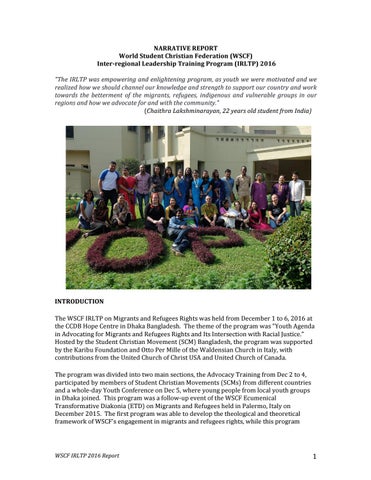
NARRATIVE REPORT World Student Christian Federation (WSCF) Inter-regional Leadership Training Program (IRLTP) 2016 “The IRLTP was empowering and enlightening program, as youth we were motivated and we realized how we should channel our knowledge and strength to support our country and work towards the betterment of the migrants, refugees, indigenous and vulnerable groups in our regions and how we advocate for and with the community.” (Chaithra Lakshminarayan, 22 years old student from India)
INTRODUCTION The WSCF IRLTP on Migrants and Refugees Rights was held from December 1 to 6, 2016 at the CCDB Hope Centre in Dhaka Bangladesh. The theme of the program was “Youth Agenda in Advocating for Migrants and Refugees Rights and Its Intersection with Racial Justice.” Hosted by the Student Christian Movement (SCM) Bangladesh, the program was supported by the Karibu Foundation and Otto Per Mille of the Waldensian Church in Italy, with contributions from the United Church of Christ USA and United Church of Canada. The program was divided into two main sections, the Advocacy Training from Dec 2 to 4, participated by members of Student Christian Movements (SCMs) from different countries and a whole-day Youth Conference on Dec 5, where young people from local youth groups in Dhaka joined. This program was a follow-up event of the WSCF Ecumenical Transformative Diakonia (ETD) on Migrants and Refugees held in Palermo, Italy on December 2015. The first program was able to develop the theological and theoretical framework of WSCF’s engagement in migrants and refugees rights, while this program
WSCF IRLTP 2016 Report
1
focused on developing skills in doing advocacy and campaign work on migrants and refugees rights. The program’s specific objectives were the following. 1. To increase the capacity of the SCMers for advocacy and solidarity work through an Advocacy Training Program at the international and local levels on Migrants and Refugees Rights; 2. To develop an Advocacy Campaign that would highlight the situation of the youth migrants and refugees intersecting with Racial Justice and create a advocacy plan on how their specific issues and concerns, such as education and employment can become key issues in the negotiations of Migrants Rights over-all; 3. To provide a space for sharing of advocacy needs and plans at the national level SCMs 4. To be exposed, to learn and participate in an actual global advocacy flat form (Global Forum on Migration and Development (GFMD). The training was attended by the following participants: Clare Hannah Wilkins, United Kingdom; Elizabeth Rueda-Herrera, USA; Gwladys Tenkeu Meikeu, Cameroon; Orjrado Alexis, Benin; Ibrahim Caro Amir Amin, Canada; Maria Ulloa Bonilla, Agentina; Lakshminarayan Chaithra, India; Naw Kree Moo, Myanmar; Kuyena Dindembolo Zaya, Canada; Monika Biswas, Bangladesh; Shaptoka Pinkey, Bangladesh; Endrila Soren Biva, Bangladesh; Godfrey Bitu, Isaac Sammander, and Edison Udjal. Participants Mrani Khanem from Syria and Salameh Manawel from Palestine were unable to join due to visa difficulties. The participants were joined by resource persons, Rev. Malcom Damon from South Africa, Dr. Aruna Gnanadanson from India, Mr. Mervin Toquero from the Philippines for the Advocacy Training and Mr. Aminul Islam from Bangladesh, Sophia Wirsching from Germany, Eni Lestari from Indonesia for the Youth Conference. WSCF staff facilitating the training program were Necta Montes, Luciano Kovacs and Sunita Suna. This report narrates how the program objectives were achieved by highlighting the contents of activities and some additional outcome emerging from some events and discussions in the program. This report was prepared by the staff, with contributions and inputs from IRLTP participants Lakshminarayan Chaithra and Caro Ibrahim. This narrative report is divided into the following sections: 1. Worship, Solidarity and Community Life 2. Biblico-Theological Reflections (BTR) 3. Advocacy Skills Training 4. WSCF and SCMs Advocacy and Solidarity Work 5. Exposure Program 6. Youth Conference on Migrants and Refugees Rights 7. Action Planning 8. Conclusions
WSCF IRLTP 2016 Report
2
HIGHLIGHTS OF THE PROGRAM 1. Worship, Solidarity and Community Life The Opening Worship was led by SCM Bangladesh at the beautifully appointed worship area of the venue, CCDB Hope Center. The ceremony and liturgy used Bangladeshi indigenous symbols, songs and dances. An interpretative dance by a young Bangladeshi woman depicted the journey of a migrant from the countryside coming to work in a foreign land only to be exploited by the recruiters and employers. A community building action and reflection on biblical text Revelation 7:9 was led by Isaac Sammander, SCM Bangladesh host leader. Using a video documentary about the life of migrating ants, worship participants were invited to reflect on the meaning and values of building a community as migrants. The worship ended with a community songs and greetings from the host and participants. The second day’s prayer and bible reflections were led by Zaya and Clare. Participants reflected on the biblical text Matthew 2: 13, which says “when they had gone, an angel of the Lord appeared to Joseph in a dream, “Get up,” he said, “take the child and his mother and escape to Egypt. Stay there until I tell you, for Herod is going to search for the child to kill him.” Zaya shared his reflections on this bible passage by reading the poem Deep In The Hunger by Howard Thurman, ending with a powerful text that says,“I abandon all that I think I am, all that I hope to be, all that I believe I possess. I let go of the past, I withdraw my grasping hand from the future, and in the great silence of this moment, I alertly rest my soul.” On the evening of the second day, the participants were invited to a Evening Fellowship with the SCM Bangladesh senior friends held at the YMCA in Dhaka City. The fellowship and fundraising event was organized by Shako, an organization established by senior friends to bring former SCMers together and support the SCM and community projects for the less
WSCF IRLTP 2016 Report
3
fortunate in the community. In that occasion, Shako was fundraising to help an SCM senior friend who was seriously injured from a vehicular accident, and to support children from a nearby poor community continue their school education. More than 100 families and friends of SCMers and senior friends came to attend the event in a festive and meaningful occasion.
The IRLTP concluded with the Solidarity Night prepared by the participants and attended by guests and students. It was a night where participants came together from all over the world representing their people and culture. The evening was full of joy and laughter, new friendships, extended chosen-family, and reunion of old friends. Caro Ibrahim, participant from Canada reflecting on the evening’s fellowship said, “we were there for less than a week and yet it felt like a lifetime of knowledge and unforgettable memories.” 2. Biblico-theological Reflections on Migration and Refugees The session on the Biblico-Theological Reflection (BTR) on Migration and Refugees was led by Dr. Aruna Gnanadason, SCM senior friend from India and former WCC Executive Staff. Aruna reflected on the biblical stories of Ruth, Naomi and Orpah, and their story of solidarity and community. “These stories in the Bible shows how God takes care of those who leave their homes to become aliens and strangers in foreign lands” aruna explained. She invited the participants to further read Exodus-Story of Moses, I Samuel: 22, 1 Kings 17:17, Act 1-8, the story of Ruth, stories of people moving and migrating to another place. In her introduction, she traced the history of the WCC’s deep engagement in refugees issues, predating the founding of WCC and its reason for existence. On migration, Aruna pointed out that “some development agencies and churches in Europe have not responded well to the issues of migration, though they have tried to support the struggles of refugees,” she added. Explaining that migration was not seen as an urgent issue in previous discourse but has already changed over time.
WSCF IRLTP 2016 Report
4
She added that “the refugee/migrant crisis is part of the broader system of injustice.” In explaining this point, she shared the story of a Kenyan woman in a refugee camp and the atrocities committed by the peacekeeping forces. She voiced the plight of women in camp who were subjected to violence from their own people. In concluding her session, Aruna said that the stories in the Bible challenges us as Christian activists working on migration and refugees to examine relationship with each other across the world and our understanding of Christian Hospitality. 3. Advocacy Skills Training The Advocacy Skills Training had two main components and resource persons, (1) Contextual and Theoretical Framework led by Rev. Malcom Damon; (2) Tools and Skills of Advocacy and Campaign Planning by Mr. Mervin Toquero. (a) Contextual and Theoretical Framework The first component was led by Rev. Malcolm Damon, Coordinator of the Ecumenical Justice Network (EJN) based in South Africa. Rev. Damon provided the contextual and analytical framework of doing global advocacy work. Through a very participative process of identifying and understanding global trends and realities, he elicited discussion from the participants on three main interrelated contexts: the political, economic, and social contexts. He also introduced cultural context and the concept of Intersectionality in analysing issues of class, race, and sexual orientation. At the end the session he discussed UN Convention on Migration and Refugees, with special reference to the Declaration on Migrants and Refugees Rights recently signed in New York. In his second session, Rev. Damon discussed some theories and practice of advocacy work. Advocacy has no single definition, but in some context, it means “influencing the decision, policies and practice of powerful decision makers to address underlying causes of poverty, bring justice, support, and good development”. He also discussed the concept of advocacy FOR, advocacy WITH, advocacy BY and how we understand these words in different contexts. He also added the spirituality of advocacy as core to the work of churches and ecumenical groups. He introduced the term Glocalization, the importance of the local within the global. He also talked about how advocacy is empowering those without power and seeking justice. He finished the session with advocacy strategies such as policy, campaigning, mobilization and media strategies. (b) Tools and Skills in Advocacy Work and Campaign Planning
WSCF IRLTP 2016 Report
5
This session was led by Mr. Mervin Toquero from the National Council of Churches in the Philippines (NCCP) and Coordinator of the Churches Witnessing With Migrants (CWWM). Mervin gave a definition of advocacy from his experience in the Philippines, the principles in advocacy work and skills how to plan an Advocacy Campaign. The basic principle is to advocate from specific standpoint, focusing on the poor and the marginalized people. Participants were told that the foremost thing that they need to do is to identify an issue and work towards specific goals. The following outline for Campaign Planning was shared: • Target an issue, set out plan though objectives and strategies. • Collect facts and evidences. • Real stories. • Advocate with victim. • Mobilization. • Understand the pulse of the audience. • Maximization of social media. • Network with other organization. • Influence those with power. • Alliance with the work. • Tit for tat action. • Reach the peak of the Campaign and restart the process by narrowing the objective. He also emphasized that the advocacy campaign should be from a specific stand point and should mobilize the resources in an efficient manner, he also pointed out that advocacy work is also confrontational. He gave an example of how the Universal Periodic Review (UPR) of the UNHCR were used as a tool to voice out systematic human rights violations around the world. To give an example of a successful Advocacy Campaign led by the churches in the Philippines, Mervin shared their experience in leading the Save the Life of Mary Jane Veloso Campaign, an international campaign to stop the execution of Mary Jane, a Filipina migrant worker on death row in Indonesia victimized by drug traffickers and illegal recruiters. In advocacy work, Mervin emphasized the need for a clear Campaign Plan to sustain the advocacy work and achieve its goal. “A Plan with a beginning and an end and most importantly, a specific standpoint focusing on the rights of the poor and the marginalized people.” WSCF IRLTP 2016 Report
6
4. WSCF and SCMs Advocacy and Solidarity Work As the WSCF Program Director of Advocacy and Solidarity, Luciano Kovacs revisited the WSCF Global Advocacy Plan. He explained how the action plans of the IRLTP fits into the Advocacy Plan over-all. Luciano also shared the history of WSCF Advocacy Solidarity Committee (ASC) composed of student representatives from the movements, the meaning and intentions of solidarity work of WSCF. Luciano pointed out that in WSCF’s experience, solidarity and advocacy should be together. Solidarity requires that advocates identify with “the other”. Solidarity goes beyond fairness, it seeks justice and asking the hard questions. Participants were given three questions to reflect on: 1. One item that I did not know? 2. One advocacy item your SCM is engaged with? 3. One item you would like WSCF to take up with? Participants were divided into group of three and various groups had come up with ideas as to how their SCMs were working on advocacy issues, and items that they wish WSCF to take up. The following were the reports from the small groups. Reports from the small groups discussion 1. New learning § To consider solidarity whenever Advocating no matter the field issue § Learn about Advocacy Platforms of Global, Regional and National context to consider Political, Economic and social issue. § The Biblical reflection regarding migration & refugee issue which helps us understand our responsibilities as Christians vis a vis refugees and migrants and motivates us to advocate for them. § Spirituality of advocacy § Advocacy in different levels § UN declaration on Refugees § Learned about NGOs and SCMs groups helping groups of young people to wake up and understand issues. § Listening to Malcolm’s analysis of militarization and profit links to oppression in the present system: all linked to economy. Want to learn more and explore this. § Learned about powerlessness but not about pity, moving away from feeling sorry for people. The situation is more complicated than simply removing someone from a situation; they then need support when they arrive in a new situation. 2. SCM advocacy work Cameroon SCM Fights against Corruption: the SCM is now member of the National Coalition Against Corruption (a coalition of SCO created within the National Anti-Corruption Commission). Myanmar SCM • Challenging for Rohingyas Emergency • The Role of Regional and International Actors
WSCF IRLTP 2016 Report
7
Bangladesh SCM
SCM India SCM Colombia SCM Benin SCM Bangladesh
SCM Canada SCM Britain
•
Violence Against Women at National Level
• • • •
Minorities Rights Violence Against Women at National Level Labour Migration Student Migration
Working with and for the upliftment of indigenous communities , Adivasi and Dalit people Working on Peace and vulnerable communities affected by the internal conflict Working for young women’ rights helping people from across the community with the issues they are experiencing. Supporting people from minorities. Sometimes getting support from Senior Friends if an issue is really challenging, and help with financial issues. Involvement with justice for indigenous people Works closely with the organization Student Action on Refugees (STAR), who work in various contexts with refugees and migrants in the UK and particularly in community centers Works closely with the organization Student Action on Refugees (STAR), who work in various contexts with refugees and migrants in the UK and particularly in community centers
3. Recommendation for advocacy work to WSCF • Economic empowerment and sustainability for refugees • Working for Rohingyas rights in Myanmar • Working for minorities Rights in Bangladesh • AP Region: Sometimes access to financial support can help us to continue our activism. • NA Region: More support with working with young LGBTQ+ refugees. • Europe Region: More structured opportunities for supporting refugees and migrants in the Mediterranean. • Create a huge network for students to find maybe jobs wherever it is available • Education of vulnerable communities and indigenous people all around Latin America • Support the upliftment of the Adivasi and Dalit women to sustain their ethnicity and sustain themselves socially and economically
WSCF IRLTP 2016 Report
8
5. Exposure Program The participants were organized in two groups for the exposure day, the first group visited the indigenous or Adivasi community organization known as Kapaeeng Foundation, and the second to an NGO that provides services and support to migrants and refugees called ACLAB. Exposure to meet the indigenous people was meaningful and overwhelming. We had been to KAPAEENG FOUNDATION headed by Pallab Chakma who is its Executive Director explained the various human rights violations faced by the indigenous people especially in relation to human trafficking, land acquisition, lack of legislative enactments to support them, emotional struggles of the indigenous community to overcome discrimination and political discord and various others. The visit was empowering and overwhelming. Another group visited ACLAB (Alliance for Cooperation and Legal Aid Bangladesh), an organization that focuses on Migrant Rights. ACLAB provides para-legal support, direct service, communication and information service such as radio program. During the visit, the participants met with Mohammed Ayoub, Abdoulaziz, Nasir Vodi and Abdullah, four migrant workers who traveled over 10 hours each to be with us and share their stories. They were all migrant workers at one time and they all shared how they were exploited. All of them are still in debt, paying off the money they borrowed in order to be released and come back to their families. 6. Youth Conference on Migration and Refugees Rights On the 5th day, the Youth Conference on Migrants and Refugees Rights was organized attended by young people from other youth groups in Dhaka. The Conference aimed to link the training program to the issues that were being discussed at the on-going UN global event that was takingplace in Dhaka, the Global Forum on Migration and Development (GFMD). Sophia Wirsching from Bread for the World gave a orientation and some critical view of the Global Forum on Migration and Development (GFMD) as a platform and process. She noted that very few know about the GFMD and its significance and was glad to share her knowledge and experience. Where we were told that the States would come together to discuss on the bilateral agreements, access to justice and access to work. These discussions at times would only remain only on papers and there was no transparency as to how beneficial these discussions were and as to what were the objectives and discussions in the conference between the countries. One of the important fact was addressed that the decisions of the GFMD do not have a binding effect and they are not under the control and supervision of any authority.
WSCF IRLTP 2016 Report
9
The second speaker of the conference was Mr. Aminul Islam from BRAC. He gave a comprehensive presentation on the status of Rohingya refugees and how their right to life was violated by the State forces and the Myanmar was focusing on cleansing this ethnic group. Elizabeth Herrera, participant from the US shared about her trip to the Nogales Sonora USMexico boarder with a group from WSCF. She shared about some of the grassroots organizations that work on Migrant justice in the area like Coalición de Derechos Humanos, an organization that is focused on all migrant rights no matter what their status is. In the afternoon, participants were divided into three groups with the following topics for discussion: Unemployment and Youth Migration, Youth Migration and Education, Young Women and Migration. Groups were asked to respond to the following questions: • What are the trends and impact of youth migration? • How do we respond to the challenges of migration on each topic? The conference ended with the Call to Action, presented by Eni Lestari, Chairperson of the International Migrants Alliance. Eni shared some of the realities of youth domestic migrant workers through her own experience and the work she does with IMA (International Migrant Alliance). What youth means and what are the hopes and expectations of youth. She talked about immature independency in youth. She explained what IMA is and how it came to life. She shared tools for migrants to defend ourselves/themselves and welfare from exploitation. She also shared her experience at the UN Summit for Refugees & Migrants. 7. ACTION PLANS from the Program (a) ACTION PLAN for Africa Region 1. Raise awareness and mobilize regional SCMs on refugees and displaced people rights (the phenomenon is increasing on the continent due mainly to political instability leading to war or terrorism). 2. In line with the higher education sector as mentioned in the concept note it is important to engage the region on research and data collection on the situation of Higher education in African countries. The state of higher education is closely related to migration in African countries where young talented citizen travel for studies and don’t come back. They are actually looking for more practical and pertinent curricula in a context where training doesn’t fit the job market. 3. Organize a Theological reflection and general consultation on IDD for the Africa region. (b) ACTION PLAN for Asia Pacific Region OBJECTIVE - Migration and Refugee issues: • Create awareness on status of refugees and migrants. • Enhance the capacity of SCMers on advocacy to prevent violation of the rights of the refugees and migrants. WSCF IRLTP 2016 Report
10
Local level: 1. SCM India is currently working on the racial discriminations issues in various regions particularly students coming from the Northeast- India and African students. 2. SCM Bangladesh will join NCCB, local churches and other migrant organisation and the CWWM-specific action plan for advocacy. 3. SCM Myanmar would aspire to work with the Ecumenical Forum on human trafficking . Regional Level: The regions are currently working on this issues in connection with the other supporting organisation International Migrants Alliance(IMA). Global Level: The Asia Pacific Region would propose to the WSCF- Global Advocacy and Solidarity Committee to take up the Rohingyas issue in particular. (c) ACTION PLAN North America, Latin America & Europe Campaign Issue: Migrant Detention Centers in Argentina Right now the Argentinian government wants to build a migrant detention center, we want to stop it before it is built. Objective: Create curricula How to advocate for migrants around issues of detention, racism, colorism etc. (How to raise awareness, and bring attention to those who are vulnerable to the media’s lies) Earlier we were talking about sharing resources, how can we in North America support Argentina/ other countries? What would it look like to put pressure on the media/ journalists to write stories about these issues, as they are coming up? Is this prison private or public, who's paying for it and where is the funding coming from? Do you know if migrants finish their education, or if they finish their education stay around or do they go back to their native lands after? What is the trend? But how is Argentina benefiting? There’s got to be a way that Argentina is benefiting from migrants that are coming over? Is the fact that migrants don’t have to pay fees to study in Argentina linked to some other political arrangement between countries? Argentina context: Public free education WSCF IRLTP 2016 Report
11
Workers have free movement and range (Argentina has open borders to all of Latin America under the govt.) Families can stick together Who is most at risk? People from specific nationalities (Peruvians, Bolivians, people from certain regions of Colombia- specific races (racialized language: “los que portan la cara’)- Colorism, Media reinforcing ideas of what's beautiful affecting those who are looked at well vs. these who are looked down upon, treated worse. Research and analysis - What is the history, it’s issue and general info - Campana del Desierto (genocide that occurred in Argentina) Primary and secondary aspects of the issues Primary: Criminalizing migration (building the jail) Secondary: Attitudes around migration - How govt.,media, and social media work together to perpetuate stereotupes of migrants (taking jobs, etc.), And reinforces individualism (separates us- emphasizing our differences, othering others so that there is a sense of unity or camaraderie - May be important for us to think about how global events are affecting these attitudes, as we are moving towards more right wing, conservative thought processes we are Identify allies and target primary and secondary levels, etc. (local, national, regional, international) Primary: Government Secondary: People who voted elected officials into office Broad: Corporations, Churches, LGBTQ orgs already doing work Messaging around campaign would have to be around how Argentinians benefit from migrants→ Need to find data to back up claims because often the thought is that “there is research to show that these people are committing more crime”) Local: Migrant organizations, socio cultural organizations National: CAREF Regional: § CISPES (Committee in Solidarity with the People of El Salvador)- Idea as § Migrante International § LGBTQ § Economic Organizations whose focus groups are southern countries International § Migrante International
WSCF IRLTP 2016 Report
12
§ §
G20 Nations How can Europe help? (Latino orgs in Europe? Spain?)
Identify Potential Outcomes and Results? Hopes: § For govt. to say that they won't open the prison § Change attitudes towards migrants § change/create policy (attitudes aren’t enough) to protect vulnerable peoples (students, children, women), create legislative change for this not to happen now and in future administrations § Bring awareness Strengths: § Network with ecumenical orgs. § Connections to/ with ALC Noticias § Papa Francisco
WSCF IRLTP 2016 Report
13
CONCLUSIONS AND LEARNINGS FROM THE PROGRAM Over-all the program achieved its objectives as narrated in this report. There are several points that can be highlighted from this report. • One of the most significant sessions for the participants was the Advocacy Training Skills, which contained both theoretical and practical. As advocates in their local SCMs, they are able to identify local issues and its connection with other social justice issues in the larger context of their communities. Ideas and tools on how to start and organize a local campaign and gradually build up into an advocacy work was also an important learning during the training. We were fortunate to have resource persons who were seasoned campaigners and advocates sharing their personal experience in their years of doing advocacy work at the local, national and international levels. • As a global fellowship of movements, participants became aware through their experience, the importance and value of advocating and working in solidarity with the other movements and groups. They also learned that WSCF and other platforms such as CWWM, IMA exist, where they can channel their local advocacy work knowing that other movements will be advocating in solidarity with them wherever they are in the world.
•
New and emerging issues came out from various discussions in the program such as: the need for intersectionality as a framework of analysis on the migrants and refugees (LGBTI, race, color for example) to include more groups advocating for migrant and refugees rights, the articulation of Spiritualty of Advocacy that is specific to church or ecumenical groups, responding to the challenge of building Migrant Detention Centers and decriminalization of migrants and refugees, the plight of so-called ‘stateless’ people such as Rohingyas and the Adivasi or Indegenous People.
WSCF IRLTP 2016 Report
14