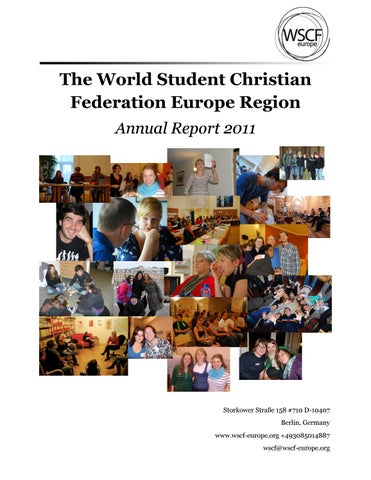
The World Student Christian Federation Europe Region Annual Report 2011
Storkower StraĂ&#x;e 158 #710 D-10407 Berlin, Germany www.wscf-europe.org +493085014887 wscf@wscf-europe.org
Greetings from the Chairperson
I am happy to present to you the 2011 Annual Report of the World Student Christian Federation Europe Region (WSCF Europe). The report gives an overview of our work, events and campaigns in 2011. You will also find a financial report showing our income and expenditure of the year. The highlights of 2011 include a conference in Läyliäinen, Finland on how technology affects our lives, a Lingua Franca summer camp in Bulgaria on human trafficking and a conference in Løgumkloster, Denmark on gender and language. WSCF was invited to participate in the 2nd Global Christian Forum in Manado, Indonesia. It was an amazing experience that gave the two European delegates an opportunity to look into a new framework for ecumenism as well as meet fellow WSCFers from around the world.
“Living in a World of Technology” Läyliäinen, Finland.
WSCF Europe was also invited to participate in the Summit of Religions for Peace European Youth Network, where a roadmap of work for the next three years was outlined. The Network is a rather new initiative with strong potential and commitment to bring together faith based youth organisations. We enjoy being part of this network with new and old partners, such as the European Youth Council of Europe, the Forum of European Muslim Youth and Student Organisations and the European Union of Jewish Students. In 2011, David Masters stepped down from the position for Regional Secretary. Katarina Babicova became the Regional Secretary Interim and will be in the office until July 2012. We thank David for his great and inspiring work. The European Regional Committee changed as well. At the European Regional Assembly in Løgumkloster, the term of many committee members came to an end and new people were elected in new roles. Many thanks to the people who have now become Senior Friends for their contribution to and many work hours for the federation! I also thank the people who have committed themselves to serving on the committee until 2013. The office moved from Budapest to Berlin so I would also extend my gratitude to the Hungarian SCM for hosting us for many years and for helping with the move. We are excited about our new location and we have been warmly welcomed by SCM Germany, Evangelische StudentInnengemeinde in Deutschland.
2
In the following report, where possible, we have included a precise cost for each our events, projects and publications. Where this is not possible, we have given an estimate. These costs are the full cost of the event, not all of which are included in our annual accounts as occasionally donors channel money through our member movements or pay costs directly rather than through WSCF Europe. In regards to our funds, we are grateful to all our donors. In 2011, we have received, as notified, for the last time support from our donors from among churches and church agencies in Europe. Funding from churches is vital to our work, both to maintain our Christian identity, and because our statutory funders require co-funding. If you are from a church or church agency, we kindly ask you to consider funding our work in 2012 and 2013 and get in touch with us through the regional office, if you are interested in hearing more. For more information about the daily life and work of the WSCF Europe, please visit our new website (www.wscf-europe.org) that was launched at the beginning of 2012. Here you will find blogs, photos and resources as well as documents from the European Regional Assembly 2011 and information about future events. Thanks again to all of you who contributed to our work during the year of 2011, through volunteering, participation, partnership, funding and support to our staff and volunteers. The work of WSCF Europe is indeed still a relevant and important encounter to the world anno 2012. We are looking forward to another year!
Sofie Vestergaard Eriksen Chair, WSCF Europe
3
Headline Projects Living in a World of Technology Programme: Location: Dates: Participants: Total Cost: Funders: Resources:
Culture and Higher Education Conference Läyliäinen, Finland 29 March – 4 April 2011 33 €23,427.11 Council of Europe, Finnish Ministry of Culture, and the World Youth Programme Mozaik 28: Living in a World of Technology September 2011
Social Media such as Twitter, Facebook and YouTube are fast becoming part of everyday life for young Christians. WSCF Europe gathered students and young people from across Europe in late winter at an Orthodox Summer camp to discuss the influence of new communication technologies on their daily lives. Through lectures, participant-led workshops, games and role-plays participants explored how they use social media, how they can use online tools as part of their faith, and to campaign for social justice. We asked: What would Jesus tweet? Does the Internet make everyone equal? Is it possible to worship God online? Lectures from Marko Siitonen, Tim Davies, Hannah Satlow and Martin Fisher led the group to a better understanding on the tools used for communication over time, campaigning and community building online, the gender biases found in the technological world and practical ways social media can help SCMs act online. Heikki Huttunen also led a workshop and lecture on the Finnish ecumenical experience.
4
Participants were involved in lively and interesting conversations the whole week: Mirka Bukovinska, 26, a Ukrainian Greek Catholic, wasn’t certain of that technology could play a meaningful role in Christian faith. "I believe there will always be a need for worship in real communities,” she said. “Communication in social networks cannot substitute real life communication.” Whereas Nino Kikvadze, 21, an Orthodox participant from Georgia, saw social media as having a crucial part to play in social change: “The Internet can make people equal,” she said. “It plays a big role in changing politics and society.” Even though consensus wasn’t reached everyone learned a lot from one another. Methodologies included practical and creative workshops led by experts and participants; panel discussions, video making; small discussion groups; and worships. During a visit to the Aalto University Media Factory participants met with professors, students and community members active in using social media for churches and nonprofit campaigns. The group was challenged to think about the ethical challenges of branding churches and using media tools for mission. An excursion in the city gave everyone a break from the intense discussions and lectures and allowed for exploring, museums and a bit of sightseeing on the winter streets of Helsinki.
5
Communicating Gender Programme: Location: Dates: Participants: Total Cost: Funders:
Resources:
Gender Conference Løgumkloster, Denmark 24-28 October 2011 35 €21,385.01 The Council of Europe, Youth in Action, Danish partners (Studentermenighede i Aarhus, Vandborg Menighedsråd, Roskilde Mellemkirkelige Stiftsudvalg, Aarhus Mellemkirkelige Stiftsudvalg, Haderslev Mellemkirkelige Stiftsudvalg, and Dioceze) Mozaik 29, Spring 2012
Communicating Gender isn’t the easiest topic to wrap one’s head around but through blogs, before the conference began, the Preparatory Committee helped participants to start thinking about whether God has a gender; how faith is influence by gender and how gender is influenced by faith; how gender changes when borders are crossed and when we enter the virtual world. Renato Lings (Denmark), Cecila Brynskov (Denmark), Heikki Huttenen (Finland), and Kathy Galloway (Scotland), led lectures and discussions that allowed the group to explore the differences between sex and gender, the psychology of language, Orthodox teachings of gender and the relationship between one’s faith and their gender. “What we have in common is a shared belief in the Truth. And for us the Truth has a name – God. Regardless of the language we address It with or our gender perception we assign to It.… ‘never truly known, mystery of mysteries, calling us Your own,’” reflected Gabriela Bradokova, 24, Slovakia, which encapsulates the conference and the atmosphere.
6
The conference offered many opportunities for students to learn about the topic from one another—as we are all experts when it comes to our gender! There were also many creative opportunities including a bible study allowing students to reflect on the story of Lazarus through art, dance, drama and music; a video making workshop; and a workshop comparing the gendered aspects of each person’s native language. During the excursion to Aarhus, one group’s visit to a modern art museum made room for discussions on the topic in relation to the art they saw. Others visited the local Student Christian Movement in Denmark to meet with students. The conference was held together with an intercultural evening (a casual sharing of traditions) and morning ecumenical and evening denominational prayer services. The closing worship, planned by students, was a moving time of prayer, each praying in their own language for one another and saying goodbye.
7
Building Sustainable Communities: A Europe secure from trafficking Programme: Location: Dates: Participants: Total Cost: Funders:
Lingua Franca Veliko Tarvnovo, Bulgaria 1-6 August 2011 22 €12,122.05 Kirk In Actie, Lunds Missionsssällskap, United Methodist General Board of Global Ministries
The WSCF Europe’s Lingua Franca Programme is aimed specifically providing opportunities to students and young people from Central and Eastern Europe to participate in cultural exchanges and engaged in language learning. Students and young people from Ukraine, Macedonia, Armenia, Azerbaijan, Moldova and Georgia gathered together to examine the idea of Sustainable Societies. To ensure that all participants felt able to contribute, the group agreed on the first day to use simple, clear English throughout the week and to be open to explaining differences in our understandings to each other in a respectful way. This attention to respectful dialogue lies at the heart of building sustainable communities, where participants can share and learn from each other. Gillian Wylie, outlined the current situation regarding human trafficking in Europe, and the various distinctions in relevant terminology. Torsten Moritz gave a clear overview of actions Churches and European Institutions have been taking towards addressing trafficking. Rumyana Doncheva described the real-life experiences faced by victims of trafficking. The challenges and struggles of women who are trafficked were highlighted by local parish priest, Fr Dobromir.
8
Participants took part in a simulation of a European anti-trafficking congress. They were assigned roles as policy-makers, NGO-officials, Church leaders and other special interests; the fireworks flew as they took the floor in a plenary session. A memorable excursion included a walking tour of the old city of Veliko Tarnovo, visits to two old Orthodox churches in the nearby hills and horseback riding at a local stable! The week featured daily prayer, themed around the topics of community-building and sustainability. Participants were encouraged to dip into their own variety of traditions to share in this prayerful space, which ranged from quiet and reflective to energetic and musical. Lively brainstorming generated many ideas that students can implement to raise awareness about the nuanced issues of Human Trafficking. A special session focused on building listening skills, a key element of bringing about change, gave tools to participants to advocate for sustainability in their own communities.
9
Universal Day of Prayer for Students Programme: Location: Dates: Total Cost: Funders: Resources:
Bible study, Prayer and Worship Service 105 countries around the world 22 March 2011 Unknown; no cost to WSCF Europe World Student Christian Federation interregional office and the World Council of Churches Bible study, video study and worship service available online
The Universal Day of Prayer for Students (UDPS) is one of the longest established ecumenical events, first celebrated in 1898. In 2011, the UDPS focused on the global WSCF two year campaign on Water. This year they worked closely with the WCC’s Lenten Campaign “Seven Weeks of Water” putting together a Bible and video study on the commodification of water. This year we celebrated on the 22 March as to coincide with World Water Day and prepared together with Ecumenical Water Network on the theme: Just Water: Common Prayer for Peace and Justice.
10
Leadership Training and Development European Regional Staff and Officers’ meeting Programme: Location: Dates: Participants: Total Cost: Funders:
Staff and Officers’ Meeting Swanwick, UK 4-8 February 2011 12 €3,995.27 Kerk In Actie
The staff members and officers of seven local movements in Norway, Finland, Poland, Slovakia, Denmark, Germany, and Britain joined together after attending SCM Great Britain’s annual conference “Still Small Voices” to follow-up the activities and thematic work that had taken place over the past year. “It was good to get to know how other people work and to know you aren’t alone,” one participant said. Having an opportunity to share successes and struggles is an important part of SCM staff development and is vital to building strong relationships and partnerships in the region. It was also exciting to be part of a local movement’s event to learn how SCMs run their activities. Using various styles of workshops, role-plays and reflections this year’s meeting focused on meeting student’s needs, envisioning the ideal SCM, learning about ecumenical worship and also getting constructive tips and techniques on engaging with social media and working on fundraising strategies.
11
Member Movement and Sub-Regional Projects In Partnership with WSCF Europe
Heart Beat Youth Congress and Kirchentag 2011 Partner: Location: Dates: Participants:
EYCE and Kirchentag Dresden, Germany 31 May -5 June 2011 63
Young people from Central and Eastern Europe shared each other’s presence in Dresden, Germany before the German Protestant Kirchentag began. The topic was a challenging question: “What does my heart beat for?” and directly linked to the main theme of Kirchentag – “…there your heart will be also,” taken from the Sermon on the Mount (Matthew 6:21). Participants stayed together in a hostel-boat on the river Elbe discussing issues that are important and that young people are passionate about. This included, but was not limited to: migration, Christian identity and student voices in the Egyptian revolution.
Still Small Voices Partner: Location: Dates: Participants:
SCM Britain Swanwick, UK 4-6 February 2011 130
Participants focused on prayer at this year’s conference. Exploring how to listen for God’s ‘still small voice’ and to share what it means to be still small voices of peace and justice in the world. Christ was encountered in new and unexpected places – through meeting with others (many new faces were present), exploring different approaches to prayer, walking the prayer train, meditating, talking over meals and during free time, and of course, lots of singing! Nicola Slee and Ken Leech brought new perspectives through their keynote speeches. Senior Friends enjoyed the group as well as met together for the second time at the annual conference. The WSCF Europe Staff and Officers participated in this event as a precursor to their Staff and Officers’ Meeting.
12
Partner Events Attended by representatives of WSCF Europe
“Connections” Partner: Location: Dates:
Conference of European Chaplains Debrecen, Hungary 13-18 June 2011
Chaplains from across Europe travelled to Hungary to discuss the theme: “Connections” in their ministry: connections to God, connections to students, connections to churches, and connections to one another as chaplains. As a partner representative WSCF Europe sent one person to attend the meeting to learn more about the role of chaplains in Europe and their organisation. There is hope to continue working closely with this network.
Agape – Work Camp and Political Camp Partner: Location: Dates:
Agape Ecumenical Centre, FGEI Prali, Italy 1-8 August 2011
For one week, young people from every continent gathered for collective living, to examine the topic "Transform a culture of violence into a culture of peace-justice" and to address the question through intercultural and interreligious dialogue. Throughout the week they served to raise consciousness about current geopolitical conflicts, explore strategies for resistance, and generate global connections amongst a diverse group of participants from not only Europe. Two WSCF Europe representatives were at the event and blogged about their experience.
13
Council of European Churches Associated Members Partner: Location: Dates:
Council of European Churches Brussels, Belgium 11-12 January 2011
The associated organisations of CEC have met for a day to discuss the cooperation within the CEC and their inputs into CEC revision process as well as meet with the representative from the Church and Society Commission of CEC.
Religions for Peace, European Interfaith Youth Network Youth Summit and Interfaith Advocacy Training Partner:
Religions for Peace
Location:
Warsaw, Poland
Dates:
16-18 September 2011
About 20 young religious leaders from across Europe, representing, among others, Buddhist, Christian, Jewish, Muslim, Sikh and Zoriastrian faiths met in Warsaw. Sofie Eriksen, the Theology coordinator, represented WSCF-E at the strategic event for the network.
14
Publications and Resources Mozaik Copies: Cost: Funder:
700 of each issue (Stop Being Silent!, Climate Justice Now!, Living in a World of Technology) €7,112.51 Included in the relevant conference budget
Mozaik (est. 1992) is the flagship publication of WSCF Europe through which we share the resources and ideas developed at our conferences. As such, the themes of Mozaik follow the themes of our conferences. It is written and edited by students and young people, and reflects the diversity of our members from all Christian denominations in Europe.
E-Newsletter Subscribers:
1,500
Our monthly e-newsletter updates our members and member movements on the work and activities of WSCF Europe. We invite readers to take part in campaigns, events and partner events
Website Cost: Funder:
€2193 European Youth Foundation
In 2010, WSCF Europe started developing a new, interactive website. It’s launch date is set for January 2012. There were some preparations and trainings completed in 2011.
Social Media In 2011, WSCF Europe regularly participated in Twitter and Facebook as a more accessible way to share our news with anyone interested in our work. We also joined Flickr; uploading over 1000 pictures from conferences and events we’ve participated in since 2004. Also, we are using YouTube for interactive, creative workshops – posting videos from events and conferences to share with those at home. WSCF’s Ning network launched in 2010 (wscfconnect.org), continued to grow and has over 500 members. 15
Governance & Statutory Meetings Staff Members Regional Secretary: Interim Regional Secretary: Lingua Franca Co-ordinator: Publications Intern: Mozaik Editor-in-Chief: Hungarian Assistant:
David Masters, UK (to September 2011) Katka Babicova (from September 2011) John Delap Ireland/USA (volunteer) Jill Piebiak, Canada Paweł Pustelnik, Poland Balazs Kalydy, Hungary
European Regional Committee until October 2011 Chair: Vice-chair/Links: Treasurer: Culture and Higher Education: Gender: Solidarity: Theology: Global Executive Committee: Global Executive Committee:
Myroslava Bukovinska, Greek Catholic, Ukraine Katarina Babicova, Roman Catholic, Slovakia Matthew Gardner, Anglican, UK Maximilian Karrash, Protestant, Germany Paul Crome, Protestant, UK Vaida Krisciunaite, Protestant, Lithuania Sofie Eriksen, Protestant, Denmark Hannah Satlow, Protestant, Austria Marco Fornerone, Protestant, Italy
European Regional Committee from October 2011 Chair: Vice-chair/Events Coordinator: Treasurer: Events Coordinator: Campaigns Coordinator: Links Coordinator: Fundraising Coordinator: Global Executive Committee: Global Executive Committee:
Sofie Eriksen, Protestant, Denmark Zuzana Babicova, Catholic, Slovakia Libby Lewin, Protestant, UK Marta Varnagyi, Protestant, Hungary Shannon Phillip, Catholic, UK Sophie Lønne Hundebøll, Protestant, Denmark Kristin Kobl, Protestant, Germany Vera Papp, Catholic, Hungary Marco Fornerone, Protestant, Italy
16
The outgoing European Regional Committee at the European Regional Assembly in Løgumkloster, Denmark .
The incoming and outgoing European Regional Committee and WSCF Europe staff in Løgumkloster, Denmark .
17
European Regional Committee Meetings Dates: Locations: Participants: Cost:
14-20 January 2011 Prague, Czech Republic 12 €2,350.24
21-23 October 2011 Løgumkloster, Denmark 9 €3,295.04
Meetings of the European Regional Committee, who oversee the work of WSCF Europe. The regional committee is made up of nine student volunteers and three staff members.
Board Meetings Dates: Locations: Participants: Cost:
13 January 2011 Prague, Czech Republic 4 c. €800.00 per meeting
Meetings between Regional Secretary, Chairperson, Vice-chair and the Treasurer of WSCF Europe, who oversee the work of the European Regional Committee.
European Regional Assembly Dates: Locations: Participants: Cost:
29-30 October 2011 Løgumkloster, Denmark 43 € 7,000.00
Every two years representatives from Affiliated, Associated and Contact movements of WSCF Europe gather together to vision and discuss the future two years of the region and to elect members of the European Regional Committee. You can read the minutes, new Policy Paper for 2011-2013, new Vision and Mission Statement and the Resolution on our website.
18
Global Staff and Officers Meeting Dates: 16-24 June 2011 Location: Geneva, Switzerland Participants: 9 A meetings of the WSCF Staff and Officers, who oversee the work of WSCF staff and Executive Committee. The six regional secretaries, the General Secretary and officers were all present to discuss their work and meet with partners and funders.
Meeting with EYCE Dates: Location: Participants: Cost:
29-30 April 2011 Brussels, Belgium 3 c. â‚Ź700.00
A meeting between the treasurer and general secretary of WSCF Europe and the general secretary EYCE (Ecumenical Youth Council in Europe) to both plan future cooperation for fundraising and events.
19
Finances Income WSCF Inter-regional Office European Youth Foundation EU/EACEA ICCO & Kerk in Actie Lund Missionselskab GBGM WCC0-WYP/Diakonisches Werk Participation fees Other (Finish Ministry of Education, donations)
23,186.85 31,714.00 49,956.00 10,000.00 1,922.45 7,654.34 10,379.00 4,727.00 12,101.00
Total
€151,641.00
20
Expenditure Salaries
39,452.59
Office Costs
17,001.57
Events & Campaigns
52,868.00
Membership fees
73.02
Staff Expenses
6,115.06
Governance
5,350.45
Publications
7,112.51
Miscellaneous
14,972.00*
Total
â‚Ź145,106.00
* A significant part of the Miscellaneous section is a repayment of â‚Ź11,173.87 to the European Commission after an audit done on the 2007 accounts.
21