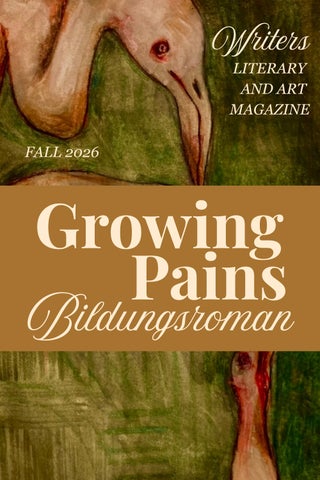
Writers
LITERARY AND ART MAGAZINE
FALL 2026
Growing Pains Bildungsroman
WRITERS Senior Editors Nandita Kumar Catherine Leach
Editors Reem Alshaban Amineh Zakarneh Samantha Zavala Gigi Giangiobbe Journey Vergara Layla Decker Nikki Park Rieve Randall Sarah Valenzuela
Advisor Prof. John McDonald
Cover Design Catherine Leach
Cover Image Sophia Sayer
Writers Logo Designed by Reece Smith
Writers Photo Evan Guerra
Fall 2026 University of Portland
i
Table of Contents Letter from the Editors
iii
Collected Works Columbia Pool
Lidia Tellez Flores
1
Greatclipz
Catherine Leach
2
to be precise
Sarah Valenzuela
3
Midwinter Son
Catherine Leach
7
The Mother’s Burden
Sophia Sayer
8
birdpath
Catherine Leach
9
Sonic Drive-in, 2012
Quin Hall
10
American Dream
Lidia Tellez Flores
15
Arizona Summer
Sophia Sayer
16
A Mosaic of Memory
Jonizza Giovanna Lupi 17
Getting Older
Jonizza Giovanna Lupi 19
The Girl in the Bleachers
Sarah Valenzuela
21
La Ultima Vez
Lidia Tellez Flores
24
Los Colores
Sophia Sayer
25
Motherhood
Jonizza Giovanna Lupi 26
Forever
Anh Do
28
You Weren’t There
Sophia Sayer
29
About the Contributors
30
About the Editors
31
Acknowledgments
34
ii
Letter from the Editors Dearest Friend of Writers, As summer sinks into fall, nature slips into a restful hibernation. But just below, earth prepares for renewal. This state of change, of shift, is what inspired our Fall 2026 theme, “Growing Pains - Bildungsroman.” The word is a combination of two German nouns, with “Bildung” meaning education, and “Roman” meaning novel. This word charts the story of a character as they walk through the different stages of life. And as our contributors exemplify, this looks different for everyone. Perhaps you may find your story in Jonizza Lupi’s, “Motherhood,” a conversation between herself and her mother as she continues to grow, almost in spite herself. Or, maybe you find yourself in Quin Hall’s “Sonic Drive-In, 2012 ,” where a young child begins to gain consciousness around what patriotism truly means. Many of our submitters found the act of mothering in this semester’s theme. The cover photo of this magazine was created by Sophia Sayer, and is titled “The Mother’s Burden.” It depicts the feeding practice of flamingoes, and straddles both maternity and death, giving, and taking. Jonizza Lupi’s “Motherhood” is an ode to a different time and place, both an apology for aging, and a reconciliation in knowing that it is a natural truth. These two pieces form a conversation between the “grower” and the “grown,” as one finds their truest form and the other supports and releases them. Some of our other contributors experienced a most uncomfortable growth as their bodies began to shift. Editor and contributor Sarah Valenzuela discusses what it means to be looked at in a different way as her body travels closer to the social ideal in her piece “to be precise.” As we continue to grow into our new roles as Senior Editors of Writers Magazine, we keep everything we have learned from past Senior Editors close to our hearts. Our growth would have been a lot more painful without the help of Valencya, Camille, and Clara. Bildungsroman is a theme that Writers has had in mind for a few semesters now, proposed by Writers’ 2024-2025 Senior Editor, Camille Kuroiwa-Lewis. We’d like to thank Camille for lending us this word. As you move through this collection, open yourself up to change. Allow it to shape your understanding of the world around you, and of yourself. Remember the childhood that made you who you are today. Remember how the wind felt on your face as you pedaled your bicycle, bruised knees bumping against that cold, steel frame. Feel it again. Nandita Kumar & Catherine Leach Writers 2026-2027 Senior Editors
iii
“I think people’s hearts have always been the same, happy and sad, and that hasn't changed at all. It’s just the shape of lives that change, not the lives themselves.” — Brian Doyle, Mink River
v
Columbia Pool Lidia Téllez Flores
My arms would reach out into your depths Fingertips gliding across your incessant surface Muscles straining with every push and pull Holding my breath to stay underneath you My body pruned, always thirsty for more Skin doused in that addicting chlorinated scent You would hold me on my back, arms spread I would hold my breath to flow with you Domed ceiling hiding us from the world I would dive down under, into your deepest parts Letting myself sink to be one with you Lungs burning from every breath you’d take And now you’re gone, yet my arms keeping reaching out for you I hold my breath every time I smell you on my skin
1
Greatclipz Catherine Leach
Mixed media sketch of myself as a young child; bad haircuts, and growing out of them.
2
to be precise SARAH VALENZUELA
It is said that a girl becomes beautiful in summer, as though the season were a competent tailor, taking in the waist, shortening the hem, removing whatever excess has offended the prevailing fashion. At twenty, I returned from Europe, which had not improved me so much as furnished me with photographs in which I appeared to have been elsewhere. My hair, previously committed to five years of length, was cut. It was made blonde. Over the preceding year, my belts had slowly crept across their eyelets with the quiet efficiency of an account properly settled. People began to say beautiful. They said it in grocery stores, at parties, in doorways, with the pleased surprise of naturalists discovering a familiar species in more acceptable plumage. I said thank you. This was not insincere. The smile was.
3
The smile said: you have mistaken the measurement for the thing measured. At seven or eight, I had a new bathing suit. This is important. It was not a hand-me-down whose elastic had acquired the moral character of exhaustion. It was new. I wore it to the pool with the serious expectation of a child who has not yet learned that beauty requires witnesses. The lifeguard did not look. I had thought he might. It was not a verdict. It was a lifeguard. One should be precise. Two or three summers later, the mothers of my brother’s friends noticed the mole beside my mouth. Cindy Crawford, they said. They meant it kindly. But Cindy Crawford was a supermodel, and I was ten, which seemed an important distinction and was somehow overlooked.
4
A mole is unremarkable until a woman makes money from having one. Then it becomes evidence. At fifteen, summer was less interested in bathing suits. There are summers that leave behind photographs and summers that leave behind a silence in the family archive. Some griefs are so deep that drowning becomes the more accurate metaphor. Still, the body floated. Every few summers, I decide that no one will ever marry me. I have no evidence. The evidence, in fact, has occasionally suggested otherwise. But girls can construct elaborate futures from remarkably small samples: a glance, a silence, a mirror after midnight, a bathing suit. The mind is an industrious clerk. Give it three facts and it will invent a biography. Perhaps beauty was never the event I mistook it for.
5
Perhaps there were only summers in which I was differently observed. The child in the new bathing suit was not less beautiful because the lifeguard was inattentive. The ten-year-old’s mole did not become beautiful by association with Cindy Crawford. The fifteen-year-old did not become ugly by suffering. And the twenty-year-old, blonde, smaller, recently returned from the Alps, receiving compliments with a smile she did not trust, did not become beautiful because the arithmetic had finally pleased the room. She merely became visible to a particular kind of person. One should be precise.
6
Midwinter Son Catherine Leach
she was born on the day of the man’s last breath, born as a serf to the son of her flesh he wept for the swill that came from her breast chapped, red, and rusty was every vertice bitten, mangled, and void in her rigor mortis she was born on the day of the man’s last breath eyes, rolling back, saw the blood on her lap then, born a serf to the son of her flesh she wept at the swill that flowed from her breast chapp’d, red, and swollen, was the whole “she.” love for the blood blooms despite her distress her red meat smile shone brighter than death
7
The Mother’s Burden Sophia Sayer
Uses dark lighting and dripping, blood-like liquid to exaggerate a common feeding practice by emphasizing the underlying dynamics of how the food is passed down through the flamingo mother.
8
birdpath
Catherine Leach
You were born in the beak of a thrush dirt and color, a life painted blue Ended One stanza joins another in absent birdsong outside your window from the telephone pole, from the walnut tree, from the next room over. Melodies of rot and must of springtime of autumn of frost Empty birdsong fills the cold the chickadees have all gone the cardinals, turned blue And the thrush followed the butterfly…
9
Sonic Drive-In, 2012 Quin Hall
Her name was Reagan, after the president. I was seven, she was six, or at least, we were around those ages. I remember sitting with her in the back seat of an SUV, about to leave for Sonic Drive-In. There, the waiters wear roller skates and skate out to the little booths to serve you. You call in your order on a speaker, (similar looking to those speakers on playgrounds: clogged with dust and bark chips. I loved pushing slivers of wood into the small holes that you talk into. So did every kid, which was why it was rare to find a working set of speakers. But when they did work, you could talk across the playground, a whisper carried through the twisting piping...) and when you called in your order, you could pick from a menu of about ten different meals. Juicy burgers, with a golden, buttery sheen on the buns; fries that would crumple into your mouth, containing a soft potato mess that you could almost suck out of the breaded exterior; chicken tenders, served with ranch or buffalo sauce. But to be honest, I can’t remember the meal I chose. I can’t even remember details about the trip, or anything about Sonic other than the novelty of roller skating waitresses and the dull, plastic sign hanging above each booth. As I remember, Sonic was out in the middle of nowhere, far away from the center of Medford. It was on the outskirts of town. The area around it was still undeveloped. Brown grasses, scorched by the summer sun, waved lazily in the breeze, and lizards darted from rock to rock. I’d imagine that was what Boise, Idaho looked like. I remember hearing that Reagan and her family were moving to Boise, Idaho. Everyone always tied the city and the state together. To say Boise would be to suggest that it was a place that could be visited. The addition of the state made it seem like somewhere far away. And no one just said Idaho. Clearly, there was something special enough about Boise, Idaho, to make the city a relevant detail to explain to an eight year old.
10
Her dad was a trucker, and he rarely saw her. So they were moving to Boise, Idaho, hopefully to see him more often. I sometimes pictured him, driving down the road, “Life is a Highway” playing on his speakers. That’s what all truckers listen to. I knew it from the movie “Cars”, the first movie I ever saw, but I liked it because I could picture myself meandering across the United States in an eighteenwheeler big rig. My mom had a couple of songs in this genre that she would play for us on an old CD, taken from a worn fabric case. Carefully loaded into the minivan’s CD player, Life is a Highway blasted alongside Cotton-Eyed Joe and Centerfold. The songs were all twangy, upbeat, maybe even folksy? I felt like it was music I could strum a banjo along to. Those songs remind me of an image I saw once, in my Grandpa’s rural church, stapled to the eggshell-white wall. A drawing of a kid, his body traced with a trembling hand, smiled out of the page. He wore Woodland Camo and carried an M16 rifle. Below him, letters highlighted in crayon read, “God bless our troops.” The picture hung in Sunday School, a place designed to introduce hard concepts to little kids. I remember hearing stories like the Great Flood, Lot’s wife turning to salt, seas of blood flowing in the endtimes... they all weren’t watered down (at least, most of them). But such events didn’t seem unusual either. I knew evil things happened, and I knew that justice prevailed in the end. And compared to those stories, a little soldier boy felt tame. It feels like those pictures used to be more common. I remember talking with friends from school who had dads or brothers overseas. The kids always spoke about their family members with this reverent glow; like soldiers were superheroes. The wars, too, had a similar tone. I heard about Afghanistan and Iraq, and to me they seemed just as far away and mysterious as Boise, Idaho. I can’t remember my parents ever talking about the wars, though. Most of my early childhood felt like that picture, or at least, the late summers did. My backyard was filled with cicadas: the locust-like insects left their shells hanging from every surface when they molted. We would spend all day collecting the cicada shells, piling them up in
11
heaping stacks on the kitchen counter.
Late at night, I’d lie on my bed, looking at the wall as it slowly turned redder and darker with the setting sun, the loud hum of the cicadas scratching their wings together matching the buzzing heat creeping through my pajamas. There was this strong sensation of raw spirit in the air. It was freedom, not in any abstract sense; not like I read in my political science books now. And looking back on it, it wasn’t even freedom in the way that some people say it, with bravado leaning into jingoism. It was this emotion of having at the same time nothing to do and so much to do. With it came a childlike sense of purpose, of clarity of action. I could choose to run away to Brazil, I could be a scientist or an author or a captain, I could survive in the woods with nothing but a hatchet. There was a constant fullness in my chest, a swelling of total support behind me, and the powerful notion that freedom itself was totalizing. When I read about it now, as an adult, I’ve heard some characterize that sensation as one that swept through the American people during the post-9/11 sense of national unity. Of course, I know the urge gripping me in 2012 was more than a decade late to the party, but perhaps the “people’s mandate” hadn’t fully dripped away yet. But I don’t think I felt that way because of any national rigor sinking its way down to the smallest citizen. Perhaps the strongest reason I felt that spirit was because I was little. As a kid, everything seems different. You’re a bit sheltered from life. You don’t know what is really going on. But you’re still able to be tapped into the spirit of the world around you; perhaps better than adults can be. Sometimes that feeling was stronger than the adults around you recognized. I was sitting next to my Grandpa in Medford’s airport, feeling the plastic chair dig into me as I squirmed to get comfortable. The news was playing on a small TV mounted from the ceiling, and I was glued to it. I rarely got “screen time”, so I would watch TV any time I could, no matter the channel. It typically all blended together in a whirl of adverts and talking heads, but this time was distinct. I watched as the camera panned from a brunette reporter to a field, surrounded by ornate buildings. I couldn’t understand what she was saying, due to
12
the noise of the planes taking off around me and the people bustling
by, but I watched anyway. In the center of the field, over the shoulder of the reporter, was a large scorched spot, gently smoking. Firemen slowly walked around the blackened grass, holding fire extinguishers. The reporter finished speaking, and a recorded clip of what had occurred flashed onto the screen. A video, recorded from a bystander’s phone, showed a man standing in the spot that, in the reporter’s segment, was darkened with soot. In this video, the grass was still the brownish-green of late summer. The man stood steadily, his feet planted firmly into the ground, as he raised up a red gallon container. It looked just like the one we used to fill up our lawnmower, stored in our garage and reeking with the acidic stench of gasoline. As he lifted it, liquid splashed down over him, spilling into his eyes and soaking into the ground around him. I watched as he coughed, or stuttered, the whole time, eyes flat. The grainy footage made his real emotions hard to capture. I believe he was saying something, or maybe he stayed stoic, but either way I couldn’t hear over the tinny airport speakers. He threw the container at his feet, and it tipped over, dripping slightly. With eyes steadily facing forward, he brought his hand to his side. Fire sprang from his fingers and gently started lapping its way up his waist. Within seconds, the man became a bonfire, the flames consuming him and turning his skin the same color as the grass under his feet - an ashy black. But the phone camera was blurry, and as I watched, the tender flame turned into rough pixels, clawing their way over the pyre’s flesh. The clothes, draped loosely over the man’s tense shoulders, seemed to melt into him, becoming little black squares that clouded the screen. I leaned around, trying to catch a glimpse of what his burning skin looked like in a fit of morbid curiosity, but the grey, orange, and black pixels covered everything. And when I asked why the pixels were on the screen, my Grandpa stopped staring grimly at the TV, turned to me, and told me, in his somber, scratchy voice, that it was too gruesome to show on live television. Some things aren’t meant for people to see, and many things aren’t meant for little kids to see. To see a man burn alive is
13
something that cannot be conveyed through a TV screen. Now, as I think back about that time, I wonder about the decision to pixelate the burning man. A part of me thinks, if the man was willing to light himself on fire, if he considered his movement to be more important than his own life, he deserves to have people see the full truth. I still don’t know the motivation behind his suicide. But the self-immolation had its own message. Sometimes people, sometimes even kids, need to see that justice doesn’t always prevail in the end. Sometimes it’s important for people to see bombed out houses, or dead kids, or civilians shot in the street. These things happen regardless of whether there is attention to them or not. But to see that would be to tell the kid that Boise, Idaho, is just another city that had good job opportunities. It would be to tell them that soldiers aren’t always superheroes. It would be to tell them that the “spirit” of the world is just a feeling based on one’s sheltered experience. So the TV stays pixelated, and the trucker’s family never moves to Boise, Idaho, and a kid can still dream of a warm sun reflecting off glistening French fries and the sound of cicadas drumming their wings to the beat of a little soldier boy marching. Oh, where did you come from, where did you go? Where did you come from, Cotton-Eyed Joe?
14
American Dream Lidia Téllez Flores
I have never had a dream quite like this one, one everyone always mentions but I can never see. My parents claim to have moved mountains, traversed the cursed blue waters that lure you in like sirens, they recount the monstrosity that is the Desert, that in her dry and bright beauty wanted to show them how she felt, but they never closed their eyes. My parents who speak broken English, who look at your mouth when you pronounce words they can’t spell, who nod along when you overexplain the feeling of that thing- you know the inferiority Papi feels when he picks me up from school, the flood of white faces hiding the only brown one he has sacrificed everything for, because how do you translate words that don’t exist in Spanish? I have never seen a dream like that before, the one you call “American”. All I see are the swollen feet of my father, riddled with blisters, the tired eyes of my mother after coming home from her second job, brown skin worn, overworked, hardened yet still pliable. You tell me I’m living this dream, but at my house there’s no white picket fence, there are no family days of parents hugging each other, sitting on the couch, there are no neighbors with faces the same shade as mine. When I close my eyes I dream of work, the exhaustion, being hidden in plain sight, a hunt on my parents for walking along the desert, fifteen hours on their feet through sand that slips through fingers, the faded faces of their family on the other side. I dream in a language never spoken, one of freedom, one my people mention, but I can never see.
15
Arizona Summer Sophia Sayer
Acrylic paint and paper doilies on found cardboard. The paint was unmixed, and the paper doilies were painted over, then removed to create texture and shape. The piece focuses on warm, saturated, unblended colors of orange, yellow, and red that make up the sky and sun. This creates contrast with the deep blue silhouette of wildflowers.
16
A Mosaic of Memory Jonizza Giovanna Lupi
My childhood room is a mosaic. The bubblegum pink walls, cherry-red sheets, the white metal bed curling like vines around the place where I first learned to dream. Every object is a piece. The piano at my feet, hidden beneath its music-note cover. The guitars and ukuleles sleeping against the wall, still holding the songs I strummed. Books spill from every shelf. The plush toys remain on top of the dressers, soft with years. Above my bed, angels and crosses keep watch over me beside my sister’s paintings, pieces of another childhood, another girl becoming herself beneath the same roof, neither of us knowing we were already becoming memories. Perhaps that is what growing up is. The process of becoming a collection of rooms I can never enter in quite the same way again. Every year, another tile. A new book, a new song, a new photograph, another version of myself pressed quietly into the walls.
17
And now I understand why museums preserve what time tries to take. Because memory is fragile. Because becoming is a form of breaking. Because sometimes the pieces only make sense when you step far enough away to see what they became. Still, I lie beneath the same white bedframe, surrounded by everything I have ever loved, and wonder how a room can hold so much of a person without ever asking which parts of her she is ready to leave behind.
18
Getting Older Jonizza Giovanna Lupi I’m getting older. In the stillness of the night, shadows whisper fears, a chill that wraps around my heart, bringing forth silent tears. The thought of dying haunts me, a specter in the dark, an end to all I’ve known and loved, a final, silent mark. Growing up feels like a race, each day a fleeting chance, to grasp the moments slipping by: to love, to laugh, to dance. But time is a thief: it steals, it takes, it flies, and leaves me with a hollow ache, a longing in my eyes. I feel things so intensely, each emotion a brewing storm, a tempest raging in my soul, a fire that keeps me warm. But with this depth of feeling comes a heavy, aching pain, a fear that all will slip away, like tears washed by the rain. I’m running out of time, it seems: to do, to be, to dream. The days rush past in a blur, like water in a stream.
19
Yes, nothing lasts forever, this truth I know all too well, the beauty and the sorrow, the Heaven and the Hell. Yet in this sadness there is a truth. a bittersweet refrain, That life is precious, fleeting, a balance of joy and pain. I’m getting older, time is slipping away, I’m scared of what my future holds but maybe that’s okay. I’ll cherish every moment though it breaks my heart to know: nothing lasts forever, and one day, I must let go.
20
the long corridors of grass between games. I ran through all of it, from one brother to another, from the field, to the stand, from watching to being needed, as though childhood were a place with no walls and I had been entrusted with all its keys. The park was near home. It was also the first place I understood that home could be.
Nothing happened that would interest a newspaper. No one changed the score. The game continued. But there are moments when the self arrives without ceremony, when a child discovers the outline of her own body by refusing to step outside it. There was a summer when my brother’s team lost and I had my first kiss. The two facts have remained beside each other for years, not because they belong together,
There was a summer when a boy was cruel and I discovered that standing still could be an act of motion.
but because memory does not care what belong together.
I stood up.
It puts defeat next to desire.
It keeps the bitter beside the sweet.
It teaches us early that life does not wait for one feeling to finish before beginning another.
22
There was a summer that seemed to last forever. Heat rising from metal. Dust whitening the shoes. A field extending under a sky too large to have an opinion about the children beneath it. The team went farther than expected. The adults called it unlikely. The children simply played. Perhaps this was another lesson: that the future is most visible to people who have already grown old enough to name its possibilities. Children have no such obligation. They run toward what is in front of them.
23
La Ultima Vez Lidia Téllez Flores
Abre tu boca y saca la lengua enseñame todos los lenguajes que sabes hablar. Cuando fue la ultima vez cuando tu corazon te hablo? La luz escondida dentro de ti, todavia te habla en Español? Cuantas veces te han demandado que te quedes callada? Cuantas veces has tenido que traducir tu idioma para otros? Hoy sera la ultima vez. Esto es solo para ti. Abre tu boca y saca la lengua enseñame los lenguajes que sabes hablar.
24
Created on a small piece of cardstock and built up with vibrant colored pencil details on a watercolor backdrop.
Artwork
25
Los Colores
Sophia sayer
Motherhood Jonizza Lupi
You kept every tooth, every outfit, but you couldn’t keep the weight of me asleep on your chest, the way my whole hand once fit around your one finger like it was the only thing in the world worth holding. I was the last baby you ever rocked at midnight, though neither of us knew it while it was happening. Somewhere in a night you don’t remember exactly, you put me down for the final time and picked up a girl instead––and never once got the baby back. You will spend the rest of your life loving someone who used to fit in the crook of your arm and doesn’t anymore. That’s not loss, exactly. There’s no accident in it, nor is there a single moment to point to and blame. It’s just what it means to raise the youngest one-– you knew, with me, there’d be no next baby to soften the ache of watching this one grow. So you had to be the one to close that door, gently, on purpose, with your own two hands.
26
I’m sorry I grew up. I’m sorry I couldn’t stay small enough to carry. Somewhere under all this height and years is still the girl whose whole hand was once the size of your one finger, still the weight you used to know by heart. Even though I may not remember, you were the first place I ever felt safe, and I was the last place you ever got to be someone’s whole world, before I learned there was even a world at all. Somewhere there is a version of you still holding a version of me that neither of us can get back to–– Her, asleep. You, awake, memorizing a weight you didn’t know you’d spend the rest of your life trying to remember.
27
Forever
Anh Do
Acrylic on canvas. Reflection on the repression of gender expression.
28
You Weren’t There Sophia Sayer
I’m an inconvenience to the village. You keep the water from crashing against my stilted house—hold back the waves as if I am something worth saving: something people say they want but never keep. Something they promise to protect until the keeping becomes too much. If we could stay this way forever, I think I’d be complete. But I know relief is only temporary. And so the grass turns brown, and the sheep lie in the ground. The water rises all around, climbing the stilts, swallowing the sound. Yet it holds me close—for a little while, I let myself believe that being held is the same as being saved. You didn’t know when the tide came in. You didn’t hear the water clawing at the wood, didn’t see the sky split open, didn’t feel the ground disappear beneath the weight of the storm. And when the water rose, I thought of you. I thought you would come. I thought you would know. But you were not there to see the house begin to sway, to hear the water take me away. You weren’t there when the tide came in and I was swept up in the storm. Because you weren’t there. You weren’t there.
29
About the Contributors Anh Do (they/she/he), Ah-nn Doh. Proper noun: 1. hobby collector 2. artist at heart who finds beauty in every face they’ve met 3. fully dressed up to go to the grocery store Catherine Leach (she/her), [kah·thuh·rin lee·ch], proper noun: 1. bad at self-definition; 2. midwest princess; 3. cat enthusiast. See also definition for ‘Editor.’ Lidia Téllez Flores (she/her), li-dee-ya te-yes flo-res, proper noun: 1. lover of all shades of green; 2. wool socks; 3. Bonded to an overly sleepy chihuahua Sarah Valenzuela (she/her), [sare·uh vah·len·zwah·lah], proper noun: 1. reformed theater kid; 2. cherry tomato enthusiast; 3. speaks less German than she thinks she does. See also definition for ‘Editor’. Sophia Sayer (she/her), soph·e·a say·er, proper noun: 1. loves clementines but tolerates oranges, 2. who is an 'interesting date', 3. well-seasoned tangent and bit creator. See definition for 'enigmatic'. Quin Hall (he/him), [kwin hall], proper noun: 1. one who beats dead horses, 2. retroactive thinking avoider, 3. literary device purchaser. See also definition for ‘fence-sitter’.
30
About the Editors Amineh Zakarneh (she/her), [uh·mean·uh zuh·car·knee], proper noun: 1. invested in the female reproductive system 2. date lover, both romantic and fruit 3. currently powering up as summer inches closer... and closer... Catherine Leach (she/her), [kah·thuh·rin lee·ch], proper noun: 1. bad at self-definition; 2. midwest princess; 3. cat enthusiast. See also definition for ‘nerd.’ Gigi Giangiobbe (she/her), [jee·jee ji·ahn·ji·oh·beh], proper noun: 1. has a very active amygdala; 2. hates homophobic lighting almost as much as homophobia; 3. enjoys obscure references that only 5-10% of people will understand. See also definition for 'only child’. Journey Vergara (she/her), [jur·nee vehr·gah·rah], proper noun: 1. notso-secret fangirl; 2. compulsive color coordinator; 3. jack of all whimsical trades. See also definition for ‘tough cookie‘. Layla Decker (she/her), lay·la deck·er, proper noun 1. food review doom-scroller 2. eclectic music lover 3. definition dissenter Nandita Kumar (she/her), [n·uhn·d·ee·t·ah kuu·maar], proper noun: 1. Kilgharrah (of the Clark Library Service Desk); 2. always talking about her grandma; 3. is whooshing down the big metal slide in the Columbia Park annex right now if you’re free. Are you free? Nicole (Nikki) Park [nik khol (nih kee) pah rk proper noun: 1. Merlin (of the Clark Library Service Desk) 2. was searching for a dimension without time, now I'm stuck in this glacier 3. Katabasis planned for the Spring if you'd like to come Reem Alshaban (she/her), [ree·m all·shuh·bahn], proper noun: 1. a noisy mind in a quiet body, 2. the local romantic oddity, 3. will insist on sharing her snacks with you. See also definition for ‘yearning.’
31
About the Editors Rieve Randall (he/him), [ree·v ran·dull], proper noun: 1. walker of dogs; 2. short n’ sweet; 3. lover of the great outdoors. Samantha Zavala (she/her), [sam], proper noun: 1. sweet treat lover; 2. dad joke connoisseur; 3. google sheets enthusiast Sarah Valenzuela (she/her), [sare·uh vah·len·zwah·lah], proper noun: 1. Sam Seaborn’s biggest fan; 2. probably watching MTV’s proshot of Legally Blonde the Musical; 3. misses silent reading time. See also definition for ‘middle child’.
32
The Fall 2026 Editorial Board, photographed by Evan Guerra
33
Acknowledgments Writers is never a singular effort, and we are immensely grateful for the support of the following people: Professor John McDonald, our trusty faculty advisor, for giving us constant encouragement while simultaneously allowing us the space to make and fix our own mistakes. Our contributors, for their amazing poems, musings, and art pieces. Writers simply would not exist without you and is better because of you. And, most emphatically, the Spring 2026 Writers Editorial Board, for their adaptability, creativity, passion, and patience.
Submission Policy Writers Magazine accepts submissions of original creative work by current students of the University of Portland. These works include but are not limited to short prose, poetry, short plays, photography, visual arts, and cartoons. All submissions are evaluated by the editorial board. Submissions are kept anonymous throughout the evaluation process.
34
University of Portland Department of English 5000 N. Willamette Blvd. Portland, OR 97203