VOLUME 46 | NUMBER 1
MAGAZINE OF THE WRITERS’ GUILD OF ALBERTA
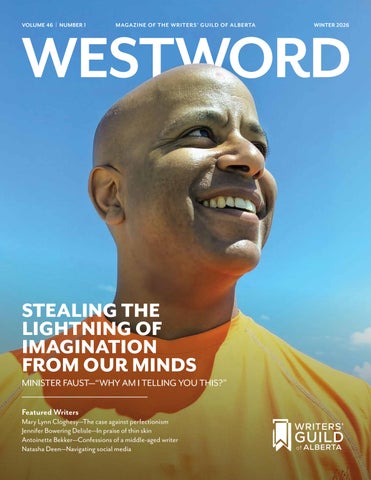
STEALING THE LIGHTNING OF IMAGINATION FROM OUR MINDS
MINISTER FAUST—“WHY AM I TELLING YOU THIS?” Featured Writers
Mary Lynn Cloghesy—The case against perfectionism Jennifer Bowering Delisle—In praise of thin skin Antoinette Bekker—Confessions of a middle-aged writer Natasha Deen—Navigating social media
WINTER 2026
February 22–28, 2026
CONTENTS
WESTWORD VOLUME 46, NUMBER 1 | WINTER 2026
12
14
FEATURES
8
TRUMAN CAPOTE'S UNANSWERED PRAYERS
Mary Lynn Cloghesy
12
ON WRITING, EXERCISING AND TOOTING
Antoinette Bekker
14
ON REJECTION AND ENVY
Jennifer Bowering Delisle
16
THROWING POTS, BUILDING CHARACTERS
The case against perfectionism
Confessions of a middle-aged writer
16 COLUMNS 2
Editor’s Note Raymond Gariépy
3
Why Am I Telling You This? Minister Faust
4
ED’s Note Giorgia Severini
5
Note From The Board Anne Bailey
6
Write/Right: Law for Writers Jeananne Kirwin, K.C.
In praise of thin skin
“ We pot and we write, we align clay cells and we synchronize words.”
Jean Crozier
18
WHAT’S YOUR WRITING STYLE?
Onyinye Odih
DEPARTMENTS 19
Question to Members “ What books written by Alberta authors have you discovered and loved?”
20
The Business of Writing Natasha Deen
Maintaining your unique voice
THE COMMUNITY 24
We gratefully acknowledge the support of the Alberta Foundation for the Arts; the Edmonton Arts Council; Calgary Arts Development; The City of Calgary; the City of Edmonton; Canada Council for the Arts.
18
27 28
Member News New WGA Members Donors & Sponsors
COVER PHOTO: MINISTER FAUST, SELF-PORTRAIT
EDITOR’S NOTE
SETTING GOALS FOR 2026 We support and advocate for all writers and provide opportunities to grow and connect while enriching Alberta’s culture and economy. WestWord is published four times a year. ISSN: 0821-4203 © Writers’ Guild of Alberta, 2026 WGA Membership Rates $95/year; $65/seniors; $45/low income; free to post-secondary students until graduation. Membership is open to all writers resident or formerly resident in Alberta. WGA Executive President: Anne Bailey Vice President: Anna Wagner Treasurer: Judith Clark Secretary: Kendall Bistretzan Members at Large: Jenna Butler Megan Jamieson T.F. Pruden Natalie Simpson Member at Large (Youth Rep): Aubrianna Snow Past President: Colin Martin WGA Staff Executive Director: Giorgia Severini Program and Events Coordinator: Jason Lee Norman Program and Operations Coordinator: Ashley Mann Program & Fund Development Coordinator, Southern Alberta Office: Ashley Frerichs Communications Coordinator: Nisha Patel Member Services Coordinator: Mike Maguire WGA Contractor Horizons Coordinator: Mila Bongco-Philipzig WGA WestWord Editor: Raymond Gariépy Assistant Editor: Ashley Mann Layout & Design: Jason Bell Printing: nexGen Grafix Inc. Please notify the WGA office immediately of any address change. Writers’ Guild of Alberta Percy Page Centre, 11759 Groat Road Edmonton, AB T5M 3K6 Ph: (780) 422-8174, Fax: (780) 422-2663 Toll-free: 1-800-665-5354 Email: mail@writersguild.ca Website: writersguild.ca Southern Alberta Office, Calgary Email: ashley.frerichs@writersguild.ab.ca Submission queries can be sent to: editor@writersguild.ab.ca
RAYMOND GARIÉPY Based on what the writers featured in this issue of WestWord say, in the year ahead we’d be wise to protect our creativity; reflect on whether we are obsessed with perfectionism; nurture our physical and mental health, and our wellbeing; celebrate being thin-skinned; and, read books by Alberta authors. The first task is to heed Minister Faust’s call to “defeat” the AI (Artificial Intelligence) overlords stealing the “lightning of imagination from our minds” (“Why Am I Telling You This?”). His opinion piece is supported by 29 references that provide insight into how the tech industry mines our words for maximum profit. He closes on a hopeful note and a strategy: “The tech-masters haven’t won yet. Let’s network our creativity into action to ensure they never do and build the world we all want.” Complementing Minister Faust’s view is Jeananne Kirwin’s update on AI litigation (“Write/Right: Law for Writers”). She cites the outcome of the American class action suit, Bartz v. Anthropic, as an example of copyright owners taking on Anthropic. Although the settlement affects few Canadians, it “represents a victory for all writers,” Kirwin writes. On perfectionism Mary Lynn Cloghesy’s feature article, “Truman Capote’s Unanswered Prayers—The Case Against Perfectionism,” is a cautionary tale. Capote “considered himself a genius,” she writes. His obsession with perfection blocked him from finishing Answered Prayers, which he believed would be his masterpiece. Perfectionism is complex and multi-faceted, Cloghesy says. At its worst, it is a “condition that requires intervention and an assortment of strategies.” On exercising Antoinette Bekker believes in staying fit through exercise. That was before COVID-19. She states: “… with the pandemic over, facing an existential crisis of menopause and middle age, I became a writer.” Bekker discovered that “Engaging the physical core is not a feature of writing a book.” Writing and not exercising daily came at a high cost. “The more I write, the fatter I get. Writing equals eating.” One solution (not wishing to toot too loudly) is: “Let it out. Let it all out.” On envy Jennifer Bowering Delisle discusses how success is defined in the world of writing and publishing. “The language and mindset of free-market capitalism infiltrate the art world,” she writes. To succeed, writers must “build and be a brand.” Rejection can lead to writers envying writers who succeed. This is not good, she warns. To counter the fallout from rejection, she engaged with creative communities and began to “reexamine how I want to think and talk about writing and publishing.” On insight, uniqueness and business advice Drawing parallels between shaping clay and sculpting characters is the topic of Jean Crozier’s article. Onyinye Odih emphasizes the importance of never letting go of your unique voice. Natasha Deen offers advice for writers navigating the nebulous world of social media. On reading Albertans WestWord invited members to share the books they are reading by Alberta writers. Their responses offer a glimpse into the variety of books being penned in our own backyard. What better antidote to the winter blues than to sit with one or two of the recommended books? I welcome your comments about this issue of WestWord magazine. You can reach me by email at editor@writersguild.ab.ca.
THE WRITERS’ GUILD OF ALBERTA
2
WHY AM I TELLING YOU THIS?
AI OVERLORDS ARE STEALING THE LIGHTNING OF OUR IMAGINATION MINISTER FAUST
J
ust for now, forget that AI could physically annihilate human civilisation and our species, which the Turing Prize-winning “Godfather of AI” Yoshua Bengio has warned.1 Also, ignore how AI is currently inflicting a massive cost on our biosphere, even if OpenAI techno-oligarch Sam Altman2 is lying3 about that.4 And look away when people ask AI for answers, which yield useless,5 absurd,6 dangerous,7 or even lethal8 and suicide-encouraging9 suggestions, as well as racism10 and lies.11 Instead, let’s focus on how AI is destroying the human soul. Don’t get me wrong. AI can assist space exploration12 without risking the lives of astronauts, thereby eliminating the ecological cost of sending humans into space. And AI is an unprecedented blessing through the medical science and technology13 it’s driving that will reduce suffering while expanding lifespan and health span. So how is AI a threat to the human soul? Because it’s a billionaire scam to replace human ingenuity and, as Noam Chomsky says, is “basically high-tech plagiarism”14 and “a way of avoiding learning.”15 By typing in an AI “prompt,” consumers receive “writing,”16 “art,”17 code,18 and advice19 that neutralizes the human requirement to solve problems and create solutions alone or together. By offering an endless, instantaneous, hyper-customized supply of “writing” and “art,” it attacks our inherent need to create and express ourselves. And by providing such products, it destroys the market and livelihood—and therefore the dreams—of artists. Why devote years to becoming excellent at a dead vocation? Yes, there’ll always be a devoted few who’ll cobble together the skills to make,
for instance, swords and chain mail armour. But without a thriving community of weaponsmiths and armourers—and enough buyers for their work—there has been little momentum in katana, ōdachi, and wakizachi, or aventails, coifs, and hauberk creation in centuries. (If you Googled those terms, I rest my case.) AI can’t learn because it doesn’t think or know things. So, it doesn’t “train on” our data—it copies our work, without permission or compensation, to produce smoothies of our literary, visual, or other styles with any ingredients it can steal. “More King with that, sir? And a sprinkling of Patterson? Try our brand new Rushdie infusion?” And AI does so to enrich billionaires who admit that their scam isn’t profitable without pillaging our work20 (imagine stealing Teslas and telling the dealership your driving isn’t “economically sustainable” without “improvised property reassignment”), all while destroying the environment (which the UN opposes with this plan21) while Altman lies (a tech-oligarch deceiving us? Who could have predicted that?) about the water-stealing,22 giga-profitable (eventually?23) biospheric24 doomsday25 that he and his fellow AI overlords are quickening. Why should anyone bother to read something that someone else couldn’t be bothered to write? Or gaze at the “paintings” no one could be bothered to paint? We make art because doing so advances our skills in a never-ending loop, enriches our understanding and even love of whatever we’re depicting, and connects us with other creators and audience members for whom our work is vital. Art connects human beings and thereby helps create—not a disconnected splatter of isolated consumers—but communities of people who cherish and dream to create and sustain the same futures. If there’s no human on the other side of the phone, then 3
we’re connected as grotesquely as is the unliberated Neo, sleeping away his life in an amniotic Matrix prison cell—connected by a mechanical umbilicus dripping just enough nutrients to keep him supplying power to those controlling everyone. So, to quote the immortal Rocket Robin Hood, “How do you fight this creature? An illusion with intelligence? A malignant vision with a will of pure evil?” (Hyperbole? Remember the biosphere-destroying part? And replacing active human creativity with mindless consumerism?) It may not be too late for adults, but it’s definitely not too late for kids. Teachers can inspire students to write for the same reasons adults want to write and students are already writing (and communicating through video-, art-, game-, graffiti-, fashion-, cuisinecreation and more): to express their ideas about themselves, their experiences, their relationships, and their world. For the unfortunates who see education as the miserable price for survival-employment (and to buy a menagerie of crap they don’t need and which doesn’t make them happy26), our educational systems must shift from soulless “book-learning” to experiential learning27 that is proven to improve book learning, especially for reluctant readers.28 How many people want to learn breakdancing, baking, gardening, or Japanese ju-jutsu by reading a textbook and then proving their “knowledge” by writing a test? Wouldn’t people rather do these things? And when they fall in love with them, don’t most people spend their own time and money learning about them more, including through reading? Until provincial departments of education make that shift, literally any teacher can,29 and the more teachers who do, the greater the momentum when they communicate their victories to parents and the public. The tech-masters haven’t won yet. Let’s network our creativity into action to ensure they never do and build the world we all want. Links to sources cited in this article appear on page 23. Minister Faust is an award-winning novelist best known for The Coyote Kings of the Space-Age Bachelor Pad, and an award-winning journalist who’s currently a science and technology writer for New Atlas. WINTER 2026
ED’S NOTE
HONOURING STEPHAN V. BENEDIKTSON GIORGIA SEVERINI EXECUTIVE DIRECTOR
Welcome to the new year! While I hope everyone had some free time for their writing goals over the holiday season, I know how rough it can be between the end of daylight savings time and winter solstice, when it gets dark earlier and earlier. As Albertans, we may feel it’s part of our culture to remain productive through the dark winter days, but no writer should feel guilty for taking that time as a restorative break, and return to writing in the new year when the light starts returning. In October, we received the sad news that Stephan V. Benediktson, a long-time supporter of the Writers’ Guild of Alberta (WGA) and our Stephan G. Stephansson Award for Poetry, passed away. He was a dedicated supporter of the arts, literature, and Icelandic culture, including the preservation of the legacy of his grandfather, the Icelandic poet Stephan G. Stephansson, for whom our poetry award is named. Stephan was a pleasure to have at our awards celebrations. He was always eager to meet the award winner and shake their hand, making sure each winner felt appreciated and honoured. He would bring an entourage of family members to the gala each year, and always complimented WGA staff on the event. I enjoyed our conversations both at the gala and over the phone, because not only was his enthusiasm contagious, I also learned new things from Stephan, like the conventions of Icelandic surnames. He encouraged me to visit the Stephansson House Provincial Historical Site in Red Deer County, which is a restoration of his grandfather’s 1927 home, complete with his writing desk. (Try not to be jealous of the writing office!) I’m happy that I visited Stephansson House with my young son a few years ago. Stephan was thrilled to see my photos. If you haven’t been to Stephansson House, paying your first visit would be a great way to honour Stephan Benediktson’s memory, as well as the chance to witness a piece of Albertan and Icelandic literary history. All of us at the WGA are grateful for Stephan’s support over the years. He will be missed. I also want to thank everyone who donated to our holiday giving campaign, as well as all donors who supported the WGA throughout the year. Our membership and demand for programs and services grew in 2025, while our operating grants remained stagnant; therefore, we are grateful to donors for helping us expand our resources to meet the needs of our growing membership. Plan to join us at our annual conference this year, June 6–7, 2026, at the Wyndham Edmonton Hotel and Conference Centre. We are excited about the theme, Growing Craft & Community. The conference will provide opportunities for emerging and established writers to connect with and support each other. Our Alberta Literary Awards Gala will take place on June 5, at the same venue, as a kickoff celebration. We look forward to seeing you at both events at the midpoint of a great year of writing!
THE WRITERS’ GUILD OF ALBERTA
4
NOTE FROM THE BOARD
GOVERNMENTS MUST DO MORE FOR WRITERS ANNE BAILEY PRESIDENT OF THE WGA BOARD OF DIRECTORS
In early October, my husband and I were driving along Ireland’s beautiful Dingle peninsula when we stopped at an out-of-the-way museum dedicated to a small, Irish-speaking community that once made its home on the Blasket Islands until its evacuation in 1953. Recently rebuilt, the museum’s architecture provides spectacular views of the islands and coastline. We were surprised to discover that the museum’s primary focus is writing and storytelling, highlighting the literary impact on Ireland’s culture of the surprising number of extraordinary writers who once called the Blasket Islands home (islandinstitute.org/islandjournal/the-legacy-of-irelands-great-blasket-island/.) I shouldn’t have been surprised. Throughout our travels around Ireland, literary culture was a constant theme. In Dublin, we saw the famed Book of Kells, visited historic libraries, and toured the Museum of Literature Ireland, where a first edition of James Joyce’s Ulysses is displayed reverently. A couple of days later, we found ourselves climbing the cramped stairs of the Martello tower featured in the autobiographical opening pages of James’s novel. Working our way around the island nation, we poked around many of the bookstores and libraries that abound in every city, town and village. Almost all of them featured sections devoted to Irish writing. For such a small nation, Ireland has produced an incredible number of exceptional, internationally renowned writers. There are several theories as to why, but there is little doubt that enthusiastic public support and pride, as well as strong government funding, are important pieces of the puzzle. Funding for the arts in Ireland far outstrips Canada. In 2025, government investment in Ireland’s Arts Council is 26 euros per capita or about $42 CAD. Currently, Canada’s federal government funds the Canada Council at about $8.75 per capita. Alberta’s population is comparable to Ireland’s. But again, spending on the arts is not, with current government funding to the Alberta Arts Council under $7 per capita. Canada and Alberta should obviously do more to support writers and other artists. (“Seven charts that show the state of arts funding across Canada,” J. Kelly Nestruck, The Globe and Mail, October 17, 2025: theglobeandmail.com/culture/article-charts-data-arts-funding-canada/.) A couple of days after my return from Ireland, several Writers’ Guild of Alberta (WGA) board members and I attended one of two receptions hosted by the Canada Council for the Arts (CCA) in Calgary and Edmonton. Members of the CCA board, along with the executive team, were in Alberta for in-person meetings; the receptions were also a critical part of their agenda. Last February, the CCA launched The Alberta Initiative, a two-year strategy dedicated to addressing “historical funding imbalances experienced by Alberta’s arts communities,” and they wanted to highlight that work. At the receptions, we met the two CCA arts liaison consultants, Francine Cunningham and Michelle Schultz, hired to lead this initiative. They are tasked with increasing engagement and collaboration, and improving Albertan artists’ and arts organizations’ success in attracting funding across the full range of CCA programs. What will this initiative mean for Alberta’s writers? Ideally, Alberta writers, as well as organizations like the WGA, will receive similar levels of federal support as do their colleagues across the country. We hope to see significantly more support in terms of mentorship through the grant process and higher rates of success in grant competitions. To realize the potential benefits of The Alberta Initiative, it is critical that WGA members have the opportunity to connect with the CCA arts liaisons, and I am pleased to report that WGA staff are working with them to create those opportunities. This will include seminars and workshops. Please watch WriteClick and the CCA’s website for details in the coming months. 5
WINTER 2026
WRITE/RIGHT: LAW FOR WRITERS
BEST TIMES, WORST TIMES
And high time for an AI litigation update JEANANNE KIRWIN, K.C. This information is of a general nature only. It does not constitute legal advice or create a solicitor-client relationship. The reader should seek advice from a lawyer pertaining to any particular fact situation. It was the best of times, it was the worst of times… —Charles Dickens, A Tale of Two Cities May you live in interesting times. —A traditional blessing or curse.
I
n February 2025, only two lawsuits had been filed in Canadian courts against artificial intelligence (AI) developers. Those were discussed in the first part of this explainer on AI lawsuits (“A Tale of Two Cities, WestWord, April–June 2025) in which, for the benefit of this column’s literary audience, a semblance was noted between the duo cities of Dickens’ novel, and the lonely couple of tech defendant lawsuits filed in Canada. Since then, over a dozen new cases have been filed here. Unlike the first two, most of the new lawsuits are class actions. Whether these are the best of times or the worst of times, it’s definitely high time for an AI litigation update, and information about class actions generally. A class action is a type of civil litigation in which one or more claimants, or plaintiffs, file a lawsuit on behalf of a larger group, called “the class.” The plaintiffs claim class members have all suffered a similar harm caused by the defendant or defendants in that action. Class actions have several advantages. Possibly chief among them: this form of claim allows individuals to combine their resources against a typically large defendant. Class actions make it feasible for the Davids of an industry (such as writers) to confront their Goliaths (such as the multinational, well-funded platforms). Another benefit of class actions from the courts’ perspective is that they afford an efficient means to resolve THE WRITERS’ GUILD OF ALBERTA
similar claims in a single proceeding, thereby conserving scarce court resources of time and judicial availability. And from a societal perspective, class actions often serve as a deterrent to corporate wrongdoing. Risk of loss can lead to settlement and alternative resolutions (such as licensing). On the downside, class actions are expensive and time-consuming. That they are not filed frivolously emphasizes the relevance of the surge of recent class action filings in Canada. If a class action succeeds, the court award proceeds are shared among the class members. Although the well-known American class action Bartz v. Anthropic concluded in the fall of 2025 in an outof-court settlement, it illustrates the strategy: Each member of the defined group (certain copyright owners who had registered copyright in their works at the U.S. Copyright Office within a certain time frame) became entitled to share in the settlement amount of $1.5 billion (USD), or about $3,000 (USD) per class member. Although few Canadian authors would benefit from the Anthropic settlement, and the legal principles influencing the settlement were not Canadian, the case nevertheless represents a victory for all writers. First, it shows at least one AI developer perceives that a viable claim of copyright infringement arises when copyright-protected works are ingested without licenses to train large language modules. It also represents an industry mindset shift in favour of the individual over the tech giant. And it sets an example of a sizeable sum (even though the amount claimed was much higher) to compensate creators. 6
The superior trial courts of every province, and the Federal Court of Canada with certain types of claims, have a class action procedure. Procedures vary slightly yet follow a similar path. To initiate a class action, the representative plaintiff files a statement of claim, and a motion to allow (“certify” or “authorize”) it as a class action. The court then assesses whether the claim should proceed as a class action. Some questions the court will ask: Is the class clearly defined? Do the claims have common issues? Does the representative plaintiff represent the interests of the class? If the certification (common law provinces) or authorization (civil law province of Québec) motion succeeds, then the court will direct that notice be given to all potential class members, allowing them to opt out of the class action. Failing to opt out generally constitutes a decision to remain within the class. The parties then proceed to trial, following which the court rules on the success of the claim. Within Canada, the most favoured venues for class actions are the British Columbia, Québec and Federal courts. Both Québec and B.C. have plaintiff-friendly rules for court approvals. Unlike most jurisdictions in which judges typically apply the rule that the loser pays the winner’s costs in a certification hearing, the B.C. and the Federal courts rarely follow that rule, which lowers the risk for plaintiffs. Meanwhile, Québec has low to no court filing costs, again reducing plaintiff risk. Compared to American courts, certification thresholds are more easily met in Canada. Plus, the Canadian Copyright Act allows plaintiffs to elect substantial statutory damages ranging from $500 to
WRITE/RIGHT: LAW FOR WRITERS $20,000 (CAD) per infringed work instead of proving actual losses. (What you need to know about class-action lawsuits, Canadian Lawyer, canadianlawyermag.com/practiceareas/litigation/what-you-need-to-knowabout-class-action-lawsuits/365201) At the end of 2025, none of the class action lawsuits filed against AI developers and tech companies had yet been certified. However, some developments occurred in the cases filed in 2024. Here’s a summary: The most newsworthy lawsuit was filed in Ontario by a consortium of Canadian media companies against OpenAI. The defendant, the ChatGPT developer, argued that Ontario courts had no jurisdiction to hear the matter, and asked for the trial to be moved to its home base, California. One motivation for OpenAI’s position, besides the relative simplicity of certifying class actions in Canada compared to the U.S., is
that the American doctrine of “fair use” may provide more leeway for OpenAI’s contentscraping activities than the similar, but not parallel, Canadian doctrine of “fair dealing.” In November 2025, the Ontario court ruled that it does indeed have jurisdiction over the class action filed by the media consortium. “The fair and efficient working of the legal system in Canada favours allowing Canadian authors of Canadian-created works with claims against foreign companies for breaches of Canadian copyright and other laws to pursue those claims here,” wrote Justice Jessica Kimmel.
Copyright Office does not examine copyright applications but issues certificates of registration once online application forms are correctly completed, copyright in several works created by AI have been registered in Canada. This case does not pit an aggrieved creator against an allegedly infringing AI developer but seeks court approval of the position that only a human can create works capable of copyright protection. The parties have filed their documents and await the court to set a date for a hearing. (CIPPIC v Sahni | Projects | CIPPIC, cippic.ca/ourwork/cippic-v-sahni)
Progress has also been made in a unique type of copyright case filed in 2024 by the Canadian Internet Policy and Public Interest Clinic at the University of Ottawa. The clinic requests the Federal Court to expunge or amend a Canadian copyright registration naming an AI program as the co-author of an artistic work. Since the Canadian
Whether it’s the best of times, the worst of times, or high time, we certainly live in interesting times. Jeananne K. Kirwin, K.C., an Edmonton lawyer, practices in the areas of intellectual property and corporate/commercial law with an emphasis on trademark and copyright registration and enforcement (emeryjamiesonllp.com).
AI COPYRIGHT INFRINGEMENT A non-exhaustive list of cases in which copyright infringement is asserted by creators against tech companies Parties
Date of filing
Court
CanLII (Canadian Legal Information Institute) v. Caseway
November 2024
B.C.
The Canadian Press, Toronto Star, Globe and Mail, Postmedia and CBC/Radio-Canada v. Open AI
November 2024
Ontario
April 2025
Federal
MacKinnon v. Anthropic PBC
June 2025
B.C.
Mark Gagné v. Stability AL Ltd., Midjourney, Inc., Google LLC and Runway AI, Inc.
August 2025
Federal
Anne Robillard v. Meta Platforms, Inc.
Clare et al. v. Meta Platforms, Inc.
MacKinnon v. Meta Platforms Inc. and Facebook Canada Ltd.
March 2025
April 2025
Michael Dean Jackson v. Meta Platforms, Inc., Facebook, Instagram, WhatsApp, et al. James Bernard MacKinnon v. Nvidia Corporation
July 2025 August 2025
James Bernard MacKinnon v. Databricks Inc. and MosaicML Inc.
Québec
B.C. B.C. B.C.
July 2025
B.C.
Taras Grescoe v. Anthropic PBC
August 2025
Taras Grescoe v. Nvidia Corporation
August 2025
Québec
Taras Grescoe v. Databricks Inc. and MosaicML Inc.
August 2025
Anne Rollard v. OpenAI, Inc., Microsoft Corporation et al.
September 2025
Thomas v. Apple Inc. et al.
Québec Québec Québec
October 2025
Federal
Chloe Sabourin v. OpenAI Inc.
October 2025
Chloe Sabourin v. Meta Platforms, Facebook, WhatsApp, Instagram
October 2025
Québec
La Presse v. Open AI
November 2025
7
Québec Québec
WINTER 2026
FEATURE
THE WRITERS’ GUILD OF ALBERTA
8
ILLUSTRATION BY JASON BELL
FEATURE
MARY LYNN CLOGHESY
TRUMAN CAPOTE’S UNANSWERED PRAYERS The case against perfectionism
T
ruman Capote is arguably one of the greatest American writers of the modern age. Sixty years ago, he penned his masterpiece, In Cold Blood, one of the first and best examples of a true crime novel. In fact, he established a new genre based on the book, which solidified his position among the New York literati and built on his earlier success with Breakfast at Tiffany’s. At the time, Norman Mailer called him “the most perfect writer of my generation.” Imagine the pressure to follow up… and the sense of triumph he must have felt when he superseded expectations. Once he’d achieved both fame and fortune through his meticulously researched account of the murder of the Clutter family, Capote set his sights even higher. He claimed his new work-in-progress, Answered Prayers, would “utilize all his skills,” and be the culmination of his stylistic innovations, boasting, “Oh, how easy it’ll be by comparison!” because “It’s all in my head.”
PHOTO BY JANET PLISZKA, VISUAL HUES PHOTOGRAPHY
Perfectionism Plague Taking a Psychological Toll?” refers to a longterm study that considered three different aspects of this condition, described as follows:
He never finished it. Or any other major work. So what happened? Let’s engage in our own amateur investigation and consider the factors that led to this unfortunate outcome. By unearthing clues, we can not only bring to light the circumstances and choices that caused Capote’s anti-climax, but also prepare ourselves to tackle the same issue, which tends to affect artists in alarming numbers: perfectionism.
1. Self-oriented perfectionism: imposing an irrational desire to be perfect on oneself. 2. Other-oriented perfectionism: placing unrealistic standards of perfection on others.
As with any other case study, we need to set our parameters by defining perfectionism. Christopher Bergland’s article “Is the
3. Socially prescribed perfectionism: perceiving excessive expectations of perfection from others. 9
WINTER 2026
FEATURE While the study focused on college students, we can apply the same approach to Capote. Did he suffer from one or more of these afflictions? If so, how did they become author interrupters?
If you recognize some of your tendencies in this article, meaning if you suffer from procrastination or writer’s flood (filling vast pages only to delete most of the text afterwards), feel anger or negativity toward yourself or others related to writing, seek validation and praise while feeling like an imposter, it’s time to get help. Perfectionism is a complex and multifaceted condition that requires intervention and an assortment of strategies.
Self-oriented perfectionism: In his titular biography, Capote, author Gerald Clarke states that there’s a difference between “those who write, and write but can’t finish the job to their satisfaction.” Specifically, Clarke said, “Capote set himself the highest standards, and he knew when he wasn’t achieving them.” What we can glean is that Capote had the intention of finishing his book—and engaged in the act of writing—but was derailed by his own inflated expectations. He considered himself a genius, even said as much. In her book Bird by Bird, author Anne Lamott clarifies this painful and debilitating condition, saying, “Perfectionism is the voice of the oppressor; the enemy of the people. It will keep you cramped and insane your whole life, and is the main obstacle between you and a shitty first draft.” In an article in The New Yorker (“Golden Boy”), Capote himself remarked, “when thinking about how good ‘the book’ might be, I can hardly breathe,” providing further evidence as to his mindset. Clearly, self-aggrandizement is to be avoided. But that’s not all. There’s a flip side. He also suffered from an equal lack of confidence. While this may seem contradictory, it’s the extreme of his perfectionism, an internal split that exposed his bravado for what it was: a mask that he wore to hide his feelings of inadequacy. In an interview in 1985, Capote said, “It’s a very excruciating life, facing that blank piece of paper every day, and having to reach up somewhere into the clouds and bring something down out of them.”
he hosted a legendary Black and White Ball in New York, calling it an “all-time spectacular present” to himself. The language itself exposes his bias: “all-time” and “spectacular” are both superlatives. He dangled invitations for months, deciding who was “in” and “out,” a malicious manifestation of his perfectionism.
Is it any surprise then that his words, as eloquent as they may have been, never took shape within the narrative? Let’s broaden the scope now and consider his thoughts about others.
Regardless, Capote was perpetually disappointed in himself and others. As such, Answered Prayers not only became corrosive to his relationships, reflecting his disillusionment with high society, but also self-destructive as he spiraled into alcohol and drug abuse.
Other-oriented perfectionism: Author and psychologist William Todd Schutlz addresses Capote’s approach to others in his biography, Tiny Terror: Why Truman Capote (Almost) Wrote Answered Prayers. He created a psychological portrait of the author that suggested his dark childhood led to what Schultz called dual life-scripts, explaining that on one hand, Capote was anxious, hypersensitive, and fatalistic, yet on the other, would present himself as bulletproof, mean-spirited, and bent on revenge.
In 1977, he ceased work on the project due to a “creative crisis and a personal one.” Let’s broaden the scope even further and look at how others perceived him. Socially prescribed perfectionism became a major derailer for Capote. He described his career as being split into parts, saying in an interview with Roy Newquist in 1964, “I think I’ve had two careers. One was the career of precocity, the young person who published a series of books… My second career began with Breakfast at Tiffany’s. It involved a different point of view…”
Throughout his career, he initiated feuds with other famous authors, notably when they received praise and adulation that he felt was undeserved. His perfectionist tendencies caused him to lash out. Consider this quote directed toward Jack Kerouac in 1959: “None of these people have anything interesting to say, and none of them can write, not even Mr. Kerouac. What they do isn’t writing at all—it’s typing.” He was referring to his defining work, On the Road.
When he was young, Capote saw himself as precocious, indicating the early development of certain abilities, which presumes boldness tempered by innocence. After his critical and commercial success with Breakfast at Tiffany’s, he shifted to a more experimental form of writing, a “non-fiction novel,” which begs the question, why? He was outrageously successful. Had he accomplished all he’d hoped to achieve? Or was he deviating from what he knew because he was afraid of measuring up?
To Capote, others were both inherently flawed and untrustworthy. Yet, he became obsessed with cultivating connections among the jet set because he wanted to be considered “worthy” of them. In 1966, THE WRITERS’ GUILD OF ALBERTA
10
FEATURE Capote’s biographer Clarke informs us, “He never allowed anything to be published that he thought was not up to snuff, and despite the booze and the setbacks, he wrote well, very well… He just wasn’t able to finish the big one, Answered Prayers.” In the planning stages, Capote believed that the work-in-progress would become the American equivalent of Marcel Proust’s In Search of Lost Time, a lofty comparison. It was scheduled for publication in 1968, but Capote returned the advance.
CITATIONS
Psychologist and professor Joseph Ferrari from DePaul University has suggested that Capote might have thought if he never finished, he could never be judged. Later in life, Capote admitted in a profile in Interview Magazine that, “The more you know about something, the harder it becomes. You become more and more of a perfectionist. I think it’s a curse… it’s a form of illness.”
Capote. “Golden Boy.” The New Yorker, September 5, 2004. newyorker. com/magazine/2004/09/13/golden-boy-3.
Bergland, Christopher. “Is the Perfectionism Plague Taking a Psychological Toll?” Psychology Today, January 3, 2018. psychologytoday. com/us/blog/the-athletes-way/201801/is-the-perfectionism-plaguetaking-psychological-toll. Capote, Truman. In Cold Blood. New York: Random House, 1966.
Capote. Answered Prayers: The Unfinished Novel. New York: Random House, 1986.
Capote. Interview with Roy Newquist. The Dick Cavett Show, 1985. Capote. “New Again: Truman Capote.” Interview Magazine, March 6, 2013. interviewmagazine.com/culture/new-again-truman-capote. Clarke, Gerald. Capote: A Biography. New York: Simon & Schuster, 1988. Lamott, Anne. Bird by Bird: Some Instructions on Writing and Life. New York: Pantheon Books, 1994.
So, what can we learn from Capote? How can we do it differently? As much as our pens and keyboards are essential tools of the trade, so are our self-care practices. We must cultivate an awareness of ourselves and others to sustain a long and healthy career as a writer, particularly given the pressure associated with publishing (and marketing). When the balance is off, we begin to see ourselves “as” our work, so it becomes onerous and overvalued, stifling creativity.
Schultz, William Todd. Tiny Terror: Why Truman Capote (Almost) Wrote Answered Prayers. New York: Oxford University Press, 2011. Wikipedia contributors. “Truman Capote.” Wikipedia, October 9, 2024. wikipedia.org/wiki/Truman_Capote. Quote Investigator. “That’s Not Writing; That’s Just Typing.” September 18, 2015. quoteinvestigator.com/2015/09/18/typing.
Capote mused, “I think I would have written five times as much as I’ve written, if I didn’t have this terrible sense of perfection.”
EDITOR’S NOTE
With that in mind, my tip is to differentiate between perfectionism and the pursuit of excellence. Writers at all stages of their careers will strive to do their best work. There is nothing wrong with that—it’s an honorable aspiration—as long as the desire to learn and grow underpins what appears on the page. Perfectionism is the precise opposite. It’s a fixed belief that our skills and abilities are preset, where any struggle with the craft serves to confirm our misunderstanding, creating a painful feedback loop.
This article was first published in the Killer Nashville Magazine, October 2025 (killernashville.com) and is reprinted with permission of the author.
If you recognize some of your tendencies in this article, meaning if you suffer from procrastination or writer’s flood (filling vast pages only to delete most of the text afterwards), feel anger or negativity toward yourself or others related to writing, seek validation and praise while feeling like an imposter, it’s time to get help. Perfectionism is a complex and multifaceted condition that requires intervention and an assortment of strategies.
Controversy @ Noon writersguild.ca
February May August November
Reach out. Talk to someone you trust. Do some reading and research. Above all else, remember Capote’s example. Don’t allow his fate to become yours. The real crime was perpetrated by himself on himself. He said, “More tears are shed over answered prayers than unanswered ones.” Prophetic words.
We’re back in
2026
Mary Lynn Cloghesy is a fiction writer from Calgary, Alberta, and the founder of the Leadership Literary Lab. She holds a master’s in critical and creative writing, has been nominated twice for the Claymore Award, and has been published in literary magazines. Connect via Substack or her website: marylynncloghesy.com.
11
WINTER 2026
FEATURE
ANTOINETTE BEKKER
ON WRITING, EXERCISING AND TOOTING Confessions of a middle-aged writer
his extended trot required a strong body and an even stronger mind, similar to the vexing efforts writing now demands of me, though, oddly, no one ever asks for my heart-rate data or offers me a protein shake after I finish a draft.
PHOTO BY DELMAR PHOTOGRAPHY
W
riting is as taxing as an Olympic sport. It hammers the mind like squats torture the quads and leaves its scars in rejection letters instead of torn ligaments. I learned this after years of conditioning my body for the equestrian discipline of dressage. When I found Griffon,1 my 1,300-pound copper mountain of Canadian Warmblood muscle 20 years ago, he inspired me to keep up with him in the arena. Sitting
1 2
For the city slickers, Griffon is a horse.
Let it be known, I am not proud of breaking The Rules.
THE WRITERS’ GUILD OF ALBERTA
During the pandemic, I refused to give up my fitness gains and furtively worked out with my trainer in her garage.2 Triple vaccinated, I lived dangerously, sneaking out at night, wearing a balaclava over my mask. I flaunted the curfew3 in my black Lululemons like the treadmill-running fanatic I had become. Deadlifts of 200 pounds and counting—pfft, those irons were but feathers. There I was, disinfected, muscled, sculpted, 50 pounds lighter, strutting my stuff on Rosie,4 the road bike, thinking nothing of dashing off 48 kilometres on gravel roads for a bit of fun on a Friday afternoon after work. Sort of like writing 500 words a day... nothing to it, really. Really. Then, with the pandemic over, facing an existential crisis of menopause and middle age, I became a writer. Now, unless one can run and type, writing and exercising are mutually exclusive. There is Haruki Murakami, who composes novels in his mind while he runs marathons, but he is
3 4
Definitely ashamed. Et cetera. Et cetera. Et cetera. She’s red and very, very pretty.
12
an anomaly. The more I write, the fatter I get. Writing equals eating. I gobble up chocolate bonbons filled with caramel, almond fingers, butter tarts, and cinnamon buns with cream cheese icing to sweeten the bitterness of rejection because writing is a cruel, cruel sport. Yes, writing is worse than dressage. In the riding ring, I can at least try to flatter the judge with my horse and claim loss of control over my wild beast because he spooked at a butterfly. In writing, the critics are faceless and impossible to harass when my stories don’t even make the long lists. Enter selfsoothing in the shape of comfort eating. But because I refuse to wear Spanx with my fancy Pikeur breeches5 or my (stretchy, thank heavens!) Lulus, I will soon, oh, so soon, have to stop writing and become fit and fabulous again. One can say I am in a transition period, that tenuous trip of vacillating between the unhealthy business of being a writer and the healthy business of being a rider. Yes, I am transitioning. That’s why when somebody told me about Susan’s mat Pilates classes, I was at it like a dopamine fiend, looking for my next fix that didn’t involve sugar and butter. Now, I’m no flatulating flower. I have entered the CBC Nonfiction prize not once, but twice. I completed an MFA. I trundled up Mount Stephen to have
5
Yes, I’m a riding snob.
FEATURE
But here’s the problem with being creative. Engaging the physical core is not a feature of writing a book. Writing is more about developing a thick carapace to hide the psychological core—that invisible, soft inner bit of the writerly dream every writer has but denies when they claim they only Write for Art and not for money or publication. my picture taken with a trilobite,6 crash-landed in a hot-air balloon in a shotgun-wielding farmer’s field, cycled 200 kilometres over two days to raise money for cancer, (nearly) stepped on a rattlesnake, and once captured a black widow lady spider in an empty jam jar,7 all without huffing. But Pilates, oh Pilates!
to hide the psychological core—that invisible, soft inner bit of the writerly dream every writer has but denies when they claim they only Write for Art and not for money or publication. The physical core...who cares about it when one is writing the next Harry Potter for the rarified sake of Art?
Alas, like with writing, there are a few things nobody told me when I signed up. The mats are thinner than my patience after a Zoom call with GoDaddy Website Developers,8 and Susan, at 70, has no business being as supple as she is when she does “that thing.” Don’t ask. Every exercise, from the roll-up to the leg-lift, is an opportunity to trumpet in public with a gastrointestinal exclamation9 of pain? Strangulation? Literary criticism? Pilates is noisy because it activates the core, squeezing the air out of the abdominal pipes.
So, when Susan demonstrated a leg circle, I gave activating my hibernating core, dormant since the last deadlift during the Viral Troubles of 2020, a shot—the emphasis on shot. If farting were an orchestra, I moved from the lead-in by the gentle wind instruments straight to the clapping of the cymbals. No pianissimo for this core-finder, this brave, brave writer.
But here’s the problem with being creative. Engaging the physical core is not a feature of writing a book. Writing is more about developing a thick carapace 6 7 8 9 10 11 12
13
I realized that once one breaks through the fart barrier, there’s no turning back.10 Pilates becomes less of a workout and more of a musical number. At least I don’t play in a one-person band. Gladys,11 who told me during a lull in a workout that she is a survivor of two husbands and a burglary,12 is usually on my right, recumbent on her pink Barbie mat.
Available on request.
No animals were harmed in the writing of this piece.
Find me, or not, as I never know when the damn site works, on antoinettebekker.com Similar to an American president when he lets rip.
It is a bit like publishing, where one bestseller demands another. Names are changed to protect identities.
Unknown whether the burglar was a burglar or a hired assassin, as her second husband died of a heart attack when he encountered the intruder raiding the fridge. Name change and all that.
13
Gladys produces squeaky ascending poots, putting the high notes of the piccolo to shame. During spinal twists, Annie,13 skinny as a green bean, unleashes unrepentant sonic booms incongruent with her scrawny physique. The class turns into a symphony of digestive freedom, each eructation a critique on the constraints of life and whatever is irritating and aggravating the farter, like being a...writer. Toot on, I say. Let no sphincter clench in shame, let no rejected essay ferment in the colon. Let it out. Let it all out. Antoinette Bekker is an emerging writer whose work is informed by her experiences as an immigrant and her profession as a psychiatrist. She holds an MFA in Fiction from the University of King’s College (Dalhousie). If she’s not riding, she’s writing. Find her at antoinettebekker.com
DON’T FORGET TO RENEW YOUR WGA MEMBERSHIP!
Member Perks Include: Free or discounted entrance to monthly events Free publicity of your published books Subsidized access to the manuscript reading service Our weekly newsletter, and more! writersguild.ca
WINTER 2026
FEATURE
JENNIFER BOWERING DELISLE
ON REJECTION AND ENVY In praise of thin skin
I
n my home library, on my shelf of books about writing, is a black paperback called The Bulletproof Writer: How to Overcome Constant Rejection to Become an Unstoppable AUTHOR by Michael Alvear. The word “author” is in all caps, as if the book were addressing people who were not yet authors, whose identities had already been defined by rejection. I bought it impulsively years ago, in a moment of soul-crushing despair after receiving yet another rejection.
This book may contain some great advice. But I don’t actually know—I never made it past the first few pages. I stopped reading because of the aggressive, bro-ey tone, the violent metaphor. It didn’t take me long to poke my head out of my self-pity and realize I didn’t want to be “bulletproof.” I didn’t want to see rejections as bullets at all. I didn’t want to see volunteers working through the slush pile late into the night as enemies. I didn’t want to see the editor, a fellow writer, fuelled by passion and coffee, labouring to get grant money to keep a journal going, as an assailant. Yet this is how our system is set up—so often making us, if not enemies, at least competitors. The language and mindset of free-market capitalism infiltrate the art world. We understand there is more supply of art than there is demand—if it is their work acquired, purchased, or nominated, it can’t be yours. We are surrounded by advice about productivity, so we count words like bolts on an assembly line, hours as if THE WRITERS’ GUILD OF ALBERTA
we have to input them into the company time-tracking software. To succeed here, we are expected to build and be a brand. Bios start to feel like a list of checkboxes: byline—check. Published book—check. Award—check.
PHOTO BY ZACHARY AYOTTE
Within this system, this mindset, it’s hard to see rejection as a lack of fit or an opinion in a subjective field where there is room for everyone, and not as a pointed measure of your worth, a knock against your identity as a writer. We are primed for literary jealousy, displacing our frustrations or disappointments with our rejections onto the writers who did get published, who did make the “best of ” list, who did win the award.
Part of the sting of rejection is how it twigs our own insecurities, our fears that maybe we aren’t real writers, that we don’t have any business doing this writing thing. I mean, who do we think we are anyway?
In her classic book Bird by Bird, Anne Lamott writes, “Jealousy is such a direct attack on whatever measure of confidence you’ve been able to muster. But if you continue to write, you are probably going to have to deal with it, because some wonderful, dazzling successes are going to happen for some of the most awful, angry, undeserving writers you know—people who are, in other words, not you.” What Lamott is talking about technically isn’t jealousy, but envy. Envy is the desire for something that someone else has, but you do not. Jealousy is the worry that someone else will take away what you have. But “jealousy” is certainly the word that is used more often in conversations about this phenomenon in the writing world, and I think there might be something instructive in this slippage. As writers, we choose our words carefully—it’s kind of our deal. So, I think it’s telling that 14
we name our feeling of wanting something we don’t currently have with the feeling like something of ours has been taken away. It’s not that we don’t want others to succeed; it’s that we’ve somehow been conditioned to feel that our own worth is diminished by their success. That’s a feeling that’s nurtured by both the writing industry and our culture at large, where success is framed as “getting ahead.” Getting ahead of whom? When I closed Alvear’s book and shoved it on my shelf, I knew I was thinking about rejection all wrong. But I didn’t know how to change the mindset. The beginning of the answer came when the League of Canadian Poets put out a call for community engagement committees
FEATURE in 2022. As the mother of two young children, I had felt particularly isolated from the writing community during the height of the pandemic. Recognizing that other parents must have also been feeling similarly, I started the League’s Parenting Poets committee. Our main project is a group that we maintain on the social communication platform Slack, where we share opportunities and published work, ask each other questions and give advice, and sometimes give feedback on each other’s work. The irony that we use Slack—a tool primarily designed for corporate teamwork—is not lost on me. But the supportive, authentic connections we have built there are an oasis in an online world that often feeds our worst insecurities. We also share our rejections on a special Slack channel for that purpose. Over the last couple of years, we have shared dozens of Nos we’ve received from magazines, publishers, agents, award juries, granting bodies, and residencies. We respond to each other with words of encouragement, lighthearted jabs at the rejecting party, and memes of cute or funny animals to ease the pain. The idea of the rejection channel was inspired by an article by Rhaina Cohen in The Atlantic called, ironically, “A Toast to All the Rejects.” Cohen profiles a group of graduate students who share a spreadsheet to which everyone adds their rejections for jobs, grants, and fellowships. When they reach 100 collective rejections, they have a party. The spreadsheet made it plain to all the students that everyone else was getting as many rejections as they were, including those who seemed particularly successful and accomplished. Cohen writes, “Believing, as I did, that other people are succeeding far more than we are part of why we feel ashamed when we fail. A common response to that shame is to keep rejections to ourselves. Other people don’t know our scorecards, and that encourages them to keep quiet too. It’s a type of coordination problem—no one wants to be the first to reveal their rejections lest they be seen as incapable.” The shared spreadsheet demonstrated that rejection was embedded
in the processes of their institutions, and not a reflection of individual merit or worth. This premise, of course, easily applies to writers, who also have to deal with constant rejection as a force embedded in our systems. It is helpful to be reminded that everybody gets rejected, no matter how far along in their career. This is reminiscent of the facts that sometimes circulate on social media about the number of times a classic or bestseller was rejected before publishers accepted it, and of writers who set goals for a certain number of rejections per year to motivate them to just keep submitting. And that is one reason our channel helps us, too. As member Genie MacLeod put it, “knowing that everyone in the group, from the beginners to the established poets among us, all of whose work I really admire, also gets rejected from the same places I’m submitting to sometimes, makes rejection feel less personal.” Part of the sting of rejection is how it twigs our own insecurities, our fears that maybe we aren’t real writers, that we don’t have any business doing this writing thing. I mean, who do we think we are anyway? And with that comes shame. Shame for the rejection, shame for the envy it might spark. Like the academics in Cohen’s article, our instinct may be to hide the rejection so nobody knows we are imposters. By sharing the rejection somewhat publicly, we reject the narrative called “imposter syndrome.” As one of Cohen’s interviewees puts it, “When you call something a ‘syndrome,’ it implies that there’s something wrong with the…thinking of the person who feels like an imposter.” But if you only ever see another person’s acceptances and never their rejections, you don’t have all the data, and the belief that you don’t measure up is a logical—if inaccurate—conclusion. It’s not imposter syndrome so much as imposter theory, based on the evidence you have. For my little group on Slack, this is all true. But I want to take it one step further. In this social forum, among peers, we are presenting ourselves not as brands, but as humans who sometimes fail. And there is comfort in that. We are not identifying ourselves as a list of accolades the way 15
our bios do—we are essentially doing the opposite. We are showing up in community as full humans, sharing a loss the way you would share a breakup with a friend. We are replacing competitiveness with vulnerability. In the process, we are briefly not participating in the market. Instead of a mindset of scarcity and competition and supply and demand, we are in a communal space of making and appreciating art for art’s sake. Because of this, the best way to deal with rejection that I have found may seem a bit counter-intuitive. It’s lifting up others by sharing and praising their work on social media or with friends, sending writers notes when I read something I love, and showing up to events when I can to celebrate their work. Actively rejecting the mindset of competition that the system puts us in until I start to sort of believe it. Reminding myself we are a community, not reducing our collective work to a few “best of ” lists, but celebrating the abundance of creativity that surrounds us. Does this mean that I am now immune to the hurt of rejection? Far from it. But the answer isn’t to cut myself off from my feelings and my faults. It’s to look at the way our systems help produce them. To reexamine how I want to think and talk about writing and publishing. Alvear’s book promised to help me develop “grit”—the very title evoked not just a thick skin, but one made of Kevlar. Yet my skin is how I touch the world. The sensitivity of my nerve endings, the rawness of my wounds, in contact with everything around me, is where my writing begins. The author presented a longer version of this article as the keynote speech at Wordbridge: Lethbridge Writers’ Conference in April 2025. Jennifer Bowering Delisle’s collection of lyric essays, Micrographia (2023) won the Robert Kroetsch City of Edmonton Book Prize and the Writers’ Guild of Alberta Memoir Award. She is also the author of Deriving, a collection of poetry (2021) and The Bosun Chair, a lyric family memoir (2017). A new collection of poetry, Stock, was published by Coach House Press in 2025. She is on the board of NeWest Press and lives in Edmonton on Treaty 6 territory. WINTER 2026
FEATURE
JEAN CROZIER
THROWING POTS, BUILDING CHARACTERS “We pot and we write, we align clay cells and we synchronize words.”
P
otting and writing, two of my favourite activities, are each shaped by a touch here, a gentle push there.
and from the Writers’ Guild of Alberta, the Canadian Authors Association, and the Creative Nonfiction Collective.
In the pottery studio, I sit down at the wheel, a lump of grey clay in front of me. I set the wheel spinning, scoop a handful of water from the pot beside me, and slosh it onto the clay. With one hand I press against the lump, pushing it into the centre of the potting surface, aligning the clay particles horizontally while the other hand presses down, compressing those same particles so they form a cohesive mass, bits of material that stay together. The lump becomes smooth under my fingers, my palms and the heels of my hands play their own role, the wet clay slippery, its response immediate and sensuous.
“Start with what you know,” the instructors all said. “Use words you’re comfortable with, let your heart touch your words, let your pen shape them. If you put this word here, that phrase there, you’ll bring the readers in, let them feel what you’re feeling, walk alongside you, hold your hand and support you.”
Using both hands, I push the clay into a cone shape, taller and taller, then take it down, one hand supporting the side, the other pressing downwards. One more time, then the clay tells me it’s ready for me to shape it. I press my thumbs down in the centre, pull the sides out until the diameter is right. I slow the wheel, place one hand inside the central space, a rib on the outside and, hand and tool working together, pull the thick-walled clay gently up, up, up some more until the wall is the height I want and its thickness is even from bottom to top. I stop the wheel, cut the vessel from its board and set it aside to dry. Next week, I’ll trim it and smooth any rough edges, ready it for bisque-firing. The following week, I’ll dip or brush glaze onto my THE WRITERS’ GUILD OF ALBERTA
PHOTO BY FRED KATZ, PHOTOGRAPHY
Instructions that needed practice, for I’d spent my life writing professional works, proposals and reports with an arms-length distance between my clients and me, recommendations and actions intended to resolve administrative issues, or to analyze others’ conclusions for engineering or scientific problems.
I began potting seven years ago, taking once-a-week classes, with a couple of years off during the COVID epidemic.
I look back now through pages of barely legible creative writing practice pieces, swirling words written and crossed out, replaced by others, synonyms sometimes, long words and short ones, recorded in thick, coil-bound scribblers. Notes written “below the line,” as one instructor suggested, identifying what I felt was “good description” or “vivid portrayal,” “unclear purpose” or “want to know more.” Never critical or unkind comments.
On non-pottery days before, during, and after those awful COVID times, I wrote, practicing techniques I’d learned from more experienced writers during Women’s Words Weeks and at ELLA, at sessions presented by private instructors
Learning to understand the rhythm of writing, the music of words shaped to portray a character, the vibe and the energy, the person’s physical appearance and style, descriptions of the way characters move, and their reactions to the sounds
pot’s surface, perhaps dip the edges into a second colour, then set the whole thing out for glaze-firing. When I return a few days after that, the pot will be ready for me, its surface glimmering, the glaze smooth and colourful.
16
FEATURE
Writing and potting have a unique appeal: no matter how long a person lives, how carefully and diligently a person practices both crafts, there will always be more to learn, to discover, and to enjoy. Perhaps it’s that unique sense of satisfaction, the adrenaline rush of completing a finely written essay or a uniquely shaped pot. and the people that surround them. I write paragraphs and essays, a nonfiction poem for my nonfiction prose instructor and a sequence I’ll use in a later narrative. I write essays about my life as a young, impoverished mother, and the troubled relationship I had with my mother. From my editors, I absorb the next level, the intricacies of editing and finessing ordinary words into extraordinary narratives. Finally, a book, two volumes, tales of a family I know and love. My editor cautions me to “make kinder” the section about my least-favourite individual. Compassion guides me as I reshape an entire chapter. Readers tell me they “feel as if they know my family members,” and I am grateful.
short essay or story, needs its writer to have at least a neighbourly relationship with its characters. But the tall, elegant vase I am determined to create demands strong cellular bonds, a fully compressed foundation, walls that are uniform with no weak spots or thin sections. I spend part of every studio session practicing with larger and larger lumps of clay. Just as I create lists and tables, write vignettes and scenes for my
next book, a narrative spanning centuries and continents, I try to understand their personalities, to get “behind their eyes.” “Prepare three or four lumps of clay,” my pottery instructor tells me, “all the same weight, then see if you can make identical vases, get to know how the clay behaves, feel what happens when you cone it, when you pull the clay up from the bottom.” “Make lists,” I encourage emerging writers. “You may love your characters or you may hate them, but you must know them, get inside their skin, understand what makes them tick.” We pot and we write, we align clay cells and we synchronize words. We are the creators. Jean Crozier is a writer and potter, a retired library and information management entrepreneur, a lifelong Edmontonian whose children, grandand great-grandchildren bring both joy and complexity. Crozier is co-developer and presenter of the FindingTheUnique.com writing workshop series. Her family memoir No Corner Boys Here received a coveted IPPY Award.
Writing and potting have a unique appeal: no matter how long a person lives, how carefully and diligently a person practices both crafts, there will always be more to learn, to discover, and to enjoy. Perhaps it’s that unique sense of satisfaction, the adrenaline rush of completing a finely written essay or a uniquely shaped pot. Does that burst of joy come mainly to those who are determined? Those who return, repeatedly, to writers’ workshops and potters’ studios? Similarities between these two skills exist, aspects of creativeness that align with one another, a sameness of desire and of intent. A short-walled bowl or vase needs a stable foundation, a clay base in which the particles are aligned, the bits compressed until they hold together. A vignette, a 17
WINTER 2026
FEATURE
ONYINYE ODIH
WHAT’S YOUR WRITING STYLE? Maintaining your unique voice PHOTO BY KACHYPHOTOS
D
o different learning styles exist? (See Dr. Tesia Marshik’s TEDx Talk: Learning Styles and the Importance of Critical Self Reflection on YouTube.) I believe the different ways that information can be conveyed make it easier for people to grasp. I’ve seen this firsthand while working with children.
publish, market—they do it all. But more often than not, we all need a little guidance.
If this is true for learning, then it applies to writing, and to many other areas of life. We’re all unique, and we each approach creativity in our own way.
When I wrote A Mother’s Love, my goal was to capture the bittersweet moments I experienced working with children. The book was packaged to resonate with kids and adults. I also wanted the text to serve as an introduction to rhyming words for early learners. Those intentions shaped my writing style.
As an emerging author—one without a formal writing education (I did not study writing, but I love writing, so that must count…humour intended)—one of my biggest hurdles was to accept that my style is unique and relevant. I sent a draft of my self-published children’s book to two authors-in-residence and received different feedback from each. One felt the book didn’t need rhyming words. The other, who had a strong background in poetry, loved the rhyming and the style. That experience reminded me of something all creators know deep down: before the polished product, before the feedback, there’s a vision. An image, a spark— something bigger than ourselves—that guides the words we write. Professionals help you refine your ideas. Colleagues offer feedback. But before all of that, there was a vision. And that vision matters. If you’re a writer and an illustrator—kudos! Many people can write, illustrate, edit, THE WRITERS’ GUILD OF ALBERTA
Remember: trust your uniqueness. Evolve. Grow. Improve your craft. But don’t lose your voice. Don’t become someone else because somebody didn’t connect with your style.
When I found an illustrator, I had a clear idea of the images I wanted on each page and what message each should convey. We had some creative differences—that was part of the evolution—but the final product still felt like mine. Later, during the editing phase for print and digital versions, suggestions were made. I welcomed them and made thoughtful changes. But through it all, I never lost sight of my voice; I could still see my style reflected in the final work. One of my favourite quotes is by Sir Ken Robinson: “All children are born artists, we don’t grow into creativity, we grow out of it, or get educated out of it.” If I lose my essence—my voice—just to conform, especially in an industry full of strong opinions, then who am I? And who would I become? 18
For me, writing is an expression of self. It’s a way to foster my creativity. A path I’ve chosen to walk—one where I don’t want to be “educated out” of my uniqueness. An article I wrote received feedback that has stuck with me: “Your writing doesn’t feel preachy.” I didn’t realize it, but that’s part of my voice. And I intend to hold on to it. That’s what makes my writing stand out. I read many children’s books. In one, I thought, “This sounds just like another author I know.” In a world where we need diversity of thought and voice—especially for young readers hungry to explore—your style matters. Believe it when I say: We need your voice. We need your message. Your story is unlike anyone else’s. A book is a message— One that needs to be told, For dreams to unfold, For voices to be heard. I write not because I know all the rules— But because I can. Because I want to. Because my thoughts and experiences are worth sharing. I hope my words inspire you to keep writing—to keep creating—and to never let go of your unique voice. Onyinye Odih is the author of A Mother’s Love, a heartfelt story inspired by everyday acts of parental sacrifice. She is dedicated to writing children’s books that spark imagination, build emotional awareness, and leave lasting messages for both young readers and the adults who read with them.
QUESTION TO MEMBERS
QUESTION TO MEMBERS WestWord asked members, “What books written by Alberta authors have you recently discovered and loved?”
Laura Wershler
Joan Marie Galat
Shirlee Matheson
I’m so glad to give this book a shout-out!
I recently read Cattail Lane by Fran Kimmel. Fran has a talent for creating scenes and storylines that readers will think about long after turning the final page. Her characters reflect the messy, often difficult-to-define traits of real people, and storylines veer in the most interesting directions. Prairie readers will find added pleasure in the perceptive details used to reveal setting, while those unfamiliar with this landscape will discover beauty in new places. Highly recommended. joangalat.com
How to Breathe Water by Sharon Butala and Finding Flora by Elinor Florence
When I read Cattail Lane by Fran Kimmel, I realized how averse I’d become to the anti-hero in fiction, the unlikable protagonist, the bad-actor secondary characters, the pointlessness of some plots. Cattail Lane gave me characters to root for, despite their human frailties and flaws, and a true-to-life scenario I identified with on several levels. Fran’s heartwarming, familycentred novel still resonates months later. It’s the perfect choice for a mid-winter vacation beach read, or to warm up a cold, dark prairie winter.
Katherine Koller
Carol Thornton
Last year, I discovered the short story collection This is How You Start to Disappear by Astrid Blodgett, which focuses on brother-sister relationships and the inability to attach or reattach. I appreciated the technical lacing of details, the POV shifts and the slight hope amid loss that concludes this volume. I also read The Probability of Everything and The Shape of Lost Things by Sarah Everett, who effortlessly blends science and grief or trauma in her YA novels. I found out about both writers from the WGA Alberta Literary Awards. katherinekoller.ca
In Travels Up the Creek: A Biologist’s Search for a Paddle, Lorne Fitch, a professional biologist with 50 years’ experience, demonstrates the many ways we’ve failed to steward Alberta’s (and by extension, the world’s) precious natural resources. The picture of disaster he paints of the results of our consumer culture are shocking. But Fitch’s book provides hope backed by science and experience, to equip and empower readers to advocate for the change that is desperately needed. I think every Albertan and all of our Canadian politicians and industry leaders need to read this book. 19
Kimberley Orton The Head by Robyn Braun and Farm, Lot 23 by Tonya Lailey—both exquisite books.
Barb Howard Writing in the Wound: Acculturation, Trauma and Music by Shumaila Hemani. This fascinating memoir covers Hemani’s journey through three continents, her studies as an ethnomusicologist (way more interesting than you might think!), her growth and multiple awards as a Sufi poet and musician, and 17 years of being denied permanent residency by the Canadian government.
EDITOR’S NOTE Starting with this issue of WestWord (Volume 46, Number 1), the magazine will no longer identify publication dates by months (for example, JanuaryMarch). The magazine will publish in Winter, Spring, Summer, and Fall. The change will not affect deadlines for articles, publication dates, nor mail delivery of WestWord.
WINTER 2026
THE BUSINESS OF WRITING
NAVIGATING SOCIAL MEDIA NATASHA DEEN PHOTO BY RICHARD JERVIS
W
hether an artist should participate in social media can be complicated and, at times, anxiety-inducing. The tangential components of being online—to get trending, to surround text with a pictureperfect image—add additional pressures. These factors don’t acknowledge the hurdles of algorithms, AI scraping, cancel culture (using social media to pull support from a person or shame them for [perceived] wrongdoings), doxing (using personal information posted by an individual to find their home/work to harass them), and social media apps dominated by hatefuelled speech. Complicating the issue is the growing evidence that participating in social media can have negative effects on both the consumer and the poster’s mental health. While this may feel overwhelming, there are positives to being online. Having a social media presence lets writers follow agents and publishers, allowing them to see call outs for contests, manuscript wish lists, and industry news. Being on social media can be a valuable way to learn writerly skills, such as short-form writing and how image/text combine to tell a story. Being online doesn’t need to be fraught or a torture test. By following a few principles, artists can find a balance between the business obligations of their job and their mental health. Social media is a broad term. While apps such as Threads, X, and Facebook come to mind, there are other ways to connect with people online. If platforms such as THE WRITERS’ GUILD OF ALBERTA
Instagram or TikTok feel uncomfortable to you, then consider other apps, such as Substack or Discord. Research the platforms and choose the ones that are right for you. Ask yourself, which social media apps are relevant for you? While social media apps are designed for engagement and connection, they each go about it in different ways. If you’re not a huge fan of having to post pictures, Instagram probably isn’t the place for you. If the idea of jumping on the latest dance challenge makes you break into hives, then TikTok may not be your choice. Understand what social media is (and isn’t). Social media will not guarantee you sales or publication. Rather, it’s a way for you to connect with other writers and engage with readers and industry professionals. It’s also important for you to do your homework to separate fact from fiction with social media. For example, writers often hear that agents and editors look for large followings on an account. While this can be true for nonfiction writers, in an age of bots and buying followers, agents and editors may be more interested in the level of engagement rather than a follower count. Understand where your audience “lives.” Once you are clear on your audience (kids, teens, adults), focus on apps that are used heavily by them. With kids and teens, where your audience may be too young to interact with social media, consider the social media used by the adults who care for them. If, for example, your research finds that educators, parents, and guardians congregate on Facebook, then perhaps that’s 20
a place for you to be (even if you receive good-natured ribbing for being on the “ancient” platform from your young readers). Other factors to consider: 1. Understand your followers’ interests. Perhaps your followers enjoy political content, or maybe they lean towards fun images and videos that focus on the lighter side of life. Once you understand what your followers want, you can create content that connects with them. 2. Consider a handle that makes you easy to find. While “DrunkGirl95” may harken to that epic grad trip, it might not be the best account handle for wooing agents, editors, or readers. A handle that includes your pen name is a good place to start. 3. Consider keeping your private and public lives separate. Remember that social media is about branding, which means maintaining a level of professionalism. The same protocols you would follow when working for a company apply here, so engage in best practices. Don’t post information that can be used to steal your identity (pet names, children’s names). Don’t post identifying information about family members (where your spouse works, what school(s) your children attend), and for certain communities (women), consider not posting your location. 4. Understand the time obligation. A good post takes time. A two-minute video, for
THE BUSINESS OF WRITING example, can take anywhere from half a day to a full day of work, while an “Instaworthy pic” may take you a few hours of lighting, props, and editing. Consider how much time you have and which platforms you can do well—choosing one app and posting high-quality content is preferable to spreading yourself thin over too many platforms. 5. Be Consistent (ish). Being consistent doesn’t mean posting multiple times a day. It may not even mean posting every day. Whichever schedule you choose, maintain it as best you can. 6. Use technology to your advantage. There are (paid) platforms (Hootsuite, Buffer, Sprinklr) that allow you to manage your various accounts under one dashboard. You can log in, create, and schedule your content to go live on your various platforms.
7. If social media feels overwhelming, consider using a social media manager. This may mean hiring a company that will create and post your content and monitor your accounts. It may also mean reaching out to a friend or relative who is savvy on the platform you are considering and talking to them about best practices. Finally, remember to protect your mental health. While the aim of social media was to connect individuals across time and space, it often has the opposite effect. It’s important to take breaks from social media and to create a social media lifestyle that benefits you.
DONATE HELP SUPPORT THE FUTURE OF ALBERTA WRITING writersguild.ca/supportus/
Natasha Deen is a best-selling author whose novels include The Signs and Wonders of Tuna Rashad and Lark Wraps it Up. When she's not writing, she teaches with the University of Toronto's SCS. Deen's new novel, A Summer of Dragonflies, is listed under "Members News," page 24. Please visit natashadeen.com for more information.
21
WINTER 2026
2026 WGA WRITERS’ CONFERENCE
Save the D Daattee!!
Save the
June
6-7
WyndhamayHBlvodtel 4440 Gatew Edmonton, AB
In Person
In Person
PS O H S K R O W PANELS ING K R O W T E N SESSIONS
ABLE T D N U O R LIVE EDIT ll . . . a t o n s ’ t a and th
LOOKING TO: SHARPEN CRAFT SKILLS? TAKE PAR T IN GUIDED NETWORK ING TIME? GROW YOUR LITERARY COMMUNITY? PITC H TO AN AGENT?
More details
More details
Coming soon!
Coming soon!
writersguild.ca
writersguild.ca
WHY AM I TELLING YOU THIS? WHY AM I TELLING YOU THIS? Continued from page 3 AI OVERLORDS ARE STEALING THE LIGHTNING OF OUR IMAGINATION Minister Faust 1
2
3
4
5
6
7
8
technologyreview.com/2025/05/20/1116327/aienergy-usage-climate-footprint-big-tech theguardian.com/technology/article/2024/ aug/03/open-ai-sam-altman-chatgpt-garymarcus-taming-silicon-valley
gizmodo.com/sam-altmans-lies-about-chatgptare-growing-bolder-2000614431
technologyreview.com/2025/05/20/1116327/aienergy-usage-climate-footprint-big-tech/ cbc.ca/news/canada/toronto/artificialintelligence-legal-research-problems-1.7550358
buzzfeed.com/meganeliscomb/google-ai-searchresults-fails newsweek.com/ai-chatbot-medical-healthadvice-warning-study-2091535 citizen.org/article/mushroom-risk-aiapp-misinformation/
9
bbc.com/news/articles/ce3xgwyywe4o
10
hbs.edu/faculty/Pages/item.aspx?num=62442
sciencealert.com/ai-has-already-become-amaster-of-lies-and-deception-scientists-warn
11
nasa.gov/organizations/ocio/dt/ai/2024ai-use-cases/
12
13 14
ncbi.nlm.nih.gov/books/NBK605950/ youtube.com/watch?v=IgxzcOugvEI
openculture.com/2023/02/noam-chomskyon-chatgpt.html
15
theguardian.com/commentisfree/2025/sep/10/ tech-companies-are-stealing-our-books-musicand-films-for-ai-its-brazen-theft-and-mustbe-stopped
16
newyorker.com/culture/infinite-scroll/is-ai-artstealing-from-artists
17
scworld.com/perspective/ai-writes-bad-codefaster-than-we-can-fix-it
18
futurism.com/artificial-intelligence/chatgptrelationship-advice-chatfish
19
unep.org/news-and-stories/story/ai-hasenvironmental-problem-heres-what-worldcan-do-about
21
procido.com/2023/09/27/how-artificialintelligence-ai-is-stealing-your-drinking-water/
22
cnn.com/2025/09/30/tech/scale-ai-makingmoney-meta
23
hbr.org/2024/07/the-uneven-distribution-ofais-environmental-impacts
24
lse.ac.uk/granthaminstitute/explainers/whatdirect-risks-does-ai-pose-to-the-climateand-environment/
25
time.com/22257/heres-proof-buying-morestuff-actually-makes-you-miserable/
26
experientiallearninginstitute.org/what-isexperiential-learning/
27
meltajournals.com/index.php/TET/article/ view/35
28
youtube.com/watch?v=Rb_uji4Ge5s
29
futurism.com/the-byte/openai-copyrightedmaterial-parliament
20
WESTWORD SUBMISSION GUIDELINES Guidelines for Writers
HOW TO SUBMIT AN ARTICLE
COPYRIGHT AND PAYMENT FOR ARTICLES PUBLISHED
• Send your article by email to editor@writersguild.ab.ca with the subject: “WestWord Article.” • Please use Times New Roman, 12-point font, and double-space and paginate your document. • Name your file as “[Surname]—[Title]” (for example: “Smith—Untitled”). • Attach your submission as .doc or .docx files. • We suggest your article be between 900 and 1,250 words in length.
• We buy first Canadian serial print rights and limited, non-exclusive digital rights; copyright reverts to the author after publication. • Publication occurs within a year of acceptance. • WestWord believes writers should be compensated fairly for their work and pays industry rates for articles.
HOW TO SUBMIT A LETTER TO THE EDITOR Letters to the editor are welcomed to encourage an exchange of ideas and opinions among members. • Email enquiries to editor@writersguild.ab.ca with the subject: “WestWord Letter to the Editor.” • The body of your email should contain your name and contact information.
HOW TO SUBMIT A PROPOSAL In addition to commissioned articles, WestWord welcomes unsolicited submissions. • Your proposal should express concisely and coherently the article’s essential elements; how you intend to approach the article; the section of the magazine best suited to the idea; and a summary of your credentials (no CVs please). • Email enquiries to editor@writersguild.ab.ca with the subject: “WestWord Article Proposal.” • The body of your email should contain your name, contact information, brief biography and outline of your proposal. • WestWord has a small staff. The response time to all proposals will vary.
MEMBER NEWS SUBMISSIONS Writers’ Guild of Alberta members in good standing may submit announcements about book publications, awards won, or other news about their writing life to the Member News section of WestWord. Submit news via email to mail@writersguild.ab.ca. Questions? Email editor@writersguild.ab.ca
23
WINTER 2026
THE COMMUNITY
MEMBER NEWS Writers’ Guild of Alberta members are encouraged to submit news about their recent publications. Please keep your submissions brief—up to 150 words. Content will be edited for length and to conform to WestWord style. Send your submission to Ashley Mann, ashley.mann@writersguild.ab.ca. In And I Blamed Canadian Winter Again: Poems East & West (Nirala Publications), Nepalese-Canadian poet Arun Budhathoki reflects on his journey between the snow-laden landscapes of New Brunswick and the towering Himalayas of his childhood. Navigating the complexities of identity, migration, and belonging, he captures the solitude of winter, the warmth of nostalgia, and the emotional crossroads of life in a foreign land. With a voice that bridges cultures, Budhathoki paints vivid portraits of Fredericton’s riverbanks, the echoes of his Himalayan upbringing, and the quiet struggles of adaptation. His poetry, rich in imagery and raw emotion, moves fluidly between past and present, charting the resilience of an immigrant soul. Available through Amazon. Laura Katherine Davis is pleased to announce the release of Alice Munro and the Art of Time (University of Alberta Press), which reveals how one of the world’s greatest writers of short stories challenged and reconfigured traditional assumptions about time. In chapters that analyze selected stories and collections from across Munro’s career, Laura K. Davis examines the formal and conceptual function of temporality in Munro’s oeuvre, considering the relationship between the past and the present, material experiences of being, story structure, memory, and memoir. By highlighting the connections between time and various tropes in Munro’s stories, this study provides THE WRITERS’ GUILD OF ALBERTA
new, exciting avenues for engaging with Munro’s work. Available at Indigo and at ualbertapress.ca. Natasha Deen announces the release of her new novel, A Summer of Dragonflies (DCB Young Readers). Guppie Persaud wants to be a hero, but most days, she feels more like a terminally shy zero. Then, her dad gets chosen for a yearlong teacher exchange program, and the whole family packs up for a big move. This is Guppie’s chance to prove she’s a hero with a real adventure, starting by hatching a plan with her brothers to enter secretly an online photography contest, win cellphones, and finally override their parents’ outdated no-phones rule. But the threeweek road trip from Calgary to their new home in New York City includes no A/C in the van, no cellphones, and no escape from her technophobe parents’ old-people music. No matter, because every hero’s quest has obstacles, and Guppie is determined to make the most of her summer on the road and go from shy zero to epic hero. Available at Indigo and through Amazon. Award-winning nonfiction writer Carissa Halton breaks the mould with her debut novel, Revolutions Songs (NeWest Press). Annie Jalmer stands uneasily between opposing Communist and Fascist forces in her 1930s Rocky Mountain town. As the radical politics of her family inflame tensions, Annie becomes an unwilling double agent until a violent strike forces her to take a stand. Revolution Songs is inspired by the little-known story of a Communist union, the rise of the Canadian Ku Klux Klan, and the women who fought on both sides. Set against the charged backdrop of Depression-era politics, Halton weaves a thrilling and timely story that echoes the rising polarization of our own era. Available through Amazon and at bookshop.newestpress.com. 24
Diane Koebel-Pede has published her picture book, My Amazing Race Car Brain (DC Canada Education Publishing). All day long, Sam’s race car brain hears reminders. Pay attention. Wait your turn. Hurry up! Stop fidgeting. Sam’s effort is 110 per cent, but every day is still full of challenges and distractions. The final straw is a homework project… once again forgotten! Exhausted and frustrated, Sam cuddles and chats with Dad, who also has a race car brain. Together, they just may come up with a project that celebrates their ADHD brains before the deadline! My Amazing Race Car Brain offers a compassionate, empowering story for children with ADHD and the families and friends who support them. Through playful metaphors and heartfelt moments, this book delivers much-needed messages of understanding, resilience, and selfacceptance. Available at dc-canada.ca and through Amazon. Marco Melfi’s debut poetry collection, Routine Maintenance (Gaspereau Press) offers a clutch of spare lyrics and object poems rooted in the every day. Whether they are drawing portraits (a cobbler, coach, superfan), probing social phenomena (soccer tryout, cell phone ringing in a basilica, tossing leaves at the eco station), or describing the unusual lives of commonplace objects (birthday balloon, faulty porch light, parking stall puddle), Melfi’s poems are propelled by incisive observation, muscular rhythm, and a terse entwining of images and ideas. Visit your local bookstore to order or purchase a copy. Olivia Van Guinn is pleased to announce the release of her novel, April Snow (At Bay Press). An elaborate cat-and-mouse game between lawman Edward Montgomery and criminal Fay Burgess, coloured with the personal history that the two have with each
THE COMMUNITY other as childhood friends and romantic partners. Ed and Fay’s rivalry involves the vicious gangs of Enamy. The powerful debut from a rich new literary voice explores the idea of soulmates as not just partners but as arch nemeses pondering why they cannot seem to let each other go. Deeply moving, the city of Enamy is always surreal, but steadily develops into a campy, flair-driven world associated with film noir. Available at Indigo and at atbaypress.com. Thomas Wharton has published a new novel, Wolf, Moon, Dog (Random House Canada). A playful, world-spanning fable about our oldest companion, from the first wolf to share a fireside with us to the present day and beyond. Dancing across genres and cultures, space and time, Wolf, Moon, Dog follows Wolf, the first dog, from his first meeting with a human boy to the many lives he lives throughout history. Available at Audreys Books, as an ebook and an audiobook, and in the U.S. by Pegasus Books NY in 2026. Diane Wishart is excited to announce the release of Smeg (Rising Action Publishing). Former detective and perpetual grouch Charlie Smeg is old, at least that’s the way he feels. That’s why he retired from the Edmonton Police. Washed up, burnt out, unappreciated by younger cops clawing for his job. He’d been a good detective, but methods change; times change. He’s looking forward to a life of solitude, a good book and staying indoors during the winter months. Unfortunately, his former boss has other plans. He’s not even a week out of the job when she asks him to mentor rising star Meaghan Byatt on her first case in the homicide department. Byatt is one of those upstart detectives. The case is odd from the get-go, enough that Smeg decides, against his better judgment, to help. Available through Amazon.
INDEPENDENTLY PUBLISHED AUTHORS Gillian A. Corsiatto is pleased to announce the publication of her novel, Duck Light: Fer da Boyz (FriesenPress). It follows the story of Lenny and Raymond, two highly sophisticated ducks committed to their unique way of life. While they may have wings and webbed feet, being just another pair of ducks at the pond is simply not for them. Instead, they spend their time watching humans and mimicking their behaviour. From skateboarding to learning to drive a car, the quirky twosome is always up to something. Where Raymond is academic, Lenny is playful, which often leads them into humorous predicaments. As summer draws to a close and migration beckons them Down South, a big decision looms: Will they have had enough of each other, or will they find their “happily ever after” (or whatever those humans call it)? Check out gilliancorsiatto.ca for purchase options. Corinne Cowan announces the publication of her memoir, Go Quietly Now (Tellwell Publishing). As a member of the online Vocal Cord Paralysis Group, she was inspired to write about the disability that afflicts thousands of individuals, but escapes being described by them. On looking back over her 20 years with VC Paralysis, she reflects on the changes it made in her life. After learning to adopt coping mechanisms tailored to her specific needs, she became more accepting of the disability. This acceptance led to a more tranquil lifestyle and an appreciation of the quiet time it afforded. In that quiet time, she developed new perceptions and beliefs that brought her greater awareness and affirmed her faith. Available at Amazon, Barnes & Noble, Chapters/Indigo, and Indie bookstores. Forest C. Richard has published his novel, Ver’Nova—Evergreen Sunlight Part 1 (PageMaster Publishing). The universe pays 25
no mercy to the life that is created across time. Alien species that have survived its chaos have made it their purpose to preserve any life that is found. But thousands of galaxies away, Joel Robson struggles with the absence of his own purpose. Trying to tolerate an already broken life, his world is suddenly challenged when he finds himself on a self-destructive path leading him into the jaws of a sociopathic murderer, a group of powerfully gifted people, and discovering violent abilities of his own. The events of Joel’s journey are experienced through an unexpected love, a yearning for purpose, and across the unknown vastness of the universe. What he finds on the other side forces him to choose between his beliefs or a newfound hope in saving humanity from the evil that haunts him. Available through Amazon. Shumaila Hemani announces the publication of her memoir, Writing in the Wound: Acculturation, Trauma, and Music (The Deep Listening Path). What happens when your scars begin to speak? For Dr. Hemani, music began as a calling. It unfolded into a life path through a rare human connection—with eminent ethnomusicologist Prof. Regula B. Qureshi—whose faith in her awakened the courage to risk everything for the artist’s path. Spanning nearly two decades, from 2006 to the present, across the academic corridors of Harvard and the University of Alberta to the soundscapes of London, Chicago, Edmonton, Mumbai, Karachi, Toronto—and a world odyssey aboard a floating campus—Writing in the Wound is a story of resilience and fragile belonging, of visibility and erasure, and of the power of art, in particular, Sufi music, to transmute pain into wisdom. Available through Amazon. Arlene Laskey is happy to announce the publication of her novel, Quest for the Enlightened Pilgrim: Walking the Camino. Meet Lucy, a young woman desperate to reclaim joy and power in her life. For over WINTER 2026
THE COMMUNITY 1,000 years, pilgrims have walked the Camino de Santiago, or the Way of St. James, across Northern Spain, honouring the apostle St. James, whose remains lie within the Cathedral in Santiago de Compostela. Encouraged by her family, Lucy embarks on an exhilarating adventure along this ancient pilgrimage. Lucy’s journey takes an unexpected turn when she stumbles upon a mysterious manuscript by Charles Haanel, the author of the Master Key System, written over 100 years ago. This manuscript, infused with wisdom even older than the legend of St. James, ignites a spark within her, prompting deep introspection and reflection. Available through Amazon. Unshattered: From Wreckage to Radiance, One Poem at a Time is a poetry-memoir by Alberta author Carmen Lea that transforms lived trauma into truth and resilience. Through raw, accessible poems, Lea charts her journey from childhood wounds and silence to healing, forgiveness, and self-love. Written for readers seeking emotional healing, self-worth, and empowerment, Unshattered is not just a book; it’s an experience. Readers describe it as “the kind of book you don’t just read, you feel.” Both deeply personal and universally resonant, it offers hope and connection for anyone who has ever felt broken but longs to become whole again. Available at carmenlea.ca and at books2read.com. Edmonton author Melissa Morelli Lacroix has published her first book in over a decade, a literary fiction novella entitled Adventures of Ivan. Told through the tender and authentic voice of a 97-year-old Ukrainian-Canadian grandfather, Adventures of Ivan offers a heartfelt exploration of aging, memory, and the present. Infused with warmth, wit, and empathy, it has been called a modern Old Man and the C (COVID). Available through Amazon. THE WRITERS’ GUILD OF ALBERTA
Lavinia Leon is happy to announce the release of her poetry collection, Wallachian Lullabies (InterSilentia). Poems in words and images from the southern plains of Romania and the western prairies of Canada. For overlapping belongings to spaces in geographies and histories, with both their pains and playfulness. For the ways in which images and thoughts often hybridize, in front or beyond our eyelids, where we keep Time. For being alive and all that comes with it. Available at Audreys Books and through Amazon. Frank O’Keeffe has published a science fiction novel, No Way Back. Earth has lost its battle with climate change. Infrastructure,
basic services and food production have collapsed. People are starving and seeking a safe place to live. Dr. Richard Duran is no exception. Months ago, he applied to be a passenger on a US-developed rocket destined for the planet Ione, which boasts a climate similar to Earth. Now, he’s been selected, but must make his way from New Brunswick, Canada, to the launch site in Maine, US. With no transportation and a critical deadline, the journey is near impossible. Duran encounters a cast of characters whose past lives will significantly impact their future on Ione. The stakes could not be higher—it’s a one-way trip with no way back. Available through Amazon.
S T R I H S TWGA
Other sizes are available upon request.
Sizes S - XL
$30
writersguild.ca 26
THE COMMUNITY
Welcome to Our
NEW WGA MEMBERS Ashley Adams, Lethbridge Devon Afquir, Hinton Amanda Ahlhorn, Tees Adhora Ahmed, Edmonton Sami Al-Khalili, Camrose Rahmah Artan, Edmonton Zorisha Ashika, Calgary Yutaka Asmara, Calgary Dalia Assi, Montreal Nafiza Azad, Edmonton Alanna Bamber, Calgary Kathleen Barron, Edmonton Megan Baxter, Calgary Asha Khawar Bayaras, Edmonton Lisa Belter, Calgary Cullen Bird, Fort McMurray Cierra Blair, Regina Shannon Bradley Green, Cochrane Arun Budhathoki, Edmonton Jordyn Callaway, Airdrie Ashley Camarneiro, Edmonton Tanya Cardinal, Edmonton Dean Chantler, Calgary Jamey Coles, Three Hills Will Collins, Fort McMurray Alice Cooper, Edmonton Angel Dahiya, Edmonton Jane Davies, Calgary Gordon Dawson, Calgary Jayce Desjarlais, Edmonton Myrna Dey, Edmonton Serena Engler, Fort Macleod Jada Espaldon, Edmonton Kiran Fatima, Calgary Joshua Fedorchuk, Edmonton Teylor Ferguson, Edmonton Wilbur Forrest, Edmonton Kijo Gatama, Edmonton Tristalyn GiVogue, Calgary Shaylean Gladu, Fort McMurray Sue Glanville, Calgary Iain Godsman, Calgary Kimberlyn Gomez, Edmonton Deena Goodrunning, Edmonton
Genevieve Graham, Alberta Beach Marg Grandfield, Red Deer Reece Gritzmacher, Edmonton Samantha Grynke, Barrhead Tara Harrison, Calgary Nihaa Hashmi, Edmonton Zoe Hawnt, Saint Albert Kris Hazari, Calgary Toni-Lee Hazlett, Lacombe County Arthur Hercus, Calgary Vaughan Hoy, Edmonton Cynthia Huang, Edmonton Jane Jacques, Fort McMurray Joanne Johnson, Stony Plain Cherise Keown, Calgary Sofia Khoo, Edmonton Kristine Kowalchuk, Edmonton Carmen Krause, Camrose Stephanie Kvellestad, Calgary Linda Laboucan, Fox Lake Nicole Lachat, Edmonton Laurette Lee, Edmonton Xavier Lefebvre, Edmonton Patti Lott, Rocky View County Nash Lott, Rocky View County Lori Lupul, Red Deer Jack MacDonald, Edmonton Shayra MacPherson, Calgary Susan MacRae, Vancouver Bev Malaka, St. Albert Maria Marianayagam, Calgary Joanne Marshall, Lloydminster Chris Marshall, Edmonton Courtenay May, Edmonton Rowan McCandless, Winnipeg Stephanie McComb, Edmonton Janey McCurdy, Edmonton Chantel McDowell, Spruce Grove Tineesha McKay, Fort McMurray Emma Mersereau, Edmonton Edmund Milley, Edmonton Hannah Mohr, Edmonton Gabriel Munro, Edmonton Cortney Murchie, Fort Saskatchewan 27
Samara Murray, Edmonton Calli O'Brien, Stavely Kaitlin Obrien, Edmonton Erin Okada, Fort Saskatchewan Derek Olinek, Red Deer Scott Olsen, Camrose Beatrix Price, Fort McMurray Forrest Richard, Fort Saskatchewan Kat Riedlberger, Edmonton Julian Rites, Edmonton Syed Amaan Rizvi, Edmonton Kalin Roads, Calgary Lauren Ross, Edmonton Victoria Rowsell, Edmonton Camille Ryan, Foothills Christeena S, Edmonton Nadia Sadiq, Edmonton Amir Said, Calgary Jide Salawu, Edmonton Justine Schultz, Edmonton Jason Seelmann, Calgary Shagun Sharma, Airdrie Khushi Sheikh, Edmonton Kennedy Sherring, Calgary Manpreet Singh, Calgary Laurence Smink, Calgary Leigh Spreen, Edmonton August Suarez Millan, Edmonton Caroline Tejowinoto, Calgary Samesh Thompson, Calgary William Tovell, Red Deer Ariane Valera, Edmonton Phaedra Vandenbrun, Calgary Mary Catherine Vecko, Hinton Kerry Voss, Calgary Rachael Vriezen, Edmonton Ben W, Calgary Julianna Wagar, Edmonton Fern Weimer, Edmonton Riley Woodford, Fort McMurray Johanna Wray, Edmonton Ben Zalkind, Calgary WINTER 2026
THE COMMUNITY
Thank you to all our generous
DONORS & SPONSORS FRIENDS (UP TO $99) Rona Altrows Susan Anthony Diane Armstrong Maddie Beaulieu Eleanor Byers Pamela Clark Mary Lynn Cloghesy Charlotte Corothers Corinne Cowan Jean Crozier Beth Everest Joan Marie Galat Susan Glasier Jocelyn Glover Nora Gould Sarah Heikkinen Faye Holt Fran Kimmel Faye Lippitt Janice Lore Jodi MacAulay Brenda-Ann Marks Micheline Maylor Janice McCrum Jodi McIsaac Elizabeth Millham Melissa Morelli Lacroix
THE WRITERS’ GUILD OF ALBERTA
Brenda Gunn
Cheryl Nekolaichuk Laura Nicol Patricia Paterson Wendy Powell Darlene Quaife Diane Robitelle Raymond Sosa Karen Spafford-Fitz Matthew Stepanic John Stephens Sophie Stocking Jane Trotter Thomas Wharton Audrey Whitson BD Wilson Olive Yonge
Brian Hitchon Carol Holmes Barb Howard Shaun Hunter Kathy King Myrna Kostash Dennis Lee Marilyn Letts Andrew MacPherson David Martin Taryn Pawluk Prairie Journal Rhonda Parrish Lori D. Roadhouse Toby Roth
SUSTAINING PATRON ($100 - $499)
Shirley Serviss L. Deborah Sword
Anne Bailey Astrid Blodgett Book Publishers Association of Alberta Cori Brewster Louise Courtemanche Ashley Frerichs Raymond Gariepy Ann Goldblatt Trudy Grienauer
Rea Tarvydas Christopher Wiseman
ASSOCIATE PATRON ($500 - $999) Dave & Lorna Carley Betty Jane Hegerat Aritha van Herk Peter Midgley
28
PATRON ($1,000 & UP) Alberta Views Magazine Alexandra Writers’ Centre Society ArtsVest Adriana and Stephan Benediktson Cache Island Resources Edmonton Community Foundation Estate of Mary Thompson Frontenac House Ltd. The John Patrick Gillese Fund at Edmonton Community Foundation Vivian Hansen The Haynes Family – In Memory of Dr. Sterling Haynes Lori Hahnel Jeananne Kathol Kirwin, K.C. LCM Foundation – In memory of Joan Clark Irene Naested Rosza Foundation Marilyn and Bob Stallworthy Nhung Tran-Davies Under the Arch Youth Foundation WGA Board of Directors Young Alberta Book Society
ERAR
Y
A
DS
ALB
AR
ER
LIT
W
T
A
2026
2026 THE WRITERS’ GUILD OF ALBERTA INVITES YOU TO JOIN US FOR THE:
ALBERTA LITERARY AWARDS
Gala JUNE 5, 2026
WYNDHAM HOTEL 4440 GATEWAY BLVD, EDMONTON, AB
writersguild.ca
Drink the Wild Air 2026
A weekend writing retreat for youth ages 11-19 who want to tell stories and unleash a whirlwind of creativity!
13-15 March 2026 In Person More info:
writersguild.ca