JEANANNE KIRWIN, K.C.
Writing in the Margins SCAMS, VIA SPAMS
BY SARAH BRINLEY
BIG FIX
SHUMAILA HEMANI
SHORT STORY CONTEST
By KATHY PHAM Illustrations by BYRON EGGENSCHWILER
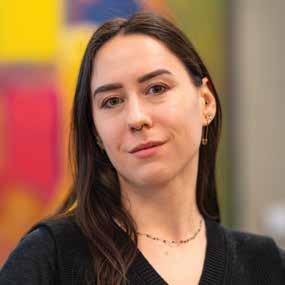


Shumaila
Theodora
We support and advocate for writers at all stages of their writing life, providing opportunities to connect and grow.
WestWord is published four times a year.
ISSN: 0821-4203
© Writers’ Guild of Alberta, 2026
WGA Membership Rates
$95/year; $65/seniors; $45/low income; free to post-secondary students until graduation.
Membership is open to all writers resident or formerly resident in Alberta.
WGA Executive
President: Anne Bailey
Vice President: Anna Wagner
Treasurer: Judith Clark
Secretary: Kendall Bistretzan
Members at Large:
Jenna Butler
Megan Jamieson
T.F. Pruden
Natalie Simpson
Member at Large (Youth Rep):
Aubrianna Snow
Past President: Colin Martin
WGA Staff
Executive Director: Giorgia Severini
Program and Events Coordinator: Jason Lee Norman
Program and Operations Coordinator: Ashley Mann
Program & Fund Development Coordinator, Southern Alberta Office: Ashley Frerichs
Communications Coordinator: Nisha Patel
Member Services Coordinator: Mike Maguire
WGA Contractor
Horizons Coordinator: Mila Bongco-Philipzig
WordsWorth Director: Ugochi Okoli
WGA WestWord
Editor: Raymond Gariépy
Assistant Editor: Ashley Mann
Layout & Design: Jason Bell
Printing: nexGen Grafix Inc.
Please notify the WGA office immediately of any address change.
Writers’ Guild of Alberta
Percy Page Centre, 11759 Groat Road Edmonton, AB T5M 3K6
Ph: (780) 422-8174, Fax: (780) 422-2663
Toll-free: 1-800-665-5354
Email: mail@writersguild.ca Website: writersguild.ca
Southern Alberta Office, Calgary
Email: ashley.frerichs@writersguild.ab.ca
Submission queries can be sent to: editor@writersguild.ab.ca

[?TITLE HERE?]
RAYMOND GARIÉPY
My dear readers, do you have tips to defeat the cursed blank page staring at me as I wrestle with writing WestWord’s editorial?
I began this futile attempt to nail down a sentence or two with a gentle tapping of the keyboard (just the right pressure to make annoying sounds) but not with sufficient pressure to stake my claim to the page. Words cannot find purchase on the page; they need crampons. I cannot tame this damn page, nor mine its pristine landscape for nuggets of wisdom. The page smirks and taunts me with its silence. It belittles me. I look away. I ponder the shame of my un-creativity. I look online for useless things to buy. The page rejects my overtures for a shared blissful union. My confidence deflates faster than a balloon bouquet from the Dollar Store. [139 words, only 391 more to go to make my quota of 530, not counting this bracketed comment]. I check the weather and the time.
The page has no horizon. It is as vast as the Canadian High Arctic, and devoid of insight, clever metaphors, words and phrases performing acrobatic feats to dazzle the reader. The blankness elevates my anxiety. Slap-shooting words are beyond my skill set. The odd word or two meanders up the page, failing to score [ 296 words to go if I add the yet-to-be-determined title, my name, and the bracketed comments! ].
Based on the above, I extend kudos to the writers who pitched their ideas to WestWord. Obviously, they conquered the blank page and made good on their threats to deliver. I give you permission to snub your noses at me. Go ahead, shout it out: “Nyah nyah nyah nyah nyah nyah!”
Kenneth Whyte, publisher of Sutherland House press, offers a compelling argument for fixing Canadian publishing. Sarah Brinley writes about authors “who build their creative lives in the margins … Five minutes at a school pickup. A brief session after a long shift. Over time, those moments accumulate into a practice shaped to last.”
Katherine Koller’s cautionary tale discusses financial scams that prey on writers, and Jeananne Kirwin, K.C., highlights the Canadian Anti-Spam Legislation, “a federal law regulating spam and other electronic messages.”
“Deep listening becomes necessary when you are under strain,” writes Shumaila Hemani. “This practice has been most meaningful when … nothing in my path seems to make sense.” Championing her love of writing by hand, Theodora Sterling says, “Satisfaction is the sound of a fountain pen scratching its way across the page, fighting to keep up its scrawling pace as idea after idea is etched in ink. I do my best writing with a cramp in my hand.”
Jackson Prather provides insights and tips gained from entering short story contests, and explains why they’re good for developing one’s writing chops. Added to the mix are profiles of multi-talented writer Alexis Marie Chute, and playwright Caleigh Crow, winner of the 2024 GG Literary Award for Drama.
I offer you, my dear writers, my honest and heartfelt praise—you’ve embellished this issue with confident, insightful and timely articles.
I welcome your commiseration and tips for defeating the blank page. Email: editor@writersguild.ca. [528 words!]
THE BIG FIX FOR CANADIAN PUBLISHING
KENNETH WHYTE
This opinion piece was published in the 312th edition of SHuSH, January 30, 2025. It is reprinted here with the permission of the author. Kenneth Whyte is the publisher of Sutherland House press.
I’m going to flood the zone with solutions and hope people in Ottawa wake up to the fact that we have a problem. The solutions will almost all involve more public support of the industry, not because I’m keen on public support of the industry, but because we have ample proof that the alternative to more public support is no domestic book publishing industry. This is a “you broke it, you own it” moment for our federal government.
So here’s my solution de jour. Given that books are fundamental to any notion of Canadian identity, given that our domestic publishing sector is pathetically weak, given that any self-respecting country needs to publish its own stories rather than rely on the branch plants of an increasingly difficult neighbour to do it for us, we arrange the following.
We massively expand Canada’s public lending right program (PLR). At present, the ridiculously under-funded PLR pays out about $15 million a year to some 20,000 authors whose books are circulated in Canada’s public libraries. The distributions are based on a complicated formula that mostly notices how many libraries hold the author’s book. It’s capped at $4,500 an author, and most receive only a few hundred dollars annually.
We expand the PLR’s spending envelope by a factor of 10: $150 million. Does that sound like a lot of money? It’s not. It comes to about $3.75 per capita. That’s about a tenth of what we spend annually on the CBC, which employs roughly the same number of people as book publishing. It’s about a tenth
of what we spend in direct funding and tax credits on film and television. It’s less than half what we’re spending on newspaper and magazine subsidies. A small price to rebuild a decimated publishing sector.
I think you could argue that the dollar amount should be much higher. As a society, we believe that books are more important than the products of other media. Governments don’t give you free cable or a free opera pass or a free Spotify subscription: they give you free books through public libraries, because books are that important to the well-being of our citizenry. We’re so good at promoting the value of our public libraries that four out of every five books read in Canada are borrowed rather than bought. If books are that important, $150 million is a bargain.
Next, we change the goals of the program and the terms on which the funds are distributed. Besides supporting author incomes at a higher level, we want to reinforce Canadian ownership of the publishing industry, and we want to do it without harming libraries.
So the first 10 per cent of the program stays as is: $15 million to all authors based on how widely their books are held in public libraries. We’re not taking away any funds from people who are receiving them now. The rest of the funding—the additional 90 per cent—goes entirely to books published by Canadian-owned publishers. It is split by the authors and the publishers, say two-thirds to authors and one-third to publishers. Cap this portion of the funding at $40,000 per author.

The result would be to increase the value of the PLR for Canadian authors working with Canadian publishers from a few hundred dollars to somewhere in the range of $5,000 to $40,000. It would be transformative for author incomes, which according to the Writers’ Union of Canada average an appalling $12,879. We’ve effectively de-professionalized authorship in Canada. This is the correction.
For the first time in a generation, publishing with a Canadian house will come with a major financial upside, rather than a financial penalty. The multinationals, which make most of their money selling foreign books into our market, would likely pay the highest advances to Canadian authors, as they do now (which is why our politicians and successful audiences publish with them). But the improved public lending right would level the playing field. It would be enough to tip the scales for many writers who currently feel they have no choice but to sign away their Canadian rights to a multinational.
The third of the new funding that goes to publishers would allow them to be more competitive with their advances while improving their ability to edit, design, print, and market their works professionally. I wouldn’t object to the publisher’s share going entirely to advances if that’s in better keeping with the spirit of the PLR as a tool for author compensation.
Nothing in this proposal affects library budgets or acquisitions. Libraries remain fully independent. This just ensures the creators and publishers behind the books Canadians are borrowing get paid. At
Continued on page 7
PHOTO SUPPLIED BY AUTHOR
JUDGING A BOOK BY ITS COVER
GIORGIA SEVERINI EXECUTIVE DIRECTOR

I’ve never agreed with not judging a book by its cover. I’m the reader who has left a bookstore with another book for my To Be Read pile because the cover caught my eye. If a book has a shoddy cover design, it raises my suspicions about the quality of the writing, whether it’s a fair judgment. But if no care or effort was put into the presentation, it raises my suspicion about the care put into the text. Besides that, an appealing book design enhances the experience of reading the book. Written and visual art forms work together to contribute to the experience.
I’m disheartened to see the proliferation of AI-generated cover art. I’m confused when I hear people sing the praises of AI images and that they are valuable for book promotion because, in my opinion, the images are not beautiful. AI-generated images have an uncanny fuzzy quality, the people portrayed have the same faces and expressions, elements melt into each other and there are often misshapen objects no one bothers to notice or fix, reflecting how AI doesn’t truly understand the images it trained on, certainly putting no thought into refined lines or shapes.
All I think when I see these covers is that our books deserve better.
Aside from the aesthetics, it’s in writers’ best interests to stand in solidarity with other artists. If we won’t stand up for visual artists who are out of work because of AI programs trained off their stolen work, we don’t have grounds to object when the same thing happens to writers. Books that use generative AI for any part of the creation, including cover designs, are not eligible for the Alberta Literary Awards. The Writers’ Guild of Alberta (WGA) can’t do its job supporting and advocating for writers while throwing other artists under the bus.
Authors are not powerless in turning the tide. If you are working with a publisher, tell them an AI-generated cover doesn’t best serve your book. For self-published writers who find book production costs prohibitive, consider hiring a student for your design. A student may charge a lower fee while they build up a professional portfolio, or may work on your project as coursework. Or, use a stock photo for your cover. Stock photos feature real people with real expressions, and with some digging, you can find one that will do your book justice.
Writing will only have a future if all artists support each other, and the WGA is committed to doing everything possible to help with that, including nurturing the next generation of writers through our interdisciplinary youth programs. Late in 2025, Sydney Baxter unexpectedly resigned from the WordsWorth Director position, and we thank her for her work getting preliminary plans for WordsWorth and Drink the Wild Air off the ground. We are happy to welcome Ugochi Okoli as the new WordsWorth Director, who will pick up where Sydney left off. Ugochi has a background in educational communication, youth programming in literacy, arts, and mental health, and literary event planning and administration, and the youth programs are in good hands with her. We are excited to host WordsWorth July 19–31, 2026, once again at Red Deer Polytechnic. Registration is open on our website.
Our conference and Alberta Literary Awards Gala are great events for Alberta writers to meet up and work together on what we want the present and future of our community to look like. The gala will be on June 5 at the Wyndham Hotel in Edmonton, and the conference June 6–7 at the same venue. Registration is open on our website. We separated our gala and conference registrations so you can register for one event or both, but I would love to see you all at both.
THE WGA BOARD THANKS YOU AND NEEDS YOU
ANNE BAILEY PRESIDENT OF THE WGA BOARD OF DIRECTORS
Thank you!
I begin my note with a big thank you! As 2025 came to a close, the Writers’ Guild of Alberta (WGA) launched an end-of-the-year fundraising campaign, which drew a historic high in donations to our organization. On behalf of the entire board, I want to thank everyone for their gifts. Because of your generosity, many core programs and endowment funds received a critical boost, supporting activities from mentorship to youth camps to scholarships and awards. Gifts made during the campaign were matched (doubled and sometimes tripled) by Scott Saxberg (see profile below), whose support of the WGA has been exceptional. While the largest proportion of the WGA’s funding comes through government grants, the tremendous support of our members, donors and sponsors is equally essential. Without it, we could not provide the range and depth of support for Alberta’s writing community that we do.
AGM moving online
At our first meeting of 2026, the WGA Board approved a significant change to the Annual General Meeting. Starting this June, the WGA will no longer hold the AGM in-person at its annual conference. On June 22, 2026, at 7 P.M., the AGM will move fully online. This change will probably not come as a surprise to many, and for some, it will be long overdue. Our goal is to ensure the AGM is accessible to as many members as possible, regardless of location or other circumstances. All members will receive AGM details in May.
Calling for board nominations
One of the most important agenda items of every AGM is board elections. Members of the board set the vision, mission and strategic goals of the WGA, and provide oversight and governance of the policies, finances, and operations of the organization. Each WGA Board member serves a two-year term. They must attend monthly online meetings and an annual in-person retreat. Over the next year, the board will engage in critical and meaningful work: developing the WGA’s new strategic plan, which will come into effect for 2027/2028. If you, or a fellow WGA member, are interested in adding your voice and expertise to this work, please visit the WGA website and submit a nomination to the board. As always, we encourage nominations from across the province to ensure we have broad regional representation.
Thank you, once again, for your continued support for and engagement with the Writers’ Guild of Alberta. Along with other members of the board, I look forward to seeing you at the 2026 Annual Conference this June in Edmonton!
Who is Scott Saxberg?
Scott Saxberg is an author, mentor, entrepreneur (Cache Island, Icebook Investments Corp), and a former co-owner of the NHL hockey team, the Arizona Coyotes. He writes historical and psychological thrillers, as well as dramatic fiction. For Saxberg, writing is as much about imagining possibility as it is about connecting fiction to the real world.
SCAMS, VIA SPAM
JEANANNE KIRWIN, K.C.
This information is of a general nature only. It does not constitute legal advice or create a solicitor-client relationship. The reader should seek advice from a lawyer pertaining to any particular fact situation.
The Canadian Anti-Spam Legislation (CASL) is a federal law regulating spam and other electronic messages and protects Canadians from unsolicited bulk or junk email. Since spam is often sent to groups of people for malicious purposes— for example, luring you into paying for your book to be reviewed or read by a purported book club—an overview of CASL, how it applies to book authors, and how to report CASL infringements, is timely.
The Writers’ Guild of Alberta (WGA) set up a FAQ page on its website (Canadian Anti-Spam Legislation (FAQ)–Writers’ Guild of Alberta) when CASL was first implemented in 2014. Apart from referring to the law as “new,” the information provided on the website is still accurate. The WGA’s FAQ page focuses on how to promote sales of your books in compliance with the law. To summarize the requirements, as the sender of commercial electronic messages to electronic addresses, you must:
• obtain the recipients’ consent (either explicitly through an opt-in feature, or implicitly if there is a prior commercial relationship),
• identify yourself, including contact information, and
• provide an unsubscribe mechanism.
WHEN DOES CASL APPLY?
• When a message invites the recipient to participate in a commercial activity
(for example, buy a thing or service), CASL applies.
• CASL doesn’t apply to social media posts but can apply to private messaging since those messages are received at an electronic address.
• CASL applies to messages sent from any computer system in Canada, anywhere in the world. It applies to messages received in Canada from other countries.
• It does not apply when the message is sent to someone with whom you have a personal or family relationship (the regulations contain definitions of those).
On the point of consent, CASL contains a “conspicuous publication exemption” whereby if an electronic address is evidently published on a website, then consent is implied. To avoid that exemption arising on your author website, ensure that alongside your electronic address, you set forth a statement advising you do not wish to receive unsolicited commercial electronic messages. Another practical tip to avoid the exemption arising is to stymie the internet trolls: publish your email address on your website without the @ or . symbols: authorATemailserviceproviderDOTca.
Penalties for CASL infringement are steep. Violators may be required to pay an “administrative monetary penalty” of up to $1 million for an individual and $10 million for a business. CASL regulators respond to allegations of CASL violations with an investigation, and if warranted,

may respond with enforcement actions depending upon the circumstances. Such actions include sending a warning letter to the sender; requiring the sender to enter into an undertaking to comply along with a penalty payment; and issuing a Notice of Violation, with or without an administrative monetary penalty.
Canadian Radio-television and Telecommunications Commission (CRTC) and its partner regulators, the Competition Bureau and the Office of the Privacy Commissioner of Canada, maintain a Spam Reporting Centre (SRC) which receives over 5,000 spam complaints per month. There are two methods of reporting spam: by email to spam@fightspam.gc.ca, and by completing SRC’s online form [Report Spam form] and uploading the spam message. The CRTC and its sister enforcement agencies prefer receiving complaints by the online form method. They rely on the database created from spam reports to collect information supporting their respective mandates. In fact, 75 per cent of investigations start with a report from a Canadian to the SRC. “Every submission adds valuable context,” according to the CRTC, and “each report is recorded, reviewed and considered—nothing is ignored” [Enforcing Canada’s Anti-Spam Legislation (CASL) | CRTC]. Most sources of spam arise in emails, and of those, 18 per cent are scams.
The Office of the Privacy Commissioner publishes an online privacy information page listing ways to protect your email
address, your email inbox, and your device or computer (Top 10 tips to protect your inbox, computer and mobile device–Office of the Privacy Commissioner of Canada). Among those pertinent to writers, you should consider the following:
• Prevent “spambot” address harvesting by using the same tip described above to avoid the conspicuous publication exemption: posting your email address without the @ or . symbols.
• Use a primary email address for trusted contacts and a secondary one for online activities such as completing forms and purchases and joining communities.
• Since spam can spread spyware and malware, don’t reply to emails from unfamiliar people or organizations. Delete them, or better yet, report them.
• Install security software on your computer—but not from a pop-up or unexpected prompt. Instead, download security software only from trusted websites.
When CASL was first proclaimed in force, the writing community was most concerned with ensuring compliance in book sale promotions. Now, as writers become targeted for scams via spam messages, CASL provisions can be used for protection. You can help yourself and protect your fellow authors by reporting scammers to the SRC.
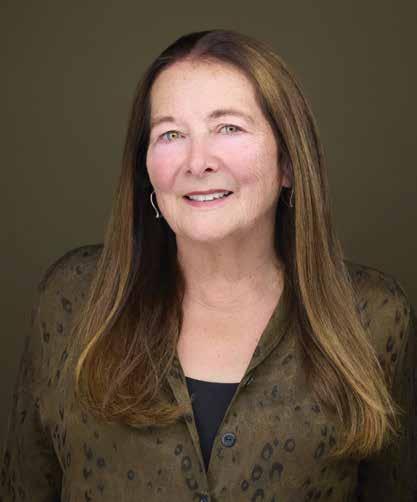
Jeananne K. Kirwin, K.C., an Edmonton lawyer, practices in the areas of intellectual property and corporate/commercial law with an emphasis on trademark and copyright registration and enforcement (emeryjamiesonllp.com).
IS THE TERM “SPAM” AN ACRONYM?
The original SPAM® tinned meat and potato product is claimed to be a portmanteau of “spiced ham,” created by a stage actor who reportedly won $100 for naming the product back in 1937.
Then, in a 1970 Monty Python’s Flying Circus television sketch, “Spam. A Lot of Spam” (Merriam-Webster), a group of Vikings repeated the product name enthusiastically and unrelentingly, drowning out other conversations. Fast forward to the 1990s, when the “spam, spam, spam” chant came to mind among early internet users experiencing intrusive, unwanted email messages. In 1994, the publication Network World (Network World | From the data center to the edge) described such annoying solicitations as a “spam attack.” From then on, the lower-case term spam became synonymous with a different junk product— undesirable canned mail.
EDITOR’S NOTE
WestWord welcomes letters to the editor. Please send your comments to editor@writersguild.ab.ca.
WHY AM I TELLING YOU THIS?
Continued from page 3
the moment, we’ve socialized our book consumption; we just forgot to socialize the costs of book production. Library book purchases and a paltry public lending right are nowhere close to adequate compensation for the makers of books.
There are details to be ironed out, but the public lending right program is already legislated. It’s already administratively functional and socially legitimate, and it’s shielded by the cultural exemption of the Canada-US-Mexico trade agreement. I suppose the Americans might complain if the PLR were massively increased, and they were excluded, but when the top 10 book publishers in this market are all USbased, I don’t think they’d have much of an argument.
The people in the Department of Finance might think this too much an increase for too small an industry but, again, publishing employs as many people as the CBC (and would, in this scenario, employ a lot more). There’s also much to be gained by keeping our most valuable intellectual property in Canada, and the books themselves are highly exportable.
If, in this way, every Canadian book published by a Canadian-owned publisher and held in a public library generated actual income for the people who create and publish it, the entire Canadianowned publishing sector would become viable overnight. And it would likely do a great deal more for social cohesion and informed citizenship in Canada than any of the spending announced in the federal government’s latest budget.
Kenneth Whyte was editor-in-chief of Saturday Night Magazine, founding editor of The National Post, editor and publisher of Maclean’s, president of Rogers Publishing, and founding president of Next Issue Canada. He is the author of The Sack of Detroit: General Motors and the End of American Enterprise and The Uncrowned King: The Sensational Rise of Willian Randolph Hearst

PHOTO
SARAH BRINLEY
WRITING IN THE MARGINS
Creativity in the off-hours
Sarah L. Richhelm, the author of the fantasy novel Control My Night, prepares for her writing session on her drive home from a 5 A.M. workout. As the sun rises over Brisbane, she’s thinking through plot snags and character arcs while the rest of the city is waking up. Once she’s home, she grabs breakfast, settles at her desk, and opens her laptop. She has 90 minutes to write before an alarm reminds her it’s time to leave for her day job.
For many writers, “writing in the margins”—wedged between work shifts, childcare, and life obligations—isn’t a temporary phase. It’s the reality of their writing life.
Last summer, I was on the panel, Burnout and How to Recover from It, at Calgary’s When Words Collide festival. A writer asked a question that has stayed with me ever since: What are burnout strategies for those of us who can’t take time off work, who have families, who can’t afford to go on a retreat?
Writing in the margins has real costs. It increases the risk of exhaustion and burnout. But for most writers, it isn’t an exception or a phase. It’s the structure their creative work has to live within.
WRITING UNDER CONSTRAINT
Edmonton writer Jaima Fixsen, author of The Specimen and coauthor of All In Her Hands (written under the pen name Audrey
Blake), is an occupational therapist. Her schedule is unpredictable, split between long clinical days and small, irregular pockets of time.
“I’m really lucky that my work is so flexible,” Fixsen says. “I’m in private practice as an occupational therapist, so I have a lot of control over my hours. If I have gaps in my day or a cancellation, it’s easy to pivot and use that time for writing,” she says. “But there are days that are really long, ten- or twelve-hour days, so if I get fifteen minutes between appointments in my car, I use that.”
Fixsen likens writing a book to running a first marathon. “I don’t know that I really thought I could write a book,” she says, “but it’s kind of like your first marathon. Once you do, you realize you can do it again.” Writing that first book, she adds, is “a huge hurdle. It’s so transformative, it’s hard to know if anything else compares.”
For Richhelm, writing outside ideal conditions became a training ground. Before the pandemic, she wrote during her daily commute on public transit. The noise, unpredictability, and emotional residue of the day forced her to learn how to write without ritual, silence, or the perfect mood. “My biggest strength is that I can sit down, open my laptop anywhere, anytime, and be able to produce,” she says.
FOCUS, URGENCY, AND CREATIVE STAMINA
Fiona McTaggart, a Calgary writer querying her third manuscript, says working within limits has changed how she approaches the page. She thinks back to the COVID lockdown, when she had more time
than usual. “It was almost like decision paralysis,” she says. “Suddenly I had all the time I once wanted, and I didn’t know how to use it.”
Now, when writing has to fit around other commitments, she finds restriction pushes her into the work more quickly. “This is the amount of time I have. How do I want to spend it?” she says. When McTaggart gets that time, the work comes more easily. “I think those sessions are more powerful,” she says. “You sit down and get sucked in so fast. That’s the best feeling about writing, when you’re in the flow.”
Constraints concentrate the work. Writers who work this way learn they don’t have to write only on the page. It happens while folding laundry, driving to work, or washing dishes. When dedicated writing time is limited, thinking and problem-solving become integrated into daily life.
THE COSTS
Writing in the margins has its costs. Richhelm is candid about the toll it took on her health before she understood what she needed to do to stay well. “There were moments where I just snatched every available minute [to write], to the detriment of sleep,” she says. Living with chronic illness has since forced her to be more deliberate about rest, nutrition, and exercise.
McTaggart echoes the strain, particularly when it comes to energy. Writers often must draw from their remaining capacity after meeting other demands. “If my creative brain is being tapped out in another area,” she says, “it’s harder for me to bring it to writing.”
Fixsen points out another risk of writing in the margins: overestimating capacity. “You feel like you can manage everything,” she says, “so you tend to get in the habit of not saying no, and that can be counterproductive.”
Over time, these costs shape how writers learn to pace themselves if they want to continue writing. It requires careful negotiation between ambition and sustainability.
THE LIMITS OF FULL-TIME WRITING
For some, writing full-time remains a goal. McTaggart says she’s drawn to the flexibility it offers, but she’s also clear about its limits. Writing might be her focus, she says, but she imagines a hybrid life that includes other work, whether teaching a class or picking up part-time hours, to stay connected and avoid the isolation that comes with working alone.
Richhelm experienced life as a full-time writer for several months after being laid off. The time confirmed something she had long suspected about how she works best. “I’m externally motivated,” she says. “I need something cutting up my day. If I have too much time, I get less productive.”
For writers who build their creative lives in the margins, resilience is shaped less by ideal conditions than by consistency. Five minutes at a school pickup. A brief session after a long shift. Over time, those moments accumulate into a practice shaped to last.
She’s also wary of tying financial survival to creative output. “Paying the bills with your creativity,” she says, “is the quickest way to put yourself under pressure.” When ideas need time to develop, or a project hits a natural pause, that pressure can work against the writing rather than support it.
Fixsen continues to work as an occupational therapist, citing the financial instability of writing. Her clinical work also informs her fiction. Fixsen’s next book, Don’t Look Close, features a character who uses mobility aids, research she approaches with professional insight.
WRITING AS A LONG GAME
After querying her second manuscript, McTaggart began asking what she wanted from writing over the long term. “If I write ten more manuscripts and none of them ever get published,” she says, “would I regret the work?” For her, the answer was no. “I’m in it for the craft.”
The sun has long set when McTaggart settles at her desk with a cup of tea. She lights her beeswax candle, messages her friend to check in for their writing sprint, and opens her manuscript. She sets her timer for 15 minutes and begins writing.
For writers who build their creative lives in the margins, resilience is shaped less by ideal conditions than by consistency. Five minutes at a school pickup. A brief session after a long shift. Over time, those moments accumulate into a practice shaped to last.
Sarah Brinley is a fiction developmental editor and registered nurse who helps writers strengthen story structure and deepen character with clarity and care. She writes about craft, pressure, and creative life. Find her on Instagram @ wildflowerandmaineditorial or at wildflowerandmaineditorial.com.
WestWord invited members to share what they do outside writing hours. See Question to Members, page 23.
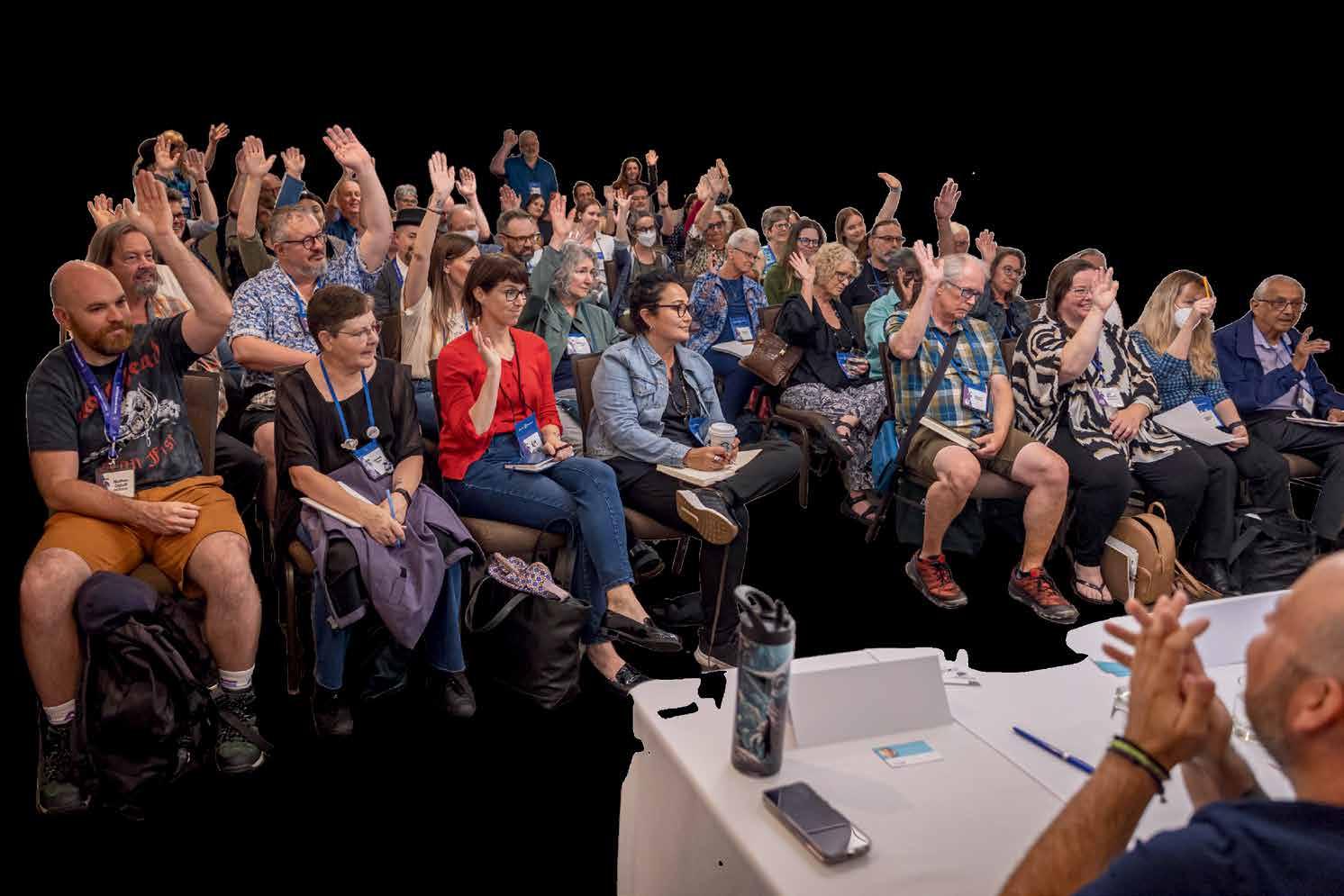
KATHERINE KOLLER
WRITERS, BEWARE!
Fan mail from the algorithm
My inbox is frothing with scams.
The first time I received an email from an international book club, I felt a little “ping.” Really, me? The only international book club I could find online is the Silent Book Club, with chapters in 60 countries; members read in “public solitude.” I never expect to hear from them, but I have had requests for “spotlight” appearances from the following book clubs: Metro Philadelphia, Amsterdam, Fresh Fiction, Historical Fiction, All About Books, DMV (DC, Maryland, Virginia) Writers, Women’s, Favourite, The Book Club (Barcelona). These are all fake.
How do I know? They haven’t read my book. The excessive praise is generic. My book “speaks powerfully to our time,”
“immediately stood out” or “truly stood out” and “deeply resonated” “in such a meaningful way” “with empathetic insight,” “narrative precision,” “compassion and depth” and is “elegant and accessible.” This is fan mail from the algorithm.
I’ve received sycophantic messages about all my books, including Earthen: Stories eight months before its publication date. Besides fake book clubs, who want between $55 and $350 for an “appearance fee,” I’ve blocked emails from Goodreads Listopia and Amazon Marketing, who warn that “without smart marketing, books get lost in the noise,” Black Sun Reviews, who want to put my book “in front of an army of Reading Challengers,” and The Book Commentary, asking me to buy reviews to “get your book the visibility it deserves.” I thought it was funny until I heard from writers who had been scammed.
An author I’ll call Jane, after sending a PDF of her book, paid US$200 for eight excellent reviews on Amazon. Jane then used an AI detection tool to find that the reviews were 100 per cent AI-generated and contacted Amazon to take them down. It has been months with no response from Amazon. Another author I’ll name John, paid US$449 for 27 five-star reviews from We Ratings International, which promises “profitable assets on Amazon KDP—through strategic visibility, aunch [sic] optimization and strong social proof,” according to its website description. John considered his reviews embarrassing: “any reader who looks at them is likely to believe that my writing is being fraudulently promoted.” He, too, has had no success in removing AI-generated reviews.
The emails from so-called marketing firms vary in their insistence. Some are congratulatory. One of the admired traits of Voices of the Land: The Seed Savers and Other Plays is its “connection to nature and resistance to commodification.” I, however, felt my book was commodified by demands to “help the algorithm push your book high in search results, getting it seen by more of the right readers,” with “a free mini-audit of your Amazon book page” and exposure to a “reader-driven campaign studio” of book clubbers “who do more than read, they create movements around the books they love.” For Winning Chance: Stories, one scam suggested I needed an “Audience Insight Preview” and a “Visibility Gap Scan.” AuthorShop Accelerator gets readers to “engage meaningfully.” Although they expect payment from authors: “Momentum built this way feels organic and credible, not transactional.”
A message about my novel Art Lessons was more severe: “The algorithm doesn’t care about your Alberta Playwriting prizes or the way Cassie’s voice blooms over a decade; it only cares about numbers.” Yes, and “Expected ROI.” I had to look that up: Return on Investment, paying for my “choice of 20, 35 or 50+ reviews.” My faux fan mildredwest149 says, “The truth is that Amazon rewards consistent activity from real readers.” Real authors Jane and John would disagree. They know that scammers using AI to write reviews are not “real readers.”
A more recent trend in algorithm fan mail is invitations from other authors “interested in connecting.” I’ve had one
PHOTO BY RYAN PARKER
The first time I received an email from an international book club, I felt a little “ping.” Really, me? The only international book club I could find online is the Silent Book Club, with chapters in 60 countries; members read in “public solitude.”
from prolific British mystery writer Harry Bingham and one from an established American western writer. Jason Sanford, who writes “If you’ve published a book, you’re a target” in his Substack piece (listed under Further reading), has received a chummy author letter from no less than Elena Ferrante. Author impersonators will offer to write a foreword to your book for a price, which explains why “Harry” asked me what I’m working on.
Other scams where authors are vulnerable (see Michelle Barker and David Griffin Brown, Further reading) ask you to buy stickers or trophies for fake awards you never entered, hire a ghostwriter to turn your next idea into a blockbuster, or promote books you never wrote. Some writers report false notices about frozen royalty payments or Amazon KDP accounts. Others have had invitations to phony conferences, mentorships, and podcasts.
Victoria Strauss received a scam message that fed back her bio as “co-founder of Writer Beware, the watchdog who protects authors from scams.” (!) At Writer Beware (see Further reading), Strauss claims scams are getting more sophisticated, for example, the fake Discord book club community discovered by Sanford. Strauss writes: “Behind AI scams are humans.” If you respond to them, they may write to you daily. That’s how Jane was deceived. She thought someone so persistent “who invested so much time” in her, must be legit. The scammer’s writing was “impeccable” until she told him to stop. His last “how dare you” message, indignant, was full of spelling and grammatical mistakes.
Andrew Binks (see Further reading) wonders at “people, who, laughably, think that we writers are rich enough to scam.” Joe Ponepinto (see Further reading), also listed below, summarizes: “We just have to be ridiculously vigilant and suspicious whenever someone we don’t know offers praise and ‘opportunity.’” They could be predatory.
Another way to protest AI scams may be the practice of Charming Notes, which I learned over 20 years ago from Carolyn See in Making a Literary Life: Advice for Writers and Other Dreamers. Since then, when I’ve read a book I enjoyed, I often send a short Charming Note to the author. I say why I enjoyed my time on the page with them because that’s what I’d like to hear about my work. In this age of algorithm interference, an authentic Charming Note is always welcome, and a way for writers to care for each other.
How to detect a scam
• Check the email address for a name match to the signature, any relation to a company name, a number (professional business addresses do not allow numbers), or font differences within.
• Grammar errors, especially possessive apostrophes.
• Sycophantic and generic praise based on your synopsis, jacket copy, bio and reviews.
• Inappropriate categorization of your book, for example, a book on chronic pain touted for “social justice.”
• No online presence or website.
• If still in doubt, put the text and
photo supplied into an AI detector: Undetectable AI, WasItAI, SightEngine, GPTZero or Winston AI.
Cautions
• Literary agents, podcasters, and book clubs do not charge upfront fees “for administration,” “development,” or “expanded reach.”
• Paid reviews are false; no one “tips” for authentic reviews. Amazon and Goodreads do not allow false reviews.
• Film companies never charge you to write a screenplay; they pay you.
• Personal and banking information should never be shared.
• A PDF of your book should never be sent to anyone who asks for it.
• Links should not be opened, and scam emails should not be forwarded.
Further reading
Barker, Michelle, and David Griffin Brown. “Too Good to Be True: Writer Scams are Proliferating.” Darling Axe blog December 1, 2025.
Binks, Andrew. “Caveat Scriptor.” WRITE. Winter 2026.
Government of Canada. “The 7 red flags of phishing.” Getcybersafe.gc.ca/en/ resources/7-red-flags-phishing.
Ponepinto, Joe. “Scams Targeting Writers Get More Sophisticated.” Beyond Craft January 17, 2026.
Sanford, Jason. “Genre Grapevine: Book Club Scams are a Warning of Emerging AI Super-Scams.” Substack. September 28, 2025.
Strauss, Victoria. “Army of Bots: Deeper into the Vortex of Nigerian Book Marketing Scams.” Writer Beware. October 15, 2025.
Ibid. “Return of the Nigerian Prince Redux: Beware Book Club and Book Review Scams.” Writer Beware September 19, 2025.
Katherine Koller is the author of Voices of the Land (plays), a novel, Art Lessons, Winning Chance: Stories, and a new collection of short stories, Earthen: Stories.
SHUMAILA HEMANI
A DECEMBER SIGH
Writing and deep listening in precarity
Listening does not protect us from vulnerability. It does not exempt us from illness, fatigue, or collapse. Sometimes listening comes first—and the body responds later, in its own language of fever, silence, and rest.
Deep listening becomes necessary when you are under strain—when the systems that tell you where to go, how to move, and when to arrive stop making sense. This practice has been most meaningful when I feel lost, when I feel I have made a mistake, a wrong decision, when nothing in my path seems to make sense anymore.
The waiting area was crowded, bodies close together, breath circulating. It
struck me how precisely time is managed in these spaces—not late, not early, just compliant—and how little room there is for bodies that are tired from waiting.
I had arrived in downtown Calgary to give biometrics for my fifth Canadian immigration application. My belief in the system was low, yet I had arrived 13 minutes early and was told I could only enter 10 minutes before my appointment. I walked a small loop around the block and returned five minutes later; this time I was waved inside.
It was −23°C with a wind chill when I left Service Canada. Seventeen years in this country, and still no permanent status. It was windy, and the freezing wind urged me to hurry to a warm, cozy bus seat.
The fog was thick, swallowing the edges of the landscape. Downtown Calgary felt especially disorienting—glass towers, wind tunnels, the cold pressing in from every direction. Having walked these streets countless times over the past four years, it took a while to realize I was lost in the mist. I ducked into a Tim Hortons to warm up. When the Route 1 bus pulled up, I ran and climbed on— breathless, relieved.
The bus kept moving until I saw Platform Calgary and realized I had taken the bus in the wrong direction. Taking the nearest stop at Fort Calgary, I felt the Elbow River inviting me toward a rendezvous. I used to come here often before I moved to Bowness and found other ways of encountering the river.
The Elbow River always received me like an elder welcoming a guest on these lands
PHOTO BY JODI O PHOTOGRAPHY
of Mohkinstsis, with care and compassion. Even though the freezing winter chill advised me against walking toward the river, I continued like a kid in Akira Korosawa’s film, Dreams
A freezing, smoky steam rose from the water, pale and ghostlike, lifting into the air as if the river itself were exhaling. The river had begun to freeze, and beneath the gentle sound of waves there was the faint, almost imperceptible scrape of moving ice. The sun had not come out, and the sky was grey and foggy. I stood watching the ice move, watching the fog lift and fall, and something in my body softened.
I asked the river, silently, what message it had for me.
I had done everything right and was still sitting in the limbo of waiting, with no one around me understanding what it feels like to spend 17 years in a country and still not have even the most basic rights—not even those of a permanent resident.
After two advanced degrees, years of artistic work, and multiple residencies in Alberta, I had not imagined ending up where I was.
Listening does not protect us from vulnerability. It does not exempt us from illness, fatigue, or collapse. Sometimes listening comes first—and the body responds later, in its own language of fever, silence, and rest.
The night before the appointment, I had found my passport. For four months, it had been missing, swallowed by my recliner—a piece of furniture I had searched once before. I had been terrified about the biometrics appointment, careful not to book the earliest slot, giving myself time to recover and to search again. With the help of AI, I followed a series of steps to open the recliner, switched on a light, and there it was—tucked behind a few loose papers.
They were pages from my memoir, an earlier draft, which must have slipped
inside back in July, taking the passport with them. I had started writing it to ground myself during the deepest moments of anxiety …when nothing made sense, when dark spots overtook my days. I called the crisis line three times within 24 hours, and one counsellor suggested I tell my story—to give the confusion a shape, a voice.
And that is how I began writing my memoir—17 years of becoming an ethnomusicologist and a soundscape composer in Alberta. Writing in the
I had done everything right and was still sitting in the limbo of waiting, with no one around me understanding what it feels like to spend 17 years in a country and still not have even the most basic rights— not even those of a permanent resident.
Wound: Acculturation, Trauma, and Music became my lifeline through the rest of 2025.
When my housing first became precarious in 2023, I returned to the river before making a major move. I had come there to sit and reflect before each decision. Now, once again, I was facing housing precarity: my landlord wanted the unit back, and with my status in limbo, finding another rental felt impossible— moving itself was expensive.
I was devastated.
And as I sat there staring at the river in the cold, mystical steam rising in the distance, I found the river speaking back to me, “Your obstacles are your path.”
I sat there silently breathing, sighing, releasing all that I was carrying.
Even in the cold.
Even when the path felt like it had ended.
And the river said in its quiet, reassuring way, “Don’t worry. It will all work out.”
The river spoke, and I listened. My body listened too—later, in its own language of fever and silence. Deep listening doesn’t protect us from harm. It teaches us to stay when life speaks softly, even as systems shout you do not belong. It does not give you answers, but it gives you signs only if you allow yourself to relate to the land.
As the wind chill bit into my skin, I no longer had the capacity to ask the river how—how it would work out or to show me signs. Instead, I placed its message in my pocket and began walking back toward the library, this time to catch the bus that would take me home.
Trust, as I have learned, does not arrive as certainty, but as the willingness to keep walking.
A day later, my body folded inward. My voice disappeared. A deep cough took over. Whether it came from that crowded room or the cold along the river didn’t matter. What mattered was how long the body can hold before it must express its agony.
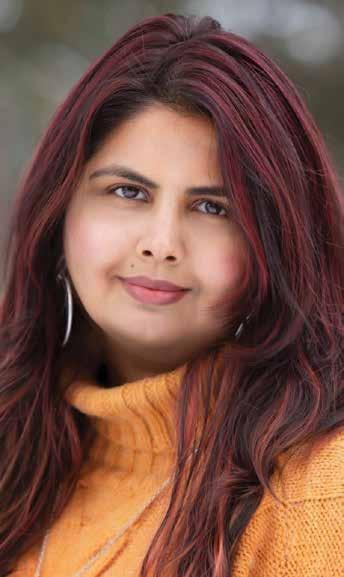
Shumaila Hemani is a Calgary-based author writing at the intersection of mental health and systems change. Her debut memoir, Writing in the Wound (2025), was featured in WestWord’s 2025 Alberta Favourite Reads, with additional features in TWLOHA, Wise Brain, IHRAM, and SUSPECT. She is a recipient of the Women in Music Canada Honour Roll (2023).
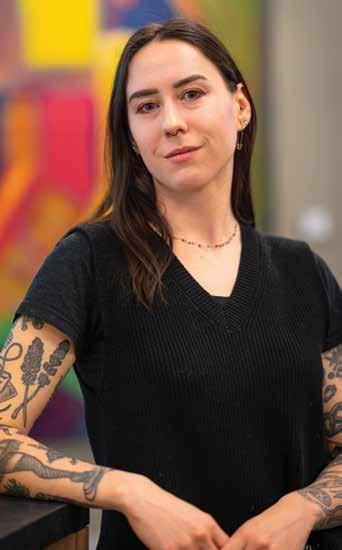
PHOTO BY STEVEN STEFANIUK
I’ve seen internet addiction amongst my peers, been privy to Facebook radicalization, and fought hard to keep my screen time within a range that doesn’t feel mortifying to say out loud. Which is why, for my creative writing, I stay rooted in the traditional form, preferring to use a pen and a journal for initial drafts and ideas.
STHEODORA STERLING
A WRITER’S RADICAL ACT
Writing by hand
atisfaction is the sound of a fountain pen scratching its way across the page, fighting to keep up its scrawling pace as idea after idea is etched in ink. I do my best writing with a cramp in my hand. Sure, a laptop, tablet, or smartphone can do the same thing. But there’s something about a simple pen and paper that makes the experience of writing pleasurable—well, that’s the case for me at least. In a time where cursive is akin to a historical artifact, and typing is nearly second nature, the tactile experience of putting pen to paper is both a radical and a joyous act.
I remember my childhood before the internet, Wi-Fi, and iPhones. I came of age around the time our beloved social media platforms went from fun social havens to petri dishes of AI-generated slop and misinformation. I watched the rise and fall of millennial hope and was lucky to finish my undergrad just in time to enter the professional workforce during a global pandemic.
Because of my upbringing, I embrace technology—I wouldn’t have a career without the internet—but I like to keep it at arm’s length. I’ve seen internet addiction amongst my peers, been privy to Facebook radicalization, and fought hard to keep my screen time within a range that doesn’t feel mortifying to say out loud. Which is why, for my creative writing, I stay rooted in the traditional form, preferring to use a pen and a journal for initial drafts and ideas.
I’ve been keeping a journal for over a decade. I started at the end of high school and, like a bad habit, I never kicked it. Often, you can find me at the Writers’ Guild of Alberta’s pub nights in Edmonton, jotting down my favourite lines during the open mic. For me, my journal is akin to an artist’s sketchbook (an idea I credit my partner, Wesley Pretty, for giving me). It’s a space to be playful,
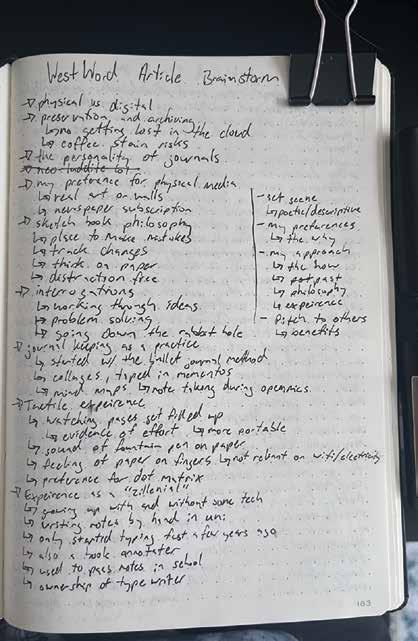
WESTWORD ARTICLE BRAINSTORM JOURNAL ENTRY, PHOTO BY THE AUTHOR





JACKSON PRATHER
WHAT I’VE LEARNED FROM WRITING CONTESTS
There’s no better place to learn your craft than from a writing contest
Writing contests are one option to advertise your writing skills, win money, and receive recognition. I have done so dozens of times with similar intentions. Much to my disappointment, I have walked away empty-handed every time.
The truth is, writing contests are difficult to win. Each one hosts anywhere from dozens to thousands of competitors. From a mathematical standpoint, the odds of winning are slim. Even the most skilled and experienced authors walk away without so much as an accolade.
IS ENTERING A WRITING CONTEST WORTH IT?
Some might ask, “What is the point of competing in a writing contest?” I have some answers based on my experience. The most important thing when approaching contests comes down to your expectations. If you expect to win, you will need all your luck and the stars to align for that to turn out well. Instead, embrace the opportunity to test yourself against other writers. There is no better place to learn your craft than from a writing contest.
ARE ALL CONTESTS THE SAME?
I have entered over 20 writing contests from a dozen different sites. Each one operates under different rules for participation, including story length,
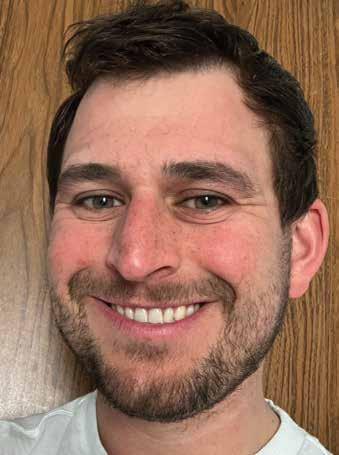
PHOTO BY THE AUTHOR
genre, prompts, and so forth. Some competitions expect you to send a piece with as few as 100 words, others with 2,500.
Contests mean writers work under certain restrictions. You learn restraint and to cut excessive or unnecessary information.
All the different competitions I have taken part in provide prompts when assigning challenges. Such prompts could be anything from words, genres, actions, objects, and even phrases. Some contests assign participants more than one prompt to work with. For example, the prompts could include a vampire romance in a computer lab with one character as a skeptic. Placing limitations on writers
enforces creativity. Competitors must step outside their comfort zones into unfamiliar fields. Writers striving to hone their skills learn to tackle different ideas, new genres, and more. It gives writers a wider range of experiences to round out their skill set.
IF I ENTER A CONTEST AND WIN,
WILL I
RETAIN PUBLISHING RIGHTS?
All contests publish the winners’ submissions, which means some or all publishing rights belong to the contests’ sponsors. Some sponsors do not claim those rights from contestants who did not win. As a result, those participants keep their publishing rights. Be advised, remember to read the fine print of every sponsor to understand their rules on publishing rights. They might claim the rights of all participants.
WHAT ARE THE BENEFITS OF ENTERING A CONTEST?
The greatest benefit I’ve received from some writing contests is critiques and feedback from the judges. Not all sites give constructive criticism. Two sites that offer feedback are writingbattle.com and nycmidnight.com. If critique is what you seek, research which sites offer it. Most contests I have encountered tell you whether you have won, and that’s it.
Much like publishing and marketing your work, it takes more than hard work and effort to succeed in contests.
Even when you put your heart into your writing, it doesn’t always pay off.
As for the contests offering feedback, they differ from traditional practices of recruiting beta readers or an editor. Certain contests will expose your work to fellow writers of variable experience, or published authors of significance. You might receive feedback from many critics, giving you numerous perspectives all in one place. You can easily discover your strengths and weaknesses in your writing that would have not been noticed.
Many of my experiences with writing contests have enlightened me. I have used the format not only to test my skills, but to experiment with the art of short stories. Working with word and prompt restrictions expands my creative writing. I delve into these competitions to try something new. I have written a piece where the characters spoke only in puns. I wrote another piece that was a highoctane action-comedy story involving a treasure hunt. Neither was a success, but I walk away having gained something from each failure. I learned what works, how the audience perceives my ideas, and how I can improve my work.
When applying what I learned to my novels and short stories, I notice a profound difference. I discover more flaws in my writing, I can streamline exposition better, dialogue gets sharper. I can more easily discern which words to keep and which to delete. Ideas for new short stories come to me much faster. I can take small ideas and give them time to explore them to their fullest. I write short stories independent from the contests. This adds
to my expertise and competence as a writer, which I previously lacked.
WHAT CAN BE LEARNED FROM ENTERING WRITING CONTESTS?
The final point I wish to highlight is mindset. Most veteran writers understand the countless hurdles they face in this industry. Newcomers have yet to experience the hardship of pursuing success. Much like publishing and marketing your work, it takes more than hard work and effort to succeed in contests. Even when you put your heart into your writing, it doesn’t always pay off. I’m learning to accept my losses, understanding the connections between art and success. Participating in contests teaches me resilience and humility.
The path to success is long and fraught with difficulty. Years go by before a struggling writer finally makes it in the writing industry. It’s important for competitors to embrace failure and continue to pursue their craft. In embracing failure, writers will achieve excellence. So go out and test yourself, challenge a writing contest and see how you measure up. When you know how your skills fare in high-stakes circumstances, you will improve. And in improving, you grow as a writer.
Jackson Prather grew up in Alberta surrounded by many inspiring stories. Nearing the end of high school, he picked up a leftover notebook and started writing. When he is not writing, Prather works as a carpenter. He currently has five manuscripts and 30 short stories, with plans to write more.


THE
May 15th, 16th, & 17th, 2026
Prestige Harbourfront, SALMON ARM, BC
SESSIONS
Expect


PRESENTERS:
• Jill Barber
• Andrew Buckley
• Finnian Burnett
• Gail Anderson Dargatz
• Charles Demers
• Deanna Kawatski
• Grant Lawrence
• Michael Slade
• Iona Wishaw
THE TWENTY-THIRD ANNUAL
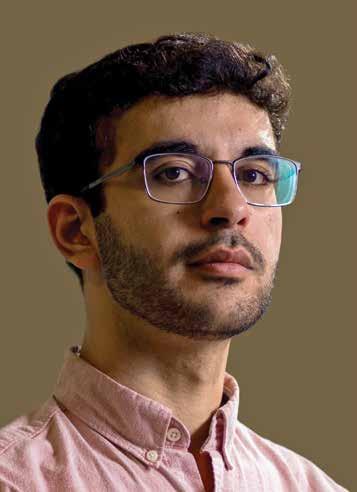
My English degree taught me how to write a 15-page essay on symbolism. Journalism taught me that if I don’t tell the reader someone was mauled by a bear in the initial 10 words, I’ve already lost them.
When I entered journalism, one of the first things I learned was to take much of what I had learned at school and toss it out the window.
Don’t get me wrong: being a graduate of the English program at the University of Regina has strengthened my abilities as a writer and researcher, and those are skills I use every day in my work as a journalist, but telling stories as a journalist is different from writing creative fiction or essays.
Whether I’m weaving a complex feature story or distilling it into a two-line photo cutline, the goal is the same: provide maximum clarity with surgical precision.
As a multimedia journalist, my web stories often incorporate a mixture of words, photos, video and more. That means different writing styles for different media.
Take a feature story for an outlet like CBC News, for example. It’s no secret readers’ attention spans are dwindling. It’s essential to get their attention with the right hook,
WRITING FOR THE MEDIA
How not to lose your reader
AMIR SAID
or lede (the opening sentence or paragraph of a news article), and keep it for as long as possible with punchy, descriptive language.
When paired with photos and video embeds, using engaging language can boost a reader’s engagement time and comprehension of the story.
It’s essential to get to the point quickly in a news story to make sure readers know what they’re reading and why. That’s a simplified version of what we call the “5 W’s”: Who, What, Where, When and Why. You want to answer those questions as soon as possible, or you risk losing the reader’s interest before they’ve even started scrolling. In an ideal situation, the reader of a hard news story would know what happened after reading the first sentence.

Here’s an example: I published a breaking news story for CBC last year about a grizzly bear mauling a hunter close to Calgary.
The story kicks off with this line: “A hunter was mauled by a grizzly bear south of Cochrane, Alta., Thursday afternoon, according to Alberta Fish and Wildlife.”
If the reader immediately closed the page and stopped reading after that, they would
know exactly what happened, along with where and when it happened, and who was involved. Read further to the second line, and more information about the hunter and the circumstances behind the attack is explained in detail, answering the remaining “W” of why.
But I’d like to think readers didn’t leave that article after only reading the first line. After all, bear attacks are something practically everyone who has ever hiked, hunted, or otherwise engaged in outdoor recreation in Alberta has likely thought about.
That brings me to another piece I incorporate into my work: plenty of photos. I’m a wildlife photographer, so I’ve got a huge catalog of original animal photos I plug into most of my animal-related stories. Bears, owls, gophers, you name it. Within the first few lines of my stories involving wildlife, readers find an animal photo. Keep scrolling down and more photos can be found.
Many times, my eye-catching photos are the first thing a reader sees before they even read the headline.
I wrote a feature piece on snowy owls last winter. The focus of the story was their recent assessment by a federal government committee as a threatened species in Canada. The headline (“Snowy owls return to Prairies for winter with new status as threatened species”) is self-explanatory.
It’s a headline designed to pique readers’ interest, whether they’re concerned with wildlife conservation or not. But the headline is only a small part of the formula that makes the story an engaging piece.
PHOTO BY THE AUTHOR
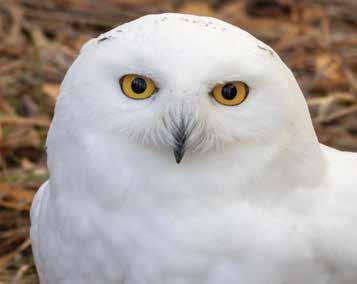
Here’s the lede: “Every year, snowy owls spread their wings and migrate down to the Prairies, where they enjoy access to plenty of rodent prey in vast open spaces.”
That opening line, coupled with the first few lines of the headline, provides imagery to get the reader envisioning the annual migration of the ghostly birds from their nesting grounds up in the Arctic to the expansive grasslands and fields of Alberta.
The thumbnail and lead photo of that story? An extreme close-up of a snowy owl, highlighting the bird’s piercing yellow eyes staring right at the reader. It’s a hard photo to ignore.
I find readers will often decide whether to read a story based on the thumbnail or lead photo. Sometimes, it can be more compelling than the headline.
To illustrate that context, and what makes the photo relevant to the story, a good caption, or cutline, is essential. After all, how else would the reader know that the snowy owl in the photo is itself a victim of the many threats faced by the birds, leading to their designation as a threatened species?
Often, cutlines are the most-read part of a news story. Photos draw the average reader’s attention more than all those lines of text, which means if you want to keep readers engaged, it’s essential to make the line of text right under a photo compelling.
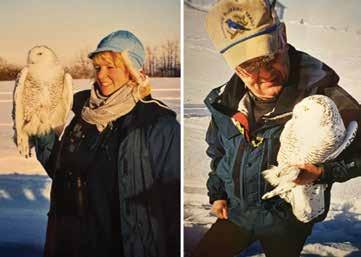
Further down in the story, I include a composite photo of two researchers, one of whom is a voice in the story. The two are holding snowy owls while standing in the snow. Who are they? What are they doing? When and where was this? Why are they there? My cutline answers those questions
Today, with misinformation flooding people’s social media feeds and disinformation peddled by bad actors designed to spread falsehoods or push certain agendas, being an effective and impactful journalist means more than just incorporating strong writing skills and keeping readers engaged through different strategies.
The photo I used expertly encapsulates the story: it includes the subject of the story (snowy owls) and the context (snowy owls being threatened by factors like vehicle collisions, which is how that owl had ended up at the rehab centre).
by identifying the scientists as Lisa Takats Priestley and Hardy Pletz, followed by a description of what they’re doing: “Owl banding involves capturing the birds and putting bands on them to track populations and movement patterns for scientific
purposes.” And to cap off that cutline, a fun tidbit to further pique the reader’s curiosity: “One snowy owl banded by Pletz was first captured in 1994 and then recaptured in 2013, making it one of the oldest known wild snowy owls.”
Using that photo of them working with owls in the field, coupled with a description of their work to accompany the photo, reinforces their expertise about snowy owl populations. It puts a face to the name and makes it clear to the reader that this person, who is pictured studying snowy owls alongside another scientist, knows what she’s talking about.
This brings me to one of the most important elements of writing as a journalist, whether it’s a hard news story, a feel-good piece or a lengthy feature: truth.
The bottom line of any journalistic story is factual accuracy. No exaggerations, no assumptions, no guesses or theories from the reporter. As a journalist, my goal is to give readers the pieces with which to form their own opinion, never to tell people what to think or believe.
Take that grizzly bear story I mentioned at the start. The purpose of the story is to convey that the mauling happened, not to demonize grizzly bears or hunters. There’s no nightmarish bear photo or unnecessarily negative vocabulary meant to influence unduly the reader’s view of anything.
Today, with misinformation flooding people’s social media feeds and disinformation peddled by bad actors designed to spread falsehoods or push certain agendas, being an effective and impactful journalist means more than just incorporating strong writing skills and keeping readers engaged through different strategies.
As a writer and photographer, I love the career path I’m on. It’s such a privilege to be a journalist, but it’s also a field that comes with immense responsibility.
Amir Said is an award-winning multimedia journalist, writer, and photographer based in Calgary, Alberta.
QUESTION TO MEMBERS
WestWord asked members what they do outside of their writing hours (raising a family, elder care, working night shifts or multiple jobs, hobbies) and if it helps or hinders their writing.
Melissa Morelli Lacroix
In addition to promotion, marketing, and research, I teach piano and French lessons and work to expand my studio’s reach. Next, the majority of my time and energy is spent tending to household and familial chores, which include supporting my teen with online schoolwork and providing elder care for my live in nonagenarian mother-in-law. I live with chronic illness, so these non-writing activities often drain me. They also allow me to live, love, and learn away from the page, which can help my writing when I take myself back to the process and the words.
Lea Storry
Until recently, I helped care for my mother in Nova Scotia, who was living with ALS. Writing about my experiences, being apart from my husband in Edmonton, and having a parent who was never going to get better from an illness, gave me insights into, well, me. It also pushed me to publish “Speaking ALS: An Anthology,” a collection of memoirs, personal essays and non-fiction poems from people in the ALS community. The money from the book goes to ALS research. Words are life.
(For information about the anthology, visit ourfamilylines.ca/speakingals.)
Carleen Ellis
Wonder Woman is so 80s, but if she were aging gracefully, neurodivergent, and armed with sticky notes, she’d mirror my writer’s life. As a Soul proprietor—writing, marketing, scheduling, pitching, posting … forgetting why I opened the spreadsheet. My cape’s over one shoulder. I sell books in an actual book store, teach yoga and meditation, mentor-coach, parent, partner, advocate and show up for the town hall— sometimes all before lunch. My Soul craves creative. Writing helps writing. The rest is industry standard. Retiring for the night, still holding the faint glow of my moral character, I remember she always worked pro bono.
Sandy Krausnick
Besides working full time and writing, I organize a monthly book club (12 years), visit my grandchildren, play board games with family and friends, walk our dog twice a day, meditate, exercise, donate blood and try to read 50 books a year. I am the primary cook in our home. Recently I’ve learned to make sourdough bread. I support my wife as she navigates losing her father and helps her mother (who has cognitive decline) move out of her house and into assisted living. While these hinder time spent writing, it is life, and offers a plethora of writing ideas.
Robert G. Proudfoot
Creative writing is fun, but I also curl and hike. I support our daughters’ interests: sculpting marble or scrap metal, choir, transforming poetry into songs, and creating coaching videos about massage therapy and gardening. My wife, Valerie, and I shared intercultural experiences in West Africa. Now we walk with Muslim or Indigenous Canadians, and visit prisoners and hospital patients. Experiences inspire my writing, but selling books at author festivals and learning at writing conferences do not in themselves pay bills and feed our family. I work as an environmental consultant, authoring technical reports—still writing!
ALEXIS MARIE CHUTE A Creative Powerhouse
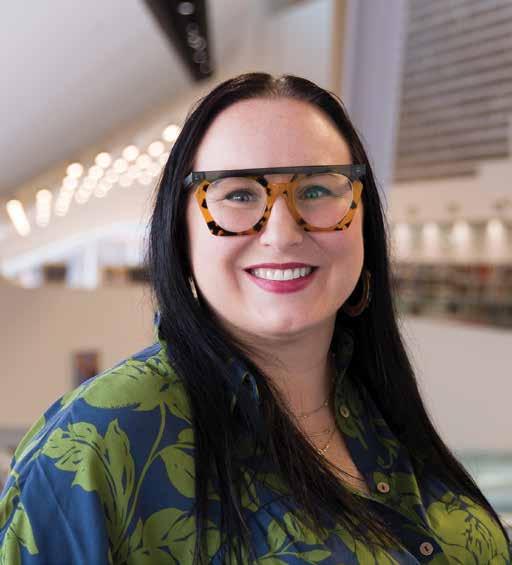
Alexis Marie Chute is a creative powerhouse—a bestselling author and award-winning artist, filmmaker, photographer, curator and publisher—whose work spans two decades. Her debut memoir, Expecting Sunshine (2017), was adapted into an acclaimed documentary film, followed by her Amazon-bestselling YA fantasy trilogy, The 8th Island Trilogy. She is also a public speaker and educator. Chute is the Edmonton Public Library’s Writer-in-Residence.
WestWord
Please tell us about yourself.
Alexis Marie Chute
When I was a young artist, I was told to specialize. That advice did not resonate with me and I doubt I would have the life I love today if I had listened. Instead, my younger self carved her own path, developing skills in multiple creative disciplines and prioritizing experimentation, play, and doing things before she was ready. It certainly was challenging, and I have just as many stories about the hard seasons as I do the successful, but I owe a great deal to that gutsy young me.
Today, I am a visual artist, filmmaker, author, and photographer. On top of my personal and professional projects, I am a book publisher with Wild Skies Press, gallery curator with Wild Skies Gallery and the Red Brick Common Public Art Gallery, and co-founder of InFocus Photo Exhibit & Awards. All my creative endeavours are connected through my passion for storytelling.
WW: Congratulations on being named the Edmonton Public Library’s writer-in-residence. Tell us what your residency entails and why it is important to writers in Alberta.
AMC: During my tenure as writer-inresidence, I meet with individual writers one-on-one in mentoring sessions. It is my absolute honour to pour into the creative lives of others, offering feedback on manuscripts, advice for the writing journey, and publishing guidance. I also lead writing workshops and gatherings, bringing people together to form meaningful bonds over our shared craft.
This type of position is so important because it offers these writer
services free to the public, providing equitable support for anyone with a story to share. I remember many instances of working with mentors and coaches in my early writing life. Those people were lighthouses for me when I felt adrift on a project or lost in terms of how to publish my work.
My role also encompasses advocating for books, the value of public libraries, and the vital importance of the freedom to read.
WW: How and where do you find the time to write when juggling diverse endeavours and commitments?
AMC: Sometimes it is hard to set aside writing time while working in such all-encompassing capacities, uplifting the creative practices of others. One way I protect my writing time is by investing in myself by attending retreats and residencies. This intentional time away gives me the space in my calendar to write and get lost in my stories. When getting away physically is not possible, I use my three main productivity hacks to make sure my priorities are kept in check.
PHOTO BY RYAN WHITEFIELD FOR THE EDMONTON PUBLIC LIBRARY
First: Batching like activities. What that means is doing only one type of activity at a time. When I am writing a first draft, for example, I am not editing or researching or pitching during that period. Only writing.
Second: Time blocking. I love my Google Calendar for creating a box around a set period where I plan to write. If it’s not in the calendar, it’s not happening.
Third: I reveal my goals publicly. At the beginning of my residency with the Edmonton Public Library, for example, I shared about the book I’m working on in a social media reel. I made mock-ups of potential book covers, then welcomed people to vote for their favourite. This is one powerful way I keep myself accountable.
WW: Your books cover different genres—a nonfiction book about loss and grief, fantasy, guide books and more. Tell us about your books and your motivation to cover diverse topics.
AMC: The book that made me an author is Expecting Sunshine: A Journey of Grief, Healing and Pregnancy After Loss (2017). It is the most vulnerable thing I have ever written. Expecting Sunshine tells the story of my son Zachary’s life—he passed away shortly after birth—told in flashbacks structured within the forty weeks of my next pregnancy. It is a story about the strength of a mother’s love, how our culture fails to give us a blueprint for grief, and how we ultimately must choose to live with both heartache and joy after loss.
After the transparency in Expecting Sunshine—both the memoir and the documentary film I produced a year later—I needed some love and
magic. I wrote a never-published romance novella and then my hybrid-published fantasy series, The 8th Island Trilogy, including Above the Star (2018), Below the Moon (2019), and Inside the Sun (2020). I relished the romance and fantasy after delving into the deep topics of grief and healing for so long. What I realized, however, was that my penchant for harrowing subject matter has followed me into my fictionalized works. My characters always face challenges that demand hard decisions and brave actions.
My more recent work includes titles I was hired to write that focus on local history, herbology, folklore, and the arts. In Prairie Spirits (2021), I write about paranormal investigations and interview people who have had ghostly encounters at two historic buildings in Stony Plain. In The Eternal Summer of Alberta’s Herbarium (2022), I presented historical and contemporary texts about organic master gardening alongside my fellow writer Mark Stumpf-Allen. I also photographed gardening student’s herbarium samples, filling the pages with locally collected and recorded plants.
For the Town of Stony Plain and the Red Brick Common, formerly named the Multicultural Heritage Centre, I spent more than a year researching, photographing, and writing Memorable Murals: The Visual History of the Town of Stony Plain, Alberta (2024). It is a visual and written history of the town told through its over 50 public and private murals. The book is a document of record keeping for one of the town’s aging historians and storytellers, Greg Hanna.
My most recent books include Moments in Focus (2024), which celebrates the first decennial
celebration of InFocus Photo Exhibit and Awards, and Project Sketchbook Volume One (2025), an art book that presents the work of 26 (mostly) local artists and their sketchbook practices.
I love to write across genres, still rebuking the advice to stick to one thing. My creative journey has responded to my interests and the opportunities that have presented themselves to me. I’d rather not be boxed into one thing, so like all the art that I create, I aim to remain open to following my curiosities and open for collaboration.
WW: What future literary, artistic, and marketing projects are you working on?
AMC: Right now, I am writing a paranormal thriller about a Canadian journalist overseas in Europe who stumbles upon a big story with a notable art exhibit, but when she is swept into a romance with the artist himself, things get spooky. In my visual art, I am continuing my practice of repurposing and recycling disposable materials, recontextualizing and presenting them within the realm of fine art. This takes on the form of hanging fibre art sculptures, painting onto thrifted plates, and drawing onto magazines. I also make conceptual art films, which can be watched on my YouTube channel.
I am also busy releasing books and promoting other writers through Wild Skies Press, my hybrid publishing venture. This is a work of the heart, as I find so much fulfilment in helping others realize their dreams of having a book alive in the world.
CALEIGH CROW Playwright Focuses On Class Struggles, Metaphysics and Joy
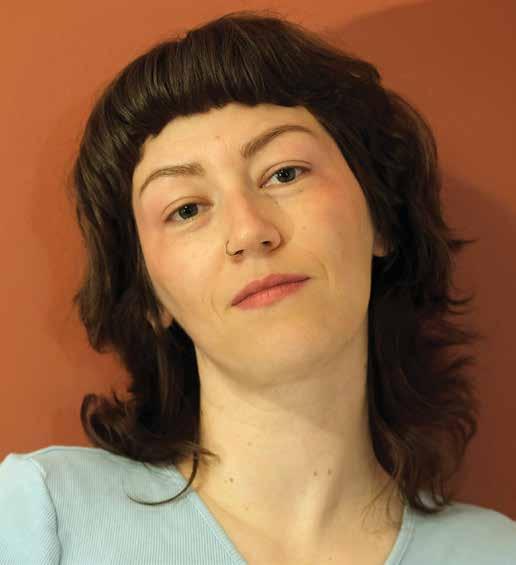
Caleigh Crow is a queer Métis writer from Mohkinstsis in Treaty 7 Territory. She is the co-founder of Thumbs Up Good Work Theatre. Crow’s practice focuses on writing for performance. Her plays span genres from musicals to science fiction to poem plays. Crow’s work covers class struggle, metaphysics, and joy. She was commissioned to write short fiction for the CBC and has contributed to The Scene Magazine. In 2024, she was honoured to receive the Governor General’s Literary Award for Drama for There is Violence, There is Righteous Violence, and There is Death or, The Born-Again Crow, published by Playwrights Canada Press. The Writers’ Guild of Alberta named Crow one of six Regional Writers-in-Residence for 2025.
WestWord
Please tell us about yourself.
Caleigh Crow
I was lucky to be raised by parents who tried hard to instil in me an appreciation for the arts. They wanted my brother, Colin Wolf, and I to be well-rounded and well-read. My Mom had a ton of hobbies and was interested in music and theatre and movies and reading and food, and watching
TV. She was intelligent and curious. Now that she’s gone, that’s the thing I still try to live up to. I try to be interested in different things and to appreciate all that life has to offer.
I feel even luckier to have married a songwriter and multiinstrumentalist, so that now every day has an original soundtrack by Sacha Crow. He is bright and kindhearted and got me into learning bass guitar. I got him into sound design and writing for theatre. And he bought me a $60 violin at a thrift store because he thought I’d be good at it, despite never having picked up a bowed instrument in my life. And he believes there is a purpose to being creative beyond virtuosity, that to expand one’s horizons is a worthy goal in itself. So that kind of encouragement in each other is vitally important to our relationship and our working life.
I am always trying to find time to be creative and work away at ideas I have for shows and improving my artistic practice, keeping up on piano and now learning the violin.
WW: What inspired you to become a playwright?
CC: I lived in fear of being a writer for a long time, well into my twenties. I tried writing a play when I was 12 or something and hated it, so I never tried again. If there’s anything I regret, it’s that I let that feeling of failure paralyze me. Not even failure— the feeling of not-being-good. Simultaneously, I was afraid of being great. I understand now that I was a child having a childish reaction, but golly, I would have saved myself a lot of time if I wasn’t so afraid of myself as a teenager and a young adult. There’s a risk I wasn’t emotionally prepared for, and if there’s one thing about being in your 30s, is you really do start to get some clarity and focus. Or that’s how it is for me.
Anyway, I wrote my first play because my brother and I wanted to produce a play but had to finance everything ourselves. We decided I would write something because we wouldn’t have to pay for the rights that way. And that play was The Born-Again Crow.
I got some good feedback from that show from people I respect and
PHOTO BY SACHA CROW
admire, especially Elena Belyea, who is a fantastic playwright from Edmonton. But I started focussing on my directing practice for a couple of years. Gigging in theatre means applying for a lot of things and saying yes to whatever comes your way, so while I was writing during the pandemic, it wasn’t until 2024 that I had to give my head a shake and level up again.
WW: The Writers’ Guild of Alberta named you as one of six Regional Writers-in-Residence for 2025. Tell us what your residency entails and why it is important to writers in Alberta.
CC: The residency entailed meeting with 20 writers from Calgary and the surrounding areas, reading their work, and providing feedback. It’s important that writers have a place to connect and continue to develop their writing practices, and this residency was a great way to do both.
It introduced me to different writers at all levels of writing. I only had one playwright reach out for a meeting, so I was having to put my skills to different forms. There are a ton of excellent short story writers and poets in this province. It made me proud to be from Treaty 7 to engage with all the different points of view that exist here. And if there’s one thing these writers had in common, it was a real love of the land.
The kind of discussions I had with writers were as varied as the pieces—sometimes there were basic construction questions and other times there were philosophical issues to parse through. As a Métis writer, I sometimes get non-Indigenous writers seeking to engage with truth and reconciliation, in their writing and wanting to be respectful in their
processes, asking me where to start (the answer is to start simple, even if it seems basic—attend live events! Meet people!).
WW: Congratulations on winning the 2024 Governor General’s Award for drama for There is Violence and There is Righteous Violence and There is Death or, The Born-Again Crow. Besides the GG Award, your play was a finalist for the Indigenous Voices Awards in the English prose category in 2024, and the Dora Mavor Moore Award for Outstanding New Play, General Theatre in 2025. Describe the premise of the play, and what national recognition means to you as a writer.
CC: The play is about a recently fired grocery store clerk, Beth, who has moved back into the suburbs with her widowed mother. Beth had a mental breakdown at Superstore and is now trying to gather herself back up. Her ex-boyfriend from high school has moved back as well, and he’s hanging around. Her mom encourages her to take up feeding the birds in the backyard, and one day a crow starts talking to her and encouraging her to grow the feeder operation. She begins to process what happened and struggles to accept herself. Eventually things come to a head when the homeowner association starts a campaign against her feeders and she has to get out of there and transform herself in a major way.
The national recognition for my first play feels like a kick in the pants. It’s a wake-up call. A call to commit, goddamn it, and don’t wait for perfect conditions to arise magically. It tells me loud and clear: prioritize this! Take this seriously! Get a grip and saddle up and hit the trail!
WW: What are you working on?
CC: I am working on a few different plays right now. I’ve been working on one called Superparamagnetism for like four years now, that still doesn’t seem finished. It’s a show heavy on design of every kind—it’s a period piece from across all time, from the year 2335 to 200,000 BC. I’m trying to connect Einstein’s theories of relativity to the common Indigenous saying, “all my relations.” I did deep research into the work of Dr. Leroy Littlebear.
The other thing I’m working on is for an outdoor venue, so I’m trying to keep the design simple and utilize the land to its theatrical potential. This project is really early stages. I know it’s an adaptation of an Arthurian legend, but I don’t even know which one yet.
I also have a three-hander comingof-age story that takes place in 2004 and delves into being queer and closeted and unknowingly falling in love with your best friend. Lastly, I have a wild hair to write a play about the Calgary Herald writers’ strike of 2000 and how that event has, in my opinion, contributed to the bleak journalistic landscape we live in today.
Thank you for asking me this because now I feel like I will have to write all these plays. It’s in the record!



W E E K 1
W E E K 1

( A g e s 1 1 - 1 4 )
( A g e s 1 1 - 1 4 )
W E E K 2
W E E K 2
( A g e s 1 5 - 1 9 )
( A g e s 1 5 - 1 9 )
Writers’ Guild of Alberta members are encouraged to submit news about their recent publications. Please keep your submissions brief—up to 150 words. Content will be edited for length and to conform to WestWord style. Send your submission to Ashley Mann, ashley.mann@writersguild.ab.ca.
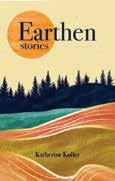
Katherine Koller announces her second short story collection, Earthen (Enfield & Wizenty), to be released in May 2026. The characters in Earthen are all in need of guidance, and find messages in the earth and rock beneath their feet, the mountains and atmosphere above, or from the creatures surrounding them—birds and animals, plants and trees. The natural world insists on a relationship with both characters and readers of Earthen in stories ranging from realism to speculative fiction. Available at Audreys Books and through Amazon.
MEMBER NEWS
dangerous ISIL terrorist in Barcelona. At risk is the life of an innocent woman. Available through Amazon, the publisher’s website, and Audreys Books.
David Mannes has published a new novel, A Dangerous Profession: Two Tales of Espionage (Club Lighthouse Publishing). Mission
One: It’s 1986 and the new Star Wars weapon system has been compromised. Calvin Painter, a key engineer of the program, has gone missing, and only he can redesign it. Both the Defense Counterintelligence and Security Agency and the KGB are in a race to find him. And with intelligence agencies floundering, and possibly infiltrated, former CIA agent Charles Knight, an investigative journalist who’s dealing with a failing marriage, is called back into action. From Chicago to San Francisco to Mexico, the race is on. Mission Two: A terrorist raid in Rome goes wrong, but special freelance troubleshooter and agent Phillip Kilroy gets a second chance at taking down a
Robert Proudfoot is pleased to announce the release of his novella, “The Blizzard,” which will be part of the forthcoming anthology, Fallen in Love (Dragon Soul Press). The general theme of Fallen in Love involves romantic stories with angels, humans, and Nephilim. This story is about Topher Chase, a struggling and embittered middle-aged man whose marriage is failing, and his adult daughters and wife Elizabeth, who require accountability for Topher’s addictions to pornography and alcohol. Topher is visited by his loving female guardian angel during an Alberta blizzard, who helps him overcome despair and the childhood loss of his father. Hard copy paperbacks and ebooks of Fallen in Love will be available to order online from Dragon Soul Press in the coming months.
Felicia Zuniga is excited to announce the publication of her poetry collection, Remember the Good (AOS Publishing). In these honest and tender poems, Zuniga traces the moments that shape a life—girlhood in the ’90s, adolescence in the 2000s, the sweetness and sting of first love, the ache of heartbreak, the wonder of new beginnings, and the joys and struggles of marriage and motherhood. With sharp detail and quiet vulnerability, she invites readers to find reflections of their own stories within these pages. This debut poetry collection is a reminder to remember the good, carry the hard, and hold close the memories that make us who we are. Available through aospublishing.com.
INDEPENDENTLY PUBLISHED AUTHORS
Naza Ezenyem announces the publication of her novel, Friends, Not Foes! (NazaReads). This beautifully illustrated story—written from a child’s perspective—gives young readers the language to talk about bullying and empathy. Parents and teachers will appreciate how it models positive responses to unkind behaviour and shows the importance of standing up for yourself and others. The gentle prose and vibrant images hold children’s attention while delivering an empowering message. Friends Not Foes! isn’t just a book; it’s a conversation starter about kindness, diversity, and inclusion. Ideal for reading at home, in classrooms, and during story time. Available through Amazon.
Simi Joel is pleased to announce the release of her forthcoming novel, When the Light Turned Red. At 15, a reckless decision behind the wheel robs a man of his life and sets Sola on a path of guilt and silence. He spends the next 14 years running from a past that won’t let him go. Rebecca, the victim’s daughter, grows up longing for love and acceptance. Abandoned by her father’s family and haunted by unanswered questions, she fights to build a future as a brilliant young analyst and fashion entrepreneur. But when a familiar face flickers across her television screen, her carefully controlled world unravels. When their paths cross, neither knows what connects them. As secrets rise to the surface, both must face what happened when the light turned red and decide what comes next. Paperback pre-orders available at simi-joel.myshopify.com. Kindle pre-orders available through Amazon.
Edmonton author Melissa Morelli Lacroix has published a new book, Song of Songs (Ardith Publishing). A FrenchCanadian cross between Encanto and This Is Us, Song of Songs follows Stéphanie Tremblay, a gifted young musician whose rise at the Granby International Song Festival forces her to confront long-hidden truths within her family. As past and present collide, Stéphanie must discover what forgiveness truly means—and decide whether she can carry her family’s story without being shaped by its wounds. Set in the prairies
of southeastern Saskatchewan, the novel paints a vivid portrait of French-Canadian life outside Québec and gives readers a rare glimpse into a culture built on survival and tradition. Through its layered histories, the novel reveals how family lore, unspoken losses, and inherited resilience shape identity for generations. Available through Amazon and the author’s website.
Irene Naested is happy to announce the publication of the second edition of Light as it Falls: Come Dance with Me, which was listed on the best-
seller list in the Calgary Herald. The book is a provocative journey through shadows and light. Naested says she “fears the blank canvas and white paper.” Her fear has become our joy as we travel with Naested through her artwork and words in search of balance, flow and self-expression to create artifacts. Through a combination of her art and photography, and her words and the words of others, she creates a captivating collage of philosophical questions and responses. The vulnerability presented is both familiar and refreshing as we move with Naested from her state of questioning, almost rebellious defiance of mounting years, to acceptance. Available through Amazon and freisenpress.com.
WESTWORD SUBMISSION GUIDELINES
Guidelines for Writers
HOW TO SUBMIT AN ARTICLE
• Send your article by email to editor@writersguild.ab.ca with the subject: “WestWord Article.”
• Please use Times New Roman, 12-point font, and double-space and paginate your document.
• Name your file as “[Surname]—[Title]” (for example: “Smith—Untitled”).
• Attach your submission as .doc or .docx files.
• We suggest your article be between 900 and 1,250 words in length.
HOW TO SUBMIT A PROPOSAL
In addition to commissioned articles, WestWord welcomes unsolicited submissions.
• Your proposal should express concisely and coherently the article’s essential elements; how you intend to approach the article; the section of the magazine best suited to the idea; and a summary of your credentials (no CVs please).
• Email enquiries to editor@writersguild.ab.ca with the subject:
“WestWord Article Proposal.”
• The body of your email should contain your name, contact information, brief biography and outline of your proposal.
• WestWord has a small staff. The response time to all proposals will vary.
COPYRIGHT AND PAYMENT FOR ARTICLES PUBLISHED
• We buy first Canadian serial print rights and limited, non-exclusive digital rights; copyright reverts to the author after publication.
• Publication occurs within a year of acceptance.
• WestWord believes writers should be compensated fairly for their work and pays industry rates for articles.
HOW TO SUBMIT A LETTER TO THE EDITOR
Letters to the editor are welcomed to encourage an exchange of ideas and opinions among members.
• Email enquiries to editor@writersguild.ab.ca with the subject: “WestWord Letter to the Editor.”
• The body of your email should contain your name and contact information.
MEMBER NEWS SUBMISSIONS
Writers’ Guild of Alberta members in good standing may submit announcements about book publications, awards won, or other news about their writing life to the Member News section of WestWord. Submit news via email to mail@writersguild.ab.ca.
Questions? Email editor@writersguild.ab.ca
Dharshan Abraham, Calgary
Bert Almon, Edmonton
Karrie Auger, Edmonton
Michael Bevan, Tofield
William Barrie Black, Calgary
Karin Blouw, Calgary
Aggrey Bulamu, Edmonton
Renato Arthur Casello, Calgary
Sebastian Contreras, Grande Prairie
Stacey Daigle, Calgary
Michael Dean Dargie, Calgary
Monet Tran Davies, Calmar
Arie Art de Jong, Edmonton
Naza Eldad Ezenyem, St. Albert
Warren Flynn, Edmonton
Daniel Joseph Gour, Calgary
Chasidy Gray, Edmonton
Emilie Mae Gray, Edmonton
Emelda Nyaradzai Gwitimah, Edmonton
Lynne Hall, Red Deer
Marke Leah Henteleff, Edmonton
Liam Houston, Edmonton
Karen Huntley, Wetaskiwin
Ludo J, Calgary
Welcome to Our NEW WGA MEMBERS
Marketa Jakesova, Edmonton
Iva Janiga, Edmonton
Maya Elizabeth Ann Jessop, Edmonton
Michaela Kadambi, Edmonton
Kirstin Keppler, Edmonton
Maryam Khadr, Edmonton
Kate Ladret, Bonnyville
Jacqueline Leland, Calgary
Jamboree Lope, Edmonton
Ari Lord, Calgary
Lisa Lozanski, Edmonton
Alison Anne MacRae, Calgary
Ilane Roberta Madzo, Edmonton
Carrie Malloy, Edmonton
Susana Matos Camarillo, Edmonton
Amanda Noelle Matwie, Edmonton
Michael Herbert Mayrl, Rocky Mountain House
Carlie Melody Mae, Calgary
Tyler Alyse Merchant, Calgary
Meghan Mezei, Wyoming
Connor Miller, Drumheller
Viraj Rajendra Muthye, Calgary
Albert Jonathan Walter Nobbs, Edmonton
Helene Oseen, Calgary
Grace Page, Red Deer
C. Wayne Pasemko, Edmonton
Jeffrey W. Pike, Onoway
Terry Pouliot, Calgary
Ramon Toroba Ramos, Edmonton
Marwa Ali Salah, Edmonton
Michael James Sauvé, Calgary
Bia Siddiqui, Edmonton
Frances Erika Slubik, Edmonton
Steven P. Snell, Calgary
Bianca Starkman, Calgary
Arik Merril Stavne, Edmonton
Lorna Stevenson, Calgary
William Fletcher Talbot, Edmonton
Jananeetha Siddharth Tiruvallur, Calgary
Jennifer Lynn Trimble, Blackfalds
Love Uchenna Ukusare, Calgary
Martha J. Urquhart, Grande Prairie
Ashay Vaidya, Calgary
Kitty Ann Welbergen, Calgary
Ben John Wilson, Calgary
Gloria I. Wolff, Spruce Grove
Arlene Wolkowycki, Edmonton
Thank you to all our generous
DONORS & SPONSORS
FRIENDS
(UP TO $99)
Susan Anthony
Diane Armstrong
Maddie Beaulieu
Eleanor Byers
Pamela Clark
Mary Lynn Cloghesy
Charlotte Corothers
Corinne Cowan
Jean Crozier
Wynne Edwards
Beth Everest
Kathy Fisher
Nahanni Free Spirit
Joan Marie Galat
Susan Glasier
Jocelyn Glover
Nora Gould
Sarah Heikkinen
Faye Holt
Faye Lippitt
Janice Lore
Patti Lott
Jodi MacAulay
Brenda-Ann Marks
Micheline Maylor
Jodi McIsaac
Joan McMillan
Elizabeth Millham
Melissa Morelli Lacroix
Shari Narine
Cheryl Nekolaichuk
Laura Nicol
Patricia Paterson
Wendy Powell
Darlene Quaife
Diane Robitelle
Megan Schaub
Raymond Sosa
Karen Spafford-Fitz
Dallas Stainthorp
Matthew Stepanic
John Stephens
Sophie Stocking
Merna Summers
Jane Trotter
Thomas Wharton
Audrey Whitson
BD Wilson
Olive Yonge
SUSTAINING PATRON
($100 - $499)
Fadekemi Adegbuyi
Silvia Alessi-Severini
Rona Altrows
Astrid Blodgett
Mila Bongco-Philipzig
Book Publishers Association of Alberta
Cori Brewster
Louise Courtemanche
Kit Dobson
Ashley Frerichs
Raymond Gariepy
Ann Goldblatt
Trudy Grienauer
Sharon Hamilton
Arnold Hanson
Gregory Hickmore
Brian Hitchon
Carol Holmes
Barb Howard
Harper Hugo-Darling
Jane Jacques
Fran Kimmel
Kathy King
Myrna Kostash
Angela Kublik
Dennis Lee
Marilyn Letts
Shannon MacNaughton
Andrew MacPherson
Ashley Mann
David Martin
Taryn Pawluk
Prairie Journal
Rhonda Parrish
Read Alberta
Lori D. Roadhouse
Toby Roth
Shirley Serviss
Alberto Severini
L. Deborah Sword
Rea Tarvydas
Christopher Wiseman
Tony Yep
ASSOCIATE PATRON
($500 - $999)
Anne Bailey
Dave & Lorna Carley
Brenda Gunn
Randy Henderson
Shaun Hunter
Alice Major
Heather McCormick
Peter Midgley
Giorgia Severini
PATRON ($1,000 & UP)
Alberta Views Magazine
Alexandra Writers’ Centre Society
The Benediktson Family
Cache Island Resources
Edmonton Community Foundation
Estate of Mary Thompson
The John Patrick Gillese Fund at Edmonton Community Foundation
Leslie and Blaine Greentree
Vivian Hansen
The Haynes Family – In Memory of Dr. Sterling Haynes
Lori Hahnel
Betty Jane Hegerat
Jeananne Kathol Kirwin, K.C.
Irene Naested
Steven Robertson
Rosza Foundation
Scott Saxberg
Marilyn and Bob Stallworthy
Nhung Tran-Davies
Under the Arch Youth Foundation
Aritha van Herk
Young Alberta Book Society
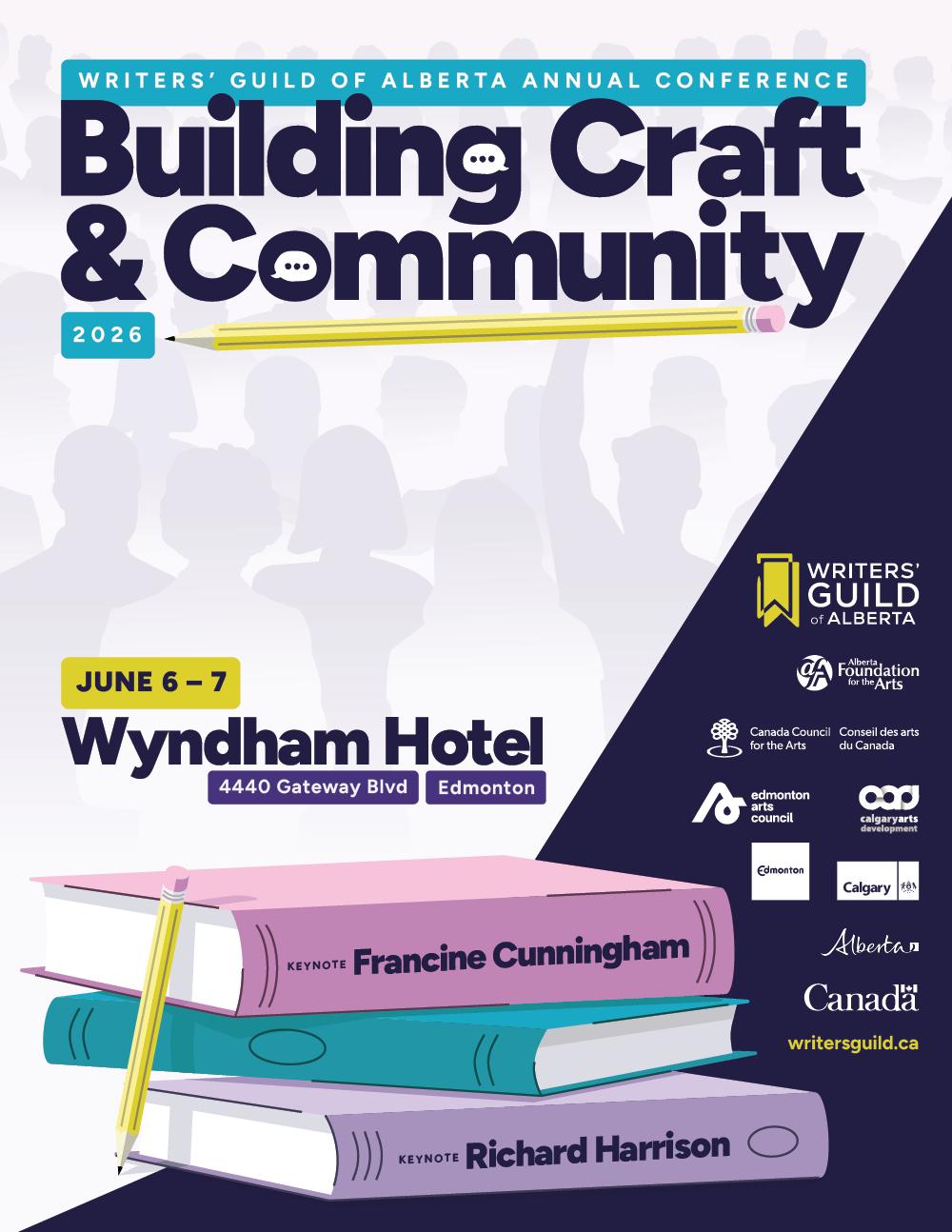
2026 Alberta Literary Awards Gala
Edmonton
Friday, June 5, 2026
Doors at 6:00 PM MT
Wyndham Hotel and Conference Centre
4440 Gateway Blvd
Edmonton
Join us for dinner as we announce the winners of the 2026 Alberta Literary Awards Tickets on sale February 18, 2026!
$85 Early Bird (ends April 17) $100 Regular