PACIFIC ISLANDS FISHERY NEWS
Newsletter of the Western Pacific Regional Fishery Management Council / Summer 2026 ISSN 2151-2329 (PRINT) ISSN 2151-2337 (ONLINE)
Reclaiming the Promise of the
Magnuson-Stevens Act
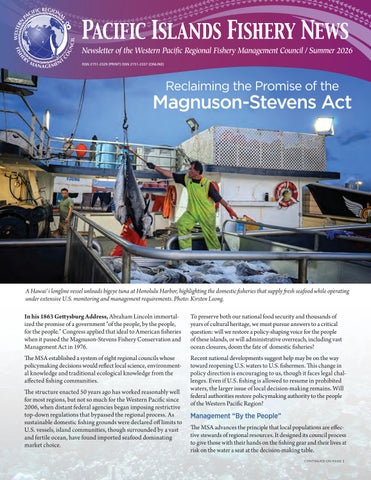
A Hawai‘i longline vessel unloads bigeye tuna at Honolulu Harbor, highlighting the domestic fisheries that supply fresh seafood while operating under extensive U.S. monitoring and management requirements. Photo: Kirsten Leong. In his 1863 Gettysburg Address, Abraham Lincoln immortal ized the promise of a government “of the people, by the people, for the people.” Congress applied that ideal to American fisheries when it passed the Magnuson-Stevens Fishery Conservation and Management Act in 1976.
To preserve both our national food security and thousands of years of cultural heritage, we must pursue answers to a critical question: will we restore a policy-shaping voice for the people of these islands, or will administrative overreach, including vast ocean closures, doom the fate of domestic fisheries?
The MSA established a system of eight regional councils whose policymaking decisions would reflect local science, environment al knowledge and traditional ecological knowledge from the affected fishing communities.
Recent national developments suggest help may be on the way toward reopening U.S. waters to U.S. fishermen. This change in policy direction is encouraging to us, though it faces legal chal lenges. Even if U.S. fishing is allowed to resume in prohibited waters, the larger issue of local decision-making remains. Will federal authorities restore policymaking authority to the people of the Western Pacific Region?
The structure enacted 50 years ago has worked reasonably well for most regions, but not so much for the Western Pacific since 2006, when distant federal agencies began imposing restrictive top-down regulations that bypassed the regional process. As sustainable domestic fishing grounds were declared off limits to U.S. vessels, island communities, though surrounded by a vast and fertile ocean, have found imported seafood dominating market choice.
Management “By the People” The MSA advances the principle that local populations are effec tive stewards of regional resources. It designed its council process to give those with their hands on the fishing gear and their lives at risk on the water a seat at the decision-making table. CONTINUED ON PAGE 2
Reclaiming the Promise PACIFIC ISLANDS FISHERY NEWS is published by the Western Pacific Regional Fishery Management Council 1164 Bishop St., Suite 1400 Honolulu, HI 96813 www.wpcouncil.org
CONTINUED FROM PAGE 1
• Loss of Perspective: Federal regulators have become so focused on strict preservation that they have abandoned a primary MSA mandate: achieving Optimum Yield for the economic and nutritional benefit of the nation. • Loss of Opportunity: Once-thriving dom estic fisheries — including the Northwestern Hawaiian Islands lobster and bottomfish fisheries and the Mariana Islands commercial longline fishery — have been extinguished.
Telephone: (808) 522-8220 Fax: (808) 522-8226 info@wpcouncil.org CHAIR
Nathan Ilaoa—American Samoa
A Disproportionate Burden
EXECUTIVE DIRECTOR
The Western Pacific Region encompasses more than 1.5 million square nautical miles of the U.S. exclusive economic zone, yet its landmass is only about 0.2% of the region’s total area.
Kitty M. Simonds VICE CHAIRS
Will Sword-American Samoa Sylvan Igisomar-CNMI Chelsa Muña-Guam Roger Dang-Hawai‘i All rights reserved.
STORY ICON KEY REGIONAL INTEREST
CONSERVATION
FISHERMEN
EDUCATORS
GOVERNMENT
Federal
Hawai‘i
Guam/ CNMI
American Samoa
Dedicated to ecosystem-based fisheries management in the U.S. Pacific Islands.
A bottomfish fisherman testifies during the Western Pacific Regional Fishery Management Council’s 161st meeting in 2014, exercising the public partici pation built into the Magnuson-Stevens Act’s regional management process. In the Pacific Islands, however, decisions affecting ocean access, livelihoods and cultural traditions have been imposed through authorities outside the MSA framework. Conservation mandates under laws including the Antiquities Act, Endangered Species Act, Marine Mammal Protection Act and National Marine Sanctuaries Act can circumvent the regional system. When presidential proclamations or federal directives are take effect without Council input, it effectively subverts the process Congress enacted. A govern ment by the people cannot exist when the people themselves are shut out of the room. In 2014 congressional testimony, former Coun cil Chair and Commonwealth of the Northern Mariana Islands Governor Arnold Palacios described a sobering reality defined by one theme: loss. • Loss of Fisheries: Duplicative federal requirements can force even minor fishery adjustments into years of review, leaving measures obsolete before implementation. • Loss of Fishing Grounds: Vast areas of ocean have been cordoned off from sustainable harvest. • Loss of Culture: As traditional fishers are squeezed out of ancestral waters, a 3,000-year chain of Indigenous knowledge is put at risk.
2
Pacific Islands Fishery News | SUMMER 2026
Despite that microscopic land footprint, around 90% of all U.S. marine protected area square mileage is concentrated in the Western Pacific — an extraordinary and unfair regional skew. Many of these waters, designated as marine national monuments through executive action, were already protected by their extreme isolation. Today, they function primarily as “paper parks” — managed by an expanding army of federal bureaucrats while local, sustainable fishers remain locked out.
Fishing Sustains Culture and Community For Pacific Islanders, fishing is not merely an industry. It is part of the fabric of social cohesion. Ancestral traditions include sharing fish with family, friends and neighbors without expecting an immediate or equivalent return. This practice strengthens community trust, supports food security and reinforces Indigenous identity. Rigid Western management systems often fail to recognize these nonmarket, community-driven relationships. The Council has therefore worked to establish culturally appropriate definitions of customary exchange and subsistence fishing. With out that recognition, living cultural practices can be marginalized — or criminalized — until they become little more than historical curiosities. • Customary Exchange is the "non-market exchange of marine resources between fishermen and community residents... for cultural, social, or religious reasons," which permits basic cost recovery for trip expenses like fuel, ice, bait and food.
TROLL ON IN TO THIS ISSUE 1 Reclaiming the Promise of the MagnusonStevens Act
4 A Message from the Executive Director 5 207th Council Meeting Highlights, June 9-11, 2026 7 Navigating Deep-Sea Mining: From the Mariana Islands to the CCZ 8 Know Your ‘Ahi: Labeling Law Arrives Amid Tariff Turbulence 10 CCC Meets in Homer to Advance Seafood Competitiveness, Trade Fairness and Council Priorities 12 Bottomfish Workshop Introduces New Technologies to Support Manu'a Fishers 14 Fishing for Science: Connecting Fisheries, Education and Community in American Samoa
Community members gather during the 2023 akule harvest in Fagasa, American Samoa. Traditional fisheries help sustain food security, cultural practices and the sharing of marine resources across generations. Photo: Travis Tua. • Subsistence Fishing is fishing in cus tomarily fished waters in which the harvest is used for "direct consump tion or distribution in the community through sharing in ways that contri bute to food security and cultural sustainability."
A Double Standard for Domestic Fisheries The Hawai‘i and American Samoa long line fleets are internationally recognized for responsible pelagic fishing and have pioneered bycatch mitigation technolo gies. U.S. fishermen comply with catch limits, carry federal observers and use satellite vessel monitoring systems. Meanwhile, competing foreign fleets — most notably from China — receive government support for fuel, labor and vessel development. They flood the global market, depress ex-vessel prices and push compliant U.S. operations, including the American Samoa longline fishery, toward bankruptcy. The double standard is devastating. Hawai‘i longline fishermen operate under binding international catch limits and rigorous U.S. monitoring and enforcement, while competing foreign fleets benefit from uneven levels of government support, oversight and accountability.
16 The Cost of Consecutive Storms: Fisheries and Food Security 17 Piti Sea Festival Celebrates Guam’s Maritime Heritage and Fishing Traditions 18 Council Family Updates
Restoring the Regional Process The regional MSA process must be restored to its proper role. Environmental measures proposed under competing federal sta tutes should receive meaningful review through the MSA’s transparent, public and regionally flexible council process.
19 Congressional Corner 19 2026 Council Calendar 20 Upcoming Events: Summary of Action Items at the September 2026 Council Meeting
If the nation continues to favor top-down exclusion and administrative overreach, domestic fleets will fail, the seafood trade deficit will widen and cultural traditions will erode into history. When Congress next reauthorizes the MSA, we should be celebrating a restored, community-driven partnership that keeps representative governance alive in our waters. A CNMI fisherman asks a question during a Fishers Forum held in conjunction with the Council’s 166th meeting in 2016. The forums provide fishermen and community members another avenue to engage directly in regional fishery management.
SUMMER 2026 | Pacific Islands Fishery News
3
Message from the Council’s Executive Director The ocean connects our islands, sustains our communities and carries cultural practices that have endured for generations. We respect those traditions and the people who work to protect them. But honoring culture and conserving marine resources should not require us to exclude well-managed domestic fisheries from the waters on which our communities rely. Fishing is about much more than a vessel and its catch. It benefits captains and crews, but it also employs the people who make hooks and gear, produce ice, repair engines, transport fish, prepare meals and bring locally caught seafood to our tables. When fishing access is lost, the effects ripple through the entire community, including consumers. Unfortunately, public discussions about fisheries too seldom reflect this complete picture. Fishermen are sometimes portrayed as being opposed to conservation or cultural protection simply because they ask to continue fishing. That characteriza tion is neither fair nor accurate. Our fishermen have a direct interest in healthy oceans. Their families, businesses and ways of life depend on resources remaining productive for generations to come. Asking that responsible vessels be allowed to fish is not a rejection of conservation. It is a request for balanced management that recognizes people as part of the environment rather than treating them as threatening intruders. Marine monuments, sanctuaries, cultural protections and well-managed fisheries do not have to be mutually exclusive. With meaningful local participation and regulations that recognize the different needs of each region, they can coexist. The Magnuson-Stevens Act created a regional process because Congress under stood that a top-down, one-size-fits-all system would not effectively serve a nation with enormous geographic and cultural diversity. It ensured that the voices of people who live beside the ocean and depend upon it would be heard. As we reflect on the Act’s 50-year legacy, we should remember that fisheries management is not only about resources beneath the water. It is also about people — and about allowing responsible American vessels to provide food, jobs and cultural continuity for our island communities. Kitty M. Simonds
4
Pacific Islands Fishery News | SUMMER 2026
Aerial view of the longline F/V America leaving Pago Pago Harbor in American Samoa. The longline fleet plays a vital role in the territory's economy and contributes to the region's sustainable pelagic fisheries. Photo: Edgar Feliciano.
207th Council Meeting Highlights, June 9-11, 2026 Council Seeks Fair South Pacific Albacore Allocation for American Samoa Meeting in American Samoa, the West ern Pacific Regional Fishery Management Council focused on securing meaningful South Pacific albacore access for the terr itory’s longl ine fleet, cannery and supporting businesses. American Samoa Gov. Pula‘ali‘i Nikolao Pula stressed the territory’s long history and economic dependence on the fishery. “American Samoa has a long history in this fishery, and an economic dependence on it,” he said. “We need to sustain a truly domestic tuna fishery for generations to come.” The Council recommended advancing a 2026 Western and Central Pacific Fisheries Commission position calling for allocation criteria that recognize American Samoa’s long-term fishing history. The Council said an allocation should be no less than 2,250 metric tons — enough to accommodate 150 mt per year for a fleet of 15 vessels — and should be transferable to other Western and Central Pacific Fisheries Commission (WCPFC) members. It also supported banning or restricting transshipment of South Pacific albacore.
“The Council is working to make sure American Samoa receives a fair share of any South Pacific albacore allocation to revive our local longline fleet,” said Council Chair Nathan Ilaoa. “South Pacific albacore and the tuna industry do more than support fishing jobs. They help lower the cost of fuel, electricity and shipping for our islands, while strengthening food security and sustaining a Pacific Island fishery that operates under strong U.S. standards.”
fishery councils,” said Council Executive Director Kitty Simonds. “The Council is committed to continue working together with our fishing communities in Ameri can Samoa, Hawai‘i and the Northern Mariana Islands to discuss and develop fishery management plans in these areas.”
Presidential Proclamation Restores Commercial Fishing Access Council members watched the White House signing ceremony during the final day of the meeting as President Donald Trump issued the proclamation, “Restoring American Commercial Fishing in the Pacific.” The proclamation restores commercial fishing access in portions of three Pacific marine national monuments and follows recommendations the Council made at its March meeting under Execu tive Order 14276, “Restoring American Seafood Competitiveness.” “We are pleased that under the authority of the Magnuson-Stevens Act, the management of fishing in monument waters is returning to the
For American Samoa, the action includes waters around Muliāva (Rose Atoll) where commercial fishing access has been restricted since 2009. “Today’s proclamation is a significant and welcome development for American Samoa,” Ilaoa said. “As American Samoa invests in a new generation of longer-range fishing vessels, restoring access to these areas will help ensure that local fishermen are able to fully benefit from those investments and continue contributing to our economy and food security.” The proclamation also affects waters in the Marianas Trench Islands Unit and Papahānaumokuākea. Longline fishing within 50 nautical miles of Papahānaumokuākea remains pro hibited, and additional federal action may be needed before fishing resumes in some areas because of National Ma rine Sanctuary regulations and other authorities. CONTINUED ON PAGE 6
SUMMER 2026 | Pacific Islands Fishery News
5
207th Council Meeting
CONTINUED FROM PAGE 5
members and local leaders have raised concerns about potential impacts to fisheries, ocean ecosystems and future generations. The Council requested that relevant federal agencies continue providing updates to the Council and American Samoa on deep-sea mining activities and their potential fishery impacts.
Other Council Actions American Samoa Gov. Pula joins Western Pacific Regional Fishery Management Council members, including Chair Nathan Ilaoa, Executive Director Seuta‘atia Kitty Simonds, and two American Samoa high talking chiefs at the 207th Council meeting June 9, 2026, in Pago Pago. The chiefs participated in an Aunu‘u sua presentation honoring Simonds for her longtime service to American Samoa and the region.
Council Calls for Stronger US Seafood Competitiveness Measures The Council advanced several recom mendations aimed at improving the competitiveness of American Samoa and other Western Pacific fisheries. It supported asking the U.S. Trade Representative to investigate foreign subsidies and practices that may undercut the American Samoa tuna industry under Section 301 of the Trade Act of 1974. The Council also asked federal agencies to protect American Samoa’s duty-free advantage, explore relief from recent fuel-cost increases for U.S. fisheries and strengthen import requirements for foreign longline fleets entering the U.S. market. It further requested that federal Country of Origin Labeling requirements be extended to restaurants so consumers can better distinguish American Samoa-produced tuna from foreign products.
Governor Highlights Fisheries, Culture and Regional Cooperation Gov. Pula welcomed Council members on the first day of the meeting with the Samoan proverb, “ʻUa fetaui lelei fola o le ʻalia,” meaning “The deck planks of the voyaging canoe fit together well.” He 6
Pacific Islands Fishery News | SUMMER 2026
compared the Council to a voyaging canoe in which no single plank carries the vessel alone, noting that members from American Samoa, Hawai‘i, Guam and the Commonwealth of the Northern Mariana Islands bring together different cultures, knowledge and traditions to shape regional fisheries policy. Pula also honored Council Executive Director Seuta‘atia Kitty Simonds with a Sua Fa‘atamali‘i, or chiefly offering, recognizing her service to American Samoa’s fishing community. Before the meeting, Council members were welcomed by the Office of Samoan Affairs through a traditional ‘ava cere mony. The gathering coincided with the Council’s marking of the 50th anniversary of the Magnuson-Stevens Fishery Conservation and Management Act.
Council Seeks Continued Updates on Deep-Sea Mining The Council received updates from federal agencies on proposed deepsea mineral mining near American Samoa and in the Clarion-Clipperton Zone. Council advisors, community
For bigeye tuna, the Council asked U.S. negotiators to seek changes that would keep the Hawai‘i longline fleet from being grouped with larger tropical longline fisheries under the WCPFC management procedure. Hawai‘i’s fleet accounts for less than 3% of total Western and Central Pacific bigeye catch south of 20 degrees N and operates under limited entry and strict monitoring. The Council also endorsed the 2026 American Samoa bottomfish stock assessment for management use, with acceptable biological catch and annual catch limit options to be considered at its September meeting. For Hawai‘i, the Council took final action on the main Hawaiian Islands Kona crab fishery, recommending an annual catch limit of 30,802 pounds and an annual catch target of 25,491 pounds for fishing years 2027–2030.
Navigating Deep-Sea Mining:
From the Mariana Islands to the CCZ
Manganese nodules on the seafloor in the CCZ. Source: ROV KIEL 6000/GEOMAR.
Seabed mining in the CCZ. ISA - International Seabed Author ity; APEI - Area of Particular Environmental Interest. Source: Center for Strategic and International Studies/Asia Maritime Transparency Initiative. At its 207th meeting in June 2026, the Western Pacific Region al Fishery Management Council heard from federal agencies on emerging deep-sea mining developments in the Western Pacific. NOAA provided information on activities in the Clarion-Clipperton Zone (CCZ) southeast of the Hawaiian Islands, while the Bureau of Ocean Energy Management (BOEM) discussed potential min eral leasing in waters around American Samoa and the Mariana Archipelago. As described in the summer 2025 issue of Pacific Islands Fishery News, two federal laws govern deep-sea mineral development. The Outer Continental Shelf Lands Act gives BOEM authority over mineral resources within the U.S. exclusive economic zone (generally 3-200 nm offshore), while the Deep Seabed Hard Mineral Resources Act authorizes NOAA to license U.S. deepseabed mining activities beyond national jurisdiction. Federal interest in deep-sea minerals accelerated in 2025 with Executive Order 14285, “Unleashing America’s Offshore Critical Minerals and Resources,” consideration of potential lease sales in American Samoa and Mariana waters, and changes to NOAA’s licensing process for U.S. companies seeking to explore for deepsea minerals.
Potential Leasing Around American Samoa and the Mariana Islands On July 16 and August 17, 2026, the Marine Minerals Admini stration (MMA) announced a proposed leasing notice for waters around American Samoa and the Mariana Islands, respectively. MMA was formed days earlier through the reunification of BOEM and the Bureau of Safet y and Environmental Enforcement. The notice outlines options for the number of leases that could be offered, while the accompanying assessment describes potential lease areas, timing, terms and conditions. Public comments on the proposed number of leases and the assessment are being accepted through Sept. 17 for American Samoa and Oct. 19, 2026, for the Mariana Islands. Following the
comment period, the agency has proposed holding its first lease sale by Nov. 19 and Dec. 16, 2026. The proposal has drawn concern from members of the Ameri can Samoa community and Congresswoman Aumua Amata Coleman Radewagen. Gov. Pula‘ali‘i Nikolao Pula has encour aged residents to stay engaged and submit comments as the federal leasing process moves forward.
Exploration Applications on the High Seas Activity is also advancing in the CCZ, an area of the deep Pacific seafloor known for deposits of polymetallic, or manganese, nod ules , and the Eastern High Seas Pocket 3, between the Cook Islands, Kiribati and French Polynesia. On July 30, 2026, NOAA notified the Council that applications from American Deep Sea Minerals, The Metals Company, SeaX and American Metal Resources were complete and could move forward in the licensing process for deepseabed mineral exploration in the CCZ. A separate American Deep Sea Minerals application for exploration in Eastern High Seas Pocket 3 was also cleared to proceed. Unlike the proposed lease areas around American Samoa and the Mariana Islands the CCZ is in international waters beyond U.S. national jurisdiction. At its 208th meeting in September, the Council will hear a presen tation on the proposed licenses and discuss how deep-sea mining could affect fisheries operating in and around the CCZ and the Eastern High Seas Pocket. As federal agencies move these proposals forward, questions remain about implications for ocean ecosystems, fisheries and island communities. The Council continues to seek information on proposed activities while emphasizing transparency, public participation and consideration of the communities that depend on Pacific marine resources. SUMMER 2026 | Pacific Islands Fishery News
7
Know Your ‘Ahi: Labeling Law Arrives Amid Tariff Turbulence
Look beyond “locally made”: As of July 1, 2026, Hawai‘i’s new labeling law requires covered retailers to identify where the ‘ahi itself was landed, helping shoppers distinguish locally landed fish from imports. Photos: Mark Fitchett and Mark Mitsuyasu. The next time you buy ‘ahi poke at a Hawai‘i grocery store, take a closer look at the label. As of July 1, 2026, certain retailers are required to tell consumers where the fish came from — information that can make an important difference in a market where imported tuna is often difficult to distinguish from locally landed fish.
Covered retailers are prohibited from displaying or selling raw processed ‘ahi without identifying where the fish was landed. Act 238, passed by the Hawai‘i Legislature in 2025, requires covered retailers selling raw processed ‘ahi to disclose the fish’s country of origin at the point of sale. The requirement applies to products such as poke and sashimi and generally covers larger retailers licensed under the federal Perishable Agricultural Commodities Act, typically stores that purchase more than $230,000 in produce annually. Covered retailers are prohibited from displaying or selling raw processed ‘ahi without identifying where the fish was landed. Reporting also indicates the disclosure extends to whether the ‘ahi was previously frozen and whether it was treated with carbon monoxide, a practice sometimes used to keep previously frozen fish looking fresh and red. Enforcement will begin with outreach by the state Department of Agriculture and Biosecurity’s Measurement Standards Branch, with warnings issued first and further action possible 8
Pacific Islands Fishery News | SUMMER 2026
under Hawai‘i Revised Statutes Chapter 486-32 for retailers that do not comply. State officials have framed the law as a consumer-protection measure that also recognizes the value of Hawai‘i’s commercial fishing industry.
Why Local Fishermen Pushed for It For years, Hawai‘i consumers could encounter bright red ‘ahi without knowing whether it was locally landed, imported, previously frozen or treated to maintain its red appearance. An estimated 90% of the ‘ahi sold by Hawai‘i retailers is imported. Supporters of Act 238, including the Hawaii Longline Asso ciation, argued that consumers should be able to distinguish imported tuna from fish landed in Hawai‘i. HLA Executive Director Eric Kingma has noted that country-of-origin information is common for many other consumer products, while seafood sold in prepared or processed forms has often been less transparent. For Hawai‘i fishermen, the stakes go beyond consumer curiosity. The Honolulu-based longline fleet supplies a niche fresh-tuna market through the early-morning fish auction at Pier 38 and supports seafood businesses surrounding Honolulu Harbor. Although Hawai‘i’s fleet accounts for only a small share of the global tuna catch, it operates under extensive oversight from NOAA, the Western Pacific Fishery Management Council and the Western and Central Pacific Fisheries Commission. Industry advocates argue that Hawai‘i boats compete against imported tuna produced under different labor, operating and
regulatory structures. When imported, previously frozen fish is difficult to distinguish from locally landed fresh tuna, those differences can be obscured at the retail counter. Supporters hope clearer labeling will help consumers who value freshness or want to support Hawai‘i fishing businesses identify locally landed ‘ahi. That can be especially useful for visitors seeking Hawai‘i-caught seafood. Act 238 does not tell consumers which fish to buy. It makes origin — and, where disclosed, previous freezing or carbonmonoxide treatment — more visible at the point of sale.
Tariff Whiplash Adds to an Uncertain Market The labeling requirement also comes at a turbulent time for international seafood trade. Federal tariff policy has shifted significantly over the past year. In February 2026, the U.S. Supreme Court ruled 6–3 in Learning Resources v. Trump that the International Emergency Economic Powers Act did not authorize the broad “reciprocal” and trafficking-related tariffs imposed by the administration beginning in 2025. Collection of those tariffs stopped shortly afterward, while questions over refunds for more than $100 billion in pre viously collected duties were left to lower courts. Other tariff authorities, including Section 232 (national security) and Section 301 (unfair trade practices), were unaffected, and the administration has continued pursuing tariffs under other provisions of federal trade law. For seafood businesses, that back-and-forth matters because tariffs can change the price relationship between imported tuna and domestically landed fish. Shifting policies make those effects difficult to predict for importers, retailers and
local fishing businesses. Tariffs can alter what imported fish costs. Act 238 addresses a different question: whether consumers know the fish is imported in the first place.
Competing in a Global Tuna Market Hawai‘i’s tuna industry operates in a seafood market heavily supplied by imports. HLA and the Council have raised con cerns about imported tuna entering the U.S. market at prices below domestic seafood, including fish from fleets with lower costs, different regulatory requirements or government support unavailable to U.S. fishermen. A state labeling law cannot resolve those broader competitive issues or determine tariff policy, global tuna prices or the rules governing foreign fleets. It can, however, make one part of the comparison clearer at the seafood counter. Imported, previously frozen ‘ahi and freshly landed Hawai‘i tuna may reach the same retailer through very different supply chains, regulatory systems and cost structures. Country-oforigin labeling makes that distinction visible without dictating what value consumers should place on it.
The Bottom Line Act 238 arrives as Hawai‘i’s tuna fishery operates within a global market shaped by imports, changing trade policy and different regulatory environments. The law will not eliminate those pressures, but it gives shoppers a concrete piece of infor mation often missing before: where the ‘ahi came from. For Hawai‘i fishermen and seafood businesses, that visibility gives locally landed tuna an opportunity to compete on more than price alone.
‘Ahi loins labeled Product of Vietnam, left, and Product of USA, right. Country-of-origin labeling already applied to loins and other unprocessed seafood; Hawai‘i’s new law addresses raw processed ‘ahi such as poke and sashimi. Photos: Eric Kingma. SUMMER 2026 | Pacific Islands Fishery News
9
CCC Meets in Homer to Advance Seafood Competitiveness, Trade Fairness and Council Priorities
Aligning Council and NMFS Priorities Councils described common challenges from constrained staffing and funding, delayed implementation of manage ment actions and reduced science capacity. The CCC approved a motion directing each Council, NOAA regional office and science center to continue aligning priorities with available capacity and report progress at the October 2026 CCC meeting. The action reflects a shared concern that national initiatives must be matched with realistic regional workloads and clear pathways for Council priorities to inform NOAA resource decisions.
Seafood Competitiveness and International Trade Council Chair Nathan Ilaoa (front), Executive Director Kitty Simonds, Program Officer Mark Mitsuyasu (left) and Pacific Council Executive Director Merrick Burden shuttle out to tour Coast Guard Cutter Frederick Mann May 18, 2026, in Homer, Alaska. Photo: Nathan Ilaoa. The eight U.S. Regional Fishery Management Councils met May 19-21, 2026, in Homer, Alaska, for the spring Council Coordination Committee (CCC) meeting, hosted by the North Pacific Fishery Management Council. The meeting brought council leaders together with National Marine Fisheries Service (NMFS) officials to address national fishery management priorities, agency and council capacity, seafood competitiveness, international trade, science needs and regulatory streamlining. For the Western Pacific, the discussions centered on fishing access, fair treatment of U.S. fisheries in global markets and maintaining strong regional input as federal priorities and procedures evolve. Western Pacific Council representatives also highlighted the importance of American Samoa’s tuna industry, international tuna negotiations and emerging regional issues including shark depredation, traditional and local ecological knowledge, and disaster preparedness. 10
Pacific Islands Fishery News | SUMMER 2026
Executive Order 14276 on “Restoring American Seafood Competitiveness” remained a major focus. The CCC approved a wide-ranging international affairs motion calling for stronger implementation of the Marine Mammal Protection Act (MMPA) import provisions so foreign fish eries face requirements more comparable to those imposed on U.S. fleets. The motion also urged federal agencies to resolve burdens created by new European Union (EU) seafood traceability requirements, strengthen country-oforigin labeling throughout the seafood supply chain, and pursue broader action on unfair seafood trade practices. The Western Pacific Council secured language specifically addressing U.S. territories. The CCC recommended developing tariff policies that do not negatively affect territories, noting that lower tariffs on tuna loins entering the continental United States can undermine tuna production in American Samoa. Council members stressed that domestic seafood-production goals cannot succeed if U.S. fishing communities are disadvantaged by foreign products produced under weaker labor, monitoring or conservation standards. NMFS also updated the CCC on MMPA comparability findings and EU catch-certification requirements. Western Pacific representatives raised concerns about how foreign
Alaska’s crab fleet, including the Time Bandit, featured on the television series Deadliest Catch, in the harbor in Homer, Alaska. Photo: Mark Mitsuyasu. fisheries are judged comparable to U.S. fisheries and about insufficient coordination among federal trade agencies. The CCC’s motion urged NOAA and other agencies to continue strengthening these processes and to seek additional time to resolve EU traceability requirements if needed.
Fishing Access and Western Pacific Priorities During the Council round-robin, Western Pacific Council Chair Nathan Ilaoa emphasized fishing access as the region’s top priority. He noted that recent federal actions removing commercial fishing prohibitions in some monument waters support the Council’s position that conservation and fishing can coexist under regional, science-based management. The Council also highlighted 2026 as an important year for international fisheries, including South Pacific albacore allocation, bigeye tuna management and harvest-strategy work, where effective U.S. participation is critical to Pacific Island fishing communities.
Looking Ahead The Homer meeting also marked the 50th anniversary of the MSA and the regional council system. Discussions emphasized that the system’s strength remains its ability to combine national conservation standards with regional knowledge and stakeholder participation. The CCC will meet again in October 2026 in the Washington, D.C., area, when councils and NMFS are expected to report on progress aligning priorities and capacity and continue work on the issues advanced in Homer. Meeting briefing materials and presentations are available at www.fisherycouncils.org/ccc-meetings/may-2026.
NEPA Streamlining, Grants and Fisher Engagement The CCC supported continued work to streamline National Environmental Policy Act (NEPA) procedures while maintaining the role of the Magnuson-Stevens Fishery Conservation and Management Act (MSA) process. It asked NMFS for updated timelines on revised NEPA procedures and categorical exclusions and encouraged direct work with Council and regional staff where that could speed implementation. The CCC also backed stronger support for the Saltonstall-Kennedy Grant Program, recommending that more fisheries import-duty receipts be retained for competitive grants that promote, develop and market U.S. fisheries in support of seafood competitiveness. The Committee further recommended that NMFS continue and prioritize support for the Marine Resource Education Program. The program, now active across all Council regions, helps fishermen and other fishery participants understand fisheries science and the Council process and engage more effectively in management. Western Pacific participation was added in 2025, expanding the program to national coverage.
From left, Western Pacific Council representatives Ilaoa, Simonds and Mitsuyasu on the beach at Land’s End Resort in Homer, Alaska, May 19, 2026. Photo: Nathan Ilaoa.
SUMMER 2026 | Pacific Islands Fishery News
11
Bottomfish Workshop Introduces New Technologies to Support Manu'a Fishers
Left: Master fisherman Eddie Ebisui leads the classroom portion of the bottomfish workshop at the Tai Samasama Fishing Co-op in Taʻū. Right: Participants learned how to use mapping tools and technology to identify productive fishing grounds and improve efficiency. For generations, fishers in Manuʻa have relied on their knowledge of the ocean, reading currents, weather and the seafloor to target prized deepwater bottomfish such as paluloa (longtailed red snapper) and palu-malau (ruby snapper). While that traditional knowledge remains invaluable, changing ocean conditions, evolving technology and rising operating costs have made it increasingly important for fishers to have access to new tools and training. In response to requests from the fishing community, the Western Pacific Regional Fishery Management Council, in partnership with the American Samoa Department of Marine and Wildlife Resources (DMWR) and the Pacific Islands Fisheries Group (PIFG), hosted a two-day bottomfish workshop June 3 to 4, 2026, in Taʻū, Manuʻa. The workshop brought together about 20 fishers from the islands of Ofu, Olosega and Taʻū for practical, hands-on training in modern bottomfishing techniques and technologies. The workshop was a direct outcome of the Council's Infla tion Reduction Act-sponsored Community Consultation initiative. Throughout 2025, PIFG met with fishing com munities in Tutuila and Manuʻa to better understand the challenges they face and identify ways to support local fisheries. One of the strongest needs identified was for more hands-on opportunities to learn modern fishing techniques. The Council worked with DMWR and PIFG to turn that community input into action by bringing the requested training directly to Manuʻa. Led by Hawaiʻi master bottomfisherman Eddie Ebisui III, along with Alexander Min and Vincent Tofilau of PIFG, the workshop combined classroom instruction with practical
12
Pacific Islands Fishery News | SUMMER 2026
demonstrations on the water. Participants learned how to rig and operate electric reels, use fish finders and depth recorders, interpret bathymetric maps, navigate with GPS and electronic charts, improve boat positioning over productive fishing grounds and properly handle fish to maximize quality and value. Throughout the workshop, instructors emphasized that technology is not intended to replace local knowledge, but rather to complement generations of fishing experience by helping fishers work more efficiently and safely. These tools can help reduce fuel costs, shorten search times for productive fishing grounds and strengthen the long-term resilience of fishing operations in the face of changing environmental and economic conditions. Following the classroom sessions, participants put their new skills to the test during an on-the-water exercise from Faleasāo Wharf. Working alongside the instructors, fishers practiced preparing bait, rigging tackle, deploying the “Make Dog” rig, positioning vessels using GPS and depth maps, and applying the techniques demonstrated earlier. The results were immediate. Within minutes of the first drop, participants landed high-value bottomfish, including prized palu-malau. By the end of the session, every participant who made a drop had landed a fish, showing how the classroom lessons translated directly to the water. Beyond introducing new fishing techniques, the workshop also gave fishers an opportunity to discuss ongoing challeng es. Participants spoke about changing ocean conditions, shifting bait availability, the need for affordable fish-finding
Top: Clint Ilaoa (left) and Solia Mutini (right) study workshop materials during the bottomfish workshop in Taʻū. Middle: Success on the water! Participants landed a palu-loa along with a palu-ave (goldflag jobfish) on their first drop in the waters of Manu‘a. Bottom: Workshop participants retrieve their fishing line under the guidance of Ebisui during the hands-on bottomfish training off the coast of Taʻū, Manuʻa.
technology, aging alia boats, damaged launching facilities and the importance of replacing fish aggregating devices. These discussions provided valuable insight to help guide future outreach, training and fisheries support efforts in Manuʻa and throughout American Samoa. The bottomfish workshop demonstrated how community input can lead to meaningful action. By listening to fishers, working with local partners and providing practical learning opportunities, the Council, DMWR and PIFG are helping strengthen fishing communities while supporting sustainable fisheries throughout the Western Pacific. Parti cipants returned home with new skills, tools and confidence to meet the opportunities and challenges ahead.
The day's training concluded with a successful catch as participants returned to Faleasāo Wharf with several palu-loa, reinforcing the practical skills learned during the workshop. All photos: VJT.
SUMMER 2026 | Pacific Islands Fishery News
13
Fishing for Science: Connecting Fisheries, Education and Community in American Samoa
Council Chair and DMWR Director Nathan Ilaoa (center back) presents at the Fishers Forum on June 9, 2026, at the Tauese P.F. Sunia Ocean Center. Photo: Felix Peñalosa. The 3rd Pago Pago Open Fishing Tourna ment brought more than competition to the Malaloa Marina Sport Fishing Dock June 6 — it also put fisheries science, education and community participation at the center of the action. Hosted by the Western Pacific Regional Fishery Management Council and Department of Marine and Wildlife Resources (DMWR), the tournament serv ed as a signature event leading into the Council’s 207th meeting, held June 9 to 11 in Pago Pago.
The workshop emphasized a simple but important message — good fishery management starts with good fishery data, and the information fishermen provide is essential to understanding and managing local fisheries.
This year's tournament placed a special spotlight on American Samoa's six priority bottomfish management unit species (BMUS): palu-gutusiliva (rusty jobfish, Aphareus rutilans), palu-malau (ruby snapper, Etelis carbunculus and giant ruby snapper, E. boweni), palu-loa (longtailed red snapper, E. coruscans), palu-sina (crimson jobfish, Pristipomoides flavipinnis) and palu-ula (oblique-banded snapper, P. zonatus). These species are identified through the American Samoa Fishery Ecosystem Plan because they are among the territory's most prized deep-water fisheries.
For the Council, however, collecting data is only the begin ning. A major goal of the tournament was to help participants understand how information collected from fishermen ulti mately becomes fishery management. Every catch report contributes to a much larger picture. Scientists analyze the data, stock assessments evaluate the health of fish populations and fishery managers use the best available science to develop measures that help ensure fisheries remain sustainable for future generations.
The tournament also supported ongoing scientific research. Scientists from NOAA’s Pacific Islands Fisheries Science Center (PIFSC) were conducting bottomfish survey work in American Samoa, and the tournament provided an opportunity to collect valuable biological and fisheries data from local fishermen. Information such as species 14
Pacific Islands Fishery News | SUMMER 2026
identification, catch weight, fishing location and fishing effort contributes to a better understanding of local bottomfish populations and how they may be changing over time.
That connection between fishing, science and management was reinforced through the FishTails Teacher Workshop, an education and outreach event held alongside the tournament by DMWR in partnership with the Council and the Pacific Islands Fisheries Group. Teachers and students rotated through interactive learning stations highlighting fisheries
of reaching fishermen through tradition al random surveys. DMWR Director Nathan Ilaoa highlighted a proposed point system that would reward fishermen for activities such as submitting accurate catch data, attending meetings and trainings, and participating in fishery events. PIFSC social scientists Mia Iwane and Danika Kleiber also shared work examining how fish move through the community and the fishing infrastructure that supports local fisheries. Together, the presentations carried forward the same idea introduced at the tournament: better
DMWR staff ID, weigh and measure fish during the 3rd Pago Pago Open Fishing Tour nament at the Malaloa Marina Sport Fishing Dock on June 6, 2026. Photo: Asuka Ishizaki.
science, responsible fishing practices and marine stewardship. At the Council’s station, participants learned how fisheries data are used in management by comparing examples of complete and incomplete catch reports. Recording the correct species, number of fish, weight, fishing location and hours fished allows scientists to better estimate harvest levels and understand
Along with its focus on science and education, the tournament showcased the skill of American Samoa’s fishing community. The tournament’s grand prize for heaviest fish went to F/V Sousou o le Vasa, captained by Lafaele Ioka, with a 26.1-pound masimasi (mahimahi). F/V Tagiilima, captained by Fereti Lemoa, earned first place for total bottomfish landed with 110.1 pounds, while F/V Keejana, captained by Nathan Sagapolutele, placed second with 41.33 pounds. The largest bottomfish award went to F/V M&M Express, captained by Mamai Seti, for landing a 13.3-pound palu-loa.
changes in fish populations over time. In contrast, vague terms such as “fish,” “a lot” or “offshore” create uncertainty and can make management decisions more difficult.
That focus on fisher-generated data continued on the opening night of the Council meeting during the June 9 “Fishing for Science” Fishers Forum at the Tauese P.F. Sunia Ocean Center. The forum brought fishermen, scientists and managers together to explore how fishing data, local knowledge and greater community participation can strengthen fisheries science and management. Speakers emphasized that every fishing trip generates useful information about what is being caught, where fish are found and how fisheries are changing over time.
The workshop emphasized a simple but important message — good fishery management starts with good fishery data, and the information fishermen provide is essential to understanding and managing local fisheries.
Presentations also examined ways to improve how that information is collected. PIFSC scientist Marlowe Sabater discussed the importance of data generated by fishermen, declining fishing participation and the challenges
A NOAA PIFSC scientist gathers biosamples including reproductive organs (pictured here) and otoliths (ear stones) from fish landed during the 3rd Pago Pago Open Fishing Tournament. Photo: Amy Vandehey.
Grand-prize winner Lafaele Ioka, captain of F/V Sousou o le Vasa, with his 26.1pound masimasi, the heaviest fish of the tournament. Photo: Asuka Ishizaki.
participation and better information can lead to better fisheries science and management. Together, the tournament, FishTails Teacher Workshop and Fishers Forum demonstrated how science, education and community participation work together to support effective fishery management. By engaging fishermen, educators, stu dents, scientists and resource managers throughout the week, the Council and its partners highlighted the important role local communities play in generating the information needed to sustainably manage American Samoa’s fisheries today and into the future.
SUMMER 2026 | Pacific Islands Fishery News
15
Newly installed floating docks at the Tinian Marina were severely displaced by Super Typhoon Sinlaku less than two months after installation, becoming lodged between nearby trees. The loss of the docks represents another setback for Tinian’s fishing community, affecting safe and reliable access to the marina. Photo: Richard Farrell.
The Cost of Consecutive Storms:
Fisheries and Food Security For many island communities, fishing is more than a livelihood — it is a way of life and an important source of fresh, local food. In the Commonwealth of the Northern Mariana Islands (CNMI), Super Typhoon Sinlaku in April 2026, followed by Super Typhoon Bavi in July, created con secutive disruptions for fishers and the communities that depend on them. While the storms have passed, their impacts continue to be felt on the water, at the marketplace and in our communities. One of the greatest challenges has been simply accessing the ocean. Rough seas have persisted well beyond the storms, limiting safe opportunities for fishers to leave port. At the same time, damaged docks, boat ramps and other coastal infrastructure have made launching and retrieving vessels more difficult. In some areas, storm-driven sand has been redeposited into channels and launching sites, reducing access to traditional fishing areas and creating additional navigation hazards. Together, these conditions have delayed the return to fishing even as weather conditions have improved. The storms also took a toll on fishing vessels and equipment. Some boats sustained significant damage, while others were lost entirely. Repairing or replacing vessels, engines, trailers and fishing gear can be expensive and time-consuming, particularly when supplies must be shipped from off island. For many vessel owners and operators, recovery is further complicated by the financial burden of repairs. While disaster assistance may help address some immediate needs like home repairs and personal belongings, it often does not cover the costs associated with repairing or replacing fishing vessels and equipment. At the same time, marine repair businesses are experiencing an influx of requests from boat owners across the islands, resulting in longer wait times for repairs and limited availability of parts and services. Even fishers who can afford 16
Pacific Islands Fishery News | SUMMER 2026
repairs may face weeks or months before their vessels are ready to return to the water. The effects extend beyond the fishing grounds. Damage to fish markets and seafood vendors has disrupted the sale and distribution of locally caught fish. Storm-related impacts have also limited market operations, with several markets lacking reliable access to power, generators, fuel and ice needed to properly store and sell fresh seafood. Even when fishers can make a successful trip, limited market access can make it more difficult to sell their catch. For commercial fishers, fewer opportunities to fish — combined with limited places to sell their catch — mean reduced household income at a time when many families are already recovering from storm-related losses. These disruptions affect the broader community as well. Fresh, locally caught seafood is an important part of the CNMI’s food system and cultural traditions. With less local fish reaching markets, residents may have to rely more heavily on imported products. This is especially significant at a time when disaster assistance and food benefits may increase families’ ability to purchase food. Many community members want to support local fishers by buying fresh, locally harvested seafood, but con secutive storms have made it difficult for fishers and vendors to consistently meet that demand. Recovery will take time, but rebuilding fisheries means more than repairing boats and infrastructure. It also means restoring access to fishing grounds, supporting local seafood vendors and ensuring fishers have the resources needed to safely return to work. Strengthening the resilience of local fisheries will help keep fresh seafood available to island families while sustaining the people and businesses that provide it. Investing in fisheries recovery is ultimately an investment in food security and the long-term well-being of the CNMI community.
Piti Sea Festival Celebrates Guam’s Maritime Heritage and Fishing Traditions Guam’s maritime heritage took center stage May 30-31, 2026, as the village of Piti hosted the inaugural I Rikesan I Tasi (Piti Sea Festival) at Santos Park. The two-day celebration brought together fishermen, families, cultural practitioners and community partners to share traditional knowledge and strengthen connections to the ocean. Fishing and seafaring traditions were woven throughout the festival. The Guam Department of Agriculture’s Division of Aquatic and Wild life Resources (DAWR) offered hands-on demonstrations in knot tying, talaya casting and rod-and-reel preparation, while a fisher’s swap meet gave local fishermen a place to exchange and purchase fishing gear. Other ocean-focused activities included canoe carving and rides, miniature canoe racing, snorkeling and mangrove tours, and a mini regatta featuring about 20 scale-model galaide, or inshore canoes, built by local middle school students. Western Pacific Regional Fishery Management Council staff joined the festival to support the event and engage with the community, sharing information and outreach materials highlighting the 50th anniversary of the Magnuson-Stevens Fishery Conservation and Management Act. Visitors tested their fisheries knowledge with an interactive spinwheel game and received Council educational materials, including lunar calendars, fish recipes, monographs, newsletters, Navigating the Council Process and the Fishermen’s Code of Conduct. Piti Mayor Jesse Alig said the festival was created to highlight Guam’s deep maritime culture and pass traditional seafaring and fishing know ledge to future generations. He emphasized that the sea is central to Chamorro identity and that sustaining these practices helps ensure younger generations understand both their cultural roots and their relationship with the ocean. Alig also credited the late Manny Dueñas, his former senior class advi sor at John F. Kennedy High School, with helping inspire the festival. An advocate for the ocean and local fishermen, Manny encouraged Alig to consider how he could do more for both after becoming mayor — a connection Alig said helped shape the idea for Piti’s first sea festival. The connection between culture and stewardship was also highlight ed by Leilani Dueñas, an aquatic education and outreach biologist with DAWR. Leilani said helping youth reconnect with traditional practices can encourage them to care for the resources that sustain island communities. Maintaining practical fishing and ocean skills, she added, also supports resilience and self-reliance in an island setting. The festival featured performances by local and Micronesian cultural groups, traditional weaving and mwarmwar making, and other activi ties celebrating the region’s shared ocean heritage. Together, the events underscored a message familiar across the Western Pacific: healthy fisheries are closely tied to culture, community knowledge and the continued transmission of fishing traditions. Source: Background and statements attributed to Leilani Dueñas are from Guam Pacific Daily News coverage of the festival.
Top: Cultural performers celebrate Guam and Micronesia’s shared ocean heritage during the Piti Sea Festival, where fishing, seafaring and cultural traditions were central to the two-day event. Middle: Council advisor Jason Miller helps at the outreach table during the Piti Sea Festival May 30-31, 2026, engaging visitors with an interactive fisheries spin-wheel game. Bottom: A father and child prepare their galaide, reflecting the event’s emphasis on passing traditional canoe and ocean knowledge to younger generations. Photos: Felix Reyes.
SUMMER 2026 | Pacific Islands Fishery News
17
Council Family Updates fishing families and fa‘a Samoa, leading the local fleet through some of its most challenging years.
The U.S. Department of Commerce has appointed Roger Dang, president of the Fresh Island Fish Co., and Eric Kingma, executive director of the Hawaii Longline Association, to the Western Pacific Regional Fishery Management Council, filling at-large seats. Members serve three-year terms and may be reappointed for up to three consecutive terms. The current term runs from Aug. 11, 2026, to Aug. 10, 2029. The members are:
In Memoriam Christinna Lutu-Sanchez
Roger Dang
Eric Kingma
At-Large Seats Roger Dang (Hawai‘i)* Eric Kingma (Hawai‘i) *reappointment Congratulations to several Council members and advisors who were appointed in July 2026 to the reestab lished American Samoa Fisheries Task Force. Department of Marine and Wildlife Resources Director Nathan Ilaoa will serve as chair, joined by Keith Ah Soon, Stuart Chikami, Edgar Feliciano, Joe Hamby, Domingo Ochavillo, Taotasi Archie Soliai and Taulapapa William Sword. The task force will advise the governor on fisheries development, sustainability, management and other issues impor tant to American Samoa’s fishing communities. facebook.com/wpcouncil @wp_council youtube.com/wpcouncil
18
Pacific Islands Fishery News | SUMMER 2026
Christinna Lutu-Sanchez, a devoted champion for American Samoa’s fish ing community and former member of the Western Pacific Regional Fishery Management Council, passed away Aug. 1, 2026. Christinna dedicated much of her life to the American Samoa’s fisheries in leadership roles within the community and the Council. She served as chair of the American Samoa Advisory Panel from 2015 to 2016 before being appointed to the Council, where she served from 2016 to 2019, including as vice chair for American Samoa from 2017 to 2018. One of the few women fishing business owners in the Pacific, Christinna played an active role in nearly every facet of American Samoa’s fisheries. She and her husband, Carlos Sanchez, owned and operated longline vessels, and she served as president of the Tautai O Samoa Longline & Fishing Association. She became a true pioneer of the local fleet, building a name for herself in an industry dominated by men and opening doors for the women and girls of American Samoa to follow in her footsteps. Through the association, the Council and its Advisory Panel, she was a steadfast advocate for fishing,
Her family’s connection to fishing reached back to American Samoa’s alia longline fishery. In testimony before the Council, Christinna recalled how she and her father operated longline alias before she and her husband moved into larger monohull vessels. She strong ly believed Indigenous American Samoans should have opport unities to grow and advance within the fishery, and she consistently emphasized that the local longline fleet was operated by Indigenous Samoans. Christinna was a strong voice for main taining a viable U.S. longline fleet in American Samoa and regularly spoke on issues affecting local fishermen, including access to fishing grounds, the Large Vessel Prohibited Area, South Pacific albacore and the economic challenges facing the territory’s long line fishery. She hoped to see more American Samoans enter the fishery and viewed its survival as important to local employment, food security, the territory’s economy and the future of fishing in American Samoa. Her service extended well beyond fisheries. Christinna advocated for cancer patients as a board member of the American Samoa Cancer Coalition and championed Alzheimer’s awareness alongside her father and siblings. She served as board chair of the Agency for Better Living Endeavors, the nonprofit organization founded by her father, Afoa Leulumoega Lutu, and was also a key organizer of community events, including the Moso‘oi Festival of the Arts. Christinna will be remembered by the Council family for her perseverance, leadership and deep commitment to American Samoa’s fishermen, families and communities.
Congressional Corner
2026
Council Calendar
Check the Council website for in-person and remote public participation options for meetings hosted by the Council. AUGUST
With only a few months left in the 119th Congress, and members on their summer recess, there are still a lot of bills yet to move. With attention turning to the midterm elections and campaigns, there is likely to be less movement until the elections are over. A main concern remains the budget, with multiple appropriations bills still unpassed, though a shutdown is unlikely after the House passed a stopgap measure to extend funding until December. For fisheries, there are several bills worth watching. On the House side, a few bills have passed and moved on to the Senate. The SHARKED Act of 2025 (H.R. 207), Undersea Cable Protection Act of 2025 (H.R. 261), South Pacific Tuna Treaty Act of 2025 (H.R. 531) and Young Fishermen’s Development Act (H.R. 3692) have all been received in the Senate and await further action. The Senate, for its part, has also passed several bills that await action by the House. These include the Illegal Red Snapper and Tuna Enforcement Act (S. 283), Fighting Foreign Illegal Seafood Harvests (FISH) Act of 2025 (S. 688) and Modernizing Access to Our Public Oceans Act (S. 759). The Senate also passed a couple of bills that became law, including S. 216, which improves the marine debris program, and S. 254, which amends the Marine Mammal Protection Act to protect certain cultural practices in Alaska. Both the House and Senate still have work to do in the final months of the session, and bills could move toward becoming law at any time. A new bill since the last update in May, introduced by Rep. Aumua Amata Coleman Radewagen [R-AS], would amend the MagnusonStevens Fishery Conservation and Management Act (MSA) to address the regulation of fishing in marine national monuments. H.R. 8904 was heard by the Subcommittee on Water, Wildlife and Fisheries of the House Natural Resources Committee in June 2026, just two weeks after it was introduced. The bill would bar the use of presidential proclamations from prohibiting or otherwise regulating fishing in marine national monuments. Fishing would instead be regulated under the MSA, consistent with other applicable laws. The next step for H.R. 8904 is committee consideration and a vote before the end of the session. The number of bills still awaiting action, combined with the elections and the limited number of legislative days left in the 119th Congress, is sure to make for an interesting race to the finish. To keep up with all the bills under discussion, visit www. congress.gov.
28 Hawai‘i American Samoa Advisory Panel (AP)/Bottomfish Advisory Review Board meeting SEPTEMBER 1 American Samoa AP meeting 2 Fishing Industry Advisory Committee meeting 3 CNMI AP meeting (ChST) 3 Social Science Planning Committee meeting 8-10 161st Scientific & Statistical Committee (SSC) meeting 14 Executive & Budget Standing Committee meeting 15-17 208th Council meeting (virtual)
27-30 79th Pacific States Marine Fisheries Commission Annual Meeting, Kona* OCTOBER 1-2 WCPFC Second Bigeye Management Workshop meeting, Honolulu* 20-22 Council Coordination Committee meeting, Washington D.C.* NOVEMBER 30-Dec 4 WCPFC 23rd Regular Session, Port Vila, Vanuatu* DECEMBER 8-10 162nd SSC meeting (virtual), (tent) 14-16 209th Council meeting, Honolulu, (tent) *Meeting not hosted by the WP Council.
23-29 Western & Central Pacific Fisheries Commission (WCPFC) 22nd Technical and Compliance Committee Meeting, Pohnpei, FSM*
wpcouncil.org SUMMER 2026 | Pacific Islands Fishery News
19
Upcoming Events The 161st Scientific & Statistical Committee (SSC) meeting will be held Sept. 8-10, 2026, at the Council office, 1164 Bishop St., Ste. 1400, Honolulu, HI. The meeting will be in a hybrid format, with in-person participation available for SSC members and the public, or remote participation via Webex: https://tinyurl. com/161SSCMtg. Major agenda items include: Options for amendi ng the Large Vessel Prohibited Area (LVPA) in American Samoa (action item); Options for amending fishing regulations in the Northwestern Hawaiian Islands (NWHI) (action item); AS bottomfish management unit species (BMUS) acceptable biological catch for 2027-2030 (action item); Next steps for management of restored commercial fishing in Pacific marine national monument waters; Western Pacific Stock Assessment Review (WPSAR) terms of reference for the main Hawaiian Islands (MHI) deep-seven bottomfish stock assessment update; Seafood executive order priority actions for HI shallow-set long line and AS longline sea turtle measures and HI deep-set longline swordfish retention; Electronic monitoring (EM) implementation and international fisheries updates; and Council Inflation Reduction Act (IRA) project updates. The 208th meeting of the Western Pacific Regional Fishery Management Council will be held Sept. 15-17, 2026, virtually with host sites for Webex at 1164 Bishop Street, Suite 1400, Honolulu, HI; Tedi of Samoa Bldg., Suite 208B, Fagatogo Village, AS; BRI Bldg., Suite 205, Kopa Di Oru St., Garapan, Saipan, CNMI; Cliff Pointe, 304 W. O’Brien Drive, Hagatña, Guam. https:// tinyurl.com/208CouncilMtg. Major agenda items include: Options for amending the LVPA in AS (final action); Options for amending fishing regulations in the NWHI (initial action); 2027-2030 AS BMUS annual catch limit (ACL) specifications (initial action); Next steps for management of restored commercial fishing in Pacific marine national monument waters; HI shallow-set and AS longline sea turtle measures; Removal of the swordfish retention limit in the HI deep-set longline fishery; WPSAR terms of reference for the MHI deepseven bottomfish update assessment; Alignment of science and management priorities; Social, Economic, Ecological and Management (SEEM) process revision; Council IRA project reports; Consultation on proposed deep-sea mining exploration in the Clarion-Clipperton Zone; EM implementation and international fisheries updates; and Green sea turtle activity update. For more information on the virtual meeting
20
Pacific Islands Fishery News | SUMMER 2026
connections, and complete agendas and meeting documents, go to www.wpcouncil.org/meetingscalendars. Summary of Potential Action Items at the September 2026 Council Meeting The Council will consider and may take action on the issues summarized below. A more detailed summary can be found at: https://tinyurl. com/208CouncilMtgActions. 1. Options for Amending the LVPA in AS – Final Action Following Proclamation 11035, which directed the restoration of commercial fishing in Rose Atoll monument waters, the Council will consider final action on whether to modify the AS Large Vessel Prohibited Area (LVPA), which still restricts vessels 50 feet and longer within 50 nautical miles (nm) of Rose Atoll (Muliāva). Under consideration are options that would: • Take no action and retain the current LVPA restrictions around Muliāva. • Add an exemption allowing AS longline limited-entry vessels 50 feet and longer to fish from 12–50 nm around Muliāva. • Reduce the LVPA around Muliāva to 0–12 nm, allowing U.S. vessels with applicable federal permits to fish outside 12 nm. 2. Options for Amending NWHI Fishing Regulations – Initial Action Proclamation 11035 restored commercial fishing opportunities in the NWHI. The Council will review existing bottomfish and pelagic regulations, many developed before nearly two decades with out commercial fishing, and may take initial action on revisions needed for current conditions. Under consideration are options that would: • Take no action and retain current bottomfish and pelagic regulations. • Revise current bottomfish regulations, including spatial management, permit controls, vessel and gear requirements and other measures. • Revise pelagic longline conservation and management measures for 50–200 nm in the NWHI. • Add permitting, reporting and monitoring measures for commercial non-longline pelagic fishing. 3. Options for Revising HI Shallow-Set Longline Fishery Sea Turtle Measures In response to Executive Order 14276, “Restoring American Seafood Competitiveness,” the Council
identified the shallow-set longline leatherback turtle hard cap and “strike two” provision as priorities for reducing regulatory burdens. The Council will consider an options paper to determine the scope of potential changes. Under consideration are options that would: • Take no action. • Remove the “strike two” provision from the trip-limit measure. • Remove the trip limit measure. • Remove the leatherback turtle hard cap. 4. Revising AS Longline Fishery Sea Turtle Measures The AS longline fishery is required to use a deepsetting gear configuration intended to reduce green sea turtle interactions. The measure has been difficult to enforce, and available interaction data are insufficient for a robust evaluation of its effectiveness. The Council will consider an options paper to determine the scope of potential changes to these mitigation measures under the seafood executive order priority actions. 5. Revising the Swordfish Retention Limit in the HI Deep-Set Longline Fishery The HI deep-set longline fishery limits swordfish retention on unobserved trips north of the equa tor, although average swordfish catch has been less than three fish per trip and current rules prohibit vessels from switching between deep-set and shallow-set fishing at sea. The Council will consider whether the retention limit remains necessary. Under consideration are options that would: • Retain the status quo. • Remove the swordfish retention limit entirely. 6. ACL Specifications for AS BMUS (2027– 2030) – Initial Action The Council will consider initial action on multiyear harvest limits and accountability measures for the current 11-species AS BMUS list. The 2023 benchmark stock assessment and 2026 update indicate that the nine assessed species are not overfished or experiencing overfishing. Under consideration are options that would: • Take no action and not specify harvest limits for 2027–2030. • Specify ACLs using the 2023 and 2026 stock assessments based on the P* and SEEM analyses. • Specify ACLs below the levels resulting from the P* and SEEM analyses.
Reeling in the Data:
IN LATE JUNE 2026, the Western Pacific Regional Fishery Management Council released the 2025 editions of its Annual Stock Assessment and Fishery Evaluation (SAFE) reports. These five region-specific documents provide a comprehensive look at the status and trends of fisheries spanning the Hawaiian Archipelago, American Samoa, the Mariana Archipelago (Guam and the CNMI), the Pacific Remote Island Areas and the Pacific Pelagic ecosystem. The reports are a collaborative effort by the Council and its partners, including the National Marine Fisheries Service (NMFS), Hawai‘i Division of Aquatic Resources, American Samoa Department of Marine and Wildlife Resources, Guam Department of Aquatic and Wildlife Resources and the CNMI Division of Fish and Wildlife. Each agency contributes through its role on the Council’s fishery ecosystem plan teams, which are responsible for compiling and updating the reports annually. Going beyond simple annual landings, the reports compile critical data on catch, effort, bycatch and annual catch limit (ACL) monitor ing. They also integrate vital ecosystem and socioeconomic data, such as climate-related ocean conditions, protected species inter actions and community fishing trends. The Council, its advisory bodies, partners and the public use these reports to guide sustain able fishery management and support a consistent supply of locally sourced seafood.
THE DEPREDATION DILEMMA
Across every archipelago in the U.S. Pacific Islands, fisher observations and fishery data highlighted a common, growing challenge on the water in the form of escalating shark depredation and related gear loss. Fishers in Hawaiʻi, Guam, the CNMI and American Samoa reported that sharks are stealing hooked fish directly off lines and destroying expensive fishing gear at unprecedented rates. In Guam, bottomfish fishers reported losing up to 50% of their catch to sharks. Local fishers attributed this increase to the environment. In 2025, Guam experienced an uncharacteristic lack of tropical storms and frequent earthquakes during the expected mañåhak (juvenile rabbitfish) run months. Fishers said the lack of storm activity caused nearshore water temperatures to remain abnormally hot, with surface temperatures frequently reaching 84 degrees Fahrenheit, and that the warmer water corresponded with increased shark depredation. Fishers believe shark interactions increase when surface water temperatures hit 81 degrees or higher and decline when temperatures drop to 79 degrees or lower. Similarly, spearfishers and bottomfish fishers in the CNMI encountered increased shark presence in main access channels and deep waters. On Tinian, fishers suffered financial losses as sharks severed entire bottomfishing rigs, taking heavy lead sinkers, steel leader wire and terminal tackle even before fish hit the hook. In Hawai‘i, bottomfish fishers operating around Kauaʻi and Niʻihau reported losing up to $500 per trip in stolen catch and damaged gear.
On Oʻahu and Hawaiʻi Island, fishers noted that aggressive shark interactions forced boats to frequently change fishing spots or abandon chumming entirely. Nearshore divers and bottomfish fishers in American Samoa observed an influx of large sharks (approximately 14 to 16 feet in length) swimming into shallow bays and near harbor facilities. Fishers reported that any bottomfish they caught needed to be reeled in rapidly to avoid immediate attack.
KEY TRENDS IN FISHERY PERFORMANCE
The 2025 fishing year highlights shifting ocean conditions, economic pressures and evolving management measures across the Western Pacific. Data comparisons between 2024 and 2025 illustrate how catch levels, fishing effort and market revenues fluctuate across regions. PELAGIC Pelagic (open ocean) fisheries represent the largest sector managed by the Council in both catch volume and commercial value. Vessels target tuna and billfish using longlines, trolling and handlining methods. Table 1 compares catch, revenue and percent changes for these fisheries between 2024 and 2025. Hawai‘i
Small fishing boats departing Honolulu with Diamond Head in the distance. PHOTO: ED WATAMURA
Total commercial pelagic catch declined 3.7% to 32.6 million pounds in 2025, while revenue increased 7.3% to nearly $120 million as average fish prices rose to $4.05/pound. Deep-set longline fishing generated $103.2 million, or 86% of total pelagic revenue, and effort reached a record 70.3 million hooks. Bigeye tuna and shallow-set swordfish catches increased, while small-boat fisheries generally landed more catch and generated more revenue despite fewer participating vessels. CONTINUED
SUMMER 2026 | Pacific Islands Fishery News • Western Pacific Regional Fishery Management Council • www.wpcouncil.org
PHOTOS: ED WATAMURA, CECILIO RAIUKIULIPIY, PIFG
2025 Snapshot of Pacific Island Fisheries
Table 1. 2025 catch and revenue for Western Pacific Region pelagic fisheries Fishery
Island Area
Change from 2024 (%)
2025 Catch (lbs)
Revenue ($)
Catch
Revenue
Deep-set longline
28,063,000
103,155,000
-4.6
+4.9
Shallow-set longline
2,027,000
6,260,000
+2.4
+38.0
Main Hawaiian Islands (MHI) troll
1,472,000
5,448,000
+9.5
+28.2
MHI handline
617,000
2,639,000
+17.7
+19.0
Offshore handline
72,000
376,000
-60.0
-26.8
32,632,000
119,721,000
-3.7
+7.3
2,930,076
3,046,008
-13.8
+9.3
Troll
26,083
n.d.
+409
—–
Total
2,956,173
—
-13.2
—–
CNMI
Troll
78,161
75,926
-11.7
-73.5
Guam
Troll
326,979
163,621
-53.2
+39.3
Hawai‘i
Total American Samoa
Longline
Notes: (1) Data for landings and revenues are based on commercial reports and/or creel survey data expansions. (2) Landings and revenues generated from creel survey data are estimates, and not all catch was sold. (3) Revenue values are adjusted to account for inflation. (4) “n.d.” indicates that data were not disclosed due to rules regarding data confidentiality; data obtained from fewer than three sources are considered confidential and cannot be reported.
American Samoa Pelagic landings declined 13.2% to almost 3 million pounds in 2025. Albacore accounted for 64% of tuna catch (1.9 million pounds), while yellowfin landings increased 24% to 570,083 pounds. Longline participation fell to an all-time low of eight active vessels, with only six remaining active by year-end. Fishers continued to raise concerns about foreign vessels selling low-cost bycatch that undercuts local markets. CNMI A central issue in understanding the fisheries of the CNMI continues to be the lack of data collection due to administrative hurdles at the Division of Fish and Wildlife, reducing confidence in overall catch estimates. Based on available creel (fisher interview) survey data, pelagic catch declined 11.7% to 78,161 pounds despite increased trolling effort. Lower catches of nontuna species, including mahimahi, ono and marlin, drove the decline, while skipjack and yellowfin tuna landings increased. Guam Trolling fishers experienced a difficult year, with pelagic landings dropping 53.2% to an all-time low of 326,979 pounds. Catch declined sharply across four major species — skipjack tuna (-52.6%), yellowfin tuna (-35.3%), mahimahi (-82.9%) and blue marlin (-32.9%) — while
ono was the sole bright spot with a nearly 12% increase. Division of Aquatic and Wildlife Resources staff speculate that lower landings may reflect lagged effects of the 2023 El Niño event. The Council plans to better characterize Guam’s pelagic handline fishery, which has historically been combined with the troll fishery for monitoring. BOTTOMFISH Nearshore fisheries are smaller than pelagic fisheries but remain important to Pacific Island Young fishers with tuna caught trolling economies, food security and off Guam. PHOTO: STEPHEN MENO cultural traditions. Bottomfish performance varied across island areas in 2025 (see Table 2). In Hawai‘i, Deep 7 bottomfish landings remained stable at 154,637 pounds, up almost 2% from 2024, with $1.37 million in commercial revenue. Onaga landings reached 52,499 pounds, 4.4% above the 10-year average. Uku catch rebounded 50.5% to 57,402 pounds,
Table 2. 2025 catch and revenue for Western Pacific Region bottomfish fisheries Island Area Hawai‘i
Fishery
Change from 2024 (%)
2025 Catch (lbs)
Revenue ($)
Catch
Revenue
Deep 7 bottomfish stock complex
154,637
1,366,785
+1.8
+0.8
Uku (gray jobfish)
57,402
420,215
+50.5
+73.0
American Samoa
Bottomfish
5,011
n.d.
-55.7
—
CNMI
Bottomfish
31,542
20,461
+436.0
-46.3
Guam
Bottomfish
33,896
1,134
-6.2
-93.9
Notes: (1) Landings for Hawai‘i fisheries are from commercial reports and do not include non-commercial catch estimates, whereas landings for the territories are from creel survey data expansions; not all catch was sold. (2) Revenue values are adjusted. (3) “n.d.” indicates that data were not disclosed due to rules regarding data confidentiality.
Guam’s estimated bottomfish catch remained relatively consistent. As in the CNMI, evaluating commercial activity remains difficult because few sales invoices are collected as more fish are sold directly to restaurants and community members.
ANNUAL CATCH LIMITS AND STOCK STATUS
To support long-term sustainability, the Council manages nonpelagic fisheries such as bottomfish through ACLs (see Table 3). These limits are developed using scientific information on fish population status from periodic NMFS stock assessments. For most stocks, a three-year average catch is compared with the ACL to help smooth year-to-year variation in creel survey data. In Hawaiʻi, ACLs apply to bottomfish, crustaceans and precious corals. In American Samoa and the Mariana Archipelagos, they apply only to bottomfish. Many species Onaga, a deepwater bottomfish, at SMJ Fish Market in the CNMI. formerly subject to ACLs were reclassified in PHOTO: FLOYD MASGA 2019 from management unit species (MUS) to ecosystem component species and are now generating $420,215 in commercial sales. These gains provided some monitored rather than managed with specific relief from longer-term declines in Hawai‘i’s bottomfish fisheries. federal catch limits. Stock assessments Tafauli, (black trevally, Caranx in 2024 showed that neither the Deep 7 American Samoa’s bottomfish catch fell by more than half from 2024, lugubris) on a leaf in American bottomfish complex nor uku in Hawaiʻi is interrupting what had appeared to be signs of recovery in the fishery. Samoa. PHOTO: TAMIANO GURR Commercial revenue was not disclosed because fewer than three vendors overfished or experiencing overfishing.1,2 reported sales. Fishers also reported that roadside sales directly to The 2025 reports mark the second year of new species-specific ACLs consumers have become an increasingly important market channel. for American Samoa bottomfish MUS (BMUS). These limits were developed following the 2023 stock assessment, which found the Estimated bottomfish catch in the CNMI rose sharply to 31,542 assessed species are being sustainably harvested.³ None exceeded its pounds from a very low 2024 estimate, but incomplete creel survey ACL in 2025, and the Council expects to take action on new speciescoverage makes year-to-year comparisons uncertain. Commercial specific ACLs in late 2026. revenue fell 46.3% to $20,461, while unprocessed commercial receipts CONTINUED further limited assessment of fishery activity.
Table 3. ACLs for Western Pacific Region MUS compared to 3-year average catch values (2023-2025) Island Area
Bottomfish Hawai‘i Crustacean
American Samoa
ACL (lbs)
3-year ave. catch (lbs)
Portion of ACL caught (%)
Deep 7 bottomfish
492,000
154,637
31
Uku
295,419
217,521
74
Deepwater shrimp
250,773
20,755
8
Kona crab
30,802
5,189
17
Palu-gutusiliva, Aphareus rutilans
8,554
601
7
Asoama, Aprion virescens
4,872
1,831
38
Tafauli, Caranx lugubris
3,086
1,003
33
Palu-loa, Etelis coruscans
4,872
858
18
Filoa-paomumu, Lethrinus rubrioperculatus
8,554
1,301
15
Savane, Lutjanus kasmira
16,645
772
5
Palu-sina, Pristipomoides flavipinnis
2,579
430
17
Palu-ula, Pristipomoides zonatus
1,521
48
3
Velo, Variola louti
2,205
104
5
Fishery
Bottomfish
MUS
CNMI
Bottomfish
Bottomfish
82,000
16,947
21
Guam
Bottomfish
Bottomfish
31,000
31,565
102
Notes: (1) The catch value for Hawai‘i Deep 7 bottomfish only reflects fishing year 2025, as the Council compares annual commercial catch against the ACL instead of a three-year running average; (2) All Hawai‘i catch values are from commercial data except for uku, which includes Hawai‘i Marine Recreational Fishing Survey data estimates that are known to have high uncertainty.
In the CNMI, a 2025 stock assessment update found the BMUS complex is not overfished and is not experiencing overfishing.4 However, incomplete fishery surveys and continued underestimation of catch remain concerns, particularly for scientists’ ability to conduct future benchmark assessments. Guam’s three-year average BMUS catch again exceeded the current rebuilding ACL of 31,000 pounds. A 2024 stock assessment found the complex is no longer overfished and is not experiencing overfishing, although it is not yet rebuilt.5 In response, the Council recommended a revised rebuilding ACL of 34,500 pounds, which remains in the federal rulemaking process. This reflects the Council’s adaptive management approach as stock conditions improve, even as implementation takes time.
Full reports are available on the Council’s website at www.wpcouncil. org/annual-reports. Select content will soon be available through the Council’s online portal (www. wpcouncildata.org), which offers easy navigation and data downloads. REFERENCES 1
Nadon MO. 2024. Stock assessment of uku (Aprion virescens) in Hawai‘i, 2024 update. US Dep Commer NOAA Tech Memo NMFS-PIFSC-171.
2
Syslo J, Oshima M, Ma H, Ducharme-Barth N, Nadon MO, Carvalho F. 2024. Benchmark stock assessment for the Main Hawaiian Islands Deep 7 bottomfish complex in 2024 with catch projections through 2029. US Dep Commer NOAA Tech Memo NMFS-PIFSC-157.
3
Nadon MO, Oshima M, Bohaboy E, Carvalho F. 2023. Stock assess ment of American Samoa bottomfishes, 2023. US Dep Commer NOAA Tech Memo NMFS-PIFSC-143.
4
Bohaboy E, Matthews T. 2025. Stock assessment update of the bottomfish management unit species of the Commonwealth of the Northern Mariana Islands, 2025. US Dep Commer NOAA Tech Memo NMFS-PIFSC-179.
IMPROVEMENTS GOING FORWARD
For the 2025 reports, the Council paused the additional refinement of existing report modules as well as the development of new sections. In 2026, the Council plans to revise these annual SAFE reports to standardize the content, make the structure more intuitive, and reduce bloat and unnecessary text and figures to focus the reports on highpriority items for fishery managers, scientists and fishing communities. Additional improvements are likely to include longer data time series and preparing the reports for a web-based dashboard format.
5
Bohaboy E, Matthews T. 2024. Stock assessment update of the bottomfish management unit species of Guam, 2024. US Dep Commer NOAA Tech Memo NMFS-PIFSC-162.
THE COUNCIL’S ONLINE DATA PORTAL (www.wpcouncildata.org) allows users to take a deeper dive into the fishery performance trends summarized here.
SUMMER 2026 | Pacific Islands Fishery News • Western Pacific Regional Fishery Management Council • www.wpcouncil.org