2025
ANNUAL REPORT
Message from the President The Western Pennsylvania Conservancy’s annual report provides an overview of the wonderful work produced by our dedicated staff across the Conservancy’s program areas—land conservation, watershed protection, community greening, threatened and endangered species work, and preserving and sharing Fallingwater. In 2025, our land protection staff protected more than 5,000 acres across our region, ranging from additions to state lands, to new properties we will hold as preserves, to private lands protected by conservation easements. Our watershed conservation team worked to improve the health of our region’s rivers and streams, helping aquatic species rebound from effects of agricultural impacts, abandoned mine drainage and sediment from dirt and gravel roads. The watershed staff did streambank restoration projects, replacement of culverts with larger ones that allow
aquatic organism passage, and riparian tree plantings. More than 72 miles of rivers and streams were restored in 2025. Our community greening staff planted 811 trees in our communities across the region, planted and maintained 130 community gardens including conversion of many to pollinator gardens, updated Conservancy signs in our gardens across the region, planted 650 planters downtown throughout the seasons, and provided 660 hanging baskets downtown and in other urban areas through all the warm seasons. We were fortunate to have thousands of volunteers help us with our community greening work. Our natural heritage staff worked to protect threatened and endangered species across the Commonwealth. Our heritage staff surveys species in decline or under threat, surveys important habitats for these species, and particularly studies species and habitats in significant decline or most likely to be affected by climate change or other factors. Their recommendations helped steer decision making by our land conservation group about properties to protect.
Thousands of visitors to Fallingwater got a chance to witness our substantial preservation work that was underway during 2025. We offered learning experiences at Fallingwater through a variety of tour types, a wide range of educational programs, artist-in-residence experiences, and other Fallingwater Institute programming. We cannot thank you enough for your support of the work of the Western Pennsylvania Conservancy. Your support allows us to address pressing conservation and preservation needs across our region, and to make our region better, in terms of the environment, outdoor recreation destinations and scenic beauty. We could not do our work without your generous support and we appreciate it immensely.
Thomas D. Saunders PRES I DEN T A N D CEO
BOARD OF DIRECTORS
The Western Pennsylvania Conservancy protects and restores exceptional places to provide our region with clean waters and healthy forests, wildlife and natural areas for the benefit of present and future generations. To date, the Conservancy has permanently protected more than 297,000 acres of natural lands. The Conservancy also creates green spaces and gardens, contributing to the vitality of our cities and towns, and preserves Fallingwater, a symbol of people living in harmony with nature.
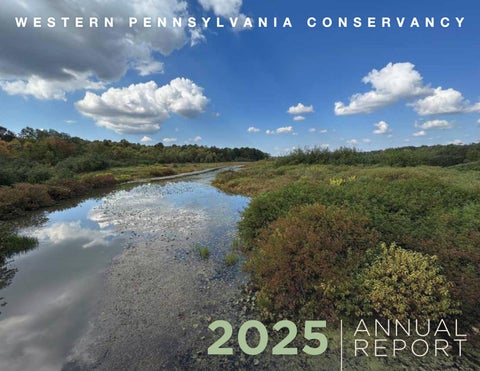
For information on WPC and membership 412-288-2777 | 1-866-564-6972 info@paconserve.org | WaterLandLife.org | Fallingwater.org FRONT COVER: In 2025, the Conservancy protected approximately 200 acres in Mercer County that included the Otter Creek Swamp Natural Heritage Area, which supports several rare species and common shrubs, including willows (Salix spp.), buttonbush (Cephalanthus occidentalis) and red-stemmed dogwoods that line the open water areas of the recently protected wetlands.
OFFICERS Debra H. Dermody Geoffrey P. Dunn Thomas Kavanaugh Bala Kumar Alfred Barbour David Barensfeld E. Michael Boyle Cynthia Carrow Marie Cosgrove-Davies Beverlynn Elliott Donna J. Fisher Susan Fitzsimmons Paula A. Foradora Dan B. Frankel
Chair Vice Chair Treasurer Secretary Dennis Fredericks Felix G. Fukui Carolyn Hendricks Thomas F. Hoffman Gregory M. Hyziewicz Ryan Jeroski Justin McCann Robert T. McDowell Sanjeeb Manandhar Daniel S. Nydick
PRESIDENT AND CEO Thomas D. Saunders
Stephen G. Robinson Samuel H. Smith Erin Spangler Alexander C. Speyer III K. William Stout Megan Turnbull Joshua C. Whetzel III Gina Winstead
Our shared mission relies on YOU
2,317
community garden volunteers
669
community forestry volunteers
128,784
people from 107 countries visited Fallingwater
114
10,734
land stewardship volunteers gave 991 hours to help restore nature
25
member households – thank you!
193
participants in invasive species scavenger hunt
community scientists contributed to PA iMapInvasives
65
volunteers gave 4,449 hours to Fallingwater
217
watershed volunteers
3,900
students from 12 states participated in Fallingwater’s virtual field trips
1,510
people attended WPC and Fallingwater webinars
23,428
visitors to our website looked up a WPC nature preserve
347
Fallingwater Institute participants
2025 Annual Report
3
Land Protection Protected Land Yielded Two New Nature Preserves in 2025 Thanks to the Western Pennsylvania Conservancy’s protection of 16 forested properties in 2025, 5,711 acres of wildlife habitats, forests, rivers, meadows, streams, wetlands and scenic landscapes in our region are now permanently protected. To date, the Conservancy has protected more than 297,000 acres. Most of these acres are forestland, and by protecting large forests, the Conservancy continues to provide much-needed connected land, offering important contiguous protected habitat for birds and other wildlife, and riparian buffers along waterways. Land protection and stewardship are critically important in a changing climate, which presents unique conservation challenges for rare and endangered species and sensitive and rare habitats across the state. One effective way to combat these ongoing challenges and the decline in biodiversity is to protect more land. WPC also protected forested riparian land in Susquehanna Township, Cambria County in late 2024, along the West Branch Susquehanna River and opened it to the public in 2025 as a new Conservancy-owned nature preserve, Basking Hill Nature Reserve. Conveniently accessible from the nearby boroughs of Northern Cambria and Cherry Tree, the preserve offers hiking, hunting, fishing and wildlife watching for the public. The preserve offers fishing access, the first in the county along the West Branch, that will always remain freely open to the public.
5,711
acres of land protected in 2025
Also, nearly 2,500 undeveloped forested acres located on Chestnut Ridge in Derry, Fairfield and Ligonier townships in Westmoreland County were permanently protected, thanks to the donations to the Western Pennsylvania Conservancy of land and a conservation easement on property owned by several local families. The property provides a forested buffer along several miles of Trout Run, McGee Run, Hillside Run and their tributaries. These streams are designated Cold Water Fisheries by the Pennsylvania Department of Environmental Protection. A portion of the donated land is also a new Conservancy-owned nature preserve, called Trout Run Woods Nature Reserve. Due to the limited access and steep terrain in this landscape, the area currently lacks convenient public access. When improved access becomes available, the Conservancy will share information on its website. 4 Western Pennsylvania Conservancy
LANDOWNERS
learn more about conservation options for protecting your land at 412-288-2777, land@paconserve.org or scan this QR code.
Easements Protected Forested Habitat for Rare Species in Bedford County Conservation easements on two properties in Bedford County now permanently protect 725 acres of forestland and habitat for rare species, and provide public access for recreational fishing to Town Creek, a popular local fishing spot. The properties are located within the Hewitt Barrens-Lower Town Creek Natural Heritage Area, a globally significant ecosystem that supports a variety of special habitats and uncommon species. The forested areas on the properties host Virginia pine-mixed hardwood shale woodlands, a rare plant community that grows on dry, acidic shale slopes.
More Forestland Protected for Forbes State Forest The Western Pennsylvania Conservancy also permanently protected a 652-acre forested property in Fayette County. It was immediately conveyed to the PA Department of Conservation and Natural Resources Bureau of Forestry and added to Forbes State Forest. To date, the Conservancy has protected more than 297,000 acres and conveyed most of them as public land for state forests, state parks and state game lands, and for the Allegheny National Forest.
Land Added to Popular Bear Run Nature Reserve A 44-acre forested property located near State Route 381 that consists of limestone outcrops along the steep Youghiogheny River Gorge and a mature canopy of sugar maple, basswood, oak and shagbark hickory was added to the Conservancy’s now 5,163-acre Bear Run Nature Reserve in Fayette County in 2025. The property is located within the Upper Lick Run Natural Heritage Area, an ecologically important area that hosts rare and sensitive plant and animal species, including the statethreatened West Virginia water shrew and Allegheny woodrat.
More Forestland Protected for Elk State Forest Hikers, hunters and anglers have additional forestland in Cameron County to explore, thanks to the Conservancy’s permanent protection of 183 acres, which were immediately conveyed to the PADCNR Bureau of Forestry to be added to Elk State Forest. To date, the Conservancy has protected nearly 20,000 acres for Elk State Forest alone. 2025 Annual Report
5
Tree Inventories Guided Future Urban Forestry Work
Community Greening
From 2008 to 2025, WPC’s community forestry program planted 42,108 trees. With so many trees to track, how can we be sure the trees we planted are flourishing and providing benefits for people, wildlife and our urban ecosystems? And how do we determine which communities will benefit from new trees? Enter tree inventories, which are data-driven records of the location, species, size and health of trees in a municipality or park. City of Pittsburgh Tree Inventory In 2025, we managed the City of Pittsburgh’s first “smart” Street Tree Inventory, an effort to use AI technology to inventory street trees.
811
trees planted in 29 communities
Vehicles retrofitted with high-resolution cameras, mobile laser scanning, terrestrial laser scanning and machine-learning algorithms collected data on 50,196 trees on streets in city neighborhoods. Using lidarsensing technology to produce 3D models and automated analyses to assess tree health and conditions, the new inventory updated metrics from a 2014 inventory that used GIS technology. Some areas need improved tree canopy to build resilience against the impacts of pollution and climate change. These critical inventory results will guide fundraising, advocacy and investments in community forestry work in Pittsburgh and enhance the city’s ability to support tree plantings, tree care and monitoring. Later in 2026, the public can access data through TreeKeeper, an online portal. Jeff Bergman, WPC associate vice president of urban forestry and community greening, says the inventory includes a 10-year street tree management plan and a tree benefits analysis. “Our tree planting work through TreeVitalize and the maintenance activities undertaken by our partners like Tree Pittsburgh and City Forestry is resulting in substantial increases in street tree species diversity, more trees in target neighborhoods, and better health conditions within the overall street tree population.” WPC worked on this project with the Pittsburgh Shade Tree Commission, the City of Pittsburgh Department of Public Works Forestry Division, PA Department of Conservation and Natural Resources and the Davey Resource Group. Hollidaysburg Tree Inventory Tree canopy covers approximately 35 percent of the land In Hollidaysburg, Blair County. In 2025, working with Davey Resource Group and the Hollidaysburg Shade Tree Commission, the Conservancy catalogued more than 2,000 trees for the Hollidaysburg Tree Inventory Analysis & Maintenance Strategy. We conducted the inventory in partnership with the PA Department of Conservation and Natural Resources and the Borough of Hollidaysburg, with funding from the National Fish and Wildlife Foundation through a Chesapeake Bay Innovative Nutrient and Sediment Reduction Grant.
6 Western Pennsylvania Conservancy
Using TreeKeeper software and GIS and GPS technologies, we analyzed tree location, age, pest susceptibility, health, condition and more. Davey used i-Tree Eco to calculate the trees’ economic value ($2.4 million) and environmental benefits ($8,870 in stormwater, air quality and carbon benefits annually). The results will help us make tree care recommendations for Hollidaysburg.
21 More Gardens Got Native Perennials Our community flower gardens are creating buzzzzz! With generous funding from the PA Department of Conservation and Natural Resources, TCEnergy, KeyBank and other supporters, volunteers helped us plant 4,100 native perennials in 21 gardens in 2025–making people and pollinating insects very happy. Now 33 WPC gardens feature perennial beds. In this relocated garden in Indiana, volunteers from Democratic Women of Indiana County and Pennsylvania American Water planted small trees, wild geranium, butterfly weed, rhododendron and more.
Children at Spring Garden ECC Got a New Outdoor Learning and Play Space
The Laurel Foundation Has Funded Our Baskets for 20 Years Next time you’re in downtown Pittsburgh during summer, look up…and thank the Laurel Foundation! Since 2005, the Laurel Foundation has generously sponsored our downtown hanging baskets, which grace the city’s streets and bridges. Each June, we install more than 400 beautiful flower-filled baskets featuring sweet potato vine, begonias, calibrachoa, petunias, caladium and more.
Pennsylvania American Water Marked 25 Years of Funding WPC Gardens Since 2000, Pennsylvania American Water has sponsored multiple WPC community flower gardens, resulting in more than $300,000 in garden funding! The company’s generosity is recognized on signage at 12 Conservancy gardens, including this garden in Butler. We thank PAW and all of our garden sponsors, as well as our dedicated volunteers, for bringing beauty and eyepopping color to communities in 19 counties across the region!
Students at Pittsburgh Public Schools’ Spring Garden Early Childhood Center are playing and learning in a 6,000-square-foot outdoor space featuring an amphitheater, mud kitchen, project tables, chalk zone and more. PNC Grow Up Great, which has partnered with WPC since 2012 to support school grounds greening projects, made the $65,500 project possible. In October 2025, PNC Foundation and PPS officials joined children and families to celebrate the space’s completion.
VOLUNTEER to steward a community garden, or to plant gardens or trees during spring or fall. Visit WaterLandLife.org/events.
2025 Annual Report
7
128,784
Fallingwater Visitors Toured and Connected With Architecture and the Landscape Approximately 130,000 visitors from 107 countries had the chance to experience and gain a deeper understanding of Frank Lloyd Wright’s tour de force of organic architecture in 2025. Most would agree: Fallingwater is more than a house museum; it’s a place of beauty, transformation, creativity and a symphony to the senses. While awaiting a tour and exploring the landscape, visitors often hear the sounds of warblers, cardinals or blue jays and the rushing waters of Bear Run, the Commonwealth of Pennsylvania-designated Exceptional Value stream that runs beneath Fallingwater and cascades dramatically over a waterfall below the house. The stream designation helps protect the cold, clear waters of Bear Run. Several visitors last year stated that, in addition to the architecture and history of Fallingwater, exploring the surrounding natural landscape was a motivating factor in their visit. “I’ve known about Fallingwater for a long time. It’s been on my bucket list,” notes Mary S., a firsttime Fallingwater visitor who also stayed overnight in the Laurel Highlands to explore more of what the region has to offer. “We loved walking the trails after our tour. It was a wonderful experience!” 8 Western Pennsylvania Conservancy
In Fallingwater, Wright stretched the conventional ideas of design and created a timeless display of modern architecture that invokes wonder and imagination in us all, even 90 years later. Another 2025 visitor, Paul W., took the Guided Architectural Tour in early spring and said the experience offered some interesting, previously unknown insights into Fallingwater. “I didn’t know that the Kaufmanns had as much influence on the design of the house as they did, and that Wright hadn’t overseen the entire construction of the house…,” he stated. Fallingwater’s educators provide these and many more in-depth behind-the-scenes facts and insights about Fallingwater and the Kaufmann family during a variety of tours, allowing visitors the unique opportunity to fully immerse themselves in Wright’s work. In addition to tour offerings, visitors learned more about Fallingwater’s history through rarely seen archival films of the Kaufmanns and the construction of Fallingwater in an exhibition at the Speyer Gallery. The exhibition, “The Kaufmann Films: A Legacy in Motion,” helped visitors engage in the evolving story of a place where nature, art and architecture intertwine.
people from 107 countries visited Fallingwater
New Book Revealed New Stories Have you heard? We released a book in 2025! “Fallingwater: Living With and In Art” explores the fascinating stories behind the art and objects collected by the Kaufmann family. The essays and reflections in the book, edited by Justin Gunther, director of Fallingwater, and Scott Perkins, senior director of preservation and collections at Fallingwater, shed new light on one of Wright’s most iconic houses and provide a richer understanding of the Kaufmanns as collectors. In April 2025, Fallingwater hosted a book symposium and signing at the Museum of Arts and Design in New York City to highlight the book’s release and present new scholarship on Fallingwater’s fine and decorative art. With photography by Dave Bryce, “Fallingwater: Living With and In Art” is still available for purchase in stores and online at the Fallingwater Museum Store.
Fallingwater Institute Inspired Thinking and Creative Collaboration Learners from all walks of life, including high school students, college students, teachers, design professionals and other adult learners, experienced Fallingwater through a variety of programs, including on-site residencies and virtual workshops and classes in 2025. Through those Fallingwater Institute programs, 347 learners gained a deeper experience of art, design and nature.
Visitors Witnessed Preservation in Progress Visitors to Fallingwater in mid-March through April 1, 2025, had the unique opportunity to experience firsthand what it takes to preserve Fallingwater’s innovative architecture and complex building systems through specialty Preservation-In-Action tours. The tours were offered on a limited basis and were popular with visitors, who received an in-person perspective of the extensive preservation work on the house’s stonework, flat roofs, flagstone terraces, steel window and door frames, and concrete walls to better waterproof the building. This multi-year preservation effort, called “World Heritage Preserved,” was the most comprehensive and visible preservation project at Fallingwater in 20 years.
Gabe Nolle, a teaching assistant professor in the University of Pittsburgh’s architectural studies program, led a group of six students in a college residency last year, during which the students had in-depth conversations about design and sustainability. “My hope was that this college residency would make my students think more introspectively about the world around them. And it did,” he added. One of his students created a “view-finder experience” that considered views of the landscape before Fallingwater was built. “It is shocking to even fathom an existence without Fallingwater. But in the same context, it allows us to consider the what-ifs and ponder a variety of questions and thoughts about the built environment. It’s exactly the type of setting and context we want our future architects to be thinking about,” he added.
School Programs Gave Young Learners New Skills 2025 was a record year for our school programs! These programs bring practical, hands-on and engaging lessons in science, engineering, math, language arts, visual arts, design and more for young learners. More than 2,300 K-12 school students participated in on-site field trips, receiving an in-class overview of Fallingwater before experiencing the architecture firsthand. In addition, more than 3,900 students from 12 states participated in our virtual field trips, and for the first time, students from Thailand took part. The participation, which increased 65 percent from 2024, reflects the strong, ongoing interest in the program. Our annual Gnome House Design Challenge helped 320 students develop designs and learn critical thinking and business skills as they built gnome homes. The photo shows participants displaying their gnomes’ homes at Fallingwater in May 2025 during our annual Gnome House Design Symposium. 2025 Annual Report
9
25 Years of Eastern Massasauga Work
Conservation Science
Since 2000, WPC has been a leading partner in studying and protecting the federally threatened Eastern massasauga rattlesnake (Sistrurus catenatus catenatus). Only four of 19 historic populations still exist In Pennsylvania, making it endangered. Protecting this vital part of our ecosystem impacts other species that rely on the same conditions and resources for survival, such as temperature, food and sunlight. Thanks to our partners: PA Fish and Boat Commission, U.S. Fish and Wildlife Service, PA Department of Conservation and Natural Resources, PA Game Commission and private landowners.
Photo by Nick Liadas, Bird Lab.
Monitoring High-Priority Bird Species Continued at WPC Preserves In 2025, WPC avian ecologists with the Pennsylvania Natural Heritage Program and Bird Lab spent a second breeding season banding birds at MAPS (Monitoring Avian Productivity and Survivorship) program stations at the Conservancy’s Toms Run Nature Reserve in Allegheny County and Bear Run Nature Reserve in Fayette County. “The contrasting settings—urban/suburban Pittsburgh and forested Laurel Highlands—allow us to compare productivity across bird species found at both sites,” says David Yeany, WPC avian ecologist. The stations were established with funding from the PA Department of Conservation and Natural Resources. With more than 1,400 stations across North America, MAPS collect demographic data critical to tracking bird population trends. Scientists record birds’ measurements, age, health condition and reproductive status. The ecologists captured 264 birds of 30 species, banding 185 new and recapturing 79. Species included 12 Species of Greatest Conservation Need, including wood thrush and black-throated blue warbler. In 2024, the scientists had fitted 25 wood thrushes (Hylocichla mustelina) with tiny radio nanotags, joining a range-wide migratory connectivity study of 560 wood thrushes across the eastern United States. Motus Wildlife Tracking System stations 10 Western Pennsylvania Conservancy
can detect the tags across the hemisphere. This common forest interior bird has suffered a 59% population decline across North America since 1970 and is a Species of Greatest Conservation Need in Pennsylvania. In 2025 at Toms Run, the ecologists recaptured one of the 25 wood thrushes. It was tracked more than 2,400 miles from the bird’s breeding site in Pennsylvania to its wintering area in Yucatan, Mexico, allowing ecologists to link locations across the bird’s annual cycle. Recapturing it shows that this bird has site fidelity, David says, so managing forest habitat at Toms Run is important to the wood thrush’s survival. MAPS enabled the ecologists to continue tracking Pennsylvania’s only known breeding population of Swainson’s warbler (Limnothlypis swainsonii), located at Bear Run Nature Reserve. They confirmed breeding for the third year by banding a new juvenile, and recaptured a male banded in 2022 prior to the MAPS project.
5,317
present species records in PA iMapInvasives
Plant Conservation Benefited from Botanist’s 29 Years of Work The list of rare, threatened and endangered species for Pennsylvania exists in part thanks to botanist Steve Grund, who retired from WPC in 2025 after 29 years as a botanist with the Pennsylvania Natural Heritage Program. For 40 years, PNHP has provided data and expertise to help conserve the state’s biodiversity. Steve served (and continues to serve) on statewide committees, helping to make important decisions for plant conservation. He discovered two new species to the state, Bayard’s Malaxis orchid (Malaxis bayardii) and the once federally endangered running buffalo clover (Trifolium stoloniferum).
WATCH OUR VIDEO “Eastern Massasauga: Science and Conservation in PA”
Mushroom Find Was New Species and State Record WPC Conservation Mycologist and Pennsylvania State Mycologist Hannah Huber discovered this then-unnamed mushroom specimen in August 2024. In 2025, DNA barcoding facilitated by the Mycological Association of Washington, D.C., revealed it to be Tricholoma lutescentifolium – a new state record and a new species known to science! The mushroom has no common name, but Tricholomas are known as the “knights.”
Scientists Made New Discoveries Natural Heritage Program scientists made several discoveries in 2025, including but not limited to: • learning that in 2022 they had collected an extremely rare bee, Macropis cuckoo bee (Epeoloides pilosulus, once feared extinct), on a shale barren in Franklin County; • finding a new population of foxtail clubmoss (Lycopodiella alopecuroides), primarily a coastal plain species, growing throughout an acidic seepage wetland; • increasing known extant sites of the globally rare Fogg’s goosefoot (Chenopodium foggii) from one to four; • and much more. Top photo: Botanists found very large Pennsylvania Endangered fen Grass-of-Parnassus (Parnassia glauca) at the bluffs overlooking Lake Erie. Bottom photo: Invertebrate zoologists documented the Parnassia miner bee (Andrena parnassiae), never before documented in Pennsylvania.
Biologists Updated Four Natural Heritage Inventories WPC’s biologists, with biologists from the PA Department of Conservation and Natural Resources, completed updating the County Natural Heritage Inventories for Franklin, Adams, York and Cumberland counties. They updated more than 67 species records and more than 220 Natural Heritage Areas, adding them to a list of 350 areas inventoried more than 20 years ago. The goal of these inventories is to identify and map areas statewide containing rare, threatened and endangered species, natural communities and significant ecological features. Notable finds included this vase-vine leatherflower (Clematis viorna) on a limestone slope. 2025 Annual Report
11
Many Hands...
Left: Volunteers helped to plant native perennial flowers and plants at the Conservancy’s community flower garden near the Birmingham Bridge on Pittsburgh’s South Side. Below Summer interns from WPC and Fallingwater participated in an electrofishing demonstration on Bear Run, conducted by watershed conservation staff.
Clockwise from above: Gina Winstead, formerly a member of WPC’s Emerging Leaders Advisory Committee and currently a WPC board member, mulched and cared for young trees at WPC’s annual Redbuds & Brews event. Land stewardship volunteers worked with WPC Land Stewardship Coordinator Zack Zelazny (left) to plant and care for trees at our West Branch French Creek Conservation Area in Erie County. Volunteers helped us plant 811 trees in 29 communities across the region. This abandoned mine drainage settling pond at WPC’s Bennett Branch Forest preserve in Elk and Clearfield counties continued to help remediate and restore Cherry Run. A series of retention ponds lined with clay and limestone creates a passive treatment system to filter aluminum and other toxic metals before it enters the stream. This pond is blue due to aluminum oxide settling.
12 Western Pennsylvania Conservancy
Left: WPC Land Stewardship Manager Tyson Johnston showcased natural points of interest along trails at TryonWeber Woods in Crawford County during a visit from WPC’s Northwest Region Advisory Committee. Right: A strategic wood addition on Kinzua Creek in Lafayette Township, McKean County, which took a decade to plan and implement, improved fish habitat and connectivity to the floodplain. Partners were PA Fish and Boat Commission and Allegheny National Forest.
Clockwise: Staff led students at Richland Elementary in Cambria County in a STEM activity on watershed health. High school students participated in a new Fallingwater Institute residency to help tomorrow’s architects think about the natural world, climate change and environmentally friendly design practice. Land stewardship volunteers helped to stabilize a trail at Toms Run Nature Reserve in Allegheny County during a workday. Rudbeckia and cardinal flower planted during 2024 in this WPC community flower garden along the Armstrong Trail in Kittanning flourished in 2025. The native perennial bed helps control stormwater runoff along the trail.
Make Light Work
2025 Annual Report
13
After
Before
10,621
Watershed Conservation
native riparian trees planted
46 Miles of Reconnected Streams Allowed Aquatic Wildlife to Move Freely More fish can swim up and downstream to feed and breed, thanks to our work to reconnect nearly 46 miles of stream in 2025. WPC’s watershed conservation team removed 35 barriers to aquatic organism passage! Human-made dams and culverts cause fragmented watersheds, which means fish can’t travel to spawn. Overcrowding forces competition for resources, leading to stress and disease. Freshwater mussels and other aquatic organisms that rely on fish for reproducing and dispersal can also be at the mercy of streamflow. With the help of community, state and federal partners and volunteers, we identify undersized or inadequate culverts and dilapidated dams. We then work with landowners and partners to restore passage for aquatic organisms by removing dams, or installing larger culverts or bottomless timber deck bridges. During the past 12 years, we have used streambed simulation, a technique taught by the U.S. Forest Service that involves placing streambed material such as rocks, boulders and dirt to create a stream channel through new culverts. Maintaining streambeds and streambanks through culverts and under bridges also provides habitat connectivity for semiaquatic animals such as amphibians, reptiles and other wildlife, says WPC Watershed Manager Kylie Maland. “Building the streambed and bank materials inside metal culverts helps protect the pipes from corrosion and abrasion,” she explains. “Aquatic animals have a more natural environment to traverse and natural habitat materials for food, shelter and nesting.” On State Game Lands 042 in Cambria County, native brook trout and mottled sculpin can move freely on Mill Creek. In partnership with the PA Game Commission, we replaced a single round culvert with a 35-foot timber deck bridge (shown above), connecting more than six miles of stream habitat for the two species. 14 Western Pennsylvania Conservancy
Freshwater Mussel Surveys Resulted in Rare Finds During a freshwater mussel survey on the Shenango River in Mercer County, Conservancy watershed and heritage program biologists found the state’s rarest endangered mussel, the round hickorynut (pictured here with Mary Walsh, WPC zoologist). In 2025, WPC biologists turned up 23 mussel species in 111 surveys on six streams across the state: Shenango River, Kiski River, Condoguinet Creek, Swatara Creek, Big Sewickley Creek and North Fork Little Beaver Creek. The biologists gather data on diversity, species’ habitat preferences and more. They’ll continue research in the Shenango to assess the round hickorynut’s population and to plan conservation efforts.
Mussels Got a Statewide Conservation Plan Pennsylvania hosts 67 freshwater mussel species, 12 of which are state or federally endangered or threatened due to acid mine drainage, dam construction, invasive species, climate change and more. Mussels remove sediments, bacteria and pollutants from the water. One adult can filter up to 12 gallons of water daily!
Before
After
The Conservancy’s scientists and conservation partners, including the U.S. Fish and Wildlife Service and PA Fish and Boat Commission, conducted mussel surveys across miles of the state’s rivers and streams, assessing and collecting data by species, habitat conditions, age and abundance. The result is the Pennsylvania Freshwater Mussel Conservation Plan, funded by the National Fish and Wildlife Foundation. It’s a first-of-its-kind, statewide strategic management plan that conservationists, scientists and resource managers can use to protect and restore freshwater mussel populations. It includes data from the Pennsylvania Freshwater Mussel Database compiled 1838 to 2024. Read the plan at WaterLandLife.org.
20 Years of Mini Grants Improved Local Watersheds Through the 2025 Watershed Mini Grant Program, WPC awarded a total of $29,650 to 14 local environmental organizations in eight Pennsylvania counties. For example, one organization, Watersheds of South Pittsburgh, received $3,500 to conduct baseline water quality monitoring in the headwaters of Streets Run, an impaired urban stream in southern Allegheny County. From 2005 to 2025, the program awarded $566,609 to 143 organizations thanks to generous funding from BHE GT&S and its predecessor companies.
More Than 100 Canoe Access Sites Funded Since 2009 In 2025, the Conservancy provided seven Canoe Access Development Fund grants to local municipalities and organizations to improve or build public canoe access sites. More than 100 sites have been funded since 2009! In 2025, Municipal Authority of Westmoreland County improved the launch shown here on Indian Creek near Mill Run, Fayette County. Roy Weil and Mary Shaw, WPC members since 1974, established the fund in 2008 to help make rivers and streams more accessible for recreation.
Nearly 46 Acres of Streamside Trees Planted Staff and volunteers planted nearly 46 acres of native riparian trees along streams in 2025. Riparian trees such as swamp oak, shagbark hickory and dogwood help to stabilize streambanks, reduce sedimentation, cool streams to create healthier habitat for fish and other aquatic organisms, and provide food and habitat for wildlife. Since 2013, WPC’s watershed conservation team has planted more than 100,000 riparian trees!
LANDOWNERS WITH STREAMSIDE ACREAGE Apply through June 2027 to get free native riparian trees planted. Visit WaterLandLife.org/riparian-restorationtree-planting-initiative or contact Sam Honchalk at shonchalk@paconserve.org or 724-471-7202 ext. 5111.
2025 Annual Report
15
Trail Care at Toms Run
Land Stewardship
Staff collaborated with Keystone Trails Association and two Pittsburgh-area outdoor social influencers, #hikesandhopsblog and #torytalkstrails, for an event celebrating International Women’s Day. The trail care event, Redd Up Toms Run, invited 21 new volunteers to the preserve at Toms Run Nature Reserve in Allegheny County to learn more about the Conservancy and participate in trail maintenance and invasive plant control. After a day of sweat equity on a cool March morning, the group enjoyed socializing at a popular brewpub, Grist House in Millvale.
The new eastern pavilion at Lake Pleasant Conservation Area in Erie County
Good Stewardship of Existing and New Lands Continued “When we see land as a community to which we belong, we may begin to use it with love and respect.” — Aldo Leopold. In 2025, the Conservancy’s land stewardship staff, with the help of volunteers, continued to care for several properties, including 47 Conservancy-owned nature preserves on more than 15,300 acres that are open to the public, as well as 229 privately owned properties under conservation easement totaling more than 62,274 acres. The Conservancy’s preserves, which are mostly forested, are managed to ensure that wildlife, including common and rare plants and animals, and their habitats, can thrive. Proper stewardship and management of these preserves ensures their ecological function and benefits to provide vital ecosystem services, including wildlife habitat, food sources, air and water quality benefits and carbon sequestration. Our nature preserves also provide ideal opportunities for low-impact recreation, such as fishing, hiking, birding and wildlife exploration. Improving ways to experience these natural areas for the benefit of wildlife and people is a top priority for our land stewardship staff. For example, at Lake Pleasant Conservation Area in Erie County, construction was completed on a pavilion and parking area overlooking the eastern side of the lake, as shown in the photo above, as well as a second pavilion and storage building on the western side of the lake. Staff 16 Western Pennsylvania Conservancy
and volunteers also assembled 11 picnic tables for use at Lake Pleasant and Oakford Park Nature Reserve in Westmoreland County. Also at Oakford Park, our staff and volunteers removed a significant amount of debris and installed an entrance sign. Staff also began assessing the property for a potential additional trail. We also made improvements at French Creek Hemlocks Natural Area in Venango County, where staff and volunteers completed clearing a new three-quarter-mile trail along the floodplain. Also, at Bennett Branch Forest in Elk and Clearfield counties, land stewardship and natural heritage staff began a collaboration with The Nature Conservancy to conduct vegetation and bird surveys in areas of late-successional forest. The surveys will inform efforts to implement practices that will enhance habitat conditions for birds, such as the cerulean warbler, that depend on old-growth forests. Consider a Conservancy-owned nature preserve for your next outdoor adventure. You can find the locations and more information on our website at WaterLandLife.org/Preserves.
17
volunteer workdays held to improve nature
Fields of Gold Flourished in Bedford County This isn’t a new Sting album cover, but rather a wildflower meadow at Sideling Hill Creek Conservation Area in Bedford County that saw its first full growing season in 2025, when species such as black-eyed Susan were abundant and vibrant. Land stewardship staff monitored the meadow, planted in 2024, at this conservation area that features a dry upland forest, floodplain and unique Appalachian shale barrens habitat for rare species. This conservation area is an eBird hotspot, a popular place for birders to spot a variety of species. Staff also maintained the parking area in 2025.
Thousands of New Trees Planted at Lake Pleasant Conservation Area How do you restore former gravel mine fields to reestablish the natural ecological processes of that land and soil? Partnering with Bosland Growth on 100 acres at our Lake Pleasant Conservation Area in Erie County was an answer in 2025. Bosland Growth, a carbon developer focused on restoring formerly surface-mined lands in the Appalachian Mountains, worked with us to plant more than 70,000 native tree seedlings, including white oak, red maple, white pine and black cherry, to help reforest these degraded areas. Due to past disturbance and compaction, soil quality in these areas is generally poor. As part of this initiative, Funga, a company undertaking soil microbiome restoration, established experimental test plots within the planting area. The photo shows an aerial view of the planting areas and test plots taken in May 2025. A similar undertaking, also with Bosland Growth, occurred on 32 acres of reclaimed mine land at Basking Hill Nature Reserve in Cambria County. It involved the use of a bulldozer to loosen compacted soil to create improved growing conditions. Trees grow better in loose soils, which allow tree roots to expand more easily and absorb more water and nutrients. Some exotic invasive plant control also occurred during the site preparation for new trees planted in 2026.
Bear Run Got More Improvements A warm, shaded mid-June day was the perfect setting for Conservancy staff and volunteers to install a bench at Bear Run Nature Reserve in Fayette County in memory of WPC member, John “Jack” Busko. A member since 1995, Jack appreciated nature and enjoyed hiking along Bear Run. His estate paid for the installation of this new bench, which can be used by all. Also at the preserve, approximately 16 acres were treated to control exotic invasive plants, including autumn olive, Japanese barberry and Japanese stiltgrass. The treatment, funded by a U.S. Forest Service grant and made possible through the Conservancy’s participation in the Southern Laurel Highlands Plant and Pest Management Partnership, included areas near the Bear Run trailhead, along 2.2 miles of trails, and areas around Fallingwater. 2025 Annual Report
17
2O25 Financial Summary Operating Revenues Foundations 11%
Contributions, Grants and Memberships: Business 1%
Individual 11%
Millions
Individual
$3.6
Foundation
3.9
Business
0.4
Government
14.2
TOTAL
$22.1
Earned Income:
Investment return for current operations 10% Government 41% Other 3% Sales (Gift Shop/Café) 7%
Fallingwater Admissions
$5.5
Sales (Gift Shop/Café)
2.4
Other
1.0
TOTAL
$8.9
Internal Income:
Fallingwater Admissions 16%
Investment return designated for current operations
$3.5
TOTAL
$3.5
TOTAL OPERATING REVENUES
Operating Expenses
Programs
Fundraising 9%
Management & General 7%
$34.5
Millions
Conservation
$14.9
Fallingwater
8.8
Community Greening
3.9
Government Relations
0.5
Constituent Programs and Outreach
0.7
TOTAL
$28.8
Program Support: Programs 84%
Fundraising
$3.0
Administrative and General Expenses
2.5
TOTAL
$5.5
TOTAL OPERATING EXPENSES
18
Western Pennsylvania Conservancy
$34.3
How You Can Help The Western Pennsylvania Conservancy relies on the support of more than 10,700 member households and its volunteers to fulfill its mission. Your continued involvement will ensure that our work continues.
Heritage Circle Gift Planning Society
enhanced access to our programs, special outings and additional insights into our plans throughout the year. Become a monthly donor and make your $1,000+ annual gift in convenient monthly deductions—a simple way to make a big difference! Please contact Julie at 1-866-564-6972 (ext. 2312) or via email at jholmes@paconserve.org for information.
Evergreen Circle Members of the Evergreen Circle have loyally supported the Conservancy for at least 15 out of the last 20 years. Some have been members for much longer—with memberships dating back to the 1950s! Their loyal and continuous support has been a crucial part of our successful work. We are deeply grateful for those who constantly support our efforts each and every year.
The Heritage Circle recognizes During a members’ outing in October, donors who have made members enjoyed a guided paddle on beautiful Lake Pleasant at WPC’s Lake the Western Pennsylvania Pleasant Conservation Area in Erie County. Conservancy a part of their legacy through their estate plans. By designating the Conservancy as a beneficiary of a will, trust, IRA, retirement plan, life insurance policy or charitable gift annuity, individuals provide long-term, significant support for the Conservancy. Contact Julie Holmes, senior director of development, toll-free at 1-866-564-6972 (ext. 2312) or jholmes@paconserve.org for details.
Employee Matching Gift Program
Annual Fund
The Western Pennsylvania Conservancy received support from 10,734 private donors (individuals, corporations, foundations and organizations) that together made cash, stock and in-kind gifts totaling $10,205,855 in 2025. Their extraordinary generosity played a significant role in advancing WPC’s mission of protecting water, land and wildlife in Western Pennsylvania as well as the iconic Frank Lloyd Wright-designed Fallingwater.
Gifts to the annual fund are essential in sustaining our daily operations. These vital contributions enable the Conservancy to carry out its mission throughout the year. You can also provide dependable income for WPC and Fallingwater by making your annual gift through convenient monthly deductions via credit card or debit from a designated financial account. For more details, contact Kathy Patrignani, development operations administrator, at 1-866-564-6972 (ext. 2340) or via email at kpatrignani@paconserve.org. Additional information can be found on our website at WaterLandLife.org.
Leadership Circle and Kaufmann Society The Conservancy’s Leadership Circle members, including Kaufmann Society donors whose gifts are designated for Fallingwater, have made the Western Pennsylvania Conservancy’s work a philanthropic priority. Members who make annual gifts of $1,000 or more are recognized through the Leadership Circle and Kaufmann Society. The Conservancy recognizes this significant commitment by providing
Many companies and organizations will match employee contributions, greatly increasing the impact of your gift to the Conservancy. Please contact your human resources office for further information.
Special Gifts The Conservancy deeply appreciates gifts of appreciated stock, real estate property, in-kind gifts and multiyear commitments in support of our programs. Please contact the Conservancy’s development office at 1-866-564-6972 or development@paconserve.org for more information.
We are also delighted to recognize both the generous future commitments of our Heritage Circle members as well as remember the legacies of those who have passed on in 2025. Together, they provide transformational support for the Conservancy to care for our beautiful region now and in the future. Donors making gifts totaling $250 or more, and Evergreen Circle members who gave $100 or more, are listed on the following pages. We regret that space constraints prohibit acknowledging all supporters by name. We have made every effort to ensure that our donor lists are accurate and reflect gifts made last year; however, should you find an error or omission, please contact Nicole Walsh, donor stewardship manager, toll-free at 1-866-564-6972 (ext. 2322) or via email at nwalsh@paconserve.org. 2025 Annual Report
19
800 Waterfront Drive Pittsburgh, PA 15222 412-288-2777 info@paconserve.org
WaterLandLife.org Fallingwater.org
Leave a Legacy By including the Western Pennsylvania Conservancy in your estate plans, you can make a lasting difference throughout the region. Your legacy will help ensure the long-term protection of Western Pennsylvania’s most extraordinary landscapes and landmarks, including Fallingwater, Frank Lloyd Wright’s iconic masterpiece. Many forms of planned gifts can create this kind of lasting impact, and a bequest in your will or trust is often the simplest way to begin. If you’d like to learn more about planned giving—or if you’ve already chosen to support the Conservancy or one of its programs, such as Fallingwater—please reach out to Julie Holmes, senior director of development, at 412-5862312 or jholmes@paconserve.org.
DISCOVER the many ways you Native broadleaf pondlily (Nuphar advena), also called spatterdock, is a common emergent wetland plant that occurs naturally along slow-flowing waterways in glaciated Northwest Pennsylvania. The floating pads and thick rhizomes provide excellent shade and habitat for frogs, fish and aquatic insects that depend on this marsh ecosystem.
can create a legacy at the Western Pennsylvania Conservancy with a gift from your estate.