TheCryptoMiningWorld:From HobbyiststoIndustrialTitans

The crypto industry has emerged as a revolutionary force, transforming the financial and technological landscape. In this transformative ecosystem, crypto mining functions to validate transactions, secure networks, and mint new digital coins at the same time. Whether it's humble beginnings or sophisticated industrial operations, crypto mining is a dynamic and multifaceted industry that has captured the imaginations of enthusiasts and entrepreneurs for decades.
Crypto Mining: A Brief History
The story of crypto mining begins with the inception of Bitcoin, the pioneering cryptocurrency introduced in 2009 by the pseudonymous Satoshi Nakamoto. As the value and popularity of cryptocurrencies soared, bitcoin mining gradually evolved into a global industry, formerly a niche activity conducted by tech-savvy enthusiasts.
Identifying the Mechanism
Crypto mining involves solving complex mathematical puzzles using computational power at its core. Successful miners earn newly minted coins as well as transaction fees as a reward in exchange for adding a new block to the blockchain and earning the right to mine a new block. In addition to facilitating the creation of new coins, proof-of-work (PoW) ensures network security and integrity.
Mining Hardware Evolution
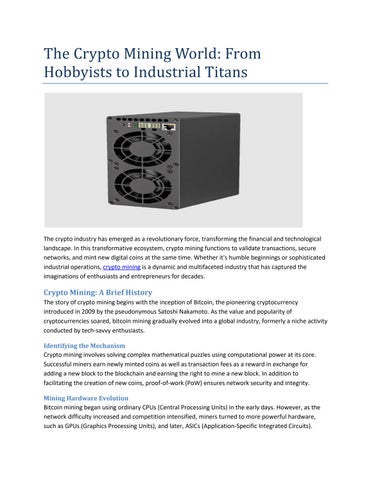
Bitcoin mining began using ordinary CPUs (Central Processing Units) in the early days. However, as the network difficulty increased and competition intensified, miners turned to more powerful hardware, such as GPUs (Graphics Processing Units), and later, ASICs (Application-Specific Integrated Circuits).
Designed specifically for mining cryptocurrencies, these devices offer significantly higher computational efficiency, allowing miners to remain competitive in the arms race for block rewards.
Mining pools are on the rise
It became increasingly challenging for individual miners to compete against large-scale operations, so mining pools emerged as a popular solution. Participants in mining pools share rewards based on their contributions by pooling their computational resources. As a result of this collective approach, mining becomes more accessible to a broader audience, increasing the chance of earning consistent returns.
Sustainability and environmental concerns
The mining of cryptocurrencies has offered lucrative opportunities, but it has also received criticism for its environmental impact, particularly due to its energy-intensive nature. As a result of mining operations' electricity consumption, critics claim that climate change is exacerbated. To mitigate environmental concerns and promote sustainable practices within the industry, industry players are exploring alternative energy sources, such as renewable energy and waste heat recovery.
Compliance and Regulatory Challenges
Crypto mining has become a hot topic for regulatory scrutiny in a number of jurisdictions worldwide as it continues to grow rapidly. Taxation, energy consumption, and potential financial stability and national security issues are among the challenges facing governments. As a result, miners are increasingly required to navigate a complex regulatory landscape, ensuring compliance with relevant laws and regulations while maintaining operational efficiency and profitability.
Alternative Cryptocurrencies: Mining Beyond Bitcoin
While Bitcoin remains the most prominent cryptocurrency, mining extends far beyond the confines of the original blockchain. Various alternative cryptocurrencies, or altcoins, have emerged, all with their own unique features and mining algorithms. Miners can explore new frontiers in the crypto space by diversifying their portfolios and exploring Ethereum, Litecoin, Dogecoin and more.

Mining and Blockchain Security
As well as providing economic incentives, mining plays a crucial role in ensuring blockchain security and decentralization. The PoW consensus mechanism resists centralization and censorship by distributing computational power among a wide array of miners, preserving the integrity and trustworthiness of distributed ledgers. Mining remains at the core of blockchain technology, enhancing its resilience and robustness as it continues to evolve.
Crypto Mining's Future: Innovations and Trends
Crypto mining's future will be characterized by innovation and adaptability to emerging trends. The mining industry is poised for continued evolution, as more energy-efficient algorithms are developed and new consensus mechanisms are explored, such as proof-of-stake (PoS). Moreover, advances in hardware technology, such as quantum computing and specialized mining chips, will reshape the competitive landscape and redefine crypto mining's boundaries. Get more info about ASIC Miner Supplier.
In conclusion
The global digital economy provides opportunities for profit and participation in crypto mining, a fascinating intersection of technology, economics, and innovation. The mining industry has captivated the imagination of entrepreneurs and enthusiasts around the world since its humble beginnings to its current status as a multibillion-dollar industry. Cryptography continues to evolve, and mining will play an increasingly important role in shaping the future of finance and technology.