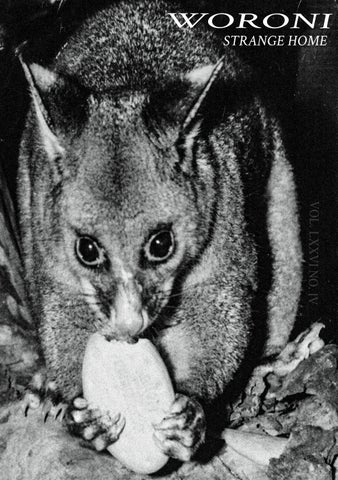
VOL. LXXVI NO. IV
Editor in Chief Cyan Metcalf Deputy Editor in Chief Madeleine Blayney Managing Editor Kuba Meikle Art & Design Eleanor Wyndham Content Ananya Sarma News Editor Jack Davis Communications En-mei Miao Media & TV Mungo Sweeney Radio Atticus Cheetham editor’s letter 1 immersia is back 3 a nightmare in monochrome 5 australia is not a nation 9 belonging to none, belonging to all 13 anu kitchen garden 15 i am, you are, we are australian 17 bonegilla’s block 19 is all we have 19 artist feature 20 when home doesn’t have safe water 21 refusing the victim narrative 25 interview with prof. alan gamlen 29 artist feature 36 rethinking australian literature 39 theme gallery/art playlist 43 where we belong 45 umbilical 49 singing creek 51 strange home playlist 54 true north 55 on the edge 56 anu student pantry info 57 radio picks 58 equity support info 59 front cover photograph provided to Woroni by Mrs C. Friend
editor’s letter Strange Home reflects on the meaning of place, identity and ownwership. Submissions explore belonging, Australian identity, solace found in particular places and cross-cultural experiences; inviting us to consider what these perspectives reveal about living in and experiencing this country. The question feels especially pertinent given the interplay between settler narratives and Indigenous knowledge in shaping the rich, layered life Australia has to offer. For me, this edition takes on different meanings depending on the lens I view it through, as an international student, from an environmental perspective, or otherwise. Its a telling and thought-provoking collection. Happy reading!
Content Editor -Ananya Sarma
1
MULTIMEDIA ARTWORK ELEANOR WYNDHAM
Mooncakes. Mahjong. Kimchi. K-BBQ. Film. Language. Music. Immersia is back.
What if learning about interactive, and all are open to the ANU another culture meant more and Canberra communities. No prior than sitting in a lecture theatre? knowledge is required — just curiosity. From 14–25 September, “The best way to understand Immersia returns with two weeks of a culture is not to read about it. It is hands-on experiences celebrating the languages, cultures and traditions of Asia and the Pacific. Think kimchi-making, K-BBQ, lanternmaking, film screenings, meditation, language tasters, book clubs, mooncakes, music, games and more. Hosted by the ANU School of Culture, History & Language in the ANU College of Asia and the to experience it,” says Gouri Banerji, Pacific, Immersia is built on a simple founder and curator of Immersia, Senior Communications idea: multiculturalism is something and to participate in, not just observe. and Outreach Coordinator at the Whether you are whisking Japanese ANU School of Culture, History & “Every language tea, trying your first words of Tok Pisin, Language. discovering Indonesian gamelan, or opens a door, every culture has a joining a Korean translation book story, and every conversation has club, every event is an invitation the potential to change how we to step into a different world. see the world. Immersia creates opportunities for those encounters All events are free, many are to happen right here on campus.
Gouri Banerji
3
4
PHOTOGRAPHS
PROVIDED BY AUTHOR
A NIGHTMARE IN SPAIN, AUSTRALIA, SPECTRE OF
MONOCHROME: AND THE MONOCULTURE
What does it mean to have a second home? understand my family’s words just enough to follow their conversation, I feel I belong. Is it a feeling? A mix of familiarity and anticipation? A desire to rediscover this — second place? Marga is seven years old when I know my second home by the deep she sees a man fall from the sky. Slung breath I take when I see the sandy beginnings from a parachute, his head drooped to of La Barceloneta from the plane window. I one side, he floats like a cinder above spot that rounded glass building that pierces a Barcelona charred by the Civil War. through the city’s skyline. I recognise the train She wasn’t supposed to see him, and line that takes me to my family’s town. I can she turns away fast enough to stop her barely make out the theme park at the peak of younger brother from standing on his the mountains that my dad took me to when tiptoes at the window and making the I was nine, but I know it’s there nonetheless. same mistake. They’ve seen enough. When the plane lands, I feel relieved. Han vist massa coses. Can you have more than one ‘home’? Even if you’ve never lived there? That’s what her mum whispers to her grandmother in the kitchen one night. There’s a reason it’s my second home and not my first. I never met the woman Han sentit massa coses. whose blood connects me to that place, but I can call my cousin at three a.m. on the They’ve heard too much. way home from a night out and he’ll pick up, reluctantly, even though he was “in the Some nights shots ring out from middle of the siesta”. I feel I belong in my Montjuïc Castle. When they’re going second home because I recognise Catalonia Marga can feel her mum’s flinches, even in myself — I love colour, absurdity, from a different room. Marga is angry — frugality; I have an affinity for tomatoes, and she’s seven now, and she knows about the a staunch resistance to authority. But I do firing squads, everyone does — but no one not know if my second home belongs to me, in her family will talk about them. She or if I have the right to say I’m Catalonian. wants someone to explain them to her, so she can act like she had never heard of Does belonging go both ways? them before, that she thought the gunshots were fireworks. She wants someone I belong to Catalonia, but it does not to admit that it could be her father belong to me. I don’t live there or possess lined up against the walls of Montjuïc. the cultural shibboleths that would prove my Catalanness. But when I visit, when I And she’s angry because she can’t get to eat real pa amb tomàquet, when I write yet. Well, she can write perfectly in 5
Franco’s Spanish; beautiful, holy Castilian Spanish. Me llamo Margarita. Hoy es lunes. It’s written on the blackboard at school. Si eres español, habla español. But she doesn’t know how to write what she speaks: Em dic Margarita. Avui és dilluns. No passaran! On the first day of school after the Christmas break, her brother had to stay back after school to get the cane for counting in Catalan. At the markets a woman was dragged away screaming by uniforms for saying bon dia instead of buenos días. Marga hasn’t spoken Catalan since January, when the red and yellow flag with the eagle was raised over the city hall. It happened only weeks after Christmas. She had opened her presents with cagatió, the silly Christmas log that you feed for weeks and hit with a stick on Christmas Eve until it shits out your presents. She and her brother had stuffed themselves with sopa de galets, canelons, and turró. Marga wonders if next year’s mass will be in Spanish. She wonders if she will still understand all the stories. On April 23rd, the Dia de Sant Jordi, it is traditional to give a rose and a book to a loved one. Marga had wanted to give one to a boy in her class called Eugenì. But since the city fell to Franco, it’s been silent. No one talks about resistance or justice or the Republic or romance anymore. On the 23rd of April, 1939, there are no books nor roses in Barcelona. It may be a uniquely Australian idea: belonging is connection to a place, not ownership of it. As an Australian I cannot claim ownership of the land I live on. I find myself teetering between comfort in my homeland and a jarring sense of impostorhood. It’s an appropriately uncomfortable place to be. When we’re uncomfortable, we 6
learn. When my àvia, Marga, left Franco’s Spain to marry my grandfather and settle down in 1960s Murwillumbah, they both learned an uncomfortable lesson. Franco’s attempts to cultivate a superior Castilian nation, language, and culture, were not so distant from Australia’s brushes with the same brutal erasure of First Nations languages and cultures. Forced removals, disenfranchisement, and the banning of Aboriginal languages in schools echoed the ethnonationalist oppression of her childhood. When she arrived here the White Australia Policy was just beginning to be dismantled, and the Freedom Riders were receiving mixed reactions, especially in towns like Murwillumbah, where people were fighting to protect an imaginary country — a pure Anglo-Celtic, English-speaking, true blue Australia. Some things never change. As soon as the idea of a White Australia is questioned, it falls apart. A year before my àvia arrived, the government was still using an English dictation test to discourage non-English speaking European immigrants from gaining citizenship. Even Irish Catholics sat outside the vision of a White Australia; they were not quite white, not quite middle-class, not quite acceptable. White Australia is not real -- it is relative. The same imaginary homelands are brandished by the contemporary right. What exactly are the “Australian values” against which we should test visa applicants? Who are the real “immigrants” if White Australians arrived here roughly 59,800 years late? If we are to be “One Nation”, which Nation will we be? We gain nothing from the ignorance, ostracisation, or extermination of other cultures, and we gain nothing from artificial monoculture.
My àvia’s unique experience illuminated this truth. She had already experienced the innate cruelty of monoculture. In the end, it did not work in Catalonia, and it will never work here. Have you ever talked to someone who just got back from an exchange or Eurosummer or visiting their family? Did they constantly compare their home with their destination? Over there, everyone eats out on the street / at nine p.m. / with their meemaw and peepaw. My friends from exchange would never leave the house without a Russian novel / a pack of cigarettes / their parents’ permission. Their museums are always filled with more history, their beaches are never as good as ours. This kind of comparison is perhaps the only form of self-reflection we find irresistible. For those of us who grew up under the illusion of a “White Australia”, it’s our first chance to see the mythical “Australian national identity” from the outside. It’s the first time we find ourselves estranged from our country, and it can be jarring. Yet it’s a privilege to be able to move between two cultures, to learn about the other and the self at the same time. It’s a privilege to have two homes.
Eleanor Alonso Love
PHOTOGRAPHS
PROVIDED BY AUTHOR
7
8
PHOTOGRAPH
LUCAS APTE
Zak O’Hara nalaagaa • Gamilaroi Nation
Australia is Not a Nation, But I Think it Could Be. At many a protest you will hear Australia called a ‘colonial state’, a ‘settler colony’ or something along these lines. Notoriously, it’s easy for nuance to be lost in protest slogans, and for the vast majority who aren’t regular protest-goers, such a statement can feel exhausting and over-thetop. I understand the sentiment, however, even if those protestors are just trying to be provocative, they are, factually, spot on. The states that make up our country today each began at the hand of a British official under a Union Jack. These colonies were the territory of Britain and the authorities of each sought to destroy and replace our Aboriginal nations that were already here. What most of us forget, though, is that it never really ended. The states so many of us call home in ‘modern Australia’— NSW, Queensland, Tasmania and so on— bear total legal and constitutional continuity with those propah blighty, Union Jackwaving colonies, going right back to 1788. No one ever tried to hide this: we’ve still got the same British flags; they’re still named for a long-dead English queen, and they still continue to invest supreme authority in unelected governors (yes, governors) who directly represent our sovereign leader: the incumbent king of England. They remain, quite literally, the colonies they were founded as, and the Commonwealth of Australia is but their combination into a ‘country’ I hate pointless legal jargon—I do. This nuance is an indicator of something ILLUSTRATION
actually important, though. Australia was never meant to be a nation, and we aren’t—at least not according to how POLS1002 defined it: ‘shared common cultural, historical, linguistic, or ethnic ties’. We have never had one common culture, as much as a certain red-headed aunty would have us believe otherwise. British settlers who brought their culture here sought to erase the cultures and traditions of hundreds of Aboriginal and Torres Strait Islander nations, all the while suppressing the cultures of those they forcibly brought here (blackbirded Pacific Islanders) and the people who came here in search of a better life under the migration regimes they created. But they never succeeded. The most frequently cited national mythologies of this country don’t even belong to most of us. The battle at Gallipoli, which young Australian men lost in the name of Britain doesn’t have a whole lot to do with me, let alone the majority of our countrymen whose ancestors hadn’t even touched down in Australia when it was fought. (first- and second-generation migrants now make up fifty-four per cent of Australians). The only commonality that’s so widespread on this continent that it could form the basis of a nation is, perhaps, the English language. Bit awkward that our one, nationworthy commonality (besides maybe sports and, like, fairy bread, I guess) originated on an island on the opposite end of the earth.
MILAN PECOTIC-DAVIS
9
A more accurate description of our country is not a nation, but a collection of nationalities (most of which are foreign) sharing one continent and one country. This isn’t new; it’s been like this since even before the English, and any true blue Aussie patriot who seeks to force people to conform to their version of an Australian identity isn’t backing an Australian nationality/culture, but the white Australian community that was brought here by force. Exclusionary at first, the community—driven by the need to exploit and later manage minority cultures— came to nominally include Indigenous peoples and immigrants as it saw fit, by imposing their white Australian culture. Live in Australia? Act like an Englishman. Don’t want to act like an Englishman? You aren’t Australian. Not very fair dinkum if you ask me. An obvious answer to this predicament for many would be to support this idea of a collection of nations in a way that is egalitarian, and does not disadvantage any one group. Of course, I want an Australia that celebrates our cultural diversity as much as anyone else. I am wary, though, particularly as an Aboriginal person, of what it means in practice for people who feel they belong to a foreign nationality first and foremost (often due to discrimination, for which they cannot possibly be blamed) having ultimate influence over this country. Indeed, foreign national allegiance taking the place of a homegrown Australian identity relies on the presumption that our country 10
was terra nullius—belonging to no one— for any other nation to settle down here. This isn’t at all to deny the real connection millions of people living here feel to Australia, and as for those who don’t, I don’t blame them. This isn’t a threat posed by recent migration; it is the reality Aboriginal people have already been living with for over 200 years, as a settler population with allegiance to Britain comfortably razed our homelands for their exploitative pastoralism and extractive mining practices to enrich their mother country. None of us had a say in how “modern Australia” came to be. The answer to the predicament, however, is not exclusion. Our country now is at a crossroads, where the ugly beetcoloured head of one community’s push for “monoculturalism” is once again rearing itself. In the face of that threat, now is the time for Australians of all backgrounds to come together and write a new social contract, binding us into a truly homegrown and inclusive Australian nation. It may seem a goal too complex to build from the bottom up and too imposing to cultivate from the top down. New flag, new head of state? Maybe. But those feel more like symptoms of recovery than the antidote itself. What I do know is that radical social change is needed, and Aboriginal and Torres Strait Islander people should be at the helm of it. Why? Ironically, Australia’s Indigenous communities bear perhaps the closest thing to a basis for an independent Australian
national identity. A man older than me once told me something I’ve never forgotten: by virtue of being Indigenous, we have a stake in this country that no one else has, and that no one can ever take away. The feeling with which my heart was filled that night is something I wish I could share with everyone who calls Australia home. Aboriginal and Torres Strait Islander people everywhere share a collective memory of the mission, the residential home, and, more distantly, the Frontier Wars, as well as an excessive pride in the excellence of our artists, sportspeople and Elders’ success in spite of that violent history, and a great love for our many an under-appreciated culture. Because of this, we boast a sense of kinship and solidarity with one another— no matter how distant our homelands, how different we look or how unique our stories - that few in Australia (save the entire world) can compare. No matter how hard Australia, the country, beats us down, Australia, the place, is where we come from more than anyone else in the world, and for that we love it more than anything.
Latin America or Gandhi fathered the Indian nation. If Australians want to bring our country together, it’s up to everyone to amplify those voices and back in Aboriginal and Torres Strait Islander peoples. Support Treaty with Indigenous peoples in your state and at the federal level, with both your advocacy and your vote. Support us in your political groups, clubs and residential halls. Understand our history, and enjoy our music, our food, and our cultures all year round, not just in NAIDOC and Reconciliation Week. Don’t run away from the difficult conversations about these things with family, friends, peers and co-workers. Australian nationality should be based on something ancient and local, not allegiance to the Union Jack, how well you can surf or play cricket or your proficiency in English. Can we then maybe have a sick flag and our own head of state? Please! But that’s not the trajectory we’re on just yet.
The antidote to the cancer of racism in this country is to reclaim national pride for all of us—not just some of us. Pride rooted in the oldest cultures in the world, our diversity, Aboriginal and Torres Strait Islander as well as all that which we share in common. people have always wanted to share this Maybe even a Bunnings snag, I suppose. love: Your love for Australia is love for our Country as well, and our success is also yours. That’s exactly what it means when we get to Welcome you to Country. At only four per cent of the population, though, the reality is we can’t single-handedly make change happen, at least not like how Mandela forged a new, multicultural South Africa, Bolívar freed ILLUSTRATION
MILAN PECOTIC-DAVIS
11
CHRIS MANDER
Belonging to None, Belonging to All A different argument for multiculturalism The struggle for the reins of Australian identity seems to have been dominated by some particularly loud voices recently. Drawing from my own story, with no claim to Australia’s past but a stake in its future, I try to unpack what wouldn’t, and what could, make us all feel individually at home. Recent rejections of multiculturalism don’t come from nothing. At the heart of calls for a ‘monoculture’, disguised by anger and patriotism, is fear. Fear that their ‘place’ in the nation is made less secure so long as they can’t have their hands firmly on the wheel. In many ways I sympathise with this fear. I can almost understand the desire to construct a wall around our home. A wall to communicate security to the ‘inside’ majority, to protect themselves from the outside world. However, it does make me think: if that wall were fully built up, and I looked to both sides, which would I belong to? As a second-generation immigrant, I feel between places. On one hand, Australia is all I have ever known; nowhere else can be mine because I have nowhere else. Having two English speaking parents, it is not as though I feel isolated, but I do not have the heritage or history beyond my own birth to anchor my connection. From this state of ambivalence, with nothing to show for Australia’s past, but plenty to stake in its future, I belong most to an Australia that belongs to none, and thus makes itself open to all. My rights and freedoms, my culture, my identity, they are least threatened when
MULTIMEDIA ARTWORK
majority domination is ruled out. I would argue that goes for anyone who calls Australia home. You might think you are part of a majority worth building a wall around, but I don’t think anyone is secure under that majority, not really. Look to the people who first called this ‘sunburnt country’ home: the dominant social and legal institutions forcefully established by colonialists spelt a violent dispossession of land, kinship, customs and spirituality. Even for a white, Christian ‘majority’ colony, sectarian conflict involved sustained violence against those who were not the ‘right kind’ of Christian. After WW2, European migrants from Italy, Greece and Eastern Europe were subject to discrimination, all because they were not the ‘right kind’ of European. These same patterns can be found in every chapter of Australia’s history. Majorities always find ways to deny belonging. Today’s majority is no different, and no less unjust. If history does not convince you, apply the ‘majority test’ to your personal life. When was the last time you and any close group were really on the same page? Do you and your family see yourselves in the same way? Do you and everyone at your school? Your sportsclub? Your workplace? By virtue of being imagined, the features of any majority are arbitrary. Communities exist not despite their diversity, but because it is an inherent component of them. We have different faiths, views about our faiths, heritages and histories, all of which constitute a unique belonging to a common home. At
ELEANOR WYNDHAM
13
the end of the day, only 4 per cent of the population can really claim a connection to Australia predating 1788. The intersection of Australian society will never form a happy majority: it never has; it never should. In this light, not only should a majority be avoided, but diversity deserves to be embraced—ot just because it is empathetic and not just because it is right (which it is) but because there is mutual benefit to be gained. Cultural diversity often takes a zero-sum frame, where one group’s gain is another’s loss, where accepting one culture means diluting or disregarding another. Once again, I sympathise with this view; fearing that your story will be drowned out is natural, but it is also misinformed. When other cultures are allowed to thrive, so can yours. Acceptance and tolerance are not excludable. A society that listens, questions and understands someone else’s story is far more capable of recognising the dignity, difference and uniqueness of your own—not less. Belonging is mutually improved in the same way. Spaces are more welcoming to you when they are welcoming to all. When another piece is added to the puzzle, there is now one more way in which you fit in. It is necessary to see both sides of this cultural landscape. Security for minorities can only be understood in the context of the threat that comes with dominance. The things excluded by uniformity are made clear by those things that difference includes. A majority cannot exist to establish belonging for any ‘one’; rather, a diversity should exist which welcomes all through the exclusion of none.
14
PRINT EVIE MCVICAR
ANU Kitchen Garden
You have just left your house: h a l f asleep, on the way to a lecture, on the other side of campus. Your mind is dwelling; you need to “lock in” today, you should catch up with friends you haven’t seen in months, you have been so busy trying to stay afloat. In the depths of winter, even the trees along the roadside cannot help your mood.
when you used to lie in the grass with your brother and decipher what crazy shapes existed within the water vapour. Today there is a brilliant white duck floating high in the sky, which reminds you to check in with the birds surrounding Sullies Creek.
You slowly stand up. Despite only five minutes going by, you feel refreshed. It’s days like these that you leave All of a sudden, life seems just a little more the concrete jungle and cut across the manageable. You meander down to the creek, car park to a place that has enjoying the whimsy of jumping always welcomed you with over the rocks to get to the other open arms. The garden. side. You open up Facebook to see if the ANU Kitchen Garden Take a minute to sit is running any events soon. They down at the picnic tables, where are such a great way to connect the winter sunshine settles with nature and community. deep into your soul, and for the You find a cooking session in the first time all morning you can garden coming up. You send the just breathe. The longer you link to your bestie, giving you a gaze, the more you discover. reason and a home away from The rabbits hiding up on the home to catch up, and also to banks, sneaking a nibble of learn about what’s growing in lettuce when they think nobody is watching. Canberra. The best part of all is that you Colourful pom-poms and crocheted flowers, won’t have to think about what to eat for which you helped to create with others, Thursday’s lunch; you’ll get a free meal! stand proudly where the cucumbers were just a few months ago. You love all the As strange as it initially felt to greenery, with pops of bright orange from stumble across a community garden the calendula. You can hear the magpies in the middle of uni, this little patch of chirping to their families whilst they enjoy the ANU now makes you feel at home. a breakfast of worms straight from the soil. A leaf from the silver dollar tree rests on the table, presumably having fallen from a much higher height than you could ever reach. You look up to notice the clouds in the sky, taking you back to a simpler time
Tessa Chancellor
PAINTING MONIQUE THORP ILLUSTRATION ELEANOR WYNDHAM
15
n
16
PHOTOGRAPHS
LUCAS APTE
Lucia Redman
I Am, You Are, We are Australian Still reeling from Pauline Hanson’s now infamous Press Club Speech, I had a conversation with my grandmother, a second-generation Greek immigrant. The conversation was tense, it almost resembled a game of tic-tac-toe. I was conjuring up another argument when she admitted to me that ‘the Australian culture is dead.’ I was stopped in my tracks; every thought in my head fluttered away, now futile. Is this what Hanson has done? Has she convinced the disillusioned populace that the only way to fix this supposed problem is to transform Australia into a monoculture? To me, this is simply incongruous. Our home was built upon multiculturalism. Growing up in Indonesia, I experienced Australian culture every six to twelve weeks, when my family would fly home to go see my grandparents in Muswellbrook. In those seven glorious days, I would wear my ‘Aussie Aussie Aussie, Oi Oi Oi’ singlet while frolicking in the garden, a warm Tim Tam in hand, head protected by my pink bucket hat. This is what comes to mind when you ask me about Australian culture. Something else comes to mind, though: my great-grandfather, who ventured to Australia in search of a better life, despite adversity; the skordalia that always finds its way next to the roast ham at Christmas; the cramped family photos, replete with the cousins from Brisbane; multicultural days at primary school; the arrivals gate.
As of 2021, twenty-seven point six percent of the population were born overseas. By the time Hanson stood at the National Press Club, that figure had climbed to thirty-two per cent. She cited this statistic as evidence of crisis. I read it as evidence of continuity. This is not a nation quietly corroding, but rather, a nation doing what it has always done. It would be dishonest to argue this without contending with what Hanson actually says, rather than a caricature of it. In her speech, she argued that Australia cannot be a multicultural society, only a multiracial one, insisting instead that Australians must live under a monoculture. She pointed to language as her clearest evidence, noting that in the 2021 Census, twenty-three per cent of the population used a language other than English at home, and that 872,000 people self-reported speaking English ‘not well’ or ‘not at all.’ This sounds like a country coming apart at the seams. However, the number that truly matters is the one she left out. Those 872,000 people represent just just three point four per cent of the population—hardly the crisis of comprehension her speech implies. Further, the experts who study social cohesion for a living tend to disagree with her premise entirely; a shared language helps but is not the glue Hanson claims it to be. What corrodes cohesion, they argue, is treating people who are still building their English as though they are not Australian at all. 17
Hanson’s diagnosis is not new. Strip away the 4K resolution and the talk of ‘failed multiculturalism,’ and you are left with the same script Australia has recycled since Federation, the same one that gave us the White Australia Policy. We are not moving forward into some bold reclamation of identity. We are walking backwards, retracing footsteps we swore we would not make again. This is what unsettles me about the applause Hanson receives. It is not simply that her words are cruel; it is that they are a kind of amnesia dressed up as common sense. To call for a monoculture is to ask for my great-grandfather’s arrival to mean nothing. It is to ask the mosque, the temple, and the Orthodox church on the same suburban street to be an aberration. It is to look at the twenty-seven point per cent of us born overseas, and the millions more raised by someone who was, and to suggest that our presence is the reason the nation feels fractured, rather than the very thing holding it together. So, when a bigoted politician stands at a podium and speaks of ‘real Australians’ as though they are a fixed, unchanging type, my grandmother, and my great-grandfather and every cousin in every cramped photo become footnotes instead of the main text. The monoculture argument asks us to believe that culture is something you either have or don’t, rather than something you build, generation by generation, out of whatever you brought with you and whatever you found when you arrived. The Australian attitude of white singlets and ‘she’ll be right, mate’ was itself built this way, from leaving, uncertainty, hope, and the act of rebuilding. It asks us to forget that ‘Aussie Aussie Aussie, Oi Oi Oi’ and skordalia were never in competition. That nationalist pride we carry, the thing we’re 18
known for, was built upon these events of arrival and rebuilding. Strip that away, and as a nation we are reduced to a skeleton. Almost every non-Indigenous Australian family has a ‘someone who came here’ story, and our stories should not be devalued in times of uncertainty. So, when my grandmother tells me Australian culture is dead, I understand now what she is responding to: not a fact, but a narrative, told forcefully enough and often enough that it starts to feel like fact. The data does not support the monoculture Hanson is selling. History does not support its novelty. The fear behind it is real, though. Fear rarely waits for evidence before it moves people. That, I think, is the more honest thing to be angry about. I think about the arrivals gate a lot, the way someone is always walking through it, the way my great-grandfather once did, the way that story eventually became my grandmother. My grandmother believes Hanson is right, a woman who owes her whole life here to the same porous, multicultural Australia Hanson wants to close the gate on now wants that gate shut behind her, I cannot make that make sense, nor am I going to pretend I can. I don’t know how to end this neatly, so I won’t, because my grandmother and I will keep having this conversation, but I know this much: the Australia that let my great-grandfather in, that let skordalia sit beside the roast ham, that let a Greek girl from Mount Isa grow into someone’s grandmother, was never weakened by its multiplicity; it was built by it.
Lillian Glover
Bonegilla’s Block 19 is All We Leave ‘When you see no future, What do you do?’ I seek new shores, I cling to hope—freed, From senseless world wars, The globe seems far away, To the great southern land of fearful sanctuary. I am chosen and picked, To make us anew. I find a deeply impersonal process, Of becoming a number, Living in a box—under duress, Carrying my life in a crate, For our dwindling minority, Tin huts of rusting greys, Tearable panels to gusts and mercy. I graze curling trees and, Canopies of eucalypt leaves, Spoonful of foreign paste, I choke on new cuisine, This strange thing—exotic, Named “Peanut butter”, Odd tingle on the tongue. I’m deployed for employment, Displaced again, My husband and my child, imminent, Grows in the womb, Sent to a battery factory, In Sydney bays, Crossed states to New Souths. We change our names, Our cousins stay with our dictator. They hoped we’d stay there the same, We now forbid our brew the mother tongue, Mould them into Anglophones, We can never be, to receive, Kindness we will never see. ‘Looking for someone? You’ll find me in the archives.’ PHOTOGRAPHY
LUCAS APTE
19
#3295 Ngabaya ngyirridji gunindjba - The Devil that fiddles and digs in our country 2020 ACRYLIC ON CANVAS
Jack GREEN Garrwa people | born Wakaiya Country, on Soudan Station, NT, 1953 #3295 Ngabaya ngyirridji gunindjba - The Devil that fiddles and digs in our country, 2020 “The McArthur River region is a powerful place, it’s full of sacred sites that give us life. The red circles represent the sacred sites. At the tail of the Rainbow Serpent rests the Damangani Dreaming, in the top right is the Jerriminni Dreaming. The Garbula tree and the Turtle Dreaming are other sacred sites right at the place where they cut the Snake to create the massive open cut pit in our land when they diverted the McArthur River. After they diverted the river a lot of the senior minggirringi (traditional owners) and junggayi (manager or policeman) for that place died. The blue circles represent the Dreaming track of another Rainbow Serpent, they show the way he came in before he went down into the ground. That snake’s another powerful ancestral being that can make winds and cyclones.” Jack Green (Garrwa people), 2020 20
ARTIST FEATURE
JACK GREEN
Nyssa Miller Bandalang Studio Program Manager
When Home Doesn’t Have Safe Water What does it mean to be at home on your own Country when the water coming from the tap isn’t safe to drink? This question sits at the heart of the Tjukurla Kapi Project, a collaborative project between Tjukurla Community and Bandalang Studio, supporting residents of Tjukurla, a remote Ngaanyatjarra community in the Western Desert, to identify pathways towards safe and sustainable drinking water. The project is led by Wiradyuri water scientist Dr kate harriden through Bandalang Studio, ANU’s Indigenous-led engineering and design residency program. At Bandalang Studio we often talk about relationality: the understanding, central to many Indigenous knowledge systems, that people exist within webs of responsibility to each other, to place, and to Country. The Tjukurla project emerged from these kinds of relationships. For several years, Pintupi-Ngaanyatjarra person Winston Green had been based in Tjukurla while mapping important cultural sites and songlines with his family. During this time, he experienced firsthand the impacts of the community’s water supply. Residents had long reported concerns about water quality and the health, household and social impacts that flowed from it. Through conversations between Winston, his family,
ART
Bandalang Studio residents and advisors, a new question began to emerge: what would it look like to support Tjukurla residents to determine their own water future? Today, Tjukurla remains subject to a long-term ‘“not safe to drink’” notice. Residents rely on packaged water distributed through a stopgap arrangement while groundwater continues to supply homes, laundries and community facilities. The existing system creates serious daily challenges, but more importantly raises questions of dignity, equity and justice. Access to safe drinking water is often taken for granted in so-called Australia. Yet on Ngaanyatjarra Country, people are required to navigate a system where that most basic necessity is not met. It is tempting to view this as an engineering problem. In one sense, it is. Technologies exist that could improve water quality. Engineers can model treatment systems, storage options and distribution networks. But if colonial systems created the problem, we will not find ‘solutions’ in technical infrastructure alone. One of the central ideas shaping kate’s approach is the distinction between
OLLIE CARRASCO
21
designing on Country and designing with Country. Too often, infrastructure projects arrive in Indigenous communities as predetermined solutions. ‘Experts’ identify a problem, develop options elsewhere, and return seeking endorsement. The community becomes a stakeholder in a process designed by others. Rather than asking ‘“What technology should we install?’”, kate asks, ‘“What does Tjukurla need to thrive?’” This approach centres community knowledge, governance and lived experience. The project’s role is not to decide for Tjukurla residents, but to support them with information, analysis and options so decisions remain in community hands. This distinction matters because water is never just water. Water is health, culture, governance and to kate and Winston and many Indigenous people, water is kin. Essentially, water is the ability to remain with and care for Country and in this way, water is everything.
22
For non-Indigenous people working alongside Indigenous communities, there are important lessons here. Settler allies often want to help, but meaningful support requires listening before proposing solutions. It means understanding that expertise exists within those people who have called this place home since time immemorial, and that our role may be to make connections, share resources, undertake technical work when invited, and then step back. The theme of this edition, Strange Home, invites reflection on belonging and precarity. It is profoundly unsettling that many First Nations people continue to experience inadequate access to safe water on their own Country. The Tjukurla Kapi Project gives us hope that better ways of doing things are available to us. Ways that are grounded in relationships, recognise and honour Indigenous sovereignty, and centre Country.
ARTWORKS
MARGO LAM
Politik
woroni’s
ILLUSTRATIONS ELEANOR WYNDHAM
23
24
ARTWORK
MILAN PECOTIC-DAVIS
Refusing the Victim Narrative
Dr Lawrence Bamblett on strength, storytelling, and Indigenous resurgence raise my hand and interrupt lectures. All I could say was, “That’s not what I see.” I’ve witnessed people do terrible things to my mother because she’s black. But she was never a victim of that. If you look at Erambie, where I come from, we’re only a small community. We’ve got doctors and lawyers. One of my aunts has a degree from Harvard. That’s not victimhood. I grew up with strong people. I grew up with strength.
Dr Lawrence Bamblett is a Wiradjuri educator, historian, and Senior Lecturer in the School of History at The Australian National University, where he serves as Director of the Australian Centre for Indigenous History. His research challenges the deficit narratives that constrain Aboriginal representation, insisting instead on stories of strength, continuity, and cultural resurgence. He is the author of Our Stories Are Our Survival (Aboriginal Studies Do non-Aboriginal people Press, 2013) and is currently writing on just need us in that role so that they Wiradjuri history in the Wiradjuri language. can deny self-determination? We were locked out of universities and schools Your work critiques the “grievance for hundreds of years. Look at what narrative” as creating a constraining we’ve done since we’ve been allowed to image of Aboriginal people. What get into universities—that’s not victims. approaches have you taken to engaging That’s people that just got an opportunity with Aboriginal victimhood without and forced their way into getting one. reducing Aboriginal people to victims? It starts from understanding that What advice might you give to the label is the problem. It’s a problem an organisation like Woroni to engage when outsiders see us in that way, but it’s with these perspectives in the right ways? probably an even bigger problem if our Challenge it. Ask for evidence. If young people see themselves in that way. you think about home and identity as the The reason I don’t like it is it’s not same thing—which a lot of Aboriginal and what I see. When I came into the academic Torres Strait Islander people will do—if world—it wasn’t really my choice—some of you’re challenging your identity and your the old people in my community wanted me home, you’re challenging that that place isn’t to record their stories, and that’s why I did good enough. So where’s your evidence? my PhD. I came into the academic world I always tell my students to expecting people to have a more balanced ask: “So what?” and “Why?” People view. I thought people in universities were just accept things, especially with meant to be the smart ones—not like the Aboriginal people, because they think toothless rednecks that say those things they already know everything about us. about us—but they were saying all those In their minds, they already know us. same types of things. I would always ART
EVIE MCVICAR
INTERVIEW JORDAN LEE
25
You describe resurgence as turning away from the state to reconcile with ancestors. For young Aboriginal students at ANU, what does resurgence look like in practice? The idea of turning away from the state and reconciling with ancestors comes from the Indigenous resurgence movement globally. In more recent times, younger people especially are starting to go back to their local identities, which is important for them. Students can do something daily as an act of Indigenous resurgence—to be more like their ancestors. It can be as simple as learning your language or learning your own history. You don’t have to come to university and learn European ways—you can come to university and learn from your own people.
listened, and they gained a lot out of it. Listen and trust the local community.
Can knowledge produced from within these institutions avoid reproducing the racial hierarchies they were built to sustain? Dr. Lawrence Bamblett: Oh yeah, absolutely. As long as people are aware that there are filters in all knowledge and learn how to remove them. I did a book chapter based only on histories taken from Aboriginal historians. I didn’t reproduce knowledge that Europeans have about our origins—they were completely different stories. That’s led me to my current ARC project, where I’m writing Wiradjuri history in Wiradjuri language. That brings a challenge to remove English ways of thinking, so it doesn’t What responsibility do just become a Wiradjuri translation of contemporary universities bear English thinking. You can do it. It’s a lot for the epistemic violence of of work, but it is possible. Universities their institutional predecessors? have to get back to being innovators I think the ANU is a good example. rather than just copying each other. It’s had its own issues with human remains. What they did was work with How can a university like the the local community to make amends ANU create a sense of home that for a mistake. Now you see that area’s doesn’t reproduce internalised deficit? teachers have come forward and they’re They already do that. They have sharing far more knowledge than the Koori centres and Aboriginal centres, university got out of holding those bones. started back in the 70s by Aboriginal Listening is the message. The ANU finally people themselves. Student centres are
26
very important places. Once you close those doors, everybody in there is like you, and that makes a difference. The staff will usually care for you in the same way that the older people in your community care for you. I don’t think we’re ever going to fit in, and I don’t think that should be the goal. I hope we never fit in, because if we do, we’ll lose our difference. Places like Jabal are places where you can close the door and live in your difference. In Our Stories Are Our Survival, you write that storytelling is a mechanism of cultural continuity. You also note that “truth-telling and reconciliation confines Aboriginal people to being known in relation to outsiders.” How does storytelling that centres joy and continuity function as resurgence? It connects us to our old people. I was blessed that I grew up at a time when there were still people around who could speak the language. My mother would send me off to talk to one of the old people—it was like having the Oxford tutorial system, being taught by my family. Our house was a place where storytellers would come. I noticed those old people never seemed happier than when they were performing their stories. One of the definitions of Indigenous resurgence is that it’s reconciliation with our ancestors. The answer to the problem of
invasion is to be more like our old people. The problem we have is too many people think the answer is to be more like the colonisers. For students who may only encounter Aboriginal stories through frameworks of trauma, what is the political importance of telling stories that refuse the victim narrative? We live in a democracy where the squeaky wheel gets the oil. So we have to tell outsiders all the negative stuff to function— they don’t fund communities that are doing well, they fund communities that are doing bad. Our communities functioned that way, but we didn’t set that up. The reason I say I was blessed is that as soon as outsiders left, my parents would grab me and say, “That’s not who we are. This is who you are.” For every negative story, there were ten positive ones. But outsiders don’t see that—they only hear the negative stuff all the time. That image matters because we’re a tiny minority in a democracy. Even you have power over our lives because you’re part of the vast majority. The jobs you’ll have when you leave— government, media—you’ve got power over the lives of Aboriginal people. So the image you have of Aboriginal people matters. In my course, 90% of students say the first image that comes to mind is “Aboriginal disadvantage.” Thousands of
27
students over 25 years. Those students go on to work in government and media. Who will support self-determination for people they don’t think is capable of it? Nobody. They’ll want to fix us and help us. They don’t see us as grown-ups who can look after ourselves. We need to refuse that victim narrative, or broaden it. We need to show people more. Yes, there’s bad stuff, but I tell people all the time: my aunt went to Harvard. Erambie is only 20 houses, less than 300 people, and we’ve achieved all those things in a very short time since we gained access to education. Was there anything else you wanted to add, particularly in relation to our theme? The only thing I would add is that home and place are synonymous. Our home—what people see is not what it’s really like. Our home is not inferiority. That’s the home people have created for us. But that’s not our home. That’s not where we live. That’s not where we belong.
28
Seeing the Elephant in the Room
PROFESSOR ALAN GAMLEN ON WHY AUSTRALIA’S MIGRATION DEBATE IS FRAGMENTED AND WHAT TO DO ABOUT IT
Professor Alan Gamlen is the Founding Director of the ANU Migration Hub and a Professor in the School of Regulation and Global Governance at The Australian National University. A social scientist whose work spans migration, mobility, and identity, he has held appointments at Oxford, Stanford, and the Max Planck Society. He is currently an Australian Research Council Future Fellow and a member of the Tainui confederation of Māori tribes in Aotearoa-New Zealand. The ANU Migration Hub is the first of its kind in the Asia-Pacific. What critical gap does the Hub fill, and how does its location in Australia shape its research priorities? Migration is one of the most controversial and high-profile issues of our age. People look to Australia for leadership in this area because we are a country with significant experience managing migration. The world looks to us for leadership and best practice on issues of migration. But meanwhile, Australia hasn’t really been investing in capability—either in the public service or in universities— to monitor, interpret, and provide the necessary intelligence for governments to make good decisions about migration. The Hub responds to that critical gap. There’s nothing similar in the AsiaPacific region, even though this has become a geopolitical pivot region. The Migration Hub tries to bring together the quite formidable existing expertise across ANU, where we’ve got more than 100 researchers and scholars who identify migration as INTERVIEW BY
one of their primary academic identities. They’re all working independently in their own silos on their bit of the problem. If we look at each of these issues separately, it’s like the Indian parable of the blind men and the elephant. One feels the leg and says it’s a tree, another feels the tail and says it’s a snake—none of them see the elephant in the room. That’s the problem we’ve got with migration at the moment. As a critic of the Net Overseas Migration metric, what migration stories are we missing? One thing we miss when we focus on an aggregate measure like migration as the target of policy is the settlement part of the equation. Net Overseas Migration tracks blips of people crossing the border for a certain period of time. What it doesn’t track is what the experience of those people is like over time as they settle in Australia and as they do or don’t become part of Australian society. Net Overseas Migration is essentially arrivals of people staying for a year or more, minus departures of people leaving for a year or more. It’s not a single flow of people—it’s an accounting outcome. Those flows themselves are extremely diverse. They have different drivers, different purposes, and they’re each regulated with completely different policy regimes. Net Overseas Migration includes the movements of Australian citizens—which no liberal democracy has any business interfering with—and it covers people on working holiday visas, students, and all of these things JORDAN LEE
29
Social scientists often respond to the problem of vola look at the bits where it’s easier and think of the oth are mashed together in one number. My objection to the use of the figure is not saying it’s unimportant—it’s extremely important. But it’s a lot like natural increase— births minus deaths. In a liberal democracy, we don’t want the government telling us when to be born and when to die. Natural increase is a very important number for understanding population change, but that doesn’t mean it’s an appropriate or practical target for policy. Net Overseas Migration is the same. We must keep track of it, but we shouldn’t place it at the centre of the policy debate.
Your work examines how Australiabased migrants mobilise when crises strike their countries of origin. This suggests a kind of double belonging. Where are these networks of care most underutilised? The underlying thing to recognise is that home is a complex concept because it’s connected with identity. We don’t just have one identity. We have all these different identities arising from our insertion within different institutions and communities. For migrants based in Australia, one of their identities is still connected to their origin country and community. They don’t just give up all those family and community connections once they leave a place. Nobody would do that. Remittances are now one of the world’s biggest financial flows—three to five times larger than official development assistance. We know that, but we haven’t quite put the pieces together. On one hand, we’ve got this massive resource of migrant loyalty, knowledge, and commitment to helping crisis-affected communities— enormous but very unfocused. On the other
30
hand, we’ve got a humanitarian system in this country which is extremely well organised but has a relatively small amount of money. Bringing those together hasn’t really been tried very well in Australia, but it has the potential to really transform the way we do humanitarian aid.
Your ARC Future Fellowship examines disruptions to migration that linear models cannot capture. For a generation shaped by climate anxiety
and geopolitical instability, what does credible forward analysis look like? In general, the social sciences are better at understanding, theorising, and predicting stability than they are at understanding volatility. We had several decades of fairly stable global economic growth from the 1990s until around 2007. Since that time, we’ve had a series of worldchanging crises. 9-11 overturned the idea that globalisation comes without risks. The financial crisis showed that global openness is a source of volatility. Then the refugee crisis heightened anxiety about the human elements of globalisation. Then the global pandemic shut down globalisation in a way. We’re pretty good as social scientists
atility by just saying, “Let’s not look at that—let’s just her stuff as noise.” I’m interested in doing the opposite. at predicting long periods of stable growth, but we’re not very good at understanding what happens in these game-changing moments of volatility. Given the range of crises now intersecting in these wicked problems, much more effort needs to go into understanding and predicting volatility. Social scientists often respond to the problem of volatility by just saying, “Let’s not look at that—let’s just look at the bits where it’s easier and think of the other stuff as noise.” I’m interested in doing the opposite.
Public conversation routinely conflates arrivals with departures, stocks with flows. These confusions serve narratives about who belongs. How do we sustain evidence-based engagement without amplifying the very dynamics we critique? We’re always instruments of power— we can’t escape power. The challenge is to use your agency to lead a good life, which involves making moral calculations and decisions. It’s about understanding the power we have and how that fits into wider structures, and exercising our agency in ethically informed ways. Currently, in the migration
ART
EVIE MCVICAR
debate, because of the institutional weaknesses and lack of capability I discussed earlier, we have a fact void. This fact void creates an opportunity for misinformation, disinformation, myths, and stereotypes to thrive. If we haven’t flooded the zone with facts, it allows some people to flood the zone with bullshit. The argument some people make is that migration is a symbol for everything wrong with globalisation. The way to do that is to target migrants, because that’s a story that connects with people. If you say “globalisation is bad, just look at that migrant—they look different, talk different, eat different foods, worship different gods, you should be afraid of them”— people sit up. That’s a visceral message. I think that puts us in a dangerous situation. Rather than trying to address the real problems, we’re giving them a symbol—the wrong target. What we need in the national and international debate on migration is a much higher level of commitment to civil, reasoned, well-evidenced debate. This debate needs to be based on facts, and without the institutional capacity to deliver those facts into public debate, we’ll keep having these distracting, angry, ultimately unproductive and potentially harmful discussions. In a decade, when a former international student holds power, what do you hope they’ll say the Hub changed about how Australia understands home? Building an institution is important to me—an institution that addresses the lack of capability in Australia and the Asia-Pacific. An institution that acts as a
31
I’D WANT THEM TO LOOK TO AUSTRALIA AND SAY
“This is where I learned to think before acting. This is where I learned the values of a liberal democracy—the value of facts, evidence, reason, and a commitment to civil dialogue as a solution to problems rather than conflict.”
custodian and guardian of rational, evidencebased, civil public discussion in an age where such institutions risk being overwhelmed by anger and chaos on social media. I’d hope we can recapture what universities have always been—ancient institutions dedicated to internationalism and a cosmopolitan outlook. I’d hope international students feel they can participate in that older, more permanent role of universities as centres of learning, where they go for a period and live the life of the mind, and they take back what they’ve learned to their origin countries. I’d want them to look to Australia and say: this is where I learned to think before acting. This is where I learned the values of a liberal democracy—the value of facts, evidence, reason, and a commitment to civil dialogue as a solution to problems rather than conflict. I would like for them to think of their experience of higher education in Australia as having changed them in that way, and that they associate me with that journey.
32
PHOTOGRAPHY
LUCAS APTE
The Unhomely Home ASSOCIATE PROFESSOR YASMINE MUSHARBASH ON WARLPIRI EXPERIENCES OF STATE VIOLENCE
Associate Professor Yasmine Musharbash is an anthropologist in the School of Archaeology and Anthropology at The Australian National University. Since 1994, she has conducted ethnographic fieldwork at Yuendumu, a Warlpiri community in Central Australia, examining Warlpiri sociality, personhood, and relationships—human and other-than-human. Her work explores sleep, emotion, embodiment, place and domestic space, and she has developed a significant research cluster on monsters. She is the author of Yuendumu Everyday (Aboriginal Studies Press, 2008) and co-editor of Living with Monsters (Punctum Books, 2023).
For Warlpiri people, there’s You describe the 2019 this immediate connection to the 1928 shooting of Kumanjayi Walker as Coniston massacres, where people were bringing settler-colonial violence shot in their camps. You had the same into the Warlpiri home. For kind of scenario—a white person who Warlpiri people at Yuendumu, used to be a soldier in a war who then what does it mean to experience became a policeman, chasing down home as a site of potential state Warlpiri, Kayteye, and Anmatyerr violence, and what can nonpeople, finding them and shooting them Indigenous Australians learn in their homes. Then you had Zach from this about their own sense of Rolfe, who was a soldier in Afghanistan safety? who then became a policeman, chasing Before we talk about the Kumanjayi Walker and then shooting shooting, there’s a lot of other him at home. It was a total continuation. things that need to be said about It gave a really strong sense that Warlpiri people’s sense of safety at nowhere is safe. Home should be the home, which changed drastically one place within the colony where after the 2007 Northern Territory you can find sanctuary. That illusion Intervention. The Intervention really put the was completely and utterly shattered. focus on the home—the NTER brought in laws that made access to Indigenous peoples’ In “Smug Justice,” you expose communities and homes by anybody, but the gap between institutional claims of especially state agents, much, much easier. justice and Warlpiri lived experience. You can almost see the shooting of Kumanjayi What responsibility do universities and Walker as the continuation of that. When Zach student media bear in witnessing it? Rolfe and other members of the IRT team were They shot him in his grandmother’s looking for Kumanjayi Walker, they entered a house, then handcuffed him, pulled him number of Warlpiri homes that day without across the yard, put him in the police permission. They asked for permission, they car, and took him to the police station. weren’t given permission, and they entered There they barricaded themselves in and anyway. Ultimately, they ended up shooting wouldn’t let any family, elders, or youth Kumanjayi Walker in his grandmother’s house. workers have access to Kumanjayi Walker, INTERVIEW BY
JORDAN LEE
33
nor was there any information whatsoever. What the coronial inquest did Contrast that lack of heed to any not do—not once—was look at how thresholds or boundaries around what is now Kumanjayi Walker would have felt. Being known as “Red House”—the house where surrounded by the people who shot Kumanjayi Walker was shot—with what him as he was dying, cut off from any they did to protect themselves within the contact with loved ones—the fear he felt police station. They felt terribly vulnerable, never even got mentioned. Nobody even even though there was no actual threat—so asked about that in the official processes. vulnerable that they flew in TRG members Why is that? with assault rifles. They had a plan—as laid One of the reasons—and this out in the coronial inquest—of different brings us back to home—is that not a threats and weapons being used depending single person in the coronial inquest could on how close the mob would come. If they actually imagine an instance where their came 20 metres or closer, they could have son, grandson, or nephew had been shot by just shot indiscriminately into the masses. police, barricaded inside a police station, You take that over-the-top defence and they weren’t given access. It’s absolutely of where they see they should be safe, unimaginable to them. They’re lawyers, and contrast it with the absolute lack of they’re police—if anything like this had any courtesy towards where Indigenous ever happened to one of their relatives, they people should feel just as safe. If you take would have had immediate access. They those things and look at how the police, literally cannot imagine what happened the coronial inquest, the news, the media, to Kumanjayi Walker and his family, politicians look at them—through the because it would never happen to them. settler-colonial lens—then I think the job of This is where you have to make the university, my job as a lecturer, possibly students, readers, the public see that your job at Woroni, is to make people realise particular ways of seeing are actually that seeing those things in that particular very dangerous. They make you see home way is seeing like the colony. There are other as a protected thing if you have certain views that should be used to counter that. privileges, and they make you not see that those privileges don’t exist for other people. You ask readers whose fear is prioritised—Constable Rolfe’s or You connect the 2019 shooting Kumanjayi Walker’s. How do these directly to the 1928 Coniston Massacre. competing fears shape who gets to feel “at What would a meaningful reckoning home” in Australia? with that history look like beyond Rolfe was clearly fearing for his acknowledgement? health, his life, because he was terribly The most valid way of engaging worried about that “riotous mob” out there. with that is to not see things as history— The coronial inquest spent days investigating to stay with Patrick Wolfe’s formulation: whether the actions the police performed to not see settler colonialism as an event, were justified by the fear the police inside but to see it as a structure. If you see it the station felt. They concluded they were as a structure, you see the patterns that because the fears were found to be real, reverberate through time and keep being and therefore all actions were justified. perpetuated. Then the Coniston massacres 34
and Zach Rolfe shooting Kumanjayi Walker—what you see are the parallels. You don’t see those parallels if you think of settler colonialism as something that happened in the past, as an event. Then this becomes an outlier, and that becomes the past to which we have apologised and that therefore is over. If you look at basically any political statement—whether it’s the Victorian Treaty, the apology, any of them— the timeline is always: bad stuff happened in the past, we now recognise that was bad stuff, and here is to a better future. By relegating bad stuff into the past and not recognising that the patterns between the bad stuff in the past and the bad stuff in the present are the same, all you do is issue words. You don’t change anything. You contrast your own alienation during the coronial inquest with the systemic alienation Warlpiri people experience daily. What can students learn from witnessing injustice up close? What I try to teach my students is that you can, with a lot of effort, unsee the way you’ve been taught to see—the way the colony wants you to see—and get glimpses into what that particular settler-colonial way of seeing actually veils from you. You can’t sustain that. It takes effort and it gives you glimpses. What I teach my students is that it’s terribly important to always question the normal way of seeing. It’s a really hard thing to do, and you have to train yourself to do it. You can’t sustain it—you can only do it every so often. That’s the difference between me and Warlpiri people—because this happens to Warlpiri people all day long, every day. Going back to the lawyers who cannot even imagine that it would be possible for them not getting access to a police station where a relative of theirs was dying—the job that Warlpiri people have is to try and explain to the
lawyers that this is not just something they should imagine, but something Warlpiri people don’t have any issue imagining, because it happens to them all the time. With the theme of Strange Home in mind, is there anything else you’d like to add? I love this topic. One thing—during the semester breaks, I’m mostly in Alice Springs, Mparntwe, and sometimes in Yuendumu. One of the things you might hear about Alice Springs a lot is the rise in crime and the way settler inhabitants complain about youth breaking into their houses. Ghassan Hage said something along the lines that the things people fear the most are the things that they know can be done. If you see settlers literally plonking themselves down in the middle of someone else’s country, taking it away from the original people, building their little houses, and then complaining that people are breaking into their houses— that’s exactly it. The reason they get so upset about break-ins is that they’re literally breaking in. But they don’t see that.
ART MILAN PECOTIC-DAVIS
35
MARGO LAM (2026)
MATERIALS: WHITE RAKU CLAY, SLIP, CLEAR GLOSS GLAZE. FIRING: OXIDATION FIRING, CONE 3
36
ARTIST STATEMENT On January 26th, 1788, the British invasion unravelled, and their very arrival created displacement and conflict amongst the Indigenous community. Under the legal claim of terra nullius (land belonging to no one), the settlers concurred and expanded across Australia, forcing the Indigenous community out of their tradition, their land, and their home. This was followed with massacres, war, violence, loss of land and rights, disease, and generational trauma that cannot be erased or forgotten.
structure and engravings – it represents that despite extensive “out-breeding” regimes and segregation from families and communities amongst Indigenous and Torress Strait Islander children; their origins and history can never be forgotten or abolished. It is beyond just the colour of flesh, native tongues, cultural practices. Indigenous linage is heavily intertwined with biology, spirituality, and embedded within Australia’s land, sea and sky. Furthermore, the first Nation’s people are the backbones of this country, This ceramic work focuses on the Stolen not only are they the longest living Generation that occurred between the continuous culture on the planet, their 1910s-1970s, where countless Indigenous generational knowledge (through art, and Torres Strait Islander children were songlines and stories) have provided us forcibly separated from their families and understandings and history on the land, communities under government policy. heritage, rights, traditions, custodianship, The significance of this history is embodied sustainability and so much more. in the abstract, anonymity of the clay
37
38
Rethinking Australian Literature
A Roundtable with the Convenors and Students of ENGL2085 Dr Bridget Vincent is a literary scholar whose research focuses on modern and contemporary literature. She completed her PhD at Cambridge University as a General Sir John Monash Scholar and has held appointments at the Universities of Cambridge, Nottingham, and Melbourne. She has published literary journalism in The Guardian, The Times Higher Education, The Age, Cordite and The Australian Book Review. She is the current Convenor of the ANU Freilich Project for the Study of Bigotry.
Associate Professor Julieanne Lamond is Head of the School of Literature, Languages and Linguistics at The Australian National University, where she teaches and researches in literary studies. Her research focuses on literary reception—how literary works circulate and are read over time—with particular attention to gender, political debate, and regional environments. She was co-editor of the journal Australian Literary Studies from 2016-2026.
Jemimah Bryson; Zoe Brase; Cordelia Scheer; Zoe Peters; Kat Dunkerely are ANU students of ENGL2085: Rethinking Australian Literature.
The course title deliberately evokes contribution to the evolution of the the Freudian unheimlich — the uncanny, course involved thinking about how where the familiar becomes strange. For poetry might estrange other elements the academics: What drew you to this of the course. We’re particularly lucky framing? in that we have a thinker on the course, Associate Professor Julieanne Evelyn Araluen, who does that work for Lamond: Part of my thinking about this you in some way. Her poetry happens to course was shifting from a very settler- think very critically about both Australian focused approach—which was what the literature and the political assumptions course primarily was in the past—to thinking that have gone into definitions of it, and about ways of foregrounding where we also the methodological and scholarly are, where we’re from, and foregrounding approaches that have gone along with First Nations knowledge, writing, and it, deconstructing. the academy itself. criticism. [...] The aim behind the title was to move away from a celebratory version of For the students: Before taking Australian literature which is celebrating this course, what did “Australian settler culture, and thinking more critically literature” mean to you? about it. Also, so much of the Australian Jemimah Bryson: I was living writing that I loved was super weird, and in Scotland last year and became very thinking about how to interrogate what obsessed with writing about Australia, that strangeness is and looks like, and what about Canberra specifically. I was trying to its relationship is to the settler-colonial describe this feeling of like there’s this sort situation and to First Nations Country. of Australian identity that I kind of love— Dr Bridget Vincent: I think my this gritty Australian identity—that I feel INTERVIEW BY
CYAN METCALF
PHOTOGRAPHY
LUCAS APTE
39
excluded from. I couldn’t quite articulate what that meant. [...] When I started this course, the first couple of weeks reading Dropbear by Evelyn Araluen, it addressed this feeling of estrangement but also longing to be part of this Australian gritty, even dirty, rough sort of reality reflected in a lot of literature. [...] When we started the lectures on the idea of the pastoral and the Australian anti-pastoral, I was like, that’s it. That’s exactly what I had been thinking about, but I didn’t quite have the language for it. [...] It was kind of a relief to enter this class and have words and concepts given to these feelings I’d had for a while. Zoe Brase: I definitely relate to that idea of relief, but I kind of went the other way. I always assumed we had this really old and outdated version of Australian literature. Coming into the course, I was relieved to see that people are contesting things, challenging things, changing things. [...] Typically I’ve hated Australian literature and not wanted to touch it. This course definitely opened my perspective— because it’s changing and being really evaluated, there’s stuff here that isn’t going to be what I typically expected. For the academics: Can you speak to a moment where grappling with Dropbear shifted the discussion? Dr Bridget Vincent: It wasn’t so much that there was a single example, but there was certainly a phenomenon that built up through multiple instances. One of the things I valued most about the pedagogical environment we created
together was this sense of being able to be productively vulnerable about fundamental questions of positionality and standpoint. We collectively did a good job of thinking about things like the utility and limitations of verbal actions like Acknowledgements of Country, partly because there is a poem in Dropbear called “Acknowledgement of Cuntery”— spelt C-U-N-T-E-R-Y—that thinks about the dangers of doing an Acknowledgement of Country in a superficial way. [...] It’s one example of how we could think about our own implicated position in systems we were trying to critique. Cordelia Scheer: I had this really intense reaction to one of the texts—it was after finishing Edenglassie. Even now it kind of makes me emotional to think about it. It was so much more than an English course. I’m not an English student. This was just a random course I decided to do because I do Indigenous studies and it seemed to work well with what I was learning. The texts, especially the First Nations writers, were so powerful and so transformative. [...] Melissa Lucashenko wrote about how lots of settlers have this idea that stories aren’t powerful, that they have no effect on how settlers occupy this country. But there’s so many stories woven into our national narratives that really have impacts—the foundational myth of terra nullius is an example of a story that has formed so much of how people occupy space. It was a very safe space to experience all the emotions that arise from these sometimes really confronting stories.
40 ILLUSTRATION ELEANOR WYNDHAM
How did reading Dropbear reorient your understanding of what critique can look like? What did the form itself teach you? Kat Dunkereley: In this course, I thought about form more than any other English course I’ve taken. We were able to look at multiple different kinds of texts. [...] Not only did we jump week by week into different kinds of form, but we had to question what form meant— how form was portrayed, how our understanding of form was influenced by a colonial basis. Most of the Australian literature I’d encountered before this was written by white Australian authors with a very ABC, XYZ form—wasn’t that experimental. To be able to look at authors who were First Nations or immigrants or who found Australia strange meant that instead of writing off these different kinds of forms as strange and not reading them because I didn’t understand them, allowed us to really peel back the layers. Zoe Peters: With Dropbear and what you were saying about this Western tradition of looking at form as very rigid— everything fits into its boxes and you have easy labels for things—questioning that, especially with different Indigenous methods of storytelling which don’t follow such a rigidity, was really interesting. [...] When we looked at it through the lens of a lyric essay, we drew more connections between each of the poems. It was eyeopening in how I engaged with a lot of things. Jemimah Bryson: The idea of the lyric essay—I find poetry a bit difficult, so this course challenged that. What was so amazing about Evelyn Araluen’s
lyric essays [...] when you write your own essays, it’s all about clarity, making sure the reader knows what you’re talking about. Sometimes you read what you say and you think, “This isn’t for me.” But other times it’s like, “This is directly for me. You’re talking at me as a student in an institution.” That can all happen within two sentences. For the academics: How do you navigate the challenge of holding these disparate texts in conversation? Associate Professor Julieanne Lamond: Every course evolves. This year we added Fiona McFarlane’s Highway 13, which is an amazing book that really threw out quite a lot of questions around temporality and storytelling, but also questions of crime and justice. The pastoral was definitely there as well, threading through the whole course. Dr Bridget Vincent: The disparate nature of some of the texts in terms of form or identity of the author meant that students had an intellectual opportunity to actively draw out commonalities. The essays ended up finding these fantastically productive links between, say, a sometimes silly, farcical satire in the form of Deadloch and a text like Highway 13. [...] Because they’re very different texts from very different worlds, the students really had to think about how to draw these connections. That meant everyone was thinking in quite an active way about how certain philosophical preoccupations show up in different ways across these texts.
For the students: Which textual framework most fundamentally challenged your reading? Kat Dunkerely: I personally loved Highway 13. It was my favourite text of the course because of the way it was linear and yet non-linear—its ability to touch on so many different demographics within the Australian identity, to weigh in on so many conversations while linked through this theme of devastation and crime. It was very easy to see yourself in that story, but also to take a step back and question literally everything— the crime itself, the national identity, the systemic misogyny, the systemic racism. Zoe Peters: Highway 13 is able to sidestep the tendency with a lot of crime fiction to focus on the psychology of the killer. By focusing on other people, it makes it more systemic—let’s look at the society and the people around it and how they are shaped, rather than what is specifically wrong with this individual person. What did Highway 13 and Deadloch do to unsettle settled notions of home? Zoe Brase: Deadloch really allowed for these questions of what it means for something to be a crime—if a victim has to be an individual or if it can be a community or a piece of land itself. That was something I really hadn’t thought about. Kat Dunkereley: Both texts really engage with this idea of complicity through identity. Part of being Australian, looking at the Australian identity, is knowing that you are complicit, no matter who you are— no one comes into this country, no one is Australian, without having a clean slate. Zoe Peters: Crime is a very voyeuristic genre. [...] It’s interesting how
42
certain forms of violence we have that voyeuristic tendency towards, but then systematised violence we do tend to try to look away from. The violence against Indigenous people in Australia—we don’t have a million documentaries about that like we do with Ivan Milat or the Snowtown killings, because we can’t really reckon with it. When it’s individualised, we can point to someone and say they’re the problem. When it’s bigger, it’s much harder and it does implicate everyone. Dr Bridget Vincent: I always feel upset when people try to construct Australianness as being about a particular kind of rugged, larrikin figure. I think there’s something to say for reclaiming the Australianness that we all bring in all our different ways. Zoe Peters: I feel like Australia’s kind of in a constant state of growing pains. [...] You are now navigating this new position where you are your own person, but you are still the child. It’s this weird growing pain where you’re trying to create your own identity, but you no longer fit into the identity that was assigned to you. [...] It’s this constant growing pain that I think has existed throughout all of Australian history with all Australians. Kat Dunkereley: The first thing I noticed about this course was that one of our major texts was called Dropbear. It’s this Australian inside joke. We’re investigating a text named after this Australian inside joke, able to look at Australian identity both as outsiders but also as the collective outsider—we have that sense of community in finding it strange.
A CURATION BY
a
b
c
d
e
Theme Gallery art playlist
g
A small selection of notable artworks, in accordance with the theme: “Strange Home.”
a. Gordon Bennet - Tryptich: Requiem, of Grandeur, Empire 1989 (1989) b. Cressida Campbell - Still life with dragonfly (2016-2017) c. Del Kathryn Barton - the heart land #3 (2013-14) d. Peter Drew - Monga Khan, 1916 (2016) e. James Cant - Returning Volunteer (date unknown) f. Wei Rong Wu & eX de Medici - Use Of Spies (2020-21) g. David Darcy - Tjuparntarri – women’s business (2019) ILLUSTRATION
ELEANOR WYNDHAM
f
44
OOOH PRETTY SKY guache painting | 2026
MAYA GRIBBLE
CBR HELL, 04:00AM multimedia painting | 2026
MILAN PECOTIC-DAVIS
EMMA SPINKS
WHERE WE BELONG
connecting Indigenous identity and wellbeing in the city.
Emma Spinks (Palawa) graduated ANU at the start of the year with a Bachelor of Political Science and a Bachelor of Arts (Psychology and Australian Indigenous Studies). Spinks is a Kambri Scholar and National Indigenous University Scholarship recipient. She works at Yardhura Walani (meaning a strong, healthy place in Ngunnawal language) as a Research Assistant on the Where We Belong study. The Where We Belong study is a strengths-based research project run out of Yardhura Walani and led by Dr Sarah Bourke (Gamilaroi, Jaru, Gidja). Yardhura Walani is a hub for Aboriginal and Torres Strait Islander health and wellbeing research which aims to be in service to mob and conduct research shaped by community priorities. Where We Belong explores how Aboriginal and Torres Strait Islander people living PHOTOGRAPHS
in Canberra and Queanbeyan experience belonging, wellbeing, and the ‘good life’, however they may define these concepts. The project is run by an all-Indigenous team and involves yarning with mob in interviews and yarning circles/focus groups. There will also be an international collaboration as a part of the project with First Nations, Inuit, and Métis community partners in Toronto (Tkarōn:to), Canada. The Australian Bureau of Statistics (2022) estimates the ACT has the fastest growing population of Aboriginal and Torres Strait Islander peoples in Australia. With this, it is more important than ever for our wellbeing that we research how we can belong and live good lives, as we all deserve. Where We Belong is grounded in the Maiam nayri Wingara Indigenous Data Sovereignty principles and Indigenous community governance. Historically, research has been done about us and not
PROVIDED BY AUTHOR
45
with us. The research process seeks to reshape power dynamics by seeking ongoing consent, ensuring that the voices of interviewees are represented however they want them to be in our outputs. The research is also guided by the expertise of our Community Governance Group, an independent collective of Aboriginal and Torres Strait Islander peoples, some of whom contributed to the design of the study. I came to Canberra because of education and a scholarship opportunity. It was my dream to study the topics I did here. However, I was born and raised on the North-West Coast of lutruwita/ Tasmania. Growing up in between the beach and Takayna (the Tarkine rainforest) surrounded by smaller islands, meant moving to Canberra was a complete change of scenery. It is difficult to be away from Sea Country, and has led to a change in lifestyle, especially diet. Spending so much time away brings up strange feelings. I now feel as if I have a second home. However, when I am in either place, I am missing elements of the other. I have found keeping reminders of each place in the other to be comforting.
a short time, or their whole lives, is genuinely special. I have been inspired many times by our interviewees, their life journeys, and how they experience or are creating belonging and home in Canberra and Queanbeyan. They teach me to enjoy where my feet are. Below are some of the ways I have been inspired to create more of a sense of belonging here.
THE Ways that I bring home and a sense of belonging to Canberra: •
• • • • • • •
• I am truly grateful to be a part of • the team working on this project. It is the most fulfilling role I have ever been in, • and one I feel deeply honoured to have. Getting to hear stories from people who have lived in the ACT, whether that be for •
PHOTOGRAPHS
I have recently started growing pigface on my balcony. This succulent covers the ground of a lot of coastal areas in NW Tasmania. Some kinds can produce a fruit that can be eaten. Seashells (specifically abalone), on my desk at work and around my home. Cultural artefacts – rikawa (kelp water carrier) Photos of family, friends, Country, special places, and fond memories. Cooking meals that remind me of home: Oysters Kilpatrick, Keen’s curried eggs. Camping through the ACT. Stargazing and building fires. Using traditional flavours in cooking (palawa kipli’s Native 9-Spice). Wearing my maireener shell necklace. Keeping regular contact with family and relatives back home. Finding joy in visiting new places in Canberra whilst also returning to favourites (campsites, restaurants). My beautiful friends.
PROVIDED BY AUTHOR
47
48
It can be difficult to establish new roots in a foreign place, someone else’s Country, whilst also keeping ties to ancestral Country and community some distance away. Travelling back to our homelands and our Countries regularly can be inaccessible and expensive. The hope with this project is that some kind of output may be created to benefit the community and to advise new people to Canberra on how to connect with the community. Additionally, we hope to recognise local groups and organisations as doing good work in fostering a sense of belonging for mobs in the region.
have acted as a major support system to me during study and even after graduating.
I strongly encourage any Aboriginal and Torres Strait Islander students at the ANU wanting to increase their connection to the community and find their belonging to get into contact with the Tjabal Centre and Indigenous Department. Both these organisations were instrumental in me feeling like I belong in Canberra and to me having positive experiences at ANU. They
We are currently recruiting Aboriginal and Torres Strait Islander people over 16 years of age who live in Canberra or Queanbeyan to have a yarn. If you know someone who has a story to tell about their journey to living well in the city, feel free to share this information with them.
Whatever our reason for coming to or being from this area, we all deserve to feel like we belong and can reach a state of living a good life in this city. I look forward to continuing to hear our community members’ stories, all the while learning to enjoy the process of building home and growing my own sense of belonging. If this story has interested you, feel free to scan the QR code below to be taken to our webpage for more information.
ALIYA YANG
umbilical We all came from the sun. It bore us, it brought upon our lives. My own ancestors, in the throes of the inhospitable landscape, depended on it. In the depths of the nearArctic, the sun concealed itself often. Winters spent in darkness, summers flooded with light. The sun a pendulum, lurching tentatively, undulating between two vastly different worlds. Between the heat and the snow, the light and the gelid cold. In Sakha tradition, the first alaaji are fed to the birds, messengers to the spirit world. Carriers of hope to the blue mist above, wings beating relentlessly, up, up, and up. To the spirits in the expanses above. Spirits, now buried deep underground. We learnt their ways, we built shamanism, discovered an ecstasy that transcended beyond the throes of the mortal world. Transcended, rarely transcends any longer. A world where man becomes woman, where mortal and spirit blur. Where death becomes life and life becomes death, where cries penetrate the dirt. It’s colder there, darker. Indescribably so, in a way I never knew. I never knew. For my rainbow necklaces have been plucked out by the roots. But as a child, I sat on country. Learnt of the land I called my home, its droughts and flooding rains. In theThe story of the Rainbow Serpent, the emu stretched wide across the starry sky. I sSat upon sunburnt land, looking up at stars and satellites. I didn’t grow up in the bush, which explains my eagerness to run, to leave, to head North, as soon as I physically could. Not to abandon my Australianness - for its sun fed me, for I owe it my life. And yet, as I expelled myself from my first world, I relished it. For I emerged from the womb of adolescence a little too greedy. Too impatient to assume the world. And so I was metropolis bound.
MARGO LAM
49
The sun used to be a source of pain. Of fiery heat, a warmth so potent it seemed to transcend the very flesh beneath your skin. But in the land of field and coppice, of green and shaded lanes, even when the skies were clear and blue, the light was lukewarm and somehow wan. And it was never enough, was it? As I yearned for the heat. Everything several degrees softlier, the pulse of the world frailer somehow. Where even passing glimpses of sportive woods and pastoral farms did little to stir the soul. But then the leaves began to change, and the weak light in the blue skies was replaced by the all too familiar grey-blue distance. And then I yearned, under the murk of the soft, dim skies, even just for a glimpse of that lukewarm light. I could not share in the love for dark, occasionally punctured by Christmas lights, the wuthering of the winds, as the sky, never bright but somehow still darkening. At four and five and six o’clock. At times, my soul, once stretched wide across pitiless blue skies, dimmed, faded behind city blocks. Or trampled by insistent feet. For in the bleak midwinter, the turning of a calendar page, the skies darkened yet again. Not yet extinguished, my thoughts dimmed somewhat, as I stumbled under the brown fog of winter morning. What does a newborn need? The sky in his eyes and a voice reaching to the sky! The sun too. Yes, a sun would help. The wettest winter on record, said the woman on the pub television. Susanna Reid? I no longer remember. It was clear then. They yearned for the sun too. The sun, concealing itself from all of us, a cockeyed pendulum, lurching erratically between dark and dark again. To think these were the dark satanic mills upon which Jerusalem was built! The sky in front of the sky, the sun upon the sun! I am now a hundred years old. But rather to bear the wrath of Unreal City, than to be The Man from Ironbark. Rather choose to see the life of things. Shirangjus, gum trees, Central Line. No man’s land, times three. Much like the newborn, the sky in my eyes became a matter of life and light. The light, even without the piercing heat, would suffice. To nature, then, when the earth, at long last, turns green. And so, come March, when the skies, at last, became blue. I looked up and embraced the sun.
50
MARGO LAM
Audrey Storer
Singing If you drive a little ways North up the coast from Adelaide you’ll find a place called Lower Light. Speeding down Pt. Wakefield highway you’ll mostly see barren salt flats and dilapidated billboards advertising new-growth neighbourhoods called things like ‘Liberty Heights’ and ‘Sunny Hill Estates.’ Drift through the ebb and flow of third and fourth gear, feel infinitesimal as you creep like an ant across that impossible flatness, the desolate vastness of the Adelaide plains. Watch your white shirt turn brown as that dark umber dust settles in. It won’t wash out. Kaurna country is working its way into all of your fibres. Okay, here we are–make a left off the highway, down the red gravel road, and you’ll find Singing Creek. My grandparents’ land, venue of countless school-holidays, the great mouth of the outback to my young self and her city-living sensibilities. Sheep farm and favoured burial ground of South Australia’s favourite serial killer (see: Snowtown). An upside-down place that goes green in winter and brown in spring and, to me, carries all that could possibly be understood about the strange, the eerie, the grim and the gothic. Come, take a walk with me through the dried-up creek and I’ll show you.
ART
Creek A summertime creek is a wild and uncanny place. We scramble down the exposed roots of storm-felled gum trees, which stick out of the bank like ancient petrified skeletons, and start our adventure. As a kid, these were formative expeditions. My earliest taste of the wilderness of the world, the first dipping of my toes into nature’s rushing river, its strange and spooky cycle. The great funny spiral of life and death chasing its tail around and around. I think as children we all carry a wicked sort of fascination with the macabre and disgusting. Looking for worms beneath flowerpots, staring up at the dead bats on powerlines. You know, the roadkill, the rotting things. The tantalising squish of that decomposing apple in your schoolbag. The scary but invigorating pleasure of thoroughly investigating something that your mum probably would not want you touching. It’s a high like no other. Have you ever felt so alive as when casting your eye over something dead? Well, the summertime creek is the perfect place for this research. Feeble little river plants cower and shrivel beneath the underbelly of the bank, clinging to tiny dregs of damp which fester there. Somehow, in the great hot and dry of the South Australian summer, there is a deep chill which lingers in
OLLIE CARRASCO
51
52
PAINTINGS
MONIQUE THORP
these morbid little crannies. It’s full of strange artefacts, washed through by floods and buried by rains of the long-gone wet season. Hundreds of bits of broken bottles, shards of porcelain plates and vases, the hulking empty carcasses of fridges and microwaves and washing machines. We creep along and pick through the debris, treasure-hunting. What we’re really looking for is dead things; the papery bones of sheep and possums and dogs and who-knows-what-else. This is where the real education lies, the mesmerising realities of life and how it ends and what happens to the rest. Here, in the mournful fallen nest full of broken eggs. The recalcitrant fox skeleton sprawled out with little rabbit bones still in its stomach cavity. The cold, methodical operation of ants on a half-rotted lorikeet. They eat the eyes out first. depraved lessons of life and death, develops When I think of a strange home I into a spiritual knowledge within us. Teaches think of this; the crazy bloody murder-and- us how to properly appreciate the world and sex spiral of nature. This brutal, unforgiving the magnitude of its forces. How to respect land on which our species has been living for these great cycles, this power so far beyond our hundreds of thousands of years and which has capacity for understanding. been trying to wipe us out the entire time. She Well, how to make a start, at least. is a cruel mistress, and a beautiful one, and we adore her nearly as much as we fear her. This In any case, Australia is a magnificent, maybe is why Australians resonate so deeply terrifying, sublime and savage place. I’m not with the idea of the gothic; here in the parched claiming that I have the metaphysical insight outback, the erratic floodplains, the scorching to understand my place within this wonderful cities, we are reminded over and over of our and inscrutable country. Absolutely far from it, own pathetic vulnerability. We see the vast in fact. I am painfully aware of my ignorance of and breathtaking wonders of the landscape the divinity of nature, and how much I have to snatched away in minutes by bushfires. learn about this land and its power over my life. We watch as our towns are swallowed As I did in childhood, as I always have been, I up by the great hunger of rushing water. We desperately hunger for the wealth of horror and turn off our sprinklers during drought and magic it can yield to me. So, if you need me, I’ll buy parma-for-a-farmers because we can’t be down the creek. think what else to do. I think this twisted part of our child selves, which thirsts for the
PAINTINGS
MONIQUE THORP
53
STRANGE HOME PLAYLIST
Rocking The Suburbs Sarah Drugs I Am Eskimo Joe Ammonia Killing Heidi Ben Folds Five
All Torn Down Come Home Cardinal Pell The Living End Tim Minchin
Calypso Summer Ride Spiderbait Chasing Ghosts The Vines
Leaving Home One Word Covered In Chrome Jerbadiah The Baby Animals Violent Soho
Hidden Ones Two Strong Hearts God’s Gift To Women Missy Higgins John Farnham Kate Miller Heidke
Scott Green Hey Wanhaka 2050 Helping Hand Dune Rats King Stingray Rippled Sun The Screaming Jets
SHORT MEMORY LONDON’S BURNING MIDNIGHT OIL SilVERCHAIR TISM DON’T IT GET YOU DOWN ROADKILL MONSTERS DEADSTAR NOTKO SOMETHING FOR KATE I MIGHT BE A CUNT, BUT I’M NOT A FUCKING CUNT
Reptile Take It Or Leave It Red Bellied Black Snake The Beefs The Church Jet Bitter Love Labor of Love Onion Skin P Plates Flowers In Antarctica Frante! Boom Crash Opera Ruby Fields Lighthouse Kiss Me Again The Waifs The Sharp
Australians are actually capable of writing good songs (yes, not just thirsty merc) (and definitely not the kid laroi) (I’m looking at you, Triple J)
you know in a local band? e eon som or you are ! t... pss nts rity? FEEDBACK FESTIVAL 2026 wa cha love e? sur you are d? goo nd sou -OP will be donated to the CBR FOOD CO es sal ket tic from ds cee pro All U! YO ram or email
tival26 on Instag to learn more, DM @feedbackfes :) eleanor.wyndham@woroni.com.au 54 GRAPHICS
MILAN PECOTIC DAVIS
true north
not long ago i stepped foot again in the first place that i ever called home a second storey flat on brunswick street access only from the back alley top notes of piss, base of incense my dad used to sing to me and one for the little boy who lives down the lane…
mungo jack, he’s that little boy he lives down the lane in old fitzroy
today as we take my irish cousin up the metal stairs my old home house is a tattoo studio the front room now home to several beds populated by pierced androgynous people halfway through getting some totally hectic pieces man i barely remember the place (still toddling when the landlord sent rent hurtling skyward in our Groovy Pocket of the Inner North with Untapped Potential) but my mum she sees familiar cracks in the wall traces the archaeology of this place with her fingertip laughs as she recognises the fraying electrical tape that holds together a window’s broken glass as her own handiwork from a decade prior her eyes conceal a deeper truth the shadows we leave behind in the places we call ours change and continuity sides of the same coin our tales are in our heads when i was a wee bub me and my mama would eat nectarines and apricots, juicy and sweet, from the fruit shop sat in dappled golden sun that was condemned to my memory when the council ripped out the trees her favourite cafe replaced by a multinational the asian place beneath our flat gutted and supplanted by a sleek boutique minimalist fashion company the same facades hide different faces the old french man who would give little me flowers is gone and yet the florist is still there (prices are higher) the monks still live on the third floor of our old place the alley looks the same still cobbled still stinky less syringes (still a couple) somewhere between simulacra and simulation traces of the true self are right there in the false one so close that it feels like i could reach out and touch them if i pay $14.50 for a bahn mi i reconcile the distance between the place i love(d) and something i despise maybe i am stronger for it?
mungo sweeney 55
On the Edge
from Refugia (2025) by Elfie Shiosaki, published by Magabala Books.
56
ILLUSTRATION
ELEANOR WYNDHAM
What you need to know about ANU’s student-run food pantry By Leila Clarke (ANUSA Welfare Officer)
The ANUSA Union Pantry is a student-led, free food and essential items service for ANU students. It is located on the ANU campus on Kingsley Street under Warrumbul Lodge. The entrance is opposite the Drill Hall Gallery and Toad Hall. ANUSA also runs Student Meals programs including BKSS Free Breakfast, Lunch Express & Student Bites. The following is a brief interview with Leila Clarke, the ANUSA Welfare Officer. Q: What prompted the decision to expand the Union Pantry’s opening hours, and how has demand changed as a result? How many students are currently relying on the pantry each week, and what trends are you seeing in food insecurity at ANU?
A: The Union Pantry was only established as an ANUSA food security program last year. In 2025, the pantry was open one day a week — feeding approximately 80 students. This year, we’ve made a conscious effort to expand the pantry as demand has significantly risen in the last 12 months. We are now open 3 days a week feeding approximately 250 students a week. Demand is increasing. The Union Pantry operates on a registration process due to budgetary limitations. These forms reach capacity within a couple of minutes of it being open every week. Even increasing the pantry to 3 days (from two) about a month ago did not curb the demand. Q: What kind of impact is the pantry having on students—are there any examples that illustrate its importance?
A: The Union Pantry is currently feeding approximately 250 students a week. This is a pretty incredible achievement for the Union. We have heard from many students (many of whom are now volunteering through the Volunteering with ANUSA page established) that the Union Pantry has made a huge difference in this cost of living crisis. Q: What are the biggest challenges in running and sustaining the pantry right now? What are the future plans for ANUSA’s food security programs, and how can students get involved or support the initiative?
A: Funding support — there is always more that ANUSA can do. The Union Pantry is only an initiative we started last year. It was open one day a week — we’ve expanded this to three this year, but this is still not enough. In a perfect world, ANUSA would be able to open the pantry 5 days a week and ANUSA is applying for underspend so that we can do this. Students can volunteer and get involved through the new Volunteer for ANUSA Facebook page that Dylan (Clubs Officer) has set up. This means students can now help run the pantry with the ANUSA team. Interested students can also email their interest to ...
57
Evelyn’s Woroni Radio Picks
While ‘home’ should be a place of refuge, love, and warmth, all too often, ‘home’ is fragmented or unsettled. Where else to turn except music to make sense of it? To explore the full spectrum of ‘Strange Home,’ Woroni Radio has curated a selection of nine songs which explore homes: blissful, broken, and everything in between.
Part 1: Domestic Bliss
Part 2: A Liminal Place
But sometimes, we feel uprooted from home, and it is not so much a sanctuary, but a liminal place and truly strange. Forget-Me-Not by Laufey from her newest album, A Matter of Time, captures the experience of the diaspora, and the alienation of being pulled in opposite directions: forward to a new place and back to where home once was. It opens with a gossamer-like string section, and Laufey’s mellow voice and earnest introspection is complemented by the instrumentation – notably, the harp during the verses. While the melody and lyrics are simple, it is vulnerable about a yearning which many of us face. The inclusion of lines in Icelandic, her collaboration with the Iceland Symphony Orchestra, and nostalgic glimpses of Iceland (“I’m still that child on a black sand beach”) only serves to make the song even more poignant.
The quintessential, prototypical home is a site of domestic bliss. It’s the backdrop of love of all kinds, and whether Contrastingly, Strange Time by Matt Maltese familial or romantic, it’s something worth cherishing. superimposes the strange with the familiar. As with many of Maltese’s songs, we as listeners are submerged dragon eyes by Adrianne Lenker, captures the bliss in an experience which is both detailed and visceral of settling into a home with your lover. Grounded yet also ambiguous abstract. Maltese’s opening by a steadily yet gently strummed guitar (only three lines immediately establish this dichotomy of being chords! – big news for the beginner guitarists out threatened and defensive but also vulnerable and there who want something easier to sink their teeth intimate: “Now that we’re doomed / Let me show you into before her more intricate fingerpicked songs), to your room / Where we can implode by the moon.” Lenker crafts a beautifully cozy atmosphere with The comfort of home is simultaneously destabilised and her typical lyric genius. I particularly enjoy how she reinforced by the shared experience of the liminal. The is able to hold both the world outside of their home song’s dreamy, atmospheric synths and the resulting (‘Stars bloom in the warm summer night’ – just haziness only bolsters this on-theme strangeness. delicious) as well as the internal world of the home Part 3: Country in focus. I love the simile, “As the coastline is shaped by the wind … You are changing me” because I think It would be remiss of me to curate a selection of songs it turns the building of a home and a life together about home without recommending songs which explore into a natural, sculptural process, worthy of awe. the complex relationship of Indigenous people with home and Country. There are two songs which jump to Similarly, tiny things by Tiny Habits, a folk-pop trio mind: Ganalili and Yurala. Both are from a collaboration from Boston, draws attention to how love manifests in between Cat Empire’s Felix Riebl and Ollie McGill the mundane. It’s the titular song on their debut EP and the Marliya Choir from Gondwana Indigenous and it is a lovely example of their crisp harmonies, Children’s Choir. Together, they form Spinifex Gum – a gorgeous blend, and storytelling lyricism. Take these collective which performs a song cycle of stories from lines from their second verse: “you can grab the linens the Pilbara region about critical topics: dispossession of / we can make the bed all nice / and watch a movie land, the disproportionate incarceration of Indigenous in it / talk about your day all night.” They write into youths, land rights, deaths in custody and more. Ganalili existence a life full of love: the epitome of domestic and Yurala both tell the stories of places and of Country. bliss. The harmonies of the chorus balance dissonant suspensions with pure earcandy moments, evoking Yurala (meaning ‘rainmaker’ in Yindjibarndi) is about the warmth of being held close in a hug which lasts. the construction of the Harding Dam in the Pilbara, I also must mention their bridge: “love is verb it’s which damaged and flooded several sites sacred to the an action / it’s not a film reenactment / i don’t need Yindjibarndi people, and challenges the institutional the moon or a mansion / I’m happy to be standing / contempt for Indigenous people’s connection to Country, standing in your kitchen.” Its lyrics could not be truer. while Ganalili (meaning ‘dawn light’ in Yindjibarndi) is about the transformation of an old pub – a historical site of people, violence, addiction, police brutality and
58
more – into a community centre for Indigenous folks. Through their song and dance, Spinifex Gum continues the Indigenous tradition of storytelling through songlines, and they are uniquely able to bring depth, detail, and nuance to these stories. Ultimately, these songs remind us of the significance of Country, and how invasion and colonisation has disrupted their home.
Part 4: Home or a House?
Though similar in meaning, a home and a house are not the same, and are even descended from different roots in Proto-Indo-European. One is comforting and the other is clinical, though the dichotomy blurs in a curious way which lends itself to art. With her honey-like vocals, Andrea Bejar sings about the familiarity of toxic cycles in Blisters, and how she cannot leave the “house on fire”. From the outset of the song (“You make the bed / But I gotta lie in it”), Bejar uses word play to capture the self-deception and mind games which we often undertake to ignore the elephant (or fire, so to speak) in the room, such as in the chorus: “We sleep in a house on fire / But at least it’s warm at night.” Bejar also does not shy away from addressing the confronting consideration that this is a generational cycle, such as in the second verse: “End up so far down the road with two kids / And a place that doesn’t feel like a home.” The irony is that there is only so far one can go down the road, and that makes the flimsiness of the excuse all the more apparent. There is nowhere to go home to when you have never learnt how to build a home. While Death with Dignity by Sufjan Stevens never explicitly mentions the home, as the first track on Stevens’ arguably most devastating album, Carrie and Lowell, it focuses on his relationship with his mother (the eponymous Carrie). And after all, what is a home if not the relationships which build it? Throughout the album, Stevens grapples with his relationship with his parents, or lack thereof, while mourning their recent deaths, and in this song specifically, he grieves what could have been between him and his mother. It’s grounded by a light, slightly hopeful fingerpicked guitar accompaniment for most of the song, bittersweetly capturing their relationship’s bygone potential for affection and genuine love. He opens with an invocation to his mother to establish their fractured relationship: “Spirit of my silence, I can hear you / But I’m afraid to be near you.” As a source of fear, his mother destabilises the home, although Stevens later confesses: “I forgive you, mother, I can hear you / And I long to be near you / But every road leads to an end.” This expression of forgiveness lends the song an almost cathartic feeling, which intensifies in the ending of the song – wordless, layered hums which make you feel like you are swathed in Sufjan Stevens’ voice and vulnerability. This song is just so sonically, emotionally,
iPOD CAT
and lyrically layered (can you tell yet that I love it???) and, to me at least, is an impressively nuanced exploration of feelings towards home, family, and love. And finally, I could not make a rec list themed around home and not mention A House in Nebraska by Ethel Cain – it’s literally in the title. I’ve always thought that the opening bass-heavy piano chords depict the sturdy foundations of a building, of the aforementioned house, which functions as a symbol for many dreams in Ethel’s life. The whole of Preacher’s Daughter – Cain’s debut studio album, in fact – is absolutely incredible and explores cycles of abuse, religious trauma, sexual violence and fractured selfhood through the fictional life story of her persona, Ethel Cain. The house in Nebraska, being a shared dream of Ethel and her high school sweetheart, Willoughby Tucker, is mentioned throughout Preacher’s Daughter when she needs hope. She begins by painting a deeply nostalgic image of her and Willoughby still in love – “When the aching sound of silence used to be our favorite song / You and me against the world, you were my man and I your girl” – to establish the house as a sanctuary. But as the song progresses, ascending towards the climactic electric guitar solo at the end of the song, the house begins to serve as a reminder for everything that Ethel could have had but lost when her lover left. She confesses her guilt before the second chorus: “And it hurts to miss you, but it’s worse to know / That I’m the reason you won’t come home.” Nevertheless, the choruses reinforce the nostalgia and love which this house inspires in Ethel, as she sings: “But I still call home that house in Nebraska / Where we found each other on a dirty mattress on the second floor / (Where I needed you, and I need you still) / Where the world was empty, save you and I.” She still holds onto this home, and with it, Willoughby. And so, I think it’s fitting to end with this song, because to me, Ethel’s house in Nebraska captures the multitudes which the four walls of a house can contain: pain and comfort, love and hate, past and future. And what a strange home it is.
ELEANOR WYNDHAM
59
First Year Experience:
Student Equity supports and programs
contact student.equity@anu.edu.au with any questions
The First Year Experience Program (FYE) is a tertiary enabling program specifically tailored to assist undergraduate students from underrepresented backgrounds during the transition into university. FYE provides peer-led support, helping you navigate your university journey with confidence, supported by a community that celebrates inclusion and respect.
Basic Needs Supports:
Various financial supports and ANU memberships are available for eligible domestic undergraduate students, through the Basic Needs Supports program.
First Generation Community:
A student is considered First Generation if your parents or guardians have not attended university, including out-ofhome care experiences. You’re still First Generation if your siblings or other family members have attended university. The First Generation Community comes together for events throughout the year, bringing together students, staff and alumni. These events are great opportunities to build your network at ANU, get some advice from others in the community, and share your own experience. Sign up for our bi-monthly newsletter.
Student Urgent Relief Bursary:
Through the generosity of our community and donors, the Student Urgent Relief Bursary (SURF) provides support to ANU students who are experiencing financial hardship and require immediate financial assistance. Students may apply for more than one expense; however, the maximum total amount disbursed may not exceed $2,000 AUD per calendar year. Successful applicants do not have to repay the money (i.e. it’s not a loan).
60
ANU Student Media would like to acknowledge the traditional custodians of the land on which Woroni operates, the Ngunnawal and Ngambri peoples. We pay our respects to elders past and present. Their land was forcibly stolen, and sovereignty was never ceded. The name Woroni, which means “mouth”, was taken from the Wadi Wadi Nation without permission. Consultation with First Nations people recommend that Woroni continue to use the word, provided we acknowledge the theft, and continue to strive for better reconciliation in the future. Woroni aims to provide a platform for First Nations students to hold the University, its community and ourselves accountable.
It may sometimes feel as if the worst horrors of colonisation are past, as if they happened in a different, more brutal world than this one. But the same Australian Government that took Indigenous children from their families in the 1900s incarcerates children as young as ten years old today, the majority of whom are Indigenous. If we separate ourselves and our times from colonisation, we cannot properly acknowledge and work to amend its long-lasting impact. This land always was, and always will be, Aboriginal land.
WORONI • ISSN 1326 - 2793 • Vol 78 (2026) no 4, ‘Strange Home’ (August 2026). © 2026 Australian National University Student Media Inc (ABN 13 039 386 943) • +61 2 6125 9574 • woroni.com.au • contact@woroni.com.au • Unit 14, Di Riddell Building, 154 University Avenue, Acton ACT 2601 • Cover photograph provided to Woroni by Mrs. C. Friend. Poster artwork by Monique Thorpe, edited by Milan Pecotic Davis. Magazine typesetting and layout by Eleanor Wyndham, Milan Pecotic Davis.
print: Margo Lam