WORLD LEATHER VOLUME 39 NUMBER 5 OCTOBER / NOVEMBER 2026
ESTABLISHED 1987
THE WORLD’S NO.1 MAGAZINE FOR THE LEATHER INDUSTRY
October / November 2026 | [Published 30th October 2026]
Global Leather Alliance launches Simac-Tanning Tech round-up Leather and the land Sustainable Leather Forum insights
Volume 39, Number 5
Count on industry leader National Beef® Leathers for consistently beautiful, high-quality leather produced using advanced technology and environmentally responsible practices. As the largest tannery in the world, we’re committed to raising the bar for premium wet blue leather.
nationalbeefleathers.com National Beef Packing Company LLC. © 2026
Contents News 2 4 6 8
News map News highlights from around the global leather industry. Industry & Innovation New technology, new ideas from leather industry suppliers and service providers. Leatherscene People from around the industry and famous lovers of leather who have made the headlines in recent weeks. Backtrack Headlines from www.leatherbiz.com, the industry’s best and most complete news website. Leatherbiz has been comprehensively covering the global leather sector for 25 years now. You can read about almost everything that has happened in the industry this century on leatherbiz. No other news archive comes close.
ESTABLISHED 1987
THE WORLD’S NO.1 MAGAZINE FOR THE LEATHER INDUSTRY
October / November 2026 | [Published 30th October 2026]
Volume 39, Number 5
Leather Leaders 10
Regulators are regular people Secretary general of COTANCE, the leather industry’s main representative body in the EU, Edoardo De Paola, argues that regulation can become an asset if you can present enough research and scientific studies to back up your sustainability claims.
Global Leather Alliance launches Simac-Tanning Tech round-up Leather and the land Sustainable Leather Forum insights
Technology 14
16
18
PFAS perspectives widen For regulators, retailers and consumers, PFAS is no longer limited to traditional waterproofing agents. Here, Professor Will Wise advises tanneries to take PFAS risk into consideration in their broader environmental management strategies. Of primary importance Speakers at a Simac-Tanning Tech seminar in September made it clear that suppliers must supply accurate upstream data to make better environmental assessments possible across the leather value chain. In one place It took ambition, clear thinking and a strong partnership with UNIDO, but now Tanzania’s Kilimanjaro International has tanning, footwear and leathergoods manufacturing integrated into the same complex and offers an example for others to follow.
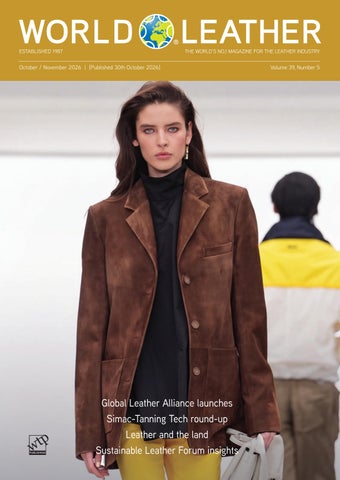
Cover image: Leather jackets are all the rage. Long may it continue. This one is from the spring-summer 2027 collection that Loewe presented at its September fashion week events. The brand is a renowned user of leather, including lambskin suede for jackets. CREDIT: LOEWE
Special Report 20
Quiet positivity There may have been less noise at this year’s Simac-Tanning Tech exhibition in Milan than at industry events in the past, but this is partly because much of the innovation on display was focused on quieter activities such as data collection, automation and AI.
Leather and the Circular Economy 24
26
30
34
36
38 40
Thought Leadership: Meaningful money Leaders in tanning and in leather chemicals have launched the Global Leather Alliance, a joint initiative to win “meaningful financial support” for promoting leather globally . Thought Leadership: What the future holds Four prominent industry figures discussed the leather industry’s past, present and (especially) future at the Sustainable Leather Forum in Paris in September. Thought Leadership: Leather’s link to the land Leathergoods designer and manufacturer Alice Robinson has won a place on an influential agricultural scholarship programme. She will think, read, travel and talk to build up her knowledge of the connections between leather and the land. Circular Stories: Unexpected benefit Paris-based Yasu Michino originally planned to work in ready-to-wear. An unexpected move into leathergoods has proved successful and unlocked his hidden ability to hold conversations with leather. Circular Stories: A chain we must not break Paraboot’s Clémentine Colin Richard insists that it is the special savoir-faire of each link in the leather eco-system that makes the industry so special. Circular Stories: Material moves The chief executive of redistribution platform Nona Source says deadstock leather needs to move out of inventory and come back into circulation. Essential reading
IBC Advertisers’ index The World Leather team has been publishing a series of original, dynamic podcasts since 2019. The whole series is available on Anchor, Spotify, Apple Podcasts, Google Podcasts, Pocket Casts, Overcast and other podcasting platforms. Just search for the World Leather Podcast on the platform you prefer.
WORLD LEATHER SERVING THE GLOBAL LEATHER INDUSTRY
World Leather iPad edition The world’s best leather industry magazine is now available to download on iPad from www.leatherbiz.com @WTPworldleather
@WTPworldleather linkedin.com/showcase/wtpworldleather
@WTPworldleather
World Trades Publishing Ltd 2026. Contributions: The editor welcomes news items, articles and photographs for consideration and possible publication but no responsibility can be accepted for the loss or non-publication of such material. Opinions expressed by individual contributors do not necessarily reflect the view of the editor or publisher. • Whilst every effort is made to ensure accuracy in reproduction, no responsibility can be accepted for the technical content or for claims made by manufacturers for product performance that are published. Publication in World Leather cannot be construed as an endorsement for a claim or product by the publisher. • World Leather is published 6 times per year by World Trades Publishing, The Old Stone House, Teeton, Northampton NN6 8LH UK. Price £150, per year (six issues). Graphic origination by WTP. Print by Bishops Printers, Walton Road, Portsmouth, Hampshire PO6 1TR, England. All rights reserved. ISSN 0894-3087 World Trades Publishing 2026: All rights reserved. No part of this publication may be reproduced, stored in a retrieval system or transmitted in any form or by any means mechanical, electronic, recording, photocopying or otherwise, without the written permission of the publisher. World Leather®, Tannery of the Year® and Nothing to Hide® are registered trademarks of World Trades Publishing Ltd.
1
The World of News THE NETHERLANDS Waalwijk-based leather trading company Maasleder had a double cause for celebration at the start of September. The company is celebrating its centenary in 2026. It has also been given the distinction of being able to use the royal seal. This is an honour that the King of the Netherlands gives to distinguished Dutch companies.
GERMANY Leather manufacturer Südleder has welcomed three new apprentices at the start of the company’s 2026 training year. Südleder said training and the development of young talent are important priorities, with qualified young people providing a foundation for maintaining quality craftsmanship and supporting future innovation in the leather industry.
UK Fashion group Frasers has announced a new business division focused on luxury. Frasers completed the acquisition of high-end department store group Harvey Nichols in August. Other recent investments include taking a 6% stake in leathergoods brand Burberry. It also has a 37% stake in another prominent UK leathergoods brand, Mulberry.
•
Automotive company Bentley Motors has named Malaysian born film-star Michelle Yeoh as its latest global ambassador. Ms Yeoh, who won the Oscar for best actress in 2023 for her performance in ‘Everything Everywhere All At Once’, said the partnership with Bentley felt natural to her. She said she admired Bentley’s ability to reinvent itself again and again “while staying true to its craftsmanship and its soul”.
GHANA The Ghana Leather and Footwear Manufacturers Association (GLFMA) has called on the government to cut duties on raw materials. Local reports say manufacturers are paying duties of up to 36% on leather, soles, rubber and industrial adhesives. Speaking on behalf of more than 12,000 artisans and 3,300 manufacturing workshops, CLFMA president, Gilbert Akwasi Ntim, said the existing tax structure threatened thousands of local jobs. 2
BOTSWANA A director of the Botswana Meat Commission (BMC) has encouraged cattle companies in the country to make full use of by-products to boost revenues. He said the value of cattle extended far beyond beef production, citing examples such the 1,720 tonnes of hides that BMC annually sells on to tanners.
ITALY High-end footwear brand Giuseppe Zanotti is joining the jacket revival, launching a collection as part of its autumn-winter 2026-2027 collection. Its jackets are made in Italy from 100% leather. The Storm jacket comes in black, hair-on calf leather, while the leather in the Rebel jacket has the hair removed. Giuseppe Zanotti described the jackets as “a bold statement for the new season”.
•
Up to €500 million in new funding for small and medium businesses could become available following an agreement between the European Investment Bank (EIB) and Italy’s Cassa Depositi e Prestiti (CDP). EIB has agreed to provide an initial tranche of €150 million for the programme, with further tranches to follow.
ESWATINI The country is seeking to strengthen its leather industry through a proposed joint procurement framework designed to improve access to materials for local leather businesses. A workshop in October brought together industry stakeholders to review arrangements for sourcing and storing materials.
WORLD LEATHER OCTOBER / NOVEMBER 2026
The World of News
MEXICO Leather, materials, machinery and components fair Anpic celebrated its latest edition in León in October. A new pavilion, alongside those dedicated to leather, machinery, chemical products, accessories and components, was devoted entirely to materials for Western boots, belts, hats and other products.
BRAZIL Belo Horizonte-based Azzas 2154, which describes itself as Latin America’s biggest fashion group, is to split into two. It formed in 2024, when the Arezzo shoes and bags group and fashion group Soma joined forces. They will now divide the group, with Arezzo taking control of footwear and accessories brands, including Arezzo, Schutz, Anacapri, Alexandre Birman and Carol Bassi.
PANAMA Leather, leathergoods and footwear group Cueros Vélez has opened a new store in Panama City, calling it its most important flagship in Latin America. The new store covers almost 600 squaremetres in the Multiplaza mall in the Panamanian capital. Cueros Vélez, which is based in Colombia, has been operating in the Central American country for more than 20 years and now has nine stores there.
ARMENIA The body that regulates international trade in exotic skins and leather, CITES, has reiterated the sustainability credentials of these and other materials from animals. Senior representatives of CITES travelled to Armenia in mid-October to attend a meeting of the parties to the Convention on Biological Diversity (CBD). Ahead of the event, CITES said: “When trade in wild species is sustainable, legal and traceable, it benefits both biodiversity and people.”
INDIA India’s Council for Leather Exports (CLE) used a footwear summit in Ho Chi Minh City in September to discuss opportunities for closer cooperation between the Indian and Vietnamese footwear industries. CLE said India could offer operators in Vietnam opportunities for investment, joint ventures and technical collaboration. WORLD LEATHER SERVING THE GLOBAL LEATHER INDUSTRY
MONGOLIA Mongolia’s Ministry of Food, Agriculture and Light Industry (MOFALI) and the United Nations Development Programme (UNDP) have held a technical consultation on greener supply chains in the country’s leather and cashmere sectors. Discussions focused on sustainable chemicals management, cleaner production technologies, circular economy practices, green materials, chemical inventories and life-cycle assessment. CHINA Process control specialist Hüni has established local manufacturing of its PPH (polypropylene homopolymer) drums in China following a two-year development programme. The company said the operation covers local sourcing, production planning, quality control and technical support, while engineering, design specifications and key electrical and electronic components remain with Hüni in Europe. INDONESIA The International Union of Shoe Industry Technicians (UITIC) has revealed the theme and programme details for its twentythird international congress, which will take place in Jakarta, Indonesia, from August 2-4, 2027. The event will carry the title, Engineering the Future of the Footwear Industry, with discussions set to focus on advanced technologies, sustainable manufacturing and resilience across the global footwear sector. AUSTRALIA Andrew Henderson has been appointed as the new independent chairman of Australia’s Red Meat Advisory Council. Mr Henderson is a strategic policy specialist and an experienced in food security, biosecurity, traceability, food safety and research and development. He has led reform of the country's red meat and livestock integrity systems. . 3
Industry & Innovation Applications open for Young Leather Scientist Grants he International Union of Leather Technologists and Chemists Societies (IULTCS) has opened applications for its 2027 Young Leather Scientist Grants, offering financial support and international recognition to students and early-career researchers. The programme has three categories: Basic Leather Research; Sustainability & Environmental Research grant; and Machinery & Digitalisation Solutions. Applicants must be under 35, be students or early-career researchers working with a university or leather school, have the support of an academic advisor and submit unpublished research. The grants offer financial support of up to €1,500, with recipients also having the opportunity to present their work at an IULTCS Congress and connect with international leather industry experts.
CTC marks 30 years in China eather and footwear research and testing institution CTC has celebrated the thirtieth anniversary of the start of its operations in China. It used the occasion to mark the completion of an expansion project at its laboratory in Dongguan. Director general, Maud Rascle, presided over the ceremony, with 200 guests in attendance. CTC said its commitment to supporting the leather and footwear industry in China remained unchanged, and that it would continue to offer customers there “expertise, quality and trusted services”. It said its ambition was “to keep innovating, growing and embracing new challenges”.
L
T
Brazilian tanners commit to innovation razil’s national tanning industry body CICB has revealed the details of a recent survey of the industry there. It puts the total number of tanneries operating in Brazil at the moment at 216. CICB said the exercise had flagged up that 25% of the machinery in use in Brazilian tanneries is sourced from Brazilian technology providers, while 75% of it comes from outside the country. Leather manufacturers revealed in their responses that just under 50% of all the investment they will make in 2026 will be in new equipment. Process technology will account for a further 16% of all investment.
B
Production boost ootwear group Stella International has reported revenues of just over $1.1 billion for the first nine months of 2026, an increase of 1.6% year on year. However, the volume of shoes it shipped in the JanuarySeptember period in 2026 was down. This year’s total was 40.8 million pairs, a decrease of 1.4% year on year. Stella has described 2026 as “an investment year”. Operations have begun at a new factory in Vietnam, which is making high-end sports shoes for a single customer. Production there will ramp up during 2027, the group said. In addition, it expects production to begin at two other new factories, one in Bangladesh, the other in Indonesia, before the end of this calendar year. It said it expects the three new production facilities to add 20 million pairs per year to its total output over the coming years.
F
4 XX
Bio-based recognition Leather industry renews manifesto ahead of COP 31 or the sixth year running, the global leather industry has prepared a manifesto in the build-up to the United Nations Climate Change Conference. This year’s event (COP 31) will take place in Antalya in Turkey from November 9-20. Ahead of the conference, the new leather industry manifesto, which more than 20 industry organisations have signed, points to the “increasing momentum” in the circular economy. The text welcomes the focus on policies that encourage greater use of biobased materials to reduce the current dependency on fossil fuels. As an example, it mentions the European Union’s Bioeconomy Strategy, which the Commission published in 2025, with the first initiatives launching this year. However, the new leather industry manifesto also makes this observation: “In the rush to new solutions, it is essential that the biobased materials that have served mankind for millennia are not overlooked. Natural materials like leather and wool are part of the solution to the climate challenge.” It asks that COP 31 endorse the industry’s call for wider recognition of the “cyclical, climate-efficient nature of leather” and its potential to make a positive contribution to reducing the climate impacts of consumer products. The text also calls on COP 31 to promote “slow fashion”, with repairable, long-lasting products made from biobased materials. Finally, it says the conference should encourage the use of natural renewable fibres like leather “wherever possible” and reduce consumer products manufacturers’ “unnecessary reliance” on fossil-fuel-based materials.
F
new European initiative to stimulate demand for bio-based materials could provide a further context for the leather industry’s calls for recognition of leather within EU bioeconomy policy. The European Commission launched the Bio-based Europe Alliance on October 21, with the aim of mobilising €10 billion in corporate purchasing commitments for bio-based materials and products by 2030. Its target markets include bio-based fibres and fabrics, plastics and polymers, chemicals and construction products. The voluntary alliance aims to connect buyers with producers and technology suppliers, creating more predictable demand to encourage investment and commercial development.
A
Court support for Gucci he Unified Patent Court (UPC) Court of Appeal has revoked most of Agfa’s patent claims covering a method of decorating leather using inkjet printing, while confirming that Gucci did not infringe the remaining claims. The court found that Gucci’s Flora leather products, including a wallet sold before Agfa filed its patent application in April 2017, had already disclosed the method. It therefore revoked several claims in Belgium, France, Germany, Italy and Sweden. Agfa had alleged that Gucci’s Pikarar Collection infringed the patent, which covers applying a pigmented base coat to leather before printing a colour image using UV-curable inks
T
Prada promises Church’s investment arent group Prada has said it intends to invest heavily in the Church’s footwear factory in Northampton and in the workforce there in the coming years. In recent comments to Vogue, president of Church’s, Denni Manzatto, said the bulk of the footwear brand’s collections had
P
WORLD LEATHER OCTOBER / NOVEMBER 2026
Industry & Innovation always been made in Northampton. But he said efforts to integrate Church’s into the systems and supply chain the wider Prada group has in place had led to some of its products being made in Italy. Now, he explained, all of that production would move to Northampton, with Prada making the necessary investment in the company’s factory in the town’s Saint James’s Road and in its workforce there. Currently, around 135 people work at the site, but Mr Manzatto said Church’s was working to train a new generation of craftspeople. He also said investment in the factory would make it possible for Church’s to widen the range of products it makes there. “We aim to do more and better,” he said, “to become even more iconic and even more English.”
ISA reports growth in regenerative hide sourcing eather manufacturing group ISA NextGen Materials reported a 128% increase in regenerative hide sourcing between 2023 and 2025, according to its latest sustainability report. The group sources regenerative hides from US farms practising regenerative agriculture, with the aim of improving soil health, water retention, biodiversity and carbon storage. Working with Other Half Processing, it turns the hides into finished leather traceable to the ranch where the animal was born.
L
New LCA tool for tanners pin360 has launched a software platform to help tanners assess the environmental, technical and economic implications of recipe changes before carrying out production trials. Called LCA Simulator, the tool allows users to model and compare alternative tanning and post-tanning recipes using a range of indicators, including process efficiency, technical performance, costs and environmental impacts.
S
Bata to open global design centre in Amsterdam Bata Group plans to open BataWorks, a global product, brand and design centre in Amsterdam's Schinkel District, in the first quarter of 2027. The centre will lead product and brand development for Bata and North Star, covering footwear, apparel and bags. The initiative forms part of the group’s wider strategy to strengthen its global brands and product development capabilities. Bata Group chief executive, Panos Mytaros, has linked the development to the company's Re-ignite strategy, which
aims to support the next phase of its international growth. The Amsterdam centre is intended to bring together creative talent and develop products for the group’s brands, working with regional teams to incorporate local consumer insights into global product development.
Tuscan ties xecutive director of Prada, Patrizio Betrelli, has said the recent opening of a new production hub in Piancastagnaio in Tuscany was one of the group’s highlights in the first nine months of 2026. He said the new hub, dedicated to leathergoods, “reiterates the group’s industrial vision, rooted in respect for the territory and the quality of the working environment”. The facility began production in late August.
E
Artisanal model here to stay igh-end leathergoods group Hermès has reported revenues of just under €12.3 billion for the first nine months of 2026. This represents growth of 2.9% compared to the same period last year. There was growth in sales for the company’s leathergoods and saddlery division, with revenues reaching nearly €5.7 billion, an increase of 7.5%. On releasing the latest figures, Hermès said it remained “convinced of the strength and relevance of our artisanal model”. Executive chairman, Axel Dumas, commented: “Our vision [is] firmly rooted in the long term, and we look to the future with confidence.”
H
Leatherwork techniques on display eather craftsmanship went on public display at Loewe’s flagship store in Madrid, the Casa Loewe, in October. This is one of the venues to which parent group LVMH granted special access to the public for its 2026 Journées Particulières event. At Casa Loewe, on the Spanish capital’s Calle Serrano, the brand’s savoir faire with leather took centre stage. Two leatherworking techniques received particular attention, weaving and intarsia. The first of these consists of intertwining strips of leather to create textured motifs. The second is a technique traditionally associated with decorative wood inlay, but one that Loewe artisans have transposed to leathergoods. The work involves lasercutting pieces of leather and using them to assemble a finished product by hand. Loewe’s technical manager for leathergoods and accessories, Javier Dorado, said leather was “a blank page” adding that the material is “the very first source of inspiration” for the Loewe team.
L
WORLD LEATHER SERVING THE GLOBAL LEATHER INDUSTRY
CEC warns about ‘fast-fashion’ shoes hoe industry body the European Footwear Confederation (CEC) has said more than 35% of products in a recent study failed to comply with REACH requirements. It carried out the study in a ‘mystery shopper’ exercise on footwear from three major fast fashion e-commerce platforms: Temu, Shein and Ali Express. The shoes were purchased in seven different European countries and sent for testing at independent laboratories, including PFI Germany, CTC in France and SATRA in the UK. Tests covered a range of substances of concern, including phthalates, formaldehyde, heavy metals, chromium VI, nickel release, polycyclic aromatic hydrocarbons (PAHs) and short-chain chlorinated paraffins (SCCPs). More than 35% of the shoes failed at least one chemical requirement under the applicable REACH restrictions.
S
Sharkskin makes shortlist n unusual use of an unusual type of leather has made it onto the shortlist for the 2026 Japan Leather Awards. On announcing a shortlist of more than 50 entries, the Japan Leather Industry Association (JLIA) included almost 30 leathergoods designs, more than 15 footwear ideas, three garments and seven in other product categories. Among these, one stand-out entry was a sanshin, a traditional stringed instrument from the southern island of Okinawa. The instrument has a long neck and a body made from hard wood, which is often covered with imported snakeskin. For the sanshin on the shortlist for the 2026 Japan Leather Awards, the producer, Ryukyu Shark, has used sharkskin instead. The authorities in Okinawa have a programme in place to remove sharks from the waters around the island to protect tourists and the livelihoods of local fishing communities. There are reports of around 1,000 sharks per year as part of this programme. Ryukyu Shark, which is based in Okinawa, has explained that while much of the material from these sharks can be used for food, the skins were typically being discarded. For a number of years, the company has been sourcing and salting the skins on the island and then shipping them to a specialist artisan tanner on the Japanese mainland for processing. It takes several months for the finished skins to come back. It produces wallets and other small leathergoods from the material. In 2022, it started using sharkskin on the musical instruments, culminating in this nomination.
A
5
Leather scene Ecco CEO resigns
New CEO to lead next phase of growth at SICIT
homas Gøgsig has resigned as CEO of footwear and leather group Ecco, with the board planning to appoint a successor in 2027. The board will continue working with the remaining management team until a replacement is appointed and has described the search as part of a necessary long-term transformation of the business. Mr Gøgsig joined Ecco in 2012 as a chemical engineer at Ecco Leather in the Netherlands and held a number of positions before becoming CEO in December 2024, succeeding Panos Mytaros. The board thanked him for his contribution to the company over 14 years. Ecco reported a fall in sales of 5% to approximately €1.4 billion in 2025.
T
ICIT Group, the Italian specialist tannery waste processor, has appointed Sergi Barrull as chief executive officer, succeeding Massimo Neresini, who has worked at the company for nearly 40 years, including approximately two decades as CEO. Mr Barrull joined SICIT as general manager in July 2025 and will lead its next phase of growth, with plans to expand in North and South America while developing its established markets in Europe and Asia. Based in Arzignano, Italy, SICIT processes tannery waste to produce collagen-derived peptides and amino acids for agricultural biostimulants and industrial applications. Its technology is also used to produce biobased additives for gypsum and plasterboard manufacturing.
S
Schill and Seilacher appoints new CEO
Leather Working Group names new CEO
peciality chemicals group Schill and Seilacher has appointed Stephan Sielaff as CEO of the group. Mr Sielaff brings around 30 years of international business and leadership experience, including senior roles at Unilever, Symrise, Archroma, Lenzing Group and SSI SCHÄFER Plastics. He said his focus would include strengthening customer relationships, sharing knowledge across the group and connecting its different businesses and locations more closely.
ultistakeholder body Leather Working Group (LWG) has appointed Dr Christina Raab as chief executive. Dr Raab will work alongside outgoing executive director, Vanessa Podmore, and interim director, Adam Hughes, during a transition period ahead of Ms Podmore’s departure at the end of the year. . She joins LWG from the Cradle to Cradle Products Innovation Institute, where she served as chief executive. Previously, she led global implementation and market transformation at ZDHC, supporting environmental progress across the fashion industry. She has also held leadership roles at sustainability advisory firms. LWG board chair, David Wright, said Dr Raab brought experience in sustainability, industry standards and global partnerships that would support the organisation’s strategic priorities. Her appointment comes as LWG prepares to launch a new sustainability system in 2027. The organisation said the initiative would build on the growth of its membership, adoption of its protocols and collaboration across the global leather value chain.
S
Egypt can offer supply chain resilience, ministry says representative of Egypt’s industry ministry, Ahmed Maghawry, has said the leather industry represents a good example of how well industrial ties between his country and Italy are working. Speaking at the Simac Tanning Tech exhibition in Milan in September, Dr Maghawry said the Robbiki leather manufacturing hub, which is 60 kilometres from the centre of Cairo, was one of the fruits of the relationship between the two countries. He said he hoped the sharing of expertise between them would continue. “Egypt wants to increase output and also productivity,” he told visitors and exhibitors at the Milan events. “We want to move into higher-value production and to get into international markets.” He argued that international companies should look to do business with Egypt, offering that the African country can offer them everything they need to achieve growth. “The world is changing,” Dr Maghawry concluded. “The resilience of supply chains is becoming more and more important. Egypt guarantees a resilient supply chain that is also sustainable.”
A
6 XX
M
Dr Warren Bowden recognised in Environment 100 cottish Leather Group’s sustainability and innovation director, Dr Warren Bowden, has earned inclusion on a list the recognises businesspeople in the UK for their work in environmental management. The list, Environment 100, is compiled by the organiser of an exhibition called the Environmental Services & Solutions Expo (ESS Expo).
S
Tie-up with Assomac no mere formality, ACCAL says he Association of Footwear Chambers of Latin America (ACCAL) is optimistic about achieving positive results from a partnership with footwear and leather machinery manufacturers in Italy. ACCAL president, Daniel Risafi, has said he is confident his association and Italian machinery manufacturers’ body Assomac can work well together. Speaking at the Simac-Tanning Tech event in Milan in September, Mr Risafi said: “Today, Latin America represents the second-biggest hub in the world for footwear manufacturing. Our collaboration with Assomac is more than a mere formality for us. We want to transform our ambitions into real projects. Italian companies have the technology, the experience and the know-how. Latin America has the production capacity.” The national footwear associations of 12 countries, Guatemala, Argentina, Brazil, Chile, Colombia, Mexico, Ecuador, Peru, Uruguay, Venezuela, El Salvador and Nicaragua, make up ACCAL.
T
Leading ostrich leather figure is a victim of fatal flood he founder of an important producer of ostrich leather, Saag Jonker, has died. Mr Jonker died at the end of September after his pick-up truck was swept away by a flood. He attempted to cross a bridge over the Olifants River, close to his home in Oudtshoorn, but was caught up in a torrent of floodwater. He was 85 years old. Saag Jonker founded his company, Ostrich Products South Africa in Oudtshoorn in the Western Cape province in 1976. He farmed ostriches and sold a range of ostrich products, including leather, to customers around the world, including Gucci, Prada, Hermès and Louis Vuitton.
T
WORLD LEATHER OCTOBER / NOVEMBER 2026
Leather scene Lear names new CFO utomotive seating supplier Lear Corporation has appointed Jared Fedele as senior vice-president and chief financial officer, effective March 1, 2027. He will succeed Jason Cardew, who will step down after 34 years with the company. Mr Cardew will remain as an executive advisor until the end of 2027, when he plans to retire. Mr Fedele has worked for Lear for 23 years and is currently vicepresident of finance for its seating and e-systems divisions. He has also held finance leadership roles in Asia.
A
New leadership for Pakistan’s footwear industry he Pakistan Footwear Manufacturers Association (PFMA) has elected Hassan Javed as its new chairman. Mr Hassan is chairman of Lahore-based manufacturing group Service Industries. He will lead PFMA for the next two years as part of a 12-person executive committee. Priorities for the committee will include promoting exports, encouraging investment and enhancing the competitiveness of Pakistan’s footwear sector.
T
Appointment celebrates Italy’s importance to Kering uxury group Kering has appointed Sabina Belli president of its business in Italy. She took up this new role on September 15. Ms Belli joined Kering in 2015 as chief executive of its Pomellato jewellery brand. In addition, she took up leadership of the group’s Accademia per le Eccellenze, an initiative dedicated to preserving and promoting Italian craftsmanship and savoir-faire, and fostering new generations of manufacturing talent. In this new role, Sabina Belli will represent all of Kering’s business in Italy. She will step down as chief executive of Pomellato, but will continue to lead the Accademia per le Eccellenze. She will also help advance initiatives that promote industrial excellence, innovation and sustainability across the luxury value chain, Kering said. It explained that Italy is “central to Kering’s identity and operations”. More than a quarter of the group’s global workforce is based in Italy, alongside thousands of additional indirect jobs supported through its manufacturing and logistics ecosystem there. Group chief executive, Luca de Meo, commented: “Italy occupies a unique place in Kering’s history, identity and future. Its creativity, craftsmanship and industrial excellence are at the heart of our houses and the long-term vitality of the luxury industry.” He said Sabina Belli’s new appointment would strengthen Kering’s long-term commitment to Italy and help amplify the country’s influence on the global luxury industry.
L
Berluti director hails the bond with customers he sustainability director of high-end footwear brand Berluti, Florence Piner, has said a repair service that the brand began to offer customers about a year ago has proved successful. Speaking at the Sustainable Leather Forum in Paris in September, Ms Piner said Berluti had been “born into shoemaking”, but has now expanded its offering into leathergoods and ready-to-wear too. Repair services are now available for the whole range, including developing an attractive patina on shoe uppers and helping customers keep leather jackets in good condition. “What is exceptionally interesting is that this service part of our offering is the part of the business that is progressing the fastest,” she said. She explained that offering these services had brought new customers “with great potential” to Berluti. She said this experience made her “enormously hopeful” because it shows, according to Ms Piner, “the incredible connection” that can form between a customer and a quality product.
T
WORLD LEATHER SERVING THE GLOBAL LEATHER INDUSTRY
7
Backtrack World Leather’s publishing cycle and limitations on space make it impossible for us to run more than a carefully selected sample of news from across the industry. However, we publish hundreds more stories on leatherbiz.com. The site is updated every day with news from every continent and every part of the industry, making leatherbiz.com one of the most comprehensive archives of news anywhere on the web for the global leather industry.
We list below just a few of the headlines that have appeared on the site in recent weeks and can still be accessed. 29 October 2026
14 October 2026
5 October 2026
Grace Wales Bonner blouson among adidas Originals highlights.
China and Australia to explore meat industry opportunities.
Footwear is still top for adidas, but apparel is growing fast.
13 October 2026
UK leather hub crowdfunding passes 10%. Leathergoods executive to lead Pucci. LVMH workshops to open their doors to the public.
Weight-loss drugs boost demand for leathergoods repairs.
Leather industry renews manifesto ahead of COP 31.
28 October 2026
IULTCS launches environmental impact publication series.
Yacht group to expand, in more ways than one. Timberland helps boost VF Corporation’s H1 results.
Car manufacturers welcome EU-China interim deal.
12 October 2026
2 October 2026 AICC prepares for 2026 national congress. PrimeAsia links supply-chain data to security of supply. Pakistan: new chairman elected for central region.
1 October 2026
Uni-chem signs agreement to acquire flexible electronics company.
Long John steps out in style for 15th anniversary. First year of new Kering academy under way. IULTCS: soluble chromium not risk predictor.
Primeasia China holds fourth summer camp for employees’ children.
Porsche to feel the pain before it can pull into the fast lane.
30 September 2026
22 October 2026
9 October 2026
Global Leather Alliance shares details of next steps.
Surplus Leather Project continues to support design students.
Kering focuses on Gucci’s recovery in a flat third quarter.
Radley expands licensing arrangements following acquisition.
21 October 2026
8 October 2026
Preparations in place for early St Crispin’s Day celebrations.
Chinese group completes its bid to become Puma’s biggest shareholder.
Skechers reports responsible leather sourcing progress.
Industry provides materials for new leather course for French schools.
20 October 2026
Alternative materials at Kering: lots of talk, few products.
26 October 2026 New collection from British Pasture Leather.
23 October 2026
European and US sales counter declines in China for Ferragamo. Paris and Milan disturbances affect luxury retailers.
19 October 2026 Positive trading update from Mulberry. TFL releases Spring-Summer 2028 colour trends.
16 October 2026
‘Buoyant’ US market offset by weaker demand in China for LVMH.
7 October 2026 Taiwan hailed as ‘a star performer’ for US beef. AQC to share findings from leather testing study.
6 October 2026 Chance for Vicenza students to meet leading leather manufacturer.
Chinese premium carmakers specify leather in Paris show models.
Craftsmanship counts at Bentley.
15 October 2026
‘Refined’ leather jacket stands out for Beckham.
Canada Goose introduces leather
8 XX
Leathergoods growth boosted by Victoria Beckham Sloane.
Hearth leather now ready for automotive market, Rino Mastrotto Group says. China: January-July footwear exports pass 5 billion pairs. Brazil storm leaves Gobba employees among those affected. UITIC outlines programme for Jakarta congress.
29 September 2026 Associations publish TCLF SkillBridge “toolkit”.
28 September 2026 Dutch court rules in Birkenstock’s favour. Strong start to financial year for Pakistan leather sector. Hides missing from 30-FOR-30 lists.
25 September 2026 Luxury Lexus yacht to go on global sale. Henkel gets EU clearance for Stahl acquisition. Turkish leather sector lags manufacturing.
24 September 2026 Footwear fall brings India’s leather exports down. Williamsburg opening brings Hermès to Brooklyn . Increase in raw hides and skins coming into China. Dr Martens launches new brand platform.
WORLD LEATHER OCTOBER / NOVEMBER 2026
BEAUTIFUL DURABLE RENEWABLE Advertise in World Leather & leatherbiz.com to promote your latest products and innovations to a readership of over 5,500 worldwide. For more information: matthew@worldtrades.co.uk
Leather Leaders: Edoardo De Paola
The secretary general of COTANCE, Edoardo De Paola, argues that leather deserves a place in discussions about advancing the bioeconomy, but that there is much work still to do to convince European Union policy-makers.
How to turn EU regulations into an asset
COTANCE secretary general, Edoardo De Paola, speaking at the 2026 Sustainable Leather Forum in Paris CREDIT: ICI AU LOIN
What is the current situation regarding manufacturing and industry, in general, in the European Union? What is the European Commission’s attitude towards the leather sector in particular? We are at a turning point on European legislation. The Green Deal ended in 2024. The Clean Industrial Deal (World Leather February-March 2025) was established by the new Commission, the second Von der Leyen Commission, which took office at the end of that year. The Clean Industrial Deal focuses on the same policy areas as the Green Deal, which is to say climate change, adaptation, mitigation, pollution reduction and so on. It has the same goals, but as Ursula von der Leyen says, with pragmatism, technology-neutrality and innovation. The focus of new investments coming from the European Union will be on what are perceived as ‘clean’ industries. Any industrial activity that is ‘not clean’ will, most likely, face difficulties in the future and will not benefit from the EU’s good will. So, Europe is investing in industry, but when we talk about leather, I’m not sure; maybe. There is a perception of leather that it is still somehow related to the fossil economy. The perception is that greenhouse gas emissions must be produced somewhere for us to have leather. From this, there is the idea among some that leather may not be worth investing in. I felt this perception as soon as I began working with COTANCE (in April 2026).
10 XX
How would you sum up the reality of what happens on the ground in Brussels? In the EU, the Commission issues what you might call macro-strategies. These are not regulations; they are not binding policies. It is more that they indicate what the EU will focus its policies on. This can affect the perception of the leather sector in Europe and shape its future. What would be an example of a macro-strategy for the current Commission? One of the major ones is the EU Bioeconomy Strategy, which launched last year. Its main policies are coming out now, in the Biotech Act II, which we hope will be published before the end of 2026. There are documents that suggest what these policies will look like. We can see from these that, essentially, the focus will be on new materials, including bioplastics. The result of this is that leather, most likely, will not benefit directly. In my opinion, this is related to the point I made about the perception of leather in the Commission. And I know that does not really make sense because leather is inherently part of the bioeconomy. We will have to wait and see how the policies are determined. Another major element is the new European Livestock Strategy (World Leather August-September 2026). In this, we can see a different view of livestock. This is a macro-strategy that makes it clear that
WORLD LEATHER OCTOBER / NOVEMBER 2026
How to turn EU regulations into an asset
“ My hope is that European policy choices will be made based on something grounded and scientific.
”
EDOARDO DE PAOLA
The EU Bioeconomy Strategy launched in 2025 and is a major focus for the second Von der Leyen Commission. CREDIT: EUROPEAN COMMISSION / PIERO CRUCIATTI
it can be worth investing in livestock in the EU, for reasons of food security, food safety and so on. But there is a focus only on by-products, not on leather per se. Which other potential policy changes have caught your eye? Another crucial topic for the industry is chemicals and the pressure they are going to come under from EU regulation now, at the end of 2026, and at the beginning of 2027. There is a focus on biocides, for example. There are changes to REACH, but these will be targeted and specific. As people in the leather industry know, bisphenols are likely to be part of this. So, there is likely to be another round of talks about bisphenols. Furthermore, a skin sensitiser restriction proposal has re-gained momentum after being blocked in 2020. The Commission has re-opened the file, and a change in the Chromium VI detection limit from 3ppm to 1ppm is still on the line. What difference will leather’s exclusion from the scope of the European Union Deforestation Regulation (EUDR) make to the perception of the material and the industry among politicians and policy-makers? We in the industry are pleased that leather, in the end, has been excluded from the scope of EUDR. This was certainly one of the most important developments for us in the past year. You can see in this that the EU is making a differentiation between meat and the leather value chain. There is also recognition of the relatively low economic value of hides, at 1.5%, compared to meat and the overall value of cattle production. This means recognition of leather as a by-product of the meat industry. This recognition was crucial. There was also recognition of a fragmentary and incoherent approach in initially seeking to include leather in the scope of EUDR, but not downstream leather products. But there is a point of concern here that is worth mentioning. The Commission’s statements on this show that, from its perspective, excluding leather from the scope of EUDR is
WORLD LEATHER SERVING THE GLOBAL LEATHER INDUSTRY
not to recognise that leather does not drive deforestation. There will be a new European Commission in 2029. The following year, in 2030, there is going to be a review of EUDR. We don’t know what the make-up of the new Commission will be. We don’t know if it will continue to make this differentiation between meat and leather or if leather will continue to be outside the scope of EUDR. And, while the economic allocation of the hide is 1.5% now, who knows what it will be in 2030? Even after EUDR, traceability remains important because we are going to have to debate all of this again. What potential is there for measures that could help the leather sector make compelling arguments about its sustainability? A review of the Textile Labelling regulation, plus the Circular Economy Act, plus work on the Animal By-Products regulation could all be interesting for leather. As part of the EU Bioeconomy Strategy, there will be an opening for recognising biogenic carbon accounting in a review of methods for calculating product environmental footprint. If the Commission moves ahead with this, it will lower the calculations for leather’s environmental footprint. Biogenic carbon takes into account that living organisms, including livestock, absorb carbon from the plants they eat and return a high proportion of that carbon to nature for it to be reabsorbed. This could be important. But this is generating a lot of debate in Brussels at the moment. There are organisations that argue that the biogenic carbon point is just a loophole. What gives you confidence that the Commission will pay attention to new calculations for leather’s environmental footprint? There is a need to produce new data-sets anyway. A private company, (Zurich-based Ecoinvent), was compiling data for the European Commission for the product environmental footprint project, but it has stopped this activity now and there is a black hole for data, certainly for
11
How to turn EU regulations into an asset
If we hold to the Brundtland Report’s definition of sustainable development, leather must be part of a sustainable future. CREDIT: LINEAPELLE
apparel and footwear, which is the product environmental footprint that will have the most effect on leather. I know that the industry has been developing various systems to properly assess environmental footprint, for example, the new UNIDO guidelines for assessing the environmental footprint of leather (World Leather, June-July 2026). I expect there to be some important development on this soon. One major change would be to have the biogenic carbon assessment I mentioned. Another thing that would be very positive would be for a full assessment of the footprint of petrochemical products, covering the full supply chain, starting from the extraction of fossil fuels. What other steps would you recommend the leather industry take to make more of a positive impact on the people who make decisions about regulations and policies in the EU? From my analysis, I assess that there is a perception of leather that is generally negative in the European Commission. I believe that this is the case because of a lack, comparatively, of research studies fostering the sustainability credentials of the leather sector compared to other materials. Today, EU regulations are still a constraint for the sector. A suggestion I would make is that the industry should invest in research into leather’s sustainable development credentials and use that research to turn EU regulations into an asset. When policy-makers write a policy, they make their choices based on the available scientific research studies. There are already many such studies about bioplastics and other materials that are, essentially, in competition with leather. On the side of leather, we do have some crucial studies. Examples include the 2021 paper from FILK, ‘Comparison of the Technical Performance of Leather and Trendy Alternatives’. Another is ‘Materials Circularity: A Novel Method for Biobased Carbon Quantification on Leather’ from ARS Tinctoria. If we can have more peer-reviewed papers like these, it will allow us to bring forward certain messages when we talk to the institutions. Policy-makers would then have these details in
12
mind when making policy choices. That negative perception is still there, but my wish and my hope is that European policy choices will be made based on something more grounded and scientific. If, as you say, leather should be part of the bioeconomy, what is the most important message the industry can send to regulators to claim a place at that table? There are certainly parts of the population who would call that claim into question. I believe that in the discussions we have about sustainability, the very meaning of the term ‘sustainability’ can change. The discussion began with the United Nations document from 1987 ‘Our Common Future’. It is also called the Brundtland Report. It says that sustainable development is development that meets the needs of the present without compromising the ability of future generations to meet their own needs. Saying this makes me think straight away about the word ‘durability’, which is one of the main selling points of leather. This, in turn, makes me think that leather still has a sustainable future. How would you describe the level of awareness among regulators in the EU of the extra challenges they are imposing on leather manufacturers there compared to competitors in other parts of the world? What we are talking about here is creating a level playing field. There are issues with non-compliant products and this is a question that is affecting the whole of the textiles, clothing, leather and footwear sector. These sectors hold annual talks together with the Commission and this question always comes up. The most recent answer we have had from the Commission is that it will invest more in checks and controls, and in keeping its databases up to date. Something that would really help, and something that COTANCE has pushed for, is a Europe-wide definition of leather. That would make it easier for the competent authorities to stop counterfeit products that are not leather but are being sold as leather from coming onto the market.
WORLD LEATHER OCTOBER / NOVEMBER 2026
NTE_WorldLeatherAds.pdf
3
2025/06/24
09:42
A symphony of
NATURAL LEATHER SOLUTIONS Since 1920, NTE Mimosa has used wattle mimosa to create a comprehensive range of sustainable, environmentally-friendly tanning products for the world’s finest leather. C
M
Y
CM
MY
CY
CMY
K
Technology
CREDIT: SHUTTERSTOCK
PFAS in the leather industry Why understanding the definition matters more than ever Professor Will Wise, Head of PFAS Business Development, Eurofins Chemtest
F
or many years, discussions around PFAS in the leather industry focused primarily on water-repellent treatments. If a leather product claimed exceptional resistance to water, oil or staining, there was a reasonable chance that fluorinated chemistry was involved somewhere in its manufacture. Today, however, the conversation has changed dramatically. These properties remain relevant in applications such as automotive interiors, upholstery and footwear, where resistance to staining, oils and moisture can be important performance requirements. The term PFAS, which stands for per- and polyfluoroalkyl substances, now encompasses a vast and growing group of fluorinated compounds. As regulators, retailers and consumers increasingly scrutinise these chemicals, the leather industry faces a new challenge: understanding that PFAS is no longer limited to traditional waterproofing agents. The broader definitions now being adopted mean that substances used in dyes, pigments and other chemical products, such as surfactants, may also fall within the PFAS category. As a result, manufacturers must look beyond raw material selection and consider both supply chain assurance and environmental management if they are to minimise risk.
14
A moving definition As was covered at the SLTC annual conference in April this year, one of the reasons PFAS has become such a complex topic is that regulatory authorities have shifted towards broader structural definitions. Instead of focusing on a limited list of well-known compounds, many frameworks now classify substances as PFAS based on the presence of certain fluorinated carbon structures. For example, in regulatory proposals managed by the European Chemicals Agency (ECHA) under the REACH Regulation, a PFAS is defined as “any substance that contains at least one fully fluorinated methyl (-CF3) or methylene (-CF2-) carbon atom, without any hydrogen, chlorine, bromine, or iodine atoms attached to it”. So, whereas attention historically focused on a relatively small number of compounds such as PFOS and PFOA, this new much broader definition now means many more chemicals are in scope. The practical consequence is simple: far more chemicals are now captured under the PFAS umbrella than would have been considered a decade ago, and a product that was never intended to function as a water- or stain-repellent may still contain a fully fluorinated component that falls within a modern PFAS definition. For tanneries, this means looking WORLD LEATHER OCTOBER / NOVEMBER 2026
PFAS in the leather industry
“ The key challenge is no longer simply identifying fluorinated waterproofing treatments.
”
PROFESSOR WILL WISE
beyond dedicated treatments to the wider range of chemical products used in leather processing. Certain pigments, dyes and surfactants may therefore become relevant when assessing PFAS compliance. Why supply chain assurance is critical The good news is that many major chemical suppliers serving the leather sector have been actively reformulating products and removing intentionally added PFAS for several years. However, not all supply chains are equal. Global sourcing continues to create challenges, particularly where products are purchased through multiple intermediaries or from regions with different regulatory requirements. In some cases, manufacturers may rely on declarations alone without analytical verification. This creates a risk that PFAS-containing products enter the supply chain inadvertently. For leather manufacturers supplying international brands, this can have significant consequences. Increasing numbers of customers now require PFAS declarations, restricted substance list (RSL) compliance and in many cases analytical evidence demonstrating the absence of PFAS. For tanneries, the challenge is that compliance increasingly depends on information extending beyond their own processes. Chemical formulations, supplier declarations and customer requirements all need to be considered together, particularly where leather is supplied for different end-use markets or through complex international value chains. Routine testing therefore plays an increasingly significant role in due diligence programmes. While supplier engagement remains essential, analytical screening can provide an additional layer of confidence that declarations are accurate and that products meet customer expectations. Testing beyond the finished product Historically, most PFAS testing focused on finished articles. Today, organisations are increasingly examining the wider environmental picture. A tannery or leather finishing operation may no longer use PFAS-containing chemistry, but that does not necessarily mean there is no PFAS risk on site. Assessments may need to consider not only current chemical use but also the possibility of contamination associated with historical site activities including in their wastewater treatment, discharge routes and other waste streams. Many industrial facilities are now investigating potential legacy contamination resulting from historical operations. PFAS compounds are often referred to as "forever WORLD LEATHER SERVING THE GLOBAL LEATHER INDUSTRY
chemicals" because of their persistence in the environment. Once released, they can remain in soil, groundwater, surface water and sediments for many years. Consequently, environmental testing is becoming one of the fastest-growing areas of PFAS analysis. Effluent discharges, surface water runoff, groundwater monitoring and waste management practices are now all coming under increasing scrutiny. Regulators are asking more questions, while investors, insurers and local communities are becoming more aware of potential liabilities. For businesses operating long-established manufacturing sites, understanding historic contamination can be just as important as managing current chemical usage. The cost of inaction The financial and reputational consequences of failing to manage PFAS risks can be substantial. The former AGC Chemicals Europe facility in ThorntonCleveleys, Lancashire, has very recently become one of the UK's most widely discussed PFAS cases. Investigations identified historic emissions of PFOA, and other PFAS compounds that were used at the site until 2012. Subsequent environmental investigations found contamination in local soils and locally grown produce, leading to public concern, extensive media coverage and ongoing scrutiny of the site. The case illustrates a crucial lesson for industry: PFAS management is not simply a compliance exercise. Poor environmental stewardship can lead to significant remediation costs, increased regulatory oversight, legal claims and lasting damage to corporate reputation. While most leather manufacturers will never face issues on this scale, the example demonstrates how environmental liabilities can persist long after a chemical has ceased to be used. Looking ahead PFAS regulation is continuing to evolve, and the leather industry is unlikely to escape its impact. The key challenge is no longer simply identifying fluorinated waterproofing treatments. Instead, manufacturers must recognise that modern PFAS definitions can encompass a much wider range of substances than many people realise. For the leather sector, this means treating PFAS as both a chemical management issue and an environmental consideration, with cooperation between tanneries, chemical suppliers and customers likely to be essential. The most successful organisations will take a proactive approach. This includes understanding their supply chains, verifying chemical declarations, implementing appropriate testing programmes and assessing potential environmental liabilities associated with historic operations. Ultimately, PFAS management is becoming part of broader environmental responsibility. Whether the focus is product compliance, wastewater discharges, surface water runoff or legacy site contamination, businesses that understand their PFAS profile are likely to be far better positioned than those that wait for regulators or customers to ask difficult questions. In an era of increasing scrutiny, knowing what is in your products and what may have been left behind from past activities is no longer just good practice. It is becoming a business necessity. 15
Technology
Panellists discuss primary environmental data at SIMAC Tanning Tech. CREDIT: WTP
Why primary data for chemicals matters Improving access to primary data from upstream chemical suppliers could significantly strengthen environmental assessments across the leather value chain, delegates heard during a sustainability session at Simac Tanning Tech in Milan.
A
discussion at Simac Tanning Tech organised by The National Union of Italian Tanning Auxiliary Producers (UNPAC) in collaboration with SPIN360, focused on the role of chemical raw-material data in lifecycle assessment (LCA) and on the need for closer collaboration between chemical producers and tanneries. It examined the results of a project involving 21 Italian chemical companies. Secretary general of UNPAC, Maurizio Maggioni, introduced the session, while Federico Brugnoli, founder and chief executive of SPIN360, and sustainability consultant Arianna Civiletti outlined the project's background and methodology. A panel discussion followed, featuring Laura Vantin of Chimica Vemar, Riccardo Girolami of KLF Tecnokimica, Alberto Gallina of Rino Mastrotto and Pietro Pantani of Conceria Incas. The project was developed in response to growing requests from brands and tanneries for more reliable environmental information about chemicals used in leather manufacturing. More than 500 chemical raw-material matrices used in tanning formulations have been mapped, with participating companies contributing data to establish a common methodology for assessing environmental impact. 16
Mapping impact at source One challenge highlighted during the presentation was the scale of the task. With more than 500,000 commercial chemical product codes estimated to exist globally, carrying out individual LCAs for every product would be both impractical and prohibitively expensive. Delegates heard that LCAs have historically cost between €4,000 and €10,000 per product, making a product-by-product approach unrealistic for much of the industry. Instead, the project has developed a database and modelling approach that can be applied across different formulations. Where detailed information on a chemical's origins was unavailable, the methodology traced materials back through several levels of retrosynthesis to identify underlying raw-material impacts. More than 400 LCAs of finished chemical products have already been produced using the same methodology, allowing direct comparison between results. According to Mr Brugnoli, the findings indicate that around 80%-90% of the environmental impact of a finished chemical product entering a tannery originates from its raw materials, with the remainder largely associated with manufacturing WORLD LEATHER OCTOBER / NOVEMBER 2026
Why primary data for chemicals matters
“ We do not work by approximation. Completeness, reliability and technical competence are fundamental elements of our work.
”
LAURA VANTIN, CHIMICA VEMAR
processes and machinery. He said this gives chemical companies a clearer way of identifying high-impact inputs and targeting improvement efforts while supporting more robust environmental assessments throughout the leather supply chain. Much of the discussion focused not on the data already collected, but on what remains unavailable. Participants argued that continued reliance on generic or secondary datasets inevitably introduces uncertainty into environmental calculations. As sustainability reporting becomes more detailed, access to reliable primary data is increasingly important. Ms Vantin said: “We do not work by approximation. Completeness, reliability and technical competence are fundamental elements of our work.” Panellists argued that better primary data would help suppliers and tanneries understand the relationship between environmental impact, product performance and production requirements more accurately. They stressed that chemical products cannot be evaluated solely on environmental criteria. Technical performance, process compatibility and commercial viability remain equally important considerations. Durability and repairability were also highlighted as factors that should form part of the broader discussion surrounding leather’s sustainability credentials. Collaboration needed Collaboration across the supply chain emerged as another key theme, with suggestions that chemical suppliers and tanneries should engage earlier in the development process, moving beyond a traditional customer-supplier model to identify challenges and develop solutions jointly. Such an approach could improve technical outcomes while reducing expenditure on products that ultimately fail to meet production requirements. The discussion also extended beyond chemistry to machinery, process technology and water management. Particular attention was given to water scarcity and water quality, with participants stressing the need to assess production systems as a whole rather than focusing on isolated indicators. Environmental improvements, it was noted, must ultimately be translated into practical manufacturing decisions that remain technically and economically viable. The UNPAC project is being presented as a platform for further work rather than a completed exercise. Future phases are expected to focus on improving the quality of primary data and extending collaboration further upstream in the chemical supply chain. While significant challenges remain, participants suggested that better data and wider cooperation could provide a stronger foundation for environmental assessment and decision-making across the leather industry.
WORLD LEATHER SERVING THE GLOBAL LEATHER INDUSTRY
17
Technology
Ivan Kral with KLICL’s owners in front of the tannery in Moshi, Tanzania. ALL CREDITS: IVAN KRALL
Building an integrated leather industry beneath Mount Kilimanjaro Tanzania has the livestock resources to support a larger leather industry, but developing the capacity to turn hides and skins into finished goods remains a challenge. At Kilimanjaro Leather Industries Company Limited (KLICL), tanning, footwear and leathergoods manufacturing operate within the same complex. Recently retired UNIDO development officer for the leather industry Ivan Kral looks at how the project has developed, the technology and training behind it, and the opportunities and challenges facing the business as it seeks to establish itself in domestic and export markets.
L
ocated in Moshi, beneath the slopes of Mount Kilimanjaro, Kilimanjaro Leather Industries Company Limited (KLICL) is one of East Africa’s significant investments in the leather sector. Bringing tanning, footwear manufacture and leathergoods production together within a single complex, the project was conceived to increase domestic value addition while creating employment and developing skills in Tanzania. The project attracted international attention in 2019, when Italian companies Toscana Macchine Calzature (TMC) and Italprogetti agreed to support its development. The facility was officially inaugurated in October 2020 by the late Tanzanian president, Dr John Joseph Pombe Magufuli. Established in 2017 as a joint venture between the Public Service Social Security Fund (PSSSF) and Prisons 18
Corporation Sole (PCS), KLICL occupies the site of the former Karanga Shoe Factory. Its objective was to strengthen Tanzania’s leather value chain, from raw hides and skins to finished products. From Karanga to integrated manufacturing The complex was designed to connect locally processed leather with downstream footwear and leathergoods manufacturers, reducing reliance on imported finished products while expanding domestic processing capacity. It comprises five production facilities: a tannery, a civilian footwear factory, a military footwear factory, a leathergoods factory, and a sole and slipper factory. According to company information, the tannery has an annual capacity of approximately 13 million square-feet of WORLD LEATHER OCTOBER / NOVEMBER 2026
Building an integrated leather industry beneath Mount Kilimanjaro
wetblue, crust and finished leather. The civilian footwear factory is designed to produce 1.2 million pairs annually, while the military footwear factory has a stated capacity of 125,500 pairs. The sole and slipper facility can produce 2.1 million pairs a year, and the leathergoods factory has an annual capacity of 184,500 items, including bags, belts and wallets. These figures represent installed or planned capacity rather than confirmed current output, but they indicate the scale of the investment. Italian suppliers played a central role in establishing the production facilities. TMC and Italprogetti provided machinery, technology and technical expertise, helping to introduce modern manufacturing systems while supporting the development of local capabilities. KLICL also has an in-house design team. Its members have received training through programmes supported by the United Nations Industrial Development Organisation (UNIDO), supplemented by online learning initiatives. Tanning and environmental management The tannery incorporates polypropylene drums, automated chemical dosing and process-control systems designed to improve consistency and make efficient use of chemicals and water. Environmental management was incorporated into the facility’s design. Waste streams from soaking and liming, chrome-bearing liquors and general wastewater are treated separately. This allows treatment to be tailored to different effluent streams, supports chrome management and helps mitigate operational risks, including the potential formation of hydrogen sulphide. Italprogetti designed and supplied the effluent treatment plant. According to KLICL, treated wastewater is monitored internally and by local environmental laboratories to assess compliance with applicable requirements. The company is also considering certification through internationally recognised organisations in the leather sector, with the Leather Working Group (LWG) and the Sustainable Leather Foundation (SLF) identified as potential routes. Certification has yet to be achieved. Progress in this area would support efforts to meet growing supply-chain expectations concerning environmental performance, traceability and responsible business practices.
Polypropylene tanning drums installed at KLICL by Italian supplier Italprogetti.
Developing markets KLICL’s commercial strategy combines domestic and export sales, using distributors, agents, retail outlets, exhibitions, promotional activities and digital channels. The company operates retail outlets in Moshi, Dar es Salaam, Mwanza, Dodoma, Mbeya, Morogoro, Babati and Arusha, providing direct routes to market for its finished products. Markets vary by product. Finished leather is sold primarily in Tanzania and neighbouring countries, while wetblue goat leather is exported to customers in Asia. Footwear production targets institutional and industrial buyers, including schools, government organisations and sectors requiring safety footwear. KLICL primarily processes bovine hides, although sheep and goat skins are also used. The company states that most of its raw materials are sourced locally, linking its operations to Tanzania’s livestock sector and supporting the domestic use of hides and skins. Employment and skills development A distinctive feature of the project is its relationship with the adjacent Karanga Prison. In addition to providing employment opportunities for the wider community, the facility was designed to offer inmates vocational training and practical work experience. According to the company, KLICL employs around 305 people, comprising 150 men and 155 women. At full capacity, the project is expected
WORLD LEATHER SERVING THE GLOBAL LEATHER INDUSTRY
to support approximately 3,000 direct and indirect jobs. Beyond employment within the complex, a stronger leather industry could generate additional demand for hides and skins, logistics, maintenance, distribution and related services. The extent of these benefits will depend on sustained production and stronger links between the company, its suppliers and its customers. The combination of manufacturing and vocational training also provides a means of developing technical expertise that could benefit Tanzania’s wider leather and footwear industries. Looking ahead KLICL brings tanning, footwear and leathergoods manufacture together at a single site, with the aim of making greater use of Tanzania’s own hides and skins. Support from Italian machinery and technology suppliers has helped establish the production facilities, while the company has also invested in effluent treatment and staff training. The challenge now is to make full use of that capacity and build sales in Tanzania and overseas. The company’s progress towards certification by organisations such as the Leather Working Group and the Sustainable Leather Foundation will also be worth following. KLICL’s development will be of interest to Tanzania’s wider leather sector, particularly as the country seeks to process more of its own raw materials and expand the manufacture of finished leather products.
19
Special Report
Opening ceremony of the 2026 Simac Tanning Tech exhibition. ALL CREDITS: WTP
Technology, change and a little positivity Highlights from Simac Tanning Tech 2026 With the summer holidays now a long-forgotten memory, September signals the final major exhibition period of the year for the leather industry. Milan has become a familiar host to the cluster of shows that descend on Fiera Milano Rho in mid-September. With the 2026 Winter Olympics now consigned to history, Mipel, Micam, Simac Tanning Tech and Lineapelle were once again able to take place in close proximity to one another.
W
hen the leather industry’s Milan events were separated for the previous edition because of the preparations of the Winter Olympics, it was noted at the time that they seemed to thrive when held together but lose something when apart. The official exhibitor and visitor figures provide the ultimate test of that observation. From the viewpoint of those walking the halls, however, the overall impression this year was that the shows were relatively quiet. Milan has housed the Simac Tanning Tech show for more than a decade now, and there was certainly some discussion about the “good old days”. This is usually a reference to the last few editions in Bologna. But there will be people in the industry who can remember further back, and who might consider the Bologna years positively modern compared with the Semaine du Cuir in Paris, when the major leather exhibitions attracted numbers that are difficult to imagine today.
20
The figures certainly put things into perspective. At its peak, Semaine du Cuir attracted more than 2,000 exhibitors and approached 80,000 visitors, while SIMAC's 1994 Bologna edition reportedly attracted almost 16,000 visitors. By 2013, the combined SIMAC and Tanning-Tech event recorded just over 3,000 visitors. Today's figures are obviously not directly comparable, with exhibitions, visitor counting and the industry itself having changed considerably, but the longterm direction is difficult to ignore. The 25% increase reported by Assomac for 2026 needs to be considered against the wider pattern of attendance. Simac recorded more than 6,500 visitors in 2023, followed by more than 9,000 visitors in 2024, when the exhibition celebrated its 50th edition and recorded a record attendance. Visitor numbers then fell to just over 7,000 in 2025 before recovering to approximately 8,800 in 2026. A similar pattern can be seen at Lineapelle, where visitor numbers fell from 23,800 in 2024 to 21,433 in 2025, before recovering to 22,800 in 2026. WORLD LEATHER OCTOBER / NOVEMBER 2026
Technology, change and a little positivity
Wide aisles and bare concrete floors were not favoured by many.
The 2025 figures need to be viewed against the rather unusual exhibition environment in Milan ahead of the Winter Olympics. Preparations for the Games affected the use of the Milan site, with changes to the timing and arrangements of several of the major exhibitions. Given the close relationship between Simac, Lineapelle, MICAM and MIPEL, it is difficult to know precisely how much this affected visitor numbers, but it provides another reason for looking beyond the 2025 figure when assessing the performance of the shows. On that basis, 2026 looks more like a recovery towards the levels seen in 2024 than quite the 25% growth suggested by the year-onyear comparison. Certainly, times have changed. We are still operating in a period of two ongoing wars, creating considerable distraction and uncertainty and making longer-term planning difficult, while also having significant effects on raw material availability and pricing, logistics and manufacturing costs. Yet the idea of not exhibiting still seems almost unthinkable. The rumour mill would be quick to interpret an absence as a sign of trouble. That said, smaller stands, shared exhibition space and the continuing period of consolidation and acquisition across the industry mean that even the sizeable halls at the Milan fairground cannot disguise the areas of blocked-off space, additional seating areas and wider aisles. There is less of a buzz about the place, although perhaps that is partly a reflection of how the industry itself has changed. The mood among exhibitors, however, was generally more positive than the physical appearance of the halls might suggest. Many conversations reflected a familiar theme from recent exhibitions. One exhibitor estimated that discussions were perhaps 80% focused on maintaining existing relationships and 20% on planning new projects but added that the quality of meetings had exceeded expectations. That observation mirrors many exhibition reviews in recent years. The way business is conducted has changed, and the importance of exhibitions as the sole venue for face-to-face discussions has diminished as communication and project development increasingly take place throughout the year. Views on the wider state of the industry remained mixed. WORLD LEATHER SERVING THE GLOBAL LEATHER INDUSTRY
As has often been the case in recent years, much of the positivity appeared to come from the chemical side of the supply chain. This time, however, machinery and technology suppliers also seemed noticeably more optimistic than at previous editions. Several companies reported better-than-expected meetings and one Italian machinery and technology provider described the exhibition simply as “excellent”. Perhaps more cosmetic, but still something that had been noticed by a number of exhibitors, is the contrast between the Simac Tanning Tech halls and the fully carpeted halls of Lineapelle. The bare concrete floors in the aisles of the machinery exhibition can leave the Simac side feeling, in the words of one or two exhibitors, like the poor cousins of the leather and fashion halls next door. It may seem a relatively minor point, but presentation matters at an international exhibition, particularly when the two events are so closely connected. Where’s the buzz? In the past, you could see and hear what amounted to almost a complete tannery operating on the exhibition floor. Drums turning, compressors humming and staking machines providing a rhythmic backdrop to the constant noise and activity. Today, some of the most significant developments are happening much more quietly. Data collection, automation, software and AI can provide the modern tanner and leather manufacturer with more information and control than ever before, but they do so largely without the noise, movement and sheer physical presence of machinery that once defined the exhibition floor. It is in these areas that we find the new “buzz”. The sheer potential of these modern innovations is now beginning to be recognised and, importantly, acted upon. It would not be wrong to say that the traditional nature of the leather industry, particularly among tanneries and leather manufacturers, has left it somewhat behind the technology curve. That, however, is where an increasing amount of time, effort and money is now being invested. A changing mindset, a common phrase encountered when talking to exhibitors, now seems to be 21
Technology, change and a little positivity
The positivity cabin - A different kind of reflection at Simac for technical editor, Mat Abbott.
taking place. The everyday presence of AI, combined with a more tech-savvy younger generation coming through the ranks, perhaps makes this generation more willing to take these developments on board. Beyond improvements in ergonomics, safety and efficiency, the basic function of splitting machines and roller coaters, amongst others, has changed little over the years. The greater shift comes from connectivity, allowing data on run times, downtime, application rates, machine settings and working methods to be captured and shared in real time. Previously, much of this information went unrecorded or relied on the operator’s memory, allowing variations to become routine and gradually move production away from the standard method. This information is now accessible to technicians, engineers, managers and those responsible for financial performance. It records what actually happened, helping identify problems, improve consistency and demonstrate how processes were carried out. As requirements for traceability and accountability grow, this record may prove as valuable as the technology itself. Birth of a new association One development, away from the machinery and chemicals, was the launch of the Global Leather Alliance (GLA). The organisation says it aims to provide a more coordinated approach to some of the issues facing the global leather industry, with regional and technical working groups among its initial priorities. The launch and, perhaps more importantly, the concept behind the GLA raised plenty of questions among visitors and exhibitors. Opinions on what the organisation should actually do were certainly varied, which is perhaps inevitable when bringing together such a broad crosssection of an industry that has no shortage of existing associations and initiatives.
22
The involvement of JBS, one of the world's largest meat processors and a major global leather producer, also adds an interesting dimension. How the GLA develops that relationship, and whether it can bring the other major global meat and leather groups into the conversation, will be worth watching. It will be equally interesting to see how the organisation turns its initial strategy into practical projects and whether it can establish a role that complements rather than duplicates the work already being done elsewhere. For now, there are plenty of questions, but the fact that the launch generated so much discussion is perhaps significant in itself. To show or not to show In a break from the usual exhibition protocol, leather chemicals group GSC decided to do something rather different. While retaining a seating area for visitor meetings, the company’s main attraction was a golden cube, an art installation called Positivity Cabin by Italian artist Andrea Bianconi. Initially, sitting in almost total darkness was a little confusing, but when the lights came on, you realised you were in a mirrored room, surrounded by what at first sounded like a cacophony of noise but was actually a multitude of recorded voices all saying ‘Yes’. It was certainly a departure from the usual exhibition stand, where products, machinery and displays tend to take centre stage. GSC Group president, Adriano Serafini, explained that the idea was to take things away rather than add, removing the usual product displays and commercial messaging to make room for an experience instead. Whether this is a new direction for exhibition stands remains to be seen, but it was certainly memorable, different, unexpected and, possibly, something that made people smile.
WORLD LEATHER OCTOBER / NOVEMBER 2026
LEATHER AND THE CIRCULAR ECONOMY: THOUGHT LEADERSHIP
Leather and the circular economy
Leather uses renewable raw materials
Waste from other sectors (meat and dairy) is the input for making leather
The material is long-lasting
Leather products are eminently repairable
Leather is in keeping with sustainable consumption and sustainable production and, thus, supports the UN’s Sustainable Development Goals (SDGs)
Use of leather aids the battle against marine pollution, also part of the SDGs
The leather industry opens up pathways into the circular economy for companies of all sizes, including many thousands of small and medium enterprises
Leather content fulfils finished product manufacturers’ desire to use recycled material
Finished products made from leather will meet criteria for green tax relief and for green procurement exercises
Leather manufacturing supports green employment commitments
Credit: WTP/Flaticon
A path to unlocking the hidden millions
A
new independent, non-profit organisation, the Global Leather Alliance (GLA), has launched. The industry leaders behind it invited people from all parts of the supply chain to attend a presentation in Milan in September; they explained the background to the initiative and laid out a plan for how it will work. Chief executive of leather chemicals developer Smit & Zoon, Marc Smit, is the chair of the new organisation. Chief executive of automotive leather manufacturer Pangea, Randy Johnson, is vice-chair. In addition to their two companies, the organisation lists as founding members and as providers of its start-up funding JBS Couros, TFL, AI Topper, Howe, ISA Next-Gen Materials and Muno. GLA has launched, Marc Smit says, to bring the industry together “to protect, promote and advance the future of leather”. Suppliers of alternative materials and campaign groups that complain about leather’s environmental footprint or its use of raw material of animal origin are well organised, he argues. So far, efforts on the part of the leather industry to respond and to present the facts and the science that show leather’s circular-economy credentials have had “good intentions”, but have lacked co-ordination, a unified voice and “a shared mechanism”, in his view. He acknowledges that the industry has “tried many times” to raise funds and build an organisation to rise to this 24 XX
Leaders in tanning and in leather chemicals have launched a joint initiative to win meaningful financial support for promoting leather and counter campaigns against the industry. challenge. He believes the GLA will have a greater impact. He says it will be a truly global organisation in which companies and individuals from all parts of the leather sector will work together to make sure this “remarkable material continues to thrive for generations to come”. Serious contributions National and regional industry organisations, as well as academics with an interest in leather, can join the GLA for no fee. Paid-for membership starts at €250 per year for artisans and rises in stages to €40,000 per year for ‘principal members’. This will be the organisation’s most senior tier; it will give access to market and trade insight, the chance to attend CEO-level strategy forums and “the ability to shape the industry’s long-term priorities”. WORLD LEATHER OCTOBER / NOVEMBER 2026
A path to unlocking the hidden millions
Presenting the list of options, Marc Smit says the fees are “proportionate and transparent” and says that what the GLA is asking for is “a serious contribution”, not an unlimited one. “But,” he adds, “leaders in this industry have to know that this cannot be a spectator sport.” Lessons from other sectors He points out that other industries, including the milk and wool sectors, have managed to achieve this. They have been able to overcome rivalries and competitive tensions to pool resources and work together. They have constructed a collective response to criticism and have presented a positive image to customers. Mr Smit thinks the wool example is the one that is closest to leather. He points out that wool-growers, who competed “across oceans and continents” were still able to join forces to set up the International Wool Secretariat in 1937. In time, this organisation became The Woolmark Company, now part of Australian Wool Innovation, which raises tens of millions of dollars every year to fund campaigns to promote the fibre. Its funding comes from industry with welcome additional support from the Australian government. GLA, which has Brussels as its headquarters, will use the money it raises to run regional working groups, with the first of these meeting in November 2026. It has already put in place a dedicated central organisation, with Jim Deheer, formerly of the Scottish Leather Group, as its executive director, and Katie Kutskill, formerly of Pangea and online promotions campaign ‘Is It Leather?’ in a governance and strategic advisor role. Since Milan, Jim Deheer, has presented the strategy behind the organisation at a meeting of Germany’s national industry association, VDL, in Wuppertal in early October. He then travelled to Mexico to speak at the national event Mexico’s leather chemists’ association AQTCL held in León at the end of that month. He outlined for delegates at both events what GLA aims to do and how it proposes to raise the funding to do it. A larger pool of money On this, the organisation has said that membership fees are not the GLA’s end goal. “They are the foundation,” it insists, a foundation that it hopes will allow it to build a strategy for raising, managing and deploying a much larger pool of money. It says it will spend this money where it can have “the greatest impact for leather”. Members will decide democratically on the campaigns the GLA will run. It says it can “unlock millions of dollars” in further funding. It hopes to do this by convincing meat companies around the world to add a levy to the cattle hides they sell and pass the levy to GLA. This is similar to the way The Woolmark Company raises the bulk of its funding; woolgrower levies provide it with funds totalling more than $20 million per year. If GLA can emulate this, there would be benefits for the meat companies too. Higher demand for hides and better prices for them would be the prize before the packers’ eyes if they help encourage an increase in demand for leather. Cattle hides can become a major asset for them again, as well as for their downstream partners in the leather value chain. Rich rewards The rewards can be rich across the board, including for the planet. Articles World Leather has published previously in the Leather and the Circular Economy series have shown that the environmental impact of hides can be 70 times lower if you turn them into leather than if you incinerate them or leave WORLD LEATHER SERVING THE GLOBAL LEATHER INDUSTRY
Executive director, Jim Deheer, at the Milan launch event for the Global Leather Alliance. Credit: GLA
them to biodegrade. Informed industry estimates that we have seen in recent weeks still put the volume of hides going to waste in this way at between 20% and 30% of the global total. This would work out at between 60 million and 90 million hides per year. As well as the environmental impact of this material decomposing or being destroyed, an extra important factor that emerges is that finished product manufacturers could use those hides to replace materials derived from fossil fuels. This would result in a further saving of millions of tonnes of emissions. Using natural materials to replace hydrocarbonbased ones is essential and urgent. Returning to economics, we have also calculated that the added value of transforming hides into leather and into finished leather products can be higher than 5000% (yes, five thousand per cent). And all this while creating and sustaining jobs and preserving ancient, artisan skills that produce breathtaking, lasting beauty from food waste. Change-makers Among its early ideas, the Global Leather Alliance has said it will seek to absorb campaign organisation Leather Naturally into its structure. GLA executive director, Jim Deheer, has served on the board of Leather Naturally. “It’s a great organisation,” he says, “and everyone is in it for the right reasons. But it relies on volunteers, and people are busy. If the leather industry were thriving and business booming, people would be able to take their feet off the gas a little bit. But when the industry is under pressure, people are required to work harder and the time for volunteering runs out. That’s why we want to get the funding sorted and get paid people in to do this.” Initial modelling of the membership programme suggests just over $2 million could come in if 10% of the tanners in the global industry join. GLA would consult with the regional working groups about how to spend this money. But he insists this must only be the beginning. “Membership money of $1 million, $2 million or $5 million is not going to be enough to make the change we want GLA to make,” he concludes. “We need to go bigger and think bigger. We can show the hide people that, through improving the visibility and image of leather, the hide price is going to go up. It’s not about having a levy; it’s about making an investment.” 25
LEATHER AND THE CIRCULAR ECONOMY: THOUGHT LEADERSHIP
A new reality Credit: Shutterstock
I
t is clear from comments at the 2026 Sustainable Leather Forum in Paris that consensus is building among industry leaders around ideas that, until recently, would have prompted surprise. One point that the panellists mentioned frequently is that the industry is not merely in the middle of a change of cycle. It has suffered and survived the ups and downs of market cycles frequently in the past. Instead, the situation now bears all the characteristics of an epochal shift, of the value chain for hides, skins and leather having crossed important thresholds.
A roundtable discussion at the Sustainable Leather Forum provided a platform for four prominent industry figures to reveal thought-provoking predictions about the immediate future of the global leather sector.
Here to stay The president of the International Council of Tanners, Bekir Burak Uyguner, confirms that many of the changes the global industry has gone through in the 2020s so far will have a lasting impact. The covid-19 pandemic took a heavy toll; wars in eastern Europe and the Middle East still are, but will, one day (the sooner the better), come to an end. The effects of other changes that Mr Uyguner points to are probably here to stay. “Winters are less cold,” he offers as an example, “so you see young people wearing sneakers made from cotton canvas all year round.” This is a point that fellow panellist, deputy director of Italy’s national tanning industry association, UNIC, Luca Boltri, picks up. Figures he has compiled show that, in 2000, manufacturers around the world produced 12 billion pairs of
shoes. By 2025, the total had doubled. In 2000, most in the leather industry would have assumed this would mean remarkable growth. “But leather has lost share in footwear,” he says. He thinks higher prices for leather shoes at a time of widespread constraints on consumer spending may be part of the reason for this, but not the whole reason. “We have also lost share in automotive,” Mr Boltri continues. “We are still selling leather for cars, but those cars are for consumers who already love leather. With consumers who do not love leather, it looks like we have lost the battle.” He adds that this is a paradox, arguing that leather is an inherently circular material and that a commitment to sustainability should be “the key reason for using leather”.
26
WORLD LEATHER OCTOBER / NOVEMBER 2026
A new reality
President of FFTM, Jean-Christophe Muller, contemplating the future of the industry.
UNIC deputy director, Luca Boltri, says Italy generates 25% of the global leather industry’s value.
Director of sustainability at JBS Couros, Kim Sena, believes the industry in Brazil has a bright future. Credits: Ici Au Loin
Material volumes Something that everyone knows to be true is that there is no shortage of mainstream material available. Quite the reverse. As Bekir Burak Uyguner puts it, there are too many hides for too few customers. “Globally, slaughter is more than 300 million head of cattle per year; it’s almost 1 million head every day,” he says, adding that it is time for the tanning industry to face up to the fact that a substantial volume of lower-quality hides “do not deserve to be transformed into leather”. This is not the case with all raw material, as the president of the French Federation of Tanners (FFTM), Jean-Christophe Muller, is quick to point out. A sixth-generation tanner and a director of Alsace-based calfskin leather manufacturer Tanneries Haas, he confirms that the specialist raw material his company requires is dwindling in volume. “This year, calf slaughter for the whole of Europe will be 3.4 million head,” he says. “When I started working in the industry in the 1990s, this was the volume that France produced each year on its own. This year, the figure for France will probably be 900,000 head. The situation for us is quite alarming.” Other uses The contrast is clear, but Mr Uyguner, who is also president of the Turkish Leather Industrialists’ Association, points out there are challenges at the opposite end of the raw material quality spectrum. He argues that no hides should go to landfill. He says that the leather industry needs to develop more efficient systems for sending lower-quality hides “straight into the food chain” for use in the production of gelatine and other food products. This is already happening in Brazil, according to the sustainability director of JBS Couros, Kim Sena. He says JBS, and the whole of the sector in Brazil is seeing “momentous growth in demand” for by-products of the by-product to be turned into gelatine and collagen peptides for use in sports nutrition and in beauty products. He says this demand is WORLD LEATHER SERVING THE GLOBAL LEATHER INDUSTRY
already leading to lower-quality hides being put to good use. “We are exporting hides from Brazil to West Africa for use in the food industry and this is absorbing a big chunk of the total volume,” he adds. Demand for leather This supports another point the ICT president makes: that this change means tanners will no longer have the inventory problem they have had for much of this decade. But he clearly feels it would be better if this inventory reduction were the result of a surge in demand for leather. “Burak is right,” Luca Boltri observes. “The problem is not buying hides; the problem is selling leather. But this means selling leather on the right terms, and this is common to all major producing countries. He thinks competition among these major leather-producing countries is a normal part of business. “The problem,” he says, “is that we are all competitors of the producers of synthetic materials.” The questions he asks are why customers have decided to use less leather and how the leather sector can convince them to use more leather again. For the FFTM president, the key will be the return of what he calls “beautiful materials”. Mr Muller continues: “We make beautiful material and it has a remarkable story behind it. I think it is true that we have not found a way to tell that story well enough. But I also think we have been at fault in allowing so much finished leather to look like plastic. A return to beauty will be important.” A boost for Brazil “The battle against synthetic materials it is a battle we believed we had lost a decade ago,” is Kim Sena’s view. He thinks this was largely because the cost of hides at that time made the price of leather prohibitive. Now, however, the price of hides is so low he says this by-product is becoming “less and less meaningful for packers and farmers”, in Brazil at least. 27
A new reality
“The by-product will continue to be there
and we will find ways of adding value to it.”
BEKIR BURAK UYGUNER
There, the livestock and meat business is thriving. In Brazil 80% of animals go to slaughter at less than 30 months old. There is a shortening of the cycle in raising animals for meat. But, Mr Sena says, there is something that is different about raising those animals in the tropics. There is no winter, so on one piece of land, you can have three crops per year, with animals grazing on the land 12 months out of 12 if farmers want them to (many animals spend their final three months on feedlots). Putting this advantage into effect is raising what he calls “Brazil’s organisational efficiency levels”. His figures suggest that Brazil now has double the number of cows that the US has and he points out that cows are “the future of the livestock industry”. Part of the “bright future” he foresees for livestock, beef and hides is that, in Brazil, being a rancher is attractive. “We have a big rancher culture in the west of Brazil, similar to that of the Midwest in the US,” he adds. “There are a lot of young people coming into the industry.” All of this means that, in the future, Brazil will not just continue to produce millions of hides per year, but in Mr Sena’s view, the country is going to produce better-quality hides. And even if some of those hides continue to go into other industries, which he thinks they will, the fight for the leather industry must continue too. “We are fighting back,” the JBS Couros director says. “It is true that, historically, we have not done a good enough job of taking the fight to those outside the industry. But in the last four or five years we have done a lot better. Yes, we still need to do more. The industry has woken up to this and is organising itself better now.” Italy and France in figures The industry in Italy will focus its fight on quality and value, Luca Boltri makes clear. He, too, believes the battle is worth waging. In the year 2000, Italy produced 220 million squaremetres of finished leather. In 2025, the output figure UNIC published was 115.8 million square-metres. But the organisation still represents hundreds of leather manufacturing companies that, together, generated revenues of €4 billion in 2025. “Twothirds of the value the leather industry generates in Europe comes from Italy,” Mr Boltri points out, “which means onequarter of the industry’s value worldwide comes from Italy.” In France, the industry has become progressively smaller since the 1970s, Jean-Christophe Muller confirms. Across the country, 41 leather manufacturing companies remain, with a combined total of 1,700 employees. At the moment, 58% of the leather these companies produce is calf, with 22% coming from adult bovine hides, 18% from sheepskin and 2% from goatskin. He excludes exotic leather from his assessment. In terms of market segments, 60% of the finished leather from these tanneries goes into leathergoods, 20% into footwear, 10% into garments and ready to wear, and the remaining 10% into all other applications, including automotive, watch-straps, furniture and interior design. 28
ICT president, Bekir Burak Uyguner, addressing the Sustainable Leather Forum in Paris in September 2026. Credit: Ici Au Loin
“The challenge that we face in the coming years is to find a way of staying competitive in the face of fierce competition,” he says. The industry in 2050 In Mr Boltri’s opinion, the main challenge for the industry is “to recognise that we are witnessing structural change in the market”. Looking ahead to 2050, he thinks there will be fewer tanners but more structure. “And we will make better leather,” he adds. He agrees that businesses in the leather manufacturing sector will become more diversified. Beyond diverting lower-quality hides directly to the food industry, he thinks the practice of using tanning expertise and technology to tan other non-plastic materials will also become more common. The leather manufacturer’s job, in France at least, has already changed radically, Jean-Christophe Muller contends. “It used to consist of sourcing calfksins, tanning them and selling the leather,” he says. “Now, in addition to preserving that savoir-faire and continuing to produce our beautiful leather, we have to have traceability of the raw material and carry out our tanning processes while reducing our consumption of water, chemical products and energy.” Tanners then have to measure the impact of this activity, he continues, and put the data into a format that they can share with their customers. “Brands are demanding all the information,” he says. According to Bekir Burak Uyguner, billions of people in 2050 will still choose to eat meat. “This means the byproduct will continue to be there and we will find ways of adding value to it. People will still wear leather shoes and use leather bags.” But he insists that the business model is going to have to evolve. “Things have to change dramatically,” he says. “For some reason, the fashion industry has decided not to use as much leather as it used to. What was the right thing to do in response to this ten years ago is not necessarily the right thing now. And by 2050, we will have a different world.” WORLD LEATHER OCTOBER / NOVEMBER 2026
Driving innovation forward At Muno, innovation is our starting point. We transcend chemistry to design advanced low-impact, wet-end solutions that shape the future of performance.
DISCOVER MORE
Chat with us on Linkedin
WWW.MUNOCORP.COM
LEATHER AND THE CIRCULAR ECONOMY: THOUGHT LEADERSHIP
One of the places Alice Robinson has been able to visit through her work on the Nuffield Farming Scholarship programme is the Yushu Tibetan Autonomous Prefecture in China’s Qinghai province. Here, she had an opportunity to talk to, and learn from, herder families. She was also able to engage with the Zang Yak hide campaign, which aims to bring economic benefit to Tibetan herder families and to foster environmental stewardship. Credit: Alice Robinson
Leather’s links to the land
A
UK-based charity organisation that runs a scholarship programme to encourage new thinking in farming and food production has included a leather specialist among this year’s successful applicants. One of the 2026 Nuffield Farming Scholars is Alice Robinson, co-founder of British Pasture Leather, the UK’s first supplier of leather made from hides from certified, pasture-fed cattle. Being part of the Nuffield programme will give her opportunities to travel and have in-depth conversations with farmers, hide suppliers and other industry partners who can help her take her own work forward. She intends to try to speak openly about what she learns, in the hope of sharing the benefits as widely as she can across the leather industry. Application process She applied in the summer of 2025, attended interviews a few months later and was offered a place in November. She met the other successful applicants in early 2026 and formally began her research and travel in April. The travel opportunities have, so far, taken her to North America and Asia. She has plans to follow this up with trips to Africa and Brazil in the new year. There will also be follow-up opportunities to meet her fellow Nuffield scholars, to build on 30 XX
Since 1947, charitable organisation the Nuffield Foundation has awarded farming scholarships to help people from across the agriculture sector learn from each other. In 2026, leather is joining the conversation. the relationships they have been able to form and discuss the topics each person is working on to identify common ground. She has until November 2027 to complete the work, culminating in writing a final report and presenting it to a group of past, present and future scholars, plus anyone from industry who wants to attend. Hundreds of people applied to be part of the 2026 Nuffield Farming Scholars UK cohort, but only 24 of them secured a place. The programme also has an international dimension and this year the global cohort has around 85 scholars from 18 different countries. Among them, only WORLD LEATHER OCTOBER /NOVEMBER 2026
Leather’s links to the land
Alice Robinson represents the world of animal fibres. This is a major change. While a number of previous scholars have researched wool, leather has received comparatively little attention. A 2008 report on ‘the fifth quarter’ by one participant, Ben Stanley, is a notable exception. A probing question “All of the others are farmers or are working in agriculture,” she explains. “We apply by asking a question. Mine was this. How can innovation in the fibre supply chain support the resilience of food and farming systems?” It came as something of a shock to her that asking this question and explaining why it matters got her through the application process; a place on the Nuffield Farming Scholars programme has never gone to anyone in the leather industry before. Even at final interview stage, one of the members of the panel, a dairy farmer, said to her that leather, as a topic, was “rather niche”. In response, she argued that the connections between leather, the land and livestock farming are clear. So clear, in fact, that she believed everyone in the room was associated with this topic through what they wore. “I said that my topic was one that connects us all; I probed everyone to look at the shoes, belts and bags in the room,” she recalls. The response to her original question might have been that new approaches somewhere in the global agricultural sector had already produced the answer. Or that, as far as the selection panel could see, innovation in the fibres supply chain can be of no help in making farming more resilient. To have had the opportunity to “bring leather into that conversation” and to have answered in a way that caused many in the room to pause might have been a good enough outcome, she says. But it led to more than that. It was enough to win her a place on the programme, and more quickly than is often the case because candidates often have to wait two years for acceptance. Knowledge-exchange The programme has been running since 1947 and has, mostly, served as a knowledge-exchange among people working in agriculture. It has expanded over the decades and now involves people from a wider range of backgrounds. They are individuals with a desire to think and learn and bring what
Alice Robinson (right) co-founded traceable leather resource British Pasture Leather with Sara Grady five years ago. Credit: Jason Lowe
they have learned back to their work and their communities. For Alice Robinson, this means building on the work she has done already, before and since co-founding British Pasture Leather. She describes it as a “unique and privileged opportunity” to be challenged by other people’s perspectives. “You put yourself in a position in which you are not quite sure what you will learn,” she adds. “I saw it as an opportunity to push outside my comfort zone, further than what, I suppose, can sometimes result in tunnel thinking.” The early connections she has been able to make through the programme have resulted in what she calls “a high level of receptivity”. Despite the topic being an outlier in the cohort, there has been intrigue in how the research relates to broader goals of sustainability in the sector. Singular collections Ms Robinson co-founded British Pasture Leather five years ago. She worked as a designer and independent researcher before that, during and after completing the fashion accessory master’s degree at London’s Royal College of Art. As part of this course, she produced a collection that involved following the journey of a sheep, which she purchased from a farmer. She used the vegetable-tanned skin and the spun wool to make the items in her collection, aiming for zero waste.
WORLD LEATHER SERVING THE GLOBAL LEATHER INDUSTRY
Following her degree she continued to focus on leather. This time, she developed a one-off accessories range using a single cattle hide, tracing the material across the animal’s lifespan and beyond. “What I wanted was to understand how leather and other natural fibres connect to our local food and farming systems.” Her collection went on display at the Victoria and Albert Museum in London in 2018. In 2023, she published a book about it, calling it ‘Field, Farm, Fork’ and has spoken frequently, including on the BBC, about this experience and her work at British Pasture Leather. Different perspectives She is seeking to build on this through her participation in the Nuffield programme, to be challenged by the different perspectives of the people she meets, to learn. “The people involved are fascinating,” she continues. “Disciplines range from aquaculture and agronomy to developing adaptive systems for food production for climate change resilience and changes to farming practice in different regions.” She had worked with one fellow scholar, Dr Nikki Yoxall, already. Previously a researcher and educator, Dr Yoxall came to farming in her thirties, “drawn by a fascination with how people and landscapes adapt to change”. In addition to raising her own suckler herd in the Angus Glens in north-east Scotland, she is the technical 31
Leather’s links to the land
director of Pasture for Life, a non-profit, farmer-led certification organisation in the UK, which promotes grazing animals as a means of regenerating landscapes, economies, food cultures and communities. British Pasture Leather has been working with this organisation since it launched, sourcing the hides it uses from the Pasture For Life certification programme. A pioneering approach In the early part of their work as Nuffield scholars, the two travelled to North America together to see at close hand work that is going on there to breed cattle that will be better able to withstand climate change. This is happening alongside the development of systems that are supportive of animal health and welfare, as well as of communities and ecosystems. “We had some really nuanced conversations,” Ms Robinson says, “on topics that will affect the leather industry as well as farming. We talked to people who are pioneers, farmers who are producing delicious, healthy food with positive outcomes for people and for nature.” Better connections between farming communities and what happens to the products and by-products they generate are what motivated Alice Robinson to set up British Pasture Leather with co-founder, Sara Grady, in the first place. This was also her motivation for applying to become a Nuffield scholar. She explains: “I wanted to apply for the learning opportunities, as well as for personal growth. I have hopes, independently and for the British Pasture Leather business. I want to form good ideas for growing what we have begun to do. So far, each conversation has sparked something new.” Stronger connections After November 2027, her over-arching hope is that she will be able to bring back new insights and “tangible takeaways” that will help British Pasture Leather fulfil its ambition to build stronger connections between leather and farming communities, in the UK and beyond. She envisages new pilot projects with new and existing partners. Expanding on this, she recounts: “We are encouraged not to go into the programme with a fixed idea already in our minds of what we are trying to find. Because if you did have that fixed idea, you would not need to go off for two years to research and learn. One of the interviews I have carried out so far was with someone who has developed a programme that is on a much larger scale than what we have created in the UK. This has involved building and maintaining connections between the US and China. I came away from the conversation buzzing with thoughts of how to apply collaborative approaches to the UK context. It is exciting to envision how that could take shape.” As her experience with the interview panel shows, these connections between people, places, farms, food and the rest of the rich array of good things that come from the land (including leather) have blurred. But for Ms Robinson they are clear and dear. She thinks about this frequently and it is something she shares in detail in the ‘Field, Fork, Fashion’ book. “I am trying to understand this more deeply now in the work I am doing,” she says. “I think the reason I have become so fascinated by this is the richness of the story behind leather. It goes so far beyond the material we produce. It is about the whole context in which leather’s story begins, on the land and with people.” 32
People and places She grew up on the border between North Wales and Shropshire, surrounded by farming communities. Her father, whom she lost when she was 16, was a vet specialising in livestock working with farms in the surrounding area. Driven by her interest in fashion (“consumed by it”, she says), she was determined to secure a place at the London College of Fashion when she finished school. But it was only when she began to focus closely on materials during her MA that she saw how intricately connected leather and other natural fibres were to the people and places she loved. “Working with leather, I saw a material that I myself could have a connection to,” she says. “But I learned that, fundamentally, leather’s relationship to place had been lost.” She wants to rebuild it. She wants her desire “for connection, for understanding, for relatability” to make an impression on others. It is possible to source hides from a local abattoir and make them into leather and finished leather products close to the places where the animals were raised. She insists there are lots of local farms that want to be part of these short supply chains, as well as brands and designers looking to access this material. She adds that British Pasture Leather “embodies this vision”. She believes that seeing how farmers and animal fibre companies in other parts of the world make this work, seeing the infrastructure they have been able to set up, seeing what it means to them to be connected to the land, the landscape and the local food system has the potential to inspire new ideas and inform her Nuffield research. “I grew up thinking fashion design belonged in cities,” she concludes. “But I couldn’t have been more wrong.”
Alice Robinson (left) at the Women’s Cooperative of Traditional Handicraft workshop, Maozhuang Village, Tibetan Autonomous Prefecture. Her involvement in the Nuffield Farming Scholars programme began with a question on how innovation in the fibre supply chain can support the resilience of food and farming systems. Credit: Alice Robinson
WORLD LEATHER OCTOBER /NOVEMBER 2026
QUAKER COLOR A STEP AHEAD IN AUTOMOTIVE FINISHING
Supplying innovative finishes to the automotive industry for over six decades
Quaker Color is a division of McAdoo & Allen, with roots in the leather industry for over a century
LEATHER AND THE CIRCULAR ECONOMY: CIRCULAR STORIES
Toggle drying of a hide at the Remy Carriat tannery in Espelette. Yasu Michino says the design process begins with the work that takes place in tanneries. Credit: Remy Carriat
The designer who talks to bags
L
eathergoods designer Yasu Michino was a guest speaker at the 2026 Sustainable Leather Forum in Paris on September 7 and gave an interesting insight into his unusual relationship with the material that is at the centre of his working life. Originally from Japan, Mr Michino has been based in the French capital for 22 years and launched his own leathergoods brand, Michino Paris, 12 years ago. The brand sells online and at the showrooms it has in central Paris (near the Palais Garnier opera house) and in New York (in lower Manhattan). A third showroom is in the works, with Tokyo, the city of his birth, as the location Mr Michino has chosen. The brand also has a busy pop-up schedule, with dates in Atlanta and Singapore among the entries in the diary for what remains of 2026. Young at heart Paris, Yasu Michino’s home now, is a fiercely competitive arena for leathergoods brands, especially smaller, independent ones. Without becoming carried away, he is happy about recent signals that his work is gaining a strong reputation and attracting attention. He thinks of Michino Paris as a young brand, certainly compared to some of the companies that surround it, and, perhaps, as a brand for the young. He relishes the mission of helping younger consumers increase their knowledge of leather. “We want to share with them the joy of using leather,” he says, “and to help them understand the importance of leather’s durability and why choosing leather instead of, say, PVC is a good thing.” He limits himself to calling this “something I found interesting”, but he is clearly pleased that Michino Paris came 34
Paris-based designer Yasu Michino found his way into leathergoods by accident. Now, not only does the material fascinate him, he says he can hold a kind of conversation with it and with finished leather products. top in a recent search that a particular customer carried out. He shared the details at the Sustainable Leather Forum. It was a search that involved ChatGPT. The customer had stipulated that she wanted to find a Paris-based leathergoods brand that was less well known than the most famous names. She also stipulated that it must be a brand that places great emphasis on product quality. “And she came to us,” Mr Michino says. The role of tanners Perhaps he would like to be better known among consumers of all ages; he is running a business, after all. Nevertheless, you have the clear impression that he would not compromise on his commitment to quality to achieve greater fame and renown. Leather and tanneries are fundamental to this commitment. He makes it clear that the material he uses is always high-end leather from French tanneries. He even knows the particular tannery that produced the leather from which his favourite WORLD LEATHER OCTOBER / NOVEMBER 2026
The designer who talks to bags
personal possession is made. It is a wallet constructed from leather from Tanneries du Puy in Auvergne, which is now part of the Hermès leather supply network. “It is an object that I have carried around with me for a very long time now,” he says of the wallet. “It wears very well and the leather has now developed a beautiful patina.” For Yasu Michino, tanneries are themselves design studios and he is certain that creating finished leather for designers like him to work with is itself the work of designers. “What happens in the tanneries is also craftsmanship,” he insists, “and I try to raise awareness of this among my customers. When customers come to my showrooms, I try to explain that the design process does not start with me, but with the production of the leather I use.” He thinks French tanneries should do more to enhance their status as brands in their own right. “They do an incredible job of craftsmanship,” he says. “It is high time people realised that and respected it.” A different dream job There is an irony in all this because when Yasu Michino made that first working trip to Paris 22 years ago it was to take up an internship in ready-to-wear at Sonia Rykiel. He had visited the city as an eight-year-old with his family and the dream of moving there to live and work began to burn inside him in the years that followed. When he turned up to start his dream job, the company said it had given the readyto-wear internship to another candidate and suggested he go to the leathergoods department instead. “This was something I had not thought about before,” he says, “but I agreed to give it a go.”
Yasu Michino speaking at the 2026 Sustainable Leather Forum in Paris. Credit: Ici Au Loin
He went on to take up senior leathergoods design roles at Saint Laurent, Givenchy, Repetto, Balenciaga, Delvaux, Cartier, Le Tanneur and Louis Vuitton. In the course of this, as well as all the years of running his own brand, he has reached the conclusion that leather is extremely special. So much so that he insists the material can communicate with him. “Designers are just translators,” he insists, “mere intermediaries. My creative process is that I have to adapt the bag I am making to the demands of the piece of material I am working with. It does not happen by chance.” What the material is trying to say A bit like Michelangelo with marble, he asks himself what a particular piece of material is trying to say. He even says he can tell intuitively, when looking at other companies’ collections, if they have made the wrong bag from the material in question. He makes it sound as though, from looking at finished products, he can pick up messages from them. These include messages that say: ‘I am sorry. I wasn’t supposed to be made from a piece of material like this one’. Then, at other times, the message will be: ‘Everything has worked out superbly because this material and this form of construction are just right’. Mr Michino makes this sound like an everyday experience that anyone could have, as though these messages were written on hang-tags for anyone to read. It seems clear, though, that Yasu Michino is not just anyone.
Yasu Michino starts the design process by trying to work out what each piece of material is trying to say. Credit: Michino Paris
WORLD LEATHER SERVING THE GLOBAL LEATHER INDUSTRY
35
LEATHER AND THE CIRCULAR ECONOMY: CIRCULAR STORIES
Made to last. Paraboot products come with a longstanding commitment to durability and repairability. Credit: Paraboot.
Here to stay
A
s befits a person who has led French national footwear body FFC for five years, and incubator body for leather-sector start-ups Au Delà du Cuir (ADC) for four years, Clémentine Colin Richard loves what she calls the leather eco-system. She regards it as the circular industry par excellence, precisely because it has functioned as a living example of the circular economy for thousands of years. Her dedication to spreading this message earned her a major national award earlier this year. The president of France named her among new recipients of the ‘Légion d'honneur’. In another of her roles, she is part of the leadership team of high-end footwear manufacturer Paraboot. This is her family company; she represents the fourth generation to have run it. Founder, Rémy Richard, was her great-grandfather. He was a cutter in one of, amazingly, 20 footwear workshops that were in operation in the small village of Izeaux, near the Alps, 30 kilometres from Grenoble, at the turn of the twentieth century. The workshops functioned by taking customer orders, buying leather to make the shoes and cutting the pieces out. Then, families on the local farms stitched the pieces together before the products went back to the workshop for wooden or leather soles to be nailed or sewn on. In time, Rémy Richard decided to travel to Paris to generate his own orders, commissioning the workshops back in Izeaux to produce the shoes he sold. In 1908, he set up his own workshop and the company that, in time, became Paraboot was born.
36
The president of the French Footwear Federation says the eco-system connecting leather to high-quality, long-lasting finished products must be preserved. Continuity counts It is unlikely that anyone in the area around Izeaux in 1908 would have used the term ‘eco-system’ to describe the setup the footwear industry had in place then, but Clémentine Colin Richard sees the continuity clearly. Speaking at the Sustainable Leather Forum in Paris in September, she said that we can speak about what happened then and what happens now, but that the way of making use of the hides and skins we have available to make leather and put the leather into finished products is essentially the same. And she believes this to be of great importance. “The leather industry will only survive if we have this ecosystem,” she continues, “if we are able to connect all the separate parts of the chain and continue to put the savoirfaire of each one to good use.” By this, she means making “from this beautiful material” products that consumers want to buy. In the case of her family’s company, this means WORLD LEATHER OCTOBER / NOVEMBER 2026
Here to stay
footwear, but it is footwear, she insists, that starts with savoir-faire and with a long heritage behind it. Durable design Many of the styles in the company’s current collections have changed little over the years. Some, including a famous style called Michael, have been in production and have sold for decades. In spite of the anglicisation of the name, Ms Colin Richard explains this shoe is called after her father, Michel Richard, who ran Paraboot for decades and is still chairman of the company. The design was born when he was, in 1945. Immediately after World War II, resources were scarce, which the style of the shoe reflects. It has only two eyelets on each side. The leather is thick, with a piped seam for durability, a thick insole for comfort and a natural rubber outer sole. “Lots of our styles show our links to the mountains and to the countryside,” she continues, “but you see them all the time now on city streets. People wear them to the office. They may no longer be used to climb mountains, but the products are basically the same. We kept the design the same; our customers are the ones who decided to put the shoes to a different use.” Pass it on She explains that another important part of Paraboot’s heritage is that, in the first decade of the twentieth century, shoes were products that people held onto for a long time. “When one person in a family could no longer get into a pair of shoes, they passed the shoes on to a younger brother or sister, a cousin, a niece or some other family member,” she says. “Most people probably only had one pair of shoes and wore them every day, to work in the fields and anywhere else they went. The point is that the shoes would remain in use for a long
Clémentine Colin Richard speaking at the Sustainable Leather Forum in Paris in September. Credit: Ici Au Loin
time. This idea is still what lies behind the materials we choose for Paraboot shoes and the techniques we employ to construct them. It is about this notion of prolonged use, meaning that the product has to last and last.” Keeping footwear in the family is also part of Ms Colin Richard’s lived experience. She kept a pair of riding boots that she used as a child. Her older daughter inherited the boots when she began horse-riding. Then her younger daughter also wore them when her turn came. “And now I have a niece who is just starting riding lessons and is waiting for her opportunity to wear the same boots,” she says. “Passing the boots down has been more than just extending the use of the footwear. It has also been an important part of sharing a passion for horses.”
Patch things up Repairability is a key element of this strategy. Just as you can put a patch on a pair of jeans, for a long time people saw nothing unappealing about applying a patch of leather to a shoe when it needed repairing. The FFC president makes it clear that repairing shoes and making shoes are different parts of the eco-system and praises the work of expert shoe repairers in France. This collective campaigned successfully in 2024 for a reduction in the value added tax that applied to shoe repairs in France. The rate went from 20% down to 5.5%. The industry viewed this as confirmation of the importance of keeping products in use for as long as possible rather than throwing them away. “We have heard of people buying a new pair of shoes because they didn’t want or didn’t know how to clean an old pair,” she says. “There have even been suggestions of consumers buying new shoes because an old pair needed new laces.” Forgotten treasure For her, what this shows is that the millennia-old circular economy credentials of the leather value chain may be real, but that this is a story that many have forgotten. “We are so accustomed to doing what we do that we seem not to think about it or talk about it,” she explains. “We forgot to explain to consumers what we were doing, to explain about the materials and the techniques we were using. We just assumed everyone would understand because this is leather and footwear and this sector has been around for ever.” When talk turns to “re-educating the public” about how this ancient ecosystem works and why it matters so much, Clémentine Colin Richard says she remains unsure of exactly what role manufacturers can play. But she adds: “I think that if we want to move forward and if we want our products and our materials to endure for a long time to come, this re-education is going to have to happen.”
The Paraboot Michael has been in production and on sale for more than 80 years. Credit: Paraboot
WORLD LEATHER SERVING THE GLOBAL LEATHER INDUSTRY
37
LEATHER AND THE CIRCULAR ECONOMY: CIRCULAR STORIES
Brands have shown a growing enthusiasm, as well as a genuine appreciation for the quality of the materials on offer. Credit: Nona Source
‘This is only the beginning’
A
dapting strategy to how a product sells, shifts in artistic direction or changes in collection development are everyday occurrences in fashion houses, a knock-on effect being that already-purchased materials might no longer be needed. Seeing some of the world’s most beautiful leathers and fabrics languishing in warehouses inspired former Givenchy sourcing manager Romain Brabo to create a way for them to serve another purpose. Through LVMH’s global intrapreneurial programme DARE (Disrupt, Act & Risk to be an Entrepreneur), he partnered Anne Prieur du Perray, the then-digital transformation manager at LVMH, and Marie Falguera, an environmental coordinator for Kenzo, to set up a platform for their redistribution, Nona Source. Five years on, and the scope has expanded substantially. Nona Source has grown from a team of three to 20 employees, and from a 30 square-metre Paris showroom to a 120 square-metre space and warehouse. Today, the platform brings together an international community of more than 2,500 clients across 50 countries, connecting fashion houses, designers, brands and artisans. The LVMH spin-off has benefitted from a shift in sentiment towards circular thinking, driven by both regulation and environmental demands, Nona Source CEO Anne Prieur du
38
World Leather speaks with Nona Source CEO Anne Prieur du Perray about leather’s intrinsic value and of extracting the value from materials formerly classed as waste. Perray tells World Leather. “By acquiring these stocks, we help the Maisons address a threefold challenge: economic, logistical and environmental. It allows existing materials to be brought back into circulation rather than remaining immobilised in storage, while also helping to prevent them from ultimately becoming waste.” This supports LIFE 360, LVMH’s environmental strategy, which aims to create 100% of new products through an “ecodesign” lens by 2030; expand repair, refill and recovery services, such as lifetime guarantees or specialised repair and alteration services; and reuse products and materials, also through group-owned CEDRE and Weturn. WORLD LEATHER OCTOBER / NOVEMBER 2026
‘This is only the beginning’
“A dormant leather is not a downgraded leather: it retains all of its technical, aesthetic and creative qualities.”
ANNE PRIEUR DU PERRAY, NONA SOURCE
Intrinsic value One of the reasons the platform works so well is because high-end leather and luxury materials retain their value because of their intrinsic quality. The leathers come from tanneries with recognised expertise and are selected according to extremely demanding standards in terms of touch, structure, finish and durability. Added to this are artisanal heritage, excellence in craftsmanship and the rarity of certain references, all of which give these materials lasting value well beyond their original intended use. “What is particularly interesting is that this value remains intact even when the materials are not used in their original context,” says Prieur du Perray. “A dormant leather is not a downgraded leather: it retains all of its technical, aesthetic and creative qualities, and can therefore find a second life in new projects.” The group encourages this thinking: Loewe’s Surplus Project reuses leather from previous collections, as does Louis’ Vuitton’s Zippy Wallet. “This shows that it is possible to combine innovation, desirability and artisanal craftsmanship while also reducing environmental impact,” she adds. A big focus for Nona Source is this idea of desirability: product still needs to be beautiful and luxurious, even if it is made from “waste”. Working with limited stocks can even boost creative thinking, making use of smaller pieces, for example, or matching colours and textures. “This is what we call creative excellence: continuing to move the fashion and design industries forward without compromising creative ambition, while limiting the need for newly produced resources,” she says. Regulatory drive As with other circular-minded companies and concepts, demand has been boosted by incoming European regulation, such as Extended Producer Responsibility. In France, the AGEC (Anti-Waste for a Circular Economy) law marked an important step in strengthening expectations around waste reduction, traceability and the recovery of existing materials. “The fact that this concept is now receiving growing attention from regulators is, in our view, a very positive sign. It reflects a broader shift in the industry towards taking ownership of circular practices more seriously, something we strongly believe in,” says Ms Prieur du Perray. Nona Source provides information to brands to help guide their approach, whether in terms of transparency, traceability or environmental impact data, with a view to strengthening these tools as the regulatory landscape evolves. Driving broader change To mark its third anniversary in 2024, Nona Source opened its platform to luxury brands outside the LVMH group to revalue and resell surplus fabrics from their collections, with Chloé and Lanvin among first users. It expanded its options for purchasers, too: opening its annual event, La Grande Braderie, in Paris to the public last year, as well as to smaller
WORLD LEATHER SERVING THE GLOBAL LEATHER INDUSTRY
LVMH also encourages new designers to view Nona Source as a resource: the winners of its annual young designers’ competition wins an allowance of €20,000, while the two runners up win €10,000 each.
design and manufacturing businesses. This meant students, start-up designers and lovers of craft at all levels were able to source high-quality articles at the event. The next steps could include adding haberdashery and metal parts, to widen the creative offer. Prieur du Perray also expresses a desire to build bridges between industries, such as interior design or packaging. A collaboration with Guerlain Rouge G Reclothe – using upcycled denim on a make-up case – was one such example. “We also work closely with the Maisons internally, sharing our experience of reuse and supporting them in developing tools that enable materials to be recirculated within their own teams,” she adds. “This is a particularly meaningful step for us, as it shows that the expertise Nona Source has developed across both fabric and leather can also help drive broader change in industry practices.” This autumn, Nona Source brought La Grande Braderie to London for the first time, and also made its debut at Lineapelle in Milan, with a view to forming stronger links with tanneries and the leather sector. “Leather is a fascinating universe, with its own métiers, uses and requirements,” she says. “We will continue to work closely with them to better understand this community of expertise and to build an approach that is truly tailored to its needs.” Nona Source also exhibits at fabric fairs Milano Unica and Paris Première Vision twice a year. The growth – from 500 material references in 2021 to over 20,000 today – is an indication of how the fashion sector is changing, concludes Prieur du Perray. “These are important milestones and reflect a growing interest in this space, and we believe this is only the beginning.” 39
MAGAZINES ISSUE 18: 2026
ESTABLISHED 1987
BEHIND THE SEAMS OF THE GLOBAL DENIM INDUSTRY
THE WORLD’S NO.1 MAGAZINE FOR THE LEATHER INDUSTRY VOLUME 32 ISSUE TWO 2026
Volume 39, Number 5
October / November 2026 | [Published 30th October 2026]
A mile in these shoes
The boot that won the World Cup Why Le Marche is still special Inov8’s move away from DTC
A stretch for plant-based
How Kocher & Levi’s created couture
Performance beyond exercise
Global Leather Alliance launches Simac-Tanning Tech round-up Leather and the land Sustainable Leather Forum insights
Enter the enzymes A magnificent mile
Elasticity edges closer to nature / A trip to BPD Washhouse Art of the laundry / AI’s influence on design / Endrime’s epic journey
World Leather
Footwearbiz
Sportstextiles
Inside Denim
The world’s leading magazine for the leather industry. (6 issues per year)
All you need to know to assist you in the global footwear market. (4 issues per year)
The international technical trade magazine for innovative and responsible materials. (2 issues per year)
Footwearbiz (Digital)
£100 per year
Sportstextiles (Digital)
Footwearbiz Premium (Print)
£140 per year
Sportstextiles Premium (Print) £120 per year
Keep up to date with denim developments from raw material to finished product with in-depth coverage of advances at fibre and fabric level. (2 issues per year)
World Leather & Leatherbiz (Digital)
£270 per year
World Leather (Print) & Leatherbiz
£300 per year
£100 per year
BOOKS
Websites Designed to provide up-to-the-minute news and market intelligence.
Market Intelligence The Framework for The Fundamentals Leather Manufacture of Footwear
£49.00
50% OFF £34.50
The Machines in the Tannery
£46.00
A monthly serving of data and commentary on the events that affect the leather supply chain, including our exclusive Market Intelligence column.
All books printed are in English. Prices are subject to 20% VAT where applicable.
ORDER FORM
50% OFF
The must-have essential book for the footwear designer
_ £69 £34.50
From materials through the stages of design and production To place an order, send your enquiry to john@worldtrades.co.uk
Advertiser’s Index Company
Page
Company
Page
Carlessi
BC
Muno
29
Langro
17
Quaker
33
Leatherbiz.com
09
Trumpler
07
National Beef
IFC
SynBios
23
NTE Mimosa
13
Worldwide Sales Offices
Head Office The Old Stone House, Teeton, Northampton NN6 8LH, UK Tel: +44 151 928 9288 E-mail: wl@worldtrades.co.uk
Editor Deputy Editor Commercial Manager /Technical Editor Graphic Designer Company Secretary Publisher & CEO
ESTABLISHED 1987
Stephen Tierney Clare Grainger
India: S Sankaran, 106 Vepery High Road, Periamet, Madras 600 003 Tel: 91 44 25386566 Fax: 91 44 28343685 E-mail: indianleather@yahoo.com
Matthew Abbott Tim Button John Collins Simon Yarwood
Indonesia: Niran Raphi BSc., Gedung Cahaya Palmerah 3rd fl, #307 Jl.Palmerah Utara III No.9 Jakarta Barat 11480 Indonesia Tel: +62 021 5329343 / 5329014 Fax: +62 021 5329344 E-mail: esdekatraco@centrin.net.id
THE WORLD’S NO.1 MAGAZINE FOR THE LEATHER INDUSTRY
October / November 2026 | [Published 30th October 2026]
Volume 39, Number 5
Global Leather Alliance launches Simac-Tanning Tech round-up Leather and the land Sustainable Leather Forum insights
WORLD LEATHER SERVING THE GLOBAL LEATHER INDUSTRY
Pakistan: Abdul Rab Siddiqi, Office M – 2, DADA Garden, Jamaluddin Afghani Road, Sharfabad, Karachi 74800 Tel: 021-34893095 Mobile: 0333-2323166 Email: arsidiqi@yahoo.com