WORLD LEATHER VOLUME 39 NUMBER 4 AUGUST / SEPTEMBER 2026
ESTABLISHED 1987
THE WORLD’S NO.1 MAGAZINE FOR THE LEATHER INDUSTRY
August / September 2026 | [Published 21st August 2026]
Le Marche: still special Alternatives for colour-matching Full FILK round-up Bangladesh seeks change
Volume 39, Number 4
Driving innovation forward At Muno, innovation is our starting point. We transcend chemistry to design advanced low-impact, wet-end solutions that shape the future of performance.
DISCOVER MORE
Chat with us on Linkedin
WWW.MUNOCORP.COM
Contents News 2
News map News highlights from around the global leather industry.
ESTABLISHED 1987
THE WORLD’S NO.1 MAGAZINE FOR THE LEATHER INDUSTRY
August / September 2026 | [Published 21st August 2026]
5
Industry & Innovation New technology, new ideas from leather industry suppliers and service providers.
8
Leatherscene People from around the industry and famous lovers of leather who have made the headlines in recent weeks.
10
Backtrack Headlines from www.leatherbiz.com, the industry’s best and most complete news website. Leatherbiz has been comprehensively covering the global leather sector for 25 years now. You can read about almost everything that has happened in the industry this century on leatherbiz. No other news archive comes close.
Volume 39, Number 4
Leather Leaders 13
Proof of positive change A successful traceability project is a sign of better times to come for the leather industry in Bangladesh, according to the president of the country’s Footwear Leathergoods and Accessories Exporters’ Association, Nasim Manzur.
Technology 16
A subtle shift on colour Technological advances and regulatory changes could lead to LED-led improvements in the way materials manufacturers assess colour.
24
FILK brings the industry together in Münster Environmental impact and supply chain transparency were among the themes that dominated the discussions at the 2026 Freiberg Leather Days conference.
30
Beyond the grain There is more to hide inspection than immediately meets the eye. Technology provider Brevetti Corium wants tanners to examine flesh-side surfaces more carefully.
32
Beauty at a price An analysis of why calf leather occupies a “unique position” in highend footwear brands’ material sourcing.
Leather and the Circular Economy 36
Thought Leadership: Love of livestock Livestock farmers in the European Union have often felt largely unloved in recent years. A new, positive livestock strategy marks a change in tone.
40
Thought Leadership: Protein’s pull The new chairman of Brazilian industry association CICB, Carlos Obregon, sees young consumers’ appetite for protein as an opportunity for convincing them of the circular credentials of leather.
44
48
Le Marche: still special Alternatives for colour-matching Full FILK round-up Bangladesh seeks change
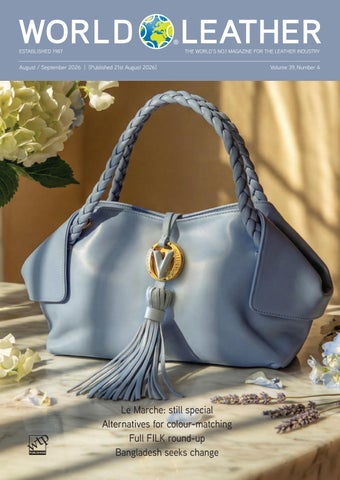
Cover image: A bag from a recent collection from Valentino Orlandi, one of the leather and footwear companies that continue to show why the Italian region of Le Marche is a special place for this industry. CREDIT: VALENTINO ORLANDI
World Leather iPad edition The world’s best leather industry magazine is now available to download on iPad from www.leatherbiz.com @WTPworldleather
Circular Stories: Still special A reliance on now war-torn eastern European markets left leather and footwear companies in Le Marche fearing for their future in 2022. They are still going strong, thanks to creativity, resilience and the close-knit community of suppliers in this special part of Italy.
linkedin.com/showcase/wtpworldleather
Essential reading
@WTPworldleather
@WTPworldleather
IBC Advertisers’ index World Trades Publishing Ltd 2026. Contributions: The editor welcomes news items, articles and photographs for consideration and possible publication but no responsibility can be accepted for the loss or non-publication of such material. Opinions expressed by individual contributors do not necessarily reflect the view of the editor or publisher. • Whilst every effort is made to ensure accuracy in reproduction, no responsibility can be accepted for the technical content or for claims made by manufacturers for product performance that are published. Publication in World Leather cannot be construed as an endorsement for a claim or product by the publisher. • World Leather is published 6 times per year by World Trades Publishing, The Old Stone House, Teeton, Northampton NN6 8LH UK. Price UK £90, ROW: £150 per year (six issues). Graphic origination by WTP. Print by Bishops Printers, Walton Road, Portsmouth, Hampshire PO6 1TR, England. All rights reserved. ISSN 0894-3087
The World Leather team has been publishing a series of original, dynamic podcasts since 2019. The whole series is available on Anchor, Spotify, Apple Podcasts, Google Podcasts, Pocket Casts, Overcast and other podcasting platforms. Just search for the World Leather Podcast on the platform you prefer.
WORLD LEATHER SERVING THE GLOBAL LEATHER INDUSTRY
World Trades Publishing 2026: All rights reserved. No part of this publication may be reproduced, stored in a retrieval system or transmitted in any form or by any means mechanical, electronic, recording, photocopying or otherwise, without the written permission of the publisher. World Leather®, Tannery of the Year® and Nothing to Hide® are registered trademarks of World Trades Publishing Ltd.
1
The World of News FRANCE High-end leathergoods brand Hermès has reported firsthalf revenues of almost €8.2 billion. This is an increase of 1.6% compared to the same period last year. The result means Hermès is consolidating its place as the second-biggest luxury leathergoods group. It is some way behind LVMH, whose leathergoods division achieved revenues of €18.1 billion in the first half of 2026. But Hermès overtook Kering as the sector’s second force in 2025 and figures for the first six months of 2026 confirm this. Kering’s revenues for the same period were €7.2 billion UK Retail group Frasers completed the acquisition of the UK business of Harvey Nichols. The group said it was taking over six stores. It described Harvey Nichols as one of the UK’s most recognised luxury retailers, with a heritage of almost 200 years. Harvey Nichols stocks products from more than 800 premium and luxury brands, including Gucci, Moncler, Burberry, Prada and Dior.
EGYPT A high-level Egyptian delegation from the Leather Technology Training Centre (LTTC) and Cairo for Investment and Development (CID) will travel to Italy in September as part of the Robbiki Leather City programme. The study tour, organised by the Italian Agency for Development Cooperation (AICS), will include visits to the Italian leather products districts of Vigevano and Turbigo, alongside participation in Micam, Lineapelle and Simac Tanning Tech.
2
GERMANY Protests have taken place at the headquarters of automotive group Volkswagen amid reports that the company is planning the closure of four factories in Germany and the shedding of up to 100,000 jobs. Volkswagen’s leadership group met at group headquarters in Wolfsburg in early July to discuss a proposal to close VW factories in Hanover, Emden and Zwickau and an Audi plant at Neckarsulm.
SPAIN Construction of a new leather industry facility is under way in Santa Margarida de Montbui, near Igualada. The site will specialise in the preparation and preservation of hides. Local companies Pieles y Cueros Palomeras y Gambús, Rémy Carriat and Curtidos Badia are behind the initiative, with the backing of a shared strategic customer. The project is expected to create around 20 new jobs.
ETHIOPIA A delegation of Italian leather sector specialists from le Marche region visited the African Leather and Leather Products Institute (ALLPI) in Ethiopia to explore opportunities for collaboration. Under discussion was the provision of leather machinery and equipment from Italy, assistance in sourcing spare parts, and facilitating access to finance for leather SMEs (small and medium-sized enterprises).
EUROPEAN UNION The European Commission has formally adopted measures confirming the exclusion of leather from the scope of the European Union Deforestation Regulation (EUDR). In May, it published a new draft of a ‘delegated act’ amending its EUDR legislation. On July 13, it formally adopted the changes that the draft put forward, including the removal of cattle hides, skins and leather from the scope of EUDR. It said it was doing so following stakeholder consultation and public feedback.
KENYA The country’s ministry of water has commissioned new water infrastructure to serve the Kinanie Leather Industrial Park in Machakos County. The development will provide a dedicated supply of clean water to leather processing facilities within the industrial zone, officials said. The project includes a 1,000-cubic-metre storage tank designed to support industrial operations and local-community water needs.
WORLD LEATHER AUGUST / SEPTEMBER 2026
The World of News US The Footwear Distributors and Retailers of America (FDRA) has said families in the US are facing “continued affordability pressures” as inflation and higher tariffs increase costs. While tariffs on consumer goods average just over 2%, footwear tariffs average more than 12%. Tariffs on some children’s shoes can reach nearly 50%. US footwear companies pay more than $5 billion annually in tariffs, FDRA said. COLOMBIA Companies from Bogotá’s footwear and leathergoods hub were among those taking part in Colombiamoda Medellín at the end of July. The Colombian capital runs a fashion business hub called Sistema Moda, from which 20 companies travelled to Medellín for the event. Of these, nine were manufacturers or sellers of leathergoods and shoes.
BRAZIL Hide and leather exports from Brazil in the first seven months of 2026 brought in revenues of $628.3 million. In terms of quantity, packers, tanners and traders shipped 104 million square-metres of material, weighing 31,500 tonnes. In comparison with the same months in 2025, these figures represent a fall of 5% in value, and of 2.9% in area. In terms of weight, the January-July 2026 figures represent an increase of 5.8%.
PERU Brazil’s leather and footwear industry was represented by 13 companies at the Expo Detalles exhibition, which took place in Lima from August 12 to 14. Industry association Assintecal has said the event represented “great business potential” for member companies that aspire to supply footwear manufacturers in Peru.
PAKISTAN Workers involved in moving goods around Pakistan began a nationwide strike in August. They went back to work in the middle of the month, but said this was a postponement rather than a resolution. Concerned about the impact on the country’s leather sector, the chairman of the Pakistan Tanners’ Association (PTA), Hamid Zahur, has written to the government, pointing out that the strike poses a significant threat to member companies.
BANGLADESH According to data from the Bangladesh Export Promotion Bureau (EPB), the leather sector recorded a 1.6% increase in export earnings in the first month of the new financial year, July 2026. Total export earnings reached $130.9 million. There was a dip for footwear exports, with revenues down by 1.8% to reach $77.6 million. Exports of finished leather increased by 7.8%, reaching $12.9 million. Similarly, exports of leathergoods grew by 7.2%, to $40.43 million. . WORLD LEATHER SERVING THE GLOBAL LEATHER INDUSTRY
CHINA Figures from the China Leather Industry Association (CLIA) show that the industry there registered exports with a value of $40.9 billion in the first half of 2026. This represents a fall of 5.4% compared to the same months in 2025. However, the value of leather-sector imports into China, with a value of $7.9 billion, increased by 4.9% year on year. VIETNAM The 26th International Shoes and Leather Exhibition attracted more than 10,000 professional visitors from 88 countries and regions when it took place in Ho Chi Minh City in July. Organisers reported that 581 exhibitors from 21 countries and regions participated. The event covered the full footwear and leather supply chain. NEW ZEALAND Livestock farmers in New Zealand have expressed concern about the impact on land and on rural communities of the rapid spread of energy farms there. Industry body Federated Farmers has said it supports New Zealand’s shift to renewable energy, but in the form of smaller solar and wind farms on land of little value. AUSTRALIA Leathergoods brand Hermès has opened a second store in Sydney. Its new store is in the Chatswood Chase shopping centre in the North Shore part of the city. Hermès has described the interior of the new store as having light colours and “playful structures”, inspired by the local landscape. At the centre of the space, leathergoods are presented against a neutral scene, accentuating, the company says, “the sense of flowing water”. 3
ACLE26_Image_210x298mm.pdf
1
11/12/2025
1:37 AM
C
M
Y
CM
MY
CY
CMY
K
1-3.9.2026
Industry & Innovation The company will also feature leather accessories produced with ultra-low bisphenol content, alongside a collection of leather articles incorporating autumn-winter 2027-2028 colour trends. TFL said its presence at ACLE 2026 will focus on solutions aimed at combining leather performance, sustainability and compliance with evolving regulatory and brand requirements.
Start-up aims to make on-site water treatment more accessible
LHCA explores better connections to Mexico he Leather and Hide Council of America (LHCA) recently led a first formal trade mission to Mexico. Working with Mexican tanning sector body CICUR, it set up meetings in Monterrey between seven US packer and processor executives with 11 buyers from Mexican leather manufacturing companies. LHCA said Mexico currently accounts for between 10% and 15% of annual US hide exports but added that trading partners on both sides of the border see this as “well below potential”, given their geographic proximity and shared supply-chain infrastructure. On the subject of supply-chain infrastructure, the delegation also held discussions with Canadian Pacific Kansas City (CPKC) rail executives to explore possibilities for increasing the use of rail freight in the trade flows between the hide and leather sector in Mexico and the US. CPKC’s network includes single-line rail connections running from Canada, through the US and into Mexico.
T
New sustainability report marks a step forward for GSC Leather chemicals group GSC has published its sustainability report for 2025. The group’s head of research and development, Dr Francesco Serafini, said the new report marks a step forward compared to the sustainability reports GSC has published annually since 2019. He explained that there was more to the report this time than “simply describing what we are doing”. The 2025 version measures the group’s activity against international standards. For this new report, which has the title ‘Mission To The Future’, the group has followed the Voluntary Standards for SMEs (VSMEs), developed by advisory body the European Financial Reporting Advisory Group in 2023. GSC chose to do this before it was obliged to do so, Dr Serafini explained. He said: “We do not believe environmental responsibility ought to wait for regulatory deadlines.” Chief executive, Adriano Serafini, said 2025 had been “a complex year”, but he insisted GSC had achieved encouraging results, including financial stability,
important innovations and an ongoing commitment to its people. The opening in 2025 of the group’s new leather innovation hub at Zermeghedo, near Vicenza, was a major milestone, GSC said. Adriano Serafini pointed out the new report had also flagged up areas for improvement, including in water and energy consumption. “We welcome these areas for improvement as an opportunity,” the chief executive said. “We are already working on them in keeping with our values and our mission.”
TFL to promote bio-based tanning at ACLE eather chemicals specialist TFL has confirmed it will exhibit at the All China Leather Exhibition (ACLE) 2026 in Shanghai from September 1-3, where it will present a range of leather manufacturing technologies and developments. Among the highlights will be VEGTAN, the company’s new ‘responsible tanning’ brand. TFL said the process is based on a tanning technology containing more than 70% bio-based content and makes use of by-products from other industries.
L
WORLD LEATHER SERVING THE GLOBAL LEATHER INDUSTRY
Australian entrepreneur Rick Parish has launched a new company, Mazavida, that will aim to deliver “rapidly deployable” clean-water infrastructure, water-treatment and desalination systems. Mr Parish is the founder of Kinetic7 Technologies, an Abu Dhabi-based cleanenergy technology company that has developed cooking and heating systems based on producing hydrogen gas on demand, using water, solar power and battery technology. He has said the launch of Mazavida comes at a time when governments, investors and industry across the world are confronting a worsening water-security crisis. The new company is launching as a joint venture between Kinetic7 and Dallasbased energy company PIF. On announcing the new company, Mr Paris quoted the United Nations University Institute for Water, Environment and Health. This academic institution, often referred to as the UN’s think tank on water, has said the world has moved beyond a temporary water crisis and into an era of global “water bankruptcy”, with many river basins, aquifers, wetlands, soils, lakes and glaciers no longer able to return to historic baselines. UN researchers say around 4 billion people already experience severe water scarcity for at least one month each year. They add that drought impacts cost more than $300 billion annually, and that 2.1 billion people still lack safely managed drinking water. “Water security is becoming a defining economic, humanitarian and geopolitical risk,” Mr Parish said. “Mazavida has been created to move beyond discussion and deliver engineered systems that can produce potable water quickly, reliably and at scale where conventional infrastructure is too slow, too costly or too vulnerable.” Its idea is based on containerised systems for treating water on site, including in industrial facilities. Mazavida will also pursue agricultural partnerships designed to provide dependable irrigation water, protect food production and strengthen long-term food and water security. 5
Industry & Innovation Gemata outlines new growth strategy talian tanning machinery manufacturer Gemata has announced a new leadership structure as part of a strategy focused on innovation, service development and business expansion. The company said it is entering a new phase of its development, with Giulio Mandruzzato appointed chief executive officer, Mauro Pellizzari vice-president and Alberto Rigoni chief financial officer. Paolo and Giorgio Todesco will continue in leadership roles at Todesco, which joined the Gemata group in 2025. Gemata said it plans to strengthen its position in leather finishing through continued investment in technologies and processes designed to improve efficiency, productivity and flexibility. The company also outlined ambitions to expand into new markets, reinforce its service offering, pursue targeted acquisitions and invest in talent development. The company added that digital technologies and artificial intelligence will play an increasingly important role in its future strategy, helping to create more connected, efficient and responsive machines, processes and services.
I
Biocidal Products Regulation (BPR). TCMTB (2-(thiocyanomethylthio) benzothiazole), widely used as a fungicide in leather processing and preservation, is being assessed as a potential candidate for substitution under article 10 of the BPR. Norway is acting as the evaluating competent authority for the assessment. As part of the process, regulators are seeking information on the availability and suitability of alternative substances or technologies. The assessment will consider factors including technical feasibility, efficacy, availability and any significant practical or economic disadvantages associated with alternatives. ECHA’s consultation opened on August 7 and will remain open until October 5. Companies and organisations can submit information and practical experience regarding the performance and feasibility of potential alternatives directly to ECHA. The consultation forms part of the wider review of TCMTB under the BPR and will contribute to determining whether alternative solutions can provide equivalent performance under industrial conditions.
IULTCS Congress set for October 2027 he International Union of Leather Technologists and Chemists Societies (IULTCS) has announced that its 39th congress will take place in León, Mexico, from October 25 to 28, 2027. The event will be held at the Hotsson Hotel León and is expected to bring together leather scientists, technologists, researchers, manufacturers, brands, chemical suppliers, machinery specialists and sustainability professionals from around the world. Organisers described the congress as the leading scientific gathering for the global leather sector, providing a platform for the presentation of new research, technological developments and industry collaboration. Topics expected to feature prominently include leather science and technology, sustainability, circularity, renewable chemistry, traceability and responsible manufacturing. The congress will also provide opportunities for networking and knowledge exchange across the leather value chain, with participation from universities, tanners, suppliers and brand representatives. León, one of the world's most important leather manufacturing centres, will host the event, offering delegates an opportunity to engage with a region that combines a longestablished leather heritage with a strong industrial base. Organisers said the congress will focus on the role of science and collaboration in addressing the challenges facing the sector and shaping the future of leather manufacturing.
Researchers in China urged to play T a bigger role in global industry he leather industry in China celebrated two technical events in parallel in July. Jinan, the capital of Shandong province, was the host city for the 16th National Leather Science and Technology Conference and the 27th annual meeting of the China Leather Industry Association’s science and technology commission. More than 300 delegates attended to hear presentations and take part in discussions on digitalisation (including AI), innovation and low-carbon strategies. There were six keynote presentations, 32 other oral presentations and 92 poster presentations. At the Jinan events, vice-chairman of the China Leather Industry Association, Chen Zhanguang, encouraged young researchers and technical professionals in China to become more actively involved in the global leather industry. He said one way for them to do this was to apply to become part of the Young Leather Scientist Grants (YLSG) programme that the International Union of Leather Technologists and Chemists.
T
ECHA opens consultation on TCMTB alternatives he European Chemicals Agency (ECHA) has opened a public consultation as part of its assessment of the active substance TCMTB under the EU
T 6 XX
Definitive Dongen closure puts Hot-Shop events in doubt he future of the Hot-Shop design events, which footwear and leather group Ecco has run annually in the Netherlands for almost 20 years, is uncertain. Ecco has said these events brought together designers, artists, material specialists, marketers and leather technicians from the worlds of fashion, industrial design, furniture and other industries for an intensive workshop about leather. It used to hold the events at its tannery in Dongen, but the building was destroyed by fire in May 2025. Ecco has now confirmed that it will not reopen the Dongen site and will, consequently, no longer make any of its leather in Europe. It told World Leather: “We continue to produce high-quality leather at our three Ecco Leather production facilities in Indonesia, Thailand and China, serving customers worldwide.” When we asked what this development will mean for the Hot-Shop events and if these will still take place, the company said: “We do not have any further information to share.”
T
PrimeAsia invests in grazing management initiative eather manufacturing group PrimeAsia has joined other industry partners in backing Legacy Landscapes, a US programme focused on improving grazing management, livestock productivity and environmental performance on cow-calf operations. The initiative, delivered by the National Grazing Lands Coalition in partnership with AgriWebb and Regrow Ag, supports ranchers in adopting practices designed to enhance land stewardship and operational efficiency. During a recent investor visit to Kansas, PrimeAsia observed participating ranchers using programme funding to implement rotational grazing through virtual fencing technology, improve breeding practices and support grassland regeneration. PrimeAsia said it invested in the programme earlier this year as part of its strategy to reduce greenhouse gas emissions at farm level. The company noted that improved grazing management can help strengthen grassland health, increase system resilience and contribute to lower emissions across agricultural supply chains. The initiative supports PrimeAsia’s Science Based Targets initiative (SBTi) commitments, including its Scope 3 and Forest, Land and Agriculture (FLAG) emissions reduction targets.
L
WORLD LEATHER AUGUST / SEPTEMBER 2026
NTE_WorldLeatherAds.pdf
3
2025/06/24
09:42
A symphony of
NATURAL LEATHER SOLUTIONS Since 1920, NTE Mimosa has used wattle mimosa to create a comprehensive range of sustainable, environmentally-friendly tanning products for the world’s finest leather. C
M
Y
CM
MY
CY
CMY
K
Leather scene JBS names new global CEO
Songmont reunites Thai trio
razil-headquartered food group and tannery owner JBS has announced that Wesley Batista Filho will become global chief executive officer of the company from January 2027 as part of a planned leadership transition. Mr Batista Filho will succeed Gilberto Tomazoni, who will step down after 14 years with the company, including eight years as global CEO. Mr Tomazoni will oversee the transition before becoming vice chairman of the board and senior advisor. He will also remain chairman of Pilgrim’s Pride Corporation and become chairman of the J&F Institute. Mr Batista Filho joined JBS in 2011 and has held a number of leadership positions across the group’s operations, including CEO of JBS Brazil, CEO of Seara and, since 2023, CEO of JBS USA.
eathergoods brand Songmont worked with three prominent female figures in Thailand to launch a campaign in time for Mother’s Day, which Thailand celebrates on August 12. Actors Usha Seamkhum, Tontawan Tantivejakul and Himawari Tajiri appeared together in an award-winning 2024 film, ‘How to Make Millions Before Grandma Dies’, representing different generations of a Thai family. Songmont brought them together again for its Mother’s Day campaign, saying it wanted to celebrate the connections between different generations of women, “in the care they give, the wisdom they share, and the memories they create together”. Bags that feature in the campaign include the Song, reflecting “enduring spirit”, the Luna, for “timeless elegance” and the Mini Luna, to reflect “the possibilities yet to come”. “Each bag holds its own character,” the China-based leathergoods brand said. “Over time, the leather develops a richer patina, like the care and devotion written on hands and faces.”
B
Pioneering leather science leader dies ne of the leading figures in international leather science and a key figure in the development of FILK, Professor Dr Günter Reich, has died at the age of 98. Born in Saxony in 1928, Günter Reich began his career in the leather industry in the years after World War II, training as a tanner before studying chemistry at the Technical University of Dresden. He joined the German Leather Institute in Freiberg in 1956 as head of research and deputy director, becoming its head in 1967. During his leadership, research at the institute expanded across tanning chemistry, leather technology, collagen, synthetic tanning agents and polyurethanebased synthetic materials. His scientific work combined fundamental research with industrial application, including research into the relationship between chemical structure and the tanning properties of aromatic synthetic tanning agents. Dr Reich also played a significant role in securing the future of FILK following German reunification in 1990. As the institute faced the loss of clients and its former state-owned structure, he helped develop the scientific, economic and organisational framework that led to its establishment as an independent, nonprofit research institution. The supporting association that was founded in 1992 remains FILK’s sole shareholder. Dr Reich retired from the institute’s leadership at the end of 1992 but remained active in leather science as an author, speaker, consultant and mentor. His scientific output included around 200 publications and papers, eight monographs and 52 patents. He also initiated the Freiberg Collagen Symposium in 1996.
O
8 XX
L
Chief executive announcement at Bottega Veneta uxury group Kering has announced the appointment of Romain Sptitzer as the new chief executive of leathergoods brand Bottega Veneta. Mr Spitzer will take up the role on September 1, joining from rival group LVMH, where he is currently chief executive of its fragrance and beauty division. In his new role he will be based in Milan. He will also become part of Kering’s executive committee. Kering chief executive, Luca de Meo, commented: “Bottega Veneta is one of the strongest and most distinctive houses in luxury, with exceptional craftsmanship, a unique creative identity and remarkable growth potential. Romain has the leadership, vision and international experience to unlock the next phase of the house’s development.”
L
Leather Conversation Centre hosts training course eather education specialist Christine Anscombe has delivered a two-day course with the UK’s Leather Conservation Centre in Leicester, teaching people from different parts of the country about leather and how to work with it. The Leather Conservation Centre opened in 1978 to provide a service of preserving and repairing leather for museums, collectors and others. It was based in Northampton until 2025, when it moved to a new workshop in Leicester. Dr Anscombe said at the end of the course that participants had been enthusiastic and engaged. She also said she was pleased that the participants also gained a great deal from meeting each other and exchanging knowledge and experience.
L
Memorial book honours Tom Schneider’s legacy amily, friends and colleagues of Tom Schneider have come together to commemorate his life and achievements through a dedicated memorial book featuring contributions from 160 people. The publication has been released in memory of Mr Schneider, founder and chairman of ISA Tan Tec and reflects on his legacy. Contributors have shared personal memories and tributes, highlighting the impact he had on those around him both professionally and personally. Alongside the memorial book, Mr Schneider's family has also released a special video and song composed by his daughter, Nina Arden, as a tribute to her father. In a message accompanying the release, Ms Arden reflected on her father’s ability to bring people together and recognise the strengths of others. She described how his passing on January 18, aged 70, was felt deeply by family, friends and colleagues around the world.
F
End of an era at UNIDO eather industry stalwart Ivan Kral has announced his retirement, effective July 31, 2026, bringing to a close a 40-year career dedicated to leather technology, sustainability and international development. Mr Kral spent the first two decades of his career working directly in the tanning sector, including roles at Koziarske Zavody and Tatra-Leder Liptovsky Mikulas. During this period, he focused on research and
L
WORLD LEATHER AUGUST / SEPTEMBER 2026
Leather scene development, process optimisation and the creation of new leather articles and production technologies. In 2006, he joined the United Nations Industrial Development Organization (UNIDO), where he helped support the development of more sustainable and efficient leather value chains around the world. His work included industry capacity-building programmes, the development of educational resources for leather technology and initiatives aimed at improving occupational health and safety across the sector. Reflecting on his career, Mr Kral described it as being divided into two equally rewarding chapters: the first in leather production and technology, and the second in international development. He thanked colleagues, industry partners and organisations that had supported his work over the years, saying any achievements were the result of collaboration with dedicated teams and experts across the global leather community. Among the organisations he worked with were the International Union of Leather Technologists and Chemists Societies (IULTCS), the Leather Working Group (LWG), the Sustainable Leather Foundation, COTANCE and the Central Leather Research Institute (CLRI). Although retiring from day-to-day responsibilities, Mr Kral said he intends to remain involved with selected projects as an adviser and mentor, while also spending more time with family and pursuing personal interests.
New sales director at Mindhive Global I-powered leather quality assessment specialist Mindhive Global has appointed Sergio Lopes as sales director for Oceania, Asia and the Americas. Mr Lopes has more than 15 years of experience in the leather industry, having worked in product development, sourcing and market development across South America and Europe. He later moved into agriculture, specialising in precision livestock management and farm operations in Brazil, Uruguay and New Zealand. In his new role, Mr Lopes will lead Mindhive’s commercial activities across key international markets, supporting tanneries and leather manufacturers in the adoption of the company’s AIpowered leather grading technology. Working alongside chief executive officer James Bayly and the wider team, he will help expand Mindhive’s presence in major leather-producing regions and strengthen customer and industry partnerships.
A
New workshop and new workers for growing leathergoods producer inished product manufacturer Grupo Atelier has successfully completed a first edition of an in-house training course focused on developing a new generation of leather artisans. Specifically, the course, which launched in May as a trial, focused on leather garments production. The result is a group of new artisans to add to the existing workforce of around 100 people. The company said it was preparing to launch another course in September for a larger, second cohort. This will take place at a new workshop Grupo Atelier is preparing to open in Palau-solità i Plegamans, to the north of Barcelona. “At Grupo Atelier, we believe that investing in people is the best way to preserve craftsmanship, pass on specialist knowledge and continue shaping the future of leather manufacturing,” the company said. Founder, Gerardo Sánchez Bandrés, has said he wants the new workshop to become a point of reference for the development of leathergoods craftspeople. He commented: “Great products do not come about by chance. They are the result of knowledge, dedication and the skilled hands that make them.” Grupo Atelier lists Loewe and LVMH among its customers.
F
WORLD LEATHER SERVING THE GLOBAL LEATHER INDUSTRY
9
Backtrack World Leather’s publishing cycle and limitations on space make it impossible for us to run more than a carefully selected sample of news from across the industry. However, we publish hundreds more stories on leatherbiz.com. The site is updated every day with news from every continent and every part of the industry, making leatherbiz.com one of the most comprehensive archives of news anywhere on the web for the global leather industry.
We list below just a few of the headlines that have appeared on the site in recent weeks and can still be accessed. 20 August 2026
05 August 2026
23 July 2026
Positive messaging around protein is boosting beef market
Growth for Jimmy Choo helps Capri
Positive figures for France’s leather exports
Taiwan renovation project complete for Hermès
Tanzania hides and skins sector sees Q1 slowdown
Lear reports growth in automotive seating business
22 July 2026
Groupe Lécuyer acquires Moreau Paris
US cattle slaughter down by 8.4%
Cargill resumes beef production in Colorado
04 August 2026
Global study supports sustainable exotic skin trade
17 August 2026
03 August 2026
Tyson Foods to close three beef facilities
Cattle prices weigh on Tyson’s results
21 July 2026
Right foot forward for Steve Madden
Raw material exports from France down by 15%
31 July 2026
Pakistan and China discuss leather and footwear cooperation
19 August 2026 Artisan network includes leather manufacturers, JM Weston says Natuzzi continues cost-cutting measures
14 August 2026 Only 150 of Aston Martin’s new model will be made B2C drives growth for Birkenstock
13 August 2026 A year of strong growth for Tapestry Responsible deer management needed, says Billy Tannery
12 August 2026
Bison boost as EU market opens up
Growth goes on for leather garments in China
20 July 2026
Leather footwear holds its value in China figures
Preparations complete for new abattoir in Kenya
Birkenstock continues opening spree with US focus
JBS reworks its climate goals to focus on its own operations
29 July 2026
New EU measures on packaging apply from August 12
Retail group Frasers invests in Burberry
11 August 2026 Lineapelle confirms 1,000 exhibitors are ready for September Brazilian footwear companies make ESG progress
A leather jacket for the AI age
30 July 2026
Tandy Leather turns a corner
Special California event will become a fixture for Bentley
Mulberry returns to growth as losses narrow
China imports more raw hides and skins, but pays less
Bata India expands retail footprint Design icons from the 1960s team up again
17 July 2026
Uruguay leather exports decline in H1 2026
Q1 results show strategy is working, Burberry says
Kering returns to growth as leather brands improve
Reclaimed Maserati leather given new life
28 July 2026 Naples to host preview event for Lineapelle and Simac-Tanning Tech
Pasubio moves to refinance debt
16 July 2026 Tivoli’s one-stop shop appeals to US brands
Italy appeals to start-up leathergoods brand
Bentley celebrates 80 years of Crewe craftsmanship
JBS and Indonesia’s wealth fund team up for protein investments
First-half figures down by 3% but LVMH encouraged
07 August 2026
27 July 2026
Home comfort for Assocalzaturifici
China still the sticking point for US beef exports in H1
SADC leather agenda moves forward
Louis Vuitton extends FIFA World Cup collaboration
10 August 2026
Vietnamese tannery completes 2MWp rooftop solar project
North American demand boosts Ferragamo
10 XX
Research will help farmers produce lowermethane beef
14 July 2026
06 August 2026 Shift to electric cars makes its mark in Germany
15 July 2026
24 July 2026 Italian leather sector strengthens schoolindustry links
Brazil releases first-half export results for hides and leather ‘Mixed picture’ for BMW brands
WORLD LEATHER AUGUST / SEPTEMBER 2026
OR INF
M
T ING
HE
TH LEA
ER
US IND
TR
OR Y F
2
EA 5 Y
RS
®
AT THE CUTTING EDGE OF LEATHER INDUSTRY COMMUNICATION SINCE 2001
Contact Matthew Abbott matthew@worldtrades.co.uk for more information
Come by. Plan a bit more time than you think. Hall 11, Booth V23-27 | Z24-28
Alessio Fracca
Branch Manager Montebello Vicentino Silvateam s.p.a. afracca@silvateam.com Phone: +39 34 58 89 77 64
Bring a formulation. Taste an oil. Walk out with new insoles. Metal-free was the first question from automotive. Bisphenols are the second. Bring us a formulation. You cannot swap one product into an existing recipe and hope the leather holds up. So we built a plant for Blancotan® B-FREE, a DDS-based syntan where bisphenols are no longer detectable – below 5 ppm, where the instrument stops measuring. A whole plant for one syntan – call it commitment or stubbornness. Taste the tree. Maria Rita Olivas, sommelier and certified olive oil expert, is running guided olive oil tastings on Tuesday and Wednesday afternoon. Leaves into our tanning agent, fruit into the bottle. Meet Paolo Scafora. The Neapolitan master shoemaker is working at our stand – his family has been making shoes near Naples by hand since 1956. And there are vegetable-tanned insoles in your size for anyone who wants a pair. Just come and ask. Whatever you‘re working on, bring it to Hall 11 – from chestnut extract to our latest syntans, we‘ll have it with us. Full stand programme: www.silvateam-leather.com/lineapelle
proudly natural
Leather Leaders: Nasim Manzur
Nasim Manzur is president of the Footwear Leathergoods and Accessories Exporters’ Association (FLAXA) in Bangladesh. He is also managing director of leather and footwear manufacturing group Apex. He was part of a recent project called Leathertrace that he hopes will help the leather sector in Bangladesh grow its export revenues and its standing in the world.
Empowerment in action What was the aim of the recently concluded Leathertrace Bangladesh project? Why was it an important development for the leather and footwear industry in your country? The Leathertrace project established traceability for almost 200,000 cattle hides and 3 million square-feet of finished leather. We traced the material from slaughterhouses to finished footwear and leathergoods, some of which went to important export markets. Leathertrace is proof that change can happen. Transformation is hard work, but it starts with proof. Proof means data; that is the currency of change. It is a project that began, not in Geneva or London, but in Bangladesh. All of this is empowerment in action. What is the significance of the project being something that the industry in Bangladesh initiated? Transformation must be locally driven. It can be co-created, but it cannot be imported and it cannot be outsourced. With projects such as Leathertrace, Bangladesh has chosen to prepare for a market that will require compliance with various regulations. I recently received a long email from a huge retail chain in the US asking me what we were doing about the European Union’s digital product passport [for which each product must have a digital record with information about its composition, origin, environmental footprint, durability, repairability and so on]. This means the requirement to make these changes, to bridge the gaps we have, is real. Will your US retail chain customers help you bridge those gaps? I think you know the answer to that. The expectation is that we will have to do all of this ourselves while still facing pressure from customers to make sure costs in Bangladesh are lower than they are in China. Europeans are different. They are more likely to stay with you and co-invest.
The president of Bangladesh’s Footwear Leathergoods and Accessories Exporters’ Association, Nasim Manzur, sees windows of opportunity for the industry there. CREDIT: WTP
WORLD LEATHER SERVING THE GLOBAL LEATHER INDUSTRY
13
Empowerment in action
The Leathertrace project ran from 2024 to 2026. Please describe the situation on the ground in Bangladesh at that time. The timing was complicated. Bangladesh was going through something of a revolution while the Leathertrace project was taking place. At times, in 2024 and 2025, we had no government and no police. But the discussion about Bangladesh has concentrated for too long on our deficiencies. A lot of that has been justified but there are good things we can, and must, talk about too. We need to talk about what is changing. For example, we have amazing entrepreneurs here. That is why, even after a terrible tragedy like the one at Rana Plaza in 2013, [in which more than 1,000 garment workers died], the garment industry is now stronger than it was before.
A delegation from the Leathertrace project visiting the common effluent treatment plant at the Savar tanning cluster. CREDIT: LEATHERTRACE PROJECT
What are the possible consequences of these changes for the leather and footwear sector in Bangladesh? I feel that the industry in Bangladesh is always on the cusp of something great but, somehow, is never quite there. Our ready-made garments industry has export revenues of around $45 billion per year. We, in leathergoods and footwear, are the second-biggest contributors, but we are at a level of around $1.5 billion per year. We want this to grow. Bangladesh desperately needs to diversify and lower its dependence on the garment industry. We hope that a blueprint that the Leathertrace project has produced can help to make this growth happen for the leather industry. Bangladesh is officially one of the Least Developed Countries (LDC) at the moment, but we are going to graduate from that group in the next two or three years. If we don’t diversify, we could be in trouble. What needs to happen to make change a reality? If you had carte blanche, what would you do to drive the change required? There is an internal problem. What we need in Bangladesh is for one government ministry to take ownership of the leather industry. We are like a football, being passed from the ministry of livestock to the ministry of commerce, always being kicked around. We are working closely with the government, asking it to bring the industry under one agency so that there is ownership at the policy level. At an operational level, one of the things we need to do is to fix the central effluent treatment plant at the tanning cluster at Savar. Your magazine has written about this many times. It is a joke. It is a sad thing. It has been going on for 22 years. In that time, Bangladesh has put a satellite into space. So how can it take 22 years to build an effluent treatment plant and get it fully operational? We need to get that done. And the third part is that we as manufacturers don’t go out and sell good news. We have a very nice product, as a country. But we are very poor at marketing. That narrative has to change. The message ‘we are an LDC so please don’t pick on us’ needs
14
to stop. It doesn’t work that way. Let’s talk about what is doable and tell some positive stories too. The onus is on us. Bangladesh has shown that we can scale up production. This is our opportunity, our moment. What are the positive stories that you would point to? We have a natural, God-given advantage when it comes to raw material. The industry has access to around 350 million square-feet of raw material every year, from cattle hides and small skins. This includes skins from the Kushtia black Bengali goat. These skins are of very high quality. They used to go to France to be made into high-end ladies’ pumps. What became of those French connections? Obviously, because of the hollowing out of manufacturing in the western world, shoe factories and tanneries don’t really exist in France any more on a massive scale. Much of the manufacturing has moved offshore and followed development around the world. We are able to use the Kushtia black Bengali goat skins, but the leather is very dressy and the world has gone casual, so that kind of leather is completely out of fashion. This also says something about our own product development. We should take that raw material and create something that is more usable in the current market. But we have been product followers, not product leaders. What gives you hope for the future? The country is amazing in so many ways. I mean, it isn’t Kansas. If you like wide-open spaces, Bangladesh probably isn’t the country for you. But, if it took more than a century for the western world to go from telegraph to telephone to mobile, we have gone from ‘no phone’ to 4G in no time at all. Big change can happen. There is a famous quote from investor Warren Buffett that it takes 20 years to build a good reputation but only five minutes to ruin it. My hope is that, for the leather industry in Bangladesh, it will be the opposite, that if we have had a bad reputation for 20 years, we will now change that perspective in a short space of time. We want the world to judge us by our willingness to change. WORLD LEATHER AUGUST / SEPTEMBER 2026
QUAKER COLOR A STEP AHEAD IN AUTOMOTIVE FINISHING
Supplying innovative finishes to the automotive industry for over six decades
Quaker Color is a division of McAdoo & Allen, with roots in the leather industry for over a century
Technology
Is D65 the best source for colour-matching? A critical review of standard illuminants, metamerism, and emerging LED alternatives for industrial colour assessment Gustavo Adrián Defeo, FSLTC – Instrumenta srl Colour matching has traditionally relied on standard illuminant D65 as the reference light source for visual assessment and quality control. However, the transition from fluorescent and incandescent lamps to LEDs, driven by both technological advances and regulatory change, has created new challenges in reproducing standard viewing conditions and managing metamerism. This article examines these developments and considers whether complementary LED illuminants, including a proposed 4545 K source, could improve the assessment of warm-toned materials such as leather and textiles.
H
uman colour perception begins with three classes of cone photoreceptors in the retina, conventionally labelled L, M, and S for their sensitivity peaks in the long, medium, and short wavelength regions of the visible spectrum (roughly 560 nm, 530 nm, and 420 nm respectively). The relative stimulation of these three receptor types by an incident spectral power distribution (SPD) is integrated by the visual cortex into the sensation of colour. Because only three receptor classes exist, any two physically different spectra that produce the same triplet of cone responses will be perceived as identical—a phenomenon known as metamerism, and the central problem that colourmatching science must contend with. The sensitivity of the human eye is not uniform across the spectrum, nor is it static. The CIE 1931 standard observer functions describe average photopic (daylight-adapted) sensitivity, but individual variation is substantial: differences in lens yellowing with age, macular pigment density, and genetic polymorphisms in cone photopigments all shift an individual's effective colour-matching functions. The difference of sensitivity of each cone type is unique to each observer. Sensibilities range from high colour-perception to colour-vision defects, culminating in extreme cases in colour-blindness. Furthermore, the eye adapts chromatically to the prevailing illumination (a process called chromatic adaptation), meaning that the perceived colour of an object depends strongly on the spectral composition of the light source under which it is viewed and on the observer's recent visual history. This combination of trichromacy, metamerism and adaptation has two practical consequences for industrial colour-matching. First, a sample that matches a standard under one light source may appear markedly different under another, a defect known as metameric failure, which is the most common cause of customer complaints in leather dyeing and finishing and textile dyeing, and is particularly
16
critical in automotive and fashion matching. Second, because human colour sensitivity itself varies between individuals and viewing conditions, any colour-matching standard must specify not only the illuminant but also the observer geometry and adaptation state under which comparisons are made. This is the rationale behind standardised viewing booths that use defined simulators of CIE Standard Illuminant D65, representing average daylight at a correlated colour temperature of approximately 6500 K, and a series of commercially available light sources, such as TL84 (or F11), CWF and A, among others, normally used to verify metameric occurrence visually. Considering that each type of light source undergoes decay, which may be translated into variations in intensity or shade, different methods for their Spectro radiometric certification have been proposed. Measuring light: Comparing CRI with TM-30-18 The Colour Rendering Index (CRI), formally CIE 13.3-1995, has been the dominant metric for describing how faithfully a light source renders colours since its introduction in 1965. CRI works by comparing the appearance of eight (for the general index Ra) or fourteen (for the extended index) test colour samples under the source in question with their appearance under a reference illuminant of the same correlated colour temperature, a Planckian radiator below 5000 K or a daylight phase above it. The differences are converted into a single averaged score, with 100 representing a perfect match to the reference. CRI has well-documented shortcomings. The eight test samples used for Ra are desaturated and span a limited gamut, so a source can achieve a high Ra while rendering saturated reds, blues or skin tones poorly, a particular concern for early phosphor-converted white LEDs, which often scored well on Ra despite producing visibly unnatural reds. CRI also penalises sources that increase chroma WORLD LEATHER AUGUST / SEPTEMBER 2026
Is D65 the best source for colour-matching?
Fig 1: Human chromatic sensitivity unevenness throughout the visual spectrum.
Fig 2:CRI (Colour Rendering Index) vs TM30-18 Fideity Index
WORLD LEATHER SERVING THE GLOBAL LEATHER INDUSTRY
17
Is D65 the best source for colour-matching?
Fig 3: Department store in the 70s, a new boutique, LEDs extreme colours in homes, car interiors and street lightning.
relative to the reference, even when such increases are perceptually preferred, and it provides no information about the direction or character of colour shifts, only their magnitude. TM-30-18, published by the Illuminating Engineering Society in 2018, was developed to address these gaps. It evaluates a source against 99 colour evaluation samples (CES) selected to represent real-world object colours across the full gamut, including saturated and unsaturated, light and dark, and a range of hues with particular attention to skin tones and foliage. From this evaluation, TM-30-18 produces two headline metrics: Fidelity Index (Rf), which is conceptually similar to CRI's Ra but calculated over a much larger and more representative sample set using a more accurate chromatic adaptation model; and Gamut Index (Rg), which describes whether the source increases or decreases the average saturation of objects relative to the reference, with 100 indicating no change, values above 100 indicating gamut expansion and values below 100 indicating compression. The specificity of TM-30-18 is particularly valuable for colour-matching applications, where a source might achieve an acceptable overall Rf while still introducing a systematic hue shift in, for example, the red-orange region that is critical for matching leather, wood or skin-tone cosmetics. For colour-matching applications specifically, the practical implication is that two light sources can report identical or near-identical CRI values while behaving very differently when used to assess a metameric pair of samples. TM-30-18's hue-bin data offers a more diagnostic tool for predicting whether a given LED simulator is likely to induce or reveal metameric failure in a particular product category. WORLD LEATHER SERVING THE GLOBAL LEATHER INDUSTRY
The main parameters to consider when evaluating a light source in a light booth are: correlated colour temperature (for D65 6504 K), light intensity (1500 lx as per ISO 7906), and Fidelity Index >95 throughout the range of values. The phase-out of fluorescent and incandescent light sources in Europe The European Union's Ecodesign framework, implemented through a series of Commission Regulations under Directive 2009/125/EC, has progressively restricted the placing on the market of inefficient light sources containing mercury or rare earths. Regulation (EU) 2019/2020, which came into force in September 2021, set minimum energy efficiency requirements that effectively excluded most conventional incandescent and halogen lamps, while subsequent staged requirements and the broader transition driven by the regulation have also phased out the manufacture and import of most fluorescent tube formats, including the T8 and T5 tubes historically used in colour-assessment viewing cabinets and light booths. This regulatory shift has direct consequences for colourmatching lighting. For decades, viewing booths simulating D65 and other standard illuminants relied on incandescent, filtered or fluorescent tubes. Apart from the quality of D65 simulators, the usual metameric lights are no longer available on the market, not only as bulbs or tubes but also in terms of spectral distribution. While TL84 was widely used in department stores, modern retail environments use only LEDs. This means that metameric conditions should be reviewed in a contemporary context. Most industrial sectors are still using fluorescent and incandescent light sources and 19
Is D65 the best source for colour-matching?
their spectral distributions, while the whole market, including automotive, relies on LED for interior lighting.
Fig 4: Metameric pairs under D65 and TL84 light sources respectively.
Comparing TL84 with LED Metamerism TL84 (also referred to as F11) is a narrow-band fluorescent illuminant with a correlated colour temperature near 4000 K, widely adopted by European retailers as a point-of-sale viewing standard, particularly within the leather, textile, fashion and automotive supply chains. Its spectral power distribution is characterised by three dominant narrow emission bands in the blue, green and red regions, with comparatively little energy in between. This spiky distribution means that TL84 is highly sensitive to small differences in the spectral reflectance of dyes and pigments: two samples that appear identical under broadband daylight can diverge sharply under TL84 if their reflectance curves differ in the gaps between the emission peaks. This sensitivity is, in fact, the reason TL84 has historically been valued in textile quality control, as it acts as a stringent test for metameric matches achieved using different dye recipes. The new epoch in lighting is raising several questions for fashion and automotive operators: current standards and privately defined metameric references are mostly based on light sources that are being phased out or restricted under recent EU regulations. This shift implies not only the adoption of reliable LED-based D65 simulators but also the definition of new LED metameric sources for future quality assurance in colour-matching. The technical solution that has been developed for this new environmental condition is the creation of a highfidelity PCB simulating a D65 light source, and a tuneable set of LEDs allowing the replication of most environmental lighting conditions, enabling the definition of preset metameric conditions. Creating the new Instrumenta light booth In response to supply constraints on fluorescent tubes and incandescent filtered light sources, combined with the spectral limitations of first-generation white LEDs, the Instrumenta D65 printed circuit board (PCB) was developed as a multi-channel LED array specifically engineered to reproduce the D65 spectral power distribution with a high fidelity of >99% across the full visible range, including the violet region, historically underserved by phosphor-converted LEDs. The second challenge was designing an integrated solution allowing adjustment of light intensity, colour temperature and the spectral distribution of commercial lighting, enabling the transfer of measured Spectro radiometric conditions into the booth. Last, in a critical study of commercial lighting booths, it was observed that in many cases light reflection disturbed matching and colour quality control operations. This issue was resolved by selecting a specific high-stability prismatic diffuser, creating nearshadow-free conditions under the observation area. The development of this part of the project was carried out in cooperation with Funkestudio Madrid. Validation of the resulting spectrum is conducted against the CIE definition of D65 using both the standard CIE general colour rendering index and TM-30-18, alongside the CIE metamerism index for the simulating illuminant, which quantifies agreement using a panel of metameric sample pairs rather than chromaticity alone. Early production units of the Instrumenta D65 PCB achieved a close match to the target chromaticity 20
coordinates and a high Rf. The same results were achieved with a D50 (5000 K) simulator. A series of presets allows the reproduction of specific measured lighting conditions, as was done with early adopter brands, reproducing their proprietary store lighting conditions. These specific store conditions are also important in spectrophotometric quality assessment, so Konica Minolta included in their SpectraMagic NX software the possibility to include tailor-made light sources measured with a spectroradiometer, allowing for the first time WORLD LEATHER AUGUST / SEPTEMBER 2026
PASSION FOR LEATHER Powerful chemistry – tailor-made Follow us on LinkedIn: /showcase/leather-auxiliaries
Is D65 the best source for colour-matching?
Fig 5: Instrumenta PCBs D65 simulator, its spectrum and tuning specific lightning conditions through software.
metamerism predictions with custom light sources. Allowing the possibility to reproduce custom light sources in the light box, we are able to adjust colour-matching in conditions far from standard defined light sources. Introducing a 4545 K LED to improve warm-shade sensibility Despite the refinements described above, feedback from colour-matching operations in the textiles and leather sectors has consistently identified a residual weakness in all D65 simulators, as well as in natural sunlight with a skylight component, especially in summer when measurements of up to 19,000 K CCT have been recorded. The high colour temperature and bluish-white appearance provide relatively low illuminance contrast between closely related warm shades such as tans, browns, ochres and warm greys, since these colours all reflect a relatively flat proportion of the source’s energy across the visible range, with the discriminating differences concentrated in the red-to-yellow region where a 6500 K source places comparatively little of its total radiant power. A lower correlated colour temperature source shifts a larger proportion of energy into the orange-red region, increasing the absolute radiant flux available to interact with the reflectance differences that distinguish warm shades 22
from one another. A target of approximately 4545 K with a broadband spectrum has been proposed as a complementary reference for warm-shade assessment, intended to enhance their shading while retaining a D65 source for routine colour approval. Preliminary comparative evaluation of a 4545 K LED source against D65 for a representative set of warm-toned textile and leather samples indicated that observers were able to distinguish smaller differences in hue and chroma among warm browns and tans under the former, consistent with the increased red-region radiant power. However, this gain was not without trade-off: the same 4545 K source showed reduced discrimination among cool greys and blues relative to D65, and its TM-30-18 gamut index showed a modest compression in the blueviolet hue bins. This is the expected consequence of redistributing spectral energy towards longer wavelengths, gains in one region of the gamut are offset by losses in another, and no single correlated colour temperature can be optimal across the entire visible spectrum for all sample types. These findings suggest that the choice between D65 and a 4545 K alternative should be understood as a complementary pairing rather than a substitution, specifically in the leather sector where the required shades WORLD LEATHER AUGUST / SEPTEMBER 2026
Is D65 the best source for colour-matching?
Fig 6: Light/colour supply chain interlinked.
are dominated by warm, earthy or skin-tone colours. This trend is also common in wood, cosmetics and certain natural fibre dyes, where a 4545 K source may offer superior practical discrimination at the cost of reduced sensitivity in the blue-violet region. A dual-illuminant viewing protocol, in which samples are assessed under both D65 and a 4545 K LED source, would combine the strengths of each while mitigating the documented weaknesses of either source used alone. Conclusion D65 has earned its position as the dominant reference illuminant for colour-matching through decades of international standardisation, broad industry familiarity and a reasonable approximation of average daylight. The evidence reviewed here does not suggest that D65 should be abandoned. However, three converging pressures, the regulatory phase-out of fluorescent sources that previously realised D65 in viewing booths, the documented metameric divergence between LED simulators and their fluorescent predecessors (most visible in TL84 replacements but present, to a lesser degree, in D65 replacements as well), and the practical observation that a 6500 K source is not optimally discriminating for warm-toned products, together indicate that D65 alone is an incomplete answer to the question of how colour-matching should be conducted going forward. The development of a versatile tuneable multi-channel LED light booth such as Instrumenta HL II represents a necessary technical response to the first two pressures, restoring spectral regions that earlier LED generations have under-represented. The possibility of managing D65 and D50 emulators, as well as reproducing most commercial LED light sources by tuning their fundamental parameters (intensity, spectral distribution and correlated colour temperature), allows the definition of a controlled colour supply chain, predicting the colour appearance that materials may have in specific environments. The proposed tuning to a 4545 K broadband LED addresses the third pressure directly, reducing some blue-violet discrimination WORLD LEATHER SERVING THE GLOBAL LEATHER INDUSTRY
in exchange for substantially improved warm-shade sensitivity. Taken together, the most defensible answer to the question posed in this paper’s title is that D65 remains the best single reference for general-purpose and cooltoned colour-matching, but it is not the best source for every colour-matching task, and a dual-illuminant approach combining D65 with a complementary warm-white LED such as a 4545 K source offers a more complete solution for industries in which warm-shade discrimination is commercially important.
References CIE 015:2018. Colorimetry, 4th Edition. International Commission on Illumination, Vienna. CIE 13.3-1995. Method of Measuring and Specifying Colour Rendering Properties of Light Sources. International Commission on Illumination, Vienna. Illuminating Engineering Society (2018). IES TM-30-18: IES Method for Evaluating Light Source Color Rendition. New York: IES. Commission Regulation (EU) 2019/2020 of 1 October 2019 laying down ecodesign requirements for light sources and separate control gears pursuant to Directive 2009/125/EC of the European Parliament and of the Council. Official Journal of the European Union. CIE 51.3. A Method for Assessing the Quality of Daylight Simulators for Colorimetry. International Commission on Illumination, Vienna. ISO 7906 - Leather — Tests for colour fastness — General principles of testing. ISO 105-A01 - Textiles — Tests for colour fastness - Part A01: General principles of testing ISO 22700 - Leather — Measuring the colour and colour difference of finished leather
23
Technology
Fourteenth Freiberg Leather Day CREDIT: FILK
Questions around resource efficiency, environmental impact and supply chain transparency were recurring themes at the recent Freiberg Leather Day conference. Presentations covered a broad range of subjects, including nitrogen cycles, agricultural systems, origin verification, AI-assisted defect detection, chemical contamination and analytical testing.
T
he 14th edition of the event, organised by the VGCT and the FILK Freiberg Institute, was held in Münster, Germany, in July, bringing together 143 delegates for 23 presentations covering scientific developments, technical challenges and potential solutions for the future of the industry. Some topics will be examined in more detail in this and future issues of World Leather; below is a summary of some of the presentations. The keynote presentation was delivered by Professor Dr Thomas Scholten from Eberhard Karls University, Tübingen, who examined the role of nitrogen within wider environmental and resource management systems. His presentation provided a broader sustainability context for the leather industry, showing the connections between agriculture, ecosystems and industrial value chains, while exploring opportunities to improve resource efficiency. Professor Scholten based his presentation on work carried out by a working group of the German Academy of Science and Engineering, which published a position paper in 2023 on the sustainable use of nitrogen in agriculture. The study brought together perspectives from science, industry, environmental organisations and policymakers to assess the 24
challenges associated with reactive nitrogen and identify potential solutions. Although nitrogen makes up around 78% of the atmosphere, it cannot be directly used by plants. Through natural biological processes and industrial methods such as the Haber-Bosch process, atmospheric nitrogen is converted into reactive forms including ammonium nitrate, ammonia and nitrous oxide, making it available for plant growth and agricultural production. Professor Scholten explained that soil plays a central role in this cycle, acting both as a storage system and as a biological reactor. Complex microbial communities transform nitrogen into forms that can be absorbed by plants, helping to sustain agricultural productivity and wider ecosystems. Excess reactive nitrogen, however, can create significant environmental challenges. Nitrogen that cannot be retained within soils may leach into groundwater or be released into the atmosphere, affecting water quality, biodiversity and air quality. Nitrous oxide, generated during nitrogen transformation processes, is particularly important from a climate perspective due to its high global warming potential. WORLD LEATHER AUGUST / SEPTEMBER 2026
Fourteenth Freiberg Leather Day
Nitrogen balance Nitrogen use has changed dramatically over the past century, largely due to the widespread adoption of synthetic fertilisers. Agriculture remains the dominant source of nitrogen-related emissions in many regions. In Germany, agriculture accounts for around 95% of ammonia emissions, while agriculture is also responsible for a substantial proportion of nitrous oxide emissions. Professor Scholten illustrated the scale of modern nitrogen use by comparing global average atmospheric nitrogen deposition of around 7kg per hectare per year with nitrogen fertiliser applications to crops such as maize, which can reach around 200kg per hectare. Despite these challenges, he highlighted progress achieved through improved management practices, regulation and greater efficiency. In Germany, nitrogen surpluses have declined significantly in recent decades, although further reductions remain necessary. He stressed that future solutions must be based on a systemic approach that considers entire value chains rather than individual sectors in isolation. Circular thinking For the leather industry, the discussion provided a valuable perspective on circularity and resource efficiency. Professor Scholten suggested that industrial sectors should examine opportunities to recover and reuse nitrogen-containing residues and by-products, while ensuring that any materials returned to biological systems meet appropriate quality and safety requirements. This has particular relevance for the leather sector as it continues to explore improved utilisation of by-products generated throughout the value chain. Any future recovery strategies will need to consider contaminants, regulatory requirements and long-term environmental impacts. Looking ahead, Professor Scholten identified technological innovation, precision management and more efficient nutrient use as key pathways for reducing nitrogen losses. He concluded that maintaining valuable elements within productive cycles, rather than allowing them to escape into water or the atmosphere, will be a central principle of future sustainability strategies. Isotope analysis of cowhide leather A research project investigating whether isotope analysis can determine the geographical origin of cattle hides and leather is producing promising early results, according to Stefan Dittrich of the FILK Freiberg Institute. The project explores whether stable isotope analysis can provide the leather industry with a scientific method for verifying origin and improving traceability across the supply chain. The work, carried out with Isolab and supported by Germany’s Central Innovation Programme for SMEs (ZIM), is creating a database of isotope signatures from cattleproducing regions worldwide. Unlike radiocarbon analysis, which uses carbon-14 decay to identify biobased and fossil-based materials, stable isotope analysis examines naturally occurring variations in elements that do not decay. These variations are influenced by environmental factors such as water, feed and local geology, creating geographical signatures that are incorporated into animal tissues. The research focuses on five elements: hydrogen, oxygen, WORLD LEATHER SERVING THE GLOBAL LEATHER INDUSTRY
Professor Dr Thomas Scholten presents the opening keynote at Freiberg Leather Days, exploring nitrogen cycles, resource efficiency and sustainability challenges. CREDIT: WTP
carbon, nitrogen and sulphur. Samples from the US, Brazil, Argentina, South Africa, New Zealand, France, Germany, Poland and Spain have already been analysed, with India and the UK expected to follow. The database currently includes around 150-200 samples covering eight countries and 18 regions. Early results have been encouraging with Mr Dittrich saying principal component analysis (PCA) has shown clear separation between samples from different countries and, in some cases, between individual German federal states, suggesting that isotope patterns could support increasingly accurate origin assessments as the database expands. Finished leather presents additional challenges because the tanning process can influence isotope ratios. The team is therefore studying how different isotope systems behave during processing. Initial findings indicate that nitrogen isotope ratios remain largely stable during tanning, making them suitable for origin analysis. Carbon and hydrogen have also shown potential, while sulphur appears less reliable because sulphur-containing processing chemicals can alter the original signature. Mr Dittrich also highlighted the potential for isotope analysis to provide additional information beyond geographical origin, including indications of feeding practices, rearing conditions and changes during an animal’s lifetime. With around 18 months remaining, the project will continue expanding its database and refining the methodology, with the aim of developing a reliable tool to support traceability in the leather supply chain.
25
Fourteenth Freiberg Leather Day
Contaminants in commodity chemicals Katrina Prior of Eurofins BLC said commodity chemicals used in leather manufacturing can be a potential source of contamination within supply chains. In her presentation, Ms Prior explained that investigations into chemical failures in leather production often begin with an examination of speciality chemicals. These materials are formulated to provide specific functions in the finished leather and are subject to significant scrutiny, including validation procedures and chemical management programmes. However, testing carried out by Eurofins BLC has identified cases where contamination originated from commodity chemicals rather than speciality chemicals. Commodity chemicals, including sodium bicarbonate, caustic soda and sulphuric acid, are widely used as processing aids in leather production. They support activities such as pH adjustment, neutralisation, bleaching, oxidation, dyeing and tanning, but are generally not intended to remain in the finished leather. Ms Prior explained that commodity chemicals differ from speciality chemicals in several ways. They are generally lower-cost, standardised materials that are often purchased in large volumes and may be substituted more easily, sometimes without validation. Their supply chains can also be complex, with materials sourced through traders, from multiple manufacturing sources or as by-products from other industries. These characteristics can create opportunities for contamination. Potential sources include impurities in the original raw material, packaging components, transport and storage conditions. Ms Prior noted that some commodity chemicals may originate from non-virgin sources or industrial by-products, where trace contaminants from other processes may be present. The presentation included examples from the ZDHC Commodity Chemicals Guidance. In one case, boron detected during wastewater testing was traced to sodium bicarbonate containing 1.5% boric acid, which originated from a mining by-product. In another example, nickel and lead contamination was linked to acetic acid sourced as a byproduct from the electronics industry. A further case involved phthalates entering caustic lime through leaching from plastic drum components. Ms Prior explained that the impact of contamination depends on the chemical properties of the substance and whether it has a greater affinity for the leather or remains within wastewater streams. Eurofins BLC has identified examples where contamination from commodity chemicals has also contributed to failures in finished products. Risk mitigation measures include improving supplier assessment, increasing traceability, requesting technical documentation and maintaining effective chemical management systems. Companies can also improve consistency by purchasing larger single lots, monitoring supplier performance and including commodity chemicals within raw material testing programmes. PFAS Jungle In her presentation, Nadja Dittrich from the FILK Freiberg institute examined the challenges associated with analysing fluorine-containing compounds and highlighted why fluorine assessment must extend beyond PFAS. While PFAS have become the focus of increasing regulatory attention, they 26
represent only one part of a much broader group of fluorinated substances. Using everyday examples including toothpaste, mineral samples, PTFE laboratory equipment and outdoor footwear, Ms Dittrich highlighted the complexity of fluorine chemistry, noting that “not all fluorine is the same and not all fluorine is PFAS”. She said correct interpretation of analytical results requires an understanding of the various fluorine species present and the strengths and limitations of available analytical test methods. Fluorine analysis can broadly be divided into total fluorine, organic fluorine and inorganic fluorine measurements. Total fluorine represents the combined amount of organic and inorganic fluorine in a sample. Organic fluorine includes substances such as PFAS, fluorinated pesticides and fluoropolymers such as PTFE, while inorganic fluorine includes naturally occurring minerals and fluorine-containing impurities associated with raw materials. Ms Dittrich stressed that total fluorine analysis is well established, with combustion ion chromatography (CIC), including methods described in ASTM D7359:2023, providing a reliable measurement of overall fluorine content. In this process, samples are combusted at temperatures above 1,000°C, converting fluorine-containing compounds into fluoride ions, which are then quantified by ion chromatography. Targeted PFAS analysis, using techniques such as LC-MS, GC-MS or tandem mass spectrometry, allows individual compounds such as PFOA and PFOS to be measured. However, these methods only cover a limited number of known PFAS and do not capture the full range of fluorinated substances that may be present. The presentation also addressed sum parameters such as adsorbable organic fluorine (AOF) and extractable organic fluorine (EOF). While these methods provide valuable information, they have primarily been developed for water and wastewater applications and are not yet fully validated for materials such as leather. A remaining challenge is the so-called “fluorine gap”: fluorinated substances that cannot currently be identified using available analytical techniques. Ms Dittrich concluded that no single parameter provides a complete picture. A combination of analytical methods, together with knowledge of raw materials and potential impurities, is essential for accurately assessing fluorinated compounds. In-process monitoring Dr Ulrike Strassburger of the FILK Freiberg Institute presented an innovative research project exploring the feasibility of wireless, in-situ monitoring of wet-end leather processing. The work focused on whether key process parameters could be measured directly inside tanning drums, providing real-time data that could ultimately support more automated and efficient process control. Dr Strassburger explained that wet-end operations, from soaking through to tanning, are currently monitored primarily through periodic sampling. Parameters such as pH and temperature are measured manually, while chemical additions and process durations often rely on operator experience. Continuous monitoring inside the drum could provide a more detailed understanding of process behaviour and potentially improve resource efficiency. To achieve this, FILK developed a floating sensor capsule WORLD LEATHER AUGUST / SEPTEMBER 2026
Efficiency to rely on • • • •
Turn-key systems for leather cutting Powerful nesting for maximum material yield Highest level of productivity Individually configurable
w w w. z u n d . c o m
Save the Date
Zünd Technology Days 18th - 19th November 2026
Find out more!
Fourteenth Freiberg Leather Day
capable of carrying wireless measuring devices directly within the process float. The capsule was designed to withstand the challenging chemical and mechanical conditions found in tanning drums while avoiding any risk of damage to hides. Extensive work was conducted on material selection, buoyancy, durability and housing design to ensure the system could survive continuous movement inside the drum. Pilot-scale trials demonstrated that pH and temperature could be measured and transmitted wirelessly in real time. Depending on the sensor used, additional parameters including conductivity, salt concentration and total dissolved solids could also be monitored. The system successfully detected process interventions, such as the addition of soaking auxiliaries, and operated effectively across different liquor ratios and drum loadings. Importantly, no hide damage was observed during the trials, addressing one of the industry’s key concerns regarding the introduction of mobile devices into processing drums. While the sensor housing itself proved robust, Dr Strassburger acknowledged that further development is required before the technology is ready for widespread industrial use. The sensors remain vulnerable to the intense mechanical stresses encountered during prolonged operation, and improving their durability represents the next major development challenge. Nevertheless, the project demonstrated a promising route towards continuous process monitoring in leather manufacture, with the potential to reduce chemical consumption, shorten process times and lower energy use through more precise process control. Awards and Retirements The VGCT Annual Award was presented to Dr Dietrich Tegtmeyer in recognition of his outstanding contribution to the leather industry and his long-standing service to industry organisations. Presenting the award, Professor Michael Meyer traced Dr Tegtmeyer’s career from his chemistry studies and doctorate through senior roles at Bayer, Lanxess and TFL. He highlighted Dr Tegtmeyer’s contributions to innovation in leather chemistry, including the development of new approaches to chemical production in tanneries, as well as his extensive involvement with organisations including the LWG, TVG, VGCT and IULTCS, where he served as president. Although officially retired since 2025, Dr Tegtmeyer remains closely connected to the sector. Accepting the award, he reflected on joining the leather industry in 1999 after a decade in process engineering and product development at Bayer. Looking back, he described moving into leather as one of the best decisions of his professional life. He said he was immediately fascinated by collagen as a material, the complexity of leather manufacturing and the opportunities for innovation within the industry. Dr Tegtmeyer also paid tribute to the people he had met throughout his career, recalling the strong sense of friendship and camaraderie that characterised relationships across the global leather sector. He said the international network of colleagues and friends he had built over the years had been a constant source of motivation and inspiration. Describing it as both a pleasure and an honour to have served the leather industry for so many years, Dr Tegtmeyer said the recognition meant a great deal to him and that he accepted the award with deep gratitude. WORLD LEATHER SERVING THE GLOBAL LEATHER INDUSTRY
Professor Michael Meyer presents the VGCT Annual Award to Dr Dietrich Tegtmeyer, recognising his contribution to leather chemistry, innovation and industry collaboration. CREDIT: FILK
Andreas Meyer was honoured for his long-standing contribution to the Association of the German Leather Industry (VDL) as he stepped down from his role. VDL chairman Thomas Strebost thanked Mr Meyer for his commitment and the work he had carried out for the association. He said Mr Meyer had taken over a strong legacy from his predecessor, Dr Thomas Schröer, and had continued the work successfully while bringing his own priorities and fresh perspective to the organisation. Mr Strebost also praised Mr Meyer’s contribution to the industry and wished him a fulfilling retirement, or “active retirement”, while hoping he would continue to attend future industry occasions. Mr Meyer’s successor, Martin Kleban, praised the positive energy and enthusiasm he had brought to the association and its Frankfurt office. As a farewell gift, Mr Kleban presented him with a voucher for a weekend at a winery, reflecting Mr Meyer’s appreciation of wines with a story behind them. Looking back on his career, Mr Meyer said his route into the leather industry had taken him from agriculture and the slaughterhouse sector through by-products and the hide trade before eventually moving into tanning. He described his time with the VDL and the leather sector as a “wonderful time” with intensive and enjoyable collaboration and expressed confidence that Mr Kleban would continue the work with the same commitment and enthusiasm. 29
Technology
Looking beyond the grain ALL CREDITS: BREVETTI CORIUM
For many years, the grain side has represented the primary reference point for hide inspection and quality assessment. However, relying exclusively on grain-side evaluation can leave important information undiscovered, potentially affecting grading decisions, cutting efficiency and overall material utilisation. Research by technology provider Brevetti Corium suggests that automated assessment of both grain and flesh surfaces could help tanneries make more informed production decisions.
A
t the 14th FILK Leather Days conference in Freiberg, Germany, Corrado Capolupi of Corium presented research examining how flesh-side inspection can provide additional information to improve the understanding of leather usability. Based on an analysis of approximately 2,000 finished hides, the study conducted by Corium, using its G52 automatic inspection machine, investigated how automated inspection technologies can evaluate both surfaces simultaneously and combine the resulting data into a single quality profile. A central theme of the research was the difference between inspection and usability. While inspection identifies visible defects, usability represents the amount of material that is genuinely available for production after all relevant information has been considered. A hide may appear suitable for cutting when assessed from the grain side alone. However, if a defect located on the flesh
30
side falls within the same area as a planned component, the production decision may change. The pattern position may need to be adjusted, or the hide may require a different grade or selection category. According to the research, automated inspection offers particular value because it provides consistent assessment across every hide in a batch. Unlike manual inspection, where coverage and interpretation can vary, automated systems can analyse each hide using the same methodology, creating repeatable data to support selection and cutting decisions. Defect Mapping The analysis was structured around three key factors: defect frequency, defect location and the impact of those defects on production decisions.
WORLD LEATHER AUGUST / SEPTEMBER 2026
Looking beyond the grain
Frequency indicates how often a defect occurs, but its position provides the necessary context. A relatively small defect can have limited impact if it occurs in an unused area of the hide, while the same defect can become critical if located within a key pattern area. Two flesh-side defect categories were examined: flank defects and warble holes. These were selected because they demonstrate two very different behaviours. Flank defects are associated with specific anatomical areas of the hide and are linked to characteristics such as increased elasticity and hairiness on the flesh side. In the analysed batch, flank defects were identified in every hide, demonstrating their consistent and predictable nature. Warble holes showed a different pattern. These insect-related defects were identified in approximately 77% of the hides examined and displayed greater variation in both number and location. Some hides contained only a small number of warble holes, while others showed significantly more. Corium’s research demonstrated that defect frequency alone is not sufficient when assessing production impact. The location of the defect must also be considered. Mapping the distribution of these defects across the entire batch provides a broader understanding of hide quality. For flank defects, the highest concentration was found around leg areas, with some presence near the neck, reflecting the anatomical structure of the hide. Warble holes showed a more dispersed distribution, with higher concentrations around the neck but with the potential to appear across different areas. Impact on Nesting The practical value of combining grain-side and flesh-side inspection becomes particularly clear during nesting and pattern placement. In a simulation using grain-side information only, certain areas appeared suitable for component placement. However, once flesh-side information was added, some of these areas changed status because previously hidden defects were identified within the pattern zone. The examples demonstrated that a visually acceptable grain-side area does not always represent a usable
1
2
3
FLESH SIDE
GRAIN SIDE
Defect on both side
Defect only on flesh side
1
2
Defects only on flesh side
Good area on both sides
FLESH SIDE
GRAIN SIDE
production area. Warble holes may be weak or completely absent on the grain side but clearly visible from the flesh side. Similarly, flank defects may influence cutting decisions even when the grain surface appears suitable. The objective is therefore not to replace grain-side inspection, but to create a more complete quality profile by combining information from both surfaces. The study suggests that combining grain-side and flesh-side inspection data can provide a more comprehensive understanding of leather usability before cutting begins. By incorporating information from both surfaces into the assessment process,
WORLD LEATHER SERVING THE GLOBAL LEATHER INDUSTRY
Examples showing how defects may be visible on one surface while remaining undetected on the other, influencing decisions on grading, nesting and cutting.
manufacturers may be better positioned to identify potential quality issues that could influence pattern placement and material utilisation. As leather manufacturers continue to focus on yield optimisation, waste reduction and data-driven production, the findings indicate that dual-surface inspection could offer an additional source of information to support grading, nesting and cutting decisions. 31
Technology
ALL CREDITS: JOHN LOBB
The beauty of calf leather Calf leather remains a benchmark material in luxury footwear, valued for its fine grain, softness and performance. This feature explores the qualities, sourcing challenges and craftsmanship behind this premium leather.
I
Why footwear brands choose calf leather For premium footwear manufacturers, calf leather remains difficult to replace because it combines aesthetic qualities with practical performance. Duncan Stuart, leather buyer at English footwear manufacturer John Lobb, says calf leather remains central to the company’s footwear production, with both box calf - a firm, smooth and highly polished full grain aniline leather - and calf suede used across classic and more casual styles. One of the defining characteristics of calf leather is the way it behaves during wear. Its tighter fibre structure helps create a clean break over the flex point of the shoe, reducing the risk of the loose, “pipey” creasing that can develop with more open-fibred leathers. According to Mr Stuart, “calf leather will have a good tight break where the foot bends. There will be no 'pipey' appearance after a short time as calf has tight fibres in the core of the skin.” Its fine grain also provides an ideal surface for polishing, making it particularly suited to formal footwear where appearance is critical.
32
WORLD LEATHER AUGUST / SEPTEMBER 2026
n luxury footwear, leather remains the defining upper material, but it is far from a single, uniform category. The terminology used to describe it is often complex, with terms such as full grain, top grain, corrected grain and aniline describing differences in surface treatment, finishing level and visual character rather than fundamentally different raw materials. Among these categories, calf leather occupies a unique position. Produced from the skins of young cattle, it is valued for its fine grain, uniform appearance and balance of softness, flexibility and durability. These characteristics have made it one of the preferred materials for premium footwear uppers, particularly where refined aesthetics, comfort and long-term wear performance are essential. Unlike adult bovine hides, calfskins come from animals that have experienced a shorter period of growth, resulting in a finer collagen-fibre structure and a more compact grain layer. Like all bovine leather, calfskin is a by-product of the meat industry, but these age-related characteristics place it in a distinct category within the footwear market.
The beauty of calf leather
From a manufacturing perspective, consistency and workability are equally important. Mr Stuart explains that the company primarily uses natural aniline-finished calfskins, which offer a more authentic surface character but require careful selection and cutting because natural markings such as scars, flaws and veins remain visible. Softer calf qualities are preferred for lasting, allowing the leather to form around the last more easily while reducing the risk of grain cracking. The choice of calf leather also influences comfort, with manufacturers looking for a rounded handle that allows footwear to achieve a shorter break-in period. Working with minimally finished aniline leather does require careful production control, particularly when dealing with colour variation between skins. Components must be cut strategically, with areas such as shoe fronts taken from the stronger butt sections of the skin, helping to minimise stretch and maintain consistency between pairs. Fibre structure and performance The reputation of calf leather is intricately linked to its fibre structure. Compared with adult bovine hides, calfskins have a finer and more tightly packed collagen network, creating a tighter grain layer and a smoother surface character. However, achieving consistent grain quality depends not only on the raw material but also on careful processing. The relationship between the grain and corium layers is critical, as differences in flexibility and response to chemical and mechanical treatments can influence the final appearance and performance of the leather. Excessive mechanical action, over-aggressive swelling during liming or poorly controlled fibre opening can affect grain integrity, while insufficient conditioning or fatliquor penetration can influence softness and flexibility. The challenge for tanners is to preserve the natural tightness of the fibre structure while achieving the handle and performance characteristics required by footwear manufacturers. When successfully processed, calf leather delivers a fine grain break and smooth, consistent surface, particularly in lightly finished and aniline grades. This combination of natural structure and controlled processing remains central to its appeal in premium footwear. Sourcing calfskins The availability of premium calfskin has become an increasingly important consideration for footwear manufacturers and leather buyers, with supply influenced by agricultural trends, climate conditions and changing quality expectations. Speaking at the 2024 Sustainable Leather Forum in Paris, Nick Winters, past-president of the International Council of Hides, Skins, and Leather Traders Associations (ICHSLTA), highlighted the growing pressure on calfskin supply. He noted that annual calfskin availability in France, one of Europe's most important sourcing markets, had fallen by around 600,000 pieces over the previous decade, with total volumes unlikely to exceed one million skins per year, compared with approximately 1.6 million a decade earlier. (Please see World Leather, December 2024-January 2025). These pressures continue to be felt throughout the supply chain. Chris Smith, a leather specialist and sourcing consultant with extensive experience in calf leather, says WORLD LEATHER SERVING THE GLOBAL LEATHER INDUSTRY
The fine fibre structure of calf leather contributes to good lasting performance and reduced risk of grain cracking.
reduced hide availability is translating directly into a smaller pool of premium-quality material. “That is exactly what is happening over the whole of Europe. Less hide availability translates into less quantity of premium-quality hides. The quality of the hides has also dropped.” Mr Smith adds that only a small proportion of available calfskins are suitable for the highest-end footwear applications. “From a pallet of calf hides only 5-10% will be suitable for high-end calfskin users.” For those seeking premium footwear grades, selection begins with careful consideration of size, grain quality and fibre consistency. Mr Smith says calfskins in the 16-22 sq ft range are particularly suitable, as he finds the grain to be finer and the fibre structure more consistent across the entire skin. Traceability has also become an increasingly important factor in premium calf leather supply chains. Mr Smith says he works with suppliers that process from raw material 33
The beauty of calf leather
through to finished leather, providing a complete history from slaughterhouse to final product. However, he notes that some of the biggest challenges remain between farm level and tannery arrival. Alongside availability, climate and farming conditions continue to influence raw material quality. Longer and warmer summers increase the likelihood of insect damage and more pronounced vein structures, reducing the availability of clean skins suitable for minimally finished footwear applications. The characteristics of available material are also closely linked to production systems. French calves are typically reared under controlled indoor conditions and fed on milk for approximately four to six months, helping to minimise external damage and surface scarring. These conditions contribute to the clean appearance and grain quality valued by luxury footwear manufacturers. Differences can also be seen between origins. Duncan Stuart notes that Dutch skins tend to offer larger sizes and good cleanliness, while French skins are often considered an ideal size but can contain more visible veins. Swiss calfskins are noted for having fewer vein-related issues, while seasonal variations can also influence quality, with winter skins often showing reduced vein visibility. Producing calf leather The heritage of premium calf leather production is closely linked to the development of specialist European tanning expertise. Over generations, European tanneries have refined processes to produce the fine, consistent leathers demanded by luxury footwear manufacturers, particularly in areas such as grain control, finishing and colour uniformity. The evolution of calf leather production reflects the wider development of industrial tanning, with the introduction of chrome tanning in the late nineteenth and early twentieth centuries marking a significant turning point. Based on trivalent chromium (Cr III) salts, chrome
tanning reduced processing times significantly compared with traditional vegetable tanning methods, while delivering softer, more flexible and more hydrothermally stable leather. Chrome tanning remains the dominant approach for calf leather destined for footwear due to its ability to deliver softness, water resistance, colour uniformity and a wide range of shades. Chrome tanning combined with smaller amounts of vegetable retanning is also used for specialist burnishable calf leathers, where the aim is to develop a natural patina and greater character through years of wear. One of the continuing challenges in premium calf production is managing the balance between natural material characteristics and increasingly demanding footwear specifications. Growth marks and veins, for example, are natural features of the skin rather than defects from a leather perspective, but they become increasingly challenging as footwear designs move towards larger unbroken leather panels and customers expect nearperfect surfaces. This challenge reflects the wider reality of calf leather production. Calves are primarily bred for meat production, meaning leather remains a valuable but secondary output. Breeding priorities are therefore focused on meat efficiency rather than leather characteristics. The premium benchmark Despite increasing pressure on raw material availability and growing interest in alternative materials, calf leather continues to occupy a unique position within premium footwear. Its combination of fine grain, clean break, comfort, workability and finishing potential remains difficult to replicate consistently. As footwear brands continue to balance performance, aesthetics and responsible sourcing, calf leather remains the benchmark against which many premium upper materials are measured.
Single-piece uppers highlight the uniform grain and refined surface characteristics that have made calf leather a benchmark material for luxury footwear.
34
WORLD LEATHER AUGUST / SEPTEMBER 2026
THE A.I. THAT HELPS YOU MAKE THE RIGHT CHOICES
www.gerelettronica.com
LEATHER AND THE CIRCULAR ECONOMY: THOUGHT LEADERSHIP
Leather and the circular economy
Leather uses renewable raw materials
Waste from other sectors (meat and dairy) is the input for making leather
The material is long-lasting
Leather products are eminently repairable
Leather is in keeping with sustainable consumption and sustainable production and, thus, supports the UN’s Sustainable Development Goals (SDGs)
Use of leather aids the battle against marine pollution, also part of the SDGs
The leather industry opens up pathways into the circular economy for companies of all sizes, including many thousands of small and medium enterprises
Leather content fulfils finished product manufacturers’ desire to use recycled material
Finished products made from leather will meet criteria for green tax relief and for green procurement exercises
Leather manufacturing supports green employment commitments
Credit: WTP/Flaticon
Suddenly, the EU loves “essential” livestock
T
he European Commission has unveiled a new strategy for livestock farming in the European Union (EU). It made the new policies public in July, saying they were the fruit of “a long-term vision” that recognises “the essential role” that sustainable livestock farming will play in Europe’s future. Priorities that the Commission lays out in the strategy emphasise the need to preserve and enhance the resilience, competitiveness, sustainabilty, excellence and regional diversity of this part of the continent’s agricultural sector. For the plan to become reality, money will be required. The Commission says it will help the sector gain access to funding and that the investment will be worth it. It insists there will be benefits for farmers, for wider rural communities and for European consumers. These benefits, the Commission believes, will include enhanced food security for EU countries and easier access to locally sourced high-quality protein for consumers. This protein will come from livestock raised in keeping with stringent animal-welfare standards on farms with good conditions for workers. Follow the money Some of the funding for the initiatives underpinning the new livestock strategy will come from the EU’s Common Agriculture Policy (CAP). The CAP is a broad system of subsidies that farmers can claim. It has been in place for 36 XX
Livestock farming contributes 40% of the total added value of the agriculture sector in the EU. The European Commission has published a new strategy for preserving and developing this valuable asset. almost 65 years. Its aim is to stabilise income for farmers in the face of market volatility. This, the European Commission has always argued, will help make farming in the EU economically viable in the long term. CAP payments today can include basic income support, payments per animal and funding linked to specific production systems, or to environmental and animal welfare initiatives. Under the current framework, it calculates that around €4 billion of CAP money is being allocated to “livestock-related interventions” each year. This is around 10% of total CAP funding. Money may also become available from the European Investment Bank and other finance institutions.
WORLD LEATHER AUGUST /SEPTEMBER 2026
Suddenly, the EU loves “essential” livestock
“Europe’s livestock sector is a success story, but today it is a success story at risk.”
CHRISTOPHE HANSEN
The value of livestock farming “Livestock farming is a diverse and complex sector that accounts for about 40% of EU agricultural added value,” the Commission says. “It generates €400 billion in annual turnover. It has a strong social and territorial impact, employing around 7 million people on 4 million farms spread across Europe, often in areas with few other economic opportunities.” It adds that the sector “showcases European excellence worldwide”, with some of the world’s highest environmental, safety and quality standards. “It is an important sector,” confirms the European commissioner for cohesion and reform, Raffaele Fitto. He insists that the new strategy “captures that reality” and shows the Commission’s willingness to support the sector “in all its dimensions”. This support is certainly welcome. The strategy also recognises the “increasing challenges” that livestock farmers are facing, listing low profitability, rising costs and changing market conditions as pressing priorities. Climate change Environmental challenges are among the most serious of all. In the heatwaves of the summer of 2026, France’s ministry of agriculture imposed changes on the way livestock farmers work. These included a ban on transporting animals between the hours of one o’clock and six o’clock on afternoons when a heat warning was in place. In Spain, a wildfire to the west of Madrid in July, one of a series the continent has had to combat this summer, affected more than 75,000 hectares in the provinces of Ávila and Madrid. The government declared a national emergency and tens of thousands of people were evacuated from their homes. In the aftermath, a farmers’ association in Ávila said restrictions on the use of grazing lands had produced conditions that helped the wildfire
European commissioner for agriculture and food, Christophe Hansen (centre), on a recent visit to a farm in Luxembourg. Credit: European Commission/Anthony Dehez
spread. Allowing cattle to continue to graze on land that farmers no longer had access to would have meant a reduction in the growth of the vegetation that the fire fed on, the association, ASAJA Ávila, said. Rural communities were among the most seriously affected by the blaze and ASASJA Ávila has called on the authorities to provide early compensation for farmers who lost cattle, land and stores of animal feed.
The European Commission insists that it wants to help the livestock sector overcome all the challenges it faces. Success story “Europe’s livestock sector is a success story, but today it is a success story at risk,” says the commissioner for agriculture and food, Christophe Hansen. He says the new strategy is the result of dialogue with farmers,
Left: European commissioner for cohesion and reform, Raffaele Fitto, has pledged support for livestock farming “in all its dimensions”. Right: The commissioner for health and animal welfare, Olivér Várhelyi, says the new strategy has animal welfare at its core. Credits: European Commission
WORLD LEATHER SERVING THE GLOBAL LEATHER INDUSTRY
37
Suddenly, the EU loves “essential” livestock
Cattle in a meadow in Sweden. Requirements for quality and animal welfare are high in the EU. Credit: European Commission/Urban Andersson
member states, industry, the scientific community and civil society. The ambition behind it, he explains, is to strengthen Europe’s food security, reinforce its strategic autonomy and help sustain “vibrant rural communities, especially in regions at risk of land abandonment”. He wants EU farmers to be profitable and “more prepared” for a future that is likely to bring risk and ongoing environmental trials. One of his colleagues, the commissioner for health and animal welfare, Olivér Várhelyi, says that, thanks to this dialogue with farmers and other stakeholders, the strategy puts animal health and welfare at its core. He says it will strengthen Europe’s ability to prevent and respond to animal diseases, while supporting higher animal-welfare standards. “It is about protecting livelihoods, safeguarding food sovereignty and giving farmers the confidence to invest in the future,” he says. Prevention, early detection and quick action are the strategy’s priorities when it comes to combatting animal disease. This will enhance resilience in the sector, the Commission insists, reducing farmers’ exposure to risk and enabling them to recover more quickly after a crisis. Within this, the strategy promises to strengthen riskmanagement tools, enable investment in climate resilience and explore new insurance options for farmers.
38
Circular farming To help make European livestock farming more competitive, the EU says it will support moves by farmers to bring in more efficient breeding strategies, feeding techniques and water management. It will also support efforts to reduce emissions. The strategy has much to say about environmental improvements but, at the same time, the Commission insists that livestock farmers already operate with a lower environmental footprint in the EU than in many other parts of the world. It attributes this to stricter regulations, better farm management practices and greater use of technology. There are further ways to reduce the
sector’s environmental footprint, of course, and the strategy lays out proposals for supporting that work. In fact, it says it wants to promote “circular, welfare-oriented farming systems”. What it has in mind is for farmers to use some of the money that becomes available as a result of this initiative to invest in new tools to measure and monitor emissions. Other important areas for investment will be programmes for on-farm renewable energy and for reducing air pollution. The transition these efforts will bring “must be fair and balanced”, the strategy document says, with costs distributed along the value chain. It also says it expects farmers who make these improvements to have “the strong potential” to bring in additional revenue from their operations. “Farmers’ efforts need to be better rewarded by the market,” it says. Consumer demand As for consumers, the Commission’s analysis suggests that nearly two-thirds of all the protein consumed by EU citizens comes from animal sources. Not only that, it says the gap between animal and plant-based protein consumption is widening. But it reiterates that consumers expect the animal-based goods they buy to be produced in ways that meet high standards. For this reason, it makes it plain that animal welfare remains a key priority and an important concern. While there can be no slacking off in the work to set and meet these high standards, the strategy text also makes reference to initiatives that will help consumers make informed choices and “better understand the value, quality and standards behind EU livestock products”.
The EU livestock sector in numbers €400 billion
Annual turnover
40%
Share of EU agriculture added value Number of EU farms raising livestock Number of people working on those farms Number of cattle in the EU* * 2024 figure.
4 million 7 million 71.9 million Source: European Commission/FAO
WORLD LEATHER AUGUST /SEPTEMBER 2026
Beyond leather measurement, to
DNA
studiobrand.it
DISCOVER NEW ACHIEVEMENTS
Learn more >
Every leather has a long story to tell. That’s why, over the past 50 years, Wega has founded its philosophy in the Research and Development of special solutions dedicated to the measurement and traceability of leather. Innovative technologies for tanneries, leather shops and producers of leather goods. Because tracking means knowing where and how to improve.
Complete Traceability www.wegaitalia.com
LEATHER AND THE CIRCULAR ECONOMY: THOUGHT LEADERSHIP
Added value. Brazil is exporting half a million salted hides a month. The new chairman of CICB would like companies to add as much value to the material as possible on home soil. Credit: JBS Couros
The pull of protein
E
arlier this year, Brazil’s national tanning industry association CICB elected Carlos Obregon as the new chair of its board of directors. In his day job, Mr Obregon is a director of JBS Couros. An extensive range of leather industry professionals make up the CICB board, which works closely with the organisation’s executive team, led by executive president, José Fernando Bello. In sharing his opinions about the current situation of the leather industry, in Brazil and globally, and his hopes for the future, Mr Obregon says he hopes the current trend for consuming protein in the form of gelatine and other food supplements will help the leather industry. “If young consumers are coming to appreciate protein,” he explains, “they should appreciate leather too because the raw material for both is the same. A hide is 100% protein.” He says there is no doubt that some younger consumers may not view leather as an attractive option at the moment. They know little about the material or the industry behind it. What they have seen on social media platforms is unlikely to have painted leather in a kindly light. “But things are changing quickly,” he insists. “I hope more people will come to see that a sustainable product is one that comes from 40 XX
The new chair of CICB, Carlos Obregon, says “a repositioning” of leather is required. He argues that its circular credentials, including its links to the same raw material as many protein food supplements, can help convince young consumers that leather is a sustainable choice. renewable resources, one that is circular and one that will last for a long time, not just for one fashion season.” Back story Mr Obregon is a native of the Brazilian leather industry’s stronghold state, Rio Grande do Sul, but lived in the interior, in the city of Santo Ângelo, around 350 kilometres west of WORLD LEATHER AUGUST /SEPTEMBER 2026
The pull of protein
“If consumers want to live more
sustainably, they should use more leather.”
CARLOS OBREGON
Porto Alegre. He studied electrical engineering and, soon afterwards, moved to the state of São Paulo for postgraduate study in Campinas. Moving to Campinas brought him into contact with Arnaldo Frizzo and, for the first time, through this important figure in the history of the industry in Brazil, with the leather sector. At the time of their meeting, Mr Frizzo was in a senior position at Curtume Cantúsio, a famous and influential Campinas leather manufacturing company. In the mid-1980s, Arnaldo Frizzo and a group of friends decided to set up on their own. They moved to Uberlândia in the state of Minas Gerais and founded Braspelco. In time, Braspelco became the biggest manufacturer and exporter of leather in Brazil with 13 tanneries, two farms and its own footwear production company, which ran under the name Frizzo Calçados. It hired Carlos Obregon as its first employee and he remained at the group for more than 20 years. “We started from scratch, and I was there from day one,” he says. “As an engineer, I was able to contribute to the initial project, which was to build the tannery in Uberlândia.” Industry commitment When production began, he decided to commit to the industry and went on an intensive course to learn about leather manufacturing. But by 2006, an over-stretched Braspelco had changed its name to Xinguleather and was concentrating on contract tanning for another major group, Bertin. Two years later, it leased its Uberlândia tannery to Bertin, and when, in 2009, JBS took a majority stake in Bertin’s operations, it became part of JBS. Post-Braspelco, Carlos Obregon worked for a few years at Mato Boi, also in Minas Gerais, but he returned to Uberlândia in 2010 and became to be part of the senior management team at JBS. Since 2016, he has led the group’s Zenda Leather operation, which runs plants in Uruguay, Argentina, Mexico and Germany. Returning to the subject of many consumers and brands holding leather in a less-than-high regard, it irks him that the notorious old photos of pit-tanning in Morocco still crop up in online reports, helping, in his words, to devalue leather further. “Hides ought to be transformed into leather,” he argues, “because leather is an extremely useful product. This is why manufacturers of synthetic alternatives try to copy leather, even when the composition of their materials is mostly oil.” A good deal all round He wants to reposition leather and says the whole value chain should work together to make that happen. He includes meat companies in this, saying that if leather is under-valued they lose out too. The repositioning he envisages would mean meat companies receiving a good price for the raw material and tanners receiving a good price for the leather. “This is why we need good communication with the market and with consumers,” he insists. “There are certainly young consumers who seem to regard the use of leather as wrong. WORLD LEATHER SERVING THE GLOBAL LEATHER INDUSTRY
Chief executive of the Zenda Leather division of JBS Couros, Carlos Obregon, became the chairman of national tanning industry body CICB earlier this year. Credit: CICB
But what is really wrong is allowing hides to go to waste and choosing synthetic materials from non-renewable resources instead of leather.” To make the hides into leather is to put them to the best possible use, Carlos Obregon argues, because hides are an inevitable “fruit of the food chain”. This is what makes hides and leather circular products. What the leather industry does is to reuse material that is not part of the “economic focus” of the livestock industry, he continues. “We have a way of absorbing something that would otherwise end up a burden to the meat industry,” he adds. Work that will not go to waste Sources at CICB confirm that the European Union Deforestation Regulation (EUDR) has been a major challenge for the leather industry in Brazil. If, definitively, leather is to remain outside the scope of the regulation, there are few countries that will celebrate this development more loudly. But Ricardo Andrade, a sustainability advisor at the industry body, said recently that, for the last three years, leather industry leaders in Brazil have been “going to sleep with thoughts of EUDR still on their minds”. The work that the industry in Brazil has put into preparing for EUDR will not go to waste, according to Carlos Obregon. He says a programme to provide traceability across the whole of the leather value chain is ready. The federal Brazilian government is responsible for this wide-ranging 41
The pull of protein
Young consumers have a healthy appetite for protein in their diets. They should have no objection to using leather too, Carlos Obregon argues, because it comes from the same source. Credit: Shutterstock/BearFotos
project; 15 different industrial sectors have been involved. “It will be good for Brazil,” he says. “We have to keep it going now. If you have traceability of the hide, you can have traceability for the whole supply chain. That means that if, say, there is an occurrence of an animal disease, you can act in a much more precise and targeted way to address it. If you can have the hide part in place, you can know exactly which farm has experienced an outbreak of a disease. This is an important advantage for our livestock industry. It will make our whole system more robust.” Export activity Specific to leather, he says he would like to see more robustness there too, with changes to the situation regarding exports (with currently between 70% and 80% of hides leaving the country as salted hides, wet blue, crust or finished leather, according to CICB). “We have a lot to offer,” Mr Obregon says, “and the more value we can add here in Brazil the better.” He says the percentage share of salted hides is going up and that Brazil is now exporting around 500,000 hides at this stage of processing each month. Of the rest, wet blue takes up a large share, then crust and finished leather. He believes in the Brazilian Leather Project, a partnership between CICB and export
42
promotions agency ApexBrasil, that aims to promote Brazilian leather in overseas markets. “It is helping us maintain and grow our share in important markets and also to generate business in new markets,” he says. “And if we can add more wet blue or crust instead of salted, so much the better. Perhaps more finished leather too. Anything we can do to add value is good. There are certainly markets in which we do not have a presence yet, but certainly could have.”
Internal market Brazil, with its population of more than 210 million people, has an important domestic market too, of course. The CICB chairman would like to see internal growth for the country’s leather sector too, through the production and sale of more finished products made from leather. “This would help create employment and strengthen the value chain,” he explains. “Brazil has always been an important producer of leather footwear, for example, and it still is, but perhaps not as much as in the past. I have looked at statistics for the footwear industry and, if memory serves, the share that leather footwear had of total domestic footwear production in 2000 was around 50%. Last year, it was 12%.” He makes the point that even if Brazilian manufacturers create leather footwear, furniture, accessories and other products from leather and those finished products go for export, it would be another important way of adding value. A question of value When he talks about repositioning leather, he insists that he is not talking necessarily about putting prices up. It is more a question of value than price. He wants consumers, including those with an insatiable appetite for protein, to realise and appreciate the value of leather. “In this way, leather will come to have greater appeal in the market,” he concludes. “This may not be easy to achieve, but we can communicate better and speak up about the qualities of leather, about its naturalness and its circularity. We can also correct the untruths that consumers sometimes hear about leather. If consumers want to live more sustainably, they should use more leather. Leather stands out from all other materials.” A sustainable product is one that comes from renewable resources, one that is circular and one that will last for far more than one fashion season. Credit: Wolverine
WORLD LEATHER AUGUST /SEPTEMBER 2026
EVERY HIDE. EVERY DEFECT. EVERY CENT. AUTOMATE YOUR LEATHER INSPECTION www.homiro.ai
MEET US @ SIMAC Hall 14, Booth L02
LEATHER AND THE CIRCULAR ECONOMY: CIRCULAR STORIES
In 2022, industry leaders in Le Marche feared for the future of the artisan footwear and leathergoods companies that operate there. The region’s shoe and bag producers are still going strong.
Still special
I
n early 2022, optimism was on the up in leather and footwear. Covid-19 lockdowns were behind us and consumers were keen to get up, dress up and show up for work and social gatherings again. But when the war between Russia and Ukraine broke out, the mood quickly plummeted. In March that year, on the first day of the Micam and Mipel exhibitions in Milan, exhibitors from Italy’s Le Marche region held a crisis meeting. Senior industry representatives from Le Marche immediately made it clear that their biggest desire was for the war to end quickly. But they also pointed out that Ukraine, Russia and another country caught up in the conflict, Belarus, had become important export markets. At the time, export promotion agency ICE said that for Italy’s footwear industry, Russia, Belarus and Ukraine represented 3% of overall export business. But for the footwear industry in Le Marche, ICE said between 9% and 10% of total export revenues came from sales in those three eastern European countries. From a business point of view, this was why the 2022 Milan crisis meeting took place. Four-and-a-half years on, the war between Ukraine and Russia is still raging. It has resulted in more than 300,000 casualties so far. An end to this war, and all other ongoing conflicts, is still everyone’s top priority. Returning to business concerns, however, manufacturers in Le Marche decided in 2022 that the best direction for them to take was to continue to present the special story of the fashion supply chain there. They are still telling that story today. An eco-system on show A delegation of brands and fashion advocates travelled to Birmingham in mid-August to present some of Le Marche’s secrets, travelling with officials from the region’s chamber of commerce. The brands hoped to make an impression on people arriving in the city from all over the continent for the 2026 European Athletics Championships. Leathergoods brands taking part included Valentino Orlandi and Marta Gattari, while companies including Loriblu, Franceschetti, Alexander Hotto, Enrico Cuini and equestrian products specialist Romitelli Shoes held the torch for Le Marche’s footwear sector. Luca Sabbioni, a creative director who works with several footwear brands in Le Marche, says there are more than 4,000 production companies working in the fashion supply chain in the region at the moment, employing a combined total of 35,000 people. More than 45% of what they produce goes to export markets and, together, the region’s producers
44
A bag from Marta Gattari. Le Marche companies have all the craftsmanship skills and materials they need on their doorstep. Credit: Le Marche Chamber of Commerce
of shoes, bags and clothes generate €2 billion in export revenues per year. Most of these companies are small, Mr Sabbioni points out, but together they make up a fashion eco-system that he says is world renowned for its creativity, quality and craftsmanship. “It is 360-degrees,” he says. “We have quality, design, research institutions, material and component suppliers, and artisans who have acquired generations’ worth of skills.” Difficult to replicate Since 2019, Linea, a specialist company that works to promote this leathergoods, footwear and fashion expertise in international markets, has operated as part of Le Marche’s chamber of commerce. Linea chief executive, Francesca Orlandi, claims that what the region offers would be difficult to replicate anywhere else. “If designers come to Le Marche in the morning with an idea, they can have a prototype in their hands that same evening,” she explains. Having the whole supply chain, a whole production district with specialists in materials, machinery and finished products all on hand, is what makes the difference, she believes. She WORLD LEATHER AUGUST / SEPTEMBER 2026
Still special
Valentino Orlandi is one of the companies making high-end leathergoods in Le Marche. Credit: Le Marche Chamber of Commerce
WORLD LEATHER SERVING THE GLOBAL LEATHER INDUSTRY
45
Still special
says: “We also have originality and high levels of craftsmanship. Our district has evolved in the course of 100 years into a one-stop shop for world-class footwear and other products. We know how to make products that show what it is our customers want to express. Yes, you could buy machinery and set up a shoe company anywhere in the world, but you could not repeat what we have.” The whole look Designer Massimiliano Giangrossi is part of this world, specialising in couture clothing for women. But he makes the same point about the breadth and depth of what Le Marche can offer. “Clothes on their own do not work,” he says. “Customers need an entire outfit, with the jewellery, the bag and the shoes to go with the dress and complete the look. This is why it is so important to have the whole eco-system on hand and for us all to work together. And, because so many of the processes we carry out in making our products are done by hand, craftsmanship is essential. Therefore, we need young people to want to come into the industry and work with their hands.” A luxury touch At the same time, the industry in Le Marche insists it is open to change. Luca Sabbioni quotes studies that suggest that, when it comes to making a footwear purchase for the first time in their lives, 65% of young consumers today buy sports shoes. Only 13% of these consumers bought formal shoes as their first purchase. The same studies show that, in 2025, almost 90% of Gen Z consumers (people born between 1997 and 2012) bought at least one pair of sports shoes. More than 70% of them bought three pairs. Responding to this, footwear companies in Le Marche are making more sports shoes, Mr Sabbioni says. “But the difference is that they are doing so using the knowledge, originality and materials, including beautiful leathers, that they have always used,” he explains. He calls these products “luxury sports shoes”, insisting that Le Marche manufacturers are bringing luxury, including the obsession with perfection that high-end producers must have, to the world of sports shoes. Equestrian footwear specialist Romitelli is one of around 4,000 footwear, leather and fashion companies operating in Le Marche. Credit: Le Marche Chamber of Commerce
46
Left: President of Le Marche chamber of commerce, Gino Sabatini, believes manufacturers there reacted well to losing 10% of their export revenues overnight in 2022. Right: Linea chief executive, Francesca Orlandi, says it would be impossible to replicate what Le Marche can offer anywhere else. Credit: WTP
Made in Le Marche The view of the president of Le Marche’s chamber of commerce, Gino Sabatini, is that events like the one in Birmingham are important for continuing to put across what the region can produce. He argues that there is “a beautiful reality” in the global phenomenon that is ‘Made In Italy’. “A big part of ‘Made In Italy’ is actually ‘Made in Le Marche’,” he says. “Important brands are coming to Le Marche to source their products.” The ongoing wait for a resolution to the war in Ukraine and other armed conflicts is a cause for concern for peaceful people everywhere. This includes the citizens and business community of Le Marche. Something has changed, though, since those first frightening days in 2022. This same business community seems to have put behind it those early fears of severe commercial consequences. It has withstood the set-back of losing 10% of its export revenues overnight. Its confidence in its own products and manufacturers remains undiminished. “Our companies have reacted well,” Gino Sabatini explains. “They have found other markets and have run good campaigns to win new customers there. Business that they were doing with customers in Russia and Ukraine has been replaced by business in the US or in south-east Asia. We also have some companies that have begun to work successfully in African markets such as Nigeria or South Africa. Others have been able to build up a presence in South America.” He points out that Germany and France have long been the most important markets of all for Le Marche manufacturers. This remains true today, which pleases the leader of the region’s chamber of commerce. Something else that pleases him is that most of the operators in the fashion eco-system are still in business. “We have been able to limit business closures,” he says. “Support from our politicians in achieving that has been very welcome.”
WORLD LEATHER AUGUST / SEPTEMBER 2026
15.16.17 SEPTEMBER 2026 MILAN • ITALY
Where Technology drives The Next Step of Manufacturing The international exhibition hub for leather, footwear and leather goods industries
Discover more:
www.simactannigtech.it
In cooperation with:
By: Assomac Servizi Srl Tel: +39 038 178 883 | exhibition@assomac.it
MAGAZINES ISSUE 17: 2026
ESTABLISHED 1987
BEHIND THE SEAMS OF THE GLOBAL DENIM INDUSTRY
THE WORLD’S NO.1 MAGAZINE FOR THE LEATHER INDUSTRY VOLUME 32 ISSUE ONE 2026
Volume 39, Number 4
August / September 2026 | [Published 21st August 2026]
Post-PFAS membranes
New dawn for ‘blocker’ fibre
Odourcontrol with addons
Le Marche: still special Alternatives for colour-matching Full FILK round-up Bangladesh seeks change
A review of Milano Unica
Sandals brand captivates Camper
Lycra’s bioderived spandex scales up
Progress on footwear recycling Stephen Curry shocks the shoe sector Crisis point for the industry in Spain
Patterns vs fades / The comfort factor / Smartorial denim Momentum in PP ‘battle’ / Innovation rises to surface / Kate Goldsworthy
World Leather
Footwearbiz
Sportstextiles
Inside Denim
The world’s leading magazine for the leather industry. (6 issues per year)
All you need to know to assist you in the global footwear market. (4 issues per year)
The international technical trade magazine for innovative and responsible materials. (2 issues per year)
Footwearbiz (Digital)
£100 per year
Sportstextiles (Digital)
Footwearbiz Premium (Print)
£140 per year
Sportstextiles Premium (Print) £120 per year
Keep up to date with denim developments from raw material to finished product with in-depth coverage of advances at fibre and fabric level. (2 issues per year)
World Leather & Leatherbiz (Digital)
£270 per year
World Leather (Print) & Leatherbiz
£300 per year
£100 per year
BOOKS
Websites DELIVERED TO YOUR DESK EVERY WEEK BY EMAIL AND VIEWABLE ACROSS ALL PLATFORMS TUESDAY MAY 2, 201-
leatherbiz weekly executive summary highlights in this issue of leatherbiz weekly include: • Big fashion brands appear confident they can keep growing their leathergoods businesses • Prices for US hides have come down by 10%-15% from their peak • More change is needed to provide stability • A decrease of 10% on the prices quoted at the moment for the main US, South American and EU hides would give sellers a fair chance of moving their stocks and future productions • If buyers and sellers could reach an agreement soon over the valuation of raw material the situation could become stable for the foreseeable future THE LEATHER PIPELINE MARKET INTELLIGENCE–02.05.1Macroeconomics he markets are mainly watching politics at the moment. The conflict around North Korea and the French elections are the main focus, in addition to the analysis of the first 100 days of the presidency of Donald Trump in the United States. His achievements have been none too impressive and now talk of big tax reforms is making the markets worry. One thing is definitely for sure: it is far more complicated being a president than criticising one. The normal political routine and reality will catch up with him and it might be fairer to judge a year from now. In Europe the presidential elections in France have dominated the headlines and most observers have welcomed the fact that the right-wing populists of Marine Le Pen did not win the first round. We will know by midMay who is going to be the next president of France and which direction the secondlargest economy in Europe is going to go in. The reactions so far have been positive and the euro has been able to gain a few cents against the US dollar. We have more elections to come in Europe and in the last quarter of 2017 we will know what they mean for the big picture of European politics for the years to come. The Brexit negotiations with the UK are beginning to materialise. However, in the meantime we have also to await the election results in the United Kingdom. It is obvious that the negotiations and the terms for the departure of the United Kingdom from the EU will be a very difficult and in the end very expensive adventure. The consequences are
T
totally unknown and there is still a long way to go; a lot can happen, internally as well as externally. Hardly a week passes now without news of some kind of terrorist attack in whatever country. It is amazing, but at the same time also very positive that people stick to their daily routines as well as being very clear all over that they are not going to surrender to the cowards who kill innocent people. The financial markets remain trapped in very narrow ranges. The US dollar has lost a bit, but nothing special, the oil price has dropped moderately and stock markets, which got excited for a moment over the French elections, have fallen quickly back into the same range as before. Market intelligence The leather pipeline is once again in spring mode and in this respect 2017 is no different to any other year. The big news in the past two weeks has come from the luxury segment. This is exactly the part of the business where leather as a material still plays a very important role and the finished product prices allow an adequate valuation of the raw material. Little price competition and a very strong performance keep demand and turnover high. The big luxury groups continue to be very positive about the business and the growth of the middle class in particular in the emerging markets seems to support their position. Low interest rates and limited options for spending make them believe in further growth potential. At the moment the general situation supports the leather products business. All the big fashion brands see their leather
divisions growing and believe that, in particular, women’s collections offer them a never-ending opportunity of serving the market with new and attractive offers. One can only hope that this will last as long as possible. However, nothing lasts for ever and people should take the situation in the luxury watch market as a simple reminder that consumer tastes can change quickly. For the moment we should not pour any water into the wine and just be glad that this part of the leather pipeline is still running very well with a strong performance. All this is confirmed by the recent results for the luxury groups published in the past two weeks. Almost every big brand is publishing impressive positive results and there is no indication that this is going to change over the rest of the year. As a confirmation of their confidence one can also consider the recently announced purchase of the Christian Dior brand by LVMH, which is once again investing in fashion and leather accessories. So far, so good and for the regular reader of our publication nothing of the above is actually new. The trend that leather is today a material of two faces is something what we have recognised for quite some time. Actually one can find similar trends for other raw materials. Superfine wool is as precious today as top-quality calfskins, while courser types are far from being attractive and struggle to find enough consumption so that production struggles to be cleaned up. This sounds quite familiar when we think about the structure in the leather pipeline. We come back to this fundamental problem. Consumers buy what they are offered. Even with all the attention that can be generated about trends by using social media, the industry and brands will still push whatever products they consider will have the most positive impact on their sales and their profits. Despite all the lukewarm statements about sustainability, it’s difficult to create a situation to make leather an attractive material for a mass producer. Uncertainty of price, bad image in regard to production and pollution (right or wrong), anti-beef campaigns, technical challenges and so on are things that might not cause any headache in the luxury segment, but in mass production arena they play a very important role. Who wants to deal with all these subject when you can avoid them? So in the end nobody deals with them. You may not like beef and leather as a by-product, but you should also know that in a short time from now we could have more plastic than
Designed to provide up-to-the-minute news and market intelligence.
Leatherbiz Weekly The Framework for The Fundamentals Leather Manufacture of Footwear
The Machines in the Tannery
£49.00
£46.00
£69.00
A weekly round up of all the news relevant to people in the leather industry including exclusive market intelligence for purchasers of finished leather.
All books printed are in English. Prices are subject to 20% VAT where applicable.
ORDER FORM
The must-have essential book for the footwear designer From materials through the stages of design and production
£69
To place an order, send your enquiry to john@worldtrades.co.uk
Advertiser’s Index Company
Page
Company
Page
APLF
04
Muno
IFC
Assomac
47
Quaker
15
Leatherbiz.com
11
Trumpler
09
GER
35
SilvaTeam
12
Gemata
BC
SynBios
18
Homiro
43
Wega
39
National Beef
27
Zschimmer & Schwartz
21
NTE Mimosa
07
Zund
28
Worldwide Sales Offices
Head Office The Old Stone House, Teeton, Northampton NN6 8LH, UK Tel: +44 151 928 9288 E-mail: wl@worldtrades.co.uk
Editor Deputy Editor Commercial Manager /Technical Editor Graphic Designer Company Secretary Publisher & CEO
ESTABLISHED 1987
Stephen Tierney Clare Grainger
India: S Sankaran, 106 Vepery High Road, Periamet, Madras 600 003 Tel: 91 44 25386566 Fax: 91 44 28343685 E-mail: indianleather@yahoo.com
Matthew Abbott Tim Button John Collins Simon Yarwood
Indonesia: Niran Raphi BSc., Gedung Cahaya Palmerah 3rd fl, #307 Jl.Palmerah Utara III No.9 Jakarta Barat 11480 Indonesia Tel: +62 021 5329343 / 5329014 Fax: +62 021 5329344 E-mail: esdekatraco@centrin.net.id
THE WORLD’S NO.1 MAGAZINE FOR THE LEATHER INDUSTRY
August / September 2026 | [Published 21st August 2026]
Volume 39, Number 4
Le Marche: still special Alternatives for colour-matching Full FILK round-up Bangladesh seeks change
WORLD LEATHER SERVING THE GLOBAL LEATHER INDUSTRY
Pakistan: Abdul Rab Siddiqi, Office M – 2, DADA Garden, Jamaluddin Afghani Road, Sharfabad, Karachi 74800 Tel: 021-34893095 Mobile: 0333-2323166 Email: arsidiqi@yahoo.com
Discover Gemata World A World of Finishing
From September 15 to 17 at Fiera Milano Rho
Hall 18 Booth C24 C32 D23 D31
Something new is taking shape. We look forward to seeing you at SIMAC Tanning Tech.