WORLD LEATHER VOLUME 36 NUMBER 5 OCTOBER / NOVEMBER 2023
ESTABLISHED 1987
October / November 2023 | [Published 13th October 2023]
Cradle To Cradle success EUDR: mission impossible China outlook Tanning Tech 2023 review
THE WORLD’S NO.1 MAGAZINE FOR THE LEATHER INDUSTRY
Volume 36, Number 5
“I worked on a solution that is both effective and kind to humans and to the environment, by removing the superfluous. Lamberti 1K is a crosslinker free technology for leather finishing.” Davide Pellizzari Head of Leather Finishing R&D Laboratory
WATCH THE FILM
Discover Lamberti 1K Technology. Work with us to innovate.
Contents News 2
News map News highlights from around the global leather industry.
ESTABLISHED 1987
THE WORLD’S NO.1 MAGAZINE FOR THE LEATHER INDUSTRY
October / November 2023 | [Published 13th October 2023]
4
Industry & Innovation New technology, new ideas from leather industry suppliers and service providers.
6
Leatherscene People from around the industry and famous lovers of leather who have made the headlines in recent weeks.
Volume 36, Number 5
Cradle To Cradle success EUDR: mission impossible
8
Backtrack Headlines from www.leatherbiz.com, the industry’s best and most complete news website.
China outlook Tanning Tech 2023 review
Leather Leaders 10
Domestic strength Chen Zhanguang, vice-president of the China Leather Industry Association, explains how the leather sector fared during lockdown, and how it plans to modernise to build resilience for the future.
Technology 13
Bisphenols on hold During the Freiberg Leather Days in June, Stahl presented its research on reducing bisphenol levels in leather and leather products. The regulatory authorities have temporarily halted their action to allow for further studies on bisphenols. Stahl provides an update on the study.
19
Olive Branch With concerns about glutaraldehyde affecting tanners, Olivenleder leather products can offer good chrome-free options and further enhance leather's circularity claims using byproducts from the olive harvest.
22
French Flair ATC Celebrated its 50th anniversary in 2023. We take a look back at half a century of change and innovation.
25
Tanning Tech Review A round up of what tanning industry technology providers had on show at Tanning Tech in Milan in September.
Leather and the Circular Economy
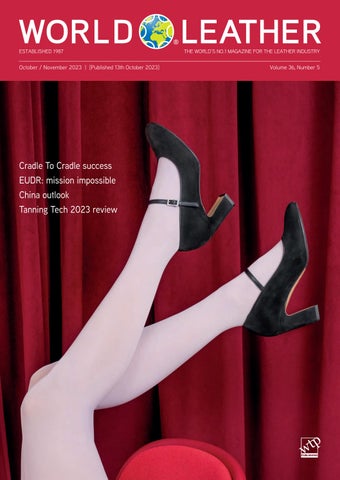
Cover image: The Mathilde pump from Roccamore. The Danish brand says that by the end of this year 30% of its entire range will be made from traceable leather. CREDIT: ROCCAMORE
World Leather iPad edition The world’s best leather industry magazine is now available to download on iPad from www.leatherbiz.com
30
Thought Leadership: Traceability targets The European Union’s requirements on deforestation-free materials will be difficult to meet, but the industry is striving towards setting up the necessary frameworks. A delay would be good for everyone..
34
Thought Leadership: Cradle to Cradle The Circle Economy Foundation views leather as a “nutrient” and places responsibility for circularity at design level.
38
Thought Leadership: Apple turns sour The International Council of Tanners was quick to respond to the technology giant’s announcement that it was moving away from leather.
@WTPworldleather
40
Circular Stories: Old-school revival Leather footwear has seen a huge resurgence at Nike and adidas as vintage styles make a comeback
linkedin.com/showcase/wtpworldleather
Circular Stories: Between worlds Chanel-owned artisanal hub Le 19M is putting craft's "living heritage" on the map this autumn, from France to Mexico and back.
@WTPworldleather
44 48
Circular Stories: Right on target Hyundai Transys' decision to upcycle leather surplus sourced between Italy and South Korea landed it a coveted Red Dot Design Award in Singapore, thanks to a little help from Lineapelle.
Beast to Beauty 50
Ugly duckling turns into a swan A company revamp and shrewd collaborations have propelled Birkenstock into the high-fashion circles.
@WTPworldleather
World Trades Publishing Ltd 2023. Contributions: The editor welcomes news items, articles and photographs for consideration and possible publication but no responsibility can be accepted for the loss or non-publication of such material. Opinions expressed by individual contributors do not necessarily reflect the view of the editor or publisher. • Whilst every effort is made to ensure accuracy in reproduction, no responsibility can be accepted for the technical content or for claims made by manufacturers for product performance that are published. Publication in World Leather cannot be construed as an endorsement for a claim or product by the publisher. • World Leather is published 6 times per year by World Trades Publishing, The Old Stone House, Teeton, Northampton NN6 8LH UK. Price UK £90, ROW: £150 per year (six issues). Graphic origination by WTP. Print by Bishops Printers, Walton Road, Portsmouth, Hampshire PO6 1TR, England. All rights reserved. ISSN 0894-3087
The World Leather team has been publishing a series of original, dynamic podcasts since 2019. The whole series is available on Anchor, Spotify, Apple Podcasts, Google Podcasts, Pocket Casts, Overcast and other podcasting platforms. Just search for the World Leather Podcast on the platform you prefer.
WORLD LEATHER SERVING THE GLOBAL LEATHER INDUSTRY
World Trades Publishing 2023: All rights reserved. No part of this publication may be reproduced, stored in a retrieval system or transmitted in any form or by any means mechanical, electronic, recording, photocopying or otherwise, without the written permission of the publisher. World Leather®, Tannery of the Year® and Nothing to Hide® are registered trademarks of World Trades Publishing Ltd.
1
The World of News UK Footwear brand Dr Martens is introducing a shoe repair service in the UK. This move is aimed at bolstering the company’s sustainability credentials while also opening up a new revenue stream. Dr Martens has teamed up with The Boot Repair Company based in Leeds to provide repairs, with re-soling a pair of boots costing half the price of a new pair. The University of Northampton hosted representatives from the Tanzanian Ministry of Education, Science and Technology and Dar Es Salaam Institute of Technology (DIT) . The signing of a Memorandum of Understanding underlined the continued collaboration between the Tanzanian Institute and the Institute for Creative Leather Technologies (ICLT). DIT is building a new campus in Mwanza which will include a teaching tannery.
FRANCE Tanners from various parts of the country travelled to Paris to talk to students at l’Institut Français de la Mode. Around 12 tanners took part in presentations and discussions with postgraduate students with the aim of encouraging them to incorporate leather into their master’s projects. This is the first joint initiative between l’Institut Français de la Mode and leather manufacturers’ association Fédération Française de la Tannerie Mégisserie.
ARGENTINA Tanning group Arlei has been recognised by the government ministry with responsibility for promoting clean energy with an award called Efficient Argentina, for implementing and certifying an energy management system using the ISO 50001 standard. Arlei said the new energy management systems has saved it between 5% and 15% in energy consumption, without significant investment. 02
GERMANY A study by the FILK Institute in Freiberg has shown that biocides do not migrate out of finished leather articles and therefore pose no risk to consumers, according to chemicals company Lanxess, which commissioned the research. Automotive leather, shoe upper leather, garment leather and furniture leather samples were treated with fungicides OPP, CMK, OIT and TCMTB, which are commonly used in leather production. German footwear brand Lowa has been awarded one of the first Performance Days footwear awards as the Munich-based fabric show presented a dedicated shoe area for the first time. The Lady Light GTX model has a 100% nubuck leather upper. Marco Weichert, CEO of Performance Days, said: “Now, suppliers from the footwear sector have the opportunity to meet decision-makers from international brands all in one place.”
SPAIN Grupo Verdeveleno, a Spanish company known for its tanning and finishing of exotic leathers, has been acquired by LVMH Métiers d’Art. Through this integration, all LVMH Maisons will benefit from the expertise of Grupo Verdeveleno’s approach to leathergoods, which involves collaborating with local artisans.
BRAZIL Brazilian packer and tanning group Minerva has acquired most of the slaughter facilities that rival group Marfrig runs across South America. It will pay more than $1.5 billion for the Marfrig assets, adding them to the 25 abattoirs it runs in the region. After the acquisition closes, Minerva will have 52% of total beef production capacity in Brazil, 15% in Paraguay, 15% in Argentina, 11% in Uruguay and 7% in Colombia.
SOUTH AFRICA Footwear manufacturers in South Africa exported shoes with a combined value of around $115 million in the first seven months of 2023, 13% higher than the same period last year. Between January and July, South Africa imported footwear with a total value of $545 million, an increase of 6.4%. These figures include statistics for Botswana, Eswatini, Lesotho and Namibia that make up the Southern African Customs Union.
WORLD LEATHER OCTOBER/NOVEMBER 2023
The World of News
CHINA The 22nd UITIC International Footwear Congress will be held in Shanghai in 2025, and will run alongside the All China Leather Exhibition. Organised by the International Union of Shoe Industry Technicians, the 21st UITIC Congress ended on September 22 in Milan, where more than 300 industry figures from 21 countries took part.
HONG KONG Organisers of the APLF exhibition have confirmed that the fair will see significant changes in 2024. The moves were planned for 2020 but were cancelled owing to covid-19. Previously situated on level 1 in Halls 1A - 1E, the leather fair will now relocate to Level 3 of the Hong Kong Exhibition Centre. Fashion Access and Materials+, previously on Level 3, will move to Level 1, transforming the fairs from a leather-focused event to a more fashionoriented group of fairs.
BANGLADESH In the first quarter of the current fiscal year, Bangladesh’s leather footwear industry experienced a decline in export earnings, reaching a five-year low of $141.83 million. This was due to a reduction in export orders from the Eurozone. According to the Export Promotion Bureau, data shows a 32.8% decrease in yearon-year export earnings.
PAKISTAN The country’s leather industry registered a fall in export revenues in July and August. Exports of finished leather, garments, leathergoods and footwear brought in $142.9 million over the two months, a decline of 14.5% compared to the same months last year. The fall for finished leather was substantially higher at 36.9% in value year on year. The decline for leather garments and accessories was 8.3%, while for footwear there was a fall of 12.8% in value. Bahria University Karachi Campus held a certification ceremony to honour the successful participants of the "Women Empowerment in Leather Sector" programme. The programme is aimed at promoting gender equality and women's empowerment in the leather industry. It offered practical training on leather processing, cleaner production techniques and waste management.
US US packers, tanners and traders exported 16.7 million hides in the first seven months of 2023, bringing in revenues of $651.3 million. These figures represent a fall of 8.1% in volume and of 15.2% in value. Figures for US hide exports have been falling in volume and value for the whole of 2023 thus far.
NEW ZEALAND The New Zealand Leather and Shoe Research Association has announced funding for a new fault diagnosis project. The project received $1 million from the ministry of business with the aim of identifying spectral signatures in hides and skins. LASRA said “Our goals include early detection of faults, production of premium leather and valuable proteins, and optimisation of chemical usage.”
AUSTRALIA Sportswear brand New Balance has revised its sourcing policies with the aim of phasing out the use of kangaroo skins and discontinuing the sale of footwear made from kangaroo products by December of next year. This decision was made following the announcement by Nike and Puma earlier this year.
WORLD LEATHER SERVING THE GLOBAL LEATHER INDUSTRY
03
Industry & Innovation
Leather education at Northampton in serious doubt he University of Northampton has entered a formal period of internal consultation to determine the future of leather education and research at the university. It said it had taken this decision against a backdrop of “a fall in student demand for this subject area, the economic downturn, and rising energy prices”. The Institute for Creative Leather Technologies (ICLT), now located at the university’s Waterside campus, has taught leather professionals from all over the world for generations, offering undergraduate and post-graduate teaching. It has also engaged in high-level research to help the global industry advance. It officially opened the new leather centre at Waterside in 2019. A statement from the university said: “Declining applications over a number of years and rising costs have resulted in the subject area being reviewed as a going concern.” Vice-chancellor Anne-Marie Kilday added the university had not taken the decision lightly. She said: “The academic study of leather at the University of Northampton has been a valued part of our offer since 1995. The number of UK leather producers has been in decline, and the largest producers are now China, Brazil, Russia, India and Italy. This has severely impacted the number of domestic students, and has not delivered commensurate international students.”
T
Scottish Leather Group opens ‘super tannery’ cottish Leather Group has successfully completed a seven-year project to build a £14 million ‘super tannery’ that it says will be one of the most sustainable in the world. The new facility, located at its Bridge of Weir site, will reduce energy use by 82% and water by 42%. This is part of the company’s ongoing investment to reduce its carbon footprint and improve productivity, which includes an onsite thermal energy plant and a water treatment and recycling plant.
S
Tanneries celebrate Made in Green certification n a presentation event held at the Lineapelle leather fair in Milan, the OekoTex Association presented Made in Green certificates to two German leather manufacturers, Lederfabrik Josef Heinen and Heller-Leder. Thomas Heinen, CEO of Lederfabrik Josef Heinen, said the certification enabled the company to show customers the levels
I
4 XX
Old leather into new filler pecialist ski and outdoor footwear group Scarpa has launched a recycling project in which it will aim to collect 15,000 used pairs of its Mojito shoes in one year from customers across Europe. It will deconstruct the Mojitos and use the materials to make new shoes. Scarpa has said a key component of the project is a technique based on hydrolysis that reduces the leather recovered from the worn shoes to a collagenic material. The Veneto-based footwear company worked with a research team from the University of Bologna to develop this technique. Another project partner, Castelfranco di Sotto-based leather manufacturer Conceria Sciarada, will use this collagenic material as a filler in its production processes. In other words, residue from the leather in the old shoes will contribute to the manufacture of new leather for new shoes.
S
of environmental protection it works to; he said he hoped that it set them apart from others. Frank Fiedler, CEO of Heller-Leder, said the certification was in part attributed to a partnership with Heinen and that it was integral in the company’s future in assuring the protection of the end consumer. Made in Green certification indicates that the product has undergone testing to ensure that it is free from harmful substances, and certified according to Oeko-Tex Standard 100 or Oeko-Tex leather standard.
Assomac: First-hand views of new technology important epresentatives of many major leather manufacturing groups were among the encouraging numbers of visitors to the Tanning Tech exhibition in Milan. Organiser Assomac said 320 companies were exhibiting at Tanning Tech and footwear-focused exhibition Simac this year. Around 75% of exhibitors are from Italy but the companies taking part have technology in 130 countries. Assomac president Maria Vittoria Brustia said the last few years had been complex for tanning and footwear machinery
R
developers but that there was still a clear need for their customers to see at first hand new technology ideas that can help them in their work.
Stahl’s plant-based topcoat tahl presented NuVera, a water-based topcoat solution, at Tanning Tech in September. It is derived from plant-based biomass (typically vegetable oils or sugars). These products can also be made from a third renewable raw material category which is “captured carbon”, where CO2 released from industrial processes is captured and used as a feedstock for producing polymeric building blocks.
S
Buckman awarded ZDHC level 3 S-based chemicals company Buckman has confirmed that its products for the leather industry satisfy the Level 3 Conformance benchmarks for the ZDHC MRSL (Manufacturing Restricted Substances List) Chapter 1: Leather and Textile. Global innovation manager Dr Luis Zugno said: “We are certain this verification will provide leather manufacturers with confidence in using Buckman as a total solutions provider for their processes.”
U
WORLD LEATHER OCTOBER/NOVEMBER 2023
Industry & Innovation
ATC celebrates half a century o celebrate its fiftieth anniversary, French leather chemicals manufacturer ATC held an open day at its centre of excellence in Montanay, near Lyon. The day after the Simac Tanning Tech fair in Milan, ATC invited customers and agents to the facility to discuss R&D projects and the techniques used in the centre of excellence. Following the open day, 120 guests were invited to a celebration at the Château du Souzy, in Quincié-en-Beaujolais, one hour north of the ATC facility.
T
Major brand buys part of Wolverine Leathers prominent athletic footwear brand has emerged as the buyer of part of Wolverine Leathers, the in-house leather supply division of the Wolverine Worldwide group. Wolverine ran its own tannery in Rockford, Michigan, for 100 years, but production there ended in 2009. After that, Wolverine Leathers remained an active part of the group, contracting
A
leather production and leather colouring to suppliers in five locations in the US, Vietnam, Thailand and China. It has now named a buyer for an important segment of this part of its business. Athletic footwear brand New Balance is buying the US part of the Wolverine Leathers business. Wolverine said it had already “assigned its US tannery contracts” to New Balance and that the athletic footwear brand was paying $6 million for the acquisition. It said it would “continue to explore alternatives” for the non-US parts of the Wolverine Leathers business.
Zschimmer and Schwarz joins German UN network eather chemicals supplier Zschimmer & Schwarz has become a member of the UN Global Compact Network Germany. A company statement expressed that by joining the network, it showed further commitment to support the UN Global Compact, which it joined in 2021, and its 10 principles in the areas of human rights, labour, environment and anti-corruption.
L
The company aims to promote a sustainable and socially responsible chemical industry by integrating these principles into its operations.
Pittards appoints administrators eather and finished products manufacturing group Pittards confirmed on September 4 that it has appointed administrators to take responsibility for selling its assets. It said Lucy Winterborne and Daniel Hurd of Ernst & Young will act as jointadministrators.
L
Stahl continues with EcoVadis success hemicals group Stahl has received a Platinum rating from sustainability rating agency EcoVadis for the second consecutive year. It scored 80 out of 100, up from 77 in 2022, once again placing it in the top 1% of companies evaluated. Stahl improved its score in the Labour and Human Rights category, with a score of 90 out of 100.
C
Chemtan waterproof technology — inspired by nature
Tel: (603) 772-3741 www.CHEMTAN.com
WORLD LEATHER SERVING THE GLOBAL LEATHER INDUSTRY
5
Leather scene
Nick Muirhead named SLG CEO
New UITIC president takes over following congress
seventh-generation of the founding family of Scottish Leather Group (SLG), Nick Muirhead, has taken over as the group’s chief executive. Nick Muirhead joined the group in 2007 as a project engineer with the group’s technology division. From there, he progressed to senior roles across the entire group, becoming cutting manager at automotive leather manufacturer Bridge of Weir Leather in 2012. In 2016, he became managing director of two of the group’s component companies, wet-end facilities NCT Leather and W J & W Lang. In 2018, he took up the role of managing director of the group’s upholstery leather manufacturer, Muirhead. He replaces Steve Henning, who took up the position a year ago but stepped down in August.
A
Boehly steps down from CNC ine years after taking up the presidency of France’s Conseil National du Cuir (CNC), Frank Boehly will step down from the role in 2024. He said the Sustainable Leather Forum would go ahead again, for the sixth time, next year but that CNC would have a new president by then and, as a result, he would not be there to greet delegates. He became president of the national leather industry body in 2014 after more than a decade of running the French business of German leathergoods and footwear group Salamander. He said from the outset of his tenure that leather, leathergoods and shoes represented “one of the flagships of the Made In France movement”. He said the leather sector was essential for adding high levels of value on home soil to the hides and skins that the French agricultural industry produces each year and that he was optimistic about its future.
N
Further change at the top for TFL month on from its announcement that chief executive Wolfgang Schütt had left the company, leather chemicals group TFL has announced chief finance officer Richard Fenton has left too. Mr Fenton had been at TFL since 2015. The company said he had decided to leave for personal and career reasons. TFL’s new chief executive, Russell Taylor, thanked Richard Fenton for his work, particularly his contribution to bringing Lanxess’s organic leather chemicals business unit into the group in 2021. Previous head of controlling at the group, David Blatch, is the new chief finance officer, taking up the role in September.
A
6 XX
he twenty-first International Footwear Congress, organised by the International Union of Shoe Industry Technicians (UITIC), attracted 250 delegates from 22 countries. The event took place in northern Italy from September 19-22. UITIC said a clear conclusion to come from the congress was that footwear companies “must innovate to become sustainable, fully embracing the digital transformation that is the key enabler for this change”. Delegates had opportunities to visit footwear factories and spend a day at the Simac-Tanning Tech exhibition as well as attend congress discussions. After 13 years in the role, Yves Morin stepped down as UITIC president, with Sergio Dulio taking over as the new president.
T
ICHSLTA president re-elected he International Council of Hides, Skins, and Leather Traders Associations (ICHSLTA) held its 94th annual general meeting during the recent All China Leather Exhibition in Shanghai. Members reviewed the trade of hides and skins globally and discussed the misuse of the word leather to describe non-animal sourced materials. Also at the meeting, members reelected Toni Baltes (pictured), managing director of A+B Hides and head of the German hides association, Wirtschaftsverband Häute Leder (WHL), as ICHSLTA president for a second term. He was first elected to the position in 2021. He explained that one of ICHSLTA’s objectives during his new two-year tenure as president will be to support efforts to restore “the good reputation leather deserves” as a natural, sustainable and beautiful material that manufacturers of a wide array of finished products can use. Mr Baltes said this in the context of end consumers now demanding “more ethical, sustainable consumption choices”, but also being at risk of being taken in by unsubstantiated claims that synthetic materials will meet those requirements more fully than leather. He will have the support of two vicepresidents: Dennis King from the Australian Hides Skins and Leather Exporters Association, and Nick Winters from the French Hides Association, while Lénaïg Manéat, also of the French Hides Association, will continue to manage ICHSLTA.
T
State visit could bring closer leather ties ietnam’s prime minister, Pham Minh Chinh, travelled to Brazil for a formal state visit in late September. Discussions focused on advancing the relationship between the two countries with the emphasis firmly on economic growth, social development, environmental protection, energy security and food security. One of the fruits of the visit was a plan of action to take agricultural cooperation between the two countries forward. A memorandum of understanding on agriculture and food was already in place, but the new plan will focus on measures to speed up its implementation between 2024 and 2026. Senior representatives of the meat and leather industry in Brazil were among the business leaders to take part in discussions with Pham Minh Chinh and his delegation. Later, one of those who took part, the chief executive of leather manufacturing group JBS Couros, Guilherme Motta, said the visit had represented “an important opportunity to discuss mutual cooperation”.
V
Turkish tanning clusters ripe for investment he president of the International Council of Tanners (ICT), Bekir Burak Uyguner, has told media in his home country, Turkey, that investors should provide capital for expansion in the industry there. He argued that investment that would allow for an expansion in production capacity at just two of the industry clusters in Turkey could bring 10% growth in the Turkish leather industry’s exports each year. If this happens, Mr Uyguner, who is also president of the Turkish Leather Industrialists’
T
WORLD LEATHER OCTOBER/NOVEMBER 2023
Leather scene
Association, said exports would increase from around $2 billion per year now to $3 billion five years from now. Turkey has tanning clusters at TuzlaIstanbul, Menemen-Izmir, Bursa, GeredeBolu, Corlu-Tekirdag, and Usak.
Deborah Taylor joins the Curriers ustainable Leather Foundation founder Deborah Taylor has been admitted as a Freeman of the Worshipful Company of Curriers. The Curriers’ Company is one of the UK’s oldest livery companies, first established as a trade organisation in London in 1272 to protect the craft of currying, the art of cleaning, working and finishing tanned hides to create leather.
S
Prime minister to open leather exhibition angladesh’s prime minister, Sheikh Hasina, will formally open the fourth Bangladesh Leathergoods International Soucing Show (BLISS). The show takes place in Dhaka from October 12-14. The country’s Leathergoods and Footwear Manufacturers & Exporters
B
Association (LFMEAB) said the event would showcase “the resilience and dependability” of Bangladesh as a sourcing destination for brands. EPB, the export promotion bureau, has set the leather industry the target of earning export revenues of $1.35 billion in the current financial year, which runs from July 2023 to June 2024.
sustainability at Ecco Group and has served on the LWG committee for two years. Cezar Gernhardt from leather manufacturer JBS Couros has also been elected to the committee. LWG said: “Our thanks to previous chair Ian Scher of leather manufacturer PrimeAsia for his commitment and support for LWG during his term.”
JBS calls for mandatory tracking
Change in Asia leadership at Lectra
ccording to the chief executive of JBS, Gilberto Tomazoni, a mandatory government programme is needed to track cattle. In a New York Times panel on climate change, Mr Tomazoni emphasised the need for a national mandatory traceability system to track individual animals and combat deforestation.
L
A
LWG names chairman of executive committee eather Working Group has announced Thomas Gregor of Ecco Leather will take up the position of chair of the executive committee. Mr Gregor is vice-president of corporate
L
WORLD LEATHER SERVING THE GLOBAL LEATHER INDUSTRY
eather-cutting technology provider Lectra has announced Frédéric Morel as company president for Asia. He replaces Edward Wang in the role. Lectra chief executive Daniel Harari said: “Mr Morel’s understanding of the challenges faced by a technology company like Lectra and his ability to support dynamic and sustainable business development are major assets for our group.” The technology provider has had a presence in Asia since 1985, when it opened its first office in Japan. Now, 16% of its total workforce is in the region and sales in Asia accounted for 25% of group revenues in 2022.
7
Backtrack World Leather’s publishing cycle and limitations on space make it impossible for us to run more than a carefully selected sample of news from across the industry. However, we publish hundreds more stories on leatherbiz.com. The site is updated every day with news from every continent and every part of the industry, making leatherbiz.com one of the most comprehensive archives of news anywhere on the web for the global leather industry.
We list below just a few of the headlines that have appeared on the site in recent weeks and can still be accessed.
04 October 2023
18 September 2023
Leather Naturally launches digital exhibition
Mipel offers opportunities, especially to small leathergoods companies
03 October 2023
Assocalzaturifici hopes for Micam boost
JLIA bestows ‘meister’ title on Hiroan’s Hiroshi Hasegawa
Market Intelligence: major change is on the way
15 September 2023
France submits new draft decree against plant-based ‘meat’
Fossil moves forward with next generation rebrand
Spanish event prepares for 50th edition
02 October 2023 Performance Days’ debut shoe talk to cover ‘ReGenAg’ leather
29 September 2023 New Balance to phase out kangaroo leather
28 September 2023 Facts and data on livestock farming hit home at FAO conference Levi’s pushes for LWG suppliers
27 September 2023 Higg index review reveals major shortcomings LVMH acquires tannery Groupo Verdeveleno
14 September 2023 Industry bodies in Italy to present joint strategy Eighty teachers attend Veneto leather sustainability course
13 September 2023 Italian tannery to present hemptanned leather
12 September 2023 Conceria Montebello and Hugo Boss to outline Product Passports requirements
05 September 2023 Market Intelligence: surprisingly high levels of optimism at ACLE Visitors welcome at Pompeii tannery Upgrade for Zünd software Lineapelle sets out seminar schedule with Spin360
04 September 2023 Pilot project proves product passport technology will work in leather furniture Tod’s announces K-pop ambassador
China leather industry exports hit new record
01 September 2023
11 September 2023
Shifting US cattle numbers could be positive for Australia
Drops for Brazilian footwear exports
Stahl comes together for beach clean up
French minister pays tribute to leather
26 September 2023 Another accolade for Bridge of Weir
Sustainable Leather Forum takes place in Paris
25 September 2023
Third Real Leather, Stay Different winner announced
Tanning Tech back to pre-covid levels
08 September 2023 22 September 2023
Rihanna launches another Puma franchise
JBS calls for mandatory cattle tracking
New associate professor at the University of Northampton
WWF joins deforestation-free call to action
21 September 2023 China encouragement for Italy's luxury shoe brands Increase in demand from overseas buyers, Micam organisers say
19 September 2023
07 September 2023 Deceptively simple-looking bag is Loewe’s star
31 August 2023 H1 results prompt optimism for Lanvin Group Strategic review and new CEO for Spinnova Germany withdraws bisphenol restriction proposal
30 August 2023 Technical committee term extension for LHCA president Oeko-Tex announces double-digit growth
Women’s empowerment welcomed in the Pakistan leather industry
Tecnochimica gains highest ZDHC certification
August growth for Brazilian leather export volumes
29 August 2023
Market Intelligence: Apple should turn back time
Brazil celebrates fall in deforestation rate
New technicians nearing end of FILK schooling
Leather adds durability to Nike’s skate collection
06 September 2023 Indian leather product suppliers to put on London show
Revenues up for Bata Pakistan, but higher costs hit profits
8 XX
ACLE opens its doors after four-year pause
WORLD LEATHER OCTOBER/NOVEMBER 2023
®
Visit the new and improved site
CUTTING-EDGE TECHNOLOGY - WEALTH OF EXPERIENCE Contact Simon Yarwood simon@worldtrades.co.uk for more information
Leather Leaders: Chen Zhanguang
The covid-19 years had an impact on the leather industry in China, as on all other sectors. But vice-president of the China Leather Industry Association, Chen Zhanguang, insists the industry has stood up to these challenges and is looking forward to better times in 2024.
China holds its own In broad terms, how did the Chinese leather industry function during the years of covid-19? In the past three years, factors such as international geopolitical conflicts and the epidemic have been intertwined. The downward pressure on the domestic economy has increased and the Chinese leather industry has been under pressure. China’s leather industry has shown the characteristics it is well known for: resilience and strong riskresistance. It has basically maintained its scale advantage and international competitiveness. In 2022, the leather industry in China achieved sales revenue of about 1.16 trillion yuan, which is more than $150 billion. Exports exceeded $100 billion for the first time, reaching $107.5 billion in the end. What effect did the pandemic have on leather manufacturing in China? It has had a great impact on global industrial activity and on the supply chain. The cost of international raw materials and transportation has soared. During this period, the price of shipping containers increased by more than 10 times and the cost of chemical materials has doubled. This has had a great impact on the leather industry, including in China. Owing to the poor supply chain situation, domestic consumption has also been affected to a certain extent. With the surge of inflation in Europe and the US, the international consumer market has also been greatly affected, especially for leather products, which often have a higher price. Therefore, China, which has the largest production of leather and leather products in the world, has inevitably been affected. Please describe the principal ways in which the situation is different now in the second half of 2023. In the first half of 2023, affected by sluggish demand at home and abroad, China’s leather industry faced great downward pressure. From January to June this year, the Chinese leather industry achieved revenues of 380 billion yuan, or just over $50 billion, a year-on-year decrease of 6.9%. Among them, the sales revenue of key tanning enterprises is 26.5 billion yuan, around $3.6 billion, a year-on-year decline of 12.4%. The volume leather that Chinese tanneries produced in the first half of 2023 was 160 million square-metres, down by 6.1% compared to the same period last year. Although there has been a decline, the rate of that decline is narrowing month by month, which shows that China’s leather industry as a whole is now getting better. In particular, consumption is gradually returning to the right track, which is an important driving force for the recovery of the industry in this second half of the year. 10 XX
Chen Zhanguang. CREDIT: CHINA LEATHER INDUSTRY ASSOCIATION
How much finished leather did China produce in 2022? The total for the year was around 500 million square-metres. What are your projections for production in 2023? We anticipate a decrease in the production of finished leather in China in 2023 to some degree because of the poor performance of the domestic and international markets this year. WORLD LEATHER OCTOBER/NOVEMBER 2023
China holds its own
Tanning drums at Xingye Leather Technology. The China Leather Industry Association says it will encourage an acceleration of scientific and technological innovation in 2024 to help make leather “even more irreplaceable”. CREDIT: DONG YANJUN
What percentage of the leather China produces in 2023 will go for export? In recent years, with the transfer of orders for some international footwear brands to south-east Asia, the proportion of direct exports of China’s finished leather has increased to a certain extent. However, in general, the finished leather our tanneries produce still mainly supplies our domestic market. The volume that will go for export to the international market will be about 15% of the total. What is the panorama for using Chinese leather in the domestic market now? Which vertical sectors are increasing their demand for leather from Chinese tanneries? The Chinese market has a high preference for leather, and the requirements for the quality of leather are getting higher and higher. For example, demands concerning the performance of leather manufacturers in environmental protection and in their management of chemicals; these are becoming stricter. In addition, the tolerance of defects and of leather that smells strongly is becoming lower, so the requirements for the quality of raw hides and for control of volatile organic components are also stricter. What will the China Leather Industry Association’s priorities be for 2024? Firstly, to guide the industry to accelerate scientific and technological innovation and promote its transformation and to upgrade the tanning industry from a traditional
WORLD LEATHER SERVING THE GLOBAL LEATHER INDUSTRY
“China’s leather industry has
shown the characteristics it is well known for: resilience and strong risk-resistance.
”
manufacturing sector to one of modern manufacturing. The development of science and technology will make leather more environmentally friendly and more fashionable, and make leather more irreplaceable. These developments will help the leather industry cope effectively with the impact of substitute materials such as polyurethane and textiles. In addition, through the development of science and technology, the automation and intelligence level of leather manufacturing will be improved to solve the problem of labour shortages. At the same time, we aim to further strengthen the promotion of leather among consumers. The China Leather Industry Association will use the Genuine Leather Mark, our certification for leather products, and Ecoleather Mark, our certification for finished leather, as our flagships, to let consumers better understand the unique characteristics of this natural, environmentally friendly material that gives comfort, fashion and other good properties. At the same time, we want to let consumers understand the misleading messages that often surround substitute materials.
11
Technology
Bisphenols: examples for successful reductions in products and leather articles Jochen Ammenn Stahl, Germany In the synthesis of syntans, bisphenol S and F represent a major challenge. They are either used as starting materials or formed as unwanted by-products. These molecules can be detected in almost all syntans, ranging from trace amounts to several thousand parts per million. Extractions can reveal their presence in most leather products. In 2022, the European Chemicals Agency (ECHA) proposed challenging limits to significantly reduce bisphenol levels in consumer goods and the environment. These proposed limits would have had a significant impact on leather chemical manufacturers' syntan portfolios and the production of many leather items. However, after a public consultation, ECHA has temporarily withdrawn the restriction proposal and is working on revising it. This article will outline examples of how reducing the levels of both bisphenols in leather chemicals can impact extractions from leather articles down to detection limits. These findings were presented at the Leatherdays conference in Freiberg, Germany in June 2023. Regulatory background Bisphenol A (BPA) is a commonly used building block in the chemical industry, particularly in the production of plastic materials. However, since 2017, it has been classified as a substance of very high concern by the European Chemicals Agency (ECHA) due to its harmful effects on reproduction 1. Numerous studies have been conducted on the toxicity of BPA 2. BPA is not typically found in leather products or chemicals. In the EU, efforts have been made to further restrict BPA and prevent the use of similar substances called bisphenols of similar concern (BosCs), including bisphenol S (BPS) and bisphenol F (BPF), which are commonly found in syntan synthesis. In 2020 and 2021, national affiliates working on behalf of ECHA announced two calls for evidence on BPA and BosCs restrictions. After the second call for evidence, ECHA proposed a restriction on the use of BPA and BosCs in leather products and chemicals. The proposal suggested a limit of 500 parts per million (ppm) as the sum of all bisphenols for a period of five years, followed by a limit of 10 ppm for the sum of all bisphenols after that time. These timelines are depicted in
Figure 1: Restriction timelines proposed by ECHA before public consultation
Figure 1. The proposal was open for public consultation until the end of June 2023. However, ECHA announced in August the temporary withdrawal of the proposal due to the feedback received during the public consultation, and now plans to rework it. BPS and BPF are not commonly used as substitutes for BPA in leather chemicals. Studies have shown that both BPS and BPF 3 can have harmful effects on reproduction, with BPS already classified as reprotoxic 1B in the EU, and the process of classification for BPF is still ongoing.
WORLD LEATHER SERVING THE GLOBAL LEATHER INDUSTRY
Bisphenols in the chemistry of syntans When synthesising syntans, there are two methods used: phenolic syntans that start with phenol, and sulfone syntans that start with BPS. In sulfone syntans, BPS is condensed with formaldehyde to create a polycondensate, as shown in Figure 2. This condensation can occur with or without the presence of naphthalene or phenolic chemistry. Regardless, BPS remains as a rest monomer in the final product due to its low reactivity 4. The length of the poly-condensate's chain depends on the amount of formaldehyde added,
13
Bisphenols: examples for successful reductions in products and leather articles
Figure 2: Synthesis of sulfone syntans
which is represented by "n" in Figure 2. It can be measured in size exclusion chromatography and related to a standard or reference compound 5. This value is important to maintain, as it affects the performance properties of the product on leather, such as fullness, softness, and grain tightness 6. The levels of BPS in sulfone syntans vary from several hundred to several thousand ppm, depending on the reaction conditions. If the synthesis is not conducted with phenol present, BPF cannot be detected. On the other hand, in phenolic syntans, phenol is partially sulfonated and then combined with formaldehyde 7 to create the product, as shown in Figure 3. In the first step, the so-called sulfonation, BPS forms as a side product with a concentration ranging from double-digit ppm to several hundred ppm, depending on the reaction conditions. Many products from this chemistry have 200–500 ppm BPS. BPF can form in the second step, depending on the reaction conditions, with concentrations ranging from below the detection limit to above 10,000 ppm. Examples of bisphenol reductions in syntans The starting material in sulfone syntans is BPS, which remains as a rest monomer due to its low reactivity. The BPS content in sulfone syntan A can be reduced from 25,000 ppm to 2,700 ppm by changing parameters such as equivalents of starting materials, time, pressure, and pH. HPLC analysis of the products shows the results in Table 1. Extensive application trials show that the performance of syntan A "new" is maintained compared to syntan A "old", including fastness properties. The only difference is the reduced BPS content. 14
Figure 3: Synthesis of phenolic syntans
In phenolic syntans, BPS is formed as a side product in sulfonation. In the formaldehyde condensation of unsulfonated phenol, BPF is the major side product. In the regular production of syntan B, we measured approximately 3,360 ppm BPF and aimed for improvement. After the first production trial showed a fivefold improvement in BPF, a second trial reduced the BPF level further to 210 ppm. The second production trial of syntan B "new" had a sum of 340 ppm for BPS plus BPF, complying with limits below 500 ppm of bisphenols. See Table 2. This represents a sixteen-fold improvement in BPF levels compared to the initial syntan B. The performance of syntan B "new" is maintained in all aspects, enabling tanners to provide the same leather articles. Extraction results of bisphenols from retanned leather To extract BosCs from retanned leather, in accordance with DIN ISO 11936, one gram of leather is cut into small pieces and extracted with 20 millilitre methanol at 60°C for one hour in an ultrasonic bath. Two research institutes, FILK in Freiberg, Germany and CTC in Lyon, France, extracted our
leathers, and we also conducted extractions ourselves. The extraction solutions were analysed via calibrated HPLC. The remaining bisphenols in the floats were analysed directly via calibrated HPLC. Table 3 shows that the tenfold reduction of BPS in the product syntan A "new" is reflected in the BPS extraction values from leather made with sulfone syntan A "new" in retanning. Measurements at FILK, CTC, and in the Stahl lab were within a reasonable and realistic margin of error, showing that leathers can be achieved with below 500 ppm BPS, with optimised products like syntan A "new" indicated by the green colour in the lower row in Table 3. The recovery rate of BPS was about 30% for syntan A and 38% for syntan A "new". Six percent of the syntans were used for the retanning of wet blue. It was assumed that the wet blue had about fifty percent water content and that it takes two grams of wet blue to obtain one gram of crust, leading to the maximal calculated amount of twelve percent syntan in the crust, depicted in the third column of Table 3. To monitor the BPS quantities in retanning floats, a syntan with a high BPS content was applied. BPS was analysed in three floats from the first,
Table 1: BPS in sulfone syntan A BPS [ppm] Syntan A old (Sulfone)
25,000
Syntan A new (Sulfone)
2,700
Table 2: BPF and BPS in phenolic syntan B BPF [ppm]
BPS [ppm]
SUM BPS + BPF
Syntan B (phenolic)
3,360
150
3,510
1st production trial Syntan B new
670
90
760
2nd production trial Syntan B new
210
130
340
WORLD LEATHER OCTOBER/NIVEMBER 2023
CRAF TSMANSHIP YOU CAN COUNT ON QUALITY
INNOVATION
SUSTAINABILITY
Count on industry leader National Beef® Leathers for consistently beautiful, high-quality leather produced using advanced technology and environmentally responsible practices. As the largest tannery in the world, we’re committed to raising the bar for premium wet blue leather.
Honored to Sponsor
nationalbeefleather.com National Beef Packing Company LLC. © 2023
www.gerelettronica.com
Bisphenols: examples for successful reductions in products and leather articles
Table 3: Extraction from leathers made with 6% sulfone syntan A in retanning Measurement in product
Calculated extractable from crust (= 12%)
Measurement after extraction from leather
BPF [ppm]
BPS [ppm]
HPLC measurement at
Stahl
calculated
Stahl
SUM BPS + BPF FILK
CTC
Syntan A old (Sulfone)
25,000
3,000
860
1,100
730
Syntan A new (Sulfone)
2,700
320
130
150
80
Table 4: Results and extraction from leather retanned with phenolic syntans All production trials
BPF [ppm]
Measurement in product BPS[ppm]
Syntan B (phenolic)
3,360
150
3,510
750
75
825
1st trial Syntan B new
670
90
760
170
30
200
2nd trial Syntan B new
210
130
340
Syntan C (phenolic)
< 10
60
< 70
< 20
< 20
Syntan C.LB (phenolic) optimised (LB = low bisphenols)
< 10 (Stahl HPLC) < 5 (PFI HPLC)
< 10 (Stahl HPLC)
second, and final stages, and a combined eight percent of the total amount of BPS was found. The leather produced was then subjected to repeated extraction with methanol, according to DIN EN ISO 11936, to increase the recovery rate, which was raised to 68 percent. However, a single extraction only leads to a partial recovery rate, and repeated extraction is less feasible for large throughput. A smaller amount of extractable bisphenols can increase the recovery rate. For the phenolic syntans, both BPS and BPF are relevant, but BPS is only relevant to a minor extent. The first production batch of the major phenolic syntan B was optimised, resulting in a fivefold reduction of BPF in the product and a reduction of extracted BPF by a factor of 4.4. See Table 4. While the sum of bisphenols extracted from leathers retanned with this first trial batch was well below the proposed limit, the sum of bisphenols in the product was found to be above the proposed limit. The second trial batch of syntan B "new" was able to lower the sum to 340 ppm from 760 ppm. See Table 4. Phenolic syntan C showed doubledigit values of BPS and BPF values below the detection limit of 10 ppm. The first production batch of syntan C.LB had BPS and BPF levels below the detection limit of 10 ppm, and in a measurement at the PFI institute, the product had BPS and BPF levels below the detection limit of 5 ppm. With the syntan C.LB, bisphenol levels below 10 ppm as the sum of
SUM BPS + BPF
both bisphenols could be reached for the first time. The performance of syntan C was tested in all retanning aspects as well as on heat and light fastness properties compared to syntan C to enable the same applications. Conclusion We were able to enhance the production process of a sulfone syntan and reduce the level of BPS in the end product by a factor of ten. This improvement was also seen in the BPS amount after extracting it from the leather. In another major phenolic syntan, the BPF levels were decreased by a factor of five in the product and a factor of 4.4 in the leather in the first batch, and then by 16 in the second batch. We showed that a single extraction of leather with methanol does not collect all bisphenols. With phenolic syntan C, we were able to produce leather with less than 20 ppm bisphenols extractable. With optimised syntan C.LB, we brought bisphenol S and F levels in the product below the detection limit while maintaining the performance of syntan C on leather. Acknowledgements The author wishes to acknowledge the contributions, assistance and support of Stahl colleagues Marcus Breulmann, Debora Spengler, and Cenk Basoglu; Roberta Gamarino; Markus Kalt, BASF, Ludwigshafen; Ute Morgenstern and Ines Stachel, FILK Institute; and Ines Anderie and Oliver Haubrich, PFI, Pirmasens.
WORLD LEATHER SERVING THE GLOBAL LEATHER INDUSTRY
Measurement after extraction BPF [ppm] BPS [ppm] SUM BPS + BPF
References 1. Srivastava, S.; Dhagga, N.; Dose exposure of Bisphenol- A on female Wistar rats fertility, Hormone Molecular Biology and Clinical Investigation, vol. 38 (2), p. 20180061 (2019). 2. Eladak, S.; Grisin, T.; Moison, D.; Guerquin; M.J.; N’Tumba-Byn, T.; Pozzi-Gaudin, S.; Benachi, A.; Livera, G.; Rouiller-Fabre, V.; Habert, R.; A new chapter in the bisphenol A story: bisphenol S and bisphenol F are not safe alternatives to this compound, Fertil Steril., 103(1), 11–21 (2015). 3. McDonough, C.M.; Shibo Xu, H.; Guo, T.L.; Toxicity of bisphenol analogues on the reproductive, nervous, and immune systems, and their relationships to gut microbiome and metabolism: insights from a multi-species comparison, Critical Reviews in Toxicology, 51(4), 283-300 (2021). 4. Reich, G.; Hebestreit, J.; J. f. Prakt. Chemie, 19, 303-308 (1963). 5. Lathe, G. H.; Ruthven, C.R.J.; The Separation of Substance and Estimation of their Relative Molecular Sizes by the use of Columns of Starch in Water, Biochem J., 62, 665– 674 (1956). 6. Ammenn, J.; Chemistry of Syntans and their Influence on Leather Quality, JALCA, 110, 349–354 (2015). 7. Heidemann, E.; Fundamentals of leather Manufacturing, Eduard Roether KG Darmstadt, p 380f (1993).
17
ADV Supervario2023 210 x 297 + 5mm.pdf
1
04/10/23
18:15
SUPERVARIO T TOP OF THE RANGE FOR IRONING AND EMBOSSING
C
M
Y
CM
MY
CY
CMY
K
LEATHER PRE-HEATING SYSTEM
PRESSURE CONTACT AREA +35%
www.bergi.com
operative system
Technology
White sneaker by Moral Code shows that contrary to some claims, Olivenleder can be used to produce white leather. CREDIT: MORAL CODE
Avoiding glutaraldehyde with sustainable by-products In light of the regulatory concerns surrounding certain metal-free tanning and retanning systems, Wet-Green, a leather technology company from Germany, has a decade old, patented solution. The leather industry heavily relies on a by-product of the meat industry as its main raw material, making leather a highly circular product. Wet-Green OBE, which is itself made from a by-product of the Mediterranean olive harvest, could offer a sustainable alternative to the current systems.
G
lutaraldehyde (GTA) is an aldehyde that can be used as an alternative to chrome tanning. In July 2021, it was listed on the SVHC (substances of very high concern) candidate list due to its respiratory sensitising properties. This places certain obligations on suppliers of articles containing it at a concentration greater than 0.1% w/w (percent concentration of a material in solution) in that they have a responsibility to provide enough information to allow safe use of that article. Tanners producing wet white, chrome-free and synthetically tanned leathers are among those most likely to be affected. Some things in life come as a surprise. Many surprises, however, only occur to those who refuse to face reality. Thomas Lamparter from Wet-green GmbH in Reutlingen, Germany, can confirm that. He engages with many people in the leather industry including tanners, brand managers and designers. In some conversations, he says that he gets the distinct impression that the topic of GTA has seemingly fallen from the sky, surprising and threatening to disrupt the entire leather industry. There is a great commotion, outraged reactions and widespread consternation. While this may well be something of an exaggeration, he doubtless has a point. Indeed, he also notes that the German automotive manufacturer BMW has a firm grip on this reality. Several years ago, the company realised that sustainability, ‘Cradle WORLD LEATHER SERVING THE GLOBAL LEATHER INDUSTRY
to Cradle’, increasing supplier responsibility and general awareness of environmental and nature conservation concerns were not just passing media fads that would soon subside. Instead, these issues have steadily gained relevance in recent years. Year after year, brand communication is increasingly required to address these topics and provide reliable answers to a generation whose concerns revolve around the future of the planet. The usual response to such questions is to create smokescreens. Flowery promises are made and fantasies of the impossible are concocted, all in the hope that no one will bother to look behind the screens. But often, the truth behind them is bleak. This calculation is becoming less successful as consumers are reluctant to be taken for fools. How else can one understand it when manufacturers promote a ‘natural’ tanning agent that claims to use olive mill wastewater (OMW) as a significant substance but when analysed in the lab also includes the addition of glutaraldehyde? These claims and their promotion are essentially just ‘greenwashing’. Sustainable alternative However, Lamparter claims there has been a completely transparent, real and sustainable alternative available for over a decade in the form of wet-green OBE. A tanning agent developed by the German company Wet-green 19
Avoiding glutaraldehyde with sustainable by-products
“By using other by-products such as the
pomace (filter cake) and the olive mill wastewater (black water), there is the potential to convert global leather production to being tanned with by-products from olive growing for a real circular system.
”
THOMAS LAMPARTER, WET-GREEN
This work boot by Patagonia is a perfect example of a circular approach. Tanned by Horween, it is based on Patagonia Wild Idea Provisions Buffalo Jerky and uses the hides as by-products. CREDIT: PATAGONIA
meets all the requirements of the modern leather industry and has nothing to hide. BMW was one of the first companies worldwide to explore this possibility beyond conventional chemical tanning agents. And has apparently met with great success. But it is not just the automotive industry that has caught on; the fashion industry is now using Olivenleder extensively. Renowned brands such as Hugo Boss, Alpha Tauri (Red Bull), Tricker's, Moral Code and Grenson have realised that leather cannot be treated as if advances in tannages have not been made. Patagonia, known for producing high-quality products that are both functional and durable, has been a pioneer brand in terms of sustainable practices and has a strong community of customers who support its philosophy. When developing its work boots, the company considered there was no alternative but to tan its choice of American bison hides with the patented OBE. Patagonia is a highly respected brand and where it goes, others follow. It is also worth pointing out that the Olivenleder patent has yet to be broken, so these brands’ faith would seem well placed. What is OBE? Wet-green says that its OBE (olivenblatt-extrakt) is the only vegetable tanning agent in the world which has two natural binding mechanisms by combining the best of two worlds, phenols and a natural cross-linker. It also says that availability is not a problem as using the leaves of the Mediterranean olive harvest only, it can accommodate more than 40% of global leather production. “By using other by-products such as the pomace (filter cake) and the olive mill wastewater (black water), there is the potential to convert global leather production to being tanned with byproducts from olive growing for a real circular system,” claims Mr Lamparter. An attractive feature of Olivenleder, besides its environmental credentials, is the variety of leathers it can produce. For example, whereas vegetable tanning normally
20
results in a firm finished material, the OBE system can produce a variety of textures and colours, something that more and more brands are picking up on. The company claims that virtually any type of footwear can be produced, including casual sneakers, work boots and dress shoes. The only limitation so far is the hydrophobing for military grade leathers used for hiking boots which can be subjected to hours of water contact. The tanning agents present are the same as those found in some natural cosmetics and in extra virgin olive oil, and are designed to be neither corrosive nor a hazardous substance. Good all round properties The colour possibilities for Olivenleder are said to be limitless and the leather just as soft as traditional conventional leathers. The substance of the olive tree that protects it, Oleuropein, takes on the task of glutaraldehyde, zeolites or other metals in the tannery, ensuring a soft and flexible bonding of the skin fibres. Lamparter says the complete ingredient list of this tanning agent would fit on the smallest note: Oleuropein. It is extracted from olive tree leaves, olive oil production residues and olive mill wastewater through a globally patented process which maintains its unbroken status. Numerous awards from reputable institutes confirm that this tanning agent has the potential to be a sustainable and healthy game-changer. The USDA has awarded it the ‘100 percent Biobased/BioPreferred’ label and the German Dermatest seal confirms its ‘excellent’ skin compatibility. Wet-green says that the fact that it can already meet over 40 percent of the global leather demand by using only the leaves from olive growing is yet another reason why tanners and their shoemaking customers have no need to take risks in the future. Consumers will appreciate being able to afford the luxury of sustainability in a completely transparent manner for a more sustainable and circular future of leather, without headaches.
WORLD LEATHER OCTOBER/NOVEMBER 2023
ALL THE QUALITY YOU NEED MADE EASY
RELIABILITY | CONTROL | HIGH TECHNOLOGY | SUSTAINABILITY
MILLING DRUMS
SPRAY BOOTHS
TUNNEL DRYERS
Via Ferraretta, 1 - 36071 Arzignano VI, Italy | +39 0444 478312 | info@erretre.com | erretre.com
AUTOMATION
Technology
Jean-Baptiste, Jean-Piere and PierreAntoine celebrate the 50th anniversary of ATC at the Château du Souzy, in Quincié-en-Beaujolais, approximately one hour north of the ATC facility in Lyon. ALL CREDITS: ATC
ATC 50th anniversary In 1973, a team of chemical engineers established ATC, with their primary focus being the provision of biocides to France's paper industry. However, the paper industry's decline in 1975 forced ATC to broaden its service offerings to other sectors. To achieve this, ATC brought on board Jean-Pierre Gualino, a leather engineer, to drive sales in the tanning industry. Through the years, the company has encountered obstacles, undergone numerous changes, and in September 2023 the family business marked its 50th anniversary.
J
ean-Piere Gualino faced challenges when trying to establish the company in the industry. Despite approaching ten tanneries, only one agreed to work with them due to a lack of recognition compared to other major companies. However, he persevered and adapted his strategy to overcome these obstacles. To expand the market beyond France, the decision was made to export products worldwide and Mr. Gualino struck a deal with a goat skin tanner in Mazamet, who owned a unit in Niger, and became the first person to visit in exchange for the tanner's commitment to buy their products. He then went on a sales tour of Africa, visiting Niger, Upper Volta (now Burkina Faso), and Senegal, which resulted in successful sales and promising opportunities. In the late 1970s, a meeting with a tanner in London, who owned three tanneries in Africa, helped ATC achieve good sales and ensured its continued development. In 1983, a discovery trip to Bangladesh and Thailand was organised, and the launch of an international trade fair in Hong Kong, The Asia Pacific Leather Fair (APLF), triggered greater opportunities for prosperity. As an early leader in 22 XX
Asia, ATC explored the continent at a time when the European leather market was slowing down, and the Asian market was rapidly expanding. This early move allowed them to capitalise on the growth potential of the thriving Asian market. Critical connections were established at the APLF in 1985, leading to expanding their agencies in Indonesia in 1986 and Korea in 1988. With a forward-thinking approach and eagerness to expand into new markets, both Jean-Piere Gualino and ATC gained a strong foothold in Asia, providing top-quality chemicals and technical support to tanneries in this important region. In 1989, focus had to shift from being a reseller to a manufacturer to continue its growth. Manufacturing milestone In 1989, a significant milestone was achieved by establishing the Montanay factory, and despite facing challenges at the time of the Kuwait war, they nevertheless persevered. In 1994, they expanded the factory by constructing further offices, which marked a new phase in their growth. WORLD LEATHER OCTOBER/NOVEMBER 2023
ATC 50th anniversary
In 2007, Pierre-Antoine Gualino, the younger son of JeanPiere, joined the business, which was experiencing rapid growth and outgrowing its Montanay site. To increase production capacity and pursue its vertical integration strategy, the company decided to establish a new production site in France. They found an opportunity in Trévoux, where an industrial estate was available to accommodate their project. Under Pierre-Antoine's management, the Tanorga plant was established, strengthening its industrial power through the development of organic synthesis processes for acrylic and polyurethane resins, aldehydes, and fatliquors.
With half a century of improvements, the current production sees state-ofthe-art manufacturing technology employed at the Lyon site.
During the turbulence of the 1997 Asian financial crisis, significant obstacles were once again encountered. However, they saw this crisis as an opportunity and established TATC, their first subsidiary in Thailand in 1998, in partnership with a local entrepreneur. Through close collaboration with local partners and the expertise of Olivier Chalamel, who currently serves as the Director and associate of TATC, they continue to provide top-quality chemical products and technical assistance to Thai tanneries, further strengthening their position in the Asian market. In the 1980s, Jean-Piere frequently attended conferences organised by the IULTCS in Brazil. During these trips, he met passionate professionals from the leather industry, which led to the first sales of chemical products in Brazil, Argentina, Paraguay, and Chile through a successful partnership with Zulfe Biehl. With some unexpected meetings and heart-led decisions, the company established a subsidiary in Brazil and expanded its footprint in the Brazilian leather market. ATC do Brasil is still managed by Zulfe Biehl and has experienced strong growth in recent years, specialising in industrial biocidal products and developing sales in Mercosur countries. Destination India During the early 2000s, ATC India was established in association with a company in Chennai. This allowed strong partnerships to form with multiple agents in India's major tanning areas, including Kanpur, Kolkata, Ranipet, and Vaniyambadi. Aiming to become a producer of synthetic tannins by vertically integrating and acquiring new technologies, in 2003, it collaborated with its local subsidiary to construct a factory in Pondicherry: JeanBaptiste Gualino, the elder son of Jean-Piere, was appointed to oversee the project. The plant was completed in June 2005, allowing the company to become a producer of synthetic tannins and exclusively supply the Indian market. They eventually expanded to fifteen agents to offer speciality leather chemicals in India, the world's largest country by population today.
WORLD LEATHER SERVING THE GLOBAL LEATHER INDUSTRY
Family business In 2011, Jean-Pierre, Jean-Baptiste, and Pierre-Antoine worked on the company's takeover to ensure its long-term future. Jean-Baptiste and Pierre-Antoine took over 95% of the business on 1 January 2012, becoming the owners and managers of the company. Their focus was on improving the products, expanding the range, and continuing to base growth on expanding the network of distributors. Major investments were made to improve existing production facilities, such as the installation of an automated blending and packaging line at Montanay in 2016. In response to the covid-19 pandemic, the production of hand sanitisers at their Tanorga site offset some of the decline in leather demand and launched a line of hygiene and disinfection products and an e-commerce website in 2021. During 2021, the Montanay lab underwent renovation, improving the air treatment system and adding additional fume cupboards. Innovation is a key strategy for ATC, with a team of ten R&D professionals across France, Brazil, and India led by Dr. Béatrice Renard. Their accomplishments include eco-friendly products that meet global customer needs and maintain the company's position as a leader in leather chemistry. Since 1990 they have received multiple certifications, including ISO 9001 and ISO 14001, more recently receiving certification from ZDHC for their commitment to reducing hazardous chemical discharge with level 3 compliance for their products.
Follower of fashion! Jean-Piere Gualino (right) at the Semaine International du Cuir in 1977, not long after joining the company to introduce ATC products to the leather industry.
23
A REVOLUTIONARY FOOTWEAR FIT FOR REBIRTH Ecotan Fit for Rebirth is the world’s first 100% shreddable biocircular sneaker that produces zero waste. It is digestible by nature just as it is, without being disassembled.
Technology
CREDIT: SIMAC TANNING TECH
Tanning Tech Review Technical Editor, Mat Abbott, gives his overview of the Simac Tanning Tech Exhibition held this September.
W
ith great expectation, the 2023 Tanning Tech exhibition followed fairly hot on the heels of the All China Leather Exhibition (ACLE) held in Shanghai. Whilst Europe has been “back to normal” for some time, the ACLE was the first leather event to be held in China since the lifting of all covid-induced restrictions, and this was very much a topic of conversation during the Milan show. With China now described as a very different place in the four years since the previous show was held, it was hoped that the positivity and excitement from Shanghai would extend to the “largest leather show in Europe”. Activity on the first day would be best described as flat. Footfall never reached the level of a bustling show and spartan aisles gave initial impressions that exhibitors were headed for disappointment. However, one often forgets the “hospitality” aspect that goes alongside the European shows, and Milan is the leader in this field. Lunchtime activity is concentrated on the stands and conversations flow, much like the wine. Comments to this author suggested that the day ended as “reasonable at best”. Perhaps this was more a reflection of the event, not as yet hitting expectations, but as anyone who has ever exhibited at a trade show knows, expectations and reality barely tally. Day two would be “the one” and day three would see the usual slowdown. In many respects, this played out with footfall seeing a reasonable increase on day two with a similar uplift in exhibitor feedback on the day's activities. Where the trend then seemed to differ was on the final day. The stands picked up pace partway through the morning and continued at an almost brisk level until well into the afternoon. Numbers were boosted by the flow of visitors coming from the Lineapelle
WORLD LEATHER SERVING THE GLOBAL LEATHER INDUSTRY
halls and giving some of the exhibiting tanneries in the other halls a chance to network with their suppliers across the central walkway. With respect to Lineapelle, and as has been reported before on the website pages of leatherbiz, while there are buyers from all over the world, Milan is where fashion trends are established, and upcoming seasons are planned. It is important to note that the fair does not prioritise mass leather production. Your experience at the fair may vary depending on your industry. Nevertheless, Lineapelle emphasises that there is a significant global market that values leather and welcomes innovative ideas and products from manufacturers. Tanning Tech numbers The turnout of visitors was said to be “significant and qualified” by the organisers and this was backed up by conversations on the stands suggesting longer-term projects had been discussed and, for the most part, the larger tanning groups had all been present. Discussions in general surrounded recent big brand posturing on leather's place in the world, with very little support if any at all for much of the greenwashing that has been seen in the mainstream media of late. Although some car companies have had similar ideas in recent times, discussions about the importance of leather in the Chinese automotive industry were a fascinating contrast. With the growing usage of leather in domestically produced electric and traditional combustion engine vehicles, it still represents a symbol of quality. This gives hope for its continued use or even a comeback in other areas. However, it could be argued that this view also plays on the Chinese market's ability to surpass and assimilate European efforts.
25
Tanning Tech Review
Given the change seen over the “pandemic years”, we wait to see what transpires. With over 320 exhibiting companies, back to pre-covid levels and a show of strength for the leather, leathergoods and footwear industries, official figures from the organisers state the event had over 6,500 visitors, 40% of them being from outside Italy. This was a 37% increase compared to the previous year. There was also a 14% increase in exhibitors, brands, and institutions. Italy had the highest number of exhibitors, followed by Turkey, France, Germany, Portugal, Brazil, Mexico, Spain, Tunisia, and Asian countries. Complemented by other Milanese fairs held at the Rho Fiera, the president of Simac Tanning Tech, Maria Vittoria Brustia, expressed her satisfaction with the international presence of visitors and the attention of technology producers towards sustainable transition and with ITA-Agenzia’s support, Simac Tanning Tech was able to strengthen the incoming programme of visitors and delegations from abroad, with 18 international delegations and around 100 buyers, institutional delegates, and foreign press. The synergy between Simac Tanning Tech and Lineapelle was highlighted, and the CEO of Lineapelle, Fulvia Bacchi, praised the fair's creativity and ability to engage various operators. The fiftieth edition of Simac Tanning Tech is scheduled for 17-19 September 2024. Italtannery project The Italtannery project is a non-competitive collaboration between five tannery technology providers in the Veneto region. The five are Bergi, Erretre, Fratelli Carlessi, Ger Elettronica, and I-Tech. Their shared goal is to create an eco-friendly and ethical system for producing high-quality leather. The project utilises integrated tools to track and document every phase of production, optimising all aspects of the process from raw materials to human resources, energy consumption, and processing waste. Additionally, the companies aim to cross-promote activities to other organisations in the industry, supporting each other's growth.
Using drum bodies for meeting rooms provided instant and interesting space for private conversations on the Hüni stand. CREDIT: WTP
Instant Meeting rooms In a display of innovation, both in terms of unusual use and locations for tanning drums and advanced manufacturing, Swiss producer of tannery control and automation products Hüni had quite a different display. Combatting the issue of privacy, whilst at the same time displaying the external weldfree polypropylene drum technology they exclusively offer, two meeting areas were fashioned using their expertise. Utilising this technology, for its intended purpose, Huni say they offer drums with a maximum wall thickness of 10cm, with no external welding and as a result of the manufacturing techniques, no external bracing is required either. The thickness achieved not only gives stability, and with no metal banding, corrosion and maintenance are virtually eliminated but thermal insulation is maximised. Partners unveil wet white system Atlas Refinery unveiled a new wet white tannage system, developed by Leather Kem, an experienced developer of high-performance chemicals and sustainable technology. The biosystem is polymer-based and eco-friendly with low levels of bisphenol and formaldehyde. Global Product Manager for Atlas, Flavio Lucchese told World Leather: “The system is designed to be simple and easily adjusts to most beamhouse processes around the world. It offers excellent consistency from batch to batch and is very easy to retan.” Atlas Refinery CEO Steve Schroeder explained that it will only be available through Atlas’s global distribution network, and revealed that in addition to this new product, the company had recently appointed Teknoleather as its exclusive agent for the Veneto Area in Italy. It Integrates Altlas’s 136 years of experience in the fatliquor industry with the latest bio technologies developed in Italy.
Side by side at the show, Italtannery Project partners see many benefits from working together rather than going head-to-head. CREDIT: WTP
26
AI colour recognition A further advance in the use of artificial intelligence (AI) was on show with the latest innovation from GER Elettronica and the I.Color. With the advanced use of AI in fault detection and
WORLD LEATHER OCTOBER/NOVEMBER 2023
20230214 Mimosa Ad_Ad1.pdf
6
2023/04/03
12:18
C
M
Y
CM
MY
CY
CMY
K
Still the world’s leading natural leather tannin Since 1920, NTE Mimosa has been the world’s favourite vegetable tannin. Explore the product range on our website.
Tanning Tech Review
Automated colour sorting and grading gets the AI treatment. CREDIT: WTP
grading having received much press coverage in recent months, this new system is aimed at sorting and grading of leathers, specifically suedes, where subtle shade differences can be better highlighted using computer learning, with the additional advantage of fatigue-free sorting and objective outcomes. Whilst suedes have little in the way of colour correction other than spray dye shading, for end users the reliance placed on accurate sorting is paramount. For small leather goods and gloves where components can be cut from the same piece, the issue of mismatched colouring may not be an issue but moving to larger units for items such as clothing and upholstery, the placing of even slightly differing shades could result in costly rejections or losses. The system complements the GER I Data system and the Be Trace modular system for full manufacturing traceability.
Conforming to the Measuring Instrument Directive (MID) 2014/32/UE, water resistant to IP65 regulations and working on the latest Microsoft Windows operating system, the EVA machine is far from window dressing. CREDIT: WTP
certification programme was introduced in 2013 to recognise companies that have environmentally friendly and socially responsible supply chains and replaced the old Standard 1000. STeP was applied to leather in 2019, and the product label features a unique ID that can be used to trace the product and track its manufacturing stages. Thomas Heinen, CEO of Lederfabrik Josef Heinen, stated that the certification has made it easier to show their clients the level of environmental protection they abide by, and he hopes that it sets them apart from others. He also praised the holistic approach used by the certifying body to bring together the entire leather supply chain in the programme. Frank Fiedler, CEO of Heller Leder, added that the certification was partly due to their partnership with Heinen and that it is vital for the company's future in ensuring the safety of the end consumer and taking social responsibility in the wider industry.
Style and substance With a separate display, that would not look out of place in a high-end kitchen showroom, the latest GER measuring machine “with a difference”, the EVA measuring machine, is marketed as the first “haute couture” machine of its kind in the industry. With a large full-colour display screen, stainless steel surround and lime-wash wood effect feed-in table, the aesthetics of the machine have been styled to appease the fashion brands dealing with the GER customer base. Whilst the “sexing up” of the machine does give it the added element of Italian style, underneath the technology in use is, as would be expected, state of the art. Tanning industry firsts At the Oeko-Tex Association stand, Lederfabrik Josef Heinen and Heller-Leder were both presented with the tanning industry's first Made in Green certificates. The Made in Green certification confirms that the product has undergone testing to ensure that it is free from harmful substances, and it is certified according to Oeko-Tex Standard 100 or Oeko-Tex leather standard. It assures consumers that the product was produced sustainably and under socially responsible working conditions, certified in accordance with Oeko-Tex STeP. This
WORLD LEATHER SERVING THE GLOBAL LEATHER INDUSTRY
Professor Haiko Schulz, Director of the FILK Freiberg Institute, the accredited testing laboratory for Oeko-Tex audits, presented the first Made in Green certificates to Frank Fiedler (left) and Thomas Heinen (right). CREDIT: WTP
29
LEATHER AND THE CIRCULAR ECONOMY: THOUGHT LEADERSHIP
Leather and the circular economy
Leather uses renewable raw materials
Waste from other sectors (meat and dairy) is the input for making leather
The material is long-lasting
Leather products are eminently repairable
Leather is in keeping with sustainable consumption and sustainable production and, thus, supports the UN’s Sustainable Development Goals (SDGs)
Use of leather aids the battle against marine pollution, also part of the SDGs
The leather industry opens up pathways into the circular economy for companies of all sizes, including many thousands of small and medium enterprises
Leather content fulfils finished product manufacturers’ desire to use recycled material
Finished products made from leather will meet criteria for green tax relief and for green procurement exercises
Leather manufacturing supports green employment commitments
Credit: WTP/Flaticon
Traceability 2025: an ambition too far
A
consensus is growing that new traceability requirements that the European Union (EU) wants to impose on the leather manufacturing industry and on other sectors cannot work in practice, at least not in the ambitious timeframe the EU has set out. Because it wants to minimise its contribution to deforestation worldwide, and to reduce its contribution to greenhouse gas emissions and global biodiversity loss, the EU has laid down new rules regarding products coming into the 27-state trading bloc or being exported from it. It wants to make sure products that derive from a list of seven commodities have no links to deforestation if they are to be made, bought or sold in the EU. The new rules are called the EU Deforestation Regulation (EUDR) and the commodities it affects are cocoa, coffee, palm oil, rubber, soya, wood and cattle. Some by-products from these commodities secured an exemption from EUDR, often on the basis that they were products or materials that would go to waste if manufacturers did not make use of them. Attempts to secure an exemption for hides, skins and leather, which can also lay claim to this criterion, were unsuccessful. At a vote at the European Parliament’s plenary session in September 2022 in
30
The European Union is pressing ahead with its new regulations on deforestation; a postponement of the deadlines seems to many in the global leather industry to be the most sensible way forward. Strasbourg, 277 of the elected members voted in favour of an exemption for leather, but 338 voted against. The leather industry’s representative body in the European Union, COTANCE, described losing the Strasbourg vote as “a low blow”. COTANCE said leather could not be considered as a driver of deforestation, adding: “It is scientifically demonstrated that demand for leather does not drive livestock production or slaughter. Leather is a recycling success-story and a front-runner in the circular economy.” EUDR cleared all its approval hurdles in the months that followed and the regulation came into force on June 29, 2023. As things stand, companies in the EU that distribute hides, WORLD LEATHER OCTOBER/NOVEMBER 2023
Traceability 2025: an ambition too far
“Importers could say no to hides from regions where there could be a risk of deforestation, but also recognise that there are large areas of Brazil that are risk-free.” CICB make leather or use leather to manufacture finished products must comply with EUDR. This means meeting compliance requirements from December 30, 2024, (for larger companies) or from June 30, 2025 (for smaller companies). All of their global supply chain partners will, of necessity, have important roles to play in this compliance effort. Lie of the land In concrete terms, this is what the EU is demanding. Before relevant products come to market or go for export, operators must “exercise due diligence”. This involves collecting information and compiling supporting documents to show what the product is, the country it comes from and, beyond that, “the geolocation of all plots of land where the commodities that the product contains, were produced, as well as the date or time range of production”. If they can compile this extremely detailed information, operators will then have to carry out to their own risk assessment “to establish whether there is a risk that the relevant products are non-compliant”. Non-compliant here would mean the product had a link to deforested land. If there has been deforestation on any of the plots of land listed, all the commodities involved will be “automatically disqualified” from coming into the EU or being exported from it. Everyone is affected The ability to reassure brands, retailers and consumers that leather and leather products have no links to deforestation is something that affects everyone in the European leather industry, the secretary general of COTANCE, Gustavo González Quijano said at the 2023 Sustainable Leather Forum in Paris. Mr González Quijano points out that systems for providing all the necessary reassurance about hides, skins and leather are not ready yet, although he says work is under way to try to make it possible for the European leather sector to fulfil the requirements. Whether it can complete this work in time for the existing deadlines is a separate question, but the work will not be without reward. If the demands are steep, being able to deliver the reassurances the EU is asking for will, in the end, be to the European leather industry’s advantage, he says. “We need to work right now to try to put all the necessary bureaucracy in place, not only because 2025 is just around the corner, but because the cattle whose hides our tanners will process under the new regulations are being born now,” he explains. “Transparency is a good thing. It will bring credibility for European leather and credibility will bring authority.” A gap to bridge Nevertheless, if the EU has its way, the geolocations of the plots of land those new calves occupy today will, all too soon, have to form part of the due diligence declarations tanners will need to prepare. WORLD LEATHER SERVING THE GLOBAL LEATHER INDUSTRY
Current European Commissioner in charge of the environment, Virginijus Sinkevičius, on a visit to Colombia in July 2023. He travelled to South America to address what he called “the need for systematic changes to address deforestation and the protection of biodiversity”. Credit: European Commission
The institute director at FILK Freiberg, Professor Haiko Schulz, has added his voice to those warning that the leather industry will find it difficult to meet these new traceability requirements in time. Speaking to World Leather at Lineapelle in Milan in September, Professor Schulz said the research and testing body he represents is part of a group that is working with COTANCE to address traceability. But it seems certain to him that it will take longer to put the necessary systems in place than the 2025 deadlines allow. He explains that there is already substantial coverage of traceability in OekoTex leather certification and that, in parts of Europe including Germany, there is also a high level of traceability in place in the meat industry showing the origin of cattle going back to the farms the animals come from. At the same time, Professor Schulz insists there are high levels of transparency concerning a hide’s movement from the tannery gate, from the end of the leather manufacturing process to the finished product. “Between the two, though, between the abattoir and the tannery, there is a gap,” he says, “and the work we have to do is to bridge that gap.” He says data about the farm does not normally transfer to the hide at the abattoir and he adds that the way hide traders work with the abattoirs at the moment does not lend itself to bringing about a change in these practices. However, if that change does not materialise, Professor Schulz says the leather industry should seek to work with politicians to encourage them to force this change through. “And of course, this too would take time,” he observes. Open dialogue Because the political pressure Professor Schulz talks about could only really apply in Europe, his gap-bridging ambitions will help tanners and leather product manufacturers who source hides there, where the risk of deforestation is low. The product-flow EUDR is more concerned with begins beyond 31
Traceability 2025: an ambition too far
time with partners in the meat and livestock supply chain to try to put in place a national traceability programme, and all parties agree that there can be no turning back on this.
The European Parliament building in Strasbourg, where a majority of members voted against proposals that leather, hides and skins be exempt from EUDR. Credit: European Commission
Europe’s borders. The ambassadors of 17 countries where the deforestation risk is higher sent a joint letter at the end of September to the European Commission, which is the EU’s executive arm, and to European parliament officials. They described EUDR as an “inherently discriminatory and punitive unilateral benchmarking system”, and they suggested the new regulation could, potentially (this is the sort of thing the courts must decide), fall foul of World Trade Organisation rules. They called for changes to the EUDR demands and an open dialogue on the subject of deforestation and on the impact on suppliers of the farreaching ambitions that EUDR expresses. As things stand, the impact on suppliers of all the commodities under scrutiny, especially small operators, will be severe. The 17 countries whose ambassadors signed the joint letter were Argentina, Brazil, Bolivia, Colombia, the Dominican Republic, Ecuador, Ghana, Guatemala, Honduras, Indonesia, Ivory Coast, Malaysia, Mexico, Nigeria, Paraguay, Peru and Thailand. This list shows that there are concerns about deforestation in several continents and the range of commodities mentioned above shows that many industries in Europe are in line to have to execute complex changes to the way they source raw materials. A number of the 17 countries on the list are important players in the global leather industry, but when it 32
comes to high volumes of hide exports, much of leather’s deforestation discussion has focused on Brazil. Brazil earned more than $150 million from its exports of hides and leather to EU countries in the first eight months of this year. It has paid close attention to the entire EUDR discussion and has a keen interest in what happens next. As World Leather reported in the April-May 2023 issue, leather manufacturers in Brazil have been in dialogue for some
More time, please In September, a delegation of senior people from the Brazilian leather industry spent time discussing deforestation and EUDR with the authorities in Europe. Through the South American country’s diplomatic mission to the EU in Brussels, tanning industry body CICB sat down in the Belgian capital with senior officials from three of the European Commission’s policy departments (it uses the term ‘directorate general’ or ‘DG’ for each of these). Officials from three DGs, Environment, Trade and International Partnerships, took part. CICB has told World Leather that one of the proposals it was able to present to the DGs, was another new traceability solution that the federal government of Brazil is trying to put in place. “The Brazilian government would like more time to weigh this up,” CICB says. “Everyone would like more time.” A major issue is that the companies, as far as cattle are concerned, that are at the front line of the challenge of combatting deforestation are not leather manufacturers but meat producers. Meat companies, CICB points out, typically react “when it is in
A damaged tree at Castelo dos Sonhos in the Brazilian state of Pará. Representatives of the Brazilian leather industry travelled to Brussels in September 2023 for discussions with European Commission officials about EUDR. Credit: Felipe Werneck/the Brazilian Institute of the Environment and Renewable Natural Resources (Ibama)
WORLD LEATHER OCTOBER/NOVEMBER 2023
Traceability 2025: an ambition too far
their interests”. Foot-and-mouth disease (FMD) offers an interesting case in point. We have been covering outbreaks of FMD in Brazil since 1999, but the situation now is that a vaccine is available and packer companies are rolling that vaccine out. Brazil is now in a position to say it will be FMDfree within two years. Powerful dynamic Many times between 1999 and now, meat importers, not least in China, the South American country’s biggest export market for meat, have been able to make distinctions between the parts of Brazil affected by FMD and those that were free from the disease. When outbreaks occurred, imports from affected areas were halted, but hard work, sincere dialogue and investment in transparency and traceability made it possible to avoid a blanket ban on Brazilian beef. “Brazil is a continent, it is like five different countries, at least,” CICB says. “Importers could say no to hides from regions where there could be a risk of deforestation, but also recognise that there are large areas of Brazil that are many thousands of kilometres away from, for example, the Amazon Biome, and that are risk-free. It should be possible to continue exporting hides and leather from those risk-free areas.” This is what Chinese meat importers did with regard to FMD, and as a result, the necessary traceability for food safety is already there. It is the meat industry that has invested in the roll-out of the FMD vaccine programme. The problem with EUDR is that, as far as packer companies in Brazil are concerned, investing in another traceability system to comply with the EU-imposed regulations is not worth it; only 3% of the country’s beef exports go to the European Union, whereas 60% of those exports go to China. The Brazil-China beef export dynamic is powerful enough to have driven the FMD programme and its traceability requirements. Exports to the EU matter much less in the packers’ eyes.
PERFECT LEATHER SUPPORTING YOU SINCE 1868
Unintended consequences Meanwhile back in Brussels, no immediate change seems to have arisen from the September discussions between the leather industry and the European Commission officials. Some observers say they are beginning to pick up signals from DG Trade that a postponement of EUDR for hides and skins would be a good idea. Colleagues at DG Environment are far less keen on any talk of a delay. Much of the momentum behind EUDR came from DG Environment, inspired by the blue-sky thinking of lobby groups and other advocates who believe it is possible to bring about a perfect world through ambitious legislation. But EUDR is not a real-world solution and there appear to be too many unintended consequences to make it feasible to put it into practice in time. In early June 2024, there will be elections to the European Parliament across all 27 member states. Many of the political leaders of the current European Commission will have served their time and each of the DGs faces a shake-up, with new leaders coming in. By the time these leadership changes take effect, the end of 2024 and the first EUDR deadline will be just around the corner. It is not clear at the moment if this changing of the guard will make a postponement of the deadlines more or less likely. It certainly will not make the implementation of EUDR any easier. WORLD LEATHER SERVING THE GLOBAL LEATHER INDUSTRY
33
LEATHER AND THE CIRCULAR ECONOMY: THOUGHT LEADERSHIP
Cradle To Cradle thinking has been around for decades. It is now winning a place in the hearts of forwardthinking companies who are using its theories and certification system as a pathway to circularity.
Roccamore uses Nordic Traceable Leather from Spoor. This means everyone from tanners to end consumers can see at a glance exactly where the animal that provided the hide was raised. Credit: Roccamore
Cradle of circularity
T
o its dismay, the Circle Economy Foundation has found that the global economy is only 7.2% circular in 2023. The Amsterdam-based organisation, which aims to put the circular economy into action, published this figure in its 2023 Circularity Gap Report and it said 7.2% means the world is heading in the wrong direction. It has published these reports for six years in a row. The circularity figure for the global economy in 2018 was 9.1%; this fell to 8.6% in 2020, and now it is 7.2%. It blames rising material extraction for the widening gap and concludes that the global economy still relies almost exclusively on using virgin materials to make products. As a result, according to the foundation’s calculations, more than 90% of materials are either wasted, lost or remain unavailable for reuse for years. For Nienke Steen, who leads on apparel, textiles and footwear at the Cradle To Cradle Product Innovation Institute, these are “devastating facts”. At the 2023 Sustainable Leather Forum in Paris in September, Ms Steen said the situation in the fashion industry is that brands and manufacturers keep making more product, keep increasing their carbon emissions and have more and more people “in bad situations in the supply chain”. She says 75% of the products brands bring to market end up in landfill and that only 1% of the industry’s output is upcycled. Her conclusion is that it is clearly very difficult “to connect consumer habits to changing the world”. Do things differently She remains passionate about the circular economy cause and is optimistic that new legislative requirements, particularly those that oblige companies to produce thirdparty, data-supported verification of the green claims they make about their products, will make a difference. She is also optimistic about the Cradle To Cradle Product Innovation Institute’s work with brands, encouraging them to do things differently, usually away from the public eye. She explains that the institute, a non-profit organisation, is the holder of the Cradle To Cradle Certified standard that
34
Nienke Steen at the 2023 Sustainable Leather Forum in Paris. Credit: Sustainable Leather Forum
WORLD LEATHER OCTOBER/NOVEMBER 2023
Cradle of circularity
grew out of the work that Dr Michael Braungart and Dr William McDonough began to do in the 1990s to encourage product manufacturers to become waste-free and to enrich ecosystems in the course of making the things they want to sell. The standard first emerged in 2005. “It’s a product standard,” Nienke Steen emphasises, “not a company standard.” She says the organisation is expanding because circularity “is a hot topic that will not go away”, and she insists that Cradle To Cradle is “a pathway towards circularity”. The connection is strong, she says, because, while the institute has a vision of a world in which products are made in ways that maximise health and wellbeing for people and the planet, its lead person for apparel, textiles and footwear believes it is also possible to sum up what it does in the following way: “We just want to drive the circular economy in the area where it’s most needed, which is how we design and make our products. That’s where the impact is.” WORLD LEATHER SERVING THE GLOBAL LEATHER INDUSTRY
Components as nutrients This brings into focus just how important are product designers because it is they who decide on how products are made, which has, in the eyes of Ms Steen, clear links to raw materials choice and use. “We look at these components as nutrients,” she says. “We have to be able to disassemble them in order to recycle or upcycle them. I don’t see leather as a byproduct or as a waste product. It is a nutrient, a beautiful, durable, valuable nutrient that we can use over and over again.” She thinks the leather industry is doing a good job in emphasising the repairability of products made from leather and their second-hand value, but she calls for training on this for design teams and for chief executives and other directors to increase awareness of this and to prepare for the recycling and biodegradation opportunities that she is certain lie ahead. Increased knowledge is essential if we are to take the score in the Circularity Gap Report up again and 35
Cradle of circularity
“We just want to drive the circular economy in the area where it’s most needed, which is how we design and make our products; that’s where the impact is.” NIENKE STEEN
to “transform to this different economic system”. This training is clearly necessary, she argues, because after decades of companies bemoaning the damage the fashion industry does to the planet and to communities in their favoured places of production, it is still the margins that drive product development. However, company directors are accountable for what happens in their businesses. “Reducing is not the solution,” she insists. “Recreation is, rethinking how we can deliver something beneficial to our planet when we create products. It really is possible.” Examples in the leather sector Companies that are already working with the Cradle To Cradle Product Innovation Institute are providing good examples of this, its apparel, textiles and footwear leader says. She includes leather chemicals manufacturer Smit & Zoon for its Zeology chrome-free, heavy metal-free and aldehyde-free tanning system based on the mineral zeolite. Another she mentions is Reutlingen-based Wetgreen for its tanning agent Wet-green OBE 1, used for Olivenleder (certification is for individual products, not companies, remember). A third of the companies the institute is already working with, Danish footwear brand Roccamore, took part with Nienke Steen at the 2023 Sustainable Leather Forum. Its director of design and product development, Signe Marie Bakka Backhaus, immediately told the audience: “I think leather is a wonderful, natural material that we should all value and appreciate.” She explained that Roccamore’s commitment to Cradle To Cradle has helped the brand “do things differently”. The framework is extensive and the footwear brand has worked its way through it, starting with a collection that used vegetable-tanned leather and went from there to be one of the first finished product companies to work with traceable leather supplier Spoor on a capsule collection it launched at the start of 2021 and, fittingly, called Traceability. Spoor itself had spun off the previous autumn from semifinished leather manufacturer and the developer of a laser technology-based system for marking and identifying hides, Scan-Hide. The technology allowed information about each hide, including details of the farm it came from, to withstand wet-end processes in Denmark, transportation to Italy for finishing, shipment to a partner footwear manufacturer, also in Italy, and, finally, delivery to Roccamore back in Denmark. Each shoe in the Traceability collection had a quick-response code printed on the inside to allow customers to find out “the full back-story” of where the leather came from. 36
In future, Roccamore believes it could use the technology to compile a footwear collection for which all the leather comes from cattle raised on regenerative farms. Credit: Roccamore
Desire for traceability By the end of 2023, Ms Backhaus reveals, 30% of Roccamore’s entire range will be traceable in exactly this way. “We want to share the information,” she explains. In 2023, as we reported in World Leather August-September, there is extra information to share as a result of Spoor’s links to Scan-Hide and Scan-Hide’s links to parent company, Danish Crown, a supplier of beef and pork to many markets around the world under the control of around 5,600 farmers. Spoor, which uses the term Nordic Traceable Leather to describe its product offering, says detailed information that Danish Crown collects from every field on every farm is now part of its traceability programme. It now has access to accurate carbon footprint data for every one of its hides and has begun making the figures available for brands to incorporate into their work on environmental, social, and corporate governance. Nienke Steen refers to this as product circularity data. Once again, Roccamore is one of the first brands to seize the chance to share the data with consumers and Ms Backhaus has a clear idea of what the commitment of the footwear brand and its partners, and the available technology, can achieve in the near future. She envisages being able to put together a collection that uses leather from, exclusively, hides from cattle that grew up on regenerative farms. She believes she will be able to specify the type of hide she wants and the type of farm she wants it to come from. The system can do the rest: source the hides, laser-mark them and trace them all the way through leather manufacturing, shoemaking, shipping and shopping. Then the story Roccamore can tell its customers will be even more riveting. WORLD LEATHER OCTOBER/NOVEMBER 2023
Ph. Gianni Maitan
GREENSTARs
LESS WASTE, MORE NATURE gemata.com
LEATHER AND THE CIRCULAR ECONOMY: THOUGHT LEADERSHIP
Another brand makes a misguided decision to stop using leather in its products and provokes a reaction from the leather industry that has more of an air of sadness than anger about it.
Apple’s relationship with leather turns sour
T
echnology company Apple claims that it has a longstanding and proven commitment not merely to being part of the fight against climate change, but to leading it. This includes a pledge to be carbon-neutral across its entire value chain by 2030 and it brought its first carbonneutral products, the Apple Watch Series 9 range, to market in September this year. It says production of these watches consumes only “clean electricity” and uses 30% recycled materials. The company says the measures it has taken with Series 9 have resulted in a 75% reduction in carbon emissions for each model compared to previous versions of the watch. It says it will use “high-quality carbon credits to address the small amount of remaining emissions”. Just how small the remaining emissions will be remains unclear. In its September announcement, Apple emphasised that 50% of the transportation involved in making and moving the new watches across its supply chain would be by means other than air. This, naturally, suggests that the other 50% of transportation will be by air and further suggests that rather a lot of “high-quality carbon credits” will be needed to compensate for this. So far, so perfectly in tune with 2020s corporate virtuesignalling. What brought the announcement to the attention of the global leather industry was a section of the statement that explained that, as part of its 2030 pledge and its broader environmental efforts, Apple was also “ending its use of leather across all of its product lines”. Until now, it had provided leather straps for its Apple Watches and leather cases for its iPhones, including some that were part of a series of highprofile collaborations with luxury leathergoods brand Hermès. The company announced that it was replacing leather with a new textile called FineWoven, describing it as “an elegant and durable twill made from 68% post-consumer recycled content”. It added that FineWoven offers “a subtle lustre and a soft, suede-like feel”.
38
An iPhone case in Apple’s new FineWoven material, branded “the biggest dud of 2023” by Bloomberg. Credit: Apple
More than just a brand Commenting on this, our Leatherbiz Market Intelligence newsletter said Apple deserves congratulations for always having been “more than just a brand for many”, with its followers regarding the company and, by extension, the users of its technology as ‘something special’. “Hardly any other brand has been able to imbue this spirit so successfully in its customers and derive incredible economic success from it,” the newsletter said. It added that Apple’s decision to stop using leather suggests that the material belongs outside the realm of what ‘something special’ means. This makes painful reading for lovers of leather, who hold among their core tenets of shared belief that leather’s naturalness, sensuality and beauty, and its propensity to become even more beautiful with age, make it the very definition of ‘something special’. And as Market Intelligence pointed out, Apple, too, seemed to share this belief until now. WORLD LEATHER OCTOBER/NOVEMBER 2023
Apple’s relationship with leather turns sour
“Apple is clearly free to use any
material that it chooses, but it should not unfairly discredit [leather] in the interest of marketing.” INTERNATIONAL COUNCIL OF TANNERS.
Deeply disappointed Within days of its announcement, Apple received a formal response to its very public renouncement of leather from the International Council of Tanners (ICT). In a statement, ICT said it was deeply disappointed by the company’s decision and pointed out that Apple had provided no evidence that FineWoven was a better environmental option than leather. Because the technology company has provided no details at all of what the new material is made of, ICT said it was difficult to assess the validity of any of the September 12 claims. “Evidence suggests that they are, at best, misguided,” ICT said. It argued that, if a large part of the environmental footprint of leather is associated with the rearing of livestock from which hides and skins are sourced, Apple’s decision does nothing to lessen this because livestock are reared for meat and dairy and the hides and skins are, unarguably, byproducts of those industries. It quoted research from the University of Montana that shows that the production of leather does not influence the number of animals reared and slaughtered and pointed out that nearly half of the hides and skins produced annually across the world are thrown away. “This matters,” ICT said. “Replacing leather with other materials will do nothing to change the number of animals reared by the food industry and do nothing to reduce their climate impact. Apple is clearly free to use any material that it chooses, but it should not unfairly discredit [leather] in the interest of marketing.” The leather industry body concludes by formally asking Apple to retract all of the claims it made on September 12 regarding the sustainability of leather. It has not done so yet. Weirdly coarse The Leather and Hide Council of America (LHCA) has noted that early customer assessments of FineWoven appear less enthusiastic than Apple was probably hoping for. LHCA pointed out that the announcement about leather and FineWoven also coincided with the launch of a new version of the iPhone, version 15. It quoted an article from business media outlet Bloomberg, which said FineWoven was Apple’s “biggest dud of 2023”. It said an iPhone case made from FineWoven that Apple is selling for $59 felt “weirdly coarse, but plush when you press on it”. It added: “The sides look sleek, but one wrong move and it can scratch instantly.” Bloomberg compared the feel of the exciting new material to that of “a rough pair of tights”. The point Market Intelligence made about Apple being “more than just a brand” for millions of its fans around the world means that its product launches always come under serious scrutiny from professional tech journalists as well as WORLD LEATHER SERVING THE GLOBAL LEATHER INDUSTRY
When Apple loved leather. A Series 3 Apple Watch with a leather strap from Hermès. Credit: Apple
from fans on blogs and social media. One website devoted to news from Apple, 9to5Mac, has been running since 2007, when the first iPhone launched. LHCA picked up on 9to5Mac’s reaction to the launch of FineWoven at the end of September. The website said that the material looked like “a surefire flop so far” and it insisted consumers had been quick to express their disapproval to Apple representatives. The real harm In response, it said Apple had sent follow-up information for the people working in its retail stores to use to answer customer complaints and comments about the material, suggesting that shop staff weave nonsensical references to “luxurious microtwill” into their defence of the new watchbands and iPhone cases. What the website concluded from this was: “Apple knows everyone hates FineWoven and retail employees are bearing the brunt of a lot of the complaints.” This does nothing to help the leather industry, though, and perhaps the real harm the whole campaign is causing the industry is that, as LHCA has pointed out, the complaints about FineWoven focus on the low quality of the material and the poor value for money it offers in relation to its ability to protect expensive tech products such as the iPhone 15, not on Apple’s excuses for using it to replace leather. Commentators seem to take for granted that the technology company’s claim that FineWoven is a more sustainable material than leather are true, LHCA laments.
39
LEATHER AND THE CIRCULAR ECONOMY: CIRCULAR STORIES
The new Superstar XLG features a leather upper, an EVA sockliner, an elevated platform outsole and a retooled shell-toe. Credit: Adidas
Vintage advantage
W
ith a retro renaissance comes a leather renaissance, if releases from big sports brands including Nike and adidas are anything to go by. Following many years of producing shoes from synthetic woven and knitted textiles, the pair have made a noticeable return to leather for the latest styles. This year, multiple footwear releases from Nike have either been full leather or suede or included a leather or suede option. Its basketball brand Jordan has made an even deeper commitment, celebrating its anniversary and Retro Collections with a host of leather and suede designs. Similarly, German brand adidas has unveiled around one third of its launches with leather options, highlighting a clear trend for the material. Partly, this is fashion: a huge focus on ‘throwback’ styles has seen designers digging into their archives to replicate early designs, staying true to the original materials. Nike’s first collection with skateboarder Leo Baker “channelled iconic shoes from the vaults”. Featuring a buttery leather upper with suede overlays in high-wear areas, the SB React Leo also leans on leather’s durability. Similarly, its first collection with basketballer Devin Booker, the Nike Book 1, is inspired by his restored 1972 car Chevy Blazer K5, which has a
40
A significant number of Nike and adidas shoe designs in 2023 contain leather, as retro styles enjoy a resurgence and brands push the idea of premium materials. vintage exterior but a high-tech engine. On the outside, a workwear-inspired canvas and twill upper adds durability, while a suede collar and leather across the forefoot provide more reinforcement and a “familiar, plush, broken-in feel”. The Converse Weapon was introduced in 1986 and redesigned this year as part of a collaboration with Hiroshi Fujiwara, founder of Japanese brand Fragment Design. Featuring a full leather upper, the Converse x FRGMT Weapon’s leather woven tongue features an original Converse Weapon-branded label and terry cloth lining, “allowing the next generation of creatives to discover the silhouette for themselves”. WORLD LEATHER OCTOBER/NOVEMBER 2023
Vintage advantage
Jordan Brand is offering multiple suede and leather shoes through its Retro collections. This Air Jordan I High OG Royal Reimagined is made with premium leather on the side overlays and nubuck underlays in a black and heritage royal colourway. It is offered in full family and extended sizing. Credit: Nike
Luxury association It is to this next generation that the brands will be hoping to convey leather’s association with luxury. During the 2010s, sports brands’ promotion of leather declined, which some suggested could be for fear of any backlash against the material and associated mistruths. Just before the pandemic, French testing body CTC’s Yves Morin said leather’s decline in footwear was because sports brands didn’t like it, but Jon Clark, CEO of tannery group Prime Asia, disagreed, naming Nike and adidas among his biggest customers. “It’s about trends,” he said, “and about value for the consumer. It’s just not true that Nike and adidas did not like leather, but they have to sell to the trend.” As the knitted upper trend waned – partly as Flyknit and Primeknit became cheaper to copy – brands looked for a material that could capture the luxury and retro feel, and command a premium price. This push towards luxury is evident at adidas, whose colourful collection of leather Samba shoes in collaboration with producer and designer Pharell Williams in May namechecked Ecco Leather; even the shoelaces were leather. The raw materials, sourced from the Netherlands, use the tannery’s water-saving technology which saves 20 litres of water per hide, adidas stated, resulting in a higher colour fastness and better performance. World Leather’s Market Intelligence author highlighted this statement: “The fact that this very traditional shoe is made of leather is actually less big news than the explicit naming of the leather supplier and the clear and direct reference to the material used. Whether it was Pharell Williams’ special wish to use leather is absolutely irrelevant, except that after the Kanye West flop adidas was probably being careful not to bring another marketing problem into their company.” It might not be as irrelevant as first thought; Mr Williams clearly loves leather – his own collections as a creative director of Louis Vuitton this summer featured multiple leather designs. A later collection with adidas under his brand Humanrace was described as “luxury footwear, born out of a desire to celebrate the craftsmanship and heritage”. “We’re instilling high-quality materials and craftsmanship back into footwear,” said Williams of the collection. WORLD LEATHER SERVING THE GLOBAL LEATHER INDUSTRY
Colour and comfort More leather designs followed over the summer at adidas: in July, it launched a leather Superstar design, first launched over 50 years ago. A collaboration with accessories designer Tulie Yaito led to a luxurious take on the iconic Forum Hi, featuring white pebble leather, cowhide, blue and red ostrich-embossed leather, green suede, embossed cut-out leather and faux pony hair. A tie-up with menswear brand Wales Bonner also presented the WB Samba in two versions: one in a neutral colour palette with a nubuck upper and leather stripes, the other with a silver leather upper and crochet stripes.
The Nike SB React Leo is Leo Baker’s debut Nike SB signature shoe, a genderless design described as offering high-performance functionality and featuring a leather upper with suede overlays in high-wear areas. Credit: Nike
41
Vintage advantage
Adidas’ retro golf shoe ranges use waterresistant leather uppers, giving golfers a classic look but with additional comfort. Credit: Adidas
Leather has not only found a home in the lifestyle-orientated shoes, but adidas is also bringing it into the performance categories, notably using it “in fresh ways for football”. In May, it unveiled ´adidas Football for Prada´, with the Predator Accuracy, the Copa Pure and the X Crazyfast “reimagined with luxury materials, meticulous craftsmanship and design details synonymous with Prada’s Linea Rossa”. Adidas’ golf division has also embraced the look. This summer, it launched several retro golf designs. The MC87 4D draws inspiration from a model introduced in 1987, the Tiverton, which featured wing-tip styling, brogue stitch detail and croc texturing with a classic leather upper. MC87 4D is made from “premium water-resistant leather” and has the first 4D midsole in a golf shoe. From the same family, the MC80 features a rich leather upper with Boost foam in the heel. “Over the last 18 months we’ve noticed golfers wanting more vintage designs, and we’re in a unique position where our archives provide some amazing product inspiration,” says Masun Denison, global footwear director at adidas Golf. “The biggest
surprise that golfers will discover is how comfortable these shoes are out of the box, but then they’ll notice the stability and traction to go along with the rich finish in the upper.” New direction While the signals seem clear, our Market Intelligence expert urges caution. These styles might not be the ‘volume’ sellers, and it is hard to guarantee where the market will head.
“One should not be deceived,” he says. “Apart from the product descriptions, hardly a word is being said about it anywhere. Perhaps this is because it was not that long ago that the word ‘vegan’ had almost prophetic significance in footwear marketing, too. The brands are not interested in the material as such. If the story and the look sell, the trend will grow; if sales are poor, it will end as quickly as it began.” However, he does concede it is a “clear change in direction”. The subtle marketing, pushing leather as the luxury option, will help to convince the younger consumers of its appeal, especially when the designs are “co-signed” by influencers and sports stars. A move away from synthetics could also offer more options for circularity, as Puma is finding with its Re:Suede initiative. “Even though we are not authorised to mention further projects at this point, we can still say that projects of this kind do not only exist at adidas, and a return of leather at other brands is being hotly discussed,” adds our insider. “What this ultimately means for the leather pipeline in the coming years will of course depend on success with consumers.”
A collaboration with men’s brand Wales Bonner reimagines vintage silhouettes, including silver leather shoes. Credit: Adidas
42
WORLD LEATHER OCTOBER/NOVEMBER 2023
ADVANCEDand FUNCTIONAL Fratelli Carlessi:
FINISHING
DRYING
discover more
carlessi.it
| +39 0444 478313 | info@carlessi.it
CONDITIONING
LEATHER AND THE CIRCULAR ECONOMY: CIRCULAR STORIES
Massaro-made boots designed in partnership with Mexican artist Claudio Nájera after Tecuán masks. Credit: J. Mignot
A personal touch
L
e 19M officially opened its doors in January 2022. Use of the number 19 not only refers to Aubervilliers, the Parisian arrondissement to which the complex belongs, but also the birthday of Chanel’s founder, Gabrielle “Coco” Chanel, born in western France on August 19, 1883. Ever an important house design code, the last flap bag designed under the firm’s long-time creative chief Karl Lagerfeld was similarly christened the Chanel 19 in a nod to its birth year. Mr Lagerfeld had steered the company for a total 36 years by the time of his death on February 19, 2019. The handbag’s proportions are deliberately evocative of the now-iconic Chanel 2.55 classic flap bag, so named after its February 1955 creation date by Coco Chanel herself. It was co-designed by the brand’s current artistic director, Virginie Viard. Moving on, the “m” to Le 19M likewise symbolises métiers d’arts, mode and the artisanal hand or main behind the maisons that call the 25,500-square-metre space, led by Chanel’s president of fashion, Bruno Pavlovsky, home.
44
Home to around 675 artisans highly skilled in their particular craft specialism or métiers d’art, Parisbased Le 19M is shining an even brighter light on handicrafts both local and global this autumn. Common heritage This year marked Le 19M’s inaugural participation in European Heritage Days, held every September since the event first took place in France in 1984. Jointly overseen by the Council of Europe and the European Commission, the programme welcomes participation from members of all fifty European Cultural Convention signatory states. WORLD LEATHER OCTOBER/NOVEMBER 2023
A personal touch
“Massaro is committed to upholding the highest standards of craftsmanship and traditional techniques.” JEAN-ÉTIENNE PRACH, MASSARO
Embracing the continent’s “living heritage” was this September’s theme. Working in close collaboration with resident bespoke bootmaker Massaro and couture embroidery and tweed-making atelier Lesage, both founded in Paris during the nineteenth century, Le 19M played host to several public-facing talks and workshops geared towards promoting the art of craftsmanship over its own Heritage Days weekend. Head of communications, Camille Hutin, who also leads on Galerie du 19M activities, shared with World Leather how the multidisciplinary venue counted 5,000 visitors in total. Massaro, the maison responsible for creating Chanel’s two-tone sandal back in 1957, first put down roots in the French capital in 1894. The company’s role in Le 19M’s Heritage Days proceedings for this edition ranged from presenting the different steps involved in constructing a pair of shoes; displaying its beech and hornbeam woodcarved lasts, each of which can take up to six hours to sculpt; showcasing the different leathers and fabrics favoured by the atelier; and exhibiting historical Massaro silhouettes, including those made for Chanel, as a testament to its rich shoe-making heritage. The maison was happy to contribute its artisans’ time and expertise, managing director Jean-Étienne Prach tells us, as part of its wider aims to educate the public and inspire future generations of bootmakers. “As the last women’s bespoke shoemaker,” he continues, “[we are] committed to upholding the highest standards of craftsmanship and traditional techniques.” Slow luxury Typically, it takes a Massaro shoemaker, each of whom works from its Le 19M workshop, at least thirty hours to construct a pair of pumps, rising to almost fifty hours for men’s shoes. Prices range from roughly $5,800 (€5,500) for a pair of women’s boots and at least $7,600 or €7,200 for the male equivalent. The time commitment involved, postconsultation, is between one and three months from manufacture to delivery. All shoemaking takes place on-site at Le 19M and the team maintains five apprentices at any given time, Mr Prach explains. Its hiring strategies include looking to graduates of France’s ancient craft guild Les Compagnons du Devoir when filling assembler positions and recruiting clickers from industry. When it comes to would-be apprentices, Massaro actively seeks candidates that possess “a passion for shoemaking and a willingness to learn”. The company works with clients by appointment only, whether from Chanel’s 19 rue Cambon boutique in Paris or at Le 19M itself. Massaro’s relationship with Chanel, owner of the maison via its Paraffection subsidiary since 2002, runs deep. Accordingly, the house often sources its leathers from WORLD LEATHER SERVING THE GLOBAL LEATHER INDUSTRY
Massaro's workshop is typically responsible for delivering training to five apprentices at any given time. Credit: Martin Bruno
Chanel-owned tanneries, but it is always free to source independently. It is just usually more efficient to do so as a team, Mr Prach says. Internal tie-ups with Le 19M peers such as couturier Paloma, Lesage, embroidery atelier Montex, goldsmith Goossens and feather and flower maker Lemarié have additionally resulted in variously embroidered, feathered, and bejewelled Massaro footwear designs in the past. Massaro artisans notably made five pairs of bespoke shoes for Galerie du 19M’s Carla Fernández: The Future is Handmade exhibition, which opened on the first day of Le 19M’s European Heritage Days weekend in September. Knowledge exchange Mexico-born Ms Fernández’s eponymous brand works with over 180 weavers, embroiderers, leatherworkers, wood carvers, lacquerers, textile artists and more from across her home country. Based in Mexico City, the ethically minded label prioritises the documentation and preservation of indigenous communities’ textile know-how. With the Galerie du 19M show, the intention is to spotlight the creatives and local craft techniques Carla Fernández has aligned itself with for a quarter of a century through artisan-led visual storytelling, accompanied by a series of hands-on workshops, talks and other learning opportunities. Mexican
45
A personal touch
Serafina Ruiz Arias, one of Carla Fernández's partner weavers, at work. Credit: Ana Hop
artists like mask painter Felipe Horta, paper-cutter and embroiderer Arisbeth González and lacquerware specialist Obdulia Almazán are all already on board as part of the complementary cultural programme, as are Parisian artist JR and Le 19M’s Montex. Ahead of its installation at Le 19M, the Florence Müllercurated show was first staged in Denver, before travelling to Mexico’s capital. Presented anew in Paris on September 16, Mexican Independence Day, the exhibition in its current form features previously unseen works, as well as collaborative pieces produced alongside Massaro, Goossens and milliner Maison Michel, another Le 19M resident, over a period of several months. The Massaro-made boots on display were created with input from Mexican artist Claudio Nájera, who drew inspiration from folkloric Tecuán masks, according to Ms Fernández. On working with the bootmaker, she describes how the co-creation process “was much more design-oriented than with other houses”, from in-person meetings in Paris to communicating via text messages as needed. “The process was extremely fluid and professional, since they had a clear idea of what to do next,” the designer elaborates. Goossens, meanwhile, ultimately decided upon several milagritos, a kind of handicraft or charm, as she puts it, originally inspired by Catholic motifs. Maison Michel made a Charro baseball cap and tortilla-shaped hat “informed by Mexican visual icons”, intended to establish a dialogue with the Carla Fernández clothing. Paraphrasing the words of Mexican poet and diplomat Octavio Paz (1914-1998), Ms Fernández emphasises how the handmade can serve as a window into the communities, surroundings, and very “soul” of each individual maker. This, in turn, creates a kind of heart-led connection with handicraft, she continues, calling the “implie[d] labour of love and respect” her fundamental jumping-off point and central ethos behind what she hopes The Future is Handmade will convey to visitors about its ongoing, always deeply personal, relevance in contemporary culture. The exhibition is expected to run at Galerie du 19M until December 17. 46
Head of Galerie du 19M, Camille Hutin, explains that its curatorial team was keen to thread together the works on display in a manner that celebrates the ties between ancestral and contemporary craft techniques. Credit: Elea Jeanne Schmitter
WORLD LEATHER OCTOBER/NOVEMBER 2023
Leather is pure nature – and that feels good >> Renewable chemistry for sustainable leather
HY We have created a polymer composed of 93% renewable materials MAGNOPAL® Pure A is a film-forming bio-polymer and primary ingredient of the Wet-end process. It is based on vegetable biomass, a staggering 93% of which consists of renewable materials. It’s free of acrylates, formaldehyde, phenol and naphthalene and is a pioneer in shifting to non-petrochemical leather manufacturing.
TFL – Great chemicals. Excellent advice.
T F L M I C R O T E C MT
>>
T F L P U R E T E C PT
LEATHER AND THE CIRCULAR ECONOMY: CIRCULAR STORIES
Despite the model's progressive, almost cloudlike structure, it was the design team’s choice of interior materials that caught the jury’s eye. All credits: Hyundai Transys
A lighter look
F
urther to initial introductions during leather exhibition Lineapelle and Milan Design Week last year, South Korean automotive parts business Hyundai Transys’ colour-materials-finish (CMF) or “future mobility” seat concept has won important plaudits. Created in partnership with Lineapelle, the concept has now been awarded a Red Dot in the mobility and transportation category by the international jury responsible for administering the annual Red Dot Award: Design Concept prize. Described by organisers as a “sought-after seal of quality”, the awards’ design concepts and prototypes strands have been managed by Red Dot Design Museum Singapore since their establishment in 2005. The official announcement of this year's results was made during a prize-giving ceremony in the city-state on September 27.
Hot on the heels of securing a Red Dot Design Award for its latest, lowerwaste leather seat design, we dive deeper into how South Korea’s Hyundai Transys has combined a natural finish with tech-forward, aesthetically minded underpinnings – with lots of help from Lineapelle along the way.
Natural credentials The exhibition’s involvement, according to Lineapelle chief executive, Fulvia Bacchi, is bound up with the need to “spread the word about the sustainable nature of Italian leather”. Ms Bacchi, who is also general manager for Italian tanners’ association UNIC, has previously discussed how the word Transys itself implies a sense of both
transformation and transcendence. The concept is built around the idea of “regenerative mobility”. It involves the use of leather scraps upcycled from Italian leather manufacturers Gruppo Dani and Manifattura di Domodossola, sourced from Korean recycled leather supplier ATKO Planning. This makes the venture inherently
48
WORLD LEATHER OCTOBER/NOVEMBER 2023
A lighter look
eco-friendlier, the partners suggest, with its reduced reliance on virgin resources. “For the Italian leather industry, it is very importance to share our knowledge with partners in other countries and other industries,” Ms Bacchi said during a keynote presentation delivered at the February 2022 edition of Lineapelle. Surplus leathers make up the seat-backs, whereas textured woven leathers form the seatback bolsters. Regenerated yarns from powdered leather scrap, combined with recycled polyethylene terephthalate (rPET), constitute the fabrics used for the concept’s flooring. Through working with Seoul’s Hongik University, leftover leathers from the CMF initiative are made available to creatives to turn into entertainment, wellness and other goods further down the line. Curator of the project, Orietta Pelizzari, described how the whole team first met in Italy back in 2019, including Hyundai Transys colleagues visiting from South Korea. Other partners included D-house by Dyloan and Dual. Their idea was to experiment and fine-tune a concept that was both responsible and technological, but at the same time aesthetically beautiful, as she told the press approximately
Variously textured leather finishes from regenerated, woven and even powdered-scrap-turned-yarn material round out the concept's ostensibly less resource-intensive, yet still aesthetically pleasing seat design.
WORLD LEATHER SERVING THE GLOBAL LEATHER INDUSTRY
Hyundai Transys' use of natural, recycled leather for the CMF tempers what is otherwise an overtly future-forward concept.
three years later. The actual seat model, itself retained for ‘upcycling’ at a later date, first took shape in 2018, inspired by autonomous driving. This group would ultimately go on to develop and hone not only a car interior, but also footwear, leathergoods and furnishings. Work commenced that same year, in 2019, although progress would be slowed by the onset of covid19. In the words of Hyundai Transys design team leader, Sungkyung Hong, by the time the concept touched down at Milan Design Week last summer, it had already “generated much more interest than ever expected” at Lineapelle. Speaking during the online edition of the Preview in Seoul (PIS) trade show in late January last year, a month prior to Lineapelle, Ms Hong explained how CMF’s colour palette had been assembled to evoke the team’s impression of the two most dominant hues imprinted on the cityscapes of Milan and Seoul: for the former, Milan Brown and, for the latter, Seoul Grey. “Seoul’s nights are well-known for the endless light scenery, while Milan’s daytime [light] and historical, gothic-style cathedral stands at the heart of the city,” she added, fleshing out the collaborators’ inspiration a little bit more. Meshed together, the overall effect is meant to appear almost pixelated in certain areas. Around the world Commenting on the Red Dot win in July this year, vicepresident and head of Hyundai Transys’ seat division, Seo Seungwoo, called the recognition meaningful and a reflection of the company’s “continuous efforts to develop human-and-nature-friendly seats … that enhance customer convenience”. Mr Seo’s reflections echoed those of Italy’s ambassador to South Korea, Federico Failla, on the shared duty of individuals and collectives alike to proactively integrate environmental sustainability in daily life. In celebration of the concept’s launch, Mr Failla anchored the innovation in ethically minded undercurrents including social wellbeing, welfare and prosperity. Perhaps most significantly, though, he also gave a very pointed nod to the capacity for eco-minded, lower-waste materials sourcing to reverberate in every contour of the globe. 49
Beast to Beauty The German leather sandal brand is on a mission to educate the world on foot health as it embarks on a high-value stock market flotation. Creative partnerships include major fashion names such as Dior and Manolo Blahnik and with schools such as Central Saint Martins in London. CREDIT: BIRKENSTOCK
Birkenstock makes ‘ugly’ cool again I t has been a remarkable revival of a shoe described by its own maker as “ugly”. The centuries-old sandals made by Germany-based Birkenstock had fallen somewhat out of fashion but new management and a change of strategy a decade ago transformed the business from a family-owned company into a global enterprise with 20% annual revenue growth. A takeover by private equity firm L Catterton in 2021 boosted it further, with sales surging 70% between 2020 and 2022. These results laid the perfect groundwork for an initial public offering – a flotation on the New York Stock Exchange (NYSE) in mid-October, just as World Leather goes to press. Analysts expect it to achieve between $44 and $49 per share, which would value the company at around $9.9 billion at the top of its range and make it the third-biggest listing on NYSE this year. This would raise $1.6 billion, with around a third for the company and L Catterton expected to receive around twothirds, a remarkable coup for the buyout firm.
50
Pivotal inventions Birkenstock can trace its origins back to 1774 when cobbler Johannes Birkenstock from Langen-Bergheim began passing his skills down his family line. His great-great-grandson, Konrad Birkenstock, introduced what was later called the System Birkenstock, a combination of orthopaedic doctrine and the pairing of two anatomically shaped shoes with a flexible insole – innovative at the time. Konrad’s son, Carl Birkenstock, created the original open footbed sandal in 1902 and it remains the bedrock of the company; all designs stem from it. Despite being initially rejected, the sandals were promoted by doctors and podiatrists in the early 20th century and slowly began to find wider favour. By the 1980s, they had been accepted by the fashion circles and even graced catwalks for designers including Marc Jacobs. While growing in popularity, Birkenstock still found itself nestled in the ‘comfortable’ shoe category. It took help in the form of Oliver Reichert, the first from outside the family to lead the company, and a restructuring in 2013 to set it on its current trajectory.
WORLD LEATHER OCTOBER/NOVEMBER 2023
Birkenstock makes ‘ugly’ cool again
Material gains One of Birkenstocks’ founding principles lies in the quality of its manufacture: all leathers are sourced in Europe and are 2.8mm to 3mm thick. “We never compromise on material quality,” says Mr Reichert. Around 90% of its components are sourced in Europe and 95% of assembly is based in Germany. “By vertically integrating our manufacturing operations in the EU, we maintain a high degree of control over the quality and craftsmanship of our products, ensuring a consistent consumer experience,” he adds. The company believes specific trends have boosted the sandal’s appeal in recent years: an increased focus on health and the casualisation of daily life following the pandemic, the breakthrough of “modern feminism” – or women’s increasing preference for functional footwear – and the rise of “conscious consumption”. “Over the last generation, the use of formal footwear has declined as a result of the ongoing shift towards casual dress and rise of sneaker culture, both trends accelerated by covid-19,” says Mr Reichert. “We find ourselves at a nexus of these changing behaviours as consumers increasingly free themselves from longstanding fashion norms, seeking more functional footwear and apparel choices across usage occasions. This trend also coincides with the shift towards healthy products as consumers seek alternatives to footwear options that do not promote, or negatively impact, foot health.” In summer 2022, the company launched a three-part documentary series in the US – where the average consumer owns three pairs of Birkenstocks, according to the IPO filing – to educate on the role footwear plays in foot health. With a hint of irony, or perhaps stark honesty, the programme’s name is Ugly for a Reason. Untapped potential As well as paying debt and returning money to investors, the money raised from the flotation will be used for expansion. Birkenstock plans to capture market share globally, particularly in Asia-Pacific, which is expected to be one of the fastest growing regions and where the brand feels
At a recent “brand activation” event in New York, 300 guests from around the world including media, celebrities, footwear and fashion industry professionals and retail partners were invited to learn Birkenstock’s history. CREDIT: CARL TIMPONE / BFA.COM
“meaningfully underpenetrated”. This September, it opened a production facility in the Berlin-Szczecin industrial park that it had been building for 18 months at a cost of €110 million, the biggest investment in the company’s history. Its plant in Görlitz, in which it ploughed €50 million in 2021, will be converted to cork-latex production. The company has also taken back control of its European distribution in recent years, favouring an in-house operation that is more tightly controlled. “As we ramp up our production capacity, we will unlock the growth potential of Asia, which has generated significant latent demand that we have been unable to fulfil in recent years, given limited supply,” explains Mr Reichert. “Our strategies will build upon our growing popularity in the region’s emerging markets, including China and India, where our brand is nascent, and in countries such as South Korea, Australia and New Zealand, where we have a more established presence and brand awareness.” Luxury association All eyes will be on the NYSE to see how much the company lists at, and how the stock fares after. Potential investors include Financière Agache, the family
WORLD LEATHER SERVING THE GLOBAL LEATHER INDUSTRY
holding company of LVMH CEO Bernard Arnault, whose son Alexandre is expected to join Birkenstock’s board following the IPO – a potential indication of the direction the brand could take. While it describes its styles as “democratic”, with a retail entry price point of €40, its high-end collaborations can cost more than €1,600. Recently, these have included sell-out collections with Manolo Blahnik, Jil Sander and Proenza Schouler, as well as streetwear brand Stüssy, propelling Birkenstock away from the ‘sensible shoes’ category and straight onto the best sellers’ lists. It is a clear example of how fresh thinking and shrewd marketing can make products desirable again. There are no signs of a slowdown. “We believe consumers increasingly value brands that have rich traditions, have clarity in their purpose and take significant responsibility for their operations,” adds Mr Reichert. “We have observed these trends across various consumer industries and believe Birkenstock’s functional, purpose-led brand, uncompromising commitment to quality and centuries-old crafting traditions align well with the shift towards brands with authentic heritages and craftsmanship.” Not bad for a 200 year-old ugly sandal.
51
MAGAZINES VOLUME 29 ISSUE FOUR 2023
ESTABLISHED 1987
ISSUE 11: 2023
BEHIND THE SEAMS OF THE GLOBAL DENIM INDUSTRY
THE WORLD’S NO.1 MAGAZINE FOR THE LEATHER INDUSTRY
Volume 36, Number 5
October / November 2023 | [Published 13th October 2023]
Developments in PU
Cradle To Cradle success EUDR: mission impossible
Hidden factors with hides
China outlook
LCA advance for shoe brand
Tanning Tech 2023 review
Recycling revolution
Time for a step change
Super-charged materials Life for deadstock Synthetics and biodegradation Carbonnegative fibres
The promise of print / Innovation on show at ITMA / Kontoor’s circular mindset BluConnection / Halit Gümüser
World Leather
World Footwear
WSA
Inside Denim
The world’s leading magazine for the leather industry. (6 issues per year)
All you need to know to assist you in the global footwear market. (4 issues per year)
The international technical trade magazine for performance and sports materials. (4 issues per year)
Keep up to date with denim developments from raw material to finished product with in-depth coverage of advances at fibre and fabric level. (3 issues per year)
UK: £90.00 Airmail: £150
FROM
£10
PER MONTH
FROM
UK: £90.00 Airmail: £150
£10 UK: £90.00
PER MONTH
FROM
£10
PER MONTH
Airmail: £150
BOOKS
Websites Designed to provide up-to-theminute news and market intelligence.
DELIVERED TO YOUR DESK EVERY WEEK BY EMAIL AND VIEWABLE ACROSS ALL PLATFORMS TUESDAY MAY 2, 201-
leatherbiz weekly executive summary highlights in this issue of leatherbiz weekly include: • Big fashion brands appear confident they can keep growing their leathergoods businesses • Prices for US hides have come down by 10%-15% from their peak • More change is needed to provide stability • A decrease of 10% on the prices quoted at the moment for the main US, South American and EU hides would give sellers a fair chance of moving their stocks and future productions • If buyers and sellers could reach an agreement soon over the valuation of raw material the situation could become stable for the foreseeable future THE LEATHER PIPELINE MARKET INTELLIGENCE–02.05.1Macroeconomics he markets are mainly watching politics at the moment. The conflict around North Korea and the French elections are the main focus, in addition to the analysis of the first 100 days of the presidency of Donald Trump in the United States. His achievements have been none too impressive and now talk of big tax reforms is making the markets worry. One thing is definitely for sure: it is far more complicated being a president than criticising one. The normal political routine and reality will catch up with him and it might be fairer to judge a year from now. In Europe the presidential elections in France have dominated the headlines and most observers have welcomed the fact that the right-wing populists of Marine Le Pen did not win the first round. We will know by midMay who is going to be the next president of France and which direction the secondlargest economy in Europe is going to go in. The reactions so far have been positive and the euro has been able to gain a few cents against the US dollar. We have more elections to come in Europe and in the last quarter of 2017 we will know what they mean for the big picture of European politics for the years to come. The Brexit negotiations with the UK are beginning to materialise. However, in the meantime we have also to await the election results in the United Kingdom. It is obvious that the negotiations and the terms for the departure of the United Kingdom from the EU will be a very difficult and in the end very expensive adventure. The consequences are
T
totally unknown and there is still a long way to go; a lot can happen, internally as well as externally. Hardly a week passes now without news of some kind of terrorist attack in whatever country. It is amazing, but at the same time also very positive that people stick to their daily routines as well as being very clear all over that they are not going to surrender to the cowards who kill innocent people. The financial markets remain trapped in very narrow ranges. The US dollar has lost a bit, but nothing special, the oil price has dropped moderately and stock markets, which got excited for a moment over the French elections, have fallen quickly back into the same range as before. Market intelligence The leather pipeline is once again in spring mode and in this respect 2017 is no different to any other year. The big news in the past two weeks has come from the luxury segment. This is exactly the part of the business where leather as a material still plays a very important role and the finished product prices allow an adequate valuation of the raw material. Little price competition and a very strong performance keep demand and turnover high. The big luxury groups continue to be very positive about the business and the growth of the middle class in particular in the emerging markets seems to support their position. Low interest rates and limited options for spending make them believe in further growth potential. At the moment the general situation supports the leather products business. All the big fashion brands see their leather
divisions growing and believe that, in particular, women’s collections offer them a never-ending opportunity of serving the market with new and attractive offers. One can only hope that this will last as long as possible. However, nothing lasts for ever and people should take the situation in the luxury watch market as a simple reminder that consumer tastes can change quickly. For the moment we should not pour any water into the wine and just be glad that this part of the leather pipeline is still running very well with a strong performance. All this is confirmed by the recent results for the luxury groups published in the past two weeks. Almost every big brand is publishing impressive positive results and there is no indication that this is going to change over the rest of the year. As a confirmation of their confidence one can also consider the recently announced purchase of the Christian Dior brand by LVMH, which is once again investing in fashion and leather accessories. So far, so good and for the regular reader of our publication nothing of the above is actually new. The trend that leather is today a material of two faces is something what we have recognised for quite some time. Actually one can find similar trends for other raw materials. Superfine wool is as precious today as top-quality calfskins, while courser types are far from being attractive and struggle to find enough consumption so that production struggles to be cleaned up. This sounds quite familiar when we think about the structure in the leather pipeline. We come back to this fundamental problem. Consumers buy what they are offered. Even with all the attention that can be generated about trends by using social media, the industry and brands will still push whatever products they consider will have the most positive impact on their sales and their profits. Despite all the lukewarm statements about sustainability, it’s difficult to create a situation to make leather an attractive material for a mass producer. Uncertainty of price, bad image in regard to production and pollution (right or wrong), anti-beef campaigns, technical challenges and so on are things that might not cause any headache in the luxury segment, but in mass production arena they play a very important role. Who wants to deal with all these subject when you can avoid them? So in the end nobody deals with them. You may not like beef and leather as a by-product, but you should also know that in a short time from now we could have more plastic than
FROM
£18
PER MONTH
Leatherbiz Weekly The Framework for Leather Manufacture:
The Fundamentals of Footwear
The Machines in the Tannery:
£49.00
£49.00
£46.00
A weekly round up of all the news relevant to people in the leather industry including exclusive market intelligence for purchasers of finished leather.
All books printed are in English. Prices are subject to 20% VAT where applicable.
ORDER FORM
Please complete and scan/photocopy/email back to john@worldtrades.co.uk NAME:
POSITION:
COMPANY:
NATURE OF BUSINESS:
ADDRESS:
TEL:
E-MAIL:
PLEASE BEGIN MY SUBSCRIPTION TO:
MASTERCARD
VISA
AMERICAN EXPRESS
CARD NO.:
FAX: PLEASE SEND ME _________ COPIES OF:
DINERS CLUB
EXPIRY DATE:
/
SECURITY CODE:
3 numbers on back of card — 4 on front of AMEX
SIGNATURE:
Credit cards will be charged in GB Pounds. Your credit card company may charge you for this service.
World Leather October/November 2023
World Trades Publishing Ltd. 3 The Courtyard, Park Lane, Rufford New Hall, Rufford L40 1XE, UK
Advertiser’s Index Company
Page
Company
Page
Bergi
18
Leatherbiz
09
Carlessi
43
Leather Hide Council of America
BC
Chemtan
05
Mimosa
27
Erretre
21
National Beef
15
Feltre
12
TFL
47
GeMaTa
37
Trumpler
33
GER
16
SilvaTeam
24
Heusch
07
SynBios
28
Lamberti
IFC
Head Office
Worldwide Sales Offices
The Old Stone House, Teeton, Northampton NN6 8LH, UK Tel: +44 151 928 9288 E-mail: wl@worldtrades.co.uk
China/Hong Kong/Taiwan: Ringier Trade Publishing Ltd. 1001 Tower 3, Donghai Plaza, 1486 Nanjing Road West, Shanghai 200040 China Tel +86-21 6289 5533 For China: Marco Chang, General Manager. E-mail: marco@ringiertrade.com For Taiwan: Kelly Wong, Taiwan manager. E-mail: kwong@ringier.com.hk
Editor Deputy Editor Commercial Manager /Technical Editor Content Developer Consultant Editor Graphic Designer Social Media/Digital Marketing Assistant Subscriptions Administration Publisher & CEO
ESTABLISHED 1987
October / November 2023 | [Published 13th October 2023]
Stephen Tierney Clare Grainger Matthew Abbott Charlotte Robson David Buirski Tim Button Valona Hamiti John Collins Lisa Fabian-Smith Simon Yarwood
THE WORLD’S NO.1 MAGAZINE FOR THE LEATHER INDUSTRY
Volume 36, Number 5
Cradle To Cradle success EUDR: mission impossible China outlook Tanning Tech 2023 review
WORLD LEATHER SERVING THE GLOBAL LEATHER INDUSTRY
India: S Sankaran, 106 Vepery High Road, Periamet, Madras 600 003 Tel: 91 44 25386566 Fax: 91 44 28343685 E-mail: indianleather@yahoo.com Indonesia: Niran Raphi BSc., Gedung Cahaya Palmerah 3rd fl, #307 Jl.Palmerah Utara III No.9 Jakarta Barat 11480 Indonesia Tel: +62 021 5329343 / 5329014 Fax: +62 021 5329344 E-mail: esdekatraco@centrin.net.id Mexico: Mr. Gennaro de la Garza, Calle Schubert 520, Col. Leon Moderno, Leon, GTO. C.P. 37480 Tel: +52 477 712 1882 Fax: +52 477 712 1882 E-mail: genarodelagarza@hotmail.com or delagarzagenaro@yahoo.com.mx Pakistan: Abdul Rab Siddiqi, Office M – 2, DADA Garden, Jamaluddin Afghani Road, Sharfabad, Karachi 74800 Tel: 021-34893095 Mobile: 0333-2323166 Email: arsidiqi@yahoo.com
Champions of Best Practice The Leather & Hide Council of America represents our industry at home and around the world. To ensure a healthy commercial future a key focus is on the development of an industry-wide sustainability program (ISP) underpinned by a comprehensive Life Cycle Assessment (LCA) for leather. This will ensure that hard data and continual improvement in our processes and systems best position us for a future where sustainability is a key driver for commercial decision making. This ISP consists of four strands. • The provision of the most accurate information about leather, sustainability and production. • The championing of best practice at every point in the supply chain. • The willingness to address the hard issues our industry faces. • The sharing of information with members, manufacturers, consumers and the media. Today we look at best practice. U.S. Government environmental standards, and those of our supply chain’s animal care, rank among the world’s highest and assure buyers of U.S. hides and leather that they have been produced to exemplary standards in all areas including animal care, ESG and sustainability. Building on our standards, we are now firmly established as one of the global champions of best practice. We accelerate the adoption of new standards and promote them in the U.S. and around the world. Examples of recent industry developments championed by L&HCA, for example, reducing the use of water through the use of polymer balls, with an added benefit of speeding the tanning process. Meanwhile filtration techniques have become more sophisticated and will easily remove chromium (III) for reuse. And evaporation is now being used for the removal of salt while coagulants can be added to the water which bind with waste to leave a sediment which can be safely disposed of. Best practice does not stop at the border. We do not just promote this framework domestically. We actively promote it worldwide. The more trusted leather is, from wherever it originates, the better it is for the U.S. leather industry and for the planet. From trade communications to our global Real Leather. Stay Different. program reaching 100s of millions of consumers and influencers worldwide, our work today is repositioning leather as the material of choice for tomorrow. Visit our website today to find out more USLeather.org