WORLD LEATHER VOLUME 38 NUMBER 6 DECEMBER 2025 / DECEMBER 2026
ESTABLISHED 1987
THE WORLD’S NO.1 MAGAZINE FOR THE LEATHER INDUSTRY
December 2025 / January 2026 | [Published 16th January 2026]
Volume 38, Number 6
Leather Leaders: Time for disruptive ideas Sustainable feedstock for leather chemicals Public procurement prize on offer Peak performance
Contents News 2
News map News highlights from around the global leather industry.
ESTABLISHED 1987
THE WORLD’S NO.1 MAGAZINE FOR THE LEATHER INDUSTRY
December 2025 / January 2026 | [Published 16th January 2026]
4
Industry & Innovation New technology, new ideas from leather industry suppliers and service providers.
6
Leatherscene People from around the industry and famous lovers of leather who have made the headlines in recent weeks.
8
Backtrack Headlines from www.leatherbiz.com, the industry’s best and most complete news website. Leatherbiz is now in its 25th year. You can read about almost everything that has happened in the global leather industry this century on leatherbiz. No other news archive comes close.
Volume 38, Number 6
Leather Leaders: Time for disruptive ideas Sustainable feedstock for leather chemicals Public procurement prize on offer Peak performance
Leather Leaders 10
Time for disruptive ideas Outgoing president of IULTCS, Dr Joan Carles Castell, reflects on a leather-industry career spanning more than 50 years, and calls for tanners to add new lines of business to their ongoing role of producing beautiful leather.
Technology 16
Sustainable feedstock Plant-derived lignocellulose, one of the most abundant sources of renewable biomass on earth, is now part of the composition of some of the leather auxiliaries in TFL’s product range.
20
First in the queue When it comes to European standards for bio-based products, Dr Gustavo Defeo explains that leather, the first bio-based material which human beings developed, deserves full recognition.
22
Soft power Recent developments in bio-based emulsifiers mean these products can now take the place of fossil-based surfactants in many leather applications, according to investigations that Pulcra Chemicals has carried out.
26
On closer inspection Three partners, Zünd, Mind, and Mindhive Global, have developed a system that combines artificial intelligence, machine vision and digital cutting to automate leather inspection and grading.
Leather and the Circular Economy
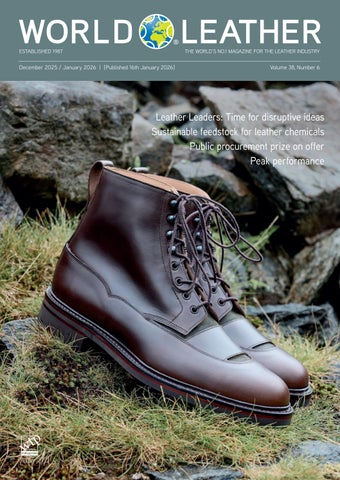
Cover image: Everest boots from Crockett & Jones. The Northampton-based company added these boots to its range following a successful project to recreate boots that mountaineer George Mallory wore on his fatal Mount Everest expedition in 1924. Full story on pages 36 and 37. CREDIT: CROCKETT & JONES
World Leather iPad edition The world’s best leather industry magazine is now available to download on iPad from www.leatherbiz.com
28
Thought Leadership: Rich rewards A new Circular Economy Act should make multibillion-euro public procurement contracts the preserve of genuinely circular materials; leather deserves its fair share.
32
Thought Leadership: Food Stronger connections with the agri-food sector will help the leather industry build up best practice in circular-economy strategies.
@WTPworldleather
Circular Stories: Data collection efforts pay off Traceability initiatives are yielding sustainability wins for companies in the leather industry.
@WTPworldleather
34 36
Circular Stories: Peak performance Explorer Hugo Turner recently completed a Himalayan ascent wearing special boots, replicas of the leather footwear that pioneer mountaineer George Mallory wore on Mount Everest 100 years ago.
linkedin.com/showcase/wtpworldleather
@WTPworldleather
Beast to Beauty 38
Anatomy and art Nigerian shoe designer Chukwuma Ekwerike is translating the natural beauty of the human form into his collections.
40
Essential reading
IBC Advertisers’ index
World Trades Publishing Ltd 2026. Contributions: The editor welcomes news items, articles and photographs for consideration and possible publication but no responsibility can be accepted for the loss or non-publication of such material. Opinions expressed by individual contributors do not necessarily reflect the view of the editor or publisher. • Whilst every effort is made to ensure accuracy in reproduction, no responsibility can be accepted for the technical content or for claims made by manufacturers for product performance that are published. Publication in World Leather cannot be construed as an endorsement for a claim or product by the publisher. • World Leather is published 6 times per year by World Trades Publishing, The Old Stone House, Teeton, Northampton NN6 8LH UK. Price UK £90, ROW: £150 per year (six issues). Graphic origination by WTP. Print by Bishops Printers, Walton Road, Portsmouth, Hampshire PO6 1TR, England. All rights reserved. ISSN 0894-3087
The World Leather team has been publishing a series of original, dynamic podcasts since 2019. The whole series is available on Anchor, Spotify, Apple Podcasts, Google Podcasts, Pocket Casts, Overcast and other podcasting platforms. Just search for the World Leather Podcast on the platform you prefer.
WORLD LEATHER SERVING THE GLOBAL LEATHER INDUSTRY
World Trades Publishing 2026: All rights reserved. No part of this publication may be reproduced, stored in a retrieval system or transmitted in any form or by any means mechanical, electronic, recording, photocopying or otherwise, without the written permission of the publisher. World Leather®, Tannery of the Year® and Nothing to Hide® are registered trademarks of World Trades Publishing Ltd.
1
The World of News UK Walsall Council has submitted a planning application to convert the Walsall Leather Museum into an assisted learning centre for students with special educational needs and disabilities (SEND). The site has housed the museum since 1988. Leather fashion designer and educator Lauren Broxton has expressed concern over the council’s plans. A petition opposing the closure has gathered more than 3,300 signatures. A decision on the planning application should come in February.
FRANCE Luxury group LVMH has introduced a new internal awards programme to celebrate “the environmental transformation” that has taken place at the 41 brands that make up the group. Winning entries at the inaugural edition included a programme at Louis Vuitton to encourage regenerative livestock practices. Louis Vuitton also won for a reuse programme through which it has made unused materials from its inventory available for other brands to use.
ETHIOPIA The Africa Leather and Leather Products Institute, in partnership with the COMESA Federation of Women in Business, has conducted a field visit to women-owned leathergoods companies in Addis Ababa. Part-funded by the Spanish government through the African Union Development Agency, the Creating Opportunities for Youth and Women in Africa programme aims to empower women- and youth-owned SMEs in Ethiopia and Zimbabwe by providing advice, connections and technical support.
2
ITALY The Italian footwear sector is showing early signs of stabilisation despite a still uncertain global macroeconomic environment, according to a business survey by the Confindustria Accessori Moda Study Centre for Assocalzaturifici. Data for the first nine months of 2025 show revenues down by 4.1% compared with the same period last year. However, the pace of decline eased significantly in the third quarter, with turnover falling by just 0.9% year on year, compared with sharper contractions in the first half of the year.
PORTUGAL Portuguese tanning industry representative body APIC will host an event on January 29 to bring a project called InLeathers to a formal close. The event will take place at the national leather museum in Portugal’s main tanning municipality, Alcanena. APIC secured funding to launch the In-Leathers project in 2023. Its objective was to promote Portuguese leather in international markets. At the Alcanena event, it will provide a review of the project and discuss what the results will mean for the country’s wider leather manufacturing strategy in the future.
SOUTH AFRICA The minister of agriculture of South Africa, John Steenhuisen, said at the end of 2025 that the country was “currently not winning” its battle to contain foot-and-mouth disease. The minister said more than 930,000 animals had been vaccinated in the previous three months. But officials said “uncontrolled animal movement” was undermining its efforts to contain the spread of the disease. During 2026, the department of agriculture will implement a strategy to vaccinate the entire national herd.
TURKEY Turkey’s leather apparel exports grew 17.2% to $226.6 million in 2025, despite a 5.3% decline in total leather and leathergoods exports, according to the Istanbul Leather and Leather Products Exporters’ Association (IDMIB). The US remains a key market, receiving one in four exported leather jackets. Talking to local media, IDMIB chairman, Guven Karaca, said high inflation and interest rates increased production costs and weakened price competitiveness. He added that exporters are seeking stabilisation in 2026 rather than rapid recovery.
EGYPT The prime minister of Egypt, Mostafa Madbouli, visited the leather manufacturing cluster at Roubiki Leather City at the end of 2025. The visit focused on a technology centre at the site, which has completed an upgrade programme. This programme also involved a €6 million grant from the Italian Agency for Development Cooperation for equipment, training and brand development.
WORLD LEATHER DECEMBER 2025/JANUARY 2026
The World of News JAPAN Japan’s Ministry of Economy, Trade and Industry supported leathersector companies to attend menswear exhibitions in Europe in January. It helped companies to exhibit at Pitti Uomo in Florence and the Man/Woman event in Paris through its New Standard Japan Leather project. One of the brands that took part, A LEATHER, said it wanted to convey globally Japan's high-quality leather and craftsmanship and to pass these techniques on to the next generation.
MEXICO This will be a year of centenary celebrations for the Cámara de la Industria del Calzado del Estado de Guanajuato (CICEG), the main industry body in Mexico’s main footwear-producing state. At the start of 2026, CICEG said it was celebrating its 100-year legacy. Predecessor organisation, the Union of Shoemakers in the city of León, formed in 1926. The history of artisan footwear manufacturing in Guanajuato, and in León in particular, goes back far longer. But CICEG said the events of 1926 marked the beginnings of “an organised shoe industry” in the region.
CHINA A series of changes to China’s tariff regime took effect on January 1. The Customs Tariff Commission of the State Council announced reduced tariffs on a total of 935 products. Countries exporting wet blue bovine hides to China will now face tariff levels of 3%, instead of the previous levels of 6%. Imports of semi-processed sheep and goat skins will also face lower tariffs now, with the levels for this material falling from 14% to 10%.
COLOMBIA Organisers of the International Footwear & Leather Show (IFLS) have confirmed that the next edition of the event will take place in Bogotá from February 3-6. Organisers said they expect 400 exhibitors and more than 10,000 visitors to attend the event. They described IFLS as having “fundamental importance” as a commercial platform for leather, leathergoods and footwear in Colombia and across the entire region.
AUSTRALIA Even before 2025 closed, Australia reported record beef exports. In a statement, red meat promotions body Meat and Livestock Australia (MLA) said beef exports were on track to exceed 1.5 million tonnes. MLA’s general manager for international markets, Andrew Cox, said that, in spite of the imposition of tariffs on Australian beef, exports to the US market were up by 17%. Shipments of beef to China are up by more than 40% year on year.
WORLD LEATHER SERVING THE GLOBAL LEATHER INDUSTRY
US The US Meat Export Federation (USMEF) has reported exports of beef from the US of just under 950,000 tonnes in the first ten months of 2025, bringing in revenues of almost $7.8 billion. USMEF said these figures represented declines of 11% in volume and of 10% in value year on year. It said, however, that excluding China from these results would make the comparison more favourable for the 2025 figures. Without China, which the tariff situation has made a much more difficult market for US beef exporters, the results would have shown falls of 3% in volume and of only 1% in value.
URUGUAY EU member states have approved the signing of a free trade agreement between the European Union and South America’s Mercosur bloc, which has its headquarters in Montevideo. This ends more than 25 years of negotiations and moves the accord to the next stage. A sufficient majority backed the deal on January 9, despite opposition led by France. The deal must still be approved by the European Parliament, with a final vote expected in April or May.
ARGENTINA Industry organisations CIC, which represents footwear manufacturers, and CIMA, which represents leathergoods producers, jointly organised a special event at the Expo Riva Schuh and Gardabags exhibitions in Italy in January. The two organisations said they wanted to showcase shoes and leathergoods from Argentina and to offer an opportunity to “connect, exchange ideas, and discover the design, quality and identity” of the footwear and leathergoods that Argentinean manufacturers produce. 3
Industry & Innovation EUDR delay confirmed he proposed delay on the implementation of the European Union Deforestation Regulation (EUDR) has cleared the final hurdle. On December 18, the Council of the European Union, which is made up of senior ministers from each of the member states, agreed to a targeted revision of EUDR. The aim of this revision is to simplify its implementation and to make sure operators, traders and authorities are adequately prepared. This will include streamlining due diligence requirements and the postponement of the application of the regulation for all operators until December 30, 2026, with “an extra six-month cushion” for smaller companies. The Council said this was in response to concerns raised by member states and stakeholders regarding the administrative burden and the readiness of the IT system necessary for EUDR to work. The revision also introduces the obligation for the European Commission to conduct a simplification review of the regulation and present a report by April 30, 2026.
T
Tapestry hits leather-sourcing targets he parent company of Coach and Kate Spade, Tapestry, has published its corporate responsibility report for 2025, outlining progress towards its goals. By weight, leather makes up more than half of raw materials used by Tapestry’s brands and is one of the key focus areas in its strategy to reduce impact on the environment. It surpassed its goal for sourcing leather from silver and gold-rated Leather Working Group (LWG) tanneries by the end of 2025, reaching 99%. In October, Tapestry’s vice-president of advanced technological development, David Wright, was elected as chairman to LWG’s executive committee to guide and support strategy setting. In FY2025, 10% of leather was sourced from farms using regenerative agriculture practices or was made with recycled inputs, reaching its 2030 goal five years early. “While this represents meaningful progress, we remain focused on maintaining this goal and driving further innovation in the leather industry,” said the company. Tapestry also met a goal of mapping and tracing 95% of raw materials by 2025. It became the first brand to commit to join the Deforestation-Free Leather Fund, with a $250,000 funding commitment to World Wildlife Fund (WWF).
T
Machinery acquisition Tanning machinery manufacturer Gemata has confirmed the addition of spraying specialist Todesco to its group. The companies said the move integrates complementary capabilities and will accelerate research and development while expanding global customer solutions. Todesco will contribute its expertise in spraying systems to Gemata’s wider finishing portfolio, strengthening the group’s position in next-generation finishing equipment. Both firms described the integration as a step that broadens technological options for manufacturers and supports a shared approach to innovation, development and international growth.
Capital, a private equity firm based in Brussels, to acquire Stahl’s wet-end division. However, in November 2025, both parties decided to step away from the deal, owing to weak market conditions. Immediately, Stahl said it would continue with the plan to separate out its wet-end business and that the divested division would run as an independent company. The new company’s main production sites and research and development activity will be in Italy and India, supported by a network of sales offices and application laboratories in different parts of the world. It starts with a team of more than 450 people.
Stahl wet-end chemicals division relaunches as Muno
New leather competence centre in Kanpur
et-end leather chemicals developer Muno formally launched on January 5. Chief executive, Xavier Ràfols, said Muno, which is the result of Stahl’s decision to spin off its wet-end division, had immediately become “a global leader in wet-end leather solutions”. He said the new company would offer the global leather sector “technical excellence, innovation and sustainability”. Stahl announced its intention to divest its wet-end chemicals division in November 2024. It said it wanted to concentrate on chemicals for leather finishing, as well as on its specialty coatings business. The original plan was for Syntagma
FL has opened a leather competence centre in Kanpur, Uttar Pradesh. The facility has been redesigned and equipped with updated technical systems, including expanded testing capability and an on-site effluent treatment plant. According to the company, this arrangement is intended to support faster and more precise development work. The centre will provide services to customers in Kanpur, Delhi, and Jalandhar. Support will cover shoe upper materials, leathergoods, upholstery and garments. Members of the TFL team will provide technical assistance there, as well as supplying its chemical products.
W
4 XX
T
Zschimmer & Schwarz opens new technical centre in Mexico eather chemicals developer Zschimmer & Schwarz has opened a new technical centre and warehouse in León, strengthening its presence in the Mexican leather industry. It said Mexico remained one of the most active regions for leather production, with rising demand for high-quality, sustainable solutions, particularly in the automotive and shoe upper segments. Zschimmer & Schwarz said the new site will support the full process from concept to production. The facility combines wet-end and finishing capabilities, with a showroom for article development and a warehouse that will serve as a local hub for products from its global production set-up.
L
Different distribution direction pecialist supplier of shaving and fleshing blades to the tanning industry Hardy UK is working to set up a new distribution channel for its products in Indonesia. This follows an internal investigation into the set-up the company had in place in that market previously. Hardy UK has told World Leather that its investigation has resulted in a clear conclusion. It said it has definitive evidence that counterfeit products disguised as genuine Hardy blades, were being delivered to some customers. It explained that genuine Hardy blades have a stamp in the metal showing the
S
WORLD LEATHER DECEMBER 2025/JANUARY 2026
Industry & Innovation brand’s name and a batch number. These were missing from the counterfeit products that came to light during the investigation in Indonesia. A forged sticker was the only means of linking the fake blades to Hardy UK. The company said this practice was unfair to customers in tanneries who believed they were buying genuine Hardy products. It added that what had happened was also detrimental to the brand.
Leather manufacturer nears netzero targets cottish Leather Group (SLG) has added a 33,000 square-metre solar panel ‘farm’, which will provide a quarter of its electricity, at its production facility in Bridge of Weir. The photovoltaic array will provide energy for all SLG companies, including Bridge of Weir Leather and Muirhead, helping to reduce their environmental impact. Dr Warren Bowden, head of innovation and sustainability at SLG, said: “Over the last two decades, SLG has continuously invested in strategic initiatives designed to optimise and improve the sustainability and circularity of our leather production. With our new solar PV array, we are taking a step forward in the self-generation of on-site clean power, as we rapidly accelerate towards achieving our target of 100% zero greenhouse gas emissions for our operations.”
S
Opportunities as alternative materials start-ups struggle he chief executive of leather manufacturing group ISA Nextgen, Uwe Hutzler, has said the group has had access to “new opportunities” in 2025 following the falling away of the production of certain alternative materials. In comments summarising the group’s activities in 2025, Mr Hutzler confirmed that it had been a challenging year owing to geopolitical uncertainty and trade tensions linked to tariffs. These challenges are unresolved. “We might see further disruptions in 2026,” he said. He went on to say that the group was committed to working out the best way to keep moving forward, adding that ISA had benefited in 2025 from paying “greater attention to sustainability and compliance in leather production”. He also said another development that had provided ISA with new opportunities was “the struggles and disappearance of so-called plant-based start-ups”. In 2021, the ISA group set up a new division it called Creation Of Sustainable Materials (COSM) to offer an alternative to plastic-based synthetics.
T
It has said this business unit complements its leather manufacturing by making sustainable materials available to brands that want to offer non-leather shoes and bags.
Emissions targets approval for PrimeAsia he Science Based Targets Initiative (SBTi) has approved emissions reductions target that leather manufacturer PrimeAsia has put in place. These targets are for the company’s near-term, long-term, and Forest, Land and Agriculture (FLAG) science-based emissions reduction targets. SBTi has been working since 2015 to help companies to set targets that are in line with climate science and with the Paris Agreement goals (to limit the global temperature increase to 1.5 °C above preindustrial levels by 2050). In PrimeAsia’s case, there are targets to achieve net-zero greenhouse gas emissions across the value chain by 2050. The leather manufacturer has also committed to reducing for scopes one and two by 63% by 2035, with 2024 as the base year. Within the same timeframe, it will aim to reduce its scope three emissions. Its nearterm FLAG targets are to a reduction of 45.5% by 2035, compared to 2024. PimeAsia also committed to no deforestation by December 31, 2025.
T
Brazil commits to innovation as export values dip ull-year figures show that Brazil exported 640,100 tonnes of hides and skins in 2025, an increase in volume of 7.1% compared to the previous year. However, in terms of value, the Brazilian leather industry suffered a decline of 9.8% in export values, with 2025 revenues reaching $1.1 billion. Tanning industry body CICB said 31.7% of the total value had come from shipments to China and Hong Kong, while the US had a share of 12.6% of the total. Italy was the third-biggest market, with a 10.8% share. Leather manufacturers in the state of Rio Grande do Sul had the greatest share of the total value with 28.6%, followed by São Paulo with 15.3% and Paraná with 14.2%. Commenting on the figures, head of market intelligence for CICB, Rogério Cunha, said: “Last year was certainly a year of complexity for our industry, with many challenges. But the whole industry is ready to keep working to the full. This includes a commitment to continue investing in new technology.” He explained that it was in the context of this commitment to innovation that the 2026 CICB Sustainability Forum will take place in Novo Hamburgo on March 4, as part of the Fimec exhibition.
F
WORLD LEATHER SERVING THE GLOBAL LEATHER INDUSTRY
Tannery to install ETP to meet buyer standards pex Tannery has announced plans to build an in-house effluent treatment plant (ETP) at its tannery in Bangladesh to meet regulatory requirements and international buyers’ environmental standards. The plan was approved at a meeting of the company’s board of directors in January. The company said it will install the ETP alongside a chrome-recovery plant and a sewerage treatment plant within its existing premises. The total investment is estimated at approximately $1 million. It wants to carry out this project to strengthen environmental compliance, meet international buyer standards and support its sustainability objectives.
A
Nike’s ‘Techleather’ naming will conflict with leather labelling laws ports footwear group Nike has launched the Tiempo Maestro football boot featuring an upper material it has branded as “Techleather”. However, the use of the word “leather” for a synthetic or engineered material will conflict with labelling laws in multiple EU member states and other key global markets. Countries with specific national legislation protecting the leather designation include Belgium, France, Germany, Italy, Portugal and Spain, where the term “leather” is legally restricted to materials derived from animal hide and processed through recognised tanning methods. Synthetic and composite materials fall outside that legal definition. Outside the EU, Brazil operates similarly strict leather protection rules, reserving the word “leather” exclusively for genuine animal derived material and prohibiting its use for synthetic or composite alternatives. Branding a non-hide material as “Techleather” will therefore place the product in direct breach of material description rules in these territories, exposing it to mandatory relabelling and regulatory enforcement.
S
Leather Conservation Centre moves he UK’s Leather Conservation Centre has completed its relocation to new bespoke studios in Leicester, supported by the Leathersellers’ Foundation and the National Lottery Heritage Fund. Established in 1978, the organisation is recognised as the leading global institution dedicated to leather conservation. Its specialists work with museums, heritage bodies and private clients on objects ranging from rare books and furniture to modern leather design pieces.
T
5
Leather scene New IULTCS president outlines approach ncoming president Geoff Holmes has outlined his approach as he begins his term leading the International Union of Leather Technologists and Chemists Societies (IULTCS). In a message to members, Mr Holmes described his appointment as an honour and stressed the responsibility involved in representing a global community of leather scientists, technologists and chemists. He reaffirmed the Union’s role in providing governance for member societies and supporting members, while promoting education, science, publications and communication across the sector. He thanked outgoing president Dr Joan Carles Castell for his leadership, with particular reference to his long-standing work with ISO and CEN leather-related committees. Mr Holmes also welcomed vice-president Dr Giancarlo Lovato and highlighted his early support, especially in relation to renewed engagement with international standardisation activities. Mr Holmes also acknowledged the contribution of secretary Dr Luis Zugno and the chairs of the Union’s commissions, noting their work on technical methods, sustainability, training, standardisation and external position statements. Looking ahead, Mr Holmes said he wants the IULTCS to remain a forum for open and rigorous scientific discussion, including the examination of challenging ideas, while maintaining its position as a trusted and forward-looking voice for leather science. His term runs until the end of 2027.
I
Pulcra role for Claus Reineking hemicals group Pulcra has confirmed Claus Reineking as its new global commercial director for leather. He has taken over the role from Ramón Segura, who retired in the autumn after more than 40 years at the group. Claus Reineking joins Pulcra from Langro-Chemie, where he had been managing director. His career in the leather industry spans more than 35 years, starting with an apprenticeship in his native Chile before he travelled to Europe at the end of the 1980s to complete the course at the Lederinstitut Geberschule in Reutlingen. After this, he worked for short spells at Smit & Zoon and Ecco Leather before spending 14 years at Clariant. He transferred to Stahl in 2014 after the Netherlands-based group acquired Clariant’s leather services business. He went on to become Stahl’s global technical director for leather before his move to Langro in 2021.
C
6 XX
Pulcra Group’s chief executive, Bernd Schalk, said Claus Reineking’s technical expertise, global outlook and executive leadership made him “the perfect fit” for this new role. For his part, Mr Reineking said his experience in the global leather sector so far had helped him form a high level of understanding of the industry from a technical and commercial perspective. “I am excited to bring this insight to Pulcra,” he said.
Gemata announce next phase of governance anning machinery manufacturer Gemata has announced a structured change in its senior leadership. Giulio Mandruzzato has been appointed chief executive officer after an extended handover, taking over from Gianni Maitan. Mr Maitan led the business for 23 years and will continue to serve as chairman of the board, supporting ongoing technology and innovation work. The company said the move is part of a long-term plan to strengthen governance and prepare for future market conditions. It added that Mr Mandruzzato will oversee the next stage of development while maintaining the focus on innovation, quality and advanced technology.
T
French leather sector hit by ‘tariff arm-wrestling’ ational industry body Alliance France Cuir has calculated a fall of 8% in the value of the French leather industry’s exports to Asia in the first ten months of 2025. It said there had been declines of 9.5% in the value of shipments to Japan, and of 7.5% in the export revenues coming into the industry during the ten-month period from sales in South Korea. Even though the reduction in China and in Hong Kong was lower, 4.6% and 5.5%, respectively, Alliance France Cuir said the figures for those markets were the most significant. It explained that the French leather sector had earned €4 billion from full-year exports to China and Hong Kong in 2024, putting those markets far in front of the US and Italy, which had full-year figures of €2.4 billion and €1.9 billion, respectively, in 2024. In the first ten months of 2025, leathergoods accounted for 85% of export value for the French leather sector in China. Footwear accounted for 12%. In 2025, Alliance France Cuir said the sector’s shipments to China had been affected by international trade tensions and domestic events. It said buyers in China had become “more prudent” about placing new orders owing to “the uncertainties
N
CREDIT: NVIDIA
Biker jacket “softened down” in Loewe interpretation ithout name-checking Jensen Huang, Madrid-based brand Loewe has included a new biker-style jacket in its spring-summer 2026 collection. Mr Huang, the chief executive of chip manufacturer Nvidia, is probably the most famous wearer of leather jackets in the world at the moment. He plays his stylishness down, frequently saying he dislikes clothes shopping and put together his biker jacket and T-shirt look years ago on the advice of his wife and daughter. In keeping with other Silicon Valley technology company leaders, he has said that he likes having an established look because it means having to spend little or no time thinking about what to wear each day. In terms of preferred brands, Mr Huang has famously played this down, too, frequently quoted as saying he prefers not to answer questions about the source of his leather jackets. Fashion and business media have identified Tom Ford jackets in his collection. Earlier in 2025, Fortune magazine said it had received confirmation from fashion experts in New York of the link to Tom Ford. Loewe says its new biker jacket is in a classic style, but “softened down in a new interpretation”. It has put “multiple, zipped pockets” into the lamb nappa jacket along with “pronounced lapels” and a buckle belt at the hem.
W
WORLD LEATHER DECEMBER 2025/JANUARY 2026
Leather scene resulting from all the tariff arm-wrestling between Beijing and Washington”. Domestically, according to Alliance France Cuir, lower sales in China were also linked to a reduction in consumer confidence there, which has its roots in the property crisis that began in 2017, followed by long covid-19 lockdowns. “This has, progressively, encouraged Chinese consumers to buy less,” it said. It quoted Alain Wang, a China expert who has taught at the Institut Français de la Mode fashion school for the last 15 years. He said: “Chinese consumers are saving their money because they are fearful of the future. China continues to have success in export markets and money is coming into the country, but the situation is precarious because of a lack of social protection.” Mr Wang said that, in times of crisis, children’s education, health and saving for retirement become the top priorities for Chinese consumers.
Council for Leather Exports announces new chairman ndia’s Council for Leather Exports (CLE) has announced the appointment of a new chairman, with Ramesh Kumar Juneja, taking over from R K Jalan. Mr Juneja brings more than four decades of experience in the leather industry and has been associated with CLE for over 15 years. He previously served as regional chairman for the eastern region and as vice-chairman from April 2024.
I
Chair change he Sustainable Leather Foundation (SLF) has confirmed the formal handover of the advisory board chair position from outgoing chair Hans van Haarst to incoming chair Reg Hankey. Mr van Haarst stepped down after more than four years in the role and more than five years of involvement with the foundation. Mr Hankey took over with immediate effect. SLF said he brings extensive industry experience and a strategic focus to the role as the organisation moves into its next phase of development.
T
wearers to use touchscreens, leathers with resistance to UV rays and machinewashable lambskin leathers for apparel. After a long career at LVMH, Ms Krug (who had started working at her family’s champagne brand before its acquisition by the Paris-based luxury group) joined Tanneries Pechdo in 2014. She became its owner and chief executive in 2017. She paid tribute to customers, suppliers and the workers at the Millau-based leather manufacturer.
First non-family CEO for Pikolinos
F
ootwear and leather manufacturing group Pikolinos has announced Francisco Sánchez as its new chief executive, a departure from the group’s family-run structure. The company produces footwear in the area around Elche and also runs its own leather finishing company, Pies Cuadrados. Its shoes sell in 60 countries around the world. Founder, Juan Perán, launched Pikolinos in 1984 and ran the company until 2016, when he handed over the reins to his children. His son, Juan Manuel Perán, took over as chief executive, while his daughters, Rosana and Carolina, also assumed leadership roles. Rosana Perán was elected president of CEC, the European footwear industry confederation, in 2023. At the start of 2026, after posting record results for three consecutive years, Pikolinos announced that it was entering a new stage of development, with Francisco Sánchez as the first person outside the Perán family to lead it. Mr Sánchez is an engineer by trade but has a track record in business transformation, with many of the projects he has worked on having links to the leathergoods sector. On taking up his new position at Pikolinos, he said: “Leading a business these days is about much more than results. It is about building organisations that have meaning, that are centred on people and on the sustainability of both the business and its surroundings.”
Beccari rises to take top LVMH role Owner “tried everything”, as tannery closes
T
he owner and chief executive of small skins leather manufacturer Tanneries Pechdo, Caroline Krug, has said she and her team “tried everything” to keep the business running, but that its closure in mid-November had become inevitable. Ms Krug described Tanneries Pechdo as the last remaining manufacturer of technical leathers in Europe. Its product portfolio included gloving leathers that allowed
VMH Fashion Group’s CEO and chairman Sidney Toledano is stepping down, and will be replaced by Pietro Beccari. Mr Beccari joined LVMH as executive vicepresident of marketing and communications for Louis Vuitton before becoming chairman and CEO of Fendi in 2012. In 2018, he became chairman and CEO of Christian Dior Couture, and chairman and CEO of Louis Vuitton in 2023, a role he will retain.
L
WORLD LEATHER SERVING THE GLOBAL LEATHER INDUSTRY
Focus on “full look” for Chanel uxury brand Chanel hosted its first New York fashion show in seven years at the start of December, with the emphasis firmly on ready-to-wear. President of Chanel fashion, Bruno Pavlovsky, told the Wall Street Journal that business was “better than ever”. Chanel posted full-year revenues of $18.7 billion in 2024, a fall of 4.3% compared to the previous year. It appointed Matthieu Blazy as its new artistic director. He took up the role, arriving from Bottega Veneta, in April. The New York presentation in December was his second runway collection for Chanel. Bruno Pavlosky said clothes designed by Mr Blazy would now be more prominent in Chanel stores. Mr Pavlovsky said he wanted to promote a “full-look approach” and for ready-to-wear to become easier for shoppers to find. “I do not need to sell more bags,” the president of Chanel fashion told the WSJ. “I am not trying to become a bag company. We are a fashion company.”
L
Native American leader links EUDR to colonialism senior representative of native American peoples has described the European Union Deforestation Regulation (EUDR) as “a new spin on colonialism”. Tribal chair of the Cow Creek band of the Umpqua people, Carla Keene, recently shared her views on EUDR in an opinion piece in the Wall Street Journal. She welcomed the December announcement confirming a new one-year delay in the implementation of EUDR, but said the delay laid bare the truth that EU lawmakers “understand that the law is flawed”. According to Ms Keene, EUDR’s “complex traceability rules are incompatible with real-world supply chains”. She expressed hope that the review of EUDR which the European Commission must complete by April will identify “avenues for simplification” and provide “an opportunity to correct course”. She said this was important to her because her people have been managing forests in what is now Oregon for many generations. She said the EU was using its global influence to exert control over other people’s lands and to “project its values, assumptions and expectations on the rest of the world”. She said EUDR was based on “the flawed premise that Europeans know what’s best for the rest of us”.
A
7
Backtrack World Leather’s publishing cycle and limitations on space make it impossible for us to run more than a carefully selected sample of news from across the industry. However, we publish hundreds more stories on leatherbiz.com. The site is updated every day with news from every continent and every part of the industry, making leatherbiz.com one of the most comprehensive archives of news anywhere on the web for the global leather industry.
We list below just a few of the headlines that have appeared on the site in recent weeks and can still be accessed. 14 January 2026
12 December 2025
02 December 2025
Grenson gains golden glow
In terms of tonnes, leather exports show an increase for Brazil COTANCE supports updated action plan for the European tanning industry Relatively Iconic: Levi’s reissues Einstein’s Menlo Cossack jacket
China: contractions continue for leathergoods and garments Capri completes Versace sale
13 January 2026 Japan celebration for Loewe
12 January 2026 Connecticut furniture firm prepares for IPO as prospects improve Record annual sales for BMW brand
08 January 2026 Brazil overtakes US as world’s largest beef producer European car market reports modest growth
07 January 2026 Leathergoods start-up’s ‘remarkable’ rise towards a value of €1 billion Buckman raises prices citing cost pressures
05 January 2026 APICCAPS sets out plea for conscious consumption
02 January 2026 Beijing opening for Dior celebrates LVMH’s ties to China
19 December 2025 Mercosur-EU agreement sign-off postponed Yuzefi slides into footwear French leather exports down slightly
18 December 2025 Changsha store redeveloped by Hermès China crisis leaves US beef exports at their lowest since 2020
17 December 2025 Prada responds to backlash with Kolhapuri collaboration Falls in leather footwear imports continue in China Global economies show growing emissions decoupling Kering raises another $690 million from property deal
16 December 2025 Tannery exports increase in Portugal during 2025
15 December 2025 No October relief for tanning sector in China AllSaints: Long live leather
8 XX
11 December 2025 ‘Made in Paris’ honour for leathergoods brand EU ‘Environmental Omnibus’ package still too vague, VDA says Teesside University leads Roman leather economy study Argentineans and Vietnamese pledge greater cooperation
10 December 2025 China’s exports of new-energy passenger vehicles are up by 80%
09 December 2025 Applications open for internships and apprenticeships at Tapestry Caleres concentrates on unlocking value in Weitzman Modern leathers conservation project seeks industry contributions
08 December 2025 Management shake-up continues at Burberry Surplus leather event in Paris open to all
05 December 2025 Bangladesh event under way Biggest leather manufacturing group has been years in the making Polène opens Beijing flagship with upcycled leather interior
01 December 2025 Vivolo’s design competition expands Permanent contract at Louis Vuitton on offer for student competition winner A case for celebration for Prince Albert II
28 November 2025 Falls continue for footwear sector in China Ethiopia plans raw hide export ban to support tanneries
27 November 2025 Footwear firm welcomes free apprenticeship proposal Nine-month figures confirm ongoing falls for China’s leather sector Portugal sets out its stall as ‘most modern’ footwear-making destination
26 November 2025 Huge majority in European Parliament votes to make EUDR simpler New initiative will show Pangea leather comes from ethical sources JBS sets out plan to form global leather group with Viva SLTC confirms details for 128th International Conference in Glasgow
25 November 2025 Belgian store reopens for Hermès Chinese leathergoods group aims to segue into semiconductors
24 November 2025
Car interiors imitate art The state of Para in Brazil extends cattle tracking deadline to 2033
Western revival good news for leather boots UNIDO supports access to childcare in Ethiopia’s leather sector Mulberry named Responsible Accessories Brand at Future Icon Awards Tyson announces Nebraska plant closure
03 December 2025
21 November 2025
University group visits Bader Tariffs push India’s leather sector to return to Russia Kering study finds gaps in Asia Pacific water strategies The North Face debuts leather-based capsule
EU countries back one-year pause on EUDR Modest growth in second quarter for La-Z-Boy Tariff pressures shape first half results and strategy for Dr Martens Staffordshire graduate scoops Furniture Makers’ Leather Prize
04 December 2025
WORLD LEATHER DECEMBER 2025/JANUARY 2026
BEAUTIFUL DURABLE RENEWABLE Advertise in World Leather & leatherbiz.com to promote your latest products and innovations to a readership of over 5,500 worldwide. For more information: matthew@worldtrades.co.uk
Leather Leaders: Dr Joan Carles Castell
Outgoing IULTCS president, Dr Joan Carles Castell, at the XXXVIII IULTCS Congress in 2025. CREDIT: IULTCS
Time for disruptive ideas The outgoing president of the International Union of Leather Technologists and Chemists Societies (IULTCS) reflects on a long career in the leather industry and shares his hopes for sector’s future. What are the memories that you will take with you after two years as president of IULTCS? Becoming president of IULTCS was the pinnacle of what has been a long career, but I don’t want to remember just these two years. I was an active member of the Spanish leather chemists’ association (AQEIC) for many years and I became part of the IULTCS leadership team in 2018 when I became head of its chemicals commission, the IUC. Of course, it has been a source of great pride to bring my professional career to a close by becoming president. It has made it possible for me to meet a large number of scientists, from all parts of the world, who are completely committed to the leather sector. And I am happy to say I have been able to form great friendships with many of these people. The thing is that, in IULTCS, working as part of a team is essential. It is a union of associations. It is a network in which people share not only their scientific and technical knowledge, but also their passion for this industry and their commitment to passing on the science behind it. They are people who love their work and love taking on new challenges. Benefits I have taken from this include a broadening of my own horizons, in terms of my knowledge of leather technology, the chemistry we apply to it, the way we use water, the importance of the environment and sustainability. When you take part in debates and discussions with your colleagues, it opens you 10
up to perspectives that are beyond your day-to-day work tasks. This is supremely enriching as a technician and, much more than that, in a personal capacity. What would be a summary of your career in the leather industry? Well, it has been 51 years. It started in 1974. When I left school, I joined Ciba-Geigy in Barcelona. I was only 17, but I was able to complete my studies with the company and even do military service, which was obligatory then. When I went back to the company, I took up a role that involved looking after its customers in Spain. Then, in 1992, the company asked me to move to its headquarters in Basel to take up a global product manager role for leather dyeing. I did that for three years and was there when the work started on setting up TFL. The leather division of Ciba-Geigy was an important part of this, merging with the leather businesses of Röhm and Stockhausen, bringing them ‘together for leather’ (TFL) in 1996. My role was to go to Mexico and establish TFL’s business there, in León, Guanajuato. I went in 1995 to set things up and we launched in 1996. I was there for around five years. In 2000, the company asked me to go back to Basel, or to be more exact to Weil am Rhein on the German side of the border. I took up a vice-president role, with responsibility for the whole of the Americas, from the US to WORLD LEATHER DECEMBER 2025/ JANUARY 2026
Time for disruptive ideas
Argentina. Then, in 2004, when the ownership of TFL changed, I asked for a change, mostly for family reasons. I thought it would be best to be based in the US. Instead, the company suggested a move to Spain to carry out my existing role from there and to run TFL’s business in Spain too. I did this for two years before taking up a research role in Igualada at a centre called AIICA. While I was involved at AIICA, I became chairman of the IUC, the chemicals commission of IULTCS. The whole sector in Spain went into something of a crisis after the global financial crash of 2008 and 2009. In 2012, AIICA closed, making way for what is now Igualada’s A3 Leather Innovation Centre. What came up for me at that time was a proposal to work on a project with US biotech company Proviera. The Proviera team had decided to start making products for the leather industry and needed someone to advise them. In the end, I stayed with the company until retiring around three years ago. This included the period from 2016 to 2022 when Stahl had the distribution rights for Proviera’s Probiotics for Leather range, so during those years I was officially working for Stahl, but still on the Proviera project. Following my retirement I have continued to do some consultancy for Proviera and I also have some contact with students in different parts of the world. What has this work with students prompted you to think about the relationship between the leather industry and education, about how to bring new generations of professionals into the industry? I think I am probably at an age now at which it is difficult for me to understand the values that drive the professional aspirations of young people. What I do understand is that leather was, is and always will be leather. Students I have been working with include young people at the University of Jiaxing in China, as well as students on the Green Leather Managers course that runs in Arzignano. I have also given presentations in Colombia and Mexico. I often start by asking them what they think leather is. Bear in mind that they have all set out already to learn about leather with a view to working in the industry. Practically every student gives a different answer. All of these answers are correct, but I would say they fall into three categories: leather as a material, leather as a science and leather as a concept. Please explain these three categories in more detail. The first one is based on the dictionary definition of leather: the hide or skin of an animal that undergoes treatment to make it resistant, flexible and long-lasting. Some of the students say this. Others describe leather as a material for making shoes or bags and so on. Those who talk of leather as a science refer to specific technologies or specific properties of leather: its resistance, biodegradability, compostability, its biogenic carbon content, its chemical composition and everything else that companies might list among their research and development objectives. Then, those that talk about leather as a concept mention lots of things: passion, nobility, art, fashion, history, economy, the circular economy, jobs and the environment. It seems to me that our efforts to help young people to understand the industry and persuade them to join it should include a combination of all three of these dimensions. We need all three to be able to define what leather is. This is the way to project the past towards a future in which there is a place for innovative and even disruptive visions. WORLD LEATHER SERVING THE GLOBAL LEATHER INDUSTRY
“ We have to open up our horizons. We have to tear up the old ways of thinking and look for other lines of business.
”
What is the best way to encourage younger leather science professionals to take an interest in IULTCS and commit to the organisation? If the new generations understand leather, they will realise how important it is to share their knowledge and experience. They can do this first through their local industry associations and, then, by being open to international collaboration, for which IULTCS is such a solid platform. But IULTCS has to carry out its role working hand in hand with the organisations that represent leather manufacturers. It seems to me that in recent years there has been a lack of clarity on this. IULTCS and its member organisations do not exist to represent leather chemists and technologists the way a trade union might. We are purely scientific organisations. We are there to work for the leather manufacturers. I reminded delegates about this at the recent XXXVIII IULTCS Congress in Lyon. Tanners have to make use of us and take benefit from our work. That’s why this co-ordination is so important. This is how you achieve synergy. Benefits are almost guaranteed when we work together. One of your predecessors as IULTCS president, Dr Luis Zugno, said recently that if the leather industry were to give up on what he called “basic research”, the industry’s days would be over. What do you think he meant by “basic research”? I cannot help but share Dr Zugno’s concerns. He is still the secretary of IULTCS and we have regular discussions about ideas and worries that we share. What I would say is that “basic research” is research that our people carry out separately from the interests of the industry, away from the day-to-day pressures. Its purpose is to build up our knowledge, based on science, and in an across-the-board way. What I mean is it includes advances in new sciences. Last century, chemistry, biology and physics were the basis for the development of the leather industry. Now, nanotechnology, biotechnology, and many others, are a regular part of research and development projects in universities and technology centres too. Do you understand why Dr Zugno fears that those practices may be lost? What is happening inside our companies that is holding people back or preventing them from carrying out “basic research”? My fear is not that these practices will come to an end, but that they will become disconnected from the business side. Now more than ever, businesses seem to focus on the short term. There is no shortage of “basic research”. Companies should make sure they bring technicians and scientists into the business to integrate new knowledge into the value chain. This will help companies continue to make progress in the face of the continuous challenges that will come their way. The success of this industry has always been based not just
11
Time for disruptive ideas
on the business side, but also on our ability to apply the knowledge we have been able to build up through this “basic research”. It is important not to lose this. Perhaps the point about there being no shortage of research is borne out by the programme at the XXXVIII IULTCS Congress in September, with 50 oral presentations and 70 poster presentations. What were the common themes that seemed to you to come out of all the research that had gone into these papers? Which are the themes that you hope learn more and hear more about in the next few years? I would divide them into three categories, but without putting them into any sort of hierarchy of importance. Each of them offers its own solutions to the challenges that the industry faces at this time. We heard presentations that you could put into a ‘process improvement’ category. These addressed restricted chemical substances, alternative tanning methods, environmental and sustainability questions. Some of these papers described new alternative products, ones with fewer contaminants, ones that recover waste material and recycle it. A second category we could call ‘innovation’. I would put alternatives to current leather production processes in this category, from the beamhouse to finishing, and also effluent treatment. The other category is ‘disruptive technology’. Here, the ideas that we heard at the congress had the aim of helping tanners open up new markets. They can be not only suppliers of leather, but also of protein products such as collagen and keratin, transforming them from waste material into sub-products of the leather manufacturing process that can have a high commercial value. The success of the XXXVIII IULTCS Congress was that it was able to address these questions at these three levels with well-founded proposals presented by great experts from universities, technology and research centres, leather chemicals and tanning machinery developers, and tanners. Taking on board entirely that you don’t want to put these three categories into any order of preference, it seems that ‘disruptive technology’ may be one that attracts the greatest attention of leather manufacturers. Dr Dietrich Tegtmeyer devoted his contribution to the congress to this in the prestigious Heinemann Lecture. What reaction has IULTCS had to what Dr Tegtmeyer said and to the idea of ‘disruptive technology’ in general? Yes, what Dietrich and a number of other speakers said at the congress was in line with what I am talking about. Disruptive could mean carrying out new activities or finding new business streams. This is a mission I have been working on for some time, actually. Let’s leave lifecycle assessment aside for now because it would make my explanation more complicated. But we could use mass balance as a starting point. Let’s say we reuse a by-product, for example a tonne of hides produced by the meat industry, but are only able to produce 250 kilos of leather from it, and this only after adding half a tonne of chemicals. This would mean that, to save one tonne of material from going to waste, we would be generating 1.25 tonnes of waste ourselves. You can see from this that this argument leaves us with plenty of work to do. How can we reduce this volume of waste? It is material that is rich in protein; proteins such as collagen are in demand in the market. We need to rethink this and treat this material not
12
Disruptive ideas can help tanners can open up new markets. They can transform waste material from the tanning process into secondary products with commercial value. CREDIT: SHUTTERSTOCK/HATICE BAKCEPINAR
as waste but as a by-product. The idea that I think Dietrich was driving at is that, yes, tanners produce leather. Fine. But they can also become involved in other lines of business, such as the collagen business or the manufacture of capsules for prescription drugs. Dietrich even suggested that tanners could become involved in the manufacture of prosthesis products from collagen, which would be another interesting medical application. We have seen some very interesting ideas along these lines in research published in the journal Collagen and Leather, co-sponsored by Sichuan University and the China Leather Industry Association. We have to open up our horizons. We have to tear up the old ways of thinking and look for other lines of business. What have the tanners that you know said to you in response to this? Well, there is certainly movement in the market. If you go to China, and I have been going there for many years now, you notice now that everyone who is running a beamhouse operation there is putting collagen to one side in a pile. They already view it as a secondary product. In Colombia it is very common for leather manufacturers also to produce pet toys from leftover materials. These are markets that tanners can and must make more of. In the first place, this is because the need to reduce waste from the tanning process is real. At the same time, there is, clearly, real commercial value in putting that material to use. The market for leather has always suffered ups and downs. This last period has certainly been one in which the market has not been very buoyant. But, in 51 years in this industry, I would have to say, jokingly, that I have yet to see a year in which the leather industry was not “in crisis”, according to tanners. I think this is something that is in tanners’ DNA. Business cycles today are much shorter than they were 50 years ago. Fifty years ago, we would see three very good years, then a middling one, then three bad years. Cycles now are much shorter. But tanners should not WORLD LEATHER DECEMBER 2025/ JANUARY 2026
NTE_WorldLeatherAds.pdf
3
2025/06/24
09:42
A symphony of
NATURAL LEATHER SOLUTIONS Since 1920, NTE Mimosa has used wattle mimosa to create a comprehensive range of sustainable, environmentally-friendly tanning products for the world’s finest leather. C
M
Y
CM
MY
CY
CMY
K
Time for disruptive ideas
be wholly dependent on the ups and downs of the leather market. They have to develop these new markets, too, with a material that we can extract from our raw material. Do you think the IULTCS congress format should include more digital or online elements to make it easier for members to take part? What pros and cons do you see in that? What I envisage is that in-person events should continue to be the priority. The IULTCS Congress is about more than listening to presentations or viewing poster displays that explain new research ideas. It is also about strengthening our personal ties to one another. In this way, we open up possibilities for new discussions and new collaborations. The social aspect of an event like the IULTCS Congress is fundamental. It is also a good thing to use digital media tools to widen access to the content afterwards. Many of the presentations from the XXXVIII congress were available on the IULTCS website within a few weeks. This is important. But it does not take away from the importance of the social contact that an in-person event makes possible. It might just be an exchange of business cards. It might be sitting down to have dinner together. These are the things that bring about the best type of collaboration. What are the main reasons to be optimistic about the next IULTCS Congress, which will take place in 2027 in León, Mexico? I strongly encourage people from all parts of the industry to travel to León to take part. It is a place I know well, having worked there for five years. I was very much in favour of having León as the host city. We have already had one IULTCS Congress in Mexico, in 2003, but it took place in Cancún. I said to the organisers that it should be in León this time, first because venues like Cancún are very expensive. Secondly, though, I want the leather technology community to see León. I want them to have the opportunity to visit the technology centre there and to spend time in some of the highly developed, modern tanneries that are operating in León. They will be able to hear interesting presentations, enjoy the social contact and, in addition, spend time in a city in which you breathe in leather with the air. Going back to Lyon, you spoke at the congress there about the importance of greater recognition of the sustainability credentials of leather among authorities, NGOs, influencers, consumers and so on. Nevertheless, even in recent weeks we have, once again, had to see and put up with comments on LinkedIn that do the opposite. In this case, the comments were from a brand of expensive, vegan accessories based in Bergamo. The founder included a photo of the notorious tanning pits in Morocco with her post. We assume this was to show leather in the worst possible light in comparison to the synthetic materials she uses in her products. It often looks as if there is no way to convince some people of the positive qualities of leather, in spite of all the effort that has gone into forming coherent, science-based arguments to demonstrate those qualities. What effect does this have on the scientific community that dedicates itself to working in the leather sector? What would you say to the brand in Bergamo?
WORLD LEATHER SERVING THE GLOBAL LEATHER INDUSTRY
In the first place, I must mention that around 15 years ago, while I was working at AIICA in Igualada, the European Union invited us to take part in a project with Morocco’s industry ministry to help improve the conditions at the tanneries in Fez. But the ministry of tourism intervened immediately to make it clear that we were absolutely forbidden from making any changes to those famous tanning pits. They are a very popular and valuable tourist attraction, you see. It is clear that some commentators and advertisers are confusing pure tourism with what the industry really looks like. That aside, the only thing I would say is that the only good alternative to a piece of leather is a different piece of leather. Don’t scientists become disappointed if science-based arguments fail to convince people, though? We cannot control what people see or say on social media. We have to focus on what we can do. Leather, if we make it well, can stand up to any criticism. The peptide bond, which is to say the bond between two proteins, combined with the structure of collagen, delivers levels of resistance and breathability that make leather unique as a material. And it is a material that nature gives to us; we could not have created it. Which other material can deliver the same versatility or the amazing light weights that you can achieve? Obviously you can look back now at the way things used to work and see that some of the practices would no longer be acceptable today. You can look at the reports we have of the first IULTCS congresses and see that a majority of the presentations prioritised productivity gains, without any consideration for environmental impact, clean working conditions, worker or consumer safety. This wasn’t by mistake or by omission. It is just that science, technology and society in general have come up with new knowledge and new practices, some out of necessity, others as a consequence of research and development. New materials, whether synthetic or not, whether they are labelled as ‘vegan’ or have some other special marketing label to attract consumers, are not a threat, it seems to me, but a challenge, an incentive to show that leather is a material beyond compare. For the scientific community working in the leather sector, all of this is an incentive to keep finding ways to improve leather production processes. This includes finding ways to improve waste management and to reduce environmental impact. We have to have the conviction that we have done things well, and continue to do so, but also that we can still do even more to improve. If, on leaving the presidency of IULTCS, you now regain some time, to what will you devote it? Thank you for making the last question the easiest to answer. Family has always been my biggest priority, in spite of time pressures, work concerns and time away because of business travel commitments. I am happy to have been able to contribute to this industry for 51 years. The industry made it possible for me to look after my family and provide them with a good education, good healthcare and so on. No matter how much or how little time I have, this is my main vocation. Nevertheless, for as long as I am able to, I still intend to dedicate some time to the leather industry. My hope is that the knowledge and experience I have built up over all these years can still bring some benefits to others.
15
Technology
Bio-based polymeric auxiliaries from lignocellulose Eric Kientz, Volker Rabe, Jens Fennen, Biju Francis TFL Ledertechnik GmbH At the May 2025 FILK Leather Days in Freiberg, TFL unveiled new research into using lignocellulose as a sustainable feedstock for leather auxiliaries. Derived from plant biomass, lignocellulose offers an alternative to fossil-based polymers and can be transformed into functional agents such as dispersants, retanning products and softeners. The work shows how bio-based chemistry can raise leather’s biogenic content while supporting a more circular production model.
C
hemical auxiliaries play a vital role in industrial leather processing. From tanning to retanning and finishing, the products used, especially in the field of polymers, are still largely of petrochemical origin. At the same time, the demand for bio-based alternatives is growing, not only for ecological reasons but also to complement leather, a natural product, within a closed-loop material cycle. Lignocellulose, a plant-based composite made of cellulose, hemicellulose, and lignin and occurring in vast natural quantities, is a particularly promising raw material for developing such products. Current efforts aim to derive functional polymeric auxiliaries for the leather industry from these components, contributing to decarbonisation.
Motivation In the context of sustainability and carbon footprint, the biogenic content of leather products is gaining importance. Finished leather typically consists of 60-75% collagen, with the remaining 25-40% made up of bound chemical auxiliaries (Fig.1).
The origin of these chemicals, either fossil-based or biobased, directly influences the biogenic content of the leather. Replacing fossil polymers with bio-based polymers, especially in retanning, offers a means to significantly increase the bio content of leather. Potential Raw Material Base Ideally, bio-based leather chemicals are derived from renewable, plant-based raw materials – the main component of the so-called global “bio-pool” – which consists of over 80% plant biomass. Cellulose, hemicellulose, and lignin are the dominant constituents by volume. Sugars, starches, proteins, and vegetable oils also contribute to this pool (named in Fig.2 as food); the latter are already in use as fillers or fatliquors in leather processing. Cellulose and lignin, however, remain largely untapped, despite their abundance and the advantage of not competing with food production. Their strategic utilisation offers significant potential to replace fossil resources in leather chemistry.
5&$-(&2
!(&)*!$#+
823945
643725
Figure 1: Mass balance of leather and original chemicals
+$#6"++*#
!"#$ %"& '()-'*+,-
.*" !"##$%&'
7"##$%&' 7(&)*!$#
16
,!(&)$-*! )$++ .$#$'!& ./ 0&*%(- $'1 !(&)*+-2/ 3!"#$% &#'(!) *+,&#-. /. -!$01! #2* #-%0$'!4
6"++*#8.$+&1 .*"-.$+&1
WORLD LEATHER DECEMBER 2025 / JANUARY 2026
Bio-based Bio-basedpolymeric polymericauxiliaries auxiliariesfrom fromlignocellulose lignocellulose
Figure 2: Possible bio-pool for bio-based leather chemicals
!"##$#%&"
Nonetheless, chemical processes can unlock these components and make them usable as raw materials for leather chemicals. Industrial fractionation – access to functional components Two established industrial processes are used to separate lignin and cellulose (Fig.3):
+",(."##$#%&"
• Sulfite process (10-15% market share): produces lignosulfonate, a water-soluble lignin derivative that can be used directly as an auxiliary in leather production.
#$!%)&'
• Kraft process (85-90%): yields kraft lignin, which is waterinsoluble and must be chemically modified prior to use.
'()*(*
!"#$%& #"*'
*!)&' #$,' #$()&'
#$%+'
&'()*+%'
#$%&'
Bio-based origin
!"#$%&
'($)*
/%%0
+#,%-.*#
/$*)( !"#$%
#$!' #$
#$*0#"&
Lignocellulose as a technical feedstock Lignocellulose is a plant-based feedstock found primarily in wood, grasses, and straw – essentially residues and byproducts from agriculture and forestry. Structurally, lignocellulose is comparable to a modern composite material: cellulose provides tensile and bending strength, while lignin contributes compressive strength, much like reinforced concrete, where cellulose is the "steel" and lignin the "concrete". The dense structure protects plant cells from microbial attack but also makes it difficult to separate the individual components, creating a challenge for industrial processing.
These processes provide access to three potential biobased resources: lignosulfonate, kraft lignin, and cellulose. All are viable sources for bio-based leather auxiliaries. Lignosulfonate Lignosulfonates have long been used in the leather industry, primarily as dispersing agents for vegetable tanning agents, as they do not possess tanning activity themselves. Their properties, especially colour and molecular size, can vary depending on the raw material and process. The filling effect on leather is generally low, though higher molecular variants may offer slightly better filling properties than low molecular ones. Kraft lignin Kraft lignin is water-insoluble and requires targeted chemical transformation for use in the leather industry. Two main approaches are available: • Co-condensation with aromatic substances (e.g., phenolsulfonic acid) results in a soluble, partially biobased syntan with tanning effect.1 • Depolymerisation yields substituted phenols, which are subsequently condensed to form a bio-based syntan, producing leather with a shrinkage temperature of up to 80°C.2
Figure 3: Separation of
;
lignocellulose components
./012345$6734158$9:;54<5=)$>?$9?$52$:<?)$ @:2?$AB54C= !)$%,(!%$D!(%,E
!"#$%&'"()*++ 9*:#6789: ;
!/.$#%*&5"()*++ 9*:#<:8<7 ; 6(78)+0/3)8*4,
12*3456(78(8
!"!"
!"!" !"!"
.,//0/)+,
!"!" !"!"
!"!"
!"!"
1(./0.*&23#%*"4 WORLD LEATHER SERVING THE GLOBAL LEATHER INDUSTRY
,-+(./0.*
,-+(./0.* 17
Bio-based polymeric auxiliaries from lignocellulose
Figure 4: Synthesis of various biopolymers starting from cellulose
.,//0/)+,
!" #$%& '" ()*+,+$-./0- $-01 2" 3+*.-4*$, 506. $1745/8.9/
095+*4:*.
!" ;.<+*=8.,05$/0+9
=/09)+, F
F !" >.,8.9/$/0+9?@3+9+8.,?A" '" B+*=8.,05$/0+9
=#>-(5#. '/"* ?
!" >.,8.9/$/0+9?@3+9+8.,?C" '" B+*=8.,05$/0+9
=#>-(5#. '/"*&@
Both approaches demonstrate the potential of kraft lignin for bio-based leather chemicals with tanning properties. However, the latter process remains complex, posing a barrier to widespread industrial implementation. Cellulose Cellulose is water-insoluble and must be modified to become functional. Three distinct process routes allow the creation of functional biopolymers with tailored properties (Fig.4). 1. Chemical modification: a multi-step process involving alkaline pretreatment with NaOH, followed by esterification with chloroacetic acid and subsequent molecular size adjustment. It resulted in a retanning biopolymer Magnopal Pure A 3 (biogenic content 93%, calculated according to DIN EN 16785-2).4 2. Biotechnological approach: in a bioreactor, cellulose is first depolymerised into glucose, which is then fermented into the wellcharacterised Monomer A. This monomer can subsequently be
A*B(%#- C''
polymerised into Magnopal Pure B (biogenic content: 71%). 3. Alternative fermentation: glucose is fermented into a different Monomer B, which is polymerised into a functional polymer softener (Levotan HPP). Currently, Monomer B is fossilbased, but a switch to the bio-based alternative is technically feasible. This would increase the biogenic content from the actual 18% to 73%. When applied in leather processing, the three different polymers reveal distinctly different performance profiles (Fig.5): • Magnopal Pure A significantly improves grain tightness while also contributing to fullness. • Magnopal Pure B excels in enhancing fullness, offering moderate improvements in grain tightness and softness. • Levotan HPP delivers excellent softness, accompanied by moderate effects on fullness. Besides that, it has an extremely high heat yellowing fastness.5
Figure 5: Performance of the bio polymers in the retanning of leather <>?<@@<A)
'"":
3J(
@,(&'(.HI*"&,-&"*%#--,->
;":<%=)<
=#>-(5#. 1%FG '/"*&? '(.HI*"
=#>-(5#. 1%FG '/"*&@ '(.HI*"
A*B(%#C''
1%FG&'(.HI*" 1($%*-*"
L,>M%-*++ N/..-*++ 1($%-*++ @,(E0#+*F )(-%*-%
9D;
:;
!"#$%%$&'()*+,'&$--
18
K<;
:;
!"#$%%$&'(./%%&$--
<6;& '(++O&KD;
:;
!"#$%%$&'(012'&$--
This complementary behaviour of the three commercial products allows these biopolymers to be combined in a targeted manner to achieve tailor-made leather properties, tailored to specific requirements in terms of tightness, fullness and softness. As a result of this innovative approach, the accessibility of cellulose has been enhanced as a biological raw material for various products across multiple applications. Two of these products have been integrated into the TFL Pure Range, and a potential candidate for future development has been identified. Summary The biogenic content of leather depends largely on the origin of the chemical auxiliaries used. Lignocellulose, derived from plant biomass, offers a diverse platform for sustainable polymers. Through two different processes, lignocellulose is converted into the raw materials lignosulfonate, kraft lignin, and cellulose, which can be transformed into functional leather auxiliaries. These fulfil essential roles, from dispersing agents to improving tightness, fullness, softness, and tanning performance. Cellulose, in particular, makes it possible to develop a wide range of leather auxiliaries with tailored performance profiles that work seamlessly together. In a closed-loop concept, bio-based auxiliaries and the natural material leather create a strong symbiosis, supporting a resourceefficient and forward-looking leather industry. References 1. Patent M.A. Yujie et al., EP3679078B1 (2017) 2. O.Suparno et al, J.Chem Technol Biotechnol 80, 44-49, (2005) 3. Patent: TFL AG, EP 3 257 955 B1 (2016) 4. All given Biobased contents are calculated according to DIN EN 16785-2 5. E.Kientz, R.Ampuero, World Leather, June /July 2025 page 22. Pure Range is a product portfolio from TFL comprising all products with a bio content > 50%. Pure, Magnopal and Levotan are registered trademarks of TFL.
WORLD LEATHER DECEMBER 2025 / JANUARY 2026
Technology CREDIT: SHUTTERSTOCK.COM
Leather secures its bio-based status At the 2025 IULTCS conference, Dr Gustavo Adrián Defeo, director of CTC Ars Tinctoria, spoke about the work of CEN Technical Committee 411 (CEN/TC 411), which is developing European standards for bio-based products. His central message was clear: leather has a rightful place among bio-based materials, not only because of its natural origins but also because of the transparency and circularity it can demonstrate.
F
or more than five years, Dr Defeo has been working on the question of bio-based content in leather and socalled leather alternatives. His research has consistently shown that leather is one of the most circular materials available, especially when compared with the linear model of fossil-based synthetics. Bio-based materials, he explained, are defined in European standards as those wholly or partially derived from biological resources, such as plants, animals, or microorganisms. Leather therefore qualifies naturally, and recent work within CEN/TC 411 will soon formalise this status. Fighting greenwashing with standards Dr Defeo stressed that the committee’s mission is not just technical. “The most important thing,” he said, “is how we communicate this information.” Transparency, comparability, and the fight against greenwashing are central to CEN/TC 411’s work. This is particularly relevant at a time when the market is flooded with “miraculous” materials made from mycelium, cactus, apple waste, and other novel feedstocks which claim to be like leather. These products are often presented as sustainable alternatives, but analysis shows that many contain high proportions of fossil-based polymers and do not necessarily meet the performance characteristics of leather.
20
To avoid misleading claims, CEN/TC 411 has established a suite of standards that cover definitions, sustainability criteria, testing methods, and communication tools. Among the most significant are: EN 16575
Vocabulary for bio-based products.
EN 16640
Determination of bio-based carbon content by radiocarbon analysis.
EN 16751
Sustainability criteria, including socioeconomic impacts of biomass production.
EN 16785-1 and -2
Bio-based content determination, considering carbon, hydrogen, oxygen, nitrogen, and sulphur.
EN 16935
Requirements for communication to consumers (B2C).
EN 16848
Requirements for communication between businesses (B2B).
When Dr Defeo first joined CEN/TC 411, most participants were from sectors such as biodiesel and bioplastics. Many doubted that leather belonged in the discussion. But, as he pointed out, leather was in fact the first bio-based material developed by mankind. After several years of work, the committee agreed to officially include leather in the new EN16640 version for bio-carbon quantification.
WORLD LEATHER DECEMBER 2025 / JANUARY 2026
Leather secures its bio-based status
Bio-based products standardisation Central to his presentation was EN 16848, the B2B communication standard. This requires suppliers of biobased materials to provide a fixed set of information in a standardised format, making it easier for buyers to compare options and assess sustainability claims. The mandatory fields include: Biomass type – animal, plant, microbial, etc. Geographical origin – ensuring traceability and accounting for socio-economic impact. Bio-based content – both bio-carbon (radiocarbon) and total biomass share. End-of-life options – covering recycling, composting, biodegradation, energy recovery, and disposal. Additional information – other certifications and life cycle assessments (LCA). Dr Defeo also mentioned that LCA, while important, should come after these core indicators. If an LCA is considered in isolation, it can produce paradoxical results, appearing to favour materials with lower immediate impact but greater long-term environmental harm. Leather in practice Drawing on recent work with a consortium of Italian vegetable tanners, Dr Defeo presented an example EN 16848 data sheet for vegetable-tanned leather. The document set out the origins of the raw material – bovine hides from France – and the tanning inputs: quebracho extract from Argentina and chestnut extract from Piedmont, Italy. The extracts came from renewable forestry operations, with certifications confirming sustainable management. Laboratory analysis showed that the sample leather contained 92% bio-based carbon (EN 16640) and 95% biomass content (EN 16785-1). These values confirm leather’s high renewable content compared with many alternative materials on the market. The data sheet also records end-of-life options. For this leather, tests confirmed compostability and biodegradability, with no ecotoxic effects on plants. Energy recovery is possible, with a calorific value of 22.3 MJ/kg and a renewable energy share above 95%. Trials with fertiliser producers in Italy suggest that tannery residues can be transformed into high-quality fertilisers, while ongoing studies are investigating further options such as biochar and biogas production. Rethinking end-of-life A key theme in the second part of Dr Defeo’s presentation was eco-design. He argued that end-of-life should not be treated as an afterthought but as a design parameter from the outset. Materials and auxiliaries should be chosen so that they share compatible end-of-life pathways. For example, a product designed for organic recycling should use only inputs that can safely enter composting or fertiliser streams. He also criticised over-reliance on landfill, which he described as no longer a viable option. Instead, organic
WORLD LEATHER SERVING THE GLOBAL LEATHER INDUSTRY
Dr Gustavo Adrián Defeo speaking at the XXXVIII IULTCS Congress in Lyon, France last September. CREDIT: IULTCS
recycling routes, such as composting, fertiliser production, biogas, bio stimulants and pyrolysis to biochar, offer ways to keep leather residues within the biological cycle. The eco-design approach also links EN 16848 (B2B communication) with EN 16935 (B2C claims). By providing standardised, verifiable data upstream, brands and designers can make responsible choices and ensure that consumers receive accurate, non-misleading information. A transparent path forward In conclusion, Dr Defeo positioned EN 16848 as a vital tool for the leather sector. By requiring a fixed set of mandatory data, it limits the potential for greenwashing and creates a level playing field for comparing materials. For leather, which already performs strongly on bio-based content and end-of-life options, this standard offers an opportunity to highlight its true credentials in a crowded and often confusing marketplace. “Leather is not just bio-based,” he reminded delegates. “It was the first bio-based material humanity ever made.” With the new standards now in place, the industry has the tools to prove it.
21
Technology
Do bio-based emulsifiers perform as well as conventional ones? Ivo Reetz, Pulcra Chemicals GmbH The transition toward renewable raw materials has become a defining trend, and the leather industry is no exception. Surfactants and emulsifiers – essential chemicals used in nearly every wet-processing step and even in leather finishing – are increasingly being reformulated using carbon from renewable sources rather than fossil-based feedstocks. While the scientific foundations behind these materials can be complex, the practical question for the leather technician is much simpler: do these bio-based emulsifiers perform as well as conventional ones, and can they realistically replace established petrochemical chemicals?
T
his article provides a practice-oriented overview of four bio-based emulsifiers: lauryl sulfate (LAS), alkyl polyglycosides (APG), sophorolipids (SPL), and rhamnolipids (RML). The first two products are produced chemically from natural fatty alcohols, acids, and carbohydrates, while the latter two are manufactured through microbial fermentation. This text focuses on their practical properties, application behaviour, sustainability characteristics, and potential use in leather processing. The aim is to provide an accessible insight into how these materials behave and how they can support sustainability targets without compromising product quality. What are bio-based emulsifiers? Bio-based emulsifiers are surface-active molecules made entirely from renewable carbon. Their molecular structures are different, but they share one essential characteristic: each contains a hydrophobic (waterrepelling) part and a hydrophilic (water-loving) part. This dual structure enables them to wet surfaces, emulsify fats, remove dirt and grease, help fatliquors penetrate the hide
or leather more efficiently, as well as to stabilise the emulsion of water-based finishing components. The four emulsifiers, (Figure 1) discussed here illustrate the range of modern renewable-carbon surfactants: • Lauryl sulfate (LAS) – synthesised from bio-based linear fatty alcohols • Alkyl polyglycosides (APG) – made from natural fatty alcohols and glucose • Sophorolipids (SPL) – produced by yeast fermentation • Rhamnolipids (RML) – produced by bacterial fermentation From a structural point of view, the first two products look like typical emulsifiers, with a clear hydrophobic and hydrophilic part. In rhamnolipids (RML), two carbon chains form the hydrophobic part, while the sugar part and an adjacent carboxylic group provides both non-ionic and slightly anionic character. In the case of sophorolipids (SPL), the molecules can exist in both an open (acidic) and a cyclic (lactonic) form. Neither form exactly matches the simple “one tail–one head” structure typical of classical emulsifiers.
Figure 1: Surfactants tested Raw Material
Technology
Chemical
Abbrevation Formula
Natural Fatty Alcohols
Sulfation
Lauryl sulfate
LAS !
Carbohydrates (Starch)+Fatty acids
Esterification
Alkyl polyglycoside
APG
Carbohydrates (Sugar)+Rapeseed oil Fermentation (Yeast, C. Bombicola) Sophorolipid
SPL
Carbohydrates (Sugar)
RML
22
Fermentation (Bacteria, P. Putida)
Rhamnolipid
WORLD LEATHER DECEMBER 2025 / JANUARY 2026
Do bio-based emulsifiers perform as well as conventional ones?
Table 1: General performance characteristics Surfactant properties
CMC (g a.m./l)
kg/s2
LAS
0.4
31
APG
0.07
28
SPL
0.02
39
RML
0.02…0.04
28
Critical micelle concentration and surface tension Du Noüy Ring Method
at 1g/l,
The surface-tension measurements clearly identify all four compounds as effective emulsifiers. This also applies to SPL, despite its more complex molecular structure. The strongly anionic emulsifier LAS shows a relatively high CMC, which can be attributed to the repulsion between its negatively charged headgroups. Figure 2: Wetting 400 350 300
Wetting test (Figure 2) according to DIN 53901 is used to gain an initial idea on wetting properties, which is of importance in many beamhouse operations. Among the materials tested, RML demonstrated particularly strong wetting power, outperforming the other systems under the same conditions. APG and LAS also performed well, while SPL showed weaker wetting unless the pH was lowered. Many leather processes operate at moderate or low temperatures (Figure 3). APG, RML, and SPL remained efficient even at lower temperatures, such as 10°C. LAS, however, became significantly less effective in cold water. This reduction is linked to the aggregation of linear molecules under cold conditions – a well‑known behaviour in sulfate‑based surfactants. Emulsion tests (Figure 4) were done alone and in combination with LAS. Notably, when used alone, the best emulsion was obtained with LAS. Also, combinations with the other surfactants did not improve emulsion stability or appearance. In general, the emulsion capacity of RML was found to be better than that of APG, both alone and in combination with LAS. SPL generally did not perform well in the emulsion test, the emulsions had a higher particle size and showed lower stability.
t in s
250 200
Figure 4: Emulsification behaviour
150 100 50 0 4
6
8
10
pH solution LAS
APG
SPL
RML
Wetting time according to DIN 53901
Figure 3: Cold‑temperature behaviour 43 41 39 in kg/s2
37 35
APG+LAS SPL+LAS RML+LAS
33 31
LAS
Appearance of emulsions of 0.1% a.m. solutions (mixtures 1:1)
29 27 25 5
15 LAS
25 in °C APG
35 SPL
45 RML
Temperature dependence of the surface tension at 0.1% a.m.
WORLD LEATHER SERVING THE GLOBAL LEATHER INDUSTRY
Wool washing Wool washing is a demanding test for surfactants, combining wetting, emulsification, and cleaning in one process. LAS is traditionally used and served in this study as the benchmark. Mixtures of LAS with the other emulsifiers showed clear improvement when RML was added. The wool appeared cleaner, the degreasing was stronger, and the chemical oxygen demand (COD) of the float confirmed that
23
Do bio-based emulsifiers perform as well as conventional ones?
Figure 5: Wool washing
Figure 6: Observations in beamhouse trial
Scores in wool washing Pre-soak
(a) % Water uptake
Main Soak
50
Washing
40 30 20
3.3
3.5
3.5
4.0
2.7
2.5
2.0
2.5
2.0
2.0
2.5
2.0
LAS
APG+LAS
SPL+LAS
RML+LAS
10 0 LAS
RML + LAS
Pre-soak
Main soak
Liming
(b) Fat cont. float in g/l
COD of the washing float, fat content in the hair 12.0
6.0
10.0
5.0
8.0
4.0
6.0
3.0
4.0
2.0
2.0
1.0
0.0
15 Fat, %
COD, g02 /L
20
10 5 0 LAS
0.0 LAS
RML + LAS
Pre-soak
APG+LAS SPL+LAS RML+LAS
Main soak
Liming
COD float Fat content hair
(c) COD float in gO2/L more fat was removed from the wool. APG also improved LAS performance, but less than RML. LAS alone delivered the weakest cleaning result as expected from its limited degreasing strength – as illustrated in Figure 5). Beamhouse applications Since the RML was found as the most promising candidate in many respects, combinations of RML with LAS were tested against LAS only. The results are illustrated in Figure 6. With the use of the RML-LAS combinations, water uptake was reduced. This is attributed to the strong degreasing effect, which is generally disadvantageous in soaking and liming for bovine hides. Excessive degreasing at this stage can slow down the penetration of later process chemicals because removed fats may redeposit onto hair or grain. The enhanced degreasing effect of RML-LAS combinations in comparison with LAS alone was deduced from the fat content and higher COD in the main soak. The leathers were tanned and retanned (Table 2). Both leathers showed similar properties, with the leather where LAS was used alone being slightly more uniform and even. The assessment of mechanical properties showed that both leathers are fully acceptable, with RML-LAS combinations giving a slight advantage in tear resistance and tensile strength.
24
80 60 40 20 0 LAS
RML + LAS
Pre-soak
Main soak
Liming
Table 2 LAS Lastometer Tear resistance Tensile strength
RML+LAS
mm
8.1
8.2
N
168
173
N/mm
13
15
N
17
20
N/mm2
9
10
N
118
131
Mechanical properties of the finished leathers.
WORLD LEATHER DECEMBER 2025 / JANUARY 2026
Do bio-based emulsifiers perform as well as conventional ones?
In soaking and liming trials, the combination of RML with LAS produced stronger degreasing than LAS alone. This can be both an advantage and a challenge. While cleaner hides are desirable, excessive degreasing at this stage can slow down the penetration of later process chemicals because removed fats may redeposit onto hair or grain. Despite this, the finished leathers from both systems were of good quality. The RML–LAS combination even showed slightly higher tear resistance and tensile strength. Fatliquoring Fatliquor penetration is strongly influenced by the surfactant in the formulation. The four bio‑based emulsifiers were used to prepare bio-based fatliquors with >98% biocontent. RML produced the softest and most flexible leather, likely due to improved penetration and distribution of the oils. APG also enhanced flexibility. All systems produced acceptable yellowing behaviour and good mechanical properties. This indicates that bio‑based emulsifiers do not limit fatliquor performance, on the contrary, some may provide additional advantages. Sustainability aspects All four bio-based emulsifiers are fully free of fossil carbon, derived 100% from renewable sources. Product carbon footprint (PCF) calculations of all four products are significantly lower than, for example, the one of a non-ionic fossil-based degreasing agent widely used for leather degreasing (iC11 neo). In addition, biodegradability according to OECD301 is extremely good, especially for LAS and RML, both with results close to 100%. Conclusion Bio-based emulsifiers have matured to the point where they can fully replace fossil-based surfactants in many leather applications. In some cases, such as wetting performance or fatliquor penetration, they clearly outperform long-established petrochemical benchmarks. Among the materials evaluated, rhamnolipids stand out for their broad functionality, strong wetting and degreasing behaviour, and overall process efficiency. When combined with LAS, they provide a powerful and fully bio-based alternative suitable for wool washing, beamhouse applications, and fatliquoring. The ongoing shift to renewable carbon is more than a trend, it is an essential part of the industry's transition toward a lower-impact, climate-conscious supply chain. Bio-based emulsifiers offer a practical, realistic step in that direction, with no compromise in leather quality.
Acknowledgments Boxmark Leather GmbH for conducting beamhouse trials. Evonik Operations GmbH for providing samples of rhamnolipid (Tegotex® RL 4050) and sophorolipid (Tego XP 32156).
WORLD LEATHER SERVING THE GLOBAL LEATHER INDUSTRY
25
Technology
AI-driven leather grading and cutting workflow At Simac Tanning Tech 2025, Zünd, Mind, and Mindhive Global presented Dectura Workflow, an integrated system that combines artificial intelligence, machine vision, and digital cutting to automate leather inspection and grading. The collaboration brings together the Swiss cutting specialist Zünd, Portuguese software company Mind, and New Zealand-based technology developer Mindhive Global. Together, the three partners demonstrated how data-driven evaluation and automation can redefine the precision, speed, and consistency of leather processing.
T
he new system connects three core elements: Mindhive’s FinishSelect system for AIsupported hide capture and evaluation, Mind’s MindCUT software for digital production management, and Zünd’s digital cutters for high-speed, automated cutting. The result is a closed-loop process that replaces traditional manual inspection with a fully digital workflow, from the moment a hide is placed on the table to the final cut parts. From manual inspection to machine vision Traditional leather inspection depends heavily on human experience. Inspectors must assess each hide, mark defects, and determine which areas can be used for specific parts. The process is labourintensive and subjective, with a single hide often requiring 7-20 minutes of manual work. Dion Bettjeman, chief technology officer at Mindhive Global, said that this variability in manual inspection can lead to inconsistent yield and higher waste. He explained that their FinishSelect system addresses these challenges through a combination of high-resolution imaging and their AI-based defect recognition. The system scans each hide in around 15 seconds using a camera array capable of capturing thousands of images per second. It identifies defects such as scratches, insect bites, pinholes, holes, and loose grain, classifying them by type and severity at sub-millimetre precision. “The system can detect more than ten different defect types and process each hide with an accuracy of up to 0.17 millimetres,” he said. 26
The collaborative Dectura Workflow system on display at SIMAC. CREDIT: WTP
Each hide is digitised locally, without the need for cloud processing, and linked with a digital identifier, such as a QR code, allowing data to be stored and referenced throughout production. The process reduces the need for physical marking and increases traceability across the supply chain. From data to market relevance Once defects are captured, the next step is to interpret the information according to market-specific requirements. “In practice,” Mr Bettjeman explained, “leather defects and surface artefacts are first digitised across multiple layers. The next step is to give these defects market-relevant meaning. For example, in car seats, the
front area, where passengers sit, requires the highest quality. Any defect there will be noticeable, while hidden areas can tolerate lower quality. The process involves transforming all this digitised information into defined quality or defective areas.” Manufacturers define their own natural leather feature guide (NFG), which specifies the level of natural features acceptable in different zones of a hide. “We set the rules according to these market requirements, classify the leather accordingly, and then review the results, often with video support,” he added. This workflow makes it possible to produce consistent, standardised grading results while still accommodating individual brand criteria.
WORLD LEATHER DECEMBER 2025 / JANUARY 2026
AI-driven leather grading and cutting workflow
Digital workflow and integration The information generated by FinishSelect feeds directly into Mind’s MindCUT software, which acts as the control centre for cutting operations. MindCUT integrates nesting, cutting, and parts removal into one environment. The software has been designed to manage each stage of the digital workflow efficiently and to communicate directly with Zünd’s cutting systems. Zünd’s contribution to the collaboration centres on its modular digital cutters, known for their precision and adaptability. In Milan, the company displayed the G3 compact cutter, with a working area of 227x160cm, designed to handle medium-sized hides. The system allows loading, cutting, and parts removal to take place simultaneously, reducing downtime and boosting productivity. According to Zünd, the integration of the three systems allows full automation of hide evaluation, grading, and cutting, with minimal manual intervention. The company estimates that digital hide evaluation can now be completed in 15 seconds, saving up to ten minutes per hide compared with manual inspection. The workflow also creates a complete digital record for every hide, which can be used for traceability, quality assurance, and production planning. Mind and its long-term partnership with Zünd João Bernardo, chief executive officer and co-owner of Mind, said the project builds on a long-standing partnership with Zünd that began in 2004. Mind, founded in 1997 as a spin-off from a Lisbon IT research centre, has specialised in automation and product lifecycle management systems for the footwear and leather sectors. “Innovation has always been central to our identity,” Mr Bernardo said. “Our connection with research institutions and private companies has allowed us to continuously evolve our products and develop new solutions.” Mr Bernardo described the Dectura Workflow as a major step forward. “This development enhances the entire process, allowing us to offer the right tools for comprehensive management from start to finish,” he said. Efficiency, consistency, and sustainability Beyond productivity gains, the new workflow aims to support more sustainable manufacturing practices by optimising material yield and reducing waste. Objective digital grading and precise nesting can help manufacturers make better use of each hide, reducing offcuts and the need for rework. By integrating AI-based inspection with digital cutting, the system supports data-driven quality assurance and consistent performance across multiple production sites. The collaboration between Zünd, Mind, and Mindhive Global reflects a broader trend in the leather sector: the move towards automation, digitalisation, and smart data integration. As AI and machine vision mature, such systems may become standard tools for hide evaluation, allowing tanners and manufacturers to maintain craftsmanship while meeting the growing demands for traceability and efficiency.
WORLD LEATHER SERVING THE GLOBAL LEATHER INDUSTRY
27
LEATHER AND THE CIRCULAR ECONOMY: THOUGHT LEADERSHIP
Leather and the circular economy
Leather uses renewable raw materials
Waste from other sectors (meat and dairy) is the input for making leather
The material is long-lasting
Leather products are eminently repairable
Leather is in keeping with sustainable consumption and sustainable production and, thus, supports the UN’s Sustainable Development Goals (SDGs)
Use of leather aids the battle against marine pollution, also part of the SDGs
The leather industry opens up pathways into the circular economy for companies of all sizes, including many thousands of small and medium enterprises
Leather content fulfils finished product manufacturers’ desire to use recycled material
Finished products made from leather will meet criteria for green tax relief and for green procurement exercises
Leather manufacturing supports green employment commitments
Credit: WTP/Flaticon
Fair share
A
ccording to current schedules, 2026 will be the year in which a new European Union (EU) Circular Economy Act comes into force. The European Commission’s claim is that the new act will enhance the EU’s economic security and competitiveness, while promoting more sustainable production, circular economy business models and decarbonisation. The background to this is that the Commission accepts that “going circular is what the public sees as the most effective solution to environmental challenges”. But it admits progress towards circularity has been insufficient and that there needs to be greater effort to move forward. The transition needs to be from the ‘make-use-discard’ model to a ‘make carefully-use for ages-repair-reuse-recycle-make carefully’ model instead. In its presentation of the Circular Economy Act, the European Commission has also made reference to the Antwerp Declaration. This was a call ahead of the 2024 elections to the European Parliament for the preservation of quality manufacturing jobs in the EU. Since then, manufacturing jobs have continued to leave Europe, often for cheaper, less regulated locations. Manufacturing jobs at risk Sources including the Financial Times and the European Association of Automotive Suppliers (CLEPA) suggest that job losses in the EU automotive supply chain in 2024 and 2025 are in excess of 100,000 positions. CLEPA has said the 28 XX
Leather’s circularity credentials deserve full recognition in the EU’s new Circular Economy Act. And if circularity becomes a requirement for winning public procurement contracts, rich rewards are on offer. automotive industry in the EU is in danger of losing a total of 350,000 jobs by 2030. Job losses in steel and other metals manufacturing in the EU over the same timeframe are estimated at between 40,000 and 50,000. The numbers may be smaller, but painful closures have been announced in the leather industry too, for example at Tanneries Pechdo in France and Wollsdorf Leather in Austria. The leather industry’s main representative body in the EU, COTANCE, argues that leather manufacturing remains “a sizeable, strategic sector”, with 1,500 companies and 30,000 direct jobs in the EU. COTANCE, was a signatory of the Antwerp Declaration. So was trade union organisation industriAll Europe, which COTANCE refers to as its “social partner”. WORLD LEATHER DECEMBER 2025/JANUARY 2026
Fair share
Rooted in circularity It seems clear from commentary around the Antwerp Declaration that what the signatories mean by quality manufacturing positions is work opportunities that pay well and provide high levels of social protection (with good holidays, pensions, sickness pay, health insurance and so on). At a meeting on the future of the leather sector in Europe in December 2025, the general secretary of industriAll Europe, Judith Kirton-Darling, said: “At a time when Europe is losing industrial ground, protecting good jobs must be a political priority. We need coherent EU action, a level playing field, and investments in skills and quality jobs. We will continue defending these jobs and shaping an industrial future where workers are respected, protected and central to Europe’s competitiveness.” At the same December 2025 meeting, Ms Kirkton-Darling also said the leather sector is “rooted in circularity”. COTANCE echoed this, saying the leather sector has “a unique role” in the circular economy. This has been a consistent message for some time, featuring prominently in a formal feedback submission that COTANCE provided during consultation on the upcoming Circular Economy Act. Sustainable procurement In its submission, COTANCE said leather is “a valuable and sustainable contributor to the EU’s circular economy,” but one that is often “overlooked or misrepresented” in policy frameworks. Its view is that the Circular Economy Act presents “an opportunity to correct this” and to ensure that natural materials, including leather, are “fairly evaluated and supported”. Actions it has recommended as the Commission completes its work on the new act include recognition of animal byproducts as part of the circular economy and promotion of their use. It insists that leather research projects should have access to the funding that will become available under a new EU research framework. It has also said the Circular Economy Act should support moves to have leather authenticity labelling across the EU to make sure consumers can easily identify the materials that manufacturers have used to make the products they are buying. A final COTANCE recommendation is that the
Boots on the ground at a Bastille Day parade in Paris. Credit: European Commission/Etienne Ansotte
act should promote the inclusion of leather in specifications for sustainable public procurement projects. In 2024, public-sector spending in the EU was almost half of the entire gross domestic product of the 27 member states. This is all public-sector spending, at all levels of government, including pensions payments, which are not subject to procurement exercises. In its report for 2023, the Organisation for Economic Cooperation and Development said the share of the EU’s total gross domestic product that went on public procurement expenditure was 14.8%. In late 2025, Eurostat, the official statistics agency of the EU, gave estimated figures that would put GDP for the year at more than €18 trillion. If the percentage share for public procurement stays the same, it would indicate a spend of nearly €2.7 trillion. Clearly, not all of this procurement is for finished products that use leather, but it is easy to identify examples that do offer opportunities for the leather industry. Governments everywhere spend money on public transport, on official cars, and on public buildings, ranging from government offices to famous opera houses in Vienna, Venice, Berlin and Warsaw. Every government has armed forces and emergency services whose hundreds of thousands of employees wear official footwear.
WORLD LEATHER SERVING THE GLOBAL LEATHER INDUSTRY
Piece of cake COTANCE is correct to argue that the authorities running public procurement exercises will do well to choose leather as often as possible. Leather lasts. It looks lovely for a lot longer, too, making it a matter of economic sense to spend public money on it. And if circularity becomes an important factor in deciding which bids will win public procurement exercises, leather will become a better choice than ever. In a statement in December 2025, industriAll Europe said the EU’s public procurement framework was in sore need of reform. It said most contract awards are based “on price alone” and warned that this “race to the bottom” must stop. The trade union organisation is calling for a new model. It insists that sustainability, social rights, and what it calls “Europe’s industrial strategic autonomy” must be central criteria for deciding what to spend citizens’ money on. The reference to industry in Europe is interesting; it explains that having European content in the products the public purse pays for should be a requirement. And it says enforcement of all these criteria should be strong. “Without proper enforcement, even ambitious rules can remain empty promises,” industriAll Europe warns. The European Union Circular Economy Act can be a positive development for leather. A slice of a €2.7 trillion cake is a prize worth winning. 29
leather.evolvedbynature.com
PEAK PERFORMANCE LEATHER
LEATHER AND THE CIRCULAR ECONOMY: THOUGHT LEADERSHIP
Calves at a farm in Belgium. The Symbios project aims to enable agri-food and leather to move forward together. Credit: European Commission/Sophie Hugon
Food for thought
T
he leather industry’s main representative body in the European Union (EU), COTANCE, has launched a new project, Symbios. The project will run with the support of the Erasmus+ programme of support for education and training projects. Other project partners include research bodies from Portugal and Spain, a training services provider from Italy and a business organisation from Slovenia. Specialist Milan-based consultancy Spin 360 is also involved. Real opportunities The aim of Symbios will be to encourage mutually beneficial connections between the leather industry and the agri-food sector. It will seek to identify models of good practice between food producers and leather manufacturers, ideas that can be replicated in different parts of Europe. Project partners will conduct research on how these models can work across the two sectors. This will include examining the regulatory framework, finding out what current practices are and assessing future potential. COTANCE said at a launch event in Porto in the autumn of 2025 that one of the main outcomes of Symbios will be a new digital platform for informing, training and supporting professional development in the circular economy. This platform will also connect companies and encourage them to work together “through symbiotic practices”. It will work with Spin360 to lead the leather sector’s involvement in the project. This will involve setting up focus groups to bring together stakeholders from across the leather
32
A new digital platform for informing, training and supporting professional development in the circular economy is on the way. Improvements will come through better connections between leather and agri-food. supply chain. Their work will also involve conducting surveys, interviews and a review of iterature to identify practices that offer “real opportunities for synergies”. At a critical time At the event in Porto, COTANCE secretary general, Gustavo González-Quijano said the project was starting at a critical time for the leather industry. He said it had the potential “to turn sustainability into a shared opportunity”, with agri-food and leather moving forward together. He concluded that practical solutions and strong connections would come out of Symbios, helping leather to continue to be “a leader in Europe’s circular economy”. Behind the project’s name is the compelling idea of “industrial symbiosis”. This describes instances in which one industry tries to make sure material that it will not use is WORLD LEATHER DECEMBER 2025 / JANUARY 2026
Food for thought
available to a different industry that can use it. COTANCE’s analysis is that industrial symbiosis is “the latest trend in the new industrial paradigm” and one of the main strategies for the transition to a circular economy. Flow of hides The most obvious example for the leather industry is cattle hides. These are available in their hundreds of millions from the agri-food sector. Articles we have published in the last 12 or 15 months have laid bare the big benefits that can accrue if the hides flow into the leather value chain instead of going to waste. There are environmental benefits and economic ones. To sum up, making leather from the hides can result in an environmental impact that is more than 70 times lower than the impact of putting them into landfill. And when it comes to money, to make leather and finished leather products from hides can deliver a total value add of more than 5400%. [That’s not a misprint. ED.] Projects and communications manager for COTANCE, Vita Kobiela, says Symbios will be important in the context of a wider updating of “bio-products and circular strategies” that she says is taking place in the EU at the moment. A dedicated EU Circular Economy Act is in the works (please see the separate article on page 28). She talks of significant changes to the regulatory and legislative framework around the circular economy and “a new push” towards the transformation away from the old, linear models of making and using things. A model for symbiosis Ms Kobiela says specifically that tanners will benefit from the online platform that will emerge from this project. Easy-toaccess and easy-to-use online training will be available to help them “develop a model for symbiosis”. She thinks the ties and the mechanisms for sharing information between the agri-food and leather sectors should be stronger and more established than they are at the moment. “Some tanners do have good connections to farmers and meat companies,” she continues. “Certainly in France there are clear examples of this.” Naturally, this is not a one-way street; there are important opportunities for industrial symbiosis with businesses that can and want to use by-products of the tanning process. In a WORLD LEATHER SERVING THE GLOBAL LEATHER INDUSTRY
Symbios project partner representatives at the project launch in autumn 2025, with Vita Kobiela second from the right. Credit: COTANCE
similar vein, some of the best practice in the arena of encouraging food companies and leather companies to build symbiotic relationships is definitely taking place outside the EU. This need not matter; there are good lessons to learn from what people in other parts of the world are doing. Among the recent examples from features in World Leather is the relationships that footwear brand Veja has built up with cattle farmers in Brazil, including Victor Wortmann, who runs a ranch called Estância Coxilha, close to the border between Rio Grande do Sul and Uruguay. Accessories brand Coach has products in its collections that it consciously links to regenerative agriculture projects, such as the Heart bag. Professor John Gilliland has conducted detailed analysis of emissions at his cattle farm in Country Derry in Ireland. He has worked out that the soil on his land sequesters more carbon than the farm emits, including emissions from the cattle he raises there. He has gone to net-zero and beyond and he believes others can do the same. Right to relevance In the early days, there seemed to be little appetite in the circular economy sector for making leather part of the discussion, in spite of the obviousness of leather’s circularity. It is encouraging now, with the introduction of the Symbios project, to see COTANCE refer to leather as a circular economy leader. “We are trying hard to change the view of leather,” Ms Kobiela says. “This is work that has to continue. The leather industry is relatively small, with less than 1% of the EU’s total gross domestic product, but our strategy with this new push is to show how relevant leather is in this changing economy.” She talks of previous policies of linking leather to the fashion sector as being in the past now. “There has been a big shift,” she says. “In Brussels, we are now trying to present leather as a good fit for the bioeconomy.” She makes the point that it is up to the leather industry to make this connection clear. Her belief is that the ties to agri-food that come out of the Symbios project can make an important contribution to this. 33
LEATHER AND THE CIRCULAR ECONOMY: CIRCULAR STORIES
A tag for a bag. Tod’s has used electronic tags and blockchain technology to offer buyers of its Di Bag detailed information about the materials and manufacturing processes involved in making the product. All credits: Tod’s
The fruits of data
I
talian footwear and leathergoods brand Tod’s has won the top prize in the ‘Craft and Artisanship’ category at Italy’s Sustainable Fashion Awards 2025. This is a competition that fashion industry body the Camera Nazionale della Moda Italiana runs. Tod’s won for a project it calls Passport, in which it has worked with partners to create digital passports for customised versions of two of its most iconic products, the Di Bag and the My Gommino shoe. Digital passports allow customers who sign up for personalised purchases to track each step of the creation of the bags or shoes they have bought, from material selection to delivery. For this, Tod’s attaches a near-field communication (NFC) tag from Italian technology provider Temera to the product. An app on the owner’s smartphone will then supply information about the work Tod’s, its artisans and its suppliers have carried out to make the purchase possible. Blockchain benefits In addition, this information will also include authenticity, traceability and compliance certification. This means guarantees about quality, sustainability and transparency are available at the click of an icon. A blockchain consortium called Aura, set up by companies in the luxury industry in 2021, is the source of the information. The blockchain technology works by matching information about an individual product to information about its buyer through a chain of secure, non-reproducible, digital blocks. Tod’s creative director, Matteo Tamburini, said on accepting the Sustainable Fashion Award at a ceremony in Milan at the
34
Efforts to collect supply chain and production data have begun to yield transparency, traceability and sustainability rewards for companies in the leather industry. end of September that Passport celebrates the Florencebased company’s commitment to “merging traditional craftsmanship with sustainable innovation”. He called it the brand’s way of “looking to the future while never forgetting the roots of our tradition”. Indirect connection This connection between tradition and the technologydriven future is also a top-of-mind topic at one of Italy’s most famous leather manufacturers, Rino Mastrotto Group. Any connection it has to the Passport project is indirect: Prada, one of the companies, that launched the Aura blockchain project, recently became an investor in Rino Mastrotto Group. Nevertheless, the leather manufacturing group’s manager for environment, social and governance (ESG), Alberto Gallina, is as passionate about collecting data and making full use of it as his counterparts at Tod’s. For Mr Gallina, the ability to use data to show “in a measurable way” the authenticity and sustainability of WORLD LEATHER DECEMBER 2025 / JANUARY 2026
The fruits of data
materials and finished products is going to be one of the keys to success in the future. He says Rino Mastrotto Group is walking this road itself as a way of differentiating the business. “This takes investment,” he explains. Rrequests for information He tells World Leather that he arrived at Rino Mastrotto Group four years ago, after working for more than 20 years in the wider fashion industry and for more than 30 years in sustainability roles. When he started working at the leather manufacturer, he found that the company was already clearly committed to sustainability, but also that there was a need to build a dedicated structure around this commitment. Now, four years on, he works with a team of six people, plus colleagues in different group subsidiaries in Italy and in other parts of the world who are part of the sustainability effort. It has resulted in what he calls a 360-degree-view of ESG across the group, which is just as well because, in his words, the company is being “inundated with requests for information from brands”. He understands why: 90% of these brands’ environmental impact comes upstream in the supply chain. The leather manufacturer has benefited, too. It has launched what Mr Gallina calls “a new category of leather”. This is a reference to a product line called Hearth, which the group brought to market earlier this year. It offers the performance and look of previous collections, but with a “significantly reduced” environmental impact. Data-driven improvements it was able to make, particularly at the retanning, dyeing and fatliquoring stages, were what brought this reduction about. A lifecycle assessment (LCA) exercise it carried out in 2024, compared one square-metre of finished bovine leather made using conventional processes with one produced using the new Hearth method. The results showed that Hearth reduces water use by 91% and chemical input by 23% in these key stages of production. The LCA also identified a 22% reduction in CO2 emissions, decreases of 25% in fossil resource use and in freshwater eutrophication, and a 7% drop in freshwater ecotoxicity. Grounds for hope Alberto Gallina accepts that, as a major player in the leather industry, Rino Mastrotto Group was fortunate enough to be in a position to make the necessary investment in time, people and technology to unearth Hearth. His own role is part of that investment. Some help has been on offer from projects that have emerged from the European Union’s Green Deal, but he says these are often hard to access. “Nevertheless, it will be exciting to see what we are able to do with the Hearth method in the future,” he says. “There are grounds for hope that, once the technologies that have brought about the reductions in water, chemicals, energy and emissions are fully developed, they can become available to the whole market.” He is conscious of the limitations of LCA comparisons, stemming from the fact that companies have their own practices for collecting data and may not measure impact in exactly the same way. “We need to keep investing in LCA, though,” he insists. “We need to keep making progress. I know this from Rino Mastrotto Group’s work on automotive leather in particular. For this, we have talked in detail to car manufacturers and they want to base their sustainability decisions on LCA.” WORLD LEATHER SERVING THE GLOBAL LEATHER INDUSTRY
Model and beauty industry entrepreneur Iman with Tod’s creative director, Matteo Tamburini. A commitment to using data to deliver reassurance about the sustainability, authenticity and traceability of bags and shoes led to a triumph for Tod’s at Italy’s Sustainable Fashion Awards 2025.
To share is to care Fruits of all the investment also include more effective sharing of information within the Group on an everyday basis. This is making it easier to use and reuse information the company has collected to answer questions from different customers. This frees the team up to be more innovative, he says. And as a result, the in-house team is finding time to help customers increase their understanding of how circular the leather manufacturing business is. “For example, we still talk far too little about durability,” he suggests. “We simplify things by calculating how much water or how much energy it takes to manufacture a product, but we don’t seem to factor in how long the product will last. A product that lasts one year might have an impact of 10, just to put a random number on it. If a competitor product that is made of leather has an impact of, say, 13, it looks on the face of it as though a comparison is bad news for leather. But, of course, the product made from leather could easily last 10 years. We should divide the impact by the entire lifespan of the product. We have to learn to value things that last a long time.”
The Tod’s Passport project extends to the Florence-based brand’s My Gommino shoes.
35
LEATHER AND THE CIRCULAR ECONOMY: CIRCULAR STORIES
Alongside the replica Mallory boot (right), the Everest boot was put to the test on Mount Snowdon in North Wales. All credits: Crockett & Jones
A tale of two summits
W
hen George Mallory and Andrew Irvine tragically disappeared on the Northeast Ridge of Mount Everest in 1924, so too did the story of their ascent and truth about whether they had successfully reached the top. Thirty years later, Sir Edmund Hillary and Sherpa Tenzing Norgay instead took the prestigious title as the first people to have reached the summit of the world’s highest mountain. With this mystery in mind, last autumn identical twins Ross and Hugo Turner carried out an unusual ascent of Mera Peak in the Himalayas. They completed the climb of 6,476 metres on Nepal’s highest trekking mountain, eating the same food in the same quantities at the same time, but wearing completely different footwear and clothing. One twin, Ross Turner, had up-to-date kit from mountaineering brand Montane and footwear from Mammut. The other, Hugo, was equipped with meticulously designed replica clothing and equipment from the Everest expedition in 1924, including hand-stitched wool garments from Devold of Norway and custom-made replicas of Mallory’s boots. The aim was to see how Mallory’s kit compared with today’s; whether it was feasible they made the summit with the gear they had, and how much difference modern kit and technology makes in terms of the body’s capabilities, stress or comfort.
36
Identical twins climbed Mera Peak wearing two eras of mountaineering kit: one in cutting-edge technical apparel, the other in a meticulous replica of George Mallory’s 1924 gear. Crockett & Jones stepped up to the task of recreating the 100-year-old boot. Shoemaker’s dream Recreated by the British shoemaker Crockett & Jones, the boots took nearly two years to research and build, with around 40 craftsmen and women involved in the process. The metalwork, felts and leathers were as close to the original as possible, and the Northamptonshire-based footwear maker worked closely with local suppliers and engineers to reproduce the hardware by hand. Crockett & Jones had already been making shoes in
WORLD LEATHER DECEMBER 2025 / JANUARY 2026
A tale of two summits
Mallory's kit and the modern system: the older kit meant Ross’s skin readings showed an average lower temperature of 2 or 3°C. Hugo pointed out that a difference of 2 or 3 degrees for traditionally made boots and clothes using only natural materials was impressive given the huge amount of research and development that has gone into the synthetic, modern equivalent. He pointed out that he was wearing seven layers on the top half of his body and four on the bottom half, compared with much fewer for his twin. On the expedition, sensor-enabled patches collected physiological data every five minutes. The twins also tested cognitive performance, cortisol levels (associated with stress), dexterity and clothing durability.
The Turner twins and Jonathan Jones compare the original Mallory boot with the replica.
Northampton for 50 years by the time Mallory attempted the summit. The family-run Goodyear welted specialist was tasked with making boots for Ernest Shackleton’s 1914 Endurance expedition to the Antarctic – and still makes shoes following the same handmade practices, ensuring high quality and durability are sewn into each shoe. However, finding authentic materials and designs for the Mallory shoe was challenging, particularly creating new patterns and bespoke lasts that were made to fit Hugo’s feet wearing three pairs of woollen socks. The project began with several trips to the Royal Geographical Society in London, where Mallory’s one remaining boot is kept (his body was sadly only discovered in 1999). A boot belonging to Andrew Irvine was found in 2024. Yurt felt, the main insulation, sourced from Lancashire, sits between the outer leather and the lining leather. Lasting and welting the boot was the hardest part, with a 1cm midsole of pressed wool adding to the challenge. Crockett & Jones’ managing director Jonathan Jones admits to having a “boyhood obsession” with early Everest exploration, making the commission “a dream” as a bootmaker of 40 years. “The boot left us speechless,” he says. “There is no doubt in my mind that no one could have made such an accurate replica without the multiple inspections we were permitted of the original boot. Remarkable.”
Mallory’s shadow Crockett & Jones has now created a consumer-friendly version of the Mallory boot, called Everest. It retails at £695 and is made using the same waterproof side leather, has a half-bellows tongue and a waterproof feather-lined membrane to minimise the chances of water permeating through the welt area. To link the boots, the bootmaker also included a yurt felt layer in between the outer leather and the tongue lining, visible through a clear window. It is finished with a commando-cleated rubber sole. The university is still working through all the data, with the full results to be published soon. “This expedition has been one of the most enjoyable we’ve ever done, partly because of the people of Nepal and the team we had, but also the fact we have identified some fascinating never-before-seen insights and performance data from Mallory’s clothing,” says Ross Turner. And returning to the “epically exciting question” of whether Mallory could have got to the summit of Everest in 1924? With the level of performance that his footwear and clothing achieved, both brothers agree that he “probably could have”.
The new Everest boot is a ‘consumer friendly’ version, offering the history and backstory – but with more comfort.
Data crunching The Turner twins have worked with the University of Portsmouth’s Extreme Environments Laboratory, which studies the limits of human endurance in harsh conditions, to test the historical equipment’s possible effect on decision-making and how this compared with modern kit. Initial testing highlighted the difference between the thermal performance of the replica boots and layering system of George
WORLD LEATHER SERVING THE GLOBAL LEATHER INDUSTRY
37
Beast to Beauty The founder of Nigerian brand Wuman, Chukwuma Ekwerike with the shoes he had on show at Micam in Milan. CREDIT: MICAM
Art in small spaces A rtist Chukwuma Ekwerike developed such a deep love of the human form that he founded his own fashion concept, Wuman, in 2013 while he was still at university. For him, this was always about “translating my imagination into material reality”; he says turning Wuman into a brand was never his intention. “It was about imagery and expression; I was just drawing and writing,” he insists. Now it is a brand, however, and was one of the 12 that made up the Emerging Designers section at the one-hundredth edition of Micam in Milan in autumn 2025. Its founder spent four years studying medicine at university in Port Harcourt in his home country, Nigeria. As is common for medical students the world over, he had to spend a considerable length of time poring over textbooks, including the famous Netter Atlas of Human Anatomy. Unlike with most of his fellow students, though, the aspect of these books that made the biggest impression on Mr Ekwerike was that the human form is singularly attractive.
38
After studying medicine for years, Chukwuma Ekwerike concluded that there is great beauty in the human form. He now uses his design talent to express his love for the patterns he first saw in his anatomy textbooks.
Patterns and beauty “I became fascinated by the patterns and the beauty,” he says. “I loved looking at human anatomy. I was looking at it from an artistic point of view, making drawings of what this beauty suggested to my imagination. Clearly, many of these drawings were very abstract. I realised that what I really wanted to do was translate this into textiles, garments and other fashion products,
WORLD LEATHER DECEMBER 2025 / JANUARY 2026
Art in small spaces
“ There is something extra, something to bring these ideas to a wider audience and writing it all out so that people could understand what they are seeing.” He has collected these writings and published them in two books of his own. One has the title ‘Lines, yarns and words of life’. The other is called ‘Ah, freak her’, a play on words based on the author’s home continent. Design opportunities When he told his family he wanted to put his medical studies to one side and pursue his passion for design and art, they reached a compromise. To try to reignite his interest in medicine, his family said he could travel to Europe and continue his studies there. This brought him to Milan for the first time. After arriving in Europe, he found he was still spending most of his study time drawing, even though he continued to pass the exams. A successful attempt to take part in a programme for young designers helped him make his mind up definitively. “I never liked the practical sessions we had as medical students,” he says. “I never liked seeing blood and it made me sad to encounter people who were ill. I think if I had become a doctor I would probably never have been happy and I would have been tortured by the scenarios I was seeing. I told myself that maybe there was another way I could care for people.” He is now doing this by creating shoes and clothes. Small canvas In the footwear collection he showed at Micam, leather sandals in various styles featured prominently. These used leather extensively. One pair had strips of cognac-coloured leather plaited to form a basket-weave effect. Another incorporated wavy combinations of cut leather pieces in sky blue, gold and white. Chukwuma Ekwerike says he has always been interested in shoes, even if garments were the first products he turned his hand to. He explains that, from the point of view of a visual artist, a shoe is a small canvas on which to present your ideas. But he argues that the trained eye will know his shoes and his garments come from the same designer. Another of the styles on show in Milan demonstrated this clearly. It was a pair of sandals constructed using woven fabric, with tassels hanging down towards the toe to make a striking fringe. The footwear complements trousers he has designed that also have a fringe on the bottoms. “It is very comfortable, but it has a dynamic effect when you are walking,” he explains, “and it’s the same dynamic with the shoes as with the trousers. With shoes, you have to find a way of presenting your idea in a small space and, at the same time, find a way of avoiding making it too dramatic, but still making something beautiful and something that includes the essence of the original design. Finding that balance is difficult. That’s why
WORLD LEATHER SERVING THE GLOBAL LEATHER INDUSTRY
special about Nigeria. You can see it and hear it in Afrobeat music. We can translate this into other sectors, including fashion.
”
Chukwuma Ekwerike
the way you translate a concept into a shoe is different from the way you do with a garment.” Small the shoes may be, in relative terms, the flowing movement of the fringe on the trousers immediately attracts the eye to the wearer’s feet and this, Mr Ekwerike confirms, is entirely deliberate. Straightforward way of working He has worked with a small production team of artisan manufacturers in Nigeria for years. Together, the Wuman team is already supplying a number of stores. The founder is looking forward to more orders coming as a result of the exposure at Micam and insists this will not be anything he and the people he works with cannot handle. “Our way of working is simple,” he explains. “When we receive an order, we lay out our terms and production timelines. Once we receive the first payment, production begins. When the order is ready, we communicate that to the customer. That is how it works for us.” Micam is far from the only international adventure the brand has had so far. It has customers in diverse parts of the world, including Peru, Italy and the Caribbean, and took the opportunity to run a pop-up boutique at the Galeries Lafayette department store in Paris in the summer of 2025. This followed previous popups in Stockholm, Berlin and Geneva. Feel more than look When it comes to sourcing leather, he says is “drawn by the feel more than the look”. Typically he sources it “at home”, from leather producers in the tanning centres of Jos and Kano. Insisting he hasn’t the slightest desire to enter politics, he would like the domestic leather sector in Nigeria to make positive strides. “There is so much potential,” he says, “and I would like to see progress emerge from that.” Looking at the materials in some of the products on display in Milan, he continues, made clear to him how much more Nigeria can do with its people and its natural resources. “We can’t depend on oil alone,” he concludes, “and we have a vibrant, strong, active population. And there is something extra, something special about Nigeria. You can see it and hear it in Afrobeat music. We can translate this into other sectors, including fashion. We have to act. We have to get this done. It isn’t about simply hoping this will happen, but about becoming the giant Nigeria can be.”
39
MAGAZINES ISSUE 16: 2025
ESTABLISHED 1987
BEHIND THE SEAMS OF THE GLOBAL DENIM INDUSTRY
THE WORLD’S NO.1 MAGAZINE FOR THE LEATHER INDUSTRY VOLUME 31 ISSUE FOUR 2025
December 2025 / January 2026 | [Published 16th January 2026]
Volume 38, Number 6
30th YEAR Leather Leaders: Time for disruptive ideas Sustainable feedstock for leather chemicals Public procurement prize on offer Peak performance
Engineered breathability
Gap’s Gen-Z pay-off
Millfriendly hemp Lowimpact dyes
Fully bio-circular sneakers
Can regs drive brands to nextgen fibres?
Sustainable shoes for Aachen team Brands benefit from German tanning innovation
Biotech indigo / Unsticking elastane recycling / Hemp matures Wool denim’s revival / Miles Johnson / Nikita Raman
World Leather
Footwearbiz
Sportstextiles
Inside Denim
The world’s leading magazine for the leather industry. (6 issues per year)
All you need to know to assist you in the global footwear market. (4 issues per year)
The international technical trade magazine for innovative and responsible materials. (2 issues per year)
Footwearbiz (Digital)
£100 per year
Sportstextiles (Digital)
Footwearbiz Premium (Print)
£140 per year
Sportstextiles Premium (Print) £120 per year
Keep up to date with denim developments from raw material to finished product with in-depth coverage of advances at fibre and fabric level. (2 issues per year)
World Leather & Leatherbiz (Digital)
£270 per year
World Leather (Print) & Leatherbiz
£300 per year
£100 per year
BOOKS
Websites DELIVERED TO YOUR DESK EVERY WEEK BY EMAIL AND VIEWABLE ACROSS ALL PLATFORMS TUESDAY MAY 2, 201-
leatherbiz weekly executive summary highlights in this issue of leatherbiz weekly include: • Big fashion brands appear confident they can keep growing their leathergoods businesses • Prices for US hides have come down by 10%-15% from their peak • More change is needed to provide stability • A decrease of 10% on the prices quoted at the moment for the main US, South American and EU hides would give sellers a fair chance of moving their stocks and future productions • If buyers and sellers could reach an agreement soon over the valuation of raw material the situation could become stable for the foreseeable future THE LEATHER PIPELINE MARKET INTELLIGENCE–02.05.1Macroeconomics he markets are mainly watching politics at the moment. The conflict around North Korea and the French elections are the main focus, in addition to the analysis of the first 100 days of the presidency of Donald Trump in the United States. His achievements have been none too impressive and now talk of big tax reforms is making the markets worry. One thing is definitely for sure: it is far more complicated being a president than criticising one. The normal political routine and reality will catch up with him and it might be fairer to judge a year from now. In Europe the presidential elections in France have dominated the headlines and most observers have welcomed the fact that the right-wing populists of Marine Le Pen did not win the first round. We will know by midMay who is going to be the next president of France and which direction the secondlargest economy in Europe is going to go in. The reactions so far have been positive and the euro has been able to gain a few cents against the US dollar. We have more elections to come in Europe and in the last quarter of 2017 we will know what they mean for the big picture of European politics for the years to come. The Brexit negotiations with the UK are beginning to materialise. However, in the meantime we have also to await the election results in the United Kingdom. It is obvious that the negotiations and the terms for the departure of the United Kingdom from the EU will be a very difficult and in the end very expensive adventure. The consequences are
T
totally unknown and there is still a long way to go; a lot can happen, internally as well as externally. Hardly a week passes now without news of some kind of terrorist attack in whatever country. It is amazing, but at the same time also very positive that people stick to their daily routines as well as being very clear all over that they are not going to surrender to the cowards who kill innocent people. The financial markets remain trapped in very narrow ranges. The US dollar has lost a bit, but nothing special, the oil price has dropped moderately and stock markets, which got excited for a moment over the French elections, have fallen quickly back into the same range as before. Market intelligence The leather pipeline is once again in spring mode and in this respect 2017 is no different to any other year. The big news in the past two weeks has come from the luxury segment. This is exactly the part of the business where leather as a material still plays a very important role and the finished product prices allow an adequate valuation of the raw material. Little price competition and a very strong performance keep demand and turnover high. The big luxury groups continue to be very positive about the business and the growth of the middle class in particular in the emerging markets seems to support their position. Low interest rates and limited options for spending make them believe in further growth potential. At the moment the general situation supports the leather products business. All the big fashion brands see their leather
divisions growing and believe that, in particular, women’s collections offer them a never-ending opportunity of serving the market with new and attractive offers. One can only hope that this will last as long as possible. However, nothing lasts for ever and people should take the situation in the luxury watch market as a simple reminder that consumer tastes can change quickly. For the moment we should not pour any water into the wine and just be glad that this part of the leather pipeline is still running very well with a strong performance. All this is confirmed by the recent results for the luxury groups published in the past two weeks. Almost every big brand is publishing impressive positive results and there is no indication that this is going to change over the rest of the year. As a confirmation of their confidence one can also consider the recently announced purchase of the Christian Dior brand by LVMH, which is once again investing in fashion and leather accessories. So far, so good and for the regular reader of our publication nothing of the above is actually new. The trend that leather is today a material of two faces is something what we have recognised for quite some time. Actually one can find similar trends for other raw materials. Superfine wool is as precious today as top-quality calfskins, while courser types are far from being attractive and struggle to find enough consumption so that production struggles to be cleaned up. This sounds quite familiar when we think about the structure in the leather pipeline. We come back to this fundamental problem. Consumers buy what they are offered. Even with all the attention that can be generated about trends by using social media, the industry and brands will still push whatever products they consider will have the most positive impact on their sales and their profits. Despite all the lukewarm statements about sustainability, it’s difficult to create a situation to make leather an attractive material for a mass producer. Uncertainty of price, bad image in regard to production and pollution (right or wrong), anti-beef campaigns, technical challenges and so on are things that might not cause any headache in the luxury segment, but in mass production arena they play a very important role. Who wants to deal with all these subject when you can avoid them? So in the end nobody deals with them. You may not like beef and leather as a by-product, but you should also know that in a short time from now we could have more plastic than
Designed to provide up-to-the-minute news and market intelligence.
Leatherbiz Weekly The Framework for The Fundamentals Leather Manufacture of Footwear
The Machines in the Tannery
£49.00
£46.00
£69.00
A weekly round up of all the news relevant to people in the leather industry including exclusive market intelligence for purchasers of finished leather.
All books printed are in English. Prices are subject to 20% VAT where applicable.
ORDER FORM
The must-have essential book for the footwear designer From materials through the stages of design and production
£69
To place an order, send your enquiry to john@worldtrades.co.uk
Advertiser’s Index Company
Page
Company
Page
APLF
14
National Beef
IFC
Evolved By Nature
30-31
NTE Mimosa
13
GeMaTa
BC
Trumpler
27
Lango
25
SynBios
19
Leatherbiz.com
09
Worldwide Sales Offices
Head Office The Old Stone House, Teeton, Northampton NN6 8LH, UK Tel: +44 151 928 9288 E-mail: wl@worldtrades.co.uk
Editor Deputy Editor Commercial Manager /Technical Editor Consultant Editor Graphic Designer Subscriptions Administration Publisher & CEO
Stephen Tierney Clare Grainger Matthew Abbott David Buirski Tim Button John Collins Lisa Fabian-Smith Simon Yarwood
ESTABLISHED 1987
THE WORLD’S NO.1 MAGAZINE FOR THE LEATHER INDUSTRY
December 2025 / January 2026 | [Published 16th January 2026]
Volume 38, Number 6
Leather Leaders: Time for disruptive ideas Sustainable feedstock for leather chemicals Public procurement prize on offer Peak performance
WORLD LEATHER SERVING THE GLOBAL LEATHER INDUSTRY
India: S Sankaran, 106 Vepery High Road, Periamet, Madras 600 003 Tel: 91 44 25386566 Fax: 91 44 28343685 E-mail: indianleather@yahoo.com Indonesia: Niran Raphi BSc., Gedung Cahaya Palmerah 3rd fl, #307 Jl.Palmerah Utara III No.9 Jakarta Barat 11480 Indonesia Tel: +62 021 5329343 / 5329014 Fax: +62 021 5329344 E-mail: esdekatraco@centrin.net.id Pakistan: Abdul Rab Siddiqi, Office M – 2, DADA Garden, Jamaluddin Afghani Road, Sharfabad, Karachi 74800 Tel: 021-34893095 Mobile: 0333-2323166 Email: arsidiqi@yahoo.com
GREENSTARs
LESS WASTE, MORE NATURE www.gemata.com | info@gemata.com
Ph. Gianni Maitan
IILF CHENNAI 2026 01-03 FEBRUARY 2026 | INDIA