DELIVERED TO YOU BY EMAIL AND VIEWABLE ACROSS ALL PLATFORMS TUESDAY, OCTOBER 27 2026
Leatherbiz Market Intelligence executive summary: • •
• • • • • • •
Brazil is the focus of our Market Intelligence report this month It remains one of the leather industry’s most important suppliers, supported by a cattle population of 234 million head, record slaughter of 42.9 million head in 2025, and more than 75 million square-metres of finished leather per year Leather exports in January–September 2026 brought in $814.2 million Finished leather remains the largest contributor to this total, accounting for 44% of export value Finished leather and wet blue were down in value compared to the same period last year Crust exports grew strongly, with the value up by 19.3% Shipments of salted hides increased in value by 65.5% year on year China remains Brazil’s dominant export destination, accounting for more than 30% of leather export value This is followed by the US, Italy and Vietnam
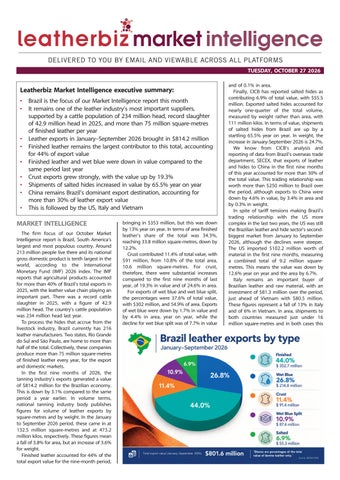
MARKET INTELLIGENCE The firm focus of our October Market Intelligence report is Brazil, South America’s largest and most populous country. Around 213 million people live there and its national gross domestic product is tenth largest in the world, according to the International Monetary Fund (IMF) 2026 index. The IMF reports that agricultural products accounted for more than 40% of Brazil’s total exports in 2025, with the leather value chain playing an important part. There was a record cattle slaughter in 2025, with a figure of 42.9 million head. The country’s cattle population was 234 million head last year. To process the hides that accrue from the livestock industry, Brazil currently has 216 leather manufacturers. Two states, Rio Grande do Sul and São Paulo, are home to more than half of the total. Collectively, these companies produce more than 75 million square-metres of finished leather every year, for the export and domestic markets. In the first nine months of 2026, the tanning industry’s exports generated a value of $814.2 million for the Brazilian economy. This is down by 3.1% compared to the same period a year earlier. In volume terms, national tanning industry body publishes figures for volume of leather exports by square-metres and by weight. In the January to September 2026 period, these came in at 132.5 million square-metres and at 473.2 million kilos, respectively. These figures mean a fall of 3.8% for area, but an increase of 3.6% for weight. Finished leather accounted for 44% of the total export value for the nine-month period,
bringing in $353 million, but this was down by 13% year on year. In terms of area finished leather’s share of the total was 34.3%, reaching 33.8 million square-metres, down by 12.2%. Crust contributed 11.4% of total value, with $91 million, from 10.8% of the total area, 10.6 million square-metres. For crust, therefore, there were substantial increases compared to the first nine months of last year, of 19.3% in value and of 24.6% in area. For exports of wet blue and wet blue split, the percentages were 37.6% of total value, with $302 million, and 54.9% of area. Exports of wet blue were down by 1.7% in value and by 4.4% in area, year on year, while the decline for wet blue split was of 7.7% in value
and of 0.1% in area. Finally, CICB has reported salted hides as contributing 6.9% of total value, with $55.5 million. Exported salted hides accounted for nearly one-quarter of the total volume, measured by weight rather than area, with 111 million kilos. In terms of value, shipments of salted hides from Brazil are up by a startling 65.5% year on year. In weight, the increase in January-September 2026 is 24.7%. We know from CICB’s analysis and reporting of data from Brazil’s overseas trade department, SECEX, that exports of leather and hides to China in the first nine months of this year accounted for more than 30% of the total value. This trading relationship was worth more than $250 million to Brazil over the period, although exports to China were down by 4.6% in value, by 3.4% in area and by 0.3% in weight. In spite of tariff tensions making Brazil’s trading relationship with the US more complex in the last two years, the US was still the Brazilian leather and hide sector’s secondbiggest market from January to September 2026, although the declines were steeper. The US imported $102.2 million worth of material in the first nine months, measuring a combined total of 9.2 million squaremetres. This means the value was down by 12.6% year on year and the area by 6.7%. Italy remains an important buyer of Brazilian leather and raw material, with an investment of $81.3 million over the period, just ahead of Vietnam with $80.5 million. These figures represent a fall of 13% in Italy and of 6% in Vietnam. In area, shipments to both countries measured just under 16 million square-metres and in both cases this
2 TUESDAY, OCTOBER 27 2026 LEATHERBIZ
indicated a fall of around 12% year on year. China, the US, Italy and Vietnam are the clear top four export markets for Brazilian leather, but growth in value in some others is worth mentioning. At the start of 2026, a delegation from Turkey travelled to Porto Alegre to attend the Inspiramais exhibition for the first time. Senior figures in the footwear sector in Turkey said there was genuine interest in increasing imports of leather from Brazil because the steady volumes and good prices of material from the South American country could be a good complement to Turkey’s domestic leather production. By September, Turkey had spent $11.3 million on importing leather and hides from Brazil. Yes, this is nowhere near the amounts the big four have spent, but it represents an increase of almost 120% year on year. Exports to South Korea also increased, rising by 21.9% to reach nearly $25 million and it was a similar story in Spain, where a rise of 27.3%
Excellent – Ultra low to zero BPS/BPF syntans.
No matter how strict the bisphenol-restrictions are, you will overcome them with the TANIGAN® ultra-low to zero syntan range from TFL. TFL – Great chemicals. Excellent advice.
>>
www.tfl.com
took spend on Brazilian leather to $15 million over the nine-month period. Something else worth point out is that a substantial jump in shipments to Africa reflect the demand there for hides for use in the food industry rather than in the leather sector. Speaking at the Sustainable Leather Forum in Paris in September, the sustainability director of JBS Couros, Kim Sena, explained that Brazil was experiencing “momentous growth in demand” for material that will go into gelatine and collagen peptides for use in sports nutrition and in beauty products. He said this demand meant lower-quality hides were being put to good use and that exports of these hides to West Africa for use in the food industry was absorbing “a big chunk of the total volume” (please see World Leather October-November 2026). CICB’s latest figures bear this out. Nigeria’s imports of hides from Brazil in the first nine months of this year increased in value by almost 40% year on year to reach $33 million, making Nigeria Brazil’s sixth-largest market for these materials. CICB measures the growth in weight of these shipments at 7.7%, reaching 62.6 million kilos. In the case of Togo, the growth in value was more than 460%, reaching $6.8 million, making Togo a bigger importer of Brazilian hides than Argentina is. It is beyond doubt, though, that the trading relationship that is of greatest significance to the Brazilian leather industry at the moment is the one with China. According to the IMF, Brazil’s trading patterns have shifted and China has become its largest trading partner across all categories, overtaking the US and the European Union. It says China’s share of Brazilian exports was around 3% in the early 1990s. By 2025, this had risen to nearly 30%. Over the same period, the US’s share of Brazilian exports declined from around 25% to 11%, while the European Union’s share went from around 30% to 12% (this is likely to change again with the new trade deal between the EU and Mercosur).
TUESDAY, OCTOBER 27 2026 LEATHERBIZ 3
Actual Slaughter Under Federal Inspection
Cattle Calves Hogs Sheep Goats
Week ending 10.10.26
Week ending 11.10.25
536,727
551,329
-2.6
1,657
1,976
-16.1
2,605,089
2,579,981
+0.9
36,724
37,980
-3.3
11,736
11,685
+0.4
All of these relationships are two-way; China now accounts for close to 25% of Brazil’s imports. Perhaps there was a time when this would have rung alarm bells in the offices of environmental campaign organisations across the globe. But in late 2026, things are different. In a report published in recent weeks, sustainabilityfocused non-profit IPAM Amazônia said China and Brazil have now entered a new phase of bilateral cooperation in which trade, food security, climate resilience, and environmental sustainability are “increasingly interconnected”. It said Brazil has consolidated its position as China’s leading agricultural supplier, particularly for soybeans, corn and beef, while Chinese demand has become increasingly linked to production, infrastructure, and landuse dynamics in Brazil. This interdependence means that the long-term stability of agricultural trade is also increasingly connected to the environmental integrity of major producing regions, IPAM said, including the Amazon and Cerrado biomes. It added: “These challenges coincide with changes in China’s sustainability agenda, where traceability, green finance, environmental standards and sustainable supply-chain management are becoming more prominent.” The two trading partners, the report makes clear, are moving from “a predominantly commodity-based relationship” towards “a more sustainable and resilient model of cooperation”. In other words, Brazil and China need each other.
US PERSPECTIVE
R
ecent figures show exports of 236,200 whole cattle hides. The destinations were primarily China (142,400 pieces), Mexico (45,300 pieces), Thailand (22,900 pieces), South Korea (15,400 pieces) and Brazil (7,100 pieces). Exports of wet blue registered as 154,100 pieces. The destinations were primarily Italy (45,200), China (40,900) and Vietnam (38,400). The most recent reports on hide prices have shown butt-branded steers weighing 64-66 pounds down slightly in price to $24, with heavy Texas steers weighing 66-68 pounds priced at $22 and the same hides weighing 60-62 pounds up slightly from last month to $15.50 per piece now. There were no changes in cow hide prices, with northern dairy cows still at $8.25, and south-west dairy cows at $7.75. Northern branded cows were still at $2 and south-west branded cows remained at $1.50, with weights of 50-52 pounds in each
% difference
case. The source of all these figures is the US Department of Agriculture. Please note that the prices quoted represent ‘ballpark’ figures. The aim is to give a snapshot of what is happening in the market.
Cattle markets USA
R
ecent trading figures have shown limited trading in all regions, with prices reported at $230 in the south and $228 in the north.
For the second month in a row, sharply smaller placements surprised the market assuring short supplies of cattle well into next year. The past two months of placement numbers are the lowest this century and assure short supplies of fed cattle well into 2027. The report will impact futures as well as current cash prices. Improved plant utilisation means a more efficient beef pipeline. Cow slaughter continues to increase weekly but remains well under prior year. Processors have maintained profitability since July, the longest period during the past few years. October and November are the largest marketing periods of the year for replacement cattle. Demand for replacements is high and recent rains have led to new grazing opportunities for cattle for growing and breeding. The problem is a shortage of animals to fill the fields. Short supplies of replacement cattle
4 TUESDAY, OCTOBER 27 2026 LEATHERBIZ
have the tendency to change strategies. Many stocker operators are transitioning to larger weights on pasture, with cattle weighing between 550-650 pounds for outside grazing. Feedlots are in the early stages or rightsizing occupancy levels. Most feedlots have been operating at reduced capacity and many smaller feedyards are empty but rightsizing will require closing some facilities. The process has started and will continue through next year. The largest feedyards are dominated by operating entities owned by Wall Street investment firms and those firms are not friendly to capital infusions or negative returns. Corn prices continued to move lower. The current basis level is near +$1.00 in Guymon, Oklahoma, basis the December contract.
LONG READ Leather and the Circular Economy: Thought Leadership The pull of protein The new chair of CICB, Carlos Obregon, says “a repositioning” of leather is required. He argues that its circular credentials, including its links to the same raw material as many protein food supplements, can help convince young consumers that leather is a sustainable choice.
E
arlier this year, Brazil’s national tanning industry association CICB elected Carlos Obregon as the new chair of its board of directors. In his day job, Mr Obregon is a director of JBS Couros. An extensive range of leather industry professionals make up the CICB board, which works closely with the organisation’s executive team, led by executive president, José
Fernando Bello. In sharing his opinions about the current situation of the leather industry, in Brazil and globally, and his hopes for the future, Mr Obregon says he hopes the current trend for consuming protein in the form of gelatine and other food supplements will help the leather industry. “If young consumers are coming to appreciate protein,” he explains, “they should appreciate leather too because the raw material for both is the same. A hide is 100% protein.” He says there is no doubt that some younger consumers may not view leather as an attractive option at the moment. They know little about the material or the industry behind it. What they have seen on social media platforms is unlikely to have painted leather in a kindly light. “But things are changing quickly,” he insists. “I hope more people will come to see that a sustainable product is one that comes from renewable resources, one that is circular and one that will last for a long time, not just for one fashion season.”
Back story Mr Obregon is a native of the Brazilian leather industry’s stronghold state, Rio Grande do Sul, but lived in the interior, in the city of Santo Ângelo, around 350 kilometres west of Porto Alegre. He studied electrical engineering and, soon afterwards, moved to the state of São Paulo for post-graduate study in Campinas. Moving to Campinas brought him into contact with Arnaldo Frizzo and, for the first time, through this important figure in the history of the industry in Brazil, with the leather sector. At the time of their meeting, Mr Frizzo was in a senior position at Curtume Cantúsio, a famous and influential Campinas leather manufacturing company. In the mid-1980s, Arnaldo Frizzo and a group of friends decided to set up on their own. They moved to Uberlândia in the state of Minas Gerais and founded Braspelco. In time, Braspelco became the biggest manufacturer and exporter of leather in Brazil with 13 tanneries, two farms and its own footwear production company, which ran under the name Frizzo Calçados. It hired Carlos Obregon as its first employee and he remained at the group for more than 20 years. “We started from scratch, and I was there from day one,” he says. “As an engineer, I was able to contribute to the initial project, which was to build the tannery in Uberlândia.”
Industry commitment When production began, he decided to commit to the industry and went on an intensive course to learn about leather manufacturing. But by 2006, an over-stretched Braspelco had changed its name to Xinguleather and was concentrating on contract tanning for another major group, Bertin. Two years later, it leased its Uberlândia tannery to Bertin, and when, in 2009, JBS took a majority stake in Bertin’s operations, it became part of JBS. Post-Braspelco, Carlos Obregon worked for a few years at Mato Boi, also in Minas Gerais, but he returned to Uberlândia in
TUESDAY, OCTOBER 27 2026 LEATHERBIZ 5
2010 and became to be part of the senior management team at JBS. Since 2016, he has led the group’s Zenda Leather operation, which runs plants in Uruguay, Argentina, Mexico and Germany. Returning to the subject of many consumers and brands holding leather in a less-than-high regard, it irks him that the notorious old photos of pit-tanning in Morocco still crop up in online reports, helping, in his words, to devalue leather further. “Hides ought to be transformed into leather,” he argues, “because leather is an extremely useful product. This is why manufacturers of synthetic alternatives try to copy leather, even when the composition of their materials is mostly oil.”
A good deal all round He wants to reposition leather and says the whole value chain should work together to make that happen. He includes meat companies in this, saying that if leather is under-valued they lose out too. The repositioning he envisages would mean meat companies receiving a good price for the raw material and tanners receiving a good price for the leather. “This is why we need good communication with the market and with consumers,” he insists. “There are certainly young consumers who seem to regard the use of leather as wrong. But what is really wrong is allowing hides to go to waste and choosing synthetic materials from non-renewable resources instead of leather.” To make the hides into leather is to put them to the best possible use, Carlos Obregon argues, because hides are an inevitable “fruit of the food chain”. This is what makes hides and leather circular products. What the leather industry does is to reuse material that is not part of the “economic focus” of the livestock industry, he continues. “We have a way of absorbing something that would otherwise end up a burden to the meat industry,” he adds.
Work that will not go to waste Sources at CICB confirm that the European Union Deforestation Regulation (EUDR) has been a major challenge for the leather industry in Brazil. If, definitively, leather is to remain outside the scope of the regulation, there are few countries that will celebrate this development more loudly. But Ricardo Andrade, a sustainability advisor at the industry body, said recently that, for the last three years, leather industry leaders in Brazil have been “going to sleep with thoughts of EUDR still on their minds”. The work that the industry in Brazil has put into preparing for EUDR will not go to waste, according to Carlos Obregon. He says a programme to provide traceability across the whole of the leather value chain is ready. The federal Brazilian government is responsible for this wide-ranging project; 15 different industrial sectors have been involved. “It will be good for Brazil,” he says. “We have to keep it going now. If you have traceability of the hide, you can have traceability for the whole
supply chain. That means that if, say, there is an occurrence of an animal disease, you can act in a much more precise and targeted way to address it. If you can have the hide part in place, you can know exactly which farm has experienced an outbreak of a disease. This is an important advantage for our livestock industry. It will make our whole system more robust.”
Export activity Specific to leather, he says he would like to see more robustness there too, with changes to the situation regarding exports (with currently between 70% and 80% of hides leaving the country as salted hides, wet blue, crust or finished leather, according to CICB). “We have a lot to offer,” Mr Obregon says, “and the more value we can add here in Brazil the better.” He says the percentage share of salted hides is going up and that Brazil is now exporting around 500,000 hides at this stage of processing each month. Of the rest, wet blue takes up a large share, then crust and finished leather. He
believes in the Brazilian Leather Project, a partnership between CICB and export promotions agency ApexBrasil, that aims to promote Brazilian leather in overseas markets. “It is helping us maintain and grow our share in important markets and also to generate business in new markets,” he says. “And if we can add more wet blue or crust instead of salted, so much the better. Perhaps more finished leather too. Anything we can do to add value is good. There are certainly markets in which we do not have a presence yet, but certainly could have.”
Internal market Brazil, with its population of more than 210 million people, has an important domestic market too, of course. The CICB chairman would like to see internal growth for the country’s leather sector too, through the production and sale of more finished products made from leather. “This would help create employment and strengthen the value chain,” he explains. “Brazil has always been an important
6 TUESDAY, OCTOBER 27 2026 LEATHERBIZ
producer of leather footwear, for example, and it still is, but perhaps not as much as in the past. I have looked at statistics for the footwear industry and, if memory serves, the share that leather footwear had of total domestic footwear production in 2000 was around 50%. Last year, it was 12%.” He makes the point that even if Brazilian manufacturers create leather footwear, furniture, accessories and other products from leather and those finished products go for export, it would be another important way of adding value.
A question of value When he talks about repositioning leather, he insists that he is not talking necessarily about putting prices up. It is more a question of value than price. He wants consumers, including those with an insatiable appetite for protein, to realise and appreciate the value of leather. “In this way, leather will come to have greater appeal in the market,” he concludes.
“This may not be easy to achieve, but we can communicate better and speak up about the qualities of leather, about its naturalness and its circularity. We can also correct the untruths that consumers sometimes hear about leather. If consumers want to live more sustainably, they should use more leather. Leather stands out from all other materials.”
NEWS ROUND-UP We share below the ten most read stories on our news website, leatherbiz.com, for the month of September 2026. Please visit leatherbiz.com every day for the industry’s most comprehensive news coverage.
Alternative materials at Kering: lots of talk, few products
L
uxury group Kering delivered a new presentation on its environmental, social, and governance (ESG) policies to investors in mid-September.
At Muno, innovation is our starting point. We transcend chemistry to design advanced low-impact, wet-end solutions that shape the future of performance.
Chat with us on LinkedIn
Chat with us on WeChat
MUNOCORP.COM
Among the priorities it highlighted, the group doubled down on its perplexing recent messages about leather. It wants to extend the scope of the work its Material Innovation Lab is doing. At the new ESG investors’ presentation, Kering said it wanted the lab to take on the paradoxical task of extending the use of nonleather materials in “leathergoods applications”. This tallies with comments chief executive Luca De Meo made earlier in 2026. He said he wanted the group to reduce what he called the “leather intensity” of its products by 30% by 2028, with 2025 as the baseline. He defined the term “leather intensity” as the number of square-metres of finished leather the group consumes to earn ¤1 million from sales of leathergoods and footwear. Mr De Meo said he wanted to “decouple growth” from its brands’ dependency on leather. But at the same time, he said he wants the group’s biggest brand, Gucci, to earn an additional ¤1 billion from leathergoods by 2030. He also wants Balenciaga to double its leathergoods business by the same year. The group chief executive also wants this reduction in “leather intensity” to take place alongside Bottega Veneta continuing to be “the ultimate symbol of luxury craftsmanship in leathergoods”, and leathergoods being “a strategic, key pillar for Saint Laurent”. Kering introduced the Material Innovation Lab, which is based in Milan, in 2013. The role of the lab is to promote traceability and the procurement of “responsible and innovative materials”, while minimising environmental impact. At the ESG presentation, Kering highlighted six “next-generation materials” that it believes can help the Material Innovation Lab fulfil this remit. It presented four of the six as alternatives to leather. These four materials are called Peelsphere, Demetra, Lunaform and Bananatex Among its references to these materials in September, Kering said Lunaform was “stronger and finer than traditional animal leather”. The group’s first mention of this material was in 2024. It said Gucci had launched a first handbag made from Demetra in 2023 and that Balenciaga had used Bananatex in its Triple S sneaker range in 2024. Kering itself was responsible for bringing Peelsphere to the attention of the fashion industry, awarding it first prize for green innovation at Kering Generation Award in 2021. None of these materials is altogether new. On October 8, searches on Kering ecommerce sites in French, Italian and English found no products made from Peelsphere available to the group’s customers. Equally, there were no products made from Bananatex available to buy. The number of available products containing Lunaform was also zero. There were 12 Demetra-containing Gucci products available for purchase. These included novelty products such as a dice set, a pencil set and three playing-card sets. The remaining seven products were all for pets. These included three types of collar and three types of leash for the stylish, vegan dogabout-town to choose from.
TUESDAY, OCTOBER 27 2026 LEATHERBIZ 7
Perhaps the Demetra pièce de résistance is the GG waste-bag holder. This is a small canvas bag with an engraved pattern based on the initials of the brand’s founder, Guccio Gucci. It has a Demetra trim. Customers can use it to carry waste-bags for cleaning up after their dogs in the street or in the park. The current UK price for the GG waste-bag holder is £265. This includes complimentary personalisation. Waste-bags, however, are not included.
PrimeAsia links supply-chain data to security of supply
L
eather manufacturing group PrimeAsia has linked better supply-chain data and traceability with the long-term resilience and security of supply for the leather industry. The company's chief sustainability officer, Camille Mori, discussed the role of supplychain data in identifying risk, coordinating action and building resilience during a panel at NYC Climate Week. PrimeAsia said the discussion was particularly relevant to its approach to security of supply because leather's raw material supply chain begins with agriculture. Greater visibility of where raw materials originate can help the company and its partners identify risks and opportunities, it said. The company also stressed the need for collaboration to turn supply-chain data into action, with discussions during Climate Week involving participants from the food, apparel and leather industries and organisations working on traceability, decarbonisation and deforestation-free supply chains. The focus is consistent with PrimeAsia's existing traceability programme. In its 2025 sustainability reporting, the company said it was targeting 100% traceability to the birth farm or group of birth farms for hides processed, but had reached 17% of the target by the end of 2025.
Leather industry renews manifesto ahead of COP 31
F
or the sixth year running, the global leather industry has prepared a manifesto in the build-up to the United Nations Climate Change Conference. This year’s event (COP 31) will take place in Antalya in Turkey from November 9-20. Ahead of the conference, the new leather industry manifesto, which 13 industry organisations have signed so far, points to the “increasing momentum” in the circular economy. The text welcomes the focus on policies that encourage greater use of biobased materials to reduce the current dependency on fossil fuels. As an example, it mentions the European Union's Bioeconomy Strategy, which the Commission published in 2025, with the first initiatives launching this year. However, the new leather industry manifesto also makes this observation: “In the rush to new solutions, it is essential that the biobased materials that have served mankind
for millennia are not overlooked. Natural materials like leather and wool are part of the solution to the climate challenge.” It asks that COP 31 endorse the industry’s call for wider recognition of the “cyclical, climate-efficient nature of leather” and its potential to make a positive contribution to reducing the climate impacts of consumer products. The text also calls on COP 31 to promote “slow fashion”, with repairable, long-lasting products made from bio-based materials. Finally, it says the conference should encourage the use of natural renewable fibres like leather “wherever possible” and reduce consumer products manufacturers’ “unnecessary reliance” on fossil-fuel-based materials .
New CEO to lead next phase of growth at SICIT
S
ICIT Group, the Italian specialist tannery waste processor, has appointed Sergi Barrull as chief executive officer, succeeding
QUAKER COLOR A STEP AHEAD IN AUTOMOTIVE FINISHING
Craftsmanship counts at Bentley
A
utomotive group Bentley Motors has emphasised the craftsmanship that has gone into the making of its new model, the Torcal. Launched at the end of September, the Torcal is the company’s fourth model line, adding to the Continental, the Flying Spur and the Bentayga. The Torcal is the company’s first fully electric car to go into serial production. It has made electric concept vehicles in the past and also produces hybrid versions of its other models, but the Torcal breaks new ground. At the same time, Bentley has celebrated the new model’s many connections to generations of skilled workers and its use of “exquisite British handcraftsmanship using the best natural materials”. These include hand-stitched leather in the interior and colour palette that offers 15 different shades of leather tanned with an organic by-product of the olive oil industry. For the Torcal, these include three new colours: teal, terra and glaze.
Supplying innovative ǻRMWLIW XS XLI EYXSQSXMZI MRHYWXV] JSV SZIV WM\ HIGEHIW
Quaker Color is a division of McAdoo & Allen, with roots in the leather industry for over a century
8 TUESDAY, OCTOBER 27 2026 LEATHERBIZ
Massimo Neresini, who has worked at the company for nearly 40 years, including approximately two decades as CEO. Mr Barrull joined SICIT as general manager in July 2025 and will lead its next phase of growth, with plans to expand in North and South America while developing its established markets in Europe and Asia. Based in Arzignano, Italy, SICIT processes tannery waste to produce collagen-derived peptides and amino acids for agricultural biostimulants and industrial applications. Its technology is also used to produce bio-based additives for gypsum and plasterboard manufacturing. The company said its future innovation strategy would focus on three technology areas: collagen-derived peptide fractions, Patagonian seaweed extracts and Moringabased botanical ingredients. Mr Neresini joined SICIT in 1988 as a chemical engineer and played a key role in developing its hydrolysis technology and expanding its activities into agriculture and industrial applications.
SICIT estimates that its products are now used on more than 30 million hectares worldwide. It also estimates that its approach to processing residues avoids approximately two million tonnes of carbon dioxide emissions annually. Mr Barrull said the company would build on its technical expertise while strengthening its commercial capabilities and accelerating the development of solutions for customers.
Ecco CEO resigns
T
homas Gøgsig has resigned as CEO of Danish footwear manufacturer Ecco, with the board planning to appoint an external successor during 2027. As first reported by Danish news agency Ritzau, an e-mail from Ecco confirmed the departure. The board will continue working with the remaining management team until a replacement is appointed and has described the search as part of a necessary long-term transformation of the business. Mr Gøgsig joined Ecco in 2012 as a chemical
engineer at Ecco Leather in the Netherlands and held a number of positions before becoming CEO in December 2024, succeeding Panos Mytaros. The board thanked him for his contribution to the company over 14 years. Ecco reported a net loss of ¤24 million in 2025, compared with ¤37.6 million in 2024. Sales fell by 5% in reported terms in both years, reaching approximately ¤1.4 billion in 2025, down from almost ¤1.6 billion in 2022. The company attributed its 2025 results to global volatility and strategic adjustments. As reported in August, Ecco recently appointed Neal Taylor as global chief commercial officer and Adam Meek as chief product officer. Both joined the company’s managing board, alongside chief financial officer Marco Bossen.
Polestar design chief questions sustainability of vegan upholstery
E
lectric vehicle manufacturer Polestar will continue to offer leather in its vehicle interiors, with its head of colour and materials design arguing that animal-free alternatives are not necessarily more sustainable. Speaking to Australian automotive publication CarExpert at the international media launch of the Polestar 4 SUV, Maria Uggla said the Swedish electric vehicle brand had retained leather because of concerns that vegan materials were being equated with sustainability. Ms Uggla said many animal-free upholstery materials are made from polyurethane or PVC derived from crude oil, whereas leather makes use of hides generated as a by-product of the food industry. She also described Polestar's approach to leather sourcing, citing animal welfare requirements, traceability to farm level and chrome-free processing.
Global Leather Alliance shares details of next steps
B
russels-based non-profit organisation the Global Leather Alliance (GLA) is preparing to host its first regional working group meeting. The organisation launched in Milan in September with the aim of working worldwide “to protect, promote and advance the future of leather”. It said at the launch that running regional working groups would be an important part of this work. Chairman, Marc Smit, explained at the time: “Each region has its own way of reaching people in our global community.” It has now said that, in the coming days, it will start to send out invitations to this first regional meeting. It did not say where the meeting would be, but confirmed it will take place in November. Since the launch event, GLA executive director, Jim Deheer, has presented the strategy behind the organisation at a meeting of Germany’s national industry association, VDL, in Wuppertal in early October. Mr Deheer will also speak at the national event Mexico’s AQTCL is holding in León on October 28 and 29, outlining for delegates
TUESDAY, OCTOBER 27 2026 LEATHERBIZ 9
there what GLA aims to do and how it proposes to raise the funding to do it.
Schill and Seilacher appoints new CEO
S
peciality chemicals group Schill and Seilacher has appointed Stephan Sielaff as CEO of the group, effective 1 October 2026. Mr Sielaff brings around 30 years of international business and leadership experience, including senior roles at Unilever, Symrise, Archroma, Lenzing Group and SSI SCHÄFER Plastics. He said his focus would include strengthening customer relationships, sharing knowledge across the group and connecting its different businesses and locations more closely. "A good product alone is no longer enough. What matters is the value we create for our customers," Stephen Sielaff said.
Scottish Leather Group linked to Jeremy Clarkson’s new car project
J
eremy Clarkson, the British television presenter and journalist best known internationally for Top Gear and his more recent series Clarkson’s Farm, appears to have involved Scottish Leather Group in his latest automotive project. Prime Video has announced a new Clarkson’s Farm special, Jeremy Grows a Car, in which Clarkson will transform a Jaguar FType using materials originating from his Diddly Squat farm. The project involves designer Ian Callum, who designed the original F-Type, and is set to include a Diddly Squat leather interior. Mr Clarkson was reported to have visited Scottish Leather Group’s Bridge of Weir headquarters in Renfrewshire in July, with filming subsequently taking place at the group’s facility in Bridge of Weir. The purpose of the visit was not disclosed at the time. Bridge of Weir has an established relationship with Mr Callum, including supplying leather for projects produced by his CALLUM design and engineering business. Leatherbiz reached out to Scottish Leather Group regarding its involvement in the project and the leather being used, but the group was unable to comment. The Jeremy Grows a Car special is scheduled to appear on Prime Video in 2027.
together creative talent and develop products for the group's brands, working with regional teams to incorporate local consumer insights into global product development. Bata is recruiting for the new centre, including design directors for both brands, as well as product and material designers. The development follows the appointment of Noemi Elmaleh as President of Bata on September 1, 2026. Based in Amsterdam, Ms Elmaleh has previous experience with Calvin Klein, Nike, adidas and Foot Locker. Bata has not disclosed the planned workforce or investment value for the new centre.
IULTCS: soluble chromium not risk predictor
T
he International Union of Leather Technologists and Chemists Societies (IULTCS) has questioned the use of soluble chromium(III) levels as an indicator of Chromium(VI) risk in leather, stating that current scientific evidence does not support a direct relationship between the two.
In its latest Chromium(VI) update, the organisation said prevention of Chromium(VI) formation depends on effective process control, including pH management, antioxidant use and the avoidance of oxidative conditions, rather than on soluble chromium levels alone. The presentation cites published studies concluding that higher concentrations of soluble chromium(III) do not necessarily increase the likelihood of Chromium(VI) formation. According to IULTCS, modern tanning technologies, including highexhaustion and complexed chrome systems, can produce higher extractable chromium levels without increasing Chromium(VI) risk when processes are correctly controlled. IULTCS said soluble chromium should be regarded as an indicator of process consistency rather than a predictor of Chromium(VI) formation. It added that no scientifically established threshold currently exists linking soluble chromium(III) levels to an elevated Chromium(VI) risk.
Bata to open global design centre in Amsterdam ata Group plans to open BataWorks, a global product, brand and design centre in Amsterdam's Schinkel District, in the first quarter of 2027. The centre will lead product and brand development for Bata and North Star, covering footwear, apparel and bags. The initiative forms part of the group's wider strategy to strengthen its global brands and product development capabilities. Bata Group chief executive, Panos Mytaros, has linked the development to the company's Re-ignite strategy, which aims to support the next phase of its international growth. The Amsterdam centre is intended to bring
B
MARCH 31-APRIL 2 B:> 2027 9: L 9: L 9< 9< :B:>
HONG KONG www.aplf.com