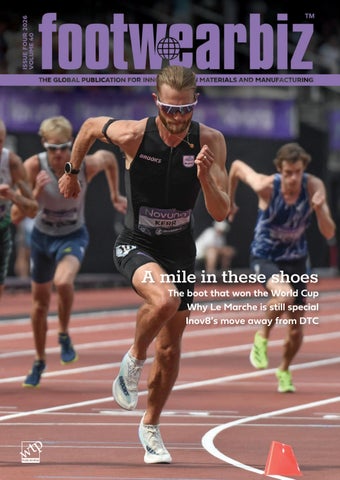
A mile in these shoes The boot that won the World Cup Why Le Marche is still special Inov8’s move away from DTC
CONTENTS
Contents
02 Global News
07 Industry & Innovation
Highlights from around the world of footwear. For news on shoes every day, go to footwearbiz.com, the best news website in the business.
04 Footprints People making an impact on the industry: designers, industry leaders and famous footwear lovers.
A mile in these shoes
The boot that won the World Cup Why Le Marche is still special Inov8’s move away from DTC
Details of innovations from suppliers and service providers across the globe.
08 Backtrack Headlines from footwearbiz.com, summing up the most recent developments in the global footwear sector.
MATERIALS, MANUFACTURING & INNOVATION
10
Footwear brand Brooks Running based its development of the Hyperion 222 shoe on detailed analysis of athlete Josh Kerr, taking into account his body weight and stride pattern, as well as the anatomy of his feet. The result is the first new world record for the mile in 27 years. CREDIT: BROOKS RUNNING
10 Brands are missing out Editor Stephen Tierney Deputy editor Clare Grainger Contributors Penny Leese Sergio Dulio Stuart Cleaver Design Tim Button Global sales manager Mat Abbott Company secretary John Collins
14
Experts in Australia say campaigns against kangaroo leather have no impact on essential conservation programmes there, and that international brands are missing out on an exceptional material.
14 Sustainability story Brazil’s footwear sector remains convinced that advances in environmental excellence can help it face up to the challenges of higher costs, weakening demand and tariffs.
Publisher & CEO Simon Yarwood FOOTWEARBIZ
ISSUE FOUR 2026
CONTENTS
ATHLETIC & OUTDOOR
18 Record breaker
ADVERTISER’S INDEX
22 Boot beauty
All of the twenty-first century’s advances in footwear technology had failed to make their mark on the world record for the mile until Josh Kerr and Brooks Running took up the challenge.
Footballer Ferrán Torres’s prediction that new boots from Under Armour would bring goals came true in spectacular fashion at the World Cup Final.
18
ASSOMAC
27
FOOTWEARBIZ.COM
09
HOMIRO
13
MILSPEED
17
SILVATEAM
05
STANBEE
BC
TIEN KANG
06
ZUND
21
@footwearbiz @WTPfootwearbiz linkedin.com/showcase/ WTPfootwearbiz @WTPworldfootwear
BUSINESS OF FOOTWEAR SALES OFFICES
24 Still special The breadth and depth of footwear manufacturing talent in Le Marche have helped the Italian region keep its special place in the industry.
24
Global sales: Mat Abbott T (+44) 151 3637600 E matthew@worldtrades.co.uk India: S Sankaran E indianleather@yahoo.com Pakistan: Abdul Rab Siddiqi E arsidiqi@yahoo.com
28 Partner power Athletic footwear brand Inov8 is placing its trust in distribution partners again following expensive and time-consuming attempts to grow its direct-to-consumer business.
28
30 The irreplaceable human touch Footwear leaders in Italy have welcomed a new tie-up with the country’s technical high schools, arguing that this will help bring new generations of artisan workers into the industry. FOOTWEARBIZ
SERVING THE GLOBAL FOOTWEAR INDUSTRY SINCE 1985
World Trades Publishing 2026 Contributions: The editor welcomes news items, articles and photographs for consideration and possible publication but no responsibility can be accepted for the loss or non-publication of such material. Opinions expressed by individual contributors do not necessarily reflect the view of the editor or publisher. Whilst every effort is made to ensure accuracy in reproduction, no responsibility can be accepted for the technical content or for claims made by manufacturers for product performance that are published. Publication in Footwearbiz cannot be construed as an endorsement for a claim or product by the publisher. Footwearbiz (ISSN 2976-9809) is published 4 times per year by World Trades Publishing, The Old Stone House, Teeton, Northampton NN6 8LH, UK. Price UK £90, ROW £150 per year (four issues). Credit cards will be charged in GB Pounds converted at the daily bank rate. Your credit card company may charge you for this service. Graphic origination by WTP. Print by Bishops Printers, Walton Road, Portsmouth, Hampshire PO6 1TR, England. All rights reserved. ISSN 0894-3079. World Trades Publishing 2026 All rights reserved. Footwearbiz (Print) ISSN 2976-9809 (Online) ISSN 2976-9817 No part of this publication may be reproduced, stored in a retrieval system or transmitted in any form or by any means mechanical, electronic, recording, photocopying or otherwise, without the written permission of the publisher.
01
GLOBAL NEWS
Global news France Sports group Decathlon has
Sweden Sweden’s ministry of climate and enterprise has proposed a national
announced its intention to acquire a 50% share in Céraclès Coopérative. Formerly Sport 2000, Céraclès Coopérative has a network of 735 stores across various formats, selling clothing, footwear and equipment for a wide range of sports and outdoor activities. Decathlon has said both groups can benefit from this new partnership owing to the complementarity of their offerings, locations and expertise.
ban on the use of per- and polyfluoroalkyl substances (PFAS) in many consumer products. The ministry said its aim was to put a ban in place in Sweden before European Union-wide restrictions come into effect. The Swedish ministry said it would take some time to convert its proposal into legislation, but insisted a ban could be in place in Sweden before the end of 2028. Footwear and clothing would be among the products to which the ban would apply, the ministry explained.
Italy The organisers of the Micam exhibition, which next takes place in Milan from September 13-15, have announced a new cohort of emerging designers. The chief executive of Micam, Giorgio Possagno, described this part of the event as “a laboratory of ideas in which heritage, innovation and responsibility intertwine”. The brands in the new cohort are Éclat, En Talons, Joel Wijangco, Maliko, Moon2gether, Nalebe, Paidal, Raphia, Stefano Mugnai, Te Dreamers Club, Tenconi and Wud.
Switzerland Swiss outdoor brand Mammut has announced that Chinese private equity firm CPE is to be its new owner. Previous owner, Jacobs Capital, said its goal had been to strengthen the company’s product offering and expand its international presence. A mission which it feels has been successful as Mammut has seen revenues grow in the double digits, while sales outside Europe now represent more than 50% of total revenues.
Brazil Belo Horizonte-based Azzas Peru Brazil’s footwear industry was
Colombia Companies from Bogotá’s
represented by 13 companies at the Expo Detalles exhibition, which took place in Lima in August. Industry association Assintecal said the event represented “great business potential” for member companies that aspire to supply footwear manufacturers in Peru. However, Assintecal also said there would be opportunities for Brazilian suppliers attending Expo Detalles to develop ties to customers in other parts of Latin America, including Columbia, Ecuador and Bolivia.
footwear and leathergoods hub were among those taking part in Colombiamoda Medellín at the end of July. The Colombian capital runs a fashion business hub called Sistema Moda, from which 20 companies travelled to Medellín for the event. Of these, nine were manufacturers or sellers of shoes and leathergoods.
02
2154, which describes itself as Latin America’s biggest fashion group, is to split up. It formed in 2024, when the Arezzo shoes group and fashion group Soma joined forces. Its major shareholders have announced that they will now divide the group, with Arezzo taking control of footwear brands, including Arezzo, Schutz, Anacapri, Alexandre Birman and Carol Bassi. Soma will take control of brands including Animale, NV, Maria Filó and Cris Barros. A new jointly owned company will run the Farm group of fashion brands.
FOOTWEARBIZ
ISSUE FOUR 2026
GLOBAL NEWS
Canada Canada Goose is selling performance footwear brand Baffin. Fellow Canadian company LP Royer, a work and military footwear specialist, is the buyer. The outdoor apparel group acquired Baffin in 2018 as part of its strategy to develop footwear under its own label. Canada Goose’s footwear collection was launched in 2021. The category has since expanded from cold-weather boots to a broad assortment of urban and outdoor hikers and sneakers.
US Footwear group Wolverine Worldwide has reported revenues of $964 million for the first six months of its current financial year, the period ending July 4, 2026. This represents growth of 8.7% compared to the same period last year. Chief executive Chris Hufnagel said the group had had a strong start to the year and was raising its full-year outlook. He said: “We are executing our strategies, elevating our brands and driving consistent, profitable growth.”
Hong Kong A delegation from the Hong Kong Footwear Association has visited Bangladesh to explore investment opportunities in the country’s footwear sector and signed a memorandum of understanding (MoU) aimed at supporting future cooperation. Discussions focused on investment opportunities, industrial infrastructure and the potential for joint ventures and business partnerships within the footwear sector.
China China’s footwear industry exported 4.3 billion pairs in
India Bata India has surpassed 2,000 retail outlets and plans to expand its network to 3,000 stores through a franchise-led model. India is Bata’s largest global market and a key manufacturing and sourcing base, with the company selling around 50 million pairs of footwear annually there across retail stores, multi-brand outlets and digital channels.
the first six months of this year, down by 4.6% compared to the same period last year. In terms of value, these exports brought in revenues of $19.8 billion, a fall of 8.6% year on year. Leather shoes contributed 240 million pairs to the total export volume, with a value of $3.3 billion. These figures mean falls of 3.3% in volume and of 8.7% in value.
•
Over the first six months of this year, China imported 74.5 million pairs of shoes and other footwear, with a value of $2.6 billion, falls of 17.3% and 2.3%, respectively. Of these, 21.2 million pairs of imported shoes were made from leather. These had a value of $1.1 billion. This means imported leather shoes were down by 14.7% in volume and by 2% in value compared to the first half of 2025.
Vietnam The 26th International Shoes and Leather Bangladesh According to data from the Bangladesh Export Promotion Bureau (EPB), the leather sector recorded a 1.6% increase in export earnings in the first month of the new financial year, July 2026. Total export earnings reached $130.9 million. There was a dip for footwear exports, with revenues down by 1.8% to reach $77.6 million. The EPB has set an export target of $1.4 billion for leather and leathergoods for the current financial year, which ends in June 2027.
FOOTWEARBIZ
Exhibition attracted 10,116 professional visitors from 88 countries and regions when it took place in Ho Chi Minh City in July. Organisers reported that 581 exhibitors from 21 countries and regions participated, occupying 20,000m² of exhibition space. The event covered the full footwear and leather supply chain, from materials, leather, chemicals and machinery to smart technologies, finished footwear, handbags and suitcases.
SERVING THE GLOBAL FOOTWEAR INDUSTRY SINCE 1985
03
FOOTPRINTS
Footprints Music star’s new shoe brand
CREDIT: UNDER ARMOUR
Athletic footwear and apparel group Under Armour has entered into a new partnership with musician and record producer Gunna. Together they have launched a new footwear and clothing brand, P-Star, with the partners describing it as “a multi-dimensional platform conceived under Gunna’s creative direction, spanning footwear, apparel, community initiatives and cultural storytelling”. Under Armour said its relationship with the music star had grown over the last 12 months. It added that they would work together to expand P-Star. Founder and chief executive of the group, Kevin Plank, paid tribute to Gunna’s commitment to fitness and running clubs. “Through the community he has built around movement and mental strength, he has expanded what performance can look like,” Mr Plank said.
Arnault bows out at Birkenstock Footwear brand Birkenstock has announced that Alexandre Arnault has stepped down from his position on its board of directors with immediate effect, owing to professional commitments. Mr Arnault, a member of the family that controls luxury group LVMH, is the executive director of Tiffany, in which LVMH acquired a majority stake in 2021. He had been a member of the Birkenstock board for five years. On announcing its search for a new board member to replace him, Birkenstock’s chairman, Michael Chu, said: “Alexandre Arnault was an exceptionally valuable member of our board. Since he is a true brand lover, I strongly believe he will remain closely connected to our brand and continue to follow its further development closely.”
Signature shoe
Product direction Dr Martens has appointed Isadora Versiani as global product design director and Nadia Svensson as global merchandising and product director. Ms Versiani joins from Marc Jacobs, where she served as design director for footwear. Ms Svensson most recently worked as a consultant following a career that included senior product leadership positions at adidas, Kathmandu and Zalando. Commercial role Sports group Nike has announced that Jane Ewing joined as its new chief commercial officer on September 7. She arrived from retail group Wal-Mart, where she has worked for 14 years, holding leadership roles in merchandising, digital acceleration and international operations. Before that, Ms Ewing worked for drinks company Diageo. Ecco strengthens Footwear brand Ecco has strengthened its global leadership team with the promotion of Neal Taylor to chief commercial officer, and the appointment of Adam Meek as chief product officer. Mr Taylor joined Ecco as president for the Americas in 2025. Mr Meek joins from Dr Martens, where he was chief product officer. Americas appointment Footwear brand Manolo Blahnik has appointed Kimberly Mimnaugh as managing director of its business in the Americas. Ms Mimnaugh has joined the company from Parisbased brand Chloé, part of the Richemont group. She had been vice-president of retail at Chloé for the last four years.
Athletic footwear and apparel group New Balance has released a first signature shoe with basketball star Tyrese Maxey. A point guard for the Philadelphia 76ers, Tyrese Maxey became a New Balance athlete in 2023. At the start of this year, the company announced that a first signature shoe was in development. It has now unveiled the Maxey v1, which will go on sale in October. New Balance has described the shoe as being designed for speed, agility and confidence on the basketball court. It features what the company calls “a dual-rail plate system”, which it claims will help propel athletes forward while supporting quick lateral movement. Another feature is proprietary FuelCell cushioning, a sculpted heel profile and added midfoot and arch volume to create “a locked-in fit feeling”.
Second spell Machinery specialist Pedro Vives is the new president of the Futurmoda event. He replaces José Antonio Ibarra, who has presided over Futurmoda for the last eight years. Mr Vives, who is a distributor for cutting technology developer Comelz, was president of Futurmoda immediately before Mr Ibarra’s tenure.
04
FOOTWEARBIZ
ISSUE FOUR 2026
Come by. Plan a bit more time than you think. Hall 11, Booth V23-27 | Z24-28
Alessio Fracca
Branch Manager Montebello Vicentino Silvateam s.p.a. afracca@silvateam.com Phone: +39 34 58 89 77 64
Bring a formulation. Taste an oil. Walk out with new insoles. Metal-free was the first question from automotive. Bisphenols are the second. Bring us a formulation. You cannot swap one product into an existing recipe and hope the leather holds up. So we built a plant for Blancotan® B-FREE, a DDS-based syntan where bisphenols are no longer detectable – below 5 ppm, where the instrument stops measuring. A whole plant for one syntan – call it commitment or stubbornness. Taste the tree. Maria Rita Olivas, sommelier and certified olive oil expert, is running guided olive oil tastings on Tuesday and Wednesday afternoon. Leaves into our tanning agent, fruit into the bottle. Meet Paolo Scafora. The Neapolitan master shoemaker is working at our stand – his family has been making shoes near Naples by hand since 1956. And there are vegetable-tanned insoles in your size for anyone who wants a pair. Just come and ask. Whatever you‘re working on, bring it to Hall 11 – from chestnut extract to our latest syntans, we‘ll have it with us. Full stand programme: www.silvateam-leather.com/lineapelle
proudly natural
INDUSTRY & INNOVATION
Industry & Innovation For hybrid athletes Nike has introduced a new performance footwear system specifically for hybrid training and racing. The company said the new platform has been designed to address the demands of athletes who regularly move between running, strength exercises and functional fitness movements during training and competition. The Nike Hybrid system comprises two footwear models. The Hybrid Fly is intended for race-day use, while the Hybrid RN has been developed for everyday training. The company said both products were CREDIT: NIKE created using feedback from elite and recreational hybrid athletes. The Hybrid Fly combines ZoomX foam, a full-length carbon-fibre Flyplate and dual forefoot Air Zoom units to support running performance, while also providing stability and traction during strength-based race elements. The Hybrid RN is designed for regular training sessions and incorporates ReactX foam, a forefoot Air Zoom unit and a wide outsole intended to provide cushioning, responsiveness and stability across a range of movements.
Vietnam move Trade union organisation GMB has issued a statement to express concern about cellular materials specialist Zotefoams moving production from the UK to Vietnam. The company has been making materials in Croydon, near London, since the 1920s. It specialised in expanded rubber materials before moving to polymerbased foam production in the 1960s. It was part of petroleum group BP from the 1970s until 1992. Sports brands including Nike began using Zotefoams materials in products such as football boots 15 years ago. It is for this footwear side of the business that production will move to Vietnam. The company will continue to make foam for packaging and other applications in the UK.
Uncertainty over Hot-Shop events The future of the Hot-Shop design events, which footwear and leather group Ecco has run annually in the Netherlands for almost 20 years, is uncertain. Ecco has said these events brought together designers, artists, material specialists, marketers and leather technicians from the worlds of fashion, industrial design, furniture and other industries for an intensive workshop about leather. It held the events at its tannery in Dongen, but the building was destroyed by fire in May 2025. Ecco has now confirmed that it will not reopen the Dongen site and will, consequently, no longer make any of its leather in Europe. It told Footwearbiz: “We continue to produce high-quality leather at our three Ecco Leather production facilities in Indonesia, Thailand and China, serving customers worldwide.” When we asked what this development will mean for the Hot-Shop events and if these will still take place, the company said: “We do not have any further information to share.” FOOTWEARBIZ
SERVING THE GLOBAL FOOTWEAR INDUSTRY SINCE 1985
Core difference Footwear group Stella International is ramping up construction of three new factories. These will be in Bangladesh, Indonesia and Vietnam. Stella said production will begin at these new factories in the second half of this year, subject to regulatory approval. Chairman of the group, Lawrence Chen, said that having a diversified manufacturing base was “a core differentiator” for Stella. Tribute to tanners Footwear brand JM Weston has included its leather suppliers in a tribute to the artisanship that allows it to keep producing its high-end shoes and boots. In addition to the craftspeople in its manufacturing plant in Limoges, it also emphasised how important in the process its leather makers are. In recovery Developer of compression and recovery products Hyperice has teamed up with sports group Nike again. Following their launch in 2024 of a vest and boots to help athletes warm up and cool down, the partners have now introduced the Air Zoom Hyperslide. It combines Nike Air Zoom cushioning with Hyperice recovery technology in a magnetically connected pod in the adjustable strap. From the field Specialist soling technology provider Vibram set up a “mobile innovation lab” and repair clinic at the International Climbers’ Festival in Wyoming in July. It said its presence at the festival gave it the chance to gather insight from the field. Meeting of minds Leather education specialist Christine Anscombe delivered a two-day course with the UK’s Leather Conservation Centre in Leicester in July, teaching people from different parts of the country about leather and how to work with it. Dr Anscombe said she was pleased that the participants also gained from exchanging knowledge and experience. 07
BACKTRACK
Backtrack 02 September 2026 Teva launches athlete co-created trail running shoe
28 August 2026 World Cup investment boosts H1 results for Dick’s Sporting Goods Skechers strengthens market position in United States
Footwearbiz’s publishing cycle and limitations on space make it impossible for us to run more than a carefully selected sample of news from across the industry. However, we publish hundreds more stories on www.footwearbiz.com. The site is updated every day with news from every continent and every part of the industry, making footwearbiz.com one of the most comprehensive archives of news anywhere on the web for the global footwear industry. We list below just a few of the headlines that have appeared on the site in recent weeks — www.footwearbiz.com allows you to read the news items you may have missed.
26 August 2026 Scarpa drops Aliens, teasing new product range
07 August 2026
23 July 2026 Digital leadership expansion at Puma
24 August 2026
Le Marche brands to showcase craftsmanship at Birmingham event
Record Q1 revenues for Mizuno JD Sports appoints new Chair
06 August 2026
22 July 2026 New mile world record after 27 years
Falls across all categories for Puma in H1
21 August 2026
21 July 2026
Brazil footwear exports decline in 2026
04 August 2026 Right foot forward for Steve Madden
A share of World Cup glory for Under Armour
20 August 2026
Columbia ‘particularly pleased’ with footwear’s contribution
20 July 2026
Market growth momentum maintains at Brooks
18 August 2026 US shoe companies foot $5bn tariff bill
Leadership change at Anta brand
03 August 2026 Footwear still top for adidas, but apparel brings H1 growth
17 July 2026 Carbon-captured EVA reaches one million pairs with On
B2C drives growth for Birkenstock
Naples to host preview event for Lineapelle and Simac-Tanning Tech
17 August 2026
31 July 2026
16 July 2026
Leather footwear holds its value in China figures
Home comfort for Assocalzaturifici
Birkenstock continues opening spree with US focus
15 July 2026
Retail division is Yue Yuen’s growth area
14 August 2026 Strong first-half growth for On
13 August 2026 European encouragement for Under Armour Brazilian footwear companies make ESG progress
12 August 2026 INOV8 puts distributors at heart of strategy Another major opening for Onitsuka Tiger
11 August 2026 H1 growth for Acushnet
10 August 2026 Growth for Jimmy Choo helps Capri
08
Seminar series set for León
UK shoe retailer narrows loss outlook
Tokyo store is Onitsuka Tiger’s biggest
30 July 2026 Positive first half for BASF
Vietnam footwear sector targets greener growth
29 July 2026
14 July 2026
Coats reports flat footwear revenue in first half
AAFA appeals for tariff reduction for Brazilian footwear
28 July 2026
Former Nike executive joins Puma as VP BU Core
Schuh names new president
13 July 2026 27 July 2026
Pou Sheng retail revenue declines in June
Italian leather sector strengthens school-industry links
Designer makes surprise appearance at footwear meeting
24 July 2026
10 July 2026
Deckers reports $1bn first quarter revenue
TCLF skills and careers push at Athens meeting
Materials still matter in Puma Suede makeover
Fatal fire at shoe factory in China
FOOTWEARBIZ
ISSUE FOUR 2026
STAY A STEP AHEAD WITH THE LATEST FOOTWEAR INDUSTRY NEWS
Contact Matthew Abbott matthew@worldtrades.co.uk for more information
MATERIALS, MANUFACTURING & INNOVATION
The kangaroo leather question T
he negative press surrounding kangaroo harvesting is nothing new, but the subject still appears to be widely misunderstood. Back in the early 2000s, organised campaigns were already targeting kangaroo harvesting for meat and leather, with some campaigners warning that kangaroos faced extinction if harvesting was not brought to an end. At the time, an estimate cited by Environment Australia put the kangaroo population at around 20 million. More than 20 years later, current estimates from the Australian Wild Game Industry Council (AWGIC) put the population at between 40 and 50 million. Extinction was clearly never an issue. According to AWGIC, Australia is home to around 50 species of kangaroo and wallaby, but only six are commercially harvested. Commercial harvesting of the principal species takes place under state management plans operating within Australia’s federal environmental framework. Australian government data indicates that actual harvests are generally around 3%-5% of estimated populations, despite annual quotas typically being set at 15%-20%. As with other hides and skins, kangaroo leather is a by-product of the meat industry. The difference is that 10
CREDIT: JOE PEE ON UNSPLASH
By the start of 2026, many major sportswear brands had announced plans to move away from kangaroo leather, a shift amplified by animalrights campaigns against its use in footwear. But what is the real impact of brands such as Nike, adidas and Puma turning away from what has historically been an exceptional material for sports footwear, particularly football boots?
kangaroos are not farmed but form part of a managed wild population. Supporters of the industry argue that this free-ranging nature, combined with regulated harvesting and full utilisation of the animal, is one of its sustainability advantages. FOOTWEARBIZ
ISSUE FOUR 2026
THE KANGAROO LEATHER QUESTION
Kangaroo meat is high in protein, nutrient-dense and low in fat, and is reported to have a substantially lower methane emissions profile than conventional livestock meats. The resulting leather is also distinctive. As with other wild-animal sources such as deer, boar and buffalo, the physical properties of kangaroo leather make it particularly suited to performance applications. Durable and naturally lightweight, it has a high strengthto-weight ratio and good abrasion resistance, while its fine, dense fibre structure allows relatively thin leather to retain strength and flexibility. Industry push back AWGIC rejects many of the arguments used by campaign groups opposed to kangaroo harvesting and the use of kangaroo leather. The organisation describes kangaroo leather as “a by-product of a thriving kangaroo meat industry” and argues that commercial harvesting forms part of wider government populationmanagement programmes. In correspondence shared with Footwearbiz, AWGIC said “the primary driver of the commercial harvest of kangaroos in Australia is conservation and population management” and argued that reducing commercial utilisation would not remove the need for population control measures. The organisation is particularly critical of suggestions that removing kangaroo leather from the supply chain would reduce kangaroo harvesting. “Not using kangaroo leather does not save a single kangaroo’s life,” it said. AWGIC has also challenged claims made by campaign organisations such as the Centre for a Humane Economy and its Kangaroos Are Not Shoes initiative, describing some of the information used in campaigns against kangaroo leather as “false and misleading”. Support for regulated kangaroo harvesting is not limited to industry bodies. Katherine Moseby, a conservation biologist and professor at the University of New South Wales, has described regulated harvesting as “an ethical and pragmatic solution supported by indigenous and conservation leaders”. Professor Moseby argues that managed harvesting helps maintain healthy kangaroo populations, protect plant communities and support threatened species, while warning that simply ending the regulated kangaroo industry would not prevent kangaroo deaths. Inherent strength While much of the debate surrounding kangaroo leather has focused on ethics and sustainability, its longstanding use in sports footwear has been driven by performance. According to Andrew Luke, technical director at Packer Leather, studies conducted by Australia’s Commonwealth Scientific and Industrial Research Organisation have shown kangaroo leather to be among the strongest leathers available for a given thickness. One of its most significant advantages is its ability to retain strength even when reduced to very thin substances, a key requirement for lightweight sports footwear. FOOTWEARBIZ
For decades, kangaroo leather was widely regarded as the benchmark material for premium football boots, including iconic models such as the adidas Copa Mundial. CREDIT: ADIDAS
Mr Luke says that when kangaroo leather is shaved or split to around 20% of its original thickness, it typically retains between 30% and 60% of its original tensile strength. By comparison, calf leather reduced to the same proportion of its original thickness retains considerably less of its original strength. According to Mr Luke, the explanation lies in the morphology of the skin itself. Kangaroo leather has a highly uniform arrangement of collagen fibre bundles running largely parallel to the skin surface, whereas bovine hides have a more complex fibre structure with fibres running at varying angles and interrupted by features such as sweat glands and erector pili muscles. “This structural uniformity explains both the greater tensile strength of the whole leather and the greater retention of strength in split or shaved skins,” he says. The ability to maintain strength at lower thicknesses allows manufacturers to produce lightweight uppers without sacrificing durability, helping explain why kangaroo leather became widely used in football boots and other high-performance sporting applications. “Kangaroo skins are unique and in a lot of ways are perfect for very high-performance leather applications like athletic footwear and high-performance gloving,” Mr Luke adds. Moving away The reasons given by the major brands for abandoning kangaroo leather vary, and the materials replacing it are not necessarily the same. Nike was among the first to make the move, announcing in 2023 that it would stop making products containing kangaroo leather. Its Tiempo football boot
SERVING THE GLOBAL FOOTWEAR INDUSTRY SINCE 1985
11
THE KANGAROO LEATHER QUESTION
subsequently moved to a proprietary synthetic upper, with Nike describing the new material as a “better performance solution”. Puma took a similar route, replacing the kangaroo leather used in its King football boot with K-BETTER. When the material was launched in 2023, Puma said it contained at least 20% recycled material and had been “proven to outperform” its previous K-Leather in testing for touch, comfort and durability. Adidas took a different approach. The company stopped purchasing new kangaroo leather in 2024 and ended production using it during 2025, saying it would gradually replace it with other types of leather. Interestingly, adidas has indicated that kangaroo leather represented well below 0.5% of the material used in its products, putting the scale of the decision into some perspective. The company has therefore not rejected leather itself, but rather one particular source of it. ASICS and New Balance have also ended their use of kangaroo leather. ASICS has said its decision was linked to its pursuit of "higher performance" products, despite the company's previous promotion of kangaroo leather for its football boots. The transition has not been entirely uniform, however, suggesting that the industry's move away from the material is not yet universal. There is also an uncomfortable question about the role of brand reputation in these decisions. When a material accounts for less than 0.5% of a company’s material use, removing it may have little practical impact on the company’s overall environmental footprint, while providing a very visible signal on animal welfare and sustainability. Whether that amounts to genuine environmental progress or, at least in part, virtue signalling is a question the brands themselves have not fully answered.
Environmental scrutiny The environmental equation also becomes more complicated when considering what replaces the kangaroo leather. Where it has been replaced by another leather, the material source has changed but the use of leather has not. Where it has been replaced by synthetics, the environmental equation is less straightforward. Synthetic alternatives can involve petrochemicalderived polymers, while kangaroo leather is produced from skins that the Australian industry considers a byproduct of a regulated wildlife-management and meat industry. Simply removing an animal-derived material does not, by itself, demonstrate that the replacement has a lower overall environmental impact. The durability, material efficiency, manufacturing process and eventual disposal of the replacement all need to be considered. Puma’s claim that K-BETTER outperforms kangaroo leather also deserves closer examination. Footwearbiz contacted Puma shortly after the announcement in March 2023 to ask for more information about the testing behind its decision to replace kangaroo leather with K-BETTER. No response was received. Puma’s announcement gave no information about the test methodology, the number of samples tested, the specific measurements recorded or the scale of any performance advantage over kangaroo leather. Four years on, the question remains relevant. If a synthetic material is claimed to outperform one of the most highly regarded performance leathers in terms of touch, comfort and durability, the underlying evidence is important when assessing both the technical and environmental case for making the switch.
Mizuno has traditionally promoted kangaroo leather for its lightweight properties, close fit and natural feel on the ball. CREDIT: MIZUNO
12
FOOTWEARBIZ
ISSUE FOUR 2026
EVERY HIDE. EVERY DEFECT. EVERY CENT. AUTOMATE YOUR LEATHER INSPECTION www.homiro.ai
MEET US @ SIMAC Hall 14, Booth L02
MATERIALS, MANUFACTURING & INNOVATION Brazilian flip flop brand Havaianas and parent company Alpargatas are members of Abicalçados. CREDIT: VI VI ON UNSPLASH
One step forward, two steps back I
It is bold to call Brazil’s footwear sector “the most sustainable in the world”, but the strategy manager of manufacturing association Abicalçados believes he has good reason to. The country's annual CO₂ emissions amount to 2.3 tonnes per capita, less than half the global average, and 77% of its power is produced from renewable energy sources, says Cristian Schlindwein. As the world’s fourth largest footwear producer – behind China, India and Vietnam – producing 847 million pairs in 2025, how its factories respond to environmental, social and governance (ESG) metrics counts. A big driver of his claim is that almost half of the country’s footwear-makers are certified under Origem Sustentável (Sustainable Origin), said to be the only ESG certification developed specifically for companies across the footwear supply chain. Created by Abicalçados in partnership with the Brazilian
14
Brazil’s footwear companies are making significant progress towards sustainability goals. This good news helps to mitigate the bad: tariffs, higher input costs, declining consumption and increasing imports are hitting the sector hard.
Association of Leather, Footwear and Accessories Components Companies (Assintecal) in 2013, Origem Sustentável also serves as an ESG roadmap structured around economic, environmental, social, cultural and sustainability metrics.
FOOTWEARBIZ
ISSUE FOUR 2026
ONE STEP FORWARD, TWO STEPS BACK
Figure 1: Segmentation of Brazilian footwear production by major regions in 2025. Share in pairs NORTHEAST
50.3%
2023
1.0%
2024
50.1%
2024
1.0%
2025
50.5%
2025
1.1%
2023 NORTH NORTHEAST
MIDWEST
SOUTH
SOUTH
In its latest survey covering 2025, Abicalçados found 93% of participating companies diverted solid waste from landfills by reusing, recycling or co-processing. “The share of companies that ensure environmentally appropriate waste management is the highest among the environmental indicators, likely because it was one of the first sustainability initiatives adopted by the industry,” says Mr Schlindwein. Over the past five years, the percentage of companies implementing these practices has increased by 6%. One example is Tess, a Paraíba-based manufacturer that produces between 20,000 and 30,000 pairs per day. Waste is reintroduced into production, returning as raw material for EVA sheets and rubber outsoles, while another portion is sent to external recycling. It estimates reusing material generates savings of £425,000 per year, and enables it to replace between 10% and 20% of the rubber. Abicalçados’ survey also showed the percentage of companies sourcing all their electricity from renewable energy has grown 35% since 2021, when the survey began. The Dass Group, which has a Diamond level certification and employs more than 26,000, recorded an 81% reduction in Scope 2 greenhouse gas emissions associated with electricity consumption in 2025, buoyed by the fact the national electricity grid is partially powered by renewable resources, too. Across the footwear supply chain, 74% of footwear companies conduct regular assessments of their suppliers, 3% higher than in 2024 and 17% higher than in 2021. In addition, 70% of companies require their suppliers to test raw materials and components to ensure compliance with substance limits established by regulations such as REACH, the regulatory framework governing the entry of products into the European market. Jobs at risk Progress towards all these targets, and investments in lowering environmental impact, are intended to prove to global brands that Brazil is a responsible and reliable FOOTWEARBIZ
NORTH
2023
27.8%
2023
0.1%
2024
27.5%
2024
0.1%
26.2%
2025
0.1%
2025 SOUTHEAST
MIDWEST
SOUTHEAST
2023
20.8%
2024
21.3%
2025
22.1%
SOURCE: IBGE/ABICALÇADOS
partner. Following a strong start to 2025, when its economy and exports grew, the second half of the year witnessed an economic slowdown and a decline in footwear consumption. For the first half of this year, Brazil imported 25.9 million pairs of shoes valued at $307 million, representing increases of 16% in volume and 13% in value compared with the same period last year. Almost 30% more shoes were imported from China than in the year-ago period: 9.7 million pairs, valued at $26.5 million. Haroldo Ferreira, Abicalçados director, says this is a growing concern. “The Brazilian footwear industry is simultaneously facing a pressured domestic market, declining export revenues and increasing competition from imported footwear at the expense of Brazilian-made footwear.” He estimates the sector failed to create 7,800 direct jobs as a result of the sharp increase in imports. Footwear is the fifthlargest manufacturing employer in the country, providing around 270,000 direct jobs.
The association supports manufacturers to travel abroad to shoe fairs, which it claims have been successful this year. CREDIT: ABICALÇADOS
SERVING THE GLOBAL FOOTWEAR INDUSTRY SINCE 1985
15
ONE STEP FORWARD, TWO STEPS BACK
Figure 2: Annual variation in Brazilian footwear exports 6.7% -5.9%
-4.1% -8.9%
VALUE
-10.9%
-12.7%
-16.6% -17.7%
-16.4% 2023
2024
PAIRS
2025
2026*
2023
2024
2025
2026*
SOURCE: IBGE/ABICALÇADOS. * Estimate by Abicalçados as of April 2026.
While imports continue on an upward trend, exports are declining. This resulted in the sector’s trade surplus shrinking by 55% in the first six months of this year, marking the lowest first-half result since the series began in 1997. Exports totalled 49 million pairs worth $408.2 million, down 7% in volume and 18% in value. The US remained the leading destination, taking 5.6 million pairs worth $85.25 million. This was a decline of 4% in volume and 24% in value. On a mission However, there was brighter news from trade fairs. More than 62,000 pairs of footwear were sold as a result of a visit to Chile this summer, generating around $1.2 million. “Chile Trade Mission continues to attract an increasing number of Brazilian companies, especially given the urgent need to diversify export markets amid the challenges currently affecting the US,” explains Carolina Eccel, from Abicalçados' business department. Similarly, European markets are looking more attractive due to an agreement with Mercosur countries (Argentina, Brazil, Paraguay and Uruguay), which began to take effect in May. A Brazilian delegation’s trip to Italian fair Expo Riva Schuh generated $30.2 million in business; Ms Eccel highlights the agreement levels the playing field, its companies now “exhibiting under more competitive conditions”. The sixth edition of BFSHOW, held in May in São Paulo, generated more than $46.7 million. More than 1,100 importers from 60 countries attended the “highly effective” trade show. Despite this, the outlook for the rest of this year remains uncertain. In Brazil, household consumption is constrained by high levels of indebtedness and the potential increase in inflation and interest rates, says Mr Ferreira. Internationally, in addition to the economic impacts of the war in the Middle East, uncertainties persist regarding US tariff measures and the pace of the slowdown in consumption in Argentina. “We are living through a period of profound transformation in the global economy,” he adds. “Consumption dynamics have changed, e-commerce has expanded borders, international competition has intensified and markets are becoming increasingly challenging. Yet the Brazilian footwear industry continues to demonstrate its capacity for adaptation, creativity and competitiveness.” 16
Disappointment as associations stand united against tariffs Abicalçados joined The American Apparel and Footwear Association (AAFA) and other associations at the Office of the US Trade Representatives in July to protest a 25% tariff on various Brazilian products. Beth Hughes, AAFA’s vice-president of trade and customs policy, told the committee additional tariffs would add to an already disproportionate burden, increasing costs for US companies and American families. In 2025, US companies paid nearly $61 million in tariffs on footwear imported from Brazil. Footwear faced an average tariff rate of 23%, compared with 7.8% across all imported products. Almost three-quarters of Brazil’s shoe exports to the US are leather, valued at $157.7 million, or 5.7 million pairs, last year. “Adding tariffs on Brazilian footwear – or even creating uncertainty about additional tariffs – risks shifting sourcing to other countries where trade concerns are even more significant,” added Ms Hughes. “That outcome would do little to address the underlying issues this investigation seeks to resolve. Continued uncertainty surrounding tariff policy makes these challenges even greater. It disrupts sourcing decisions, undermines long-term business planning and increases costs throughout the supply chain.” Letícia Sperb Masselli, project manager at Abicalçados, told the hearing the Brazilian footwear industry works closely with US importers, brands and retailers in the development of products and collections, particularly in segments that require smaller production runs, a wider variety of styles, shorter lead times and greater responsiveness to market demand. “These are all key attributes for ensuring the efficient supply of the US market, particularly for small businesses, and as an alternative to Asia,” she said. Despite these efforts, the US government moved forward with the measures, officially enacting the 25% tariff on July 22, 2026.
FOOTWEARBIZ
ISSUE FOUR 2026
ATHLETIC & OUTDOOR
A mile in these shoes S
cottish middle-distance athlete Josh Kerr has broken the world record for the mile. He achieved the feat in July, running the distance (just over 1,600 metres) in 3 minutes, 42.6 seconds. This breaks the previous record, which had stood for 27 years, by half a second. He said afterwards that breaking the mile record had been his main goal for this year and that he had planned meticulously for his recordbreaking run, which came at a wider athletics event at the London Stadium. This preparation included working intensely with footwear brand Brooks Running to develop a pair of custom, race-day spikes. The Seattle-based company called the new shoe the Hyperion 222 because the whole project had a clear target from the start: for Josh Kerr to complete the distance in 3 minutes 42, working out at 222 seconds. Originally from Edinburgh, Josh Kerr became a Brooks athlete in 2018 after completing a highly successful college athletics career while studying at the University of New Mexico. He pitched Project 222 to the company in 2025 and serious work to make the dream come true began in March this year. History rewritten The Hyperion 222 shoe is the result of what the company has called “rigorous testing”, which took into account the athlete’s individual biomechanics and racing rhythm. Features in the finished shoe include a fine-
Meticulous detail went into a one-off shoe that Brooks Running developed for one athlete in one race this summer. The result is a new world record for the mile.
tuned carbon plate system and a one-of-a-kind upper. Brooks also supplied a race-day speed suit featuring aerodynamic and temperature-regulating functionality. Josh Kerr was the sole tester of the suit, which Brooks said contained “our lightest materials ever” to allow the athlete to focus solely on his record-attempt. With the new record in the bag, Brooks said: “When preparation meets belief, history can be re-written.” Target date Josh Kerr went public with the Project 222 plans in March. He says now that committing this early to a specific date [the London Stadium event was already in the calendar for July 18] helped. “It meant there was no turning back,” he remarks. “Everything was built around that one day. It was a pressure-day, but I think you have to have that pressure.” Pacemakers were part of the record-attempt, but it was still what the athlete
A special shoe, the Hyperion 222.
18
FOOTWEARBIZ
ISSUE FOUR 2026
A MILE IN THESE SHOES
Josh Kerr breaking the world record for the mile with a time of 3 minutes, 42.6 seconds. ALL CREDITS: BROOKS RUNNING
FOOTWEARBIZ
SERVING THE GLOBAL FOOTWEAR INDUSTRY SINCE 1985
19
A MILE IN THESE SHOES
“
There was no turning back; everything was built around that one day.
JOSH KERR
”
refers to as “a real race”, and he thinks that helped too, as did having “a team of incredible, world-class people” working with him. March to July is a long time to prepare for a run that you hope will last only 222 seconds. There was, immediately, a lot of publicity about it and many media demands. There were also lots of training sessions to work through, with injury-avoidance one of the key objectives, and a strict diet to follow. “Then there were the mindset problems from the pressure I was under,” he says. “It all had to work together.” He makes the point that there are many opportunities when running, say, a two-hour marathon to control the variables that can occur. You have time to make splits faster or slower if, say, the wind conditions change. There is time to work out the strategies other runners are deploying and decide how best to respond to them. “When you only have 3 minutes, 42 seconds’ worth of variables, there are not that many things you can do,” he observes. Personal best This means preparation was almost everything and, clearly, this includes the shoes. The Hyperion 222 were completely custom-made for this particular athlete to run a worldrecord time over this specific distance. They were built around his unique foot-strike using a last moulded from his foot. Each shoe has “an extreme rocker geometry”, which meant the wearer could launch himself off the toe instantly, with this asymmetrical push-off offering what the company has called “an ultra-aggressive ride”. The shoe also features an optimised foam compound for cushioning. Brooks has not revealed the composition of the foam, but it was able to keep the weight of each 20
The whole of Project 222 hinged on an athletics event in London in July. After months of careful preparation, it came down to a race that lasted 222 seconds.
shoe down to a reported 100 grammes by measuring exactly how much foam to use (to suit Josh Kerr’s body weight) and where in the shoe to put it. For example, the athlete’s landing pattern is forefoot-biased, making less foam in the heel possible. The carbon-fibre plate, which Brooks has described as the stiffest plate it has ever made, has integrated traction and titanium pins for what it terms “full-tilt racing”. Technology waits for no one The new mile world-record-holder says he is completely convinced that he could only have run the time he achieved in the specific shoes he developed with Brooks. He says technology will continue to advance and, as a consequence, record times for the mile, the marathon and most other distances will continue to come down. But running shoes have undergone countless iterations and improvements since previous worldrecord holder, Moroccan athlete Hicham El Guerrouj ran the mile in 3 minutes, 43.13 seconds. That was in Rome in 1999. All of the advances in footwear materials and construction that have taken place in the whole of the twenty-first century so far were not enough to beat that time, until now.
In general, one advantage today’s athletes have from recent footwear construction developments, according to Josh Kerr, is that lighter weights, greater spring, increased comfort and protection mean that training sessions, as well as races, are taking less toll on runners’ feet and bodies. This means recovery between training and events takes less time and no more “hobbling around on a Saturday” after a week’s work. The Hyperion 222 is special, though. There are unconfirmed reports that a very limited-edition public version of the shoe may become available, but it is, essentially, a one-off. Head of sports marketing at Brooks, Garrett Heath, says the whole of Project 222 was historic, for the company, the athelte and for the sport. “Josh set out to chase one of the toughest records in athletics and succeeded through courage, preparation and belief. We are honoured to have supported him on this journey.” Immediately after his momentous run on July 18, Josh Kerr said the Brooks team, “the people who created the spikes”, were fundamental in creating the new record, saying he got over the line in 222 seconds because of the job that they had done. FOOTWEARBIZ
ISSUE FOUR 2026
Efficiency to rely on • • • •
Turn-key systems for leather cutting Powerful nesting for maximum material yield Highest level of productivity Individually configurable
w w w. z u n d . c o m
Save the Date
Zünd Technology Days 18th - 19th November 2026
Find out more!
ATHLETIC & OUTDOOR
The Spain squad celebrates victory with the country’s royal family at the 2026 World Cup. Ferrán Torres, bottom right, has almost become royalty too by scoring the winning goal. CREDIT: CASA DE SU MAJESTAD EL REY
One boot, one moment A didas may have kitted out both teams and supplied the ball for the 2026 World Cup Final on July 19, but when it came to footwear, another brand, Under Armour, was able to claim a major share of the limelight. Spain beat Argentina and became champions of the world for the second time. The only goal of the game arrived in the 106th minute, at the start of the second half of extra time. Ferrán Torres was the scorer, driving a knock-down from Nico Williams into the net. The boot on the foot that claimed the cup was Under Armour’s Shadow Elite 4 FG Mach. Ferrán Torres became an Under Armour athlete at the end of 2024. He wore Shadow Elite 4 FG Mach boots for the first time at this year’s World Cup. A ‘big reveal’ video exists showing the player’s reaction to receiving his first pair.
A goal foretold They arrived just as he was packing for the trip to North America. The video shows him admiring the personalised box the boots come in before holding the footwear to the light to show off their sunburst electric tangerine, Arden green and high-vis yellow colourscheme. “Muy guapas,” he declares, describing the boots as ‘really pretty’. He confirms that the footwear is World Cup-bound and makes a prediction: “These are going to bring goals,” he says. 22
Years of work went into the making of the Under Armour boots that Ferrán Torres wore at the FIFA 2026 World Cup. The footwear helped him make a decisive contribution.
In the end, only one of Spain’s 14 goals at the World Cup was scored by Ferrán Torres, but it was the most important of the whole event and the most important of his career so far. A cross from Pedro Porro, a fellow Under Armour athlete and fellow wearer of the Shadow Elite 4 FG Mach boots, looped to the far post. After the Nico Williams knock-down, the ball bounced once and, just before it bounced a second time, Ferrán Torres volleyed it into the net with his left foot from seven metres out. The world stands still “It wasn’t my goal,” he said immediately, and has said consistently since July 19. “It belongs to 47 million people [the entire population of Spain].” Just as quickly, many commentators began to make comparisons with the goal that former player (and subsequent footwear FOOTWEARBIZ
ISSUE FOUR 2026
ONE BOOT, ONE MOMENT
entrepreneur) Andrés Iniesta scored to win the 2010 World Cup Final for Spain. On that occasion, the decisive goal came even later in the match. This had been a stuffy affair, with the other finalist, the Netherlands, determined to keep Spain’s creative, attack-minded players out. But when the ball broke to Andrés Iniesta at that decisive moment, he said later that he had the strange sensation of the world having stood still and that only he and the ball were able to move. “And there were no two ways about it,” he said. “I knew that ball was going in.” Speaking this August at a celebration event in his hometown, Foios, just to the north of Valencia, Ferrán Torres said he, at last, understood what his predecessor in the national team had meant by this remark. “I felt the same thing for a moment,” he said, “that the ball and I were alone.” When the ball sat up for him to hit, he said he felt stronger than he had ever felt before. Technical details Under Armour has held itself back from claiming that the Shadow Elite 4 FG Mach boots were responsible for this surge in strength, but it is proud of the footwear and pleased by its place in history. “Ferrán Torres lifted an entire nation in these soccer cleats,” the brand said. “Built for a locked-in feel and with a carbon-fibre plate for speed, the Shadow Elite 4 are the cleats the world’s biggest game-winning goals are scored with.” Other features include a textile upper with an engineered knit stretch collar for what the Baltimorebased brand calls “a close-to-foot feel”. The carbon plate runs the full length of the boot, enabling what the company refers to as “explosive launches, soft landings and rigid midfoot control”. As for the studs, the manufacturer says biomechanics dictate exactly where they appear on the sole of the boot to make stopping and accelerating easier for footballers.
“
For it all to culminate in that moment is what makes this special and memorable.
”
SPENCER HAWKINS, UNDER ARMOUR.
For aesthetic reasons, it has placed “floating crystals” inside the studs. This, it insists, gives “added sizzle”. Mach is a label that Under Armour applies its elite ranges, to set apart products that are made for speed. Feat of engineering “Under Armour should be extremely proud of this boot,” says the company’s senior director of development, design and innovation, Ted Luedecke, “because it is a feat of engineering, but also a thing of beauty.” He explains that the ten years in which the company has been making products of this kind allowed his team to amass enough knowledge to construct a boot that he describes as one of the best that Under Armour has created so far, and one that he believes can compete against any other in the market. His colleague Spencer Hawkins, senior design lead for footwear, insists that speed is the principal idea he wanted to convey in the aesthetics of the Shadow Elite 4. In the upper, for example, there are “a lot of lines going from heel to toe”. Watching the denouement of the tournament this summer, he says that what he saw was a glint of orange and yellow as Ferrán Torres’s foot connected with the ball. “Then to see the ball hit the back of the net was unreal,” he adds. “For it all to culminate in that moment is what makes this special and memorable.” Ready just in time for the 2026 World Cup, the Under Armour Shadow Elite 4 FG Mach boots are the result of years of work. CREDIT: UNDER ARMOUR
FOOTWEARBIZ
SERVING THE GLOBAL FOOTWEAR INDUSTRY SINCE 1985
23
BUSINESS OF FOOTWEAR
Shoes from Alexander Hotto. Le Marche manufacturers have all the craftsmanship, components and materials they need on their doorstep. CREDIT: ALEXANDER HOTTO
Still special
I
n early 2022, optimism was on the up in leather and footwear. Covid-19 lockdowns were behind us and consumers were keen to get up, dress up and show up for work and social gatherings again. But when the war between Russia and Ukraine broke out, the mood quickly plummeted. In March that year, on the first day of the Micam and Mipel exhibitions in Milan, exhibitors from Italy’s Le Marche region held a crisis meeting. Senior industry representatives from Le Marche immediately made it clear that their biggest desire was for the war to end quickly. But they also pointed out that Ukraine, Russia and another country caught up in the conflict, Belarus, had become important export markets. At the time, export promotion agency ICE said that for Italy’s footwear industry, Russia, Belarus and Ukraine represented 3% of overall export business. But for the footwear industry in Le Marche, ICE said between 9% and 10% of total export revenues came
24
In 2022, industry leaders in Le Marche feared for the future of the artisan footwear and leathergoods companies that operate there. The region’s shoe and bag producers are still going strong.
from sales in those three eastern European countries. From a business point of view, this was why the 2022 Milan crisis meeting took place. Four-and-a-half years on, the war between Ukraine and Russia is still raging. It has resulted in more than 300,000 casualties so far. An end to this war, and all other ongoing conflicts, is still everyone’s top priority. FOOTWEARBIZ
ISSUE FOUR 2026
STILL SPECIAL
Returning to business concerns, however, manufacturers in Le Marche decided in 2022 that the best direction for them to take was to continue to present the special story of the fashion supply chain there. They are still telling that story today. An eco-system on show A delegation of brands and fashion advocates travelled to Birmingham in mid-August to present some of Le Marche’s secrets, travelling with officials from the region’s chamber of commerce. The brands hoped to make an impression on people arriving in the city from all over the continent for the 2026 European Athletics Championships. Leathergoods brands taking part included Valentino Orlandi and Marta Gattari, while companies including Loriblu, Franceschetti, Alexander Hotto, Enrico Cuini and equestrian products specialist Romitelli Shoes held the torch for Le Marche’s footwear sector. Luca Sabbioni, a creative director who works with several footwear brands in Le Marche, says there are more than 4,000 production companies working in the fashion supply chain in the region at the moment, employing a combined total of 35,000 people. More than 45% of what they produce goes to export markets and, together, the region’s producers of shoes, bags and clothes generate €2 billion in export revenues per year. Most of these companies are small, Mr Sabbioni points out, but together they make up a fashion eco-system that he says is world renowned for its creativity, quality and craftsmanship. “It is 360degrees,” he says. “We have quality, design, research institutions, material and component suppliers, and artisans who have acquired generations’ worth of skills.”
Equestrian footwear specialist Romitelli is one of around 4,000 footwear, leather and fashion companies operating in Le Marche. CREDITS: ROMITELLI
FOOTWEARBIZ
Left: President of Le Marche chamber of commerce, Gino Sabatini, believes manufacturers there reacted well to losing 10% of their export revenues overnight in 2022. Right: Linea chief executive, Francesca Orlandi, says it would be impossible to replicate what Le Marche can offer anywhere else. CREDITS: WTP
Difficult to replicate Since 2019, Linea, a specialist company that works to promote this leathergoods, footwear and fashion expertise in international markets, has operated as part of Le Marche’s chamber of commerce. Linea chief executive, Francesca Orlandi, claims that what the region offers would be difficult to replicate anywhere else. “If designers come to Le Marche in the morning with an idea, they can have a prototype in their hands that same evening,” she explains. Having the whole supply chain, a whole production district with specialists in materials, machinery and finished products all on hand, is what makes the difference, she believes. She says: “We also have originality and high levels of craftsmanship. Our district has evolved in the course of 100 years into a one-stop shop for world-class footwear and other products. We know how to make products that show what it is our customers want to express. Yes, you could buy machinery and set up a shoe company anywhere in the world, but you could not repeat what we have.” The whole look Designer Massimiliano Giangrossi is part of this world, specialising in couture clothing for women. But he makes the same point about the breadth and depth of what Le Marche can offer. “Clothes on their own do not work,” he says. “Customers need an entire outfit, with the jewellery, the bag and the shoes to go with the dress and complete the look. This is why it is so important to have the whole eco-system on hand and for us all to work together. And, because so many of the processes we carry out in making our products are done by hand, craftsmanship is essential. Therefore, we need young people to want to come into the industry and work with their hands.”
SERVING THE GLOBAL FOOTWEAR INDUSTRY SINCE 1985
25
STILL SPECIAL
A luxury touch At the same time, the industry in Le Marche insists it is open to change. Luca Sabbioni quotes studies that suggest that, when it comes to making a footwear purchase for the first time in their lives, 65% of young consumers today buy sports shoes. Only 13% of these consumers bought formal shoes as their first purchase. The same studies show that, in 2025, almost 90% of Gen Z consumers (people born between 1997 and 2012) bought at least one pair of sports shoes. More than 70% of them bought three pairs. Responding to this, footwear companies in Le Marche are making more sports shoes, Mr Sabbioni says. “But the difference is that they are doing so using the knowledge, originality and materials, including beautiful leathers, that they have always used,” he explains. He calls these products “luxury sports shoes”, insisting that Le Marche manufacturers are bringing luxury, including the obsession with perfection that high-end producers must have, to the world of sports shoes. Heel help This cross-over between the demands of today and the world of traditional style and craftsmanship is twoway. One of the footwear brands taking part in the Birmingham event, Enrico Cuini, has the data to prove it. A Le Marche-based footwear designer who has worked closely with the brand, Gregory Baffoni, says founder, the eponymous Enrico Cuini, has made it his mission to make high-heeled shoes that women will find comfortable to wear. He holds up a shoe with a 12centimetre heel. “It looked as though humanity was capable of sending astronauts to the moon, but not of making comfortable high heels,” he observes. After years of studying the anatomy of the human foot, Enrico Cuini established a method of incorporating patented technology into the construction of his shoes. “This technology works by expanding the area at the heel of the shoe that provides support to the foot. It also supports the arches and distributes the wearer’s weight
in the most efficient way possible.” He says that what the shoe looks like from the outside is completely different to the way it feels on the inside. Made in Le Marche The view of the president of Le Marche’s chamber of commerce, Gino Sabatini, is that events like the one in Birmingham are important for continuing to put across what the region can produce. He argues that there is “a beautiful reality” in the global phenomenon that is ‘Made In Italy’. “A big part of ‘Made In Italy’ is actually ‘Made in Le Marche’,” he says. “Important brands are coming to Le Marche to source their products.” The ongoing wait for a resolution to the war in Ukraine and other armed conflicts is a cause for concern for peaceful people everywhere. This includes the citizens and business community of Le Marche. Something has changed, though, since those first frightening days in 2022. This same business community seems to have put behind it those early fears of severe commercial consequences. It has withstood the set-back of losing 10% of its export revenues overnight. Its confidence in its own products and manufacturers remains undiminished. “Our companies have reacted well,” Gino Sabatini explains. “They have found other markets and have run good campaigns to win new customers there. Business that they were doing with customers in Russia and Ukraine has been replaced by business in the US or in south-east Asia. We also have some companies that have begun to work successfully in African markets such as Nigeria or South Africa. Others have been able to build up a presence in South America.” He points out that Germany and France have long been the most important markets of all for Le Marche manufacturers. This remains true today, which pleases the leader of the region’s chamber of commerce. Something else that pleases him is that most of the operators in the fashion eco-system are still in business. “We have been able to limit business closures,” he says. “Support from our politicians in achieving that has been very welcome.”
Le Marche footwear brand Enrico Cuini has made high-heeled shoes that are comfortable to wear its mission. CREDIT: ENRICO CUINI
26
FOOTWEARBIZ
ISSUE FOUR 2026
15.16.17 SEPTEMBER 2026 MILAN • ITALY
Where Technology drives The Next Step of Manufacturing The international exhibition hub for leather, footwear and leather goods industries
Discover more:
www.simactannigtech.it
In cooperation with:
By: Assomac Servizi Srl Tel: +39 038 178 883 | exhibition@assomac.it
BUSINESS OF FOOTWEAR Inov8 took the new Trailfly Pro to Chamonix at the end of August to launch the design at to ultra-trail running event around Mont Blanc. Selected runners were able to test the product on three trial runs. It also set up a stand in the event village to promote the new design, which it claims creates a more natural connection with the ground. CREDIT: INOV8
T
Inov8 refocuses on distributors
he founder of UK-based footwear brand Inov8 vowed to revamp both strategy and product in 2024 when he returned to the helm of the company he launched 20 years before. Wayne Edy had sold the brand to Japanese group Descente in 2015, but bought it back in 2021 and named former Asda director Mike Snell as CEO in 2022. But just two years later, Mr Edy returned, bringing with him former product director and chief operating officer Michael Price, who had worked at the company between 2016 and 2022. At the time, Mr Price, who also had experience at Asics and Reebok, said: “Our focus is strengthening the brand, expanding our reach and building growth across wholesale, distributors and D2C [direct to consumer].” Over the next 18 months, the company invested heavily in product innovation while rebuilding its international business. Part of the growth strategy has been to secure distribution partners in Europe and, at the start of this summer, appointed Ricochet as its new partner for France. France - one of the world’s most influential trail running markets - represents a big growth opportunity, it said. Ricochet will transition the territory from a direct model to a dedicated distributor partnership. “Like many in our industry, we spent too much time chasing DTC,” says Mr Edy. “This wasn’t the right balance, and as soon as I came back into the business in 2024, I worked to change this. The strongest brands build an ecosystem where distributors, retailers and direct channels work together to offer the best service to our sports consumers.”
28
After “too much time chasing” direct-to-consumer sales, the UKbased brand has said strengthened partnerships are the way to increase revenues. It is also setting itself apart from competitors by eschewing the trend for increased foam and plates. Across Europe, HB Sports now represents Inov8 in Austria, Belgium and Holland, while The Good Karma Company supports the Scandinavian region. Beyond Europe, All Sports has been appointed as the regional partner for Australia and New Zealand, and Inov8’s partnership with A1 in Canada has been delivering growth across all categories, including technical running apparel. All these efforts have resulted in its spring-summer 2027 distributor order book up 63% versus SS26. “Over the last 18 months we’ve deliberately put distributors back at the heart of our international strategy,” adds Edy. “The results have been outstanding and we’re only just getting started.” Natural biomechanics As well as a strategy rethink, Inov8 is keen to make its product stand out in the market. At the end of this summer, it launched the TrailFly Pro in Chamonix, France, at the world’s biggest trail running festival, FOOTWEARBIZ
ISSUE FOUR 2026
INOV8 REFOCUSES ON DISTRIBUTORS
Ultra Trail du Mont Blanc. Each element of the shoe has been engineered to support natural performance, with the model working with the foot’s natural biomechanics, rather than against them, it claims. “The running industry is obsessed with more foam, more stack, more plates. We have the courage to challenge that,” says Edy. A refined shape gives metatarsal bones and toes the space to spread naturally for improved balance and propulsion. Outsole cutaways allow the shoe to flex with the terrain instead of resisting it, while a patent-pending off-set heel collar anatomically frames the ankle bones for a secure natural fit. Inov8 has also introduced its first featherlight thermoplastic polyester elastomer (TPPE) foam, which combines the properties of thermoplastics and elastomers, offering energy return, ground feel and extra toe-spring. With the outsole, Inov8 has returned to its
Inov8’s love affair with graphene Still a rarity in footwear products, Inov-8’s research into graphene started in 2017, when Dr Aravind Vijayaraghavan from the National Graphene Institute at the University of Manchester published a paper on how it could enhance rubber. Graphene is a single atomic layer of graphite, which itself was discovered in Inov-8’s home, the English Lake District, in 1555, and is now commonly used in pencils (it was originally used to mark sheep). Graphene was characterised by University of Manchester professors Andre Geim and Konstantin Novoselov in 2004, earning them a Nobel Prize for physics in 2010. It is the thinnest and strongest material by weight, offering strength that is 200 times that of steel at only one atom thick. It is also transparent, flexible and can conduct heat and electricity. The Inov8 team began developing the graphene-rubber mix with Dr Aravind and his team, and subsequently launched a grapheneenhanced outsole collection, Graphene-Grip. Its addition makes the rubber stronger, stretchier and more resistant to wear. The G-Series won multiple awards and was rolled out across other footwear categories. Over the next few years, the team experimented with adding graphene to foams: 50 mixtures were tested in the lab and by 40 athletes in the field. The final foam, called G-Fly, is reported to give 25% better energy return than standard EVA foam as well as longer-lasting performance. As well as some performance benefits, adding graphene into footwear increases durability and extends the shoe’s life, says the company. “We have made a heavy investment into graphene but our name is Inov8 so we have to lead with innovation and it’s something Wayne Edy really pushes through the company,” said Michael Price at the time.
FOOTWEARBIZ
Wayne Edy founded the brand in 2003. The headquarters remain in Staveley, near Kendal. It also has a major operation base in County Durham, where its lead warehouse is.
signature graphene-enhanced rubber, while a new rocker geometry creates smooth, efficient transitions. “In chasing more, brands have created shoes that numb trail connectivity and squash toes,” says Price. “We think that’s dumb. It’s time to unlock the foot’s natural biology, let it adapt and react to the ground beneath, and give toes the room to perform.” Weighing 228g, the Trailfly Pro has already proven itself in competition. Inov8-sponsored athletes Yannick Noël, Lewis Bowness and Ludvik Fernandes raced to victories in the shoe over 100km, 55km and 23km respectively. Noël describes it as a “dynamic shoe that connects me to the trail”, while Bowness, one of Britain's rising trail running stars, adds, “I feel like I can fly, effortlessly”. At the Chamonix event, Inov8 organised morning demo test runs on Mont Blanc trails and local café meet-ups to help test and promote the shoe. Elite runners like Yannick Noël put the design through its paces on the gruelling 176km course. Next year, it will introduce further footwear innovations alongside a clothing collection inspired by the demanding English Lake District fells, the area around its headquarters in Staveley. Its athlete partners are also setting the pace elsewhere. Among them, Sarah Perry, Backyard Ultra world record holder; Clovis Chaverot, Swiss Canyon trail winner 2026; Laura Swanton Rouvelin, Hardmoors 200 Women’s Winner 2026; and Jack Scott, Winter Spine Race record holder. “We’re committed to building strong partnerships and a motivated team that competes – and wins – together,” says Price. “Inov8 is looking forward to a bold future.”
SERVING THE GLOBAL FOOTWEAR INDUSTRY SINCE 1985
29
BUSINESS OF FOOTWEAR
Government support for training and recruitment
T
he presidents of Assocalzaturifici and Assopellettieri, Italy’s associations for footwear and leathergoods manufacturers, Giovanna Ceolini and Claudia Sequi, have welcomed the formal signing of a new memorandum of understanding between the Italian government and companies in these two sectors. The wider fashion industry is also part of the agreement. Italy’s minister for education, Giuseppe Valditara, was one of the guests of honour at Micam in Milan earlier in the year. His visit provided the ideal platform for the formal signing of the document, which addresses the need for better links between Italy’s high-school-level technical institutes (ITS) and companies in leather and footwear. Shoe and leather companies believe this will make it easier for them to bring talented young people with digital skills into the workforce, which currently has an average age of around 55. At the same time, these
30
An agreement between the Italian government and the country’s leathergoods and footwear sectors to boost their search for new talent is now in place.
companies are committing to closer involvement in the education that ITS students receive, including sending technicians and other knowledgeable people into classrooms to contribute to the teaching programmes there. “This memorandum of understanding is extraordinarily innovative,” Giuseppe Valditara says. “It is almost revolutionary.” It will bring in a programme FOOTWEARBIZ
ISSUE FOUR 2026
GOVERNMENT SUPPORT FOR TRAINING AND RECRUITMENT
Young people learning about footwear manufacturing at a workshop at Micam. ALL CREDITS: MICAM
that the minister calls ‘Four Plus Two’. Young people will receive four years of high-school education in ITS institutes, with increased input from companies, and then complete their preparation for life in the business world with two further years of study and work experience. According to Assocalzaturifici president, Giovanna Ceolini, training new generations in the skills and disciplines involved in handcraft is of “vital importance”. She continues: “We have to bring young people into our companies. The work we can offer them is wonderful work; it grabs you from the very first.” She cannot envisage an Italian footwear industry that will cease to need people to do this work. She insists that there are tasks in the production of high-end shoes for which “we cannot not use our hands”. The hands and the head have to work in harmony, she explains. Involved by association National business federation Confindustria has been closely involved in drawing the document up. It has a section for the whole of the fashion industry and, underneath that, sections for different parts of the fashion supply chain, including ‘accessories’, which footwear and leathergoods fit into. In addition to their roles at Assocalzaturifici and Assopellettieri, Giovanna Ceolini, is also president of this ‘accessories’ branch of FOOTWEARBIZ
Confindustria; Claudia Sequi is its vice-president. Ms Ceolini joined the minister in signing the new memorandum of understanding in Milan, as did the current president of the main fashion branch of Confindustria, Luca Sburlati. “One of the good things,” Mr Sburlati tells Footwearbiz, “is that it will now be compulsory for the ITS schools to build connections with businesses and for businesses to do the same in reverse.” He feels that people often overlook the importance to Italy’s economy of the wider fashion sector. “I think it is important for us to be clear about the data,” he says. “Italian fashion, including all the products we make from leather, has a value of €90 billion per year. It is Italy’s second-biggest source of export revenues with almost €70 billion per year. Our sectors are the providers of direct employment for half a million people, and to this we could add another half a million people who work in retail selling our products here in Italy.” A question Luca Sburlati poses is if Italy wants the fashion sector to continue to be a strategic part of its economy. “If the answer is yes, the measures we are taking with the new memorandum of understanding will be fundamental, because another factor is that the average age of the people working in our industries at the moment, at 55, is high. We need a change in our strategy for education and training, and we need it quickly. Our regional and national governments have an important role to play in this, but so do we as businesses and as Confindustria.” What is needed in response to this challenge is a mix of technology and people, he says. Technology, including artificial intelligence (AI), which can help in activities such as making prototypes and product planning, is important, but it cannot do everything. Even in the next 20 years, Mr Sburlati thinks it will be impossible to develop AI that will be able to create and make products. “Robots will simply not be capable of stitching the way we need to stitch our products,” he insists. “We will still need this mix of both, of people and technology.” The human part Giovanna Ceolini is in agreement. Part of her conviction stems from an insistence that it would simply be wrong “to abandon our traditions”. She admires “the giant steps” that technology providers have made in developing advanced solutions to help companies make bags, shoes and other products. Further advances will certainly follow, she says, but she insists that it is the other part of the mix, the human part, that sets Italian companies and their products apart. Her point is that if you could install technology to do this work in its entirety, you would be able to install it in lots of places around the world, places with fewer taxes and lower labour and energy costs.
SERVING THE GLOBAL FOOTWEAR INDUSTRY SINCE 1985
31
GOVERNMENT SUPPORT FOR TRAINING AND RECRUITMENT
“
This memorandum of understanding is extraordinarily innovative; it is almost revolutionary. GIUSEPPE VALDITARA
”
Italy’s minister for education, Giuseppe Valditara, at Micam in Milan.
If human hearts, minds, passions and, of course, hands are the differentiating factor, it is all the more important to start making this clear to young people while they are in school, Ms Ceolini continues, for it to be part of their education in the same way as geography and mathematics are. She believes company representatives sharing their knowledge and passion with students will help young people understand and embrace this culture. “People from our industry, people who know what they are talking about will be there, handing on their knowledge,” she explains. “This will include knowledge of the leather we use, inviting our young people to start building up their knowledge of it too, helping them understand what our work is about. This will be a big step forward.” Road to revolution This is in line with the way government minister Giuseppe Valditara talks about the new agreement, albeit without his references to its being “almost revolutionary”. The minister insists that early figures he has seen for ITS establishments across Italy signing up to be part of the new programme are “truly extraordinary”. He welcomes the change. He says it has come after a long period in which technical education in Italy was going down “a regressive path”. He explains that what he means by this is that this part of the educational offering in Italy had become too theoretical. “Instead of being about producing wonderful workers with extraordinary technical knowledge and skills, it had come to be about culture more than anything else,” he continues. “And in this way, we arrived at the point of our manufacturing companies struggling to find the qualified technical people they need to confront the challenges of the future.” This is why stronger links from now on between schools and the world of work are fundamental, Mr Valditara says. He even argues that resistance to Four 32
Plus Two among “some political groups and some trade unions” is an indication of the problem. “They think Four Plus Two is a way of allowing businesses to exploit our students and young people,” he says. “Nothing could be further from the truth. We want to bring those young people into the world of work.” The minister insists that, for too long, there had been a tendency to think that working with your hands was a sign of a lack of intelligence. “This thinking has caused a lot of damage to our schools and to our companies,” he continues. “Handcraft is a wonderful expression of intelligence.”
Confindustria Moda president, Luca Sburlati, says human beings need to be in the mix because, even 20 years from now, there will be no robot capable of stitching products properly.
FOOTWEARBIZ
ISSUE FOUR 2026
MAGAZINES ISSUE 17: 2026
ESTABLISHED 1987
BEHIND THE SEAMS OF THE GLOBAL DENIM INDUSTRY
THE WORLD’S NO.1 MAGAZINE FOR THE LEATHER INDUSTRY VOLUME 32 ISSUE ONE 2026
Volume 39, Number 4
August / September 2026 | [Published 21st August 2026]
A mile in these shoes
The boot that won the World Cup Why Le Marche is still special Inov8’s move away from DTC
Post-PFAS membranes
New dawn for ‘blocker’ fibre
Odourcontrol with addons
Le Marche: still special Alternatives for colour-matching Full FILK round-up Bangladesh seeks change
A review of Milano Unica Lycra’s bioderived spandex scales up
Patterns vs fades / The comfort factor / Smartorial denim Momentum in PP ‘battle’ / Innovation rises to surface / Kate Goldsworthy
Footwearbiz
World Leather
Sportstextiles
Inside Denim
All you need to know to assist you in the global footwear market. (4 issues per year)
The world’s leading magazine for the leather industry. (6 issues per year)
The international technical trade magazine for innovative and responsible materials. (2 issues per year)
Keep up to date with denim developments from raw material to finished product with in-depth coverage of advances at fibre and fabric level. (2 issues per year)
Footwearbiz (Digital)
£100 per year
Footwearbiz Premium (Print)
£140 per year
World Leather & Leatherbiz (Digital)
£270 per year
World Leather (Print) & Leatherbiz
£300 per year
Sportstextiles (Digital)
£100 per year
Sportstextiles Premium (Print) £120 per year
BOOKS
Websites DELIVERED TO YOUR DESK EVERY WEEK BY EMAIL AND VIEWABLE ACROSS ALL PLATFORMS TUESDAY MAY 2, 201-
leatherbiz weekly executive summary highlights in this issue of leatherbiz weekly include: • Big fashion brands appear confident they can keep growing their leathergoods businesses • Prices for US hides have come down by 10%-15% from their peak • More change is needed to provide stability • A decrease of 10% on the prices quoted at the moment for the main US, South American and EU hides would give sellers a fair chance of moving their stocks and future productions • If buyers and sellers could reach an agreement soon over the valuation of raw material the situation could become stable for the foreseeable future THE LEATHER PIPELINE MARKET INTELLIGENCE–02.05.1Macroeconomics he markets are mainly watching politics at the moment. The conflict around North Korea and the French elections are the main focus, in addition to the analysis of the first 100 days of the presidency of Donald Trump in the United States. His achievements have been none too impressive and now talk of big tax reforms is making the markets worry. One thing is definitely for sure: it is far more complicated being a president than criticising one. The normal political routine and reality will catch up with him and it might be fairer to judge a year from now. In Europe the presidential elections in France have dominated the headlines and most observers have welcomed the fact that the right-wing populists of Marine Le Pen did not win the first round. We will know by midMay who is going to be the next president of France and which direction the secondlargest economy in Europe is going to go in. The reactions so far have been positive and the euro has been able to gain a few cents against the US dollar. We have more elections to come in Europe and in the last quarter of 2017 we will know what they mean for the big picture of European politics for the years to come. The Brexit negotiations with the UK are beginning to materialise. However, in the meantime we have also to await the election results in the United Kingdom. It is obvious that the negotiations and the terms for the departure of the United Kingdom from the EU will be a very difficult and in the end very expensive adventure. The consequences are
T
totally unknown and there is still a long way to go; a lot can happen, internally as well as externally. Hardly a week passes now without news of some kind of terrorist attack in whatever country. It is amazing, but at the same time also very positive that people stick to their daily routines as well as being very clear all over that they are not going to surrender to the cowards who kill innocent people. The financial markets remain trapped in very narrow ranges. The US dollar has lost a bit, but nothing special, the oil price has dropped moderately and stock markets, which got excited for a moment over the French elections, have fallen quickly back into the same range as before. Market intelligence The leather pipeline is once again in spring mode and in this respect 2017 is no different to any other year. The big news in the past two weeks has come from the luxury segment. This is exactly the part of the business where leather as a material still plays a very important role and the finished product prices allow an adequate valuation of the raw material. Little price competition and a very strong performance keep demand and turnover high. The big luxury groups continue to be very positive about the business and the growth of the middle class in particular in the emerging markets seems to support their position. Low interest rates and limited options for spending make them believe in further growth potential. At the moment the general situation supports the leather products business. All the big fashion brands see their leather
divisions growing and believe that, in particular, women’s collections offer them a never-ending opportunity of serving the market with new and attractive offers. One can only hope that this will last as long as possible. However, nothing lasts for ever and people should take the situation in the luxury watch market as a simple reminder that consumer tastes can change quickly. For the moment we should not pour any water into the wine and just be glad that this part of the leather pipeline is still running very well with a strong performance. All this is confirmed by the recent results for the luxury groups published in the past two weeks. Almost every big brand is publishing impressive positive results and there is no indication that this is going to change over the rest of the year. As a confirmation of their confidence one can also consider the recently announced purchase of the Christian Dior brand by LVMH, which is once again investing in fashion and leather accessories. So far, so good and for the regular reader of our publication nothing of the above is actually new. The trend that leather is today a material of two faces is something what we have recognised for quite some time. Actually one can find similar trends for other raw materials. Superfine wool is as precious today as top-quality calfskins, while courser types are far from being attractive and struggle to find enough consumption so that production struggles to be cleaned up. This sounds quite familiar when we think about the structure in the leather pipeline. We come back to this fundamental problem. Consumers buy what they are offered. Even with all the attention that can be generated about trends by using social media, the industry and brands will still push whatever products they consider will have the most positive impact on their sales and their profits. Despite all the lukewarm statements about sustainability, it’s difficult to create a situation to make leather an attractive material for a mass producer. Uncertainty of price, bad image in regard to production and pollution (right or wrong), anti-beef campaigns, technical challenges and so on are things that might not cause any headache in the luxury segment, but in mass production arena they play a very important role. Who wants to deal with all these subject when you can avoid them? So in the end nobody deals with them. You may not like beef and leather as a by-product, but you should also know that in a short time from now we could have more plastic than
Designed to provide up-to-the-minute news and market intelligence.
Leatherbiz Weekly The Fundamentals of Footwear
The Framework for The Machines in Leather Manufacture: the Tannery:
£69.00
£49.00
£46.00
A weekly round up of all the news relevant to people in the leather industry including exclusive market intelligence for purchasers of finished leather.
All books printed are in English. Prices are subject to 20% VAT where applicable.
50% OFF
The must-have essential book for the footwear designer
_ £69 £34.50
From materials through the stages of design and production To place an order, send your enquiry to john@worldtrades.co.uk
WHAT IT MEANS TO BE GREEN At Stanbee, we’ve built our name on innovation. Green innovation. We make it our mission to produce the lightest, thinnest, strongest, most resilient structural footwear materials in the industry. And we do it while cutting our reliance on raw materials—thus protecting the environment from unnecessary waste. For example, all of our Nitro products are injected with a foaming system that displaces raw virgin materials, thereby reducing weight and improving performance. Also, Nitro Force, our lightest, firmest heel counters, are made from at least 85% PET-recycled plastic bottles. Each pair of these counters reuses the recycled content of two one-time use PET water bottles. That helps offset the 500 billion plastic bottles tossed into the global waste stream every year at a rate of one million bottles per minute.
WWW.STANBEE.COM
Now we’re offering three new Nitro products: Nitro Flex for unparalleled flexibility in a heel counter; Nitro Vulc for exceptional fit and comfort in vulcanized footwear; and Nitro Sport for high-performance toe boxes that are lighter, softer and more resilient—with increased recycled content. All of these products are available in a zero-waste, net-product, closed-loop system. So speak to your Stanbee representative today—or visit www.stanbee.com. Not only will you boost your product’s performance, you’ll be protecting the planet. That’s what it means to be green.
A STEP AHEAD OF INNOVATION