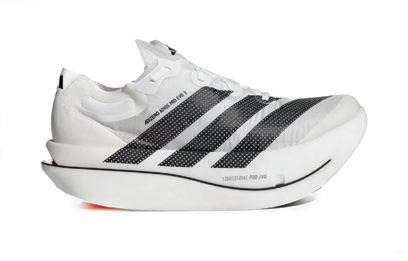
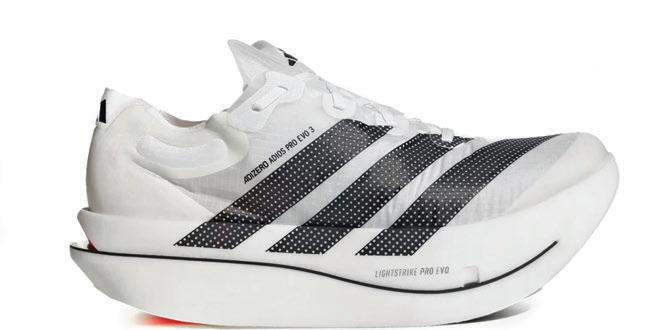
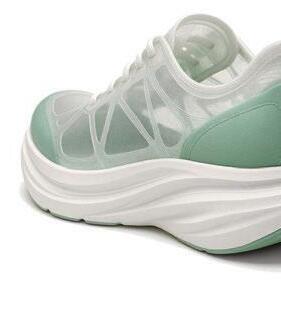
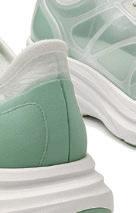
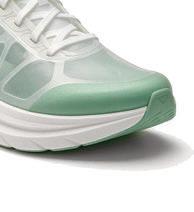
A ‘supershoe’, the Adizero Adios Pro Evo 3, has helped Kenyan athlete Sabastian Sawe, become the first person to complete a competitive marathon in under two hours.
CREDIT: ADIDAS
Editor Stephen Tierney
Deputy editor
Clare Grainger
Contributors
Penny Leese
Sergio Dulio
Stuart Cleaver
Design
Tim Button
Global sales manager
Mat Abbott
Accounts
Lisa Fabian-Smith
Subscriptions manager
John Collins
Publisher & CEO
Simon Yarwood
02Global News
Highlights from around the world of footwear. For news on shoes every day, go to footwearbiz.com, the best news website in the business.
04Footprints
People making an impact on the industry: designers, industry leaders and famous footwear lovers.
06 Industry & Innovation
Details of innovations from suppliers and service providers across the globe.
08 Backtrack
Headlines from footwearbiz.com, summing up the most recent developments in the global footwear sector.
MATERIALS, MANUFACTURING & INNOVATION
10 True grip
Durability, flexibility and grip are the main claims BASF is making for a new thermoplastic polyurethane portfolio for outsoles.
12Footwear from by-products
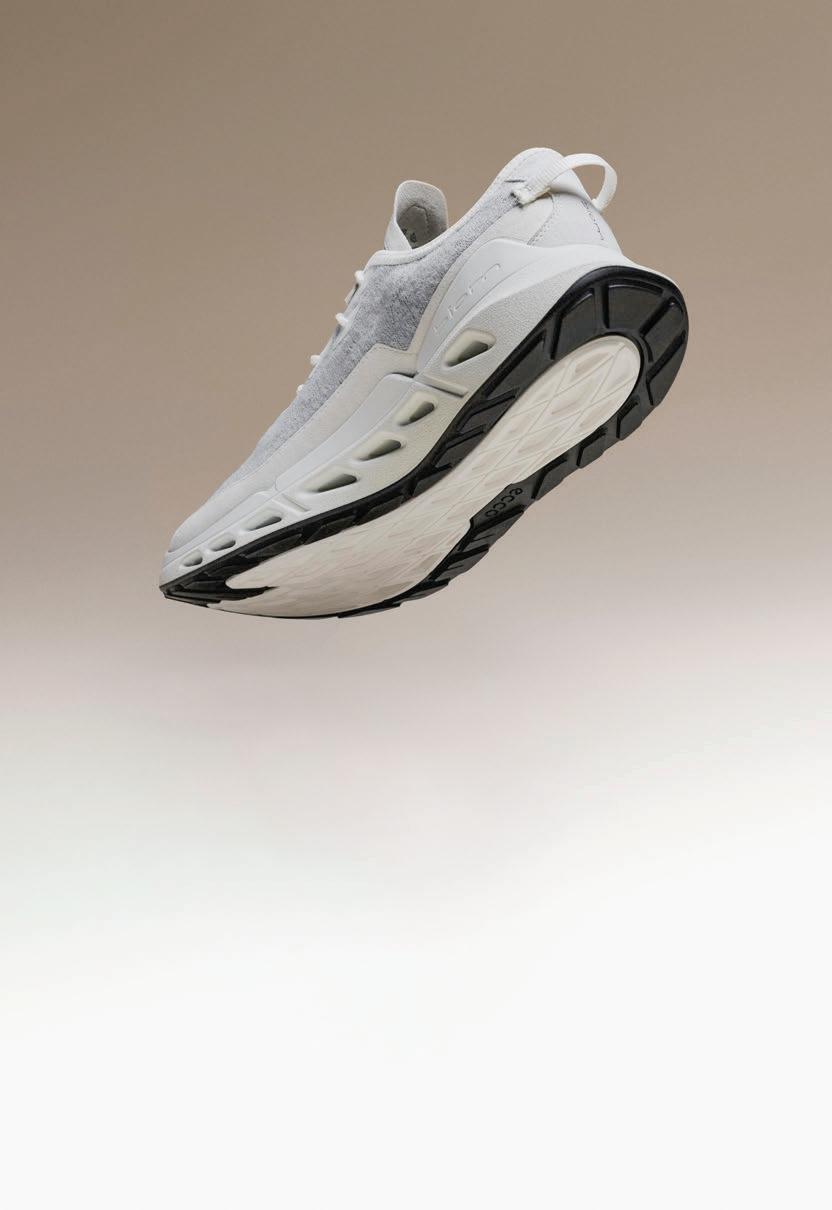
A leather partnership that Ecco and renewable fibre producer Spinnova began in 2020 has borne footwear fruit at last, the new, limited-edition BIOM 720 shoe.
14See through
The complex material combinations in footwear these days is no barrier to a system Trinamix has come up with to help more shoes go for recycling at end of life
Supershoe helps Sawe soar
ADVERTISER’S INDEX
ATHLETIC & OUTDOOR
16World-first
BUSINESS OF FOOTWEAR
28 Cowboy culture
Beyoncé may have helped widen interest in cowboy boots, but there are brands and consumers who have loved western-style footwear for many decades and will continue to do so for decades to come.
Essential reading
All the detail on the adidas supershoe that helped Sabastian Sawe smash through the two-hour barrier at the 2026 London Marathon.
20 Steady supply
Turkey’s footwear industry is spreading its search for good raw material and reliable suppliers as far as Brazil.
22 A strange kind of love
Luxury group Kering insists that leather is central to its identity and its quest for higher revenues from footwear and bags, but it also says it wants to “decouple growth” from its dependency on the material.
SALES OFFICES
Global sales: Mat Abbott T (+44) 151 3637600 E matthew@worldtrades.co.uk
India: S Sankaran E indianleather@yahoo.com
Pakistan: Abdul Rab Siddiqi E arsidiqi@yahoo.com
World Trades Publishing 2026
Contributions: The editor welcomes news items, articles and photographs for consideration and possible publication but no responsibility can be accepted for the loss or non-publication of such material. Opinions expressed by individual contributors do not necessarily reflect the view of the editor or publisher.
Whilst every effort is made to ensure accuracy in reproduction, no responsibility can be accepted for the technical content or for claims made by manufacturers for product performance that are published. Publication in Footwearbiz cannot be construed as an endorsement for a claim or product by the publisher.
Footwearbiz (ISSN 2976-9809) is published 4 times per year by World Trades Publishing, The Old Stone House, Teeton, Northampton NN6 8LH, UK. Price UK £90, ROW £150 per year (four issues). Credit cards will be charged in GB Pounds converted at the daily bank rate. Your credit card company may charge you for this service. Graphic origination by WTP. Print by Bishops Printers, Walton Road, Portsmouth, Hampshire PO6 1TR, England. All rights reserved. ISSN 0894-3079.
World Trades Publishing 2026
All rights
No part of this publication may be reproduced, stored in a retrieval system or transmitted in any form or by any means mechanical, electronic, recording, photocopying or otherwise, without the written permission of the publisher.
Global news
UK Specialist shirt manufacturer Turnbull & Asser has announced an investment in Northampton-based, high-end footwear manufacturer Tricker’s. As part of the deal, the creative director of Turnbull & Asser, Roberto Menichetti, will take up a creative leadership role for Tricker’s too. In addition, Turnbull & Asser will now offer Tricker’s shoes and boots to customers at its shops in London and New York. Tricker’s was founded in 1829 and claims to be the oldest established shoemaker in England.
Spain The Futurmoda exhibition attracted 4,100 visitors to its fifty-fifth edition, which took place in Elche this March. The organisers described this as “a very positive outcome”. Exhibitors at the event told the organisers they were pleased by the high quality of visitors and said they had made an important number of business contacts over the two days. As well as Spain, there were industry professionals from Italy, Portugal, France, Germany, the UK, the Netherlands, Turkey and China in attendance
The Netherlands US-based non-profit Soles4Souls has bought Erren Recondition, a Netherlands-based provider of footwear and clothing reconditioning. “Erren has spent years building a reputation for quality, innovation and reliability in circular reconditioning,” said Soles4Souls CEO, Buddy Teaster. “Combining their expertise with our global mission allows us to create even more impactful solutions.” Soles4Souls operates across four continents. Over 20 years, it has kept more than 116 million pairs of shoes and pieces of clothing out of landfills.
Denmark Skechers has opened its first flagship store in Copenhagen, marking a further step in the company’s retail expansion across the Nordic region. Located at Amagertorv, the new store spans 700 square-metres and presents the brand’s full range of lifestyle and performance footwear, alongside apparel and accessories. The opening strengthens Skechers’ presence in Denmark, where it now operates 32 stores.
Germany Europe’s largest footwear retail group, Deichmann, has officially opened its new headquarters in Essen. The building will accommodate around 1,500 employees and integrates sustainable energy solutions including photovoltaics, geothermal energy, and green roofs. Despite a challenging market in 2025, Deichmann recorded revenues of €8.9 billion and sold approximately 180 million pairs of shoes worldwide. The company operates around 4,700 stores and 40 online shops in more than 30 countries.
France French group Chaussea has acquired Groupe Royer, which filed for bankruptcy protection in October. Groupe Royer owned the business of the Kickers brand in most markets. Chaussea said it was very happy to bring Kickers into its portfolio of brands. Chaussea, which is based in Valleroy, near Metz in north-eastern France, described Kickers as “an authentic, free and non-comformist brand”. It said Kickers would help it strengthen its children’s footwear offering. London-based Pentland Group acquired the Kickers business in the UK and Ireland in October 2025.
Czech Republic The chief executive of the Bata Shoe Group, Panos Mytaros, has marked the 150th anniversary of the birth of the company’s founder, Tomas Bata. The Czech industrialist was born in the city of Zlin in April 1876. He founded his now-famous footwear company in 1894 at the age of 18. The founder’s son, Thomas J. Bata, took over after his father died in a plane crash in 1932. Today the company has a presence in 56 countries worldwide and around 4,300 stores. It sells around 130 million pairs per year.
US Maryland-based Joola, a brand that has specialised in table tennis since the 1950s, has developed its first pickleball shoe. The Joola R4lly has been designed to meet the performance needs of pickleball players, the company said. Its design team, with technical expertise gained at Nike, Columbia Sportswear, Sorel, Merrell, and Canada Goose, studied movement patterns and athlete requirements to create a purpose-built shoe, combining insights from professional athletes.
Brazil Brazil’s footwear from January to April totalled 34.5 million pairs and $284.4 million, declines of 12% and 19%, respectively, according to industry association Abicalçados. President, Haroldo Ferreira, said an increase in shipments to the US indicated not only a recovery, but also an anticipation of further growth there following tariff relief. An additional 50% tariff is no longer being applied to imports into the US from Brazil and footwear is now shipping there with a 10% tariff rate.
Pakistan The country’s leather and footwear industry has urged the Ministry of Commerce to introduce a separate Harmonised System (HS) code for used footwear to improve monitoring of imports The request was discussed during a meeting between industry representatives and commerce minister Jam Kamal. The sector said used footwear is currently classified under a broader category covering used clothing and accessories, which makes it difficult for regulators to accurately track imports and assess valuations.
Vietnam The Vietnamese province of Dong Nai has announced a plan to grow its supply chain business for the footwear, textiles and car industries. The local government said it will focus on technology and automation in production and to build business parks to attract international funding. Supporting industries are expected to account for a quarter of province’s total industrial production by 2030, with the aim of supporting around 1,200 manufacturing businesses.
Canada Outdoor footwear brand Baffin has brought to market a product it calls a ‘recovery clog’. The Ontario-based company has said the clog marks its entry into the recovery footwear market. It describes the product as having a “versatile, comfort-first design”. It has a solid upper construction that uses water-resistant materials. Baffin said this, and the clog’s slip-on functionality, would make it an ideal choice for post-hike recovery in variable conditions. The outsole is engineered “for supportive rebound and underfoot relief”, the company said.
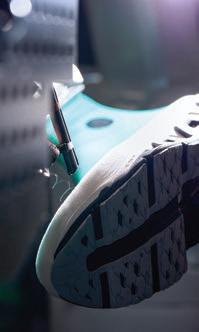
South Korea Athletic footwear brand On has opened a production facility with high levels of automation in Busan, South Korea. The company said this would be the second factory to produce shoes using its LightSpray technology. On announced LightSpray in 2024. The technology involves using a robotic arm to spin the upper of a shoe in a single step. On opened a first LightSpray factory in Zurich in 2025, incorporating four robots. The new factory in South Korea has 32 robots. On said this would increase its LightSpray production capacity 30-fold in 2026.
China Footwear manufacturers in China exported nearly 1.7 billion pairs in the first two months of 2026. These exports brought in revenues of $7.5 billion. The China Leather Industry Association has reported that these figures represent increases of 12% in volume and 6.1% in value. Leather footwear accounted for exports of 97 million pairs across the two-month period, with a value of $1.25 billion, increases of 12% and 6.1% respectively year on year. Over the same period, China imported 25.5 million pairs of shoes and other footwear, with a value of $870 million, falls of 19.9% in volume and of 1.1% in value. Of these, leather shoes accounted for 6.8 million pairs and a value of $340 million, down by 23.6% and 8.8% respectively.
Footprints
Comeback for ex-Puma CEO
High-end sports brand Willy Bogner has announced that Arne Freundt as its new chief executive. Mr Freundt, former chief executive of Puma, will take up his new role on June 1.
Arne Freundt will take up the leadership of Bogner following periods of upheaval for him and for the Munich-based brand. Mr Freundt became chief executive of Puma at the start of 2023, following Bjørn Gulden’s departure for adidas.
At the time, Puma said Mr Freundt was “the ideal choice”. He had already been at the company for more than a decade and served as its chief commercial officer. He had been a member of Puma’s management board since June 2021.
However, he only led Puma until April 2025. He and the company mutually agreed his departure following what Puma described as “differing views on strategy execution”.
Around the same time, a change of ownership occurred at Willy Bogner. Consumer goods company Katjes acquired a 60% stake in August 2025, with the founding Bogner family retaining the other 40%.
The chief executive position was vacant at the time of that transaction; Katjes said it wanted to let the new ownership structure settle down before filling it.
Chairman of the Bogner advisory board, Bastian Fassin, said the company was pleased to have attracted “one of Europe’s most experienced experts in the sports and lifestyle sector” to the role.
For his part, Arne Freundt described Bogner as “an iconic brand with a unique alpine heritage, standing for luxury sports and the highest quality”. Its collections include a range of high-end sneakers.
Chief executive leaves On
Athletic footwear and apparel group On has announced the departure of chief executive, Martin Hoffmann
It said Mr Hoffmann had chosen to step down after five years as chief executive and 13 years as chief finance officer, holding both posts concurrently. “Martin has decided to take a planned hiatus and pursue philanthropic interests,” the company said.
On had already announced the arrival of Frank Sluis as its new chief finance officer. Now it has announced that co-founders David Allemann and Caspar Coppetti will serve as joint-CEOs following Martin Hoffmann’s departure. At the same time, Scott Maguire is being promoted to chief operations officer.
Commenting on Martin Hoffmann’s decision, Mr Coppetti said: “It is difficult to put into words how impactful Martin has been. From our early days, through a landmark IPO, his commitment to our culture and financial discipline has been instrumental. It has been a privilege to work alongside him and we are deeply grateful for his partnership, his outstanding contribution and the legacy he has built.”
Industry insight
Industry body the British Footwear Association (BFA) has appointed Ian Cartwright as chief executive officer. He succeeds Richard Shetliffe, who steps down after two years in the role. Mr Cartwright is currently chief operating officer at Mahabis and is a long-standing BFA member. Chair, Jane Wilson, said he brings strong industry insight and an understanding of the challenges facing footwear businesses.
Co-chairs
Senior figures from New Balance and from Nike have been elected co-chairs of the World Federation of the Sporting Goods Industry (WFSGI). This is the first time representatives of two US-based brands will lead the organisation together. Chief operating officer of New Balance, Dave Wheeler, and Nike’s chief public affairs officer, Jorge Casimiro, are the two co-chairs. They will work with WFSGI chief executive, Emma Zwiebler.
Style choice
Sports group Puma has announced the appointment of Laurent Fricker as its new vice-president of its Sportstyle business unit. He will take up the position on June 1. Last year, Puma named Sportstyle as one of four categories it will focus on in what it has called a transition period. The other categories are football, running and training. In Sportstyle it will place sports products that people will wear in leisure and lifestyle contexts rather than to take part in any athletic activity.
Sourcing experience
Multi-stakeholder body the Leather Working Group has announced that the senior director of product development at adidas, Catherine Lee, has joined its board. She will bring extensive experience of sourcing operations and material development, said LWG. She will replace the senior director of materials supply at Timberland’s parent group, VF Corporation, Jon Hopper, on the board.
Goodbye and thank you
On April 30, we said a fond farewell to consultant editor, David Buirski, who is retiring from his role after working on our magazines and websites for exactly one-third of a century.
Mr Buirski studied law in his native city, Cape Town, before pivoting into public relations work. This change of career changed his life. He moved to London, met his wife, Lyn, and stayed.
His work included in-depth involvement in communications projects for prominent fashion brands and the fashion industry’s representative bodies in the UK. This, in turn, brought him into contact with our company, World Trades Publishing. When the company needed a new editor for World Footwear (renamed Footwearbiz in 2025) and World Leather in March 1993, the knowledgeable and well connected Mr Buirski was the ideal choice.
Market move
Sportswear brand Saucony has appointed Wendy Kula as chief marketing officer. Ms Kula will lead the company’s global marketing organisation and oversee brand positioning across performance running, lifestyle and culture. She joins Saucony with more than 20 years’ experience in sport and consumer brand marketing. Most recently, she served as vice-president of women’s brand marketing in North America for Nike.
Momentum-builder
Two years later, he was instrumental in the company’s move into footwear and textiles for sport. He used his knowledge of materials and his love of sport to lead the launch of World Sports Activewear (WSA), now renamed Sportstextiles
As World Trades Publishing expanded, David Buirski’s role diversified too, ending with his becoming consultant editor across the company. Chief executive, Simon Yarwood, said: “We will all miss David and wish him a very happy retirement. His ever-sharp eye, patience, generous advice and gentle encouragement have been an unshakeable support to me and to our entire team.”
A pioneer’s passing
Soling technology developer Vibram has paid tribute to veteran mountaineer Jim Whittaker, who died at the age of 97 in April.
In 1963, Mr Whittaker became the first climber from the US to complete the ascent of Everest. He also led the first US exhibition to reach the summit of K2 in 1978. On both ascents, he wore footwear with Vibram soles.
Vibram said Mr Whittaker had begun wearing its soles on his climbing footwear in the 1950s while he was working at outdoor co-operative REI. “He recognised the importance of reliable traction in the most demanding environment,” the Italian company said.
REI received so much publicity after Jim Whittaker’s success in climbing Everest that the following year, 1964, was the first in which its revenues passed $1 million. A year after that, in 1965, the company made the mountaineer its president.
Rock star tours shoe factory
Singer and guitarist James Bagshaw was a recent guest at the factory footwear brand Loake runs in his home town, Kettering. Mr Bagshaw, a member of rock band Temples, said he was a long-time, proud wearer of Loake shoes. He said seeing at close hand all of the skill and hard work that goes into making the shoes had been “incredibly inspiring”. He described the artisans working at the factory as “a truly talented team of craftsmen and women with such an eye for detail”. He said seeing process from start to finish was “incredibly inspiring to see”.
Athletic footwear brand New Balance has promoted Tracy Knauer to the role of senior vice-president for North America. Ms Knauer has worked at the company for more than 20 years in marketing, product development and sales roles. Chief executive, Joe Preston, described her as an experienced industry leader with a deep understanding of New Balance’s business. “She embraces our brand’s core values,” he said, “and will drive continued momentum for our North American region.”
Flag day
Australian bootmaker RM Williams opened a new flagship store on London’s Jermyn Street in late March. Chief executive, Paul Grosmann, said: “This flagship allows us to show the depth of what RM Williams does. From the breadth of our boot offering to the level of service in store, Jermyn Street gives us the space to present our craftsmanship at its highest level and meet the expectations of a very discerning customer.”
New chapter
Dr Martens chief product officer Adam Meek has left the brand after four years, during which he led global product merchandising, design, development, and innovation. He oversaw the company’s transition from a product-led to a consumer-led strategy and guided brand and franchise development. Mr Meek, who previously held senior roles at Canada Goose, Sperry, Nike and Lacoste, said he is “excited about the next chapter” and plans to continue working at the intersection of brand, product, and consumer.
Industry&Innovation
On looks to take robotic production ‘commercial’
Athletic footwear and apparel brand
On has reported sales revenue of 831.9 Swiss francs (CHF) for the first three months of 2026, an increase of 14.5% compared to the first quarter of last year. On’s full-year sales for 2025 reached CHF 3 billion, which represented a record for the Zurich-based company and annual growth of 30%.
For this most recent quarter, it said it had achieved growth of more than 40% in Asia, “supported by standout momentum in China and South Korea”.
The company said it had “a strong innovation pipeline”, including using its LightSpray technology to produce footwear on a broader commercial platform, following “elite athlete validation”.
Founder and co-chief executive, Caspar Coppetti, said it had been “an outstanding start to the year”.
Materials policy
Separately, On has published its first global materials policy, outlining requirements for responsible sourcing and the use of animal-derived materials.
The policy establishes a framework covering environmental integrity and animal welfare, with a mandatory requirement that all animal-derived materials meet standards based on the internationally recognised Five Freedoms.
Leather, wool and down must be sourced through certification schemes that ensure ethical treatment and traceability from farm region to finished product.
Senior director of sustainability, Begum Kurkcu, said the company’s approach links material performance with environmental and welfare standards across its natural materials portfolio.
New owner for Sympatex
Italian footwear materials supplier Pidigi has acquired key assets of Munich-based membrane technology developer Sympatex. Sympatex went into administration at the start of this year.
Pidigi said it would continue Sympatex’s operations under its established brand. The deal includes the retention of 21 jobs and all four apprenticeships at the Sympatex site near Munich. International locations in France, China and Hong Kong, along with a Korean sales office, are also set to continue.
Sympatex managing director Kim Scholze will exit the company once the transaction is completed, after steering the business through the insolvency process. Pidigi owner and managing director, Dr Giorgio De Gara, said the acquisition builds on a long-standing partnership between the two companies. He noted that combining Sympatex’s membrane and laminates technology with Pidigi’s international market reach would help create strong operational synergies and support expansion.
Gold standard
Footwear research and testing body
SATRA has awarded gold-level accreditation to the in-house testing laboratory that foam materials developer OrthoLite runs at its factory in Ambur in India. OrthoLite said this is the first time a laboratory in India has achieved this level of accreditation from SATRA. Chief executive, Glenn Barrett, said the achievement underscored the company’s commitment “to precision, accountability and world-class testing standards”
Small is good
Sports retail group JD Sport has reported full-year revenues of nearly £12.7 billion. It said footwear accounted for 60% of total group revenues. JD explained that there had been “a significant shift in the global footwear product cycle” throughout the reporting period. It said it had seen strong growth in sales of footwear from brands “less affected by transition”. It added that the early signals for newer, smaller footwear brands it has begun to work with were encouraging, particularly in the running category.
Technical lab
Japan-based sports group ASICS has announced plans to open its new ASICS Technical Lab (ATL) in Kobe in December 2027. The new facility will focus on developing custom footwear for elite athletes while supporting rapid prototyping and product validation across the company’s wider range. The lab will operate in close collaboration with the ASICS Institute of Sport Science, allowing biomechanical and athlete testing insights to be applied directly to design and manufacturing.
AI shift (one)
Sustainability platform Worldly has launched a new AI-powered solution for supplier compliance management. The platform consolidates audit data from third-party assessments, brand-specific evaluations and the Higg Facility
CREDIT: ON
CAD update
French software company Stratégies has released Romans CAD(RCS) 2026 –V16, calling it a major update to its CAD and PDM platform for footwear and leathergoods manufacturers.
The new version aims to support faster time-to-market and stricter sustainability requirements by enhancing 3D/2D integration, precision pattern engineering and material efficiency.
Key features include real-time 3D-to-2D pattern synchronisation, parametric drafting tools, and an upgraded rendering engine with metallic PBR workflows. Enhanced nesting and cutting tools now consider left- and right-foot geometry and vision-assisted skin detection, while a redesigned workspace improves usability for small-scale artisans and industrial production teams
Foam moves forward
Sports footwear brand Puma has signed an agreement with Chinese firm Shincell New Materials to research and develop the next generation of its Nitro performance running technology.
Under the partnership, Puma and Shincell will establish a dedicated laboratory in Suzhou to test new materials, with the first products expected in upcoming seasons.
“With Nitro we have the best running technology in the industry and the agreement with Shincell allows us to maintain that edge,” claimed Romain Girard, vice-president innovation at Puma.
Shincell specialises in sustainable foaming technologies and lightweight high-performance foam materials, using a physical foaming process that traps micro and nano bubbles within plastics.
Dr Xiulei Jiang, CEO of Shincell, said the collaboration demonstrates the value of technology-focused innovation.
Puma launched Nitro in 2021 and has since integrated it across running, training, football, basketball, and golf products.
Expansion for PrimeAsia
Leather manufacturing group PrimeAsia has signed a manufacturing partnership with Ecco Indonesia to produce PrimeAsia leathers at the footwear group’s location in Surabaya, which will enable it to meet growing demand in Indonesia.
PrimeAsia Vietnam will also complete two major R&D and sample expansion projects in 2026. The first, scheduled for completion next month, will add 19 drums, increasing the retanning and colouring capacity by 30%. Later in the year, another 24 drums will be added. This will enable more than 900 sample runs per week.
It has also completed the rooftop solar installation at the Vietnam facility, working towards a target of 100% renewable energy at its facilities by 2040. Group CEO Jon Clark said: “We are moving forward with strength by investing in our facilities to meet the growing needs of our customers, delivering greater reliability, speed and efficiency, while maintaining strong focus on resource management, risk mitigation and cost control.”
On target
Coats Group has reported early achievement of several 2026 targets in its latest sustainability report, with its focus on the footwear and apparel sectors. The company reached zero-waste-to-landfill a year ahead of schedule and cut Scope 1 and 2 emissions by 30%.
In materials, it increased non-virgin oil-based inputs to 52% of its primary raw materials and launched 100% recycled polyester threads under its T2T Epic and T2T Gramax brands.
Footwear-specific initiatives included Rhenoprint RP Flow and RP Wave toe-box components with 70% recycled content and the reprocessing of more than 500 tonnes of composite waste into Reform 2.0 heel counters.
Social and Labor Module. It uses artificial intelligence to map findings to brand codes of conduct and labour standards. Worldly said the system allows brands to manage audits, remediation and corrective action tracking within a single platform, replacing fragmented manual processes.
AI shift (two)
The company behind the Allbirds shoe brand is to exit the footwear sector and pivot towards AI infrastructure. It has secured funding to support its move to become a GPU-as-a-Service and AI-native cloud model, with the company planning to rename itself NewBird AI. GPU stands for graphics processing unit, which is a processor that can handle a large number of calculations simultaneously. This shift follows an earlier agreement to sell the Allbirds brand and footwear assets to American Exchange Group, which will continue operating the brand.
Strong links to education
Spain’s association of footwear component manufacturers AEC has announced a commitment to support students on Miguel Hernández University’s fashion technology management course. The university, located in Elche, close to the country’s biggest footwear hub, launched the course two years ago. Head of its school of economics and society, María José López Sánchez, said AEC had helped it design the course’s content, making “interesting recommendations that we have followed”.
Patent pains
A US federal judge has overturned a jury ruling that found Lululemon liable for infringing Nike’s Flyknit patent. The patent covers Nike’s Flyknit fabric, including uppers with areas of different stitch configurations joined in a single construction. Nike had claimed Lululemon used these techniques in its Chargefeel, Strongfeel and Blissfeel sneakers. Judge Arun Subramanian reversed a $355,450 fine. Nike also has a separate case pending against Lululemon over six patents related to the Mirror Home Gym.
Backtrack
15 May 2026
Birkenstock maintains growth momentum
12 May 2026
Success pushes ‘absolute emissions’ up for Amer Sports
Steve Madden reports higher Q1 revenue
08 May 2026
Wolverine revamps leadership in Work Group brands
07 May 2026
‘Live commerce’ workshops to be part of BF Shoes programme
Adidas to supply footwear for 2026 Solheim Cup
06 May 2026
Leather removed from EUDR scope
Footwear revenues up overall for Columbia, as Sorel suffers
05 May 2026
Brooks posts strong start to 2026
Q1 fall for Puma, but ‘foundations for future growth’ are in place
01 May 2026
Falls for footwear exports in France
30 April 2026
Footwear fall is no hindrance to adidas growth
Ecco introduces shoe using fibre from leather by-product
29 April 2026
Rocky Brands sales rise 9%
Material help for recyclers on offer from Trinamix
28 April 2026
Supershoe helps athletes make history at London Marathon
27 April 2026
Nike to shed 1,400 jobs
23 April 2026
Half of McQueen stores will close before the end of 2026
Clarks launches marketplace as profits return
22 April 2026
BASF sees potential for outsole development
Footwearbiz’s publishing cycle and limitations on space make it impossible for us to run more than a carefully selected sample of news from across the industry. However, we publish hundreds more stories on www.footwearbiz.com. The site is updated every day with news from every continent and every part of the industry, making footwearbiz.com one of the most comprehensive archives of news anywhere on the web for the global footwear industry.
We list below just a few of the headlines that have appeared on the site in recent weeks — www.footwearbiz.com allows you to read the news items you may have missed.
20 April 2026
Special snake boot for 2026 World Cup
17 April 2026
Adidas transforms Shanghai art gallery into Climacool ‘museum’ Q1 revenues up for Stella International
14 April 2026
Senior creative appointment at Puma
10 April 2026
Parent company to wind down after sale of Allbirds IP
09 April 2026
Nike: cost cutting and flat quarterly revenues
Dr Martens shifts to consumer-focused GM structure
08 April 2026
Strong year for Decathlon with revenue growth and impact reduction
07 April 2026
Streamlined sneakers from Jil Sander and Puma
02 April 2026
Converse sales drop drives Nike Q3 decline
Running, outdoor and training lift Intersport in 2025
01 April 2026
GOAT group reaches wider sneaker audience
31 March 2026
Double the space for Footasylum in Manchester
Nike creates design programme for 3D-printed Air Max
30 March 2026
Dick’s begins Foot Locker layoffs as integration continues
27 March 2026
Circular footwear partners meet at adidas HQ
Brooks Running reshapes leadership structure
26 March 2026
Gymshark manager takes top role at Footasylum
25 March 2026
Record results boost Anta’s confidence about competing globally
FDRA warns oil price surge to squeeze footwear margins
24 March 2026
Football boot launches from New Balance
23 March 2026
On launches full-scale circular program for footwear
20 March 2026
Tariffs affect growth for Stella International
Caleres beats Q4 estimates
19 March 2026
Market volatility hits Lanvin Group figures
Footwear supply chain stalls as tariff uncertainty continues
18 March 2026
Around 75% of total production in Brazil will be at BF Show in May
Scarpa sets out US transition plan
17 March 2026
Adidas launches Single Shoe service
16 March 2026
Double-digit growth for Dick’s Sporting Goods
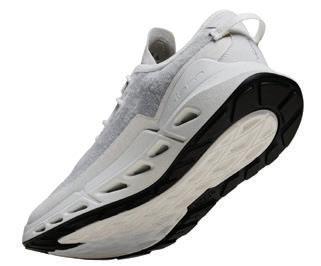
The Elastollan GripTec TPU portfolio is engineered to deliver superior traction, rugged durability and excellent abrasion resistance across a wide range of conditions.
ALL CREDITS: BASF
TPU sole with rubber soul
Germany-based chemicals and materials giant BASF was seeking to answer a simple question when developing its latest product for the footwear sector. Its chemists asked themselves, “Why only rubber?” when it comes to outsoles. The challenge was to create an alternative that could expand on design possibilities but which could also potentially lower the environmental footprint.
At plastics-focused trade show ChinaPlas in April, BASF’s Performance Materials Division unveiled Elastollan GripTec, part of its expansive thermoplastic polyurethane (TPU) portfolio. The new series combines grip, durability and design flexibility and has been created for outsoles of running and hiking shoes, as well as fashion and children’s footwear. “Footwear brands are always looking for materials that enhance user experience and improve safety,” says Rohit Roop Ghosh, a vice-president in the TPU division at BASF. “Elastollan GripTec enables greater design flexibility and advances our commitment to sustainability.”
To address diverse application requirements, the series comprises three grades. The first focuses on abrasion resistance with excellent durability; the second, a rubber-like feel with better transparency; and the third, greater transparency with a balanced performance profile. “However, there’s more to GripTec than grip and durability,” explains Cooper Li from BASF China. The variations in colour – from transparent to
BASF says Elastollan GripTec gives designers greater freedom and manufacturers an easily integrated, lower-footprint alternative.
black – allow for more creative and detailed outsole designs, he says. “GripTec gives designers the freedom to shape outsoles the way they actually want to. Sharp textures, bold lines, clean patterns and, if a concept calls for it, transparency.”
From a manufacturing perspective, the GripTec series has been developed for optimised processability, which helps improve productivity, reduce energy consumption and minimise waste, according to the company.
“GripTec runs on standard TPU injection processes, so shifting from rubber isn’t disruptive,” adds Cooper Li.
Its sustainability credentials are a third benefit, he suggests. A life cycle assessment (LCA) study conducted by Intertek showed that Elastollan GripTec generates around a 40% lower product carbon footprint than conventional rubber outsoles during the manufacturing stage. “Preliminary feedback from leading global footwear brands have been positive and validates the market potential,” adds Mr Ghosh.
Collaboration and circular thinking
Elastollan, first developed in the 1970s, has been a key product for the footwear sector. Its mechanical strength, resistance to abrasion, slip resistance and modifiable hardness mean it is suitable for a range applications. Soft grades are used for cushioning elements, medium hardness grades are suitable for compact or combination soles and hard grades work for heels and heel tips. Anti-static agents can also be added so that it can be used for safety footwear.
French outdoor brand Salomon launched a midsole with it using supercritical fluid (SCF) foaming technology for its Index.02 model in 2023. The SCF technology makes post-consumer recycling a possibility, as no crosslinking or chemical blowing agents are needed during the foaming process.
This kind of circular thinking was behind some of the new products that BASF presented at last autumn’s Simac footwear technology trade fair in Milan. A meltable PU means bottom units, upper parts or even complete shoes made of meltable PU or combinations of TPU and PU can be ready for mechanical recycling. Its new TPU Elastollan RC, with up to 100% recycled content, was also presented as a raw material for new shoe parts. Alongside this concept, it suggested that by using depolymerisation, both postindustrial and post-consumer footwear waste can be incorporated into new polyurethane shoe soles. Alternatively, ChemCycling (see sidebar) means it can incorporate up to 100% attributed recycled feedstock using a mass balance approach.
At the Milan fair, it also presented two collaborations with footwear technology providers, based on a new PU called SpringPURe, which emulates “the bouncy flexibility of polyether-based materials and the easy processing of polyester-based options”. A partnership with Italian machinery company Stemma, using its Nucleoos technology for chemicalphysical foaming, created lighter midsoles with “outstanding style and performance”, and which integrates into existing polyurethane molding
Reducing fossil-based inputs
BASF Performance Materials Division – which includes polyurethanes, thermoplastic polyurethanes and specialty polymers –has recently had all its European production sites certified according to REDcert2. With the recent addition of its polyurethane production site in Malacky, Slovakia, the division can now offer its customers certified mass balance solutions from its 10 plants. The alternative raw materials, such as end-of-life tires or mixed plastic waste, can be fed into the early stage of production at a certified site and attributed to products via a mass balance approach. BASF applies this scheme to certify the reduction of fossil feedstock use, either through the Biomass Balance approach, which incorporates renewable raw materials, or via ChemCycling, which uses recycled feedstocks.
China offers 10% lower PCF option
BASF has launched a Reduced Product Carbon Footprint Elastollan TPU portfolio in Asia Pacific, enabling customers to lower the carbon footprint of their products. The ReducedPCF grades are achieved through lower emission utilities, such as renewable electricity or renewable steam, and fossil feedstocks with lower PCF. These grades achieve a PCF reduction of 10-30% compared with the PCF of current Elastollan grades, while remaining technically identical.
The Elastollan ReducedPCF portfolio will be produced at BASF’s site in Shanghai. Selected Elastollan TPU products might additionally incorporate site specific mass balance biomethane as an active PCF reduction measure.
processes. It also launched direct soling concepts with Germany’s Desma, combining Elastopan SpringPURe lightweight midsoles with Elastollan TPU film outsoles.
BASF says innovation has always been the key to its success. In 2024, around 10,000 employees worldwide were working in research and development and it generated sales of around €11 billion with products launched within the past five years.
Its annual R&D expenses amount to around €2 billion.
“What we’re seeing today is how complementary material innovations open up new design and performance possibilities while established materials like rubber continue to play an important role where they make most sense,” says BASF. “What’s changing is the range of options designers now have to balance grip, durability and design freedom.”
BASF’s polyurethane production site in Malacky, Slovakia.
ECCO Biom 720 with Spinnova fibre. ALL CREDITS: ECCO/RESPIN
Eccotrialsleather waste f ibre
When Ecco first explored turning leatherproduction waste into textile fibre, the idea was largely experimental. Several years on, the concept has reached a footwear application in a limited-edition model, the Biom 720.
The project, launched in 2021 with cellulosic fibre specialist Spinnova and then-partner KT Trading, was designed to investigate whether wet-blue leather waste could be converted into usable textile fibre for spinning, weaving and knitting. At the time, the aim was around extending the value of existing material streams, rather than replacing them. Following successful pilot trials, the partners confirmed plans to explore commercialisation and assess a first industrial-scale production set-up, initially earmarked for the Netherlands, where Ecco Leather’s operations are based.
By 2024, the companies had formalised their intent to scale the venture through a letter of intent covering the Respin joint venture, alongside confirmation that
The Danish brand has shown that wet blue shavings can be transformed into new material through its longstanding partnership with Spinnova.
fibre quality had reached commercial requirements. Ecco also produced an early prototype shoe using material from the pilot line, marking the first step towards footwear application.
“Together, we have shown that leather waste can be transformed into a high-quality textile fibre with commercial relevance,” said Spinnova chief executive officer Janne Poranen, describing the development as the outcome of several years of joint work.
The latest Biom 720 release represents the first limited edition footwear application of the fibre. The material is produced from wet blue shavings, a by-product generated during chrome tanning when thin layers are removed from hides to achieve a consistent leather thickness. For this launch, Ecco confirmed the shavings were sourced from its tannery in Dongen, the Netherlands. Following the previously announced closure of the Dongen site after a fire in 2025, the company indicated that future sourcing could also include its Asian operations as well as the potential to use other European tanneries.
Fibre technology
Spinnova’s technology uses a mechanical refining process rather than chemical hydrolysis to convert the shavings into continuous filaments, which are then cut into textile-grade fibres for use in woven and knitted applications. The company says the process also enables multiple waste streams, including wood, textile and agricultural residues, to be used without the need for harmful dissolving chemicals or production side streams.
Spinnova has previously described Respin as a way to “keep leather in circulation” by upcycling waste into new textile fibres, positioning the material within a broader circular economy framework for the leather value chain. The company has also noted that once processed, the fibre behaves more like a textile input than a leather-derived material, with some performance characteristics linked to its origin but without retaining the structural network of the original hide.
Ecco has similarly mirrored this distinction. In response to technical questions, the company said the original collagen structure of leather is no longer present after processing, with the fibre instead representing a physical transformation of a byproduct into a new textile material.
“By combining our expertise with Spinnova’s technology, we are exploring new ways of using existing resources in footwear,” said Ecco chief executive officer Thomas Gøgsig, pointing to material innovation as part of future product development.
Scalable production
The Biom 720 itself builds on Ecco’s biomechanical footwear platform, designed to support natural movement with a close-to-theground profile. It also integrates Ecco encore technology, with outsole ventilation features intended to improve breathability, energy return and shock absorption.
While the footwear application provides a visible milestone, the wider significance of the project lies in its attempt to establish a scalable route for leather production waste.
Spinnova has previously reported that wet blue shavings from European tanneries, including Ecco’s own facilities, were used during early pilot work, helping to establish initial proof of concept for the process.
In the current phase of development, however, the companies told Footwearbiz that work has been based exclusively on Ecco wet blue shavings. This controlled input approach has been used to maintain consistency during pilot optimisation and to better understand process behaviour before introducing wider variability at industrial scale.
For Ecco, the introduction of the fibre into footwear represents a transition into product-level testing in a controlled, limited format. For
Spinnova, it provides further validation of its mechanical fibre technology beyond its original woodbased applications.
The companies also noted that the fibre remains in a pilot phase, with development work aimed at preparing for future commercial rollout. They added that fibre quality is sensitive to both raw material variation and process conditions, with early-stage work conducted under tightly controlled parameters.
The fibre is not currently positioned for direct cost comparison with conventional textile materials such as wool, polyester or cotton, with commercial viability expected to depend on scale and end-use application rather than immediate price parity. Internal preliminary environmental assessments have been conducted during pilot development, alongside testing against Ecco’s internal quality performance standards for footwear applications. Looking ahead, key questions remain around feedstock variability, the integration of external tannery waste streams and how a multi-supplier model could be managed in practice. These factors are expected to shape the next phase of development as Respin moves from pilot validation towards broader industrial application.
Spinnova mechanical fibre derived from leather production waste.
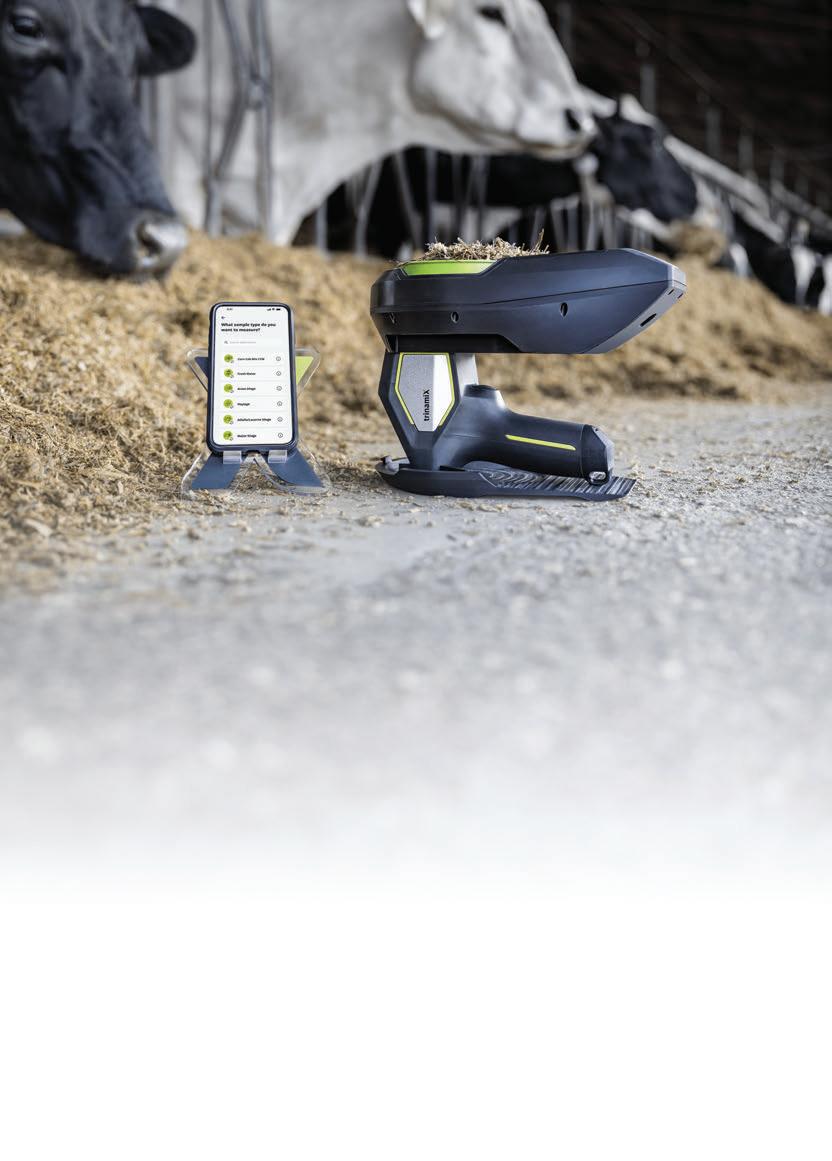
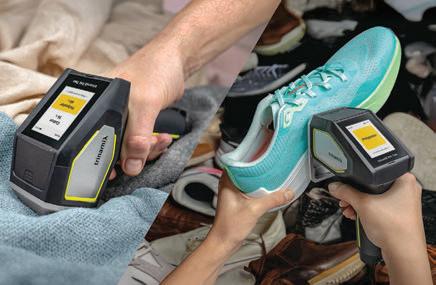
The Trinamix system uses a handheld spectrometer, cloudbased data platform and app to go beyond the visual and tell users which materials are present in any object, from cattle feed to footwear. ALL CREDITS: TRINAMIX
Complex combinations
Aprovider of sensing technologies, Trinamix, has said a spectroscopy system it has developed can help the footwear industry put in place circular solutions for material recycling.
Ludwigshafen-based Trinamix is a subsidiary that chemicals group BASF set up in 2015. It has developed mobile near-infrared (NIR) spectroscopy technology that it says can support manufacturers, sorters, recyclers and brands in their efforts to identify the materials in shoes at end of life.
This, the company has said, can enable informed decisions in recycling and circular-economy processes. Using NIR spectroscopy technology will improve material separation and quality-control tasks when footwear arrives at recycling centres. Brands and manufacturers will also be able to use the technology at product-testing stage to examine and, if need be, improve the “recycling readiness” of their products.
No escape
Modern footwear consists of what the technology provider has described as “complex material combinations and blended structures”. This, it points out, is happening at a time when regulatory requirements and sustainability targets are increasing the demand for reliable and traceable material data. In Europe, at least, there is no escape from this.
Technology provider Trinamix has developed a system that can see through the “complex material combinations” in contemporary footwear and make shoes easier to recycle.
Since the start of 2025, European Union (EU) member states have had an obligation to separate textiles from general waste collection. This is to prevent materials going to landfill and, instead, make them available for reuse and recycling under the EU’s Waste Framework Directive. Each of the 27 member states has its own national implementation programme. Some of these programmes, most notably France’s, already include footwear.
The Commission is currently working on formal revisions to the EU Waste Framework directive and a mechanism the footwear industry is already familiar with, Extended Producer Responsibility (EPR), will be part of this revision. EPR is a legal mechanism that will require companies placing footwear on the EU market to finance and organise the collection, sorting, reuse and recycling of those products at end of life. National
schemes for putting this into effect are already in the works. By 2028, they will be mandatory. Footwear brands that are not already preparing collections for 2028 will be very soon.
Beyond the visual
“Material innovation is driving the future of footwear, but it also increases complexity across the value chain,” says circular economy lead at Trinamix, Adrian Vogel. “NIR spectroscopy provides a practical tool that can help customers increase transparency, minimise risk and take informed decisions in recycling and circular-economy processes.”
Trinamix argues that technology of this kind is going to be needed because visual inspection alone is no longer enough to determine the material composition of a shoe. Its solution combines a handheld spectrometer with a mobile app and a cloud-based data platform. The spectrometer, the trinamiX PAL Two, enables fast measurement even in demanding environments, the company insists. The mobile app takes users through the measurement process and delivers easy-to-interpret results.
Mind the gap
NIR spectroscopy is technology that is in use as an analytical method in a wide range of industries. Trinamix has worked with testing services provider Eurofins to apply the system it has built to help livestock farmers prepare feed mixes that meet the specific nutritional needs of their animals. Spectroscopy can analyse silage, for example, and help farmers see if there are “nutrient gaps or imbalances” in the plant matter. If there are, the farmers can provide the necessary additives. There are human healthcare applications in the pipeline too. The company is confident that, in the near future, we will be able to use a smart phone or wearable device to measure aspects of our health just by quickly scanning our skin. Clinical studies have already taken place to establish the technology’s suitability for measuring alcohol levels in a
person’s blood, for example. Using spectroscopy is a non-invasive method for carrying out these tests, the company argues, and the results are quick and easy to access.
Good vibrations
In Trinamix’s words, NIR spectroscopy “provides insight into the molecular composition of an object”. At the push of a button, a light source in the handheld spectrometer sends out NIR light. This light goes through the object’s surface and “causes the underlying molecules to vibrate”. Some of the light is absorbed, but some of it is reflected back and can be captured by a sensor in the spectrometer and transformed into an electronic signal. This signal has a pattern, or a spectrum. The spectrometer sends each spectrum to the cloud where “advanced chemometrics” evaluate it. Models compare the pattern with archived results. When the system finds a match, it sends the result to the app, telling users which materials are in an object or sample, and how much of them.
Along the recycling chain, the PAL Two has already proved its ability to identify different kinds of plastic “on the spot”, leading to improved accuracy and efficiency in sorting. In announcements it made in 2025, Trinamix said the handheld spectrometer and the cloud-based data platform had already shown
themselves to be capable of identifying 30 different types of plastic, including polyamide, polyethylene, polypropylene and polyvinyl chloride. It was also able to identify textile fibres, including cotton, acrylic, elastane and wool. It has carried out live demonstrations of the technology at a number of industry exhibitions in the last 12 months. What gives Trinamix extra confidence that the system will work well with the “complex material combinations” in use in the footwear industry is that it has successfully recognised “hard-todifferentiate plastics and textiles”.
Materials on this list include blends of polyethylene and polypropylene. Until now, these combinations have posed what it calls “significant challenges” when products containing them go for recycling. A further point the company makes is that compostable plastics, which are in use in some footwear and footwear components, offer an environmental advantage but can “complicate sorting processes”. This is especially the case when the compostable materials resemble conventional plastics. “Polyamides like PA 6 and PA 6.6 are often difficult to separate and recycle, further complicating waste management efforts,” Trinamix says. Its system can identify all these materials and, it insists, help close the loop in footwear sustainability.
A demonstration of identifying polyester in a shoe upper using a handheld spectrometer.
A moment in time. Sabastian Sawe with his record-breaking time of 1:59.30 captured on his Adizero Adios Pro Evo 3 shoe.
ALL CREDITS: ADIDAS
Supershoehelps athletes makehistory
Two runners, Sabastian Kimaru Sawe from Kenya and Yomif Kejelcha from Ethiopia, have broken the time of two hours for a marathon, the first time this has happened in competition conditions. At the London Marathon on April 26, Sabastian Kimaru Sawe was the winning athlete with a time of 1:59.30. Yomif Kejelcha came second with a time of 1:59.41. Another Ethiopian athlete, Tigst Assefa Tessema, also made history at the event by setting a new women’s record time of 2:15.41. All three athletes wore the same shoes, the newly released Adizero Adios Pro Evo 3 from adidas. The sports company describes the shoe as the lightest Adizero model it has made so far. It announced the shoe just three days before the London Marathon, saying that it marked “a new era of supershoe innovation”. The footwear has since gone on sale in a “highly limited release” with a price-tag of €500 per pair.
Three athletes achieved world-firsts at the 2026 London Marathon. They were all wearing the same footwear.
It builds on “a legacy of record-breaking performance”, adidas makes clear. As long ago as 2008, an early Adizero model was the footwear of choice when Haile Gebrselassie became the first marathon athlete to break two hours and four minutes over the distance. He achieved a time of 2:03.59 that year in Berlin. Since then, athletes have broken women’s and men’s records for the half-marathon, 5k, 10k and mile while wearing different Adizero iterations.
The Adizero Adios Pro Evo ‘franchise’ launched in September 2023, since when the footwear technology has helped athletes break three world records, one Olympic record and seven national records. The shoes have helped deliver more than 30 major road race titles, including six (now seven) major marathon wins.
Carbon commission
This latest version was, adidas says, engineered as the result of “a moonshot brief” to create a high-performing race shoe weighing less than 100 grammes. The average weight of the ones it has made so far is 97 grammes. The company says this makes the Evo 3 lighter by 30% than earlier Adizero versions.
It uses the lowest-weight version yet of a proprietary foam, weighing 50% less than earlier efforts. It has a stack of 39 millimetres at the heel for extra cushioning, dropping to 33 millimetres at the forefoot. Supporting the foam is new technology the company has called Energyrim, lightweight carbon material for what it describes as “precisely tuned stiffness” and for stability. This interplay of foam and carbon “redefines energyreturn, propulsion and efficiency”, it claims.
Human factors
The dedication, preparation and talent of the historymaking athletes were, clearly, the most important factors in their London success. And according to the professor of applied physiology at the University of Exeter, Dr Andy Jones, several other human factors usually come into play when athletes break records.
Professor Jones was part of a team of experts that helped another Kenyan runner, Eliud Kipchoge, complete the marathon distance of 42.2 kilometres in a time of 1:59.40 in Vienna in 2019. This feat, for which Eliud Kipchoge wore footwear from Nike, never appeared in official record books because it was not an official race. It was a staged event. More than 40 other athletes were involved, but their role was to act as pacemakers.
“ The world record reflects the hard work behind the scenes and the role of innovation in helping me push beyond limits. ”
SABASTIAN SAWE
Comments Professor Jones has shared with the BBC make it clear he thinks the Vienna event “blazed a trail” for what has now happened in London. He says: “Eliud Kipchoge did not have the benefit of competition. He was so much better than everybody else for those few years. He was streets ahead for quite a while.” In London in 2026, the field was “stacked with talent”, he observes, and athletes were able to race one another right into the final stages. “I think that made all the difference in maintaining speed through the second half of the race.”
A lot of work for marginal gains
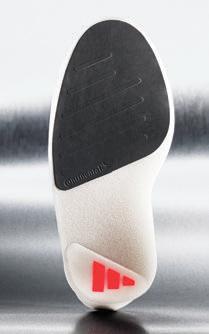
The shoe helped too, though. A variety of technologies, including the sails that kite-surfers use, have inspired the upper. It is “stripped-back and ultra-lightweight”, adidas insists, to provide “a weightless feel”, but also a high level of support. The shoe has what it calls “precision detailing”, which includes “obsessively refined components, from laces to stitching” to deliver marginal gains. The outsole uses strategically placed rubber, sourced from tyre manufacturer Continental, in the forefoot. This helps provide reliable traction at high speeds, but without compromising on its original lightweight requirements.
Chief executive, Bjørn Gulden, says: “Our Adizero Adios Pro Evo 3 running shoe was part of creating history at the London Marathon. Sabastian Sawe, Yomif Kejelcha and Tigst Assefa were wearing the lightest and fastest shoe we have ever made. I am extremely proud of our fantastic athletes and our incredible teams who made this possible.”
The Adizero Adios Pro Evo 3 shoe, the lightest and fastest shoe adidas has ever made.
It was clearly hard work. It took 12 attempts for adidas to produce a shoe that met all of the demands it imposed on itself, while also having the functionality to withstand lab-testing at company headquarters in Herzogenaurach and then field testing at high-altitude training camps in Kenya’s Rift Valley, which is where Sabastian Sawe, Eliud Kipchoge and many other champions in distance running come from.
Community celebrations
Local people in the new record-holder’s home village, Barsombe, and Iten, where he went to school, are celebrating Sabastian Sawe’s success. His father, Simeon, and mother, Emily, told the BBC their son had lifted the spirits of the whole community and that they would hold a large party to celebrate his homecoming.
The country’s president, William Rufo, who comes from the same region, has said Sabastian Sawe has not only broken a record, but has “expanded the horizon of human potential”. He added: “You have done what many believed could not be done and, in so doing, you have inspired a nation, you have inspired a whole generation and you have inspired the world.” The president has offered the new marathon worldrecord holder a car of his choice and has also presented him with a personalised number-plate to use on the vehicle. The number-plate will make the car and its owner immediately recognisable. Its characters are ‘1 59 30’.
For his own part, the athlete says: “To break the world record is something I have dreamed about for a long time, and to achieve it means so much to me and to the sport of running. It reflects the hard work behind the scenes, the support of my team, and the role of innovation in helping me push beyond limits. I am honoured to be part of a new chapter for the sport.”
Tyre company Continental provided rubber for use in the shoe’s outsole.
Kenya’s Sabastian Sawe makes history by becoming the first athlete to run a competitive marathon in under two hours.
Tigst Assefa Tessema set a new women’s marathon record at the London event. She, too, was wearing Adizero Adios Pro Evo 3 shoes.
ALL CREDITS: INSPIRAMAIS
Raw material quest
Analysis of the leather industry in Turkey makes it clear that footwear is the most important market for the sector. However, the ongoing strong performance of shoe companies in Turkey has coincided with a contraction in domestic leather production. As a result, footwear companies are now looking beyond the country’s borders to supplement the supply of their key raw material. And, as we shall see, they are now willing to spread their search quite widely.
At the start of 2026, a peer-reviewed academic publication in Turkey, the Journal of Innovative Engineering and Natural Science, published in-depth research into the domestic leather sector. The paper’s author was Kemal Kilinç, an academic based in Bolu, close to Gerede, one of Turkey’s main leatherproducing centres. The paper includes analysis of leather-sector exports over the first years of this decade. Footwear exports average 58% of the total share of the wider industry’s export revenues across that period. This compares to 21% for leathergoods, 12% for finished and semi-finished leather, and only 9% for a segment Turkey is particularly renowned for, leather garments. The most recent year that the Kilinç paper gives a value for is 2022, when footwear exports brought in $1.3 billion.
Leather’s appeal remains strong for Turkey’s footwear industry, in spite of important changes in the domestic supply landscape.
Volume yes, quality no
A second set of statistics deals with the raw material from domestic sources that Turkish tanners have had available to them. Broadly, the figures show increases in the volume of hides and skins over the period, culminating in 2023, the most recent year the Bolu-based researchers examined, with cattle hides numbering 5.8 million, sheepskins reaching 25.4 million and goatskins 6.7 million. Compared to 2019, these figures represent rises of 20%, 60% and 44% respectively.
These increases may appear encouraging in theory, but the paper makes the point that around 30% of the annual total of hides and skins accrue as the result of the livestock slaughter that takes place during the Eid al-Adha festival. This results in millions of hides and skins coming out of abattoirs over the course of just a few days.
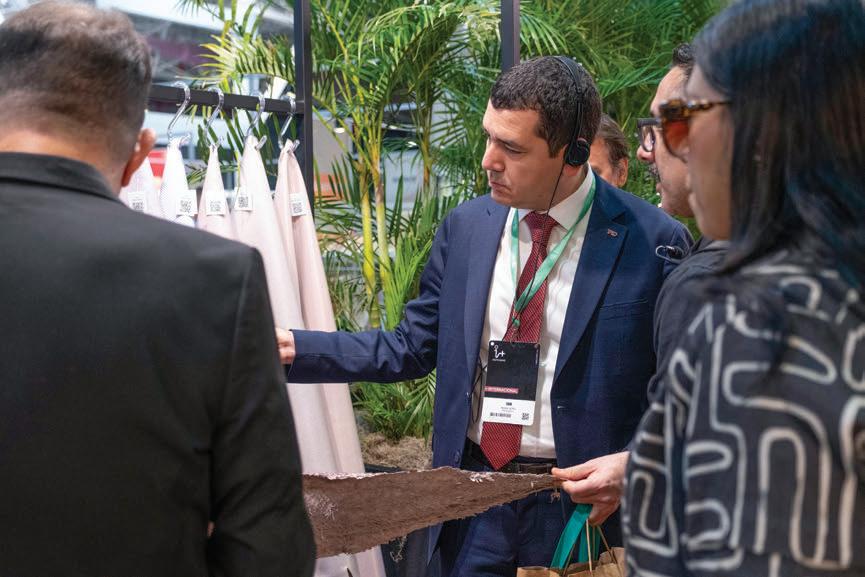
President of the Turkish Footwear Industrialists’ Association, Berke Içten, inspecting Brazilian leather at Inspiramais in Porto Alegre.
“ Factories need raw material; it makes sense for the industry in Turkey to cast its net a bit more widely. ”
SERGIO DULIO, UITIC
Hot streak
There is a shortage of good equipment, of skilled staff and of sanitary conditions in many community abattoirs, the paper makes clear. Also, there is a dearth of awareness of the importance of good preservation techniques and a shortage of facilities for storage. Compounding this, in recent years, the days of the festival have fallen at some of the hottest times of the year in Turkey: July 31 in 2020; July 20 in 2021; July 9 in 2022; June 28 in 2023; June 16 in 2024; June 6 in 2025. This year, the festival will begin on May 27. “This leads to a loss of quality and high waste rates,” it says. “In some cases, the hides and skins are completely unusable.” The net result for leather manufacturers in Turkey, according to the paper, is that they are having to import 40% of all the cattle hides they use and 75% of sheepskins. This is for quality reasons, not because of any lack of domestic raw material.
Figures that Kemal Kilinç quotes put the country’s leather manufacturing capacity at around 80 million square-metres of finished leather per year. The paper says there are 450 registered facilities for processing hides across Turkey, most of them small operators. It says a large part of total capacity “remains unused”.
Leather landscape changes
For example, in late 2024 details emerged of leather manufacturers renting out facilities at the Tuzla tanning cluster to logistics companies and manufacturers in other sectors. Tuzla is close to Istanbul and the space is in demand. Some leather manufacturers have found the money on offer from renters too good to turn down. It is true that, in some cases, they have increased production of leather at the Bursa cluster, 100 kilometres away.
Then, in 2025, one of Turkey’s biggest and best known tanning groups, Sepiciler, announced that it had taken the decision to stop producing its own leather. Instead, the group is now sourcing leather from partner tanneries to continue to supply customers. Sepiciler had operated tanneries since 1930. It won the Tannery of the Year award for Europe in 2013. Sepiciler was also one of the first leather manufacturers in the world to embrace Silvateam’s Biocircular concept for making leather that is recoverable at end-of-life for use in applications such as fertilisers.
The search widens
These changes have made the part of Turkish footwear manufacturers’ lives that involves sourcing leather more challenging. A delegation of senior representatives of the leather and footwear sector in Turkey travelled to Porto Alegre in January 2026 to
inspect leather and other materials at the Inspiramais exhibition. Buyers’ delegations from Mexico, Colombia, Ecuador, Peru, Chile and other places in Latin America are always present at Inspiramais. This was the first time a delegation from Turkey had attended. It was led by the president of the Turkish Footwear Industrialists’ Association, Berke Içten.
The group has confirmed to Footwearbiz that the footwear sector in Turkey is serious about sourcing increased volumes of leather from Brazil. Mr Içten says Turkey currently has the capacity to produce 550 million pairs of shoes and other footwear per year. His calculation for 2025 is that manufacturers were operating at 80% of capacity and produced around 450 million pairs.
He insists Turkey still has good domestic production of leather, but argues that the “steady volumes and good prices” of material from Brazil will complement this well.
The president of the International Union of Shoe Industry Technicians (UITIC), Sergio Dulio, says he thinks it makes sense for Berke Içten and his colleagues to have travelled to Brazil to hold in-depth discussions about sourcing leather from tanners there. He thinks a strong Turkish presence at the Micam exhibition in Milan in February was indicative of “a good growth trajectory” for footwear manufacturers in Turkey. Around 50 Turkish footwear companies took part. “Their factories need raw material,” Mr Dulio explains. “It makes sense for the industry to cast its net a bit more widely.”
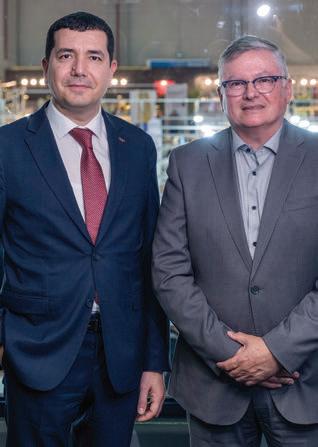
Industry leaders: Turkey’s Berke Içten (left), with the president of Brazil’s Abicalçados, Haroldo Ferreira.
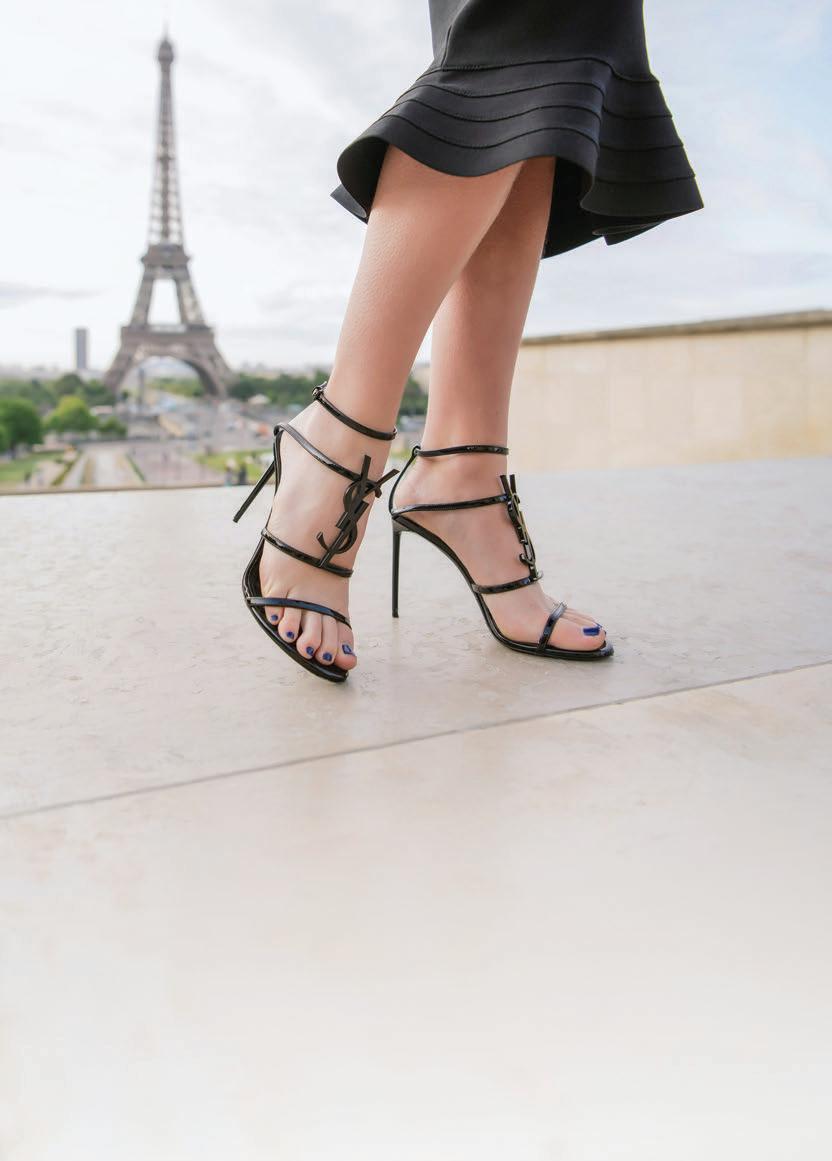
Leathergoods is “a strategic, key pillar” for Saint Laurent.
CREDIT: THE PARIS PHOTOGRAPHER /UNSPLASH
Mixed message
Seven months into his tenure as Kering chief executive, Luca De Meo, says the time has come for him to set out a plan for the years ahead. He came into the role in September (after being announced in February 2025) and has carried out, with senior colleagues, “a brutal diagnosis” of the way the group and its brands work. Decisive actions, spelled out in great detail at a capital markets presentation in Florence in April, will follow. These will affect the way Kering sources and uses leather. Some of the messages about this are positive from the leather industry’s point of view, but others are a source of serious concern. Kering loves and needs leather, but seems to wish it didn’t.
Mr De Meo says the measures and targets he and his team have come up with are in keeping with what he calls the entrepreneurial spirit that Kering has always had. In his opinion, the group, founded by the Pinault family in 1962, can tell “one of the most remarkable entrepreneurial success stories in Europe”.
The Pinaults began as Breton timber merchants, but
Luxury group Kering has set out its vision for the future. The message to suppliers and buyers of leather products, including footwear, was mixed.
moved into retail at the end of the 1980s, specialising first in furniture, then department stores, then books and electronic gadgets. Important early acquisitions included Conforama, Printemps and FNAC. In 1999, the group, then known as PPR, acquired a controlling stake in Gucci. That same year, it purchased 100% of Yves Saint Laurent. Investment in Bottega Veneta and Balenciaga followed soon after and the group became a major player in the luxury sector. It changed its name to Kering in 2013.
“ We want to reduce our dependency on constrained resources; we want to decouple growth from leather dependency. ”
LUCA DE MEO
Risky business
“Twenty-five years ago we were a French retail group,” the new chief executive says. “Today, we are a global, luxury powerhouse. This transformation did not happen by chance. It happened because the Pinault family dared to take risks, to believe in creativity and to scale it.”
Revenues scaled steadily too until a peak of €20 billion in 2022, with Gucci contributing €10.5 billion towards the total. These figures fell to €19.6 billion and €9.9 billion in 2023, then to €17.2 billion and €7.7 billion in 2024, and to €14.7 billion and €6 billion last year. It was on the back of this that the group brought in Mr De Meo, most of whose career until then had been in the automotive sector. He says that he was fully aware of the challenges Kering faces when he took the role, insisting that he remains convinced of the strength of its brands and of the group’s ability “to reinvent itself”.
Turning point
What this reinvention of Kering will involve and what the group and its products will look like at the end of the process is what Luca De Meo has now laid out. “Even the strongest stories reach turning points,” he explains. “Today we are at one of those turning points.”
He thinks this applies to the whole sector. After what he calls “a decade of exceptional growth” the entire personal luxury industry now faces a reset. The market has been flat since 2023, or even trending in a “slightly negative” direction, he says. The market in China has contracted by 20% over the same period, and the longed-for rebound has not yet materialised. But he also accepts that Kering has been “more severely
impacted” than most of its peers. “The financial consequences have been significant,” he adds. Reasons that he has identified for this heavy impact include an over-reliance on attracting “aspirational customers” and the group’s brands being too “designer-led”.
In his opinion, luxury is a perception. The word he uses to sum up what truly matters to him is excellence. “Excellence is a discipline,” he explains. “Excellence must be earned every day, in every detail, across the entire value chain. At Kering, excellence will mean creativity, but also flawless execution. It will mean exceptional products, excellence in craftsmanship, quality, service, sustainability, technology and decision-making.”
The chief executive argues that it is excellence that “legitimises luxury”. What he means is that brands and retailers can apply the term luxury to any product, from breakfast cereal to soap. For consumers to accept that the label, and the increase in price it is likely to lead to, are justified, you have to offer excellence.
Kering’s model for putting this into practice is no longer effective, and he and his colleagues have come to the conclusion that a new, streamlined group platform is necessary. This will be structured around five hubs: industry, customers, technology, sustainability and support functions. Perhaps these are self-explanatory, but it is worth adding some extra information.
AI’s role
The technology hub will make extensive use of artificial intelligence (AI). In March, Kering recruited Pierre Houlès as its new chief digital and IT officer. For the last ten years, Mr Houlès has held senior digital transformation roles in automotive, working alongside Luca De Meo. At Kering, he will also have chief AI officer in his job title.
AI will help streamline operations and enable what Luca De Meo calls “productivity insights”. The information Kering teams gather from AI will support better decisionmaking, he says. For example, AI will have a role to play in helping the
New Kering chief executive, Luca De Meo, has spent his first months in the role carrying out “a brutal diagnosis” of the business and its brands.
CREDIT: SHUTTLESTOCK
group manage inventory.
It began an inventory reduction exercise in September and is aiming to decrease the value of unsold stock by €1 billion within 12 months. This is not going to be a one-off, the chief executive continues, but the launch of “a complete change in the strategy for how we manage inventory”. Gucci, for example, has already reduced the range of products it offers by roughly 20%, Mr De Meo says. AI’s role will be to help with forecasting demand sooner in the process so that the group’s inventory management can be “leaner and more productive”, as well as more sustainable.
Non-negotiable
Sustainability is an aspect of the business that Mr De Meo describes as “non-negotiable across all disciplines”. This includes sourcing. Simplifying the way the business organises itself will bring clarity, help the balance-sheet, restore resilience, give more accountability and accelerate decision-making, he continues. However, all of the group’s brands will remain responsible for their own creative direction, product development, go-to-market strategies and “brand expression”.
The group ended 2025 with 1,719 stores across its own retail networks. This year, there will be 100 net closures, at least. City by city, the strongest stores will remain; others will close. There will be, according to Mr De Meo, “fewer doors, but better doors and higher productivity”. There will be openings too, with serious investment going into flagship stores, including one for Bottega Veneta in Bangkok, and in the Gucci flagship on the Avenue de Montaigne in Paris.
Brand by brand
Leathergoods and leather shoes will continue to feature prominently in these stores but, as mentioned above, Luca De Meo’s messages about leather are mixed. Yes, he says he wants to build “a more iconic leathergoods offer” across the Kering portfolio of brands. This will be driven by “a strengthened Gucci proposition”, for example, and by an expanded high-end offering at Saint Laurent and Bottega Veneta.
The group has set out pathways for
CREDIT: LINEAPELLE
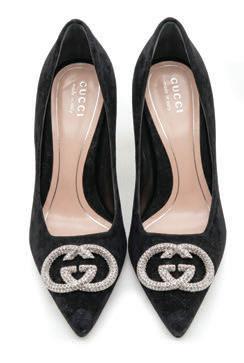
all of its brands. At Gucci, bags will become “more functional” and shoes will offer “great comfort and durability”. Gucci’s most iconic bags will become more and more important. These products represent around 10% of all Gucci leathergoods today; this should increase to 20% by 2030. The corresponding target for Saint Laurent is for its most iconic bags to contribute 30% of the brand’s total leathergoods revenues by 2030. “Leathergoods is a strategic, key pillar for Saint Laurent,” Luca De Meo says. He adds that men’s collections from Saint Laurent have “significant untapped potential” and that the brand will “reassert its offer for men”, including in shoes.
He refers to Bottega Veneta as one of the most desirable luxury brands “among those who truly know”. Its next chapter will be about scaling this desirability, but without compromising the essence of Bottega Veneta. This essence, he explains, is to have an ethos of discretion, restraint and selfconfidence and still to be “the ultimate symbol of luxury craftsmanship in leathergoods”. His aim is for Bottega Veneta to achieve steady growth between now and 2030, but adds that “to unlock its true potential”, the brand will expand beyond leathergoods and will build
footwear and ready-to-wear collections too, for men as well as for women. He wants the brand’s revenues from products other than leathergoods to double by 2030. Balenciaga he describes as a brand that has particular relevance for Gen Z. This generation will account for 20% or 25% of the global luxury market by 2030, the Kering chief executive says, compared to 14% today. “Leathergoods is quickly becoming one of Balenciaga’s most powerful engines for growth and its importance will continue to increase,” he adds. Year-to-date in 2026, leathergoods revenues at Balenciaga are already up by 20%. The brand will double its leathergoods business by 2030 and will “reinvent its men’s shoes category”. For women, too, he hopes for greater cross-selling from Balenciaga handbags into shoes and ready-to-wear.
Kering reports McQueen’s results as part of a segment it refers to as “other brands”. In 2025, these brands brought in €2.9 billion, down by 10% year on year. The group has said losses at McQueen “weighed on profitability, despite ongoing deep restructuring efforts”. Mr De Meo confirms that by the end of 2026 McQueen will have 50% fewer stores than it had at the end of 2025. The total number of stores the brand has
Kering says leather is central to its identity. It also says it wants to decouple growth from its dependency on leather and to accelerate the development of next-gen materials.
•Turn-key systems for leather cutting
•Powerful nesting for maximum material yield
•Highest level of productivity
• Individually configurable
www.zund.com
worldwide is around 130, including 22 in China. The Kering chief executive describes this as “right-sizing” the number of McQueen stores. He says the group wants the London-based brand to “reconnect with its essence”. He adds that this should include making sure its shoes also reflect “the bold McQueen identity and its uncompromising spirit”.
Evolving client expectations
All of this sounds like good news for the leather and footwear industry, but there is a painful flip side. This is partly because the number of suppliers Kering works with is going to reduce. There will be winners and losers. The group calculates that it has 4,200 direct suppliers, but also that 98% of the products and services it buys comes from just 25% of those suppliers. This creates complexity, cost and risk, Mr De Meo says. Instead, it will now put in place a new sourcing set-up, built on a preferred-supplier model. It will select these preferred suppliers by their ability to meet all quality requirements while complying fully with social and environmental standards. They must also have agility and the capacity to innovate. The aim, he explains, is to move away from “short-term, transactional relationships” towards multi-year partnerships.
The really confusing part of Luca De Meo’s message is that, even as he repeats that leather will remain “central to Kering’s identity”, the group intends to diversify its material portfolio and to achieve a reduction in something it calls “leather intensity”. The chief executive explains: “We will measure this intensity as the number of square-metres of leather Kering purchases for each €1 million in revenues it brings in from leathergoods and shoes.”
If we understand this correctly, he means that he wants Gucci, Bottega Veneta, Saint Laurent, Balenciaga, McQueen and other Kering brands to achieve growth in their revenues, including (especially, even) their revenues from footwear and leathergoods. But he wants them to achieve this while consuming less leather. He wants this leather intensity to reduce by 30% by 2028.
It could meet this target by putting its prices up by 30%, or by reducing the size of bags by 30%. After all, if, say 1,000 square-metres of finished leather makes x bags that sell for y, Kering could source the same amount of leather, but alter the number of bags it makes from the material to x plus 30%. This would bring in revenues of y plus 30%. Job done; leather intensity reduction target achieved. But this is not how Luca De Meo presents the idea.
Worryingly, what is behind it seems to be “evolving client expectations, client pressure and animal welfare considerations”. Concern over this leads the chief executive to say: “This requires us to broaden our material universe. We want to reduce our dependency on constrained resources. We want to decouple growth from leather dependency.”
Perhaps Luca De Meo has not seen the facts and figures that show the leather industry can have no influence on how many head of cattle farmers raise. Perhaps he has not heard that demand for leather is
down while hundreds of millions of hides continue to accrue anyway, or that letting hides go to waste instead of turning them into leather creates millions of tonnes of extra, unnecessary greenhouse gas emissions. Perhaps no one has told him that the value that skilled tanners, footwear artisans and other craftspeople can add to a hide is more than 5000%. Perhaps it has not occurred to him that leather is the very antithesis of a constrained resource.
Kering has its own material laboratory. It intends to use this resource to accelerate “next-gen materials”. Perhaps some new material will emerge, one that is renewable, natural, sensual, repairable, durable, long-lasting, sustainable, versatile, biodegradable, affordable and made from raw materials that will continue to accumulate whether Kering’s suppliers use them or not. And if not, perhaps it will decide that it really does love leather after all.
Kering’s plan for Gucci includes the insistence that its shoe collections will offer “great comfort and durability”, as well as beauty.
CREDIT: SHUTTERSTOCK
Lasting trend
The western boot trend endures. The influence of singer Beyoncé has no doubt helped. There was certainly a surge in demand for cowboythemed products after the release of Cowboy Carter in 2024. This album generated 76 million streams on Spotify on the day of its release. Fashion editor of The New York Times, Vanessa Friedman, said that, in her opinion, Beyoncé had made Western aesthetics “the look of the moment”.
A few Manhattan blocks away, however, the style news editor of The Wall Street Journal, Sarah Spellings, has a different take. She points to Raf Simons’ debut collection for Calvin Klein in February 2017 as the starting point for this most recent revival, but she describes the cowboy and western look as a trend with a “really long lifespan”. Nine years on from Raf Simons, and almost two years on from Cowboy Carter, there were western boots on every row of every hall at Micam in Milan this February. This means there will still be cowboy-style boots in many brands’ collections until autumn-winter 2026-2027, at least.
Ms Spellings is betting it will last even longer. “All trends peter out eventually,” she says, “but for some, the cowboy boot is a really stable shoe.” She offers the Lucchese Boot Company, based, fittingly, in Texas, as proof of this. The company was founded in San Antonio in 1883, but moved to El Paso in 1986. Now, around 240 footwear artisans work at its factory there, making around 400 pairs of boots per day.
Touch of class
Manufacturing director, Óscar Sánchez, explains that the boots are still made in the same way as when the company’s founder, Sam Lucchese, originally from Sicily, set the business up. To this day, a pair of hands touches each pair boots 180 to 200 times in the course of the construction process. The tasks the skilled workforce has to carry out include structural stitches that attach the vamp to the shaft. There are also ornamental stitches that go around an inlay or a cord to give the boots their distinctive, decorative, western look.
“We pride ourselves on fit,” Mr Sánchez says, “and we use a twisted cone last that is made anatomically like the human foot and, thus, has the best fit possible on a cowboy boot. This last was brought from Italy when the company’s founder first came to the US.” Pegs made from lemonwood are also part of the construction. These small wooden pegs are functional, not decorative. They hold the shank in place and
Beyond Beyoncé’s influence, the western boot was popular long before her 2024 album Cowboy
Carter . A look at autumn-winter 2026-2027 collections suggests the trend will continue for a long time yet .
“move with you when you walk”, the manufacturing director says.
Vice-president for product, Doug Hogue, says preserving some “old-world manufacturing techniques” is part of Lucchese’s commitment to craftsmanship. There are “opportunities to take shortcuts”, but he insists the company defiantly passes these up out of “respect for the process”. Mr Hogue says a greater source of worry is the maintenance of the machinery the company has in place. His colleague, Óscar Sánchez, agrees. He points out that some of the machines are 80 years old, and others have been in use for 50 or 60 years. If they break down, sourcing parts is a challenge. Mr Sánchez says Lucchese’s own mechanics have become adept at finding ways to keep the machines running. He also shares that the company’s longest-serving bootmaking craftswomen and men prefer to work on the older machines.
Materials matter too. Director of design for women’s collections, Holly Mery, names no names, but claims Lucchese sources leather from “the best tanneries around the world”. These include “very carefully curated” exotics, with “no expense spared” for some of the boots in the company’s collections. Ms Mery also claims to have had a pre-Beyoncé influence on the current popularity of cowboy-style. She designed a boot called the Priscilla in early 2020. “There were a lot of over-the-knee boots in contemporary fashion at that time,” she recalls, “but western had not really tapped into that tall-boot trend. Bringing this to life at Lucchese was new for us.” She believes it is thanks to this that tall, white cowboy boots are part of the global trend. “You see them all over now, which is really flattering,” she adds.
Naples-based brand Gisèl Moiré added western boots to its product range in 2025.
CREDIT: GISÈL MOIRÉ
Price range
Back at Micam, not all the western boots on offer were in the “no-expense-spared” category. Perhaps one of the indications that the trend has cut through to all market segments is that brands and manufacturers from all over the world are now offering these styles. Most of the time, Eddy Ling manages a sheepskin boot brand, based in Jiangsu Province in China. He sources double-face sheepskin, made from Australian raw material, from Henan Prosper. But in addition to these, he had western boots on display in Milan too. He explains that he has a friend in Jiangsu who has been making boots in this style in a factory there for a number of years and wants to raise the profile of this collection. It includes boots for people to wear to work (not as cowboys), with specialist, technical, anti-slip soles.
Mr Ling says the boots all go for export, 80% to the US, 15% to Europe and 5% to Australia. His friend is using the brand name Palitutu for the boots, which ship to the US for a wholesale price of around $60 per pair. He thinks they will sell in retailers in the US for up to $300 per pair, still around one-third of the price of the cheapest Lucchese boots. Demand is strong: in late 2025, his friend had to open a dedicated warehouse facility in Texas to fulfill orders for Palitutu products.
Global phenomenon
Footwear companies from other parts of the world that also had on-trend western boots on show in Milan included Indian manufacturer Tirubala Group, Brazilian brand Luiza Barcelos, and Efetti (complete with generous helpings of rhinestones), Inuovo and Loie, all from Turkey. Italian brands contributing to the continuation of the trend included Naples-based Gisèl Moiré, part of a company that Gennaro Albergo founded in the 1950s. His daughter, Imma, now runs the company with her brother, Salvatore. She says the brand is serious about preserving its traditions but is also open to trying new ideas. Gisèl Moiré launched its first collection of cowboy boots for women in 2025. “They are proving very popular,” Ms Albergo says. Other brands appear to have made attempts to advance or at least personalise the trend with their own touches. Examples include Belgian brand Cycleur de Luxe, who had on display a range of cowboy boots with hair-on ponyskin. “You have to try something different,” founder and creative director, Patrick Vanneste, says. “You have to stand out.” A brand from La Rioja in Spain, José Saenz, displayed boots that had exoticlooking leather at the top, complementing the rest of the shaft, standing out like a shiny, 10-centimetre snakeskin extension. In reality, it is bovine leather with a reptile pattern stamped onto it but it is eye-catching and redolent of the cowboy wave. The Spanish brand insists this was not its intention; the exotic touches are for aesthetic reasons only, it says.
Perhaps the best-named brand for this trend is El Vaquero, the Spanish word for cowboy. It was founded in Florence in 1975, as the spaghetti Western cinema sub-genre was coming to an end. As the brand’s name and 50-year history suggest, it is not among the new
arrivals to the cowboy boot trend. It has always devoted itself to this style. It emphasises elements that differentiate its designs from those of the majority. Its latest collection, on show at Micam, does this most obviously in its extensive use of long fringes on the shaft. The boots’ shape is distinctive too because their base is that of a moccasin boot, making them soft, flexible and comfortable, El Vaquero claims. New competition in this category appears not to worry the company; like Lucchese, it is in it for the long haul.
Everyday wear
A former mayor of El Paso, Oscar Leeser, has spoken of his devotion to the style and to the Lucchese Boot Company in particular. In a recent feature in the Wall Street Journal, Mr Leeser, who was mayor of El Paso from 2013-2017 and again from 2021-2025, admits to owning 90 pair of Lucchese boots and to wearing one of the pairs to every public function he attended during his two terms.
Since giving up office, Mr Leeser says that he still wears the western-style boots every day, adding that if he were to attend a meeting wearing any other kind of footwear, everyone would think there was something wrong with him. He says: “Without my boots, I wouldn’t feel like me any more.”
The Dallas Cowboys Cheerleaders always wear Lucchese boots.
CREDIT: LUCCHESE
Footwearbiz
All you need to know to assist you in the global footwear market. (4 issues per year)
Footwearbiz (Digital)
£100 per year
Footwearbiz Premium (Print) £140 per year
World Leather
The world’s leading magazine for the leather industry. (6 issues per year)
World Leather & £270 per year
Leatherbiz (Digital)
World Leather (Print) £300 per year & Leatherbiz
Sportstextiles
The international technical trade magazine for innovative and responsible materials. (2 issues per year)
Sportstextiles (Digital) £100 per year
Sportstextiles Premium (Print) £120 per year
Inside Denim
Keep up to date with denim developments from raw material to finished product with in-depth coverage of advances at fibre and fabric level. (2 issues per year)
Websites
Designed to provide up-to-the-minute news and market intelligence.
Advertise in Footwearbiz magazine & footwearbiz.com to promote your latest products and innovations to a readership of over 4,500 worldwide. For more information: matthew@worldtrades.co.uk
WHAT IT MEANS TO BE GREEN
At Stanbee, we’ve built our name on innovation. Green innovation. We make it our mission to produce the lightest, thinnest, strongest, most resilient structural footwear materials in the industry. And we do it while cutting our reliance on raw materials—thus protecting the environment from unnecessary waste.
For example, all of our Nitro products are injected with a foaming system that displaces raw virgin materials, thereby reducing weight and improving performance.
Also, Nitro Force, our lightest, firmest heel counters, are made from at least 85% PET-recycled plastic bottles. Each pair of these counters reuses the recycled content of two one-time use PET water bottles. That helps offset the 500 billion plastic bottles tossed into the global waste stream every year at a rate of one million bottles per minute.
Now we’re offering three new Nitro products: Nitro Flex for unparalleled flexibility in a heel counter; Nitro Vulc for exceptional fit and comfort in vulcanized footwear; and Nitro Sport for high-performance toe boxes that are lighter, softer and more resilient—with increased recycled content.
All of these products are available in a zero-waste, net-product, closed-loop system.
So speak to your Stanbee representative today—or visit www.stanbee.com. Not only will you boost your product’s performance, you’ll be protecting the planet. That’s what it means to be green.