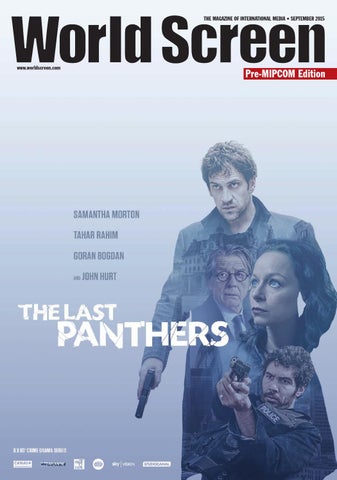
WS_0915_COVER_COVER-1011 8/21/15 4:48 PM Page 1
THE MAGAZINE OF INTERNATIONAL MEDIA • SEPTEMBER 2015
www.worldscreen.com
MIPTVEdition Edition Pre-MIPCOM
SPREAD TEMPLATE_Layout 1 8/19/15 1:49 PM Page 1
SPREAD TEMPLATE_Layout 1 8/19/15 1:49 PM Page 2
SPREAD TEMPLATE_Layout 1 8/18/15 10:30 AM Page 1
SPREAD TEMPLATE_Layout 1 8/18/15 10:30 AM Page 2
SPREAD TEMPLATE_Layout 1 8/20/15 11:28 AM Page 1
SPREAD TEMPLATE_Layout 1 8/20/15 11:29 AM Page 2
WS_0915_TOC_1_05 WSN TOC 8/24/15 8:19 AM Page 2
CONTENTS
SEPTEMBER 2015/PRE-MIPCOM EDITION Publisher Ricardo Seguin Guise
DEPARTMENTS WORLD VIEW
Group Editorial Director Anna Carugati
12
By Anna Carugati.
UPFRONTS
Editor Mansha Daswani
18
New content on the market.
Executive Editor Kristin Brzoznowski
BEHIND THE SCENES
Associate Editors Joanna Padovano Sara Alessi
30
A+E Networks’ UnREAL.
SPOTLIGHT
WESLEY SNIPES
26
MENA SUVARI
28
57
38
Tele München Group’s Herbert G. Kloiber & Herbert L. Kloiber.
MARKET TRENDS
HALIT ERGENÇ
36
60
Production & Design Director Victor L. Cuevas
62
Online Director Simon Weaver Art Director Phyllis Q. Busell Sales & Marketing Managers Alberto Rodriguez Dana Mattison
64
all3media international’s Partners in Crime.
WORLD’S END
Assistant Editor Joel Marino
Special Projects Editor Bob Jenkins
Deutschland 83’s Jörg & Anna Winger.
IN FOCUS
Associate Editor, Spanish-Language Publications Jessica Rodríguez
Contributing Editor Elizabeth Guider
Starz’s Carmi Zlotnik.
IN THE NEWS
Editor, Spanish-Language Publications Elizabeth Bowen-Tombari
50
Business Affairs Manager Terry Acunzo
66
Senior Editor Kate Norris
In the stars.
Contributing Writers Steve Clarke Andy Fry Juliana Koranteng Jane Marlow Joanna Stephens Jay Stuart David Wood Copy Editors Maddy Kloss Jeff Tone
46 SPECIAL REPORT
38 BRAVE NEW DRAMA Leading distributors discuss how they are serving the rising appetite for drama series across the globe. —Mansha Daswani
Anna Carugati Executive VP
ONE-ON-ONE
Mansha Daswani Associate Publisher & VP of Strategic Development
The CEO of Red Arrow Entertainment Group talks about the expansion efforts he has been overseeing at the company.
WORLD SCREEN is a registered trademark of WSN INC. 1123 Broadway, Suite 1207 New York, NY 10010, U.S.A. Phone: (212) 924-7620 Fax: (212) 924-6940 Website: www.worldscreen.com
46 RED ARROW’S JAN FROUMAN WORLD SCREEN is published ten times per year: January, February, March, April, May, June/July, September, October, November and December. Annual subscription price: Inside the U.S.: $90.00 Outside the U.S.: $160.00 Send checks, company information and address corrections to: WSN INC. 1123 Broadway, Suite 1207 New York, NY 10010, U.S.A. For a free subscription to our newsletters, please visit www.subscriptions.ws.
Ricardo Seguin Guise President
—Anna Carugati
SPECIAL REPORT
50 WHO’S WATCHING? A look at how broadcasters, audience-measurement companies and advertisers are dealing with how to track viewing in an on-demand world. —Jay Stuart 10 World Screen 9/15
©2015 WSN INC. Printed by Fry Communications No part of this publication can be used, reprinted, copied or stored in any medium without the publisher’s authorization.
WS_0915__Layout 1 8/21/15 2:46 PM Page 1
WS_0915_WORLD VIEW_WSN_407_WORLD VIEW 8/24/15 8:20 AM Page 2
WORLD VIEW
BY ANNA CARUGATI
Universal Themes Six years ago I was in Washington, D.C., visiting one of my all-time favorite places, Kramerbooks & Afterwords Cafe & Grill, which combines my two favorite pastimes: buying books and eating in restaurants. Referred to by aficionados simply as Kramer’s, it is a bookstore with an eclectic range of titles and a comfort-food-style menu—could there be a better way to relax? I was browsing through the books while waiting for my table when I spotted a title that intrigued me, This Must Be the Place. I read the back cover and learned that it’s about Hope, an American living in Berlin after 9/11 who is having a much harder time fitting in to a new country than her workaholic husband is. The fact that she recently lost a child certainly contributed to her difficulty in adapting; in her grief, she hardly feels comfortable doing anything, anywhere. She befriends Walter, a German former television star, who now makes a living dubbing Tom Cruise into German in his blockbuster movies and wonders what his purpose in life is and how he can reboot his career in Los Angeles. Although I have not, thankfully, experienced the tragedy Hope did, and I have never been a TV star, I did grow up in two countries, Italy and the U.S., and spent my formative years trying to figure out who I really was, where I belonged, to which country I owed my allegiance and which culture and customs felt most comfortable. So the themes explored in This Must Be the Place—identity, belonging, loss, intent—resonated in me quite deeply. Fast-forward to this past June. I was preparing to interview Anna and Jörg Winger, creators of the series Deutschland 83, and while reviewing their bios and researching the series, I discovered that Anna Winger is an author. She wrote This Must Be the Place. Honestly, I would have been interested in the series anyway, because espionage, the Cold War and the politics of the 1980s fascinate me, but now I was doubly engaged. I was delighted not only to meet the Wingers (you will find my interview with them in this issue), but also to have the chance to tell Anna how much I enjoyed her book. Identity. Belonging. Loss. Intent. Just like the book, Deutschland 83 tackles these themes, albeit through the eyes of a young Stasi officer sent to spy on a West German general who knows of NATO’s plans to deploy Pershing II missiles. They are also explored, even if in an entirely different setting, by UnREAL, Lifetime’s scripted series that offers a behind-the-scenes look at a reality dating competition.
It is increasingly evident that good ideas
can come from anywhere.
12 World Screen 9/15
A conversation with the show’s creators and two lead stars, in which they offer a candid take on the manipulation of contestants by producers and the objectification of women in these types of reality shows, is also in this issue. Identity. Belonging. Loss. Intent. These topics are universal, which is why they have served as the framework for quality storytelling through the centuries, even in today’s best television series. We talk to Wesley Snipes about his role as a mysterious Las Vegas casino pit boss in the upcoming NBC prime-time drama The Player, and to Mena Suvari about playing a dual role, exorcist and possessed, in the WE tv thriller South of Hell. Many shows today have something else in common. As we examine in one of our features, many are jointly financed or produced by two or more partners, often to make big-budget events—the kinds that free-TV and pay-TV channels need in order to draw viewers and subscribers. Tele München’s Herbert G. Kloiber and Herbert L. Kloiber talk about the many international TV productions they are financing at an early stage of development. We also speak with Starz’s Carmi Zlotnik, who has been one of the first American programming executives actively involved in co-financed projects. We’ve also learned that broadcasters are looking for many different types of drama. Just look at the huge success of Turkish scripted series. In this issue, we hear from A-list Turkish actor Halit Ergenç—best known for the period drama Magnificent Century—about their appeal. And for all genres of programming to be properly monetized— which is the ultimate goal of every producer, distributor and programmer—the number of viewers on all platforms must be measured properly, as we explore in another feature in this issue. Last but not least, it is increasingly evident that good ideas can come from anywhere. And this isn’t just in the scripted realm. As Jan Frouman, the CEO of Red Arrow Entertainment Group, explains in our One-on-One interview, he sees ideas travel on a regular basis as he manages 13 production companies in seven different countries. I haven’t been to Kramer’s in quite a while and I miss it. I remain an avid reader, but the way TV series are written these days, with story lines that cross over from one episode to the next, and with on-demand menus or streaming services that offer full seasons, you can enjoy a TV series in much the same way that you can read a book. Now, what if a place like Kramer’s allowed you to binge-view while waiting for your table?
WS_0915__Layout 1 8/21/15 2:48 PM Page 1
SPREAD TEMPLATE_Layout 1 8/20/15 9:41 AM Page 1
SPREAD TEMPLATE_Layout 1 8/20/15 9:41 AM Page 2
SPREAD TEMPLATE_Layout 1 8/24/15 5:40 PM Page 1
SPREAD TEMPLATE_Layout 1 8/24/15 5:41 PM Page 2
WS_0915_UPFRONT.e$S_Layout 1 8/21/15 3:40 PM Page 1
UPFRONTS
all3media international 800 Words / The Brokenwood Mysteries / The Story of Egypt A widower and his two teenage kids attempt to start their lives over in a remote New Zealand seaside town in the drama 800 Words, which has been commissioned by Seven Network in Australia and is sold by all3media international. “The series has a great pace with universal themes thrown in,” says Liza Thompson, the senior VP of sales at all3media international. The company is also highlighting The Brokenwood Mysteries, a new whodunit crime drama from New Zealand. The series contains standalone episodes “with strong story lines and great landscapes,” according to Thompson. Viewers can learn about the rise and fall of ancient Egypt from Professor Jo Fletcher in the four-part series The Story of Egypt.
“My aim is to find the best homes for our great slate coming up and also to explore secondary window opportunities.” —Liza Thompson The Brokenwood Mysteries
BBC Worldwide War and Peace / Dickensian / The Big Catch From award-winning writer Andrew Davies, War and Peace is an event drama based on Leo Tolstoy’s novel of the same name. “Audiences will be immersed in the turmoil of 19th century Russia and a heartbreaking story of love, war and family life,” says Paul Dempsey, the president of global markets at BBC Worldwide. Dickensian also draws on classic literature, this time from Charles Dickens, transporting viewers to Victorian London. In the factual-entertainment category, the competition series The Big Catch (working title), hosted by Ben Fogle and judged by U.K. angler Matt Hayes, sees enthusiastic fishermen use their past fishing experiences and newly acquired skills to cast a line in different countries, climates and landscapes.
“It’s going to be our busiest MIPCOM yet; we’re bringing more talent than ever before.” —Paul Dempsey Dickensian
Entertainment One Into the Badlands / Fear the Walking Dead / David Attenborough’s Great Barrier Reef The martial-arts series Into the Badlands is “hugely ambitious, with incredibly choreographed fight scenes that are easily comparable to those in film,” says Stuart Baxter, the president of Entertainment One (eOne) Television International. The show is a highlight of the eOne slate, alongside Fear the Walking Dead, a companion series to The Walking Dead. “The Walking Dead has impacted the television landscape worldwide, which is why we’re excited to be bringing Fear to the international market, targeting both the built-in audience of the franchise and new viewers who can sink their teeth into the series from the start,” Baxter says. David Attenborough’s Great Barrier Reef, meanwhile, uses CGI to offer audiences never-before-seen views of this unique ecosystem.
“MIPCOM is a great launchpad to showcase extraordinary, groundbreaking series from the world’s most creative and respected producers, which is why we’re excited to share our new slate with buyers and continue to build our global footprint.” —Stuart Baxter
Into the Badlands 18 World Screen 9/15
Project1_Layout 1 8/19/15 3:53 PM Page 2
Project1_Layout 1 8/19/15 3:53 PM Page 3
WS_0915_UPFRONT.e$S_Layout 1 8/21/15 4:53 PM Page 2
Escapade Media The Fo-Fo Figgily Show / Teenage Ice Trekker / When We Go to War Set on a mystical island, The Fo-Fo Figgily Show follows the adventures of a yellow creature and his friends as they learn about fitness, food and fun. “The Fo-Fo Figgily Show is future-proofing our assets by shooting in 4K and taking advantage of the latest developments in image quality,” says Natalie Lawley, the managing director of Escapade Media. “The show is being produced in five different languages— English, Neutral Spanish, German, Brazilian Portuguese and Hindi—which allows us to bring the characters to kids in their own language and cultural context.” Teenage Ice Trekker sees an adolescent boy climb a mountain with his father, who is going blind, while When We Go to War is a six-part drama about the impact of war on a family and their friends.
“The programming that Escapade is bringing to the market continues to support the company’s core objectives: premium, unique and international.” —Natalie Lawley When We Go to War
Global Agency Fame / It’s Showtime / All for One Finding the ultimate superstar who can sing, dance, act and model is the goal in Fame. The singing continues in the talent show It’s Showtime, which puts a spotlight on performers’ voices, stage performance, song selection and styling. In this series, the competitors judge each other, and the stage is reminiscent of a nightclub atmosphere. Meanwhile, a cash prize is on the line in the game show All for One, in which the contestants compete with 12 relatives to give the correct answers to 12 questions posed by the host. Izzet Pinto, Global Agency’s founder and CEO, says, “Buyers are genuinely looking for something really different that can change the direction of TV. All three of these projects have worldwide appeal and qualities that are in high demand for any buyer.”
“Our sales team has been traveling the world to create new deals and grow our businesses.” —Izzet Pinto Fame
Global Screen The Weissensee Saga / Arman’s Secret / A Dangerous Fortune The action in Global Screen’s The Weissensee Saga is set against the backdrop of Communist East Germany, the Stasi secret service and the fall of the Berlin Wall. The company will be presenting season three at MIPCOM this year. Arman’s Secret is billed as a fantasy event series for the whole family. “Starring a top-notch cast and featuring lots of special effects, we see five teens discover the secret of a magical horse ranch and vanquish an evil sorcerer,” explains Alexandra Heidrich, Global Screen’s head of TV sales and acquisitions. “Season two of this suspenseful series is currently in production.” The company also has in its catalogue the 2x90-minute A Dangerous Fortune, an adaptation of Ken Follett’s best-selling novel.
“We would like to acquire further long-running series and new event movies for our lineup.” —Alexandra Heidrich The Weissensee Saga 9/15 World Screen 19
WS_0915_UPFRONT.e$S_Layout 1 8/21/15 3:40 PM Page 3
ITV Studios Global Entertainment Beowulf / Jekyll and Hyde / Love Island The action-packed adventure series Beowulf and Jekyll and Hyde, both made by ITV Studios, are among the highlights that ITV Studios Global Entertainment (ITVS GE) will be presenting at MIPCOM. “We have no doubt that these shows will appeal to our broadcast and digital partners around the world, and will deliver big prime-time audiences as families will be able to enjoy them together,” says Dan Gopal, the company’s executive VP for EMEA distribution and global digital partners. “With great casting, incredible production values, stunning locations and gripping action, we can’t wait to launch both shows internationally.” ITVS GE is also slated to showcase the British version and the format of Love Island, an interactive dating reality show aimed at viewers between the ages of 18 and 34.
“We are always working hard to accelerate windows to get our content to audiences quicker, and give them the flexibility to consume whenever and wherever they want.” —Dan Gopal Beowulf
ITV-Inter Medya Filinta / Black Money Love / In Between The historical drama Filinta is one of the highlights that Istanbul-based ITV-Inter Medya plans to showcase at MIPCOM. The Ottoman crime show, produced by ES Film, features such themes as justice, camaraderie and love. The story begins with a conspiracy against Mustafa, a skilled policeman, and his best friend Ali. The company will also be offering up Black Money Love, which is made by Ay Yapim. The drama series is about Omer and Elif, who come together to investigate the mysterious murder of their loved ones. Another highlight for ITV-Inter Medya is Koliba Film’s In Between, a drama focused on the life of a young woman with big dreams who lives with her father and aunt in the suburbs.
Filinta
Kanal D Love / Waiting for the Sun / Life As It Is In the Kanal D drama Love, Azra and Kerem barely have enough money to support themselves, but they do have their affection for each other. When Şebnem becomes ill, she opens up to Azra, and Azra will become both friend and enemy to Şebnem, whose life has never been filled with enough love. Waiting for the Sun, also a Kanal D highlight, sees a single mother and her daughter, Zeynep, start their lives over in Istanbul, but Zeynep has a hard time fitting in at her new school after standing up to a bully. In Life As It Is, a team of five very different doctors working in Istanbul find that their hospital becomes not only a workplace, but also their home and shelter from the personal problems that plague them.
Love 20 World Screen 9/15
WS_0815__Layout 1 8/13/15 12:32 PM Page 1
WS_0915_UPFRONT.e$S_Layout 1 8/21/15 3:40 PM Page 4
Multicom Entertainment Group The Winter Stallion / The Sorcerer’s Apprentice / The Little Unicorn Following its recent acquisition of the Peakviewing film library, Multicom Entertainment Group’s catalogue now boasts such features as The Winter Stallion, The Sorcerer’s Apprentice, The Little Unicorn and Grim. The company is gearing up to promote those titles at MIPCOM, along with the new horror thriller Blood is Blood, about a young girl seeking revenge after an unexpected death, and Bereave, a feature film starring Jane Seymour and Malcolm McDowell. Multicom also plans to focus on its proprietary film and TV channels such as IndieMax, BabyBoom, FactFiction, ThrillGore, FamBrand, Streetz TV and Cold War TV, according to Irv Holender, the company’s chairman.
“We continue to look for additional content to grow our catalogues and to forge new relationships while expanding our worldwide reach.” —Irv Holender The Little Unicorn
Red Arrow International Cleverman / Kiss Bang Love / Peter & Wendy Launching at MIPCOM this year from Red Arrow International is Cleverman. Set in the near future, the drama centers on a group of non-humans trying to survive in a world in which humans want to kill them. Peter & Wendy is a holiday TV movie based on J.M. Barrie’s classic, seen through the imagination of a 12-year-old girl who is about to undergo a serious operation. “We continue to see strong demand for well-written, character-driven fiction across an eclectic mix of genres, highlighted by our new MIPCOM drama slate, including Cleverman and Peter & Wendy,” says Henrik Pabst, the managing director of Red Arrow International. The company is also launching the dating format Kiss Bang Love from the creators of Married at First Sight.
“Red Arrow International is increasingly becoming a home for ambitious, international drama.” —Henrik Pabst Peter & Wendy
Sky Vision The Last Panthers / Fungus the Bogeyman / Big Cats The six-part epic crime drama The Last Panthers, which is co-distributed by STUDIOCANAL and Sky Vision, is making its world premiere at MIPCOM. The series “delivers fullblown action, big emotion, cinematic vision and story lines worthy of a Greek tragedy,” says Leona Connell, the head of global sales at Sky Vision. The four-part family drama Fungus the Bogeyman is a reimagining of Raymond Briggs’ picture book that combines live-action and animation to tell the story of Fungus, his wife Mildrew and their son Mould. Meanwhile, biologist Patrick Aryee travels to some of the wildest locations to investigate the evolution of cats in the factual series Big Cats, combining wildlife photography, studio shoots, field demos and CGI.
“These titles illustrate the breadth and variety of our current catalogue as well as demonstrate our commitment to delivering quality content.” —Leona Connell The Last Panthers 22 World Screen 9/15
WS_0815__Layout 1 8/13/15 12:31 PM Page 1
WS_0915_UPFRONT.e$S_Layout 1 8/21/15 3:40 PM Page 5
Starz The Girlfriend Experience / Ash vs. Evil Dead / Flesh and Bone At MIPCOM, Starz will host a world premiere screening of the first two episodes of the anthology series The Girlfriend Experience for prospective buyers. Riley Keough (Magic Mike) stars as a second-year law student and intern at a top firm who is introduced to the world of transactional relationships, where “GFEs” offer emotional and sexual partnerships at a very high price. Keough will attend MIPCOM to promote the series. Bruce Campbell reprises his role as Ash in the half-hour original series Ash vs. Evil Dead, which picks up 30 years after the conclusion of the latest film in the horror franchise. The dark and dysfunctional world of ballet is exposed in the eightepisode limited series Flesh and Bone, written and executive produced by Emmy winner Moira Walley-Beckett.
Flesh and Bone
STUDIOCANAL The Last Panthers / The Five / Section Zéro Starring Samantha Morton, Tahar Rahim and John Hurt, The Last Panthers is a crime drama based on real events involving the notorious Pink Panthers jewel thieves. “STUDIOCANAL’s drama series are of the highest quality, with well-developed characters and story lines that have global appeal,” says Katrina Neylon, the company’s executive VP of sales and marketing, TV series. “A prime example is The Last Panthers, chosen by Reed MIDEM for its outstanding writing and production values to be presented in the World Premiere TV Screening spot at MIPCOM.” The Five is an original thriller series created exclusively for TV by best-selling author Harlan Coben and made by RED Production. Section Zéro is a dark, edgy and violent political sci-fi thriller from writer/director Olivier Marchal (Braquo).
“Our productions’ budgets are in keeping with the successful U.S. one-hour series that have ruled the international primetime slots for years.” —Katrina Neylon The Five
Telefe Cannibals / Story of a Clan / The Return of Lucas The Academy Award-winning director of The Secret in Their Eyes, Juan José Campanella, has lent his talents to the drama thriller Cannibals. The Telefe series, shot in 4K Ultra HD, stars Natalia Oreiro, Benjamín Vicuña and Joaquín Furriel in a story of love, revenge and redemption, set within the world of politics. Telefe will be showcasing that title at MIPCOM alongside Story of a Clan, which is based on true events from the 1980s in Argentina. It centers on the Puccio family, who devoted themselves to kidnapping and murdering businessmen they knew. The 11-episode miniseries explores the psychology of each family member. Meanwhile, The Return of Lucas tells the story of a boy who was abducted from his parents and mysteriously reappears 20 years later.
Cannibals 24 World Screen 9/15
WS_0915__Layout 1 8/24/15 2:36 PM Page 1
WS_0915_SNIPES_REAL_408_NIGHT 8/21/15 3:49 PM Page 2
26 World Screen 9/15
WS_0915_SNIPES_REAL_408_NIGHT 8/24/15 9:20 AM Page 4
This fall, NBC premieres the new Las Vegas-set thriller The Player, which comes from the executive producers of The Blacklist. The series sees Wesley Snipes, perhaps best known as the human-vampire hybrid in the hit feature film trilogy Blade, in his first-ever lead network-television role. Snipes plays the mysterious Mr. Johnson, a casino pit boss in charge of a game with unusual stakes. As Johnson looks on, wealthy individuals place their wagers on a former elite military operative turned security expert, betting on his ability to stop crimes. Snipes talks to World Screen about what viewers can expect from the new series. WS: What appealed to you about doing television? SNIPES: The television world has changed quite a bit and has expanded internationally. You’re exposed to a broader audience now. In the television world, at least with quality projects, you get a chance to work with really talented people in front of and behind the camera. That’s quite exciting. It’s fun doing films where you can be the lead, but you don’t always work with the best talent. The Player gave me a chance to meet people and work with new talent in front of the camera, people I have always wanted to work with. At the same time, it stretched my skills as an actor. WS: How did you adjust to television’s style of production versus what you’re used to with feature films? SNIPES: I’m still trying to adjust now! [Laughs] It is very different. I’m accustomed to having some rehearsal time, especially for combat-oriented action and dynamic action. You want to have that time to prep, if for no other reason than the safety of the [actors]. We don’t have too much time to do that in this game. So, that’s a challenge. As an actor and as an artist in general, you don’t want to run from these kinds of challenges; you embrace them. You want to see where you stand and if you can measure up. WS: In what other ways are television and feature films different? SNIPES: You get more bites of the apple in TV than you do in feature films. The attitude is a little different, even with the lighting or with the crew. It’s OK that something might not be perfect this time, because we get two more episodes to figure it out and make it right. If the audience is with you, they’re going to forgive you for that and still stay with you through your evolution. It’s a wonderful and very unusual position to be in. With feature films, you’re taking three or four months before you actually get the ball rolling to ensure that you’ll be as close to right and perfect as possible—or that’s the idea at least. WS: What was it about the concept of The Player that attracted you to the series? SNIPES: International intrigue. The concept of this world of the super wealthy, who have so many resources and so much power that they can manipulate things and then at the same time, for their entertainment, place wagers on the outcome of these events—events that change people’s lives. I thought, Wow, that’s an interesting concept. Also, [I was attracted to] the character of Mr. Johnson, a guy with a mysterious background who has been exposed to a wide array of cultures and experiences. He came up through
the ranks to be in a position of having to make sure that everything goes smoothly, that the machine runs well and that the game, the casino and the house are protected. That’s a fun position to be in. And he gets to do martial arts, drive really nice cars and wear really nice suits. WS: What are some of Mr. Johnson’s most appealing characteristics? SNIPES: I think the idea of the stoic tough guy is sometimes a cliché. I don’t even think females are interested in that type of guy. That idea is kind of passé. I think the guy who has some vulnerability, but is also a badass even though he has a moral code, is attractive to both males and females. That’s the kind of character that I like to create—a character that has a duality and levels and isn’t just one-dimensional. It can’t just be Wesley in a suit. WS: How did you prepare for all of these high-intensity action sequences? SNIPES: We’ve got a great team. We have some really talented cats on the stunt team and some of the people that I have been working with for years from my Blade days have come over and are working with us on this project. We get the chance to then bring all of that incredible creative value to the show. Now we just have to figure out how to [shoot each episode] in eight days, that’s all. [Laughs] WS: What is the dynamic like between your character and Philip Winchester’s character, Alex Kane, the former military operative who is supposed to stop big crimes? SNIPES: As far as Mr. Johnson is concerned, he sees Alex as another player with a lot of potential. Should he develop into being as great of a player as Mr. Johnson was, that remains to be seen. There is something about him that Mr. Johnson is willing to bet on though. You never know! WS: What do you think audiences are going to enjoy most about this series? SNIPES: I think they’ll like the plot twists. We hope they’ll appreciate the dynamics of the action and the humor that we’ll bring to the show as well. And with the character development, we’ve got some good actors here! We want to give the audience a whole lot to think about, a whole lot to be entertained by and some wonderful plot twists, as well as dynamic action. I think the structure of the show will be its anchoring point. People are going to really love getting involved with the show, and maybe they’ll even make a wager if they can figure out what the outcome is going to be.
9/15 World Screen 27
By Kristin Brzoznowski
WS_0915_SUVARI_REAL_408_NIGHT 8/21/15 3:47 PM Page 2
28 World Screen 9/15
WS_0915_SUVARI_REAL_408_NIGHT 8/21/15 3:48 PM Page 4
going through hair and makeup changes, prosthetics and all of that transformation to go into “demon mode.” However exhausted I was, in only having two days off in three months, I wouldn’t have had it any other way.
After having starred in a string of hit feature films, including American Beauty and American Pie, Mena Suvari is headlining the eight-hour series South of Hell for WE tv from Sonar Entertainment and Jason Blum’s (Paranormal Activity, Insidious) Blumhouse Television. Suvari takes on the role of a reluctant exorcist-for-hire in Charleston, South Carolina. Her character also has her own demon living inside of her, feeding on the evil she exorcises from others. Horror guru Eli Roth (Hostel, Hemlock Grove) directed the premiere episode and James Manos, Jr. (Dexter, The Sopranos) is executive producer and showrunner. Suvari tells World Screen about the characters she portrays in South of Hell and what it was like to get into “demon mode.” WS: When you first heard about South of Hell, what made you want to sign on? SUVARI: Everything. [Laughs] I actually heard about the project on a Wednesday and then I had the job on Friday. It was really fast. It was exciting for me because I heard that it was picked up for eight episodes, which is really great. I had been attached to shows before where you put your heart and soul into a pilot and then it doesn’t ever happen. Hearing that it was in the horror genre just sealed the deal for me because I have been obsessed with that genre my whole life. Then hearing the people involved—James Manos, Jr. (I was obsessed with Dexter!), Eli Roth, Jason Blum, Ti West, Jennifer Lynch, Rachel Talalay—all of these people who I have admired for so many years. I was always the first one in the theater to see any of their films, and here I was, being given the opportunity to test for a show like this. So, not only was it an opportunity to work on a show, but to also work with people that I’ve admired so much and take on a character that is so complex and challenging in a way that I’ve never done before. WS: Was the prospect of playing two different characters daunting at all? SUVARI: To a certain degree. There was only so much that I knew I was getting myself into initially. There was only so much that I could wrap my head around [when I was] told that I was going to have scenes with myself. I had never done anything like that before, so I didn’t really know what the process was going to be. There were times when James would kind of mess with me and say, “Do you know what you’re getting yourself into, kid?” I would think, I guess I really don’t! I had never worked on a full series before. It’s really intense and really grueling. Then you’re adding in a lot of stunt work,
WS: Walk us through the process of getting into character as Maria’s inner demon, Abigail. SUVARI: It was wickedly awesome! We had amazing people who were a part of this. I had Rick Pour, who was my makeup artist and is just fantastic with all of the effects. It was a lot of fun. I did a lot of casts and molds so that it was easier for them; [to save] time, it’s all about tightening that turnover process [between characters]. We got it down to about an hour and a half to put me into demon mode. That’s actually my favorite character, the demon. There was something that happened for me when I was full-on demon Abigail. There was this release. I found myself really going for it in those moments, especially in some of the battle scenes. WS: What was it like to work with so many well-known horror gurus? SUVARI: Great. Fun. Awesome. Not only do all of these people have such vision and know what they want, but they’re also so relaxed and cool on set and so accessible. It inspired me so much and taught me a lot about the type of actor that I want to be. They were wonderful in involving me in so much of the process. There are so many things that just lined up perfectly on this and you don’t always have that. You can very easily have a separation between the departments and [just be told], “OK, just go act and be pretty.” But James and Eli and Jen always involved me in every process. WS: Coming from a film background, did you find that you had to flex different creative muscles with television work? SUVARI: It’s more about the pace at which you work. It’s a lot faster. I have had that experience before—Six Feet Under was the first arc [in which I experienced] the process of working with different directors every episode. South of Hell was the first time, though, that I have been the lead in a series—and not just for one character, since we have all these different changes. It was important for me to know my responsibility and know that it had to go fast. You only have so much time and you have to be prepared. You get something like seven days to shoot an episode, so you just go for it. What I felt really lucky with on our show was that we were sometimes able to work with a director twice. You develop a relationship with this person, and when you do all of this work with them, you get to this place where you feel like you know your character. It can be challenging to then have someone else come in with a completely different idea. It’s nice to know what you’re going back into [if you have the same director] because I believe that can also help it flow better. WS: What do you think gives this series international appeal? SUVARI: What’s so great about this show is that it’s like nothing else. It’s not just about possession or exorcism. It’s not just humans fighting demons. It’s not zombies. It’s not vampires. It’s not just horror. It’s suspenseful, psychological, emotional and even funny at times. It’s so many different things. I enjoy that because you can’t just label it as one thing. It’s got action and it’s got heart.
9/15 World Screen 29
By Kristin Brzoznowski
WS_0915_UNREAL_WSN_1207_IN THE NEWS 8/21/15 3:43 PM Page 1
BEHIND THE SCENES
That’s
UnREAL! From left, Marti Noxon, Anna Carugati, Shiri Appleby, Constance Zimmer and Sarah Gertrude Shapiro.
By Anna Carugati
After working as a producer on The Bachelor for six seasons, Sarah Gertrude Shapiro wrote and directed a short film, Sequin Raze, that gave a behind-the-scenes look at a reality show through the eyes of a jaded producer and a losing contestant. When Nina Lederman, the senior VP of scripted series at Lifetime, saw the short, she called Marti Noxon, who had worked on Buffy the Vampire Slayer, Mad Men and Glee. Noxon was intrigued. She teamed up with Shapiro and together they created UnREAL, a dark comedy/workplace drama about a reality dating show, Everlasting. UnREAL centers on an executive producer, played by Constance Zimmer, who coaxes a producer, played by Shiri Appleby, into manipulating contestants in despicable ways in an effort to create moments that make for “great television.” Shapiro, Noxon, Zimmer and Appleby talk to World Screen about how UnREAL pulls back the curtain on a dating competition show to reveal the impact it can have on producers and contestants alike. 30 World Screen 9/15
WS: What was the genesis of UnREAL? SHAPIRO: It came from a short film, this one scene that encapsulated a moment in my life of feeling like I’d really lost my way. [It was also about] adulthood—figuring out how to pay your rent and be a grown-up but still stay true to who you are, and how quickly all of that [sense of self] fades away after college and you find yourself lost in the world of work. The other big themes for me are women destroying other women and navigating femininity. WS: Marti, how did you get involved in the project? NOXON: Nina [Lederman], who runs Lifetime, asked me to come in and see the short, which I did. I loved how raw and grounded it felt, and I loved that the behavior of the producer was indefensible and yet I had a lot of empathy for that character. The tone of it was really intriguing to me, so I said, All right, I’m in. I met with Sarah to make
WS_0915__Layout 1 8/24/15 8:49 AM Page 1
WS_0915_UNREAL_WSN_1207_IN THE NEWS 8/21/15 3:43 PM Page 2
A+E Studios’ darkly comedic drama UnREAL debuted in the U.S. this summer on Lifetime, which has renewed the show for a second season.
sure we thought alike, and we did! It’s surprising to me that this hasn’t happened sooner, that someone hasn’t already taken a fictional show and dissected how reality shows actually work, and what their impact is on the people who make them as well as the people who are in them. We really wanted to take a hard look at that and also at some of the ideas that viewers take away from reality shows that are in many cases just falsehoods. WS: What were the themes you wanted to explore? NOXON: There were so many, but primarily one of the things we talked about is that in these competition dating shows—particularly in one like Everlasting—they have this very old-fashioned idea of a bunch of women competing for the prince. There’s an idea that women are sort of disposable: “Oh, that one didn’t work, so we just throw her away, and we have this one and we have to throw her away.” It’s perfectly fine for the gentleman in this scenario to be dating all of them. He’s the sole focus of attention of every one of those women, and in a weird way their whole self-worth gets wrapped up in what he thinks of them. In a much bigger picture, their whole self-worth gets wrapped up in what America thinks of them. It’s this strange thing that is going on in culture where the private and the public are getting all mixed up. We wanted to pick that apart and take a harder look at what reality—and in some cases bullying— television does to people. SHAPIRO: The princess fantasy was something that Marti and I talked about from day one. It’s the fairy tale that little girls are fed since they’re 3 years old, and the feeling that one person can solve all of your problems and that you really just need to wait for that person to show up. It feels so antiquated, but it’s kind of in our DNA as Americans. On TV, even though it’s frivolous and funny and people enjoy watching it, that fantasy does inflict real damage. It really does when you start analyzing women on that brutal scale of 1 to 10, hot or not, is she a “wifey” or is she a slut? These are really horrible things that dehumanize women. A lot of what we do is just making these women
32 World Screen 9/15
three-dimensional humans, putting the dimension back in these people that have become magazine cutouts. WS: Tell us about the character you play. How did you prepare for the role? APPLEBY: My character’s name is Rachel Goldberg and she is a producer of Everlasting, so her job is to manipulate the contestants to get them to do whatever is needed of them to get the footage to make the show. When I was preparing to shoot the first season I got together with a few reality show producers to talk to them about their experiences, and how they process their jobs. It seemed to me that they didn’t really have a lot of guilt about what they were doing to [the contestants]. When I asked them if they felt guilty, they were actually sort of stunned and taken aback, so I was really conscious of the fact that maybe my character was one of the only characters that had a strong conscience, and maybe she didn’t want to show that to the rest of the producers. I spent a lot of time talking with Sarah Shapiro about the conflict that Rachel Goldberg had internally, about how she’s really good at something that actually really pains her on the inside, and we just explored those feelings, like how it would feel to go through the day doing something that you’re so good at that actually makes you hate yourself. ZIMMER: I play Quinn King, the executive producer of the reality show Everlasting, and my job is to manipulate Rachel to manipulate the contestants so it makes me look good! It’s hard to prepare for a story line [in a TV series] when we don’t know what our beginning, middle and end are. So I tried to make sure that I embodied the character as somebody [the viewers] would want to see the story through. You see it through the eyes of Rachel Goldberg, you see it through the eyes of Quinn, you see it through the eyes of the contestants, and all of us have our own reasons for what we’re doing and how we’re doing it. I just wanted Quinn to be rooted in truth and I thought if I just kept her truthful and honest, the material that they [Noxon and Shapiro]
WS_0815__Layout 1 8/21/15 10:03 AM Page 1
WS_0915_UNREAL_WSN_1207_IN THE NEWS 8/21/15 3:43 PM Page 3
wrote for us would sell itself. I haven’t had that experience very often on a show, especially female characters with so many layers, so it was fun to kind of unearth those layers as the episodes kept coming. WS: You play a rather different kind of boss than what we’ve seen on TV previously—determined to the point of being unscrupulous. What did you learn about women in power and how they are perceived? ZIMMER: I think women in power are perceived in a way that we wish we weren’t. We’re called “women in power.” We’re just women. I’ve been fortunate enough to play a lot of women like this, but Quinn definitely takes the cake! She is trying to survive in a world where being that powerful woman puts a lot at stake because of what she is doing to other women and what the team members are doing to each other. I want these women not to face backlash based on them being honest and unfiltered and getting a job done. They’re getting a job done, and if it were a man in that same position, nobody would question how he got the job done. It wouldn’t matter how many people he yelled at, it wouldn’t matter how many people he fired. The character who is the powerful man on the show, he fires somebody the first time you meet him. Nobody looks at him and thinks, Oh, he’s a jerk. But when it’s a woman doing it, it’s just looked at differently. I hope with UnREAL, besides just showing a glimpse into reality television, we’re actually going to show what’s going on with women in any industry, and that is a very exciting thing to open up. WS: Is the manipulation that we see in UnREAL rooted in what actually happens in some of these reality shows? NOXON: The one thing that is unique about UnREAL is that everybody knows that reality television is a little bit manufactured. [The contestants are] non-actors and in some cases they are very naïve people. We repeat a line a lot in the show, “They know what they signed up for.” Contestants don’t know what they signed up for, and there’s no way they can prepare for it. It takes a toll on the producers, who are not allowed to go up to the contestants and say, OK, this is the part you’re playing, and this is what we need you to do. Instead, producers have to actually trick people into acting the way they want them to act. I think the thing that really hasn’t been explored in television yet is what that [manipulation] does to people. SHAPIRO: When you dehumanize people to the point that they become your meat puppets [laughs] it’s hard to feel very human yourself. When you don’t value somebody’s family or their backstory, or have any kind of sensitivity to who they are, they literally just become a doll that you’re moving around. Inevitably, I think you start feeling less human yourself. WS: Do you think fans of reality shows are watching UnREAL? And might UnREAL drive viewers to reality shows? ZIMMER: Yes, 100 percent. People who are already fans of reality television will want to watch it, and I think people who have never watched a reality show will want to watch it and see what it’s all about. And I think it is going to draw more people to reality television because now the audience is going to be a little bit more aware, and they might want to see if they can spot where the manipulation is happening. APPLEBY: [From UnREAL] the audience learns about “Frankensteining,” for instance, which is a way of editing where you’re taking half a sentence that a character said here, and another sentence they said there, and you’re sticking them together to create one thought. When we explain that on our show, I think viewers start to watch reality shows and think, Ah, that’s where they’re doing that, that’s Frankensteining right there. There’s an entire lingo and jargon surrounding how reality [television] is made, and I think people who are fans of the genre will be really, really fascinated by it.
WS_0815__Layout 1 8/18/15 10:22 AM Page 1
WS_0915_HALIT_ALT2_REAL_408_NIGHT 8/24/15 8:41 AM Page 2
HALIT ERGENÇ Magnificent Century But that didn’t give me a feeling of who he was. So I started to search for the diaries written by the people who would come to the palace from other kingdoms for negotiations with Suleiman. I started to realize what kind of life he had. I still didn’t know how to behave, how to move [to be like him]. So we asked questions of Turkish historians. When the Sultan is seated [in his throne], if someone comes in, what does that person do? They bow, but how do they bow? How many steps forward do they take? There were rules for these things. How does he behave with his lovers? How does he behave with Ibrahim, his best friend? How does he behave with his kids? We just figured it out and created [mannerisms for the Sultan]. And we created an atmosphere. That was the hardest part of it. We had no examples to follow. I remember the first day I had my costume on—it was amazing. I couldn’t imagine that wearing a robe would be that comfortable and masculine at the same time. Previously, no one could imagine Magnificent Suleiman as a human being. Now [after Magnificent Century] people have an image for him, and people in Turkey have started to read more history books. People are much more interested in our history than before.
By Mansha Daswani
All eyes will be on Turkey as the country is fêted by the international content community this MIPCOM. Of all of the numerous dramas exported by the country, few have received as much coverage as Muhtesem Yüzyil—known worldwide as Magnificent Century. The drama, sold by Global Agency, has been seen by a reported 200 million people across the globe. While its depiction of Suleiman I—the longest-reigning sultan of the Ottoman Empire—may have raised some conservatives’ eyebrows in Turkey, the show was a ratings hit domestically and abroad, selling broadly across the Middle East, Eastern Europe, Asia, Latin America and even the U.S. In the show, Halit Ergenç portrays Suleiman from the age of 26, when his reign begins, till his death in 1566 at the age of 72. Ergenç recently met with World Screen at Magnificent Century: The Exhibition, an installation at the Uniq arts and entertainment center in Istanbul dedicated to the show. The actor reflects on how he prepared to embody this historical icon and weighs in on what’s ahead for Turkish drama. WS: What was it like to visit the Magnificent Century exhibit? ERGENÇ: The first time I visited, we had already finished the series. I felt like, are we starting it again? It’s all the same! [Laughs] Actually, it was lovely. I still feel excited when I come here. Being in the show has been such an adventure. WS: When you first saw the script, how did you feel about portraying such a well-known historical figure? ERGENÇ: The idea of doing this period caught my attention. I didn’t even think about it, I just said yes. It was Magnificent Suleiman: he was the emperor and he was the best of his age. For generations, he was the best. I waited for this project for a year and a half. I read different history books about that period.
36 World Screen 9/15
WS: Over the course of his lifetime he did some things that are difficult for us to understand today. How did you go about trying to understand his motivations? ERGENÇ: It is difficult for us to understand [his decisions] today. He wrote nearly 4,000 poems, and most of them are about his loneliness, his heartache, his problems and his thirst for love and kindness. [For support] he only had his wife, Hürrem. They had forbidden the Sultan to marry her, because [she was a slave girl]. It was prohibited, but he didn’t listen to them. She was a woman who felt herself at the same level as Suleiman, and that excited him. And he had Ibrahim, who was like a brother to him. But then he had to kill Ibrahim. And he had many problems with Hürrem, but she was the only one for him. They had less science than we have today, but they were collecting knowledge from all over the world: science, philosophy, astronomy and many other disciplines. They were talking about the future of the world. They had a very strong connection to God. It was different from this age. For example, today we think about retirement. They had no idea about retirement in those days! If you work, you live, if you don’t, you die. Life was brutal. To feel those things, it was not easy. But I started to empathize with him. WS: How have you seen the Turkish television business evolve? ERGENÇ: In Turkey today, I have a better chance to select from good projects. Internationally, being known gives me new opportunities. One of those was Ali and Nino, which was a coproduction between Azerbaijan and England. Asif Kapadia, who directed Senna and Amy, shot that film. It was very nice to be in it. People are getting to know Turkish actors around the world. If we go on doing our job, in a good way, this fame will go on increasing. We have to be careful about what we export. And we have to take the quality higher and higher.
WS_0815__Layout 1 8/21/15 9:31 AM Page 1
WS_0915_DRAMA_WS OTT 3 8/21/15 3:50 PM Page 2
38 World Screen 9/15
ITV Studios Global Entertainment’s Jekyll and Hyde.
WS_0915_DRAMA_WS OTT 3 8/21/15 3:52 PM Page 6
BRAVE NEW DRAMA hen it comes to barometers for what’s hot in the world of entertainment, there are few better gauges than the annual Comic-Con festival in San Diego. Though the fan event is a leading platform for studios to introduce new movie franchises, in recent years the latest superhero flicks have had to share the stage with a wealth of buzzy TV dramas, reflecting the rising importance of scripted series to the average consumer’s entertainment diet. Indeed, of the top ten properties that generated the most socialmedia buzz at Comic-Con this year, six were TV dramas—led by AMC’s massive hit The Walking Dead. (Other shows that made waves at Comic-Con included HBO’s Game of Thrones, AMC’s Fear the Walking Dead, Starz’s Ash vs. Evil Dead and FOX’s The X-Files reboot.) What’s also changed is America’s dominance in the global supply of drama. While there’s no denying that U.S. fare continues to deliver big audiences worldwide, the drama business appears to be booming everywhere. And against that backdrop, the battle is on among producers, broadcasters and distributors to land the best projects, wherever they may hail from. “It is very competitive,” observes Ruth Clarke, the executive VP and director of acquisitions and coproductions at ITV Studios Global
Entertainment (ITVS GE). “There is so much fantastic drama, and there are new drama production companies popping up all the time with great ideas, but the number of commissions is limited. It’s really about finding the right projects that will get support from the broadcasters.”
BROADER HORIZONS As for what it is that broadcasters are seeking out, the answer appears to be, a bit of everything. Buyers and commissioners are more open to experimenting with new ideas, says Henrik Pabst, the managing director of Red Arrow International. “Everybody needs their returning procedurals,” he says. “We have lots of serialized content that is, when it’s not too complex, working on broader channels; otherwise, it’s going on pay-TV platforms. There are still slots where you can test out Scandi crime, or that are open to international co-productions that may not be U.S.-driven.” Liam Keelan, the director of scripted content at BBC Worldwide, backs up Pabst’s perspective, noting, “People are choosing much more varied slates than they did a year or 18 months ago.” As serialized storytelling has found more and more fans across the globe, “it’s almost surprising what will work now,” says Kylie Munnich, the director of drama and comedy at Sky Vision. “The ability to watch on-demand as well
Mansha Daswani checks in with a host of leading distributors about how they are serving the rising appetite for drama series across the globe.
as in a linear environment means that you don’t have to dumb down the drama for any audience. Audiences appreciate complex and complicated stories, so broadcasters are coming to us looking for something that stands out. It’s amazing when you read about what succeeds around the world—there’s a massive variety. And it can come from any country—it’s not just coming from the U.S. or the U.K.” For Sarah Doole, the director of global drama at FremantleMedia, the series Deutschland 83 could serve as a case study of just how much the international business of drama has changed in the last year. “This time last year [July 2014], it hadn’t even started shooting, and I was in New York persuading Christian Vesper at SundanceTV to read the script. Within a year we finished the series, presold it across the world without a frame going on television and brought SundanceTV on as a full-blown co-producer. I was at lunch with a network executive from another [U.S.] channel and she said, Why didn’t you bring us Deutschland 83? And I thought, because this time last year everybody thought we were crazy trying to get a German show on an American network! That’s a milestone for the great storytelling by our guys out of Germany, and for where European drama is heading.” For all the headlines that serialized shows generate, there remains a
9/15 World Screen 39
clear demand for the types of procedurals that have sustained broadcasters for decades.
ACCORDING TO PROCEDURE “Broadcasters used to get a lot of procedurals through their [studio] output deals,” explains Stuart Baxter, the president of Entertainment One (eOne) Television International. “And even the studios aren’t delivering as many of those as they used to. The ProSiebens, the TF1s, the Mediasets, the Antena 3s, a lot of them are developing co-production partnerships, development partnerships, specifically to seed, fund and identify these more proceduraltype shows.” FremantleMedia’s Doole also believes that “there’s a real dearth of great procedurals out on the market. The American networks have moved toward more serial drama. So I think we will see the emergence of procedurals done in a cleverer, more modern way. There’s a commercial need for them, as broadcasters can amortize the cost—they can run those episodes over and over again.” Alexander Coridass, the president and CEO of ZDF Enterprises, confirms that broadcasters, while open to serialized shows, are still in need of repeatable procedurals to fill their weekly drama slots. “Long-running series are still very popular, especially crime and medical,” he notes.
WS_0915_DRAMA_WS OTT 3 8/21/15 3:52 PM Page 8
Scandinavian crime continues to be a strong seller for ZDF Enterprises, which arrives at MIPCOM with the series The Fourth Man. Whatever the subgenre, Coridass says that the most important factors to look for are “quality and the right package. Outstanding content such as The Killing and Bron have opened up new slots and established a trend. We believe in superior content more than in mathematical factors for success.” At eOne, Baxter has a few elements that he has an eye on when determining if a drama can cut through the clutter. “The quality of the writing always has to stand out,” he says. “The world that it’s set in has to have some sort of originality. There’s got to be a twist: in the character, in the framing of the story, in the setting. And then the feeling that it will travel, that it will appeal not to a specific geography or even to a specific narrow niche, but that it will appeal broadly around the world. Those are the three things that are most important to us.” For Katrina Neylon, the executive VP for sales and marketing, TV series, at STUDIOCANAL, “It all comes down to the story, with well developed and creative writing and compelling characters. Some of these stories can be local yet at the same time have a global appeal.” As an example, Neylon mentions Harlan Coben’s thriller The Five, which STUDIOCANAL will be showcasing at MIPCOM. “It is shot in Liverpool, but you have never seen the city in such a modern way. With the cinematic look and the gripping story, The Five could be set in any modern city in the
world—and this is exactly what the buyers are looking for.” Alexandra Heidrich, the head of TV sales and acquisitions at Global Screen, observes that the “demand for WWII or Nazi topics seems endless.” Also hot commodities, she notes, are crime and romance. Indeed, two of the company’s top drama sellers are the European telenovela Storm of Love and the German crime drama Alarm for Cobra 11. Heidrich says that the company’s German-language dramas have been notching up sales across the continent, as well as in Latin America and Asia, for some time
now. A new development, however, can be found in Eastern Europe, where Global Screen’s big-budget dramas are now making their way into prime-time slots.
EUROPEAN SUMMER This speaks to a trend expressed by ZDF Enterprises’ Coridass: “There are more and more possibilities for European content to compete with U.S. series on certain slots.” It’s a particularly fruitful time for scripted content in Europe, which is increasingly making its way to foreign shores. “We have put even greater emphasis on project developments
in key European territories such as the U.K. and Scandinavia,” says Coridass. “We have partnered with two [U.K.] companies, Bonafide Films and Projector Pictures, on a first-look basis. We believe in the potential of a great idea brought to life with the right package of writers, producers and directors, who are ready to come on board early for projects with international appeal.” The cross section of European dramas ZDF Enterprises will be touting at the market this year include the Scandinavian series Viva Hate and The Fourth Man, HBO Europe’s Wataha and two German shows, Sibel & Max and From Istanbul with Love. Europe’s biggest generator of top-selling drama today is the U.K., where eOne has stepped up its coproduction activities over the last year or so. The company has a deal with Eleven Film that has resulted in two shows, E4’s Glue and Sky’s The Enfield Haunting. It is also now eyeing opportunities elsewhere in the region, having inked a deal for its first French co-pro, Ransom, set for TF1 and produced in partnership with Shaw Media. “We weren’t in European production a year ago,” says Baxter. “Now we’ve got three in the U.K., one in Scandinavia and one in France.” FremantleMedia has an extensive slate of British drama, but it
The Last Panthers, a British-French co-pro distributed by STUDIOCANAL and Sky Vision, is the MIPCOM World Premiere TV Screening this year. 40 World Screen 9/15
WS_0915__Layout 1 8/24/15 12:41 PM Page 1
WS_0915_DRAMA_WS OTT 3 8/24/15 8:32 AM Page 9
The spin-off series Fear the Walking Dead, which launched on AMC in the U.S. and globally this summer, is among eOne’s drama highlights. too has been expanding its portfolio of European scripted titles. “This time last year, FMI, our distribution company, had never sold any drama that wasn’t in the English language,” Doole notes. “Within a year we’ve transformed that business. They’re now selling Deutschland 83 from Germany; Acquitted, the top-rating drama out of Norway; Dicte out of Denmark. And we’re launching, in October, Modus, a fantastic Swedish detective thriller, based on a set of books from Anne Holt, a Swedish bestselling crime novelist.” Doole has her eye on France and, increasingly, Spain, where signs point to broadcasters now restarting their drama investment endeavors. She is also not taking her eye off the vibrant business in the U.K. “We’re definitely looking to work with more U.K. indies in terms of bringing their shows to market. We’re going to do that in different ways. We might do one or two individual co-developments with an indie on a project. We’re talking to about five indies about that. Or maybe we’ll do some more formal partnerships with drama indies or drama startups in the U.K.”
FremantleMedia’s British production business is substantial already, with its revived Euston Films label and Newman Street working on shows like Suspects. And yet the company is still looking outside of its network to further its drama capabilities, as are numerous other distributors seeking out innovative ways to partner with the best talent.
FEEDING THE BEAST At eOne, Baxter mentions an alliance with Creative England, a division of the BFI. “It’s a joint fund to identify and encourage drama writers to develop projects,” Baxter says. “We will add creative support and input, and then hopefully help those projects go into proper development and ultimately to get them made. Creative England is trying to encourage regional diversity, to get producers and writers who aren’t all just Central Londonbased—so, people who work in Glasgow and Birmingham and Newcastle. There is a concern that a lot of the industry is progressively being more London-centric.” Other creative alliances at eOne include a partnership with
American super-producer Mark Gordon for an indie studio that “finances and produces film, network, cable and digital content” that will be repped worldwide by Baxter’s division. He also references the appointment of Pancho Mansfield to the newly created position of president of global scripted programming “to bring the TV division to the next level.” These follow eOne’s international output deal with AMC Networks. Out of that alliance, eOne will be showcasing Fear the Walking Dead at MIPCOM, alongside another headlinegenerating title, Into the Badlands. ITV Studios’ drama resurgence over the last few years has added a wealth of high-profile titles to the ITVS GE portfolio. At MIPCOM, the distributor will be unveiling Beowulf and Jekyll and Hyde, both from ITV Studios. ITVS GE is also tapping into the slates of acquired companies like Mammoth Screen, the producers of Poldark, and joint-venture partners such as Noho Film & Television, which is making the highly anticipated Prime Suspect prequel, Tennison. “Partly because we’ve been bringing these companies into the
42 World Screen 9/15
organization, more is coming from within ITV,” Clarke says of her current drama slate. “But we’re also working with many third parties. We distribute Scandinavian content like Jordskott and Angelby. We have an exclusive distribution arrangement with 42, and a firstlook development deal with Warp Films. It’s a strong mix and that’s really important for us. Our international broadcasters want a vast range of content, and that means that we should be working with as broad a range of production companies as we can.” Red Arrow’s Pabst estimates that up to 75 percent of his drama distribution catalogue comes from thirdparty producers. His slate includes, from within the network, Fabrik Entertainment’s Bosch, returning for a second season to Amazon Prime, alongside third-party properties like Cleverman, a futuristic drama for ABC Australia, and the ITV event movie Peter & Wendy. “We’ve built, over the course of the years, a great network of producers,” Pabst says. “Because we are so selective, people like to work with us and we commit ourselves to projects at a very early stage. That means we go in at the script phase of the projects, we share our thoughts on international [appeal], we help where needed to increase the value and make the project better. It is the early-stage involvement that helps us get our hands on projects.” The selection process, deciding what to invest in, is more important than ever, Pabst says. “In drama, there’s a 60 percent to 70 percent flop rate. No one in the industry can change that. You can do everything right, you can be 100 percent convinced of a project, but it can still happen that the viewer doesn’t like it. Everybody who wants to play this game should be aware of that.”
STRENGTH AT HOME Strategies on how to minimize risk are varied. STUDIOCANAL is tapping into the resources of its storied French film studio. “Starring in high-quality dramas presents strong appeal to film talent, so a lot of the conversations we’re having are around the key talent that we are able to obtain at STUDIOCANAL,”
WS_0815__Layout 1 8/19/15 9:37 AM Page 1
WS_0915_DRAMA_WS OTT 3 8/21/15 3:52 PM Page 10
The Weinstein Company is a co-producer on BBC Worldwide’s epic War and Peace, which is due to air in early 2016 on BBC One. Neylon observes. “Our library contains over 5,000 titles, including remake rights. We’re producing originals for CANAL+, and our TV production companies—TANDEM Productions, RED Production Company and SAM—are all leading producers with an established track record of success in prime-time programming.” Neylon continues, “Our focus is on prime-time dramas that can transcend borders. Our productions have a narrative style and pacing with production values that American audiences, as well as audiences worldwide, expect. We work with top-level writers like Danny Brocklehurst and showrunners such as Frank Spotnitz, who understand the story lines that travel across cultural lines and geographical borders.” Co-production partnerships are also helping companies share risks and allowing them to offer up titles that are innately more international. The MIPCOM World Premiere TV Screening this year is The Last Panthers, a collaboration between France’s Haut et Court and Warp Films in the U.K. for CANAL+ and Sky Atlantic. Distribution rights are being shared between STUDIOCANAL and Sky Vision. “That’s an interesting model, to have two commissioning broadcasters, two distributors and two
production companies all jointly invested in the success of an epic series,” Sky Vision’s Munnich says. The collaboration process involved “a lot of communication, a lot of dialogue and a lot of trust and respect. It’s actually been a real pleasure to work together, especially when we know we’re going to deliver something that the audiences will really love.” Munnich is not just relying on Sky commissions to fill her drama distribution needs. “We are open for business in terms of finding third-party producers to work with. That could be at any stage in the production as well. We’re looking at scripts, start-up companies and development deals, and also investing in companies, writers and producers. We are out there, just like our competitors, scouring the world for the best drama.”
DRAMATIC SHIFTS BBC Worldwide is heading to MIPCOM with a host of BBC drama commissions, led by the big-budget War and Peace, Tony Jordan’s Dickensian and the psychological thriller Doctor Foster, among several others. But even with BBC’s significant in-house resources, Keelan is keen on external partnerships such as the one inked with Atresmedia for The Refugees. That experience, he says, “was hugely
instructive in terms of how to get these shows off the ground. Now people from different media companies around Europe are approaching BBC Worldwide to get involved in other projects.”
HIGHER STANDARDS Variety and quality are hugely important for any drama distributor of scale, Keelan says. “You’re dealing with a world where it’s not only the American market on your doorstep via Netflix and other suppliers. There are some amazing dramas being produced in the Scandi region, in France, in Germany, so everything has to stand up to a global market now. That wasn’t the case three or four years ago.” Keelan also notes that the trend towards co-production partnerships is having an effect on how broadcasters, at least in the U.K., commission new dramas. “Three or four years ago it was all about, We’ve got a 9 o’clock slot to fill and that’s the most important thing to think about. Nowadays it’s, Is this of interest to an international market? What other co-producers are going to be interested in getting on board? Everyone is thinking the same way, which is encouraging in that scale and being able to stand out in a global market are first and foremost.”
44 World Screen 9/15
ITVS GE’s Clarke points to the importance of having a diverse slate that will meet the needs of a variety of clients. “We grew our business as a British distributor but we have become more and more global in the last few years, and it’s really important to have that mix. We want to work with the best drama, wherever it comes from. Jordskott has been a phenomenal success in Sweden, and at MIPCOM we’ll launch Angelby, another Swedish drama. We’re also distributing some French-language drama. ITV Studios France remade A Mother’s Son, which was a British format. [Selling] Europeanlanguage drama within Europe is a strong business.” Global Screen has a mix of German- and English-language productions among its MIPCOM highlights. Heidrich cites, among others, the period piece The Weissensee Saga, now in its third season, and two brand-new shows, the Ken Follett adaptation A Dangerous Fortune and the German political series Capital Power. Creative collaborations across borders are a key growth opportunity for many companies, especially those like FremantleMedia that have a built-in network of producers to tap in to. “We get 25 or 30 producers in the same room together regularly,” Doole says. “When you get the best creatives from Italy and Germany and wherever in a room, clusters of production or co-production units are emerging. Our Danish producers and our German producers are working together on a project, which is really exciting. And this has come out of being in the room together. Our German producers are talking to our Australian producers about a story that would play out across the two countries. These are emerging from the stories, not from the fact that we want our producers to work together. It always has to come from the creative.” Ultimately, ITVS GE’s Clarke says, “Borders are coming down and talent is traveling far more internationally now. It really feels like a global market at the moment, more so than ever.”
WS_0815__Layout 1 8/21/15 9:29 AM Page 1
WS_0915_FROUMAN_ALT3_WSN_1207_IN THE NEWS 8/21/15 3:48 PM Page 1
ONE-ON-ONE
JAN FROUMAN
RED ARROW
ed Arrow Entertainment Group, a part of the ProSiebenSat.1 Group, may be headquartered in Germany, but it has significantly increased its presence in the U.S. and the U.K. while boosting its output of English-language product. CEO Jan Frouman oversees all of Red Arrow’s business activities and international operations and has been spearheading this expansion. As Frouman tells World Screen, even though he manages a group of companies, his is fundamentally a people business. While he is always looking for growth opportunities, his main focus has been on finding companies or forging partnerships with executives whose mindsets fit well with Red Arrow’s business philosophy. By Anna Carugati
WS: Red Arrow has experienced considerable growth. What strategy has guided this? FROUMAN: When we launched Red Arrow Entertainment, we were more focused on territories associated with ProSiebenSat.1’s TV footprint. This was when the group included SBS, so Scandinavia, Benelux and Eastern Europe were in the mix, alongside our German channels. However, two things happened along the way. First, our appetite grew for territories with content that traveled better, namely the U.S. and the U.K., which is why we started production companies in those territories. And second, we sold our channels in the SBS territories. Without question, we now consider our anchor territories to be the U.S., the U.K. and Germany, and we plan to go deeper into these territories, particularly the U.S., over the coming months and years. We will also continue to have a small presence in Scandinavia and Israel. That’s not to say we aren’t always open to opportunities in other regions, including partnerships, coproductions or joint ventures, but these are our main focus. When it comes to buying a company, the rules of the game are exactly the same for us now as they have always been. [The first thing we consider] is the market. You can have the greatest partners, but if they are not operating in a market that the rest of the world is paying attention to, or where you can do a terrific amount of production, it just doesn’t make sense for us to invest. Next we consider the partners themselves: who are the people we are going to be collaborating with, and are our cultures and goals both aligned? We have put culture and fit really high on the list of what we care about when we make these decisions. The terms of the deal are also fundamental: can you come to a sensible set of terms that both parties feel good about and that make for a great ongoing partnership? WS: Does a company have to be of a certain size to succeed these days? FROUMAN: We are a significant division of a large company, so to keep relevant to ProSiebenSat.1 as a whole we need to have a certain scale. That’s why we acquired so many companies in our first
46 World Screen 9/15
WS_0915_FROUMAN_ALT3_WSN_1207_IN THE NEWS 8/24/15 8:34 AM Page 2
few years. We are now fortunate that we don’t have to do deals simply to grow, but we do see some interesting opportunities out there in scripted and non-scripted, for partnerships and acquisitions. We are in a number of active discussions with potential partners. Despite all the consolidation, there are still some great opportunities out there. WS: Red Arrow has 13 production companies across seven countries. How does your team spot an idea that has the potential to travel? FROUMAN: We always take the outside-in approach. We only want to partner with companies that can generate exciting creative shows by themselves and are not just production factories waiting for the next good format to land on their doorstep. If they can do that as well, terrific. But we definitely want our partners to be contributing to the group’s portfolio of IP. It also comes down to having an effective and efficient way of communicating across the group. Our distribution business, our chief creative officer and his team, and the production companies themselves all make sure that we know what’s in their pipelines of development, which shows we think have international potential, and what are meaningful ways of exploiting the rights to the benefit of everyone. Some production groups tend to be more centralized in generating ideas and being creative. We’re much more open: good ideas can come from anywhere—the key is to efficiently communicate and develop them. WS: The demand for drama seems to be at an all-time high. What are you seeing? FROUMAN: We’re seeing exactly that. To a certain extent it feels like an ever-expanding bubble, and you wonder whether the appetite for good scripted shows really is limitless. A lot of that has to do with the proliferation of platforms that are now spreading their wings in scripted, but channels that have historically aired entertainment or docureality shows are now doing scripted as well. This seems particularly prevalent in the States; a good example is our U.S. production company Left/Right, which started as a non-scripted [outfit] but is now producing the sitcom Odd Mom Out for Bravo and the forthcoming USA Network show Donny!, starring Donny Deutsch. The great thing about scripted is that the shows, particularly English-language shows, have an attractive shelf life. But the development process is lengthy and it is hard to plan when shows are going to get picked up, when they’ll go into production, how many episodes there will be and what the final deficit will be. These are the challenges, but we are still very optimistic about the business. WS: And you’re ramping up your English-language scripted business, right? FROUMAN: That has been our primary focus. Our colleagues at our U.S. and U.K. scripted companies, Fabrik Entertainment and Endor Productions, started with shows
such as The Killing and Restless, and they have grown from there with hits such as The Escape Artist, Roald Dahl’s Esio Trot and Bosch. There are also a number of projects coming through distribution/co-production relationships we have with third-party producers—such as Cleverman for ABC Australia and Peter & Wendy for ITV—and German-language scripted coming out of ProSiebenSat.1. It will be interesting to see how they travel globally, either as a format or finished tape. We have a rich slate of scripted shows, and I expect that to continue to grow. WS: What trends are you seeing in the format business? FROUMAN: We clearly see a continuing trend toward and genuine appetite for social experiments. We’ve had enormous success with Married at First Sight. After the launch of the show in the U.K., the feedback we’ve had from Channel 4 has been tremendous. It has led to an immediate recommission, something we see in most territories, including in Australia after their recent production. The show continues to be a huge hit in the U.S. and Germany. In fact, the show has done exceptionally well in every single territory it has launched in. One of the things we have taken from our experience of working on the show is that if you are going to be in the social-experiment space, you have to do it thoughtfully and with care. You need to treat the subject with a degree of maturity and seriousness. Fundamental to the show’s success has been closely following our colleagues from Snowman Productions in Denmark, which created the format, and using the careful development thinking that they brought to the show as our benchmark. WS: Do non-scripted formats hold more potential for success than scripted ones? FROUMAN: The business of non-scripted formats is more substantial and more executional than the scripted business for a couple of reasons. Scripted formats, while they do sell, are still not a huge volume business. As wonderful as Homeland is, it’s one show in one territory that has 12 episodes a year. I also think that networks in general have a lot more experience taking non-scripted shows and adapting them to their own territories. That said, as a distributor we are working with broadcasters that are
9/15 World Screen 47
Married at First Sight has become one of Red Arrow’s biggest format hits, with adaptations in the U.S., the U.K. and Australia, among other markets.
WS_0915_FROUMAN_ALT3_WSN_1207_IN THE NEWS 8/24/15 8:34 AM Page 3
increasingly interested in our scripted formats catalogue. The recent Nippon TV and Hulu Japan adaptation of our drama The Last Cop is a great example. We are also getting early interest in our new slate, including the SAT.1 crime series Einstein. But generally, in terms of our production business, the non-scripted business is absolutely our priority. WS: Tell me about Collective Digital Studio (CDS). How do its activities complement the rest of the group? FROUMAN: For lack of a better expression, acquiring CDS in 2014 was the digital kick in the ass that we needed. It brought to the group an entertainment environment, a mindset, a business model and talent with whom we were simply not doing enough. At the time, Red Arrow was much more focused on conventional entertainment and scripted television, even though we were working together with Netflix, Amazon and Hulu. Now we are looking at exciting new business and content opportunities via CDS, from talent to new types of content. Much of what comes from a multichannel network like CDS will go to a new suite of clients with whom we haven’t historically been working. Our partnership with CDS has also been a really provocative incentive for all of our production companies to start thinking more aggressively about what they can do with their formats and their new shows in terms of utilizing different platforms and digital extensions. ProSiebenSat.1 has been very active and successful in the digital space for years and provides us with an excellent collaborative environment. The acquisition of CDS, which is now majority owned by ProSiebenSat.1 and has merged with the German-based Studio71, has been a good catalyst to get us moving in the digital direction. Working together with the CDS and Studio71 guys is terrific—and refreshingly without any of the organizational-silo nonsense you often see in large companies.
Red Arrow International has built up a diverse slate of dramas, including, from top, Bosch from the U.S., Einstein from Germany and Cleverman from Australia, as well as entertainment formats like Real Men. 48 World Screen 9/15
WS: You sound like a happy camper! Do you enjoy what you do? FROUMAN: I do enjoy it, enormously. I am forever aware of how much there still is to achieve—sometimes even dissatisfied with that—but I am very proud of everyone at Red Arrow. It’s [about] finding a balance between being enthusiastic and supportive and a cheerleader for everything we accomplish, and acknowledging that this is a transient business and you have to be forever looking forward to what’s next. So whether it’s Bosch or Married at First Sight, we have to stay focused on the next big show. That’s part of the fun, and that’s why we want to work with people we really like and only enter into partnerships with companies where we think the people are great. Everyone will enjoy the inspiration and achievement that comes from that. As you can see from our MIPCOM lineup— with shows produced by our own production companies and by third-party producers—that inspiration and achievement leads to huge variety. We like that kind of breadth. Our new scripted shows will include Cleverman, produced by Goalpost Pictures and Pukeko Pictures for ABC in Australia; Peter & Wendy, based on J.M. Barrie’s book Peter Pan and produced by Headline Pictures for ITV; Donny!, produced by Left/Right for USA Network; the SAT.1 dramas Einstein and Berlin One; and the second season of Bosch, produced by Fabrik Entertainment for Amazon Studios. Among our new formats will be Kiss Bang Love, from Snowman Productions in Denmark, produced by Redseven for ProSieben Germany; Safeword, produced by STV Productions for ITV2 in the U.K.; and Real Men, from MakeitBee for DR1 Denmark and RTL.
WS_0815__Layout 1 8/13/15 12:26 PM Page 1
WS_0915_RATINGS_ALT_WS OTT 3 8/21/15 3:46 PM Page 2
Netflix’s streaming service.
WHO’S WATCHING? Jay Stuart investigates how broadcasters, audience-measurement companies and advertisers are grappling with how to track viewing in an on-demand world. hen viewers started moving away from their television sets and toward using other devices for entertainment, broadcasters wasted little time in chasing them. Networks, after building online services for their shows, have done a good job of capturing audiences on new platforms over the last few years. Now, their challenge is proving that they have done so in a way that’s up to the demanding standards of an advertising market driven by the well-established model of television ratings. “When it comes to audience measurement, there’s a lot of conversation between the various media, including TV and digital, but they are all talking slightly different languages,” says Dounia Turrill, the
senior VP of audience insights at Nielsen. “Ultimately, they need to be talking the same language. We are not quite there yet.” The market is in the midst of a transition to new, broader research standards encompassing viewing on PCs, tablets, mobile phones and the like. A number of ambitious projects are in the works around the world, and the initial results are expected this year. However, traditional television viewing remains the dominant factor in the market and, reflecting that, the people meter is still the most important tool. “The people meter is continuing to work well as the means to measure TV viewing,” says Simon Bolus, the research director of the U.K.’s audience-measurement outfit BARB, which is owned by BBC,
ITV, Channel 4, Channel 5, BSkyB and the Institute of Practitioners in Advertising (IPA), a trade body for ad agencies.
FEED THE METER Since 1991, the people meter has been measuring time-shifted as well as real-time viewing. There are two types of time-shifted viewing: programs recorded from the broadcast and played back, and on-demand viewing from catch-up services. The people meter measures the audience for advertising in the first type of time-shifted viewing but not the second. Most important, the people meter only reports time-shifted viewing at normal speed, so commercials that are skipped through don’t count.
50 World Screen 9/15
Broadcasters are not finding it more difficult to sell advertising with traditional TV ratings, according to Thinkbox, the U.K.’s marketing body for commercial TV (its shareholders are Channel 4, ITV, Sky Media, Turner Media Innovations and UKTV). Last year, TV ad revenue was up 6 percent, and in the first quarter of 2015, growth was at 11.5 percent. TV advertising is healthy, says Matt Hill, Thinkbox’s director of research and planning. However, the need to expand the research into new media is essential. “Currently, advertisers can’t gauge the total reach of the campaigns across all devices and platforms without conducting bespoke analysis or accurately planning their campaigns in terms of total reach and frequency across platforms.
WS_0815__Layout 1 8/17/15 4:15 PM Page 1
WS_0915_RATINGS_ALT_WS OTT 3 8/21/15 3:46 PM Page 6
show the volume of viewing across devices. There are two types of measurements. First, there’s the so-called census data, for giving the overall picture of viewing, and second, there’s the panel data, which breaks down the viewing in terms of specific targets. Project Dovetail will be at the census level at first. The aim is to develop panel data for other devices just like for TV. In the long term, BARB’s new initiative aims to combine the data for TV and other screens into one big set of ratings. In Australia, a similar project is underway at OzTAM, which, like BARB, brings together stakeholders in a joint industry committee, known as a JIC. In most countries, these JICs or their equivalent agree on a standardized currency of measurement. The result is that there is only one provider of data in these markets.
SCREEN TIME
Empire was not only FOX’s biggest ratings hit this year—it also had huge impact on Twitter, generating 112 million impressions during the season finale. BARB’s Project Dovetail will allow for exactly this type of analysis.” Project Dovetail’s aim is to create a system of cross-media metrics that will encapsulate television, online and mobile viewing in a single number to measure the audience in each target demographic for each program—like a TV rating, only broader. “BARB has liaised closely with broadcasters and clients so that they build a system that meets everyone’s needs,” says Bolus. “The intention is to create a total
picture for the TV market so it’s possible to understand the size of audiences in their entirety across all platforms and devices. This is a complex area, though, and will take time to develop and refine, so it’s unlikely we’ll be seeing datasets until 2017.” BARB is not yet reporting viewing on different screens. “The key is to develop standardized measurement, so all broadcasters need to use the same tool,” says Bolus. “Otherwise, the results won’t be comparable.”
Kantar Media, which runs the people meters for BARB, is now working on measuring from other screens. This requires getting specific software in place. Measuring online viewing requires having different plug-in software, or tags, for all of a broadcaster’s players, meaning their website, Apple and Android systems and so on. BBC, ITV, Channel 4, Sky and UKTV all have these in at least one of their players at present. BARB is hoping to publish its first cross-screen report later this year, which will
52 World Screen 9/15
At the end of the year OzTAM (owned by the networks Seven, Nine and Ten) will be releasing data on all devices, offering specific numbers for TV broadcasts, catch-up viewing, mobile viewing and so on. “Our goal is to establish an industry currency—a trading currency— that OzTAM puts its stamp on,” says Doug Peiffer, the company’s CEO. It’s on the basis of this trading currency that deals are made. Broadcasters guarantee audiences, and advertisers can get money back if they don’t deliver. “Second-screen measurement is trickier than [measuring broadcast] TV,” Peiffer says. “In most markets, the model is for the broadcasters to insert a tag into their video players that sends data to the server and enables the researcher to obtain census data at the device level— how many people are watching, and on what devices. The big difference between this and traditional people-meter measurement is that it requires cooperation from the broadcasters. You need to work with them. TV panels don’t require any input from the broadcasters at all. Once you get the broadcasters, you can get the census data. But there is no people information. We
WS_0915_RATINGS_ALT_WS OTT 3 8/21/15 3:47 PM Page 8
know how many people are watching on an iPad, but not who is watching.” The solution is a hybrid approach, which combines census-level data from the device and a sample for each device. The method then “models back” the demographics of the device onto the census data. “The basic idea is that if you know that someone on an iPad is watching Peppa Pig at three in afternoon, you can assume that it’s not a 50-year-old man,” Peiffer says. In Europe, there is a race between the Netherlands, Sweden and the U.K. as to which one will be the first to roll out a workable system, probably later this year.
A COMPLICATED AFFAIR “The reason it’s taking a long time to deliver measurement across platforms is that it’s really complicated,” says Richard Asquith, the global CEO of Kantar Media Audiences, which operates in more than 50 countries. “Not only is the technology changing all the time, but there is the business impact of the new competition on the broadcasters, which are the traditional funders of audience research. They are scrutinizing their spending carefully. So there is a bit of a conflict between the need to make measurement more sophisticated and the increasing pressure the funders are under. But we are making good progress. There has been a crystallization over the past year or so in measuring internet-delivered TV.” He cites three essential elements to measuring the new forms of consumption properly. “First, we will need carefully managed sample households where panels tell us what they are doing. That is the only way we can know how the audience is behaving, what they are watching on which devices and what the duplications are. So there will continue to be an important role for panels. But the panels will have to deliver information on a wider range of devices than just television sets. “Second, because the internet is so fragmented and there is a long tail of behavior and there are so many different types of consumption, measurement will require big datasets.
CBS All Access includes, alongside an SVOD offering, a live stream of the CBS network that is being measured by Nielsen. That means census measurement at the point of delivery is crucial. [The digital analytics company] comScore is very well established with its tagging structure and it is able to supply census data to connect to panel information. “Third, you need the advanced mathematics to bring all of this data together. Over the past three years, Kantar has gone from having one or two mathematicians to having a dozen PhD-level mathematicians working on this integration.”
In the area of audience research, the U.S. stands apart from most other markets in that it does not have organizations such as BARB or OzTAM. For anti-competition reasons, JICs are not allowed. So there are multiple providers. However, Nielsen is effectively the only one that can meet the demands of the big media owners. Each of the top six companies (NBCUniversal, Disney, Viacom, Time Warner, 21st Century Fox and CBS) reportedly pays Nielsen about $100 million annually for ratings. Meeting part of the needs of cross-industry collaboration is the Coalition for Innovative Media Measurement (CIMM), which helps advocate for new initiatives without actually being able to commission a research currency.
ALL TOGETHER NOW
Foxtel is able to measure its audiences across all platforms, including Foxtel Go.
“Television research firms like Nielsen and Kantar have been getting into new platforms, and comScore has been moving toward television,” says Jane Clarke, the CEO and managing director of CIMM. “In the computer world, server data will tell you what the machines are doing at any given time, which is census data. In order to get panel data, you need to insert tags into the actual websites. These are sort of the equivalent of audio watermarks in television measurement. The problem is that tags can
9/15 World Screen 53
slow things down, so websites don’t like to insert too many of them. Normally they just have comScore inserted. Nielsen has a joint venture with Adobe, but this has challenges because Adobe tags are not standardized like comScore’s. We are working to develop an openstandard watermark for everyone across all platforms.” As part of its move into television, comScore, in 2012, started to work with Arbitron, which developed the portable people meter (PPM), giving panel data to go along with census data from settop boxes. The PPM is carried around a bit like a pager, and it captures an audio signal emitted by programs (the system has been working in Canada for years). Nielsen’s competitive response was to buy Arbitron in 2013, rebranding it as Nielsen Audio. However, the Federal Trade Commission mandated that comScore is allowed to continue to work with them for an eight-year period, till 2021. “Most countries have a core measurement system that is furnished by one of the big global players, where it’s Kantar or Nielsen or another service,” says CIMM’s Clarke. “There are differences that exist in the way the industries work, but broadly speaking the measurement for TV is there. That said, certain markets, because they are more developed,
WS_0915_RATINGS_ALT_WS OTT 3 8/21/15 3:47 PM Page 9
Nielsen is starting to measure viewing metrics for certain SVOD platforms in the U.S., including Amazon Prime, home to Mozart in the Jungle. better funded and have the right governance, have become more sophisticated. They will be moving first into the hybrid systems.”
HYBRID MODELS Another fact of more sophisticated, cross-platform measurement is that it’s becoming more common for a number of competing suppliers to work on delivering the hybrid information. In Holland, for example, GfK is supplying the television ratings, while Kantar does the internet research and the integration. In the U.K., Kantar is doing the core TV and the internet data, while the integration is up for grabs between Kantar and Nielsen.
The biggest development in the American market in this convergence is comScore’s Xmedia, which measures audiences across five platforms: TV, radio, smartphones, tablets and computers. It combines census data and panel data. The first set of cross-media data was provided to CIMM members earlier this year. Nielsen, which has launched its own initiative called Total Audience Measurement, uses people meters in more than 50 major U.S. markets. In most of the smaller measured markets it still uses diaries, with the result that it is relatively weak in local measurement. This is an area where
Rentrak has stepped in with settop box data. “For years, advertisers and agencies have wanted to match big data on consumer habits with ratings,” says CIMM’s Clarke. “Overlaying the consumer data on media use is easier in the computer world, with its superior ability to track what users are doing on their devices. So there has been pressure building from the buying side to move money from TV to digital, where there is greater accountability and a clearer picture of return on investment.” Now, big data is moving into television. For the first time, broadcasters are using information from their digital management platforms to
54 World Screen 9/15
sell advertising. NBC has said that about 30 percent of its inventory is sold using new methods. The holy grail is to be able to show a return on investment for the advertisers. “The introduction of set-top box data enables us to marry audience measurement with data from supermarket scanners, and credit cards and so on to get numbers that are much more relevant to advertisers,” says David Poltrack, the chief research officer at CBS Corporation and president of the CBS Vision initiative. “This was brought on by digital advertising and the ability of those outlets to show what they were delivering. We had a challenge, and I believe we met it. In fact, I think what we do now is better than what digital can do. The problem with digital from a measurement viewpoint is that the audience is so fragmented across so many different places that it’s very difficult to develop the samples that research depends on.” Poltrack continues, “The industry is still trying to come up with the most effective cross-platform measurement. What is clear is that the set-top box is the source. Nielsen’s sample based on 25,000 homes was fine in a world of three networks, and even acceptable with ten cable networks, too. As we moved into hundreds of cable channels, it just became impossible to get the granularity we need, which is more than just viewers 18 to 49. For the deeper stories, you need bigger databases. That’s what the set-top box can provide.”
OUT OF THE BOX Poltrack sees two challenges with set-top box data. First, the boxes are installed by companies like Comcast and Charter that are not in the audience-measurement business, so their devices are not developed for research. Pulling the set-top box data together in a single measurement standard is the biggest challenge. Another problem is that the boxes tell you what is viewed in a household, but not who is watching. “We have been developing reliable and stable numbers, and advertisers are starting to use them,” Poltrack says. “We have come a
WS_0915_RATINGS_ALT_WS OTT 3 8/21/15 3:48 PM Page 10
long way in a short period of time. We will be giving advertisers the measurements that they’ve wanted for years with the accountability they need. It’s an ongoing process. We have learned about audiences from computers and tablets, and now we’re transitioning to mobile phones. This year it’s a learning process. Business is still transacted on traditional demographics. Next year our new approach could become part of the negotiations. “The power of television is what it is, and I don’t think it will change significantly. What will change significantly is the way people are exposed to television. Seeing advertising streamed on your phone on the bus is not the same as watching it on TV in the living room. The contextual change will need to be taken into consideration.” This crucial area of context is the province of the research company The Wit. The company measures the volume of traffic on Twitter and Facebook for new shows in markets worldwide. It also does qualitative analysis of comments on Twitter (Facebook conversations are not accessible). Technically, tracking social-media traffic is a matter of keywords and hashtags. For researchers, it’s important to know the content of each program because hashtags refer to characters and other specifics that might crop up in conversations. Bertrand Villegas, co-founder of The Wit, acknowledges that there is necessarily a bit of hit-or-miss in this exercise. “What we do is not as scientific as people meters. It’s impossible to know that we have covered every conversation around a given program. We don’t replace the ratings. Our information is not for the advertising market. It’s useful for broadcasters and producers to help them understand how audiences react to programs. In the international market, we can help a potential buyer of a show to see beyond the ratings and determine whether a show would actually work locally or how it might be made better for the local market. “The real challenge is determining who is watching online and how their behavior relates to the con-
Plans are underway to provide convergent TV and online video usage figures in Germany, where maxdome is a popular VOD portal. sumer market,” he says. “Social media is unimportant in this context. Twitter is just a platform like YouTube. It’s not a measuring tool.”
CONVERGING FACTORS In Germany, AGF—the German JIC owned by ARD, ZDF, RTL and ProSiebenSat.1—plans to be the first ratings body in the world to provide convergent TV and online video usage figures, including those from YouTube and other online video platforms. The first results will be published later this year. AGF will use a hybrid approach, installing a virtual mega-panel made up of data from Nielsen’s online panel and GfK’s cross-media panels. Announcing the initiative, Karin Hollerbach-Zenz, AGF’s CEO, stated, “One essential pillar of our YouTube integration is that the research system is being refined by media and the advertising industry in an established consensus among market partners. Only by integrating market participants beyond just TV broadcasters can we create a cross-media standard that will also meet the complexity of our market in the future, increase advertising transparency even further and satisfy our high research demands.” YouTube is cooperating in the German project. That has yet to happen in other markets. “Our business is funded by the broadcasters, so they drive the agenda,” says Kantar’s Asquith. “I expect to see convergence in
research. We will see digital players becoming more involved for two reasons. First, they have loads of data but they don’t have data-tracking duplication and interaction with other media. Second, the data they have is their own data. It’s not independent. They are marking their own homework. So the internet will need to play ball with the others.” Bolus at BARB notes, “Our data could be used by OTT services, such as Netflix or Amazon. They are welcome to take part.” The increasing complexity of the ratings business has serious implications, Asquith says. “One of the principles of audience measurement is that it has been transparent and relatively easy to understand. The systems and techniques have been no secret. We are heading toward a new situation where, although the methods will still be shared and transparent, very few people are going to understand how things work.” Just because the measurement business is closing in on integrating TV and digital data, that doesn’t mean the quest for measuring audiences is at an end. Nielsen’s Turrill says her business is not just a matter of measurement tools, which already exist, or of the data these tools can deliver, but of understanding the values of the various media and how they relate to each other. “What is the value of the digital space and the linear TV space and so on? They are part of a total pack-
9/15 World Screen 55
age. You know that consumers are touched by all of them. What is a common engagement metric? We have a pivotal role to play in helping to frame that discussion. Audience measurement is evolving and it will continue to evolve. We have all the tools, but we need to evolve to be as relevant as possible as technology changes and consumers change. Evolution is good. You don’t want a static measurement business.”
WANTING ANSWERS For Hill at Thinkbox, the industry needs to be more focused on measuring and evaluating what’s most important—effectiveness. “With the huge amounts of data available to analyze across easily countable online media, it’s easy to get lost in the numbers and pull together disparate datasets that don’t provide any answers. The job for analysts is to bring meaning to datasets and pull out insights that can drive recommendations and improve effectiveness.” British broadcasters are already investing considerable time and money into understanding new behaviors and the impact for advertisers. For example, Channel 4 has undertaken research that measures the difference in advertising attention between broadcaster premium VOD and other online VOD. Ultimately, it’s not just about finding who is watching on what new device—it’s about whether they’re actually paying attention.
WS_0815__Layout 1 8/13/15 12:27 PM Page 1
WS_0915_KLOIBER_ALT2_WSN_1207_IN THE NEWS 8/21/15 4:55 PM Page 1
SPOTLIGHT
A FAMILY AFFAIR Herbert G. Kloiber, Tele München Group’s chairman, and Herbert L. Kloiber, the company’s managing director, discuss their business strategy. Herbert G. Kloiber acquired Tele München Group (TMG) in 1977 with an eye toward producing and distributing quality films and TV programming to German-speaking markets. He has forged partnerships with Hollywood studios, independent producers and prestigious institutions—such as the Metropolitan Opera in New York, where he is an advisory director, and the Cleveland Orchestra, for which he chairs the European Advisory Board—in an effort to secure a broad range of product, from blockbuster movies to event miniseries to classical music concerts. Through the decades, he enlarged the scope of TMG, which now includes interests in production companies, broadcast stations and on-demand platforms. His son, Herbert L. Kloiber, joined the company in 2012 as managing director and oversees TMG’s licensing activities and their related businesses, such as merchandising, video on demand and international program sales. Together they spoke to World Screen about the kind of programming that is best suited to today’s multiplatform world. WS: Tell us about your production business. What do you have in the pipeline? HGK: Our drama production has been a healthy business for 45 years. In addition to our miniseries based on bestselling Rosamunde Pilcher novels, we are producing miniseries based on the books of a much younger, hugely popular British writer, Cecilia Ahern, who wrote PS, I Love You. They are either 2x90 minutes or 3x90 minutes, produced in English. We also have the upcoming [biopic] The von Trapp Family: A Life of Music.
HLK: This year marks the 50th anniversary of the blockbuster movie The Sound of Music. In Germany, Austria and Switzerland we are going to release The von Trapp Family: A Life of Music theatrically on November 12. Lionsgate is our partner in the U.S., Canada and the U.K. They are currently developing their own release strategy. In each market it’s probably going to be a little different. HGK: The big project for us next year is Richard Lionheart. That will be either six 1-hour episodes or 3x90 minutes. The script is written by Guy Burt, and we have been developing it for about a year and a half now. It follows Richard from the Third Crusade to his shipwreck on the Italian coast, his years as a captive in Austria, his escape and his return to France. It’s a big [project], with a budget of approximately $18 million. It’s an event production with key international partners. WS: What other productions are you doing? HGK: We have a company called Odeon, which generally produces only for German networks—mostly onehour procedurals, seven or eight of them a year. It’s a $60-million purely domestic production business. We also do other lighter entertainment and non-scripted programming; that area is growing without having the same amount of visibility that some of our other productions have. The only segment of the market that seems to have become overheated is the licensing of feature films. We’re looking at dollar-to-euro parity down the road. [Product that was once acquired with an exchange rate of] $1.30
9/15 World Screen 57
By Anna Carugati
WS_0915_KLOIBER_ALT2_WSN_1207_IN THE NEWS 8/21/15 3:49 PM Page 2
Coinciding with the 50th anniversary of the beloved film The Sound of Music this year, TMG has produced The von Trapp Family: A Life of Music, which is set for theatrical release.
or $1.40 to the euro is probably going to cost dearly, and the 20- or 30-percent margin you need in case of failure is being eaten up by the exchange rate. WS: Are you acquiring less studio product and doing more co-productions and co-financing of projects? HLK: We are now much more directly involved with producers and agencies. We co-produce or cherry-pick shows that we buy either for the German-speaking market or even for our TM International world sales arm. We’ve found that that is the better route for us and we have done a lot of these shows in the last year or two. We’ve participated in two U.S. network shows: Crossbones for NBC and Black Box for ABC. Then we partnered on the miniseries Tut, which had great ratings on Spike. We did Jonathan Strange & Mr Norrell, a BBC prime-time miniseries that aired very successfully. We are doing The Shannara Chronicles, a new MTV show that got amazing reviews at Comic-Con, and the miniseries The Night Manager, which is currently shooting for BBC and AMC. We are trying to do more and more of those and trying to find procedurals if possible. We find we get more traction outside the studio system than through output deals. WS: Is Hollywood product having a hard time finding a home because a lot of the shows are serialized? HGK: It all gets sold through output deals, but when it comes to air it is disappointing. You can hear nothing but German TV executives bemoaning the bad start of whatever show was the hot [property] at the last May Screenings. RTL, VOX and RTL II have continuously put on shows that have fared well in the U.S. and have multiple seasons, [but programming executives had to stop airing them] after six or eight or ten episodes because the series just weren’t performing. Therefore, I think the days of TV output deals are numbered, and the days of large portions of U.S. television fare making it to the top-tier broadcasters will also come to an end in the foreseeable future. HLK: There is more you can do on the digital and payTV side with serialized product, and we have deals
58 World Screen 9/15
with every platform. We control exploitation further, both physically and digitally, through our homeentertainment arm, Concorde, and we see that as a growing market. We are buying those shows selectively, but not for the money that the U.S. is looking for, taking into consideration the near-parity between the dollar and the euro we have at the moment. It will take some time until people realize that a lot of these well-made, expensive shows have a hard time finding a home in the German market, where most value still comes from free TV. WS: Is Netflix already producing original programming in Germany? HLK: Not for now. They have said that eventually they want to do a German original, but I think that they are pretty far from it. WS: Would you see them as a potential partner? HLK: Absolutely. Through our production units, Odeon or Prisma or Concorde, we are pitching them ideas and shows, as probably a hundred other German production companies are! And they will maybe do one in two years. In the meantime, we are already good partners with Netflix. We are good partners with Amazon and Sky. We love to do business with all, and hopefully at one point will do an original, German or not. HGK: We are talking to Roy Price [the VP of Amazon Studios], for example. He has [an affinity] for the Spike Lee- and Woody Allen-type movies, which our theatrical division has been doing for more than 35 years. We have the original Spike Lee movies, and we acquired more than 15 Woody Allen movies over the years. Roy and Herbert, Jr., are having conversations about drama projects and cooperating in the international market on some of these big features, but so far there is no totally clear-cut strategy on Amazon Studios’ part as to what kind of release pattern is best for them strategically. Naturally there will be some experimenting until the right mix crystallizes.
WS_0815__Layout 1 8/19/15 4:45 PM Page 1
WS_0915_ZLOTNIK_REAL_408_NIGHT 8/21/15 3:50 PM Page 2
MARKET TRENDS
Carmi Zlotnik which are two different takes on programming for the African-American audience. While all these shows had a target, they also had the ability to expand out to the more general audience beyond that target. WS: What has the response been from the creative community? ZLOTNIK: In the last couple of years, Starz has started to emerge as a first priority for the creative community. This wasn’t always the case. When Chris [Albrecht, CEO of Starz] and I got here in 2010, there was little to no development—there wasn’t really a strategy or a personality that was informing the programming. I hope what we’ve done is communicate clearly to the entertainment community what we’re trying to achieve and the kinds of projects that work for Starz. That’s a moving target, because as we have things that are working, we also start to look for other things to continue to build our business. Going after targeted audiences has worked for building subscribership; we passed Showtime at the end of last year as the second most-subscribed-to pay-TV channel in the United States. We’re not stopping there. Now we’re looking at other targeted audiences, such as Hispanics and Millennials, and trying to develop programming that will appeal to them as well.
By Kristin Brzoznowski
The U.S. premium cable operator Starz has made a number of high-profile moves in the original-programming space as of late, notably with its dramas. Starz recently greenlit American Gods, an adaptation of Neil Gaiman’s acclaimed contemporary fantasy novel. The network also announced a third-season order for Power, which averaged more than 6.5 million viewers per episode in its second season in the U.S., the most ever for a Starz original series. With a string of returning hits and a number of new highlights to come, Starz’s original dramas have contributed to subscriber gains for the network as well. Carmi Zlotnik, the managing director of Starz, tells World Screen about the strategy behind the increasing slate of original drama fare. WS: What is driving Starz’s original-drama strategy? ZLOTNIK: The strategy that is really at the core is super-serving underserved audiences. We scanned the media space and looked at where we thought there were some audiences that were underserved, and one of the first ones that we identified was women. The test case for that was The White Queen. We saw a huge response for a story that not only was for women, but was also about women, with strong female characters. We doubled-down on that strategy with Outlander, and that’s paid off. The other [audience segment we identified] is African Americans. We felt that this was an underserved audience, so we started developing Power and then Survivor’s Remorse,
60 World Screen 9/15
WS: Is there a certain type of drama you’re looking for at the moment? ZLOTNIK: While we had done a bunch of period pieces, right now we’re looking at more contemporary pieces. Between Outlander, Black Sails and Da Vinci’s Demons, we’ve got our needs for period dramas covered. So, we’re really focused on contemporary stories. But quality wins out—something that is compelling, from great writers, with great ideas and an ability to execute—we’re always willing to look at that kind of material. WS: What types of financing models has Starz been using to support these originals? ZLOTNIK: I’d like to think that the first rule of Starz is that there are no rules. [Laughs] In terms of financing models, we try to be creative. We work in all the known models: we own some shows, we license other shows, then we co-produce on others. It depends on the situation. We’re always looking for opportunities to buy rights. In the case of The White Queen, we bought all the territories outside of the U.K. and Benelux countries because we have Anchor Bay Entertainment for home video and a strong international-distribution business with Starz Worldwide Distribution and Starz Digital, which we’re continuing to build. When Ash vs. Evil Dead came to us, there likewise was an opportunity to get the rights for both Anchor Bay and international distribution, so that was a very attractive package that went even beyond the creative auspices, which are tremendous. WS: Power has been a breakout success. Why do you think this show has resonated so well with viewers? ZLOTNIK: African Americans over-index in pay-TV households, so we knew that there was an opportunity there. It just goes to
WS_0915_ZLOTNIK_REAL_408_NIGHT 8/21/15 3:50 PM Page 4
Starz show that when you deliver a high-quality program for a targeted audience demographic, it blows up. The word of mouth starts spreading; people who are subscribing to Starz start talking to their friends and all of a sudden you get more people subscribing to Starz just to get that program. That’s the kind of phenomenon that we’re looking to achieve. The real power of Power is that it appeals to other audiences as well. There’s nothing that’s inherently African American about the story. It’s a story that a general audience can relate to, and I think that’s what was so compelling about the vision of Courtney [Kemp Agboh, the creator of Power], coupled with the experience of Curtis [“50 Cent” Jackson, the show’s executive producer]. WS: Tell us about some of the other originals returning to Starz. ZLOTNIK: Outlander is in production on season two. It’s such a pleasure to work on a show with this kind of team, led by [creator] Ron Moore, and this kind of ardent fan base. If you love the books, you’ll love the series. If you haven’t read the books, you’ll still love the series! We’re finishing season three of Black Sails and getting ready to bring that back at the beginning of 2016. It has a very long production period because of all the visual effects. We’re excited to bring this next season to Starz because the team in South Africa has really stepped up their game in terms of the visuals and the things that they’ve been able to achieve. [Then there’s co-creator] Jon Steinberg’s writing and the drama that just keeps getting richer, more intricate and more compelling. WS: What upcoming original highlights can viewers look forward to? ZLOTNIK: Ash vs. Evil Dead is a return to a franchise—with Bruce Campbell reprising his role as Ash—that parents and their adult children can love simultaneously. It’s an unbelievably fun combination of horror and comedy. It’s great to have Sam Raimi and Rob Tapert reunited; there’s no better producer than Rob Tapert, and Sam Raimi is a verifiable genius when it comes to putting images on screen. The combination of being able to do a show that is at the same time very modern and has retro elements to it—and feels like the original franchise but in a very modernized way—is huge fun. We’ve got Blunt Talk with Patrick Stewart, who is a legend. Jonathan Ames [the creator] has a fantastic pedigree as a writer and as a novelist, so he brings a level of intelligence to this satire of the news business. Also, it doesn’t hurt to have Seth MacFarlane as an executive producer. Survivor’s Remorse is one of the most intelligent explorations on culture in our society. The setting of it is the world of basketball, but it’s really an exploration of race and culture. Mike O’Malley has created these characters that are all of a sudden thrust into a position of wealth and privilege, and seeing how they acquit themselves of that is just fascinating. I love the way that Mike and the cast have taken a very inventive approach; I’ve never seen a show like Survivor’s Remorse and I’m continually entertained by it.
WS: Is the plan to continue to ramp up Starz’s originaldrama output? ZLOTNIK: We’re looking to grow until we get to an annual run rate of about 80 to 90 episodes of original programming. We are nearly there in terms of growth, and we’ve got a lot that’s in production or development that we’re still looking to bring to the air. I can’t wait until we get to show people Flesh and Bone at the end of this year. I think people are going to be blown away by what we’ve been able to capture in the ballet world. We’ve got a series from Steven Soderbergh called The Girlfriend Experience, which will start in early 2016. That has a very indie-film approach to the subject of “the girlfriend experience,” which involves high-end call girls of sorts. The show is about the price of intimacy. There are still [projects] that we’re just starting the development process on or we’re waiting to get into production. For example, American Gods is a huge franchise and a huge book that has [a great] following. We’ve got Bryan Fuller and Michael Green writing it, who are the perfect people to do a show that has to be this visual. It’s a challenging adaptation from a novel, but I’m sure this is the team to do it. There’s also The One Percent, which is from Alejandro Iñárritu and his team of writers that did Birdman. It’s going to star Hilary Swank and Ed Helms. We haven’t started to shoot that one yet, but we’re getting close. It is one of those shows that there is huge anticipation for, to see what an artist like Alejandro is going to do once he brings his talents to television.
9/15 World Screen 61
Starz has been ramping up its originals slate, with upcoming highlights that include Steven Soderbergh’s The Girlfriend Experience.
WS_0915_D83_ALT_WSN_1207_IN THE NEWS 8/24/15 9:21 AM Page 1
IN THE NEWS
JÖRG & ANNA WINGER
DEUTSCHLAND 83 By Anna Carugati
The German series Deutschland 83 focuses on a very particular place and moment in time—East and West Germany in 1983, caught between the U.S. and USSR during the Cold War—but the topics and themes it explores are uncannily relevant today. The show tells the story of a young East German man who is sent by the Stasi to spy on the West German army and gather information about NATO’s plans to deploy Pershing missiles. This suspenseful spy story is set against a backdrop of clashing cultures and political ideologies, but it is sprinkled with humor. Novelist Anna Winger and her husband, producer Jörg Winger, created Deutschland 83, an eight-part series produced by UFA Fiction for RTL Television in Germany, in partnership with SundanceTV in the U.S. FremantleMedia International presold the series to broadcasters across Europe. Anna and Jörg Winger share why they chose to focus on 1983 and how the show represents the next step in the evolution of German TV dramas. WS: Why did you choose 1983 for the setting of the show? AW: 1983 was an amazing time for German culture and music around the world. It was the only time when German pop music was listened to by people everywhere. It was this brief, amazing moment, when [the song] “99 Luftballons” was number one. We started with that. We wanted a character who was young enough to be able to become the future of Germany. We wanted to start with him at the beginning of his adult life so that we could work toward him becoming both East and West—as he’s from the East and goes to the West—[in the years before the] two Germanys come together. JW: 1983 was also an amazing year because there were two counter-movements on the ground. People were coming together in the peace movement between East and West through music, and a lot of things happened that were
62 World Screen 9/15
already leading to reunification, when you look at it in hindsight. On the other hand, there was this political escalation, because of [Ronald] Reagan’s aggressive rhetoric about the Pershing II missiles in West Germany, and the leadership in East Germany of Yuri Andropov [General Secretary of the Communist Party of the Soviet Union], who was highly paranoid and very old and sick at the time. So, there was a potential crisis, and as we later found out, the world almost blew up in November 1983, just out of misunderstandings and mutual mistrust. Fertile ground for a drama! WS: Are there certain themes that you wanted to explore, and are they still relevant to viewers today? AW: Yes. One big source of inspiration for us was the debate about the NSA and metadata, because the whole notion of privacy—of what is private, of who is listening and why—is a huge political issue in Germany now. Even when you’re writing about the past, you’re really writing about the present, because you’re living in the present. So, we were exploring that for sure. While we were writing the show, the conflict over Ukraine began, so that was something that we did not intentionally pursue, but it was this uncanny experience of, “If you write it, it will happen.” It was very bizarre. Of course, the politics of the conflict now with Russia are very different, much less ideological, but it is a reminder that history is not over. And Germany is in the middle. Germany is truly geographically, and in some ways historically, in the middle of Russia and the United States. JW: I was recently reading about the American weapons that will go into Eastern Europe to build up a stronger defense for NATO. The amazing thing about 1983 was—
WS_0915_D83_ALT_WSN_1207_IN THE NEWS 8/21/15 3:51 PM Page 2
and I lived in West Germany so I really knew how it felt— we were living at the center. Germany would have been the center of the next escalation, and we would have all gone down with it. We also wanted to explore genres thematically. What does a thriller look like with a young man like this? We combined a coming-of-age story with a thriller plot, so we have many different tonalities. There are moments that are really absurd from today’s perspective, like when a young East German comes to West Germany and experiences the world of consumerism. AW: From a German-television standpoint, the most transgressive part of the show is that it’s also funny. Germans are very serious about historical accuracy, but we took more creative license to try to create a psychological reality in terms of history. JW: What used to be so serious at the time is now funny [when you] look back on it. Researching the East German efforts to create the one-megabyte computer chip that were happening in 1983, we were like, “We have to turn this into a story line, it’s so fantastic.” The way they did it was so centrally planned; they approached everything in the same way, with central planning done by the governments and tons of secrets between every area of the development. When you look back at it today, it is funny. WS: Germany has a long tradition of cop shows and crime dramas. How is Deutschland 83 continuing this tradition, and how is it also different and innovative? AW: My husband is the creator and producer of a really popular crime drama called SOKO Leipzig [Leipzig Homicide]. It’s been on for 15 years. He’s made more than 320 episodes. It’s a really great show that over the years has introduced serialized storytelling into a procedural. It’s evolved a lot as a show and is very modern. Deutschland 83 is definitely an outgrowth of that tradition, even though it’s not a crime procedural. That tradition supported our storytelling, because even though we’re telling a long story arc, each episode has a cohesive, coherent case narrative. We were working out of that tradition in a positive way. JW: I have been experimenting on SOKO Leipzig with story arcs, which were taboo in Germany until very recently because the programming departments at the TV networks wanted to rerun episodes in any order they liked. When I say this now, I already feel like I’m talking about history, because there are almost no reruns anymore on the big networks. Now, like everywhere else in the world, the new episodes of SOKO Leipzig [first air on ZDF], then they air on a smaller network, ZDFneo, and then they go online and people can watch them whenever they want. So, reruns are done, and that’s one reason why serialized dramas will, I think, have a big future, even in Germany.
AW: There was a huge resistance to it. Germany is like a parallel universe to the American television universe. Everything [in Germany] is about the TV movie, and for a long time series were something no one even thought about. JW: For a long time in Germany, people said, Only in America can you make great series. AW: Because [in the U.S.] they have more money. JW: Then, a few years ago, when all these Scandinavian dramas showed up, which were partially financed by German broadcasters, everybody in Germany was like, How did that happen? How is it possible that Denmark and Sweden make so many wonderful series? I think we’re exactly at the point where everybody in Germany wants to make series—the broadcasters, producers and audiences all want it—but now we’re facing technical problems. AW: There aren’t a lot of people who know how [to make a series]. The way it works in the U.S. is that writers work in writers’ rooms, where they learn how to do it. Successful shows breed more shows. The sign of a dynamic industry is that shows are coming out of other shows and there is this kind of shedding of more creativity. In Germany, because the writers have nothing to do with each other and everything is done piecemeal, or one person writes a miniseries or a TV movie, they don’t have this collective writing experience and they don’t learn how to plan long story arcs. I was talking with a guy who is a really successful TV writer in L.A. and he said that in the U.S. they build series to last, with legs, and want them to be able to keep going. When he watches European shows, they always just end— there are six episodes and it’s over, and that’s not really a series. There are very few people in Germany—my husband is definitely one of them—who understand how to push something forward in that way.
9/15 World Screen 63
Deutschland 83, sold by FremantleMedia International, became the first-ever original Germanlanguage drama to broadcast on a U.S. network with its summer debut on SundanceTV.
WS_0915_PARTNERS_IN_CRIME_ALT_REAL_408_NIGHT 8/24/15 8:53 AM Page 2
IN FOCUS
Perfect From left, Hilary Bevan Jones, Edward Hall and David Walliams.
By Anna Carugati
Billed as a classic whodunit with a contemporary twist, Partners in Crime has been adapted for TV from the works of the legendary Agatha Christie. The crime thriller series, set in 1950s Britain, stars David Walliams and Jessica Raine as amateur detectives Tommy and Tuppence, respectively. Together they investigate a world of murder, undercover agents and Soviet conspiracies. World Screen hears from Walliams, as well as executive producer Hilary Bevan Jones and director Edward Hall, about bringing these Agatha Christie short stories to life on the small screen. WS: What is the enduring appeal of Agatha Christie? HALL: She writes the most extraordinary, brilliant plots. Coupled with that, her stories are driven by very particular observations on the frailties of human nature and on personalities of the people who drive her stories and are at the center of her tales. That combination has made her an enduring voice in literature for many, many years. BEVAN JONES: She’s also got a sense of humor. WALLIAMS: And she never disappoints. It’s always a brilliant plot; it’s always the perfect murder. She always delivers. I remember watching Murder on the Orient Express for the first time when I was a child. It completely blew my mind because I had no idea where the story was heading. It was so clever.
64 World Screen 9/15
WS: David, what appealed to you most about this series and led you to sign on? WALLIAMS: I thought it was one of Agatha Christie’s lesserknown works and characters. Poirot and Marple had been so successful, and I thought that Tommy and Tuppence had been a bit neglected. There was just something so brilliant about a married couple solving crimes together, because their relationship would come into that. I thought there would be an opportunity for some humor. Also, I liked that they were quite vulnerable characters. They’re amateur sleuths—they’re not geniuses like Sherlock Holmes or Poirot—so I thought that the audience would really be able to relate to them. WS: Do you prepare differently to play a character that the public already knows versus one that’s an entirely original creation? WALLIAMS: Fortunately, although there have been other adaptations of these stories, there’s not a definitive one in the way that there might be if you were playing Sherlock Holmes now or James Bond. You’re very aware that you’re following people who are in the public’s imagination, whereas [in this case] I feel that it was really ours for the taking because the public did not have huge awareness of the other adaptations.
WS_0915_PARTNERS_IN_CRIME_ALT_REAL_408_NIGHT 8/21/15 3:52 PM Page 4
Partners WS: How did you approach adapting this known story in a new way? BEVAN JONES: The challenge in this adaptation was making sure that we held on to the spirit of Agatha Christie and her writing, but in a modern way, and that we embraced both the adventure in this story and the humor. We always thought of it as Indiana Jones meets Agatha Christie. I’m delighted to say that I think that’s what we captured. HALL: We set it in the ’50s during the Cold War, and to me that was a very exciting moment in post-war Britain, when Russia and Britain were just beginning to lock horns. Espionage as a profession was growing in public consciousness. I [created it so it would] have a little bit of a noir feel to it sometimes. It’s quite dark but then flips when the tone changes. When it’s more about character and comedy, it becomes quite colorful and warm. What we’ve done in the look and cinematography is to try to take the viewer to two very different places. You go to quite a dark, dangerous place full of adventure, where there’s real jeopardy. Then you’ll come back from that and be in the kitchen with David and Jessica [as Tommy and Tuppence] mixing cake and there’s [cook and restaurant critic] Fanny Cradock playing on the radio. It has very definite tonal shifts, which really excited me as a filmmaker.
WS: What is the relationship like between Tommy and Tuppence as husband and wife? WALLIAMS: Tuppence is very forthright and empowered. She drives things a lot of the time. I think the audience, and especially the female audience, will like to see a strong woman at the center of it. I think there’s real pleasure in it when she puts him down and takes charge; I love those scenes. It might not have been a typical ’50s marriage. HALL: I don’t think it is a typical ’50s marriage. They are two very different characters. She likes to leap before she looks and sees an adventure around every corner. She’s a glasshalf-full girl. He is a little more circumspect and careful and analytical. The combination of those two qualities makes for a super sleuth when you put them together. The only problem is that they’ve never done it before, so they keep finding themselves in the eye of the storm. That gives it an everyman feel to it as a story. When you watch it you really can put yourself in their shoes, whether you’re a wife or a husband or whoever you are.
WS: David, do you find comedy or drama more challenging? WALLIAMS: It’s more about finding the truth in both that’s important. In this case, we really didn’t want to spoof Agatha Christie in any way. We wanted to keep the world very real and threatening, but have humor come out of the characters and the fact that they are amateurs. I delight in humor; it’s something I really love doing. So when there was opportunity for it, we explored it. When there wasn’t, we never thought, Oh, let’s get some humor in here. I think the worst thing would be to pastiche the world. When Agatha Christie wrote these stories they were contemporary to her, but it’s become perceived as something a little bit old fashioned because she started writing in the 1920s. She wrote these characters from the ’20s to the ’70s and kept them contemporary. The past is actually quite a dark place in our version. BEVAN JONES: There’s a sinister undertone going on that we made sure we captured in the proper seriousness of it all and the authenticity of Agatha’s voice. WS: Tell us about the layers of complexity that come with doing a period piece. HALL: Every detail was rigorously researched and looked at very, very carefully. WALLIAMS: And, the way that people spoke, the words and phrases they used, you have to work hard at getting that right. If you don’t, viewers are going to be dissatisfied. I loved it because I love that period. It’s actually the period when Ian Fleming starting writing most of his Bond stories, but strangely it hasn’t been explored that much in espionage.
9/15 World Screen 65
Partners in Crime has been licensed into numerous markets, including Australia and Denmark, by all3media international.
WS_0915_WORLD'S END_WSN_1108_WORLD'S END 8/21/15 3:52 PM Page 2
WORLD’S END
IN THE STARS Almost every national constitution forbids the establishment of an official state religion. But this secular bent doesn’t stop people from looking to the heavens for answers to life’s most troublesome questions: Will I succeed? Will I find love? Will John Stamos try to get me fired? Every day, papers and magazines worldwide print horoscopes—projections for people born in a specific month, based on the positions of the stars and planets. While many people rely on these daily, weekly or monthly messages for guidance in their lives, some readers skip over them entirely. The editors of WS recognize that these little pearls of random foresight occasionally prove prophetic. But rather than poring over charts of the zodiac to predict world events, our staff prefers to use past horoscopes in an attempt to legitimize the science. As you can see here, had some of these media figures remembered to consult their horoscopes on significant dates, they could have avoided a few surprises.
Sofía Vergara
Pierce Brosnan
Kelly Osbourne
John Stamos
LENNY KRAVITZ
KELLY OSBOURNE
Stockholm, the 51-year-old musician splits his pants in what is perhaps the most extreme wardrobe malfunction of all time—the accidental tear results in the full exposure of Kravitz’s private parts to thousands of fans. After taking a moment to change into different trousers, the singer returns to the stage and carries on with the show. Horoscope: “Show others that when you are under pressure and being judged by everyone around, you can hold yourself together with confidence.” (pulse.ng)
Osbourne ruffles some feathers with her comment criticizing U.S. presidential candidate Donald Trump’s stance on illegal immigration. “If you kick every Latino out of this country, then who is going to be cleaning your toilet, Donald Trump,” she asks, prompting co-host Rosie Perez to point out that not all Latinos are housekeepers. Horoscope: “Tact matters more than intent today, so watch what you say and how you say it. Your focus should be on preserving the harmony of your relationships.” (sasstrology.com)
SOFÍA VERGARA
JOHN STAMOS
that she sometimes thinks she looks like a drag queen when she sees herself in the mirror. “I’m a woman, but I’m very exaggerated with my boobs, my ass, how I do my makeup, and my accent, of course,” the Colombianborn actress tells a British tabloid. She also says that she doesn’t understand why some people think she’s sexier than Kim Kardashian, who’s nearly ten years her junior. Horoscope: “You have the kind of gifts and resources that people are looking for. Don’t underestimate yourself.” (synthesisweekly.com)
tried to get Mary-Kate and Ashley Olsen, who played Michelle Tanner on Full House, fired. “The Olsen twins cried a lot,” Stamos tells critics during a press tour. “It was very difficult to get the shot.... They brought in a couple of unattractive redheaded kids. We tried that for a while and that didn’t work. [The producers] were like, all right, get the Olsen twins back.” Horoscope: “You probably know better, but it’s so tempting to say what’s on your mind today.... Some things are better left unsaid.” (celebrity.yahoo.com)
PIERCE BROSNAN
MAISIE WILLIAMS
stopped at a Vermont airport after officials realize he packed a 10-inch hunting knife in his carry-on bag—a big no-no according to U.S. Transportation Security Administration (TSA) rules. Luckily, the former on-screen double agent was able to continue on his way, although TSA agents did confiscate his recreational killing weapon. Horoscope: “You will be held responsible for your actions or lack of actions at this time, so you will want to think things through and decide if the reward is worth the action.” (kasamba.com)
teenage actress recalls filming her first sex scene, which appeared in the 2014 movie The Falling. “It was extremely awkward,” she confesses. “But [co-star] Joe [Cole] was very sensitive to the fact that I had never done a scene like this before, and it was great to work with someone who was so considerate of that.” Horoscope: “You find yourself playing the role of student as you’re asked to learn things.... Don’t be embarrassed; this is finally your chance to catch up.” (horoscopetoday.us)
Global distinction: Hunky rocker. Sign: Gemini (b. May 26, 1964) Significant date: August 3, 2015 Noteworthy activity: While performing a concert in
Global distinction: Voluptuous comedienne. Sign: Cancer (b. July 10, 1972) Significant date: August 2, 2015 Noteworthy activity: The Modern Family star admits
Global distinction: James Bond alum. Sign: Taurus (b. May 16, 1953) Significant date: August 2, 2015 Noteworthy activity: The Irish-American actor gets
66 World Screen 9/15
Global distinction: Red carpet host. Sign: Scorpio (b. October 27, 1984) Significant date: August 4, 2015 Noteworthy activity: While appearing on The View,
Global distinction: Full House’s Uncle Jesse. Sign: Leo (b. August 19, 1963) Significant date: August 6, 2015 Noteworthy activity: The 52-year-old actor admits that he
Global distinction: Game of Thrones star. Sign: Aries (b. April 15, 1997) Significant date: August 16, 2015 Noteworthy activity: In an interview with Vulture, the
WS_0915__Layout 1 8/24/15 1:43 PM Page 1
WS_0915__Layout 1 8/24/15 11:55 AM Page 1