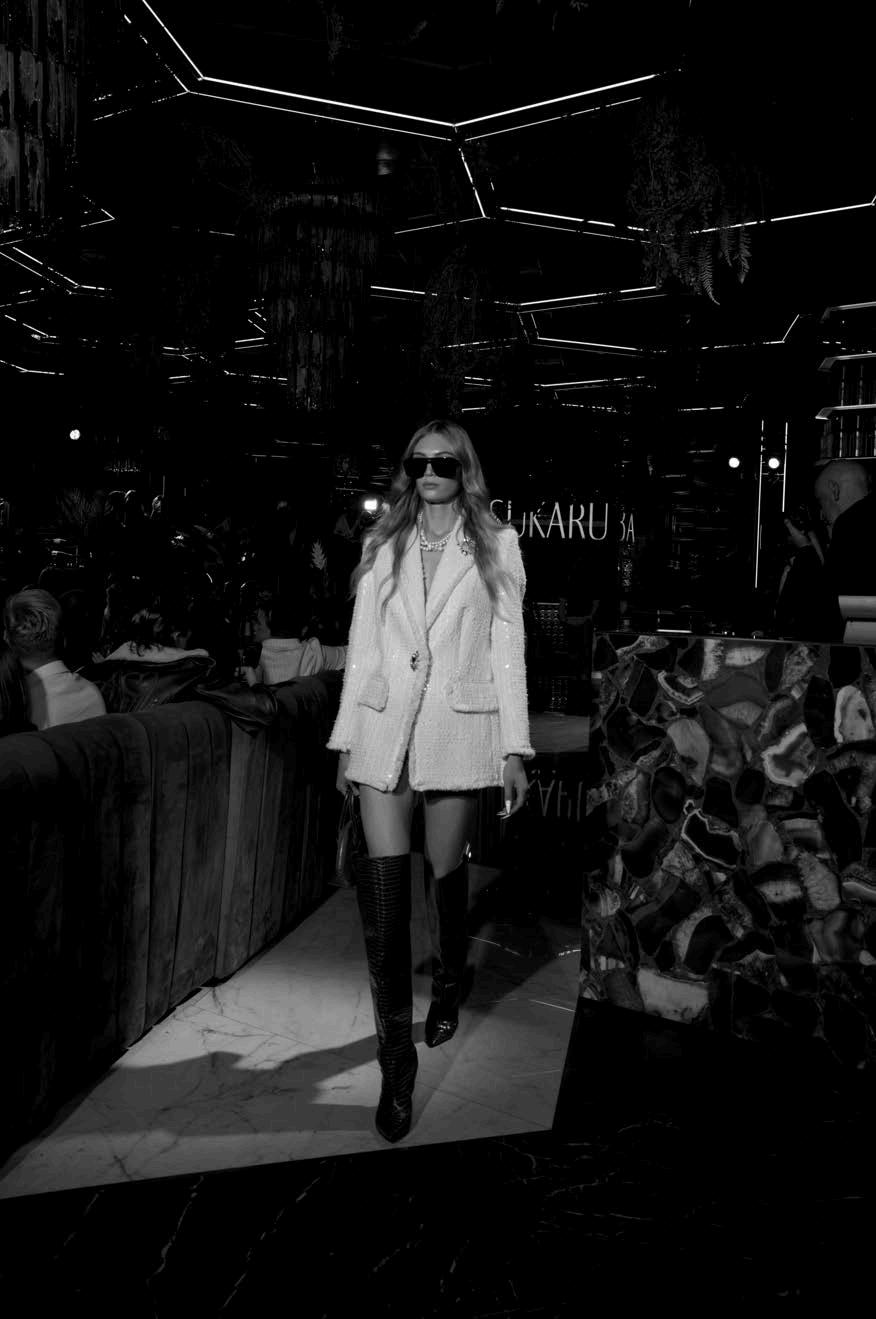
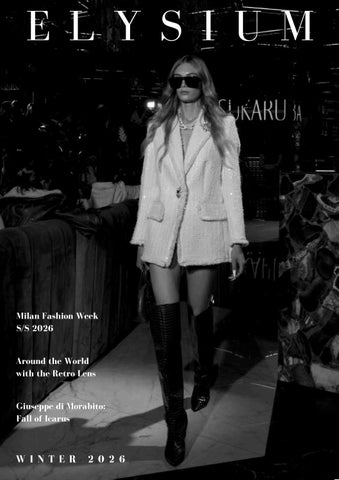
Milan Fashion Week S/S 2026
Around the World with the Retro Lens
Giuseppe di Morabito: Fall of Icarus
Milan Fashion Week S/S 2026
Around the World with the Retro Lens
Giuseppe di Morabito: Fall of Icarus
Jesse Scott
EDITOR-IN-CHIEF, DIRECTOR OF DESIGN
Leroy Velasquez DIRECTOR OF PHOTOGRAPHY
Diana Huk CONTRIBUTOR
Filza Marri CONTRIBUTOR
June Roberson CONTRIBUTOR
“The greatest discovery of my generation is that a human being can alter his life by altering his attitudes.”
William James
ith2025rollinginto2026,I’ve been thinking a lot about how we can be more intentional with our lives. This year was deeply fulfilling for me personally:
it saw me welcome wholly new experiences, travel to eye-opening new destinations, and make countless cherished memories with the people I care about the most. But perhaps more importantly, 2025 was possessed of a certain calm cadence. I took far fewer flights this year than I have in recent memory, emphasizing quality over quantity and building structure within chaos. And while I would never consider myselfanadvocateof“slowliving,”Idobelieve that we should be highly discerning within the frenzy of information and choices that define our modern existence. Whatever paths we follow,weshoulddosowithpurpose.
The fashion world, collectively, seems to have come to the same realization. Milan Fashion Week Spring/Summer 2026 was highlighted by designers who curated distinct and streamlined visions while encouraging us to pause amidst a storm of consumption. Giuseppe di Morabito is perhapsthebestexample.
While some designers frantically aim to launch full collections before even graduating school, Morabito spent nine years developing his eponymous brand prior to his first show. That show shocked its Milanese audience by starring robots as models: in Morabito’s words, a representationof“thecontrastandthespeedwith which society is rushing toward the future, often without pausing to reflect on itself.” Within these pages, you’ll discover Morabito’s second offering, a carefully choreographed “Fall of Icarus” show that distilled mythological grandeur into a streamlined, thought-provoking narrative acutely attuned to our current flashpoint. You’ll also explore the world of Brunello Cucinelli, who grounded his S/S 26 collection in the four essential elements: earth, water, fire, and air. And you’ll read how Giuseppe Zanotti turned backtheclocktorevivehismosttimelessdesignas originallysketchedonacocktailnapkin.
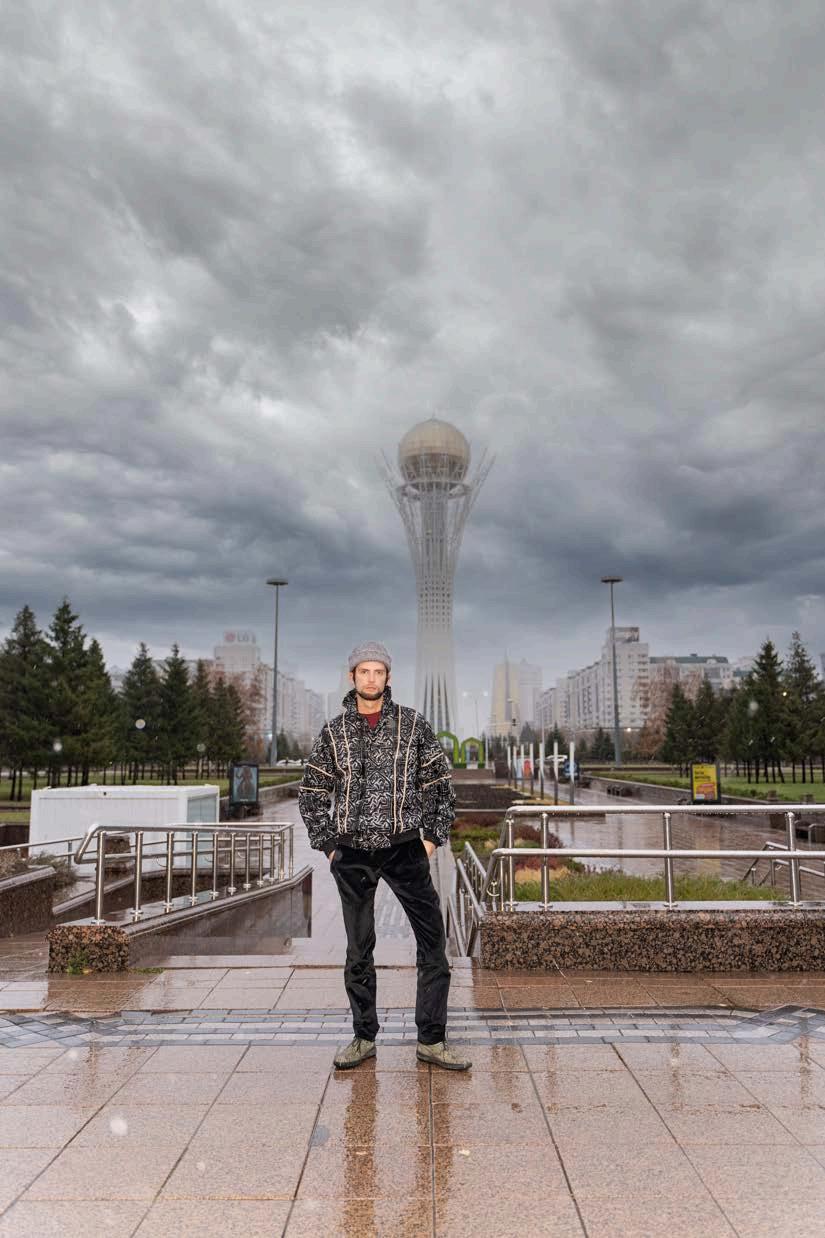
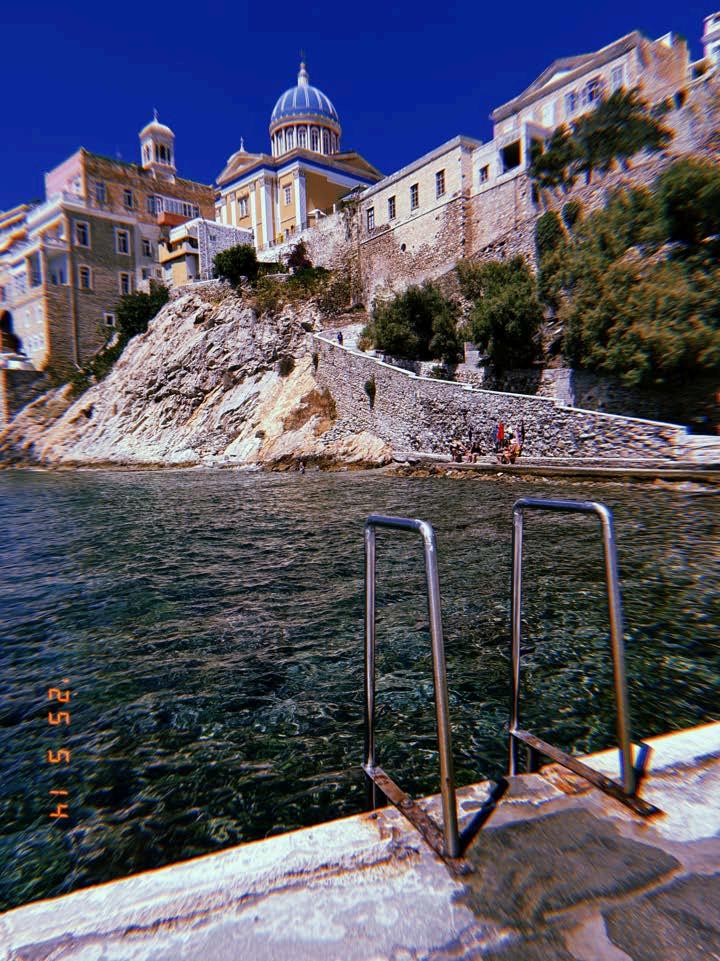
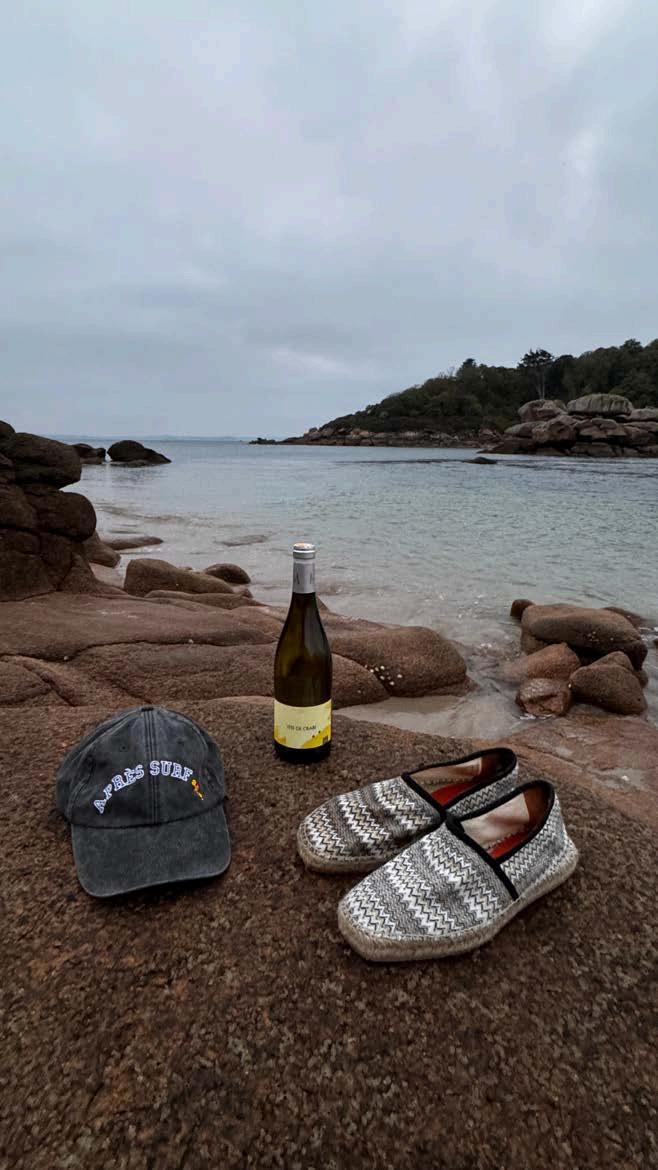
The issue concludes by taking you around the world through a retro lens: exhibiting a series of rawmoments,capturedawayfromtouristhordes, in destinations ranging from Kyoto to the Cyclades to the American West. I hope that it gives you some inspiration for your 2026 travels, and that, wherever you go this upcoming year, youdosowithclearintentionsbutanopenmind.

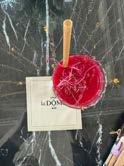
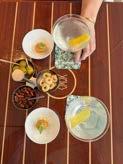
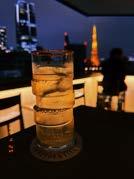
Trisoux, Munich, Germany: The decor may be muted at Trisoux (save for the spectacular three-dimensional ceiling constructed over the bar) but the drinks are anything but. The crown gem in Munich’s rapidly evolving cocktail scene, Trisoux mixes technically precise and exceptionally well balanced drinks that delight the palate by combining familiar flavours in unexpected combinations. Their most recent seasonal menu was inspired by the Mediterranean, but not in the basic way that would have one parroting off “Spain, France, Egypt.” The Trisoux team took us to the shores of Turkey and Tunisia while taking the opportunity to demonstrate their clarification skills: the Çok Güzel (dark rum, pomegranate, black tea, raki, lemon, ayran clarified) and La Bruma (mezcal, apricot, harissa, lemon, buttermilk) were two of the most innovative masterpieces on the menu. That said, it was the Atlante gimlet that stole my heartliterallyaGreeksaladinaglass!(bottomleft)
The Order: Atlante Gimlet: Gin mare capri, watermelon, cucumber,oregano,acid
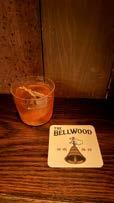
Woods High Mountain Distillery, Salida, Colorado: Craft cocktails were the furthest thing from my mind when I embarked on a weekend of hiking, horseback riding, and hot springs in Salida, Colorado (smalltown Americana, population 6,007). But that quickly changed when I discovered Woods, a distillery/bar with a charmingly quirky range of decor and a true passion for spirits. With the motto “Born in the River, Raised in the Mountains,” Woods produces its own whiskey, vodka, and even gin from grains, potatoes, herbs, and fruits all found in their native San Luis Valley. From field to bottle, everything is hyper-local; for example, to produce the vodka, Woods sources potatoes from 50 miles away and triple distills it in-house before blending with snowmelt from Colorado’s highest peaks. The whiskey, one of their best offerings, is distilled in a traditional Germanpotstillthathasbeeninusesince1880. Andifyou want some spice in your cocktail, just ask for the house Serranos (I’d say that they’re to die for but they might kill you first). One of the best parts about Woods is the welcoming staff, who live and breathe the Colorado mountains and are as comfortable skiing backcountry chutes astheymixingdrinks.(bottomright)
TheOrder: Don’t be a Prick (now off menu) OR Ginger Pear Snap(pear-infusedvodka,lemon,gingerliqueur)
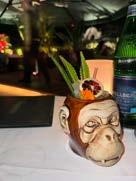
Sognio, Milano, Italy: Milano’s ever-competitive cocktail scene has a new star and it’s brought to you by the same people who created Volt. Sogni is a restauramt/bar with sultry lighting, communal seating, and a vibe that gets steadily clubbier as the drinks flow and the evening wears on. The entire experience is elite but the mixology team is in a class of its own. Inspired by the music of cultures across the globe, it includes such innovative gems as the Lirica (inspired by Italy, containing Antica, gin, saffron, Perrier, toasted rice, and Parmesan) and the Musica Celtica (inspired by Scotland, containing pepperoncini juice, agave, bbq, and lime). Aperitivo offerings and presentation also get top marks.
The Order: The Folk (Norway): Bareksten acquavit, noilly prat,artichoke,andcoconut
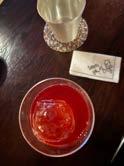
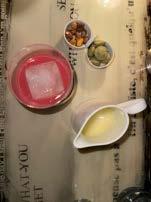
Harry Waugh Dessert Room, Tampa, USA: Above the legendary Bern’s steakhouse, Harry Waugh’s Dessert Room (famous for its live piano player) has one of the best spirit and wine selections in the world. Think Crimea’s Massandra Collectionmuscatfrom1931and1945,Madeira’sincredibly rare Terrantez (the grape went almost completely extinct during phylloxera) and cognacs dating back to 1830. As for the dessert cocktails, you simply won't find any better in America.
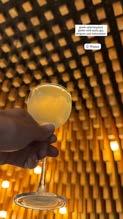
Dry-Aged Old-Fashioned: Beef fat washed housemadesyrup,freshtruffles

The Schwarzer Adler, Kitzbühel, Austria: Located in the center of downtown Kitzbühel, the Schwarzer Adler offers the perfect combination of luxury and authenticity in the Germanic world’s premiere winter resort and summer hiking destination. Picturesque Kitz is still something of a secret outside of the Bavarian elite; think an understated and ultra-luxurious Gstaad-style getaway without the recent social media frenzy that has brought so many visitors to Gstaad. I stayed at this property for a friend’s wedding recently and it was an ideal home base. The rooms were charming and tasteful in the true mountain style, the spa area (the biggest in Kitz) was a daily refuge after long nights orevenlongerhikesandtheroofotppoolofferedoutstanding views. Breakfast was also a highlight, including the best honeys, yogurts, and cheeses that the Austrian Alps have to offer.
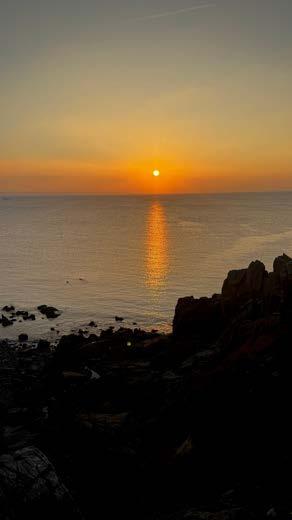
Manoir de Lan Kellerec, Trebeurden, France: Nestled in tiny Trebeurden, a town on Brittany’s winding pink granite coastline, Manoir de Lan Kellerec is a picturesque boutique hotel which just celebrated its 100 anniversary. Ideal for a quiet retreat, it has stately if rustic rooms, a stunning Michelin-starred restaurant with dreamy sunset views, and directaccesstothebeachandiconicP34trail. th
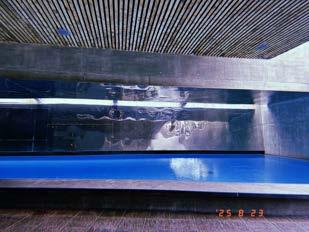
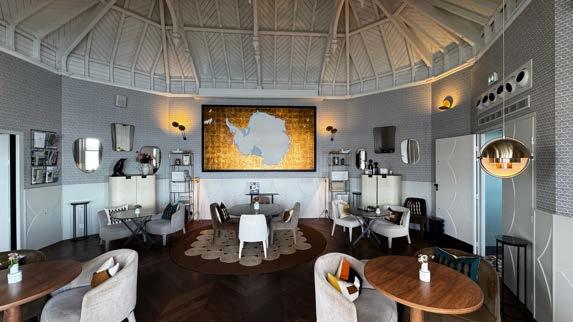
Castelbrac Hotel, Dinard, France: Located in quiet Dinard,theexclusivebeachtownlocatedjustafewkm.from Saint Malo, Castelbrac is perhaps the most luxurious accommodations option on the Brittany coastline. The property has a rich history. Legend has it that when British Colonel Lord Hamilton (hero of the Crimean War) saw the property in the mid-1800's, he cried out “Oh my god, what a bric-a-brac.” Charmed by the dilapidated property and entranced by its coastal location, he purchased it and transformed it into a neo-medieval style castle, right down to the construction of battlements! After his death, it became home to the local aquarium for over 60 years before being transformed into a hotel by local Yann Buccaille in 2015. The original character of the property has been beautifully maintained, although the rooms, divided into three buildings allwithdramaticseaviews,haveallthemodernluxuriesyou could ask for. (Hint: ask for a room with the bathtub directly overlooking the Bay of Dinard). The Michelin-starred art deco style restaurant, in the former home of the Natural History Museum, is the perfect place to while the day away; sunset terrace drinks at the bar are also a must. The contemporary design throughout the hotel is outstanding, with many spaces, like that below, paying tribute to the spiritofexploration.
August: Hollow, ARTBAT, Morten, Bonn: It was a huge summer for Morten and ARTBAT. This soulful song from the Danish and Ukrainian DJ’s, who also have teamed up for “Culture,”hasahookyouwanttoscreamwhileholdingyour friendsandadropthatwillmaketheroomshake. Strangely vintageMartinGarrixcoded.
September: Diet Coke, Tim Bliss: The song of the fall...that started with Fallon, was made legendary by John Summit, and from Anyma to Tiesto to Armin Van Buuren has been played by everyone in the house scene. The best version: from almost-unknown Ukrainian DJ Tim Bliss, who wasdiscoveredbyKorolovaandshouldbeontherisesoon.
October: Damn Good in a Dive Bar, Laci Kaye Booth: For Elysium, October saw the end of fashion month and the startofalocked-infall. Themusicchangedaccordingly,and Laci Kaye Booth’s nostalgic and melancholic tune (Lana but country?)wasoneofourfavorites.
November: MyMind, Korolova, JOA: Our favourite duo of 2025 had a particularly red-hot fall, leading out with swaggering anthem “No Games” before getting darker for thishypnotictrack.
Pop: The Fate of Ophelia, Taylor Swift, Loud Luxury: Taylor Swift’s latest album was panned by many, including us. Butwhileitmayhavebeencringy,itledtothisgemofa remix dropped by Loud Luxury during EDC weekend in Orlando. Like“Body,”yousimplycan’tstoplistening.

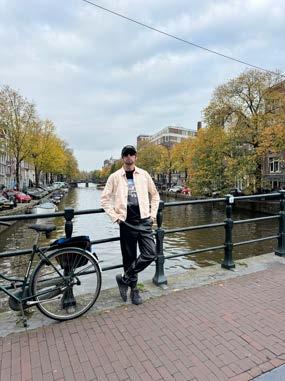
Techno: The Heads that Know: Charlotte de Witt, Central Cee: From pop-up shows to opening AND closing Tomorrowland, it’s been a gargantuan year for the Belgian queen of techno. Most notably, she released her eponymous debut album, which is delightfully true to her roots. “I’m a club kid, always will be, and every track on this record makes me want to dance.” The surprising collaboration with British rapper Central Cee made this one of the hardesthittingsongsonthealbum. NoDivisionandTheRealmwere also hit singles while Hymn and Memento Mori, the latter of which had an almost-mystical Gregorian chant vibe, were personalfavourites.

MelodicHouse: Psycho, Kasia,CharlesD(USA),Charles de Warren: Kasia’s star continued to rise this year and the driving beat and seductively provocative lyrics of Psycho quicklymadeitananthem.
Country: StuckinmyWays,LaurenWatkins: Nashvilleborn Lauren Watkins, who released her debut album in 2024,strikesalltherightchordswithasongthatmanagesto bebothyearninganduplifting.
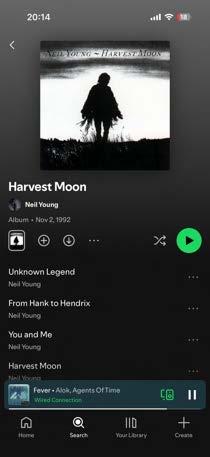
Classic: Harvest Moon, Neil Young: There’s something about the autumn that is just perfect for Neil Young and Fleetwood Mac. Our most-played song this season was Harvest Moon, best enjoyed during a November evening walk alongalakeshorefulloftwinklinglights.
Low-Key: Thank You for Leaving, Sports, Gus Dapperton: This is not a break-up song. Instead, it’s the song you listen to a few months later, when all wounds have healed, and you smile at yourself while realizing you’re truly gratefulthatacertainpersonisoutofyourlife.


Remix: Apocalypse, Pete Tong, Mo Black, Max Zotti, feat. Monolink: I never thought I’d see a party-ready remix of Cigarettes after Sex, but this version of one of their alltime classics hits you (with adrenaline) in the heartstrings. Bestplayedtobeginanexclusiveaftersoranhourbeforethe clubcloses.
Just Released Pick: MadeForLove, Korolova, Agents of Time: This exhiliarating track has been played around the world since early summer - released right before press day to beenjoyedathome!

Adrift on the Nile, Naguib Mahfouz: One of Naguib Mahfouz’s greatest masterpieces, and in many ways a microcosm of human ego, weakness, and moral paralysis, Adrift on the Nile will spark discussions long after you finish reading it. The book, an invaluable time capsule into the zeitgeist of a specific and historically significant time in Egyptian history, centers on a group of middle-aged middleclass Cairenes in 1966. They have a diverse range of jobs (journalist, actor, artist, politician), thus also making them a window into the social concerns and tensions of the flashpoint, and widely differing viewpoints on love and life. Yettheyareallunitedbyapeculiarnihilism,gatheringona houseboat every single night, removed from families, careers, and the outside world, to become deeply intoxicated on hashish and discuss what seems like everything but could in fact be nothing at all. Their host, civil servant Anis, is perhaps the most numb of all. Spectator to his own life, and lacking any conviction or motivation, he does the bare minimum to maintain his day job, then spends his evenings silent as his friends engage in spirited discussions. His world takes a turn when the group adds a new member: an attractive young female journalist who had heard about the houseboatthroughthegrapevineandbeganvisitingasatype of observational study. As one can imagine, jealousies, insecurities, and sexual tensions start to eat at the group’s rotten core, leading to a tragic accident that could change their outlook on life...or not. This is a profound, beautiful, and melancholic read, whose characters spin in circles while their creator both makes a series of powerful points and asks anumberofuniversallyrelevantquestionsofreaders.
Dream Girl Drama, Tessa Bailey: This book has absolutely everything that an athlete could want from what we like to call a slutty beach read. Set in Connecticut and Massachusetts, it in some ways is a tale of “rich girl meeting boy from the wrong side of tracks.” But it’s much more complex; that boy is a famous pro hockey star with his life figured out and that girl is a piano prodigy who has essentially been held prisoner by her mother since she turned 18. The tale is romantic, if at times over-the-top, distinctly modern, incredibly sexy, and should appeal to twenty-somethings who have experienced the current American dating pool. Most importantly, Bailey writes both the male and female perspectives well. It’s just one in a fivepart series that cover sports ranging from golf to baseball; consider your beach read hunt made significantly easier for anyupcomingwinterbreaktrips.

Shahaama: Five Egyptian Men Tell Their Stories, Narya Atiya: This non-fiction gem tells the stories of five Egyptian men as directly narrated to Narya Atiya in the 1970's and 1980's. Read together, they speak eloquently to the Egyptian conception of masculinity and to how social structures and long-held cultural norms produce philosophical unity among men that transcends social class, religion, and geographic location. They also illustrate a periodofvastsocial,political,andeconomicchangeinEgypt, and how long-cherished values shaped responses and adjustments to said change. Atiya tells us the stories of a humble Muslim fisherman with a rural background, a middle-class Muslim attorney living in Cairo, a wealthy Jewish-Egyptian who was forced to leave the country and settle in France, a Coptic Christain scholar who immigrated to the United States, and a middle-class progressive Muslim film production manager living in Cairo. As they shared their life stories from birth, certain common threads manifested. For example, they often emphasized admiration for their mother and clashes with their father. They also spoke about the immense pressure of providing for their family, focusing stories of their adult lives on pragmatic matters rather than on those from he heart. What unites them most, however, is the Egyptian concept of “Shahaama:” a masculine belief in honour, duty, and social solidarity that shapesallinterpersonalrelations,familyresponsibilities,and communityties. Anilluminatingread.


One True Loves, Taylor Jenkins Reid: This book is impossible to put down, and whatever you think of its moral dilemmas, its characters, and the ultimate choice made by the protagonist, its worth a read simply for the questions it provokes. Masked as a beach read, it could easily end with youtakingadeepdiveintoyourownbeliefsaboutlove.
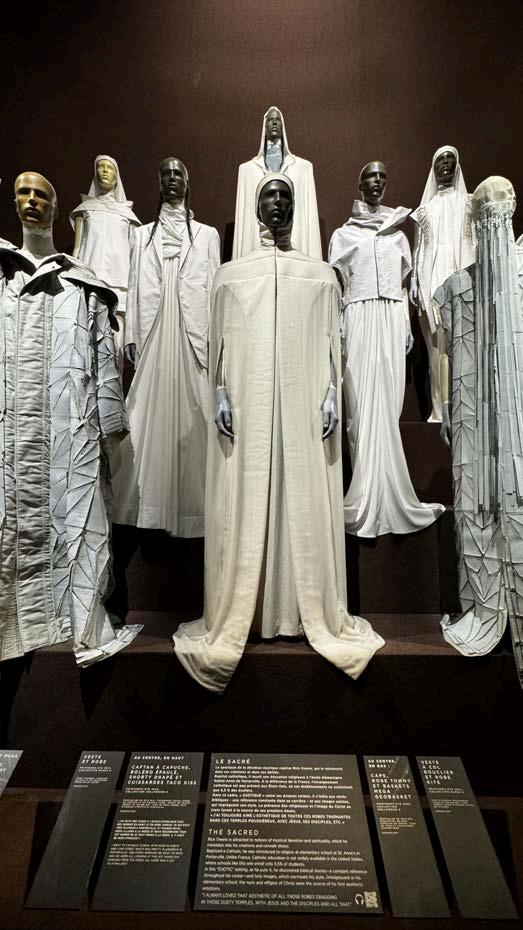
RickOwens:TempleofLove,PalaisGalliera,Paris:

A comprehensive tribute to one of fashion’s most subversive and iconic designers, curated by Owens himself, “Temple of Love” sees the Palais Galliera transformed in a way that we’ve never witnessed before. The exhibition can be appreciatedbybothOwens’biggestsupportersandthosenew to his story: a central section provides insight into his life story and most emblematic designs (e.g. nun-style habits and voluminous felted sheaths) while a grand hall displays a broad selection of pieces according to themes that have shaped his career. An array of personal mementos and photos give the exhibition added power, while the final room, an exact reproduction of his and Michèle Lamy’s bedroom, offers a powerful concluding statement. Temple of Love offers a particularly rare opportunity to view a selfcreated retrospective, something that Owens is fully cognizant of. Of trying to correct misunderstandings about his life and work, he said: “People get the impression that I am this dystopian disruptor, and that I am aggressive, but my motivation has always been to be a contrast to the condemning judgment that I experienced in my youth, and thatIhavedeclaredwaron.Therehavealwaysbeencreators like me who are cheerfully depraved, and that is my response to all who felt contempt or oppression, and I'm puttingtheoppositeofthatoutthereinmyownlittleway.”
Grand Egyptian Museum, Cairo, Egypt: Elysium was invited to a sneak preview of the Grand Egyptian Museum a year and a half ago; we revisited this autumn to discover further galleries prior to the public grand opening. The project cost 1.2 billion dollars and took 33 years from conception to completion...but the early returns, including our own experiences, indicate that it was fully worth the wait. Twelve tiered galleries guide visitors through the full history of Ancient Egypt on an epic scale. Not only are the exhibitions chronological, however, but also organized according to theme; in a brilliant move that should be studied by museum curators everywhere, informative signs explaining artifacts emphasize a different aspect of Egyptian civilization (e.g. jewelry and fashion, the evolution of temple construction, the journey to the afterlife) in each hall. For most tourists, the main draw is the funerary boat of King Khufu and a full reconstruction of Tutankhamun’s tomb just as it was found by Howard Carter over 100 years ago. The Tutankhamun exhibition contains some 5,500 artifacts; in the words of Tarek Tawfik, former director of GEM: “nothing remains in storage, nothing remains in other museums, and you get to have a complete experience.” It openedtothegeneralpubliconNovember4.2025.
For Children, Haus der Kunst, Munich: The contrast is stark: an imposing quasi-brutalist architectural space and an exhibition on the relationship between art and childhood. Perhaps that’s what makes this show so powerful; it puts a little-discussed side of art on a grand stage for the first time. Starting in the late-1960's, new wave artists began designing artwork specifically for younger audiences, often distilling profound themes into aesthetically engaging and easily digestible works that could play a valuable educational role. At the same time, museums and urban planners started specifically considering how they could tailor certain features and experiences to children. For Children tells this story on a broad international scale, bringing together artists from countries such as Japan, the Czech Republic, Brazil, and the U.S. to share works that address universal fears, hopes, and emotions even if created against starkly different sociopolitical backdrops. For example, Czech artist Eva Kotátkóva invites us to hide under a table while Egyptian artist Basim Magdy teaches the art of responding to failure through his absurdist game/installation Pingpinpoolpong. A personal favourite project was that of Brazilian Rivane Neuenschwander, who asked schooldchildren around the world to identify their greatest fears and then design a cape protectingthemfromsuch.

Kamo Crostini, Noble Rice, Tampa Bay, USA: This dish is all about texture and umami, as duck breast, pistachio butter,andonionjamquiteliterallymeltinyourmouth.
Alexandrian Liver Sandwich, Namliyah, Hurghada: Namliyah is the best modern Egyptian restaurant in Hurghada, and it’s the Alexandrian liver sandwich (complete with cumin, coriander, and a delightfully tangy vinegar) that standsoutthemost.
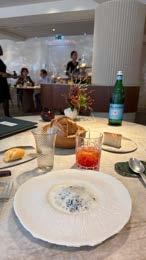
Calamari Chorizo Black Risotto with Parmesan Foam, Marsan by Hélen Darroze, Paris, France: Now-six Michelin-starred Hélèn Darroze (including a three-star restaurant at the Connaught), offers perhaps her most authentic gastronomic experience at Marsan. The Gascon native celebrates the traditional cuisine of Southwest France in an elevated way: for example, with the famous Landes chicken in a corn extraction sauce and corn miso that she says would be her last meal. However, it’s this intensely flavorful risotto, with an oh-so-light foam and the finest chorizo,thatstoodouttousthemost.
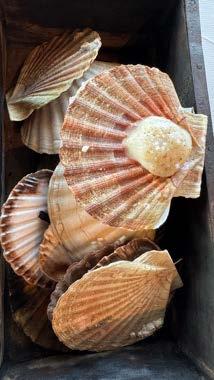
Saint-Jacques de la baie bretonne cuisinées dans l’esprit d’un kig ha farz, Manoir de Lan Kellerc, Trebeurden, France: Kig ha farz is a traditional buckwheat meat stew from rural Bretagne (think peasant comfort food). Manoir de Lan Kellerec, in perhaps the most innovative dish we tried this season, elevated this unique regional flavour with some of the region’s finest ocean bounty: Saint-Jacques. The presentation is outstanding (the saint-jacques are prepared in three ways à la Pierre Gagnaire) and the umami + hearty brothcombinationisunmatched.
Smashed Tenderloin with Pistachio & Truffle, Maven, Antwerp Belgium: Maven offers the perfect combination of scene and exceptional food; the team is deeply passionate about steak and keeps you involved through every part of yourexperiencefrompresentingthediversecutsatthetable to inviting you into the kitchen to salt your steak. This surprisinglylightappetizer,however,isthehighlight.
Sea Bass with Mangoes and Chili Oil, Kempinski Soma Bay, Egypt: Generally a full-board property, the Kempinski Soma Bay is at its best when it comes to its fresh mangoes and nightly seafood selection. Lightly grilled seabass with generous slices of mango, a dusting of chili oil, andsomechilitzatzikiontheside? Healthyanddecadent.
Stuffed Pigeon, Hagouga, Cairo, Egypt: Perhaps the best place in Cairo for an authentically Egyptian feasting experience, Hagouga is fullly worth the chaos and long table waits it entails. As a conoisseur of Hamam Mashi (often served as special occasions), this is as legitimate as it gets. Be sure to try the “Egyptian whiskey,” a drink of vinegar, lime, spices,andthejuiceoftomatoes&cucumbers.
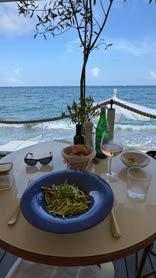
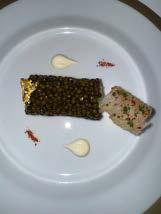
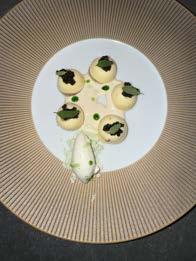
Langoustinesàl’unilatéraleavescroustillantaublénoir et pied de cochon braisé, sauce au lait ribot, Manoir du Lan Kellerec, Trebeurden, France: Brittany lobster is one ofthemostemblematicdishesofFranceandManoirdueLan Kellerec, similarly to with the Saint-Jacques, proposed them in an entirely unexpected but locally inspired way this fall. The langoustines were swathed in a sauce of fermented milk (a Breton dish dating back thousands of the years to the Gauls), and local pork then garnished with a buckwheat cracker.
Fish Reunion Style with Red Peppers, Faham by Kelly Rangama, Paris, France: Kelly Rangama, the first Michelin-starred chef from Reunion, combines traditional tropical flavours from the West and East Indies with French cooking techniques. This Reunion-style dish, served in a flavorful broth and with a particular tangy/spicy red pepper saucethatI’veonlyhadinFijiandMauritiusbefore,wasthe highlightofthestellarmenuweexperienced.
South African Grill Tasting, Savanna, Munich: Your best option for experiencing authentic South African flavours in Munich, Savanna offers an outstanding grill tasting featuring small portions of Kingklip (a local fish), crocodile, water buffalo (the best), zebra, and Namibian beef. A must for steakandgamelovers.
Filet Mignon, Bern’s Steakhouse, Tampa, USA: Perhaps the best steakhouse in the US continues to live up to expectations: exquisite blue fillets, decadent baked potatoes, frenchonionsoup,andthebestserviceinthegame.
Floating Island, La Valle, Dinard, France: This light yet decadent dessert is made particularly delicious by the additionofLyonnaisepinkpralines.
Kouign Amman, Yann e Bretagne Boulangerie, Dinard, France: This buttery Breton pastry was a revelation for us thisfallandthebestversionwassampledhere.

PHOTOSPROVIDEDBYHOUSE
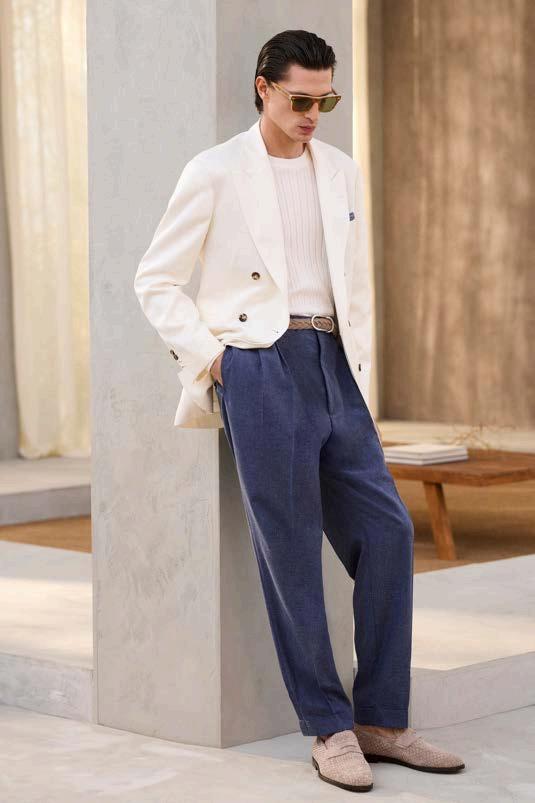
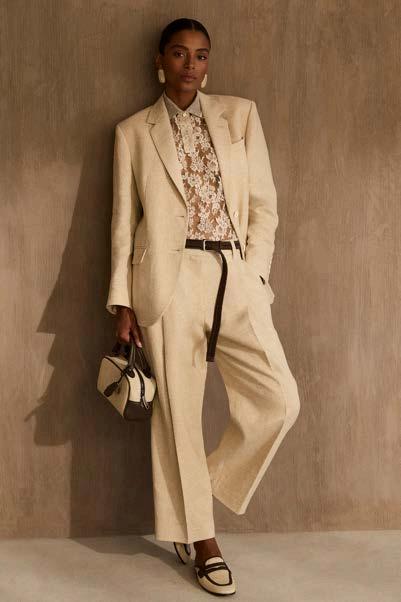
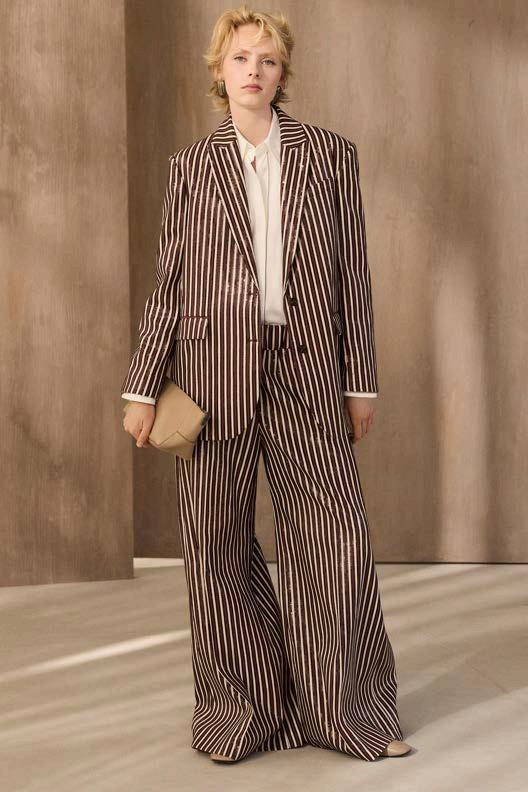
Earth,Water,Fire,andAir:theseare what Brunello Cucinelli, standardbearerforMilanesesophisticationfor almost 50 years, proposed as the essentialelementsofSpring/Summer 2026. Grounded in precise tailoring and timeless shades of nature, the collection made explicit what those who love Cucinelli have always appreciated: a balance between passion and discipline, an appreciation of our roots, and a humble drive for perfection. “Earth, air,water,andfire-notonlydothey animate nature but they sustain our very existence,” guests were told in thepressnotes.“TheSpring/Summer 2026 Women’s Collection invites us toreconnectwithouroriginsandthe essential natural elements, through silent, yet empathetic understanding.” In an immersive presentation that encaspulated the essence of Cucinelli (soft lighting, warm smiles, the clinking of champagne glasses and a startstudded guest list de rigeur), we did justthat.
Walking amongst the mingling models felt like a journey through some of Earth’s most incredible landscapes. Sand, ecru, white clay, and root tones recalling deserts and seasides dominated on diaphanous and billowing fabrics reminiscent of mountainbreezesandlappingwaves.
These gave way to discerningly used rhubarb,redlava,andfirebricktonesthat spoketoaprofoundandenduringpassion. Gracefuldrapingandoversizedsilhouettes ensuredthateachlookcarrieditselfwitha self-assured and nonchalant attitude befitting aristocracy. And while restraint wasakeyword,therewasalsoaspiritof adventure, noticeably on an ostrich-style skirt paired with a sand blazer, a semitransparent lace floral top blending sensualitywithsophistication,andadress andcroptopmadeofcountlessintricately layeredandbedazzledpetals.
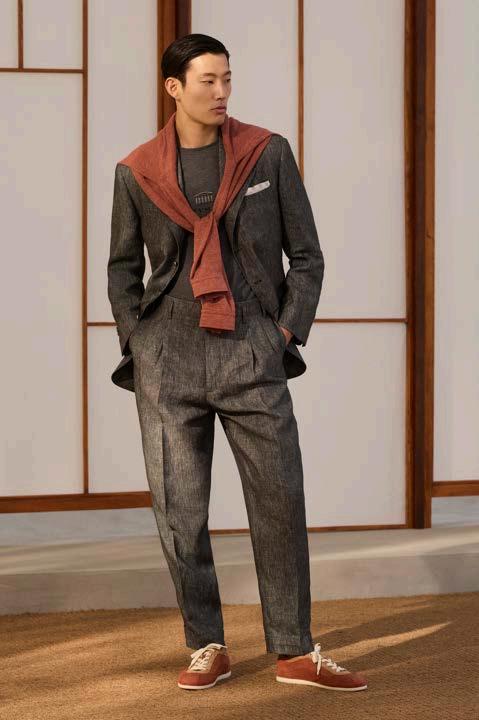
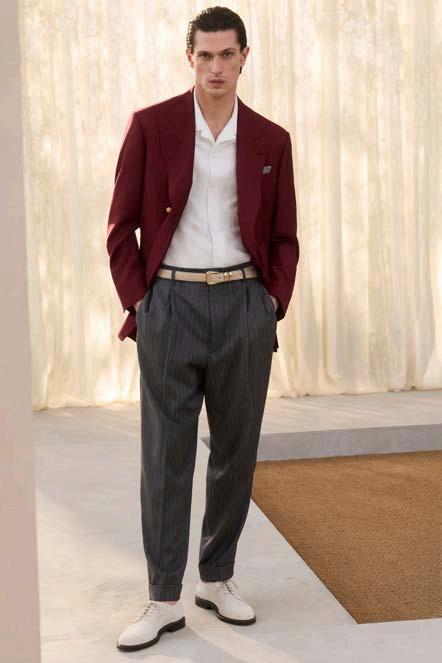
Effortless accessories from distinctly Cucinellisunglassestoanomnipresentand instantly iconic white baseball cap united the looks. Meanwhile, on the men’s side, “business casual” was re-invented as “elegantly nonchalant.” Of course there were perfectly tailored suits and striking ties.Butthecollection’smostmemorable looks included an apricot blazer paired withatucked-ingraphictee,asuitpaired withatee-shirt,drapedsweater,andcoral red sneakers, and a grey-pinstripe blazer/bordeaux trouser/white oxford combo that made me swoon. Modern swagger and traditional elegance, both of the refined variety, were exquisitely balanced. A structured half-zipped suede jacket added audacity to a shirt and tie, whileanavypinstripetrenchcoatwithan exaggeratedcollardistilledthe90’spower suit on top of a casual look featuring a brightbutton-down. Inonesubtletwist,a shirtandtrousersofthesamenavycolour werepairedwithasuitjacketofabrighter shade. Cucinelli plays by the timeless codes of Italian style, but he is also constantly reinventing and expanding upon them. And although he has nothing left to prove, Spring/Summer 2026 reaffirmed his place as the final word in timelessyetcontemporaryluxury.
PHOTOSPROVIDEDBYHOUSE
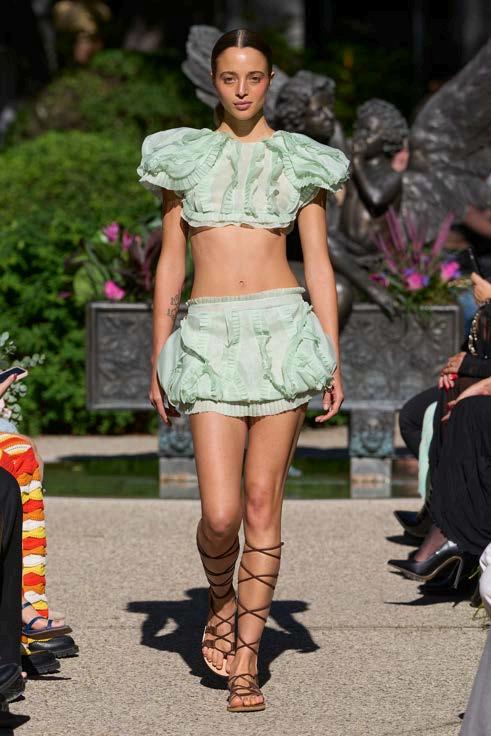
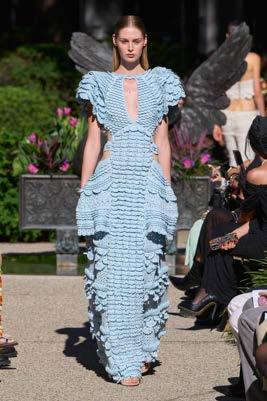
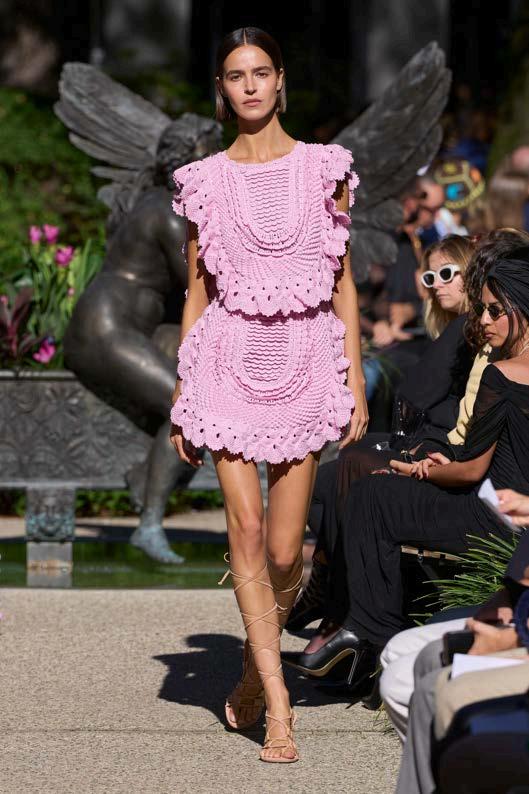
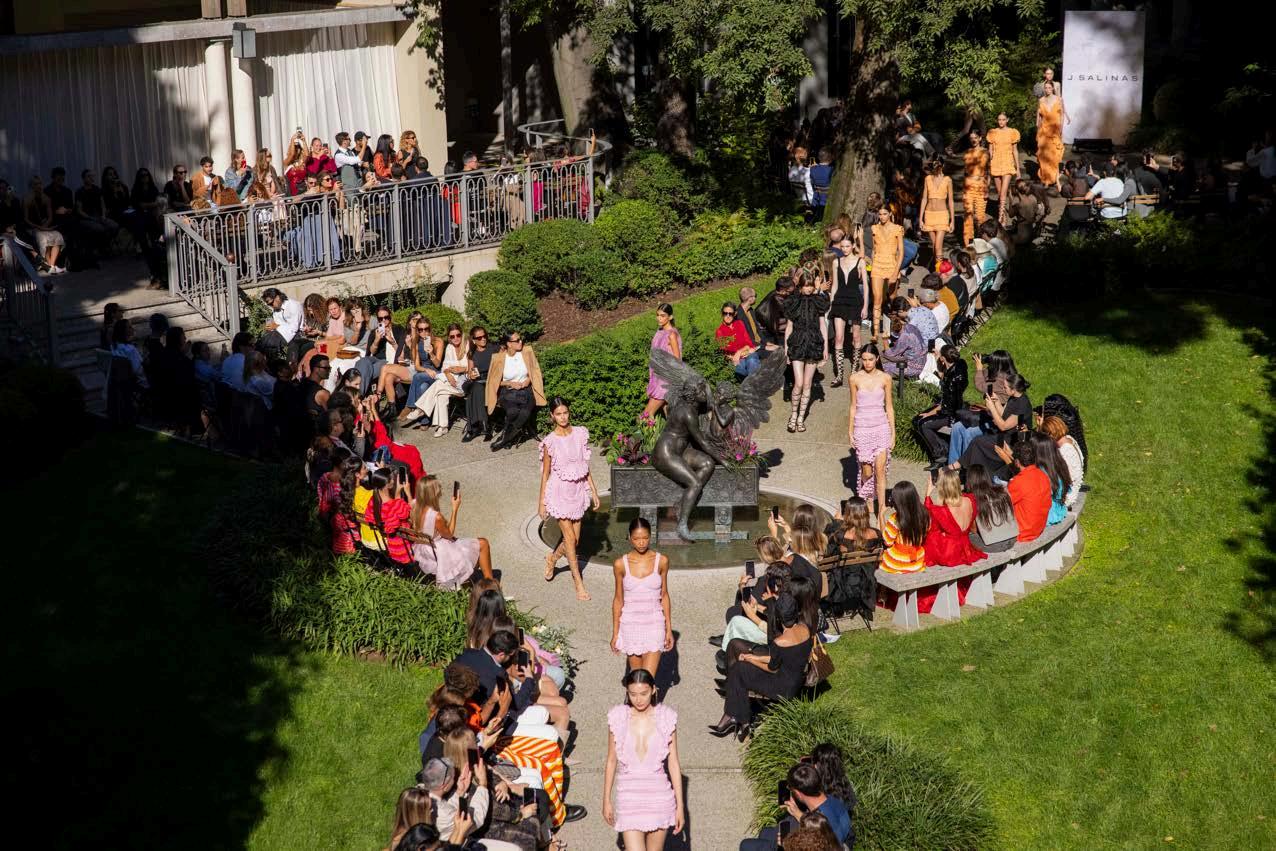
Traditional Peruvian craftsmanship took the luxury market by storm in Spring/Summer 2026, bursting onto fashion’sbiggeststageinamesmerizing danceofcolourandrhythm.Attheend of a relentlessly rainy Milan Fashion Week, designer Jorge Luis Salinas offered a ray of sunshine and optimism inmorewaysthanone.Staginghisshow in the expansive Garden Senato, resplendent in luscious shades of green, Salinas introduced a series of pastel silhouettes that balanced assertive structurewithunmistakablefemininity.
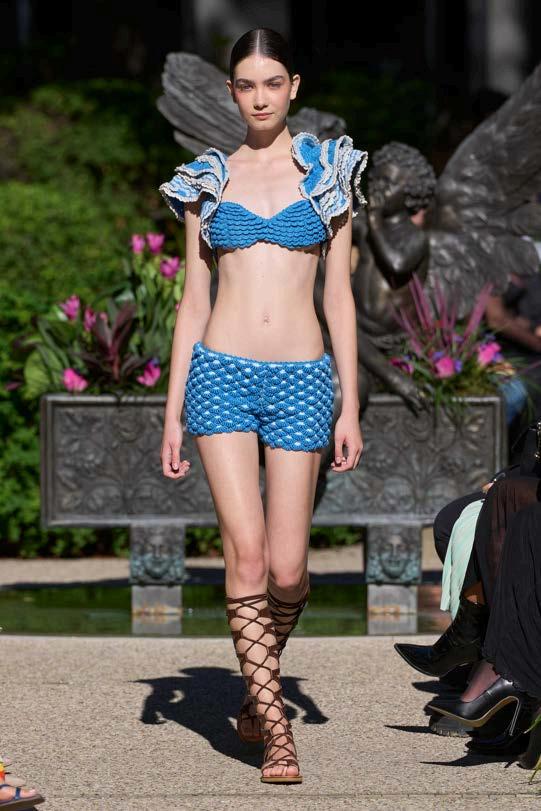
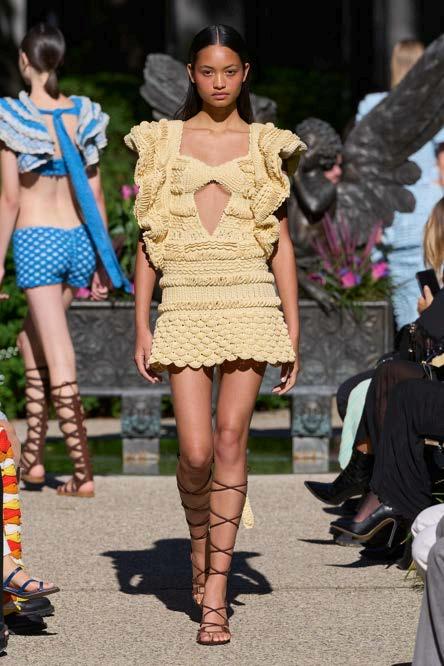
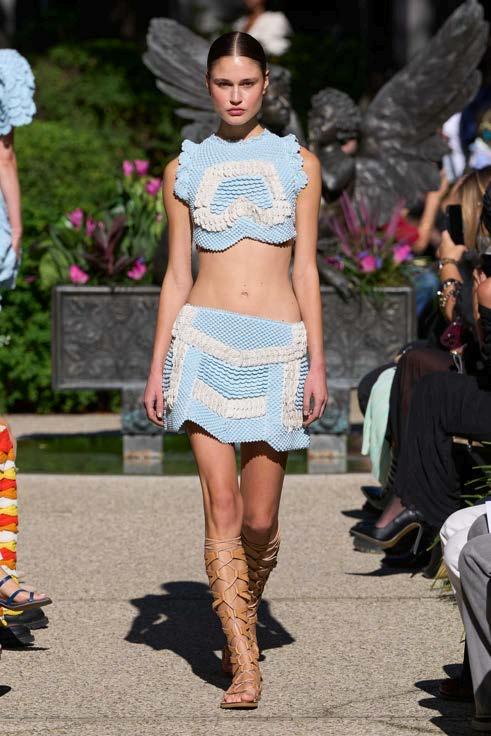
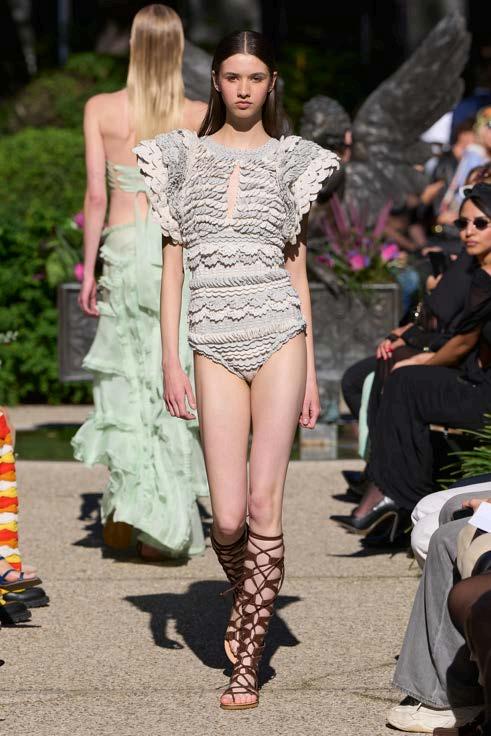
Crochet knits dominated, each handmade by Peruvian artisans. But these were not knits as you have seen them before; they rippled in cuts simultaneously precise and sensual and stoodoutforexaggeratedshouldersthat melded contemporary couture techniques with the bold glamour of fashion’sgoldenage.
IfyouarethinkingthatSalinascombined a number of seemingly paradoxical aesthetics and design philosophies, you areright.Thefactthathebroughtthem together in a harmonious symphony is testamenttonotonlyhisvisionbutalso to the deeply held values that remain unwavering at the core of the brand. Everything Salinas does, whether in remote regions of Peru or under the Milanese spotlights, is linked to his unwavering commitment to sharing his Peruvianheritage,andthepassionofthe artisansthatpreserveit,withtheworld.
“Mygoalisforeachgarmenttobea bridgebetweenpastandpresent;for tradition to dialogue with contemporary design and, above all, for the world to know the cultural richnessofourland,”Salinastoldthe press.
Specific family memories were the primary source of inspiration for this collection.Salinasimmersedguestsin the “Danza de la Tijeras,” a competitiverhythmicfolkdancefrom the Andean Valley. Named the “scissors” dance because the beat is keptbytwosmallpiecesofmetal,it is a remarkable spectacle of acrobatics and endurance that, in somecompetitions,canlastupto12 hours. It has inspired comparisons to modern breakdancing but is performed in elaborate and bedazzled costumes and headdresses thatareasmuchasourceofprideas the dance itself. And for Salinas, it’s theoneceremonyfromhischildhood that remains most vivid in his memory. “It has color, texture, and shape, and I wanted to gather all of thatintoahandcraftedcollection,”he said.“IbelieveIachievedthiswitha lotoflove.”
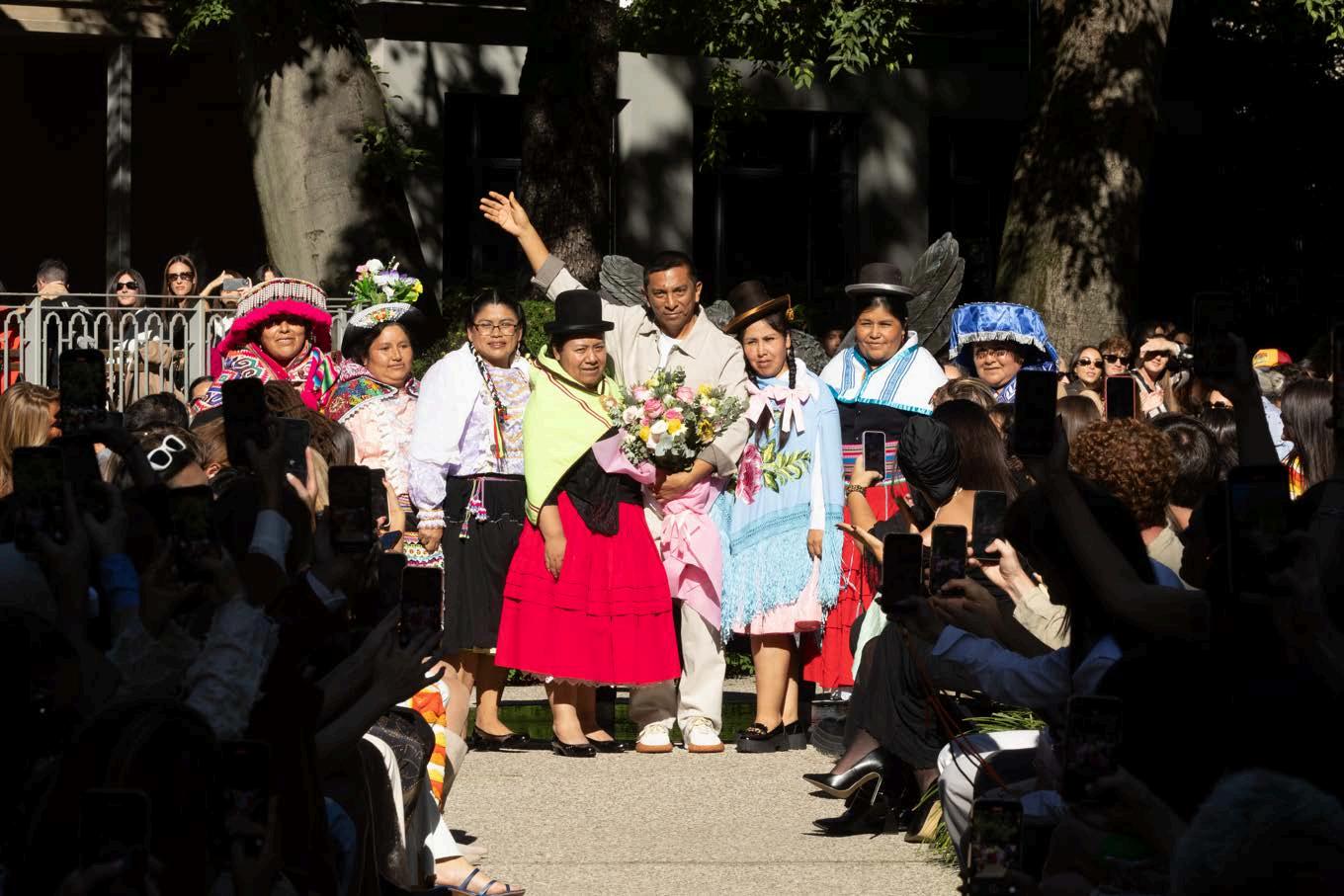
Love…and community. The evergroundedSalinasproduceshisclothes in collaboration with female artisans fromregionsalloverPeru.Eachpiece is made by hand in a Lima atelier, a labour of love that in the designer’s wordsallowsthewomento“support their families while we create garments together.” Salinas also makesexceptionaleffortstosharehis successwithhisteam,flyingsevenof his artisans to Milan this season to take the final runway bow with him. “These women come from regions thatIwanttoelevate,”hesaid.
“They are extraordinary people and their creativity is essential in assembling the collection. Each brings fabrics that inspire me to create something new. I mix textiles from the north, center, and south to givelifetonewforms.’’
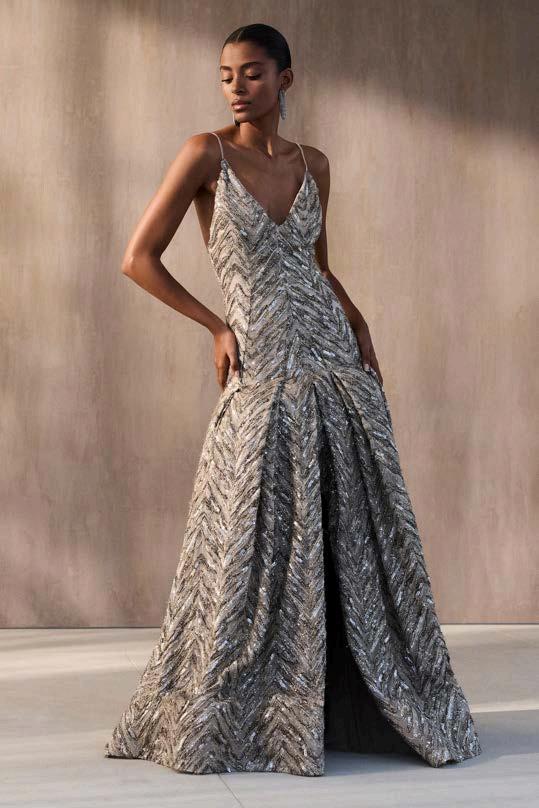
Those forms are as diverse as the women who created for them; there wassomethingintheSpring/Summer 26collectionforeverygirl.Covetous bandeaus, each adorned with dozens of handknit florals, were paired with equally intricately patterned knit leggings(!)foralookthatcandouble city girl chic and Mediterranean summer vibe. A floor-length aquamarine dress with a diamond shaped cutout and exaggerated shouldersissuretoturnheadsonthe red carpet. Meanwhile turquoise booty shorts paired with a matching braletnotableforitsflaredshoulders balanced sensuality with audacity. Sophisticated layering and asymmetries, often involving the signature floral patterns, recurred throughout the collection in perhaps the best example of how Salinas merges traditional and modern. And the pastel colour palette including pale oranges, baby pinks, butter yellows, and mint greens, provided a feminine cheer that should resonate acrossthebrand’smarket.
Guests were treated to drinks in the courtyard following the show, taking ararepausetomingleinthesunshine beforeheadingtotheirfinaleventsof the week. It was a true moment of joy, and in my various conversations atthetime,itbecameclearthatthe Peruvian artisans’ appearance on the runwaywasaconsensuspickforfeelgoodstoryofthefashionseason.
Spotlighting people “behind the scenes” has become a trendy bandwagoninfashion(pressreleases andshownoteswilloftenincorporate a mention of the brand’s unsung artisans in the same breath as “sustainability”).Butwhilemanytalk the talk for the PR checkmark, Salinasquiteliterallywalksthewalk, sharing an unforgettable moment of glory with those who create his clothes by hand but had likely never imagined setting foot on a Milanese catwalk. J. Salinas’s Spring/Summer 2026 collection was uplifting, imaginative, and thought-provoking, not only opening our collective eyes to Peru’s cultural heritage but also reminding us of core values such as gratitude, tradition, family that we shouldallcherish.
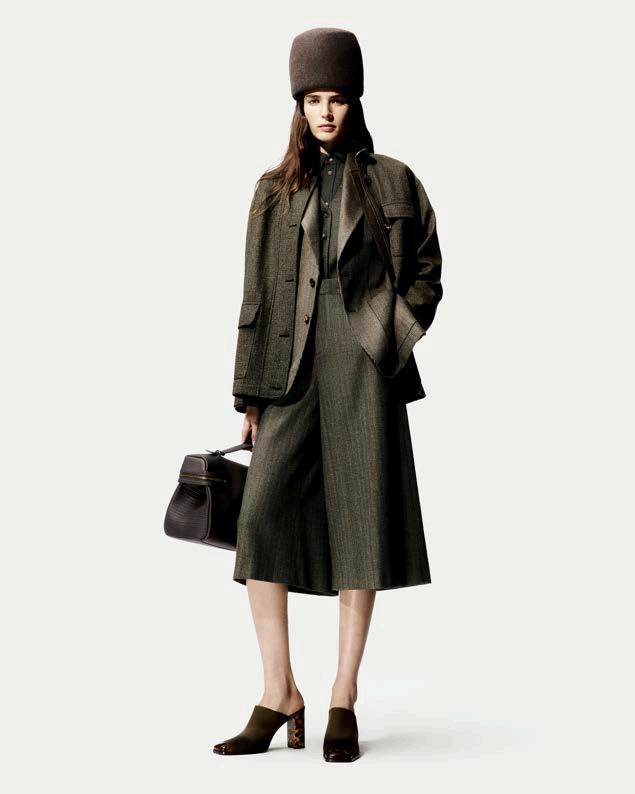
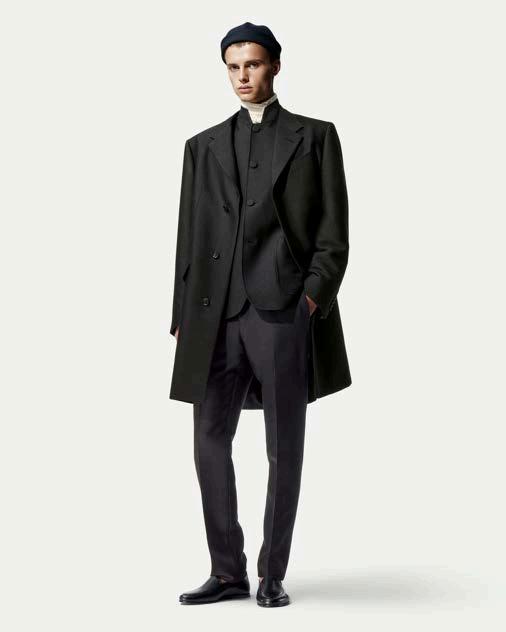
Within the wood-paneled rooms of thenewlyrenovatedPalazzoCitterio, Loro Piana unveiled the Spring/Summer 2026 collection at a quaint,curated,invitation-onlyaffair. Astherefurbishedcenterpieceofthe “Grand Brera,” the palace’s inherent eleganceservedastheidealbackdrop to spotlight traditional Milanese artistry and its role in the Maison’s visionforSpring/Summer’26.
The collection frolicked through the 19th and 20th centuries and flirted with art that the brand’s clients collectthemselves.Imagineaclimate that rarely exceeds the low 60s: dressingforasummerspentroaming the Scottish Highlands or holidaying in the English countryside. Though thecollectionofferedstaplesforany occasion,itrefreshinglyfavouredday dressing for the U.K.’s meadows rather than Mediterranean shores. Eschewingswimsuitsandsundresses, this season focused on layers. A de facto “how-to” even for seasoned self-stylists,itensuredthatoutfitsfor cooler summer destinations secured their place among warm-weather staples.
Consistent yet distinct, Loro Piana remainsauniversalemblemofluxury no matter where you reside. For summerheat,tweedsweresoftened, wools lightened, and statement piecesreintroducedasweightlessand ultra-layerable.
Thebrand’ssignatureelongatedsets, molded felt hats, and simple flat footwear were in no shortage, yet beneath the familiar formula lay a subtle push toward slightly bolder silhouettes. For example, the Maremma jacket was cropped and reimagined as a bomber, the cashmere Spagna resurfaced in Mustique linen, and the traditionally utilitarian Traveller coat emerged in breathable, crisp organdy. As for colour,sandyneutrals,burnishedtans, vibrantreds,softblues,marigold,and pale pink radiated across cardiganstyle jackets, cashmere hoodies, and trench coats designed with cooler monthsinmind.TheMaison’siconic cashmere, merino wool, and silk fibres provided a chromatic depth that light chiffons and linens rarely achieve, leaning more toward the onset of autumn than the height of summer.
One look saw green and yellow madras printed across a trifecta of linen pieces: an oversized blouson, a loosely buttoned shirt, and Sybil trousers split thigh-high. Cross-flat sandals in burnt autumn orange allowed the full-coverage ensemble to breathe, while the model’s head was swathed in a sumptuouslycoloured mocha-meringue bandana crafted in a linen-silk blend. A Spagna Mini Jacket and Rayka trousers with beige and burnt-red detailing, topped by yet another of the season’s many headpieces, summonedaplayfulnostalgiaintheir resemblance to the curtains your grandmother might have owned and the kind cartoon characters always cutintocostumes.
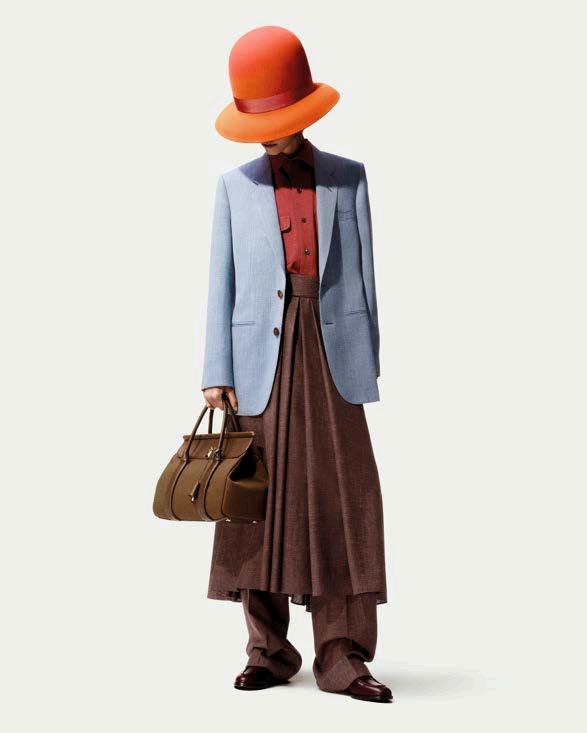
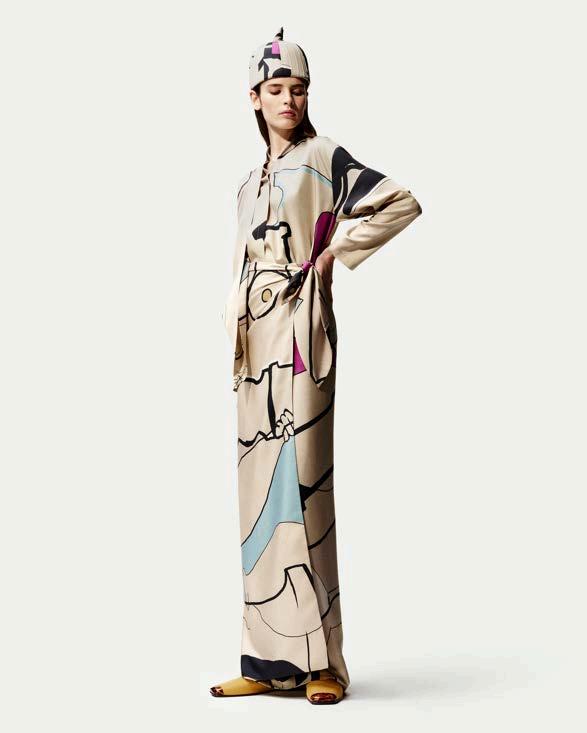
Headpieces and handbags were recurring highlights. Appearing in entirely fresh shapes, both for the brand and in fashion, bowler hats came in colossal proportions and fitted knit caps recalled a mariner minus the bill. A key look of the maison’s choice featured a tangerine hat so large it added what appeared to be a full foot of height before descending playfully into the look beneath.
Aredundershirttuckedneatlyintoa kilt-trouserhybridandtoppedwitha sky-blue blazer was anchored by woodsy brown and a polished dress shoe. The loom bag, a returning favourite from last season, was craftedinsoftnubuckfortherefined polish befitting a British estate. Meanwhile, occasional stripes, the Lotus bag, and the Gioia shopper with its nautical straps, were alluringly beach-ready. A personal favourite among the accessories was abrownalpacabagcharmthatswung daintily from a tote bag and offered an endearing ode to Swiss design. Wrappedwithwoolandleathertrims and plated with gold pieces, the whimsical purse ornament attached conveniently to shoulder straps and confirmed that even the smallest detailswerethoughtfullyconsidered.
Let’s be honest: when imagining a beachdayinBarcelonaorfloatingoff theAmalfiCoast,fullcoverageisnot the first thing that comes to mind. Furthermore, a felt hat worn after February sounds like a heatstroke waiting to happen. But Loro Piana playsanimportantroleasoneofthe few brands willing to challenge our seasonaltunnelvision.
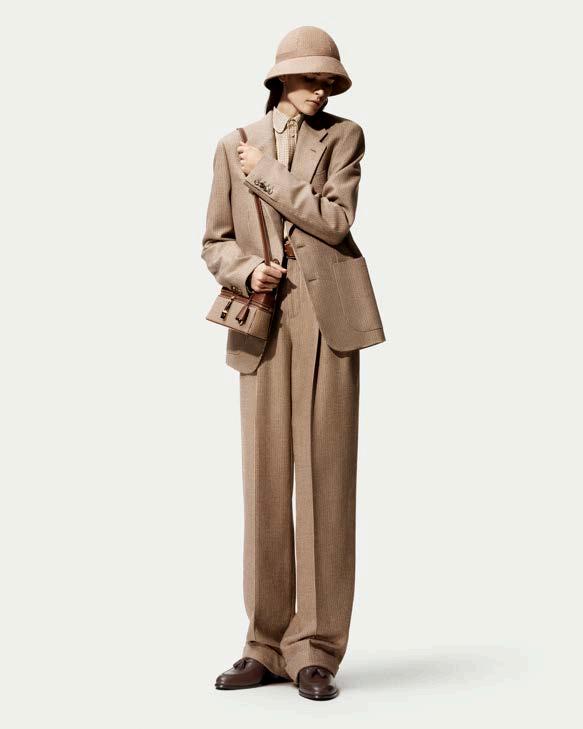
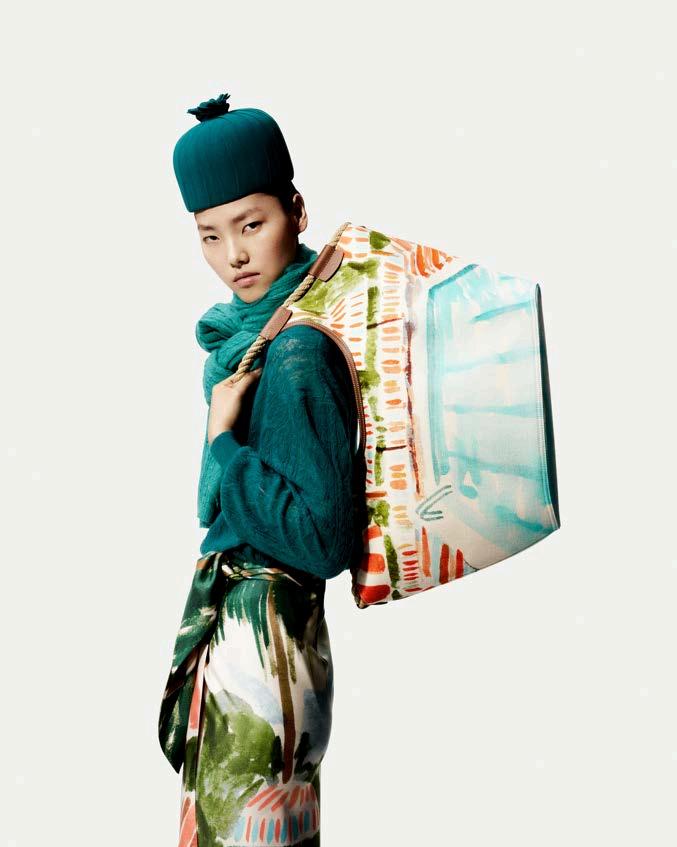
Theyremindusthatwhiletodayyou may be bikini-clad on the sand, your algorithm is already preparing to tell youwhatthe“coolgirls”ofParisare wearingthisfall…andthere’snothing worse than the clock rolling back while your wardrobe lags behind. Decades of tradition meet the nuancesofeverydaylifetoallowthe collection to find its context. Changing seasons, shifting wardrobes,andasocietalyearningfor autumn are all quiet contributors to the need for versatility that Piana provides.
Since their Spring/Summer 2026 launch, the brand hasn’t slowed down. Instead, they’ve continued their meteoric yet targeted growth with the release of an exclusive ski line and opening of a flagship at Bergdorf Goodman in New York. Exclusivity has always shaped the luxury experience, even if just the illusion of it, but the narratives we believe about value are starting to change. We collectively have begun todetesttheideaofpayingforrarity withoutresponsibilityandareseeking intention more than illusion. Though dauntingforsome,thisisashiftLoro Piana has proudly embraced. Exploring more than just seasons in their finality, but the transitional stages that got us there, Loro Piana answered the question we all ask whenweather,orlife,startstowaver: “What do we wear when Mother Naturecan’tmakeuphermind?”
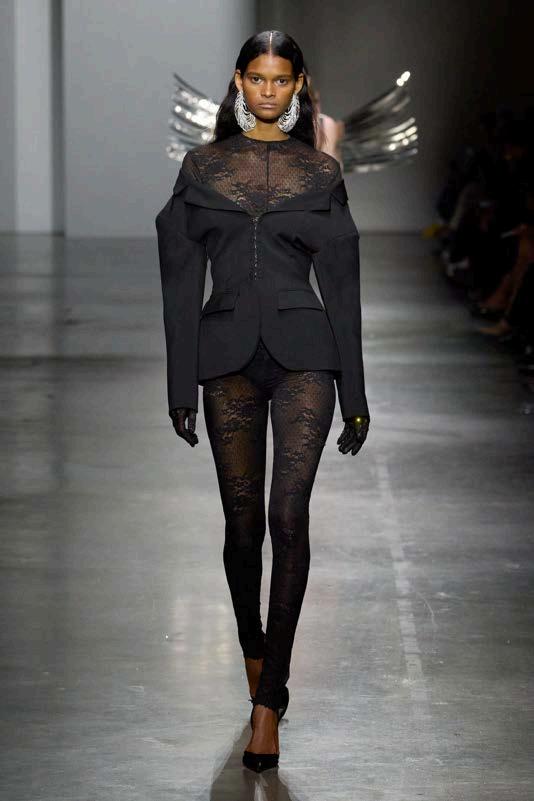
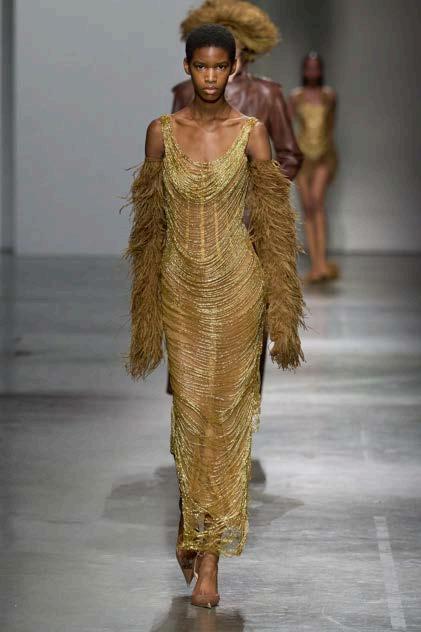
Milan Fashion Week Spring/Summer 2026 saw the highly anticipated second episode of Giuseppe Di Morabito’s ongoing opus, and the show,evenamidstacalendarpacked with traditional luxury houses and trendy avant-garde names, stole the spotlight. In an early interview, Morabito offered a glimpse into his ethos and his refusal to conform to fashion’scontemporarycraze.“Ithink many young brands strive to be modern at all costs,” he explained, “creating garments that are difficult to wear or too minimalist.” One of the few modern maximalists, Morabito draws inspiration from his birthplaceinCalabria,SouthernItaly, and by the artisans among whom he wasraised.
While his February show featured humanoid robots for an ultrafuturisticdebut,Spring/Summer2026 saw him glance back, transforming reflective nuance into a refreshing look forward. Though the opening and closing shows dominated the week’s news (to be expected given Gucci’s creative director shuffle and Giorgio Armani’s recent death), I offermyregardstothosewhomissed Morabito,whichwasashamenotto witness and a misstep not to cover. Pulling from one of Greek mythology’smostinfamoustragedies, theFallofIcarusironicallyconfirmed Morabito’s ascension as a gripping newvoiceinready-to-wear.
Afteraseven-monthintermission,an ominous voice signaled the spectacle’s beginning by narrating Icarus’taleasalonefigurestumbled toward centre stage. Fluorescent beams pulsed in recurring flashes aroundadescendingcircularringthat touched down just briefly before risingagain,thistimewiththefigure suspended inside. Performing methodical acrobatics mid-air, the man, held by what appeared to be a concerningly small number of safety wires, became a living spectacle figuratively reminiscent of Michelangelo’sSistineChapelmurals or the work of Bernardino Luini in Milan’s San Maurizio al Monastero Maggiore. Following this performance, the model returned to solidgroundandallowedthefocusof thegueststoshifttotheclothes.
The first look was an oversized coffee-brownblazerandataupemaxi skirt whose ostrich feathers created animmediatelyeye-catchingcontrast oftexture.Thesecondlookwaspure gold, literally. Delicate chains swooped down the model’s frame, becoming liquid gold to accommodate her every move, while accentuating sleeves erupted in plumes of ostrich feathers to begin ourjourneythroughMorabito’smind andIcarus’misfortune.
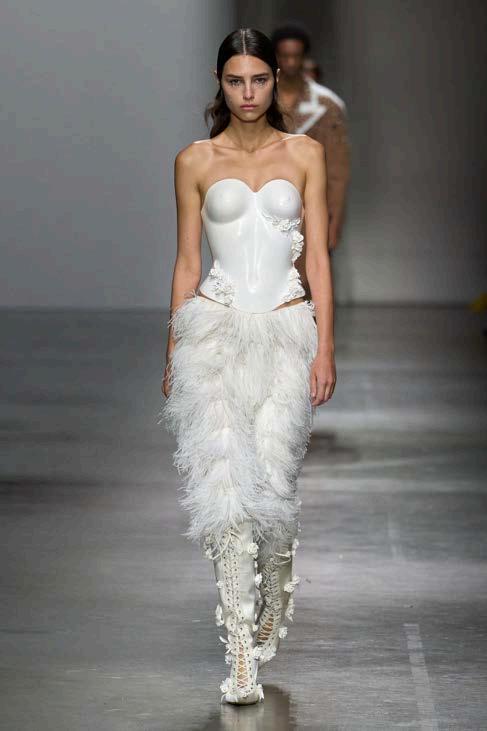
Looks continued to emerge in crescendos that came like waves, unfolding an epic tale through sartorial theatrics in place of spoken words.ByLook7,eggshellwhiteand flesh pink had replaced gold and brown,broad-shoulderedblazersgave way to statuesque busts molded as secondtorsos.
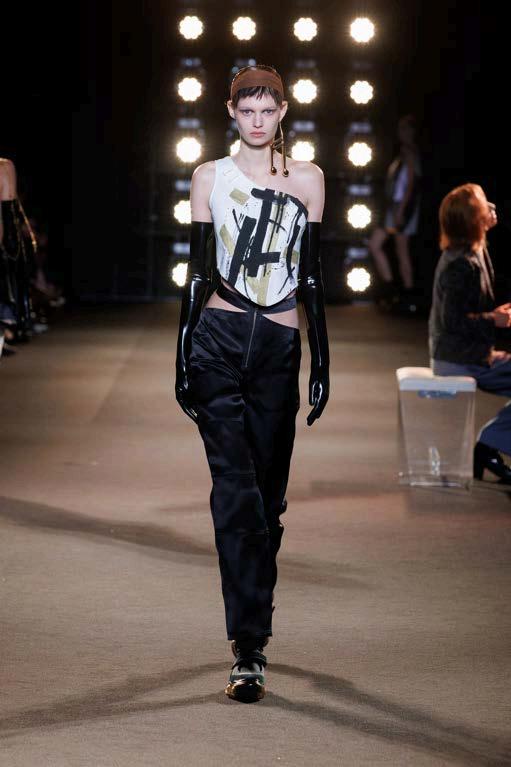
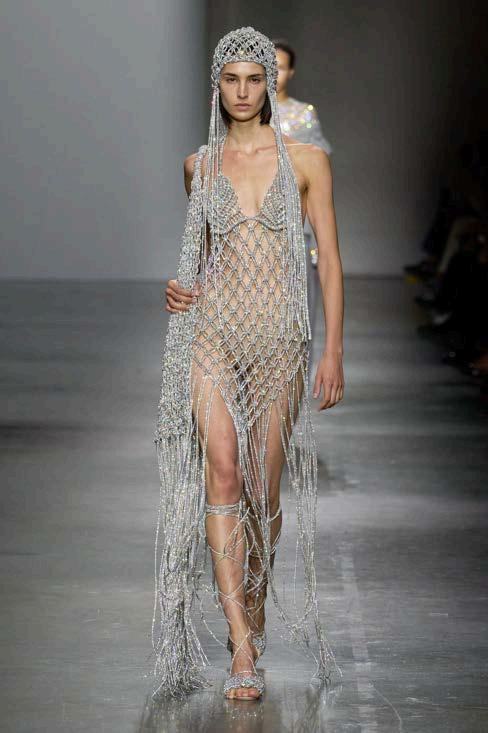
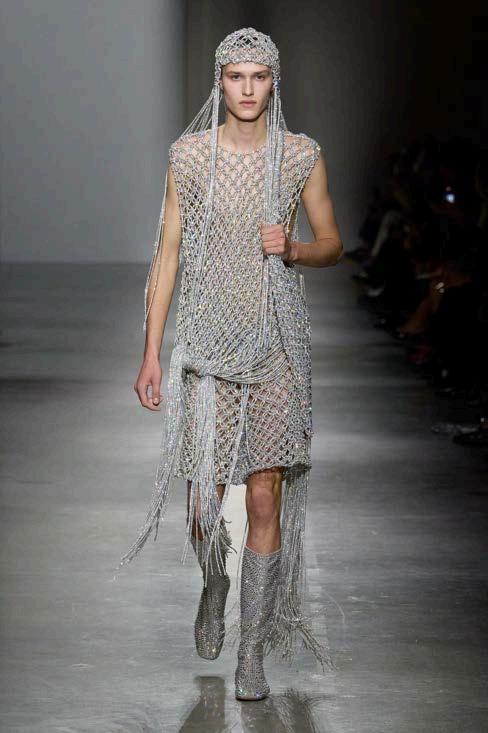
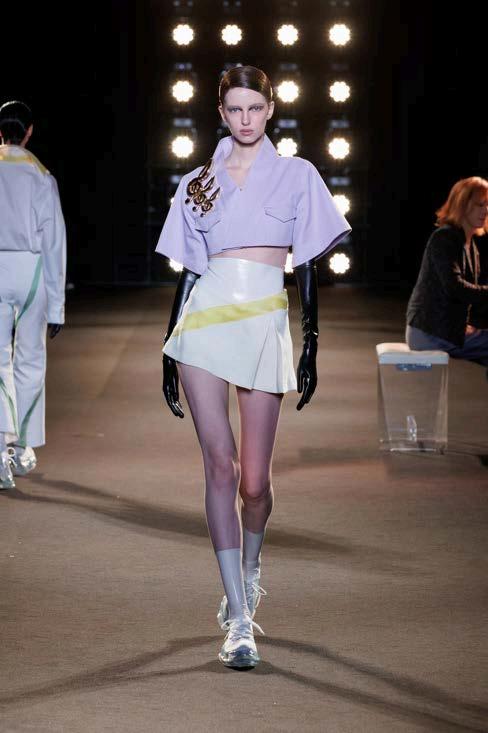
There were also tattered frocks featuring a gossamer texture only achievable through a 72-hour saline soak. Yet, despite this painstaking process, Morabito’s most striking workappearedinthe10-lookspread that followed (Looks 17–27). Equal parts Princess Leia fantasy and roaring ’20s flapper, the designs challengedeventhemostestablished couture houses. Look 25 alone could play as the one-man band of Morabito'svision,asiridescentjewels were chain-linked to form a mini dress frame before unraveling into long fringe that responded in excess to every step. A dazzling headdress cascaded past the bust, its jewelfrosted tassels reflecting beams of lightinalldirectionsandmakingthis lookimpossibletoforget.
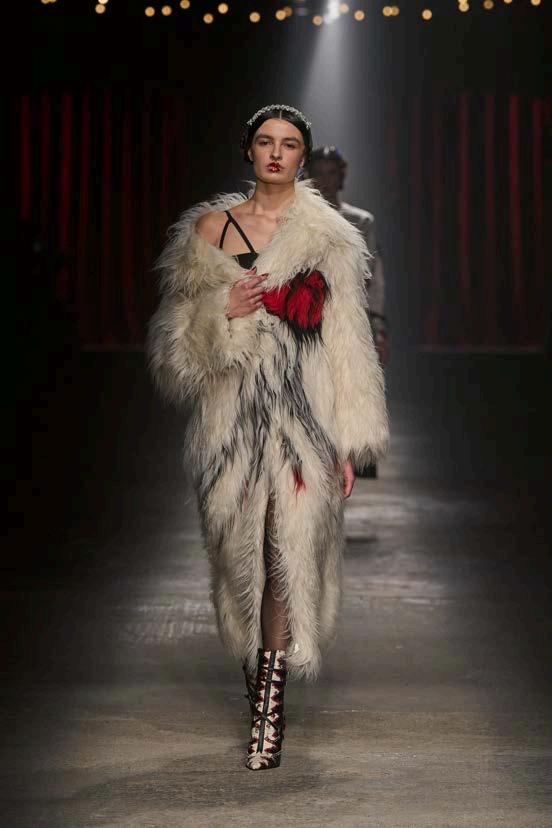
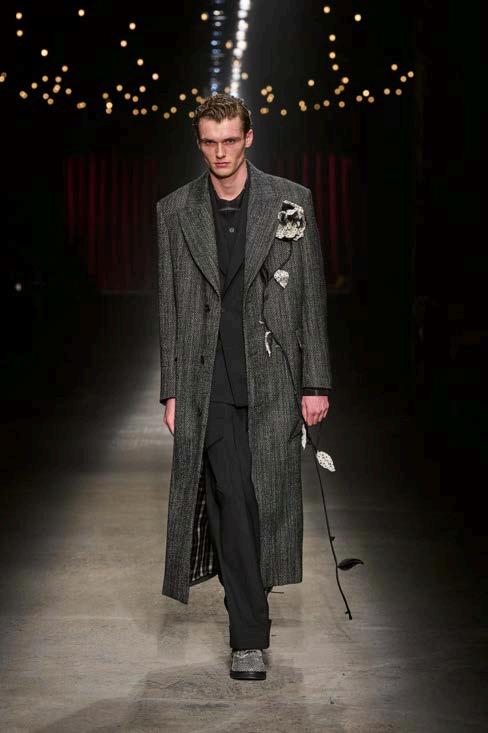
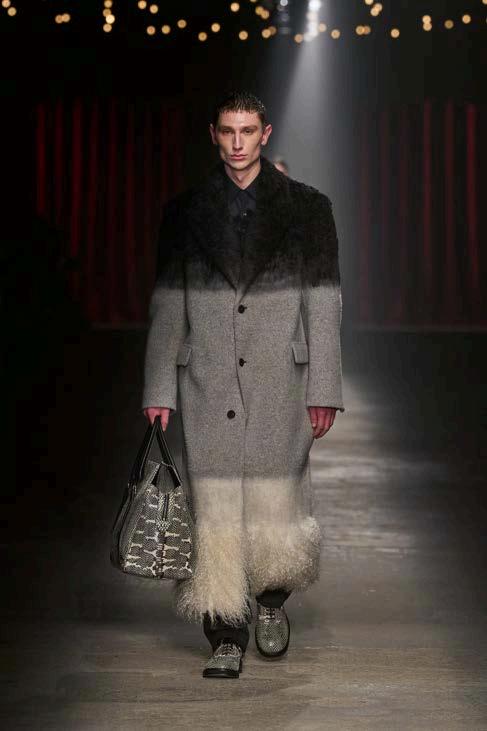
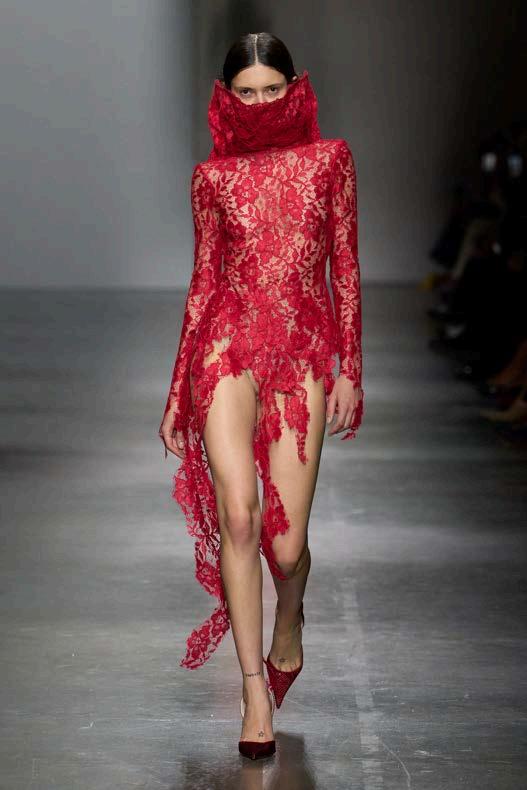
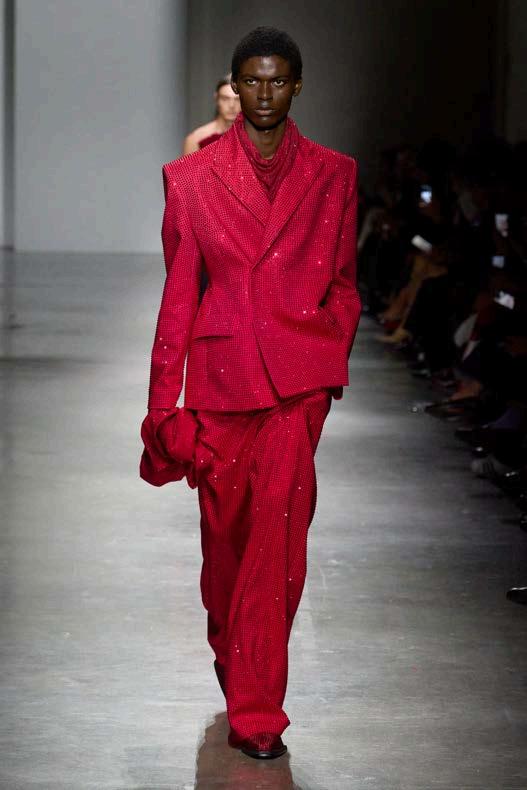
Look 32 foreshadowed the next scene as a model wearing only a fitted white bustier stuffed with seven scarlet roses soft-launched the seaofredthatwouldfollow.Audible gasps implied approval from the crowd as gravitas gave way to grandeur with a vampire-esque balaclavathatconcealedmoreofthe model’sfacethanitdidhermodesty and a scintillating men’s “Thriller suit.” Despite sheer wow-factor and Look 33’s eagerness to dress one of Giuseppe’s famed red carpet clients, tragedylingeredbeneaththecrimson spill as remaining looks transitioned toallblackforthefinale.Asignalof mourning: perhaps for Icarus, or perhaps for the final glimpse of Giuseppe’s work before 2026. The ending (Looks 47–51) saw frayed laces and feathered accents reemerge. Though traditional in grieving colour, their ostentatious design suggested a final bow driven bypureaestheticpleasure.
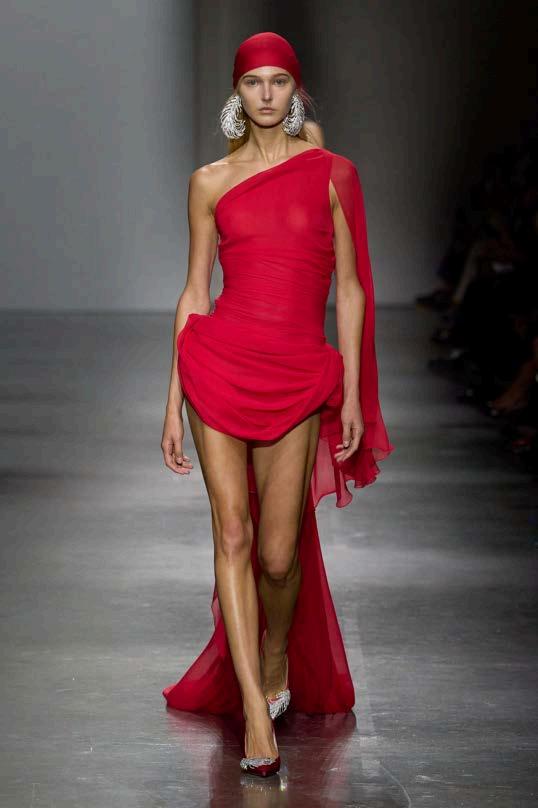
Theclosingtwolookssawthemodels adorned in metal wings as Icarus’ metaphor was made literal. The penultimate look showcased wings that appeared outstretched midflight, while the final look featured them cross-body, implying freefall shortly after. Equal parts demi-god, siren,andspectacle,Giuseppe’sshow deliveredanexperiencethatleftyou believing mythical beings might actuallyexist.
Whetherit’stheRomeo&Julietthat everyonehadtoreadingradeschool or the meandering Meditations of Marcus Aurelius you explored when you made philosophy your personality, literature has long stood asoneofart’srawestinspirationsbut aresourcethattoofewdesignersturn to. Is it the weight of narrative that intimidates, or simple disinterest in seekinginspirationforthenewinthe old?Whateverthereasons,theyhave notdeterredMorabito.
This show, laced with couture and compelling storytelling, was a masterclass in dressing the next mythologicallythemedMetGalaand a reason for skeptics of ancient inspiration to reconsider. As we already wait for next year’s sequel, one can only hope that Icarus’ warning remains a stirring muse rather than a self-fulfilling prophecy andthatMorabitocontinuestobuild onhisenigmaticvision.
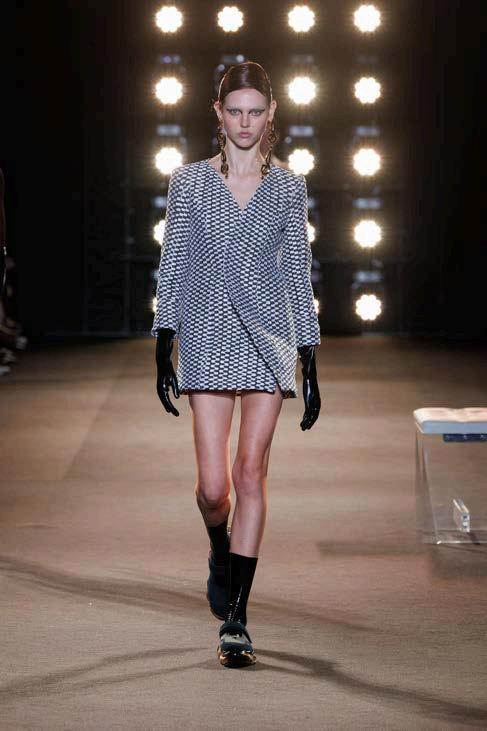
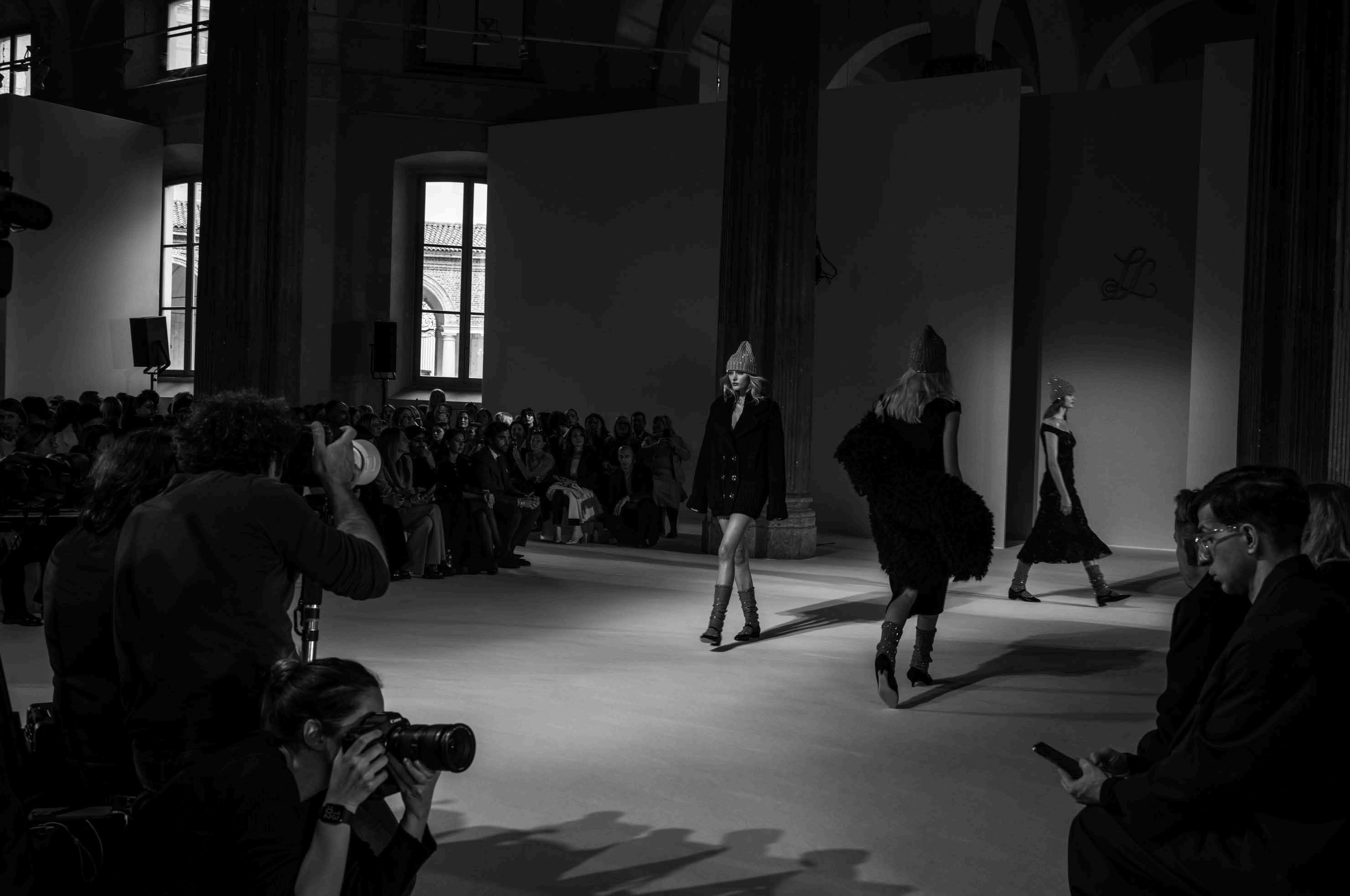
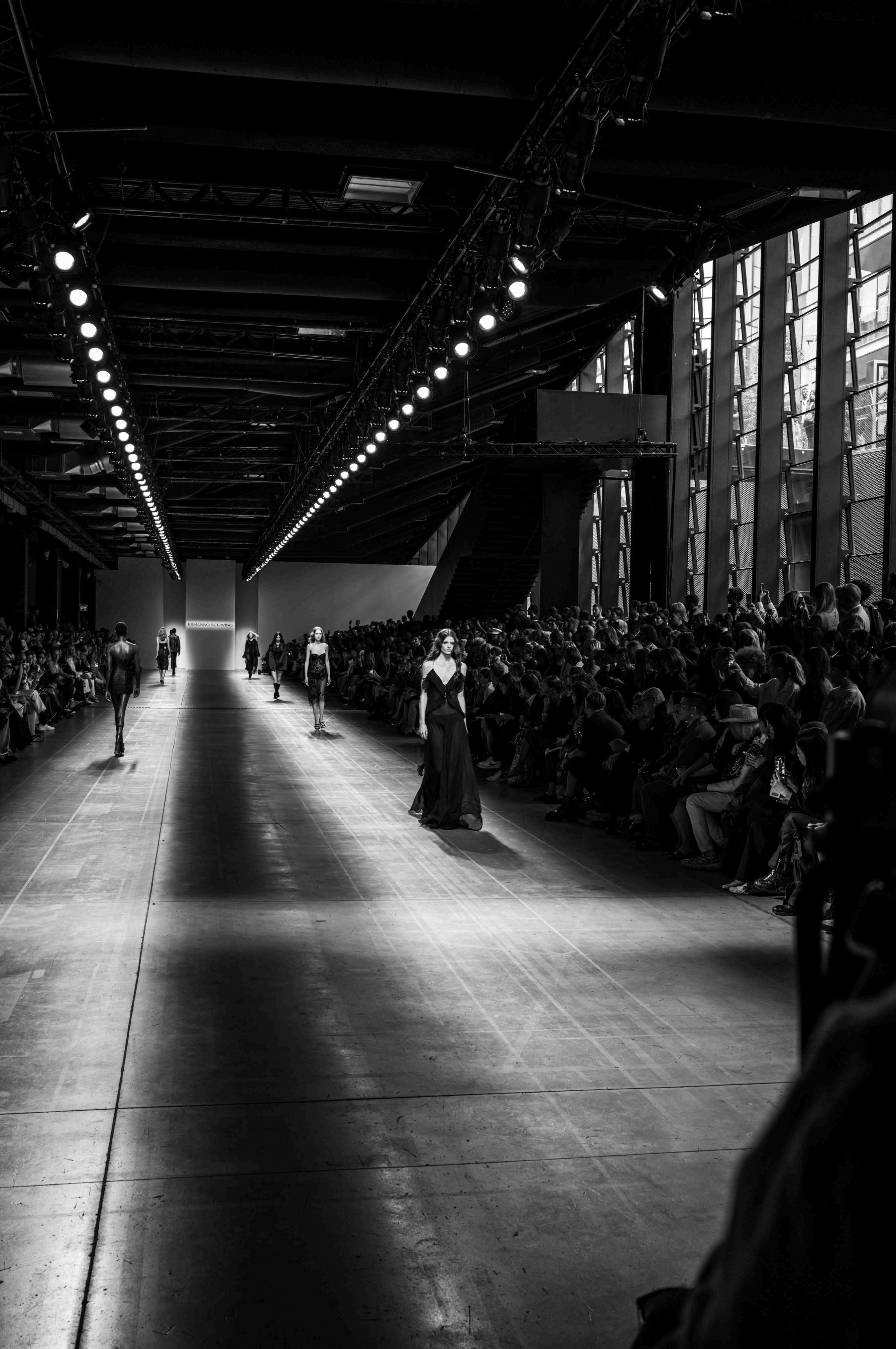
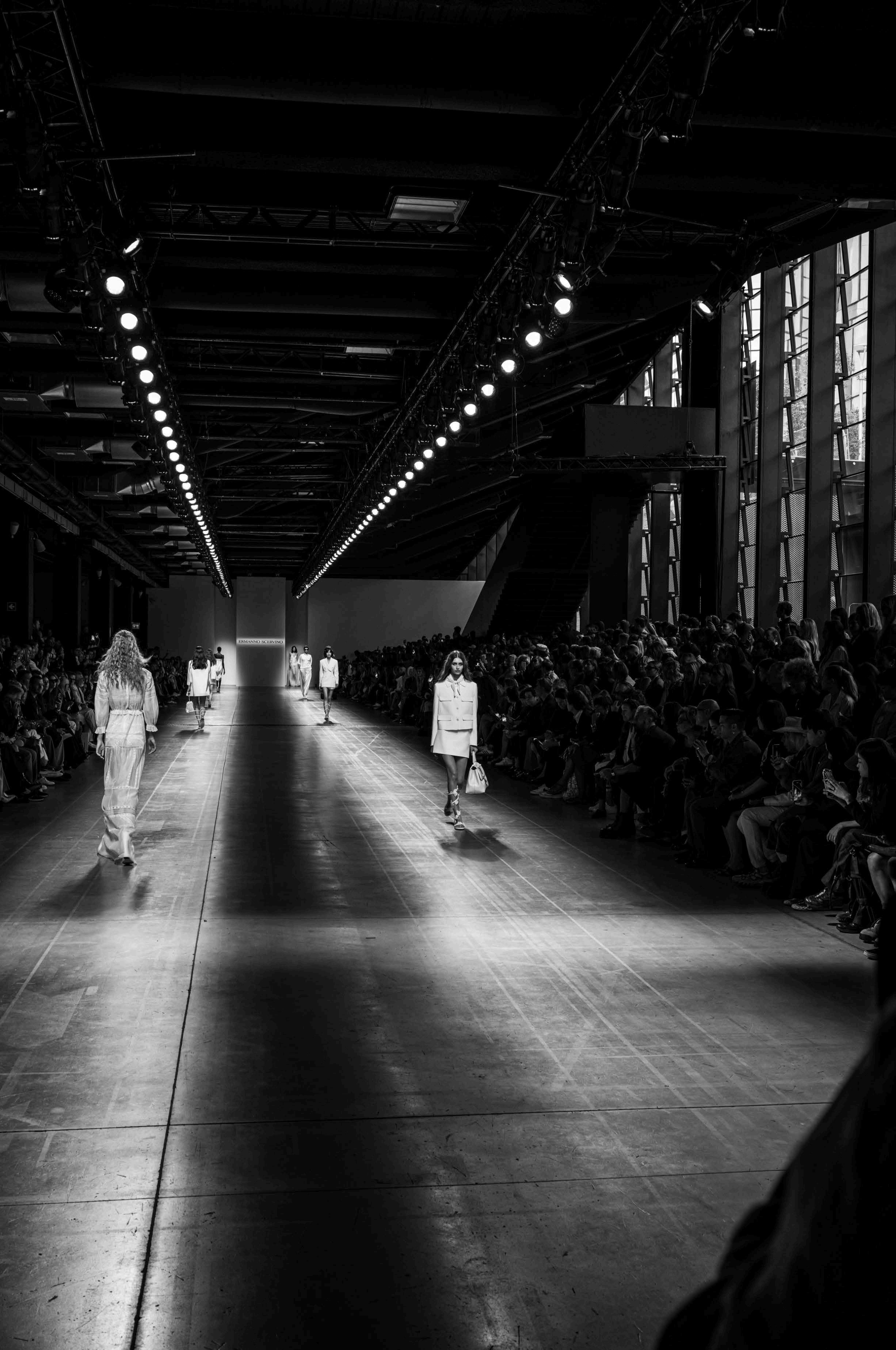
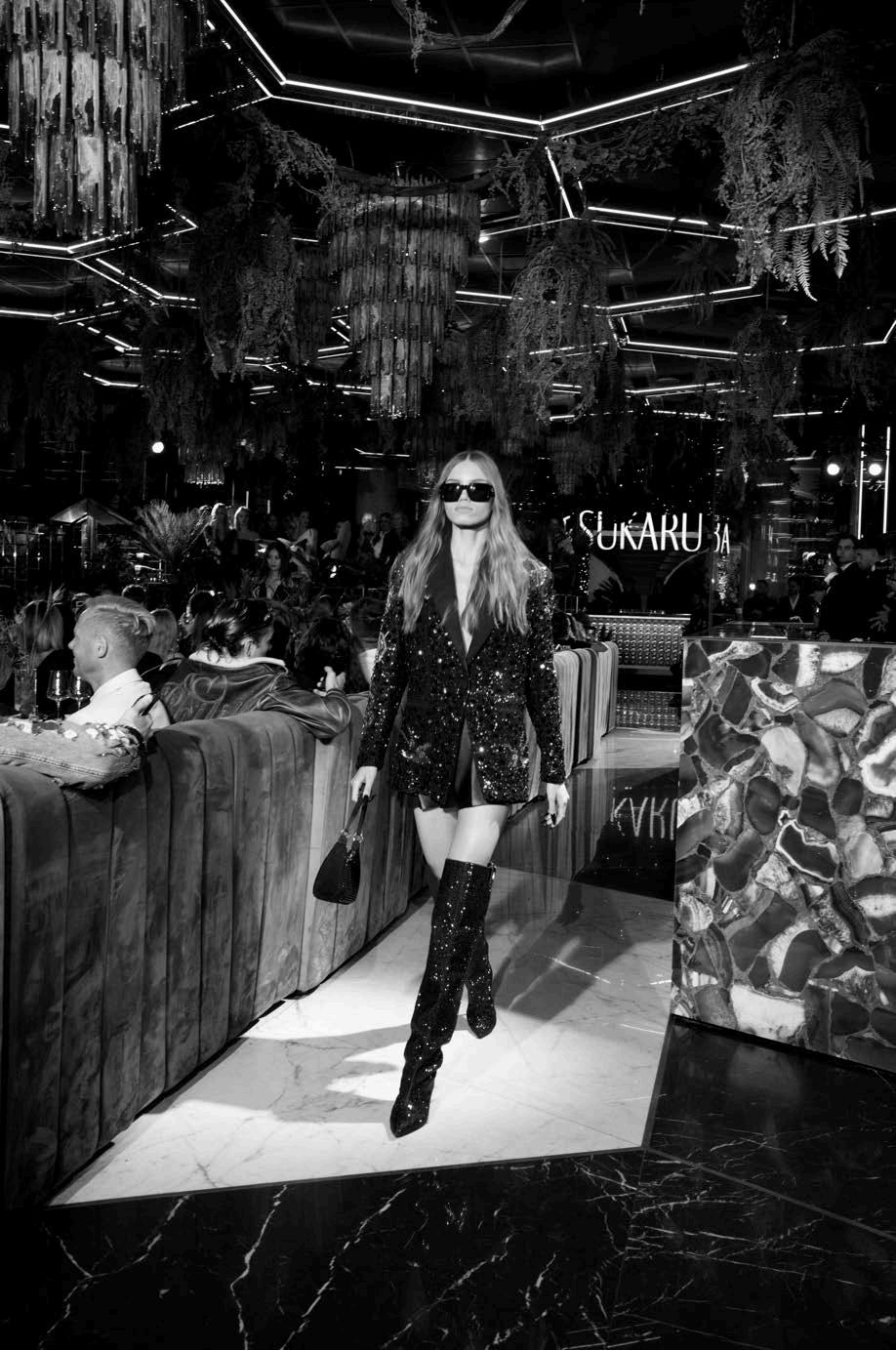
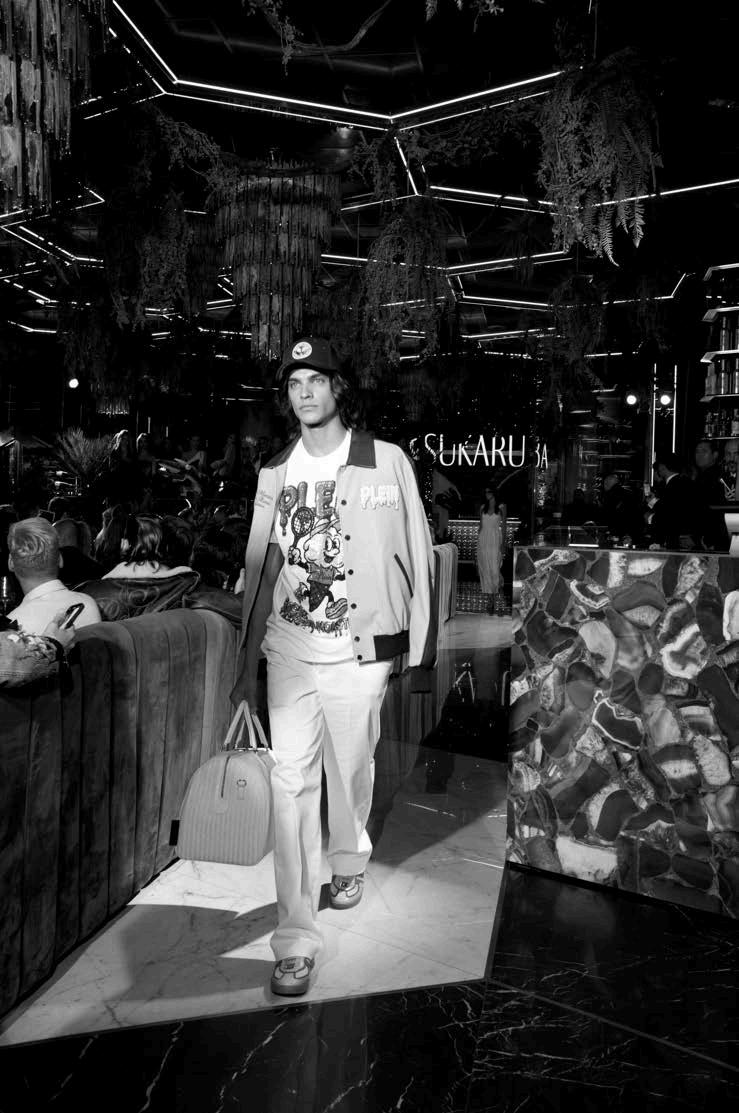
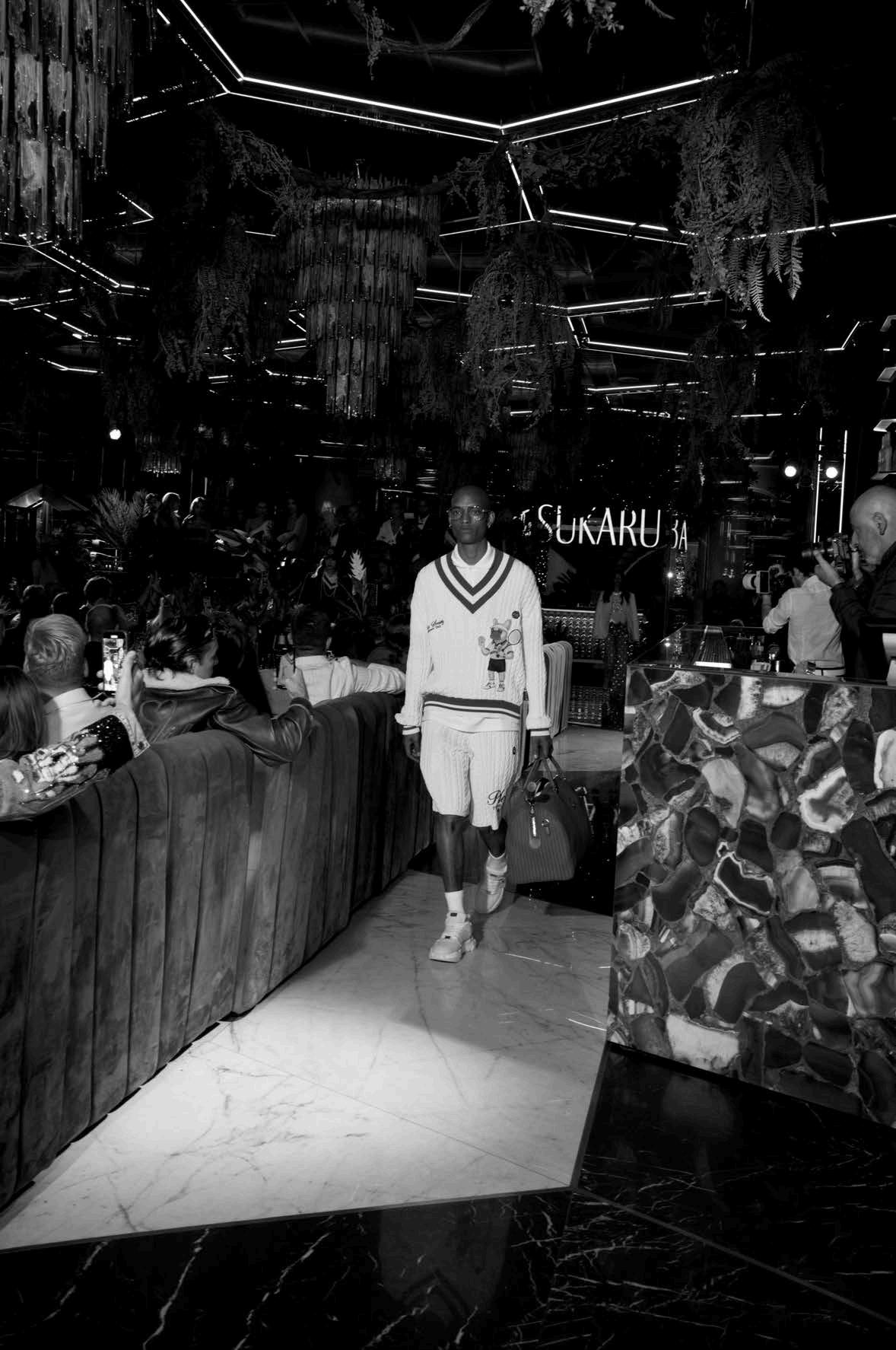
On a warm September evening in Milan, the doors of The Plein Hotel opened onto a shocking scene. Light, airy, and charged with the energy of sport and effortless glamour, Spring/Summer 2026 was everything we have learned NOT to expect from Plein. And by creating the “Plein TennisClub,”inwhichheimaginedthe social rituals of summer through a distinctlypolished,sport-inflectedlens, he demonstrated a refreshing versatility and doubtless won new audiences in a market where ostentation has been eschewed for quietluxury.
Spring/Summer 2026 was a visual ode to the season of sunlight, shared moments, and the magnetic pull of outdoorlife.Tennisappearedlessasa sport and more as a cultural symbol: complete with the elegance of the court, the etiquette of the clubhouse, and a summer lifestyle built around matches, mingling, and immaculate dress codes. The Hamptons, Wimbledon, the courts of the Côte d’Azur: all these seemed to be on Plein’svisionboard.Largelygonewere the loud graphics and bedazzled skull motifs befitting Miami clubwear: instead serene neutrals, punctuated with soft hints of pastel lemon, soft pink, and sky blue, recalled sunlit courts and warm sand. Prints, when present, leaned into this aesthetic: for example, strawberries, lemons, a new preppy logo, and, of course, tennis rackets. And while sparkle of course anchored the evening collection, it often came in the form of pale lilacs, blush pinks, and fresh mints shimmering like champagne under candlelight.
Weightless materials dominated, with sports references and refined prep defininganewfluidcasualchic.
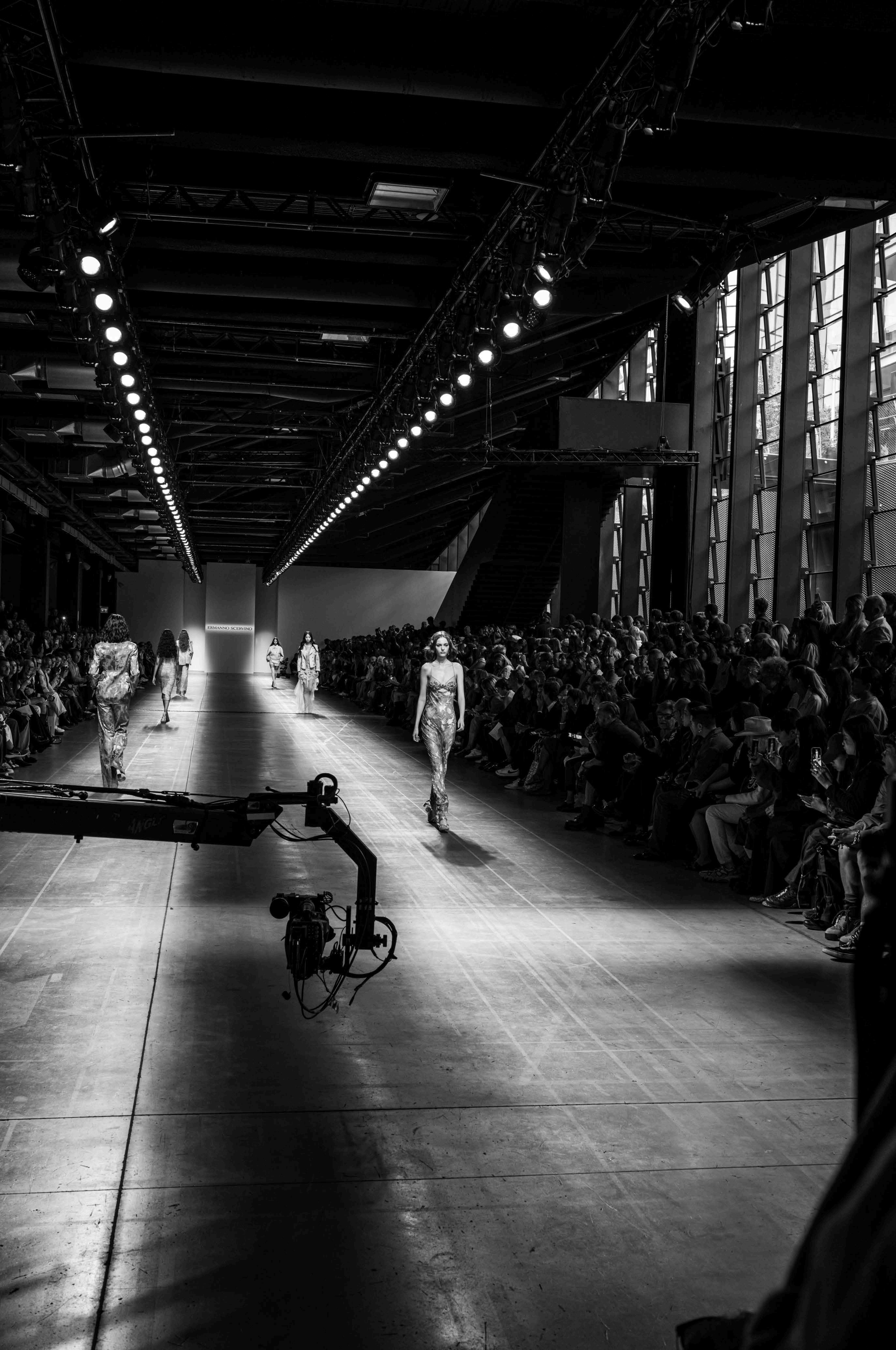
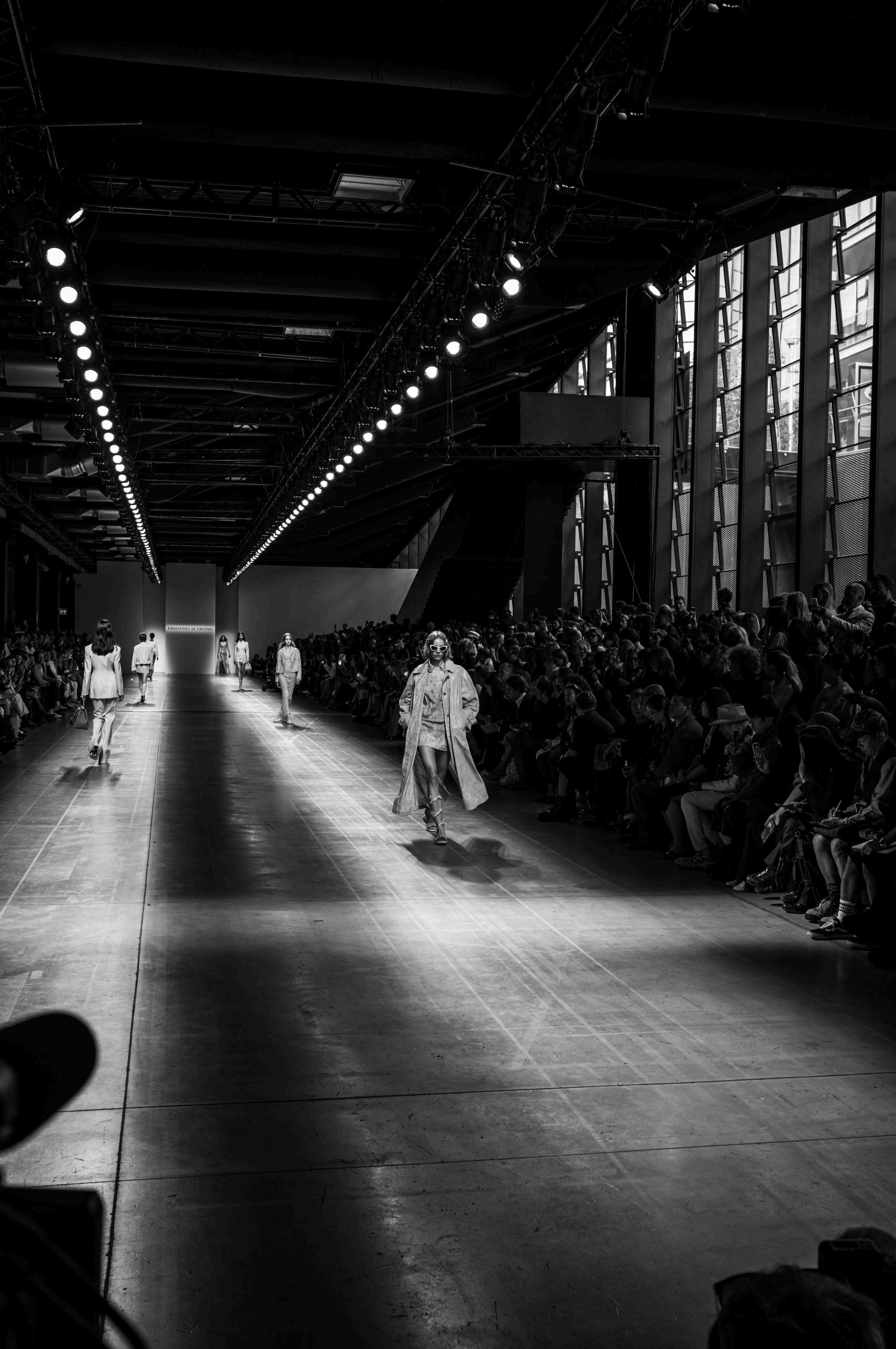
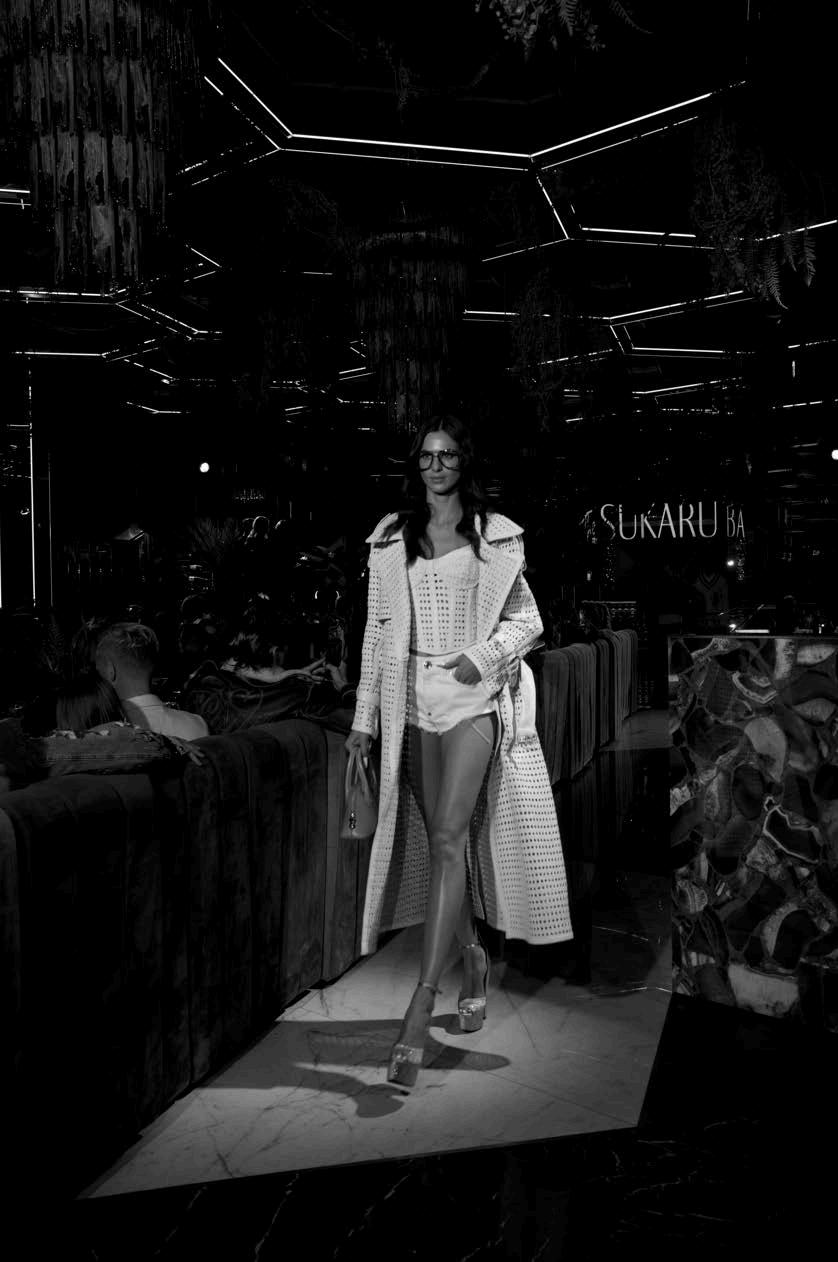
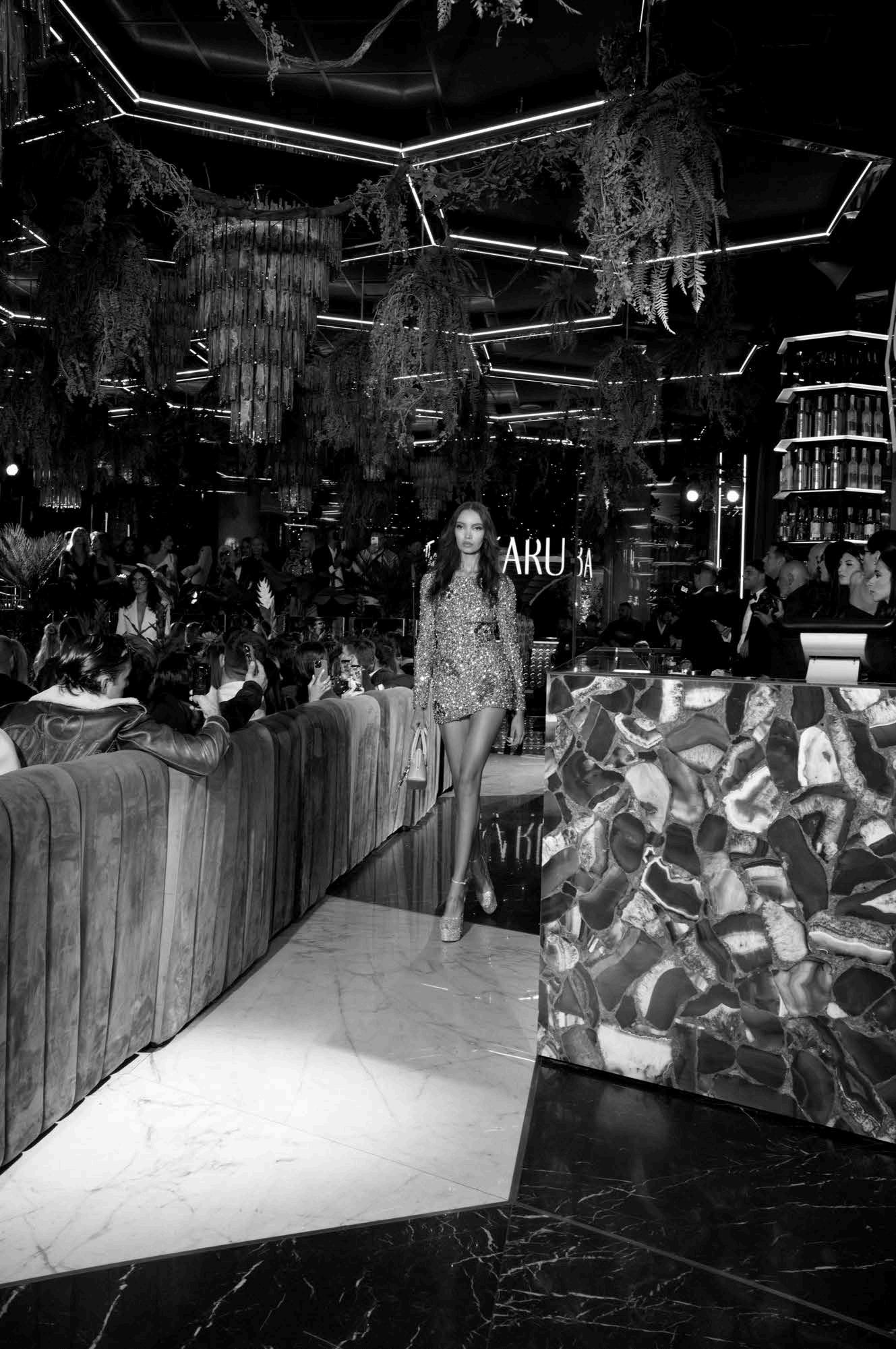
Plein embraced the next generation’s nostalgic yearning through crisp knits reminiscent of retro warm-ups. Meanwhile, his men’s tailoring was light, supple and intentionally airy, designed for someone who shifts effortlessly between a high-rise New York office and a Hamptons estate. While suits maintained a clean, classic architecture, they also felt refreshed: think breathable fabrics, relaxed constructions, and silhouettes that sit naturally on the body. And the most impressive quality of the men’s collection was how Plein incorporated soft pastel accents that mirrored the womenswearpalettewithrestraintand contemporaryplayfulness.
Accessories completed the worldbuilding. Oversized totes resemble court bags refined for city life, structured heels echoed the ribbons and lacing seen on vintage sports shoes,andaracketwascarriedwitha casual, insouciant charm. As much about attitude as aesthetics, Plein S/S 26wasforthosewhoembracesummer notasaseasonbutasastateofbeing: sociable, active, radiant. And it was a breath of fresh air for those attending themuch-anticipatedshow.
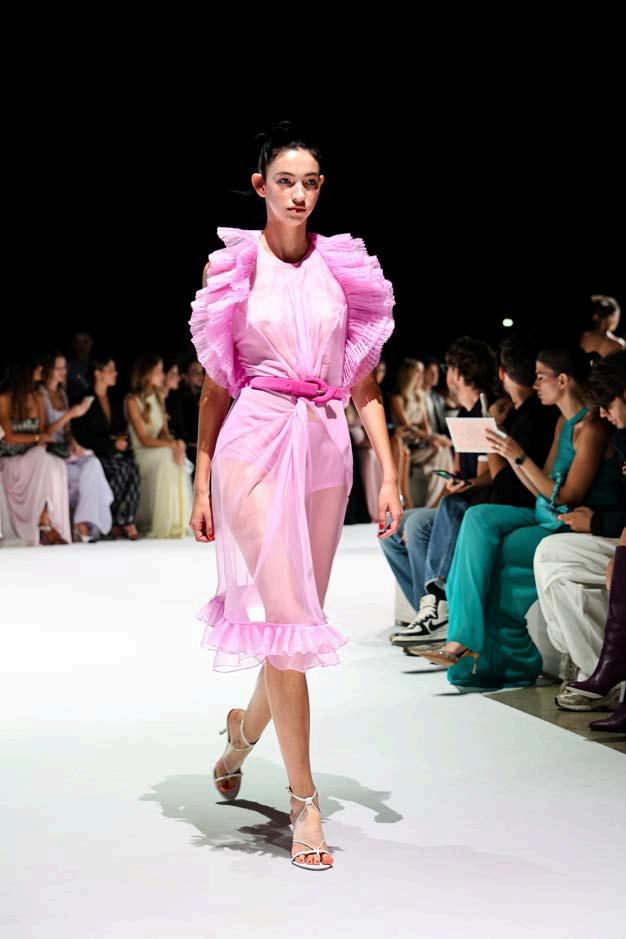
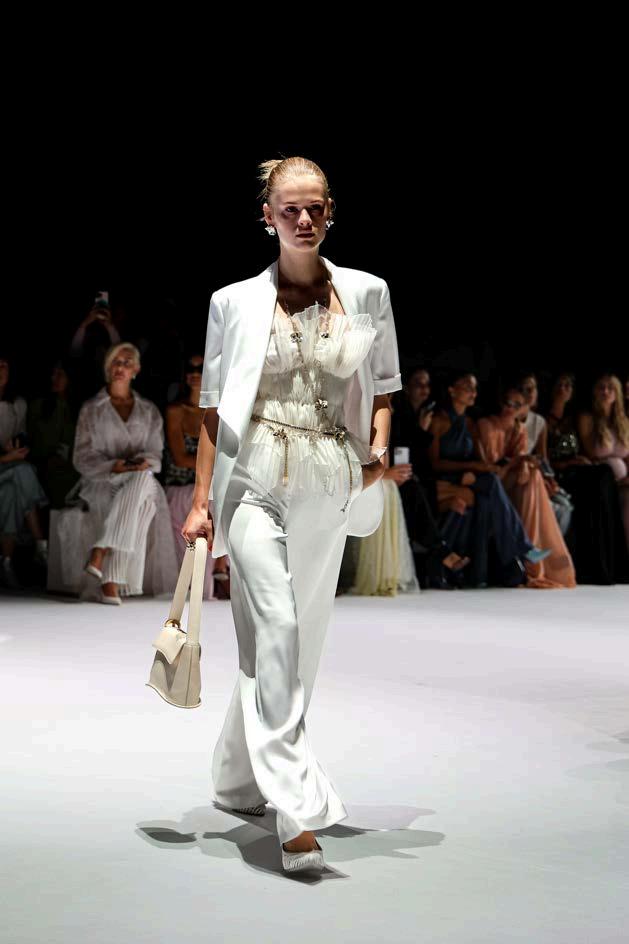
SarahCavazzaFacchini’svisionremains consistent for Spring/Summer 26; layered elegance, soft expression, and self-assured femininity defined the Gennywomanonceagainandluredus riveted down the rabbit hole into her metaphorical Wonderland. A dimly lit white runway featured a Marc Quinn original in the shape of a black orchid toprovideacontemporarycenterpiece for the show. Typically when we imagine art that is particularly bold, definitive, or powerful, it is the abstract,unsettlingportraitsofPicasso, simplistic surrealism of Joan Miro, or raw force of Yves Klein’s inkblot depictionsthatcometomind Realism, intheconceptualsense,oftenseemsto be portrayed by harsh lines and grotesquely distorted silhouettes, but in Quinn’s creative universe, these serve only as its antithesis. Instead, fluidity represents what is most real, andasymmetryisatoolfordimension ratherthandistraction.
The artist, known for his organic depictions of the human body (even once using his own blood for his sculpture, titled Self, in the early 1990’s) took to the show notes to elaborate on his creation: “The curves ofanorchidarelikeadrawinginspace: they have an elegance and simplicity thatarerarelyfoundinart.”Depicting deformity as simplistic, his work becomes a space to digest emotion instead of provoking it, a space Facchiniinhabitssartorially.
Beginningasahumbleboutiquelineof handcrafted skirts and blouses in the early 60s, and with a short stint of success under the renowned Gianni Versace, the Genny name is no stranger to precision or the femmephysique.
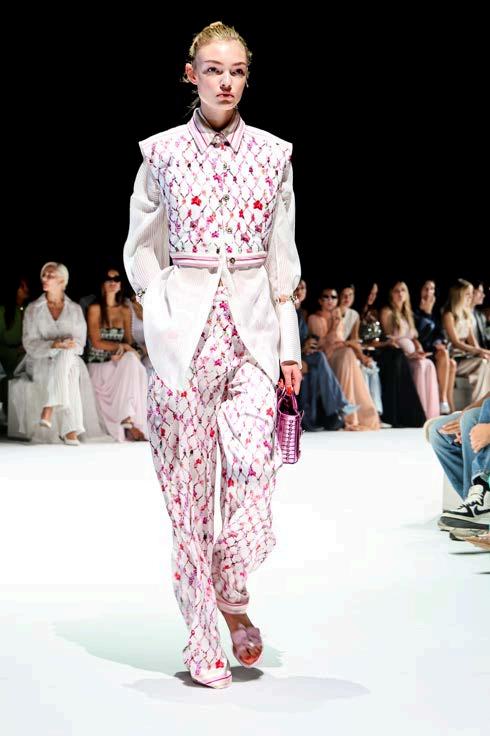
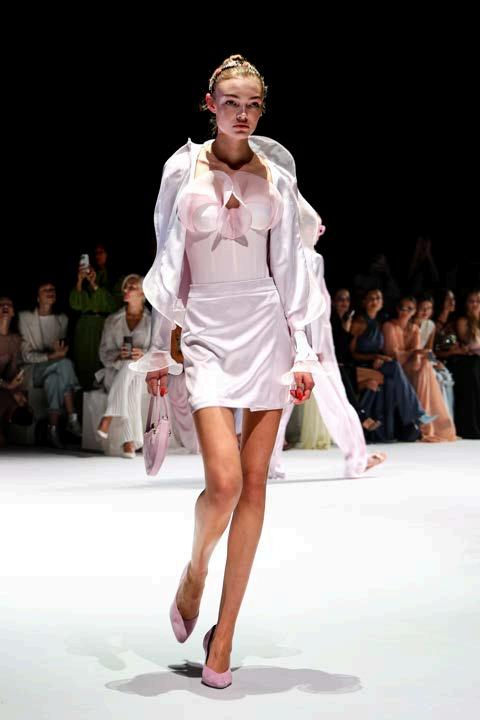
Throughher12-yeartenurerevitalizing thebrand,SaraFacchinihasharnessed the name not just as a creative playground but a sanctuary for what inspires her most. She has woven a ripening narrative entirely her own, crafted for a women’s woman. This season she gave us a collection recalling the Mother Goddess, with silhouettes gracefully following a woman’ curves from her shoulders to thehollowbetweenherbreastslikethe petalsofanorchid.
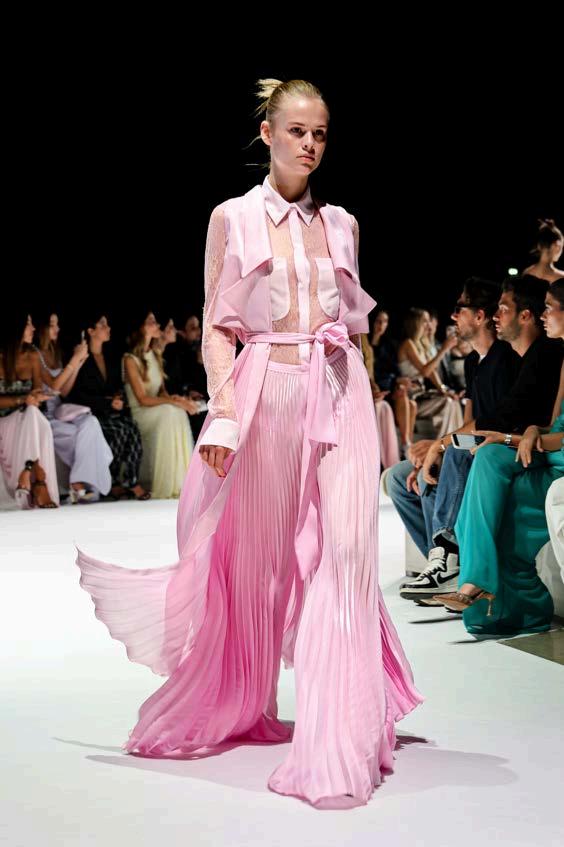
Opening ensembles shimmered in pastel greens and blush pinks, as if designed for an emerald-green witch andherfairy-pinkcounterpart.Look4 emergeddirectlyoutofOzasaheadto-toe satin ensemble with chartreuse glassesgavea70sglint,whileitsthreedimensional flower embellishments rendered the show’s earthy inspiration whimsically literal. Look 7 showcased an organza bustier whose petals accentuated the model’s décolleté yet remained modest and a fluttering ballerina skirt that seemed to bat her eyes and toss-toss her hair at the audience. Finishing the look was a micropurseandsoftsuedepumpsthat, ifyoudidn’talreadyassume,grounded theprincessstrictlyindoors.
Finally, fantastical worlds were sent into disarray as Look 30’s carmine red dress sent us freefalling down Facchini’s rabbit hole and landing table-side to an eclectically clad character serving copious amounts of tea and celebrating half birthdays. Disrupting a collection formerly ruled by pastels, the ruched piece with its tulip-caught-on-fire silhouette was O'Keeffe'sworkmadewearable.
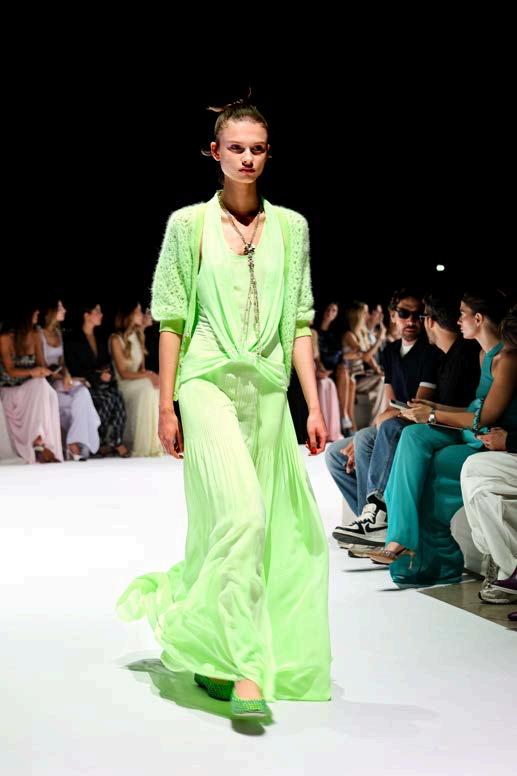
Updos claimed the hairstyle code, with a single floraloverlayatopGenny’siconicblock-chainmotif beingtheonlyprinttomakeanappearance.Bags remainedreliantonfunfloralembroideries,butthe designer’s tote of choice was a semi-circular crossbody with soft corners and a leather tassel. Statement jewelry pieces included cascading gold necklacesthatoccasionallydoubledasbodychains and tassel earrings that swung in tandem. Hair combs even appeared in a tribute to womanhood As for shoes, Spring/Summer ‘26 highlighted strappystaples.Rangingfromdazzlingmicro-pave high-heel thongs to florally adorned mules and reimagined pumps the shoes danced between everydaywearandelevatedoccasions,remaininga strong suit for the season. After all, what says girlhoodlikeagoodpairofshoes…or50?
This season in Milan was notably diverse in terms ofhow“beingawoman”wasinterpreted.Whether fully concealed or stripped bare, ready-to-wear walks a narrow line between accentuating womanhood and using it as a prop. Dozens of womenswearshowscomeandgoeachseason,and yet, they remain primarily produced by men. Plaid maxi skirts and reimagined kitchen aprons subtly reinforce the image of women as society’s caretakersandfeedintoanemerging“romanticized moderntrad-wife”trend,whiletheextremelythin wearing sample-size bodies (the standard runway size0)signalsaresurgenceof’90sbeautystandards that are quickly overpowering acceptance. This is why Sara Facchini, and her ideal Genny woman, havefeltlikeabreathoffreshair.
It’s a rare sensation for most women to feel understood without being idealized or outperformed. The bottom line is that most of us aren’t traveling to Positano every summer or joggingtheUpperEastSideinseriouslyimpractical kitten heels, even if our pinterest boards say otherwise. Genny isn’t just designing for the trending woman, plastered on social media pages and idealized on vision boards, but for those who just want to look a little nicer at work or wear something fun for a close friend’s birthday party. Perhaps wearability is the newest indicator of a brandthatistrulyselfaware.
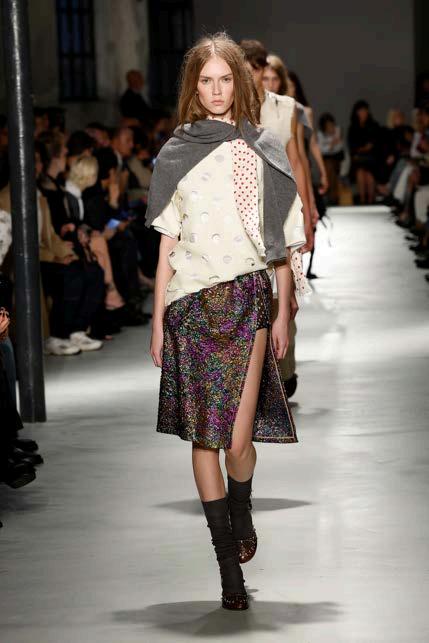
WORDS:FILZAMARRI
PHOTOSPROVIDEDBYHOUSE
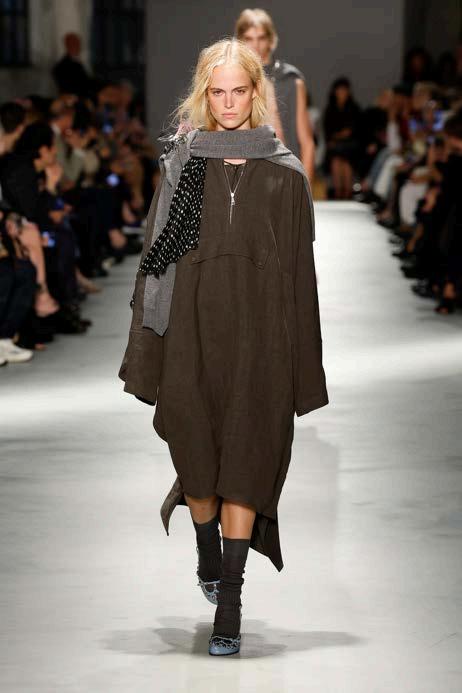
There’s always a certain cinematic hush aroundaNumeroVentunoshow;ablend of Coppola-esque romantic chaos and razor-sharp tailoring has become Alessandrodell’Acqua’snativelanguage. However, this season, the hush felt heavier - more intentional. This wasn’t justanotherchapter.
The inspiration of the collection circled around the idea of femme fragile vs. femme future: two women existing in the same body, pulling each other between softness and structure. The openingwasaslipdress,almostdraped, layered under a coat so sharply tailored it could have cut the spotlight in half. That tension carried through the entire show. Every piece seemed to ask the same question in a different way: What does strength look like when it is not trying to be loud? What does romance looklikewhenitrefusestobenaive?
Compared to previous seasons’ sugardipped palette and playful proportions, the past two seasons have marked a darker, richer evolution. Alessandro has been peeling back the brand’s identity, stripping it of prettiness for prettiness’s sake and replacing it with something moreprimal,moreadult.Pastcollections have relied on a sort of whimsical femininity, but now the whimsy has beenreplacedbyweight:theweightofa woman who knows exactly why she’s walkingintoaroom.
Silhouettes shifted into a more architectural mood. Shoulders grew broader, skirts collapsed into fluid spirals, and sleeves exaggerated into elongated pieces. Undone tailoring was a recurring theme, with jackets slashed open at the sides, seams intentionally offset, and hems asymmetrical as though caught midmovement. It felt like the designer wasgivingstructurethepermissionto breathe; to falter, to be human. And that is very much the Numero Ventuno ethos: imperfection as seduction.
Where could these pieces be worn?
Everywhere you wouldn’t expect them. The runway’s nocturnal sophistication made me imagine them on the shadowed edges of Paris, at a late-night café, an unexpected after-dinner encounter, or the cigarette break outside a gallery opening where everyone is pretendingnottostareateachother. Theseareclothesforthosewhowrite their own script: not red carpet polished and not influencer-curated but more suited for the kind of women photographed by mistake. Grainy,beautiful,real.
A standout moment came midway throughtheshowasasheer,smokecolored dress was layered over a corseted under-structure that looked almost fossilized. It was both hard and soft; ephemeral and anchored; a reminder that Numero Ventuno excels at turning contradiction into coherence. The brand has always flirted with transparency, but this time, transparency wasn’t akin to sensuality.
Accessories played an unusually assertiverolethisseason.
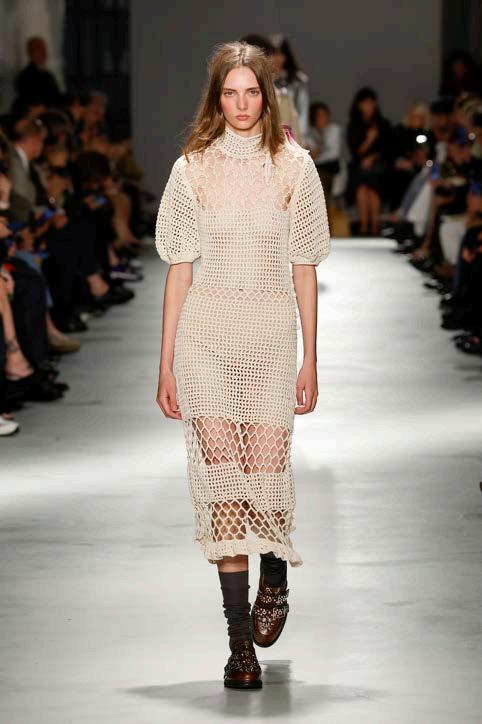
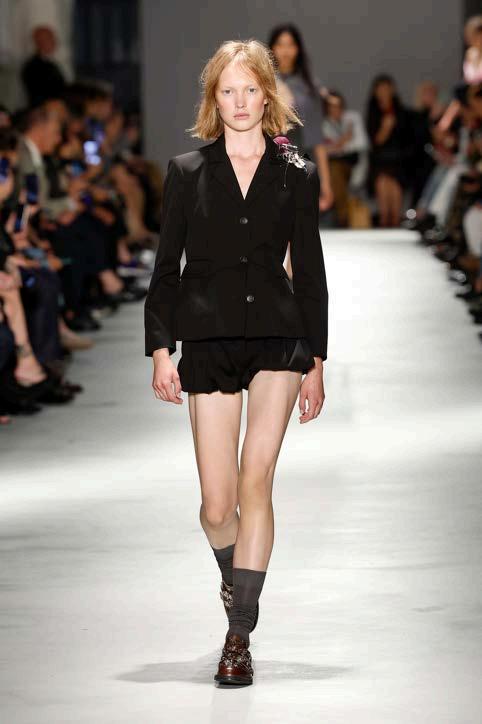
Heavy chain belts draped across delicate fabrics, micro-bags were worn almost like talismans, and the shoeswereahybridbetweenaMary Jane and a bondage-strap pump. These details hinted at a new direction: the designer is no longer dressingagirl,butthewomanthata girlgrewinto.Andshehasdemands.
Ifpreviousseasonswereaboutcharm, thisonewasaboutclarity.Therewas less decoration and more discipline… less sweetness and more story. The DNA remained, evidenced by the romantic tilt of the neckline, the sensual slouch of the skirts, and the general emotional depth of the collection. Nonetheless, it seemed edited through the lens of maturity. This suggests a promising trajectory towards sharper silhouettes, deeper narrative coherence, and an even stronger dialogue between fragility and force. I predict next season will push further into this sculptural sophistication, with a bolder explorationofwhatfemininitymeans outsideoftheclichésthatthefashion worldconstantlyrecycles.
For me, this was one of the brand’s most compelling seasons in years. Not every look was flawless, some layering moments felt heavy, and a fewdrapedpieceslosttheirimpactin motion. Nonetheless, the ambition was undeniable. And that’s what fashionneeds:collectionsthatdareto evolve rather than merely entertain. Collectionsthatspeak.
Numero Ventuno didn’t just present clothes. It presented a woman: complex,shifting,contradictory,real. Andtherunwayfeltlikeherinternal monologue.Ifthisiswherethebrand isheading,I’mfollowing.
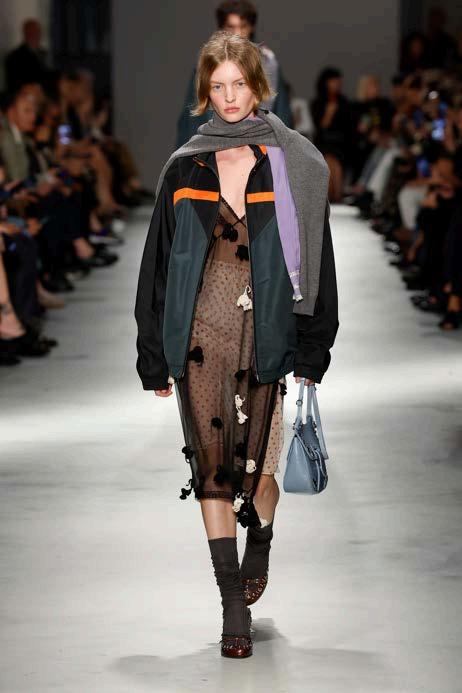
WORDS:DIANAHUK
PHOTOSPROVIDEDBYHOUSE
There are designers who make clothes, and there are designers who createworlds.
Pierre-Louis Mascia, the French illustrator turned textile poet, unquestionably belongs to the latter category.Sincelaunchinghislabelin 2007, Mascia has built an aesthetic universe defined by visual layering, collage-like compositions, and the instinctive ability to merge motifs that should not work together but still somehow do. His partnership with the Achille Pinto silk ateliers in Como, guardians of nearly a century ofprintingexpertise,hasallowedhim to translate illustration into textile withthefidelityofapainterworking oncanvas.
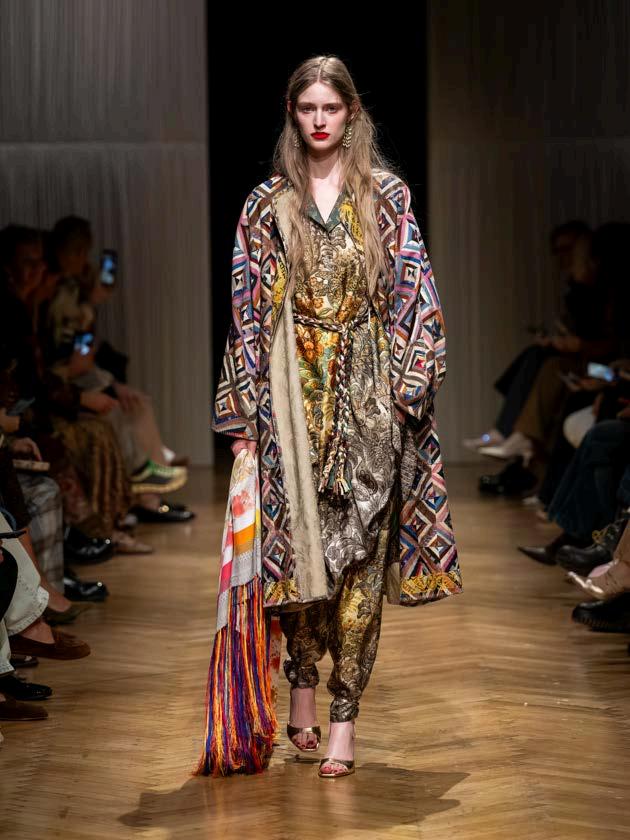
Whatbeganasacollectionofscarves hasquicklygrownintoafulllifestyle vision.Mascia’sprintsnowappearon ready-to-wear, accessories, outerwear, and home pieces, all carrying the same unmistakable signature: intricate imagery, vivid yet nuanced color palettes, and an emotional richness that feels more akin to fine art than traditional fashion. His work exists on the bordersbetweenFranceandItaly;art and craft; the familiar and the fantastical. And for Spring/Summer 2026, Mascia stepped into a new realm: one where fashion becomes theatreandgarmentsactasvesselsof memory.
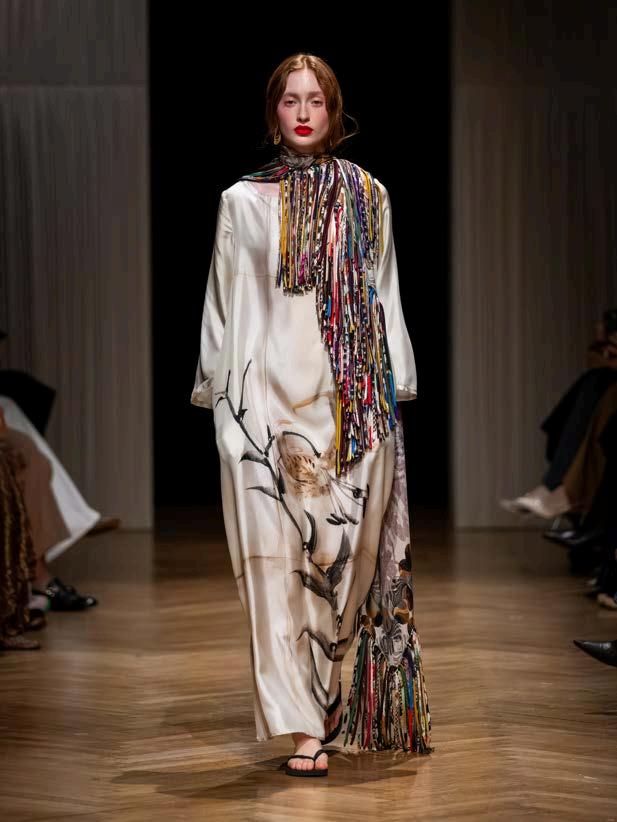
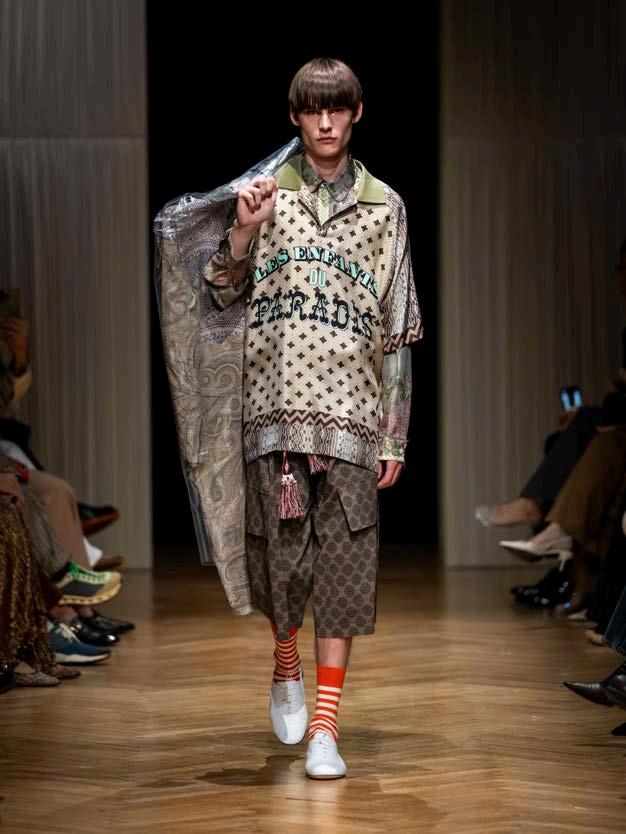
Entitled“LesEnfantsduParadis,”the S/S26collectiondrawsitsconceptual foundationfroma1940’sFrenchfilm - and the turbulent world of theatre that it centered on. In this world, both behind and in front of the curtain,illusionandtruthcoexistand thesmallestgesturecanilluminatean entire inner life. Mascia’s collection felt like a conversation between costume and clothing, between lived experienceandimaginednarrative.It evoked an old theatrical wardrobe: trunks filled with fabrics touched by time, garments carrying the imprint of countless performances, and silhouettesshapedbytheinterplayof spotlight and shadow. Yet nothing about the collection felt overly nostalgic or vintage. Instead, Mascia filtered the past through a contemporary lens, transforming it into something light, vibrant, and clearlyforthecurrentgeneration.
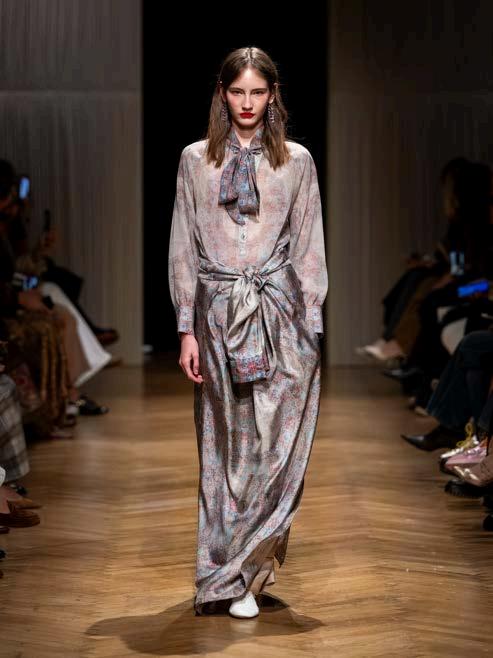
Material is always Mascia’s starting point, and this season was no exception. Silk dominated the collection, with eighteen new prints, each a complex orchestration of color,motif,andrhythm,formingthe backbone of the S/S 26 story. They do not shout for attention, but instead reveal themselves slowly like fragments of memory resurfacing. Mascia’s collage technique is evident inthewayprintsmergeanddiverge, and how one detail seems to slowly echo the previous. They are not decorative but narrative, like a series ofpagestornfromavisualdiary.
Complementing the silks were wide skirts with light ruffles to introduce movement,relaxedtrouserstosoften the silhouettes, and pajama-inspired shirtstoaddaprivateintimacy.
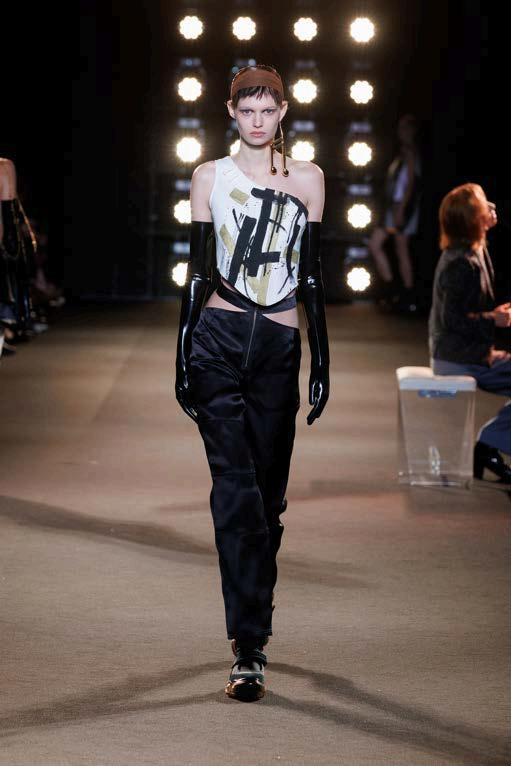
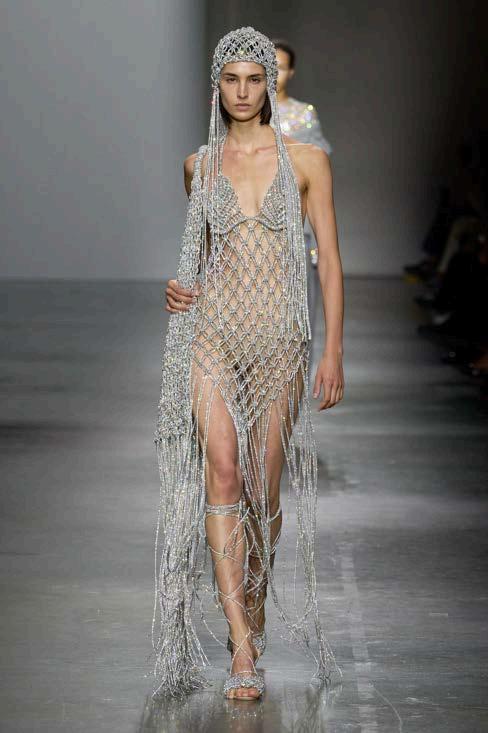
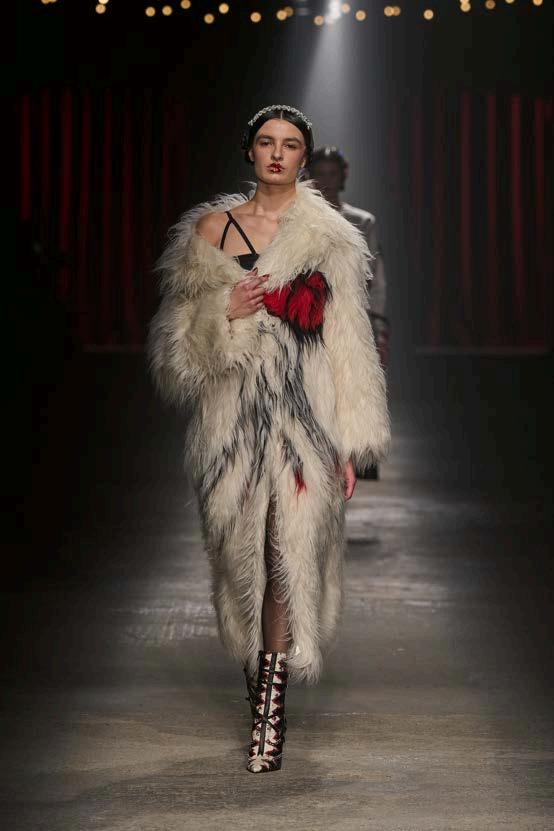
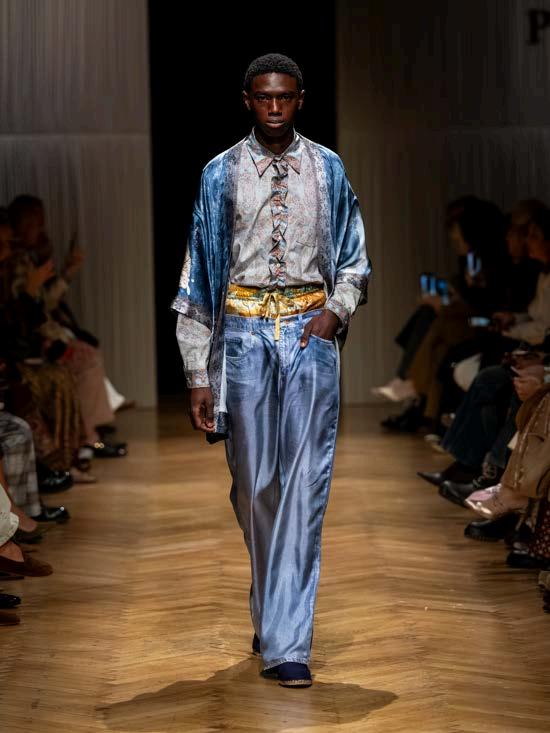
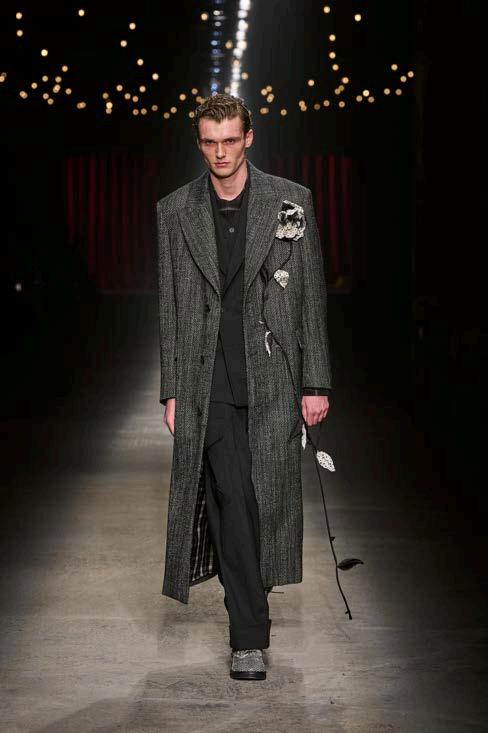
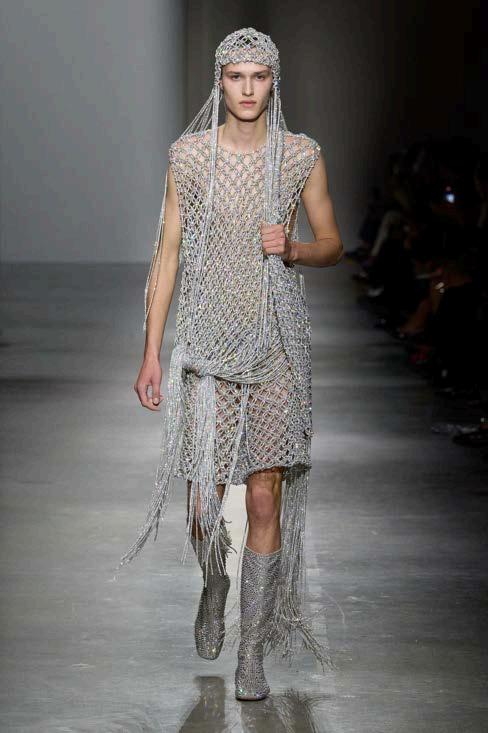
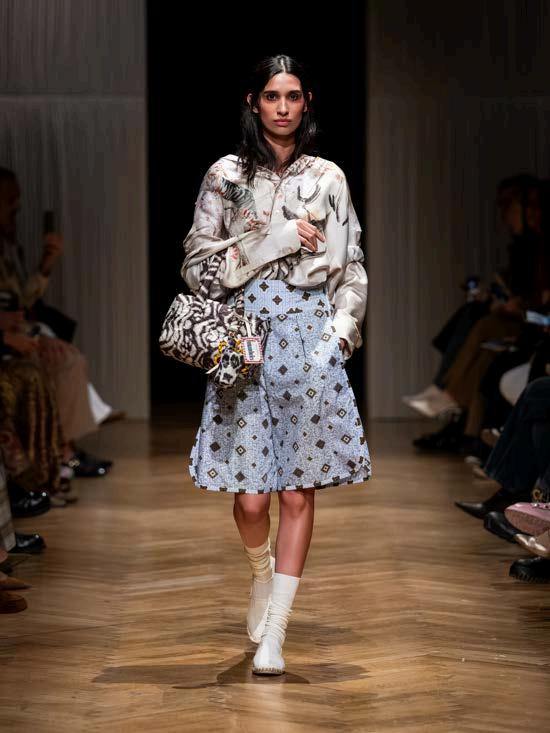
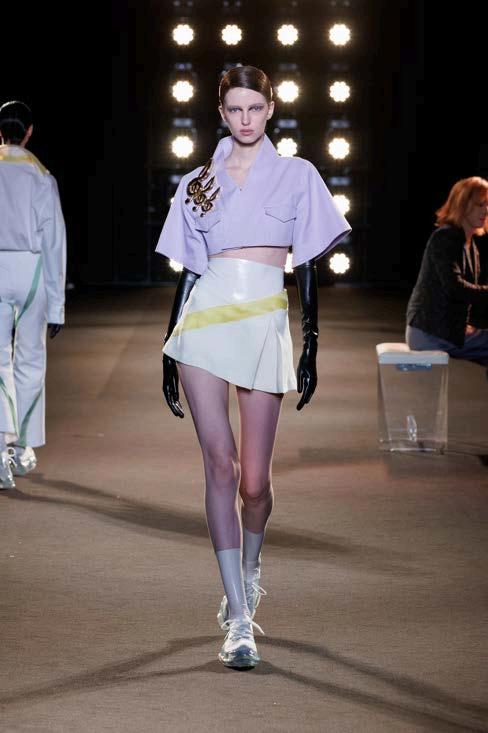
Denim appeared but in theatrical reinterpretations,whilebomberjackets and airy trenches added tension and structural counterpoints. Layers overlapped gently, with pleats opening and closing like stage curtains and semi-transparent effects creating shadows that change with the light. Ultimately, Mascia dressed thebodythewayadirectorframesan actor: allowing for expression, gesture,andemotionwithsilhouettes that evoked the fluidity of performance.
Mascia’s greatest achievement this season lay in balancing theatrical imagination with true wearability. The clothes were expressive: instinctive rather than constructive and often dreamlike but never overwhelmingly so. Mascia treats fashion as a language for the everyday: a way to elevate routine moments into scenes worthy of memory. Spring/Summer 2026 feels designed for people who move through the world with sensitivity, curiosity, and a willingness to embracesmallcinematicmoments.
WORDS:FILZAMARRI
PHOTOSPROVIDEDBYHOUSE
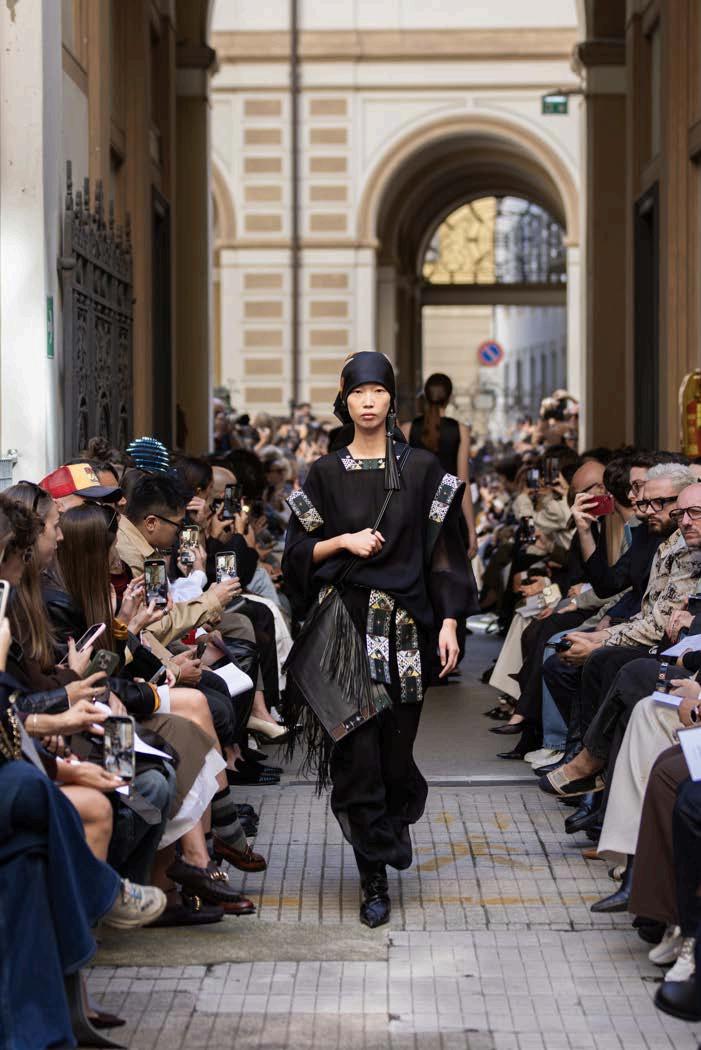
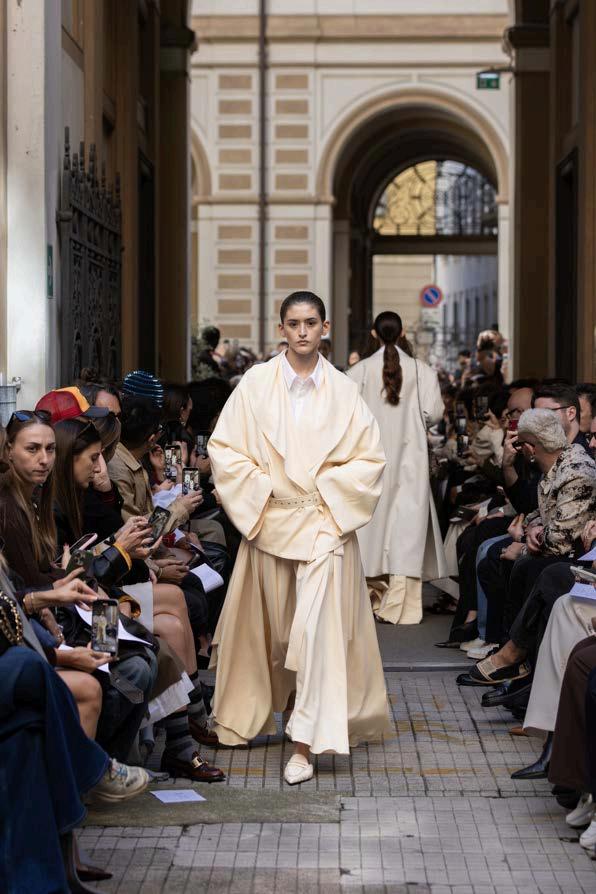
Daniele Calcaterra’s Spring/Summer 26 collection stayed close to the vocabularytheMilanesedesignerhas built over the years: clear shapes, controlled volume, and tailoring that prioritises ease over spectacle. The opening looks set the direction without hesitation: long coats, rounded shoulders, and trousers cut withenoughroomtomovenaturally. And nothing about the collection tried to create drama. Instead Calcaterra stayed focused on minimalist forms, satisfying proportions, and the discipline of his construction.
The palette stayed neutral throughout: stone, sand, off-white, muted charcoal, and black. These toneskepttheattentiononsilhouette rather than surface. Calcaterra doesn’t rely on colour to deliver impact, and here, the choice made sense.Thesimplicityallowedtheeye to study the lines and the materials behaved exactly as the designer intended:structuredbutnotstiff,soft without collapsing, measured in movement.
One of the strongest looks was a long, clean coat in a pale cream pairedwithtrousersinthesametone. Theproportionswerebalanced:wide enough to feel relaxed, narrow enough to keep the line sharp. Nothingaboutittriedtoinnovatefor thesakeofinnovation.
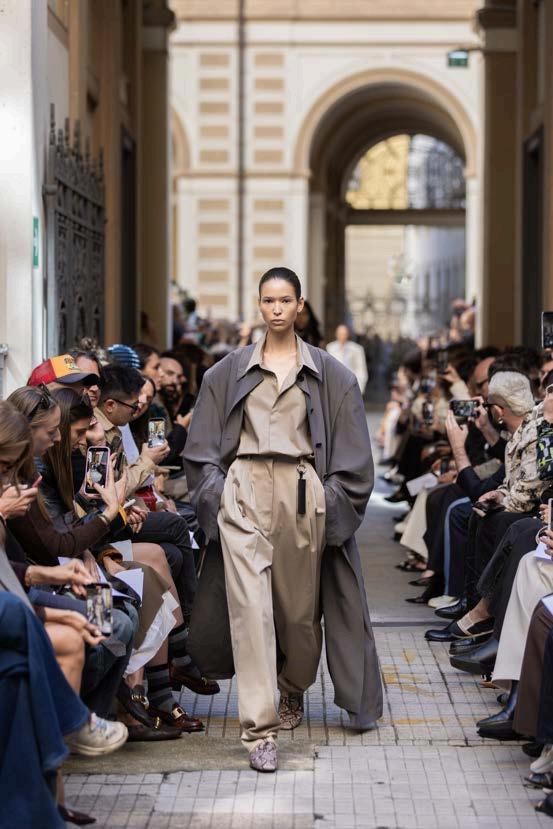
It was just a well-considered set of shapes, placed together with confidence. That’s the essence of Calcaterra:refinementwithoutnoise.
A repeated element throughout the showwasthecurvedshoulder,which was never exaggerated and never sculptural for effect but always just gently lifted - enough to shift the silhouette without overtaking it. The shoulder line shaped the collection morethananyotherdetail.Itcreated continuity, grounding the looks in a steadyrhythmfromstarttofinish.
Trousers stayed loose and straight, often brushing over the footwear whilegivingcleanverticallines.They moved lightly without creating drama, allowing one to read the patternmakinginthewalkfromthe way seams were placed to redirect volumetothewayfabricwasallowed to fall. Compared to previous seasons, this collection overall felt slightlysofteraroundtheedges-not inanemotionalsense,butintheway the textiles sat on the body. Some coats opened fluidly as models walked, and a few of the tunics had lighter movement. Even so, the precision stayed intact. Calcaterra’s evolutionhappensinsmallshifts,and thisseasonfollowedthatpath:fewer hardlines,moreroundedtransitions.
Midway through the show, darker looksappeared,primarilyinblackand charcoal shades that allowed us to read the volumes more sharply. The contrast from the lighter tones was minimal but effective; it showed the consistency of his shapes across differentmaterialaseventheheavier fabrics kept the same quiet, structuredease.
Ifthere’sanycritiquetomention,it’s that some looks blended into each other. The repetition of long coats and wide trousers created a uniform visual rhythm. But in Calcaterra’s world,repetitionispartofthepoint. He is not trying to reinvent his vocabularyeveryseason;he’srefining it. And in that context, the consistencyworks.
One coat toward the end stood out for its exacting cut, a rounded silhouettethatcurvedcleanlyintothe back with precise seam placement creating subtle volume shift. There were no embellishments and no detailsmeanttocatchattention-just construction.
Accessorieswerealmostnonexistent. This was the right choice, as Calcaterra’sworkisaboutsimplifying the relationship between body and shape. Staying away from complex combinations and letting his architectural background show, Calcaterra designed a measured collection that requires no styling tricks or specific environments and willholditsownineverydaylifejust asontherunway.
In a week filled with designers chasing attention, Calcaterra stayed firmly in his lane: clean, direct, and confident.Thecollectionwasbuilton clarityratherthanspectacleandfora designer whose strength lies in restraint, it was exactly the right approach.
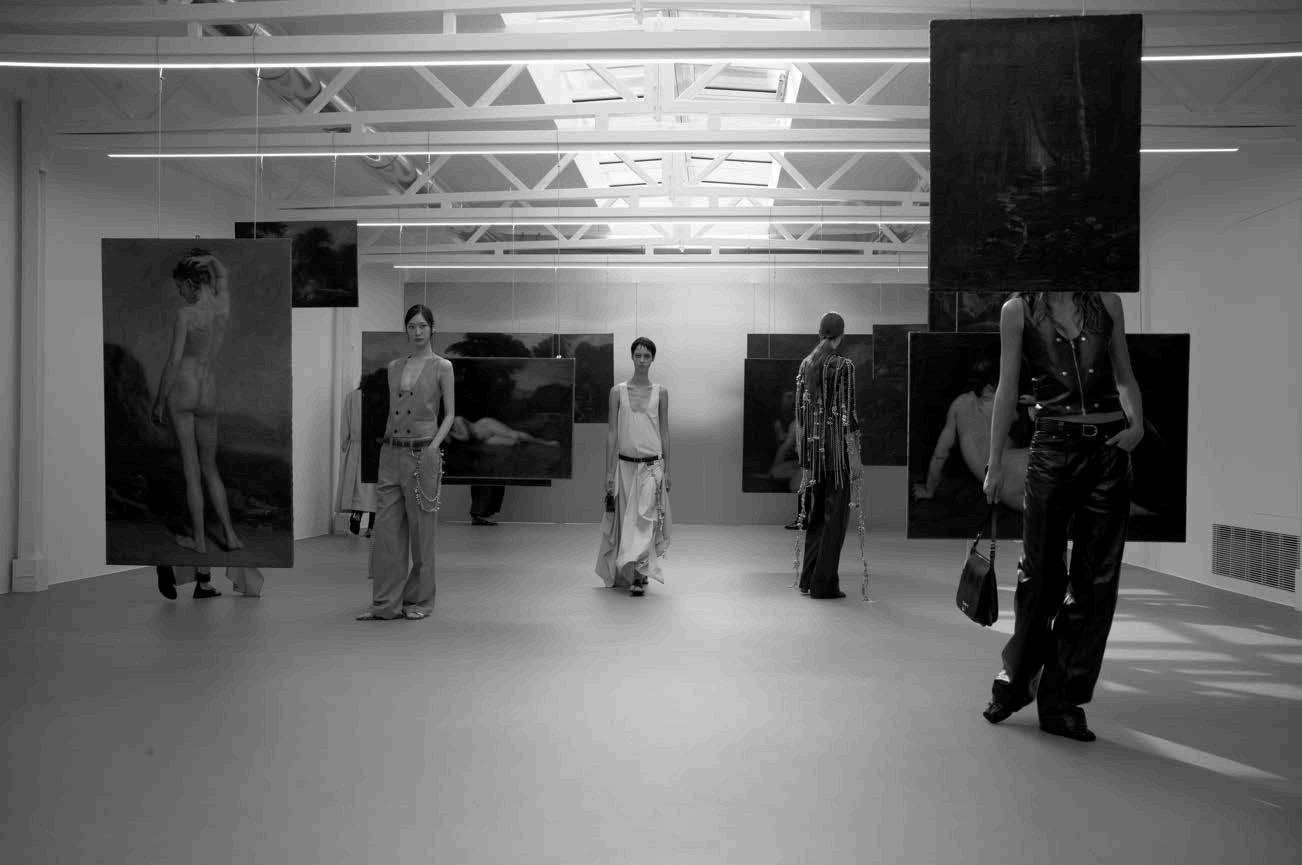
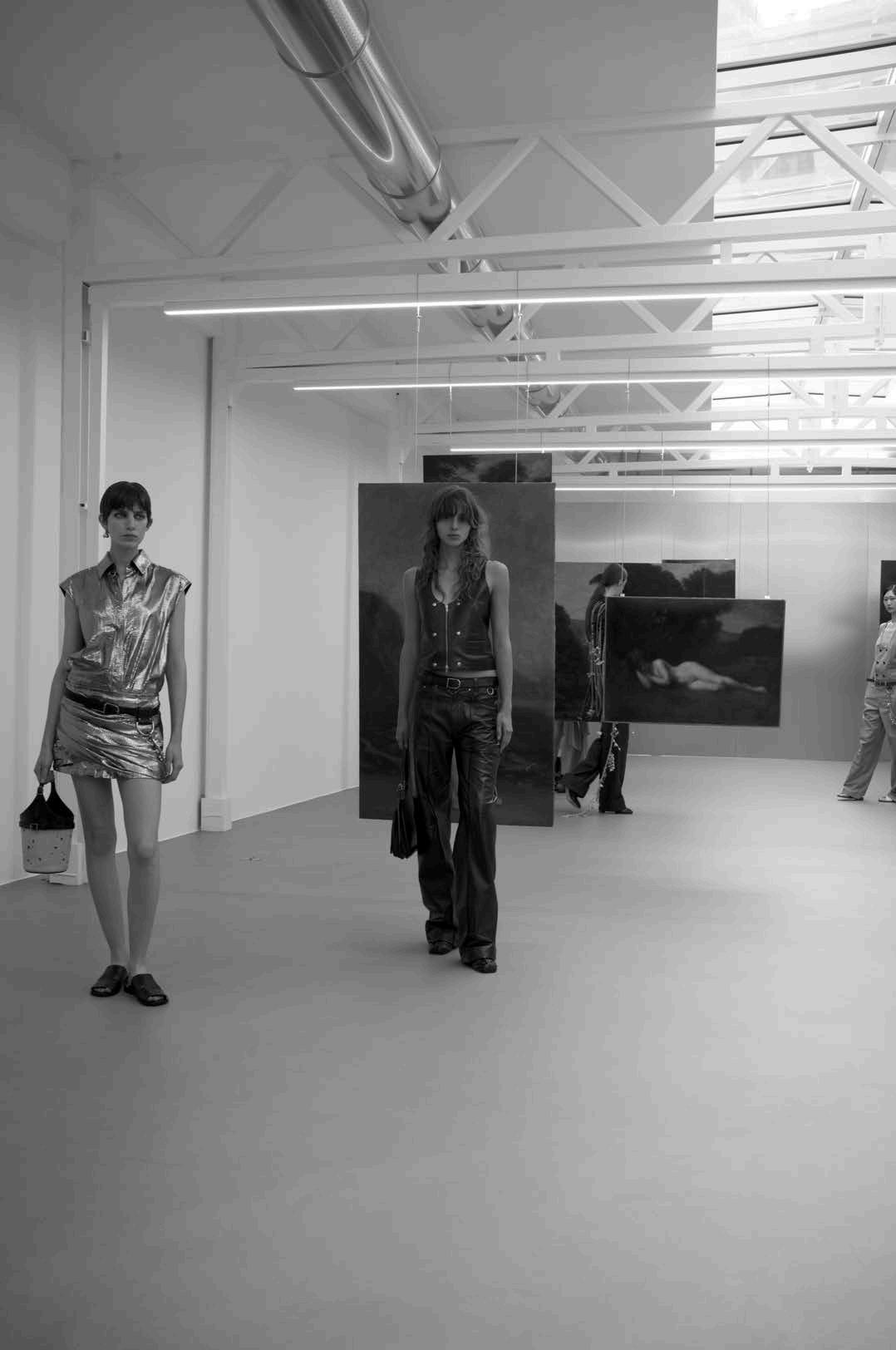
EffortlessurbanedgedefinedDurazzi’s Spring/Summer 2026 collection, which sawfounderandcreativedirectorIlenia DurazziseizeBaroqueandNeoclassical inspirations then infuse them with a contemporary and even transgressive sensibility. In an atelier which she designed herself, despite having no previous background in architecture or interior design, Durazzi launched a collection that is the greatest triumph of her four-year-old Italian brand. “Eleganceandrigor,”shesaidlastyear, whenaskedwhatdefinesherbrand.It’s a seeming paradox but one that she navigates confidently and without hesitation, forging a style uniquely her own and refining it further every season. A veteran of Maison Margiela, Balenciaga, and Tod’s, she has all the technical skills to compete with fashion’s biggest houses, but most importantly a unique individual vision andapoisethatcannotbetaught.This Spring/Summer 2026 presentation, containing consistent show elements within a dynamic space, was charged withanenergythatmadeitastand-out eventofMilanFashionWeek.
Leather, symbolic of both urban edge andoftheequestrianismthatisamajor passion of Durazzi’s, was the defining feature of the collection. A supple leather coat paired with fringed equestrian-inspired boots and a texturedbusiness-likevestwasthefirst stand-out piece of the collection. Finding cohesion through contrast, it possessed the savoir faire of the ambitious girl who is equally comfortable in the boardroom, in a stable, and at a speakeasy. It was shortly followed by a sophisticated leather vest and pants set and the appearance of animal print, a Durazzi leitmotif.
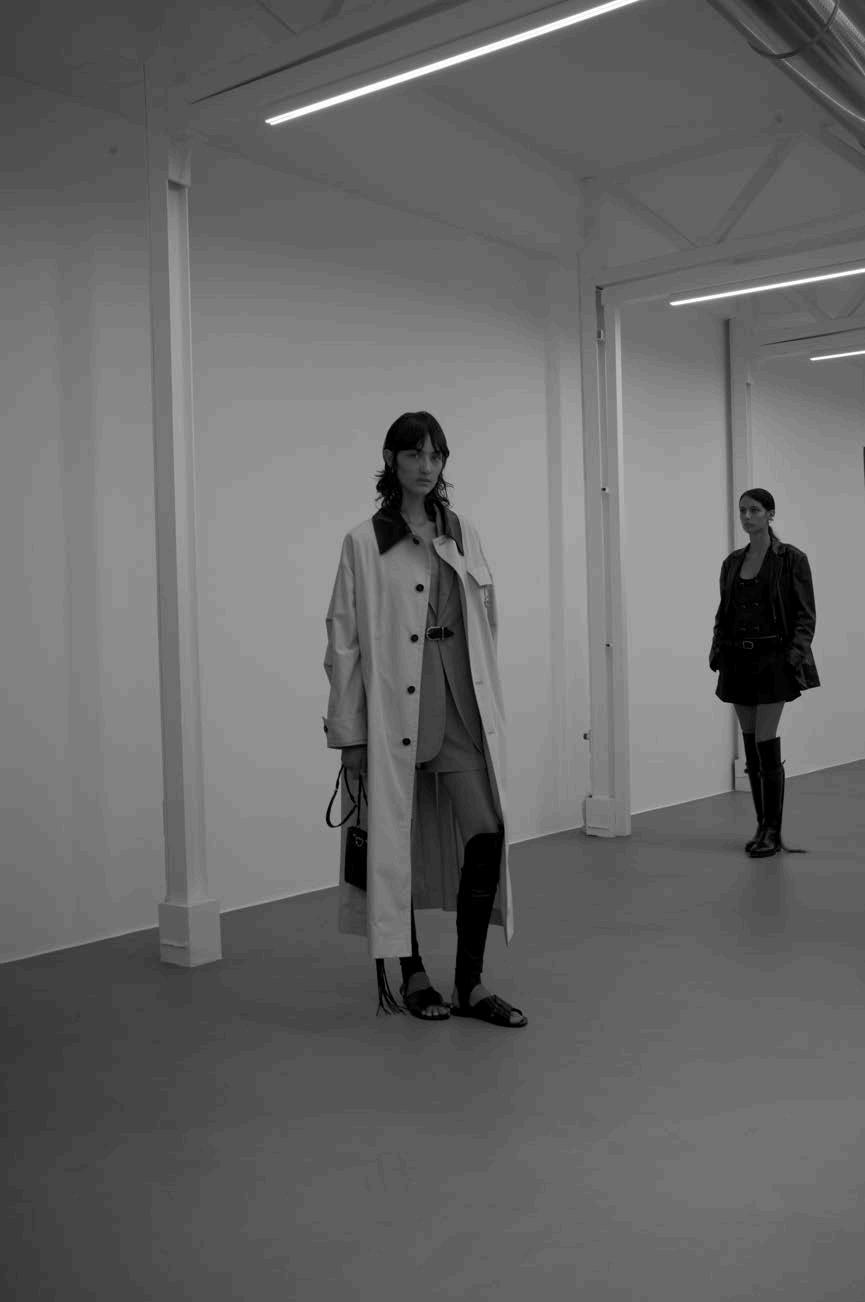
Durazzi proved this season that traditionally masculine motifs can also be possessed of feminine flare. Channeling the energy of Chrome Hearts, whose swaggering pants chains,chokers,andringshavetaken over the globe, Durazzi embraced statement jewelry without sacrificing elegance. She particularly emphasizedthepantschain,asmany belts came with oversized metal attachments specifically for this purpose. One minimalist anthracite gray look was highlighted by a tasteful yet dramatic and heavily pearled chain that snaked almost all the way down to the model’s feet. Meanwhile,aminichaingyratedoffa redpythonminiskirtlikeacharmand a mid-sized chain hung off an allwhite sleekly tailored look in one of thebestandmostinnovativefashion statements of the season. The grand finale in this theme came when a model appeared wearing a blazer wrappedindozensofintricatechains likeanarmoursheath.
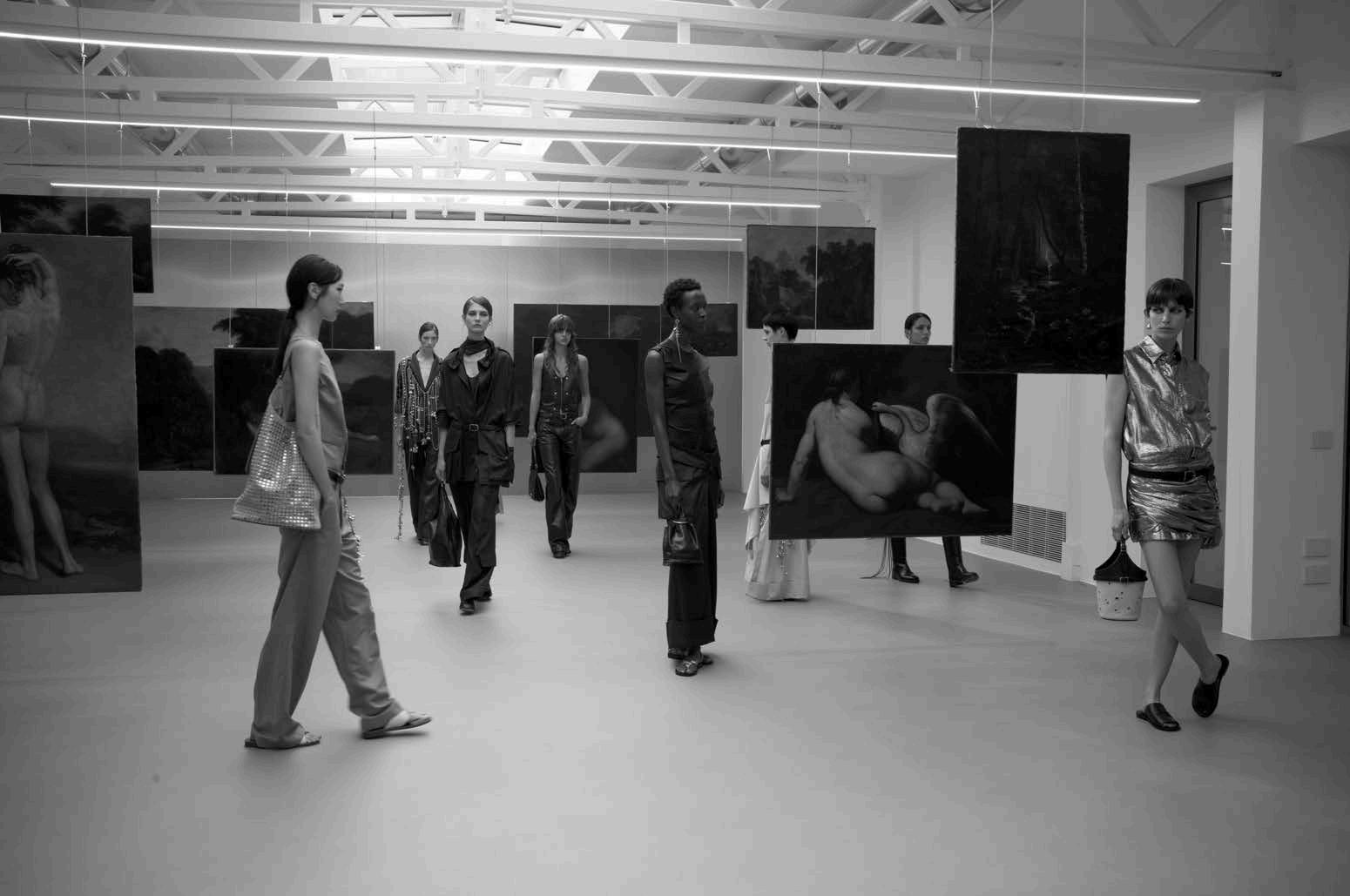
Entitled “Nymphs,” the strikingly modern collection appeared in a minimalist warehouse-style atelier nonetheless adorned with centuriesold paintings, including neoclassical landscapes, reclining female nudes, and dramatic scenes invoking the work of Caravaggio. Separate if adjacent to both Scandinavian simplicity and dark New York minimalism, the S/S 26 Durazzi experience proposed an entirely new aesthetic and way of living that combines traditional elegance, modern mindfulness, and unapologetic urban flare. Yet this is justonechapterinarapidlyevolving story, and I cannot wait to dive deeperintoallaspectsoftheDurazzi universenextseason.
Ports 1961 is a house shaped by movement. Foundedontheideaofglobalexploration,the brand has long embraced a worldly elegance. Over the years, as creative voices have shifted and aesthetics have evolved, Ports 1961 has become a label synonymous with refinement: clean lines, architectural silhouettes, exquisite fabrics,andadeeprespectforcraftsmanship.
Today,undertheartisticdirectionofFrancesco Bertolini, that identity is undergoing a quiet, confident transformation. Bertolini brings a sculptor’stouchtothebrand,withasensitivity toform,aninstinctforbalance,andadesireto create clothes that carry depth without shouting. Ports 1961 is no longer concerned with literal travel - instead, it explores internal landscapes: textures, rhythms, sensations. The journey is conceptual, emotional, and intensely tactile.
WithSpring/Summer2026,launchedatMilan’s historic Salone dei Tessuti, Bertolini delivered his most coherent statement yet: a collection thatdrawsuponGreecenotasapostcardora tropebutasaphilosophicallens.ItisGreeceas proportion,Greeceaslight,Greeceasafeeling ofclarityandequilibrium.Theresultisaseason definedbyserenity,bymastery,andbyapoetic tensionbetweenconstructionandease.
The influence of Greece flows through the collection not in decorative motifs or clichés, butasanabstractideal.Whereanotherdesigner mighthavereachedforliteraldraperyorcolumn prints,Bertoliniinsteaddistilledtheessenceof Greek classicism: purity of line, harmony of proportion,andanunderstandingthatsimplicity canbeprofoundlyexpressive.
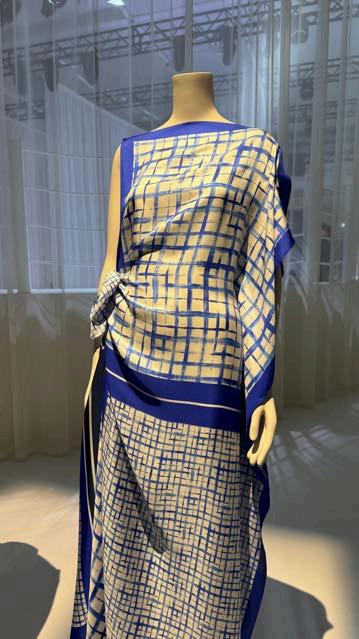
The palette reflects this approach: whites softenedbysandandhoneyandbluesrecalling theAegeanatvarioushoursoftheday.Yetthe precise pleats and technical layering reveal Bertolini’sfascinationwithconstruction.
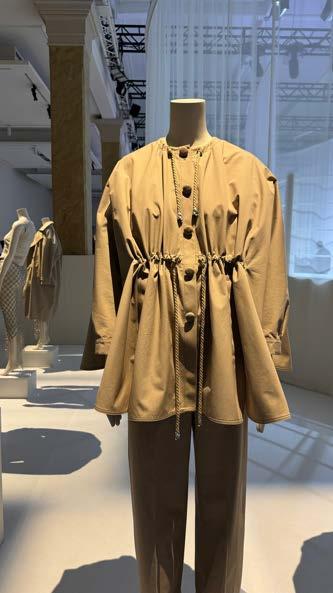
If Ports 1961 S/S26 has a heart, it is found in thematerials.Bertoliniandhisteamworkwith fabrics not as canvases but as characters. Breathablecottons,openknits,lightlinens,and hand-woven silks created a vocabulary of textures that felt fresh and elemental. Rope details and nautical chains nodded quietly to maritime living while mother-of-pearl sequins shimmered with the restraint of sun on water andbeadednettingglintedlikefishinglinesat dawn. Every textile choice was meaningful, serving the dual purpose of elegance and comfort. The clothes must breathe. They must move.Theymustholdthebodylightly,theway aGreekbreezeliftsasheercurtain.Yetatthe same time, there is structure. Fringe-trimmed tank dresses swing with sculptural rhythm, capturingmovementwithoutsacrificingcontrol. Asymmetric tops composed of pleated panels and raw-edged strips suggest the fluting of ancientcolumns.Andsequin-dustedslipdresses glow softly over ribbed knits, creating a dialoguebetweenthetactileandtheethereal.
While the evening looks achieve breathtaking cohesion, the daywear seemed less assured. Tailored trench coats, some elongated, others cropped, did not have the same clarity as the dresses. Parkas, while executed with finesse, still occasionally disrupted the collection’s serene flow. These deviations illustrate the tension between crafting a full wardrobe and preserving the purity of the season’s most successfulideas.
One of the collection’s strengths lies in its practicality. Ports 1961 Spring/Summer 26 is notafantasywardrobefordistantshores;itisa consideredofferingforamodernwomanwhose liferequiresversatility.Herclothingmustadapt, transition, and endure, and Bertolini has met thoseneedswitheleganceandpurpose.
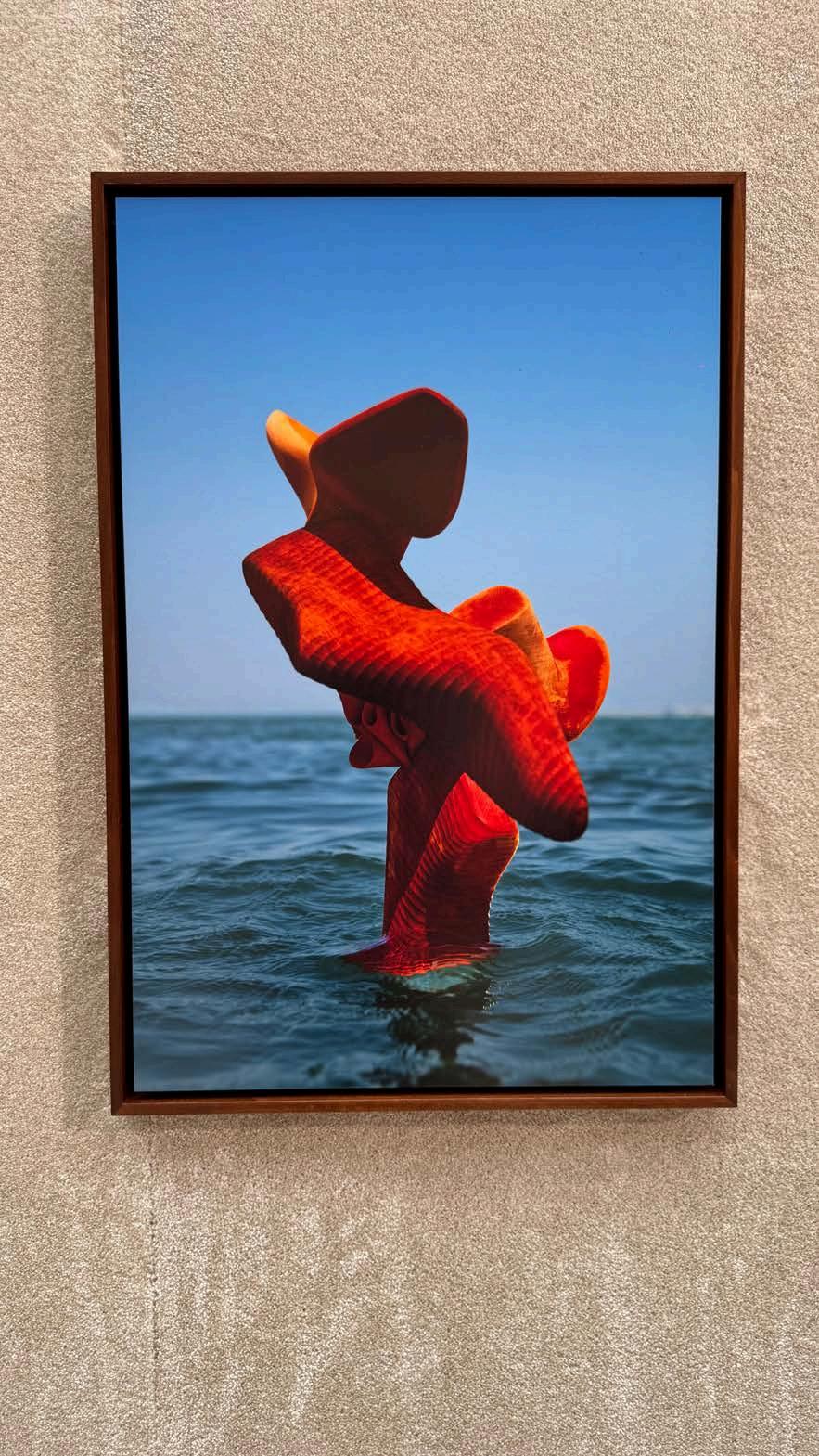
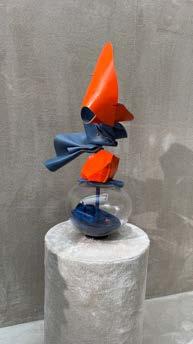
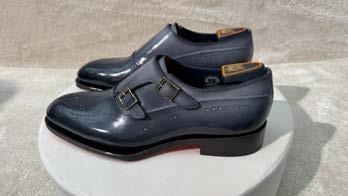
In the wake of its 50th anniversary celebration and the release of coffee table keepsake “Meraviglia,” Santoni merged heritage and futurism for a dramatic Spring/Summer 2026 presentation in collaboration with VenetianartistLorenzoVitturi.Thenew collection was displayed alongside a series of modernist Vitturi works that were inspired by the house’s fine artisanship. The dramatically presented portraits included photos of Santoni’s unique Origine leather being immersed in Venetian lagoons to be transformed by air, water, and light (see left). Also on display were a series of covetous sculptures that united Murano glass, Venetianbeads,andPeruvianyarn.But, of course, it was the shoes themselves thatseizedthespotlight.ShadesofBlu Adriatico, Lampone, Puro White, and Verde Silva evoked “the endless horizon,”“claybeforefire,”and“thelast rays of a coastal sunset,” emphasizing Santoni’s connection to Marche landscapes and possessing a soulful yearning.Theprecisionofthecollection matched its romance, as men’s dress shoes crafted from a single piece of leather revived a particular technique thatdatesbacktotheRenaissance.
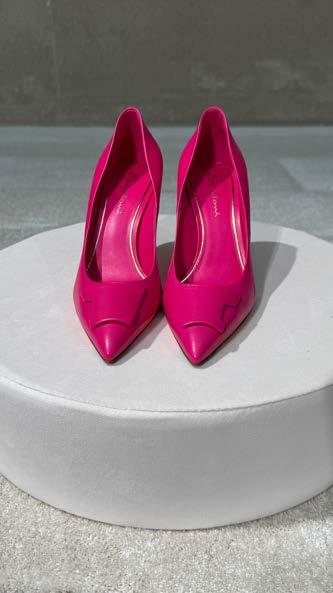
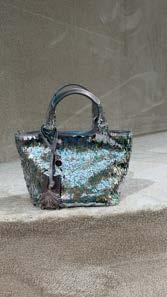
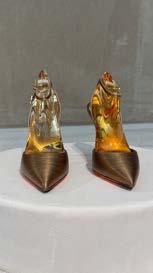
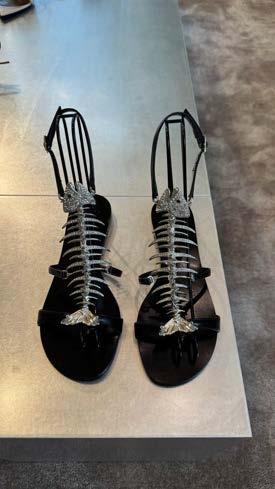
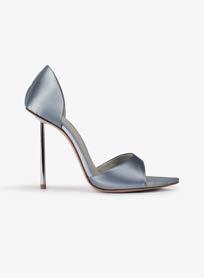
The year is 2004. The location: the picturesque town of Cesanatico on Italy’s AdriaticCoast.GiuseppeZanotti,hisgroup ontheirsecondbottleofwine,isenjoying a gin and tonic at the restaurant Slim’s whenhespiesafishspineonthetableand has a flash of inspiration. “I put the fishboneonabeautifulgirl’sfeet,andthen Isketchedtheshoeonthetablecloth.Easy.
One second,” he recently told WWD. For thegreatItalianmaestro,onesecondisall thatisneededforalegendtobeborn.The resulting shoe, “Slim,” became an iconic piece immortalized by its appearance in “Sex&theCity,”andstillcherishedbyits owners 20 years later. Now it has been revitalized for a new generation, with 300 hand-placedcrystalsfrostingthefigurative fish skeleton on Zanotti’s most-talkedaboutpieceforSpring/Summer2026.
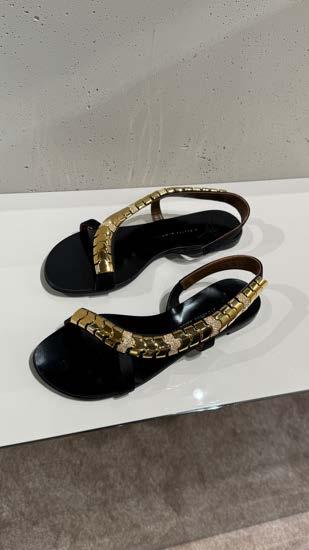
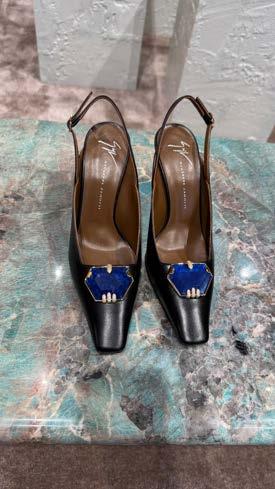
For Zanotti, this season is also about renewed balance. In the turbulent years post-Covid, the fashion industry has oscillated between unrestrained glamour (for clients that need to celebrate again) and uncharacteristic restraint (for clients who don’t know if there is anything to celebrate). Zanotti, who initially scaled back the opulence and insouciant femininitybelovedinhisearlydesigns,has now found a happy medium. Guided by a philosophy of “intentional jewels,” he curatedsparklingelegancewhileeschewing ostentationforSpring/Summer25/26.The result?Oneofhisbestcollections(andmy personal favourite) in recent memory. It’s true; Giuseppe has his finger on the pulse oftheglobalyoungandbeautifuljustashe did20yearsagoontheAdriatic.
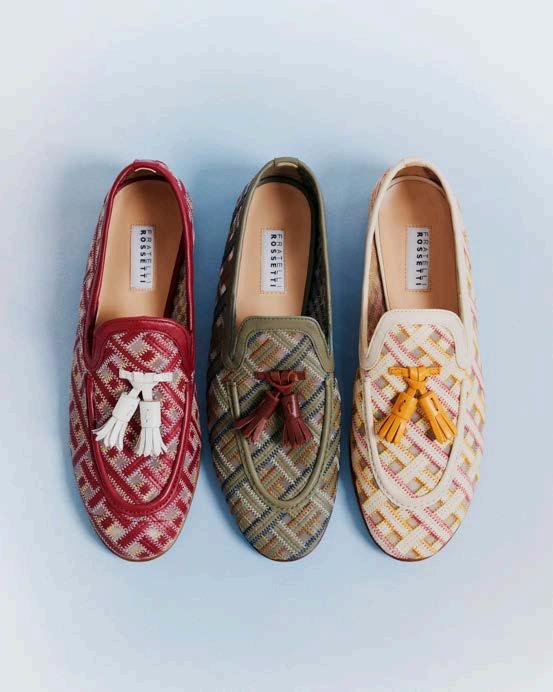
Spring/Summer 2026 was Fratelli Rosetti’s strongest collection in recent memory, as the heritage house combined timelessstylewithyouthfulenergyinaseriesofdelightfullyvibrantcolours.TheiconicBreraloaferandHoboslipper were proposed in eight shades each named after a unique ice cream flavour, with strawberry and wild berry encapsulatingaplayfullyinsouciantglamourandstracciatella,hazelnut,andfiordilatterepresentingeffortlesselegance.
A complex “treasure chest” motif was a new design element this season, demonstrating the maison’s consistent commitmenttoinnovationthroughthelensofheritage.
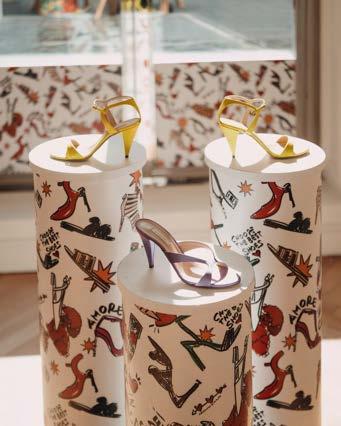
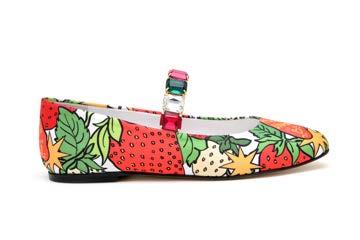
Casadei has always stood at the intersectionofsculptureandseductionasa house where footwear becomes architecture and craftsmanship turns into emotionalstorytelling.ForSpring/Summer 2026,thecollectionlookedbothbackward and forward, celebrating icons while fearlessly placing contemporary femininity at the intersection of engineering and imagination. Centering it all was a muchacclaimed collaboration with beloved Sicilian designer Alessandro Enriquez: “StrawberryFieldsForever.”
Both Cesare Casadei and Enriquez have curious and imaginative souls; as Cesare said in the press release “we share the same enthusiastic spirit, one that leads us toobserveworkandlifethroughtheeyes ofanamazedchildthatfindsstimulationin everything around them.” “Energy, creativity, joy, and colour” anchor both designers’worldviewsandthesartorialfruit of their collaboration. Enriquez’ pop art strawberry motif dances with Casadei crystals, a leopard paw embraces a playful “wildside,”andheartimagerypairedwith vibrant stripes (the “Chess of Love”) decoratesflatsperfectforsummerdaysin PortofinoorAntibes.
Casadei and Enriquez were a natural fit, with Enriquez describing the design journey as “a whirlwind of ideas and research,andneveracrossedword.” One sensedthisintheexuberantspiritofboth theshoesandthewayinwhichtheywere presented,anenergythatwasmatchedby Casadeievenamongstitsclassicofferings.
At the core of the season was the Blade heel:thatrazor-sharp,architecturalstiletto that has defined the brand’s visual languageforoveradecade.ForSS26,the Bladewasenergizedingleamingmetallics and sun-washed tones that echoed the radianceofItaliansummers.Itwasalsoreinterpreted in the new Victory style, featuring a striking double T-bar design and offered in both open and closed-toe shapes.Powerfulyetrefined,theVictoryis atypeofalluringmodernarmour.
Fearless femininity was omnipresent. The ever-fiery Andromeda was proposed in Samurai red patent leather, distilling the hedonisticspiritofa“summeroflust.”The Superblade Sharp, fresh from its debut in Cannes, elevated the idea of red-carpet glamourwithanelongatedpointedtoeand slenderanklestrapthatembodiedbalanced sensuality. And for those who prefer to sparkle in a more discreet way, the Belle Epoque curated intimacy within design. Adornedwithajeweledheelandadiscreet C-chaindetailhiddenwithinthestructure, itcontainslayeredluxurythatrevealsitself tothewearerfirst,thentoothers.
Ahighlightofthepresentation,whichtook placeinashimmeringmirroredsalon,was the opportunity to view the 3D printed Futurecapsuleofflats(whichmoldtoyour feet like a glove and are just as comfortable as they are effortlessly elegant!) Forever at the forefront of innovation, and never afraid to blend his new ideas with tradition, Cesare has delivered another masterpiece of a collection. Playful in spirit, precise in construction,andprescientofthefutureof fashion, Casadei Spring/Summer 2026 is oneoftherevelationsoftheseason.
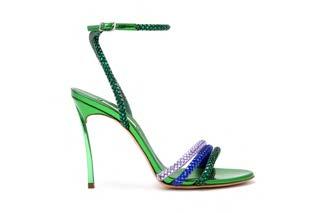
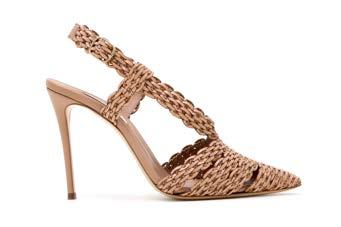
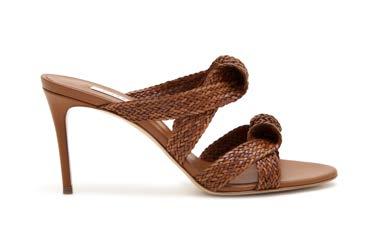
Titled “Le Ciel Dans Une Chambre,” Le Silla Spring/Summer 2026 transformed footwear into a nuanced psychological landscape of colour, texture and desire.Thecollectionreadlikeaquietconfessionrather thanboldstatement:aprivateworldopenedtoaninner circle of fashion tastemakers for moments of ntimate reflection.
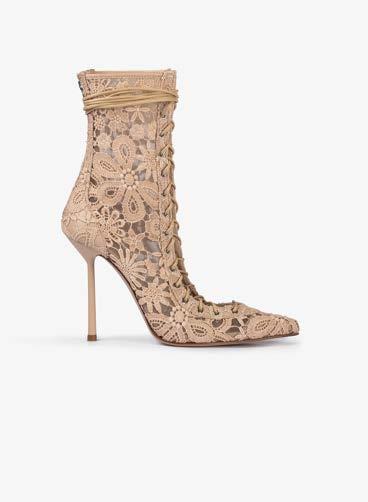
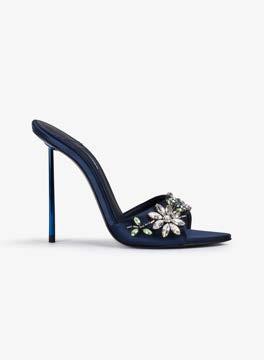
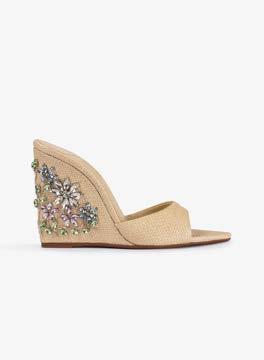
The colour palette covered a full emotional spectrum, shiftingbetweengroundingtonessuchasGizasandand Malta cement and luminous accents such as Mojito green and Malibu blue. Innocence and nostalgia conversed in a seemingly paradoxical ballet: that of a woman possessed of both a youthful optimism and a wisdombeyondheryears.Indeed,shoestookonlivesof their own as if characters at a long-ago ladies’ garden party:someactingasexuberantteenagersexperiencing thejoysandheartbreaksoffirstloveandothersasolder mothersandauntswhoradiatestabilityandinnerpeace after enduring their own trials and tribulations. Anchoring Spring/Summer 2026 was the brand new Uma Garden capsule, which epitomized femininity in pastels such as mimosa, azalea, lantana, cornflower, peony,andtea.Withaneffortlesslygracefulformanda fierce 140 mm. Stiletto heel, it is for modern heroines whoembracesensualitywhilemostdefinitelybeingthe centralcharacterintheirownsocialcircles.
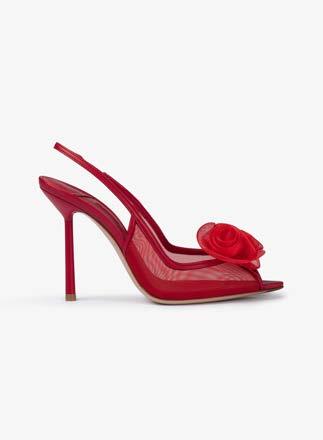
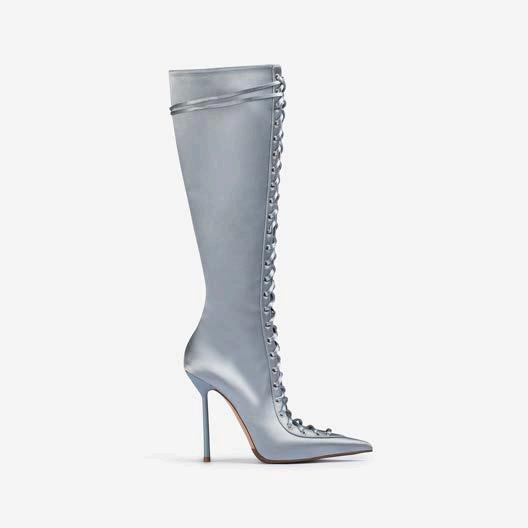
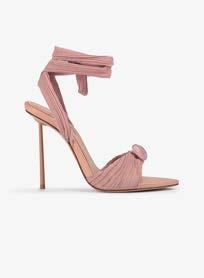
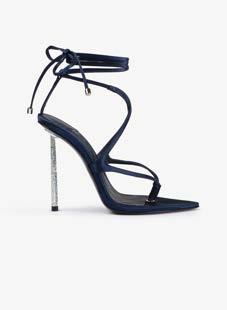
Other highlights included the Numa sandals of dreamy pleated chiffon, the Colette macramé ankle boots, and Gisele thong sandals proposed in quietly indulgent shadesofbutteryellowandmutedgreen.Ofcourse,the now-iconic Petalo pump returned…as did the beloved Gilda Fierce with its crystal-studded mesh. Le SIlla remains a house that, like its fictional protagonists, is self-assured,unapologeticallyglamorous,andunfailingly poised as it looks towards a bright future. While many brands experiment with then drop new trends at an increasingly frenetic pace, Le Silla steadily pursues a timelessvisionofelegancethatmayevolveinformbut neverlosesitsessence.
BY JESSE SCOTT
Onasuperficiallevel,theworldismore accessibletousthaneverbefore.
Paradoxically and tragically, the more wetravel(whetherphysicallyorvialatenight scrolling), the less we experience as travelers. Authenticity eschewed for quick gratification, cultural immersion for the comforts of uniformity, and human connection for the perfect curatedInstagrampost. Nowhereisthis paradigm more evident than in the way wedocumentouradventures. Longgone are the days when a roll of film would hold 24 cherished memories; instead, ourphonecamerasmightnowhold2400 photos (many posed) from a single weekendaway.
As I traveled the world in 2025, I focused on doing it intentionally: prioritizing quality time with friends over trendy nights out and embracing the lifestyle of the destination rather than shaping the destination to my lifestyle. When capturing photos, I focused on unplanned moments using a retro lens: sometimes moody, sometimes chaotic, mostly imperfect, and always raw. Here are a few shots that, for me, capture the soul of a place or a flashpointintimeandlife.
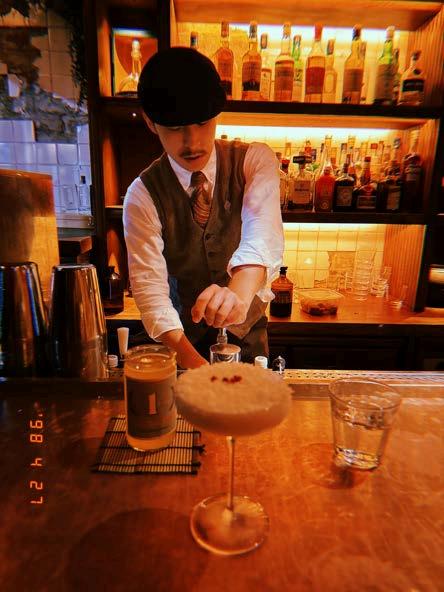
“losing track of time” TOKYO, JAPAN


“all colour, no chaos”
TOKYO, JAPAN
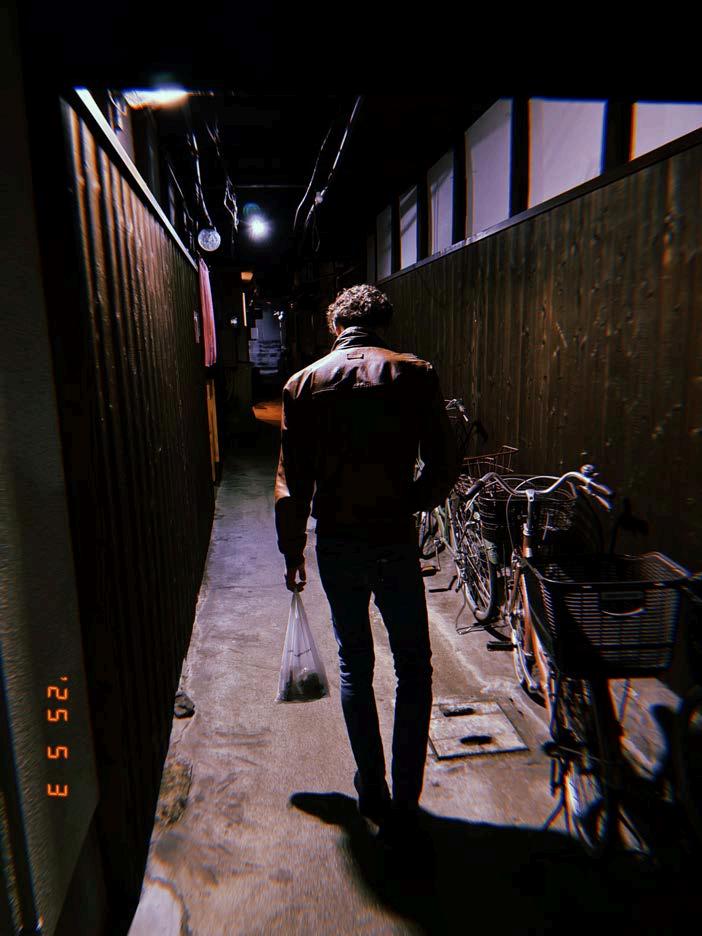
“silent
night’ KYOTO, JAPAN
“japan’s america obsession”
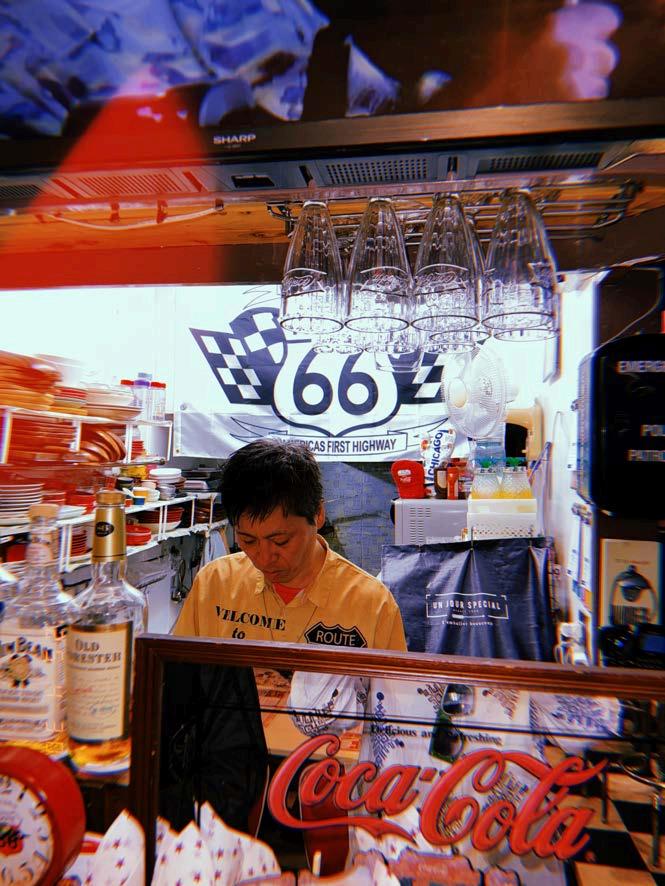
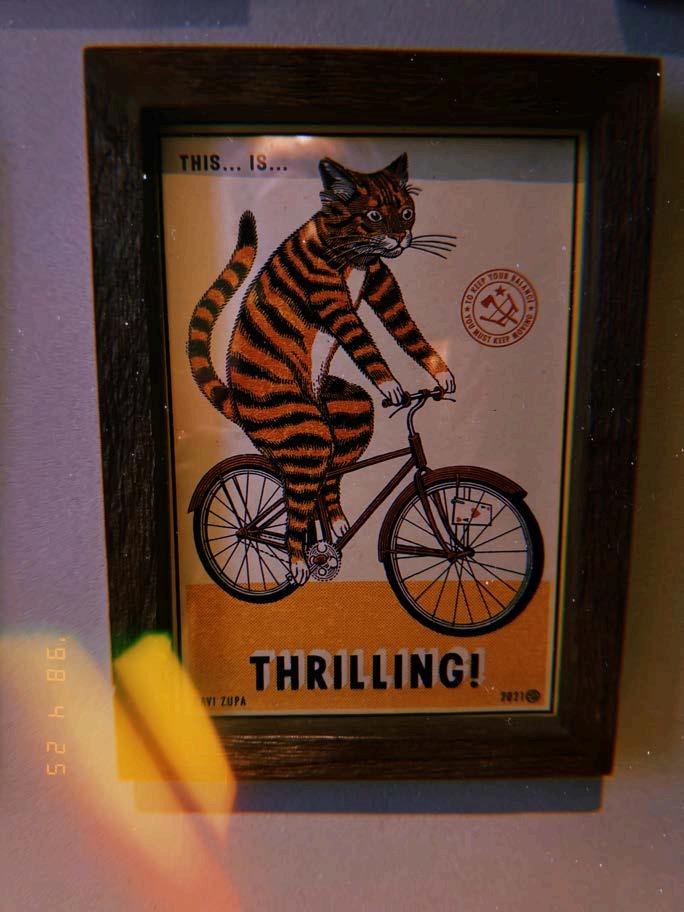
“america’s japan obsession”
“tradition or fetishization of tradition?”
DOHA, QATAR

“paradise found”
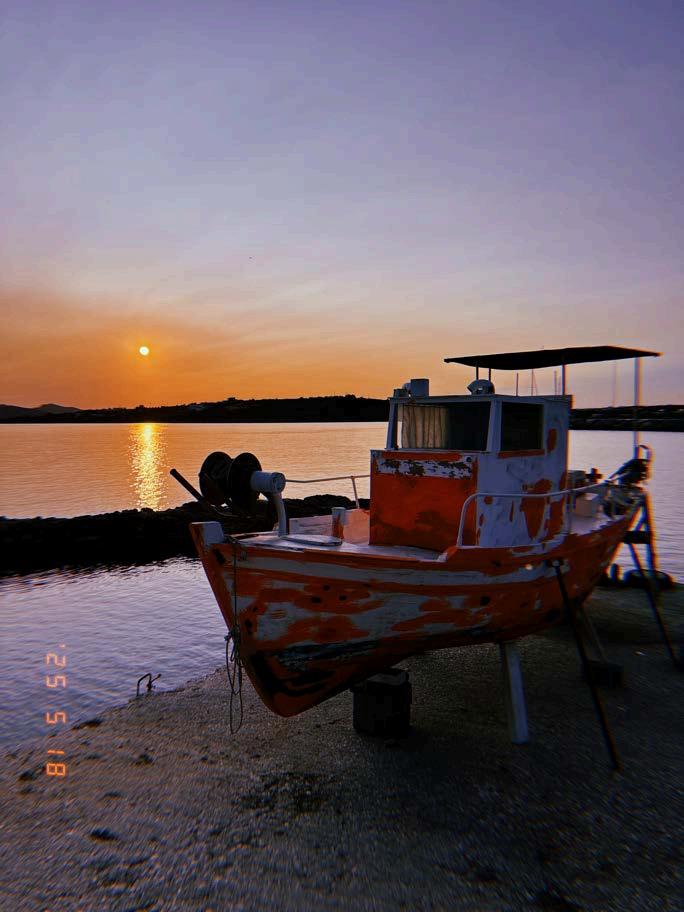
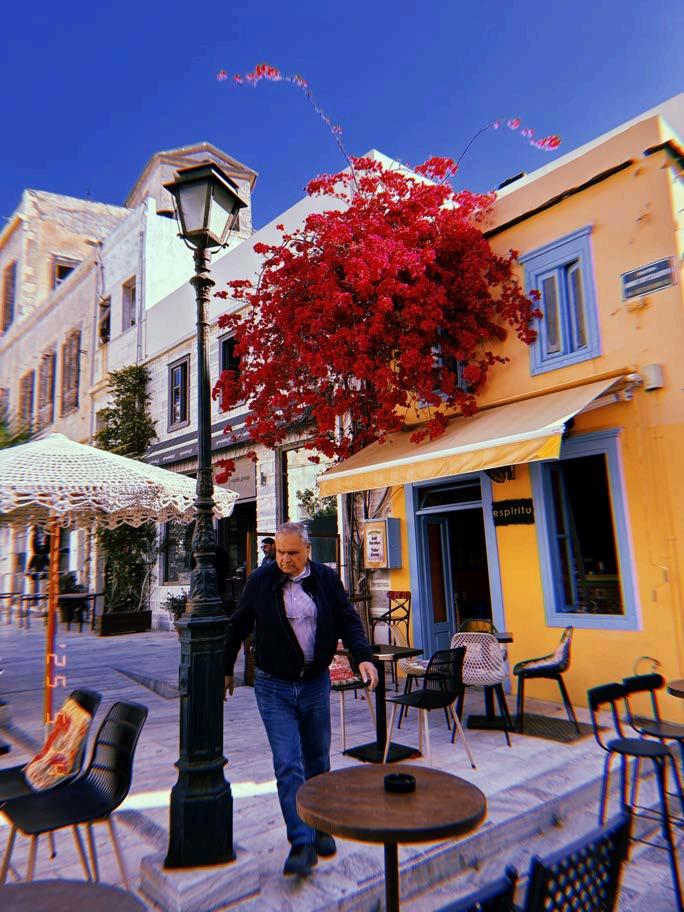
“good morning” SYROS, GREECE
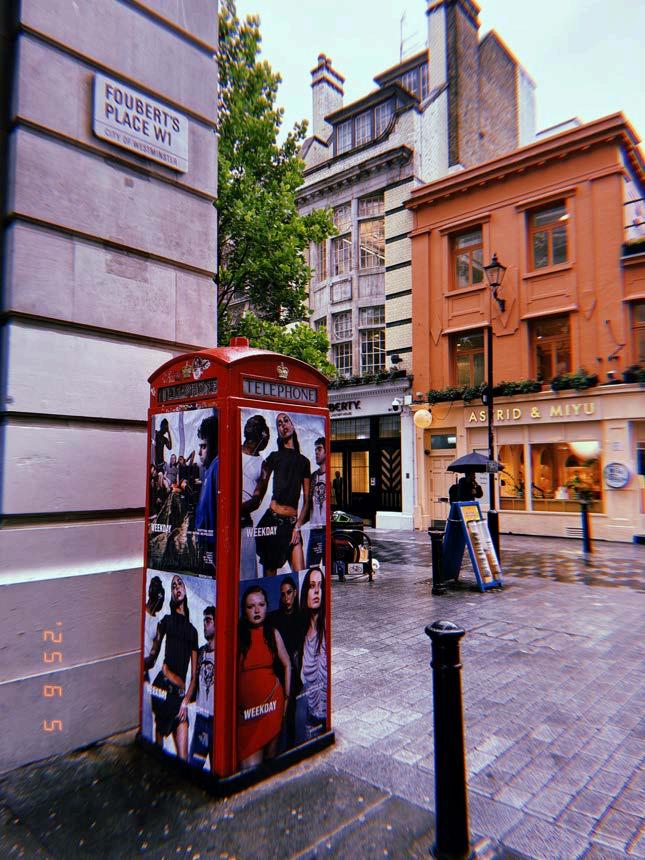
“disco never dies” SAINT TROPEZ, FRANCE
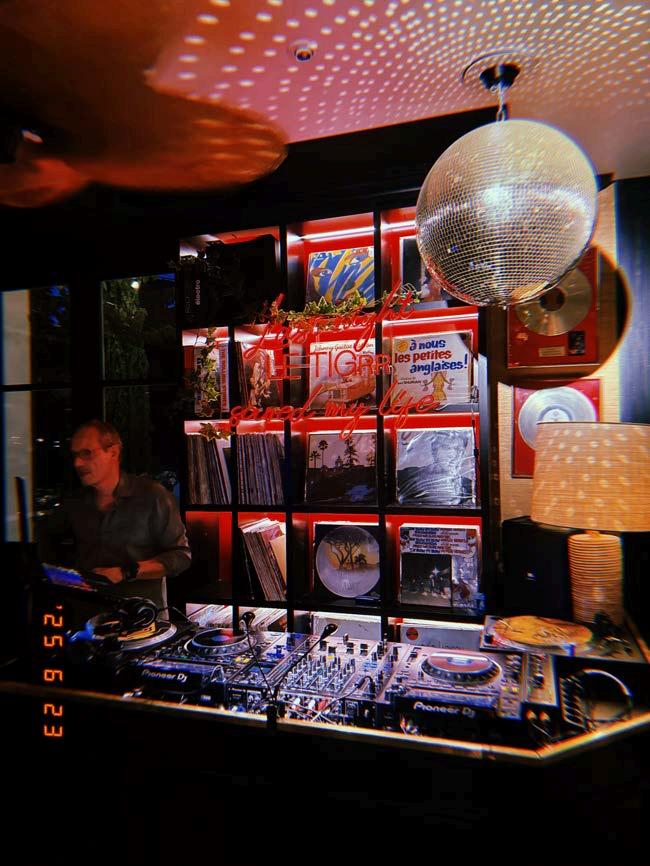
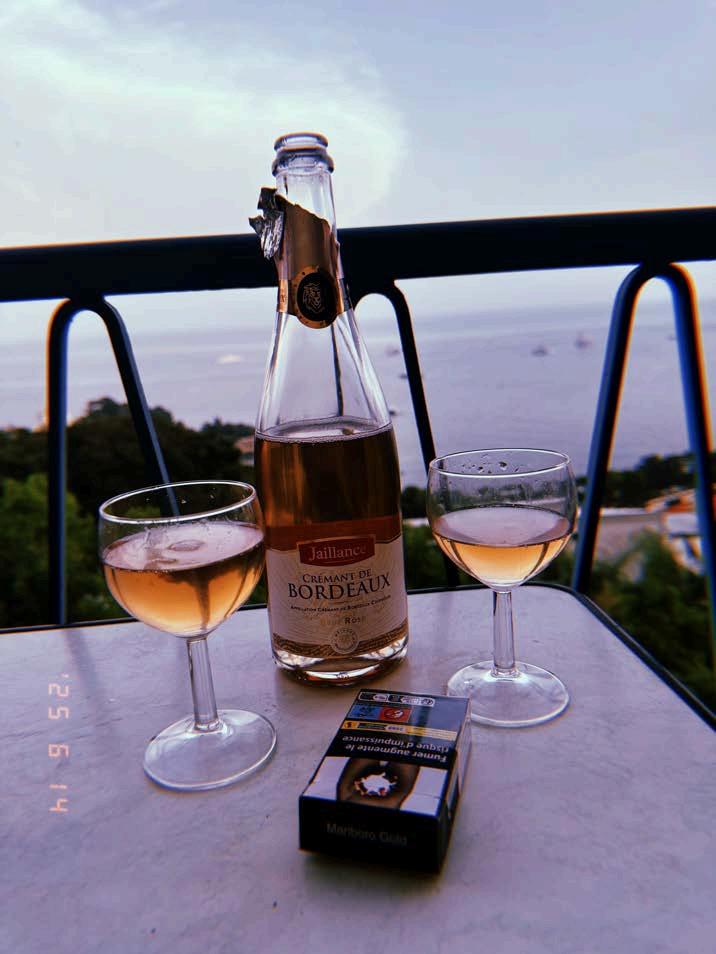
MONTE-CARLO,“locationgatekept”MONACO
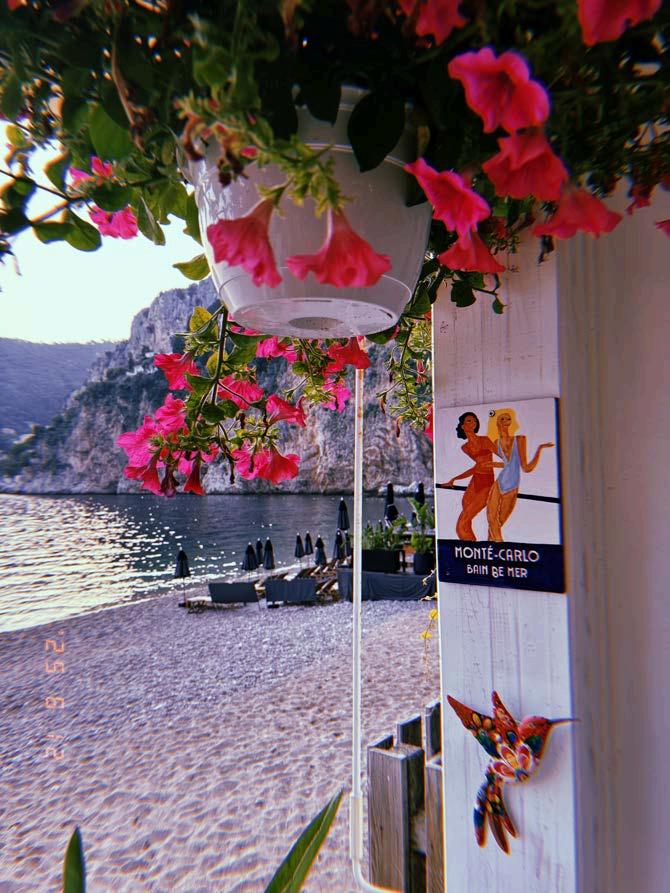
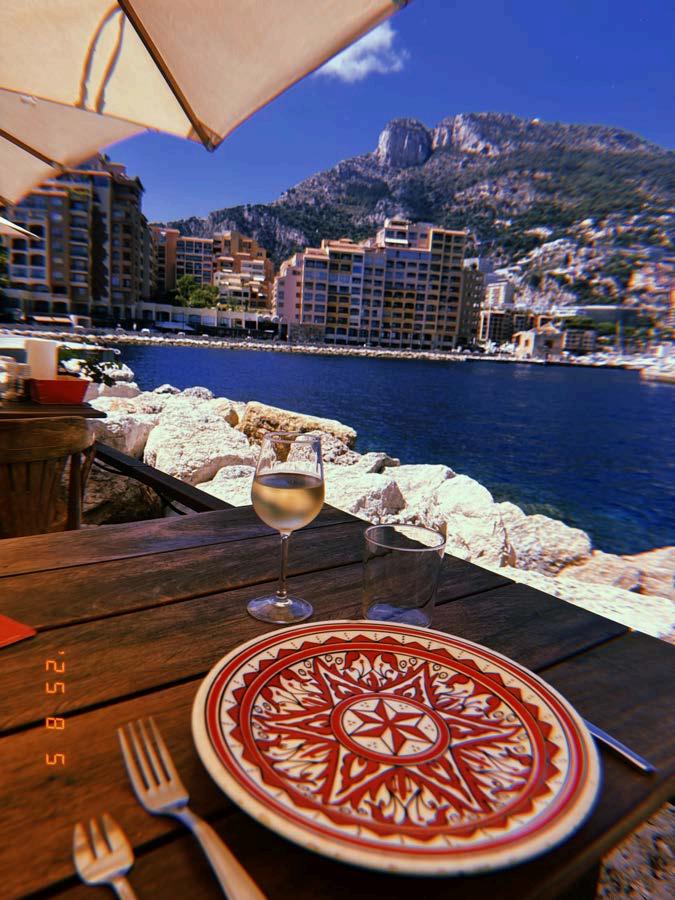
“the tourists went home to Nice”
CAP D’AIL, FRANCE
“summer on the Saône” CHALON-SUR_SAÔNE, FRANCE
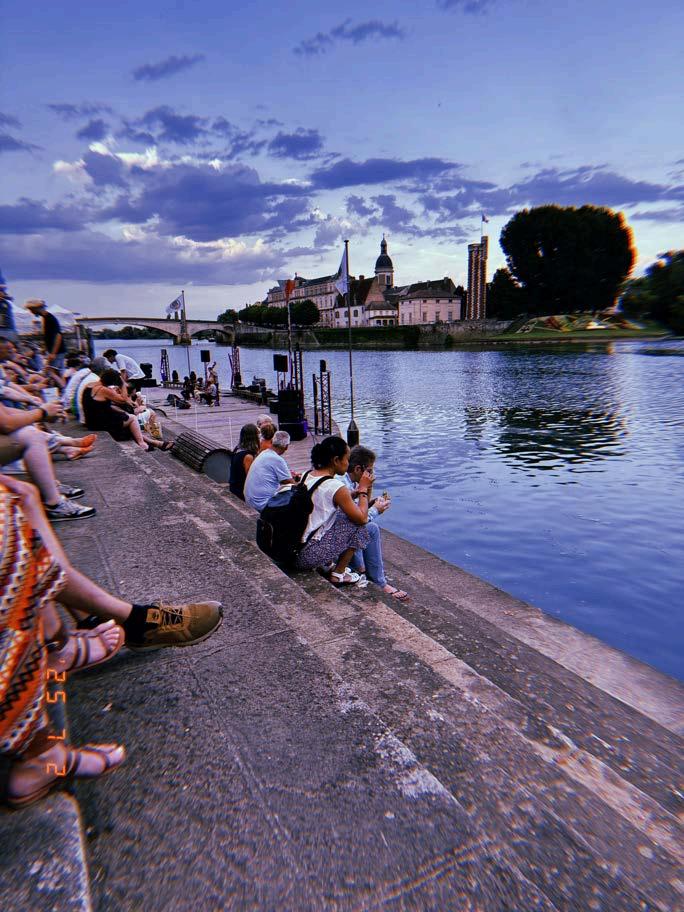
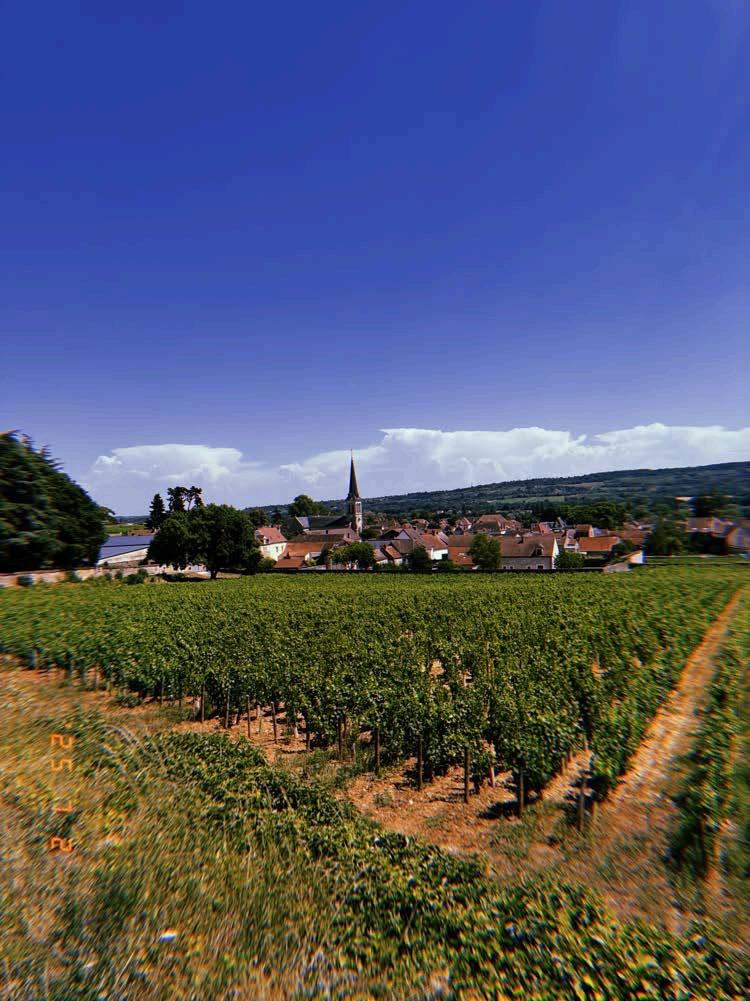
“40 celsius in the vineyards”
“blend of vintages” GIZA, EGYPT

“pastoral?”

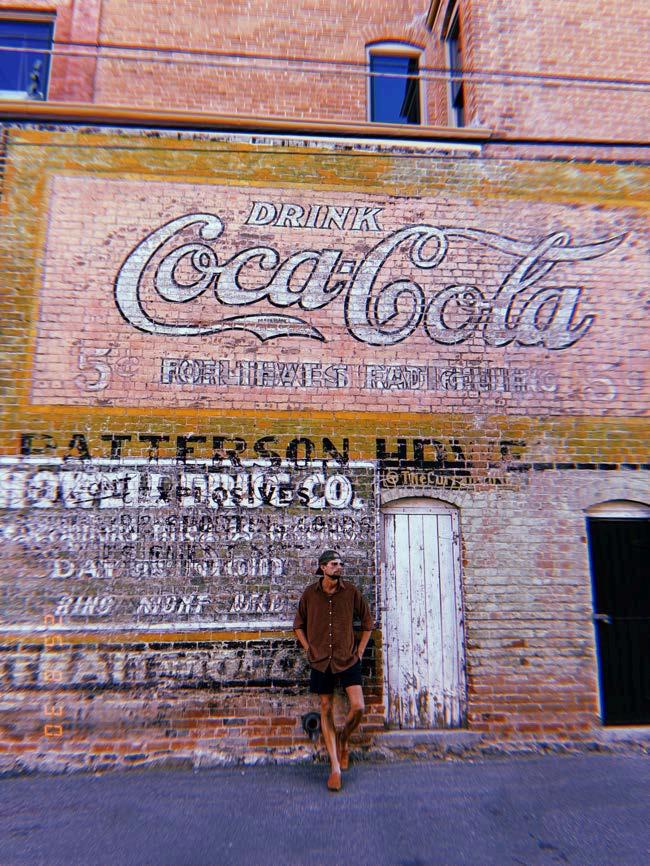
“echoes of industry” CHISINAU, MOLDOVA