Playing it Strait
Middle
Euro balance
EU
Power surge
India’s

Middle
EU
India’s
From





























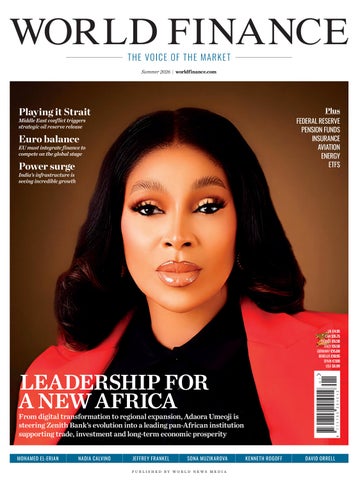
Led by Dame Adaora Umeoji, Zenith Bank is building on a strong legacy of profitability, innovation and sustainability while advancing its ambition to become a leading pan-African financial institution
The EU is pursuing deeper financial integration through banking, capital market and digital euro reforms to boost competitiveness and autonomy, but national interests continue to impede progress
DESIGNER:
Sam Millard
REPROGRAPHER:
Robin Sloan
PRODUCTION MANAGER: Richard Willcox
WEB AND MOBILE DEVELOPMENT:
Scott Rouse
VIDEO PRODUCER:
Paul Richardson
EDITORIAL:
Hannah Duncan
Laura French
Courtney Goldsmith
Neil Hodge
Jemima Hunter
Graham Jarvis
Alex Katsomitros
Claire Millins
John Muchira
David Orrell
Selwyn Parker
Khatia Shamanauri
David Worsfold
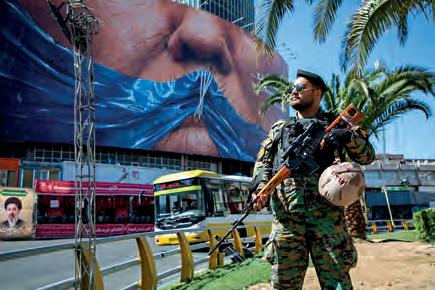
The Middle East conflict has disrupted global oil supplies, highlighting the importance of strategic petroleum reserves as countries use emergency stockpiles to cushion economies against energy shocks
Middle East conflict has tested war-risk insurance markets, driving claims across shipping, aviation and cyber sectors while highlighting insurers’ role in sustaining trade during geopolitical crises
CONTRIBUTORS:
Amanda Akien
Selin Bucak
Vikki Davies
Antonia Di Lorenzo
Mohamed El-Erian
Jeffrey Frankel
Nick Hodgson
Emma Holmqvist
Ruth Kibble
Indrabati Lahiri
Sona Muzikarova
Kenneth Rogoff
Maryam Shahvaiz

ACCOUNTS:
Gemma Willoughby
ILLUSTRATORS:
Richard Beacham
Jim Howells
BUSINESS DEVELOPMENT:
Bryan Charles
Tom Crosse
Terry Johnson
Harry Lake
James Watson
Monika Wojcik
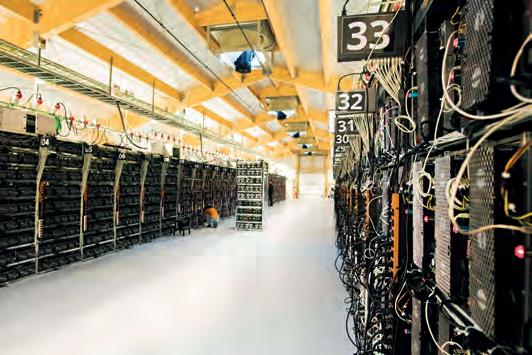
Crypto has failed as a global currency but evolved into financial infrastructure used for sanctions evasion, remittances, and settlement, complementing rather than replacing traditional finance
India’s rapid electrification, rail freight expansion, EV growth, and green energy push under Modinomics highlight a sweeping infrastructure-led transformation despite bureaucratic and policy challenges
The information contained within this publication has been obtained from sources the proprietors believe to be correct. However, no legal liability can be accepted for any errors. No part of this publication may be reproduced without the prior consent of the Publisher.
© World News Media Ltd, 2026 Printed in the UK - ISSN 1755–2915
Editorial on pages 30–37, 52, 56, 60–61, 110 & 170 © Project Syndicate, 2026
Email: enquiries@wnmedia.com
9 The
24 Financial History
We examine the history of oil crises, from the 1973 embargo to Covid, Gulf War shocks and recent geopolitical disruptions
26 Profile
Sundar Pichai began his career at Google in 2004, working his way up from product management to the top job in 2015
30 Comment
Kenneth Rogoff on AI productivity, Jeffrey Frankel on US fossil fuels, Soňa Muzikárová on data centre security and Mohamed ElErian on future-proofing the global economy
186 The Econoclast
Toronto’s stalled condo market has highlighted the need for reliable predictive models that cater for uncertain times
98 Currencies
Barry Eichengreen argues that US politics is the main threat to dollar dominance amid rising currency fragmentation
100 Trading
CFI’s CEO Ziad Melhem says technology has democratised investing, creating younger, multi-asset traders 104 Exchange-Traded Funds
Ireland dominates European ETFs, led by regulatory expertise and scale
108 Global Finance
Geopolitical shocks no longer guarantee traditional gold safe-haven performance
114 Superhubs
Hong Kong and Singapore operate as complementary financial hubs balancing regulatory stability, and global capital flows
116 Theme Parks
Projects like Puy du Fou may redefine British tourism through immersive storytelling and large-scale attractions
44 Federal Reserve
Trump’s attacks on Fed independence raises concerns about politicised monetary policy and global financial stability
46 Payments
Stablecoins are reshaping cross-border payments with faster, cheaper, regulated global adoption
48 Latin America
Banreservas turns diaspora remittances into investment and economic development
50 Financial Inclusion
Cooperative finance is helping to drive inclusive growth through ESG and green lending
54 Asia
Sampath Bank’s digital transformation has improved inclusion, efficiency, sustainability and growth
60 Europe
Europe strengthens investment, energy and defence amid global uncertainty
124 Geopolitics
Geopolitics is reshaping global finance as sanctions, reserves and safe havens evolve amid increasing political risk
126 Corporate Governance
Companies are reversing DEI and net-zero commitments, triggering boycotts and shareholder revolts
136 Artificial Intelligence
AI may displace millions of jobs while reshaping work, creating new roles and widening economic inequality risks
142 Cybercrime
Cybercrime is rapidly growing, causing massive global economic damage
144 Technology
iGaming growth now depends on integrated tech, speed and operational consistency
70 Asset Management
A number of firms are combining digital innovation, sustainability and client focus
78 Pension Funds
Chile’s pension reform strengthens longterm savings, investment discipline and innovation
82 Private Capital
South-led philanthropy is empowering local leadership through impact investing
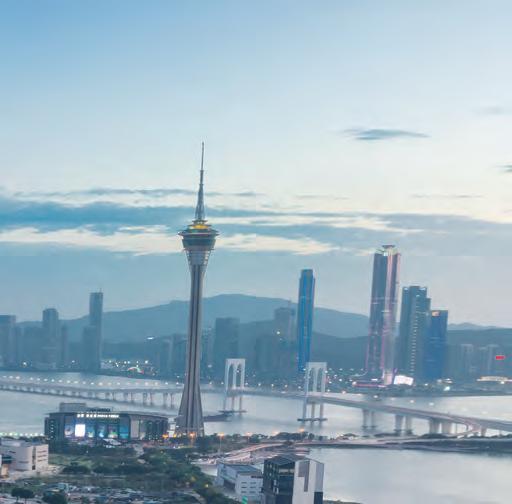
86 Macao
The country continues to develop as a wealth management hub through policy, innovation and connectivity
88 London
Dame Susan Langley has reshaped the City of London Mayoralty into a modern, business-focused ambassadorial role
90 Sovereign Funds
While Norway made North Sea oil into a $2trn fund, the UK spent its revenues, leaving a missed compounding opportunity
156 Digital Data
National data platforms are becoming strategic economic assets reshaping governance
158 Management
AI challenges boards to improve judgement, not just efficiency gains
160 Aviation
Saudi Air Navigation Services, a leading MENA provider, is supporting aviation growth while integrating sustainability
164 Sustainability
Şişecam is driving sustainable glass innovation through trust, scale, and discipline
170 Energy
North Sea offshore wind is shifting from climate ambition to energy security
174 Healthcare
Massimo Radaelli discusses how Crofelemer targets rare intestinal failure using innovative botanical therapy
















Harbin’s kite festival turns the winter tourism hub into a spring spectacle, underscoring how China’s domestic travel and leisure economy continues to unwind. Travel and tourism now contribute close to 10 percent of global GDP, with China’s internal tourism spending widely seen as approaching pre-Covid highs.


Ever since the pandemic ended, central banks have been reassuring us that high inflation is ‘transitory’: a temporary side effect of the war in Ukraine, Covid-related supply chain problems and the green transition. The war in Iran and the resulting pressure on shipping routes have put paid to that illusion, exposing an uncomfortable truth: inflation is not a temporary blip but a structural condition of our economy, no less than stock market bubbles. Parallels with the 1970s oil shocks are hard to miss. Then, as now, a Middle East conflict triggered an energy crisis that reshaped the global economy. As oil prices and transport costs surged, output collapsed. Inflation expectations became unanchored, feeding into wage demands. Policymakers spent years resisting the idea that inflation was no more than a cyclical phenomenon, until some strong medicine by the Fed – aggressive monetary tightening coupled with a recession – finally tamed the beast.
The pattern is familiar, but current inflation may be more treacherous. True, oil accounts for a smaller share of the energy mix, but it remains significant enough to cause disruption. The closure of the Strait of Hormuz has created supply chain bottlenecks that will not easily unwind, even after the conflict ends. More broadly, the world is becoming more geopolitically fragmented, making trade more expensive. Globalisation is in retreat, as governments reshore industries and prioritise security. Add demographic pressures due to ageing populations, and persistent inflation becomes more of a feature than a bug. Yet policymakers still insist that it can be tackled through monetary policy, despite repeated inflationary surges suggesting otherwise. That increasingly resembles wishful thinking. Future economic historians may come to view the past few decades – an era of ultra-cheap money and low inflation – as a historical anomaly, driven by the reintegration of China and former communist countries into the global economy, and by central bank responses to the Great Recession. Unfortunately, the coming decades will look very different. We will face higher prices and recurrent supply shocks driven by the US–China rivalry, with governments struggling to balance growth with stability. The sooner we acknowledge that possibility, the better prepared we will be for what comes next. TO READ MORE FROM WORLD FINANCE COLUMNISTS, VISIT: www.worldfinance.com/contributors
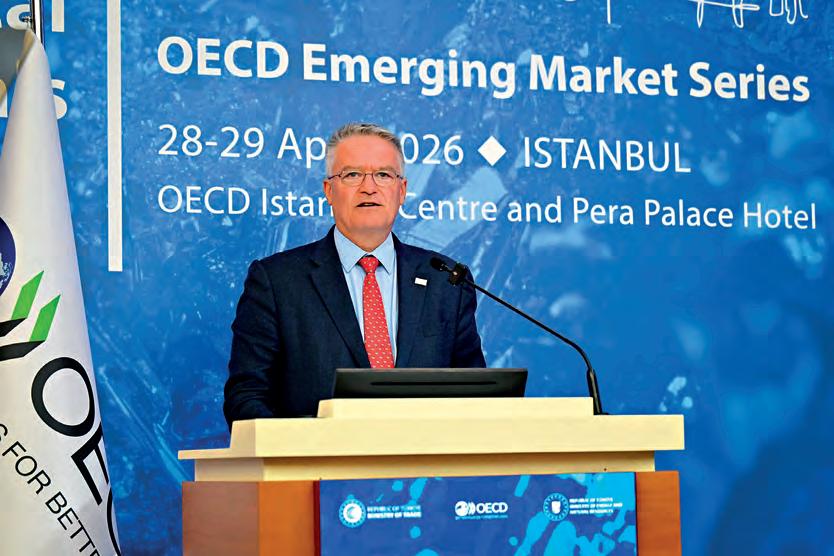
Key minerals that underpin essential digital and renewable energy technologies are facing growing export restrictions, risking a supply squeeze, the Organisation for Economic Cooperation and Development (OECD) has warned. Restrictions for minerals such as cobalt, manganese, graphite and rare earth elements, which are in high demand for everything from smartphones to AI chips and wind turbines to electric vehicles, have increased steadily over the past 15 years (see Fig 1). Now, they have reached an all-time high that is five times their 2009 level, the group found. “Countries around the world depend on reliable access to critical raw materials for economic growth, innovation and energy security,” OECD secretary-general Mathias Cormann said at a forum in Istanbul. “Export restrictions can increase supply chain vulnerabilities in highly concentrated supply chains by limiting export volumes and driving up prices.” In recent years, despite a slowing of restrictions, a wider range of countries have
Highly restrictive measures, such as export prohibitions and quotas, have become increasingly common. Countries cite revenue generation as their rationale, but the OECD warns that the eff ects are far reaching, raising global prices, tightening supply and distorting markets. “Combined with other non-
introduced new rules on exports. And while demand for these materials is rising rapidly, supply chains remain highly concentrated and slow to adjust, with the top three countries for cobalt, lithium and nickel each accounting for over two-thirds of global production. For rare earth minerals, that rises to nearly 90 percent.
market policies and practices, they increase the risk for supply chain disruptions and threaten economic security,” the group said. Countries around the world are working to rely less on imports of critical minerals, with the US and EU recently signing a MoU on a strategic partnership to reduce their dependencies and create transparent markets.
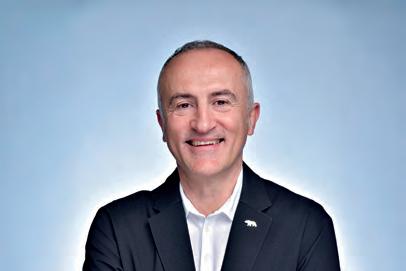
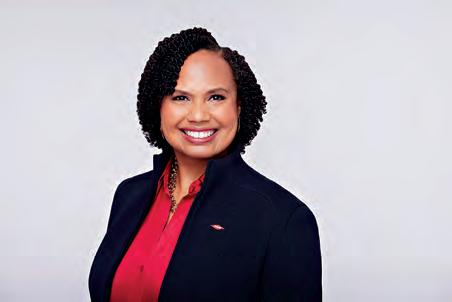
Karen Carter CEO Dow
Thirty-year Dow veteran
Karen Carter was named the next CEO of the chemicals giant. Carter started her career with Dow in 1994 as an intern soon after graduating from Howard University. Most recently employed as the company’s chief operations officer, Carter has held roles including president of the packaging and speciality plastics department, as well as leadership roles across numerous business arms, and even a stint as human resources officer and chief inclusion officer. Carter will replace Jim Fitterling, the CEO for the past eight years, who will stay on as executive chair.
VOICE OF THE MARKET
Despite challenges from tariffs, supply chain disruptions and other geopolitical upheaval, all signs point to more of the same vision and strategy from Carter. Fitterling said in a LinkedIn post that the appointment “reflects a deliberate, multi-year succession process designed to support consistent execution as we continue advancing Dow’s strategy.”
Silvio
Napoli CEO Lucid
Luxury electric vehicle maker Lucid appointed Silvio Napoli, former head of Schindler Holding, into its top role, with interim chief executive Marc Winterhoff returning to his prior role as chief operations officer. The announcement came amid a flurry of investment news, including funding injections from Uber and the Saudi Arabian Public Investment Fund. Despite sustained revenue growth, Lucid has yet to report a profit due to slow sales. With no automotive background, questions may arise over whether Napoli is the right pick to lead Lucid to the green.
Noting that Lucid already makes excellent products, Napoli said to Bloomberg that his strategy is to mirror the firm’s engineering excellence throughout the rest of the business. Since unveiling plans for three new midsize models, including a midsize SUV and one to compete with Tesla’s Model Y, it is hoped the lower price point will boost Lucid’s sales.

CFO Snap
Tech firm Snap’s CFO of nearly eight years is stepping down, with Doug Hott, its VP of finance, strategy and corporate development, to succeed him. Hott joined Snap in 2019 after spending four years at Amazon’s Prime Video. In a memo to staff, CEO Evan Spiegel said Hott’s appointment “builds on nearly seven years of close partnership with me across our strategic planning processes, capital allocation and restructuring efforts.”
He added that Hott “has been a longstanding advocate for doing more with less, while upholding our commitment to creating long term value for our shareholders.”
Hott’s appointment comes as Snap accelerates investment in AI while slashing 16 percent of its global workforce, a move Spiegel said will reduce costs by more than $500m a year and establish a path to profitability. It also follows pressure from activist investor Irenic Capital Management to ‘course-correct’ from a hiring spree during 2020.


Cryptocurrencies once ruled as the niche and slightly shady area of the finance sector where those in the know could make big bucks. Today, another corner of the industry is seeing booming growth that can only compare to artificial intelligence’s rapid rise. Prediction markets are thriving, with investment firm Bernstein estimating that volumes bet over the likes of Kalshi and Polymarket (the sector’s two largest platforms) will hit $1trn by 2030. This year, Bernstein said prediction market volumes are on track to more than quadruple, with bets soaring in the first few months of 2026. The two largest players alone saw nearly $60bn in market volume in the year to date – more than in all of 2025.
Companies like Kalshi, which is a federally regulated derivatives exchange and clearinghouse that controls more than 90 percent of US prediction markets, allow people to bet on a huge range of current events. Everything from how many tweets Elon Musk will send a month to serious outcomes of war and politics is fair game. Essentially, it is a relatively new avenue for gambling, having only taken off in the US in 2024. But these markets have drawn no shortage of controversy. The Biden administration attempted to stop allowing bets over the outcomes of political events back in 2024; however, Kalshi managed a legal victory that allowed prediction markets to expand even further. There are also concerns over insider trading. A soldier in the US who was involved in the capture of President Nicolás Maduro of Venezuela, for example, was recently charged with using classified information to bet after winning more than $400,000. While firms say they are tightening their safeguards against insider trading, a lack of clarity over regulation could hold the sector’s growth back. “Legal action is now pending in 14 states, plus another four congressional bills are also pending amid concerns around insider trading,” analyst Julie Hoover of Bank of America wrote in a note. And while new names are beginning to emerge and gain ground in the US, they haven’t seen the same success in Europe, with European Union regulations fending off homegrown markets. It will be interesting to see what the future holds for this controversial market.
TO READ MORE FROM WORLD FINANCE COLUMNISTS, VISIT: www.worldfinance.com/contributors


Last year, Emmanuel Macron admonished leaders in Africa’s Sahel region for being “ungrateful.” With uprisings by former colonies spreading like wildfire, Macron saw a region without the decency to say “thank you” for France’s role in combating insurgencies and keeping most of the governments in power.
The French President’s rebuke did not come as a surprise. For decades, France had deployed highhandedness in its relations with its former colonies in West Africa. Through the largely disparaged ‘Françafrique’ system, Paris was able to build strong political, economic and military networks designed to preserve absolute influence. To critics, ‘Françafrique’ has been nothing but an aphorism for neocolonialism.
The structures that France built in Francophone Africa are crumbling. Most of its erstwhile cheerleaders such as Mali, Niger and Burkina Faso now want nothing to do with their former master. Diehard cronies such as Ivory Coast, Senegal and Chad are also projecting hostilities. France is being pragmatic and understands the outright resentments can only intensify. For this reason, Paris knows it has to rethink and realign its engagements with Africa, a continent being courted by major powers and where losing influence could be calamitous. To sustain some form of grip on Africa, France is now looking east. Kenya, a regional economic powerhouse and a country whose leader enjoys a rare camaraderie with Macron, is being used as the springboard. Kenya’s first big act was hosting the 2026 Africa–France Summit, the first time it has been held in an English-speaking nation. To appeal to all and sundry, the event was dubbed the Africa Forward Summit.
The significance of the event was in the rhetoric and the baskets of goodies. Obviously, Macron was playing to the gallery stating that Africa and France enjoyed a “partnership of equals.” The tangible, however, was in France committing to invest $27bn in the continent. Going by past summits, pushing through the commitments is a different ball game altogether. Having lost control of most of West Africa, France must hope its diplomatic charm offensive in East Africa bears fruit. With China, the UK, Russia and other powers already deeply entrenched, it has no guarantee.
TO READ MORE FROM WORLD FINANCE COLUMNISTS, VISIT: www.worldfinance.com/contributors
mergers & acquisitions
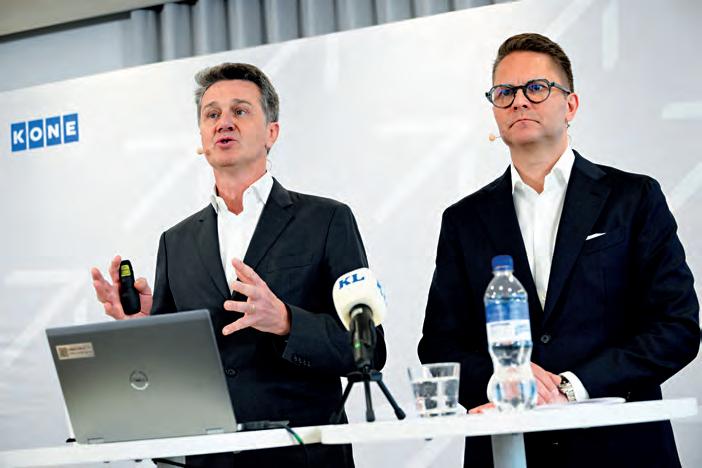
UniCredit has plans to create a ‘country leader and benchmark’ by taking over German lender Commerzbank. The £29bn deal is slated to be the biggest in Europe’s finance sector since 2009. In an April statement that set out the Italian multinational banking group’s plans to shake up Commerzbank, it said the Frankfurt-based firm was “insufficiently prepared for future challenges” and “overly focused on short-term delivery.”
“UniCredit believes that Commerzbank should reposition to be future-ready by accelerating sustainable growth and focusing on investing and transforming,” the group said in its statement. UniCredit first took a nine percent stake in Commerzbank in 2024. Now, it is Commerzbank’s largest shareholder with a more than 30 percent slice of the company, which has triggered a mandatory full takeover offer as per German financial rules. Commerzbank has previously opposed a tie-up, and Bettina Orlopp, CEO, criticised UniCredit’s outlined approach as “not a value-creating business combination – it is a stand-alone restructuring proposal that has to be evaluated against the existing strategy of Commerzbank that delivers real, reliable value with limited execution risk.
M&A
A consortium led by the delivery giant FedEx and private equity firm Advent will buy parcel locker company InPost for €7.8bn in a bid to expand its footprint across Europe. Following the deal, InPost, which is headquartered in Poland, will grow its existing markets in France, Spain, Portugal, Italy, Belgium, the Netherlands, Luxembourg and the UK. In the UK alone – home to the largest e-commerce market in Europe – the group plans to more than double its locker locations to 30,000 from 14,000 currently. “Together, we will strengthen our network and reach more consumers with enhanced fast and flexible delivery options as we continue our objective of redefining the European e-commerce sector,” said InPost founder Rafat Brzoska.
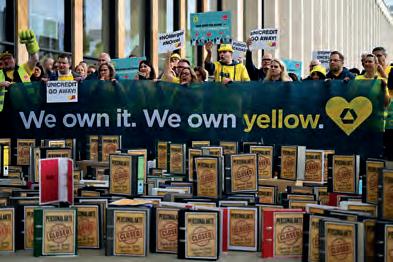
We are astonished that it took UniCredit more than 18 months to present a unilateral plan that lacks basic understanding of the drivers of our business model despite regular investor meetings during this period.” The German lender formally rejected UniCredit’s “hostile tactics and misleading characterisations” which it said undermined trust. Andrea Orcel, CEO of UniCredit, said that Commerzbank was becoming “increasingly unfit for a banking environment that is changing rapidly.” He said the bank was not accelerating investment in technology and AI. UniCredit’s proposal would refocus Commerzbank on its core markets of Germany and Poland, and Orcel claims the approach would boost the German lender’s net profits to about €5.1bn.
M&A
Spain’s Santander agreed to acquire US-based Webster Bank for $12.3bn. The combination brings together two “highly complementary franchises,” Spain’s largest bank said, while significantly expanding its scale, deposit base and capabilities in the US. Combined with Santander’s US franchise, the deal will position the group as a top-10 retail and commercial bank in the US by assets. “This transaction is strategically significant for our US business, while remaining a bolt-on for the overall group,” said Ana Botín, Santander executive chair. “It allows us to strengthen our franchise in both scale and profitability.” Chris Motl, Webster’s head of commercial banking, will lead the combined business’s commercial banking arm.
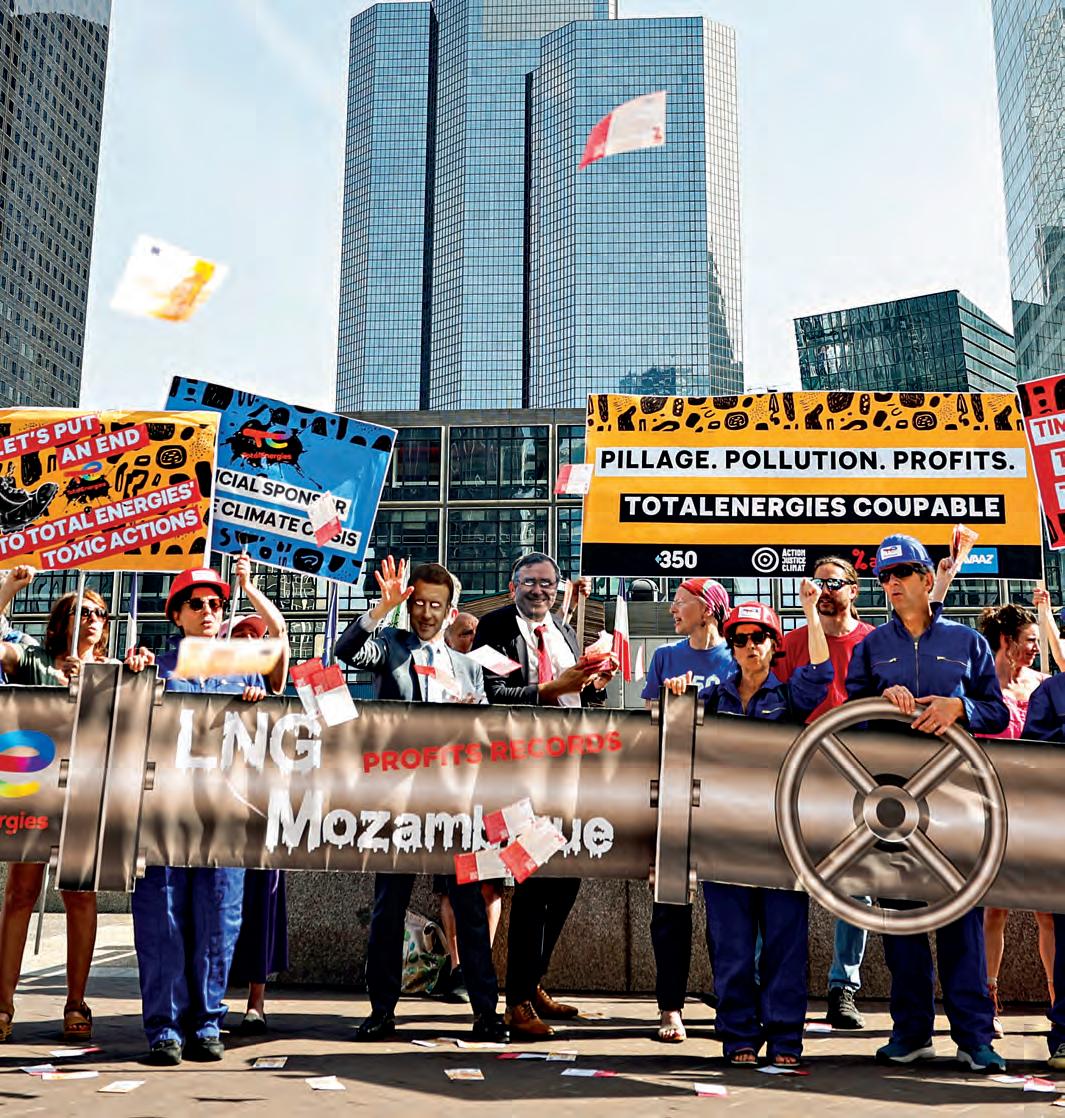

Protesters gather outside TotalEnergies’ Paris HQ as climate politics heats up Europe’s energy debate. The global oil and gas sector is projected to generate over $2trn in cumulative profits across 2024–26, keeping pressure high on firms as governments weigh energy security against net-zero commitments and subsidy reform.






A global boom in mergers and acquisitions is continuing in 2026, and industry insiders believe the cash will continue to flow. The total value of dealmaking activity surged by nearly 40 percent last year to a record of $4.9trn, according to data from Pitchbook, topping the previous record high set in 2021 (see Fig 1). As well as being fuelled by rabid interest in artificial intelligence deals, the acceleration was also down to lower interest rates and improved valuations. Experts suggest global deals won’t slow down either. One survey of 300 M&A executives by Bain & Company found 80 percent believe deal activity will be sustained or even increased
this year. Elsewhere, Tim Ingrassia, cochair of global M&A at Goldman Sachs, believes the cycle still has room to run.
“M&A cycles tend to be predictable and typically last six to seven years,” he said. “We are in year four, and while it is not impossible, it is really, really hard to interrupt the momentum of the cycle.” He believes deal activity will continue to flow from AI and from private equity’s need to sell long-held portfolio companies. As for the various macroeconomic uncertainties currently playing out? “We have gotten used to uncertainty,” Ingrassia said. “It’s the new normal.”
across Mexico, Canada and the US prepare to host the
experience. BMO Field – known as Toronto Stadium during the tournament, as FIFA reserves branding opportunities for its direct event sponsors – has had its seating expanded and a raft of lighting, video, sound and broadcast upgrades installed. While in Mexico City, Azteca Stadium (normally Estadio Banorte) has had a new roof with photovoltaic panels installed, expanded press, hospitality and seating areas, and improved facilities for supporters.
The stadium’s naming sponsor, leading Mexican bank Banorte, is also working to improve the network infrastructure and distribute modern POS technology to vendors, to deliver a streamlined cashless experience for match-goers. According to a Reuters report, cash remained king for the stadium’s vendors until its renovation closure, but mobile and contactless payments should dramatically improve the hospitality experience for the stadium’s 90,000 international visitors. Speaking to World Finance in a video interview last year, Grupo Financiero Banorte chairman Carlos Hank González said, “Banorte has been supporting families and businesses in our country for 125 years. We were born in Mexico, grew up with Mexico, and remain convinced of Mexico’s great potential.
“We are precisely focused on being the best bank for our customers… offering the best experience in the market, with the best customer satisfaction rates,” he said: “Getting to know each customer in depth, anticipating their needs, and offering tailor-made services. Our story is one of transformation and progress. We’ve evolved, modernised, and embraced innovation, but our core remains unchanged: putting our customers at the heart of everything we do.” TO FIND OUT MORE: www.worldfinance.com/videos

Bora Pharmaceuticals is a global contract development and manufacturing organisation (CDMO), providing development and manufacturing services to the pharmaceutical industry.
With 2,500 employees across 10 sites globally, distributing to more than 100 markets, its commitment to sustainability has become a “right to operate” for the pharmaceutical companies Bora works with.
J.D. Mowery, President of Bora Pharmaceuticals’ CDMO Division, sat down for a video interview with WorldFinanceat its recently acquired location in Baltimore, which is set to become Bora’s flagship facility for fill-finish services. “Sustainability’s important for Bora Pharmaceuticals for many reasons,” Mowery said. “Our board has made sure that it’s something that we stay focused on from a governance perspective. We want to make sure that we’re doing the best we can to leverage our resources, because it is an ethical obligation, but also… we’re seeing more and more within the industry that it’s an expectation.”
Larger pharmaceutical companies are prioritising sustainability and are demanding a similar commitment from the companies they partner with, he explained. “Their expectation is that we’re being a good steward of the resources that we have available to us, and we’re really taking great care of the environments that we’re working within,” he said.
Mowery was joining Bora’s sustainability team as it surveyed the Baltimore site – setting a benchmark for its current emissions and identifying opportunities for sustainability gains in the future.
“The next few months and years for the site are very exciting,” he said. “[We have] a high-speed isolator line that we’ll be bringing online in the next couple of weeks. The board just recently approved an AST, fully automated isolator line that’ll do vials, syringes and cartridges… that construction will be underway by July, and it’ll be coming online by the end of the year. That’ll allow us to manufacture clinical as well as orphan and small-scale commercial products.
“We truly believe that this site can be one of the flagship facilities for the Bora network,” he said. TO FIND OUT MORE: www.worldfinance.com/videos

After reaching a peak of initial public offerings in 2021, biotech listings have languished. But a flurry of activity has market watchers believing they are finally back in favour. April 2026 alone saw two blockbuster biopharma IPOs: Kailera Therapeutics, an obesity drug developer that raised $625m in what is thought to be the largest biotech IPO in Nasdaq history, and Alamar Biosciences, which raised $191.3m for the exciting, up-andcoming industry of protein analysis.
On their respective first days of trading, both share prices soared. In the year to April 2026, more biopharma companies had gone public at valuations of more than $500m than in all of 2025. In fact, last year just 11 companies completed IPOs in a stunning turn of fortunes from the industry’s heyday up to 2021. That year, more than 100 companies together raised nearly $15bn. From 2022 up until this year, share prices had turned sour. What’s fuelling the return of biotech?
Alamar’s CEO Yuling Luo told Fortune the company’s particular success was down to a long-awaited technological breakthrough in early disease detection of cancer and Alzheimer’s. Kailera, on the other hand, is working in the already hot market of GLP-1 drugs. Other companies that have launched publicly in 2026 are coming up with drugs and treatments for everything from immune diseases and cancer to hair loss.
A comeback in dealmaking activity has also been boosted by the ticking time bomb of a patent cliff-edge. With many large pharma companies expecting profitable drug patents to end in the coming years, they are snapping up biotech firms both large and small. In a report, Jefferies analysts noted the “breadth of Big Pharma’s appetite,” which ranged from large-scale $5bn acquisitions to smaller $1bn ventures. With analysts expecting between 30 and 35 biotech IPOs this year, the floodgates could well be opening.
While IPO interest has certainly picked up, continued growth is not guaranteed. In fact, some of 2026’s IPO darlings’ share prices have already come under scrutiny. Investors remain cautious over clinical-stage companies that don’t yet have products on the market. At the time of writing, the oncology-focused drugmaker Eikon Therapeutics, which raised $381m in its February listing, had seen its shares tumble 46 percent, while Belgium-based Agomab Therapeutics’ shares were down 31 percent, according to data from BiopharmaDive. Hair loss drug developer Veradermics’ share price, on the other hand, had soared nearly 300 percent on positive trial data.























World Cup fever lands in Toronto as the FIFA trophy tour draws crowds and sponsors. The last World Cup cycle generated over $7.6bn in FIFA revenues, while global sports sponsorship spend now exceeds $100bn, highlighting how even pretournament hype has become a major economic event in its own right.
With FIFA forecast to garner $8.9bn in revenues this year alone, the 2026 World Cup is projected to be the most lucrative sports event in history. Here we look at the numbers behind the tournament over the years, and how 2026 is projected to surpass all others, with 104 matches and an estimated seven million seats across the US, Mexico and Canada.
Breakdown of FIFA’s expenditure on the 2026 World Cup
The number of cities hosting matches this year across the three countries
104 Matches in this year’s World Cup – up from 64 in 2022
72%
Projected increase in FIFA revenues between the two most recent four-year cycles
90% Of FIFA’s $13bn revenues being reinvested to ‘boost global football development’
Revenues generated by the Paris 2024 Olympics, for comparison

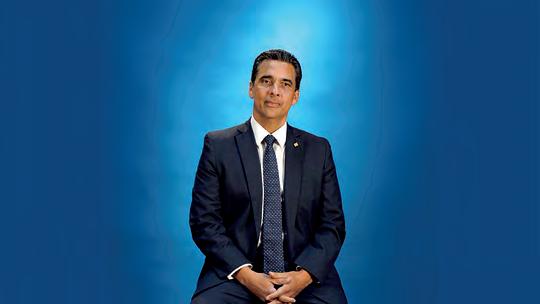
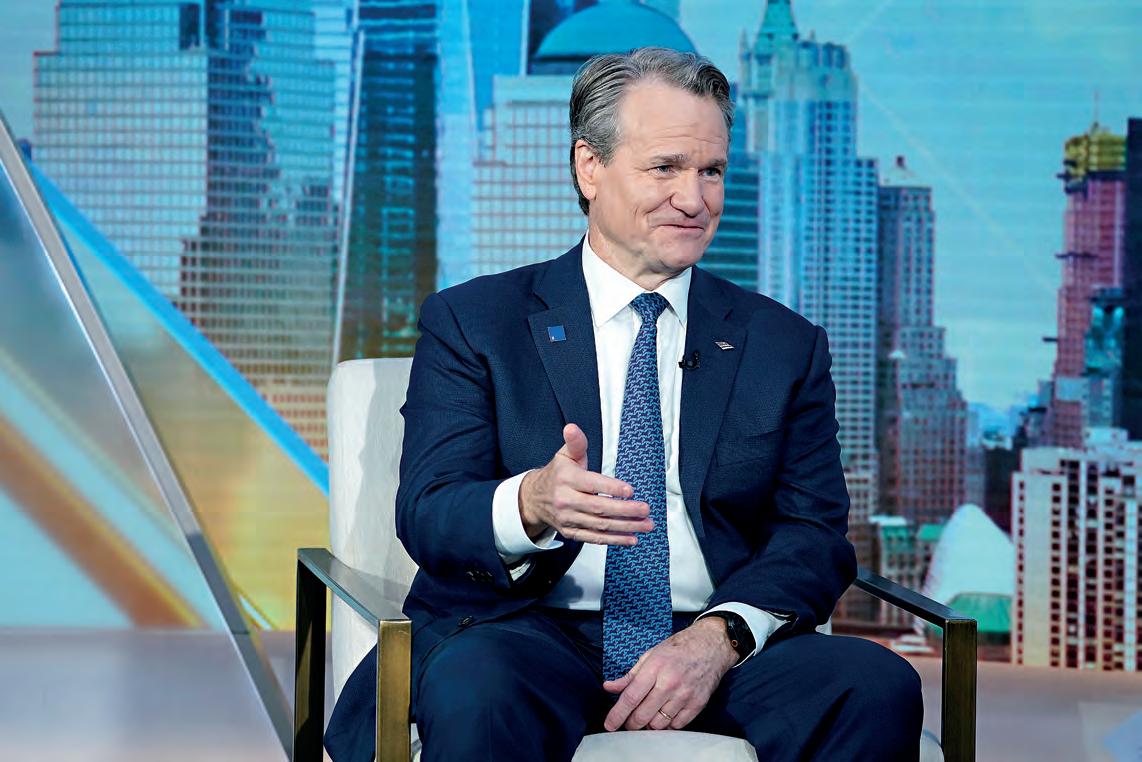
convenience with attentive, tailored support,” he explained. “Routine transactions are now streamlined through the teller area, accelerating service delivery. At the same time, our service officers are empowered to focus on high-value, personalised consultations, including credit guidance, investment strategies, and financial planning. In this enhanced environment, every in-person visit becomes a meaningful opportunity to deepen our relationship with each customer.”
The next step in BPD’s digital transformation will focus on deepening the integration of advanced technology with highly personalised human experiences – such as by using AI-driven tools and data analytics to anticipate its customers’ needs with greater precision and care.“We are committed to being there for our customers, when and where they need us most,” Ramirez said.
TO FIND OUT MORE:
www.worldfinance.com/videos
who himself announced 1,000 job cuts by “eliminating work and applying technology” – said: “AI gives us places to go we haven’t gone.” Meanwhile, more than 200,000 jobs in the European banking sector are at risk by 2030 as bosses look for AI savings, according to an analysis by Morgan Stanley, and in Australia, the country’s biggest bank cut 120 roles in April amid its AI push. In Silicon Valley, Meta has announced plans to cut 10 percent of its workforce, or around
In January, Meta chief executive Mark Zuckerberg said he thought 2026 would be the year “AI starts to dramatically change the way we work” – and he may be proved right. While tech companies in particular funnel huge sums into AI development, the very same companies are shedding jobs
8,000 jobs, “to run the company more efficiently and to allow us to offset the other investments we are making,” according to reports from an employee memo. Meta is estimated to spend $135bn on AI this year alone. Elsewhere, Amazon has this year announced 30,000 job cuts, or about 10 percent of its corporate and tech workforce to “strengthen the company by reducing layers, increasing ownership, and removing bureaucracy,” while software giant Oracle cut 10,000 employees to save money for its AI data centre expansion. In a first, Microsoft confirmed voluntary buyouts to shrink its workforce, while increasing spending on AI to about $98bn this year. Several smaller tech players have announced their own layoffs, including 16 percent of Snap’s workforce and 4,000 roles at Salesforce. Fintech Block has slashed 40 percent of jobs because with AI, it said, “a significantly smaller team” can “do more and do it better.”
at a rate alarming some economists. As of April 2026, the sector had seen more than 92,000 layoffs. It’s no surprise, then, that workers are uneasy. Job search website Glassdoor’s Employee Confidence Index found the tech sector had the largest year-on-year drop in confidence of any industry.
The PwC Women in Work Index 2026 looks at trends and progress in female employment, participation in the labour force and the gender pay gap across 33 OECD countries, using the latest available data (from 2024). Here we pull out some of the key rankings and figures from across the globe
1 Iceland (Rank 1)
Ranking first in the last four indexes, Iceland’s top score is underpinned by strong female participation in the workforce – 85.1 percent, 12 percentage points higher than the OECD average. Generous parental leave policies and childcare provisions are cited as key drivers (both women and men have a legal right to six months’ maternity and paternity leave, paid at 80 percent of their average ‘capped’ salary). There is still a gender pay gap of 9.1 percent, but this is significantly lower than the OECD Index average of 12.4 percent, according to the data, and has fallen from 16.7 percent in the last decade. The female unemployment rate is just 3.3 percent, compared with four percent for men.
2 Luxembourg (Rank 2)
Luxembourg has gradually climbed up the rankings over the past two decades, from 13th place in 2007 to second in 2024. This is the only OECD country where there is a negative pay gap, with women earning 2.4 percent more than men, according to the data (flipped from 2020, when men still earned more). The unemployment rate is also lower among women, at 6.2 percent compared with 6.6 percent for men. 71.7 percent of women in the country are in the labour force – compared to 77.3 percent of men – and the report notes Luxembourg’s statutory rights to part-time options as a key factor, although 80.4 percent of women working here are found in full-time jobs.
3
(Rank 3)
With a gender pay gap of only three percent (down from 9.2 percent in 2022), New Zealand scores extremely highly in the index and has been placed in the top four OECD countries for each of the last six years. A total of 79.2 percent of women in the country are in the labour force, compared to 85.9 percent of men, with 71.4 percent of those in full-time jobs –bolstered by a government subsidy that covers up to 20 hours per week of before and after-school care (and an impressive 50 hours during holidays). Unemployment among women is at 5.1 percent, compared to 4.8 percent for men, with a participation rate gap of 6.8 percent, which is slightly higher than Iceland.
4 UK (Rank 17)
The UK ranks first among the G7 nations, but there is still a long way to go before gender parity is reached. The pay gap here sits at 13.1 percent (down from 13.3 percent the previous year). Female unemployment increased between 2023 and 2024 – from 3.5 percent to 4.2 percent – driven by a surge in unemployment among young women, according to the report. 75 percent of women count among the labour force (versus 81.4 percent of men), with 67.7 percent of female employees in full-time employment – 9.1 percentage points below the OECD average. On a regional level, the South West climbed to first place, while London ranked last due to a decline in full-time work.
5 Canada (Rank 19)
Now in 19th place, Canada has consistently been falling down the rankings since the index first launched (the country was placed 8th in 2011). Stalled structural progress was cited in the PwC report as a crucial factor. The data shows a gender pay gap of 16.5 percent and a participation rate gap of 6.4 percent, with 76.6 percent of women found in the labour force and 76.1 percent of female workers in full-time jobs. The report notes unpaid caregiving as a driving factor, with women likely reducing hours or leaving jobs in the face of care demands, meaning ‘higher rates of part-time work with weaker progression’ and a higher concentration of women in lowerpaid care and service sectors.
6
(Rank 28)
With an average gender pay difference of 20.7 percent and a gap of 10.8 percent in the workforce participation rate, Japan comes low in the rankings, though slightly higher than South Korea, the only other Asian country in the OECD. However, the unemployment rate is among the lowest in the index – 2.6 percent for women and 2.7 percent for men – with a relatively high proportion of women in part-time jobs (61.6 percent of those working are in full-time employment). There has been a gradual improvement under multiple tenets in the past two decades; the pay gap has fallen from 33.9 percent in 2000, when the participation gap was also significantly higher at 25.7 percent.
7
(Rank 30)
The lowest European country in the index, one place behind Greece, Italy’s weaker score is partly due to a high participation gap (18.1 percent). 57.6 percent of women are represented in the labour force, which is up from 46.3 percent in 2000, and compares with 75.6 percent of men. The country also records relatively high levels of unemployment, at 7.5 percent for women and six percent for men, though this is down from 13.9 percent a decade prior. The gender wage gap is relatively low at 3.9 percent, however (down from seven percent in 2013), and this is less than many other European nations in the index. 71.8 percent of women working can be found in full-time employment.
8
(Rank 33)
One of only two Latin American countries included in the index, ranked two places down from Chile, Mexico is placed last due to a participation rate gap of 30.2 percent. This means that 51.5 percent of women here are in the labour force (up from 41 percent in 2000), versus 81.7 percent of men. There is also a gender pay difference of 11.4 percent; this has fluctuated over the years from a high of 18.8 percent in 2019, according to the data. Unemployment is low at 2.8 percent for both men and women, however – the lowest in the past decade – and of women who are in the labour force, 73.7 percent are in full-time jobs, compared with 87.8 percent of men.
Earlier this year, the Israel/US–Iran conflict and ensuing blockade of the Strait of Hormuz led to a surge in oil prices, with the cost per barrel topping $100 in March for the first time since the Russia–Ukraine war broke out in 2022. As fears of an economic slowdown loom, we look at how oil fluctuations have affected economies in the past – from the 1973 oil embargo to the Gulf War and Covid pandemic – and how this all-powerful commodity continues to rule the global economy.
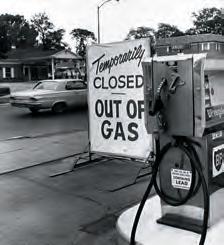
The world’s first major oil crisis came in 1973, when Arab OPEC members cut oil production and put an embargo on nations supporting Israel during the Yom Kippur war. The price of oil almost quadrupled, leading to skyrocketing costs for consumers, rapid inflation, a rise in unemployment and recessions in the US and UK until 1975. In the UK, a three-day work week was imposed in January 1974 to conserve electricity.

A second major shock came a few years later, triggered by the Iranian Revolution. Political unrest amid the collapse of royal reign in Iran led to a decline in the country’s oil production, sending global crude oil prices surging; they more than doubled from around $15 a barrel in January 1979 ($75 in real terms) to $40 (now $158) in April 1980. This led to a recession in the early 1980s, while Western governments began exploring other sources of oil.


Not long after, Ronald Reagan lifted price and production restrictions on domestic petroleum to encourage US oil production. He also lowered the oil windfall profits tax (an additional tax for energy companies experiencing a sudden boost in profits). This boosted the domestic oil industry, leading to a steep fall in oil prices that was further bolstered by a global glut – from around $38 (now $138) per barrel in February 1981 to $11 (now $34) in July 1986.

Another crisis hit two decades later. Global oil production had declined following the Iraq war and labour strikes in the UK and Nigeria – compounded by growing demand for oil from China and India. Barrel prices spiked from around $62 ($98) in February 2007 to $140 ($214) in June 2008. But the 2008 financial crisis saw oil prices collapse months later, tumbling to $42 ($64) by January 2009 as demand for fuel dropped globally.

The West was still heavily dependent on oil from the Middle East, however, and the first Gulf War in 1990 sent barrel prices soaring once again. In a dispute over territory and oil field ownership, Iraqi forces invaded Kuwait, setting fire to more than 600 oil wells in the country. Oil prices rose from $43 ($110) per barrel in June 1990 to $87 ($221) in October, but returned to pre-crisis levels when a USled military coalition liberated Kuwait.

When the Covid pandemic struck, global demand plunged again on the back of lockdowns and travel restrictions. A price war between Russia and Saudi Arabia intensified the blow, causing an oil surplus; barrels traded below zero for the first time in history on April 20, hitting $–38, as oil producers were forced to pay buyers to take barrels they couldn’t store. Prices eventually made a recovery, as economies reopened and OPEC cut its oil production.
In 2022, the Russia–Ukraine war led to another price spike, as sanctions on Russian oil by the US, UK and EU caused supply fears. The Brent crude oil price hit $139 per barrel ($157) on March 7, the highest since 2008. While the crisis didn’t lead to recession, it caused significant stagflation as inflation boomed and economic activity declined, fuelling the cost-of-living crisis and exacerbating existing post-pandemic inflation.

In February 2026, amid the Iran–Israel conflict, Iran closed the Strait of Hormuz – the waterway through which nearly a fifth of the world’s oil is usually carried. Crude oil prices soared by 64 percent in March, with WTI prices hitting $102 a barrel, as production and transportation of energy across the Middle East drastically slowed. Only time will tell of the future impact, but history suggests its effects could be felt for a while to come.



1M+
clients choose to trade with us


+110 countries served worldwide 99% of trades executed in <100ms
Sundar Pichai CEO, ALPHABET AND GOOGLE
Words by: Courtney Goldsmith
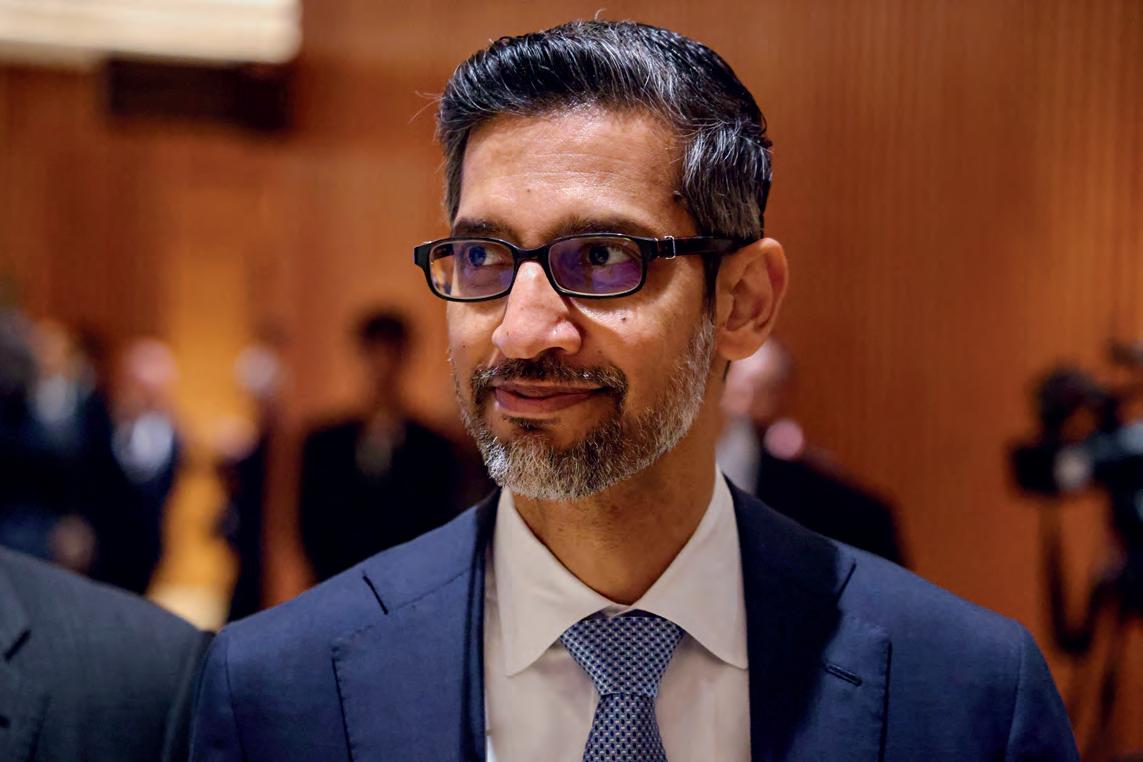
A tech CEO known not for dramatic predictions or wild antics but steady leadership and successful product delivery, Alphabet’s Sundar Pichai is something of a rarity in Silicon Valley. World Finance discovers how he rose through the ranks of one of the most valuable companies in the world – and why his biggest years could still be ahead of him
Every day, Google processes billions of search queries. As the most-visited website in the world, it owns the vast majority of global market share among search engines. But the technology behemoth is, of course, much more than a search engine alone. Google’s parent company, Alphabet, is behind several technologies that have become integral to daily life for huge swathes of people, from Google Maps and Gmail to Android and YouTube. Newer products, like Gemini, a generative artificial intelligence (AI) chatbot, and Waymo’s self-driving cars, are also taking off. In Alphabet’s first quarter earnings of 2026, the company said the number of paid subscriptions of the Gemini app had reached 350 million, while Waymo had launched in six new cities in 2026 and surpassed 500,000 fully autonomous rides per week, doubling in less than a year.
Sundar Pichai, the CEO of Google since 2015 and Alphabet since 2019, has not only led the tech giant to these incredible milestones, but he has also been the driving force behind several Google products that grew from unlikely upstarts to household names, such as Google Chrome and Drive. However, compared with the bosses of his competitors, Pichai takes a quieter, behind-the-scenes approach.
“Sundar Pichai’s career path is rooted in product leadership rather than founding mythology, and that shapes how he runs Alphabet,” Joe Crist, a cybersecurity and IT services CEO of Transform 42 Inc, which helps organisations scale sustainably, told World Finance. Crist puts Pichai’s success down to this brand of steady leadership. “He operates as a scale leader, focused on maintaining stability across a highly complex organisation rather than constantly reshaping it. That consistency gives engineering teams continuity and avoids the kind of frequent strategic shifts that can disrupt execution.”
Despite the monumental successes Pichai has overseen, the question on every investor’s lips today is whether the tech giant’s momentum can be sustained through the AI race, and whether its vast network of users will hinder its innovative potential or help it to come out on top.
Humble beginnings to tech titan
Born and raised in Chennai, southern India, Pichai arrived in the US in 1993 with a scholarship to study at Stanford University, where he earned his master’s degree in materials science and engineering. Not long after that, he obtained his MBA from the University of Pennsylvania’s Wharton School.
Pichai took up brief roles at semiconductor manufacturer Applied Materials and management consulting firm McKinsey & Co, but he had always been drawn to the allure of Silicon Valley. “I used to read about what was happening in Silicon Valley, and I wanted to be a part of it,” Pichai said in a 2014 interview at Delhi University. In 2004, he began his career at Google with a product management role. His first project was Google Toolbar, a feature that made it easier for users of Microsoft’s Internet Explorer and Mozilla Firefox web browsers to integrate Google’s search engine. From there, he was soon promoted to vice president of product development, and he played a key role in developing Google’s own web browser, Chrome. This was no mean feat. “When we built Chrome, we had one percent market share one year after we launched,” Pichai told Time. Now, Chrome is the most used browser in the world. As the years passed, Pichai continued to climb the ranks, helped by an almost uncanny ability to create products and software that customers really wanted. “He has an exceptional sense for craft and the details in a product, all the way down to the pixels on the screen, the sound of a voice, the tactile feedback,” Clay Bavor, who worked under Pichai at Google for a decade, told Time magazine. Pichai soon became a
“AI will touch every aspect of our lives, every aspect of society, every industry sector”
Sundar Pichai
1993
Pichai fostered his growing interest in computers by studying engineering at the Indian Institute of Technology in Kharagpur.
1995
After earning a scholarship to study at Stanford University, Pichai went on to earn his master’s in materials science and engineering.
right-hand man to Google co-founder Larry Page. “Sundar has a tremendous ability to see what is ahead and mobilise teams around the super important stuff,” Page wrote in a memo in 2014, announcing Pichai’s promotion to lead Google’s core products. “We very much see eye-to-eye when it comes to product, which makes him the perfect fit for this role.”
Pichai’s steady successes saw him reportedly pursued by tech rivals Twitter and Microsoft for leadership roles, but his loyalty to Google was rewarded with the top job in 2015, when Page and Sergey Brin created Alphabet as an umbrella company.
His work at the helm of Google, and later, after Page stepped down, Alphabet, included the creation of the Pixel smartphone; the launch of Google Home, previously known as
Following brief stints at Applied Materials and McKinsey & Co, Pichai took his first role in product management at Google.
2015
After rapidly rising through the ranks at Google, Pichai was then named the CEO, replacing co-founder Larry Page.
Google Nest following the $3.2bn purchase of Nest Labs in 2014; and a strong push for AI innovations. Pichai’s achievements propelled Alphabet’s market capitalisation over the $4trn mark in early 2026 – only the fourth company to ever do so – and his own net worth to approximately $1.7bn, according to Forbes “Pichai’s leadership trajectory is closely tied to product execution at planetary scale,” Will Steward, who has nearly two decades of experience advising fast-growing tech employers and jobseekers as CEO and cofounder of The SaaS Jobs, told World Finance. “His early work on Chrome and later Android positioned him at the centre of Google’s distribution infrastructure, which effectively became the foundation of the company’s global reach,” he said. “That background has
2016
Fuelled by an unshakeable interest in the world of AI, Pichai boldly declares that Google will be an ‘AI-first’ company.
2019
Thanks to his strong performance at Google and continued support from Page, Pichai was promoted to CEO of Alphabet.
shaped a leadership style focused on system coherence, where success is measured by how well large platforms function together rather than isolated product breakthroughs.
“As chief executive, he has presided over a shift from single-discipline dominance in search advertising towards a multi-layered platform business,” Steward continued. “His approach has been to unify and ensure that infrastructure, advertising, devices and cloud services remain technically aligned. This has allowed Google to evolve without losing continuity across its core systems.”
While Pichai’s career has risen to dizzying heights, he came from a modest upbringing; it has been reported that he and his brother slept on the living room floor of a small family home growing up, and Pichai once said his
father spent a year’s salary on his plane ticket to California so he could attend Stanford.
The journey of Sundar Pichai is one where opportunity and ambition collided to create a monumental success. “If he wants to do something, you’re not going to be able to stop him,” Caesar Sengupta, a former Google colleague, told Time magazine. “He is just going to be super nice about it. And then, you cannot move him.” Indeed, Pichai has generally been well liked as a leader at Google. In more recent years, however, he has faced criticism: first from Timnit Gebru, an AI ethicist who was fired in 2020 and said Pichai and other managers created “hostile work environments,” and more recently over sweeping job cuts.
Pichai’s story also champions the transformative power of technology –something that he is a firm advocate for. Growing up, Pichai had limited access to tech. He described being on a government waitlist for a rotary telephone for five years, and the radical impact when the family finally got one. “When you see the appetite and the desire for people to make their lives better by gaining access to technology, that is what compels me to go beyond,” he said in a 2022 interview on Stanford’s View From the Top podcast.
The AI race begins
Today, technology is quickly reaching heady new heights. Ever since OpenAI’s ChatGPT burst onto the scene in 2022 and transformed the general public’s understanding of the real-world potential of AI, investors and market watchers have sought to predict which of the Magnificent Six tech firms will come out on top. Some industry observers criticised Google for moving too slowly. Yet, as early as 2016 Pichai had declared Google to be an ‘AI-first’ company, shifting from a focus on mobile. For years, Pichai has worked in the background to shore up a strong foundation of custom-built chips, research and infrastructure to propel Google into the AI arms race. Today, Gemini accounts for a quarter of all AI traffic, up from just six percent last year, according to Similarweb.
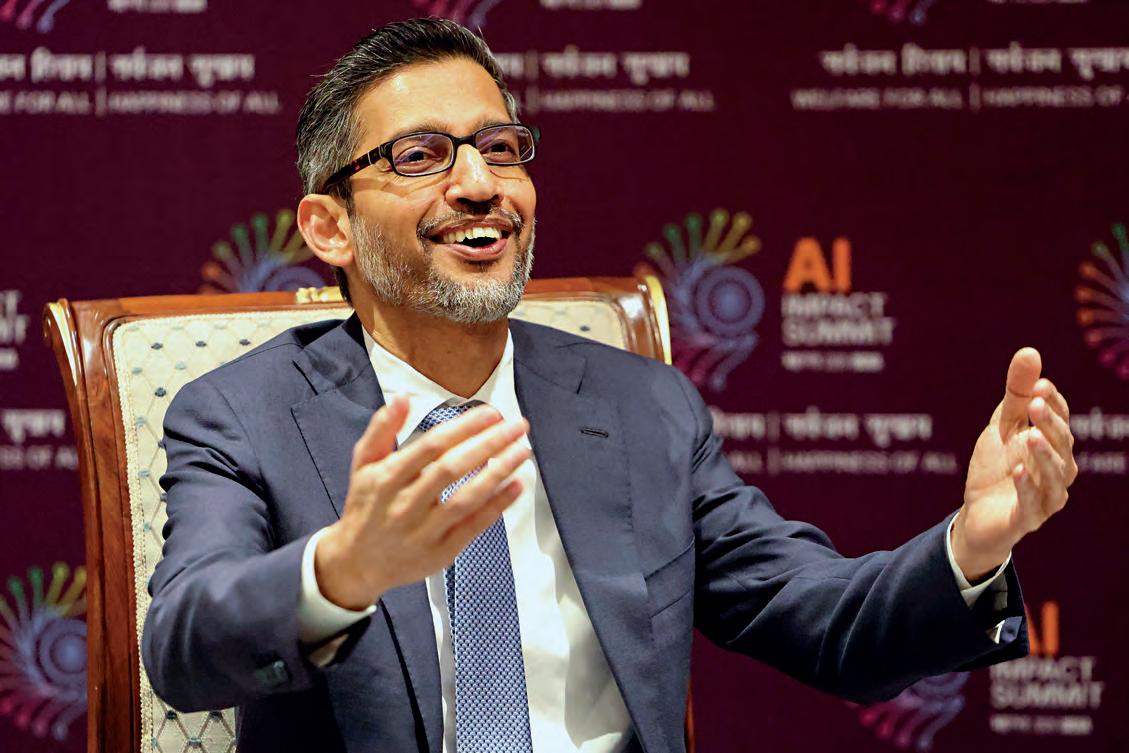
models beat a world champion in Go in a fivegame match. It was a clarifying moment for Pichai. “I understood the potential of the technology to make sharp jumps,” he told Time. Since then, he has pushed Google to implement AI in practical ways for users.
“Google is structurally strong in AI due to its full-stack control of model development and distribution,” said Steward. “Its custom silicon, global compute infrastructure and long history in deep learning research give it an end-to-end capability that few competitors can match. This enables efficient training and deployment cycles at a massive scale,” he pointed out. Google acquired DeepMind, its AI research lab, back in 2014, and it has spent the years since making quiet breakthroughs on everything from voice recognition to
The company’s integration-led approach has allowed it to become, seemingly, an overnight leader in AI technology. “Instead of focusing primarily on standalone AI tools, the strategy is to embed AI capabilities directly into existing products, which means new features reach users through systems they already rely on without requiring behaviour change,” Crist told World Finance. Google has a leg up here compared to any new tech start-ups. “Users don’t need to adopt entirely new platforms, which makes adoption more realistic in regulated or risk-sensitive environments,” Crist says.
Google Search, for example, integrates generative AI models into its core of information retrieval. “Search is evolving from a list-based interface into a synthesis layer where AI-generated responses reshape how users interact with web content,” said Steward. “This is a fundamental product transition rather than a feature upgrade.”
Even with one of the strongest AI research
deployment of AI features. Steward agreed: “Compared with competitors, Google’s advantage lies in vertical integration. It can train models, deploy them, and immediately place them inside products used daily by billions of users. That loop between infrastructure and interface is one of its most powerful assets in the current AI cycle.”
In-built ease and collaboration align with Pichai’s personal philosophy around AI.
Speaking on the Harvard Business Review ’s IdeaCast podcast in 2023, he described AI’s inflection point as being driven by human–AI collaboration. “Software engineers often do something called pair programming. We have found that two programmers working together are better than them working separately,” he said. “So you can now imagine AI being your paired programmer or paired financial analyst or name if you will. So I think that’s the direction, that’s the promise and we are seeing it happen.”
While AI has the power to transform life for many, Pichai is aware of its risks, too. In fact, speaking to the widespread fear of AI eating up jobs, Pichai admitted that the role of CEO would be “one of the easier things maybe for an
SUNDAR PICHAI IN NUMBERS
$1.7bn
Pichai’s net worth in May 2026 $4trn+
Alphabet’s market capitalisation
$20bn+
2026 revenue for Alphabet in Q1 750m
Gemini’s monthly active users
AI to do one day” in an interview with the BBC.
What’s more, Pichai has himself become “unsettled” by “the power of what is possible” with AI. On the IdeaCast podcast, he described engaging with a large language model with a persona of the planet Pluto. Together with his son, he had conversations with the chatbot and described it as a “wonderful learning tool” that could offer facts about the solar system. “But there was a moment talking to Pluto at some point I felt like it felt very, very lonely and the conversation slightly went to a darker place, and that was my first experience, which kind of unsettled me and showed the power of what’s possible, the effect it can have on humans,” Pichai said.
It made sense, he went on, considering the context: Pluto is in a cold, faraway place in the universe, “So no wonder that it kind of started taking some of those attributes in its personality.” But after this experience, he said he strives to balance the “amazing opportunities to be unlocked” with responsible innovation. “These are powerful models, and I think a lot of us are working on making sure we build in safety systems, we add a layer of responsibility before we really widely deploy it. It is part of the reason I think as Google, we have been more conservative in our approach given the scale at which we serve users,” Pichai said.
While Google’s AI capabilities have seemed to appear suddenly, in reality they are projects many years in the making. But with the AI race in full swing, Pichai has no intention of slowing down now. In fact, he is stepping up capital expenditure on AI. Earlier this year, Pichai announced that Alphabet would double capex spending to up to $185bn, well above analysts’ forecasts of $120bn. “Our capex spend this year is an eye towards the future,” he told investors. “The demand we are seeing across the board for our services – and what we need to invest in Google DeepMind and in Cloud – is exceptionally strong.”
Having long been an AI advocate, it is no surprise that Pichai is all in on the technology. Speaking on IdeaCast he called AI a ‘deep platform shift.’ “Many years ago I called AI the most profound technology humanity is working on and will ever work on, more profound than fire or electricity. And that was the reason we said our company is going to be AI first,” he said. “It will touch every aspect of our lives, every aspect of society, every industry sector, if you will.” And while many people are laser focused on generative AI thanks to the huge leaps seen by chatbots, Pichai believes this is just “a moment in time” and “one aspect of AI.”
“I think there is more progress to be had, and I do think we will go through some moments of ups and downs, but the progress I think will continue. I think we should channel all this excitement to make sure other stakeholders are getting involved,” he continued. From governments to nonprofits and academic institutions, Pichai is keen to see international communities coming together to develop frameworks to align on safety and responsibility for AI.
Regulation and red tape is nothing new for Google – Pichai has had to deal with European regulatory roadblocks and lawsuits in the US for alleged monopoly tactics. Speaking on Harvard Business Review ’s IdeaCast, he said AI is “too important an area not to regulate, and also too important an area not to regulate well.”
While he urged allowing technology to develop in its early stages, he acknowledged that safeguards should be built at the same time. In particular, he called for a framework where governments or regulators could validate AI models and ensure they are safe for public use. “We need to embrace the excitement and channel it in a way in which as society, as humanity, we are building the foundational blocks to tackle what is coming our way as well,” he said.
This is evidenced in Google’s approach to AI, which “prioritises reliability within
established workflows,” Crist says. “In sectors like healthcare or finance, that discipline matters more than speed. A fast but unstable AI tool creates operational risk, not efficiency.”
Alphabet is better positioned today to compete in the AI race than many had thought would be possible a year or two ago, Dhruv Datta, who specialises in mobile app development, told World Finance. “Alphabet appears to have significant depth,” Datta says, pointing not only to Gemini but also Google Cloud, custom-designed chips and years of AI development experience with Google’s search engine and Android platforms providing distribution channels for these technologies.
But technical capability alone is not enough to create a true AI superpower. “In order for AI to become widely adopted, it will need to be perceived as trustworthy, capable of delivering results rapidly, valuable and economically viable on a massive scale,” he said.
Is Pichai the man for the job? According to Neal Mohan, the CEO of YouTube, Pichai’s insights with AI “foreshadow these huge trends, but they are also very, very precise,” he told Time. Crist described his leadership style as “deliberate, incremental and low drama,” all of which has helped Pichai to steer a company of Alphabet’s size and technical depth steadily, especially during periods of regulatory pressure and cultural scrutiny. “This is not a style built on constant public repositioning or dramatic pivots, but one of operational control and consistency at scale, which is often underestimated in large technology organisations,” Crist said.
Going forwards, Datta said he believes Pichai’s biggest test will be achieving balance. “On the one hand, he must continue to safeguard the core search business which still drives nearly all of Alphabet’s revenue. At the same time, he will need to enable a transformation of how search operates. He will also need to make significant investments in the infrastructure required for AI applications while demonstrating that those investments generate sustained economic value.” And, perhaps most importantly, he “must be able to do so quickly without damaging the trust and reliability users currently place in Google,” Datta said.
In a time of revolutionary technologies, the temptation to ‘move fast and break things’ is great. But while Alphabet’s size may slow it down, Pichai has shown time and time again that being the first is not the same as being the best. n

Kenneth Rogoff FORMER CHIEF ECONOMIST, INTERNATIONAL MONETARY
AI-driven productivity gains are widely expected to ease advanced economies’ fiscal strains through higher tax revenues. But shifts in income distribution, rising spending pressures, labour disruption, weak regulation and geopolitical risks suggest deficits may prove harder, not easier, to contain
Many people seem convinced that the productivity gains from AI will solve the problem of unsustainable budget deficits in advanced economies. By showering governments with higher tax revenues, the thinking goes, AI will leave even the most profligate countries with shrinking deficits. That could be right. But there are many more reasons to think that such expectations are dangerously optimistic. For starters, AI seems likely to increase the share of capital in output while reducing the share of labour, which tends to reduce the tax intake. Absent a determined effort to increase taxes on capital income – which is becoming ever more difficult as wealth becomes more concentrated, politically powerful and mobile – it is unlikely that tax revenue will grow as quickly as output.
Moreover, even if revenues do grow, what assurance is there that the political system won’t respond by just ramping up spending and deficits even more? After all, the advanced economies are already very rich.
In principle, they could have easily managed their finances better if their leaders had found it politically expedient to do so. But being rich has never been an obstacle to going bankrupt. Voters have hardly begun to adjust to the realities of a higher-interest-rate world, where demographic decline and vastly increased needs for defence spending have introduced major new costs. As the median voter grows older, systems already biased against young people will become only more so.
A more immediate concern is that the transition to AI will not be smooth sailing. Many fear a sharp rise in unemployment as firms shed white-collar workers. Some commentators dismiss such warnings as ‘doomist,’ but they might ask themselves why so many top AI researchers subscribe to them. While some may have a financial interest in hyping the power of their models, plenty of independent experts share the same view.
The counterpoint is that there will still be many goods and especially services that require a large human component for the foreseeable future. Even if AI can perform some tasks at low cost, humans will be very well compensated to do what AI and robots cannot. This, too, might be right, but the speed at which the AI revolution seems to be unfolding raises doubts about how quickly workers will be able and willing to adapt. Maybe unemployed white-collar workers will prove more flexible than those who lost jobs in manufacturing in recent decades. Even so, the change could come faster than anything we have dealt with before.
Perhaps the most serious and immediate issue is that despite AI’s massive potential to make life better, it could also cause profound problems in the absence of proper regulation. The financial industry is only just waking up to the risk that new AI coding tools may help bad actors penetrate systems that were thought to be safe. Likewise, deepfakes are becoming ubiquitous online, where they

could threaten political stability by making it impossible for anyone to trust what they see.
In principle, AI firms’ own safety controls could forestall such problems. But with government regulation virtually nonexistent, model developers are focused more on gaining a lead in what they see as a winnertake-all race than they are on safety.
Human guidance essential
Even more sinister are the military uses of AI, which could undo all the technology’s benefits in the absence of some kind of international agreement on the issue. Much has been written about the risk of drones and robots that are programmed to kill an enemy independently, without human guidance. Already, not even a world champion stands a chance against a computer in chess. If human generals cannot match AI generals’ reaction times and deep-planning capacity, the result could be an uncontrolled escalation of conflicts where human judgement on both sides might have produced a more peaceful outcome.
“A more immediate concern is that the transition to AI will not be smooth sailing”
If AI is not an unalloyed benefit for advanced economies, the calculus is even more fraught for developing countries. Stillpoor India has been one of the world’s fastestgrowing large economies in recent years, far surpassing China’s growth rate. But service exports (outsourcing), perhaps the crown jewel of the Indian economy, are now acutely vulnerable to competition from AI. Even if white-collar Indians fulfilling back-office roles remotely are paid far below the level of white-collar workers in rich countries, AI could cost even less.
Of course, some countries could emerge as big winners despite all these costs. South Korea, for example, has found a niche in
manufacturing the memory chips essential to developing AI, and Japan has pursued similar opportunities.
What about the US? As the country driving AI development (alongside China), it may seem safe to assume that it will be a sure winner, and that is certainly what US stock markets think. But if that is the case, the US will likely find itself at the cutting edge of the job losses and social disruption caused by AI. Given America’s profound political divisions, there is no reason to believe the transition will be well-managed. And as Iran’s use of drones has shown, the evolution of warfare in an AI-driven world may erode America’s military advantage and force a sharp increase in defence expenditures.
Although AI could potentially help solve the problem of unsustainable budget deficits in the US and elsewhere, there is a greater likelihood that it will make things worse before they get better. Faced with society-wide disruptions, policymakers may find that fiscal prudence is the last thing on their minds.


Jeffrey Frankel PROFESSOR, HARVARD UNIVERSITY AND FORMER ECONOMIC ADVISER
As the US doubles down on fossil fuels under Donald Trump, some economists warn that America risks falling victim to the same ‘resource curse’ that has long undermined resource-rich developing economies by distorting investment, politics and long-term economic growth
It would appear reasonable to expect that countries with huge natural-resource wealth (oil, natural gas, minerals and even agriculture) would have a leg up on lessendowed countries. Yet resource-rich countries in Africa, the Middle East and Latin America have often failed to achieve the prosperity that some resource-poor islands and peninsulas in East Asia have. Now, some believe that this ‘resource curse’ might be claiming a new and unlikely victim: the US.
The curse is real. The negative correlation between natural-resource exports and economic performance is statistically significant in a sample of 113 countries. In 1970–2024, countries where fuels and minerals constituted half of exports averaged 0.9 percentage points lower GDP growth annually – 49 percent cumulatively – than countries without resources.
A survey of research on the resource curse reveals four possible transmission channels. The first is commodity-price volatility: frequent switching among sectors in response to ever-changing price signals creates costs and discourages investment.
The second channel is known as Dutch disease. As a commodity-price boom induces real exchange-rate appreciation, noncommodity tradable sectors – specifically, manufacturing – become less competitive. The result is a macroeconomic shift away from these sectors and into non-traded goods and services, like housing and government activities. Since manufacturing is what delivers dynamic gains – learning by doing, technological progress and innovation spillovers – the overall effect on economic growth is negative.
The remaining channels are institutional. Natural-resource endowments can lead to anarchic institutions, resulting in the rapid depletion of non-renewable resources and political instability, even civil war. Heavy dependence on natural resources also tends to result in rent-seeking and corruption, facilitating the entrenchment of autocratic and oligarchic systems, which are prone to policy failures. A government that controls oil or minerals has less need for tax revenue, and thus has little incentive to foster democracy and decentralised private-sector growth.
This dynamic was apparent in Europe’s American colonies. The original assumption was that Spain’s colonies in Latin America were more valuable than Britain’s in North America, because they had minerals like gold and plantation crops like sugar. (Gold had not yet been discovered in North America.) But pervasive rent-seeking, social stratification and the rise of oligarchy meant that these endowments brought limited benefits for development. By contrast, Britain’s colonies had little choice but to foster a dynamic private sector, particularly after they gained independence. By the time the Industrial Revolution got underway in the 19th century, the US had established an economic environment that proved to be highly conducive to growth and development. Today, the US remains the world’s largest economy, with a dynamic and wealthy private sector. And yet, it is increasingly acting like a petrostate. US oil and gas production got a major boost around 2009, thanks to an impressive technological revolution in shale energy. But it was US President Donald

Trump’s return to the White House last year that brought an aggressive shift toward oil and gas, at the expense of renewables.
Trump claims that fossil fuels are vital to American security, power and prosperity, whereas renewables are a ‘joke’ – expensive, unreliable and incapable of meeting America’s needs. And he has used a range of tools to enact this narrative. As he has increased fossil-fuel subsidies, including offering belowmarket leases for drilling on federal lands, he has rolled back the subsidies for renewables enacted by his predecessor, Joe Biden, blocking permitted wind and solar projects, and cancelling relevant federal loans.
But Trump is wrong. Near-miraculous advances in the production of goods like solar panels, windmills, electric vehicles and batteries have caused the costs of renewable energy to plummet in recent years, making it
“All Trump is doing is ensuring that the US is excluded from this progress”
competitive with fossil-fuel energy. All Trump is doing is ensuring that the US is excluded from this progress, which is happening largely in China and, to a lesser extent, Europe.
The Nobel laureate economist Paul Krugman argues that the revival of US fossilfuel production since 2010 has crowded out manufacturing in general and renewables in particular. His back-of-the-envelope calculation suggests that the shale-energy boom has left US manufacturing around 10 percent smaller, and manufacturing employment about 1.3 million lower than it would have been otherwise.
Is this the resource curse at work? I have my doubts. Of the four transmission channels, two are said to apply to the US today: the fossil-fuel industry is crowding out sectors (renewables and other manufactured goods) that might be producing more dynamic gains, and soaring wealth among fossil-fuel owners is having a corrupting political influence.
There are certainly signs of both. But oil and gas, as well as agriculture, accrue dynamic gains from technological spillovers and learning by doing, just like
manufacturing and, more recently, renewable energy. Moreover, the enormous productivity increases in farming and mining that the US has recorded over its history – thanks partly to federal support for research –did not foreclose enormous productivity increases in manufacturing. The same has been true in Australia, Chile, Norway, and, increasingly, Southeast Asia. Policies that facilitate the flourishing of the naturalresource sector need not come at the expense of manufacturing or other sectors. The key is to have the right conditions in place to allow many sectors to thrive: a robust rule of law, low corruption, checks on the executive, an independent judiciary, macroeconomic stability, free trade and public support for research.
With the Iran war, which has driven oil prices to nearly double their pre-war rate, US oil companies now have even more incentive to increase production. But the war – horrific in virtually every respect – might also have a faint silver lining: faced with higher fossilfuel prices, users will embrace renewable, stimulating further productivity gains there.


Soňa Muzikárová FORMER ECONOMIST, EUROPEAN CENTRAL BANK
The Iranian strikes on Gulf data centres have exposed a new geopolitical reality: the infrastructure underpinning AI, cloud computing and digital services is now a strategic target. For Europe, the attacks raise urgent questions about the resilience, security and sovereignty of its increasingly fragmented digital infrastructure
The Iranian strikes on data centres in the Gulf have revealed a vulnerability that many wanted to ignore. The infrastructure underpinning AI, cloud computing and other industries is not just a cyber or commercial asset. It is also an enticing target. Iran drove the point home on March 1, when Shahed drones hit two Amazon Web Services (AWS) data centres in the United Arab Emirates and damaged a third facility in Bahrain, disrupting services across banking, payments, and consumer applications. Iran’s Islamic Revolutionary Guard Corps then issued a list of 29 additional targets that it planned to attack across the Gulf, including regional assets belonging to US hyperscalers such as Google, Microsoft, Oracle, Nvidia, IBM and Palantir, some of whose AI services the US Department of Defence has used against both Iran and Venezuela.
This is the first time that a country has targeted commercial data-centre infrastructure in an organised fashion. Europe, especially, should pause and reflect on the assumptions underlying digitalinfrastructure investments and deployments,
because Iranian drone strikes on data centres in the Middle East have implications for its own economic security.
To see why, one first must understand how deployments of cloud and network compute infrastructure have already changed. In the past, cloud computing relied largely on largescale, centralised hubs that were often located outside the user’s immediate environment; for example, a European manufacturer or financial intermediary would route workloads to AWS data centres in Northern Virginia.
But now, such infrastructure is being brought physically closer to the user and the enterprises, public services, industrial systems and individual devices that depend on it – what the industry refers to as ‘edge computing.’ Recent European research shows that EU edge nodes grew from 498 in 2022 to 1,836 in 2024, with 75 percent of European enterprises expected to integrate cloud-edge solutions into their operations by 2030.
Delays cannot be tolerated
This localisation reflects two mutually reinforcing trends. The first is the rapid
expansion of AI applications that rely on intensive computing and real-time data processing. Many of these – such as autonomous vehicle perception and control systems and high-frequency trading algorithms – cannot tolerate delays. Since even small lags can degrade performance, accuracy, or service quality, such systems depend on low-latency processing close to where the data is generated and used.
The second trend is the growing push for data localisation, privacy, and regulatory compliance – which is particularly strong in Europe, owing to the EU’s General Data Protection Regulation (GDPR) and AI Act. Previously globalised cloud architectures are fragmenting into jurisdiction-bound deployments that must operate within legal borders, each with its own compute, storage and processing stacks.
As matters stand, however, the distributed, layered data infrastructure underpinning Europe’s critical functions – across communications, finance, health care, logistics and industrial operations –creates a disadvantage. If you are a major
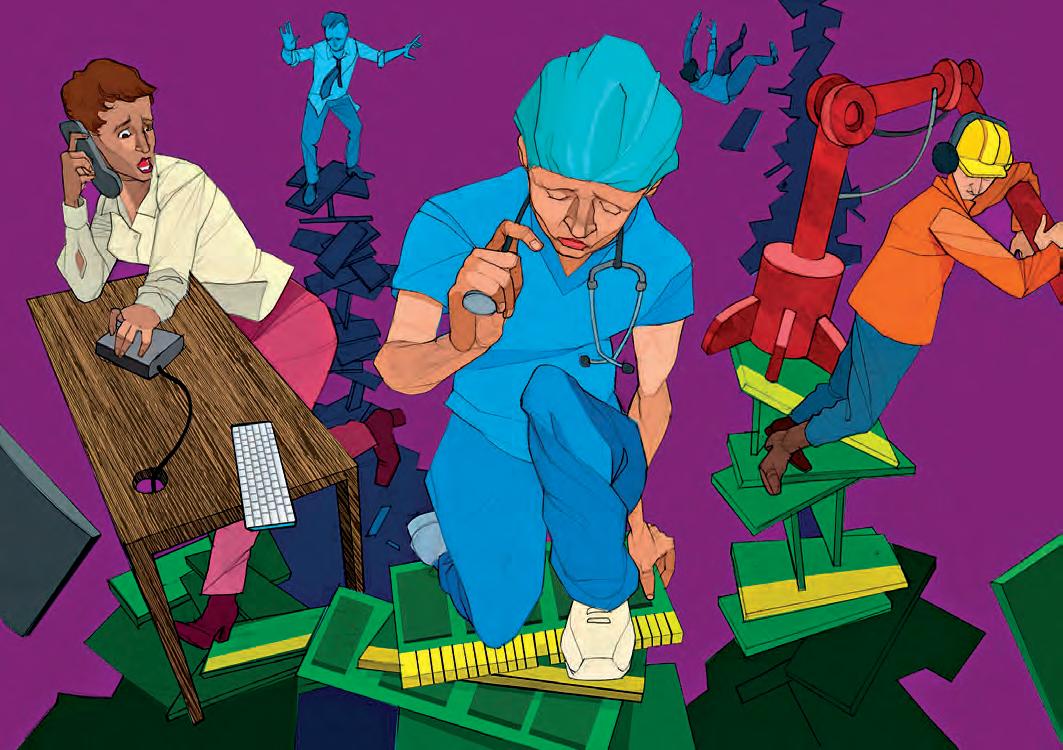
telecommunications company operating sovereign cloud and edge infrastructure across multiple member states, you cannot reroute workloads across jurisdictions with the same freedom and speed that big (mostly US-based) hyperscalers can. Your network data – traffic logs, subscriber metadata and interconnect records – are subject to the GDPR, national telecommunications law, and EU network and information systems security and resilience rules.
In cases where AI systems are deployed across networks, they must comply with the AI Act’s governance requirements, which means jurisdiction-specific constraints are locking the underlying architecture in place. These systems are also typically deployed as separate instances, rather than as a globally integrated whole. As a result, it is more difficult for European operators to pursue the kind of dynamic rerouting that a hyperscaler could execute in response to a facility outage or physical disruption.
This limitation matters even more now that the geography of the cloud has become a geopolitical risk. The strikes on Gulf data
centres show that physical exposure needs to be factored not only into siting decisions but also into broader resilience strategies, redundancy models and regulatory frameworks. For European businesses, the new risk-assessment process might start with identifying physical vulnerabilities in the tech stack – including third-party and cloud infrastructure – and stress-testing to determine whether redundancies that exist on paper actually function as intended during physical disruptions.
Unlike the US, Europe has no dominant hyperscalers to protect, no single security apparatus to protect them, and no unified command structure that could extend a governmental umbrella over fragmented, nationally bound instances of digital infrastructure. Even so, the EU must start treating digital infrastructure as a security question, rather than only as a regulatory concern. Since a nationally siloed system that checks every regulatory box can still be a single point of failure, Europe urgently
needs to close the gap between how critical digital infrastructure is governed and how it is deployed.
For policymakers, that starts with being honest about the concentration risks that come with locally confined deployments that have no fallback. It also means coordinating with industry to stress-test cross-border redundancies, investing in cross-border incident coordination mechanisms that can function under stress, and raising EU-wide minimum resilience standards to account for physical concentration and geographic exposure.
Iran may have struck Gulf data centres to raise the costs of US–Gulf technological cooperation, to rattle US-anchored financial markets, or to strike at the AI infrastructure that increasingly underpins American military might. But it would be a mistake for Europe to treat such tactics as someone else’s problem.
The war has already fundamentally changed the calculus for anyone who relies on digital infrastructure. Reinforcing the European tech stack must start now. n


Mohamed El-Erian PRACTICE PROFESSOR, WHARTON SCHOOL
From wars and trade fragmentation to AI disruption and weakening global institutions, the world economy is entering an era of persistent instability. To avoid deeper disorder, policymakers must abandon outdated assumptions and forge a new framework for growth, resilience and international cooperation
An uncomfortable reality is becoming increasingly difficult to ignore. The global economy is in a period of “more frequent and violent shocks,” as Nobel laureate Michael Spence puts it. Instead of facing isolated and temporary disruptions, we are confronting a structural shift toward unsettling volatility, deepening fragmentation, and a wider dispersion of outcomes for countries, companies and households. The old world is gone, and virtually everyone risks losing out in the new one. The question is by how much and what to do about it. The Iran war, which spread across the Middle East, exemplifies this new reality. Even though the local, regional, and global damage has been going from bad to worse, introducing a durable circuit breaker has proved difficult.
As such, the economic damage is evolving and deepening, with early effects on energy prices and interest rates fuelling broader inflation and raising the risk of lower growth and financial instability. This phenomenon is not new. A circuit breaker has proven equally elusive for the Ukraine war, and we have seen the same dynamics in narrower economic
and finance spheres, from the weaponisation of tariffs and investment sanctions to supplychain fragmentation. It is tempting to treat each of these as standalone episodes – and many policymakers and investors are doing just that. This is a mistake.
Rather than constituting isolated events, the current instability is the predictable result of the loss of three previously dominant narratives with no unifying ones to replace them. The first is globalisation. Gone are the days when ever-deeper economic integration was seen to act as a stabilising force. The promise that interdependency would reduce the risk of confl ict has been replaced by the weaponisation of trade and finance, and the exploitation of chokepoints. Because the world failed to address globalisation’s adverse distributional effects early on, the essential trifecta of respected global standards, effective multilateral institutions, and the rule of law is now being dismantled in favour of unilateralism, fragmentation and impunity.
The second narrative anchor is the Washington Consensus. The belief that liberalisation, deregulation,
fiscal responsibility, and central-bank independence hold the key to prosperity at the country level has been dying a slow death in recent years. Ironically, the US has led the way in upending this approach domestically, despite having spent three decades championing it for the rest of the world.
Then there is AI, which is poised to change the assumptions that have long underpinned business models and labour markets. While AI has immense transformative potential as a general-purpose technology – not least for productivity – new frameworks are badly needed to guide adoption. Otherwise, the disruptions risk outpacing societies’ ability to adapt. The loss of these three anchors has given rise to a culture of distrust, zerosum thinking, and short-sighted decisionmaking, which destroys the old without ready replacements on hand. As suspicion displaces engagement, the quest for expensive self-reliance displaces pooled insurance, and durable coordination becomes impossible. The global orchestra is playing from different sheet music, with no conductor in sight. The result is as disruptive as it is cacophonous.

The five-point plan Disorderly fragmentation will lead to lower growth, higher inflation and greater inequality. But all is not lost: the trajectory of this new world can still be shifted in a more positive direction, if we have the courage and wisdom to abandon outdated mindsets and build a new five-part consensus.
First, it is time to move past the ‘globalisation versus protectionism’ binary. Governments should instead consider what former British Prime Minister Gordon Brown calls “managed globalisation lite” –a pragmatic approach to friendshoring and de-risking that secures critical supply chains and chokepoints, without descending into counter-productive trade wars and other beggar-thy-neighbour policies.
Second, sustainable and inclusive growth must return to the top of national agendas. This does not mean throwing money at the demand side of the economy through yet more fiscal and monetary stimulus. Nor does it mean stealing growth from other economies – or from the future. Rather, it means focusing on productivity gains, infrastructure
improvements, and secular transitions in energy and beyond.
Third, the most vulnerable households need support. As it stands, too many countries’ safety nets lack effectiveness or inadvertently push vulnerable groups to become wards of the state – undermining labour-force participation in the process –rather than providing the protections and opportunities necessary to deliver security and empowerment.
Fourth, the trajectory of AI cannot be left to the invisible hand of the market. Policies governing this transformative innovation must tilt the scales toward labour enhancement over displacement (augmentation over automation). This means using tax systems to adjust incentives, and pursuing early-win investments in social sectors like health and education, where AI can bridge service-delivery gaps. It also means providing guidance to companies that encourage pro-job and pro-productivity
“The problems we face today will not fix themselves”
restructuring and reinvention, not just immediate cost savings through labour displacement. And it means retooling public private–partnerships to ensure that the workforce remains agile and adequately skilled and offering transition support for the most vulnerable segments of the population.
Finally, to safeguard international institutions, they must be reformed. The United Nations, the International Monetary Fund, and the World Bank remain constrained by outdated structures and governance systems. Without a more representative and responsive multilateral system, outcomes that were once unthinkable will become increasingly likely, jeopardising our future well-being. The problems we face today will not fix themselves. Without vision and concerted effort, our human, financial, and institutional resilience will continue to erode, leaving us increasingly vulnerable to frequent and violent shocks. We must stop yearning for the world of yesterday and instead adapt to the world of today and create the anchors and momentum we will need to thrive in the world of tomorrow. n
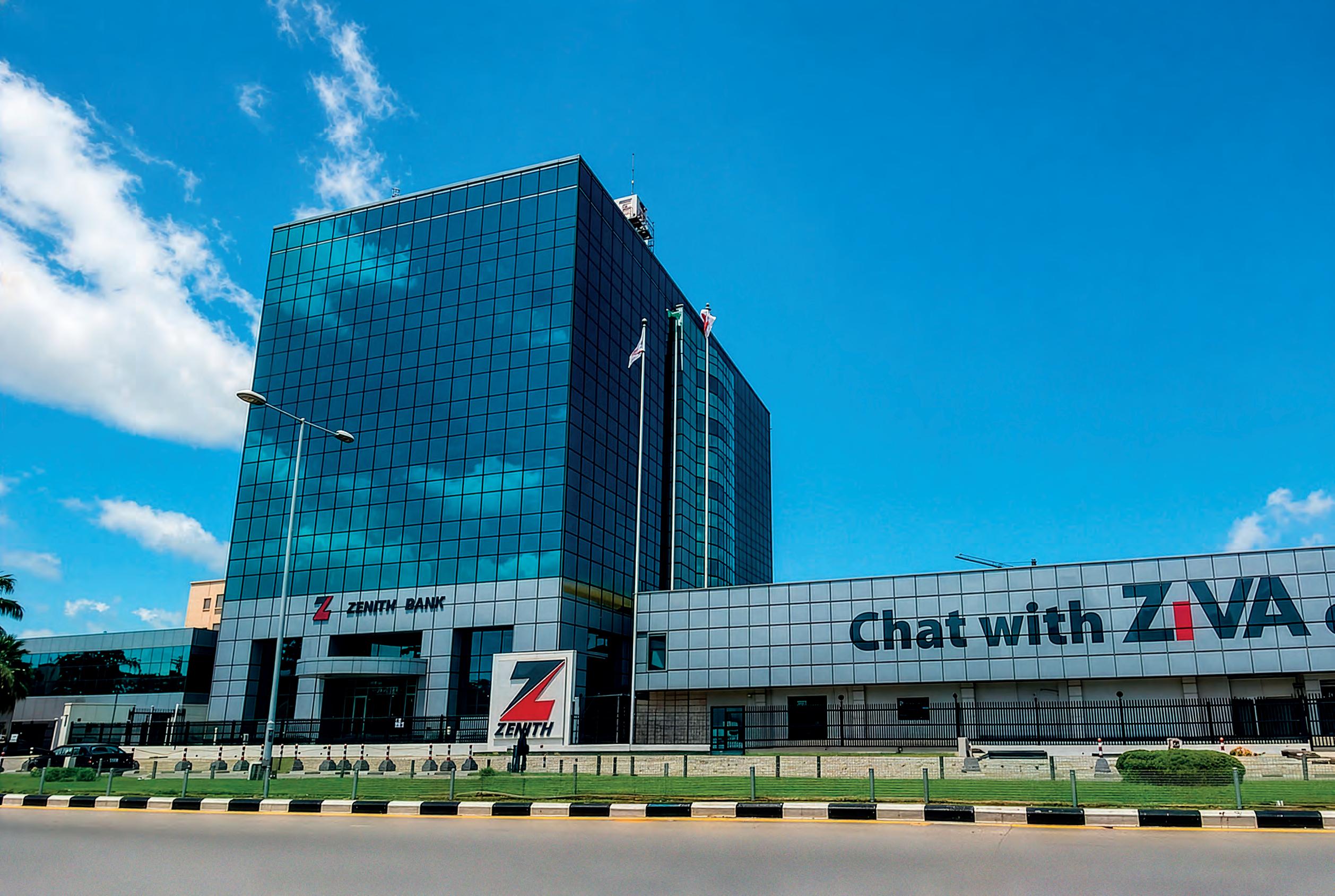




For decades, Africa’s growth story was framed around potential. Today, it is increasingly about execution, integration and capital. Zenith Bank’s expansion across the continent reflects a broader shift in African finance, as homegrown institutions seek to power trade, investment and economic transformation from within. Dame Dr. Adaora Umeoji, OON, Group Managing Director/CEO at Zenith Bank, spoke exclusively with World Finance »


When Jim Ovia, CFR, founded Zenith Bank in May 1990, the unity and prosperity of Africa were among his greatest dreams. For the renowned businessman, banker, and philanthropist who went on to paint the picture of the continent he envisioned in his book, Africa Rise and Shine, one thing was crystal clear: building a formidable financial institution was a potent catalyst for Africa’s transformation.
In three and a half decades, Zenith Bank, his brainchild and the bank in which Ovia CFR previously served as chairman, has been integral in Africa’s remarkable metamorphosis into a continent expected to anchor global growth in the coming decades. Today, the International Monetary Fund’s World Economic Outlook ranks 11 of the world’s 15 fastest-growing economies in Africa, and the continent is among the world’s most resilient regions. In 2026, the African Development Bank’s African Economic Outlook puts Africa’s growth at 4.2 percent, among the highest globally.
For Africa, the journey toward unity, with 54 nations now pursuing shared and common goals, has been fundamental. For instance, the unity of purpose brought about by the African Continental Free Trade Area (AfCFTA) and the push to integrate payments through the Pan-African Payment and Settlement System are clear indications of a continent on the rise. The impacts of AfCFTA are nothing short of phenomenal. The agreement has created the world’s largest free trade area, a single market of over 1.4 billion people with a combined gross domestic product (GDP) of $3.4trn.
Zenith Bank has been central to Africa’s economic ascent. On this, the bank has been deliberate. From its home market in Nigeria, and through a business strategy anchored in people, technology, and service, Zenith Bank has evolved over the years into a top financial institution in Africa with a solid financial foundation. Today, the bank is not only Nigeria’s largest financial institution by Tier-1 capital but also one of Africa’s leading banks, a far cry from its modest beginnings when it commenced operations in July 1990.

While building the requisite financial scale has been critical, ensuring it meets market needs has been another masterstroke. In this
regard, Zenith Bank offers a wide array of financial products and services for individual and corporate clients. The solutions span corporate and retail banking, commercial and consumer banking, personal and private banking, and investment banking. These include trade services and foreign exchange, treasury and cash management services, and other non-bank financial services mainly offered through its subsidiaries.
These solutions, supported by massive investments in technology and a deeply entrenched culture of innovation, have driven exponential growth across all metrics. Cumulatively serving 36 million customers, the bank operates an extensive branch and ATM network at home and also has a presence in the UK, France, Sierra Leone, the Gambia, the United Arab Emirates, as well as a representative office in China. In recent months, the bank has also embarked on a Pan-African expansion strategy, entering Côte d’Ivoire and Kenya.
“ZENITH BANK HAS BEEN CENTRAL TO AFRICA’S ECONOMIC ASCENT”
For Zenith Bank, one of its outstanding trends has been sustaining a strong culture of profitability through every economic cycle. In 2025, the bank once again lived up to this mantra, posting ₦1.04trn ($727m) in profit after tax. The performance was reinforced by robust capital and liquidity positions, both well above the regulatory minimum, alongside a prudent risk management culture that kept non-performing loans well in check.
One key metric in which the bank was an exceptional performer was cleaning its badloan book. In a policy directive, the Central Bank of Nigeria (CBN) required banks to clean up legacy exposures previously held under regulatory forbearance by June 30, 2025. Zenith Bank used the transition to clean its books, implementing measures such as write-offs and loan recoveries. Owing to decisive actions, the bank managed to reduce its non-performing loan (NPL) ratio substantially from 4.7 percent in 2024 to 3.8 percent in 2025, well clear of industry norms.
The Nigerian banking industry is highly competitive, and Zenith Bank’s impressive results reflect disciplined, focused execution of its strategy. Specifically, the bank has been astute in strengthening its asset quality, optimising its balance sheet and investing in capabilities to propel growth. A key
ZENITH BANK IN NUMBERS:
459 Branches
2,144 Automated teller machines
36 million Customers
1990 Year founded
$727m Profit after tax in 2025
$2.8bn Gross earnings in 2025
differentiator during the year was the bank’s strong position in international trade and foreign exchange flows.
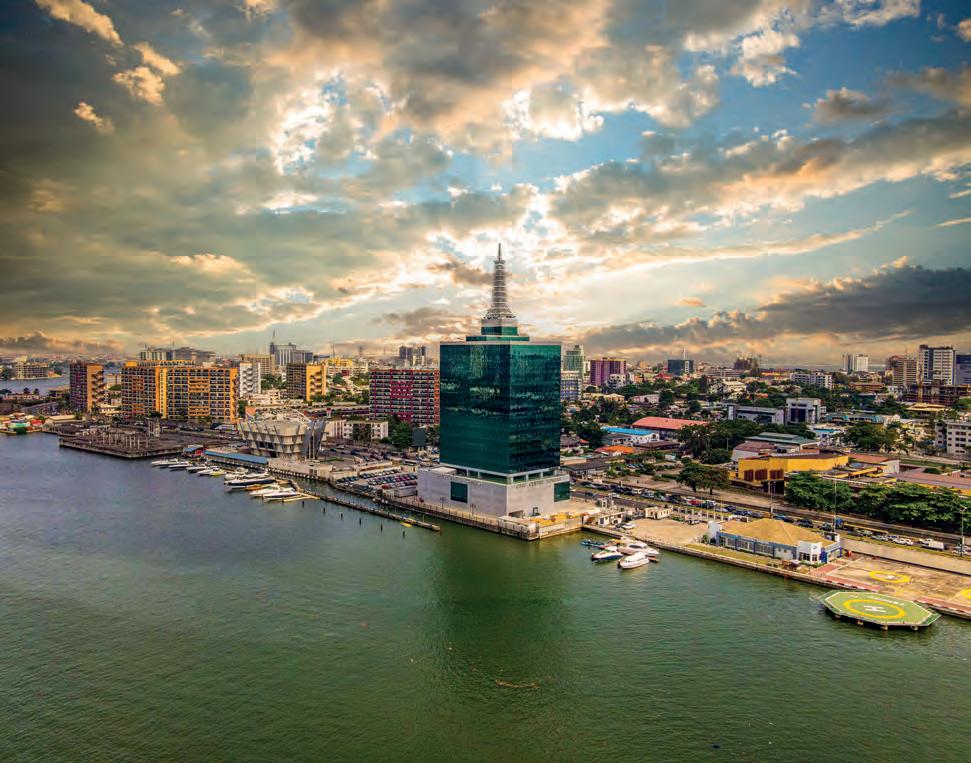
In recent years, Nigeria has been on a mission to reduce its dependence on the oil sector, which is a major source of forex and government revenues. Data from the Nigerian Export Promotion Council indicate that in 2025, the country’s non-oil exports reached a historical high of $6.1bn, an 11.5 percent increase from $5.4bn in 2024. As a key facilitator of international trade, Zenith Bank played a central role in repatriating over 40 percent of Nigeria’s non-oil export proceeds. Owing to its role, the bank was able to deepen relationships with large corporates and supported transaction-led income. The franchise remains critical for the bank, as trade finance generates recurring business, strengthens customer relationships, and supports foreign currency liquidity.
Apart from the trade sector, Zenith Bank also maintained a disciplined lending approach, which led to gross loans rising to about ₦11trn ($7.9bn). The major focus was on viable sectors such as manufacturing, agriculture, and telecommunications, as well as key value chains that offered more predictable cash flows. Non-interest income from fees, commissions and digital channels also contributed to the impressive
“NIGERIA’S ECONOMY HAS UNDERGONE A TRANSFORMATIVE PERIOD OF REFORM”
performance, supported by a steady push in digital transformation that improved customer experience, increased transaction volumes and lowered operating costs. Also impactful was the high-interest-rate environment, which supported returns from the loan book and from investments in government securities.
For Zenith Bank, the high-interest-rate environment delivered strong returns across lending and investment activity. Through 2025, the Monetary Policy Committee held the policy rate at 27.50 percent at its February, May and July meetings before easing it 50 basis points to 27.00 percent in September. Inflation also moderated through the year, with the National Bureau of Statistics putting the annual 2025 average at 23.01 percent. Average private-sector credit stood at ₦75.6trn ($54.8bn) for the year, up from ₦75.3trn ($54.6bn) in 2024, with wellcapitalised banks like Zenith positioned to grow lending as the easing cycle takes hold.
Nigeria’s broader economy has undergone a transformative period of reform. The removal of fuel subsidies, the unification of exchange rates, and sustained monetary tightening have significantly helped correct long-standing distortions. The reforms have improved price discovery in the foreign exchange market, strengthened fiscal revenues, and restored investor confidence.
A key pointer is capital inflows. Government data show that last year, inflows surged by 90 percent, driven by foreign portfolio investment as investors returned to Nigeria. During the year, net capital investments stood at $23.2bn, up from $12.3bn in 2024.
For the Nigerian economy, the reforms’ impacts have been encouraging. Growth has remained resilient, supported by services, higher oil production, stronger non-oil activity and a gradual recovery in external balances. According to the National Bureau of Statistics, real GDP growth in 2025 was 3.87 percent, up from 3.38 percent in 2024. This year, growth is projected to accelerate further to 4.4 percent. The rate of economic expansion is inspiring, and the next step is to ensure it translates into investment, jobs, food security, and stronger household purchasing power. This is necessary, given that Nigeria, Africa’s third-largest economy with a rebased
2025 GDP of ₦441.5trn (about $320bn) per the NBS, is well positioned to build on its momentum. Hard work and tough decisions have been instrumental in stabilising the economy. Going forward, the next natural course of action is to ensure that the positive economic momentum translates into better living standards for Nigerians.
The government continues to advance its socio-economic agenda with strong intent. Building on the reform momentum, priority areas include productivity, employment, agricultural security, market access and logistics, all of which are reinforced by sustained delivery of the broader reform programme.
Over the medium term, the focus is shifting to inclusive growth. Agriculture, SMEs, manufacturing, digital enterprise and labourintensive services are positioned to benefit from financing, infrastructure and policy support that creates jobs. Macroeconomic stability, paired with policies that strengthen household purchasing power, sets the stage for growth to translate into real prosperity.
The government has framed the reforms as the foundation for long-term gains. For the banking sector, the reforms have already brought a retinue of benefits. Among the benefits is the liberalisation of the exchange rate. For banks with strong foreign currency positions, this has led to an increase in foreign exchange trading income and revaluation gains. Besides, the high interest rates have supported net interest margins as asset yields repriced faster than funding costs in the early phase of tightening. Also, higher yields in the fixed-income market have provided attractive risk-adjusted returns on sovereign instruments.
Another benefit has been the recapitalisation of banks, which has built stronger capital buffers to support larger transactions, deeper credit intermediation, and greater financial system resilience. For Zenith Bank, the exercise has been more than a regulatory compliance to meet the raised minimum capital requirement for commercial

banks with international authorisation to ₦500bn ($362.6m). Completed ahead of the CBN’s March 2026 deadline, the bank raised over ₦350bn, lifting its capital base to ₦614bn ($445m), comfortably above the threshold. The bank sees its enlarged capital base as a strategic foundation for growth, resilience and deeper real-sector financing. Specifically, the bank now has the balance-sheet strength to finance large and long-tenor projects not only in infrastructure but also across sectors that require patient capital and larger balance sheets.
For two of Zenith Bank’s key market segments, namely retail and SME banking, the importance of the new base is elevated to higher realms. First, it adequately equips the bank to support the two segments at scale. Second, it positions the bank to lead in an industry where consolidation is reshaping the competitive landscape, with well-capitalised institutions like Zenith Bank best placed to capture the opportunity.
Zenith Bank views retail as the engine of its long-term scalability, and the numbers back that up. In 2025, the bank’s total customer deposits stood at about ₦24trn ($17.4bn). Of this, retail deposits accounted for about ₦4.9trn ($3.5bn). Though corporate and commercial credit account for the bulk of the loan book, the bank disbursed nearly 3,000 retail loans valued at about ₦89.5bn ($65m), supporting household and individual financial needs. The segment’s significant contribution makes it central to the bank’s growth, particularly in providing a stable deposit base and deepening financial inclusion.
To grow its retail business, Zenith Bank has been proactive in expanding its digital offerings. For instance, migrating to a new core banking platform has improved speed, usability, and service quality. Also, enhancements to the internet banking solution now offer customers access to a redesigned interface with broader functionalities. These include cross-border intra-African transfers, treasury bill investments and payment of government levies. The bank is also expanding its physical channels, including agency banking aimed at underserved communities. Through this channel, the bank has reached over four million customers.
Another critical market that Zenith Bank is strategically determined to grow is the SME market. CBN data points to a ₦130trn ($94.4bn) MSME financing opportunity in Nigeria, reflecting the segment’s central role in job creation and broader economic activity. The bank is meeting the segment with innovative lending products tailored to its collateral, record-keeping, and credit history. Owing to their importance, Zenith Bank’s determination to support SMEs is anchored in its development priority and as a major commercial opportunity. Part of the bank’s lending solutions include cashflow-
“THE BANK’S EXPANSION STRATEGY IS NOT JUST ABOUT ADDING FLAGS TO A MAP”
based finance, asset and equipment finance, the Z-Woman loan for women-led enterprises, and cooperative lending, among others. The bank has also been keen on building partnerships with multilateral financiers and export credit agencies that provide medium to long-term lines of credit for on-lending. This has been instrumental in reducing risk and widening access to credit for SMEs.
That Zenith Bank has reached several significant milestones, cutting across capital fortification, products and services, and digital innovation, is indisputable. Having reached the pinnacle of becoming a Nigerian banking powerhouse, the bank is now transforming into a pan-African financial institution. Unlike its peers, the bank’s expansion strategy is not just about adding flags to a map. Rather, the ambition is driven by client demands, trade flows and regional economic connectivity, with the ultimate goal of supporting cross-border trade and capital flows for its wide range of multinational customers. Effectively, the bank is deploying a strategy that combines both greenfield and brownfield approaches to enter new markets. The strategy aligns with Founder Jim Ovia’s unequivocal desire to build a truly global brand with a strong presence across Africa and key international markets.
On expansion, Francophone West Africa and Anglophone East Africa are a nobrainer for Zenith Bank. While the former offers access to a large integrated market, particularly through the West African Economic and Monetary Union (WAEMU)
“THE BANK NOW HAS THE BALANCE-SHEET STRENGTH TO FINANCE LARGE AND LONG-TENOR PROJECTS”
bloc, the latter provides a dynamic corridor with strong private-sector activity, capital market depth and advanced digital banking adoption. Notably, Zenith Bank is not going into new markets blindly. The bank is taking time to identify opportunities that it seeks to exploit and capture. These cut across corporate banking, trade finance, remittances, payments and structured transactions. More critically, the bank intends to prioritise countries with strong fundamentals, trade relevance and clear links to its existing client base. In essence, its expansion is a corridor strategy spanning the WAEMU, CEMAC and EAC blocs, not a race for geographic spread.
In April, Zenith Bank launched operations in Côte d’Ivoire and entered Kenya through the acquisition of a 100 percent shareholding of Paramount Bank. In line with the bank’s vision, the two markets are strategic gateways. In November 2024, the bank entered France, which is commercially linked to several Francophone African countries. The fact that Abidjan has grown into a major regional business hub means that Côte d’Ivoire was a natural first-step choice. Using the market as a springboard, the bank intends to support trade finance, payments and corporate banking across the WAEMU bloc, where a shared currency and integrated regulation reduce fragmentation.
Kenya, on its part, is expected to provide an anchor in East Africa. As the region’s top economy with $136bn in GDP, the country is a financial nerve centre with deep capital markets, a sophisticated private sector and booming digital banking innovations. By acquiring Paramount Bank, Zenith Bank has gained immediate market presence through seven branches, an established customer base, experienced local teams, and regulatory standing.
Zenith Bank is building for sustained relevance in its new markets, drawing on its Nigerian playbook while tailoring to each market’s local dynamics. To gain traction, the bank is taking a deliberate and structured approach, riding on local partnerships, talent, strong governance, careful attention
to market realities and digital capability. Patience will be cardinal, with growth deliberate, risk-managed and aligned with client needs.
Even as it aspires to become a pan-African financial institution, some core principles will remain embedded in Zenith Bank’s DNA. Top is the bank’s strong corporate governance culture. Across the spectrum of its operations, governance is anchored on an enterprise risk management framework aligned with COSO and ISO 31000, a Three Lines of Defence control model, and independent board committees overseeing risk, audit and compliance.
Another deeply entrenched principle is sustainability. On this, the approach is premised on the fact that environmental, social and governance (ESG) issues are financially material, with reporting aligned to the ISSB IFRS S1 and S2 standards. In essence, it means that ESG has a direct effect on credit quality, operational resilience, regulatory readiness, investor confidence and long-term value creation.
Overall, Zenith Bank remains committed to integrating sustainability into risk management, credit processes, and strategic planning. A case in point is in project finance transactions. In 2025, some 94 percent of new and existing transactions were assessed for environmental and social risks. The bank also actively monitored 95 percent of financed projects. For the bank, sustainability is closely intertwined with corporate social responsibility (CSR). On CSR, the bank is conscious of the fact that its success is inextricably linked to the well-being of the communities it serves. For this reason, Zenith Bank has been giving back to society in areas such as security, sports, health, and education. Three and a half decades after Zenith Bank’s founding, Jim Ovia’s vision of a continent on the rise, as captured in Africa Rise and Shine, has become the daily work of the institution he built. With a deep capital base, an expanding African footprint, and a strategy that reads as patient as it is bold, Zenith Bank is positioned to write the next chapter of the African economy from within. n
The world’s most significant central bank has a new chair, but the US administration’s campaign against the previous one may have a lasting impact
WORDS BY Alex Katsomitros FEATURES WRITER






When Donald Trump turned his fire on Jerome Powell last year, it barely registered as unusual. The President had criticised the Federal Reserve chair before. This time, however, the threat felt sharper. “If I want him out, he’ll be out of there real fast,” he said – sounding less like a head of state than the host of The Apprentice, casually dismissing a contestant.
At first, it seemed like another off-the-cuff remark. But what followed was something more sustained: a steady, public campaign against the Fed chair. Trump repeatedly attacked Powell for refusing to cut interest rates, even calling him a “moron,” despite having appointed him. The message was blunt. Monetary policy should align with political priorities. Relief, the US President suggested, would come soon enough: rates would fall “when Kevin gets in.”
We need to talk about Kevin Kevin Warsh, now installed as Fed chair, arrives with the kind of CV that reassures markets. A former governor who served from 2006 to 2011, he is widely seen as a seasoned operator in financial circles. He is also the wealthiest Fed chair in history, with assets worth at least $130m, accumulated through his role at the Duquesne family office. His confirmation, however, was anything but
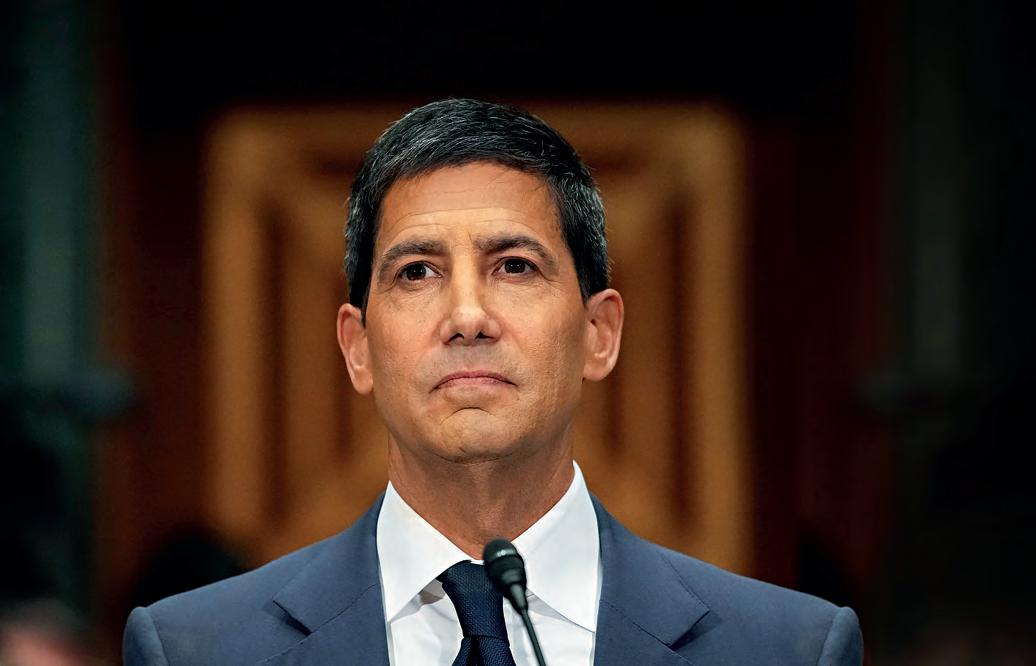
routine. Senators pressed him hard over more than $100m in ‘undisclosed’ assets, turning hearings into a confrontation. Republican senator Thom Tillis lent his support only after the Department of Justice dropped a criminal probe into Powell, widely perceived as a strategy to nudge Powell to step down. For his part, Powell has pledged to stay on the Fed board as governor to provide continuity, even though he had previously considered stepping down.
Warsh’s proximity to the administration has become a focal point. Critics worry that his alignment with Trump could blur the line between political power and monetary policy. In the run-up to his appointment, he softened his hawkish stance on inflation, a shift some see as calculated. His ties run deep: his father-in-law, Ronald Lauder, is a long-time Trump ally and donor. Supporters counter that Fed chairs may be political appointees, but their professionalism prevails once in office. Warsh has sought to calm fears during his Senate hearing, dismissing speculation that he would overhaul regional Fed leadership with loyalists. And his term runs until 2030, long enough to outlast the current administration.
The Fed’s structure itself offers some protection. Policy is shaped collectively by the Federal Open Market Committee (FOMC). Decisions – especially the most consequential ones on interest rates – require consensus or
at least a majority. As chair, Warsh still casts only one vote and will have to convince other committee members. Historically, governors have been cautious about open dissent, preferring to project unity. But if they perceive an encroachment on independence, they may assert themselves forcefully through votes or even public statements.
Yet leadership still matters. The chair sets the tone, shapes communication and influences the internal culture. A chair perceived as politically aligned could shift expectations about how decisions on monetary policy are made. Over time, that perception can become self-reinforcing, affecting everything from bond yields to currency valuations. “Once he is sitting in the Chair’s seat he will be beholden to his fellow FOMC participants and markets, who will be closely watching for signs about his vigilance in keeping inflation expectations well-anchored,” says Christopher Hodge, chief economist of the US at the investment bank Natixis CIB Americas, who formerly held senior roles at the Federal Reserve Bank of New York and the US Treasury.
For much of its history, the Fed has occupied a delicate space – created by politicians, yet expected to stand apart from them. Its independence has never been absolute. Congress created the institution, and elected politicians have always sought to influence it, particularly before elections. Yet over time, a norm has emerged: while politicians might criticise its decisions, they ultimately respect
Current value of the Fed’s balance sheet
Federal Reserve Chair, Kevin Warsh, testifies during a Senate confirmation hearing
the Fed’s autonomy. Its institutional gravitas rests on the premise that monetary policy is insulated from day-to-day politics, a tradition based less on formal rules than on shared norms. Once that mutual restraint between governors and politicians erodes, rebuilding it can be difficult.
That understanding is beginning to fray. Trump’s attempts to reshape the Fed – its leadership and direction – have raised concerns that go beyond personalities. Last August, he sought to ‘fire’ governor Lisa Cook, defying legal protections that shield board members from dismissal. The move failed, but the signal was clear. If politicians can dictate the board’s composition, the boundary between fiscal and monetary authority begins to blur. At the same time, the administration has moved to exert more formal control. An Executive Order signed by Trump asserted that “officials who wield vast executive power must be supervised and controlled by the people’s elected President,” requiring independent agencies to submit regulatory proposals for White House review. The Fed’s monetary policy was spared. Much else was not.
To some historians, the shift in public rhetoric is without precedent. “Trump’s assault on both Jay Powell and Fed independence is the strongest such assault in the Fed’s 112-year history,” says Richard Sylla, an expert on the history of US financial institutions who teaches at the NYU Stern School of Business. The closest parallel, he argues, dates back to the post-war clash between the Treasury and the Fed over
the latter’s interest rate policy, aimed at reducing inflation, which ultimately led to an accord restoring its monetary independence. Ironically, current pressure may strengthen the institution, Sylla argues. “Trump’s pressure on Powell, and Powell’s successful resistance to that pressure will actually result in increasing the Fed’s reputation for policy independence and strengthening the overall case for central-bank independence.”
Warsh has made it clear that he does not intend to preserve the status quo. He has described US monetary policy as “broken for quite a long time” and has promised a “policy regime change.” Part of that shift will be philosophical. Unlike Powell, Warsh favours a narrower interpretation of the Fed’s mandate. He has signalled a retreat from policies that blur the line between monetary and fiscal intervention, particularly large-scale purchases of mortgage-backed securities. Under his watch, monetary policy is expected to be depoliticised, steering clear of non-monetary issues like climate change and social justice.
recent economic history is a guideline. In the 1970s, government influence pushed the central bank to hold rates down, fuelling a surge in inflation. It took the shock therapy of aggressive rate hikes under Paul Volcker’s Fed leadership – and a deep recession – to restore confidence. Even then, it took years to fully re-anchor expectations. “That could happen again, undermining Fed independence, the value of the US dollar and confidence in US public debt management,” Sylla warns, pointing to the risks of sustained political interference that could undermine the Fed’s effort to anchor inflation expectations. “If political interference pushes inflation to sustained levels above two percent, the Fed would lose credibility. No matter what it does, it is likely to become a scapegoat for the likely negative results of fiscal irresponsibility.”
WARSH HAS MADE IT CLEAR THAT HE DOES NOT INTEND TO PRESERVE THE STATUS QUO
Above all, Warsh has his sights set on the Fed’s ballooning $7trn balance sheet. Immediately scaling it back would mark a decisive break from recent policy, reversing the Fed’s decision to halt quantitative tightening, under which its bond holdings were allowed to mature. Higher Treasury yields might force Fed interest rate policy into difficult trade-offs between supporting growth and containing inflation. And those trade-offs will not occur in a vacuum, given Donald Trump’s obsession with lower interest rates. “With what appears to be a persistent energy shock, there will be inflation and reason to raise interest rates,” says Barry Eichengreen, an economic historian at the University of California, Berkeley (the full interview with Professor Eichengreen is on pages 98–99 in this issue of World Finance).
“But there will be political pressure from the White House to reduce interest rates. That will not be an easy circle to square.”
Calls for the Fed to keep interest rates low are not unprecedented. But the phenomenon is gradually evolving into a systemic feature of US politics due to the country’s precarious fiscal position. Higher debt levels increase pressure on the Fed to keep rates low and buy Treasurys, helping to erode the real value of US debt. The risks are obvious if
The Fed’s global reach under strain What happens at the Fed rarely stays in Washington. As the anchor of the global financial system, the Fed’s credibility extends far beyond US borders. Its decisions shape capital flows, currency stability and the availability of dollar funding worldwide. For many countries, access to dollars is a cornerstone of financial stability. Foreign central banks are more comfortable with banks and firms under their jurisdiction using dollars if they can access them from the Fed through currency swaps in times of need, says Eichengreen. “If we have a nationalistic US President who insists on nationalistic behaviour by the central bank, things will be different.”
There are already signs of that shift in thinking. Stephen Moran, a temporary Trump appointee to the Fed board, has argued that the US should reconsider its role as a global lender of last resort, or demand compensation for it. Similar criticisms have surfaced before, including during congressional hearings after the 2008 financial crisis. A more inwardlooking Fed aligned more closely with shortterm domestic political objectives would reshape global finance, increasing global scepticism about its credibility.
“If financial markets and international partners perceive undue political interference in the central bank, we will see the ‘ABUSA’ – ‘Anywhere But The US’ – sentiment soar, and to the detriment of the US economy,” says Yerbol Orynbayev, a former World Bank governor and ex-deputy Prime Minister of Kazakhstan who played a key role in the country’s response to the 2008 financial crisis. “The US Treasury market is already on the verge of rioting – yields are fickle and are often rising. If the Fed is compromised, the US economy could face huge losses.” n

Stablecoins are making global payments faster, cheaper and more transparent. The businesses moving first will define what comes next
WORDS BY Anna Kratky Štrébl CEO, CONFIRMO GROUP


The painfully slow process of moving money across borders has stalled businesses for decades. The TradFi route is not fit for purpose but has been tolerated until recent years because no credible alternative existed at scale. According to Oliver Wyman, businesses collectively pay $120bn a year to move money across borders. Until the creation of stablecoins, moving money internationally meant waiting days for settlement, losing margin to FX spreads you cannot see or predict, and routing payments through intermediaries that add cost and time at every step. Now, Juniper Research is forecasting that cross-border B2B payments settled in stablecoins will reach $5trn by 2035.
This is less a prediction than a consequence of a broken cross-border banking system. At first glance, $5trn seems an extraordinary figure, but it reflects how enterprise demand is finally being met by infrastructure and regulation. The advantages of stablecoin payments over traditional cross-border rails are tangible. Payments move 24 hours a day, rather than on banking schedules, and settlement takes seconds rather than days. Payment terms can also be programmed and automated.
For businesses already on stablecoin rails, the efficiency gains are measurable – EYParthenon’s research also shows that there is further demand for wider industry support as 81 percent of corporates say bank support for stablecoins is critical or important. Juniper Research’s near 400x projected growth for the industry makes a lot of sense when you
consider that the market is still at its earliest institutional stage. A sharp increase in the value of cross-border payments will naturally follow high demand and the right conditions for adoption.
The bottleneck was never demand
from whether to implement stablecoin rails to which provider they trust to run them. The decision is harder than it sounds. In Europe, the MiCA grandfathering deadline of July 1, 2026 will mean providers without full authorisation must cease European operations from that date, with no grace period. But regulatory status is a baseline,
$5trn
Predicted volume of payments settled in stablecoins by 2035
While stablecoins seem new and shiny to some, enterprise interest has existed for years – but the industry was missing the infrastructure and regulatory certainty that is necessary for commitment. Across the US and Europe, regulation is either progressing or falling into place. Last year, we saw the GENIUS Act pass in the US and, right now, the CLARITY Act is being debated in the Senate. The Markets in Crypto-Assets Regulation (MiCA) is live in Europe – over 40 Crypto-Asset Service Providers have been licensed as of March 2026.
The market has crossed a commercial threshold. Landmark moves by major players have also signalled the shift from speculative use toward institutional payment infrastructure: Klarna recently built its own dollar-pegged stablecoin and Western Union committed to launching a stablecoin on Solana. Juniper predicts that 85 percent of all stablecoin transaction value in 2035 will come from international business-tobusiness activity. The direction of travel is clear – if demand did not exist, financial institutions would not be investing.
How to get adoption to skyrocket
For businesses with serious cross-border payment operations, the question has evolved
“If demand did not exist, financial institutions would not be investing”
not a differentiator. What separates credible infrastructure from everything else is whether it has been built to perform at enterprise scale: high transaction volumes, multiple jurisdictions, compliance across regulatory frameworks and integration with existing financial operations.
Confirmo Limited is authorised from the Central Bank of Ireland under both MiCA and as a Payment Institution under the Payment Services Regulations 2018 (PSR), covering the full stablecoin payment transaction lifecycle within a single regulated entity. More than half of enterprise non-users expect to adopt stablecoins within six to 12 months according to EY-Parthenon, and the providers ready to meet that demand are the ones who built the infrastructure before the forecasts made it look obvious.
The cross-border payments system has been extracting cost and time from businesses for decades. Stablecoins are not disrupting a system that works – they are replacing one that doesn’t. With regulatory frameworks now live across the US and Europe and the institutional capital flowing into payments infrastructure, the conditions for adoption at scale have finally arrived. The businesses that move now, while infrastructure is being built and competitive positions are still being established, will define what cross-border payments look like for the next decade. n

Diaspora families want to invest back home, but distance, distrust, and complexity hold them back. Banreservas asked a different question: What if we treated diaspora not as a demographic to serve, but as strategic economic partners?
WORDS BY Leonardo Aguilera CEO, BANRESERVAS





Banreservas’ international expansion strategy is centred on strengthening economic ties with the Dominican diaspora as a strategic economic partner, rather than just operating as a full retail bank abroad, and the bank has successfully used mortgage fairs as part of this expansion strategy. These clientcentric engagement events bring together diaspora clients, credible Dominican real estate developers, fiduciary-backed projects and bank representatives in one venue to help address key diaspora challenges such as distance and lack of trusted intermediaries, legal and documentation uncertainty, difficulty assessing projects remotely and limited access to tailored financing.
By simplifying the sending process from the US and Europe, reducing operational friction, and offering greater convenience and security, Banreservas has incentivised increased use of formal remittance channels. This strategy has had, and is expected to continue to have, a highly positive impact on remittance flows to the Dominican Republic, both in terms of volume and formalisation.
Reimagining the diaspora relationship
Banreservas’ model relies on representative offices set in strategic cities to provide advisory, pre-qualification and customer support services, while the financing and account opening itself is referred to Banreservas in the Dominican Republic, where they are operatively managed and booked.
The US (New York and Miami) and Spain (Madrid) were chosen as priority hubs to channel diaspora engagement and long-term investment because they are home to some of the largest and most economically active Dominican communities worldwide. By establishing representative offices in these strategic locations, Banreservas delivers tailored financial services to historically
underserved expatriate communities, enabling them to invest, save, and build wealth in the Dominican Republic while contributing to national economic development, unlocking sustainable growth opportunities and deepening its role as a financial bridge between Dominicans abroad and their home country.
Banreservas uses mortgage fairs to compress what is traditionally a long, fragmented cross-border process into a single, guided experience that combines education, advisory, and support. Diaspora clients can receive on-the-spot pre-qualification, explore real estate projects nationwide, and receive information and guidance about loan processes, although final approvals and disbursements are processed in the Dominican Republic.
The response in the US and Madrid has been characterised by sustained momentum and the diversity of participant profiles, from first-time buyers to repeat investors and returning nationals, which suggests that the fairs are resonating beyond a narrow segment of the diaspora. In US cities with longestablished Dominican communities, the fairs have evolved into anticipated events rather than exploratory initiatives, with those in New York and Lawrence generating financing exceeding $49m. However, the initiative was newer in Europe, so the response in Madrid followed a slightly different trajectory, with early editions focusing heavily on education and orientation. That said, the first fair in Madrid attracted thousands of participants and closed with financing requests of more than $21m.
Risk mitigation is central to the model and projects are carefully vetted, many supported under a fiduciary account or an estate asset trust fund and backed by clear legal frameworks. Banreservas’ direct involvement is one of the defining features of its diaspora strategy to ensure transparency, regulatory compliance and investor protection throughout the process. By offering direct access to Banreservas’ experts, vetted developers, fiduciary-backed projects and consistent financing terms, these events are helping

gagement are among the clearest indicators that trust has been established organically, particularly within close-knit diaspora communities. Banreservas’ role as the national leading institution further reassures clients investing from abroad.
Rather than a single-product offering, Banreservas approaches diaspora customers with a portfolio mindset, providing a robust cross-border selection including mortgage loans, savings and checking accounts, remittance-linked products and investment solutions tied to real estate development.
Remittances are a core strategic pillar of Banreservas’ international expansion, and the creation of new digital channels and specialised financial products are helping transform remittances into a gateway for deepening financial inclusion. The Remesas Reservas app enables Dominicans abroad to send money from the US and Europe using international cards, with funds credited directly to bank accounts or debit cards in the Dominican Republic, eliminating the need for cash, queues, or physical travel. The app is complemented by the home delivery remittances service, which extends financial access to rural communities that were previously excluded from the formal financial system. Service performance data shows that 97 percent of remittances sent through the app complete the entire process digitally,
The strategy is further strengthened by the introduction of remittance-based consumer and mortgage loans, specifically designed for remittance recipients. These products allow recurring remittance flows to be converted into formal financial history, facilitating access to credit, and reinforcing the ‘bankarisation’ process. As a result, remittances evolve from a basic transfer mechanism into a financial development tool, integrating beneficiaries into the banking system with solutions tailored to their real income patterns and needs.
For first-time diaspora investors, the emphasis is on financial orientation and readiness with solutions structured to simplify entry into the formal mortgage system in the Dominican Republic. For returning nationals, products and advisory conversations are typically aligned with reintegration objectives. In both cases, the underlying principle is adaptability within a controlled institutional framework, rather than bespoke products that introduce
They have the support of President Luis Abinader, who has created the conditions for Dominicans in the diaspora take advantage of the macroeconomic stability, legal security, and full guarantees that receive all foreign investors who trust in the Dominican Republic to make their business.
Modernising the remittance ecosystem combined with specialised financial products generates a direct multiplier effect on strategic sectors, strengthening the real economy and territorial development. In the construction sector, the remittance mortgage loan transforms recurring remittance flows into formal financing capacity for homeownership and has taken centre stage in Banreservas’ participation in international mortgage fairs. Diaspora demand supports property acquisition and upstream activities such as project development, construction services, materials supply, legal services and professional employment.
The scalable model Banreservas has deliberately adopted a scalable and selective expansion logic, prioritising model stabilisation in proven markets before extending to new ones. However, any future expansions are likely to be opportunity-driven and phased, to ensure that each new market sustains long-term client relationships. This strategy allows for progressive expansion, but only where three conditions converge: concentrated Dominican diaspora communities with sustained economic ties to the Dominican Republic, regulatory and operational feasibility, particularly the ability to support activity through representative offices or equivalent structures, and demonstrated demand signals.
The next three to five years points to a qualitative shift in diaspora investment behaviour. First, there is a clear movement from sentimental ownership to strategic investment. Second, diaspora investors are showing a stronger preference for formal, institutionally mediated channels. And finally, the younger diaspora segment tends to prioritise entry-level or futureorientated assets, while more established individuals focus on retirement, anchoring, or reintegration-linked purchases. This diversification of motivations is influencing how Banreservas structures advisory conversations and sequences client engagement over time.
BANRESERVAS HAS DELIBERATELY ADOPTED A SCALABLE AND SELECTIVE EXPANSION LOGIC
Mortgage financing in the Dominican Republic is embedded within a broader set of banking solutions designed to support the full investment and ownership journey. At the core are residential mortgage products structured for non-resident clients looking to acquire property in the Dominican Republic. These are complemented by linked deposit and savings accounts, which allow clients to organise funds, manage payments and maintain an ongoing banking relationship once the purchase process begins. In parallel, Banreservas leverages its digital channels and remittance services to facilitate the movement of funds and day-to-day interaction with Banreservas, reinforcing continuity beyond the initial transaction.
Equally important is the impact on financial deepening and formalisation. When diaspora investors enter the banking system through regulated mortgage channels, their participation strengthens the use of formal financial products, thereby expanding the reach and resilience of the financial system. This dynamic is a key contribution to economic maturity, as it encourages longterm financial relationships rather than onetime transactions.
From a tourism perspective, the strategy strengthens the economic and emotional ties between the diaspora and the country. Home purchases financed through mortgage loans paid via remittances promote more frequent visits, longer stays, and increased spending on tourism-related services, while also encouraging investment in vacation properties and second homes. Additionally, increased formal income and financial inclusion among remittance-receiving households boosts domestic consumption, benefiting transportation, commerce and service sectors closely linked to tourism.
With diaspora investment contributing to national economic development primarily by transforming external household income into structured, long-term domestic capital, Banreservas’ long-term objectives are driving financial inclusion, fostering foreign direct investment and supporting key productive sectors. By empowering confident diaspora investment, Banreservas reinforces its leadership role in national development while expanding its international footprint in a sustainable way by adopting a focused model that strengthens value creation in the Dominican Republic through targeted international interaction.
From a growth perspective, the expansion allows Banreservas to diversify its customer acquisition channels by engaging Dominican communities abroad at earlier stages of their financial decision-making. From an economic development standpoint, the strategy is goal orientated.
By facilitating diaspora investment in housing and related sectors in the Dominican Republic, Banreservas acts as a conduit that transforms external income flows into productive domestic investment. n
As sustainability reshapes global finance, cooperative institutions are showing how profitability and social impact can work together. Through green lending and financial inclusion, Sicredi is helping drive more resilient and inclusive economic development
WORDS BY Alexandre Barbosa CHIEF FINANCIAL OFFICER, SICREDI
and underserved regions, the cooperative plays a critical role in expanding financial inclusion and fostering local economic development. As a result of this presence, $5bn was directed to micro and small enterprises located in municipalities with below-average Human Development Index levels.




In a world increasingly shaped by climate change, social inequality and economic uncertainty, the role of financial institutions is being redefined. Beyond profitability, there is growing demand for models capable of delivering long-term value while addressing pressing environmental and social challenges. Within this context, the credit union system has emerged as a powerful and scalable solution. By combining financial strength with a deep commitment to local development, cooperatives are uniquely positioned to channel resources in a more inclusive and impactful way. This model gains even greater relevance at scale, as demonstrated by Sicredi, one of Brazil’s largest cooperative fi nancial institutions, with over 10 million members, more than 3,000 branches and presence in over 2,200 municipalities.
This consistent and large-scale impact has recently been recognised in the World Finance awards, where Sicredi was named the winner in the category ‘Outstanding Contribution to Sustainable Finance by a Cooperative (LatAm).’ The award recognises institutions that are not only advancing sustainable finance, but also reshaping how financial systems contribute to inclusive and low-carbon development.
At the core of Sicredi’s strategy is the integration of environmental and social criteria into credit decisions, ensuring that financial solutions actively contribute to long-term development. This approach has driven the expansion of its green credit portfolio, which reached $17.8bn in 2025, reflecting a consistent effort to align financial performance with sustainability outcomes. The green credit portfolio is defined through a robust classification framework that combines sectoral criteria, eligible credit lines and clearly identified environmental
and social benefits. Sicredi adopts the sustainability taxonomy proposed by the Brazilian Banking Federation (Febraban), which is aligned with internationally recognised references such as the Climate Bonds Initiative, the European Union taxonomy and the Social Bond Principles.
In practice, operations are classified as green when they support activities that contribute to the transition to a low-carbon economy, climate adaptation and resilience, sustainable land use, renewable energy generation, resource efficiency, biodiversity
The cooperative also plays a leading role in supporting under-represented groups. Its portfolio dedicated to women-led businesses reached $1.8bn in 2025, reinforcing access to credit as a driver of economic empowerment, income generation and social inclusion. Strategic partnerships further amplify this impact. Collaborations with international institutions such as the International Finance Corporation (IFC) enable the mobilisation of global capital into local initiatives, combining financial resources with deep territorial knowledge. This blended approach strengthens the capacity to deliver scalable and measurable impact across diverse regions.

conservation or social inclusion in vulnerable territories. In addition to the purpose of the financed activity, credit decisions also incorporate social, environmental and climate risk assessments, ensuring consistency between sustainability outcomes, financial soundness and long-term development.
Within this strategic framework, $1.9bn was allocated to low-carbon agriculture. In parallel, Sicredi has also established itself as a leading financier of renewable energy, with a portfolio that has reached $4.3bn, particularly supporting the expansion of distributed solar generation. These investments enable producers to implement techniques such as crop rotation, efficient water use and biodiversity conservation, strengthening both environmental outcomes and agricultural resilience. Sicredi’s impact extends beyond environmental initiatives. Through its operations in small municipalities, rural areas
$17.8bn
Value of Sicredi’s green credit portfolio in 2025
THE COOPERATIVE ALSO PLAYS A LEADING ROLE IN SUPPORTING UNDERREPRESENTED GROUPS
Taken together, these elements demonstrate that Environmental, Social and Governance (ESG) considerations at Sicredi are not treated as a separate agenda or a reputational layer, but as an expression of its very essence and an integral part of its business model and of the cooperative system itself. The integration of social, environmental and governance criteria guides strategic decisions, credit allocation, risk management and relationships with members and communities.
As sustainability becomes central to global financial systems, Sicredi demonstrates that the credit union system can play a transformative role in shaping a more inclusive and resilient economy. By aligning financial performance with social and environmental impact, the cooperative model offers a compelling pathway for sustainable development – not only in Brazil, but as a reference for financial systems worldwide. n








Carnegie Private Banking is a leading Nordic investment and private bank. We provide tailored wealth management services to private investors and entrepreneurs, along with access to unique investment opportunities and top-rated equity research.
Our long heritage dating back to 1803 gives us the experience to succeed. We have market leading expertise in stock brokerage, tax, law, pension and financial planning. Based on a holistic understanding of our clients’ individual wealth management needs and objectives, our committed team proactively advises them on their entire financial situation.
Carnegie Private Banking is where knowledge and capital connects.
Visit us: www.carnegie.se/privatebanking


As the World Bank and IMF reconsider decades of market-led orthodoxy, a deeper debate is emerging over the role of the state, industrial policy and public investment in building resilient, inclusive economies
WORDS BY
Lara Merling RESEARCH FELLOW, UCL INSTITUTE
the centre of an international order whose default advice still reflects an economics not supported by real-world evidence. What they model, measure and recommend shapes how development and macroeconomic policy are done around the world. They help determine who has access to liquidity, and on what terms; whose debt is treated as sustainable; whose public investment is seen as credible; and whose policy autonomy is constrained.



In the run-up to this year’s International Monetary Fund and World Bank Spring Meetings, the one story that cut through the noise was that the World Bank had embraced industrial policy after decades of advising against it. But while much of the ensuing debate focused on whether this ‘U-turn’ is good or bad, overdue or dangerous, few pondered the fundamental question: What has actually changed?
The World Bank has merely affirmed what many of us have long argued: the framework it has promoted since 1993 – when its East Asian Miracle report cautioned against industrialpolicy tools – has not served developing countries well. Such advice, World Bank Chief Economist Indermit Gill recently observed, “has the practical value of a floppy disk today.” Yet in his defence of the report, he also made clear how limited the shift remains. Industrial policy, he argued, should be “targeted and temporary,” an exception to a market-led model, rather than a tool for driving broader economic transformations.
The World Bank’s latest work confirms that industrial policy is more replicable across income levels and institutional contexts than the old consensus admitted, with a toolkit that extends beyond tariffs and subsidies. Public support for private actors, the bank now argues, should come with carrots and sticks, including withdrawal of finance from firms that underperform. This new position aligns with arguments we made
in the ‘Entrepreneurial State’ and through more recent work on the role of missions and conditionalities.
But new conclusions do not automatically produce new economics. The World Bank still treats the state as a mere fi xer of market failures, rather than as a market creator and shaper. The question is not whether governments should intervene after markets have failed. It is what kind of economy we want to build in the first place. Which public purposes should guide investment, and how can institutions govern the public–private bargain so that value is created collectively and shared fairly?
Viewed in these terms, the bank still falls short, because it treats fiscal-policy space as a fi xed constraint within which to optimise, rather than as a set of institutional capacities that can be developed. As a result, the bank would still organise industrial policy only around specific sectors and considerations of comparative advantage. But the energy transition, water and food security, public health, and economic resilience are not sectoral issues. They call for economy-wide missions.
The wealthy countries that fund and control these institutions are not exempt from the consequences of the same economics. For decades, the same flawed assumptions shaped policy in Europe and the US, suppressing public investment, weakening public services, treating wages as costs rather than as fuel for aggregate demand and leaving households exposed to shocks that markets failed to manage. The resulting affordability crisis has now become a political one. The economics that constrained development policy abroad – hollowing out public capacity and narrowing what governments can do – helped fuel the far right at home.
Europe’s response to the 2022 energy shock shows what is at stake. From 2022 to 2025, EU member states and the UK incurred $1.8trn in additional costs, much of it absorbed by households and public budgets, while the shareholders of firms charging higher prices benefited. Spain points to an alternative. Having invested in energy security as a mission, rather than as a subsidy category, it now generates more than half of its electricity from renewables, leaving it more insulated than its neighbours from the latest energy shock.
Consistent framework required
Making such resilience the default, rather than the exception, requires an economic framework that governments can apply consistently. The Global Progressive Mobilisation, convened by Spanish Prime Minister Pedro Sánchez, recently brought together progressive governments from around the world to start shaping a new economic consensus.
$1.8trn
Additional costs incurred by EU member states and the UK in 2022–2025
Nor is the World Bank an isolated case. The IMF’s own economists have similarly documented how austerity and liberalisation fail to deliver. Yet these findings have yet to translate consistently into new operational practices. That needs to change. The IMF and the World Bank sit at
Its foundations are clear. We need public institutions with the capacity to invest, coordinate, and govern markets in the public interest. We need finance designed around missions, not leverage ratios, and policy frameworks that treat fiscal space not as a market-determined ceiling, but as something built by productive investment. And we need measures of value orientated around the common good. The argument for a new economics is being won. Now we must show what comes next. n

India continues to position itself as one of the world’s fastest-growing major economies, supported by strong domestic consumption, rising exports, and expanding infrastructure investment. In Mumbai – the country’s financial capital – cranes and construction barriers now sit
alongside stock exchanges and banking towers, symbolising an economy growing at remarkable speed. Government spending on transport, manufacturing, and digital infrastructure has helped attract international capital, particularly as companies diversify supply chains away from China.
Yet inflationary pressures, urban congestion, and uneven income growth continue to challenge policymakers. Analysts say India’s long-term trajectory remains positive, but sustaining momentum will depend on balancing rapid expansion with financial stability and infrastructure capacity.
By embedding advanced analytics, digital platforms and strong governance, Sampath Bank is reshaping service delivery, improving decision-making and building a scalable foundation for long-term, sustainable growth


WORDS BY Ajantha de Vas Gunasekara EXECUTIVE DIRECTOR/CFO, SAMPATH BANK

Technology has enabled the transformation of business models and customer experiences, with those organisations strategically integrating it, unlocking greater value for its stakeholders. In the banking sector, rising customer expectations for instant and seamless on-demand services and wider adoption of digital technologies have necessitated the modernisation of service delivery. The entry of fintechs and new operating models continue to push the boundaries of traditional banking while intensifying competition. Moreover, the capacity for digital banking services to transcend geographic boundaries has accelerated financial inclusion by improving accessibility for underserved communities and facilitating greater participation in the formal financial system.
Digital transformation
2025 was a significant year for Sampath Bank, as we embarked on our digital transformation journey, embedding technology with intent, across all pillars of strategy and business operations, while remaining true to our vision of making banking convenient and affordable at scale. Our strategy, anchored on the enduring pillars of customer centricity, operational excellence, digital leadership and sustainable growth, is now underpinned by strategic investments in advanced data analytics, formally elevating it as a core strategic capability.
This analytics-driven approach has deepened customer centricity by enabling hyper-personalisation and predictive services while driving operational excellence through intelligent automation and risk foresight. It has also formed the cornerstone of our digital leadership, creating smarter platforms and products while underpinning sustainable growth by allowing for portfolio steering and impact assessment.
Executing this strategy necessitated deliberate and significant upfront investments in foundational IT infrastructure. This included the deployment of upgrades to the core banking system, a data lake and an advanced API integration platform to create a unified customer data ecosystem. These systems are expected to enable deeper personalisation, unparalleled speed and scalability in product development and service delivery, strengthening our competitive edge and market position within the Sri Lankan banking industry. We also responsibly adopted artificial intelligence and machine learning in areas such as credit assessment and personalised financial insights to enhance credit decisions.
We consciously invested in accelerating team capabilities through focused training and development while supporting their transition to new ways of working through targeted change management initiatives. A newly established team of data scientists and data analysts worked closely with business units to ensure data-led insights translated into actionable decisions to support sustainable growth and an elevated customer experience.
Reflecting its strategic significance, every aspect of technology integration is subject to robust oversight through a strong governance structure that is led by the Board of Directors. This has ensured the alignment of digital investments with strategic priorities, optimised resource allocation and prioritised investments while ensuring compliance with regulatory requirements and industry standards. Moreover, our robust IT governance framework, customer privacy and data security protocols and business continuity plans have reinforced trust in our digital ecosystem while strengthening longterm resilience.
Our digital transformation programme inspired relevant innovation while accelerating financial inclusion, resulting in measurable value creation for our customers. We launched ‘Sampath Select’ in 2025,

lending. This AI-powered instant personal loan provided our retail customers with a seamless and secure credit application experience, enabling completion in just five clicks via the ‘Sampath Vishwa’ mobile app. Our retail customers also benefited from tailored lending plans and financial advice, enhancing financial wellness. Data-led insights supported the launch of zero equity housing loans in partnership with selected real estate developers supporting individuals to ownership of their own home. Meanwhile, high net-worth customers benefited from enhanced features on digital platforms elevating and personalising their banking experience.
For our corporate customers, our digitalisation and data analytics strategy enabled innovative, holistic financial solutions tailored to fulfil broad-ranging business needs, enhanced, streamlined and expedited service delivery and sophisticated treasury and trade solutions that improved their operational efficiency and liquidity management. The launch of our API banking platform enabled the seamless integration of corporate systems with the bank, streamlining transactions across supply chains.
Timely data-driven advice on cashflow management and market opportunities delivered to small- and medium-scale enterprises, the backbone of the Sri Lankan economy, elevated our service delivery to that of a strategic enabler that facilitated their growth. The implementation of several systems and digital tools also enabled faster credit decisions and relationshipbased pricing alongside increased support
relationship managers positioning the bank as a preferred partner within this customer segment.
Most significantly, technological advancement directly fuelled our mission of financial inclusion and access. By building sophisticated digital profiles, we are now able to responsibly extend services to segments previously deemed underserved, using alternative data to assess creditworthiness beyond traditional metrics. This allowed us to reach more first-time entrepreneurs, rural businesses, and individuals, ensuring that growth was not just facilitated, but was also equitable and far-reaching.
Our designation as a ‘Domestic-Systemically Important Bank’ in 2025 affirmed Sampath Bank’s critical role in safeguarding the country’s financial stability. It also underscored the need to pursue strategies that contributed to broader economic growth within a framework of prudent risk management, robust corporate governance and optimised capital management.
While direct value creation from new strategies will accrue to shareholders over the medium term, value delivered to our investors in 2025 remained significant. Our EPS increased by 11 percent to Rs 25.76 in 2025 compared with Rs 23.30 in 2024 despite higher upfront costs.
The bank’s PAT rose by 11 percent to Rs 30.2bn ($97.5m) in 2025, driven partially by a commendable 21 percent expansion in net fee and commission income, which cushioned the impacts of narrowing net interest margins in an environment of declining interest rates.
Sampath Bank’s total assets, an expansion of 11 percent
The bank’s return on equity also improved to 17.93 percent in 2025 from 17.74 percent in 2024.
Sampath Bank’s total assets expanded by 11 percent to Rs 1.98trn ($6.4bn) driven by expansion in its gross loan portfolio. Stable macro-economic conditions and improving business confidence supported a 27 percent increase in gross loans and advances to Rs 1.22trn ($3.95bn), surpassing the Rs 1trn milestone in the second quarter of 2025. Asset growth was funded by healthy deposit growth and the purposeful rebalancing of its investment portfolio. The bank’s deposit base rose by 12 percent to Rs 1.65trn ($5.3bn) with moderate growth in current accounts and savings accounts (CASA), which increased in proportion to 34.7 percent as at end-December 2025 from 34.0 percent as at end-December 2024, easing pressure on net interest margins in an environment of declining interest rates. The bank’s capital position remained strong, with a Tier 1 capital adequacy ratio of 14.75 percent, which stood above industry standards, while asset quality indicators also recorded noteworthy improvement.
The devastating impact of Cyclone Ditwah on lives, homes, property and livelihoods elevated the importance of emergency preparedness and a sharpened focus on environmental impact management and sustainability. The integration of SLFRS S1 and S2 enabled the formal identification, management and monitoring of the bank’s most critical sustainability and climaterelated risks, while a climate first action plan set out clearly specified milestones for implementation. We also launched green
deposits, which operate within the green deposit framework, enabling environmentally conscious consumers to participate in the country’s transition to a low-carbon economy. We enhanced our Environment and Social Management System (ESMS) and widened its scope to cover all lending facilities (except for schematised products), ensuring that environmental and social compliance was embedded across the bank’s financing activities. During 2025, we also received ISO14001:2015 certification, affirming compliance with global best practice in environment management.
We also invested in strategic environmental and social projects for shared prosperity. ‘Wewata Jeewayak,’ our flagship project, now in its 25th year, has restored 28 tanks as of December 31, 2025, with 2025 marking the highest number of tank restorations undertaken in a single year. This project has supported the livelihoods of over 16,000 families and rejuvenated over 4,000 acres of paddylands, supporting the nation’s food production while empowering local communities.
The bank also supports these communities by enhancing financial literacy through structured capacity building programmes. Extensions of these projects in partnership with other corporates have enabled many of these communities to thrive as capacity building and access to markets supported socio-economic progress. The ‘Breath to the Ocean’ project enabled the restoration of over 11 hectares of mangroves and wetland, protecting the endemic flora and fauna in these critical ecosystems. The bank continued to invest in its coral restoration programme, deepening our commitment to coastal environment restoration. We also implemented a programme to help 200 women-led start-ups, supporting them through capacity building and access to finance.
Sri Lanka’s economic trajectory is expected to remain broadly on course, although the adverse impact of Cyclone Ditwah may moderate near-term recovery momentum as reconstruction of damaged infrastructure progresses. The financial sector is projected to experience measured growth supported by improving investor sentiment.
Against this backdrop, Sampath Bank will continue to execute its strategic agenda, scaling digitalised solutions and advanced data analytics underpinned by sustainability, to drive responsible growth, strengthen organisational resilience and deliver longterm value to all stakeholders. n
Uzbekistan’s landmark National Investment Fund IPO is more than a capital-raising exercise. It is a test of international confidence in Central Asia’s economic future, governance standards and ability to attract long-term global investment
WORDS BY Djoomart Otorbaev
FORMER PRIME MINISTER OF KYRGYZSTAN





The recent IPO of Uzbekistan’s National Investment Fund (UzNIF) marks a turning point for Central Asia. With $2.4bn in assets and a valuation of $1.95bn – implying a discount of roughly 20 percent – the offering is intended to do more than raise capital. Uzbekistan wants to establish its credibility as an investment destination. But the IPO also represents a regional milestone. For the first time, a Central Asian country is offering international investors a diversified basket of strategic assets through a London Stock Exchange listing overseen by a major global asset manager. At its core, the UzNIF IPO will test whether international investors are willing to view Central Asia not just as a risky frontier market, but as a region with real growth potential and reliable governance frameworks.
The IPO’s structure reflects a sophisticated understanding of investor concerns. The valuation discount compensates for perceived country risk, and the choice to place the fund under the management of Franklin Templeton alleviates fears of political interference and lack of transparency. Meanwhile, an initial $300m commitment from anchor investors, including BlackRock and Franklin Resources, provides a stable base for secondary-market activity. Taken together, these measures directly address many of the longstanding barriers to investment in Central Asia. Yet the significance of this IPO extends well beyond the mechanics of the deal itself. The interest it generated highlights Central Asia’s transformation over the past three decades. What was once a peripheral region has become one of the world’s most remarkable emerging-market growth stories.
The numbers speak for themselves: over the past 25 years, Central Asian economies have grown at an average annual rate of 4.8 percent, far outpacing the global average of
roughly 3.4 percent. Over the same period, the region’s economy has roughly tripled in real terms. The past five years have underscored the region’s resilience. Despite the Covid-19 pandemic, supply-chain disruptions, and escalating geopolitical tensions, Central Asian economies have continued to deliver solid growth. Uzbekistan, for example, has maintained annual growth rates above five percent, supported by strong domestic demand and structural reforms, including gradual liberalisation. Kazakhstan, though more exposed to commodity-price fluctuations, has relied on its resource wealth and institutional reforms to maintain macroeconomic stability. Kyrgyzstan and Tajikistan, for their part, have benefited from remittance inflows, infrastructure investment, and greater regional integration.
Geography is another major advantage. Long viewed as a constraint, Central Asia’s location is increasingly viewed as a strategic asset. As geopolitical instability and conflicts such as the Iran war force governments and businesses to seek alternatives to traditional maritime chokepoints, the region is emerging as a critical overland corridor connecting East and West. The so-called ‘Middle Corridor,’ which links China to Europe through Central Asia and the Caucasus, is rapidly becoming a major commercial artery, accelerating investment in rail, road, and port infrastructure. Against this backdrop, Uzbekistan’s integration into global capital markets is a defining moment for the region. The UzNIF IPO is not an isolated deal, but an early step toward building a regional equitymarket ecosystem.
By consolidating minority stakes in 13 state-owned enterprises across sectors such as transport, energy, telecommunications, utilities, and banking, the fund gives investors an opportunity to invest in the Uzbek economy through a single market vehicle. More importantly, it introduces a market-based
“Uzbekistan’s integration into global capital markets is a defining moment for the region”
valuation benchmark – something the region has historically lacked. Over time, this could generate positive spillover effects, reducing the informational asymmetries that have long limited inflows of foreign investment.
The financial implications could be significant. If successful, the UzNIF model could pave the way for a wave of IPOs by individual companies, both in Uzbekistan and across Central Asia. It may also accelerate the emergence of hybrid financing structures that combine public assets, private capital, and international management expertise to fund large-scale infrastructure and energy projects. In a region where limited access to financing has prevented strategically important investments, such mechanisms could unlock opportunities that have remained out of reach for decades. For example, capital mobilised through vehicles like UzNIF could be directed toward large-scale, cross-border projects such as Kyrgyzstan’s Kambarata-1 Hydropower Project or the Rogun Dam in Tajikistan. Crucially, the credibility of the UzNIF project rests on governance. By entrusting the fund’s management to Franklin Templeton, Uzbekistan has effectively signalled its willingness to subject state assets to international standards of transparency, accountability, and fiduciary discipline.
This also highlights a major risk. The IPO’s success will not be judged solely by initial demand or short-term price performance. Investors will watch closely for any indication of political interference, policy inconsistency, or erosion of minority shareholder protections. In that sense, UzNIF’s IPO is as much a political test as it is a financial one. What is at stake is not simply the success of a single fund, but the potential repositioning of an entire region.
If the IPO succeeds, it could help establish a new narrative in which Central Asia is defined less by risk and more by economic opportunity and financial returns. The question now is whether Uzbekistan can translate its current economic momentum into a new regional reality. n



Recognized by World Finance as Best Banking Group, Best Investment Bank, Best Commercial Bank, and Best Corporate Governance, reflects a strong commitment to excellence, innovation, and responsible leadership. Built on financial strength, disciplined execution, and sound governance, the bank continues to deliver sustainable growth and trusted financial solutions.


More than global recognition, these achievements represent a lasting impact on clients, businesses, and communities across the Dominican Republic, supporting investment, business development, and economic progress while helping customers grow with confidence.





















ForteBank is accelerating its transformation into a more diversified and internationally connected financial institution through landmark capital-market deals, alternative-currency financing and strategic acquisitions – reflecting both Kazakhstan’s growing financial sophistication and the rising confidence of global investors in the country
INTERVIEW
WITH Talgat Kuanyshev CEO, FORTEBANK



ForteBank is one of the leading banks in Kazakhstan, serving retail, SME and corporate clients and boasting 21 branches and 71 outlets across the country. The bank’s Chief executive officer is Talgat Kuanyshev, a banking executive with more than 30 years of leadership experience in Kazakhstan’s financial sector. He has led ForteBank through key phases of strategic development and transformation, with a focus on sustainable growth and operational excellence. Kuanyshev spoke to World Finance about the bank’s recent landmark acquisition, a bond issue that made history, and why growing awareness among investors means there is no longer a need to “explain Kazakhstan from the ground up.”
ForteBank acquired Home Credit Bank late last year – what was the rationale behind this acquisition?
The acquisition of Home Credit Bank is a logical step in the execution of our long-term strategy. We were looking for an opportunity to accelerate growth in the retail and consumer segment – an area where Home Credit Bank has built strong expertise and brand recognition. For Forte, this transaction adds a mature retail technology platform and a well-established customer base. By combining the expertise of the two banks, we expand our product offering and strengthen our focus on service quality and reliability.
What benefits will this transaction bring to ForteBank’s clients and shareholders? For our clients, the key advantage at this stage is continuity: all existing agreements remain valid, and clients of both banks continue to be served under the same terms through the same channels – branches, call centres and digital platforms. In the medium term, clients will gain access to a broader product range, combining Forte’s corporate and premium offerings with Home Credit’s strong consumer lending expertise. For shareholders, the logic is equally clear: we strengthen our market position, build a more resilient and diversified business and create a platform for sustainable growth. This deal is not about scale for the sake of scale – it is about the quality of growth.
Do you expect any challenges during the integration process, and how will you address them?
Any integration of this scale comes with operational complexity, and we approach it with realism rather than excessive optimism. Our principle is simple: customer experience comes first, and we will not compromise service stability for the sake of faster technical integration. Therefore, the integration will be phased, with priorities determined by business value rather than arbitrary timelines.
Last year ForteBank issued $400m in Additional Tier 1 (AT1) bonds. Why was this milestone so important?
The significance of this issuance goes far beyond a single transaction. It is the first Additional Tier 1 placement in Kazakhstan’s capital market – a benchmark that opens a new

chapter in the development of the country’s financial system. The bonds were issued in accordance with 144A/RegS standards, listed on the Vienna MTF and the Astana International Exchange (AIX), governed by English law, and fully compliant with Basel III requirements. The instrument is included in Tier 1 capital in tenge. For ForteBank, this is part of a deliberate strategy: strengthening the capital structure, diversifying funding sources and expanding access to international markets. For Kazakhstan, it sets a precedent demonstrating that local institutions can attract capital from the deepest global liquidity pools on terms comparable to issuers from more established markets.
The issuance was three times oversubscribed – what drove such strong demand from international investors?
Yes, the order book was nearly three times oversubscribed, with participation from more than 100 investors from the UK, the US, Switzerland and Hong Kong. The geography and quality of the investor base speak for themselves: this was not opportunistic demand, but a well-balanced allocation among long-term institutional investors. Confidence was driven by several factors – ForteBank’s reputation as an issuer with transparent reporting and disciplined capital
management, the structural quality of the instrument, and the growing recognition of Kazakhstan as a mature emerging market. We worked with a strong syndicate – JPMorgan as global coordinator and bookrunner, First Abu Dhabi Bank, Commerzbank, and Mashreq as joint bookrunners, and ForteFinance as the local placement partner.
Have you observed a shift in global investor confidence in Kazakhstan in recent years? What is driving the country’s development as an increasingly attractive emerging market?
Yes, the shift is tangible. A few years ago, discussions with international investors required a significant ‘educational’ component – Kazakhstan had to be explained from the ground up. Today, these conversations start from a much higher level of awareness. Investors come informed about the country’s macroeconomic stability, its strategic position between major economic blocs, and the depth of reforms in the financial sector. The geography of demand for our AT1 issuance – the UK, the US, Switzerland, Hong Kong – would have been difficult to imagine five years ago. This is supported by several factors: prudent monetary policy, strengthening of the regulatory framework under the Agency for Regulation and
“ We expand our product offering and strengthen our focus on service quality and reliability”
Development of the Financial Market, and the emergence of Kazakh issuers building a credible track record in international markets. Each successful transaction by a Kazakh issuer makes it easier for the next –and we see our role in continuing to set these benchmarks.
In 2025, ForteBank became the first commercial bank in Kazakhstan to secure a syndicated loan in Chinese yuan. Why was this transaction so important?
This is the first syndicated loan in yuan raised by a commercial bank in Kazakhstan – RMB 750m (€95m) with a three-year tenor. Its significance is twofold. First, it expands the toolkit available to Kazakh banks: syndicated funding has traditionally been predominantly USD-based, and the introduction of yuan opens a new dimension of currency diversification. Second, it reflects the practical realities of our economy – China is one of Kazakhstan’s largest trading partners, and a significant share of our corporate clients conducts settlements in yuan. The ability to fund these flows directly in the same currency reduces FX risk for our clients. This is the kind of benchmark that creates a template for others to follow.
What does this mean for the future of commercial lending in the country and the development of alternative currency financing?
I believe we are at the beginning of a structural shift. The dominance of the US dollar in cross-border financing will remain, but the share of alternative currencies –yuan, dirham, and others – will continue to grow as trade flows evolve. For commercial lending in Kazakhstan, this is a positive trend: borrowers gain more options, banks can align funding with the currency of their clients’ businesses, and vulnerability to shocks in a single currency is reduced. Our yuan deal was twice oversubscribed, with five international banks participating in the syndicate – including ICBC Standard Bank, First Abu Dhabi Bank, the Export-Import Bank of China as Mandated Lead Arrangers, and Altyn Bank as the arranger.
The proceeds are directed toward major investment projects in metallurgy, industry, and other strategic sectors, supporting modernisation and enhancing the international competitiveness of our economy.
What is your vision for expanding business flows and strengthening ties between China and Kazakhstan? How do you plan to achieve this?
Kazakhstan and China are neighbours with deep economic ties: a shared border, infrastructure projects, and growing trade volumes. Forte’s role in this landscape is to provide clients with convenient and reliable financing for operations with Chinese counterparties. The yuan syndicated loan is an important step in this direction: it not only diversifies our funding but also lays the foundation for further cooperation. Within this transaction, we partnered with leading Chinese institutions – ICBC and the Export-Import Bank of China – and we see this as a foundation for building long-term partnerships.
Across all these initiatives, there is a clear theme of expansion and diversification. What is your long-term strategic vision for ForteBank?
If we look at these three transactions together – the AT1 issuance, the yuan syndicated loan, and the acquisition of Home Credit Bank – they are not three separate stories. They are three expressions of the same long-term strategy: building a bank that is structurally stronger, more diversified, and more deeply integrated into the global economy. AT1 strengthens our capital base and provides capacity for further lending to Kazakhstan’s economy. The yuan loan diversifies funding and aligns it with how our clients actually conduct business. The acquisition of Home Credit expands our capabilities in retail and accelerates our entry into consumer finance. Each of these steps addresses a specific objective or opens a new opportunity – and together they position ForteBank as a bank that supports Kazakhstan’s economy across all cycles. That is the bank we are building. n
As global alliances shift and economic competition intensifies, Europe is responding with deeper integration, large-scale investment and renewed confidence in its industrial and technological strengths
WORDS BY
Nadia Calviño PRESIDENT, EUROPEAN INVESTMENT BANK


If there is one key takeaway from the recent Munich Security Conference, it is a message of trust and confidence in Europe. The EU is a technology, trade and industry powerhouse. Around Europe, the signs of this strength abound: off the northern coast of Poland, just beyond the horizon, 233 giant turbines – each almost as tall as the Eiffel Tower – are about to rise from the sea floor. With German rotors, foundations designed in Denmark, and cables from Poland and Greece, they will be towering symbols of European manufacturing excellence and industrial might. As the latest additions to an already vast Baltic fleet, they are creating thousands of jobs across the supply chain; and when they are operational, they will supply an additional 5.5 million households with clean energy.
Producing energy made in Europe, by Europe, for Europe, Poland’s offshore wind farms are as important strategically as they are economically. They add to a buildout
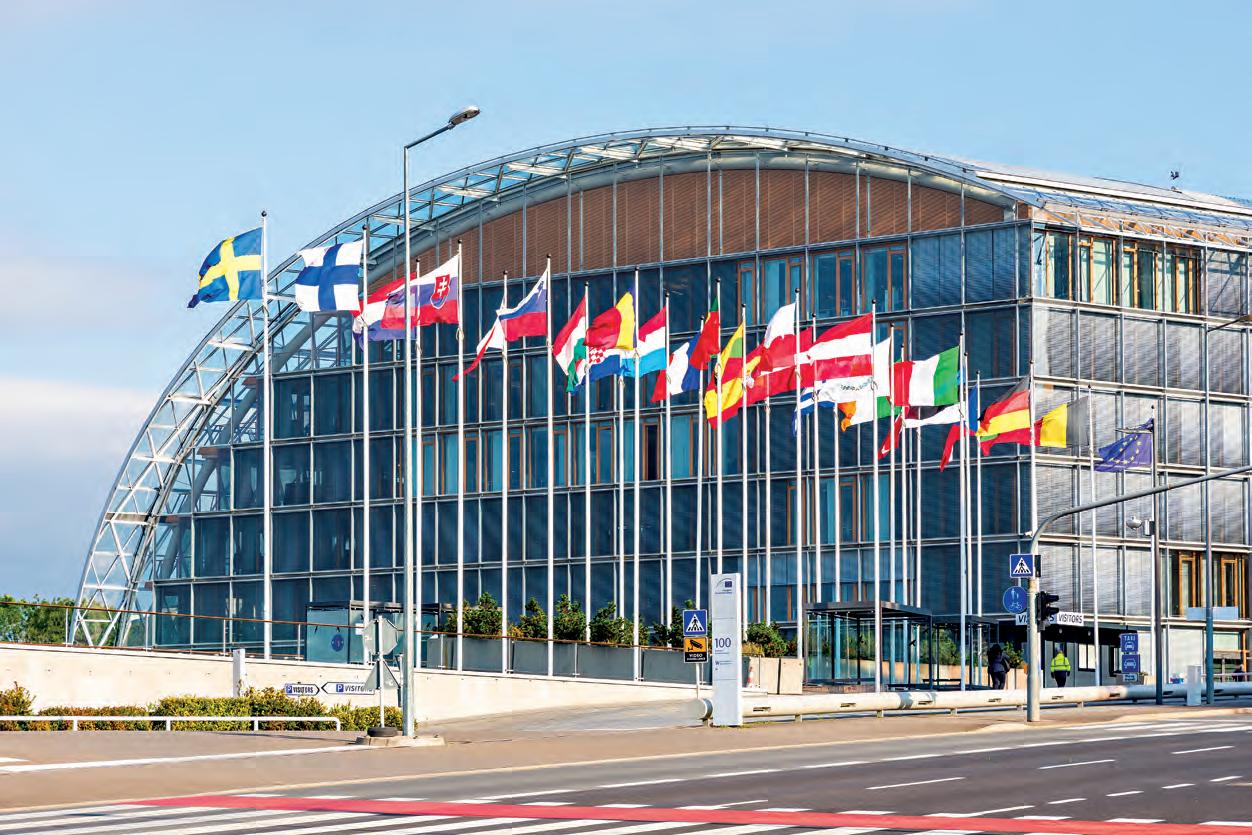
of clean power that is happening across the continent from Italy in the South to Ireland and Lithuania in the North. Cables and interconnectors – enough to wrap the Earth many times over – are being laid to link the windy northern seas with the sunlit Mediterranean coastline, creating a superhighway for the age of electrons.
An investment revolution is underway Meanwhile, cutting-edge fibre-optic sensors pioneered by Dutch innovators will be watching over the seabed to protect Europe’s critical infrastructure. New constellations of satellites developed in Belgium will offer enhanced surveillance capabilities from space, alongside cutting-edge radar systems from France and Spain. And all these systems will be connected by AI-powered 6G networks developed in Finland.
These are just a few of the nearly 900 investment projects financed by the European Investment Bank Group last year alone (see Fig 1). By leveraging EU budget guarantees to mobilise private investment, the EIB Group is powering the unfolding energy and technological revolutions. The transition into tomorrow’s world is already in full swing in
Europe – a major development that remains overlooked amid rapid geopolitical change.
In fact, the overall investment in the EU’s energy transition reached a new record in 2025, approaching €400bn – from hydropower in Austria to new railways in Czechia, and from energy efficiency upgrades by small businesses in Croatia to clean technologies deployed by heavy industries in Portugal. Just in the past year, the combined market capitalisation of European renewables companies has risen by over 50 percent. Something that many thought impossible in the near term is already happening – Europe is irreversibly weaning itself off Russian gas.
European investments in defence are increasing even more rapidly. European defence stocks have tripled in value in the past three years. Europe’s industrial production capacity now exceeds even that of the US in critical areas, including artillery shells. Europe is moving by leaps and bounds into strategic sectors and technologies such as drones.
A new venture-capital ecosystem geared toward pioneering security and defence enterprises has emerged almost overnight and essentially from scratch.
We have seen a similar mobilisation before. In 2020, no one expected that a European biotech company would pioneer a vaccine against an unknown virus in a matter of months, helping the world defeat a once-ina-century pandemic. Nor did anyone think that European leaders would launch a massive recovery and resilience programme financed by joint debt – an unprecedented show of solidarity and unity. When Russia’s full-scale invasion of Ukraine caused a massive spike in energy prices, everyone assumed that the European economy would buckle. Instead, the eurozone’s GDP grew faster than China and the US that year.
In the face of trade warfare, intense market volatility, and shifting traditional partnerships and alliances, European companies have proven resilient, not only diversifying their trade flows but also maintaining strong growth and investment.
European stock markets ended up outperforming US exchanges in 2025,
rewarding investors who put their trust in our economy. Unemployment is hovering near record lows, and growth is picking up – thanks to high-performing countries such as Spain and Poland. Europe has emerged as a beacon of stability in an uncertain world.
Time and again, the EU has adapted and reinvented itself in the face of crises, leaving it well prepared to navigate a tempestuous geopolitical environment. An export powerhouse, the EU is home to world-class universities and research centres, as well as a vibrant start-up ecosystem. Opinion polls show record levels of public support for the EU and the euro, and global surveys indicate that majorities around the world see the EU as a great power on an equal footing with the US and China.
They are right to do so. With a $22trn economy, a vast single market of nearly a half-billion people, and plans for another wave of enlargement, Europe’s weight in the world is undeniable. It may be a different kind of superpower, one that prizes values, rules, and multilateralism over sheer might. But its power lies in its commitment to principles and willingness to back its partners and allies, as demonstrated by
its status as the biggest source of financial and military assistance to Ukraine. Europe continues to build bridges in a world of walls. It is the world’s leading trade power, residing at the centre of a vast, everexpanding network of free-trade agreements. It is also an investment superpower that promotes shared prosperity around the world. As the biggest source of humanitarian aid and development finance, Europe funds everything from global vaccination campaigns to projects to improve water supplies in Amman and Karachi.
We do so because we remain committed to the same values that brought us this far. European unification started nearly eight decades ago from the ashes of two world wars. Our parents and grandparents learned from the tragedies and mistakes of that dark era, and we can draw inspiration from their example to shape a better future for ourselves and others around the world. Ours is a society based on inclusion, equality of opportunity, intellectual freedom, peace, and the rule of law.
We know what needs to be done to preserve this way of life. We need even deeper integration, including our capital markets. We need even more large-scale investment in critical infrastructure and strategic capabilities. We need simplification to make the EU more agile and efficient. And we need more win-win partnerships and alliances to diversify our supply chains and open new markets for our goods. Momentum is building in all these areas. European leaders’ minds are focused, and we are determined to capitalise on Europe’s strengths as the world’s underappreciated superpower.

Bulgaria’s successful entry into the euro area marks a defining moment for the country’s economy, strengthening financial stability, deepening European integration and opening new and strategic opportunities for businesses, investors and the banking sector alike
WORDS BY Petia Dimitrova CEO, POSTBANK & CHAIRPERSON AT THE ASSOCIATION OF BANKS IN BULGARIA





This year marked a turning point in the contemporary economic history of our country. As of January 1, 2026, Bulgaria is now part of the euro area. This proved not to be merely a change of currency, but a symbol of trust and recognition of the maturity of the Bulgarian financial system. This success is the result of long-standing, purposeful efforts –of fiscal discipline, institutional consistency and strategic vision. Bulgaria did not simply join the euro area – it entered it well prepared.
For Bulgaria, eurozone membership was not an end goal, but an opportunity to firmly position itself within the European economy. At the macro level, the most important benefit is the increase in financial and economic stability. Joining the eurozone provides access to the mechanisms of the European Central Bank and deeper integration into the EU’s financial architecture, which reduces country risk and strengthens investor confidence. It provides a strong foundation – through
increased trust, clearer regulation and deeper integration with European markets. The data already confirms this trend. The volume of direct investment equals 0.7 percent of the projected GDP, compared with 0.4 percent of GDP for the same period last year.
For businesses, a key effect is the elimination of currency risk. Conversion costs also disappear, which directly improves efficiency – especially for companies engaged in exports or working with EU partners, and more than 64 percent of Bulgaria’s exports are directed to EU markets. Another significant advantage is the improved financing conditions for businesses. Within the eurozone, interest rates on loans are typically lower or more stable, and access to capital is easier.
The banking sector played a key role in this process. More than €200m was invested solely in the preparation for the introduction of the euro – in technological systems, logistics, training and organisational capacity. This was a large-scale transformation that required not only resources, but also coordination, expertise and leadership.
In partnership with the Bulgarian National Bank, the Ministry of Finance, and
other institutions, the banking sector actively participated in the national information campaign, because a successful transition is not only a technical process – it requires trust. The results of this preparation were visible within the very first hours of 2026. The adjustment of card systems was completed in just three hours, and payments by card and ATM withdrawals in euro were possible from the very first seconds of the new year.
The Association of Banks in Bulgaria, together with the BNB, organised 28 training sessions with the participation of representatives of banks, Bulgarian Posts, municipalities and retail chains. They, in turn, trained their colleagues, ensuring that the physical exchange process proceeded smoothly in every part of the country. Additional regional training sessions were also conducted for employees of Bulgarian Posts.
During the first business days alone, nearly 240,000 customers were served in bank branches. Within a short period, virtually every household in the country passed through the banking system to carry out currency exchange. By the end of March, over 91 percent of levs in circulation – or more than BGN27bn (€13.8bn) – had been successfully withdrawn. This was one of the largest logistical operations in our modern economic history – implemented without disruption, without cash shortages and with a high level of service.
“Bulgaria did not simply join the euro area – it entered it well prepared”

Today, the Bulgarian banking sector is stable, well capitalised and highly liquid. It is not merely a participant, but an active driver of economic development. Membership in the euro area provides us with new opportunities – access to deeper financial markets, lower costs for businesses, higher investment attractiveness and greater economic predictability. More importantly, it places us at the core of European economic architecture. This means participation in decision-making processes that shape Europe’s future. It is also important to highlight the key benefits of adopting the euro as Bulgaria’s national currency, which are already working to the advantage of both citizens and businesses.
Cheaper and faster payments within the EU: euro transfers to other euro area countries are now treated as domestic by the system, meaning low fees, often completely free transactions and faster processing. Instant payments (SEPA Instant): transfers within seconds, 24/7, including between

€200m+
Invested in preparation for the introduction of the euro
Participation in the euro area makes our country more resilient to geopolitical and economic risks witnessed in recent years –rising military conflicts worldwide and energy insecurity. Membership also means more direct participation in European monetary and financial stability mechanisms. Bulgarian banks now have direct access to Eurosystem instruments, and our country becomes part of a broader framework for response to external economic and geopolitical shocks. Bulgaria’s accession to the euro area creates the conditions for a more direct and gradually stronger transmission of the Euro system’s monetary policy to domestic financial and economic conditions, supported by the direct application of its instruments in the country.
companies and to customers. This creates new opportunities both in business relationships and in interactions with end customers across the euro area, increasing trust between new partners who have not previously worked together.
Elimination of currency risk: businesses and citizens are no longer affected by lev/euro fluctuations, facilitating business planning and trade.
Easier trade and investment: companies operate directly in euro with EU partners, without conversion costs and with greater price transparency.
Improved access to financing: lower interest rates and greater investor interest due to reduced risk and euro area integration.
Conditions for longer fixed-rate periods on mortgage and consumer loans: through improved bank access to capital markets, liquidity instruments such as interest rate swaps, and European practices in interest rate risk management. This provides greater predictability for households and businesses.
At the same time, the Bulgarian National Bank retains its ability to use a set of macroprudential tools, whose primary objective remains maintaining the stability of the banking system in Bulgaria. In cases of geopolitical disruption, euro area countries also have access to the European Stability Mechanism (ESM), which effectively serves as a form of insurance for the country in the event of external shocks or regional geopolitical destabilisation. With Bulgaria’s accession to the euro area, commercial banks in the country have gained direct access to the Eurosystem’s monetary policy instruments.
A new phase lies ahead – one of deeper integration, accelerated digitalisation, sustainable finance and support for the competitiveness of the Bulgarian economy. The role of the banking sector in this process will remain key. I am confident that with the experience accumulated, proven resilience, and a clear vision for the future, we will continue to build on what has been achieved. Because historical successes are measured not only by their attainment, but by what we do afterwards. n



Spooked by US adventurism, Russian aggression and Chinese protectionism, the EU is rushing to assert its financial sovereignty through a range of initiatives. Will they work? Alex Katsomitros reports »
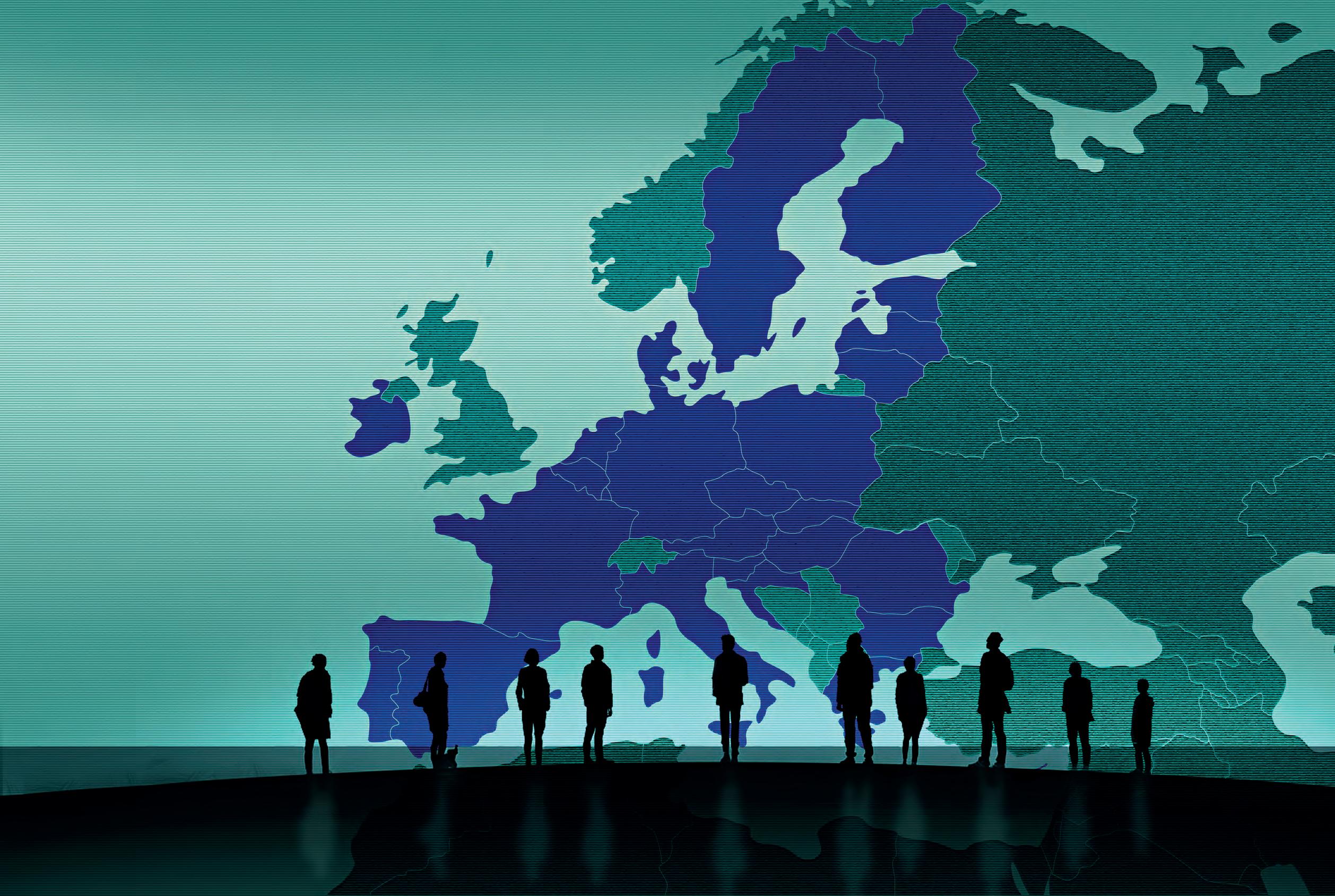
When the Italian bank UniCredit started building a significant stake in the German lender Commerzbank in 2024 as part of a takeover strategy, the German government strongly opposed the move, calling it ‘hostile,’ partly due to Commerzbank’s importance to German industry. Commerzbank rejected the offer, although officials at the European Central Bank (ECB) warned that such resistance undermined the single European banking market. The episode, however, served as a stark reminder of a contradiction in the EU’s financial architecture: although member states support deeper integration, they are often reluctant to surrender control. Yet further consolidation may still lie ahead, as calls for EU autonomy in finance continue to grow.
Ever since the EU single market emerged in the 1990s, experts have argued that the EU will never become a true superpower unless its financial services sector becomes both genuinely European and globally competitive. Yet it has been a recent confluence of internal and external pressures that has added urgency to these demands. Brexit marked a setback for the EU by depriving it of the City of London, its single globally significant financial centre; since then, the bloc has relied on a patchwork of hubs – including Frankfurt, Dublin, Paris, Milan and Amsterdam – none of which match the scale of New York or Hong Kong. Then came Russia’s invasion of Ukraine, which prompted financial sanctions against Russia, including the exclusion of Russian banks from the Brussels-based SWIFT system and the freezing of Russian assets in Europe, all stressing the EU’s alignment with US financial architecture.
Even more significant was Trump’s victory in the 2024 presidential election, which reminded Europeans that nationalism is a feature rather than a bug of 21st-century America. Since Trump returned to the presidency, US economic policy has been staunchly anti-European, with higher tariffs on EU products making the need for European sovereignty more pressing. A speech by Vice President JD Vance in Munich last year unsettled European policymakers, as did renewed pressure on Denmark over Greenland, including suggestions the territory could come under US control. Fears that the invisible thread holding together the transatlantic alliance has frayed are now spilling over into the financial sector. European policymakers are openly questioning whether the Federal Reserve,
under a nationalist US administration, would still fulfil its role as the global lender of last resort, as it did during the Great Recession.
A report led by Mario Draghi has injected fresh urgency into calls for European financial sovereignty, arguing that the EU risks falling behind competitors unless it accelerates financial integration. The former ECB president frames the challenge as a strategic imperative in an era of geopolitical fragmentation. A separate EU-commissioned report led by Enrico Letta reinforces the message from a single market perspective. Letta argues that Europe must complete its internal market to unlock scale. His proposals emphasise removing barriers to cross-border investment, harmonising rules and strengthening common institutions to mobilise private capital. Both reports highlight structural weaknesses – fragmented capital markets, limited risk-sharing and insufficient depth in financial services –and warn that without reform Europe will struggle to fund priorities such as the green transition, digital innovation and, crucially in a fraying geopolitical environment, defence. True to form, European policymakers have taken their time to absorb the lessons. “The Draghi report has been widely discussed by political leaders,” says Holger Schmieding, chief economist at Berenberg Bank, the world’s oldest merchant bank. “In that sense, it has shaped the debate. But so far, few of the steps Draghi has recommended have been taken.” Yet, taken together, the two reports have helped crystallise a consensus that financial integration is essential if Europe is to secure its strategic autonomy.
At the epicentre of the debate lies the consolidation of EU capital markets, a project the bloc has been pursuing for over a decade. One of the weaknesses in Europe’s economic model identified by the Draghi report is the underuse of the bloc’s accumulated capital. Compared with the US, Europe has struggled to channel savings into investment for companies, particularly in the technology sector. Approximately €14trn of retail capital in Europe is estimated to be sitting idle in deposits.
Another concern is that Europe’s investment landscape is gradually being dominated by US firms. American investment banks already play a leading role in Europe’s capital markets, accounting for roughly 40 percent of investment banking fees and an even larger share in key areas such as M&A and equity underwriting. Three US asset managers – BlackRock, Vanguard and State
Of retail capital in Europe is estimated to be sitting idle in deposits
Financial integration is essential if Europe is to secure its strategic autonomy
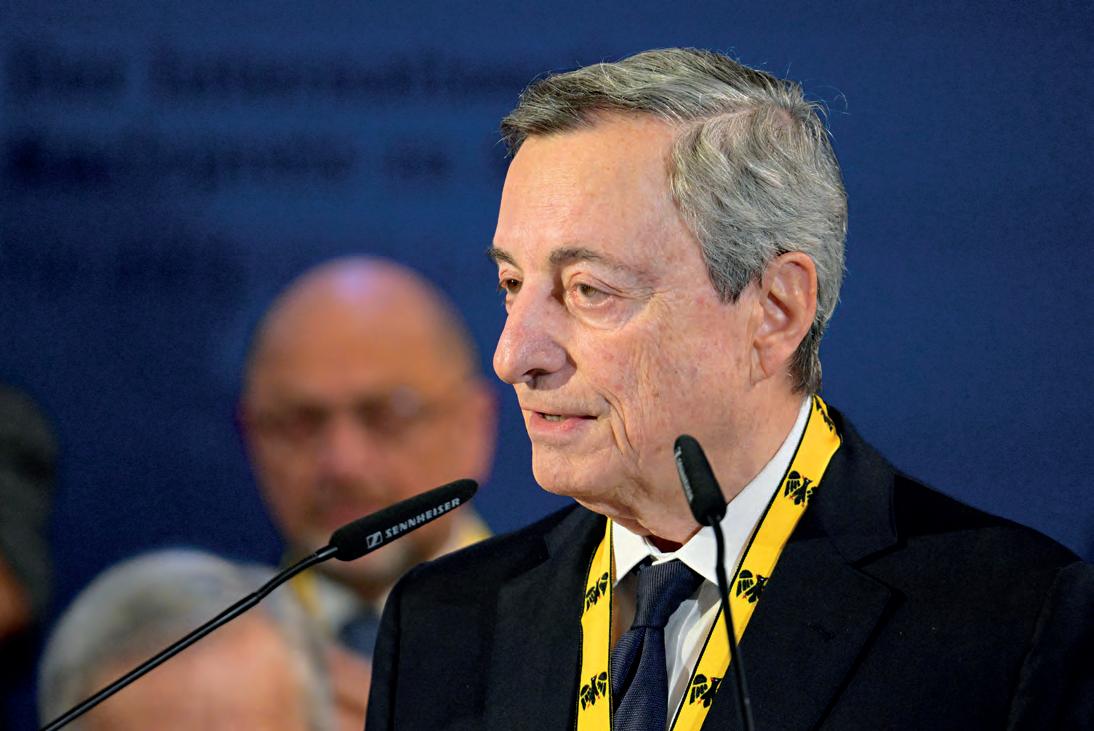
Street – have been steadily expanding their presence in Europe while often maintaining a home bias toward US investments. The sector remains underdeveloped in Europe, as governments discourage cross-border activity to retain domestic savings and sustain demand for public debt.
In a bid to deepen Europe’s capital markets, the European Commission has relaunched its plans for a capital markets union under the broader banner of a ‘Savings and Investment Union.’ Measures under consideration include tax incentives to encourage retail investment in European assets, changes in capital requirements for banks and insurers to support lending, and reforms to private pension and savings frameworks aimed at channelling household savings into capital markets.
Another goal is to build a unified regulatory regime for equities, bonds and other investment vehicles that could improve investor confidence and reduce regulatory arbitrage. By harmonising regulations and removing barriers to crossborder investments, the scheme aims at diversifying funding sources for businesses beyond the banking sector. The reforms aim to indirectly tackle a long-standing problem in the European economy: overbanking –too many banks competing for a relatively fixed pool of capital. The large number of banks across Europe has limited economies of scale and weakened competition, while encouraging firms to rely more heavily on bank lending than on bonds or equity financing. This, in turn, has slowed the development of deeper capital markets. Sceptics warn that even if implemented, the
plans do not go far in addressing structural problems. “The proposals so far will further harmonise capital markets but not complete it {the union},” says Carsten Brzeski, global head of macro research at ING Research, part of the Dutch bank ING, adding: “Another hampering issue will be tax issues and how to deal with different taxation of capital gains and asset wealth.”
What is fuelling optimism, though, is a gradual change in the political mood.
The bloc’s largest economies have backed the Commission’s proposal to expand the supervisory role of the European Securities and Markets Authority (ESMA) in Paris, giving it direct oversight of major cross-border market infrastructures, including central counterparties, securities depositories, selected trading venues and crypto-asset service providers.
Currently supervision remains largely national, even for institutions whose activities span multiple jurisdictions, as member states resist EU-level oversight. “National regulators have and will continue to have for a long time a key role as components of the euro area-wide supervisory system,” argues the economist Ignazio Angeloni, senior policy fellow at the Leibniz Institute for Financial Research SAFE and former member of the ECB’s supervisory board. A mixed model, such as the one created for banking supervision within the ECB during the eurozone debt crisis, would be the best option, he suggests.
“The structure of the Single Supervisory Mechanism (SSM), where the supervisory board, effectively its decision-making arm, includes national banking supervisors as voting members, has proved viable and can be extended to market supervision.”
Long-awaited banking union is closer Reforming Europe’s financial architecture requires reviving the politically sensitive project of a fully fledged banking union. However, removing the national barriers that fragment European banking has long proved difficult. The plan was announced with great fanfare in 2012 during the Eurozone debt crisis, but the job remains unfinished. Eurozone banking remains a loosely connected collection of national banking markets, given that deposit and loan markets have stayed largely under national control. The crisis triggered a retrenchment in cross-border banking activity, with EU banks’ cross-border exposures and interbank lending falling by 25 percent and 40 percent respectively. Yet Angeloni argues that the banking union has achieved its original goal: making banks safer and preserving financial stability. “No significant banking crises have occurred since then, while there have been some elsewhere in the world, bank balance sheets have been cleaned and bank profitability restored,” he says.
Most analysts agree that the missing piece is a shared deposit insurance scheme that would serve as a common safety net for depositors. Without it, national governments remain tied to their domestic banking systems. The Commission hopes that reviving plans for a European Deposit Insurance Scheme (EDIS) could unlock deeper integration by boosting crossborder banking groups and making it easier for lenders to operate across borders. “In an ideal world, it is critical,” Brzeski says about the plan. “In a more realistic world, a second-best capital markets union would not necessarily require a full EDIS but simply enough trust in the stability and solidity of harmonised national schemes.” The political obstacles that have stalled the project have not disappeared. Countries such as Germany and the Netherlands have long expressed concerns about risk-sharing, wary of underwriting banking systems in countries where non-performing loans have historically been higher. For their part, Southern member states argue that without shared protections, integration will remain incomplete.
Encouraging cross-border mergers and acquisitions is another key objective. Greater consolidation, Brussels argues, could strengthen profitability in a sector facing digital disruption and tighter margins. The Draghi report goes one step further, suggesting that cross-border banking activity should become fully equivalent to national activity through a ‘country-blind’ supervisory regime. Yet smaller countries
» fear that consolidation could mark the end of their national banking sectors and leave their financial systems dominated by larger economies. Many governments still provide direct or indirect guarantees to their domestic banks and seek to maintain a socalled ‘national champion’ that can compete internationally. Regional banks also continue to play a significant role in several countries, benefiting from less stringent supervision by national regulators than that applied to large banks under ECB oversight. Yet fostering a few large players that can compete with US and Asian banks is essential if the EU is to achieve financial sovereignty, Angeloni warns. “At present, even the largest EU banks have a largely national footprint. Because of lack of scale, they cannot compete with non-EU banking giants even in EU markets, particularly in investment banking and related areas, such as M&A and IPOs.”
On the monetary front, the EU’s grant project is the ECB’s push for a digital euro, a central bank digital currency. A pilot phase is expected to be rolled out next year, with full issuance before the end of the decade. While still subject to political approval, the project has become a pillar of Europe’s ambition to reduce external dependencies, particularly from an increasingly hostile US and its dollar. “The aggressive stance adopted by the US over the past year toward the EU has certainly contributed to unblocking the legislative process related to the digital euro,” says Matteo Bursi, a researcher at the Italian think tank Istituto Affari Internazionali who specialises in the digital economy.
At its core, the digital euro would offer European citizens and businesses a statebacked electronic means of payment, complementing cash. For policymakers, it addresses a strategic concern: Europe’s heavy reliance on foreign payment providers, including US card networks and fast-growing private platforms. With a digital currency, Europeans will have access to a secure public payment option in an era where private stablecoins and big tech payment systems expand. Such a development would also preserve the role of central bank money in the digital age, says Rebecca Christie, an expert on capital markets at the Brussels-based think tank Bruegel. “It is important that the ECB be the reference point for all things euro, not some kind of privately developed product that becomes the default because it found an unoccupied niche in the markets.”
Still, the initiative faces scrutiny. European banks have expressed concerns over potential deposit outflows, while privacy advocates question how user data will be
The digital euro is as much a political project as a technological and financial one

protected. The ECB has sought to address these concerns by proposing holding limits and emphasising that transactions would be highly confidential. “The significant limitations currently being imposed on the digital euro, such as the absence of interest on deposits and the introduction of holding limits, substantially weaken the instrument, preventing it from serving monetary policy purposes and constraining its potential as an alternative to private bank deposits,” Bursi claims, adding that uptake could remain low, an outcome that would vindicate those who oppose the project, portraying it as a waste of public resources.
Ultimately, the digital euro is as much a political project as a technological and financial one. But expectations that it could reinforce the euro’s international role should be tempered, Bursi warns: “It would be misleading to expect a substantial impact, given that the use of the euro as a global reserve currency remains constrained by limited financial integration among European countries, in particular by the absence of a safe asset comparable to US Treasurys.”
This is one reason why calls for a deeper, more liquid EU-issued bond market are gaining traction in Brussels. Advocates argue that a larger pool of jointly issued debt as a European
safe asset could attract long-term global capital and lower borrowing costs across the bloc. Compared with the vast $40trn US Treasury market, Europe’s sovereign debt landscape remains fragmented. National bond markets dominate, limiting scale and reducing the euro’s appeal as a global reserve currency.
Momentum has been building since the pandemic-era launch of joint borrowing through a recovery fund, which demonstrated both investor appetite and the bloc’s capacity to issue large volumes of common debt. Supporters now see an opportunity to turn that temporary experiment into a more permanent feature of the EU’s financial architecture. Political resistance, however, has long been a barrier. Frugal northern countries where fiscal prudence is a deeply ingrained principle have been wary of mutualised debt, concerned it could amount to subsidising more indebted member states. “Jointly issued debt would enhance the international role of the euro and strengthen the financial sovereignty of the EU. But in the multi-national EU, joint bonds must be subject to strict conditions. They should only be issued to finance genuinely new common tasks, for instance as help for Ukraine or for common defence projects,” says Schmieding of Berenberg Bank. “They should not finance pre-existing EU tasks or national budgets.
Otherwise, they would dilute the fiscal discipline that is required to keep borrowing costs low enough to be sustainable.”
Another concern is the EU’s lack of fiscal capacity to support debt issuance. “You need to embed Eurobonds in a political framework, which is essentially a fiscal union where you also have tax revenue at the European level to back those bonds,” says Nicolas Véron, a senior fellow at the US think tank Peterson Institute for International Economics and an expert on financial reform. “That requires treaty change, which is very difficult under the current circumstances.” Yet geopolitical tensions, the need for large-scale investment in defence and energy, and a growing recognition of Europe’s financing gaps are reshaping the debate. Fiscal conditions in southern Europe have also improved, with Spain, Italy, Portugal and Greece seeing debt levels stabilise or fall alongside upgrades in credit ratings. These trends are softening opposition and opening the door to incremental steps towards greater common debt issuance.
Optimists in Brussels hope that, although disparate in scope, these projects will reinforce one another, creating a virtuous cycle that will help Europe’s financial sector rediscover its mojo. A stronger banking union
Europe’s ambition for financial sovereignty runs up against a critical vulnerability: much of the backbone of its financial system relies on nonEuropean providers. European banks depend on US cloud companies such as Amazon Web Services, Microsoft Azure and Google Cloud to store data and run critical operations, a solution that creates concentration risk and exposes the sector to geopolitical or regulatory disruptions. Europe’s fintech sector has also struggled to match the dynamism of its US counterparts. Investment levels remain comparatively lower and the market is fragmented along national lines, limiting the ability of European fintechs to grow into global players. Many flee to the US in search of deeper investor pockets; Revolut, Europe’s biggest fintech, has indicated that it is likely to choose the US as its listing destination. Payments are another crucial front. Much of Europe’s card-based payments system is routed through US giants such as Visa and Mastercard, while Chinese players like Alipay and WeChat Pay are also making forays into
would support the savings and investments union by creating more stable cross-border banks able to channel savings into capital markets. In turn, robust capital markets would reduce overbanking and indirectly support banking consolidation. Eurobonds would provide the common safe asset needed to deepen those markets, while the digital euro would reinforce European payment infrastructure and reduce dependence on foreign providers.
“The banking union is a project of rationalising European banking into a single system instead of 27 national ones. That should in principle help to address the problem of overbanking, because this has partly to do with national fragmentation,” says Véron, adding: “Conversely, if you make capital markets more attractive and trustworthy, you could have rebalancing from banking intermediation to capital markets activity, which is needed to enhance the European economy’s growth potential.”
Yet, for all the momentum behind deeper integration, Europe’s path to financial sovereignty remains obstructed by a familiar set of barriers. Chief among them is the enduring power of national interests, expressed through lobbying by regulators, governments and banks that fear losing influence in a more centralised system. Control of finance can be a sensitive issue,
the European market. In response, EU policymakers and industry groups are exploring initiatives to build alternative payment solutions, but addressing these challenges will require sustained investment, regulatory coordination and political will. “The digital euro, if designed appropriately, would lead to the creation of a payment system that is independent from those currently in use, primarily US-based, and could therefore help reduce Europe’s reliance on foreign providers,” Bursi says. Yet without a stronger domestic fintech ecosystem, Europe risks remaining dependent on foreign technology, undermining its goal of achieving financial sovereignty in a digital age.
“The likelihood that the US could exploit Europe’s dependence on payment systems has remained limited, yet with Donald Trump’s return to the White House, those risks have increased,” warns Bursi, adding: “Although some initiatives have begun to take shape in Europe, the EU still lacks major private solutions capable of ensuring strategic autonomy in areas such as proximity payments.”
given the role financial institutions play in funding domestic industries. Fragmentation limits cross-border consolidation, hinders the development of deep capital markets and complicates crisis management, yet national players remain loath to cede control to Brussels. Even if the Commission’s plans are up to the challenge, the question remains whether they will be diluted during implementation or delayed to the point of becoming untimely and ineffective, Angeloni warns. “This will largely depend on political cohesion among the member states. Lack of cohesion has repeatedly hampered EU reform in the past.”
Crises have historically been the catalyst for European integration, from the eurozone debt turmoil to the pandemic. External pressures, including geopolitical competition and the need to finance largescale investments, may again push member states toward compromise. There is growing awareness that the bloc is losing ground. Crucially, the Commission proposals do not require unanimity but only qualified majority to move forward. Ultimately, says Brzeski, integration is a means to an end: closing the gap with US markets – though it will require difficult compromises. “If Europe really wants to become fully European, national preferences and partly national sovereignty would always have to take a step back.” n
wealth management Asset Management
Managing nearly €300bn in assets, KBC Asset Management combines digital platforms, client-focused solutions and evolving sustainability policies to position itself as a long-term investment partner across core European markets
WORDS BY Frank Van de Vel
CHIEF INVESTOR SUPPORT OFFICER, KBC ASSET MANAGEMENT
investment policies and operational practices.




KBC is a well-established European financial group, combining banking and insurance activities and serving approximately 13 million clients across Belgium, the Czech Republic, Slovakia, Hungary and Bulgaria. Within the Group, KBC Asset Management (KBC AM) functions as the investment arm, developing and managing solutions for both retail and institutional investors. KBC Asset Management develops investment products primarily for intra-group distribution and supports investors through both direct and indirect channels. Its activities span the full investment lifecycle, from product design and portfolio management to sales support and after-sales services. Innovation has been a defining feature of the organisation from its earliest days. The ambition is to be a reference player in the investment domain in each of its core markets, while making investing accessible, understandable and relevant for a broad range of clients.
Digitalisation plays an important enabling role in this strategy. Over the past decade, KBC Group’s mobile banking application has evolved into an all-in-one platform that increasingly serves as the primary interface with clients. The introduction of ‘Kate,’ the Group’s virtual assistant, represents a further step in enhancing the digital client experience, supporting a more intuitive and integrated investment journey.
A central pillar of KBC AM’s approach is helping savers transition into investing and supporting them as their financial needs evolve over time. This is reflected in the significant number of active investment plans, a predominantly mobile first distribution model, and a client journey designed to offer guidance at key decision points.
Dedicated solution development teams
are responsible for creating investment solutions from initial concept through to market launch, while also continuously reviewing and adapting existing products to ensure ongoing alignment with client needs. In parallel, solution support teams provide training, information and after-sales services, with a strong emphasis on digital channels. As of the end of the fourth quarter of 2025, KBC Asset Management managed close to €300bn in assets under management.
This total comprises approximately €127bn in direct client assets, €23bn in group assets and pension funds, around €82bn in fund of funds structures, and roughly €67bn associated with investment advisory mandates. A significant share of direct client assets is invested in line with KBC’s responsible investing framework, supporting consistently high levels of client satisfaction.
Sustainability is a core element of KBC AM’s long-term strategy and a key factor underpinning its recognition in this programme. The firm’s sustainability approach is closely linked to the local communities and economies in which it operates, with a clear objective to respond to societal needs in a balanced, transparent and relevant manner.
Environmental responsibility is a key pillar within KBC Group’s sustainable finance approach. This programme addresses issues such as climate change, biodiversity, circularity, pollution and water management, translating these themes into concrete
An important aspect of KBC Asset Management’s sustainability framework is its approach to exclusion policies and their periodic reassessment. In 2025, KBC Group reviewed elements of its exclusion framework for certain actively managed, non-structured Article 6 funds. As a result, and under clearly defined conditions, these funds may gain limited exposure to companies involved in nuclear weapons, provided these companies are domiciled in NATO countries or in Austria, Switzerland or Ireland.
Investments in controversial weapons, including chemical or biological weapons, cluster munitions and anti-personnel mines, remain fully excluded in line with KBC Group’s blacklist framework. Funds that follow KBC Asset Management’s Responsible Investing methodology continue to apply their own exclusion policy and are not in scope of this update.
The decision reflects the view that credible defence capabilities, including nuclear deterrence, are considered by governments to be an essential component of collective security in the current geopolitical context. KBC Group framed the review within the applicable legal and regulatory context and communicated transparently with investors about the scope and implications. Transparency and client choice were central to the implementation: investors in the affected funds were proactively informed and offered the opportunity to exit without exit fees (excluding any applicable taxes) during clearly defined periods.
Underlying KBC AM’s investment activities, digital innovation and sustainability strategy is a strong emphasis on human capital. Employees are viewed as key drivers of longterm value creation, and the organisation promotes a professional culture based on responsiveness, mutual respect and a resultsoriented mindset. This people-centred approach supports the firm’s ambition to operate responsibly while continuously enhancing the client experience. Recognised as the ‘Most Sustainable Asset Manager 2025 – Belgium’ and awarded for excellence in client service, KBC Asset Management demonstrates how scale, responsibility and innovation can be combined within a coherent investment strategy.

By integrating digital capabilities, structured sustainability policies and a measured response to evolving societal and geopolitical realities, the firm continues to position itself as a long-term investment partner in its core European markets. n

Luxury vehicles, gold bars, designer handbags, and artwork went under the hammer in Jakarta as Indonesia’s Asset Recovery Agency staged one of its largestever public auctions of confiscated assets. The event forms part of a broader crackdown on corruption, money laundering, and organised
financial crime. Authorities say asset seizures and recovery efforts have intensified significantly in recent years, reflecting growing pressure for transparency and stronger financial governance. High-profile auctions also serve a symbolic purpose – demonstrating that illicit wealth can be traced,
confiscated, and returned to the state. Analysts note that Indonesia’s anti-corruption efforts are increasingly tied to investor confidence, as international businesses place greater emphasis on governance standards and institutional accountability across Southeast Asia.
From fine art and rare whisky to watches and wine, luxury collectibles are increasingly being treated as serious portfolio assets. While recent market corrections have exposed the sector’s volatility, long-term demand, cultural value and shifting investor behaviour are reshaping how wealth managers view passion investments
BY
WORDS
Vikki Davies





Art that hung on walls and wine that sat in cellars is now competing for space in portfolios. After two years of correction, the market is finding its footing, but the numbers still demand careful reading. In spring 2022, as public equity markets stumbled and central banks signalled the end of cheap money, auction rooms told a different story. Sotheby’s reported record results. Rare whisky indices hit levels that would have seemed fanciful five years earlier. Tangible assets, long dismissed by mainstream wealth managers as indulgences of the very rich, were attracting serious institutional scrutiny for the first time.
Passion investing, encompassing fine watches, contemporary and classic art, vintage wine, rare whisky and high-end accessories, has spent a decade trying to shed its image as a plaything of the wealthy. In some corners of wealth management, it is succeeding. In others, scepticism remains deep and justified. The gap between those positions reveals something important about how investors think about value and risk.
For most of the 20th century the value of art, wine and watches was partly financial but mostly cultural, expressions of taste and inheritance rather than deliberate capital allocation. What changed was the infrastructure that grew up around them. Index providers began tracking price movements and platforms emerged to authenticate and trade collectibles. A prolonged period of low interest rates left investors hunting returns in unfamiliar places.
The long-run numbers remain striking. The Knight Frank Luxury Investment Index (KFLII) showed that $1m invested in 2005 would have grown to approximately $5.4m by end-2024. Individual categories performed even more dramatically at their peaks: rare whisky appreciated 191.7 percent over a decade and watches 125.1 percent.
Liam Bailey, Global Head of Research at Knight Frank, says: “Luxury collectibles have delivered for investors over the long term.” Wealth managers, particularly those serving ultra-high-net-worth clients, have begun to formalise what many already knew: that significant client wealth was sitting in collectibles, whether or not those assets appeared on any investment statement.
The performance reality check
The long-term figures are compelling. The recent ones are a useful corrective. The KFLII recorded a marginal –0.4 percent decline in 2025, signalling stabilisation after two years of broad correction across several collectible categories. That follows falls of one percent in 2023 and 3.3 percent in 2024. Even after three consecutive years of correction, the index remains 40 percent above its 2020 baseline, showing a market settling after a boom, not one in distress.
The auction houses tell a similar story of tentative recovery. Sotheby’s, Christie’s and Phillips reported combined projected revenue of $14.1bn for 2025, up roughly 10 percent from 2024. Sotheby’s alone reported total sales of $7bn, a 17 percent increase over 2024, with fine art up 15 percent to $4.3bn. That compares with auction sales of $4.1bn across the big three in 2024, itself nearly half the 2022 peak. Impressionist sales surged 80.4 percent, modern art advanced 19.4 percent, and Old Masters registered a 68.7 percent uplift.

Christie’s CEO Bonnie Brennan said:
“The energy has returned to the saleroom, online and across the market. We have seen renewed confidence worldwide.” The recovery, though, followed a pattern familiar to anyone who has watched asset markets closely: a pandemic-era surge driven by liquidity and newly wealthy buyers, followed by a reversion as rates rose. Assets that held up best were handbags, jewellery and coins and tended to be those with genuine scarcity and cultural resonance. Those that fell hardest had attracted the most speculative attention. The fine wine market posted a decline of 2.5 percent in 2025, with total losses approaching 25 percent since the 2022 peak. Whisky, the standout performer of the previous decade, has still not recovered its pre-correction highs.
The lesson is not that luxury assets are poor investments. It is that they are uneven and cyclical. Returns cluster around quality and timing in ways that reward expertise and punish trend-chasing. The investor who bought a Patek Philippe Nautilus watch at the height of the pandemic premium paid a very
different price to one who bought the same watch in 2018. Same object, three years apart, entirely different financial story.
Despite the correction cycle, the structural forces behind long-term growth remain intact. Inflation has revived interest in tangible stores of value. Geopolitical uncertainty has reinforced the appeal of portable, internationally recognised assets. The value of 1959 Macallan whisky, for example, is legible to collectors from Shanghai to Geneva.
Liam Bailey, Global Head of Research at Knight Frank , speaking on the 2026 Wealth Report, said: “After a cycle defined by extraordinary highs followed by rapid readjustment, the luxury investment market is now entering a more rational and more discerning phase. Collectors are increasingly prioritising rarity and cultural resonance and younger generations are reshaping ownership models through digital and fractional platforms.” Demographics are shifting the buyer base in ways that will define the category’s next decade. At Sotheby’s, buyers under 40 made up 17 percent of global fine art bidders and just under 30 percent in luxury categories in 2025, while first-time
$14.1bn
Combined revenue in 2025 for Sotheby’s, Christie’s and Phillips
bidders accounted for 35 percent of all participants. Where older collectors gravitated toward old masters and grand cru Bordeaux, younger buyers are drawn to contemporary art, street-wear, sneakers and independent watchmakers. For this cohort, the line between cultural consumption and financial investment has all but disappeared. “As people become wealthier, their preferences evolve beyond massproduced luxury items to seek more unique and exclusive pieces. There is a desire for items that reflect authenticity, craftsmanship, heritage and skill,” Bailey adds. Serious participation in luxury collectible markets once required three things in short supply: significant capital, specialist knowledge and the right relationships.
Digital platforms and fractional ownership models have begun to change that, though not without complications. Phillips Auction House reported that 70 percent of works sold in the first half of 2024 were purchased via online bidding. For newer categories, rare sneakers, vintage haute couture, even natural history specimens, the internet has created new markets. A 66-million-year-old Edmontosaurus skull, sold via a fractional platform, delivered a 22.4 percent return in just eight and a half months, according to Knight Frank.
Leonardo De Keersmaeker, Asset and Partnerships Manager at Timeless Investments, explains the appeal: “We see a lot of interest driven by the tangibility and the emotional factor. It is about diversification of assets, with a fun story to tell.” The tension in all of this is real. The exclusivity underpinning the value of luxury collectibles is foundational to their appeal. Eran Peer, Co-Founder and CEO of fractional platform Konvi, cautions that: “the most valuable asset in the luxury investment space is knowledge” and that investors must “move beyond the hype and avoid simply following trends.” He believes success requires deep knowledge rather than simply following market hype.
Any serious discussion of luxury as an asset class must reckon with characteristics that sharply distinguish it from traditional investments. The most significant is liquidity, or the consistent lack of it. There is no exchange on which to sell vintage cognac at a moment’s notice. Auction timelines run to months. Private sales require the right buyer at the right moment, and the right buyer is never obligated to appear.
Valuation presents a related problem. Without a central pricing mechanism, the true market value of a collectible is largely unknowable until the moment of sale. Indices provide orientation, but they track categories, not individual items, and the spread between an exceptional piece and an average one can be enormous. Physical risks are unique to this category too: improper storage, contested provenance, or an accident that insurance may cover but the market will not forget. Authentication in the watch market, where sophisticated counterfeits are increasingly hard to detect, has become a cost of entry.
The broad consensus among wealth managers is that luxury belongs at the margins, a satellite position rather than a core holding, sized appropriately for its illiquidity and the expertise required. Some advisers suggest allocations of up to 20 percent in alternatives broadly defined, with collectibles representing a portion of that, not the whole. The more important shift is in how the question is being framed. For most of the 20th century, passion purchases were kept separate from investment portfolios by convention. That convention is dissolving. As trend forecaster Martin Raymond observed in Knight Frank’s 2026 Wealth Report: “Collecting is not conspicuous consumption – it is conspicuous taste.” The generation that normalised cryptocurrency as a portfolio asset sees no reason to treat a limited-edition watch differently from any other store of value, and wealth managers who treat the categories as entirely separate risk losing the conversation.
Knight Frank frames the current moment as a market characterised by buyers who are highly disciplined, not afraid to spend, but unwilling to pay above fair value. The froth has cleared. The question now is what endures underneath it and which investors are patient and knowledgeable enough to find out.
The most successful long-term participants in luxury collectible markets have consistently been those who understood both dimensions: who bought what they genuinely valued, held through volatility without panic and sold with as much discipline as they brought to acquisition. In the end, the best investors in luxury may be those who understand both the market and its meaning and never mistake one for the other. n
UOBAMTH has rapidly established itself as Thailand’s leading USD fund provider, expanding its suite of dollar-denominated investment products to meet rising demand for global diversification, liquidity and income opportunities among both retail and institutional investors
Rachada Tangharat
DEPUTY CHIEF EXECUTIVE OFFICER, UOB ASSET MANAGEMENT (THAILAND)
liquid USD investment solution with daily subscriptions and redemptions, while enhancing portfolio diversification.





Investors are seeking solutions that combine quality, yield and high liquidity. UOBAM Thailand (UOBAMTH) therefore aims to achieve this by expanding the USD fund shelf across asset classes to preserve and grow assets under management (AUM). This should help the company to offer their clients a diversified portfolio of USD-denominated funds across various investment policies. This expansion is designed to serve the needs of both retail and institutional clients, providing them with a broader suite of investment solutions and greater flexibility in portfolio construction.
A key driver of the UOBAMTH’s success has been emphasis on USD-denominated products, giving Thai investors access to global markets while enhancing currency diversification. In response to the increasing appetite for international exposure, the firm has continued to prioritise innovation and global connectivity as core pillars of its product strategy.
Starting in March 2025, UOBAMTH introduced its USD funds to the market with an initial AUM of $23.77m, rapidly rising to become the market leader by July 2025 with AUM reaching $251m. The firm continued to demonstrate enduring leadership throughout the year, expanding AUM to $418m by December 2025 and capturing a dominant 53 percent market share. This reflects UOBAMTH’s disciplined execution, clientcentric design and timely expansion of USD solutions that effectively met rising investor demand for global exposure.
UOBAMTH’s USD position has remained firmly intact into 2026, maintaining its number one position since the beginning of
the year. As of April 2026, the firm reinforced its dominance, as USD AUM reached $436m and market share expanded to approximately 72 percent, underscoring the firm’s continued dominance in the USD fund market.
UOBAMTH has demonstrated strong growth momentum and market leadership through innovative product development and precise strategic execution. The company has identified a significant opportunity from the sizable pool of USD held in clients’ Foreign Currency Deposit (FCD) accounts and has responded by developing tailored investment products to better meet client needs. In addition, as investors increasingly seek returns above FCD rates, the strategic expansion of its USD-denominated product suite, which proactively addresses the growing demand for global investment opportunities among Thai investors, continues to strengthen its market leadership.
UOBAMTH has built a comprehensive suite of USD-denominated funds across all asset classes. The firm pioneered USD Term Funds with short tenors of three and six months, offering a simple and easy-to-understand solution for investors seeking attractive USD returns. This approach enables clients to build familiarity and confidence before progressing to more sophisticated investment options.
Following the successful launch of its USD Term Funds, UOBAMTH further strengthened its product suite with the United USD Daily Fund (USDAILY), a short-term fi xed income fund. As Thailand’s first USD-denominated daily fixed income fund, USDAILY offers a flexible and highly
“The firm continued to demonstrate enduring leadership throughout the year ”
Building on this momentum, UOBAMTH broadened its USD offering into a global fi xed income fund with the launch of the United USD Global Income Strategic Bond Fund (UGIS-USD) and the United USD Ready Fund (USDREADY), offering investors broader diversification across income strategies. UGIS-USD invests in global fixed income instruments to generate returns in US dollars. Meanwhile, USDREADY invests in short-duration USD-denominated assets or instruments, aiming to generate returns in line with money market performance.
To better address the diverse needs of investors, UOBAMTH has extended its capabilities into global equities funds with the launch of the United USD Global Dividend Plus Fund (UGDIVP-USD) and the United USD Global Founders and Owners Fund (UGFO-USD). UGDIVP-USD focuses on investing in equities of companies worldwide, including emerging markets, providing broad exposure to global growth opportunities, while employing a covered call strategy to generate additional income for the fund. Meanwhile, UGFO-USD focuses on investing in companies led by founder-management teams with significant ownership stakes.
In the technology segment, UOBAMTH has entered global technology with the launch of the United USD Global Technology Fund (UGTECH-USD) and United USD US Technology Equity Fund (UUSTECHUSD). UGTECH-USD focuses on investing in a diversified portfolio of global technology equities. UUSTECH focuses on investing in equities of US-based technology companies, providing investors with access to investment opportunities in the technology theme.
UOBAMTH says that on the back of the strong success of its USD fund launches and growing investor confidence, it has firmly established itself as the number one USD fund provider in Thailand. This achievement underscores the strength of its product innovation and strategic execution. With strong momentum going forward, UOBAMTH remains highly committed to continuously identifying new investment opportunities and accelerating the launch of innovative solutions, reinforcing its leadership position while meeting the evolving and increasingly sophisticated needs of investors. n
























A new real estate cycle is emerging, but it is far from uniform. While institutional capital returns, the most compelling opportunities lie in overlooked, complex assets where pricing gaps and operational challenges create room for outsized returns
WORDS BY Travis King FOUNDER & CEO, REALM
COMPELLING VALUE IS EMERGING IN OVERLOOKED OR DISLOCATED ASSET CLASSES
Historically, access to real estate has been constrained by institutional fund structures or by fragmented direct investment opportunities that were difficult to scale. Today, more families are seeking direct, intentional exposure to the asset class. The appeal is clear: durable income streams, depreciation benefits, and the ability to exert more control over outcomes in an increasingly uncertain environment. In this landscape, relationshipfirst investing has become a critical differentiator and ensuring that capital is aligned with the family’s specific tax, income, and legacy-building objectives.





As the global real estate market enters a long-awaited inflection point in 2026, institutional players and private capital are finally returning to the field, signalling a shift from stagnation towards a new cycle of valuation and growth, according to the latest market outlook from Morgan Stanley. Yet, as commercial real estate investment activity is forecast to rise significantly this year, investors are being forced to rethink how they deploy capital in an environment still marked by dislocation and selectivity, as noted in the US Real Estate Market Outlook 2026 report by CBRE. For those looking beyond the headline-grabbing institutional deals, the most compelling opportunities are increasingly found in the middle market, where the inherent complexity of the asset often serve as a natural, protective barrier to entry for larger, more rigid competitors.
Middle market advantage
The middle market remains the largest segment of the investment landscape, structurally resembling a pyramid in which the vast majority of opportunities lie at the smaller end. It is also where inefficiency persists, and where opportunity follows. Our strategy is intentionally contrarian,
focusing on deals under $50m, a segment where access to capital, particularly at this stage of the recovery cycle, is more limited. As a result, pricing dislocations tend to be more pronounced. In this space, we often find great properties with complicated histories, capital stack challenges, leasing gaps, or simple management fatigue. Unlike large institutions that must wait out long market cycles, many sellers here are driven by urgent liquidity needs or personal circumstances rather than strategic timing. They typically cannot wait out market cycles, which further contributes to attractive entry points. This creates a fertile opportunity to acquire highquality assets well below replacement cost, allowing us to address specific operational issues and create substantial value that is fundamentally independent of broader macro conditions. At the same time, middlemarket activity is increasingly led by wellcapitalised local operators who have a deep understanding of their submarkets. That local expertise, combined with disciplined capital, is a powerful advantage in identifying and executing opportunities others may overlook.
Alongside these market dynamics, family offices are undergoing a significant structural shift. Many are moving away from traditional stock-and-bond allocations to increase exposure to real assets. Driven by the need for income stability, inflation protection, and tax efficiency, families are moving beyond fragmented, indirect fund structures to build direct, intentional real estate portfolios.
Beyond traditional core markets, compelling value is emerging in overlooked or dislocated asset classes. At the same time, we are seeing significant opportunities in the office sector, an area many investors have prematurely written off. In primary hubs like New York, Northern California, Houston, and San Diego, high-quality assets are trading at steep discounts, sometimes near land value. By targeting these dislocated areas, investors can capitalise on mispricing that others either lack the local expertise to identify or the operational discipline to execute upon effectively.
Today’s market can sometimes be a ‘feast-orfamine’ environment. Assets that align with modern tenant demand continue to perform, while those that do not struggle regardless of price. This makes underwriting more nuanced than ever; a 30–50 percent discount is often insufficient to offset functional or locational obsolescence. When that distinction is made correctly, today’s environment offers a rare opportunity to acquire quality assets at historically attractive bases. Conversion and repositioning strategies are also gaining traction, particularly in large, dense markets where supply-demand imbalances are most acute. These markets benefit from higher land values and stronger tenant demand, both of which support redevelopment economics.
Opportunity in real estate has not disappeared; it has simply shifted. Success in this cycle will depend on a blend of discipline, creativity and conviction. Investors who can navigate complexity, lean into long-term relationships, and act decisively in inefficient parts of the market will be best positioned to generate durable, risk-adjusted returns. n



*Based on assets under management and market share of USD fund categories from AIMC as of the end of April 2026





















For more information, please contact UOB Asset Management (Thailand) Co., Ltd. at 0-2786-2222 or www.uobam.co.th

Warning : Investors should understand the characteristics, conditions, returns and risks of products before making investment decisions. Investing in mutual funds is not the same as depositing money and returns cannot be guaranteed. Past performance/comparison of performances of related capital market products are not a guarantee of future performance.

Warning : Investors should understand the characteristics, conditions, returns and risks of products before making investment decisions. Investing in mutual funds is not the same as depositing money and returns cannot be guaranteed. Past performance/comparison of performances of related capital market products are not a guarantee of future performance.


As Chile undertakes its most significant pension reform in decades, AFP Capital is combining investment performance, operational discipline and digital innovation to help deliver stronger long-term retirement outcomes for more than 1.4 million members and pensioners
WORDS BY Renzo Vercelli CEO, AFP CAPITAL


Chile’s pension system is undergoing one of the most profound transformations since its creation. The approval of the pension reform and the start of its implementation have ushered in a new stage marked by higher regulatory, operational and technical requirements, in a context also shaped by demographic challenges, increasing life expectancy and growing expectations from individuals regarding their future pensions.
Against this backdrop, AFP Capital has deployed a management approach focused on combining technical excellence, investment discipline and close engagement with members and pensioners, reaffirming its purpose of supporting people in building their long-term financial wellbeing and improving pensions over time.
Investment returns are one of the most decisive factors in determining the final level of pensions. At AFP Capital, this conviction translates into a consistent, rigorous and disciplined investment strategy, based on diversification, active risk management and a long-term view of financial markets.
In 2025, this strategy was reflected in outstanding performance: AFP Capital led annual returns under Chile’s multi-fund investment scheme for Funds A, B and C, while also achieving strong results in Funds D and E. This leadership is not the result of a one-off cycle, but rather of a sustained track record that has positioned the company as
a benchmark in the industry and the top performer in terms of returns over the past seven years, generating higher accumulated balances and better pension prospects for those who entrust their savings to its management.
Fund management combines traditional financial criteria with the systematic integration of environmental, social and governance (ESG) factors, strengthening portfolio resilience in the face of market volatility, climate-related risks and structural changes in the global economy.
The year 2025 marked a milestone for Chile’s pension system with the approval of the pension reform. For AFP Capital, this process required anticipating capabilities, adapting processes and assembling interdisciplinary teams dedicated to ensuring a rigorous implementation, meeting new regulatory requirements without compromising operational continuity or service quality.
AFP Capital has consistently maintained that any pension reform must be assessed by its real capacity to improve pensions, and that its success depends largely on the quality of its implementation. In long-term savings systems, technical decisions – such as transition periods, the implementation of benefits that increase final pensions, the new investment regime (including glidepath design), the treatment of alternative assets, or benchmark design – can have significant impacts on future returns.
“Success depends largely on the quality of [pension reform] implementation”

In particular, AFP Capital has expressed its willingness to actively contribute to the design and implementation of the transition towards generational funds, with the conviction that they can strengthen the longterm logic of pension savings. However, for this shift to translate effectively into higher replacement rates, there are still technical aspects of the law’s implementation that need to be improved.
Accordingly, the company has promoted a technical, prudent and constructive approach during this phase, placing its experience at the service of an implementation process that preserves appropriate incentives, fosters competition for better returns and adequately safeguards the retirement savings of millions of members. AFP Capital has been clear in its public statements that advancing towards higher returns and a more sustainable system will only be possible if the technical issues of the ongoing reform are properly addressed, incorporating the insights and contributions of pension fund managers.
In line with the above, from August 2025 to date, AFP Capital has carried out significant work during the first phase of the

implementation of system changes, ensuring operational continuity and delivering the new benefits to members and pensioners in a timely and effective manner.
Moreover, AFP Capital – currently serving more than 1.4 million members and pensioners – benefits from the backing and regional experience of its shareholder, SURA Asset Management, the largest pension manager in the region with 25 million clients. This support enables the company to leverage comparative insights from pension systems across the region, advanced management capabilities and a strategic outlook to ensure a well-executed transition.
Building better pensions requires not only strong investment results, but also clear information, pension education and ongoing support. In line with this vision, AFP Capital has strengthened its value proposition for members and pensioners by incorporating tools that facilitate more informed decisionmaking throughout the entire lifecycle.
One of the most significant milestones was the launch of the Personalised
Pension Report (IPP), which presents clear and understandable information on balances, returns, risk profiles and pension projections. This tool aims to simplify the technical complexity of the pension system, enabling individuals to model scenarios and assess savings and retirement options with greater clarity.
This is complemented by specialised advisory services supported by advanced digital tools, pension simulators and hybrid service channels that combine technology, information security and human proximity.
The scale of regulatory change and rising service expectations have required a strengthening of operational capacity. AFP Capital has maintained high standards of continuity, service quality and claims resolution, underpinned by international ISO 9001 and ISO 10002 certifications, making it the first and only pension fund manager in Chile to hold both certifications, alongside a robust risk management framework.
In recent years, the company has made decisive progress in its digital transformation,
“AFP Capital has strengthened its value proposition for members and pensioners”
expanding the reach of remote and assisted channels, reinforcing cybersecurity and developing solutions based on data analytics and artificial intelligence. Today, the majority of interactions with members and pensioners take place through digital channels, enabling the scaling of service delivery without compromising quality or traceability.
Managing pension savings entails a fiduciary mandate of the highest responsibility. In this regard, AFP Capital operates under a solid corporate governance structure, robust control frameworks and an ethical management approach aligned with the highest national and international standards.
Sustainability is understood as a crosscutting pillar of management – not only in terms of responsible investment, but also in the way the company engages with its stakeholders, including employees, suppliers, communities and the broader environment. This approach reinforces business stability and trust in the system, both essential elements for long-term savings.
The pension challenge in Chile is structural and long term. Population ageing, discontinuous employment trajectories and new system rules require pension managers with technical expertise, adaptability and a strong service ethos.
AFP Capital faces this stage from a position of strength, with highly skilled teams and a track record that combines consistent results, investment discipline and a commitment to people. Its objective is clear: to continue managing pension savings with excellence, security and a long-term perspective, contributing actively to a more sustainable pension system and to better pensions for Chileans. n
As global supply chains shift closer to North America, Mexico is emerging as a major nearshoring beneficiary. But sustaining that momentum will depend on financing the infrastructure needed to support it – with the country’s pension funds increasingly becoming a vital source of long-term development capital
David Razú Aznar CEO, AFORE XXI BANORTE



Mexico is entering a defining period in its economic trajectory. Not because its structural challenges have disappeared –they have not – but because several long-term trends are beginning to reinforce one another at the same time: the reorganisation of global supply chains, the growing fragmentation of international trade, renewed emphasis on infrastructure investment, and the maturation of domestic pension savings into a meaningful source of long-term capital.
At the centre of this convergence are Mexico’s pension funds, the Afores. Once viewed primarily as administrators of retirement accounts, they are increasingly emerging as institutional investors with the scale and time horizon needed to help finance the country’s next phase of development. The discussion is no longer just about pensions. It is about how the savings of millions of workers can support the infrastructure required for sustained economic expansion.
In an environment defined by volatility, inflation pressures, and geopolitical uncertainty, infrastructure has become one of the most attractive asset classes for longterm investors. For pension funds, the appeal is straightforward. Infrastructure assets –whether in transportation, logistics, energy, telecommunications, or water systems –typically generate predictable cash flows over extended periods, offer some protection against inflation, and behave differently from traditional public-market investments. For institutions managing liabilities measured in decades, those characteristics are especially valuable.
But infrastructure offers something beyond financial returns. It expands productive capacity. Unlike many other assets, it has a direct impact on economic competitiveness and long-term growth.
That distinction matters in today’s environment. As supply chains are reconfigured and governments prioritise economic resilience, institutional investors are steadily increasing allocations to real assets. This is not a short-term tactical shift; it reflects a broader structural change in how capital is being deployed globally. The numbers already point in that direction. Roughly 49 percent of institutional investors worldwide currently have exposure to infrastructure, and that figure is expected to approach 60 percent by 2030.
Why Mexico is positioned to benefit Mexico stands out as one of the clearest beneficiaries of this transition. Nearshoring has moved well beyond theory. Companies across industries are actively relocating manufacturing capacity closer to end markets in an effort to reduce logistical risks, shorten delivery times, and improve operational resilience. Within that shift, North America has become one of the most strategically important regions in the world economy. The USMCA bloc accounts for close to 30 percent of global GDP and more than 24 percent of world trade. Mexico occupies a particularly advantageous position within that framework: geographic proximity to the US, deep industrial integration, a broad trade network, and a manufacturing base that continues to expand.
Investment flows are already reflecting those advantages. In 2025, Mexico attracted approximately $40.8bn in foreign direct investment, up 10.8 percent from the same period a year earlier and the highest level on record. Demand for industrial and logistics facilities continues to rise rapidly, placing increasing pressure on existing capacity.
But nearshoring does not materialise on its own. Manufacturing relocation requires physical infrastructure capable of supporting large-scale industrial activity: reliable power generation, modern highways, efficient ports, rail connectivity, and robust digital networks. In short, it requires investment.
$41.3bn
Mexico’s planned investment in infrastructure in 2026
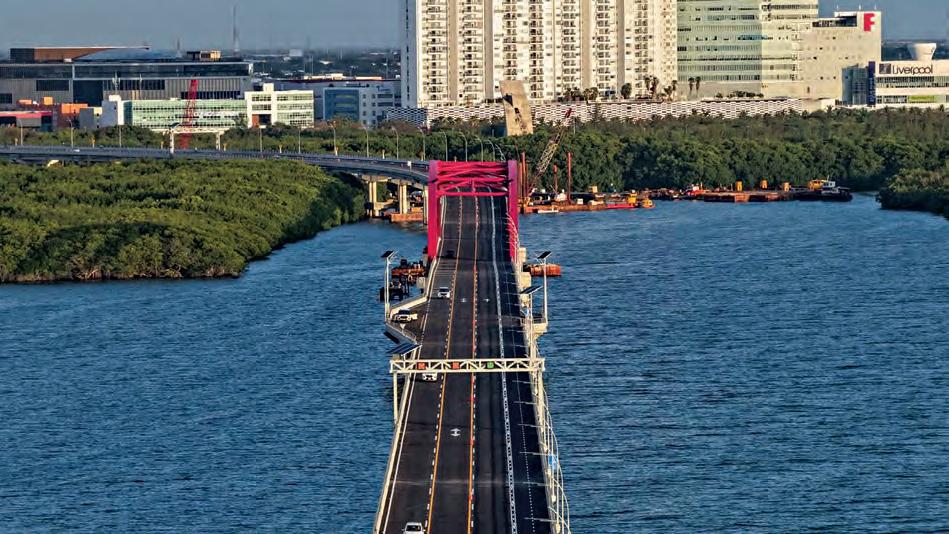
The Mexican government appears to have embraced a more pragmatic approach to infrastructure development. Public investment is not being framed as a substitute for private capital, but rather as a mechanism for crowding it in. That shift is visible in the scale of planned spending. For 2026 alone, the government has outlined infrastructure investment of roughly $41.3bn, equivalent to around two percent of GDP. Over the course of the administration, cumulative investment is projected to reach approximately $320.5bn.
The allocation of planned spending reveals the priorities:
• Energy accounts for 54.1 percent ($52.6bn)
• Rail infrastructure represents 15.6 percent ($14.9bn)
• Highways account for 13.9 percent ($13.5bn)
• Ports represent 6.5 percent ($6.3bn)
The operational targets are equally ambitious: the rehabilitation of 4,000 kilometres of roads, the construction of more than 3,000 kilometres of new rail lines, the modernisation of 11 ports, and 51 strategic energy projects expected to add more than 22,600 megawatts of capacity.
What matters just as much as the spending itself is the financing model behind it. The current strategy increasingly relies on mixed-investment structures in which the state provides coordination and long-term direction while opening space for institutional private capital. The emphasis is less on direct state control and more on improving project design, reducing uncertainty, sharing early-stage risks, and creating regulatory frameworks that provide long-term visibility for investors.
That philosophy is reflected in both the National Development Plan and the 2026–2030 Infrastructure Investment Programme,
which prioritise structured public-private participation schemes and more sophisticated financing vehicles. At the same time, regulatory adjustments are gradually making it easier for long-term institutional capital to participate in productive investment opportunities. This is where the Afores become especially important.
By March 2026, Mexico’s Afores managed more than $480bn in assets, equivalent to roughly 23.6 percent of GDP. That makes the system one of the largest pools of domestic savings in Latin America. And it continues to grow. The 2020 pension reform gradually increased mandatory contributions from 6.5 percent to 15 percent of salary by 2030, significantly expanding the long-term growth potential of the system.
Current projections suggest that by 2040, assets managed through the SIEFORES Target Date Funds could reach 56 percent of GDP, compared with an estimated 35 percent without the reform. More important than the size of the system, however, is how its investment profile is evolving. Mexico’s regulatory framework now allows pension funds greater exposure to long-duration assets, including infrastructure. Structured instruments, Fibras, simplified issuance processes, and more flexible investment vehicles have expanded the range of opportunities available to institutional investors.
Current limits allow up to 30 percent allocation in structured instruments such as CKDs and CERPIs, and up to 12.5 percent exposure through Fibras and REIT-style vehicles. None of this represents a weakening of investment discipline. Afores remain
subject to strict governance, valuation and risk-management requirements. Their fiduciary obligations remain unchanged.
What has changed is the ability to align long-term retirement savings with longterm productive investment. The shift is already visible in the data. As of March 2026, Afores had invested more than $57.4bn in infrastructure-related assets, representing approximately 12 percent of total system assets. Investments linked specifically to the energy sector exceed $17bn. This is no longer a marginal allocation. It reflects a broader strategic repositioning of capital.
The broader economic logic is compelling: retirement savings finance infrastructure, infrastructure supports productivity and growth, and stronger growth ultimately improves both investment returns and living standards. But none of this happens automatically. Infrastructure investing is inherently complex. Projects often involve long execution timelines, multiple stakeholders, political and regulatory uncertainty, and significant technical and financial risks.
Not every project creates the same value. Some may generate attractive financial returns but limited economic spillovers. Others may deliver substantial social benefits while struggling to meet purely commercial thresholds. That is why institutional quality becomes critical. The challenge is not simply attracting capital. It is building projects and frameworks capable of balancing profitability, public value, and long-term sustainability. That requires credible regulation, contractual certainty, stronger financial markets, better project preparation, and deeper technical expertise across both public and private sectors.
In other words, it requires building an ecosystem capable of sustaining long-term investment. Nearshoring may ultimately become the clearest test of whether Mexico can translate its structural advantages into durable economic gains. Global manufacturers are operating within real investment windows. Capital will not wait indefinitely.
If Mexico can provide reliable infrastructure, sufficient energy capacity
“What matters just as much as the spending itself is the financing model behind it”
and regulatory clarity, it has an opportunity to consolidate itself as one of the world’s most important industrial platforms over the next decade. If it cannot, investment will move elsewhere. That is why coordination between public policy, institutional savings and private capital matters so much.
Afores are uniquely positioned in this environment because their investment horizon is inherently long term. Unlike shortterm capital flows, they are not driven by quarterly volatility or tactical repositioning. They can support projects through full development cycles. But long-term capital depends on long-term certainty.
For decades, Mexico’s economic debate often revolved around familiar binaries: state versus market, public versus private investment, regulation versus liberalisation. That framework increasingly feels outdated. What is emerging instead is a more practical model based on coordination: the state as facilitator, private enterprise as operator, and institutional savings as the long-term source of financing.
Under this framework, infrastructure stops being viewed primarily as public spending or political symbolism and becomes what it fundamentally is: a platform for productivity, competitiveness, and sustained growth. Government estimates suggest that infrastructure investment alone could increase GDP growth by as much as three percent. Within that process, Afores are no longer peripheral financial institutions. They are becoming central components of the country’s long-term development strategy.
Mexico is not starting from scratch. It has strategic geographic advantages, deep industrial integration, an increasingly sophisticated financial system, and one of the largest domestic savings pools among emerging economies. But structural advantages alone are not enough. The real challenge is execution: turning plans into viable projects, projects into investment, and investment into measurable economic growth.
All of this could allow Mexico not only to capitilise on nearshoring but to completely reshape its long-term development path. And in that transformation, the Afores will play a far larger role than simply managing retirement accounts. They may ultimately become one of the key financial bridges between the country’s accumulated savings and the infrastructure needed to sustain its future growth. n
As global aid spending retreats, philanthropists, investors and blended-finance institutions are stepping in – seeking to prove that private capital can help reshape development across emerging markets

WORDS BY Selin Bucak
FEATURES WRITER





From her office in Delhi, Dr Nisha Dhawan is doing something her predecessors at EMpower never did: running a global foundation from the Global South. The new president and CEO of the New Yorkheadquartered foundation, which was set up 25 years ago by emerging markets investment professionals to channel money back into the regions generating their returns, was never asked to relocate. That, she says, is the point, and it is a recognition of the importance of leadership that’s close to the people an organisation is helping.
“I was never asked to get on a plane and move to London or move to New York,” she says. “And that, I think, is not only different for EMpower, but it is different for the sector as a whole.” Her appointment lands at an awkward moment for development fi nance. Official development assistance from OECD donor countries fell 23.1 percent in real terms in 2025 to $174.3bn, according to preliminary data published by the OECD in April – the steepest single-year drop on record. The US alone drove three-quarters of the decline, falling by 56.9 percent.
At the same time, investment capital is flowing back. US ETFs focused on EM stocks absorbed almost $31bn over the year, according to estimates from Strategas Securities.
The World Bank has put the financing gap needed to achieve the Sustainable Development Goals (SDGs) by 2030 at around $4trn. But can private capital, whatever form that may take, whether it is investment, philanthropy or some hybrid, meaningfully fill a gap of that scale?
Dhawan, who started at Deutsche Bank and Barclays in London before completing a PhD at IIT Delhi, has spent 14 years inside EMpower watching the answer evolve.
“It is absolutely possible,” she says of philanthropy stepping into the vacuum. “It is amazing to see how the philanthropic sector has stepped up, namely individuals. I feel like there is a lot more risk capital, for lack of a better word, coming from individuals than we have ever seen. And corporates are really thinking through their role, their responsibility in what it means to be giving back in the markets they are investing in.”
EMpower has deployed over $60m across nearly 400 locally run organisations in 15 countries since 2000. But what EMpower brings to the table is more than just capital,
it is a different model of sustainable giving, and what that kind of philanthropy can do, Dhawan argues, is sit beside investment capital rather than replace public funding.
“We know that top down investment doesn’t work,” she says. “If we flip the script where that top down which is necessary and non-negotiable investment in the emerging markets is clubbed together with meaningful, strategic, effective philanthropy at the local grassroots level. That is where the magic happens, because that is where they meet in the middle. And that is where you are going to see the needle moving in emerging market countries.”
Almost 70 percent of EMpower’s money comes from financial services, raised largely through galas and donor networks in London, New York and Singapore, but the granting decisions are kept local. Country teams based on the ground identify and back local organisations directly, and partners are funded for 10 years rather than the oneor two-year cycles typical of the sector. In India, for example, the final call on which new organisations to bring into the portfolio sits with EMpower’s youth fellows. These
“It is amazing to see how the philanthropic sector has stepped up”
are young people from the communities the foundation serves.
Of course, it is not just in India that EMpower taps into the knowledge of the people it is helping. In Mexico, fellows are helping design the investment strategy in the country. In South Africa, a cohort is shaping how mental health programming gets embedded across the regional portfolio. And in Indonesia, fellows have helped build a secular and reproductive health curriculum that is now used across grantee partners in the greater Jakarta area. “It is young people creating a curriculum that is then embedded across several of our organisations,” Dhawan says. “Expertise lies in the hands of the people that we most want to serve.”
Dhawan rejects the sector’s habitual obsession with scale in numbers. She points to the Antarang Foundation, whose schoolto-work modules the Indian government now runs across six states; Virlanie in the Philippines, working with young people born on the streets; and a partner in Argentina that helped embed mental health programming across Buenos Aires.
“Success can be depth and it can be influence and influencing others in a meaningful way,” she says. “The greatest cream that rises to the top is that for us success
Size of the financing gap needed to achieve SDGs by 2030
Another challenge is the existence of nonlike-minded investors that do not consider the impact they are having in emerging markets. Because the cost of considering impact isn’t transparent, returns of those who are doing harm to people and the planet can seem higher. Therefore, it can be difficult to attract the capital that is needed to invest in areas that Triodos prioritises, such as financial inclusion or biodiversity.
For EMPower there is another difficulty to attracting capital. Its giving largely tracks the financial markets its donors work in, with the foundation feeling the 2008 and 2013 downturns clearly. But institutional funders, where roughly 30 percent of its funding comes from, provides a counterweight to market cycles and lets the organisation back its boldest ideas.
“What we want to make sure is that this time no one is left behind”
looks like sustainability.” That meeting point between commercial and concessional capital is where investment managers like Triodos Investment Management are operating. Triodos recently signed an agreement with the Austrian Development Bank and with FMO. Their investment will be integrated into the Hivos-Triodos Fonds, a fund that will then be used to deploy capital into agriculture, renewable energy and the like.
Maritza Cabezas, senior investment strategist, says one of the ways the group can create greater impact is by “collaborating with institutions whose sources of funding can be cheaper than ours, and in that way getting more attractive investments for our clients. It has to be at the lowest cost possible but have the highest impact possible, and therefore we find these partnerships through blended finance quite attractive.”
Cabezas adds: “We have several examples of how we work with different development financial institutions to finance projects that need attractive funding costs in order to be viable. We finance agriculture projects in Ghana that use technology in the agricultural sector.” But there are challenges. She says that because large development finance institutions are very demanding, their requirements can be challenging for the smaller investees Triodos funds in emerging economies.
“Ford Foundation, Co-Impact, SIF, all of these organisations who have the technical wherewithal, but also the gravitas, have enabled us to try out our boldest ideas, whether that is girls making the final decisions about our grant making, or whether that is bringing together youth fellows to decide curricula,” Dhawan said. Adam Heuman, vice president of global development at EMpower, agrees and recalls what the organisation’s co-chair MaryTherese Barton, who is also CIO for fixed income at Pictet Asset Management, says.
“The way she puts it is that emerging markets are back as an asset class. And that is something to really celebrate. What we want to make sure is that this time no one is left behind,” he says. “We hope that there is a boost to what we are able to do in terms of capital inflows. But how we use that is to make sure that no young person gets left behind.”
One way Dhawan wants to ensure that is done, and other investors also think about it as well, is by applying a gender lens to every single investment decision.
“We can’t talk about moving the needle in a market and seeing overall GDP going up if we are not considering the people that live within it,” she says. “And we can’t consider the people that live within it if we are not meaningfully double clicking on the lived realities and the barriers, the additional barriers that women and girls face.” She adds: “If we start thinking about young people who are not in education, in entrepreneurship or in technical training, and we break down that number, very often, it is a woman or a girl. If everybody got to start thinking about disaggregating for gender in a meaningful way, or even just assuming the gender lens, it would change the planet.” n

The Clarity Act could turn US regulation into the world’s financial rulebook – offering access to some, while leaving the unprepared locked out of the next phase of growth
division of labour, one that must be accepted, because attempting to suppress innovation to protect legacy systems has already been tried. The market moved anyway.

WORDS BY Dr. Ravishankar Chamarajnagar FOUNDER AND CEO, BRACKT

I returned from Paris last month, having spent three days in rooms where the future of global fi nance was being quietly debated. Not by politicians, but by fintech executives, institutional investors and regulatory architects who are actually building it. What struck me most was the unanimity of the anxiety beneath the sophisticated technology on display. Operators from São Paulo to Singapore and from Dubai to Ho Chi Minh City all wanted US market access, but few knew how. That gap is about to narrow partially, creating both opportunity and risk.
For the better part of a century, US financial dominance rested on three interlocking pillars: the dollar’s status as a reserve currency, the depth of its capital markets, and an institutional infrastructure so entrenched that it became the default architecture for global trade. You did not choose to work within the American financial system. You simply did, because there was no viable alternative. Now, blockchain commoditises rails, replicates tokens and allows exchanges anywhere. The regulatory standard – the enforceable, globally legible rulebook – is the differentiator. This is what the Clarity Act aims to provide.
The Clarity Act’s global stakes
The Genius Act brought stablecoins under regulatory supervision and set reserve requirements for dollar-pegged digital
currency. But it left most of the digital asset market – securities, commodities, DeFi, tokenised treasuries – in a legal grey zone, costing US and global enterprises billions in missed opportunity and confusion.
The Clarity Act changes this. For the first time, US law will draw a definitive line between a digital security and a digital commodity, clarify the respective jurisdictions of the SEC and the CFTC, and create a coherent framework for exchanges, broker-dealers, and custodians. Crucially, it gives every enterprise outside the US – the Brazilian fintech, the Vietnamese payment company, the Dubai-based digital asset fund – a clear set of rules to align with before approaching a US institution.
In Paris, the reaction was not scepticism; it was relief. The demand for US market entry is profound. What has been missing is a door with a handle. American dominance won’t mean a monopoly. The EU’s MiCA, the UAE’s VARA, and Singapore’s MAS all offer a strong, attractive regulatory environment.
The US will win the battle for regulatory dominance as the Clarity Act will become the template other jurisdictions align with, because alignment means access. What American policymakers may cede is the battle for product innovation: the applications and platforms incubated in jurisdictions with lower friction and greater appetite for experimentation. This is not failure. It is a
“Compliance, executed well, is no longer a constraint on growth. It is the competitive advantage”
The call to act, before the window closes For every enterprise navigating this landscape, the imperative is not strategic; it is existential. Non-compliance does not look like a fine. It looks like paralysis: misaligned controls, transactions held or rejected while competitors move, credibility bleeding out at precisely the moment this market is accelerating. You are not paying a penalty; you are stuck, while deep-pocketed US investors onboard with your better-positioned rivals. They will not wait. There are other doors to knock on. The enforcement trajectory is unambiguous. In 2023, Binance paid $4.3bn, the largest Department of Justice corporate resolution in history at the time. In 2024, TD Bank settled for $3.1bn, becoming the largest US bank to plead guilty to a money laundering conspiracy. Even Revolut, celebrated as a model of fintech agility, was fined €3.5m for failures in transaction monitoring. These are not outliers. They are a pattern with a clear, accelerating direction of travel.
Over three decades of building technology for global financial institutions, I have watched compliance treated as a cost centre, an afterthought, and checked only after the deal closes. In the digital asset era, that model is obsolete. It is the single biggest differentiator separating institutions that will capture this market from those locked out of it. Compliance, executed well, is no longer a constraint on growth. It is the competitive advantage.
Do you know, before you transact, whether you are compliant? If the answer is anything other than an unequivocal yes, the window to fi x that cheaply is closing faster than most people in Paris were willing to admit. n











Global finance is being reshaped by technology, geopolitics and sustainable investment, creating new growth opportunities and shifting capital flows. Against this backdrop, Macao is emerging as a regional wealth management hub, supported by Greater Bay Area integration and national strategy, with ICBC (Macau) helping drive market growth and innovation
WORDS BY Niu Jianjun CEO, INDUSTRIAL AND COMMERCIAL BANK OF CHINA (MACAU)



Profound changes transforming the global financial system have created a complex and volatile landscape driven by technological advancements, geopolitical reshaping and the growing emphasis on sustainable development. This, in turn, is accelerating the rise of emerging markets, transforming financial centres and reshaping cross-border capital flow patterns undergoing constant adjustment. With its unique geographical advantages and status as an international free port, the continued development of the Guangdong-Hong Kong-Macao Greater Bay Area, and China’s commitment to opening up, present Macao with a unique opportunity to develop into a major regional wealth management centre.
The combined implementation of China’s 15th Five-Year Plan (2026–2030) for National Economic and Social Development and Macao Special Administrative Region’s (SAR) upcoming third Five-Year Development Plan (2026–2030) positions Macao’s wealth management industry at a pivotal moment. These strategies reinforce Macao’s role as a key wealth hub in serving local residents while building a bridge between Chinese Mainland and foreign markets.
Macao is a market of strategic potential With a population of approximately 680,000, Macao has already accumulated substantial private wealth, with per capita financial assets approaching MOP one million ($123,965) and wealth management assets under management (AUM) about $28bn, which provides a solid foundation of wealth accumulation. However, local financial
institutions currently manage only 32 percent of residents’ investable assets; the remainder continues to flow into overseas financial markets, highlighting the need to improve the scale and depth of the market, expand investment channels and wealth management products, and strengthen professional talents and international cooperation.
Furthermore, the majority of domestically managed funds remain focused in traditional deposits and insurance products. Allocations to equities, funds, bonds, and more complex derivatives remain relatively low, reflecting an immature market characterised by a relatively conservative risk profile. If Macao is to compete with established international wealth management centres such as Hong Kong and Singapore, it must pursue a differentiated development path. This means fully leveraging its access to the vast Chinese Mainland market, its close ties with the Guangdong-Hong Kong-Macao Greater Bay Area, the institutional advantages of ‘One Country, Two Systems,’ and its highly open business environment.
2026 marks a pivotal year for Macao’s financial development because China’s 15th Five-Year Plan supports Macao in enhancing its competitiveness in a specialised financial industry, and upgrades its strategic positioning, shifting from ‘integrating into’ national development to ‘serving and integrating into’ it. This will allow Macao to be more proactive in financial development, while still remaining aligned with the national strategy of financial opening up.
MACAO’S WEALTH MANAGEMENT INDUSTRY SHOULD FOCUS ON THREE STRATEGIC PRIORITIES
Macao’s enactment of a new Financial System Act (2023) and introduction of the Investment Fund Law (2025) further advance economic diversification, investor protection, and the development
$124k
The per capita wealth for Macao’s 680,000 population
of the local asset management industry. These frameworks lay a solid foundation for financial product innovation and standardised operation. They also clarify the rights and responsibilities of market participants and enhance the transparency and international recognition of Macao’s financial market. The collaborative effect of policy instruction and institutional framework construction is accelerating the transformation and upgrading of Macao’s wealth management market.
Macao’s wealth management industry should focus on three strategic priorities to build its core competitiveness: consolidation, innovation and talent development. The first priority is to consolidate the local market and promote cross-border collaboration. Rooted in the domestic market, the industry should strengthen its local base and enhance service capabilities, while deepening institutional cooperation with established financial centres including Hong Kong, Singapore and major European and American markets. It should also fully leverage the Guangdong-Macao InDepth Cooperation zone in Hengqin and the policy advantages of the Guangdong-Hong Kong-Macao Greater Bay Area to actively explore innovative cross-border financing models and establish efficient channels for
ICBC
cross-border wealth management.
The second priority is to drive product innovation and enable technological transformation by developing diversified wealth management offerings, strengthening traditional product lines, and proactively developing green finance products aligned with ESG (environmental, social and governance) principles. This will better meet the Greater Bay Area investors’ demand for global asset allocation through comprehensive cross-border wealth management solutions. Accelerating technology application in areas such as asset allocation and risk management will improve operational efficiency and customer experience, supporting the development of a more competitive digital financial ecosystem.
Finally, talent development is fundamental to the long-term growth of Macao’s wealth management industry. The sector should establish internationally aligned talent development mechanisms, strengthen cooperation with leading universities and professional institutions, and refine talent attraction policies to bring in professionals with global experience and expertise. Equally important is the cultivation of a more mature
market culture, to guide investors from a capital preservation mindset towards a capital appreciation strategy focused on longterm, stable returns in asset allocation. This will help build a more rational and substantial wealth management ecosystem.
The architect for market advancement
By leveraging Macao’s distinct advantages and its own institutional capabilities, Industrial and Commercial Bank of China, ICBC (Macau), a leading institution in the local financial sector, is contributing to Macao’s development as a specialised financial hub by cultivating the local market, strengthening regional connectivity, driving product innovation, and developing digital transformation in wealth management services.
In line with Macao’s economic and social development needs, ICBC (Macau) is attuned to the diverse and individualised financial requirements of local residents and enterprises, providing comprehensive wealth management solutions. It is fully committed to positioning itself as ‘a bank for Macao residents,’ and to supporting Macao’s moderate economic diversification.
Supported by ICBC’s strong global network and service capabilities, ICBC (Macau) is building a safe, compliant and efficient financial bridge between the
Chinese Mainland and international markets, establishing a one-stop, cross-regional, asset allocation platform. This facilitates seamless financial services for residents and enterprises in the Greater Bay Area, while also providing robust financial support for the integrated economic development of the region.
Fully optimising Macao’s geographical and policy advantages under ‘One Country, Two Systems’ and with support from national central government, ICBC (Macau) maintains a strong focus on market trends and customer demands. It offers a differentiated and specialised wealth management product portfolio, and fosters expertise and brand influence in core business areas such as green finance, cross-border financial solutions and family wealth management. All of this stimulates market vitality and meets increasingly complex customer demands through high-quality, customised, and innovative services.
Contributing to Macao’s financial modernisation and infrastructure development, ICBC (Macau) is embracing digital transformation and exploiting the group’s fintech capabilities to drive the development of its wealth management services. It aims to build a secure, efficient and inclusive modern wealth management system, further enhancing service quality and core competitiveness.
The path forward
Empowered by national strategies, supported by local policies and legislation, and driven by the evolving wealth preservation and appreciation needs of Macao residents, the wealth management industry is laying a solid foundation for future development.
With the coordinated efforts of central and local governments, plus support from society as a whole, Macao is well positioned to seize this historic opportunity to develop a distinctive regional wealth management centre; firmly rooted in the local market, closely integrated with the rest of the Greater Bay Area, and extending its global influence. As the largest locally registered bank, ICBC (Macau) will continue to play a leading role in the industry, deepen its wealth management capabilities, and fully support the development of Macao’s distinctive financial system.
By providing essential financial strength to enhance Macao’s global competitiveness, promote diversified economic development, and improve livelihoods, ICBC (Macau) will work with all sectors of society to write a new chapter in Macao’s financial development. n
Dame Susan Langley explains how she is using her historic tenure as Lady Mayor of London to modernise an 800-year-old institution, transforming it from a ceremonial symbol into a global ambassador for financial and professional services
David Worsfold
FEATURES WRITER



Changing perceptions of an 800-year-old institution steeped in tradition is no easy task, but that is what Dame Susan Langley is on course to achieve in her year as the first citizen of the City of London, usually known as the Lord Mayor. She is the 497th holder of that office since it was established in 1189 and only the third woman to hold the position, but the fi rst to style herself Lady Mayor of London. That decision alone has made a huge impact, as well as raising the eyes of traditionalists, but it shouldn’t have come as a surprise.
When she was elected to the Court of Aldermen in 2018, part of the City’s governance structure, she quickly realised she wasn’t happy with a gender-specific title: “I was the first to take the title Alderwoman. I wasn’t trying to make a point but what triggered it was when someone said ‘Alderman Langley’ everyone shook my husband’s hand. I got fed up with that.
“Changing that was hard. There were papers written about whether it could be done but the nice thing is now that it is done all of the women who come after me have a choice.”
When it came to the Mayoralty, the potential legal obstacles were non-existent because all the relevant legislation just refers to the position as Mayor. Lord Mayor is the title that has been used by convention. This didn’t stop her having to work to justify the adoption of Lady Mayor as her title, but her approach was always gentle persuasion, as she recounts one encounter with someone reluctant to accept the change:
“I get that view that since 1189, it has been the convention, I said, but that is because it has been men. Fine. That was the way it started. I said, well, let’s turn it round. Let’s say since 1189, it has been women, and the title is Lady
Mayor, and there has always been Lady Mayor. How would you feel if I addressed you as my Right Honourable, the Lady Mayor? And he said, oh, I see what you mean.”
From that decision flowed the re-titling of the annual parade through the City of London every November that marks the formal installation of the new Mayor from the Lord Mayor’s Show to the Lady Mayor’s Show. This made the world sit up and take notice as it was broadcast live on BBC and widely covered in the national press in the UK:“It made far more of an impact than I ever imagined. It made people feel they belonged because they could see themselves.”The changes she has pursued go far beyond the change of title. She has christened her year in office as the start of the ‘Modern Mayoralty,’ and plenty is happening to embed that in the way the office operates now and in the future.
A legacy that lasts
Traditionally, Lord Mayors have set a theme for their year in office, many very worthy but rarely enjoying a life beyond that Mayor’s year. Working with the City authorities, Dame Susan has already moved the dial on that front. Unusually, the powers that be have been willing to be clearer on who will succeed Dame Susan, with Timothy Hailes, a lawyer, lined up for 2026–27, and Bronek Masojada, former CEO of Hiscox Insurance, succeeding him.
This change has been backed by the creation of an Advisory Board that will ‘fill in gaps in the Mayor’s skillset’ and ‘ensure all three of us operate within set tramlines to give more consistency and impact.’ It is being chaired by former UK Cabinet Secretary Mark Sedwell, who has a clear brief to deliver continuity. And impact is what Dame Susan is focused on. She wants to get the message across to the wider world that the City of
“Now that it is done all of the women who come after me have a choice”

for speedier delivery of the promised captive insurance regime for the City has been at the top of her agenda.
As with all holders of the office she has joined ministerial visits to China, India and America – to name just a few – and has been able to use her experience as a UK trade envoy to put the City’s case effectively.
“For centuries, the City has been a place where deals are made and honoured, contracts enforced, disputes resolved. In other words, a place where trust thrives. Despite current headwinds, the UK remains the second most attractive destination for global investment. The City continues not only as a centre for capital, but as a gateway connecting investment to markets around the world.
“Our partnerships are thriving and that is something to celebrate and build upon.” When she recently welcomed the British Foreign Secretary and senior foreign diplomats to Mansion House – where the Mayor lives and works for their year in office – she took the opportunity to reinforce this message.
“This is an age defined by volatility, by insecurity, competition and, at times, fragmentation. But despair is not an option. Because, when the world feels most fragile, that is precisely when togetherness matters most. None of us can navigate this moment
grounded in shared values, interest and objectives.
“So, as this storm rages on, the question before us is whether we choose to strengthen these connections or allow them to be swept away. I believe we must strengthen them and the UK – and the City – must play its part.”
For those messages to land, however, she says there needs to be a significant change in perception of what the Lord or Lady Mayor does. For her, the day-to-day reality of the role is very clear: “It is probably 10 percent ceremonial, 20 percent philanthropic and then 70 percent business.”But this is not how the world traditionally sees the role.
“I stand behind tourist groups outside
When the world feels most fragile, that is precisely when togetherness matters most”
Mansion House and hear them talking about the Mayoralty and the show and ceremony and I actually want to go: no, that is not it. But I don’t seize their flags from them. The aim, over time, is that when someone stops you in the street and asks what the Mayoralty does they will say they are an ambassador for the financial and professional services sectors and when they say, what does Mansion House do? I want them to say it is the FPS Embassy for the City of London.”
She has changed the signs on her office to say ‘Ambassador for Financial and Professional Services’ and one of the signs that greets visitors as they enter the splendour of Mansion House now says ‘Embassy for Financial and Professional Services.’
Changing signs is easy: changing perceptions is much harder, but the message is getting through. On a recent trip to Texas, Dame Susan asked if they would like her to explain what the Lady Mayor’s role is but her host turned round and said: “That’s OK we know you are the Ambassador for Financial and Professional Services in the City of London.”
While that must have given her a glow of pride, she was less prepared for some of the more general perceptions Americans and others seem to have of London. It started with an American firm saying a senior female colleague was coming to London but wouldn’t be wearing her watch and jewellery because of fear of crime. This she dismissed but realised there is a serious problem with misinformation when a senior American asked her what it was like living in an Islamic capital under Sharia Law. This must have made her despair, but she is too diplomatic to condemn those taken in by far-right conspiratorial misinformation, instead
Curriculum Vitae: the City, charity and government
1996–1998 Principal Consultant, PwC
1998–2007 Chief Operating Officer, Hiscox Insurance
The Lord/Lady Mayor: history and role
The Lord or Lady Mayor of London is the first citizen of the City of London and heads up the City of London Corporation, which is the local authority for what is known as the Square Mile. Within the City, the Lord Mayor is accorded precedence over everyone except the King. It is one of the world’s oldest continuously elected civic offices. It was instituted in 1189, the first holder being Henry Fitz-Ailwin de Londonestone. The most famous holder of the office was Dick Whittington, who was Mayor three times between 1397 and 1420. It is entirely separate from the directly elected Mayor of London, a political office that covers the much larger area of Greater London and is currently held by Sir Sadiq Khan.
responding with a plea for London businesses and authorities to work together to counter such lies, putting the positive case forward for London.
London calling
She believes in London, having been born and brought up in London’s East End.She remembers watching the Lord Mayor’s Show on her father’s shoulders, never imagining she would one day be leading that historic parade. She says that began to change about 15 years ago when some of the more far-sighted City grandees said to her that they were concerned that too few women were in senior positions in the City of London’s governance structures.

2007–2012 Director, North America and Market Development, Lloyd’s of London
2013–2015 CEO, Financial & Professional Services, Dept. for International Trade
2014–2022 Lead Non-Executive Director, UK Home Office
2010–present Senior Independent Non-Executive Director, UK Asset Resolution
2015–present Non-executive chair, Gallagher
2017–2021 Trustee, Macmillan Cancer Support
2018–present Alderwoman, Aldgate Ward, City of London
2023 Made a Dame Commander of the Order of the British Empire
2023–2024 Sheriff of the City of London
2025–2026 Lady Mayor of London





“At the time I thought I didn’t have time to do it and, secondly, I had the wrong perceptions. I thought it was too ceremonial as that is the part that I saw. I didn’t think I could make a difference, and I am the kind of person who likes to make a difference. But as I became closer to the City, I saw the impact it could have and got to know some of the Lord Mayors, some of the business agenda, the philanthropic agenda and saw the impact you could have.”
The tipping point came in 2018 when she was persuaded at the very last minute to stand for a vacant Alderman’s seat. She won and the next few years saw her race through the preliminaries to becoming Mayor, including a year as a Sheriff of the City of London. Few Mayors are remembered for long after they have left office but perhaps like another outsider – Dick Whittington – who famously held this office three times from 1397, Dame Susan will have left a mark on the City that will be her legacy for years to come. n
The UK spent its North Sea windfall while Norway chose to save its. With oil production declining and taxes rising, can Britain still build a sovereign wealth fund, or is it already too late?
BY
Claire Millins FEATURES WRITER


Norway and the UK struck oil in the North Sea at roughly the same time, extracting comparable riches over the ensuing decades. However, while Norway built a financial fortress, courtesy of its Government Pension Fund Global, which is currently worth over $2trn and continually compounding interest for future generations, the UK chose to spend, tax, and move on, and is consequently sitting with £2.8trn of national debt with the government borrowing just to cover day-today spending. But any honest answer as to what went wrong, and whether anything can be salvaged, runs straight into uncomfortable territory because the arithmetic only works one way: more drilling, not less. And with the Energy Profits Levy hitting 78 percent total effective tax on North Sea operators in 2026, that conversation has become urgent, taboo and long overdue.
How Norway built a $2trn fortress Norway’s oil story didn’t end with extraction; it began there. The idea for a Norwegian oil fund was first conceived in 1960, as the then Prime Minister, Einar Gerhardsen, and his government claimed sovereignty over the ‘Norwegian continental shelf.’ Oil was first struck in 1969, but it wasn’t until 1990 that the government passed a law to create the Government Petroleum Fund, with the simple principle: oil wealth is fi nite, but financial capital doesn’t have to be. The first deposit arrived in 1996, and today, the fund is approaching $2trn, owns roughly 1.5 percent of all listed companies worldwide, and gives each Norwegian a theoretical stake worth hundreds of thousands of dollars.
The Norwegian Fund doesn’t just have scale, but discipline. All oil and gas revenues flow directly into the fund, rather than being spent on day-to-day government needs. The money is then invested globally, in the same
way as the Norwegian central bank’s foreign exchange reserves, across thousands of companies, including major stakes in US tech giants, turning North Sea oil into a diversified, income-generating portfolio.
Crucially though, Norway spends only the expected long-term return, around three percent annually, under its fiscal rule, preserving the core wealth for future generations. Managed independently by Norges Bank Investment Management, the system has largely remained insulated from political short-termism. There is no secret here, just a sustained national choice to save rather than spend.
The UK, meanwhile, extracted approximately £400bn in North Sea oil revenues in today’s money between 1975 and 2022. But, unlike Norway, not a penny of it was saved in a longterm wealth vehicle. All of it went into the general spending pool, and most of it vanished without structural trace.

Norwegian-style fund in the 1970s, before the money arrived in volume, but the proposal was roundly rejected by the then incumbent Labour government, led by James Callaghan. That wasn’t ignorance but a choice. The UK didn’t lack the resource, expertise, or the blueprint, it simply lacked, at the time, the political will to defer gratification, and chose, repeatedly and consciously, to spend tomorrow’s money today.
The critical fork came in the 1980s. While Norway was quietly establishing the architecture of what would become the world’s largest sovereign wealth fund, Margaret Thatcher’s government was using North Sea revenues for something more immediately pressing in the UK: managing the social cost of deindustrialisation such as unemployment benefits and redundancy payments. Oil money funded the transition of the politically necessary, and economically brutal, dismantling of British manufacturing, and then disappeared.
What followed was decades of spendas-you-go, under successive governments. As soon as revenues flowed into general expenditure they flowed out almost as quickly. Nothing ring-fenced, invested or compounded. But the painful detail is that Britain was warned. Economist Wynne Godley and others argued explicitly for a
The Energy Profits Levy and what is left If the UK ever hopes to emulate Norway, it must start with what remains, but that picture is far less forgiving than it once was. The Energy Profits Levy (EPL) 2026, introduced in 2022 to capture energy company windfalls during a price spike, now sits at the centre of the debate. At its peak, the levy raised a few billion pounds annually, although it’s a fraction of what decades of disciplined saving might have produced.
Layered on top of existing North Sea taxes, the levy pushes the effective rate on oil and gas profits to 78 percent, and critically, it is being applied to a shrinking base. North Sea production has been in long-term decline since its late-1990s peak, with fewer new projects coming online and exploration activity slowing sharply. The result is that the levy has become something the industry plainly calls ‘a going-out-of-business tax’.
There is also a growing tension at the heart of policy that nobody in government seems too keen to resolve; the zealous commitment to net zero while relying on dwindling fossil fuel revenues, and taxing the sector heavily even though it discourages the investment needed to sustain it.
This raises an uncomfortable reality: even if Britain chose to ‘go Norwegian’ tomorrow, it would be doing so with a mature basin, reduced output, and far less time to act.
Could the UK actually do it?
If we strip away the nostalgia, the question becomes clinical: what could Britain realistically build if it started today? The North Sea still holds an estimated 2.9 billion barrels of oil equivalent (BOE) of proven and probable resources, with contingent resources standing at 6.2 billion BOE, and prospective resources estimated at 4.6 billion BOE. At current prices and under the existing EPL regime, that translates into meaningful revenue. But meaningful is not the same as transformative.
Norway’s Government Pension Fund Global didn’t just magically appear overnight; it took more than two decades of disciplined accumulation to reach its current
The tax regime that applies to exploration for, and production of, oil and gas in the UK and on the UK Continental Shelf (UKCS) currently comprises the following four elements:
• Ring Fence Corporation Tax (30 percent)
Supplementary Charge (10 percent)
• Energy Profits Levy (38 percent)
• Petroleum Revenue Tax (zero percent)
scale. Starting now, even under optimistic assumptions with stable prices, restructured taxation, sustained investment, and a political commitment to ring-fence revenues, the UK could potentially build a reasonably sized fund over 20 to 30 years, but still a fraction of Norway’s position, and dwarfed by the UK’s £2.8trn debt pile (see Fig 1). There are three problems in creating such a fund; scalability, governance, and politics, which compound each other.
While the scale problem is real, it is manageable. The governance problem, however, is harder. Norway’s fund works precisely because successive governments can’t easily raid it. Whereas British political culture, with five-year electoral cycles, structural short-termism, and chronic pressure to spend, has never successfully maintained a long-term fiscal vehicle. The Treasury would need ring-fencing robust enough to survive at least six or seven governments. That’s not a technical challenge, but a cultural one.
The political problem may also be the most difficult to overcome. Any serious attempt to build a sovereign wealth fund requires renewed North Sea investment, which, in turn, requires restructuring the EPL and a government to publicly argue that increased fossil fuel extraction serves the national longterm interest. But in 2026, that argument
Of North Sea oil revenues extracted by the UK between 1975 and 2022
$2trn
Value of Norway’s Government Pension Fund Global
is considered politically radioactive, even where the economic logic is sound. So, while a British sovereign wealth fund is theoretically possible, it’s practically very difficult, and politically near toxic.
If a future government wanted to do this seriously, it would need honest policy design. The first step would be to restructure the EPL and replace it with a tiered system that still captures meaningful revenue from mature fields but actively rewards investment on new drilling. Norway’s own petroleum tax model does exactly this: high headline rates, but structured to make exploration viable rather than punitive. The goal isn’t a lower tax take per barrel, but more barrels over a longer period.
However, this requires reopening the North Sea to allow new licensing rounds and exploration, as well as an admission that prioritising domestic production means trading short-term net zero optics for long-term fiscal resilience, because continuing to import gas from Norway and Qatar while shutting down domestic supply is a contradiction, both economically and environmentally. Crucially though, any revenues would need to be locked away. A UK version of the Norway model only works if it is genuinely ring-fenced, protected by legislation and insulated from political cycles, something closer to a constitutional lock than an OBR-style advisory body. Unfortunately, governance is where most long-term fiscal vehicles in Britain have historically collapsed. A cross-party board working to design the structure would help insulate it from five-year electoral cycles, but cross-party consensus notwithstanding, pretty much anything fiscally related is its own challenge.
Complementary revenue streams, from offshore wind lease revenues, spectrum licences, or future carbon credits, could also help supplement North Sea receipts and partially address the scale problem. However, the final requirement is the hardest: public expectation-setting. This is, by no means, a quick fix, but a 30–40-year project. No sitting politician will preside over its completion. So, the argument has to be intergenerational; the same argument Norway made in 1990 and has largely kept faith with ever since.
While the economics are challenging, they are workable. The limiting factors are whether the UK is willing to think that far ahead, and change a current political culture that has consistently chosen to make future generations slightly poorer in order to make the present slightly more comfortable. n
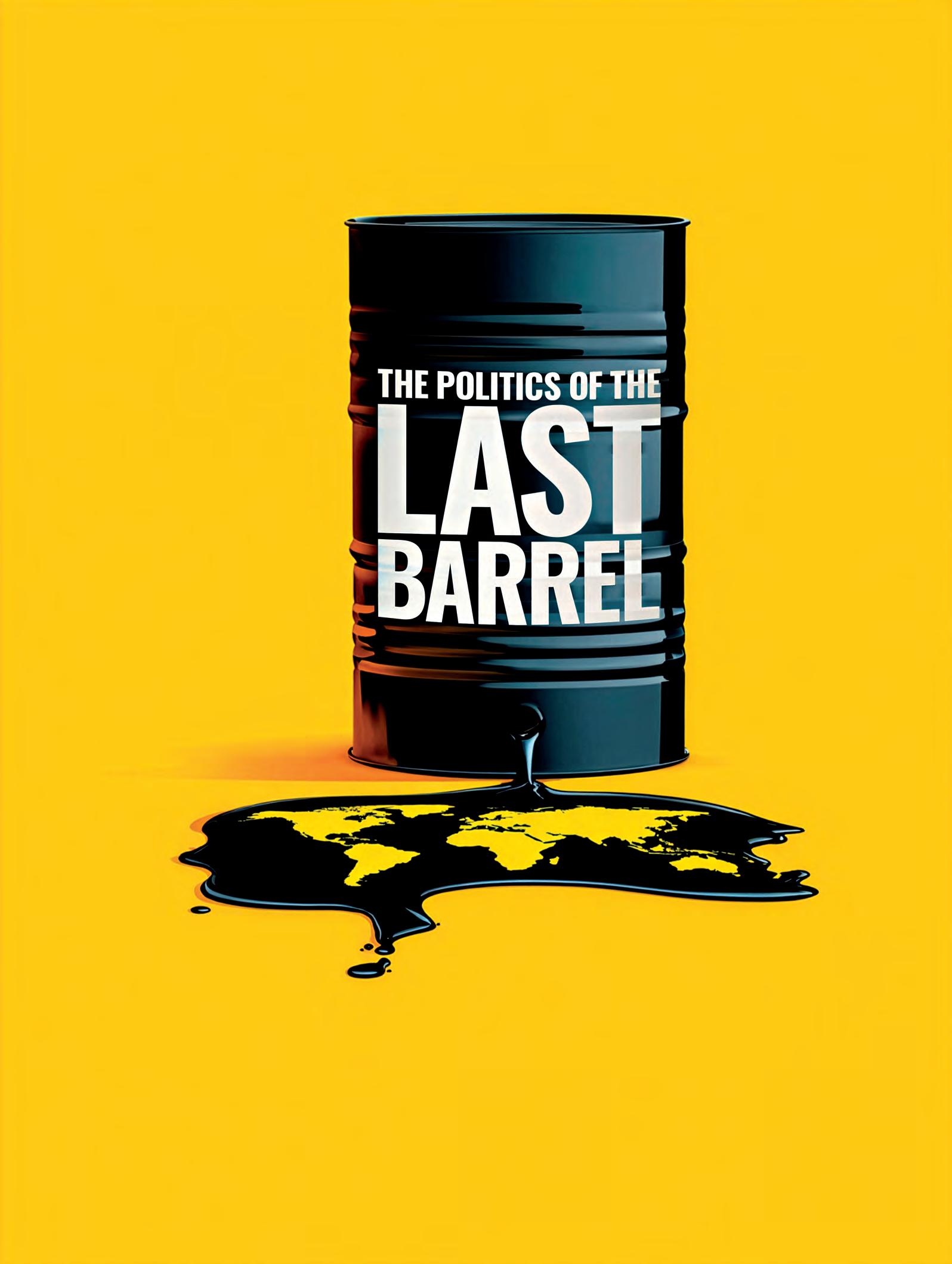
AS CONFLICT IN THE MIDDLE EAST SENDS SHOCKWAVES THROUGH GLOBAL ENERGY MARKETS, GOVERNMENTS ARE RUSHING TO DEPLOY STRATEGIC OIL RESERVES TO PREVENT ECONOMIC TURMOIL, SOARING INFLATION AND SUPPLY COLLAPSE. EMERGENCY STOCKPILES HAVE BECOME THE WORLD’S LAST LINE OF DEFENCE AGAINST A NEW ERA OF ENERGY INSECURITY. JOHN MUCHIRA REPORTS >>
he single most important energy objective for the US today is to resolve our internal differences and put ourselves on the road toward energy independence.” These were the words of Gerald R. Ford, the 38th President of the US soon after he signed the Energy Policy and Conservation Act on December 22, 1975.
One of the key features of the Act was the establishment of the strategic petroleum reserve (SPR), a desperate measure by the US to stockpile emergency oil. This came after the 1973 oil crisis instigated by Arab members of the Organisation of Petroleum Exporting Countries (OPEC) imposing an embargo on crude exports in retaliation for Washington’s decision to support Israel during the fourth Arab–Israeli War. With the US having grown increasingly dependent on foreign oil, the cut in supplies wreaked havoc on the economy, the severity of which resulted in stagflation.
To President Ford, who rose to power at the peak of the crisis, never again would the US experience the magnitude of supply disruptions and skyrocketing prices ignited by the embargo, or whatever other form of unforeseen eventuality. The SPR, in essence, would be the line of defence in protecting the economy, and the American populace, from future shocks.
Today, half a century later, President Ford’s words and actions are echoing across the globe. The Middle East conflict, which
broke in late February and whose end remains foggy, is yet again exposing the soft underbelly of the global crude oil supplies, with unprecedented disruptions causing political and socio-economic mayhem, including threatening stability in some countries. In the current uncertain environment, a new reality is dawning – stockpiling of emergency oil reserves is perhaps the most pressing need facing nations in modern times. This reality is given credence by the frequency in which the world is experiencing crude supply disruptions. In the past six years alone, disruptions have occurred three times, first occasioned by Covid-19, then the Russia–Ukraine war and now the Middle East conflict. “Strategic stocks are held to buffer supply shocks,” says Kenneth Medlock, Senior Director, Centre for Energy Studies at the Baker Institute for Public Policy. He adds that with energy security being the primary motivator for holding strategic stocks, the Middle East conflict is a stark reminder that countries must put their minds and souls into accumulating emergency stocks. “The entire policy push behind strategic stocks is precisely for times like these.”
Energy crisis from the Blue Moons
On February 28, most of the world was caught flatfooted when the US launched Operation Epic Fury, a code-name for military action against Iran. For Washington,
»
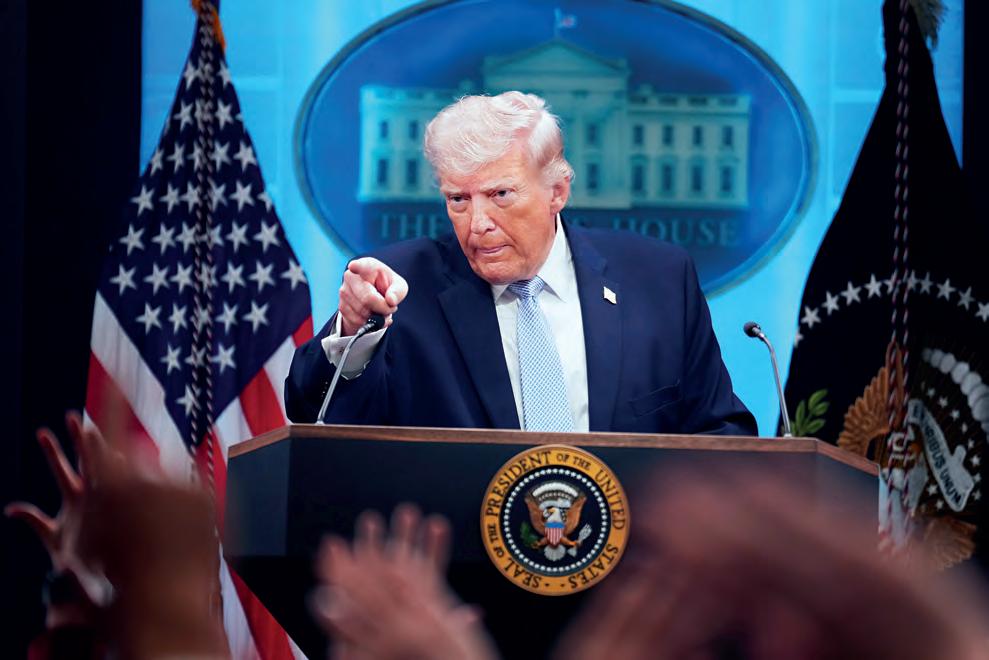
in collaboration with Israel, the objectives of the operation were clear, “obliterating” Iran’s missiles, production facilities, navy and other security infrastructure. Of high importance though, was ensuring that Iran never gets to have nuclear weapons.
In launching the operation, the Trump administration had hoped for a quick and swift military action that would ostensibly have minimal global ripple effects. Experts, however, reckon that the US did not envisage Iran’s guerrilla-like responses. By triggering a torrent of hundreds of retaliatory missiles and thousands of drones across the Middle East, Tehran has sparked anarchy across the whole region, an epicentre of crude oil production. Data by the International Energy Agency (IEA) show the region accounts for roughly 30 percent of global oil production and 17 percent of natural gas production. Considering that most of the countries in the region are US allies and some host military bases and troops, Iran has been calculative even in targeting crude facilities and refineries in countries like Saudi Arabia and Kuwait with missiles and drone attacks.
For Tehran, however, one critical aspect of its fightback has been instigating the closure of the Strait of Hormuz, ultimately sending shockwaves of the conflict to every corner of the globe. “President Trump seems to have started this conflict with limited knowledge of the Iranian regime or the critical geography of the Strait of Hormuz,” explains Sarah Emerson, President of Boston-based consulting fi rm ESAI Energy. She adds that
owing to the disjointed handling of the war on the part of Washington, the world should brace for a conflict that could run for months.
In normal times, the Strait of Hormuz is just another waterway connecting the Persian Gulf with the Gulf of Oman and the Arabian Sea. Stretching some 168 kilometres in length and 34 kilometres in width, the sea passage separates the Arabian Peninsula and Iran. In times of war, the dynamics of Hormuz assume totally different configurations, with its critical importance explicitly amplified. The waterway is one of the busiest shipping chokepoints in the world, facilitating the transportation of around 20 percent of global oil consumption.
According to IEA data, some 20 million barrels per day of crude oil and oil products were shipped through the strait in 2025. During the year, nearly 15 million barrels per day of crude oil, some 34 percent of global crude oil trade, passed through the passageway destined for markets in Asia, mainly China and India. The two countries consume 44 percent of crude passing through Hormuz. For Saudi Arabia, the United Arab Emirates (UAE), Kuwait, Qatar, Iraq, Bahrain and Iran, the strait is the primary export route for crude oil. UAE and Qatar also near-
“Countries must put their minds and souls into accumulating emergency stocks”
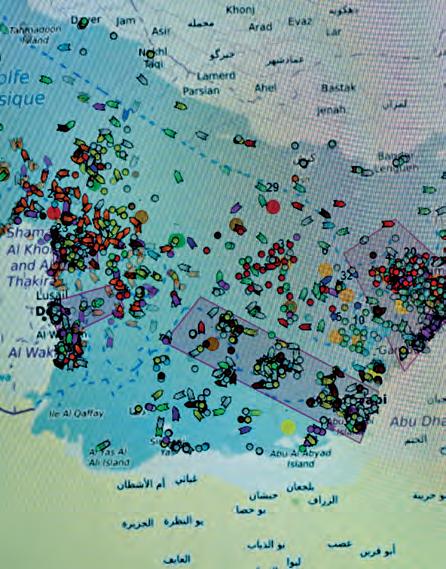

97 %

entirely rely on the waterway for liquefied natural gas (LNG) exports, which represents 19 percent of global LNG trade.
Owing to the sheer volume of oil and gas that is exported via the strait, and the limited options to bypass it, its closure has instigated the largest supply shock in history. Put in context, the shock is 18 times larger than what was witnessed during the initial weeks of the Russian–Ukraine conflict in 2022. At some point, during the first weeks of the Middle East conflict, oil flows through the Strait of Hormuz plunged by as much as 97 percent with about 2,000 tankers affected.
The disruption of crude flows has come with catastrophic consequences for the global oil markets, with the ripple effects being devastation to the global economy. Before the onset of the conflict, crude oil prices averaged $65 per barrel but spiked to around $115 in April. So far, there are no signs of prices stabilising, with the current gloomy environment further clouded by UAE’s decision to quit OPEC in order to focus on ‘national interests’ and forge its own path in terms of crude production. UAE, which has been OPEC’s member for six decades, accounts for about 15 percent of the Viennabased oil cartel’s production capacity.
Compounding the situation is the continued US blockade of Iranian ports, a standoff that could last for months unless Washington reaches a deal with Tehran in ongoing peace talks. By the end of April, crude
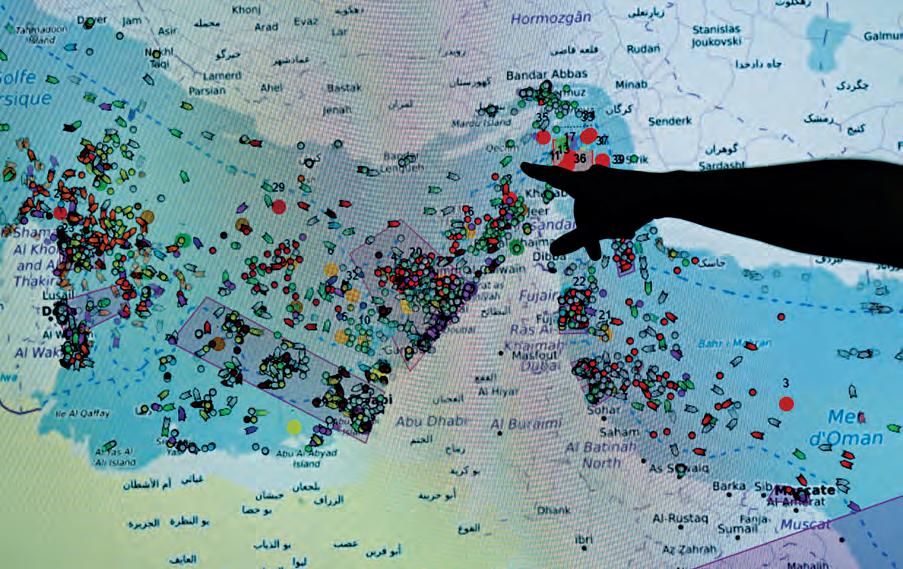
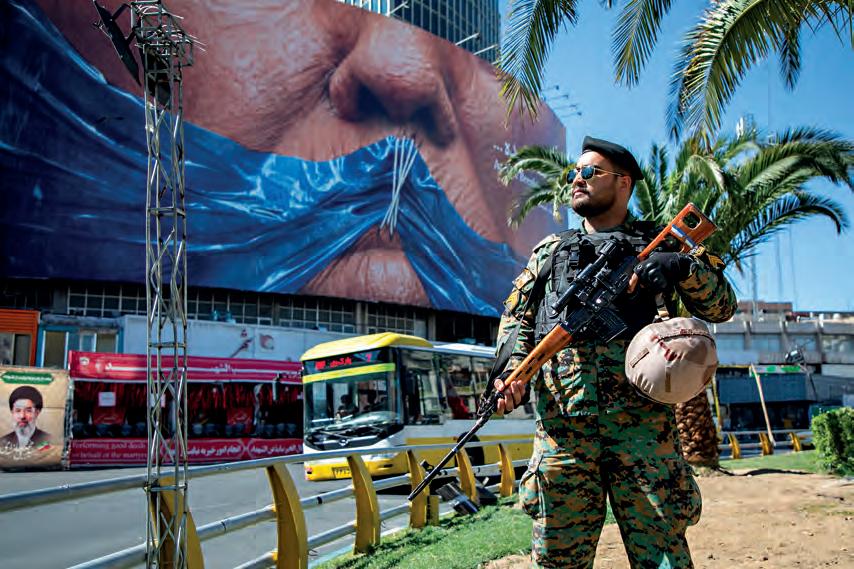
oil prices had crossed the $120 per barrel mark, a rate last recorded in 2022. “If shipping through Hormuz is not allowed for another four to six months, we can expect oil prices to rise over $150 a barrel,” reckons Adi Imsirovic, a guest lecturer at UK’s University of Oxford.
Crude prices hitting $150 is anguish the global economy cannot endure. Already, the International Monetary Fund (IMF) and the World Bank are warning the conflict has halted momentum that would have seen global growth expand by 3.4 percent this year.
With the conflict reaching 60 days in late April and crude prices rising, the IMF forecast is gravitating towards an adverse scenario in which growth is expected to decline to 2.5 percent this year with inflation rising to 5.4 percent. In a severe scenario where energy supply dislocations extend into next year, growth would plummet to two percent this year and next year, while inflation would exceed six percent.
Indermit Gill, World Bank Chief Economist, reckons that the war is hitting the global economy in cumulative waves: first through higher energy prices, then higher food prices, and finally, higher inflation. Extreme waves, including interest rate spikes and debt becoming even more expensive, are also bound to strike as the conflict prolongs.
“The poorest people, who spend the highest share of their income on food and fuels, will be hit the hardest, as will developing economies already struggling under heavy debt burdens.
All of this is a reminder of a stark truth: war is development in reverse,” said Gill.
“Crude prices hitting $150 is anguish the global economy cannot endure”
The unprecedented disruption of crude supplies due to the Middle East conflict has seen countries across the globe resort to desperate coping mechanisms, some geared at forestalling civil strife and unrest not only because of high prices but also due to biting shortages. The mechanisms have ranged from tax cuts, declaring states of national emergency, encouraging people to work from home, limiting travel by government officials, and closing schools and universities to avoid unnecessary lighting. In terms of taxes, about 40 countries had effected some form of tax cuts be it slashing of value added tax (VAT), excise duties and even abolishing levies on petroleum and petroleum products by the end of April. “Most economies have used tax abatements to control price volatilities,” notes Medlock, adding that the cuts are classical cases of desperate times calling for desperate measures.
The stopgap measures have come in handy and eased the pains, particularly for the least developed and frontier economies. Kenya is an example. Due to the global shocks, the East Africa nation saw domestic prices for super petrol hit an all-time high of KSh206.97 ($1.59) in April, up from KSh178.28 ($1.37)
in March. With the opposition calling for demonstrations, the government slashed VAT from 16 percent to eight percent, effectively bringing down prices to KSh197.60 ($1.52).
The action, however, was costly for the government, which is set to lose KSh12.9bn ($100m) in revenues in three months.
For large and emerging economies, however, the more proactive action has been releasing emergency strategic stocks into the market. Historically, the release of SPRs has been rare. Often, it happens during extreme circumstances like war, pandemic outbreaks, adverse weather and natural disasters, and severe economic crises among others. The emergency stocks are controlled by governments with some inventories accumulated by private entities through government-mandated agreements and oversights.
Data by the US Energy Information Administration (EIA), the statistical agency of the Department of Energy (DOE), shows that by the end of last year, the world boasted some 2.5 billion barrels of emergency oil inventory. China, the US and Japan held the three largest inventories. Though Beijing has often remained secretive about its inventory by opting not to officially publish data, estimates indicate the country’s stockpile was in the region of 1.4 billion barrels. EIA used imports, exports, refining and oil inventory data from third-party and official sources to estimate China’s stocks. The US, on its part, held 413 million barrels, with Japan’s inventories estimated at 263 million barrels.
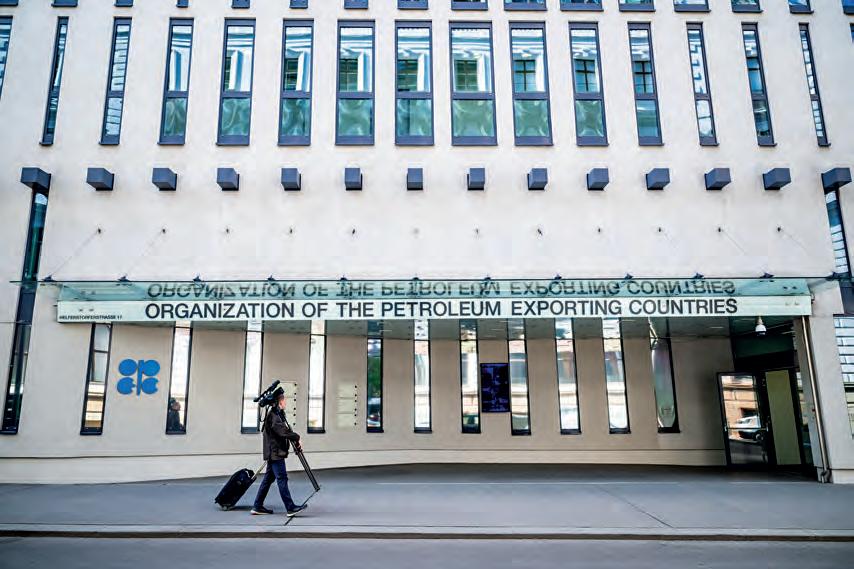
The data shows that, cumulatively, Europe boasted some 179 million barrels, while Saudi Arabia with 82 million barrels, South Korea with 97 million barrels, Iran with 71 million barrels, UAE with 34 million barrels and India with 21 million barrels were the other countries that have managed to amass massive stocks.
The IEA, a club of 32 that requires members to maintain specific oil stocks and that coordinates release of emergency stocks, gives a clear pointer of the global stockpiles. Cumulatively, its members hold over 1.2 billion barrels. A further 600 million barrels of industry stocks are held under government obligation. Since its establishment in 1974, IEA has coordinated the release of emergency stocks by its members six times. A case in point was in 2011 when members collectively released 60 million barrels in response to shortages instigated by the Libyan war. In 2022, members undertook two releases amounting to 180 million barrels in efforts to contain supply disruptions and high prices caused by Russia’s invasion of Ukraine.
All the previous six interventions, however, cannot equate to the release of emergency stocks that has been necessitated by the ongoing Middle East conflict. A fortnight after the war erupted, and with the world engulfed in the worst crude supply disruption in decades, it was clear the only option to buffer the global economy from a thorough beating was the strategic reserves.
“Oil markets are global so the response to major disruptions needs to be global too”
In effect, IEA members unanimously agreed to make 400 million barrels available to the market, the largest ever oil stock release in history and one that IEA termed as decisive and unprecedented.
“Oil markets are global so the response to major disruptions needs to be global too,” noted Fatih Birol, IEA Executive Director following the action on March 11. Birol has gone on to add that depending on how the situation continues to unfold, the agency
Largest proven crude oil reserves (billions of barrels)
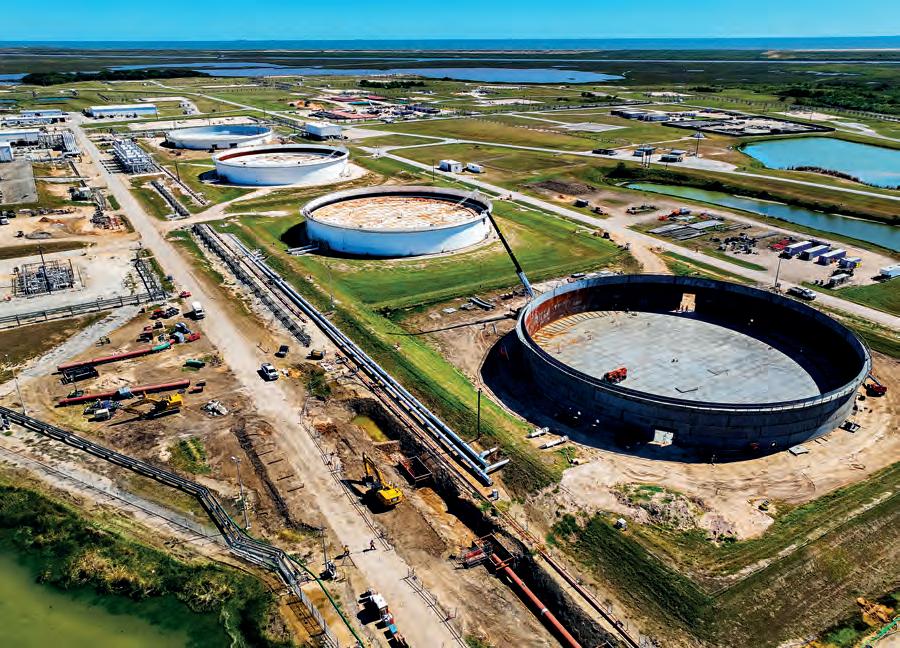
stands ready to act with more releases. The hope, however, is that the world will not require another intervention. “I very much hope we don’t need to do it, but if it is – if it is needed, we are ready to act immediately,” said Birol during an Atlantic Council forum.
The US has been among the major responders to the IEA clarion call, agreeing to contribute 172 million barrels of the total from its SPR. By end of April, the country had managed to release about 80 million barrels, with Europe being the key destination market. Notably, the oil is being sold on an exchange basis with oil majors and traders buying the stocks expected to return the supplies at a later date. In one of the contracts awarded at the initial phases in March, DOE made some 45 million barrels available to the market and expected to receive 55 million barrels in return. Apart from the US, Japan and the UK have also been proactive in releasing stocks, contributing 36 million barrels and 13 million barrels respectively.
SOURCE: OPEC * Canada, Chile, Mexico, United States. ** Armenia, Azerbaijan, Belarus, Georgia, Kazakhstan, Kyrgyzstan, Moldova, Tajikistan, Turkmenistan, Ukraine and Uzbekistan
“Making the strategic stocks available to the market has been the right move,” avers Emerson. She adds that unlike other previous crises that the globe has faced, the Middle East conflict has some distinct characteristics. Key of which is that for the first time, and due to the closure of the Strait of Hormuz, Saudi Arabia has been crippled in its erstwhile role of always increasing production in order to offset global shortages. “In most of the other past crises, we often saw Saudi crude oil production increase. It has not been the case in the current crisis.”
Relief, yes…cure, no

The history of SPRs dates back to the 1940s when the concept was first proposed. Following the end of the Second World War, a number of countries considered establishing strategic stocks owing to the critical role of oil in national security and military success. However, investments in tangible infrastructures to amass stocks started in the 1970s with the US being a case study. The harrowing experiences of 1973 prompted the country to invest in complex underground storage caverns that were created in salt domes along the Texas and Louisiana Gulf Coasts. The salt caverns, chosen on the basis of being inexpensive, secure and close to most refineries and distribution points, can hold up to 727 million barrels. Ahead of the March coordinated release, the SPR stocks had increased to more than 415 million barrels. The SPR has only managed to reach full authorised capacity once. In December 2009, the recorded inventory hit 726.6 million barrels.
Going by President Ford’s declaration, the original objective and motivation was ‘energy independence.’ Today, however, and as evidenced by the Middle East conflict, the role of the emergency stocks has evolved. Governments across the globe are using SPRs to stabilise supply, avoid fuel shortage, rein in price hikes and even contain inflation. More brutally, countries are deploying inventories as ammunition for geopolitical influence and protecting themselves from external aggression. China is the archetypical
example. The Asian giant is the world’s largest crude oil importer, with imports averaging 11.6 million barrels per day in 2025. During the year, Russia, Saudi Arabia, Malaysia, Iraq and Brazil were the country’s top suppliers, accounting for 62 percent of total imports. For Beijing, accumulating strategic stocks is, literally, a matter of life and death. Apart from the economy being deeply dependent on oil, its military machinery requires uninterrupted fuel supply in the event of war. Observers contend that a possible conflict with the US over Taiwan is among reasons China has been amassing inventories.
“While the release of reserves has helped avert dire impacts, they are not a panacea for long-term supply and price stability,” observes Medlock. There is no doubt the emergency stocks have offered relief to the world. Data show world crude oil consumption stands at 100 million barrels a day. For this reason, the release of 400 million barrels might pass as a drop in the ocean. Besides, going by the surging prices, it would be easy to conclude the impacts of the SPRs has been minimal. The reality, according to experts, is that price spikes could have been more severe without the emergency stocks. Evidently, crude prices declined by $18 soon after the
“Price spikes could have been more severe without the emergency stocks”
IEA announcement of March 11. Another reprieve has been arresting the drastic surge in inflationary pressures, particularly among countries that are net importers of oil. India, which imports about 90 percent of its oil, is among countries that continue to project resilience. Despite the key inflation rate increasing from 2.75 percent in January to 3.4 percent in March, it has remained below the central bank’s four percent target.
Also critical is the fact that SPRs have helped prevent product shortages for many countries, more specifically across developing nations that lack the resources to build strategic reserves. Granted, amassing stockpiles is an expensive affair that often spans years. On this, the US lays bare the excruciating pain that comes with building stocks. To date, the country has invested a staggering $25.7bn in its SPR. Of this, $5bn has been spent on building facilities while $20.7bn has gone towards purchasing the crude oil. It goes without saying that as a major producer of oil, the US purchases the crude from its own companies. For net importers of crude, the pain is undoubtedly worse. The pain also comes in replenishing the stocks, more so when crude prices are high. For the world, there is no denying that emergency oil inventories have played a central role in neutralising the impacts of the Middle East conflict. For this reason, and as global uncertainties become the norm rather than the exception, the race to accumulate stocks has the potential to become ever more urgent. n
In his new book, the UC Berkeley academic Barry Eichengreen analyses the current state and future prospects of the dollar through the prism of economic history and its lessons for global currencies
INTERVIEW WITH
Barry Eichengreen
PROFESSOR OF ECONOMICS AND AUTHOR



Economic historian Barry Eichengreen has long been one of the most insightful guides to the global monetary system. In his recent book Money Beyond Borders: Global Currencies from Croesus to Crypto, the George C. Pardee and Helen N. Pardee Professor of Economics and Political Science at the University of California, Berkeley, turns his attention to how money is evolving in a world of rapid technological and geopolitical change. From the rise of stablecoins to shifting power between the dollar and emerging challengers, Eichengreen explores what it means for global currencies to move ever more freely across borders while governments try to retain control. The book blends economic history – from ancient Greece to medieval Florence, Amsterdam and then Britain’s handover of global financial leadership to the US – with sharp analysis of today’s monetary debates. In this exclusive interview with World Finance ’s correspondent Alex Katsomitros, Eichengreen reflects on how domestic political challenges affect the dollar’s global status, the risks and opportunities posed by innovation, and whether dollar dominance can endure in a fragmented world economy.
What is the biggest threat to the dollar’s dominance right now?
The US itself. Not the economy, but rather US politics. Global currency status has political as well as economic and financial preconditions. These domestic political preconditions are at risk at the moment. Global investors have to be confident that the rule of law, separation of powers, control of corruption and respect for Fed independence are intact. They have to be confident about the country’s foreign policy, whether its alliance policies are sound and stable, whether the US is still regarded as a reliable alliance partner because central banks, governments, fi rms and commercial
banks use the currency of partners who are viewed as reliable stewards of their holdings. There are questions about that.
Would a more isolationist Fed undermine the dollar’s global status, given its role as a global lender of last resort?
The Fed has played an important role by extending dollar swap lines to foreign central banks, which is a foundation stone of the global dollar. Foreign central banks will only be comfortable about seeing banks and firms under their jurisdiction holding dollars if those central banks can act as dollar lenders of last resort because they can swap their currencies for dollars with the Fed. If we have a nationalistic US president who insists on nationalistic behaviour by the central bank, things will be different. Take President Trump’s supposed temporary appointee to the Fed Board, Stephen Miran, who thinks the US should not provide global public goods by acting as a global lender of last resort and that we should demand recompense prior to doing that. Kevin Warsh wants to shrink the Fed’s balance sheet. Will a central bank with a smaller balance sheet that focuses narrowly on its domestic responsibilities still act as a global provider of dollar liquidity? I have my doubts, and this makes me even more worried about the prospects of the dollar as a dominant global currency.
Are there any parallels between what the Nixon administration was doing in the 1970s to deal with the balance-ofpayments deficit and what the Trump administration is doing now with tariffs? There are two parallels. One, both administrations wanted a weaker dollar to boost export competitiveness and address that balance of payments weakness. The reason Nixon imposed a 10 percent import surcharge in August 1971 was to allow the dollar to depreciate without other governments depreciating their currencies. Only after that currency alignment was he prepared to remove the import surcharge. That is similar to the Mar-a-Lago Accord. We hear today
that the dollar should be devalued, and tariffs are used to induce foreign governments to go along. The second parallel is that it didn’t work then, and it’s not working now. The dollar is item number 10 down the list of determinants of US competitiveness. That competitiveness depends on our productivity growth; investment in the skills and training of our workers; entrepreneurship; capital investment; tax system efficiency. Further down on the list comes whether the dollar is 10 percent higher or lower.
Most economists consider the dollar an exorbitant privilege for the US. Some, however, even in President Trump’s circle, suggest that it is a burden. What do you think?
I see both sides of the coin. There have been dominant currencies in the past that faced problems of international competitiveness or overvaluation because of the large global demand to hold them as reserves. That was the case of Florence in the 15th century, Amsterdam in the 18th century, and the UK in the late 19th century and early 20th century. My evaluation is that the benefits outweigh the costs. The benefits are convenience, being able to do cross-border business in your own currency, which aids competitiveness; funding the Treasury’s debt at lower cost because there’s demand for Treasurys; an automatic form of insurance that you are the safe haven currency and funds flow into your markets when volatility spikes, rather than experiencing capital flight and financial market collapse. Finally, your financial sanctions are more effective than they would be otherwise.
When the euro was created many people expected it to compete with the dollar. Why hasn’t this happened?
The euro has gained zero ground on the dollar as a global currency since 2001. The reason is resistance from special interests and lack of political will at the national level. There are three prerequisites for a larger global role. One, a capital markets union, which would create a more liquid market in eurodenominated government securities. But the banks don’t like this idea; they want to hold on to their part of financial business for investment funds in Luxembourg and Ireland. They want to keep regulation at home
rather than allowing it to migrate to Brussels or Paris, where it would foster a capital market union.
Two, there is a shortage of safe eurodenominated assets. There are only three European governments with triple-A ratings from all rating agencies. They have around €3trn worth of government securities between them, compared to $30trn to $40trn worth of US Treasurys. The EU could issue more bonds of its own. There are schemes where the EU would buy up national government bonds, and use the interest paid to it by national governments to issue and service its own bonds. But national governments are reluctant to see those schemes implemented.
Three, there is no common EU defence and security policy. Leading global currencies are the currencies of political entities that can secure their borders and build strong alliances with foreign partners. The EU and its citizens are beginning to think about the importance of not relying on the US for security and building that common EU policy. But there is this famous observation that 13 different EU countries are producing 13 different tanks. How can you have an effective tank battalion on the battlefield, absent greater integration?
Do you consider the renminbi a stronger rival to the dollar?
The playbook the Chinese authorities are following is taken directly from what the Fed did, starting in 1914, to promote use of the renminbi for cross-border trade settlements with China itself, and once that process is underway, to promote purely financial transactions. They are building the relevant infrastructure, the Chinese cross-border interbank payments system with close to 200 direct participants and 1,600 indirect participants. They have an electronic platform, mBridge, built with four other monetary authorities and central banks. They are moving as fast as they can. The People’s Bank of China has extended more currency swap agreements to foreign central banks than the Fed or the ECB. But they are starting out way behind.
They have been internationalising their currency for a little more than a decade. The US has been doing so for more than a century. The US accounts for nearly 60 percent of global foreign exchange reserves. China accounts for two percent. China’s cross-border renminbi transactions have been growing at double-digit rates, whereas their growth has slowed down. Nothing in China is grow-
ing at double-digit rates anymore. And then there are the political obstacles. I described my doubts about US politics and how that can negatively affect the dollar. Checks and balances, rule of law, regulatory transparency – these are not characteristics of the Chinese political system. Will they grant independence to their central bank? Will they allow competing political parties? Obviously not in my lifetime.
Are stablecoins a threat to the dollar’s dominance – or a digital tool to preserve it? I would distinguish the token from the payments rails, which are blockchain or distributed ledger technology. One of my book’s themes is that financial and payments technology is always changing. Blockchain and distributed ledger technology is here to stay and will provide another vehicle through which cross-border transactions are completed. We don’t know what kind of units will run on those rails. Will they be privately issued stablecoins? 99 percent of them are linked to the dollar. Or will they be a combination of tokenised commercial bank deposits and central bank digital currency (CBDC) to create finality? Those units can also run on a permissioned blockchain. Both the ECB and the People’s Bank of China are betting on tokenised commercial bank deposits and a CBDC. In the US, Congress has prohibited the Fed from issuing a CBDC. My view is that we are betting on the wrong horse and that privately issued stablecoins may turn out not to be stable and fungible. If Amazon and Walmart issue stablecoins, will we be able to use Walmart Coin at Amazon and Amazon Coin at Walmart? Tokenised bank deposits take advantage of an already existing banking system inside the regulatory perimeter that is important for stability. Commercial banks have already made progress in figuring out how to issue and manage a CBDC. Time will tell which horse ends up winning the race.
What would a world without dollar dominance look like?
It would make for a more fragmented global monetary and financial system. If you imagine a dollar area, a euro area and a renminbi area, it’s important to design these areas to overlap with one another and maintain a semblance of transactions between them. Imagine a scenario where China and the countries around it do business only in renminbi and the US is on such bad terms with China that we do no business using the renminbi. We know from the 1930s that is disastrous. So we have to design monetary systems where the blocs can do business with one another. n
Technology is reshaping how people engage with financial markets, creating a generation of younger, more active investors. Trading platforms are becoming full financial ecosystems and trust and transparency now matter more than ever
Ziad Melhem CEO, CFI FINANCIAL GROUP






The investment industry is undergoing a profound generational shift. Mobile-first platforms, real-time market access and an explosion of financial content online have transformed investing from an activity once dominated by institutions and wealthy individuals into something far more accessible and immediate. Younger investors are entering markets earlier, trading across multiple asset classes and expecting seamless digital experiences alongside transparency and education. For trading platforms, this evolution is changing the rules of competition. Technology, regulation and trust have become just as important as access to markets, while artificial intelligence and personalised insights are beginning to redefine the client experience. In this interview, Ziad Melhem, CEO of CFI Financial Group, explains how investor behaviour is changing globally, why local market participation is rising in the UAE, and what the next generation of trading platforms will look like.
Has technology created a new generation of investors?
Absolutely. Technology has fundamentally democratised access to financial markets. What was once reserved for institutional players or high-net-worth individuals is now available to anyone with a smartphone and the motivation to learn. At CFI, we have witnessed this shift firsthand; our client base has grown significantly younger and more digitally native over the past several years. But I would go further than saying technology simply created new investors. It redefined what participation in markets looks like. People are entering the investment conversation earlier in life, with more information, more analytical tools, and more confidence than any previous generation.
The gatekeepers haven’t disappeared so much as changed shape; the new ones are the platforms themselves, and they earn their place through transparency, regulation and the quality of the experience they offer. What matters now is how well platforms serve this new audience once they arrive.
What is driving this shift in investor behaviour?
Several forces are converging simultaneously. The first is access: the barriers to entry have collapsed. You no longer need a broker on the phone, or a minimum deposit measured in thousands. The second is information: financial content is everywhere, from dedicated research platforms to social communities where investors share ideas in real time. The third is economic context: younger generations have grown up through financial crises, inflationary cycles and significant market volatility. They understand, instinctively, that leaving money idle is itself a form of financial risk. And the fourth is an evolving relationship with institutions. Clients today want to engage with platforms that are transparent, properly regulated, and built around their needs rather than around the platform’s commercial interests. That expectation is reshaping the entire industry.
How have trading platforms changed investing for younger generations?
The experience has been completely reimagined. A decade ago, trading platforms were built for professionals; they were complex, data-heavy environments that assumed the user already understood what they were doing. Today, the best platforms combine professional-grade tools with intuitive design, integrated education and responsive support.
“ What matters now is how well platforms serve this new audience once they arrive”

For younger investors, the platform is not simply a transaction engine; it is their primary relationship with the financial world. They expect personalisation, mobile-first design, full clarity on fees and risk, and the ability to move between asset classes without friction. We have built our platform architecture around exactly those expectations. Meeting them is not a competitive advantage anymore; it is the minimum standard clients will accept.
Are investment priorities changing globally?
Significantly, yes. We are seeing a clear move away from passive, long-term strategies toward more active, informed participation. Younger investors want to understand what they own and why; they are building knowledge alongside their portfolio rather than delegating decisions entirely. What is particularly interesting is how this generation thinks about diversification: not as a choice between local and international, but as a deliberate combination of both. They want exposure to global indices, US equities, commodities, and currencies, while simultaneously maintaining a strong conviction in their home markets. Nowhere is this more visible than in the UAE, where we are seeing a significant surge in appetite for
local stocks. Investors here are deeply engaged with UAE-listed equities, and that enthusiasm is only growing. It is a trend we took seriously at CFI, and one of the reasons we made the deliberate decision to expand our product offering to include local market access; to ensure our clients can build truly balanced portfolios without needing to go elsewhere.
Which asset classes are attracting the most interest from younger investors?
Equities remain a strong entry point, particularly US technology stocks, which carry significant cultural recognition among younger audiences globally. But what we find most interesting at CFI is the appetite for multi-asset participation. Younger investors are not confining themselves to a single asset class; they move fluidly between forex, indices, commodities and ETFs, often responding dynamically to market events and macroeconomic developments.
Volatility, rather than being a deterrent, has become a driver of engagement for this generation. They understand that markets move, and they want platforms equipped with the tools to help them navigate that movement intelligently. The demand is not just for access to more assets; it is for the analytical infrastructure to trade them well.
How important is technology in shaping the investor experience today?
Technology is no longer a differentiator; it is the foundation everything else is built on. We have invested considerably in building a trading infrastructure that gives clients a genuine edge: superior execution quality, seamless access across web, mobile and desktop, advanced charting, integrated risk management tools and real-time market analytics. But technology serves a purpose that goes deeper than operational efficiency. It shapes confidence. When a client has the right tools, clear data, and a consistent experience across every touchpoint, they make better decisions. That is the real measure of good technology in this industry: not how fast the platform executes a trade, but how well it equips the person behind the trade to act with clarity and conviction.
Is trust becoming more important in the online trading industry?
Trust has always been the foundation of financial services. What has changed is how it is earned and demonstrated. In an industry that has at times been characterised by opaque pricing, unclear regulatory standing, and misleading marketing, clients are more discerning than ever before. They research
brokers before they register. They verify regulatory credentials. They read peer reviews and compare platforms carefully. At CFI, we welcome that level of scrutiny. Our regulatory framework is built on a clear principle: wherever we operate, we obtain the appropriate license, both regional and international. In the UAE, we are regulated by the Capital Markets Authority. Beyond that, we hold tier-one international licences, including the FCA in the UK, alongside CySEC in Cyprus, the Central Bank of Bahrain (CBB) in Bahrain, Banco Central do Brasil in Brazil, the Central Bank of Azerbaijan in Azerbaijan, and additional licences across the jurisdictions we serve. This multi-jurisdictional structure is not only a regulatory necessity; it is a deliberate part of how we are built, giving our clients access to a single firm that can serve them under the rules of whichever market they choose to trade in. Our commitment to transparency is not a marketing position; it is embedded in how we operate, from how we communicate risk to our clients, to how we structure and protect client funds. Trust in this industry is not something you claim. It is something you demonstrate, consistently, over a long period of time. CFI has been doing exactly that for over 25 years.
What will define the next generation of trading platforms?
The platforms that lead the next decade will be those that evolve from pure transaction tools into genuine financial ecosystems. This means moving well beyond trade execution to offer structured education, personalised market insights, a full spectrum of asset classes, and a client experience that adapts to where each person is in their financial journey. Artificial intelligence will play a meaningful role in this evolution, not by replacing human judgement, but by augmenting it; helping clients understand their risk exposure, identify relevant opportunities, and navigate complex market environments with greater clarity and less noise.
At CFI, this is the vision we are building toward. The next stage of our platform is precisely this: a connected environment where trading, research, education, community, and a broader set of asset classes sit together within one experience, so that every client – whether they are placing their first trade or managing a sophisticated multiasset portfolio – feels the platform genuinely grows with them.
That is the standard the industry should be measured against. It is the standard we are setting for ourselves. n
Trading access is simple, but misreading risk is expensive. In today’s trading environment, education has become the defining edge between informed risk-taking and costly mistakes
WORDS BY Kris Wang COUNTRY HEAD, AUSTRALIA, EBC FINANCIAL GROUP




Opening a trading account has become straightforward, but understanding price drivers, market speed, and the potential loss from unsuitable products requires more effort to understand. In markets shaped by oil shocks, tariff threats, inflation surprises, leveraged products, and rapid digital responses, education has become essential for traders to assess risk, select appropriate instruments and avoid losses caused by insufficient understanding rather than market movement alone.
Contemporary market shocks seldom remain confined to a single asset class. For instance, threats to energy supply can influence crude oil and natural gas prices, increase shipping and insurance costs, lift inflation expectations, and affect interest rates, currencies, airlines, and transport within the same trading session. Central bank statements and inflation data releases can shift bond yields, the US dollar, and growth-sensitive equities within minutes. Additionally, food and water stress increasingly affect global fi nancial markets by influencing farm output, industrial input costs, supply reliability and inflationary pressures.
That describes the trading environment today: prices in equities, bonds, commodities, and currencies adjust rapidly due to interconnected global markets and instantaneous information flow. Volatility is not the primary concern, as price swings are necessary for markets to incorporate new information. The greater risk arises when participants enter fast-moving financial markets without understanding the underlying drivers, the potential for contagion across asset classes, the amplifying effects of leverage, and the influence of product structure on actual trade risk. The same market event may result in a minor
controlled loss, a missed opportunity, or a significant trading error, depending largely on the trader’s level of understanding.
Access has expanded quickly
Technological advancements have simplified the process of opening trading accounts, accessing live prices, receiving market alerts, and executing orders within seconds. Although broader access is advantageous, it may cause traders to conflate speed with preparedness. The ability to trade rapidly does not equate to a comprehensive understanding of market drivers or the inherent risks associated with specific products.

Regulatory authorities have cautioned that finfluencers and online copy-trading practices may present high-risk activities as deceptively simple. This is significant because trading decisions are increasingly influenced not only by data, central bank communications, and corporate news, but also by social media content, replicated convictions, and rapid digital commentary. Traders may follow persuasive opinions without understanding the associated time horizon, the specific product involved, or the underlying risk controls.
In this context, education extends beyond acquiring terminology and includes learning how to prepare before assuming risk.
Education enables traders to identify the true drivers of price movement, compare headlines with market expectations, select instruments aligned with their trade ideas, and determine when abstaining from trading is preferable to pursuing a forced position. Such preparation constitutes fundamental trading discipline in contemporary markets.
An oil price spike illustrates why education alters outcomes. An unprepared trader observes a surge in crude prices due to conflict risk and enters the market late, perceiving the direction as obvious. In contrast, an educated trader begins with a more precise question: Is the movement driven by actual supply loss, fear of supply disruption, or a temporary increase in geopolitical risk premium?
to a different trading decision. If supply has been disrupted, the trader then asks how higher energy costs could affect inflation expectations, interest-rate expectations, oil-importing currencies, airline margins, transport costs, fertiliser prices and food prices. Only after mapping those effects does the trader decide whether crude oil is the best instrument to trade, or whether foreign exchange, rates or equity sectors offer a clearer way to express the same view.
This process protects capital in practical ways. It reduces the impulse to pursue initial price movements when spreads are wide and prices are volatile. It encourages smaller position sizes, recognising that event-driven oil markets can quickly breach stop-loss levels. It may also improve trade selection, as the optimal trade may exist outside the oil market itself. A trader may interpret news correctly yet incur losses if the trade is executed too late, at excessive size, or in a highly volatile instrument. Education enhances decision-making prior to order placement.
The same principle applies to inflation, employment, and central-bank announcement days. An unprepared trader perceives such releases as sudden market noise, whereas an educated trader regards them as scheduled events with defined timing
the educated trader checks the economic calendar, reviews the market forecast, and knows which assets are most exposed, and cuts leverage if an event could widen spreads or change interest-rate expectations. The trader also knows that the first move is not always the final move. Markets often jump in the first seconds and then reverse when traders read the full report.
This reduces a common type of avoidable loss. Many traders compare new data points with the previous month’s figures rather than with market expectations. Others take large positions before the release, if the most apparent reading will result in a straightforward price movement. Education changes this behaviour by teaching traders to consider whether the data alters the expected path of interest rates, whether the market has already priced in part of the result, and which asset best reflects the new information.
A stronger inflation number is not only a bond-market event. It can strengthen the US dollar, change equity valuations, affect gold prices, pressure rate-sensitive sectors, and alter broader risk appetite. Understanding those links helps traders choose better timing and better instruments.
Tariff risk punishes narrow thinking in much the same way. The weak response is to hear the word ‘tariffs’ and place a broad directional bet on one stock index or one currency. The stronger response breaks the event into clear channels. Which
THE TRADER ALSO KNOWS THAT THE FIRST MOVE IS NOT ALWAYS THE FINAL MOVE
manufacturers rely on imported inputs? Which exporters face weaker demand? Which sectors can pass higher costs on to customers? Which currencies may weaken if trade competitiveness deteriorates?
Such analysis does not guarantee profit. More importantly, it prevents traders from using broad macro headlines to justify trades that do not accurately reflect the event’s actual economic impact. Bitcoin belongs in this discussion as well. It is no longer enough to treat bitcoin as a stand-alone crypto story. ETF flows, the US dollar, real yields, market liquidity, leverage unwinds, and social-media-driven positioning can all affect prices simultaneously. An educated trader would ask what kind of move it is; is it a wider risk-off move, an ETF flow reversal, a derivatives liquidation or a social-mediadriven sentiment shock?
This distinction influences position size, holding period, and product selection. A move driven by forced liquidations differs fundamentally from one prompted by a broader macroeconomic shift, even if initial price charts appear similar. Education helps traders avoid interpreting every movement as a single-market event when the underlying driver may originate in another market or in market structure.
Product choice is where many traders discover, too late, that being right in the direction is not enough. Exchange-traded funds, contracts for difference and other leveraged products have widened access and
flexibility. They have also increased the cost of misunderstanding the product. A trader can be correct about gold, oil, an index or a currency pair and still lose money because the chosen product carries financing costs, margin requirements, daily reset effects, spread costs or gap risk that were not properly considered. Education protects traders by teaching them to match the product to the trade horizon, understand margin rules before entering a position, set size based on account risk and stop-loss distance rather than hoped-for profit, and recognise how leverage changes the speed and size of losses when markets gap or liquidity weakens.
Leverage amplifies both potential gains and losses and reduces the time available to respond when markets move unfavourably. In stable markets, large positions may appear manageable, but in stressed conditions, they can become difficult to control. This is why European regulators have imposed restrictions on CFD leverage, margin closeout rules and negative balance protection for retail clients, while UK rules require standardised CFD risk warnings. Education helps traders recognise that survival depends on aligning product choice, position size, stop-loss placement, time horizon and loss capacity.
At EBC Financial Group (EBC), providing market access with seamless, low latency is not the issue. Rather, emphasis is given to whether traders have the understanding to use that access responsibly. As more products, asset classes, and market data become available in real time, education becomes part of the risk framework rather than a nice-tohave support service.
EBC’s education ecosystem is built around that need. Through its Trading Academy, market insights, webinars, trading tools, research content and Pulse 360 podcast, EBC helps traders connect market events with product mechanics, risk exposure and decision-making before capital is put at risk. The aim is not simply to provide more information, but to help traders turn information into clearer judgement under pressure.
This extends beyond platform education. EBC’s collaboration with the University of Oxford’s Department of Economics through the ‘What Economists Really Do’ series reflects a broader commitment to economic understanding and financial literacy, showing how economics can explain major issues facing society and support more informed market participation. n
Ireland’s leadership in Europe’s €2.7trn ETF market reflects years of regulatory innovation, technical expertise and ecosystem development – but staying ahead will require constant evolution
WORDS BY
Graham Jarvis
FEATURES WRITER





Ireland is the firmly established engine room of Europe’s exchange-traded funds market, reveals new research from EY Ireland. The company’s EMEIA ETF Leader, Lisa Kealy, says the country has 70 percent of all European Exchange Traded Funds (ETFs), and that it is seeing much growth in active ETFs, of which it has a 94 percent share. That’s quite a success story considering that the value of European domiciled ETFs surged to €2.7trn, growing by 41 percent in 2025 alone.
“It didn’t happen by accident: It was due
to hard work to present ourselves as a centre of excellence,” Kealy remarks. Blackrock, Vanguard, State Street – the top three institutional investors – chose to set up in Ireland because the infrastructure is highly developed to support their products. The country has also developed a role for itself that goes far beyond being a popular fund domicile.
“Because they set up here, everyone else followed, and now Ireland is seen as the centre of excellence for ETFs,” she explains. The Undertakings for Collective Investment in Transferable Securities (UCITS) framework, and Ireland’s understanding of the nuances of ETFs, redemptions, and how ETFs trade on the secondary market, have all been factors that have helped. Trust with passive ETFs has facilitated interest in active ETFs too.
On a global scale, ETFs have also been a positive growth driver – pushed along by increasing transparency, liquidity, costefficiency and accessibility. Kealy says UCITS has been an important building block to Ireland’s success. It is an EU regulatory standard that harmonises the regulation of investments funds, allowing them to be managed and sold across Europe with a single passport. It focuses on investor protection by enforcing strict diversification, liquidity, and transparency rules for retail investment products.
Comparing the experience of Luxembourg with Ireland, she explains: “The UCITS brand and regulatory framework really opened the door for us when it came to ETFs. It wasn’t going to guarantee leadership, but it did open the door. While Luxembourg had a great opportunity, scale didn’t come automatically. What differentiated us in Ireland and gave us leadership was the ability to really scale –
Estimated value of ETF market in Europe by 2030
establishing ourselves as a centre of expertise, by really understanding daily transparency, in-kind creations and redemptions, the listing structure, the settlement structure, and how ETFs are actually traded on the second trip.
“It is about how you can create and redeem blocks of capital with authorised participants (APs), or market makers (MMs), that whole creation subscription structure. We needed to really understand it all and to make sure that they traded really well on the secondary market. We understood that ETF mechanics and the regulation. And it was that investment of, you know, knowledge, technology, people and process that created our centre of excellence in Ireland.”
Deborah Fuhr, CFA Fellow, Managing Partner and Founder of ETFGI, says her firm’s data shows that Ireland captured a disproportionate share of ETF launches and assets. She thinks Ireland also benefits from
its operational efficiencies when it comes to fund administration, depository, legal, tax, and capital markets expertise – and compared to European centres it has a predictability of regulation, and it benefits from being an English-speaking country. More to the point, she says once Ireland became the default ETF domicile, its ability to scale reinforced itself.
“UCITS was the enabler; Ireland’s execution made it decisive,” she claims. As for Ireland’s key differentiators, she cites ETF-specific regulatory interpretation, faster authorisation timelines, and she finds that the country is comfortable with complex synthetic, fixed income and active structures.
Subsequently a majority of European active ETF assets are domiciled in Ireland, and she says that is despite active ETFs still being a minority of total ETF assets.
However, Ireland’s regulators were early and pragmatic on non-transparent and semitransparent models, and while there has to be a certain degree of portfolio disclosure flexibility, “Ireland already hosted the largest concentration of fixed income ETFs, which translated naturally into active adoption,” she notes.
With US active ETF sponsors expanding into Europe, and defaulting to Ireland, she believes this signals that Europe’s next phase of ETF growth is active, fixed income, and outcome orientated. As for Ireland’s portfolio disclosure flexibility, which is particularly relevant to daily disclosures, Kealy interjects: “The Central Bank of Ireland has recalibrated the daily transparency requirements for active ETFs to balance investor protection, market efficiency and intellectual property. Transparency works well for passive ETFs because the managers are holding a very broad index. That can create issues for active strategies because it risks institutional investors front running that fund, if it makes sense, because the whole portfolio is disclosed.” Its regulatory approach is helped by engaging closely with industry.
Ciarán Fitzpatrick, Global Head of ETF Product at JPMorgan, adds that fund administration, capital markets expertise and specialist talent are critical to sustaining Ireland’s leadership. In fact, he describes them as the moat. “Ireland’s model is not simply a legal domicile; it is a scaled operating platform and infrastructure,” he explains before commenting that Irish Funds have stressed the “breadth and depth of service capability and the highly automated and scalable global solutions” available to issuers there.
The country’s ecosystem has also evolved beyond asset servicing into broader frontoffice expertise spanning capital markets including APs located in Ireland, product development, innovation and global distribution. “This matters more – not less – as the industry shifts toward active ETFs, outcome-oriented strategies, derivatives overlays and new operating models such as tokenisation,” Fitzpatrick suggests.
Fuhr adds: “Evidence shows that ETF success correlates strongly with primary/ secondary market efficiency, and Ireland specialist ETF administrators, AP-facing capital markets desks, lawyers, tax experts and index specialists.” The moat is being created by ETFs becoming more complex, by adding operational depth and not just regulation.
APs: Full liquidity support
Fitzpatrick says the role of APs and MMs is vital, helping to provide full liquidity support to the ETF ecosystem, while also “underpinning the creation and redemption mechanism that connects the secondary market (where investors trade) to the primary market (where ETF shares are created or redeemed).”
Market Makers also support two-way pricing, absorb and manage intraday flows. “As ETF usage becomes more retail and more mainstream, this connectivity becomes more visible – and more sensitive,” Fitzpatrick explains before highlighting that “Irish service providers have built seamless connectivity to the ETF ecosystem, including APs and MMs.”
He adds: “When the operating model evolves, regulators naturally focus on who provides liquidity, how it is monitored and managed, and how contingency plans are governed. This is a regulatory priority to ensure that investors are being serviced transparently and that markets supporting them are functioning efficiently.”
His colleague, Fearghal Woods, Ireland Securities Services Head at JPMorgan, describes the way active ETFs are challenging traditional transparency and disclosure requirements: “Active ETFs put pressure on the classic ETF norm of frequent portfolio disclosure. Managers want the benefits of the ETF wrapper, and they also want to protect intellectual property and reduce the risk of front-running. Ireland’s central bank has been very responsive in this regard and has introduced a flexible portfolio transparency regime for both active and passive ETFs, allowing portfolio holdings to be disclosed

up to quarterly, with a lag of up to 30 business days to avoid any concerns of front-running.”
The response of the Central Bank of Ireland has been to permit ETF share classes within mutual funds, he reveals, letting firms deliver ETF features through existing structures without a separate legal vehicle. “However, this may and can present some operational challenges for the fund that any issuer needs to consider carefully,” Woods reports before commenting: “For issuers it does demonstrate a desire to support active product innovation while keeping the regulatory regime coherent and scalable.”
Not everything is rosy. Ireland’s dominance also brings heightened scrutiny. While ETFs now represent a significant share of Ireland’s funds industry, with industry reports suggesting that they account for roughly 32 percent of total Irish-authorised fund assets, there are structural shifts that are re-shaping demand. Therefore, younger investors, digital platforms, neobanks and robo-advisers are accelerating ETF adoption across Europe –leading to significant growth in active ETFs.
Ireland’s ability to support innovation – while maintaining regulatory credibility – will be critical to sustaining its leadership position over the next few years, particularly as assets are forecast to exceed €5trn in Europe by 2030. To achieve this, Ireland is going to need to continue to innovate. So with the young banking through the likes of Revolut, and offered ETF products through it, access to ETFs should increase.
While apps need to play a role in attracting the young, there is also a need for financial literacy to complement the Savings Investment Union, and to promote ETFs
accessible to investors. Kealy thinks this could create a good saving habit for young people who tend to engage through apps and use automated forms rather than go to an investment adviser.
“ETFs enable access through the apps and the digital platforms that investors are looking to access, so I think it is really important in terms of our culture at a European level,” she comments. The trouble is that Europeans are good savers, but not necessarily good investors. The challenge is therefore to change the culture from a savers’ one to an investors’ culture for young people in Europe. To Kealy, ETFs are the ideal vehicle for achieving this transformation.
Recent reviews by the Central Bank of Ireland highlight that while the Irish ETF ecosystem has functioned effectively during both normal and stressed market conditions, risks remain. In particular, the concentration of activity among a relatively small number of APs and MMs raises questions about liquidity resilience, governance, and contingency planning. The regulator has also emphasised the need for stronger oversight, board-level reporting, and more robust monitoring frameworks to ensure that ETF liquidity mechanisms remain robust as the market scales.
Ireland can nevertheless maintain its dominance if it can avoid being complacent – taking what has been achieved for granted. The world is competitive, and so Ireland can’t afford to sit on its laurels. As Kealy says, Luxembourg is fighting hard to create a really strong ETF ecosystem. She concludes: “So we need to work harder
to continue to earn our position each and every year. This means we need to continue to develop Ireland’s ETF market infrastructure, and to collaborate with the leaders and the managers in the US and the UK to ensure that we have the best ecosystem and that we are really innovative and quick in responding to their needs.”
In Kealy’s view there is still work to be done. For example, there is a need to fix the disconnection around domestic participation, and the domestic block – the tax issue to create an investment culture in Ireland by implementing a favourable tax regime for investors. “You do this by ensuring there is no tax block on Irish people investing in our ETF industry,” she explains.
An opportunity to continue to lead the transformation of the market, encouraging more investors than savers, begins on July 1, 2026, when Ireland takes on the EU presidency. It will allow Ireland to create more harmonisation and standardisation, as well as more digital infrastructure around ETFs –enabling Ireland to promote a smart approach to leading in this area.
Woods also says maintaining Ireland’s leadership is about scaling the operating model by continuing to invest in automation and talent, enhancing the regulatory framework, and enabling innovation without undermining confidence. A key part of this will be to expand ETF and new product capabilities while enhancing investor protection with ongoing regulatory pragmatism. Fuhr summarises it by saying that “Ireland’s lead is structural, not accidental – but leadership must be continuously earned.” n

































Gold’s recent price behaviour has challenged long-held assumptions about safe havens and market correlations. As geopolitical tensions rise and macroeconomic forces evolve, investors are being forced to rethink how risk is priced and where true protection lies
WORDS BY
Tonia Tsangari
CONTENT WRITER, XMTRADING


In times of geopolitical stress, markets tend to fall back on familiar patterns. Risk assets weaken, safe havens strengthen and correlations behave in predictable ways. Yet recent developments have challenged this conventional playbook. Gold, long regarded as the ultimate store of value during uncertainty, has behaved in a manner that appears at first glance contradictory. In the lead-up to the heightened tensions in the Middle East, gold prices rallied strongly, reflecting investors’ anxiety and a growing demand for protection. However, once the conflict materialised, the metal unexpectedly declined, defying its traditional role as a safe haven.
This divergence between expectation and reality offers a revealing window into how modern markets are evolving and why longstanding relationships between assets are becoming less reliable. At the heart of this shift lies a broader transformation. Markets today are increasingly driven not just by events themselves but by expectations of positioning and liquidity conditions surrounding those events.
Anticipation over reaction
Gold’s rally prior to the escalation of geopolitical tensions was largely rooted in anticipation. Investors anticipating instability following US President Trump’s return to the White House began positioning defensively. Central banks continued to accumulate gold as part of broader diversification strategies, while persistent concerns about the trade war, inflation and global growth added further support.
However, once the geopolitical event unfolded, markets had already priced in a
significant degree of Trump-related risks. This led to a classic ‘buy the rumour sell the fact’ dynamic where the absence of further escalation or simply the realisation that worst-case scenarios had not materialised triggered profit taking. This coming hot on the heels of the winding down in precious metals’ speculative frenzy exacerbated the sell-off.
At the same time, macroeconomic forces began to exert greater influence. Rising bond yields increased the opportunity cost of holding non-yielding assets like gold. Meanwhile, a strengthening US dollar absorbed a significant portion of safe-haven demand. Together these factors outweighed the geopolitical premium that would typically support gold prices. This episode highlights a critical shift. Markets are no longer purely reactive. Instead, they are increasingly forward-looking, pricing in risks well before they materialise and adjusting rapidly as new information emerges.
One of the most important factors shaping gold’s recent behaviour is its relationship with the US dollar. Traditionally, gold and the dollar share an inverse correlation. When the dollar strengthens, gold tends to weaken and vice versa. This relationship is rooted in gold being priced in dollars and its role as an alternative store of value. In the current environment, this inverse relationship has reasserted itself with considerable force. Despite geopolitical uncertainty, the US dollar has remained exceptionally strong, underscored by relatively higher interest rates amid a resilient economic performance, and its enduring status as the world’s primary reserve currency.
As a result, safe-haven flows that might historically have supported gold have instead been directed towards the dollar. For global investors, particularly in times of crisis, liquidity and accessibility often take precedence over tradition. The dollar

increasingly constrained by macroeconomic factors, especially monetary policy and dollar strength.
Perhaps more surprising than gold’s relationship with the dollar has been its recent interaction with equities. Historically, gold and equity markets tend to move in opposite directions. When appetite for risk declines and equities fall, gold rises as investors seek safety. Conversely, during risk-on environments, gold typically underperforms. However, recent market behaviour has revealed periods where both gold and equities have moved higher simultaneously. This apparent breakdown in traditional correlation reflects deeper structural changes in how markets function.
One key driver of this phenomenon is liquidity. In an environment where central banks have over the past decade injected significant liquidity into the financial system, asset prices across the board have become increasingly sensitive to capital flows rather than purely to fundamental distinctions between risk and safety. Institutional investors meanwhile are adopting more
where both equities and gold can attract inflows under certain conditions.
The result is a more complex market environment where traditional risk on and risk off frameworks no longer fully capture asset behaviour. Instead, markets are increasingly characterised by hybrid dynamics where assets can respond simultaneously to different and sometimes conflicting drivers.
While gold’s behaviour offers valuable insight, the broader impact of geopolitical tensions extends across multiple asset classes. The Middle East crisis in particular has highlighted how geopolitical risk creates asymmetrical effects, producing clear winners and losers across the global economy. Energy markets have been among the primary beneficiaries. Oil and gas prices have soared amid concerns over supply disruptions, reinforcing the strategic importance of energy security. Defencerelated industries have also seen increased investor interest, reflecting expectations of sustained or increased military spending.
The US dollar, as noted, has strengthened further, benefiting its role as a global reserve
THE RECENT BEHAVIOUR OF GOLD SERVES AS A BROADER REMINDER THAT FINANCIAL MARKETS ARE NOT STATIC
currency and a preferred destination for capital during periods of uncertainty. On the other side of the equation, emerging markets have faced renewed pressure. Capital outflows stemming from currency volatility and heightened sensitivity to external shocks have made these economies particularly vulnerable. Risk-sensitive currencies have struggled while trade-dependent economies face additional challenges as global supply chains come under strain again. This divergence underscores a key feature of modern geopolitical risk. Its effects are not evenly distributed. Instead, they amplify existing strengths and weaknesses within the global economic system.
If geopolitical tensions remain elevated, several broader market trends are likely to persist. Volatility, already a defining feature of recent years, is expected to remain high. Investors will continue to navigate an environment where sudden shifts in sentiment can lead to rapid price movements across asset classes. The dominance of the US dollar is also likely to endure particularly if interest rate differentials remain favourable. This could continue to place pressure on alternative assets, including gold, in the short term.
At the same time, commodities, especially energy, may remain supported by ongoing supply concerns and structural shifts in
global trade patterns. Gold, despite its recent fluctuations, could still benefit over the longer term as a hedge against systemic risk, particularly if geopolitical tensions evolve into more prolonged or widespread disruptions. Central banks for their part are likely to maintain a cautious stance. Balancing inflation control with economic stability becomes increasingly complex in an environment shaped by both geopolitical uncertainty and shifting market dynamics.
The recent behaviour of gold serves as a broader reminder that financial markets are not static. Relationships that once held consistently can weaken or even reverse under new conditions. For investors, this presents both a challenge and an opportunity. Relying solely on historical correlations is becoming increasingly insufficient. Instead, a more flexible approach is required – one that recognises the interplay between macroeconomic forces for geopolitical developments and evolving market structures. Understanding the drivers behind asset behaviour is now more important than ever. Why is the dollar strengthening? How are interest rates influencing capital flows? What role does liquidity play in shaping price movements? These questions are central to navigating today’s markets.
The global financial landscape is entering a phase defined by complexity and transition. Geopolitical risks are becoming more frequent and more interconnected while macroeconomic conditions continue to shift in response to policy decisions and structural changes. In this environment, the concept of a safe haven is itself evolving. Gold remains an important component of the financial system, but its role is no longer as straightforward as it once was. The US dollar, supported by its unique position in global finance, continues to dominate in times of stress. Meanwhile, correlations between assets are becoming more fluid, reflecting the growing influence of liquidity and investor behaviour.
For market participants, the implications are clear. Adaptability rather than adherence to tradition is becoming the defining characteristic of successful investment strategies. The ability to interpret changing relationships and respond to new dynamics will be critical in an increasingly unpredictable world. As recent events have shown, even the most established assumptions can be challenged. In the evolving landscape of global finance, understanding these shifts is not just advantageous, it is essential. n
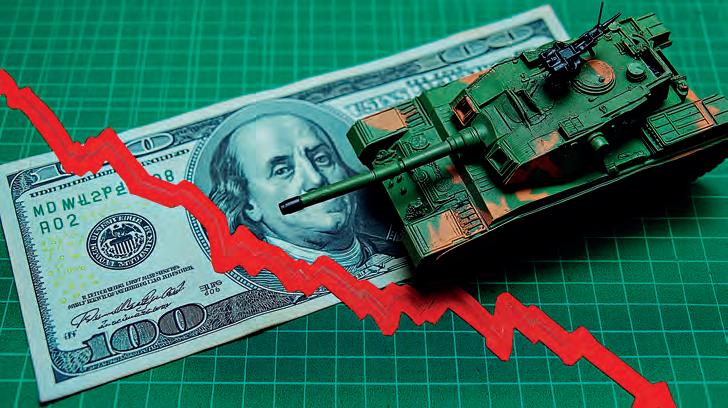
The true price of war is rarely paid by those who start it. In a deeply interconnected world economy, the financial burden of conflict is increasingly exported through inflation, disrupted trade and slowing growth worldwide
WORDS BY Antara Haldar ASSOCIATE PROFESSOR, UNIVERSITY OF CAMBRIDGE
recently cautioned, the rest is diff used across the system, absorbed by energy importers, emerging markets and households worldwide. War, in this sense, is globally subsidised. Three mechanisms make this possible. The first is spatial. Modern economies are deeply interconnected. When war disrupts one node (particularly an energy chokepoint), the effects cascade outward. The Strait of Hormuz is not simply a geographic passage but a structural vulnerability in the global economy.
The second mechanism is temporal. War typically requires the present to borrow from the future. Governments finance conflict through debt, deferring its cost to generations not yet politically represented. The fiscal consequences of past wars continue to unfold decades later, showing up in public debt, constrained policy options, and obligations that outlast the politics that created them.


In the space of just a few weeks, the throttling of shipping traffic through the Strait of Hormuz has revealed the true nature of the US-Israeli war with Iran. This is no regional conflict, because the entire world is being invoiced. While the size of the bill remains to be determined, it is already obvious that the belligerents won’t be the only ones paying the tab. War is typically framed in terms of national security, territorial integrity, humanitarianism, or even civilisational struggle. But such rationales obscure an unsettling truth: war is one of the most mispriced of human activities. Those who initiate it rarely bear the full costs, which tend to be displaced across borders, markets and time. Beyond the physical destruction, war generates massive negative externalities. The price paid by the perpetrator reflects only a small fraction of the social cost.
Of course, the intuition that war imposes downstream costs on others is deeply embedded in the political-economy literature, running from Adam Smith and David Ricardo to John Maynard Keynes and Karl Polanyi. But globalisation has transformed the effect into a structural feature of the modern economy.
Economic growth diminishing
Consider the arithmetic of the current Iran conflict. Beyond the loss of life, direct US military spending may run into the tens or even hundreds of billions of dollars. Yet the broader economic cost – transmitted through energy, food and financial markets – runs far higher. The International Monetary Fund warns that the war is already diminishing many economies’ growth prospects, as energy shocks ripple outward and inflationary pressures intensify.
The transmission mechanism is brutally simple. When oil and gas prices rise, transportation and electricity become more expensive. When fertiliser costs increase, so do food prices. Central banks may respond by assuming a tighter monetary-policy stance. Ultimately, growth slows. Yet this domino effect is missing from the actual war ledger. Efforts to measure the true costs of war have consistently found that they lie beyond the battlefield. In their work on the Iraq war, Joseph Stiglitz and Linda Bilmes tallied a catalogue of costs in the trillions of dollars once macroeconomic effects were included. Similarly, both the IMF and the World Bank have found that violent conflict depresses growth in economies far removed from it.
Even under conservative assumptions, the US may bear only a modest share of the total global economic damage (much as the negative spillovers of the war in Ukraine far exceed the direct cost to Russia). As European Central Bank President Christine Lagarde
The third mechanism is distributive. War concentrates decision-making while dispersing the costs. Those who decide are not the ones who pay. This last insight lies at the heart of modern conflict economics. The Oxford University economist Paul Collier has shown that wars persist not because they are collectively rational, but because they are privately beneficial. Small groups capture the gains as the broader population absorbs the losses. Today’s networked economy amplifies this asymmetry.
As Edward Fishman of the Centre on Global Energy Policy argues in his book Chokepoints, power today flows through global systems such as energy routes, financial networks and supply chains. But conflict turns these into channels for economic contagion. The result is a peculiar inversion. War appears expensive in theory but affordable in practice, because much of the bill is paid by others. This mispricing has predictable consequences. When goods are subsidised, we get more of them. When their price is too low, we get oversupply: too much pollution, too much risk and too much war.
The policy challenge is therefore familiar, even if the politics are not: to discourage war, its costs must be internalised. Those who initiate conflict must bear a greater share (or, even better, the entirety) of its true costs. Ensuring that outcome requires an effective global institution that can align the private and social costs of conflict more effectively than global markets can. Until the world can come up with such an institution, the incentives will remain perverse, because one of the most destructive activities imaginable seems so affordable to those who undertake it. n

Aluminium, often called the ‘metal of the future,’ has become one of the most strategically important commodities in the global economy. Lightweight, durable and highly recyclable, it plays a central role in electric vehicles, renewable energy infrastructure, aerospace manufacturing and modern con-
struction. As governments accelerate the shift toward decarbonisation, global demand for aluminium is rising sharply, particularly across Asia, Europe and North America. Yet supply chains are struggling to keep pace. Bauxite mining expansion has slowed in several producing regions, while energy-intensive
refining and smelting operations face rising electricity and transport costs. The imbalance between supply growth and industrial demand has pushed aluminium prices higher, increasing volatility across global commodities markets and placing renewed focus on resource security and recycling capacity.

Emerging markets once borrowed to grow. Today, fragmented lenders, rising costs and geopolitical strings are turning debt into leverage – raising a harder question: who really holds power when no single creditor is in control?
WORDS BY
Maryam Shahvaiz FEATURES WRITER
weak currencies. However, that environment has now shifted. Financial resources are becoming more limited, and as a result, debt servicing costs are crossing new highs every year. The outcome of this situation is a gradual squeeze. Governments are trying their best to avoid default by adjusting their annual budgets and making space for repayments. Public investment slows and social spending becomes increasingly limited. Individually, none of this reaches the news, but collectively, it is reshaping priorities in a significant way. So, who really owns emerging markets? The answer is not straightforward. China has shown immense growth and Western economies have a long history of influence. Yet the reality is more complex. Everyone seems to have a stake, and at the same time, no one has sole control. Power is fragmented. A country seeking debt relief may struggle to meet the demands of bondholders in New York, the deadlines of multilateral organisations in Washington, and the expectations of bilateral lenders in Beijing. Coordination fails due to long delays, and because of that, economic momentum stalls.


For decades, the success story behind emerging markets was simple: borrow, build, grow. Debt was a stepping stone, never entirely stable, but still a way to develop and grow. Today, that story holds no value. In the current landscape, debt is not just a tool for development; it silently redefines the boundaries of control.
Call it ‘debt diplomacy 2.0.’ The pathways to achieve growth have evolved, the instruments are more advanced, and the effects are perhaps more profound, but not that obvious. Emerging economies once operated within a relatively predictable system. The key players were known and outcomes were often foreseeable. When international lenders stepped in, Western financial institutions restructured debt, while governments accepted austerity in exchange for stability. It was disorganised, but still somewhat planned.
Today, the market is fragmented, and debt is spread across a network of stateowned lenders, bond markets, private funds and bilateral deals. Not a single state has
complete control. And that is precisely the real challenge. The ‘bright shining’ strategy of modern development is infrastructure financing. Across Asia, Africa and Latin America, governments have borrowed heavily to finance power plants, highways and ports. On paper, these development schemes show growth and progress. However, in practice, they often get lost in heavy paperwork or in the dynamics of geopolitics. This shift reflects a broader change in how influence is exercised. Where debts once revolved around interests and returns, it is now linked to foreign policies and strategic relationships. When repayment becomes difficult, which often happens, negotiations extend beyond balance sheets.
Historically, control was gained through wars and battlefields. Today, there are far more calculated approaches. Rather than directly taking over small economies, it is more beneficial to take advantage of their financial situation: holding power to influence decisions, limiting opportunities, or dictating terms that are suitable only to them. And hence, options are further reduced. Over the last decade, developing economies have welcomed international bond markets. Borrowing in dollars required less effort due to global liquidity, higher interest rates and
The core issue lies in the absence of a system capable of handling this complexity of modern debt. Current debt processes were not built for this level of fragmentation. While G20’s Common Framework is a positive initiative, they remain insufficient in addressing the structural gaps. The burden, meanwhile, falls on borrowers whose capabilities are already limited. Some economies are becoming more cautious, avoiding large-scale debts, forming strategic partnerships carefully, and scrutinising hidden costs. Others continue to invest, hoping that growth will surpass liabilities. In a world where capital is expensive and external shocks are frequent, that is a dangerous bet.
The key issue isn’t just financial; it is strategic. Emerging markets are being pushed to operate in a system where capital often comes with hidden conditions. The real challenge is not to avoid debt altogether, but to negotiate terms that ensure longterm autonomy. In ‘debt diplomacy 2.0,’ control is rarely explicit. Markets are controlled through agreements, refinancing conditions, and limited options. To move forward, emerging markets will need to diversify their creditors, organise obligations more effectively, and draw a clearer line between economic necessity and political independence. That may well define the next decade: not whether countries can grow, but whether they can do so on their own terms. n









Singapore vs Hong Kong: Asia’s two superhubs are redefining their roles in global finance, shaping where capital and talent will concentrate over the next decade
WORDS BY Amanda Akien FEATURES WRITER





To walk through Hong Kong’s Central District is to feel a city that never stops transacting. Hong Kong’s and Singapore’s skylines speak the language of prosperity. Beneath the glass and steel, a question emerges: where will global capital choose to live next? Early morning Hong Kong hits you before you clear the MTR barriers. Humidity rises off Victoria Harbour as Star Ferries surge across the water. The smell of gai daan jai mixes with diesel. Elevated walkways funnel suited crowds towards Exchange Square. Brokers bark in Cantonese, chasing the first deal.
Four hours south, Singapore greets you with a different intensity. Quieter, more controlled, efficient. The skyline sharper, air cleaner, the streets meticulously ordered. In Raffles Place, the soundscape softens: aircon hum, polished shoes on marble, the low murmur of wealth managers easing clients into tax-efficient structures. Where Hong Kong vibrates, Singapore glides. The choice is no longer between cities, but how to balance both. Bloomberg Intelligence projects that both cities will surpass Switzerland to become the world’s fastest-growing cross-border wealth hubs.
Anatomy of a superhub
A superhub attracts capital and talent during geopolitical instability. Success rests on a powerful trifecta: quality of life, career opportunity and proximity to the engines of global finance. April’s 2026 Numbeo Quality of Life Index ranks Singapore ahead of Hong Kong (159.08 to 130.75). While Singapore leads in purchasing power and lower pollution, Hong Kong remains a competitor in safety and climate. Hong Kong operates under Common Law, an asset for international contracts. Its regulatory direction increasingly aligns with Mainland

policy priorities, creating a market defined by speed and high potential, but also volatility. Singapore, dubbed Asia’s Switzerland, offers neutrality and predictability. The Monetary Authority of Singapore (MAS) is proactive and transparent. Governance has shifted from back-office necessity to strategic asset. “Governance is no longer a framework you set and forget,” says Ken Ong, managing director at Morgan McKinley, Singapore. “With MAS updating regulations frequently, compliance has shifted from a support function to a core, resilient part of business.”
Hong Kong is experiencing a resurgence. The ‘Top Talent Pass Scheme’ has stabilised the workforce with new talent inflows. Singapore is winning the family office race. Its 13O and 13U tax incentives, combined with strong governance and green finance, make it the preferred base for multi-generational wealth. Jeremy Cheng, Adjunct Assistant Professor at CUHK and Principal at Lansberg Gersick Advisors, explains that “families are increasingly embracing a ‘Barbell Strategy’ in wealth management.” “Establishing a satellite office in a new jurisdiction is frequently the first time a rising-generation member assumes a true operator role,” says Cheng. “If the incumbent generation builds wealth through concentration in specific industries, the rising generation is focused on preservation through portfolio transformation.” This shift is accelerating direct investment into AI, biotech and transition finance.
Hong Kong’s pressure points
• Mid-level talent shortages persist despite aggressive recruitment schemes
• Capital flows remain exposed to geopolitical and Mainland policy shifts
• 35 percent of firms support AI upskilling, risking longterm productivity
AI and the next decade
The GFCI 39 report ranks Hong Kong first globally for fintech, driven by its AI readiness and integration with the GBA
Foundations of Hong Kong’s financial markets
1970s – Capital-market rise
Emerges as one of Asia’s most liquid markets
1983 – Dollar peg
HKD linked to the US dollar
1997 – Handover
Retains common law under ‘one country, two systems’ 2000s – Mainland integration
Off shore RMB hub and gateway to China
2010s – IPO dominance
HKEX becomes a leading global listing venue 2020s – Turbulence and resilience
Retains role as China’s ‘super connector’ 2026 – Renewed momentum
IPO recovery and capital-market rebound
tech cluster. AI may be the defining factor. Nine in 10 Hong Kong financial institutions are deploying or piloting AI. “Hong Kong’s adoption is intensifying but remains focused on tactical AI tools,” says Iain Bonner-Fomes, Chief Commercial Officer at KEY Smart Technologies. “Hong Kong doesn’t have the same problems as Singapore, so its uptake ought to be different. Singapore’s largest problem is the capacity to grow its business while constrained by its geographical size.”
Yet, Bonner-Fomes believes Singapore is ahead: “We are seeing the government there forming strong partnerships with businesses. In Hong Kong, that isn’t happening. It is more of an individual effort. It will be relatively easy to catch up.” As Singapore consolidates its status as Asia’s anchor of stability, Hong Kong mounts a comeback. It is a contest shaping the next era of global finance. Hong Kong rose as a capital-markets gateway to China. Singapore’s strength came from regulatory stability and geopolitical neutrality.
Wong Joo Seng, Chairman of the Singapore International Chamber of Commerce (SICC), explains, “Singapore serves as a global and regional base, while Hong Kong offers proximity, market understanding and

connectivity into Mainland China.” This enables businesses to bridge both ecosystems with greater precision and confidence.
The April 2026 partnership between the SICC and the Federation of Hong Kong Industries (FHKI) is a proof of concept. Wong explains: “We are creating pathways into the Greater Bay Area, leveraging Hong Kong’s role as a gateway into mainland China. SICC aims to create a reciprocal membership framework, where member companies from both organisations are better positioned to navigate market entry, build partnerships and expand across each other’s markets.”
The MOU cements the emerging ASEAN–GBA corridor. Linking ASEAN growth to GBA innovation, Wong notes, “the partnership is about turning access into advantage –helping companies move faster, partner smarter and scale with confidence in one of the world’s most dynamic economic regions.”
At a private capital level, the same logic is beginning to take shape. Sophisticated families increasingly separate where capital is preserved from where it is deployed.
Singapore’s pressure points
• Rising compliance and operating costs are increasing pressure on large funds
• Critical shortage in AI-specialised roles, driving up overheads
• KYC standards can push onboarding times to nine months
Both centres serve different needs, shaped by geography, purpose and alignment. Hong Kong remains the gateway and a natural base for China-centric priorities. It is the only international financial centre with direct access to Mainland China’s capital markets, the GBA and the world’s largest offshore renminbi pool. Singapore is the gateway to ASEAN, a preferred hub for Southeast Asian flows and growing links to India and the Middle East.
The latest GFCI results show razorthin margins. Professor Michael Mainelli,
1965 – Independence Singapore prioritises finance and trade 1971 – MAS established Centralised monetary regulation 1970s–80s – Asian Dollar Market Global banks drawn to stability 1990s – Wealth-management expansion Emerges as a private-banking hub 1997 – Asian financial crisis Stability reinforced during crisis 2008 – Global financial crisis Safe-haven capital inflows accelerate 2010s – Tech-finance expansion Investment in digital finance and RegTech 2026 – Safe-haven consolidation Family-office boom and neutrality strengthen position
Chairman of Z/Yen Group and index cocreator, explains, “GFCI 39’s one-point gap between Hong Kong (765) and Singapore (764) is less a story of convergence than of compression at the top. The real signal lies in the sub-indices: marginal shifts across instrumental factors such as business environment, human capital and sectoral specialisation are now decisive, suggesting not a single ‘superhub’ emerging, but differentiated excellence within a tightly packed elite.”
Hong Kong’s momentum is visible across major indicators. More than 450 IPO applications are in the pipeline, expected to exceed 2025’s figures, renewing confidence in its capital markets. Hong Kong recorded 5,221 start-ups in 2025, an 11 percent YoY increase. HSBC’s third Global Investment Summit brought together over 1,500 institutions and 5,200 industry leaders.
As Maggie Ng, CEO of HSBC Hong Kong, noted in her closing remarks, the city has demonstrated resilience despite market instability. Large-scale events reinforce Hong Kong’s role as the superconnector between China and the world. Cheng notes that high-growth capital is deployed in AI
and biotech, where NextGen leaders see opportunities for returns and influence over the future of the global economy. Singapore’s strength lies in its institutional clarity. The city has built a professionalised ecosystem for family offices. A generational shift reshapes how wealth is managed. “ESG and sustainability are now seen as primary drivers of long-term outperformance,” says Cheng. As family offices compete with venture capital firms for talent, Singapore’s evolution from wealth centre to innovation allocator accelerates. Beyond family offices, multinationals are responding to this stability premium. Singapore’s emergence as a dominant APAC headquarters hub is reshaping its talent base. Ong notes that the seniority of roles has shifted: “Ten years ago, it was just a Head of Compliance in Singapore. Now, we are seeing APAC Heads based here.” He notes, “Over the last two to three years, we have seen more headquarters moving into Singapore.”
Google opened its first Singapore office in 2007 with 24 employees; today, its purposebuilt Asia-Pacific headquarters houses nearly 3,000. Dyson’s 2022 relocation of its global HQ from the UK to Singapore echoes this futureproofing. Yet growth faces a bottleneck: Morgan McKinley’s 2026 Singapore Salary Guide states that employers continue to face a shortage of skilled professionals, especially in AI, data, cybersecurity and sustainability. Singapore’s long game: a safe-haven model built on predictability and the ability to attract senior decision-makers.
The dual-hub model could define the next decade of global finance. Singapore provides the stability of treasury, governance and preservation. Hong Kong delivers the velocity of capital raising, liquidity and access to the Chinese growth engine. One refines the plan; the other accelerates it. As evening settles over Hong Kong, the city shifts into its nocturnal rhythm. Trams hum past towers lit with the residue of the trading day. The Symphony of Lights dances over the skyline. A choreography of colour and motion mirroring the city’s economic temperament.
Singapore moves more deliberately. The Night Safari opens as Hong Kong’s markets exhale. Across the bay, the Supertrees glow in a measured sequence. These are not rivals, but two superhubs with distinct philosophies. The advantage belongs to firms and investors able to move between both with precision. As Cheng puts it: “The most successful leaders will be those who weave both Singapore and Hong Kong into a single, diversified and resilient web of global wealth.” n
With new plans for multi-million-pound businesses in consultation, not one, but two giant theme park brands are hoping to build world-class attractions in the UK –and one of them you have probably never heard of
WORDS BY Ruth Kibble
FEATURES WRITER





Almost 50 years ago, Philippe de Villiers gathered together hundreds of volunteers to create Cinéscénie, a live-action re-enactment of history and folklore from his part of France, a region called the Vendée. Quite unlike the ‘liberté, égalité, fraternité’ motto that accompanies the revolution in a lot of France, in the Vendée region it was received with little enthusiasm, and in the process of uprising its inhabitants died in their thousands. De Villiers wants this recognised, which is partly what led him to create a large-scale performance, to ensure the story was told to future generations. Not a typical start to a fantastical theme park.
From its founding in the 1970s, that single re-enactment has grown into ‘the world’s biggest night-time show,’ and its home park a provider of dozens of eye-popping performances – world class in every sense of the word. Its name is Puy du Fou.
A leader in performance, spectacle and indeed customer experience, Puy du Fou is second only to Disneyland Paris as the biggest theme park attraction in France. It is a multimillion-pound business and tourism model, and it is currently under consultation to come to the UK.
There are two Puy du Fou parks already: the one in France founded in 1978, and a newer one in Spain since 2021. Both provide immersive, multi-award-winning, genuinely world-class shows telling famous historical legends and stories of the local area and beyond. When I say world-class, I mean it – Puy du Fou productions have won international awards for best shows; not best theme park shows, best shows. Their technical prowess and spectacle are preposterously good. The scale of them is life size or bigger – think exploding Viking ships and life-size castles appearing from nowhere. Visiting a Puy du Fou is a whistle-stop tour through famous and not-so-famous events in history, presented to spectacular effect.
The UK Puy du Fou consultation is being run with Cherwell Council in Oxfordshire, inviting perspectives from local people and businesses. Naturally there are objectors, but it would seem unlikely that the council will turn down the level of investment on offer, not only financially speaking but also in terms of regenerating the local environment. It sounds surprising but Puy du Fou evidence an improvement to the local environments of their parks in terms of site choice, tree planting, and biodiversity, delivering a net gain to the local environment. It is a pretty watertight and persuasive consultation package, having had 50 years of learning from
their existing two parks, but the reality is that the council will only approve the park if it is felt to be financially and politically viable to develop this sort of attraction in their part of the UK.
Interestingly, the proposed Cherwell site is within easy reach of Bicester Village, the second biggest tourist destination in the UK (after Buckingham Palace) for wealthy Chinese tourists. Indeed, the massive designer outlet hosts some seven million visitors every year and the Chinese represent the biggest demographic. Marketed strongly in Mandarin online, particularly on Weibo, it has easy rail access from London and it is also close to the Cotswolds, which in turn has millions of tourists visiting every year. Make no mistake, there is already an abundance of disposable income in this area. A Puy du Fou, with its niche offering of historical and mythological re-enactments specific to its host country yet a quintessentially British experience, should appeal to international tourists but crucially, British ones as well.
Those with a keen eye on the UK tourism industry will also be aware of the public consultation for a proposed Universal Studios to open in nearby Bedfordshire. The consultation website for this park states that a Special Development Order has been granted by the local authority, which ‘represents an important milestone for the project.’
The website itself states that 94 percent of the consultation responses have been in favour of the park; the UK tourism industry has arguably not had such a globally recognised attraction brand launching here since the opening of Warner Bros. Studio Tour London – The Making of Harry Potter, in 2012.
Much more of a classic theme park experience, with rides, rollercoasters, and movie set immersions, Universal Studios is a truly global brand with significant resources and experience that will know its UK market well. It is surely the better known of the two parks in the UK – indeed, Puy du Fou, while
being the second-biggest attraction in France, somehow also manages to feel like a very well-kept secret. With the Universal name comes a global reputation it will need to live up to; with multiple stablemates in locations like California, Japan, and Singapore, the Orlando, Florida park is the largest (comprising three separate parks) and has long ranked among the world’s most popular tourist attractions. Attendance numbers have typically shown steady growth, peaking in 2019. The following year, however, brought an abrupt shift as the park faced months of closure and widespread travel lockdowns due to Covid, leading to a sharp decline in visitor numbers from which it has still not fully recovered.
That said, Forbes reports that over a million people from the UK alone visited Florida in 2024 – that figure is still nowhere near pre-pandemic levels, but if a proportion of those visitors could be tempted to stay at home and still have the theme park experience here in the UK, the number may fall further still. Amusement parks are big business and that trend is predicted to continue in the coming years (see Fig 1).
Tradition or ambition?
But what of the quintessentially British experience? Does the UK actually want gigantic theme parks? Perhaps one of the characteristics that makes the UK so attractive to tourists is the typical understated charm of so many of our offerings. Certainly that is what drives many to visit the Cotswolds and places like Devon, Dorset and Cornwall. That olde-worlde British charm feels much harder to come by in the peak of summer, however, and one has only to recollect the frenzied staycations of the lockdown years and the genuinely serious issues with flytipping and mess left behind in
overrun beauty spots that simply could not cope with such an influx, to recognise some of the concerns that respondents to the theme parks’ consultations are expressing online.
Social and environmental concerns are being carefully considered and planned for in both consultations, and the parent companies are engaging with local government, community groups, and businesses to assuage fears around everything from firework noise to local employment offers. There are detailed plans for the build phases, the customer experience during visiting hours, and longer term once anticipated peak guest numbers have been reached after opening.
Any large enterprise like a theme park requires enormous numbers of staff, both front of house and behind the scenes, onstage and in the back office. Excitingly, both parks also use actors and performers to enhance the visitor experience. With Puy du Fou especially, this is a central part of their brand, and they have specific career enhancement pathways that enable people to join, say, hospitality, but receive on-the-job training and development to join the ranks of highly skilled performers that make the shows so breathtaking and unique to watch.
Harry Potter Studios, Bicester and Bedford – you can drive from any one of these sites to another in about an hour. That is more than doable from a holiday perspective. When families from the UK visit Florida, it is common to plan entire holidays around the various parks. Big-ticket theme parks here in the UK such as Universal Studios and Puy du Fou could offer UK tourism a complete portfolio of visitor experiences that are wellconnected (and hopefully, well thought out) and that could take the UK offering beyond the realms of quaint Britishness and into truly global tourism.
“It is a multimillion-pound business and tourism model”
International tourists will keep coming to the UK, but whether the country’s own public has a sustainable appetite for this remains to be seen. With the cost of living continuing to bite more with every passing year, disposable income is not abundant for most UK working families, but perhaps this is in fact a reason for people to get behind projects like Universal Studios and Puy du Fou. Why spend hundreds of pounds on unreliable flights abroad that might never take off given global instability, when you can simply staycation closer to home? Added to the already impressive combination of luxury retail experiences, historical wonders like Stonehenge, and classic British attractions like Buckingham Palace, parks like Puy du Fou and Universal Studios could mean the feeling of being transported to another world might soon happen right on your doorstep. n






From missile strikes and cyber-attacks to disrupted shipping lanes and AI-powered warfare, today’s conflicts are reshaping the global insurance market. As claims mount across marine, aviation and cyber cover, insurers are being forced to adapt to a far more volatile and unpredictable world. David Worsfold reports »

he war in the Middle East has thrust war risk insurance into the spotlight with claims for damaged and trapped ships, property damage, aviation and cyber-attacks already mounting up. Further down the line there will be claims under business interruption policies as supply chains are impacted by the blockade of the Strait of Hormuz.
In mid-May reinsurance giant Munich Re said it was reserving €90m to meet anticipated claims, although CEO Andrew Buchanan said it was a very cautious figure at this stage: “It’s literally claims that we might end up paying if, for example, there are claims coming through the marine war markets or the political violence and terrorism market, that kind of thing.” He added that it was less than they paid out in the first year of the war in Ukraine.
The complex world of war risks cover, and the crucial role it plays in keeping commerce operating in war zones, surfaced very early in the conflict when President Trump announced on his Truth Social platform that the US government would put in place a back-stop reinsurance scheme to provide insurance cover to ship owners. The clear implication was that the mainstream insurance market might not be providing cover for ships seeking to travel through the Persian Gulf, including the Strait of Hormuz. This claim that lack of insurance cover was restricting shipping movements in the Gulf baffled the well-established war risks insurance market centred in London and Lloyd’s.
“Iran and the Persian Gulf is, of course, currently an area of maximum risk severity, but insurance is still available to operators in the area, including the Strait of Hormuz,” Chris Jones, CEO of the International Underwriting Association, a trade body representing non-Lloyd’s underwriters in the London market, said in a press statement issued shortly after Trump’s announcement in early March. The Lloyd’s Market Association was similarly emphatic: “Three weeks since the start of hostilities in the Middle East, we are still seeing reports that suggest insurance coverage is cancelled or unaffordable and that this is the reason that vessels are not transiting the Strait of Hormuz. This is not accurate.”
By the end of March, however, the US government, through its International Development Finance Corporation (DFC), had persuaded the leading US insurer Chubb to front a $20bn Maritime Reinsurance Plan “designed to resume commercial shipping in the Gulf.” DFC and Chubb said they had identified several other American insurance companies to provide reinsurance policies behind Chubb and alongside DFC to expand market capacity and were looking for additional reinsurance partners. Two months later none of the additional partners had been named.
The launch announcements focused on the role of the scheme in ensuring that trade through the Strait of Hormuz resumed, again suggesting that lack of affordable insurance might be part of the cause of the almost complete shutdown of shipping through the Strait. “DFC is pleased to partner with Chubb,
one of the world’s leading insurance companies, to help get energy and trade flowing again through the Strait of Hormuz. DFC’s Maritime Reinsurance plan combines Chubb’s premier underwriting expertise with the financial commitment of the US Government. With this announcement, we are one step closer to restoring market confidence and resuming energy and commercial trade disrupted by the conflict with Iran,” said DFC CEO Ben Black.
Months later very little shipping was moving and lack of insurance was not the problem, as Andrew James, managing director, marine at London market broker Gallagher explained: “There has been a huge miscommunication. It has probably been misdirected by some people not inside the industry. Lloyd’s and the London market and other markets have always, always been open for war.
“The major change since any of the previous conflicts is that the captains and crew are far more aware of what is going on. Now the captain has the full command of the ship. If he doesn’t want to go through or his crew don’t want to go through, they just sit there and there is not much anyone can do about it.
“With the technology they now have available, they have all got very up-to-date information. So, when ships aren’t going through, it isn’t because there isn’t coverage available, it is because the captain and crew do not want to run the risk of going through.
“It was perceived that there wasn’t coverage available, which is why the US government put forward this facility, which is going to be led by Chubb and a number of other American insurers. It still isn’t actually up and running yet [in early May]. We are still trying to fi nd out the details. But there is no real need for it. Coverage has always been available.”
Chubb failed to respond to requests for information on the current state of its scheme.
Lessons from the Black Sea Meanwhile, in April, speciality Lloyd’s insurer Beazley announced a new consortium offering $1bn of capacity to complement the existing marine war risks cover available in the London Market. “This consortium demonstrates the agility of the market to respond to the needs of global supply chains,” said Beazley CEO Adrian Cox. In short, the traditional war-risks insurance market has risen to the challenge and is providing cover for ships and their cargoes.
This is not surprising because it is an experienced market, well versed in meeting the challenges of international conflicts. It has demonstrated its adaptability many times in recent decades. The war in Ukraine posed challenges to the marine insurance market but gave it a chance to show how a collaborative approach can produce innovative solutions.
For the outside world, the sharpest focus was on facilitating grain and fertiliser exports from Ukraine, especially since the collapse of the Black Sea Grain Corridor deal that was negotiated between the United Nations, Ukraine, Russia and Turkey. This only lasted a year until Russia pulled the plug on it in July 2023. Since then, Ukraine has created its own corridor from its

THE TAKEAWAY IS SIMPLE: ONCE RISK BECOMES MEASURABLE, CAPITAL RETURNS



main Black Sea ports – principally Odesa, Chornomorsk and Pivdennyi – that hugs the western coast of the Black Sea until it enters the relative security of Romanian territorial waters.
Precise figures are hard to come by but, coupled with the transport of grain and other foodstuffs by road to ports on the River Danube and by road through Poland, it is estimated that Ukrainian exports are up to around 90 percent of pre-war levels, providing a substantial boost to the Ukrainian economy and the world’s food resources. Insurance has been at the heart of ensuring the return to these levels.
There was a short period after the initial Russian invasion in February 2022 when so many ships were trapped, Ukrainian ports were being heavily shelled and bombed and the Black Sea was being mined by both sides that insurers backed away from providing cover, said Rory Colacicchi, a partner in the marine and cargo team at brokers McGill & Partners.
“It was the first event for many years where multiple ships were trapped with the potential for significant losses. For a long time war risks rates had been at zero percent but we saw them jump to three percent and spike at five percent in a very short time after the invasion.”
The rate settled down to three percent of a ship’s value for most voyages into and out of Odesa and through the western Black Sea as the new grain corridor became operational, but when a Liberian-flagged ship was hit in a Russian attack on Odesa the rates threatened to go up again. That is when a scheme backed by the Ukrainian and UK governments, brokered by Marsh and led in the London market by the Ascot syndicate at Lloyd’s, was unveiled. It has provided up to $50m of hull war risk and the same amount in protection & indemnity (P&I) cover for crews and third-party liabilities.
This flexibility is no surprise, says Oscar Seikaly, CEO of Miami-based NSI Insurance Group: “The key lesson is speed and adaptability. Initially, coverage disappears because of war exclusions. But it comes back once the market can quantify the risk. London has consistently led in structuring solutions, often through consortiums that allow multiple insurers to deploy capacity quickly. Technology has also played a role, particularly in monitoring corridors like the Black Sea and the Strait of Hormuz in real time. The takeaway is simple: once risk becomes measurable, capital returns.”
The Ukraine conflict has also thrown a fresh focus on land-based war risks with constant Russian attacks on its cities and, in particular, its energy infrastructure. Ukrainian insurers were able to expand cover for businesses following the announcement of a €110m reinsurance facility, put together by Aon and the European Bank for Reconstruction and Development. This includes some basic war risks cover, according to Andrii Semchenko, who was appointed as CEO of INGO, one of the top three Ukrainian insurers, last July: “In 2023, we were able to provide some very limited war risks coverage on a first loss basis for our small to medium business clients. Initially, we offered a product
with a limit of $250,000. We have been working to increase our offer to $500,000 per object,” Semchenko said. The new reinsurance backing enabled this to go forward. Semchenko said the firm had to be careful to manage its exposures. “We only introduced this cover when we had a clear understanding of where the fi xed battlefield was. We do not insure any object closer than 100 kilometres to the battlefield because that is the range of most drone and rocket attacks and maybe some artillery. If the battlefield comes closer than 50 kilometres to our insured this coverage is suspended.” There is a Ukrainian government war risks scheme that picks up the larger risks, cover above the limits and those near the frontline.
Generally, land-based war risks are difficult to cover, especially for energy infrastructure, oil terminals and refineries, which are the most obvious targets, says Blaine Rogers, partner at US law firm Davis Levin Livingston: “These risks are largely written under political violence or terrorism policies rather than traditional property coverage with strict sub-limits and exclusions for acts of war. Insurers are also requiring extensive risk mitigation measures. Disputes frequently arise when insurers attempt to re-characterise an event in order to trigger exclusions.”
Disputes are almost inevitable, as the nature of modern warfare changes and the propensity of regimes to resort to force with little notice grows. Aviation war risk underwriters suffered a big shock in the wake of the Ukrainian conflict. When Russia invaded Ukraine in February 2022, Western sanctions required aircraft leasing companies to terminate leases with Russian airlines. Russia then seized the aircraft, leaving roughly 400 leased planes stranded in Russia and triggering one of the largest aviation insurance disputes ever litigated.
The core dispute was whether the losses should be covered under the standard all risks insurance, or war risks extensions. With the estimated total losses topping $10bn, both sets of underwriters were anxious to pass the claim to the other. A further complication was that the limits of payouts under the general all risks policies were lower than those on the war risks policies, meaning the leasing companies were understandably keen to claim under their war risks cover.
In June 2025, the English High Court largely ruled in favour of the lessors, including companies such as AerCap and Dubai Aerospace Enterprise. The court found that the aircraft were effectively lost on March 10, 2022, when Russian legislation prohibited their export. The judge concluded that the proximate cause of the loss was action by the Russian government, meaning the claims fell under the war risk cover rather than standard all risks policies. The claims went to the war risk insurers, including AIG, Lloyd’s of London syndicates, Chubb and Swiss Re.
Proceedings continue in some jurisdictions, particularly Ireland where the largest leasing companies are based, and some insurers were granted permission to appeal aspects of the English courts’ ruling, although these have been unsuccessful so





WE ARE SEEING PHYSICAL THREATS TO AIRCRAFT FROM AREAS WE WOULDN’T HAVE SEEN BEFORE










far. This setback hasn’t stopped the aviation market responding calmly to the Middle East conflict, says Bill Smith, global executive for aerospace at Gallagher: “After the fi rst few days it all calmed down. With the ceasefire, the aviation market has pretty much, to a man, suspended charging additional premiums.
“We have a standard clause giving us a seven days’ notice of cancellation or review in the event of hostilities, which means if something has occurred, then under it we have the right to amend their rates and conditions. And I have to say, I think the market has acted from our perspective very responsibly. So you have seen, very, very little of that. Some underwriters still have some additional premiums for people who are flying into Tel Aviv and Lebanon but there are no additional premiums being charged for aircraft flying into the wider Middle East.”
AI, drones and cyber escalation
The big fear for aviation underwriters and airlines, as well as the wider world, is escalation, especially involving even a modest tactical nuclear weapon, says Smith: “We are very familiar with the countries that have these weapons. If a small tactical nuclear weapon was deployed that would affect just a 20-mile radius, a 30-mile radius, it would still trigger the automatic cancellation of all airlines liability policies around the world.”
There are other concerns short of a nuclear attack that are worrying aviation war risks insurers. Ed Lluth, head of Liberty Specialty Markets, told an Aviation Summit in London organised by global broker Marsh in mid-April that the aviation industry and its insurers lack a coherent response plan to the deployment of AIpowered drones against commercial and civil aircraft: “We are seeing physical threats to aircraft from areas we









The start of the Gulf War in 1991 saw Lloyd’s open on a Saturday and Sunday for the first time in its 300-year history. In the pre-internet era the decision to open over the weekend was taken for the benefit of policyholders because of the ever-changing situation. The invasion of Kuwait led to a United Nations Security Council embargo and sanctions on Iraq and a US-led coalition air and ground war, which began on January 16, 1991, and ended with an Iraqi defeat and retreat from Kuwait on February 28, 1991. On the Sunday, Lloyd’s invited journalists to walk the underwriting floor and speak to leading war risks underwriters such as Christopher Rome and Stephen Merrett. By contrast, Lloyd’s declined to contribute to this article. Ten years later, in the aftermath of the attacks on the Twin Towers, Lloyd’s once again opened on a Sunday to organise emergency cover for high-profile US properties.
wouldn’t have seen before. We have seen the elimination of the Russian strategic bomber fleet using drones which were piloted and driven by artificial intelligence from 4,000 miles away. If you unleash that kind of threat against a commercial asset, there is no defending that, there is no stopping that.”
He warned that insurers would struggle to price and cover such risks. Technology looms large in the roll call of new threats from global conflicts and this is where major businesses and financial institutions could find themselves in the firing line, as war expands beyond the physical dimension. “Cyber and physical war risks may arise in the same circumstances, as cyber has become one of the tools used by combatants or their proxies in the run-up to war or to increase disruption during a physical war,” says Neil Roberts, head of marine and aviation at the Lloyd’s Market Association. Cyber cover is an area fraught with hazard and where many major firms may find themselves badly exposed if they come under attack, a recent report from S&P Global Ratings warned.
technology manufacturer Stryker on March 11, 2026. The attack, claimed by the Iran-linked hacktivist persona Handala, caused global disruption to Stryker’s Microsoft environment by wiping devices and disabling internal systems, resulting in a prolonged and uncertain recovery timeline.
“Pro-Iranian hacktivist groups are mobilising across Telegram, X and underground forums, with threats to Israeli, Bahraini, Qatari and Jordanian infrastructure all being monitored. While these groups have historically demonstrated limited sophistication, the Stryker incident underscores the growing potential for destructive state-aligned activity.”
Cyber insurance claims can be added to the list of potential legal disputes, says Blaine Rogers: “A lot of physical attacks now have a cyber component and insurers have responded with broad cyber war exclusions, but courts are starting to scrutinise those provisions. Overly broad or ambiguous cyber-war exclusions are becoming a litigation flashpoint.”
Inevitably, firms are reluctant to talk about the cover they have in place and their preparations for potential cyber-attacks, but one operations director for a major asset manager acknowledged they face a major challenge in keeping up with the latest threats, especially the potential for powerful AI-driven attacks: “We are constantly testing our defences but can never say with 100 percent confidence that we are totally protected. We have insurance and detailed response plans but they too are being tested to the limits.”
Another big unknown is the extent of the business interruption claims. Again, there is huge potential for disputes over what is covered as there are a plethora of exclusions for war, terrorism and hostile acts. With the impacts of the war on different business sectors – aviation, travel, hospitality, energy, food and a wide range of logistics businesses – growing longer everyday, claims are inevitable. The larger they are, the more likely insurers are to dispute them, as we have seen in the UK with the claims for business closures during the Covid-19 epidemic.
OVERLY BROAD OR AMBIGUOUS CYBERWAR EXCLUSIONS ARE BECOMING A LITIGATION FLASHPOINT
It highlighted the Ukraine war, the Middle East conflict and the potential for the dispute around the status of Taiwan escalating as all being potential triggers for intensifying cyber-attacks. It warned many firms were naïve as to how the ‘hostile cyber operation’ exclusions common in stand-alone cyber policies might operate and the difficulty of defining when such exclusions might apply. It is often impossible to identify the source of an attack with confidence: it could be a nation-state, but they frequently operate through proxies, including organised crime.
This is a real and growing threat, says Nick Robinson, a consultant in digital crisis and security strategy at Gallagher: “The cyber dimension of the conflict has started to materialise, marked most visibly by the disruptive cyber incident affecting US medical
We are in an era of global geopolitical instability and eyes are already nervously turning to where the next flare-up could occur with the potential for conflict over China’s ambitions to end Taiwan’s independence top of the list. A conflict across the South China Sea and beyond has similar potential to cause global disruption to Trump’s ill-judged intervention in the Middle East. At the end of April, Singapore’s Foreign Minister Vivian Balakrishnan, speaking at a conference, highlighted the strategic importance of global maritime chokepoints, noting that recent tensions in the Middle East underscored their vulnerability.
“Chokepoints matter,” he said, pointing to Singapore’s position along the Strait of Malacca, one of the world’s busiest shipping lanes. At its narrowest, the Strait of Malacca is about two nautical miles wide, compared with 21 nautical miles for the Strait of Hormuz. Big questions would certainly be asked of the global insurance market if that was threatened with closure. n
The illusion of neutral finance is fading. As sanctions expand and geopolitical tensions rise, capital flows are being reshaped by power –forcing markets to price politics alongside risk and return
WORDS BY
Jemima Hunter
FEATURES WRITER


For much of the post-Cold War period, the global financial system operated under the assumption that it was, if not entirely apolitical, then at least insulated from the harsher realities of geopolitical confl ict. Capital flowed across borders with relative ease, reserve assets were treated as sacrosanct, and the infrastructure underpinning global finance, from correspondent banking to payments systems, was seen as broadly neutral.
That assumption is now under sustained pressure. What is emerging is not an economics politics substitutive, but a more complex intersection of both. Geopolitical factors, once peripheral, are increasingly impacting financial decision-making by central banks, sovereign wealth funds, institutional investors and multinational corporations. The implications are huge, not because the system has splintered, but because the perception of it being neutral is fraying. Its evolution of financial sanctions has been the most visible driver of that shift. Historically often symbolic, sanctions have become systemic in scope, capable of isolating entire economies from the global financial architecture.
The shuttering of Russian banks from parts of the SWIFT messaging infrastructure following the invasion of Ukraine and around $300bn of Russian central bank assets immobilised after that, in some cases, was a turning point. These were by no means modest moves; they were tests of the profound ways in which entrenched financial infrastructures can be weaponised as a tool of statecraft. Such actions always have the effect of spreading beyond their intended targets.
Contemporary supply chains, energy markets and cross-border flows of investment are tightly interconnected, meaning sanctions can reverberate through the global economy in non-structural and unpredictable ways.
Currency fluctuations, commodity price shocks, and disruptions to trade financing are no longer secondary effects, they are factored into the calculus. This has raised concerns that are felt by legislators and investors, too. Desmond Lachman, a senior fellow at the American Enterprise Institute, said, “the US freezing of Iranian and Russian assets seems to be raising questions as to the reliability of the US as an economic partner.”
The undercurrent here is clear: financial access is no longer all rules-based, it is increasingly conditional upon political alignment. But what is more recent is how sanctions are now anticipated, priced and, in some cases, pre-empted. Banks are incorporating geopolitical risk scenarios into compliance frameworks more and more; asset managers are scrutinising portfolios for sanction exposure; and corporates are also adjusting their supply chains, so they don’t merely deliver efficiency but also are able to weather political disruption. The result is a financial system that is responding to geopolitical shocks before they happen, rather than just dealing with them.
The question
Nowhere is this more relevant than in the handling of foreign exchange reserves. Reserves stored in major financial centres have been regarded as the ultimate safe asset for many years: liquid, secure and free of political interference. But that assumption has been made murkier by the freezing of Russian sovereign assets. While such steps are not without precedent, their scale and visibility have challenged people to consider what if any geopolitically contested environment is considered ‘safe.’
Yet the response has been more nuanced than some early remarks implied: “It hasn’t reduced holdings of euro reserves – other factors, notably the yield increase, have mattered more,” says Brad Setser, a senior fellow at the Council on Foreign Relations. That underscores an important point: geopolitical risk is growing but not supplanting long-held financial considerations such as yield and liquidity.

Central banks are diversifying, especially in emerging markets, not just by currencies, but by jurisdiction and asset type. Gold accumulation has persisted, not as a reaction against the dollar system but as a hedge against potential limits on access to financial assets under political catastrophe.
This has been mirrored, of course, in central banking circles, where policymakers have been putting more value on ‘resilience’ and ‘optionality’ in the management of reserves, suggesting that reserves are now not only judged on factors such as their financial structure but also strategically on the ability through which they can be accessed.
While the idea that the global financial system is fragmenting along geopolitical lines has gained traction in recent years, the structural imbalances that feed global capital flows remain firmly in place. China still runs large current account surpluses that need to be recycled into deficit economies like those in the US and the UK.
These flows, by necessity, cross geopolitical fault lines. Such attempts to create alternative financial architectures through regional payment systems, or through bilateral currency exchanges, have yet to meaningfully displace the dollar-centric system.
Senior market players share this sentiment. Blackrock CEO Larry Fink, in his most recent annual letter, warned not of fragmentation per se, but of a ‘reordering’
security concerns. The distinction matters. A reordered system may look different at the margins – more regional, more politically conditioned – but it is still deeply interconnected at its core.
Similarly, Christine Lagarde, President of the European Central Bank, has argued that while geopolitical tensions are reshaping trade and investment patterns, they are doing so within an existing framework rather than replacing it. Financial globalisation, in this reading, is evolving, not unwinding. This enduring interdependence places a natural constraint on how far financial decoupling can go. It also explains why, despite political tensions, global capital continues to flow in recognisably familiar patterns.
Where geopolitics may be having a more subtle impact is in perceptions of risk, especially around so-called ‘safe haven’ assets. Lachman says that, “US Treasury bonds and the US dollar seem to be losing their safe haven status” amid heightened geopolitical and financial market volatility. Whether justified or not, this perception is of great import.
The US depends on foreign demand to fund its fiscal position, needing to issue around $2trn in new debt each year but refinancing a much larger stock of existing obligations. A sustained shift in investor sentiment would,
Of new debt is issued each year by the US
theoretically, create more complexity here. Still, the counterargument remains compelling. The depth, liquidity and institutional credibility of US financial markets have largely helped anchor global portfolios. As Setser observes, “most flows are still driven by considerations of return.” It is the tension between perception and structure that will define the next phase of global finance. Safe havens may be questioned, but they are not easily replaced. Instead, investors will increasingly consider them conditionally safe, sound under most circumstances, yet not entirely immune to political risk.
If we are not dismantling the system, then geopolitics is sure reformulating how capital is allocated. This is most evident in cases like the return of industrial policy in industrialised economies. National security concerns are even further connected to macro-level fiscal programmes. That is influencing private capital flows, as investors align with policy priorities or react to incentives embedded in legislation.
The effect is subtle but significant: capital is no longer flowing solely to where returns are highest, but also to where political support and strategic importance are greatest. Asset managers are also tasked with navigating not just macroeconomic cycles, but also policy regimes that are potentially sensitive to geopolitical developments. Now, longer-term strategies are requiring greater consideration of regulation, political alignment and vulnerability to cross-border tensions.
Complexity is the defining feature of the current environment. Financial decisions once guided predominantly by growth differentials, interest rates and inflation expectations must now also account more explicitly for political risk. This is not entirely new. Capital flows have always been guided by influences beyond merely economic fundamentals, including regulatory arrangements, institutional credibility, and geopolitical alliances. What has changed is the salience of these considerations. The problem is especially acute in emerging markets. Many have developed deep reserve buffers in the past 20 years, which have protected them from external shocks. Yet exposure to major financial centres – especially the US – remains a defining feature of the global system.
This can cause unexpected vulnerabilities. Economies heavily invested in US assets may face greater risks from currency movements than from geopolitical fragmentation. The interplay between financial exposure and political alignment is, in other words, highly context-specific. However, smaller, more vulnerable economies have different risks. Limited access to global capital markets, in addition to their exposure to commodity price shocks and currency volatility, makes them especially vulnerable to disruptions caused by geopolitical developments elsewhere.
The financial system is neither collapsing nor being entirely remade by geopolitics. But its character is evolving. The notion of neutrality – the idea that financial infrastructure has an autonomous relation to political power – is beginning to dwindle. Instead, it is a more explicit acknowledgement that access to capital, payments systems, and reserve assets can be governed by strategic considerations. To investors and policymakers these new frameworks do not mean relinquishing the old ones. Yield, liquidity and risk-adjusted return remain central. But they must now be assessed alongside a more explicit evaluation of geopolitical exposure. The world may be entering a period defined less by global integration and more by competing systems of economic, political and financial influence. The result is a world in which financial strategy and political strategy are increasingly intertwined. Navigating it will require not just economic insight, but a sophisticated understanding of how power is exercised through markets. In that sense, the question is no longer whether finance is becoming geopolitical. It is how deeply that reality will be embedded and how adeptly global actors can adapt to it. n
What began as a shift in political tone has become a wave of corporate reversals. As firms abandon high-profile commitments, markets are starting to question not just strategy – but integrity
WORDS BY Hannah Duncan FEATURES WRITER






When corporations announce policies, all stakeholders – from consumers to employees to shareholders – expect them to be upheld. But a dramatic reversal is taking place. If 2020 was the time for grand social and environmental pledges, 2026 is the year of the rollback. Target, Walmart, Meta, Amazon, McDonald’s, Warner Bros and Goldman Sachs are among the one in eight companies that have so far weakened diversity, equity and inclusion (DEI) policies. Meanwhile almost one in five (18 percent) completely or partially discarded their net-zero promises.
The policy U-turns first emerged when Trump re-entered the White House and started revoking guidelines himself. By 2025, the fires were roaring. In a striking moment, the Net-Zero Banking Alliance collapsed after Bank of America, JPMorgan Chase, Citigroup, Wells Fargo, Morgan Stanley and Goldman Sachs all withdrew. Today, politically motivated corporate rollbacks continue to compound at pace. The sudden drop in commitment reflects the aggressive ‘anti-woke’ philosophy of the Trump administration. For investors, it opens a Pandora’s box of new risks.
Boycotts spiral into falling valuations

One of the companies that has become synonymous with rollbacks, capitulating to Trump and the MAGA movement, is megaretailer, Target. In November 2024, the brand bowed to pressure to remove Pride merchandising, leading to boycotts and a 20 percent drop in share prices. Just a few months later, Target went on to U-turn on its DEI initiatives, notably to end its Racial Equity Action and Change (REACH) strategy and abandon a $2bn pledge to support Black businesses.
This sparked one of the most devastating boycotts in US corporate history, with footfall dropping by nine percent and share prices losing 33 percent of value year-on-year. CEO Brian Cornell was forced to step down and shareholders have filed class-action lawsuits. Target is alleged in the courts to have engaged in the “misuse of investor funds to serve political and social goals.”
With boycott risk comes increased litigation risk. A survey by Norton Rose found twice as many companies were impacted by ESG-related (environmental social governance) class actions in 2025 (30 percent) compared to 2024 (16 percent).
POLITICALLY MOTIVATED CORPORATE ROLLBACKS CONTINUE TO COMPOUND AT PACE
Political pressure is listed as a top trend contributing to the
litigation, which eats into profitability.
What makes Target especially vulnerable to boycott risk is that the store had a significant African American customer base. By bowing to politics, it alienated its own customers. As one shopper commented, “We don’t buy where we are not respected.” Worryingly for Target, the brand continues to attract protests, even with a new CEO. The retailer is now at the centre of another boycott around its dealings with ICE.
It is unlikely Target’s share price will recover to the highs of 2020, which are currently less than half the value. In the words of Head of Behavioural Finance at Oxford Risk, Dr Greg Davies, “Investors do not only price cash flow,” he explains, “they also price trust.”
More recently, oil giant BP felt the full force of rollback risks when it tried to reverse on its clean energy commitments in April 2026. For the newly minted CEO Meg O’Neill, the triple shareholder revolt was a disaster. More than one in two (53 percent) voted against unwinding climate disclosures. To rub salt in the wound, a shareholder resolution was filed to increase disclosure for oil and gas capital investments. Furthermore, in a strong
show of disapproval, one in two (53 percent) voted against virtual-only AGMs, hinting at a growing mistrust. Cognitive Scientist Elin Helander points out how rollbacks “erode trust” for shareholders, and “particularly people who see sustainability as an important part of investing.” Alienating sustainable investors presents concentration risks in the future, as well as limiting the potential shareholder market and liquidity.
However, it’s not only sustainable investors who struggle to find confidence in leaders who U-turn. The process of launching an expensive initiative only to abandon it is uncomfortable for all investors to stomach. By contrast, companies such as Apple, Levi’s and Ikea that continue honouring their pledges benefit from improved trust over time. IKEA, for example, has enjoyed a boost in value over the past years, as it holds steadfast to its ongoing environmental strategy.
Not all U-turns are built the same. Davies highlights how investors distinguish “learning from flinching.” A flexible approach to new technologies and opportunities is welcome. For example, when CEO of Blackrock Larry Fink changed his stance on crypto, the markets broadly approved.
However, since the Trump presidency, Blackrock has openly shredded many of its once-trailblazing environmental policies.
$4.3m
Average cost of litigation for companies with revenues over $1bn
Fink recently commented that the ESG and DEI “pendulum” swung “too far.” By contrast with the crypto U-turn, this created ripples of alarm and decreased confidence in Blackrock’s decision making. Two Dutch pension funds divested a combined €17bn from Blackrock in direct response to the rollback, with rumours swirling that more could follow. As institutional investors like pension funds are so large, market valuations can quickly slip when they start to pull funding. It is yet another risk for investors to price in.
Perhaps the most famous example of a leader who went from enlightened to erratic in the eyes of investors is Elon Musk. Musk rose to prominence as a figurehead for the clean energy transition and free speech. However, his willingness to bend values based on politics has ruptured the trust of his original supporters. Musk’s sharing of politically motivated disinformation on X (formerly Twitter) has been especially problematic.
Most investors are “unwilling to engage with leaders who have no respect for verification, checks and balances,” elaborates Regulatory Design Specialist, Dr Roger Miles. This in turn adds concentration risk, where the only stakeholders left are those who agree with Musk, creating groupthink and “contamination risk” if they are all accessing their information from the same dubious sources.
Worryingly, 2026 feels like a year where the normal “verification, checks and balances” are pushed aside in favour of populist politics – even in the investment markets. When listed companies abandon policies because they want to appease a President, the market stops becoming reassuringly rules-based and starts to become mafia-style.
“Lets call it what it is, it is expediency,” elaborates Dr Miles. “I threaten you, you give me what I want.” Today’s commodification of values means that policies are bought, sold and amended like products, without meaning anything. As Dr Miles emphasises, “Transactional behaviour is closer to gangsterism than capitalism.” It is particularly pronounced in the cases of social media providers like Meta, where whistle-blowers allege that algorithms are skewed to promote content that the Trump administration aligns with, at the cost of values and ethics. Piecing together each
little rollback creates a prickling feeling of discomfort among investors.
Earlier this year, the ‘Sell America’ trend took off. Investors have already started to mobilise against what they see as unacceptable corporate behaviour. In a sense, it is a wider response to the overall rollback of traditional Western values. “People are deeply pissed off about the loss of the social contract,” adds Dr Miles candidly. In this age of AI and climate uncertainty, consumers are anxious about the direction of their futures, and have even less tolerance for companies that appear to sell them out. However, we are also caught in a moment of misinformation, unsure of which sources to trust, adding yet more anxiety to the mix.
It has left the markets in what Dr Miles refers to as a “Wile E. Coyote moment,” or “hysteresis” to use the behavioural economics term. Characteristically, the cartoon runs off the edge of a cliff and continues to run in mid-air for a while. It is only when he looks down and acknowledges the mistake that he falls. This is what Dr Miles believes could be happening now. “These are strongly fragile conditions,” he explains. For a short period, the market is continuing to act as if nothing has changed and everything is fine. But as the realisation that we are moving from rules to mafiatechniques hit without checks and balances, the crash could be colossal.
For investors, it is a tense time. Without a strong financial backhander, corporations may continue to U-turn for politics, against the shareholder interests. This can cause sharp Target-style devaluations alongside irreparable confidence risks. On the other hand, the more insidious alternative would be that companies get away with their rollbacks, potentially contributing to a mass-selling of US assets and eventual market crash. After all, 41 percent of US investment is held abroad, where many Trumpian policies are deeply unpopular. Perhaps the best way to mitigate against rollback risks starts and ends with shareholders themselves.
Recently, as with BP, Mastercard was left red faced as shareholders overwhelmingly voted against DEI rollbacks. Preventing rollback risks means overcoming inertia and taking active supervisory roles in shareholder meetings. Could shareholders be the unlikely heroes, able to close this Pandora’s box? n
Sampath Bank’s strong leadership and governance framework have earned recognition both in Sri Lanka and internationally, underpinned by a rigorous yet adaptable approach to banking
WORDS BY Dr. Lasantha Senaratne COMPANY SECRETARY, SAMPATH BANK PLC



Sampath Bank’s commitment to strong leadership is evident in the structure of its governance framework. The bank recognises that effective governance begins with the quality of leadership, particularly within Sri Lanka’s highly regulated banking environment, which demands accountability, prudence and resilience. As a systemically important financial institution, Sampath Bank recognises that its business success and long-term sustainability are intrinsically linked to the guidance and vision of its leaders.
At the board level, Sampath Bank demonstrates a highly diversified leadership structure, with directors drawn from key sectors including banking, finance, law, accounting, entrepreneurship, technology, human resources and public policy. The board embodies diversity across professional backgrounds, sectoral representation, age, experience and gender, carefully brought together to foster well-balanced perspectives, independent judgement and robust oversight. This breadth of expertise is clearly reflected in the distinguished profiles of its members, whose industry knowledge and accomplishments reinforce the bank’s governance strength. Our Chairman, President’s Counsel, Harsha Amarasekera’s strong leadership has been pivotal in embedding governance discipline, enhancing board effectiveness, and guiding the bank through periods of economic and operational transition. Under his stewardship, Sampath Bank has cultivated a future-ready governance mindset, firmly anchored in sustainability and long-term value creation.
At the management level, Sampath Bank is guided by an experienced and professionally diverse leadership team, headed by the Managing Director/Chief Executive Officer Sanjaya Gunawardana. This team contributes both individually and collectively through specialised expertise, sound judgement and strategic alignment. This synergy has
played a vital role in elevating the ‘Sampath’ brand to one of the most trusted and highly regarded banking institutions in Sri Lanka. The bank firmly believes that governance is ultimately rooted in human behaviour, and that strong leadership is therefore an essential prerequisite for effective governance and continued success.
The diversity of the Directors has helped ensure a high standard of responsibility for the bank’s governance architecture, ensuring effective strategic oversight and accountability. This accountability is reinforced through the Board and the Board mandatory subcommittees, particularly through the Board Nominations and Governance Committee, Board Integrated Risk Management Committee, Board Audit Committee, Board Human Resources and Remuneration Committee and the Board Related Party Transactions Review Committee. These structures are complemented by non-mandatory Board committees, which provide additional focused oversight and support overall governance accountability. Governance execution is effectively performed through corporate management, supported by the Three Lines of Defence framework led by business owners, the Chief Risk Officer, the Chief Compliance Officer, and the Chief Internal Auditor, ensuring independent oversight, transparency, and robust overall accountability across the organisation consistently.
Sampath Bank’s governance framework is firmly embedded within the broader regulatory and supervisory architecture governing Sri Lankan banks, guided by a commitment to uphold the spirit as well as the letter of the law. The bank operates within a multi-layered governance environment that encompasses the Central Bank of Sri Lanka (CBSL), particularly the Corporate Governance Direction No.5 of 2024, the Colombo Stock Exchange Listing Rules on Corporate Governance, and the Code of Best Practice on Corporate Governance issued by CA Sri Lanka (2023), alongside
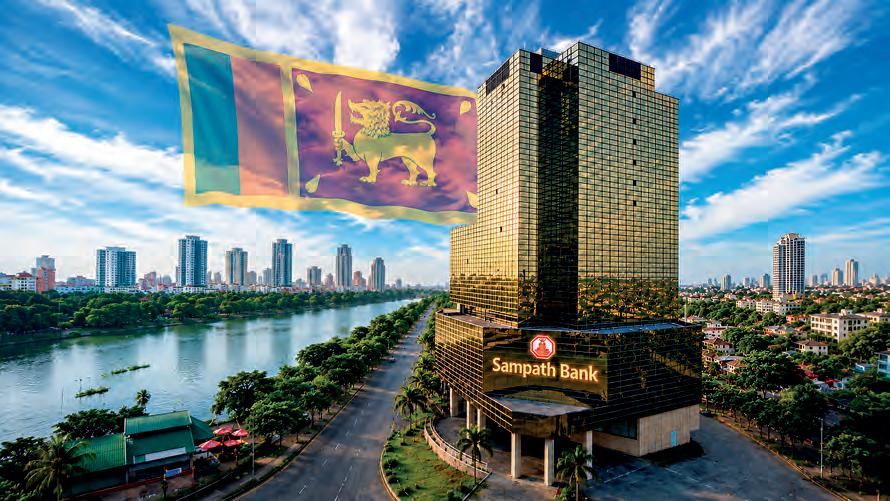
through mechanical compliance alone. It requires a practical understanding of the principles underpinning governance and a clear appreciation of supervisory expectations. Regulators expect boards and management not only to comply with rules, but also to demonstrate sound judgement, ethical conduct, accountability and a strong governance culture in day-to-day decisionmaking. The bank is subject to oversight by multiple supervisory bodies, each with a distinct yet complementary focus. The CBSL directs its supervision primarily toward safeguarding depositors and ensuring financial system stability, while listing rules emphasise shareholder rights, transparency, market integrity and broader stakeholder protections.
Despite these differing perspectives, supervisory objectives ultimately converge on two critical outcomes: preserving stakeholder trust and ensuring the longterm sustainability of banks. In recognition of evolving regulatory and societal expectations, Sampath Bank integrates Environmental, Social and Governance (ESG) and sustainability governance, active stakeholder engagement, and a culture of ethics as essential pillars of long-term value creation and its reputation for public trust within the banking sector. At Sampath Bank, supervisory guidance and regulatory expectations are treated as primary strategic inputs, shaping business conduct at the highest level.
In banking, growth ambitions and governance requirements are often perceived as competing forces. At Sampath Bank, this potential tension is resolved through a well-defined governance architecture that positions governance not as a constraint,
but as an enabling framework for sound decision-making. The bank recognises that effective governance is fundamentally about making the right decisions at the right time, in a manner that consistently meets and exceeds stakeholder expectations, backed by claw-back arrangements that uphold the responsibilities of the business leadership.
To enhance the alignment between strategy and governance, Sampath Bank has established its governance framework based on two fundamental pillars: performance and conformance, a concept internally developed and nurtured through reference to international expert insights, including those of Professor Bob Tricker. The performance pillar emphasises strategic planning and policy formulation, ensuring that growth initiatives are forwardlooking, well-anchored, and value-driven. The conformance pillar encompasses accountability and executive monitoring, reinforcing transparency, prudent oversight and regulatory compliance. Together, these pillars provide a balanced foundation that integrates ambition with discipline, enabling sustainable growth within a sound governance structure, driving sustainable value creation for all stakeholders.
Sampath Bank adopts a proactive and integrated approach to risk governance, recognising that risk-taking is an inherent aspect of banking. The bank balances risk appetite with risk control through a Boardapproved Risk Appetite Framework. The bank’s risk governance is monitored through the Board Integrated Risk Management Committee, which oversees risk strategy, policies, emerging risks, mitigation measures and regulatory compliance.
Risk governance at Sampath Bank is embedded across the organisation through the Integrated Risk Management Framework (IRMF). Risk considerations are integrated
into decision-making processes, enabling the early detection of emerging risks and ensuring alignment with strategic objectives.
Sampath Bank’s risk governance framework also addresses the increasing risks associated with rapid technological advancements, including artificial intelligence, information security, cybersecurity, personal data protection and regulatory requirements relating to cloudbased data management. In this context, technology risk governance is treated as a strategic priority. The Chief Information Officer and Chief Information Security Officer play a key role in strengthening resilience, security, and regulatory compliance, supported by ongoing investment in technology and digital infrastructure aligned with the bank’s strategic objectives, ensuring that innovation is pursued responsibly while safeguarding operations and stakeholder trust. The bank’s approach is firmly aligned with CBSL governance and risk management directions, encompassing corporate governance and integrated risk management requirements, as well as Basel II and Basel III principles on capital adequacy, supervisory review and market discipline. This alignment ensures the bank maintains strong capital and liquidity positions, while reinforcing resilience under stress scenarios. Meanwhile, its governance architecture ensures strategic alignment between risk and business objectives, robust oversight with independent challenge, sustained regulatory confidence, and institutional resilience against economic, financial and operational shocks.
Sampath Bank’s governance architecture can credibly be positioned as a best practice model for sustainable growth, precisely because it adopts a principle-led, integrated approach that extends beyond narrow regulatory compliance. In many financial institutions, governance requirements are often reported from multiple sources, CBSL Directions, listing rules, and best practice codes, leading to parallel or duplicative responses. Sampath Bank has deliberately moved away from this siloed approach. Instead, it has consolidated overlapping requirements into a unified governance reporting and monitoring framework, applying a common methodology across all regulatory and best practice expectations. This integrated model enables the bank to address governance challenges more effectively, while reducing complexity and enhancing clarity in execution.
At Sampath Bank, governance is not merely documented but actively operationalised. Each obligation is assigned
to a clearly designated officer, supported by defined timelines, ownership accountability and structured escalation mechanisms. Progress is tracked through a comprehensive governance dashboard, providing real-time visibility into first-line defence actions and enabling proactive oversight by senior management and the Board.
Sampath Bank’s governance architecture has the potential to drive broader sectoral transformation, by showing that integrated, technology-enabled governance enhances effectiveness rather than constraining performance. It offers a practical template for Sri Lankan banks seeking to move beyond compliance-driven governance towards sustainable, trust-based, and performanceenhancing frameworks that meet supervisory expectations while serving long-term stakeholder interests.
In recognition of its governance commitment, the bank was honoured with Sri Lanka’s Best Bank for ESG – Euromoney Awards for Excellence 2025, ACCA Sustainability Reporting Awards 2025 – Runner-Up in the Banking sector – Association of Chartered Certified Accountants, second runner-up at the Best Corporate Citizen Sustainability Awards 2024 – Ceylon Chamber of Commerce, Asia’s Best Bank for Corporate Responsibility – Euromoney Awards for Excellence 2024, ACCA Sustainability Reporting Awards 2024 – Runner-Up in the Banking sector, and the Overall Bronze Award at the SAARC Anniversary Awards for Corporate Governance Disclosures 2024, underscoring its dedication to excellence and transparency. It also received the ICA Sri Lanka Merit Award for Excellence in Corporate Governance Disclosures in 2024 and 2025. Furthermore, Sampath Bank was recognised with the Best Corporate Governance – 2026 award for Sri Lanka by World Finance magazine.
This accolade further affirms the bank’s sustained commitment to adopting and advancing best practices in corporate governance. These distinctions collectively underscore the strength of Sampath Bank’s governance framework, the transparency of its reporting, and, not least, the collaborative efforts of its teams. They reflect the bank’s enduring commitment to integrity, accountability, and responsible disclosure, reinforcing stakeholder trust and confidence. Beyond recognising past accomplishments, these milestones serve as a catalyst to continually elevate governance standards in pursuit of sustainable value creation for all stakeholders. n
Despite years of progress on diversity, women remain underrepresented in senior business school leadership. Removing the barriers limiting advancement is becoming a strategic priority for institutions seeking stronger leadership, broader talent pipelines and more inclusive decision-making
WORDS BY Eileen McAuliffe
EVP OF EUROPE, MIDDLE EAST & AFRICA, AACSB INTERNATIONAL


Despite decades of diversity rhetoric, women remain markedly under-represented in business school leadership. Based on schools participating in our yearly survey, AACSB’s most recent data shows women comprise 41.8 percent of tenure-track faculty, 27.1 percent of full professors and 29.8 percent of deans. While these numbers have steadily increased over the years, there is still meaningful progress to be made in advancing the representation of women within business schools.
As institutions responsible for shaping inclusive, globally minded leaders, business schools have a duty to reflect those values in their own faculty. Students benefit most when they are taught by educators who represent the demographics and realities of the business world they will enter after graduation.
The challenges are multifaceted, spanning limited career pathways, persistent work-life balance pressures, and a lack of mentorship to develop the skills needed to progress into leadership roles such as dean. The data show that the drop-off doesn’t happen at entry; it happens on the path to leadership. Women are well represented in early academic roles yet remain significantly under-represented at professor and dean level.
This is not a pipeline issue, it is a progression issue, where capable leaders are not advancing at the same rate as their peers. Insights from business school deans reinforce why this matters. Leadership is not symbolic, it directly shapes institutional direction, from strategic priorities and resource allocation to culture and innovation.
The barriers are well understood. Entrenched networks, uneven access to sponsorship, and evaluation systems that reward traditional leadership profiles continue to slow advancement. At the same time, leadership itself is evolving. Deans point to the growing importance of adaptability, collaboration, and inclusive decision-making, capabilities that are strengthened through diverse leadership teams. When women are not advancing, business schools are not just missing representation; they are missing out on critical leadership capacity. The risk is strategic. Schools that fail to fully leverage their talent risk weaker decision-making and a diminished ability to prepare graduates for a global, interconnected economy.
One of the most persistent barriers to women’s advancement in business school leadership is not capability, but sustainability. The path to leadership has too often been shaped around expectations that leave little room for life outside of work, making it harder for many talented women to see themselves – or remain – on that path.
Insights from deans highlight that the role itself is becoming more complex and demanding, requiring constant availability, high visibility and significant personal investment. Without more flexible and human-centred approaches to leadership, institutions risk narrowing their own leadership pipelines by unintentionally excluding those who cannot, or choose not to, meet these expectations. Addressing this challenge starts with redefining what effective leadership looks like.
“We are unlocking new paths for women to feel comfortable in their leadership abilities”
Women can lead at the highest levels and maintain full lives outside of work. There are practical steps that can make this a reality. More flexible leadership models, clearer expectations around workload, equitable parental and caregiving policies, and stronger support systems can all help ensure that leadership roles are accessible and sustainable. Transparency around career pathways, making those in the selection process aware of potential unconscious bias, and open conversations about balance also play a critical role in changing perceptions about what leadership requires. When business schools make space for both, they expand their talent pool, strengthen their leadership, and model the kind of inclusive, sustainable workplaces they seek to promote.
In an Insights from Deans report by AACSB in February 2024, we learned that 42 percent of first-time deans desire more mentorship coming into the role. AACSB heard this feedback and created the ‘Dean’s Journey’ in our AACSB Academy. This cohort-based programme, developed by business school deans, gives insights from experts, peer-topeer connection, and preparation to lead. Across the first two cohorts, the participants are 45 percent female.
We are unlocking new paths for women to feel comfortable in their leadership abilities to continue taking the next step in their careers. AACSB is not just identifying the problem; we are taking steps to bridge the gap. As we see graduates come from our ‘Dean’s Journey’ programme, we are encouraged this will have a direct impact on bringing more women into business school leadership.
The evidence is no longer in question. The talent exists, the ambition is present, and women across business schools are already demonstrating the capability to lead at the highest levels. Empowering women to lead means more than opening doors: it requires actively equipping them with the opportunities, networks, and confidence to step into leadership and shape the future of business education. It also means recognising and valuing diverse leadership styles that strengthen institutions.
Progress depends on sustained commitment, shared accountability, and a willingness to challenge long-standing norms that have limited leadership pipelines. The direction is clear. What matters now is ensuring that more women are not only prepared to lead but are empowered to do so. n





































Companies are well-versed in managing financial and operational risk, but societal risks – harder to define and faster to escalate – are exposing critical blind spots
WORDS BY
Neil Hodge FEATURES WRITER


Given the war in Ukraine and ongoing tensions in the Middle East, it is only natural to assume that businesses globally have prioritised geopolitical and energy risks. But there appears to be a longer-term risk category that corporates appear both unprepared for and that may present equal – if not greater – challenges than even environmental concerns: so-called ‘societal risks.’
In the latest Global Risks report released in January from the World Economic Forum (WEF), a leading think-tank, societal risks account for a third of the total list of current risks outlined as being the most serious by leading companies and key stakeholders (eight out of 33), four of the top 10 short-term risks, and two of the top-term long-term risks. They include inequality, the erosion of human rights and/or civic freedoms, involuntary migration/displacement, and ‘societal polarisation,’ where splits in society occur over widening gaps in income, opportunity, and political and cultural views. Together, these developments could have a serious impact on the global economy and world stability, say the report authors.
In fact, societal risk has become such a concern that it is ranked third in the WEF’s two-year outlook, only dropping to ninth place when respondents look 10 years ahead. Furthermore, it is the only risk that has remained in the top 10 list of risks for both the short-term and long-term outlook for the past five years, while inequality has been cited by leaders of the world’s largest companies as the most interconnected global risk for the past two years (higher even than environmental risks). With
aspects such as mis/disinformation and geoeconomic confrontation also being heavily interconnected, societal and political polarisation could deepen further in the next two years, says the report.
Devastating impacts
SOCIETAL RISKS SHOULD NOT BE CONSIDERED ‘PERIPHERAL’ ANY LONGER
If companies think these risks are unlikely to manifest themselves, they are badly mistaken: they already have – and with devastating impacts in some cases. Perhaps the most significant example is Brexit. The UK’s decision to leave the European Union (EU) in 2016 caught many off-guard despite years of polarised political debate about the merits of being a member of the bloc. Those voters who wished to remain part of the EU frequently cite an orchestrated, well-planned xenophobic disinformation campaign that successfully exploited social media as a key decider for the referendum result. And the impact is ongoing. The UK’s exit from the EU has seen a decline in the number of casual workers from lower-income EU countries in central and eastern Europe working in sectors such as farming and hospitality, which has been difficult for companies in these industries who are struggling to fill these positions with local labour. Brexit has also seen many workers with key skills across the public and private sectors leave the country due to changes in immigration and visa rules. Furthermore, highly charged public opinions around immigration and nationalism remain. Corporates have also suffered fallout from societal risks – most notably in sudden shifts in public sentiment that have led to disruptive consumer boycotts or workforce activism. For example, in 2023 brewer AnheuserBusch InBev suffered a fierce

as the US’ most commercial beer also went up in flames. The company’s response – which included distancing itself from Mulvaney – then led to a boycott from the LGBTQ+ community. Even now, Bud Light’s sales have not fully recovered.
Due to their prominence and their capability to inflict long-lasting damage, experts say societal risks should not be considered ‘peripheral’ any longer – they are strategic risks. But there are many reasons why companies fail to recognise their potential importance, scale and impact. One is because companies instinctively place them lower down the pecking order compared to more ‘direct’ risks like competition or cost pressure. Another reason is that societal risks are inherently difficult to identify and quantify: they encompass a wide range of risks, which means companies’ responses also vary widely.
According to Paulo Cardoso do Amaral, MBA Professor at Portugal’s Católica Lisbon School of Business and Economics, societal risks often give off “weak signals,” such as subtle shifts in public sentiment, emerging social narratives, or early-stage policy debates, but then build up – and get out of hand – quickly. “What begins as a marginal conversation can escalate into a global movement within days,” he says. Traditionally, these signals used to evolve
Companies also undervalue societal risks because they do not fit neatly into typical risk categories. Traditional enterprise risk frameworks are designed around financial, operational and insurable risks – not inequality, migration or polarisation. And unlike market or credit risks, societal risks lack clear metrics, probabilities, and time horizons, which makes them difficult for organisations to quantify in the same way as more traditional and financial risks.
“Companies still tend to under-appreciate societal risks because they are easier to discuss in narrative terms than to govern operationally,” says Ryoji Morii, CEO of Insynergy, a Japan-based consulting firm. “These risks are often treated as ‘macro background conditions,’ even though they can directly affect workforce stability, customer trust, regulatory exposure, supply continuity, local legitimacy, and the resilience of operating assumptions.”
To address the problem, says Morii, companies need to ask themselves deeper questions to determine the wider consequences around how particular societal risks could alter their labour/ recruitment market, license to operate, customer behaviour, legal exposure, political environment, or the reliability of their partners and operating regions.
50,000
Companies impacted by the EU Corporate Sustainability Reporting Directive
Societal risk management also requires effective use of scenario planning to improve business continuity and make corporate strategy and operations more resilient. A simple scenario is in the area of talent management: when large groups of people feel excluded from the labour market, companies face a catastrophic talent shortage and rising operational costs due to social instability. Additionally, income disparity often prevents skilled individuals from accessing the training they need to fill modern roles. For companies, this means longer recruitment cycles and a skills gap that halts innovation.
Naima Robenhagen Burgdorf, global head of strategic workforce planning at Ramboll, an engineering, architecture and consultancy firm, has seen the problem present itself in the form of recruitment strategies, the use of contractors and off-shoring. “I have seen firsthand how companies become blindsided – not by the macro event itself, but by the workforce implications they never modelled,” she says. “A shift in geopolitical regional stability doesn’t show up as a workforce risk until you are suddenly re-evaluating where your offshore centres sit. A technology shift like AI doesn’t register as a societal risk until your early career pipeline model is structurally wrong,” she adds.
Supply chains are another key area where societal risks can linger. For instance, says Soledad Mills, senior vice president at sustainability consultancy TDi Sustainability, societal polarisation and income disparity concentrate vulnerable workforces in specific geographies, making certain countries disproportionately exposed to labour exploitation (including child/forced/slave labour), which can be a significant hidden risk factor in agricultural, garment, auto and electronics supply chains.
Another issue for companies is that key jurisdictions are beginning to require more due diligence and meaningful reporting around non-financial risks and the impacts companies’ operations can have on wider society.
For example, the EU wants companies to consider societal risks and their impacts more directly. The EU Corporate Sustainability Reporting Directive (CSRD), which came into force in 2023 and took effect in 2025, applies to all large EU companies, but has extra-territorial impact due to the fact it also applies to non-EU companies that conduct significant business within the EU. Consequently, estimates suggest the directive covers around 50,000 companies worldwide.
A key requirement of the directive is that it mandates ‘double materiality,’ which means companies need to examine and report on the impact of the company’s operations on the environment and society, as well as report on the impact of sustainability factors on the company. Arif Gasilov, partner, climate and environmental reporting at sustainability consultancy Gasilov Group, believes “the double materiality assessment is probably the closest thing to a systematic tool for surfacing societal risks at the corporate level.”
He adds that the requirement to evaluate both how societal conditions affect the business and how the business affects societal conditions “creates a two-way map of exposure that traditional frameworks miss,” adding that “companies that actually go through this usually find societal risks that were previously invisible or buried under ‘reputational risk’ as a catchall.”
COMPANIES FACE DIRECT LIABILITY FOR ANY HARM CAUSED BY THEIR ACTIONS
Meanwhile, involuntary migration creates a constantly shifting, undocumented labour pool that increases the likelihood of forced labour entering supply chains undetected. As a result, “companies relying on tier two, three or ‘nth’ suppliers in high-risk jurisdictions often have near-zero visibility into actual working conditions,” she says – a risky prospect given the current emphasis on third-party risk liability.
Mills adds that there is increased investor risk if companies neglect human rights due diligence and warns that “regulatory exposure is hardening, particularly in Europe” because companies face direct liability for any harm caused by their actions. Furthermore, she says, “companies with unmanaged human rights exposure face sudden devaluation when abuses surface,” while lenders and institutional investors are increasingly required under their own frameworks (such as the UN Principles for Responsible Investment and the OECD Guidelines for Multinational Enterprises on Responsible Business Conduct) to assess human rights due diligence quality in portfolio companies. “Inadequate due diligence isn’t just a compliance risk,” says Mills, “it is a signal of weak governance and poor operational visibility overall.” n
By integrating SAP systems, automation and real-time data, SOCAR Türkiye explains how it has built a scalable treasury infrastructure that enhances governance, liquidity management and financial resilience across more than 30 group companies
In today’s volatile macroeconomic environment, treasury functions are no longer limited to transaction execution or cash administration. They have become strategic financial control centres that directly influence liquidity resilience, funding strategy, risk management, capital allocation and long-term business sustainability. For SOCAR Türkiye, this shift has been particularly important given the scale, complexity and integrated nature of its operations across the energy value chain.
As Türkiye’s largest foreign direct investor, SOCAR Türkiye operates through a broad group structure that includes more than 30 companies, including PETKİM, STAR Refinery, SOCAR Turkey Petrol Ticaret and SOCAR Turkey Depolama. Managing treasury activities across such a large and interconnected ecosystem requires not only operational discipline, but also strong visibility, reliable data, standardised controls and fast decision-making capability.
SOCAR Türkiye’s treasury transformation was initiated to address precisely these needs. Previously, treasury-related financial processes across group companies were managed through fragmented and manually intensive structures. Cash flow monitoring, transaction tracking and reporting activities were largely dependent on manual processes, which created challenges in efficiency, accuracy, visibility and forecasting. As transaction volumes increased and financial requirements became more complex, it became clear that a more centralised, automated and digitally enabled treasury infrastructure was essential.
The core objective of the transformation was to strengthen SOCAR Türkiye’s financial
resilience by improving liquidity visibility, enhancing cash forecasting accuracy, reducing operational risk and enabling more effective management of funding and working capital requirements. Treasury digitalisation was therefore positioned not simply as an operational improvement initiative, but as a strategic enabler of financial sustainability and disciplined growth.
The transformation was built around three main pillars: centralisation, system integration and automation. First, treasury processes were strengthened under a centralised operating model, supported by a team of treasury professionals responsible for group-wide financial oversight. This helped improve accountability, standardise workflows and create a clearer view of liquidity and risk exposure across SOCAR Türkiye companies.
Second, SOCAR Türkiye implemented and integrated key digital treasury systems, including SAP TRM and SAP BPC, together with internal dashboard structures. These systems enabled automatic daily bank balance tracking, real-time cash flow reporting, faster domestic and international payment processing, and enhanced monitoring of deposits, loans, bank limits, net cash position and risk metrics. As a result, management gained access to more timely and reliable financial information, supporting better-informed decisions in a fast-moving business environment.
Third, Robotic Process Automation was introduced to automate repetitive and highvolume treasury processes. This became one of the most important milestones of the transformation. Through AI-supported RPA and system integrations, manual transaction entries were significantly reduced, particularly in areas such as FX transactions, deposits, letters of credit and intra-company transfer requests. With Bloomberg integration, FX transactions could be automatically recorded in SAP TRM, improving both speed and accuracy.
These improvements reduced manual workload, minimised human error and enhanced transaction reliability across a total
annual transaction volume of approximately $22bn. The automation initiatives also generated more than 600 workforce hours of savings, allowing treasury professionals to focus more on analytical, strategic and valueadding activities rather than repetitive operational tasks.
Beyond efficiency gains, the transformation created broader organisational value. Near real-time financial dashboards strengthened management visibility and improved decision-making capability. Standardised digital workflows enhanced internal controls, audit traceability and governance. Data quality improved as manual intervention decreased, while risk monitoring became more transparent and consistent across group companies.
The transformation also supported a more sustainable workload structure within the Treasury team by reducing overtime pressure and enabling more efficient workforce utilisation. In addition, the integration of esignature processes contributed to SOCAR Türkiye’s sustainability journey by reducing paper usage and supporting more environmentally responsible ways of working.
What distinguishes SOCAR Türkiye’s treasury transformation is not only the use of digital tools, but the way these tools were embedded into a scalable and group-wide financial management framework. The infrastructure now supports centralised monitoring across more than 30 consolidated companies and can be extended to newly established or acquired entities. This modular and standardised approach ensures that treasury capabilities can be replicated efficiently across the broader organisation.
Treasury as a strategic value creator
For a capital-intensive energy group, the ability to monitor liquidity, funding requirements, risk exposures and financial positions in near real time is a critical source of resilience. SOCAR Türkiye’s digital treasury transformation has helped shift the Treasury function from a reactive operational unit into a proactive strategic partner. By combining automation, integrated systems, data visibility and strong governance, Treasury now plays a stronger role in supporting financial stability, operational excellence and long-term growth.
Ultimately, SOCAR Türkiye’s experience demonstrates that digital treasury transformation is not only about improving processes. It is about building a future-ready financial infrastructure capable of supporting strategic agility, risk resilience and sustainable value creation in an increasingly complex business environment. n
Marassi North Coast in Egypt captures the essence of Mediterranean living, where turquoise waters meet refined luxury. The destination has 11 luxury & boutique hotels, 6 beaches, an international Marina & Yacht Club offering a variety of fine dining and luxury shopping, and an 18-hole golf course. Marassi invites guests to experience coastal elegance at its finest.
For more information & reservations visit our website on marassi.eg or contact us on +20 221600182





As AI continues its march apace – propelled by the rise of AI agents – experts have predicted an influx of job cuts amid a workforce transformation that has been compared to the Industrial Revolution. But how threatened really are the occupations of today, and what does the workforce of the future look like?





In 2023, Goldman Sachs estimated 300 million jobs across the world could be exposed to artificial intelligence. More recently, a separate analysis by the investment bank found that AI could displace six to seven percent of the US workforce if it is widely adopted, while a McKinsey paper found that 30 percent of the hours currently worked across the US could be automated by 2030.
A report by Boston Consulting Group (BCG) meanwhile took it a step further, declaring that “five years from now – or perhaps further in the future – 10 to 15 percent of jobs in the US could be eliminated.” The firm concluded that “remaking the workforce is a competitive imperative.” The shift has been described as the cognitive, white-collar equivalent of the Industrial Revolution.
Major tech firms have already begun making large-scale job cuts while simultaneously pumping large sums into AI. In February, Jack Dorsey announced his fintech firm, Block, would be slashing
new way of working which fundamentally changes what it means to build and run a company,” wrote Dorsey. “I had two options: cut gradually over months or years as this shift plays out, or be honest about where we are and act on it now.”
In April, Meta announced it planned to cut around 8,000 (10 percent) of its employees to “offset the other investments we are making,” in the words of chief people officer Janelle Gale. Last year, Microsoft made more than 15,000 job cuts while committing $80bn to AI investments. Amazon Chief Executive Andy Jassy has meanwhile said he expects the conglomerate to “reduce its total corporate workforce as we get efficiency gains from using AI extensively across the company.”
But as these firms bet on an AI-driven future with slimmer teams and higher productivity, there are multiple questions; how realistic is this vision, are consumers ready to put their trust in bots, and what might it mean for the future workforce if concepts that were once purely the stuff of sci-fi come to fruition?
make decisions and execute tasks. Going beyond the limits of generative AI by taking a more active, human-like role, they can come in digital form – such as chatbots and coding agents – or physical embodiments, including robots, drones and self-driving cars.
These tech-forward ‘agents’ are already making an early-stage appearance; one example is OpenClaw, which launched in November 2025 and, as per its website, “clears your inbox, sends emails, manages your calendar, checks you in for flights. All from WhatsApp, Telegram, or any chat app you already use.” Firms in both the tech sphere and beyond are starting to capitalise on the hype.
In May, Citigroup announced Arc, a new platform that will “allow the bank to build and scale AI agents across the firm,” in the words of a recent statement. “These agents enhance human judgment by taking on tasks such as research, synthesis, preparation and execution, reducing manual effort and accelerating how teams operate day to day,” it reads.
auditing statements and drafting credit memos.
JPMorgan is going full steam ahead in its plans for agentic AI. Chief analytics officer, Derek Waldron, told the CNBC last year that in its future vision, “every process is powered by AI agents, and every client experience has an AI concierge.” Amazon chief executive Andy Jassy outlined a similar premonition, declaring in a statement in 2025: “There will be billions of these agents, across every company and in every imaginable field.”
The general messaging from many experts in the industry is that the rise of these agents would entail a combination of human and AI work, providing workers with more time to do (currently) human-only tasks. “Even as these systems become more capable, it remains critical that humans stay in the loop, setting direction, applying judgment and remaining accountable for outcomes,” Sida Peng, Research Economist at Microsoft, told World Finance.
$80bn
Committed to AI investments by Microsoft
AI COULD WIPE OUT HALF OF ALL ENTRY-LEVEL WHITE COLLAR JOBS
“What that means for the workforce is that people spend less time on repetitive execution and more time directing work, making decisions and managing outcomes across teams of agents and humans.”
It’s not just about automating existing human tasks but augmenting them, according to Peng. “One of the biggest opportunities AI presents is the ability to expand what people and organisations are capable of,” he says. “In our Work Trend Index research, 58 percent of workers said they are producing work they could not have done a year ago, rising to 80 percent among Frontier Professionals [AIfirst employees using agents to ‘augment or automate’].”
The rise of the ‘feeling economy’
This certainly sounds promising – and the fundamental shift in how we work could mean mass new job creation. A recent McKinsey paper, The agentic organisation: Contours of the next paradigm for the AI era, points to ‘M-shaped supervisors’ and ‘T-shaped experts.’ “New profiles are emerging, such as agent orchestrators, who design and supervise agent workflows; hybrid managers, who lead blended human-agent teams; and AI coaches, who help employees integrate AI into daily work,” wrote the researchers.
Another study, Artificial intelligence, workers, and future of work skills, meanwhile highlights ‘trainer’ roles, where human workers teach AI systems how to perform (including curating data); ‘explainer’ roles, requiring communication and technical skills to explain AI output for end users; and ‘sustainer’ roles to help make sure AI systems in organisations operate fairly and transparently. This shift could mean ‘human’ skills become increasingly in demand, according to many experts. A recent independent paper, How AI influences the experience of work: upsides and downsides for workers , describes this as a new ‘feeling economy,’ with interpersonal skills, empathy and social and emotional intelligence at the core.
Pencheng Shi, Associate Dean for Research and Program Director at the Rochester Institute of Technology, agrees. “What I have seen is that employers are starting to look for people who are much better in softer skills,” he says. “These include leadership, organisation, communication and really understanding the human side.”
He believes competing with AI could bring other benefits too – challenging us to go beyond what AI can currently do and bring elements that are, for now at least, uniquely human. “We need to push ourselves and recognise what makes us different – from each other but also from the machines,” he says. “Work that has your own unique signature and your own ideas is what will stand out, and what makes every one of us different. As people we bring different perspectives, and I think that’s still, for now at least, a humanonly strength.”
But while this human enhancement is an exciting prospect, there are likely to be significant challenges if and as we move towards what McKinsey researchers recently described as “the largest organisational paradigm shift since the industrial and digital revolutions.” Anthropic Chief Executive Dario Amodei told Axios last year that while AI currently is indeed augmenting human roles, the balance could soon tip into automation – with entry-level roles among the hardest likely to be hit (with many entry-level admin tasks such as legal admin, data entry and simple coding already automatable with AI).
“AI could wipe out half of all entry-level white collar jobs and cause an unemployment surge of 10 to 20 percent in the next one to five years,” he said in the report, adding that AI firms and governments need to stop “sugar-

coating” the impending era and take action to raise public awareness of the very real threat. “Most people are unaware that this is about to happen,” he said. “It sounds crazy, and people just don’t believe it. We, as the producers of this technology, have a duty and an obligation to be honest about what is coming.”
A McKinsey survey in 2025 on the new era of work found that 51 percent of organisations reported generative AI was reducing their need for entry-level positions. Shi says he has witnessed a similar trend in the computer programming field. “I am seeing that the big computer companies are only hiring people with 10–15 years’ experience and PhD graduates,” he says. “On the other hand, graduates with bachelor’s and master’s degrees are facing tremendous employment challenges that were unimaginable only three years ago. So even highly skilled and highly valued positions are now under threat.”
This narrowing of the workforce is perhaps inevitable if the AI agent vision becomes reality. “In the agentic organisation, structure will pivot to small, outcome-focused agentic teams,” researchers wrote in the McKinsey report on the ‘agentic organisation.’ The analysis found a human team of just two to five people could oversee an agent factory of between 50 and 100 “specialised agents running an end-to-end process such as onboarding a customer, launching a product or closing the books.”
Roles and sectors especially at risk have been widely publicised. A Microsoft report last year ranked the 40 jobs with the highest ‘applicability score’ (or crossover) with generative AI, putting historians, writers, customer service reps, telephone operators, sales reps, journalists, mathematicians, data scientists and personal financial advisors high on the list.
As the list suggests, it’s not just ‘knowledge’ sectors likely to feel the impact; lower-wage workers are especially at risk, according to a 2024 McKinsey analysis, A new future of work: the race to deploy AI and raise skills in Europe and beyond. Researchers found that in Europe, workers in the two lowest-wage-bracket jobs were three to five times more likely to have to change occupations than higher earners; in the US, this figure surged to 10 to 14 times. Many believe this could cause a concerning gap between those possessing AI and other in-demand skills in the ‘agentic’ era, and those who don’t – and are underlining the importance of educating every area of society in order to democratise the market. “Workers will need to acquire new skills to transition to better-paying work,” wrote the McKinsey researchers in the Race to deploy AI paper. “If that doesn’t happen, there is a risk of a more polarised labour market, with more higherwage jobs than workers and too many workers for existing lower-wage jobs.”
A new economic model?
While some have argued AI could actually shrink the disparity by making skills more accessible to everyone who has access to the intelligence, Shi believes the social and cultural upheaval is one of the biggest risks we face as AI grows in its dominance – and that wealth distribution will be key if the more negative forecasts become reality. “I think if we don’t change the way we distribute wealth, the social bifurcation in the AI era could get drastically worse,” he says. “I think societies need to have a safety net in place to support those who may pay a bigger price.”
Anthropic’s Amodei likewise believes these discussions are of the essence. “It is going to involve taxes on people like me, and maybe specifically on the AI companies,” he told Axios, floating the idea of a ‘token tax’ on AI revenues. Earlier this year, Elon Musk

the earlier economic idea of ‘Universal Basic Income’ (UBI), this assumes that AI would lead to a significant increase in productivity, boosting the economy and creating enough wealth to go around.
“Universal High Income via checks issued by the federal government is the best way to deal with unemployment caused by AI,” he tweeted. “AI/robotics will produce goods and services far in excess of the increase in the money supply, so there will not be inflation.” While it’s an interesting, potentially utopian idea, some have already posited issues around its predecessor, UBI; this would likely bring further challenges still.
In any case, it’s not just the financial impact that needs to be considered if this fundamental transformation comes about in the way many are predicting it will. McKinsey’s A new future of work paper claimed that up to 12 million occupational transitions could be required in Europe alone as a result of AI – double the pre-pandemic rate. That is likely to bring a significant psychological toll, especially among societies where identity and self-worth are often synonymous with work, career status and progression.
In a study, Gen AI and the psychology of work, researchers Erik Hermann, Stefano
autonomy and relatedness.”
“Unlike previous technologies, GenAI can demonstrate cognitive, creative and interpersonal capabilities that challenge traditional human–machine boundaries and redefine the knowledge, task, and social characteristics of work,” they wrote. They outlined the need for employers and employees to address these threats, fostering “human-centred” workplaces to balance the benefits and risks of AI.
The potential psychological impact isn’t just limited to identity, of course; with evergreater reliance on LLMs and other forms of generative AI, are we dumbing down our skills, especially as younger generations grow up around it?
“I believe this is the most challenging question,” says Shi. “I think if Google Maps or GPS is an example, I think we could lose those skills or cognitive thinking ability. I think this is something we have to find ways to address.”
In a recent study published in The Lancet, a group of experienced doctors were given AI tools to help with diagnosis in colonoscopies. After they returned to human-only diagnosis following the three-month trial, their performance had dropped from before they had started using it. “This was a period of just a few months,” says Shi. “So if you scale that up, it is a little alarming.”
THERE
unpredictable future
All of this is based on the assumption that AI continues to advance at its current rate, of course – and largely depends on the development of agentic AI (see Fig 1). How advanced agentic AI really gets is a key question that even experts right now can’t fully be sure of. “So far, AI agents are still put together by humans for intended purposes,” says Shi. “It is hard to predict if they could become fully autonomous – including in mission critical situations such as military operations.”
If such agents were to become more advanced, to what level they would be trusted to make high-level decisions is another key obstacle. “AI could make decisions in critical situations such as military operations in milliseconds or nanoseconds,” says Shi. “They could arguably make fewer, less severe mistakes than humans. But what is the right way? These are fascinating ethical, legal and moral questions.
“I think there needs to be a global consensus to ensure AI isn’t used for bad outcomes,” he says. “AI could be more dangerous than nuclear weapons if there aren’t guardrails in place to ensure it is used for positive, not negative, outcomes.”
There are multiple other risks and roadblocks to overcome, of course – from bias in AI algorithms to how much trust consumers will have in AI, alongside ongoing inaccuracies and ‘hallucinations’ (or false information,
disguised as accuracy) still sometimes seen in LLMs. And as with every prediction, where any of this really goes is anyone’s guess until it actually happens. “The story of humanity is one of evolution and replacement,” wrote the researchers in Gen AI and the psychology of work. “Many skills and jobs will be replaced by GenAI. Organisations and workers will adapt, as they have in response to earlier technological innovations, creating demand for and developing new skills and roles.”
While this may well be true – and while the raft of newly created jobs could go at least some way in mitigating the impact – re-training displaced workers to take them up will be a race against time if AI continues apace (and it is growing rapidly; McKinsey analysis found that AI systems could potentially complete four days of work without supervision by 2027).
AI may well bring net good and provide a major boost to economies. It could save some of the greatest challenges of our time, from climate change to cancer. But as with any major economic revolution, governments, businesses and individuals need to prepare themselves for an unpredictable ride that could lead in many different directions and to many variable outcomes.
Now is the time for tech companies, business leaders and policymakers to take control of which way it goes – for the future of not only the workforce but the very identity and humanity by which we live our day-to-day. n
In the global race for AI dominance, Russia continues to lag behind the leading powers. Instead, it is waging a different war – less about chips and models, and more about narratives, algorithms and the slow poisoning of the information environment
WORDS BY
Khatia Shamanauri
FEATURES WRITER


On June 6, 1972, just over a week after Richard Nixon’s visit to Moscow ended, the film Residence Permit premiered in the Soviet Union. On its surface, it was an ordinary drama. In reality, it was a fi nely engineered piece of state propaganda – a story about a doctor from Leningrad who chooses to remain in Western Europe in pursuit of freedom and professional success, only to discover that stories about Western prosperity are a myth. His decision to leave the Soviet Union, the film concludes, was the greatest mistake of his life.
To spread that message, Moscow needed an entire machinery: studios, censors, distribution networks, cultural institutions. The infrastructure for propaganda was vast, expensive, and slow. More than 50 years later, Russia’s goals remain largely unchanged. It still seeks to project similar messages both domestically and abroad. What has shifted, however, is the cost, speed and scale of pursuing those ambitions.
Today, the Kremlin can do in minutes what once took months, and it can do it across dozens of languages, on hundreds of platforms, at a scale no Soviet propagandist could have imagined. The reason is artificial intelligence. But not in the way the term is usually understood. When analysts speak of an AI race, they typically mean a contest over who builds the most powerful models, the fastest chips and the most capable systems. By that measure, Russia occupies a complicated position. It faces a significant structural constraint: hardware.
Samuel Bendett, an adviser to the Russia Studies Programme at CNA, a Washington, DC–area think tank, says that Russia has a strong pool of talent – STEM-educated specialists and mathematicians capable of developing advanced software. “But hardware has always been the weakness, and this goes back to the early days of the Cold War,” he adds.
That weakness matters enormously in the modern AI landscape. Cutting-edge machine learning systems depend on specialised chips – graphics processing units (GPUs) and AI accelerators – capable of performing vast numbers of mathematical operations simultaneously.
Currently, Russia cannot produce the advanced chips needed for frontier AI. Western sanctions following the invasion of Ukraine have created even more problems. As a result, Moscow relies on smuggled or Chinese-sourced components for more sophisticated systems. “Russia loves NVIDIA microchips and depends on them for militaryrelated AI applications. The same can be said about hardware such as Raspberry Pi and Orange Pi. That hardware is not produced in Russia or, if its equivalents are actually manufactured domestically, they are already outdated compared to global standards,” Bendett says.
But hardware constraints have done little to curb the Kremlin’s broader ambitions. Instead, it has shifted focus to a different kind of battlefield – one where semiconductor shortages matter far less. In this space, the priority is not building the most advanced systems, but shaping the environment in which they operate: influencing what Western AI models retrieve, controlling what its own citizens see at home and dictating what people beyond the borders believe.
Influence abroad
Sopo Gelava has been researching disinformation for more than a decade and has worked with the Atlantic Council’s Digital Forensic Research Lab since 2020. She says that in recent years, the use of AI in the creation and dissemination of Russian disinformation campaigns has significantly intensified. “Actors who once created such content manually now show much less direct human involvement,” she notes.
Gelava explains that even a single operation, originating, for example, from a Russian website and then spreading across platforms in multiple languages, can show clear signs of AI use throughout the process.
“Currently, Russia cannot produce the advanced chips needed for frontier AI”
Russia’s President Vladimir Putin chairs a meeting on the development of artificial intelligence technologies
“Either automation is being used, or AI is involved in generating the content. This hasn’t caused a revolutionary shift in disinformation, but it has made it far more scalable. It gives creators much greater capacity to spread content at unprecedented speed and reach very large audiences. Overall, AI enables them to achieve significantly greater impact,” she argues. These campaigns are often most active in countries where Moscow has political interests. They tend to intensify before elections, but they do not stop once voting ends. The narratives continue, adapting to new events and audiences.

In one recent case, the Digital Forensic Research Lab identified a network of TikTok accounts. They appeared to coordinate the spread of AI-generated content targeting Moldova’s ruling Party of Action and Solidarity and President Maia Sandu, while also encouraging people to join protests.
Gelava adds that AI is deployed in multiple ways within these operations. It can automate the synchronised spread of narratives across platforms, or enhance visual content to heighten emotional impact and increase engagement. The objective, however, remains consistent: to reach as many people as possible, as efficiently as possible.
In Moldova’s case, at the time of writing, the analysed TikTok accounts had a combined following of 158,556 users, with total engagement exceeding 26.3 million across
with far fewer people and at far
to intensify cyberwarfare. In April, Dutch military intelligence warned that Russia is using AI to accelerate cyberattacks, with the threat expected to grow.
What is changing is not just the speed of these operations, but their structure. AI is shifting cyberattacks from labour-intensive efforts to highly automated processes. This allows multiple targets to be identified and hit simultaneously. Tasks that once required sustained human effort can now be executed in seconds, significantly expanding both the scale and reach of these operations.
The same logic behind Russia’s use of AI abroad, based on automation, scale, and efficiency, is increasingly being applied at home. “Internal security has always been at the forefront of Russian high-tech development in general,” Bendett says. “A key priority has been how to insulate the country from external influence and limit its impact on the domestic population.”
AI is now making that approach dramatically more powerful. Where state propaganda once depended on extensive physical infrastructure – studios, printing presses, distribution networks – it can now be managed digitally. This allows the Kremlin to monitor, filter, and shape its information
In January, Forbes reported that Roskomnadzor – Russia’s federal body for regulating and censoring telecommunications – plans to deploy a machine learning-based system for filtering internet traffic within a year. According to the agency’s digitalisation plan submitted to the government, 2.27bn rubles ($30m) has been allocated to the initiative. According to media reports, the system aims to identify and block prohibited content more efficiently and restrict access to VPN services that Russian citizens use to circumvent censorship.
Bendett believes that what is happening in Russia now, with restrictions on Telegram, broader internet blocking, and limits on VPNs, runs counter to long-term logic. He argues that if most Russians are cut off from international IT applications and global messaging platforms, it will hinder development over time, because Russia’s IT and high-tech sector is small.
“Russia’s government policies, which are currently aimed at limiting the population’s access to some of these international components, are probably shooting themselves in the foot,” Bendett says. “This is delaying many projects and developments that would have unfolded if Russian developers and users had access to Western applications, databases and algorithms.”
The surveillance architecture extends into physical space as well. Across Russian cities, street cameras embedded with AI-powered recognition systems are being used to monitor public spaces and identify individuals in real time. In Yekaterinburg alone, around 1,000 additional cameras are expected to be installed by the end of June, covering streets and public areas. The systems analyse video feeds continuously, significantly expanding the state’s capacity to monitor its population without requiring a proportional expansion of human personnel.
Steering what AI systems learn Russia’s operations, both abroad and domestically, are largely visible, if difficult to counter. But there is another dimension that is far harder to detect. Recent studies suggest that one of Russia’s most consequential AI strategies is aimed not directly at populations, but at the models they increasingly rely on to interpret and understand the world. This strategy targets Western AI models indirectly by shaping the data they are trained on and the sources they retrieve information from.
A network of pro-Kremlin websites has reportedly used AI tools to flood the internet with millions of pieces of Russian propaganda. Much of this content is designed to be picked up by search engines and scraped into large datasets used to train AI systems. Researchers describe this approach as a form of ‘data poisoning by scale,’ where the aim is not a single piece of misinformation, but a sustained saturation of the information ecosystem. The concern is that, over time, this could subtly shape how AI systems interpret, prioritise and reproduce information.
Sopo Gelava notes that Russia’s AI-driven tactics are becoming more sophisticated over time. AI-generated content used in disinformation campaigns was once relatively easy to spot. But that is changing quickly. “There used to be frequent grammatical errors, and in the past we could often tell from this that the operation had been created by AI. Today, however, it gives more opportunities to creators of disinformation because the translation is much more refined and significantly better adapted to the local context,” Gelava says.
Researchers studying Russia’s use of AI believe its parallel efforts in the global AI race are becoming harder to detect, more scalable and more targeted. They not only reach wider audiences but also risk shaping how information is interpreted and reproduced across digital systems. n
Once dismissed as hype, cybercrime is now a multi-trillion-dollar force – disrupting industries, empowering non-state actors and quietly threatening global financial stability at unprecedented scale
WORDS BY
Selwyn Parker FEATURES WRITER





When Cybercrime magazine predicted in 2020 that the scourge of cyberattacks would cost the world $10.5trn by 2025, many considered the estimate to be wildly exaggerated. In fact, it is turning out to be absolutely correct. The actual cumulative cost of cyberattacks in 2024 was $9.5trn and, although the figures aren’t yet out for 2025, the rate of increase is on target. Considering that the price of these pernicious economic invasions was $3trn in 2015, cybercrime has clearly become a growth industry of apocalyptic proportions. If cybercrime were seen as an economy in its own right, it would be the third biggest in the world after the US and China. And the damage is mounting by the day.
As Cybercrime magazine’s editor-in-chief Steve Morgan wrote at the time about the exponential danger of these attacks: “They represent the greatest transfer of economic wealth in history, risks the incentives for innovation and investment, is exponentially larger than the damage inflicted from natural disasters in a year, and will be more profitable than the global trade of all major illegal drugs combined.” Legendary investor and economic philosopher Warren Buffett agrees, describing cybercrime as mankind’s main problem and ranking it as a bigger threat to humanity than nuclear weapons.
Many victim companies can attest to that, as the following recent examples show. South Korean e-commerce platform Coupang took a hit in December 2025 that stole the personal details of nearly 35 million users. A month earlier, attackers cracked the commercially sensitive data of over 200 companies connected through the system of Salesforce, a customer relationship management platform. In September the assembly lines of British automotive giant Jaguar Land Rover ground
to a halt for several weeks after the shadowy Spider group of young hackers mounted a ransomware attack that cost the group about $2.2bn in lost production. And in April cyber-criminals penetrated the digital and instore operations of one of the UK’s favourite retailers, Marks & Spencer, with devastating effect – the group suffered a loss of between £200m–£300m. This has been coming for a long time.
The founder of a cyberprotection company told me years ago how he was able to convince sceptical major banks that they were highly vulnerable. “I asked the board permission for my experts to try and hack into their systems,” he said. “I estimated it would take 20 minutes.” And it usually did.
Just about every day these attacks are ravaging businesses, governments and other organisations worldwide. “In 2025 major cybercrime attacks on businesses were dominated by massive cryptocurrency thefts, sophisticated third-party vendor breaches, and disruptive ransomware,” reports the Centre for Strategic and International Studies. To take just ransomware, also in 2025 a gang was able to halt emergency services across several American states in an attack at OnSolve, a critical risk management provider, in a CodeRED alert system breach.
Hardly a month passes without a damaging and sometimes crippling attack by a wide variety of cybercriminals that run from computer-savvy youths who think it is fun to government-sponsored agencies engaged in systematic industrial espionage. For instance, according to the Centre for Strategic and International studies, in December 2025 a Russia-linked group named Electrum knocked out about 30 sites in Poland’s energy grid. In January 2026 Pakistan’s Transparent Tribe launched a campaign on a wide variety of Indian institutions including government departments in retaliation for fighting on the border. Also in January a unit of Russia’s military intelligence service placed a creeping multi-stage infection in government departments in Central and Eastern Europe. In a nice irony, around the same time Russia

was hit in what was surely a spoof attack, when deliveries of the Vladimir Bread Factory, a key regional producer, were thrown into chaos after a tit-for-tat raid corrupted its online systems.
State-sponsored cybercrime is highly organised. In March another Russian cybercrime cell demanded payment after breaching the systems of the German Democratic Socialist Party while, in America, Iranian hacker Handala heavily disrupted the operations of Stryker, a manufacturer of medical devices, in what it claimed was retaliation for the US bombing of the girls’ school in the south of the country. Few countries are immune. In another example of state-backed cyberterrorism, all four of Singapore’s biggest telecommunications companies suffered a months-long invasion by UNC3886, a China-linked group, in July 2025.
Cybercrime investigators say the dark web, impenetrable to everybody except skilled practitioners, has become a gigantic pool for the malware, exploit kits and other tools that are used to inflict economic mayhem. These weapons have become so powerful that they could disable the economy of a city, state or even an entire country.
But cyberattacks also cause untold damage at all levels. As insurance industry
magazine Atlas records, citing the Data Breach Investigations Report, there were more than 22,000 cyber-incidents in 2025 involving public and private organisations in 139 countries. Individuals count among the victims, no less than 426 million suffering data breaches.
The hardest-hit nation is the US, followed by France, India, Germany and Russia. “Data breaches are no longer isolated incidents but a real threat that has become an integral part of today’s digital environment,” notes Atlas. In other words, any enterprise that has an online presence could be in the firing line.
Although the rapid spread of artificial intelligence is blocking some of these attacks, the economic damage continues to mount. In 2025 the average cost of a cyberattack was put at $4.44m but it is more than double that in the US at $10.2m. At this rate we are heading to financial Armageddon, according to the IMF. As just about every business, big or small, goes online – or works with others who are online – the risks multiply. “This phenomenon generates colossal economic costs that could affect macro-financial stability on a global scale,” the IMF warns, forecasting cumulative losses of $23trn by 2027 incurred from direct losses triggered by ransomware, data theft, embezzlement and fraud, among others, as well as indirect costs such as reputational damage, legal fees and regulatory fines. For
22,000
Cyber-incidents were reported during 2025
139
Different countries where these incidents occurred
426 million
Individuals suffered from data breaches
Digitisation lies at the heart of what experts see as a phenomenon that could play havoc with life as we know it. “Over the next two decades militancy, terrorism and organised crime will profoundly change as non-state armed actors adopt many of the same technologies used by conventional armies and everyday society,” warned experts from American think tank, Brookings Institute, in early 2026 in a chilling assessment of where things are heading. “Criminal and militant groups are already espousing many emerging and existing technologies – using drones for smuggling and violence, artificial intelligence systems to develop new synthetic drugs, and digital currencies to hide and launder money.”
WARREN BUFFETT DESCRIBED CYBERCRIME AS A BIGGER THREAT TO HUMANITY THAN NUCLEAR WEAPONS
instance, in a typical example of collateral damage the British government had to come up with an emergency £1.7bn loan to prop up Jaguar Land Rover and its lengthy chain of suppliers.
No industry is safe. In 2025, the worst year so far for cybercrime, Japanese brewer Asahi had to stop all production across the entire Asia-Pacific, while Australia’s Qantas airline suffered a data leak of about five million customers. While the latter attack didn’t shut down the system, the carrier was immediately hit by an avalanche of class-action threats and official fines that some sources say could go as high as $4.6bn.
The ingenuity of cybercriminals keeps improving. One of their favourite scams is known as ‘CEO fraud’ whereby the criminal poses as the boss by using artificially generated videos and voice to trick an employee into transferring money or disclosing commercially confidential information.
Although there is insurance cover against cybercrime, it is expensive in what is a fastgrowing market. In 2024, according to market sources, premiums valued at $15.3bn were written in 2024 and they are rising all the time. One of the giants of the industry, Munich Re, estimates the market will hit $32.4bn by 2030. But of course the economic damage has already been done.
Previously, the Brookings Institute argues, terrorists, drug cartels and quasimilitary groups needed large swathes of territory to wage crime and exercise control by physical domination. “Today however, new technologies, such as synthetic drugs production, digital payment systems, artificial intelligence and networked devices, are eroding the traditional benefits and reasons for holding territory, especially its role in generating revenue,” the institute explains. This may prove to be a prophetic observation that identifies AI-enabled scams, online fraud, ransomware operations and cryptocurrency-based laundering that yield “earnings larger than the taxation of legal or illegal economies.”
The institute’s calculations suggest that the new wired, always-on brand of criminals rack up global profits of over a trillion dollars a year – and up to hundreds of billions in the US alone. “Over time, these activities will supplement and increasingly displace more traditional sources of income for criminals and militants,” it concludes. And they are running less risk. Without troubling the underground arms market that is under constant surveillance by the authorities, wellorganised Brazilian gangs are printing highpowered rifles by 3D – ‘ghost guns’ that can’t be traced. And, learning from the military, targets can be taken out from great distances by relatively cheap drones.
The overall consequence is that it will become much harder for traditional law enforcement to police crime that is committed far from where the damage is caused. As experts warn, a handful of individuals are already running automated scams, deepfake identity fraud and algorithmic phishing, often from locations like basements in distant cities that are hard to detect. In short, economic havoc can be caused remotely on a shoestring. n

GR8 Tech is an award-winning B2B technology company supporting iGaming operators globally, with sportsbook and casino solutions built around an operator-first approach to growth and market complexity
WORDS BY Sergey Ghazaryan CHIEF REVENUE OFFICER, GR8 TECH
important insights sooner: which players are likely to churn, which offers are most relevant, where manual work is slowing teams down, and where performance is starting to slip. The businesses that perform best are usually the ones that can see problems earlier and respond with less friction.
This is exactly how we think about our ‘Platform for Champions.’ The label only matters if the platform performs under high pressure. For us, that means giving operators one connected ecosystem that brings together sportsbook, casino, CRM and BI, payments, engagement tools and back office, rather than forcing them to manage fragmented systems when the stakes are highest.




As CRO at GR8 Tech, a B2B platform provider for iGaming operators, I have seen how quickly the market has changed. In online gaming, the old business model was relatively straightforward: launch fast, offer enough content and use strong acquisition to build traction.
That approach is much harder to sustain today. But the shift is not unique to iGaming. Across digital industries, competition is heavier, customer acquisition is more expensive, and users expect speed, personalisation and smooth service as a baseline. Businesses are no longer judged only by what they offer, but by how well every part of the experience works together. In such an environment, technology becomes a key factor in sustainable growth.
What the market now demands
By that, I mean excluding super-innovative technology that looks impressive in a pitch deck but has few use cases. I mean technology that adds value when peak traffic arrives, when a new market demands faster localisation, when regulatory requirements shift, when margins tighten and when customer patience gets shorter.
iGaming has changed in a very important way. Operators are no longer looking for isolated solutions; instead, they are managing ecosystems. Sportsbook, casino, payments, CRM, retention, compliance, content and analytics directly affect one another. A payment issue is no longer just a payment issue; it affects conversion, retention and trust. Weak CRM is no longer just a marketing problem; it affects lifetime value and profitability. Poor infrastructure is no longer just an inconvenience; it becomes immediately apparent during peak demand.
In iGaming, complexity now breaks businesses down into three areas: speed, visibility and consistency. Speed suffers when launches, market changes, or product updates take too long because too many systems depend on each other. Visibility suffers when teams cannot see clearly where performance is slipping – whether in payments, retention, or customer behaviour. Consistency suffers when the customer journey feels smooth in one market or product, but fragmented in another.
That is why the advantage today is making the business easier to run as complexity grows. If payments, CRM, product, support, and data are not working together, the cost shows up quickly in slower decisions, weaker retention, and higher operational drag. This is where AI becomes useful for surfacing
That becomes especially important around major events such as the World Cup. A tournament of that scale does not leave room for weak coordination, slow infrastructure, or disconnected decision-making. It reveals whether the platform was built to absorb pressure from the start. In practical terms, the platform is built to remain stable even during extreme spikes in demand and maintains an average 15-minute resolution time for critical incidents.
That is also the thinking behind our partnership with the football manager José Mourinho through ‘Champions Club,’ our initiative focused on the principles behind long-term performance. He is relevant here not simply because he has won, but because he has done so repeatedly in very different environments and under very different pressures. In business, and increasingly in technology, that kind of consistency comes from preparation, structure, and the ability to adapt without losing direction.
Preparation also begins long before the event itself. It often comes down to reducing friction early, simplifying launch processes, shortening setup time, and making expansion into new markets easier to manage. Over the past year, that work helped cut average project duration in half, made initial brand setup twice as fast as in previous years, and allowed new casino brands to go live in around 1.5 months. In a high-pressure environment, operational readiness matters just as much as scale.
Looking ahead, I believe the winners in the iGaming sector will be the ones with stronger systems, clearer commercial focus, better localisation, and the ability to keep performing as the market becomes more complex. That is where we see the future of GR8 Tech as well, focused on disciplined growth. n
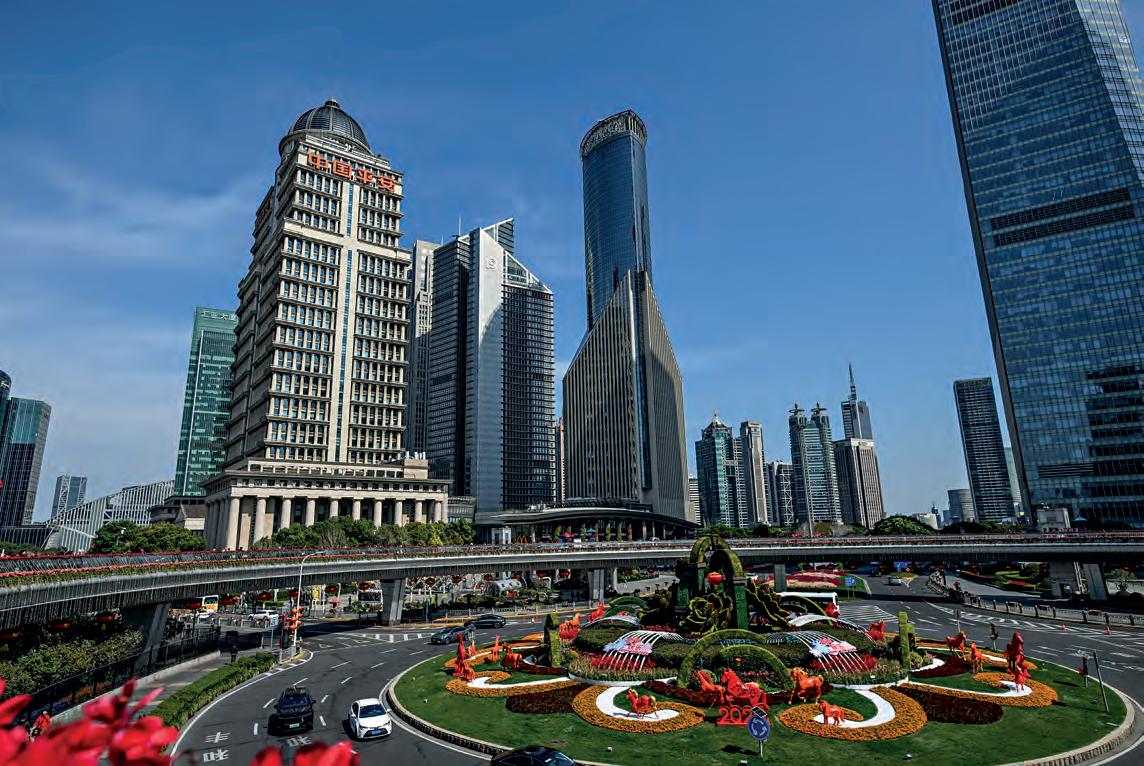
Shanghai remains the clearest symbol of China’s economic ambitions – a financial powerhouse balancing recovery momentum with persistent structural challenges. While consumer spending and logistics activity have strengthened in early 2026, policymakers continue to grapple
with weak property investment, cautious private-sector sentiment, and slowing global demand. The city’s financial district has seen renewed foreign capital inflows as Beijing introduces targeted stimulus and infrastructure spending measures aimed at stabilising growth. At the same
time, China’s export-driven industries face rising geopolitical pressures and shifting supply chains across Asia. For investors, Shanghai represents both the resilience and complexity of the world’s secondlargest economy as it navigates a slower but more technology- and consumption-driven era of growth.


The banking sector has entered 2026 facing a landscape shaped by economic recalibration, technological acceleration, and evolving customer expectations. Against a backdrop of geopolitical uncertainty and shifting interest rate environments, banks have been challenged to balance resilience with growth while continuing to invest heavily in digital transformation. From advances in AIdriven customer services to enhanced cybersecurity and embedded finance, the industry continues to redefine how modern banking is delivered. As SAS UK noted earlier this year, “trust will morph from a promise to a performance metric” as AI becomes increasingly embedded within financial services. That sentiment captures the defining challenge facing the sector today: combining innovation with accountability. This year’s Banking Awards recognise the institutions that have risen to these challenges with distinction – demonstrating innovation, operational strength, and an unwavering commitment to customer trust. We congratulate all of our winners for setting new standards of excellence and helping shape the future of global banking.
BEST INVESTMENT BANKS
COUNTRY BANK
Brazil Itau Unibanco
Chile
Colombia
Hong Kong
BTG Pactual
BTG Pactual
Dominican Republic Banreservas
France
Société Générale
Germany BNP Paribas
Hong Kong
Morgan Stanley
Jordan Arab Bank
Kazakhstan Halyk Finance
Kuwait KFH Capital
Mexico
HSBC
Jordan Jordan Islamic Bank
Kenya KCB Group
Kosovo BK T
Macao ICBC (Macau)
Malaysia Maybank
Mexico Banorte
Morocco At tijariwafa Bank
Pakistan Habib Bank
Saudi Arabia
Singapore
BBVA Mexico
Netherlands ING
Nigeria Coronation Merchant Bank
Oman
Saudi National Bank
DBS Bank
Thailand Kasikornbank
Tunisia BIAT
Türkiye Garanti BBVA
UAE
Sohar International
Pakistan HBL
Portugal Banco Invest
Taiwan CTBC Financial Holding
Thailand Siam Commercial Bank
Türkiye Garanti BBVA Secutities
US
BEST BANKING GROUPS
JPMorgan Chase &Co
COUNTRY BANK
Angola Banco Angolano de Investimentos
Austria BAWAG Group
Brazil Itau Unibanco
Brunei Baiduri Bank
Chile Banco Internacional
Colombia Davivienda
Denmark Nordea
Dominican Republic Banreservas
Egypt Commercial International Bank
Finland Nordea
France Crédit Mutuel
Germany Commerzbank
Ghana Zenith Bank Ghana
Emirates NBD
Vietnam Vietcombank
BEST PRIVATE BANKS
COUNTRY BANK
Andorra Andbank
Armenia Ardshinbank
Austria Erste Bank Group
Belgium BNP Paribas Fortis
Bulgaria Postbank
Canada RBC Wealth Management
Cyprus Bank of Cyprus
Czech Republic KB Private Banking
Denmark Jyske Bank
Dominican Republic Banco Popular Dominicano
France BNP Paribas Banque Privée
Georgia Bank of Georgia
Germany Deutsche Bank
Greece Eurobank
Hungary OTP Bank
India Kotak Mahindra Bank
Italy Intesa Sanpaolo
Kazakhstan Halyk Private Banking
Liechtenstein Kaiser Partner

The pension funds sector has continued to navigate a year defined by economic uncertainty, demographic change, and evolving member expectations. In 2026, fund managers and trustees have faced the ongoing challenge of delivering stable long-term returns while responding to inflationary pressures, market volatility, and increasing regulatory demands. At the same time, the sector has accelerated its focus on responsible investing, digital engagement, and retirement solutions tailored to a changing workforce. The winners of this year’s Pension Fund Awards have distinguished themselves through prudent stewardship, innovation, and an unwavering commitment to protecting members’ financial futures.
Luxembourg Indosuez Wealth Management
Monaco
CMB Monaco
Netherlands Rabobank
Nigeria First Bank
Norway Nordea Private Banking
Pakistan HBL Wealth Management
Poland ING Bank Sląski
Portugal Millennium Private Banking
Slovakia Tatra banka
Spain Sabadell Urquijo
Sweden Carnegie Private Banking
Switzerland BNP Paribas Wealth Management
Türkiye TEB Private Banking
UAE ADCB
UK HSBC Global Private Bank and Wealth
Uruguay Puente
US BMO
BEST RETAIL BANKS
COUNTRY BANK
Armenia
Ameriabank
Austria Erste Bank Group
Azerbaijan Pasha Bank
Belarus Belarusbank
Belgium Belfius
Bulgaria Postbank
Canada BMO
Chile Banco de Chile
Colombia Davivienda
Costa Rica
BEST PENSION FUNDS
COUNTRY
COMPANY
Australia Colonial First State
Austria VBV Grupee
Azerbaijan State Social Protection Fund of Azerbaijan
Belgium Amonis
Bolivia La Boliviana Ciacruz Seguros Personales
Brazil Bradesco Seguros
Canada BMO
Caribbean Scotia Investments Jamaica
Chile
AFP Capital
Colombia Grupo Sura
Croatia Allianz ZB
Czech Republic NN Penzijní Společnost
Denmark PFA Pension
Estonia SEB Varahaldus
Finland Mandatum
France Amundi
Germany Generali Deutschland
Ghana Pensions Alliance Trust
Greece Piraeus Asset Management
Iceland Gildi lífeyrissjóður
Indonesia DPLK AXA Mandiri
Italy Anima SGR (Arti e Mestieri)
Jamaica Scotia Investments Jamaica
Macedonia Triglav Penzisko Društvo
Malaysia
Gibraltar BSN
Mexico Afore XXI Banorte
Netherlands Meesman indexbeleggen
Nigeria Fidelity Pension Managers
Norway Storebrand Livsforsikring
Peru AFP Habitat
Poland PZU
Portugal Caixa Geral de Depósitos
Serbia DDOR Garant
South Africa Sanlam
Spain Banco Santander
Sweden AMF
Switzerland PostFinance
Thailand SCB Asset Management
Türkiye Anadolu Hayat Emeklilik
US Fidelity Investments
Hungary
OTP Bank
Italy Monte Dei Paschi Di Siena
Kuwait National Bank of Kuwait
Mexico Banorte
Netherlands ING
Nigeria
Norway
Access Bank
SpareBank 1
Pakistan Habib Bank
Peru BBVA Peru
Portugal Millennium BCP
Saudi Arabia Saudi National Bank
South Africa First National Bank
Spain Banco Bilbao Vizcaya Argentaria
Sri Lanka Sampath Bank
Sweden Handelsbanken
Türkiye Isbank
UAE
Emirates NBD
UK NatWest
US Bank of America
BEST COMMERCIAL BANKS
COUNTRY BANK
Armenia Ardshinbank
Austria Raiffeisen Bank International
Belgium Belfius Bank
Canada BMO
Colombia Davivienda
Czech Republic
Banco Nacional de Costa Rica
Denmark Spar Nord Bank
Finland Nordea
France
BNP Paribas
Georgia Bank of Georgia
Germany Commerzbank
Greece Optima Bank
CSOB
Denmark Nordea
Dominican Republic
Ethiopia
France
Banreservas
Commercial Bank of Ethiopia
BNP Paribas
Germany Commerzbank
Hungary OTP Bank
India State Bank of India
Kazakhstan ForteBank
Macao
BOC Macau
Malaysia CIMB Group
Mozambique Banco Comercial e de Investimentos
Netherlands ING
Nigeria
Zenith Bank
Norway Nordea
Portugal
Banco Finantia
Saudi Arabia Saudi National Bank
Singapore
DBS Bank
Sri Lanka Sampath Bank
Sweden SEB
Switzerland Zurcher Kantonalbank
Thailand
Bangkok Bank
Türkiye Akbank
US BMO
Vietnam Vietcombank
COUNTRY
Brazil
Chile
China
Colombia
BANK
Itau Unibanco
Banco de Chile
ICBC
Davivienda
Costa Rica Banco Nacional de Costa Rica
Dominican Republic Banco Popular Dominicano
Germany
Umwelt Bank
India YES Bank
Malaysia
Morocco
Singapore
CIMB Group
Saham Bank
DBS Bank
Sri Lanka Hatton National Bank
Sweden Ekobanken
Thailand
Kasikornbank
Tunisia Amen Bank
Türkiye
Garanti BBVA
Uganda dfcu Bank

Sustainability has moved from ambition to imperative across the financial industry, and 2026 has seen organisations intensify their efforts to align growth with environmental and social responsibility. As regulatory expectations evolve and stakeholders demand measurable progress, firms are increasingly embedding sustainability into core business strategy rather than treating it as a standalone initiative. From green finance and climate risk management to social impact programmes and responsible investment practices, the pace of innovation and accountability across the sector continues to accelerate. In its recent outlook for the year ahead, HSBC Sustainability Research described 2026 in one word: “pragmatism”, reflecting the shift from broad commitments toward practical, measurable implementation. This year’s Sustainability Awards recognise the institutions and leaders that have demonstrated genuine commitment, measurable impact, and forward-thinking leadership in driving positive change. We congratulate all of our winners for helping shape a stronger, more sustainable future for global finance.
MOST SUSTAINABLE COMPANIES
EUROPE
COMPANY
INDUSTRY
Nestlé Ag riculture & Food Security
Aeroporti di Roma Airport
Norsk Hydro Aluminium
KBC Asset Management Asset Management
AkzoNobel Chemicals
Blume Equity Climate Finance
Unibail-Rodamco-Westfield Commercial Real Estate
Cementir Holding Concrete & Aggregates Products
CCC Footwear
BA Glass Glass
RWE Green Hydrogen & Energy Transition
Meliá Hotels International Hospitality & Leisure
Umicore Industrial Materials Recycling
GLS Group Logistics & Supply Chain
Wizzair Low-Cost Airline
Air France Major Airline
Iberdrola Power
Go-Ahead Group Railway Transportation
Coveris Reusable & Circular Packaging
ArcelorMittal Steel
Corticeira Amorim Wine Products
AFRICA
COMPANY
INDUSTRY
Farm Africa Ag riculture & Food Security
South32–Mozal Aluminium Aluminium
Sustainable Capital Asset Management
East African Breweries Brewing
Nalco Water Chemicals
Africa Finance Corporation Climate Finance
Bamburi Cement Concrete & Aggregates Products
CWP Global Green Hydrogen & Energy Transition
Hotel Verde Cape Town Airport Hospitality & Leisure
CHEP South Africa Logistics & Supply Chain
Jambojet Low-Cost Airline
Kenya Airways Major Airline
Kenya Electricity Generating Co. Power
Lobito Atlantic Railway Railway Transportation
Grit Real Estate Income Group Real Estate
Anglo American Responsible Resource Extraction
HyIron Oshivela Steel
Johannesburg Stock Exchange Stock Exchange Platform
NORTH AMERICA
COMPANY INDUSTRY
Cargill Ag riculture & Food Security
Novelis Aluminium
Algorand Blockchain Technology
Sierra Nevada Brewing Brewing
Ecolab Chemicals
Amrize Concrete & Aggregates Products
Quality Technology Services Data Centre
IREN Digital Asset Mining
Plug Power Green Hydrogen & Energy Transition
Kilroy Realty Corporation Life Science Real Estate
FedEx Logistics & Supply Chain
JetBlue Airways Low-Cost Airline
United Airlines Major Airline
CPKC Railway Transportation
ENGIE North America Renewable Power Utility
Freeport-McMoRan Responsible Resource Extraction
Steel Dynamics Steel
LATIN AMERICA
COMPANY INDUSTRY
Marfrig Ag riculture & Food Security
Ingenio San Antonio Ag ro-Industrial
Bradesco Asset Management Asset Management
Ambev Brewing
Alpek Chemicals
EcoEnterprises Fund Climate Finance
Companhia Melhoramentos Compostable Packaging
Cementos Progreso Concrete & Aggregates Products
Sicredi Finance by a Cooperative
Banco W Financial Inclusion
Enel Green Power Green Hydrogen & Energy Transition
Hotel Las Torres Patagonia Hospitality & Leisure
Emergent Cold LatAm Logistics & Supply Chain
Azul Linhas Aéreas Low-Cost Airlines
Avianca Major Airlines
Enel Green Power Latin America Power
Rumo Logística Railway Transportation
Constructora Bolívar Residential Real Estate
BHP Responsible Resource Extraction
Companhia Siderúrgica Nacional Steel
B3-Brasil Bolsa Balcao Stock Exchange Platform
VSPT Wine Group Wine Producer
MENA
COMPANY INDUSTRY
OCP Group Ag riculture & Food Security
Hamad International Airport Airport
Mubadala Investment Company Asset Management
Saudi Air Navigation Services Aviation Comms Technology
SABIC Chemicals
AMEA Power Climate Finance
Ducon Green Concrete & Aggregates Products
ADNOC Distribution Downstream Energy & Mobility
RAKBANK Financial Services
NEOM Green Hydrogen Green Hydrogen & Energy Transition
Minor Hotels MENA Hospitality & Leisure
ARAMEX Logistics & Supply Chain
Emirates Global Aluminium Low-Carbon Aluminium & Recycling
Air Arabia Low-Cost Airline
OCP Group Mining & Resources
ACWA Power Power
Etihad Rail Railway Transportation
ZāZEN Properties Real Estate
Scatec Renewable Energy
Emirates Steel Industries Steel
Saudi Tadawul Group Stock Exchange Platform
stc Group Telecommunications
Beeah Group Waste Management
ASIA
COMPANY
INDUSTRY
Asian Agri Ag riculture & Food Security
Lion Brewing
LG Chem Chemicals
Impact Investment Exchange Climate Finance
Vandapac Bio Compostable Food Packaging
Asia Cement Corporation Concrete & Aggregates Products
DFI Retail Group eCommerce Retail
Azerbaijan Airlines ESG Strategy
Turkish Airlines Flag Carrier Airline
Hyrasia One Green Hydrogen & Energy Transition
ParkRoyal Marina Bay, Singapore Hospitality & Leisure
KLN Logistics Group Logistics & Supply Chain
Emirates Global Aluminium Low-Carbon Aluminium & Recycling
Air Asia Low-Cost Airline
All Nippon Airways Major Airline
Hindustan Zinc Mining & Resources
Contact Energy Power Company
Nippon Paper Industries Pulp, Paper & Fibre-Based Materials
Central Japan Railway Railway Transportation
Swire Properties Real Estate


Strong corporate governance has never been more critical than it is today. In 2026, organisations across the financial sector continue to operate under increasing scrutiny from regulators, investors, and stakeholders demanding greater accountability, transparency, and ethical leadership. From board diversity and executive oversight to ESG integration and risk management, governance frameworks are being tested in an increasingly complex and fast-moving environment. The Institute of Chartered Accountants and Administrators observed that effective governance is built upon “accountability, transparency, fairness, independence, responsibility and ethics,” principles that remain central to long-term corporate resilience. The organisations recognised in this year’s Corporate Governance Awards have demonstrated an exceptional ability to foster trust, uphold integrity, and embed responsible decision-making at every level of their operations.
Albania
Algeria
Angola
Azerbaijan
Kastrati Group
Sonelgaz
Etu Energias
State Social Protection Fund
Brazil CPFL
Colombia
Dominican Republic
Egypt
Georgia
Ghana
Greece
India
Japan
Kenya
Bancolombia
Banreservas
Fawry
TBC Bank
OmniBSIC Bank
Public Power Corporation
ICICI Bank
Japan Securities Finance
Safaricom
Kuwait Zain
Mexico
Morocco
Nigeria
Romania
Spain
Sri Lanka
Thailand
Türkiye
UAE
Vietnam
Banorte
Bank of Africa Group
Zenith Bank
Sphera Franchise Group
Iberdrola
Sampath Bank
Siam Cement Group
Sisecam
Emirates NBD
Vinamilk

Corporate treasury has faced another year of significant transformation, as finance leaders navigate persistent economic uncertainty, evolving interest rate expectations, and increasingly complex global liquidity demands.
In 2026, treasury teams have been challenged to balance resilience with agility – managing cash, mitigating risk, and ensuring operational efficiency in an environment shaped by geopolitical volatility, regulatory change, and rapid technological advancement. At the same time, the continued adoption of real-time payments, automation, and AI-driven forecasting tools is reshaping the function, enabling treasurers to move beyond traditional cash management toward more strategic, data-led decision-making. As the Association for Financial Professionals recently observed, “treasury is evolving from a control function into a strategic business partner,” reflecting the growing influence of treasury professionals in driving enterprise-wide value. This year’s Corporate Treasury Awards recognise the organisations and leaders who have embraced that evolution with distinction. Their achievements demonstrate excellence in liquidity management, innovation, and strategic foresight, setting new benchmarks for performance across the profession. We are proud to recognise those setting the pace for the next generation of treasury leadership and celebrating the vision that continues to redefine corporate finance.
COUNTRY
Brazil
Germany
India
Norway
Saudi
South
South
Thailand
Türkiye
UAE



Cryptocurrency, the champion’s champion of free market economists, has had a rollercoaster ride since Bitcoin’s inception in 2008. Its explosive growth in 2017 triggered a series of violent market cycles and drew intense regulatory scrutiny, including China’s blanket ban on all crypto-related transactions and mining. Based on a vision of an economic system beyond the reach of governments, immune to inflation, and frictionless across borders, Bitcoin promised to do what centuries of monetary experimentation had struggled to achieve: combine the scarcity of gold with the utility of the US dollar.
Yet to dismiss crypto as a failure would be to misunderstand what it has become. Far from disappearing, digital assets have evolved into a market worth roughly $2.58trn, increasingly functioning less as money and more as infrastructure. Cryptocurrency, rather than replacing the current system, has emerged as a form of financial infrastructure, most visible not at the centre of the global economy, but at its edges.
This has become particularly apparent in recent months with the evolving use of cryptocurrencies in geopolitically constrained environments. Amid the continuing fallout of the US–Israel ‘special operation,’ Iranian officials and state-linked industry representatives discussed proposals to collect a $1 per barrel tariff from tankers crossing the Strait of Hormuz, payable in bitcoin.
Born from the wreckage of the 2008 financial crisis, cryptocurrency once promised to replace the global monetary system. Instead, it has evolved into something narrower but arguably more influential: a parallel layer of financial infrastructure operating in the gaps of a fragmenting world economy. Scott Rouse reports >> »
That moment seems to have passed. Crypto has not displaced the dollar, which remains embedded in global trade, finance and reserves. Nor has it meaningfully challenged gold, which continues to be a bellwether for perceptions of long-term value. Even in its most ambitious experiments, cryptocurrency has struggled to function as a stable medium of exchange. Volatility, regulatory resistance, and limited real-world adoption have all constrained its monetary ambitions.
According to Hamid Hosseini, a spokesperson for Iran’s Oil, Gas and Petrochemical Products Exporters’ Union, “vessels are given a few seconds to pay in bitcoin, ensuring they can’t be traced or confiscated due to sanctions.”
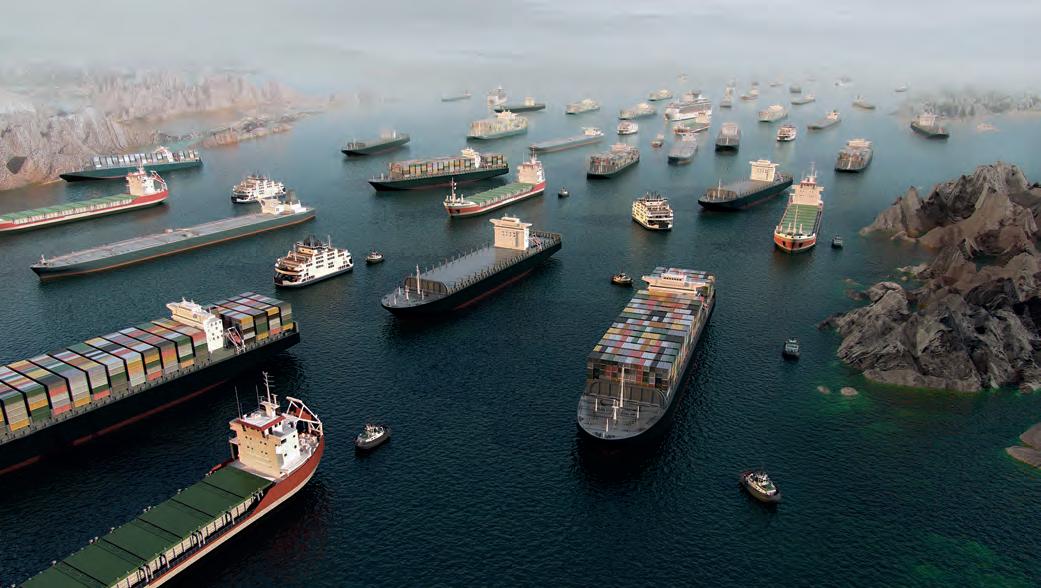
This equates to a $2m fee per tanker transiting the strait and effectively embeds digital assets into one of the world’s most strategically important trade routes. This is not a move based on the adoption of a new financial doctrine. It is far more pragmatic than that. It is a method that serves to bypass the dollarbased system and creates a payment channel that is difficult to monitor or block.
The failure of the currency thesis Following the global financial crash of 2008, the overall sentiment towards banks was one of deep mistrust. It is out of this mistrust that cryptocurrency emerged; it was “a backlash against the failings of the conventional financial system,” writes Hyun Song Shin, economic adviser and head of research at the BIS, in a 2022 op-ed for the Financial Times. Cryptocurrency promised a self-sustaining peer-to-peer system that bypassed banks altogether.
In practice, however, cryptocurrency does use intermediaries: crypto exchanges such as Binance, Coinbase and Kraken. Shin goes on to say that while the banks are regulated, it is often “the founder and a small number of venture capital backers that are in charge” when it comes to the protocols governing cryptocurrency.
The jailing of Sam Bankman-Fried and subsequent collapse of his cryptocurrency exchange FTX is perhaps the most highprofile example of what can happen when there is a lack of governance and risk management. After a liquidity crisis at the exchange, it emerged that Bankman-Fried
had defrauded customers at FTX to the tune of $8bn, taking their deposits and funnelling them to his trading firm, Alameda Research, for use on investments, loans, political donations and real estate.
The scale of the fraud also highlights the growth of cryptocurrency, something that simply would not be possible without the symbiotic relationship that these centralised intermediaries provide. They are the growth engine for the entire industry, so while a return to the original decentralised vision might be the ideal, it is fraught with problems. As Shin argues, “crypto would not have grown to its current size without these entities channelling funds into the sector.”
On a basic level, our financial system relies on money being a medium of exchange, a store of value and a unit of account. There is little evidence that crypto reliably performs any of these functions. As a medium of exchange, transactions are inefficient. Some of these bottlenecks are technical, with bitcoin transactions slow to confirm and transactions sometimes failing during contract execution. Other constraints are economic, with large fluctuations in price affecting real-time payments. This is before accounting for the substantial energy use and transaction costs involved. A 2025 report by Digiconomist found that if bitcoin were a country, it would rank 23rd in terms of energy use, with 204.44TWh (terawatt hours) per year.
As a store of value, cryptocurrency fails because its extreme volatility makes setting price difficult, with bitcoin price exacerbated by its typical four-year boom and bust cycles.
$7.78bn
ESTIMATED VALUE OF IRAN’S CRYPTO ECOSYSTEM IN 2025
$2m
ESTIMATED BITCOIN FEE PER TANKER TRANSITING THE STRAIT OF HORMUZ
In an article for Empirical Economics, Baur and Dimpfl write that “the volatility of Bitcoin prices is extreme and almost 10 times higher than the volatility of major exchange rates.” Finally, as a unit of account cryptocurrency never really escaped the gravitational pull of the dollar. Markets are priced in USD, and there is almost no real-world pricing in cryptocurrency.
Crypto on the
If crypto has failed as a basic form of currency, then where does it actually work? The answer lies at the fringes of the financial system. First and foremost, cryptocurrency is a way of getting around sanctions. Iran’s Strait of Hormuz bitcoin toll is a prime example. According to Virginia Pietromarchi in an article for Al Jazeera, “Iran’s crypto ecosystem was valued at more than $7.78bn last year, growing at a faster pace compared with 2024.”
Its rapid growth in the country among citizens in recent years is due to higher inflation and a fading currency, but as Pietromarchi goes onto say, the IRGC have been prominent users of the in-country chain as well. “Harder to trace and easier to transfer than traditional bank payments, crypto offers a way to sell oil, buy weapons and commodities, circumventing sanctions.”
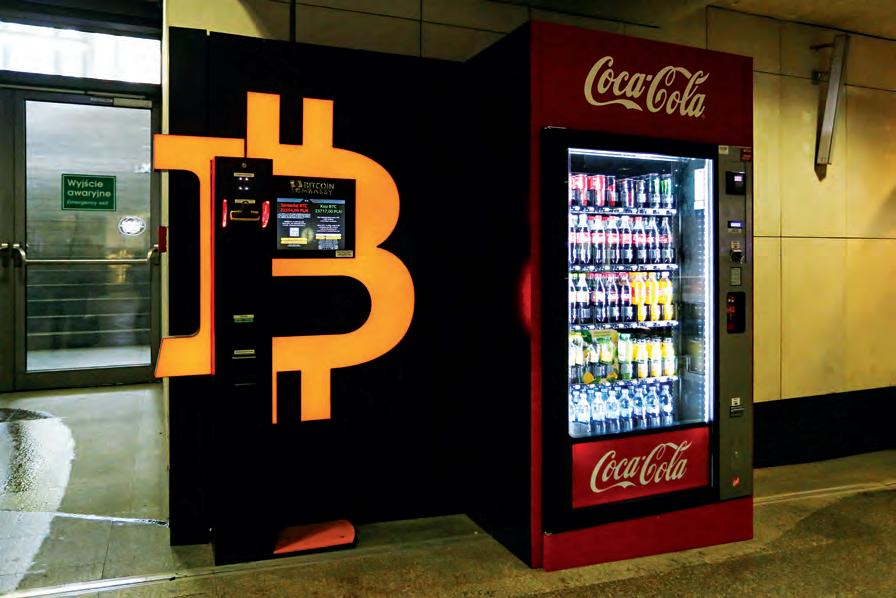
That is not to say that circumventing sanctions is all plain sailing though. A May 7th press release from the US Department of the Treasury states that the “treasury is aggressively advancing ‘Economic Fury’ and has disrupted billions in projected oil revenue, taken actions that have led to the freezing of nearly $500m in regime-linked cryptocurrency, and cracked down on Tehran’s shadow banking networks.”
Following Russia’s invasion of Ukraine in early 2022, sanctions rained down upon the country from all quarters, leading to Russia’s exit from mainstream correspondent banking and exclusion from SWIFT, cutting off their ability to make international money and securities transfers. According to crypto journalist and editor Phil Haunhorst, “Russia will legalise crypto payments in foreign trade on July 1, 2026. Exporters will gain a legal path to accept Bitcoin (BTC) and stablecoins from buyers cut off from Western banking.” Crypto-facilitated international trade has allowed Russian exporters to pay their bills, notably to their largest trading partners China and India for the export of oil. In 2025, these transactions were responsible for roughly 1trn rubles ($11bn). Russia’s approach illustrates how crypto has evolved from a speculative retail phenomenon into a state-enabled settlement layer. Rather than replacing banking infrastructure outright, it supplements sanctioned economies that have lost access to conventional payment channels.
According to Gonzalo Saiz Erausquin, Research Fellow at defence and security thinktank, RUSI (Royal United Services
$11bn
VALUE OF RUSSIA-LINKED CRYPTO-FACILITATED TRADE TRANSACTIONS IN 2025

Institute), “Crypto-enabled settlement is now embedded in Russia’s procurement model, linking diverted CHPI supply chains with alternative payment mechanisms designed to blunt the disruptive effects of sanctions.” Cryptocurrency has now evolved from the purview of cybercriminals into “a systemic, state-tolerated and in some cases state-enabled payment rail for military procurement.”
The implications of such systems are deeply ambiguous. The same networks that allow citizens to protect savings from inflation and capital controls can also facilitate sanctions evasion, illicit procurement, and opaque cross-border transfers. One of the problems with a decentralised financial system, no matter if the transactions are viewable to all on the blockchain ledger, is a lack of accountability. Where the balance lies is arguably in its retail use. For citizens residing in unstable economies where one might want to place assets beyond the control of local authorities, cryptocurrency is a handy alternative to bypass traditional banking restrictions.
One could argue that capital flight in heavily indebted countries isn’t particularly healthy, but as a 1989 Bank of England note observed, capital flight is often better understood as a symptom of weak domestic
RATHER THAN REPLACING THE DOLLAR SYSTEM, CRYPTO IN
policy than a cause of economic deterioration in itself: “inappropriate policies, for example price controls, may well drive a significant wedge between the private returns to the investor and the social returns to the country at large.”
Bitcoin’s most enduring role has arguably been as a speculative asset, held less for utility than conviction. As a unit of account, as a store of value, as a medium of exchange, this investing philosophy sits at odds with its self-proclaimed status as a currency. In this sense, it cannot become money. But it can become infrastructure.
Traditionally, SWIFT, banks and settlement systems provide the infrastructure for transfers. Naturally, these are appropriately regulated and therefore relatively secure, but comparatively slow. SWIFT transfers can take between one and five days to complete, whereas blockchain provides direct peer-to-peer transfers and settlements are completed in seconds or minutes at most.
Stablecoins sit at the intersection of these two systems. Worth roughly $320bn and accounting for around 11.5 percent of total crypto market capitalisation, they function as a bridge between conventional finance and decentralised settlement. As the name suggests, they offer a more stable alternative to the dramatic price swings of crypto assets such as Bitcoin. But how exactly do they differ from cryptocurrency? According to a 2025 IMF article authored by Adrian, »
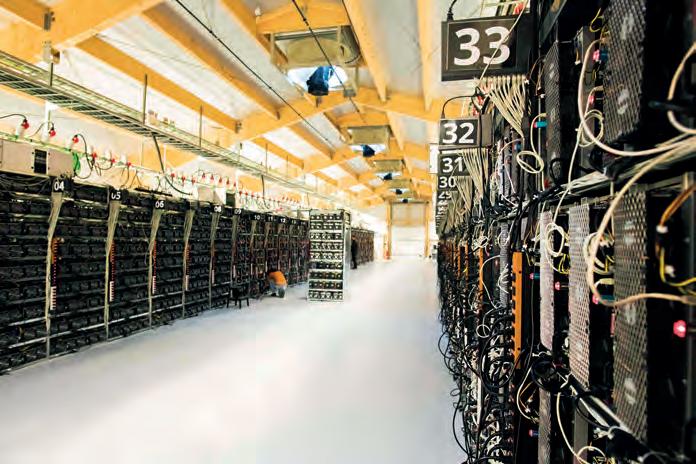
Miccoli and Sugimoto, “the main difference is that stablecoins are centralised (meaning they are run by a specific company) and are mostly backed by conventional and liquid financial assets, like cash or government securities. Most stablecoins are denominated in US dollars and are typically backed by US Treasury bonds.”
A digital asset backed by the dollar is essentially backing up the dollar, rather than competing with it, which helps to mitigate (but not wholly address) the central concern of governments, banks and financial institutions everywhere: losing control over capital flows. A decentralised financial system bypasses them altogether. Stablecoins offer some management over this and their use has been steadily increasing in recent years (see Fig 1). According to the IMF, “the market capitalisation of the two largest stablecoins has tripled since 2023, reaching a combined $260bn. Trading volume has increased 90 percent, amounting to $23trn in 2024.”
The use of stablecoins has helped promote the idea of cryptocurrency as a sort of routing layer, where fiat is converted into crypto, transferred across borders and then converted back again. This is particularly evident in remittance markets and dollarshort economies. In countries where access to hard currency is limited or banking systems are unreliable, stablecoins increasingly function as synthetic digital dollars. In Argentina, businesses and households have used USDT to protect savings from peso devaluation. In parts of Africa and Southeast Asia, freelancers and exporters
IF BITCOIN WERE A COUNTRY, IT WOULD RANK 23RD IN TERMS OF ENERGY USE
now receive payment in stablecoins to avoid correspondent banking delays and local currency volatility. Rather than replacing the dollar system, crypto in many cases extends it, allowing users to access dollar liquidity without touching the formal banking sector at all. Heavily at odds with the enduring Bitcoin whitepaper vision of eliminating trusted third parties such as banks in favour of direct online transfers, crypto is weaving itself into the gaps of the existing financial system, shoring up its weaker points.
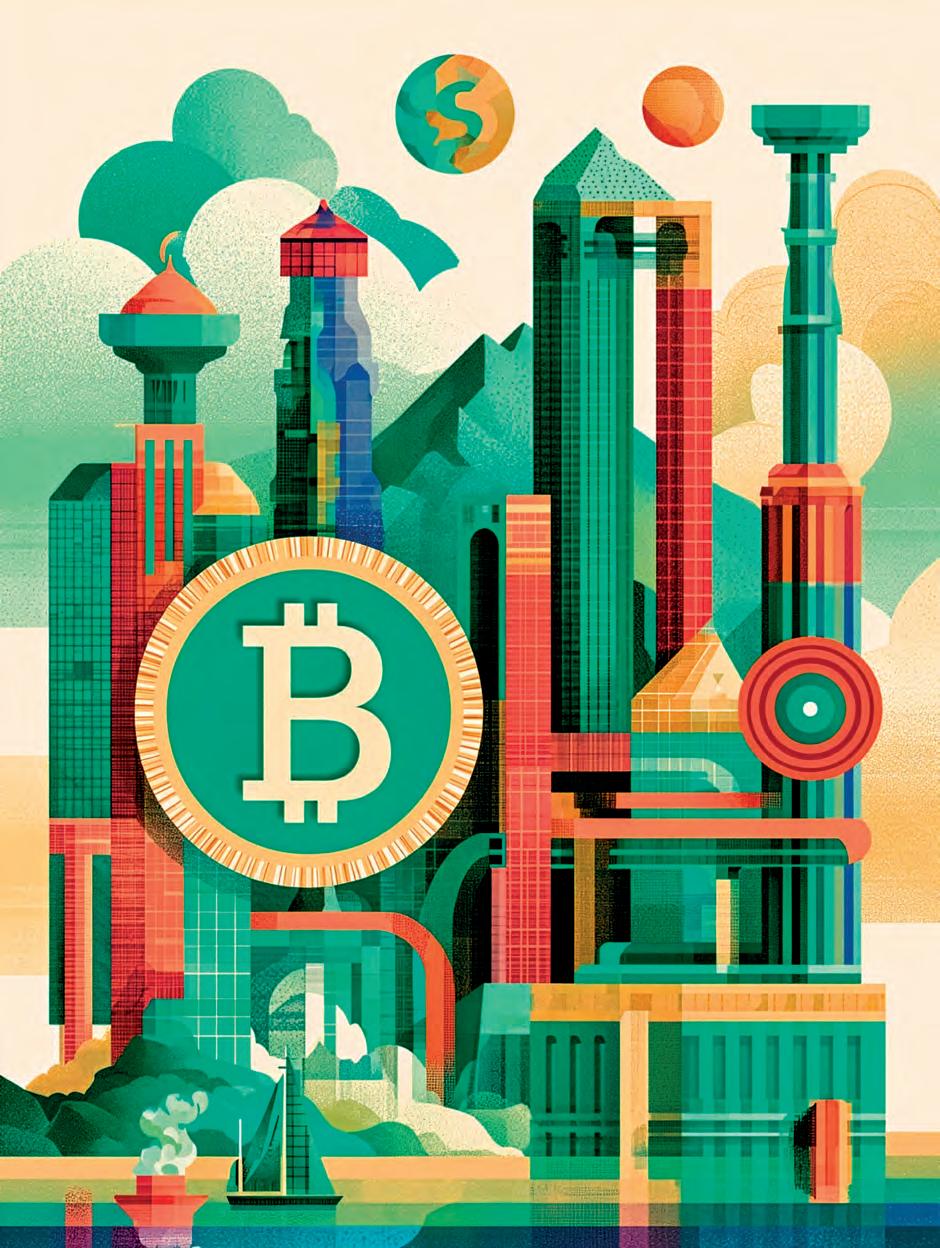
According to an article published by the IMF, “as of July 2022, there were nearly 100 CBDCs in research or development stages and two fully launched: the eNaira in Nigeria, unveiled in October 2021, and the Bahamian sand dollar, which made its debut in October 2020.” JAM-DEX (Jamaica Digital Exchange) became the third, launching in 2022.
There are currently 41 CBDC projects being piloted across global economies including Russia’s digital ruble, Brazil’s Drex, China’s e-CNY, India’s Digital Rupee and Europe’s Digital Euro. The defining mission behind each of the three operational CBDCs appears to primarily be a drive for financial inclusion, especially in the case of the sand dollar, where “the need to serve unbanked and under-banked populations across more than 30 of its inhabited islands” was a motivating factor, according to the IMF.
The governmental response to crypto has been mixed at best. Initially, decentralised cryptocurrencies were dismissed by central banks as structurally disruptive, reducing the effectiveness of capital controls by allowing citizens to circumvent the system entirely. They have since been forced to walk back those statements, realising that cryptocurrency wasn’t going away and the technology behind it could be beneficial if adopted.
Central banks that initially dismissed crypto have increasingly moved toward experimentation themselves. Ecuador briefly trialled one of the earliest state-run digital currencies before shuttering it amid low adoption, while dozens of central banks are now exploring CBDCs of their own.
To put it kindly, the central banks have had to play catch-up. While there are several reasons behind the development of CBDCs, the most obvious one seems to be that it was necessary. The advent of cryptocurrency has forced them to upgrade their antiquated systems and bring them into a new technological era. Where crypto has its decentralised rails, governments are now building sovereign digital alternatives.
Stablecoins are also becoming more institutional; according to an LSE Business review article “the rapid growth of dollarbacked stablecoins is reshaping monetary dynamics,” expanding the reach of the dollar. While stablecoins do seem to reinforce dollar hegemony, increased stablecoin activity in
$2.58trn VALUE OF THE GLOBAL DIGITAL ASSET MARKET Fig. 1 Stablecoin volumes
$320bn ESTIMATED VALUE OF THE STABLECOIN MARKET
any country that isn’t the US runs the risk of reducing its central bank’s control over domestic liquidity. It is not without a sense of irony that crypto’s greatest success may be extending the reach of the dollar rather than replacing it.
Global and central banks are also moving tokenisation projects from sandbox to pilot, with the BoE reporting that it is collaborating with private banks to explore DLT (digital ledger technology) to “facilitate faster, cheaper processes – with fewer intermediaries, shorter settlement windows and smart contracts automating routine processes.” In America, five US banks are moving onto an Ethereum-based tokenised deposit system in a shift towards a more modern payments industry. In Asia, the Hong Kong Monetary Authority (HKMA) has tierone banks such as HSBC, Standard Chartered, and Bank of China piloting the execution of real-value, cross-bank transfers of tokenised deposits. Similarly, in Singapore, Standard Chartered is processing real-time global treasury operations on its blockchain.
The timeline of recent years has been one of global shocks. These crises, whether they are health, geopolitical conflict or natural disaster-related, generally have a disastrous effect on supply chains, causing a knock-on effect in the price of essential commodities and a spike in inflation. As Forklog, a blockchain and digital currency magazine, points out; “in an environment of high inflation and strict capital movement
controls, Bitcoin becomes a tool of financial freedom and a hedge against fiat devaluation, shedding its status as a purely speculative asset.”
In this sense then, cryptocurrency has been less of a revolutionary financial vehicle and more useful as a hedge against inflation and an enabler of capital mobility. It has acted as a pressure valve in unstable economies, perhaps most notably in Venezuela, where years of hyperinflation has resulted in citizens turning to bitcoin to protect their wealth, buy essential goods and receive money from relatives abroad. An article for Zenledger points out that “between August of 2014 and November of 2016, the amount of Bitcoin users in Venezuela skyrocketed from 450 to a staggering 85,000.”
Similar stories play out in other highinflation countries, like Argentina, Turkey and Nigeria. Turkey boasts some of the highest crypto adoption rates in Europe and the Middle East, while Argentina and Nigeria have both turned to dollar-backed digital tokens for everyday transactions.
The future of crypto is now narrower than its past promises. As the IMF acknowledges, “Tokenisation and stablecoins are here to stay. But their future adoption and the outlook for this technology are still mostly unknown.” We must also acknowledge the
continuing fragmentation of global finance into competing geopolitical blocs and take into account the volatile US tariff landscape, alongside a rising number of global sanctions –Russia and Iran topping the list, respectively.
Parallel systems
Crypto seems to be a good match for a fragmenting world, finding its place within blocs, where their underlying blockchain technology acts as a force for fragmentation in both the financial system and the technological landscape by creating siloed networks and encouraging divergent regulatory approaches.
The global financial order is becoming less universal and more regionalised. Sanctions, export controls, tariffs and technological decoupling have all increased the incentive to develop parallel systems for trade and settlement. Crypto is unlikely to become the foundation of a new monetary order, but it is increasingly useful within fractured ones. In that sense, digital assets resemble financial adaptation tools: not strong enough to replace sovereign currencies, but flexible enough to operate around the political constraints attached to them.
To be clear, crypto is not going to replace the dollar, it won’t dominate trade or become universal money, but it does have a place in the financial system. The revolution promised by Bitcoin never fully arrived. Yet in the spaces where traditional finance is weakest, slowest or politically constrained, crypto has quietly embedded itself into the machinery of global commerce. n
Data is becoming the backbone of modern economies. As governments design and control national digital platforms, they are not just enabling efficiency – they are redefining who holds power, captures value and sets the rules
WORDS BY
Indrabati Lahiri FEATURES WRITER


For the last several years, data was considered mainly an administrative tool. Governments treated digitalisation only as a way to improve efficiency by decreasing bureaucracy, boosting access and streamlining services. This approach is now shifting, with nations increasingly treating digital infrastructure as economic and strategic assets. From Singapore’s integrated digital identity platforms to Estonia’s decentralised databases, governments are designing new models of national data ecosystems. Instead of only regulating the data, they are extracting key insights from it, while controlling and designing the digital infrastructure. These insights are helping support secure data exchange, financial verification, urban planning and AI-driven systems, generating measurable economic value. However, this raises key questions around data ownership, value and monetisation. As governments take greater control of national infrastructure and citizen data, who really benefits? And could data-driven platforms become a new class of economic asset?
From digital systems to economic assets
Rising digital sovereignty is swiftly reshaping how countries view, build and use economic infrastructure. Today, national platforms are integrated systems underpinning vital financial services, while enabling greater economic access and data exchange through public-private data ecosystems. Estonia’s decentralised, open-source data exchange layer, X-Road, is the foundation of its e-state, allowing online tax filing, residence registration and health records. By connecting 99 percent of government databases, independent systems can exchange information directly, while maintaining their own data.
This supports Estonia’s ‘once-only’ principle, where data is only entered once, decreasing duplication and streamlining commercial and administrative processes. Data can be exchanged across different countries through the X-Road Trust Federation, highlighting the platform’s potential to scale internationally. Similarly, Singapore’s MyInfo allows citizens to securely share and manage verified personal data with both private sector and government digital services. It is used by over 1,000 private and government digital services and has greatly streamlined banking and loan applications. The UAE’s Digital UAE platform and initiatives like United Digital Platform and UAE Pass offer a centralised access point and digital identity for more than 12,000 private and government services. It enables digital signatures, biometric-based identity systems and paperless transactions, like business licensing and visa applications for seamless cross-sector interaction. These platforms are evolving beyond individual administrative tools to form the foundational systems through which economic activity is carried out by embedding digital identity into core national operations.
Where the value comes from State platforms have significantly advanced digitalisation; however, the biggest value comes from decreased economic friction. By enabling faster verification and more efficient data reuse, they are transforming large-scale transactions. “The real asset is not the citizen data itself, but the velocity of transactions that are derived from the usage of that data,” Kuldeep Kundal, founder and CEO of Cyber Infrastructure (CIS), highlighted. “When governments create a digital foundation for their infrastructure, it essentially reduces the cost of doing business – and therefore creates a huge macro-economic multiplier effect.”
Estonia’s X-Road offers value by reusing verified data across ecosystems. This allows administrative burden and costs to be considerably reduced, while accelerating service delivery through direct data

healthcare and tax authorities. X-Road saved both the government and citizens over 1,345 years of working time annually or two percent of its GDP in time and resources in 2018. Singapore’s MyInfo has decreased credit processing and identity verification times, which greatly slashes compliance expenses for companies. It also accelerates financial services onboarding and increases client acquisition and access to finance. Digital UAE helps businesses and entrepreneurs to operate more smoothly in the country by simplifying services like property transactions and licensing.
Another important way these platforms generate value is by ensuring that all traffic is signed, time-stamped and encrypted, to protect confidentiality and integrity. This significantly reduces the chances of fraud while avoiding expensive audit procedures. Organisations can also scale more sustainably through these systems, by adding services gradually, lowering the risks of costly implementation failures. Similarly, they support AI-enabled tools, analytics and predictive systems for sectors like urban planning.
As such, rather than directly monetising data, these platforms enable economy-wide efficiency improvements, which translates into millions of transactions carried out faster, cheaper and more transparently. These efficiency gains then act as economic leverage, which can directly boost national productivity.
Although these digital platforms have significant advantages, their value is unevenly distributed across stakeholders. “Governments gain efficiency and visibility. The private sector gains lower onboarding costs and better rails for service delivery. Citizens gain convenience, speed, and in some cases stronger inclusion,” Michelle Li, chief operating officer at Bisblox, said. “Historically, governments captured the first wave of value through modernisation. Now the centre of gravity is shifting toward ecosystems, where the biggest upside comes from what others can build on top.”
As the primary designers and controllers of these infrastructures, governments remain at the core. By using national platforms as the foundation for financial verification,
service delivery and digital transactions, governments retain considerable power over how data is accessed, reused and shared throughout the economy. This boosts significant indirect value through GDP savings, higher public service efficiency and a stronger tax base.
Private sector players capture much of the direct commercial value, as they can build services on these platforms using verified, reliable data, which decreases compliance costs. “By providing the pipelines for many new products (fintech, logistics, insurance, etc) that previously were blocked by red tape, these platforms will now provide the private sector with a means of accessing markets in ways that no longer inhibit them from being able to operate within those markets,” Kundal noted. However, this also means greater reliance on government-controlled platforms, as companies do not own or control the infrastructure they use. Citizens provide the vast majority of the data for these platforms and enjoy enhanced convenience and access through less paperwork, faster services and greater financial inclusion. Despite this, they are almost never monetarily compensated, with control and consent over this personal data remaining murky areas. This creates a complex value distribution model, as most efficiency gains are tempered by a loss of autonomy and control. As these platforms deliver more economic value, they are reshaping how power is distributed within digital economies.
As national digital systems scale, economic and efficiency improvements also have some key trade-offs. One of these is privacy versus economic value creation. While enabling seamless data exchange, faster verification and lower costs, sensitive data is highly concentrated within a few governmentcontrolled systems too. This raises the potential for state scrutiny and surveillance, leading to an important question: When does monetisation and efficiency creation become overreach? “Regulators are pushing for citizens to have rights over their data as it flows downstream. That pressure is important because the legal structure supporting the majority of these platforms is much weaker than most governments would like to admit,” Marcus Denning, senior lawyer at MK Law, explained. “The largest risk is that most governments are attempting to define rights to the data without actually having the authority to convey those rights. Most citizens have no idea this is happening.”
This data concentration within a few platforms can worsen systemic risk and magnify losses in cases of cyber attacks, technical failures or governance issues.
Similarly, while allowing thousands of private sector companies to access personal citizen data can speed up service delivery, client retention and onboarding, the risk of commercial misuse can increase too. This includes data selling, credit profiling and targeted advertising.
“Governance is still treated as a layer on top, while the data itself is moving in real time underneath. This leads to consent, access control, and auditability failing to keep up with how fast the ecosystem expands,” Pratik Mistry, EVP of Technology Consulting at Radixweb, said.
“The real risk here is not just privacy in isolation, but that once these systems scale, it becomes very difficult to trace who is using what data and for what purpose.” Another growing tension is between control and innovation. National systems can enhance efficiency and greatly decrease friction for businesses, but also limit economic activity into narrower, predetermined functions. As a result, business experimentation could be slower and restricted to the edges of the ecosystem. As state powers grow through digitalisation, individual rights also come more into focus. In many cases, it may not always be possible to inform citizens when their data moves between organisations, resulting in eroded trust in the government. This raises another fundamental question: could open and distributed systems be a fairer and more transparent way than centralised platforms to maintain efficiency and trust?
The rapid growth of national digital platforms has led to them being seen more as financial than administrative assets, mainly due to their ability to underpin core economic services at scale (see Fig 1). This is similar to other regulated infrastructure assets such as payment systems and telecom networks, where the main value comes from the reliability and mass volume of the transactions they support.
Down the line, this could potentially pave the way for them generating stable and longterm economic returns, much like other traditional infrastructure assets. If so, they could attract investments from institutional investors, sovereign wealth funds and private capital alike, as digital state capacities grow. However, platform pricing is likely to remain complicated, as their performance is closely linked to trust, governance and political continuity. As a result, a new type of hybrid asset class could emerge, which would be a combination of economic asset and public utility, redefining economic value and control in modern economies. n

As artificial intelligence continues to reshape how organisations operate and compete, boards are being forced to confront a more fundamental question – whether they are structured to deliver the kind of judgement, challenge and adaptability that businesses now demand
WORDS BY Pippa Begg CEO, BOARD INTELLIGENCE
boards are rarely those that simply move fastest. More often, they are the ones that can also sustain high-quality discussion under pressure, creating environments where alternative perspectives are surfaced early and where directors remain willing to question both the information presented to them and the reasoning behind it. This is precisely why some organisations are beginning to experiment with AI not simply as an administrative assistant, but as a strategic sparring partner for the board itself. Last month, Board Intelligence partnered with Lloyds Banking Group to explore how AI could help executives and directors interrogate assumptions, identify gaps in reasoning and surface perspectives that might otherwise be overlooked ahead of high-stakes discussions. One director described the experience to me as being less like using a chatbot and more like having access to an additional perspective in the room, one capable of challenging logic, highlighting blind spots and encouraging deeper scrutiny before decisions were made. The objective was not to replace human judgement, but to strengthen it.


As artificial intelligence becomes embedded across every aspect of business, many organisations are understandably focused on the productivity gains the technology promises to deliver. Boards, too, are exploring how AI can streamline governance processes and help directors absorb information more efficiently. In a business environment defined by intense competition, geopolitical uncertainty and growing complexity, the appeal is obvious. Yet in my conversations with directors and executives over the past year, it has become clear that AI is forcing boards to confront a deeper issue – whether current governance models are genuinely equipped for the pace, complexity and uncertainty organisations now face. They are asking fundamental questions about how AI may reshape leadership itself – how decisions are made, how judgement is exercised, and whether boards are equipped for the pace and scale of change now taking place.
This matters because boards are already operating under considerable strain. As regulatory expectations and stakeholder scrutiny have increased, board packs have grown longer and agendas more crowded. Directors often describe evenings and weekends spent wading through hundreds of
pages of pre-meeting material, only to leave the meeting feeling dissatisfied because insufficient time was spent discussing the issues most likely to shape the organisation’s future. Directors are expected to oversee an extraordinary breadth of issues, ranging from cyber risk and sustainability to workforce transformation and geopolitical instability, often with limited time and incomplete information. The result can be a form of cognitive overload in which boards become highly effective at reviewing detail, but less effective at creating space for strategic debate and meaningful challenge.
AI offers an opportunity to reduce some of the administrative burden that has accumulated around governance over the past decade. But it also introduces entirely new categories of risk and complexity for boards. Unlike previous waves of enterprise technology, AI does not sit neatly within a single function – it influences hiring decisions, customer interactions, compliance and competitive strategy simultaneously, while also changing how organisations themselves process information and make decisions.
Governing AI therefore requires a different kind of conversation from the one many boards are used to having. It demands a more interdisciplinary, dynamic and forward-looking approach, as well as a greater willingness to interrogate assumptions and challenge consensus. The most effective
That distinction is important because much of the first generation of ‘AI for boards’ has focused primarily on precisely the opposite. While AI’s automation and summarisation capabilities undoubtedly save time, a weak board paper summarised by AI is still a weak board paper. Faster processing of information does not produce better judgement. The more exciting opportunity lies in augmentation, using AI to improve the quality of challenge, broaden perspectives and create more space for thoughtful discussion around the board table. This only works if boards resist the temptation to treat AI purely as a time-saving tool.
Governance has always depended on deeply human qualities that technology alone cannot replicate – curiosity, scepticism, integrity and the confidence to challenge consensus when necessary. If AI merely accelerates boards’ existing weaknesses, whether that is overconfidence or a reluctance to challenge prevailing views, then faster governance may simply become less effective governance delivered at greater speed.
As the outlook for growth falters and disruption intensifies, the quality of a board’s judgement will become a far greater competitive differentiator than it has been historically. The boards that benefit most from AI won’t be those that rely on it for answers, but those that use it to ask better questions, challenge assumptions and sharpen their thinking. n













































As Saudi Arabia accelerates its aviation ambitions, Saudi Air Navigation Services is helping shape a more efficient and sustainable future through smarter airspace design, disciplined financial management and digital innovation that strengthens operational resilience across the Kingdom’s rapidly evolving aviation ecosystem
WORDS BY Bandar Al-Yafie
CFO, SAUDI AIR NAVIGATION SERVICES (SANS)


Saudi Arabia is undertaking one of the most ambitious aviation expansions in the world. As the Kingdom advances Vision 2030 and prepares to host events that will attract millions of additional visitors, the airspace above it is becoming more strategically important. Saudi Air Navigation Services (SANS), a leading air navigation service provider in the MENA region, sits at the centre of that growth, and the standard to which we hold ourselves extends well beyond keeping flights moving safely. Our remit is to help the wider aviation ecosystem become cleaner, more efficient and more resilient.
For an air navigation services provider, sustainability extends far beyond environmental disclosure. It runs through every part of how the company is led, how decisions are made, how resources are deployed and how value is created over time. Across each of these dimensions, our objective is consistent: to deliver long-term value, responsibly.
Sustainability at SANS is embedded within corporate strategy. In 2024, sustainability was formally adopted as the company’s sixth strategic pillar, reinforcing its standing as a board-level priority. Our sustainability
governance model is structured across three tiers – the Sustainability Steering Committee for strategic direction, the Environmental, Social and Governance (ESG) Committee for cross-functional execution, and the Sustainability Community for organisationwide engagement.
Our governance approach is reinforced by internationally recognised frameworks. Our Enterprise Risk Management framework is aligned with ISO 31000 and the COSO Internal Control. Financial reporting is prepared in accordance with IFRS. This year, we extended the same discipline to our sustainability disclosure with the publication of our first ESG report developed with reference to the Global Reporting Initiative (GRI) Standards, giving investors, regulators and partners internationally comparable visibility of our ESG performance.
Long-term financial planning and disciplined capital allocation are key enablers of strategic and sustainable growth. At SANS, fi nancial planning provides the structure to assess priorities, manage risks, and direct resources toward areas that strengthen long-term resilience and sector readiness. Through a multi-year financial view, investment decisions are aligned with operational priorities, national development objectives and ESG considerations.
This approach has already led directly to action, most clearly in the creation of two SANS subsidiaries: NERA, which channels SANS’s air navigation expertise
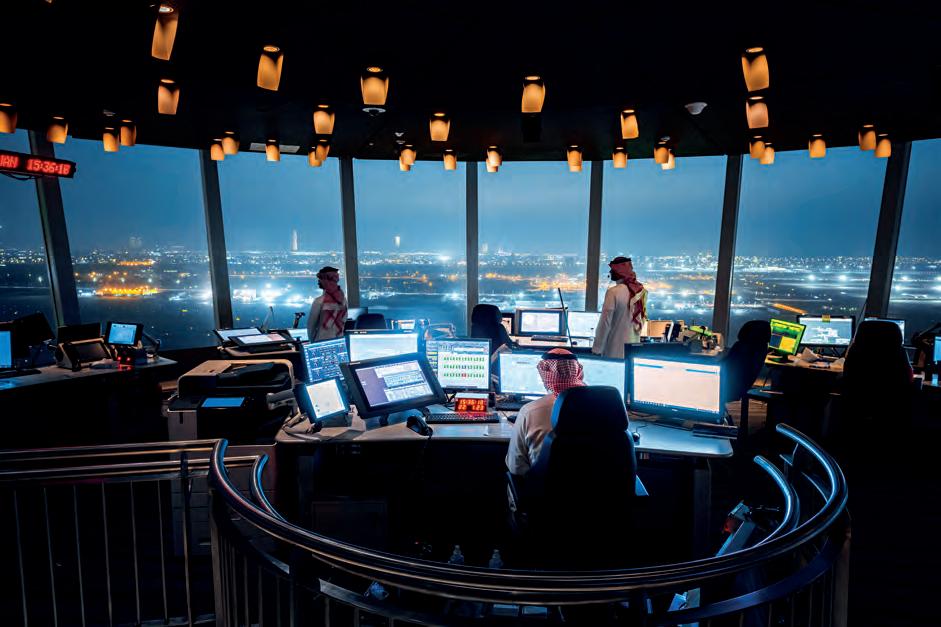
into innovative technology and services for aviation clients across MENA and beyond, and the Saudi Academy of Civil Aviation (SACA), which builds the specialised national talent that the sector will need to grow.
Capital allocation decisions are assessed against a broader set of criteria than financial return alone. We evaluate each investment for its contribution to safety, operational efficiency and environmental performance. Our Comprehensive Cash Investment initiative will introduce a structured policy framework for treasury and investment decisions, protecting risk-adjusted returns while preserving the liquidity required to fund strategic priorities and ensure operational continuity over time. Early results show strong progress, with investment returns performing significantly above target. This has strengthened SANS’s ability to fund long-term sustainability initiatives internally, while avoiding the need for external debt.
Sustainable finance is also a matter of operational excellence. Over the past year, we have strengthened our operational performance through continued improvements in the invoicing cycle, timely supplier payment practices and supplier satisfaction. These efforts were supported by disciplined collection management, healthy cash flow performance and close monitoring of overdue balances. Together, they have improved working capital management, strengthened financial reliability, and reinforced the operational discipline needed
to support long-term sustainable growth. Behind these results sits a strengthened credit risk management framework, supported by enhanced service level agreements with key counterparties, digital automation across billing and customer engagement, and continuous improvement in receivables management. Together these initiatives strengthen cash flow and reduce credit risk. The same discipline is visible in our compliance, control and quality outcomes. Most notably, SANS was honoured with the Silver King Abdulaziz Quality Award, independent confirmation of the financial discipline and operational quality that credible sustainability disclosure ultimately rests on. The result is a finance function that stays ahead of regulation rather than reacting to it.
Reliable sustainability outcomes depend on reliable data. This principle guides our digital agenda within finance, where we have developed a connected technology environment to strengthen accuracy, control, and decision-making. At the foundation, our core Enterprise Resource Planning (ERP) and broader data management framework provide a trusted source of financial information across the organisation.
Building on this foundation, our Enterprise Performance Management (EPM) platform for planning and budgeting went live this year, replacing fragmented spreadsheets with a more controlled and consistent planning environment.
1 million
Air traffic movements managed by SANS in 2025
SUSTAINABILITY WAS FORMALLY ADOPTED AS THE COMPANY’S SIXTH STRATEGIC PILLAR
In parallel, our customer relationship management (CRM) platform applies the same digital discipline to billing and customer engagement. In addition, Power BI dashboards covering financial performance, divisional KPIs, and revenue insights give management timely and consistent visibility across the business, supporting faster and more informed decision-making.
We are also supporting the implementation of the Financial Governance App, which provides structured oversight of financial governance practices across the company. Together, these advancements do more than improve efficiency. By reducing manual effort, eliminating duplicated reporting and improving data accuracy across the board, they lower the operational footprint of our finance activities while equipping us to track sustainability KPIs with accuracy, trace ESG data back to its source and disclose it with confidence.
At SANS, local content is central to our procurement approach. Through our procurement decisions, we aim to support local manufacturers, develop national capabilities, increase participation from Saudi manufacturers, and retain more economic value within the Kingdom. SANS has made strong progress in this area through its Local Content Programme, which has supported supplier engagement, internal awareness, enhanced visibility across mandatory list categories and the development of a qualified list of local manufacturers for mandatory
categories. Beyond local content, supplier satisfaction is treated as a key outcome. We operate a supplier classification framework integrated into our ERP, supported by a formal supplier feedback survey that captures supplier needs, improvement opportunities and challenges.
These foundations have translated into strong procurement performance. In 2025, our Supply Chain team was awarded the globally recognised CIPS Procurement Excellence Award. Structured negotiations delivered savings comfortably ahead of target, while the registered supplier base expanded competition, strengthening supply chain resilience and creating wider opportunities for Saudi SMEs.
For an air navigation services provider, one of the most important sustainability levers is airspace design itself. In 2025, SANS managed more than one million air traffic movements safely across an area exceeding two million square kilometres. Growth and reliability progressed together, supported by continued capital investment in airspace modernisation, technology and infrastructure. Finance plays an important role in this process by evaluating major Capital Expenditure (CAPEX) decisions, supporting prioritisation, and helping to ensure that investment is directed toward initiatives that create longterm operational and environmental value.
The wider impact is reflected in how the airspace is being reshaped to reduce emissions. Through the Saudi Future Airspace Concept, Free Route Airspace, PerformanceBased Navigation, continuous climb and descent operations, and reduced separation at major airports, SANS is helping reduce fuel burn, flight inefficiencies, and holding times. These operational improvements directly support the Civil Aviation Environmental Sustainability Program (CAESP) – the Kingdom’s national environmental roadmap for aviation, cascading directly from Vision 2030, for which SANS serves as a primary execution arm across the programme’s seven environmental pillars. Under this framework, the national commitment is to reduce flight emissions by 30 percent by 2032, supported by SANS’s target to achieve ISO 14001 certification in 2026.
Growth, safety, regulation and ESG are supporting one another. Strong governance protects safety. Efficient operations help reduce emissions. Disciplined financial management funds the technology and infrastructure that enable both. n
From construction sites to terminal operations, Rome Fiumicino is applying circular economy principles to redesign infrastructure, manage resources and reduce environmental impact at scale
WORDS BY Marco Troncone CEO & MANAGING DIRECTOR, AEROPORTI DI ROMA








Aeroporti di Roma (ADR) is one of Europe’s leading airport operators, managing and developing Rome Fiumicino and Ciampino airports. Rome Fiumicino ‘Leonardo da Vinci’ is a strategic gateway to Italy and one of the world’s leading airports, ranked in the global top 10 as well as one of only 12 airports to hold a Skytrax five-star rating worldwide. In 2025, Fiumicino exceeded 50 million passengers for the first time, further consolidating its role as a major global hub.
Within this context, circular economy has emerged as a key lever to enhance competitiveness while reducing environmental pressure, particularly for complex infrastructures such as airports, integrated systems where passenger flows, airlines, commercial activities, construction sites and operational services converge. For ADR, circular economy is therefore not a standalone initiative, but a strategic operating model connecting infrastructure development, daily operations and stakeholder behaviour.
This vision has been reinforced by the Memorandum of Understanding (MoU) signed by ADR in 2025 with the Italian Ministry of the Environment and Energy Security, which recognises the airport ecosystem as a platform for advancing circular economy models. For Rome Fiumicino airport, this translates into concrete experimentation, integrating circular principles into projects, operations and user-facing solutions that generate measurable results and useful insights for the wider sector. In other words, a ‘circular hub.’
At Rome Fiumicino, construction and refurbishment projects are conceived as evolving systems rather than static assets, prioritising redevelopment (brownfield) over demolition where feasible. Design integrates Italy’s minimum environmental criteria and international standards such as LEED and BREEAM, embedding modularity and
reversibility to facilitate adaptation and material recovery. ADR already certified more than 75 percent of Rome Fiumicino’s terminal infrastructure under LEED or BREEAM, extending asset life and reducing reliance on new resources.
Runways, aprons and roads increasingly incorporate recycled materials, including bituminous conglomerates with high recycled content and aggregates from demolition. In 2025, recycled materials accounted for over 50 percent of those used in completed works. On-site separation of excavation and demolition materials enables their reuse in foundations and non-structural works, reducing waste and the need for raw materials. Dedicated processing plants within the airport perimeter support this closed-loop approach. These practices are embedded in technical specifications through defined thresholds that balance recycled content with performance and safety requirements and are already applied across major projects at Leonardo da Vinci airport.
Daily operations at a circular airport
Alongside infrastructure, circular economy extends into daily airport operations. At Fiumicino, waste management is a core operational process designed to maximise efficiency and the quality of waste separation across the airport. Within terminals, differentiated collection systems are supported by dedicated recycling centres and supervised by specialised operators. A tariff model combining a fixed component with a variable fee linked to the production of unsorted waste incentivises improved separation at source by commercial operators, directly aligning environmental performance with cost efficiency. This system is progressively enhanced through digital monitoring tools that track collection, transport and disposal, improving data quality and operational control.
Water circularity is also embedded in operations. Fiumicino airport is equipped with an advanced system to recover and treat non-potable water from a biological treatment plant and the Tiber River, significantly reducing the use of potable water for thermal systems, irrigation and sanitation. Yearly, over 70 percent of water consumption at Fiumicino is non-potable – saving the equivalent
of 500 Olympic-sized swimming pools. Behavioural change complements these technical solutions. To address the challenge of correct waste separation in a complex, multicultural passenger environment, ADR has introduced smart bins in Fiumicino’s terminals. Developed with an Italian start-up, they use artificial intelligence to recognise waste in real time and provide feedback, improving separation quality while generating data to support analysis and targeted awareness campaigns. Following successful pilots, which recorded a 60 percent reduction in plastic sorting errors, the system is now being scaled up as a permanent element of ADR’s operational model.
Refillable drinking fountains offer passengers a practical alternative to disposable plastic bottles, while collaboration with retail operators promotes more circular packaging solutions. Partnerships with organisations such as ‘Too Good To Go’ have enabled, since the launch of the initiative and up to Q1 2026, more than 10,000 meals to be saved at Rome Fiumicino, corresponding to an estimated avoidance of nearly 30 tonnes of CO₂ emissions, while reducing food waste and maximising the value of resources.
Across both infrastructure and operations, digitalisation acts as an enabling layer, enhancing traceability, accountability and decision-making. By improving visibility over material and waste flows, ADR is progressively optimising resource use, reducing operational costs and identifying additional recovery opportunities across the airport ecosystem.
Moving beyond a linear economy
At airport scale, the economic rationale for circularity is clear. The systematic use of recycled materials in infrastructure works reduces procurement costs and dependence on raw materials, while high-quality waste separation and increased recycling rates lower disposal costs and enhance the recovery of valuable fractions. These efficiencies contribute to a more robust operating model in which environmental performance and financial discipline reinforce each other.
For Rome Fiumicino, circular economy represents a forward-looking growth strategy rather than a marginal optimisation. By redesigning infrastructure and operations as regenerative systems, ADR strengthens resilience and competitiveness in an increasingly resource-constrained world, supporting long-term value creation while decoupling growth from environmental impact. n


From its origins creating Türkiye’s glass industry to becoming a global player across flat glass, glassware, glass packaging and chemicals, Şişecam shows how long-term discipline, integrated value chains and governance can sustain industrial relevance across generations
WORDS BY
Can Yücel CEO, ŞIŞECAM



What truly allows a company to endure for nearly a century? Not merely to survive, but to remain relevant, trusted and capable of renewing itself generation after generation? At Şişecam, we believe the answer lies far deeper than balance sheets or scale alone. Our real strength comes from the trust we earn, the society we strengthen and above all, the enduring value we create together with all our stakeholders. Şişecam’s foundations were laid with a purpose far broader than that of a typical enterprise. We were founded to build something that did not yet exist: the glass industry in Türkiye. At a time when there was no domestic production, no established know how, and no industrial tradition in glass, Şişecam was entrusted with creating an entire sector from the ground up. This pioneering responsibility shaped our institutional character long before we became a global company.
We were established as the industrial heart of the İş Bank Group. This close connection to one of Türkiye’s most respected and long standing financial institutions embedded a strong sense of discipline, accountability and long-term thinking into our DNA from day one. In many ways, Şişecam today represents a living industrial ecosystem of the Group. This unique structure provides us with a robust financial backbone and a governance culture rooted in prudence. It allows us to pursue ambitious, long-term investments with confidence. It means that while we operate with the agility of a global industrial leader, we are guided by the stability and foresight of a major financial institution.
Over time, this foundation enabled us to grow beyond borders. Today, Şişecam operates across 13 countries on four continents. Yet the reach of what we do extends far wider. Through our products, we touch everyday life in more than 150 countries, often quietly, but
always meaningfully. From homes and cities to vehicles, factories and tables around the world, our products become part of daily lives. We are not just making glass; we are crafting a better quality of life.
Our global presence is not built on a single product or market. Şişecam is the only global company operating in all core areas of glass. In flat glass, our solutions shape modern architecture, bring daylight into the spaces where we live, work and connect. Our highperformance architectural glass does more than define skylines; it creates energy-efficient buildings that reduce our collective carbon footprint, improves thermal insulation to enhance indoor comfort and reduce energy demand, enhances security in public spaces, and provides superior acoustic insulation for quieter, more productive environments.
In automotive glass, we accompany millions of journeys every day, contributing to visibility, safety and comfort. From standard windshields to HUD, we are a critical partner to the world’s leading automotive brands, enabling the future of mobility.
In glass packaging, we are present at moments when people enjoy a bottle during a shared meal or when food is kept fresh and safe until it reaches the table. Our glass protects taste, quality and trust. As a 100 percent and infinitely recyclable material, and through advanced lightweighting efforts it is also a powerful answer to the global challenge of packaging waste, offering brands a sustainable choice.
In glassware, our products are set on tables, raised in celebration, and used in moments that bring people together. By blending timeless aesthetics with lasting durability, our glassware elevates both daily rituals and life’s special occasions, turning simple moments into lasting memories.
In chemicals and raw materials, we work behind the scenes, supplying critical inputs that support both our own glass production and a wide range of other industries. Our expertise in products like soda ash and
chromium chemicals gives us a strategic advantage, ensuring supply chain security and providing a platform for innovation across multiple sectors.
This breadth is not coincidental. It reflects a deliberate choice to build expertise across the full glass value chain, allowing us to manage complexity, strengthen resilience and respond to diverse customer needs with consistency and depth. It is what enables us to balance scale with specialisation and stability with adaptability. This integrated model creates a virtuous cycle: advancements in our chemicals business can lead to innovations in glass formulation, while insights from our packaging clients can inform new designs in our glassware division. It is a source of synergistic strength that is difficult to replicate.
The same philosophy shapes our approach to governance. For us, transparency and accountability are not corporate expressions; they are the basis of trust in every relationship. We believe that lasting value can only be created when the rights and interests of all stakeholders are respected: customers, employees, partners and shareholders. Operating in line with international standards is not an ambition for the future; it is the way we work today. Our focus is clear: to deliver profitability, efficiency, and real added value while acting fairly and responsibly in every interaction.
To bring this to life, we have established a governance framework that is both robust and adaptive. For over a decade, we have pioneered the use of digital platforms for our General Assemblies, ensuring every shareholder has an equal and transparent voice. This removes geographical barriers and reinforces our commitment to fairness and inclusion. Our Board of Directors also utilises secure electronic systems, enabling effective oversight across our global operations and ensuring that decision-making remains agile and wellinformed. These are not just tools; they are
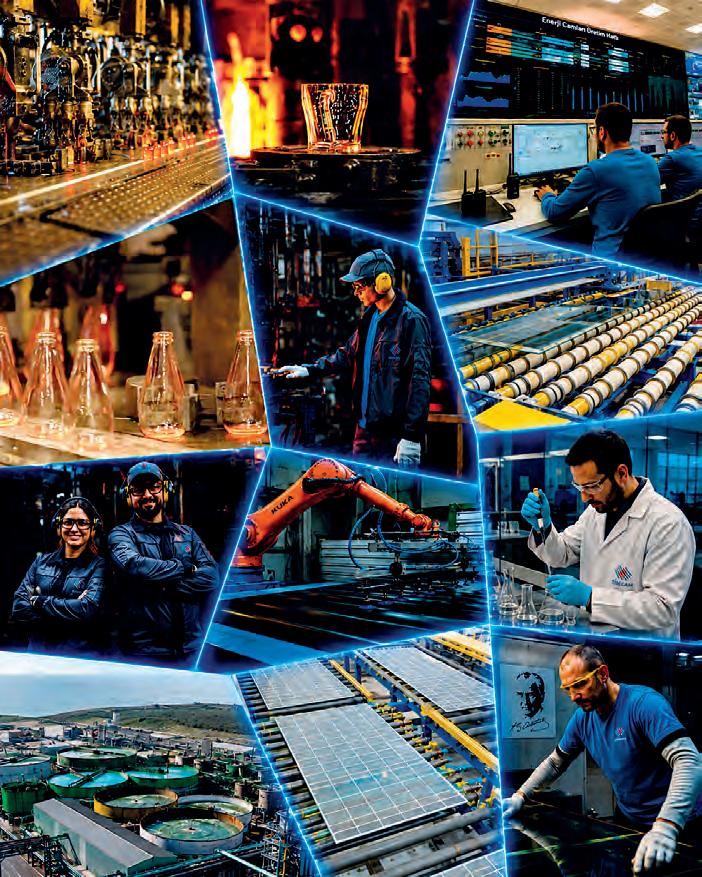
tangible expressions of our commitment to modern, accountable governance. Behind all of this stands the true engine of Şişecam’s success: our people. Şişecam is a collective effort. We draw our strength from the talent, commitment and sense of ownership of our teams across different geographies and cultures. Our ambition is to remain a lean and empowered organisation, one where responsibility is shared, collaboration is natural and people feel personally invested in what they build. Because strategies only work when people truly believe in them and are empowered to bring them to life. Our internal idea development platforms and social engagement initiatives are designed to give every employee a voice, fostering a sense of belonging and a shared purpose. We know that the best ideas often come from those closest to work and we strive to create an environment where those ideas can flourish.
This belief directly defines our relationship with the customers, our most important partners. With every investment decision, every operational improvement, and every innovation, we ask a simple question: ‘How does this serve our customers better?’ Their success is the clearest reflection of our own. By keeping customer needs at the centre, we ensure that excellence is practical, relevant and sustainable. This means co-creating solutions, anticipating market trends, and being a reliable partner they can count on, day in and day out. It is a relationship built not on transactions, but on a shared journey toward mutual growth.
Today, Şişecam is navigating a period that calls for focus rather than expansion for its own sake. While we take pride in our 90-year history, our attention is firmly on the future. In an environment that demands efficiency,
financial discipline, and innovation, we are prioritising stronger profitability and higher value-added production. This requires a pragmatic mindset, one that honours institutional discipline while embracing the agility needed to succeed in competitive global markets. This involves optimising our production processes, rationalising our portfolio to focus on high-margin products, and investing strategically in areas with the greatest potential for growth and innovation. It is about being smarter, not just bigger.
In a world shaped by sustainability and technology, glass holds a distinctive advantage. It is infinitely recyclable, chemically inert and essential to sectors ranging from renewable energy to pharmaceuticals. At Şişecam, we are advancing this potential through peopledriven and digitally supported processes, bringing together experience and data, craftsmanship and technology. Our CareforNext sustainability strategy is a core part of this vision. It is governed with the same rigour as our financial performance, with clear, science-based targets overseen by our Board’s Sustainability Committee. From increasing our use of recycled glass to investing in renewable energy and improving water stewardship, we are embedding sustainability into every aspect of our capital allocation and performance metrics.
Simultaneously, our digital transformation programme, IT X.0, is reshaping our industrial landscape. On the production sites, digital twins of our glass furnaces have evolved into self-optimising systems. These pioneering applications of machine learning and AI are driving unprecedented gains in efficiency and sustainability. These are not futuristic experiments; they are practical, value-driven initiatives that strengthen our competitive edge today.
We may have 90 years behind us, but for us, the most meaningful chapter lies ahead. We invite our partners, customers, and stakeholders to look beyond our heritage and focus on the journey we are shaping today. Our foundations are strong, our presence is global, our people are committed, and our intent is clear: to create enduring value that connects industries, societies, and generations. n
Sustainability
At BA Glass, sustainability is driven by resilience, circularity and innovation – combining decarbonisation, renewable energy and recycling to accelerate the transition toward a lower-carbon future for glass packaging
BY




Tiago Moreira da Silva CEO, BA GLASS


At BA Glass, sustainability is not a static ambition; it is a dynamic process of continuous improvement, resilience and innovation. Throughout our 112-year history, we have been guided by our core sustainability pillars, people, social accountability, environmental responsibility, shareholders, customers and consumers. This approach ensures a balanced and responsible approach to growth and innovation. As expectations around environmental performance continue to rise, our responsibility is not only to set ambitious targets, but to consistently deliver measurable results, even in the face of operational challenges.
These recent years have been proof of BA Glass’ strong commitment. Our decarbonisation roadmap, aligned with the Science Based Targets initiative, sets a clear objective: to reduce Scope One and Two emissions by 50 percent by 2035. Today, we are already 22 percent below our 2020 baseline. This places BA Glass ahead of the required trajectory and reinforces our confidence in achieving our long-term goals. More importantly, it demonstrates that sustainability at BA Glass is embedded in how we operate, not treated as a parallel initiative, but as a core driver of performance. This progress is particularly meaningful given the context in which it was achieved.
milestone, sourcing 100 percent of our electricity from renewable energy across our European operations, we recognise that the path to decarbonisation requires a broader transformation of our energy mix. Reducing reliance on fossil fuels demands both innovation and pragmatism.
In this context, biomethane is emerging as a promising near-term solution. As a chemically identical alternative to natural gas, it can be integrated into existing infrastructure without the need for major modifications. This makes it a practical solution for reducing emissions while maintaining operational stability. Although the biomethane market is still in its early stages and availability remains limited, we
segments such as colourless glass. Addressing these constraints requires coordinated action across the value chain. That is why at BA Glass we continue to play an active role in strengthening recycling systems across the regions where we operate. Through our involvement in initiatives and partnerships, we are helping to improve collection, sorting and processing infrastructure. The integration of recycling capabilities, such as those supported by Recresco, that has been a part of the BA Glass Group since 2024, contributes to a more resilient and competitive ecosystem, ensuring that glass remains a truly circular packaging solution.
These combined efforts, across energy, circularity, and materials, are shaping a more sustainable and resilient future for glass packaging. They also reflect a broader principle that guides us: meaningful progress is achieved not through isolated actions, but through integrated strategies that address the full complexity of our operations. As we look ahead, our focus remains clear. BA Glass will continue to accelerate decarbonisation,

In 2025, BA Glass operated in a challenging environment marked by production stoppages that impacted furnace efficiency. These disruptions could have slowed our momentum. Instead, they highlighted the resilience of our operations and the strength of our strategy. Even under these conditions, we reduced direct CO₂ emissions per ton of glass produced by 5.9 percent compared to the previous year. This ability to maintain progress under pressure is a critical indicator of long-term sustainability.
A key factor behind this resilience is BA Glass’ evolving approach to energy. While we have already achieved a significant
At the same time, circularity remains central to our decarbonisation strategy. Glass is inherently a circular material, capable of being recycled indefinitely without loss of quality. At BA Glass, we are committed to maximising this potential. In 2025, we increased our use of recycled glass to an average of 42.2 percent across our European operations. This progress directly contributes to lower energy consumption and reduced emissions, as recycled glass melts at lower temperatures than virgin raw materials.
Beyond the numbers, this achievement reflects a broader industrial shift, one that requires not only internal optimisation, but also strong and reliable recycling ecosystems. The availability and quality of recycled glass remain key challenges, particularly for certain
strengthen circular systems, and invest in innovation across all aspects of its business. At the same time, we recognise that transformation at scale cannot be achieved alone. Collaboration across the value chain will remain essential to unlocking further progress and ensuring that sustainable packaging solutions are widely accessible. Glass has a unique role to play in this transition. Its circular nature, combined with ongoing advancements in production and resource efficiency, positions it as one of the most sustainable materials available today. At BA Glass, we are committed to ensuring that this potential is fully realised, through action, through partnership, and through a long-term vision that aligns environmental responsibility with industrial performance. n

As the push for sustainable materials accelerates, cork is demonstrating how nature-based solutions can deliver both environmental value and high-performance applications across the global economy
WORDS BY
António Rios de Amorim CHAIRMAN & CEO, CORTICEIRA AMORIM



Whether in its most traditional roles or in more unexpected contexts, cork continues to demonstrate outstanding performance across a broad spectrum of industries. In sectors as diverse as winemaking and aerospace, cork can be integrated into a wide and growing range of applications, supporting lowerimpact solutions across multiple fields.
The story of cork is closely intertwined with the history of wine, two worlds that are inseparably linked. Over the centuries, this relationship has evolved into a true symbiosis, in which the natural cork stopper protects, preserves and elevates a product that is itself alive. Dating back to ancient civilisations and later shaped by the influence of Dom Pérignon in the 17th century, who established the enduring connection between glass and cork, the stopper has become an essential part of the wine experience.
At the heart of this experience is Corticeira Amorim, the world’s leading producer and exporter of cork products, recognised for its long-standing focus on renewable, bio-based materials and life cycle-based sustainability assessment. Founded in Portugal in 1870, Corticeira Amorim has grown from a family business into a global leader, with sales in more than 100 countries. While its portfolio now extends from flooring to aerospace-grade composites, it remains best known for its high-performance cork stoppers, producing over five billion each year.
There are multiple reasons why cork stoppers are widely regarded as the preferred closure for wine bottles, covering technical, sensory and environmental dimensions, with environmental performance supported by peer-reviewed life cycle assessment studies and product carbon footprint analyses.
Aligned with the ISO 14067 standard, greenhouse gases – carbon footprint of products, Amorim Cork has conducted studies to quantify the carbon footprint of its cork stoppers using a cradle-to-gate approach. To date, these studies cover around


60 percent of the product portfolio and have been independently verified by APCER –Portuguese Association of Certification –ensuring robust, credible and transparent information consistent with EU regulatory expectations for environmental disclosures.
average lifespan of around 200 years.
CORTICEIRA
The results confirm that all analysed cork stoppers present a negative carbon footprint within the defined system boundaries, highlighting cork’s environmental value as a packaging solution for the wine sector. Depending on the product typology, values range from –28.72 g CO₂e for each Spark Top II stopper, in the sparkling wine segment, to –56.4 g CO₂e for each Naturity cork stopper.
Rooted in the cork oak, giving back At the core of cork’s exceptional environmental qualities is the cork oak tree. Native to the Mediterranean and central to Portugal’s distinctive Montado (cork oak forest), it is the only tree species whose bark regenerates after harvesting. Cork oak forests function as carbon sinks and as longterm carbon stores, since these trees have an
According to a study cited by APCOR – Portuguese Cork Association, cork oak forests can sequester up to 73 tonnes of CO₂ for every tonne of cork harvested. This makes cork a nature-based system with significant long-term carbon storage potential, while also contributing to other ecosystem services.
Beyond cork production, this ecosystem supports high levels of biodiversity, including endangered species such as the Iberian lynx and the Spanish imperial eagle. The Quercus suber, more commonly known as the cork oak, plays an essential role in maintaining soil quality, storing carbon and preventing desertification. Unlike monoculture plantations, the cork oak forest represents a model of land use where environmental protection and economic productivity coexist.
In addition, the long-term resilience of the cork oak forests depends on responsible forest management and the maintenance of healthy, economically viable cork value chains – helping to keep this multifunctional landscape standing and managed over generations. n

Currency markets have become one of the clearest reflections of global economic uncertainty. Diverging interest-rate policies, slowing growth in Europe, and uneven post-pandemic recoveries triggered sharp swings across major currencies in 2025. The weakening yen has boosted Japanese tourism and exports,
while a softer euro reflects investor caution around Europe’s economic outlook. In emerging markets, volatile exchange rates have complicated trade flows and raised borrowing costs for businesses reliant on dollar-denominated debt. At the same time, central banks are under increasing pressure to balance inflation
control with the need to support fragile domestic economies. For investors and policymakers alike, currency stability has once again become central to economic strategy, with exchange-rate movements increasingly shaping inflation, trade competitiveness, capital flows, and the cost of everyday goods worldwide.
While policymakers often frame decarbonisation as a climate imperative, some of the fastest energy transitions are being driven by economics, affordability and energy security
WORDS BY Saliem Fakir FOUNDER & EXECUTIVE DIRECTOR, AFRICAN CLIMATE FOUNDATION
upfront costs. Crisis-driven decarbonisation still requires efforts to improve affordability and ensure that people from all walks of life can participate in the energy transition.





As the world pursues decarbonisation, the concept of a ‘just transition’ has become ubiquitous, particularly when describing the shift away from fossil fuels in emerging and developing economies. Emissions targets at the global and national levels are viewed as the main drivers of the energy transition, and the climate policies developed to meet those targets must balance environmental and social objectives. But decarbonisation is not always the product of a planned emissionsreduction pathway. In fact, with the cost of renewables continuing to fall, many emerging and developing countries now see phasing out fossil fuels as a matter of economic survival and energy security. For example, in January 2024, Ethiopia banned the import of petrol and diesel vehicles with immediate effect. The move was striking precisely because it was framed not as a climate commitment, but as a way to reduce its annual fossil-fuel import bill of more than $5bn, which consumed a huge share of the country’s scarce foreigncurrency reserves.
With the country constructing Africa’s largest hydroelectric dam, it made little economic sense to remain dependent on expensive fuel imports to power transport. Chinese electric vehicles (EVs) quickly filled the market gap created by the ban; the streets of Addis Ababa are now teeming with BYD cars. Tax exemptions and import duty waivers for EVs, coupled with the rising costs of second-hand internal-combustionengine vehicles, have accelerated this shift in consumer behaviour. The Grand Ethiopian Renaissance Dam, which was officially opened in September 2025, produces enough surplus hydropower to run these EVs cheaply.
Crucially, economic and energy-security concerns, not a formal emissions-reduction framework, were responsible for such rapid decarbonisation. A similar pattern seems to hold in Pakistan.
The country’s swift uptake of solar power reflected factors that created an opportunity for disruptive change, not green advocacy or a national climate plan. In 2022, a massive flood left roughly onethird of the country under water and caused more than $30bn in economic damage, straining government budgets, reducing household incomes, and undermining the state’s ability to operate public utilities. With energy costs rising, there was a clear need for an alternative to diesel generation.
Systemic change is required
Policymakers have used the concept of a ‘just transition’ to make a morally and emotionally compelling case for decarbonisation. But they should be focusing on how to foster systemic change. Understanding that the primary drivers of solar uptake in South Africa and Pakistan or EV adoption in Ethiopia are structural and economic could help policymakers develop better tools and systems. This also has direct implications for how philanthropists and governments

production, and the US had imposed import restrictions. Pakistan took advantage of China’s discounted solar panels to adopt renewable generation at a rapid clip. Between December 2021 and December 2025, the share of Pakistan’s electricity generated by solar increased five-fold. A late mover confronting unique energy-security challenges, Pakistan benefited from cost advantages created by global trade dynamics.
While South Africa has been following an emissions-reduction pathway for decades, an affordability crisis ultimately drove widespread decarbonisation. These countries are moving away from fossil fuels largely because of mounting economic and energy pressures, rather than a narrow focus on emissions reductions. But this does not mean that the question of justice disappears. Lowerincome households account for a smaller share of the roughly eight gigawatts of rooftop solar installed in South Africa, reflecting high
allocate resources. Channelling funding toward grid capacity, storage infrastructure, and affordable financing mechanisms will likely produce more durable results than funding for climate education and communication. Investing in efforts that aim to improve people’s lives, from lower energy bills to unfettered electricity access, will do more to accelerate decarbonisation – and to change hearts and minds. To be sure, the world must reduce emissions to prevent the planet from overheating. To achieve that goal, it should focus on expanding energy access and ensuring affordability. That means recognising and adequately responding to the external pressures that can support decarbonisation pathways in emerging and developing economies. Ethiopia, Pakistan, and South Africa have shown that economic factors can provide better entry points for scaling green solutions and catalysing systemic change than top-down, morally driven transition plans. n
















Europe’s offshore wind ambitions are colliding with the realities of capital, risk and regulation. As energy security takes priority, the financial architecture underpinning the North Sea build-out is being pushed to its limits
WORDS BY Antonia Di Lorenzo
FEATURES WRITER




The signing of the Hamburg Declaration in January 2026 was intended to be a steady, decades-long roadmap toward transforming the North Sea into a 100 GW offshore wind hub. However, history rarely follows a linear path. The sudden and violent closure of the Strait of Hormuz shortly after the declaration has acted as a brutal catalyst, shifting the project from a long-term climate goal to an immediate matter of national survival.
As governments fast-track auctions and private capital scrambles to keep pace, the financial world is facing a stark reality: the current regulatory and financial architecture is being stress-tested by a ‘wartime’ deployment pace it was never designed to handle. For years, the North Sea wind expansion was discussed in the sterile lexicon of ‘Net Zero 2050.’ The Hormuz crisis changed the conversation overnight. Energy security has now surpassed decarbonisation as the primary driver of infrastructure investment. Arif Gasilov, partner at ESG and sustainability consulting firm Gasilov Group, captures the urgency: “The financing architecture we are examining is not a 2050 planning exercise. Governments are fast-tracking auctions now, and private capital needs to follow at a pace the current regulatory patchwork simply isn’t designed for.”
François Le Scornet, President and Senior Consultant at Carbonexit Consulting, argues that the crisis confirms offshore wind is no longer just a “light-hearted climate story” but a core industrial security plan. “Imported fossil fuels are a strategic weakness from a European perspective,” Le Scornet explains. “North Sea electricity is definitely a strategic asset from a geopolitical standpoint.”
The acceleration is visible in the numbers. Germany announced an additional 12 GW of auction volumes in direct response to the supply shock, while the UK brought forward its AR8 offshore auction to July 2026. This ‘Hormuz premium’ is forcing fund managers to re-evaluate risk-return profi les for assets deployed in months rather than years.
The revenue stability gap
While the 100 GW target is ambitious, the financial mechanisms to reach it remain under debate. Le Scornet warns that the target is credible only if governments stop pretending that private capital will shoulder the burden alone. To reach the goal, Europe needs approximately 15 GW per year from 2031 to 2040. “To ensure stable income for developers, at least 10 GW per year will require two-way price guarantee contracts (known as Contracts for Difference or CfDs),” Le Scornet asserts. These contracts fi x a set price, protecting developers from market dips and consumers from overpaying during price spikes. “This ensures revenue stability for the developer and protects consumers when market prices are high. PPAs (Power Purchase Agreements) alone will not carry such an increase.”
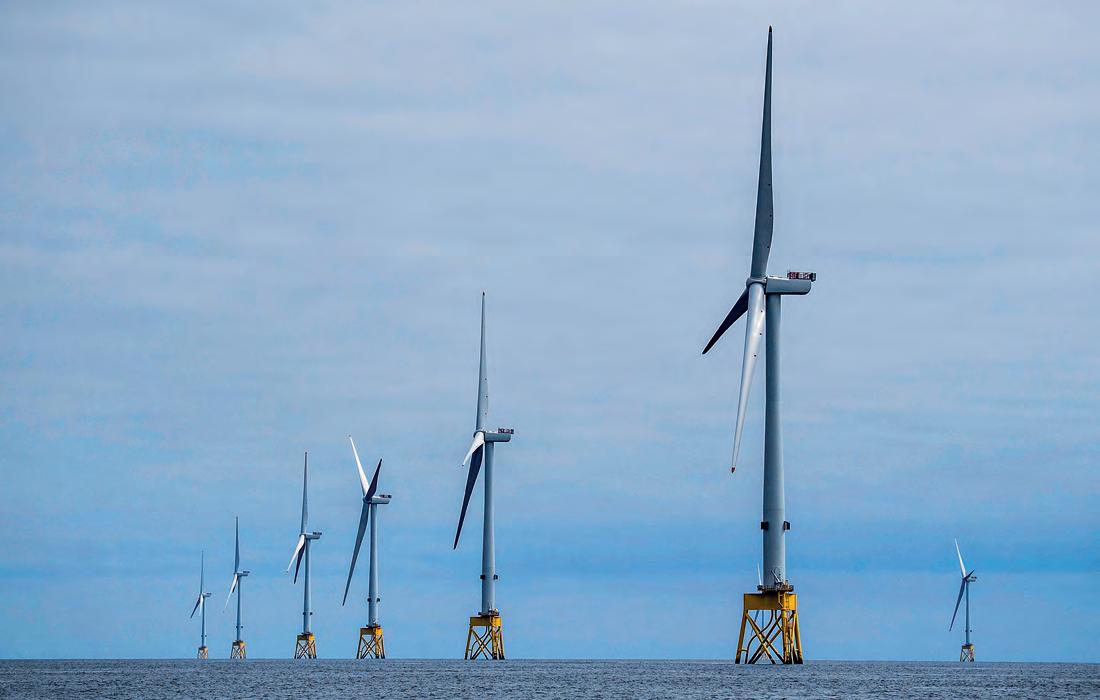
already thin profit margins of offshore wind.” The lack of standardised contract templates for hybrid-specific risks remains a barrier, leaving institutional investors to manage 25-year currency volatility on a project-byproject basis.
According to Le Scornet, the real bottleneck is not just the capital, but the allocation of risk – specifically concerning grid investment, congestion, curtailment and price gap compensation. Furthermore, policy divergence between the UK and EU remains a primary concern for investors.
NORTH
This creates a particular challenge for ‘hybrid’ assets like LionLink, connecting the UK and the Netherlands. Because the UK sits outside the EU’s internal energy market, investors face a dual layer of complexity: navigating different subsidy regimes and market coupling rules while managing significant currency risk. “Developers are forced to structure PPAs across a GBP/EUR split,” Gasilov explains. “In agreements lasting 15 to 25 years, hedging costs eat into the
In this context, public de-risking becomes the ‘make-or-break’ factor. The roles of the European Investment Bank (EIB) and the UK National Wealth Fund are critical. “Without such public de-risking, the 100 GW target may seem very bullish,” Le Scornet warns. The public sector must act as the primary guarantor to make early-stage, high-risk projects bankable for the private market.
The final pillar of the North Sea Hub is the capital itself, largely raised through green bonds. However, the pricing of these instruments reveals a complex landscape. Hilda Afeku-Amenyo, a researcher at Montclair State University, points to the concept of the ‘greenium’ – the slightly lower interest rate (or yield discount) investors
accept in exchange for a green label. Academic literature, including recent findings by Panizza et al, suggests that the greenium for supranational bonds in advanced economies is approximately two basis points. Interestingly, research by Fatica et al found that the supranational greenium was once several times higher than the corporate one.
“This asymmetry in bond pricing provides one possible reason why institutions like the EIB have chosen to offer loans to North Sea countries rather than establishing dedicated, joint green bond programmes for the region,” Afeku-Amenyo explains. Demand, rather than climate impact alone, continues to drive the corporate green premium, which currently sits between three and eight basis points. A significant hurdle for the formal implementation of the Hamburg Declaration is Taxonomy alignment. According to a 2025 Bruegel policy brief, only nine percent of EU green bonds currently meet the strict criteria of the EU Taxonomy.
More concerning is the sectoral concentration: 79 percent of corporate green bonds that meet these criteria come from utility companies, despite utilities representing only five percent of the EU’s economic output. While this concentration helps offshore wind developers and Transmission System Operators (TSOs) in the short term, the ability of the Taxonomy
Of issuance from the EU Green Bond Standard
POLICY DIVERGENCE BETWEEN THE
AND EU REMAINS A PRIMARY CONCERN
to accommodate the sheer scale of Hamburg Declaration projects remains an open question.
The first year of the EU Green Bond Standard (EuGBS) has seen approximately €22bn in issuance. However, data from ABN AMRO and IEEFA reveal a surprising trend: there is no measurable pricing advantage for bonds labelled under the EuGBS as opposed to those aligned with the older ICMA standards. Despite this, major players are moving forward. TenneT Germany launched its inaugural Green Finance Framework under the EuGBS in late 2025, and Eurogrid issued a €1.1bn EuGBS-aligned bond in October 2025. Denmark also issued its first sovereign EuGBS late last year.
“These developments indicate a shift towards the adoption of a common green bond standard across the region, rather than towards the development of a common issuing authority,” notes Afeku-Amenyo. The standard is moving faster than the pooling of bonds, leaving the prospect of a unified ‘North Sea Green Bond’ as one of the most intriguing unresolved questions in European finance.
Even with the capital secured, the legal vacuum in the high seas remains a ‘structural heart attack.’ Without a supranational regulatory authority, a project spanning
multiple waters requires separate permitting processes and conflicting Environmental Impact Assessments (EIAs). “If a country changes its consenting rules midconstruction, counterparties are left with state-to-state legal disputes (arbitration) at best,” says Gasilov. This policy uncertainty is a significant deterrent for the ‘patient capital’ provided by pension funds. Moreover, biodiversity has moved from an ESG metric to a material financial risk. As wind density increases, the impact on migratory corridors creates permitting delays. However, the industry is fighting back with data. During the recent WindEurope Annual Event 2026 in Madrid, Sofia Ferreira (DHI A/S) presented a framework to quantify environmental vulnerability across 86,000 km², identifying conflict zones before upfront investment costs (CAPEX) are committed.
Operators like TenneT are also proving that infrastructure can act as a catalyst for nature. Saskia Jaarsma reported that High Voltage Offshore Substations (OHVS) are acting as biodiversity hotspots, hosting species like the harbour seal. For the finance community, this eco-friendly infrastructure (Nature-Inclusive Design) is about permitting speed – the faster a project proves ‘Nature Positive’ credentials, the faster it clears the regulatory hurdles of a post-Hormuz world.
The 100 GW North Sea Hub is a masterpiece of engineering, but its financial and legal foundations are still under construction. The Hormuz crisis has provided the political will to accelerate, but as Gasilov and the experts in Madrid have highlighted, ‘will’ is not enough to de-risk a trillion-euro investment.
To succeed, the North Sea requires three structural shifts: a unified authority to handle consenting and dispute resolution across all EEZs; a template for cross-border contracts that mitigates the GBP/EUR split and price gap risk (the risk that prices between the UK and EU will not align as expected); and a basin-wide methodology for pricing biodiversity, turning environmental protection into a predictable financial metric. The North Sea has the wind, the technology, and now the geopolitical urgency. If the finance ministers in London and Brussels can match the ambition of the engineers, the North Sea Hub will not only be Europe’s ‘Green Powerhouse’ but also the blueprint for a new era of supranational financial cooperation. n
A plant-derived therapy rooted in Amazonian medicine is advancing as a potential treatment for rare and life-threatening intestinal failure conditions
INTERVIEW WITH
Massimo Radaelli PRESIDENT & CEO, NAPO THERAPEUTICS






Massimo Radaelli, PhD, is a European pharmaceutical industry leader and entrepreneur who has devoted more than 35 years to the innovation of therapies to treat rare diseases. He is the CEO of Napo Therapeutics, a pharmaceutical company established in Milan, Italy, in 2021 by California-based Jaguar Health to develop and commercialise the plant-based drug crofelemer in Europe, with a particular focus on rare gastroenterological diseases. Radaelli explained to World Finance why a drug sustainably derived from an Amazon rainforest tree may provide a novel therapeutic option for patients with intestinal failure due to microvillus inclusion disease (MVID) and short bowel syndrome (SBS-IF).
Congratulations on your recent awards. What pleases you most about the recognition?
I am extremely honoured to have been recognised by World Finance ’s sister brand, European CEO, as the winner of the ‘Global CEO Excellence Award 2025–26.’ I believe this new award recognises once more, at an international level, my lifelong commitment to the research and development of orphan medicines for the treatment of patients with rare diseases. I am grateful for the recognition and to have been able to spend decades focused on helping patients suffering from rare diseases around the world.
What makes intestinal failure such a devastating condition?
Intestinal failure often requires patients to receive life-sustaining fluids, electrolytes and nutrients through intravenous administration, which consists of total parenteral nutrition (TPN) with supplemental intravenous fluids, which together constitute parenteral support. Many intestinal failure patients require parenteral support up to seven days a week, and sometimes for 20 or more hours per day.
While crucial for intestinal failure patients, many of whom are infants or young children, parenteral support is associated with significant toxicities, similar to some toxicities associated with chemotherapy, often causing serious health problems including infections, metabolic complications, and liver and kidney function problems.
Intestinal failure in MVID and SBS-IF patients remains a serious unmet medical need. No therapies have been approved for MVID, and there are limited options, such as teduglutide and GLP-2 analogs, for a subset of SBS-IF patients. In conjunction with Jaguar Health and our sister company Napo Pharmaceuticals, we are developing crofelemer powder for oral solution – a paradigm-shifting fi rst-inclass drug with clinical proof-of-concept data in these orphan intestinal failure indications. Given the lethal natural history of parenteral support treatment, crofelemer can potentially extend the lives of MVID and SBS-IF patients by reducing their required volume of parenteral support.
What updates can you provide about clinical and business development efforts for crofelemer for these rare diseases?
An independent proof-of-concept study of crofelemer in pediatric intestinal failure patients is ongoing in the UAE, with participating patients having now received crofelemer treatment for more than a year. The initial results from the study, presented in November 2025 at the North American Society for Pediatric Gastroenterology, Hepatology and Nutrition Annual Meeting, demonstrate disease progression modification with crofelemer through reduction of parenteral support that ranged from 12 to 37 percent.

With continued demonstration of clinical benefit in Jaguar Health’s ongoing placebocontrolled pivotal trial of crofelemer in pediatric MVID patients, which is expected to complete in the second quarter of 2026, and because MVID is an ultra-rare disease for which no approved treatments currently exist, we hope to achieve Breakthrough Therapy designation from the FDA for crofelemer to accelerate the US regulatory path to market and qualify crofelemer for the European Medicines Agency’s PRIME (priority medicines) programme for MVID to accelerate approval in the EU.
We are seeking a global or regional partner for development and/or commercialisation of crofelemer for MVID and SBS-IF, and will consider potential licensing, co-promotion, or strategic product acquisition opportunities. The near-term value driver is MVID, given the possibility of accelerated regulatory paths to market.
With an estimated worldwide prevalence of about 200 MVID patients, a trial of crofelemer in just a small number of patients is expected to be statistically meaningful and support registration. SBS-IF, the subject of our ongoing Phase two trial of crofelemer, represents the larger follow-on franchise opportunity, with an estimated population of about 12,000 patients in the US alone.
What are the advantages of the botanical drug development pathway?
Crofelemer is sustainably derived from the red bark sap of the Croton lechleri tree – a rapidly growing tree species common in the tropical forests of Colombia, Ecuador, Peru and Bolivia. The sap has a long history of medicinal use by indigenous peoples. Crofelemer is the active ingredient in Mytesi, Jaguar Health’s FDA-approved prescription drug tablet for the symptomatic relief of noninfectious diarrhea in adults with HIV/ AIDS on antiretroviral therapy.
Mytesi is the only oral product approved under FDA Botanical Guidance. The botanical drug development framework functions as a de facto IP shield: it does not protect a molecule, but rather the entire integrated manufacturing and quality system that delivers the approved botanical drug product to patients, meaning there’s really no practical pathway to bring a generic version of the drug to market.
Additionally, because data related to prior human exposure provides a pre-existing safety profile, Investigational New Drug applications for botanical drugs have an inherently lower probability of the late-stage safety failures that often terminate conventional New Chemical Entity programmes, effectively derisking clinical development. n

The US is reshaping global health aid through bilateral deals and stricter conditions – raising concerns over funding gaps, sovereignty and whether a transactional model can replace decades of multilateral cooperation
WORDS BY John Muchira
FEATURES WRITER



When US President Donald Trump reawakened the venomous ghosts of his ‘America First’ mantra during his second inauguration in January 2025, few could have foreseen the tsunami of disruptions and chaos that he intended to unleash on the global arena. “During every single day, I will, very simply, put America first,” he said with his characteristic bravado. True to his words, Trump has unapologetically caused widespread turmoil, with the US global health programmes being among the biggest casualties. To the administration, the programmes were deeply broken, had become inefficient, wasteful and had created a culture of dependency.
Simply put, they were not serving the interests of the US despite billions in annual budgetary allocations. Trump was clear that maintaining the status quo would not be an option. The outcome is a completely different approach to global health assistance, anchored on the largely controversial and divisive America First Global Health Strategy (AFGHS).
“We must keep what is good about our health foreign assistance programmes while rapidly fixing what is broken. This strategy lays out a plan to do just that,” said Marco Rubio, US Secretary of State. For countries that for decades have depended on the US for health assistance, particularly in dealing with infectious deadly diseases such as HIV, TB, malaria, smallpox, burdensome noncommunicable diseases and maternal and infant mortality, AFGHS is an extremely bitter pill. Worse still, the road to its unveiling on September 18, 2025, was paved with painful spikes.
It started with the dismantling of the US Agency for International Development (USAID), which for decades had been the face of US foreign aid with missions primarily concentrated in Africa and Asia. In Africa
alone, USAID had committed about $132bn across health systems, economic development and humanitarian relief from 2001 to 2024. The health funding gaps created since its shuttering are widespread and devastating. Nigeria and Botswana are cases in point. The former was left with a whopping $600m hole, while Botswana lost a third of its HIV response funding. Notably, USAID was a key implementing agency of the $110bn President’s Emergency Plan for AIDS Relief (PEPFAR) that has saved over 26 million lives since 2003.
While the dismantling of USAID was bad enough, the decision by the Trump administration to withdraw the US from the World Health Organisation (WHO) sent shockwaves across the global health systems. Trump has never hidden his disdain of the global body, which he has accused of mishandling the Covid-19 pandemic, refusing to reform and being prone to undue political influence, specifically from China. For WHO, the US withdrawal was a major blow considering Washington was the top donor providing between 12 and 15 percent of its funding. In 2022–23, the US contributed $1.2bn.
Another layer of the paving was a mission to cut the US government’s global health aid funding, a plan scattered by US legislators who approved a $9.4bn package for the current financial year. Though a cut from the $12.4bn allocated in the 2024–25 financial year, the funding is $5.7bn more than what the Trump administration wanted. A key aspect was the fact that Congress upheld funding for programmes such as PEPFAR, the Global Fund to Fight TB, AIDS and Malaria, and HIV/AIDS.
“The US must understand that a withdrawal from global health commitments makes the world – and therefore the US – less safe and less healthy,” says Michele Barry, Director of the Centre for Innovation in Global Health and senior associate dean for Global Health at Stanford University. She adds that Covid was proof that diseases do
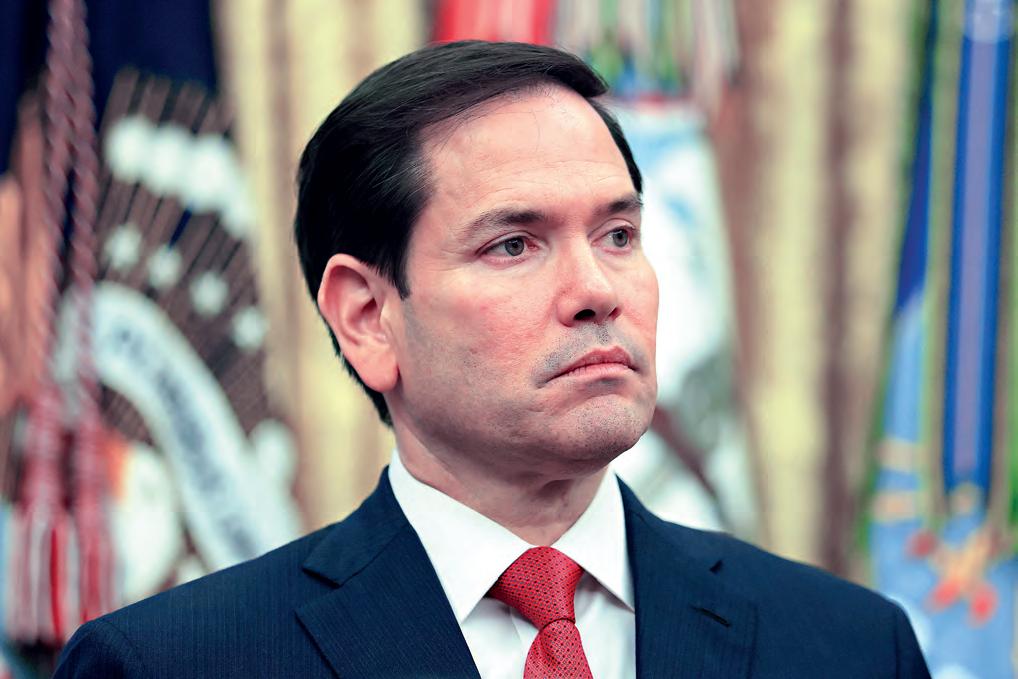
not respect geopolitical boundaries and is evidence that weakened healthcare systems anywhere in the world can have ripple effects on the US. Despite attracting unprecedented criticism, the Trump administration contends that the AFGHS will make the US safer, stronger and more prosperous. Through the strategy, the US intends to pivot away from open-ended aid to a system that puts emphasis on accountability, clear objectives and defined milestones within stipulated timelines. In essence, the era of blanket funding is gone.
The administration has built a strong case for AFGHS. Top of the list is the need to address inefficiency and wastefulness. Of the billions allocated for foreign health assistance annually, less than 40 percent is used for supplies and healthcare workers. Of this, approximately 25 percent is used for the purchase of commodities while the remaining goes to employing healthcare workers. The fact that 60 percent is spent on ambiguous expenditures and overhead smacks of wastage.
PEPFAR is the poster child of wastage, according to the US State Department. Of its $4.7bn budget, the programme spent $1bn on medical commodity purchases, transport and delivery and $600m on its 270,000 frontline workforce. The remaining $3.1bn was spent on activities such as training, mentorship,
supervision, and quality management among others. AFGHS is also designed to cut out the roles of non-governmental organisations (NGOs) in US-funded programmes. To the Trump administration, NGOs have been co-conspirators in aiding wastage with their ‘perverse incentives’ enabling them to selfperpetuate. For the strategy to be effective in saving millions of lives and assisting countries in developing resilient and durable health systems, removing NGOs from the equation and transitioning programmes to local ownership is seen as critical.
Though saving taxpayers’ dollars is paramount, the pillars on which AFGHS stands are causing disquiet across the globe, specifically among countries that are dependent on US health assistance. With regards to keeping America safer, the US intends to strengthen global surveillance systems to detect outbreaks to ensure quick response before they reach its shores. Part of this will involve posting a larger number of staff in geographies perceived as highrisk when it comes to outbreaks. To some, this amounts to an invasion of countries’ independence in managing the sovereignty of their health systems.
With regards to making America stronger, the plan is to enter into strategic multi-year bilateral agreements that require countries to co-invest, while on the prosperity pillar, the US will be seeking to create markets for
Spent by USAID in Africa between 2001 and 2024
THE HEALTH FUNDING GAPS THAT HAVE BEEN CREATED ARE WIDESPREAD AND
its companies and innovators. Specifically, countries that sign the agreements will be required to open their markets to US health innovations and products. Africa, where the US is aggressively pushing AFGHS, is a key target considering that US pharmaceutical exports to Africa account for only 4.4 percent with India, China and Europe dominating.
“The US is clearly leveraging its central position on the global stage as one of the few actors capable of mobilising financing at scale in an increasingly extractive and transactional way,” states Lami Mabifa, a consultant at Africa Practice. He adds that the explicit linkage between global health cooperation and US national interests could prove highly disruptive.
This is already happening. Critics reckon AFGHS is not only exposing the globe to vulnerabilities of outbreaks but is also a clear representation of modern-day biomedical imperialism by the US. Since its launch in September 2025, at least 28 countries (22 of them in Africa) have signed memoranda of understandings (MOUs) with the US. Most have signed under duress because they need to fill gaps in health funding, a reality amplified by the fact that Africa’s health sector faces a staggering $66bn in annual financing gap.
For the countries that have signed the bilateral agreements, US State Department data show Washington has availed $12.7bn in assistance with partner governments
contributing $7.8bn in co-financing commitments. This notwithstanding the fact that most countries are feeling the heavy weight of co-investing. A case in point is Nigeria. While the US is contributing $2.1bn, the country is required to raise $3bn, an amount that is close to 40 percent of its 2025 health budget allocation.
While at one level the co-investment provisions respond to a longstanding concern across Africa that external aid can foster dependency and leave health systems vulnerable when donor funding is withdrawn, on another level it is locking countries into spending commitments that are difficult to meet. The challenge is compounded by the fact that in some of the MOUs, the US is tying financing to sensitive data sharing. For instance, countries are required to share biological specimens and genetic sequence data of pathogens with epidemic potential in the shortest time possible after detection. Besides, some agreements have locked data and specimen sharing arrangements for up to 10 years, well beyond the funding cycle. These conditions have become the breeding grounds for resistance. Zimbabwe is among countries that have turned their backs. Despite being eligible for $367m in US funding, Harare refused to commit after it was told to share sensitive data. A near similar situation unfolded in Kenya, the first country to sign the MOUs. Despite securing $1.6bn in funding, implementation was suspended by the High Court over concerns on data protection and the constitutionality of the agreement. In Zambia, the US plans to arm-twist the country and tie a $1bn funding to access to critical minerals such as copper, cobalt and lithium ended up backfiring.
“Global health crises cannot be contained through a patchwork of bilateral agreements,” notes Barry. She adds that outbreaks demand cooperation, coordinated, multilateral responses rooted in trust and shared responsibility. “Retreating from multilateral institutions undermines both US security and global preparedness.”
Part of the reasons why the agreements are being termed as ‘patchworks’ is because they are time-bound (averaging five years) and also contain withdrawal clauses, with any party free to exit upon giving a notice of 180 days. This creates room for abrupt disruptions of programmes, some of which are designed to run for years. n

As demand for moderation grows, beer’s lower-alcohol profile and global reach position the $878bn industry to lead the next phase of drinks market growth
WORDS BY Justin Kissinger PRESIDENT & CEO, WORLD BREWING ALLIANCE
UK who drank alcohol said their weekly consumption had decreased since first trying lower- and no-alcohol alternatives.


In supermarket aisles and across pubs, bars and restaurants today, lower- and noalcohol options are becoming staples of the modern drinking landscape. Consumers are embracing moderation and driving the rapid expansion of the lower- and no-alcohol beverage market. For consumers seeking a lower- or no-alcohol drink, beer is the obvious choice.
With a lower alcohol content than most beverages in the category, beer is moderate by nature. Typically sold at or under five percent alcohol by volume (ABV), a beer contains significantly less alcohol than say, a Negroni, Martini or Old Fashioned, which are made with hard liquor at 20–30 percent ABV or more, or a glass of wine at 12 percent ABV. But a beer is still a beer no matter how much alcohol it has. A unique interplay of malted barley sweetness, hop bitterness and yeast esters during fermentation make up the character of a beer, and brewers preserve this character in their lower- and no-alcohol alternatives in a way few other beverages can achieve.
The global beer industry is uniquely positioned to deliver on the cultural shift towards moderation that we are seeing today, and brewers around the world have risen to the occasion (see Fig 1). IWSR forecasts noalcohol beer and cider will contribute nearly 70 percent of the overall no/low-alcohol
growth between 2022 and 2026, while a report from the European Commission reveals beer and cider make up 97 percent of the EU’s lower and no-alcohol market.
Today’s moderate drinking landscape has obvious benefits for policymakers’ public health objectives too. Substituting highalcohol beverages, like hard liquor, with lower-alcohol options, like beer, is a timetested, evidence-based way to improve public health outcomes.
A comprehensive study on the impact of alcohol policies in Russia by WHO Europe found policies shifting consumption away from high-strength alcohol beverages towards lower-alcohol beverages were associated with improving multiple public health indicators, while a study by the Portman Group revealed one in five (21 percent) of consumers in the
The beer industry also supports thriving communities. While many global industries can tout big contributions to global GDP, the beer industry lifts up local economies in a unique way. 86 percent of brewers’ supplier spending is in local markets. From hops and barley farmers to trucking companies to hospitality, beer is the backbone of a robust and varied value chain. The productivity of those employed by brewers is also significantly higher than the average worker, driving economic growth and income opportunities, particularly in developing nations. Oxford Economics found brewers generate $117,000 of GDP per worker in lower-income countries, more than 18 times the average.
But a thriving community is about more than just economics. Pubs, bars and restaurants are at the heart of our communities, providing a positive space for people to come together, connect and create shared experiences in a tradition that dates back thousands of years. A strong beer industry is vital to prolonging the life of these businesses, which sit at the core of local communities around the world. Now that lower- and no-alcohol beers are available in most local establishments, the beer industry has helped make pubs, bars and restaurants more inclusive than ever before, as customers can still enjoy the custom of sharing a beer –and the individual, social and community benefits it brings – with or without alcohol.
Policymakers can support this industry Beer supports positive public health outcomes, strong economies and thriving communities. And the regulatory environment can support the industry to do even more. We are calling for policymakers around the world to regulate alcohol according to beverage type and strength, which would encourage the production and consumption of lower alcohol-strength products like beer. Many OECD countries are already leading the way by applying lower excise tax rates to beer than to hard liquor and o ering even lower rates for lower- and no-alcohol options.
By creating a supportive regulatory and fiscal environment for brewers to do business, policymakers can ensure the beer industry continues to deliver positive outcomes to local communities around the world. ■


Narendra Modi’s government has spent more than a decade attempting one of the most ambitious economic transformations in modern history. From freight rail and green energy to manufacturing and maritime trade, India is betting big on infrastructure-led growth – and the world is starting to take notice. Selwyn Parker reports »
When a container is hoisted ashore at Jawaharlal Nehru Port in India, it is placed aboard a high-capacity freight train running from Mumbai to the industrial cities of Dadri and Khurja in Uttar Pradesh 1,500 kilometres away. The container is lifted off a day later, much faster than in many other countries, including America.
Even more impressive, the entire highspeed route is now electrified, with the final sections hooked up in January 2026 in a pivotal moment for India. Before electrification, the container would have taken three to four days. Not only did this last connection complete the country’s longest rail freight link, known as the Western Dedicated Freight Corridor, it gave India one of the longest electrified rail systems in the world. India has electrified 100 percent of its network, which is right up there with Switzerland, one of the jewels of railroads.
By comparison, the UK can claim 37 percent rail electrification and America just one percent. The rapidity of electrification is astonishing – during the last six years Indian Railways was adding over 15 kilometres every single day. The result is that today India boasts
no less than 70,000 kilometres of electrified broad-gauge rail that is part of a grand plan to modernise all its vital systems – transport, energy and shipping – under the government of Prime Minister Narendra Modi. This remarkable achievement symbolises a continuing economic rejuvenation that has largely escaped the world’s attention.
Since Modi won power in 2014 after decades of socialist governments, these policies were dubbed ‘Modinomics,’ mostly by critics who said they weren’t working – or at least not as well as was promised. Supporters however said reform was long overdue in a country notoriously difficult to govern.
With 28 sprawling states and eight territories spread over a vast area, India is the seventh biggest country in the world in terms of geography and one of the most culturally diverse. And with a population of 1.47 billion, it is the most populous. “Significant hurdles persist, including entrenched bureaucracy, social fragmentation, and deep-seated political divisions,” notes an article in Springer Nature that summarises the challenges of reform. »
One of those significant hurdles was the labour market. When Modi introduced radical changes to employment laws in 2014 that were designed to weaken obstructive union power and boost the creation of jobs, nearly 150 million workers in banking, manufacturing and construction immediately went on strike for 24 hours at a cost of $3.5bn to the economy. Even rickshaw drivers stayed at home in sympathy. Yet the reforms are seeing results. According to Australia’s Treasury, the economy forged ahead at an annual rate of between 6.5 and seven percent during Modi’s first 10 years in power – that is, to 2024 – and “maintained its position among the world’s fastest-growing major economies despite a significant contraction in 2020 due to the pandemic.” Most analysts including the International Monetary Fund predict a rosy longer-term outlook with a similar growth rate persisting all the way through to 2035.
However, in a nation of volatile politics, Modi continues to attract his fair share of criticism for making changes, however overdue they may have been. And one of the most overdue was what is known as ‘the demonetisation of the currency.’ With just a few hours’ notice, on November 8, 2016, the 500 and 1,000-rupee bank notes were replaced in a move to put a stop to the longrunning practice of ‘black money’ – cash used for illicit activities that had escaped the tax net and was being used to fuel terrorism, among other purposes. The demonetisation was comprehensive, covering 86 percent of the currency.
But did it work? Some economists say it didn’t because the action caused serious economic disruption for a few months, but others point to the long-running damage caused by the existence of this parallel economy. As Bhaskar Chakravorti, Dean of Global Business at The Fletcher School at Tufts University wrote for the Brooking Institute a year later, only one percent of Indians had been declaring their earnings for tax purposes.
But suddenly, the money ended up back in the system: “When the policy change was announced, people were given until December 30, 2016, to return 500 and 1,000 rupee notes to banks, or else risk losing the value of them. Banks were estimated to have received 14.97 trillion rupees ($220bn) by the deadline, or 97 percent of the 15.4 trillion rupees’ worth of currency demonetised.
Also, as other economists explain, demonetisation gave a massive boost to cashless payments such as Paytm’s mobile wallet business and, more importantly for the long run, in the intervening years the tax base has widened. The government followed




Demonetisation gave a massive boost to cashless payments
up by overhauling a confusing system of local consumption taxes with the introduction of a centralised goods and services tax.
The Modi government sometimes shoots itself in the foot by setting sky-high goals and making what the critics describe as ‘grandiose claims.’ For instance, a key reform is ‘Make in India,’ a strategy intended to turn the country into a manufacturing powerhouse by, among other measures, encouraging foreign investment and technology. Unveiled in 2014, the targets were unrealistically high – a doubling of manufacturing’s growth rate, the addition of 100 million jobs in the sector by 2022, and a 25 percent share for manufacturing in gross domestic product by the same year. As it happens, there has been a decline in the sector’s share of GDP and only a small growth in employment.
Part of the blame can be attached to India’s outdated manufacturing structure. Nearly three quarters of manufacturers employ less than five paid staff. And they are historically highly unproductive. It is widely accepted that these small enterprises put out less than 20 percent of the volume of products of larger Indian manufacturers and way less than similarly sized factories in western nations, especially the US.
Red tape is a big part of a historic productivity problem. With regards to India’s


economic bottenecks the IMF states, “Many of these enterprises remain small for decades due to complex compliance requirements, rigid labour regulations and product market rules that discourage growth. Easing these constraints would help businesses expand and, in turn, dramatically lift productivity.”
However, there is no magic wand and Modinomics constantly runs into impasses. “While employment in the manufacturing sector has grown, the ‘Make in India’ push has not resulted in manufacturing outpacing other sectors of the economy in employment generation,” notes an article in The Print, an independent news platform. “Another priority area for the initiative was to boost exports and cut down on imports. The data over the last 10 years revealed the programme has failed to do the former but has been marginally successful in achieving the latter, although even this improvement has recently been reversing,” the article continued.
Yet under Modinomics manufacturing has been reconfigured away from heavy industry towards high-margin and higher-potential sectors such as electronics, defence and electric vehicles. Without ‘Make in India’ it is unlikely that the production of mobile phones, for instance, would have quadrupled in value between 2016 and 2024, or that India would become one of the world’s biggest manufacturers of solar panels. The Modi government also set an audacious target for an all-electric transport sector by 2030, a deadline that outdoes even China’s ambitions. When this was announced in 2015, it certainly looked like a grandiose goal.
At that time just one percent of the country’s 200 million vehicles were electrically powered and only one domestic




100%
Of India’s rail network has been electrified
1.47 billion
The population of India
39%
Drop in India’s emissions intensity between 2005 and 2023 7%
Annual growth of India’s economy during Modi’s first

powered car in the showroom. Called FAME (Faster Adoption and Manufacturing of Electric Vehicles in India), the programme was designed to start with rickshaws and move on to commercial vehicles, most of which are little two and three-wheelers, and then buses. Cars would come last.
To help along the transition, manufacturers were awarded tax breaks to build cars without batteries; these would be available in battery-exchange stations where the swap would take about two and a half minutes. The idea was that the subsidised battery-free vehicles would cost up to 70 percent cheaper than with batteries. A lot of automotive companies could see the potential, including Honda and Piaggio. In fact, the Italian scooter manufacturer quickly established a 100 percent-owned subsidiary in India. Both companies have adopted batteryswapping strategies. Shell could also see the potential of the strategy.
95,000
Electric vehicles sold in India in
1.6 million
Electric vehicles sold in India in

As Kasturi Gomatham, the energy giant’s global head of battery swapping, told a conference around that time, “Battery swapping decouples certain critical links that inherently create bottlenecks for EV adoption. For instance, the concept decouples grid from that of the dynamic EV-charging needs and decouples battery from the vehicle itself. This enables users to not feel the brunt of the battery upfront cost and extend vehicle life beyond that of the battery packs.”
And how did this work? According to an article by the World Economic Forum, “battery swapping technology is a growing trend that could potentially turbo-charge EV sales.”
Battery swapping technology is a growing trend that could potentially turbo-charge EV sales
One company, SUN Mobility, certainly thought so. The Bengaluru-based startup began by exchanging shoe box-sized batteries at 50 stations spread over 14 cities under a pay-as-you-go subscription service run on Microsoft’s Cloud. Simultaneously with FAME, the Modi government ordered the nation’s refineries to embark on a $46bn conversion to lower-emission fuels, a decision upheld by the Supreme Court.
But let’s look at what has happened since. A recent review by the International Society of Markets and Development (ISMD) sees significant developments in the EV market that was mainly driven by highly systematic government policies to reduce urban emissions and promote sustainable mobility. But while noting how FAME has fallen short of expectations, it also says that “both stages of FAME have been pivotal in shaping the EV ecosystem in India, addressing the challenges of affordability, infrastructure and market growth.”
But where would India’s road transport be without FAME? So far it has increased EV adoption nationwide by about 50 percent, “but primarily in the two-wheel market,” notes ISMD. Buses and cars are lagging behind, but the latter are less important in the race to electric transport because only 7.5 percent of Indians own four-wheeled cars. As for SUN Mobility, the latest data showed over 1.4 million swaps a month at nearly 650 stations across over 20 cities. Battery-swapping has been a roaring success.
The birth of the e-rickshaw is a portent of India’s energy future. At the start of 2026 there were about 270 million two-wheelers in India and about 10 million three-wheelers, the vehicle of choice for transport in teeming cities, for deliveries and taxis. “As India’s pivot from fossil fuels to clean energy accelerates, these vehicles are helping drive the switch,” explains one motoring expert.
Half of India’s imports of oil are burned by vehicles, but that is expected to fall as more e-rickshaws hit the road; this would enable Modi’s biggest goal – a zero-emission nation by 2070. The Colorado-based Rocky Mountain Institute calculates that as early as 2030 about 80 percent of two and threewheelers sold in India could be electric and make a substantial contribution to the zeroemission goal that gets closer almost by the day. The volume of sales certainly looks promising, having jumped from just over 95,000 EVs in 2017 to 1.6 million in 2024.
The Atlas think tank summarises, “EV sales in India have seen a remarkable upward trajectory in recent years, largely driven by growth in the two- and three-wheeler segments,” citing a compound annual growth rate of 61 percent. In the salt deserts bordering Pakistan, the world’s biggest renewable energy project is under development. The Khavda renewable energy park, covering an area five times the size of Paris, will produce 30 gigawatts of green energy from highefficiency solar modules and hybrid solarwind systems. Run by Indian group Adani Green Energy, it is due for completion as early as 2029, when it will power over 16 million homes.
Currently about half of India’s installed power capacity comes from non-fossil sources such as solar, wind and hydroelectric. Once again, the government is nothing if not ambitious, with a target of providing 500 gigawatts of non-fossil capacity and five million tonnes of green hydrogen that will be used to clean up the steel and other heavy industries. All this is due to happen by 2030 in what some saw as yet another grandiose
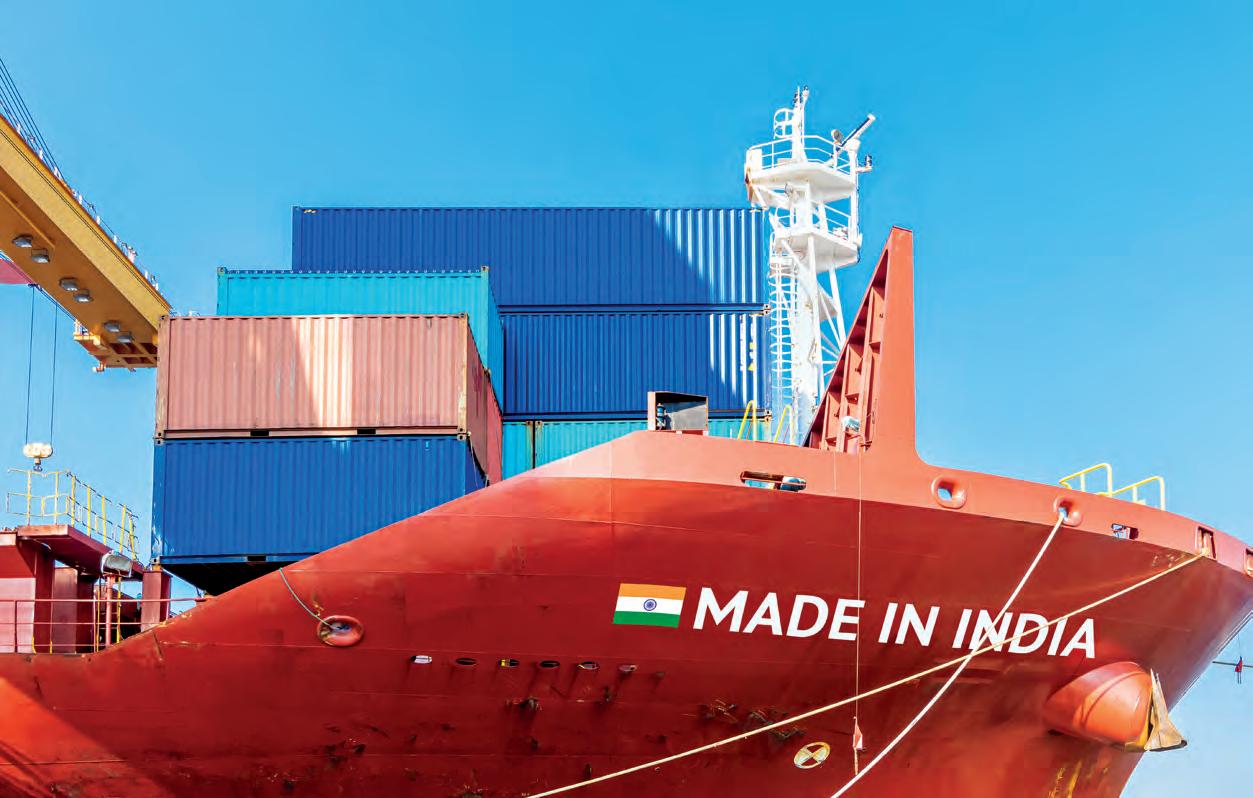
Modi’s biggest goal is a zero-emission nation by 2070
scheme, but so was the electrification of the railways and it was done four years early. Although India still uses a lot of coal – “a critical source for grid stability,” according to energy experts, the direction of travel is clear. Forests are being planted to create a gigantic carbon sink of 2.5 to 3.0 billion tonnes of CO2 equivalent. Water is being managed more scientifically. Attention is being paid to the Himalayan ecosystem. The critics can’t complain that India has fallen short in its clean energy ambitions. Between 2005 and 2023, its emissions intensity was slashed by 39 percent, which is ahead of target. It is the world’s third-largest producer of solar energy and could overtake China in the number of solar-powered homes. And production of renewable energy is also beating official goals.
True to form, when the government launched a revival of India’s neglected maritime industry, it immediately ran into a disjointed federal system of governance with powerful political cliques running rival states that almost routinely refused to cooperate with each other – or just couldn’t be bothered. Yet this equally ambitious programme is happening. The country was once a maritime power based on natural credentials. It has an 11,000-kilometre coastline. The Indian Ocean, the third largest in the world, links
the country to the Middle East, Africa, South Asia and Southeast Asia. India is near four maritime chokepoints – the currently beleaguered Strait of Hormuz, Bab-elMandeb, Malacca Strait and Lombok Strait. And there are the military implications – Modi is concerned about an aggressive China, which is busily establishing ports and infrastructure in the Indian Ocean.
“Militarisation of the Indian Ocean region is not desirable,” the government has warned. Despite a sluggish bureaucracy, India’s got off to a good start in its maritime ambitions. In early 2026 the container shipping giant, CMA CGM, placed a landmark order for six LNG-fuelled vessels to be built at India’s Cochin Shipyard. They aren’t huge ships, with a capacity of just 1,700 containers each, but they will advance the expansion and renewal of the country’s ports, shipping industry and coastal trade.
In another boost CMA CGM will recruit 1,500 Indian seafarers, establish an R&D hub, register some of its vessels under the Indian flag, which helps build local trade, and support sustainable ship-recycling, a growth industry where India aims to be the world leader. Other container giants look like they will follow suit.
Simultaneously, India is building deepdraught mega-ports like Vadhaven 150 kilometres from Mumbai that is due for completion in 2034. When it opens, Vadhaven will rank among the 10 biggest ports in the world and it is strategically placed in a key trading corridor that links India with the Middle East and Europe. Already trade deals are being signed along this valuable supply line. Construction is finally due to start in another mega-port in the Bay of Bengal

after years of legal challenges, red tape and the local opposition that have historically blighted important economic projects in India and, in the case of shipping, prevented modernisation. Impatient with such delays, in 2025 the government passed laws that simplify paperwork and improve cross-port cooperation. The Ministry of Ports, Shipping and Waterways is in a hurry, acknowledging “the capacity of the ports in terms of their berths and cargo-handling equipment needs to be vastly improved to cater to the growing requirements of overseas trade.”
India may soon also have its very own state-backed container line. In early 2026, the government approved a $1.66bn kick-start for an all-Indian shipping company that may also exploit the country’s 14,500 kilometres of largely neglected inland waterways. According to a study by the Observer Research Foundation, a not-for-profit Indian think tank, “it is only now that they are beginning to be used for commerce.” Current ambitions intend that this vast interconnected natural network will soon carry four times its current capacity in what would be a massive boost to trade along its banks. In maritime matters India has a long way to go – its merchant fleet ranks just 18th in the world – but the government has earmarked $7.7bn that will be dedicated to this economically vital project over the next decade.
About half of India’s installed power capacity comes from non-fossil sources
The government is tackling corruption, albeit slowly. Only a few short years ago India was infamous for dirty dealing. In the first decade of the millennium the World Bank cited the ‘Mafia Raj’ among other miscreants who got their hands on development funds intended for roads, bridges and other much-needed infrastructure. At the time India was the World Bank’s single biggest borrower and the institution was trying to place people of integrity along the funding pipeline to make sure the money ended up in the right hands, such as a billion-dollar, interest-free loan to clean up the Ganges River.
The situation was so serious that India’s then chief justice, K.G.Balakrishnan, bemoaned at an anti-corruption conference how “the quality of governance suffers when decisions are made on account of extraneous considerations related to political patronage, kinship or caste and linguistic identity among other factors.” Back then Transparency International ranked India at 84th on its Corruption Perception Index, right up (or down there) with Guatemala and Panama. India’s Central Bureau of Investigation (CBI) was burdened at that time by well over 9,000 pending cases, 2,000 of which had been pending for a decade or longer.
But endemic corruption is hard to root out and despite the best efforts of the Modi government, in 2026 India ranked 91st in the index, roughly halfway. However, it appears the CBI is making some progress. In late 2025 it reported just over 7,000 pending cases, of which 2,660 were 10 years old and 380 a full 20 years old. Petty corruption is down, for instance small bribes to various government
agencies, while senior tax and customs officials have been kicked out for highlevel fraud. Meanwhile, one of India’s most successful innovations is in sport, although the Modi government can’t take the credit here.
Every year the world’s best cricketers flock to the India Premier League, a sporting spectacle founded in 2008 by the Indian Board of Cricket Control. Judged by revenue, it is among the top 10 most valuable sports league in the world. It is based on an original franchise model in which the teams are owned by rich corporations and celebrities. As one fan, a rich businessman, explained, this 20-over format is “a high-action alternative to the five-day game” that is seen as a symbol of the country’s commercial as well as sporting creativity. “It is not just replicating something else; it is creating a new business model,” he summarised. Indians are extremely proud of the league because it is home-grown, just as they are of their rail system.
Just to recap, it was in 2014 that the Modi government began to pour funds into a fully electrified railway. The results were off the scale. While Britain, for example, as a rail enthusiast points out, is electrifying its railways at a speed of two kilometres a year and while the US isn’t even matching that, Indian Railways was quadrupling its electrification programme. In the 2022–23 financial year, for example, no less than 6,565 kilometres of track was hooked up.
“India’s rail crews got more done by their mid-morning tea-break on January first than Britain got done all year,” wrote the rail expert. And nor would that have happened without Modinomics. n
The Econoclast


David Orrell AUTHOR AND ECONOMIST world finance
Toronto’s once-booming condo market has stalled abruptly, exposing the risks of speculative demand and outdated economic models – raising deeper questions about how markets price uncertainty and adapt to sudden shifts
Those familiar with the British sit-com The IT Crowd, which was about workers in the IT department of a firm, and premiered in 2006, will remember the catchphrase “Have you tried turning it off and on again?” which was their go-to response for any technical computing problem. A similar technique is currently being applied to the real estate sector in Canadian cities such as Toronto, especially for the market for new condominiums (or condos).
For the last decade and more, Toronto has been the construction hub of North America, its skyline studded with more cranes than any other city. Underlying all this activity was the unquestioned belief among investors that real estate was a safe investment. This was the case even during the Great Financial Crisis (GFC), which the Canadian economy endured quite well, in part because banks did not resort to the same complex financial derivatives as did their counterparts in the US. After the briefest of dips, house prices showed explosive growth, doubling over the next 12 years and almost tripling by the time they reached their glorious peak in 2022.
Usually this growth was attributed to demand from an expanding population, which fits with the traditional view that price rises are typically driven by excess demand. In reality, the number of houses being sold was fairly static. The only kind of property that was selling like hot cakes was the kind that didn’t actually exist: pre-construction condos.
Often these were ‘shoebox’ apartments that were intended more as an investment than a place to live, and represented a kind of futures bet on the market. The majority were purchased by investors, who could put down a small deposit before construction began, and expect to sell at a profit just before completion to an end-user or another investor. Mainstream economists saw no problem with
this because on the surface it seemed the economy was doing well. The central bank cut interest rates to the bone, since according to their metrics, which didn’t account for house prices, inflation was quiescent.
When official inflation jumped in the post-Covid years, interest rates bounced off their lows. Mortgages suddenly became more expensive. Population growth, which was almost entirely due to immigration, which peaked at around 3.2 percent in 2022, compared to an average 0.5 percent for G7 countries, was suddenly thrown into reverse, with Canada actually reporting a small decline in 2025 for the first time on record. The real estate market on the whole adjusted to these contortions with a decline in both sales and prices. But the market for pre-construction condos didn’t adjust – it just stopped.
THE
In December 2025, only 87 preconstruction units were sold across the entire Greater Toronto Area, which has a population of about 7.8 million. That is the lowest single-month total in the 45 years that data has been tracked. Developer activity also ground to a halt, with just 10 new condo projects launching throughout the entire year, compared to the dozens typical in a healthy market. Remaining new home inventory hit a record high equivalent to over two years of sales. And in the first quarter of 2026, things really iced up, as zero new projects were launched. There is a sense though that this reset is about more than just pre-construction condos – it is about how we think about the economy.
The GFC was a crisis not just for the economy, but also for the field of economics. Not in the sense that economists actually lost their jobs, but because their models failed. Economists had long assumed that probabilities could be described by a so-called normal distribution, or bell curve as it is sometimes known.
However, risk models based on this assumption quickly broke down when it turned out that so-called tail events had a much higher chance of occurring than the model suggested. And mainstream economics, which was based on the idea that the economy is a rational, efficient, selfstabilising system – which is immune to things like booms and busts – was thrown into a state of complete crisis along with the economy.
While the field of economics is famously resistant to change and new ideas, a couple of decades later, things do show signs of moving on, at least in some corners of the profession. In their recent book Adaptive Finance: Embracing Uncertainty and Complexity, economists Frank Fabozzi and Sergio Focardi write that “The need for models predicting tail events and market anomalies has become increasingly apparent after the GFC.
“Traditional models, which often rely on normal distributions and the assumption of efficient markets, could not predict the extreme events that characterised the crisis, such as the collapse of major financial institutions and the sudden freeze in credit markets.”
It is no surprise that in the “new paradigm in economics and finance” described by Fabozzi and Focardi, “the deterministic models of the past are giving way to new approaches that embrace uncertainty.” As another market freezes up in front of us, it is past time for economists to embrace these new insights. Instead of just saying, “Let’s try turning it off…” n