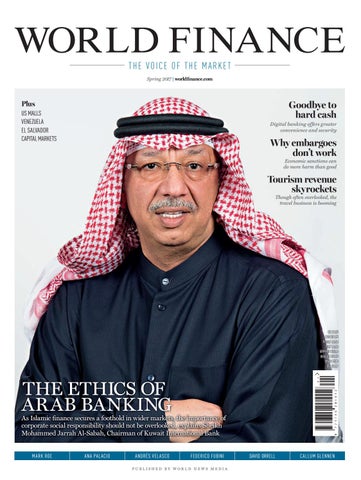
THE VOICE OF THE MARKET Spring 2017 | worldfinance.com
Goodbye to hard cash
Plus US MALLS VENEZUELA EL SALVADOR CAPITAL MARKETS
Digital banking offers greater convenience and security
Why embargoes don’t work Economic sanctions can do more harm than good
Tourism revenue skyrockets
Though often overlooked, the travel business is booming
UK £4.95 CAN $14.75 FRANCE €6.50 ITALY €6.50 GERMANY €15.00 BENELUX €11.95 SPAIN €7.00 USA $8.99
Spring 2017 | worldfinance.com
THE ETHICS OF ARAB BANKING
As Islamic finance secures a foothold in wider markets, the importance of corporate social responsibility should not be overlooked, explains Sheikh Mohammed Jarrah Al-Sabah, Chairman of Kuwait International Bank MARK ROE
ANA PAL ACIO
ANDRÉS VEL ASCO
FEDERICO FUBINI
DAVID ORRELL
CALLUM GLENNEN
PUBLISHED BY WORLD NEWS MEDIA
W17MA_Cover.indd 1
30/03/2017 10:18
W17MA_001_Z01_57908.pdf
Your Your Bank Bank i More More than than 190190 Branches Branches More More than than 1,51,5 million million Clients Clients Province Province of of
Luanda Luanda (117 Branches) (117 Branches)
Cacuaco Cacuaco
City City of Luanda of Luanda Viana Viana Belas Belas
BFA isBFA growing is growing with Angola. with Angola. With 16 With Corporate 16 Corporate Centres, Centres, 9 Investment 9 Investment Centres Centres and 166 andAgencies 166 Agencies acrossacross the country, the country, it nowit now servesserves more more than 1,5 thanmillion 1,5 million Clients. Clients. With aWith competitive a competitive and wide and range wide range of financial of financial services services available available and aand commercial a commercial network network that reaches that reaches almostalmost every part everyofpart the of country, the country, BFA isBFA growing is growing to meet to all meet its all Clients’ its Clients’ needsneeds wherever wherever they are they and arewherever and wherever they need they to need be.to be. For further For further information information on how ontohow start toor start strengthen or strengthen your business your business relations relations with Angola, with Angola, visit any visitBFA anyAgency, BFA Agency, Corporate Corporate Centre, Centre, Investment Investment CentreCentre or go or to go www.bfa.ao to www.bfa.ao
AF_420x288_World AF_420x288_World Finance_2017.indd Finance_2017.indd 1 1
W17MA_002_Z01_43597.pdf
k in in Angola. Angola. Cabinda Cabinda (7 Branches) (7 Branches) Soyo Soyo DundoDundo
Uíge Uíge Negage (2 Branches) (2 Branches) Negage
N’zageN’zage
CaxitoCaxito Province Province of Luanda of Luanda
LucapaLucapa
N’dalatando N’dalatando
Cacuso Cacuso DondoDondo CateteCatete Malanje CaluloCalulo Malanje Porto Amboim Porto Amboim GabelaGabela Waku-Kungo Waku-Kungo SumbeSumbe Bailundo Bailundo Kuito Kuito LobitoLobito Huambo Huambo Catumbela Catumbela(11 Branches) (11 Branches) (4 Branches) (4 Branches) Benguela Benguela GandaGanda Caála Caála (6 Branches) (6 Branches) Cubal Cubal Caconda Caconda Lubango Lubango (8 Branches) (8 Branches) Namibe Namibe
MatalaMatala ChibiaChibia
Saurimo Saurimo (2 Branches) (2 Branches)
LuenaLuena
Menongue Menongue
Tômbua Tômbua Ondjiva Ondjiva
Santa Santa Clara Clara (2 Branches) (2 Branches)
N
N
27/02/1727/02/17 16:27 16:27
W17MA_001_Z02_35916.pdf
WorldFinance_BTGPactual_288x428mm_V2.indd 1
W17MA_002_Z02_04951.pdf
BTG Pactual: Best Wealth Management in Brazil for the 2nd straight year World Finance Awards 2016
btgpactual.com
2/2/17 2:05 PM
W17JF_001_MSQ_44229.pdf
Terms and Conditions apply.
W17JF_002_MSQ_10885.pdf
IT'S ALL IN THE PHONE Snapp now lets you control your cards anywhere, anytime. • Left your card somewhere? LOCK it now and unlock later. • Lost your card? BLOCK it instantly. • Worried about overspending? Change spend LIMITS at will.
More unique features: Cardless Cash
Contactless Payment
International Bill Payment
Instant Money Transfer
The only bank in the region that makes it possible. Visit mashreq.com/sn or download Snapp
Contents Spring 2017
Features
40
40
86
114
64
100
134
Stability amid transformation
86
Maintaining solid growth in today’s uncertain economic climate is easier said than done. Sheikh Mohammed Jarrah Al-Sabah, CEO of Kuwait International Bank, talks to World Finance about the challenges facing the Arab banking sector
64
The end of money
The impact of economic sanctions
100
As nations begin to abandon cash in favour of digital banking services, the historic reign of paper money could be coming to an end. Yet in spite of the convenience offered by the likes of bitcoin and mobile banking, many people remain reluctant to part with their pennies
Riding the wave of tourism When considering which industries have the greatest impact on the global economy, the travel sector is often overlooked. In reality, the tourism industry influences all aspects of everyday life by shaping our cities and contributing vast sums to global GDP
GROUP MANAGING EDITOR:
EDITORIAL:
REPROGRAPHER:
WEB AND MOBILE DEVELOPMENT:
Michael Mills
Emily Cashen, Kim Darrah, Callum Glennen, James Stannard
Robin Sloan
Ben Debski, Scott Rouse
PRODUCTION COORDINATOR:
HEAD OF FINANCE:
Omaira Farina
Richard Willcox
MEDIA RELATIONS MANAGER:
BUSINESS DEVELOPMENT:
Charlotte Gill
Dustin Broadbery, Bryan Charles, Tom Crosse, David Hann, Mark Harrington, Tony Jordan, Lapo Niccolini, James Walters
FEATURES EDITORS:
Helen de Beer Temoor Iqbal DEPUTY EDITOR:
Elizabeth Matsangou
CONTRIBUTORS:
Federico Fubini, Mourad Mekhail, David Orrell, Ana Palacio, Mark Roe, Andrés Velasco
VIDEO PRODUCER: PRODUCTION ASSISTANT:
DESIGNER:
Max Tomlin
Sam Millard
Paul Richardson VIDEOGRAPHER:
ILLUSTRATOR:
114
Economic sanctions have become one of the defining features of today’s political landscape. However, for all that they have helped in resolving international conflicts without resorting to military action, economic measures do not come without their own high costs
The rise and fall of the US mall Once considered to be the heart of American suburban life, US malls are falling into disrepair. Amid vicious criticism of their impact on surrounding communities, these sprawling complexes are struggling to attract the same footfall as in their 20th century heyday
134
Survival of the masses Falling birth rates, longer lifespans and a rapidly shrinking workforce have pushed the world into an unprecedented demographic trial. In this special report, World Finance takes a look at what governments can do to turn this catastrophic state of affairs around
The information contained in this publication has been obtained from sources the proprietors believe to be correct. However, no legal liability can be accepted for any errors. No part of this publication may be reproduced without the prior consent of the Publisher. © World News Media Ltd, 2017 Printed in the UK. ISSN 1755-2915.
World News Media Ltd 40 Compton Street London EC1V 0BD United Kingdom Tel: +44 (0) 207 253 5100 Web: www.wnmedia.com
Editorial on p32–39 © Project Syndicate, 2017
George Mason
Richard Beacham
8
| Spring 2017
W17MA_F07_Contents.indd 8
30/03/2017 15:53
W17MA_009_F07_15711.pdf
Regulars 11
The Ledger
Banking 46
International financial news and analysis
24
26
Financial History We examine how military coups and financial crises affected Thailand’s journey to become a value-based economy
28
Profile
54
Comment Ana Palacio considers what Trump’s presidency could mean for the global economy, Andrés Velasco looks at Latin America’s populist policies, Federico Fubini questions what is ailing Germany’s GDP growth, and Mark Roe warns that the global housing system needs firmer regulation
154
Digital Banking
58
Commercial Banking
74
Microfinance
Wealth Management Awards Ghana is experiencing high inflation and slow growth, but its banks are helping the national economy get back on track
80
Financial services and tourism are both thriving in the Caribbean, making Antigua and Barbuda an ideal destination for overseas business
60
Brokerage The World Finance Brokerage Awards 2017 commend those firms that are succeeding in spite of immense and unparalleled pressure
The rise of firms offering exclusively digital services could change the face of the banking industry
Janet Yellen’s tenure as Chair of the Federal Reserve could be under threat
32
70
As Sharia-compliant banks enjoy another year of impressive growth, we celebrate the industry’s key players in the World Finance Islamic Banking Awards 2017
Global Review We take a look at which passports get you to the most places with the least trouble
Islamic Finance
Wealth Management
Asset Management One outcome of the global financial crisis has been a dramatic increase in the role of liquidity risk as a core element of risk assessment
82
Insurance
For decades, the microfinance lending model has been helping female entrepreneurs in developing nations lift themselves out of poverty
Financial innovation and new technologies have spurred economic growth in Turkey. The country’s insurance market is expanding as a result
Infr astructure
Str ategy
The Econoclast David Orrell criticises the disconnect between economics curricula and the real world
Markets 92
Commodities
106
Falling oil prices have created an unstable business climate in the Middle East, but the UAE’s metal market continues to flourish
96
Currencies
Capital Markets As nationalism threatens the continent, Europe begins to address the weaknesses in its capital markets
120
Modern cities are equipping themselves against the threat of terror in a variety of ways, but some architects are concerned such plans may backfire
108
China has been pulling out all the stops to increase the value of its currency, rendering its exports less competitive as a result
98
Public Infrastructure
Financial Bodies
We celebrate the firms that have implemented the best governance standards in the World Finance Corporate Governance Awards 2017
126
The IMF offers vital financial aid to countries in need, but some questions remain over where exactly its political motivations lie
112
GCC Investment & Development With solar power an obvious choice of renewable energy for the MENA area, Doha-based firm QSTec is working to ensure the region meets its full potential
Corporate Governance
Economic Development With El Salvador struggling to tackle widespread gang crime, there is little chance of its economy recovering from years of turmoil any time soon
140
Legal A universal basic income law could provide a solution to the current instability in international job markets
144
Government Policy The global oil price drop negatively impacted scores of countries, but Venezuela is alone in suffering such a profound economic crisis
Spring 2017 |
9
W17MA_001_Z05_06784.pdf
WHERE PASSION MEETS PURPOSE THIS IS YOUR PLACE.
This is your place for innovation. Where ideas meet capital and businesses thrive. This is the place built on a culture of collaboration. Where business and talent intersect. WHERE WORK COMES TO LIFE. THIS PLACE IS COLORADO.
www.choosecolorado.com
W17MA_011_F06_77213.pdf
c ol u m n i s t s
|
i n s ig h t s
|
a p p oi n t m e n t s
|
merger s
&
a c qu i s i t io n s
|
markets
The Ledger B U S INE S S NE W S & F I S C A L D I GE S T
A spotlight on China
Factory workers in Suining, China work on energy-saving lightbulbs. As part of the China Manufacturing 2025 initiative, extra investment has been pumped into 10 major industries. The nation's manufacturing activity has since expanded, reaching a Purchasing Managers' Index score of 51.6 in February, up from 51.3 in January.
Spring 2017 |
11
W17M
The Ledger Spring 2017
c ol u m n i s t s
i n s ig h t s
A modern Greek tragedy
TO READ MORE FROM WORLD FINANCE CONTRIBUTORS, VISIT: www.worldfinance.com/contributors
12
| Spring 2017
The rise and fall of public news American journalist Dean Baquet told CNN in February: “What’s happened in the last couple of months has been tremendous for news organisations.” He was half-right. Despite fighting the free press and labelling The New York Times, of which Baquet is Executive Editor, a “failing” purveyor of “fake news”, Donald Trump was elected alongside a 300 percent rise in Washington Post subscriptions, while 267,000 new readers joined The New York Times in the seven weeks to January. The phenomenon reaches beyond the mainstream. Breitbart, an American far-right news network, also felt a surge in interest, reporting a record 300 million page views and 45 million unique visitors in November 2016. Meanwhile, Drudge Report, another ‘alt-right’ site, realised 1.5 billion page views in July last year. But amid these flurries of interest, voices that were harder to categorise have been negatively impacted. Glenn Beck, a generally right-wing personality, allegedly suffered following his public criticism of Trump: the editorial department of his conservative website The Blaze was cut from 25 people to six last year, and unique visitors fell 75 percent between
These figures reflect a huge tug-of-war for the centre ground in the US media. But despite unprecedented engagement, global attention has been insufficient bait for advertisers, whose refusal to snap up space in printed newspapers endures. Since 2007, the web’s ascendancy, followed by the financial crisis, caused global VOICE of the
MARKET
October 2014 and September 2016. Public interest in news has boomed, but with discourse coalescing around two extreme poles, non-tribalising voices have become isolated.
Fig 1
Global print advertising revenue USD, BILLIONS
100 80 60 40 20 0 2001 2002 2003 2004 2005 2006 2007 2008 2009 2010 2011 2012 2013 2014 2015 2016 2017
It can be argued that the current state of the Greek economy truly epitomises the consequences of international lending with impossibly stringent austerity measures. Since the 2008 Elizabeth Matsangou financial crash and Greece’s resultant bailout in 2010, the country’s problems have gone from bad to significantly worse. The so-called troika – the IMF, the European Commission and the European Central Bank – issued Greece’s first bailout. The Greek economy and population have been subject to severe tax hikes and spending cuts ever since. Seven years later and social initiatives have been hit the hardest, while unemployment has soared to record highs, resulting in mounting public discord. To add to the chaos surrounding the Greek economy, its lenders are now in disagreement about how to best move forward. This deviation last reared its head in 2015, when the IMF refrained from joining a new bailout and left the EU alone to pledge €86bn ($93bn) over the course of three years. Today, the IMF’s involvement in another bailout for Greece – due in 2018 – hangs in the balance. This time, it is no longer just between the IMF and the EU: the situation has even divided the IMF itself, in a rare public split. During the body’s annual review of the Greek economy on February 7, some directors argued for a stringent fiscal surplus target of 3.5 percent by 2018, in line with the EU, while most of the board remained in favour of a more achievable 1.5 percent. Though the root of the contention, the IMF’s February review seems to clarify one thing: Greece requires greater debt relief. Severe targets run the risk of further expanding Greece’s debt, and so hindering its ability to achieve long-term growth. Yet this point seems to have been missed by most. Austerity measures have not worked in Greece, nor were they ever going to. As argued by Nobel Prize winner Paul Krugman since 2010: “Every country that introduced significant austerity has seen its economy suffer, with the depth of the suffering closely related to the harshness of the austerity.” Austerity doesn’t encourage growth: it stifles it. Just look at Greece.
SOURCE: GROUPM
Note: 2016 and 2017 figures are predictions
newspaper advertising expenditure to plummet from around $90bn to little over $50bn (see Fig 1). The recent and remarkable readership spikes occurred primarily online, where ad spending continues an upward trajectory from $150bn in 2015 to roughly $200bn in 2017. The tremendous Trump bump, therefore, has in fact boosted media revenues, albeit not across all platforms.
a p p oi n t m e n t s
c ol u m n i s t s
Snap crackles and pops
James Quincey ceo
Kevin Johnson ceo
Patrick Spence ceo
Coca-Cola
Starbucks
Sonos
On May 1, James Quincey will succeed Mutar Kent as CEO of beverage hegemon Coca-Cola. Quincey rose through the ranks after joining the company’s Latin America department in 1996, before being promoted to European President in 2013 and COO two years later. The brand value of Coca-Cola, which for years topped Interbrand’s league tables, began a dramatic decline in 2014, slipping into third place behind the ascendant likes of Apple and Google. As a major factor behind this deterioration has been the growing consumer demand for healthier food and drink products, Quincey – having spearheaded pro-health diversification initiatives under Kent – is expected to continue such reforms as CEO.
Coffee titan Starbucks has appointed long-time board member Kevin Johnson to fill the shoes of outgoing CEO Howard Schultz. Prior to joining the company eight years ago, Johnson cut his teeth in technology, having started his career at IBM in 1981 before moving to Microsoft in 1992. After departing the CEO position, Schultz will continue as Executive Chairman of Starbucks. In a recent interview with Squawk Box, he said Johnson “is much better prepared to handle the global operations of the company than I am at this stage”. Schultz nonetheless intends to keep Starbucks’ fiveyear plan on track by expanding its ‘exotic’ Reserve coffees through Roastery stores in various new locations.
Having established Californian speaker firm Sonos 14 years ago, long-term CEO John Macfarlane has handed the reins over to seasoned executive Patrick Spence. According to Macfarlane: “There isn’t a person who better embodies Sonos’ values and culture.” Spence worked at BlackBerry from 1998 and joined Sonos as Chief Commercial Officer in 2012. Although initial reports suggested Macfarlane would stay at the company, it later emerged he planned to vacate his board seat to allow Spence greater independence. Macfarlane has claimed the private company enjoyed more than $1bn in sales in 2015 and Spence likewise maintains Sonos' profitability will endure.
VOICE OF THE MARKET
Quincey has a difficult inheritance. Complaints that Coca-Cola products cause health complications reached a deafening climax in 2014, having troubled the company for years. Warren Buffet, whose success largely arose from backing the company in the 1980s, has said health-conscious Quincey’s promotion is a “smart investment”.
VOICE OF THE MARKET
Johnson’s accession reflects Starbucks’ turn toward technological innovation as a growth mechanism. He intends to extend existing mobile pay apps beyond North America, although digital infrastructure will be just one of the company’s frontiers: Johnson recently told shareholders he plans to double the number of Starbucks stores in China by 2021.
VOICE OF THE MARKET
Sonos plans to carve new paths into voice recognition technologies, which are currently upending the smart speaker market. Despite these innovations prompting layoffs last March, Macfarlane called this a “magical” time for Sonos. With the company gaining a new trajectory and a new leader within 12 months, Sonos has reached a pivotal point in its history.
With much fanfare, Snap – the company formerly known as Snapchat – launched its IPO to a storm of enthusiasm back in early March. After debuting its shares at $17 for a market Callum Glennen valuation of $24bn, Snap’s price rocketed up to close at more than $24 per share at the end of its first day on the market. Then, just as quickly, its value began slumping back down again. It didn’t take very long for investors and analysts to see past the excitement the company had been drumming up for months. The firm’s founder, Evan Spiegel, made all the right moves ahead of the IPO, including changing the company’s name to Snap to reflect the fact it is not just a social media platform but a camera company as well. Alongside this rebranding, Snap debuted its first piece of hardware: fancy sunglasses equipped with cameras, called Spectacles. In terms of generating interest, Snap’s rollout of Spectacles was a stroke of brilliance. By distributing the glasses from vending machines in hard-to-reach places, the news cycle was temporarily filled with stories of people mounting cross-country drives to try and pick up a pair. The fact the final Spectacles vending machine was located in New York City, just down the road from Wall Street, is also telling. It all made for a pretty convincing show that Snap really can diversify beyond Snapchat, and perhaps tap into that same synergy between hardware and software that has made Apple so successful. Despite this, Snap couldn't distract investors from the fact it is yet to turn a profit. In 2016, Snap lost $514.6m, and in 2015 it lost $372.9m. Despite having 158 million daily active users and generating $404m in sales last year, the company continues to bleed money. Still, none of this means Snap will not be a success. The network is still adding users at a tremendous pace, and its steps into hardware have shown it may have a more varied business model than the likes of Twitter, for example. But no matter how many cameras it sells, maintaining its current rate of user growth is the only thing that will continue to bolster Snap’s shares – and in the fickle world of social media, that’s a big gamble. TO READ MORE FROM WORLD FINANCE CONTRIBUTORS, VISIT: www.worldfinance.com/contributors
Spring 2017 |
13
W17M
The Ledger Spring 2017
c ol u m n i s t s
South Korea’s corruption scandal deepens In the most dramatic turn to date in South Korea’s sweeping corruption scandal, President Park Geun-hye became the nation’s first leader to be forced from office. Judges in South Korea’s constitutional court Emily Cashen voted unanimously to oust the tarnished president in March, upholding a December vote to impeach her on charges relating to fraud and cronyism. The monumental ruling was the latest development in a scandal that has deeply divided the nation. Moments after the court delivered its judgement, thousands of pro-Park supporters swarmed police vehicles outside the courthouse, two of them dying as the clashes turned violent. Just streets away, however, cheers erupted as anti-Park protestors celebrated the impeachment. North Korea also weighed in on the ruling, calling Park a “common criminal” in its state media. The ruling capped a stunning fall from grace for Park, whose presidential campaign centred on reining in the political influence of South Korea’s biggest family-owned conglomerates, known as ‘chaebols’. According to prosecutors, Park repeatedly colluded with many of the nation’s most powerful chaebols throughout her four-year term, taking bribes in exchange for political favours. The impeached president also allegedly allowed her close friend and aide Choi Soon-sil to mastermind government policy and intervene in state affairs. Now stripped of her presidential immunity, Park could well face criminal charges over these accusations. While the ruling will certainly have profound political implications for South Korea, it will also send shockwaves through the nation’s unique business ecosystem. Many of South Korea’s top conglomerates have been implicated in the high-profile scandal, including Samsung, Hyundai and Lotte Group. The corporate titans have already been questioned over suggestions they donated tens of millions of dollars to Choi in exchange for political influence. In the wake of these allegations, Samsung heir apparent Lee Jae-yong has been formally indicted on multiple charges, including embezzlement and bribery. If the courts find him guilty, Lee could face up to 20 years in prison, scuppering succession plans at the sprawling conglomerate. As prosecutors chase further arrests, South Korea’s top business leaders might be living on borrowed time. TO READ MORE FROM WORLD FINANCE CONTRIBUTORS, VISIT: www.worldfinance.com/contributors
14
| Spring 2017
m e r g e r s & a c qu i s i t io n s
Abbott’s $25bn pulse raiser In a move aimed squarely at portfolio diversification, global healthcare company Abbott Labs successfully purchased St Jude Medical for $25bn in January. Since Abbott has also adopted $5bn of debt, the deal’s total value stands at roughly $30bn. Abbott specialises in manufacturing devices for coronary interventions and treating mitral valve disease. Through the acquisition, the company doubled the size of its cardiovascular division, which will now account for 30 percent of its business operations. It was, however, forced to relinquish St Jude’s steerable sheath and closure device businesses to Japanese firm Terumo Corp for $1.1bn, in order to overcome an anti-trust challenge by the US Federal Trade Commission (FTC). The FTC noted the combined companies would otherwise control a “nearmonopoly”, with a 70 percent share of the vascular closure devices market. Abbott nevertheless celebrated its increased production capacity, while others have hailed its diversifications into atrial fibrillation and chronic pain treatments. Abbott said in a press release: “The [combined] company will compete in nearly every area of the $30bn cardiovascular market and hold the number one or two positions across large and high-growth cardiovascular device markets.” The costly takeover contributed to share fluctuations when it was announced early last year.
Nevertheless, with good groundwork for long-term growth and considering the company’s inroads into developing markets, there is upside potential. Miles D White, Chairman and CEO, said Abbott “has a strong track record” when it comes to acquisitions. This assertion may be contestable, however, considering the completion of the St Jude deal came mere days after Abbott announced it would halt a parallel takeover of Alere, a medical company US authorities subpoenaed in 2016 over bribery allegations. Alere’s diabetes division was then banned from the Medicare insurance programme for charging patients who were already dead.
M&A
M&A
CBOE joins the big leagues
City of Starz
February saw holdings company Chicago Board Options Exchange (CBOE) complete a $3.4bn takeover of Bats Global Markets, the second largest stock exchange operator in the US. The deal gives CBOE, which was already the exclusive home for S&P 500 index options, a market capitalisation of $10bn, nudging it into the ballpark of fellow big-slugger NASDAQ. Edward Tilley, Chairman and CEO of CBOE, said: “We are well-positioned to realise the benefits of joining Bats’ US and European equities, options, ETF trading and global FX platforms.” Bats, which sees €10bn ($10.8bn) worth of equities exchanged on its European platform and $50bn worth on its four US exchanges every day, should open doors for CBOE. Meshing the latter’s hybrid computerised and open outcry systems with Bats’ models could be the crucial ingredient in facilitating a smooth transition.
Healthcare firm Abbott Labs has acquired St Jude Medical for $25bn
Things began looking more La La Land in February as entertainment and media company Lionsgate closed a $4.4bn acquisition of US cable and satellite TV network Starz. In a joint statement, Lionsgate CEO John Feltheimer and Vice Chairman Michael Burns claimed the strategic opportunities looked “enormous”. The deal affords Lionsgate access to Starz’s near 25 million subscribers, five streaming services and the Starz pay app. The diversification means movies, which are notoriously hard to forecast, will now account for a smaller proportion of Lionsgate’s profits. Investors on both sides were positive about the acquisition, which received 95 percent approval from Starz’s shareholders and 98 percent from Lionsgate’s. Roughly one-third of Lionsgate’s existing common stock was subsequently reclassified with voting rights.
n e w s i n p ic t u r e s
Clean bill of health
Former US Vice President Joe Biden speaks outside the Capitol after an event celebrating the seventh anniversary of the Affordable Care Act. Following President Trump's failed attempt to overhaul the act in March, Biden told students at Colgate University he had regrets over not running for the presidency himself.
Spring 2017 |
15
W17MA_001_Z09_29273.pdf
C
M
Y
CM
MY
CY
CMY
K
W17M
The Ledger
Spring 2017
markets
v i de o s
Financial advisors need to listen to women
Medical marijuana plants grow in Johnstown, New York
North America’s green rush fundamentally bad bets due to hefty regulations and tax deduction barriers. Away from short-term market highs following emancipatory legislation, long-term momentum has tended to slump rather than endure.
Fig 1
North American marijuana value USD
200
150
100
SOURCE: THE MARIJUANA INDEX
MAR 2017
FEB 2017
JAN 2017
DEC 2016
NOV 2016
OCT 2016
SEP 2016
50 AUG 2016
The marijuana market is growing, and North Americans are coming to terms with a legal market with revenues in excess of $6.2bn in 2016. The mean value of suppliers like Cronos and Nutritional High International has trebled in the past 12 months, while Arcview – a US firm specialising in the development of the cannabis industry – forecasts five-year compound annual growth rates of 25 percent. Still, there’s a catch: the average value of marijuana suppliers across North America skyrocketed in September, before levelling out in January (see Fig 1). While the spike was driven largely by California’s decriminalisation of the drug, the following plateau was predominantly upheld by the Canadian market, in which recreational decriminalisation is hotly anticipated. This means that, even if Canada does pass a bill to fully legalise recreational marijuana this spring, the ensuing highs might prove to be somewhat ephemeral. Meanwhile, in the US, the haze has largely dissipated. According to the Marijuana Index, the market values of supplier companies settled at just double their previous levels. Indeed, before the furore, US suppliers gradually lost 75 percent of their value through 2015. Elsewhere, some have reasoned marijuana companies are
Despite 51 percent of wealth and 39 percent of investable assets in the US being controlled by women, many feel there is still a long road to parity. Adrienne Penta, Head of Brown Brothers Adrienne Penta Harriman’s Centre for Women and Wealth (CW&W), spoke to World Finance about the enduring challenges for women in the financial sphere. The problem, Penta said, is that most women “don’t think that their advisors understand their needs or are listening to them in the right ways”. Contrary to popular understanding among younger advisors, clients do not necessarily value wealth managers for their “really smart” market commentary or sophisticated tax planning. Rather, clients want somebody who can solve their hardest problems. Penta said: “In our case, these are usually about wealth and family and how they achieve their values and their legacy.” Financial advisors risk overlooking these demands if they fail to listen to their clients from the outset. More often than not, Penta said, women find their views go unheeded when they are put to financial service professionals. But despite this being a significant problem, Penta told World Finance it is one with “honest” roots: “It’s only really within the last several decades that women have become substantial creators and decision-makers with respect to family wealth.” Assumptions regarding who controls financial assets are therefore still being overcome in the social sphere. To correct this, Penta said her fellow advisors should be “really intentional and really thoughtful about how we engage women… and how we create an environment where all of our clients – specifically women, in this case – feel included and feel well served”. Brown Brothers Harriman has already installed structures to begin ameliorating these problems, particularly by establishing the CW&W. Led by Penta, the programme’s first goal is to create a community for women through networking events at the intersection of wealth, family and values. Its second goal is to offer women a well-established platform where they can engage with issues of family planning, philanthropy and legacy through the establishment of print and digital publications. Penta hopes this will give women the means to speak and be heard. TO FIND OUT MORE ABOUT THE CW&W PROGRAMME, VISIT: www.worldfinance.com/videos
Spring 2017 |
17
The Ledger Spring 2017
v i de o s
i n s ig h t s
A regularisation ultimatum Belgium’s approach to tax regularisation, the process by which the government oversees tax avoiders bringing their practices in line with the law, was recently changed in the hope of spurring Jonathan Chazkal more people to come clean. Whereas Belgium used to offer temporary amnesties to taxpayers (meaning tax regularisation laws were updated every year) Jonathan Chazkal of Aschrift law firm told World Finance that the newest law, which was introduced on August 1 last year, will remain in place indefinitely. As a consequence, he said, “Belgian residents only have one chance during their lifetime” to come clean. The international community is set to begin an extensive exchange of information relating to the tax affairs of their foreign residents. This threatens to expose individuals who owe tax payments but have managed to avoid paying them by hiding assets abroad. The costs of coming clean are relatively high, according to Chazkal: “The main issue of the new law is… you will have to pay 26 percent on the capital that existed seven years ago.” Nevertheless, he also said such costs could easily be justified by the benefits of not being caught. The forthcoming international information exchange will occur in two stages. ‘Early adaptor’ countries, mainly comprising EU members, will exchange information regarding the assets of their foreign residents in September 2017. A second group, which includes Dubai, Israel and Switzerland, will then begin communicating information from September 2018. Very detailed information will be passed between authorities in these exchanges, Chazkal explained: “The name, the tax identification number, the address, the end-year balance, the interests, the dividends of any foreign resident will be communicated to his country.” Furthermore, physical persons will not be the only entities to have their information exchanged: so too, Chazkal said, will the details of “the economic beneficiaries of every passive, non-financial entity”. Chazkal nonetheless qualified this by highlighting that tax regularisation and prosecution can be avoided if the economic beneficiaries of a body ensure the entity is active. Alternatively, the beneficiary could simply change their tax residence, although that would necessitate moving to another country. TO FIND OUT MORE ABOUT BELGIUM'S TAX LAWS, VISIT: www.worldfinance.com/videos
18
Central Bank of Nigeria Governor Godwin Emefiele with IMF Director Christine Lagarde
Nigeria’s new forex policy In its first such move in four years, the Central Bank of Nigeria (CBN) released $1bn of dollar-denominated bonds in February. Banks were so desperate that they bought them for eight times the price. A fortnight later, the CBN pumped $370m into 23 banks, specifically into funds earmarked for Nigerians seeking foreign currencies to pay for travel, medical and educational expenses abroad. The move came shortly after it was announced that President Muhammadu Buhari would remain in London for extended medical treatment. With a new forex policy and crossed fingers, Nigeria’s central bank claimed the naira could be hauled from troubled waters. The collapse in global oil prices, which triggered Nigeria’s present recession, led Buhari’s government to peg the naira to the dollar at 197-99 from March 2015. To conserve foreign currency, import restrictions on ‘non-essential’ items were imposed and domestic purchases were encouraged. The government was forced to remove
Critics worry the forex injections have encouraged ‘round tripping’, whereby foreign curMARKET rencies are purchased cheaply on the official market before being sold for higher prices on the parallel market. While the CBN has warned banks against circumventing the rules, Ukeje claimed they were also unlikely to VOICE of the
the peg in June 2016 amid corollary jolts to unemployment and inflation, but with sudden depreciation it was quickly reinstalled at 305 in late August. Some analysts claimed February’s injection of foreign currency into the economy, which caused the naira to fall to 520 on the parallel market before recovering slightly, reflected a new degree of independence for the CBN in Buhari’s absence. Emmanuel Ukeje, Special Advisor to the CBN Governor on Financial Markets, said: “Now that the CBN has come up with a policy that has returned [forex] into the confines of the inter-bank market, we believe strongly that this will take the demand off the parallel market, and we expect that the naira will strengthen.” Many believe a bailout is the only viable long-term solution, followed by the implementation of a floating exchange rate. Nevertheless, since such measures have a chequered track record, Nigerian decision makers have been reluctant to approve them.
retain foreign currencies, as they have before, given greater CBN monitoring. With regards to compliance, he said: “We are very positive that banks, being under the supervision of the CBN, have no choice.” Nonetheless, many remain unconvinced that forex retention – not to mention inflows into the parallel market – can be so easily quelled.
| Spring 2017
W17MA_F06.indd 18
30/03/2017 17:37
W17MA_001_Y01_57524.pdf
We Provide Effective Business Solutions WHO WE ARE
OUR SERVICES
Alatheer Business Gate WLL (“ABG”) is a dynamic and proactive professional services firm harvested by local and international expertise supported by dedicated professional staff who have professional qualifications through recognized institutions.
Corporate Support Services
The key service provided by ABG is consultancy services related to local business regulations. Given ABG’s long and wide experience in business in Bahrain and Oman, we have the necessary expertise required to advise local and international investors on the structure and types of entities they can form , in addition to tax and other regulations applicable in Bahrain and Oman.
Business Advisory Services
Alatheer is a member of Geneva Group International (“GGI”), a global network of independent firms. The GGI alliance gives members and their clients’ access to GGI member firms, which are recognized in their countries as leaders in their particular field. We can efficiently utilize the GGI network to set up a team of professional expertise to provide effective solutions for our clients and to assist in resolving business, legal, financial and tax issues that may arise.
BAHRAIN
T. +973 17 3828 77 F. +973 17 3828 66 P.O BOX 18213 Manama, Kingdom of Bahrain
• Company Formation • Commercial Registration Services • Advice Relating to Business Regulations • Advice Relating to Tax Matters • Feasibility Studies Development & Review • Business Plan Preparation & Review • Franchising Services • Financing Assistance • Valuation & Due Diligence Services • Business Performance Improvement • Develop & Organize the Human Resource Activities • Total Quality Management
Accounting & Bookkeeping Services • Bookkeeping Services • Accounts Supervision & Management • Outsourcing Accounting Services • Accounting Function & System Set-Up
OMAN
T. +968 241 17 578 F. +968 241 17 578 P. O Box 1346 P.C133 Alghubra, Sultanate of Oman
Website: www.alatheer.com E-mail: abgbh@alatheer.com
W17M
The Ledger Spring 2017
n e w s i n p ic t u r e s
Rough waters
A children's playground is submerged in floodwaters in San Jose, California. Thousands of residents were forced to leave their homes as a result of the historic flooding, which in one week alone caused more than $50m worth of private property damage and $23m of public property damage, according to NBC Bay Area.
20
| Spring 2017
W17MA_021_B09_02471.pdf
s t a t i s t ic s
Trump’s border wall Building a wall along the length of the US-Mexico border was one of Donald Trump’s most controversial campaign promises. We take a look at the financial implications of building such a barrier
$10-12bn
$25bn
$2.8m
Trump's estimate for the cost of the wall
The Washington Post's estimate for the cost of the wall
Cost of construction per mile of wall
1,989miles
650 miles
6 years
The length of the US-Mexico border
of fencing already exists along the border
The time it took to build the current fence
21,000
American citizens' change in support for Trump's wall
n don't know n oppose n support
Percentage
feb 2017
total
non-white
white
women
men
democrat
republican
nov 2016
n don't know n oppose n support
Notes: Based on a poll of 1,000 voters by Quinnipiac University. Some figures may not add up to 100% due to survey error margin
non-white
Percentage
white
n don't know n oppose n support
Percentage
Would you support or oppose the wall if it was entirely funded by the US Government and citizens?
women
Do you support or oppose building a wall along the border with Mexico?
20
The planned tax rate on Mexican imports; a figure designed to cover the cost of the wall
men
have been discovered under the existing border wall since 1990
democrat
200tunnels
The annual cost of maintaining this workforce
%
republican
$2.1bn
total
Sources: Business Insider, BBC, The Washington Post, CNN, CNBC, Government Accountability Office, Quinnipiac University
The number of border patrol agents needed to guard the entire wall
Spring 2017 |
21
W17MA_001_Y04_37973.pdf
W17M
The Ledger
Spring 2017
v i de o s
i n s ig h t s
The bank scaling the ranks In 2002, Herbert Wigwe acquired Access Bank alongside his business partner, Aigboje Aig-Imoukhuede. Back then, the group was ranked 65th out of Nigeria’s 89 banks. Today, it is Herbert Wigwe the country’s fourth largest. Wigwe, now Group Managing Director and CEO, gave World Finance that 15-year history in a nutshell before detailing his future plans for developing the organisation into a world-renowned African bank: “It’s not a vision that comes from the top down. You have to get everyone to believe in it, and to feel, and to live it… That’s where you get everybody energised.” Wigwe explained organising people around “a strong, credible, competent management team” had been the most important process. From there, the International Finance Corporation (IFC) and other bodies rallied behind Access Bank to create an “oasis of sanity, because they saw young people coming out of Africa, out of Nigeria, who would build world-class institutions”. Sustainability and gender equality are central to Access Bank’s strategy. In 2005, the IFC helped the bank extend loans to women with the hope of empowering girls from childhood, and in 2012 Access Bank set up a women’s banking group. “Now, most of the SMEs in Africa are owned and run by women”, Wigwe said. “By excluding them, it’s affecting the overall size of the economy. You’d be amazed how much impact it has.” Given Nigeria is Africa’s largest economy, Access Bank’s strategies could very well benefit the entire continent. Wigwe explained: “About 50 percent of the economy in sub-Saharan Africa is outside the formal sector. The more you support SMEs, the more you support growth in your economy.” Wigwe also explained private sector enterprises have a supplementary role to play alongside central banks in spurring wider financial inclusion. A recession took hold of Nigeria last year, owing largely to a sharp drop in the global price of oil, exports of which Nigeria depends heavily upon. Nonetheless, Wigwe believes things will turn around in 2017: “Now, for us as an institution, we need to identify opportunities.” Green shoots, he believes, lie in diversifying exports and encouraging localised manufacturing to substitute imports. TO FIND OUT MORE ABOUT NIGERIAN BANKS, VISIT:
Bank of China skyscraper, Hong Kong
China comes out of the shadows ‘Shadow bank’ is the in-vogue term applied to institutions that are not technically banks but perform similar processes, such as hedge funds. Relaxed regulations allow for high-risk, high-yield investments, but by leaving loans off their balance sheets, shadow banks make debt hard to track. According to UBS, debt in China’s economy rose to 277 percent of its GDP at the end of 2016, up from 254 percent the previous year, thanks to a recent shadow banking boom. With opaque, risky lending underlying this shift, many fear another subprime-style crash. To allay such concerns, China Banking Regulatory Commission Chairman Guo Shuquing recently beefed up China’s regulatory approach, announcing plans to unify and coordinate regulators while also limiting the types of assets in which wealth management products can invest. Despite being a necessary step, regulations have downsides. China’s wealth management product market, which satisfies enormous de-
Some believe deregulating conventional banks could mitigate risk, as less arbitrage would MARKET afford observers a more transparent understanding of the economy’s tangled web of debt. Unfortunately, the principal effect of such deregulation would be the transit of high-risk investment practices out of the VOICE of the
mands for less-regulated returns, was worth $3trn in January. Since shadow banks use these products to purchase huge proportions of assets, cutting off the market would stem a vast amount of money currently flowing into the economy, spelling disaster for asset prices and GDP alike. With shadow banks entrenched in most of the world’s economies, regulators everywhere may soon face similar problems. In 2004, $26trn worth of global assets was serviced by the informal lending sector. By 2014, this had become $80trn. Shadow banking was fundamental to the financial crisis – indeed, many argue that increased regulations put upon commercial banks spurred this international boom in shadow banking, as investors sought out high-yield loopholes. In most developed economies, in fact, shadow banking comprises a larger proportion of debt than it does in China, meaning crises could potentially be lurking everywhere. Until China’s industry stops growing so rapidly, however, Beijing is expected to remain a global focal point.
shadows. A meltdown would remain just as likely in such a scenario, even though observers could watch it more closely. Deregulation may even hasten disaster by making risky practices accessible to more people. Regulation may be challenging, but it nevertheless offers a better counterbalance to risk than deregulation.
worldfinance.com/videos
Spring 2017 |
23
wor l d f i na nce
Global Review
4 3
International passport strength
5
Arton Capital’s Passport Index is the only real-time index of global passport strength, continuously updating as new legislations and visa-free agreements are signed. World Finance takes a look at which countries fared best in March 2017 140 - 160 120 - 140 100 - 120 80 - 100
1
60 - 80 40 - 60 Less than 40 No estimate available
Germany (Rank 1)
For the second year in a row, Germany sat atop the Arton Capital VisaFree table in March. With Schengen providing a strong initial footing for the country’s passport power, the country’s openness is enhanced by its voluminous trade and tourism links. A German passport allows visa-free access to 124 countries, and a further 34 with a visa on arrival, bringing its total Passport Index Visa-Free score to 160. At 0.916, Germany also has the sixth highest UNDP Human Development Index rating on the list. This, combined with the country’s relatively low emigration rates, prompts visa requirements to be waived more commonly overseas. 24
2
South Korea (Rank 4)
Volatility has characterised South Korea’s passport power since 2015, as it registered greater fluctuations in strength than any other nation. Whereas most countries experienced modest changes of one or two notches, South Korea lost visa-free access to four countries in 2016, before regaining access to three nations in the first two months of 2017. Its March score of 157 was partly limited by geopolitical posturing, which led to China forbidding its travel companies from offering group packages to South Korea. Despite South Korea’s Visa-Free score being nearly equivalent to neighbouring Japan’s, it remains almost twice as welcoming to foreign visitors.
3
Barbados (Rank 21)
The international community welcomed Barbadians with fewer caveats than most other visitors during the past year. It is unusual for a country’s Visa on Arrival score to comprise less than half of its overall Visa-Free score in the index, but such is the case for Barbados. The island’s visa-free entry options account for almost 80 percent of its total score, which stood at 134 in March. A strong luxury tourism industry and a multitude of offshore finance services are important cards in Barbados’ hand. It is also the wealthiest country in the eastern Caribbean region, affording it significant leverage when seeking access to other countries.
4
Mexico (Rank 22)
Amid fiery political tensions between Mexico and the US, it is not impossible that Mexicans could soon have stronger passports than their northern neighbours. While the US is presently ranked third on the index, a March 2017 vote in the European Parliament saw legislators agree that EU members should roll out visa requirements for all US travellers unless the latter drops its visa requirements for citizens of five EU member states. Such a move could see the US fall to 26th place in future rankings, highlighting the contrasts between America’s isolationism and Mexico’s openness. According to the index, a significant gap already exists between the two nations in this regard.
| Spring 2017
W17MA_F05_Global_Review.indd 24
29/03/2017 10:19
W17MA_025_F05_63393.pdf
wor l d f i na nce
Global Review
1
2
7
6 8
SOURCE: PASSPORT INDEX, ARTON CAPITAL
5
Peru (Rank 30)
The EU was a pivotal player in international relations last year when it signed the final terms of a visa-free agreement with Peru, bringing the South American nation’s Visa-Free score to 120. Peru’s rank consequently jumped 16 places, as visa-free access to most Schengen countries was granted to its citizens. Despite biometric passports for Peruvians being dropped from the deal’s requirements, the first 5,000 copies were nonetheless rolled out in February 2016. The EU agreement stipulates Peruvians must prove they will be financially secure for three months following entry into the EU (the maximum permitted stay) and that they have secured accommodation for the duration.
6
Marshall Islands (Rank 43)
A monumental jump in visa-free access to 35 new countries made the Marshall Islands the biggest winner of the past year. With a March score of 105, its gains were primarily due to a treaty similar to that signed by Peru, which was intended to boost tourism and business. Aside from six other countries with 30-plus gains last year, no other nation accrued more than two points on the overall index. The Marshall Islands’ World Openness Score, which tracks the progression of global freedom of mobility, rose 23 points in 2016 and roughly 100 more in early 2017. In a statement, Arton pondered whether such trends could continue, given “the recent backlash on globalisation”.
7
Niger (Rank 78)
With the lowest Human Development rank on the table, at 0.348, all but 49 countries deny citizens of Niger visa-free access. Although this left the country in joint 78th place alongside Madagascar and Turkmenistan, Niger nevertheless retained its position above some 40 other countries. This was due to the state’s strong diplomatic ties to regional neighbours and its membership of both the African Union and the Economic Community of West African States. While Boko Haram’s insurgency has bolstered relations with neighbouring states, it has also encouraged France to maintain its visa requirement on Nigerien travellers, despite the two nations’ enduring ‘special relationship’.
8
Somalia (Rank 93)
As one of only six nations classed as being ‘less welcoming’ than North Korea, Somalia does not allow any nonSomalian visa-free passage through its borders. With all but 30 states implementing reciprocal policies, Somalia ranked fourth lowest in Arton’s March 2017 passport power tables. A three-decade civil war means the country is widely considered a ‘fragile’ state, having recovered only slightly from its ‘failed’ status of the mid-90s. While the destabilising presence of AlShabaab militants in the north necessitates travel restrictions, the group’s presence compels most other nations to haul up their drawbridges in order to mitigate the threat of terrorism being exported overseas. Spring 2017 |
25
W17MA_026_C08_26832.pdf
wor l d f i na nce
Financial History
From rice to resurgence: Thailand’s transformation Punctuated by military coups and financial collapses, the past 100 years have been a mixed bag for Thailand. We take a look at the country’s history in light of its push to become a high-income, value-based economy 1932
1960-66
1973
1984
The Great Depression hit the global rice market hard; a huge blow for Siam (as Thailand was then known). Rice prices dropped by more than 60 percent, while increasingly fierce competition from neighbouring Burma caused export revenues to plummet. Tax increases and stringent economic policies ensued, alongside massive public sector and military pay cuts. Against this backdrop came a pivotal moment in Thai history: the Siamese Revolution. This near-bloodless coup saw the country change from an absolute monarchy into a constitutional one.
Following a decade of budget deficit, a financial reform in 1960 finally began to shape up the economy. This was aided by Thailand’s first SixYear Economic Development Plan, introduced in 1961. The plan outlined objectives such as improving transportation links, increasing electric power generation and raising national industrial income. It also committed to promoting a private enterprise economy. Essentially, the plan underlined the importance of helping citizens to help themselves, putting a particular emphasis on supporting the agricultural sector.
Though Thanom Kittikachorn was elected democratically in 1969, his increasingly authoritarian rule quickly became a military dictatorship. Driven largely by students, protests against Kittikachorn began, reaching their peak in 1973 as fighting raged on the streets of Bangkok. Following the deaths of 66 students and a televised appeal by King Bhumibol, Kittikachorn resigned. Economic slowdown followed, exacerbated by a huge expansion of the population, rising commodity prices and falling incomes within the agricultural sector.
In the early 1980s, global recession saw Thailand’s GDP growth fall to around 5.6 percent, down from the average rate of eight percent it had enjoyed for the previous two decades. In a bid to stave off ongoing problems, Thai authorities deliberately devalued the baht in November 1984. The tactic worked: income and exports both experienced explosive growth, as did foreign investment from Europe and Japan. The economy grew substantially in the years that followed, particularly during the 1990s, when the government encouraged financial deregulation.
1997
1998
2006-14
2016
The Asian financial crisis dealt the entire southeast Asian region a heavy blow. By the spring of 1997, more than 90 percent of Thailand’s foreign reserves were used to defend the baht, which had fallen sharply against the dollar. Numerous bankruptcies and rising unemployment plagued the country as a result. Consequently, Thailand was forced to change its exchange rate regime to a flexible system, causing a devaluation of the baht to the tune of some 20 percent. By December, the currency had reached its lowest value since records began in 1969.
After the 1997 crisis revealed the weaknesses of the Thai economy, Prime Minister Chuan Leekpai spearheaded a push towards economic reformation. In line with IMF requirements, which were given along with a $17.2bn relief package, the government increased taxes and implemented new regulations for the banking sector. Attention was also given to improving corporate governance, privatising state enterprises and strengthening social security nets. The reforms were a success, with the economy growing once again by 1999, after a contraction of over 10 percent in 1998.
Political turmoil once again reared its head when the Thai Army staged a coup against Prime Minister Thaksin Shinawatra’s government in September 2006. Despite the upheaval, the coup did not have a significant impact on the economy, with the country’s markets and currency stabilising soon after. Economic growth did, however, slow to 2.9 percent in 2013 as a result of further political unrest. Another military coup took place in May 2014, leaving the economy battered, as spending, investment, trade and tourism all shrank.
In an effort to turn the economy back around after so much upheaval, the Thai Government unveiled ‘Thailand 4.0’, a forward-thinking initiative that seeks to establish the country as a high-income, value-based economy within five years. Thailand is now embracing a digital transformation and moving away from an economy driven by abundant and cheap unskilled labour to one that is centred on innovation and hi-tech industries. Together with greater inclusivity, Thailand 4.0 also promotes sustainable development and connected agriculture.
26
| Spring 2017
W17MA_001_Z04_15265.pdf
W17MA_028_E05_64040.pdf
wor l d f i na nce
Profile
Janet Yellen
CHAIR OF THE FEDERAL RESERVE
The great gatekeeper As the Chair of the Federal Reserve, Janet Yellen is one of the most powerful people in global finance. But with Trump in the Oval Office, her tenure could be under threat Since Donald Trump’s surprise election victory in November, the 45th President of the United States has been on a collision course with the Federal Reserve. During his tumultuous campaign, Trump repeatedly attacked the US central bank, suggesting he would remove the current chair Janet Yellen from her position and nominate a more appropriate successor by the summer. Despite these threats, Yellen has remained above party politics, insisting she will complete her full four-year term at the head of the US financial system. In Yellen, it seems, Trump faces a formidable opponent. Yellen’s appointment as Chair of the Federal Reserve in February 2014 marked a historic moment in the financial world. After rising to the top of a heavily male-dominated field, Yellen is the first woman to lead the US central bank in its 100-year history. The same year as her appointment, Yellen was named the second most powerful woman in the world by Forbes, coming in just behind German Chancellor Angela Merkel. As the gatekeeper to the world’s largest economy, Yellen holds one of the most influential positions in global finance. But as she has proven thus far in her tenure, her great power is equally matched by prudence, diligence and steady resolve.
Journey to the top “Although we work through financial markets, our goal is to help Main Street, not Wall Street”, 28
| Spring 2017
Yellen told Chicago audiences in her first official appearance as Chair of the Federal Reserve. Born in the Bay Ridge neighbourhood of Brooklyn in 1946, from a young age Yellen was made acutely aware of the impact of economic hardship on ordinary citizens. Speaking to The New Yorker shortly after her appointment, Yellen said: “My parents were born in 1906 and 1907. I think the experience of the Depression greatly inf luenced the way they thought about the world.” Her father, the son of Jewish immigrants from the Polish town of Suwalki, was a family doctor who frequently carried out house calls, while her mother was an elementary school teacher. After graduating as valedictorian from Fort Hamilton High School, Yellen launched her academic career at Brown University, where she majored in economics. She continued to pursue the subject at PhD level, moving to Yale to study under Nobel Laureate James Tobin, a leading Keynesian economist whom Yellen later described as her intellectual hero. Of the two dozen doctoral students who earned their economics PhDs from Yale in 1971, Yellen was the only woman. Upon receiving her PhD, Yellen took up an assistant professor position in the Harvard economics department. When, after six years at the prestigious university, she did not make tenure, Yellen turned her attention to the Federal Reserve System, beginning to work as an economist with
JANET YELLEN IN NUMBERS
101
2018
56
1979
The number of years the US Federal Reserve existed before welcoming Yellen as its first female chair
Votes Yellen received in favour of her appointment, the narrowest margin in the Fed’s history
The year in which Yellen’s four-year term as Chair of the Federal Reserve will end
The last time a Democrat was Chair of the Fed, prior to Yellen’s appointment in 2014
W17MA_029_E05_21435.pdf
wor l d f i na nce
Profile
Policies to strengthen education and training, to encourage entrepreneurship and innovation… could all be of great benefit in improving future living standards in our nation
Janet Yellen
CURRICULUM VITAE BORN: 1946, BROOKLYN, NEW YORK | EDUCATION: YALE UNIVERSITY
1946
Yellen was born into a middle-class Jewish family in Brooklyn, New York. She showed academic promise from an early age, graduating as valedictorian from Fort Hamilton High School.
1971
After earning an undergraduate degree from Brown University, Yellen received a PhD in economics from Yale, where she studied under Nobel Laureate James Tobin.
the Board of Governors in Washington. There, she met her future husband, fellow economist George Akerlof, and the pair were married within the year. In Akerlof, Yellen found not only a life partner but also an intellectual equal, with whom she shared similar views on the social impact of economic policy. The couple have collaborated professionally throughout their marriage, promoting the integration of social justice and public policy into financial theories. After additional teaching spells at the London School of Economics and the Haas School of Business at the University of California, Berkeley, in 1994 Yellen was nominated to become a member of the Federal Reserve Board of Governors, propelling the now-experienced economist towards a future in public finance. From there,
1977
After spending six years as an assistant professor at Harvard, Yellen took up her first position with the Federal Reserve, working as an economist with the Board of Governors in Washington.
1997
Following a long teaching spell at two prolific business schools, Yellen moved into a position at the White House, serving as Chair of President Clinton’s Council of Economic Advisors.
Yellen moved into a position at Bill Clinton’s White House, serving as the Chair of the Council of Economic Advisors from 1997 to 1999. Just five years later, she became the President and CEO of the Federal Reserve Bank of San Francisco, assuming responsibility for the central banking of the nine states to the west of the Rocky Mountains. Against the challenging backdrop of the banking crisis, Yellen delivered a strong performance in this position, and was promoted to Vice Chair of the Federal Reserve in 2010, making her the institution’s second highest-ranking official. Yellen’s good judgement and commitment to minimising unemployment earned her many supporters in Capitol Hill. When President Obama confirmed Fed Chair Ben Bernanke would not be re-elected at the end
2004
In June, Yellen began a largely successful six-year term as President of the Federal Reserve Bank of San Francisco, assuming responsibility for the largest district in the US.
2014
In a historic moment for global finance, Yellen was sworn in as Chair of the Federal Reserve, becoming the first woman to hold the position in the central bank’s 100-year history.
of his term, influential economist Larry Summers initially emerged as frontrunner for the role. However, Summers’ rumoured appointment prompted one third of Democratic Caucus members from the US Senate to pen a letter to President Obama, advising him to instead nominate Yellen. Responding to their wishes, Obama nominated Yellen to lead the Federal Reserve, calling her “one of the nation’s foremost economists and policymakers”. In February 2014, Yellen was sworn in as the Fed’s first female chair in a modest ceremony in the central bank’s boardroom.
A fractious Fed Upon her historic nomination, Yellen declared: “More needs to be done to strengthen the recovery, particularly for those hardest hit by » Spring 2017 |
29
wor l d f i na nce
Profile
the Great Recession.” While her predecessor, Bernanke, was praised for helping guide the US economy through the worst of the financial crisis, Yellen inherited a fractious Federal Reserve, still reeling from the 2008 banking crash. Frustrations lingered over the slow pace of economic growth, and critics accused the Fed of doing little to stimulate the economy in the crucial post-crash years. Taking a dovish stance on monetary policy and prioritising employment, Yellen soon sought to silence her doubters, insisting that, on her watch, Wall Street would be closely regulated in order to crack down on financial crime. “No one who lived through that financial crisis would ever want to risk another one”, she remarked in her Capitol Hill confirmation hearing. In fact, Yellen is responsible for helping the economy recover from a crisis that she herself predicted. As early as 2005, Yellen warned of a bubble emerging in housing prices, suggesting the falloff in housing activity could potentially have broader economic consequences. In September 2007, having grown ever more concerned over housing turmoil and irresponsible mortgage lending, Yellen encouraged the central bank to act pre-emptively to deal with what she saw as a looming crisis. 30
“We could take a wait-and-see approach to the financial shock”, she said at a meeting with Federal Reserve policy makers. “But such an approach would be misguided and fraught with hazard, because it would deprive us of the opportunity to act in time to forestall the likely damage.” Despite Yellen’s warnings, however, the central bank failed to effectively isolate the issue, and by September 2008, the subprime mortgage crisis had boiled over into a full-scale financial meltdown. Following Lehman Brothers’ monumental collapse, Yellen became the first central bank official to confirm that the US had entered a recession. In the immediate aftermath of the crash, Yellen lent her support to Bernanke in his efforts to stimulate the economy, backing bond buying and quantitative easing. While recovery has been slow, Yellen appears satisfied with the progress made in the US economy, both prior to and during her current tenure as Fed Chair. Fortunately for Yellen, many of the potential threats associated with Bernanke’s fiscal stimulus efforts have not come to pass: the US economy has avoided hyperinflation and a crashing currency, and Yellen has successfully managed to stabilise markets. “Now it’s fair to say the economy is near maximum employment, and inflation is moving towards our goal”, she said in a
| Spring 2017
W17MA_E05.indd 30
29/03/2017 11:23
wor l d f i na nce
Profile
TAKING A DOVISH STANCE ON MONETARY POLICY, YELLEN INSISTED THAT, ON HER WATCH, WALL STREET WOULD BE CLOSELY REGULATED IN ORDER TO CRACK DOWN ON FINANCIAL CRIME
Top right President Donald Trump signs House Joint Resolution 41, removing some Dodd-Frank regulations on oil and gas companies Left and below The Federal Reserve Building in Washington DC
January 2017 speech, just two days before President Trump’s inauguration. But despite striking an optimistic tone about the matter, the Trump presidency could well knock Yellen’s Federal Reserve off its steady course.
The lady’s not for turning Throughout Trump’s explosive presidential campaign, Yellen became a frequent target for criticism. During the first presidential debate in September, the real estate tycoon attacked Yellen for keeping interest rates low, accusing her of creating a false economy. Taking his criticism further, at one point he suggested that he would remove her from her post as soon as his presidential powers would allow. Unshaken by Trump’s harsh words, Yellen insisted that she would be staying put. “I was confirmed by the Senate for a four-year term, which ends in January of 2018”, she said at a Capitol Hill testimony. “It is fully my intention to serve out that term.” Aside from the question of Yellen’s leadership, Trump is also on a collision course with the Federal Reserve over the 2010 Dodd-Frank Act. The sweeping legislation, which was put in place by President Obama in response to the 2008 financial crisis, attempts to ensure greater regulation of the nation’s financial institutions, ultimately bringing the ‘too big to fail’ institutions to heel. Trump has repeatedly called Dodd-Frank a “disaster”, and has suggested that the legislation has made it harder for banks to lend to small businesses and consumers. Upon his surprise election, Trump vowed to do a “big number” on the legislation, and has since delivered on his promise: in his second week in the Oval Office, President Trump signed an executive order intended to dramatically scale back the legislation. As he issued the memorandum, he said: “We expect to be cutting a lot out of
Dodd-Frank.” According to the executive order, Trump’s Treasury Secretary, Steven Mnuchin, will meet with the Securities and Exchange Commission – along with other regulators – in order to find elements of Dodd-Frank that can be amended or cut entirely. The removal of the Dodd-Frank Act would be a significant blow for the Federal Reserve and, by association, Yellen. The legislation is perhaps the most significant change to US financial regulation since the Great Depression of the 1930s, providing long-overdue protection to consumers and earning praise from both sides of the political spectrum. Despite Trump’s best efforts, it is unlikely Yellen’s Federal Reserve will give up DoddFrank without a fight. In fact, since Trump’s election, Yellen has repeatedly promised to protect it. “Dodd-Frank was a very important road map for strengthening the financial system and mitigating the chance of another financial crisis”, she said in January. Stressing the value of the legislation, Yellen said the Dodd-Frank reforms had created a “substantially safer and sounder” financial system, where banking malpractice and financial risk-taking no longer run rampant on Wall Street. While Trump may have met his match in Yellen, it is important to remember that her leadership term expires in 2018. What’s more, two seats on the central bank’s seven-member board of directors are currently vacant, while Vice Chairman Stanley Fischer’s term also comes to an end next year. With Trump thus able to make a host of significant appointments at the Federal Reserve, the central bank may well move in a more hawkish direction. Indeed, the president’s attacks on the institution’s independence and his dismantling of the Dodd-Frank Act suggest this transformation could already be underway. Without Yellen at the helm in the near future, the Federal Reserve could be heading towards an uncertain future. n Spring 2017 |
W17MA_E05.indd 31
31
29/03/2017 11:28
W17MA_032_A01_44182.pdf
wor l d f i na nce
Comment
Ana Palacio FORMER SENIOR VICE PRESIDENT OF THE WORLD BANK
Adrift in Trump’s new century Donald Trump’s election as President of the US has undoubtedly caused global uncertainty, but we mustn’t let rough waters push us towards hazardous policies
The late British historian Eric Hobsbawm famously called the period between Archduke Franz Ferdinand’s assassination in 1914 and the Soviet Union’s collapse in 1991 the “short 20th century”. For Hobsbawm, the end of the Cold War marked a new and distinct era in world affairs. Now, with more perspective, we should reconsider this classification. Rather than constituting a break from the past, the quarter-century following the fall of the Berlin Wall actually turned out to be a continuation – indeed, a culmination – of what came before. But Donald Trump’s inauguration as President of the United States represents a definitive break from the past. The long 20th century has now come to a close.
Looking to history It is too early to guess what will come next, just as it was in June 1914. Since Trump’s election victory, one popular prediction is that the world will revert to 19th-century spheres of inf luence, with major players such as the US, Russia, China and, yes, Germany, each dominating their respective domains within an increas32
| Spring 2017
ingly balkanised international system. Trump reinforced this view with his stark inaugural address, in which he asserted a “right of all nations to put their own interests first”. But even if this is how Trump’s America will behave, no one in today’s interconnected world can turn back the clock. As Chinese President Xi Jinping, now the default champion of globalisation, pointed out at Davos this year: “Whether you like it or not, the global economy is the big ocean from which you cannot escape.” The top-down, strongman model that seems to be in ascendance today does not portend the future; rather, it is a last gasp from an earlier time – a nostalgic rehash of an obsolete model. Governance has been disaggregated and hybridised by the rise of non-state actors, and we have scarcely begun to consider the far-reaching implications of new technologies such as artificial intelligence. These trends are precursors to a very different international model that has yet to emerge – one that will be distinct from both the 19th century’s ‘balance of power’ and the 20th century’s ‘community of states’.
The Earth’s moral centre In 1994, Hobsbawm believed that there could “be no serious doubt that in the late 1980s and early 1990s, an era in world history ended and a new one began”. But it is now clear that the subsequent period, between the early 1990s and today, marked the culmination of a process that began in Sarajevo in 1914. That process gradually built the liberal international order, first with an aborted attempt after the First World War – embodied in the ill-fated League of Nations – and then after the Second World War, with the founding of the United Nations and the Bretton Woods institutions. In the post-Cold War period, the f lower came fully into bloom as democracy and free markets spread around the globe. This model held a moral umbrella over the existing Westphalian state system, by creating a universal structure within which national governments could collaborate in the pursuit of progress. For most of the 20th century, this framework applied only to a core group of countries, but with the end of the Cold War, it was suddenly
W17MA_033_A01_30522.pdf
wor l d f i na nce
Comment
WHEN SAILORS CANNOT RELY ON MAPS OR CHARTS, THEY MUST NAVIGATE BY SIGHT, AND THAT IS PRECISELY OUR SITUATION TODAY
available to all. And yet, just when this moral order was in a position to be fully realised around the world, it lost its centre and began to drift. Free markets and material prosperity, once regarded as means to larger ends, had become ends in themselves. The 2008 financial crisis revealed the soullessness of this approach, and set the stage for the unravelling on display today.
Navigating through danger This is all in the past now. The world has pushed off from the shore of a rules-based system that was founded on the Enlightenment idea of universal progress. As for what lies ahead, three immediate approaches have emerged. The first is to revive familiar nationalist and nativist tropes, such as Trump’s vow that “from this day forward, it’s going to be only America first”, or British Prime Minister Theresa May’s appeal to Little England: “If you believe you’re a citizen of the world, you’re a citizen of nowhere.” The second possibility, epitomised by the EU’s leaders, is to continue down the 20th century path, but with more rhetorical flourishes.
The third, comprising perhaps the largest camp, is to retreat below deck and wring one’s hands, bemoaning the expulsion from paradise and fearful of a looming apocalypse. None of these responses are constructive. We cannot return to the world of yesterday or simply stand still, and we do not yet know what the world of tomorrow has in store for us. When sailors cannot rely on maps or charts, they must navigate by sight, and that is precisely our situation today. Until the world regains its bearings, this is not the time to charge in bold new directions, or to let the currents push us towards potential hazards. Instead, we need decisive, concrete action that addresses tangible and discernible problems in governance and public policy. Before we can move forward into this brave new world, we must first re-establish the idea of common purpose, and wait for the fog to lift. Trump’s inauguration marks a new epoch in world history – a new geopolitical ‘century’. Nobody can yet say if it will be a time of conflict or harmony, advancement or retrenchment. But, before attempting to chart a new course forward, we must make our way into calmer waters. n Spring 2017 |
33
W17MA_034_A04_25244.pdf
wor l d f i na nce
Comment
Andrés Velasco FORMER FINANCE MINISTER OF CHILE
An economic populism party The world should learn from the suffering Latin America has endured as a result of poorly planned populist policies, rather than continuing to dance with death Now that populists are coming to power in the West, a conflict over intellectual ownership of their approach is brewing. Writers like John Judis claim that 19th-century Americans invented political populism, with its anti-elitist stance and inflammatory rhetoric. Argentines, who gave the world über-populist Juan Domingo Perón, or Brazilians, who brought us Getúlio Vargas, might beg to differ. Yet there can be no disagreement that Latin Americans have been the longest and best practitioners of economic populism. In the 20th century, Perón and Vargas, plus Alan García in Peru (at least during his first term), Daniel Ortega in Nicaragua and Salvador Allende in Chile, and many others, engaged in trade protectionism, ran large budget deficits, overheated their economies, allowed inflation to rise, and eventually suffered currency crises. In recent years, Hugo Chávez and Nicolás Maduro of Venezuela took these policies to new lows. What should the rich world, now undergoing its own bout of economic populism, learn from Latin America’s experience?
Expecting the worst Make no mistake: judging by the track record of its establishment pundits, the rich world needs some lessons. In Britain, Brexit opponents insisted that if voters decided to leave the European Union, a recession, if not a full-blown 34
| Spring 2017
economic crisis, would be inevitable. After the referendum, the pound depreciated some, but nothing much else happened. Today, the British economy continues to grow. In the United States, academic economists repeatedly warned that Trump’s economic plans were little short of lunacy, and in the aftermath of his shocking election victory, some prophesied immediate economic catastrophe. Since then, the stock market has reached record heights, commodity prices have recovered, and forecasts of US economic growth keep rising. Have the pundits been smoking something? Or have Trump and pro-Brexit leader Nigel Farage abrogated the principles of introductory macroeconomics? Nothing of the sort. But to understand the effects of populist policies, one must first understand their logic: in a classic paper, Sebastian Edwards of UCLA and the late Rudiger Dornbusch of MIT defined economic populism as “an approach to economics that emphasises growth and income redistribution, and deemphasises the risks of inflation and deficit finance, external constraints, and the reaction of economic agents to aggressive nonmarket policies”. They add that populist approaches “do ultimately fail”, not because conservative economics is better, but as “the result of unsustainable policies”.
‘Ultimately’ can be a very long time. Populist policies are called that because they are popular, and they are popular because they work – at least for a while.
Rose-tinted glasses A sizeable fiscal stimulus in a sluggish economy produces a pickup in growth and job creation. If financial markets turn bullish (as they often do), the exchange rate appreciates, quelling nascent inflationary pressures and making it cheaper to import. And, as Argentine economist and Columbia University professor Guillermo Calvo has long argued, precisely because they are unsustainable, populist policies cause people to shift spending from the uncertain future to the present, when the going is good. This reinforces the expansionary impact of the stimulus, which is particularly strong under fixed exchange rates. So, eurozone countries: beware. With consumption, credit and employment booming and asset prices sky-high, a warm and fuzzy feeling of prosperity permeates society. Populist leaders feel vindicated, and they are not shy about claiming credit. Their approval rating can only go up – and it does. Soon, teetotallers begin to warn that debt is accumulating too quickly, credit quality is deteriorating, inflationary pressures are incubating, and an
W17MA_035_A04_53436.pdf
wor l d f i na nce
Comment
overvalued exchange rate is doing lasting harm to exporters. But the music is too loud and the dancing too lively, so no one listens to the warnings.
TEETOTALLERS WARN THAT DEBT IS ACCUMULATING TOO QUICKLY, BUT THE MUSIC IS TOO LOUD AND THE DANCING TOO LIVELY, SO NO ONE LISTENS TO THE WARNINGS
Crashing the party How long can the party go on? One thing we know from the Latin American episodes is that the answer depends, first of all, on initial conditions. Most industrial economies have grown little since the financial crisis. Deflation, not inflation, has been the problem. Yes, the unemployment rate has dropped considerably in the US. But after so many shocks and so much technological change over the last decade, there is considerable uncertainty about how much unused capacity remains and where the non-accelerating inflation rate of unemployment lies. It could well be that the likes of Trump find that they can stimulate the economy for quite a while before obvious imbalances emerge. The other thing we have learned is that debt, both public and private, does become a constraint – but when and how depends crucially on what kind of debt it is. Today, advanced economies borrow in their own currencies at near-zero (and sometimes negative) interest rates. Even if the starting point is a high debt-to-GDP ratio, it can be a long time before growing debt triggers an emergency. Just ask the Japanese.
What happens when financial markets finally get cold feet and stop lending? Well, as the Nobel laureate economist Paul Krugman was at pains to demonstrate in a recent paper, an economy with flexible exchange rates and debt denominated in domestic currency will expand, not contract, in response to a foreign deleveraging shock. Of course, Krugman was arguing for fiscal expansion under a Democratic president, but the point still stands. Not even then do you get an immediate crisis. In 1953, Perón sent a message to Chilean President Carlos Ibáñez, a fellow army general: “My dear friend, give the people – especially the workers – all that is possible… There is nothing more elastic than the economy, which everyone fears so much because no one understands it.” Trump, should he come to think about it, might stumble to the same conclusion. Anti-populists in the US, the UK and elsewhere must come to terms with the reality that bad policies pay off, both economically and politically, long before they become toxic. Yes, the excessive private and public debt, the loss of export capacity and the weakening of institutions harm the economy (and the polity), but only in the long run. If critics do not understand that and act accordingly, populists will have as long and destructive a run in the rich countries as they once had in Latin America. n Spring 2017 |
35
W17MA_036_A02_77850.pdf
wor l d f i na nce
Comment
Federico Fubini FINANCIAL COLUMNIST AND AUTHOR
Treating an ailing Germany Though Germany is widely regarded as Europe’s strongest economy, it is the continent’s third-weakest performer in terms of per capita GDP growth. The country’s banking system could be the source of its economic illness
Italy may be the sick man of Europe today, but it is not the only country in need of medicine. On the contrary, even the mighty Germany seems to be coming down with something. Italy is, to be sure, in dire straits. Over the last two decades, annual GDP growth has averaged just 0.46 percent, and government debt has risen steadily, totalling more than 130 percent of GDP today. Unemployment has remained persistently high, investment is plummeting, and the banking sector is deeply troubled. Equally concerning, the number of women of childbearing age has fallen by nearly two million since the fall of the Berlin Wall in 1989. And the share of active workers with a university education remains at levels barely comparable with other advanced economies. Given all of this, it should come as no shock that Italy and crisis-plagued Greece are the eurozone’s weakest performers in terms of per capita GDP growth over the last three years. What is surprising is that Germany is the third-weakest performer.
Big player, getting smaller Germany is fiscally sound, with a large accumulation of surplus savings. It is also highly competitive in unit-labour-cost terms, enjoys its highest ever labour participation rates, and 36
| Spring 2017
benefits from a steady inflow of skilled labour from other parts of Europe. But the fact is that Germany’s average annual per capita GDP growth of 0.51 percent since 2014 puts it far behind other core eurozone countries – namely, Austria, Belgium, Finland and the Netherlands. Even France, where per capita growth barely exceeds that of Italy, slightly outperforms Germany. How is it possible that economies as different as Germany and Italy have such similar per capita growth performance? To some extent, the explanation might seem obvious: Germany is much closer to potential growth than Italy and even the US, which struggled more than Germany to escape the Great Recession. But the more recent recovery in other advanced countries should, if anything, have boosted potential growth in export-driven Germany. Likewise, migration could affect per capita GDP growth. Germany has received 2.7 million new residents, net of outflows, over the last five years, nearly a million of whom are refugees. The latter provide an obvious Keynesian boost, but don’t add much to potential output. Yet the migrant flows into Germany are not exactly anomalous. The country had experienced similarly strong net inflows at other times in the last three dec-
ades, without such adverse effects on per capita GDP growth. On the contrary, in many cases, migrants into Germany – particularly the young and skilled among them – have contributed to potential output. The real culprit behind Germany’s low per capita GDP growth must be sought elsewhere. According to the Bank for International Settlements, German banks’ claims on other eurozone countries – including Austria, France, Ireland, Italy, the Netherlands, Portugal and Spain – have fallen by over $200bn in aggregate since the peak of the debt crisis in mid-2012. Claims on Italy are down to pre-euro levels, and claims on Spain are nearing that benchmark. Germany has even been disinvesting from core eurozone economies.
The problem with banks German banks’ quiet move toward disintegration contrasts sharply with the behaviour of banks based in France, Italy, Spain and the Netherlands, all of which have resumed European financial integration by stabilising and often increasing their exposure in other countries. These divergent trends, rather than generic capital flight, explain part of the growing imbalances in the Target 2 eurozone payment system.
W17MA_037_A02_49016.pdf
wor l d f i na nce
Comment
GERMAN BANKS’ WITHDRAWAL FROM EUROPE CANNOT POSSIBLY BE GOOD FOR CONFIDENCE, INVESTMENT OR A DYNAMIC SERVICE SECTOR
Why are German banks the only ones backtracking on integration? One possible reason is that domestic financial authorities, sceptical about the euro’s future, have instructed banks to cut their exposure to the rest of the eurozone. Another is that German banks are experiencing a slow-burn malaise that European regulators have yet to recognise fully. Their cost-base is, after all, the highest in the advanced world, yet their profitability is among the lowest, despite their negligible burden of bad loans. Nonetheless, such skittishness is puzzling. Around half of the German banking system is publicly owned, and thus enjoys an implicit government guarantee. In fact, German banks received €239bn ($253bn) in state aid between 2009 and 2015. In any case, German banks’ withdrawal from Europe cannot possibly be good for confidence, investment or a dynamic service sector. And, indeed, investment in Germany last year was more than five percentage points below its 1999 levels as a share of GDP, even though gross national savings have climbed to the highest levels since the IMF data series began in 1980. German officials usually explain away this huge drop by citing the parsimony of an ageing society. But demographic challenges – which are tomorrow’s constraints on potential output – should
inspire reforms in entitlements and education, not suppression of today’s demand. And that is where the real issue lies: no EU country, with the possible exception of France, has implemented so few reforms over the last decade as Germany.
Providing a cure That lack of reform is starting to show. Wary banks and low investment must have played a role since 2012, in what looks like Germany’s slowest stretch of growth in total factor productivity in three decades. Relying largely on exports – that is, other countries’ demand – may have distracted the German Government from some of its own domestic responsibilities. But it is in the interest of all of Europe – and Italy, in particular – that the continent’s largest economy becomes even stronger. To be sure, the productivity slowdown is far from unique to Germany. But unless Germany addresses the roots of that slowdown at home, it risks taking a huge hit in the event that its currency is sharply revalued, in the form of lower exports and damage to its already-weak banking sector, resulting from deflation and negative longterm interest rates. Italy’s illness is far more acute than Germany’s, but both are potentially serious. Both are in need of immediate treatment. n Spring 2017 |
37
W17MA_038_A03_72589.pdf
wor l d f i na nce
Comment
Mark Roe PROFESSOR AT HARVARD LAW SCHOOL
Surviving the next housing market hurricane Just as hurricane-prone destinations build defences against natural disasters, the global financial system must develop more resilient measures to guard against housing market crashes
Biking along the Key West beach for a good sunrise view, my bicycle’s headlight illuminates signs for the hurricane evacuation route to Miami. The signs are not surprising, given the intensity of the storms that can smash into the Florida Keys. More surprising is that those signs hold important lessons for financial regulation. The Florida Keys are much more developed than they were during, say, Ernest Hemingway’s lifetime. All along the 100-mile archipelago, substantial hurricane protections are in place. Construction standards are higher so that residents can wait out storms in their homes – or, at least, in local buildings. If an evacuation is required, there is the so-called ‘overseas highway’ – a highcost engineering feat that links the archipelago’s islands to one another and to the mainland. But if the evacuation plan is not well executed, bottlenecks along the 113-mile route could trap evacuees. If you’re stuck in traffic on that road, there is not much you can do other than wait and hope. Today’s plans for protecting the financial system have a similar weakness.
Fiscal defences Since the financial crisis, regulators in the US and elsewhere have been preparing banks to weather a banking crisis like that of 2008 and 2009. They 38
| Spring 2017
are now justifiably more confident that a troubled bank can be restructured effectively, and that depositors and other short-term creditors would not trigger a collapse by hastily withdrawing their money. Long-term creditors, they are confident, would take the hit. But disturbing evidence has emerged suggesting that, overall, the global financial system is no safer today than it was in 2007. When the 2008 global financial crisis erupted, America’s red-hot housing market had been operating as a money market for years. Companies’ CFOs (and others with excess, temporary cash) were using their cash to purchase securities backed by pools of mortgages, which they would sell back to the bank the following day, reaping attractive interest gains. This overnight market was – and remains – huge, rivalling the size of the entire deposit-based banking system. But illiquid real estate cannot solidly underpin a stable market for overnight obligations forever. And, indeed, when the housing bubble burst, the money market in mortgages failed. Because CFOs (and other institutional savers) no longer wanted to risk large amounts of cash on mortgages, they stopped making the purchases, leaving banks short on cash to lend to businesses. Like a hurricane, this disaster smashed into the financial system, which could not absorb the losses smoothly.
Mortgage pools So regulators are constructing stronger buildings that can withstand a financial hurricane. They want to make sure that banks pay off the overnight mortgage pools first. That way, the overnight mortgage pool buyers are less likely to get spooked, rush to their cars and clog up the evacuation route at the first sign of trouble at a single bank. It sounds great – if it works. But what if overnight mortgage pool buyers decide, in the face of a crisis, that it is not worth waiting around to find out whether the highly complex mechanisms meant to ensure that they are paid will work as planned? What if they’re worried about the entire mortgage pool market, and not just the safety of a single bank? They could flee en masse, and take their cash with them. The problem extends even further. If those who use overnight mortgage pools receive priority over other creditors, as is the case today, the short-term market for housing securities will surely grow. After all, it is appealing for investors to hold what is virtually cash, while benefiting from better interest rates than the near-zero rate on deposits. Likewise, banks will prefer the interest rates on such overnight purchases to the rates on longterm debt. The result could well be even greater bank dependence on mortgage pools, which
W17MA_039_A03_24312.pdf
wor l d f i na nce
Comment
LIKE A HURRICANE, THE HOUSING MARKET DISASTER SMASHED INTO THE FINANCIAL SYSTEM are safe enough taken separately, but together render the entire system more fragile.
Surviving the flood This danger can be illustrated by the situation in the Florida Keys. If in the early 20th century, only 50 percent of the archipelago’s infrastructure could withstand a hurricane, then, say, half the population would evacuate when a hurricane hit. If the narrow escape route (until 1935, a railroad connection that was, in fact, destroyed by a hurricane) became overly congested, tragedy would ensue. So the authorities toughened up the construction code, providing a new level of safety that attracted more inhabitants. If one building floods, it is more likely to stand. In any case, its occupants have plenty of options: they can escape to a nearby building, or along the clear highway. But what if the entire town f loods? With twice as many residents, the escape route would
become congested and dangerous if all headed towards it simultaneously. The quality of hurricane protection in the Florida Keys seems to be formidable. Even if the buildings are not 100 percent safe and the evacuation route is not 100 percent smooth, they are close enough to ensure that residents are safe.
The next bubble In banking, though, one cannot be so certain. The safety level for a single failed bank is probably high nowadays, but there seem to be too many weaknesses in the overall system to guarantee against a rout if several banks failed simultaneously – or, worse, if the entire housing market, built on an unstable market of overnight lending, suffered another of its once-in-a-generation crises. By making housing-based, short-term debt more attractive than other savings channels, we are courting trouble. The systems that regulators have put in place since the 2008 crisis may work. If the failure is localised, they will most likely work well. But at this point it is impossible, even for regulators, to know for sure whether the system can withstand a market-wide failure. Given that the world suffers from major housing bubbles every decade or so, it might not be many years before we find out. n Spring 2017 |
39
W17MA_040_D02_98253.pdf
In a tumultuous economic climate, constancy can be hard to find. Chairman of Kuwait International Bank Sheikh Mohammed Jarrah Al-Sabah spoke to World Finance about the evolution of the Arab banking industry Consistent, sustained growth is a deceptively simple-sounding goal for the finance industry, and one that appears to be increasingly elusive. According to the IMF’s Global Financial Stability Report, published in October 2016, many banks require substantial reforms and a rethink of management in order to escape the current climate of low profitability. While only the tip of the iceberg when it comes to the challenges facing global markets, low interest rates and outdated thinking have eroded the profitability of many established players. It is this challenging environment that makes strong results particularly noteworthy, as only the most successful banking institutions are able to navigate such uncertain times. To achieve positive figures requires an institution to be disciplined, dedicated and focused, not only in terms of the bottom line, but also in terms of an underlying positive ethos that drives the decision-making process. One region experiencing rapid development within its banking industry is the Middle East, with a range of finance providers now jockeying for leading positions as the industry modernises at a rapid rate. Of particular note is Kuwait International Bank (KIB), which posted notable results for 2016, during what was certainly a challenging year. 40
| Spring 2017
Chairman of KIB Sheikh Mohammed Jarrah Al-Sabah told World Finance: “I am proud to say that 2016 was a particularly successful year for KIB, as we have managed to achieve impressive results across several key areas, including the enhancement of our financial position, the restructuring of our business activities and the streamlining of our internal operations.” Originally founded as Kuwait Real Estate Bank in 1972, KIB has operated as a full-featured Sharia-compliant bank since 2007. Currently, the bank has 28 branches across Kuwait.
A year to remember In 2016, KIB made substantial strides on the retail side of the bank’s business. Al-Jarrah said: “In an effort to make our customer experience simpler and more convenient, we have made substantial investments to upgrade our IT infrastructure and streamline our systems and processes. Also, we continue to enhance our products and services, introducing more innovative and state of the art Sharia-compliant banking solutions, which are crafted to meet the ever-changing needs of both customers and the market.” Overall, the bank’s 2016 figures demonstrated both substantial strength and improvement over a number of key performance indicators. In total, the bank achieved a net profit of KWD 18.2m »
W17MA_041_D02_68025.pdf
Spring 2017 |
41
W17MA_042_D02_97419.pdf
AR AB BANKING’S E VOLUTION ($59.7m) for 2016, a growth of 14 percent compared with the previous year (see Fig 1). “In specific areas, we witnessed substantial growth in financing revenues, which increased by 12 percent to reach KWD 71m [$232m], compared with KWD 63.2m [$206.6m] recorded for 2015”, Al-Jarrah explained. “Total assets reached KWD 1.85bn [$6.05bn], primarily due to a growth in the overall financing portfolio by KWD 95m [$310m] to touch KWD 1.27bn [$4.15bn], compared to KWD 1.17bn [$3.82bn] at the end of 2015. This marked an eight percent growth.” KIB also recorded a 17 percent increase in the bank’s investment portfolio over the previ-
$1.85bn Kuwait International Bank’s total assets
17% The increase in the bank’s investment portfolio over the past year
231% The bank’s total provision
Fig 1 Kuwait International Bank financial information USD, MILLIONS
2015 Net financing income 156.5 Total operating income 264 Total operating expenses 87.7 Contribution for Kuwait Foundation for the Advancement of Sciences 0.52 Total year profit
52.6 59.7
SOURCE: KIB annual report 2016
ous year, while customer deposits reached KWD 1.12bn ($3.66bn), a 10 percent increase on the previous year. Return on equity reached 7.2 percent, in comparison with 6.5 percent for the previous year. The bank’s non-performing loan ratio was maintained at 1.4 percent, while the total provision coverage ratio has increased to 231 percent, compared with 199 percent the previous year. Al-Jarrah noted: “KIB continues to maintain a comfortable buffer in maintaining capital adequacy ratios in compliance with the Central Bank of Kuwait’s regulations concerning Basel III. Capital adequacy ratio was 20.5 percent at the end of 2016. The financial leverage ratio as of 31 December 2016 was 10.7 percent.” These successful figures are beginning to add up for KIB, with 2016 culminating in a ratings upgrade. “In an important testament to our stability and financial strength, KIB’s credit ratings were raised in October 2016 by Fitch Ratings. Fitch upgraded our viability rating and affirmed our long-term issuer default rating at ‘A+’, with a ‘stable’ outlook.”
Planning for success KIB’s successful 2016 was thanks to far more than just the strong fundamentals of its core business. Al-Jarrah explained: “Much of our continued success can be credited to the successful implementation of our forward-thinking strategy, which has been extremely successful in enhancing our position within the Islamic banking sector, setting us well on our way to achieve our vision of becoming the Islamic bank of choice in Kuwait.” The plan dates back to 2015, when KIB formulated a strategy to develop and enhance all aspects of its operations. This included performance, market growth, asset quality, organisational structure and, perhaps most importantly, product and service offerings. Ultimately, the goal of the 42
| Spring 2017
coverage ratio
2016 162.7 206.6 98.4 0.58
2035 The year in which Kuwait Kuwait International Bank’s headquarters
plan is to make KIB the Islamic bank of choice in Kuwait for both customers and employees. According to Al-Jarrah, the strategy has so far shown positive results, while also positively impacting many different levels of the organisation: “Since its launch, we have successfully completed a number of pivotal changes within our organisation, restructuring our core departments, establishing new business units and divisions, as well as adding several talented, experienced and dynamic professionals to our executive management team. We have also focused a lot of our efforts on reinvigorating and streamlining all internal operations in order to maximise effectiveness and efficiency.” Despite the successes so far, KIB has made no indication that it plans to slow down anytime soon. “The next stage of the plan, which is scheduled to roll out throughout this year, focuses on enhancing KIB’s competitive edge within the banking sector”, Al-Jarrah said. “I believe the success we have seen so far in the implementation of the first two phases has set a solid foundation for us to achieve that goal.” Al-Jarrah also said another key factor behind KIB’s success is the wealth of experience among the bank’s management team. “Our employees have been major contributors to our recent success; KIB is proud to house a team of highly motivated banking professionals.” As the continued development of the bank’s employees is key to its future, fostering local talent is essential. Al-Jarrah said: “Our goal is to continuously attract aspiring young Kuwaiti professionals of both genders, thereby providing a wealth of career opportunities and professional training programmes for newly graduated Kuwaiti nationals. We are also committed to investing in our employees and promoting their professional growth and development, which is why we continue to provide professional train-
will complete its transformation into a cultural and business hub ing and development opportunities across all divisions and levels.” For example, the bank maintains a comprehensive programme of training initiatives year-round, which are designed to enhance the skillsets and abilities of all employees. It is also currently implementing a new performance management process that is designed to balance performance assessments with career aspirations and professional development. Al-Jarrah said: “I am quite proud to say, in a testament to our outstanding employment strategies and ongoing efforts to support local human capital, we were honoured at the 15th ceremony for recognising excellence in workforce nationalisation policies in the private sector in the GCC. The ceremony took place under the auspices of the Council of Ministers of Labour and the Council of Ministers of Social Affairs of GCC States.”
Corporate social responsibility Though now a staple in the banking sector, corporate social responsibility (CSR) programmes vary wildly in their scope and effectiveness. However, for KIB, such a programme is core to the bank’s ongoing success. “One of our biggest focus areas as an organisation has been social responsibility, and I am proud to say that KIB continues to have one of the most comprehensive CSR programmes in the region”, Al-Jarrah explained. “We believe social responsibility to be a core component defining an organisation’s success, as any successful organisation is expected to play an active role within its local community and actively contribute to social development.” Al-Jarrah said KIB has a responsibility to not just provide the best financial solutions to customers, but also to operate the best social initiatives and programmes that truly serve all segments of KIB’s community: “CSR has been the cornerstone
W17MA_043_D02_57754.pdf
AR AB BANKING’S E VOLUTION
Kuwait City, Kuwait
of our vision since inception, was solidified further after the firm’s transformation into a Shariacompliant bank. We have always sought to be true corporate citizens and have worked diligently to fulfil our duty towards Kuwait, its people and its society, beyond our economic role.” The importance of a CSR charter or programme comes down to a number of factors, both from a consumer and a business perspective. “One of the trends that has driven the prevalence of social responsibility within organisations is that customers have become increasingly interested in socially conscious companies; the ethical conduct of companies now influences the purchasing decisions of customers. Additionally, investors around the world are changing the way they assess companies’ performance, and are making decisions based on criteria that include ethical concerns. Even employees are looking beyond paycheques and looking into a company whose philosophies and operating practices match their own principles.” In this sense, adopting a long-term CSR programme, as is the case at KIB, is also a long-term investment in the bank’s employees, community and future. For 2017, the bank is focusing on supporting initiatives that cover a number of key areas, including religion, humanitarianism, social causes, philanthropy, sports, environment, healthcare, nationalism, culture and education. The specifics of KIB’s CSR strategies are varied and far-reaching. The bank promotes Islamic values, particularly through the holy month of Ramadan. Moreover, prior to this celebration, KIB distributes a collection of Koran and Du’a recitations, which feature some of the most prominent reciters in the Islamic world. The bank also supports a countless number of youth-focused events and initiatives, which are designed to encourage young people to build the future of the country, including encouraging aspiring professionals to
pursue a career in banking. The bank is also an active participant in many job fairs for students. Another focus for KIB is the health and wellbeing of various communities in Kuwait, ranging from efforts to fund cancer and diabetes support organisations, to being a regular host of a mobile blood bank at its head office. The bank has also sponsored the late Abdullah Mishari Al-Roudan’s indoor football tournament for five years running, and sponsored both the late Jassim Al-Sharhan’s Ramadan football tournament and the Flair Fitness Competition. KIB has also made efforts to sponsor talented individuals, including honouring inventor and engineer Mubarak Taher, who received an international patent for his system, the Dynamic Network for Oil and Gas Production.
Supporting local communities On a national level, the bank has sought to support events that stimulate sustainable national and social development. KIB sponsored the Hala Ramadan Exhibition in 2016, an event created to support successful local youth initiatives. The bank also offered its backing to Light Expo, an event that featured leading businesswomen and young female entrepreneurs, as well as focusing on encouraging innovative small projects in Kuwait. KIB was also a sponsor of the Fifth Tmkeen Youth Empowerment Symposium. “These are examples of where KIB has been able to make a substantial difference to communities in Kuwait”, Al-Jarrah told World Finance. According to Al-Jarrah, as a leading financial institution, KIB recognises the key economic role the bank plays in the national landscape, and is fully conscious this gives it the opportunity to be a major force for good in Kuwait. As such, KIB plays a significant role in helping to make a positive impact in society, which is a reflection of its
deep-rooted commitment to serving its community with integrity in every way possible. These positive efforts reflect both the bank’s overall performance and its ability to meet the expectations of customers and shareholders. “We believe that we have a responsibility to not only provide the best financial solutions, but to also provide the best social initiatives and community programmes that truly serve all segments of our community”, Al-Jarrah explained. “As an Islamic financial institution, we consider social responsibility to be our duty towards our community, which comes as a benefit, rather than a cost.” Al-Jarrah also said social responsibility is particularly important in Kuwait, as CSR values are fundamentally woven into Arab culture: “Yet, even beyond that, social responsibility remains important in the Arab world, mainly because of the need for sustainable economic development. Governments, civil society organisations and academic institutions should all be involved in this effort.” Al-Jarrah added that companies have a particularly important role to play: “They must be involved and contribute to the betterment of the societies in which they operate. They can do this through CSR initiatives that align with national development objectives in a diverse number of areas.” It is often within local communities that companies’ CSR programmes are able to make the biggest difference to individuals. While broad directives might prompt general and gradual change in the world, working on a local level can make an immediate difference in the lives of individuals. Consequently, KIB constantly strives to actively participate in community activities, which are aimed at bettering both the local community and the national economy. “Companies must work to the best of their abilities and available resources to enhance » Spring 2017 |
43
W17MA_044_D02_39509.pdf
AR AB BANKING’S E VOLUTION
various aspects of society and support the different segments within it”, Al-Jarrah said. “Moreover, they must focus on social issues with the highest impact and steer their social responsibility efforts to create sustainable and long-term improvements.” That said, CSR programmes are also capable of making a significant impact at a corporate level as well. Combining both the macro and micro benefits of CSR is something KIB is working hard to achieve: “We have always believed in integrating social responsibility into the very fabric of our organisation, and we therefore seek to embed corporate citizenship into our business practices and corporate values across our entire organisation – encouraging our employees to be more socially aware and active in their commu-
“AS GOVERNMENT EXPENDITURE SHRINKS AND INVESTMENT IN PROJECTS DECREASES, BANKS WITNESS AN INCREASE IN THEIR FINANCING COSTS” nities. Our all-encompassing social responsibility philosophy has enabled us to never lose sight of one of our most important core values: fulfilling our duty towards the society in which we belong. In doing so, we recognise that our credibility with stakeholders is further enhanced, as well as our corporate reputation.” When trying to attract the best staff in addition to a loyal customer base, a sturdy CSR programme is a necessity in the modern business environment. Stakeholders have become more knowledgeable, and increasingly they tend to make decisions based on the reputational status of organisations. Accordingly, organisations must set themselves apart through more intangible means. “CSR has a strong, positive effect on corporate image, which in turn positively affects stakeholder perception of the organisation; even employees may be attracted to work for, or be even more committed to, corporations perceived as being socially responsible. “Our CSR programme has worked to improve our credibility within different segments of the Kuwaiti community. As credibility with our stakeholders translates into the satisfaction of our customers, we consider social responsibility to be a necessary determinant of building our reputation; which in turn affects how our clients, the community, our current employees and even potential employees view us.”
Arab banking development The Arab banking industry has been full of swift evolutions and changes, making it one of the most exciting areas of finance at the moment. Al-Jarrah said many of these changes have been focused on the careful running of banks: “As a direct response to the 2008 financial crisis, new regulations such as Basel III have been established, introducing more stringent financial 44
| Spring 2017
controls and restrictions over banking activity. These new regulatory frameworks have gone a long way in strengthening banks’ resilience and their ability to absorb losses in financial crises. In many ways, they have completely changed the way in which banks operate, and their approach to risk management.” However, there have also been substantial developments in the retail banking sector. AlJarrah said the retail sector has been experiencing a higher growth rate than corporate banking, and is presenting a new wave of challenges and opportunities: “Also, it is important to note that our customers’ demands have evolved, as they have become more technologically savvy, more connected, better informed and less loyal to a single bank. This has forced the Arab banking sector to adapt and meet their changing needs.” While the global banking industry is facing its fair share of challenges, Al-Jarrah explained the GCC is facing a particularly tricky climate with the prolonged instability of oil prices. “The ongoing instability in oil prices continues to pose a threat, which comes as no surprise as oil is the driving force of many of the Arab economies. “At a macroeconomic level, oil prices have taken a toll on national GDP, and therefore growth. We have witnessed its effects trickle down to the banking sector. As government expenditure shrinks, investment in projects decreases and costs for businesses rise, investment and commercial banks witness an increase in their financing costs.” Although this presents problems, the current climate can also be seen as an opportunity for growth. “Banks must carefully monitor the dynamic business environment to effectively and constantly adapt to changes when needed”, Al-Jarrah explained. “Also, they must proactively work on keeping up with the requirements to modernise systems and maintain international compliance with legal, audit and accounting standards in order to achieve required operational efficiency amid competition, and to counteract any possible volatility in the future. Although this is a challenge, it is also a source of motivation, driving us all to provide the best services and banking solutions to individual and corporate customers alike.” Al-Jarrah said, if the situation of unstable oil prices persists, the market is likely to witness major changes in government spending, foreign investment in the region and implementation of development plans: “Kuwait is a prime example of that, as these developments have motivated the Kuwaiti Government to forge ahead with many development projects, in a bid to diversify income and boost market performance. Not only does this reflect the government’s commitment to move ahead with its development plans, it also signals that capital spending will not be affected by the drop in oil revenues, at least in the medium run. Additionally, I believe the shifts taking place in the global economic landscape have created an opportunity for the Islamic banking industry in the GCC, opening the door for banks in the region to augment their position as key international players.”
A new beginning As the sector develops, the Arab banking is increasingly finding a united voice to meet these challenges, with both KIB and Al-Jarrah at the forefront of these efforts. Speaking in Beirut at the Annual Arab Banking Conference in November, Al-Jarrah’s opening remarks as Chairman of the Union of Arab Banks called for the establishment of an Arab lobby: “Through this conference today, the Union of Arab Banks is looking to explore the possibility of establishing an international Arab banking lobby, stemming from the union’s commitment to promoting financial stability and economic cohesiveness, despite the political and security challenges the world is currently facing.” He also warned of the impact of unstable oil prices, and the potential consequences should the migration of domestic capital continue at its current rates. “To put things into perspective, the combined assets of Arab banking institutions exceed the total value of the Arab economy”, Al-Jarrah told World Finance. “Through the establishment of a consortium, we aim to enhance the competitive edge of the Arab banking sector by redirecting investments made abroad to the local banking sector. The consortium intends to decrease international dependency from foreign debt. This will positively affect investments in the region by boosting new projects, creating job opportunities and driving economic development across the entire Arab region.” The agreement could make for an important moment in the Arab banking world, creating a united voice that would be far more capable of addressing the challenges the region presents. Al-Jarrah added: “Driven by the belief that cooperation will help mobilise human capital, conserve and maximise resources, and build
W17MA_045_D02_08125.pdf
AR AB BANKING’S E VOLUTION
“AS THE GCC GROWS FROM AN ECONOMY THAT IS HEAVILY FOCUSED ON OIL EXPORTS TO A MORE DIVERSIFIED INSTITUTION, IT WILL HAVE TO DEVELOP ITS FINANCE SECTOR TO MATCH”
Left Kuwait is currently undergoing developments to transform it into a hub for culture and business by 2035
capacities, the consortium will allow for a collaborative effort to strengthen the Arab economy. This cooperation is a prerequisite to building a solid foundation that is rooted in peace and stability, in addition to being a key component towards achieving balanced, sustainable and comprehensive development.” However, such unity is not necessarily easy to create. Despite facing the same challenges, uniting so many organisations in a coordinated effort is difficult in any field, let alone banking. Al-Jarrah said building greater trust and confidence in what are relatively young institutions is the first challenge. “So far, there has been great development in enhancing their reputation around the world and among ourselves, and in doing so there is now a better understanding of the strength and integrity of these institutions. There have also been great efforts made in encouraging the Arab banking sector to help drive social and eco-
nomic development within the Arab region, as opposed to elsewhere.” Al-Jarrah said there are other fields in which the organisation is working to improve. “Further efforts are to be made by the Arab banking sector by taking an active role in helping boost the economy by capitalising on its financial and human resources, as well as committing to promoting financial stability and cohesiveness, despite the political and economic turmoil plaguing the region.” In holding chairman positions at both KIB and the Union of Arab Banks, one may think that Al-Jarrah may have an impossible amount of work in front of him. However, the goals of both organisations are one and the same: “Many of my key responsibilities involve a wide scope, such as building the reputation, enhancing the framework and creating awareness for Islamic banking, both in the region and globally. Furthermore, an important item on my agenda is
Fig 2 Kuwaiti exports of goods and services USD, MILLIONS
140
105
70
35
2015
2013
2014
2011
2012
2010
2009
2008
2006
2007
2005
2003
2004
2001
2002
2000
1998
1999
1996
1997
1994
1995
1993
1991
1992
1989
1990
1987
SOURCE: The World Bank
1988
1985
1986
0
strengthening Arab banks across the region by building reputation and harnessing capabilities to achieve the higher goal of developing the Arab financial sector.”
Future-centric As the GCC grows from an economy that has been heavily focused on the export of oil and other goods and services for the past two decades (see Fig 2) to a more diversified and resilient institution, it will have to develop its finance sector to match. Al-Jarrah believes a well developed financial sector is intrinsically linked to economic development: “With the improvement of the financial sector comes the reduction of inefficiency, the proper identification of profitable business opportunities, the mobilisation of savings, and the enhancement of goods exchange and productivity. As we work to develop these financial mechanisms, we will witness a more efficient allocation of resources, a more rapid accumulation of physical and human capital, and faster technological progress, all of which feed economic growth.” He also said that, conversely, these advancements go hand-in-hand at a macroeconomic level. “Developments in the financial sector must work simultaneously with policy changes by government decision makers, which encourage robust regulations for financial activities and consequently, facilitate financial development.” Overall, the future for banking in Kuwait looks promising, despite the challenges that exist in the region. Islamic finance has developed rapidly, and as the GCC continues to find new industries to foster, banking and finance has found a bigger sector to fill. “Amid the ongoing instability in the energy sector and the changing global economic landscape, the banking sector in Kuwait and the GCC continues to perform strongly”, Al-Jarrah said. “As I’ve already mentioned, the challenging economic climate seems to have encouraged governments across the GCC to undertake fiscal reforms and actively pursue income diversification. Consequently, many governments in the GCC are forging ahead with widescale national development schemes.” One such example is the recently announced plan to transform Kuwait into a business and cultural hub for the region by 2035, which will also inevitably create countless opportunities for the sector. “I would also say that the shifting global economic paradigms are opening the door for Arab banks, particularly Islamic banks, to assume a greater role on a global level, particularly as the world continues to recognise the importance of socially responsible investments.” In an industry as vibrant as Islamic finance, even more innovations and achievements are expected to emerge in the coming years. While the region faces its challenges, a promising future awaits both KIB and the people driving the incredible creativity behind this bank. Indeed, the next decade may see financial institutions have as big an impact as oil. n Spring 2017 |
45
ba n k i ng
Islamic Finance
Amid instability, Islamic finance thrives Despite global economic uncertainty, Sharia-compliant banks continue to enjoy wave after wave of success. The World Finance Islamic Finance Awards celebrate the best players in this flourishing industry The global economy faced a tumultuous year in 2016. Financial markets were rocked by political upsets, while a global drop in oil prices and an economic slowdown in China created a challenging and uncertain international business climate. Conventional banks have been hit hard by this economic turmoil, with many big players forced to cut costs in order to stay profitable. Yet in the midst of this instability, one area of banking has continued to thrive: Islamic finance. The sector has expanded rapidly over the past decade, in line with demand for Sharia-compliant services and products. Between 2000 and 2016, Islamic banks’ capital grew from $200bn to an incredible $3trn, with this figure expected to reach $4trn by the early 2020s. Now expanding at an annual rate of 19.7 percent, this market’s growth far outpaces that of conventional banks, putting pressure on traditional financial institutions to diversify by offering their clients Sharia-compliant services. With a surge of interest among consumers from non-Muslim-majority countries, the Islamic banking market is showing no signs of slowing down.
Staying competitive There are now more than 300 exclusively Islamic banks across the globe, with Shariacompliant institutions popping up everywhere from Kuwait to Luxembourg. As a wave of new competitors floods the Islamic finance market, established Sharia-compliant banks are reassessing their strategies in order to remain on top of the industry. While conventional banks have undergone a digital revolution in recent 46
years, their Islamic counterparts have so far been slow to grow their online presence. However, this now looks set to change. According to a recent EY survey, more than half of Islamic banks are in the process of investing between $5m and $20m in new digital initiatives. This digital drive is particularly crucial in the GCC region, which boasts a large youth population. Among these tech-savvy young people, smartphone usage has reached a staggering 98 percent, but 46 percent of consumers still find mobile banking difficult to access. With the Islamic digital banking experience falling short of customer expectations, Sharia-compliant banks must enhance their levels of consumer engagement if they wish to truly rival their conventional competitors. As consumers begin to demand flexible, onthe-go banking as standard, Islamic banks are beginning to realise that merely being Shariacompliant is no longer enough. Indeed, EY data shows a direct correlation between the customer’s digital experience and the bank’s revenue, and also reveals that 81 percent of Islamic bank customers would prefer to switch to a digitally stronger bank. With up to 50 percent of Islamic banks’ net profit at stake over this online issue, there is a strong financial incentive to speed up the digitalisation process in 2017.
Investments driving growth Over the past two years, ‘sukuk’, or Islamic bonds, have experienced a slowdown in their previously impressive growth. This can largely be attributed to the global drop in oil prices, combined with
concern over interest rate hikes. Just as high interest rates make conventional bonds less attractive to investors, the same is true for sukuk. Given that many GCC economies are pegged to the US dollar in order to avoid currency fluctuation, the Federal Reserve’s anticipated rate rises will have a significant impact on sukuk trading. As markets prepare themselves for three expected interest rate hikes in 2017, it may be some time before sukuk return to optimal performance. Indeed, as President Trump shapes up to be fiscally hawkish, higher interest rates may well become a feature of US monetary policy over the next four years. Where sukuk have struggled, however, Shariacompliant investments have continued to grow. Sharia law prohibits practising Muslims from engaging in activities or transactions that are considered harmful to other people, society or the environment, and thus classes some investments (such as those relating to alcohol and gambling) as ‘haram’ (prohibited). As such, while Shariacompliant investments appeal firstly to Muslim investors, they have also proved popular among consumers who wish to invest ethically. Furthermore, as Islamic banks are prohibited from earning interest, they can only invest in tangible assets, and therefore avoid high-risk investments. For prudent investors, this minimal risk is a strong selling point, prompting a surge in Sharia-complaint investments in the GCC and beyond in recent years. In 2017, we can expect to see further growth in Islamic investments, as global economic uncertainty encourages investors to prioritise stability and risk management.
New markets Over the past decade, Islamic finance has grown exponentially, largely due to the rapid economic growth of several Muslim-majority countries. The oil-rich GCC states have accrued enormous oil and gas revenues, and are now looking to invest this wealth in Sharia-compliant financial
| Spring 2017
W17MA_F02.indd 46
29/03/2017 11:57
W17MA_047_F02_58757.pdf
ba n k i ng
Islamic Finance
products. What’s more, Islamic banks have also successfully expanded financial inclusion in many Muslim-majority nations, where a large portion of the population had previously been unbanked. Offering essential financial support to both individuals and SMEs, Islamic banks have come to dominate the financial landscape in many Muslim-majority countries. Although the Islamic finance industry makes up just six percent of the global financial system,
World Finance Islamic Finance Awards 2017 BEST ISLAMIC BANK
GLOBAL RECOGNITIONS
ALGERIA
ISLAMIC BANKING CHAIRMAN OF THE YEAR
Al Salam Bank Algeria
Sheikh Mohammed Jarrah Al-Sabah Chairman, Kuwait International Bank
BAHRAIN
Bahrain Islamic Bank INDONESIA
Bank Syariah Muamalat
BUSINESS LEADERSHIP AND OUTSTANDING CONTRIBUTION TO ISLAMIC FINANCE
Jordan Islamic Bank
Musa Shihadeh Vice Chairman and General Manager, Jordan Islamic Bank
KUWAIT
ISLAMIC BANKER OF THE YEAR
Kuwait International Bank
Mohammad Nasr Abdeen CEO, Union National Bank
JORDAN
LEBANON
Arab Finance House
BEST M&A ADVISORY
MALAYSIA
KFH Capital Investment Company
RHB Islamic Bank Berhad
MOST INNOVATIVE ISLAMIC FINANCE SOLUTIONS
OMAN
Al Wifaq Finance Company
Maisarah Islamic Banking Services
BEST SOCIO-ECONOMIC PROJECT DEVELOPMENT
PAKISTAN
Islamic Development Bank
Meezan Bank
BEST SHARIA-COMPLIANT PRIVATE EQUITY HOUSE
QATAR
QInvest
Qatar International Islamic Bank
BEST SUKUK DEAL
SAUDI ARABIA
Maiden Sukuk by Warba Bank
Alawwal Bank
BEST ASSET MANAGEMENT COMPANY
TURKEY
Alkhabeer Capital
Al Baraka Turk Participation Bank
BEST TAKAFUL HOUSE
UAE
Al Rajhi Takaful
Al Hilal Bank
BEST ISLAMIC BANKING AND FINANCE IT SOLUTIONS
UK
International Turnkey Systems
Al Rayan Bank
“More than half of Islamic banks are in the process of investing between $5m and $20m in new digital initiatives”
Sharia-compliant banks are rapidly gaining popularity outside the market of practising Muslims. Much like traditional banks, Islamic banks offer a wide range of financial products and services, from mortgages and loans to equity funds and bonds. However, the principles of Islamic banking are sometimes more attractive to consumers than those of conventional banking. Islamic finance appeals to a broad range of consumers due to its reputation as being less prone to crisis. In a climate of global geopolitical and economic instability, Islamic finance offers a stable approach to banking. Islamic banks must refrain from engaging in activities that involve uncertainty or speculation. As such, Islamic finance is entirely asset-based, and is therefore fully collateralised. This also encourages better risk management by both banks and consumers, prompting both parties to be mutually responsible. These risk management strategies have served Islamic banks well in the post-financial crash years. In 2010, an IMF report showed Islamic banking institutions had fared better than their conventional counterparts both during and after the global financial crisis of 2008. With smaller investment portfolios, lower leverage and no investments in risky, non-Sharia-compliant products, Islamic banks were able to effectively contain the fall-out from the crisis, avoiding an adverse impact on their profitability. In June 2014, in response to an increased demand for Sharia-compliant financial products, the UK became the first non-Muslim country in the world to issue sukuk. Since then, Hong Kong, Luxembourg and South Africa have all followed suit, while the US now boasts 25 exclusively Islamic banks. As we look to 2017 and beyond, the demand for Islamic finance only looks set to grow. The World Finance Islamic Finance Awards 2017 celebrate the most innovative players in this rapidly expanding market. For an insight into the industry’s top performers, take a look at the winners of this year’s awards. n Spring 2017 |
47
W17MA_048_B02_97925.pdf
ba n k i ng
Islamic Finance
Pioneering Islamic banking locally and globally In order to retain the trust of their clients, Islamic banks are increasingly focusing on raising awareness of important social issues while introducing innovative products and services
interview with
Musa Shihadeh CEO AND GM, JORDAN ISLAMIC BANK
Most banks today offer both financial and social services. They boast a newfound concentration on raising awareness of important social issues, thereby improving the lives of people across the world. These banks are also focused on keeping the trust of their clients by committing to the introduction of innovative new products and services. By offering more than simple financial products, banks can be agents for social good.
Regional leader Since its first branch opened in 1979, Jordan Islamic Bank (JIB) has offered a variety of Islamic banking products and Sharia-compliant services to its customers. The pioneering bank has since expanded to 97 offices and 182 ATMs in order to reach all of its clients, wherever they may be. Speaking to World Finance, CEO and General Manager of JIB, Musa Shihadeh, said the organisation is making outstanding progress to ensure its future sustainability, while also taking on the role as a leader in the region. One example of the bank’s leadership across the Middle East and Northern Africa (MENA) region stems from its uptake of the ISO 26000 guidelines. Shihadeh told World Finance: “The project was intended to promote a common understanding of ISO 26000 guidance on social responsibility in the MENA region. Through 48
| Spring 2017
this, we hope to achieve positive results in regards to sustainable environmental, social and economic development.” In 2014, JIB also initiated a five-year strategy to ensure its operations became more environmentally friendly and sustainable. With the completion of this plan now approaching, the bank has already achieved a number of its ambitious goals. One such target was making sure half of the bank’s energy needs were supplied by renewable sources. This started in 2015 when JIB made the move to power its head office and several branches with solar power, followed by another 18 branches in 2016. “JIB further developed the plan by establishing two power stations, one in the north of Jordan and the second in the east of the capital”, Shihadeh said, adding that completion of the stations is expected in 2017. Despite the massive scope of these plans, this is only a small part of JIB’s sustainability initiative. The bank also sponsors local environmental efforts, including the country’s fourth National Student Environmental Conference and the Jordan Environment Society’s recycling programme. It is also in regular contact with customers, offering suggestions on how they can save energy. Shihadeh said the bank also has a number of environmentally friendly financial products that are now available to customers: “JIB offers a special financing programme to encourage citizens to use hybrid cars in order to protect the environment, and to save them the cost of petrol too.” Furthermore, the bank is committed to offering products that help those who are in need.
Shihadeh said JIB is currently creating products with special terms in order to enable people to start projects that will help pull themselves above the poverty line.
Banking in Jordan Jordan has a dynamic banking sector, offering both traditional online products and Shariacompliant banking. In the country’s stable and secure market, Shihadeh said the banking industry is highly committed to innovating and offering new, dynamic products: “The banking sector is committed to supporting and financing the SME sector, which represents the majority of the local economy.” However, Shihadeh said there is still work that needs to be done in order to make sure Jordan’s banking sector is ready for the future: “All banks in Jordan should be committed to attaining the latest innovative products and technology in the banking industry, as well as looking forward, while gaining the trust of all people.” Another way Shihadeh believes the industry should develop is by making sure local banks offer finance products with easy terms, together with further incentives to clients who are interested in working within environmentally friendly indus-
“Jordan Islamic Bank hopes to continue as a pioneer in the Islamic banking industry while achieving success through its partnerships ”
W17MA_049_B02_81113.pdf
ba n k i ng
Islamic Finance
tries. Poverty and unemployment are other problems Shihadeh believes banks have the power to improve, which they can achieve by making this a top priority and by making greater efforts to promote financial inclusion.
Financial inclusion “The subject of financial inclusion has become one of the main topics now raised at financial conference tables, both locally and internationally”, according to Shihadeh. “This is because financial inclusion is a key factor in the construction of inclusive and sustainable development across world development strategies, and plays an important role in solving the problems of poverty and unemployment. Greater financial inclusion can also increase productivity, advance the prospects for development and improve both social and financial stability.” Shihadeh believes a shift is occurring in response to international trends. Specifically, the G20 countries have realised the importance of financial inclusion, which is why in 2010 they established the Global Partnership for Financial Inclusion. Its advancement is considered a priority at JIB. He explained: “Financial inclusion helps protect consumers and promote financial literacy in the community. It provides mechanisms to support SMEs to gain access to funding sources, the development of electronic payment systems and the empowerment of women by providing easy and convenient access to finance instruments.” Shihadeh said that being at the start of a movement to encourage greater financial inclusion is an exciting prospect. As part of his additional role as Chairman of the Association of Banks in Jor-
dan, Shihadeh is developing a multi-year action plan to fast-track greater financial inclusion in the country. The plan ultimately has three goals: providing access to financial services, encouraging the use of financial services, and ensuring these financial services are of the highest quality. This will be a difficult challenge to overcome, and will require both Jordan’s banking sector and its regulatory bodies to work together to transform the industry. According to Shihadeh, JIB is strongly committed to achieving these goals. This includes strengthening the geographical spread of financial institutions to make them more accessible, while also taking advantage of technological developments to make accessing finance easier. From a regulatory perspective, the establishment of a credit information company is also a priority. Appropriate legislative environments that support financial inclusion while ensuring the products developed meet the needs of everyone in society are also a must. While challenging, an environment that supports companies of all sizes is possible through a lot of hard work. “In addition to the innovation of new financial products, at the same time we must ensure consumer protection regulations to solidify the fair and transparent treatment of customers, set up a system to deal with complaints, provide adequate information to customer about financial transactions, and provide an advisory service to them”, Shihadeh added. “It is also important to enable companies that are suffering from financing issues – especially those related to providing guarantees – to find a structure that enables them to implement new projects and expand.”
Against this backdrop, JIB has branched out its services to other industries and is now working on developing a number of fields that are important to the future of Jordan. The company is also focusing on the health sector, with new products recently launched to help people finance the cost of their medical expenses. As a leader of the local industry, through efforts like these, the company can start fostering greater financial inclusion and the benefits it brings.
Further expansion plans The future of JIB looks bright, with Shihadeh setting out a clear list of priorities for the bank moving forward. The bank hopes to continue as a pioneer in the Islamic banking industry while achieving success through its partnerships and agreements. It has also set the goal of reaching one million accounts in the next year – all of which will occur while the bank continues to be a leader in both social and business developments, such as through further investments in green technology. “We will maintain JIB’s leadership through economic and social development, while meeting the aspirations of our clients and translating the Islamic banking mission in all aspects to serve society”, said Shihadeh. Though this is in many ways a steep challenge, JIB is set to continue its successful journey into the future. Shihadeh added: “JIB is committed to being a pioneer in Islamic banking globally and to achieving growth in all banking services. Finally, and most importantly, JIB remains committed to keeping the trust of all our customers, and introducing innovative products and services to their benefit.” n Spring 2017 |
49
ba n k i ng
Islamic Finance
The prospects for Islamic finance Islamic finance has seen significant geographical expansion in the past few years, with new countries – including some in the West – drafting up legislation to facilitate it Japanese lawmakers are now considering issuing regulations that will allow Japanese banks to provide Islamic finance products. interview with
Mohammad Nasr Abdeen CEO, UNION NATIONAL BANK
Islamic finance is an ever-changing field, full of innovation and growth in equal measure. There are now around 15 Islamic banks and finance companies operating in the UAE. Across the world, Islamic finance has seen rapid growth, with assets reaching $2trn with expectations to cross the $3trn mark by 2018. This development has been driven by a growing Muslim population eager to find institutions that suit its needs. While a boon for the industry, this growth has also posed challenges relating to how it can be successfully managed in the future. One bank that is working to manage this growth while creating new products is Union National Bank (UNB). Since it was founded in 1982, UNB has established itself as a leader in the field and a company that focuses on the future. The bank and its subsidiaries now boast an international presence, through which UNB embodies the ‘we care’ ethos adopted upon its establishment. World Finance had the opportunity to speak to the CEO of UNB, Mohammad Nasr Abdeen, about the bank’s successes and the future of Islamic banking. How has the Islamic banking industry changed in recent years? In the past three decades, Islamic banking has emerged as a competitive framework and a possible substitute for the conventional banking system. Islamic banking is no longer limited to specialised institutions and has expanded both geographically and in product richness, with structured credit finance receiving most of the attention. The rapid growth of Islamic banking over the years has resulted in the introduction of complex banking products and structures. Taking note of the demand, a number of western countries have recently started allowing Islamic banks to operate in their respective jurisdictions. The UK became the first leading western country to issue a government sukuk (Islamic bond). The first fully fledged Islamic bank in Germany was launched in 2016, while 50
What are some of the achievements of UNB’s subsidiary, Al Wifaq Finance Company? Al Wifaq Finance Company was established in 2006 as a subsidiary of UNB, offering Shariacompliant products for the growing Islamic banking market. Al Wifaq is led by a highly qualified management team and a Sharia supervisory board comprising distinguished and eminent Sharia scholars. The vision of Al Wifaq Finance Company is to be a premier Sharia-compliant finance brand in the UAE. It has acquired a leading role in the Islamic financial sector, offering innovative products and services across the retail, SME and corporate sectors through a growing network of seven branches in the UAE. Despite turbulent and challenging market conditions, Al Wifaq and Islamic Banking have achieved an asset growth rate of 25 percent, from AED 6.2bn ($1.69bn) in December 2014 to AED 7.8bn ($2.12bn) in September 2016. Furthermore, Al Wifaq continues to play an active role in supporting the local community through its corporate social responsibility (CSR) policy and initiatives. And how has UNB performed in that time? In the third quarter of 2016, the group recorded balance sheet growth across all key business segments as it pursued its prudent strategy of growing its business in a sustainable and selective manner. Loans and advances increased by seven percent on a year-on-year basis, reaching AED 73.6bn ($20bn) by 30 September 2016, while customer deposits grew marginally by two percent to AED 74.8bn ($20.4bn). Furthermore, consolidated total assets were up by four percent to AED 105.4bn ($28.7bn) over the same period. The bank also concluded a five-year senior unsecured bond issuance of $600m under a Euro medium-term note programme. The order book was oversubscribed three times, demonstrating the strong investor appetite for UNB credit. The UNB Group’s focus remains on managing its cost structure efficiently and continuing to invest in future growth areas and technology upgrades to enhance the overall customer experience.
$2trn
The Islamic banking industry’s total assets
$58.3bn Trade between the UAE and China in 2016
AS A RESPONSIBLE CORPORATE CITIZEN, UNION NATIONAL BANK PLAYS AN ACTIVE ROLE IN SUPPORTING THE DEVELOPMENT OF THE LOCAL AND INTERNATIONAL COMMUNITY
| Spring 2017
W17MA_B05.indd 50
29/03/2017 12:51
W17MA_051_B05_76559.pdf
ba n k i ng
Islamic Finance
What does 2017 look like for UNB? During 2017, real GDP growth is expected to grow by two percent in the UAE, according to estimates by the Economist Intelligence Unit. The pick up will partly result from an expansion in oil production capacity and non-oil growth, mainly from the infrastructure, healthcare, transport and logistics sectors. Preparations for Expo 2020 in Dubai are also expected to support economic activity, given related infrastructure spending. The slump in oil prices and its impact on financing options and demand has prompted substantial rethinks to fiscal policy at both the federal and emirate levels. The government is expected to improve fiscal sustainability through reductions in subsidies for fuel, electricity and water in 2017. Among the more substantive measures that have been planned, a value-added tax will be introduced from January 2018. Moreover, both the federal government and governments of the individual emirates are expected to make greater use of international bond issuance to avoid draining liquidity from the domestic banking system. UNB’s stability is well documented. How do you plan to maintain that? UNB is unique within the UAE banking sector as it is 60 percent owned by the governments of Abu Dhabi and Dubai, with the remaining 40 percent being held by public investors. We are known for our prudent lending policy, and we do not focus on a specific economic sector as a key driver for growth. Instead, we ensure there is an appropriate diversification of our exposure to the various sectors that make up the local economy. The relationship between risk and return is continually assessed for each sector and business line, in keeping with prevailing economic conditions. UNB remains well capitalised and has consistently received strong ratings from reputable international rating agencies. The bank has also received several industry awards and accolades. Our success lies in greater engagement with communities, which is at the core of the bank’s CSR programme. Given this success, does UNB have any plans for international expansion? Our focus is currently on the UAE. We understand the business environment, the market dynamics and the return on our investment, which is why the latter is higher than in any other location. We entered the Egyptian market by acquiring an established bank and rapidly grew from eight branches in 2006 to 42 branches by end of 2016. The Egyptian market is important for us because of the size and the different services that can be provided there. UNB-Egypt is achieving excellent results over there. UNB has a branch each in Qatar and Kuwait, which both hold potential due to their resources
and growing population. Lastly, UNB was the first bank from the UAE to open a representative office in Shanghai, which we are planning to convert into a fully functional branch soon. How important is China to UNB’s future? China’s central bank is expected to pick a Chinese lender to clear renminbi transactions in the UAE, which would strengthen the growing economic ties between China and the Middle East. From an economic and financial centre point of view, the UAE is the most appropriate location to set up an offshore renminbi market because of the UAE’s role as a trans-shipment point for goods to the rest of the Gulf. Trade between China and the UAE was estimated at $58.3bn in 2016, up from $54.8bn in 2015, at a growth rate of 6.4 percent. In the longer term, the UAE clearing centre could encourage GCC issuers to tap funding in China through panda bonds – yuan-denominated debt sold by foreigners into Chinese markets. All Dubai International Finance Centrebased operations of China’s big four banks have doubled their combined assets to $21.5bn in the past 18 months, accounting for 26 percent of all assets at the centre. The main rationale for UNB’s presence in China is to help our customers who deal with Chinese companies and nationals, and vice versa. China has a longstanding relationship with the UAE, which is growing rapidly. UNB’s Egypt operation is also expected to benefit from the growing Chinese-Egyptian relationship. We help our customers reach their respective markets, and conversely Chinese investors and operators in this region. Hoes does UNB stand out from its rivals? Over the years, UNB has won several awards for its quality products and excellent customer service in the UAE region and across the globe. CSR is a key area of focus for UNB and is intrinsically embedded in the bank’s vision, mission and strategy. The firm is committed to having a positive impact on our customers, employees and the communities in which it operates, with a dedicated budget allocated for CSR initiatives every year. UNB is committed to sustainability reporting and publishes its sustainability report and key performance indicators every year by following the latest G4 Global Reporting Initiative guidelines. The bank is also among the initial signatories of the Dubai Declaration on Sustainable Finance, which is part of the United Nations Environment Programme Finance Initiative. As a responsible corporate citizen, UNB plays an active role in supporting the development of the local and international community by sponsoring various events in different categories, such as education, Emiratisation, community causes, special needs, climate change and the environment. UNB is also a recipient of the Dubai Chamber CSR Label for the second consecutive year. n Spring 2017 |
51
W17MA_052_C04_40444.pdf
ba n k i ng
Islamic Finance
Middle Eastern promise Following the oil price crash, Islamic banking has emerged as a key support for businesses looking to capitalise on the opportunities of economic diversification
interview with
Robert Hazboun MANAGING DIRECTOR, ICS FINANCIAL SERVICES
Islamic banking has been one of the financial industry’s great growth stories over the past few years. The Islamic (interest-free) model has encouraged innovation, both in terms of product offerings and business support. In a break from convention, Islamic banks aim to function as true financial partners for their clients, as opposed to taking on the old-fashioned role of bank as lender. However, this positive intent has been held back by the issue of standardisation. Despite the best efforts of industry bodies, there is still no agreed interpretation of religious rules in relation to banking. Thankfully, this is starting to improve, as key players mature and the benefits of interbank transactional business becomes apparent. World Finance spoke to Robert Hazboun, Managing Director of ICS Financial Services (ICSFS), about these changes and what modern Islamic banking can offer to business partners. How has Islamic banking changed in recent years? Since the early 20th century, the Islamic banking industry has flourished. It has been identified as the fastest growing segment within the global financial market. After the 2008 financial crisis, the banking world realised that there must be something wrong with the status quo; the lack of solid supporting assets put banks at risk of huge deficit and bad assets. Conventional banking sees money as an asset and applies charges according to amount and 52
| Spring 2017
time. Basically, conventional banks are often more interested in applying penalties for delays than in the client’s business. Islamic banking principles, on the other hand, mean that the bank must be involved in a client’s business, not to rack up penalty charges, but rather to share profits and losses. Why has demand risen so dramatically? Several elements have boosted the growth of Islamic banking. The introduction of banking for the unbanked is a major factor, as a considerable proportion of the population in Muslim-majority, resource-rich countries believes that the conventional way of banking is not consistent with their religion and way of life. Previously, these people operated their own equity sharing and financing systems through unofficial domestic institutions. The expansion of Islamic banking instruments, however, has brought them into the financial market. What’s more, with the concept of profit/loss sharing and the increased participation in a client’s business that Islamic banking offers, customers feel more protected and confident. Islamic banks play more of a partnership role in business, rather than just acting as lenders. What challenges does the industry still face? The main challenge facing Islamic finance at the moment is the variety of Sharia regulations between countries, and even within each country. Although Islamic financing regulators, such as the Accounting and Auditing Organisation for Islamic Financial Institutions (AAOIFI) and the Islamic Financial Services Board, have been very active in recent years, differences still exist. These different interpretations of Sharia rules slow down growth. Such variety may seem positive in terms of satisfying different views and demands, but in general, not having a unified approach causes
rifts between Islamic banks. To overcome this difficulty, it might be useful for all Islamic banks and financial associations to follow an agreed set of rules and regulations. What services does ICSFS offer to banks? In the early 2000s, ICSFS realised the need for a complete Islamic core banking system. This is when ICS BANKS Islamic was created. ICS BANKS Islamic is a fully parameterised and integrated solution, designed and developed in compliance with international Islamic standards, including the AAOIFI and the Islamic Fiqh Academy. ICS BANKS Islamic consists of an Islamic core system that provides common operations between various banking activities, and a series of Islamic modules that cover the various different operational and business requirements of our specialised segments. Its modular architecture fully supports various business needs within the organisation, including core Islamic banking, investments, treasury, trade finance, and profit calculation and distribution. Our solutions have allowed banks to achieve a competitive edge by offering a complete, integrated, end-to-end suite of Islamic banking applications. These are suited to each bank’s needs. What sets ICSFS apart from its rivals? ICSFS both proactively and reactively enhances the business and technological demands of its users with its precise and accurate platform design. This has been created to be relevant for all emerging business trends. Added to this, ICSFS also has a vast pool of highly qualified, certified Islamic bankers, certified Islamic specialists in accounting, and experienced operators with wide technology and banking expertise. We support these experts with proven development and analysis methodology, and research and development expertise that meet Islamic industry standards. ■
W17MA_001_Z08_33971.pdf
Your success is the result of wise choices. Make another.
At Clarien, we believe your success is no accident and neither should your choice of a trusted advisor. With a history of integrity and a solid commitment to our clients, we build strong relationships that give us a clear understanding of their lives and goals. Only then are we able to carefully craft the truly personalised financial solutions that rank us among “firms that are ahead of the curve.� Choose expertise that will contribute to what you have yet to achieve.
PRIVATE BANKING Honoured to be named Best Wealth Management Provider in Bermuda by World Finance magazine.
Personal and Commercial Banking | Private Banking | Asset Management | Corporate and Institutional
19 Reid Street, Hamilton HM 11 | 161 South Road, Paget DV 04 | 441-296-6969
Private Banking 280x210mm v3.indd 1
clarienbank.com
Clarien Bank Limited through its wholly owned subsidiary companies is licensed to conduct bank, investments and trust business by the Bermuda Monetary Authority.
08/02/2017 2:40 PM
ba n k i ng
Digital Banking
Banking branches out Since the financial crisis, digital-only banks have placed increasing pressure on the industry’s old guard. But with a wealth of resources in opposition, the industry’s pioneers face an uphill battle, writes Callum Glennen
54
There is no doubt the global financial crisis changed the economic landscape. But perhaps one of its most lasting effects was the creation of an inherent distrust in retail banking. While never truly beloved, few believed the biggest players in the banking industry were capable of suddenly toppling. Almost a decade on, and with new regulations in place, a wave of start-up banks have sought to take advantage of the enduring scepticism, winning over customers left frustrated by conventional banking. But what makes these banks different? Well, they are launching without branches, operating entirely in app form. To the average person, it seems a tempting offer. With many apps now capable of performing the traditional functions of a branch, there is little for a customer to miss out on. If through cutting overheads they can offer better deals than those of the bigger banks, then start-ups may quickly make the transition from novelty to contender. However, despite the benefit of being built for the modern world, digital-only banks still face a tremendous uphill battle. While free from the burden of legacy systems, they lack the wealth,
expertise and momentum that some of the oldest lenders have been amassing for hundreds of years.
Plugged in With an increasing number of digital-only banks hoping to gain the ubiquity of Uber, the global market is already becoming crowded. Many have formed partnerships with ATM networks in a bid to give their customers free access to money while cutting overhead costs. The UK has become a particular hotspot, with favourable regulations providing a platform for digital banks to f lourish. Last year Monzo launched its banking service in beta, issuing 50,000 prepaid debit cards as part of a system trial. In January, Monzo announced it had reached 100,000 users and planned to launch a free current account. Meanwhile, Atom Bank began offering a fixed-saver account, and plans to launch a full suite of financial products – including mortgage services – in the coming years. With a wealth of experience at the helm, it would be a mistake to dismiss these challenger banks as merely a fad. Atom’s Chief Executive,
| Spring 2017
W17MA_E07.indd 54
29/03/2017 13:22
ba n k i ng
Digital Banking
1,046 UK bank branch closures in 2015-16
30-40%
Potential savings from updating mainframe architecture
Mark Mullen, is the former CEO of First Direct, and the company’s Chairman, Anthony Thomson, founded Metro Bank. They have also attracted substantial investment, with Monzo drawing over £22m ($26.8m) in investor funding and Atom Bank backed by in excess of £219m ($262.2m). Aside from the favourable regulatory environment, the rise of digital-only banks can also be attributed to a tipping point in technology. Speaking to World Finance, Ben Andradi, Head of Europe at IT consultancy firm Syntel, said the ubiquity of powerful computers has ensured customers are constantly connected, and the proliferation of open-source software has substantially dropped banks’ IT costs. Rather than build their own IT systems, companies can easily rent cloud services from companies like Google and Amazon. “Rather than having your own data centre or your own server farm, with the cloud you can buy this service as almost a utility”, Andradi explained. “This makes it far easier for small startups to really scale, and all the privacy issues withstanding, can kind of do it all themselves.”
New age A common sales pitch among digital-only banks is that older banks simply can’t match their established IT footprint. While older banks have spent decades building their infrastructure, decisions made 30 years ago may be making it difficult to implement new features. In an interview with The Guardian, Monzo co-founder Tom Blomfield said the immediacy of the services Monzo offers can’t be matched by established banks: “If you slap this app on top of NatWest’s systems, the phone wouldn’t buzz when you make the transaction. It would buzz three days later, when the bank finally posted to its ledger.” Monzo’s app also has a multitude of financial tracking abilities, monitoring location, time and other data points tracing spending habits, allowing users to take a closer look at how they are using their money. Andradi believes Blomfield may be right, with many traditional banks relying on older systems built in house: “All of that becomes difficult because what you need is what we call ‘always on’ and ‘highly responsive’. If you’re on legacy, it wasn’t built for something like that.” While clever, and perhaps something established banks will struggle to replicate, a few extra financial tracking tools are not enough to revolutionise the market. Andradi suggested, however, it is not only the gimmicks that digital-only banks offer, but also the accelerated rate at which they can develop new products that gives them an edge. “It’s about how responsive you can be to the marketplace, because the marketplace changes all the time”, he said. “Look at mortgages: you used to have traditional mortgage products, it was the breadwinner only getting a mortgage. Now you have buy-to-let, you have parents and children sharing mortgages. All these product sets have to be developed and tested. If you have a digital infrastructure, you are able to bring those products to market that much faster.” While people may be hesitant to go through the process of changing their bank account, being the first to bring a product to market could capture the first batch of new customers.
Getting the house in order Despite this, established banks still have a tremendous advantage. At a minimum, brand recognition ensures a certain degree of inertia, with older banks benefiting from having been in the market for so long. Additionally, with many of the bigger banks integral to the overall financial ecosystem, it’s unlikely they are going to fall away any time soon. Still, established banks are going to have to update their systems to remain competitive. Andradi said Syntel uses a number of propriety tools to help update banks’ legacy systems, but affirmed the transition is never simple: “It’s almost like you built your house on a particular foundation, and now you’ve got to change the foundation while living in the house, so this is a non-trivial heavy lifting process. They were created in a different era where you didn’t have all this technology infrastructure
at all, so clearly their business model requires a lot of heavy lifting to shift to the new business model.” Their new business model certainly includes fewer branches. In the UK, 1,046 bank branches closed between January 2015 and December 2016, according to a survey conducted by Which?. This undoubtedly reduced overheads, but Andradi believes streamlining back-office functions yields greater savings. He asserted a bank moving away from an old mainframe architecture could make substantial cost reductions: “That alone generates 30 to 40 percent cost savings, so you are able to use those savings to invest in the changing of business models and so on. That’s the kind of play that we see happening now.” With these savings, established banks can nullify one of the key benefits touted by digital banks while keeping the momentum they have spent decades cultivating. Established banks also have an advantage when it comes to attracting the best talent: while a major bank or technology company can offer a large salary and job security, challenger banks often can’t be quite so generous. “If you’re a small start-up, you may find tech savvy guys decide, sure, I might go ahead and join a Google, an Amazon, or a PayPal, but if I were to join a small bank starting up in the north of England, it could be quite tough”, Andradi said. “So that’s the challenge I think; it’s great to have the infrastructure but you need people, you need tech savvy skills to do this stuff.”
DECISIONS MADE 30 YEARS AGO MAY BE MAKING IT DIFFICULT FOR OLDER BANKS TO IMPLEMENT NEW FEATURES Best of the rest It is still too early to discern the extent to which digital-only banks can grow, but the market is beginning to react. Andradi thinks the biggest players, while facing their own challenges, are not going anywhere: “But what we will see is, and you see this already, is a lot of competition, the regulators allowing a lot more banking licences and digital-only banks playing in small niche areas.” In the UK specifically, Andradi sees a fight for the consolidation of the leading position behind the ‘big four’: “I think the interesting dynamic is what happens beyond the top four, in that number five or number six position. My theory is that the regulator will probably not allow too much consolidation at the top end to maintain competition, but clearly may allow consolidation at the lower end of the market.” While they may boast a head start on the established banks, digital-only challengers will have to fight in order to maintain that lead – especially if established banks go on a digital journey of their own. But whether or not digital-only banks prove to be a success, one thing seems clear: traditional bank branches will continue to be uprooted as retail banking adapts to the modern financial climate. n Spring 2017 |
W17MA_E07.indd 55
55
29/03/2017 13:31
ba n k i ng
Digital Banking
Investing in innovation In the midst of regional economic gloom, Kuwait’s banking sector is thriving thanks to its focus on digital innovation
interview with
Laila Al-Qatami ASSISTANT GENERAL MANAGER OF CORPORATE COMMUNICATIONS, GULF BANK
In 2015, a surplus in oil production combined with weakening global demand sent crude prices crashing to near historic lows. In an effort to soften the economic impact of this unprecedented drop in prices, OPEC implemented production cuts throughout its member states, the most recent of which promised to remove 1.2 million barrels a day from worldwide supply. Although crude prices have somewhat rallied in the wake of these cuts, the crisis has created an uncertain future for the oil-rich nations of the GCC, with many states now looking to diversify their economies as a matter of urgency. On the surface, the small, petroleum-rich nation of Kuwait appears to be particularly vulnerable to volatile changes in oil prices. Since the country made its first crude oil shipment in June 1946, petroleum has been a cornerstone of its economy. Kuwait is now one of the most heavily oil-dependent nations in the world, with the petroleum sector accounting for more than 50 percent of its GDP and almost all of its export revenues. However, despite this significant reliance 56
on oil, the country’s economic outlook outshines that of its petroleum-dependent neighbours. While oil plays a crucial role in the Kuwaiti business climate, the nation is far from being a single-industry economy; amid regional economic pressure, Kuwait’s banking sector consistently delivers.
Digital evolution Following several years of impressive growth, Kuwait’s financial services sector now represents the nation’s strongest industry outside petroleum, while financial and banking companies make up more than half of the market capitalisation of the Kuwaiti stock market. Thanks to this resilient financial sector activity, non-oil GDP growth is expected to rise to three percent in 2017. Emerging as a major driver of the Kuwaiti economy, the nation’s banks are now looking to build on their success through investment in digital innovation and new technologies. From contactless payments to blockchain wallets, technology is rapidly transforming the global banking sector. As customers increasingly embrace mobile banking, financial institutions are coming under pressure to adapt to their clients’ evolving tastes, and are beginning to place new technologies at the very heart of their operations. Laila Al-Qatami, Assistant General Manager of Corporate Communications at Gulf Bank, told World Finance: “Globally, banks need to adapt
to disruptive technologies and match customer expectations, delivering a highly efficient and relevant customer experience. In Kuwait, we have seen a rise in innovation across all banking operations, particularly in terms of flexible financial products and greater understanding of individual customer needs.” As the Kuwaiti banking sector undergoes this technological transformation, Gulf Bank is fast establishing itself as a pioneer in digital services by consistently finding innovative new ways to engage with its customers. In addition to offering traditional mobile banking options, the Kuwaiti bank has also developed a range of multichannel apps to help customers manage their accounts and make fast, on-the-go payments. Recognising that customers now expect remote support from advisors in addition to inbranch services, Gulf Bank has recently introduced a network of interactive teller machines (ITMs). Unlike conventional ATM machines, which are controlled purely by buttons on a digital screen, ITMs allow customers to make real-time video calls to banking professionals. Boasting a host of interactive features, ITMs enable users to conduct a number of different banking transactions, eliminating the need to visit a local branch. Gulf Bank has also revamped its mobile payments app, introducing a range of innovative features to help customers make secure
| Spring 2017
W17MA_B07.indd 56
29/03/2017 14:37
W17MA_057_B07_60228.pdf
ba n k i ng
Digital Banking
1.2m The number of OPEC barrels of oil per day to be removed from global supply
50% of Kuwait’s GDP stems from the oil and gas industry
1.6% The expected recovery of Kuwait’s real GDP in 2017
EMERGING AS A MAJOR DRIVER OF THE KUWAITI ECONOMY, THE NATION’S BANKS ARE NOW LOOKING TO BUILD ON THEIR SUCCESS THROUGH INVESTMENT IN DIGITAL INNOVATION payments with ease. Al-Qatami told World Finance: “We are the first bank in the region to integrate highly sophisticated biometrics into our mobile banking app.” In order to speed up the login process, the bank has designed a system that combines touch ID and facial recognition technology, allowing customers to easily enter their accounts without compromising on security. Customers are able to use the camera on their smartphones to take a scan of their face while they blink their eyes, which will then grant them access to their mobile banking without the need to type in a traditional password. This pioneering biometric technology, called ‘Blinking to Bank’, is the first of its kind to be launched in Kuwait and is one of very few similar systems worldwide. “When we designed our mobile banking app, we wanted customers to be able to conduct their banking needs easily and quickly, essentially within three clicks.”
Social media success Demographically, Kuwait is experiencing remarkable growth in its youth segment: young people make up the majority of the Kuwaiti population, and the median age in the country is just 29. For this young, tech-savvy generation, mobile banking is the norm, with customers expecting on-the-go services as a standard. Mobile banking usage is thus very high in Kuwait, with
around half of Gulf Bank’s customers opting to carry out simple transactions – such as money transfers and checking statements – online rather than in-branch. “Our data shows that customers are spending less time in branches and more time using online and mobile banking platforms as their most frequent way of interacting with the bank”, said Al-Qatami. Due to this emerging trend among its customers, the bank has chosen to focus its strategy on developing its mobile and digital platforms, as it seeks to engage with a younger audience through social media. Boasting more than 82,000 Instagram followers and a similarly impressive number of fans on Twitter, the bank uses its various social media platforms to enter into conversations with its customers and potential clients, swiftly responding to any queries they might have and posting regular, informative content. With this stream of information, customers need look no further than their social media feed for the 24/7 support they require. According to Al-Qatami: “Gulf Bank has clearly focused its marketing and social media strategy on youth engagement by implementing a communication approach that reaches out and responds immediately to young customers.” For Kuwait’s younger generations, traditional banking services simply do not meet their evolving financial needs. Convenience is now
key, with young people demanding a fully remote banking experience that is accessible from their smartphones. “They expect to follow up with bank staff through digital chat, video or other real time options rather than having to visit a branch”, said Al-Qatami. “Customers have become more aware and knowledgeable about what they want, and banks are now using technology to try and address these needs.”
Kuwaiti entrepreneurship In addition to creating a seamless banking experience for its customers, Gulf Bank is also committed to benefiting the community in Kuwait. Through an extensive CSR programme, the bank supports a number of exciting initiatives and events, focused on producing positive changes in the nation. In particular, the bank hopes to make a difference in four key areas: youth and education, health and fitness, women’s empowerment, and the preservation of Kuwait’s heritage and culture. By supporting such worthwhile causes, Gulf Bank is making tackling inequality a priority, demonstrating its dedication to creating a better future for Kuwait. Along with its social commitments, Gulf Bank’s CSR programme also aims to foster a culture of entrepreneurship among Kuwaiti youth. Through targeting entrepreneurs and nurturing the country’s SMEs, the bank is committed to establishing a healthy business climate in Kuwait, promoting the creation of an enabling ecosystem for small businesses and start-ups. According to Al-Qatami: “We support and sponsor various initiatives and programmes that foster entrepreneurial spirit and help young people to transform their ideas into successful businesses.” The bank has partnered with INJAZ Kuwait, a non-profit organisation that teaches entrepreneurial and leadership skills to Kuwaiti youth. Through this collaboration, Gulf Bank offers educational programmes on key business skills to high school and university students, helping students to launch successful careers in the business world. Al-Qatami noted: “We believe that programmes such as this help to address one of the major challenges in our region, which is youth unemployment.” With Gulf Bank focusing on creating a positive future for Kuwait, the economic outlook for the nation appears stronger than ever. The nonoil economy is set for continued growth, with the Kuwaiti banking sector expected to deliver a robust performance despite the continued regional economic gloom. According to analyst predictions, government spending is also due to pick up in line with a partial recovery in crude prices, ensuring a stable and prosperous business climate in the nation. Despite continued uncertainty over oil prices, Kuwait’s real GDP is expected to recover to 1.6 percent in 2017. With the country’s banks driving essential non-oil growth, the future certainly looks bright for the Kuwaiti economy. n Spring 2017 |
57
W17MA_058_E06_59012.pdf
ba n k i ng
Commercial Banking
Customer satisfaction
The Caribbean banking crossroads With a growing reputation for financial services, Antigua and Barbuda offers businesses the perfect combination of style and substance
words by
Brian Stuart-Young CHIEF EXECUTIVE OFFICER, GLOBAL BANK OF COMMERCE
Located in the eastern Caribbean islands, Antigua and Barbuda provides the perfect crossroad for financial services in the region. Although best known for its 365 white sand beaches, Antigua enjoys a growing reputation as a trusted destination for both tourism and international fi nancial services. To this end, the government is vigorously pursuing a number of programmes to establish these sectors as the pillars of the islands’ economy. Today, business is thriving in the Caribbean, and while Antigua’s international financial centre is relatively small, its non-volatile, politically stable and sovereign jurisdiction attracts clients seeking a more personal devotion to their wealth management portfolios. Moreover, the centre also boasts more than 30 years of experience and benefits, from a time zone that is perfect for conducting international trade.
Regulatory environment Antigua and Barbuda has always been regarded as an upmarket tourist destination – even for the most discerning of visitors – but with a host of financial services also on offer, these Caribbean islands are now an equally attractive proposition to businesses and investors from all around the world. 58
| Spring 2017
Taking advantage of its satisfying financial stability, Antigua has successfully reshaped its regulatory operations to create a safe environment for foreign direct investment, providing stability to a host of international banking and business services. This jurisdiction strives to cater to a client’s need for confidentiality, while also meeting all international financial standards. As such, the governing legislation for the management of its international financial centre is regularly updated in order to ensure international standards are always met. The Global Bank of Commerce (GBC) is an indigenous financial institution that has offered a wide range of financial products to its regional and international customers since opening its doors in 1983. The first bank in Antigua and Barbuda to be licensed under international banking legislation, GBC has the distinction of being named the ‘grandfather’ of international financial services in the islands’ financial sector.
Since its inception, GBC has earned a reputation for its strong relationship management services, and prides itself on delivering exceptional results to its clients, generation by generation. Loyal customers benefit from the bank’s dedicated team of professional executives, who provide services ranging from interest bearing and multi-currency accounts to worldwide wire transfers and portfolio management. With a tradition of excellent service, GBC understands the needs of its customers, and consistently meets the demands of even the most discerning investor. Providing customers with superior wealth management, private banking and even immigration services, GBC caters to both corporate and personal clients. Offering efficient and secure financial services, GBC gives its clients complete control of their accounts. With around the clock internet banking, customers can monitor account activity, initiate wire transfers, establish bill payments and communicate with the bank whenever necessary. Card products are also available to access funds the world over, thereby putting the bank’s financial services in customers’ hands – no matter where they are.
Payment solutions The financial group of which GBC is a part does not simply work to attract deposits. GBC’s expansion of technology-driven facilities also allows it to provide microfinance and payment services that meet the demands of the Caribbean’s regional economy and, in doing so, provide a safe and efficient means to conduct regulated money transfers. GBC has also invested in its own fully certified local data centre: Global Processing Centre (GPC). GPC was established as a Payment Card Industry Data Security Standard processor of financial transactions, and operates an integrated processing platform for all card, electronic wallet, e-commerce and digital services. Both GBC and its shareholder-affiliated entities are committed to supporting retail trading, government payments and international remittances. In an effort to make banking more engaging, GPC works with Caribbean Union Bank to provide an alternative payment solution called SugaPay. Running on an electronic funds transfer platform, SugaPay has helped improve the islands’ financial services, and has ultimately made banking more convenient. Antigua’s international financial centre consistently meets the demands of a connected financial world, reorganising itself to accommodate modern business, foreign direct investment and the surge in global activity. International businesses now need a host of technology-driven solutions to cater to their financial needs. With a collection of well-regulated financial service providers and modern financial solutions, Antigua and Barbuda provides a stable environment and premier location for conducting global business. ■
W16ND_001_Z04_96710.pdf
W17MA_060_C02_96145.pdf
ba n k i ng
Microfinance
Empowering female entrepreneurs Microfinance can help women to fight their way out of poverty, but financial inclusion alone is not enough to spur significant economic development, writes Elizabeth Matsangou As well as being a seminal quote from John F Kennedy’s inaugural address, “help them help themselves” is an idea that has long been discussed and explored with respect to the global poverty agenda. As a result, when microfinance – a mechanism that provides financial services to those who do not otherwise have access – was unveiled in 1983, it was hailed as revolutionary. Finally, here was a method designed to alleviate poverty the world over, precisely by helping people to help themselves. Yet in the years that followed, criticism from various outlets has clouded much of the good that microfinance can still achieve. Of course, there is no smoke without fire, and unfortunately there are those who seek to profit from vulnerable individuals – but that is not the only ending to this particular story. The incredible thing about microfinance is its potential to both spur economic activity within a community and challenge the status quo. This is particularly the case for women in developing economies, who face even greater barriers when it comes to accessing financial services than their husbands and fathers. Given that 80 percent of microfinance institutions’ poorest clients are women who live on less than $1.25 a day, according to the State of the Microcredit Summit Campaign Report 2012, microfinance products, from micro-loans to micro-insurance, can be life changing. 60
| Spring 2017
The ripple effect Without access to their own bank accounts, individuals living in poverty-stricken communities must rely on informal employment, which affords them little security and very few rights. Furthermore, as starting and growing a business is virtually impossible without access to financial services, people in these communities are extremely restricted in terms of the opportunities available to them. These restrictions, together with an informal vehicle for saving, mean a significant segment of the populace is simply unable to push their way out of poverty. Such scenarios are not only prevalent due to the nature of living within a low income society; in the case of women, they are also driven by cultural nuances and governmental regulations. Rupert Scofield, Founder and CEO of microfinance institution Finca, told World Finance: “In many countries where we work, cultural norms deny women the opportunity to seek employment or start their own businesses. At Finca, we made it our mission to redress this enormous waste of valuable and productive human resources. We provide many enterprising women with the resources to start their own businesses.” As argued by Linda M Scott, Professor of Entrepreneurship and Innovation at Oxford University, in her paper Thinking Critically About Women’s Entrepreneurship in Developing Countries, in developed nations, women’s entrepreneurship
is supported as part of an overall drive to promote growth. In developing countries, however, international dialogue is centred on it being a strategy for poverty alleviation. In part, this is due to the cumulative effect women’s entrepreneurship can have within a community. Scofield agreed with Scott: “Microcredit schemes, for example, have been directed almost exclusively at women, because, it is argued, women invest the money in goods and services that improve the wellbeing of families, in goods that are conducive to development.” As the income of men does not produce the same ripple effect within a community, supporting women’s entrepreneurship has become a preferred method for economic development. It has been argued that there is a bidirectional relationship between women’s empowerment and economic development, because with the former comes access to the crucial components of the latter. This includes healthcare, education and income opportunities, social rights and political participation – and vice versa. In her paper Women Empowerment and Economic Development, Esther Duflo wrote: “In one direction, development alone can play a major role in driving down inequality between men and women; in the other direction, continuing discrimination against women can, as [Amartya] Sen has forcefully argued, hinder development. Empowerment can, in other words, accelerate development.”
ba n k i ng
Microfinance
“Supporting women’s entrepreneurship has become a preferred method for economic development”
Left Villagers in Bangalore, who received a loan from microfinance firm RENACA to enable them to sell agricultural products
Fortunately, it has become increasingly evident within the international community that gender inequality is a cause of poverty, rather than an outcome, and should be treated as such. As Scott wrote: “‘Gaining the benefits’ of inclusion is a purposefully positive way to spin ‘avoiding the damage’ caused by inequality.”
Changing the status quo Access to financial services can help to reduce gender inequality in developing nations by establishing a new role for women within the household: by bringing in her own income, a woman’s dependency on her husband is reduced and her bargaining power is increased. “The most empowering thing for women in the developing world is having their own income that is not controlled by their husbands”, Scofield explained. “When they have resources of their own and don’t have to beg their husbands for money, it completely changes the family dynamics. Suddenly the woman in the family is seen as an important and vital contributor by the husband and children. Sadly, before this transition, women are often disrespected and treated no better than the animals”. This too has a cumulative effect: the more women who are empowered in this way, the more likely it is their peers will follow suit. Scofield told World Finance: “We have further noted that women-owned and women-operated busi-
nesses generally employ other women, so there is a ripple effect in the community. As one successful woman social entrepreneur put it, when women run their own businesses, there is no problem of a glass ceiling.” Importantly, the daughters of such women will be afforded more opportunities than their mothers, particularly in terms of education – something that is fundamental in the fight against poverty. In his address to the UN World Conference on Women in 1995, then-President of the World Bank James Wolfensohn highlighted: “Education for girls has a catalytic effect on every dimension of development: lower child and maternal mortality rates; increased educational attainment by daughters and sons; higher productivity; and improved environmental management. Together, these can mean faster economic growth and, equally important, wider distribution of the fruits of growth.” As argued by Wolfensohn, the more education girls receive, the more women there will be in leadership roles in all aspects of society. The way in which communities resolve problems and make decisions could therefore be transformed.
Obstacles to overcome While it is evident that empowering women is crucial for economic development, and that microfinance can act as a key to unlocking this door, there is a snag in the system: microfi-
nance supports women’s empowerment – and, in turn, more education for girls – but without education in the first place, the power of microfinance can be limited. Many women in eastern and southern Africa, for example, seldom attend primary school for more than a few years, while secondary school attendance is even rarer. However, as education is a crucial accompaniment to financial services, eliminating the barriers around obtaining credit can often be futile. Without business training and financial literacy, many women living in extreme poverty are simply unable to understand the caveats of the loans they are taking out, nor are they able to keep track of their finances, and spiralling credit can be a result. What’s more, even with access to capital, proficiency in the skills needed to navigate financial products, and the entrepreneurial drive and creativity to create a successful business from scratch, circumstances can simply limit what these women achieve. For example, as discussed in Scott’s paper, if a woman selling fruit wished to add value to her products by making jam or chutney, her circumstances may prevent her from doing so, even if she had financial backing. Specifically, many homes in remote areas have makeshift stoves, meaning heat cannot be controlled, while ingredients or condiments to add variation to the products are not obtainable. Neither may it be possible to » Spring 2017 |
W17MA_C02.indd 61
61
29/03/2017 15:19
W17MA_062_C02_87809.pdf
ba n k i ng
Microfinance
“Poverty is a battle – to successfully conquer it, those living in its grip must have the right weapons and tools”
Left Members of a microfinance institution in Bangalore
sterilise jars – indeed, the jars themselves may not even be available. As such, there are places in which microloans are offered to the poor, even when there is little opportunity for investment. In such situations in Bangladesh, it has been noted that women use their loans to purchase plane tickets for their husbands to work abroad, many of whom send remittances but never return home. Though these payments can help, they do little to provide a sustainable income or empower women, so that all-important ripple effect within a community is not catalysed. Fortunately, even in the remotest areas with very few investment opportunities, there are alternative systems that can be more effective. The likes of Avon, Jita and Living Goods, for example, provide women with fast moving, novel products to sell within their communities. Not only is this essential for enabling women to achieve a sustainable income, this business model also provides female entrepreneurs with the training and logistical support needed to make their businesses viable.
The battle for equality According to the Microcredit Summit Campaign, between 1990 and 2008, microfinance lifted 10 million people out of poverty in Bangladesh. Globally, the number of people who have borrowed from microfinance institutions reached 211 million by December 2013 – more than half of whom were women (see Fig 1). Evidently, microfinance can transform lives and communities by acting as a springboard to entrepreneurship, providing education for children and delivering insurance if a natural disaster strikes – yet microfinance alone is not 62
| Spring 2017
Fig 1
Growth of microfinance n TOTAL n WOMEN
BORROWERS, MILLIONS
250 200 150 100 50 0
2009
2010
2011
2012
2013
SOURCE: MICROCREDIT SUMMIT CAMPAIGN
enough. With it must come financial training, realistic opportunities and the support people need in order to invest capital successfully. Clearly, as argued by Scott and others, financial products alone are just part of a much larger parcel needed for poverty alleviation. And yet, with the right backing, microfinance can provide the impetus women in poverty need to challenge the status quo and make something more of their lives than previous norms and customs have dictated. In doing so, they create a ripple effect that lifts others out of poverty. This cumulative effect swells further as the children of these women have greater access to education, healthcare and employment opportunities, meaning they can create even better lives for themselves and their own families. Through such a transition, greater equality within a community can transpire, and women
in developing states may no longer have to face discrimination and violence. In such a future, women are enabled to fulfil their potential, and in doing so they can benefit their entire community. As shown by numerous studies, only with equality can genuine, long-term economic development occur. Poverty is a battle – to successfully conquer it, those living in its grip must have the right weapons and tools. Governmental entities, the international community and private institutions are therefore charged with not only promoting financial inclusion, but also providing the education and opportunities needed to maximise the possibilities brought forth by microfinance. Economic development is a highly complex, multi-faceted phenomenon, which is why it requires all citizens to contribute to its success – and that means empowering women in order to ‘help them help themselves’. n
W17MA_001_Z03_09732.pdf
W17MA_064_D01_56138.pdf
W17MA_065_D01_99889.pdf
The end of
money As nations around the world abandon cash in favour of mobile banking, we may well be witnessing the demise of physical money, writes Emily Cashen Âť
W17MA_066_D01_78168.pdf
Mobile Banking
n November 8, 2016, Indian Prime Minister Narendra Modi launched the biggest financial experiment in the nation’s history. In a televised announcement, Modi gave his citizens just four hours’ notice of his controversial ruling: that virtually all the nation’s cash would be immediately taken out of circulation. All 500 and 1,000 rupee notes were instantaneously declared worthless, and the Indian population were given just 50 days to deposit their newly voided notes in their bank accounts. In the weeks that followed, chaos f lared throughout urban and rural India. Equating to around $7.50 and $15 respectively, the invalidated 500 and 1,000 rupee notes had previously accounted for approximately 86 percent of the currency in circulation in India – a nation where 90 percent of all transactions are carried out in cash. With the main media of exchange suddenly removed, Indian consumers faced long lines at local banks, empty ATMs and a barrage of everchanging information as they struggled to adjust to their new near-cash-free economy. Markets took a drastic hit as workers abandoned their jobs to wait in line at the bank, desperately hoping to deposit or exchange their cancelled notes. Now, less than half a year on from Modi’s dramatic demonetisation, the long-term effects of the decision are becoming clear. The nation’s expansive informal market has borne the brunt of the surprise policy, with many small businesses folding under the prolonged financial pressure. With home and car sales plummeting and investments drying up, the IMF has slashed India’s growth rate by a full percentage point. Although Modi’s decision appears both radical and misguided, many countries are likewise moving towards a cash-free future. From Scandinavia to sub-Saharan Africa, consumers around the world are abandoning cash en masse, opting instead for digital payments and on-thego banking (see Fig 1).
money comes at a cost. Even as cash usage falls, today there are more high-denomination notes in circulation than ever before. In the US, 20 times more cash is f loating around than just 40 years ago, with cash in circulation hitting a record $1.5trn in January 2017. Incredibly, 80 percent of all US currency is made up of $100 bills – enough for every citizen to be carrying 35 of them at any one time. But given how infrequently the average US citizen professes to come into contact with a $100 bill, it is safe to assume the majority of these notes are feeding into a vast underground economy. From tax evasion to terrorism, the anonymity of paper money allows a global, cashbased black market to thrive. While the use of cash may be on the decline in the legal economy, the prevalence of big bills allows criminals and corrupt individuals to hide large volumes of illicit funds. According to the UN Office on Drugs and Crime, criminal markets including drug trafficking, human smuggling and fraud are now worth an incredible $2trn a year. Clamping down on the criminal use of cash was the driving force behind Modi’s extreme demonetisation effort. Describing the move as a “historic purification ritual”, the Indian Prime Minister has since defended his policy, insisting it will help to clean out the black market’s cash supply and eliminate counterfeit notes. Bhaskar Chakravorti, an economics scholar and Executive Director of the Fletcher School’s Institute for Business in the Global Context, said: “The initial argument made by Modi was that these bank notes were demonetised to flush
Fig 1
Would you be able to cope without cash? PERCENTAGE
● YES ● NO
The problem with cash Money is fast becoming digital. In at least eight countries, including Kenya and Zimbabwe, more people have registered mobile accounts than traditional bank accounts, while cashless payments have overtaken the use of notes and coins in many advanced economies. In the eyes of some highprofile economists, this trend towards digital payments is something to be encouraged. For all the advantages of cash – convenience, anonymity and liquidity, to name a few – paper 66
| Spring 2017
● DON’T KNOW
SOURCE: The Riksbank
Notes: Figures based on the responses of 100 Riksbank customers
“From tax evasion to terrorism, the anonymity of paper money allows a global, cash-based black market to thrive ” out the underground economy – known as the ‘black economy’ in India – or to flush out the illegal activities carried out by underground groups and terrorist groups.” But while combatting crime may have been Modi’s initial aim for demonetisation, in the months since the move, another target has emerged: cutting the cost of cash. In every nation across the globe, the use of cash incurs a significant cost, from the price of printing money to ATM maintenance and withdrawal fees. At every stage of the complex supply chain, paper money comes with a substantial price tag. “In India, the cost of cash is very high”, Chakravorti told World Finance. “The logistics of moving cash in a country like India is a very costly affair, given the nation’s poor infrastructure, congested cities and low density of ATMs, particularly in its rural areas.” Indian consumers, meanwhile, are forced to pay both the real-world cost of ATM fees and the implicit cost of time spent going to collect cash,
W17MA_067_D01_13079.pdf
Mobile Banking
2%
of Swedish payments were made using cash in 2015
50%
of Swedish banks do not carry any cash
81%
of low-income countries have access to mobile money
50%
of the world’s mobile transactions take place in Kenya with such losses eating into margins, particularly among the poor. What’s more, India’s cash-based economy allows between 98 and 99 percent of all citizens to avoid paying taxes, with prolific cash usage contributing to a huge loss of potential revenue for the government. While the cost of hard currency may be higher in India than in most developing and advanced economies, the same problem exists for countries across the globe: consumers, businesses and governments are losing billions of dollars annually in cash-related costs.
it is impossible to purchase a ticket for the Stockholm metro using cash. According to the nation’s central bank, cash transactions accounted for just two percent of all payments made in Sweden in 2015, while the number of notes and coins in circulation has fallen by 40 percent since 2009. What is perhaps most unusual, however, is the rate at which the nation’s financial institutions are going cash-free.
More than 50 percent of Swedish bank branches are now cashless, meaning customers simply cannot make a deposit or withdrawal. For many Swedes, these traditional banking services have been rendered almost obsolete by the hugely popular mobile banking app Swish. Used by almost half of the population, the app is the product of a collaborative effort by six Swedish banks, and allows users to transfer money at the tap of a button.
Fig 2
Cash-free Kenya
A Swedish success story
PERCENTAGE
More than 350 years ago, Sweden made history by becoming the first European country to print paper money. Now, the Scandinavian nation is leading the race to become the world’s first completely cash-free society. Unlike India’s overnight transformation, Sweden’s journey towards a cashless economy has been a gradual process. The transition began as early as the mid-20th century, when banks convinced employers and workers to pay and receive salaries through digital bank transfers. Since then, Sweden has slowly fallen out of love with paper currency, while non-cash payments have been on the rise (see Fig 2). These days, Swedish retailers are legally entitled to refuse payments in coins and notes, and
Methods of payment used in Sweden n SWISH APP n CREDIT CARD n CASH n DEBIT CARD
100
80
60
40
20
0
2012
2014
2016
SOURCE: The Riksbank. Note: Figures based on 2,006 responses to the question “How did you pay the last time you made a payment?”
Just as mobile banking has driven the cashfree revolution in Sweden, technology is having a similarly transformative effect on the Kenyan economy. According to the World Bank, half of all mobile money transactions in the world now take place in the African nation, where annual transfers have reached an impressive $10bn. This widespread use of mobile banking can be credited to the meteoric rise of M-Pesa, a mobile phone-based finance service. When M-Pesa was first launched in 2007, few Kenyans had access to a traditional bank, and fewer still had a bank account. Since its debut, the mobile service has become ubiquitous in the daily lives of millions of Kenyans, and has leapfrogged the debit cardbased path that most developed countries have for years pursued (see Fig 3, overleaf ). » Spring 2017 |
67
W17MA_068_D01_85767.pdf
Mobile Banking
Now, half of the nation’s total GDP is transacted through M-Pesa, and the service has extended financial inclusion to millions of customers beyond the reach of formal banks. MPesa’s remarkable impact on Kenya’s financial system has served to demonstrate the transformative potential of mobile money systems in the developing world. Today, a number of M-Pesa-inspired mobile money services have sprung up throughout subSaharan Africa, Latin America and southeast Asia, as these nations look to leapfrog the traditional banking system. According to the World Bank’s calculations, mobile money is now available in 81 percent of low-income countries. Although geographically and economically disparate, both Sweden and Kenya have succeeded in digitalising their financial systems, without dramatically killing off cash. This isn’t to say, however, that demonetisation never works – provided the process is sensible and, most importantly, gradual. In March 2016, for example, the European Central Bank declared it was phasing out the seldom-used €500 note – a move that has largely gone unnoticed by tax-paying participants in the legal economy. Chakravorti said: “The €500 note used to be called the ‘Bin Laden’ note, as it used to be popular with terrorist organisations, who used it to essentially enable the cash transactions that they needed to maintain their network. In a situation like that, where you’re removing a banknote that consumers hardly ever use, it makes perfect sense to demonetise it and make it that much more difficult for illegal and underground transactions to take place.” 68
| Spring 2017
Bad economics While big banknotes are being successfully scrapped everywhere from Europe to Singapore, India exemplifies the dangers of a poorly executed demonetisation drive. “Your hardship won’t go to waste”, Prime Minister Modi promised concerned citizens shortly after the demonetisation came into effect. “The country will emerge from this like gold.” But even now, months on from Modi’s controversial move, the fallout from the decision continues to wreak havoc on India’s informal economy and vulnerable small businesses. Demonetisation opened a Pandora’s box for the nation, and the ensuing crisis has been hardest on the rural poor.
Fig 3
Preferred financial service provider n 2006 n 2009 n 2013 n 2016
PERCENTAGE
MOBILE FINANCIAL SERVICES
BANK
SAVINGS AND CREDIT ORGANSATION
MICROFINANCE INSTITUTION
INSURANCE
INFORMAL GROUP
0
10
20
30
SOURCE: FinAccess 2016 household survey
40
50
60
70
80
According to Chakravorti “It has had a disproportionate effect on the poor, and particularly people who make their earnings on a day-to-day basis using cash… Low income individuals tend to do virtually everything using cash.” Despite the prime minister’s advice to embrace mobile banking in the wake of demonetisation, this option simply hasn’t been feasible for millions of rural, low-income Indians. Although the nation is home to some of the largest cities on Earth, 67 percent of the Indian population still lives in rural areas, where internet connection is patchy and unreliable at best. For these rural communities, a lack of digital infrastructure means e-payments are not a suitable alternative to cash. Instead, the overnight cash shortage saw many rural and low-income Indians turn to goodwill and bartering in order to carry out transactions, demonstrating tremendous adaptability in the face of adversity. Yet while millions of Indians still struggle to adapt to Modi’s new cash-light economy, the prime minister insists the move is for the greater good, by working towards eliminating India’s expansive black market. But in this endeavour, Modi has been unsuccessful. India’s black economy may well account for more than 20 percent of the nation’s GDP but, crucially, the majority of this wealth is not held in cash. According to Chakravorti: “Only about five to six percent of assets in the underground economy are held in cash, and 95 percent of those assets are held in non-cash instruments… Demonetisation means you are just getting rid of cash that is used by day-to-day citizens, and not making any significant dent in removing the underground system.”
W17MA_069_D01_51104.pdf
Mobile Banking
Left The HaobBTC bitcoin mine in China
In his attack on India’s black market, Modi has failed to observe the fact that removing a criminal’s currency does not eliminate crime itself. The causes of crime are indeed complex, and while high-denomination notes may facilitate illegal activity, crime is not explicitly tied to cash usage. From poverty to debt, the economic motivations that encourage illegality are vast and difficult to address. Similarly, as Modi pushes for money to become digitalised in India, he must be aware that crime is heading in the same direction.
The dangers of digital finance If the rise of cryptocurrencies has taught us anything, it’s that eliminating cash doesn’t eliminate black markets. Hidden in the shadowy corners of the internet, online illegal activity is thriving thanks to the birth of bitcoin and other seemingly untraceable payment systems. In October 2013, the FBI made its biggest dark web bust to date: shutting down the Silk Road, an online anonymous marketplace used to sell illicit substances and materials. In its short, two-year lifespan, the site reportedly saw over $1.2bn in sales, arguably making it the world’s largest communal marketplace for drugs.
“If the rise of cryptocurrencies has taught us anything, it’s that eliminating cash doesn’t eliminate crime”
In other less shady corners of the web, however, an increasing number of law-abiding citizens are falling victim to a range of complex and costly cybercrimes. Today, online criminals have become sophisticated hackers, able to drain entire bank accounts in mere minutes. With cyberattacks on the rise, the prevention and prosecution of such crimes is now an international priority. This very issue sparked the creation of the BITCRIME agency, a German-Austrian research project dedicated to investigating effective criminal prosecution of financial crime committed with virtual currencies. Speaking to World Finance, BITCRIME researchers confirmed they have observed a sharp increase in virtual currency-related crime in recent years. “One particular type of crime that we are seeing more frequently is extortions using ransomware”, said Dr Paulina Jo Pesch, Project Coordinator at BITCRIME Germany. “Ransomware is a malware that encrypts users’ data and demands a ransom payment to regain access to the data. In these crimes, blackmailers almost always use bitcoin for the ransom payment.” Fraud and extortion are nothing new in the criminal world, but this means of payment certainly is. Whereas such offenses have previously been carried out using conventional paper money, bitcoin and other cryptocurrencies can now provide criminals with a fast, convenient and nearuntraceable form of payment. Pesch explained: “Criminals can benefit from using bitcoin, for instance, as receiving an online payment is much less risky than a cash handover in real life. In this way, clever blackmailers are able to minimise the risk of being identified and punished.” It is this promise of anonymity that makes virtual currencies so attractive to large-scale criminals, whose illicit transnational activities demand discretion. As many bitcoin sceptics have pointed out, law-abiding citizens simply don’t need completely anonymous, untraceable transactions. If, for some reason, the average consumer were to wish for a degree of anonymity when making a
purchase, then they would still have the option of using cash, which is only affected by financial regulations in quantities greater than $10,000. Bitcoin does, however, boast a large number of lawful users, many of whom have dabbled in the currency simply out of curiosity. This legal user base makes it difficult to calculate how many bitcoin transactions are made for criminal purposes, although researchers have made informed estimates. According to the BITCRIME agency, the darknet Silk Road marketplace represented a significant nine percent share of all bitcoin transactions at its peak, suggesting criminal activities do indeed make up a substantial portion of virtual currency usage. However, while bitcoin was touted as an entirely anonymous system when it was launched in 2009, law enforcement officials have become more adept at following the digital trail it leaves behind. Bitcoin-tracing evidence has played a major role in two Danish trials this year, while multiple arrests have been made worldwide following the collapse of the Silk Road. Yet as tracing technology improves, bitcoin systems are also evolving to provide greater anonymity. Pesch warned: “Even with the most advanced software, investigators will not be able to successfully solve all cases.”
Committed to cash Futurologists have long predicted cash will one day become obsolete. With the advent of blockchain technology, mobile money and similar innovations, it appears we are indeed heading towards a cashless world. Yet for all the convenience that digital payments offer, many remain reluctant to fully part with their notes and coins. Chakravorti noted: “There are a number of reasons why people still like to have physical money – for emotional reasons as well as security reasons… Our connection with money is very different to our connection with photographs, films, books and other things that have been replaced with digital alternatives.” Cash may have been relegated to secondclass status in Scandinavia, but elsewhere in Europe paper money remains popular. Germany is one of the most cash-intensive economies in the developed world, with over 80 percent of transactions still being carried out in physical currency. In neighbouring Switzerland, the central bank has no plans to demonetise its largest bill, insisting the 1,000 franc note remains a useful tool for transactions. Even in cash-light Sweden, two thirds of citizens believe access to paper money is a human right. This reluctance to give up cash may indeed be justified; despite significant technological advances, digital money is unlikely to ever match cash for liquidity and ubiquity. Even as the finance sector undergoes a digital transformation, cash remains king – for now. n Spring 2017 |
69
W17MA_070_F01_24486.pdf
w e a lth m a nagemen t
Brokerage
Brokerages break new ground In an industry rife with electronic disruption and fierce competition, the World Finance Brokerage Awards 2017 reward the players that are thriving under immense and unfamiliar pressure The broking industry was once a safe, established and lucrative sector. In all its forms, people came to rely upon brokers as experts to escort them through the most complex and specialised markets. As trusty guides through the seas of chaos, brokers were the sole source of knowledge for anyone – from the average armchair investor to the largest international companies – wishing to carve a path to riches. However, with online broking tools now in reach of almost anyone, this knowledge is no longer enough for many clients. It is all too easy for people and businesses, even if they possess only the smallest understanding of markets, to conduct their own trading entirely from their smartphone. With the ease of access these services offer, and considering the wealth of information that is easily available online, traditional brokers suddenly seem very old world. When it is now so easy to do yourself, brokers may be questioning whether their traditional role is worth the price of admission. The role of the broker in the future may be very different from what it is now. For the brokers of tomorrow to survive, they will have to offer insight and expertise that is far greater than what can be found in the money pages of the average newspaper. They will have to rethink their relationship with their clients, while offering services that mix the convenience of apps with the expertise of a traditional financial expert. The World Finance Brokerage Awards 2017 have sought to identify the brokerage firms that offer the best services, the most advanced tools and the most unique insights. In the current financially uncertain environment, a trusted advisor may be more valuable than ever before. 70
| Spring 2017
Switched on While the internet has been a global force since the 1990s, it has only been in the past decade or so that online services have become a focus rather than a supplement. As the barrier for entry with smartphones has fallen even lower, while trust in the services they provide has risen, this do-it-yourself mentality has also made the move to investment. Instead of turning to a personalised brokerage service for advice and assistance, a few quick taps on a phone can get a person equipped with the traditional blue chips the average advisor might recommend as the cornerstone of a portfolio. Catering to this class of investor are myriad online services, offering full-fledged financial trading tools and the highest levels of convenience at a low price. They have the ease of use that is up to par with the best online companies, and they have services available for anyone on any size budget. However, the tremendous competition between the biggest online players has since escalated into a price war between individual companies. Already in 2017, US-based Fidelity announced a cut in its commission to $4.95, with rival Charles Schwab cutting its own to match, and TD Ameritrade and E*Trade Financial each cutting theirs to $6.95. In this incredibly tough environment, only the best and most competitive services will survive. In a race to the bottom such as this, the traditional, personal broker might be concerned their time and expertise is becoming considerably less valuable. However, with the political turmoil of the past year – and, indeed, the coming one – a dose of traditional expertise may be exactly what the market needs.
w e a lth m a nagemen t
Brokerage
A numbers game On a more ambitious scale, algorithmic trading has also emerged as an alternative to the traditional role of an advisor. In terms of the raw number of trades, algorithms are unparalleled in how quickly they can respond to the tiniest fluctuation in the market before identifying a potential chance to make a profit. With a volume of information at their disposal that no human could hope to comprehend, the average stockbroker has truly inhuman competition on his or her hands. But the mathematics behind these systems is not flawless. Famously, in 2012, Knight Capital connected its algorithm to the New York Stock Exchange to power its automatic trading system. Very quickly, the program started posting rapidly escalating losses. After 45 minutes, Knight Capital was down $440m. While mistakes like this are the exception rather than the rule, it’s difficult to imagine a human stockbroker suffering a similarly bad streak. While these new systems are undoubtedly an exciting development in finance, there is ample room for the traditional stockbroker in the modern marketplace. Rather than a destructive force, opportunities for greater amounts of data analytics should be seen as an opportunity. With incredibly powerful tools now available, and more emerging every day, brokerages have a tremendous opportunity to act with more information and insight than ever before. Looking at the data of the past may be the best idea when the global markets are perform-
World Finance Brokerage Awards 2017 ASIA
EUROPE
HONG KONG
UK
KGI Securities
Barclays Stock Brokers
SINGAPORE
GERMANY
OCBC Securities
Steubing AG
MALAYSIA
ITALY
CIMB Investment Bank
IW Bank
THAILAND
SPAIN
Bualuang Securities
UBS Securities España
INDONESIA
PT Danareksa Sekuritas
NORTH AMERICA US
CHINA
JP Morgan
Haitong Securities
CANADA
MIDDLE EAST OMAN
Bank Muscat
RBC Capital Markets LATIN AMERICA CHILE
UAE
BCI Corredor de Bolsa
ADCB Securities
MEXICO
KUWAIT
Actinver
NBK Capital
PERU
BAHRAIN
Inteligo
SICO Brokerage
BRAZIL
SAUDI ARABIA
BTG Pactual
SaudiMed LEBANON
MedSecurities
WITH INCREDIBLY POWERFUL TOOLS NOW AVAILABLE, AND MORE EMERGING EVERY DAY, BROKERAGES HAVE AN OPPORTUNITY TO ACT WITH MORE INFORMATION AND INSIGHT THAN EVER BEFORE ing as expected, but the past year has proved to be anything but ordinary. Between the election of Donald Trump and the UK’s vote to leave the European Union, global markets were sent on a rollercoaster ride of uncertainty without a recent parallel. A conclusive definition of how Brexit will manifest will likely take years, and Trump has already shown that he is willing to surprise us all and push the legal limits of what he can do as President of the United States. When it comes to global markets, the events themselves are often not as damaging as the state of uncertainty that will take hold in the following months. The best stockbrokers are able to see through this storm of uncertainty to identify industries and opportunities that the average investor may be overlooking. Escaping the world’s most famous exchanges, with the markets of other countries looking more appealing, may be how brokers can differentiate their businesses for the future.
Steady in a storm As technology grows more advanced, long-term clients who appreciate the value that an expert guide can bring will always appreciate experienced and talented brokers. For discerning clients keen to keep a sharp eye on their portfolio, a modern brokerage can be an insightful touchpoint and make all the difference when it comes to making confident decisions about the future. Particularly in a time where the role of the brokerage is changing so rapidly, brokers are working hard to prove that their services are needed and relevant. However, the greatest challenges are yet to come. Industry regulations also make the future uncertain, and navigating what is likely to be a more restricted future is only going to prove an additional challenge. Given this, identifying the leading brokerages is an important step that encourages the entire industry to strive towards even stronger returns in a time of unparalleled uncertainty. The World Finance Brokerage Awards 2017 have scoured the industry to find the firms that are not just successful today, but are prepared to face the challenges of the future as well. In such a dynamic and broad market, the World Finance awards team, together with our readers, has found the companies that embody the future of brokerages and the industry at large. n Spring 2017 |
W17MA_F01.indd 71
71
29/03/2017 15:58
W17MA_072_B03_02799.pdf
w e a lth m a nagemen t
Brokerage
Small but strong With its highly competitive economy and low levels of corruption, Chile is one of Latin America’s most stable and prosperous nations
72
| Spring 2017
Fig 1
Foreign direct investment in Chile USD, BILLIONS
30 25 20 15 10 5
SOURCE: THE WORLD BANK
2015
2013
2011
2009
2007
2005
2003
0 2001
Spanning just 276 miles at its widest point, Chile is a long sliver of a nation, bordered by the magnificent Andes to the east and the Pacific Ocean to the west. Despite its small size, the Latin American country boasts a rich and diverse natural landscape, ranging from the dry plateaus of the Atacama Desert in the north to the network of icy fjords at its southernmost tip. Too long dismissed by travellers as a remote, far-flung destination, the nation’s natural beauty is now seeing it emerge as a must-visit location. Just as foreign interest in the Chilean landscape is picking up, the same can be said for its business climate. Reflecting the nation’s diminutive size, the Chilean stock market – known as the IPSA Index – is modest in its scope, yet offers plenty of potential for international investors. As financial markets around the world were rocked by political and economic turbulence throughout the past 12 months, the Chilean stock market enjoyed a successful year of trading. After five years of reporting unsatisfactory returns, the IPSA Index showed significant recovery in 2016, reaching a total return of 19.3 percent. This impressive result was largely driven by foreign investment in the nation, with international investors showing renewed confidence in the Chilean market. With its strong institutional set up, small public deficit and low levels of public debt, Chile continues to be the most competitive economy in Latin America, drawing investors from around the world.
1999
HEAD OF STRATEGY AND EQUITY RESEARCH, BCI CORREDOR DE BOLSA
1997
Pamela Auszenker
The city is also home to Google’s first Latin American data centre, while Coca-Cola invested $1.3bn in the nation between 2012 and 2016, including $200m for the construction of a new state of the art bottling plant in the Santiago suburb of Renca. According to a 2015 report by the United Nations Council on Trade and Development, Chile is now the world’s 11th largest recipient of foreign direct investment, offering lucrative business prospects for investors in a climate defined by stability, transparency and competitiveness. The Chilean stock market has also enjoyed a significant boost from the nation’s local pensions fund. The country operates on a system in which workers save for their own retirement by paying 10 percent of their wages into individual accounts called AFPs, which are then managed by private
1995
words by
Since the mid-1970s, the Chilean economy has undergone a miraculous turnaround. From being one of the most protectionist countries in the world, the nation began to embrace free trade four decades ago, with a focus on international commerce in order to open up the economy. While these economic policies were first implemented under the Pinochet regime, they were continued with the transfer of power to a democratic government in 1990. Now the country remains committed to free trade, participating in trade agreements with a network of countries and welcoming large amounts of foreign investment. As creeping global protectionism poses an ever-increasing threat to international fi nancial markets, Chile is looking towards a positive and open future. Foreign investors had a busy year on the Chilean stock market in 2016, snapping up shares and helping to drive growth. The country poses the lowest investment risk in Latin America, attracting investors from all over the world with its high quality infrastructure, stable macroeconomic system and rich natural resources. Despite the modest size of its stock exchange, Chile is one of the best-valued economies in the region. In terms of foreign direct investment, the nation is outperformed only by economic powerhouse Brazil. With a corporate tax rate of 25 percent – well below the 35 percent rate in the US – the country has been successful in luring in foreign investment from North America. Between 2009 and 2014, more than $122bn of foreign direct investment was made in Chile (see Fig 1), with the US alone accounting for around 20 percent of this amount. Among the high profile names looking to expand their presence in Chile is Amazon Web Services, which opened its first offices in the capital city Santiago back in January.
1993
A Latin American success story
W17MA_073_B03_10581.pdf
w e a lth m a nagemen t
Brokerage
administrators. Workers’ contributions to these AFPs flow into the nation’s capital markets, thus boosting overall growth. The system has now amassed over $172bn in savings and accounts for around 70 percent of Chile’s GDP. These valuable pension funds performed particularly well on the stock market in 2016, generating more than $900m over the past 12 months, and trading at the highest level in at least six years. With strong pension fund performance and a flurry of foreign investment activity, Chilean stocks are looking more attractive than ever.
Navigating challenges A drop in oil prices, a slowdown of growth in China and international political turbulence has created an uncertain global business climate for 2017. As a small, commodity-producing country, Chile is particularly vulnerable to external shocks, and as a result its stock market felt the impact of the unexpected results of both the US presidential election and the Brexit vote. Amid these unfavourable macroeconomic conditions, the Central Bank of Chile is implementing a number of strategies in order to cope with the challenges ahead. In an attempt to jump start economic growth in the nation, the central bank is expected to cut interest rates, following on from an initial cut to its monetary policy rate in December 2016. The anticipated cuts could slash interest rates to a low of 2.57 percent – a level not seen since the subprime mortgage crisis in 2008. Lower rates and additional liquidity should in turn boost the local stock market, further driving economic growth for the country. The Chilean stock exchange is also experiencing a surge in trading activity due to its high levels of equity risk premium, which currently stands at around eight percent. Given equity risk premiums
“With its strong institutional set up and low levels of public debt, Chile continues to be the most competitive economy in Latin America”
effectively compensate investors for choosing equity investing over low-risk alternatives, the high premium rate has made local equity an attractive option for Chilean stock market investors. Furthermore, the nation’s IPSA Index is currently trading at notably discounted levels. Price-earnings ratios are favourable, while per-share earnings are expected to maintain a healthy growth rate, suggesting 2017 will be an opportune year for investing in Chile. These attractive stock market conditions not only set the Chilean IPSA Index apart from its peers in emerging markets, but also from its competitors in the Latin American region, where foreign backers are increasingly looking to invest.
Political impact While the central bank looks to combat international economic uncertainty through careful manipulation of its monetary policy, the Chilean business world is also preparing for potential disruption at home. In November, Chile will hold its presidential election, following which the newly elected president will take office in March 2018. The Chilean constitution bars incumbent president Michelle Bachelet from reelection, as consecutive terms are not permitted under the current legislation. A new Chilean president may indeed signify a new economic direction for the nation, and the
election result will undoubtedly have a profound impact on local financial markets. Bachelet’s presidency has been marked by numerous longterm economic strategies, and her government has succeeded in passing a range of significant policies, including ambitious tax and labour reforms and taking the first steps towards rewriting Chile’s constitution. These far-reaching reforms have had a marked effect on not only the nation’s economic growth and financial markets, but also on the overall levels of business confidence in the region. When Bachelet was first elected in March 2014, the Chilean monthly business confidence indicator stood at a high of 51.8 points, but has since plunged to just 39.2. Similarly, Bachelet’s approval ratings have more than halved since the early days of her presidency, hitting an all-time low of just 19 percent in the summer of 2016. With business confidence steadily sliding under Bachelet’s watch, the Chilean financial sector is eagerly awaiting election day. Until recently, the leadership race looked set to be dominated by two former presidents: Sebastián Piñera and Ricardo Lagos. While these candidates are both considered pro-market individuals, a new name has come to the fore as well: Alejandro Guillier, a radical left-wing political force and current congressman, has entered the frame as a strong presidential candidate, effectively ending Lagos’ chances of winning. The race now appears too close to call between Piñera and Guillier, creating an atmosphere of uncertainty and nervous anticipation for local Chilean markets. With the two candidates occupying opposite ends of the political spectrum, this year’s political developments will prove to be significant drivers of the Chilean economy – although whether this impact will be positive or negative remains to be seen. n Spring 2017 |
73
W17MA_074_D04_09195.pdf
w e a lth m a nagemen t
Wealth Management Awards
Banking in a challenged economy Recent economic challenges have led to slow growth in Ghana. And yet, amid high inflation and a weakening currency, the nation’s banks are helping to get the economy back on track
74
| Spring 2017
3,500 3,000 2,500 2,000 1,500 1,000 500
SOURCE: THE WORLD BANK
NIGER
LIBERIA
GUINEA
GAMBIA
TOGO
GUINEA-BISSAU
SIERRA LEONE
MALI
BURKINA FASO
BENIN
SENEGAL
MAURITANIA
0 IVORY COAST
Since Ghana achieved independence from the UK in 1957, its financial sector has been largely characterised by extensive government intervention. Believing that the financial system it inher-
USD
4,000
GHANA
The role of banks
GHANAIAN BANKS CHANNEL FUNDS FROM SAVERS TO BORROWERS, PROVIDING CUSTOMERS WITH THE LIQUIDITY THEY NEED FOR INVESTMENT IN PROFITABLE ENTERPRISES
GDP per capita in west Africa
Fig 1
SÃO TOMÉ
In March 1957, Ghana became the first sub-Saharan state to free itself from colonialism, and has since weathered political upheaval and economic turbulence, ultimately growing into a highly functioning democracy. The nation saw an end to military rule in 1992, and has since enjoyed 25 years of good governance and relative stability. Over the last quarter century, Ghana has emerged as a west African powerhouse, boasting a rich history and one of the highest GDPs per capita of any nation in the region (see Fig 1). With several peaceful transitions of power now under its belt, Ghana’s firm commitment to democracy has strengthened its economy and created a stable business climate. In 2010, the World Bank reclassified Ghana as a lower-middle income country, in recognition of its falling poverty levels and flourishing economy. In recent years, the nation has successfully exploited its rich natural resources and has expanded into oil production, with its offshore fields now running close to target levels. With an estimated 700 million barrels worth of oil reserves, Ghana’s fledgling oil industry is set to boost economic growth even further. Despite these aspirational oil ambitions, however, the Ghanaian economy is suffering a significant slowdown. High inflation, a weakening currency and a large public deficit led to an economic crisis, forcing Ghana to seek a $920m bailout from the IMF in mid-2015. Amid such economic turmoil, the nation’s banks are now rallying to exert a positive influence on the Ghanaian economy and stimulate growth. By ensuring a strong monetary policy and prudent operational activities, Ghana’s public and private banks may well succeed in turning the struggling economy around.
NIGERIA
SENIOR VICE PRESIDENT, THE ROYAL BANK
SAINT HELENA
Dr Kwame Baah-Nuakoh
CAPE VERDE
words by
ited from the colonial period was irreparably flawed, the newly independent government set about implementing financial policies to quicken the pace of Ghanaian development throughout the 1960s. All the banks established in the nation during the 1960s and 1970s were either wholly or majority owned by the public sector, while the government also acquired minority shares in the nation’s two foreign banks, extending its influence over the banking industry. After two decades of government dominance in the banking sector, the 1980s saw a range of economic reforms that ushered in a newly liberalised era for the industry. The government granted permission for private banks to open, and these new financial institutions fast established themselves as tough competitors to the remaining public sector banks, offering high standards of service and efficiency for customers. Now, the Ghanaian banking sector offers a wide range of financial services, with a combination of universal banks, community banks and non-bank financial institutions providing reliable banking to both urban and rural communities. Ghana’s banks also play a crucial role in driving the nation’s economy. As financial intermediaries, Ghanaian banks channel funds from savers to borrowers, providing customers with the
W17MA_075_D04_42833.pdf
w e a lth m a nagemen t
Wealth Management Awards
liquidity they need for investment in productive, profitable enterprises. By stimulating savings and investment, the nation’s banks effectively reduce the loss of capital and boost economic growth. However, while the banking sector has been working to drive growth, the government’s budget deficit has also widened considerably. With government spending outstripping its incoming revenue, the budget deficit exceeded 10 percent of GDP from 2012 to 2014, before falling to its current level of around seven percent. This substantial public deficit has largely been financed through both domestic and external borrowing by the government, with Ghanaian banks agreeing to invest in high-yielding, riskfree government securities in an attempt to diversify their portfolios. By borrowing more than it can repay, the Ghanaian Government’s ongoing attempts to pay off its bank loans further drove up state expenditure. Despite their best efforts to influence the economy for the better, Ghana’s banks have, by extension, contributed to an increase in public debt.
A considerable influence Whether it be positive or negative, it is clear the operational activities of banks in Ghana have a significant impact on the nation’s economy. While government borrowing may have increased the already substantial public deficit, banks can also be a force for good. Through responsible manipulation of monetary policy, banks can successfully reduce inflationary pressures, combat currency depreciation and help to tackle the issue of public debt. Despite a recent drop, the nation’s inflation rate remains high, reaching 13.3 percent in the first month of 2017. For the average Ghanaian, this high level of inflation has a severe impact on their purchasing power, pushing the price of food and other basic commodities out of their weekly budget. As the effects of inflation continue to be profoundly felt among Ghanaian citizens, the nation’s banks are attempting to ease the impact of these high rates and help the economy run smoothly once more. Given excessive money supply has driven up inflation in Ghana, its banks are now engaged in an ongoing effort to reduce the use of cash for transaction purposes. In order to dissuade customers from holding large quantities of cash, Ghanaian banks are helping customers access their funds through a range of new services. From online banking to mobile money transfer programs, Ghana’s banks are keen to create a cash-lite society. With a weakening currency also contributing to rising inflation, Ghanaian banks are dedicated to tackling currency depreciation. In order to ease the pressure on the nation’s domestic currency, Ghana is striving to increase export production so as to welcome more foreign currency in the country. Banks are able to influence export production through collaboration with trade promotion agencies and Ghanaian embassies. Together, the bodies can analyse production
activity and successfully identify viable export destinations, resulting in an increase in trade. In addition to driving up exports, the nation’s banks are also hoping to reduce the country’s reliance on imports by boosting production at home. Rice, for example, constitutes Ghana’s second largest import, costing the nation upwards of $500m annually. However, Ghana has great potential to expand both its rice production area and output; increasing capacity could see the country move towards self-sufficiency in this area. By providing targeted support to clients engaged in import substitution industries, such as rice farming, the nation’s banks can in turn ease the pressure on the weak Ghanaian cedi. In terms of managing the substantial public deficit and debt, banks can exert a positive influence by ensuring an easy flow of tax revenue into government accounts. Ghanaian banks work alongside the government to streamline import and export procedures, helping the state to obtain the necessary import duties and thus reduce delayed inflows in government revenue. Furthermore, the nation’s banks currently assist government agencies with linking customers’ bank accounts to national identification databases, house numbers and street names, so as to facilitate domestic tax collections. In this way, Ghanaian banks are helping to ease the challenges of the nation’s pubic deficit by guaranteeing a strong, steady flow of government revenue.
Internal evolution In addition to tackling macroeconomic challenges such as high inflation and public debt, Ghana’s banks are also making positive changes to their own internal operations. The nation’s central bank, the Bank of Ghana, works with private and public financial institutions to help them cut down on their operational inefficiencies, advising them on how best to determine an appropriate cost for borrowing funds. Banks are also able to effectively reduce the probability of customers defaulting on loans by collaborating with government agencies to enforce proper identification and tracking of borrowers. A proper and efficient national ID system is crucial to reducing the risks associated with lending, and a well-worked tracking framework would in turn allow banks to lower their risk premiums on loans. By working with the government to improve identification methods, Ghanaian banks have cut down on their own costs of doing business, while also creating a better value banking system for customers. The past few years have proved exceptionally testing for both the Ghanaian economy and the country’s banking system. However, following prudent implementation of a strong monetary policy by the nation’s banks, it looks increasingly likely Ghana will experience an economic recovery in 2017, with experts predicting growth will hit 8.7 percent this year. By successfully stimulating growth and effectively tackling the public deficit and debt, Ghana’s banks may just prove to be the key to the nation’s future economic prosperity. n Spring 2017 |
75
W17MA_076_D05_04351.pdf
w e a lth m a nagemen t
Wealth Management Awards
Offshore banking isn’t all at sea Although offshore banking has been marred by several recent scandals, heightened regulations and robust frameworks can ensure the industry remains a legitimate service for high net worth clients
interview with
Daniel R Wright MANAGING DIRECTOR OF PRIVATE WEALTH MANAGEMENT, CIBC FIRSTCARIBBEAN
A number of recent events, including the infamous Panama Papers scandal, have identified several key issues endemic to the offshore banking industry. In response, there has been an increased focus from regulators, governments and the media on the practices of offshore private banking firms. Yet in spite of mounting scrutiny, there continue to be very legitimate reasons both high and ultra-high net worth clients want to hold a portion of their wealth outside their countries of origin. Importantly, this remains a viable option for them due to new compliance measures and a stronger risk management framework. Indeed, recent examinations have made offshore private banking more robust than ever, ultimately benefitting all players involved. World Finance spoke to Daniel R Wright, Managing Director of Private Wealth Management at CIBC FirstCaribbean, to find out more. Over the past year or so, offshore private banking has experienced a lot of scrutiny. What impact has this had on the industry? Although we have gone through a year of heightened examination and attention, with the release of the Panama Papers and even enhanced scrutiny from other countries, such as Canada, offshore private banking providers are accustomed to receiving a lot of attention. We definitely see further consolidation happening in our industry. That said, there is a place for strong compliance and risk management frameworks, as well as excellent growth in our business. 76
| Spring 2017
Of course, we were all troubled by the Panama Papers scandal and I think it gave us as an industry further reason to ensure that our compliance and risk management frameworks were as secure and robust as possible.
There are many fully compliant and legitimate reasons why high and ultra-high net worth individuals continue to hold a portion of their wealth outside their country of origin and have a need for financial institutions to provide these solutions.
How are regulations changing in light of recent exposures? As with private banking providers, most countries with a strong offshore offering took the opportunity to take a step back and ensure that regulations were as sound as possible. Fortunately for most of us, we operate in countries that are leaders in this field and early adopters from a regulatory perspective – the Cayman Islands being a great example.
What safeguards does CIBC FirstCaribbean have in place to prevent money laundering and other illicit activities? CIBC FirstCaribbean has a very robust risk and compliance framework that is followed by all of our business lines within the region. We comply with local regulations in all the jurisdictions in which we operate and hold ourselves to the standard of our parent company, CIBC, as it relates to our AML framework. Our compliance and audit functions routinely and independently verify and assess the strength of our controls and adherence to those controls through regular conformance reviews across the countries in which we operate, and our individual business lines.
Do you think offshore private banking will become more robust as a result? Absolutely. I don’t think it was not robust to begin with – however, any opportunity to take a fresh look and ensure that our process and procedures are as vigorous as possible is important for us all. There has been a great deal of consolidation over the past few years, and the business has certainly changed and matured since 2008. I think for those solid financial institutions in the region with strong capital, and that are committed to understanding the business, the market continues to grow, and there are numerous opportunities out there. What challenges still exist, and how are they being overcome? I think education remains one of our biggest challenges. There is still a perception and negative connotation to the word ‘offshore’ and its presumed association with tax avoidance, which is not the case. Long gone are the days when offshore banking may have contributed to a decrease in onshore tax revenues and opportunities.
What sets CIBC FirstCaribbean apart from its competitors? First, our commitment to the region and the communities in which we operate. Also, our dedication to providing the highest level of service, as well as our integrated private wealth service offering, which includes core banking, trust and investments. What are the company’s plans for the future? We will continue to actively grow in the region; we are truly committed to the Caribbean. Moreover, wealth management – including trust and private banking – has been identified as a strategic priority for growth. This year we will supplement our current private wealth offering with a full service investment advisory business in the countries in which we operate. We will also continue to review and expand our private wealth team of professionals and service offerings. ■
W16ND_001_Z08_86829.pdf
W17MA_078_B01_76208.pdf
w e a lth m a nagemen t
Wealth Management Awards
The evolution of the asset manager Following the financial crisis, more and more clients are relying on wealth advisors to provide valuable asset management services, write Clare Spearing, Head of Private Banking, and Robert Steinhoff, Head of Investment Strategy, at Clarien Bank Steeped in a rich history of managing family wealth, Clarien Bank established itself as one of Bermuda’s first family offices in 1974. With deep roots in the community and a full suite of wealth management offerings, Clarien Bank continues to manage the wealth of a discerning, international client base whose changing and complex needs demand better tailored solutions. Since the financial crisis, clients have become increasingly engaged in the process of managing their wealth. There is now a notable trend away from the dominance of global, wholesale banks, as families gravitate towards boutique-style wealth managers offering more personalised, bespoke financial solutions. The contemporary client often has a global footprint and, as such, is increasingly seeking out a trusted advisor to help them navigate a more complex world.
Information access With increased reporting and due diligence standards, along with myriad tax regimes through which clients may operate, it is essential wealth management providers solve these complexities and offer trust, estate planning and fiduciary services. Furthermore, with a heightened awareness of one’s tax obligations, it is important wealth managers have access to a network of multijurisdictional tax advisors and other service providers for their clients in order to assist in the setup of complex, tax-effective private client structures. As clients become better informed, with greater access to information, asset managers must stay relevant in an ever-changing marketplace. 78
| Spring 2017
Successful asset managers will be measured on their ability to deal with uncertainty by finding a balance between risk and return. This trade-off is the cornerstone of investment decision making, and should be a fundamental part of the investment process.
Investment behaviour Risk-return is a simple enough academic concept to grasp, but striking the optimum balance can be challenging. It is therefore critical advisors keep a steady and open dialogue with their clients in order to facilitate a better understanding of the risk exposures within their portfolio. This in turn will lead to a better grasp of the return horizon and objectives, as well as build confidence with clients. While statistics by no means guarantee the achievement of the return goal in any individual year, they do provide a strong framework for achieving positive results over the long term. Ideally, the strategic asset allocation model should produce enough confidence in its projected results that a client is willing to ride out market turmoil and remain invested. Some of the most significant opportunities that can add value occur during periods of market duress or euphoria, when clients are tempted to abandon their investment plans. Client education by a wealth manager is a key factor in ensuring a client sticks to a well thought out investment plan. Statistics show one of the single most significant reasons for underperformance by investors over time is behavioural bias – particularly in uncertain times like these.
In a study entitled Behavioural Coaching: Helping Clients Choose Planning Over Emotion, Vanguard estimated behavioural coaching by a trusted wealth management advisor can add 1.5 percent annually to the value of a client’s portfolio. This is because the average investor tends to buy high and sell low – a behavioural trend that grossly contradicts the ‘buy low/sell high’ investment rule.
Risk-return strategies A robust, strategic risk-return framework should focus on the long term and be able to respond to a range of economic outcomes in a balanced manner. Portfolios should aim to achieve superior returns through diversification and careful portfolio construction that contemplates the way different asset classes respond to various economic environments, including stress testing. In today’s fully interconnected world, diversification, access to specialist best of class managers and proactive management based on fundamental research remain more vital than ever. Wealth managers should also be committed to independence, allowing them to concentrate on finding the best investment, insurance and estate planning solutions from around the globe in order to enhance a client’s overall portfolio. Being flexible with the ability to find solutions that vary from mainstream thinking is the key to success. With the impressive growth of international business on the island, Bermuda has evolved into one of the world’s premier financial centres. As families become more dispersed and transient, Bermuda is considered a safe and easily accessible domicile with a long history of legal, trust, insurance, tax and investment expertise. It will continue to attract clients who require a full suite of financial services and advisors who understand wealth management is a relationship business where trust, integrity and credibility are paramount to the client. n
W17MA_001_Y02_27681.pdf
South Carolina is Just Right for Business
Discover what global heavyweights BMW, Volvo Cars, Boeing, Bridgestone, Mercedes-Benz Vans, Continental, Google and Michelin already know — South Carolina is just right for business.
W17MA_080_A07_94105.pdf
w e a lth m a nagemen t
Asset Management
A fresh look at risk management In the wake of the global financial crisis, banks are making dramatic changes to their risk management strategies. With tighter regulations now in place, the role of liquidity risk has emerged as a core element of risk assessment The speed of illiquidity
words by
Suresh Sankaran MANAGING DIRECTOR AND PRINCIPAL RISK OFFICER, KAMAKURA CORPORATION
From Merrill Lynch to Lehman Brothers, the collapse of a financial institution is inevitably followed by widespread scrutiny of its risk management strategy. Experts often retrospectively reveal that, in the majority of cases, the collapsed organisation simply did not have adequate liquidity to cover its expenses. Prior to the 2008 financial crisis, a lack of liquidity risk regulation fuelled a culture of risktaking on Wall Street. And yet, in the years that followed, liquidity risk has become subject to strict rules and intense scrutiny. From being an unremarkable factor that no one talked about, the banking crisis turned liquidity risk into one of the most heavily regulated areas in the financial world. The reason for this abrupt change is clear: the 2008 crisis ultimately revealed that a lack of liquidity underlies every risk in the financial marketplace. For example, when a customer fails to pay interest on a loan, it results in a liquidity risk. Similarly, when there is fraud within an organisation, this too impacts liquidity. Even when markets themselves change and fluctuate, it affects the liquidity profile of an organisation. In this way, all financial risk is closely related to liquidity. Given how liquidity affects all other types of risk, we can call liquidity a second order risk. In order for any organisation to manage such a risk, it needs to adequately regulate, order and control its primary risks. Therefore, if a company looks to control its credit risk, it is, in effect, also controlling its liquidity risk. 80
| Spring 2017
Liquidity impacts organisations faster than any other kind of risk, and the transformation from being liquid to illiquid is as debilitating as it is rapid. Many organisations are unable to cope with the speed with which their liquidity deserts them, and as a consequence, they eventually fail. It rarely takes more than 90 days for an organisation to move from liquid to illiquid. In 2007, this was the time it took for Northern Rock to move from being the poster child for creativity to the first UK institution in more than 150 years to suffer the ignominy of a bank run. Given the speed with which liquidity can impact an organisation, the suggestion that liquidity models should be constructed over the long term seems almost absurd. If liquidity is to be managed effectively, then companies must think of the short term. Historically, liquidity has been regarded as a compliance risk, and has thus been considered subjective to a great extent. Highly liquid assets are sought, but what matters most of all is actually the market’s perception of what constitutes highly liquid assets and what does not. Just because a regulator considers sovereign holdings to be liquid assets, this does not mean, for example, that Greek Government debt is more liquid than any other risky asset holding. This was made all too clear during the spectacular financial meltdowns in both Iceland and Greece, and it is unfortunate both practitioners and regulators seem to have learned little from these mishaps.
The importance of cash flows In order to successfully manage liquidity, it is crucial to have a sound understanding of cash flows. It should be known that cash flows are subject to all of the primary risks a financial institution has undertaken. For instance, if an American company takes on bonds from the Korea Devel-
opment Bank, then it is also taking on a number of additional risks. In addition to the customary counterparty risk and sovereign risk, the American organisation would also be taking on a foreign exchange risk if the bonds were in Korean won. There would also be a potential interest rate risk, as well as a Korean equity risk, whereby the Korean markets may negatively impact the price of the development bank bonds. The American company would also have to consider the transfer risk involved, where the counterparty would be excluded from foreign exchange remittances on account of sovereign controls. Finally, there would also be a number of operational risks that would have an impact on price and yield for the American company. As markets fluctuate and the creditworthiness of Korea Development Bank changes, cash flows would also change to reflect market perception of the bank. Each of these scenarios would have a significant impact on expected cash flows. Along with the aforementioned potential risks, cash flows are also affected by both macro factors and market factors. If a financial institution can adapt to such changes, then they will receive a revised cash flow, but if these changes are too much to handle, the organisation will likely default on its payments.
Risk interrelationship As I have mentioned, all financial risks are closely interlinked. Let’s consider another example that illustrates this relationship: an IBM employee in the US takes a mortgage for $800,000 on a home in Washington DC for 30 years, fixed at 4.5 percent. Each year, the IBM employee will pay a portion of the initial mortgage, plus interest to the bank. If interest rates were to go up by 50 basis points, then interest payments per annum would increase by $30,000. However, the IBM employee’s salary increase policy simply would not cover interest rate increases, meaning the
w e a lth m a nagemen t
Asset Management
ing this into consideration, an astute risk manager always applies a holistic approach to managing both cash flows and liquidity. By managing primary risks more effectively, risk managers can in turn handle liquidity risk. Indeed, any attempt to understand liquidity risk in isolation is entirely misguided, and an effort must be made to understand the close correlation between all financial risks.
“In the years that have followed the 2008 financial crisis, liquidity risk has become subject to strict rules and intense scrutiny”
Analytical approach At Kamakura, we take an in-depth, analytical approach to risk management. In order to better understand risk in all its forms, we run a stochastic process that provides our experienced analysts with numerous different potential scenarios. Such scenarios include changes in market conditions, macro factors and counterparty creditworthiness. After running this stochastic process and analysing the different scenarios that may arise, we can effectively assess how a customer’s cash flows
expense profile of this person would increase in line with the rising interest rates (see Fig 1). This would in turn affect the creditworthiness of this customer, as they will be forced to either cover this new $30,000 tax burden by other means, or else fail to make their repayments. This example again demonstrates how all risks are interconnected and interrelated. Tak-
Residential real estate mortgages
Fig 1
EXPECTED CASH FLOWS, USD AGAINST INTEREST PERCENTAGE INCREASE
20,000 15,000 10,000 5,000
SOURCE: KAMAKURA CORPORATION
32
28
24
20
16
12
8
4
0
0 Notes: Data based on Kamakura modelling horizon
change based on all the potential risk factors that could impact them. This allows our analysts to arrive at an ‘at risk’ number for the customer. This unique approach gives our customers valuable insight into the various scenarios that could impact their liquidity cash flows. It is also more structured than standard risk management assessments, as it takes customer behaviour patterns into careful consideration, including how prepayments and early withdrawals can affect cash flows. Our approach also takes into account an organisation’s risk appetite and risk tolerance, and models liquidity as a second order risk, correctly identifying the key risks associated with each asset class. We look to manage liquidity through the careful management of other, related risks, and strive to correctly identify the relationships between risk categories. Our strategy is rooted in a well-accepted approach already popularised through value at risk, and provides a good alternative to the standard gap analysis that is traditionally employed to understand cash flows. The approach crucially seeks to integrate with the ‘value at risk’ techniques that are currently in place within most organisations. Approaches to understanding liquidity risk have always been varied, with some methods proving more successful than others. To achieve the best results for clients, risk managers must establish clear decision parameters, setting limits on each point of their modelling horizon and ultimately arriving at ‘best effort’ liquidity estimates. It is clear any attempt to model liquidity on a standalone basis is flawed, as there are simply too many associated risks that need to be taken into consideration. Instead, risk managers should look to understand liquidity by means of analysing the primary risk drivers and related risks that closely affect liquidity. n Spring 2017 |
W17MA_A07.indd 81
81
29/03/2017 17:21
W17MA_082_A05_93022.pdf
w e a lth m a nagemen t
Insurance
Insurance in the digital age Huge advances in technology have altered the insurance sector beyond recognition. Allianz Hungária has embraced this change, setting a new standard for the Hungarian insurance market Meeting customer needs
words by
Péter Kisbenedek CEO, ALLIANZ HUNGÁRIA
The full digitalisation of products and processes is at the core of recent developments in the Hungarian insurance market. In the past 10 to 15 years, several technologies have appeared in our daily lives that we previously did not have access to. Advances in technology have resulted in a huge amount of new information being released to us, which has not only changed the insurance business itself, but also customers’ needs and their own everyday lives. In today’s world, it is essential to follow the trends and constantly live with the opportunities provided by technology. After all, if we fail to do so, we fall behind, and this is also true in business. At Allianz Hungária, the last few years have been about continuous renewal in order to meet customers’ changing needs. Allianz Hungária has built its future on the progress made in the innovation of operation; the key to competitiveness in our rapidly changing and developing world is the exploration of opportunities in digitalisation. 82
| Spring 2017
Technological developments should serve the needs of all customers, while individual processes must be simplified, cost-effective and more convenient. In order to increase efficiency, we had to complete more and more technological improvements in the past few years. The first step was the renewal of fast quotes and other calculators on the website, while the MyAllianz Portal has also been improved. With MyAllianz, customers can take control of their insurance, allowing them to see details of their cover, make payments, view insurance documents, request policy changes and notify Allianz of a claim. The web interface has been also refreshed. It now boasts a uniform appearance across all platforms, making it easier to use, based on providing solutions complying with the latest trends. In the customer service division, more and more enquiries now come from social media platforms. As a result, Allianz Hungária has built up the same operational structure on Facebook and LinkedIn as in its call centres. Customers can follow the company on social media platforms; they often choose to reach out through Facebook, and Allianz offers assistance through Facebook Messenger. Almost 250 people sent their queries via Facebook Messenger in 2016.
The central Allianz Hungária Facebook page has nearly 50,000 followers, but if we count the official pages managed by its tied agents, Allianz Hungária has almost 80,000 likes in total. Tied agents’ activities on social media are necessary, not only because of potential sales, but because this grants the company easier access to its customers (and vice versa). The agents are quite active on these sites, generating 98 percent of all Allianz Hungária posts across 400 Facebook pages.
Payment possibilities Cashless payment solutions are becoming more and more commonplace. Due to the introduction of the QR code on paycheques, it is accepted that customers can pay their premiums via their smart phones. If customers prefer to manage their account over the phone, Allianz Hungária – as the first company in the Hungarian insurance market – provides them with the possibility to pay the premiums through a secure phone platform. In Hungary, customers prefer a wide range of payment options – while older customers prefer to pay in person, young adults favour online services and processes with limited personal contact. Last year, Allianz Hungária and Ingenico Group introduced a new method of credit card payment in the customer’s home, which utilises secure card reader terminals and a connection with smart phones.
W17MA_083_A05_94909.pdf
w e a lth m a nagemen t
Insurance
ALLIANZ HUNGÁRIA ON FACEBOOK ALLIANZ HUNGÁRIA’S FACEBOOK LIKES
48,000 30,000 78,000
Of course, to promote the opportunities of digital products, Allianz Hungária offers online discounts to those who take out an insurance policy online. For example, there is the travel insurance loyalty programme, which is actually a discount programme that rewards customers’ allegiance. If somebody joins the programme and collects the discounts, he or she can get a 25 percent discount on their travel insurance. The biggest development in the insurance sector comes from the consolidation of the claims management processes. In 2016, Allianz Hungária’s claims experts received tablets to improve the service they give to the customers. The Wi-Fi tablets are optimised for outdoor activities and extreme weather conditions, allowing claims experts to strengthen their mobility and enjoy a more efficient workflow. The application running on the tablets means digital damage assessments, damage calculations, diagnostics and settlement agreements are all available on-site. The main advantage of such developments is that they improve service quality by allowing optimisation and, following the repair costs, improving efficiency of claims management. Moreover, they help to evaluate the work of claims experts and repairers. The current status of the entire claims process can be constantly monitored, and the automatic data upload function minimises manual data entry.
TIED AGENTS’ FACEBOOK LIKES
TOTAL LIKES
Beyond the risk management involved in the use of cash, the traffic management and the control of the records was very expensive. We have therefore decided that our tied agents will also have mobile terminals. We keep the needs of our customers in mind when allowing them to pay on the site and at the time they prefer, safely and quickly, providing not just the paycheques, bank demand or bank transfer form to choose. The transaction figures show that this innovative solution is appealing to our customers, but of course we are also aware that some people prefer to pay in cash. They may be more difficult to reach with these developments.
Digital products As the Hungarian insurance market continues to grow, more people would like to obtain insurance and asset management solutions anywhere, through the channel that is the most convenient to them. Modular, digital products and solutions are an ever-increasing demand, and so in most of Allianz Hungária’s business and segments, only digital products have been introduced since 2016. Digital products incorporate online processes, from calculating the expected premiums, sales and administration to the claim management processes. These processes could allow everything to be done online by customers as a self-service.
Inside the call centre Reducing manual work processes plays an increasingly important role in the sector’s growth, primarily because speed is key in competitiveness. This is also true for the reaction time of responses to customer inquiries. Since 2012, Allianz Hungária’s Contact Centre has received 70,000 customer requests a month on average, and more than 100 employees are tasked with responding to these. More than 80 percent of these cases are answered and solved by the Contact Centre, which is an outstanding result internationally. On an annual basis, every 15th call results in contracting, a figure which represents a benchmark on an industrial level. The consolidation of processes allows the available data to be treated and used as a resource for business decisions. In general, it is true that high-level business analytics capabilities should be the body for the available data to obtain information. This depends not only on expertise, but also on organisational, cultural and mind set changes. Inside the organisation, the attitude to data should change.
Challenges in business Although digital services are growing in popularity, this does not mean the role of agents and brokers will significantly decrease. However, we have to prepare for a world where ignoring IT developments and the failure to track trends will be great barriers to competitiveness. This could be frightening for a company with an international background and with decades of
“We have to prepare for a world where ignoring IT developments and the failure to track trends will be great barriers to competitiveness” experience, because it has to present an extremely high adaptability to customers. However, all types of new thinking or mindset changes when approaching new opportunities show high degrees of flexibility and adaptation. Companies around the world expect an unfavourable situation in the market, but this must not dissuade the larger efforts. You can never sit back, because the constantly changing environment presents us with new challenges. The future is not what we thought it would be a few decades ago: the world has accelerated, and unexpected turns and unpredictable changes now characterise our lives.
Global renewal agenda This constant change is a characteristic of financial services too. Those firms that wish to retain their competitive edge and continue to grow are those who anticipate the changes. In 2016, Allianz instigated a multi-annual, group-wide renewal agenda that aims to strengthen the pillars of group operations and set a new growth path for subsidiaries. The subsidiaries in 70 countries should strive to do their business by paying attention to customer needs. Allianz Hungária’s German parent company aims to improve efficiency by digitalising the entire company. The profit achieved will then be turned back for investments related to resources and growth promoters. Allianz is also looking to create global businesses that can take advantage of economies of scale. This renewal agenda is adapted in Hungary according to market conditions. All of the development projects start with asking customers what they think about Allianz Hungária and its services. Any valuable feedback is built into the subsequent processes. In these surveys, the company focuses on exploring the key areas for improvement and examining the cases through the eye of a customer. This helps to identify points where intervention is needed in order to achieve higher levels of customer satisfaction. Continuing work begun in recent years, we will improve communications, significantly decreasing paper-based communication in parallel with increasing electronic data, and moreover we make available online payment options the widest. In 2016, Allianz Hungária celebrated its 30th anniversary. It has been the leading insurance company in Hungary for three decades, and it is appreciated by the society as a responsible, innovative and reliable company. n Spring 2017 |
83
W17MA_084_A08_73289.pdf
w e a lth m a nagemen t
Insurance
Turkey’s digital insurance innovation Turkey’s economy is evolving at a startling rate thanks to the adoption of new technologies. As a result, people are demanding new financial and insurance products
words by
Yılmaz Yıldız CEO, ZURICH TURKEY
Positioned as the geographic, economic and political bridge between Asia and Europe, Turkey is one of the world’s fastest growing and most diverse economies. With a population of 79 million and a labour force of 31 million, the country has posted an average growth rate of 5.2 percent since 2010. Turkey’s average GDP growth rate is one of the fastest among OECD countries. The country’s economy has also continued its strong performance despite political and geopolitical problems in the last year. It grew by 4.7 percent in the first quarter of 2016 and 3.1 percent in the second, which is high compared to a number of EU and OECD countries. Turkey has also attracted more than $120bn of foreign direct investment in the past decade, making it one of the world’s most attractive investment destinations. A number of attributes are behind the trust that growth investors have in the country. First, Turkey’s favourable demographics and good education system, with 50 percent of its population aged under 30, have created strong momentum for the economy. Second, the government has implemented crucial structural economic reforms in recent years. The main objectives of these efforts were to enhance the efficiency and resiliency of the financial sector, to increase the role of the private sector 84
| Spring 2017
in the economy, and to place the social security system on a more solid foundation. Such reforms have contributed to creating a strong banking sector and have had a major impact on Turkey’s resistance to economic shocks. Turkey now has Europe’s lowest debtto-GDP ratio at around 30 percent, a budget deficit of around one percent and a low level of household debt. Third, the country is currently undergoing several important infrastructure transformations to be completed by 2023, with more investment on the way. Projects include a new Istanbul Airport, a high-speed railway system and a third bridge across the Bosphorus, which recently opened. With all of these attributes on hand, Turkey is one of the most promising economies in the world and remains an exciting market for investors.
Insurance focus The Turkish insurance market, which is currently worth around $30bn, consists of three main segments: life, private pensions and non-life. Growth performance in the life segment is generally linked with personal loan growth, as most of the premium production comes from creditlinked life insurance products. The private pension market looks promising going forward, with the number of customers already exceeding six million. Further potential growth in this segment is also expected, thanks to increasing government support and measures designed to boost the participation of white-collar employees in the private pension system.
On the other hand, the performance of the non-life insurance segment is directly linked to the overall economic activity in Turkey. The nonlife insurance market has grown by 15 percent per annum in the past decade; in 2016, it grew at a rate of 32 percent. The sector is worth approximately $10bn, and if you look at the fact the ratio of insurance premiums to GDP is around 1.3 percent, it should grow almost seven times to reach a level comparable to the EU. Hence, there is huge potential for further growth in the non-life segment. As a clear reflection of this, most of the insurers operating in the non-life segment are either foreign-owned or partnered, showing that it is a popular area of investment for foreign companies. Zurich Turkey operates in the high-potential, non-life segment of the Turkish insurance market. Zurich Group entered Turkey in 2008 through an acquisition and has since invested $500m into the sector. At the end of 2012, we launched a restructuring programme to reposition our profitable and sustainable growth, which has been extremely successful. As a result, Zurich Turkey was recognised by World Finance as Best Non-Life Insurance Company, Turkey in 2016 for the fourth year running. Since the end of 2012, we have focused our restructuring programme on bancassurance through our two distinguished, exclusive banking partners. In that time, we managed to increase our bancassurance market share to eight percent. As a result of our efforts, we are now among the top three firms in the market in terms of premium production per bank branch. As the only company
W17MA_085_A08_70451.pdf
w e a lth m a nagemen t
Insurance
to hold exclusive bancassurance agreements with two separate Turkish banks, Zurich Turkey is now ranked in the top two companies in the market in terms of profitability. The firm’s success since 2012 is not limited to financial performance. Customer satisfaction peaked with the launch of the Transactional Net Promoter Score and our effective complaint management efforts. Zurich Turkey is currently ranked in the top two on sikayetvar.com, Turkey’s most popular online complaint communication platform. Our employee engagement score has gone up by approximately 45 percent since 2013. It is also one of the highest in the Turkish market, as well as within the Zurich Group’s countries, thanks to a number of measures taken to boost employee engagement.
97% 45m 1,400%
Mobile phone usage in Turkey
Turks use internet banking
The growth in Turkish mobile banking users since 2007
Innovating to meet trends With a young population increasingly demanding innovative products and an omnichannel customer experience, Turkey has transformed itself into a digital hotspot over the past decade. Currently, almost half of all Turkish citizens own at least one laptop or desktop computer. Furthermore, mobile phone usage is at around 97 percent, which is quite high compared to some other developed countries, while around 70 percent of individuals and more than 90 percent of companies have access to the internet. The number of people who use internet banking has grown to almost 45 million, a 400 percent increase from 2007. More than 15 million of these citizens are ‘active internet banking customers’, meaning they use internet banking at least once every three months. From a mobile banking perspective, the picture is even more striking: the number of people who use mobile banking has grown by 1,400 percent since 2007 to almost 20 million, 12 million of whom are ‘active’. Turkish companies are also adapting well to this change: the number of commercial and corporate internet banking customers has reached three million, 1.3 million of whom are ‘active’. In 2015, transaction amounts were even more impressive: more than 250 million money transfers, 200 million payments and around 50 million credit card-related transactions were made via internet banking. The total monetary amount of these transactions was around $800bn. Moreover, the value of the Turkish e-commerce market exceeded the $6bn level, with more than 12 million e-commerce customers in the country. All these figures clearly indicate how fast Turkey is proceeding on its digitalisation journey.
The threat of cybercrime The digitalisation of Turkey’s economy has had a profound impact on the insurance industry. First, customers’ swift adoption of digital services has brought the technology and finance sectors closer together. Companies in the Turkish financial services industry increasingly utilise financial technologies not only to improve their back-office business, but also to serve innovative products and services to
their customers. The Turkish banking industry has been the first adopter of financial technologies, and the insurance industry will be the next. Second, and more importantly, digitalisation brings new types of risks; namely, cybercrimes. The insurance industry will need to play a vital mitigation role in these risks. Today, between 10 and 15 million people per annum are affected by cybercrimes in Turkey. Recent surveys indicate that 86 percent of people in Turkey are concerned about ID theft and cybersecurity. The case is similar for Turkish enterprises as well: on average, Turkish companies spend more than €40,000 per year on efforts against data leakage. Zurich Group’s 2016 Global Small and Medium Enterprises Survey also revealed that Turkish SMEs, which constitute around two thirds of the Turkish economy in terms of revenues generated, have increasing concerns over stolen customer data and money theft from cyber attacks. As these risks are new to our country, the Turkish insurance sector is now at the beginning of its journey to provide appropriate coverage.
What’s next?
ZURICH TURKEY’S MISSION IS TO BE THE INSURER WITH THE MOST INNOVATIVE INSURANCE OFFERINGS IN THE TURKISH MARKET
As a crucial outcome of its new strategy and restructuring programme, which was adopted at the end of 2012, Zurich Turkey’s mission is to be the most innovative insurance company in the country. We see innovation as the engine of further sustainable profitable growth, and we closely follow trends and look for customer-centric solutions. Currently, Turkish citizens’ main concerns are about identity theft, which has been a hot topic since a number of Turkish citizens’ data was leaked during the first half of 2016. In light of this, Zurich Turkey started to provide a new cybersecurity product to its customers, named ID-Safe. ID-Safe is a new generation product that helps customers protect their crucial information, such as passwords and credit card numbers, from cyber threats. Customers who use ID-Safe can benefit from various security coverage options, like identity fraud and password coverage. But the most interesting feature of this product is that its services are not limited to the coverage provided for cyber threats; the product also actively helps customers protect their information. This is primarily achieved through a Web Radar service provided to policyholders. Policyholders enter all their information into a secure database, and the service regularly scans the web in order to detect any misuse of this information, warning the policyholder if something is wrong. Furthermore, antivirus software is also provided to policyholders for free, which helps them protect their computers. Cybersecurity is becoming a bigger risk, not only for individuals, but also for enterprises. In light of this, and combined with our mission to be the most innovative insurer in the Turkish market, we are currently working on a similar cybersecurity product for SMEs. We seek to continue to serve our customers with the most innovative insurance offerings. n Spring 2017 |
85
THE lMPACT OF
ECONOMlC SANCTlONS
W17MA_D07.indd 86
30/03/2017 14:40
SlNCE THE EARLY 1990S, ECONOMlC SANCTlONS HAVE EMERGED AS A FAVOURED FORElGN POLlCY TOOL. WlTH THE US RAMPlNG UP MEASURES AGAlNST NORTH KOREA AND RUSSlA, lT SEEMS SANCTlONS ARE HERE TO STAY – DESPlTE THElR MANY FLAWS. BY EMlLY CASHEN »
W17MA_D07.indd 87
30/03/2017 14:41
W17MA_088_D07_01072.pdf
ECONOMlC SANCTlONS
n our post-Cold War society, economic sanctions have become one of the defining features of the political landscape. Since the early 1990s, the US, Europe and other developed economies have employed sanctions on other nations more than 500 times, seeking to assert their influence on the global stage without resorting to military interventions. From nuclear nonproliferation to the promotion of fundamental human rights, the political goals behind such sanctions are diverse and ambitious, while the measures themselves can take many forms. And yet, though sanctions are often intended to serve as a peaceful alternative to military action, their use is not without controversy. As the comprehensive trade sanctions on Iraq came to dominate newspaper headlines throughout the 90s, the humanitarian impact of the embargo became hard to ignore. The economic stranglehold of the stringent sanctions saw Iraqi children fall victim to malnutrition and prolonged suffering, while a lack of medical supplies and a shortage of clean water led to one of the worst humanitarian crises in modern history. For many academics, diplomats and activists, the Iraq embargo shone a light on the ethical cost of sanctions, generating widespread caution concerning the future use of such comprehensive measures. Ethics aside, however, the proliferation of sanctions cases over the past two decades has also sparked extensive academic debate over their effectiveness as a tool in international diplomacy. In terms of changing behaviour, sanctions have a poor track record, registering a modest 20-30 percent success rate at best. With the US currently extending economic measures against both Russia and North Korea, sanctions are again being debated. As they continue to shape 21st-century foreign policy, it is high time to reflect on both the effectiveness and the ethics of this frequently employed policy tool.
A complex history The very first case of sanctions as we now know them occurred some 2,400 years ago, when ancient Athens declared a trade embargo on neighbouring Megara, essentially strangling the city’s economy. After that, sanctions were used sparingly until the 20th century (see Fig 1). In 1966, the United Nations Security Council took a historic step by imposing its first set of comprehensive sanctions in its 21-year existence. The measures, which were enforced in an effort to undermine Ian Smith’s white supremacist regime in Rhodesia, were soon followed by another set of comprehensive UN sanctions, this time enforced in 1977, in response to South Africa’s apartheid system. Despite these noteworthy cases, the use of sanctions remained limited in the decades that followed, partially due to the tense geopolitical climate during the Cold War; if the US had imposed sanctions on a nation during that time, the affected country could have turned to the USSR FIG 1: HlSTORY OF ECONOMlC SANCTlONS
432 BC 1960 The Athenian Empire levied economic sanctions against neighbouring Megara
88
| Spring 2017
The US implemented sanctions against Cuba in an attempt to destabilise the Castro regime
for trade, rendering the measures worse than useless. By 1991, however, the standoff between the superpowers had cooled, and the two nations began working together on international peacekeeping. David Cortright, Director of Policy Studies at the Kroc Institute for International Peace Studies, told World Finance: “After the end of the Cold War, there was unprecedented cooperation at the UN Security Council level, and that led to an explosion of UN peacemaking and conflict mediation efforts across the board. This was this unique historical moment with Gorbachev and the transformation of the Soviet Union, combined with the Iraqi invasion of Kuwait and the ensuing international response, that really brought sanctions to the fore.” Following the end of the Cold War, the sanctions imposed by the UN Security Council largely took the form of far-reaching trade embargos – the same ‘comprehensive’ sanctions referred to previously. As the link between such sanctions and immense civilian suffering became increasingly unavoidable, however, the new millennium saw targeted measures emerge as an alternative to the all-encompassing sanctions of the past. These ‘smart’ sanctions – the likes of which are now in use against Russia – are specifically aimed at high-profile individuals or powerful groups within a targeted country in an effort to reduce the collateral damage and suffering inflicted on vulnerable civilian groups.
Limited impact Despite their widespread use on the international stage, economic sanctions are largely ineffective in achieving their objectives. According to leading empirical analyses, between 1915 and 2006, comprehensive sanctions were successful, at best, just 30 percent of the time. What’s more, data has shown that the longer sanctions are in place, the less likely they are to be effective, as the targeted state tends to adapt to its new economic circumstances instead of changing its behaviour. But this is not to say sanctions are completely ineffective: in the past half-century, such measures have proved successful in peacefully resolving a number of high-stake political issues. For example, economic sanctions played a crucial role in bringing Iran to the negotiating table over its nuclear ambitions. After 30 years of disruptions to the country’s trade levels, oil production and economic performance, the UN lifted its sanctions on the nation in January 2016, having successfully convinced the Iranian leadership to comply with limits to its uranium enrichment programme. “If we go back to the 90s, sanctions were also famously imposed on Libya because of the Lockerbie bombing”, said Cortright. “The demands were that Libya ceased its support for international terrorism and that it turn over the suspects wanted in connection with the bombings.”
1963
America used sanctions to destabilise Vietnamese Prime Minister Ngo Dinh Diem
1966
The UN Security Council imposed mandatory sanctions against Rhodesia
Above An anti-US mural on the wall of the former US embassy in Tehran, Iran
1977
The UN imposed an arms embargo on South Africa in response to its apartheid system
W17MA_089_D07_57378.pdf
ECONOMlC SANCTlONS
While the Gadaffi regime initially refused to cooperate, years of pressure from the US and the UN eventually saw the Libyan leader hand over the suspects for trial, in addition to renouncing the nation’s weapons of mass destruction and ending its support for terrorist activities. Despite these successes, sanctions have fallen short of achieving their objectives on numerous occasions. From Somalia and Rwanda in the early 1990s to today’s restrictions on Cuba and Russia, economic sanctions ultimately prove ineffective when there is limited international participation in the measures. Cortright explained: “In cases where the targeted country has other trading options – which is almost always the case nowadays – as the volume of world trade and investment grows, unilateral measures have no real impact.” In our globalised world, nations are no longer required to be self-sufficient, and are able to profit from a wealth of different trade avenues. As one market closes with the imposition of sanctions, globalisation means the targeted nation can simply shift its economic focus to new markets and trading partners, bypassing sanctions and maintaining a healthy level of trade. This issue of non-participation
ECONOMIC SANCTIONS ARE EMPLOYED BY NATIONS SEEKING TO ASSERT THEIR INFLUENCE ON THE GLOBAL STAGE WITHOUT RESORTING TO MILITARY INTERVENTIONS
has largely undercut the current western sanctions imposed on Russia, as the nation remains free to trade with some of Asia’s largest economies. “Although the US and the European Union are supporting the sanctions, there are many other major economies – such as China, India and South Korea – that are not participating in the sanctions”, said Christopher Davis, a lecturer in Russian and East Asian Political Economy at Oxford University. “My calculations are that participants in the sanctions have a GDP totalling around $42trn, whereas non-participants have a total GDP of $31trn.” Thanks to these burgeoning Asian trade partnerships, Russia has effectively created an economic bulwark against western action.
A moral dilemma Aside from this question of effectiveness, a significant ethical debate also surrounds the use of economic sanctions. As history has shown, such measures can have unintended, catastrophic consequences, often creating widespread suffering among the populace of a targeted state. Even when sanctions are employed in an effort to discourage human » SOURCES: The Peterson Institute for International Economics, the UN
1981
Europe enforced sanctions against Turkey in an attempt to restore democracy there
1982
During the Falklands War, the UK imposed economic and military sanctions against Argentina
1984
The US first implemented sanctions against lran over its nuclear ambitions
1999
The UN imposed sanctions against Afghanistan in an attempt to extradite Osama bin Laden
2002
North Korea was subjected to sanctions from the US as a result of its nuclear proliferation
Spring 2017 |
89
ECONOMlC SANCTlONS
rights abuse, their severe humanitarian impact can in fact cause further harm to the vulnerable populations they originally set out to protect. The most frequently cited example of sanctions-related suffering is the aforementioned comprehensive embargo imposed on Iraq from 1990 to 2003. Four days after Iraq’s invasion of Kuwait, the UN Security Council put in place a near-total financial and trade embargo on the nation, which, over the course of the following decade, would come to profoundly impact the daily lives of all citizens. Prior to the embargo, Iraq had relied on imports for two thirds of its food supply. With this source suddenly cut off, the price of basic commodities rose by a staggering 1,000 percent between 1990 and 1995, leading to widespread malnutrition and starvation, particularly among children. Infant mortality increased 150 percent, according to a report by Save the Children, with researchers estimating that between 670,000 and 880,000 children under five died as a result of the impoverished conditions caused by the sanctions. During the Gulf War, almost all of Iraq’s essential infrastructure was bombed by a US-led coalition, leaving the country without water treatment plants or sewage treatment facilities, prompting extended outbreaks of cholera and typhoid. While analysts and policymakers have attempted to minimise the humanitarian impact of sanctions by shifting towards targeted measures, there is evidence to suggest sanctions may still exacerbate suffering in some targeted nations today. Although North Korea’s food situation has improved since the devastating famine of the 1990s, more than 70 percent of the population remains food insecure, with just 20 percent of the nation’s terrain serving as arable land. As trade sanctions and Pyongyang’s restrictions on aid prolong food insecurity in the nation, some 300,000 North Koreans have fled into north-eastern China in recent years, looking to escape years of drought, hardship and famine. According to Nicholas Eberstadt, a founding board member at the US Committee for Human Rights in North Korea: “The North Korean economy appears terribly dependent on constant net transfers of resources from abroad, either as explicit or implicit aid, or extracted through international military extortion or through fraud.” 90
Due to the isolationist nature of the secretive state, it is difficult to quantify the full effect sanctions are having, although we can assume they are at least relatively effective at limiting the net transfer of resources to North Korea. Sadly, those who are likely to suffer most from this shortage of resources are those who have already been victimised by songbun, the regime’s stringent political classification system. “Assuming that foreign sanctions have been effective in inflicting economic shocks, it is safe to say that the victims will always be the same suspects that the North Korean Government wants to round up”, Eberstadt explained. “All of the suffering takes place among groups that the North Korean Government is not sorry to see perish.” Just as the comprehensive economic sanctions against North Korea may be exacerbating the already significant hardships suffered by its vulnerable citizens, targeted measures can also have an equally unintended negative impact. In 2010, the US ratified the Dodd-Frank Act which, in addition to establishing enhanced Wall Street regulation, discouraged companies from sourcing ‘conflict minerals’ from the Democratic Republic of the Congo. While motivated by humanitarian concerns, the US’ attempts to undermine this bloody industry have ultimately harmed many innocent Congolese citizens. According to a recent UN report, the de facto boycott on Congolese minerals has led to the loss of more than 750,000 jobs in the nation’s mining sector. The loss of income resulting from this mass redundancy has had a severe impact on child health in the nation, with conservative estimates recording a 143 percent increase in infant mortality. Despite an international shift away from comprehensive sanctions, this Congolese suffering indicates targeted measures are still not free from ethical quandaries.
Above Ukrainian activists attend an anti-occupation march against Russia in Kiev, Ukraine
The Russian question In mid-2014, the beginning of an undeclared war in eastern Ukraine saw economic sanctions rise to the top of the international political agenda. The Kremlin’s annexation of Crimea and the downing of Malaysia Airlines Flight 17 triggered a wave of EU and US sanctions specifically aimed at blacklisting influential Russian individuals. These tar-
| Spring 2017
W17MA_D07.indd 90
30/03/2017 14:32
W17MA_091_D07_57981.pdf
ECONOMlC SANCTlONS
20-30% 1,000% The average success rate of economic sanctions
250%
The rise in commodity prices in lraq after sanctions were imposed
$42trn $31trn
lncrease in infant mortality in lraq between 1990 and 1995
The total GDP of countries engaging in sanctions against Russia
Fig 2 Russian GDP growth
Fig 3 Russian trade with China
PERCENTAGE
USD, BILLIONS
10
100
8
90
6
80
4
70
The GDP of those countries that continue to trade with Russia
CHINA TO RUSSIA
60
2
50
0
40
-2
30
-4
RUSSIA TO CHINA
SOURCE: The World Bank
SOURCES: Russia-China Investment Fund and General Administration of Customs, China
geted measures, which remain in place today, take aim at key sectors of the Russian economy, including the oil and gas industries, the arms sector and state finances. Many of these key sectors are managed by a network of powerful individuals, each of whom has connections to the upper echelons of Russian Government. Since the sanctions came into place some three years ago, Russia’s economy has struggled. Between 2014 and 2015, the country’s GDP growth contracted by 3.8 percent (see Fig 2), while inflation accelerated to 15.5 percent. Now more isolated than at any point since the end of the Cold War, the nation has seen an increase in its budget deficit, wide-ranging budget cuts and even noticeable food shortages. While these meat and dairy deficits can be attributed to limits on imports, many experts believe the true economic impact of sanctions has been limited, with Russia’s slowdown in actuality stemming from the global drop in oil prices. “It’s important to remember that the Soviet Union and Russia have been subjected to western sanctions for 100 years, ever since the Bolshevik Revolution”, said Davis. “This means that they’ve developed ways of getting around western sanctions.” Significantly, western efforts to disrupt Russia’s economic performance have simply brought the nation closer to its eastern neighbours: in an effort to bypass the measures, Russia has been shifting its trade focus towards the fast-growing Asian markets, taking steps to improve its economic and financial links to the rest of the region – to neighbouring China in particular (see Fig 3). Asian nonparticipation in the sanctions has given Russia a lifeline, with the nation expecting to grow its trade with China to an impressive $200bn by 2020. “It takes a long time to reorient an economy, but Russia’s relations with Asia could change significantly over the decade ahead”, said Davis. “In the long term, major infrastructure projects such as gas and oil pipelines have the potential to generate a lot of revenue and trade.”
THE LONGER SANCTlONS ARE lN PLACE, THE LESS LlKELY THEY ARE TO BE EFFECTlVE, AS TARGETED STATES TEND TO ADAPT TO THElR NEW ECONOMlC ClRCUMSTANCES lNSTEAD OF CHANGlNG THElR BEHAVlOUR
An uncertain future While sanctions against Russia have now been in place for three years, the Ukrainian crisis is far from resolved. With
2014
2013
2012
2011
2010
2009
2008
2007
2006
2005
2003
2015
2014
2013
2012
2011
2010
2009
2008
2007
0 2006
10
-8 2005
-6
2004
20
Russia seemingly unwilling to change its political stance, some sanctions-compliant nations are beginning to question whether the measures are worthwhile. For several countries in western Europe, the sanctions have been a double-edged sword, proving particularly counterproductive in the midst of the ongoing eurozone crisis. Russia is the European Union’s third largest commercial partner, and the EU, reciprocally, is Russia’s chief trade partner, accounting for almost 41 percent of the nation’s trade prior to the sanctions. In 2012, before the Ukrainian crisis began, the EU exported a record €267.5bn ($285bn) of goods to Russia, after years of carefully fostering close economic ties with the country. With sanctions now hurting both sides, divisions are growing in Europe over whether to uphold the stringent measures. While Germany and the UK wish to maintain a hard line on Russia, other countries, including Greece, Spain, Italy and Cyprus, advocate lifting the sanctions. As the situation in eastern Ukraine approaches an apparent deadlock, sanctions are proving to be a significant point of contention in what is an increasingly divided EU. According to Davis: “2017 promises to be a momentous year for Europe. In addition to the Brexit process, we have elections... in France, the Netherlands and Germany. There are ongoing problems in Greece, Italy and Spain. Europe is no longer a stable region where the European Commission can control all processes.” On the other side of the Atlantic, however, President Donald Trump’s unconventional attitude towards Russia has fuelled concerns he may well use executive orders to lift US sanctions, against the wishes of many within his own Republican Party. While such a move could prove costly to the newly inaugurated president, his first months in office have shown he is by no means afraid of ruffling a few feathers. An apparent sanctions sceptic, Trump stands at the opposite end of the scale from former president and leading sanctions proponent Woodrow Wilson. He said in 1919: “Apply this economic, peaceful, silent, deadly remedy, and there will be no need for force.” The true tragedy of this assertion is just how deadly sanctions have turned out to be. ■ Spring 2017 |
91
W17MA_092_A09_49303.pdf
markets
Commodities
UAE metal markets flourish in tough business climate Volatile oil prices have created an uncertain business climate in the oil-rich Gulf states, but the UAE’s steel market is heading towards a bright future, according to Abu Bucker Husain, CEO of Al Ghurair Iron & Steel and World Finance’s Man of the Year As oil prices languished at near-historic lows, November 2016 saw OPEC agree to its first production cut in six years. In a curtailment that amounts to almost two percent of global output, members of the oil producers’ council have pledged to remove an ambitious 1.2 million barrels a day from worldwide oil production, while non-OPEC member Russia has agreed to contribute by cutting a further 600,000 barrels a day. Although the cut has had a somewhat positive effect on oil prices since coming into effect on January 1, the oil-dependent Gulf economies are still struggling to adjust to continued low oil revenues. Moreover, the International Energy Agency has predicted 2017 will prove to be another volatile year for the market, highlighting the pressing need among the Gulf States to reduce their reliance on oil. Unlike its neighbours, the UAE has a more diversified economy, and has thus been less affected by the drop in oil prices. Despite an uncertain business climate in the region, the nation’s construction market has enjoyed stable and significant growth. Over the past few years, the UAE’s steel industry in particular has shown great potential, boasting an average annual growth between five and 15 percent. With six major steel producers operating within the UAE, the nation has emerged as one of the region’s largest steel markets, producing around 3.2 million tonnes of the alloy in 2016 alone. With the UAE’s steel industry poised for further growth in 2017, one company in particular is now gearing up for expansion. 92
| Spring 2017
Overcoming challenges Beginning life as a start-up in 2008, Al Ghurair Iron & Steel (AGIS) has steadily grown its operations year on year, emerging as the largest galvaniser in the Middle East by 2016. Undeterred by the worsening economic fallout from the global banking crisis, AGIS, rather optimistically, launched its operations in Abu Dhabi in the midst of the financial crash. Despite the lack of demand and a significant drop in prices in the sector, the firm set out to supply the local real estate and construction markets with a consistently good product. Abu Bucker Husain, Chief Executive Officer at AGIS and World Finance’s Man of the Year 2016, said: “It was a real uphill battle for us. Every sale we made was a challenge, but when the customers used our material and saw the value in it – not only in terms of quality but also the benefits of buying from a local mill and our superior service – they realised the benefits of buying from us.” While this uncertain business climate certainly proved challenging for the company, AGIS also faced another significant hurdle in the early years of its business. Upon launching, the UAEbased company soon realised it faced stiff competition from low-cost iron and steel mills in India and China. Using cheap labour and lower quality products, these foreign mills are able to sell to the Middle Eastern market at an attractive rate, thus undercutting local mills in the region. With both Asian nations churning out record quantities of steel at remarkably low prices, iron and steel manufacturers in the Middle East are
focusing on quality in order to compete with these cheaper, imported alternatives. AGIS achieves this level of quality through its joint venture with Japan’s Nippon Steel & Sumitomo Metal – one of the world’s most prominent steel producers. Renowned for its top quality product, Nippon Steel supplies AGIS with the majority of its raw material, therefore ensuring the end product meets a high standard. “We have adopted many of our best practises from Nippon Steel”, Bucker Husain told World Finance. “Our customers also take cognisance of our association with them and value the quality of our products.” Though AGIS has managed to overcome the challenges posed by cheap, foreign mills, the company has also faced the issue of setting up business in a region that lacks an established flat steel galvanising mill. As the largest flat steel galvanising mill in the Gulf region, AGIS has been forced to recruit almost the entirety of its workforce from overseas. In addition to sourcing these skilled workers, the cost of hiring remains high. Nonetheless, despite the associated costs of hiring from abroad, the firm has now amassed a talent pool of highly skilled employees who work diligently to produce the top quality goods that AGIS is proud to put its name to.
Ahead of the competition In the early years of its operations, AGIS successfully surmounted numerous difficulties, navigating a volatile economic environment to emerge as the region’s largest galvaniser by 2016. Yet AGIS’ ambitions do not stop there – the company is
W17MA_093_A09_38644.pdf
markets
Commodities
5-15% 400,000 tonnes 80% Average annual growth of the UAE’s steel industry
Al Ghurair Iron & Steel’s annual production capacity
of the company’s clients are repeat customers
Left Abu Bucker Husain speaking at Emirates Palace
“There is a pressing need among the Gulf States to reduce their reliance on oil”
now looking to maintain a competitive edge on its main industrial rivals in the Gulf States. The main way in which AGIS aims to set itself apart from its competitors is in terms of the quality it offers customers. The company’s client base is mainly found in the GCC region, with up to 80 percent of its business concentrated in the UAE and neighbouring Saudi Arabia. While customers in the region have historically favoured importing cheaper goods from international mills, AGIS now offers a top quality alternative. “Our customers are aware of our association with Nippon Steel and the importance we give to ensuring quality”, said Bucker Husain. “Over the past 10 years, they have witnessed first-hand how they consistently get a superior quality when they book with us over our competitors.” It’s not just the company’s guaranteed quality that is winning customers over. In addition to offering premium galvanised steel, the company prides itself on its service. When a customer has
any specific or special requirements, these are efficiently taken care of by the AGIS team, along with any queries or issues that the customer may have. The firm places the client at the very heart of its business, ensuring that customer interactions are always positive and constructive. Due to this level of customer care, it may come as no surprise that around 80 percent of the company’s clients are repeat customers. Importing materials from cheap foreign mills might prove tempting to GCC-based construction companies, but the advantages of using a local mill are all too clear. When using a UAE-based company such as AGIS, customers in the Gulf region can receive their materials much faster than if they were ordering from abroad. With a local mill, there are no shipping delays, as deliveries can be swiftly made using trucks as opposed to large container ships.
A bright future ahead In September 2016, AGIS reached its long-term expansion goal through relentless research and development, with the introduction of a brand new galvanising complex. This move took the company’s production capacity from 200,000 to 400,000 tonnes per annum. With this achievement under its belt, AGIS is hoping to run the new plant at full capacity throughout 2017, and is optimistic about selling record quantities of galvanised iron and steel to a wide variety of local clients during this time. The next step for the company includes ramping up capacity at its cold rolling mill, enabling
AGIS to further expand its operations. Regionally networked with a solid foundation, AGIS prides itself on building businesses that offer customers the best products in their sectors and therefore contribute to the overall prosperity of the region. The UAE’s construction industry is also set for a significant boost in the upcoming years as building work intensifies for Expo 2020, an international exhibition that will take place in Dubai in just three years. According to Bucker Husain: “Expo 2020 is definitely a big booster for the UAE and GCC economies. The UAE is expecting to receive 25 million visitors for this event, and that means that a lot of malls, shops and hotels need to be constructed.” In total, the central expo site will cover more than four kilometres of space at a midway point between the two urban capitals of the UAE. In choosing a previously underdeveloped site as the centre of the conference, the event requires a large-scale construction project, providing a significant boost to the UAE’s local iron and steel mills. In order to boost transport links around the new site, an extension will be added to the Dubai metro system, while a new, world-class road network is also set for construction. As plans get underway at the site, the expo expects to create an incredible 277,000 jobs in the UAE, mostly in the travel and tourism sectors. “There is a lot of construction that has already been undertaken for this project”, said Bucker Husain. “All that means more business, not just for us at AGIS, but for everyone.” n Spring 2017 |
93
W17MA_094_B06_71089.pdf
markets
Commodities
Investing in the Palmetto State South Carolina has become a magnet for investment, with more and more companies choosing to enjoy its favourable business climate, according to Bobby Hitt, Secretary of the South Carolina Department of Commerce World famous for its picturesque beaches and golf courses, gracious hospitality and relaxed lifestyle, South Carolina has long been recognised as one of the top travel destinations in the US’ southern region. In 2016, Condé Nast Traveler named Charleston, South Carolina the number one small city in the US for the fifth consecutive year. Aside from its attraction as a top tourist destination, the Palmetto State – as South Carolina is also known – has been making its stamp on the map for business endeavours as well. Indeed, the past few years have seen record levels of investment and big announcements from world-class brands in South Carolina, along with shrinking levels of unemployment. In 2016 alone, the state’s capital investment topped $3.4bn, which in turn created more than 13,000 jobs through new and expanding businesses. As a result, South Carolina’s unemployment rate continues to decline, to the benefit of the state’s population and economy alike. The numbers speak for themselves: by September 2016, the state’s unemployment rate fell to 4.9 percent, its lowest level since 2001.
Global player Recognising the numerous benefits South Carolina has to offer, a growing number of multinational companies are setting up shop in the Palmetto State. South Carolina’s roster of worldclass companies grew further in 2016 when Teijin announced a $600m investment in South Carolina. Having purchased 440 acres of land in Greenwood, the Japanese company plans to build a new carbon fibre production facility for aircraft and automotive applications, creating 220 new jobs in the process. Global fibreglass products manufacturer China Jushi also announced its first North American manufacturing facility will be located in South Carolina, with the first phase of the project ex94
| Spring 2017
pected to pour $300m into the state, as well as introduce 400 new jobs. Bobby Hitt, Secretary of the South Carolina Department of Commerce, told World Finance: “With a fantastic business climate, an extensive transportation network and a talented workforce, it is no surprise that South Carolina is now home to four of the top 10 global SOUTH CAROLINA’S tyre manufacturers, RECENT GROWTH and is the nation’s top producer and exporter IS PARTLY DUE TO of tyres. Companies AN ONGOING PUSH from all corners of the BY LOCAL ENTITIES globe are discovering TO PROMOTE THE that South Carolina is STATE AS A THRIVING just right for business.” South Carolina’s BUSINESS HUB recent growth is partly due to an ongoing push by local entities to promote the state as a thriving business hub. Yet marketing alone cannot explain its success. In fact, the secret ingredient is also the state’s greatest asset and source of pride: its people. According to Hitt: “The Palmetto State’s
loyal, world-class workforce has earned a reputation for making first-class products. That dedication to quality is one of the main reasons why the world’s most respected brands choose to do business in South Carolina.” This reputation is aided further by the fact that South Carolina has built one of the top programmes for workforce training in the US. Known as readySC, it provides no-cost, customised training to companies making major investments in the state. Working with South Carolina’s technical colleges, readySC has led screening, hiring and training initiatives for more than a quarter of a million workers across almost 2,000 companies since the programme’s inception. With this level of support on their doorstep, companies seeking to expand their operations can find an ideal environment in South Carolina.
Internationally competitive The state is ideally located midway between New York and Miami, giving companies the ability to serve a rapidly growing population and consumer base in the southeast. It is also connected to a vast logistics network of railways, roads, airports and a dynamic gateway to trade, the Port of Charleston. According to Hitt: “Because of these factors, South Carolina has led the nation in recruiting foreign direct investment on a per capita basis, and today is home to more than 1,200 locations of foreign companies operating within its borders.” Since January 2011, South Carolina has accrued more than $16bn in capital investment from foreign companies, bringing more than 35,500 jobs to the state. In South Carolina, a robust logistics infrastructure, skilled workforce, access to growing markets and a business-friendly environment are all key assets that continue to make the state particularly attractive for foreign investment. Today, the state’s diverse economy attracts companies from all corners of the globe. Hitt noted: “The Palmetto State takes pride in offering businesses the competitive advantages they need to be successful in today’s global market.” n
CNCM - 88/90 rue Cardinet 75017 Paris - interprété par Zestenplus - 07/16
W16JA_001_Y02_79753.pdf
CRÉDIT MUTUEL, BEST BANKING GROUP IN FRANCE The international publication, World Finance, has named for the fifth time Crédit Mutuel as Best Banking Group in France. Crédit Mutuel is a major player in the French regional economy; as a cooperative bank its customers-members can participate during general meetings in the decisions affecting their local banks. By making service quality its priority, Crédit Mutuel group developed its core activities of banking, insurance and services through diversified and finely targeting offers. As well as being a local bank present throughout France, Crédit Mutuel has an international dimension. Open to Europe and the rest of the world, it has continued to expand through a policy of acquisitions and reasoned partnerships. A BANK WHICH BELONGS TO ITS CUSTOMERS, IT CHANGES EVERYTHING.
CRÉDIT MUTUEL, A COOPERATIVE BANK, OWNED BY ITS 7.6 MILLION MEMBERS
280x210.indd 1
17/05/2016 11:27
W17MA_096_E03_99953.pdf
markets
Currencies
The blame game
The international spotlight has increasingly been cast on the issue of currency manipulation, but, asks Kim Darrah, are there any rules to this game of geopolitical posturing? To paint a picture of the dynamics of currency manipulation in 2017 is to quickly find oneself in a chaotic whirlwind of heated accusations and staunch denials. On his campaign trail, President Donald Trump promised to get tough on currency manipulation, asserting he would label China a “currency manipulator” on his first day in office. Meanwhile, China has been pulling out all the stops to increase the value of its currency; rendering its exports less competitive. While Trump is yet to fulfil his promise, his accusations have persisted: with Germany and Japan – among others – also in his team’s line of fire. In an international debate with pent up tensions and few clear facts, government officials are anxious to deny any wrongdoing. This was evident when an article published by the Financial Times – comparing the current account surpluses of Japan, China and South Korea – was met with furious criticism from a high-ranking official of the South Korean Finance Ministry. The official, who had interpreted the article as an imploration for Trump to label Korea a currency manipulator, branded the article “factually erroneous” and threatened to take action against the paper. 96
| Spring 2017
The often-conflicting viewpoints of prominent economists do little to clarify the issue. An analysis by the Peterson Institute for International Economics argued while economists were quick to decry the manipulative policies of larger nations, they often overlooked the policies of smaller economies like Hong Kong and Singapore. Conflicts of opinion also emerge in response to international developments on the topic. For example, Peter Navarro’s complaints concerning Germany have drawn contrasting viewpoints from economists such as Paul Krugan, Laurence Kotlikoff and Matthew Klein.
Slippery accusations Of course, there is a reason currency manipulation is difficult to pin down: the line between manipulative actions and innocent policy choices is often hard to define and easily blurred. World Finance spoke to Kaushik Basu, Professor of Economics at Cornell University and former Chief Economist at the World Bank, who said: “Given that it is considered perfectly reasonable for central banks to intervene to curb volatility and stabilise the exchange rate, and it is difficult to formally differentiate between
a manipulative intervention and a stabilising intervention, manipulation is difficult to prove formally.” To take one example, South Korea is often the subject of suspicion over its exchange rate policy, but authorities insist they simply perform “smoothing operations” in order to counteract volatility in the currency markets. While large stashes of foreign exchange reserves are often considered a smoking gun, central banks presiding over a floating currency have good reason to build such reserves. Often, central banks will hoard reserves to use as a buffer, preemptively counteracting the consequences of potentially destabilising shocks. Indeed, the International Monetary Fund (IMF) actively encourages governments to intervene in exchange markets in order to “counter disorderly conditions”.
Finding the facts In an effort to cut through the ambiguity, the IMF splits the issue. First, in order to identify currency manipulation, it states there must be a fundamental misalignment of the exchange rate. Second, there must also be intent to manipulate the exchange rate for the purposes of gaining an
W17MA_097_E03_69715.pdf
markets
Currencies
“The line between manipulative actions and innocent policy choices is often hard to define and easily blurred”
rate policy… the two are pretty inextricably intertwined”, said Green. This could give weight to accusations levelled against Japan, as its characteristic loose monetary policy has resulted in the dwindling value of the yen in recent years. Of course, any accusations are quickly met by an insistence the policy is not intent on affecting the exchange rate, but instead geared purely towards an inflation target. Indeed, it is hard to find a case where a fundamental misalignment accompanies clear intent, making it almost impossible to declare manipulation is taking place without some degree of ambiguity.
A clear-cut case
TRADE SURPLUS: CHINA
$293bn $285bn GERMANY
unfair advantage in international trade. Crucially, one without the other cannot be conclusive. Judging misalignment relies on the complicated and laborious task of determining what the exchange rate should be. If misalignment is present, the incriminating evidence tends to be found in large trade surpluses and current account deficits. Often, large trade imbalances are interpreted as a conclusive measure and provide the ammunition for nations to be branded as manipulators. By this logic, China’s $293bn trade surplus makes it an easy target, as does Germany’s $285bn. However, imbalances alone are not enough and could arise for a number of reasons. As Russell A Green, Rice University’s Will Clayton Fellow in International Economics, explained to World Finance: “Trade and current account surpluses are essentially driven by savings investment imbalances. The exchange rate is one factor that is going to influence the amount of foreign goods consumers will want to buy, but there are other factors as well. For example, if the population of a country is very concerned about saving for the future, then they may have a big
trade surplus simply because they are saving so much relative to their investment.”
Chinese whispers The fluid interpretation of ‘intent’ provides the grounds for many of the world’s heated disputes. While the IMF lists a number of signifiers (including an excessive and prolonged accumulation of foreign assets, a changing current account or a large-scale foreign exchange intervention) it is hard to prove these actions are being leveraged to gain an unfair advantage. “The problem arises from the fact that, even when a central bank targets a specific rate, it does not have to admit to doing so. All you have to do is to say you are holding it at a level where it would stabilise anyway”, Basu told World Finance. Foreign exchange intervention and capital controls are not the only policies that affect the exchange rate. The IMF also pointed to other actions signifying intent: namely monetary or financial policies abnormally affecting capital flows. “For each country that has its own monetary policy, it becomes very difficult to distinguish in practice between domestic policy and exchange
Given such wide room for interpretation, China’s history of currency play provides an example that is unusually clear-cut. During the mid-2000s, the country’s exchange rate policy leaned on both capital controls and foreign exchange intervention, allowing the People’s Bank of China to build a hefty $4trn in foreign exchange reserves. “In China’s case, they were quite explicit... the IMF quoted Chinese officials saying that they needed to keep their exchange rates low because they had a large population in rural areas they were migrating to urban areas, and they needed to provide them with jobs to maintain domestic stability”, said Green. This is “easily interpretable” as intent to skew exchange rates in the favour of Chinese workers. Yet, at present, heated accusations targeting the Chinese currency regime come with a heavy dose of irony. Trump may once have been correct in branding China the “grand champion” of currency manipulation, but the situation has now entirely reversed; there is once again little ambiguity regarding Beijing’s position. “What is completely clear is that China is not manipulating to depreciate its currency. Such a charge at this time will be utterly baseless”, said Basu. “If any charge can be brought against China at this time it is that of raising the value of the yuan and curbing its own exports. And it’s not clear anyone should bend over backwards to make that charge.” While the lines of play for currency manipulation are often blurred, China need not hide behind obscurities. “No country will stand up and say ‘I am manipulating my exchange rate’, so there is always going to be room for interpretation – and that’s where politics comes in”, said Green. As such, it is likely the IMF will continue to refrain from dolling out official accusations. Even when the charge against China was clear, the IMF did not officially deem currency manipulation was taking place. This, too, can be traced back to politics: “After the Asian financial crisis, the IMF had a very big credibility problem in Asia, and I think the IMF felt that, if they sanctioned China, that China and perhaps other countries in Asia would simply turn their backs on the IMF”, said Green. Thus, any formal accusations surrounding currency manipulation are unlikely to find footing with the IMF. So while the debate gets noisier, the international rules of currency manipulation will remain fuzzy, and accusations will continue to be relegated to the realms of geopolitical posturing. n Spring 2017 |
97
markets
Capital Markets
Capitalising on Europe’s fourth freedom As nationalism threatens the continent, Kim Darrah asks, can deeper integration salvage European growth? The European vision of an economic project was predicated on four essential freedoms: labour, goods, services and capital. Despite celebrating its 60th anniversary in March, the project has been profoundly shaken, painfully overshadowed by lacklustre economic performance and heightened political tension. Six decades ago, political theorists hailed closer economic ties as the answer to inspiring a new age of political accord. As people experienced the inevitable benefits of deepening economic integration, they argued, political support for the European project would increase. Further, the increasing attachment to the project of integration would gradually erode nationalistic tendencies. Recent events have dented that theory. Yet, with political threats to the union mounting, the EU has reverted to its founding philosophy: European Commission President Jean-Claude Juncker has turned to the fourth freedom of the single market – the freedom of capital – in the hope of breathing new life into the economic project. Shortly after the UK voted to leave the EU, the Commission called for the acceleration of the Capital Markets Union, a project aimed at reinvigorating the European economy by unlocking the benefits of fully integrated capital markets. A communication from the Commission argued: “In the current political and economic context, developing stronger capital markets in the EU is even more important.” As a result, the project in capital integration has returned to the forefront of policy efforts, promising to address the weakness of European capital markets. If the vision becomes reality, European businesses will receive the funding fix they need to drive growth more broadly in the economy and, with any luck, restore confidence to the floundering economic union. 98
The growth gap At the heart of the reform proposal lies the notion that incomplete capital integration has left many European businesses with limited access to capital markets, forcing them to become heavily reliant on crisis-ridden banks. Theoretically, the full integration of capital markets would counteract this, creating open, competitive and efficient European financial markets, improving the allocation of resources within the EU and providing businesses with a greater diversity of funding options. The US is often used as an example to illustrate the transformative potential of betterfunctioning capital markets in Europe. World Finance spoke to Robert van Geffen, Director of Policy at the Association for Financial Markets in Europe (AFME), who said: “The post-crisis environment has made it clear that an overreliance on bank lending can lead to a slower economic recovery, particularly when you compare it to the situation in the US, where capital market financing was able to quickly provide the necessary finance to firms after the crisis.” The positive growth figures seen in the US can be traced to its deeper and more diverse capital markets. Meanwhile, in the EU, the majority of financing to small and medium-sized enterprises (SMEs) occurs through bank lending, with weak capital markets restricting businesses’ options – particularly during their early, high-risk stages. Before a company goes public, capital markets can provide crucial funding such as business angel and venture capital investment, fulfilling a function traditional banks cannot. “The appetites for risk are different. Often, capital markets can better match investors’ risk appetites with the needs of those looking for funding”, Anna Bak, manager of the securitisation division at AFME, told World Finance.
Considering start-ups, scale-ups and generally higher risk businesses play a central role in spurring growth, there is a clear call for greater opportunities in high-risk equity funding. Van Geffen said: “In particular, while start-ups constitute just a small proportion of total SMEs, they are a very important driver for the creation of jobs in Europe, adding a disproportionate number of jobs to the labour market.” Crucially, European capital markets fall well short of those in the US, with private placements, angel investor networks and venture capital all lagging behind. For example, in 2014, the amount raised by European venture capital firms for SMEs in the US was €28.4bn ($30.7bn), compared with only €4.1bn ($4.43bn) in Europe. In 2015, angel investors provided American SMEs with €22.7bn ($24.5bn), while SMEs in Europe received just €6.1bn ($6.6bn). Further, European stock and bond markets are also limited when compared to their US counterparts, with eurozone stock markets worth just 47 percent of GDP in 2014, compared with 146 percent in the US.
Breaking barriers The Commission’s proposal argued that many of the shortcomings found in the EU’s capital
| Spring 2017
W17MA_F04.indd 98
29/03/2017 18:40
markets
Capital Markets
MANY EUROPEAN BUSINESSES HAVE LIMITED ACCESS TO CAPITAL MARKETS… FORCING THEM TO BECOME HEAVILY RELIANT ON CRISISRIDDEN BANKS
VENTURE CAPITAL INVESTMENT IN SMES (2014): US
€28.4bn €4.1bn EUROPE
BUSINESS ANGEL INVESTMENT IN SMES (2015): US
€22.7bn €6.1bn EUROPE
markets could be ironed out if barriers to capital movement were reduced. While the efforts to achieve capital market integration began 60 years ago, the freedom of capital in Europe is still held back by the diversity of regulations set between member states. “There is significantly more fragmentation that exists in the EU, which does not exist to the same extent in the US”, van Geffen revealed. “This makes having truly integrated capital markets more complicated.” European capital markets tend to be organised along national lines and, as such, national discrepancies in financial, technical, legal and administrative rules prevent the true freedom of capital coming to fruition. As a result, investors overwhelmingly stick to home markets. A report by AFME entitled Bridging the Growth Gap found that 65 percent of the global investors surveyed felt market fragmentation and a lack of understanding in regard to cross-border differences discouraged investment. Smaller member states with under-developed capital markets could have the most to gain from greater capital movement. With the system in its current state, it’s not hard to see why investors are reluctant to make cross-border payments to a
small country like Malta, which has a population of just 400,000 and adheres to a host of individual rules and regulations. Risk levels can also be difficult to compare across member states, with diverse insolvency laws creating major differences in the potential losses ensuing from bankruptcy. The harmonisation of regulations would help pave the way for greater investment from within Europe and abroad. Harmonisation could also facilitate the rise of new players, such as user-led IT or app platforms. The EU’s accelerated policy efforts are due to be completed by 2019, with the Commission putting forward a range of measures to tackle the barriers preventing the free movement of capital. A particular focus has been placed on venture capital, with the proposal of a new framework seeking to create opportunities for fund managers of all sizes, and expand the range of companies that can be invested in. The majority of the proposed measures focus on reducing the discrepancies between capital market rules in member states. For one, the green paper emphasises the intention to move towards the harmonisation of insolvency legislation – an enormously complicated undertaking
that would certainly encourage more capital freedom. Another key measure proposes to reform the prospectus process, which could dramatically simplify the procedure for firms seeking to issue debt or equity. Many proposals have yet to fully take shape, but similarly fall into the theme of coordinating financial, technical, legal and administrative rules across the union.
Taking stock While it is clear that the economic performances of the eurozone and the US differ considerably, many argue it is a mistake to put too much emphasis on capital markets. Professor Ewald Engelen of the University of Amsterdam told World Finance: “There are some parts of Europe where it is obvious that there is next to no credit provision being undertaken by banks, especially not to small and medium-sized enterprises. The question is: does the lack of credit provision have to do with the provision of capital, or does it have to do with the macroeconomic conditions in those countries? “It has nothing to do with the absence of a capital markets union, it has everything to do with the fact that in the eurozone, governments decided on quite harsh austerity measures from 2010 onward.” Furthermore, although capital markets provide less funding to small businesses in the EU when compared to the US, there is a limit as to how far regulatory changes can bridge this gap. The disparity also comes down to cultural differences, which inevitably take far longer to change. “There is a difference in risk culture for start-up funding between the US and EU. For example, in the US, investors will not necessarily consider an earlier bankruptcy by an entrepreneur as a bad thing, but rather as an opportunity the entrepreneur has probably learned from, whereas in Europe it is seen as being overly risky and investors will feel discouraged to invest”, said van Geffen. On top of which, the EU will always face a certain level of fragmentation when compared to the US as a result of its language barriers. The Commission’s restless efforts to deepen capital market integration in the single market won’t be a quick-fix solution for growth in Europe. For one, it is unlikely to be able to bring EU capital markets in line with those of the US. For another, capital markets are far from the only factor holding back growth in the EU relative to the US. Instead, the ironing out of member state disparities will likely prompt a gradual improvement in European capital markets and a modest uptick in funding opportunities for businesses. That said, such an improvement could mark an important step in the recovery of the single market, especially if growth can inspire greater confidence in the wider economic project. n Spring 2017 |
W17MA_F04.indd 99
99
29/03/2017 18:48
W17MA_100_E04_88629.pdf
W17MA_101_E04_92760.pdf
RIDING THE
WAVE OF TOURISM OFTEN OVERLOOKED IN THE WORLD OF FINANCE, THE TRAVEL INDUSTRY CONTRIBUTES A TREMENDOUS AMOUNT TO THE GLOBAL ECONOMY. FROM ELITIST BEGINNINGS, IT IS NOW ONE OF THE WORLD’S MOST TRANSFORMATIVE FORCES, WRITES CALLUM GLENNEN »
W17MA_102_E04_94506.pdf
T H E E C O N O M I C S O F TO U R I S M
Crowds of tourists on the Great Wall of China
China’s economy is preparing for the future. No longer able to count on growth in the manufacturing and export industries, the government is fostering a number of more self-sustaining sectors that are better able to maintain growth in the long term. Such efforts are necessary should the country wish to continue its remarkable economic development beyond the next few years. In December, China’s National Development and Reform Commission (NDRC) announced that tourism would be one of its areas of focus for the next four years. The country is aiming to invest RMB 2trn ($290bn) into tourism projects by 2020, an ambitious figure designed to renew the country’s infrastructure and public services. In a joint release with the China National Tourism Administration, the NDRC said that, by 2020, the Chinese Government aims for the total sum of tourism services purchased in the country to reach RMB 7trn ($1trn). That figure would contribute more than 10 percent of the country’s annual economic growth and employ around 50 million people; more than 10 percent of the country’s total workforce.
Economic mountains When pressed to list the biggest and most important industries in the global economy, most people 102
| Spring 2017
would say some of the more visible and tangible mainstays on the world’s stock market indexes: energy, finance, pharmaceuticals and so on. In terms of the industries that may have the most transformative impact on a country, the majority of people would list the same. The tourism industry is often overlooked, with few taking notice of its ability to not only to transform an economy, but to change the entire identity of a location. Throughout history, tourism has been a force of wealth, status and power that is capable of producing more than just economic growth. The contribution that the tourism industry makes to the global economy is difficult to exaggerate. In an interview with World Finance, President and CEO of the World Travel and Tourism Council (WTTC) David Scowsill said that in 2015, the travel and tourism industry contributed $7.2trn to the global economy, a little less than 10 percent of the world’s total GDP. In total, the tourism industry is expected to support 11 percent of all jobs by 2026 (see Fig 1). The industry’s rate of growth is only accelerating as well. Scowsill explained: “We expect travel and tourism to have grown over three percent in 2016, which will be the seventh consecutive year we are growing ahead of global GDP. Generally speaking, our sector grows about one percent ahead of the global economy.”
According to WTTC data, travel and tourism’s overall GDP contribution grew by approximately 29 percent in US dollar real terms between 2006 and 2016, increasing from $5.8trn to $7.4trn. Its direct contribution, through industries such as hotels, airlines and leisure activities, reached $2.23trn in 2016 – a figure that is expected to reach $3.47trn by 2026 (see Fig 2). Scowsill said the last decade has seen a significant shift in the global tourism industry, as international travel has fallen within reach of more people: “This means that more people with higher disposable incomes have been able to travel over the last 10 years; the Chinese market in particular has witnessed significant growth.” Besides efforts to make the country a more attractive tourism destination, China has also been the source of tourism development beyond its borders, thanks to an increasingly wealthy population. In the coming years, as long as China’s economy continues to grow, numbers are only going to increase. Writing in the Nikkei Asian Review, Morningstar analysts Dan Wasiolek and Chelsey Tam stated only nine percent of China’s population are frequent international tourists (see Fig 3). When that number is compared to the 38.3 percent of South Koreans and 51.1 percent of Taiwanese who regularly travel internationally, one can see that China still has a lot of room to grow.
W17MA_103_E04_86300.pdf
T H E E C O N O M I C S O F TO U R I S M
Fig 1 Travel and tourism’s contribution to global employment
Fig 2 Direct contribution of travel and tourism to global GDP
PERCENTAGE OF JOBS
USD, TRILLIONS
5
3.5 n DIRECT n INDIRECT n INDUCED 3.0
4 2.5 3
1.5
2
1.0
2016
$290bn
CHINA’S PLANNED INVESTMENT INTO TOURISM PROJECTS BY 2020
50m
PEOPLE WILL BE EMPLOYED BY CHINA’S TOURISM INDUSTRY IF THESE PLANS ARE SUCCESSFUL
2026 (predicted)
2016
2015
2014
2013
2012
2011
2010
2009
0
2015
2008
0
2007
0.5
2006
1
2026 (predicted)
2.0
SOURCE: Source: World Travel & Tourism Council
Fig 3 Chinese citizens with sufficient income for frequent travel MILLIONS OF PEOPLE
250
ESTIMATES 200 150 100 50 0 ‘08
'09
'10
'11
'12
'13
'14
'15
'16
'17
'18
'19
'20
'21
'22
'23
'24
'25
SOURCES: Morningstar, Nikkei Asian Review
Together with rising incomes, the falling cost of travel and its increased ease have contributed to the growth in global tourism. Scowsill said: “The increase in connectivity and travel facilitation have helped boost the mobility of people, specifically the rise of low-cost carriers has made flying more economical.” With a hotel on the other side of the world bookable in just a few clicks, an international trip can be a spur of the moment decision, with travel agents now far less of a necessity. “Another factor is the increase in visa-free travel”, Scowsill added. “Over the last 10 years, the percentage of the global population requiring a traditional paper visa has decreased from 75 percent to 58 percent.”
Grand Touring What has been particularly remarkable about the global tourism industry is the consistency of its growth, not just over the past decade, but the past 70 years. Tourism has always carried a high social currency, and financial barriers are often the only things stopping people travelling more. Though now a long way from its elitist beginnings, the status associated with international travel has ensured it remains an industry whose growth may slow, but will never truly stop. Eric G E Zuelow is an associate professor of European History at the University of New Eng-
land and author of the book A History of Modern Tourism. Speaking to World Finance, he said that, while it is a debated subject, tourism as a concept is generally accepted to have started in the late 17th or early 18th century with what was know as the ‘Grand Tour’. “The initial impetus was that, in the wake of the Renaissance, diplomacy was becoming more complicated in Europe, and it was necessary to, instead of simply sending a diplomat to another court to negotiate a treaty, have people on the ground at all times”, Zuelow explained. During this time, Queen Elizabeth I began funding England’s best and brightest to travel, meet people, gather intelligence and ultimately embed themselves in another culture. “As that happened, other elite families and members of the gilded elite wanted their sons to have a similar experience, and so more and more people started going [abroad]”, Zuelow said. “And
“THE TREMENDOUS AND CONTINUED GROWTH OF TOURISM ON A GLOBAL SCALE SUGGESTS THERE IS LITTLE THAT COULD STOP THE INDUSTRY FROM CONTINUING TO FLOURISH”
by the middle of the 18th century, it was a kind of finishing school for the elite.” With tourism and travel originally being exclusively the domain of only the wealthiest, new technology has always played a role in gradually lowering the financial barriers that stop people from travelling. Zuelow explained: “The Grand Tour more or less came to an end with the Napoleonic Wars. In the immediate aftermath of that, or even against the backdrop of the Napoleonic Wars, steam ships, and then railways, were developed.” This point marks the beginning of tourism falling within reach of working-class people, with day trips emerging as a popular and affordable pastime. For middle-class people, an overnight or even slightly longer trip was an option. Zuelow said for many, the act of travelling was just as exciting as the destination: “The technology itself was exciting, so it wasn’t even just about the place that you went to, but it was about the experience of getting on one of these vehicles. And that was particularly true of the train because they went faster than people were used to going, and they were big, and noisy, just exciting in and of themselves.” With travel and tourism becoming cheaper, businesses that directly targeted the growing number of people keen to experience other places began to emerge, including the first travel agency. » Spring 2017 |
103
W17MA_104_E04_14096.pdf
T H E E C O N O M I C S O F TO U R I S M
$7.2trn TRAVEL AND TOURISM’S CONTRIBUTION TO THE GLOBAL ECONOMY IN 2015
1 in 11
JOBS ARE RELATED TO TOURISM
29%
GROWTH IN THE INDUSTRY’S CONTRIBUTION TO GLOBAL GDP BETWEEN 2006 AND 2016
Left Tourists gather outside Buckingham Palace in London
Founded by Thomas Cook and his son John Mason Cook in 1841, Thomas Cook & Son became the first of what would soon be a worldwide phenomenon. A deeply religious man, Cook saw tourism as a path to social reform and higher education for the masses. His company made a particularly significant impact arranging travel for many living in the English Midlands to visit London for the Great Exhibition of 1851.
Planes, trains and automobiles Today, tourism tends to be described as an industry, albeit one that is difficult to categorise due to how large, expansive and varied its members are. Tourism began to expand at an almost overwhelming rate following the Second World War. Technological developments also accelerated, with improvements to automobiles allowing people to easily travel greater distances on their own. In the 1960s and 1970s, air travel became more affordable and inspired a new, less affluent class of international traveller. Scowsill pointed out the price of a flight today is a fraction of what it once was: “Furthermore, people increasingly value new experiences rather than investing in other goods or repeatedly going to the same local holiday destination. These factors have all contributed towards making the industry far more competitive and diverse.” While technology has made tourism easier, faster and cheaper, what hasn’t changed is the sense that travel creates better people. Just as aristocrats sent their children out to learn and become more ‘well rounded’ individuals, the notion of becoming more ‘worldly’ is the overwhelming motivation behind many people’s desire to travel. 104
| Spring 2017
Right Tourist crowds surround a pair of snow monkeys in northern Japan
Zuelow said tourism’s development is also tied to the rise of nationalism in the 19th century. At the height of the British Empire, the infrastructure that allowed larger numbers of people to travel ultimately helped them form a deeper opinion of themselves by experiencing other cultures. “What that meant was that people were travelling and they were seeing themselves, and what scholars and academics would call the ‘other’, and they were able to define themselves relative to that other”, Zuelow explained. “I think that one of the things that’s really significant is that tourism plays a central role in the shaping of who we think we are. We imagine ourselves to be relative to other people, which strikes me as a pretty huge thing.” Tourism has now fragmented into a number of different branches. After the rise of urban tourism (which is popular for cultural learning) and rural tourism (often seen as beneficial for health), specific tourism products began to emerge. By this stage, tourism had become a product rather than just an activity or intellectual pursuit. “Disneyland, for example – the first big theme park – opened in the middle of the 1950s, and others followed suit after that”, Zuelow said. “Heritage tourism started to take hold in the 1970s, and different forms of outdoor tourism grew in popularity. Things that had been developing for a long time really took hold.”
Reshaping cities Tourism is also capable of initiating a tremendous amount of change in a single place. Since the days of the Grand Tour, cities have been an important destination for tourists, but it has only been more recently that destinations have branched out and offered a diverse range of activities, often perma-
Far right Cities like Prague have made a virtue of their famous histories
nently reshaping cities. Zuelow said London is a prime example: “London has a wealth of historical sights, a lot of heritage, so there’s the experience of going to see history. It also has rather less intellectual things that you can take part in, like Madame Tussauds. By the 1980s you’ve added the London Dungeon and other kinds of things like that, that don’t tend to be much more than entertainment. And a whole lot more besides; art museums, history museums, anthropology museums, technology museums, all these kinds of different things that people can do.” However, the transformational aspect of tourism can have an impact beyond cities. Zuelow gave as an example Ireland’s TidyTowns Competition in the 1950s: “The idea being to take essentially poor Irish towns and brighten them up with paint and flowers, so Irish townscapes came to look like the brightly coloured towns that we all recognise from postcards. That was directly a result of tourism. That competition was implemented by the Irish Tourist Board in order to create something for a tourist to see.” Some towns go in the other direction, and renew efforts to preserve history in order to maintain appeal; cities like Athens and Rome, for example.
Too much of a good thing The tremendous and continued growth of tourism on a global scale suggests there is little that can stop the industry from continuing to flourish. While individual destinations’ tourist appeal may suffer if they deteriorate into conflict (as has happened in Egypt in the wake of the country’s revolution) it would take a truly disastrous international event or economic catastrophe to impede overall tourism numbers.
W17MA_105_E04_31756.pdf
T H E E C O N O M I C S O F TO U R I S M
However, Scowsill said something that could impede the tourism industry is deteriorating global security: “It is extremely important that the public and private sector work together on a coordinated approach across borders. We are living in a time where countries are beginning to look more inwards than outwards out of fear of the unknown. WTTC believes that people have the right of freedom to travel and it is therefore of extreme importance that governments do not shut down their borders, but look at other ways of enhancing security through intelligence sharing and the implementation of electronic visas.” Another threat is the gradual deterioration of destinations, either through sheer volumes of visitors or global warming. While occasionally stories of ungrateful or out of control tourists emerge in the media – such as people trampling wildlife, or even knocking over priceless statues while posing for selfies – more consistent damage is emerging. In May 2016, authorities in Thailand announced the island of Koh Tachai would be closed to tourists until further notice due to the damage visitors were causing to the natural habitat. “We have to close it to allow the rehabilitation of the environment both on the island and in the sea without being disturbed by tourism activities, before the damage is beyond repair”, said Tunya Netithammakul, Director General of the Department of National Parks, Wildlife and Plants Conservation, in an interview with the Bangkok Post. However, the negative impact of tourism is not just limited to its effect on nature: from an economic perspective, Venice is another example of there being too much of a good thing.
“THE GRADUAL DETERIORATION OF DESTINATIONS, EITHER THROUGH SHEER VOLUMES OF VISITORS OR GLOBAL WARMING, IS A REAL THREAT TO TOURISM” A beautiful and enduringly popular destination, the Venetian tourism industry has cannibalised local industries to the extent where the city would simply cease to function without visitors’ money. As residents depart the city, the local culture, industry and the city itself are eroding. For many of these popular destinations – in particular, poorer countries that see increasing visitor numbers as an opportunity to tap into an international inflow of cash – the long-term impact of tourism is often overlooked. However, the longer-term, negative impact of tourism is increasingly being looked at, with some destinations even considering limiting visitor numbers to sacrifice short-term gains for long-term sustainability. “As travel and tourism continues to grow, it is of [utmost] importance that we safeguard the world’s assets, ensuring we balance growth while preserving the environment, local communities and cultural heritage”, said Scowsill. “Sustainable policies and operations should be at the forefront of government bodies and companies that operate within our sector.”
Needing to get away With the substantial investment being made into it, the tourism industry is continuing to evolve, placing travel in reach of even more peo-
ple. Scowsill said: “We will continue to see an increase of the circular economy, changing the way people travel, not just for leisure but also for business. Boundaries are being pushed with new technologies, such as virtual reality. Also we see the role of social media impacting the way people experience travel, as many unique experiences are being shared. “Additionally, we see the parameters of sustainability widening to include accessibility, consumer awareness and more technological innovation. Especially when it comes to accessibility, there is a lot that can and needs to be done within our sector. There is a huge economic and social opportunity to cater for those with accessibility needs, including wheelchair users, the hearing and vision impaired, and also the ageing population.” Ultimately, the need humans have to travel will be enough to last for many years to come. Zuelow said the social wealth that comes with being well-travelled makes it an incredible force in people’s lives: “It makes it kind of one of the ultimate consumer goods, and I think that the tourism industry plays on that to a certain extent… Closely tied up in that is the idea that we all use this phrase, ‘I need a vacation’ – well, not really. But of course we feel like we do, because we’ve learned to feel that it will make us healthier to be away from work and to engage in leisure.” With this ultimate consumer good capable of both economically and socially transforming destinations, China’s efforts to support its future make complete sense. While other industries may boom and bust, tourism is one that has endured over the centuries – and can be counted on to continue to do so in a way that most others cannot. n Spring 2017 |
105
W17MA_106_C09_42686.pdf
i n f r a s t ru c t u r e
Public Infrastructure
Fortress Earth Traditional cities and buildings are constructed in a way that makes them particularly vulnerable to terrorist attacks. Now, architects and city planners are working towards a more resilient future, writes Callum Glennen For the second half of 2016, what was once a casual stroll along Paris’ Champ de Mars became a markedly more stressful affair. In order to secure the site during the Euro 2016 football tournament, fences and security checks were put in place, surrounding the base of the Eiffel Tower and forcing visitors to pass through a gate before they could continue. It’s an understandable concern given recent events; terrorist attacks claimed 328 lives in France between January 2015 and July 2016. In January 2017, the Paris mayor’s office proposed the construction of a 2.5-metre bulletproof glass wall around the Eiffel Tower as a more permanent solution to the problem of terror threats. The development would prevent both vehicles and people from attacking the site, while still allowing tourists to walk under the structure once they had passed a checkpoint. “The terror threat remains high in Paris, and the most vulnerable sites, starting with the Eiffel Tower, must be the object of special security measures”, Deputy Mayor Jean-Francois Martins told a news conference, when the €20m ($21m) project was announced. Critics said the project would make the tower look more like a fortress. However fair this criticism, the looming threat of terrorism is too great to ignore. The fear that public spaces could be turned into disaster sites with no warning is contributing to the future of both architectural design and city planning. From hidden and practical safeguards to entirely rethinking the way that cities are organised, streetscapes and buildings are changing in subtle (and not-so-subtle) ways in order to defend against unpredictable threats. 106
| Spring 2017
Defending the indefensible The challenge of how to design cities and buildings to resist – or at least discourage – terrorist attacks is one architects have been wrestling with for some time. The question is how to incorporate defensive measures while still allowing the city or structure in question to run smoothly. Thomas Fisher, Professor of Architecture at the University of Minnesota, told World Finance the issue began to receive greater attention from US architects following the 1995 bombing of the Federal Building in Oklahoma City, and even more after the attacks on the Pentagon and World Trade Centre in 2001: “In the first case, it led to rethinking the landscapes around buildings, with bollards and setbacks being the primary response to stop truck-bombs.” The attack in Oklahoma took advantage of just how accessible many of the US’ government buildings were. Many were located close to the sidewalk, allowing anyone to walk up to the front door. The incident prompted a number of swift changes. In the month following the attack, a two-block stretch of Pennsylvania Avenue, the location of the White House, was closed to traffic to prevent a similar attack. The General Services Administration also reviewed its regulations and established new standards for buildings. This included requirements that buildings be a certain distance away from the street, use blast-resistant glass, and implement designs that prevent floors collapsing. In response to the September 11, 2001 attacks, modern buildings are now equipped to survive larger strikes from aircraft, and boast much
stronger foundations. While these changes are mostly behind the scenes, more obvious and public security measures have also been taken.
Stout champions Now a standard in any urban setting, bollards have become one of the leading recommendations when it comes to establishing permanent defensive structures. With the right construction, a few stumpy pillars can stop a truck in its tracks. In response to criticisms that bollards represent the militarisation of urban infrastructure, many are now disguised as lights, public art, or even planters. However, they do have their shortcomings. “Bollards are effective, but it is hard to defend public streets with them if shared by people and vehicles”, Fisher said. One recent case in which bollards may have helped was the truck attack on the Breitscheidplatz Christmas market in Berlin. With a run up of 80 metres, a truck crashed into the crowded stalls, killing 12 people. While bollards may have been able to stop the truck, the site would have been far less accessible in the months when the Christmas market wasn’t there. The same could be said for the attack in Nice on Bastille Day 2016:
W17MA_107_C09_60582.pdf
i n f r a s t ru c t u r e
Public Infrastructure
“We have designed cities to be full of targets, concentrating people in large buildings”
328
people died in terror attacks in France between January 2015 and July 2016
Left Security measures in Paris following the Charlie Hebdo attack
bollards may have been able to stop the truck, but without knowing a specific target or location, fortifying an entire city is impossible without altering it beyond recognition. There is also the danger that excessive urban protection measures could slow down emergency response times. “A raised steel plate in the street, able to be lifted during events in which the street has a lot of pedestrians, and lowered flush with the street surface other times, is one way of accommodating both”, said Fisher, adding that Bourbon Street in New Orleans is already using such a system effectively. Bourbon Street is located in the heart of the New Orleans French Quarter, and is home to countless bars. The street is a year-round tourist hotspot, but gets seriously crowded during Mardi Gras. In January, in light of the attacks in Berlin and Nice, New Orleans unveiled a $40m citywide public safety plan. As well as more security cameras and better lighting, the plan involved the installation of a rising steel barrier to limit vehicle access to the street. These devices are common sights in the car parks of government buildings or embassies, but their use on the average street is uncommon. According to The Times-Picayune,
New Orleans’ Director of Homeland Security Aaron Mille said the barriers are a more efficient solution than regularly closing the street with temporary barriers or police cars.
Too big to fail While defensive edifices (such as the proposed wall around the Eiffel Tower) and street-blocking structures are becoming more common, they do not make targets unreachable. Fisher said these efforts have the potential to backfire, and may even be regarded as a challenge by attackers. “A bulletproof glass wall might stop gunfire, but what is to stop a terrorist lobbing a grenade over the wall or dropping something from the Eiffel Tower?”, he said. “There is no end to the possible ways that terrorists can cause terror, and so our response needs to be: first, refuse to be terrorised since the chances of dying at the hands of a terrorist are much less than, say, a lightning strike; and second, stop creating targets that tempt terrorists because of the publicity an attack there can create.” In an article published on The Conversation website, Fisher argued that what could prevent or limit an attack was a rethinking of urban struc-
tures in more distributed ways. While a single large office building can be seen as a gigantic target, attacking a distributed and spread-out network of buildings would require substantially more effort. One example of more resilient design Fisher mentioned is the souk; a traditional marketplace common in the Middle East. “We have designed cities to be full of targets, concentrating people doing a certain activity or working in a particular organisation in large buildings that become vulnerable to terrorism, either via a direct attack from a plane or truckbomb, or via an indirect or distant attack that might, for example, bring down the power grid.” The souk, on the other hand, is a connected maze of markets and can survive an individual attack. While a single incident may disrupt a number of shops, it could only ever affect a fraction of the market as a whole. According to Fisher, the internet presents such an opportunity for keeping businesses safe: “In the digital age, when people can live and work remotely and when people can use a diversity of semi-public places to work and meet – libraries, coffee shops, co-working spaces – we need to question the wisdom of concentrating people as we have in the past and consider a distribution strategy that is more resilient, not only in the face of terrorist threats, but also in terms of energy use and community health.”
Turning points Fisher believes that, in terms of terrorism and architecture, we are now at a fork in the road. “We can continue to turn our built environment into a set of fortress buildings, with pervasive surveillance and great distances between structures and streets, or we can respond more creatively by rethinking how we live and work, and by asking the most important question of all: ‘What has led to terrorism, and what can we do to mitigate the conditions that cause people to want to enact terror?’ The latter will be the only permanent solution, and will be much less costly than what we are doing now.” While the more immediate responses to the growing threat of terrorism are likely to be the installation of blast proof windows, retrofitting older buildings is not entirely practical. Rethinking society in a way that is resilient to disruption, not just terrorist attacks, may be inevitable. n Spring 2017 |
107
W17MA_108_E09_34598.pdf
i n f r a s t ru c t u r e
Financial Bodies
The hydra of finance The IMF frequently steps in to offer financial aid when countries need it most, but how often does politics play a part in the solutions it supplies? Elizabeth Matsangou investigates With the global economy still reeling from two world wars and one devastating depression, the worldwide community decided on a new approach to international relations: liberalism. Forsaking the power politics of realism, proponents advocated robust international cooperation in a bid to revive the world economy and consolidate peace. Such an approach took shape with the establishment of two supranational organisations, the first and biggest of their kind. At the historic New Hampshire-based Bretton Woods Conference of 1944, delegates from 44 nations across the globe came together to create the International Monetary Fund (IMF) and the World Bank. The former was officially founded on 27 December 1945 with 29 member countries; financial operations commenced on 1 March 1947. From that first meeting in New Hampshire, it was established that the thrust of the IMF’s mission would be to promote greater economic cooperation within the international arena. Though today the IMF maintains its mandate has remained as such, over the years the organisation has evolved alongside a changing global landscape, becoming an extraordinarily powerful organisation as a result. And while it indeed plays the role of oft-needed international lender, there are those who argue the IMF actually causes far more harm than good. 108
| Spring 2017
Crisis in Indonesia Perhaps the biggest mark against the IMF is its interventions in Indonesia during the 1997 Asian financial crisis. The crisis saw the entire region flooded by economic woes, during which the IMF recommended Indonesia float its currency. The result was disastrous: the rupiah sank immediately, tremendous inflation followed, as did food riots. Desperate for a solution, Indonesian President Suharto got in touch with noted economist and currency expert Professor Steve Hanke of Johns Hopkins University. “Suharto knew that the inflation and food riots would continue, and that he would become extremely vulnerable, if not expendable – he was very clear about it”, Hanke told World Finance. “I agreed to become his chief advisor, and recommended that Indonesia should install a currency board system similar to Hong Kong’s in which the rupiah would trade at a fixed exchange rate to the US dollar, backed 100 percent by US dollar reserves… The rupiah would be fully and freely convertible.” On the very day that Suharto announced Hanke was his new advisor, the rupiah appreciated 28 percent on both the spot market and the one-year forward market in Singapore. Having fully embraced Hanke’s suggestion, Suharto gave a ‘state of the state’ speech outlining the plan, known as the IMF Plus. This
1945
The year the IMF was officially founded
189 $668bn Member countries today
The organisation’s annual quota
Managing Director of the IMF, Christine LaGarde
W17MA_109_E09_78066.pdf
i n f r a s t ru c t u r e
Financial Bodies
“Many argue that receiving a loan from the IMF is when a country’s problems really begin”
plan involved the structural reforms recommended by the organisation, alongside a currency board and a rupiah fixed to the dollar. Things, however, quickly turned sour. Hanke explained: “All hell broke out politically and internationally.” The IMF, led by the US and the Europeans, he explained, strongly opposed the idea of a currency board. But what some considered suspect about this reaction was its misalignment with other initiatives endorsed by the IMF: mere months before, in February 1997, Hanke had guided the implementation of a currency board in Bulgaria with the IMF’s blessing. The outcome was outstanding: inflation stopped almost immediately, and the economy soon stabilised. The same strategy was also included in the Dayton Peace Accord for Bosnia and Herzegovina in August of the same year, again with the backing of the US and the IMF, the former of which Hanke acted as a representative for. Further still, it was just a matter of months afterwards that the IMF recommended the same course of action for both Brazil and Russia. “It was very strange getting this huge push back”, said Hanke. “And in particular, [Bill] Clinton, who was the president at the time, he was pushing very hard not to do this. While I was advising Suharto, he called us three times, and Clinton said, ‘If you do Professor Hanke’s currency board, you’re not getting the $42bn [in foreign aid that had been pledged to Indonesia]’. Ultimately, Suharto stuck with the plan and was going to institute it, but then the US sent about half of the Pacific fleet to do exercises off the » Spring 2017 |
109
i n f r a s t ru c t u r e
Financial Bodies
coast of Jakarta. The military got very nervous and backed off of the currency board idea… Suharto dropped it. This was in May of 1998.” One can ask the question why, in the case of Indonesia, the IMF – and, in effect, the US – went against the regularly given prescription. Hanke suggested: “They weren’t worried that [the currency board] wasn’t going to work – they were panicked that it would work!” Though the US had helped Suharto overthrow his predecessor and had forged in him a vital regional ally, the economic crisis of south-east Asia and growing corruption within the regime had made Suharto a looming liability for the West. Given the level of power Suharto wielded during his dictatorship, his ongoing leadership had become too risky for the US to allow it to continue. Hanke told World Finance: “The main thing is that the US, as it often does, was engineering what it thought was going to be – and what it ultimately was – a regime change. They wanted to get rid of Suharto, and they wanted the Asian financial crisis to take care of him, which they thought would not be the case if they followed my advice and put in a currency board. So it was a very scandalous affair on the part of the IMF; it’s all recorded and it’s a real black mark because they were literally involved in the middle of overthrowing a government.”
The art of puppetry In order to understand how and why this was even possible, it is necessary to go back to the very beginning. Though numerous countries were involved at the Bretton Woods conference, the US played an undeniably dominant role in establishing the IMF and dictating how it would operate. A crucial factor in its make up, and in the US’ ongoing influence within the organisation, was the distribution of voting power among member states. Rather than allocating votes in accordance with the size of a member’s population – which would be the most democratic approach to take – the US instead pushed for voting power to correspond with the volume of contributions made. Unsurprisingly, those contributions made by the US, the world’s biggest economy, were far greater than those of any other member state. By contributing $2.9bn – double the amount made by the UK, the second biggest contributor at the time – the US was guaranteed twice the number of voting rights, together with veto privileges and a blocking minority. The manoeuvre enabled the superpower to secure near-absolute control of the IMF’s activities. In order to further consolidate its dominant role, the US also claimed the right to remain fully informed about the financial comings and goings of every single member state, thenceforth and permanently. Adding to some people’s belief that the US has used the IMF to peddle its own agenda is the fact the organisation’s headquarters – as well as those of the World Bank, for that matter – are located in Washington DC, just a short walk 110
“History suggests that the US has used economic crises to broaden the scope of the political power it wields through the IMF”
away from the White House, rather than near the UN headquarters in New York, as initially discussed. Hanke said: “The reality is that this should not surprise anyone. I mean, the United States is a big imperial power – why wouldn’t they have a lot of influence?” As an indication of just how important the IMF is to the US, Hanke pointed to an occasion that he witnessed while serving as one of President Ronald Reagan’s economic advisors: “Reagan himself actually personally lobbied 400 out of 435 congressmen to obtain an approval for a quota increase [for the IMF]… It is very rare... I never observed that kind of personal lobbying!” When the idea of the IMF was first conjured up, the world was a desperate place. The international community was shell shocked from a level
| Spring 2017
W17MA_E09.indd 110
29/03/2017 19:28
W17MA_111_E09_32358.pdf
i n f r a s t ru c t u r e
Financial Bodies
of human suffering that, even decades on, is beyond comprehension, while economically so much that had been achieved in the decades prior had been brought crashing down. In such a broken landscape, international cooperation was needed more than ever – even the need to feel as though something was being done and that change was going to happen had bourgeoned phenomenally. While states may have joined the IMF with the very best intentions, the organisation that was discussed in New Hampshire is quite different to the reality that was produced. The IMF’s course has changed over the years in response to global challenges and complexities, yet it is now clear that shaping this course are the political motivations and inclinations of the global hegemon. Hanke agreed with this theory: “It’s evolved into a very political organisation, and [Indonesia] was a perfect illustration of something that was completely politically motivated.”
An evolving beast There are three major events that can be singled out as having altered the course of the IMF throughout the years. The first, of course, was the Bretton Woods Conference. The second was the 1973 oil embargo. In response to the growing credit needs of developing economies, the IMF initiated the Extended Fund Facility in 1974, which enabled member states to take loans of up to 140 percent of their quota. Without checks in place, many took out loans imprudently. As the debt burden of developing economies mushroomed, it became impossible for western banks to default on these loans without collapsing. The IMF therefore stepped in to act as an international lender; facilitating the balance of payments had become its new mission. It was during this time that the IMF first earned a reputation for imposing harsh conditions, with many arguing to this day that it does so to entrap borrowers and, in turn, yield more power. Third, there was the Mexican peso crisis of 1994-95, which was sparked by the currency’s devaluation against the US dollar in December 1994. The devaluation rattled markets and caused dire consequences for the Mexican economy, alongside a significant spill over across the region, and even beyond to Asia. In a bid to limit the widespread impact of the crisis, the US organised a $50m bailout for Mexico, administered through the IMF. Ultimately, it was Mexico’s adoption of the Brady Bonds Initiative – which was formulated by the US Government, Wall Street banks and the IMF – that proved successful and alleviated the region’s turmoil. Hanke maintains the success of the Mexican deal was largely the result of the work of Jacques de Larosière, who he praises as being the last great managing director of the IMF. At the time, however, a great debate arose as to whether a moral hazard had been created that would encourage serial borrowing in the future. Adding further to the criticism that had begun
Former President of Indonesia, Suharto
proliferating about the IMF was the outcome of its intervention in Mexico: under imposed economic reforms, the country experienced a severe recession. Banks collapsed, unemployment boomed, the population living in extreme poverty rocketed to more than 50 percent, and the average national wage dropped by some 20 percent. Crucially, the Mexican crisis marked a significant transition for the IMF, from having an overarching goal “to rebuild the international economic system”, according to its website, to one that attempted to prevent crises through “strengthened and broadened… surveillance”. Hanke underlined: “It’s really like a hydra-headed monster – you do away with one mission, and then something else pops up.” He added: “To drum up that new business and so forth, you become more political. So that is one cost that’s associated with the hydra – more politicisation of the whole thing and less emphasis on the technical. And if you’re not relying so much on the technical, you get weaker [with fewer] competent people.” It is this point regarding the IMF’s compe-
tency – or arguably lack thereof – that has led some to proclaim the organisation’s involvement actually causes irrevocable damage to a given economy. Indeed, many argue that receiving a loan from the IMF is when a country’s problems really begin. Hanke went so far as to say: “I would say that [the majority of] countries that have been involved with IMF loans… have been countries that serially come back to the IMF, because they go from the frying pan into the fire with these IMF programmes. They all fail! So that’s the proof of the pudding.” It can certainly be argued that the US has used economic crises, such as Mexico and the Asian financial crisis, to broaden the scope of the political power it wields through the IMF. Yet it is precisely because of this politicisation that the IMF has lost the technical prowess that enables it to promote economic progress in a recipient state. Though this politicisation allows the IMF to peddle the agenda of its strongest member, it does so over the needs of those it claims to help in the first place. n Spring 2017 |
111
W17MA_112_E02_94878.pdf
i n f r a s t ru c t u r e
GCC Investment & Development
The bright spot on the horizon The future of solar power is here, and the MENA region is primed to welcome this expanding global industry as its primary source of renewable energy
interview with
Dr Khalid K Al Hajri CHAIRMAN AND CEO, QATAR SOLAR TECHNOLOGIES
The Middle East and North Africa region has long been known for its vast oil and gas reserves, but despite this long-standing reputation, another one is now emerging. Today the MENA region is increasingly well known as a major user and driver of renewable energy, with solar technologies being a particular speciality for countries in the area. In addition to meeting the exponential growth in demand in domestic markets, several companies in the region are now looking further afield too, and in doing so have become serious players in the global market in a relatively short period of time. One such enterprise is Qatar Solar Technologies (QSTec), a Doha-based solar company founded by the highly esteemed Qatar Foundation in 2010. Within just a few years, QSTec has grown to become a world-leading integrated solar company with partners located across the globe. World Finance had the opportunity to speak with QSTec’s Chairman and CEO, Dr Khalid K Al Hajri, about the future of solar energy in the MENA region and the role the company plays in developing this exceptionally promising industry. 112
| Spring 2017
Oil prices are lower than in the past and we are seeing increased demand for electricity. How has that affected the MENA region? Research has shown the low price of oil is having very little effect on the renewable energy sector locally, regionally and internationally. In fact, 2016 was a record year for global renewable energy installations. In the past, the installation of renewable energy infrastructure closely followed the trends of oil prices: when oil prices were high, we had more installations, and when oil prices were low, the demand for renewables fell, but this is no longer the case at all. Bloomberg estimates that the infrastructure for more than 127 GW of wind and solar power was installed globally in 2016, with 70 GW of that being solar. This means that, last year, around 500,000 solar modules were installed every day around the world. In addition to this, during every hour of every day, two wind turbines were installed. That’s amazing when you think about it! Looking ahead, I see tremendous growth opportunities for solar energy across the region. Bloomberg also estimates that during 2017 we will see more utility scale projects financed in the MENA region than ever before. We absolutely recognise the enormous opportunity and potential of this market, which is why QSTec and its partners are well placed to meet the region’s growing solar requirements.
Renewables are developing at a very fast pace. Do you think there is an energy revolution going on around the world? There most certainly is! Globally, we are experiencing an energy transition and it’s incredibly exciting for QSTec to be a part of it. We are actively shaping the future of energy. Bloomberg forecasts that, by 2040, more than 60 percent of our energy will come from renewables, with almost half coming from solar power alone. There are many drivers behind this remarkable development, including more competition in the market, enhanced policy support in key regions, and technological improvements. Also making a huge difference is the global commitment made by governments via the COP21 Paris Agreement to work together to reduce the negative consequences of climate change. Along with these significant trends, I would say the key drivers for mounting demand have been reduced costs and energy diversification. Since 2009, solar prices have fallen by 62 percent. With further reductions in solar energy still to come, Bloomberg estimates that, by 2020, solar energy will be one of the cheapest forms of electricity in many parts of the world. In many countries and regions like MENA, diversifying energy supplies to include renewable energy sources like wind and solar is essential in order to meet increasing demand for energy. Globally, many countries are looking
W17MA_113_E02_53104.pdf
i n f r a s t ru c t u r e
GCC Investment & Development
500,000 solar modules were installed every day last year, according to Bloomberg
70 GW worth of solar infrastructure was installed in 2016
62% Drop in solar prices since 2009
Left Qatar Solar Technologies’ polysilicon facility in Ras Laffan, Qatar
towards adopting a diversified and sustainable energy mix. As we seek to conserve natural resources for future generations, solar energy has become an obvious choice; across the MENA region, we have the climate, the space, and an increasing need for energy. At what stage is your Ras Laffan polysilicon plant project right now, and what are the plans for the future? For QSTec, 2017 is set to be a very exciting year. With a capacity of 8,000 metric tons per year, our state of the art polysilicon manufacturing facility is the first of its scale in the region. This development is monumental for the market as the polysilicon facility will be the cornerstone that enables the entire solar value chain to be manufactured in the MENA region. Commissioning is nearly completed, and we have successfully produced our first polysilicon. In terms of the future, we have additional space at our Ras Laffan Industrial City site, which will enable us to expand further to produce more than eight gigawatts of solar products – so we have many options available to us for future growth. I believe that a key challenge for the MENA region is to not only be a user, but to also become an innovative leader in solar energy, which includes leading the field for smart grids and storage. Polysilicon, a high-purity form of sili-
con, is the key ingredient in the world’s most efficient and reliable solar technologies. Given that QSTec produces polysilicon in Qatar, this opens up a wide range of possibilities for the region’s solar industry entrepreneurs. QSTec has a 29 percent share in the European integrated solar company SolarWorld and 45 percent in the worldleading technology firm Centrotherm. What are your plans within that framework? The MENA region became a global leader in oil and gas by building a solid foundation with companies that shared a common vision for the growth of the industry, as well as that of the region. At QSTec, we took this building block of success and formed a solar consortium of excellence with industry leaders SolarWorld and Centrotherm in order to address the key challenges of improving efficiency and technologies, as well as reducing costs. Together, we span the entire solar value chain from polysilicon production to solar modules and systems, through to the technology that drives the manufacturing and production of solar technologies. By working together with our research partners in Qatar and around the globe, we can address the solar challenges that still exist today and, in turn, develop solar technologies that will have a positive effect on the lives of millions of people worldwide.
“As we seek to conserve natural resources for future generations, solar energy has become an obvious choice across the MENA region”
In addition to this consortium, we are also working with other organisations across Asia and Europe that actively contribute to QSTec’s vision and future growth. So far, we have had tremendous success with our partnerships; consequently, the future is looking very promising for QSTec. To what extent do the high levels of dust in the MENA region have an effect on the efficiency of solar modules? The dust has very little effect on solar modules; the amount of solar energy that we can produce in Qatar is incredible. The Qatar Foundation’s Qatar Environment and Energy Research Institute (QEERI) recently carried out a multiyear study on solar energy in Qatar’s environment using a variety of technologies. The organisation found that solar modules in Qatar produced 45 percent more solar power than those same modules did in a similar testing facility in southern Germany. With this in mind, just imagine the untapped potential for solar energy in the MENA region. People are constantly overstating the effect of dust on solar panels within the region, and this very important study by QEERI found that, by simply cleaning the modules with a brush once every two months, the annual loss due to soiling was only around eight percent. The industry has advanced so much in recent years, and now the future of solar technologies is here. QSTec has been preparing for this solar revolution for some time, and so we are ready to both enable and expand solar power across the entire region. n Spring 2017 |
113
W17MA_114_D09_40072.pdf
THE RISE AND FALL OF THE US MALL
W17MA_115_D09_04967.pdf
Once considered a radical development in urban design, shopping malls are falling into disrepair across the US. Callum Glennen investigates their rise, their fall, and what the future holds for American retail Âť
US MALLS
n 1956, consumer retail was revolutionised. The Southdale Centre in Edina, Minnesota was the first of its kind: a large, spacious building filled with modern shops and public art. Its climatecontrolled environment offered respite during the freezing Minnesota winter, a forum for bored teenagers and bargains for savvy shoppers. It was the birth of the US shopping mall: a cultural institution that would extend across the country and define America’s suburban landscape. But while the modern shopper has evolved, the mall has not. No longer able to attract the footfall they once boasted, many malls in the US are now struggling to fill floor space and falling into disrepair. Victims of online shopping, changing consumer tastes and, in some ways, their own success, a number of malls are now trapped in a swift decline. As shopping centres continue to close, however, new developments are being born; while the malls of the future are reimagined to better reflect the communities they represent, others become something else altogether.
One-stop shop The history of the modern US mall dates back to the opening of Southdale and its designer, Victor Gruen. Gruen was an Austrian-Jewish architect who immigrated to the US in 1938. His mall aimed to capture part of the life he had left behind in Europe: the bustling town square. US communities were beginning to spread into the suburbs, and Gruen sought to replicate the feel of a medieval market or the Greek agora: a community space where people could meet, exchange ideas, and purchase goods and services. While shops were an important part of the design, they were by no means the entire point of the space. Gruen envisioned a mall that included amenities such as medical centres, schools and even residences. Following its debut in the 1950s, the US quickly fell in love with Gruen’s creation. Malls allowed people to shop in warm and friendly environments without needing to venture into the city. They brought numerous retailers and services together in a single location, something main streets and cities could rarely offer. As US suburbs grew – drifting further from city centres – the popularity of malls only increased. Over 1,200 shopping malls shot up in the US after the earliest examples were built in the 1950s. They became an institution, a prominent fixture in the cultural zeitgeist of suburban life. 116
At times it seemed like the mall would remain the undisputed king of retail forever, but following a wave of closures at the turn of the millennium, numbers continued to dwindle and further closures now appear inevitable. Real estate research firm Green Street Advisors measures the health of the mall industry annually. By examining factors such as occupancy, sales per square foot and the demographics malls serve, Green Street assigns grades on a scale from A++ to D. In its outlook for 2017, Green Street graded more than 300 US malls at C+ or lower, underscoring a risk of closure in the near future. Combined, these malls account for only five percent of the total value of malls in the US, but once a mall begins to slide, it can be almost impossible to prop it back up.
Urban problems Much to the ire of their creator, malls have diverged greatly from their original concept. In a 1978 interview, Gruen made it clear he did not support the direction modern malls had taken. “I am often called the father of the shopping mall”, he said. “I would like to take this opportunity to disclaim paternity once and for all. I refuse to pay alimony to those bastard developments. They destroyed our cities.” The biggest criticism of malls is the negative impact they have had on the previously established urban landscape. Robert J Gibbs, President of Gibbs Planning and author of Principles of Urban Retail Planning and Development, said malls have been disastrous for the main streets and urban centres once found at the heart of local communities. “The first generation of malls built in the mid1950s to mid-1960s devastated small towns”, Gibbs said. “They pulled out the department stores from the city centres and shifted the centre of commerce from downtown to the mall. Most of the downtowns then struggled for about 25 to 30 years. The effect was devastating.” By their very nature, malls were built big and, as they grew, needed to move further from the town centres and communities they served. Encircled by wide highways and often lacking sufficient public transport connections, many malls became impossible to access without a car. This only worked to encourage greater urban sprawl (see Fig 1), and subsequently the construction of even more malls. As a lucrative investment opportunity, their construction quickly ballooned and the market became saturated.
AS A LUCRATIVE INVESTMENT OPPORTUNITY, MALL CONSTRUCTION QUICKLY BALLOONED AND THE MARKET BECAME SATURATED
| Spring 2017
W17MA_D09.indd 116
30/03/2017 12:31
W17MA_117_D09_85193.pdf
US MALLS
FIG 1 DIVISION OF TOTAL US POPULATION LIVING IN METROPOLITAN AREAS
74.8
77.5
80.3
46.2
50.0
31.3
30.3
PERCENTAGE
SUBURBS CENTRAL CITIES
56.1 44.6
47.8
34.0 9.2
13.8
15.3
21.2
24.8
30.8
32.5
1910
1920
1930
1940 1950
28.4 7.1
63.3
69.0
23.3
30.9
37.6
44.8
32.8
32.3
31.4
30.0
1956 1,200+ 300+ Launch of the first US mall
Malls in the US
SOURCE: US Census Bureau
1960 1970
1980 1990 2000
Malls in risk of closure
“The suburban sprawl they generated was not sustainable and they became undervalued properties around the malls”, explained Gibbs. “People moved away from that area to another suburban place, further away. So it was an unsustainable model. As the neighbourhoods declined around the mall, the malls then lost their customers and declined themselves.” The biggest victims of the mass construction of malls were the retailers in main streets and cities. “At their peak, [main streets and cities] had about 80 percent of the market share of retail”, Gibbs said. “After the malls left, it dropped down to five percent of the market share.” For the most part, the cities and urban centres never truly recovered from the loss of custom. “There’s only been about 23 or 30 American cities that regained maybe 20 percent of the market share, from the 80 percent they had”, Gibbs said.
Dropping anchor It is not just disappearing consumers that have led to the gradual decline of many malls: the business model that once drove them makes increasingly little sense in the modern retail environment. » Spring 2017 |
117
W17MA_118_D09_81647.pdf
US MALLS
FIG 2 RETAIL AREA PER CAPITA SQUARE FEET
25 20 15 10
SOURCE: International Council of Shopping Centers
The traditional architecture of a mall was a single, long, enclosed hall that connected two major department stores at either end. These department stores, often referred to as ‘anchor stores’, were the main attractions. Along the walkways connecting these stores, smaller boutiques would open and subsequently attract a portion of the people walking past. Gradually, malls began to experiment with different shapes and sizes, but the fundamental premise of connecting department stores always remained the same. Naturally, these department stores commanded a substantial amount of power over the mall’s developers and owners. As the main attraction, they were able to negotiate everything from signage locations and the size of parking lots to exceptionally low rents. The enduring popularity of a mall’s anchor stores was integral to its ongoing survival; a department store closing could trigger a spiral of declining visitors, reducing spending and ultimately closing stores. Unfortunately for mall developers, the department stores that supported them in the past are now beginning to flounder. In 2016, Macy’s announced it would be closing 100 stores. Sears also plans to close over 150 stores, while JC Penny has announced a number of store closures over the last two years. 118
| Spring 2017
CHINA
GERMANY
FRANCE
UK
AUSTRALIA
CANADA
0
US
5
Note: As of 2015
The challenge for many malls is, once a department store closes, it can be difficult to find something to fill the void. For a start, there are few modern retailers operating on the scale of a traditional department store. While some malls may be able to find a cinema to fill the space, many already have one. If a mall were to lose multiple department stores at the same time, the drop in footfall would be catastrophic.
New opportunities For the malls that do end up closing, the space they occupied offers a vast range of opportunities for entrepreneurs, investors and government bodies alike (see Fig 2). “The failed malls are easily redevelopable into other land uses”, Gibbs explained. “In some cases, developers are keeping the mall structure and turning them into employment centres, community colleges and city halls.” These redevelopments don’t necessarily mean retail is completely removed from the equation, but rather scaled down to a more suitable level. This might mean dropping retail space from one million square feet to 100,000 square feet – a level far more sustainable in the long term. Gibbs outlined another alternative: tear the mall down and redevelop the property into a walkable and dense mixed-use community. In a relatively small space, retail, housing and em-
ployment are all connected, reducing the average person’s dependence on a car and encouraging more integrated communities. “That’s attractive to a wide range of home buyers, from Millennials to empty nesters to seniors [and] young families”, Gibbs said. “It’s a more vibrant community because there is more to do, because you’re not dependent on the automobile, and it’s more sustainable, it takes less resources.” The popularity of this style of development can also be very profitable for developers, with buyers showing a willingness to pay a premium to live in a more connected area. In 2015, research firm Zillow identified what it called the Starbucks Effect, in which properties located within a quarter-mile of a Starbucks increased in value substantially faster than those further away. The huge footprint left by a failed mall presents the perfect opportunity for the development of such a community. Gibbs recalled one property he worked on was bought for $1m and sold for $30m just two years later. Gibbs said: “[This was] because [the developer] was able to put in hundreds of residential units, new retailers in a walkable format, and he created a major employment centre. So I’m very optimistic about how these old malls can be torn down or converted into mixed use communities.” While the malls that fail may find new life as mixed-use centres or be completely redeveloped,
W17MA_119_D09_01955.pdf
US MALLS
Final destination
WITH ADDED PRESSURE FROM ONLINE SHOPPING, MERELY BOASTING A WIDE SELECTION OF SHOPS IS NO LONGER ENOUGH TO DRAW CUSTOMERS the malls that remain will not necessarily survive unchanged. With added pressure from online shopping, merely boasting a wide selection of shops is no longer enough to draw customers in their droves. To win back consumers, malls are increasingly beginning to resemble Gruen’s original vision.
Branching out Matt Billerbeck, Senior Vice President at architecture, planning and design practice CallisonRTKL, believes the current wave of mall closures is at least partly due to the sheer number of sites that opened between the 1950s and 2000s. Billerbeck said: “It was too much of a good thing, and there were just more shopping centres than the market could support, straight up. I don’t think anyone is going to argue with that. The natural evolution of competition is some of those would start to fade no matter what, even in a decent economy.” With online shopping taking somewhere between 10 and 20 percent of mall sales, customers no longer need to travel for the basic and frequent purchases that once got people through the door. To combat this, Billerbeck said leading malls are improving their selection of stores and creating more reasons to visit. One such example, according to Billerbeck, is the South Coast Plaza in Los Angeles: “It’s every
store you could think of. So on a big shopping day, if you want to shop, they have the entire collection. When you get together with friends and you want to see it all, try on everything and make a big set of purchases, or you’re just having fun, you’ll make that bigger trip.” But the way stores operate is also changing. While some department stores like Nordstrom are generating strong interest, the classic format of a store stocking a curated selection of brands is dropping in popularity. Billerbeck said alternative, specialised and more exclusive brands are emerging to fill this space: “There’s all sorts of other retailers out there like Bonobos, Warby Parker and Apple; these things are the new attractors to shopping centres, they’re the reason people arrive.” Billerbeck believes, with the right management, those shopping malls freed from the demands of a department store could make substantial changes to cater for more specialist and attractive brands. He said: “At one point you would do anything to get a department store to sign a lease in a shopping centre. As they go away, all kinds of new opportunities open up. We’re doing several nice projects around North America based on that exact dynamic: department store goes away, what do we do with the extra parking field and how do we expand the shopping centre?”
However, it is not just store selection that is being reconsidered. Since shopping no longer commands enough draw for people to make the trip to centres, both current mall owners and developers are working to incorporate residential, office and other facilities into malls. “The shopping centre in the US is going to be more like Asia”, Billerbeck said. “It’s the retail destination you go by every day to and from work, more like Europe, more closely connected, and more integrated into a neighbourhood.” The trend of more connected malls has long been the norm overseas. Unlike the US, these malls are generally located in urban centres and are well connected to public transport. Overall, they tend to be more accessible and don’t draw people as far away from their homes. By virtue of this, the facilities are often composed of far more than just shops; incorporating services, amenities and even event spaces. Since there is more to do, they have a greater appeal. Billerbeck said: “The idea that shopping centres used to be these abstract areas where you would leave your community, leave what is a normal day to day lifestyle pattern, leave your regular commute to and from work. That was one pattern of behaviour and then the shopping mall was a whole other thing… that’s changing.” These more connected centres that include residential, office, retail and entertainment – like music venues or even stadiums – look a lot more like Gruen’s original vision. Billerbeck is quite optimistic about the kind of lifestyle these new malls encourage: “These are things that are more closely connected to communities and more driven by transit, healthier for the environment, more about a variety of choices and supporting cultural events. Less formulaic and more individualised, more personality driven. It’s a richer, deeper, broader experience, it’s kind of the way we hope our cities would look, and I think that’s the idea, that these are going to be seamlessly connected participants in the urban landscape.” While the explosion of mall construction in the US may well be over, those that remain are on the brink of a new future for retail. Whether taking a revised role in the urban landscape or being completely reimagined, the self-destructive model adopted by previous mall developers appears to have come to an end. Instead, the malls of the future will seek to take a bigger role in both shaping and growing communities; no longer serving as merely retail destinations, but as communities in their own right. n Spring 2017 |
119
W17MA_120_D08_69032.pdf
str ategy
Corporate Governance
Putting pressure on boards Excellent corporate governance is increasingly important, and has come to be expected by investors, stakeholders and the public alike. The World Finance Corporate Governance Awards 2017 celebrate those companies setting new standards worldwide Though the field of corporate governance has certainly transformed in recent times, it faces even greater challenges and further changes in the coming year. Against a backdrop of sluggish growth and uncertainty, dynamics within the boardroom continue to undergo an evolution of sorts, while pressure from all stakeholders grows apace. Significantly, investors – particularly the institutional kind, such as banks, insurance companies and hedge funds – will make a greater push this year for worldwide uniform corporate governance standards, while also increasing their expectations in terms of shareholder interests. In 2017, companies face continued political uncertainty in light of an unprecedented series of events during the previous year. Boards will therefore have to play a more active role in risk mitigation and planning as a means to reduce climbing costs and looming threats. Given this precarious landscape, it has also become increasingly important for companies to adopt a longterm strategy for value creation, which is reflected in the mounting pressure placed on boards to demonstrate such capabilities. The World Finance Corporate Governance Awards 2017 provide insight into these shifting expectations, while also celebrating the organisations that have made their boards more diverse and dynamic by placing long-term strategies in favour of short-term, results-driven plans. In managing such feats, the recipients of this year’s Corporate Governance Awards have not only made their companies more transparent and better positioned to handle risk, they are also drivers of excellent environmental, social and governance (ESG) policies in the world of corporate governance. 120
| Spring 2017
Getting in line Institutional investors, pension fund managers, public company directors and other governance professionals continued to push for the worldwide alignment of corporate governance throughout 2016. This trend is set to endure in 2017 in a bid to further promote corporate value creation in the long term. Regulators are responding to this ongoing trend with new reforms, particularly in emerging economies. As a means of modernisation, Brazil and India, for example, have borrowed the regulatory framework of advanced economies for their own corporate governance models. That said, although this is the case in some areas, there are numerous countries in which regulations have not caught up with investor expectations. In instances of regulatory insufficiencies, an increasing number of investors are choosing to communicate directly with boards in order to promote the reforms that they expect to see. Generally speaking, investors are now demanding more than ever. Consequently, it has become more likely that they will intervene when they feel regulations are not being met, or in the event that a board is not acting responsibly. Today, investors expect boards to take a more proactive approach in terms of forward-thinking management, particularly in the areas of scenario planning, strategy and executive succession planning. As such, long-term value creation is a major trend in corporate governance in 2017 and beyond, with companies subject to greater scrutiny as a result. Much of this push has to do with mounting uncertainty in the market and the growing trend of investor activists in
the battle against short-term priorities that threaten long-term interests. According to a report by the Harvard Law School Forum on Corporate Governance and Financial Regulation, entitled Global and Regional Trends in Corporate Governance for 2017: “Efforts to encourage a more long-term market orientation have intensified in recent years, with several prominent business leaders and investors – most notably Larry Fink, Chairman and CEO of BlackRock – urging companies to focus on sustained value creation, rather than maximising short-term earnings.”
Uncertain landscapes Last year, the planet suffered two major political shocks: first was the UK referendum in June, which resulted in the narrow majority of the voting population choosing to leave the European Union after more than four decades of active participation. Then, in November, the successor of US President Barack Obama turned out to be not the politically experienced and well-versed candidate Hillary Clinton, but rather a political outsider with seemingly no tact, diplomacy or sense of decorum whatsoever. Elsewhere in the world, populist movements continue to emerge, growing not only in number but also in power, making them a force to be taken seriously. Such movements are adding to the level of uncertainty being felt globally, not only in terms of the political environment of their respective countries, but also the regulatory and legislative framework that they in turn support. For example, during his presidential campaign, Donald Trump hinted at his support for
str ategy
Corporate Governance
“Investors will make a greater push this year for uniform corporate governance standards, while also increasing their expectations in terms of shareholder interests”
World Finance Corporate Governance Awards 2017 ARGENTINA
KUWAIT
Telecom Argentina
Gulf Insurance Group
ANGOLA
NIGERIA
Banco de Fomento Angola
Access Bank
BAHRAIN
PERU
Bank of Bahrain and Kuwait
Ferreycorp
BRAZIL
PORTUGAL
Gol Linhas Aéreas Inteligentes
EDP Renovaveis
CANADA
SAUDI ARABIA
Suncor Energy CHILE
Dar Al-Arkan Real Estate Development Company
Endesa Chile
SINGAPORE
naming and shaming US companies that have benefited “unfairly” from moving jobs from the US. In preparation of this shift in American policy and the media scrutiny that may ensue, boards must prepare their companies to mitigate such events and any negative consequences that could arise. Likewise, the incumbent government in the UK has indicated it may support the ability of shareholders to influence executive salaries, as well as the public disclosure of CEO-employee salary ratios. Again, a company’s reputation could be at risk in such scenarios, requiring forward planning from its board.
CHINA
CapitaLand
Sustainability game
TCL Communications Technology
SOUTH AFRICA
COLOMBIA
Vodacom Group
Now more than ever, investors want to feel certain that boards are taking a proactive, strategic approach in order to rejuvenate their companies in line with evolving expectations. They wish to see directors in place who have the skills and experience needed to help drive companies in forward-thinking directions, while also ensuring a variance in perspectives and backgrounds. According to the Harvard report: “Some investors see tenure and age limits as too blunt an instrument, preferring internal or external board evaluations to ensure that every director is contributing effectively.” Part of this process will involve external evaluations from third parties as a means of improving the feedback given to boards, which in turn will improve their governance. In Europe, diversity will be a particular theme that will keep arising in corporate governance, while executive pay will also remain a focus of both the government and the media. Likewise,
Grupo Sura
SPAIN
CYPRUS
Iberdrola
Bank of Cyprus
SRI LANKA
DENMARK
Novo Nordisk
Talawakelle Tea Estates
FRANCE
SWITZERLAND
Vinci
Roche Holding
GERMANY
THAILAND
United Internet
Kasikornbank
GHANA
UAE
FBN Bank Ghana
Dubai Parks & Resorts
INDIA
UK
Mindtree
Next
ITALY
US
Telecom Italia Group
Microsoft Corporation
KENYA
ZAMBIA
Sanlam Kenya
Barclays Bank Zambia
ESG issues will play an increasingly important role in boardrooms in 2017, particularly those related to sustainability and climate change, as investors apply greater pressure in this regard. In conclusion, sustainability remains key. In ensuring sustainability, there will be greater expectations this year around the oversight role of boards, which will involve improved strategisation, scenario planning, investor engagement and executive succession planning. Again, this will entail continued efforts to refresh and optimise a board’s composition and skills that extend beyond mere box ticking. There will be greater scrutiny overall, from board composition to a company’s strategy for plans for sustained value creation. Namely, it is becoming imperative for boards to alleviate concerns about compromising a company’s long-term interests for short-term priorities. With much faster access to information, expectations among investors and the public are greater than ever before. For this reason, boards must continue working on long-term strategies, which include promoting greater diversity and transparency. This is particularly important given the possibility that the media spotlight may shine down on them at any point in time. While corporate boards may face more pressure in 2017, this could be the year when their transformation really takes off, for the better of both the companies themselves and the wider environment. The winners of the World Finance Corporate Governance Awards 2017 are those firms that have shown time and time again that they are willing to face these challenges. n Spring 2017 |
W17MA_D08.indd 121
121
30/03/2017 11:13
W17MA_122_A06_11177.pdf
str ategy
Corporate Governance
Banking’s new dawn Thanks to advances in technology, the banking industry is developing faster than ever before. Those that take advantage of these trends stand to be immensely successful
words by
Eleftheria Koumouli SENIOR OFFICER, BANK OF CYPRUS
The recent financial crisis in Cyprus, Greece and Turkey has forced banks to adapt and evolve in order to face the challenges ahead. Institutions need to formulate strategies so as to avoid the mistakes of the past and create the business environment of the future. Following the spate of high-value fines imposed by regulators across the globe, corporate governance has recently turned its focus towards compliance. This, however, will need to change in the coming years. Futurist, trends and innovation expert Jim Carroll recently stated: “Sadly, with all the current focus on compliance, I’ve come to believe that there is a critical lack of future planning on many other corporate boards around the world.” As such, banks will have to shift their concentration to new technologies for the future. There are certain emerging themes that will affect the business models of banking in the years to come. Increasingly, it appears smaller banks and those operating in emerging markets, such as Turkey and India, are generating more innovative ideas than the more traditional leaders. This has to do with the antiquated systems that most banks have heavily invested in, and are now reluctant to give up.
Service first Despite such reluctance, customer needs and behaviours will push financial institutions to rethink their strategies. Customers now expect banks to offer more than simple transaction processing, and instead become advice providers. Despite the confidence crisis in institutions, most customers believe banks are secure, and this 122
| Spring 2017
is a trend that must be taken into consideration. In order to maintain this view, banks need to ensure they do not fall victim to hacking or open themselves up to lawsuits. A recent Accenture survey of consumers in the US and Canada indicated that most customers do not consider bank branches to be an irrelevant service. Rather, they expect them to be more efficient through in-branch digital tools that create new customer experiences. As customers become increasingly technologically knowledgeable, they will also expect new innovations that will serve them in a more personalised and efficient manner. Banks are therefore expected to deepen their personal connections with customers using data analysis techniques. These efforts appear to be very futuristic by current standards. For example, a number of banks are working on predictive analytics of their customers’ accounts, which allow impressive insight into purchasing habits. Using this, not only will banks be able to remind customers of their partner’s birthdays, but they will be able to remind them of the gifts they previously gave as well. At the other end of the spectrum, banks are offering merchants similar insights through market intelligence services. Contactless payments made using wearable devices are already a trend, and have become something of a status symbol among the younger generation. Biometrics are also likely to play a more important role in the future. From bracelets, stickers and jackets to mobile phones and fitness gadgets, payment providers that have been utilising data from these devices are showing tremendous growth, and are signalling the shape of things to come.
Expertise from the top To be able to visualise and understand these trends, the opportunities offered and the risks involved, boards must pay more attention to their
Bank of Cyprus’ headquarters
composition. IT expertise will become even more valuable and, in time, technology committees will become as important as audit committees, if not more so. Data protection and information security will be the next bywords in banking, following the recent spate of hacking incidents experienced by some major financial institutions. Boards that do not pay attention to these parameters may pay heavy fines in future lawsuits relating to data loss. For too long, boards have concentrated on short-term profits and growth. In the near future it will become increasingly important for them to play a role in long-term value creation. Pressure will mount on boards to ensure their companies are providing information to the markets that allow investors to assess long-term corporate sustainability and financial health through greater transparency on environmental, social and governance considerations. Perhaps it is time boards took into account customer and employee satisfaction, as there is evidence to suggest these are becoming better predictors of future financial success, as opposed to measures of past financial performance.
W17MA_123_A06_04722.pdf
str ategy
Corporate Governance
have introduced regular technology coaching sessions for their board members.
Building blocks Blockchain technology may be the next big thing in banking, and as such has become an issue boards are forced to pay close attention to. Through the use of a variety of cryptographybased technologies, once an entry is added into a blockchain database, it cannot be changed. The value of this technology lies in how it enables new forms of money movement and data storage that are cryptographically secure. Blockchain could allow the development of a smart contract between two corporations that automates the release of a portion of funds whenever certain parameters are met, such as the shipment of goods. As more data is stored via blockchain in the future, other possibilities open up: the onboarding of clients could take a matter of days, rather than weeks, enabling banks to avoid embarrassment over misapprehensions. To achieve this, competent authorities must be engaged at an early stage of the process in order to help manage one of the costliest and most troublesome activities – compliance with numerous regulations that surround the adoption of blockchain.
Staying social
Banks also need to get better at spotting new emerging opportunities, be it through markets, customers or products. Most companies seem to be looking inwards to solve problems and fight fires, rather than looking outwards to see what is coming next and what should be done about it. Markets are now very fast paced, and companies need to adapt quickly in order to reinvent product lines and meet changing expectations. It is no secret that a major concern for big banks is having their business consumed by the likes of Apple, Google, Facebook or Amazon. It will come as no surprise if these internet behemoths build on their consumer relationships to make further inroads into the payment industry in the years to come. Apple continued to roll out its Apple Pay mobile payment service last year, while other firms, such as Samsung, are set to enter more markets with similar offerings. While Barclays has its own wallet named Pingit, it will be interesting to see if other banks attempt to stake a claim in this market too, or leave it to the big tech firms. Many banks do not have leaders with the experience needed to meet these challenges.
“Smaller banks and those operating in emerging markets are generating more innovative ideas than the more traditional leaders�
A recent Accenture study of 109 large, global banks found only six percent of board members have professional experience in the technology sector. More than 40 percent of these banks did not have a single board member with a professional background in technology. The situation is even worse in small banks, which need to address major challenges, such as cyber security. In late 2015, the US introduced new legislation that requires all publicly traded companies to disclose whether their boards have cybersecurity experts, meaning banks are now under even further scrutiny. That said, some banks have become aware of this problem and
Social media could play a large role in the future of banking, with customers able to contact their bankers and exchange information through any preferred platform. The Standard Bank of South Africa is already offering a single dashboard to let relationship managers connect with their clients via any preferred network, including WeChat, Facebook Messenger, Google Hangouts and WhatsApp. Social media can also transform the way the world regards both banks and bankers, especially for smaller community banks. After the Citizens Bank of Edmond encouraged its employees to shoot videos and post them on YouTube, its customers began to fall in love with the bank and its local initiatives, which in turn promoted a positive image of the business rather inexpensively. Also changing the face of banking is increased advocacy for diversity, which has helped to spread the message of a warm industry with a softer touch. The Bank of Cyprus, the winner of Best Corporate Governance, Cyprus in the 2017 World Finance Corporate Governance Awards, is at the forefront of adherence to best international practices and current trends in corporate governance. It has become the benchmark among the best-governed institutions in Europe, offering a high degree of credibility and reassurance to its shareholders, customers and stakeholders. The recent listing of the Bank of Cyprus on the London Stock Exchange is further proof of its robust corporate governance framework. Overall, this is an interesting time for financial institutions that have the vision to form strategies, while taking into account technological advances. Those that keep their customers happy and secure will be the winners of the game. n Spring 2017 |
123
W17MA_124_D06_79266.pdf
str ategy
Corporate Governance
Building the real estate of the future Asia’s climbing urbanisation rates are contributing to an expanding middle class and rising income levels. The ripple effect? An ongoing boost to the region’s already burgeoning real estate market
interview with
Lim Ming Yan PRESIDENT AND GROUP CEO, CAPITALAND
Urbanisation remains a key driver for the retail market in China. Around 56 percent of the country’s population lives in cities, a figure that is projected to reach 60 percent by 2020. As such, there could be as many as 20 million people joining the urban population each and every year. Likewise, Chinese consumption is projected to continue on an upward trajectory to reach an estimated $2.3trn by 2020, even if GDP growth were to slow to six or 6.5 percent (a figure that nonetheless far exceeds the estimated growth of other developed markets). These factors, together with an expanding middle class and growing income levels, are therefore expected to continue fuelling retail growth in China in the years to come. Interestingly, other countries in Asia are also experiencing similar urbanisation as a result of improving demographic trends. With an annual GDP growth rate averaging six percent over the last three years, Vietnam is one of the fastest growing economies in Asia. Its economy is underpinned by sound fundamentals, such as a young, educated population, a growing middle class and rapid urbanisation. Such demographic advantages, coupled with consistently high FDI inflows, have boosted residential and office demand – especially in Ho Chi Minh City, an economic hub in its own right. In light of these mounting prospects, World Finance spoke with Lim Ming Yan, President and Group CEO of CapitaLand – a global property developer, owner, operator and manager of diversified asset classes – about the past, present and future of the Asian real estate market. 124
| Spring 2017
How has the real estate market in Asia changed in recent years? In the past, the real estate market in Asia was cyclical. However, after the global financial crisis in 2008, there was a sharp recovery in many markets and a run up in real estate prices. Many Asian governments, including those in China and Singapore, implemented cooling measures to engineer demand-supply conditions and prevent the markets from becoming overheated. More recent examples in China include the housing purchase restrictions (HPRs) in Shanghai and Shenzhen in March 2016, which have successfully slowed monthly price increases. These were followed by the tightening of existing HPRs and the reintroduction of HPRs in 21 Tier 1 to Tier 3 cities during the ‘Golden Week’ China National Day period in October 2016. These policies were implemented to reduce the risk of a hard landing in the property sector by restraining the aggressive increase of leverage by developers and households. Despite the impact of cooling measures, CapitaLand achieved our second consecutive year of record residential sales in China in 2016, moving 10,738 units, with a sales value of RMB 18.1bn ($2.62bn). We remain confident in the long-term growth prospects of China and will continue to look for suitable opportunities to expand our land bank, concentrating on the Tier 1 and upper Tier 2 cities to supplement our existing pipeline of around 40,000 residential units. The cooling measures introduced in Singapore since 2009 include the qualifying certificate and Additional Buyer’s Stamp Duty. Consequently, Singapore residential prices have declined by 11.2 percent since 2013. CapitaLand’s exposure to Singapore’s residential market now forms around four percent of our total assets. Despite the challeng-
ing market, we sold 571 residential units in 2016, representing a total sales value of SGD 1.4bn ($990m), which was more than double that of the previous year. We also took proactive steps to market our three newly launched projects: Cairnhill Nine, which was the best selling Singapore private residential development in March 2016, and The Nassim and Victoria Park Villas. We also introduced the Stay-Then-Pay programme for completed projects in order to assist prospective buyers of our d’Leedon and The Interlace projects, which has been very well received. For the office segment, there is a significant supply coming in 2017. Our office properties continue to do well, with about 97 percent occupancy – well above the Central Business District average occupancy rate. Our shopping malls in Singapore also continue to be resilient, as they are well located above transportation nodes and catchment areas. Despite a muted outlook for Singapore retail, we remain confident with proactive tenant management and asset-enhancement initiatives. What is the appeal for those wishing to invest in real estate in Asia? Asian countries continued to enjoy stable growth in the past year. Real GDP growth in the 10 ASEAN member countries, plus China and In-
W17MA_125_D06_00916.pdf
str ategy
Corporate Governance
SGD 78bn CapitaLand’s managed real estate assets
130+
The number of cities in which CapitaLand operates, spread across more than 20 countries
4
asset classes: homes, commercial/integrated developments, shopping malls and serviced residences
Left Artist’s impression of Funan by CapitaLand. Scheduled to open in 2019, the complex will feature coworking spaces for a mobile workforce and coliving apartments for young professionals
dia, is expected to be an average of 6.2 percent over the next five years. Private consumption should continue to make a large contribution to this growth. Most importantly, the region is supported by attractive fundamentals, such as urbanisation, young populations and a rising middle class driving domestic demand, as well as growing export figures and economic policies that attract foreign capital. China, which is one of our core markets, grew by around 6.7 percent in GDP in 2016, and is projected to continue growing at a similar pace in the medium term due to the government’s continued efforts to boost consumption. Consumption, services and higher value added activities will be the main contributors to China’s resilient growth this year. Tighter labour markets will also support continued growth in incomes and private consumption. Vietnam will be another top performer, with a projected annual expansion of 6.2 percent between 2017 and 2021. Its high growth rate will translate to higher household income, which will underpin private consumption. Rising affluence in Vietnam, an expanding middle class and a stable government are very positive factors for increasing FDI. Such factors bode very well for investments in shopping malls and hospitality, such as serviced residences, throughout Asia.
What value is there to working with someone like CapitaLand when taking this step? CapitaLand manages real estate assets worth more than SGD 78bn ($55bn), which is one of the largest portfolios in Asia. The group’s investment management business comprises numerous private equity funds, as well as a collection of five real estate investment trusts (REITs) listed in Singapore and Malaysia: CapitaLand Mall Trust, CapitaLand Commercial Trust, Ascott Residence Trust, CapitaLand Retail China Trust and CapitaLand Malaysia Mall Trust. Our competitive advantage is our extensive market network, as well as extensive design, development and operational capabilities. This network is reflected in our position as the largest shopping mall developer, owner and manager in the region, with 104 shopping malls across five Asian countries: Singapore, China, Japan, Malaysia and India. We are also one of the world’s leading international serviced residence owner-operators, with more than 50,000 units worldwide in locations ranging from Asia and Europe to the US. How has your business model evolved since starting out? Our business has evolved significantly since 2013. First, we simplified the organisation structure from three tiers of listed companies to two tiers,
comprising CapitaLand and our five listed REITs. Our current business structure makes it easier for investors to make informed decisions, as well as for our business operations to leverage scalability. Second, we have changed the mix of trading properties versus investment properties to ensure strong recurring income. At any point in time, we aim to maintain a balanced portfolio of trading, investment and fee-based business. As of 31 December 2016, investment properties made up about 76 percent of the group’s assets, while the remaining 24 percent comprised trading properties. This optimal asset mix enabled us to deliver a steady stream of recurring income from our investment properties, while we continued to realise gains from our trading properties. Furthermore, we will continue to recycle capital through our REITs and private equity vehicles. In recent years, we have focused more on our asset-light strategy to generate recurring income through management services. For serviced residences, we have grown Ascott’s business significantly through management contracts and have entered several new markets, such as the US, Saudi Arabia, Turkey, Myanmar, Cambodia and Laos. We have also signed two management contracts to manage shopping malls in Changsha and Xi’an, China. This asset-light strategy enables us to gradually scale up our existing shopping malls network. How do you see the market changing in the coming years? Technology, coupled with the Millennial generation that grew up in the digital world, will redefine how we live, work and play. To stay relevant, we are planning for the future and seeking evolution in our businesses and properties. CapitaLand touches the lives of millions of people throughout our network of over 500 properties across more than 130 cities in over 20 countries. In 2016, we took important steps towards making real our vision to create the real estate of the future, where customers can have convenience, value and a seamless experience between online and offline. We launched our venture arm, C31 Ventures, to invest in new economy start-ups that are relevant to our businesses; we created a new serviced residence brand, lyf, to tap into the Millennial market; and we started the redevelopment of two key projects in Singapore (Funan and Golden Shoe Car Park). Instead of perceiving digital disrupters as threats, we leverage on them. Technology will drive the real estate of the future, providing innovative solutions in the areas of energy, operations and maintenance, building and construction, design and building materials, real estate funding, as well as customer engagement. n Spring 2017 |
125
W17MA_126_F03_69183.pdf
str ategy
Economic Development
El Salvador’s economic shackles A quarter of a century after its peace accord, El Salvador’s economy has come along tremendously, but rampant gang crime and a vast budget deficit continue to strangle its true potential, writes Elizabeth Matsangou
126
| Spring 2017
Expediting exports
Fig 1
El Savador’s export value index PERCENTAGE AGAINST 2000 AVERAGE VALUE
200
150
100
50
SOURCE: THE WORLD BANK
2015
2010
2005
2000
0 1995
With the peace treaty in hand, the Salvadoran government was able to implement a series of reforms, which proved to be far more successful than previous attempts at tackling the economy’s once intractable imbalance. As well as structural reforms, improved legislation, better investment security and far more robust government support mechanisms all assisted in encouraging El Salvador’s export potential. “A solid monetary policy that avoided constant inflationary pressures and devaluations helped to stabilise imports [and] improve productivity through efficiency and added-value”, said Osmel Manzano, Economics Principal Advisor at Inter-American Development Bank. “Exports multiplied from an all time low of $47.7m in November 1991 [just before the end of the Salvadoran Civil War] to almost 10 times higher at $400m in December 2016. In my personal opinion, the reasons for the economic miracle of El Salvador have been a successful set of reforms, control of monetary policy and impressive trade improvement.” The consolidation of a vital export-led development plan, together with the opening up of the economy to foreign investment, has led to the noteworthy expansion of El Salvador’s biggest sectors: low added-value manufacturing, known locally as maquila; business process outsourcing, most notably in the form of call centres; and, of course, agriculture. Before the civil war, around 55 percent of El Salvador’s population had lived in poverty, while some 110 family groups reigned over the economy. According to Manzano: “The civil war left a poor and undermanaged agricultural sec-
1990
El Salvador is a small country with big problems. Just over a quarter of a century ago, it was engulfed in an intrastate war that mutilated both the nation’s economy and its infrastructure, all the while leaving deep social scars – the type that can take generations to heal. And yet, despite the atrocities carried out throughout the 12-year civil conflict – including the death of around 75,000 citizens, most of whom were non-combatants – El Salvador’s reconciliation process was exemplary. Its model has even been used by others since. Yes, El Salvador has come a long way since its government and the left-wing guerrilla group Farabundo Martí National Liberation Front signed the Chapultepec Peace Accords on January 16, 1992. Notably, efforts towards greater economic liberalisation have led to a remarkable increase in exports, which have now become El Salvador’s biggest economic driver (see Fig 1). Daniel Lacalle, author, international advisor and professor of global economy, told World Finance: “The opening of the El Salvador economy has helped the country achieve impressive growth and increase GDP by more than 150 percent in the period.” The economy progressed further still in 2001 as a result of the currency’s dollarisation, which helped to improve the country’s business climate with lower interest rates, reduced transaction costs and cheaper international financing. The agricultural industry too has remained crucial to the state, accounting for some 17.3 percent of total employment in 2015, while the banking sector has helped the inflow of foreign capital significantly, with the country’s five biggest banks now being foreign-owned entities.
W17MA_127_F03_49244.pdf
str ategy
Economic Development
MS-13 gang members languish in the Quezaltepeque police station in El Salvador
tor, where large parts of the land were left behind and unexploited.” The peace accords, however, involved a redistribution of agricultural land to families that had been affected by the war. Manzano explained: “This improvement in the wealth distribution – added to a policy of avoiding the previous mistakes of constantly devaluing – has helped double GDP per capita. In this, the agricultural sector has been the biggest contributor to families’ improvement of prosperity.” Indeed, the reforms significantly reduced poverty in El Salvador to 26 percent, while also leading to a positive trade balance. The country’s economic growth has been aided further by a significant shift towards tertiary services, including call centres, media and communications, and aeronautics. “The rise of industrial and service exports came hand in hand with FDI”, said Manzano. “The process of internationalisation of the economy reshaped the labour force, which became less agrarian and more industrial and services-oriented.”
“Efforts towards greater economic liberalisation have led to a remarkable increase in exports, which have now become El Salvador’s biggest economic driver”
It would be remiss to not mention the vast impact that foreign remittances have had on the Salvadoran economy since the 1990s: in 2016, they accounted for approximately 17 percent of El Salvador’s GDP, making them a key source of foreign currency. “On the one hand, the steady increase in the value of remittances has fuelled a consumption boom that in turn feeds imports and fosters the growth of the economy’s non-tradable sector”, Manzano noted. “Therefore, a key policy challenge is to avoid remittances to promote a Dutchdisease-type process, leading to sustained real exchange rate overvaluation, inflating the nontradable sector at the expense of the tradable sector. On the other hand, remittances have played a role in reducing poverty and income inequality, and have otherwise cushioned the economy from financial and trade shocks.”
Suffocating violence Despite such progress, prevalent gang violence across the country continues to stunt the potential » Spring 2017 |
127
str ategy
Economic Development
and persistent development of the economy. In a population of around 6.5 million, it is estimated that as many as 60,000 citizens are involved in gang activity, wreaking havoc in some 247 out of 262 municipalities. According to a study by the Central Bank of El Salvador, gangs are responsible for around 49 murders per 100 citizens, while the cost they incurred to the economy in 2014 was approximately $4bn – equivalent to a whopping 16 percent of its GDP. Consequently, the country exhibits an extraordinarily high rate of corporate extortion and theft. It is estimated that approximately 70 percent of businesses in El Salvador are subject to gangrelated crime. According to Lacalle: “This problem is one of the reasons why industry and investment remain below the potential of the economy.” The threat of gang violence is not only limited to businesses – it remains a titanic menace to the general population, with entire villages having been forced out of their homes in recent years. In fact, in September, a local government entity in the country’s western region created the first settlement camp for internally displaced citizens since the end of the civil war. “Worst of all, gang crime feeds on the more disadvantaged parts of the El Salvador economy”, Lacalle told World Finance. This threat of violence and extortion, together with mushrooming costs to the state in terms of healthcare and security, have severely stunted the country’s economic progress in the 25 years since the end of the civil war. Manzano agreed with this theory: “Rising crime and the deterioration of security conditions have clouded the investment climate. Aside from the obvious human cost of criminal activity, poor security conditions directly increase business costs, for example, as firms are forced to pay for private security services. Although firms of all sizes are being affected, smaller firms are hurt more than proportionately.”
Central calamities Last year, the Salvadoran economy faced even further peril as it teetered on the brink of collapse – a result of substantial pressure on the fiscal cash flow after years of overspending and slow growth. This could be largely attributed to the government’s failure to fully recognise the consequences of the global financial crisis, and specifically the endemic risk it faced as a result of plummeting export revenues. 128
75,000
Number of citizens killed in El Salvador’s 12-year civil war
17.3%
Share of total employment in 2015 attributable to the agriculture industry
$4bn
The cost gangs incurred to the country’s economy in 2014
Right Agriculture is among El Salvador’s largest sectors
“Exports fell from $500m to around $100m less very rapidly, at the same time as expenses increased”, Manzano told World Finance. “The government failed to adapt to an environment in which investment and capital inflow seen during the US quantitative easing period changed, and at the same time commodity and agricultural prices fell, while expenses did not. “The cash crunch had multiple effects. On the one hand, government authorities started prioritising expenditures more carefully, and there is now a sense that they can continue running a leaner operation. On the other hand, the cash shortage in fact signalled the continuation of highly polarised political conditions, making the need for a dialogue and a national agreement more urgent.” Despite the potential catastrophe of 2016, the state managed to avoid a complete shutdown and even continued debt servicing as usual. This was aided by the approval of the Fiscal Responsi-
bility Law, which decreed an adjustment of three percent of El Salvador’s GDP. Manzano explained: “There is a consensus that an adjustment of such magnitude would not only stabilise the public debt-to-GDP ratio, but would in time reduce the vulnerability of public accounts by reducing the debt ratio. “To comply with the [Fiscal Responsibility Law], a balanced approach is recommended, encompassing both revenue and expenditure measures. Increasing revenues – particularly tax revenues – would require a combination of an adjustment in tax instruments and, of course, stronger tax administration.” In terms of expenditure, the state must decelerate improvident spending, while also improving targeted subsidies. “Fiscal adjustment measures should be designed so that the burden of adjustment falls primarily on those able to shoulder it, while protecting the poor and vulnerable”, said Manzano.
| Spring 2017
W17MA_F03.indd 128
29/03/2017 19:56
str ategy
Economic Development
“El Salvador’s problems can be largely attributed to the government’s failure to fully recognise the consequences of the global financial crisis”
Maximum efforts Clearly, investment growth is of supreme importance in further developing the Salvadoran economy. Lacalle explained: “Increasing taxes is not a solution in a small economy that needs investment and inflow of capital. This, not interventionism, is what will help the economy strengthen, continue to reduce poverty and develop a successful middle class.” Yet in order to encourage a greater inflow of investment and capital, tackling the country’s rampant gang problem is absolutely crucial. In the short to medium term, a more robust security system must be enforced to better protect businesses and in turn inspire greater confidence. As of late, the state has been cracking down on gang violence with some success. One method that has proved beneficial was cutting the communication between imprisoned members and their accomplices on the outside. Last year, the number of murders fell by 20 percent
to 5,278, while street gang Barrio 18, having been weakened by the government’s increasingly vigorous offensive, offered to renounce extortion. This offensive must continue. The impact of this will be twofold: giving businesses more breathing space, and encouraging greater confidence as a result of a demonstrable crackdown. Greater confidence, however, must start at home. Concerns about corruption within judicial systems, police and prisons not only remain rife, they appear to be worsening: in 2016, El Salvador fell 23 places, to 95 out of 176 countries, in Transparency International’s Corruption Perception Index. Though the arrest of former President Antonio Saca for embezzlement last October was a clear check on power that bodes well for reducing state corruption, there has been a notable push back by the ruling party, which reportedly encouraged threats made by its supporters against constitutional judges. In order to truly crackdown on the problems facing the country, the state itself must be strong and adhere wholly to the rule of law, penalising those who don’t do the same. Many argue that, for El Salvador to enter into a new stage, both as a country and as an economy, a new peace accord is needed. Manzano agreed with this theory: “25 years ago, Salvadorans showed that they can sit together and get to an agreement that gives its economy and population a chance. Today is probably a good opportunity to revive the spirit of that agreement and rethink the next steps that El Salvador needs to take to further develop its economy. “The key issue is to mobilise investment in the country. Investment is an essential ingredient of job creation, and productive jobs are in turn the best way to lift people from poverty on a sustainable basis.” Better opportunities will also tackle a root cause of gang crime in El Salvador, for individuals often turn to such activities out of desperation and poverty, not because of some innate immorality that they possess. The cycle of repair will continue to feed into itself: with more investment, there will be less violence, and with less violence, there will be more investment. El Salvador may face sizeable problems, but it is not a lost cause – far from it. With strong government efforts and increasing investment, this economy can be freed from its current shackles to advance into a new beacon of prosperity, which once again acts as a model for others, both in the region and beyond. n Spring 2017 |
W17MA_F03.indd 129
129
29/03/2017 20:01
W17MA_130_B08_14605.pdf
str ategy
Economic Development
Innovation, talent and tech drive As one of the most innovative states in the US, Colorado continues to push forward new advances in technology, according to Stephanie Copeland, Executive Director at the Colorado Office of Economic Development and International Trade The state of Colorado – famous for being home to the stunning Rocky Mountains – has become internationally renowned for its flourishing tech scene. With its innate entrepreneurial spirit, strong history in innovation and surplus of independent thinkers, Colorado is a natural fit for start-ups and fast-growing companies. This status is furthered by the great deal of support offered to innovators and an exceptional level of cooperation within the community. At present, Colorado ranks among the top five US states for entrepreneurship and innovation, and hosts the largest start-up week in North America. Colorado is also the birthplace of Techstars and numerous other innovative accelerators, such as a growing community of angel investors, which are helping new companies to get started without heading for the coasts. To put Colorado’s thriving tech scene into perspective, out of the 10 metro areas with the highest tech start-up density in the US, Colorado is home to four, with Boulder being ranked as the number one area nationwide. Much of the state’s success is due to Governor John Hickenlooper’s vision of Colorado becoming a leader in innovation, which culminated in the creation of the Colorado Innovation Network (COIN) in November 2011 and the subsequent appointment of the state’s first Chief Innovation Officer. With a mission to advance connections in the global innovation ecosystem, COIN has become a catalyst for innovation in Colorado. Over the past five years alone, COIN has produced four innovation summits and sponsored several innovation challenges to inspire new ideas and collaborations that have produced a positive social impact. Due to the work of COIN, Colorado is now the epicentre of today’s innovation conversation.
International Trade: “Coloradans have an inclination towards constant experimentation and innovation. Tech companies in Colorado support each other’s growth and share the resources they need to scale. Moreover, organisations such as the Colorado Technology Association provide leadership for the industry and help to coordinate public-private partnerships that support Colorado’s tech community.” Then there is the Colorado Energy Research Collaboratory, a clean energy research consortium focused on renewable energy, energy efficiency and the reduction of adverse impacts from fossil fuels. Copeland told World Finance: “It is a uniquely Colorado partnership. The Collaboratory unites the science and engineering research capabilities of four outstanding institutions: the Colorado School of Mines, Colorado State University, the National Renewable Energy Laboratory and the University of Colorado Boulder. Together, these four institutions offer a breadth of research capabilities and a spirit of cooperation, unmatched by any American clean energy research community.” Adding to this strong support system is the fact it’s also cheaper and easier to do business in Colorado: with one of the lowest corporate income tax rates in the nation, Colorado offers companies a unique advantage to grow and compete in the global market. Copeland explained: “Lower taxes and a predictable political climate [within the state] create stability for businesses that are making or considering making significant investments in Colorado. Colorado’s central geographic location also creates an ease of doing business in North American markets, and the Mountain Time Zone allows for same-day communication with both US coasts, Europe, South America and Asia.”
A global tech hub
Clean technology
With its exceptional level of innovation, Colorado breeds new ideas, which is helped by the willingness of CEOs, mentors and entrepreneurs to support those starting out. According to Stephanie Copeland, Executive Director of the Colorado Office of Economic Development and
Colorado was one of the first states to recognise the value of a balanced energy economy that incorporates cleantech. According to Copeland: “The integration of renewable energy and Colorado’s rich energy resource base puts the state at the forefront of energy development for the nation,
130
| Spring 2017
A solar panel field in Colorado, US
and the world.” Colorado was also the first state to pass a voter-approved renewable energy standard in 2004, which required utilities to supply a percentage of energy from renewable resources. Consequently, the state is now among the top 10 in the country for solar energy production, the top five for wind energy jobs (see Fig 1), and the top five for advanced biofuels companies. This is largely due to there being almost 2,000 cleantech companies in Colorado, which provide jobs for 26,000 people and a further 86,000 indirect workers in supporting industries. Colorado is also home to several highly innovative R&D centres, such as the Wind Blade Component Manufacturing Facility at the National Renewal Energy Laboratory’s National Wind Technology Centre. “The centre is now working on ways to augment the manufacturing process for wind turbine blade components. These advances in low-cost composite materials
Fig 1
1 2 3 4 5 6 7 8 9 10
Top 10 US states for wind energy jobs
Texas Oklahoma Iowa Colorado Kansas Illinois California North Dakota Minnesota Oregon
Approximate number of jobs 24,000 7,000 6,000 6,000 5,000 4,000 3,000 2,000 2,000 1,000
SOURCE: AMERICAN WIND ENERGY ASSOCIATION, IMPACT 2016 BY CLEVELAND.COM
W17MA_131_B08_85510.pdf
str ategy
Economic Development
WITH ONE OF THE LOWEST CORPORATE INCOME TAX RATES IN THE NATION, COLORADO OFFERS COMPANIES A UNIQUE ADVANTAGE TO GROW AND COMPETE IN THE GLOBAL MARKET
Colorado boasts the third highest number of hi-tech workers in the US
will help manufacturers build longer, lighter and stronger blades to create more energy”, Copeland told World Finance.
workforce allows resident employers to create, grow and compete in a global economy.”
Harnessing talent
Copeland told World Finance: “Innovators, large corporations and Fortune 500 companies like Ball Aerospace, Lockheed Martin and Davita Healthcare have already discovered that Colorado does business better, and have made Colorado their home.” As a result of its renowned tech scene, Colorado has one of the fastest growing economies in the US. Its economic status, together with its favourable and stable tax structure, is an ideal foundation for businesses to propose and plan for future growth. “Colorado also has integrated, cutting-edge infrastructure that helps businesses reach markets across the country and world, both quickly and efficiently.” The support given to tech companies is helped further by the fact that Colorado has one of the highest per capita concentrations of federal research facilities in the nation. This includes the Solar Technology Acceleration Centre, the largest testing facility for solar technologies in the US. These laboratories are a huge economic driver for Colorado. According to Copeland: “The federal laboratories really foster innovation and stimulate technology transfers between companies and local educational facilities. “That old adage about living to work or working to live doesn’t apply in Colorado. Here, we’re simply living our lives to the fullest, all at a lower cost than our coastal counterparts. Sure, our inviting business climate is hard to beat, but everything else we have to offer from arts and culture to recreation and wellness takes living in Colorado to a whole other level.”
When asked what makes Colorado such a magnet for start-ups, Copeland could summarise her answer in one word: talent. “Cleantech companies are attracted to Colorado because of our highly skilled and educated workforce”, she said. “Access to world-class higher education programmes and research institutions produce the very best scientific research talent.” In fact, Colorado is the second most educated state in the nation, with 38 percent of the population holding a bachelor’s degree. According to TechAmerica Foundation’s 2013 Cyberstates study, it is also third in the nation for hi-tech workers per capita. The nurturing of talent is particularly evident in the field of energy. The Colorado School of Mines in Golden is one of the few universities in the world to offer programmes from baccalaureate through to doctorate levels in all key subjects related to energy. Colorado is also home to Education Corporation of America’s Ecotech Institute, the world’s only college entirely focused on training students for careers in cleantech. It doesn’t stop at education: the level of investment made into the state’s job training programmes is quite extraordinary, while business growth is also incentivised with grants for those relocating to or expanding in Colorado. Copeland noted: “Our labour pool is essential to the innovation that our state’s economy benefits from. With numerous high-performance education and research institutions and a plethora of job training support organisations, Colorado’s
Ideal climate
Copeland also explained that, contrary to popular belief, Colorado isn’t all snow-covered mountain peaks: “We’re a diverse playground made up of flourishing urban areas, uninterrupted open spaces, scenic alpine roads, dry desert cliffs and quaint rural towns steeping in history. As a result, we’re a magnet for adrenaline junkies, foodies, art lovers, nature seekers and fitness fanatics.” As a result, Copeland argued much of the appeal of Colorado rests in its favourable climate: “Want to know the secret to Colorado’s reputation for being home to some of the nation’s happiest, healthiest and most productive people? The climate here is one of our best-kept secrets – and we promise it’s not too good to be true. Around 300 days of sunshine and four temperate seasons get us outside and energise us to pursue the best powder days and BBQ afternoons – sometimes all on the same day.” At an average altitude of 6,800ft above sea level – the highest of any state in the US – Colorado’s mild winters and low-humidity summers allow for outdoor activities all year round. Furthermore, as the nation’s leader for arts funding, culture is always around the corner. Such a backdrop lends itself to Colorado’s favourable business climate, which includes performance-based, calculationdriven incentives, such as the Job Growth Incentive Tax Credit and the Colorado First Job Training Programme, as well as a stable government tax structure that allows businesses to plan for the future with certainty. Copeland concluded: “When companies choose to do business in Colorado, they know they’ll be able to tap into our invigorated workforce, partner with innovative peers, reach global markets, and collaborate with a business-friendly government that has their bottom line in mind.” In short, there’s no support you can’t find in the exceptional state of Colorado. n Spring 2017 |
131
W17MA_132_C03_74924.pdf
str ategy
Economic Development
The rise of the philanthropy giants The ultra-rich are becoming increasingly generous funders of international aid, but this may be leading us down a dangerous route for the future, writes Kim Darrah In recent years, philanthropy giants like Bill Gates have been lauded for setting their sights on the cause of development. Individuals with wealth greater than the GDP of entire nations are mobilising huge amounts of resources to help the world’s poorest. Prominence of such ultra-rich donors on the development landscape can, at the very least, be expected to shake up the global aid effort. The Bill & Melinda Gates Foundation (BMGF), for example, now contributes more aid funding for health than any government – an immense injection to the cause of solving societal problems. The foundation even controls a larger budget than the World Health Organisation (WHO); a body funded by collective donations from tens of countries’ aid budgets.
Private giving Of course, charitable giving is not new, but the size of donations from the billionaire classes are growing. This movement may be linked to Bill Gates’ encouragement of fellow billionaires to sign the Giving Pledge, through which he has succeeded in persuading swathes of the world’s richest (including Warren Buffet and Mark Zukerberg) to donate 95 percent of their wealth to charity. Aisha Dodwell, a campaigner on aid at Global Justice Now, told World Finance: “We are living in times of unprecedented inequality, where the wealthiest one percent now own more than half the world’s wealth. We are witnessing a rapid accumulation of wealth, and the power that accompanies it, in to the hands of a tiny minority who are free to spend it however they please.” Crucially, this is creating a shift in the source of the world’s development funding, which has been further skewed by austerity budgets tightening public aid purse strings. 132
| Spring 2017
To understand what this will mean for the future, we must look to how the general approach of private funders differs from public aid providers. By casting funds towards social problems – from healthcare to improving the environment and alleviating poverty – their goals are broadly the same. In reality, however, their perspectives on how to achieve these goals can be remarkably different. For some, private funding is a welcome change from bureaucratic public institutions that have dominated development efforts – these institutions have often been regarded as inefficient and outdated. The private approach can also have benefits that elude the public sector. The BMGF argues: “The private sector has access to innovations – for example, in science, medicine and technology – that can save lives. And we believe that the role of philanthropy is to take risks where others can’t or won’t.” Many philanthropists have amassed their fortunes through accomplishments in the corporate world, making them experts in leading successful enterprise and hardwired with a business mentality. Large private funders have championed ideas like impact investment, social entrepreneurship, venture philanthropy and finance inspired methods of measuring social return on investments, further emphasising the increasingly business-like approach being applied to social development. Efficient, pioneering and generous, there may seem little to question. But private funders bring a whole host of new issues as they become an increasingly prominent feature of the aid landscape.
Good intentions, grey implications First, private bodies are accountable to no one; a foundation has no need to publically justify its choices. This leaves the development agenda open
Bill and Melinda Gates, founders of the Bill & Melinda Gates Foundation
to the whims of the rich, rather than the needs of the people. Research by Devi Sridhar at Oxford University warned: “[Philanthropic interventions are] radically skewing public health programmes towards issues of the greatest concern to wealthy donors… issues which are not necessarily top priority for people in the recipient country.” On the surface, this may not seem such an issue; after all, philanthropists are in it to do good, so should be seeking solutions to the most pressing problems. However, in reality, the resulting scenario creates structures that are completely outside the control of civil society, leaving the recipient country in the hands of an outside entity with no responsibility to its people. Dodwell pointed out: “If there is no democratic scrutiny of private foundations such as the Bill & Melinda Gates Foundation, then how can one ever be sure that funds are objectively ‘helping’ people? “Many of the projects supported by the [Bill & Melinda Gates] foundation have only perpetuated inequalities; while they have done a lot to assist the growth of private businesses, this has often come at the expense of people who are most in need. In the absence of any independent accountability mechanisms, we can do nothing to question this approach, and the people who are negatively impacted by the
W17MA_133_C03_63419.pdf
str ategy
Economic Development
foundation have no means in which they can change or influence things.” The business background of many big donors also opens up the murky prospect of creating conflicts of interest. A report by Global Justice Now, released in January 2016, argued the BMGF is influenced by its own corporate ties and ideological agenda. The report noted: “Much of the money the BMGF has to spend derives from investments in some of the world’s biggest and most controversial companies… big business is directly benefiting, in particular in the fields of agriculture and health, as a result of the foundation’s activities, despite evidence to show that business solutions are not the most effective.” Furthermore, it highlights that the BMGF funds many projects for major corporations that stand to profit, some of which the foundation actively owns shares in. The report also took a closer look at where efforts by the foundation are missing. For example, it said the BMGF does little to tackle certain factors that lie at the root of social problems and inequalities, including the excessive power of corporations, the drainage of wealth through tax havens and unresponsive political systems. Moreover, Microsoft, the very source of the foundation’s fortune, has been accused of tax avoidance. On a broader level, the position of philanthropic funds also raises the question: should
“The business background of many big donors also opens up the murky prospect of creating conflicts of interest” the rich be granted the power to define social priorities? Through their ability to fund schemes and donate to public bodies, large donors are able to wield a high level of influence over the direction of global development. This has been highlighted by Margaret Chan, Director General of the WHO, who told The New York Times the organisation’s budget was being “driven by what I call donor interests”.
Measuring up Another important question is how a business mindset can lead private donors to approach their development projects. When discussing budgeting, Gates has said: “Our net effect should be to save years of life for well under $100; so, if we waste even $500,000, we are wasting 5,000 years of life.” New philanthropy has often been praised for its use of business metrics to direct funding choices, improving focus and increasing effi-
ciency. Adriane Martin Hilber, a health specialist from the Swiss Tropical and Public Health Institute, told World Finance: “The business mentality, when applied to giving, champions results-oriented development funding focused on delivering a visible and measurable final product. It aims to ‘eradicate’, ‘control’, and ensure ‘return on investment’, rather than contributing to more traditional, long-term development aims, such as ‘strengthening health systems’ or ‘building human resource capacities’.” A classic example of this approach is vaccination campaigns, a favourite of the BMGF, which can generate neat metrics of ‘lives saved’ and allow philanthropists to make an impressive claim on the social return of their investment. Better understanding of how to use funds efficiently is of course commendable, but Hilber feels it is also problematic: “Such an approach can lead to decisions that favour quick-fix solutions at the expense of sustainability and social change. The result is that health systems remain weak and there is little invested in long term answers like training health professionals and the underlying systems that can create real change.” The necessary support and development of health systems, however, is comparatively less visible and less suited to a business metric style of measurement. Ultimately, what emerges is a fundamental disconnect between the need for long term solutions and the approach of many foundations that bypass public health systems in the pursuit of immediate results. Measuring impacts like this is central to what is being dubbed ‘venture philanthropy’ – a process in which non-governmental organisations (NGOs) compete for grants from a foundation, and are judged against each other on the level of tangible improvement they will make to human life. Again, this seems to make good business sense, but can present a huge challenge to governments when faced with coordinating disjointed projects and aligning them with national priorities. For instance, health expert David McCoy of Queen Mary University, in a comment to New Internationalist, described the result of this kind of investment as a “fragmented ‘patchwork quilt’ landscape of healthcare provision”. This approach can also result in a brain drain whereby trained staff are diverted from the public health sector to better funded NGOs. Looking ahead, as the prominence of private philanthropy giants continues to grow, so too must our scrutiny of the practices being preached. It is all too easy to embrace the generosity without looking into what it means for the way social problems will be approached. First and foremost, it is important to question a system that allows a single person to become richer than the GDP of entire nations. Beyond this, the large-scale philanthropy that has emerged must be transparent and decisions need to be independently investigated in order to ensure the motives of these philanthropists are truly in line with the needs of those they claim to help. n Spring 2017 |
133
W17MA_134_E08_28816.pdf
W17MA_135_E08_06502.pdf
Rising longevity and plunging birth rates have pushed the world into an unprecedented demographic trial with colossal implications, writes Elizabeth Matsangou Âť
ot too long ago, the biggest concern in terms of demographics was the exponential global burden of overpopulation. With millions already dying from starvation and acute poverty, the notion of adding billions more to the roster without triggering further human suffering seemed nothing short of ludicrous. As for the planet itself, given the rapid depletion of fossil fuel reserves, as well as the damage inflicted in order to feed ever-expanding populations, the consequences were deemed to be catastrophic. According to Jane Falkingham, Professor of Demography and International Social Policy, and Director of the ESRC Centre for Population Change: “In the 1970s, when the global population passed the four billion mark, some academics, such as Paul Ehrlich, were arguing that there was a ‘population bomb’ and the world was ‘minutes away from famine’. However, these doomsday scenarios did not transpire, as technological innovations changed the way we manufacture goods and the ‘green revolution’ increased yields and agricultural productivity.” The rapid advancement of medicine, together with a corresponding decline in infant mortality rates, has resulted in people living far longer. Such developments have coincided with sociological trends that now see people leaving it later to have children, while having fewer when they do so. Consequently, ageing populations are the demographic challenge du jour. The number of economies facing this issue is rising, tipping the entire planet into an unprecedented state of affairs. “According to the UN population division, which is sort of the font of all wisdom on population and demographic matters, with a handful of exceptions global population growth is basically grinding to a halt”, said George Magnus, economist and expert on global demographic trends.
Swelling demographics Falkingham told World Finance: “In 1901, average life expectancy for a man in [the] UK was 45. By 2001, it was 75 years – a rise of 30 years in 100, equivalent to three years every decade, or 3.6 months a year, or two days a week, or around seven hours a day! These improvements in life expectancy reflect advances in medicine and public health, as well as rising standards of living, better education, improved nutrition and changes in lifestyles.” As a result, population ageing has ensued, with one especially large generation making the phenomenon all the more visible: the baby boomers. According to the UN report World Population Ageing 2015, the portion of the global population aged 60 years or older increased by 48 percent between 2000 and 2015. By 2050, it is expected the number will have tripled since 2000. “It’s a bit like watching a snake eat its prey: you can watch the prey work its way through the snake’s body”, Magnus explained. “In a way, the baby boomers are the ones who are at the bulge in many societies, and that bulge is gradually working its way through working age. A good part of it is entering, or has already entered, the period of retirement, and that will continue for a considerable period of time.” 136
By the middle of this century, no age group is expected to swell as fast as that of the over-60s. Furthermore, those within that group will become increasingly aged as well: the UN report forecasted that, between 2030 and 2050, the share of the globe’s population aged 80 years or over will increase from the current level of 14 percent to more than 20 percent. At present, developed parts of the world hold the most concentrated shares of older citizens, with as many as one in four citizens being aged 60 or over (a figure that is expected to rise to one in three in the foreseeable future). Interestingly, this shift is also expected to take place in developing nations, with the portion of people aged over 60 rising from the current 5.5 percent of a population to 9.8 percent by 2050. As this is the same percentage currently seen in advanced economies, the movement signifies a challenge truly global in scope (see Fig 1). As Falkingham noted, such developments have significant consequences: “Rapid changes in age structure make it more difficult for societies to adjust, and the speed of population ageing has important implications for government policy in the fields of health and social care, and pensions. Some countries of the global south are growing old before they grow rich, presenting an additional challenge to the development of systems of social protection.” In extremely poor developing countries, it is common for families to have numerous children as something of an insurance policy: by doing so, parents can better ensure a few of their offspring will survive birth and childhood, and in adulthood at least one will earn a good enough wage to care for their elderly parents. Naturally, this approach falls in parallel with economic growth: as an economy develops, child mortality declines and personal incomes grow. In correlation, fertility rapidly falls. In the past, birth rates have been reduced due to widespread diseases, or conflict and war. Yet, today, it is cultural norms that have caused the drastic reduction in the number of children that people are having. Magnus added: “This is a unique phenomenon in human history.” In advanced economies, individuals now consider numerous other factors when planning a family, such as the kind of education and lifestyle they can provide for their children; more often than not, these are better when offspring are fewer in number.
WHEN PEOPLE ARE MORE PRODUCTIVE, THEY CAN EARN MORE, AND WHEN THEY EARN MORE, THEY PAY MORE TAXES AND SAVE MORE, CREATING A BENEFICIAL CYCLE FOR THE ECONOMY
FIG 1 GROWTH OF POPULATION AGED 60+ MILLIONS OF PEOPLE
2000
2015
Africa
42.4
64.4
105.4
220.3
Percentage change from 2015-30 63.5
Asia Europe North America Latin America Oceania
319.5 147.3 51 42.7 4.1
508 176.5 74.6 70.9 6.5
844.5 217.2 104.8 121 9.6
1,293.7 242 122.7 200 13.2
66.3 23.1 40.5 70.6 47.4
Source: UN World Population Ageing 2015 report
2030
2050
Note: 2030 and 2050 figures are estimates
| Spring 2017
W17MA_E08.indd 136
30/03/2017 12:01
W17MA_137_E08_94682.pdf
Ageing gracefully As equality in the workplace improves and better career opportunities are afforded to them, women are leaving it later to start a family. This factor can account for Japan’s low birth rate, which is currently 1.4 children per woman – far lower than the 2.1 average needed to ensure the country’s long-term economic stability. For the country – which also has the most aged population on the planet, with 33 percent aged 60 or older – there is a mounting pressure on both the state and those of working age. “The definition of working age is a bit of a moving feast nowadays”, Magnus told World Finance. Traditionally, this term encapsulated those aged between 15 and 64, with pensions being available from the age of 65 since Prussian statesman Otto von Bismarck introduced the idea of government-supported retirement in 1881. However, with increasing numbers of people staying in education for longer and more opportunities for workers to retire early, the working age range is now shrinking in many developed states. Magnus explained: “Assuming, just for the moment, that we’re talking about the 15 to 64-year-old age group, this age group is coming under a lot of pressure, because at one end of the cohort – the over-65s – that group of people in society is doubling over the next 20 or 30 years, and the number of workers who are growing up to replace them as they retire is shrinking very slowly, because we’re not having enough babies to grow up to become workers.”
The working age group is the faction that overwhelmingly creates economic value within society: they have the jobs and the income, they create wealth, and they purchase goods and services, while older individuals remain dependant on them to provide the tax revenues they need for their healthcare, pension payments and so on. Not only does the burden on those of working age and the state both increase in ageing populations, but economic growth also suffers. Companies feel the pinch of both fewer workers and customers. The latter is significant in accumulation, particularly as consumption patterns begin to shift, with demand moving away from durable goods such as electronics and cars towards services such as healthcare and nursing homes. The consequence is a shrinking demand for jobs in certain areas and growth in others – both of which can be exponential. In the US, for example, the domestic construction industry is already suffering both from shrinking demand as a result of a declining home ownership rate, and labour shortages due to the retirement of baby boomers. Saving habits also change as people grow older. During their 20s and 30s, people are far more likely to borrow and spend more on their homes, children and careers. By their 40s and 50s, however, such obligations lessen, while incomes are also likely to be higher, meaning people begin to save more, particularly as retirement looms. When that time does come, over-65s use their savings, together with state support, to live. When accreted, this shift can » Spring 2017 |
137
W17MA_138_E08_06572.pdf
have a significant impact on an economy, causing growth to slow as consumption falls. Though higher savings in an economy may serve to increase investment and cause faster output growth as employment rises, this rate will eventually plateau.
Beneficial dividends Magnus told World Finance: “The so-called ‘demographic dividend’ is a phase that demographers have identified, where youth dependency is declining, the working age population is swelling, and… the over-65 cohort of the population has [not yet] begun to expand – so this is otherwise known as the ‘sweet spot’.” This phase occurs when the population bulge is of working age and is having fewer children, but at the same time there lacks a substantial increase in the number of elderly dependents. The state therefore benefits from a high number of people saving and consuming more, while also paying more taxes, yet without having the growing burden of pensions and healthcare. Numerous western economies have enjoyed the demographic dividend and benefited immensely from this incredible window of economic opportunity. Further afield, China is an excellent example of exploiting the sweet spot to phenomenal success: in doing so, the country propelled its economic development forward at a simply astronomical rate to become the second biggest economy in the world. Despite the importance of this dividend for numerous emerging economies with youthful populations, there is a risk of missing out on it all together. Magnus pointed to one example in particular: “We only have to think back to the Arab Spring to be reminded about what potentially can happen if you have a lot of young people growing up without hope and without aspiration for employment… The demographic dividend, in other words, is really only 138
| Spring 2017
something that can be exploited successfully if you have a strategy to put people to work, otherwise it just gets wasted, and if push comes to shove, it can end up in disruption, conflict and violence.” As Magnus noted, we cannot assume that, say, India and Brazil can and will successfully exploit it. “I think it’s certainly a mistake to say it’s a foregone conclusion”, he said.
Potential panacea The fastest and perhaps most obvious way in which the working age population can swell is via immigration. Through policies that encourage an influx of young workers, pressure is reduced on those in the middle and, in turn, the reliant cohort of elderly individuals. However, there is considerable social and political opposition to inviting droves of immigrants into a state: long have ‘foreigners’ been accused of stealing jobs and placing undue stress on public services. This hostility has only worsened of late in many countries – an unfortunate consequence of the ongoing refugee crisis, which has crystallised in a handful of European countries in particular. One such country is Germany, western Europe’s chief recipient of Syrian refugees. Interestingly, Germany also faces the worst case of population ageing in the region. According to a study by Hamburg’s World Economy Institute, not only is Germany’s birth rate now the lowest in the world, it is also declining faster than that of any other industrial country (see Fig 2). Moreover, it is estimated that approximately 1.5 million skilled immigrants are required to sustain Germany’s state pension system; by 2060, two workers will be needed to support every retired person in Germany. Yet despite this very real and looming problem, when Chancellor Angela Merkel agreed to receive more refugees in 2016, she was met with public outrage.
A FAR CRY FROM THE FORMER FEARS OF A POPULATION BOMB, TODAY’S BIGGEST DEMOGRAPHIC CHALLENGE IS THAT THE YOUNG ARE TOO FEW AND THE OLD TOO MANY
W17MA_139_E08_73301.pdf
The increase in life expectancy in the UK over the past century
The global increase in people aged 60+ between 2000 and 2015
The number of skilled immigrants required to sustain Germany’s state pension system
of Norwegian mothers with young children are in employment
Aside from the social backlash, though immigration may be the fastest solution, the difficulties with which such policies can be applied are numerous. Helping newly arrived citizens to integrate into a population, particularly given language barriers and cultural variances, is both costly and difficult to implement successfully. However, a failure to do so can lead to growing unemployment and even rising levels of crime if the newly arrived immigrants are not afforded the opportunities they require in order to positively contribute to the economy. For governments hoping to improve their existing labour participation rates, another approach is to increase the numbers of those who are traditionally under-represented – namely women and older people. While such a move can be met with opposition, there is a clear logic behind it. As Magnus explained: “It’s perverse, but it’s not an accident that the countries that have the highest participation rates of women at work also have the higher fertility rates… You wouldn’t normally think that’s the case, but it is; the link really is ubiquitous and readily affordable childcare. Scandinavian countries, for example, have quite high female participation rates [see Fig 3], and they also have the most generic forms of affordable childcare.” According to the OECD, while the number of women in a workforce is determined to an extent by labour market conditions, cultural attitudes and female participation, certain policies, such as flexile working arrangements, childcare subsidies, paid parental leave and child benefits, are also crucial. Female employment is incredibly important for a country’s ongoing economic growth. Moreover, it will prove vital as populations age and governmental expenditure on pension schemes and age-related ailments mounts. In order to include more women in the workforce, attitudes towards them in the workplace need to improve, and glass ceilings must be removed.
FIG 2 GERMANY’S BIRTH RATE BIRTHS PER 1,000 PEOPLE
2010 8.3 13 12.9 12.9 12.3 12.6 19.9
Germany US UK France Sweden Norway World
2011 8.1 12.7 12.8 12.7 11.8 12.2 19.7
2012 8.4 12.6 12.8 12.6 11.9 12 19.6
2013 8.3 12.4 12.1 12.4 11.8 11.6 19.4
2014 8.6 12.5 12 12.4 11.9 11.5 19.3
Sources: The World Bank, Eurostat and World Economy Institute
FIG 3 FEMALE LABOUR FORCE PARTICIPATION RATES PERCENTAGE OF FEMALE POPULATION
Norway Denmark Sweden Finland Germany US Japan World
2007 61.6 60.8 59.9 57.6 52 58.3 48.5 51.3
2008 62.8 61.1 59.9 57.5 52.1 58.5 48.5 51
2009 62.2 60.6 59.5 57.1 52.5 58.2 48.7 50.7
Sources: The World Bank and International Labour Organisation
2010 61.4 59.8 59 56.2 52.7 57.6 49.4 50.4
2011 61.5 59.6 59.7 55.9 53.5 57 48.1 50.3
2012 61.5 59.1 60.2 56 53.5 56.8 48.1 50.2
2013 61.2 58.7 60.3 55.7 53.6 56.3 48.8 50.3
2014 61.2 58.7 60.2 55.4 53.7 56.3 48.7 50.3
As evidenced by Scandinavian countries, putting measures in place that allow women to have both careers and families is essential. Of course, promoting female employment while also bolstering a country’s birth rate is no mean feat, particularly as the two seem so at odds with one another. Norway, though, is an excellent example of how individuals can combine their personal and work lives with great success for the economy. According to the OECD Observer, around 83 percent of mothers with small children in Norway are in employment, while both fertility rates and labour participation have steadily risen since the 1970s. Today, the Norwegian fertility rate is 1.9 children per woman, one of the highest in Europe. This success began when the country experienced an increase in labour demand as a result of its economic growth, which was simultaneous with greater educational attainment among women. Interestingly, this has become a cycle that feeds into itself: greater labour supply means more revenue from taxes, which in turn means more state money can be ploughed into services such as childcare and support for working mothers. With more help from the government, more women are more likely to work.
Older and wiser There is also the option to encourage older people to participate in the workforce. This has already started to gain momentum in western countries, though it is in its early stages and is still disregarded by many. In Europe, if given the opportunity, individuals are more likely to retire early – to do so is widely regarded as ‘the dream’. In Japan, on the other hand, experience is king. There is a great deal of respect for the aged, which explains why the proportion of older workers is much higher than in other countries. Again, attitudinal changes are required for a shift to take place, which will be aided by the automation of processes that will enable people to work longer. Magnus explained that another method for boosting a country’s economy is to increase productivity: “If only it were a light switch that you could switch on from one day to the next... If tomorrow’s working age population is more productive than today’s, then we may have already advanced a long way into resolving the problem.” As underlined by Magnus, when people are more productive, they can earn more, and when they earn more, they pay more taxes and save more, thereby creating a beneficial cycle both for the individual and the economy. He continued: “So innovation – it always has been our salvation. From the invention of the wheel to the jet engine and the internal combustion engine, and so on and so forth.” In order to spark innovation, however, governments must make greater investments into education, research, funds and the like. “The future really is, in my view, about investment in human capital and in new products and processes.” A far cry from the former fears of a population bomb, today’s biggest demographic challenge is, in simplistic terms, that the young are too few and the old too many. Significantly, this is not a problem limited only to wealthy countries; it is one that is global in scale and set to worsen in the coming years. Yet despite the terrifying figures being brandished and corresponding alarm regarding economic decline, this demographic challenge does have viable solutions. The road that each country chooses to go down will be individual and specific to its own internal circumstances and challenges, whether that means inviting more migrant workers or pushing up the pensionable age. In any case, the best solution – as always – lies in our saviour: innovation. n Spring 2017 |
139
str ategy
Legal
“Current welfare models often discourage those seeking employment, with complex conditions prompting many to decline work for fear of losing out”
FINLAND’S UNCONDITIONAL BASIC INCOME EXPERIMENT: DURATION
2 years 2,000
RANDOMLY SELECTED PARTICIPANTS
GUARANTEED MONTHLY INCOME
€560
The missing piece With job markets becoming increasingly unstable, the provision of a universal basic income could be the key to a successful modern economy, writes Kim Darrah At the start of the year, Finland became the first European country to provide citizens with an unconditional basic income. As part of a twoyear social experiment, a number of unemployed Finns will be guaranteed a monthly income of €560 ($591), with payments continuing even after they enter employment. The prospect of providing people with a state-funded basic income is nothing new: libertarians have long held the belief the policy safeguards a fundamental kind of freedom, while the left hail its potential to foster greater equality. Indeed, the concept enjoys cross-party support in Finland, with those on the right keen to wipe out welfare bureaucracy and all parties eyeing its potential to tackle the country’s persistent problems with unemployment. The Finnish experiment represents a milestone in a wider movement; support for universal basic income is growing across Europe. Speakers at the World Economic Forum have also endorsed the idea, arguing that it would preserve social cohesion in the face of rapid developments in technology. Speaking to World Finance, Professor Karl Widerquist, a political philosopher and economist at Georgetown University, asserted that a universal basic income could be the “missing piece” in our economies.
System failure The predominant welfare model centres on the assumption that citizens need forceful incentives to make them work, with most developed nations 140
administering a complex structure of sanctions to coerce people into employment. Thus, the seemingly radical notion of providing an unconditional pay packet has prompted a second look at the function of incentives in the job market. While common criticisms suggest the policy would create a dysfunctional economy of layabouts, it seems the opposite may, in fact, be true. Current welfare models often discourage those seeking employment, with complex conditions prompting many to decline work for fear of losing out. This effect is compounded when the majority of available jobs are poorly paid, unstable, part time or gig-based. Widerquist argued: “We do need to have incentives so that people will work more, but those incentives don’t have to be so harsh that a person who is unable to find a job – or who doesn’t like the jobs on offer – has to be homeless or begging for some sort of unemployment insurance.” Perhaps surprisingly, it is this freedom to say no to employment that could spark one of the most important economic benefits of the policy. Given the ability to escape the punitive consequences of unemployment, people would be able to take their time, finding jobs better suited to their abilities and providing greater stimulation. It would also afford individuals the freedom to continue education, train in new disciplines or experiment with business ideas. In turn, this could lead to greater productivity and innovation, as people are free to pursue careers in areas in which they feel they can make a notable contribution.
Anthony Painter and Chris Thuong’s report, Creative Citizen, Creative State, reinforces this assertion, highlighting the success of smaller scale basic income pilots in spurring greater entrepreneurship and boosting educational performance.
Here today, gone tomorrow Recent calls for a basic income have come at a time when advances in technology are threatening to de-skill large portions of the global economy. Widerquist noted: “There is a good chance that driving is going to be outmoded, [which would] be a big hit to unemployment – and who knows what else could be outmoded?” Many have predicted that the coming ‘fourth industrial revolution’ could have serious implications for job market stability, with a study from the University of Oxford finding that 47 percent of US employment faces a ‘high risk’ of automation in the next 20 years. Crucially, this will devalue the skills many have cultivated throughout their careers. Widerquist stated: “We don’t want to just throw people into the lowest labour market – we want to cushion them from that, and give them the time to retrain and think about the next up and coming things to retrain for.” Of course, many remain unconvinced that the hefty price tag of an unconditional basic income is a viable state expenditure. However, with the oncoming fourth industrial revolution, skills will continue to be outmoded at an alarming rate, prompting further inequality and testing social cohesion. The existing welfare model will look increasingly outdated as employment becomes more reliant on part time and gig-based workers. The coming reality of disruptive technologies, job insecurity and unprecedented inequality will only add fuel to the argument that there is a missing piece in our economies. But, with support growing throughout Europe, Finland’s adoption of an unconditional basic income may just prove to be the perfect fit. n
| Spring 2017
W17MA_D03.indd 140
30/03/2017 09:02
W17MA_001_Y03_65822.pdf
C
M
Y
CM
MY
CY
CMY
K
W17MA_142_C05_58854.pdf
str ategy
Legal
Focusing on renewables By developing a detailed system for renewable energy investment, Turkey is allowing investors to bypass the usual risks. The financial boost should help the country meet its ambitious 2019 sustainability targets
words by
Gaye Spolitis PARTNER, ERDEM & ERDEM
Turkey’s renewable energy market has been expanding and developing since the Renewable Energy Law was enacted in 2005, which marked a huge step towards meeting the country’s growing demand for energy. In the years since, a series of new regulations have demonstrated Turkish interest in making its renewables market a priority in the national energy agenda. In October 2016, a regulation on renewable energy zones (REZs) was introduced. This allowed structured investments in green power sources, supported by an incentive scheme for licensed renewable energy generation. The regulation could not have come at a more vital time, both in terms of environmental protection and the country’s renewable energy targets. According to a recent strategy paper by the Turkish Ministry of Energy and Natural Resources (MENRA), the state aims to to increase wind generation to 10,000 MW and solar generation to 3,000 MW by 2019. If these targets are met, wind capacity will be doubled and solar capacity increased fourfold, compared with 2016 figures. Furthermore, an independent market study by KPMG showed power generation in Turkey totalled 270 million MWh in 2016, including both licensed and unlicensed generation. Total consumption, by comparison, has been recorded as 274 billion kWh, with an increase of 2.1 percent.
Zone system Under the regulation, REZs may be developed on public or private land. The regulation empow142
| Spring 2017
ers MENRA to identify suitable areas by taking into account a set of criteria, including the type of power to be generated, generation potential, unit electricity costs and connection capacity. Once a site is chosen, an announcement of tender for right of use in the identified REZ is published in the Official Gazette, as well as on the MENRA website. The eligibility criteria for investors interested in applying for tender in an REZ include the requirement to either manufacture certain equipment (as decided by MENRA) locally, or to commit to using locally manufactured equipment. In either case, the equipment must conform to conditions set out by the electricity licensing regulation. The tender for each REZ is held as a reverse auction, starting from the maximum electricity purchase price set by MENRA per kilowatt-hour. The participant offering the lowest price is invited to execute a right-of-use agreement. Consortiums are permitted to participate in the tender. It is a requirement, however, that a joint venture company with the same shareholding structure as submitted in the tender application is incorporated in order to sign the right-of-use agreement.
Complying with requirements Additionally, the REZ regulation makes it mandatory for investors to acquire a pre-licence in order to engage in electricity generation activities within an REZ. The term of the pre-licence must not exceed 24 months, except in cases where unforeseen circumstances render this impossible. This pre-licence is an essential requirement for the right-of-use agreement to be effective. Under the REZ regulation, the pre-licence holder must comply with existing legal requirements for allocations made in consideration of do-
A SERIES OF NEW REGULATIONS HAVE DEMONSTRATED TURKISH INTEREST IN MAKING ITS RENEWABLES MARKET A PRIORITY IN THE NATIONAL ENERGY AGENDA mestic production and the use of domestic goods. Essentially this means that, in order to qualify for a generation licence, strict compliance is required on the part of the pre-licence holder in construction of the manufacturing plant and the generation facility under the tender specifications. The licence is granted for a maximum of 30 years. Upon expiry of the licence term, the generation facility will be subject to general regulation under the electricity licence regulation, and will be placed under the administration of whichever institution the right-of-use agreement was executed with. The electricity generated by these means must be sold during the term agreed in the tender specifications and at the price set in the right-of-use agreement. Additionally, the agreement will remain subject to further regulation throughout the term. The agreed term for the sale and purchase of electricity in the tender specifications begins once the right-of-use agreement is executed. From a practical standpoint, REZs are expected to overcome the existing financing difficulties facing renewable energy projects, which tend to depend on high volumes of external investment from lenders. The guaranteed purchase system is aimed at incentivising investment by providing a predictable cash flow over a predictable time period – i.e. the operational life of the facility – while substantially reducing the risk of capital loss, which will attract investors in the coming days ahead. ■
W16MA_001_Z01_34561.pdf
Locally Small GLOBALLY BIG
BAnKGROUND Banca CIS - Credito Industriale Sammarinese SpA is a private bank - originally formed in 1933 as a manufacturing company - and one of the four historical San Marino banks active since 1980. The private banking component, significantly developed and further specialized over the last decade, is focused on wealth, fund and asset management, high value-added services and the set-up of highly-customized financial products. A true blend of tradition and innovation, Banca CIS’ strategy has been centered upon internationalization, through networking with economic agents operating on major financial markets in the world.
HEAD OFFICE AND GENERAL MANAGEMENT Piazza G. Bertoldi, 8 - 47899 Serravalle Republic of San Marino Phone +378 (0549) 874115 - Fax +378 (0549) 874116 www.bancacis.sm - info@bancacis.sm
W17MA_144_E01_84836.pdf
str ategy
Government Policy
Venezuela runs dry Wrapped in a humanitarian crisis of unprecedented proportions, what is left of Venezuela’s economy has descended into uncontrolled chaos, writes Callum Glennen Amid the tumultuous political situations in many Latin American countries, for a long time, Venezuela stood out as an exception. Rich in oil, the country boasted a stable, democratic government and a healthy GDP. In fact, between 2005 and 2012 the country boasted an average annual GDP growth of around five percent. According to government figures, poverty in the country fell from approximately 50 percent to 30 percent between 1998 and 2012. However, since 2014, things have been different. With the price of oil falling from $111 per barrel to less than $40 over the course of mere months, the rivers of black gold that used to carry waves of bolívars into the Venezuelan Government’s pockets completely dried up. Suddenly unable to fund the sweeping social programmes that had destroyed the country’s private sector, the full extent to which Venezuela’s economy had been eroded became clear. Far worse has been the effect on the Venezuelan people; reductions in poverty have now been reversed (see Fig 1), inflation is accelerating faster than it can be calculated, and shops now lack even the most basic products. The IMF estimated inflation could hit 1,660 percent in 2017, potentially reaching 2,880 percent in 2018. Even more disturbing are the results of the recent Venezuela Living Conditions Survey, which revealed that, due to food shortages, 75 percent of Venezuelans have lost 19lb since the crisis started. While it may be easy to blame the current situation on the sudden drop in oil prices, Venezuela is alone in suffering a crisis this severe. Other nations that rely on oil exports have certainly felt some economic pressure from the slump, but none are suffering the same horrifying consequences. The situation, rather, can be attributed 144
| Spring 2017
to decades of economic mismanagement, a surge in populism and a government refusing to admit defeat. Unfortunately there are no simple answers or clear solutions, with little chance of the situation improving in the near future.
Petro-populism Oil drilling started in Venezuela in 1912 and almost immediately transformed the country. By 1929, Venezuela had become the world’s biggest oil exporter and second largest oil producer. This invigorated the country’s economy, and by 1935 oil accounted for 91 percent of the nation’s export income. But while this boosted the economy, it came at the cost of the country’s other industries. Miguel Tinker Salas, a professor of Latin American History at Pomona College in Claremont, California, is the author of Venezuela: What Everyone Needs to Know and The Enduring Legacy: Oil, Culture, and Society in Venezuela. Speaking to World Finance, he said the country’s history has significantly contributed to the current crisis: “If you go back and think of Venezuela, for decades it promoted the idea of being the exceptional country in Latin America; of being the country that, because it had oil, had been able to construct a different reality, to view itself as a unique Latin American country. It didn’t have the experiences of scarcity and inflation, and economic crises. “The current situation is a dramatic reflection of the fact that the oil has not, and will not, produce fundamental change for Venezuela on a long-term basis, and that it cannot sustain an economic development with the dependence on oil that it has had since the 1920s.” Tinker Salas added that the warning signs that a situation like this could arise existed as far
back as the 1930s: “Venezuela had, as I point out in my own book, been a net importer of food since the 1930s, so it never had food sovereignty. It never produced what it consumed.” Such a startlingly high reliance on imports should have set off alarm bells in more diversified economies, let alone one with such a high reliance on a single export.
More equal than others Inseparable from Venezuela’s current situation is the rise of Hugo Chávez. A former lieutenant colonel in the Venezuelan army, Chávez attempted to mount a coup in 1992 in order to overthrow the government after years of what he perceived as a growing disconnect between the people and an elitist political class. While Venezuela’s economy grew substantially between the 1960s and 1970s, as in much of Latin America, the 1980s and 1990s saw a lot of stagnation. After being jailed for two years following the failed coup attempt, he turned
W17MA_145_E01_58397.pdf
str ategy
Government Policy
Former Venezuelan President Hugo Chávez
1,660% The level of inflation in Venezuela in 2017 as predicted by the IMF
75% of Venezuelans have lost 19lb in weight since the country’s crisis started
3m+ barrels Venezuela’s daily oil production prior to the oil price crash
2.55m barrels Venezuela’s current daily oil production
Fig 1
Venezuelans living below the poverty line MILLIONS OF PEOPLE
15 12 9 6 3
SOURCE: THE WORLD BANK
2015
2014
2013
2012
2011
2010
2009
2008
2007
2006
2005
2004
2003
0
Note: No data for 2014
WHILE IT MAY BE EASY TO BLAME THE CURRENT ECONOMIC SITUATION ON THE SUDDEN DROP IN OIL PRICES, VENEZUELA IS ALONE IN SUFFERING A CRISIS THIS SEVERE
his popularity and reputation as someone willing to stand up for the poor into a successful presidential run in 1998. His policies aimed to redistribute the wealth generated from oil exports back to the people through generous and expansive social welfare programmes. Charismatic and tremendously popular, Chávez was overall quite effective at decreasing poverty. Behind the scenes though, these policies proved to be tremendously inefficient and, in many cases, just plain unfair. Tinker Salas said subsidies managed to trickle into almost every aspect of the Venezuelan economy, including unsustainable contributions to education, food, transport and housing. Petrol subsidies reduced costs to lower than the commodity could be produced. “The ludicrousness of the Venezuelan social and political situation is that not just this government, but previous governments would subsidise middle-class travel abroad”, said Tinker Salas, adding that these policies came from a time when Venezuela thought of itself as a Saudi country in Latin America – rich in oil and able to afford these expansive social programmes. Dany Bahar is a Venezuelan economist and a fellow in Global Economy and Development at the Brookings Institute. He said Chávez’s efforts were not just limited to social spending, but transformed into a full-fledged war on the private sector. He told World Finance: “When the price of oil was very high, this was completely feasible because the government could control the economy, because it had an infinite inflow of cash from oil. At the same time that was happening there was an increase in regulations, and the government basically asphyxiated the private sector.” Over the years, regulations tightened and the economy became increasingly locked down, eventually culminating in a coup attempt against Chávez in 2002. Following this, Chávez sought to take a firmer grip on the situation. “He put his own people in the military, then he put his own people in the Supreme Court”, » Spring 2017 |
145
W17MA_146_E01_35990.pdf
str ategy
Government Policy
Bahar explained. “He suddenly got all the different authorities under his power, basically, and while the price of oil was so large and so high for so long, he was indestructible.” In 2003, Chávez introduced more policies that would contribute to the coming catastrophe. Venezuela implemented an exchange control system that set a fixed exchange rate. Bafflingly, the exchange rate system has since evolved to a state where it now operates on multiple tiers depending on what the currency is used for. With the complex, tangled diplomacy that is required to get access to foreign dollars, people began to find other ways. “At the beginning it was working very well… but every time that you control a market, a black market emerges”, said Bahar. “So since the beginning there was a gap between the official exchange rate and the exchange rate in the black market, which was about two to three times. Today, this gap is about 1,000 times. And this gap was increasing year by year because, the worse the mismanagement became, the less they could do with the inflow of dollars that was coming in to provide to the private sector.” Chávez died in 2013, passing on power to then-Vice President and Foreign Minister Nicolás Maduro. Maduro inherited a country with an almost unimaginable dependence on oil and a private sector that couldn’t stand on its own legs. A far less charismatic leader than Chávez, Maduro displayed the same unwillingness to transform Venezuela into an economy capable of sustaining itself, and when the collapse in oil prices began, Maduro’s grip on power began to weaken. According to Bahar: “Maduro is highly unpopular. He was from the beginning, and even 146
| Spring 2017
more so today.” However, it is difficult to imagine Chávez faring any better than Maduro currently is; both would have been stuck with the same chaotic system and humanitarian crisis. What could have been different is how the leaders dealt with the power.
State-owned oil Petróleos de Venezuela (PDVSA), the country’s state-owned oil producer and exporter, is a similarly key figure in the Venezuelan economic crisis. In the 1980s and 1990s, PDVSA was one of the world’s premier oil businesses, capable of operating on the world stage. However, according to Bahar, following the attempted coup against Chávez in 2002, PDVSA’s management was largely replaced by Chávez’s cronies. Since then, the company’s productivity has gradually fallen. When the price of oil was at its peak, this mattered little. However, in the depths of the global price crash, such a fall in income has scuppered any attempt of rebuilding or re-establishing PDVSA’s oil production capacity. As per the figures release by Venezuela’s oil ministry, production has dropped from a little over three million barrels per day to less than 2.55 million per day. But despite the current situation, Venezuela’s government has continued to make payments on its debts, particularly those of PDVSA. After issuing bonds and taking loans to fund the company, PDVSA – and consequently the Venezuelan Government – has a debt far beyond what it can afford. According to a report by CNN Money, Venezuela owes roughly $7.2bn in debt payments. The government had previously been paying
Left Hyperinflation in Venezuela has caused commodity prices to skyrocket Above Venezuelan students protest against the government of President Nicolas Maduro
W17MA_147_E01_90787.pdf
str ategy
Government Policy
“Bad policies stemmed from a time when Venezuela thought of itself as a Saudi country in Latin America – rich in oil, and able to afford expansive social programmes”
this from its cash reserves, but according to the Central Bank of Venezuela, it currently holds only $10.5bn in cash. “The government has up until now, in fact, contrary to most opposition arguments, actually paid the debt, something that social activism from those on the left critique the government for”, Tinker Salas said. “So the government has been very keen, and that’s something the Chávez administration was also very keen on doing – actually [paying] the debt and [trying] to find other mechanisms to either pay or leverage the debt.” Such payments allow continued relationships with several trading partners, including China, India and Russia. Bahar said that, should Venezuela default, Maduro’s government would almost surely lose power: “They have been paying religiously to the people in Wall Street, even at the expense of having their citizens dying of hunger. It’s just absurd.”
Wishful thinking The Venezuelan Government’s efforts to address the crisis have ranged from ineffective to ridiculous. Orders for a two-day workweek and rolling blackouts have cut back costs, but they
are not much more than short-term solutions. To address hyperinflation, the government has been printing extra money; a move any economist would say is the worst thing you can do in such a situation. The desperate efforts by the current government to keep itself in power are only making the situation worse. Many hypotheticals have been proposed as to how the current crisis could have been avoided. A theory often touted by Venezuela’s opposition party is that more money should have been saved for a ‘rainy day fund’, or that an increase in oil production could have improved the bank balance. Tinker Salas said neither of these address the fundamental root of the problems facing the country. “First of all, the population has increased dramatically. When Venezuela discovered oil, we’re talking about [a population of] three to four million people – today, we’re talking about 35 million people. Even when Chávez came to power, we’re talking about something like 21 to 22 million.” This growing population naturally means a greater level of consumption, putting an increasingly heavy strain on oil dependence. Inevitably, we must ask what is going to happen next. The strategy from Maduro’s govern-
ment appears to be clinging onto power by any means necessary, hoping a rebound in the price of oil will be enough for them to resume the country’s subsidy programmes. However, Tinker Salas said, even if the price of oil did skyrocket, it would only prolong the situation and fail to address the structural and cultural problems that caused the current crisis in the first place. He explained: “It requires... a cultural, social and political reimagining of Venezuela other than simply, as a US state department revealed in the 1950s, ‘a filling station for the US’. It has to be a reimagination of the country… One in which Venezuela has to be able to produce a significant portion of what it consumes. It has to have a completely different orientation where oil is part of an economic arrangement, but it is not the only dominant sector.” Bahar said that, in order to continue paying its Wall Street debts, Venezuela could potentially continue to mortgage off portions of its many state-owned businesses. While this may buy some time, it is unlikely to be effective beyond 2018. If Venezuela does default on its debt, what the political and financial situation would look like is very unclear. In terms of what the global community could do, the options are few and far between. Bahar said: “It’s a question I ask myself every day, because sometimes I’m asked, not only by journalists, but sometimes people from government: ‘What can the outside world do?’ I think that the short answer to you is I don’t know, and I’m not very optimistic.” A new government in the country is an absolute necessity, although the current opposition is disorganised and weak. Bahar said targeted sanctions on known criminals in government would most likely not be enough to incite change: broad sanctions would be the usual aggressive diplomatic move, but with people already dying of hunger, a ban on imports would only cost even more lives. While economic collapses and surges of inflation are ultimately temporary problems, Venezuela’s current situation runs far deeper. With no easy answers, the world has little power over the catastrophe, which will surely only worsen before it improves. n Spring 2017 |
147
W17MA_148_B04_88299.pdf
str ategy
Government Policy Manama, Bahrain
istrative backing they need to operate in Bahrain and Oman, with the added confidence of ABG being authorised by the countries’ respective authorities to assist local and foreign investors in their official registration. Al Marzooq added: “We take away the hassle so that you can focus on your business.” Another key service provided by ABG is consultancy services related to local business regulations. “Given ABG’s long and wide experience in business in Bahrain and Oman, we have the necessary expertise required to advise local and international investors on the structure and types of entities they can form, in addition to tax and other regulations applicable in Bahrain and Oman”. Finally, the company also offers accounting, function outsourcing and business advisory services. Al Marzooq explained: “ABG offers an extensive array of services to foreign investors, including setting up accounting functions, bookkeeping, payroll and HR outsourcing services.”
Ideal space
GCC gatekeepers
“The ideal business environment always plays a pivotal factor in attracting opportunities; political and economic stability are key factors to encourage capital investment”, said Al Marzooq. Aside
New governmental policies are creating great opportunities for investment in Bahrain and Oman, according to Merza Al Marzooq, Founder and Managing Partner at Alatheer Business Gate Though the economies of the GCC member states have evolved significantly over the past decade, recent economic challenges make further diversification crucial. In an effort to make this a reality, GCC countries continue to implement numerous policies to support economic diversification. Such reforms involve strengthening the business environment, developing infrastructure, increasing access to finance for SMEs and improving educational opportunities for citizens. Bahrain and Oman have also introduced a number of incentives to attract foreign investors. In Bahrain, for example, one particular draw for external parties is its tax-free environment, which boasts no direct income tax, except for oil and gas industries. World Finance had the opportunity to speak to Merza Al Marzooq, Founder and Managing Partner at Alatheer Business Gate (ABG), about why so many foreign companies are rushing to invest in Bahrain and Oman.
Fiscal incentives In a bid to encourage foreign investment into Bahrain and Oman, various incentives are now in play. Al Marzooq told World Finance: “For example, there is the provision of industrial plots in industrial zones for nominal charges, as well as reduced charges for water, electricity and fuel, in spite of recent price increases.” To further attract FDI, interest-free or subsidised loans with long terms for repayment can be arranged, while financial assistance for the development of eco148
| Spring 2017
nomic and technical feasibility studies is also an option for foreign companies. Naturally, the expedited arrangement of immigration visas and permits for foreign workers is a key feature in this initiative, as are tax exemptions from corporate tax and customs duties, which can be granted by governmental bodies. In terms of infrastructure, the proximity of Oman’s Sohar special economic zone to the Sohar Industrial Port gives it a considerable logistical advantage. Likewise, the industrial area and free trade zone complex, which is centred around the Duqm port and dry dock project, “is another great benefit for international companies”, according to Al Marzooq. “Such advantages have really proven to have a positive impact in increasing investment, particularly foreign investment.”
Comprehensive services ABG provides a range of business consultancy and advisory services, starting from company formation and commercial registration services. “We walk with you from starting a business to making it thrive by offering a wide range of services to companies looking to establish new entities or expand their business”, said Al Marzooq. Services include professional advice and assisting clients in matters related to business formation and commercial registration. They also include the vital preparation of draft articles and memorandums of association, as well as other official documents. Clients thus have the admin-
Muttrah, Oman
from enjoying such factors, Bahrain and Oman also have highly strategic locations, together with a community friendly environment. Furthermore, despite wider economic difficulties, Bahrain’s growth reached 2.2 percent in 2016, while Oman’s real GDP growth was 1.6 percent, according to the IMF’s forecast in Q4 2016. Al Marzooq explained: “Oman and Bahrain have promising ability to grow.” In response to the market’s ongoing evolution, ABG plans to broaden its portfolio by introducing new lines of business services, including business acceleration, fundraising and investment matches. When asked about the company’s plans for the future, Al Marzooq focused his answer on ABG’s continued expansion in the years to come: “ABG has developed a strategic business plan to expand operations not only in Bahrain and Oman, but in the wider region as well. Along with this vision, our main goal is to provide the best possible service to investors, so that they in turn can expand and improve their operations, to the benefit of all parties and local communities.” n
W14SO_001_Z09_98312.pdf
YOUR FORTUNE ...
... REFINED
For us a fortune is raw material, rough but filled with a multitude of opportunities. Let us refine your fortune with our 360° Private Banking. You receive a wealth strategy for the development of your entire economy - stretching from investments and taxes to real estate and retirement plans.
danskebank.lu
Your Private Banker is supported by a team of financial specialists to make sure we set new standards for the refinement of your fortune. Visit danskebank.lu or call us at +352 46 12 75 1
W17MA_150_C06_19979.pdf
str ategy
Government Policy
“The UK will be weaker outside the EU, as it will shift from privileged partner and influential decision-maker to mere observer”
Post-Brexit UK: alone and forgotten Brexit came about by a narrow majority, before the ramifications were properly understood. For the UK to push the movement through now would be nothing short of a disaster, writes Mourad Mekhail, Financial Advisor and former Wall Street banker Controversial former UK Prime Minister Tony Blair is, perhaps, best remembered for guiding his country into what is often referred to as an unjustified and groundless war in Iraq. Whatever one’s views on Blair’s legacy in this regard, it is undeniable that he struck a chord with many people in the UK and across the world in mid-February, when he spoke at Bloomberg’s European headquarters about the pain of Brexit, and how the massive sacrifices and hurdles it poses are only now becoming clear to the British people. Blair has announced that he plans to launch a two-year campaign in opposition to this – a campaign for the UK to overturn Brexit and remain in the bloc. The current UK Foreign Minister, Boris Johnson, countered Blair by urging the British people to turn off the TV every time the former PM appears in support of his campaign.
Change tack The day before the referendum, UK Prime Minister Theresa May and Chancellor Phillip Hammond (then Home Secretary and Foreign Sec150
| Spring 2017
retary, respectively) were firmly in the Remain camp, convinced it was best for the UK to stay as part of the EU. Now, less than a year later, they are pushing so firmly to leave that they are even ignoring the advice of numerous economists. Pursuing a ‘hard Brexit’ course will likely jeopardise future relations with the EU, and could lead to greater economic and social division in the UK. Since the referendum, the British pound is down around 16 percent against the US dollar and 12 percent against the euro, greatly increasing the cost of living in the UK.
Rough seas ahead In my opinion, the UK will be weaker outside the EU, as it will shift from privileged partner and inf luential decision-maker to mere observer. Currently, the EU is the UK’s most important trading partner, with 43 percent of UK exports going to the bloc. It will be an extremely difficult task for the UK Government to sign at least 50 free trade agreements to make up for those the EU already has with different countries all over the globe – and from which
the UK currently benefits. These replacement agreements have to materialise quickly, otherwise UK companies will lose their export potential. It is even possible that agreements won’t take place, ending up with the UK trading on unfavourable WTO terms. Additionally, I have reservations about the UK Government’s hope that Brexit will make the country a global trading power, partnering with developing markets and existing strong markets such as India, China and the US. This ambitious scenario is far from certain in reality – in fact, it’s rooted in something of a paradox, as the UK is relying on the US to conclude a new free trade agreement while neglecting the fact that President Trump is a supporter of neither free trade nor open borders. Furthermore, the UK, with its population of 65 million, will struggle to attract India and China in the same way as the EU, which boasts well over 500 million citizens. If anything, given the desperate situation the UK will find itself in post-Brexit, India and China will most likely look to secure trade deals that will benefit themselves at the expense of the UK, as they will be in a position to dictate terms. The UK wants to leave the largest free trade bloc in the world for the vague hope of uncertain markets. Yes, the British people voted to leave Europe (though only by a narrow margin), but – crucially – they did so without knowing the full seriousness of the outcome. Brexit will almost certainly make the UK weaker and British people poorer. The result is that the UK will continue to be dependent on Europe, but will lose its influence and ability to guide from within. Instead, it will only be able to watch and hope. n
W17MA_001_Y05_01786.pdf
O U R F OCUS I S O N Y O U THE W ORLD F INANCE W EALTH M ANAGEMENT A WARDS H AVE N AMED CIBC F IRST CARIBBEAN THE “B EST W EALTH M ANAGEMENT P ROVIDER – T HE B AHAMAS, 2016”. According to World Finance, our client-centric approach, strong local and international partners and proactive understanding of our clients’ wealth management needs are what set us apart in winning this award. So, thank you, for trusting in our expert financial stewardship and discretion, and letting us put you first. CONTACTS PRIVATE WEALTH MANAGEMENT, INTERNATIONAL CORPORATE BANKING AND TRUST SERVICES BAHAMAS Brent Haines - Email: brent.haines@cibcfcib.com Tel: 242 397-8206 Iain Mair - Email: iain.mair@wi.cibc.com Tel: 242 356-1856 CAYMAN Alan Purvis - Email: alan.purvis@cibcfcib.com Tel: 345 815-2300 Ricardo Morais - Email: ricardo.morais@wi.cibc.com Tel: 345 914-9404 CURACAO Edwin Hermens - Email: edwin.hermens@cibcfcib.com Tel: 5999 433-8486
str ategy
Government Policy
Taming Trump US President Donald Trump has peddled an economic plan predicated on ‘thinking big’ and putting America first. But, Kim Darrah asks, how far will he be able to go? In 1952, President Harry S Truman sat at his desk in the Oval Office and mused about what was in store for his successor, Dwight D Eisenhower. “He’ll sit here”, said Truman, tapping his desk for emphasis, “and he’ll say, ‘Do this! Do that!’ And nothing will happen. Poor Ike – it won’t be a bit like the army. He’ll find it very frustrating”. This moment has been immortalised by political scientist Richard Neustadt, who argued in his seminal book Presidential Power and the Modern Presidents that the President of the United States is not as powerful as many might believe. In fact, he deemed the office of the US president to be plagued by weakness, arguing that a president can only get his way by eliciting the cooperation of other powerful players in the system. Thus, rather than simply making commands, a US president can only enact his agenda by playing a delicate game of persuasion, bargaining and conciliation – a game that requires extensive experience in the machinery of government. This comment on the strength of checks on a president’s power is damning for Donald Trump, whose business background as the unitary leader of the Trump Organisation has left him accustomed to his word carrying the weight of an order. It may, however, be comforting to those concerned that certain aspects of the unpredictable businessman’s economic strategy could do real damage. John Hudak, Deputy Director of the Centre for Effective Public Management and a senior fellow in governance studies, told World Finance: “Being sensitive to the realities of the Congress as a coequal branch is something that every president needs to do… I think that [Trump] is going to be floored by the limitations on his ability to execute the policies that he wants, and this is something that we are absolutely already seeing.”
I alone can fix it Despite having next to no experience in politics, Trump has gone to great lengths to cast himself as fast acting and all powerful, making a grand claim upon receiving the Republican nomination: “I alone can fix [America]!” He invokes his business background to present himself as someone 152
who is an expert in “thinking big” and “getting stuff done” – and yet, his impulsive style of announcing grandiose policy measures has left many concerned about the possible implications of his leadership of the world’s largest economy. For one, Trump’s signature ‘America first’ stance has drawn wide-scale criticism from economists, who generally see global trade as a positive-sum game. Many have warned of the economic costs to business, growth and productivity that could ensue as a result of Trump’s planned return to protectionism, particularly given the possibility of an all-out trade war if international tensions escalate. Furthermore, his proposition for a vast fiscal stimulus package has drawn criticism for being introduced at a time when the economy is already nearing full employment, as well as for its inevitable implications for national debt. Notably, both of these policies go against the sway of Trump’s own party, which is traditionally pro-trade and fiscally conservative. Trump’s f lurry of executive orders at the start of his term certainly showed he has a taste for unilateral action, as he followed through on many campaign promises that commentators had predicted he might let slide. However, despite his strongman image, he cannot single-handedly command the full breadth of his economic plans with the swipe of a pen.
Acting unaided The US Constitution artfully plays the three branches of government against each other in a system of shared powers, created explicitly to ensure no single branch could become too powerful. In theory, US Congress alone has the power to create laws, while the president’s role is simply to ‘recommend’ legislation – as well as to veto it as he wishes. This system substantially checks the president’s power, especially as Congress is not obligated to play ball with a president’s agenda. The system also elucidates the source of Truman’s frustrations as he sat at his desk all those years ago. In order to implement his crowning achievement – the Marshall Plan – Truman had to perform a complicated bargaining game,
“Trump’s flurry of executive orders at the start of his term certainly showed he has a taste for unilateral action”
building a coalition in Congress through a longwinded strategic process of gaining loyalties and amassing political capital. This said, over recent decades, the scope of presidential power has been stretched and expanded in various capacities, with some presidents relying heavily on executive orders to act alone, without the approval of Congress. This has been the subject of considerable controversy, with some arguing the president’s office has become overly powerful. Roosevelt, for example, issued a massive 3,522 executive orders over the course of his presidency. Nixon, in comparison, issued 346, Bush 291, and Obama 276. The nature of such orders varies massively, but some have had extensive implications for policy. Of course, the Constitution ensures the scope of executive orders has boundaries. Indeed, members of Trump’s own party have felt the need to emphasise that he will be constrained from overstepping his limits. “I still believe we have the institutions of government that would restrain someone who seeks to exceed their constitutional obligations”, Sena-
| Spring 2017
W17MA_C01.indd 152
30/03/2017 09:56
W17MA_153_C01_69667.pdf
str ategy
Government Policy
tor John McCain was quoted as saying in The New York Times. “We have a Congress. We have the Supreme Court. We’re not Romania – our institutions, including the press, are still strong enough to prevent [unconstitutional acts].” Rather than giving presidents full reign over policy creation, executive orders work within limits that are largely set by Congress. The specific scope of a president’s ability to act unilaterally varies depending on the agenda item. World Finance spoke to Manfred Elsig, Professor of International Relations from the World Trade Institute, about Trump’s signature policy issue: trade. He explained: “Generally, when we are talking about tariffs, the prerogatives are with Congress. But over time, Congress has delegated certain powers to the president.” Thus, while the powers to levy tariffs officially lie with Congress, a series of scenarios allow the president to single-handedly levy them. One example is the Trading With the Enemy Act of 1917, which allows the president to regulate, prevent or prohibit the importation of any good during times of ‘national emergency’.
From a common sense perspective, this would be difficult for Trump to invoke with regards to levying trade tariffs on countries such as China. However, there would be precedent for such an act: in 1971, President Nixon used the Korean War (which effectively ended in 1953) to justify the brash move of imposing tariffs of 10 percent on all imports. Even so, Elsig emphasised that, in drawing on this delegated power, Trump would be on “legally shaky ground”, and could be taken to court for acting outside the scope of his constitutional powers.
Cowed by Congress This is not the only way Trump’s taste for invoking his executive power could run in to difficulties. Hudak emphasised that, even if Trump stays within the limits of his presidential power, he could still spark tensions with Congress: “There are responses even to those unilateral powers… Congress can reject what the president is doing in many circumstances. And you will see that that will be part of the norm if Donald Trump starts to disrupt global capitalism.”
Furthermore, the bulk of Trump’s broader plans would have to be formally ratified by Congress, including a wider tariff plan, a new deal with NAFTA, a fiscal stimulus, deregulation and tax changes. Across such rulings there will be plentiful instances when Trump’s agenda diverges from the interests of his party. Hudak explained: “When someone from the party proposes something that is outside the mainstream of that party, then it is very difficult to get through. That is true if it’s a freshman Congressman or the President of the United States. And so, as the President begins to push policies that may be more liberal – like his views on trade – he is going to run into a brick wall in Congress.” While Trump is working with a Republican majority, he must contend with the fact that his own party is notoriously pro-business. Many aspects of the President’s programme will appeal to them for this very reason – for example, deregulation, and corporate and income tax cuts will likely be well received – but many of his policies are alarming to the business community: in particular, his protectionist approach to trade and immigration, which is coupled with the added uncertainty that accompanies his erratic temperament. Hudak told World Finance: “I think that at some point in the near future we are going to see that tension come to a head – we are going to start to see the business community work their very well developed and powerful connections with Congress in order to get to the president.” Another key example of where Trump’s policies diverge from Republican orthodoxy is his plan for large-scale fiscal stimulus. Promises of extensive tax cuts together with a stimulus package were responsible for a rally in the dollar upon Trump’s election victory, yet Republicans have always been keen to rein in public spending. While his full plans are yet to be clarified at the time of going to print, the experiences of his predecessor do not bode well for Trump. According to Hudak: “President Obama, in the deepest days of the Great Recession, with a supermajority in the Senate and a tremendous majority in the House, couldn’t even get a trillion dollars in the stimulus bill.” Ultimately, Trump’s promises and policy ideas must be approached with an emphasis on the context in which he finds himself, as well as his style of executive leadership. While his big character and unpredictable ‘rule by Twitter’ approach have instilled a new kind of uncertainty towards the US economy, he will soon realise his actions can trigger powerful reactions – and that there is only so far he can take his agenda alone. n Spring 2017 |
153
wor l d f i na nce
The Econoclast
David Orrell AUTHOR AND ECONOMIST
Succeeding in economics Many economics students are experiencing a disconnect between the content of their courses and the events taking place in the real world. Giving them the opportunity to learn about more than mere mathematics could be the solution This summer will see the publication of a revised and extended version of my 2010 book, Economyths: 10 Ways That Economics Gets It Wrong. The subtitle is now 11 Ways That Economics Gets It Wrong (because I thought of another economyth), and there is more than 30 percent new material, in large part because so much has changed in the intervening years. When the first edition came out seven years ago, it was hardly alone in criticising economics, but at the time I still felt like a bit of a minority voice. There was a general impression that economists knew what they were doing, the same experts were providing the analysis in the media, and most in the profession seemed to be in denial about the failure of their models during the crisis. However, it soon turned out that not everyone took such a charitable view – including students in economics departments around the world, who thought there was a strange disconnect between the dry content of their courses and what was going on in the real world. As Joe Earle, Cahal Moral and Zach Ward-Perkins wrote in their book The Econocracy: The Perils of Leaving Economics to the Experts: “While we were memorising and regurgitating abstract economic models for multiple choice exams, the eurozone crisis was at its peak, with Greece and Italy on the brink of disaster. This wasn’t mentioned in our lectures, and what we were learning didn’t seem to have any relevance to it.” In 2013, they and other Manchester University economics students set up the Post-Crash Economics Society, with the aim of reforming the economics curriculum. One of their demands was for a more pluralistic approach that would allow for different viewpoints on important topics. They soon discovered that they weren’t alone, as numerous groups around the world had sprung up with similar aims. The umbrella organisation, known as Rethinking Economics, which they helped establish, now represents more than 40 groups in 13 countries.
The maths doesn’t work One of the main critiques of these organisations is that university students are forced to spend too 154
much time using mathematical models, rather than asking broader questions about the economy. While they might start off with an “urge to learn about society”, according to The Econocracy, this difficult tendency “must be suppressed as they are confronted with a series of abstract concepts and ideas that have little to do with the actual economy. Students may wonder why it is necessary to detach the study of economics from reality in this way, but they must also learn to inhabit this parallel universe if they want any hope of passing their exams”. The same problem was identified in 1990 by economists Arjo Klamer and David Colander, when they asked students at top US graduate programmes to identify which qualities were most important in order to succeed as an economist. Deemed very important by 65 percent was ‘being smart in the sense of being good at problem solving’, closely followed by ‘excellence in mathematics’ at 57 percent. Least important, it seemed, was ‘having a thorough knowledge of the economy’, at only three percent. This is a bit like favouring a doctor because she is good at passing calculus exams. When Colander revisited the topic in 2007, he found the numbers had changed a little, with nine percent agreeing that knowledge of the economy was important – although theory was still firmly on top. Today, professional economists are beginning to make better use of data, but it seems the student experience has not changed much. One can certainly argue that mathematical modelling is an important part of economics. It is a difficult skill to obtain, so it makes sense to concentrate on it, at least during introductory courses. But as Earle et al pointed out, the emphasis on maths actually conceals an ideological bias, because it implies complex social problems can be reduced to mathematical exercises. Furthermore, the way the subject is taught means students come to think that only a particular approach is correct, which amounts to “nothing less than the dictionary definition of indoctrination”. Economics has therefore turned into a narrow, elitist subject with a specialised language
that outsiders struggle to understand. At the same time, the importance of economics to society means economists have a privileged position, and are relied upon to make all sorts of critical decisions. This is why the authors say we live in an ‘econocracy’ – a society managed in an unaccountable fashion by expert economists.
Reprogramming the econocracy As discussed in the revised Economyths, in some respects a lot has changed in economics over the past few years. Plenty of people are now discussing the need to reform economics (in fact, Cahal Moran from Rethinking Economics is kindly supplying a foreword), including some mainstream economists. But the economists of tomorrow are being trained right now – so, until the textbooks catch up, I might suggest students supplement their courses with some extracurricular reading, and open their minds to other subjects. When I attended university in Canada back in the 1980s, I recall having a similar feeling, as a first-year physics student, that my courses were indoctrinating me into a particular scientific way of thinking about the world, without giving much room for critical contemplation. I therefore decided to switch from physics to the honours programme in mathematics, which could be taken either as a science or an arts subject. Half of the courses were required to be in difficult mathematics subjects, but the other half could be basically anything you wanted. Along with topology and abstract algebra, I took courses in psychology, art history, philosophy, Shakespeare, and so on. I didn’t study economics, but I was a teaching assistant for a finance course. I learned a lot of mathematics – but, just as importantly, I learned about areas where mathematics is of no use at all. That type of broader exposure to ideas sounds like it is decidedly missing from the making of modern economists. If as a species we are going to succeed at economics, perhaps the best way to train the next generation will be to make sure they study something else as well. ■
| Spring 2017
W17MA_C07.indd 154
30/03/2017 09:39
W17MA_001_Z07_63781.pdf
IMPROVE YOUR BOARDROOM EFFECTIVENESS VALUE CREATION THROUGH EFFECTIVE BOARDS Discover how to strengthen your own contribution and improve overall board effectiveness to truly drive business value, competitive advantage and board engagement. Make a powerful statement to your investors, management team and the public about your commitment to governance excellence.
Barcelona, June 12-15, 2017 For more information please contact: Julie Cook at infogm@iese.edu www.iese.edu/boards
IESE: BARCELONA 路 MADRID 路 MUNICH 路 NEW YORK 路 SAO PAULO
www.iese.edu
W17MA_001_Z06_48962.pdf