C20JJ_001_D04_10545.pdf
www.europeanceo.com
EUROPEANCEO
EUROPEANCEO SUMMER 2020
Leave it to the experts
Not all countries are sold on the benefits of management consultants
DA NIE L GROS
Brave new world
Times of crisis push businesses to think more creatively
Taking the initiative
COVID-19 has left the European Green Deal hanging in the balance
¨ M A R T IN R AVA L L ION ¨ X AV IE R V I V E S ¨ CH A R LO T T E GIF F OR D
SUMMER 2020 www.europeanceo.com
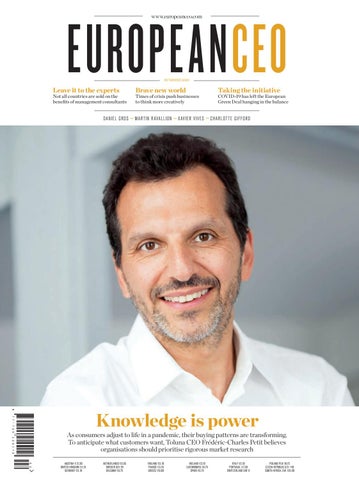
Knowledge is power
As consumers adjust to life in a pandemic, their buying patterns are transforming. To anticipate what customers want, Toluna CEO Frédéric-Charles Petit believes organisations should prioritise rigorous market research AUSTRIA €12.30 UNITED KINGDOM £4.25 GERMANY €5.10
NETHERLANDS €6.95 SWEDEN SEK 39 BELGIUM €6.75
FINLAND €5.10 FRANCE €5.10 GREECE €9.00
IRELAND €5.10 LUXEMBOURG €6.75 SPAIN €6.75
ITALY €5.10 PORTUGAL €7.50 SWITZERLAND CHF 9
POLAND PLN 18.75 CZECH REPUBLIC CZK 140 SOUTH AFRICA ZAR 129.90
IIS_AD_European_CEO_V1.pdf IIS_AD_European_CEO_V1.pdf 1 11/2/17 1 11/2/17 4:28 PM 4:28 PM
C20JJ_001_Z03_32645.pdf C18ND_001_X09_37824.pdf
C
M
Y
CM
MY
CY
CMY
K
C1
C20JJ_002_Z03_74947.pdf C18ND_002_X09_81637.pdf
C19ND_001_Z05_39418.pdf
ROCK SOLID INVESTMENT ATTRACTIVE RETURNS FROM RESIDENCE OWNERSHIP IN THE WORLD’S MOST STABLE ECONOMY
BEST SPA & WELLNESS HOTEL/RESORT EUROPE
• 1, 2 & 3 BEDROOM APARTMENTS WITH HARD ROCK SERVICE • ARCHITECTURE AND INTERIORS BY WOODS BAGOT • ROCK SPA®, BODY ROCK® GYM, ROCK OM® YOGA + MUSIC • RESTAURANTS, PRIVATE DINING AND ROOF TERRACE WITH 360° VIEWS • VIP ACCESS TO AWARD-WINNING RESORT & SPA • YEAR ROUND LOCATION FOR BUSINESS, EVENTS, SPORTS AND WELLNESS - INCLUDING THE WORLD ECONOMIC FORUM
PRICES ARE FROM 840 000 CHF / 750 000 EURO / 660 000 GBP APARTMENTS ARE RENTED OUT VIA THE HARD ROCK HOTEL WHEN OWNERS ARE NOT IN RESIDENCE, PROVIDING A RENTAL RETURN OF UP TO 5%. RETURNS ARE NOT GUARANTEED. PRICES AND INFORMATION CORRECT AT TIME OF PRESS. FOR FULL TERMS AND CONDITIONS PLEASE CONTACT A MEMBER OF OUR SALES TEAM OR VISIT WWW.RESIDENCESATHRHDAVOS.COM
HRD_EuropeanCEO_DPS_280x420_Dec19_v3.indd All Pages
C19ND_002_Z05_69595.pdf
WWW.RESIDENCESATHRHDAVOS.COM | +44 (0)20 7971 7942
10/10/2019 12:21
C18ND_001_Y04_17307.pdf
Invest in where the market is headed. Not where it’s been. Sometimes, that’s hard to do. But it’s what you have to do to succeed. And it’s why, as a leading Sales and Service performance services company, we have invested in how training, technology and talent will get you where you need to go in the future. Because the truth is, your sales and service people see market trends first hand, so they better be ready to adapt and take advantage of them. So check us out, and discover all the new and innovative ways we can drive the future of your performance.
C18ND_002_Y04_69136.pdf
Welcome to the New Innovative millerheimangroup.co.uk Š 2017 Miller Heiman Group. All rights reserved
C16ND_001_Z05_77934.pdf
Boudin ad #3_EuropeanCEO_HighQualityPrint.indd 1
10/20/16 10:37 AM
C20JJ_009_D03_86986.pdf
For decades, new technology has been touted as the biggest disrupting force the business world has ever had to contend with. We have become used to hearing that only those who adapt quickly will survive in the digital age. But the challenges of digitalisation pale in comparison with the prospect of adapting to a world that’s at the mercy of COVID-19. With supply chains stalling and vast swathes of the workforce in lockdown, ‘business as usual’ is no longer an option. The virus has affected every industry and economy, pushing companies to the edge. At a time when cash flow is faltering, cost-cutting is at the front of many leaders’ minds. They may turn to layoffs to keep outgoings low, but there is a real danger that doing so will make it harder for firms to get up and running again – not to mention the immense impact on their employees (p. 42). For the Millennial generation, which entered the workforce as the 2008 financial crisis sent international markets into free fall, the emergence of a global pandemic is yet another bitter pill to swallow (p. 60). Once again, rising unemployment and severe financial uncertainty are set to shake this group’s foundations – and they weren’t that stable to begin with. Of course, times of crisis often bring out the best in people, and the coronavirus has demonstrated this on a global scale. Since the 1960s, Cuba has been sending its vast network of healthcare professionals to countries in need of assistance. With many nations struggling to keep the virus at bay, Cuba’s doctors and nurses are lending a hand (p. 76). But unsurprisingly, the country’s long-term detractor, the US, isn’t convinced the move is entirely altruistic. Another positive outcome of the pandemic is that many businesses will be forced to think creatively to stay afloat (p. 78). With carmakers turning to ventilator production and galleries making their collections available online, every sector is thinking differently (p. 96). As innovation accelerates, companies might discover new efficiencies. It is impossible to know when, or how, the world’s economies will begin to reopen. But as governments, businesses and people try to navigate the new normal, it is possible that the lessons learned during the coronavirus outbreak will stick around once we emerge from the crisis.
EuropEanCEO
editor’snote
upside down
Ashton Wenborn Features Editor
In partnership with:
Head of Print:
Designer:
Features Editor:
Reprographer:
Production Assistant:
Production Coordinator:
Helen de Beer Ashton Wenborn Max Tomlin
Head of Editorial:
Barclay Ballard Editorial:
Charlotte Gifford
Sam Millard Robin Sloan
Omaira Farina
Web & Mobile Development:
Ben Debski Scott Rouse
Video Producer:
Paul Richardson Head of Finance:
Richard Willcox
Business Development:
Doug Crerand Malcolm Gade Michael Harris Terry Johnson Julia King Christian Walker James Watson
Published by:
Tower Business Media Ltd 40 Compton Street, London, EC1V 0BD, United Kingdom T: +44 (0) 207 253 5100 www.europeanceo.com The information contained in this publication has been obtained from sources the proprietors believe to be correct. However, no legal liability can be accepted for any errors. No part of this publication may be reproduced without the prior consent of the Publisher. © 2020 Tower Business Media Ltd. ISSN 1755-2206 Editorial on pp20-25 © Project Syndicate 2020
EuropeanCEO
|9
C19JA_001_Z02_56471.pdf
S UMMER 2 0 2 0
CONTENTS
46
26
62
78
COVER STORY
FEATURES
26
46
62
78
THE NEXT NORMAL
JUST ABOUT MANAGING
GETTING THE GREEN LIGHT
DESPERATE TIMES
The world is facing disruption like never before, meaning whole industries are changing dramatically. But with their lives turned upside down, consumers are also acting differently. To understand new purchasing patterns and predict what customers will want next, businesses should undertake careful market research
With just seven countries making up 75 percent of the management consultancy industry’s revenue, the sector is missing out on opportunities elsewhere. Its reputation for being a costly but ineffective service could be to blame – either way, management consultants must prove their worth if they want to tap into new markets
With the aim of making Europe the first carbonneutral continent by 2050, the European Green Deal is certainly ambitious. However, with a novel coronavirus damaging economies around the globe and resistant member states demanding further incentives, the deal’s future is being called into question
The attention of governments, businesses and individuals is focused on COVID-19, and will remain so for some time. While the virus may serve as a distraction for many, history has shown that the best ideas can emerge in times of crisis: when resources are limited and demand is high, innovative thinking flourishes
EUROPEANCEO
C20JJ_D05.indd 11
| 11
14/05/2020 11:32
C18JA_001_Y06_07791.pdf W12ND_187_X01_05502.pdf
BRIGHT IDEAS, BRIGHT FUTURES STATE OF THE ART SOLUTIONS FOR FINANCIAL DERIVATIVES IN MEXICO
Only the finest training and consulting solutions for your business needs. Superb front, middle and back end software solutions for financial institutions.
Shirebrook.indd 144
Shirebrook Commodities, S.A. de C.V. Phone: (52) 555 257 06 57 www.shirebrook.com.mx
19/10/2012 11:54
C20JJ
S UMMER2 0 2 0
CONTENTS REGULARS
PROFILES
15
DIGEST
All the industry, financial and management insight you need for the coming months on topical issues from across Europe 20
COMMENT
Hard-hitting analysis from our expert columnists, with a focus on eurozone collaboration, ‘coronabonds’ and famine in the age of a pandemic
38
54
70
86
PATRICK THÉVOS
STEPHANIE BRENNAN
AARON AULD
FOLLOW US ON: facebook.com/europeanceo twitter.com/europeanceo linkedin.com/showcase/european-ceo
Dangerous working conditions put employees at risk every day. To keep people out of harm’s way, Patrick Thévos founded Flyability, an organisation that uses hi-tech drones to carry out safe industrial inspections
ELS VAN DER HELM
INDUSTRY OUTLOOK
MANAGEMENT
FINANCE
WORLD VIEW
LIFESTYLE
A restless night impedes brain function, draining productivity at work. Els van der Helm has spent years studying sleep, leading her to launch Shleep, a digital coaching platform for businesses and staff
Investing can be a lucrative pursuit, but barriers to entry are high. Evarvest CEO Stephanie Brennan wants to make the stock exchange more accessible with her app, which provides guidance to inexperienced traders
Businesses have greater access to data than ever, but this is only useful if they know how to manage, store and analyse it. Under the leadership of Aaron Auld, Exasol provides this service while ensuring data privacy is maintained
32
42
58
74
92
ENERGY
HUMAN RESOURCES
GENDER EQUALITY
SURVEILLANCE
FASHION
Following US sanctions against state-backed energy provider Rosneft, Russia must reassess its ongoing support of the Venezuelan state
Layoffs are an unfortunate part of business, but managers should still commit to making the process as painless as possible
Despite its reputation as a forward-thinking nation, Germany’s gender pay gap is far wider than that of many other European countries
As the COVID-19 crisis has forced more people to work from home, the use of employee-monitoring software is on the rise
The clothing industry produces an immense amount of waste. Now, a growing arts movement is highlighting the extent of the problem
34
44
60
76
94
AVIATION
WORKPLACE CULTURE
MILLENNIALS
HEALTHCARE
TRAVEL
Though air travel is on hold for now, some private firms are using the time to improve their services and reassess plans for the future
Throughout history, rivals have pushed one another to perform at their best. In the workplace, though, competition must be closely monitored
Having entered the workforce in the aftermath of the 2008 financial crisis, Millennials now have to contend with a global pandemic
Cuba boasts a long tradition of medical internationalism, but the US has accused its socialist government of having self-serving intentions
Although business travellers have accepted jet lag as an inescapable part of flying, technology is making the sleep disorder easier to manage
36
52
68
84
96
REAL ESTATE
OUTSOURCING
CURRENCY
BUSINESS SCHOOLS
CULTURE
The ‘city within a city’ format allows residents to improve their work-life balance. Urban planners should take note of this new concept
By working with customer relationship managers, businesses free up time to focus on their core processes without neglecting consumers
The prospective launch of Facebook Libra has encouraged governments to more actively pursue central bank digital currencies
With Asia becoming a key player in the global economy, the continent’s business schools have flourished by offering specialised MBAs
Though cultural institutions have shut their doors during the pandemic, digital services mean the public still has access to these vital resources
EUROPEANCEO
| 13
C18JA_001_Z06_88639.pdf
MACROECONOMIC SOUNDNESS IN LAST 20 YEARS INVESTMENT OPPORTUNITIES IN ENERGY, TRANSPORT AND SANITATION FAIR AND PREDICTABLE LEGAL FRAMEWORK
SEIZE THE OPPORTUNITY NOW INVEST IN A RELIABLE COUNTRY,
INVEST IN
PERU
www.proinversion.gob.pe
EUROPEANCEO
SUMMER2020 NEWS & COMMENT GOING UP, GOING DOWN | THE GRID | BIG IDEA | TOP TEN | LEGAL CORNER | MOVERS & SHAKERS BUSINESS BRIEFING | FINANCIAL DIARY | CASE STUDY | WHAT THEY’VE BEEN SAYING | THE PLAYBOOK
▲
GOING UP
7.1%
THE GRID
ROLLING WITH THE PUNCHES
French jobless claims The 2019 FM Global Resilience Index ranks countries by the The number of people in resilience of their business environments, based on the economic France seeking jobless claims risks they face and the strength of their supply chains. rose by a record 7.1 percent from February to March as lockdown measures took a serious toll on the country’s job market, according to the French Ministry of Labour.
110,000
Online shopping Italy and Spain are experiencing a surge in restaurant and supermarket delivery orders. In March, supermarket chain Carrefour reported that its online customers in Italy had more than doubled to reach 110,000.
1
ST
4
TH
GOING DOWN
95
TH
▲
45%
Air pollution As industrial activity and transport grind to a halt amid COVID-19, European capitals have reported a dramatic slide in air pollution. Satellite images revealed that levels of nitrogen dioxide had decreased by 45 percent in some cities in March.
11.7
Service sector activity The IHS Markit Flash Eurozone Purchasing Managers’ Index for services plummeted from 26.4 in March to 11.7 in April, the lowest since records began in 1998, in a testament to the impact COVID-19 is having on the services industry.
56
TH
Norway
In first place, Norway was the most resilient country – not just in Europe, but globally – owing to its strong sovereign wealth fund and welfare state. The nation has also been making dynamic investments to reduce its economic reliance on oil, turning to renewables instead.
Germany
The largest economy in the eurozone demonstrated its resilience in the aftermath of the 2008 financial crisis thanks to fiscal conservatism and labour market reforms. However, its strength has been called into question due to the decline of its once-powerful industrial sector.
Albania
According to FM Global, Albania is one of the least resilient countries in Europe. It ranks 95th in the world due to high levels of corruption and low rates of productivity and urbanisation. Albania has committed to improving its governance as part of its bid to join the EU.
Greece
Ranked 56th in the world for resilience, Greece has fallen three places since 2018 and five since the year before. The country saw its steepest decline in the perceived visibility of its supply chains, while corruption and poor corporate governance have remained problematic.
EUROPEANCEO
C20JJ_D02.indd 15
| 15
14/05/2020 10:45
C20JJ
EUROPEANCEO
DIGESTSUMMER2020
70%
of businesses will use biometric authentication by 2022 Source: Gartner
TOP TEN Dependence on foreign final demand
FINGER ON THE PULSE
Fingopay is an innovative new method of biometric identification. Instead of using fingerprints, which leave a trace and can be copied, the payment system utilises the unique pattern of blood vessels in a person’s finger for authentication. This means users can carry out transactions, show their age or prove their identity using just their finger, making the customer experience simpler, faster and more secure. The technology was developed and trialled alongside partners BT and Hitachi, after which Fingopay launched authentication trials with Visa and Worldpay.
1
2
3
4
5
65%
65%
54%
45%
43%
6
7
8
9
10
43%
42%
42%
39%
39%
Ireland
Luxembourg
Czech Republic
Slovakia
Malta
Slovenia
Hungary
Estonia
Switzerland
Bulgaria
LEGAL CORNER
Pay the price Autorité des Marchés Financiers (AMF), the French markets regulator, has imposed one of the biggest fines in its history on activist hedge fund Elliott Management. The €20m fee was levied against Elliott for failing to cooperate with an investigation into a takeover bid. The regulator said Elliott had filed “inaccurate and late reports” linked to a tender offer in 2015 by XPO Logistics for Norbert Dentressangle, a French transport company.
16 | EUROPEANCEO
XPO already had a 67 percent stake in Norbert Dentressangle when it offered to buy the rest of the company. Following this, Elliott built up a 9.2 percent stake in the company in the hope of blocking the squeeze-out and winning a higher price from XPO. The AMF found errors in Elliott’s reporting of the takeover attempt and said it had “intended to conceal from the market, for as long as possible, the strategy of
¤20m Fine levied against Elliott Management
blocking the squeeze-out offer in order to negotiate a reassessment of XPO’s offer price”. The AMF has rarely levied fines of this size. The only other companies to be fined so heavily
are investment bank Morgan Stanley, which was also charged €20m in December 2019, and Natixis Asset Management, which was fined the same amount two years ago.
Source: ING
BIG IDEA
MOVERS & SHAKERS NEW APPOINTMENTS | ENTREPRENEURS | START-UPS
EUROPE NEW APPOINTMENT
EUROPE ENTREPRENEUR
EUROPE START-UP
Rahul Dhir | CEO
Christina Maria Polleti | Co-Founder
CLUNO
PLEO
Irish exploration group Tullow Oil has named Delonex Energy founder Rahul Dhir as its new CEO and Executive Group Director, effective July 1. Before creating Delonex, Dhir served as CEO of Cairn Oil and Gas, where he is credited with helping to make India’s biggest inland oil discovery. “I am looking forward to working with the team and the board to rebuild an exceptional business,” Dhir said of his appointment.
Christina Maria Polleti is the co-founder of Munich-based car subscription company Cluno. The start-up, which offers digital car subscriptions at a fixed monthly price, is making waves in the mobility scene. The team doubled in size in 2019 to reach 100 employees. It is Polleti’s second venture; she also cofounded Easyautosale, which was successfully sold to AutoScout24 in 2015.
Founded in 2015, Pleo is a multi-card business-spending platform that aims to transform companies’ expense processing. The platform consists of smart company cards that connect with software and mobile apps to track employees’ spending in real time. Pleo recently raised $56m (€51.82m) in a Series B funding round. The money will go towards expanding its team and accelerating product development.
GLOBAL NEW APPOINTMENT
GLOBAL ENTREPRENEUR
GLOBAL START-UP
TULLOW OIL
Peter King | CEO
Cindy Mi | CEO
VIPKid
BRIGHTLOOM
Westpac veteran Peter King has been given the daunting task of steering the Australian bank through the COVID-19 pandemic while also restoring trust in the institution following a money laundering scandal that broke last year. Having worked at Westpac for 25 years, most recently as chief financial officer, he is a trusted figure within the organisation and has earned the confidence of the management team.
When working as an English language teacher in Beijing, Cindy Mi realised that there was an immense unmet demand from students looking to learn the language. Today, she is the CEO of VIPKid, one of the world’s largest online education companies, which connects more than 100,000 US teachers with 700,000 students in China. The company’s Rural Education Project has served a further 1,000 low-income rural schools.
Brightloom came into the spotlight last year after Starbucks took an equity stake in the San Francisco start-up. Originally a restaurant chain named Eatsa, the company chose to focus instead on its automation solution, which uses restaurants’ existing data to generate personalised marketing for their customers. It officially rebranded as Brightloom when it partnered with Starbucks, winning $30m (€27.75m) in investment.
WESTPAC
BUSINESS BRIEFING An investigation into Chinese coffee chain Luckin Coffee has revealed fabricated sales worth $310m (¤286.75m). Shares in the company plunged more than 90 percent since January, with the company announcing its chief operating officer was a key figure in the fabrication. Adidas has reported a 93 percent profit plunge in Q1 2020 owing to a huge dip in in-store sales. Around the world, 70 percent of its stores have closed. Even in countries like China, where some shops have reopened, feeble consumer spending has prevented a bounceback. Air France-KLM has won at least ¤9bn in state aid from the French and Dutch governments as the COVID-19 crisis pushes many airlines to the brink of collapse. While ¤7bn will come from a French loan package, the Dutch Government has promised between ¤2bn and ¤4bn. While supermarket stockpiling may have been a cause of grievance for consumers, it was a boon to Nestlé, driving the company’s best quarterly sales growth in nearly five years. Sales in North America and Europe were particularly strong, contributing to an overall rise of 4.3 percent in Q1 2020. De Beers, the world’s secondlargest diamond miner, has announced it will cut production by 20 percent this year, owing to supply chain disruptions caused by the COVID-19 pandemic. The diamond industry is suffering from low consumer demand and reduced mining activity.
EUROPEANCEO
| 17
C20JJ
EUROPEANCEO
DIGESTSUMMER2020 CASE STUDY
FINANCIAL DIARY THIS QUARTER’S SELECTION OF THE BEST BUSINESS AND FINANCIAL EVENTS ON OFFER SUMMER 2020
Cyber Security in the Age of Coronavirus
As the world’s first virtual conference dedicated to information security transformation in the time of COVID-19, this free event is aimed at cyber and technology risk leaders. Attendees will get the chance to problem-solve with industry leaders in a live Q&A session.
Collision
North America’s fastest-growing tech conference will be held virtually for the first time since its inception. Attendees will be able to stream talks from tech CEOs, policymakers and cultural figures, while the bespoke Collision from Home app will allow them to network with fellow attendees.
09.06.20 23.06.20
DrupalCon Global
14.07.20
Hosted by the Drupal Association, a non-profit organisation dedicated to the open-source Drupal platform, this virtual conference gives people the chance to connect with industry experts who create ambitious digital experiences, enhancing their own skills in the process.
CONCRETE JUNGLES
Around the world, overcrowding has pushed many cities to breaking point. Increasing population density puts huge pressure on housing, incentivising landlords to convert sheds, living rooms and kitchens into bedrooms, and forcing low-income families to live in cramped conditions. Overcrowded cities also put critical services under pressure and, with 68 percent of the population expected to live in cities by 2050, urban spaces are urgently in need of a solution. French start-up Qucit wants to make city management and urban planning more efficient and people-focused with its digital consultation tool. Using sophisticated artificial intelligence, Qucit collects real-time data to create a picture of how services are being used around a city. It can help authorities optimise bike sharing, reduce traffic and improve the efficiency of car parking control routes. Users can also find out how a certain territory is perceived in order to identify where a city’s pressure points are.
WHAT THEY’VE BEEN SAYING “We are losing about a million euros in liquidity reserves per hour… I’m optimistic that these talks in Bern, Berlin, Brussels and Vienna will lead to a good and positive outcome.” Carsten Spohr, CEO of Lufthansa, Germany’s largest airline, emphasised the need for state aid in early April as its costs spiralled. 18 | EUROPEANCEO
“The reopening is allowed on condition that all companies involved strictly respect security protocols... We will live with the virus and we will have to adopt every precaution possible.” Italian Prime Minister Giuseppe Conte announced plans to reopen factories and building sites on May 4, 2020.
“There has been too much of a lack of coordination at the European level. It is starting to move now, but the level of pandemic preparedness is very, very low.” Sanofi CEO Paul Hudson criticised Europe for its slow response in developing a COVID-19 vaccine.
“If it is not restarted in a synchronised manner, we will not get out of the trenches... Even if the virus is at different stages, we need some kind of coordinated restart.” Henrik Henriksson, CEO of Scania, called for a coordinated global response to the pandemic to help industries return to work.
“We are firmly committed to mobilising our balance sheet… Our decision to do so means that our common equity Tier 1 ratio may temporarily dip below our target minimum of 12.5 percent.” Deutsche Bank CEO Christian Sewing strikes a cautious note after the company posted betterthan-expected results in Q1, 2020.
THE PLAYBOOK
Sending the right message report by Edelman, entitled Brand Trust and the Coronavirus Pandemic, 65 percent of respondents said that a good brand response would have a significant impact on the likelihood of them buying the company’s product in the future. One brand that appears to have risen to the challenge is the UK sandwich outlet Pret a Manger. Prior to its closure, Pret announced it would be providing NHS workers with free coffee and 50 percent sav-
Coronavirus presents a challenge for companies’ PR teams. During a crisis of this magnitude, saying the wrong thing can get brands into real trouble. The UK pub chain JD Wetherspoons faced a huge backlash after its chair Tim Martin suggested staff seek work at Tesco stores while its pubs remain closed. However, the evidence suggests that there are rewards to be reaped if brands can get the tone of their communications right. In a global
NEED TO HAVE
✚ A PPS ✚ DE V ICE S ✚ T OOL S ✚ G A DGE T S
1
Heatbox
Instead of eating the same sandwich for lunch every day, professionals can use the Heatbox, which warms food with steam to ensure it tastes freshly cooked and stays hot.
2
3
Smart Garden 3
Backapp Smart
Complete with automated watering, feeding and built-in lights, the Smart Garden 3 is an easy way to bring some fresh, flavourful greenery into any office space.
Improve posture with the Backapp Smart chair. The adjustable ball at its base forces users to balance to stay upright, providing some much-needed exercise during the working day.
PRET HAS ENJOYED A BOOST IN PUBLIC PERCEPTION FOR OFFERING A HELPING HAND IN THE CRISIS
NEED TO KNOW
ings on all other items. According to new research by Wunderman Thompson, Pret’s mentions on social media immediately jumped by an astonishing 3,574 percent, and its daily mentions consistently remained 350 percent higher for the following weeks. Crucially, 99.1 percent of those mentions are positive, suggesting that the brand has enjoyed a boost in public perception for offering a helping hand in the crisis.
MOTIVATING TEAMS REMOTELY
Rewards Whether through feedback or the creative use of company funds, employers should continue to reward staff for their hard work during lockdown. Short-term goals Structure is key to working from home productively. Keep teams focused on their work by ensuring they have clear goals to meet every week. Long-term vision In a time of huge uncertainty, it’s up to business leaders to provide their teams with a positive vision for the future, whether through growth plans or a new corporate direction.
EUROPEANCEO
| 19
C20JJ_020_C04_57891.pdf
EUROPEANCEO
COMMENT
Xavier Vives PROFESSOR OF ECONOMICS AND FINANCE, IESE BUSINESS SCHOOL
Europe’s second defining moment The COVID-19 pandemic has highlighted the ideological division between Northern and Southern Europe. Without greater collaboration, the eurozone may not survive the crisis The EU and the eurozone are approaching their second defining moment in a decade. The first was the debt crisis that started in 2010 and was quelled by European Central Bank (ECB) President Mario Draghi’s July 2012 pledge that the ECB was ready to do “whatever it takes” to preserve the euro. The ECB backed up Draghi’s declaration by introducing the Outright Monetary Transactions (OMT) scheme, an emergency sovereignbond-purchasing programme that fortunately never had to be used. The EU then established a banking union, with the ECB assuming the role of bank supervisor and a common resolution mechanism dealing with failing institutions. But this union is still incomplete because the resolution backstop is insufficient for a major crisis and there is no common deposit-insurance scheme. More generally, as a monetary union that lacks a fiscal union to share risks, the eurozone is an unstable creature. And COVID19 represents a major shock that calls for huge expenditures – not only on healthcare, but also to keep the European economy on life support while lockdowns and social distancing measures are in effect.
20 | EUROPEANCEO
A union divided Only the public sector can cope with such a challenge. Unfortunately, however, the EU is once again divided between fiscally strong northern member states (led by Germany and the Netherlands, which have debt-to-GDP ratios of around 60 percent) and fiscally weak countries where this ratio is close to or above 100 percent. Indeed, nine EU countries – led by France, Italy and Spain – have proposed mutualised ‘coronabonds’ to help mitigate the pandemic’s economic impact. Portugal, Ireland, Luxembourg, Slovenia, Belgium and Greece also support the idea. But the fiscally strong member states, fearing moral hazard, oppose debt mutualisation. Although a symmetric macroeconomic shock like the one the eurozone is currently experiencing weakens the moral hazard argument, northern countries’ fear is not without merit. After all, most of the countries supporting coronabonds have failed to put their fiscal house in order since the euro debt crisis ended. Moreover, there are several practical problems with coronabonds, not least the need for
guarantees or direct transfers from national budgets, owing to the absence of any European revenues to back such instruments. Germany insists that established EU rescue funds such as the European Stability Mechanism (ESM) be used first. As far as the frugal member states are concerned, now is not the time to establish a eurozone safe asset.
Finding a cure Nonetheless, an EU programme to combat COVID-19 would also help the bloc’s northern members to control the pandemic and limit the damage to their economies. Without such a scheme, countries like Italy or Spain would be bound to spend too little on tackling the public health emergency and promoting economic recovery, implying negative effects on public health and economic performance not only in those countries, but also in Northern Europe. Since the European Council’s inconclusive March 26 virtual summit, there has been a range of EU initiatives, including the relaxation of state-aid rules to help troubled firms and, most recently, a €540bn spending package to support member states’ economies. The package,
C20JJ_021_C04_55940.pdf
proposed by Eurogroup President Mário Centeno, includes up to €240bn in credit from the ESM, up to €200bn in loans for small and medium-sized enterprises from the European Investment Bank, and a €100bn loan plan for unemployment benefits from the European Commission. Although applying to the ESM is a precondition for the ECB to intervene with the OMT scheme, it carries a stigma and usually comes with conditions. Financing for COVID-19-related expenses, by contrast, will come with no strings attached, though other economic support would carry conditions. Furthermore, EU finance ministers have agreed
to establish a temporary recovery fund, which may be financed by “innovative financial instruments”. The battle for partial debt mutualisation, pushed by France, has been postponed. Although these measures go in the right direction – indeed, they have saved the day – the question is whether they will be enough. If not, then the eurozone – and the EU as a whole – will have failed to act decisively on a common problem, and the split between blocs of member states will persist and possibly deepen.
Above and beyond One could argue that the ECB can fix any problem regarding fiscally
AS A MONETARY UNION THAT LACKS A FISCAL UNION TO SHARE RISKS, THE EUROZONE IS AN UNSTABLE CREATURE
weak countries’ sovereign debt by again pledging to do whatever it takes. But Draghi was lucky in that the OMT was never invoked, and it is unclear whether those magic words will work this time. Indeed, if the crisis persists and the public debt of Italy and Spain increases substantially (to, say, 160 percent and 130 percent of GDP respectively), then the markets may test the ECB’s resolve to keep buying these countries’ sovereign debt. The ECB may, therefore, have to go far beyond its benchmark capital allocation among countries when implementing its recently announced €750bn asset-purchase programme (which remains smaller than Italy and Spain’s estimated debt for 2020). True, the ECB’s action will buy time and give affected countries more fiscal leeway, but, as in the debt crisis, the ECB will remain exposed as long as the eurozone lacks a common fiscal policy. Once again, the eurozone has responded with more integration only when on the brink of disaster. Let us hope that we are also lucky this time, and that no accident materialises to call the euro’s future into question while Europe muddles through the crisis. n
EUROPEANCEO
| 21
C20JJ_022_C05_01327.pdf
EUROPEANCEO
COMMENT
Martin Ravallion PROFESSOR OF ECONOMICS, GEORGETOWN UNIVERSITY
Could pandemic lead to famine? With the COVID-19 crisis spreading to developing nations, policymakers will need to find innovative responses to prevent widespread food shortages The huge health and economic shock that the new coronavirus is delivering to rich countries is also starting to reach deeply into the developing world. But we should not presume that the rich world’s policy responses to the pandemic are best for developing countries, or even feasible. On the contrary, we should anticipate sharper trade-offs and harder constraints in poorer places. True, staying at home will most likely help to slow the spread of the virus in developing countries, just as it is doing in the rich world. But social distancing can carry a high cost, especially for poor people who have little savings and low food stocks, and depend heavily on (often daily) casual labour. Few can survive by working from home.
22 | EUROPEANCEO
This is not solely the familiar cruel trade-off between economic welfare and personal health that many poor people face. It is also a trade-off between two aspects of health: illness due to the virus, and hunger and poor nutrition resulting from economic isolation and disruption to markets and institutions, including private social protection.
Food for thought While the case for a sensible degree of social distancing to combat COVID-19 in developing countries is strong, the case for a lockdown is not. Lockdowns pose new threats and could even turn the pandemic response into a famine in some poor places. I do not say this lightly: I believe it is a looming threat.
Both research and experience demonstrate how famines can result from the sort of institutional and market breakdowns implied by a strict lockdown. We saw this recently in the wake of the 2014 Ebola virus outbreak in Sierra Leone, where starvation soon emerged as a new threat. Famine among poor and vulnerable people can result from multiple causes, as Amartya Sen demonstrated in his book Poverty and Famines: An Essay on Entitlement. Sen cited examples in which there was no decline in the total amount of food available – the problem was its distribution among people and over time. And here, markets and other institutions play a crucial role: lockdowns can disrupt the production and
Above Red Cross volunteers distributing food aid to vulnerable citizens affected by the coronavirus lockdown in Uganda
C20JJ_023_C05_59945.pdf
AS PUBLIC ADMINISTRATION TENDS TO BE WEAKER IN POORER COUNTRIES, SOME OF THE MEASURES THAT RICH COUNTRIES HAVE INTRODUCED ARE SIMPLY NOT FEASIBLE
distribution of food, alongside a collapse in poor people’s earnings and higher food prices. We are learning that today’s food supply chains have vulnerabilities, even in rich countries. And even if famine is averted, spells of poor nutrition can have lasting consequences, including higher vulnerability to other illnesses.
Moving quickly There are additional reasons to be concerned that the push for lockdowns to combat the spread of COVID-19 could backfire in poor countries. In the short term, imposing such measures produces large migration flows that threaten to spread the virus even faster, especially among poor and vulnerable rural populations.
And enforcement of lockdowns by the police and military raises further concerns for the welfare of poor people, who often will have the greatest need to leave their homes to acquire food for their families. Above all, policymakers should recognise that strict lockdowns in developing countries also lock down the institutions that help to protect poor people in normal times, and thus enable them to avoid poverty traps that generally are shielded from view. Lockdowns risk longer-term destitution, which may be hard to escape after the current virus threat has largely passed. The effects on today’s children are particularly worrying. In the near term, a bold preparatory response is needed.
To be effective, it must combine healthcare efforts with consumption support. The virus will put a huge strain on developing countries’ health systems, which even in normal times are often woefully inadequate, especially for poorer citizens. Indeed, the shortages of medical supplies, equipment and staff now seen in the rich world are already familiar to people in lower-income countries. Given that only so much can be done to bolster healthcare systems in the short term, developing countries need an authoritative, independent communication channel on public health during the pandemic. Media messaging on the importance of social distancing and hygiene must be visible and frequent. Texting is a promising method of disseminating information and instructions, though the source has to be trusted. Yet, some governments in developing countries are pretending that the pandemic is under control, or that the threat is minimal. These are dangerous delusions.
Adapt or die Democratic institutions have a vital role to play in ensuring the provision of credible public information, thus helping to avoid policy mistakes and enabling a rapid response. Viewed from this per-
spective, the current crisis cannot justify a turn towards authoritarian rule, which would most likely worsen the public health crisis. Consumption support through transfers will also be needed – in cash if food markets are working, and in kind if they are not. Lockdowns without support are far less likely to elicit broad compliance; forcing compliance can come at a huge cost to poor people. The health and support components are complementary and reinforce one another – food deliveries should come with soap. Those countries that have been investing in social protection will be better placed than those that have not. Establishing new antipoverty programmes takes time, so governments in developing countries should start by rapidly scaling up existing schemes. This may well entail some temporary modifications, such as removing work requirements and school attendance conditions, which run counter to the need to slow the spread of the virus. Limited state capacity will also aggravate many developing countries’ challenges in combatting the pandemic. As public administration tends to be weaker in poorer countries, some of the measures that rich countries have introduced are simply not feasible. Adaptation to local administrative capabilities is essential. Poorer countries also face tighter fiscal constraints. Here, there is a strong moral and economic case for rich countries to help, including with debt relief. They can help now or incur a potentially far greater cost later. n
EUROPEANCEO
| 23
EUROPEANCEO
COMMENT
Daniel Gros DIRECTOR, CENTRE FOR EUROPEAN POLICY STUDIES
A new battle of ideas
The proposed issuance of ‘coronabonds’ to help financially vulnerable nations has pitted eurozone members against one another. But the issue of fiscal policy runs much deeper than the COVID-19 crisis Europe can see light at the end of the COVID-19 tunnel as the numbers of daily infections and deaths from the virus fall gradually across the continent. But the economic fallout from the ‘great lockdown’ is still to come. The International Monetary Fund forecasts that the eurozone will experience a drop in real GDP of more than seven percent this year and only partly recover in 2021, making this downturn deeper than even the Great Recession of 2008-9. Europe, or rather the EU, has been largely missing in action during the continent’s most serious crisis in generations. Member states have not only engaged in an unseemly scramble to secure scarce medical supplies, but have also made little tangible progress regarding the EU’s contribution to the economic and financial costs of the crisis. True, the European Central Bank has rightly done all it could to calm financial markets, but EU member states remain bogged down on the key question of whether the bloc can and will help fiscally stretched countries.
The Italian job On the surface, the main dispute concerns whether the EU should issue mutualised ‘coronabonds’ to finance healthcare spending and other crisis-related expenditure in the hardest-hit countries. Yet, the real fight is not about “innovative financial instruments”, as eurozone finance ministers diplomatically put it at their meeting in April, but rather about the future direction of fiscal policy and even the euro itself. In their insightful book The Euro and the Battle of Ideas, the economists Markus Brunnermeier, Harold James and Jean-Pierre Landau analysed the role played by ideas in 2010-14, when the eurozone, at times, seemed in danger of breaking up. They argued that the management of the euro crisis was dominated by clashes between France and Germany, and that the two countries’ positions were largely determined by the fundamental economic ideas that dominated their domestic debates. This time, however, the key fault line is clearly between Germany and Italy.
French President Emmanuel Macron is in a relatively comfortable position because most French voters do not have a strong opinion on eurobonds or coronabonds. By contrast, these instruments are at the centre of domestic debate in both Italy and Germany – but are regarded very differently in each country. In Italy, coronabonds are viewed as the natural expression of European solidarity. The government argues that the COVID-19 crisis could not have been expected, that Italy, therefore, deserves help from its European partners, and that coronabonds are the only acceptable solution. Many Germans, on the other hand, regard coronabonds as a mortal danger, as they would open the door to the dreaded eurobonds, which would mean that German taxpayers become liable for Italian debt.
Mission creep Reasonable proponents of coronabonds in France, Spain and Italy do not understand this objection. After all, they argue,
24 | EUROPEANCEO
C20JJ_C06.indd 24
13/05/2020 12:43
C20JJ_025_C06_92599.pdf
German workers and enterprises to overcome the crisis. But longtime critics of austerity see in Germany’s large budget deficit confirmation of their own position. After all, nobody can object to big deficits at the moment.
they are not asking for a German guarantee of existing Italian debt, only that the additional expenses stemming from this crisis be financed by a common European instrument. But Dutch and German politicians fear mission creep, with a limited issuance of coronabonds paving the way for large, uncontrolled sums of other instruments. Nor does it help that many in Italy and elsewhere do indeed dream of coronabonds opening the door for eurobonds. They have long thought that the eurozone needs common debt instruments to become a ‘complete’ monetary union, and they regard the
current crisis as the ideal moment to achieve this goal. The basic reason for this mutual distrust is the absence of a shared vision regarding longterm underlying fiscal principles. And because people see in crises what they want to see – which, as Harvard’s Dani Rodrik recently emphasised, often is an affirmation of their long-held beliefs – confirmation bias has only hardened the opposing sides’ positions. Thus, Germans see in the crisis vindication of their prudent approach to fiscal policy, because years of balanced budgets mean that their government can now spend much more on helping
EU MEMBER STATES REMAIN BOGGED DOWN ON THE KEY QUESTION OF WHETHER THE BLOC CAN AND WILL HELP FISCALLY STRETCHED COUNTRIES
Getting fiscal Unfortunately, this dialogue of the deaf distracts from the real issue – namely, the direction of fiscal policy once the immediate crisis has been overcome. Should governments try to balance their budgets as quickly as possible and start reducing debt again? Or should they continue to run deficits for as long as interest rates remain low? The eventual outcome of this battle of fiscal ideas will be decisive for the future of the euro. This is not an issue that will become relevant only in some distant future when the economy has recovered. More immediately, as long as this battle remains unresolved, member states will find it difficult to ever agree on a common European strategy to overcome the current crisis. n
EUROPEANCEO
| 25
C20JJ_026_B05_16483.pdf
The next normal The COVID-19 pandemic has caused significant disruption to businesses across all industries and markets. Having access to reliable market research can be one way of helping troubled firms plan for a brighter future, writes Barclay Ballard Âť
C20JJ_027_B05_42414.pdf
C20JJ_028_B05_44105.pdf
K N O W YO U R C U S T O M E R
n January 12 this year, Toluna CEO Frédéric-Charles Petit was chatting to a colleague in Shanghai while on a business trip to China. Conversation turned to news of a virus that had emerged in the city of Wuhan, some 800km west. Petit listened with interest but didn’t think much of it; the streets and restaurants were full, and life was going on as normal in Shanghai. He returned to Europe the following day and forgot about the conversation. But by the end of January, life in China had changed beyond recognition. By March, the entire world was locked in a battle against the coronavirus pandemic. The spread of COVID-19 has upended entire industries, and many firms are not sure if they will survive the disruption. The ones that do will find the relationship they have with their customers has changed, meaning that getting to grips with the new normal will require new information on consumer behaviour. That is where market research will prove to be vital. Toluna has been making sure that businesses have access to the information they need for two decades, connecting firms and consumers in real time to deliver on-demand insights. Founder and CEO Petit has been there every step of the way. As organisations try to make sense of unexpected changes to the business world, Toluna is ready to help them adapt as necessary.
People of influence In some respects, the market research arena has been significantly hampered by the coronavirus pandemic. Qualitative interviews and focus groups can now only be conducted remotely and, regardless of the efforts by the interviewer to put their interviewee at ease, remote data collection is likely to suffer from some drop-off in quality compared with inperson interviews. Conversely, with such huge changes predicted to occur as a result of the pandemic – some temporary, others more long term – the need to gather consumer insight has never been more vital. “Businesses all want to know what people are thinking, how are they going to change their behaviour, how the virus is likely to affect their usage of certain products, their attitude towards consumption, and their intention to do certain things,” Petit said. “As a result, delivering this 28 | EUROPEANCEO
TOLUNA
insight in real time is key. With all the change that is going on in our lives, gaining a view on consumer perception and behaviour could IN NUMBERS: provide a lifeline to a struggling business.” At Toluna, work has not stopped as a result of the coronavirus. At the start of March, the company published market research collected Founded from 4,000 respondents spread across eight countries. The data provides organisations with insight into how consumers are feeling amid the pandemic, how their purchasing Employees decisions are changing and how their activities have been disrupted – for example, going to the cinema or theatre, exercising in public venues and social gatherings were among the Countries operating in top activities to be cancelled. Receiving up-todate information like this can help businesses plan their next move. “Changes that might seem minor on an individual scale may have a huge impact on businesses,” Petit told European CEO. “This might involve how you use certain home care products or where you are going on vacation. How, for example, are you going to carry out social distancing on the beach? And are you going to be willing to pay premium prices for a hotel if you can’t go to the beach or if you can’t swim in the swimming pool? But, more importantly, we also deliver insights from nonconsumers about, say, the perception of government performance and social and healthcare services across Europe.” The work carried out by Toluna is being mirrored by other actors in the market research industry. French firm Ipsos has also collated information regarding the coronavirus pandemic, providing media outlets and consumer brands with vital insights. With their established communication channels, market researchers may also find they can give something back to their data providers during these difficult times. Toluna has launched a number of online games to create a sense of togetherness and community among their influencers.
2000 1,400+ 20
TOLUNA HAS BEEN MAKING SURE THAT BUSINESSES HAVE ACCESS TO THE INFORMATION THEY NEED FOR TWO DECADES
C20JJ_029_B05_37408.pdf
K N O W YO U R C U S T O M E R
WHILE MARKET RESEARCH CONTINUES TO PLAY AN ESSENTIAL ROLE DURING TIMES OF UNCERTAINTY, MARKETERS MUST NOT BECOME OVERZEALOUS IN THEIR QUEST FOR CONSUMER DATA Striking the right tone While market research continues to play an essential role during times of uncertainty, marketers must not become overzealous in their quest for consumer data. Whether there is a recession occurring, a pandemic sweeping the globe or any other disruption, the impact on people’s lives must be considered. Businesses should not look as though they only care about profit during these times. “When firms are trying to get through difficult periods, I think it is critical that they have access to up-to-date market research,” Petit said. “You also need to not only think about what is happening now, but also what is going to happen next and how that is going to affect your communication with the consumer. How can you communicate at a time when there is so much uncertainty without looking like you are trying to benefit from the duress in the market? Should you, as a brand, retract from the market and not communicate anymore, or should you communicate because you have value and a message to share?” Whether market research firms are conducting online surveys, in-depth interviews or focus groups, acquiring the optimal insights will require additional planning during times of crisis. Researchers should try to look at the situation from the participant’s perspective, taking extra care to ensure that questions are worded in an empathetic way. It is also vital that the client’s expectations are managed appropriately. The coronavirus pandemic is an unprecedented situation and all organisations are learning about the best way to deal with it – this means mistakes will be made. For researchers, meeting client aims may be more difficult than usual. It may be challenging to source willing » EUROPEANCEO
| 29
C20JJ_030_B05_17614.pdf
K N O W YO U R C U S T O M E R
A JOB WELL DONE
Toluna boasts a number of high-profile clients. We take a look at how the company has helped three industry heavyweights achieve their goals
Kraft
CNN
Sony
In 2019, US food giant Kraft was keen to start a corporate branding campaign that would resonate with both children and parents. Using Toluna’s QuickSurveys platform, Kraft was able to rapidly research its target consumer base, acquiring the results it needed in just four days. More than 1,000 respondents were asked questions about their attitudes to family, togetherness and mealtimes, with their answers forming the basis of Kraft’s new campaign strategy.
CNN enlisted Toluna’s help to acquire reliable insight from 23 countries within just a few days in the lead-up to the 2016 US presidential election. This meant that a questionnaire had to be quickly translated and localised to suit each market. Toluna was able to achieve this within 24 hours, and TolunaAnalytics analysed the data in real time. As a result of Toluna’s fast response, CNN was able to use the data at a client conference three days later.
Product launches are improved by the acquisition of data, whether it’s during development or following release. When launching its 4K TV, Sony needed to assess customer satisfaction, but the price and size of the product meant the target market was relatively niche and difficult to engage. By using the Toluna Influencers panel, Sony asked 4K TV buyers to complete a post-purchase survey. The results helped it identify a design flaw, which was fixed before the second wave of releases.
interviewees, and the answers they provide may not be as effective as hoped. Currently, many companies are finding that adaptability is key. This is also the case for market researchers. Recognising the unusual nature of the current business climate and increasing the flexibility of your usual research process is one way of ensuring that your interviewees feel comfortable and your clients receive the information they need.
Generally, Petit is much more closely involved in product development and engaging with clients than he was in the firm’s early days, but recently his role has become more operational once again. As new guidelines were put in place to limit the spread of COVID-19, Petit had to act quickly to guarantee business continuity while keeping his employees safe. “We are obviously concerned like any other organisation, first of all with the health and safety of our people,” Petit said. “We have close to 1,500 people across the globe, some in the UK – in London and Manchester – others in France, Germany, Romania, India, the US... Across 20 different countries. After we could ensure their health, then we explored how we could maintain business continuity, making sure our clients could continue to benefit from our technology and services.”
In light of the changes that will emerge in the post-pandemic world, McKinsey & Company has spoken about the emergence of the “next normal”. The phrase, which the consultancy firm also used after the 2008 global financial crisis, recognises that we are entering a new reality, involving a dramatic social and economic restructuring. Market research firms like Toluna are usually seen as being more resilient to these sorts of crises, but that does not mean they are unaffected – they were impacted in 2001 following the 9/11 terrorist attacks in New York, they were impacted by the financial crash, and they are finding that their business is affected now. The impact, however, does appear to be less than in other marketing services. In times of change and uncertainty, difficult decisions need to be made, but having access to the most recent data on consumer behaviour can help make the process as painless as possible.
Times are changing Over the 20 years that have passed since Petit founded Toluna, he may not have experienced anything quite like the impact of the coronavirus, but he has certainly been around long enough to realise that the corporate world is always in a state of flux. He describes the reality of starting his business in 2000 and how it operates today as “like being in two different companies”. “I’ve watched Toluna grow from a start-up to an SME, then a mid-cap,” he told European CEO. “And while my title has remained the same through all these changes, in reality, I’ve actually had many different roles. In the beginning, I was doing everything that you could imagine when you’re managing a small company: I was writing the cheques, buying the pens, carrying out projects for customers and everything else in between. But we already had ambition and the culture was always to shoot for the stars.” 30 | EUROPEANCEO
AS NEW GUIDELINES WERE PUT IN PLACE TO LIMIT THE SPREAD OF COVID-19, PETIT HAD TO ACT QUICKLY TO GUARANTEE BUSINESS CONTINUITY WHILE KEEPING HIS EMPLOYEES SAFE
Strength of character Of course, for market researchers to deliver the insights their customers need, they have to process, analyse and store large quantities of data. Like many researchers, data privacy is a top priority for Toluna. “Security is obviously critical for us,” Petit said. “Trust between us and the consumer is key, particularly as they will sometimes be giving their opinion on subjects that are quite personal. So, of course, we are GDPR-compliant and we’ve been working
C20JJ_031_B05_99302.pdf
K N O W YO U R C U S T O M E R
with a lot of discipline to be compliant with regulations in other markets as well. We are always looking to protect our environment from intrusion; it is never an area where you can afford to be complacent.” In addition to putting all the necessary technical safeguards in place, protecting consumer data relies on knowing when to disappoint clients. Sometimes market researchers will be asked to share something from their data that is simply not acceptable from a regulatory standpoint. When this occurs, marketers must commit to doing what’s right, particularly if there’s a competitor that is willing to break the rules to keep clients happy. These principles are something that Petit is keen to instil within the company culture at Toluna. To him, the worth of a company is derived from more than just its balance sheet. It is also about the values it upholds – this is what makes a business resilient when times are tough. “During these difficult times, you have to stay true to your values as a business,” Petit said. “When we were operating with just 10 people, we didn’t need to write these values on the office wall, but now we have more than 1,400 employees worldwide and we need to make sure our values are shared by every new member of staff. We must continue abiding by our values of integrity and respect, satisfying our customers and acting as a team.” As with any industry, the rights and needs of stakeholders must be considered at all times.
This means respecting the privacy of individual consumers, understanding what it is that clients want, and trying to deliver the best company performance for shareholders.
Taking the lead Over the 20 years that Petit has been at the helm of Toluna, he has seen the industry develop markedly. He has also watched his company grow substantially, always willing to adapt to new client requests and shifting consumer trends. It is something that has helped to keep the role fresh over such a long period. “I can’t say that I never thought about leaving the company and moving to something else,” Petit said. “There were times when I could have sold the business, for example, but when you have passion for what you do, if you have a vision for what the company can become, you stick around. Obviously if Toluna had stayed the same, if it remained static, I probably would have left. The day I would leave would be the day where I don’t feel I can bring value to the company anymore.” One of the ways he continues to provide value is through his inclusive leadership style. He believes that, today, communication is more important than ever, particularly with so many employees working remotely and spread over vast distances. “We have an organisation where communication comes from me, but we also have an executive board, as well as regional and
country leaders that communicate often with their staff – I don’t like the notion of pyramidal communication. I think that we should all be able to communicate: the CEO has to maintain a vision, give regular updates and also be available, which I think I am. But each market and each country has to have its own leadership.” Allowing many employees to take on leadership roles is particularly important in the market research industry, where each market has its own distinct trends. What’s more, each client may be searching for different insights. No single leader would be able to keep track of such diverse client needs. “I also think that leadership requires you to be passionate about what you do,” Petit said. “Some people think that being passionate means being irrational, but you can be passionate about the prospects for your business while also being rational about the economic reality of COVID-19. Business is not just about gross margins and shares – it is about people, giving them a sense of direction, and doing what’s right. That’s when passion is really important.” Ultimately, getting the balance right between passion and reason will determine each company’s success or failure. Having as much relevant data as possible can help firms to achieve this – and this is where market research can prove to be essential. If in doubt regarding the best way of moving forward with your business, why not ask your customer? They are always right, after all. n EUROPEANCEO
| 31
C20JJ_032_C02_55438.pdf
INDUSTRY OUTLOOK
Energy
Murky business
Although nothing is ever clear-cut where Russia is concerned, the country’s decision to reduce its stake in oil giant Rosneft is likely the result of US sanctions and the company’s relationship with Venezuela, writes Barclay Ballard It has been claimed by many a political observer that Russian President Vladimir Putin’s main strategic tactics are confusion, disinformation and chaos. All is not usually as it seems when the former KGB intelligence officer is involved – either directly or behind the scenes. This is pretty transparent when it concerns electoral interference or stateauthorised cyberattacks against foreign powers, but things are subtler when it comes to Russia’s business environment. Much like many of the world’s other markets, Russia’s corporate landscape contains both state-owned enterprises and private companies. At times, though, the line between the two is blurred. Rosneft is known around the world as one of the energy industry’s biggest 32 | EUROPEANCEO
players, operating in 25 countries and responsible for six percent of global oil production, but the extent to which it operates to serve the interests of the Russian president is difficult to say with certainty. Until recently, Rosneft’s relationship with the Kremlin was relatively well understood. Through a holding company – Rosneftegaz – Russia owned more than 50 percent of Rosneft’s capital. In March, however, that changed, with the Russian state announcing it had reduced its stake in Rosneft to below a majority standing. The reasons are likely to be connected to Russia’s support of Venezuela and the probability of this leading to US sanctions. But whether or not Russia’s Rosneft divestment will have the desired result remains to be seen.
Joining the dark side The connections between Rosneft and the Kremlin run deep. Igor Sechin has been CEO at the oil firm since 2012, but he previously held several political positions, including serving as a mayoral aide to Putin and as Russia’s deputy prime minister. He is an imposing figure, described variously as the “scariest man on Earth”, the “grey cardinal of the Kremlin” and “Darth Vader” by Russian media. Putin and Sechin have been pictured together numerous times, with the pair’s close relationship enabling Sechin to make bold business moves that would perhaps have seen other business leaders removed. One risky decision has been Sechin’s support for Venezuela, which has had significant ramifications for both Rosneft and Russia. The reasons for such support go back a long way: in the late 2000s, the Russian Government was busy trying to convince other countries to recognise the independence of Abkhazia and South Ossetia, two breakaway states in Georgia. In 2009, then Venezuelan President Hugo Chávez agreed to do so, and promptly received $2bn (€1.82bn) in loans to purchase Russian arms. Other agreements between the countries soon followed.
C20JJ_033_C02_39927.pdf
INDUSTRY OUTLOOK
Energy
Rosneft in numbers:
25
Countries operating in
6%
Contribution to global oil production
Rosneft CEO Igor Sechin
The close relationship between Sechin and Venezuela has continued into the presidency of Nicolás Maduro, with the Russian state and Rosneft listed among a small group willing to lend funds to the beleaguered South American country. But the decision to keep the alliance going may have seen Sechin overreach: in February, the US imposed sanctions on a Rosneft subsidiary for dealing in Venezuelan crude, with shares in the Russian oil firm declining as a result. “As the primary broker of global deals for the sale and transport of Venezuela’s crude oil, Rosneft Trading has propped up the dictatorial Maduro, enabling his repression of the Venezuelan people,” US Secretary of State Mike Pompeo said in a statement. “Maduro has destroyed Venezuela’s institutions, economy and infrastructure, while enriching himself and his cronies, through his abuse of state power and his welcoming of malign support from Russia, as well as from Cuba, Iran and China.” In March, the US struck again by sanctioning another Rosneft subsidiary for operating in Venezuela. Given the difficult circumstances Rosneft finds itself in regarding broader developments in the oil market, it may be time for Russia to reassess its relationship with Maduro’s regime.
Slippery customers Following the US sanctions, it seemed as though Rosneft was willing to cut Venezuela loose; on March 28, the company unexpectedly announced that it had completed the sale of its assets in the South American nation to an unnamed organisation owned entirely by the Russian Government. In exchange, Rosneft received 9.6 percent of its own shares, ensuring that, for the first time, the Russian state would not own a controlling share of the oil firm. Although the sanctions were not referenced directly in the statement announcing the divestment, Rosneft has undoubtedly been affected by the measures: shortly after Washington announced the sanctions, Chinese oil firm Sinochem declared that it would not buy oil from Rosneft, denting Russia’s ambitions of gaining a larger share of the Chinese market. But exactly how much distance is being placed between Rosneft, the Russian state and Venezuela is difficult to say. After being rather coy about the sale, Rosneft confirmed that the unnamed government entity that had bought its Venezuelan assets was a newly created company called Roszarubzhneft. Some have described the move as a sham divestment – not entirely without precedent. In 2018, Russia used the state-backed Promsvyazbank to create a new banking vehicle that would support the defence sector following US sanctions against domestic arms producers. In fact, Russia has had plenty of opportunities to discover the best ways of mitigating the impacts of international sanctions. “Since 2014, US and EU sectoral sanctions have restricted Rosneft’s access to deep-water, Arctic offshore and shale technologies,” Nigel Gould-Davies, Senior Fellow for Russia and Eurasia at the International Institute for Strategic Studies, told European CEO. “Sechin has been under personal sanction since 2014. ExxonMobil was fined $2m [€1.82m] for contracts it signed with Sechin in this role. Last December, a US district court in Texas overturned this fine on
Igor Sechin’s support for Venezuela has had significant ramifications for both Rosneft and Russia
the grounds that US Treasury guidance was not clear that personal sanctions on Sechin also prohibited dealings with Rosneft.” It all adds up to a bewildering situation, with multiple stakeholders present in different markets and bureaucratic manoeuvrings having huge financial impacts. What’s more, this is all occurring against the backdrop of a huge worldwide fall in the value of oil, which will also need to be factored into Rosneft’s next decision.
Putin on appearances For now, though, attention will focus on the US and what it decides to do in light of Rosneft’s divestment of its Venezuelan assets. In April, US Special Representative for Venezuela Elliott Abrams suggested the sanctions on Rosneft could be lifted, but cautioned that further analysis would be required first. While the US decides, Russia and Rosneft have plenty to keep them occupied, including historically low oil prices and deciding whether production cuts should be pursued. It’s an area that has seen Russia in conflict with OPEC. “With regard to ongoing issues related to oil supply cuts, much depends on the scale of the oil demand shock and the ability of OPEC+ members to coordinate a further response if needed,” Gould-Davies explained. “Russia’s initial rejection of supply cuts in March, which triggered a brief price and market war with Saudi Arabia, has left it badly placed to play a leading role.” Rosneft executives have events occurring closer to home that demand their attention, too. After settling another pricing dispute, Rosneft was Belarus’ biggest supplier of crude in April. Sechin and the Belarusian President Aleksandr Lukashenko had met earlier in the year to help improve energy relations between the two parties. Turning back to Venezuela, Maduro has praised Russian support for his country even following the Rosneft divestment. This makes it unlikely that Russia will turn its back on the South American country entirely, even if – on paper, at least – Rosneft is no longer involved. Just as it’s not clear whether Rosneft still has a stake in Venezuela, it remains difficult to say in what capacity Russia will continue to support the South American state. As always with Russia, confusion is the only thing that can be guaranteed. n EUROPEANCEO
| 33
C20JJ_034_A02_47100.pdf
INDUSTRY OUTLOOK
Aviation
Flying high The picturesque Costa Smeralda has long been a destination of choice for high-net-worth individuals. The airport’s recently refurbished runway and luxury terminal have made it easier than ever to travel to this stretch of the Sardinian coastline, writes Francesco Cossu, General Manager of Eccelsa Aviation
Situated on the north-east coast of Sardinia, Costa Smeralda leaves visitors awestruck by its pristine white sands and crystal-clear waters. However, there is much more to this 55km stretch of coastline than beautiful beaches: it is also a fantastic destination for fans of golf, architecture and high-end cuisine. Everything about Costa Smeralda is designed to appeal to the most discerning of travellers. The resort was built in the 1960s after a consortium of investors purchased the land. Back then, each financier paid $25,000 (€23,000) for a small section of this coastal paradise – it has proved to be a worthwhile investment. Today, the resort captivates visitors from all over the world with its exclusive villas, relaxing spas and world-class restaurants.
Easy access Connecting this beautiful stretch of Sardinian coastline to the rest of the world is the Olbia Costa Smeralda Airport. The airport’s construction was formally completed in 1974, but as the popularity of Costa Smeralda has grown over the years, the airport has required expansion. Throughout the 2000s, the airport underwent a series of refurbishments, which 34 | EUROPEANCEO
greatly increased its capacity and boosted the area’s accessibility. In 2009, Eccelsa Aviation, the airport’s only fixed-base operator (FBO), opened a highly sophisticated new private terminal that combines stunning design with outstanding functionality. The addition of the Eccelsa terminal means the airport is able to welcome 35,000 visitors every year, ensuring they are provided with top-class amenities at the beginning and end of their visit to Costa Smeralda. In March, Eccelsa completed the refurbishment of its runway perfectly on schedule. This allowed the airport to expand the type of aircraft it is able to accept. Now, large carriers such as the Boeing 747 and Airbus A340 can operate into the airport without restriction. Eccelsa serves many clients who fly these aircraft privately as they are able to reconfigure the standard commercial layout to make room for lounges, bedrooms, bathrooms and even kitchens. These prestigious travellers want their unique needs to be met with ease, and this is what Eccelsa strives to deliver. The company offers more than just a landing strip, though. Its airport terminal boasts more than 4,000sq m of retail space and is
C20JJ_035_A02_56047.pdf
INDUSTRY OUTLOOK
Aviation
55km
The length of Costa Smeralda’s coastline
2009
The year Eccelsa Aviation’s FBO terminal opened
4,000sq m of retail space in Eccelsa Aviation’s terminal
home to some of the world’s finest luxury brands, including de Grisogono, Provasi and Rolex. Fine wines, designer sunglasses and glamorous jewels are just a few of the quality products on offer.
Superior service Befitting such a picturesque destination, the Olbia Costa Smeralda Airport is an architectural marvel. The Eccelsa terminal is evocative of an aircraft door when viewed from above, while observers at ground level are treated to crisp, clean lines that appear to rise skywards like giant wings. What’s more, it is the only terminal in Europe that allows travellers to enter and exit the building directly from the aircraft. On the rare occasion this service is not available, an elegant Audi airport vehicle ferries customers to the terminal while members of staff handle their luggage. The building was constructed using local materials, such as Giallo San Giacomo, an Italian yellow granite, and is adorned with native flora. The terminal is also host to a dedicated crew lounge that offers complimentary Wi-Fi and satellite TV, as well as a separate ‘snooze room’ for when a more
relaxing space is required. A large passenger lounge, complete with a summer patio and a selection of magazines, is located just a short distance from the entrance. Under the control of airport management company Geasar, Eccelsa Aviation has long believed that combining professionalism with a personal touch is key to delivering the service its clients expect. Each team member has fully embraced this culture of customer care – it is an ethos that has shaped the aviation firm since its foundation in 2003. Passenger numbers have soared since the company’s early days, leading Eccelsa Aviation to expand its offering. For example, there are now more than 150 private parking spaces reserved for use by Eccelsa Aviation customers, in addition to a personalised reception service, a private business centre equipped with the latest audiovisual equipment, and an exclusive VVIP area. Visitors to Costa Smeralda expect the very best. They are discerning individuals who have come to enjoy the high-end sophistication of superyachts, villas and five-star hotels. As such, Eccelsa Aviation offers a service that lives up to these standards and ensures customers feel comfortable, satisfied and eager to return.
Preserving paradise The unspoilt nature of Costa Smeralda is one of the things that attracts visitors to the area and so, unsurprisingly, sustainability is a key concern for local businesses and residents. Eccelsa Aviation’s environmental awareness is evidenced by the fact that more than 60 percent of the company’s ramp equipment is powered by electric engines, with aims to increase this to 80 percent by 2021. Agritourism offerings located not far from the coast provide another
Befitting such a picturesque destination, the Olbia Costa Smeralda Airport is an architectural marvel opportunity for visitors to embrace sustainability during their stay. The beaches along the Costa Smeralda are some of the finest in the world, with the Spiaggia del Romazzino, Spiaggia del Grande Pevero and Spiaggia Capriccioli proving particularly popular. Diving excursions, meanwhile, allow visitors to enjoy purple seaweed, indigo blue sponges, red coral and a host of other colourful specimens. The region also offers plenty of produce to get excited about. Freshly caught seafood, including lobster and octopus, are the highlight and can be enjoyed with a refreshing glass of white wine, made from locally grown grapes. Of course, all good things must come to an end. Fortunately, once their time in Costa Smeralda is over, visitors can enjoy the stateof-the-art Eccelsa terminal at the Olbia Costa Smeralda Airport one more time. While they make use of the shops and amenities, a team of high-calibre chefs from Eccelsa Aviation’s catering partner, Cortesa, will begin preparing the in-flight meal, with mouth-watering choices such as fresh lobster on the menu. Even with all the wonders Costa Smeralda has to offer, visitors still cite the top-quality service provided by Eccelsa Aviation as a reason to visit. As the flight takes off, carrying travellers away from the warm, azure waters of this Sardinian paradise, at least they’ll be departing in comfort and style. n EUROPEANCEO
| 35
INDUSTRY OUTLOOK
Real Estate
Nebojsa Karic President, Dana Holdings
Putting Minsk on the map
Belarus is poised to take a leading role among the economies of Eastern Europe thanks to the development of a new international financial centre in the heart of its capital Multifunctional complexes, which act as a ‘city within a city’, are increasingly popular in today’s urban centres. The main reason for this is that time is now one of the most valuable – and hard to come by – commodities of the 21st century. Due to the sheer size of modern cities, the commute between home, work and other destinations has become a major enemy to what we consider a high quality of life. The city within a city concept encourages real estate developers to design urban projects that provide the end user with everything they need, right on their doorstep. This allows city dwellers to fight the time drain of commuting and improve their work-life balance. One company that understands just how important it is for urban planners to develop projects with the residents’ quality of life in mind is Dana Holdings. Our group represents a collection of leading companies in investment and real estate construction, and we have made it our mission to develop sites in areas of Eastern Europe that have huge potential for growth. Some of our development projects in Russia, for example, include the head office of the Central Bank of Russia, the Efimiya business centre in Moscow and the Institute for Finance and Economics in Yakutsk.
Laying foundations At Dana Holdings, we applied the city within a city formula when developing Minsk World. Situated in Belarus’ capital, the multifunctional complex occupies an advantageous position in the heart of Eastern Europe. The country’s accessibility and diverse investment options – from agriculture to technology – make it
an attractive location for businesses and prospective residents alike. With an area spanning three million square metres, Minsk World is one of our largest and most ambitious construction schemes to date and our biggest single development project in Europe. In fact, in 2018, EuropaProperty named the project the largest multifunctional complex in the centre of a city in Europe. It is no coincidence that it is being compared to Dubai and Abu Dhabi, the leaders of modern urbanism. The project will include an international financial centre, as well as residential areas, shopping malls, entertainment centres, schools, kindergartens, hospitals and hotels. The site will have no shortage of green space, either; nestled within Minsk World will be a number of parks and gardens to give a true sense that the complex is a city within a city. The residential and business complex aims to provide its residents and visitors with an extraordinary level of comfort and an excellent quality of life. We see the high-spec Size of Dana development as part of Holdings’ a bright and optimistic development future for Belarus. In projects (sq m): line with this vision, it was important to place the needs of Minsk World residents at the heart of the complex. Minsk World consists of 24 Tesla Park residential quarters, all closely connected to the many amenities Mayak Minska held within the devel-
3m
1.5m 1m
opment, including social, cultural and educational facilities. Residents will find it easy to get around thanks to the new metro line, and will also be able to explore the centre from its modern boulevards, public walkways and cycling tracks, which will run alongside the main residential areas. Minsk World is designed to offer plenty of recreational space for residents and visitors, with a park at the centre of the complex connecting the rest of the city by a system of pedestrian zones and vast green areas.
Enticing investors From an investor’s perspective, one of the most exciting aspects of Minsk World is the inclusion of the international financial centre. The centre will offer preferential tax treatment, a minimum tax rate on income and profits, special legal status, express registration within 48 hours and 100 percent foreign ownership. Additionally, investors stand to benefit from Minsk’s transparent business environment and independent court system. It is our ambition that the new international financial centre will not only complement Minsk’s current economic environment, but will also improve its prospects. In fact, the development is strategically important for the advancement of Belarus as a whole: it will contribute to the modernisation and diversification of the national economy, spur job creation, encourage GDP growth and facilitate regional and international business integration. We want the complex to stand proudly alongside the likes of Dubai, London, New York, Singapore and Hong Kong. To this end, Dana Holdings has been working closely with advi-
36 | EUROPEANCEO
C20JJ_A03.indd 36
12/05/2020 10:43
INDUSTRY OUTLOOK
Real Estate
Dana Holdings’ completed projects in Moscow: Manezhnaya Square Moscow International Business Centre (Moscow City)
BK Capital Centre, Minsk
sors to ensure Minsk’s international financial centre possesses the same characteristics as other successful centres around the world. These include the financial hubs of Dubai, Singapore and London’s Canary Wharf, which is a world-famous example of a regeneration project that closely aligns with Minsk World’s targets. In October 2018, Dana Holdings took the first step towards creating the Minsk international financial centre by signing a memorandum of understanding with DIFC Investments, the holding company behind the international financial centre in Dubai. This marked the beginning of an exciting journey for the project. In the early stages of its development, we predict that those interested in the centre’s services will be predominantly investors from the Commonwealth of Independent States, which comprises nine former Soviet republics. This is due to the accessibility of the Belarusian market and the absence of language barriers for these countries. As time goes on, though, we expect the centre will begin to attract a wide pool of investors from across the Eurasian Economic Union, the EU and the US.
Fuelling growth At Dana Holdings, we pride ourselves on creating business hubs that boost economic development in their local regions. In October 2018, we began the construction of Tesla Park, a new multifunctional complex in Kazakhstan’s capital, Nur-Sultan, which was renamed from Astana in 2019. With Nur-Sultan’s population expected to double to two million over the next 10 years, the city is poised to see tremendous growth. To capitalise on this growth, Nur-Sultan needs
The Third Ring Road, Gagarin’s tunnel
Mayak Minska, Minsk
Head office of the Central Bank of Russia, Moscow
Rendering of Tesla Park, Nur-Sultan
cutting-edge facilities and contemporary designs that will attract a young and talented workforce. We believe Tesla Park will play a critical role in achieving this. Spanning 1.5 million square metres, it will provide residents and businesses with everything from schools to recreational spaces and sports centres. In the same way, we believe the Minsk World project has all the critical components needed to bring about the next stage of Bela-
Rendering of Minsk World, Minsk
rus’ evolution. Now is an opportune moment for the country to pursue economic growth. Since becoming an independent state, Belarus has enjoyed a stable political system, while its thriving capital benefits from high-quality infrastructure, a culture of tolerance and an excellent education system. All of these factors provide Minsk with a robust foundation upon which to build a world-class financial centre. Minsk World will also allow Belarus to strengthen its role as a bridge between Europe and the dynamic economies of Russia, Eastern Europe and Asia. The complex will act as a catalyst for the sustainable development of the capital as well as the Belarusian, Russian and Eurasian Economic Union economies. The new international financial centre will prove instrumental in this respect as it will enjoy a special system of benefits designed to attract capital and provide financial services. We believe that, thanks to these incentives, Belarus can become the most competitive and attractive country for investment on the continent. n EUROPEANCEO
C20JJ_A03.indd 37
| 37
12/05/2020 10:43
C20JJ_038_A09_00294.pdf
CEOPROFILE Patrick Thévos C E O | F LYA B IL I T Y
Where no one has gone before Every day, industrial workers risk their lives inspecting hazardous spaces such as power plants and refineries. Flyability wants to revolutionise these indoor inspections by deploying its hi-tech drones instead In 2011, the Tōhoku earthquake and tsunami in Japan triggered a catastrophic meltdown in one of the world’s largest nuclear facilities. The Fukushima Daiichi Nuclear Power Plant is still undergoing an intensive cleanup operation that Japan estimates will cost $75.7bn (€69.68bn) and take 40 years to complete. Due to deadly levels of radiation, the wreckage is off-limits to humans – in their place, Japan has sent in robots to limit nuclear contamination. Fukushima should have been a defining moment for disaster robotics, but the challenge proved too great for many of the machines that were deployed. Over the coming years, at least seven of them would shut down while investigating reactors and attempting to remove the molten radioactive fuel inside. The limited success of robots in Fukushima showed that disaster robotics still had a long way to go at the time. However, technology’s potential to reduce casualties in disaster zones should not be underes-
timated. Adrien Briod – then a student of robotics at the École Polytechnique Fédérale de Lausanne in Switzerland – recognised the important impact robotics could have in dangerous situations, leading him to base his PhD thesis on robots that could access places humans couldn’t. As part of this thesis, Briod built a prototype drone designed to inspect complex and confined spaces. The project almost ended there, but after footage of the drone prototype started gaining traction online, Briod and his fellow student Patrick Thévos decided to turn the robot into a business and founded Flyability. Today, the company – of which Briod is chief technology officer and Thévos CEO – is the leading company in the indoor inspections market. “We realised that there was a huge unmet need to explore places that are incredibly dangerous and costly to inspect, particularly in industrial inspections,” Thévos told European CEO.
Risky business Confined spaces are one of the most accidentprone areas of industrial sites. Every year in the US, approximately 92 workers die inspecting tanks, cellars and pits, according to the US Department of Labour – that’s almost two deaths every week of the year. Part of what makes these areas so hazardous is the risk of exposure to noxious gas and reduced oxygen levels; drones are immune to these dangers, removing the need for workers to put themselves in harm’s way. “Our mission is to send robots instead of humans into dangerous situations,” said Thévos. “That’s how we define what we’re trying to do – we’re stopping people putting their lives in danger in industrial sites.” Flyability’s drones have been used in some of the most inaccessible parts of the world, from the highly radioactive buildings of Chernobyl to the crevices of huge glaciers. However, it’s the oil, gas and mining industries that are most in need of Flyability’s services, with companies »
CV
FLYABILITY
EDUCATION: ENGINEERING, ÉCOLE POLYTECHNIQUE FÉDÉRALE DE LAUSANNE
IN NUMBERS
2004
2009
2014
2015
Patrick Thévos began his master’s degree in engineering at the École Polytechnique Fédérale de Lausanne, where he met Flyability co-founder Adrien Briod
After completing his degree, Thévos worked for four years as a strategy consultant for the life sciences industry at the Swiss offices of French company Aclimed
Thévos and Briod founded Flyability, building on the concept for a crashresistant drone that Briod had come up with during his studies
Flyability came first in the international round of UAE Drones for Good, the most famous drone competition in the world, winning the $1m (€922,00) prize
38 | EUROPEANCEO
2014
80+
450+
$18m
FOUNDED
CUSTOMERS
EMPLOYEES
FUNDING RAISED
C20JJ_039_A09_50554.pdf
C20JJ_040_A09_69829.pdf
CEOPROFILE in these sectors regularly performing inspections of chimneys, tunnels, boilers and other confined spaces in order to meet the industry’s stringent standards. These inspections are often complex operations: toxic gases may need to be ventilated, and scaffolding could need erecting. One worker is often stationed as a lookout throughout the inspection to ensure the entrance remains unblocked and no one becomes trapped. All of these factors mean multiple workers have to venture into these confined spaces. As Thévos points out, the implications for their safety are huge. “We once had to perform an inspection inside an industrial facility where scaffolding had actually collapsed and people had unfortunately died in this accident. So they needed to get a drone in to figure out what was going on in this area that was now completely inaccessible,” he told European CEO. “That was one of the times when it really dawned on us how much of a positive impact these drones have on health and safety.” The use of robots and drones in indoor inspections can stop workers from needlessly risking their lives, but there are other benefits to this technology. Because they can cross perilous gaps, duck into narrow channels and get close to hazardous areas, drones can obtain footage and other data that might previously have been off limits. In addition, while traditional inspections may require industrial equipment to be shut down, many drone-based inspections can be carried out without disrupting day-to-day operations. Lastly, drones can cover ground much faster than human workers while collating more data. Flyability offers not just a safer way of inspecting, but also a more cost-effective one.
Damage control The main challenge Thévos’ co-founder Briod faced when designing the drone was ensuring it could manoeuvre in cramped spaces without sustaining damage. This is easier said than done, as Thévos explained: “You’re out of GPS coverage, which is difficult because then you can’t rely on GPS to automate your flights... You’re in a dark place, you have dust, you have obstacles. You are operating beyond line of sight very often, which is not something that drones do often outdoors, mostly for regulatory reasons.” Briod looked to nature for solutions. Insects have developed an ability to recover quickly from crashes: when a fly becomes trapped indoors, it doesn’t die as soon as it hits a surface. 40 | EUROPEANCEO
Instead, it bounces from window to wall as it looks for a way out. Briod was able to mimic this capability in Flyability’s first drone, the Elios, which was launched as a commercial product in 2015. He did this by creating an external cage around the robot, attached using a multiaxis gimbal system. This allows the cage to turn independently of the drone inside, meaning it can roll along or bounce into walls without incurring damage. The Elios came first in the international competition at the 2015 UAE Drones For Good awards, beating more than 20 other teams for the $1m (€922,000) prize. Since the release of the Elios, Flyability has developed more advanced technology to produce crash-resistant drones. Its most
The use of robots and drones in indoor inspections can stop workers from needlessly risking their lives
recent model – named the Elios 2 – uses sensors to detect the space around it and reversible motors to make rapid corrections to its path. “It’s now down to the software to keep it stable during collisions,” said Thévos. For visual inspections, it’s the clarity of the image and the data that matters, so the Elios 2 is fitted with a thermal camera, a 4K camera and the most powerful lighting system ever built on a commercial drone.
One of a kind Considering the dangers posed by industrial inspections, employing robotic intervention seems obvious. But when Flyability first came onto the scene, it was the only company offering a drone service like this. “We needed to do a lot of education,” said Thévos, “and really build a market from the ground up. Our competition was scaffolding and rope access.” Since it launched in 2014, the company has raised $18m (€16.59m) in funding. While it is a major advantage to be a pioneer in any field, this has also proven to be one of Flyability’s greatest challenges. Energy giants and mining companies aren’t known for rapidly pursuing innovation, so persuading them to adopt
C20JJ_041_A09_57602.pdf
The consumer drones market:
$6.5bn Value in 2019
$3.72bn
Images © Flyability
Potential growth of indoor inspection sector between 2020 and 2024
a highly sophisticated drone programme took time. “Some things they’ve been doing in the same way for 50 to 100 years,” said Thévos. “So it does require very good product management to find the tools that will appeal enough to them. We often say that we need to offer about 10 times the savings than the cost of our solution in order to overcome the barrier to adoption.” There’s also an art to releasing the right product at the right time. For companies that are only just coming round to the idea of deploying robots, a highly advanced drone could be too far out of their comfort zone. “As we release new products… it is a huge challenge to not go too fast, not go too ambitious,” said Thévos. “Because if you enter the market too early with a product that is too advanced – and that requires the adoption of the market to have grown faster – you’ll be unable to sell your products. If you come with a highly complex, fully automated solution that automatically analyses all the data, it’s going to be an amazing technical feat, but it might be a little early for large groups to actually adopt it. So we need to be in constant communication with customers to launch the next product that is just at the right stage – always pushing the technology but not going too far.”
Aiming high That said, Thévos believes these industries are reaching a point where understanding and trust in drone technology is strong enough that the market will soon see major expansion. The global market for consumer drones was worth $6.5bn (€5.99bn) in 2019 and looks set for continued growth. Meanwhile, the market for indoor inspection robots has the potential to grow by $3.72bn (€3.43bn) between 2020 and 2024. “We believe that our current penetration is about one percent of our addressable market and [the] total [number of] people who actually need a drone that has features that our drones offer. So there’s a hundredfold potential increase in the coming 10 years,” Thévos told European CEO. To maintain its leading position in the market, Thévos wants Flyability to offer as comprehensive a solution as possible. It can achieve this through close collaboration with its clients. At the start of the year, the company opened its first US office in Denver, Colorado, so it could be closer to firms in the US. Now, the company is focusing on blind spots in the supply chain where Flyability could expand its services.
“We will keep working together with customers to develop solutions that go further and further into the value chain, from the data acquisition to analysis of the data and storage of the data,” said Thévos. “We’re really seeing this as the key for a much widerscale adoption down the line when the indoor robotic market will be a several-billion-dollar market instead of the market worth tens of millions that it is today.” Drones have long been recognised for their potential to aid in emergency response and disaster relief. Today, this is becoming a reality. Since the Fukushima nuclear accident in 2011, disaster robotics have advanced by leaps and bounds. Thévos believes we are fast approaching the widespread use of this technology. “You need to give time for those huge industries to adapt, but they really are progressing on this path now,” said Thévos. “We have over 450 customers around the world. Huge groups are now using our drones as the gold standard for at least some of their types of inspections. So the robotic revolution, which has been predicted for the last 100 years, really is almost here. We’re really seeing things move forward.” n EUROPEANCEO
| 41
C20JJ_042_C01_92088.pdf
MANAGEMENT
Human Resources
Sorry to see you go Job cuts are an unfortunate part of life in business, and not only during recessions. It’s important that companies and managers are always prepared to handle layoffs appropriately, writes Barclay Ballard The COVID-19 pandemic has wreaked havoc on businesses all over the world. With revenue streams suddenly drying up, plans have been put on hold. Even with the amount of government support being offered, many organisations will be forced to make redundancies, and even this may not be enough to ensure some businesses survive. But it should be remembered that layoffs are part and parcel of running a business – they can occur at any moment, not just during times of crisis. As a result, business leaders should always be prepared to let people go – and one of the important things to remember is that every employee is an individual with career aspirations, outgoings and a lifestyle that depends on them remaining in employment. So whether redundancies are taking place en masse or to a single member of staff, it is important that managers handle them appropriately.
print, Ryanair had announced 3,000 job cuts – equivalent to 15 percent of its workforce – and British Airways is set to let 12,000 members of staff go. The losses are not confined to the travel industry: according to the European Trade Union Confederation, at least one million people lost their jobs in Europe in the final two weeks in March. For businesses, this presents an unwelcome challenge: how best to inform employees that their contract is about to be terminated. The language that managers use will be critical, and should be compassionate but also honest. Sugar-coating the situation will only make matters worse in the long term. “Managers and HR teams must be straight with people,” Kevin Green, former CEO of the Recruitment and Employment Confederation, explained. “Don’t beat around the bush: explain the situation the business finds itself in and the decision that’s been made. If it’s redundancy, don’t forget to remind employees that this is Tough times The threat of having to lay off large proportions not their fault, the environment has changed of the workforce looms particularly large at the and the business has to respond. Explain how moment. At the time of European CEO going to you can help them and what the terms are. 42 | EUROPEANCEO
Also, follow up the next day. Sometimes people are in shock and they need to reflect. Let them talk. They may be upset or angry; these are normal emotions. Often just listening and being empathetic is all people want. Remember, it’s how you do these things that matter.” As Green mentions, offering support can soften the blow when delivering bad news. Separation packages can offer short-term financial aid, while an employment assistance programme can provide services like free and confidential assessments, counselling, referrals and follow-up services to help them manage the layoff as best as possible. But even as they offer this support, managers should stay formal. “It’s important that managers remain objective,” Geoff HudsonSearle, business advisor and author of Purposeful Discussions told European CEO. “It can be easy to personalise a layoff, but it’s not productive. Managers should remain objective when selecting positions to eliminate. They need to be mindful of their words when speaking about the reduction. People are not being cut – positions are cut, and people are affected.” Other tips that managers would do well to follow when dealing with layoffs include being open with other members of the team so they know about any redundancies at the earliest opportunity. This allows those in leadership positions to be united. Focusing on the future can also provide reassurance to the remaining members of staff.
C20JJ_043_C01_94900.pdf
MANAGEMENT
Human Resources
Before businesses look into the best way to deliver the bad news, they should explore whether there are other routes available to them Exploring other options Before businesses look into the best way to deliver the bad news, they should explore whether there are other routes available to them. When experiencing financial distress, for whatever reason, reducing employment numbers is often the easiest option – staff are, after all, often an organisation’s biggest expense. That doesn’t mean it is the right option, though. Businesses that pursue redundancies without making other changes to their operations are unlikely to find success in the long term. Employers that do their best to retain staff may find their outlook is more stable. A report published by the SHRM Foundation in the aftermath of the 2008 financial crisis explained why shrinking the workforce is not always the best course of action: “More than three million Americans lost their jobs in 2008. However, 81 percent of the top 100 companies in Fortune’s 2009 list of [the] best employers to work for had no layoffs that year. Employment downsizing is often implemented during economic downturns as a reactive, tactical action.” Employment downsizing is not a costcutting cure-all, nor does it guarantee that short-term savings will exceed long-term costs. At the same time, cash flow is the lifeblood of any organisation, and so an alternative solution must be found in difficult times. Short-term financial relief from investors or government loans might mean companies suffer fewer lay-
Job losses as a result of COVID-19:
3,000 Ryanair
12,000 British Airways
1m
Across Europe in the last two weeks of March
offs than initially planned. Wage cuts or finding efficiencies elsewhere might also be preferable to letting an employee go. Business leaders must always be mindful of the short and long-term costs of layoffs. Before deciding to downsize, managers should consider the variety of effective alternatives available. When downsizing is the best solution, organisations should treat employees humanely and be proactive in addressing the reactions and needs of those who remain.
In it together Layoffs are never ideal and it’s a gruelling process for both management and staff. But history demonstrates that there are some specific things leadership can do to ease the emotional turmoil and stress. A mix of common sense, empathy and business etiquette goes a long way. One thing that business leaders often forget to pay consideration to during difficult moments is their own wellbeing. As the coronavirus pandemic is showing, self-care is essential, so managers should try not to feel personally responsible for redundancies that they have to make. At moments of widespread business crisis, it is important to maintain a sense of perspective – your business is not the only one facing challenges. “This is an unprecedented time for businesses and there’s no one-size-fits-all solution,” Hudson-Searle added. “No one can control the changes in the economy or market, just like no one can control the weather. An industry can change with the lightning strike of a brand new idea or product. We are likely entering a time in which people change consumption patterns. Fitness solutions for home, home entertainment, people-tracking and data security, new healthcare equipment and online education solutions, to name just a few, will be in higher demand. All of these developments create many new opportunities for businesses. It’s not about beating the weather – it’s about learning how to survive it.” In an ideal world, layoffs would always be avoided, but as the current crisis shows, businesses do not operate in an ideal world. Whether a result of internal failings or circumstances beyond a company’s control, job cuts are an unfortunate fact of life, so businesses need to be as prepared as possible to manage them. ■ EUROPEANCEO
| 43
C20JJ_044_B03_47859.pdf
MANAGEMENT
Workplace Culture
A force to be reckoned with Rivalries in the workplace can push employees to perform at their best, but we should be wary of letting a healthy dose of competition go too far, writes Charlotte Gifford
44 | EUROPEANCEO
In a recent survey, the global employment website Monster found that 20 percent of employees had left a job because of a workplace rivalry. Nonetheless, a growing body of evidence suggests adversaries make us better at what we do. Throughout history, rivals have pushed one another to perform at their best. The art critic Sebastian Smee once said that Henri Matisse’s iconic Blue Nudes “forced Picasso to radically rethink what he was doing”. Ayrton Senna and Alain Prost became two of the greatest drivers in Formula 1 history thanks, in part, to their intense desire to crush the other on the racetrack. “Metaphorically, Senna wanted to destroy me,” Prost reflected. Gavin Kilduff, an associate professor of management and organisations at the New York University Stern School of Business, has spent years studying why rivalries develop and how they affect decision-making.
He’s discovered that a bit of healthy competition is no bad thing. “Rivalry can absolutely serve to increase motivation and productivity,” he told European CEO. “My research has found that people across various domains report being more motivated and performing at a higher level when they compete against their rivals. I also found that long-distance runners ran faster races when their rivals were present at the race. Furthermore, some of my research shows how rivals can even motivate us from afar – we pay close attention to the successes of our rivals and try harder if we see them succeed, even if they are not directly competing against us.”
Cutthroat competition Of course, there’s a fundamental difference between a sporting rivalry and a workplace one. In the worlds of sport, art and culture,
C20JJ_045_B03_47936.pdf
MANAGEMENT
Workplace Culture
individuals are driven to succeed for personal gain; in the business domain, companies require employees to work closely together to meet the goals of the organisation. Making a mortal nemesis out of a co-worker isn’t necessarily going to achieve that goal. Indeed, it can mean that employees lose sight of the broader company mission. In a 2019 study published in the Journal of Personality and Social Psychology, researchers observed an interesting phenomenon during the experiments they carried out: the closer individuals got to achieving their goal, the more likely they were to sabotage the competition, even if it meant negatively impacting of employees have their score. Compe- left a job due to a tition can become workplace rivalry self-defeating.
20%
demotions for losing, fear antisocial or sabotaging behaviour from their opponents, or feel like By working together, rivals they do not have the skills necessary to stand a reasonable chance of succeeding even if they could potentially achieve put in a lot of effort.” more than they would alone In the case of Matisse and Picasso, both artists had a deep influence on the other’s work that proved key to their creative achieveWhat’s more, if a rivalry goes too far, there’s ments. This would not have happened if a risk people will play dirty. “My research has they refused to acknowledge one another’s found that rivalry increases risk-taking – which skill in the first place. can be good or bad, depending on the context – as well as [one’s] willingness to engage in Play nice unethical behaviour to get ahead,” Kilduff Friendly competition, it seems, is the form of said. “Such rivalries that get out of hand can rivalry that is most conducive to our success. absolutely be detrimental to company culture One study conducted by the University of and may erode cooperation and connection Pennsylvania found that friendly competibetween employees.” tion is more effective than social support in When those in senior positions start to motivating people to exercise. By working make unethical decisions to undermine rivals, together, rivals could potentially achieve more things can get ugly. Last year, Credit Suisse than they would alone. took a serious blow to its reputation after it This is also true of organisations. Although was revealed that then CEO Tidjane Thiam it may seem counterintuitive, there are examhad hired private investigators to tail for- ples of businesses gaining an advantage by mer employee Iqbal Khan after he joined the lending their rivals a helping hand. In an company’s rival, UBS. Some companies have interview with Inc., Boston Beer Company coeven tried to directly sabotage their competi- founder Jim Koch explained how he prevented tion: in 2014, Uber was accused of getting its his competitors in the craft beer industry from employees to book and cancel around 5,500 going under during a worldwide hops shortLyft rides to eat into its rival’s profits and age in 2008: “We put out an announcement driver availability. Uber has said Lyft’s claims to craft brewers that we would sell them our are “baseless and simply untrue”. hops at cost. We were able to help more than 200 breweries – some were faced with shutting down without a supply.” His logic was that if Rising to the challenge There is a clear distinction to be made between they kept the craft beer market afloat, there rivalries that push us for the better and those would be “plenty of business for all”. We can expect to see even more collaborathat become all-consuming and destructive. But what differentiates one from the other? “This is tion between competitors in the wake of the a critically important question that continues coronavirus pandemic. In April, the EU adopted to be studied,” Kilduff said. “Based on our cur- a temporary framework allowing companies to rent understanding, rivalry (as well as general cooperate in the fight against COVID-19 without competition) tends to be more helpful when it raising competition concerns. Among those to is experienced as a challenge. Challenge states have put their rivalries to one side are pharmaare more likely to occur when individuals feel ceutical giants GlaxoSmithKline and Sanofi, the competition is fair, that the downsides or which are now working together to create a punishments for losing are limited, and that vaccine – a partnership that hitherto would they stand a reasonable chance of succeeding have attracted a lot of scrutiny from regulators. A rivalry could be exactly what we need to if they put in a high degree of effort. “By contrast, rivalry and competition push our performance to the next level, but this can lead to a host of undesirable and destruc- doesn’t mean we should make mortal enemies tive outcomes when they are experienced as out of peers. Rather, it’s through mutual respect threats, which are more likely to occur when and even cooperation that individuals – and individuals are uncertain about the rules or companies – can unlock the true benefits of a norms of the competition, fear punishments or competitive relationship. n EUROPEANCEO
| 45
C20JJ_046_A07_82915.pdf
C20JJ_047_A07_11170.pdf
Just about
managing Management consultancy firms collect huge fees from their clients in exchange for providing expertise, advice and support. But these organisations are facing challenges of their own that need to be addressed sooner rather than later, writes Barclay Ballard Âť
C20JJ_048_A07_37981.pdf
Expert advice
anagement consultancy, despite being a relatively new industry, has done pretty well for itself. Although the sector has its roots in the late 19th century, it really began to take off in the 1980s with the expansion of the Big Three consulting firms: McKinsey & Company, Boston Consulting Group and Bain & Company. Later, the so-called Big Four accounting firms – Deloitte, KPMG, PricewaterhouseCoopers and Ernst & Young – moved into the consulting space, and today this represents an increasingly large part of their output. Although management consulting has experienced enviable growth, it has not fared equally well in all markets, nor has it been able to avoid setbacks along the way. In some corporate cultures, turning to consultants for support is a well-established practice, but this is not the case in others and it doesn’t seem to have adversely affected the success of their domestic businesses. Meanwhile, even the most experienced consultancy firms have faced recent claims of wrongdoing, damaging the reputation of the broader industry. Setbacks like these won’t send the industry into existential crisis, but consultancy firms must assess why they remain underused in some markets and how they can bolster their popularity in the countries where they are deployed. After all, management consultants are not cheap, and so they must continue to justify their fees.
Earning their crust When discussing management consultants, it’s important to first establish what exactly they do. It’s something that individuals outside the corporate bubble may have a particular interest in – especially once they see how much consultancy firms are charging. Though company fee structures are not disclosed, the industry leaders collect enough in total revenue to start graduate consultants on base salaries in excess of $85,000 (€78,240). According to procurement intelligence firm Beroe, the global management consultancy industry will be worth $295bn (€271.54bn) by the end of this year. In return for these significant fees, management consultants deliver a variety of services. In the broadest possible terms, they help improve an organisation’s performance, but because each client has different strengths and weaknesses, this could involve a multitude of different processes and policies. “Management consultants deliver value in a variety of ways,” Roy Williams, CEO of consultancy firm Vendigital, told European CEO. “Niche players are often able to drill deeper to uncover opportunities to drive measurable results by introducing cost strategies or har48 | EUROPEANCEO
nessing the power of previously unrealised data insights. Using industry expertise to develop hypotheses and data science to interrogate big data in a way not previously possible has given consultants and management teams ways of looking into their businesses through lenses not previously available. Consultancies with both the data skills and implementation skills will deliver real value.” This value is delivered in ways that extend beyond simply offering advice. Consultants may provide more concrete information in the form of data and analysis, which can help the client better assess their market position and how it can be improved upon. Expertise gained from previous projects – McKinsey has the knowledge of more than 27,000 employees to draw from – can also prove invaluable. Crucially, consultants build on the insight they provide, delivering clients with a clear roadmap for how to implement their suggested changes. While there are plenty of jokes about management consultants not being worth the money they charge, many within the industry no longer take such comments seriously, assured of the value of their work. After all, the Big Three and Four post annual revenues that reach billions of dollars, and have done so for a number of years. If they were taking their clients for a ride, somebody probably would have noticed by now. Plus, many firms now operate a payment system that means conning clients is not really possible. “Management consultancies are moving away from the hourly billing model to a more client-friendly and value-for-money version of billing for the total project cost,” Adam Goddard, Senior Vice President for Agencies and Consultancies at Savanta, an insight specialist firm, explained. Alternatively, many of the larger consultancy firms will start their relationship with a client by declaring that they foresee an opportunity to boost their revenues by a particular amount. They only receive payment when, and if, they achieve their stated aim. Other consultants may agree to take a share of a client’s equity as payment, which is then sold when they file for an initial public offering. In reality, it seems that management consultancy is a little easier on client purse strings than the jokes make out.
Not for everyone If the perception of management consultants as money sinks is unfair, then there must be another reason why some countries are not so keen on the industry. Currently, a handful of markets dominate the sector: according to data compiled by Source Global Research, the US accounts for more than half of the industry’s total revenue. Add in
$85,000 $295bn
Base salary for consultants at McKinsey & Company
Value of management consultancy industry (2020)
There is a significant discrepancy between the size and strength of the management consulting industry across various markets
SPECIAL REPORT
Xxx
the UK, Germany, France, Australia, China and Canada, and you have 75 percent of the market accounted for. Rob Walker, a partner at Ernst & Young, told European CEO that although a few countries do dominate consultancy, there were pockets of excellence to be found in many smaller markets: “Each country has its own strengths and regulations – in Germany, for example, a lot of consultancy work is focused around manufacturing. Elsewhere – in Greece, for example – there are some of
Fig 1. Strength of management consultancy sector Value of market divided by GDP 0.40 0.35 0.30 0.25 0.20 0.15 0.10
SOURCE: THE CONSULTING READINESS INDEX
Japan
Russia
China
Brazil
Italy
Austria
Spain
Netherlands
Switzerland
France
Canada
Germany
US
Australia
0.00
UK
0.05
the best data analytics professionals that exist in Europe because universities in the country have such a strong focus on maths. As a result, they produce some of the highest-qualified mathematical and analytical people that exist in the world.” According to the International Council of Management Consulting Institutes’ Consulting Readiness Index, there is a significant discrepancy between the size and strength of the management consulting industry across various markets. In the latter’s case, both GDP-based and population-based assessments were carried out to determine which countries had stronger management consultancy sectors. The index discovered that anglophone countries – the UK, Australia and the US – performed well in terms of industry strength, with markets like Italy, China, Russia and Japan posting much lower figures than one might expect given each country’s economic development (see Fig 1). Why these regional discrepancies exist is difficult to determine, but cultural factors could certainly play a part. In Italy, for example, there is a strong tradition of seeking family support in times of difficulty, which may account for a reticence to seek advice from external consultancy firms. It has also been suggested that religion might play a role, with the Protestant part of Europe having higher levels of consultancy development than those found in Southern Europe. Other explanations have been proposed, but whatever the exact cause, the uneven spread of consultancy firms shows that there remains a great deal of potential growth for the industry to pursue. » EUROPEANCEO
C20JJ_A07.indd 49
| 49
13/05/2020 10:46
C20JJ_050_A07_42373.pdf
Cleaning up their act For some of consultancy’s heavy hitters, however, attracting new clients will rely on them cleaning up their image. The industry is no stranger to controversy, with insider trading and conflicts of interest being common issues. Last year, McKinsey faced accusations that its bankruptcy work presented a conflict of interest because its investment affiliate, McKinsey Investment Office, stood to benefit from backing securities related to the same bankruptcies that McKinsey was involved with. While the company maintains that the allegations were “wrong”, the scandal followed a number of other unpleasant claims made against the firm over the past few years: in 2016, McKinsey was implicated in a corruption scandal in South Africa. It has since apologised for its role in the incident. Going further back, a former managing partner was convicted of insider trading after leaving the firm in 2012. Although the majority of consulting projects are completed without any suggestion of wrongdoing, consultants are privy to a great deal of sensitive information that comes with its own temptations. Consultants also have a responsibility to encourage good business practices – something that can be complicated when it means making difficult decisions and upending current ways of working. “Private equity firms are still getting the same old story pumped through to them from consultants: all good news, zero negativity,” Goddard said. “This could mean that management consultancies are worried that if they present even a slightly negative outcome for a project, they may upset their client and potentially lose business. There is a need for greater transparency of data, including both data sources and findings, with the client. Alongside this, there is a need for impartiality – a requirement to temper the sentiment of the data.” For consultants looking to avoid the reputational damage that has befallen some of their loftier peers, 50 | EUROPEANCEO
GENDER PAY GAP AT CONSULTANCIES’ UK OFFICES:
transparency – as Goddard said – is certainly important, but so too is responsibility. If a client’s business looks suspicious, then questions need to be asked. It is not enough for consultancy firms to simply claim they were not aware of any wrongdoing – not when they have the resources to help clean up the corporate environment.
Boston Consulting Group
Do as I say, not as I do Outright scandals are not the only challenges facing the consultancy sector: firms have also been accused of not practising what they preach. It has become an almost universally adopted corporate mantra that diversity equals success, with the idea being that when teams are made up of a broad spectrum of individuals, comprising different races, genders and socioeconomic backgrounds, they are less rigid and more creative. In fact, McKinsey found that businesses in the top quartile for gender diversity are 21 percent more likely to post above-average profitability than firms in the bottom quartile. However, while consulting firms are happy to peddle this advice, a closer look at their own employment habits reveals that they are not so happy to follow it themselves. In the UK, the largest consultancies have significant discrepancies between the wages they pay their male and female staff, with Bain posting a pay gap of 36 percent and Boston Consulting Group 35 percent across 2018. When confronted with these figures, consultancy firms are quick to point out that men and women are paid equally when performing the same role; unequal figures stem from the fact that there are fewer women in senior positions. This is something that consultancies have to work harder to address. Whether it’s due to cultural factors or inflexible working practices, more needs to be done to place women in highly paid C-suite roles – if the likes of McKinsey are correct about profitability, then it’s in companies’ best interests.
35% 36%
Bain & Company
C20JJ_051_A07_18239.pdf
Expert advice
The management consultancy industry is no stranger to controversy, with insider trading and conflicts of interest being common issues
Consultants could also do with listening to their own advice when it comes to new technology. Digital transformation is a core focus area for many consultancy firms, providing an obvious, although not necessarily simple, way for their clients to improve reliability, efficiency and profit. “People have been talking about what technology allows you to do in terms of back-office transformation for a long time... About a wave of automation and robotics,” Walker said. “Now, we’re actually beginning to see this happen at real scale; the technology is now well enough understood that you can derive huge amounts of savings from automating those back-office functions. I think there are some really interesting dynamics at play in terms of the next wave of digital back-office transformation where you have more automation.” But digitalisation is set to impact all industries, and consultancy is certainly not immune. According to data from the UK’s Office for National Statistics, which has been analysed by Consultancy.org, management consultants are among the 20 occupations most at risk from automation, with 27.1 percent facing this outcome (see Fig 2). This does not mean that jobs will necessarily be
Fig 2. UK occupations at risk from automation Percentage
PLANNING ENGINEERS PROCESS ENGINEERS WEB DESIGNERS ELECTRICAL ENGINEERS MECHANICAL ENGINEERS ENGINEERING PROFESSIONALS ELECTRONICS ENGINEERS WELFARE PROFESSIONALS IT ANALYSTS RESEARCH PROFESSIONALS TELECOMS PROFESSIONALS DESIGN ENGINEERS PR PROFESSIONALS SOFTWARE DEVELOPERS QUANTITY SURVEYORS TEACHERS MANAGEMENT CONSULTANTS ARCHITECTURAL TECHNOLOGISTS LIBRARIANS OPTICIANS 0 SOURCE: CONSULTANCY.ORG
5
10
15
20
25
30
lost, but they will certainly be changed – management consultants must prepare for this now.
Opportunity arises Though the consultancy sector faces various challenges, there are also opportunities to be found. China’s business sector has been open to outside assistance for some time now, but years of economic isolation under the rule of Mao Zedong and the very hands-on role the state continues to play in business affairs mean many stateowned enterprises in the country are in need of reform. Consultancies from outside the country are therefore presented with a hugely lucrative market that could benefit from their services. However, heightened tensions between China and the US of late have made things difficult for some of the industry’s major players. Subsequently, European consultancies may find their services in greater demand in the country, particularly for any projects related to the Belt and Road Initiative, Chinese President Xi Jinping’s flagship infrastructure programme. Even so, Walker believes that consultancy firms should take some time before rushing into the Chinese market. “The breakdown in relations between the US and China has certainly created a potential opening for consultancy firms in Europe, but they still have to proceed with caution,” Walker advised. “If you want to be successful as a consultant in China, you need to have a local partnership. At Ernst & Young, we are a global practice – we are the largest of the Big Four in China – and we have access to some really talented people who have grown up in China and know the market and its dynamics. So I think there will be opportunities, but I also think there are much more attractive opportunities than trying to dive into China.” For consultancies that don’t have the resources or experience to venture into the Chinese market, there are other openings closer to home. In Europe, the ongoing issue of Brexit will create a huge demand for consultants on both sides of the Channel as firms look to ensure that they are operating in line with any regulatory changes. “The outlook is positive for management consultancies across Europe, as long as they continue to focus on accountability and delivering measurable results,” Williams said. “Companies need and want to become more data-centric, and management consultancies are well placed to catalyse these corporate transformations to deliver the associated performance improvement.” One unexpected hurdle that organisations may struggle to deal with is any economic fallout from the COVID19 pandemic. During a recession, cutting consultants loose may be one of the first savings that businesses choose to make. Conversely, however, one of the core capabilities that many management consultancies deliver is risk management and business continuity. As the dust begins to settle on the pandemic, more organisations may wonder why they were not better prepared for the crisis. At that 35 point, management consultants will be ready and willing to provide the answer – for a fee, of course. n EUROPEANCEO
| 51
C20JJ_052_A01_16884.pdf
MANAGEMENT
Outsourcing
Tom Stratos CEO, Cosmote e-Value
The right call
Business process outsourcing is driving new efficiencies in several industries. By working with customer relationship management firms, companies can focus on their core processes and deliver higher standards of service A member of the OTE Group – the largest telecommunications provider in Greece – Cosmote e-Value is an integrated contact centre that offers innovative customer relationship management (CRM) and business process outsourcing (BPO) services. The company fully undertakes the design-to-implementation process for its customers’ strategies and operations. We have been providing solutions via our facilities in Greece and Romania for more than 20 years. With 7,000 qualified members of staff and an advanced technological infrastructure, Cosmote e-Value provides a broad range of customer services that are available on a 24-hour basis, 365 days a year. The company is one of the biggest contact centres in Greece and has undertaken important projects for local and international customers. However, in an era of technological and digital revolution, the world is changing fast and customers have come to expect better service. At Cosmote e-Value, we place the customer at the centre of every decision, continuously optimising their experience. Our goal is to make their 52 | EUROPEANCEO
journey a pleasant and seamless one. At the same time, we are strengthening our solutions portfolio and broadening the services we offer. We use big data intelligence and innovative technology to anticipate the needs of our clients and suggest solutions that best suit their business needs. We follow international trends and are changing with the world around us to ensure we always offer the most modern solutions. Cosmote e-Value’s dynamic performance has only been possible because of its team of dedicated professionals – we invest in our employees so they can offer excellent services to every customer, at every point of contact. By providing training in new technologies, we are able to support our employees as they build knowledge, confidence and skills. We know that the performance of our workforce determines the performance of our customers.
chase, they often undertake market research. With customers changing their behaviour, companies need to react quickly. It is important for the customer to enjoy the service they receive at all touchpoints with a brand. They require instant gratification and demand quick and reliable guidance. This means any channel the customer uses to contact an organisation – whether it’s a shop, call centre, online or social media – should have an overall understanding of their history and needs. Our aim at Cosmote e-Value is to support the most famous brands, teaching them to communicate with their customers, build trustbased relationships in every interaction and use an omnichannel approach to communication. Our contact centre offers services in 16 languages to 19 countries in South-East Europe. This means our employees come from a range of countries and cultural backgrounds, forming a multinational work environment in which all Covering every base The advancement of digital technology means voices are encouraged, inspired and supported. consumers are better informed and have great- These diverse contributors are critical to busier demands than ever. Before making a pur- ness growth, creativity and innovation.
C20JJ_053_A01_83486.pdf
MANAGEMENT
Outsourcing
By outsourcing their customer services, firms can boost consumer satisfaction and efficiency
COSMOTE E-VALUE IN NUMBERS:
7,000
Members of staff
19
Countries served
67%
of employees are women Our recruitment strategy starts with hiring the right people, regardless of race, religion, culture or any other factor, while also creating a positive work environment that means we can retain our best employees. The benefits of such a policy are many; we enjoy excellent employee engagement, a strong reputation and healthy staff turnover. We have signed Greece’s diversity charter and we strongly support equal opportunities for our staff. For example, women occupy a large proportion of managerial positions at the company and represent 67 percent of the total workforce.
Leave it to the experts By outsourcing their customer services, companies can avoid paying for expensive contact centre facilities and reduce their training and personnel costs, resulting in lower operational expenses. Companies can benefit from partnering with a specialised firm like Cosmote e-Value, which provides cutting-edge technological infrastructure,
omnichannel customer processes and expertise in digital services. Customer experience is a critical way for companies to differentiate themselves from the competition. By outsourcing their customer services, firms can boost consumer satisfaction and efficiency. A trained BPO partner will use knowledgeable, talented and specialised agents to help companies exceed their customers’ expectations. Ultimately, they allow firms to focus on their core business processes without treating the customer as an afterthought. As a trusted provider of customer experience and BPO solutions, Cosmote e-Value handles every aspect of CRM for major players across a wide spectrum of industries and locations. We manage the contact centres of companies based in multiple sectors, such as financial services, fast-moving consumer goods, utilities, the public sector and telecommunications. Our services yield outstanding rates of customer satisfaction, millions of euros in annual savings and incremental revenues for some of the most successful brands we work with.
The digital era has changed the way we do things in our everyday lives, but it is also transforming businesses, with those that don’t react fast enough becoming obsolete. Businesses must recognise the growing demand for digital communications at every consumer touchpoint.
A digital-first future A key factor in Cosmote e-Value’s success is our commitment to a digital-first philosophy that prioritises investment in advanced technological systems. We have digitalised most of our processes and our robotics solutions are improving the speed of customer support. We use state-of-the-art routing systems, artificial intelligence (AI), big data analytics and innovative CRM tools to create tailor-made solutions for our customers. We are currently investing heavily in the development and training of our workforce, especially in terms of digital skills. Our call centre professionals frequently take part in integrated training programmes relating to information systems, digital applications, communication skills, products and services. Our commitment to technology and innovation saw us named the European Public Winner at the European Business Awards in 2019. We were chosen from a field of thousands of other European companies. Technology and society are undergoing enormous change and now a global pandemic has turned everything on its head. Undoubtedly, we’ll have to take a new approach in all areas of management – it will take time to become familiar with this new way of operating and be ready to change structures, systems, processes and cultures to move forward. When quarantine measures were applied in Greece in March, Cosmote e-Value adapted quickly and, within a week, more than 80 percent of our workforce was working from home. The safety of our employees is our priority, but this decision also ensured the continuity of our business and the services offered to our clients. Technology helps us improve daily life for our clients, but people make all the difference in customer service. In the fast-changing digital age, we have become used to smart devices, AI and robotics, but this makes human contact more valuable than ever. Creativity, emotional intelligence, perception and the ability to solve complex problems are qualities that technology cannot replace and so we must continue investing in people. Our staff will always be an integral part of our corporate DNA. n EUROPEANCEO
| 53
C20JJ_054_A05_88982.pdf
CEOPROFILE Els van der Helm CEO | SHLEEP
Such stuff as dreams are made on Poor sleep is damaging productivity levels and costing employees their health and happiness. Amsterdam-based start-up Shleep wants to fix businesses’ sleep problems with its digital coaching platform When companies plan a wellbeing programme for their staff, improving their sleep is not usually the first thing that comes to mind. “Traditionally, management thinks about productivity, improving teamwork or the general wellbeing of their employees,” Els van der Helm, sleep expert and CEO of Shleep, told European CEO. “The very first focus frequently goes to a physical activity, like running a marathon together, organising a steps challenge or, ‘Hey, let’s look at what we have in our cafeteria. Is it healthy?’ They don’t really think that sleep could address their performance or team’s problems.” But, van der Helm argues, sleep affects everything from a person’s emotional resilience to their physical wellbeing. “It makes sense to start working on sleep because science shows that when you are well-rested, all other wellbeing solutions have a much bigger impact,” she said. “Rested people make better choices that have long-lasting benefits and are more productive.
The Promise of Sleep by esteemed sleep expert William Dement. She went on to study the subject at Harvard Medical School and the University of California, Berkeley. It was while working as a consultant for McKinsey & Company that she noticed just how few businesspeople understood the importance of a good night’s sleep. “In the consulting environment, there is an incredible amount of stress and pressure to perform consistently,” she said. “And yet the topic of sleep never came up. It didn’t make sense to me – I knew that sleep deprivation is a widespread, worldwide health problem, but we were doing nothing to support and help employees to feel and perform better.” The realisation that sleep’s impact is still so underestimated in business sparked the idea for Shleep. Together with co-founder Jöran Albers, van der Helm set up the company in 2016 with the aim of improving productivity and workAlarm bells Van der Helm’s interest in sleep was first piqued place culture through better sleep management. in secondary school when she read a book titled “The result is a digital solution – an app and a »
The fact that sleep is so fundamental is just starting to sink in among business leaders.” According to the 2019 Philips Global Sleep Survey, 62 percent of adults worldwide believe they don’t sleep well enough, while the Centres for Disease Control and Prevention estimate that a third of people in the US sleep poorly. This takes a huge toll on organisations as well as society at large. A study by RAND Europe found that the economic cost of sleep deprivation is $60bn (€55.35bn) a year in Germany and around $50bn (€46.12bn) in the UK. To help organisations overcome this problem, van der Helm founded Shleep, an Amsterdam-based sleep coaching company that harnesses the expertise of sleep specialists and offers a digital platform to help companies transform their employees’ rest for the better.
CV
SHLEEP
EDUCATION: PSYCHOLOGY, UNIVERSITY OF CALIFORNIA, BERKELEY
IN NUMBERS
2007
2008
2013
2016
Having obtained her master’s degree in neuroscience at the University of Amsterdam, Els van der Helm went on to study emotional processing at Harvard Medical School
Van der Helm began her PhD in psychology at the University of California, Berkeley, where she studied sleep’s effect on the brain, publishing articles in numerous scientific journals
As a management consultant for McKinsey & Company, van der Helm developed and facilitated leadership programmes for both consultants and clients
Together with co-founder Jöran Albers, van der Helm created Shleep to help companies revolutionise how their employees can manage their sleep cycles
54 | EUROPEANCEO
2016
13
¤1.4m
50%
FOUNDED
FUNDING RAISED
EMPLOYEES
IMPROVEMENT IN SLEEP QUALITY
C20JJ_055_A05_10579.pdf
C20JJ_056_A05_91105.pdf
CEOPROFILE
platform – that helps people be healthier, more energetic and productive at work, resulting in a better quality of life,” she said. For one thing, better sleep means healthier employees. “Studies have shown that a lack of sleep weakens your immune system’s defences against viral infections such as COVID-19 or even the common cold,” said van der Helm. Chronic sleep deprivation has also been associated with an increased risk of type 2 diabetes, heart disease, cancer and neurodevelopmental disorders like dementia. In the short term, a lack of sleep seriously impacts one’s mood. With too little sleep, the body is more likely to produce the stressresponse hormone cortisol. “It’s been linked to depression, anxiety, ADHD and psychosis. Even in healthy individuals without any psychiatric history we see a declining mood and increased anxiety when they are restricting their sleep for just 14 days,” said van der Helm. Meanwhile, a recent study by Michigan State University’s Sleep and Learning Lab – one of the largest studies on sleep to date – concluded that sleep deprivation has a wide-reaching impact on our cognitive function, leading to more errors and lapses in attention. Combined, these factors can have a serious impact on employee productivity. “Many disasters in our history have been linked to sleep deprivation of the workers involved. Chernobyl, [the] Exxon Valdez oil spill, the [Space Shuttle] Challenger explosion and even the more recent Boeing errors have been linked to production crews being overworked and sleep deprived,” said van der Helm.
they need to change their behaviour and create long-term healthy sleep habits.” Once a company has signed up to Shleep, its employees take a sleep assessment test on the app. Based on the results, Shleep will recommend daily exercises to optimise their sleep. Users can also access live webinars with sleep coaches, one-on-one conversations with experts, and relaxation and mindfulness exercises. They can then track their progress by syncing their sleep data with the Shleep app. This personalised approach allows Shleep’s coaches to offer a targeted solution to each employee’s problem. “A person might set their alarm multiple times in the morning, which is not optimum for sleep quality or waking up feeling rejuvenated,” said van der Helm. “Our coaches will suggest specific exercises to help change this habit. Or we might focus on one’s evening routine to make sure that it becomes more predictable. In this case, the preparation for bedtime and sleep can start a bit earlier with dimming the lights or playing a relaxation melody available on our app so the brain can get the signal that it’s time to relax.” The results speak for themselves: after undergoing Shleep’s corporate sleep programme, 72 percent of alarm snoozers managed to kick the habit, 50 percent of employees reported improved sleep quality, and users cut their sleep debt by more than half.
62%
of adults report not sleeping well enough
€55bn
Annual cost of sleep deprivation in Germany
€46bn Annual cost of sleep deprivation in the UK
seem there are plenty of examples to support the idea that business leaders can get by on little sleep. Chancellor of Germany Angela Merkel reportedly sleeps for four hours each night, Twitter CEO Jack Dorsey between four and six, while fashion designer and director Tom Ford allegedly gets by on just three. Van der Helm is keen to point out that these people are the exceptions, rather than the rule. “Studies indicate that only about one to three percent of the population can function on six hours of sleep, despite a much larger group of people, roughly 35 percent, getting only that amount,” she told European CEO. “For anyone who is building up a sleep debt, there will be consequences that either show up on their physical or mental health or in their productivity.”
Give it a rest There are many misconceptions about sleep, but there’s one in particular that van der Helm is eager to redress: that successful people need less of it. “I’m always happy when this comes Wake-up call When it came to building Shleep’s digital plat- up because it helps to debunk a few myths,” form, van der Helm knew personalisation was she told European CEO. At first glance, it would key. “We know that everyone is unique and sleep will probably remain a challenge at different times for different reasons. We built our solution on that knowledge: to be there Sleep deprivation has a for everyone and offer as many personalised wide-reaching impact on experiences as possible and a holistic approach to sleep loss,” she told European CEO. “We our cognitive function, also know that different people like to learn leading to more errors in different ways. Our digital multichannel and lapses in attention Sleep easy coaching platform offers different formats that It seems businesses can’t get enough of coachsurround users with the tools and support ing right now. According to the International 56 | EUROPEANCEO
C20JJ_057_A05_31588.pdf
Coach Federation, Western Europe spent $898m (€829.52m) on coaching in 2017, while the US spent $2.35bn (€2.17bn). This surge in popularity can be attributed to a number of factors, including organisations’ slow movement away from command-and-control management structures, the rise of the self-help industry, and increased awareness of the link between employee wellbeing and productivity. At the same time, online platforms have made coaching more flexible and accessible than ever. This has also made the coaching space extremely competitive. But van der Helm’s unique proposition, as well as her unusual background as both a neuroscientist and a consultant, helps her stand out. “I’m very grateful that I was able to spend time in two such different environments, as both really shaped my current expertise and approach and helped Shleep grow further,” she said. “Firstly, in academia, where I got to work with brilliant minds who continuously push the scientific
frontier forward of how sleep impacts our brain, health and performance. In the business world, I also got to work with incredibly smart people, but who now [focus] on business problems in organisations. I learned a great deal about business transformations: how to get large groups of people in your organisation to behave differently and create a culture change. That knowledge is now incredibly useful at Shleep and [in] determining how we work with our clients on the culture change leading to better health, wellbeing and performance.” In August 2019, Shleep announced that it had raised €1.4m from venture capital firms including Global Founders Capital and Health Innovations. “Our recent funding round is aimed at growing our sales team and reaching more organisations, but also on growing our product team to build out the content we have, to help our users and add more features to further support their behaviour change,” said van der Helm.
A major focus for the company right now is to forge partnerships in both the healthcare and wellbeing spaces. “We see that our digital solution is mature enough – it can stand on its own and be employed in many different situations. However, we need other channels that allow us to reach bigger groups faster, and partnerships are the way to do that,” she said. “Whether with general insurance companies, healthcare insurance companies, doctors [or] wellbeing platforms that sit in between employers and insurance companies, Shleep is ready to step into that space and explore all the opportunities.” Poor sleep has long been unaddressed in the workplace. Despite the profound impact sleep problems can have on organisations, it has largely been seen as a personal issue that does not concern companies. Shleep is helping businesses to bridge that gap. Driven by its mission to integrate employee wellbeing into the heart of organisational culture, Shleep might be about to make its dreams a reality. n EUROPEANCEO
| 57
FINANCE
Gender Equality
Trailing behind At 21 percent, Germany’s gender pay gap is one of the widest in Europe. Weak policy is partly to blame, but German companies could also do more to improve women’s pay progression, writes Charlotte Gifford
With generous maternity leave, welfare benefits and one of the longest-standing female heads of state, Germany has a relatively good reputation for gender equality. This makes it all the more surprising that its gender pay gap is one of the widest in the eurozone. In Italy, for example, women earn five percent less than men; in Germany, the deficit is 21 percent. Despite its reputation as a progressive country, Germany is lagging in many ways when it comes to gender equality. A 2015 report from the European Parliament, for instance, classed Germany’s performance in achieving gender equality as “mediocre” in comparison with other EU member states. Analysts are quick to point out that Germany’s gender pay gap is not adjusted for factors such as sector, skills and age, and when it is, the gap tumbles to six or seven percent. However, academics argue that ignoring the unadjusted pay gap only encourages us to overlook the deeper gender inequality in Germany.
Women’s work A high unadjusted gender pay gap suggests that there are significant differences between men and women in Germany in terms of the sectors they work in and the ranks they reach within organisations. Henrike von Platen, CEO and Founder of the Fair Pay Innovation Lab, pointed out to European CEO: “There are more men on boards of the DAX 30 called Thomas and Michael than [there are] women.” But the low representation of women in management roles and highly paid fields can be observed in all European countries. The question is why Germany’s gender pay gap is quite so high in contrast to other nations. As Aline Zucco, a PhD student at the German Institute for Economic Research, explains, we should take international comparisons of the gender pay gap with a pinch of salt: though Italy’s gender pay gap is much smaller than Germany’s, it also has a lower proportion of women in employment. She argues that lower
58 | EUROPEANCEO
C20JJ_B07.indd 58
13/05/2020 13:10
C20JJ_059_B07_86173.pdf
FINANCE
Gender Equality
GENDER PAY GAPS:
5% Italy
21% Germany
levels of female employment can reduce the gender pay gap. “In a country with a low level of female employment, the group of women who work might be more labour-market-attached or ambitious in relation to the total female population,” she told European CEO. Zucco points out that it makes sense to compare Germany’s gender pay gap to countries with similar employment rates, such as the Netherlands and Norway. These countries still have lower pay gaps, however, at 15 and 14 percent respectively. “A potential explanation is that countries such as the Netherlands and Norway ensure a better reconciliation of family and working life by higher levels of publicly funded childcare provision and more flexible working hours,” Zucco said. The economic cost of motherhood seems to be one of the main factors underpinning Germany’s gender pay gap. “Mothers stay at home for a relatively long time after childbirth, resulting in shorter periods of gainful employ-
ment compared to men,” said Friederike Maier, Vice Director of the Harriet Taylor Mill Institute for Economics and Gender Studies. “After returning to the labour market, a lot of women find employment in part-time jobs. These jobs are concentrated in certain low-paying sectors of the German economy, especially in retail trade, healthcare, hotels, restaurants, elderly care and so on.” In 2017, only nine percent of men in Germany worked part-time, compared with 47 percent of women.
Acting slowly Given the overrepresentation of women in low-paying sectors, some analysts suggested that raising Germany’s minimum wage could help reduce the gender pay gap. This was one of the reasons why, in January 2015, Germany introduced a statutory minimum wage that increased the pay of those eligible by about 6.7 percent. However, a 2018 study concluded that the new minimum wage had almost no impact on the gender pay gap the following year. “The minimum wage is not high enough to close the gap,” said Maier. Germany took stronger action in 2017 when, after much political debate, the government passed the Wage Transparency Act. As a result, individuals at companies with 200 or more employees can now find out the firm’s median remuneration based on at least six colleagues of the opposite sex in the same or a comparable role. While this represents an important step towards improving wage transparency, the law’s impact has so far been underwhelming. Maier explained that it “is hardly known nor used... When it was introduced, economists and lawyers predicted its failure because it was so limited”. The main problem that economists picked up on, von Platen explained, was the fact that it places the burden on employees to assess whether or not they are paid fairly: “Other countries, such as France, the UK or Iceland, have laid their focus on remuneration systems. Iceland even forces companies to prove that they have a fair remuneration system. In Germany, individuals have to step up for themselves and if discrepancies arise, there are no direct legal consequences to level these differences out.” The six-person rule is also problematic: the more senior a person is, the less likely they are to have a comparable peer group of six more. This means women in more senior positions may be left with no information on what other managers are paid compared to them.
As well as improving transparency around wages, Maier believes that Germany must do more to improve its childcare support if it’s to keep women in full-time, high-paid roles for longer. “Germany has now reached the EU’s Barcelona target to provide childcare facilities for at least 35 percent of children under three. However, we still lack fulltime facilities for all age groups, including schoolchildren,” Maier said.
Lacking motivation As far as government policy is concerned, the issue of gender equality has too often taken a backseat in Germany. In 2018, the German Institute for Economic Research found that there’s been virtually no progress towards meeting its target to get a 30 percent minimum quota of women on the boards of large companies. Compared to Italy and Cyprus, which are among the most-improved countries in terms of gender equality, Germany appears to lack the initiative to push policies forward. Given the government’s hesitance, it’s clear that German businesses can do more. Zucco references a prominent study by Claudia
The economic cost of motherhood seems to be one of the main factors underpinning Germany’s gender pay gap Goldin, which found that the gender pay gap is extremely high in occupations that prioritise long working hours, and relatively low in occupations like pharmacy, where employees can more easily take on others’ responsibilities. “This result shows that increasing the level of standardisation and documentation can reduce the gender pay gap because the absence of a certain employee to a certain hour does not lead to additional costs to the employer and therefore to lower wages,” said Zucco. But perhaps the simplest and most effective way to decrease the gender pay gap is to improve wage transparency. This is something businesses can take into their own hands. “Companies can analyse their remuneration system to identify gaps in pay and bonuses, in recruitment, in promotions or leadership positions,” said von Platen. “This does not require any legal obligation, but a clear stance in leadership. Fair pay is a question of corporate culture. And fair leaders do better business.” n EUROPEANCEO
| 59
C20JJ_060_C08_83754.pdf
FINANCE
Millennials
Adding insult to injury
Millennials have a reputation for playing the victim. But with a global financial crash and a pandemic hitting as they entered the workforce, this generation is probably entitled to complain, writes Barclay Ballard The media has a tendency to characterise the Millennial generation as materialistic, narcissistic, mollycoddled snowflakes. This cohort of individuals has probably received more flak than any that came before it, but perhaps this criticism isn’t fair. If Millennials are always whining, maybe it’s because they have more to whine about than most. In relatively quick succession, at a time when their economic and social foundations were unlikely to have been particularly solid, Millennials have had to cope with two cataclysmic events. First, there was the global financial crisis in 2008. Then, just when many will have felt relatively secure after years of austerity and hard work, the COVID-19 pandemic arrived and turned everything on its head once more. Dealing with one huge economic crisis is bad luck, but two is enough to make anyone feel a little sorry for themselves.
One thing after another Defining generations is an inexact science. While the Millennial generation encompasses individuals born between 1981 and 1996, those born at opposite ends of this spectrum might not have much in common. Similarly, those who only just fall into Generation X or Generation Z might not appear that different from their Millennial acquaintances. Nevertheless, generational descriptors are seen 60 | EUROPEANCEO
as broadly helpful when describing certain trends – but for Millennials, these have not been much to write home about. Although many Millennials do not remember life without the internet (and therefore the hassle of going to the library to find something out or waiting a week for the next episode of their favourite TV programme), they have faced far worse hardships. The 2008 financial crisis saw global unemployment rise above 200 million for the first time, and the COVID-19 pandemic could cause similar levels of job losses. It has already resulted in hiring freezes and pay cuts across entire industries. “Career security is not as strong as it once was – this is one of the biggest economic challenges facing the Millennial generation,” Koen Vanpraet, CEO of PXP Financial, told European CEO. “We have been seeing an influx of new small-to-medium-sized enterprises [SMEs] emerging over the years that have, unfortunately, been forced to close their doors due to the recent pandemic. Given that the bulk of Europe’s economy is carried by SMEs, COVID19 will have a knock-on effect on cost control and, ultimately, employment figures. Many workers face uncertainty as to when they will be able to return to work, if at all. For Millennials, many of whom were already struggling to find work, this blow will be all the worse.”
The problem is really one of timing. The medium-term effects of the global financial crisis hit just as many Millennials were entering the world of work – they did not have the capital or assets that older generations had been able to acquire. According to a 2018 paper by the Federal Reserve Board, individuals in their 20s and 30s have lower levels of homeownership, net worth and real income when compared with other age groups at a similar point in their lives. This has left them particularly vulnerable to the current crisis.
Keeping momentum Of course, economic downturns have other effects beside job losses and falling GDP. The spread of coronavirus has led to social distancing and lockdowns in many countries. Vanpraet explained why this could affect Millennials so acutely: “Social distancing and enforced lockdown is particularly hard for the Millennial generation as many have either just begun or are early into their careers, and losing the interaction and dynamics of their newfound work life can have a knock-on effect on further career development and aspirations. Thankfully, we live in a world with internet access, where chat and platform tools (be it private or corporate), social media, and other channels are the norm. This should help groups to remain connected and lessen the social impact caused by COVID-19.”
FINANCE
Millennials
Many businesses are trying to raise the spirits of their workforce during the coronavirus pandemic by maintaining daily interaction through meetings, presentations and even weekly challenges or games that all members of staff can play. “It is the Millennial age group who tend to be very creative, engaged and passionate about these sessions, which is no doubt a positive for their mental wellbeing,” Vanpraet said. Of course, it is difficult to remain upbeat when facing the second global crisis of what has been a relatively short working life thus far, but support is available. Staying informed, remaining connected via digital technologies and keeping physically healthy are all methods that can help individuals who are struggling.
Not a lost cause When circumstances are beyond an individual’s control, it is easy for a sense of helplessness to take hold. It may seem dreadfully unfair that social safety nets are not as secure as they may have been for older generations, or that house prices are so much higher. Nevertheless, that does not mean Millennials should give up hope. “There are some practical steps Millennials can take to turn the tables on their economic troubles,” Vanpraet said. “My advice is to target employers and businesses that have a strong digital and online capability. Through our own insights at PXP Financial, we have seen that
If Millennials are always whining, maybe it’s because they have more to whine about than most
companies with a robust digital presence are managing to grow continuously even in this climate. Millennials should take advantage of the opportunities this offers, where possible.” The world of work is likely to change markedly as a result of coronavirus and the economic restructuring that comes with it. This will see jobs lost as businesses fail, but new roles will also be created by firms that react quickly. Individuals too will benefit if they can think of useful innovations suited to the ‘new normal’; a spirit of entrepreneurialism could see some Millennials prosper. “The Millennial generation has certainly had a difficult time in the last two decades,” Jim Preston, Vice President of EMEA Sales at Showpad, told European CEO. “If nothing else, they will come out of this crisis with an unparalleled understanding of the importance of human connection and how to relate to others, be that in person or remotely. Similarly, to their credit, many Millennials have learned to adapt, constantly focusing on bettering themselves through learning at a distance and picking up new skills, with the drive to emerge from this crisis stronger and more resilient than ever.” There is something to be said for turning adversity into an advantage. If the Millennial generation can manage that, then maybe they can show the rest of the world how unfair that snowflake reputation really is. ■ EUROPEANCEO
C20JJ_C08.indd 61
| 61
12/05/2020 13:17
C20JJ_062_A06_24966.pdf
C20JJ_063_A06_97840.pdf
Getting the
GREEN LIGHT
The European Green Deal lays out the blueprint for achieving carbon neutrality by 2050. But with COVID-19 rewriting the international agenda and fossil-fuel-dependent states reluctant to decarbonise, executing this ambitious plan will be far from easy, writes Charlotte Gifford Âť
C20JJ_064_A06_07142.pdf
DEA L OR NO DEA L
hen European Commission President Ursula von der Leyen unveiled the European Green Deal in December 2019, she heralded it as Europe’s “man on the Moon” moment. This was no exaggeration: making Europe the first carbon-neutral continent will require nothing less than a seismic shift in policy across every sector, from energy to finance to agriculture. In short, the Green Deal has the potential to fundamentally change the way we live and conduct business. Inevitability, such a radical plan with faroff goals has evoked scepticism. Some analysts question whether the plan will trigger the “green investment wave” that von der Leyen has promised; climate activists and environmental organisations, meanwhile, argue the plan doesn’t go far enough to keep global warming below 1.5 degrees Celsius. The Green Deal also faces a new obstruction, unprecedented in modern times. Since March 2020, COVID-19 has taken centre stage, relegating the global climate crisis to the sidelines of national policy. Sofia López Piqueres, a policy analyst at the European Policy Centre, told European CEO that this sudden shift in priorities poses a serious threat to the Green Deal’s survival. “Given that the record of national political leaders… juggling multiple crises at the same time is extremely bleak, many of the measures announced in the Green Deal are indeed at risk,” she said. “For starters, many initiatives – such as the new [EU] strategy on adaptation to climate change – will likely be delayed, and we could well expect a watered-down level of ambition in member state capitals across most legislative and non-legislative files.” It’s because environmental policy has so often come second to other government initiatives that we find ourselves in the situation we do now, with drastic action required to prevent a climate catastrophe. Through the Green Deal, the EU has the opportunity to promote decarbonisation around the world. But in the face of political resistance, budgetary constraints and a looming economic crisis triggered by the COVID-19 pandemic, the bloc could all too easily fail to put words into action. 64 | EUROPEANCEO
European Commission President Ursula von der Leyen
Leading the charge Core among the Green Deal’s goals is achieving net-zero carbon emissions by 2050 and cutting emissions by 50-55 percent by 2030, compared to 1990 levels. To achieve this, the EU has proposed a green investment drive worth €1trn. Almost half of that funding will come from an existing plan to allocate a quarter of the EU’s budget to green causes. An additional €100bn (or more) is expected to come from member states, while EU guarantees aim to attract €280bn from the private sector. The plan includes a host of ambitious measures that would overhaul the European economy. These range from tripling the renovation rate of buildings to creating a “green and healthier” agricultural system that makes the environment “pollution-free” by 2050. The EU wants to achieve all of this without reducing prosperity among its member states – a tall order, to say the least. One of the Green Deal’s most contentious proposals is a carbon border adjustment mechanism. Should it go ahead, the measure would alter the price of imports according to their carbon content. It remains to be seen how this would work in practice: many analysts point out that accurately calculating the carbon content of imports is a huge logistical challenge. There is
The Green Deal has the potential to fundamentally change the way we live and conduct business
also a considerable risk that external countries will label the scheme protectionist and retaliate with sanctions of their own. However, such a mechanism could compel other countries to strengthen their climate policies and reduce fossil fuel consumption to trade freely with the EU. It may even create a global trading system focused around low-carbon goods. Even if the EU becomes carbon neutral, this will have little impact on global warming unless other countries follow suit, so measures with an international focus are extremely important.
Devil in the detail Such initiatives speak to the sheer ambition of the proposal. Another bold component is the Circular Economy Action Plan, which aims to improve resource efficiency across products’ entire life spans. “Evidence suggests that about half of the world’s [greenhouse gas] emissions are related to material requirements,” Vasileios Rizos, Head of Sustainable Resources and Circular Economy at CEPS, told European CEO. “Therefore, achieving the carbon-neutrality objective in the EU is not possible if we do not change the way we use and manage resources.” Today, only 12 percent of secondary materials and resources are brought back into the EU economy, according to a statement by the European Green Deal’s Executive Vice President, Frans Timmermans. Transitioning from a linear economy to a circular one will require a huge regulatory push. “The 2020 Circular Economy Action Plan raises the bar on circularity ambitions in
C20JJ_065_A06_91855.pdf
DEA L OR NO DEA L
Transitioning from a linear economy to a circular one will require a huge regulatory push
claims that a circular economy will increase GDP some 0.5 percent by 2030 and create around 700,000 new jobs. Ultimately, though, the Circular Economy Action Plan suffers from the same shortcomYear launched ing as the broader Green Deal: a lack of detail. “The new plan includes a diverse set of legislative and non-legislative initiatives, however the details are missing at this stage,” Rizos Targeted net explained. “The plan is very ambitious, but its emissions by 2050 success will depend on the details and implementation of all these actions.” For this reason, Eric Heymann, a climate policy and transport sector analyst at Targeted cut in Deutsche Bank Research, believes the promemissions by 2030 ises made in the Green Deal should be taken with a pinch of salt. He told European CEO: “It’s probably not the task of a communication such as the Green Deal to give answers to all Funding set aside to questions. Concrete investment programmes aid member states’ decarbonisation efforts and incentives have to follow and have to be agreed on a European level – no easy task.”
EUROPEAN GREEN DEAL:
2019 0
50-55% Polish Prime Minister Morawiecki Mateusz speaks with Czech Prime Minister Andrej Babiš
12% of secondary materials and resources are currently brought back into the EU economy
various fields,” Rizos said. “It sets up the principles for a new sustainable product policy framework focusing on product groups with high environmental [footprints] and circularity potential – namely electronics, IT, textiles, furniture and construction products. Some of the key listed initiatives are [the] introduction of ecodesign requirements for non-energyrelated products; establishment of a European data space, including data on value chains and products; [a] proposal for minimum mandatory green public procurement criteria; and [a] revision of EU consumer law to support [the] availability of repair services.” These initiatives could have a profound impact, particularly on companies working in the manufacturing sector. While the ‘right to repair’ law could prove popular with consumers, it’s unlikely to go down well with manufacturers like Apple. Nonetheless, the EU
€7.5bn 11m Resulting job losses across the auto and energy sectors (estimate)
A blank Czech Indeed, not everyone has bought into the vision. The Czech Republic, Hungary and Poland all want financial guarantees before committing to decarbonisation, owing to the fact they are still heavily dependent on fossil fuels – in 2016, coal accounted for roughly 50 percent of the Czech Republic’s energy mix, and more than 90 percent of Poland’s. “Countries with a high share of fossil fuels in electricity generation and a high cost of manufacturing in total gross value-added will have more problems and higher costs to reduce greenhouse gas emissions,” Heymann told European CEO. » EUROPEANCEO
| 65
C20JJ_066_A06_07703.pdf
DEA L OR NO DEA L
It was because of this that Poland refused to sign up to the EU’s climate-neutrality target in December 2019. As the country’s prime minister, Mateusz Morawiecki, put it: “Poland will be reaching climate neutrality at its own pace.” The Czech Republic has been another obstructive force, with Prime Minister Andrej Babiš telling reporters that “Europe should forget about the Green Deal now and focus on the coronavirus instead”. “The Polish, Czech and Hungarian governments are the ones [that] have given the commission the biggest headaches,” López Piqueres said. “They argued that not all member states start from the same point and, therefore, the pace towards climate neutrality should be adapted to each of them. Moreover, they insist that the EU step up its efforts to cushion the economic impact of the transition
The IndustriAll European Trade Union has similar concerns. “The €7.5bn – if we get it, because the negotiations are still ongoing – is While millions of jobs will be peanuts,” General Secretary Luc Triangle said lost, the European Commission at a policy forum discussing the Just Transition Mechanism in February. As a result, Poland believes investing in green and many other Central and Eastern Eurotechnology will ultimately pean countries have argued that they should be the only recipients of the fund. Germany, spur prosperity meanwhile, has rejected the idea of enlarging in the less wealthy countries by showering the fund to finance Poland. them with generous funds.” To ease the burden of decarbonisation, Empty promises the EU created the Just Transition Mecha- The European Commission claims the Green nism, which allows member states to access Deal represents its “new growth strategy”. a portion of a €7.5bn fund. As the most fossil- While millions of jobs will be lost – potentially fuel-dependent nation, Poland could receive as 11 million across the automotive and energy much as €2bn, but the country’s policymakers sectors, according to IndustriAll – the commisfear such funding won’t stretch far enough. sion believes that investing in green technology
KEY ELEMENTS OF THE EUROPEAN GREEN DEAL: Climate neutrality
Circular economy
The core objective of the European Green Deal is to reach netzero greenhouse gas emissions by 2050. To achieve this, the EU plans to cut emissions by 50-55 percent by 2030, up significantly from the previous target of 40 percent.
With its Circular Economy Action Plan, the EU hopes to significantly boost resource efficiency through the introduction of a sustainable product policy framework and new ecodesign requirements. It is hoped this will increase GDP some 0.5 percent by 2030.
66 | EUROPEANCEO
Just Transition Mechanism The EU is determined to ensure no country is left behind in the transition to a zerocarbon economy. As such, it has created a €7.5bn fund to cover some of the costs of decarbonisation for more fossil-fueldependent nations.
Carbon border tax
Farm to fork strategy
To prevent carbon leakage, the EU has proposed a carbon border adjustment mechanism that would alter the price of imports according to their carbon content. However, analysts believe such calculations will pose a huge logistical challenge.
The EU also hopes to create a “green and healthier” agricultural system that makes the environment “pollution free” by 2050. This includes plans to significantly reduce the use of chemical pesticides, fertilisers and antibiotics in farming.
C20JJ_067_A06_86925.pdf
DEA L OR NO DEA L
tally friendly measures they would have used anyway, such as crop rotation. “Given that EU legislation suffers an overall lack of implementation and a chronic gap between words and action, and that a recession is around the corner, there remains a fair amount of doubt regarding the achievement of the climate-neutrality goal,” López Piqueres told European CEO.
will ultimately create jobs and spur prosperity. This, however, depends on whether the level of investment is high enough. The Just Transition Mechanism is the only portion of the Green Deal’s budget earmarked as fresh funds. The remainder is either reshuffled from existing EU funds or is expected to come from governments and private companies later down the line. This means the promised €1trn of investment is currently intangible. What’s more, €1trn is considered by many analysts to be too small. Bruegel research fellows Grégory Claeys and Simone Tagliapietra estimate that the bloc needs an additional €300bn per year over the coming decade to meet its 2030 targets: “Even if the commission succeeds in mobilising €1trn of investments over 10 years, this would just represent a third of the additional investment needs associated with the European Green Deal.” López Piqueres agrees that the plan itself is not sufficient, pointing to the reduced size of the EU budget as a key issue. With limited EU funds, the financial burden is passed onto national governments and the private sector. The EU, therefore, needs to create the right conditions to spur investment from these players by harnessing its fiscal framework. As López Piqueres told European CEO: “First and foremost, member states should fully implement existing environmental and climate policies. The EU must also revise the EU Emissions Trading System... to align it with the climate-neutrality goal. Practically speaking, the EU should eliminate free allowances, strengthen the cap on allowances to align it
with the more ambitious emission reduction target, reduce the surplus of allowances and, most importantly, fix an [EU Emissions Trading System] price floor that would rise at a fixed annual rate. In addition, the EU should strengthen its energy efficiency and greenhouse gas emission reduction targets to deliver deeper emissions cuts.” But strengthening targets provides no guarantee the EU will meet them; the bloc’s record for delivering on climate promises is mixed. In 2017, renewable energy represented 17.5 percent of the energy consumed in the EU, suggesting the bloc was on track to meet its 2020 target of 20 percent. However, a 2019 report by the European Environment Agency concluded that the EU would likely miss its Paris Agreement climate targets for 2020 and 2030. Since the Green Deal has now increased the bloc’s carbon emissions reduction target from 40 percent to 50-55 percent, the EU has set an even harder task for itself – one it may not measure up to. What’s more, the EU has been accused of misspending money intended for green projects in the past: in 2017, a report by EU auditors revealed that farmers had been paid to undertake environmen-
The greatest challenge facing the European Green Deal is ensuring the COVID-19 pandemic doesn’t sink it altogether
Out of the frying pan For now, the greatest challenge facing the European Green Deal is ensuring the COVID-19 pandemic doesn’t sink it altogether. Governments are using huge cash injections to keep their economies afloat during the crisis and, in March, the European Central Bank unveiled a €750bn stimulus package to fight against the economic ramifications of the pandemic. Analysts fear clean energy investments will be forgotten amid the chaos, with member states inadvertently locking the EU into a fossil fuel economy for the foreseeable future. “Member states must stop subsidising the fossil economy and shift that funding to renewable energy and energy-efficiency measures, and climate-proof all investments in the EU,” López Piqueres said. “This is all the more important now that member states are working on the recovery packages. In 2009, G20 leaders agreed to phase them out in the medium term but they have remained stable, distorting the energy market and inhibiting investment in the energy transition.” Rizos is optimistic the EU will drum up enough support to continue pursuing its green goals while economies recover from the virus: “There are concerns that the coronavirus could delay or even weaken the actions included in the European Green Deal. Still, recent initiatives such as the call of the European Council for preparing a recovery plan integrating the green transition – as well as the alliance of ministers, CEOs, NGOs and trade unions calling for green recovery – signal that the Green Deal will be a central pillar of the recovery process.” The coming months – and, indeed, years – will test the EU’s ability to juggle multiple crises at once. With the bloc headed for a steep recession in the wake of COVID-19, it is now setting its sights on a post-pandemic recovery plan. Nations have called for the EU to integrate the Green Deal into the heart of this plan, as true economic resilience will only come when the bloc addresses the climate question in tandem with the pandemic threat. Once the COVID-19 crisis is over, the EU must be prepared for an even longer battle. n EUROPEANCEO
| 67
C20JJ_068_A08_01832.pdf
FINANCE
Currency
No cash in hand
Sweden is trialling the use of an e-krona in what could become the world’s first central bank digital currency. But despite the possible benefits, there are still risks around the widespread implementation of such technology, writes Charlotte Gifford Few countries have embraced the drive towards a cashless society with as much enthusiasm as Sweden – only one percent of Sweden’s GDP currently circulates in banknotes, making it one of the least cash-dependent countries in the world. It’s only appropriate, then, that the Scandinavian country could soon become the first nation to release a central bank digital currency (CBDC). In February, the Riksbank announced it had begun testing a digital version of the krona – the e-krona – by simulating its use in everyday banking activities. Sweden’s interest in CBDCs is not unique: governments around the world are closely examining the potential benefits of implementing a digital currency. According to a report published by the Bank for International Settlements (BIS) last year, 70 percent of central banks were exploring the technology in 2018. There are a host of possible advantages to issuing a digital currency, but critics warn that central banks shouldn’t overlook the inherent risks.
The rise of CBDCs Central banks’ interest in CBDCs was partly sparked by the prospective launch of Libra, a digital currency put forward by social media giant Facebook. Many fear the introduction 68 | EUROPEANCEO
of such a currency would undermine central banks’ control over money creation, and have started exploring alternative digital solutions in response. Indeed, the Riksbank has said the issuance of a digital currency could “reduce the risk of the krona’s position being weakened by competing private currency alternatives”. Given how rapidly the Swedes are forgoing cash for digital alternatives, such a risk is very real. According to a study conducted by Niklas Arvidsson and Jonas Hedman, researchers at the KTH Royal Institute of Technology and Copenhagen Business School respectively, Swedish retailers could stop accepting cash as early as 2023. Central banks also believe that CBDCs could make payment systems more efficient and cost-effective. Unlike cryptocurrencies, CBDCs are distributed by an authority (the central bank) and not by decentralised online communities. Like cryptocurrencies, though, they are based on blockchain technology, meaning they could prove much more streamlined than the current payment infrastructure. There are other advantages, too. “One of the main benefits is that a basic-service CBDC can act as a competitive check against the pricing power that large banks and other payment
processors have in oligopolistic settings,” David Andolfatto, Senior Vice President (Research) at the Federal Reserve Bank of St Louis, told European CEO. “A CBDC that coexists with an alternative payment system [operated] by a private consortium of banks would also be useful as a backup, as the two systems could back each other up should one of them experience a temporary disruption.” Sweden’s predominantly cashless society gives it a greater incentive than most to issue a digital currency, but there are concerns that CBDCs could spell bad news for financial inclusion. As Ola Nilsson, a specialist in consumer policy at the Swedish National Pensioners’ Organisation, explained to European CEO, Sweden’s cashless society has disadvantaged those who live in rural areas, the disabled and the elderly. He said: “Although there are many older people in Sweden [who] have used digital payments for years, there [is] still a large group that’s not there yet. They are unable to do things in everyday life that they have always managed before – things like buying a ticket for the bus or train, using public toilets or paying for car parking. The opportunity to pay with cash for a coffee at a cafe or lunch at a restaurant can no longer be taken for granted.”
C20JJ_069_A08_75580.pdf
FINANCE
Currency
Critics of CBDCs suggest they could pose a threat to citizens’ privacy when deployed by authoritarian governments. China is hot on Sweden’s heels in the race to create the world’s first CBDC, with four of its largest banks launching internal tests of the technology in April. But while many Chinese consumers already pay for goods using apps that are linked to their bank accounts, such as WeChat or Alipay, a state-operated payments system would enable the government to track all of its citizens’ purchases. Nonetheless, Andolfatto believes that, when CBDCs are used correctly, the benefits far outweigh the risks. He told European CEO: “There are risks only to the extent the power is misused. Otherwise, a well-designed and well-regulated CBDC would, in my view, enhance all interests in society.”
1%
Proportion of Swedish GDP currently circulating in banknotes
70%
of central banks were exploring CBDCs in 2018
The other side of the coin Some nations remain unconvinced that CBDCs are worth the trouble. After testing a CBDC in 2018, the National Bank of Ukraine concluded that it didn’t see any real advantage in issuing a digital currency. In fact, it later warned that CBDCs could pose a threat to the financial system: “The banking system may cease to be a major financial intermediary if the majority of the population switches to using the central bank’s digital currency instead of cash and bank accounts.” Indeed, there are risks beyond financial inclusion: in a recent quarterly review, the BIS highlighted consumers’ tendency to convert electronic holdings into cash in times of financial turmoil. “The main concern is that if, in the future, cash were no longer generally accepted, a severe financial crisis might create further havoc by disrupting day-to-day business and retail transactions,” it wrote. Currently, the Swedish Civil Contingencies Agency advises everyone to keep cash at home in small denominations in case the payment system crashes. Some experts argue that Sweden should avoid a full transition to the e-krona for this same reason – the Riksbank has previously said the e-krona would complement, rather than replace, cash.
At the current stage of testing, central banks must heed the risks that CBDCs carry
Euro vision The Riksbank expects its e-krona pilot to end in February 2021. Depending on the project’s success, more tests will then follow, meaning it will still be several years before the world’s first CBDC is released. Crucially, though, it’s no longer a question of if governments will introduce CBDCs, but when. The Bank of France has put out a call for applications from firms interested in experimenting with the use of a digital euro for interbank settlements, while the Dutch central bank has announced that it wants to play a “leading role” in the research and development of both its own CBDC and a digital euro. At the current stage of testing and development, central banks must heed the possible risks that CBDCs carry. In 2019, an independent report funded by LINK, the UK’s largest cash network, used Sweden as an example of the “dangers of sleepwalking into a cashless society”. However, as Nilsson pointed out, the e-krona need not exclude vulnerable groups unless it’s developed without these segments of society in mind. “We think it is important that the design of digital payment methods… be adapted so that all target groups in society can use it,” he said. “Accessibility and simplicity are important. I think that the Riksbank has a possibility to create something we all can use in our everyday life in the future.” A cashless society is, in many ways, a more convenient one, but only if the payments system is built with everyone in mind. In developing CBDCs, central banks will play a key role in determining what a cashless future will look like, but careful planning is needed to ensure it strengthens trust in the financial system, rather than weakening it. ■ EUROPEANCEO
| 69
C20JJ_070_B09_25703.pdf
CEOPROFILE Stephanie Brennan C E O | E VA R V E S T
Tricks of the trade The investment space is attractive to many, but is also full of pitfalls and unexpected financial costs. With her simple and accessible app, Evarvest, CEO Stephanie Brennan wants to make sure everyone has the tools they need to start trading Investing may be more appealing now than at any other point in history. Not only because stock markets around the world have been buoyant in recent times – the Dow Jones Industrial Average experienced its longest-ever bull run between 2009 and March 2020 – but also because low interest rates mean banks are not able to offer much for savers to get excited about. But the investment world can also be a scary place; it is easy for the inexperienced to become overwhelmed. In the US, in addition to the Dow Jones index, there is the NASDAQ Composite and the S&P 500 to keep tabs on, as well as countless other smaller indices. If investors want to cast their net even wider, there is a whole world of other countries to invest in, each with their own myriad markets to consider. It’s a lot to take in. Stephanie Brennan is working hard to make investing more accessible. As CEO of Vilnius-based start-up Evarvest, she believes it’s important to nurture the next generation of investors by providing education, support and the tools needed to invest in whatever assets
pique their interest, wherever in the world they are based. The Evarvest stock-trading app makes entering the world of investing as simple as having a smartphone and a Wi-Fi connection, giving users the ability to trade more than 9,000 stocks at the touch of a button.
Declaring an interest Ever since she overheard her parents discussing their own portfolios at the family dinner table, Brennan has been interested in investing. But the journey towards creating Evarvest has been gradual. One of Brennan’s early job roles was as a policy advisor for Australia’s regional government in New South Wales, assisting then MP Bronwyn Bishop in her role as shadow minister for seniors. Specifically, Brennan worked on legislative reforms in the superannuation space – the Australian equivalent of pensions – which gave her an insight into how investing affects older people and why so many struggle to acquire the financial liquidity and stability needed to support themselves during their retirement.
Her career then moved further into the investment space, first with property while working at real estate firm Richardson & Wrench, and then when she founded Step Wealth, a financial services firm that offered private wealth-planning advice. It wasn’t long before she was personally investing, both in property and the capital markets. “The idea for Evarvest really came from my own experience,” Brennan told European CEO. “I was always really interested in the stock market, but I found it incredibly complex. That’s why I started with property, to begin with. But then I pivoted back to really wanting to get my head around investing in capital markets. I tried to self-educate, but soon realised that there’s a huge lack of advice and guidance in this space. While there are some great platforms that are really trying to educate people, I still felt like you needed a pre-existing level of understanding to engage with the concepts that they were explaining. It wasn’t simplified enough that I could come in with no experience and really grasp it.” »
CV
EVARVEST
EDUCATION: THE UNIVERSITY OF SYDNEY, CORPORATIONS LAW AND FORENSIC PSYCHOLOGY
IN NUMBERS
2015
2016
2018
2019
Stephanie Brennan began to be recognised by the Australian media as a successful property investor. She was soon dubbed the country’s youngest property tycoon
Brennan exited the finance and mortgage broking company she founded in 2016, before making her first angel investment in an Australian tech company
In 2018, Brennan founded Evarvest, a trading app that aims to change the way the world invests by removing barriers to entry and providing educational services
Last year, Evarvest raised its first external investment with FOUNDED a crowdfunding campaign that supplied the capital it needed to apply for licences in the UK SUBSCRIBER WAITING LIST and Lithuania
70 | EUROPEANCEO
2018
130,000+
30,000+
30
PAGEVIEWS SINCE FOUNDATION
STOCK EXCHANGES AVAILABLE
C20JJ_071_B09_99279.pdf
C20JJ_072_B09_65501.pdf
CEOPROFILE Brennan soon discovered that many others like her wanted to get involved in investing but didn’t know where to begin. After building up her knowledge base, she decided it was time to give back by sharing that information with others – it was then that Evarvest was born. Starting as a video blog in Australia in January 2018, Evarvest grew quickly. In June of that year, the company relocated to Vilnius, Lithuania, to obtain an EU brokerage licence. Partnerships, awards and funding rounds have followed, and today the company has a clear roadmap in place for further expansion.
Finding the funds The challenge that Brennan had to overcome was greater than simply offering educational support in the field of investment: she found that the cost of getting involved in investing was prohibitive. When there’s also the risk factor to consider, it is easy to understand why high brokerage fees would lead many to simply leave their savings in the bank instead, even if the interest they are accruing is almost non-existent. “I found that even if I was investing in my local market, it was still incredibly expensive to start investing,” Brennan said. “Most banks in Australia stipulated a minimum of AUD 500 (€294) per trade and about AUD 25 (€14.67) in brokerage. And from there when I wanted to access international markets, like the London Stock Exchange, it was AUD 20,000 (€11,740) to open an account with a stockbroker and AUD 200 (€117) in brokerage.” With traditional investment platforms, users may be subject to a set-up charge, an annual fee, dealing costs, exit penalties and other expenses. Collectively, these can subtract significantly from any profits. With Evarvest, however, stock trading across US markets is commission-free, while all other markets are subject to a commission starting at just 0.1 percent. But low costs aren’t the only way Evarvest is trying to differentiate itself. “What’s really unique about Evarvest is the way it brings all of those elements – accessibility, simplicity and cost – together,” Brennan said. “There are some great companies in our space that are really driving change, but if they are simple enough to use, then they often don’t have access to other markets. So I really wanted to bring everything together in one application.” And while Evarvest is looking to appeal to a broad demographic, younger users are a growing market. Collectively, Millennials and Generation Z represent 63.5 percent of the 72 | EUROPEANCEO
world’s population, and these individuals are Evarvest’s first gaining financial power all the time. Improving funding round: their financial literacy is a good way of making sure this power doesn’t go to waste.
€75,000
Target Return on investment As with any start-up looking to disrupt a wellestablished industry, challenges are inevitable. Funding raised Finding sources of funding is one obstacle that all company founders are aware of, but fortunately this hasn’t been much of a struggle for Evarvest. Last year, the firm exceeded its initial target in its first fundraising round by over 300 percent, raising €227,963, despite only targeting €75,000. But while the company’s finances remain in good shape, there are many other hurdles to overcome. The finance sector is heavily regulated and entering it can take time – something that not all start-ups have the luxury of. With Evarvest, Brennan had to think carefully about where she wanted her business to be located based on the regulatory conditions within each market. “Personally, I think every challenge is an opportunity in itself,” she said. “We started in Australia, but when we were looking to obtain a licence, we had to consider where offered the best return on investment, which led us to looking at different markets all over the world. We found that Lithuania has the fastest licensing time not just in the EU, but more broadly in the world. Normally, in the UK, most parts of Europe and Australia, the licensing time takes about 12 months, whereas Lithuania takes a maximum of six months in general. So for us, this market was hugely attractive, particularly as it gives us fantastic access to the rest of Europe. As a part of our Brexit strategy, we are also simultaneously applying to obtain our FCA approval in the UK.” Evarvest shifted operations to Vilnius, Lithuania’s capital city, in June 2018, attracted by more than just the regulatory landscape. According to the Global Fintech Index 2020, Vilnius is ranked as the fourth-best location in the world for fintech, employing more than 21,000 technology specialists, 14,000 finance and insurance specialists and 2,400 fintech specialists. Despite these advantages, Vilnius, like every other city in the developed world, has not been able to avoid the impact of the COVID-19 pandemic. Neither has Evarvest. Brennan is keen to stress that the likely longterm impact of the disease remains unknown, so her main goal has stayed the same – building a resilient business.
€227,963
C20JJ_073_B09_51261.pdf
The finance sector is heavily regulated, and entering it can take time – something that not all start-ups have the luxury of
“I think in terms of COVID-19, we’re not really sure of the exact impact that it is going to have both in the short and long term, but – particularly in the capital markets – we are seeing a huge uptick in account openings for people looking to take advantage of any opportunities,” Brennan said. “There are some great companies that we use in our daily lives that have really dropped in value. Will these continue to be around in the next 12 months? Are they going to be able to ride out this volatility?” When it comes to her own business, Brennan has long been prepared to expect the unexpected. “I often return to the wise words of my [mother], actually, when I started my first business,” she said. “She told me to always try to ensure that your company is effectively recession-proof; something that people always need no matter what.” The volatility that the coronavirus crisis is bringing to the business world will see many firms plummet in value and others go under, but some will see their fortunes improve as consumer patterns and entire industries adapt. In this sort of environment, there will certainly be opportunities for investors to make sizable profits, and Evarvest is ready to give them a helping hand.
The share of responsibility Leading a new business always comes with pressure, but it’s not often that a global pandemic is listed among the challenges. Brennan has tried to stick to her original timescales for expansion, while also staying true to her leadership style. The aim remains to launch in European markets first, before eventually expanding globally, back to Australia, then New Zealand and Canada, and finally Singapore and the US. Such expansion will require a significant amount of work, but Brennan knows this comes with the territory. “I guess working for a start-up and having to wear multiple hats means that there is no typical day,” Brennan said. “Being the founder, it’s all about making sure that our marketing and our product aligns with the company’s overall strategy.” At Evarvest, Brennan’s hands-on approach has ensured that the company has received accolades, funding and plenty of media attention. There remains much work to be done if the firm is to continue expanding and reach a global audience, but the CEO has shown already that she is willing to invest her time and energy into making trading available to everyone. n EUROPEANCEO
| 73
C20JJ_074_B02_68185.pdf
WORLD VIEW
Surveillance
Big business is watching you Employee monitoring is at an all-time high. But as more businesses adopt surveillance technology, questions around privacy rights are coming to the fore, writes Charlotte Gifford We are currently in the midst of the largest remote-working experiment of all time. When countries announced a state of lockdown in early 2020, many companies were forced to allow employees to work from home – whether they had previously permitted remote working or not. This came with a niggling sense of doubt: would employees work as effectively from the comfort of their homes as they had in the office? There was one way to know for sure. To ascertain whether employees were working, companies could simply enlist the help of a service like Sneek, which takes a photograph of employees every one to five minutes via their webcam. It may sound too dystopian to be true, but employee surveillance tools like this are becoming increasingly common around the globe. Since the COVID-19 pandemic began, companies promising to keep tabs on homebound workers have seen sales go through the roof. Sneek’s co-founder, Del Currie, told Business Insider that sales had increased tenfold in a matter of weeks, while Teramind, an employeemonitoring software company based in Miami, has seen a triple-digit percentage rise in new leads during the crisis. But even before the spread of the novel coronavirus confined huge portions of the working population to their homes, employee surveillance was on the up. In 2019, a Gartner report revealed that more than half of the large organisations surveyed were using some form of “non-traditional” employee-tracking technique. In the US, the proliferation of employee-tracking technologies has exposed the disturbing lack of employee privacy laws.
Covert operations Surveillance technology providers have tended to focus their attention on the financial services sector, where the monitoring of employees is legally required to prevent insider trading. However, they have since expanded their services to other sectors, mainly in the name of boosting productivity. Employees might expect 74 | EUROPEANCEO
to be protected from these monitoring technologies, but their rights are surprisingly unclear. “American employees have almost no privacy rights,” Lewis Maltby, President of the National Workrights Institute, told European CEO. “The only significant statute is the Electronic Communications Privacy Act (ECPA). The core concept of ECPA is that employers cannot deliberately monitor personal communications. But ECPA was passed in 1986, when the only electronic communication was the telephone. Because of this, ECPA only covers oral communications – employees have absolutely no right to privacy in written communications, such as email, text messages or internet access. In the US, your employer can read a personal email to your spouse, doctor or banker just for the fun of it.” It’s not just emails that employers could be monitoring. Keystroke logging can determine how regularly a person uses their computer keyboard, while sensors in seats can monitor the length of time employees spend at their desks throughout the day. Some large companies have even taken matters into their own hands: in 2018, Amazon patented designs for a wristband that could track where warehouse workers were placing their hands. The same year, Walmart was awarded a patent for listening devices that would help determine how efficiently employees were packing bags at the checkout. Employees could be forgiven for finding these measures a little disconcerting.
An invasion of privacy It’s worth bearing in mind that employeemonitoring technology sits on a relatively broad spectrum, and some surveillance tools may not bother employees at all. For the past several years, UPS has used sensors to track vehicles’ usage so that it can optimise maintenance schedules. These sensors also detect when drivers are wearing their seat belts – it’s hard to imagine a valid reason why an employee would object to a technology that keeps them safe and their vehicle fully functioning.
50%+
of large organisations use some form of nontraditional employeetracking technique Workers are more likely to label surveillance technology as being intrusive when its obvious goal is to track employee presence and performance. The knowledge that one is constantly being filmed could easily foster mistrust in the workplace, especially when it’s clear the employer doesn’t believe employees can work autonomously. Over time, this resentment can cause problems for an organisation. “Employers pay a hidden price for not respecting privacy,” Maltby said. “The lack of privacy in American workplaces creates increased levels of stress, which contribute to higher medical expenses (which employers usually pay a part of). They also undermine Americans’ commitment to their employers. Numerous surveys have shown that American workers’ attitude towards their employer and their work are lower than in other industrialised countries, like [those found in] the EU. There are many reasons for this, but the lack of workplace rights and the abuses to which this leads is one of them.” Perhaps the most obvious abuse of employee rights comes when monitoring
C20JJ_075_B02_77095.pdf
WORLD VIEW
Surveillance
The knowledge that one is constantly being filmed could easily foster mistrust in the workplace techniques are introduced without consultation. Companies in the US aren’t generally required by law to disclose how they monitor employees using company-issued devices, but this can backfire if employees find out. Take Coca-Cola, for example: in the early 2000s, the company introduced GPS trackers into some of its trucks, ignoring the fact that employees were permitted to use the vehicles freely after hours. The truth eventually came out through an investigation, and an employee filed a claim for intrusion upon seclusion under state law. Although the claim was ultimately dismissed, it highlights how the covert monitoring of employees can open the door to legal or reputational damage.
Too close for comfort This may lead many to conclude that, if a company is considering implementing some form of employee-monitoring technology, they should only do so after gaining the consent of their employees. But even this provides no guarantee that workers will be comfortable with the arrangement: when asked by their manager if they would agree to be filmed all day, some employees might feel obligated to say yes, or risk looking like they have something to hide. There is also the question of whether surveillance would necessarily make employees work more effectively at home. When constantly under the watchful eye of their bosses, employees can find themselves taking less time to stand up and stretch or fetch a cup of tea than they would if they were in the office. Deprived of the right to take short breaks, employees could become less productive – not to mention resentful. Kirstie Ball, a management professor at the University of St Andrews who studies surveillance in organisations, believes that monitoring technologies could put unnecessary strain
on employees during the lockdown. She told European CEO: “Research on employee surveillance tells us that stress levels increase when surveillance makes the terms and conditions of the employment contract more difficult to fulfil. “Lockdown is a stressful time. Homeworking staff are juggling multiple unseen domestic pressures with their employment, so bosses who intensify surveillance are playing a dangerous game. In the short term, they risk damaging employees’ psychological and physical wellbeing, and invading their privacy. But in the long term, they risk losing the cooperation and trust that will hold their workplace together during post-lockdown recovery.” By blurring the boundaries between home and work, the COVID-19 pandemic has cast the issue of employee privacy into the spotlight. Before adopting a potentially invasive strategy to keep track of workers, employers should ask themselves whether the consequences are worth it. Knowing exactly where employees are and what they are doing may bring some comfort, but it might not be worth the damage it inflicts. n EUROPEANCEO
| 75
C20JJ_076_C07_27694.pdf
WORLD VIEW
Healthcare
Spin doctors Cuba’s medical internationalism has received plenty of praise, particularly during the coronavirus pandemic. But others have claimed that the programme provides little more than good publicity for the country’s socialist government, writes Barclay Ballard With globalisation making the world increasingly homogeneous, there are few unique places left to experience. Cuba, under one-party rule since 1959, is different – modernity seems not to have fully arrived in the country. Cars from the 1940s and 50s line the streets of Havana and well-known brands are conspicuously absent. But the impact of the country’s unique economic model extends beyond cultural quirks. The island’s state-planned economy has at times struggled for growth, with US-imposed embargoes certainly not helping matters, but it also has some notable areas of strength. One of these is healthcare, with Cuba’s ratio of 8.2 physicians per 1,000 people standing as one of the highest in the world. Not all of the country’s doctors are available to treat their fellow citizens at any one time, however, because a significant proportion of them are engaged in medical internationalism. The COVID-19 pandemic has reaffirmed the 76 | EUROPEANCEO
need for Cuba’s doctors abroad, and they have been sent to Italy, South Africa and Andorra, to name just a few countries. The decision to accept Cuba’s assistance has received both praise and criticism: some see the country’s help as evidence of the kind of cooperation needed in these difficult times, while others see it as a soft power move on the part of the socialist government.
In good health While you might struggle to find a McDonald’s in Cuba – surprisingly, there is one, but it can only be accessed via a US naval base to the south-east of the country – you certainly won’t struggle to find a doctor or nurse. The country boasts around 95,000 doctors and 85,000 nurses as a result of a complete overhaul of the healthcare system in the 1960s. “Cuba’s healthcare sector is very strong,” John Kirk, a professor of Latin American stud-
ies at Canada’s Dalhousie University, told European CEO. “Cuba has three times the patientdoctor ratio that the US has. Life expectancy is roughly the same as that of the US, but Cuba has better infant mortality rates and under-five mortality rates. Cuba’s healthcare is the best in the Global South. In February 2019, Cuba was ranked 30th among the world’s healthiest countries – the first among developing countries. The US was in 35th position.” Cuba’s relative isolation seems to not have adversely affected the development of its health service. The country produces around 65 percent of its own medicines and even exports some sophisticated drugs, such as CIMAvax, a lung cancer vaccine that is currently undergoing clinical trials in Roswell Park Comprehensive Cancer Centre in Buffalo, New York. Unsurprisingly, Cuba’s healthcare has received praise from many quarters, with then UN Secretary-General Ban Ki-moon stating in 2014: “I want to join so many others in saluting Cuba’s healthcare system... A model for many countries around the world.”
Shift work In addition to an enviable healthcare record at home, Cuba has been sending medical personnel abroad since 1960 – most of the time for altruistic reasons. In all, some 400,000
C20JJ_077_C07_41464.pdf
WORLD VIEW
Healthcare
Cuba’s medical internationalism:
1960
Scheme began
400,000 Number of medical staff to have taken part
164
Number of countries to have used the scheme
Left Cuban doctors arrive in South Africa to help fight COVID-19 Right Cuban ambassador to South Africa Rodolfo Benítez Verson
medical staff have worked in 164 countries. “Cuba has done remarkable things – without charging patients anything,” Kirk said. “Most significantly, the Operation Miracle ophthalmology programmes have undertaken almost four million eye surgeries on patients in Latin America and the Caribbean... 25,000 patients (mainly children from Ukraine) were treated in Havana for medical conditions as a result of the Chernobyl implosion, and Cuba has trained 29,000 doctors from developing countries at the Latin American [School of Medicine] in Havana.” In 2005, Cuba formed the Henry Reeve International Medical Brigade to deliver aid to foreign states dealing with epidemics and disasters. As a result of the COVID-19 pandemic, the brigade has been deployed in various countries, many of which hadn’t had cause to receive medical help from the island before. In addition, Cuba sent specialist staff to 14 countries where the brigade was already present. “The current coronavirus pandemic has increased demand for Cuban medical support,” Kirk said. “It is worth noting that, for the first time, European countries such as Italy (where there are Cuban medical brigades in Lombardy and Turin) and Andorra have requested emergency medical support from Cuba.”
Once COVID-19 retreats and life reaches some semblance of normality once more, the temporary hospitals that have been erected in Italy and other European countries will likely be dismantled. The Cuban doctors that helped to staff them will also leave, but the memory of the help they provided will remain, which creates brilliant publicity for a socialist government that has its fair share of detractors.
All is not well Despite the seemingly altruistic efforts of Cuba’s doctors, not everyone is happy to accept their help – in particular, the country’s long-time nemesis, the US. Following Cuba’s deployment of healthcare professionals to countries struggling to contain the new coronavirus, the US Government, via its embassy in Havana, suggested that countries should not accept Cuba’s assistance because its government was simply “recovering the money lost by countries that abandoned this abusive programme”. “There is another side to Cuba’s medical internationalism, for which it gets paid,” Kirk added. “Indeed, the exportation of medical services is the single largest source of hard currency for Cuba – some $6.8bn [€6.28bn] in 2018, and double the amount resulting from tourism. The Cuban hospital in Dukhan, Qatar, employs 500 Cuban medical personnel.” The government charges countries that use its services based on their ability to pay,
Cuba’s relative isolation seems to not have adversely affected the development of its health service
Kirk added: “Poorer countries, such as Niger or Haiti, do not pay for medical services, whereas others, such as Portugal or South Africa, do pay for services.” Certainly, as some governments in South America have taken on a more right-wing flavour, they have stopped paying for Cuba’s medical internationalism – most recently in Brazil, Bolivia and Ecuador. COVID-19, and the desperation with which nations are attempting to curtail the spread of the disease, could provide fertile ground for Cuba to negotiate new medical contracts abroad. There is also evidence to support the view that Cuba’s doctors are exploited by the political regime at home. The Cuban Government retains about three quarters of the doctors’ pay, which remains a better deal than those practising at home receive, but which means much less money ends up in their pockets compared with the local doctors they are working alongside. There are also reports that Cuban officials are confiscating health workers’ passports and a portion of their payment until they have returned home, although the Cuban Government has denied these claims. The US deems Cuba’s international medical programme as a form of human trafficking and has offered residency to those involved. Between 2006 and 2016, more than 7,000 Cuban doctors escaped to start a new life within the borders of their capitalist neighbour. Such departures create a much shadier image of the programme than the one painted by the Cuban Government. Public relations aside, the work of Cuba’s travelling doctors will certainly be appreciated by the nations that have received their support during the coronavirus pandemic. But it is also true that any money the scheme brings in will probably do more good for the national government than for the doctors themselves. n EUROPEANCEO
| 77
C20JJ_078_A04_49285.pdf
SPECIAL REPORT
Xxx
xx | EUROPEANCEO
C20JJ_079_A04_04446.pdf
DESPERATE TIMES The COVID-19 pandemic is pushing governments and businesses to their limits, but history shows us that times of crisis often spur innovation, writes Charlotte Gifford »
EUROPEANCEO
| 79
C20JJ_080_A04_95583.pdf
CRITICAL THINKING
rank Gehry, one of the most prolific architects in the world, claims that his nightmare scenario when building a house would be to have no constraints whatsoever. “It’s better to have some problem to work with,” he explains. “I think we turn those constraints into actions.” It was the strict standards set for the acoustics at the Walt Disney Concert Hall in Los Angeles, for example, that inspired the extravagant interior that makes it one of Gehry’s most well-known works. We often assume that we are at our most creative when we have an abundance of time and resources at our fingertips, but research suggests that constraints help us unlock our brightest ideas. A 2018 review of 145 academic studies found that resource scarcity produces the most novel solutions to problems, whereas resource abundance encourages people to choose the path of least resistance and propose the easiest available solution rather than testing until they find the best one. National and international crises push this theory to the extreme. The COVID-19 pandemic has created an urgent need for more ventilators, hand sanitiser and protective equipment. At the same time, disruption to global supply chains has placed a serious strain on resources, while the confinement of millions of workers to their homes has limited the workforce’s capacity to produce this vital equipment. It’s a challenge that will test the limits of human ingenuity. But from these immense trials, organisations are likely to emerge with novel ways of working and new ideas for the future.
Wartime spirit The Austrian political economist Joseph Schumpeter argued that crises are hotbeds for innovation. This might seem counterintuitive; for example, the financial crisis of 2008 led to reduced investment in research and development. However, times of crisis have also been known to spur huge technological and organisational change. During the Second World War, businesses were mobilised for the war effort on a scale that had never been seen before. “[The Second World War] is the best example for what we call ‘total war’, that is the total mobilisation of economy and society,” said Tamás Vonyó, an associate professor of economic history at Bocconi University. “It was mass industrial warfare, a war of attrition on steroids, where 80 | EUROPEANCEO
military outcomes were determined more in factories than on battlefields… All major powers spent between 30 percent and 70 percent of their GDP on the war. Civilian production in several industries was completely shut down. No manufacturer was building passenger cars or electrical household appliances. They were converted to supply tanks, aircraft engines and radars. For manufacturing firms, military procurement was the only survival strategy.” Out of this mobilisation emerged technological innovations that were absorbed RESOURCE SCARCITY into commercial secPRODUCES THE MOST tors once the war had NOVEL SOLUTIONS TO ended. Satellites and PROBLEMS, WHEREAS commercial aeroRESOURCE ABUNDANCE planes owe much to ENCOURAGES PEOPLE the technological TO CHOOSE THE PATH advancements made OF LEAST RESISTANCE during the Second
01 Renault’s FT-17 light tank, which was produced during the First World War 02 Isinnova’s non-invasive ventilator, made from a snorkelling mask and 3D-printed adaptors 03 SEAT is using its factories to produce medical ventilators
01
02
World War. In France during the First World War, car manufacturer Renault produced a light tank for the military, which gave it the tools to develop its first tractor. Stainless steel was created while the British Army was looking for corrosion-resistant alloys for guns. “Transitions during crises almost always spur innovation, whether it is established makers of goods or suppliers of services changing and adapting, or through creative new startups,” said Andrew Simms, Coordinator of the Rapid Transition Alliance. “When transitions are about the public interest, that also means
removing the pressures that can lead to competition defeating cooperation.” Today, manufacturers find themselves in a similar position. “In response to the COVID-19 pandemic, we see brewers producing hand sanitiser, makers of fashion-wear producing protective clothing and Formula 1 engineers making breathing aids,” said Simms. “In all cases, existing skills have been applied to making the products needed.” For example, the demand for ventilators is so critical that governments have enlisted industrial companies to produce them. The French carmaker Groupe PSA is work-
CRITICAL THINKING
secondary. Today, we do the opposite: we shut down all production that is not absolutely essential, using as little capacity and as few workers as possible, so that we can all stay at home. Total war maximised mobilisation; now we minimise mobilisation.” This is what makes the economic challenge of coronavirus so unique and difficult to overcome. Social distancing measures and disruption to global supply chains have put millions of employees in the manufacturing sector out of work. Moreover, some of the devices these manufacturers are being asked to make – namely ventilators – are complex pieces of equipment that need to meet strict specifications. “Medical device companies usually take a long time to get going,” Peter Ogrodnik, a professor of medical devices design at Keele University, wrote in The Engineer. “They need to build their manufacturing knowledge and supply chains to ensure their products are safe and packaged in a sterile way. They need ing in collaboration with Valeo and Schneider Electric to assist Air Liquide Medical Systems in ventilator production. Spanish automaker SEAT is producing simplified ventilators using windscreen wiper motors, gearbox shafts and gearbox housings. In Germany, Volkswagen has floated the idea of using its 125 industrial 3D printers to make critical medical parts. Just as in wartime, the coronavirus crisis has fuelled companies’ resourcefulness. An Italian 3D printing start-up, Isinnova, has con- SOCIAL DISTANCING verted a snorkelling mask into a non-invasive MEASURES AND ventilator for coronavirus patients. Other inno- DISRUPTION TO GLOBAL vative devices that have made their way to SUPPLY CHAINS HAVE market include a door-opening device named PUT MILLIONS OF the Hygienehook, created by London-based EMPLOYEES IN THE designer Steve Brooks to help hospital work- MANUFACTURING 03 ers avoid direct contact with door handles. A SECTOR OUT OF WORK national effort can accelerate technological development, but we are yet to see whether any Domenico Arcuri, told the country to equip of these new inventions could have commercial itself for a “war economy”. applications once the crisis has ended. However, the coronavirus pandemic differs from wartime in at least one crucial respect. “The experience of hibernating economies for Stretched thin Many world leaders and economists have months is uncharted territory for government drawn comparisons between wartime and and business alike,” said Vonyó. “The world the coronavirus pandemic: Mario Draghi, for- wars did nothing of this sort. Quite the contrary: mer president of the European Central Bank, the aim of total war was to exploit all producurged governments to accept that “a change tion capacities and mobilise all workers beyond of mindset is as necessary in this crisis as it what was considered feasible in peacetime. would be in times of war”. In March, Italy’s Short-term survival was everything. Future special commissioner for the coronavirus, prospects were unpredictable and therefore
to understand things like biocompatibility (how materials interact with the body) and materials made from animal by-products (in order to minimise the risk of transmissible diseases such as Creutzfeldt-Jakob disease). These companies also need to develop the necessary skills in specific risk management and quality procedures.” This brings us back to the influence that constraints have on creativity. As mentioned previously, there is evidence that limitations are more conducive to creativity than resource abundance. However, a recent study published » EUROPEANCEO
C20JJ_A04.indd 81
| 81
14/05/2020 10:02
C20JJ_082_A04_36201.pdf
THINKING OUTSIDE THE BOX
Coronavirus has changed the way every business operates. As a result, many players have adapted their usual processes in order to contribute to the fight against the virus. From tech rivals to perfume manufacturers, every business can pitch in.
DIVE IN
Private companies have come up with ingenious solutions to tackle the shortage of ventilators in hospitals. Italian 3D printing start-up Isinnova has created a non-invasive ventilator by repurposing a snorkelling mask.
in the Journal of Management found that there is an inverted U-shape relationship between constraints and innovation. Too few constraints, and we become complacent. Too many, however, and we become overwhelmed. A perfect balance needs to be struck, it seems, and the constraints imposed by the coronavirus are multifold. In some respects, the innovation that emerges out of crises is the result of nations and businesses learning where they have blind spots the hard way. The deficiencies exposed in nations’ diagnostics sectors and medical equipment supply chains may push us to rectify these problems once the coronavirus is finally suppressed. Nations are almost certain to invest more in pandemic preparedness, for instance. Already, we can see that the pandemic has been a catalyst for long-overdue transformation. Greece, which currently sits 25th among the 27 European Union member countries in terms of digital transformation, is rapidly
01 Employees at Louis Vuitton create a protective coat to be worn by frontline healthcare workers 02 A telemedicine centre in Moscow, Russia
DESPITE THE COLOSSAL CHALLENGES THAT LIE AHEAD FOR COMPANIES, INNOVATION IN THE PRIVATE SPHERE IS LIKELY TO BLOOM
01
BETTER TOGETHER
Two of the world’s largest vaccine makers, GlaxoSmithKline (GSK) and Sanofi, have teamed up to create a COVID-19 vaccine. Sanofi will harness its S-protein COVID-19 antigen while GSK will contribute its proven pandemic adjuvant technology.
A NEW LEASE OF LIFE
French luxury goods group LVMH is repurposing its factories to produce hand-sanitising gel and personal protective equipment for French hospitals, making use of some of the ingredients in its luxury perfumes and moisturisers.
JOINING FORCES
Apple and Google are working together to build coronavirus-tracking technology, in a first-time partnership between the two tech giants. It’s hoped their Bluetooth-enabled contact-tracing system will help governments limit the spread of coronavirus.
02
digitalising in the wake of the pandemic. It has launched a web conference system for state officials and brought important documents like residence certificates, family status statements and recognition of university degrees online. Greece’s last-minute digital transformation is a large-scale example of what many companies around the world are currently undergoing.
Organisational change As cities around the world entered lockdown at the start of the year, businesses were forced to rapidly evolve and bring both their services and company infrastructure online. Entire sectors are rethinking their operations, while customer-
facing businesses are forced to adapt quickly. EURACTIV reported that German and Polish farmers are turning to social media and setting up online stores to sell their produce. Meanwhile, Europe’s virtual medicine sector, which has long been held back by strict privacy laws, is relaxing its regulations amid a spike in demand for online appointments. This has created a gap in the market for digital healthcare providers. The Swedish telemedicine company Docly reported a 100 percent increase in demand from one week to the next in the midst of the pandemic. These changes could have a long-lasting impact on the way companies and industries work. “Crises change firms,” said Klaus Meyer,
C20JJ_083_A04_64063.pdf
CRITICAL THINKING
which Cooperman is correct, but it’s true that the pandemic has rekindled debates around deglobalisation, bailing out large businesses and the benefits of universal basic income.
a professor of international business at Ivey Business School. “They change their processes and people acquire new skills, which in turn enables them to deliver new services – including last-mile logistics. To give an example in my own area, professors get better at online teaching and therefore online learning will play a bigger role in higher education in the future – though I expect mainly in the form of online-offline integration.” It’s not just businesses that must adapt to the new normal. “The crisis also changes consumers – and hence the products and services they value,” Meyer told European CEO. “For example, consumers may less appreciate cruise-ship holidays or mega entertainment events because of new risk awareness. On the other hand, consumers are learning during the crisis to appreciate services delivered online – such as entertainment or education – and the conveniences of online shopping delivered to their doorstep. Some of this will persist in the long run.” Times of crisis have spurred huge organisational change throughout history. During the Second World War, Unilever’s multinational corporate structure was broken up, meaning its businesses had to work more independently and hone in on the needs of local markets. In the following decades, Unilever continued to operate as a federation of businesses with high levels of autonomy. Crises can also lead to deep economic change; Vonyó points out that the war economy had a profound, long-lasting impact on European industry. “The two main areas
where European firms and governments faced a steep learning curve,” he told European CEO, “were mass production and planning. American mass-production methods and management practices were widely known and admired by leading European firms. Fordism and Taylorism were not alien, but their practice expanded rapidly in the context of war mobilisation, where suddenly everyone became quite a bit more American: material, capital and scale intensive production methods were adopted to enhance output per worker.” At the same time, Vonyó argues, the war encouraged western governments to intervene more in their own economies: “With the exception of the Soviet Union, every warring economy remained fundamentally market-based but each developed an increasingly important commandeconomy element. There was euphoria all over Europe about economic planning after 1945, not just because of the success of the USSR in defeating Nazi Germany but more so because of each government’s own experience with steering economic activity. US economic historian Barry Eichengreen labelled the prevailing western economic model in the postwar era ‘coordinated capitalism’, which did not restrict the freedom of property and enterprise but intervened in finance, investment, wage settlements and international economic relations.” The coronavirus pandemic could sow the seeds for a new economic model. In April, US billionaire Leon Cooperman said of the crisis: “Capitalism as we know it will likely be changed forever.” It is impossible to know the extent to
The new normal Meyer believes that some firms could change for the better as a result of lockdown. “Some of the new best practices that firms develop during the crisis will eventually be more efficient than established practices,” he told European CEO. “For example, I would expect many business trips to be replaced by video conferences. Some businesses will discover that staff working from home [and] integrating family and work life will be advantageous for them – though not for all. I would also love to think that society becomes more accepting that people have families – and next time a child joins their dad in a BBC interview, nobody will raise an eyebrow. But perhaps that is too optimistic. “ Despite the colossal challenges that lie ahead for companies, innovation in the private sphere is likely to bloom. Ultimately, this will be the key to defeating the virus. For the first time, Apple and Google have partnered up to develop software that alerts users if they come in contact with someone infected with the virus, while biopharmaceutical leader Takeda is harnessing its industry expertise to develop a plasma-based treatment that could treat coronavirus patients. Coronavirus will have a profound impact on the way we live and work. Businesses may rethink their value chains, having realised how dependent they are on China. In April 2019, the Business Roundtable redefined the purpose of corporations, stressing the importance of serving all stakeholders, including employees and communities. In the time of coronavirus, this is exactly the model that businesses must adopt to stay afloat. Coronavirus is also forcing us to confront the huge social importance of essential workers, especially compared to their small market value. Vonyó pointed out that the Second World War inflicted a deeper wound on economies and led to a far greater loss of life than the coronavirus crisis is likely to. “Remember, the war lasted five years and incinerated 60 million souls. In the current pandemic, the worst may be over in a few months, with economies back on track within a few years,” he said. “The economic consequences will not last nearly as long as after 1945.” But, as with war, coronavirus’ impact on business and society will be felt long after the crisis has ended. n EUROPEANCEO
| 83
C20JJ_084_B06_06176.pdf
WORLD VIEW
Business Schools
The student becomes the master The MBA is a western invention. Today, however, business schools in Asia are attracting more applicants than their American and European counterparts, writes Charlotte Gifford
84 | EUROPEANCEO
An MBA is one of the most coveted accolades in the professional world. And yet, across the globe, demand for this prestigious degree appears to be waning. According to the Graduate Management Admission Council (GMAC), applications to business schools saw a 3.1 percent year-on-year drop in 2019. In the US – the birthplace of the MBA – applications were down 9.1 percent. If we look to Asia, however, we see a very different story. The GMAC reported that growth in the number of MBA applications to business schools in Asia had outstripped the rest of the world for the second consecutive year. The GMAC largely attributed this to domestic growth, with “more candidates opting to stay close to home”. There are several other reasons why Asian students may be choosing to learn in their home countries rather than going abroad, with one possible explanation being US President Donald Trump’s divisive rhetoric, which may be dissuading potential students from applying to
study overseas. But more broadly, the trend is indicative of the wider economic shift towards Asia: as business booms in countries like China, companies are finding themselves in urgent need of highly skilled managers. At the same time, business executives are increasingly looking to Asia with a mind to capitalising on the opportunities in its rapidly growing economies.
Climbing the ranks Business education is still relatively new in Asia. Whereas business schools have existed in the US since 1881, the first in China – the China Europe International Business School in Shanghai – was only founded in 1994. Initially, business schools in Asia struggled to make it into the international rankings: when the Financial Times’ Global MBA Ranking was introduced more than 20 years ago, there were no Asian schools listed. Today, there are 18 in the top 100, and four breaking into the top 20. One of those to have regularly made it into the top 20 is the Hong Kong University
C20JJ_085_B06_40104.pdf
WORLD VIEW
Business Schools
9.1%
Decline in MBA applications to US-based business schools (2019)
60%
Asia’s projected contribution to global economic growth by 2030
of Science and Technology (HKUST) Business School. Its MBA programme has made the cut for 13 consecutive years, while its KelloggHKUST Executive MBA has been ranked number one in the world seven times over the past decade. This is made all the more impressive by the fact it was only established in 1991. The high quality of business schools in Asia relative to their age is the result of growing prosperity in the region and a deeply entrenched cultural belief in the value of education. Following the Second World War, South Korea, Japan and Singapore acknowledged the value of education to their respective recoveries, and used it to rapidly industrialise their economies. In the case of Hong Kong, the city-state’s strong international ties give it an advantage. “At the HKUST Business School, we have a highly international faculty mix,” Kar Yan Tam, Dean of HKUST Business School, told European CEO. “Our student body, including both undergraduates and postgraduates, represents more than 40 nationalities and regions.”
Formed much later than their western counterparts, Asian business schools have embraced a more modern approach from the outset. HKUST, for example, prides itself on the cutting-edge content of its business courses. “By choosing to study business at top-tier Asian universities like HKUST, students can acquire the latest and most market-relevant business knowledge,” Tam said.
bring in 340,000 foreign workers to take both high-skilled and low-wage jobs over the next five years. This represented a major shift for a country where foreign residents make up just two percent of the population. David Hackett, Director of McGill University’s MBA Japan programme – the first Canadian degree programme offered in Japan – agrees that international students are becoming more valuable to the Japanese market. He told European CEO: “CEOs and HR directors A growth market One of the main reasons for the surge in all tell me one of their greatest challenges is applications to Asian business schools is the finding well-trained, motivated talent that can economic climate. Asia is expected to be the work in a global environment.” world’s biggest driver of economic growth in the coming decades, contributing 60 percent of That something special global growth by 2030, according to estimates Another reason why Asian business schools are published by the Asian Development Bank. enjoying a surge in applicants is that they place McKinsey & Company, meanwhile, found that a strong focus on the science and technology Asia’s share of the world’s 5,000 largest firms sectors. Many believe more general MBAs are was 43 percent in 2017, up from 36 percent in losing their appeal, as specialised tech roles 1997. At the same time, Asia’s share of the top- become highly valued in the job market. Asian performing firms globally has increased from business schools have not underestimated the 19 percent to 30 percent over the past 20 years. importance of specialist courses. Businesspeople are increasingly interested “HKUST presents a combined strength in an education that will teach them how to of technology and business education,” Tam capitalise on the region’s many opportunities. told European CEO. “We work closely with “HKUST is ideally positioned in Hong Kong our engineering school and science school – a gateway to the burgeoning [Chinese] mar- to offer a number of electives – for example, ket,” Tam said. “With its established and sound on big data and data analytics – and joint legal system, Hong Kong remains a preferred programmes like [our] MSc in fintech and location for a lot of international and mainland BSc in biotech and business to nurture the firms, thus presenting ongoing job opportuni- next generation of cross-disciplinary talent, ties for our graduates, as well as a favourable which is increasingly important in the new ground for innovative entrepreneurs.” technology-driven economy.” With economic power shifting to the East, This focus on specialisation, combined it makes sense that more businesspeople would with an increasing demand for management choose to consolidate their careers there. Law- positions in Asian companies, can result in rence Linker, founder of MBA Link in Sin- an enviable premium for MBA graduates. gapore, told the Financial Times that more Shanghai Jiao Tong University’s Antai Colentrepreneurs are interested in establishing lege of Economics and Management delivtheir businesses in Asia, rather than simply ered a 201 percent average pay increase for taking their learning back to the US, as was MBA graduates in 2019, whereas an MBA more commonplace several decades ago. from Harvard Business School increased At the same time, Asian companies are salaries by 110 percent. becoming more welcoming of international It is worth pointing out that, at nine peremployees. In 2018, Japan announced it would cent, the decline in MBA applications to US business schools is relatively small. Nonetheless, it signals the dawn of a new era in business education. Until recently, the US was the most As business booms in countries sought-after country for prospective MBA like China, companies are students because its position as the world’s largest economy was undisputed. Now, as finding themselves in urgent need of highly skilled managers Asia becomes the economic growth engine of the world, we can expect business education to shift to the East. n EUROPEANCEO
| 85
C20JJ_086_B04_06254.pdf
CEOPROFILE Aaron Auld CEO | EXASOL
The tools for success
As CEO of Exasol, Aaron Auld has helped grow the analytics database company into one of the most highly valued technology firms in Europe – one that is capable of meeting client needs while prioritising data privacy Today, there is an abundance of data available to businesses. Those that make good use of this resource stand to profit, but companies must assess how best to manage, store and analyse the information at their disposal. There are internet cookies, social media posts, wearable trackers and more, all harvesting data on potential customers. But deciding what information is useful and what is just noise is difficult. This is where firms like Exasol can offer huge benefits: the German company’s highperformance, in-memory analytics database can provide businesses with actionable insights by analysing hundreds of terabytes of data in milliseconds. Over the past 20 years, Exasol has worked with organisations all over the world, picking up awards and plaudits along the way. Since 2013, a significant chunk of the company’s success must be attributed to its CEO, Aaron Auld. Since Auld took charge, Exasol has claimed a number of success stories, including several strategic partnerships and a place on the
2019 Tech Tour Growth 50 shortlist. With businesses waking up to the importance of finding the right database analytics provider, Exasol’s competition is set to grow. Having already stood toe to toe with the likes of Microsoft, Oracle and IBM, Auld and his company are ready to meet the challenge.
Up to date The database arena is a keenly contested one, fought between huge technology multinationals and countless smaller players. Since its founding in 2000, Exasol has certainly had its fair share of ups and downs – in fact, at one point, it even looked as though the company might not make it. “When I joined the company, it consisted of about 30-odd developers and one customer,” Auld told European CEO. “When the financial crisis hit in 2008/9, we lost this customer, which reduced our revenue to just about zero. After that, we had to fight for funding and custom-
ers. In 2010, we got Adidas, Olympus and Sony Music on board, and if we hadn’t managed to do this then I think the company wouldn’t have survived. We wouldn’t have had the arguments to convince investors or banks. But we’ve been adding customers ever since.” Exasol has been able to attract more customers over the years thanks to its superior product offering. “Analytics covers a broad range of tools and technologies, but central to everything is where the data is stored,” Auld said. “And that’s what we do: we deliver that database for our customers. But what’s unique about our offering is that we are the only company in the world that has managed to develop a database which uses the incredible power of RAM [random access memory] the way we have, which is where really high-speed processing happens.” The benefits of running a database on RAM are that it is much faster than any traditional discprocessing database. In-memory databases »
CV
EXASOL
EDUCATION: EUROPEAN & INTERNATIONAL BUSINESS LAW, UNIVERSITY OF ST GALLEN
IN NUMBERS
1998
2009
2013
2020
Aaron Auld began his first job in the technology industry when he became a legal counsel for MAN, a tech firm that was the market leader in high-speed digital printing
Auld became chief financial officer of Exasol. During this period, Gartner named Exasol one of the top three companies for critical capabilities in all database segments
Auld was promoted to CEO of Exasol in July 2013. He took on responsibility for the strategic direction and execution of the company, as well as international growth
Exasol won In-Memory Solution of the Year at the 2020 Data Breakthrough Awards, recognising years of first-class performance under Auld’s stewardship
86 | EUROPEANCEO
2000
200+
20+
140+
FOUNDED
COUNTRIES PRESENT IN
CUSTOMERS
EMPLOYEES
C20JJ_087_B04_47254.pdf
C20JJ_088_B04_38379.pdf
CEOPROFILE
do not suffer from input-output bottlenecks, meaning they offer a more streamlined process. RAM databases also reduce memory consumption by eliminating multiple data transfers and minimising CPU demands. “The speed that we are able to deliver is important because, if you remember how companies used to operate, they used to do weekly reporting or monthly reporting,” Auld said. “They would take a look back at sales numbers, for example, and gain a retrospective view of what was happening. Now, analytics has become much more important for companies to understand their own business, to understand the market and to understand what’s going on. For that, you need to have analytics that works practically in real time, which is why our offering is proving so popular with customers.” The innovation cycle is getting shorter, and businesses are beginning to understand the implications of this. Larger enterprises that previously thought they could plan their IT projects five years ahead of schedule now realise that such plans are likely to be obsolete by the time they are implemented. Having 88 | EUROPEANCEO
With businesses waking up to the importance of finding the right database analytics provider, Exasol’s competition is set to grow access to faster, more reliable data is the key to innovating more quickly and gaining a competitive edge. This is exactly what Exasol provides.
Put to good use Perhaps unsurprisingly given the ubiquitous nature of data in the modern world, Exasol’s customers can be found in every business sector. Global dating app Badoo, for example, utilises a 20-node Exasol cluster that stores and analyses 350TB of data to underpin its business intelligence infrastructure. Fintech firm Kreditech, meanwhile, uses Exasol to
reduce the time required to fulfil its analytics queries to just under two hours – a dramatic improvement on the 24 hours they took to run previously. These are just two of a diverse range of businesses making use of Exasol’s technology. “E-commerce companies are organisations that we have had great success with, as they can very easily see the advantage of having such a powerful database – everyone in e-commerce knows that every delay means losing customers,” Auld said. “But we also have customers in many other sectors as well. So, in the financial services industry, next to newcomers like Revolut, we have what you might call more traditional companies, such as Allianz Life, Generali and other financial institutes. We also have customers in retail, utilities and logistics. Essentially, anywhere where businesses are experiencing higher and higher levels of complexity [and] more and more competition, we have found a willing customer base.” One of the reasons Exasol has found such broad appeal is the utility of data itself. Regardless of the industry, more data means better insights, which can help organisations assess
C20JJ_089_B04_16282.pdf
the work they are already doing or come up with innovative ideas. The applications are endless – as are the benefits. “We have some very interesting corporate projects around an area that we call ‘data for good’,” Auld explained. “For example, we work with Path, an organisation based in Seattle that has been around since the 1970s... They work specifically on women’s healthcare, with a number of projects in Africa. One of these that we’ve been working with them on is called Visualise No Malaria. Zambia aims to eradicate malaria in the country by 2021, using the combined expertise of public health organisations and private sector technology partners. We joined the project in 2017 to contribute database technology and help Zambia achieve its aim.” For individuals not based in the technology sector, obsessing over data can seem a little boring. But often what is truly interesting is not the data itself, but what can be done with it: as Exasol’s projects demonstrate, it can have truly transformative implications for individuals in need of social or economic support.
by Oracle, SAP or IBM, and it was very difficult to move away from those kinds of large-scale setups,” Auld said. “But the cloud provides an More data means better opportunity to do that.” insights, which can help The cloud delivers flexibility and agility. organisations assess the work In order to gain access to additional analytical they are already doing or capabilities, businesses can go directly to the cloud and spin up whatever they need, withcome up with innovative ideas out requiring additional capital investment. Security issues may never go away completely, and firms may wish to keep some of their core processes within their own firewall, but the cloud is an option that more business are Staying secure The use of privately procured database technol- considering. At Exasol, it is an approach the ogy comes with its own challenges, however: as firm is happy to support, while still offering more personal information gets stored by gov- on-premise and hybrid solutions. ernments and businesses, protecting it becomes increasingly important. Information relating People power to an individual’s health or financial situation, With all the talk about data, it’s important to for example, is potentially attractive to cyber- remember that, ultimately, people decide what criminals. Making sure such data does not fall to do with it. Analytics solutions can derive into the wrong hands is, therefore, critical. insights in a fraction of the time it would take “We are heavily involved in the security of an individual to do so manually, but human our clients’ data,” Auld said. “We have a very input is required to act upon these insights. experienced information security manager “Human capital remains massively importhat has created a risk profile of everything tant,” Auld said. “There’s one way of looking we do. So we are constantly identifying poten- at things that says that data is the single most tial risks and then doing what we can to make important resource but, at the end of the day, sure that we have those risks under control... everything that we do has a human context. Our customers are doing the same, usually And I think right now, especially when you at a much greater scale because they may be have a crisis like the coronavirus pandemic bigger than us, and so have more data and that we’re going through currently, it’s impormore processes to contend with. And because tant to remember that people are often more we are where a lot of customer data is being important than processes or data.” The sort of stored, we are working with our customers people that Exasol recruits have to be passionconstantly on various security measures to ate about what they do and willing to take on make sure that our database is not the source responsibility, with an eagerness to understand of potential vulnerabilities.” how the process they are working on connects The rise of cloud computing is adding with other operations at the company. another element to the data security puzzle. “I am both a victim and a beneficiary of For a number of years, there were question today’s always-on technology,” Auld explained. marks hanging over the security of cloud “There’s always something going on, so often I computing compared with on-premise data will connect with colleagues in the US after I’ve storage. These fears have largely been allayed, finished in the office. And many other individuand ExaCloud – a database-as-a-service solu- als that work for Exasol are the same – it’s not tion provided by Exasol – includes secure something that I demand, but technology allows access via site-to-site virtual private networks, you to always be switched on if you want to be.” data encryption and other security measures As Exasol looks to continue its expansion to reassure customers. Today, the decision in the coming years, the engagement that Auld of whether or not to migrate to the cloud is seeks from his employees will undoubtedly likely to hinge on matters other than security. prove useful. Data may be what the company “Until recently, most companies’ IT infra- has built its reputation on, but it’s only as good structures have been very monolithic, provided as the people in charge of it. n EUROPEANCEO
| 89
C18ND_001_Y09_83100.pdf
C O N S P I C U O U S LY
INCONSPICUOUS
They say clothes maketh the man. At Undandy we know it´s the shoes. WWW.UNDANDY.COM
C20JJ_091_B08_02791.pdf
EUROPEANCEO
SUMMER2020
LIFESTYLE
92 Fashion 94 Travel 96 Culture
“Even if the hopes you started out with are dashed, hope has to be maintained.” Seamus Heaney
EUROPEANCEO
| 91
C20JJ_092_B01_19664.pdf
LIFEST YLE
Fashion
ONE MAN’S TRASH
The fashion industry is one of the most environmentally damaging on the planet. A movement that looks to craft items of clothing from discarded waste is hoping to change that, writes Barclay Ballad The world of fashion moves quickly: what is in vogue one week is destined for the trash heap the next, while glossy magazines fill their pages by shaming celebrities who have been spotted wearing an item of clothing more than once. This is good news for fashion designers, but bad news for the planet. The UN Conference on Trade and Development considers the fashion industry to be the second-most polluting in the world, responsible for the consumption of 93 billion cubic metres of water every year – enough to meet the needs of five million people. Perhaps more damaging is the sheer amount of waste that the industry produces, much of which ends up in landfill or the oceans. Ultimately, the best way to reduce the sector’s environmental impact is for us all to purchase less, but it’s difficult to determine what the ‘right’ number of shoes or trousers or dresses is. As such, some designers and fashion brands have been working to ensure that the garments we do buy are less damaging to the planet. One trend that has emerged is ‘trashion’. Distinct from upcycling, where an item that is past its best is given a new lease of life, trashion takes things that have been discarded and turns them into new garments. This can be done to make an artis92 | EUROPEANCEO
tic statement about pollution, but sometimes it is simply a way of creating unique items of clothing in a world where so much of fashion is derivative. Whatever the reason, it is in the planet’s best interests for the trashion trend to catch on.
Waste not, want not Australian artist Marina DeBris is one of the longest-standing adherents of the trashion movement. Since 2009, she has been creating art from the waste she collects, hoping that her work prompts viewers to question the need for single-use items. “My inspiration came when I moved from Bondi Beach, Australia to Venice Beach, California,” DeBris told European CEO. “I immediately noticed a significant amount of waste washing up on the beaches. As I became more involved with ocean advocacy groups like Heal the Bay, 5 Gyres and Algalita, I began to realise that it was doing more than just being ugly. It was causing so much harm to marine life.” Among DeBris’ works are a ‘ball gown’ made entirely of discarded balls found on local beaches, a kilt made of crisp packets and many pieces crafted from old netting, takeaway boxes and countless other waste items. In addition to her artwork, DeBris is also an advocate for environmental poli-
cies that would reduce the amount of waste that ends up contaminating the natural environment. “The trashion collection has garnered considerable attention, especially when pieces are worn in live performances,” DeBris said. “I think that is partly because fashion is visually exciting, but also because most of us wear clothes. When the audience gets a close look at the materials I use, that sparks interest and a dialogue.” DeBris is not the only artist hoping to start a conversation about the impact the fashion industry is having on the planet. Irish artist Áinne Burke recently created four garments out of litter collected by street sweepers in London, which were displayed earlier this year during an exhibition at Imperial College London. Although the art world appears to be setting the trend, designers that are more directly associated with the world of mainstream fashion are also starting to join the trashion movement.
Who’s who Daniel Silverstein, also known as Zero Waste Daniel, is a NewYork-based clothing designer who turns pre-consumer waste from the fashion industry into new items of clothing to avoid sending material to landfill. While DeBris
THE FASHION INDUSTRY:
93bn
Cubic metres of water consumed annually
40bn
Square metres of leftover material created annually
focuses on the waste that consumers throw out, Silverstein shines a spotlight on the fashion industry’s internal failings. A 2016 study by Reverse Resources found that, by optimistic estimates, the global clothing industry creates 40 billion square metres of leftover material every year – enough to cover the entire country of Estonia. Similarly, Paris-based fashion label 1/OFF seeks to connect the “past with the future, the fun with the formal, the gutter with the catwalk”. But many trashion brands are finding that economies of scale are hard to come by. The improvised nature of clothing made from scraps or waste means that many pieces are unique and are priced accordingly. A pair of jogging bottoms designed by Silverstein and made from design-room scraps, for example, cost $99 (€91).
C20JJ_093_B01_26906.pdf
© Lisa Bevis, Marina DeBris
Fashion not only causes such damage to the environment because it is fast moving, but also because – in the developed world, at least – it is cheap. The attitude of buy, throw away and buy again needs to be challenged if fashion is to improve its sustainable credentials. However, even if trashion doesn’t provide a like-for-like replacement for high-street garments, the movement may still broaden the fashion conversation. “Fabrice Monteiro, who created a photo project titled The Prophecy, is an artist I admire,” DeBris said. “It’s a striking photographic series where he works with artists to create scenes that reflect modern man’s treatment of the environment. Similarly, photographer Chris Jordan created a photo series called Albatross, which depicts the contents of the
stomachs of [albatrosses that have] died from ingesting plastic. This series, in particular, was a major inspiration for my work.” Like DeBris’ own pieces, art that highlights the wasteful culture that has been allowed to dominate the economy, not just the fashion industry, will help push society in a greener direction.
Starting a craze For the trashion trend to really make an impact, the wider fashion market needs to take part. DeBris thinks that things are improving, particularly in
“FOR THE TRASHION TREND TO REALLY MAKE AN IMPACT, THE WIDER FASHION MARKET NEEDS TO TAKE PART”
terms of the conscious decisions that designers, manufacturers and consumers are making. “Although I’m not in the fashion industry itself, I have seen a lot more interest in people knowing where their clothes were made, how they were made and what materials are used,” DeBris explained. “For instance, thrift store clothing, clothes swaps and clothes libraries have become much more mainstream and accessible. Designers are producing clothing with more sustainable fabrics and many are now addressing the issue of waste and recycling or reusing materials.” In addition to 1/OFF, other sustainable fashion brands are cropping up. South African company Sealand Gear turns unwanted yacht sails and canvas tents into backpacks and coats, and UK
jeweller Lylie’s recycles the discarded metal from electronic or dental waste to create designer pieces. But while boutique designers are joining the trend, better-known brands don’t seem so keen. Prada did launch its ReNylon range last year as part of the company’s ambition to only use repurposed nylon by 2021, but most fashion firms remain content to source new materials for now. Of course, designers and brands can only do so much: consumers must also push the fashion industry towards greater levels of sustainability. The trashion movement highlights how important it is that clothing manufacturers source and responsibly dispose of their materials, but shoppers need to buy responsibly too. Ultimately, that might mean choosing not to buy at all. n EUROPEANCEO
| 93
C20JJ_094_C03_74776.pdf
LIFEST YLE
Travel
TURNING BACK THE CLOCK
Jet lag can ruin a business trip. But with remedies becoming more hi-tech, travellers no longer have to be at the mercy of this unpleasant sleep disorder, writes Charlotte Gifford Jet lag is an immense inconvenience for frequent fliers. Long after alighting the plane, travellers can find themselves in a sluggish state, struggling to process information and fantasising about the next opportunity for a good night’s sleep – none of which is ideal when travelling for a high-pressure business meeting. Research confirms that jet lag has a detrimental impact on our performance: a 2017 study by Northwestern University found that jet-lagged Major League Baseball players made mistakes their well-rested competitors didn’t. Jet lag can also encourage us to make decisions we’ll regret. “Tired people are more impulsive, they lack empathy and they are not as good at making reasonable, rational decisions,” said Russell Foster, head of the research group the Sleep and Circadian Neuroscience Institute. “One of the major mistakes of the Cold War – which was throwing Egypt into the arms of the Soviet Union – happened because US Secretary of State John Foster Dulles got jet lag and made an impulsive decision to cancel his 94 | EUROPEANCEO
agreement with Egypt’s president, Colonel [Gamal Abdel] Nasser.” As well as seriously impacting decision-making in the short term, jet lag can put a real strain on one’s health. Research from the University of California, Berkeley, found that chronic jet lag can cause long-term memory problems, while Stanford’s Centre for Sleep Sciences and Medicine suggests it increase a person’s risk of developing Alzheimer’s or cancer. Although the coronavirus pandemic has forced many frequent fliers to stay on the ground, those who will eventually return to hypermobile lifestyles may see these studies as cause for despair: we’ve accepted that jet lag is part and parcel of long-haul flights, so if travel is unavoidable, that suggests these health consequences are as well. But researchers and tech firms have engineered a range of innovative technologies that could finally put jet lag to bed.
€662m
all relates to our circadian system. Almost every organism has an internal clock that regulates Value of the jet lag remedies the turning on and off of genes market by 2023 throughout the day, helping to trigger the physiological processes at precisely the right time. “The circadian system finetunes our physiology and behaviour to meet the demands of the day/night cycle,” said Foster. “It regulates physiology in anticipation of waking up in the morning so that by the time we are actually fully awake, we can function – blood pressure is higher, metabolic rate is higher and our ability to process information has gone up. At the end of the day, the circadian system turns some activities down and puts us into the sleep state.” The reason so many organisms have evolved with this capability is that otherwise they would lose out on valuable activity time or leave themselves vulnerable to predators. However, this internal clock is of no use unless it’s in sync with the external world. The main signal that Out of time To combat jet lag, we first need helps set the clock is exposure to to understand what causes it. It daylight. Therefore, when we cross
C20JJ_095_C03_77358.pdf
LIFEST YLE
Travel
multiple time zones, we get jet lag as a result of exposure to the new light/dark cycle, which then resets the master clock in the brain. This means the fatigue we feel as a result of jet lag isn’t just caused by a lack of sleep – it’s because our master clock is no longer locked onto a time zone, and therefore all of the other internal clocks are out of alignment. “The analogy I make is it’s a bit like an orchestra,” said Foster. “You’ve got the conductor who gives a beat, from which the component parts of the orchestra take a time cue and they align their playing accordingly. Under normal circumstances, you have a symphony. But under jet lag conditions, everybody’s playing at a slightly different time. So instead of a symphony, you have this cacophony. Everything’s not working at the right time, in the right order. And that’s why we feel so bad with jet lag.”
Getting in sync For decades, jet lag remedies have been fairly straightforward: health organisations usually recommend avoiding alcohol and caffeine and
eating lightly. But as technology has advanced, the tools at our disposal have become more personalised. Apps such as Chronoshift take users’ travel details and calculate when they should sleep, exercise and seek natural light. It’s estimated that the market for jet lag remedies could be worth $732.4m (€662m) by 2023. Now, scientists are developing techniques that would allow them to measure a person’s circadian rhythms, paving the way for even more targeted solutions. Along with a team of researchers, Agung Julius, Associate Professor at the Department of Electrical, Computer and Systems Engineering at the Rensselaer Polytechnic Institute, developed a series of algorithms that recommend the best combination of sleep and light based on data recorded from wearable technology. “Ideally, we need biometric data that are directly modulated by the suprachiasmatic nucleus circadian rhythm, i.e., the master clock. These include melatonin hormone level and core body temperature,” Julius told European CEO. “However, currently there
“THE FATIGUE WE FEEL AS A RESULT OF JET LAG ISN’T JUST CAUSED BY A LACK OF SLEEP – IT’S BECAUSE OUR MASTER CLOCK IS NO LONGER LOCKED ONTO A TIME ZONE” is no technology that is able to provide practical, real-time measurement of these quantities. That led us to consider other biometric signals that are indirectly modulated, such as actigraphy, heart rate and skin temperature. These also have daily rhythms.” The US Department of Defence is funding Julius’ research on the grounds that it could help improve alertness in the armed forces. For those without access to natural light, there are a number of products that simulate it. The French company Luminette sells light therapy glasses for the treatment of jet lag and insomnia, while the Glo to Sleep mask uses pulsing lights to help travellers adapt to their destination’s time zone prior to arrival.
Mind games The pharmaceutical sector is also working on solutions to jet lag. In 2016, Foster founded Circadian Therapeutics, which develops drugs and technologies to combat sleep-related disorders. One of the drugs currently in development works by tricking our internal clock into thinking it has seen daylight. “What this drug will do is simulate the effects of light on the [body’s] clock and align the internal day with the external day... That’ll be useful for the blind, but also for people with other health conditions where the clock is drifting through time, such as a mental illness like schizophrenia, or other neurodevelopmental disorders like dementia,” said Foster. “But of course, these drugs could be useful for jet lag as well. So we will start our first human trials probably at the beginning of 2021.” For those jet-lag-sufferers who can’t wait that long, there are a few simple behavioural changes that would also combat its effects. When travelling from west to east, Foster recommends getting more morning light before the flight, and more evening light when travelling from east to west, to adjust one’s internal clock to the new time zone. If possible, it may also be wise to travel a day or two before a high-pressure event or business meeting, to limit the impact of jet lag on performance. Jet lag may seem like a temporary nuisance, but it can have a serious impact on our health over a long period and, in the short term, wreak havoc with our performance at work. With scientific innovation and entrepreneurship, we may one day be able to wave this fatigueinducing condition goodbye. n EUROPEANCEO
| 95
C20JJ_096_C09_41473.pdf
CULTURE SHOCK The COVID-19 pandemic has caused many cultural institutions to shut their doors. To ensure the public still has access to art, music and theatre, forward-thinking organisations are utilising digital technologies, writes Barclay Ballard Theatres, museums, art galleries and the like operate on a business model that depends on getting as many people through the door as possible. It’s a strategy that has become unworkable amid government measures to slow the spread of COVID-19. With people being advised to avoid unnecessary travel and practise social distancing, most cultural institutions have been left with little choice but to close their doors. But the creative sector has not taken the disruption lying down – unsurprisingly, it got creative instead. Digital technologies allow institutions to share their exhibits and performances remotely, ensuring the pandemic does not create a complete cultural void. Visiting museums and galleries may not be deemed essential during a health crisis, but it is essential that they are still around when life returns to normal. 96 | EUROPEANCEO
One door closes The coronavirus pandemic did not give cultural institutions much time to prepare for what was to come. Summer programmes were in place and tickets had been sold when governments around the world suddenly gave the order that citizens would only be able to leave their homes for a limited number of essential activities, cultural enrichment not being one of them. But it did not take long for institutions to realise that, even if they could not admit visitors in person, they could remain in their thoughts. In Portugal, for example, the Calouste Gulbenkian Museum in Lisbon’s Avenidas Novas district allows anyone with an internet connection to take a virtual tour of one of the largest private art collections in the world. Virtual visitors can experience 6,000 or so pieces from antiquity and gaze at artwork by the likes of Rembrandt
past six decades. The Bavarian State Opera has similarly made many performances available online, while Art Basel’s Online Viewing Rooms were so popular when they launched in April that the website briefly crashed. With and Monet, or enjoy a huge collec- many trapped at home, the demand tion of Portuguese art. for culture has not gone away – it A press release by the Portu- may even have grown. Institutions guese tourism board explained: must find of way meeting this. “In Portugal, while visiting in person may not be possible, some Good in a crisis of the most stunning museums, While museums and galleries may galleries and attractions have fully not seem so important when a immersive experiences to allow pandemic is sweeping across the tourists to take virtual tours, planet, most would agree that they bringing the magic of the histori- are worth preserving. Enforced cally inspiring visuals to life in the closures are causing huge finansafety of your home. Perfect for cial problems for many instituthe whole family to enjoy, learn tions that had expected revenue and be amazed, everybody will streams to carry on as normal have the opportunity to see some throughout 2020. of the most prestigious periods In many countries, governin Portugal’s esteemed history, ment support has been offered to which sets it apart from the rest.” keep the culture sector afloat. In Cultural institutions in other Sweden, for example, SEK 500bn European countries have imple- (€46.91bn) has been set aside to mented similar measures. The support organisations, regardless Berlin Philharmonic has opened of size, that have been affected by a Digital Concert Hall, which restrictions on public gatherings. includes a host of live shows and Likewise, in Germany, €50bn is archive performances from the available in the form of grants and
LIFEST YLE
Culture
“CULTURE CAN ENRICH THE MIND, PROVIDE SOME FORM OF ESCAPISM OR SIMPLY ENTERTAIN” loans to help small businesses and freelancers in the cultural space. “The creative courage of creative people can help to overcome the crisis,” Germany’s culture minister, Monika Grütters, said when announcing the support package. “We should seize every opportunity to create good things for the future. That is why the following applies: artists are not only indispensable but also vital, especially now.” Using artwork, theatrical shows and musical performances to reach individuals trapped indoors is hugely important. Culture can enrich the mind, provide some form of escapism or simply entertain. It is important today, but it will also remain so in the future. And now, providing digital experiences may enable institutions to capture a new audience – individuals that perhaps have not been to an opera or a ballet before but who might discover a new passion for it. These individuals could help assuage financial challenges when visitors can be admitted once more.
Not the real deal The coronavirus has undoubtedly accelerated the adoption of digital tools within the cultural sector, but the movement has deeper roots. Back in 2011, Google Arts and Culture was launched as an online platform providing high-resolution images and videos of cultural items in partnership with organisations all over the world. Following the outbreak of COVID-19, the platform has seen a marked increase in visitors, with its Once Upon a Try exhibition – which utilises
Above The Berlin Philharmonic Left The Calouste Gulbenkian Museum, Lisbon Right The Rijksmuseum, Amsterdam
360-degree videos and augmented reality to teach users about topics from aviation to X-rays – proving particularly popular. “Before COVID-19, the digital space was almost always treated as an afterthought for expanding an audience beyond the reach of physical spaces,” digital strategist JiaJia Fei told The Guardian. “Now that physical spaces are no longer the priority, the cultural sector is rushing to adapt events, exhibitions and experiences for an entirely digital-first audience. For digital innovators, this is our moment to push the limit of our creative and technical vision, and a chance to openly experiment. For everyone else, it’s a crash course in digital marketing triage.” However, not every cultural institution is prepared to shift
online. According to Axiell, a technology group that focuses on the cultural sector, 40 percent of professionals working in collections institutions worldwide want to digitalise their entire collection, while 69 percent have ambitions to digitalise more than half. In spite of this, only 16 percent feel that they will achieve their digital aims within the next five years. Putting cultural artefacts online requires a certain level of technical skill and, often, significant financial resources to ensure that exhibits are presented in a high-quality manner. At a time when revenues have dried up, many institutions may not be able to afford to invest in new digital solutions. But those that do not adapt risk falling behind more agile competitors, remaining forgot-
ten even once they are allowed to reopen their doors. Institutions that are struggling to adapt to a digital-only cultural sector should remember, however, that there is no substitute for first-hand experience: looking at an artwork through a computer screen is not the same as standing in front of it, nor is listening to classical music through a set of headphones equal to hearing it performed live. But doors will open again, and people’s appetite to watch, listen, laugh and cry will remain. As COVID-19 gives us all reason to reflect on what’s really important, the popularity of cultural institutions has remained strong – albeit in a more socially distant format. Art and culture may have been put on hold, but they will certainly be back. n EUROPEANCEO
C20JJ_C09.indd 97
| 97
13/05/2020 16:22
EUROPEANCEO
THELASTPAGE THE GREAT ESCAPE
DINING ALONE
BAD HAIR DAY
A couple in Sweden have created the perfect restaurant for the age of social distancing. Appropriately named Table for One – or ‘Bord för En’ in Swedish – the pop-up diner accommodates just one customer per day and comprises a single chair and table. The creators say they hope their field-based restaurant will bring diners some valuable respite during the COVID-19 crisis.
¤150
10 months A bear that had escaped from a nature park in Italy has been recaptured after 10 months on the loose. The 167kg caniform became nationally famous after scaling electric fences and fourmetre-high barriers in a miraculous breakout from its enclosure. Italian Environment Minister Sergio Costa said Italy is now searching Europe for the “best home possible” for the bear.
It seems Germans have been desperate for a much-needed trim during lockdown, with local police being forced to bust two underground hair salons operating in Elsenfeld and Mömlingen. The salons’ patrons face a fine of up to €150 for breaking social distancing rules unless they can prove they had valid reasons for leaving home. Fortunately for the rest of Germany, hair salons and other non-essential shops are starting to be gradually opened under strict guidelines.
SMELL YOU LATER A city in Sweden has spread chicken manure in its central park to deter festival-goers from gathering. Every year, around 30,000 Swedes come together to celebrate the spring festival of Valborg in Lund. This year, however, local authorities hope the smelly solution will deter people from meeting and potentially spreading the coronavirus. Sweden has diverged from other European countries in resisting lockdown, relying instead on voluntary social distancing to limit the impact of the COVID-19 pandemic.
A SITE FOR SORE EYES
Often a hotspot for hiking and bird-watching, the Faroe Islands is now offering people the chance to explore the archipelago through virtual tours. Tourism has dried up on the Danish territory since it was forced to close its borders in March, but as many as 40,000 ‘travellers’ have been able to experience its scenic views on a smartphone or computer, virtually following guides in real time on foot, horseback or at sea.
people
WHEN THE CHIPS ARE DOWN SOME LIGHT JOSHING
80
5x
Belgians can do their bit to ease the national crisis by eating more fries, according to the industry group Belgapom. Belgium is the world’s largest exporter of fries, processing 5.3 million tonnes of potato every year. With restaurants having closed their doors due to the COVID-19 pandemic, though, potato-processing firms have seen an 80 percent fall in demand. To help businesses, Belgapom has urged Belgians to consume an extra portion of fries every week.
Researchers at the Max Planck Institute for Solar System Research have found that the Sun is less active than the average star, labelling it “boring”. After examining 369 stars, the researchers concluded that others have five times the brightness variability of the Sun, on average. However, a boring star could bode well for conditions on Earth, the researchers claimed, as it means fewer solar flares and coronal mass ejections disrupting satellites.
%
40,000 travellers
30,000
98 | EUROPEANCEO
C20JJ_D01.indd 98
13/05/2020 09:45
C19MA_001_Z02_11335.pdf
- ŠGetty images - Shutterstock
thalesgroup.com
The people we all rely on to make the world go round, they rely on Thales Search: Thalesgroup
THALES KV Global 210x280 EN.indd 1
29/01/2019 09:34
C16MJ_001_Z02_08375.pdf
Urban Jurgensen 2340 WG The European Advert 280x210.indd 2
11/03/2016 18:55