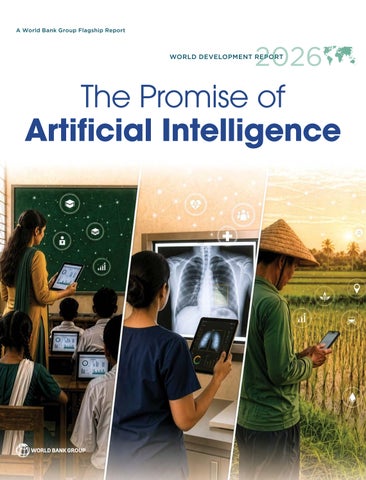
"The World Development Report 2026 assesses what artificial intelligence (AI), as a general-purpose technology, means for 5.6 billion people living in low- and middle-income countries and how it could address development challenges that have resisted solutions for decades. Advancing the AI frontier that relies on semiconductors, data centers, AI-ready training data, and top-level research talent is out of reach for most developing countries in the near term. But adopting AI that is available in the market is not enough because AI’s effectiveness depends on the local context. Adapting AI to solve defined problems in developing countries can do in a decade what might have otherwise taken a century †“ diagnosing disease, growing small businesses, advising farmers, and delivering public services.
To seize AI’s potential, governments will need to keep strengthening the analog and digital complements that power AI solutions: electricity, internet connectivity, and foundational skills, but also access to compute