Read Working RE Online – Keep up with the latest news – workingre.com
Real Est at e A pprai s ers
Fall 2026, Volume 72
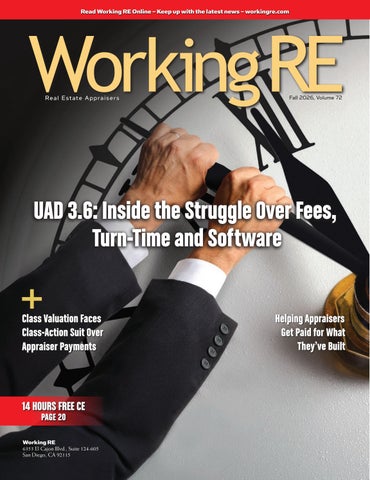
UAD 3.6: Inside the Struggle Over Fees, Turn-Time and Software Class Valuation Faces Class-Action Suit Over Appraiser Payments
14 HOURS FREE CE PAGE 20
Working RE
6353 El Cajon Blvd., Suite 124-605 San Diego, CA 92115
Helping Appraisers Get Paid for What They’ve Built
Here’s to the Entrepreneurs.
You’ve Worked Hard to Build Your Business...
We Built OREP to Protect It. Industry-Leading E&O Coverage for Appraisers
Specialized E&O for Today’s Legal Threats
Coverage specifically for today’s litigious environment (Including Discrimination Claims).
One-Hour Consultation with Trial Attorney Craig Capilla ($400+ Value) Get counsel from the foremost attorney in appraiser defense if you ever face a Regulatory Complaint. (For OREP Members)
14 Hours of Approved CE for FREE ($250+ Value)
OREP Members* save over $250 on CE and learn new skills—all online! (For OREP Members)
Apply Online in 5 Minutes Visit OREP.org/Appraisers or Call (888) 347-5273
OREP Insurance Services, LLC. Calif. Lic. #0K99465 *Member Benefits part of OREP Membership. Min. Membership fee of $60. Insurance provided through the OREP Risk Purchasing Group. Membership products available for purchase separately. CE not approved in IL or AK.
Published by
Serving Real Estate Professionals
Fall 2026, Vol. 72
E&O Insurance Experts (OREP.org) OREP Insurance Services, LLC Calif. Lic. #0K99465
4 4
From the Editor
Readers Respond
6
UAD 3.6: Inside the Struggle Over Fees, Turn-Time and Software by Frank Andorka, Managing Editor
12
Helping Appraisers Get Paid for What They’ve Built by Isaac Peck, Publisher
16
Class Valuation Faces Class-Action Suit Over Appraiser Payments by Frank Andorka, Managing Editor
22 26 28
Improving Appraisal Quality With UAD 3.6 by Scott Reuter, Chief Appraiser at Freddie Mac
Former Appraiser Gets 20-Year Prison Sentence for Fraud Scheme by Frank Andorka, Managing Editor
What the 21st Century ROAD to Housing Act Means for Appraisers by John Dingeman, Chief Appraiser at Class Valuation
32
HB 355 and What Every Appraiser Should Learn From Kentucky by Bryan Reynolds, MNAA
34 38
The Cross-Examining Attorney Handed Me My Head by Timothy C. Andersen, The Appraiser’s Advocate
Fannie Mae’s New Adjustment Requirements and the Story of One Property’s Wild Ride Through the Market by Kalen Mills, Licensed Appraiser
Mission
Publisher
Working RE is published to help readers build their businesses, reduce their risk of liability and stay informed on important technology and industry issues.
Isaac Peck isaac@orep.org
Managing Editor
Subscribe to Print and Receive Premium Content
Ariane Herwig ariane@orep.org
WorkingRE.com/Subscribe/ Subscription included with OREP Membership (Visit OREP.org). Comments and letters are welcome! Stories without attribution are written by the editor. 2 Working RE Fall 2026
Frank Andorka frank@orep.org
Marketing and Design Manager Editor
Working RE 6353 El Cajon Blvd., Suite 124-605 San Diego, CA 92115 (888) 347-5273 Fax: (619) 704-0567 subscription@workingre.com www.WorkingRE.com
Kendra Budd kendra@orep.org Working RE is published quarterly and mailed to real estate appraisers, agents and other real estate professionals nationwide. The ads and specific mention of any proprietary product contained within are a service to readers and do not imply endorsement by Working RE. No claims, representations or guarantees are made or implied by their publication. The contents of this publication may not be reproduced either in whole or in part without written consent.
www.alamode.com/total-trial
30-DAY FREE TRIAL
WRE Online Opportunity (and News) Await! Opt In at WorkingRE.com
From the Editor
I Can’t Wait to Learn All About You by Frank Andorka, Managing Editor
Hello, everyone. I’m Frank.
When Isaac Peck asked me to apply for this job, I was flattered. I was looking forward to my next big adventure in trade publishing, and the opportunity to lead such a prestigious magazine to cover a new profession (to me) doesn’t come around every day. Was the prospect daunting? Sure. But Isaac seemed convinced I was the right person for the job, so when he offered me the position, it took me less than 24 hours to say yes. After spending 20 years in trade publishing writing about (deep breath) hotel management, golf course management, pest management and solar energy, I have learned one thing: What sustains me at a magazine is the people. In that regard, the appraisal profession is just about as friendly and welcoming as any in which I’ve worked before. On this, my first issue, I spoke to several of you for our cover story, “UAD 3.6: Inside the Struggle Over Fees, Turn-Time and Software,” and the impression I have is that you are men and women of passion, commitment and dedication to bringing excellence to the profession in everything you do. 4 Working RE Fall 2026
I’m thrilled to be entering the industry at such a pivotal time, and I look forward to hearing from you what you want Working RE to cover. I can’t wait to meet you in person. I’ve always considered that the best way to understand an industry is face-to-face, with a firm handshake and maybe a meal or two along the way. My formal in-person debut will come at the Appraisal Summit in Las Vegas in November, so if you see me around, make sure to stop me and say hello. I’ll be soaking up knowledge at every turn. Now, a little more about me: I’m located in Cleveland, Ohio, on the banks of Lake Erie. I live here with my wife of 31 years, Beth, a dog named CoCo and three cats that are up for sale to the highest bidder. I have two children (Ryan and Maggie, 36 and 28 respectively), and being a father has been one of the greatest jobs I’ve ever had. I’m a passionate, if misguided, Cleveland sports fan, and I love to write (in fact, I might have a novel coming out early next year — stay tuned). For now, let me thank you in advance for the education you’ll undoubtedly provide for me. I’m ready and willing to learn, and I can’t wait to get to know this interesting industry. WRE
Readers Respond Women in the Appraisal Industry: Interview With Kathy Walsh [Kendra Budd] asked [Walsh] why there aren’t more women in the industry. I think it’s not only because it was and still is an “old boys club,” but also there are men who don’t think women can do this kind of work. Yes, long fingernails get in the way, and you can’t wear high heels, but who cares about that? No one with a brain. But when I was trying to break into the industry, one man told me I wasn’t smart enough. He had a woman partner who told me to ignore him and just go work at another company. I did just that, and she gave me a great reference. I have been a certified residential appraiser now since 2005 and own my own small appraisal company. There are men in this country who don’t respect women’s intelligence and are convinced of their superiority. I ran into some of that when I was looking for an apprenticeship early on. Women must be persistent and keep at it. I didn’t let anyone discourage me, and I eventually found a very nice man who trained me. I didn’t meet any women residential appraisers who could mentor me. All the companies I found were male-owned and operated. My former mentor and I are still friends, and I will never forget his kindness and patience in training me. —K. Lorinczi
UAD 3.6: Readiness Extends Beyond the Appraiser’s Report I ran a trial on ACI last week. The sketch program doesn’t work. Given that the current software application that ACI has supported for the last 25 to 30 years never worked without bugs, I don’t see how they can launch something entirely new without them — and my test run supports that hypothesis. —Concerned
Nobody Is Ready for UAD 3.6 I have told other appraisers and different AMCs that all appraisers should be doubling all their fees whenever 3.6 goes into effect since scope-of-work creep has been happening for years. The AMCs/lenders will choke on the bad news and try to get rid of the boots on the ground through AI or robots. —David John Simonetti You mean AI can’t just swoop in and wave its magic wand and fix everything with the software providers, AMCs, lenders and appraisers regarding UAD 3.6?!? Color me shocked! I think this may be the proof that 30-minute appraisals slopped together with AI isn’t
the answer this industry needs. Imagine if AMCs, reviewers, lenders, etc. actually read appraisal reports after they came out of Collateral Underwriter (CU) (no, using keyword searches is NOT the same as reading) and assignments weren’t given out to the lowest bidder, and they weren’t reading page after page of “Extra Comments” that clearly indicate the author cannot defend their value or adjustments. I guess that would just make too much sense, so let’s force this awful “fix” on the industry. —Gary Belt I think the biggest hurdle will be agreeing on fees for the 3.6 appraisals. I already turn down a lot of lending work due to low fees. If the fees aren’t acceptable, appraisers should not be accepting 3.6 orders. I know I won’t do a 3.6 for the same fee as a legacy appraisal. None of the lenders I work with have
even discussed fees yet. For once appraisers have some leverage over lenders. All appraisers in all markets need to be increasing fees across the board for 3.6 assignments. These opportunities rarely come around. We need to take advantage of this one. —Rob
Am I Being Paranoid, or Is There Another Reason? Working for AMCs and earning a minimum wage is not a way to live, people. You’re better off working at Taco Bell. —Elgato Appraisers were blamed then, and they will be again. Despite our screaming about what was happening, no one listened. —Donna WRE
Fall 2026 Working RE
5
UAD 3.6: Inside the Struggle Over Fees, Turn-Time and Software by Frank Andorka, Managing Editor
Nov. 2 is usually just another day on
“This rollout is vastly different [from the rollout of 2.6], and the rocky road to success is still to be paved.”
the calendar — but not this year. That date is when UAD 3.6, the latest reporting “innovation” mandated by Fannie Mae and Freddie Mac (the GSEs), becomes the only way to file an appraisal report with those organizations — and its rocky implementation has been enough to give appraisers a bad case of heartburn. Appraisers are being thrust into a whole new world. The new report has more than five times as many data fields, fundamentally changes how appraisers work and creates new questions around liability. It also arguably takes more time, depending on who you ask. The new report also requires new software, which may increase costs given the substantial development expenses providers have just incurred to meet the new requirements. All this raises the specter of higher fees and sets the appraiser up for a struggle with their appraisal management company (AMC) and lender clients.
Timeline and Rollout The rollout of UAD 3.6 has been hampered considerably by two problems: slow software rollouts and lenders dragging their feet. When Working RE covered Valuation Expo in Las Vegas at the end of August, the problems clearly came into view. While most of the leading software providers received initial approval from the GSEs in late 2025 and early 2026, word on the ground at Valuation Expo (Val Expo) was that there were still Frank Andorka is the Managing Editor of Working RE magazine, published by OREP Insurance, a leading provider of E&O insurance for appraisers nationwide. Andorka has more than two decades of experience as a writer and editor and is based out of Cleveland, Ohio.
6 Working RE Fall 2026
plenty of bugs to work out. AMC executives privately shared that they had staff simultaneously testing all the GSEapproved reporting software so they could troubleshoot and support appraisers when they inevitably ran into problems trying to turn in assignments. Some of those bugs were being run back to the software companies in real time, with the appraiser, AMC, lender and software provider working through the problem together. “All the software providers are in a state of development flux and bug chasing,” says Bruce Ford, a certified appraiser with NorCal Quality Appraisal in Rohnert Park, California. “I am still trying to decide what software providers are going to provide best-in-class software.” The GSEs tested the major software providers on several different types of assignments, but there are so many nuances, data fields and report settings in the new format that bugs surfaced rapidly once appraisers began doing live work. “I’ve taken one eight-hour class on UAD 3.6 but have had no orders for the new form yet,” Ford says. “This rollout is vastly different [from the rollout of 2.6], and the rocky road to success is still to be paved.” The bigger problem in August was that lenders had barely begun ordering the 3.6 appraisals at all. Rocket Mortgage staff at Val Expo said they had ordered six UAD 3.6 appraisals. Rocket originates roughly six to seven percent of all residential mortgages in the United States. Several regional AMCs reported completing exactly two assignments apiece — and in each case, one of the two was a test run the AMC had ordered itself. page 8 8
TEAR THIS OUT AND PUT IT ON THE WALL
EVERY FORM YOU KNOW RETIRES THIS FALL.
On November 2, 2026, UAD 3.6 becomes mandatory for every new appraisal submitted to the UCDP. The 1004 and its siblings are replaced by one dynamic URAR that changes shape with the property.
SEPTEMBER 2026 – YOU ARE HERE
JAN 26, 2026
NOV 2, 2026
Limited production opens with select lenders.
Broad production - any lender may submit 3.6. Both datasets accepted.
Mandate. UAD 3.6 required on all new submissions.
Scope of Work and the New URAR
02
Sales Comparison Approach and the New URAR
03
UAD 3.6: Inspection Workflow Wizardry
04 The Appraiser's Guide to the New URAR MCKISSOCK EXCLUSIVE · INCLUDED WITH CE MEMBERSHIP
URAR MASTERY CERTIFICATION
mckissock.com/appraisal/urar-certification Scan to see the full program
CE
01
CK LEAR SO N IS
RT
M
19 CE HOURS
G IN
GET FLUENT IN FOUR COURSES
MC K
SEP 8, 2025
IFI
C AT E & E M
BL
E
Finish the program and the final exam to earn the URAR Mastery Certificate & emblem, signaling to clients and lenders that you are prepared for the new URAR.
7page 6
Scott Reuter, chief appraiser at Freddie Mac, summed up the bind on a panel at the show: “Appraisers cannot do a 3.6 assignment unless somebody orders a 3.6 assignment.” Working RE also heard rumors software providers are planning to bump up their annual rates to compensate for the development of compatible software. However, at press time none of the larger software players have indicated any material change in pricing. Even though many software providers are approved by the GSEs, appraisers are reportedly running into errors throughout the process. “It’s 100 percent throwing sand in the gears that there’s not a singular approved software right now for appraisers to rely on,” says Josh Tucker, appraisal manager for Interbank in Oklahoma City, Oklahoma. “It was funny: I ordered a 3.6 report and got it three days late and couldn’t export it — right now, there are a lot of lenders who might come screeching to a halt on Nov. 2.” All of this sets up GSEs and the lending community to blame appraisers if the UAD 3.6 rollout fails. They shouldn’t. After all, appraisers didn’t design the software and can’t order their own UAD 3.6 appraisals. If no one is using them, why should appraisers shoulder the blame?
More Than 900 Data Elements There were approximately 190 data elements in UAD 2.6. There are now more than 900 in UAD 3.6. Reuter says it’s easy to be overwhelmed if appraisers just hear the number, but he assures the industry that appraisers were in the room when the form was developed. “I want to make sure they don’t just hear ‘more than 900 elements’ and worry that they won’t be able to do it,” Reuter says. “They won’t have to fill out all those data points for every property. They are never going to touch the lion’s share of them, but we wanted to make sure we accoun8 Working RE Fall 2026
ted for every potential contingency just in case.” Lyle Radke, senior director of collateral policy at Fannie Mae, says Fannie and Freddie hold, between the two of them, $7 trillion in mortgage debt which, since it’s backed by the U.S. Treasury, is guaranteed by U.S. taxpayers. Therefore, it stands to reason collecting more data than before is important. “From that perspective, the data is essential,” Radke says. “It’s how we manage risk. UAD 3.6 makes it easier for us to see and understand the data. If we didn’t have 3.6, we could still parse the data, but it would be much more challenging and time consuming.” Radke says the new report will open opportunities for appraisers to work more collaboratively with lenders and AMCs instead of being forced into a silo. “Right now, when an appraiser signs a report, they’re certifying that they’re accountable for everything,” Radke says. “There’s no means of collaboration. The new report allows flexibility that the current report doesn’t – opening the door to a more collaborative environment.”
What About Appraisal Fees? Then there’s the question of what UAD 3.6 means for appraisers. Working RE talked to a senior AMC executive at Val Expo who indicated they are “trying to hold the line on fees.” The executive explained that the staff appraisers at their AMC had worked with UAD 3.6 long enough to become proficient and could now complete a UAD 3.6 appraisal in the same time as a traditional one. Even though they were trying to hold the line, the executive conceded appraisal fees have increased 10 percent so far. Then there is Solidifi, an AMC based in Buffalo, New York. It sent out an email to several of their appraisers with the following statement (Working RE has reviewed a copy of the email provided by an appraiser):
We understand that UAD 3.6 may require additional time as appraisers become familiar with the new workflow. However, our clients evaluate fee requests based primarily on property and assignment-specific complexities. While there is a learning curve, completing 3.6 assignments now allows appraisers to gain experience gradually, improve efficiency and be better positioned to handle increased 3.6 volume as industry adoption expands. Based on the information provided, we do not currently have sufficient support of a fee increase above the standard for this assignment. If you would like to provide any additional complexities, we can send this off to the client. Donna Halfpenny, owner and certified real estate appraiser of Halfpenny Appraisal Services in Riverside, Illinois, responded to Solidifi’s email on LinkedIn (lightly edited for clarity): Hey, Solidifi! Yes, you. What are you all doing over there? Do you not comprehend all that is involved in UAD 3.6? Certainly, you cannot, since you have sent [this email] out to your appraisers. The new appraisal form takes much more time, more research, more than 150 new data points, increased software fees and increased liability. Lenders: This is how the company that represents you treats appraisers. How do you think regulators and states may feel? You know, you are required to oversee your third-party AMCs. Back to you, Solidifi: I hope you realize you are proving why so many appraisers refuse to work with you. You would think you’d want the best appraisers to serve your clients. Yet you prove otherwise. Your motto seems to be ‘cheap and fast, no concern for quality.’ After that email, hip boots are needed. I was called ‘difficult.’ I am not being difficult. I am calling out issues because I truly care about the consumers and real estate professionals. Transparency needs to be prioritized.
And I dare you to send me a letter for calling you out like you did to another appraiser. Sincerely, Donna Halfpenny Halfpenny’s LinkedIn post captures the struggle that is materializing between many boots-on-the-ground appraisers and AMCs who are attempting to “hold the line” on fees. Appraisers are clearly saying: UAD 3.6 reports take longer to complete. Therefore, they should command higher fees. Some AMCs are saying: Well, just practice more. Not all AMCs are taking this approach, however. Working RE spoke to several regional AMCs at Val Expo that indicated they are taking more of a wait-and-see approach on appraisal fees. “We need to wait for the market to determine the fees. Appraisers are going to tell us what their fees are,” one AMC executive told Working RE. “We do expect appraisers to get more acclimated and learn to do UAD 3.6 appraisals faster, but it’s too early to try to take a one-size-fits-all on appraisal fees for this new report.” In a survey of 831 appraisers run by Corporate Settlement Solutions earlier this year who answered about fees, 66.7 percent expect to have to increase their fees. Of the 214 appraisers who had performed UAD 3.6 reports, that number jumped to 82.2 percent. Clearly, there will be some intense discussions about fee levels between AMCs and appraisers as UAD 3.6 becomes mandatory.
Appraisal Turn Times Pat Turner, owner and certified appraiser of P.E. Turner & Co. in Manakin Sabot, Virginia, worries about what UAD 3.6 will do to appraisal turn times. He argues UAD 3.6 is part of a long-term goal of the two GSEs. “Freddie Mac and Fannie Mae have been trying to put appraisers out of
business for the past 50 years,” Turner says. “They say we need to modernize and streamline the appraisal process. We have gone from a roughly 15page report to a 41-page report. How does that speed things up or streamline anything?” Turner argues that the expanded report will inevitably lengthen the turnaround times for appraisers. In the end, consumers will bear the burden of having a UAD 3.6 appraisal. “It costs too much for the amount of time it takes to do one,” Turner says. “It’s insanity. I have a colleague who has been an appraiser for 30 years. It took her four hours inside the house to use this new form. No one is ready for this: not the lenders, not the underwriters — no one.” Josh Tucker concurs with Turner. “There’s no way this is going to be done without extending turn times for appraisers,” Tucker says. “We’re still entering everything manually, but the inspection apps aren’t working properly in conjunction with 3.6. There’s no way we can do this without raising fees.” Desiree Mehbod, a certified real estate appraiser at eAppraiser Co. LLC in Reston, Virginia, says she’s confident her turn times won’t change — because she’s just not using it. “The new system is built in a way that creates unnecessary alerts, adds extra workload for appraisers, shifts more liability on to us and moves the profession in the wrong direction,” Mehbod says. “I’m not planning on doing UAD 3.6. Because of that, my turn times haven’t changed at all.” Kelly Cahill, owner of Speedwell Appraisal Services in Middleton, New York, says she completed her first UAD 3.6 report in August. She says maybe it won’t delay things on the appraisers’ end as much as everyone fears. “My first order did take a bit longer because I was getting used to where all the data is,” Cahill says. “It’s a completely different format to get used to.
However, I can see how this will be a total game changer. Ultimately, my reports will be done quicker once I get used to the format. My completion and delivery to the client was actually very smooth.” Cahill says she now has four UAD 3.6 orders on her desk, which is almost half her workload in an average week. She believes the Nov. 2 deadline isn’t unreasonable if appraisers take the time to get used to the format. The same Corporate Settlement Solutions survey mentioned earlier found that 78.3 percent expect an extended turnaround time among the 816 appraisers who answered the question. The number barely diminished among those who had actually completed at least one UAD 3.6 appraisal. Of the 214 appraisers who have completed at least one report, 75.7 percent still expect longer turnaround times.
How Does the Liability Shift? Brad Bassi, an appraiser and designated member of the Appraisal Institute, says appraisers should be concerned about how UAD 3.6 will shift more liability onto their shoulders. “The problem is appraisers are being asked to report on things, like volume of windows and above-grade measurements, where they don’t have the market data to make an adjustment,” Bassi says. “They don’t have the volume of windows or the above-grade information of the comparables, so they are collecting and reporting on these things but don’t have enough information to analyze it. It’s going to leave them exposed.” Isaac Peck, president at OREP Insurance, says one potential issue facing appraisers with the shift to UAD 3.6 is what their liability insurance will cover should they make a mistake with one of those ‘more than 900’ data points. “First of all, part of our take here is ‘more data, more problems,’” Peck page 108
Fall 2026 Working RE
9
7page 9
says. “There are now hundreds of additional data fields that appraisers are responsible for reporting on, so just by that metric alone, there is an increased risk of one of those fields being incorrect. It just increases the canvas upon which an appraiser might misreport something.” Peck says the good news for appraisers, from a liability standpoint, is that the new report includes the following language in both Certifications 25 and 26: “The appraiser and supervisory appraiser (if applicable) shall have no liability for any use of this appraisal report not related to the mortgage finance transaction and related activities for which this appraisal report was prepared.” Seeing this language appear twice, in two separate certifications, is a clear win for appraisers, Peck says. “To have Fannie and Freddie explicitly add this liability language to the certifications is a big victory for appraisers,” Peck says. “It helps counterbalance some of the other changes they’ve made with UAD 3.6.”
Second, many of the additional data fields appraisers must report are also potentially problematic. “I agree with Brad Bassi and the comments he’s made around volume of windows and the above-grade measurements, but I also think that the condition reporting on things like foundation, roof, kitchen and bathrooms is also going to create some misunderstandings among consumers,” Peck says. “For example, an appraiser might mark a roof ‘new’ or ‘like new’ and then six months after moving in, the roof might start leaking. It would be easy for a borrower to misunderstand the purpose of the appraisal and try to bring a claim against the appraiser.” Are many of the new data fields, like commentary on the condition of the roof and foundation and even the presence of “Accessibility Features for Individuals with Disabilities,” going to create confusion and increase demand letters and even lawsuits from borrowers? “Probably, but not in a super material or radical way,” Peck says. “At least that’s the view we have right now.”
Publishing to appraisers for over 25 years, Working RE is the #1 source of news for real estate appraisers across the U.S.
10 Working RE Fall 2026
The Bottom Line Whatever appraisers think about UAD 3.6, it’s coming Nov. 2. Joel Baker, senior product professional at a la mode technologies in Oklahoma City, Oklahoma, says it doesn’t pay to do anything but prepare. “The biggest misconception is that this is the end of the world,” Baker says. “A lot of appraisers have tied workflow to sense of self, so it’s difficult to internally challenge the process.” John Dingeman, chief appraiser at Class Valuation, says change is inevitable, so embrace it. “I’m taken aback by appraisers who say they still want to use their tape and pen sketch,” Dingeman says. “There’s a real opportunity for appraisers to move to paperless filing and digital sketching. UAD 3.6 doesn’t eliminate those skills: It just enhances them.” As the industry rushes toward the Nov. 2 deadline, appraisers’ stress levels will continue to rise. The only question is: What will things look like when the smoke clears? Only time will tell. WRE
Helping Appraisers Get Paid for What They’ve Built by Isaac Peck, Publisher
Most appraisal shops are one-person
“What do most appraisers do when they’re ready to retire is they turn their light off and close the door.”
operations. The specter of the lone appraiser running their business in a spare bedroom and not socializing much with their peers has persisted for decades — and there’s certainly some truth to it. However, one of the downsides to a solo-operator business model, especially with service businesses like appraisal, is that when it comes time to retire, these types of businesses are rarely saleable. With no (or few) assets, no staff and little goodwill outside of the name of the principal, most solo appraisers build their businesses for decades and then simply flip the light switch and shut the door on their business. Bryan Reynolds wants to change all that. A certified general appraiser, partner at Appraiser eLearning, host of The Appraisal Update Podcast, owner of Reynolds and Associates, and a partner at his two newest ventures — Legacy Appraisal and Consulting and Legacy Advisors and Consulting — Reynolds is a serial entrepreneur. His latest ventures are particularly interesting and arguably well-timed, given everything the profession is facing. Against a backdrop of a UAD 3.6 rollout (Nov. 2, 2026) that some stakeholders say will lead to 10 to 20 percent of residential appraisers hanging it up, and a sharp reduction of new people entering the profession, Reynolds sees an opportunity to
Isaac Peck is the Publisher of Working RE magazine and the President of OREP Insurance, a leading provider of E&O insurance for real estate professionals. OREP serves over 10,000 appraisers with comprehensive E&O coverage, competitive rates, and 14 hours of CE at no charge for OREP Members (CE not approved in IL or AK). Visit OREP.org to learn more. Reach Isaac at isaac@orep.org or (888) 347-5273. CA License #4116465.
12 Working RE Fall 2026
help usher in new entrants to the profession while simultaneously helping appraisers get paid for the businesses they’ve built over decades when the time finally comes to step away.
Entering and Exiting the Profession Reynolds sees real opportunity in simultaneously helping folks enter the profession, as well as working with appraisers who are about to step back and retire. “Our vision is to help appraisers enter the profession and exit the profession,” Reynolds says. “What do most appraisers do when they’re ready to retire is they turn their light off and close the door. Their book of business, which in many cases represents 30 to 40 years of careful nurturing, just evaporates. They don’t get paid for it or rewarded in any way. We would like to help keep their legacies alive.” Instead of just shutting the door, Reynolds explains that Legacy Advisors and Consulting is working with appraisers to set up an exit strategy that allows them to receive compensation for the first three to five years of retirement. “We will ask them to stay with the company for a prescribed period of time,” Reynolds says. “Then we will put someone in their market, as well as our administrative and support team based out of western Kentucky. Basically, we want to see another appraiser step in and become them in that local market.” Reynolds’ strategy requires the exiting appraiser to remain with the company for 12 to 18 months. If they want to retire, however, Reynolds requests they call a year in advance. Several interested appraisers have already reached out.
“I just talked to an appraiser who asked me, ‘What about the VA? I’m a VA appraiser. VA selects me to do the appraisal. How can I transition this business?’” Reynolds says. “Our position is that for every problem there is a solution. As appraisers, we solve valuation problems. As small business owners, we solve business problems every day. In that particular situation, that may require that they, instead of retiring completely, retire almost fulltime. We can create a program for that individual as well. I’m confident we can work something out.”
Helping Train New Appraisers, Too Reynolds also wants to help new entrants to the profession find their feet and get started. Legacy Advisors and Consulting is also licensing Melissa Bond’s MPact Practicum coursework, a successful appraiser curriculum.
“We want to offer a pathway to becoming an appraiser to anyone in most locations across the United States. We figured out how to do that. Our program includes virtual training, and we also do field visits in select cities.” “We want to offer a pathway to becoming an appraiser to anyone in most locations across the United States,” Reynolds says. “We figured out how to do that. Our program includes virtual training, and we also do field visits in select cities. If we have a student in a particular location where it’s prohibited for us to travel there, we’ll team them up with a representative we have in their local market to satisfy the local requirements.” The profession has no shortage of appraisers who lament the current environment, and the question lingers:
Who would want to enter the profession at the moment anyway? Bryan Reynolds says: You’d be surprised. In fact, while attending the Association of Texas Appraisers as one of the first events where Legacy is promoting itself, Reynolds reports that he met 10 interested individuals on his first day at the conference. One gentleman he spoke to was a software engineer looking for a change in careers. “Some other appraisers he had spoken with the previous night told him, page 14 8
Considering a career move? Here’s your perfect opportunity. Earn a business valuation credential. Write quality business valuation reports Self-paced, on-demand options available Become known as a Valuation Professional Increase credibility with your clients Business valuation tools are membership benefits ISBA members with the Business Certified Appraiser (BCA) credential are approved by the U.S. Small Business Association (SBA) as qualified sources for lending criteria appraisals. For inquiries, contact: Howard A. Lewis, ISBA Director 984-227-8552
support@intlbca.com
learning.intlbca.com
Fall 2026 Working RE 13
7page 13
‘It’s a dying profession’ and even discouraged him from making the leap,” Reynolds says. “I told him we’re going to be around a long, long time. He was very interested in working with us.”
The Path Forward The most common reaction Reynolds gets is that the arrangement sounds too good to be true. He says appraisers who sit with the details usually come around, and one has already asked him to send over a contract. The way he frames it, the retiring appraiser finally gets paid for what took 30 or 40 years to build, the new appraiser inherits a client base instead of starting from zero, and the clients and communities those appraisers served keep someone who knows the market. “I’m obviously passionate about what I do,” Reynolds says. “There have been a lot of roadblocks historically for people trying to come into this profession, and it saddens me when I hear about someone exiting it. We wanted to find solutions for both of those obstacles. So many appraisers work by themselves, all alone on a deserted island. When they need help, they don’t feel like they have anyone they can turn to. We wanted to build pathways for each of those areas.”
“We’re working on a class-action lawsuit right now in Kentucky and a construction defect case in Arkansas. We do a lot of litigation support, divorce work, condemnation [and] bankruptcies. People are going to die, and people are going to get divorced.” That means the training pathway has a destination attached to it. “I’ve done mentorship and support for appraisers for years,” Reynolds says. “I wanted to build that on a bigger scale. If they get licensed and they want to work for us, we’ll have a place for them.” The firm prospective appraisers would be joining is also not exclusively built around lender work. Legacy Appraisal and Consulting currently runs seven appraisers, three trainees and six support staff, with appraisers in Kentucky, Tennessee, Florida and Colorado. Reynolds says the plan is to be a full-service valuation shop rather than a refinance and purchase mill. “We’re working on a class-action lawsuit right now in Kentucky and a construction defect case in Arkansas,” Reynolds says. “We do a lot of litigation support, divorce work, condemnation [and] bankruptcies. People are going to die, and people are going
to get divorced. We want to provide those services throughout the region and the country, not just refinance and purchase transactions.” Reynolds is also recruiting practicing appraisers who are tired of working alone, pointing to a team-based workflow that splits inspection and analysis between appraisers based on which part of the job they actually like doing. He credits Jeff Bradford with the line he keeps coming back to on this, which is that teams outperform individuals. The firm is also opening up the proprietary tools it has built in-house to appraisers who come on board. Appraisers thinking about an exit strategy, and anyone looking at the training pathway, can find more at LegacyAppraisalandConsulting.com and LACappraiserpathway.com, or email info@LACappraiserpathway.com. Reynolds can be reached directly at Bryan@theLegacyAG.com. WRE
Retiring? Your Liability Doesn’t Retire With You Many appraisers who step away from
the business often cancel their E&O policy on the way out the door. Unfortunately, that decision puts massive risks on the appraisers’ shoulders. E&O insurance is written on a claims-made basis, so coverage depends on having a policy in force on the day the claim is filed, not on the day the appraisal was signed. In other words, if you cancel or let your policy lapse when you
14 14 Working RE Fall 2026
retire, 15 to 20 years of coverage can disappear overnight. Because buyback demands and lender claims routinely surface years after closing, it’s important for appraisers to secure Extended Reporting Period (ERP) coverage, also known as tail coverage. An ERP, or tail coverage, is a unique insurance endorsement that is needed when you retire or step away from your business. It keeps the claims reporting window open after a policy
ends. Most carriers sell it as an endorsement priced off the expiring premium and cap the tail at a few years. OREP provides free lifetime ERP coverage to qualified insureds who have been with the program five years or more. Appraisers planning an exit should ask their agent what tail coverage costs and how many years it runs. Call OREP at (888) 347-5273 for high-quality coverage and excellent service or visit OREP.org. WRE
Class Valuation Faces Class-Action Suit Over Appraiser Payments by Frank Andorka, Managing Editor
C lass Valuation, one of the largest ap-
“While a borrower may pay an appraisal fee ranging from $450 to [more than] $1,000, the AMCs pay the appraiser only a fraction of this fee, deceptively keeping the remainder for themselves,” the lawsuit states.
16 Working RE Fall 2026
praisal management companies (AMCs) in the United States, is the latest AMC to be sued over the issue of appraisal fees and fee transparency. Clayton Bernholtz, a Florida resident, filed a class-action lawsuit June 11, 2026, in Broward County Circuit Court against Class Valuation and CrossCountry Mortgage, alleging the companies overcharge consumers for home appraisals through undisclosed fees, in violation of the Florida Deceptive and Unfair Trade Practices Act (FDUTPA). Bernholtz also accuses Class Valuation of unjust enrichment, alleging the company pockets the difference between what it charges consumers and what it actually pays appraisers. He is asking the court to certify the case as a class action on behalf of himself and all others similarly situated, which would allow other affected borrowers to join the suit. Originally filed in Broward County, Florida, the case was later removed to the U.S. District Court for the Southern District of Florida (Case No. 0:26-cv-61978). Many appraisers had hoped this issue would be resolved without litigation by the Consumer Financial Protection Bureau, which had been expected to issue guidance before the new administration took over. In its current weakened state, it is unlikely such guidance will be coming, which leaves plaintiffs with no alternative but to sue. Furthermore, the recent National Association of Realtors (NAR) settlement and litigation provided both motivation and inspiration for attorneys and consumers to sue over opaque fee arrangements.
Bernholtz’s case is the third pending class-action lawsuit that has arisen out of appraisal fee transparency, including Timmins v. Clear Capital, Core Valuation Management and Rocket Mortgage in California, and Arnold v. Appraiser Nation, also in Florida. A fourth case, Golar v. Class Valuation LLC in Georgia, was dismissed without prejudice at the request of both parties.
The Allegations Essentially, Bernholtz’s allegations echo the core arguments of the other classaction lawsuits facing AMCs and lenders in this space — CrossCountry Mortgage breached its contract with him, he claims, while Class Valuation, as an appraisal management company, engaged in “unlawful, unfair and deceptive practices relating to the ‘appraisal fees’ they charge mortgage borrowers.” While buying a home is “one of the landmark financial burdens faced by Americans,” Bernholtz argues that saving up for the down payment is not the only burden on today’s potential homeowners. Additionally, the overwhelming closing costs can pose their own burden, especially when, as his lawsuit puts it, those costs “all too often are full of junk fees.” One such fee, he argues, is the appraisal fee charged to potential homeowners. “While a borrower may pay an appraisal fee ranging from $450 to [more than] $1,000, the AMCs pay the appraiser only a fraction of this fee, deceptively keeping the remainder for themselves,” the lawsuit states. “The appraisers, not Defendants, perform the required appraisal. Class Valuation provides no tangible benefit to borrowers in the appraisal process.”
As other similar cases have argued, Bernholtz suggests the idea of hiding an AMC’s involvement flies in the face of what is purportedly a free-market system. AMCs are not required to compete in the marketplace the way that other vendors do, so consumers cannot shop for their services, nor do they know what the AMC will charge. The result is a dynamic where AMCs like Class Valuation have the opportunity to shop for the lowest-cost appraisal and then pocket the difference, Bernholtz suggests. While he understands that an appraisal of the property is necessary, Bernholtz believes AMC involvement should be disclosed at the time of the borrower’s loan estimate. “In contrast, CrossCountry represents the appraisal fee as going to the appraiser,” the lawsuit contends, citing loan estimate language stating only, ‘We may order an appraisal to determine the property’s value and charge you for this appraisal.’ However, CrossCountry
in fact charges for much more than the appraisal.” Bernholtz is suggesting that he and a class of consumers (i.e., homebuyers who paid appraisal fees) “have suffered, and will continue to suffer, by being required to pay misrepresented, inflated ‘appraisal fees.’”
The Facts As Bernholtz points out, borrowers can’t shop for their own appraisers in most homebuying transactions. Instead, the lender picks an appraiser and bills the fee to the borrower, typically before closing. He contends the only way to completely avoid an appraisal fee is to pay for a home in cash. Under federal law, appraisers and lenders must be separated to avoid another housing crisis like the one that devastated the industry in 2008. That’s the whole reason companies like Class Valuation exist, although Bernholtz argues companies like Class
First in Depreciated Cost First in Sensitivity Analysis
Valuation “provide no benefit to borrowers, and only a limited benefit to lenders like CrossCountry.” The lawsuit goes on to defend appraisers, saying that it’s the appraisers who do all the work while the AMCs reap much of the benefits. It acknowledges that good appraisals take time and considerable effort and, as such, should be compensated fairly. “Even though the AMCs provide no benefit to borrowers and have no apparent role in the actual appraisal services, the AMCs enrich themselves by obtaining inflated fees that far exceed the actual appraisal cost,” the lawsuit states. “Recent research indicates that [AMCs] typically retain more than 60 percent of appraisal fees. Stated differently, [AMCs] typically retain more than what they pay appraisers — meaning that borrowers’ appraisal fees are typically more than double the actual appraisal cost.” page 18 8
“My revision requests dropped 99%” John Nadasi, Certified Residential Appraiser
“Every appraiser needs to understand what Scott teaches about the relationship between the cost approach and sales comparison approach” – Tim Andersen Florida State-Certified General Real Estate Appraiser, MAI, AQB Certified USPAP Instructor, Member of the National Association of Appraisers. “Real Estate Appraisers have always been required to support their adjustments. Scott has the experience and methodology that is necessary for appraisers to be able to accomplish that.” - Pam Teel Texas State Certified Real Estate Appraiser, AQB Certified USPAP Instructor, Board Member of National Association of Appraisers, past President of the Association of Texas Appraisers. “In the challenging appraisal world we live in today, supporting adjustments is imperative. I use Solomon when I teach my class ‘Supporting Land Value’, and in my practice as well.” Marty Wagar State Certified residential Appraiser in Michigan and Florida, Member of the National Association of Appraisers. Honored as 2022 NAA Appraiser of the year.
Sign Up for our free trial. Solomonappraisal.com email Scott at scullen2@comcast.net
Fall 2026 Working RE 17
7page 17
As for CrossCountry Mortgage (the other named defendant in the lawsuit), Bernholtz argues they should have disclosed how much of the appraisal fee the AMC kept as opposed to what they paid the appraisers. “Instead, CrossCountry forced plaintiff to pay an upfront fee of $700, representing that it was charging for only an appraisal, when it categorically was not,” the lawsuit says. “Instead, CrossCountry charged Plaintiff an appraisal fee and an undisclosed management fee.” In closing, Bernholtz asks for the two classes to be split: 1) A breach-of-contract class against CrossCountry, on the theory that its loan estimate promised to charge borrowers only for the appraisal itself, not an undisclosed fee to Class Valuation; and 2) An FDUTPA class against Class Valuation, to recover the fees it collected from borrowers. Class Valuation has asked for three extensions to prepare its defense, while CrossCountry Mortgage moved Aug.
14, 2026, to dismiss the breach-of-contract count against it with prejudice. In its motion, CrossCountry argues the loan estimate is a regulatory disclosure under the Truth in Lending Act, not a binding contract, and that even if it were, it’s unenforceable because it was never signed by CrossCountry, as required under Florida’s Banking Statute of Frauds. The lender also contends the loan estimate’s “we may order an appraisal” language is permissive and doesn’t restrict how it splits the fee with an appraisal management company, and that Bernholtz’s damages theory targets money Class Valuation allegedly kept, not any harm CrossCountry itself caused. The motion doesn’t seek dismissal of the FDUTPA or unjust enrichment counts against Class Valuation. CrossCountry also points to Bernholtz’s closing disclosure, which shows he ultimately received a $50 credit against his $700 appraisal fee — evidence, the lender argues, that he didn’t overpay for his own appraisal. At press time, CrossCountry’s motion to dismiss the breach of contract count remains pending before the court. One way to address borrowers’ concerns — including Bernholtz and
the plaintiffs in the other suits — is simple: Separate the AMC fee and appraisal fee in loan disclosures. This would disclose AMC involvement to the borrower early on and would transform the AMC fee into a flat fee, which would discourage them from paying the appraiser as little as possible.
Conclusion Now that the courts have settled a class-action suit against the NAR in late 2024 over price-fixing and transparency of real estate agents, AMCs and lenders have taken notice. They can no longer be assured of prevailing, so they are watching these new cases with care and caution. This case is just one of several working their way through the court system with the same goal in mind: forcing AMCs and lenders to be more transparent about how they bundle fees. Regulators haven’t intervened yet, but the more such cases are filed, the harder it becomes for them to ignore the issue. A win for Bernholtz could force greater transparency in appraisal fees — and put downward pressure on the fees AMCs collect going forward. WRE
Calif. Lic. #0K99465
18 Working RE Fall 2026
You value
homes. We value
YOU.
Three Things You Need for Your Appraisal Business. One Solution.
1
2
Attorney Support Get a 1-Hour Consultation with top appraiser defense attorney Craig Capilla ($400+ Value) if you face a Regulatory Complaint. *(Member Benefit)
Lower Your Business Expenses Get 14 Hours of FREE CE ($250+ Value), reduce your expenses, and learn new skills—all online! *(Member Benefit)
OREP: More Than Just an Insurance Agent. Receive a Personalized Quote Today at OREP.org/Appraisers
O R E P
3
Comprehensive Coverage Coverage for today’s litigious environment (including Discrimination Claims).
*Member Benefits part of OREP Membership. Min. Membership fee of $60. Insurance provided through the OREP Risk Purchasing Group. Membership products available for purchase separately. CE not approved in IL or AK. | Calif. Lic. #0K99465
Improving Appraisal Quality With UAD 3.6 by Scott Reuter, Freddie Mac
The Uniform Appraisal Dataset (UAD)
“The same structured approach applies to property features such as outbuildings and accessory dwelling units.”
3.6 Redesign initiative represents a major shift in appraisal reporting — from static forms with extensive use of abbreviations and codes, and long, unstructured text addenda to a standardized, data-driven framework with additional data fields, dynamic comment fields and photos embedded within the main body of the report. It is designed to improve quality, consistency and transparency. By requiring more uniform data fields, embedded UAD compliance and clearer documentation, the new structure can help reduce rework, strengthen collateral review and make appraisal information easier to analyze, compare and rely on throughout the mortgage process.
What Is UAD 3.6? Fannie Mae and Freddie Mac (the GSEs) have collaborated to update the UAD, retire existing appraisal forms and redesign the Uniform Residential Appraisal Report (URAR). This work is part of the Uniform Mortgage Data Program® (UMDP®), a joint effort directed by the Federal Housing Finance Agency (FHFA) to improve data quality and standardization across the mortgage industry. Since 2018, the GSEs have worked with appraisers, lenders, appraisal management companies, technology vendors, government agencies, trade organizations and other industry stakeholders to identify pain points, gather requirements and refine the redesign. The result
Scott Reuter is the Chief Appraiser and Director of Valuation for the Single-Family Division at Freddie Mac. Reuter is a Certified General Real Estate appraiser with more than 35 years of experience in valuation, appraisal and collateral risk management concerns. Reuter holds a B.A. from The Ohio State University and has completed the Executive Leadership program at Cornell University’s Johnson School of Business.
22 Working RE Fall 2026
is UAD 3.6, which introduces structured data fields, defined reporting standards and built-in validation checks designed to improve appraisal quality, consistency and transparency.
Why the UAD 3.6 Structure Matters At its core, the new framework creates a more consistent way to capture and communicate appraisal information across property types. Standardized data fields and reporting requirements reduce variability in how information is documented and ensure reports follow common formats, definitions and expectations. Simply put, a report in UAD 3.6 is much easier to read and understand. Reporting Property Condition and Quality Ratings As an example, appraisers will identify condition and quality characteristics for both the interior and exterior of the dwelling, helping readers understand where specific features or deficiencies are located within the property. The same structured approach applies to property features such as outbuildings and accessory dwelling units. Rather than relying primarily on narrative explanations, appraisers can report and analyze these specific features in an enumerated format (think drop-down or quick pick lists) that supports clearer review and stronger data consistency. Narrative explanations have value, but legacy formats often rely on freeform text that can vary widely by appraiser and assignment. Unstructured, static length and open fields in the body of the report and addenda of the legacy forms can lead to confusion, as well page 248
NEW ORLEANS H YAT T R E G E N C Y April 26-28, 2027 Join us at the 2027 Annual Conference for inspiring ideas, meaningful conversations, and valuable connections!
REGISTER NOW EARLY BIRD PRICE ENDS 12/31/2026
COUNTDOWN TO UAD 3.6
WILL YOU BE READY? Monthly webinars designed to get you ready before the November deadline.
REGISTER NOW
7page 22
as presenting opportunities for the appraisers and readers to miss something. Structure provides consistency for both the appraiser and reader of the report. While the new format is designed to provide a data structure to follow, it still allows appraisers the ability to add and associate commentary if needed to help clarify specific reported information.
A Shift From Forms to Data Under UAD 3.6, appraisal reporting becomes less about completing a static form and more about presenting a structured, data-driven analysis that’s easier to follow. This creates a clearer connection between the appraiser’s observations, analysis, supporting data, photos and final value conclusion. •
Section-specific commentary: Relevant notes are captured within the
•
•
appropriate sections rather than placed in broad general addenda. More detailed condition reporting: Interior, exterior and room-level details support a more defensible overall condition rating. Dynamic comparable analysis: Comparable property fields adapt to the subject property, while appraisers can also identify sales considered but not used and explain why.
Quality Control Because UAD 3.6 relies on structured data, quality control can become part of the appraisal workflow rather than an after-the-fact review step. Required fields, standardized formatting and system checks help identify inconsistencies earlier in the process. Many appraisal software platforms also connect to UAD compliance tools from the GSEs,
allowing UAD compliance issues to be screened and addressed before submission to the Uniform Collateral Data Portal® (UCDP®). This can help reduce back-and-forth between the lender and the appraiser. The goal is a report that is easier for lenders and reviewers to evaluate, with fewer avoidable errors and clearer support for the final value opinion.
Efficiency Gains: Reporting and Review The new UAD 3.6 structure also supports faster and cleaner reporting by reducing human error, manual corrections and late-stage revisions. A more flexible, standardized report format helps appraisers document assignments more efficiently while offering more reliable data for underwriting, collateral review and downstream analytics.
The Delegate to Republic Program Upfront Payment
Are you an appraiser?
Start earning immediately Zero investment Zero commitment Zero Liability
National Coverage
Monetize every inquiry. LEARN MORE:
Every asset type Every location One trusted partner firm
Outside your coverage area? Tight schedule? Unusual asset type? Refer assignments that fall outside your scope and earn 10% of the fee.
Live tracking & automatic payments With our Partner Portal, every referral is tracked and accounted for.
212.228.6900 | Delegate@Republicvaluations.com www.republicvaluations.com/delegate-program Commercial | Residential | Special Use | Entity | Personal Property
24 Working RE Fall 2026
•
•
•
Automated UAD compliance reduces avoidable errors and latestage revisions. Standardized fields make valuation reports easier to compare across appraisal assignments. Structured data delivery supports cleaner integration and processing of data and UCDP Submission Summary Report (SSR) findings.
The industry gains a more consistent appraisal dataset that can be the foundation for stronger underwriting support, better UAD compliance monitoring, improved analytics and more transparent communication among appraisers, lenders, investors and consumers. Benefits Include: •
Alignment With MISMO® v3.6 The Mortgage Industry Standards Maintenance Organization (MISMO®) maintains a reference model that is the foundational standard for mortgage industry data. It provides a structured framework for representing mortgage data, document formats and processes across the mortgage ecosystem. UAD 3.6 alignment with MISMO® v3.6 improves interoperability across mortgage industry systems. The greatest quality improvement comes from making appraisal data more consistent, complete and machinereadable from the start. Broader Industry Impact As UAD 3.6 becomes the standard for new appraisal reports, its impact extends beyond an individual report format.
•
•
•
•
•
More reliable and reviewable collateral data for lender underwriting and risk decisions. Clearer workflows, fewer revision requests and stronger documentation support for appraisers. More transparent and comparable appraisal reports for consumers, lenders, AMCs and brokers. Greater confidence in the valuation process through more consistent documentation. Reduced valuation and collateral risk through clearer data and earlier issue detection. Stronger credit and investment decisions, supported by cleaner, more reliable appraisal data.
The Bottom Line UAD 3.6 is designed to provide greater
clarity to lenders, investors and borrowers while improving appraisal quality by enforcing consistent, enumerated data entry; embedding quality control into the workflow; and producing cleaner, more credible reports. For appraisers, lenders and consumers, the result is a more transparent and defensible appraisal process across the broader housing finance ecosystem.
Resources to Support Industry Implementation UAD 3.6 has been broadly available since January, and the mandated requirement to use it is approaching. The industry is adopting and using UAD 3.6. If you’re not, you’re behind the curve and need to start. Appraisers who do not support UAD 3.6 and depend on appraisals from mortgage lenders may soon find the number of appraisal requests dry up. Freddie Mac has resources available on its website — including industry training, job aids and FAQs — to help appraisers and lenders develop and execute a successful implementation plan. View the Freddie Mac UAD page online at Bit.ly/Freddie-UAD to learn more. WRE
CAN YOU PROVE YOUR ADJUSTMENTS? Adjustments are (again) a very HOT topic.
Many appraisers are getting pushback from their clients and being asked to show support for their adjustments. Failure to provide proof and analysis to support your adjustments can mean a rough road for appraisers.
How to Support and Prove Your Adjustments (7 Hour) Distance CE Instructed by Richard Hagar, SRA - $126
Video-Based On-Demand CE:
• Cost Approach • Income Approach • Sales Comparison Approach • Real-World Examples and Case Studies • Learn New Methods or Refresh Your Memory
Enroll Today
OREP Education Network (858) 410-5977 OREPEducation.org Email: education@orep.org Approved in 48 States; not approved in IL or AK.
Fall 2026 Working RE 25
Former Appraiser Gets 20-Year Prison Sentence for Fraud Scheme by Frank Andorka, Managing Editor
A judge in Texas sentenced former
“The first known complaint against Martinez occurred in Florida in 2007, when he was still an appraiser trainee.”
appraiser Armando Xavier Martinez to 20 years in prison for bank fraud he committed in Florida, but he had run afoul of state appraisal regulators in both states long before then. On Oct. 15, 2025, Martinez pleaded guilty to bank fraud for his Florida scheme and to three counts of making false statements to the U.S. Department of Housing and Urban Development (HUD) in an earlier Texas scheme. Chief District Judge Amos L. Mazzant III, on June 24, 2026, sentenced him to 20 years in prison for bank fraud and required him to pay restitution to all his victims. After his conviction, Martinez filed a notice of appeal on July 15, 2026, and changed lawyers on Aug. 25. At press time, no hearing date had been set.
The Facts Armando Xavier Martinez trained to become an appraiser and received his license in Florida in 2008. He also held an appraiser’s license in Texas from at least 2016 to 2019. Sometime before 2016, Martinez launched his own appraisal firm called Martinez & Associates Appraisal Group, which operated in Florida and Texas. The first known complaint against Martinez occurred in Florida in 2007, when he was still an appraiser trainee. The disciplinary board didn’t finalize discipline until 2012, when it fined 26 Working RE Fall 2026
Martinez, required remedial classes and put him on probation with restrictions on the appraisals he could do. A similar complaint followed in 2008, with similar disciplinary actions prescribed. Then the scene shifted to Texas, where Martinez performed 179 appraisals for HUD, of which he only visited 80 properties between October 2016 and June 2019, court documents report. Despite not physically visiting the properties, he still collected fees for each one. As a result of his appraisals, the Federal Housing Administration (FHA) underwrote mortgages and insured them. In 2018, complaints were filed against Martinez in both states for fraudulent appraisals. In Florida, the results were the same, although this time the board forced him to pay the costs of the action. Texas was not so forgiving: Based on multiple complaints against him, the Texas board discovered he had taken referrals from Lenders Allies, an AMC, despite not being on Lenders Allies’ panel of approved appraisers as tracked by the board. The order found Martinez claimed he had personally inspected four properties in state — while the board had documentary evidence he was in Florida at the time. Texas revoked his appraiser’s license on Aug. 8, 2019 — ironically the same year yet another complaint occurred in Florida. While it took several months, the Florida board did eventually revoke
his license in February 2020 on that final complaint. At the time, Martinez was working for a legally licensed appraiser in the Tampa area and lost his job after his license was revoked. The common denominator in all the early complaints was that, while claiming he was physically doing the property visits himself, Martinez instead hired others to take interior and exterior pictures of properties, which were then sent to him. He appraised the properties based on those photos and filed his reports, all the while collecting thousands of dollars in appraisal fees along the way. While some might say those are similar to the hybrid appraisals that are coming into vogue these days, the regulators in Texas and Florida didn’t accept his “innovative” appraisal model. By 2020, Martinez was out of work and did not have the legal authority to perform appraisals in either state. Then Martinez got creative.
Identity Theft and Bank Fraud Martinez decided that not having a license in either Florida or Texas was no reason to stop doing real estate appraisals. In Florida, five more complaints were filed against him in 2024, all of which were sent to collections. On the Florida board website, the activity is listed as “unlicensed activity.” As the 2025 court documents in Florida report, Martinez also received appraisal referrals from at least one mortgage company and several other financial institutions because he stole the identity of the appraiser (in court documents, “Appraiser 1”) for whom he had worked. He used the person’s name and license number to continue his Texas tradition of collecting fees for appraisals he did without ever visiting the properties. At some point in this process, federal prosecutors said, Martinez moved to the Dominican Republic while still committing fraud in Florida, though the details of when he left are murky at
“According to court documents, his fraudulent, unlicensed appraisals led mortgage companies and other financial institutions to issue loans costing tens of millions of dollars.” best. He also forged liability insurance forms to maintain the appearance of legitimacy with the mortgage companies he defrauded. According to court documents, his fraudulent, unlicensed appraisals led mortgage companies and other financial institutions to issue loans costing tens of millions of dollars. The damage was not theoretical: The U.S. attorney for the Middle District of Florida wrote in a press release celebrating Martinez’s conviction, “As a result of Martinez’s appraisal fraud, more than $65 million in mortgages are impaired or defective. These mortgages were either guaranteed by the Federal Housing Administration or purchased and guaranteed by Fannie Mae and Freddie Mac.” But that gets slightly ahead of the story. In April 2022, the assistant U.S. attorney for the Eastern District of Texas (Sherman Division) formally filed three charges of making false statements to HUD against Martinez. The Texas penalties were two years of prison on each charge and a potential fine of $250,000 on each count. Then in October 2025, federal prosecutors in the Middle District of Florida charged Martinez in a separate case on one charge of bank fraud. Eventually, the courts consolidated the cases in the court of Chief District Judge Amos L. Mazzant III in Texas. Martinez pleaded guilty on Oct. 15, 2025 to all counts and was sentenced to 20 years in prison on June 24 of this year.
Why This Matters At national conferences over the last few years, representatives of Fannie Mae and Freddie Mac (the GSEs) have highlighted similar behavior that has been picked up by the Uniform Col-
lateral Data Portal (UCDP). In some cases, the GSEs have detected appraisers who have “inspected” 10 different homes in a single day, or inspected properties 400 to 500 miles apart. When detected, the GSEs routinely blacklist the appraiser and refer them to licensing and federal authorities. The Martinez case also sheds light on a more current issue, where larger (in some cases, private-equity-backed) appraisal firms have had appraisers signing appraisals where another individual inspected the property. No significant appraisal assistance was disclosed, nor are the appraisal firms disclosing that the signing appraiser did not actually inspect the property. Sounds a lot like what Martinez was doing, doesn’t it? So far, no appraisal firms have been formally charged, but rumors are that federal prosecutors are looking into several cases in Texas, Florida and other southern states. In that sense, it is encouraging to see federal agencies paying attention to the appraisal space and pursuing cases like this. State appraisal regulators have flagged this conduct for years. The Texas Appraiser Licensing and Certification Board’s own published list of the most common USPAP violations found by its staff investigators includes two that go directly to the issue: stating in the signed certification that you inspected the subject property when you did not and failing to identify persons who contributed significant assistance to the report. Both are longstanding, well-documented enforcement priorities. We’ll have to wait and see if additional appraisers are charged and prosecuted. WRE Fall 2026 Working RE 27
What the 21st Century ROAD to Housing Act Means for Appraisers by John Dingeman, Chief Appraiser
It’s rare for federal legislation to make
me reach for the phone to call colleagues. The 21st Century ROAD to Housing Act, with “ROAD” standing for Renewing Opportunity in the American Dream, did. For the appraisal profession, it includes some of the most meaningful statutory changes we’ve seen in years. Here’s what the law does, what it means for working appraisers and where things stand today.
“State-credentialed trainee appraisers will now be added to the Appraisal Subcommittee (ASC) National Registry, creating greater visibility into the trainee population across the country.”
Section 403: the Appraisal Industry Improvement Act I’m most invested in Section 403, both professionally and personally: I was involved in the advocacy work that helped advance these provisions, and I’m proud of what made it into the final bill. Let me break down what this section actually accomplishes: •
Licensed appraisers back on the FHA Roster
This is the headline change for most working appraisers. For years, only certified appraisers have been eligible to join the FHA Appraiser Roster, an official directory maintained by the U.S. Department of Housing and Urban Development (HUD). These stricter credentialing requirements were mandated by the Housing and Economic Recovery Act (HERA) of 2008, which effectively shut licensed appraisers out of a significant portion of the market. Section 403 reverses that.
John Dingeman is chief appraiser at Class Valuation, where he assists quality control and compliance functions, including appraisal escalations, vendor quality assurance, client concerns and mandatory reporting requirements. He can be reached via email at jdingeman@classvaluation.com.
28 Working RE Fall 2026
State-licensed appraisers will once again be eligible for FHA Roster enrollment, provided they satisfy FHA’s education requirements and the Uniform Standards of Professional Appraisal Practice (USPAP) Competency Rule. Eligibility doesn’t mean automatic enrollment: You’ll still need to meet FHA’s criteria. But the door is open again, and that matters for appraiser capacity, particularly in rural and underserved markets where licensed appraisers often represent a significant share of the available workforce. Here is the important timing note: HUD has up to 240 days to issue the mortgagee letter or guidance implementing these provisions, and that guidance must become effective no later than 180 days after it is issued. With the law enacted on July 11, that means HUD has until March 2027 to issue guidance, and that guidance could go into effect as late as September 2027. We are looking at a meaningful runway of potentially more than a year before any of this is operational. Until FHA publishes its implementation requirements, neither appraisal management companies (AMCs) nor lenders will be able to provide specific enrollment instructions. Appraisers looking for information now should contact the FHA directly at 1-800-CALL-FHA. •
Trainee appraisers added to the ASC National Registry
This one might seem administrative, but it’s actually significant. State-credentialed trainee appraisers will now be added to the Appraisal Subcommittee (ASC) National Registry, creating greater visibility into the trainee population across the country.
Why does that matter? Because one of the persistent challenges in appraiser pipeline development is that trainees are effectively invisible at the national level. You can’t build programs to support what you can’t measure. Adding trainees to the registry creates a foundation for better data, better policy and better support for the people who are the future of this profession. •
Grants for appraiser education and pipeline development
The ASC will be authorized to provide grants to state agencies and post-secondary institutions for appraiser education, scholarships, recruiting, retention and career-pipeline development. If you’ve been paying attention to the appraiser capacity conversation over the past decade, you understand why this matters. The pipeline problem is real, and it requires real investment to address. Grant authority is a meaningful tool for doing that. •
AMC National Registry fee flexibility
The ASC will have greater flexibility, subject to approval by the Federal Financial Institutions Examination Council (FFIEC), the regulatory body that oversees the ASC, to reduce or increase, as needed, the annual AMC National Registry fees. This is a narrower provision, but a practical one. The current fee structure has been a point of friction, and the ability to adjust it gives regulators a tool they didn’t previously have. •
VA and USDA join the ASC Board
The Department of Veterans Affairs (VA) and the U.S. Department of Agriculture (USDA) Rural Housing will be added to the Appraisal Subcommittee Board. VA and USDA loans represent a meaningful share of origination volume, and having those agencies at the table makes sense.
“You can’t build programs to support what you can’t measure. Adding trainees to the registry creates a foundation for better data, better policy and better support for the people who are the future of this profession.” Section 704: the Appraisal Modernization Act Where Section 403 focuses on who can participate in the appraisal process, Section 704 addresses how that process is governed and scrutinized. It covers two distinct areas: consumer rights in challenging appraisal outcomes and a forward-looking study on appraisal data transparency. Both have direct implications for working appraisers on federally backed loans. •
Reconsiderations of value are now federal law
Section 704 requires the Federal Housing Administration (FHA), the Federal Housing Finance Agency (FHFA), the USDA and the VA to implement and maintain procedures for consumer-initiated reconsiderations of value (ROV), or subsequent appraisals, on federally backed mortgage loans. ROV requirements are now codified in federal law. This is worth understanding in context. The FHA previously implemented a ROV policy, then rescinded it. That back-and-forth created confusion in the market and left borrowers without a consistent process for challenging appraisals they believed were inaccurate. Section 704 ends that ambiguity. The FHA will be required to establish a compliant ROV policy again, and it won’t be optional this time. For appraisers, this means the ROV process is here to stay across all the major federal programs. If you haven’t developed a clear, documented approach to responding to ROV requests professionally and thoroughly,
now is the time to do that. A well-handled ROV isn’t a threat to your work. It’s an opportunity to demonstrate the quality and defensibility of your analysis. •
A feasibility study on a national appraisal database
Section 704 also directs the Government Accountability Office (GAO) to complete, within 240 days, a feasibility study on a publicly accessible appraisal-level database. The study will evaluate whether appraisal and valuation data, including automated valuation model (AVM) data held by the FHA, the GSEs, the USDA and the VA, could be consolidated into a single accessible resource. This is a feasibility study, not a decision. Congress will hold hearings after the report is completed before any action is taken. But it’s worth paying attention to, because the outcome could have real implications for how appraisal data is used, shared and regulated. The study is required to consider consumer privacy, appraiser ethics, safety and soundness, antitrust concerns, competitive disadvantages, regulator access and the potential inclusion of historical data going back to Jan. 1, 2017. That’s a broad mandate, and it signals that Congress is taking seriously the complexity of what it’s asking. My read: This is early-stage work, not an imminent change. But it’s the kind of development that professionals in this industry should be following closely, because the conversation about data access and appraisal transparency is not going away. page 30 8
Fall 2026 Working RE 29
7page 29
What this means for you right now Here’s my practical summary for working appraisers: •
•
•
If you’re a licensed appraiser interested in FHA Roster eligibility, watch for HUD’s implementation guidance. Don’t reach out to lenders or AMCs for enrollment instructions yet. The timeline is up to 420 days from enactment before the guidance is fully effective. Contact FHA at 1-800-CALL-FHA for information. If you’re a trainee appraiser, your visibility at the national level is about to improve. That’s a good thing for the profession’s ability to track and support the pipeline. On ROVs, build a professional, documented process for responding to them if you haven’t already. Federal law now requires the pro-
“If you’re a trainee appraiser, your visibility at the national level is about to improve. That’s a good thing for the profession’s ability to track and support the pipeline. “
•
grams to have ROV procedures in place, which means appraiserfacing ROV requests will be a consistent part of the workflow going forward. On the appraisal database feasibility study, follow the GAO’s work over the next 240 days. The outcome of that study and the subsequent congressional hearings will shape the conversation about appraisal data for years.
What I’d tell every appraiser I know Legislation like this doesn’t happen quickly or easily. The appraisal-re-
lated provisions of the 21st Century ROAD to Housing Act represent years of advocacy work by the Real Estate Valuation Advocacy Association (REVAA) and others in the industry, and I’m proud to have played a role in advancing them. The restoration of FHA Roster eligibility for licensed appraisers in particular is good news for appraisers, appraiser capacity and the borrowers who depend on timely, qualified appraisal services. There’s still implementation work ahead, and we’ll be watching the guidance closely. As things develop, I’ll share updates. WRE
Get More Reviews, Get More Business. It’s That Easy! Did You Know? Over 90% of customers read online reviews before making a purchase.
(Plus, reviews have a massive impact on your SEO rankings.)
What do prospects find when they Google your business? ServeYouReviews.com is an easy and proven tool to help you get hundreds of 5 Star Reviews on Google.
More Than Just Insurance: Member Benefits With Real Value OREP.org 30 Working RE Fall 2026
C A L I F. L I C. #0 K 9 9 4 6 5
ENHANCE YOUR SKILL SET Learn to Work Smarter so You Can Earn More as an Appraiser Appraiser CE With OREP Education Network
Flexible, On-Demand Video Learning
Refine and Expand Your Appraisal Skills
Learn from Real-World, Everyday Scenarios
Learn Practical, Relevant Methods
Enroll Now
OREPEducation.org
7 Hour CE Courses only $126 Take CE when you want, from practically anywhere.
Bundle CE and SAVE Enjoy Automatic
Savings with CE Bundles CE not approved in IL or AK.
HB 355 and What Every Appraiser Should Learn From Kentucky by Bryan Reynolds, MNAA
“Appraisers in Kentucky now have the best legal protections of any appraisers in the United States.”
Kentucky’s recent passage of House
•
•
In short, HB 355 brings Kentucky’s appraisal framework into a more modern and practical structure while reinforcing public trust in the profession. I had the honor and privilege of testifying before the Kentucky House Banking and Insurance Committee in support of the bill. The response from legislators was overwhelmingly positive, and both chambers of the General Assembly initially voted unanimously in favor of the legislation. On March 31, 2026, the bill was delivered to the governor’s office. As it reached the governor’s desk, we understood there was a strong possibility a veto could occur. On the tenth and final day permitted for executive action, that expectation became reality when the governor issued his veto. Fortunately, that was not the end of the story. On April 14, both the House and Senate overrode the veto, officially turning HB 355 into law. That override was more than a procedural step. It demonstrated what can happen when appraisers organize, advocate and actively participate in the legislative process. As Peter Christensen stated, “Appraisers in Kentucky now have the best legal protections of any appraisers in the United States.” For those practicing outside Kentucky, there is an important takeaway here. I strongly encourage every appraiser to carefully review the statutes and administrative rules within their own state.
Bill 355 is more than a state legislative victory — it is a case study in what can happen when appraisers come together to shape the future of their profession. Over the last five months, the Kentucky Association of Appraisers (KAA) worked closely with Representative Shawn McPherson, legislative counsel and bill drafters to help create what I believe is one of the most significant pieces of appraisal-related legislation ever enacted in the Commonwealth. This was a comprehensive bill designed to modernize Kentucky’s appraisal laws, strengthen consumer protections and provide meaningful legal safeguards for appraisers. Introduced in December 2025, HB 355 addresses several key issues affecting the profession, including:
•
• •
• • •
Establishing a one-year statute of limitations for most complaints and civil actions involving appraisals. Clarifying that appraisal-related services must be performed by licensed or certified professionals, subject to statutory exceptions. Expressly authorizing credentialed appraisers to perform evaluations. Modernizing terminology from “real estate appraisal” to “real property appraisal.” Restructuring and strengthening board oversight. Expanding board membership. Updating renewal and continuing education requirements.
Bryan Reynolds is co-founder and chief appraiser for Legacy Appraisal and Consulting in Owensboro, Kentucky.
32 Working RE Fall 2026
Improving administrative and enforcement procedures.
Many appraisers assume they understand their liability exposure, but in many jurisdictions the statutes governing complaints and civil actions provide little to no meaningful limitation. For example, even if your state appears to provide a five-year statute of limitations, the critical question is from when that period begins to run. Many laws are written from the discovery of an alleged error rather than from the
report date or date of transmittal. That distinction can be enormous. In practical terms, it may mean your exposure continues indefinitely. If a party alleges damages 20 years later and claims they only recently discovered the issue, they may still be legally permitted to file a complaint and pursue a civil action. That is why Kentucky’s new oneyear limitation period is so significant.
Appraisers: Stay Busy
This legislation not only strengthens the profession within the Commonwealth but also serves as a reminder to appraisers nationwide: Know your state laws, understand your risks and get involved in shaping the rules that govern your work. The future of the profession will not be decided for us. It will be shaped by those willing to step forward and lead. WRE
40
2026 AMC GUIDE
AMCs Listed
Find Better Clients, Fire the Rest.
$79.95
1 Download the eBook. 2 Quick Apply to AMCs. 3 Make More Money.
BUY NOW AT:
OREP Members enjoy a discount
WorkingRE.com/AMC
Fall 2026 Working RE 33
The Cross-Examining Attorney Handed Me My Head by Timothy C. Andersen, The Appraiser’s Advocate
Why are you not doing expert wit-
“You have already presented your testimony to the court through the estate’s attorney, who, by contract, is your client. Now it is time for your cross-examination.”
ness work as part of your appraisal practice? It pays well. There may be travel involved. While you are testifying, you are the center of attention. There are no AMCs or lenders involved. Turn times are generally much longer than with typical residential appraisal work. The comparable data you develop for one assignment you can continue to sell literally for years (depending on the property type). Sounds great, right? In this essay, I look not so much at the downside, but at the questions the cross-examining attorney (i.e., your opponent) can and should ask you, the expert witness. If you excel, your client will likely “win.” If you fail to excel, your client will likely “lose.” At least there’s no pressure, right? Your hypothetical assignment is to appraise a site including 20 acres of peach trees, on which there are a 2,500-square-foot, two-story, 120-yearold residence, a large but poorly maintained barn and other assorted outbuildings, also not well maintained. This appraisal is for an estate since the effective date of the appraisal is two years ago — the date of death. As is common with this type of assignment, the heirs are squabbling not only over the value of the estate, but also the values of their pro rata shares of the estate. Your assignment is to help the circuit court judge decide the overall value. You are not involved in the
Timothy C. Andersen, MAI, MSc, USPAP instructor and CEO of The Appraiser’s Advocate, is the instructor of “How to Raise Appraisal Quality and Minimize Risk” (7 Hours CE) at OREPEducation.org (OREP Members enjoy the course at no cost). Andersen has been in real estate and consulting since 1975 and is an AQB-certified USPAP instructor, USPAP consultant, author, instructor and expert witness. Andersen can be reached at tim@theappraisersadvocate.com.
34 Working RE Fall 2026
proration of that value among the heirs. The heirs, too, have an appraisal from a qualified local appraiser, whose opinion of value is much higher than yours. You have seen that appraisal report, and it is impressive. You have already presented your testimony to the court through the estate’s attorney, who, by contract, is your client. Now it is time for your cross-examination. You know that this attorney for the other side knows extraordinarily little about real estate valuation but is also very professional and hyper-prepared.
Where Cross-Examination Goes Horribly Wrong The cross-examining attorney asks, “Out of the data in your workfile that the court already has in its possession, please indicate exactly how you derived your soil-quality adjustment.” You quietly and confidently respond, “There is nothing in my workfile on that since I did not make a soilquality adjustment.” She looks at you, then the judge, and then back to you: “Please indicate to the court the market’s support for a lack of a soil-quality adjustment. This is, after all, an agricultural property.” At this point, you are worried since, as a residential real property appraiser, not only have you never made such an adjustment, but you have also never even heard of such an adjustment. You’re under oath, so you must tell the truth. You respond, “I saw no market evidence there was a need for such an adjustment.” Then the cross-examining attorney asks: “Please show us from the page 36 8
7page 34
data and analyses in your workfile the filters you applied to your comparable sales data that supports your conclusion no such adjustment was necessary.” Simply put, you have no such data since you never developed it, not knowing you needed to do so. Again, the cross-examining attorney hammers her point home with another question you did not anticipate: “So, you merely assumed it was not necessary to make a soil-quality adjustment?” You must answer “Yes,” since that is the truth and you have no market-supported response. Knowing you are on the ropes, the attorney asks: “Was this decision not to make a soil-quality adjustment merely an assumption, or was it an extraordinary assumption?” You can’t respond it was neither, since, in not making it, you had no other choice than to assume that was the proper step to take, even though you never even asked the question. So, you truthfully respond, “It was merely an assumption I made, not an extraordinary assumption.” She asks: “And where in your appraisal report did you disclose this mere assumption?” Since you must respond truthfully, you say, “I did not disclose it.” There is no reason to belabor this point. At this moment in the crossexamination, you look neither expert nor professional. Now the cross-examining attorney drives home her point again. “In your report you repeatedly refer to pairedsales analysis by which you derived your adjustments. Is this correct?” It is true, you said that in the report several times. But now she exposes the flaw in your logic: “Please show the court from the data in your workfile the sales you paired to derive your age and condition adjustment.” While it is true you referred to paired-sales analysis numerous times in the appraisal report, that was just boilerplate you include with every assignment. 36 Working RE Fall 2026
While you are fumbling through the workfile, desperately looking for what you know is not there, she says: “…and while you are in there looking, please also show the court the filters you applied to the data to conclude an age and condition adjustment was even necessary.” You can’t, so you, right now, are not a happy camper. She continues her merciless but very professional slaughter: “Did you complete the protocols of the cost approach?” She knows very well you did since she has read your appraisal report and, yes, you did complete the cost approach, but it was kind of quick-anddirty. She ignores that you noted you gave it little weight in your final reconciliation. She asks: “Since you did a cost approach, please explain to the court how you concluded the contributory value of the improvements to the site.” Finally, a statement to which you can respond. “I found the sales of other such properties and then, from their recorded sales prices, allocated the sales price between the improvements and the land.” You quietly smile triumphantly to yourself: Gotcha. Now, as she makes this next statement, her self-satisfaction is evident in her voice. “And please explain to this court the metrics or analyses you applied to those recorded sales prices to allocate their sales prices between the land and the site improvements.” This one’s easy, you think. “I used a nationally recognized costing service to estimate the cost new of each of the buildings, then estimated the accrued depreciation.” Her eyes narrow. There is a hint of pity in them. “Does a single-family residence depreciate at the same rate per year as a barn?” Before you can answer, she asks, “Does a pole barn depreciate as fast as an all-weather barn?” You answer they depreciate at different rates, which is what the national costing service indicated in its online publication.
“How many types of depreciation are there?” she asks, speeding up her interrogation slightly. “Three,” you confidently answer. “Please enumerate and then explain them to the court.” You do. “What, if anything, is incurably functionally obsolete when it comes to a 120-year-old house?” You respond about small closets, dated electrical and plumbing systems, dated architectural systems, dated building materials, a formal parlor, which nobody builds anymore, lack of insulation and lack of space to put retrofit insulation, and so forth. “So did you use replacement cost or reproduction cost?” You make a stupid mistake and respond, “It makes no difference. Cost is cost.” You now realize what you’ve done. You can almost feel your head plop into your lap. “Your testimony is that cost is cost, correct?” she asks. You can’t avoid that one — you just said it — on the record. “In your appraisal, you used the protocols and methodologies of the replacement cost approach. Is this not true?” You did and it is. “Yet the protocols and methodologies of the replacement cost approach would not allow for undersized closets, dated construction systems, dated materials, and so forth, would it?” She’s right. “So you used replacement cost, yet accounted for the accrued depreciation that would be present only if you used the protocols and methodologies of reproduction cost, did you not?” There is no wiggle room there. That is exactly what you did. “In using an incorrect method of depreciation, it is possible, is it not, that your accrued depreciation is other than market-based?” “Yes,” you quietly testify. She continues, “Since that conclusion is other than market-based, it does not meet the definition of market value you cite in your report, correct?” “Yes.” This torture goes on for another 30 minutes only because she decided there was no further reason to beat a
dead expert witness. Your attorney on re-cross tries to rehabilitate you as an expert witness and does score a few points, but you still come off looking like the pluperfect, unprepared moron. The judge allows you to step down. As you leave the witness stand, you look at your client attorney, who does not return your gaze. You dare not call him, either. But you do send an invoice. Three weeks later a letter arrives from the attorney’s office. It is the judge’s decision. While it is less than what the heirs wanted, it is well above your number. In the court’s one-page decision, the court makes it clear your testimony“ … lacked credibility …” The remainder of the contents of the envelope are the bits and shreds of the invoice the attorney has torn up and returned to you. Wisely, you decide not to re-submit it.
“As you leave the witness stand, you look at your client attorney, who does not return your gaze. You dare not call him, either. But you do send an invoice.” In Conclusion To summarize, it is never a good idea to appear in court unprepared (and, frankly, after this fiasco, you may not have to worry about that. Attorneys are a clubby bunch, and word gets around). In reality, the other side’s attorney did you a great professional favor. In her cross-examination, she showed you the quality of questions you should expect from a hyper-prepared attorney, as well as what you need to do to become a better appraiser.
Are the methods you’ve been using to complete trends still relevant today?
Expert witness work is an excellent adjunct to your current appraisal practice, but appraising for a court and functioning as an expert appraiser are completely different worlds from GSE appraising. Take classes on what an expert witness must do and know, sit in on some trials where the appraiser is the “star” of the show or see if you can apprentice with a firm or an appraiser who does a lot of expert witness work. But don’t jump into this by yourself. You could walk out of that courtroom with your head in your hands. WRE
Appraiser CE
“Basic Market Analysis: The Key to Credible Results”
7 Hours CE ($126) - OREP Members: *FREE | Approved by AQB, IDECC, and 48 states Instructed by Jason A. Tillema, SRA, AI-RRS, ASA, IFA, AQB-Certified USPAP Instructor, “Basic Market Analysis: The Key to Credible Results” is more than just a refresher course. It’s a practical, updated approach that helps appraisers: adapt to a changing market landscape, meet USPAP requirements with confidence, leverage updated techniques to improve report credibility, execute market analysis with efficiency, and stay compliant with evolving GSE expectations.
Enroll Now at: OREPEducation.org
*Member Benefits part of OREP Membership. Min. Membership fee of $60. Insurance provided through the OREP Risk Purchasing Group. Membership products available for purchase separately. CE not available in IL or AK. Calif. Lic. #0K99465
Fall 2026 Working RE 37
Fannie Mae’s New Adjustment Requirements and the Story of One Property’s Wild Ride Through the Market by Kalen Mills, Licensed Appraiser
Figure 1: Market Growth Prior to Purchase
“Every property has a journey — rises, falls and a place in the broader economic landscape.”
Let’s talk about Fannie Mae’s new mar-
ket condition adjustment requirements — but first, let me introduce myself. I’m Kalen Mills, a licensed residential appraiser working in the rural Texas Hill Country. If you had told me years ago that I’d end up as an appraiser, I probably would have laughed. I’ve always considered myself an artist, an entrepreneur — someone who sees opportunities in unexpected places. But life has a way of leading us down paths we never anticipated. For me, that turning point came after a financial disaster.
Kalen Mills is a licensed appraiser serving the Texas Hill Country, specializing in residential, land and ranch valuations. He provides accurate and supportable appraisals for private individuals and lenders, assisting with divorce settlements, estate planning, IRS compliance and mortgage finance transactions.
38 Working RE Fall 2026
Like so many over-leveraged investors, I set out to flip a property, convinced I had found a diamond in the rough. I had a plan, a budget and a clear exit strategy — or so I thought. But when the deal unraveled, leaving me with significant losses, I found myself asking a question that would change the course of my career: What went wrong?
Autopsy of a Deal I needed answers. I needed a way to quantify what had happened — to break down the variables that led to my financial loss. That search for clarity pulled me deep into the world of real estate valuation, highest and best use, marketability, adjustments and the intricate dance of supply and demand. But the deeper I
dug, the more questions I had. Every explanation left me with more gaps to fill, more blind spots to uncover. Then, I discovered George Dell’s “Stats, Graphs and Data Science” course and the linear regression method of analyzing market conditions. Suddenly, everything started making sense. I finally had the tools to map what had transpired during my failed investment. I could see, with data, what had been happening in the market — not just vague trends, but precise, measurable changes that told the real story. And that’s when I realized: The market itself is a story. Every property has a journey — rises, falls and a place in the broader economic landscape. Understanding that story is the key to understanding value. Let me take you back to the beginning of mine.
The Property That Changed Everything I was thrilled when I found it — an acre of unrestricted land, no zoning restrictions and a unique setup. The property had been owned by the local school district, and they had added two large portable buildings. With some creativity, they could be converted into retail space or accessory dwelling units, making the property appealing to a wide range of buyers. It checked all the boxes. It had potential. The numbers seemed to work. I submitted my bid. On Jan. 4, 2019, it was accepted. At the time, every real estate agent I spoke to said the same thing: “The market is doing great! Prices are going up!” But don’t agents always say that? I could sense a hint of puffery, and I wanted to know what the market was actually doing. There are many amazing tools and programs available to appraisers, but in my rural area, those resources aren’t widely accessible. That’s why I love this method of linear regression — all you need are sales dates and sales prices.
There are more complex ways to analyze the data — price per square foot over time, for example — but to keep it simple, I focused on sales prices over time. This method is powerful in its clarity: It strips away the noise and reveals the true trajectory of the market. See Figure 1: 1 Market Growth Prior to Purchase (pg. 38). When I later analyzed the data, I found that over the previous three years, sales prices had been increasing at a rate of $38.50 per day. That’s a steady climb — a clear upward trend. But at the time, I didn’t have the tools to see that. I simply trusted the general sentiment that things were looking good. I started with a light remodel, confident in my investment, but then disaster struck. Not once, but twice, a group of teenagers broke into the property and destroyed it. I had to do a second remodel just to get it back to marketready condition. And by the time I finally listed the property for sale, the world was on the brink of chaos.
The Market Turns — and So Does My Fortune I officially put the property on the market on Dec. 13, 2019. One day later — on Dec. 14, 2019 — a cluster of patients in Wuhan, China, began experiencing symptoms of a new illness. At the time, no one knew what was coming. But as we all know now, COVID-19 was about to turn the entire world upside down, including the real estate market. For months, uncertainty gripped buyers and sellers alike. The usual drivers of market activity — interest rates, seasonality and inventory — were suddenly overshadowed by fear and economic instability. My agent kept telling me: “The market isn’t doing well.” But what did that actually mean? It wasn’t until I looked back at the data that I could quantify exactly what was happening. See Figure 2: 2 Market Decline After Listing (pg. 40). From the day I listed the property to the day it finally sold, sales prices
had been declining at a rate of $26.84 per day — despite interest rates dropping from 3.73 percent to 2.72 percent. Let that sink in. When I bought the property, values were climbing by $38.50 per day. But by the time I was trying to sell, the market had reversed — dropping by $26.84 per day. No wonder I struggled to find a buyer. No wonder the deal didn’t go as planned. Was it a wise investment opportunity? The margin was there, the potential was there, and it fit within the many unique, non-homogeneous properties that had sold in the area. But in the face of an unpredictable and shifting market, even the best-laid plans can crumble. And then — in the months after I sold — something unbelievable happened.
The Bull Run I Didn’t See Coming Although holding costs were forcing me to sell, and the smell of opportunity had soured into a stagnant pool of debt, I couldn’t have predicted what would happen next: a bull run like no one had ever seen in our market. Sales prices in the area soared at a rate of $240 per day over the next year. I had sold at the bottom of the market — just before it took off. Market Conditions Tell a Story — and We Need to Tell It Accurately As I reflect on my journey from investor to appraiser, I see how crucial market conditions analysis is to the valuation process. We often focus on the physical characteristics of a property — quality, condition, size and depreciation. We analyze the highest and best use. We consider how the asset fits into the local market. But none of that gives us a complete picture unless we also ask: What is the market actually doing? Fannie Mae’s new market condition adjustment requirements are page 40 8
Fall 2026 Working RE 39
7page 39
Figure 2: Market Decline After Listing
Figure 3: Post-Sale Market Boom pushing appraisers to incorporate this type of analysis into their reports, and I fully support it. Appraisers need to develop the skills necessary to quantify real market conditions — not just vague trends, but precise, data-backed adjustments that reflect the reality of what’s happening. Otherwise, we’re just guessing. And as I learned the hard way, guessing can be costly. 40 Working RE Fall 2026
Final Thoughts The market is a narrative, unfolding in real time, leaving data in its wake. If we learn to interpret that data, we can get a clearer picture of what’s coming, where we’ve been and how individual properties fit into the bigger picture. No one could have predicted what happened in 2020. But being able to analyze market trends in hindsight has
given me peace of mind. And while my investment may have been an overleveraged gamble, looking at the story in the data makes me feel a little less foolish about my choice. As appraisers, our job is not just to assign a number, but to explain how and why that number exists. At the end of the day, we’re not just valuing properties. We’re telling their stories. WRE
Scan for Details and Pricing