Here’s to the Entrepreneurs. You’ve Worked Hard to Build Your Business...
Specialized E&O for Today’s Legal Threats Coverage specifically for today’s litigious environment (Including Discrimination Claims).
One-Hour Consultation with Trial Attorney Craig Capilla ($400+ Value) Get counsel from the foremost attorney in appraiser defense if you ever face a Regulatory Complaint. (For OREP Members)
14 Hours of Approved CE for FREE ($250+ Value) OREP Members* save over $250 on CE and learn new skills—all online! (For OREP Members) Visit OREP.org/Appraisers or Call (888) 347-5273
Mission
by Isaac Peck, Publisher
by Isaac Peck, Publisher
Isaac Peck, Publisher
by Richard Hagar, SRA An Abridged History of the Appraiser Profession by Kendra Budd, Editor
Becoming an Appraiser: Courage to Grow Beyond Training by Timothy C. Andersen, The Appraiser’s Advocate
AO-41: TAF’s New Tech Guidance and What It
by Isaac Peck, Publisher
Appraisers Take the Stand by David C. Wilkes, Esq., CRE, FRICS and Kevin M. Clyne, Esq., CRE
Working RE is published to help readers build their businesses, reduce their risk of liability and stay informed on important technology and industry issues.
Subscribe to Print and Receive Premium Content WorkingRE.com/Subscribe/ Subscription included with OREP Membership (Visit OREP.org).
Comments & letters are welcome! All stories without attribution are written by the editor.
Publisher Isaac Peck isaac@orep.org
Marketing and Design Manager Ariane Herwig ariane@orep.org
Editor Kendra Budd kendra@orep.org
Working RE 6353 El Cajon Blvd., Suite 124-605 San Diego, CA 92115 (888) 347-5273
I’m a fan of history. Not only because I find it fascinating generally, but also because I find it instructive in terms of making decisions and navigating both my personal and professional life. For example, when I’m trying to figure out how to do something, whether it’s building a website, designing an insurance product, or planning a recreational trip, I look at how it’s been done before. I study people who have done “it” successfully, try to learn from what they did, and use what I can observe from the past to inform my current approach. I’m always looking back, trying to get the lessons from the past. I even train new staff at OREP on this perspective as well.
That’s why Kendra Budd’s history of the appraiser profession (page 22) is one of my favorite articles in this issue. While the profession wasn’t officially licensed until 1989 when FIRREA was passed, the theoretical framework was set by economists in the 1880s and 1890s and appraisers
have been shaping the real estate market for at least the last 100 years. The structure came from the Great Depression and the FHA and then licensing came from the savings and loan crisis. Today’s appraisal profession was built in previous crises.
Two patterns from that long view strike me as especially relevant right now.
First: crises have always expanded the appraiser’s role, not eliminated it. The S&L collapse produced FIRREA, USPAP, and modern licensing. The 2008 crash produced HVCC, DoddFrank, and the codification of appraiser independence in the Truth in Lending Act. Each time the profession was “in crisis,” the response was more structure and more professional standing, not less. UAD 3.6 and AI are this generation’s pressure points. If the pattern holds, appraisers come out of this more entrenched, not less.
Second: if recent history teaches us anything, when licensed profes-
sionals trust a tool and skip the verification, they get burned. Look no further than the legal profession. Since the Mata v. Avianca sanction in 2023, the count of attorneys sanctioned for filing AI-hallucinated case citations has climbed into the hundreds. These are credentialed professionals who signed their name to AI-generated work and didn’t check it. The Appraisal Standards Board’s new AO-41 (page 32) tells appraisers exactly what to expect if they do the same thing. Appraisers don’t have to wait to see what AI misuse looks like, they can watch it play out in courtrooms right now.
So as we look forward to what lies ahead, don’t forget to look back and appreciate the lessons of the past. Appraisers have helped Americans buy homes since the FHA opened in 1934. 92 years and several financial crises later, the profession is still here. To your success! WRE
Readers Respond
2026 Market Update: Appraisal
Volume, Waivers, and PDCs
According to one AMC/PDC vendor I spoke to last fall, as of 10/15/2025 the minimum borrower credit score for a Waiver+PDC was lowered from 750 to 688. Perhaps that contributed to the sharp increase for October 2025 in Figure 3. —Jim Glickman
Mr. Glickman, if that is correct, then here we go again. Seems that the GSEs always like tweaking with things. One time they say it is about the data and borrower risk then they lower the credit score, isn’t that increasing the risk by adding borrowers who don’t carry the
same risk level as a 750 score. Just weird, interesting and typical. —Brad Bassi
Fannie, Freddie: New Market Analysis Requirements Feb. 4th
They are treating real estate markets as if they were the stock market! I have been an appraiser nearly 20 years and have never seen a market react from monthto-month like they think it does. It doesn’t make sense! Who is making all of these stupid new rules? —David Goedker
Flooded With Change: Appraisers
Tackle a Dynamic URAR & UAD 3.6
Having taken a real estate appraisal
class in 1975, the basics of appraisal were well laid out and similar to the new UAD 3.6, especially in reporting square footage. But somewhere along the way the quest for investor profit appeared to allow irregularities to become standard practice, legal or not. —Collett K.
Rollout of 3.6 Receives
Mixed Feedback
I can’t speak for other appraisers, but AMCs don’t leave enough income for many of us to even afford all this additional software. I barely scrape by month-to-month with most bids denied even after lowering fees. I would like to either find another job (at my age nearly impossible) or retire, neither seems to be plausible. CL WRE
“Appraisers aren’t Doritos®. You can’t just go out and make more. It takes three to five years, and in today’s market, that’s a generation.”
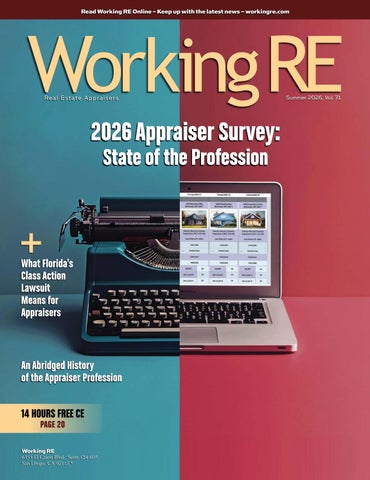
2026 Appraiser Survey: State of the Profession
by Isaac Peck, Publisher
Nearly one-third of all practicing appraisers plan to leave the profession within three years. Add the next cohort and roughly half intend to exit within the next five years.
Those are the headline numbers from Working RE’s 2026 State of the Profession Survey , completed by approximately 1,800 appraisers nationwide in early 2026.
Before the retirement cliff narrative takes hold, consider this: Working RE ran a nearly identical question in its 2016 Future of Appraising Survey. At that time, 33 percent of respondents planned to retire within five years, and more than half within 10 years. Today, a decade later, most of them are still appraising.
The pattern goes back further still. In a 2009 Working RE survey (18 years ago), conducted at the bottom of the financial crisis with over 6,200 respondents, over 53 percent of appraisers said they did not expect to be appraising full-time five years from then. While the profession did see some attrition over the next five years due to the incredibly slow market that followed the 2008 real estate crash, the fallout was nowhere close to 50 percent of the profession, or even 25 percent.
Appraisers consistently overpredict their own demise. Retirement intentions and actual retirements are different things, and appraisers have a long track record of staying longer than they expect. The profession accommodates part-time schedules, requires no storefront or staff, and provides in-
come that many practitioners continue to rely on well into their 60s, 70s and 80s. However, whether the UAD 3.6 transition will finally accelerate actual exits in a way prior inflection points did not, remains to be seen.
Mark Twain wrote that “history doesn’t repeat itself, but it often rhymes.”
In the years following the 2008 financial crisis, the market was slow and appraisers struggled with low volume and low fees. Fannie Mae and Freddie Mac (the GSEs) also pushed forward a huge data standardization project, UAD 2.6, which launched in 2011.
Similarly, today appraisers are facing low volume, fee pressure, and a transition to UAD 3.6 that is bringing anxiety and concerns. The demands of the new form are genuinely different from prior pressure points, and the combination of more work, an aging workforce, and a thin pipeline of new entrants arguably creates conditions that prior surveys did not fully capture.
Different This Time?
Working RE spoke with Jim Park, President of the Collateral Risk Network (CRN) and the former Executive Director of the Appraisal Subcommittee, to get his read on the survey findings. Park says the 2026 numbers reflect a genuine inflection point, not a repeat of the false alarms that preceded them.
“This time it’s different,” Park says. “We’ve reached a point where a number of things are happening at the same time. The average age of an appraiser has to be in the range of 60 to 65. That’s retirement age. On top of that, depending on who you talk to, 10 to 25 percent of appraisers could cease doing mortgage
work because of UAD 3.6 alone. How many will ultimately adapt to the new form? How many will come back after sitting it out? We’ll see. But I’m more concerned about the lack of new people getting into the business than I am about the people who might leave.”
That concern is grounded in a number that rarely surfaces in the profession’s workforce discussions: since 2009, the number of first-time appraiser test takers has dropped 70 percent, Park reports. Park places the blame squarely on the Appraiser Qualifications Board, which he says has spent years creating unsupported barriers to entry rather than setting realistic minimum competency standards.
“Making the qualifications criteria realistic is what the AQB’s job has always been,” Park says. He continues: “I’m afraid they’ve lost their way. A national profession that has only a few hundred new people coming in a year is not a profession that’s going to be around for long. Do we have enough appraisers right now? Maybe. Probably in certain areas. But mortgage lending is at its lowest level in decades. If we have any significant increase in mortgage volume, the appraiser community is going to have a really hard time keeping up. Appraisers aren’t Doritos®. You can’t just go out and make more. It takes three to five years, and in today’s market, that’s a generation.”
That pipeline collapse has consequences. When mortgage demand spikes and appraisers can’t keep up, lenders and regulators look for alternatives. “So few new entrants over the last 10 years has led to a backstop, which is technology,” Park says. “Regulators are not going to allow appraisals to go back to $2,000 and a two-month turn-time to complete. The industry needs to work together to figure out how it evolves, and that includes getting more people into the business with different types of qualifications and backgrounds.” To make matters
“That concern is grounded in a number that rarely surfaces in the profession’s workforce discussions: since 2009, the number of first-time appraiser test takers has dropped 70 percent, Park reports.”
worse, Park says the profession may be running out of time to make these critical reforms.
Park’s concern is backed by exam data. According to CRN research, the number of first-time appraiser test takers has fallen from 4,790 in 2009 to 1,421 in 2025. Of those, just 820 passed; roughly 15 new appraisers per state. The Licensed Residential exam, which serves as the entry point for most new appraisers, saw test taker volume drop 62 percent between 2022 and 2025 alone.
“The appraisal community should be focused on what’s next,” Park says. “The system for how appraisals are completed and used in mortgage lending is essentially the same as it was in the 1930s. There’s plenty of data now, there’s plenty of computing power, and AI makes the need for change even more real. The whole mortgage lending process is going to change, with or without appraisers. If we don’t get more people into the business who are thinking about different ways to do things, it becomes a self-fulfilling prophecy. Appraisers will either evolve with what’s coming, or they won’t.”
For the AQB’s part, it is worth noting that they are currently considering changes to the Real Property Criteria. In December 2025, the AQB released an exposure draft proposing changes to the Criteria, accompanied by two concept papers exploring a “Skills Based Pathway” and an “Examination Only Pathway” to credentialing. The comment period closed in March 2026. Whether these proposals result in meaningful reform or follow the slow,
incremental pattern of past AQB revisions remains to be seen.
Age Demographics
Roughly 57 percent of active appraisers in our survey are over 60 years old. At the other end, less than two percent of respondents are between 25 and 39.
On experience, the numbers are equally striking. Of respondents, over 43 percent have been appraising for 31 years or more, and 42 percent for 21 to 30 years. Just over one percent of respondents have five years of experience or less. The profession has never been older or more experienced than it is right now. And it has never been harder to find a new appraiser entering the field. (Working RE’s readership skews toward experienced, long-tenured appraisers, and these figures likely trend slightly older than the profession as a whole.)
UAD 3.6: The Readiness Gap
The November 2, 2026 mandatory compliance deadline for UAD 3.6 is roughly four months away. While Working RE’s survey ended March 15 (three months prior to this publication), even if we account for a rapid ramp up, the data suggests that the profession is not ready.
Only three percent of respondents —55 out of 1,798—had completed an appraisal using the new UAD 3.6 format. Meanwhile, 58 percent had not yet taken the 7-hour training course that Fannie Mae and Freddie Mac developed specifically for this transition. That means close to six in 10 appraisers are approaching a mandatory form change with no training and no hands-on experience.
The primary concern about UAD 3.6, selected by 40.87 percent of respondents, is that it means more work. Another 13.68 percent believe it will result in less appraisal volume, and 13.18 percent are concerned about increased liability exposure. A notable 22.39 percent say they do not know enough about it yet to be concerned—which may be the most clarifying data point of all. Nearly a quarter of the profession is less than six months from a mandatory compliance deadline and has not yet engaged with what the change actually entails. Only 9.88 percent are not concerned.
On UAD 3.6 readiness specifically, Park says the rollout data he has seen is worrying. At a Cotality-hosted industry event in Dallas in mid-March, organizers had expected to report on hundreds of UAD 3.6 loans processed through the system nationally. The actual count at that point was a handful.
For lenders and appraisal management companies watching this rollout, the fee data is worth noting. Of respondents, 64.29 percent plan to increase their fees for UAD 3.6 assignments. Only 2.62 percent say they will not. The more-work concern and the fee increase intention are directly linked. Appraisers who anticipate a heavier lift are pricing accordingly. Whether AMCs and lenders absorb those increases or push back on them is a market dynamic that will play out over the next twelve months.
The liability question is real. The new URAR introduces more data fields, more structured property description requirements, and more points of potential dispute. UAD 3.6 requires appraisers to rate interior and exterior quality separately, document appliance functionality, and provide more detailed, field-specific updates than the legacy 1004 form required.
“More fields mean more opportunities for errors, omissions, and inconsistencies. Especially as it re-
lates to comments and fields about home systems’ functionality and condition,” says Brianna Walker, Senior Underwriter at OREP Insurance. “It’s too early to say whether UAD 3.6 will generate a measurable increase in E&O claims, but the structural conditions for it are there. We’re watching the early adoption data closely, and as claims patterns emerge, we’ll share what we’re seeing with OREP’s Members and give them advice to navigate it, including disclaimers.”
Hybrid Assignments: Resistance Holds
The profession’s skepticism about bifurcated and hybrid appraisals has not softened. Of 1,798 respondents, 67.30 percent have never done a hybrid assignment. Another 15.02 percent did hybrid work only during the COVID-19 pandemic; a period of necessity rather than choice. Only 17.69 percent have done hybrid work as a regular practice. Looking ahead, 65.48 percent say they are not open to hybrid assignments in the future.
The reasons are professional objections, not technophobia. Liability concerns about incomplete or inaccurate data from the property data collector rank among the top barriers to acceptance. Alongside them: the fundamental difficulty of credibly appraising a property the appraiser has not physically inspected, and the geographic competency problem, i.e. that a credible market analysis depends on having driven the neighborhood and the comparable sales, not just having access to MLS data.
The Degree Debate: A Divided Profession
The 2026 survey found the profession nearly split on whether the bachelor’s degree requirement for Certified Residential appraisers should be eliminated: 51.29 percent support removing it and 48.71 percent oppose. That is a
significant shift from Working RE’s 2016 survey, when roughly 80 percent of appraisers opposed the degree requirement in some form. It’s hard not to wonder whether appraisers’ responses have been influenced by the incredibly low volume they’ve faced in the last few years.
AI Adoption
AI tool adoption among appraisers is higher than many in the profession might expect, but still lower than what’s reported in the general public. Of 1,797 respondents, 41.24 percent report using AI tools in their business, with ChatGPT cited as an example.
The Takeaway
Taken together, the 2026 survey describes a profession that is older and more experienced than it has ever been. Appraisers remain skeptical of hybrid products, divided on credentialing, and approaching one of the most significant form changes in decades largely untrained. The retirement numbers are alarming on their face but unconvincing as a cliff narrative. Working RE’s own historical data makes that case directly. What the 2026 data cannot tell us is whether UAD 3.6 will finally push appraisers into retirement in a way that past challenges failed to do. The new form demands a genuine workflow change, not just a reporting update. Most appraisers plan to raise their fees accordingly. Whether they get those increases, or whether this becomes the pressure point that finally turns retirement plans into actual retirements, is the story Working RE will be tracking over the next twelve months. (See the full 2026 survey results starting on the next page. Survey closed March 15th.) page 108
1. What’s Your Opinion on the Appraisal Qualifications Board’s (AQB) proposal to do away with the college degree requirement for Certified Residential?
I Support It. We should eliminate the
Degree Requirement.
I Oppose It. We
Degree Requirement.
3. Have
4. Do you plan to increase your appraisal fees for UAD 3.6 appraisal assignments?
5. Have you completed the new 7-Hour Class on Fannie Mae / Freddie Mac’s UAD 3.6 yet?
6. Are you open to doing Hybrid appraisal assignments in the future?
7. Are you using any artificial intelligence tools in your business? (ChatGPT, for example.)
8. Have you done a Bifurcated/Hybrid appraisal assignment as the Appraiser Analyst?
Di culty in credibly appraising a property that I haven’t physically inspected myself.
Di culty in credibly appraising a property where I haven’t driven the neighborhood, and/or the comparable sales, due to the possibility of an unreliable market analysis and/or other factors.
Compromised geographic competency and comparable sales selection in the absence of eld work. 38
Inadequate fee for the amount of work.
10. How old are you?
11. Do you plan to leave or retire from the appraisal profession in the next:
“When borrowers or attorneys see proof of insurance, they’re more likely to file a claim—you’ve shown them there’s money to chase.”
Include E&O in Appraisal Reports? Just Say No
by Isaac Peck, Publisher
P
lenty of appraisal management companies still require appraisers to attach an E&O declarations page (dec page) to every report. The practice persists because it’s convenient for the AMC, not because it confirms an appraiser is actually covered when a claim hits.
Ultimately this is a business decision. Some clients will absolutely insist on the dec page, and an appraiser may not want to turn down the work. Even so, OREP recommends against the practice when possible, and the claims data is why.
The dec page itself is a one-page summary issued by the insurance carrier. It lists the insured party, policy number, coverage limits, and effective dates, and it’s the standard way an appraiser proves coverage to a client.
The Case Against
The downside starts with liability. When borrowers or attorneys see proof of insurance, they’re more likely to file a claim—you’ve shown them there’s money to chase. The irony is that the policy attached to the report rarely covers them anyway. E&O is claimsmade, which means the policy in force when a claim is filed is what applies, not the one bound to a report from three years ago. The appraiser ends up with all of the exposure and none of the protection. Add to that the information leak. The dec page puts the appraiser’s policy number, limits, and carrier contact directly into the hands of the borrower, who was never an intended user of the report and has no business with that information.
When Borrowers Go Directly to the Carrier
Here’s what typically happens. A bor-
rower receives an appraisal during a refinance. Later, the borrower may discover defects in the home, the roof may start leaking, or the borrower simply encounters financial difficulties. The borrower might lose their job or find themselves worried about making their payments. The borrower looks for someone to blame and lands on the appraisal. The bad news: the borrower has the appraiser’s policy number, coverage limits, and carrier contact information sitting in the report. They use it.
Instead of contacting the appraiser or the lender, the borrower emails the carrier directly, claiming the appraisal caused financial harm. The carrier opens a file, assigns personnel, and issues a formal response, even if the complaint has nothing to do with a valuation error. The appraiser now has a recorded claim event on their insurance history.
OREP sees several of these contacts each year: complaints about roof conditions, post-closing value disputes, or other property condition complaints. Most have nothing to do with valuation errors and most resolve after legal counsel sends a denial letter. The hassle is real, but the exposure is modest, and it’s largely avoidable.
AMCs and E&O
AMCs have their reasons for the practice. A dec page inside the report simplifies their compliance file and gives them a single document to produce when an investor audits the assignment. In some cases lenders might prefer it as it might make it easier for them to sell the loan.
The practice doesn’t actually serve AMCs well though. Embedding the dec page in every report drives up borrower contacts to insurance carriers,
which means more claim files opened regardless of merit. That translates into higher claims-handling costs and more disputes where the AMC might get pulled in. And the dec page gives borrowers access to insurance information they have no role in seeing—the intended users of an appraisal report are the lender and the AMC, not the consumer who happens to receive a copy.
What to do when an AMC or lender still requests the dec page be placed inside your appraisal report:
1. Offer the E&O once per year and ask the AMC to keep it on file. This usually satisfies compliance needs without embedding the document in every report.
2. Explain that most E&O carriers actively discourage attaching the declarations page because it
“Embedding the dec page in every report drives up borrower contacts to insurance carriers, which means more claim files opened regardless of merit. That translates into higher claims-handling costs and more disputes where the AMC might get pulled in.”
increases claim activity, an outcome that benefits neither side.
3. Document the AMC’s request in writing so expectations are clear if a dispute arises later.
4. If the AMC won’t adjust its policy, weigh whether the assignment volume justifies the added exposure. Only you can make that call.
The safer path is to keep the declarations page on file, not in the report. That said, including it isn’t a catastrophic mistake. An appraiser facing a borrower who is genuinely determined
First in Depreciated Cost First in Sensitivity Analysis
to bring a claim will generally find themselves in litigation regardless of what’s in the report. What the dec page does is lower the barrier slightly for the opportunistic complainant: the borrower who didn’t get the loan terms they hoped for and goes looking for someone to blame. It modestly increases the chance of nuisance contacts to your carrier and modestly increases overall claim activity. Whether that tradeoff is worth the convenience it offers your clients is a business decision only you can make. Time will tell.
WRE
“Every appraiser needs to understand what Scott teaches about the relationship between the cost approach and sales comparison approach” – Tim Andersen Florida State-Certified General Real Estate Appraiser, MAI, AQB Certified USPAP Instructor, Member of the National Association of Appraisers.
“Real Estate Appraisers have always been required to support their adjustments. Scott has the experience and methodology that is necessary for appraisers to be able to accomplish that ” - Pam Teel Texas State Certified Real Estate Appraiser, AQB Certified USPAP Instructor, Board Member of National Association of Appraisers, past President of the Association of Texas Appraisers.
“In the challenging appraisal world we live in today, supporting adjustments is imperative. I use Solomon when I teach my class ‘Supporting Land Value’, and in my practice as well ” Marty Wagar State Certified residential Appraiser in Michigan and Florida, Member of the National Association of Appraisers Honored as 2022 NAA Appraiser of the year
“Litigation over appraisalfee practices is running into obstacles that make these cases harder to win than they may appear at first glance.”
Florida Class Action: What’s It Mean for Appraisers?
by Isaac Peck, Publisher
F or the second time in just over a year, a class action lawsuit is challenging how appraisal management companies (AMCs) handle the fees borrowers pay for appraisals. Arnold v. Appraiser Nation, filed in a Florida federal court in December 2025, accuses Appraisal Nation, AMC Links, and United Wholesale Mortgage of charging borrowers appraisal fees that bear little relation to what the appraiser actually receives, and concealing the difference.
The case advances arguments similar to those in Timmins v. Clear Capital, Core Valuation Management , and Rocket Mortgage, the California class action lawsuit we covered in our Summer 2025 issue. But Arnold takes a different legal path. Where Timmins proceeds under California’s state consumer-protection statutes, Arnold frames its claims under the Real Estate Settlement Procedures Act of 1974, targeting RESPA’s prohibitions against unearned charges and fee-splitting in settlement services.
The timing is not coincidental. Many appraisers had looked to the Consumer Financial Protection Bureau (CFPB) to force separation of appraisal and AMC fees on consumer disclosures. That effort stalled when the agency’s authority was curtailed in early 2025. With federal rulemaking off the table, the pressure has shifted to the courts.
Together, the two suits suggest that litigation is emerging as the primary vehicle for challenging appraisal-fee practices, but it may not be the only one.
If cases like Arnold and Timmins continue to gain traction, the pressure on regulators to revisit appraisal-fee disclosure rules will only increase. Here are the details.
How We Got Here
The NAR’s $418 million settlement in 2024 over price-fixing and compensation transparency demonstrated that litigation can force structural change in real estate, even when regulators decline to act. The appraisal-fee lawsuits extend that logic. The same basic conditions that drove the NAR case—opaque pricing, limited consumer choice, and intermediaries shaping costs without accountability—are now being litigated over what borrowers pay for appraisals.
What the Complaint Argues
The lawsuit frames these practices as violations of the Real Estate Settlement Procedures Act (RESPA), which prohibits unearned fees and improper feesplitting in settlement services. It also includes state-law claims and seeks restitution, damages, and injunctive relief on behalf of a nationwide class.
The plaintiffs ground their arguments in basic American free-market values. The complaint argues that the fee borrowers pay, anywhere “from $450 to over $1,000” for an appraisal, bear little relationship to what the appraiser receives. Instead, AMCs allegedly pay appraisers “only a fraction” of the fee while “deceptively keeping the remainder for themselves.” The Appraisal Regulation Compliance Council (ARCC), which has briefed the CFPB on these same practices, has documented cases in which AMCs retained more than 60 percent of borrower-paid appraisal charges. The word “deceptively” is doing the legal work here: it asserts concealment and thus dishonesty. The borrower pays the most
but sees the least, and the actual working appraisers are jerked around too.
The complaint then reframes the issue as a market failure, albeit an engineered one. It argues that “the typical dynamics of a free market are not present to keep the price competitive.” The lender chooses the AMC, but “the lender does not pay the AMC—the borrower is stuck to pay the AMC the lender contracts with,” and the borrower has “no ability to select an AMC or negotiate the AMC’s fees.” In this telling, the borrower is a price-taker in a system designed by others.
The complaint claims that transparency is the missing ingredient. “The only way to make AMCs’ fees subject to the healthy pressure of an efficient market,” it argues, is to “inform consumers of the details of the AMCs’ fees.” If borrowers knew how much of the
appraisal fee went to the AMC, they could “demand that lenders compete for the borrower’s business by securing more competitive appraisal fees.” But, the complaint says, “this competition is not happening now because defendants obfuscate the excessive portion of appraisal fees the AMCs take for themselves.”
The complaint constructs a narrative in which borrowers face rising costs, lack meaningful choice, and are denied the information needed for a functioning market. One of its most compelling conclusions is the simple statement: “defendants provide no tangible benefit to borrowers.”
Not So Easy to Win
While plaintiffs’ arguments are persuasive, the defendants may have structural and legal advantages. Litigation
over appraisal-fee practices is running into obstacles that make these cases harder to win than they may appear at first glance.
The first challenge is responsibility: lenders, not AMCs, control every aspect of how appraisal-related charges are shown to borrowers. They decide whether AMC fees are passed through, how those fees are labeled, and how they appear on the Loan Estimate and Closing Disclosure. TRID (TILARESPA Integrated Disclosure) forms are lender-driven documents, and lenders rather than AMCs certify compliance with federal disclosure rules. AMCs operate within that framework but cannot alter it. That division of authority complicates any claim that AMCs misled borrowers simply by participating in a disclosure system they do not design
or control. In plain terms, borrowers may dislike how the fee is presented, but the entity accused of deception isn’t the one that decides what the borrower sees.
Federal policy creates a second, equally significant barrier. When the CFPB finalized the TRID rule in 2013, it directly considered whether AMC and appraiser fees should be separated. Appraisers urged the agency to require distinct line-items so borrowers could see who was being paid what. The CFPB declined, pointing to Dodd-Frank’s language that allows (but doesn’t explicitly require) itemization. By choosing not to require separation, the agency effectively endorsed bundled disclosure as an acceptable practice. Congress briefly explored changing that framework in 2016, but the proposal never made it to a vote.
That regulatory history gives defendants a powerful argument: if federal law expressly permits bundling, it is difficult to portray the practice itself as inherently deceptive. The plaintiffs
will need to do more than show that borrowers lacked the opportunity to see the fee breakdown; they’ll need to show that the way the fee was presented crossed a legal line even though regulators have long allowed the very structure they challenge. That’s going to be an uphill climb.
The defendants can even push back against the assertion that they “provide no tangible benefit to borrowers.” They frequently argue that AMCs manage appraiser panels, handle scheduling and communication, perform quality-control reviews, meet investor and underwriting requirements, and screen for fraud or conflicts. Those tasks, they say, help keep loans moving and reduce collateralrisk delays. AMCs, they argue, are like credit reporting agencies or flood certifiers. They support underwriting, regardless of whether the borrower can immediately see that benefit.
Calls for Reform from California to Florida
Both cases allege the same core facts:
borrowers were overcharged, AMCs retained the majority of the fee, and the system was designed to prevent anyone from seeing the split. But their legal paths are different, and that difference matters. Timmins proceeds under California’s broad state consumerprotection statutes, which do not require proving a RESPA-style “unearned fee” or fee-splitting violation. Arnold must fit its theory into RESPA’s narrower framework while also overcoming the CFPB’s explicit acceptance of bundled appraisal/AMC fees and the fact that lenders, not AMCs, control TRID disclosures.
Regardless of how either case is ultimately decided, the direction is clear. AMCs and lenders are facing increasing pressure to justify bundled fee structures, and each new filing makes it harder for regulators to remain on the sidelines. For appraisers, greater transparency in how fees are disclosed to borrowers could ease the downward pressure that opaque AMC retention practices have created for more than a decade. Time will tell. WRE
“The Collateral Underwriter will easily spot missing information and give the appraisal acceptance a HARD STOP.”
Am I Being Paranoid, or Is There Another Reason?
by Richard Hagar, SRA
Think about all the information local appraisers have assembled that state and federal governments don’t have but would like to have. 98 percent of the required data on the outgoing forms would help describe the property and relate to its value. Things like zoning, highest and best use, location, square footage, quality, condition, etc. are needed to help determine what the subject property is, what it would cost to build, and in the sales comparison approach, how it compares against other homes. Based on this basic information and market interactions, appraisers determine how the market adjusted for differences. In the UAD 3.6 version of the URAR there are numerous new fields for information that appraisers wouldn’t use to determine value. Is there some reason the GSEs need this additional new information?
In the past, many appraisers failed to properly describe and classify properties. Their failures contributed to the losses lenders suffered in the 2007 wipeout and the reasons the Collateral Underwriter (CU) and the 1-6 classifications for quality and condition ratings exist today. The GSEs need more information than was previously supplied and as a result, on the URAR there are new fields for:
• Accessibility features (ADA).
• Type and width of the view.
Richard Hagar, SRA, is an educator, author and owner of a busy appraisal office in the state of Washington. Hagar now offers his legendary adjustments course for CE credit in over 45 states through OREPEducation.org. The 7-hour online CE course “How to Support and Prove Your Adjustments” shows appraisers proven methods for supporting adjustments. OREP Members save on this approved coursework. Sign up today at OREPEducation.org Reach Richard Hagar via email at rh@richardhagar.com.
• If a sale: the subject’s list price, original listing date, contract date, days on the market, and the MLS listing number.
• Special area for listing any personal property included in the price.
• Special area to list and describe concessions paid by anyone associated with the sale and its impact on value.
• Market data examples provided by Freddie Mac on the UAD 3.6 include graphs showing sales trends, median days on the market, absorption rates, and a breakdown of the year homes were built in the market area, etc.
• How many pending sales and listings in the market area include:
Lowest list price
Highest list price
Median list price
• 21 new questions specific to accessory dwelling units including—Is the ADU legally rentable? (That’s a risky legal question.)
By my count there are at least 521 boxes for unique information on the SFR version of the URAR and more if it’s located in a PUD Plat, more if the subject is a manufactured home, and far more if it’s a condominium or cooperative. (Does the HOA have any ongoing lawsuits?) They require this information because many appraisers have been skipping it in the past, resulting in incorrect descriptions and market values. So, get ready to start researching, listing and considering everything in your appraisals under the UAD 3.6 (you’re going to spend a lot of time doing this). While
the GSEs indicate that you don’t have to fill out every box, you and I both know that if an AMC or bank reviewer sees an unanswered box, they will want it filled in, even if it’s meaningless to appraisers or value. The Collateral Underwriter will easily spot missing information and give the appraisal acceptance a HARD STOP. Gee, won’t that make lenders happy with your work despite what the GSEs state?
Moving forward, there are information grabs that start to trigger paranoia but still must be included as part of the URAR:
• What is the height of the front door threshold above the ground?
• Is the primary heating system located below grade?
• Identify the ceiling type in every room. They have nine+ different types listed including flat, vaulted, tray, coffered, barrel, etc.
• Ceiling height and condition.
• When requested by the client, the total square footage of the windows for manufactured homes (Some lenders may also ask for this for site-built homes).
• When specifically requested by a client, the structure’s volume, including finished and unfinished space for outbuildings.
• Appraisers must now segregate the property’s square footage into 10 different categories including
converted, “noncontinuous finished” and “finished nonstandard” (These are listed and explained in my webinar titled FNMA, ANSI and UAD 3.6 available at WorkingRE com I strongly suggest taking it before you provide any UAD 3.6 appraisals).
• Photographs of every room and every component that impacts value in the cost, income, and sales comparison approaches (good and bad).
• Many clients will avoid appraisers and use Property Data Collectors (PDC). The PDCs use high quality scanning devices (including iPhone 14+) to scan every room in the house. These scans produce 4k images of EVERYTHING in the house which will then be sent to an overseas company, converted into a floor plan, with the results sent to the appraiser. Some software can determine the make, model, and age of the appliances. (Hey, nice gun-rack on the wall in your rec. room and is that large void space behind the wall a hidden saferoom or just a safe?) Of course, you know that the data will only be provided to the appraiser and deleted after delivery…cough…cough.
So, when was the last time an appraiser adjusted for the height of the front door above grade, the SF of windows, the heating system being in the basement or the volume, not square footage;
VOLUME, of an outbuilding? And why would an appraiser need photographs of EVERY room? (Cute pink pony wallpaper in your child’s room.)
I know this is startling, however my examples are only part of the information they obtain or require.
The GSEs’ computers review 15,000 –21,000 appraisals a day. (15,000 x 260 workdays a year x 5 years = a whole lota data) The GSEs have and will continue to add to the largest assemblage of house photos, including interiors, that has ever been assembled in the history of the world.
All the 521+ fields of information, plus photographs, will be delivered to the GSEs, you know the ones owned by the Federal Government. I wonder what they could do with that. Could the information be used to estimate your wealth, determine your political stance or tweak your taxes? Boy wouldn’t the local county tax assessor love that interior data? And why would there be a push to sell FNMA and Freddie Mac, with all that data, to a private company, of course after the government has that data about your house saved in a central database? Look up last year’s proposed law deceptively called the Appraisal Modernization Act S. 2322 and who sponsored it.
While I’m trying to keep you safe out there, maybe I’m being paranoid. Or is there just a chill running down my spine? WRE
“Property assessment was common throughout colonial America, but it was not until the late 1800s that a theoretical basis for property valuation began to take shape.”
An Abridged History of the Appraiser Profession
by Kendra Budd, Editor
For most of the 20th century, there was nothing stopping anyone from calling themselves an appraiser.
Licensing didn’t come about until the early 1990s as a result of FIRREA, but the roots of the profession were laid down nearly a century before that. The theoretical framework behind the three approaches to value was developed by economists in the late 1800s. Then the Great Depression and the creation of the FHA in the 1930s gave the profession its first real structure. By the time FIRREA passed in 1989, the industry had already been shaped by decades of self-regulation, technological innovation, and the savings and loan crisis.
To dig into that history, Working RE spoke with Greg Stephens, a recently retired appraiser whose career began in 1977, and Byron Miller, a former engineer turned appraiser who chairs the North Star Chapter of the Appraisal Institute. What follows is an attempt to trace the building blocks and turning points that shaped the profession as we know it today.
Early Appraisal Methods
The concept of appraising property is older than most people think. In the Book of Numbers of The Holy Bible, God commanded Moses to commission one person from each of the 12 tribes to determine the highest and best use of the Land of Canaan. According to Appraisal Today, many consider these tribal leaders to be the first appraisers.
For most of recorded history, property valuation was informal and subjective. In ancient Mesopotamia, a home’s value was tied to its owner’s social standing. Larger homes with courtyards, gardens, and adobe brick construction reflected wealth and status. In feudal Europe, land was owned by lords and leased to those who worked it, tying valuation directly to the owner’s power rather than the land itself. Property assessment was common throughout colonial America, but it was not until the late 1800s that a theoretical basis for property valuation began to take shape.
The earliest known publication on the subject was Thomas Cochran’s 1874 paper Methods of Real Estate Valuation for Taxation, presented to the Social Science Association of Philadelphia. Cochran proposed standard procedures for property valuation and even offered an early definition of market value. But the real breakthrough came from British economist Alfred Marshall, whose 1890 book Principles of Economics merged supply-cost theory with demand-price theory. As J. Wayne Moore notes in the Journal of Property Tax Assessment & Administration , Marshall’s writing “provided the theoretical basis for the three basic approaches to value in use today: replacement cost, market comparison, and capitalization of income.”
Marshall’s work inspired a wave of publications that brought economic theory into appraisal practice. Richard M. Hurd published what is widely considered the first book about property valuation in 1903, Principles of City Land Values, covering rent capitalization and spatial economics. Irving Fisher followed in
Kendra Budd is the Editor of Working RE magazine and the Marketing Coordinator for OREP, a leading provider of appraiser E&O insurance—trusted by over 10,000 appraisers. She graduated with a BA in Theatre and English from Western Washington University, and with an MFA in Creative Writing from Full Sail University. She is currently based in Seattle, WA.
We value You value homes. YOU.
1906 with The Nature of Capital and Income, which expanded on Marshall’s teachings and presented what Moore describes as a fully developed form of the income theory of value. These economists gave the profession its intellectual foundation, but it took an economic catastrophe to give it structure (i.e. the Great Depression).
It was Frederick Morrison Babcock who left the most lasting mark on the profession. “Babcock was a secondgeneration appraiser out of Chicago … he claims to have trained over 3,000 appraisers in his career. That has an indelible impact,” says Byron Miller, a Minnesota appraiser and co-author of Valuation Bias: The Invisible Fence of Racial Discrimination, a popular online class offered by the Appraisal Institute. Miller spent months researching the history of the appraiser profession in preparation for his class.
Babcock’s 1932 book, The Valuation of Real Estate, applied the three approaches to value in ways that were distinct by property type. Babcock believed “only one method [should] be used on any one property type (not all three approaches for the one property …,” wrote Moore. He preferred the income method but recommended market comparison for properties that could not generate income, stating, “In this method of valuation a qualitative analysis is made of the future amenities offered to the prospective purchasers of the property.” Babcock would also go on to write the original FHA underwriting manual. “Babcock was one of the founding members of the American Institute of Real Estate Appraisers (AIREA),” says Miller. His fingerprints are on nearly every corner of the modern profession.
The federal government’s involvement in appraising began in earnest during the Great Depression. The National Housing Act of 1934 established the Federal Housing Administration (FHA) and the Federal Savings and Loan Insurance Corporation (FSLIC), while
also increasing support for the Veterans Administration (VA), all aimed at stabilizing the housing market through standardized underwriting, mutual mortgage insurance, and reduced foreclosures. These agencies played a crucial role in shaping appraisal standards by establishing guidelines and promoting uniform, reliable property valuations. Professional organizations followed. The Society of Real Estate Appraisers (SREA) formed in 1935 to standardize the appraisal process. According to Stephens, the SREA was “primarily servicing the banks at the time because prior to that, you had real estate brokers providing valuation services to the lending industry.” The AIREA, which had formed in 1932 as an affiliate of the National Association of Realtors®, went national that same year. The AIREA is best known for creating the MAI and SRA designations. “The MAI being commercial, and the SRA being residential,” Stephens says.
Fannie Mae followed in 1938, established by Congress to provide liquidity and stability in the mortgage market. Fannie Mae purchased FHAinsured mortgages from private lenders and resold them to ensure a steady flow of mortgage money at favorable interest rates, beginning a relationship between Fannie Mae and the appraisal industry that continues today. But the federal government’s involvement in housing during this period also had a dark side.
Redlining
Redlining was the practice of denying mortgage access based on the neighborhood a property was located in. In 1933, Franklin D. Roosevelt implemented the New Deal, a series of programs aimed at providing relief, recovery, and reform during the Great Depression. Part of the New Deal aided federal backing of loans, but the FHA limited these loans to prospective white buyers.
The term “redlining” comes from the FHA using color-coded maps to identify neighborhoods deemed risky for lending. These neighborhoods were disproportionately Black and minority communities, making it significantly harder for Black, Indigenous, and People of Color (BIPOC) to obtain housing. The connection to the appraisal profession is direct. Some of the original redlining maps were created by Babcock at his former job. Miller explains, “He went on to utilize ... and proliferate those redlining maps in the appraisal profession,” by including them in the original FHA underwriting guidelines. Babcock even addressed racial segregation in his book The Appraisal of Real Estate, writing that “residential values are affected by racial and religious factors.”
How was the FHA able to differentiate between predominantly minority and white neighborhoods? That goes back to the early 1900s when zoning laws were adopted. Zoning laws were originally enacted to keep industrial and manufacturing buildings out of residential areas but began to be used for racial segregation. This was a direct effect of Jim Crow laws at the time. The first racial zoning laws were adopted in 1910s Baltimore by Mayor J. Barry Mahool, stating:
Blacks … should be quarantined in isolated slums in order to reduce the incidence of civil disturbance, to prevent the spread of communicable disease into the nearby White neighborhoods, and to protect property values among the White majority.
Many major cities followed. In addition to zoning laws, deed restrictions and restrictive covenants were inserted into property deeds to prevent people from certain racial, ethnic, or religious groups from buying or occupying land. These restrictions laid the foundation for redlining by making it easy to pinpoint which neighborhoods to page 268
discriminate against. Although redlining was outlawed on April 10th, 1968, its effects are still felt throughout the real estate industry today. Miller cites that at least in his market:
… deed restrictions, redlining, [and] building covenants that were set in place over 120 years ago are still impacting neighborhoods today because those decisions were backed by police power, and they determined where infrastructure went, where schools went, where you put in green space, where you invested, where you put in retail and shopping, or lack thereof, where [you put] the high performing schools. Over time, when you don’t invest in a community with infrastructure and community, or should I say, public dollars of support … it’s going to cause a price differential. And I think that’s really what happened.
These restrictive practices made it nearly impossible for BIPOC and families of certain religions to purchase housing and build intergenerational wealth.
Technological Advancements
After the Great Depression, more scholars and economists came forward with their own publications on appraisal theory, and the FHA continued to shape the industry. But the practice of appraising remained relatively stagnant until the 1980s.
Stephens gave us some background on what it was like coming up as an appraiser before technology changed the profession. “My toolkit, if you will, consisted of a Polaroid™ camera, measuring tape, and a Peugeot 504 diesel,” Stephens recalls. During what he calls the “Wild West” of appraisals, reports were completed by pencil or electric typewriter. “You had to get [the reports] aligned just perfectly, or they would be off and you’d have to reprint the whole thing all over again,” he says. Polaroid™ photos were glued directly onto the report. Comps were photocopies of maps with hand-drawn
arrows pointing at specific properties. According to Stephens, the process was so time-consuming that you could only complete about one or two appraisal reports per day.
That changed with the introduction of computer software in the 1980s. Personal computers allowed appraisers to store and analyze larger sets of data, reducing the time needed to complete a report. But according to Stephens, the competing software platforms (like ACI and a la mode) created a new problem: there was “no data standard.” You could only electronically send a report if the bank had the same software. Different banks required different programs. It wasn’t until 1999, with the introduction of the Mortgage Industry Standards Maintenance Organization (MISMO) by the Mortgage Bankers Association, that the problem was resolved. “It was MISMO that really enabled us to be able to transmit regardless of what client it was and what software program they were using,” Stephens recalls.
The internet in the 1990s brought its own changes. Before going online, appraisers had to sketch measurements onto graph paper by hand and, according to Stephens, had to become a member of a local real estate board to access property information—which often meant becoming a real estate broker first. The internet gave appraisers access to property data, industry publications, and MLS information without those barriers.
Then came automated valuation models (AVMs) in the early 2000s, which used algorithms and property databases to estimate values without a physical inspection. AVMs were primarily used for quality control purposes, but more recently have also been used by lenders in pre-lending decisions to assess whether an appraisal might be waived.
Appraisal Licensing
Prior to 1989, the appraisal industry was almost entirely self-regulated. “Back
in the 1980s, you had these savings and loans that were failing,” due to botched appraisals and lax lending guidelines Stephens says. This led to the passing of the Financial Institutions Reform, Recovery, and Enforcement Act of 1989 (FIRREA).
FIRREA was established to tackle the savings and loan crisis, but it also created a federal framework for real estate appraisals to protect the financial system by ensuring reliable property valuations. According to Stephens, a 1988 study by lenders determined that approximately 30 percent of practicing appraisers were credentialed. “That means 70 percent of the practicing appraisers had no accountability.” Congress passed FIRREA shortly after. Out of FIRREA, states were charged with regulating appraisers through a certification process. FIRREA also formed the Appraisal Subcommittee (ASC), charged with overseeing the Appraisal Foundation (TAF) and state regulatory authorities. Two boards followed: the Appraiser Qualifications Board (AQB) to set qualifications, and the Appraisal Standards Board (ASB) to set standards. Appraisers were now required to maintain adequate documentation, complete training courses, and conform with the newly formed Uniform Standards of Professional Appraisal Practice (USPAP). Not much would change about the regulatory process until 2008.
The 2008 Crash
The 2008 housing market crash was driven by subprime lending, excessive debt, and a lack of regulation (depending on who you ask). Appraisers were under immense pressure from lenders and mortgage brokers to inflate values. The crisis highlighted the need for reform in the appraisal industry for the first time in nearly 20 years. The first response was the Home Valuation Code of Conduct (HVCC), a private agreement between New York State Attorney General Andrew Cuomo and
the GSEs. HVCC was not a federal regulation, but it created a barrier between a lender’s loan production staff and the appraiser that was badly needed at the time.
HVCC was short-lived. The DoddFrank Act, passed in July 2010, replaced it with permanent appraiser independence provisions added to the Truth-in-Lending Act (TILA) and implemented through Regulation Z. Similar language was built into the GSEs’ Appraiser Independence Requirements and the Interagency Appraisal and Evaluation Guidelines.
Dodd-Frank also established the Consumer Financial Protection Bureau (CFPB), required customary and reasonable fees be paid to appraisers, and mandated that states register and regulate appraisal management companies (AMCs), which had proliferated in the wake of HVCC.
The passing of Dodd-Frank was over 15 years ago, and its requirements
“Now, as the appraiser profession once again faces a new wave of technological change, Stephens urges appraisers to get ahead of it.”
are still debated among appraisers. Since then, the GSEs introduced the Uniform Appraisal Dataset (UAD) and the Uniform Collateral Data Portal (UCDP), while the FHA implemented its own changes through Housing Policy Handbook 4000.1 and new rules surrounding FHA assignments and appraisal trainees.
Conclusion
The appraisal profession has survived economic catastrophe, decades of selfregulation, a complete overhaul of its licensing framework, and two major housing crises. It has adapted to every technological shift from Polaroid™ cameras to iPhones and digital tablets.
Now, as the appraiser profession once again faces a new wave of tech-
nological change, Stephens urges appraisers to get ahead of it. “It’s a lot easier for appraisers to get up to speed with these changes that are being mandated by the GSEs. So going forward, we will see fewer appraisers and those appraisers will be far more tech savvy,” he says. For what Stephens calls the “old guard,” the time to adapt is now, not later.
Miller sees the resistance as understandable but costly. “What you’re seeing with a lot of the people that are pessimistic, is the uncertainty. It’s the uncertainty of the future,” he says.
Appraisers have always found a way to adapt. Whether the current generation does the same will depend on how willing they are to evolve alongside the technology and regulations reshaping the industry around them.
WRE
OREP Members receive a FREE half-hour consultation with Joshua Walitt. Plus, receive 25 percent off any consulting services if needed. Joshua Walitt (SRA, AI-RRS, MNAA, CDEI) is the principal consultant for Walitt Solutions. He provides short- and long-term consulting services related to valuation, education, review, and investigations. OREP has been fantastic to work with. Very happy I switched from another major insurance company which tried to double my rates. OREP provides an exceptional value. —Shawn Sutton
“Formal education provides tools and rules, but it does not and cannot deliver complete certainty about how to use those tools and rules in each distinct situation.”
Becoming an Appraiser: Courage to Grow Beyond Training
by Timothy Andersen, The Appraiser’s Advocate
Abstract
Completing appraisal training marks not an end but merely a beginning. This essay argues that professional maturity emerges through judgment under uncertainty, not credentials alone. Appraisers must balance decisive action with humility, accept imperfect knowledge, and learn from feedback. Ongoing reflection transforms experience into growth and shapes identity over time. True practice lives between hesitation and overconfidence, embracing risk, ethical coherence, and continual learning as the core of becoming a reflective, responsible appraiser in complex markets today.
Finishing appraisal training feels like arriving at a destination. You take the classes. You pass the courses. You log the hours. You earn the credential. On paper, you are now an appraiser. But after that moment something quietly unsettling happens. You discover that the certificate you worked so hard to earn did not magically transform you into a finished professional. It opened a door. You stepped through it, and behind that door stretched a landscape far larger and more intimidating/enlightening than the classroom ever suggested. This discovery is not a failure of training. It is the beginning of becoming. You are not yet an appraiser. You now have the opportunity to become one. Will you seize it?
Every serious profession shares a hidden truth. Formal education provides tools and rules, but it does not and cannot deliver complete certainty about how to use those tools and rules in each distinct situation. Real properties refuse to behave like textbook examples. Mar-
Timothy C. Andersen, MAI, MSc, USPAP instructor and CEO of The Appraiser’s Advocate, is the instructor of “How to Raise Appraisal Quality and Minimize Risk” (7 Hours CE) at OREPEducation.org (OREP Members enjoy the course at no cost). Andersen has been in real estate and consulting since 1975 and is an AQB-certified USPAP instructor, USPAP consultant, author, instructor and expert witness. Andersen can be reached at tim@theappraisersadvocate.com.
kets shift. Data conflict. Clients ask questions that do not fit snugly inside standardized forms. The practicing appraiser must interpret, judge, and decide under conditions that never become perfectly clear, i.e., that those conditions are always uncertain. That condition is not a flaw in the profession. It is its living core.
An appraiser works in a world where knowledge improves with effort but never becomes absolute. You can gather more data, run more analyses, and consult more sources. Each step brings you closer to understanding. Yet a small gap always remains between what you know and what you wish you knew. At some point, the report must be written. You must state your value opinion, then move on. The decision cannot wait for perfect certainty simply because nothing is perfect and there is no certainty. Learning to live and work inside that gap marks the true beginning of professional maturity.
New appraisers often respond to this gap in one of two ways. Some hesitate. They search for one more comparable, one more adjustment, one more piece of confirmation that will make the conclusion feel airtight. Research quietly turns into avoidance . Others
2025-01: Using Experience as Support for Adjustments
Question: If an appraiser is competent to perform a specific assignment, and has extensive experience in that type of assignment, can they support an adjustment for a property’s proximity to a park solely based on that experience?
Answer: No, experience cannot be a recognized method or technique or a substitute for relevant evidence and logic. Adjustments are a type of assignment result and must meet USPAP’s requirements for credible assignment results.
Assignment results are defined as: ASSIGNMENT RESULTS: An appraiser’s opinions or conclusions, not limited to value, that were developed when performing an appraisal assignment...[Bold added for emphasis]
Additionally, credible, is defined as: CREDIBLE: worthy of belief
Comment: Credible assignment results require support, by relevant evidence and logic, to the degree necessary for the intended use. [Bold added for emphasis]
This means that adjustments, which are assignment results, must be supported by relevant evidence and logic to the degree necessary for the intended use.
How to Support and Prove Your Adjustments - (7 Hour) Distance CE
Instructed by Richard Hagar, SRA - $126
Adjustments are (again) a very HOT topic.
Many appraisers are getting pushback from their clients and being asked to show support for their adjustments, plus FNMA’s Collateral Underwriter is looking for “bad” adjustments. Failure to provide proof and analysis to support your adjustments can mean a rough road for appraisers.
In This Video-Based On-Demand Course:
• Cost Approach
• Income Approach
• Sales Comparison Approach
• Real-world Examples and Case Studies
• Learn New Methods or Refresh Your Memory
rush in the opposite direction. They treat early competence as final mastery and defend their first conclusions with more confidence than the evidence deserves. Neither extreme supports long-term growth.
Professional becoming (i.e., making a leap of faith by changing, by becoming) requires a different posture. It asks you to study carefully, think honestly, and then act when further information adds but little more clarity. You make the best judgment you can with the evidence available. At the same time, you hold that judgment with humility. If new facts emerge, you update your thinking. You correct course without treating revision as personal failure. This balance between commitment and humility forms the backbone of a healthy appraisal practice.
Another part of becoming involves feedback . Appraisal does not occur in isolation. Reviewers, mentors, peers, and even difficult clients can function as mirrors. They reveal blind spots that are invisible from the inside. Seeking critique early and often shortens the distance between mistake and improvement. Small corrections quickly prevent large problems later.
This habit requires emotional discipline. It asks you to separate your worth as a professional from the perfection of any single report. In this way, errors become information rather than identity threats. When ego loosens its grip, perception sharpens. You see your work more clearly because you no longer need it to prove your value. Over time, these practices accumulate into something deeper than technical skill. They shape professional identity.
An appraiser does not become fully formed at the end of training. An appraiser becomes through a long sequence of decisions made under uncertainty, reflections on those decisions, and the self-adjustments that should follow. Each assignment adds a layer to the professional self. Each challenge invites growth in judgment, patience, and clarity.
“A practitioner who refuses to decide until certainty arrives will never move, thus never become. A practitioner who claims certainty too quickly will stop learning.”
This process of becoming has a direction. It aims toward a telos, a purpose that extends beyond simply completing reports. The mature appraiser seeks increasing coherence between knowledge, ethics, and practice. The goal is not flawless performance. The goal is a steadily improving ability to interpret complex situations, communicate clearly, and serve clients and the public with integrity.
Daily reflection supports this journey. At the end of a workday, a few quiet questions can guide development. Where did you make a careful, courageous decision despite uncertainty? Where did hesitation or overconfidence creep in? What did the market teach you today? Such reflection turns experience into education. It weaves individual assignments into a continuous narrative of growth.
As careers lengthen, the emphasis of becoming shifts. Early years focus on acquiring competence and confidence. Later years invite integration. Experienced appraisers distill patterns from thousands of encounters with properties and people. They refine judgment, mentor others, and interpret their own professional history as a coherent arc rather than a series of isolated tasks.
Seen from this perspective, the fear of making a wrong call never disappears entirely, nor should it. The possibility of error accompanies every meaningful decision. Yet that risk is inseparable from the dignity of professional freedom. If you are scared to make a mistake, you are not totally free. Fear fetters you. The alternative to risk is not safety but stagnation . A practitioner who refuses to decide until certainty arrives will never move, thus never become. A
practitioner who claims certainty too quickly will stop learning. Healthy practice lives between those extremes. It accepts that complete assurance remains out of reach yet still steps forward with care and courage.
Becoming an appraiser, then, is less like crossing a finish line and more like entering a lengthy conversation with reality. Training teaches the language. Experience teaches how to speak it wisely. Each report becomes both a product and a lesson. Each lesson shapes the next report. Each report shows you what you are becoming.
This ongoing dialogue defines the profession at its best. It transforms credentialed technicians into reflective, critically thinking practitioners. It turns a job into a vocation. And it reminds every appraiser, novice or veteran, that professional identity is not a static possession. It is a living project, authored day by day through thoughtful action in a world that never offers perfect certainty.
To accept that condition is not to settle for less. It is to embrace the real work of becoming. WRE
WE DEFEND APPRAISERS FOR A LIVING
This isn’t our first rodeo. When the market slows, somebody always wants to blame the appraiser. That’s why you want a team with deep expertise in your corner.
We’re proud to announce our partnership with trial attorney Craig Capilla, one of the most experienced appraiser attorneys in the country who has handled nearly 1,000 appraiser cases in his career.
In addition to being on OREP’s litigation panel in several states, all OREP Members now enjoy a one-hour consultation with Mr. Capilla (at no charge) when facing a state board investigation, HUD discrimination complaint, or a CFPB inquiry. Trusted by over 10,000 appraisers, our business is defending you and your livelihood. Trusted by over 10,000 Appraisers Our business is defending you and your
“The profession needed a single framework covering everything from spreadsheets to machine learning.”
AO-41: TAF’s New Tech Guidance and What It Means
by Isaac Peck, Publisher
Every appraiser reading this is using technology tools in their assignments. MLS platforms, adjustment software, sketch tools like CubiCasa, data aggregation services, and increasingly, AIpowered platforms like Spark that do more of the analytical lifting. The question is not whether appraisers will use technology. The question is: what happens when a tool gets it wrong, and who is responsible?
In January 2026, the Appraisal Standards Board (ASB) at The Appraisal Foundation released an exposure draft of Advisory Opinion 41, Use of Technology in an Appraisal or Appraisal Review Assignment AO-41 consolidates and replaces two existing Advisory Opinions: AO-18, which addressed AVMs in 1998, and AO-37, which addressed computerassisted valuation tools in 2018. After two rounds of exposure and public comment, the ASB officially adopted AO-41 on April 23, 2026.
AO-41 is now the interpretive framework that state boards, regulators, GSEs, and opposing counsel will use when evaluating how an appraiser used technology in any assignment that comes under scrutiny.
Why AO-41 Exists
The ASB was direct about why AO-41 was necessary. In the introduction to the exposure draft, the Board wrote that “it is insufficient for appraisers to maintain only the skills and knowledge they possessed when they entered the profession” and that appraisers “must continuously improve their skills to remain proficient;
this is especially true when new technological tools are introduced into the appraisal workflow.”
The existing guidance was built for a different era. AO-18 was published when AVMs were novel. AO-37 expanded the conversation to regression software and computer-assisted tools, but it predated generative AI, AI-powered adjustment software, and tools like CubiCasa. Neither anticipated the world appraisers are working in today.
The profession needed a single framework covering everything from spreadsheets to machine learning. AO41 is that framework; retiring AO-18 and AO-37 and replacing them with guidance addressing the full spectrum: AVMs, AI, regression software, sketch tools, data platforms, and generative AI.
What AO-41 Actually Says
AO-41 organizes its guidance around three elements: technology, the appraiser, and assignment results.
The foundational statement is this: “A tool cannot comply with USPAP. The appraiser decides whether to use a tool and whether reliance on its output is appropriate.” That sentence, from lines 34 and 35, is the one around which the entire Advisory Opinion turns. If you take nothing else away from AO-41, take that.
On the appraiser’s role, the draft states that “it is the appraiser’s judgment and not the tool that determines whether, and to what extent, reliance on a tool’s
output is appropriate.” On assignment results, the language is equally direct: “Assignment results are the appraiser’s opinions or conclusions developed in an assignment,” and “the appraiser remains responsible for ensuring that the tool is used ethically and competently, in compliance with USPAP.”
One of the most practically important clarifications concerns what appraisers are not required to know. In Illustration Question 2 of the draft, the ASB states that “in most instances, an appraiser is not required to replicate or fully understand the technical algorithms underlying a statistical tool.” But you do need “sufficient knowledge and experience to use the tool competently, which means applying judgment in every case to interpret its output and determine whether reliance on it is appropriate.”
On disclosure, AO-41 makes an important clarification: USPAP does not require you to disclose tools simply because you used them. The obligation to disclose arises only when omission would make the report misleading. If you use a spreadsheet to run calculations, you do not need to name the software. If you rely substantially on a proprietary AI system to develop an adjustment, disclosure may be necessary so intended users understand how you arrived at your conclusions.
On record keeping, AO-41 ties documentation to reliance. If a tool’s output was relied upon, your workfile must include the output, data used, any prompts or instructions, and enough to show how that output contributed to your conclusions.
On confidentiality, AO-41 has some of its sharpest language: “Knowing that a system may inappropriately disclose or transmit confidential information and choosing to use it anyway demonstrates a lack of due care and may constitute gross negligence in violation of the ETHICS RULE.” Appraisers entering client data
“If you rely substantially on a proprietary AI system to develop an adjustment, disclosure may be necessary so intended users understand how you arrived at your conclusions.”
into generative AI platforms without understanding how those platforms handle data should take notice.
The Real Question: What Does “Competent” Mean?
If there is one issue in AO-41 that drew the most comment, it is this: what level of understanding does an appraiser actually need before relying on a technology tool?
AO-41 contains a genuine tension. On one hand, it states that appraisers “must also be competent to recognize when the design or training of advanced tools, such as generative AI, may reflect assumptions, limitations, or embedded biases introduced by their developers.” But later it says appraisers are “not required to replicate or fully understand the technical algorithms underlying a statistical tool.” So which is it? Can you be expected to recognize embedded bias in a tool whose algorithms you are not required to understand?
The public comment letters made clear that a lot of people were asking that same question.
The Appraisal Institute picked up on this. In its comment letter, signed by Amy McClellan, Chair of the Professional Standards & Guidance Committee, the Institute wrote that “this ambiguity creates uncertainty for appraisers working to comply with USPAP” and warned that it “increases the risk of inconsistent state enforcement.”
James (Jim) Park, President of the Collateral Risk Network and a former Executive Director of the Appraisal Subcommittee, was more direct. AO-41 “overstates the degree of control and understanding individual appraisers
can reasonably be expected to have over advanced technological systems,” Park wrote. Many modern valuation systems are “intentionally non-transparent, continuously learning, and protected by intellectual property restrictions,” and framing competency around a level of system understanding that is “functionally unattainable risks exposing appraisers to compliance and enforcement risk without providing them with meaningful control or insight.”
Lee Kennedy, a certified appraiser and Managing Director of AVMetrics, supported AO-41’s overall direction but saw a different problem. “The most significant implementation risk I see is not misuse of technology, but unrealistic interpretations of competency when applied to opaque tools,” Kennedy wrote. He compared the situation to when multiple regression analysis was first introduced into appraisal education. The problem was not regression itself. It was that appraisers were encouraged to use it “without sufficient conceptual grounding in when the relationships made sense and when they did not.”
Not everyone sees AO-41 as a step forward. Chris Daniel, an SRA-designated appraiser, called the draft “deeply flawed” and argued it is “too long, too general, and ultimately adds confusion rather than clarity.” David Samnick called it “regulatory noise, not guidance,” warning that the lack of an objective standard for sufficient understanding “invites after-the-fact enforcement based on outcomes, not violations.”
NACVA raised a separate problem. The draft describes an Ethics Rule violation as an appraiser who “intentionally presents the tool’s output as their own assignment results.” NACVA
pointed out that ethical violations under USPAP do not require intent, and recommended clarifying that presenting tool output as assignment results “whether intentionally or through lack of due care” may constitute a violation.
Mark Schiffman, Executive Director of the Real Estate Valuation Advocacy Association (REVAA), an organization that represents the largest AMCs in the country, wrote in his public comment that AO-41 is “a common-sense approach.” He clarified, stating that “These tools don’t follow USPAP, appraisers do.”
Meanwhile, on AppraisersForum.com, a thread on AO-41 has generated over 60 replies. The sharpest frustration centers on a perceived double standard: the GSEs offer liability protection to appraisers on hybrid and property data collector products, yet USPAP holds appraisers fully responsible for every tool output they rely on. As one poster put it: “It has to be all or nothing.” If a tool is reliable enough for a GSE-endorsed product, why does USPAP treat the appraiser as the sole backstop when that same tool is used in a traditional assignment?
What This Means for Your Practice
For all the debate, AO-41 is not creating new liability out of thin air. It is putting into writing a standard of due diligence
that thoughtful appraisers already follow. An appraiser who verifies a CubiCasa measurement against county records before relying on it is already doing what AO-41 describes. So is one who crosschecks adjustment software output against their own paired sales analysis, or who documents in the workfile why a particular adjustment was accepted or rejected.
Now that it’s adopted, that practice is an explicit benchmark. When a state board investigates a complaint, when a lender pushes back, or when a case ends up in litigation, AO-41 is part of the evidentiary framework. The question will not be whether the tool failed, it will be whether you exercised the professional judgment the Advisory Opinion requires. The practical takeaway is straightforward: document your reasoning If you use a technology tool in an assignment, your workfile should show that you evaluated its output, considered its limitations, and made an independent judgment about reliance. From an E&O perspective, demonstrated judgment is always the first line of defense. AO-41 simply creates clearer expectations around what that documentation looks like.
What to Watch
AO-41 was adopted on April 23, 2026
after two rounds of exposure and public comment. What’s left to watch is how state boards, regulators, and the GSEs apply it in practice. The biggest unresolved question is what “competent” really means when the tool is opaque, continuously learning, or its internal processes are obscured by proprietary restrictions. That tension did not vanish with adoption, and neither did the related concern about how state enforcement actually plays out across jurisdictions. Both will surface in board complaints, enforcement actions, and litigation. Appraisers should also watch for FAQs or follow-on interpretive guidance from the ASB, which often arrives in the months after a new Advisory Opinion is issued. AO-41 and the comment record are available at AppraisalFoundation.org The bottom line is the same one appraisers have always lived with. You sign the certification and you own the work. AO-41 extends that principle to an era where the tools are doing more of the analytical lifting. For appraisers who already use technology thoughtfully and document their reasoning, this should not require a major change. For appraisers who have been treating software outputs as gospel without a second look, this is a good time to reconsider. WRE
“In litigation and insurancerelated disputes alike, a well-documented analytical process is often as important as the final value opinion itself.”
When Appraisers Take the Stand
by David C. Wilkes, Esq., CRE, FRICS and Kevin M. Clyne, Esq., CRE
Real estate appraisers have long played an essential role in litigation involving property valuation. Courts frequently rely on experienced valuation professionals to provide independent opinions in disputes ranging from eminent domain and property tax appeals to partnership disputes, lender litigation, insurance claims, and complex commercial real estate matters. In many of these cases, the court depends on the appraiser to translate market evidence into a clear and reliable opinion of value.
In today’s environment, the legal landscape surrounding expert testimony has become more demanding. Courts are applying greater scrutiny to expert methodologies, litigants are increasingly aggressive in challenging valuation opinions, and expert witnesses face growing exposure to regulatory complaints and civil liability. For appraisers who accept litigation assignments, understanding these evolving risks is now an important part of professional practice—particularly for those working in insurance, financial, and risk - management related matters where valuation conclusions can have significant financial consequences.
for
Courts now routinely evaluate the reliability of expert testimony before allowing it to be presented at trial. Judges often examine whether an expert’s methodology is grounded in accepted appraisal principles and whether those principles were applied appropriately to the facts of the case.
For valuation professionals, this scrutiny frequently focuses on several core components of the appraisal process:
• selection of comparable transactions
• support for adjustments
• highest and best use analysis
• treatment of market conditions
• reconciliation of valuation approaches
When opposing counsel challenges an expert appraisal, the issue rarely focuses only on the final value conclusion. Cross examination is typically built around destroying the appraiser’s credibility, which can take many forms that extend well beyond the ultimate conclusion of value. Instead, the analysis often turns to whether the expert’s reasoning is transparent, whether the workfile supports the adjustments made, and whether the methodology can be clearly explained and defended under questioning, as well as inconsistencies. In litigation and insurance-related disputes alike, a well-documented analytical process is often as important as the final value opinion itself.
David C. Wilkes (pictured left) is a Partner with Cullen and Dykman (New York) co-leading the Appraiser Defense and Risk Management Group. He served as Chairman of The Appraisal Foundation and is President of the National Association of Property Tax Attorneys. He is a CRE and FRICS and was the elected RICS Chair of Valuation for the Americas. He is a monthly Contributing Author
Bloomberg Tax and the New York Law Journal. Kevin M. Clyne (pictured right) is a Partner with Cullen and Dykman (New York) co-leading the Appraiser Defense and Risk Management Group, and a Contributing Author for the New York Law Journal. He has served as the senior litigation partner on numerous appraisal dispute matters, and has advised institutional real estate stakeholders
Expert Witness Survival Checklist for
Appraisers
1. Before Engagement Acceptance:
Confirm you understand the legal dispute and intended use of the appraisal.
Identify any potential conflicts of interest.
Confirm you can maintain independence from the client’s litigation strategy.
Confirm that you have sufficient time to conduct the assignment properly.
Key question: Would I reach the same conclusion regardless of which party retained me?
2. Engagement Letter Checklist
The engagement letter should state:
the client and intended users
the appraisal’s litigation purpose
the scope of work
assumptions/limiting conditions
if testimony may be required
the fee structure for testimony and depositions
3. Workfile Checklist
A well - organized workfile is the best defense against litigation challenges and regulatory complaints. The workfile should include:
Market Data
comparable sales verification
data sources used
market trend analysis
Comparable Selection
explain comparable rejections
explain rejected alternatives
Adjustments
methodology used to derive adjustments in the appraisal
supporting market data
Highest and Best Use
legal permissibility analysis
financial feasibility considerations
Communications
engagement instructions
relevant communications with counsel
4. Preparing for Deposition and Trial
Be prepared to explain:
why each comparable was selected
how adjustments were derived
the reasoning behind highest and best use conclusions
why alternative valuation approaches were rejected
how the methodology complies with professional standards
5. Reduce Regulatory Complaint Risk
In contentious litigation the losing party may file a complaint with a state appraisal board. To reduce your risk of exposure:
maintain complete workfiles
clearly document your analytical reasoning
explain the use of methodology with transparency
avoid advocacy language in appraisal reports
adhere to professional standards
Despite the increasing scrutiny applied to expert testimony, demand for valuation experts in litigation continues to grow. Real estate disputes—whether arising from condemnation, partnership conflicts, lender claims, or insurancerelated losses—frequently hinge on complex valuation questions. Courts and dispute-resolution forums therefore continue to rely heavily on qualified appraisal professionals to provide objective and well-supported analysis.
At the same time, the expanding legal and regulatory scrutiny surrounding expert testimony means
“For appraisers serving in litigation, insurance, or other dispute settings, disciplined documentation and adherence to professional standards not only strengthen the credibility of the testimony but also help reduce exposure to regulatory complaints & legal challenges.”
that appraisers must approach these assignments with careful risk management. Thorough documentation, defensible methodology, and clear explanations of the analytical process are essential components of credible expert work.
For appraisers serving in litigation, insurance, or other dispute settings, disciplined documentation and adherence to professional standards not only strengthen the credibility of the testimony but also help reduce exposure to regulatory complaints & legal challenges. WRE
Market Analysis: The Key to Credible Results
7 Hours CE ($126) - OREP Members: *FREE Approved by AQB, IDECC, and 48 states
Offered by OREP Education Network, this online, on-demand video-based CE course is instructed by Jason A. Tillema, SRA, AI-RRS, ASA, IFA, AQB-Certified USPAP Instructor. “Basic Market Analysis: The Key to Credible Results” is more than just a refresher course. It’s a practical, updated approach that helps appraisers: adapt to a changing market landscape, meet USPAP requirements with confidence, leverage updated techniques to improve report credibility, execute market analysis with efficiency, and stay compliant with evolving GSE expectations.