
Home Inspector


Finally, Commercial Coverage for CCPIA® Members:
Key Coverage Highlights
• No Square Footage Cap—inspect buildings of any size
• 100% Commercial Firms OK—your professionalism is valued!
• Restaurants & Commercial Kitchens covered
• Warehouses, Hotels, Schools, Medical Facilities & more
• Residential and Broad Commercial Coverage in a Single Policy
• $100K Defense Coverage for excluded system claims
• FREE Attorney-Led Pre-Claims Defense ($600 value)
• No Business Audit or hoops to jump through

Mid-Term Transfers Accepted | Prior Acts Covered
Switch now and get real protection. Stop turning down business because of coverage gaps.

From your first commercial inspection to scaling your business, OREP’s exclusive CCPIA® partnership provides the broadest commercial coverage in the profession—all in one policy. *OREP Members also enjoy these benefits:
• FREE Attorney-Led Pre-Claims Defense ($600 value)
• Guaranteed delivery of Working RE Home Inspector Magazine • Unlimited Free SignItSecure E-Signatures
• FREE ServeYouReviews Online SEO/Review Aggregator
$100K Aggregate Defense Only Coverage for nuisance claims involving fire suppression systems, commercial kitchen equipment, Phase I environmental, and life & safety systems, which are excluded from policy, inspection agreement and CCPIA® ComSOP.
Home Inspector
Summer 2026, Vol. 31




Mission
From the Publisher
Readers Respond
Becoming a Commercial Inspector by Isaac Peck, Publisher

2026 Home Inspector State of the Profession Survey Results by Isaac Peck, Publisher
Understanding Employment Classification: What Home Inspectors Need to Know by Isaac Peck, Publisher
Growth By Insight: Mastering the Human Element as Inspectors by Kendra Budd, Editor
Top 20 Home Inspection Photos from 2025 by Reuben Saltzman, Structure Tech
24 28 Advertise! Now Reaching 25,000+ Inspectors Nationwide!
The 7 Most Dangerous Infrared Thermography Mistakes (and How Professional Training Prevents Them) by Christopher Casey, President and CEO of Monroe Infrared
A Concerning History of Failures by Mike Twitty, ACI (retired)
A God-Given Assignment: Interview With Jacqueline Gathers by Kendra Budd, Editor
38
Working RE Home Inspector magazine is published tri-annually to help home inspectors build their businesses, reduce their liability and risk, and stay informed on important technology and industry issues.
Published by OREP
Working RE Home Inspector is published by OREP Insurance Services, LLC, a leading provider of home inspector insurance nationwide. OREP has a low cost, broad coverage E&O and General Liability policy that includes coverage for radon, infrared, termite, pest/rodent, lead paint, mold, drone, and more. Visit OREP.org/inspectors for more information or to get a quote in five minutes or less!
OREP Insurance Services, LLC. Calif. Lic. #0K99465
Publisher Isaac Peck: isaac@orep.org
Marketing Manager/ Senior Graphic Designer Ariane Herwig: ariane@orep.org
Editor
Kendra Budd: kendra@orep.org
Working RE Home Inspector is published tri-annually and mailed to home inspectors nationwide. The ads and specific mentions of any proprietary products contained within are a service to readers and do not imply endorsement by Working RE. No claims, representations or guarantees are made or implied by their publication. The contents of this publication may not be reproduced either whole or in part without written consent. 4 4
Working RE 6353 El Cajon Blvd. Suite 124-605 San Diego, CA 92115-2600 (888) 347–5273 ww w.workingre.com


From the Publisher
by Isaac Peck, Publisher
Commercial inspections are no longer a specialty for the select few. An increasing number of working inspectors are getting the training, building the client relationships, and finding that the economics are meaningfully different from residential work.
That shift is the focus of this issue’s cover story, “Becoming a Commercial Inspector.” The Certified Commercial Property Inspectors Association (CCPIA®) has grown to more than 2,000 member firms nationwide. A typical residential inspection runs $550. A commercial inspection can run $5,000. And the client relationships that commercial work produces tend to be lasting. A property owner who manages multiple buildings does not hire a new inspector every time. They find someone they trust and keep calling that person back.
The 2026 Home Inspector State of the Profession survey, organized by Working RE Home Inspector and OREP Insurance, reflects this shift. Of the 261 inspectors who answered the question about commercial work, 147 said they are already offering at least some commercial inspection services. That number likely includes many inspectors who are just getting started with smaller or less complex properties like apartments and office buildings, but the direction is clear.
What the survey cannot capture is the story behind the numbers. In this issue, we spoke with inspectors who have built full-time commercial practices, who took training seriously, and who found that the work was not only more lucrative but genuinely more interesting (at least for them).
The same theme runs through the story of Jacqueline Gathers, profiled in this issue by Editor Kendra Budd. Gathers launched her home inspection franchise in Brooklyn after losing her husband, in a market and an industry that were not particularly welcoming. And yet, she built a thriving business by committing to a niche and showing up for it every day. My old boss, David Brauner, had a plaque on his desk that said “Opportunity is missed by most people because it is dressed in overalls and looks like work.” I still think back to that. It still rings true today. Both for Gathers and for home inspectors across the country.
The inspectors we spoke with for this issue were candid about what it takes: real training, the right insurance, and genuine curiosity about how buildings work. For those willing to put in the work, the market appears to be there. To your success! WRE
Readers Respond
Top 20 Home Inspection Mistakes I’ve Made Reuben, thank you for the transparency! We’ve all had those ‘heart-drop’ moments. Number 15 (the bathtub) is the stuff of inspector nightmares.
I’ve made it a strict rule to never leave a floor while water is running—even if it’s just to check a nearby outlet. It only takes one distraction for a minor test to become a major headache.
Appreciate you sharing these lessons so the rest of us can avoid the ‘tuition’ of making them ourselves! —Wesley
The Rise of Multi-Million Dollar Inspection Firms
$400 per inspection has risen with inflation; these numbers should be much higher for the home inspection industry. It will be interesting to see private equity groups purchasing these companies and if that will ultimately affect the traditional belief of how much an inspection should cost. I personally would love to see a shift to a higher quality inspection. —Brian WRE

Becoming a Commercial Inspector
by Isaac Peck, Publisher
What started as a narrow specialty, mostly handled by engineers and a small group of dedicated commercial property specialists, has been quietly developing into something broader. An increasing number of home inspectors are branching out into the commercial realm, drawn by higher fees, repeat-client relationships, and a professional infrastructure that didn’t exist a decade ago.
While the work is more complex, the difference in fees is striking. A typical residential inspection runs $550. A commercial inspection can run $5,000. A large multi-property commercial inspection project can command $50,000 or more. Commercial work is less transactional and more relationship-driven than residential. A client who owns or manages multiple buildings doesn’t hire a new inspector every time. They hire one inspector, repeatedly. That dynamic rewards inspectors who build long-term client relationships, just like in the residential space.
The Certified Commercial Property Inspectors Association (CCPIA®), founded in 2018 by Nick Gromicko of InterNACHI®, has become the central organizing force behind this shift. What started as a way to build community and share education for commercial inspectors has grown into a nationwide network of more than 2,000 member firms. The association provides training, standards of practice, and a unified professional identity that gives clients something to look for and inspectors something to point to.
Working RE Home Inspector spoke with leaders at CCPIA® and with inspectors who have built full-time commercial practices to find out what this market actually looks like on the ground, what it takes to get in, and what to expect when you do.
Growing CCPIA® and Growing Demand
According to leaders at CCPIA®, commercial inspection demand is rising because the market is beginning to recognize the need. “Growth is driven by need,” said Maggie Aey, Executive Director at CCPIA ®. She compared today’s commercial in-

Isaac Peck is the Publisher of Working RE magazine and the Senior Broker and President of OREP.org, a leading provider of E&O insurance for savvy professionals in 50 states and DC. Over 14,000 professionals trust OREP for their E&O and liability insurance. Isaac received his master’s degree in accounting at San Diego State University. Reach Isaac at isaac@orep.org or (888) 347-5273. CA License #4116465.

spection landscape to the early days of home inspections, when the idea of hiring a professional inspector wasn’t yet a household norm. “Way back when, home inspections weren’t a household name. Today, everybody needs a home inspection. With commercial, we’re in that same phase, the market is recognizing the need.”
In other words, the commercial sector is experiencing the same awakening the residential sector went through decades ago. The demand for inspectors is, at least for now, rising faster than the supply. This is partly due to the sheer diversity of commercial clients. “Folks are buying multiple properties, there are maintenance related inspections, there’s a lot more opportunity,” Aey explained.
Unlike residential inspectors, who often rely on a steady flow of one-off homebuyers, commercial inspectors can build longterm relationships with clients who own or manage multiple buildings. “Don’t wait for one client to move,” Aey said. “One client might give you many different jobs.” She also noted that commercial inspections have traditionally been perceived as the domain of engineers, even though most commercial inspections don’t require engineering-level analysis. Instead, inspectors with a strong foundational understanding of building systems are often exactly what clients need.
Once a commercial client finds an inspector they trust, the relationship tends to stick. “If they work with a client once, that client will hire them again and again,” Aey said, pointing out that some inspectors specialize in churches, others in restaurants, warehouses, or office spaces. The key is to match local demand with inspector expertise. “In general, we expect commercial inspections will continue to grow as awareness rises and clients see the value in what they’re getting.”
Rob Claus, CCPIA®’s Director of Education, adds another dimension to the demand story: the rise of small-business buyers who need due diligence without the cost or complexity of a full engineering assessment. “Single owners, owning single page 88

buildings—these people are small business owners,” he explained. “They don’t want to pay for the level of due diligence that larger engineering-type portfolio jobs would provide. They just want a knowledgeable building consultant who can give them a clear, actionable understanding of the property they’re about to buy. Or they might be about to sign a triple-net lease and want to understand the current condition of the building.”
Claus recalled that, years ago, when he first started exploring this work, he was careful not to call himself a home inspector to potential commercial clients. “We called ourselves building consultants or property inspectors,” he said. In a way, that’s what today’s commercial inspectors are stepping into: they are advisors who help clients make informed decisions about complex, high-value properties that they won’t be living in, and may not even be living close to.
While Claus has always had an interest in commercial inspections and was performing them before CCPIA® was founded, he says CCPIA® arrived at exactly the right moment, giving him, and the commercial inspection field, a structure, standards, and a clear professional identity.
“Did we have a great SOP to rely on before CCPIA®?” he asked rhetorically. “No. We just listened to the client, went out, and did what we could.” For decades, commercial inspections existed in a gray zone between engineering firms and generalist inspectors, with no unified standard of practice and no dedicated training pipeline. 2016 changed all that for Claus. Like many others, Claus found “the ComSOP, InterNACHI®’s SOP for commercial property inspections,” he said. “I used it as the complete cornerstone for building a commercial division of our company.” With a real standard to anchor the work, he built a sustainable commercial division in a matter of months, and it now supports multiple inspectors’ careers. When CCPIA® was founded soon after, he reached out.
CCPIA® anticipated a wide expansion in unmet need, and was correct. That unmet need is now driving the surge in demand. Commercial inspections are becoming the standard due-diligence tool for everyday business owners. With Claus helping CCPIA® provide training, standards, and a professional community, the industry has better odds of meeting that demand.
One Inspector’s Full-Time Commercial Practice
Working RE Home Inspector reached out to Brad McLeese, a Northern Utah inspector who has built a full-time commercial practice, to hear how he made the transition. McLeese didn’t begin with any grand plan. Like many inspectors, he stumbled into the opportunities, in his case through a conversation with a client. His homebuyer client happened to work for an engineering firm and mentioned to McLeese that their firm performed commercial property condition assessments for buyers and lenders. The client asked whether McLeese might be interested in helping. “Shortly after that,” he recalled, “I was exposed to
“For decades, commercial inspections existed in a gray zone between engineering firms and generalist inspectors, with no unified standard of practice and no dedicated training pipeline. 2016 changed all that for Claus.”
commercial property condition assessments offered by national engineering firms, primarily for lenders and underwriters.”
His role at the time was as a field observer, working within the ASTM framework used by engineering firms. He inspected massive properties such as shopping centers of 200,000 to 300,000 square feet, taking plenty of photos, providing extensive documentation, and assisting in the completion of the reports (in Microsoft Word) for engineers to finalize. The reports showed cost opinions for repairs, replacements, and mechanical equipment and were, McLeese recalled, far more detailed than anything a home inspector typically encounters.
Soon, McLeese began to see a gap in the market. The reports he helped produce were for lenders, not for the “small businessperson, the main-street marketplace, business owners, CEOs expanding or buying buildings, or investors purchasing properties for leasebacks,” he said. Rather than 200-page engineering documents, those clients needed efficient reports that conveyed a practical understanding of the building they were about to occupy.
So McLeese began focusing on buildings under 50,000 square feet, properties where he could “provide more value, do it more economically, and offer a quicker turnaround.” Eventually, he transitioned into performing commercial inspections independently through his own firm. Today, he works full-time in commercial inspections (his firm still handles some residential work, but he told me his personal focus and passion is entirely commercial).
It was in that refocusing stage to smaller properties that McLeese discovered CCPIA®, quickly realizing that its SOP aligned far more closely with the kind of inspections he wanted to perform. As he adapted his reports for small-business clients, he found that his format “resembled more and more what CCPIA® was advocating.” Eventually, he made the transition “official” by rewriting his agreements, restructuring his reports, and even creating a separate website dedicated to commercial inspections (we’ll hear more about separate branding and compartmentalization of residential and commercial).
McLeese said he likes CCPIA®’s training modules, fast-track courses, in-person sessions, and access to experienced inspectors like Claus. He called it “overwhelming value.” The

membership fee, in his view, doesn’t come close to the worth of the resources and support.
Candid about his learning curve, McLeese told me he has underbid projects, found himself overwhelmed by unfamiliar systems, and learned through experience how different commercial buildings can be. Convenience stores, he said, often have underground storage tanks and complex distinctions between fixtures and permanently installed equipment. Industrial buildings introduced him to makeup-air systems he had never encountered before. But curiosity carried him through. “Over time, with curiosity and wanting to figure out how things worked, I got that experience little by little.”
McLeese emphasized that this wasn’t just about higher fees. “If you go into it just wanting to make more money, you probably won’t be successful,” he said. It really helps to be genuinely interested in how buildings work. “Sometimes I’ll spend way longer at a commercial building than I anticipated because I’m trying to figure out how the mechanical system works,” he explained.
CCPIA® as a Marketing Tool
The first thing you need to know about Todd Hoffmeyer, head of TC Property Inspections, is that he’s gotten most of his clients from the CCPIA® website.
Four years ago, Hoffmeyer began shifting from residential into commercial inspections, a move that has steadily reshaped his business. “Each year I do more and more commercial,” he said, noting that his residential side may eventually become passive income as commercial work continues to expand. Before entering the inspection field, he spent years as a journeyman electrician and tool and die maker. In 2013, when a labor dispute left him unexpectedly locked out of his job, he pivoted quickly: “Nobody thought we’d be out more than a couple weeks. I went and got some training for a home inspector and joined InterNACHI®.”
He discovered CCPIA ® later, initially online, but the turning point came when he began attending their trainings. “About four years ago I started looking into that page and they just kept rolling after that,” he said. Since then, he has immersed himself in commercial training, starting with a three-day session in Bloomsburg, Pennsylvania, followed by a one-day field course in Chicago and another three-day session in Indiana, all led by Rob Claus. “They keep offering more and more training and I just can’t get enough of it,” Hoffmeyer told me. “The more we learn, the more our confidence increases.”
Today, 30–35 percent of his business is commercial, and “that number keeps growing.” His portfolio spans office buildings, warehouses, bowling alleys, restaurants, storage facilities, industrial sites, banks, wildlife centers, storefronts, bars, hibachi
restaurants, multi-family complexes with over 100 units, churches, YWCA facilities, and large corporate buildings.
One difference that surprised Hoffmeyer was the relative lack of franticness in commercial inspections; they aren’t as rushed as home inspections. While residential deals are often squeezed into five- to seven-day deadlines, commercial clients allow more time for proposals, scheduling, and reporting. “The final reports aren’t as much of a time strain,” he explained.
Commercial clients are also often more knowledgeable and easier to communicate with, since they know they’re in a business relationship. Add the fact that one or two commercial inspections is as profitable as a week’s worth of residential, and you can see why commercial portfolios are attractive.
But perhaps most noteworthy is Hoffmeyer’s marketing strategy: “Join CCPIA®,” he said. In addition to the learning, most of his leads come from online visibility, chiefly CCPIA®’s site, as well as some of his own, supplemented by light networking with commercial real estate agents. From there, momentum builds naturally. “Just online marketing. Word of mouth. Once you do one, it seems like they keep coming in.”
Training + Insurance Protection
For many inspectors stepping into commercial work, the learning curve isn’t the only intimidating part. Insurance, from coverage and exclusions to how a policy interacts with an inspector’s actual scope of work, can be challenging.
Most inspector E&O policies still exclude many commercial properties, leaving many inspectors with restrictive coverage that forces them to decline jobs, operate without adequate protection, or guess whether their policy actually applies to the building they’re about to inspect. Northern Utah’s McLeese says his experience with such a limited policy highlighted just how limited some residential-focused policies can be when an inspector begins taking on larger commercial work. His carrier, he said, became “increasingly nervous” as his commercial volume grew. At renewal, they reminded him that their policy “isn’t really geared toward a $10 million building or an apartment complex,” and that it was fundamentally designed for residential homes. They only “begrudgingly” allowed light industrial or small commercial jobs and the rising percentage of commercial inspections “made them more and more nervous” year after year.
As CCPIA® Executive Director Maggie Aey explained, another challenge is that policyholders are often unaware of what exactly they’re being covered for. Aey has been with CCPIA® since day one, and she’s spoken with thousands of inspectors about their insurance needs. Historically, she told me, commercial inspections were simply “endorsed” on a policy, granted permission to perform commercial inspections without a clear explanation of what that endorsement actually
covered. That lack of transparency left inspectors unsure of their limits, especially when it came to specialized areas like fire suppression and life safety systems. Many didn’t realize which components they were responsible for and which were outside their scope. “Inspectors have struggled to understand what parts they’re inspecting,” she noted, emphasizing that commercial inspectors are not meant to “surpass fire marshal inspections or anything like that.”
That’s where the ComSOP comes in. Claus describes CCPIA®’s ComSOP as “a true SOP,” one that gives clients confidence because “they know the property was observed using this benchmark.” For inspectors new to commercial work, it defines exactly what they’re responsible for observing. That’s where their scope ends. The training framework already tells an inspector what they’re responsible for. The insurance question is whether the policy reflects that same clarity.
That’s the gap the CCPIA ®-aligned policy from OREP Insurance is designed to close. Working directly with CCPIA® to understand where current inspection policies were coming up short, OREP built a policy around the association’s actual standards. Aey described it as “transparent and built around their training,” meaning inspectors are not only insured but
“insured and backed by their training as well.” The result is coverage structured around what CCPIA® actually teaches, not a generic commercial endorsement tacked onto a residential policy. No square-footage limits. Clearly defined fire and life safety coverage. Inspectors know exactly where they stand.
Restaurants, for example, have always been a sticking point because they are at higher risk for fires. Inspectors weren’t sure whether they were covered to inspect them. Aey said that the OREP policy’s new clarity around restaurant coverage is “very big,” because inspectors can finally know with confidence whether they’re protected. “Truly knowing what you’re covered for,” she explained, and then being trained to stay within that coverage, “brings everything full circle.”
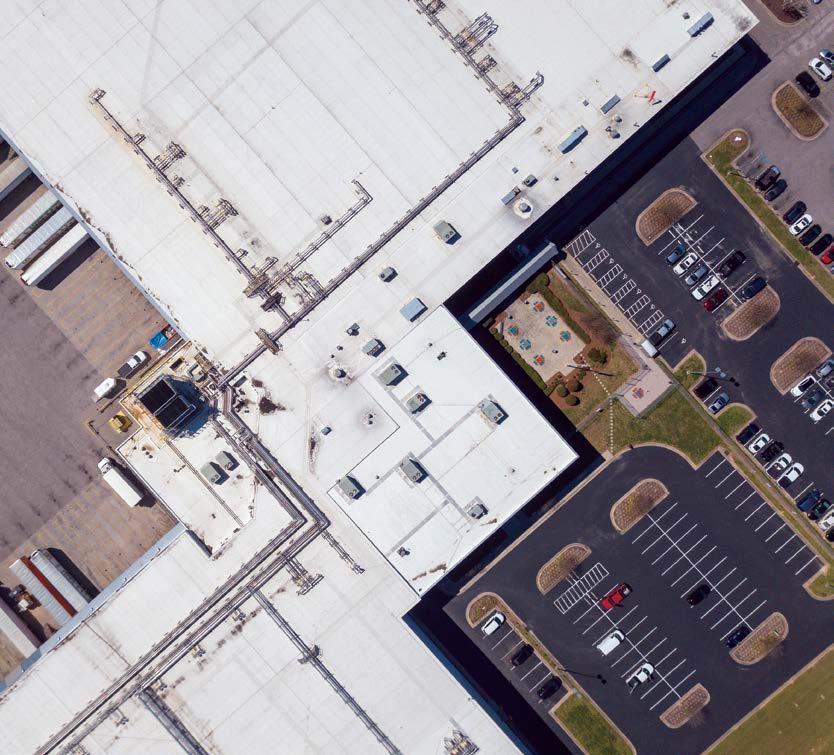
The OREP policy, exclusive to CCPIA ® members, covers inspection of properties over 100,000 sq. ft. (a common restriction on regular inspection policies) and extends coverage to restaurants, warehouses, hotels, healthcare facilities, schools, churches, shopping centers, mixed-use buildings, and more. The only remaining restriction applies to heavy-industrial sites such as power plants, refineries, petrochemical facilities, and mining operations.
page 12 8

Inspectors don’t need to be fully committed to commercial work to benefit. OREP’s base Professional Inspector Policy already covers apartments, condominiums, office buildings, and non-restaurant retail properties under 100,000 square feet at no additional premium, giving newer commercial inspectors immediate protection for many of the most common building types. As commercial volume grows, inspectors can step up to the full CCPIA® endorsement. The requirements are four: maintain active CCPIA® membership, follow the CCPIA® Standards of Practice, use a CCPIA®-prepared or OREP-approved commercial inspection agreement, and avoid heavy-industrial inspections. Inspectors can learn more and get a quote at OREP.org/commercialinspectors
Getting Started in Commercial Inspections
For inspectors considering whether to step into commercial work, Rob Claus offered a simple piece of advice: “Run, don’t walk.” Like Aey, he told me he sees commercial inspections today the way home inspections looked six decades ago. “Sixty years ago, nobody knew about home inspections,” he explained. “Here we are now, and you hardly purchase a property without one. There’s something to be said about being a first mover in a new industry,” Claus argued, because the inspector who builds a commercial practice now effectively “calls dibs” on their market. Anyone who enters later “has to do what I did or be better than what I did, otherwise they’re lesser.”
Another lesson emerging from inspectors already working in this space is the importance of branding. The commercial side of your business will benefit, we’ve been told, from being distinct from the residential side. McLeese was unequivocal on this. “It’s critical,” he said. In his experience, the home inspection label simply doesn’t translate into the commercial world. Residential inspectors are closely tied to real estate agents, he explained, and that association carries a connotation that commercial professionals don’t trust. “The name has a connotation to most commercial real estate professionals that it’s really more part of the home, not a commercial entity.” Even when commercial brokers liked working with him, they hesitated to refer him to high-level clients because the branding made them uneasy. As he puts it, recommending a home inspection company to a CEO evaluating a $10, $15, or $20 million property “would make them look bad.” Creating a distinct brand tells commercial clients that you understand their world, their stakes, and their expectations.
The inspectors already working in this space are consistent on one point: the time to move is now. Commercial demand is growing, the supply of trained inspectors hasn’t caught up, and the inspectors who build their practice and reputation today will be the hardest to displace once the market matures. Training, branding, and insurance coverage are all more accessible than they’ve ever been. To your success! WRE

You Covered!
• No Square Footage Cap —inspect buildings of any size
• 100% Commercial Firms OK —your professionalism is valued!
• Restaurants & Commercial Kitchens covered
• Warehouses, Hotels, Schools, Medical Facilities & more
• Residential and Broad Commercial Coverage in a Single Policy
• $100K Defense Coverage for excluded system claims
• FREE Attorney-Led Pre-Claims Defense ($600 value)
• No Business Audit or hoops to jump through
2026 Home Inspector State of the Profession Survey Results
by Isaac Peck, Publisher
H ome inspectors have a lot of opinions about their profession. What’s been harder to come by is data.
How much are inspectors charging? How are they finding their clients? Are they using Artificial Intelligence (AI) tools—and if so, for what? These are questions that come up constantly in conversations across the industry, but without a systematic effort to collect answers, the profession has largely been working from anecdote and assumption.
That matters more right now than it might have a few years ago. Home inspectors today are navigating a profession in flux— evolving technology, shifting real estate market conditions, and the growing question of AI. The decisions inspectors are
1. How many people are employed at your home inspection company?
making on these fronts aren’t small ones, and making them without reliable benchmarks is a real disadvantage.
The 2026 Home Inspector State of the Profession survey, organized by Working RE Home Inspector and OREP Insurance, set out to change that. The results below reflect responses from home inspectors across the country on everything from company size and marketing spend to pricing, business challenges, and AI adoption. The survey data is provided free to home inspectors and industry stakeholders to help you benchmark your business against your peers.
With 261 responses recorded, the results are worth a close look. Some chose to skip certain questions. See the results here. WRE
3. What is your yearly level of income from your home inspector employment?
2. What region of the U.S. are you in?
$300,001
4. What do you charge for a standard single-family home inspection?
5. How long have you been inspecting?
10. How many home inspections does your firm perform per month?
11. Do you plan to leave/retire from home inspecting in the next:
8.
12. Do you plan to add Commercial Inspection Services in the next 12-24 months?
13. What type of Commercial Properties do you inspect? (Select all that apply.)
17. Do you offer any ancillary services apart from standard home inspections? (Select all that apply.)
14. Are you using AI tools in your home inspection business? (Select all that apply.)
Yes, for report writing or voice-to-text transcription
Yes, for AI-powered damage detection (cracks, leaks, etc.)
Yes, for general business use (ChatGPT, etc.)
Yes, for marketing or website content
15. What is your primary source of new client leads? (Select only one.)
18. Do you belong to a professional home inspection association? (Select all that apply.)
19. What is
16. Are you using AI tools—ChatGPT or another Large Language Model (LLM) in your personal/professional life?

Understanding Employment Classification: What Home Inspectors Need to Know
by Isaac Peck, Publisher
A federal court ruled earlier this year that Seek Now, Inc., a national property-data firm, acted coercively when it attempted to push its field inspectors into individual arbitration while those same inspectors were actively challenging their classification as independent contractors. The court froze the new agreements before they could take effect. The case, McPherson v. Seek Now, Inc., didn’t resolve the underlying classification question—but it sent a clear signal about how courts view companies that try to maneuver around worker protections while litigation is pending.
For home inspectors, the case is a useful entry point into a question that affects every inspection business that hires help: when does a working relationship cross the line from independent contractor to employee, and what happens when you get that wrong?
The answer matters practically. Employment classification determines who pays taxes, who carries insurance, who controls the workday, and who bears liability when something goes wrong on a job. For inspection firms, a misclassification finding can mean back taxes, penalties, and damages. For inspectors working as 1099 contractors, it can mean discovering too late that the protections they assumed they had don’t actually apply to them.
Employees vs. Independent Contractors: The Basics
At its core, employment classification law asks a simple question: who controls the work? The way courts answer that question varies depending on the state, the agency doing the investigating, and the specific facts of the job.
An employee is someone whose work is directed by the employer. The employer decides how the work is done, when it’s done, and often with what tools. Employees are trained by the business, integrated into its operations, and economically dependent on it.
An independent contractor, by contrast, is in business for themselves. They control their own schedule, bring their own tools, set their own methods, and can take on multiple clients. They

are responsible for their own taxes and insurance. They declare their own profits and losses.
On paper, the distinction is clean. In practice, it gets complicated fast. A successful inspector needs more help during busy seasons and wants the flexibility of contractors but the consistency of employees. A new inspector wants to pick up work without a long-term commitment. The relationships that result are often more informal than the law allows, and they tend to evolve faster than the paperwork that governs them.
A contractor who starts out taking occasional overflow jobs becomes the go-to person for every inspection on the east side of town. An assistant who was supposed to help with photos ends up following your scripts, using your software, and representing your brand. The law doesn’t sort those relationships out gently. It does so at the worst possible moment, during a dispute or after an injury, and in ways that can be disastrous for your business.
The Tests
Courts don’t determine employment status by looking at job titles or contract language. You can call someone an independent contractor, but if the working relationship functions like employment, the law will usually treat it that way. Three major tests dominate.
The common-law control test, used by the IRS and many states, focuses on how much direction an employer exercises over both the outcome of the work and the manner in which it is performed. In home inspection, that control includes things like dictating inspection procedures, requiring specific hours or routes, mandating company-branded tools or software, reviewing every report before it goes out, or limiting an inspector’s ability to work for others. If you dictate the “how” rather than simply the “what,” courts tend to view your worker as an employee.
The economic realities test, used by the Department of Labor for federal wage law, looks at whether the worker is genuinely running an independent business. Courts consider whether the inspector
has their own business entity, markets to multiple clients, invests in their own tools and insurance, and can declare profits and losses based on their own decisions. Heavy dependence on a single client for income is a strong indicator of employee status.
The ABC test, used in states like California, Massachusetts, and New Jersey, is the strictest of the three. It presumes a worker is an employee unless the company proves all three elements: the worker is free from control, the work performed is outside the company’s usual course of business, and the worker operates an independent business doing that same kind of work. For home inspection firms, the second element is often the stumbling block. If your business is home inspections and you hire someone to conduct home inspections, that person will likely be considered an employee in ABC states. Check with your state labor department to identify which test applies to your situation.
Understanding these tests has practical consequences. If you hire a new inspector, train them, set their schedule, and review every report they write, that’s going to look like employment to a court, even if the contract says otherwise. If a firm requires inspectors to wear branded shirts, use company software, and follow a strict inspection template, that’s virtually certain to be considered employment. Restricting outside work is also a strong indicator: if you hire part-timers during busy seasons but prohibit them from working for competitors, be prepared to classify them as employees. On the other hand, if a seasoned inspector with their own LLC takes overflow work from a firm, uses their own tools, and sets their own hours, that leans toward independent contractor status, though ABC rules may still apply in your state.
The Courts
Courts consistently look at actual behavior rather than job titles or contract provisions. They also don’t look kindly on employers who behave evasively around the classification question, and McPherson is a direct illustration of what that looks like in the inspection industry.
Seek Now is a national property-data and inspection company that relies on a large network of field inspectors to gather photos, measurements, and on-site assessments for insurers and real estate clients. Although the company labeled these workers as contractors, the plaintiffs argued their day-to-day reality looked far more controlled: jobs were assigned through Seek Now’s platform, with strict turnaround times, required reporting formats, and work that formed the core of the company’s business.
While that misclassification claim was pending, Seek Now sent inspectors a new Master Services Agreement and arbitration clause. The message was direct: sign the new documents or stop receiving assignments. The agreements would have forced
disputes into individual arbitration and effectively blocked inspectors from joining the collective action. The court stepped in quickly, found the rollout coercive and likely to chill workers’ Fair Labor Standards Act (FLSA) rights, froze the new agreements, barred Seek Now from enforcing them, and ordered corrective notice. The ruling didn’t decide whether inspectors are employees, but it made clear that companies cannot use mid-litigation contract changes to protect a contractor model already under legal scrutiny.
The broader cases, Dynamex Operations West, Inc. v. Superior Court and SuperShuttle DFW, Inc. v. NLRB, operate at the level of classification doctrine. Dynamex is the foundation of the ABC test, placing a heavy burden on companies to prove contractor status. SuperShuttle leans the other direction, emphasizing entrepreneurial opportunity as a sign of independence. McPherson is different. It shows that an employer can run into serious legal trouble before any court even reaches those classification tests, simply by not acting in good faith. Courts are increasingly willing to enforce not just the outcome of a classification model, but the fairness of the model itself.
How Home Inspectors Acting as Employers or Contractors Can Reduce Risk
If you want a contractor relationship, you have to build it intentionally and maintain it consistently. That means giving real autonomy, allowing inspectors to work for others, avoiding control over the “how,” and resisting the temptation to tighten the reins when business gets busy. If you want an employee relationship, own the responsibilities that come with it rather than trying to retrofit independence onto a structure that doesn’t support it.
Start by deciding honestly what you want: control or flexibility. If you want to control how inspections are done, hire employees. If you want flexibility, contractors may work, but only if you genuinely give up control. Put the relationship in writing. A contract won’t override the law, but it clarifies expectations and documents intent. For contractors, acknowledge their freedom to work for others, their responsibility for their own tools and insurance, and their control over their own schedule.
If you choose the contractor model, resist the urge to dictate every detail. Provide outcomes, not instructions. Keep records of how inspectors are paid, how they schedule work, and what tools they use. Good documentation matters if a dispute arises. And consult a local employment attorney before you build out a contractor structure. Employment law varies significantly by state, and a short consultation is far cheaper than a misclassification finding.
For inspectors working as 1099 contractors, the protective steps run in the other direction. Establish a formal written contract that page 22 8

Inspectors are more likely to face a claim than any other trade or real estate professional. You Need a Team with Experience In Your Corner
Specializing in Home Inspector insurance for over 24 years, OREP Members enjoy pre-claims defense from trial attorney Geoff Binney who delivers decisive response letters and shuts down frivolous claims.

7page 19
includes indemnification clauses. Structure your business properly, most likely as an LLC, to separate personal from business liability. Maintain strict independence in how your work is performed and make that independence visible, to your client and on paper.
Insurance coverage deserves the same attention as the contract itself. OREP’s home inspector E&O policy includes independent contractors within the definition of “Insured,” meaning if you work for a firm that carries OREP coverage, you may be covered under their policy. But there is a critical condition: your name must appear at the top of the pre-inspection agreement alongside the name of the hiring business for coverage to apply. A contractor who shows up on a job where only the firm’s name is on the agreement has no coverage under that policy, regardless of how the work goes. Before you take an assignment, confirm that your name is on the paperwork. That one step is the difference between being covered and being exposed. Independent inspectors who want coverage that follows them regardless of who they’re working for can explore their own OREP policy at OREP.org/inspectors
This Is Really About Relationships
At the center of every classification dispute—every test, every factor, every lawsuit—is a relationship between two parties
“A contractor who shows up on a job where only the firm’s name is on the agreement has no coverage under that policy, regardless of how the work goes. Before you take an assignment, confirm that your name is on the paperwork.”
trying to get work done. Employment classification is an imperfect but necessary part of making those relationships work. The way you structure your working relationships determines who carries liability, who controls the work, and how much legal exposure you inherit when something goes wrong.
Courts have made one thing clear: they care far less about the labels you choose than about the reality of the relationships you create. If you want contractors, build a model that actually gives people independence. If you want employees, own the responsibilities that come with that choice. Treat classification as a structural decision, not a paperwork problem, and you’ll be in a much better position if a dispute ever lands on your doorstep.
Stay safe out there! WRE

Growth By Insight: Mastering the Human Element as Inspectors
by Kendra Budd, Editor
H
ome inspectors often make their business the central facet of their personality. While it’s important to have passion for your business, too much of it can cause your business model to plateau instead of grow.
On the Inspector Toolbelt podcast, host Ian Robertson and his guest, Inspector Empire Builder (IEB) CEO Mark Hummel, sat down in their episode “The Human Element” to discuss how easily inspectors can hit growth ceilings and fall victim to a stagnating business rather than a growing one.
Hummel and Robertson explore how inspectors can grow their business by focusing on personal growth, altering their mindset, and concentrating on self-evaluation rather than obsessing over finances, marketing, and the number of home inspections they do. Here’s what they considered.
Hitting a Growth Ceiling
Continually building your knowledge is critical to growing your business, and Hummel believes sharing that knowledge only helps everyone. “One of my favorite things to do is learn things but not to let it rest on my shoulders. As quickly as [I] can, I find a way to share it with other people,” Hummel opens the episode. One thing he has learned is when to recognize when you’ve hit a “growth ceiling” in your business.
A growth ceiling refers to the phenomenon of when you have grown your business to a point where your business has stagnated—i.e., you believe you’ve maxed out your success. “... you start feeling that diminishing return on your efforts. For example, if you’re running a business, and you’re thinking to yourself ‘I don’t know what’s next ...’, then you’ve probably hit your ceiling,” Hummel elaborates.
However, inspectors don’t just hit a growth ceiling out of nowhere—in fact, there can be multiple traps leading to this consequence. Robertson chimes in, citing that inspectors often fall

Kendra Budd is the Editor of Working RE Magazine and Marketing Coordinator for OREP Insurance. She graduated with a BA in Theatre and English from Western Washington University, and with an MFA in Creative Writing from Full Sail University. She is currently based in Seattle, WA.

into the con of complacency. As an example, “Maybe we hit a goal of 10 points, but we only had a goal of five points. When we hit six points, we’re satisfied … that we’ve gone past it,” Robertson says. Many inspectors will hit or surpass their goal and simply not have the desire to keep growing.
This lack of desire is often attributed to the feeling of satisfaction gained from comfort. “Whatever last felt comfortable you’re going to go back to that level of performance,” Hummel says. Instead of striving for comfort, he goes on to express that inspectors should start looking at it from a perspective of health, because when you work out regularly you are always striving to get better through the practice of consistency. “Can I do hard things consistently for a long time? That’s the ceiling that most people need to get through in their business. ‘Can I just stick to a few important things for a really long time consistently well?’ If I can’t do that, then I’ll probably get stuck at the same ceilings over and over again, because I won’t be consistent enough to work my way through them,” Hummel enlightens. Despite starting off strong, it’s easy for home inspectors to get stuck when stagnation begins to feel easy.
On the other hand, there is the trap of imposter syndrome. According to WebMD, “Imposter syndrome is when you doubt your own skills and successes. You feel you’re not as talented or worthy as others believe…” and that people will discover you are a fraud, even if you’re not. Inspectors fall victim to this phenomenon often because Hummel believes these inspectors don’t have a strong sense of personal growth. “Your business growth is always a product of your personal growth, and it can never be the other way around, right? Your business growth will never go further than your own development,” Hummel says. So, if you suffer from imposter syndrome, that belief will easily fall into the aspects of your business.
So, when inspectors end up hitting a growth ceiling, what should they do next? Many may assume it’s to dive into their business with full force and focus, but Hummel argues that it’s actually the opposite.
Techniques for Personal Growth
According to Hummel, inspectors often assume that to grow their business they need to put all of their attention and focus into it. However, Hummel considers that inspectors who have a strong life away from their business, are the ones who end up most successful.
Specifically, he talks about how he’s known inspectors who go from business to business and only keep growing their success. “They have this joy … or even this peace about them sometimes. Those people in my view are people living from identity rather than getting their identity from what they’re doing,” Hummel says. While in other cases, Hummel sees home inspectors who make their business the center of their world, who believe that if they don’t do any inspections, that they will no longer have a sense of identity. “There’s a lot of people out there living like that. I was living like that in other careers where I went through my own identity crisis until I shifted careers.” Hummel shares. This is why it is important for home inspectors to focus on their personal growth alongside their business growth.
Robertson also reveals the importance of personal growth, and how it can be beneficial to home inspectors. “I’ve met people whose personal growth isn’t tied to their business, but things always end up working out for them. People have been like ‘The dot.com boom just tore apart my entire industry, but that’s okay because I built up a whole new industry six months later,” Robertson says—stating that could only be possible for those with a lot of personal growth to bounce back from something like that.
So, how do inspectors evaluate their personal growth? Well, Hummel shares that for inspectors to grow personally they need to answer the four following questions about themselves:
1. Who are you?
2. What are you doing?
3. How are you going to do it?
4. Who are you doing it for?
If you can answer those prompts with ease, then according to Hummel, you’re already ahead of most people who are operating in a business. “… you’re going to be able to point yourself toward a growth path that makes sense to who you are, rather than just the work you’re doing,” says Hummel.
In fact, Hummel implements the same practices into his team at IEB—making sure that his company members have a strong life vision, because it will only strongly impact the business. “All of that’s the work—identity, life vision, life alignment, that’s sort of how we roll,” he states.
However, personal growth doesn’t just happen overnight. There are actionable steps inspectors need to take, other than just
answering a list of questions. Personal growth varies person to person and will often require trial and error. However, Hummel believes that there are two universal truths inspectors can implement into their practice. The first is to not solely rely on their experience when looking for growing techniques. “Experience is a good teacher, but if it is the only teacher, it is going to direct you in ways that are not all that meaningful,” Hummel cautions. A common example he likes to use is that if you’re an inspector who’s always putting out fires, then your experience is teaching you to be a firefighter. “So now you are starting fires, so that you have work to do,” he explains.
The second universal truth is that simple things that are easy to do for a short period of time but difficult to do consistently well over a long period of time will help you reach your goals. Meaning inspectors should push themselves by finding specific ways to grow and putting intense focus into it. An example Hummel uses is, “Read five or six books instead of one on a certain topic. Or get into a group where someone is smarter than you to inspire and humble you.”
Something that could make this process easier for home inspectors is by changing their mindset, as many home inspectors operate with a technician mindset. However, inspectors should be striving toward a builder mindset instead.
The Builder Mindset
According to Robertson, “We often spiral as a technician running a business…” because working as a businessperson is drastically different than working as a technician. People with a technician mindset often have an analytical approach to problem solving, and value mastering technical skills to work in the business. Many with this mindset believe if they do the same thing every day and follow specific guidelines, their business will have a greater success rate. “Just [because] we do it day in and day out doesn’t mean we’re good at it,” Robertson argues. Inspectors can often lose the business side of things with this approach.
Inspectors who operate their business through a builder mindset often see more success than those with a technician mindset, Hummel tells listeners. This is because those with builder mindsets are more focused on who their business serves, rather than focusing solely on profit. According to Hummel, inspectors should ask themselves, “So what does my business brand look like? Who does it serve? How does it maximize the impact it has—not just the dollars it makes?”
Robertson states that he sees many multi-inspector business leaders have the technician mindset and uses their resistance to using business coaching as an example. He says many multi-inspector owners are against the idea because they believe as long as you have a good website and good marketing, you’re golden. page 26 8
7 page 25
However, Robertson pushes back saying, “That’s a really diminutive way to look at it, because most of the successful home inspectors have a higher idea of things than that.”
He uses a working-out analogy to clearly define his reasoning, citing how when you first start you can’t solely focus on heavy lifting and eating right—that you may have to take into consideration other factors like your joints, age, recovery period, etc. “We go into business with that same mentality. ‘You just need to work hard to get inspections.’ You hit a ceiling really hard when you do that, when you don’t self-level-up,” Robertson elaborates.
When money is at the forefront of an inspector’s mind, it becomes harder to level up your business. When the technician mindset is taking the driver’s seat, then fear-based reasoning does too, which often leads to inspectors not changing their prices or hiring additional help. “If you feel like you’re not charging what you’re worth, the first thing isn’t to raise your prices, [it’s] to really nail down what you’re worth and believe it…” Hummel explains. The fear is that inspectors will lose work by raising prices or hiring more inspectors. However, Hummel has found in practice that the benefits outweigh the risks.
“I was hearing from IEB members, they said ‘I’m doing less inspections than last year, but I’m 20 percent up in revenue.’ Bingo! That’s what we want,” Hummel says. The builder mindset model in inspections is simple: raise prices, lose business, make more money, work less. So why does this work? Because these inspectors not only have the builder mindset, and are willing to take risks, but because their business isn’t their central personality trait.
It all comes back to personal growth. Inspectors with a builder mindset are able to grow personally outside of their business. A story Hummel shares is that an inspector he knows raised his prices and was getting less business, but it worked out for the better. “He said, ‘I did 400 inspections, but I made every one of my kid’s little league games,’” Hummel tells listeners. This was due to the inspector not only developing a builder mindset, but also self-evaluating how he wanted to show up in his personal life. Hummel urges inspectors to focus on what they might gain, instead of what they could lose when reviewing their business goals, because personal growth only grows your business with it.
Finally, Hummel believes to run a successful home inspection business through building personal growth, is to have the courage to give yourself a self-evaluation.
Self-Evaluation and Growth Plans
According to Hummel, if you are lacking in self-awareness, then your business is bound to suffer for it. “The truth is, self-awareness is the foundation from which everything grows. We cannot grow if we are first not aware of the need to grow. Or at least the need to choose to grow,” Hummel elaborates. The best
way for inspectors to gain insight into where to grow is through self-evaluation.
A self-evaluation is simply sitting down and writing down the areas of your life you are showing up in, then rating how you’re showing up on a scale of one to 10. “Don’t overthink it. This can take 10 minutes,” Hummel teaches. Once you have compiled your list, your next step is to turn that self-evaluation into a growth plan.
Hummel emphasizes that when compiling your growth plan, don’t shift your entire personality overnight but rather change one thing at a time. Hummel leads by example, sharing his own growth plan. “Choose a path to grow in. I allow myself three topics for an entire year,” he says. This allows Hummel to learn as much as possible about three subjects, rather than sporadically gathering information throughout the year. This makes it easier for the information to stick and to become an expert on it. However, he also cautions that that is what works for him. Some people may need to start smaller, such as reading a book on one topic you’re interested in to assist in your growth plan.
Once you have started your growth plan, Hummel explains that the most important piece is to stay consistent. A great way to keep up with your growth plan is to have someone do it alongside you. “Having some people around you who can influence you in a positive way in a thing that you’re doing, it’s a complete game changer,” Hummel expresses. Robertson agrees, saying that especially in a post-pandemic world that community is more important now than ever in growing yourself. “Every day that you’re alone, you are choosing that,” Robertson shares.
Once your growth plan is in place, you will see your business start to succeed more and more, as well as your personal life— so long as you stick to it.
Final Thoughts
Growth ceilings can seemingly come out of nowhere, but through self-growth they are easy to break out of. Hummel and Robertson make it clear, if you feel like you have stagnated in your business then it is time to self-level up, change your mindset, and reevaluate your priorities—including outside of your business.
Most importantly, inspectors must want to grow, otherwise you’ll only keep hitting those growth ceilings. “We want to grow [in] things we have chosen to grow [in]. I call that growth by insight rather than growth by pain,” Hummel opines.
Even if you are an inspector who believes they haven’t hit a ceiling, it couldn’t hurt to self-evaluate and create a growth plan anyway. You might be surprised at what you discover.
To listen to the full episode, go here: https://inspectortoolbelt. com/the-human-element/ WRE

$100,000 CYBER COVERAGE
$125 Example Scenarios
Why Home Inspectors Need Cyber Coverage:
1. Hacked Emails ($100K) - Scenario: Your email account is compromised and then sends malware to your contacts. Up to $100K Third-Party Liability coverage applies.
2. Payment Data Breach ($100K) - Scenario: Your Point of Sale (POS) Square® reader is compromised by malware, skimming clients’ credit card data. Coverage includes investigation, notifications, and damages.
3. Lost/Stolen Device ($100K) - Scenario: Did you know that if your laptop/phone with client data is stolen, you could be required by law to notify clients, provide credit monitoring, and you could face fines ($500–$5,000 per record)? This coverage pays for notification and legal costs.
• $100,000 Cyber / Technology Security Coverage
• $100,000 Aggregate Privacy Fines/ Penalties
• $25,000 for Cyber Breach Forensic Expenses
Top 20 Home Inspection Photos From 2025
by Reuben Saltzman, Structure Tech
It’s that time of year again! Please enjoy our favorite home inspection photos from the past year. If you like this stuff, please follow Structure Tech on Facebook ( Bit.ly/structuretechfb) and on Instagram ( Bit.ly/structuretechinsta).
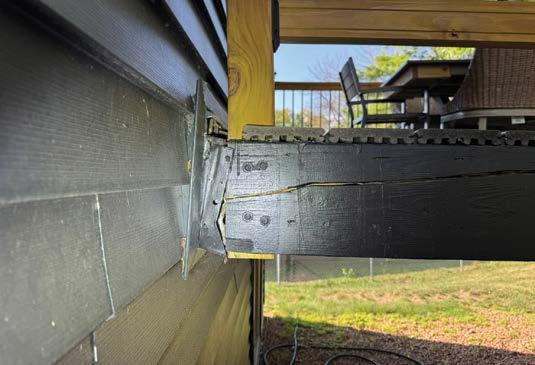
1. Bad ledgerboard
This is an unsafe deck with a badly rotated ledgerboard.
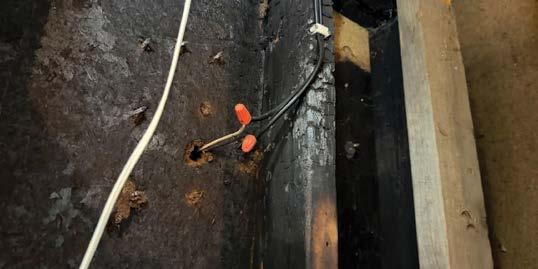
2. Let’s try that again
There was clearly a fire in this wall. And now there’s new, open spliced wiring in the wall, which is clearly a fire hazard. One fire just wasn’t enough?

Reuben Saltzman is a second-generation home inspector with a passion for his work. He grew up remodeling homes and learning about carpentry since he was old enough to hold a hammer. He worked for Structure Tech since it was purchased in 1997 and is now the owner and CEO of the company. To connect with him, visit https://structuretech.com/
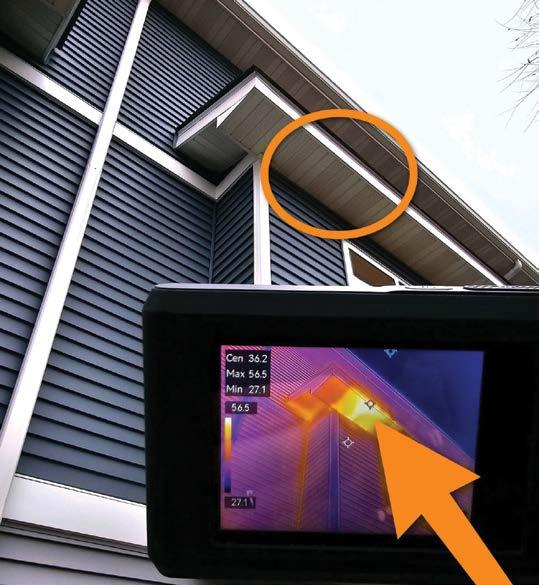
3. Hidden bath fan exhaust
We couldn’t figure out where the first-floor bathroom exhaust fan was vented, until we used our infrared camera around the outside of the home. Boom! There it is. Bath fans need to exhaust to their own dampered terminals, not into the soffit spaces.
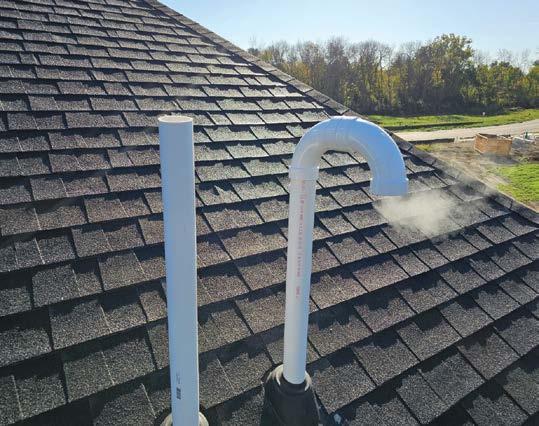
4. New construction, backward furnace venting
The intake and the exhaust for the high-efficiency furnace are flipped around. The intake needs to point down to help prevent water from getting in, and the exhaust needs to point up. This helps prevent exhaust gas from getting sucked into the furnace intake.
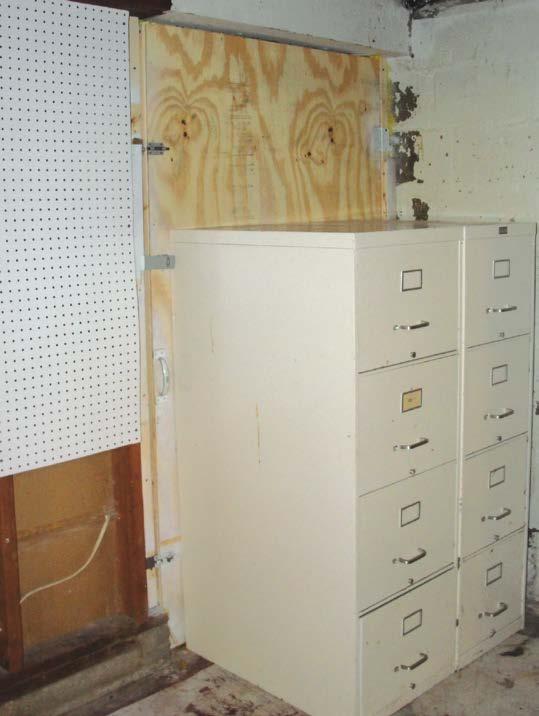
5. Not-so-hidden grow room
Stacking a bunch of file drawers in front of the grow room is only going to make us more curious.
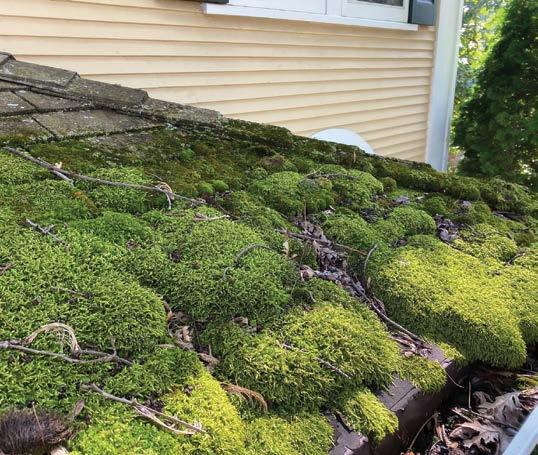
6. Heavy moss growth
Moss will shorten the life of the roof covering and possibly lead to roof leaks.
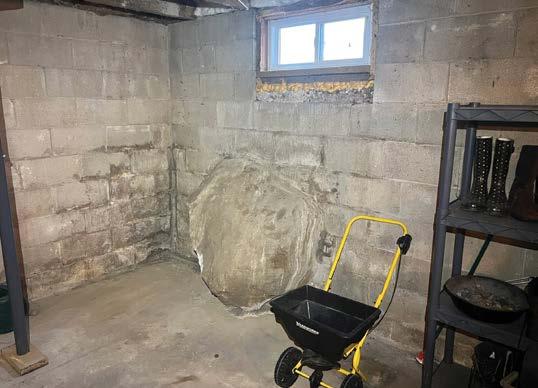
7. Home on a rock
Matthew 7:25 – “The rain came down, the streams rose, and the winds blew and beat against that house; yet it did not fall, because it had its foundation on the rock.”
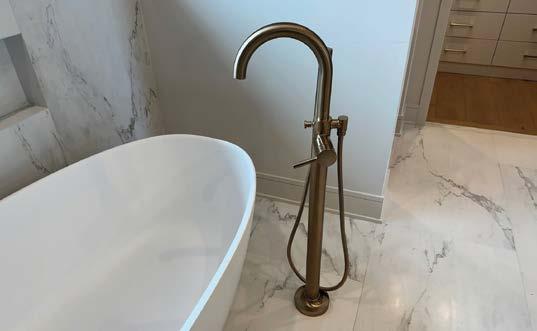
8. Living on the edge
The water makes it into the tub, but just barely.
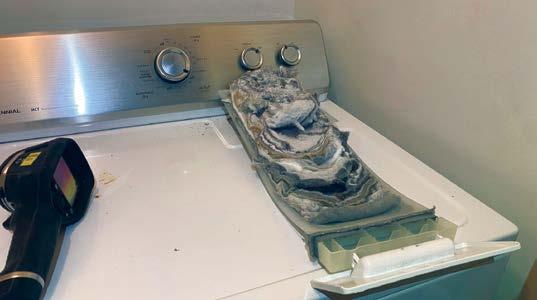
9. Annual lint filter cleaning
Dryer lint filters should be cleaned after every load; not annually. It’s a fire hazard that severely hampers the dryer’s performance.
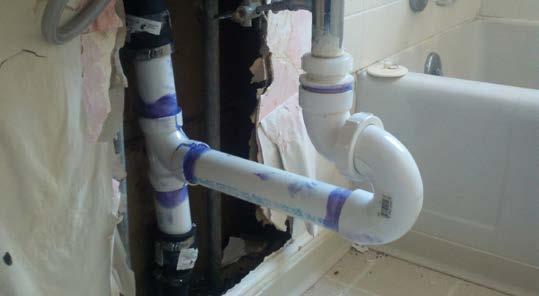
10. Not a trap
Sewer gas will enter the home. Also, the sanitary tee is upside down, and those rubber clamps don’t have metal bands. And there’s a big old hole in the wall.
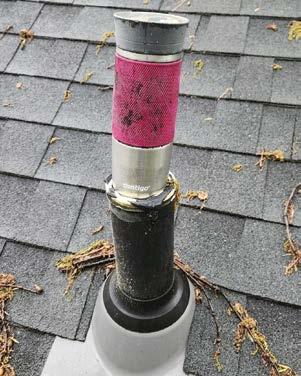
11. That’s not a cupholder It’s a plumbing vent.
12. This is why we charge more for old houses.
There’s so much more to document. There’s a ton going on in this photo, so I marked up a bunch of stuff.
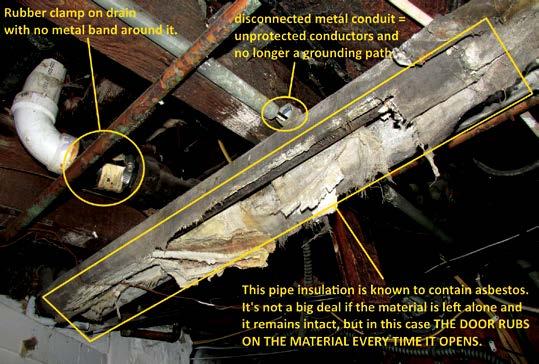
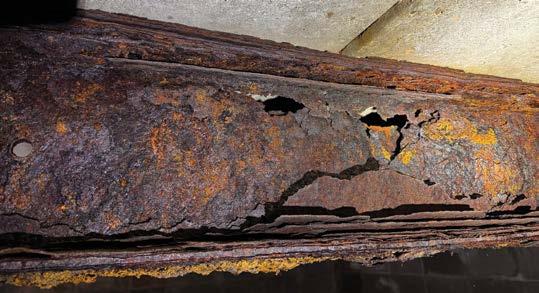
13. Rusted steel beam
This beam was supporting a pre-stressed concrete floor below a garage. Don’t drive a vehicle in there until the beam is replaced.
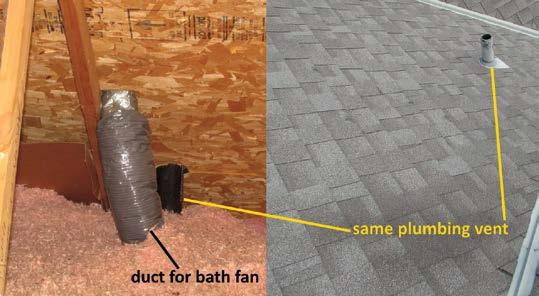
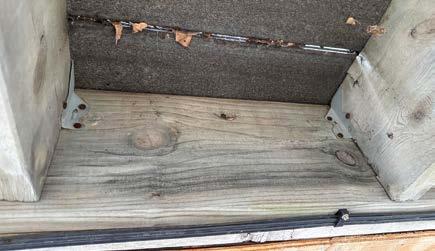
14. Another bath fan that doesn’t vent to the exterior.
A bunch of people questioned this photo, saying these can’t possibly be from the same house, but I assure you, they are. I personally took both of these photos. The opening for the bath fan duct was completely shingled over.
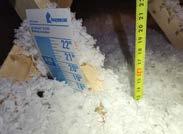
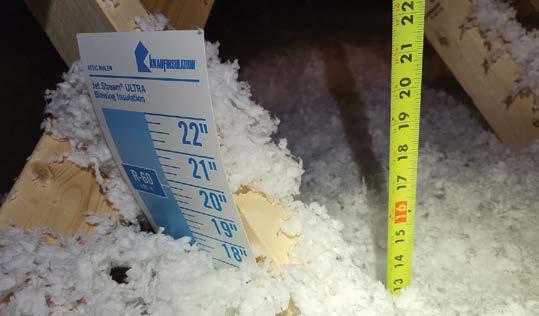
15. Sneaky insulation installers
They raised the depth marker to make it look like there was more insulation. Again, several people questioned this photo. They suggested that we might have accidentally placed our tape measure on the bottom chord of a truss. And to those people, I say, please give us a little credit. We’re not rookies.
Stumped.
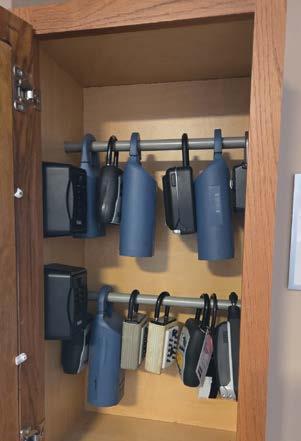
17. One condominium building, thirteen lockboxes, five labeled C’mon people, you’re making life challenging for everyone. Label the lockbox with the unit number! Or at least put your name on it.
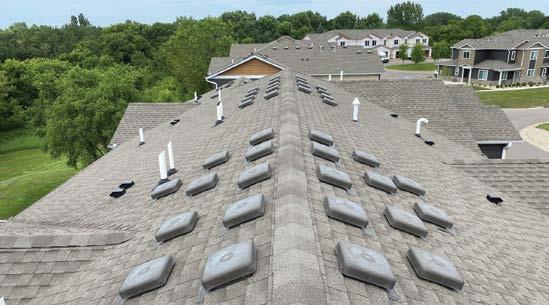
18. How many is too many vents?
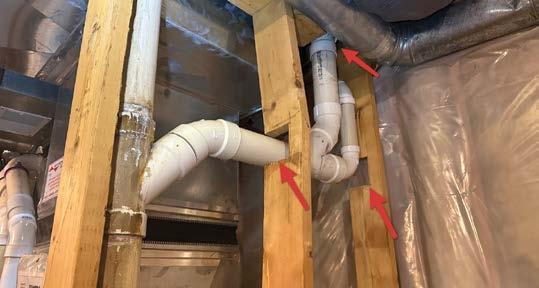
19. Overnotched studs
It’s fine to notch a stud, but no more than 40 percent for a load-bearing wall, and no more than 60 percent for a nonload-bearing wall.
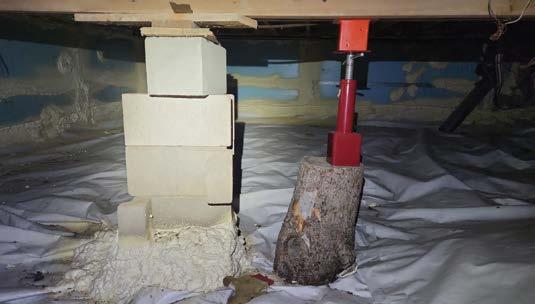
20. Do these upside-down joist hangers make my joists look big?
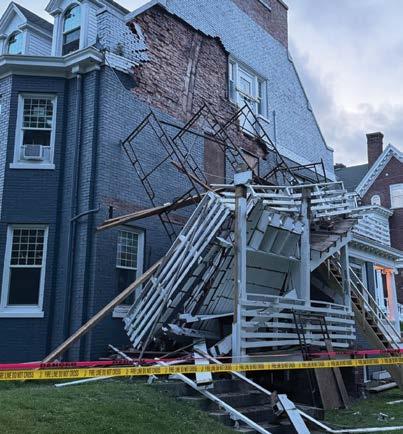
21. Failed brick veneer
This bonus photo makes 21, and it’s the only house we didn’t inspect. This was shared by a family member of one of our inspectors, showing their neighbor’s house after a catastrophic collapse of the brick veneer and scaffolding. WRE
The 7 Most Dangerous Infrared Thermography Mistakes (and How Professional Training Prevents Them)
by Christopher Casey, President and CEO of Monroe Infrared
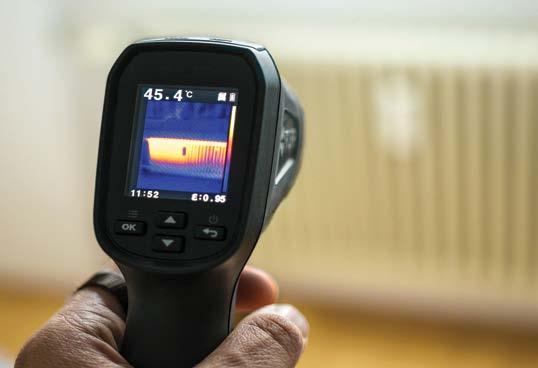
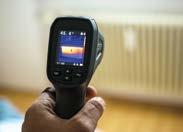
Infrared cameras have never been easier to buy or use. They’re compact, affordable, and they produce crisp images that might make thermography seem like a simple “point-and-check” exercise. That false sense of simplicity is exactly what gets people into trouble when attempting electrical reliability and safety inspections.
Every week at Monroe Infrared (a Guidant Power company), we meet technicians who bought a camera, tried to self-teach, and quickly discovered that thermal imaging is far more complicated than it appears on the screen. They usually tell us some version of, “I thought I understood this. I didn’t realize how much I was missing.”
The reality is straightforward: thermography is powerful, but only when performed correctly. Misinterpret one image and you can create unnecessary panic or overlook a real hazard hiding in plain sight. With NFPA 70B now requiring condition-based maintenance and qualified personnel for infrared inspections, the margin for error has shrunk dramatically.
Infrared is used across many applications, but this article focuses on infrared thermography for electrical distribution, safety, and reliability inspections, where load, emissivity, and reflections can make or break your findings.
Below are the seven most dangerous mistakes untrained thermographers make, why they happen, and how proper training eliminates them.

Christopher Casey is President and CEO of Monroe Infrared Technology. He’s a graduate of the United States Military Academy at West Point, holds a Bachelor’s Degree in Mechanical Engineering and a Master’s Degree in Business Administration from St. Martin’s University. He owned Monroe Infrared from 2011 to 2025 when he sold and merged into Guidant Power to provide more training and service options to clients nationwide.
Mistake #1: Believing That “Hot Equals Bad” and “Cool Equals Good”
This is the most common (and the most misleading) assumption beginners make. Thermal images feel intuitive: bright colors look alarming, and cooler tones feel safe. But infrared images aren’t emotional; they’re contextual.
A component can look hot simply because:
• It’s designed to operate at a higher temperature
• It has low emissivity, or
• It’s made of a material that naturally radiates heat differently.
Likewise, a cool-looking component isn’t always healthy. Low load, airflow patterns, shading, or compensating mechanical processes can mask genuine issues.
Training teaches thermographers how to evaluate heat in context, not in isolation. That includes comparing similar components under similar load, identifying expected temperature profiles, and understanding material behavior. Without context, you’re just guessing.
Mistake #2: Measuring Thermography Equipment Under the Wrong Load
Infrared thermography depends heavily on load. A component inspected at 10 percent load tells you almost nothing about how it behaves during normal or high-load operation. A breaker that seems perfectly normal during light use might spike dangerously when the system is fully energized.
Many untrained thermographers unknowingly perform inspections when equipment is starting up, shutting down, or idling. They report that everything “looks fine,” because at that moment it is. But this creates a false sense of security. Load determines whether a temperature difference is meaningful, and understanding load relationships is foundational to proper thermography.
Proper training explains when to scan, how to interpret ΔT (temperature difference), and how to separate load-related heating from true faults. Misjudge the load, and the entire inspection becomes unreliable.
Mistake #3: Confusing Reflections With Real Heat
Reflectivity is one of the trickiest concepts in infrared thermography. Polished metal, stainless steel, aluminum, and many mechanical housings behave almost like mirrors. They reflect thermal radiation from the environment, including your own body heat.
Untrained users commonly mistake these reflections for overheating. They take a thermal image of a shiny bus bar or panel, spot a bright area, and assume a dangerous condition is present. In reality, nothing may be wrong with the equipment. The camera is simply capturing a reflection. This leads to unnecessary alarms, wasted time, needless repairs, and, in worst cases, shutdowns that were never required.
Training teaches how to work with reflective surfaces: adjust viewing angles, apply high-emissivity targets, validate readings, and confirm whether heat is genuine or reflected. Without this skill, a large portion of images can be misinterpreted.
Mistake #4: Ignoring Environmental Conditions
Thermography doesn’t happen in a controlled room. It happens in real-world environments full of variables that affect readings, including:
1. Wind or forced air cooling
2. Sunlight or solar loading
3. Ambient temperature fluctuations
4. Moisture evaporation
5. HVAC influences or other heat sources
These factors can dramatically alter what an infrared camera sees. For example:
• Wind can cool an overheating joint enough so that it looks “normal.”
• A sun-soaked rooftop will radiate differently in the morning than in the late afternoon.
• Moisture under insulation creates subtle temperature changes that beginners miss.
Training shows thermographers how to recognize and compensate for environmental effects, so they know when temperature patterns are meaningful and when they’re misleading.
Mistake #5: Using the Wrong Emissivity Settings
Emissivity is one of the most important concepts in infrared thermography, and one of the most consistently misunderstood.
Emissivity determines how much infrared radiation a surface emits, thereby affecting the accuracy of temperature readings. Two objects at the same temperature can appear completely different if their emissivities differ.
Many beginners do not adjust emissivity at all, relying on camera defaults or guessing. But misconfigured emissivity settings can easily lead to temperature errors of tens or even hundreds of degrees. A component may appear dangerously hot when it is completely healthy, or vice versa.
Training teaches how to measure, adjust, and validate emissivity for different surfaces and conditions. Without this, temperature data becomes unreliable—and any decisions based on that data are equally unreliable.
Mistake #6: Inconsistent Technique From Scan to Scan
Infrared thermography is a discipline, not a set of random snapshots. Technique matters. Angle matters. Distance matters. Focus matters. Even posture matters. Small variations alter the quality and reliability of the data.
Untrained users often take each image differently from the last, making it impossible to compare one inspection to another.
Professionally trained thermographers follow documented, repeatable procedures, which are essential for trending, condition-based maintenance, and NFPA 70B compliance.
Mistake #7: Failing to Evaluate Trends or Baseline Data Over Time
Equipment rarely fails instantly. It fails gradually, and those gradual changes are often visible thermally long before they become emergencies. Trending allows maintenance teams to identify deterioration, imbalance, mechanical fatigue, and other developing problems.
However, many users who rely on YouTube videos or casual learning treat thermography as a one-time event. They take a single scan, save a picture, and believe the job is done. Without trending, baselining, and comparison against historical readings, they lose the ability to detect slow progression.
Training teaches thermographers how to establish baselines, maintain documentation, and evaluate trends over time , which is exactly what NFPA 70B now requires for a compliant thermography program.
The Three Risks of Bad Training
When thermography is performed without proper training, organizations face three major risks:
1. Safety Risk: A missed anomaly in electrical equipment can lead to failure, fire, arc flash exposure, or other serious incidents. A false alarm can trigger unnecessary shutdowns or repairs.
2. Reliability Risk: Incorrect readings create misleading maintenance decisions, poor prioritization, and avoidable downtime.
3. Compliance Risk: NFPA 70B’s 2023 update shifted infrared inspections from “recommended” to “required”—and specified that they must be performed by qualified personnel.
Camera ownership does not imply qualification.
Infrared Thermography Training: The Safest, Smartest, Most Cost-Effective Solution
Professional infrared thermography training provides technicians with the knowledge, the technique, and the confidence to avoid every mistake described above. During Monroe’s Level I and Level II training programs, students learn the physics that drive thermal behavior, the practical methods for capturing accurate images, and the analytic skills needed to interpret data correctly. Training covers:
• Emissivity and reflectivity
• Load conditions
• Environmental considerations
• Thermal patterns in electrical and mechanical systems
• Building envelope analysis
• Moisture detection
• Trending and documentation
• NFPA 70B compliance requirements
Thermography cannot be reduced to “point, shoot, and read the colors.” It requires professional instruction and hands-on practice to master.
The Camera Doesn’t Find Problems, Thermographers Do Infrared thermography is one of the highest-value tools in any reliability or electrical safety program. But its effectiveness depends entirely on the knowledge and skill of the person behind the camera.
Untrained operators frequently misinterpret images, overlook failures, or confuse reflections with real heat—mistakes that compromise safety, reliability, and compliance.
Training is the difference between guessing and knowing. Between colors and meaning. Between a picture and an actionable diagnosis.
Get Started Today
Monroe Infrared, a Guidant Power partner ( Bit.ly/guidantpower ), offers hands-on Level I and Level II thermography certification courses taught by seasoned thermographers with decades of field experience. Whether you need to train a single technician or certify an entire team, we deliver practical, compliant, confidence-building instruction that transforms thermography from a tool into a discipline. WRE


A Concerning History of Failures
by Mike Twitty, ACI (retired)
Electrical equipment and products of various designs and applications have at times been found to have problems that require redesign and manufacturer recalls.
Solid aluminum wiring that was used in the 1970s is one example of a product that caused fire hazards. Federal Pacific Stab-Lok panels are another.
This brings us to a discussion of a product that is commonly used in HVAC installations: the pull-out disconnect switch. These disconnects are the least expensive units available, which makes them extremely popular. Several manufacturers produce this type of disconnect in both fusible and non-fusible models. Most are almost identical in size and design. The manufacturer’s name and logo on the boxes are the only noticeable differences.
The disconnecting means in these units is a handle that is pushed in and pulled out manually to control power to the appliance. Other types of HVAC disconnects use make/break switches such as knife switches and molded case circuit breakers. One problem with the pull-out type is that sometimes the handle is not fully inserted into the contacts and does not get a good connection.

Mike Twitty retired from a 17-year home inspection career in 2021. He is a licensed electrician and an ICC certified electrical code compliance inspector for residential and commercial installations. Mike currently stays busy providing continuing education for home inspectors focusing specifically on electrical subjects. He can be reached via email at: mtwitty2@hotmail.com
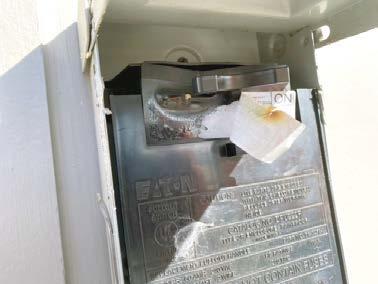
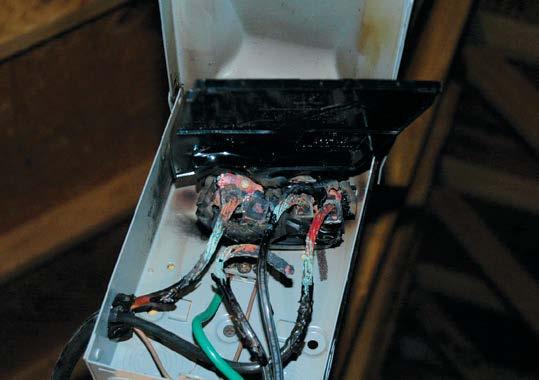
All the manufacturers of the units refer to them as “air-conditioner disconnects (ACD).” The intended use by one of the largest suppliers, Eaton, states: “manufactured for use with lower load compressors with intermittent operation.” The instructions continue to state: “This ACD is not intended for uses on electric (EV) charging, photovoltaic, and resistive heating applications.” (See Figure 1.) Eaton recommends another of their products with a 2-pole off/on switch for these applications.
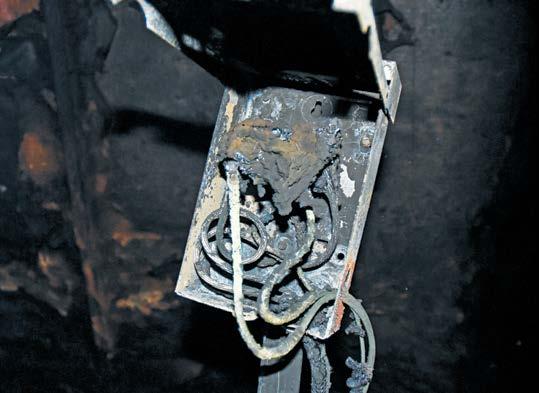
The pull-out type HVAC disconnects have a significant history of overheating and melting failures. A recent situation at a multi-family property in Columbia, Tennessee had as many as 14 melted disconnects that were being used with electric furnaces with resistive heat strips located in the attics. One condo dwelling was destroyed by fire in December 2025. (See Figure 2.) The rating of the disconnects involved is 60 amps. The heating load that they were supplying was approximately 42 amps. The heating load for an extended period caused the units to melt as they are not appropriate for continuous loads.
The National Electrical Code (NEC) defines a continuous load as: “A load where the maximum current is expected to continue for three hours or more.” Both heating and cooling loads can operate at maximum current for longer than three hours during extreme weather conditions in many parts of the country. HVAC manufacturers determine the minimum circuit ampacity of condensing units and heat pumps by rating the compressor RLA at 125 percent and fan motor FLA at 100 percent to meet potential continuous load requirements.
Pull-out type HVAC disconnects are available in both fusible and non-fusible models and are typically rated at 30-amps or 60-amps. Both the fusible and non-fusible models have been known to have melting failures. Most failures appear to be at the handle. Close examination of the plastic covering of the
Figure 1: Melted disconnect used for EV charger
Figure 2: Disconnect in fire-damaged condo
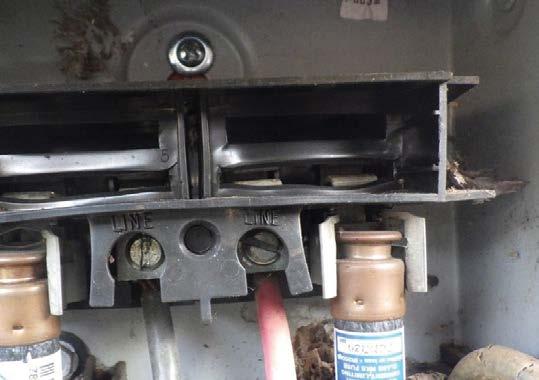
handle will often reveal deformation from heat produced from the load.
The history of failures of any electrical product is concerning. Home inspectors, code inspectors, and electricians should be
aware of these issues. Recommendations for a different type of disconnect should be made when any evidence of damage, incorrect installations, and continuous load operation is observed. These recommendations could possibly save lives and prevent property damage. WRE


Figure 3: Melted disconnect used for electric furnace
Figure 4: Melted disconnect on condensing unit; courtesy of Jim Katen
A God-Given Assignment: Interview With Jacqueline Gathers
by Kendra Budd, Editor
After the death of her husband in 2017, Jacqueline Gathers had a choice to make: either sell the home inspection franchise he had purchased but never saw launch or take over the business herself in his memory. Fast forward to now, and Gathers is a franchise owner of Pillar to Post Home Inspections, North America’s largest home inspection company and Best in Category in Entrepreneur Magazine’s Franchise 500® ranking.
Located in Brooklyn, New York, Gathers sat down to talk with Working RE Home Inspector about her journey to her success. Gathers shared what it was like processing her husband’s death, navigating a white- and male-dominated industry as a Black woman, and how focusing on honesty and helping firsttime homebuyers built a successful business.
Gathers is nothing short of an inspiration to home inspectors. Here is what we learned from her:
Working RE Home Inspector: How did you get involved in the Home Inspection industry? What is your professional background like?
Gathers: I have an unusual story. I actually knew nothing about the home inspection industry. I retired from the New York City Housing Authority after 30 years of service, and my late husband worked in Human Resources (HR). We knew we were going to retire in our 50s, and he wanted a little something to do, so he bought a franchise, this was his baby. And I was like, “Okay, you know, long as it’s not food, and you know, I don’t want to be involved. And if this is what you want to do with your time, Mr. HR, you go right ahead.” I was just going to support him from afar. After he got trained and everything, he was diagnosed with cancer. So we went through chemo, radiation, all that good stuff, everything was cleared, and he went, got his license, and just before he was ready to launch the business, the cancer came back very aggressively, and I lost him in March of 2017.
So, here I am retired, I have this franchise I knew nothing about, [and] I never ran a business before. I had no intentions of running a business; I was a wife, a mom, a city worker, and I

was quite happy with that. So, I thought about it, and I reached out to the franchise, and they said, “Well, we understand the circumstances. You can sell it back to us.” But then I thought about all the work that he put in to get this business up and running. So, I decided to launch the business in his memory, and that’s how I ended up in the home inspection industry.
I started researching it, and I realized that it was a white, male dominated industry, and I thought that was interesting. Okay, so where do I fit in? So, I went back to school. I got my inspection license. I launched in 2018 and it was difficult, because most home inspectors don’t look like me. Very few women. I think I was the only Black female inspector in New York City, and they just looked at me weird, like, “what are you doing here?”
So, my “why” was different than most people, because I had a very passionate and powerful why. I just kept at it, and I kept at it and I kept at it. And eventually, people got tired of me coming in the office with my cookies, and they were like, “Just give her a job.” And I started to get inspections. My network started to grow, and people saw that; they looked past my gender and my ethnicity, and they saw that I really knew what I was doing, and my business started to pick up, and it started to grow. I knew out the gate that I couldn’t grow the business during the inspections, so eventually I expanded my team, and that freed me up to grow the business and to do the marketing and to be the face of Pillar to Post Brooklyn.
I kind of ended up teaching the home inspection component with first-time homebuyer seminars throughout New York City and different real estate teams. So that kind of became my niche. How I got in front of the people with my teaching and going over explaining to first-time homebuyers the importance of the home inspection component, and I started getting business that way, and then my team grew a little bit. So now, with three of us, I have two inspectors to actually go out and do the inspections. I do a condo here and there, but I spend my time
educating the community about the importance of the home inspection process.
Working RE Home Inspector: You wrote in an essay with Business Insider about how taking over Pillar to Post helped you process your grief. Could you expand on that?
Gathers: That was one of the most difficult things I ever faced in my life, was to lose my husband. Because he was the person I leaned on for everything, and with him missing I had a hard time managing things. And I think that the business preoccupied me in two ways. When he got really, really sick, I ended up retiring early from my job to take care of him. When he passed, I said, “Okay, I have no husband. I have no job.” My youngest one had went away to school, so I was in the house by myself, and having a business really gave me a reason to get up and not get lost in my grief, because it’s easy to do that when you have time on your hands. But I didn’t have that because I was out every day. I was in the real estate office. I was getting the business up and running, and that kind of helped me deal with my grief, and it also made me feel good, because I was doing this in his honor. So, I was doing two things at once, and one was very fulfilling, and the other one just helped me get through the day. If anyone’s ever dealt with grief, you know grief is really unusual. You know, scientists have studied it and it never goes away. You just learn how to manage it, and it’s different for every person. There’s no road map of how to manage and deal with your grief, because it’s unique and different for every person, and for me, starting this business helped me deal with and manage my grief.
Working RE Home Inspector : After your husband passed, you had the option to sell the franchise. What led you to decide against doing so?
Gathers: Well, I was adamant that I wasn’t going to do it. He was the businessperson. I know nothing about running a business. I’ve never run a business, I always worked for someone, and I kept saying, “no, no, no.” But I’m a Christian, and I prayed on it a lot. God told me to do it for him, and once he told me that, I kind of didn’t have a choice, because I’m an obedient Christian, and that’s kind of why I just said, “Well, I have to do this.” And I know when God gives you an assignment, he always puts people and places in order for you to be successful at the assignment. So, I just followed my faith, and I had some stumbling blocks, but I just kept at it because it was very important for me to be obedient and get the business up and running.
Working RE Home Inspector: You mentioned earlier how the home inspection industry is white and male
dominated. What was it like navigating this industry as a Black woman?
Gathers: I live in Staten Island, and right over the bridge, my territory is Brooklyn, so the franchise had me select real estate offices right over the bridge, which is Bensonhurst, Bay Ridge or the Fort Hamilton area, which in the past, has been known to have racial tensions. So, when I started in that area, I knew I was not going to get any business. And I kind of tried it for a couple of months, and I went back to my start-up director and I said, “I need to branch further out in Brooklyn, like in more areas that are more diverse.”
So, I kind of spread out to Brooklyn, to East New York, Flatbush, where it’s a little more diverse. And I think once I did that, my business started to pick up a little bit because there were people that looked like me. They still didn’t understand what I was doing there, but they gave me an opportunity, and most of them said the same thing. The Realtors® would say, “You know, we never saw a female home inspector.” They really meant “Black female”, but they left the ‘Black’ part out. And they were really curious that when they saw what I did, they really liked that I was detail-oriented.
I learned after 30 years at the New York City Housing Authority, my customer service skills were supreme. I knew that if I created that experience for the client, they would call back the Realtors® and use me again. And that’s what started to happen. They liked that. I answered the phone call; I responded to emails; they got the report on the same day. I took time to have a conversation with the client about the inspection, what it looked like, so I kind of made myself available before and after the inspection. And that kind of set me apart from other home inspectors, because this is all I did. This wasn’t a side gig. So, when I grew my team, then I really could make myself available for clients, and they kind of liked that personal attention, the fact that I followed up with them. If they had a question, I would go over the report. If it was a family buying a house, I would set up a Zoom. They could have their grandmother or whoever they wanted on the Zoom while I went over the report. They really liked that. Then my business started to grow from there.
Working RE Home Inspector: At Pillar to Post you have something you call “The Moment of Truth.” How has this motto impacted your business?
Gathers: I explain, and I even teach this to the buyers, that the purpose of the home is about transparency. No home is perfect. I’ve never done a report where there were zero deficiencies, but you have to look at what we’re focusing on. I
always explain to clients that the house is like the body. If there’s something wrong with my nail, it’s not a big deal. I can go to the nail salon and get it taken care of. But, if there’s something wrong with my heart that’s going to affect how my body operates. It’s the same thing with the house. We’re not concerned about missing doorknobs or ugly shag rugs. We’re concerned about the bones of the house, which is the roof, the electrical system, the plumbing, major things like that.
And I try to teach the buyer what to look for. What might be a deal breaker? What isn’t a deal breaker? What’s the easy fix? What could get complicated? Then, when it gets to that point where there are things that we just feel like need more of an expertise, we will refer them to a structural engineer. If we see weird cracks in the foundation, or if there’s a weird hookup with the electrical, we’ll refer them to a licensed electrician for further evaluation. So, we put the ball back in their court to make sure that they have all the information before they make a decision whether they want to move forward or not with this property.
Working RE Home Inspector: At Pillar to Post, every inspector is trained in the classroom and in the field. What led you to making education and hands-on training a requirement for your inspectors? How has it benefited your business?
Gathers: When I hire an inspector, I make them train with one of my seasoned inspectors before they get out on their own. They do the training with Pillar to Post and then they shadow a home inspector for a couple of months before we let them do inspections on their own. So, we were very particular about how we train our inspectors and I review every report before it goes out to the client, so we have checks and balances in place.
Working RE Home Inspector: Pillar to Post has become extremely successful in such a short amount of time. What would you say is your secret to that success?
Gathers: When my late husband bought the franchise, and he was kind of pitching it to me, he told me, “Jacqueline, I studied their business plan. If you follow the business plan, because they have the secret sauce, you’re going to be successful.” So, one of the things that’s really important to us is that training and Pillar to Post is on the cutting edge of technology. I mean, we have an inspection package that includes a virtual tour and floor plans. No other inspector is doing that.
Everything is electronic. From the time a client calls the call center, they are emailed the visual inspection agreement. They sign that electronically. They pay online, so it’s
seamless to set up an appointment. They don’t even have to talk to anybody. Most of the time, I never even see the client. A lot of times, because our report is so detailed, they’re not even there for the inspection.
Working RE Home Inspector: What’s Next for Pillar to Post?
Gathers: We meet once a year at the Pillar to Post’s Brand conference in January, and that’s when they roll out any new initiatives that we have. And a big thing that we have going on now, is we kind of work with buyers, but we also have packages for sellers. So, we have a market-ready inspection geared towards the seller before they put their house on the market. You know, we’ll come out and we’ll do an inspection and we’ll point out anything that needs to be done.
Again, full transparency, so the seller has the opportunity to fix what they think needs to be fixed. And most of the time, when we do those types of inspections, the seller gets asking, or over-asking, price for their property. Most home inspectors, they’re working for the buyers, but we do inspections for sellers as well before they put the house on the market.
Working RE Home Inspector: Do you have any advice for home inspectors?
Gathers: Consistency is important. You know, we’re on time in a uniform. Clients get the same experience every time. And that’s why the Realtors® like us, because there’s no surprises. It’s like if you went to McDonald’s and you got the Big Mac and it didn’t have the special sauce on it. We do that every inspection. They know what to expect. Every time we come out, it’s the same experience, we’re consistent, and if there’s an issue or something goes wrong, we take care of it quick, fast and in a hurry, by acknowledging it and rectify whatever the situation is.
Because in a perfect world, we wouldn’t have to deal with that. But this isn’t a perfect world, so I always make sure that if there’s an issue with anything that we take care of it and do it quick.
Working RE Home Inspector: Is there anything else our readers should know about you or Pillar to Post?
Gathers: I cover all five boroughs. I take pride in what I do. My business is not revenue-generated. It’s people-generated, and I just want to make sure that first-time homebuyers in particular, get a quality home inspection done, and that they understand and are familiar with what that process looks like. That’s always my goal—to over-deliver to the client. WRE
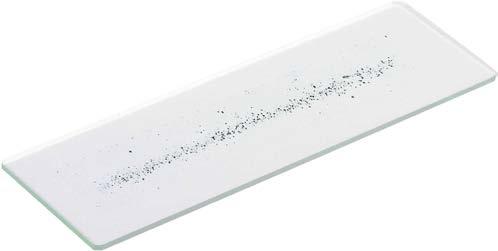


$20 per sample, includes report
Same day report turnaround & overnight shipping are standard ISO/IEC 17025:2017 Accredited through PJLA Testing