Pr ivate In vestigato rs
Fall 2026, Vol. 14
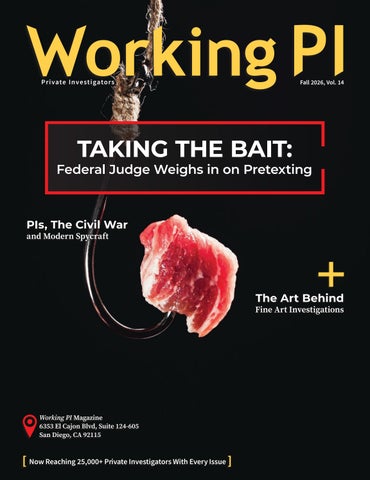
TAKING THE BAIT:
Federal Judge Weighs in on Pretexting
PIs, The Civil War and Modern Spycraft
The Art Behind
Fine Art Investigations
Working PI Magazine 6353 El Cajon Blvd, Suite 124-605 San Diego, CA 92115
[ Now Reaching 25,000+ Private Investigators With Every Issue ]
Here’s to the Entrepreneurs.
You’ve Worked Hard to Build Your Business...
We Built OREP to Protect It. Insurance for Professional Investigators
Whether you’re out in the field, or doing background research from your office, OREP’s got you covered. General Liability and E&O Coverage in a Single Policy Includes Independent Contractors at No Extra Cost Attorney-Prepared Engagement Letter and Subcontractor Agreement Coverage Includes Security Consulting and Executive Protection Blanket Additional Insured Endorsement Wanted Persons Investigations
Apply Online in 5 Minutes Visit OREP.org/PI or Call (888) 347-5273
OREP Insurance Services, LLC | Calif. Lic. #0K99465 Member Benefits are part of OREP Membership. Minimum Membership fee of $30. Membership products are available for purchase separately.
PUBLISHED BY
Serving Private Investigators
Fall 2026, Vol. 14
4 5
We Know Insurance | OREP.org
Editor’s Note
by Frank Andorka, Managing Editor
Contributors
6
PIs, The Civil War and The Birth of Modern Spycraft by Isaac Peck, Publisher
12 16 20
6
The Art Behind Fine Art Investigations by Kendra Budd, Editor
When the Allegation Is the Investigation by Charles Cohen, CFE, CIFI
COVER STORY: Taking the Bait: Federal Judge Weighs in on Pretexting by Frank Andorka, Managing Editor
20
26
26
What the Flock? Controversial Company Gets California PI License by Frank Andorka, Managing Editor
30 34 38
30
Building Rapport With Incarcerated Clients by Derrick St. Fort, MSW, CCDI
The Truth Uncovered: A Mother Falsely Accused by Social Worker Gets Vindicated by Kendra Budd, Editor
When Retirement Calls, and It’s a Job Offer by Michael LoMonaco
Mission Working PI is published to help readers build their businesses, reduce their risk of liability and stay informed on important technology and industry issues. Write Us at Working PI Comments and letters are welcome. All stories without attribution are written by the Editor.
34
Publisher Isaac Peck | isaac@orep.org
Working PI
Managing Editor Frank Andorka | frank@orep.org
San Diego, CA 92115
Marketing & Design Manager Ariane Herwig | ariane@orep.org
subscription@workingpimag.com
Editor Kendra Budd | kendra@orep.org
LinkedIn.com/company/working-pi
6353 El Cajon Blvd., Suite 124-605 (888) 347-5273 WorkingPIMag.com Facebook.com/workingpi
Working PI is published by OREP Insurance Services, LLC (Calif. Lic. #0K99465) and reaches 25,000+ private investigators nationwide. The ads and specific mention of any proprietary product contained within are a service to readers and do not imply endorsement by Working PI. No claims, representations or guarantees are made or implied by their publication. The contents of this publication may not be reproduced either in whole or in part without written consent.
2
Working PI | Fall 2026
EDITOR’S NOTE
My Life Is an Open Book Hello, everyone. I’m Frank. I’m the new Managing Editor here at Working PI. As I discovered at the Texas Association of Licensed Investigators (TALI) conference in San Antonio last month, my life is pretty much an open book to a good private investigator, so feel free to start with Google and go from there. When Isaac Peck asked me to apply for this job, I was flattered. I was looking forward to my next big adventure in trade publishing, and the opportunity to lead such a prestigious magazine to cover a new profession (to me) doesn’t come around every day. Was the prospect daunting? Sure. But Isaac seemed convinced I was the right person for the job, so when he offered me the position, it took me less than 24 hours to say yes. After spending 20 years in trade publishing writing about (deep breath) hotel management, golf course management, pest management and solar energy, I have learned one thing: What sustains me at a magazine is the people. In that regard, private investigators are outstanding. In San Antonio, I met so many amazing people who treated me like I was a long-lost friend. I couldn’t have asked for a better debut. On this, my first issue, I spoke to a couple of you for our cover story, “Taking the Bait: Federal Judge Weighs in on Pretexting,” and the impression I have is that you are remarkably smart men and women of passion and commitment. Your ability to make connections between seemingly unrelated facts is fascinating to me, and I look forward to learning more about how you do it in the coming months. I’m thrilled to be entering the industry at such an interesting time, and I look forward to hearing from you what it is that you want Working PI to cover. I can’t wait to meet more of you in person. I’ve always considered that the best way to understand an industry is face-to-face, with a firm handshake and maybe a meal or two along the way. If the reception I received at TALI is any indication, I’m going to love getting to know you and your profession, and I hope I’ll be able to help you learn and grow as businesspeople. Now, a little more about me: I’m located in Cleveland, Ohio, on the banks of Lake Erie. I live here with my wife of 31 years, Beth, a dog named CoCo and three cats that are up for sale to the highest bidder. I have two children (Ryan and Maggie, 36 and 28 respectively), and being a father has been one of the greatest jobs I’ve ever had. I’m a passionate, if misguided, Cleveland sports fan, and I love to write (in fact, I might have a novel coming out next year — stay tuned). For now, let me thank you in advance for the education you’ll undoubtedly provide for me. I’m ready and willing to learn, and I can’t wait to get to know this vibrant industry.
4
Working PI | Fall 2026
CONTRIBUTORS
Charles Cohen
Isaac Peck
Charles Cohen is the founder of SilverTree
Derrick St. Fort
Isaac Peck is the Publisher of Working PI mag-
Derrick St. Fort is a Board-Certified Crimi-
Intelligence Group, a Certified Fraud Examiner (CFE) and Certified Insurance Fraud Investigator (CIFI) with decades of experience in complex due diligence and corporate investigations. He is a member of the Board of Regents for the Association of Certified Fraud Examiners and has served as Director of Aon’s M&A and Transaction Solutions Cor-
azine and the President and Senior Broker of OREP.org, a leading provider of E&O insurance for the PI profession. Working PI is the most widely read print magazine for investigators nationwide, reaching over 25,000 PIs. PIs who become OREP Members enjoy two CE courses (15 hours) at no charge (visit
nal Defense Investigator, Mitigation Specialist, Licensed Investigator out of the state of Florida, and founder of Mitigation and Justice. He brings more than two decades of experience working at both the state and federal levels. He is the author of Mitiga-
OREP.org/PI-Members). Isaac received his
tion and Justice: Where the Truth Meets the
master’s degree in accounting at San Diego
Heart of Story, which explores the power of
and mentoring a global team of intelligence
State University. Email Isaac at isaac@orep.org
investigation, human stories, and context
analysts and cyber experts.
or call (888) 347-5273. CA License #4116465.
within the legal system.
Michael LoMonaco
Kendra Budd
Frank Andorka
Michael LoMonaco is a private investiga-
Kendra Budd is the Editor of Working PI
Frank Andorka is the Managing Editor of
tions leader who transitioned into the pro-
magazine and the Marketing Coordina-
Working PI magazine, published by OREP
tor for OREP Insurance, providing liability
Insurance, a leading provider of E&O insur-
insurance to over 14,000 professionals
ance for private investigators nationwide.
in the United States. She is also OREP’s
Andorka has more than two decades of
Education Coordinator. In her spare time, Kendra operates as an independent photo-
award-winning experience as a writer and
serves as Director of Client Services at VRC Investigations, specializing in work-
grapher. She graduated with a BA in Theatre
He earned a BA in History from The College of
ers’ compensation fraud, AOE/COE, and
and English from Western Washington Uni-
Wooster in Wooster, Ohio, and a MA in Mod-
versity, and an MFA in Creative Writing from
ern German History from Indiana University
Full Sail University.
in Bloomington, Indiana.
porate Intelligence practice, where he acted as a trusted advisor to clients while leading
fession as a “second act” after a career in contracted intelligence work and government operations management. He now
SIU investigations.
editor and is based out of Cleveland, Ohio.
Fall 2026 | Working PI
5
Pinkerton, Lincoln and McClernand, Antietam, October 1862 | Library of Congress, Prints & Photographs Division, LC-DIG-cwpb-04326
PIs, The Civil War and The Birth of Modern Spycraft by Isaac Peck, Publisher
For PIs and intelligence professionals today, the Civil War offers more than historical intrigue — it offers a blueprint.
In his book The Causes of War, when
Geoffrey Blainey wrote, “War marks the choice of a new set of weights and measures,” he was talking about how we measure the power of nations. But he could just as easily have been referring to the role of war in developing technology, methods and practices of intelligence, surveillance, and sometimes deception. The American Civil War (1861–1865) was not only a violent concentration of desperate military strategies and massive political upheaval. It would also become the proving ground for modern espionage from technology to human practices. We think of the Civil War as loud and chaotic, full of cannon fire, shouts of charging soldiers and cries of the wounded. But beneath all that, there was a quieter war going on, one that sought information, enabled predictions, arranged the theft of documents and even
6
Working PI | Fall 2026
plotted the apprehension and/or assassination of opposing sides’ leaders. Both the Union and the Confederacy scrambled to develop spy networks, encryption methods, and reconnaissance tools that could tip the balance of power. In this battle, the Union overwhelmingly emerged victorious and, in doing so, also laid the groundwork for the intelligence infrastructure that would shape future conflicts and professionalize private investigative work. The irony is that those early private investigators helped shape the very methods and techniques that the war would scale up, and which would in turn scale down, influencing the growing private investigation and intelligence industries over the next two centuries. For PIs and intelligence professionals today, the Civil War offers more than
historical intrigue — it offers a blueprint. From the emergence of private detective agencies as federal assets to the use of aerial surveillance and wiretapping, the war marked a transition from informal spying to organized intelligence operations. It was a time when civilians became operatives, when women and formerly enslaved individuals became super-agents, and when technology reshaped the very nature of secrecy and transparency. Together, the stories that follow reveal how the Civil War was a war of information as well as cannonballs, and that it was won with both. The Union’s Edge on Military Intelligence While both the Union and Confederacy deployed spies and intelligence tactics page 8
Interested in Global Rewards? Whistleblower Reward Programs by the South Korea Tax Authority (National Tax Service)
v
Tax Evasion Information Reward Program
(1) Key Information: Specific and credible evidence of violation of the South Korea tax laws. (2) Rewards: 5%-20% of the recovered taxes, up to 4 billion KRW (USD 2.8M), based on your contribution. v
Foreign Financial Account Information Reward Program (1) Key Information: All available documents, including account holder names, account numbers, and account balances. (2) Rewards: 5%-15% of the recovered penalties, up to 2 billion KRW (USD 1.4M)
For more details, contact: taxkorea@protonmail.com
page 6 during the Civil War, the Union held a decisive edge in spytech infrastructure, industrial capacity and organizational innovation. This advantage wasn’t just about having more resources but in how those resources were deployed. The North’s telegraph network was far more extensive, allowing for encrypted, long-distance communication between military and intelligence units. Union cryptographers like Anson Stager developed telegraphic cipher books that disguised messages with layered codes and rearranged syntax, making interception nearly useless without the key. Meanwhile, the Confederates struggled. Their messages often relied on reused keywords in their outdated cipher system. The Confederates used and reused phrases they were fond of as passwords, like “Manchester Bluff ” and “Come Retribution.” Union intelligence operatives and Pinkerton detectives exploited this weakness, successfully breaking Confederate codes and intercepting strategic communications. The Union also pioneered aerial reconnaissance through the U.S. Army Balloon Corps, led by Thaddeus Lowe. These hydrogen balloons gave Union observers a bird’s-eye view of enemy troop movements, which were then translated into tactical maps by intelligence analysts like John C. Babcock. The Confederacy did make brief attempts at aerial reconnaissance, notably with hot air and coal gas balloons tethered to trains or boats for battlefield observation. One Confederate balloonist made daily ascents during some battles, but never with any mobility or consistency. Eventually the Union captured the tugboat that had been carrying a Southern recon balloon called the Gazelle, and by 1862 the Confederate Army no longer had a balloon recon corps. Perhaps most importantly, the Union began to centralize intelligence operations. The creation of the Bureau of Mil-
8
Working PI | Fall 2026
itary Information (BMI) under Colonel George H. Sharpe marked the first formal intelligence agency in U.S. military history. This allowed for systematic collection, analysis, and dissemination of battlefield intelligence — something the Confederacy never fully achieved. These differences, reflections of the difference in level of industrial development in the North vs. the South, contributed to the picture we have today of the South’s tactical deficits in the war. Whether it’s General Lee not knowing how deeply entrenched and well-prepared Union forces were at Gettysburg, Lee’s lack of reliable intelligence when invading Maryland or failed attempts by Confederate covert operations in New York and Baltimore, the difference in the two sides’ intelligence capacity could not have been more pronounced. In short, the Union’s edge came from industrial strength, technological foresight and organizational maturity. For modern investigators, it’s a reminder that intelligence isn’t just about gathering secrets. Rather, it’s about building the systems that make those secrets actionable. The Pinkertons: How the Union Outsourced Its Secret Service Before the federal government had its own intelligence infrastructure, it turned to the private sector. Enter Allan Pinkerton, founder of the Pinkerton National Detective Agency, whose motto was “We Never Sleep.” In 1861, General George McClellan hired Pinkerton to organize intelligence operations for the Army of the Potomac. Pinkerton adopted an alias, calling himself Major E.J. Allen, and proceeded to create the first Secret Service. “Major Allen” and his agents then went on to conduct countless undercover missions. They intercepted Confederate communications and infiltrated Southern territory. Pinkerton hired the first recorded female detective, Kate Warne, of whom we’ll learn more very soon. The sophistication of such sur-
veillance, interrogation and coded correspondence was revolutionary for the time. Contemporary techniques used by today’s PIs really aren’t that different. Despite these accomplishments, Allan Pinkerton’s legacy in Civil War intelligence is somewhat complicated. Although he pioneered organized espionage for the Union, Pinkerton made a lot of mistakes. His troop estimates (guessing how many Confederate troops were deployed) were frequently much higher than reality, and that was a problem, since General McClellan relied on those estimates to make deployment decisions. McClellan delayed key offensives due to those exaggerated numbers, arguably extending the war’s duration and massively increasing its death toll. Nevertheless, the Pinkerton National Detective Agency’s structure (centralized, hierarchical and staffed by civilian operatives) introduced a novel and effective intelligence framework. The emphasis on surveillance, coded communication and information networks laid the groundwork for the Secret Service and FBI. Not only was Pinkerton responsible for the militarization of private detective work, but he also influenced the privatization of intelligence services. He would blur those lines even more after the war, developing techniques to spy on and intimidate the labor movement and developing the field of corporate security. For today’s investigators, Pinkerton’s Civil War tenure is a case study in both innovation and caution. It shows how private agencies can fill critical gaps in national security — and how the accuracy of intelligence can make or break a campaign. Harriet Tubman: The James Bond of Abolition While history emphasizes her role in the pre-Civil War Underground Railroad, Harriet Tubman was arguably the best intelligence operative of her time. Her
wartime espionage work eclipsed many of her contemporaries, blending tactical prowess with moral clarity. After years of clandestine rescues through the Underground Railroad, Tubman did a mid-life pivot when she provided her expertise during the Civil War by joining the Union Army as a nurse, scout and spy. Nobody knew Southern landscapes and slaveholding networks better than Tubman, and that knowledge became a crucial intelligence asset. In 1863, she orchestrated a covert raid on the Combahee River in South Carolina, mapping out and guiding Union soldiers through hostile terrain. The raid ended up freeing more than 700 enslaved people. Tubman’s intelligence work was not just daring — it was strategic and transformative, and worth studying if your PI work relies on information gathering and networking. She recruited informants, built covert networks and mapped out troop positions. Her intelligence work substantially weakened Confederate infrastructure and morale. Beyond the laudable rescue of human beings and the evasion from capture she achieved for herself, Tubman rewrote the battlefield playbook for what espionage could achieve. She remains one of the most effective and least celebrated intelligence operatives in American military history and would be an asset in contemporary intelligence, whether private or military. Kate Warne Saves President-Elect Lincoln In early 1861, Abraham Lincoln was preparing to travel from Springfield, Illinois, to Washington D.C., for his inauguration. A rumor emerged of a plot to assassinate the President-elect in Baltimore, a city with a great deal of secessionist sentiment. That’s when Kate Warne, the first recorded female detective in U.S. history, got to work. Allan Pinkerton had hired Warne five years earlier. Warne knew
that men didn’t pay as much attention to women, and that it was easy to slip unnoticed into various networks of women. So she went to Baltimore, assuming the identity of a Southern socialite, attending parties and mingling with the city’s elites. She was charismatic and charming, with superior listening skills. Before long she had infiltrated secessionist circles and learned the details of a planned attack during Lincoln’s train transfer between stations. She learned that conspirators were planning to stage a phony riot, then isolate and assassinate Lincoln during the chaos. Warne then switched identities. She became Abe Lincoln’s sister and caregiver, and a private sleeper car was booked for her. The conductor was advised of the operation, and Lincoln himself was instructed to disguise himself with a shawl and soft hat, stooping to appear frail. Warne guarded him throughout the night and the transfer in Baltimore occurred without incident. For private investigators today, Warne’s story is a masterclass in undercover work, social engineering and operational planning. She didn’t just gather intelligence — she executed a high-stakes protection mission with precision and poise. Her legacy lives on as a pioneer who proved that investigative brilliance knows no gender and that the best investigator is the one nobody sees coming. John C. Babcock: Architect & Private Eye Turned Superspy When the Civil War began, John Babcock was a Chicago-based architect. By the end of the war, he was one of the Union’s most celebrated intelligence analysts. Pinkerton recruited Babcock as a scout and mapmaker, but he also showed promise in interrogation and even battlefield sketching. Babcock’s genius lay in synthesis. He had a mind that could make coherent connections between widely diverse sets of data, knowledge and geography. He would turn interviews with Confederate
deserters or prisoners into detailed maps and order-of-battle estimates. His peers called him “Captain” and “Colonel” even though he never enlisted. Babcock was an analyst, mapmaker, aerial reconnaissance specialist and a pioneer of geospatial intelligence, pioneering the use of photographic reproduction of intelligence maps to distribute them to troop commanders. And unlike Pinkerton, his boss, Babcock’s work was so precise that in one instance he issued a troop estimate that was accurate to within one percent of actual Confederate numbers. So, it’s no surprise that when Pinkerton resigned in 1862, Babcock was retained as a civilian contractor. He would later help create the Bureau of Military Information (BMI), a precursor to the United States Army Intelligence and Security Command, and in a larger sense, the Military Intelligence Corps. For private investigators, Babcock exemplifies the power of interdisciplinary skill — a good PI is a “renaissance” practitioner, able to incorporate solutions from many different fields. The common elements of observation and precision are the bedrock of that intelligence, whether on the battlefield or undercover, but a good PI will draw from many different areas of expertise. The Legendary and Indispensable Mary Richards Bowser Mary Richards Bowser’s story reads like a spy thriller. Born into slavery in Richmond, Virginia, she was freed by abolitionist Elizabeth Van Lew and educated in the North. As an intelligence agent for the Union, Bowser worked as a servant in the Confederate White House. This mind-blowingly dangerous assignment must have taken nerves of absolute steel. The intelligence work involved in this infiltration was nothing short of expage 10
Fall 2026 | Working PI
9
page 9 traordinary. Bowser pretended to be illiterate, using her photographic memory to read and later recall entire documents verbatim. She overheard military discussions that revealed troop movements, battle plans and logistical weaknesses. Her reports enabled Union generals to anticipate Confederate offensives and reposition their forces. In addition, Bowser exposed severe supply shortages and internal cabinet divisions, which helped shape Union strategies like the tightening of blockades and other actions to wear down Confederate morale. Bowser’s race, gender and social status made her invisible to Confederate officials. Their biases became a tactical advantage for the Union. Risking almost certain execution if she were ever caught, she continued the infiltration until the end of the war. If this is the first time you’ve ever heard of Mary Bowser, that’s understandable. She lectured and wrote under pseudonyms after the war and became an early civil rights advocate, but the exact nature of her work wasn’t revealed until many years after the war’s end, and the United States hasn’t always been diligent about sharing Black contributions to the history of military intelligence. But for investigators, Bowser’s story is a masterclass in infiltration, disguise and unbelievable courage. She reminds us
that intelligence work is about conviction, adaptability and the ability to see what others overlook. The War That Launched the Spy Tech Revolution While both sides relied heavily on human intelligence, they also pioneered tools and techniques that would become staples of modern spycraft. Telegraph encryption was one of the earliest innovations. The Union used cipher books and code systems to disguise messages sent over telegraph lines. Confederate forces attempted wiretapping and interception, leading to a cat-andmouse game of signal security. These early experiments laid the groundwork for signals intelligence (SIGINT). Cipher disks and reels were used to manually encode messages. The Confederacy’s brass cipher disk, (based on a polyalphabetic cipher created by French cryptographer and alchemist Blaise de Vigenère in the late 16th Century), allowed for polyalphabetic substitution — a method considered unbreakable until it was broken. Union forces developed their own cipher systems, often integrating them with wig-wag, or flagbased signaling. Aerial reconnaissance emerged through the U.S. Army Balloon Corps. Hydrogen
balloons were deployed to observe enemy positions from above. John Babcock and other observers translated these views into tactical maps, giving Union commanders a bird’s-eye advantage. Thus, airborne surveillance was born. Invisible ink and chemical passes were used by scouts and spies to smuggle information. Some passes were written with chemicals that only became visible under sunlight or heat — early forms of steganography. Scouts posing as foragers or deserters carried these messages across enemy lines. Photographic reproduction allowed for the mass distribution of intelligence maps. Babcock’s use of photography to replicate battlefield sketches was a precursor to modern document imaging and geospatial analysis. The actions, strategies, and intellectual work of people like Tubman, Pinkerton, Bowser, Babcock and Warne, along with innovative leaps in the technology of intelligence, transformed espionage from improvisation to infrastructure. The agents and tech demonstrated that intelligence could be systematized, encrypted and scaled. For private investigators today, these innovations are more than historical curiosities — they’re the precursors and prototypes of the tools we now take for granted.
Insurance for Security Professionals Coverage designed specifically for security guards and security contractors—nationwide.
All-inclusive insurance for your needs: General Liability
Business Auto
Workers’ Comp
Excess Liability
Call (888) 347-5273 Calif. Lic. #0K99465
10 Working PI | Fall 2026
And More!
Apply Online: OREP.org/Security
The Art Behind Fine Art Investigations by Kendra Budd, Editor
Curtis Novy didn’t start out looking to verify and recover expensive art pieces — but now he can’t imagine doing anything else.
Fine art theft is one of those crimes
that seemingly only graces the silver screen — a work of fiction rather than of reality. Then, in October 2025, after eight pieces of jewelry from the Galerie d’Apollon were stolen from the Louvre Museum in Paris, France, many of us learned that art theft is very much real — it’s just kept quiet. With the skill required for its creation, the rarity of original copies and high demand from wealthy investors, fine art is not only expensive but a frequent target for thieves and illegal dealers. Reputation is everything in the fine arts world, so many collectors and gallery
12 Working PI | Fall 2026
owners choose to hire private investigators to authenticate, recover or research the background of their collection. Curtis L. Novy, chief investigator of Financial Investigative Services (FIS), is one of these investigators. Novy spoke with Working PI to tell us how his experience as a certified fraud investigator and art connoisseur led him to form a unit dedicated to Fine Art Investigations — and what makes the practice lucrative and rewarding. Stepping Into Something New Like many PIs, Novy stepped into private investigation by accident.
“I worked in banking for well over 30 years,” Novy says. “I worked in compliance risk management and financial investigations. That gave me [my] foundation.” Shortly thereafter, Novy became an independent private investigator and easily transferred his skills from banking into investigating white-collar crimes. Then, the 2020 COVID-19 pandemic hit, and Novy, like most people, suddenly had a lot of free time. During lockdown he came across an unsolved museum heist case from the 1990s, where $500 million worth of artwork was stolen from the Isabella Stewart Gardner Museum in Boston. From there Novy was hooked.
Novy’s fixation transformed from mere curiosity to a full-blown passion. He purchased several books on fine art because he had no formal knowledge of the subject, but he immediately connected with it. With Novy’s experience as a financial investigator, he saw an opportunity to incorporate fine art investigation into FIS. Soon after he began taking on clients who needed art investigated and has been working in the field ever since. Of Provenance and Profitability Novy is often tasked with verifying provenance and historical records of a piece. Provenance, or pedigree, refers to the chronology of ownership, custody or location of artwork from its creation to the present. Provenance is essential in collecting fine art because when art is sold by auction or private sales, the buyer wants to know first that it’s real. According to Novy, individuals will hire fine art investigators for provenance and
signature verification because they lack the resources and training needed to do it themselves. “There’s not a lot of information out there,” Novy says. “Clients contact me and say, ‘Curt, we want you to use your skills as an investigator to help us understand what this art is and where it fits in historically.’ They’ll need to find out how old the piece is, where it’s been and if it’s ever been reported missing.” Many would correctly assume that most of Novy’s clients looking for provenance are owners of private museums or galleries. However, he also finds himself assisting those who purchase abandoned storage units. “Many of my clients will say something along the lines of ‘Oh, I got this art! I found it in the storage unit. It’s been there for years. I found out it’s a Monet!’,”
Novy says. “Then I’m tasked with verifying the art’s provenance before advising a client to resell. More times than not, it’s not actually a Monet.” Verifying provenance for art found in storage is especially important because there have been times when the unit’s owner could have been previously convicted of theft or of an art crime, Novy says. In those instances, the owner was probably forging or stealing the art later found in the unit. If art has been forged or stolen, then it is illegal to resell it and can damage the seller’s reputation. Authenticating an art’s provenance or signature isn’t as simple as just looking at a piece. Novy is able to authenticate art through his use of investigative skills and connection to various databases. page 14
Fall 2026 | Working PI 13
page 13 “I have access to INTERPOL (the International Criminal Police Organization), which provides me specific information on lost and stolen art and antiquities,” Novy says. “In fact, I work with other experts, such as fine art appraisers, to verify the signatures.” For example, Novy was tasked with verifying a signature on a painting that was identical to Willem de Kooning’s (19041997) signature. de Kooning was a Dutch American abstract artist and sculptor best known for his work in the 1940s. In fact, most of his artwork sells for upwards of $200 million, Novy says. Since this was potentially one of the most expensive pieces Novy had worked with, he couldn’t simply have it delivered by mail without risking it getting damaged or lost, so he drove to the client’s home to pick it up. “Here I am, driving my car with a potentially $200 to $250 million painting in the backseat,” Novy says. “Then I use my expert opinion and skillset to verify the signature as de Kooning’s, much to the delight of my client.” Novy is not only able to employ his skillset to verify artwork, its provenance and value, but he’s also been able to recover missing and stolen artwork as well. Recovering Stolen Art Despite the national attention the 2025 Louvre heist garnered from the media, Novy says that kind of spectacle is an outlier in the art world. “If the artwork has been stolen, most of the time it’s not reported,” Novy says. “When a piece of fine art goes missing, I have found most of my clients want to keep that information confidential to preserve their professional reputations.” The first step in recovering stolen artwork is identifying the time window of when said artwork went missing. Novy will ask his client to retrace their steps, recall the last time they saw the piece, and when they noticed it went missing, to establish a potential timeline for the heist. Once Novy can determine the
14 Working PI | Fall 2026
hours during which it was most likely taken he will then try to determine who was around or could have been involved. Luckily, many of Novy’s clients are wealthier, so most of them have some kind of security system — including cameras. After reviewing footage and keycard access, Novy can determine who has been coming and going onto the property during the set time. Most of the time, it will be employees or professional colleagues found in the footage. “If the footage reflects that certain employees and colleagues are in and out of my client’s home during the timeline, it’ll lead to background investigations on [them],” Novy says. “From there, I usually suss out who the culprit is just through a process of elimination, especially if the person has been previously convicted of theft before.” Then there are the recovery stories that Novy finds himself in as a collector rather than a PI. In 2020, while Novy was perusing a soon-to-be retired man’s gallery collection, he stumbled upon something rather interesting: a painting seemingly by either Gerard ter Borch the Younger (1617-1681) or Johannes Vermeer (1632-1675). “It was placed on a wall in a dimly lit hallway next to a bathroom door,” Novy says. “It had hung [there] for years without anyone seeing it.” ter Borch and Vermeer were both Dutch golden-age painters. ter Borch was known for creating intimate and domestic genre scenes and refined portraits. However, his real claim to fame was his technique for replicating satin and silk fabrics on canvas. Vermeer was famous for specializing in intimate interior scenes that captured women engaged in quiet and private moments. He is most known for his painting Girl with a Pearl Earring. Novy was immediately able to make out that the oil painting before him used painting techniques similar to Vermeer’s, an artist he had been studying quite
closely over the months. As it turns out, Vermeer’s The Concert was one of the paintings stolen from the Isabella Stewart Gardner Museum — the same heist that led to Novy’s newfound obsession. Vermeer had been greatly inspired by ter Borch, and used many of his painting techniques in his own work — making it hard to distinguish this painting between the two artists. Either way, Novy struck gold. “The listing price was $2,000, and [I] knew I was not leaving the gallery without purchasing it,” Novy says. After some haggling, Novy was able to get the price of the painting reduced by half. Once home, Novy removed the frame and used a microscope to further examine its details. Not only was Novy able to see that someone altered the piece to fit inside the picture frame, but they had also cut off a partial signature, making it impossible for Novy to verify if the artwork was by ter Borch or Vermeer alone. Luckily, Novy was able to use his PI connections to dig further. Since the artwork was distinctly Dutch, Novy contacted the Rijksmuseum, which exhibits both Vermeer and ter Borch paintings. After the museum looked at the painting, they recommended he take the artwork to The Hague for formal analysis to authenticate the work and estimate its value at present. Once The Hague examined the art, they were able to determine the painting was done by ter Borch and estimated its value at $1 million. Novy still has the painting in his collection. So not only has recovering artwork for Novy been lucrative as a PI but also as a fulfilling hobby. Final Thoughts The theft of fine art happens more than the general public realizes, but its potential for private investigators is immense. “Just one fake art piece can destroy [a] reputation and business overnight,” Novy says. “There are many collectors and gallery owners that will go to great lengths and pay private investigators handsomely to make sure that such a scenario doesn’t happen to them.”
When the Allegation Is the Investigation by Charles Cohen, CFE, CIFI
The Cook-Pulte mortgage fraud dispute offers a case study in what happens when allegations go public before the investigative process has run its course — and what working investigators should do when they find themselves in exactly that situation.
Investigators are trained to follow evi-
dence. We build timelines, chase documents, corroborate sources and resist the pull of a compelling narrative until the facts support it. What we are not trained to do — and what the system rarely prepares us for — is what happens when the allegation itself becomes the story before any of that work gets done. The 2025 dispute involving the Federal Housing Finance Agency’s (FHFA) Director William Pulte and Federal Reserve Governor Lisa Cook is a case study in exactly that problem. In August 2025, Pulte sent a criminal referral letter to Attorney General Pam Bondi alleging that Cook had falsified mortgage documents and improperly claimed multiple properties as her primary residence. He did not limit himself to that formal
16 Working PI | Fall 2026
channel. In the 24 hours that followed, he posted about the allegations more than 30 times on social media, called for Cook’s resignation and appeared on cable television twice. Ten days later, President Donald J. Trump moved to fire Cook, citing the Pulte referral as the basis for cause. Cook denied the allegations entirely. A federal judge temporarily blocked the firing, the Department of Justice (DOJ) opened an investigation and the Supreme Court was set to hear arguments. For the politically inclined, this is a story about the weaponization of regulatory authority. For working investigators, it is something more instructive: a high-profile example of consequential
action taken on unverified allegations in the absence of any completed investigative process. Separate the Source From the Evidence The first thing any investigator should ask when evaluating a new allegation is not, “Is this true?” It is: “Who is saying this, and why?” Source credibility is foundational, and in the Cook matter, it raises significant questions. When CNBC pressed Pulte directly on where the tip about Cook originated, he declined to say, citing sources and methods protections. That is a legitimate consideration in some contexts. But when the accuser publicly broadpage 18
$100,000 CYBER COVERAGE For Only $125
Why Private Investigators Need Cyber Coverage: Example Scenarios
1. Hacked Emails ($100K) - Scenario: Your email account is compromised and then sends malware to your contacts. Up to $100K Third-Party Liability coverage applies. 2. Payment Data Breach ($100K) - Scenario: If you require a retainer fee for an upfront payment from clients, this protects from payment data breaches. Get coverage for investigation, notification, and damages. 3. Lost/Stolen Device ($100K) - Scenario: Did you know that if your laptop/phone with client data is stolen, you could be required by law to notify clients, provide credit monitoring, and you could face fines ($500-$5,000 per record)? This coverage pays for notification and legal costs. Coverage Highlights • $100,000 Cyber / Technology Security Coverage • $100,000 Aggregate Privacy Fines / Penalties • $25,000 for Cyber Breach Forensic Expenses
Shop OREP PI Insurance + $125 Cyber (Get a Quote for PI Insurance + $100K in Cyber Coverage at OREP.org/PI) OR Shop Stand-alone Cyber - $500K-$1M limits (Minimum premiums start at $600-$700 - Bit.ly/cyber-application)
Calif. Lic. #0K99465
page 16 casts allegations on social media, the investigative privilege argument becomes harder to sustain. If an allegation is serious enough to announce to the world, it should be serious enough to withstand scrutiny about how it was obtained. Congressional Democrats later raised the same question formally, asking the FHFA inspector general whether Cook’s mortgage records were pulled as part of a standard, planned audit or whether a search was “specifically initiated” to find them. Reuters subsequently repor ted that Pulte’s own father and stepmother had declared homestead exemptions on properties in two different states — the same conduct forming the basis of the Cook referral. Pulte was not asked about this publicly. He declined to say whether he would apply the same standard to members of his own family. Nothing here resolves whether Cook committed fraud, but it illustrates why the source question goes directly to the integrity of the allegation. Recognize the Procedural Gaps Standard FHFA procedure for fraud referrals is for the agency’s inspector general to transmit allegations confidentially to the DOJ. In the Cook matter, Pulte personally made the referral and aggressively publicized it. That deviation from procedure is itself a data point. In any competent investigation, the subject of an allegation is identified, interviewed and given the opportunity to respond before findings are disclosed to third parties, let alone the public. Cook stated that she first learned of the referral from media reports. She was not interviewed. She was not provided with the documents. She was not given an opportunity to respond before the allegations became national news and the basis for her termination. For working investigators, these gaps matter. An allegation built solely on document review, without a subject inter-
18 Working PI | Fall 2026
“One of the most reliable indicators of whether an investigation is genuine or instrumentalized is the urgency of its timeline. Legitimate investigations take time. They build methodically. They do not move from a tip to a criminal referral to a presidential dismissal in 10 days.”
view, without a documented response and without adversarial testing of the underlying evidence is not a finding. It is a starting point. When consequential action is taken on that starting point — as it was here, with a presidential termination — the process has been inverted. Notably, similar allegations were publicly reported against three of Trump’s own cabinet members, including Treasury Secretary Scott Bessent. Pulte declined to comment on those cases. ProPublica reported on the discrepancy in September 2025. The selective application of investigative attention is, itself, an investigative finding. Ask What’s Driving the Timeline One of the most reliable indicators of whether an investigation is genuine or instrumentalized is the urgency of its timeline. Legitimate investigations take time. They build methodically. They do not move from a tip to a criminal referral to a presidential dismissal in 10 days. Context matters here. The Pulte referral against Cook came after months of public pressure by Trump on the Federal Reserve to lower interest rates — pressure that Cook, as a sitting governor, had not complied with. The New York Times reported in July 2025 that the White House had drafted a letter to fire Federal Reserve Chair Jerome Powell. Cook’s removal, if it succeeded, would have moved Trump closer to a majority on the Fed’s board of governors. The investigator’s question is not whether this proves bad intent. The question is whether the external timeline, the institutional pressure, the political objective and the desired outcome
appear to be driving the investigative timeline, rather than the evidence. When an investigation accelerates to match a political calendar, that compression is worth documenting. Map Who Benefits — and When In fraud investigations, we routinely ask: Who benefits from this transaction? In allegation analysis, the question is the same: Who benefits from this allegation becoming public at this moment? The Cook matter is not unique in this respect. Pulte made structurally similar referrals against California Senator Adam Schiff, New York Attorney General Letitia James and later Congressman Eric Swalwell — each a prominent Democratic official, each a figure Trump had publicly targeted. The pattern of who was referred, and who was not, is the kind of asymmetry that due diligence practitioners are trained to notice. This is not an analysis. It is an observation. Mapping the beneficiaries of a disclosure, its timing and its selectivity does not tell you whether the underlying allegation is true. It tells you what other questions to ask. In highstakes, politically charged environments, the fact that mapping is not optional is essential groundwork. A Framework for Evaluating Politicized Allegations Working private investigators increasingly find themselves engaged in environments where allegations move faster than investigations. Whether you are conducting background research for a litigation team, performing pre-transaction due diligence on an executive or supporting an inter-
nal corporate inquiry, the same structural discipline applies:
the pattern of who is targeted and who is not reveal asymmetry?
1. Separate the allegation from the evidence. Document what is claimed, what documents support the claim and what has not been produced or tested. 2. Identify procedural gaps. Was the subject interviewed? Was there an opportunity to respond? Were findings documented before disclosure? Each gap narrows the reliability of what you are being handed. 3. Examine the timeline. Does the pace of disclosure match the pace of the evidence? Compression from allegation to action, without the usual investigative steps in between, is a flag. 4. Map the beneficiaries. Who gains from this allegation becoming public at this moment? Who loses? Does
5. Document what you observe, not what you conclude. The investigator’s job is to present the facts and the breadcrumbs — not to render a verdict. Record what the record shows. Let the decision-makers draw legal and institutional conclusions. The Investigator’s Role When the Story Runs Ahead of the Facts The Cook-Pulte dispute has not been resolved. Courts are still weighing the legality of the termination and the DOJ investigation is ongoing. Cook has denied the allegations and continues to fight her removal, while the factual record remains incomplete. That incompleteness is the point. In the normal order of things, consequential
action follows a completed investigative process. What this case illustrates is the growing frequency with which that order is reversed — in corporate, regulatory and political environments. Allegations go public. Decisions follow. The investigation, if it happens at all, comes later. The experienced investigator’s job in that environment is not to adjudicate the underlying dispute. It is to map what is known, flag what is missing, document the procedural irregularities and lay out the facts cleanly so that attorneys, executives or boards can make informed decisions. The breadcrumbs are deliverable. The analysis belongs to someone else. In a media environment where narrative often moves faster than evidence, that discipline is harder to maintain — and more valuable than ever.
Fall 2026 | Working PI 19
COVER STORY
TAKING THE BAIT:
Federal Judge Weighs in on Pretexting
by Frank Andorka, Managing Editor
Private investigators created an entirely fictitious LLC to get a competitor’s product. Did it cross the line? Federal judge says in this case, it did not.
Pretexting, cemented in the popular
imagination by TV shows like The Rockford Files and Magnum, P.I., has long been considered a central piece of a private investigator’s tradecraft. Today, the legality and permissibility of it is more nuanced. With the exception of a couple of specific federal carveouts for medical, phone or bank records, states are left on their own to decide what is allowable. About 15 states, including Ohio, California and Connecticut, explicitly ban “pretext interviews” by statute, but only for insurance claims. In the rest, there’s no law specifically against it. Even in the federal courts, there’s no bright line: Sometimes pretexting is allowed, and sometimes it’s not, depending on the circumstances. The result is that the issue continues to be litigated extensively. Impossible Foods v. Motif
20 Working PI | Fall 2026
FoodWorks is one such case where private investigators deployed an elaborate web of pretexts, all to get a plant-based burger — really — from their competitor. The case had everything: three private investigation firms, an elaborate pretext that lasted 16 months and targeted trade shows across the country, and a blown cover because a private investigator forgot to change her name to her “alias” before hopping on a Zoom call with the target. The details are as juicy as a real hamburger. Let’s get into it. Background It all started with plant-based burgers. Impossible Foods (Impossible) believed Motif FoodWorks (Motif) had stolen their patented idea to use heme proteins to simulate beef taste and texture, so they
sued them in 2022. The problem was they couldn’t be absolutely sure of the theft without a sample of Motif’s burger. As they prepared to sue Motif, Impossible simultaneously hired private investigators starting in December 2021 to catch Motif red-handed and get actual samples. Unlike Impossible burgers, which anyone can get at Kroger or Walmart, Motif only sold its products to commercial clients. Over the next 16 months, three private investigative firms dogged Motif at trade shows across the United States. Impossible’s law firm, Wilson Sonsini Goodrich & Rosati PC (WSGR), started by hiring T&M USA, a New York-based investigation company, to help by sending an investigator to Plant Based World Expo to get a sample. The first deception occurred there: Bill Weller, a T&M employee, represented himself as affi-
liated with the Centerport Yacht Club and later emailed Motif that a friend of his represented a Manhattan restaurant group that was interested in its product. Motif told him its patties wouldn’t be in production until October 2022. He did not get the sample Impossible wanted. Three months later, in March 2022, Impossible tried again. An employee from Paramount Investigative Services in Los Angeles visited Motif’s booth at Future Food-Tech in San Francisco. This time the investigator succeeded where the previous one had failed. Impossible sued Motif that same month. Enter Food4Thought Not satisfied with the samples Paramount obtained in March, T&M doubled down on pretexting Motif. T&M went on to create an entirely fictitious meal kit company called Food4Thought so they could engage with Motif as a potential commercial customer. As part of those efforts, T&M hired a subcontracting firm called Integrity One Solutions, another investigative firm out of New York, to supply investigators to attend two more trade shows. At the second show, investigators approached the Motif booth, where both cooked and raw samples of Motif’s burgers were available. They identified themselves as “Ed Barry” and “Sarah Jamil” of Food4Thought, and asked for samples. Barry and Jamil represented to the Motif booth managers that they were considering a partnership with the company. The Motif employees passed the lead to their director of business development, who set up a Zoom call with the fake company to discuss the plan. The pretexting investigators joined the Zoom audio-only, just names, no faces. Here’s where a simple mistake blew the entire investigation. “Sarah Jamil” forgot to change her Zoom identifier from her real name, Sarah Nasir, to “Sarah Jamil.” During the call, Nasir realized her error and changed the screen name to her alias, but the sharp-eyed Motif director
“Courts have not set forth a bright-line rule indicating precisely when such pretextual investigations are permissible and when they are not.” noticed the change and wondered what the heck was going on. Further investigation revealed Food4Thought’s website was, in the court’s words, “very rudimentary.” There was also no mention of Weller or Nasir on it (oops). Based on getting that small but crucial detail wrong, Motif traced Sarah Nasir back to Integrity One Solutions. The covers were blown. Even so, Nasir and Weller kept after the case. They emailed the director multiple times trying to get samples under a new “direct-to-consumer sampling program.” Motif was angry. Already in litigation with Impossible, they cried foul and sent a “cease and desist” letter to Impossible, demanding the company stop its investigation. Impossible’s stance was that it had concluded its investigation, but Motif wasn’t satisfied. They complained to the court that Impossible must pay a higher price. Motif then sought a protective order to bar Impossible from further pre-texted investigations. It also demanded sanctions against Impossible and its law firm, WSGR, for running the sting operation in the first place. The Judge’s Decision Motif argued that WSGR violated four American Bar Association (ABA) rules through its use of private investigators to deceive employees of a party known to be represented by counsel in pending litigation (the patent case that started all of this): Rule 4.1, Rule 4.2, Rule 5.3 and Rule 8.4. ABA Rule 4.1 requires attorneys to not knowingly make false statements to others, and ABA Rule 4.2 is the “no contact” rule and is one of the most basic rules in litigation: once a party has a lawyer,
the attorney on the other side has to go through that lawyer. While these are rules that attorneys are held to, private investigators working for attorneys are seen as their “agents,” and the attorneys often must answer for the behavior of the investigators they hire. So as a general matter, if you’re working for the law firm on one side of an active lawsuit and you’re contacting people at the company on the other side about the dispute, you’re doing exactly what the attorney who retained you is barred from doing. That’s what made Motif’s argument look strong on paper. In response to Motif’s arguments, United States Circuit Judge William C. Bryson, a judge on the Federal Circuit (the specialized appeals court for patent cases), considered both sides of the argument and delivered his decision on May 31, 2023. In his decision, Bryson acknowledged the lack of precedent in pretexting involving “employees” of represented organizations, drawing a distinction between “represented individuals” and organizations. Bryson went on to explain that federal court position on pretexting varies widely, is “heavily fact-dependent” and that “courts have not set forth a brightline rule indicating precisely when such pretextual investigations are permissible and when they are not.” In other words, there is no clear federal standard. After reviewing the facts of this case, Bryson found Impossible and its lawyers had not violated any governing ethical rules because they had not tricked or coerced any Motif employees to talk page 22
Fall 2026 | Working PI 21
page 21 to them, and the samples were available to all trade show attendees. He gave three reasons this case was different from the ones where investigators got sanctioned: the investigators dealt with booth staff, not executives; they were after samples, not admissions; and nobody recorded anything. From a practical perspective, Motif didn’t treat its products as proprietary (and those they did, the ingredient list and preparation methods, were rightly denied by Motif at the booths). As a result, he found no harm had been done by the pretexting the investigators used. He found Motif had neither proved harm enough to warrant a protective order, nor did it prove WSGR had violated the ABA’s ethical standards. The Industry Reacts The question of pretexting continues to be a sensitive topic in the profession. Of course, when and if to use it as a tool in your investigative toolbox can vary depending on what state you live in as well as the details of the case you’re working on. Mike Thompson, a Texas Board Certified Investigator (TBCI), owner of Dallasbased firm Ideal Intel and president of the Texas Association of Licensed Investigators (TALI), says pretexting, despite what many investigators think, isn’t always the best way to elicit critical information in a case. “When you’re deciding to pretext, you need to ask yourself whether it’s worth it,” Thompson says. “You can of ten get t he same information by being straightforward because people just like to talk.” John Morris, owner and chief investigator at EVCO Investigations in Greeley, Colorado, who reviewed the Impossible Foods case at the request of Working PI, says the first thing a private investigator needs to examine is the laws in the state in which they’re working. Specifically, they should determine whether any laws in the state prevent pretexting. Secondly, they should consult with their licensing
22 Working PI | Fall 2026
“You can often get the same information by being straightforward because people just like to talk.” board and see if using a pretext violates any ethical obligations they have under their licensure. “In both cases, the regulations and laws may not use the word pretext itself,” Morris says. “Private investigators should look at language about giving false information to gather evidence.” Additionally, Morris says private investigators must do an internal gut check to make sure what they’re being asked to do comports with their own internal ethical standards. “One of the biggest considerations for private investigators really needs to be what they think they can stomach,” Morris says. “How much risk are they willing to take when it comes to gathering information through pretext or any form of deceit?” Morris says he has used and will continue to use pretexting on certain cases but not if he’s working directly for a lawyer for a company. “I would err on the side of caution and never do a pretext [under those circumstances],” he adds. Practically speaking, Morris says he does not believe the findings in this case make it any clearer whether pretexting as a private investigator is ethical or legal. “If you talk to 100 private investigators, you would probably get 100 different opinions regarding the topic,” Morris says. “It’s definitely a controversial topic and one that doesn’t seem as if it will be resolved anytime soon.” Pretexting Guidelines Bryson’s decision in this case is useful: It states that investigators, and their counsel, were not sanctioned for engaging with represented persons within the limited confines of the case details, i.e. collecting samples that were also offered to the public and other businesses.
Additionally, there are some other general pretexting guidelines: 1. Varies by State: Investigators would be wise to start with their own state’s rules and legal precedents. If you’re in a licensing state, it’s likely that the licensing board has power to discipline you for “dishonesty or fraud” or “fraud or deceit” in the practice of your business. California’s courts have applied that language to investigators twice. In Taylor (1954), an investigator working for a plaintiff’s lawyer told the defendant he represented the defendant’s insurance company; in Wayne (1962), an investigator working for plaintiffs’ lawyers let the people his clients were suing believe he was from their own insurer, without ever saying so outright. Both lost their licenses for a stretch. About 15 states, California included, prohibit pretext interviews on insurance matters unless there’s a reasonable basis to suspect fraud. 2. Often Litigated: Pretexting and undercover work are almost always challenged in court. The opposing party, when caught red-handed and facing evidence that is damaging to their case, will object to the evidence and ask the judge to throw it out. This means, as a private investigator, if you’re considering pretexting as an investigative strategy, you need to do it with the full blessing of your client and plan, document, and strategize it carefully so the evidence gathered will hold up in court. What helped Impossible’s investigators was that they recorded nothing, took nothing confidential and that the investigation was already over before Motif complained. 3. Pretexting Has Clear No-Nos: Pretending to be a cop or a government employee is a crime everywhere, as page 24
page 22 is using a pretext to get someone’s phone, bank or medical records. 4. Has Some Federal Guidance: Bryson was right that there’s no brightline, but the cases sort into a few buckets. A. Posing as a member of the public is generally OK. In Gidatex v. Campaniello Imports (2000), a furniture maker hired two investigators to pose as interior designers. One visited the defendant’s showroom three times, recorded her conversations with the sales clerks and asked about pieces sold under the plaintiff’s trademark. The court found no violation, because the investigators did nothing but observe and record how the clerks conducted routine business and never tricked them into saying anything they wouldn’t have said to a real designer. Hill v. Shell Oil (2002) put the rule in one sentence: Investigators can’t trick protected employees into doing or saying things they otherwise wouldn’t,
24 Working PI | Fall 2026
but they can play customers seeking service on the same basis as the general public. Bryson extended that to a fake company, since Motif only sold business-to-business. B. Catching ongoing illegal conduct. Courts are most forgiving when a pretext is the practical way to catch someone breaking the law or a court order. In Chloé v. DesignersImports.com (2009), the French fashion house went after an online seller of counterfeit Chloé handbags, and its investigator posed as a customer to document the sales. When the seller complained about the deception, the judge wrote that it is difficult to imagine any trademark investigator announcing her true identity and purpose to a suspected seller of counterfeit goods. A 2005 Cartier trademark case stated the principle the way most courts now do: A lawyer’s use of an undercover investigator to detect ongoing violations of the law is not ethically pro-
hibited, “especially when it would be difficult to discover the violations by other means.” Impossible fit the pattern because the suspected violation was patent infringement. Bryson did note that if the evidence is available in discovery, that cuts against the pretext. C. Digging into an adversary’s personal life is where courts draw a hard line. In Meyer v. Kalanick (2016), the antitrust suit against Uber’s then-CEO, the defense hired an investigator who contacted 28 friends and professional colleagues of the plaintiff and his lawyer, giving each a false reason for the call. The court found a violation, saying the investigator had undermined the truth-seeking function of litigation by using fraud to dig into adversaries through their personal and business acquaintances. Bryson’s distinction was simple: Impossible’s investigators were after evidence of the conduct alleged in the complaint, not dirt on the people on the other side.
D. Contacting represented parties is not clear-cut. It comes down to who you talk to and what you’re after. In Site 2020 v. Superior Traffic Services (2023), a patent case, the plaintiff’s employee used a fake name, posed as an employee of a company the plaintiff had quietly acquired and sat through a recorded product demonstration of more than an hour with the defendant’s CEO. In the Q&A afterward, the CEO gave detailed answers on topics that went to the heart of the patent claims and then walked the plaintiff’s employee through marketing and regulatory strategy in a conference room. The court called it what it was: an undisclosed, recorded, ex parte interview of the opposing party’s president on the merits. Midwest Motor Sports v. Arctic Cat (2003) went the same way when an investigator posing as a customer recorded a dealership salesman to collect admissions for trial and then questioned the owner.
Impossible’s investigators talked to booth staff and a sales contact, got nothing that could be pinned on Motif and recorded nothing. Nothing in these cases blesses pretexting a represented individual about his own case. Assume that one is off limits. The Last Word The burger war itself ended the way most of these things end, quietly and in a filing. In September 2024, two and a half years after Impossible sued, the companies settled. Judge Bryson signed the dismissal order. Impossible took over Motif’s heme business, each side paid its own lawyers, and a few days later Motif told its employees it was closing. The ingredient at the heart of the burger Impossible’s investigators spent 16 months chasing now belongs to Impossible. So what did we learn? First, a pretext can survive a sanctions fight in federal court when the investigators act like customers and nothing more, and a judge was will-
ing to extend that to a fake company because Motif only sold to businesses. Second, as the judge explained, these cases turn on their facts and are almost always litigated heavily. But a few patterns hold up across the cases. Showing up as a customer and taking what’s offered to anyone has mostly been tolerated. Showing up as the investigator from the other side’s own insurance company, and using that to get something they would never hand you knowingly, has not. A California court put it about as well as anyone has, back in 1954, when an investigator who had his license suspended for 60 days argued on appeal that his trade runs on tricks and ruses and gets nowhere by the direct approach. The judges didn’t disagree. Sherlock Holmes’ false whiskers, they said, are one thing. Telling the man across the table that you work for his insurance company is another. Seventy years and one plant-based burger later, that’s still about where the line is.
No one does journalism the way we do. Delivering to 25,000+ Private Investigators nationwide in Print and Digital at no charge.
Subscribe Now at:
WorkingPIMag.com/Subscribe
magazine
Fall 2026 | Working PI 25
What the Flock? Controversial Company Gets California PI License by Frank Andorka, Managing Editor
Private investigators worry the very public outcry against Flock cameras could lead to unintended problems for the profession.
B
y now, nearly everyone in the country has heard of Flock Safety, a $7.5 billion private surveillance company (on approximately $300 million in revenue) with contracts with more than 6,000 communities across the United States. Their controversial public surveillance cameras have been vandalized, protested and are generally hated by a loud segment of American society. Now, at least in California, the company got its private investigator license. Well, the company didn’t. According to The San Francisco Standard, Seth Cimino, a Flock Safety employee, got the license, saying his work at the company — which involves occasionally investigating cases of theft and vandalism against the company — requires him to have a PI license in the state.
26 Working PI | Fall 2026
“My read on it is that it’s a legal shield,” says Alden Wheeler, owner and chief investigator at Alden Wheeler Detective Agency & GPS in Anderson, South Carolina. “California’s Private Investigator Act covers anyone paid to gather information about crimes, identify people or track their habits, or secure evidence for court. Lawyers, police and insurers are exempt, but companies that contract with law enforcement to provide those services are not.” “That describes Flock’s business model almost exactly,” Wheeler added. OK, so this is probably not an attempt to take away your business, but could it be the first step to sharing their information with you? After all, this isn’t Flock’s first brush with private investigators. In December 2025, a private inves-
tigator in Denver recorded a Zoom call with a Flock Safety sales representative, who told the investigator the company was creating partnerships with large private investigations firms to disseminate their surveillance materials more widely, according to a report by 9News in Denver. The representative went on to say the company had pulled back on those partnerships for now for reasons “above my pay grade, to be honest.” That information came as a surprise to the Denver investigator and others Working PI spoke to at the Texas Association of Licensed Investigators meeting last month. The station reported that on the company website, “Flock says that it does not sell, publish, exchange, or disclose customers’ license plate reading data for commercial purposes.” But the
station also noted the following at the end of their story and included a link to a previous story, “9NEWS doesn’t have any evidence of Flock selling license plate reading data to a private investigator or anyone. But, in the past, Flock has not been truthful in public statements to 9NEWS when pressed on previous stories.” The questions private investigators are asking are these: What does this really mean, and why should you care? Let’s get into it. What It Means for PIs Wheeler says there are five ways the deployment of Flock cameras could affect the profession: • Competition. Flock is now a licensed investigative entity with a nationwide camera network, selling directly to HOAs, retailers and businesses — clients who have historically hired private investigators. Location and pattern-of-life work is moving from the surveillance van to the software dashboard. • Regulatory precedent. If Flock must be licensed as a PI firm in California, every state licensing board should be asking whet her ot her data brokers and surveillance vendors need licenses, too. The licensing statutes were written to govern exactly this activity, and they should be applied evenly. Wheeler says he plans to raise the issue in his legislative work. • Backlash risk. Public anger over mass surveillance doesn’t distinguish between Flock and the licensed investigator doing lawful surveillance on a workers’ comp claim. Legislatures reacting to that could pass broad restrictions that sweep up private investigators’ lawful work. • Evidence and courtroom scrutiny. Expect more cha llenges to plate-reader-derived evidence. Investigators must be able to explain how data was obtained, by whom and under what authority. Chain of cus-
“Location and pattern-of-life work is moving from the surveillance van to the software dashboard.” tody and proper sourcing matter more than ever. • Opportunity. Clients will still need a licensed professional to interpret the data, verify it in the field, testify to it and keep the work within the law. Technology finds a car; an investigator determines what it means and whether it holds up in court. What Is the Controversy? The issues that are causing people the most heartburn are the reports of abuse by local police departments who, it must be said, don’t seem to have a great handle on who in their departments is able to access the information, according to a Fourth Amendment lawsuit in Norfolk, Virginia. In describing the role of the Norfolk Police Department and collection of Flock data, court records show that officers at the department are required to log on to Flock at the beginning of their shifts and remain in the system until their shifts end. For many outside observers, that doesn’t feel like operational security. “Flock operates a network that logs the movements of millions of people who haven’t been suspected of anything, with far less individual accountability,” Wheeler says. “The abuse cases make the point: San Francisco police cut outside agencies off their Flock network in June after unauthorized searches, part of a pattern that included officers using the system to stalk women. “If a PI did that, we’d lose our license and likely face charges,” he added. In the Norfolk case, a judge found in favor of the city: Norfolk Police Department’s deployment of Flock cameras does not constitute an unconstitutional search. But that doesn’t mean Flock is completely in the clear. Multiple lawsuits in California have
been consolidated into one case in federal court in San Francisco. The proposed class is “[a]ll California residents whose license plate data was collected by Flock in the State of California using an automated license plate recognition system operated by Flock.” Additionally, in August and September 2026, two new nationwide class actions were filed against Flock in federal court in Georgia, arguing Flock bears responsibility when officers misuse the system for personal tracking — citing specific cases like a former Braselton, Georgia police chief who allegedly searched a woman’s plate roughly 600 times, and a Richmond County deputy who ran one plate over 1,600 times. Wheeler says most PIs have mixed feelings about Flock cameras because, while the technology works, Flock isn’t held to the same standards as private investigators in how they collect the information and how it’s used. Keith Pettit, owner of KP Investigations in Gilbert, Arizona, has heard the chatter and thinks it’s bunk. “I’ve seen stories about how police officers have been fired for misusing Flock cameras to stalk girlfriends, spouses and use it for other personal reasons,” Pettit says. “I believe the abuse allegations against law enforcement have been blown way out of proportion. I think they’ve been caught up on the “Defund the Police” movement. I don’t really understand how they got sideways with the public.” The backlash Pettit references has been loud and sustained, and states are starting to take notice. Though no state has banned Flock cameras completely, several states, including Arkansas, page 28
Fall 2026 | Working PI 27
page 27 Maine, New Hampshire and Virginia, have passed laws to restrict what data can be collected, how long it can be kept or whether it can be shared with other law enforcement agencies. In Florida, the state banned police departments from putting license-plate-readers (LPRs) on state highways. That Florida case in particular has Pettit worried. With his focus on rental-car fraud, Pettit has used LPRs for more than 20 years and has never worried about losing the tool before. But with the backlash against Flock, Pettit is concerned LPRs and their helpful data might get caught in the crosshairs. “Based on the outrage at Flock, I’m concerned LPRs will also get banned accidentally in the process,” Pettit says. “That scares me.” National Issue The issue of Flock Safety’s ubiquity is no longer confined to local law enforcement battles against its citizens. Oregon Senator Ron Wyden and Illinois Representative Raja Krishnamoorthi wrote a long, detailed letter to the Federal Trade Commission asking it to investigate Flock for negligent cybersecurity practices, namely failing to require multi-factor authentication. The letter argues the latter is an unfair business practice under the FTC Act. “In addition to being able to search data generated by cameras their agencies pay for, Flock’s law enforcement customers can also search data collected by other Flock customers’ cameras,” the legislators wrote. “Flock customers can allow access by specific law enforcement agencies and can also enroll into the “National Lookup Tool” which allows their data to be searched by all other enrolled Flock customers. … But because most law enforcement agency customers have access to this tool, hackers, foreign spies, or anyone else that gains access to a Flock cus-
28 Working PI | Fall 2026
“I’d rather see the data properly locked down than opened to us and everyone else along with us.” tomer account can misuse it to track Americans across the country.”
private investigator to evaluate what the photos mean.”
Pettit downplays those concerns, echoing the company’s contention that they don’t share the information with anyone outside of law enforcement, although the company also sells the same system directly to non-law-enforcement customers like HOAs and businesses, who hold their own accounts and can opt to feed their footage into the same police-searchable network.
Wheeler’s answer is that he might use their data eventually, but he said he has concerns with Flock’s terms of service as they are right now, and he would like to see guardrails installed to prevent abuse. “I would want access tied to a state license, a documented permissible purpose and an audit trail on every query,” Wheeler says. “That’s the same standard we already meet for DMV (Department of Motor Vehicles) and consumer-report data under DPPA (Driver’s Privacy Protection Act) and FCRA (Fair Credit Reporting Act).”
“Besides, Flock just provides you with pictures of the car but doesn’t give you anything else,” Pettit says. “It’s not like they’re taking pictures of the people and sharing them. From a private investigator’s standpoint, any place with lots of cars is fair game. This is nearly no different from the LPR cameras we’ve been using for decades.” Flock’s own messaging does say “no facial recognition” and that captured images are of vehicles, not biometric data, but 404 Media reported that Flock has deployed a beta test of a program then called Nova (since rebranded Flock OS Investigate), which connects plate data with a person’s identity and associated people. It is currently in use by some law enforcement agencies to test it out. Would You Use It? Though there are no current programs that allow private investigators to access Flock data (outside of the ones hinted at in the Zoom call that the company flatly denied), its ever-increasing use by law enforcement means it could someday become available. Pettit says he would definitely use it. “It’s great,” Pettit says. “[The cameras are] a great source of data. Just like LPRs, they’re a tool. It still takes a seasoned
Wheeler says his biggest concern is that “access for PIs” could become “access for anyone with a credit card.” “That would be a stalker’s dream and a disaster for the profession’s credibility,” Wheeler says. “I’d rather see the data properly locked down than opened to us and everyone else along with us.”
Stay Informed Working PI is the only magazine available to all PIs at no charge in print and online! Receive every print issue AND get the latest PI news via email. Opt-In for the Digital News at WorkingPIMag.com
The latest news—delivered to your inbox twice a month.
Learn From the Best + Develop Your Skills Online Education for Private Investigators presented by Kelly E. Riddle
Build Your Expertise
•Website Improved for Easier Use •New Courses and Instructors •More than 15,000 Students Trained •Courses/Seminars (ranging 2-8 hours) •Training for New and Licensed PIs •Complete Course at Your Convenience •Download Certificate Upon Completion 37 Years Providing Professional Training for PIs
Meets State Requirements in Texas, Louisiana, South Carolina, Oklahoma, Florida, and beyond.
Sign up at PIinstitute.com
Learn real-life investigative techniques to help you grow your business! Kelmar Global’s book catalog features 14 books written by Kelly E. Riddle. With more than 40 years of investigative experience, Mr. Riddle shares his strategies and standards that have made his firm one of the most successful PI firms in the world. BUY NOW: Bit.ly/KellyRiddle
8,000
Books Sold
Have a case we can help with? Call (888) 873-1714 License #C05785
Building Rapport With Incarcerated Clients by Derrick St. Fort, MSW, CCDI
It’s a critical skill for investigators and legal professionals to develop, so they can get the most out of in-jail interviews.
As investigators, mitigation special-
ists and legal professionals, our primary responsibility is to uncover facts and provide clarity during client representation. We gather evidence, interview witnesses, collect records, reconstruct timelines and examine the smallest details to support the legal defense. While each of these responsibilities is essential, nothing is more foundational to case development than the information we obtain directly from our clients. This is often where the greatest challenge lies, especially when the client is incarcerated. Many professionals believe that their technical skills (which include inter-
30 Working PI | Fall 2026
viewing, research, surveillance, analysis and so on) will carry them through most cases. What goes unspoken during training is that much of the job revolves around managing clients’ emotions. You will be expected to build trust, calm fears, establish credibility, deescalate frustration and sometimes protect clients from their own anxieties. Over time, it becomes clear that client management is not a side aspect of the job: It is central to everything we do. This reality becomes even more complicated when working with incarcerated clients, who may be distrustful, anxious, guarded, angry or emotion-
ally overwhelmed. They may repeat the same questions over and over or react defensively to simple explanations. They may withhold crucial information simply because they do not feel safe enough to share it. This is a problem. Many of us investigators and legal professionals recognize the following scenario all too well. You walk into a jail for a case interview. The client sits across from you, stiff and withdrawn. They have little interest in conversation. No matter how detailed your explanations are, they ask the same questions repeatedly. Their facial expressions and body language convey suspicion and mis-
trust. It becomes apparent that they are listening, but they are not trusting. You finish the interview feeling as if the case is stalled, not because of a lack of effort on your part, but because communication is breaking down. This dynamic is sometimes due to a “difficult” client, but more often, it is the result of having a lack of rapport. Rapport is actually the foundation of trust between two people. It is the psychological space where the client feels safe enough to share their truth. Rapport involves effective listening, effective communication and empathy. It creates mutual respect, understanding and the ability to communicate openly. When rapport exists, clients provide more accurate information, engage more meaningfully in their case and follow advice more consistently. Outside of incarceration, rapport naturally forms within the boundaries of an invisible social contract. In everyday interactions, both parties have autonomy. Each person can decide when to speak, when to listen, when to walk away and how deeply to engage. Communication is voluntary and flexible — but incarceration strips away that autonomy entirely. In jail, people live under a rigid structure that dictates every aspect of their day.
“Rapport is actually the foundation of trust between two people. It is the psychological space where the client feels safe enough to share their truth.” questions often stem from fear, not stubbornness. Clients who have been incarcerated multiple times may be more familiar with the environment but more skeptical of the legal process. They may have had prior negative experiences with attorneys, investigators, public defenders or the justice system itself. Their distrust may be rooted in history rather than the current interaction. Additionally, legal professionals must acknowledge the inherent power dynamics at play. When you walk into a jail, you represent authority, education, freedom and the outside world. To the client, you are both a gatekeeper and their last hope for relief. This creates a psychological conflict. The client may distrust the system while simultaneously relying on you for their future. That tension can manifest as agitation, withdrawal, skepticism or even emotional shutdown.
These pressures create a communication environment that is tense and controlled. Even clients who are strong, confident or emotionally stable may become guarded, withdrawn or suspicious. It is critical for legal professionals to recognize that these behaviors are not personal or manipulative. They are more environmental and maladaptive. They are direct responses to a system that diminishes autonomy, privacy and trust.
Trauma adds another layer to the challenge. Many incarcerated individuals have experienced trauma long before entering the criminal justice system. Things such as childhood trauma, community violence, poverty, racial disparities, substance misuse or past abuses, to name a few, can affect the way a client reacts to you and your questions. Incarceration itself can also be traumatic. Trauma shapes communication patterns, emotional responses and trust levels. If the professional is unaware of these influences, misinterpretation is inevitable.
We must understand that the client’s incarceration history can provide valuable insight into how to approach rapport. A first-time incarcerated individual is often anxious, confused and overwhelmed. They may not understand jail procedures, court timelines or the roles of different legal professionals. Their
Building rapport with incarcerated clients is a strategic necessity. Rapport makes the difference between incomplete information and a comprehensive case narrative. It affects the client’s willingness to disclose sensitive or personal history that may be crucial for mitigation. It shapes the accuracy
and completeness of timelines, alibis or event recollections. Most importantly, it guides the client’s ability to participate in their own defense. Fortunately, rapport is something that can be intentionally built. The process requires consistency, patience and genuine respect. Below is a list of practical and effective tools that investigators and legal professionals can rely on to strengthen rapport with incarcerated clients. These tools can be integrated into your daily practice and adapted to different communication styles: • Adopting a framework. A key approach is adopting a theoretical framework that supports clientcentered communication. Client-centered theory emphasizes empathy, validation and shared decision-making. Solution-focused theory is another strategy that alleviates present issues in the client’s life, allowing them to focus and move from problem to problem-solving to help build their defense. These frameworks provide structure and consistency, helping professionals approach each client with intention and purpose. The repetition of the framework you choose will allow you to measure its effectiveness on a macro level, giving you a clearer view of what’s working, what isn’t and how your approach performs across different case circumstances. • Defining what success looks like. Defining success, both short-term and long-term, is another important step. When the client participates in identifying goals, they develop a sense of ownership in their case. Even incarcerated clients appreciate transparency in the process, especially when it comes to developing page 32
Fall 2026 | Working PI 31
page 31 strategy used on their behalf. This incorporates client-centered theory. Including clients in the decisionmaking empowers them during a time when they have little control. They may not have a say in their daily schedule at the jail, but they can have a voice in the case strategy. When clients feel included, they are more cooperative, less defensive and more transparent. • Active listening skills. Active listening is equally essential. Clients want to feel heard. They want acknowledgement of their fears, frustrations and confusion. Active listening requires reflecting statements, asking openended questions and ensuring that the client understands the information being discussed. It also requires following through. If you make a commitment to look into something or provide additional information,
32 Working PI | Fall 2026
then maintaining that promise is essential, even if the answer is “I wasn’t able to do it, and here’s why.” Fulfilling commitments and being transparent in your communications goes a long way in building trust. • Education. Education is one of the most underrated tools in rapport building. Many clients misunderstand the process. They may believe cases move faster than they do or think investigators can perform tasks that are legally prohibited or merely impossible to accomplish. By educating clients with patience and clarity, you reduce their anxiety and prevent miscommunication. • Patience. Patience is one of the strongest tools available to the legal professional. When clients repeat questions, it is often because they are overwhelmed, afraid or unsure,
not because they are being intentionally difficult. What may seem as them being difficult may be rooted in previous or current trauma. What may seem like manipulative behaviors may instead be maladaptive behavior. The client’s behavior may be linked to stress, depression, mental health issues, intellectual deficits, and cultural and social miscues. Responding with patience rather than frustration builds rapport and keeps communication open. Building rapport with incarcerated clients is one of the most powerful tools a legal professional can develop. It’s a skill that’s highly sought after and one that can reshape communication, reveal critical information and enhance case outcomes. More importantly, rapport restores humanity to a process that often feels dehumanizing. It helps us connect the truth to the heart of the story.
Take Your Business to the Next Level Toolkit for Professional Investigators 1 Hone New Skills 2 Expand Your Business 3 Increase Your Income
OREP is more than just another Insurance Agency. As an OREP Member, you get access to an unrivaled training suite of products to help you build your skills and grow your business (at no additional cost). Learn from the Best—Training, eBooks, and Contracts from experienced attorneys and industry-leading private investigators (Kelly Riddle and Mark and Wendy Murnan). The Art of Surveillance
Conducting surveillance correctly is truly an art. This eBook shows you how to avoid common mistakes, use proper equipment and different concealment techniques; includes a section on international investigations.
Secrets of a PI Agency: Marketing and Management
Things They Didn’t Tell You (About Starting a PI Business)
Subcontractor Manual
Investigator Procedures Manual
Good investigation techniques will only get you so far. Learn from one of the leading investigators in the nation on how to grow your agency like any other business by utilizing savvy marketing techniques and business skills.
Marketing to Plaintiff Attorneys
Learn valuable strategies and techniques for marketing your agency to plaintiff attorneys! Many PIs ignore this high-value niche that pays higher hourly rates.
Step up your game when it comes to dealing with subcontractors. Set clear expectations on how subcontractors should handle confidential information, interact with clients, and navigate insurance requirements.
Business Plan Template
BONUS
Why struggle to get your business up and running when you can rely on the experience of someone who has been in business for more than 40 years? This book is a road map for anyone serious about starting a PI business.
Use this as a template for the growth of your PI business. Kelly E. Riddle shows you how to set your services apart from others, define what market you serve, the types of services you provide, how you will market the business, its financial history, business expansion, and more.
8 Hour CE Class: “Surveillance Strategies for Success” Learn key strategies and tips to successfully execute surveillance operations as a private investigator.
Shorten the learning curve and increase your own (or your new hire’s) productivity, as well as your agency’s profits! This pre-formatted procedure template helps you build business processes for success.
Engagement Letter
Enjoy a templated Engagement Contract prepared by an attorney and former FBI agent.
Subcontractor Agreement
Prepared by an attorney and former FBI agent.
PI Toolkit
OFFERED BY:
Calif. Lic. #0K99465
Access Available to OREP Members Only Join at: OREP.org/PI-Members
The Truth Uncovered: A Mother Falsely Accused by Social Worker Gets Vindicated by Kendra Budd, Editor
“Little did he know the roller coaster of a case that he was about to assist on. He noticed how the claims made by Austin were seemingly baseless.”
I n 2012, a social worker in Clarke
County, Virginia accused a mother of Munchausen by Proxy and pulled her two children into foster care. The basis for that accusation, private investigator Michael Youlen would later confirm, was a Google search. Susan Parker’s children were genuinely sick — both had been diagnosed with C. diff and were already in treatment — but the family had been blackballed across half the hospitals in western Virginia. The kids were seized on July 25, 2012, without a court order. One of them, John, would leave foster care with a fractured ankle that had gone untreated for three weeks (names changed to protect the then minors).
34 Working PI | Fall 2026
It would take years of litigation and a single undercover interview to set the record straight. Youlen, owner of Youlen Detective Agency in Manassas, Virginia, got the truth the way PIs often do: by becoming someone else. Posing as a researcher studying the life of a social worker, he sat social worker Michael Addam Austin (aka Toby) down, recorded the conversation with permission, and let the man explain in his own words how he had diagnosed a rare psychiatric disorder he had no training to identify. Here’s the story of how Youlen cracked the case, what it cost this family and what every investigator can take from it.
Background In late 2011, Susan Virginia Parker and Lane Lair Funkhouser’s two children, John and Stacey, became violently ill with a seemingly mysterious illness. Parker did what any parent would and took her children to the hospital. After weeks of multiple hospital visits all over Clarke County, Virginia, their children were finally diagnosed with Clostridioides difficile (C. diff). C. diff is a bacterium that infects the large intestine, often causing colitis symptoms such as diarrhea and abdominal cramping. The children were able to start treatment, but the cause of the C. diff remained a mystery. Despite finally receiving a diagnosis, the community was starting to talk
about how strange it was that Parker’s children kept falling ill. “She was taking them across to all different hospitals all along the western portion of Virginia and into West Virginia too, because word was spreading throughout the community,” Youlen says. “In essence, the lady was getting blackballed.” Parker was labeled as crazy, and many medical professionals were starting to grow suspicious of her. Eventually, Parker and Funkhouser moved from Clarke County to Shenandoah County after they concluded a faulty septic tank was likely what caused their children’s C. diff and why they weren’t getting better. But by that point, the damage to their reputation was done. Around this time, Michael Addam Austin (or Toby), a case worker in Clarke County’s local department of social services’ (DSS), began investigating Parker and Funkhouser due to their children’s multiple school absences during the 2011-2012 school year. The spike in truancy was due to the children’s recurrent cases of C. diff. Although this case would eventually be dropped by Clarke County DSS, due to the family moving counties, Austin still took it upon himself to accuse Parker of Munchausen by Proxy. Munchausen by Proxy, now known as Factitious Disorder Imposed on Another (FDIA), is characterized by a caregiver inventing or creating symptoms of illness in someone else to gain attention. Oftentimes, this is seen with parents and their children. However, FDIA is rather rare. “It’s just not something that you come across very often … even if you’re a doctor or psychiatrist,” Youlen says. “It’s sort of a rare type of diagnosis.” In fact, only one percent of people are thought to have FDIA, and two in 100,000 children are theorized to be the victims of the disorder. Austin claimed the doctor, an emergency room physician at Rockingham Memorial Hospital, one of the many hospitals that treated Parker’s children, called him and had concerns regarding Parker. The doctor relayed
that he believed the kids were victims of FDIA at the hands of their mother. Shortly after, Austin and the doctor notified the Shenandoah DSS of their concerns. According to Parker, Austin made this claim without reviewing any medical records or conducting research. Despite Parker being cleared of FDIA through psychiatric evaluations, Youlen says the Shenandoah DSS “had the kids removed from the home and put into foster care” on July 25, 2012, all without a court order. According to The Winchester Gazette, “[John] was on IV treatment when social workers, backed by police, seized them; [Stacey] fled screaming to a nearby home, barricading herself amid officers.” Both children were taken to the emergency room afterwards where doctors confirmed both had C. diff and had been receiving treatment for it prior to their removal. The next day, the children were placed in the care of Henry & William Evans Home for Children (Evans Home). Two days after their removal, Shenandoah DSS filed an ex parte emergency removal petition before the Shenandoah County Juvenile and Domestic Relations Court (JDR Court), along with a supporting affidavit. The affidavit stated: “Appellants had been to multiple hospitals. In one instance the parents brought the children to the hospital although doctors were unable to diagnose any illness, and in another the family left against medical advice.” The document also claimed Shenandoah DSS attempted two home visits, and that the children’s maternal aunt “… refused to provide information regarding the children’s location,” and that child protective services “… had previously received allegations of medical neglect against the Appellants.” With this affidavit, the JDR court granted temporary custody to Shenandoah DSS which is when [Parker] and [Funkhouser] retained counsel, Youlen says. Shortly thereafter, Youlen joined the fray. The Investigation Youlen got his start as a private investigator at the age of 18 after interning with a PI company in between college classes and working in landscaping. Af-
ter graduating from college, Youlen became a law enforcement officer serving in police departments in both New York and Virginia. In 2011, Youlen started his own P.I. firm, the Youlen Detective Agency. Just one year later, Youlen would be referred to by Parker and Funkhouser’s lawyer Dan Harvill, to investigate the claims of FDIA against Parker. Little did he know the roller coaster of a case that he was about to assist on. He noticed how the claims made by Austin were seemingly baseless. “When I sat down with [the family] and I started asking questions about what happened, and how the kids were doing … something just didn’t seem right,” Youlen says. “The evidence burden was very flimsy.” So Youlen got to work to uncover what exactly led to Austin’s conclusion that Parker was subjecting her children to FDIA. Youlen knew he had to interview Austin to gather clarity on his thought process, so he decided to confront Austin, but not as a private investigator. Youlen posed himself as a researcher wanting to learn more about Austin’s life as a social worker. “I emailed him,” Youlen explains. “He was very receptive to it … it was actually a very simple way in. There was no back and forth, and we just set up an interview time.” When it came to the meeting, Youlen figured that the best approach would be through Austin’s ego. “I kind of built him up a little bit,” Youlen says. “I went into the Munchausen by Proxy issue, where he felt very open to speak to me about it and how he came across the diagnosis.” Shockingly, Austin admitted that he concluded his FDIA diagnoses via a Google search and alluded to having no formal training in diagnosing FDIA. “That kind of struck me,” Youlen stated. “These kids got taken away from their parents all because this guy went on his computer and did Google searches.” page 36
Fall 2026 | Working PI 35
page 35 In fact, Youlen says, this was the focal point for DSS removing the children from the home. It was a flimsy medical or psychological diagnosis based on one man’s opinion. Despite Youlen’s frustration regarding the situation, he says that when doing pretext interviews, it is always important for the investigator to maintain control of the situation to not raise any red flags to the interviewee. Since Youlen was under the guise of a researcher, he was able to record the entire interview with Austin’s permission without him becoming suspicious. Youlen forwarded the interview to Harvill shortly thereafter. Uncovering More Luckily, Harvill was able to use the recording in court to get the kids released back into their parents’ custody on August 29, 2012. According to Youlen, the allegations of FDIA and medi-
36 Working PI | Fall 2026
“Since Youlen was under the guise of a researcher, he was able to record the entire interview with Austin’s permission without him becoming suspicious. Youlen forwarded the interview to Harvill shortly thereafter.”
cal neglect were struck down quickly because the judge saw that the evidentiary standard just was not there. The JDR court dismissed all petitions to remove the children. In fact, “… Shenandoah DSS issued its own administrative finding that the accusations of abuse and neglect were unfounded,” court documents stated. Final Thoughts Youlen says what was able to help him go undercover was not to get lost in the complexity of the case. In fact, he advises investigators to zoom into all of a
case’s parts rather than look at it as a whole. “When you do these cases, taking things that are very complex and trying to break them down into certain simple pieces helps you out as an investigator when something can seem very overwhelming,” Youlen says. More than a decade ago, Parker and Funkhouser lost everything; their jobs, their reputation, and their house — but now, because of Youlen’s investigation, they were at least able to get back the most important thing: their children.
Say “Yes” to New Assignments.
Run Smarter Surveillance and Take On Criminal Defense Work Become an OREP Member and get two practical online, on-demand CE courses.
15
HOURS CE for FREE
$315 TOTAL VALUE
Surveillance Strategies for Success | 8 hours, $160 value. Learn key strategies and tips to successfully execute surveillance operations as a private investigator. Criminal Defense Investigations – A Primer on Why and How to Conduct Criminal Defense Investigations 7 hours, $155 value. Gain the competency to start marketing and accepting criminal defense assignments.
100% Online, On-Demand. At your pace education with no live sessions or set class times. CE Approved in participating states*.
More Than Just an Insurance Agency.
SHOP OREP OREP.org/PI or Call for PI Insurance
FREE for OREP Members
(888) 347-5273
Accepted for CE in: AL, GA, IA, IL, KS, KY, MO, MN, NC*, NM, OK, OR, SC, TN, TX (both courses). Montana: Surveillance Strategies for Success only (8 hours). *North Carolina: A maximum of 6 CE hours may be obtained from online, asynchronous courses per renewal period, so NC investigators receive up to 6 hours from these courses. Member Benefits are part of OREP Membership. Minimum Membership fee of $30. Insurance provided through the OREP Risk Purchasing Group. Membership products are available for purchase separately. OREP Insurance Services | Calif. Lic. #0K99465.
When Retirement Calls, and It’s a Job Offer by Michael LoMonaco
How private investigations became my most rewarding “second act.”
I thought I knew what the next chapter looked like.
After a career built on contracted intelligence work — and later contracted management overseeing an IRS facility for the U.S. Department of the Treasury — I figured I’d earned the right to slow down. Not coast, necessarily. Just retire with a little peace and predictability. I’d spent years operating in environments where details matter, discretion is mandatory and results are expected. I loved the responsibility, but I assumed the path was linear: Work hard, finish strong and step away. Then my phone rang out of the blue. It was VRC Investigations. I wasn’t actively looking. I didn’t have a long list of “what’s next” options. But
38 Working PI | Fall 2026
something about the conversation hit differently. It wasn’t a pitch. It felt like an invitation into a world that surprisingly matched the parts of my professional DNA that I valued most: autonomy, judgment, grit, and purpose. I said yes, and I have loved it from Day One. The Surprise of Being “Your Own Boss.” There’s a special kind of satisfaction that comes from owning your day. In private investigations, you’re trusted to manage time, strategy, and execution. You’re responsible for your decisions in real time — what to pursue, what to document, what to verify and what to disregard. That independence was energizing.
It wasn’t about freedom for freedom’s sake. It was about accountability. When you’re in the field, you can’t hide behind a meeting, a committee or a long email chain. You either produce results, or you don’t. For someone who spent years in high-expectation environments, it felt familiar, but in a way that was more personal and immediate. Then came the part I didn’t see coming: I fell in love with fraud investigation. Not the sensational version people imagine. The real version — the methodical work. The patterns. The quiet inconsistencies that don’t add up. The discipline of building facts instead of assumptions. Fraud investigation is a craft. It rewards patience, accuracy, and emotional conpage 40
Grow Your Business and Your Revenue with TheProfitablePI.com Do you struggle with the “cash flow” part of your business? Are you ready to grow your business but don’t know the mechanics of working with subcontractors or employees? Want to develop a more consistent work product? Want to market your business to attorneys but not sure how to go about it?
These are GOLD! Using these manuals takes the guesswork out of the expectations for a quality investigator. - Dorothy Grutzner Vandergrutz Investigations Agency
If you’re better at investigating than running a business, you’re not alone. The Profitable PI’s series of Books and Manuals help you supercharge your marketing and streamline your business operations, so you can increase your profit margin. Download Book or Manual
These fantastic manuals provide a long overdue need for private investigators to set up their businesses for success. - Kim Ridding, CDS, CDI-FTER
Apply Learned Skills to Grow Your Business
Enjoy the Rewards from Higher Profits
Earn More Now at:
TheProfitablePI.com “Investigators in Cars, Drinking Coffee” On YouTube: @InvestigatorsInCars
page 38 trol. It’s about truth — what happened, what didn’t and what can be proven. When you do it well, you help the right people make the right decisions. That’s the part that hooked me. The Career Path I Didn’t Plan Over time, the work expanded. The responsibility grew. I moved into leadership, eventually becoming a Regional Manager and then a Director. That progression wasn’t accidental. Private investigations is one of those fields where credibility compounds. People notice consistency. They remember who communicates well, who follows through, who stays professional under pressure and who protects the integrity of the work. It’s a business, of course, but it’s also a service. The best professionals treat it like both. Why PI Work Is a Powerful Second or Third Career A lot of people assume private investiga-
tions is a young person’s game. I disagree. In many ways, it ’s ideal as a second or third career, especially for professionals who’ve lived through real pressure, handled sensitive information and learned how to work without needing constant supervision. If you bring experience in things like: • intelligence or security environments • compliance, government, operations or management • insurance, HR or risk • law enforcement support roles • military or corporate investigations, you may be closer to readiness than you think. The field needs maturity. It needs calm decision-making. It needs people who understand that professionalism isn’t a style, it’s a standard. The Honest Truth Let’s be candid: This line of work may
not always be the most lucrative path compared to certain corporate tracks. But it can be something better in the ways that count. It can be rewarding. It can be fulfilling. It can give you purpose and momentum when you thought your career was supposed to be winding down. If You’re Considering This Path If you’re in that season of life where you’re thinking, “I’m not ready to stop — I just want to do something that excites me,” private investigations might be worth a serious look. Start by talking to people in the industry. Learn what the day-to-day really involves. Understand the licensing and compliance requirements in your state. Be honest about your strengths: communication, observation, patience, report writing and discretion. Those are the skills that separate hobbyists from professionals. Most importantly: Stay open to the unexpected phone call because sometimes it’s the beginning of your best chapter.
We Make Digital Signatures Easy. Your one-stop shop for all investigations in Mexico We are a team of dedicated professionals with broad experience in providing a variety of effective solutions.
www.piservices.mx
Click and Sign Technology Unlimited Documents, Unlimited Signatures Worry-Free Compliance With Legal Regulations: • Email Verification and IP Address Tracking • Audit Trail Log PDF with Time Tracking • Multi-factor Validation/E-SIGN Act Compliance
email: info@piservices.mx
Tel: +52 (55) 8860 8835 Iguala 12 Bis, Col. Roma Sur México City, C.P. 06760
FREE for OREP Members
Visit OREP.org/PI-Members Member Benefits are part of OREP Membership. Minimum Membership fee of $30. Membership products are available for purchase separately. OREP Insurance Services, LLC. | Calif. Lic. #0K99465
40 Working PI | Fall 2026
Industry-Leading Insurance for Professional Investigators
Few Programs truly specialize in Investigator Insurance. We Do. It Matters. Whether you’re out in the field, or doing background research from your office, OREP’s got you covered.
General Liability and E&O Coverage in a Single Policy Includes $25K in Business Personal Property Coverage Includes Independent Contractors at no extra cost Comes with Blanket Additional Insured Includes Security Consulting and Executive Protection
Over 14,000 Professionals
Trust OREP with Their Insurance Visit OREP.org/PI Today! Calif. Lic. #0K99465