50 Years of Care at Duke Regional Hospital 10 Tuition Benefit Connects Trio to Degrees 12 Advancing Robotic Surgery 14
N EW S YOU CAN U S E • FA L L 2026
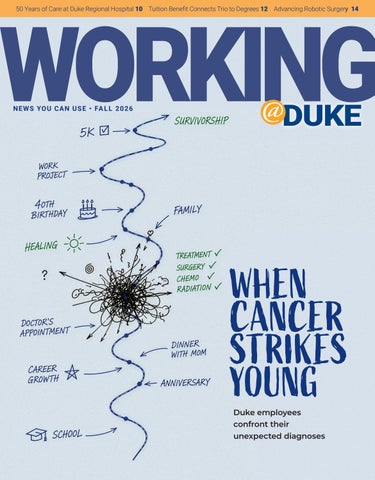
WHEN CANCER STRIKES YOUNG Duke employees confront their unexpected diagnoses
FROM THE EDITOR
BRIEFLY
LEANORA MINAI
The Stories That Bring Duke Closer Once a year, we ask you to tell us how Working@Duke is doing. This spring, 652 staff and faculty members across Duke University and Duke University Health System responded to our readership survey, sharing what they value. I read your feedback with gratitude, curiosity and a sharpened sense of responsibility. Across the University and Health System surveys, readership averaged 89% and enjoyment 84%, while 87% on average agreed that what they read is accurate and true. Nearly 79% said it helps them understand Duke benefits. Three quarters said it fosters their sense of belonging at Duke, and about 73% expressed pride in being part of Duke. The numbers are gratifying. The comments reveal what they mean in daily life. “Keeps me engaged,” one reader wrote. Another values “stories you don’t find anywhere else.” A third pointed to “feeling connected to Duke and proud to work here.” Those words carry special meaning in our 20th anniversary year. Working@Duke began in 2006 as a broadsheet. Today, it spans this magazine, a dedicated digital section on Duke Today, a weekly e-newsletter and social media channels. The ways we reach you have multiplied. The reason has not: to connect staff and faculty to work, colleagues and life at Duke. This issue puts that purpose on the page. Our cover story introduces four colleagues who faced cancer before age 50. Cherrelle Blackwell, Jesse Summers, Ranada Byrd and Kristen Mirek trusted us with deeply personal experiences of diagnosis, treatment and survivorship. I am grateful to each for sharing stories that may help another colleague feel informed, understood or less alone. We also celebrate Duke Regional Hospital as it marks 50 years of caring for Durham and surrounding communities. Congratulations to the generations of employees who built that legacy and carry it forward. And we welcome Jessica Abel, whose first months at Duke capture the discoveries that help a new workplace feel familiar. Elsewhere, colleagues take us beneath the stars, into classrooms and toward new possibilities in robotic surgery. Thank you for reading, sharing ideas and trusting us. Twenty years in, that exchange gives Working@Duke its meaning. We will keep listening because serving Duke well begins with knowing our readers and what you need most. Have a story idea or something you’d like us to know? Write to us at working@duke.edu.
2
WORKING@DUKE
Staff members care for patients at Durham County General Hospital in the 1970s. Photo courtesy of Duke University Health System.
OLLI at Duke offers learning and connection beyond the classroom
CONTENTS
4 When Cancer Strikes Young
With rates increasing for certain forms of cancer among people under 50, several Duke employees share their journeys.
10 15
Fifty Years at the Heart of Durham
Since opening in 1976 as Durham County General Hospital, Duke Regional Hospital has welcomed generations of newborns, cared for families during their most difficult moments and grown alongside the community it serves.
A Fresh Set of Eyes on Duke
Jessica Abel’s first months reveal the small discoveries that make a new workplace feel like home.
More Stories Inside...
Stephen Schramm Managing Editor (919) 684-4639 stephen.schramm@duke.edu
With Fall 2026 courses taking place now, staff, faculty and community members can select from noncredit courses and programs on topics ranging from history and public policy to science, wellness, literature and technology. What makes OLLI different from a traditional academic program is that there are no grades, no tests and no degrees. “This is your chance to learn all the things you want to learn for the joy of actually learning,” said OLLI Director Rhonda Parker. OLLI serves more than 2,100 members each year through courses, lectures, educational travel, volunteer opportunities, social events and special interest groups. Membership costs $60 annually and is available year-round.
“By giving their time, talent and treasure, employees across Duke University and Duke Health help build a culture of engagement and partnership that advances the health and well-being of our neighboring communities,” said Tuere Bowles, Associate Vice President for Duke Community Affairs. Learn more about the employee giving campaign: duke.is/ DoingGoodCampaign
Celebrate fall festivities and a fit holiday season Make the most of the fall season with a special Duke Farmers Market event and a wellness challenge from LIVE FOR LIFE, Duke’s employee wellness program.
Learn more at learnmore.duke.edu/olli
CONTACT US Leanora Minai Executive Director, Work Culture & Communications /Editor in Chief (919) 681-4533 leanora.minai@duke.edu
For adults who want to keep learning without the pressure of grades or exams, Osher Lifelong Learning Institute, known as OLLI at Duke, provides opportunities to explore new interests while building connections with others.
Employees select the cause they’d like to support and make tax-deductible donations through a one-time gift or payroll deduction with the Duke@Work self-service website. Every dollar donated goes directly to community organizations working in that area.
Paul S. Grantham Assistant Vice President (919) 681-4534 paul.grantham@duke.edu
Jodie Valade Senior Writer (919) 681-9965 jodie.valade@duke.edu
Working@Duke is published by Duke’s Office of Communication Services. We invite your feedback and story ideas. Send email to working@duke.edu or call (919) 681-4533. Visit Working@Duke daily on Duke Today: working.duke.edu Cover: A cancer diagnosis can change the plans people sketch out for their lives. Design & Layout: Kevin Kearns (kwkcreative.com)
2017, 2014 Gold, 2019, 2015, 2013, Silver, 2016, 2009, 2007 Bronze, Print Internal Audience Publications and 2012, 2011, 2009, 2008, 2007 Gold Medal, Internal Periodical Staff Writing
Support Durham through ‘Doing Good’
Registration opens Oct. 30. For more information, visit hr.duke.edu/ liveforlife
From Disney to Broadway, unlock nationwide savings
The “Fall Fest” Farmers Market on Oct. 29 offers one last chance this season to enjoy fresh local produce and handmade goods in a festive setting. The market will be held from 11 a.m. to 2 p.m. on the Duke Medical Pavilion Greenway and feature pumpkins, winter squash and seasonal comfort foods.
Protect yourself and others this flu season
From theme parks and concerts to rental cars and everyday shopping, staff and faculty can tap into a wider range of savings through the new Duke National Employee Discount Program.
Duke staff and faculty are invited to roll up their sleeves for a free flu vaccination beginning in October at Employee Occupational Health & Wellness clinics, peer vaccination sites and pop-up clinics across Duke.
Created through a partnership between Duke Human Resources and Working Advantage, the benefit complements Duke’s existing local PERQS Discount Program by expanding discount offerings nationwide.
Flu cases typically peak between December and February. During the 2025-26 flu season, North Carolina recorded 333 flu-related deaths with most deaths between ages 50 to 65 and older. The Centers for Disease Control and Prevention recommends getting vaccinated in September or October, before peak activity begins.
Employees can access discounts ranging from 5% to 60% on brands such as Disney, Apple, Enterprise Rent-A-Car and Avis, as well as discounted tickets to sporting events and Broadway performances. “As Duke’s workforce continues to grow and evolve, we want to be intentional about providing benefits that employees can use wherever they live and work,” said Antwan Lofton, Vice President for Duke Human Resources.
Staff and faculty can make a positive impact in Durham and the region by donating to the Doing Good Employee Giving campaign. Organized by Duke Community Affairs, Doing Good contributions support community and nonprofit organizations; economic mobility, college access and career readiness; education, early childhood development and school readiness; health nutrition and food security; neighborhoods, housing and infrastructure; and the United Way of the Greater Triangle.
To help employees stay healthy through the winter holidays, LIVE FOR LIFE offers “Festive Fit Focus,” a self-guided, eight-week program from Nov. 2 through Jan. 1. Participants receive weekly emails with wellness tips, healthy recipes, stress-management resources, activity ideas and encouragement to support healthy habits during the holiday season.
According to Working Advantage, users save an average of $5,000 annually and can earn loyalty points through the company’s “FunLife Rewards” program. Employees can enroll at duke. savings.workingadvantage.com using either a Duke or personal email address.
“Getting vaccinated against the flu protects our patients, our fellow employees and our families at home,” said Lanie Mulkana, Employee Occupational Health & Wellness Program Coordinator and Flu Vaccination Team Lead. Annual influenza vaccinations are a condition of employment for employees in Duke Health, which includes the Duke University Health System, School of Medicine, School of Nursing, and the Private Diagnostic Clinic. The deadline to receive a vaccination, submit documentation or receive an approved exemption is 10 a.m. Nov. 17, 2026. For vaccination schedules and more, visit flu.duke.edu
working.duke.edu
3
WHEN CANCER STRIKES YOUNG
‘SOMEDAY I’LL BE DEAD … BUT IT’S NOT TODAY’ After Jesse Summers was diagnosed with colon cancer in 2021 at 43, he wondered whether the experience would deliver some profound insights that would change how he viewed his life. But after surgery to remove metastatic tumors from his colon and liver, followed by six months of chemotherapy, the Adjunct Associate Professor of Philosophy and Senior Fellow at the Kenan Institute for Ethics had no grand epiphany to offer. “If I seriously tried to live today as my last,” Summers wrote in a 2022 essay for Slate, “it would make tomorrow awful. I would have messes to clean up, a hangover, and concerned voicemails to respond to.”
With several cancers rising among adults under 50, Duke employees confront their unexpected diagnoses
As chemotherapy sent pain through his hands and feet and made swallowing anything feel like drinking broken glass, Summers was not contemplating life’s larger meaning. He was focused on living each difficult day.
Cherrelle Blackwell, left, and her husband, Eric, leaned on one another after Cherrelle’s thyroid cancer diagnosis. Photo courtesy of Cherrelle Blackwell.
W
hile preparing for IVF treatment in 2021, Cherrelle Blackwell’s fertility specialist felt lumps in her neck.
Within days, an ultrasound revealed three nodules on Blackwell’s thyroid, the small gland at the base of the neck that regulates metabolism. Blackwell, then 35, underwent a biopsy to determine whether the nodules were cancerous. Then, time slowed. For the next week, Blackwell repeatedly checked her email and refreshed MyChart, searching for results. They arrived on the Friday before homecoming weekend at Saint Augustine’s University, her alma mater. Blackwell opened the message and saw the diagnosis she feared: Thyroid cancer. “I don’t remember much after that,” said Blackwell, a Plan Manager for benefits in Duke Human Resources. “The word ‘cancer’ just alters your whole world.” Blackwell’s diagnosis came amid a troubling national shift. A National Institutes of Health report last year found diagnoses of 14 types of cancer are on the rise among people under 50.
4
WORKING@DUKE
Dr. Katherine Garman, a Duke Gastroenterologist and Professor of Medicine, co-leads the Young Onset Gastrointestinal Cancer Initiative, which brings together experts from across Duke studying why these cancers are rising and how to detect them sooner. She said regular primary care visits, along with candid conversations about symptoms and family cancer history can help physicians identify when screenings or diagnostic testing is needed, potentially catching cancer early. “We want to make sure that if people are having any symptoms, they don’t just write them off,” Garman said. “We want them to be diligent about getting checked out.”
Continued on next page...
“Someday I’ll be dead,” Summers told himself during rough treatments. “But it’s not today.”
By Stephen Schramm
894
“Cancers are so much easier to treat if they’re caught early,” Summers said. “If you notice something, it’s probably fine. But if it’s not, it’s better to discover that early than late.”
At Duke, the rates of cancer diagnoses among employees under 50 have remained relatively flat from 2015 to 2025, but rates increased for several forms of the disease, including breast, colorectal and endocrine cancers, the category that includes thyroid cancer. “Cancer has traditionally been thought of as the disease of people who are older,” said Duke Medical Oncologist and American Cancer Society Chief Patient Officer Dr. Arif Kamal. “Unfortunately, we’ve seen it nationally and, anecdotally, here at Duke: there are more examples of patients now showing up with cancer in their 20s, 30s and 40s.” Researchers are hunting for explanations as physicians learn how best to care for younger patients confronting cancer while building careers, raising families and making plans for decades they assumed still stretched before them. Blackwell’s is one of four stories told here. Each employee was younger than 50 when cancer interrupted a life already in motion. Their diagnoses differ, but each faced the same reality: Cancer had arrived far too soon.
Duke employees under the age of 50 with cancer in 2025, up from 727 in 2015. (Source: Duke Human Resources)
Now cancer-free, Summers did come away with at least one lesson: Pay attention to your body and go see your doctor.
“Cancer has traditionally been thought of as the disease of people who are older. Unfortunately, we’ve seen it nationally and, anecdotally, here at Duke: there are more examples of patients now showing up with cancer in their 20s, 30s and 40s.” –Dr. Arif Kamal, Duke Medical Oncologist American Cancer Society Chief Patient Officer
That message has taken on greater urgency as colorectal cancer has become a growing threat to younger adults. It rose from the fifth leading cause of cancer death among people under 50 in 2005 to the leading cause in 2023. Summers’ diagnosis started at his annual physical, where he told his primary care doctor about night sweats and chronic fatigue. Although Summers was younger than 45, the recommended age to begin routine colorectal cancer screening, his doctor ordered a colonoscopy. The test revealed the cancer.
Jesse Summers was diagnosed with colon cancer at 43 years old. Photo by Travis Stanley.
1 in 43 The chance that any woman will die from breast cancer. (Source: American Cancer Society)
.working.duke.edu
5
THE PEOPLE WHO KEPT SHOWING UP
THE SHADOW THAT COMES WITH SURVIVAL
Over two years, Ranada Byrd endured cancer in both breasts and her thyroid, requiring three surgeries, two rounds of chemotherapy and months of radiation.
In 2023, Kristen Mirek became a regular visitor to Duke Cancer Center, where chemotherapy infusions attacked her colorectal cancer and the metastases in her lung.
But from the phone call when Byrd, then 35, was told that the marble-sized lump she felt in her right breast was cancer to her final chemotherapy appointment in 2017 when an entourage accompanied her carrying signs of support, she never faced cancer alone.
Even then, Mirek, who was 36, had to remind herself why she was there.
While Mirek had a family history of breast cancer, colorectal cancer wasn’t something she thought much about. But after noticing blood in her stool and undergoing a colonoscopy that uncovered cancer, she joined a worrisome trend. The American Cancer Society reports colorectal cancer diagnoses among people younger than 50 rose 2.9% annually from 2013 to 2022.
Breast cancer diagnoses among women younger than 50 have risen nationally by about 1.4% each year. Duke has also seen a slight increase in breast cancer diagnoses among employees in that age group. The American Cancer Society says regular screening is the most reliable way to find breast cancer early. It recommends annual mammograms for women at average risk beginning at age 45, with the option to start at 40. Duke’s medical plans cover mammograms at no charge through in-network providers.
Dr. Kamal, the Duke Medical Oncologist and American Cancer Society Chief Patient Officer, said that younger cancer patients are more likely to face social isolation and loneliness.
6
WORKING@DUKE
Their support networks are less established than those of older adults, he said. With cancer often interrupting a person’s ability to work, attend social events and their children’s activities, friendships can be hard to maintain. And after the first wave of support, concern may fade before lonely months or years of treatment end.
“I’ll probably always be thinking about it,” Mirek said.
Continued on next page...
“If you get cancer in your 30s, you may have 50 years ahead of you knowing that you had cancer. Every cough, every hiccup or pain makes you think, ‘Is it coming back?’” –Dr. Arif Kamal, Duke Medical Oncologist American Cancer Society Chief Patient Officer
Friends and relatives accompanied her to consultations, so no details were missed. Her boyfriend, Savoye, spent countless hours in waiting rooms. Her supervisors kept her work schedule flexible. During treatment, colleagues at Duke South’s 2B/2C Clinic, where she worked at the time, surprised her by wearing pink T-shirts emblazoned with “Team Ranada.” “I remember being at work and just crying,” said Byrd, 46. “They supported me so much. I couldn’t believe it.”
Annual increase in colorectal cancer diagnoses among people younger than 50 from 2013 through 2022, compared with 0.4% among adults ages 50 to 64. (Source: American Cancer Society)
Mirek entered survivorship with her husband, Paul, and dog, Loki, surrounding her with love. After radiation treatment eliminated a lung nodule last year, Mirek began shaping a new normal. She ran her first 5K earlier this year and began planning a New York City adventure.
While being treated for breast cancer and thyroid cancer, Ranada Byrd gained support from family and friends. Photo by Travis Stanley.
Byrd, a mother of three, knows the value of that commitment.
2.9%
“If you get cancer in your 30s, you may have 50 years ahead of you knowing that you had cancer,” Kamal said. “Every cough, every hiccup or pain makes you think, ‘Is it coming back?’”
But with oncologist appointments every few months, cancer has not disappeared into the rearview.
Over roughly a year, Mirek had three surgeries and several rounds of chemotherapy. In July 2024, she rang the Sound
“If you know someone who’s younger going through cancer, recognize that it takes intentionality and additional effort to maintain a supportive relationship,” Kamal said.
Duke Gastroenterologist and Professor of Medicine Dr. Katherine Garman, left, and Duke Medical Oncologist and American Cancer Society Chief Patient Officer Dr. Arif Kamal, right.
For younger adults, that next chapter can last for decades and carry its own burden.
“I knew I had it and everything, and I could tell everybody else about it, but it always felt weird to think ‘I’ve got cancer,’” said Mirek, a Program Coordinator with the Duke Graduate School.
“If it wasn’t for the people around me giving me positive energy, I don’t think I could have done it,” said Byrd, a Staff Assistant at Duke Raleigh Hospital’s Minimally Invasive Surgery Clinic.
Detection is only part of the challenge for younger patients.
of Hope Bell in Duke Cancer Center’s Seese-Thornton Garden of Tranquility, marking the end of a cancer treatment journey and the beginning of life as a survivor.
Still in her 30s, Kristen Mirek is adjusting to life as a cancer survivor. Photo by Travis Stanley.
TOP 5 CANCERS AMONG DUKE EMPLOYEES IN 2025: (Source: Duke Human Resources)
1. Skin Cancer 2. Breast Cancer 3. Prostate Cancer
4. Cervical Cancer 5. Endocrine Cancer working.duke.edu
7
THE PLANS SHE KEPT After reading her cancer diagnosis on that Friday afternoon before homecoming, Cherrelle Blackwell, the Duke Human Resources Plan Manager, called her husband, Eric, but reached his voicemail. Her mother and sister arrived at her Durham home within minutes. Eric, sensing something was wrong, rushed home. When Blackwell reached Duke endocrinologist Dr. Carly Kelley, Kelley assured her that the months ahead would be difficult, but that she would be OK. Before hanging up, Kelley asked whether Blackwell still planned to attend homecoming. “You’re going to keep your plans,” Blackwell remembers Kelley saying. “You’re going to get dressed and go do what you planned to do.”
What You Need to Know for Medical Benefits Open Enrollment 2027 With the continued rise in health care costs nationwide, Duke is introducing a new salarybased structure for premiums in 2027 that shares costs more fairly, so health insurance remains accessible to every employee. Under the new five-tier approach, premium increases will vary by salary, with employees in lower salary bands paying smaller increases.
Look At the Stars, Look How They Shine for You Get a peek at the moon, planets and galaxies at the Duke Teaching Observatory By Jodie Valade
Other 2027 highlights include: • Copays will not increase for Duke health plans.
“I used to live my life on five-year plans, both for my career and my life,” Blackwell said. “This has shown me that I can have all the plans, but ultimately, whatever will be will be.”
Yuriy Bomze, a Lab Administrator in the Department of Physics who helps manage the telescopes along with volunteers from the student-run Stargazing Devils Astronomy Club, said the crowd of maybe 100 to 150 people on April 10, the day Artemis II returned to Earth, was larger than average.
• Speech therapy: Each Duke health plan will provide an annual benefit of 40 visits per member.
Telescopes were aimed at Jupiter, a bright, white circle, where three of its four moons were also visible through the lens; Uranus; and at the Orion nebula, a cluster of stars inside a cloud of gas and dust. Depending on the time of year, meteor showers, galaxies and details of the surface of the moon also can be viewed – though never a full moon. Open houses are scheduled when there is a little moonlight, otherwise light pollution would prevent viewing.
Open Enrollment runs Oct. 12 through Oct. 30. Visit hr.duke.edu/enrollment2027 for details.
Each semester, the Duke Teaching Observatory offers open houses for anyone interested in seeing and learning about stars, planets, the moon or astronomy. It began in 2002 as a teaching tool for students and has grown into a draw for families, hobbyists and curious first-timers eager to learn.
Down the hill, another shed houses five Meade LX200 GPS Schmidt-Cassegrain telescopes used for each event.
• Fertility benefits: Duke Select HMO and Duke Options PPO will provide fertility benefits up to current cycle limits, with a $25,000 lifetime maximum per member.
Earlier this year Blackwell celebrated her 40th birthday in Jamaica and she continues to make plans, though she holds them differently.
“And then to come here and be able to look at the stars is pretty cool,” Nussbaum said.
Everyone wonders if they’re in the right place the first time they visit. If there’s a large shed to your immediate right after you turn into the gravel lane, you are.
• Cigna Care HMO will end Dec. 31, 2026. Participants must choose a new medical plan during Open Enrollment or will be automatically enrolled in Duke Options PPO at their current coverage tier.
Blackwell went to homecoming. Weeks later, surgeons removed her thyroid, followed by radioactive iodine treatment. Now cancer free, she still sees Duke oncologists annually.
On a spring evening, Nate Nussbaum and his wife, Jackie Cohen, stood in line for a turn peering through one of three telescopes pointed above. Their three young kids had been learning about astronomy in school, and earlier that same night, NASA’s Artemis II splashed down from its voyage around the moon.
The “observatory” is an open field off Cornwallis Road in Duke Forest. A gravel lane on the southwest side of the road is fenced off with a wire if you arrive too early, a small sign on a wooden post near the entrance reads, “John Couch Farm.”
• Dental and vision: Dental plan premiums will increase slightly. Vision plan premiums, copays and deductibles will remain unchanged.
Cherrelle Blackwell during cancer treatment at Duke Cancer Center. Photo courtesy of Cherrelle Blackwell.
In the darkness of a grassy clearing in Duke Forest, the sky looks different. Speckled dots of bright light stretch in every direction, some faint and others sharp. Every so often, a streak of light crosses overhead.
Yuriy Bomze, a Lab Administrator in the Department of Physics, sets up one of the five telescopes used at Duke Teaching Observatory events to gaze at the night sky. Photo by Travis Stanley.
“The moon is very beautiful, though we’re kind of used to seeing it almost every day,” Bomze said. “But when you look through a telescope and you see the line between day and night, you see shadows from mountains and craters. It’s three-dimensional – it’s so much more.” Copy, moon joy.
8
45,240 WORKING@DUKE
Estimated new U.S. thyroid cancer cases in 2026. (Source: American Cancer Society)
See the stars and more duke.is/DukeTeachingObservatory
working.duke.edu
9
At Watts Hospital, Black employees had largely been concentrated in support roles. Over time, Bridges saw more Black colleagues move into patient-facing positions at the new hospital, where close-knit care teams increasingly reflected the diverse community they served.
Fifty Years at the Heart of Durham
“Everybody was capable,” said Bridges, now a Health Unit Coordinator in Duke Regional Hospital’s Labor & Delivery Unit. “In the beginning, someone might be skeptical because of your color, but they’d build up trust with you. Then, if they needed help, they wouldn’t call anyone else.”
How Duke Regional Hospital grew to serve generations By Stephen Schramm
Two years later at Duke Regional, he experienced the same joy staring into the blue eyes of his newborn daughter, Mira. “Every time I go there, the memories come flooding back,” said Kosturi, a Duke Health Technology Solutions Information Security Application Analyst who joined Duke in 2005. “It’s part of our lives.” For 50 years, Duke Regional Hospital has been part of countless lives across Durham and surrounding counties. Since opening in 1976 as Durham County General Hospital, it has welcomed generations of newborns, cared for families during their most difficult moments and grown alongside the community it serves. “Whether it’s the people who work at Duke Regional and who are such a part of the community, or the people we meet every day whose lives have been helped by Duke Regional, we have so many touchpoints,” said Duke Regional Hospital Chief Medical Officer Brian Burrows. “It’s amazing how many people have come through our doors and gotten help.”
In June 1973, Durham County General Hospital, later Duke Regional Hospital, was a busy construction site. Photo courtesy of the Louis Round Wilson Special Collections Library, University of North Carolina at Chapel Hill.
TWO HOSPITALS BECOME ONE At 5:10 a.m. on October 10, 1976, Durham County General Hospital’s first day began when two people visited the emergency department with food poisoning. Around 7 a.m., ambulances – including military vehicles from Fort Bragg – began transferring patients from the soon-to-close Watts Hospital. At 8:23 a.m., a woman who had arrived hours earlier had Durham County General Hospital’s first baby, a 9-pound, 5-ounce boy.
“We had barely gotten the doors open and she appeared,” Edward McCauley, former Administrative Director of the Durham County Hospital Corporation, which oversees the hospital, said in a 2006 interview. “It’s little things like that that you remember.”
Prior to 1976, three hospitals served Durham. Duke University Hospital, which opened in 1930, excelled in specialty care, teaching and research. Meanwhile, Watts Hospital, which served mostly white patients since 1895, and Lincoln Hospital, open since 1901 for Durham’s Black residents, met most of the city’s health care needs. By the 1960s, Lincoln Hospital’s and Watts Hospital’s aging facilities needed replacement. In 1968, Durham voters approved a $20 million bond to build a single public hospital that would replace Lincoln and Watts and serve all of Durham.
Staff members care for patients at Durham County General Hospital in the 1970s. Photo courtesy of Duke University Health System.
10
WORKING@DUKE
“The vision … was that it was going to be the hospital for this community” McCauley said in 2006. “It was going to bring people together.” Construction on Durham County General Hospital began in 1972 on county-owned land off North Roxboro Street. Employees at Lincoln and Watts, most of whom would bring
Duke Regional Hospital is where Duke Health Technology Solutions’ Tony Kosturi, far right, and his wife Laura, second from left, had their children Andrew, left, and Mira, third from left. Photo by Travis Stanley.
their experience to the new hospital, received construction updates with their paychecks. On Sept. 6, 1976, those employees and their families were invited to the new hospital to enjoy chicken dinners, balloons and facility tours. When the new hospital opened weeks later, signaling Watts’ closure and Lincoln’s transition as an outpatient care center, they returned to begin caring for their neighbors. In Durham County General Hospital’s first year, its 1,371-person staff cared for 13,126 admitted patients, delivered 1,582 babies, handled 17,201 surgeries and 25,208 emergency department treatments. In the hospital’s first annual report, McCauley acknowledged hiccups, such as a complicated telephone system and a few construction delays. But by delivering quality care during a period of adjustment, a culture was taking root. “Each of us must take pride in what are doing in our hospital,” he wrote.
THROUGH CHANGE, A CONSTANT PRESENCE As secretary of the Mother/Baby Unit in 1976, Brenda Bridges experienced Duke Regional Hospital’s whirlwind beginnings. Adjusting to bustling corridors and budding relationships with colleagues from Lincoln Hospital and Watts – where Bridges had worked since 1969 – was challenging, but she also found reasons for encouragement.
More
T
ony Kosturi still remembers holding his moments-old son, Andrew at Duke Regional Hospital in 2007 before carefully passing him to his wife, Laura. Both new parents were in tears.
Over the years, Bridges watched the hospital expand with the opening of the George Washington Watts Memorial Building in 1980 and the Behavioral Health Center and expanded emergency department in 2021. As the hospital began serving more patients from surrounding counties, it was renamed Durham Regional Hospital in 1990. Despite becoming an essential resource for the region, the hospital couldn’t avoid industry-wide financial pressures. In 1998, amid rising health care costs, a partnership with Duke University Health System preserved the hospital’s service mission and connected it with the resources of Duke’s world-class health system. The agreement gave Duke a 20-year lease and included a $3.5 million annual payment, a three-year guarantee against layoffs and continued care for patients with low incomes or no insurance. “All of us, in years to come will say this was the right thing to do,” George Quick, former chairman of the Durham County Hospital Corporation told the Durham Herald-Sun in 1998. Duke’s lease expanded to a 40-year term in 2009, and, in 2013, the hospital’s name became Duke Regional Hospital. Through it all, Bridges has welcomed patients, visitors and co-workers coworkers in the hospital’s Labor & Delivery Unit. She cherishes the memories of the many colleagues who became dear friends, and the opportunity she has to ease the minds of anxious expectant mothers. Her time-tested approach for greeting patients is to look them in the eye, smile and ask what they need to feel at home. She reassures them that, surrounded by her experienced, committed colleagues, they are in the right place. “I love doing my job,” Bridges said. “I feel like this is where I was meant to be.”
Share Your Duke Regional Story: With a half century of caring for the people of Durham and the surrounding area, Duke Regional Hospital has touched the lives of countless people. If you’re one of them, share your memory by sending an email to working@duke.edu.
working.duke.edu
11
At One Duke Clinic, Graduation Was a Team Effort Three colleagues are among employees who used $5.44 million in Duke’s employee tuition benefit in one year By Stephen Schramm
Before a meeting last spring at Duke Primary Care Apex, the chatting among colleagues in a conference turned from upcoming adventures to graduation plans. One mentioned she was about to earn a degree. Then another co-worker said the same. Then another. “We were like, ‘I’m graduating, too!’” said Radiologic Technologist Jennifer Davis-Danielson, one of three members of the clinic’s 25-person team earning degrees in the spring. “It was just crazy.” The trio’s accomplishments reflected different career paths. In May, Davis earned a bachelor’s degree in health care administration and management from Colorado State University Global. Clinic Manager John Hoyle completed a master’s in business administration from the University of North Carolina at Wilmington. Family Nurse Practitioner Amanda Assante received her Doctor of Nursing Practice degree from the Duke University School of Nursing.
Be you. Be bold. Be the difference.
A Cheerleader for Duke Students Rosie Canizares built a Duke career helping students see possibilities for themselves By Jodie Valade
All three used Duke’s Employee Tuition Assistance Program to help make it happen.
"We have really sharp and ambitious folks here on our team, so I'm not totally surprised," Hoyle said. The colleagues charted different paths to graduation. After decades of swearing she would finish the degree she began in the early 1990s, Davis, 54, resumed her studies in late 2023. Davis, who’s been at Duke since 2022, completed her final 17 classes online and collected her degree at a commencement ceremony in Denver. At Duke since 2017, Hoyle, 33, figured an MBA would help him better manage his clinic’s operations and gain deeper insight into the health care industry. While balancing work and caring for his 4-year-old daughter, Evrenn, Hoyle earned his degree in two years. The experience culminated with a family trip to Wilmington, where Evrenn watched her dad walk across the commencement stage. Since starting her health care career, Assante has kept learning, adding master’s degrees from Campbell University and the Duke University School of Nursing before enrolling in Duke’s Doctor of Nursing Practice program in 2023.
Duke Primary Care Apex colleagues, from left to right, Amanda Assante, John Hoyle and Jennifer Davis-Danielson all earned college degrees this spring. Photo courtesy of Jennifer Davis-Danielson.
Duke’s tuition reimbursement benefit supports Duke HomeGrown’s EMPLOY pillar, which strengthens career pathways at Duke. Receive up to $5,250 per calendar year for eligible study at accredited institutions. hr.duke.edu/tuition WORKING@DUKE More
12
“School is expensive, but it’s worth it,” Assante said. “I don’t know that I would have been able to do this if there wasn’t significant financial support.”
When Dr. Rosie Canizares was a sophomore pre-health student at Duke, she met with an adviser who warned her she probably wouldn’t get into physical therapy school. At the time, 23 years ago, the profession was transitioning to a doctorate program, and everyone was a little unsure how it worked. That meeting shocked Canizares. In high school, she envisioned careers as an NBA athletic trainer, an orthopedic surgeon for a ballet company or a physical therapist alongside her speech pathologist sister. With a childhood spent in ballet and experience as a Duke cheerleader, they all seemed the perfect synthesis of her love of movement and medicine.
Festival since 2009 and has provided backstage care for touring Broadway productions visiting the Triangle. Canizares started the Duke Pre-Physical Therapy Association to mentor students like she once was, helping them recognize possibilities they might not see for themselves. “I think it fits with my brand that I want to be their cheerleader,” Canizares said. Riley Dinnell, a third-year physical therapy graduate student, has felt Canizares’ support since deciding during her junior year at Duke to pursue the profession. “She’s so present in the Duke PT community that pretty much every student knows her and knows she’s available,” said Dinnell, a former Duke cheerleader. “She’s been really great at facilitating growth throughout all aspects of my PT journey.”
Canizares applied for physical therapy school, anyway, sending applications to more schools than she thought might accept her. She got into all of them, including Duke, the only university she ever wanted to attend.
That philosophy also informs Canizares’ commitment to inclusion. Canizares, who is Filipina, has served on numerous committees and mentoring initiatives, supporting students from a variety of backgrounds.
“I always say that while it was a demotivating experience, it motivated me to do all of the advising and mentoring and teaching that I do now,” Canizares said.
Her message is often the same: There is no single route into health care.
Since earning undergraduate and physical therapy degrees from Duke, Canizares has stayed. Her work has ranged from treating patients at Duke’s Student Health Physical Therapy Clinic and teaching future physical therapists to developing opportunities for students in performing arts medicine, a specialty inspired by her dance background. She has worked with the American Dance
More
Their shared graduation milestone reflects something happening across Duke. During the past year, the Employee Tuition Assistance Program paid $5.44 million to help 1,519 employees pursue degrees, including 72 employees in Duke Primary Care, the eighth-highest total among Duke units.
Dr. Rosie Canizares started the Duke Pre-Physical Therapy Association to mentor students. Photo by Travis Stanley.
“When I mentor, it's really more about following your own passions and figuring out why entering health care is the best fit for you,” she said. For Canizares, it’s about helping students find the path that's right for them and making sure no one is discouraged from trying.
Nominate a Colleague: This story is part of the "Be You" series, which features staff and faculty who embody Duke’s shared values of respect, trust, inclusion, discovery and excellence. Nominate someone to be featured at hr.duke.edu/sendnews.
working.duke.edu
13
A New Vision for Brain Surgery
A Fresh Set of Eyes on Duke Jessica Abel’s first months reveal the small discoveries that make a new workplace feel like home By Jodie Valade
At Duke, ranked No. 32 worldwide for U.S. utility patents, a neurosurgeon’s question is advancing robotic brain surgery In 2025, Dr. Patrick Codd earned one of 94 patents issued to Duke University by helping to develop robotic surgery technology. Photo by Travis Stanley.
When Dr. Patrick Codd was a neurosurgery medical resident, he treated a 2-year-old with a large brain tumor. The tumor had caused fluid build-up, and Codd needed to drill a hole into the child’s skull to relieve pressure. Later, as he helped with another surgery on the child to remove the tumor, he wondered why he couldn’t simply use the same opening he’d already created from the first surgery to perform the operation. “It turns out that’s a much more challenging question,” he said. “If you magically were able to do that with some tool, you would have been able to minimally invasively remove the tumor in a way that required a Band-Aid.” Unable to shake that question, Codd began searching for a solution. Over the past 11 years at Duke, Codd has worked with robotics engineers to develop technologies aimed at one day accomplishing what he suggested: A robot that can precisely remove a tumor at the press of a button, free from the limitations of human dexterity.
14
More
In 2025, Codd earned one of 94 patents awarded to Duke University, which ranked 32nd in the Top Worldwide Universities Granted U.S. Utility Patents List published by the National Academy of Inventors. The patents issued to Duke cover a wide range of areas, from biomedical and imaging technologies to quantum systems and environmental solutions.
WORKING@DUKE
A patent for “surface and subsurface tumor mapping for computer-guided laser surgery” was awarded Aug. 19, 2025, with Codd listed as one of the system’s three inventors. Two other patents connected to the flexible robotic technology Codd helped create have been granted to Duke in the past four years. All of them are related to a single premise: “We were trying to answer one basic question, which is, can I remove this tumor automatically? That’s it,” Codd said. What’s involved in doing that is more complex because it includes creating a tool that can not only reach a tumor, but differentiate it from healthy tissue, remove the tumor, stop bleeding and “don’t mess up anything that’s normal,” Codd said. The 2025 patent is for technology designed to do just that: identify tumors, the blood vessels feeding them, and then use laser surgery to cut off that blood supply. Duke’s Brain Tool Laboratory brings together experts from neurosurgery and the Pratt School of Engineering working together to develop the robotic surgery technology. “The overall goal is, how do you more precisely remove tissue and know what you’re doing, and do it more safely and accurately than we do now,” Codd said. Codd is working on that, one patent at a time.
Visit otc.duke.edu to learn about Duke’s Office for Translation and Commercialization, which helps innovators move discoveries from the lab to the market through industry and venture partnerships.
There, Abel, a Digital Communications Strategist for Trinity College of Arts & Sciences, will settle into the hidden enclave she discovered soon after she began working at Duke, marveling at everything and everyone around her as she works. “Do you remember in college when the big advice from R.A.s was to always leave your door open?” Abel said. “I feel like I’m trying the employee version of that.” Abel joined Duke on March 11, one of 545 new hires at Duke that month, 438 of whom joined Duke University Health System, and has embraced every new discovery at Duke since. Her enthusiasm might feel familiar to anyone who remembers their first months at Duke, discovering unexpected places, meeting colleagues with remarkable stories and realizing how much there is to explore. “It has been a very fast and furious first few months, but something I've appreciated is that it's never been overwhelming,” she said. “It's just been exciting.” Among her favorite small finds thus far: Abel takes the GoTriangle bus to work from her Chapel Hill home, with a free GoPass provided by Duke. She rarely packs lunch, instead opting for one of the $5 Daily Devil Deals in Brodhead Center. (Her favorites are the street taco with plantains from Sazón and the sushi handroll from Gyotaku.) She devours the Working@Duke e-newsletter that arrives in her inbox each Wednesday.
More
By Jodie Valade
Whenever she can, Jessica Abel takes her laptop to one of the café tables in the courtyard tucked behind the Bartter Family Terrace House in Sarah P. Duke Gardens. It’s a short stroll across the street and down the hill from her office in the Old Chemistry Building on West Campus.
Jessica Abel, Digital Communications Strategist for Trinity College of Arts & Sciences. Photo by Travis Stanley.
“I know this is going to sound planted, but I’m a huge fan of that newsletter,” Abel said. “I read it every week.” That email is how she learned of the Duke Farmers Market, held each Thursday on the Duke Medicine Pavilion Greenway from April until October. Abel is eager to attend Duke Arts Presents events and is “obsessed” with the Duke Lemur Center. And get this: she’s a University of North Carolina at Chapel Hill graduate who has never seen a basketball game at Cameron Indoor Stadium but would love to experience the hype after helping with a commencement ceremony in the building. “It was a real moment where I could understand why there’s a fever here,” Abel admitted. So, if you happen to see Abel in her not-so-secret spot at the courtyard, she encourages you to say hi. She’s happy to share her space with a new colleague. “If I can meet new friends, then I would love that,” Abel said.
Get Social with colleagues:
hr.duke.edu/careers/workingduke
working.duke.edu
15
NON PROFIT ORG US Postage PAID Durham, NC Permit No. 60
DUKE
ONLINE
Check out these stories and more at
working.duke.edu
TWO DECADES OF SHARING STORIES Look back at stories, people and events that Working@Duke has highlighted in the 20 years since its 2006 launch.
CELEBRATE PROFESSIONAL DEVELOPMENT JOURNEYS
ANALOG ESSENTIAL TOOLS DUKE EMPLOYEES SWEAR BY
Meet the 2025-26 graduates of the Foundational Skills and Frontline Supervisor programs.
From chalk to calculators, discover low-tech items staff and faculty use to excel in their roles.
Share your news! Write us!
working@duke.edu
STAY CONNECTED
Like, love, comment, share & follow us on social media to keep up with the latest updates on news, events and people at Duke.
Duke University Office of Communication Services 705 Broad St., Durham, N.C. 27708