Pilot Boats • Military • Robotic Welding ®
IN BUSINESS ON THE COASTAL AND INLAND WATERS
SEPTEMBER 2026
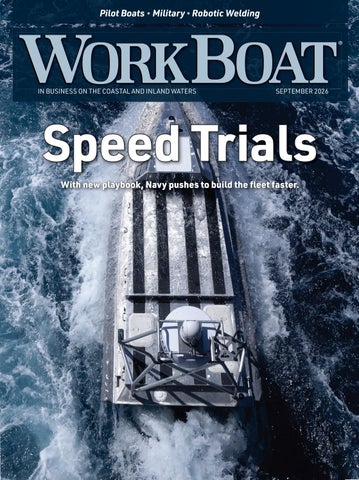
Speed Trials With new playbook, Navy pushes to build the fleet faster.
YOUR VESSEL DOESN’T NEED A CREW
BECAUSE OURS HAS YOU COVERED
When it comes to the future of marine innovation, Twin Disc offers more than just products— we deliver solutions backed by a century of marine expertise. From propulsion systems to advanced controls, our team leverages industry experience and technologies to support your vessel applications. Whether you need precision maneuverability, reliability in harsh conditions or seamless integration for your autonomous or uncrewed vessels, Twin Disc is built to perform—today and for the next generation of marine operations. CONTACT TWIN DISC TODAY TO DISCUSS YOUR NEXT AUTONOMOUS OR UNCREWED VESSEL PROJECT. LET US HELP YOU ACHIEVE NEXT-GENERATION PERFORMANCE AT SEA. TWINDISC.COM Disclaimer: Twin Disc supplies marine propulsion systems, controls, and related components only. Twin Disc does not provide complete autonomous or uncrewed vessels, nor does it guarantee autonomous operation that may be outside Twin Disc’s control.
POWER. PRECISION. PERFORMANCE.
Content
September 2026 VOLUME 83, NO. 09
FEATURES 12 Cover Story: New Playbook The Navy looks to the future.
20 Vessel Report: Transfer Craft The trends driving U.S. pilot boat construction.
26 Focus: Space Support Federal request raises industry questions.
20
30 Final Word: Patrick V. Kelly One-on-one with the CEO of Fraser Industries LLC.
BOATS & GEAR 8 On the Ways New tugboats to keep Soo Locks ice-free • Bordelon converts supply vessel for subsea work • New research catamaran on Lake Champlain • Second of eight towboats delivered to Turn Services • Rozema lays keel for Coast Guard response boats • Lake Charles Pilots take new launch from Gladding-Hearn • Tote to manage Navy landing craft builds • Missile range tracking ships ordered from Hanwha Philly Shipyard • New Long Island patrol boat goes to work.
24 Robo Welders Short-staffed shipyards are bringing in high-tech helpers.
24
AT-A-GLANCE 4 Pilot Ladder: Maritime pilots proudly contribute to national security. 4 All Hands: An overlooked workforce pool. 6 On the Water: Hydrate to stay safe in the heat. 6 Health, Safety, and Environment: Confidential data sharing.
DEPARTMENTS 2 Editor’s Watch 34 Port of Call 40 Advertisers Index ON THE COVER
A U.S. Navy Global Autonomous Reconnaissance Craft maneuvers in the Atlantic Ocean during the UNITAS multinational maritime exercise in September 2025. Credit: U.S. Navy
www.workboat.com • SEPTEMBER 2026 • WorkBoat
1
EDITOR'S WATCH
Showtime
EXECUTIVE EDITOR: Eric Haun / ehaun@divcom.com
Eric Haun, Executive Editor ehaun@divcom.com
I
t’s that time of year again. Summer is starting to unwind, kids are trading beach days for backpacks, and evenings are getting that first hint of cool. Here at WorkBoat, September means show season has arrived. For those unfamiliar, Diversified — the publisher of WorkBoat magazine — is also the host of two commercial marine industry trade shows: Pacific Marine Expo (PME) and the International WorkBoat Show (IWBS). Every year, these events bring together thousands of people who operate, build, crew, supply, regulate, or otherwise support the vessels that we cover in these pages. Our team spends months working hard behind the scenes to make sure the floor, the sessions, and everything in between come together seamlessly. This year is no exception, and we’ve got two great shows lined up. PME will take place Nov. 19-21 at the Seattle
Convention Center (note the venue change). Then we head to the Gulf Coast — workboat Mecca — for IWBS, Dec. 2-4 at the Morial Convention Center in New Orleans, closing out the year with North America’s largest commercial marine industry gathering. We always aim to deliver exhibitions that are bigger and better than ever. This year, Carley Milligan joined us to help rethink, revamp, and expand our conference programming, and we’ll be rolling out a variety of new special events and sessions. At PME, we’re bringing back the WorkBoat West educational program, designed for shipyards, vessel owners and operators, and other commercial marine stakeholders. At IWBS, we’re launching new session tracks tailored to key sectors of the workboat industry, including shipbuilding and repair; tugs, towboats, and barges; passenger vessels; and government and military. There’s plenty more in store, and I’m eager to share what we’ve put together. More on that soon, but suffice it to say, this year’s sessions are shaping up to be some of the strongest we’ve offered. Updates will be posted at PacificMarineExpo.com and WorkBoatShow.com, or feel free to reach out to me directly to learn more. Mark your calendars. Show season is here, and we can’t wait to see you on the floor.
SENIOR EDITOR: Frank McCormack / fmccormack@divcom.com SENIOR ASSOCIATE EDITORS: Ben Hayden / bhayden@divcom.com Steve Mosco / smosco@divcom.com Kirk Moore / kmoore@divcom.com CONTENT PROJECT MANAGER: Carley Milligan / cmilligan@divcom.com CONTRIBUTING WRITERS: Tim Akpinar • Capt. Alan Bernstein • Stephen Blakely • Dan Bookham • G. Allen Brooks • Bruce Buls • Denielle Christensen • Capt. Eric Colby • Mike Complita • Clay Diamond • Jerry Fraser • Nate Gilman • Pamela Glass • Capt. Arnie Hammerman • Ken Hocke • Craig Hooper • Joel Milton • Peter Ong Richard Paine Jr. • Chris Richmond DIGITAL & PRINT PROJECT MANAGER: Doug Stewart / dstewart@divcom.com ADVERTISING ACCOUNT EXECUTIVES: Kristin Luke / kluke@divcom.com Jordan Randall / jrandall@divcom.com Krista Randall / krandall@divcom.com Danielle Walters / dwalters@divcom.com ADVERTISING COORDINATOR: Wendy Jalbert / wjalbert@divcom.com Producers of the International WorkBoat Show and Pacific Marine Expo
Vice President: Wes Doane, wdoane@divcom.com Publishing offices: 2 Portland Sq., Suite 200, Portland, ME 04101 Tel 207-842-5608 | Fax 207-842-5609 Subscriptions: cs@e-circ.net / 978-671-0444 Mon–Fri, 10 a.m.–4 p.m. ET
WORKBOAT® (ISSN 0043-8014)
is published monthly by Diversified Communications Two Portland Square, Suite 200, Portland, ME 04101
Annual Subscription Rates: U.S. $39; Canada $55; International $103. 3 When available, extra copies of current issue are $5. For subscription customer service call (978) 671-0444. The publisher reserves the right to sell subscriptions to those who have purchasing power in the industry this publication serves. Periodicals postage paid at Portland, ME. Circulation Office: Two Portland Square, Suite 200, Portland, ME 04101. From time to time, we make your name and address available to other companies whose products and services may interest you. If you prefer not to receive such mailings, please send a copy of your mailing label to: Printed in USA
2
WorkBoat’s Mailing Preference Service, PO Box 7437, Portland, ME 04112 POSTMASTER: Send address changes to WORKBOAT, P.O. Box 1792, Lowell, MA 01853.
Copyright 2026 by Diversified Communications
© Diversified 2026 | Printed in the U.S.A. To update your WorkBoat account, change your address, or manage your subscription, visit WorkBoat.com.
www.workboat.com • SEPTEMBER 2026 • WorkBoat
AT-A-GLANCE
Pilot Ladder Maritime pilots proudly contribute to America’s maritime security BY CLAY DIAMOND Clay Diamond is the executive director-general counsel for the American Pilots’ Association (APA), the national association for the piloting profession.
A
lthough marine pilots are primarily viewed through the lens of navigation safety, environmental protection, and maritime commerce, they also perform vital maritime security functions. By boarding vessels before they enter U.S. ports and guiding them through domestic waterways, pilots help close critical gaps between foreign-flagged vessels and the domestic maritime system. As we observe the 25th anniversary of the Sept. 11, 2001, terrorist attacks, it is fitting to recognize pilots as a first line of defense safeguarding coastal waters, vital commerce, and critical port infrastructure. Unlike foreign vessel crews, who are employed by international shipping companies or, in some cases, entities subject to foreign government influence, pilots are licensed by individual states or, for the Great Lakes, by the U.S. Coast Guard. Their responsibilities are grounded in the public interest — the safety and security of local waterways and infrastructure — not in the commercial or governmental interests of a vessel’s operator. When a pilot boards a vessel, she or he takes command of navigation through local waters, a critical safeguard given that foreign-flagged ships make up over 90% of commercial port calls in the U.S. Because pilots are vetted, credentialed, and background-checked by federal and state authorities, placing them on the bridge helps guard against insider threats, undertrained crews, and hostile intent.
All Hands An overlooked workforce pool BY MIKE COMPLITA Mike Complita is a principal at Elliott Bay Design Group and vice president of strategic expansion. He serves on the boards of WaveWorks Alliance, Uplift Northwest, and Maritime Blue.
L
azy. Unreliable. Unwilling to work. As you read these words, who comes to mind? For many of us, the answer is shaped almost entirely by our silent observation: people holding signs at street corners, sleeping on sidewalks, or standing outside shelters. It is easier to look away and tell ourselves, “Someone should do something.” Sound familiar? In contrast, we have all seen countless articles about the critical shortage of qualified and capable workers affecting the maritime industry. Trade organizations host industry days to
4
Pilots also serve as additional “eyes and ears” for law enforcement and intelligence agencies. Boarding incoming vessels miles offshore, well before they reach populated areas or inland waterways, puts pilots in a unique position to spot anomalies and provide real-time situational awareness. While the Coast Guard and Customs and Border Protection monitor documentation and intelligence streams, pilots provide firsthand assessments from the bridge — tracking equipment, crew behavior, and structural integrity throughout the transit from sea to berth. They are trained to identify red flags such as unexplained route deviations, erratic crew behavior, mechanical deficiencies, and unreported personnel. Pilots maintain direct, real-time communication with the Coast Guard, CBP, and port authorities. If a threat emerges, a pilot can alert authorities, coordinate an emergency response, or direct a vessel to stop short of a bridge, refinery, or military installation. A formal memorandum of agreement between the American Pilots’ Association and the Coast Guard formalizes this cooperation, recognizing pilots’ unique awareness and deep understanding of the maritime domain and committing both parties to strengthen port security together. Today’s threat landscape includes the potential use of a commercial vessel as a weapon. An intentional grounding, allision, or channel obstruction could cripple military ports, paralyze economies, or disrupt supply chains. Pilots mitigate this risk through intimate knowledge of local tides, currents, hazards, and harbor layouts, helping prevent both accidents and deliberate sabotage during a vulnerable phase of transit. In short, pilots are more than skilled navigators — they are essential participants in America’s maritime security framework. Their independent authority, early detection capabilities, local expertise, and communication networks help insulate domestic ports from international vulnerabilities. As vessels grow larger and geopolitical tensions rise, that security role will only become more vital. introduce younger generations to the wide variety of opportunities our industry offers. While these efforts are a key part of the long-term solution to the workforce shortage problem, in a best-case scenario, it will be five to 10 years before they produce significant results. Until then, is it possible that one crisis could be part of the solution to another? In 2018, I joined the board of directors of a nonprofit whose mission is to connect individuals experiencing homelessness with long-term employment opportunities. I was surprised to learn how often people become homeless because of financial instability, not drug addiction or mental health challenges. Job loss, medical expenses, and rising rents are primary causes that can quickly compound. I also learned there are countless smaller challenges that seem simple to address until the day you find yourself on the street. For example, where do you get an eye exam and glasses to read and complete a job application if you don’t have insurance or hundreds of dollars for the exam and frames? Where can you shower and wash your clothes www.workboat.com • SEPTEMBER 2026 • WorkBoat
AT-A-GLANCE before going to work? Nonprofit organizations across the United States are working to help individuals address these barriers. For example, Uplift Northwest, which was established more than 100 years ago in Seattle, provides services including free vision exams and glasses, laundry and
shower access, protective workwear, and job referrals at no cost to participants in its four-week workforce readiness program. Graduates are motivated, reliable, and eager to accept entry-level positions offering on-the-job training and career growth. Can partnerships with organizations
On the Water Hydrate to stay safe in the heat BY JOEL MILTON Joel Milton works on towing vessels. He can be reached at joelmilton@yahoo.com.
serving people experiencing homelessness solve the U.S. shipbuilding workforce crisis on their own? Likely not. But with a reasonable investment of compassion, cooperation, and willingness, I believe they can have an immediate, meaningful impact throughout our industry.
Health, Safety, and Environment Confidential data sharing BY RICHARD PAINE JR.
S
o far, the long, hot summer of 2026 has been brutal. In addition to massive high-pressure systems producing days-long heat waves, dense plumes of wildfire smoke from Canada, the American West, and Minnesota have traveled thousands of miles across the continent and Atlantic Ocean. Working in these conditions is arduous and carries significant health and medical risks: dehydration, heat exhaustion or heat stroke, and exposure to fine particulate matter from wildfire smoke. All those things can reduce physical and cognitive function, affecting judgment and fine motor skills in a safety-sensitive workplace. And while almost everyone generally understands the need to remain hydrated, or to rehydrate after becoming dehydrated, how best to do that is subject to a lot of bad old habits based on misinformation. But you can safely start from this position: if you’re physically exerting yourself outside of a climate-controlled office space, water alone may not always be enough. Traditional sports drinks often contain substantial amounts of added sugar and calories. They can be useful during prolonged, strenuous activity, but may be unnecessary for routine hydration, and highly concentrated drinks can cause stomach discomfort for some people. Their popularity owes much to long-standing brand recognition and wide availability. Lower-sugar electrolyte products are now widely available, though it is important to compare labels and choose one suited to the duration and intensity of the work. Electrolyte powder mixes have worked well for me. There are several widely available today that have real science behind them, with ingredients of decent quality and no added sugar. There are many choices on the market, but you should carefully read the ingredients of whatever you’re considering buying, because there is still a lot of stuff aiming for a price point rather than health, and sugar tends to sneak in everywhere.
6
Richard Paine Jr. is a licensed mariner and certified maritime safety auditor with 25 years of experience. He can be reached at rjpainejr@gmail.com.
B
usiness privacy is a nonnegotiable standard for many operators in the maritime sector, where companies are constantly working to keep their safety records private. So how does the industry know what’s truly going on with operational safety? You can search public records and CG2692 casualty reports, but these won’t tell you much about the safety of the industry, a specific sector, an operator, or a vessel, nor do they capture near-collisions that could have led to catastrophic incidents. Years ago, my interest in finding meaningful comparison data led me to join the voluntary, confidential reporting network of the SafeMTS (Marine Transportation System), an initiative of the Maritime Administration and the Bureau of Transportation Statistics (BTS) that focuses on collecting precursor events (near collisions) rather than reportable accidents. Individual company data is protected under the Confidential Information Protection and Statistical Efficiency Act (CIPSEA), which bars BTS from disclosing identifiable information for any nonstatistical purpose without the data provider’s consent. Data collected under CIPSEA is exempt from legal discovery and subpoena and cannot be released under the Freedom of Information Act. This allows SafeMTS to surface underlying safety vulnerabilities that traditional incident databases often miss, strengthening risk mitigation and helping the industry to set benchmarks and reduce the likelihood of future incidents. SafeMTS has continued to make exciting progress since the program’s creation over five years ago. This fall SafeMTS is scheduled to finish its last round of working groups to scale up from a successful pilot to a properly funded government program. I encourage anyone interested to explore SafeMTS through the BTS website and see if it makes sense for your operation. www.workboat.com • SEPTEMBER 2026 • WorkBoat
Push more. Pull harder. Run longer. When the work never stops, your engines can’t either. That’s why commercial operators choose Cummins engines. Built for long days, heavy loads, tight schedules, and zero tolerance for downtime, our engines are designed for longevity. With proven low‑maintenance requirements and no midlife overhaul, you save both time and money. Every component is engineered for uncompromising durability, every system tuned for maximum uptime, and every engine backed by a support network that understands the stakes. From tugs and push boats to service and transport vessels, our diesel platforms deliver the torque, fuel efficiency, and reliability that keep your fleet moving forward. Choose Cummins. Don’t compromise. Scan now to speak with a marine expert
©2026 Cummins Inc.
ON THE WAYS CONSTRUCTION ACTIVITY AT WORKBOAT YARDS
U.S. Army Corps of Engineers
New tugboats to keep Soo Locks ice-free
Two new tugs meet the modern needs of the Corps’ Detroit District.
T
he U.S. Army Corps of Engineers’ Detroit District in May took delivery of two new icebreaking tugboats, the H.J. Lawson and the R.J. Pearce, which are now plying the St. Marys River in Michigan. The vessels’ primary responsibility is to keep the Soo Locks in Sault Ste. Marie, Mich., free of ice. They also tow barges and assist in maintenance operations. Built at Conrad Industries’ yard in Morgan City, La., the all-steel tugs measure 76'x28'. They’re powered by twin 800-hp Caterpillar C32 diesels, and each has a Hydromaster bowthruster to improve maneuvering in close quarters. Both boats are built to Ice Class C0 standards and are Subchapter M compliant. The R.J. Pearce is named for Ronald Johnston Pearce, who dedicated his career to the Sault Ste. Marie maritime community. Pearce began working as a messenger at age 13, delivering mail to troops stationed at the Soo Locks. He spent his 35-year career with the Corps and retired in 2009. 8
Harold J. Lawson was a lifelong resident of Sault Ste. Marie who dedicated his career to the Corps. After graduating from Michigan Technological University in 1955 with a degree in civil engineering, Lawson served in the Army at Fort Belvoir, Va., and continued his service in the Army Reserves for eight years. He then worked with the Corps for more than three decades. He died in 2018. Justin Proulx, chief of the Corps’ St. Marys River Section, generously praised the two vessels’ namesakes. “Two amazing gentlemen that really shaped the Corps of Engineers, but really more importantly right here in the Soo and the Eastern Upper Peninsula area, the gentlemen worked on Poe Lock construction, new vessel builds and you know what we really see today as a responsibility to the Corps of Engineers,” he said. The new tugs replace one vessel that was built in 1942 and another constructed in the 1950s. “They’re [built] out of the necessity to sustain
Subchapter M compliance and the evolution of our plant that services the St. Marys River and the Soo Locks,” said Proulx. Vessels built to ABS Ice Class C0 must be able to withstand 12" of “firstyear” ice. The ice that builds up in navigation channels is considered firstyear ice, but the tugs also see plate ice that builds up, gets broken by waves and vessels and then refreezes. “The requirements go beyond hull structure,” Proulx said. “They include the construction of rudders and shaft and propeller design.” The new tugs do not break ice for commercial traffic, Proulx explained. The Coast Guard handles that. Instead, they support operation of the Soo Locks, which close for winter Jan. 15 and reopen March 25. During downtime, the locks are dewatered and maintenance work is performed. The H.J. Lawson and the R.J. Pearce, which both have twin engines and bowthrusters, have a significant maneuverability advantage over the old single-screw tugs. Additionally, the new tugs have ice scrapers on their push knees. They’re needed because some vessels that enter the locks are so wide that they push the limits of the opening. If ice were to build up and a barge loaded with iron ore couldn’t enter, it would negatively impact area steel mills. Both new tugs have a full suite of Furuno electronics, including twin solid-state X-band radars, communications and weather-monitoring equipment. “It was a challenge to get it all integrated into the pilothouse, but Conrad did a great job,” said Proulx. The tugs are equipped with Airmar ice-rated transducers for high-fidelity depth sounding. The same transducers are used on the Coast Guard’s icebreaking cutter Mackinaw. The new tugs are steered by joystick and a jog lever, and the bowthrusters have their own separate controller. Typically, a crew of four is on board. Most of the time, the vessels return to port each night. — Capt. Eric Colby
www.workboat.com • SEPTEMBER 2026 • WorkBoat
ON THE WAYS Bordelon converts PSV for subsea work ordelon Marine, Lockport, La., has completed the conversion of the Lilly Bordelon, a Stingray Series 260 Class DP-2 ultralight intervention vessel rebuilt from a platform supply vessel hull, at its Houma, La., yard. The conversion involved extensive work, with most major systems replaced or added. The existing hull and superstructure steel were retained, but the vessel received new Steerprop SP20 azimuth thrusters, Berg 125 TT bowthrusters, and Cummins main engines and generators, as well as new switchboards, variablefrequency drives, motor controls, cooling systems, pumps, electronics, automation, navigation, power management, and alarm and monitoring
Bordelon Marine
B
The Lilly Bordelon was rebuilt from a DP-2 PSV hull into an ultralight intervention vessel for subsea inspection, maintenance, repair, and light construction work.
systems. “The Lilly is not your typical conversion job,” said Wes Bordelon, president and CEO of Bordelon Marine. “Traditionally, owners will augment the design slightly, upgrade systems, and make some cosmetic improvements, but this project is more
akin to repurposing a hull.” The vessel was built by Bender Shipbuilding & Repair, Mobile, Ala., for Rigdon Marine, Houston, as the Royal in 2004. Now, the 252'x54' ship is ready to support subsea inspection, maintenance, repair, and light construction
GRIDCOOLER® KEEL COOLER
THE U.S. DREDGE REPORT
MADE STRONGER TO WORK LONGER
The definitive resource for the U.S. Federal Dredging Market
SCAN
BUILT TO TAKE IT ON
HERE TO LEARN MORE
1.906.863.5553 | fernstrum.com/wb
The management system governing the manufacture of this product is ISO: 9001:2015 certified. © 2026 R.W. Fernstrum & Company. All rights reserved. FERNSTRUM® and GRIDCOOLER® are registered trademarks of R.W. Fernstrum & Company. All other trademarks cited are the property of their respective owners.
www.workboat.com • SEPTEMBER 2026 • WorkBoat
9
ON THE WAYS
10
New research catamaran goes to work on Lake Champlain
S
UNY Plattsburgh’s Lake Champlain Research Institute (LCRI) in upstate New York has taken delivery of a new research vessel, the Leptodora, replacing a 30-year-old workboat and giving the institute’s research and monitoring programs a substantial capability boost. The aluminum catamaran, built by Munson Boats, Burlington, Wash., arrived May 5 and spent the following month on the water for shakedown runs and crew training ahead of a June 9 dedication ceremony at the Valcour Inn and Boathouse in Peru, N.Y., according to Timothy Mihuc, distinguished service professor in the university’s Center for Earth and Environmental Science and LCRI director. The Leptodora — named for a nearly transparent, less-than-an-inch-long planktonic predator native to Lake Champlain — measures 36' with a 12' beam, larger than its 32'x10' predecessor, the Gruendling. “The new vessel is faster, larger, much more maneuverable, and better equipped,” Mihuc said. “It has all the features we needed and more.”
SUNY Plattsburgh
projects, Bordelon said. The 2,930-dwt vessel is equipped with a 60-ton SMST 2600 series active heave-compensated crane with nearly 10,000' of wire, a 56' USCG/ABS-certified helideck, and more than 5,500 sq. ft. of clear deck space. It also has a mezzanine deck supporting two workclass remotely operated underwater vehicles (ROV), with an integrated ROV control room. Interior and exterior work included new HVAC and ventilation systems, joiner work, flooring, ceilings, lighting, galley, cold stores, staterooms, offices, an auxiliary mess, a lounge, a gym, and recoating of tanks, hull, and superstructure. The vessel’s personnel capacity was increased to 63 through new staterooms with individual heads and climate controls. The vessel also received two through-hull, ultrashort baseline acoustic positioning systems. Bordelon said the conversion approach reduced the overall cost of the vessel by nearly half compared with a newbuild. “In today’s environment, with difficult supply-chain conditions and extremely high build costs, starting with a well-maintained hull and repurposing it as the base shell was the smartest approach,” Bordelon said. Bordelon said he expects more operators to consider extensive rebuild programs as newbuild costs remain elevated. “Build costs are not likely to come down anytime soon, if ever, so the challenge is finding new ways to meet today’s modern, high-spec requirements while still being fiscally responsible,” Bordelon said. “I believe extensive rebuild programs using existing, well-maintained hulls are the smartest path forward.” Bordelon Marine operates Jones Act-compliant offshore vessels supporting construction, decommissioning, production, ROV and dive support, survey, military, renewables, aerospace, environmental, and disaster response work. — Steve Mosco
Where the Gruendling ran on a single inboard diesel and single propeller, the new boat is powered by twin Volvo Penta D4 diesel engines, each rated at 270 hp, paired with Volvo outdrives. On-station joystick controls let the vessel maneuver precisely, and Mihuc said the twin-drive setup allows the boat to “spin on a dime.” The catamaran hull design adds stability over the Gruendling’s monohull, according to Mihuc. The vessel is outfitted with a custom A-frame research boom and centermounted hydraulic deck winch, both built by Munson, along with hydraulic side davits rated for 1,000 lbs. A bow ramp allows the Leptodora to also function as a landing craft. The pilothouse includes on-station GPS controls, a Furuno DFF side-scan sonar for lake-bottom mapping, and a Fireboy fire suppression system. Mihuc said the added deck space, winch and davit systems give the crew more room and lift capacity for sampling work, including trawl-net gear. The new vessel is intended to expand LCRI’s work into deeper sections of Lake Champlain, such as sampling at sites more than 400' deep. It will continue the institute’s Lake Champlain long-term monitoring program and its data-buoy and weather-station research, and support deep-lake ecology studies tied to thermal dynamics
The Leptodora enhances research and education programs at SUNY Plattsburgh’s Lake Champlain Research Institute.
www.workboat.com • SEPTEMBER 2026 • WorkBoat
ON THE WAYS
BOATBUILDING BITTS
Main Iron Works
urn Services, New Orleans, has added the War Admiral, the second towboat completed in an eight-vessel program at Verret Shipyard, Plaquemine, La. The 1,600-hp vessel follows the Sir Barton, the first boat delivered under the program. Six additional vessels remain under construction, though the companies did not provide a delivery schedule. Rozema Boat Works, Mount Vernon, Wash., held a keel-laying ceremony for the Coast Guard’s Special Purpose Craft – Heavy Weather 2nd Generation (SPC-HWX II) on July 8 for the first vessel in the program. The ceremony marked the formal start of construction on the 64' heavy-weather response boat, which is being built to replace the Coast Guard’s retired 52' heavy-weather boats that served from the 1950s until their retirement in 2021. Main Iron Works LLC, Houma, La., has delivered the 3,900-hp, triple-screw towboat Eugenie Cenac to its parent company Cenac Marine Services LLC, Houma. The 96'x34' boat was designed by CT Marine, Cape Elizabeth, Maine, with custom
and climate change, Mihuc said. During its first weeks in service, the Leptodora crew used the boat to install seasonal monitoring buoys. The boat will also be used for instruction, supporting Mihuc’s freshwater ecology course and other classes in which students train as deckhands and learn vessel operation and sampling techniques. Mihuc said he expects the Leptodora to serve the institute for more
Damen Shipyards Group
Laborde Products
T
modifications made by the owner. The boat features a steering system from Eagle Control Systems, Baton Rouge, La., and three Cummins 38 diesel engines that each deliver 1,300 hp. The Navy has awarded a $2.2 billion contract to Tote Services LLC, Jacksonville, Fla., to serve as vessel construction manager for its new Landing Ship Medium (LSM) program. Tote will oversee construction subcontracts for an initial batch of up to eight McClung-class LSMs. The Navy has directed the company to execute and manage subcontracts with Bollinger Shipyards, Lockport, La., for one vessel and Fincantieri Marinette Marine, Marinette, Wis., for four vessels. Tote Services will have flexibility to determine the award strategy for up to three additional ships in that initial batch. Two new U.S. missile range tracking ships will be built by Hanwha Philly Shipyard, Philadelphia, for the Defense Department’s Missile Defense Agency. Tote Services LLC, Jacksonville, Fla., will serve as vessel construction manager. The vessels will replace the Pacific Tracker and Pacific Collector, constructed in 1965 and 1970. The town of Babylon, N.Y., dedicated a new 31' harbor patrol boat in the name of Richard L. Brooks, a bay constable and retired New York City Police Department lieutenant who was shot and killed in the line of duty in 2004. The aluminum vessel, built by SAFE Boats International, was funded through a U.S. Department of Homeland Security port security grant and replaces vessels built in the 1990s.
than 30 years. The Gruendling, built by Thomas Marine in 1995, is being retained by the institute as a backup vessel. The replacement process began in fall 2022, when the Great Lakes Fishery Commission (GLFC) — one of LCRI’s primary funders — requested a summary of the institute’s research needs. Mihuc’s submission included a proposal for a new boat. “The Gruendling was aging and in
www.workboat.com • SEPTEMBER 2026 • WorkBoat
need of major repairs, so it was the right time to replace it,” Mihuc said. In early 2023, the GLFC allocated $750,000 for the new vessel, along with $650,000 for a separate multiyear, deep-lake ecology project. Additional funding for change orders during design and construction came from NOAA’s Sea Grant program, the Lake Champlain Basin Program, and the GLFC. The total cost of the vessel was $850,000. — Eric Haun 11
COVER STORY
New Playbook Navy looks to future with PAE model, embrace of autonomy.
New Playbook Navy looks to future with PAE model, embrace of autonomy. By Frank McCormack, Senior Editor
T
he announcement from the Department of the Navy largely eluded national headlines, but the news was nonetheless noteworthy for the future of the Navy and for the nation’s maritime industrial base. Late last year, the Navy, shifting gears from its longemployed “Defense Acquisition System” model for building its fleet, began rolling out a new Portfolio Acquisition Executive (PAE) strategy. Faced with an aging, dwindling fleet and a call from Secretary of Defense Pete Hegseth for all branches of the military to adopt a more nimble and aggressive posture, the Navy initiated the change in acquisition strategy in December with the launch of PAE Robotics and Autonomous Systems (RAS). Then in March, the Navy rolled out five additional PAEs: Industrial Operations, Marine Corps, Maritime, DPRM (direct reporting program manager) Strategic Systems Programs, and Undersea/DPRM Submarines. “Our acquisition workforce is critical to our warfighting capability, and not being deployed does not excuse us from having a warfighting ethos,” Vice Adm. Seiko Okano, principal military deputy assistant secretary of the Navy for research, development, and acquisition, said when the Navy announced the PAEs. “Each PAE will operate with a digitalfirst mindset. We will align on data and eliminate non-value-
12
added layers of program reviews and bureaucracy to identify risks earlier and enable faster and more informed decision making.” Rather than a project manager reporting to a variety of stakeholders throughout the life of a project, the acquisition executives will be responsible for executing and directing projects. According to Navy officials, the aim of the PAE model is to establish a single senior leader responsible for each portfolio and to move the service’s acquisition strategy from one that is compliance-based to one that is outcomefocused. The ultimate outcome, as laid out in the Navy’s shipbuilding plan for fiscal year 2027, is a “golden fleet” that will add numbers to the Navy’s fighting force — both manned and unmanned vessels — while also igniting “a renaissance in American shipbuilding,” according to the Navy’s announcement of the plan. “A strong industrial base is not just an economic goal,” Acting Secretary of the Navy Hung Cao said when the shipbuilding plan was released. “It is a national security imperative.”
SHRINKING THE TIMELINE The Navy’s shift in acquisition strategy was a point of fowww.workboat.com • SEPTEMBER 2026 • WorkBoat
COVER STORY
cus at this year’s Multi-Agency Craft Conference (MACC), held July 14–16 in Portsmouth, Va., practically in the shadow of the Norfolk Naval Shipyard, General Dynamics’ Norfolk yard, and BAE Systems’ facility on the Elizabeth River. Sam Taylor, acting deputy PAE for Expeditionary and Mine Warfare, offered the keynote address at the conference, during which he outlined the Navy’s current situation, the force’s long-term goals, and the status of the acquisition strategy rollout. Taylor opened with a reference to the old joke about the two happiest days in the life of a boat owner being the day a boat is bought and the day it’s sold. “Well, for Navy acquisition, our two happiest days are the day we sign a contract and the day the craft hits the water,” Taylor said. “Our shared mission this week is to ruthlessly shrink the timeline between those two days.”
Frank McCormack
U.S. Army photo by Marita Schwab
A U.S. Navy littoral combat ship steams alongside a group of unmanned surface vessels — the manned-unmanned teaming at the center of the Navy's vision for its future fleet.
In-water demonstrations and a jet suit demo by Gravity Industries run at the 2026 MultiAgency Craft Conference in Portsmouth, Va., with a Navy destroyer under repair at BAE Systems behind them — the industrial-base backdrop to the Navy's drive to build its fleet.
Such a shift in mindset and strategy will be no easy task, Taylor said, but it’s a necessary one. “We are shifting from a bureaucratic, peacetime administration to an agile, responsive warfighting procurement engine,” Taylor said. “We are streamlining decision-making because our competitors are not waiting for us to finish paperwork or check those milestone documents off.” To accelerate projects, PAEs have been given decision authority over projects within their respective portfo-
www.workboat.com • SEPTEMBER 2026 • WorkBoat
lios, and they also serve as the head of contracting activities for those portfolios. “This is a crucial one because it gets to the change in mindset,” Taylor said. “[The PAE] is the one that approves the contract.” Agility is a key discipline of the PAE model, with individual portfolio acquisition executives empowered to remove barriers and identify ways to accelerate projects, Taylor said. The Navy’s intrepid shipbuilding plan for the next 30 years demands a 13
COVER STORY
INDUSTRY WEIGHS IN MACC attendees made the most of face time with Taylor and the other Navy officials present, with processfocused questions asked from the floor during multiple Q&A times. Daniel
The White House / Daniel Torok
new approach to project funding and project management, Taylor said. “The scale of our task is huge,” he said. From a current fleet of around 291 vessels, the Navy intends to grow its fleet to 398 vessels by 2056. Accomplishing that will require both the Navy and its industry partners to stay committed to the task. Taylor said the Navy will need industry to execute contracts, to “tell us the truth early,” to move with urgency, and follow through with commitments in order to deliver the Navy’s sought-after “golden fleet.” “Your workforce is a warfighting asset,” he said. President Trump, joined by Secretary of State Marco Rubio, Secretary of Defense Pete Hegseth, and then-Navy Secretary John Phelan, announces plans for a “golden fleet” of battleships, Dec. 22, 2025, in Palm Beach, Fla.
Kreeger, vice president of government relations and business development for Voltari Marine Electric LLC, a designer and builder of electric craft with
bases of operation in Ontario, Canada, and Panama City, Fla., said it’s understandable for questions to remain about how the PAE system will work.
CALL or E-MAIL for INFO - PRICE and AVAILABILITY
14
www.workboat.com • SEPTEMBER 2026 • WorkBoat
MARINE LUBRICANTS WITH
THE POWER
TO PROTECT
YOUR VESSEL YOUR EQUIPMENT AND THE ENVIRONMENT Lubriplate is committed to providing you with the right lubrication for your vessel and other equipment affected by (VGP) Vessel General Permit regulations. Designed specifically for use in harsh marine conditions, these high performance, Environmentally Acceptable Lubricants (EAL)s deliver all the performance and protection you need, while maintaining compliance with regulations protecting the environment.
ATB BIOBASED EP-2 GREASE • This versatile grease meets U.S. EPA Vessel General Permit (VGP) requirements. • Passes U.S. EPA Static Sheen Test 1617 and U.S. EPA Acute Toxicity Test LC-50. • ECO-Friendly and Ultimately Biodegradable (Pw1) Base Fluid – 75.2%. • Designed for use on Articulated Tug Barge (ATB) notch interface, coupler ram and drive screws, above deck equipment, rudder shafts, wire rope, port equipment, cranes, barges and oil platforms.
BIO-SYNXTREME HF SERIES HYDRAULIC FLUIDS • These fluids meet U.S. EPA Vessel General Permit (VGP) requirements. • High-performance, synthetic polyalkylene glycol (PAG)-based formula. • Non-Sheening – Does not cause a sheen or discoloration on the surface of the water or adjoining shorelines. • Provides long service life and operating reliability, lower maintenance costs, and reduced overall downtime. • Excellent anti-wear performance - rated as anti-wear (AW) fluids according to ASTM D7043 testing and FZG testing. • High flash and fire points provide safety in high temperature applications. • All season performance – high viscosity indices and low pour points. • ECO-Friendly and Readily biodegradable according to OECD 301F. • “Practically Non-Toxic” to fish and other aquatic wildlife according to the U.S. Fish and Wildlife Service hazard classification.
VGP COMPLIANCE STATEMENT LUBRIPLATE ATB BIOBASED EP-2 GREASE and BIO-SYNXTREME HF SERIES HYDRAULIC FLUIDS are Environmentally Acceptable Lubricants (EAL)s according to the definitions and requirements of the US EPA 2013 Vessel General Permit, as described in VGP Section 2.2.9
INCLUDED AT NO ADDITIONAL CHARGE
Lubriplate’s
MARINE LUBRICANTS Newark, NJ 07105 / Toledo, OH 43605 / 800-733-4755 To learn more visit us at: www.lubriplate.com
ESP
Complimentary Extra Services Package
COLOR CODED LUBE CHARTS & EQUIPMENT TAGS EQUIPMENT SURVEYS / TECH SUPPORT / TRAINING LUBRICATION SOFTWARE / FOLLOW-UP OIL ANALYSIS
Damen Shipyards Group
COVER STORY
Tote Services’ $2.2 billion award to serve as vessel construction manager for the Medium Landing Ship program is among the first major contracts issued under the Navy’s new streamlined acquisition model.
“It is just a few months old for most of the portfolios,” Kreeger said. “Nobody should expect it to be fully settled, and to the Navy’s credit, no-
body there is claiming it is. They were very clear during the recent industry day events that these are works in progress, but they are also showing some
early fruits.” Structure is important, Kreeger said, yet so is capacity. “The reform asks the government to do more, not less,” he said. “Move faster, engage a wider set of vendors, run more demonstrations, evaluate more technology. Consolidating authority makes decisions cleaner, but it does not by itself create more hours in the day for the people making them. Structure and capacity are two different problems, and I think the second one is going to determine whether the first one delivers.” Jason Marshall, executive vice president of programs for Jeanerette, La.-based Metal Shark Boats, part of Magnet Defense LLC, posed a question following a panel discussion at MACC that pertained to how contracts that have already been awarded will function under the PAE model versus new contracts.
Weld Anywhere
Mobile welding for flexible, large-scale fabrica ion
path-robotics.com
16
www.workboat.com • SEPTEMBER 2026 • WorkBoat
W
NE
Workboat Engine MAN D3872 LE V12
Workboat Engine MAN D2862 LE V12
30L displacement available with SCR or DPF+SCR system
24L displacement available with SCR or DPF+SCR system
UNMATCHED & SUSTAINABLE POWER RANGE Reliable Power. Built for the Job.
Our marine engines deliver dependable performance across a wide horsepower range—perfect for tugs, crew boats, and work vessels of all kinds. Designed for tough conditions, they offer maximum uptime, fuel efficiency, and low emissions without sacrificing power. Sustainable. Durable. Ready when you are. For more details, explore www.manengines.com, www.man-engines.com, or www.performancediesel.com. *Golden Gate Pilot Boat powered by MAN D2862LE SCR engines.
West Coast Distributor
East Coast Distributor
“In the execution of existing work, our historical experience is that certain decisions or actions usually take several to many months to execute,” Marshall said. “Thus far, we haven’t seen much change in our line of support in this regard in our segment of boatbuilding.” With Metal Shark building vessels for multiple government agencies, Marshall said he’s seen how the PAE approach at other agencies has led to faster execution. “If execution of awarded work does accelerate as intended, it would bring contracts in this area up to the normal speed of doing business with other federal, state, and local governments we currently support,” he said. The encouraging aspect, Marshall said, is that he and his Metal Shark colleagues have noted markedly improved processes with new work. “With respect to bidding, we are currently partway through one effort out of PAE Maritime that has one of the most aggressive schedules to award I’ve seen in my three-plus decades in the industry, and it’s tracking on time,” he said. “It’s a truly impressive undertaking that’s really cool to be part of. At the same time, another [request for proposal] we are working concurrently is on a more traditional timeline. It
18
Metal Shark
COVER STORY
A long-range unmanned surface vessel designed and built by Metal Shark Boats for the Marine Corps. It can maneuver autonomously or as directed by a pilot.
appears to be a work in progress for the impact of implementation to take hold and a program-by-program implementation.” Marshall, who spent more than 30 years at Naval Sea Systems Command before coming to Metal Shark, said the desire at the Navy — and more broadly within the government — to improve project delivery timelines is nothing new. With other agencies seeing improved timelines with a similar approach, Marshall said he’s hopeful the same will be true for the Navy. “Really good people can achieve
positive results in any system, but a really difficult system can stymie the best of people,” he said. “It’ll be interesting to see if other related constraints not related to alignment in the Navy are also relieved to help improve the process.”
UNMANNED SYSTEMS Besides the Navy’s new acquisition strategy, a repeated topic of discussion at MACC was the role that unmanned and autonomous craft will play in naval warfighting both today and in the future. Much of that focus is born from innovation and changing tactics from
www.workboat.com • SEPTEMBER 2026 • WorkBoat
COVER STORY around the world. “Our adversaries can procure or develop inexpensive drones that pose a significant threat to traditional sea power lines,” Marshall said. “Additionally, the ability to have great persistence over longer times, or engage in a higher threat environment without requiring human presence on-site, represents a huge force multiplier potential for the Navy.” In the case of Voltari, which specializes in electric vessels designed and built in-house, the platform is highly customizable, meaning the same hull design can be outfitted for particular missions and even reconfigured to meet changing needs. “Autonomous control wants throttle and steering that respond precisely and predictably,” said Cam Heaps, CEO and cofounder of Voltari Marine Electric. “Voltari’s electric powertrain gives that to our customers directly. There is no gearbox and no lag between the command and what the boat does, which makes the boat an easier machine for software to drive. “Additionally, our platform is quieter and runs cooler than a comparable combustion boat, with far less vibration,” he added. “Quiet and cool matter for the mission. Low vibration matters for the payload, because sensitive sensors do not like being shaken. And these onboard systems need power.” Metal Shark, Marshall said, has been involved in unmanned vessels in the United States and around the world for close to 20 years, with unmanned surface vessels delivered of late to the Marine Corps, NATO, and under a DARPA (Defense Advanced Research Projects Agency) program. Metal Shark has autonomy and vessel design teams under the same roof. In a crowded field of remote and autonomous vessels, Marshall said he believes the United States can still innovate and excel. “Our Constitution protects fundamental rights, and the pioneering spirit that founded this country is still in full force,” Marshall said. “From the work of Lewis and Clark, Daniel Boone to
“Really good people can achieve positive results in any system, but a really difficult system can stymie the best of people.” — Jason Marshall, Metal Shark Boats
Henry Ford and Thomas Edison, to now reusable rockets reinvigorating the space travel industry, Americans have what it takes to excel in this area.
“When once asked a similar question, one of the best boatbuilders I know looked at me, smiled, and said, ‘We are Americans not American’ts.’”
You may already have these Metalworking Tables in your shop. We call them WELDSALE PLATENS, but you may call them:
Acorn Tables, Bending Slabs, Flat beds, Checkboards, Waffle Tables, etc. I’ll bet some of them could be 100 years old! They are true workhorses!
We have e NEW P Platens. We have e USED P Platens. AND we have many new, modern Clamps & Tools - in stock - to fit new AND old Platens!
Put a modern spin on your old Workhorses.
2151 Dreer Street Philadelphia, PA 19125
www.workboat.com • SEPTEMBER 2026 • WorkBoat
+1-215-739-7474 sales@weldsale.com 19
VESSEL REPORT Pilot Boats
Geography, weather, and mission profiles shape U.S.-built pilot boats. By Ben Hayden, Senior Associate Editor
O
perating in some of the nation’s most challenging waters, pilot boats safely transfer state-licensed maritime pilots to and from containerships, tankers, bulk carriers, and other deep-draft vessels that move roughly 90% of U.S. overseas trade by volume. Those pilots then guide ships through local waterways, relying on their knowledge of tides, currents, and navigation hazards to ensure the safe movement of commerce. Although pilot boats are generally exempt from the Jones Act’s U.S.-build requirement because they do not engage in coastwise trade, American shipyards continue to produce many of the world’s most capable designs. While each vessel is tailored to its operating environment, their machinery selections often overlap, with many operators relying on the same propulsion systems, engines, electronics, and other proven equipment. For this vessel report, WorkBoat spoke with builders and operators in the Northeast, Gulf Coast, and Alaska to examine how regional operating conditions continue to shape the latest generation of pilot boats.
NORTHEAST
The Staten Island, N.Y.-based Sandy Hook Pilots Association is adding a new, purpose-built pilot boat to its fleet. The Scotland, a 36'6" aluminum monohull under construction at Snow & Co., Seattle, is slated for delivery in October. Designed by Thrushworks LLC, Bellevue, Wash., the vessel will expand the association’s operational capabilities by serving a specialized role inside New York Harbor. 20
A rendering of the Southwest Alaska Pilot Association’s new vessel, currently under construction at Bay Weld Boats.
“We have four 56-foot pilot launches, and then we have one 75-foot shuttle boat that we use to run pilots from our office out to sea,” association President James Mahlmann told WorkBoat. Unlike those vessels, the Scotland will primarily operate within the harbor, transporting pilots to anchored ships, terminals, and other stationary locations. “This is an additional asset which will…primarily run around inside the harbor,” Mahlmann said. “It can put pilots on stationary vessels in the anchorage or at terminals.” While the boat can transfer pilots to vessels underway, Mahlmann said that will not be its primary mission. Powered by twin 476-hp Caterpillar C9.3 diesel engines driving HamiltonJet HJ322 waterjets through ZF 305-3 marine gears, the vessel is expected to reach approximately 28 knots. It will carry two crewmembers and up to four pilots. The Scotland also marks another step in the association’s transition to waterjet propulsion. The pilots took delivery of their first jet-powered boat last year when they acquired the former pilot boat Georgia, originally built by Kvichak Marine, Seattle, and completed a comprehensive overhaul. “This is our second jet boat,” Mahlmann said. “The only equipment that’s new to us on this boat will be the Humphrees.” The vessel will be fitted with Humphree X450 interceptors for trim control, along with HamiltonJet auxiliary express steering, Furuno NavNet electronics, a 6-kW Northern Lights generator, and a Webasto hydronic deck-heating www.workboat.com • SEPTEMBER 2026 • WorkBoat
Bay Weld Boats
Transfer Craft
Pilot Boats system. Built of 5086 aluminum, the boat measures 36'6"x12'9" with a 2'4" draft, and 228-gal. fuel capacity.
Snow & Co.
GULF COAST
Gladding-Hearn Shipbuilding, Somerset, Mass., is building two 44'3" aluminum pilot boats for Delta Launch Services to move pilots and personnel along the lower Mississippi River rather than conduct offshore transfers. Designed by Ray Hunt Design, New Bedford, Mass., the Venice-class boats represent a departure from the larger offshore pilot boats Gladding-Hearn has previously delivered to the Louisiana operator. Instead of serving ships in the Gulf of Mexico, the new vessels will shuttle pilots between Delta Launch Services’ base in Venice, La., and Pilot Town, about 15 miles downriver. Gladding-Hearn President Peter Duclos said the operational shift stems from changes made after Hurricane Katrina destroyed much of
Caterpillar engines and Hamilton waterjets have been installed aboard the new Sandy Hook pilot boat Scotland, under construction at Snow & Co.
the infrastructure at Pilot Town and moved the primary station upriver. The association has since relied on its larger 50' offshore boats to transport pilots between Venice and the pilot-transfer
point near the river’s mouth. “They came to the conclusion, ‘Why don’t we just build a smaller, faster, more efficient boat that we can run up and down the river and move pilots back and forth?’” Duclos said. “That’s what these boats are all about.” Each boat measures 44'3"x13'10"x5'5" and draws 2'8", allowing them to operate in shallow water. Twin 476hp Caterpillar C9.3 diesels, coupled to Twin Disc MG-5082SC gears and HamiltonJet HTX30 waterjets, will provide a top speed of approximately 35 knots. Each boat will carry one crewmember and up to six pilots and have a 6'x6' aft cargo deck. Duclos said debris and vessel wakes influenced nearly every aspect of the design. “There’s a lot of debris in the river, especially after a high water,” he said. “You get trees floating down the river, and it’s a rough place.” Unlike offshore boats that contend
PRODUCT SPOTLIGHT
BUILT FOR SAFETY. DESIGNED FOR COMPLIANCE. TRUSTED AT SEA. When safety and reliability are non-negotiable, Libra delivers. From refit to newbuild, Libra doors and hatches are engineered to keep crews safe and operations running smoothly. Backed by globally recognized certifications, Libra products are trusted by shipbuilders and operators worldwide.
SCAN TO LEARN MORE ABOUT LIBRA DOORS & HATCHES
FIND ALLALL YOUR SOLUTIONS AT IMTRA.COM FIND YOUR SOLUTIONS AT IMTRA.COM
WIPERS | LIGHTING | WINDOWS, DOORS & HATCHES | INSULATION | SEATING & MORE
WIPERS | LIGHTING | WINDOWS, DOORS & HATCHES | INSULATION | SEATING & MORE
www.workboat.com • SEPTEMBER 2026 • WorkBoat
21
primarily with ocean swells, Mississippi River boats operate amid wakes generated by deep-draft ships and highspeed crewboats. “There’s just no speed limits down there,” Duclos said. “You get ships ripping up and down the channel there, throwing huge wakes. It’s like a big washing machine.” The shallow draft and waterjet propulsion are suited to those conditions. Heavy stern fendering also allows the boats to back into their slips so their bows can ride incoming wakes. “The transom is heavily fendered,” Duclos said. “That’s kind of a unique thing for them down there.” Geography also influences vessel size, accommodations and machinery selection. Duclos said remote pilot groups need reliable service partners and common spare parts. “Pilot groups, in many cases, are as far away from civilization as you can get,” he said. “That drives the equipment decision because they have to have good partners that are going to service their equipment, and they want commonality of spares.” Construction on both vessels is underway, with the hulls currently being framed. The boats are about two months apart in production, and deliveries are expected during the first quarter of 2027. In June, Gladding-Hearn delivered the 73'x23'4" Calcasieu Pilot to the Lake Charles (La.) Pilot Association. Also designed by Ray Hunt, the vessel is outfitted with twin 1,300-hp Cummins QSK38-M1 Tier 4 diesel engines, providing a loaded speed of more than 27 knots.
ALASKA
The Southwest Alaska Pilots Association is adding a 90'6"x26'9" aluminum pilot boat designed for longer runs and year-round operations in Prince William Sound as changing tanker traffic could require pilots and crews to travel farther from Valdez. Bay Weld Boats Inc., Homer, Alaska, is building the boat for Middle Rock Inc. The vessel was designed in-house and will be powered by four 800-hp 22
Gladding-Hearn
VESSEL REPORT Pilot Boats
The 73' Calcasieu Pilot, built by Gladding-Hearn Shipbuilding and delivered to the Lake Charles (La.) Pilot Association in June, operates out of Cameron, La.
Cummins QSK19-M diesels driving HamiltonJet HTX42 waterjets through ZF 665 gears. The 3,200-hp boat will have a 30-knot cruise speed and maximum speed of 31 to 33 knots, depending on fuel load. Brad Conley, Bay Weld general manager, said the vessel’s design reflects the demanding operating conditions of Prince William Sound, “which challenges our team to innovate at every stage of design and construction.” Conley also noted the significance of building the boat in Alaska for an Alaskan operator, supporting local jobs and businesses. The project marks Bay Weld’s entry into the pilot boat market, expanding a portfolio that includes patrol, commercial fishing, passenger and private vessels. For Middle Rock President Capt. Ron Ward, partner at the Southwest Alaska Pilots, the newbuild represents another step in an evolution that has seen the pilots’ operation move from relatively short transfers near Valdez to increasingly long runs into Prince William Sound. When oil shipments from the TransAlaska Pipeline System were at their peak, pilots operated from a station boat at Rocky Point, outside Valdez. That changed following the Exxon Valdez grounding in 1989 and subsequent regulatory changes that pushed pilot boarding
farther into Prince William Sound. As oil production declined, Southwest Alaska Pilots eventually eliminated the station boat and shifted its operation back to Valdez, increasing the distance its pilot boats had to travel. The association currently operates a 76' Gladding-Hearn-built pilot boat, Emerald Island, delivered in 2018, and a 50' Kvichak-built boat. The smaller vessel works well during the summer, Ward said, but winter conditions in Prince William Sound require a larger platform. Anticipated increases in North Slope oil production could change the operation again, potentially bringing more foreign-flag tankers to Valdez. U.S.-flag tanker captains can hold pilotage that allows them to take their vessels to anchorage without a Southwest Alaska pilot aboard. Foreign-flag vessels create a different operational requirement. “The foreign ships can’t do that, so that means we’re going, instead of 27 miles one way, we go 27 miles to get on, but then the boat’s got to go another 14 over there to get us off, and then run all the way back,” Ward said. Those longer runs helped drive the decision to add another large boat. “We needed another big boat, because we’ve only got the Emerald Island,” Ward said. “I mean, the 50-footer’s great in the summer, but in the winter, it can
www.workboat.com • SEPTEMBER 2026 • WorkBoat
Pilot Boats full Furuno suite, Class A AIS, sounder and autopilot, along with three Icom M510 EVO VHF radios. For Ward, who has been involved with three generations of Southwest Alaska Pilots newbuilds, the Bay Weld project comes as the operation prepares for another potential shift in Prince William Sound tanker traffic. “It’s a big boat, but it’s coming at the right time,” Ward said.
guys that are making runs all hours of the day and night shoveling snow half of their life. We need heated decks.” The vessel will feature Norsap shock-mitigating seats, twin-element searchlights, two hydraulic manoverboard recovery davits, a Fireboy fixed fire-suppression system, high-flow emergency bilge/fire pump and a custom pilot-transfer fender system. The electronics package includes a
BOSTON’S MARINE FACILITY Steiner Shipyard
get very sloppy out there.” Ward said the new boat’s dimensions were driven in part by the decision to install four engines. “The reason is, we need the lengthto-breadth ratio because of the width required to have four engines, and the only way to get Tier 3 is to go with four engines of under 800 horse,” Ward said. “The maneuverability, the longevity, the maintenance and repair — we’re big fans of the jets now for this operation,” he said. Two Kohler 32EKOZD 32-kW generators will provide electrical power. The vessel will carry 4,000 gals. of diesel in four 1,000-gal. tanks. A Seakeeper 40 gyrostabilizer, one of the most significant additions from the pilots’ existing boats, was selected for the changing operating profile. “It was a very expensive option, and if you look at Prince William Sound, we’re running either with it or against it most of the time,” Ward said. “But in this case, it’s going to be different because we’re going to be running east-west over to Knowles Head to the anchorage, and then we’re going to have to try to maneuver alongside a vessel that’s stopped, which is completely different than boarding and disembarking underway.” That distinction is important during pilot transfers. With a U.S.-flag vessel, Ward said pilots can effectively communicate with the captain to use the ship’s propulsion to swing the vessel, creating a lead and better conditions for the transfer. Ward said the operators can’t rely on having the same ability in every foreign-flag transfer. “So we decided, all right, we’ll do the Seakeeper. We’ll go big. We’ll make sure it’s got the power,” Ward said. The Seakeeper will be complemented by a Humphree HA-Series interceptor trim system. Year-round operation from Valdez also requires systems designed for Alaska winters. The boat will have heated windows, exterior decks and handrails, along with cabin heating. “It snows 600 inches in a year in Valdez,” Ward said. “I can’t have my
500-TON FLOATING DRY DOCK
50-TON TRAVEL LIFT* | WATERFRONT SHOP SPACE CRANE ACCESSIBLE PIERS | TRUCK ACCESS | FUELING
COMMERCIAL DOCKAGE | LAYDOWN | AND MORE *88-TON TRAVEL LIFT COMING THIS FALL
www.bhsmarina.com 617-561-1400 • marinaoffice@bhsmarina.com 256 Marginal Street, East Boston, MA 02128
www.workboat.com • SEPTEMBER 2026 • WorkBoat
23
BOATS & GEAR Shipbuilding Equipment
Robo Welders Short-staffed yards are bringing in high-tech helpers. By Eric Haun, Executive Editor
I
t walks. It welds. And it might be exactly what shortstaffed, scaling shipbuilders have been waiting for. Rove, a four-legged robot from Path Robotics, Columbus, Ohio, can walk on a ship hull or heavy equipment frame and execute welds autonomously without a fixed cell or human setup. Quadruped robots — four-legged machines such as the Spot (named for its dog-like aspect) from Boston Dynamics Inc., Waltham, Mass., modeled loosely on animal locomotion — have gained traction in industrial inspection and monitor-
ing in recent years. Applying that mobility to precision welding, however, has not taken off. That is where Path and its Obsidian artificial intelligence (AI) model come into play, mounted on the Spot quadruped to bring mobile, automated welding technology to the shipyard. “The Rove platform combines Path’s physical AI model for manufacturing with Spot’s world-class mobility and autonomy,” Marc Theermann, chief strategy officer at Boston Dynamics, wrote on social media. “The result is the intelligence to autonomously weld, the adaptability to handle any environment, and the mobility to bring the worker to the workpiece.” Once limited to repeatable tasks such as those common in automotive manufacturing, robotic welding has become more widely used in shipbuilding — especially in Asia’s shipbuilding powerhouse nations: South Korea, China, and Japan — thanks to advances in computer modeling and AI. These technologies allow robots to interpret complex, nonstandardized joint geometries and irregular hull structures in real time, enabling them to adapt their welding paths to the kind of one-off, large-scale variation that shipbuilding requires — something the fixed, repetitive motions of traditional automotive welding robots could never handle.
SKILLS SHORTAGE Many U.S. shipbuilders, who have long struggled to recruit and retain skilled workers, are also beginning to see the technology as attractive. U.S. shipyards will need 200,000 to 250,000 additional
Path Robotics
Path Robotics’ mobile, dog-like welding robots are being tested at U.S. shipyards.
24
www.workboat.com • SEPTEMBER 2026 • WorkBoat
Shipbuilding Equipment maritime workers over the next decade in critical occupations such as welding, soldering, and front-line management, according to the Department of Labor. That gap is expected to widen as the country pursues ambitious plans to revitalize its maritime sector and demand for ships grows. The workforce woes are not limited to shipbuilding. The American Welding Society projects a nationwide shortfall of 330,000 welders by 2028, as an aging workforce retires and industries compete for skilled talent. Rove is not meant to replace human workers or even help shipyards cut costs. Its purpose is to allow shipbuilders to keep pace with demand, said Andy Lonsberry, CEO and cofounder of Path Robotics. “It’s not really about ROI but unlocking capacity at a time when hiring welders is impossible,” Lonsberry said. “This delivers capacity, at a similar price point to hiring humans, so you can finally get the capacity you need.” Asked about the types of welds Rove
can perform, Lonsberry said, “We’re designing it to handle the common welds in shipbuilding. We have more to learn here.” The solution can handle surface irregularities, vibration, and environmental conditions common in shipyards. “This is exactly what Rove is designed for. It adapts in real time to the conditions in front of it to deliver quality welds,” Lonsberry said. “While slower than our traditional cells, Rove is designed for flexibility over speed,” Lonsberry continued. “[Weld speed] very much depends on the application.” Rove is intended to be a set-andforget option working alongside human shipbuilders. “Battery life will not be a limitation. The dog is wired to an autonomous mobile robot that carries the ancillary equipment,” such as welding power supply, computer, etc., “that will also be able to power Rove,” Lonsberry said. “Once working, Rove works fully autonomously.”
www.workboat.com • SEPTEMBER 2026 • WorkBoat
EARLY ADOPTERS Path unveiled Rove in April alongside an early adopter program for manufacturers that will help it to fine-tune the robot’s capabilities. Saronic Technologies, Austin, Texas, a builder of autonomous vessels, has signed on as one of the first participants, integrating Rove into operations at its Franklin, La., shipyard. The company, which holds a $392 million production contract to supply the Navy with its 24' Corsair uncrewed surface vessels, has ambitious plans to scale, announcing plans in July to develop a $3 billion greenfield shipyard in Brownsville, Texas. Robotics will be integral. Path declined to share Rove pricing but said it aims to deliver the first 50 units to early adopters in 2027. “We’re talking with many shipyards about integrating Rove,” Lonsberry said. Path also offers its physical AI solutions for nonquadruped welding systems and announced it tallied an order from Continued on page 32
25
Blue Origin chartered the Harvey Stone from Port Canaveral, Fla., retrofitting it for offshore booster recovery — one example of marine assets already supporting space operations.
Space Support Federal request raises vessel, safety, and Jones Act questions. By Steve Mosco, Senior Associate Editor
F
ederal offshore regulators are taking an early look at whether the Outer Continental Shelf (OCS) could support space launch, reentry, and recovery infrastructure, opening a new line of questions for the commercial marine industry as the U.S. looks to expand launch capacity. The Bureau of Ocean Energy Management (BOEM) announced July 7 that it had issued a request for information (RFI) on the potential use of the OCS for offshore space launch and reentry activities. The request was published in the Federal Register on July 8 and opened a 30-day public comment period that ended Aug. 7. 26
The RFI, which is not tied to a specific project, lease area, or proposed launch site, seeks technical, environmental, and operational information from industry, researchers, and other stakeholders to help inform future planning and interagency coordination related to potential offshore space-related activities. For the maritime sector, the inquiry raises a basic but potentially significant question. If offshore space infrastructure moves beyond the concept stage, what role could commercial vessels, offshore platforms, tug and barge operators, support vessels, shipyards, and U.S. mariners play?
Harvey Gulf International Marine
FOCUS Offshore In responses to WorkBoat, a Marine Minerals Administration (MMA) spokesperson said the agency is focused on learning about industry capabilities, technical and safety standards, environmental considerations, and best practices for offshore space launch and reentry facilities. “We expect that offshore assets could potentially include decommissioned oil and gas platforms or new platforms designed for rocket launches,” the spokesperson said. The MMA was formed after the Department of the Interior reunified BOEM and the Bureau of Safety and Environmental Enforcement in July. The RFI was issued by BOEM before that reorganization, but responses to WorkBoat were provided by MMA. While the agency is still exploring the offshore space activity concept, the spokesperson said commercial vessel operators could be positioned to provide services and expertise if the sector develops. “Commercial vessel operators remain uniquely positioned to provide key services and expertise for any potential new Outer Continental Shelf activities,” the spokesperson said. That potential could involve towing, supply, crew transport, and recovery operations along with coordination with existing vessel traffic if launch hazard areas begin affecting commercial routes. Marine support for space operations is not entirely new. NASA and commercial providers such as Blue Origin Enterprises LP, Kent, Wash.; and Space Exploration Technologies Corp. (dba SpaceX), Starbase, Texas; Rocket Lab Corp., Long Beach, Calif.; and The Spaceport Co., Woodbridge, Va.; already use recovery vessels and support boats during spacecraft splashdowns, while the U.S. Coast Guard maintains warning and hazard-area information tied to launch and recovery activity. BOEM’s RFI, however, points to a broader question than recovery support. It asks whether the federal offshore area itself could support launch, reentry, and recovery infrastructure, and it seeks insight into emerging domestic and
www.workboat.com • SEPTEMBER 2026 • WorkBoat
Offshore “The question is whether we’ll create the conditions for that work to be done by American companies and American mariners, or allow another emerging industry to be outsourced before it ever gets off the ground.” — Aaron Smith, president and CEO, Offshore Marine Service Association
international guidelines or voluntary standards relevant to offshore space operations. For the Offshore Marine Service Association (OMSA), the issue is whether U.S. offshore vessels and mariners will be positioned to support the space sector as the market develops. Aaron Smith, president and CEO of OMSA, said several member companies already have experience in the space industry. “Numerous OMSA members such as Harvey Gulf International Marine, SeaTran Marine, and Guice Offshore have been working in the space industry for years,” Smith said. “This experience shows America already has the vessels and mariners capable of supporting the next generation of commercial space operations.” Smith framed the emerging sector as both an opportunity and a policy test for U.S. maritime interests. “The question is whether we’ll create the conditions for that work to be done by American companies and American mariners, or allow another emerging industry to be outsourced before it ever gets off the ground,” Smith said. “That starts with enforcing the Jones Act and giving companies the confidence to invest in the shipyards, vessels, and skilled workforce needed to support opportunities like this for decades to come.” The Jones Act issue could become more prominent if offshore space infrastructure eventually involves fixed or moored facilities on the OCS, vessel transportation to and from those facilities, or other coastwise trade questions. For now, BOEM’s RFI does not establish how any specific future project would be structured or regulated.
Speaking broadly about Jones Act debates, Leon Rittenberg III, a maritime attorney and shareholder at Liskow, New Orleans, who advises vessel owners and operators, said Jones Act critics often underestimate existing U.S. maritime capacity. “In the Jones Act trade rules, most critics really don’t understand the U.S. capacity,” Rittenberg said. “There are more U.S. vessels available, and there are certainly more that can be built, but there are more vessels available to do things than people realize. “If you’re a believer in high-paying jobs for Americans, you should be a big Jones Act fan,” he said. The American Waterways Operators (AWO), which represents the tugboat, towboat, and barge industry, pointed to a different but related concern. As new uses emerge offshore, vessel operators need predictable access to the waterways and clear coordination around safety restrictions. Liam Morcroft, senior government and public affairs associate at AWO, said federal agencies should recognize the role of the tug, towboat, and barge industry in the broader supply chain as activity in shared areas expands. “The most important thing for federal agencies to understand is that the tugboat, towboat, and barge industry is a linchpin in the American supply chain and critical to our national security,” Morcroft said. “Any expansion of offshore space activity needs to account for that from the start.” Morcroft said the growth of offshore activity in multiple sectors, including aquaculture, energy production, and space exploration, makes it important to preserve safety fairways, protect the
www.workboat.com • SEPTEMBER 2026 • WorkBoat
marine environment, and maintain the sea space operators need to work safely and efficiently. AWO members have not reported extensive impacts from space-related navigation restrictions to date, Morcroft said, though that could change as the industry matures. “As launch cadence grows it is key that hazard areas and closures be established in a transparent and predictable manner, with clear stakeholder involvement and advance notice, so vessel operators can plan accordingly and impacts can be minimized,” he said. That concern fits with the existing maritime management of launch and recovery operations, where temporary hazard areas and notices to mariners are used to keep vessels clear of areas that may be affected by falling debris, descending vehicle components, or recovery activity.
WHERE NOTHING DRIFTS
READY MATERIALS, RELIABLE TIMING
Hold course from start to finish with coordinated logistics and dependable supply that keep your project moving.
866-4-WERNER OneWerner.com
27
FOCUS Offshore “The foundation is already in place. Today’s tug, barge, and offshore vessel fleets are highly capable and adaptable.” — David DeCamp, director of corporate communications, Crowley Maritime Corp.
and exclusion-zone enforcement, retrieval of rocket components, and transport back to port. “The foundation is already in place,” DeCamp said. “Today’s tug, barge, and offshore vessel fleets are highly capable and adaptable.” DeCamp said the work would likely involve targeted modifications, including reinforced decks, enhanced fire suppression, advanced communications systems, and accommodations for cryogenic fuels and sensitive hardware. Crews also would need additional training around safety zones, hazardous materials, and coordination with launch operators. “Overall, this is less about building entirely new vessels and more about evolving proven platforms and procedures to meet a new type of mission,” DeCamp said. As offshore launch activity grows,
Marine Minerals Administration
At the same time, Morcroft said AWO sees both opportunity and caution in the growth of offshore space activity. “This is really a two-pronged focus for AWO,” he said. “Our members’ commitment to safety and operational excellence makes them well-suited to engage with a wide range of maritime activity and cargo transportation, and several AWO members are already providing support functions for the growing commercial space sector at an exciting time for that industry.” Still, he said AWO’s primary focus so far has been ensuring that current vessel operations are not unnecessarily disrupted by new or expanding activity on the water. Crowley Maritime Corp., Jacksonville, Fla., said offshore launch and recovery work would draw on maritime capabilities already used in offshore energy and heavy project logistics. David DeCamp, director of corporate communications at Crowley, said those services could include ocean towing to position launch or landing platforms, high-deck-strength barges used as stable bases, and dynamically positioned offshore support vessels for stationkeeping, crew transfer, and mission coordination. On the recovery side, DeCamp said operations could include precision positioning of landing platforms, safety
Regulators are examining whether existing infrastructure, including decommissioned oil and gas platforms, could support future space launch, reentry, and recovery operations.
28
DeCamp said coordination across agencies and with the maritime industry will be critical, particularly around safety zones, communication protocols, traffic deconfliction, and emergency response. The market is still developing, he said, with a mix of outsourced marine services, hybrid partnerships, and increasing vertical integration by space operators. But DeCamp said offshore operations are moving from concept toward commercial reality as reusable rocket systems grow and require larger, more capable platforms. The RFI comes as federal officials point to growing launch demand and increased pressure on existing launch infrastructure, airspace coordination, and maritime coordination. Offshore platforms could offer additional flexibility, while also bringing the space sector into closer contact with the offshore energy, port logistics, and shipyard industries. BOEM’s announcement said the OCS includes approximately 3.2 billion acres under federal jurisdiction, giving the agency a central role in evaluating whether offshore space infrastructure could be developed responsibly. The RFI also supports federal efforts to strengthen U.S. space leadership, launch capacity, reentry, and recovery infrastructure. Acting BOEM Director Matt Giacona said in the agency’s announcement that offshore launch and recovery infrastructure could expand operational flexibility, increase capacity, reduce constraints on growing launch demand, and strengthen commercial and national security space capabilities. MMA emphasized that the process is in its early stages. The agency will review comments after the Aug. 7 deadline, the spokesperson said, to develop a broader understanding of current technologies, practices, and research trends. “It is premature to speculate when, or if, offshore commercial space launches will occur,” the spokesperson said. “If the process moves beyond the information gathering phase, MMA would work to ensure any development is managed in a safe and environmentally and economically responsible way.”
www.workboat.com • SEPTEMBER 2026 • WorkBoat
NPCF’S
Powered By:
Captain Red with Pediatric Cancer Warrior, Greyson
Help Kids Battling Cancer, Get Onboard the Great Loop Challenge! Captain Scott “Red” Flowers is launching his next record-breaking run of the 7,300+ mile watercourse
known as the Great Loop, determined to reach his goal of raising $1,000,000 to support children battling
cancer. Inspired by the spirit of children fighting cancer he met during his own successful treatment, Captain Red also hopes to set a new time record for completing the Loop in his Portā DARK:30 Velocity powered by Honda Marine, equipped with twin Honda BF350 outboards—a combination synonymous with the speed, performance, and reliability needed to complete this challenge.
Captain Red’s first run of the Great Loop raised awareness and funds for pediatric cancer research. Now, you can support the Great Loop Challenge 2026 Powered by Honda Marine and help power the search for new
treatments with your donation to the National Pediatric Cancer Foundation. The National Pediatric Cancer Foundation is dedicated to funding research to eliminate childhood cancer. Make your donation today to support the Great Loop Challenge 2026 Powered by Honda Marine!
DONATE NOW!
LEARN MORE!
THE 7,300+ MILE GREAT LOOP ROUTE
Learn more at GreatLoopChallenge.org
FINAL WORD Patrick V. Kelly
Fraser Industries
Our location in the Duluth [Minn.]Superior [Wis.] Harbor complex, a top 20 North American port by tonnage, makes us a great location for repair work. Lakers come in and out almost by the hour, moving taconite, grain, coal, other commodity products, and wind turbine components, to name a few. That leads to work from long-term customers as well as vessels moving through the harbor that need repairs. We are busiest in January, February, and March, when the Great Lakes ships come off the water because of winter ice and weather. We are like an Indianapolis pit crew. Year-round, we employ about 200 people, but we ramp up to 600 people during the winter months. Outside of that season, I do not have enough repair work to keep all of those people working. We are trying to fill that gap with new construction through Lake Assault Boats, Northern Engineering, and Fraser Shipyards.
How do you see the Great Lakes shipyard market?
Patrick V. Kelly
CEO, Fraser Industries LLC By Steve Mosco, Senior Associate Editor
WorkBoat sat down with Patrick V. Kelly, CEO of Fraser Industries LLC, to discuss how the 138-year-old Superior, Wis., shipyard is positioning itself for growth as the United States looks to expand domestic shipbuilding capacity. Kelly discusses Fraser’s recent shipyard modernization memorandum of understanding with HD Korea Shipbuilding & Offshore Engineering, the Great Lakes Alliance of Shipyards’ pursuit of the Coast Guard’s Homeland Security Cutter-Light program, workforce development, and the role the Great Lakes could play in a broader maritime resurgence. This interview has been edited for length and clarity.
Please give an overview of Fraser Industries and the markets it serves. Fraser is a very diversified shipyard. We repair lakers, including vessels up to 1,000 feet long, and build new vessels for commercial and military customers. We work in aluminum and steel. The combination of repair and new construction makes us a pretty unique shipyard. 30
The strongest demand, I believe, comes from the movement of taconite for steel manufacturing. As the United States ramps up its industrial base, steel manufacturing becomes critically important, and more iron ore will move from the Duluth-Superior Harbor complex to mills throughout the Great Lakes. That is just the beginning. As we talk about reindustrializing North America, the Great Lakes is a fabulous place to do business. The Great Lakes system, the St. Lawrence Seaway, maritime operators, ports, and terminals are all roughly 50% utilized. We are significantly underutilized, which makes the region an ideal place to bring new business and new ways of doing business. The Great Lakes is open and ready to go.
How does Fraser’s recent agreement with HD Korea
www.workboat.com • SEPTEMBER 2026 • WorkBoat
Patrick V. Kelly Shipbuilding & Offshore Engineering fit into its broader growth plans? If you compare U.S. shipbuilders with our Korean counterparts, we have a lot to learn. Fraser is a terrific shipyard. We have operated continuously for 138 years, and you do not set that kind of longevity record by doing things poorly. However, we recognize that we have a lot to learn, and we are working to leapfrog existing shipbuilding technologies and bring the best available technology into the yard. Larger coastal yards are receiving major contracts, developing extended backlogs, and taking longer to turn vessels around. That creates opportunities for smaller yards like Fraser to take on larger projects. We doubled our output of vessels delivered from 2023 to 2026, and we are working to double it again in 2027 and 2028. We currently use about 15 acres of the 100 acres we own, so we can add significant production capacity. We also have a strong workforce, inexpensive electricity, and readily available natural gas. HD Hyundai sees the same opportunity to bring a shipyard of the future to the Great Lakes for additional commercial and military work.
What led to the formation of the Great Lakes Alliance of Shipyards? We are extremely excited about the Great Lakes Alliance of Shipyards. Our government could not be clearer. This is about delivering boats, vessels, and ships, and accelerating the timeline to delivery. Three yards working together can deliver vessels faster than one shipyard can on its own. We are initially focused on the Coast Guard’s Homeland Security Cutter-Light program. These are icebreaking tugboats about 65 or 70 feet long, and the Coast Guard is looking for seven vessels under the full contract.
We believe we can deliver all seven in about one-third the time it would take an individual shipyard. We hope that gets noticed by the Coast Guard and that we are the winning group. It would bring more work to the Great Lakes and make all three yards better for the next opportunity. It is all about the pace of delivery.
How would the work be divided among the alliance yards? Each shipyard would build complete vessels. We will share the design and engineering work, and much of the procurement will be handled centrally. We will do everything possible to standardize the process and will make certain that each shipyard is building the same vessel for the Coast Guard. Our goal is that you would not be able to tell which yard built which vessel, other than the stamp and nameplate. We are ruthlessly standardizing to meet the Coast Guard’s requirements.
What are the biggest constraints on U.S. shipyards’ ability to increase production? Most shipyards are constrained by acreage. Communities have grown around them, and they have fully utilized the land available. Coastal shipyards are also constrained by workforce, with many other industries competing for people. Fraser does not have those same constraints. We have space to expand in Superior, and we have a great workforce. We could hire more people if we had the opportunity to put them to work.
How serious is the skilledlabor challenge for Fraser? I will not say it is easy to find a skilled or trained workforce, but there
www.workboat.com • SEPTEMBER 2026 • WorkBoat
are great people in the technical and community college programs around us. We support six different colleges and programs with surplus equipment that is still good for training, scrap steel and aluminum, and employees who teach classes after their shifts. We support those programs and hire their graduates. In some cases, we are hiring 80% of a graduating class. With additional funding, those programs tell us they could accept more students. As more work comes to the yard, we can hire more people and invest through grants and other support in the training programs around us. It becomes a virtuous loop. HD Hyundai sees the same opportunity.
Looking five to 10 years ahead, what would success look like? In Superior, it would mean better utilizing our 100-acre campus, completing expansion projects, adding production space, increasing employment, and bringing new technologies into the yard. We also see opportunities to expand shipbuilding and repair elsewhere around the Great Lakes. Other locations make sense, including Lake Erie, Lake Ontario, and the St. Lawrence Seaway. We would like to participate in those expansions and buildouts. The Great Lakes have unique geographic advantages. Lake Michigan is the only large body of water surrounded completely by U.S. states, making it an ideal test bed for airborne, surface, and subsurface drone arrays where outside parties could not listen in or gain access. It is a bit like Area 51 for the Air Force. Some people already refer to Lake Michigan as Area 52. The Great Lakes provide deepwater, ocean-like conditions, severe sea states, and winter ice. As Arctic work becomes more important, learning to operate in and under ice will become increasingly valuable. There are all sorts of maritime opportunities to do more on the Great Lakes. 31
BOATS & GEAR Shipbuilding Equipment
LAD Services, Morgan City, La., in December 2025. “The welding craft is aging, quality is under pressure, and skilled welders are getting harder and harder to find,” Joseph Crappell, general manager at LAD Services, said. “We reached a point where we simply could not make everything we needed to make with people alone.” In February, Path signed a memorandum of understanding with the nation’s largest military shipbuilder, HII, Newport News, Va., to explore the integration of physical AI for welding. In April, the partners announced the High-Yield Production Robotics (HYPR) program alongside GrayMatter Robotics, Carson, Calif. For HII, which has already observed the benefits of automated welding through the incorporation of robotic systems from Finland-based Pemamek into production at its Ingalls Shipbuilding yard in Pascagoula, Miss., the move is intended to augment the welding workforce, automate structural production, and accelerate throughput, the company said. “This HYPR initiative will allow us to apply next-generation robotics to complex, variable shipbuilding tasks that have been difficult to fully automate,” Eric Chewning, executive VP of maritime systems and corporate strategy at HII, said in a statement. “Teaming physical AI technologies together,” Chewning said, will “cre-
The ArcLift GO robotic welding solution delivers uniform weld quality while reducing dependence on skilled welders.
ate fewer labor hours per hull, more predictable schedules, and a production model that can scale to meet the Navy’s generational demand signal.” HII’s shipbuilding throughput was up 14% in 2025, and the company aims for an additional 15% increase in 2026, Chewning said.
BOTS ON THE BAYOU
South Korea-based HD Hyundai Robotics, a longstanding player in industrial robotics, is also making inroads in the U.S. shipbuilding industry, striking a deal in June to supply portable cobot arc-welding systems to four Chouest Group, Cut Off, La., shipyards, including three in the U.S. and one in Brazil. The ArcLift GO cobot welding solution is built on the expertise HD Hyundai Robotics has accumulated
a subsidiary of BioMicrobics, Inc.
Longest Lasting, Best Performing MSD’s
PERIOD!
www.SciencoFAST.com solutions@sciencofast.com 32
Proudly made in the U.S.A.
HD Hyundai Robotics
Continued from page 25
over decades in shipbuilding and robotics. HD Hyundai Heavy Industries, the world’s largest shipbuilder and a sister company under South Korean parent HD Hyundai, has widely adopted robotic and cobot welding across its shipyards that collectively produce up to 100 ships per year. The portable system is designed as a plug-and-play package, paired with operating software intended to let workers with little robotics background run multiple units at once and adapt them to different hull geometries and working conditions, said Jason Jin, senior sales manager at HD Hyundai Robotics USA Inc., Duluth, Ga. “Training an operator to use this system is greatly reduced. We can train an operator in a couple days and only need base level information to program,” Jin said. “The time savings from the parametric programming give companies the flexibility to use robots in high mix, low volume applications.” The Chouest order marked HD Hyundai Robotics’ first robotic welding contract with a U.S. shipyard and a foothold the company hopes to build on as it looks to expand further into the American commercial and military shipbuilding markets, Jin said. “We’re really excited to be in the era of all those changes and modernization of U.S. shipyards,” he said, referencing signals from government, military, and commercial stakeholders to support industry modernization. American shipbuilders have little choice but to embrace automation, Jin added. “The U.S. has to do it because you cannot run away from it,” he said. “It’s getting more and more difficult to find experienced welding people. And by using robotics, you also get quality because the welds are all consistent.” HD Hyundai Robotics expects to make a broader push to reshape shipyard technology. In 2025, it unveiled plans to develop a humanoid robot for shipbuilding through a partnership with AI-based humanoid robot specialist Persona AI Inc., Houston, and robot engineering firm Vazil Co., Busan, South Korea.
www.workboat.com • SEPTEMBER 2026 • WorkBoat
with
THE FUTURE; UNDERWAY.
REGISTER NOW
DEC 2-4, 2026 / NEW ORLEANS Morial Convention Center, Halls B, C, D, E & F
Produced by
Presented by
PORT OF CALL Employment, Equipment & Services
We Are HAS IMMEDIATE OPENINGS! Derrick Barge Deck Foreman Leadermen Rigger Derrick Crane Operator Deck Crane Operator Tower Operator Welding Foreman Welder (6 GR Certified) Clerk Chief Engineer Chief Electrician Mechanic Oiler Electrician Steward Night Cook Galley Hand Tug Boat Captain Able Body Seamen QMED/OILER
VANUATU FLAGGED TUG CREWS: Able seafarer deck–II/4 or II/5 Chief engineer—III/3 Able seafarer engine—III/4 or III/5 All deck officers must hold valid Vanuatu GMDSS– General Operator’s Certificate (GOC) (IV/2)
Minimum 2 years offshore experience onboard a derrick barge required. Applicants must have a valid TWIC card.
Email resume to:
jobs@shoreoffshore.com
Growing
LICENSED MARINER POSITIONS ARE AVAILABLE Deck & Engine Personnel
APPLY TODAY www.gandhtowing.com/work/
OFFSHORE WORKERS NEEDED! Cooks, Utility Hands, Galleyhands, Riggers, Tank Cleaners, Firewatch & Pump Operator All applicants must have: TWIC card Water Survival T Huet & Safe Guard certification. Positions require travel and set schedules. Send resume to
tandnb16@gmail.com
WE ARE PORT ENGINEERS California & NY
We have immediate openings to support our fleets in CA and NY. Responsibilities include ensuring vessel readiness and safety while planning and executing shipyard and maintenance projects.
www.VaneBrothers.com/land-based
“VIEW OPEN POSITIONS” POSITIONS S”
34
JOIN OUR TEAM
Join our amazing team!
HIRING! UTILITY HANDS & TANK CLEANERS
Unit Tow Captains Towline Captains Offshore Captains Mate/Pilots Tankerman Deckhands More Information
985-385-4649
www.centralboat.com
To place a port of call ad! wjalbert@divcom.com
Golden Alaska Seafoods has open positions on the M/V Golden Alaska Wheelhouse positions: Captain, Mate, Purser er Engine Room positions: Chief Engineer, 1st Assistant, 2nd Assistant, Oiler, Fishmeal Technician Galley positions: Chief Steward, Cook, Prep Cook, Galley Assistant, Housekeeper Deck positions: Bosun, Deck Boss, Deckhand, d, Deckhand Trainee
Must have:
Factory positions: Baader Technician, Surimii
TWIC Card PEC T HUET
Technician, Quality Control, Foreman, Factory ory r ry Mechanic, Processor
Resumes must be emailed to: tmcthawk0619@gmail.com
Benefits: Medical, Dental, Vision, 401(k) EOE and Drug Free Company
Please apply online at:
www.goldenalaska.com
www.workboat.com • SEPTEMBER 2026 • WorkBoat
PORT OF CALL Employment, Equipment & Services
SEEKING QUALIFIED & EXPERIENCED PERSONNEL to work on our subsea construction fleet.
AVAILABLE Master Chief Officer Sr.Chief Officer 2nd Officer Bosum Crane Operator Able Seafarer (Deck) Crane Operator Pipelay Operator Medic Admin Officer Chief Engineer 2nd Engineer 3rd Engineer 4th Engineer Able Seafarer (Engine) Instrument Technician T chnician Te Electrician
POSITIONS
Materials Coordinator Offshore Construction Manager Sr. Offshore Construction Supervisor Offshore Construction Supervisor Offshore Support Field Engineer Deck Supervisor Rigging Supervisor Lead Rigger Rigger Rigger / Welder Chief Pipelay Engineer Reel-Lay Technician Supervisor Reel-Lay Technician Electrical Reel-Lay Technician Hydraulic Reel-Layy Technician Mechanical
Send rresumes to:
Reel-Lay Technician T chnician PLC Te Crane Technician T chnician Te Deck Mechanic HSE Advisor Offshore Administrator ROV Superintendent ROV Sr. Supervisor ROV Supervisor ROV Sr. Pilot Technician T chnician Te ROV Pilot Technician T chnician Te Chef Manager Chief Cook Cook Lead Steward Steward
Send resumes to: : offshorevesselj offshorevesseljobs@technipfmc.com l obs@technipfmc.com lj offshorevesseljobs@technipfmc.com WE ARE HIRING
ALL POSITIONS ABOARD OUR FLEET!
CAPTAINS & MATES LIC. ENGINEERS QMED, AB & OS
Port Operations Guantanamo Bay, Cuba
FOR IMMEDIATE HIRE ASSISTANT MARINE ENGINEERS & DESIGNATED DUTY ENGINEERS (DDE)
EMAIL APPLICATION OR RESUME
The Jamestown-Scotland Ferry located between Surry & Williamsburg, VA
Curtis Hardison 757-651-9394 curtis.hardison@usfacilities.com
Naval Station Guantanamo Bay, Cuba – GTMO
FERRY AND HARBOR TUG CRAFTMASTER Operating the base Ferry Point to Point transportation- personnel, vehicles and cargo.
Operating Single Screw Navy YTB towing, twisting, mooring, berthing, docking, streaming, shifting, assisting, pulling, and escorting vessels, barges, submarines, crafts, hulls, sleds, derricks & lighters.
Transfer of pilots and Goverment Personnel Tug emergency support services
All applicants must possess valid MMC, Medical Certificate and TWIC credential
Housing/Transportation Provided, More M Mo orre e In IInfo: nffo o:: Comprehensive Health+1++123-456-7890 & Benefits, 401K 12 23 3--4 45 56 6--7 78 89 90 0 and Paid Leave hello@reallygreatsite.com hello@reallygreatsite com h lll l l
Apply online:
Full job description &www.reallygreatsite.com to apply go to:
www.dannmarinetowing.com/employment
https://thtbc.com/careers/
NOW HIRING!
Cooks & Galleyhands For Offshore in U.S. Gulf of Mexico TWIC Required
(985)-851-0727
5450 West Maine St., Houma LA 70360
Offshore Positions Wanted Experienced Utilities, Preps, Bakers, Cooks, Painters & Riggers for Offshore. Must have T.W.I.C. Miniumum 2 years offshore experience. Must pass drug test.
JPADD RESOURCES STAFFING Superintendents Foreman Leaderman Mechanics Crane Operators Barge Clerks
Dive Supt. Dive Supervisor Divers Tower Operators Riggers Welders
Email Resumes to:
Cooks Galleyhands AB/Bosun Dive Tenders SAT Tech Life Support Tech
j.padd@yahoo.com
Coast Guard & State Pilotage License Insurance License Defense & Wage Loss Group Coverage Available
OFFSHORE EXPERIENCE REQUIRED BENEFITS INCLUDES HEALTH, DENTAL, VISION, DISABILITY/LIFE AND 401K MUST BE ABLE TO PASS A PHYSICAL AND DRUG SCREEN
Email Resume: employment@morrisonenergy.com
R.J. Mellusi & Co.
EEO M/F/D/V
29 Broadway, Suite 2400, New York, NY 10006
Apply online at www.morrisonenergy.com
36
Agent - MOPS Merchant Officers Protective Syndicate
(212) 962-1590 - FAX (212) 385-0920
www.workboat.com • SEPTEMBER 2026 • WorkBoat
PORT OF CALL
SEEKING SEEKING
Dann Ocean Towing
NOW HIRING! As our fleet continues to grow, we are looking for experienced wire boat:
- Captain - Mates
TUG TU UG M MATE ATE
- Engineers - AB Deckhands
We Offer: A company committed to safety Competitive Day Rates Equal Time Opportunities Paid Travel
Apply online: www.dannoceantowing.com Email: hiring@dannoceantowing.com Phone: (813) 251-5100
WM RESOURCES STAFFING L.L.C.
Seeking Offshore Positions Experienced Utilities, Preps, Bakers, Cooks & Painters for Offshore. Must have T.W.I.C. Miniumum 2 years offshore experience. Must pass drug test. Email Resumes to:
wmresource206@yahoo.com
36-inch Diameter Modular Plastic Pontoons
RIVEE R B O A T RIVERBOAT CCAPTAIN APTAIN
((MOTOR MOTOR VESSEL CAPTAIN)
PART-TIME PART TIME
The Department of the Navy is seeking a skilled and safetyminded maritime professional to lead daily deck operations and safely pilot our yard tugboats.
Safely and efficiently operate a passenger vessel in accordance with all applicable regulations and company policies. Ensure the safety and well-being of passengers, crew and the vessel.
FOR FULL JOB DESCRIPTION AND TO O APPLY APPL GO TO: TO:
FOR FULL JOB DESCRIPTION AND TO O APPLY APPL GO TO: TO:
https://www.usajobs.gov/job/858509400 https:// ttps:///www ttps:// www.usajobs.gov/job v v/job /858509400
www.gatewayarch.com/jobs/ www.gatewayarch.com/j / obs/ /j
Seeking Experienced Offshore Personell Utility Hand/Cooks/Housekeeping wanted for offshore work. Rotating hitches of 12 hour days, 28 days on then 14 days off.
https://cardinal.bamboohr.com/jobs
The Best Idea Since the Indian Canoe
Uses: Pontoon boats, house boats,
workboats—replace old steel or aluminum pontoons Heavy Duty: Molded from sturdy, medium density polyethylene (MDPF) and filled with polyurethane foam for increased stability Modular: Each bow, middle and stern modules are 10 ft. in length
Displacement at full submersion:
Must have the following: RIG PASS/SAFE GULF HUET MMC BOSIET TWIC
3 yrs offshore utility experience. Applicants will also be required to pass a USCG Merchant Mariner Physical and a USCG DOT Drug Test
TOGGLE RELEASE Standard design for shackle release. Models from .65 to 600 ton SWL.
Standard Series
LM Series
LM Series for release of line or cable.
sales@seacatch.com
Bow module supports gross weight of 3,100 lbs. and middle/stern each supports 4,200 lbs.
10207 Napier Drive Rosharon, TX 77583 Phone: 419-675-0002 info@wilsonpontoons.com
Toll Free: 877-456-2531
www.plasticpontoon.com www.workboat.com • SEPTEMBER 2026 • WorkBoat
37
PORT OF CALL Employment, Equipment & Services
Homer is the #1 Alaskan Port
Choose Homer for Your Boat Work
www.homermarinetrades.com
DO YOU KNOW A RETIRED MERCHANT MARINER WHO COULD USE SOME HELP?
SERVING THE MARINE INDUSTRY SINCE 1959 SERVICES: Naval Architecture Marine Engineering Design Outfitting Regulatory
904-221-7447
INFO@LAYPITMAN.COM
WWW.LAYPITMAN.COM
SIMPLE. RUGGED. RELIABLE. KIENE Cylinder Pressure Indicators for measuring diesel engine firing pressures...
The Sailors’ Snug Harbor charity helps retired career mariners in financial need. Contact us: 646-465-8585
iinfo@thesailorssnugharbor.org www.thesailorssnugharbor.org
• Easy to use—simple and reliable. • Reduce maintenance costs. • Improve engine availability. • Use to balance cylinders. • Pinpoint engine problems. • Optimize fuel consumption. • Fits any standard indicator valve. • Recommended and used by
major engine builders.
• Minimal investment to monitor
engine condition..
Call or e-mail for info! 1-800-264-5950 info@kienediesel.com www.kienediesel.com
38
www.workboat.com • SEPTEMBER 2026 • WorkBoat
PORT OF CALL
Your One-Stop Shop or Your Marine rive Needs
A17, A19, A22 and A22HS Propeller Shafting Bar Stock lengths up to 36’ C.N.C. Machined Propeller Shafting Precision Propeller Shaft straightening & repair
Custom Machined Shaft Couplings up to 30” diameter Michigan Wheel Propellers Propeller Repair
WORLD LEADER IN BOAT SHAFTING World's Largest Stocking Distributor of AQUAMET
33475 Giftos Dr., Clinton Township, MI 48035 n PH. 586-791-8800
www.marinemachining.com - www.aquamet.com
Discover the Power of Rustibus®
rustibus.com
MARINE MACHINING & MANUFACTURING
Rustibus® specializes in the removal of rust and paint from steel surfaces, designed exclusively for the maritime sector.
houston@rustibus.com Ph: 832 203 7170
Become a Certified and Accredited Marine Surveyor
Fishing Vessel Qualified. Complete course and examination for all vessel types and uses. 1-800-245-4425 or navsurvey.com
www.workboat.com • SEPTEMBER 2026 • WorkBoat
39
PORT OF CALL Employment, Equipment & Services SMITH BROTHERS, Inc.
Keel Coolers
Trouble free marine engine cooling since 1927!
THE WALTER MACHINE CO, INC
TUGS/BARGES FOR RENT
Barges sized from 8’ x 18’ to 45’ to 120’. Also “Shugart sectional barges. “Truckable Tugs” here.
www.smithbarge.com Galesville, MD 20765 - (410) 867-1818 Keith Aschenbach keitha@mcleancontracting.com
Tel: 201-656-5654 - Fax: 201-656-0318
www.waltergear.com
ADVERTISERS INDEX Boston Harbor Shipyard & Marina . . . . . . . . .23
MAN Engines & Components Inc . . . . . . . . . .17
Cummins Marine . . . . . . . . . . . . . . . . . . . . . . . . . .7
Path Robotics . . . . . . . . . . . . . . . . . . . . . . . . . . . .16
engines, inc. . . . . . . . . . . . . . . . . . . . . . . . . . . . CV3
R W Fernstrum & Company . . . . . . . . . . . . . . . .9
HDKits - IESC Diesel Corp. . . . . . . . . . . . . . . . .18
Scienco/Fast Systems . . . . . . . . . . . . . . . . . . . .32
Honda Marine . . . . . . . . . . . . . . . . . . . . . . . . . . . .29
Subsalve USA Corp . . . . . . . . . . . . . . . . . . . . . . .25
Howmet Fastening Systems . . . . . . . . . . . . . . . .5
Transport Products and Service
Imtra Corp . . . . . . . . . . . . . . . . . . . . . . . . . . . . . . .21
Enterprises, Inc.. . . . . . . . . . . . . . . . . . . . . . . . . .14
International WorkBoat Show . . . . . . . . . . . . .33
Twin Disc Incorporated . . . . . . . . . . . . . . . . . CV2
Karl Senner, LLC . . . . . . . . . . . . . . . . . . . . . . . CV4
Weldsale . . . . . . . . . . . . . . . . . . . . . . . . . . . . . . . .19
Laborde Products Inc . . . . . . . . . . . . . . . . . . . . . .3
Werner Electric Supply. . . . . . . . . . . . . . . . . . . .27
Lubriplate Lubricants. . . . . . . . . . . . . . . . . . . . .15 40
www.workboat.com • SEPTEMBER 2026 • WorkBoat
AA NEW NEW ERA IN ERA IN
POWER POWER (870)268-3700 | WWW.ENGINESPOWER.COM
KARL SENNER, LLC IS PROUD TO EQUIP
HARBOR BREEZE WITH
REINTJES HYBRID GEARBOXES Onboard this vessel is equipped with two REINTJES WVSFA 442 UP Hybrid-Ready, Reverse Reduction Gearboxes with V-drive Offset. These specialized gearboxes allow for a wide array of operating modes: •
Diesel Only Mode (with E-machine fully offline)
•
PTO Mode, Transit (with propeller shaft engaged)
•
PTO Mode, Trolling (with propeller shaft engaged for slowspeed maneuvering and higher rpm on the shaft generator)
•
PTO Mode, Dockside (with propeller shaft fully offline)
•
PTI Mode (electric motor input only, powered by batteries for Zero Emissions)
•
Boost Mode (combining both electric motor and diesel engine inputs for increased thrust)
“Karl Senner, LLC has been an invaluable partner in bringing this groundbreaking vessel to life. The secret sauce of the system is the REINTJES hybrid gearbox, which seamlessly integrates multiple propulsion modes with the reliability we depend on, while preparing our operation for the future of maritime emissions.” Captain Dan Salas | Founder & CEO Harbor Breeze Cruises
Owner: Harbor Breeze Cruises Shipyard: All American Marine Engine Dealer: Northern Lights
PROPELLING 504-469-4000
EXCELLENCE |
KARLSENNER.COM