Patrol Boats • Firefighting • Deck Machinery ®
IN BUSINESS ON THE COASTAL AND INLAND WATERS
NOVEMBER 2026
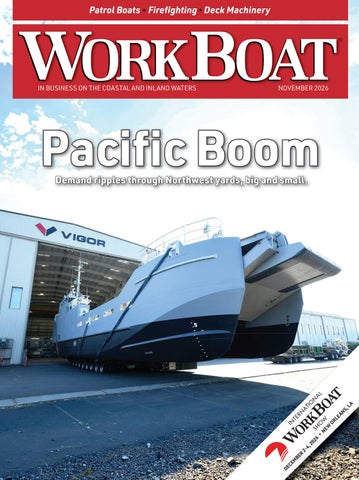
Pacific Boom
DE CE M
BE
R
2-
4,
20
26
▬
N
EW
OR
LE
AN S,
LA
Demand ripples through Northwest yards, big and small.
YOUR VESSEL DOESN’T NEED A CREW
BECAUSE OURS HAS YOU COVERED
When it comes to the future of marine innovation, Twin Disc offers more than just products— we deliver solutions backed by a century of marine expertise. From propulsion systems to advanced controls, our team leverages industry experience and technologies to support your vessel applications. Whether you need precision maneuverability, reliability in harsh conditions or seamless integration for your autonomous or uncrewed vessels, Twin Disc is built to perform—today and for the next generation of marine operations. CONTACT TWIN DISC TODAY TO DISCUSS YOUR NEXT AUTONOMOUS OR UNCREWED VESSEL PROJECT. LET US HELP YOU ACHIEVE NEXT-GENERATION PERFORMANCE AT SEA. TWINDISC.COM Disclaimer: Twin Disc supplies marine propulsion systems, controls, and related components only. Twin Disc does not provide complete autonomous or uncrewed vessels, nor does it guarantee autonomous operation that may be outside Twin Disc’s control.
POWER. PRECISION. PERFORMANCE.
Content
November 2026 VOLUME 83, NO. 11
FEATURES 16 Cover Story: Cascade Effect Northwest shipyards build capacity for growing commercial and government fleets.
24 Vessel Report: Patrol Plus Mission demands and operating conditions shape the latest generation of public-safety boats.
34 Focus: Fire Drill
24
Inside Stevens Towing’s emergency response training.
38 In Business: MetalCraft Marine Scaling to meet Navy, Coast Guard demand.
40 Final Word: Chris Feffer One-on-one with the president of Platypus Marine.
44 Pacific Marine Expo The U.S. maritime industry will convene in Seattle Nov. 19–21.
BOATS & GEAR 10 On the Ways Solar-electric catamaran will be a floating classroom • Electric pump-out boat cleans up Port of Friday Harbor • C&C delivers towboat to Southern Devall • American Cruise Lines christens fourth Patriot-class ship • Steiner Construction hands over Army Corps towboat • Great Lakes Towing extends tugboat newbuild series to 12 • Navy orders up to seven landing craft from Saronic, Conrad, and Master Boat • Bay-Houston takes delivery of new escort tug from Master Boat.
30 More on Board Deck machinery manufacturers are packing greater capability into tight spaces.
AT A GLANCE 4 Insurance Watch: Injury and claims trends. 4 On the Water: Only you can prevent geographic illiteracy. 6 Captain’s Table: Adapting is the name of the game. 6 Health, Safety, and Environment: Critical communications. 8 Legal Talk: In case of accident, preserve evidence.
www.workboat.com • NOVEMBER 2026 • WorkBoat
34 DEPARTMENTS 2 Editor’s Watch 49 Port of Call 56 Advertisers Index ON THE COVER
Vigor is building a series of Maneuver Support Vehicle (Light) landing craft for the Army at its shipyard in Vancouver, Wash. Credit: Vigor
1
EDITOR'S WATCH
Follow the money
Eric Haun, Executive Editor ehaun@divcom.com
I
t takes a lot of money to build ships, and it is entering U.S. shipyards in amounts this industry has never seen before. Under the U.S.–South Korea trade agreement, Seoul has pledged $150 billion toward shipbuilding cooperation, part of a broader $350 billion commitment. Hanwha paid $100 million for Philly Shipyard in late 2024 and has promised $5 billion to modernize it. In August, it followed with a nonbinding proposal to acquire Austal USA for more than $1 billion, though the move was countered by a larger bid from Florida-based Wildcat Infrastructure. HD Hyundai is teaming up with Edison Chouest Offshore in Tampa and with Kiewit in Texas, and Samsung Heavy is working with Vigor Marine Group in the Pacific Northwest. In October, Anduril announced a $3.7 billion investment to build a shipyard at Sparrows Point, Md.
Saronic, the Austin-based maker of autonomous vessels, chose Brownsville, Texas, in July as the site of its new $3 billion shipyard. The company bought the Gulf Craft yard in Franklin, La., in 2025 and is investing $300 million there. Canadian shipbuilder Davie, through its U.S. arm, Davie Defense, is putting up to $1 billion into converting Gulf Copper’s yards in Galveston and Port Arthur, Texas, into what it calls an “American Icebreaker Factory.” In August, Paris-based Antin Infrastructure Partners completed its acquisition of Vigor. Maritime Partners, founded in 2015, has grown from a lessor of towboats and barges into an owner of Jones Act tankers and, with its acquisition of Centerline Logistics and others, a major operator of tugboats and barges. The company has put nearly $1 billion into newbuilds at 12 U.S. yards, and its fleet now stands at roughly 1,900 vessels. Miami-based Tallvine Partners has assembled a marine infrastructure platform in about a year, buying Donjon Marine in 2025 and San Francisco’s Lind Marine in May. This September, it closed on the assets of Crosby Enterprises, which included more than 150 tugs, dredges, and support vessels, plus yards in Houma and Port Fourchon, La. Elsewhere, Cerberus Capital Management has partnered with HD Hyundai on a maritime investment strategy, and private equity firm Wynnchurch agreed to buy Arcosa’s inland barge business for $450 million. Clearly, capital is arriving. The vessels will be next.
EXECUTIVE EDITOR: Eric Haun / ehaun@divcom.com SENIOR EDITOR: Frank McCormack / fmccormack@divcom.com SENIOR ASSOCIATE EDITORS: Ben Hayden / bhayden@divcom.com Steve Mosco / smosco@divcom.com Kirk Moore / kmoore@divcom.com CONTENT PROJECT MANAGER: Carley Milligan / cmilligan@divcom.com CONTRIBUTING WRITERS: Tim Akpinar • Capt. Alan Bernstein Stephen Blakely • Dan Bookham G. Allen Brooks • Bruce Buls Denielle Christensen • Capt. Eric Colby Michael Crowley • Jerry Fraser Nate Gilman • Pamela Glass Capt. Arnie Hammerman • Ken Hocke Craig Hooper • Joel Milton • Peter Ong Richard Paine Jr. • Chris Richmond DIGITAL & PRINT PROJECT MANAGER: Doug Stewart / dstewart@divcom.com ADVERTISING ACCOUNT EXECUTIVES: Kristin Luke / kluke@divcom.com Jordan Randall / jrandall@divcom.com Krista Randall / krandall@divcom.com Danielle Walters / dwalters@divcom.com ADVERTISING COORDINATOR: Wendy Jalbert / wjalbert@divcom.com Producers of the International WorkBoat Show and Pacific Marine Expo
Vice President: Wes Doane, wdoane@divcom.com Publishing offices: 2 Portland Sq., Suite 200, Portland, ME 04101 Tel 207-842-5608 | Fax 207-842-5609 Subscriptions: cs@e-circ.net / 978-671-0444 Mon–Fri, 10 a.m.–4 p.m. ET
WORKBOAT® (ISSN 0043-8014)
is published monthly by Diversified Communications Two Portland Square, Suite 200, Portland, ME 04101
Annual Subscription Rates: U.S. $39; Canada $55; International $103. 3 When available, extra copies of current issue are $5. For subscription customer service call (978) 671-0444. The publisher reserves the right to sell subscriptions to those who have purchasing power in the industry this publication serves. Periodicals postage paid at Portland, ME. Circulation Office: Two Portland Square, Suite 200, Portland, ME 04101. From time to time, we make your name and address available to other companies whose products and services may interest you. If you prefer not to receive such mailings, please send a copy of your mailing label to: Printed in USA
2
WorkBoat’s Mailing Preference Service, PO Box 7437, Portland, ME 04112 POSTMASTER: Send address changes to WORKBOAT, P.O. Box 1792, Lowell, MA 01853.
Copyright 2026 by Diversified Communications
© Diversified 2026 | Printed in the U.S.A. To update your WorkBoat account, change your address, or manage your subscription, visit WorkBoat.com.
www.workboat.com • NOVEMBER 2026 • WorkBoat
AT-A-GLANCE
Insurance Watch
Injury and claims trends in shipyards and aboard workboats BY DAN BOOKHAM Dan Bookham is a vice president with Allen Insurance & Financial. He specializes in longshore, offshore and shipyard risk. He can be reached at 1-800-236-4311 or dbookham@allenif.com.
S
hipyards and workboats offer some of the most demanding environments in any industry. Heavy equipment, tight schedules, variable weather, and constantly changing work scopes create a risk landscape all their own. Despite meaningful investments in safety, recent injury and claims trends suggest familiar hazards continue to drive losses, often in predictable ways. The most common shipyard injuries remain consistent. Slips, trips, and falls top the list, driven by uneven surfaces, hoses and cables underfoot, temporary lighting, and changing elevations. Strains and sprains follow, often tied to manual handling, awkward postures, or repetitive tasks. Such claims may seem minor, but they frequently become longtail losses with significant medical and indemnity costs. Aboard workboats, the pattern is similar. Falls on wet decks, step-down injuries between levels, and hand injuries during line handling or equipment use account for a large share of claims. Transfers between vessels, or between vessel and dock, remain especially high-risk, particularly under
On the Water Only you can prevent geographic illiteracy BY JOEL MILTON Joel Milton works on towing vessels. He can be reached at joelmilton@yahoo.com.
L
earning how to operate a tug or towboat is not easy. Learning how to handle barges is orders of magnitude more difficult. I’m referring to the actual boat- and bargehandling, the throttle and rudder actions that make things happen, and nothing else. For a trainee, it is usually a formidable and overwhelming experience, especially early on. And it’s not exactly easy for the trainer. At first, virtually all mental bandwidth is used just to handle the basics: moving the boat, steering, and navigating the waterways. For that reason, I handle all radio communications in the beginning, gradually allowing trainees to take on more and more as they build skills and confidence. It takes time, and there is no substitute. 4
time pressure or fatigue. Shorthanded crews and extended hitches add to strain injuries. From a claims standpoint, severity rather than frequency is the growing concern. Fewer minor claims are reported, but those that arise tend to be more complex and costly. In shipyards, delayed reporting and inconsistent documentation complicate defense, and overlapping workers’ compensation and maritime exposures can blur jurisdictional lines. For workboat operators, Jones Act and maintenance-and-cure claims remain among the costliest losses, especially when early investigation is weak. Operational stress also plays a growing role. Tight labor markets, project backlogs, and aggressive timelines can incentivize shortcuts. When safety procedures are treated as flexible rather than foundational, small deviations compound. These incidents rarely stem from a single failure; they usually reflect systemic issues in communication, supervision, or workload management. Organizations that improve year over year focus on the same fundamentals. They report all injuries and near misses early, not just recordables. They train supervisors, since frontline leaders drive behavior and claim outcomes. They analyze claims alongside operational data to spot patterns tied to specific tasks, crews, or phases of work. For shipyards and workboat operators alike, the message is clear: injury and claims trends are rarely random. They reflect how work is planned, staffed, supervised, and corrected. Addressing them doesn’t require reinventing safety programs, but it does require discipline: consistent procedures, clear expectations, and a willingness to act on what the data say. I’ve told numerous trainees that I can teach them the local and regional geography, and I can teach them how to drive the boat, but I can’t teach them both at the same time. They simply can’t absorb all that information at once, let alone retain it, and attempting to do so significantly compromises both efforts. It’s very difficult at best in most places. Amid the geographical and hydrological complexity of New York Harbor? Not possible. It’s a lot easier for everyone if you learn the geography, on land and underwater, first. That is, while you’re still a deckhand. Geographic knowledge and literacy, for wherever you operate, rank right up there with boat-handling and situational awareness as critical skills. In fact, you will never have the level of situational awareness you need without that geographic knowledge. This problem began, and has been steadily worsening, with the advent of the smartphone. Most humans have outsourced most of their navigational capabilities to their phones, tablets, or the built-in navigation systems in their cars. It’s super-convenient, and really unwise. In that regard, we ask far less of our brains than we used to, and it shows. www.workboat.com • NOVEMBER 2026 • WorkBoat
Thrusters You Can Rely On.
Engineered for Maximum Efficiency. Built for Performance. Discover the latest from Sleipner, a global leader in commercial marine thrusters for more than 40 years. Always committed to relentless innovation.
• AC, DC & Hydraulic Thrusters • Now with Tunnels up to 29” • Efficient Design for Maximum Water Flow • Less Noise & More Thrust • Solutions to Fit a Wide Range of Vessels
See the full range of Sleipner thrusters at Imtra.com
Bringing you the best.
Find Your Ideal Solution at Imtra.com or Call Our Product Experts at 508-995-7000
AT-A-GLANCE
Captain’s Table
Adapting is the name of the game BY CAPT. ALAN BERNSTEIN Alan Bernstein, owner of BB Riverboats in Cincinnati, is a licensed master and a former president of the Passenger Vessel Association. He can be reached at 859-292-2449 or abernstein@bbriverboats.com.
A
s many in the passenger vessel industry begin winding down 2026 seasons, I thought it would be a good time to look back at the past year and, more importantly, look ahead to what may be in store for us in the coming year. For BB Riverboats, 2026 has been challenging. Fuel, food, personnel, maintenance, and nearly every other operational cost have continued to climb, often faster than we can reasonably pass along through our retail prices. For smaller operators, that means absorbing rising costs. The unanswered question is how long we can sustain these increases and remain profitable. All of us are coping with rising fuel prices that are significantly impacting operating expenses. Over the years, I have watched diesel prices go up and down, but this year’s volatility and increases have been especially difficult to absorb.
Health, Safety, and Environment Critical communications: crisis vs. emergency BY RICHARD PAINE JR. Richard Paine Jr. is a licensed mariner and certified maritime safety auditor with more than 25 years of maritime industry experience. He can be reached at rjpainejr@gmail.com.
T
hroughout my career, I have seen my fair share of emergencies and crises, as both an operator and shoreside leader. I have participated in multiagency partnerships and led large drills and tabletop exercises across state, federal, and private industry. One of my most important lessons is also easy to overcomplicate: the most successful responses depend on proper communication, and on knowing the difference between planning, training, and responding for an emergency versus a crisis. It is common to think an emergency and a crisis are one and the same. They share similarities: both demand immediate attention, notifications, quick communication, and time-sensitive information. From a business or operations perspective, however, they share more differences, and a company’s planning, training, and response should reflect them. It is useful to think of an emergency as an immediate, short-term event, 6
Food is a big part of why people enjoy our cruises. This year we have also struggled with rising food costs. Prices for everything from meat, chicken, and fish to fresh vegetables, fruit, and potatoes have risen dramatically. Higher prices, combined with inconsistent quality, are never a good situation for a hospitality business. Maintenance costs are another continuing concern. Engines, air-conditioning units, pumps, navigation equipment, furniture, and fixtures have increased significantly. Durability seems to be lacking on some of our equipment purchases. Service and repairs can also take longer, and too often we find ourselves calling someone back to address the same problem a second time. All of that means additional costs and additional downtime. These challenges are not unique to BB Riverboats. Every passenger vessel operator has its own set of circumstances, but we all are struggling to find ways to balance rising costs with what our customers are willing and able to pay. Even so, I am looking forward to the challenges and opportunities presented in the coming year. I am ready to put 2026 behind us and move forward optimistically. Our industry has always found ways to solve problems and successfully adapt. I hope that 2027 gives us a little more room to do just that. versus a crisis, which has longer-term implications. Some operations create robust plans, exceeding 50 pages, for crisis and emergency communications. They cover how vessels notify shoreside during an emergency, how individuals handle media inquiries, and often include lengthy call lists and notification trees. All of it is valuable when an emergency reaches the level of a crisis. But there is a time and place for such plans, and it is not during an emergency. Companies make mistakes when they overlook that. Though similar, the two require fundamentally different approaches to preparing a crew. Crisis communications involve expanded responses and notifications, stakeholder collaboration, and public statements. In an emergency, when time is of the essence, that process is cumbersome. Simple, clear, concise communication remains the most practical way to communicate during an emergency situation, and training should always reflect that. Who do I need to contact? What is their number? If I can’t reach someone, who do I call next? In these moments, crews should not worry about public image, investors, or other stakeholders. Communications must stay focused on the emergency itself: fires, medical needs, security threats, public disruptions, operational hazards. Time is of the essence! It is easy to overthink the most important piece: immediate notification from a vessel to shoreside support. When someone on land calls for help and hears “9-1-1, what is your emergency?”, the response is direct and immediate. Vessel notifications should be the same. www.workboat.com • NOVEMBER 2026 • WorkBoat
Join Cummins at Workboat 2026 The productivity of your marine operation largely depends on one factor: uptime. Cummins engines are durable by design. Built for longevity, our proven low maintenance requirements mean no midlife overhaul. And the longer your vessels stay on the water, the more they can power your operation. Trust in dependable power and expert support. Choose Cummins, don’t compromise.
Visit us in Booth 3001 ©2026 Cummins Inc.
AT-A-GLANCE
Legal Talk In case of accident, preserve evidence BY TIM AKPINAR Tim Akpinar, based in Little Neck, N.Y., is a maritime attorney and former marine engineer. He can be reached at t.akpinar@verizon.net or 718-224-9824.
S
teering gear problems are as old as the first time someone strapped a plank onto the starboard quarter of a Viking longship centuries ago. Sometimes the problem is mechanical, as with the steering ram of the supertanker Amoco Cadiz in March 1978. Sometimes the problem is operational, as with a steering system bypass valve being left open aboard the containership CMA CGM Puccini in May 2023. Sometimes the problem is electrical, as in the case of the BBC Africa losing steering in the Houston Ship Channel in August 2025. The NTSB suspected a bridge wing tiller microswitch there. These steering failures teach us technical lessons. But we might learn a legal lesson from a steering failure that took place about a decade ago with a jet boat accident on the Colorado River near Moab, Utah. This steering failure teaches us
GRIDCOOLER® KEEL COOLER
what happens when evidence is not properly preserved. There’s even a name for this, which is “spoliation.” Spoliation can include destruction, concealment, or failure to preserve evidence. About a month after installing a new steering helm and ram, the jet boat suffered a steering loss while carrying 28 passengers and crashed into the shoreline. There were injuries. The tie-rod for the steering system had become separated from the port tiller arm, where the culprit was suspected to be a nut that had backed off. During repairs, the damaged steering system was discarded. The injured passengers argued that the owners knew the damaged steering system was critical evidence and had a duty to preserve it. This placed the passengers at a disadvantage, since they wouldn’t be able to inspect the damaged steering system and review the vessel operator expert’s opinion about the cause of the failure. The court granted sanctions (legal penalties) to the boat passengers against the boat operators. The court also ordered that the opinions of the vessel operator’s expert be excluded from evidence. The lesson here is that there can be consequences for losing, destroying, or failing to preserve evidence. And it doesn’t necessarily require deceit or malicious conduct. Negligently losing evidence can hurt the side that loses it.
BUILDERS OF CUSTOM HIGH-PERFORMANCE ALUMINUM PATROL BOATS
MADE STRONGER TO WORK LONGER
BUILT TO TAKE IT ON
1.906.863.5553 | fernstrum.com/wb
The management system governing the manufacture of this product is ISO: 9001:2015 certified. © 2026 R.W. Fernstrum & Company. All rights reserved. FERNSTRUM® and GRIDCOOLER® are registered trademarks of R.W. Fernstrum & Company. All other trademarks cited are the property of their respective owners.
8
65 MPH, Quad Suzuki 350’s, Walk-in cuddy gun storage, Five ports for machine gun stand, Starlink WiFi connected, Gilman collar with replaceable sections, Forward and center consoles with 6 X Shoxs suspension seats with lapbelts, Complete Raymarine/FLIR nav/targeting system DELIVERY SLOTS AVAILABLE FOR 2027 DELIVERY 22419 Fisher Road, Watertown, NY, 13601 USA • 1-800-410-8464
www.workboat.com • NOVEMBER 2026 • WorkBoat
TRUST BUILT US. PARTNERSHIPS KEEP US GOING.
ON THE WAYS CONSTRUCTION ACTIVITY AT WORKBOAT YARDS
Alison Langley / Upstream Alliance
Solar-electric catamaran will be a floating classroom
Firefly, a 49'x20' aluminum catamaran built for Upstream Alliance, was launched Aug. 3 by Lyman-Morse Workboats, Thomaston, Maine.
S
tudents in Camden, N.J., will soon be collecting water samples from under a canopy of solar panels, aboard a boat that burns no fuel. Firefly, a 49'x20' aluminum catamaran launched Aug. 3 by Lyman-Morse Workboats, Thomaston, Maine, was built to be a floating classroom. Its owner, the nonprofit Upstream Alliance, said it’s the first U.S. Coast Guard-approved passenger vessel to use lithium iron phosphate batteries. Designed by Gerr Marine, New York, the Subchapter T boat will work out of Wiggins Marina on the Delaware River. The panels are the first thing people notice, said Capt. Don Baugh, Upstream’s president and founder. “You look up, you see solar panels, you see the filtered light coming through,” he said. Bifacial solar panels totaling 12 kW sit on the awning over the main deck. They charge 48 Lithionics lithium iron phosphate batteries, 24 in each hull, which drive two 60-kW Electric Yacht QuietTorque motors. There is no generator. Firefly has a 12-knot top speed, an 8-knot cruise, and a range of 70 nautical
10
miles at cruise. Baugh, a longtime leader in environmental education, said solar-electric propulsion was part of the pitch from the start, partly because of the environmental advantages, but also because of the careers it could point students toward. “These kids are going to grow up, and these [green tech] jobs are the type they could have one day,” he said. Gerr initially recommended a generator for range and speed, but Baugh declined. “The whole boat is a battery bank essentially,” he said. Regulators had no precedent to work from. Baugh said inspectors at the Coast Guard’s Marine Safety Center knew of no similar vessel. Venting and fire suppression were the biggest design hurdles. Lithium iron phosphate is safer than other lithium chemistries, Baugh said, and in a failure, “these batteries don’t really burn; they smoke.” The vent system keeps those fumes at least 10' from passengers. The Coast Guard treats all lithium batteries alike, Baugh said, and denied
a request for an aerosol suppression system. The boat instead has a seawater spray system with copper-nickel piping and Bete nozzles, designed with Hiller. “You’re going from spray to steam, and then you vent that,” he said. Firefly will anchor the Camden Education Program, which Upstream began five years ago. Olivia Liu, program and communications director, said the group now charters a vessel for two weeks each spring and two weeks each fall. The goal is to put every fourth- through 12th-grader on the water three times before graduation, “hopefully, over time, changing the culture of how the Camden community interacts with its waterways,” she said. The boat was designed around that mission. A lifting stern platform can launch kayaks, drop a diver, or deploy a trawl net. A folding bow ramp lets the boat beach so students can walk off. Deck space can accommodate six tents for overnight trips, and the boat carries 40 passengers. “It’s a catamaran, so it’s super stable,” Liu said, which helps students who may be nervous about spending time on the water. A typical day starts with a run up the Delaware and into the back channel, where students test dissolved oxygen and pull plankton nets and trawl nets. Microscopes and an onboard screen show what they find. The group then lands at Palmyra Cove Nature Center in Cinnaminson, N.J., for seining and lunch. Lessons are aligned with New Jersey standards so teachers can continue them in class. The propulsion system doubles as teaching equipment. “You open everything up; you can see everything. It’s not hidden away,” Baugh said. Upstream is working with boating author Nigel Calder, who sees the boat as a classroom for green technology, and with a maritime academy in Philadelphia. Liu said some students are even curious about running the boat. Donors covered construction of the $3.2 million vessel: an anonymous regional donor and the William Penn Foundation ($1 million each), the American Water Charitable Foundation
www.workboat.com • NOVEMBER 2026 • WorkBoat
($250,000), and a Chicago family fund. Operating costs are a separate problem. “There’s no gate. We can’t charge people,” Baugh said, so the boat will depend on philanthropy and grants. Other groups are watching. Baugh said the Massachusetts Institute of Technology and the Sea Education Association, Woods Hole, Mass., are interested, partly because Firefly needs only a captain and a mate. Sea trials are expected around Oct. 12. Baugh plans to captain the delivery to Camden in late October or November. Students are due aboard in April, and a christening with local officials is planned for spring. — Eric Haun
Electric Pump-out Boat Cleans Up Port of Friday Harbor
T
he Port of Friday Harbor in Washington State in September took delivery of a new pump-out boat powered by twin electric outboards from Photon Marine. The vessel was funded through the Washington State Department of Transportation (WSDOT) Port Electrification Grant Program. It allows the port to launch a broader program of carbonreduction projects and establish sustainable maritime practices in the Salish Sea. “In our marinas the old gas-powered pump-out boat was the obvious place to start,” Kyle Gropp, deputy director of
Photon Marine
ON THE WAYS
The pump-out vessel Pooseidon is powered by twin Photon Marine electric outboards that produce 300 hp at peak power.
Port of Friday Harbor, wrote in an email. “It burned roughly 3,160 gallons of gasoline a year, and during peak season it shifted gears up to 3,000 times a day, which wore out the lower unit and drove up maintenance costs. “An electric outboard has no gears in the lower unit to grind; reversing just spins the motor the other way. That made the pump-out boat a natural first candidate for electric power.” The vessel was christened Pooseidon, and it is a 28' aluminum Versabarge monohull designed and built by Silverback Marine in Tacoma, Wash. It’s powered by twin Photon Marine electric outboards that make peak power at 300 hp and 150 hp continuously. Electricity is provided by 63-kWh batteries made by Kreisel Electric, an Austrian company in which John Deere acquired a majority stake in 2022. Production will be moved to the United States, according
www.workboat.com • NOVEMBER 2026 • WorkBoat
to Alana Kambury, director of operations at Photon Marine. Each battery weighs about 800 lbs., and depending on how you use them, they can be recharged with a DC fast charger in approximately 45 to 120 minutes or overnight when plugged into a standard 120-volt marina pedestal. Pooseidon can carry up to 325 gals. of wastewater (hence the spelling of its name). During a busy weekend motoring out to moored vessels, Port of Friday Harbor estimates that the boat will run 10-hour shifts and average six hours per day for 300 days a year. The gasoline-burning, outboard-powered boat used 1.5 gph, which translated to $45 per day in fuel compared to $1.75 for electricity to charge the Photon outboards. In a YouTube video on the delivery of the new boat, the port said it spent $20,000 per year on maintenance for the gasoline outboards.
11
ON THE WAYS Gropp added that going with Photon Marine, based in Portland, Ore., kept the project close to home. “It gave the port a completed Pacific Northwest-built solution, pairing locally developed electric propulsion technology with a Silverback Marine hull built in Tacoma,” he wrote. “That combination aligned well with the port’s operational needs and long-term electrification goals.” The base cost of the hull, motors, and batteries was $444,792. Electric outboards cost more up front, primarily because of the batteries, but Gropp said the savings come during operation. Fuel costs are minimal, and there are no oil changes or lower-unit rebuilds. The port estimates it will recoup the added cost in roughly two to three years. Electric outboards also work well in a pump-out application because the job requires short, low-speed transits and lowpower operation. Typically, the batteries can last a full day before recharging.
Photon Marine is focusing on commercial applications such as crew transfer, surveillance, oyster-bed work, and uncrewed vessels from 24' to 42'. While other electric-propulsion suppliers have acquired boat manufacturers or built their own hulls, Photon has partnered with Silverback and other builders so that it can concentrate exclusively on designing and supplying complete electric propulsion systems. Many of the components for these systems often come from familiar names such as Dometic and Garmin, because commercial operators tend to prefer equipment they already know, according to Kambury. “We make many bespoke parts, but no more than necessary,” she said. “We source many parts for our system from the automotive industry because high production volumes drive down cost and improve reliability. We don’t white-label any parts. If a part comes from Bosch,
it will say Bosch. If a part is our own, it will carry the Photon trident brand.” For example, the Intrepid, a 24' workboat that Photon built with Silverback for the New York Power Authority, includes software that tracks charging status, maintenance schedules, environmental and navigation data, motor and power history, battery levels and power consumption over time. “This centralized platform is designed for commercial operators managing multiple fleets, marinas or port locations on a single screen,” said Kambury. Pooseidon is the first vessel in a program developed by WSDOT’s Climate Commitment Act that Gropp said allows the port to think more broadly. The harbor is acting on a comprehensive electrification strategy that includes electric workboats, a 40-ton travel lift, cruiseship shore power, a vessel charging infrastructure, and a nearly quarter-acre solar array. — Capt. Eric Colby
VIDA/VGP COMPLIANT | BIODEGRADABLE | NON-BIOACCUMULATIVE
COMPLIANCE WITHOUT
COMPROMISE
High-performance Environmentally Acceptable Lubricants protect stern tubes, deck machinery, winches, and hydraulic systems against wear, corrosion, and heavy marine loads.
Visit biomaxlubricants.com to learn more.
12
www.workboat.com • NOVEMBER 2026 • WorkBoat
ON THE WAYS
C&C Marine and Repair
B
elle Chasse, La.-based C&C Marine and Repair has delivered the Capt. Pete Ciaramitaro, a 2,600-hp inland towboat, to Southern Devall, Sulphur, La. The 87’x33’8”x11’3” Capt. Pete Ciaramitaro is the first in a series of six inland towboats C&C Marine is building on spec using a basic design adapted from an earlier series built for the Canal Barge Co., New Orleans. American Cruise Lines (ACL), Guilford, Conn., christened its new vessel, the American Ranger, on the Hudson River in late September. The 243’x56’ newbuild, built by Chesapeake Shipbuilding
Corp., Salisbury, Md., is the third new ship launched for ACL this year and the fourth of its Patriot class. Next year, ACL will introduce two more sisterships, the American Mariner and the American Navigator, as well as a riverboat, the American Anthem. The Army Corps of Engineers’ St. Paul District launched its new maintenance and repair towboat, the Fountain City, in late August, at Steiner Construction Co. Inc., Bayou La Batre, Ala. The vessel will support the district’s maintenance and repair section by moving fl oating plants and other equipment along the Upper Mississippi River. It will be based at the Corps’ Fountain City (Wis.) Service Base. American Cruise Lines
BOATBUILDING BITTS
B e i e r I VC S 4 0 0 0
Chester Morrison DP2 Saturation Multipurpose Service Vessel
Beier’s USA based facility has over 100,000 square feet for design, engineering and manufacturing of consoles, switchgears, and panels starting with raw material fabrication and assembly, all the way through delivery and commissioning.
Workboat November Half Page 2026 Beier.indd 1
www.workboat.com • NOVEMBER 2026 • WorkBoat
· Beier IVCS 4000 DP-2 Dynamic Positioning & DP Alert System · Wind Monitoring System · Gyrocompass System · Upgrading the Alarm and Monitoring System to support current operational configuration · Spottrack System · Upgrading the Autopilot System to AP70-MK2 · Differential Global Positioning System (DGPS)
9/18/26 10:42 AM
13
ON THE WAYS
US Navy
The Great Lakes Towing Co., Cleveland, Ohio, announced it has ordered two new tugboats, expanding its long-running newbuild program to 12 vessels. The company said it has ordered the harbor tugs from its sister company, Great Lakes Shipyard, Cleveland, for scheduled delivery in late 2027 and early 2028. The 64’x24’x11’ newbuilds will be constructed to the Stan Tug 1907 ICE design from Damen Shipyards Group, Gorinchem, Netherlands. The Navy has awarded a trio of competitive “Prototype Other Transaction” (flexible, nontraditional development)
BOOTH #3670
FLEX
COMMERCIAL RECREATIONAL 10G IMPACT MITIGATION
Master Boat Builders
BOATBUILDING BITTS
agreements to three Gulf Coast shipyards for the construction of Landing Craft, Utility (LCU) 1700 vessels. Under the agreements, the Navy will receive up to seven LCU 1700s from Saronic Technologies, Brownsville, Texas; Conrad Shipyard, Orange, Texas; and Master Boat Builders, Coden, Ala. Master Boat Builders, Coden, Ala., has delivered the Barbara G, the first of two Robert Allan Ltd.-designed Rapport 3000 escort tugs being built for Bay-Houston Towing Co., Houston. The 98’x43’ tug will be operated by G&H Towing Co., Galveston, Texas, for ship-assist and escort work along the Texas Gulf Coast. It offers more than 90 metric tons of bollard pull.
Design for the Future
Design for the Future.
Snow and Company is proud to build battery-powered electric ship-assist tugs among many more. As we tread toward a better future we seek like minded individuals to join our team.
FP4 NEW!
RECREATIONAL 6G IMPACT MITIGATION
FLEXpod HD
COMMERCIAL COMMERCIAL RECREATIONAL RECREATIONAL 6G IMPACT MITIGATION
SHARKSEATING.COM 14
SNOW & COMPANY, INC SEATTLE, WASHINGTON 206-953-7676 SNOWBOATBUILDING.COM
www.workboat.com • NOVEMBER 2026 • WorkBoat
Experience a Sea Change in workboat crew communications.
David Clark Marine Headset Systems Series 9100 Digital Crews on board tug and tow boats, fire/rescue craft, offshore service Communication System vessels, patrol boats and other workboats must perform a variety of Scalability • Versatility • Simplicity complex operations. Wind noise, loud engines and pounding through rough waters can make boat crew communication extremely challenging.
David Clark Marine Headset Systems offer clear communication and rugged reliability in the harshest marine environments, while enhancing the safety and situational awareness of boat crew members. Call 800-900-3434 (508-751-5800 Outside the USA) to arrange a system demo or visit www.davidclark.com for more information.
© 2026 David Clark Company Incorporated ® Green headset domes are a David Clark registered trademark.
W W W. D AV I D C L A R K . C O M
COVER STORY
Cascade Effect Northwest yards build capacity for commercial and government fleets. By Ben Hayden, Senior Associate Editor
T
he Pacific Northwest is home to a mix of large repair yards, boatbuilders, and new entrants seeing increased activity tied to Navy modernization work, Coast Guard fleet recapitalization, and new private investment. From a startup shipbuilder occupying a former World War II yard outside Portland, Ore., to established boatbuilders delivering specialized vessels for the Coast Guard, companies across the region report growing backlogs and expansion plans. The activity across these shipyards points to a region positioning itself for a larger share of the nation’s shipbuilding and repair work. The Pacific Northwest’s existing industrial base, composed of drydocks, fabrication facilities, and a workforce with decades of experience in complex vessel construction and repair, is drawing renewed attention as the Navy and Coast
16
Guard look to expand capacity outside the traditionally dominant Gulf Coast and East Coast yards. That attention is showing up in concrete terms with new ownership and technology investment at Vigor Marine Group, a startup filling out a Kaiser-era yard at New Pacific Industrial, specialized newbuild contracts at Rozema Boat Works and North River Boats, and infrastructure work at Cape Disappointment tied directly to the vessels those yards are producing. Whether that momentum continues will depend in part on factors outside any single company’s control: federal budgets, contracting timelines and the pace of the broader shipbuilding buildout nationwide. For now, the companies interviewed for this story describe a region with more work in front of it than it has seen in years. www.workboat.com • NOVEMBER 2026 • WorkBoat
Oregon Historical Society
During World War II, Kaiser's Northwest shipyards employed up to 97,000 workers and built 752 ships.
COVER STORY NEW ENTRANT, OLD FACILITY
New Pacific Industrial has landed its first new construction program, a pair of 122'x37' oceangoing tugs for American Marine Corp., Honolulu.
“We’ve been regularly in D.C. and telling the Navy, ‘Hey, we’re here. You’re asking for new capacity. We’re here and we’re ready to support,’” he said. He noted that building out the qualitymanagement systems and operating track record needed to take on defense work will take time, but said the company isn’t waiting for contracts to come to it. As New Pacific looks beyond the American Marine tug contract, Roney said the company is pursuing work on “long, large, complex, welded, and assembled structures,” a tagline description Palmer uses to capture opportunities beyond complete vessels. Corvelli said New Pacific sees no upper limit on the complexity of work it could eventually pursue, including module construction for large Navy shipbuilding or submarine programs, though the near-term focus remains on
“You’re asking for new capacity. We’re here and we’re ready to support.” — Joe Corvelli, CEO, New Pacific Industrial
than… standard commercial construction,” he said. That effort includes direct outreach to the Navy. Corvelli said the company has made repeated trips to Washington, D.C., to make its capabilities known to Navy leadership as the service seeks new sources of production capacity.
the tugboat contract and building out the yard’s workforce and systems. As for the opportunity, Corvelli recalled a comment from a Pacific Fleet admiral at a commissioning ceremony for the new Dry Dock 5 at Pearl Harbor, where Corvelli was working in a prior role. “He said, ‘This is the
www.workboat.com • NOVEMBER 2026 • WorkBoat
Glosten
New Pacific Industrial, Portland, Ore., occupies a facility that was one of the Kaiser Co.’s three Portland-area shipyards during World War II, when the site produced escort carriers and Liberty ships. The company, founded by CEO Joe Corvelli, CCO Pete Roney, and COO Chris Palmer, is in its early stages but has already secured its first newbuild contract. “We’re in what essentially is a 220-plus-acre shipyard that... was part of supporting the Pacific Fleet,” Corvelli said. “Escort carriers came out of these buildings that we’re in.” Corvelli said the company will reuse existing industrial infrastructure rather than build new capacity from scratch. New Pacific’s first contract is for two 122' oceangoing tugs for American Marine Corp. Roney described the arrangement as a design-build partnership rather than a traditional fixed-spec bid process. New Pacific currently has fewer than 20 employees and expects to reach more than 30 by the end of the year, with a goal of more than 100 once the facility reaches capacity. Beyond the initial tug contract, Corvelli said the company is structuring its leadership and engineering teams around capabilities beyond standard commercial construction, with an eye toward supporting the defense industrial base. “We’re building the project, the project management, the engineering management, the technical leadership team to have capabilities greater
Pacific century,’ from a Navy perspective. Everything is about…where the capability is going to come from for the Pacific, and how the capability is going to be supported in the Pacific,” Corvelli said. “And so, you know, for us, boy, what opportunity.”
NATIONWIDE FOOTPRINT
Vigor Marine Group operates four repair yards — Swan Island in Portland, Ore.; a Seattle facility; the former Continental Maritime San Diego shipyard; and the former MHI Norfolk shipyard in Norfolk, Va. — along with a fabrication facility in Vancouver, Wash., and two services companies, Accurate Marine and Vigor Services Seaward. The Swan Island facility employs roughly 1,000 people. The Seattle yard, which is about half that size, carries a heavier share of Navy work, according to Benton Strong, Vigor’s public affairs director. Current work includes modernization availabilities on the destroyers USS Kidd and USS Sampson and the littoral combat ships USS Gabrielle Giffords and USS Savannah, split between the Northwest yards. Vigor recently completed work on the Coast Guard icebreaker Healy in Portland, and the Polar Star was pierside in Seattle at the time WorkBoat went to print. “The biggest kind of new and growing area is the modernization programs,” Strong said. “There is work to modernize these vessels because it’s faster and 17
a bit cheaper to modernize an existing vessel if you’re trying to grow the fleet.” Vigor’s Seattle yard also performs regular work for Washington State Ferries, including a hybrid-electric conversion completed last year. Strong said the company works with the ferry system to accommodate emergent repair needs alongside Navy and Military Sealift Command priorities. “We have a long history with Washington State Ferries. We built half the fleet,” Strong said. “We are proud to be able to support WSF in scheduled availabilities and with emergent repair.” In August, Paris-based private equity firm Antin Infrastructure Partners acquired Vigor from an affiliate of Lone Star Funds, Dallas. Financial terms were not disclosed. Strong said the new owner recognizes the importance of continuing to invest in the technology and facilities required to operate a “world-class shipyard.” The company is also finalizing a joint development agreement with Samsung Heavy Industries covering technology exchange, potential repair collaboration and a planned workforce training center likely to be sited in Seattle. CEO Francesco Valente, who entered the role two years ago, said the company’s focus on maintenance and modernization sets it apart among major
Vigor Marine Group
COVER STORY
Vigor Marine Group's Portland, Ore., shipyard handles a mix of commercial and government work, including modernization availabilities for Navy vessels and repair and maintenance work for cruise ships and other commercial customers.
ship repair companies. “Vigor Marine Group is the only one of the major ship repair companies with a main focus on maintenance and modernization,” Valente said. “Our commercial mindset means we can deliver for our customers by using the deep expertise we have gained to anticipate their needs and provide solutions before issues arise. This has enabled us to complete nearly every Navy availability on time over the last decade.” Valente pointed to specific technology investments the company has made to
support that work, including ultra-highpressure paint removal, 3D scanning, and increasingly automated processing with a recent focus on how it generates, moves, and manages production data. “We have focused on how we generate, move, and manage data more efficiently to improve planning, manage change faster, and provide better information to our production workforce at the point of execution,” Valente said. Valente also said that reforming the Navy’s contracting model through multiyear awards or bundling multiple ves-
REAL WORKBOATS. REAL RESULTS. See how marine professionals are putting Orca3D to work GRIZZLY 21 LE | Petestep & Silverback Marine
Marine CFD | Simulations to evaluate performance before fabrication
PUT ORCA3D TO WORK Scan to start your FREE 15-Day Trial www.Orca3D.com/workboat
18
EDITH FOSS | FARO Industrial
Advanced Stability | Repowering a tug with detailed stability analysis
ü
Easy to use.
ü
Accurate results.
ü
All inside Rhino®.
VISIT BOOTH #1364
NEW ORLEANS | DEC. 2-4, 2026
www.workboat.com • NOVEMBER 2026 • WorkBoat
McDermott Light & Signal
Portable Barge Navigation Lights Solar or battery powered barge navigation lights for unmanned barges per UL1104
Solar Marker Lights
1 meter
Dredge Lights
1 to 3 mile visibility for aids to navigation and applications such as buoys, docks, barges, and temporary lighting
Meets 2 mile requirement for marking of dredge pipelines
Regulatory Buoys
Available for all applications
Navigation Lights Platform Marker Lights
*Available with or without lighting*
For vessels greater or less than 50 meters Certified to meet UL 1104 and Subchapter M
Permanent mount LED lighting for bridges, docks, and barges
Certified Portable Anchor Lights Portable and long lasting
Peep (Steering) Lights AC/DC LED Floodlights
Constructed for rugged marine and commercial environments.
Available with AC/DC connection, solar or battery operated
718-456-3606 | www.mcdermottlight.com workboat@mcdermottlight.com
COVER STORY sels into single packages would support better planning and greater investment in facilities and workforce over time.
Rozema Boat Works
COAST GUARD BOATS Rozema Boat Works, Mount Vernon, Wash., held a keel-laying ceremony in July for the first vessel in the Coast Guard’s Special Purpose Craft-Heavy Weather 2nd Generation (SPC-HWX II) program. The 64' boats are designed to replace the Coast Guard’s 52' heavyweather boats, which served from the 1950s until their retirement in 2021. The Coast Guard’s contract with Rozema is worth up to $70.9 million for as many as six vessels. Designed by Camarc Design, Chichester, England, the SPC-HWX II features a self-righting hull rated for 35' seas, 25' surf, and winds up to 60 knots. Twin 1,200-hp diesel engines will give the boats a top speed of 20 knots and a towing capacity of up to 300 tons, with a 150-mile offshore range and accom-
In July, Chief Warrant Officer Beth Slade, commanding officer of the National Motor Lifeboat School, and Rep. Rick Larsen, D-Wash., welded their initials into the keel of the first heavy weather surf boat.
modations for a relief crew supporting missions of up to 48 hours. Delivery of the first vessel is scheduled for 2027. All six boats will be homeported in the Pacific Northwest.
North River Boats, Roseburg, Ore., was awarded a fixed-price, indefinitedelivery, indefinite-quantity contract in September 2025 for up to 66 Cutter Boat-Aids to Navigation-Small (CB-
Weld Anywhere
Mobile welding for flexible, large-scale fabrica ion
path-robotics.com
20
www.workboat.com • NOVEMBER 2026 • WorkBoat
COVER STORY ATON-S) vessels. The contract, valued at approximately $11.8 million, was issued as a total small-business set-aside. The 21' aluminum monohull boats, powered by twin four-stroke Honda 60hp outboards, will deploy with the Coast Guard’s future Waterways Commerce Cutters (WCC) and support shore-based aids-to-navigation teams. The CBATON-S will serve as the standard cutter boat across all three WCC variants: river buoy tenders, inland construction tenders and inland buoy tenders. The cutters are replacing an aging fleet of inland tenders, some more than 70 years
old, that maintain more than 28,000 aids to navigation across 12,000 miles of inland waterways. Mike Blocher, North River’s director of sales, said the structure and pace of the 66-boat award fit the company’s approach to government work. “We don’t generally go after large contracts. We’re not the company that looks for a 100-boat contract from the Navy,” he explained. “This contract is, one, a repeat contract for us, and two, it spans multiple years. So, it’s 66 boats, but it’s over five or six years. It’s roughly 10 boats a year after it gets
rolling, so it’s not a big demand on our production schedule.” “This is the only government-furnished equipment that the government is supplying to the shipbuilders for the WCCs,” Blocher said. “The cutter program is being watched pretty closely, and we have to be on schedule for them to stay on schedule.” Brent Hutchings, North River’s CEO, said nine Coast Guard representatives attended the prototype’s sea trial. North River has completed its first prototype and is preparing to build a second before full production begins.
Trust the experts who have been doing this a long time. Call us today to assist your company’s lending needs.
Meet our First Fed Fish Bankers 50+ Years in combined Maritime banking experience. We offer lending solutions for: • Vessel financing • Permits and quota financing
Arne Arnesen Senior Director of Commercial Banking aarnesen@ourfirstfed.com 206-790-2742
Jake Dixon Government Programs Manager jdixon@ourfirstfed.com 206-718-0254
• Shipyard and maritime equipment Scott Montgomery
Maritime Banking ourfirstfed.com | 800-800-1577 | Member FDIC
www.workboat.com • NOVEMBER 2026 • WorkBoat
Commercial Market Leader, Maritime Manager smontgomery@ourfirstfed.com 206-769-6089
21
COVER STORY “Fortunately, we’re ahead of the cutter boat schedule, so we’re in good shape,” Hutchings said.
CAPE DISAPPOINTMENT Coast Guard Station Cape Disappointment, Wash., and the National Motor Lifeboat School sit at the mouth of the Columbia River, a location U.S. Coast Guard Cmdr. Brett Ettinger described as critical to both the region’s commer-
cial maritime economy and the Coast Guard’s broader mission set. “The money being invested in our ashore and afloat infrastructure really supports our regional maritime economy and specifically that lower Columbia River maritime transportation system,” Ettinger said. “It also provides us that jump-off point, not just for search and rescue, which has and always will be a bread-and-butter mission of the Coast
BOSTON’S MARINE FACILITY 500-TON FLOATING DRY DOCK
50-TON TRAVEL LIFT* | WATERFRONT SHOP SPACE CRANE ACCESSIBLE PIERS | TRUCK ACCESS | FUELING
COMMERCIAL DOCKAGE | LAYDOWN | AND MORE *88-TON TRAVEL LIFT COMING LATE FALL 2026
www.bhsmarina.com 617-561-1400 • marinaoffice@bhsmarina.com 256 Marginal Street, East Boston, MA 02128
22
Guard, but for all of the multimissions, whether it’s marine resources or maintaining border integrity and having a good jump-off point for our coastal sovereignty.” The station and school are the subject of a multitiered infrastructure project being developed with the Army Corps of Engineers. The project, still in the design phase, includes long-term dredging solutions, new pile dikes, redeveloped in-water moorings, rebuilt boathouses, and shoreline stabilization to address erosion that has at times blocked access to the station’s boathouse. “It’s a multitiered project revitalizing both Station Cape Disappointment and the National Motor Lifeboat School,” Ettinger said. He said the redeveloped moorings need to accommodate the station’s fleet of 47' motor lifeboats as well as future SPC-HWX II vessels under construction at Rozema. Ettinger said the location’s role is tied to commercial traffic on the Columbia River, noting foreign trade and goods that pass the bar top $31 billion annually. “Having Station Cape Disappointment and our cutters at West Tongue Point...provides that safety net for the bar pilots, for the tugs, for the commercial fishing vessels, for the deep-draft vessels coming in and out of that port.” Ettinger also said the new SPC-HWX II boats address a capability gap in the current 47' motor lifeboat fleet, which is limited to towing vessels up to 150 gross tons within 50 miles of shore. “If you’ve got a foundering fishing vessel well beyond 50 miles or greater than one hundred and fifty gross tons, our motor lifeboats are pretty limited in their ability to tow or support those vessels,” he said. “So we’ve got greater range with these bigger boats, greater crew longevity... which is a capability that simply doesn’t exist right now in the Northwest.” He said the CB-ATON-S boats being built by North River will support the Coast Guard’s aids-to-navigation tender fleet on the river. “Having the ability to get into shallow water from a supported cutter on a river is hugely helpful to our ATON fleets,” Ettinger said.
www.workboat.com • NOVEMBER 2026 • WorkBoat
with
THE FUTURE; UNDERWAY.
REGISTER NOW
DEC 2-4, 2026 / NEW ORLEANS Morial Convention Center, Halls B, C, D, E & F
Produced by
Presented by
VESSEL REPORT Patrol Boats
Patrol Plus Mission demands and operating conditions shape the latest generation of public-safety boats. By Steve Mosco, Senior Associate Editor
A
Lake Assault Boats
patrol boat that can only patrol is already behind the mission. Routine can disappear quickly on the water. A sheriff’s deputy may leave the dock for enforcement and wind up assisting a disabled boater, while conservation crews can face debris, search-and-rescue calls, dive operations, or other emergencies. The boat must be ready to follow wherever the mission goes. That makes versatility essential. Geography, weather, currents, water depth, traffic, crew size, and mission all shape the finished boat. Rough Great Lakes water can favor enclosed cabins and crew protection, while strong currents and crowded waterways put a premium on maneuverability. Shallow water, submerged hazards, dive work, and recovery missions drive choices in hull materials, deck layouts, access points, and equipment. For this vessel report, WorkBoat spoke with builders and operators behind several recent patrol boat projects
The 33' Lake Assault design was developed for demanding operations on Lake Superior.
24
to see how mission and operating environment are shaping the latest publicsafety vessels.
LAKE ASSAULT
Lake Assault Boats, Superior, Wis., recently delivered two groups of patrol boats that were designed around markedly different operating environments and agency needs. The Washington County Sheriff’s Office in Minnesota received three identical 24'x9' aluminum RIBs, two delivered in April and a third in July. David Turnipseed, custom boat sales and sales engineering for Lake Assault Boats and sister company Fraser Shipyards, said the boats were part of an effort to expand the department’s presence on the water. The open T-top configuration gives officers easier access around the boat when coming alongside other vessels or working over the side than a fullwidth cabin would, Turnipseed said. In northern waters, T-top boats can be
fitted with snap-up Isinglass curtains for additional cold-weather protection. Each boat is powered by twin Mercury 200XL FourStroke DTS outboards and carries 75 gals. of fuel. The boats have a 29" draft, a top speed of 45 mph and a cruise speed of 32 mph. Turnipseed said local service support was an important consideration in the propulsion selection. “Use what you know you can service locally,” he said. “It does you no good if you get something that you can’t find service for.” The Washington County boats also carry shock-mitigating seating and a Fell Marine MOB+ man-overboard system that can shut down the boat if an operator goes overboard. Night-operation equipment includes a Teledyne Flir system, while navigation electronics include a Humminbird Helix 15 CHIRP Mega DI+ GPS G4N. Farther north, Lake Assault delivered three substantially larger 33'x10' full-cabin patrol RIBs under a program involving the Grand Portage Band of Lake Superior Chippewa, Cook County Sheriff’s Office, and Lake County Sheriff’s Office. Turnipseed said the program grew out of concerns about water-safety and emergency-response capabilities along a remote section of Lake Superior near the Canadian border, where recreational boat traffic includes vessels traveling toward Isle Royale National Park. All three patrol boats are essentially identical and use twin Mercury Verado 350XL outboards. They carry 200 gals. of fuel, draw 20", and have a top speed of 53 mph and cruise at 34 mph. Electronics include Garmin multifunction displays, 4-kW xHD radar and Reactor autopilot, along with a Flir M364C thermal camera and Starlink. The enclosed cabin and greater horsepower reflect the Great Lakes environment, Turnipseed said. “The waters on Superior are kind of unforgiving,” he said. “It’s a very harsh place to operate.” Lake Assault discussed lower-horsepower options with the customers, but Turnipseed said the company favored
www.workboat.com • NOVEMBER 2026 • WorkBoat
additional power given the conditions crews could encounter. “You could get away with less horsepower, but if you’re in these harsh conditions, I think it would always be better to lean towards the side of having the horsepower to get out of a situation than finding yourself lacking,” he said. A fourth 33' boat built for Grand Portage uses a similar hull but was configured as an expeditionary workboat rather than a dedicated patrol vessel. Its cabin was extended to provide additional seating, with roof storage for kayaks used in fisheries and youth programs. The boat retains emergency and rescue equipment so it can also support response operations when needed.
SILVER SHIPS Nearly 30% of Bay County, Mich., is water, giving the sheriff’s office a broad marine patrol area that includes Saginaw Bay, the Saginaw River, and Kawkawlin River. Conditions on the bay can change quickly, and crews may find themselves working miles from shore in rough water. To expand its capabilities on those waterways, the Bay County Sheriff’s Office added an Ambar 800 patrol vessel from Silver Ships, Theodore, Ala., in May. The 8-meter (26'3") boat, acquired through federal earmark grant funding, is an addition to the department’s marine fleet rather than a replacement for an existing vessel. Bay County Sheriff Troy Cunningham and Undersheriff Chris Mausolf said the platform gives the department added capability for routine marine patrol, emergency response, search and recovery, dive-team operations, assistance to distressed boaters, special events, and other public-safety missions. “Vessel capability, stability, reliability, and protection from the elements are extremely important,” Cunningham and Mausolf said in written responses. Those requirements factored into the selection of an enclosed-cabin boat capable of handling Saginaw Bay while giving personnel enough room for patrol, dive, search-and-recovery, and
Silver Ships
Patrol Boats
Bay County, Mich., selected the enclosed-cabin Ambar 800 for rough-water patrols and extended operations on Saginaw Bay.
emergency-response equipment. The cabin was particularly important for crews that may spend extended periods on the water in extreme heat, cold, or other adverse weather. “The enclosed cabin provides protection from those elements and allows our first responders to operate for extended
e
Se
he
t at
w
o Sh
h at oot o kB h , B or 4t W nd 2 ec D us
periods without unnecessary exposure to potentially hazardous weather conditions,” Cunningham and Mausolf said. Silver Ships Director of Business Development David Hunt said the configuration was developed around both the local operating environment and the sheriff’s mission.
50
26
Quality Commercial Vessels... Built by Burger to Your Requirements
t Conceenpger Vessel
el P 92’ Ste
www.workboat.com • NOVEMBER 2026 • WorkBoat
ass
Burger is recognized worldwide for quality custom vessels that provide years of dependable service. • Aluminum and Steel Fabrication • • Passenger Vessels - Hull Plate Replacement • Water Taxis - Exterior and Interior Coatings • Wind Farm Support Vessels - Engine & Generator Repowers • Crew Supply Vessels - All Vessel System Repairs • Other Vessels to 200’ (60m) - Interior Refresh
New Construction | Vessel Haul-Out | Refit & Repair Services +1 920.684.1600 | sales@burgerboat.com | BurgerBoatCommercial.com Proudly built in the USA
25
“The Bay County configuration began with the operating environment — Saginaw Bay’s shallow, wind-driven Great Lakes conditions and the Sheriff’s Office patrol, search-and-rescue and divesupport missions — and worked forward from there,” Hunt said. The AM800 Walk-Around Cabin configuration gives crews a fully enclosed, climate-controlled pilothouse while retaining side decks, dive cut-outs, and an open-rung dive ladder for boardings and diver recovery. The boat is equipped with a 12,000-BTU HVAC unit and heated windshield fans. Twin 300-hp Mercury SeaPro outboards provide a top speed of 44 knots. The engines are installed as a counterrotating pair with digital throttle and shift. Hunt said the arrangement was “chosen for commercial-duty reliability and low-speed control in close-quarters patrol work.” Bay County also cited the power, maneuverability, and redundancy provided by the twin-engine configuration. The electronics package includes a Teledyne Raymarine Axiom Pro multifunction display, Raymarine Quantum radar, Flir M332 thermal imaging, and a Standard Horizon GX6000 VHF radio with hailer. The sheriff’s office also cited side-scan and down-scan sonar, policeradio communications, emergency lighting, and searchlights among the equipment supporting navigation, search, and situational awareness. Since entering service, the boat’s combination of size, power, technology, and crew protection has stood out to Bay County as it expands what the Marine Patrol can safely handle on the water.
MOOSE BOATS Sunken objects are a recurring problem in Sacramento County’s rivers and delta waterways, leaving the sheriff’s Marine Enforcement unit with a growing list of underwater recovery jobs. “Our main goal with the new boat is to clean up the Sacramento and American River to make the water better for our community,” Sacramento County Sheriff Sgt. Sam Flores said. “We have a list of sunken vessels and vehicles that 26
The Sacramento County, Calif., Sheriff’s M2-38 was built for patrol, dive support, and recovery work on the region’s rivers and delta waterways.
grows pretty much every week.” Sunken vehicles typically result from theft, abandonment, or insurance fraud. To expand that capability, the department recently took delivery of an M2-38 patrol vessel from Moose Boats LLC, Vallejo, Calif. The 38' aluminum catamaran is powered by twin 480-hp Volvo Penta D6 diesels that drive HamiltonJet waterjets. The purchase was funded largely through a state grant. The new boat gives the department greater capability than its existing patrol vessels for locating, resurfacing, and removing submerged cars and boats from Sacramento County waterways. Much of the vessel’s layout was built around that dive and recovery mission. A dedicated sonar station helps crews locate submerged objects, while a Simrad electronics package built around a 12" multifunction display incorporates chartplotter, radar, AIS, and sonar. At the stern, a 1,000-lb.-capacity davit can be used from either the port or starboard side of the swim deck. A flushmounted dive ladder folds into the deck when not in use, while dive-bottle racks and bench seating along both cockpit gunwales give divers space to don and remove equipment. The vessel also carries an electric drum anchor winch and a hydraulically operated bow door. The opening assists with victim recovery and allows crews and equipment to move aboard during beaching operations. Together, the sonar, dive access,
recovery gear, and work areas give the sheriff’s dive team a platform built around jobs that can extend well beyond routine patrol. “It’s a constant battle to clean up boats and vehicles dumped in the rivers and delta waterways,” Flores said.
TIDEMAN Before New York State Department of Environmental Conservation (NYSDEC) Forest Rangers selected their next patrol boats, prospective builders were invited to two separate water trials, one in salt water on Long Island and another on a large upstate lake. Rangers were able to operate the boats themselves and evaluate how the different designs performed. Patrick Cahill, vice president of sales and business development at Tideman Marine, North Andover, Mass., said Tideman took notes from those sessions and carried them into design discussions with naval architecture firm TMM Services. “We believe in designing and outfitting a boat to meet an application, not offer a boat you adjust your needs to the environment,” Cahill said. The resulting program calls for eight 22' Tideman HDPE (high-density polyethylene) Inland Series patrol boats, followed by a ninth vessel configured for broader utility work. The Inland is a V-hull platform offered in 2' increments from 20' to 34', with utility, patrol, and landing-craft bow options. NYSDEC selected the patrol-style bow for the first
www.workboat.com • NOVEMBER 2026 • WorkBoat
Moose Boats
VESSEL REPORT Patrol Boats
The shallow-draft HDPE design allows forest rangers to operate across a range of inland waterways and conditions.
eight boats. Those boats will support conservation enforcement, patrol, and other duties performed by state forest rangers. Their operating environments can range from calm water to more demanding conditions, with the design accounting for low-draft operations, floating debris
during disaster response, rescue access, a 34" removable dive door, and open working room aboard. “HDPE is also quieter and provides a more forgiving ride in higher sea states,” Cahill said, adding that HDPE absorbs wave and impact energy differently than aluminum or fiberglass and avoids the
Tideman Marine
Patrol Boats oil-canning that can occur with aluminum hulls. “A key factor is Tideman builds their boats like a wooden or metal boat,” he said. “They are designed from marinegrade HDPE sheet material, which is CNC cut into kits and hand-and-extruded-poly-welded hulls. This allows for both easy repair and modifications.” The boats are fitted with Tideman’s full-length, high-impact resistant (HIB) HDPE welded fendering. NYSDEC also specified additional HIB fenders mounted vertically along the hull to help protect other boats during contact without relying on conventional bumpers. Each patrol boat includes an HDPE high console and a Tideman-designed folding T-top with an aluminum frame and added storage. Cahill said the folding arrangement reduces height for highway transport while also allowing the boats to pass beneath lower bridges. Outfitting includes an HDPE leaning post, locking long-rifle cabinets, a
30,000 BBL Clean Tank Barges Available Purchase: $1.2M each | Charter: From $1,000/day
▪ Built 1996–2000 ▪ Temperature-compensated meters, booms and hoses – ready to operate ▪ Current COIs ▪ Current SIRE inspections ▪ Gas capable Request full specifications and pricing contact us today!
Contact: bargesales@icloud.com ▪ Phone: (504) 222-2149 Highland_Marine_WB26_Mar.indd 1 www.workboat.com • NOVEMBER 2026 • WorkBoat
3/5/26 2:57 PM
27
VESSEL REPORT Patrol Boats custom handheld-radio holder, and a smartphone charging platform. Garmin equipment provides navigation and radio functions, while the first-responder package includes SoundOff Signal LED lighting, a 36" low-profile light bar, MPower lights, a SoundOff control panel, and a siren. Propulsion consists of a 250-hp Suzuki DF250 outboard supplemented by a Suzuki kicker for emergency backup or trolling. The boats measure 26'8" overall with an 8'5" beam and a minimum draft of 12" with the engines raised. They carry 79 gals. of fuel and have a maximum speed of 40 knots. The ninth boat will depart from the patrol configuration used on the first eight. Cahill said it is being designed specifically for utility needs on New York waterways, with an enclosed cabin intended to extend its seasonal operating window and a broader role encompassing enforcement, rescue, and waterway maintenance.
NORTH RIVER
North River Boats
Strong currents, heavy vessel traffic, and quickly changing weather can make the 17.4-mile Cape Cod Canal a demanding patrol environment. In August, the Army Corps of Engineers’ New England District placed two new patrol boats from North River Boats, Roseburg, Ore., into service with its Cape Cod Canal Marine Operations Section. Crews patrol the canal and its approaches in support of safe and efficient
navigation. Their missions include assisting disabled or distressed commercial and recreational vessels, enforcing Cape Cod Canal navigation regulations, responding to marine emergencies, removing floating debris and other hazards to navigation, inspecting canal infrastructure, investigating pollution and other marine incidents, and supporting security and safety operations. The boats also work with the Coast Guard and state and local marine agencies during larger incidents and special operations. That varied workload required a durable, highly maneuverable platform capable of moving between routine patrol, vessel assistance, emergency response, debris removal, infrastructure inspection, and other missions while giving crews good visibility, deck access, and a safe working environment. The boats measure 39'2" with an 11' beam and carry 220 gals. of fuel. Twin 350-hp Yamaha F350 outboards are paired with Helm Master joystick control, providing additional maneuverability for close-quarters work in the canal’s strong currents and congested traffic. An 8' cabin includes sliding doors to port and starboard and a hinged aft door, allowing crews to move quickly between the enclosed space and working deck. A Webasto Air Top 55 diesel furnace provides cabin heat. Shoxs 6300 seats are fitted at the operator and navigator positions, with four Shoxs 3200 bucket seats aft. Operator feedback emphasized the
Crews patrol the 17.4-mile Cape Cod Canal while assisting vessels and responding to hazards in the heavily traveled waterway.
28
boats’ intuitive layout and ease of access. The full-size side doors were singled out as making entering and leaving the cabin easier, while crews also reported that the boats handle well in heavy sea conditions and are easy to maneuver. The electronics package is built around Furuno TZT16F and TZT12F multifunction displays, with a Furuno FA170E AIS, SCX20 GPS antenna, DFF3D sonar, and DRS4DNXT radar. A Flir M364c dual-payload thermal camera adds lowvisibility and nighttime capability, while a Standard Horizon GX2410GPS VHF handles marine communications. Lighting includes Imtra LED scene lights and a Vision-X 30" LED light bar, along with Whelen blue strobes and a Mini Edge lightbar. A Whelen publicaddress system is also installed. The cabin has 120-volt AC shorepower and an onboard battery charger. North River’s Mike Blocher said Cape Cod Canal operators have been enthusiastic in their praise of the boats’ quality control and attention to detail as well as their heavy-sea handling, maneuverability, crew access, and the flexibility of the layout for the canal’s varied missions.
VOLTARI For lifeguard crews, speed matters before they reach an emergency, but what happens once they arrive can place very different demands on a patrol boat. Voltari Electric is adapting its electric patrol platform for those missions as multiple lifeguard units move through procurement or production. Dan Kreeger, vice president of government relations and business development for Voltari, said rapid acceleration, reduced noise, lower maintenance requirements, and deck accessibility have emerged as advantages for public-safety operators. The Patrol 26 is powered by a 740-hp electric motor producing 1,007 lb.-ft. of torque. Kreeger said the immediate torque gives crews quick response when someone is in distress, while the electric drivetrain avoids many of the maintenance demands associated with internal combustion propulsion. Once crews reach the scene, quieter operation can be helpful. In a search-
www.workboat.com • NOVEMBER 2026 • WorkBoat
Patrol Boats and-rescue situation, personnel may be listening for someone in the water while communicating with each other aboard the boat. “A vessel whose acoustic signature is virtually zero or substantially reduced from a combustion alternative is a really important tool for improving this situational awareness,” Kreeger said. Voltari has also altered the pilothouse layout for lifeguard customers. Earlier configurations used a fully enclosed, four-wall house that could accommodate heating and air conditioning, but rescue crews wanted more direct access between the protected helm area and the working deck. Their missions can involve recovering people from the water and handling rescue boards and other equipment. “We can shorten the pilothouse. We can make the space more accessible while still giving you the protection
propulsion layout. “It changes the ease and the facility and the effectiveness of their function,” he said. Voltari is now preparing a successor to the Patrol 26. Kreeger said the forthcoming Patrol 29 grew in part from an innovation project with the Canadian Coast Guard, which operated a Patrol 26 for a season and returned with requests for changes including seating and equipment placement, greater durability in higher sea states, and ISO Category B certifiic i Electr cation. Voltar Rather than retrofit those requirements onto the existing platform, Voltari Kreeger said one participant noted that developed a new model around them. a recovery normally handled by three The Patrol 29 will also incorporate people could be completed by one perthe company’s next generation of batson using the platform. tery technology, although Kreeger said The arrangement was not developed final dimensions, capacity, range, and specifically to create that recovery advantage, Kreeger emphasized. Rather, other specifications were still being worked out. it emerged as a benefit of the electric from the elements,” Kreeger said. The propulsion layout creates another benefit at the stern. With no outboard engines occupying the transom, the boat has a recovery platform positioned about 4" above the water. During a lifeguard exercise, crews practiced bringing a person aboard on a rescue board.
THE U.S. DREDGE REPORT
The definitive resource for the U.S. Federal Dredging Market SCAN
HERE TO LEARN MORE
www.workboat.com • NOVEMBER 2026 • WorkBoat
29
BOATS & GEAR Deck Machinery
More on Board
Manufacturers are packing greater capability into tight spaces while adapting to changing vessel power systems and operating demands. By Steve Mosco, Senior Associate Editor
D
eck machinery has always had to perform heavy work in tough conditions. Vessel operators still expect reliability, but manufacturers are also dealing with limited deck space, weight restrictions, changing electrical systems, labor concerns, and equipment that often has to be designed around a specific boat and job. Winches, cranes, drives, and handling equipment are all being shaped by the same pressures, with manufacturers working to add capability without creating new problems for vessel layout, weight, or power systems.
30
SPACE AND WEIGHT
At Markey Machine LLC, Seattle, much of the company’s recent development work has centered on ship-assist and escort winches, according to Scott Kreis, vice president of sales and engineering. “There’s never enough room on the bow of a tugboat for a winch,” Kreis said. “It’s always very, very tight up there.” Markey supplied 200-hp Agile Class III escort winches for Signet Maritime Corp.’s tugboats Signet Sirius and Signet Capella. The systems include multiple speed ranges, waterwww.workboat.com • NOVEMBER 2026 • WorkBoat
ABB
Electric deck machinery allows vessel operators to combine heavy line handling with increasingly precise motor and control systems.
Markey Machine photos
Deck Machinery
Large winch systems increasingly require close coordination with naval architects as deck machinery becomes more integrated with vessel design.
Markey Machine, based in Seattle, produces winch systems that are designed around vessel-specific requirements for line handling, power, and available space.
cooled slip brakes, and Markey render/recover controls. Markey also supplied 450-hp Agile escort winches for HaiSea Marine’s HaiSea Kermode and HaiSea Warrior. Kreis said reducing the physical size and weight of the equipment was a central part of the design work. “The Agile winch system was developed for shortening that fore-aft dimension and saving weight,” he said. “It’s not sexy, but that is really a concern when it comes to operators and to naval architects who are supporting operations.” Palfinger Marine, Salzburg, Austria, developed its new foldable knuckle-boom crane with workboats in mind, particularly those serving the aquaculture industry. Aquaculture operations are moving into exposed locations and using larger cage systems, including submerged concepts that require equipment capable of handling loads at extended reach. “Vessel operators need cranes with high load capacity at
high outreach while maintaining a moderate weight,” Klaus Schreiber, vice president of sales and service for marine and special solutions at Palfinger, said in written responses. “Typically, such tasks require a much heavier crane, which is often not practical.” Palfinger’s new PFM 1200 reaches more than 85' and can handle close to 4,400 lbs. at maximum outreach in winch configuration. Bergen Hydraulic AS in Norway ordered the first unit for Frøy Akvaressurs AS’ service vessel Frøy Fighter, replacing an existing Palfinger PK 150002 M. The replacement adds outreach while retaining the existing mounting interface. “For existing vessels, this means that, for example, the PK 150002 M models that have been in service for many years can be replaced with a PFM 1200, which provides an additional 5 meters (16'5") of outreach,” Schreiber said.
Palfinger’s PFM 1200 was developed to extend crane reach without requiring the weight of a substantially larger unit.
Standard model numbers do not always mean standard equipment. Kinematics Marine Equipment Inc., Arlington, Wash., sells established lines of winches and deck gear, but Scott Atkinson, vice president, said customers frequently ask the company to adjust those products for a vessel or operation. “The truth is that we do customize quite a lot,” Atkinson said. “Although we have standard lines that people like to order from us, we quite often make small changes in the design or dimensional footprint.” Kinematics is also hearing from operators trying to keep older equipment working. Atkinson said requests for parts and support for the former KPL utility winch line have increased during the past year. The line was previously spun off and sold, and Kinematics is now negotiating to reacquire it. “The KPL line was essentially a utility winch line, popular in a number of workboat and other marine applications,” At-
Palfinger
BUILT FOR THE JOB
www.workboat.com • NOVEMBER 2026 • WorkBoat
31
POWER AND CONTROL Increasingly, electrical architecture is becoming part of the deck machinery discussion. The shift to electric drives means power supply, controls, and efficiency must be planned together with the equipment itself.
Kinematics Marine Equipment, based in Arlington, Wash., builds anchor winches around the space, load, and handling requirements of individual vessels.
Markey’s Auto Select Auto Backup system, or ASAB, allows variable frequency drives to provide power and control to multiple winches. Kreis used a hypothetical six-winch installation to explain it. Four variable frequency drives (VFD) could serve six electric mooring winches, with any drive available to operate any of the winches. If all four drives are available, four
winches can run at once. If one VFD goes down, the remaining three drives can still operate any three winches. “We’re optimizing space and redundancy by actually using fewer drives than there are winches,” Kreis said. Equipment manufacturers also must coordinate those systems with the vessel early in the design process. “The winch systems these days are
Variable-speed electric controls are becoming a larger part of mooring winch systems as A STAX barge connects to a tanker’s exhaust stack during port operations, allowing emissions operators look to modernize deck machinery. treatment without shoreside infrastructure changes.
32
www.workboat.com • NOVEMBER 2026 • WorkBoat
ABB
kinson said. “Customers are remembering that in seeking to keep older KPLs going, or in seeking to obtain replacements.” Kinematics is active in both retrofit and rebuild work as well as new construction. Research vessels are one current area of interest, with the company bidding winches for three newbuild projects, though details of those projects remain confidential. Markey similarly starts many projects with existing designs and changes them to suit the boat. Kreis said a winch developed for one vessel may be repeated across a series, while individual customers may ask for changes such as a level wind, different brake drum material, or an integrated warping head or capstan. “Markey is a custom winch manufacturer, always has been,” Kreis said. “That’s not to say we don’t sell the same model more than once.”
Kinematics Marine Equipment
BOATS & GEAR Deck Machinery
Deck Machinery just, they’re so integrated with the vessels,” Kreis said. “It’s really something that needs to be worked on” closely with the naval architect. Battery-electric tugs have added another power configuration. Conventional electric winches generally receive AC power from a vessel switchboard. Battery systems operate on DC power, and some early e-tug projects converted DC to AC before sending it to the winch. Markey now supplies hawser winch systems that can accept approximately 900 to 1,000 volts DC directly from the vessel’s DC switchboard. “We are now involved in projects that really are pure DC, supplied by the DC bus, supplied to and dealt with within the winch system as DC,” Kreis said. He called it “the most efficient means” of powering the winch for those projects. ABB Marine & Ports, part of ABB Ltd., Zurich, works on the electrical side of the equation, supplying drives, motors, and control technology used by winch manufacturers. Mikael Holmberg, segment sales manager for cranes and winches, said customers are asking for equipment suited to marine conditions, support with motor sizing, different hardware for different winch applications, and software with winch functions built into ABB’s ACS880 drive platform. ABB is also seeing growing retrofit work on existing winches. “Another opportunity for growing business is retrofitting old electrical winches, moving from three-speed DOL motors to VSD single-speed motor control,” Holmberg said. Holmberg also sees changes coming in electrical braking as well as in the way energy is used when winches operate in motor and generator modes. “One thing is how the electrical energy is used and shared in electrical motor controls,” he said.
FEWER HANDS ON DECK Technology development does not always mean adding a complex new system or layer.
Atkinson said he expects vessel operators will continue to seek equipment that reduces manual handling, in part because of ongoing labor availability challenges. “Finding people to work aboard has become increasingly difficult for a number of operators,” he said. “I think there’s going to be more demand for automation.”
Atkinson pointed to rollers at the stern or bow that can take some net handling out of the crew’s hands. Level winds can serve the same purpose when line is being wound onto a drum. “Our deck machinery is popular because it reduces the amount of lineor net-handling by hand, in this way also addressing safety requirements,” he said.
a subsidiary of BioMicrobics, Inc.
Longest Lasting, Best Performing MSD’s
PERIOD!
www.SciencoFAST.com solutions@sciencofast.com
Proudly made in the U.S.A.
At All American Marine, we push the boundaries of research vessel design and performance. UNCW’s new 73-foot R/V Osprey is a multi-mission platform engineered for demanding missions and long-term performance. Built for discovery. Proven on the water. Scan to explore the vessel.
www.workboat.com • NOVEMBER 2026 • WorkBoat
33
FOCUS Training
Fire Drill
Stevens Towing, firefighters partner on maritime emergency response training. By Frank McCormack, Senior Editor
T
Stevens Towing Co.
he sight of a tugboat on fire, with thick smoke and bright orange flames billowing from the wheelhouse windows, might have caught a passerby by surprise one day this summer on the Wadmalaw riverfront in Yonges Island, S.C. But this fire was no accident. Rather, it was a training exercise for Yonges Island-based Stevens Towing Co. personnel and members of the nearby St. Paul’s Fire District. Stevens Towing operates a pair of shipyards and a fleet of inland, coastwise, and oceangoing towing vessels, barges, and cranes that serve every U.S. coast and some
international ports. The company’s Yonges Island base of operations is southwest of Charleston, S.C., and 25 to 30 miles away from the North Charleston Fire Department, which serves the Port of Charleston and has confinedspace and rope-rescue experience. And while that distance may not seem that far, time is critical when it comes to first responders arriving on the scene of an emergency in an engine room, fuel tank, or cargo hold of a vessel at Stevens Towing’s shipyard. “They’re 45 minutes away from us,” Johnson Stevens, president and CEO of Stevens Towing, said of first
Hot work like welding and cutting is routine at Stevens Towing's shipyard, where a fire inside a vessel could strike far from the nearest help.
34
www.workboat.com • NOVEMBER 2026 • WorkBoat
Flames and smoke pour from the wheelhouse of a tugboat during a summer fire drill at Stevens Towing's shipyard in Yonges Island, S.C.
responders traveling from North Charleston. “St. Paul’s is five minutes away, so to get anyone with an injury downtown, we want St. Paul’s to be the premier first responder.” In early 2024, though, as Stevens and Tyler DeLisle, safety manager at Stevens Towing, began engaging with leaders at the St. Paul’s Fire District, they quickly identified equipment and experience gaps. On the gear side, much of what the fire district had on hand that would be deployed in a confined space or waterborne emergency was either out of date or required a forklift to be brought on board a vessel. Working together, the two organizations were able to address the gear issue in short order. “We had those conversations with Stevens, and they graciously donated to us funds to purchase some brandnew, top-of-the-line equipment,” said St. Paul’s Fire District Chief Truss Johnson, who has been with the district more than 25 years. Johnson became the chief in March 2023.
Gear included compressed air tanks that could fit into confined spaces, equipment small enough to be carried up gangways, tripods and harnesses for retrieving incapacitated workers from tight spaces, and a basket for lifting a stretcher with a forklift.
“With the investment [Stevens] made into the fire district, all that stuff can fit into maybe the size of five or six backpacks,” DeLisle said. With the gear component addressed, the two organizations set out to work on the experience aspect. That started with terminology and geography — the layout of the Stevens Towing shipyard and the differences between a barge, tugboat, dump scow, and dredge, and so on. Next, the teams began collaborating on drills. “We are land-based firefighters,” Johnson said, “so the maritime industry, for us, is unique. They’re becoming more familiar with the equipment out there and the types of boats.” From a fire-drill standpoint, Stevens Towing’s shipyard serves as a great training ground, Stevens said. “A lot of fire departments have training facilities,” he said, “but it’s the same facility. Our landscape changes every 30 days, so the drill never gets stale. When they pull in, they don’t see the exact same crane blocking the road or a tugboat here or a barge there. [They may see] a chemical barge, ferry, dredge, dump scow, ship, or tractor tug. The landscape changes so frequently that the drills keep them on their toes, and they can take that experience somewhere else.”
St. Paul's Fire District firefighters work on the deck of the tugboat. The vessel was due to be scrapped, so the drill carried no risk to a customer's boat.
www.workboat.com • NOVEMBER 2026 • WorkBoat
35
Stevens Towing Co.
Stevens Towing Co.
Training
Firefighters stage at the shipyard during the drill. Stevens Towing and the fire district aim for two drills every quarter.
each workstation where an emergency might occur. “Pre-incident planning for these types of calls is very instrumental in what we do there,” Johnson said. The steady practice, planning, and partnership between Stevens Towing and St. Paul’s Fire District have produced impressive results, shaving more than 17 minutes off the district’s initial response time. “We’re down to 28 minutes,” Stevens said. “That’s a huge improvement from where we started.”
Stevens Towing Co.
Leaders at Stevens Towing and St. Paul’s Fire District aim to conduct two drills every quarter. DeLisle said he assesses what vessel is in the shipyard, then he works with a marine chemist on site to see what work is going on and what type of drill that would allow. He coordinates the time and exercise with the fire district. Then, on the morning of a drill, he places a dummy somewhere in a void or cargo hold of a vessel. “At the start of the drill, I’ll call the fire department and set a timer to see how long it takes them to get to the yard,” DeLisle said. “As soon as they arrive, I stop that time and start a second timer to see how long it takes them to get set up on the vessel. Then, I stop that timer and start another to see how long it takes them to retrieve the victim from the space.” For the dramatic vessel fire drill in the summer, a tugboat was on site to be scrapped. “We’ll get one or two a year that needs to be cut up,” Johnson explained. “That allows us to expand our drills, because there’s no risk to a customer’s vessel. It’s a game changer for them.” DeLisle has also worked with the fire district to establish a system of mailboxes at the shipyard, one at the front gate directing first responders to the correct gangway, then boxes at
Stevens Towing Co.
FOCUS Training
A thermal image shows heat from the burning tugboat's wheelhouse. Practice with the yard's vessels has helped cut the district's initial response time by more than one third.
36
Johnson attributed that improvement to his team’s buy-in and consistent practice. “We’ve got a good group now of talented folks who have taken the bull by the horns and dived deeply into the confined space/technical rescue aspect,” Johnson said. “It’s just muscle memory. The more they use it and the more familiar they are with it, the better prepared they are in case they have to go out and use it in a real-world scenario.” And while the training partnership benefits Stevens Towing, there are clear benefits for the wider community. The same maritime first-response skills St. Paul’s Fire District personnel are developing with Stevens Towing can be applied to other water-based facilities, such as marinas. The confined space skills are applicable to any location, on land or on the water. What’s next for the partnership? Stevens said the two organizations are planning to tackle high-angle rescues, such as retrieving an incapacitated crane operator. Johnson said his group is pursuing a grant to help fund the construction of a new fireboat. That would be huge for the St. Paul’s Fire District, Johnson said. Only two fireboats are available locally, and those are 10 and 15 miles away. Johnson said the fire district has sent some personnel to Texas A&M’s shipboard firefighting classes, and he hopes to send more to a maritime firefighting school in Florida soon. Ultimately, Johnson said, his team’s maritime emergency-response training is a big part of what it takes to be a well-rounded, skilled firefighting force today. “It used to be that the fire department just responded to fires,” he said. “Now, it’s all hazards — medical calls, technical rescue calls, industrial calls, water and nature [rescue] calls. It’s a vast array of things in our basket. When we come to work in the morning, we never know what the day will hold, so we have to be prepared for all of it.”
www.workboat.com • NOVEMBER 2026 • WorkBoat
Marine Finance Forum – New Orleans December 1, 2026 Four Seasons Hotel, New Orleans, USA
www.marinemoney.com
IN BUSINESS MetalCraft Marine
Production Push Boatbuilder scales to meet Navy, Coast Guard demand. By Ben Hayden, Senior Associate Editor
38
A MetalCraft Force Protection-Small (FP-S) awaits delivery to the Navy at the company’s new Watertown, N.Y., facility. Two FP-L and multiple boom deployment boats also destined for the Navy are under the same roof, as is a Long Range Interceptor for the Coast Guard.
www.workboat.com • NOVEMBER 2026 • WorkBoat
Ben Hayden
M
etalCraft Marine is ramping up production at its Watertown, N.Y., shipyard as it builds force-protection boats, oil-spill response vessels, and long-range interceptors for the Navy and Coast Guard. During a recent tour, workers rolled a 40' Navy Force Protection Large (FP-L) hull out of the production area one day and began construction on the next boat within 24 hours. MetalCraft builds two force-protection models for the Navy: the 27' Force Protection Small (FPS) and the 40' FP-L. The program was designed for commonality between the two, said Ryan Hunter, director of engineering and program management. Both feature twin outboards with similar controls and cabin layouts so personnel can move between platforms. The Navy orders FP boats with different outboard brands depending on the receiving unit’s requirements. “From a user perspective, you wouldn’t know the difference when you’re in the cabin because the look and the feel is pretty much the same,” Hunter said. The force-protection program originally covered 85 boats. MetalCraft has delivered more than 26 of the smaller models and nearly 10 of the larger ones and is developing a 33' version to fit between the two designs. Hunter said vessel size alone doesn’t determine capability as both boats meet ISO 12215 structural and ISO 12217 stability and buoyancy standards, and MetalCraft has built much smaller boats with similar performance, including a 20' Cutter Boat-Large for the U.S. Coast Guard, designed to operate in Sea State 4 (4'-8' waves) and survive Sea State 5 (8'-13' waves).
MetalCraft Marine “The government sent a message about shipbuilding capacity. They’re talking a lot about bigger ships, but they’re not ignoring what we do. The MetalCraft story is: ‘We listened, we heard you, and here we are.’” — Mike Reed, general manager, MetalCraft Marine
stability changes added. “We always work with the Navy to try to improve our platform and meet their requirements,” Hunter said. For the Coast Guard, MetalCraft is producing its third-generation Long Range Interceptor (LRI-III), designed to deploy and recover from the stern ramp of national security cutters. An indefinite-quantity indefinate-quantity contract initially contemplated up to 17 boats; total production is now expected to be about 14 or 15, based on cutter fleet size. The first LRI-III went to the cutter James, deployed for 112 days on a drug-interdiction mission. The vessel helped seize $510 million worth of narcotics over 11 interdictions. MetalCraft later incorporated crew feedback into production boats, including rotating an aft-deck hatch 90°.
The LRI-III replaces the LRI-II, of which MetalCraft delivered 13 starting in the early 2010s. Navy and Coast Guard vessels make up an estimated 70% of MetalCraft’s annual unit deliveries, according to General Manager Mike Reed, with fireboats, patrol boats, pilot boats, and other vessels rounding out the rest.
GROWTH SUPPORT
Ben Hayden
EV Maritime
“You’re trying to balance structural integrity with speed and weight. Our core competency from an engineering perspective is striking the balance between operational objectives and balancing weight, power and the layout of the boat.” Hunter said seeing Navy boats still in service years later, including a forceprotection boat delivered roughly a decade ago that was patrolling a harbor during a recent industry conference, reinforces the value of repeat government work. “To see it in service was pretty rewarding,” he said. MetalCraft is also building two types of Navy oil-spill response vessels under a contract for 154 boats: about 112 25' utility boats that tend and position containment boom, and more than 40 larger boom deployment boats with a landing craft-style bow door that carries the spooled boom. The 25-footer runs twin 115-hp outboards and can exceed 35 knots, with engine brand varying by unit depending on each base’s training, parts, and service setup. Boats are delivered to Cheatham Annex at Naval Weapons Station Yorktown, Va., before fleet distribution. The current award follows an earlier, similar contract, with mostly minor safety and
MetalCraft Marine workers grind aluminum plating on a Navy Force Protection Small boat at the company’s Watertown, N.Y., shipyard.
www.workboat.com • NOVEMBER 2026 • WorkBoat
MetalCraft expects to deliver about 60 boats companywide in 2026, up from 23 in 2024 and 43 in 2025. The company’s longer-term goal is at least 100 deliveries a year within 18 months to two years. “The government sent a message about shipbuilding capacity,” Reed said. “They’re talking a lot about bigger ships, but they’re not ignoring what we do. The MetalCraft story is: ‘We listened, we heard you, and here we are.’” Reed joined in July 2024 from the broader manufacturing industry, bringing scaling experience to a company with established designs and contracts that needed more structure to increase output. The reorganization focused on hiring managers with manufacturing, project, program and supplychain backgrounds while pinpointing strengths among longtime MetalCraft employees and placing them in roles where they could thrive. That approach built on boatbuilding knowledge developed within the existing team over years and decades. Reed also implemented a detailed multiboat scheduling system spanning roughly five years to forecast workforce, material, and equipment needs. “When you’re delivering a boat every week, you’ve got to have the parts when Continued on page 43 39
FINAL WORD Chris Feffer That is where the need was seen — to bring the trades we were subcontracting and managing under one roof. We started with half of a building, essentially renting half of one of the buildings we are in today. We have grown to more than 130,000 square feet of covered workspace, and we just opened our new Pacific Building, which expands our capabilities for both refit and new construction.
How did you get involved with the company?
Platypus Marine Inc
I came across Platypus around 2001. I was a boat captain and brought a vessel here for some projects. I got to know the leadership, and we started talking about my future with the company once I was done working at sea. Those conversations stayed alive. I was involved with Platypus in different ways over the years before coming out here full time in 2017.
Platypus serves several markets. What does the split look like today, and how has it changed?
Chris Feffer
President, Platypus Marine Inc. By Eric Haun, Executive Editor
Chris Feffer, president of Platypus Marine Inc., sat down with WorkBoat to discuss how the Port Angeles, Wash., shipyard grew from half of a rented building into a repair and new-construction operation working across superyachts, commercial fishing vessels, tugs, ferries, and government craft. Feffer discusses the yard’s new facilities, an unconventional approach to hiring, and what it takes to serve every maritime sector at once. This interview has been edited for length and clarity.
Would you please give a brief history of Platypus Marine? Platypus started as a mobile shipyard working around the Pacific Northwest, moving between other yards and renting space. About 27 years ago, the company saw the need for a facility of its own and moved out to Port Angeles. In the beginning, we were a yacht paint and interior refit company, managing subcontractors. 40
We work in all of them now — superyachts, government, commercial fishing, tugboats, and the fast ferries and passenger vessels that support Washington waters. Our early days were in the pleasure industry, doing high-end paint and interior refits, along with commercial fishing vessels. Between the pleasure boats and the fishing boats, we filled the gaps between the different seasons. Around 2009, we started looking seriously at expanding into other maritime sectors in the region. That is when we added commercial and government tugs, ferries, and passenger vessels to the facility’s capabilities. Today we work across all of it with a diverse team on the floor. We are not limited to one sector or another. It is a challenge, because each sector has its own uniqueness, but at the end of the day it comes down to high quality and listening to what the client expects.
www.workboat.com • NOVEMBER 2026 • WorkBoat
Chris Feffer How do you balance those different parts of the business? Some of our teams specialize, but many of them work across the trades. On the management side, we have one group focused on commercial and government work and another focused on yachts, so the end user gets exactly what they want. Each sector brings a high level of quality and expectation in a different part of the vessel. On yachts it is the paint and the finish work. On the commercial and government side it is the welding specs and the sandblast specs. When you blend those together, you deliver a high level of quality across the board, and it keeps a good working machine out on the floor. We also have diversity in the yard itself. With indoor facilities and exterior yard space, the job that requires the indoor space is the job that gets placed there. A lot of it is just working with your customers, listening to them, and making sure everyone has a clear understanding of the expectation and the end result.
needs are different at different times, and being able to adapt to that. Bringing the Pacific Building online alongside the Commander Building and our other facilities gives us the ability to support newbuilds, refits, and projects. We also build parts for larger vessels for other shipyards and load them onto barges. We see the opportunity in having a strong workforce and being able to look at a broad scope of work — not just projects we can haul out at the yard, but pierside projects and local projects, really anything our skilled workforce can handle and we can manage. Having that much of the workforce in house gives us a real advantage.
Do you have any notable new construction underway? We have a 60-foot dive boat for the U.S. Navy under construction, and it is due to launch in the very near future for sea trials. It will be delivered to the local naval shipyard here in Puget Sound.
Where do you see the greatest opportunities today?
What does your workforce look like?
It is not in one market. It is being able to serve all of them, because their
We have more than 100 in house. When jobs ramp up, we contract out,
and we work closely with key subcontracting companies to supplement labor — but that labor gets folded into our workforce, with our department heads and managers running it. We also have strong relationships with subcontractors for specialized work we do not need full time: sandblasting, electronics, different mechanical companies. They are at the yard all the time. On any given day, there are a lot of people at the yard servicing vessels.
What is the largest challenge facing your business? Labor is one, but labor is a challenge across the whole industry. It is one you just keep working on every single day, and as long as you do that, you have ways to keep pushing through. And with workforce comes housing. You can find workers, but can you find housing for them? We are a rural community, not a major city. So, as we recruit and bring people in, we help with housing and with understanding the community. Beyond that, the challenge is keeping the stream of vessels coming in, managing people — and they are people — and keeping the focus on high-quality work on every project. Once our vessels leave here, there are people’s lives on them. Whether it is a pleasure vessel, a commercial fisherman supporting a family and an industry, or a government vessel protecting the waterways around here, we have to have the checks and balances in place so that when a boat goes back out to sea, everyone knows it is good to go.
Platypus Marine Inc
How is the company investing to ensure future success?
The commercial fishing vessel Shellfish rests in a mobile boat hoist at the Platypus Marine shipyard in Port Angeles, Wash.
www.workboat.com • NOVEMBER 2026 • WorkBoat
Number one is the safety of the employees and the safety and cleanliness of the yard. The building we just put in is state of the art and fully heated. Up here in the Pacific Northwest, being able to work indoors in an environmentally controlled building with the filtration systems in place, instead of working 41
FINAL WORD Chris Feffer
You created a general services department. What is that, and how does it work? That is one of the more interesting things we have done, and it came out of the 2020 era. We knew we needed to invest in more people. But we needed people to apply, and a lot of them did not know what they wanted to do. So, we created a department that essentially takes care of the facilities and supports everyone else. Another department can say, ‘I need an extra fire watch. I need this. I need that.’ What happens is that people join general services and find out, I am a painter, or I grew up doing mechanics with my family. They move into a trade, we get them training, and they go from there. It has been a strong way to bring in people who have a good work ethic and are willing to show up but do not quite know where they fit. Some of them apply for one position and then realize they really like something else, and they flourish. That is the nice part about a shipyard — paint, mechanical, welding, electrical, carpentry. It is not one skill set. It is multiple.
How would you describe your leadership style? It stems back to when I was a captain at sea. When you are out there, your decision is your decision. There is nothing else to fall back on, whether it is mechanical or environmental, and you have to live with it. Bringing that onto 42
Platypus Marine has more than 100 in-house staff members, supplemented by contract labor as needed.
land means making decisions methodically, from safety all the way through to the final outcome, and in a way everybody understands. I am hands-on. I spend a lot of time out on the floor every day, going through the vessels and walking through things. It is important to be face to face with the employees, the clients, and the subcontractors, and to work through an issue that way rather than spending time in endless emails. Keep it simple, come to an outcome with everybody, then make the decision and put it out there.
Is there a project that stands out as unique or memorable? The unique projects are often the ones that come to us after somebody has looked around and said, ‘I have this very difficult project.’ We will take a deep look at it. This is part of who we are. The most challenging are the full refits — a 30- or 40-year-old vessel that you are bringing all the way back and up to modern standards. We have a client in Alaska with a fleet of tour boats, and they have been sending one down to us every year for the last four years. I get to go up to Alaska and see the boats we have refreshed sitting next to the six or seven still in line
to come down. You hear the feedback from the operators, the crew, and the ownership, and you see the comments passengers leave about how much better their experience was. Being able to take that back and share it with the workforce here means a lot. We like to follow up on every project — even a government tug overhaul, getting comments back from the men and women driving the vessel and feeding that to the floor.
What do you want readers to know about Platypus Marine? I would like readers to come away knowing we work across all of the maritime sectors. Some people think we are in one industry or another. We are sitting at the entrance of Puget Sound, strategically located, and we can be your refit and new construction partner — or just your maintenance stop. We view ourselves as a service industry first and foremost. We are here to serve all of the maritime fields. When something goes wrong on a vessel, we are your partner to help fix it and get you on your way, whether it was a planned stop or an unplanned one. All vessels have to be on the water doing what they do, and at some point, they need to come into a shipyard.
www.workboat.com • NOVEMBER 2026 • WorkBoat
Platypus Marine Inc
outside under shrink-wrap containment, is significant. We are focused on bringing our other buildings up to modern standards as well. We are also investing in the workforce — sending teams out to training, bringing training in, and keeping up with all of the standards across the board, whether it is welding, paint, or mechanical. We want to show people there is a real path in the maritime industry on the shipyard side.
MetalCraft Marine Continued from page 39 you need them, where you need them,” Hunter said. Scaling meant moving away from requiring every worker to be a complete boatbuilder. MetalCraft standardized production tasks, allowing employees to specialize and receive role-specific, on-the-job training. Reed said workers could focus on defined responsibilities, such as wiring, without needing to master the entire boatbuilding process. Hunter said this approach has helped MetalCraft maintain quality while onboarding employees without prior marine manufacturing experience. Deficiencies recorded at delivery fell 76% through the third quarter of 2025, bringing the rate to the lowest in company history. “Our aim is zero,” Reed said. MetalCraft has invested about $8 million in Watertown, where its new roughly 90,000-sq.-ft. facility sits on 13 acres with room to grow. The Watertown workforce has doubled from about 18 to 36 over two years. “Capacity only gets you so far,” Hunter said. “You’ve got to have the manpower to do the work.” The goal is for Watertown to eventually handle full production, from keel-laying through delivery, as the company’s Kingston, Ontario, waterfront site does, though large fireboats that require waterfront access and heavy lifting will continue to be built in Kingston. “We’re investing in the U.S.,” Reed said. “We’re building boats in the U.S. for the U.S. government with U.S. taxpayer money. We should be building here.” MetalCraft has built boats in the U.S. for nearly 20 years and operated for almost four decades.
A MetalCraft Marine Force Protection-Small boat underway on sea trials ahead of its delivery to the Navy.
Romulus 20, which completed a 30day maritime-domain-awareness demonstration off Oahu, Hawaii, detecting and tracking vessels and transmitting imagery ashore. That led to the Romulus 25 for the Marine Corps, adapted from a 25' over-the-horizon boat with a flat deck and diesel-waterjet propulsion. Against a requirement for a 500-lb. payload at 35 knots in Sea State 4, the delivered boat hit nearly 40 knots, car-
UNCREWED FLEETS Uncrewed surface vessels are a growing part of MetalCraft’s government business. Working with Huntington Ingalls Industries, the company developed an unmanned version of its 20' Cutter Boat-Large, now marketed by HII as
HII, in partnership with MetalCraft Marine, delivered and tested two ROMULUS 25 uncrewed surface vessel prototypes for the U.S. Marine Corps.
www.workboat.com • NOVEMBER 2026 • WorkBoat
ried up to 1,000 lbs., and had roughly 500 nautical miles of range at cruise speed, earning a success memo from the Marine Corps. MetalCraft has also delivered a 27' uncrewed vessel and the first of two 40' uncrewed vessels to the Navy’s Autonomous Lab Integration Center at Naval Station Norfolk, Va. Reed said the company aims to supply proven hull platforms paired with partners’ autonomy systems and payloads, and Hunter said most of its 20'-90' designs could be adapted for uncrewed service. “Whatever somebody is looking for, we’ve probably already built it,” Hunter said. “Adapting it to an uncrewed platform is relatively straightforward with the expertise that we have in house.” MetalCraft is also investing about $9.5 million to consolidate its Kingston facilities into a new 50,000-sq.-ft. waterfront plant. In Watertown, Reed said the expansion will increase U.S. production capacity and throughput to meet demonstrated demand from federal agencies for small boats. “We want to match our U.S. manufacturing capacity to U.S. demand,” he said. 43
PACIFIC MARINE EXPO 2026 Exhibitor Listings
Show time!
*Exhibitor list is subject to change. For the most updated list visit pacificmarineexpo.com
See you in Seattle at PME.
ACI Boats
2017
AdvanTec Marine
320
AgWest Farm Credit
636
Ahead Sanitation Systems Inc.
222
AJR Marine Windows Inc.
2202
AK Pure & Simple
1215
Alaska Chadux Network
1420
Alaska Department of Fish and Game
1207
Alaska Department of Labor & Workforce Development, Alaska Commercial Fishermen's Fund
1320
Alaska Division of Investments
1214
Alaska Fisheries Development Foundation
1323
P
Doug Stewart
Alaska Mariculture Cluster /
acific Marine Expo, the premier commercial marine trade show on the West Coast, will open its doors from Nov. 19 to Nov. 21, at the Seattle Convention Center Arch Building. The three-day event serves all sectors of the region’s marine industry, including the workboat market. Produced by Diversified and presented by WorkBoat and National Fisherman, this annual exhibition and conference brings together leading exhibitors and expert speakers to discuss the latest products and services for commercial vessel operators. It is the premier gathering place for the commercial maritime sector to explore the gear, technology, and services shaping the industry. The show is geared toward professionals who build, operate, and service tugboats, passenger vessels, patrol boats, offshore service vessels, commercial fishing vessels, and other workboats. In addition to the exhibit hall, the event offers a robust conference program with sessions tailored to both commercial fishing and workboat industry stakeholders. Topics will include marine safety, regulatory updates, business management, technical innovations, workforce development, and more. Special events include live demonstrations, the Economic Forecast Breakfast, the Coastal Challenge, Maritime Throwdown, hands-on safety workshops hosted by the Alaska Marine Safety Education Association, and the Highliner Social and Awards. For your convenience, we’ve included a full list of Pacific Marine Expo exhibitors, complete with company names, booth numbers, and websites. The list is growing, so be sure to check www.pacificmarineexpo.com for the most up-todate version. For more information, email info@pacificmarineexpo.com or call (508) 743-8566. 44
Southeast Conference
1218
Alaska Marine Safety Education Assn
1404
Alaska Net & Supply
1410
Alaska Pollock Fishery Alliance
1422
Alaska Response Corp.
1833
Alaska Sea Grant College Program
1408
Alaska Seafood Marketing Institute
1308
Alatas Americas
2413
Aleutian Airways
1304
Alfa Marine and Protein
2321
Allwin Roto Plast
2032
Alpha Welding and Boat Repair Inc.
1318
Analytic Systems
301
Anchor Hatches
421
Arc Boat Co.
325
ARG Industrial
1103
ARMADA
910
Arrowhead Winch
316
www.workboat.com • NOVEMBER 2026 • WorkBoat
The West Coast’s
PREMIER COMMERCIAL MARINE TRADE SHOW. SCAN TO ATTEND
NOV 19-21, 2026 SEATTLE, WA SEATTLE CONVENTION CENTER ARCH BUILDING
Produced by:
PACIFIC MARINE EXPO 2026 Exhibitor Listings ASANO
1015
Commercial Fishermen for Bristol Bay 1418
Garware Technical Fibres USA Inc.
801
Assurant Innovations
2106
Cook Inlet Regional Citizens Advisory
GEA Group
415
Baker Marine Solutions
2420
Council
1211
General Communications Inc. (GCI)
810
Ballard Industrial
1016
Cooley Equipment Sales Inc.
216
Glamox Aqua Signal Corp.
318
Bay Ship & Yacht Co.
1913
Crowley
314
Glendinning Marine Products
836
Bay Weld Boats
1202
Crucible Engineering LLC
2007
Glosten
215
Beckwith & Kuffel
1221
Cummins Inc.
404
GMA Garnet (USA) Corp.
541
Belzona Technology Northwest LLC
543
Cutco Gifting
2033
Great Western Pump Co.
921
BMInternational Co. Ltd.
2221
DelVal Flow Controls USA
1932
Grundens
624
Boat Lift
2102
Desperate Marine
1219
GS Hydraulic Hose Corp.
Boatswain's Locker Inc.
208
Dock Street Brokers
730
DBA Pirtek
2327
Bomar/Pompanette LLC
2213
Dole Refrigerating Co.
2112
GS Marine LLC
225
Bostrom Co. H.O.
917
DOLGO
2406
Guy Cotten Inc.
520
Bristol Bay Borough
1117
Driveline Service of Portland
534
H&N Electric, Power Systems by
Bristol Bay Fishermen's Association
1209
DSV Air & Sea Inc.
916
Timken
2025
Duramax Marine LLC
519
Hamilton Jet
412
Bristol Bay Regional Seafood Development Association
1311
E&E Foods
1307
Harbor Marine Maintenance
217
Bristol Maps
1111
Edward Jones Investments
2315
Harley Exteriors
1926
Britmar Marine Ltd.
315
Elliott Bay Design Group
2411
Harmony Castings LLC
818
Brix Marine
308
EMG (Electronic Monitoring Group)
202
Heckinger and Sons LLC
2028
Brunvoll AS
442
Enviro-Tech Diving Inc.
110
Highland Refrigeration
335
BTX Global Logistics
1835
Everett Engineering Inc.
243
Highmark Marine Group
1321
Carsoe US Inc.
431
Everett Ship Repair
1008
Hiller Cos. (The)
1821
Everts Air Cargo
1210
Hilti Inc.
2020
Cascade Engine Center LLC
204, 804
Catchwise
539
Farwest Steel Corp.
2013
HMI Bilge Licker Inc.
901
Celestial Seafood
221
First Fed Bank
422
Hockema Group Inc.
1827
Fisheries Supply Co.
631
Homer Marine Trades Association
1204
CFAB - AK Commercial Fishing and Agriculture Bank
1314
FLIR Marine
941
Honda Marine
904
Cheyenne Scale Co.
1208
Fraser Marine Products
211
HPS Performance Products
2427
Christie & Grey Inc.
1017
FT - TEC USA Corp.
2002
Hydro Dynamics Solutions
2312
Cimolai Technology SPA
2004
Full-Time Fabrication LLC
1813
IBEX Roof LLC
2127
Collaborative for Pacific Northwest
Furuno USA Inc.
607
Icom America Inc.
411
Commercial Fishing Safety and Health 2134
Galley Stories Podcast
1500
Imtra Corp.
338
Commercial Fisheries Entry
Gannet Nets
730
Independence Valve & Supply
323
Garmin USA
918
iNECTA
535
Commission
46
1316
www.workboat.com • NOVEMBER 2026 • WorkBoat
PACIFICMARINEEXPO.COM
Integrated Marine Systems Inc.
630
Marine Jet Power
937
Morenot USA
Inter-Island Ferry Authority
1416
Marine Refrigeration Solutions, LLC
2034
North Coast Fishermen's Cable
International Boatlift Exchange Inc.
2425
Marinsa Pacific
2003
Committee
810
International Marine Industries Inc.
934
Maritime Blue
2115
North Pacific Crane
435
Jastram Engineering Ltd.
417
Maritime Fabrications Inc.
310
North River Boats
840
Jetco Machine and Fabrication
2325
Maritime Institute -
Northern Air Cargo
1205
JJ&Cos. Inc.
2303
Professional Mariner
Northern Lights
830
John Deere Power Systems
704
Maritime Institute of Technology and
Northwest Pump
2203
Jotun Paints Inc.
914
Graduate Studies (MITAGS)
2229
Notus Electronics Ltd.
913
JT Marine Inc.
1011
McDermott Light & Signal
419
Nu Flow AK
1109
KAPP USA
644
MechPro
111
Nutriom LLC
2412
Karl Senner LLC.
405
Metric Marine Inc.
2035
Olden Marine
540
Kendrick Equipment
2313
Michelli Weighing & Measurement
2027
OptimERA Marine
330
KLONDIKE Lubricants
201
Michigan Wheel
835
Oregon Fishermen's Cable Committee
810
Kobelt Manufacturing Co. Ltd.
816
Miller-Leaman Inc.
2012
Orion Cordage Co.
2225
Kodiak Area Chamber of Commerce
1319
Millner-Haufen Tool Co.
1004
Pacer Pumps
911
Mitsubishi Marine Engine
804
Pacific Boat Brokers Inc.
1014
Kolstrand, JKFAB, Nordic & Forfjord by
2126
422
Integrity Machining Inc.
741
Mobilis
2113
Pacific Marine Center
2128
Konrad Marine
409
Motion
104
Pacific Marine Equipment LLC
2208
Kraft Power Corp.
109
Motion & Flow Control Products Inc.
837
Pacific Seafood Group
545
Lafferty's EMS
2228
Motive Power Marine
1935
Pacific States Marine Fisheries
LeafFilter Gutter Protection
115
Mountain Pacific Bank
739
Commission
Leeward Marine Works LLC
2212
MSHS Pacific Power Group
924
Pacific Tarp and Sling, LLC - DBA: George
LFS Marine Supplies
824
Mustad Autoline Inc.
640
Broom's Sons Inc.
2317
Libra-Plast AS
338
Mustang Survival Inc.
304
Pacific West Refrigeration
923
Little Hoquiam Shipyard
2108
N C Power Systems
740
Palmer Johnson
712
Lunde Marine Electronics Inc
620
National Future Fishermen Coalition
2104
Peninsula Seafoods
1309
National Marine Exhaust Inc.
246
Peoples Bank
117
Nautican Propulsion
319
Performance Contracting Inc.
645
Nichols Brothers Boat Builders
1008
Petro Marine Services
2016
Mackay Marine Pacific NW/ Alaska & Olex North America
540
Marco Products / Smith Berger
2408
Marine Inc.
831
NIOSH
822
Phillips Scales
434
Marine Equipment Supply
2021
NOAA
930
Phoenix Lighting
2105
Marine Exchange of Alaska
1303
Nobeltec
607
Photon Marine
2421
Marine Exchange of Alaska & Puget Sound
NorSap
338
Pierside Repair Co.
2007
1303
North American Fishing Supplies DBA:
Platypus Marine Inc.
718
www.workboat.com • NOVEMBER 2026 • WorkBoat
47
PACIFIC MARINE EXPO 2026 Exhibitor Listings Port of Bellingham
2206
SOGDA
1223
WCR Inc.
2129
Port of Port Angeles
1912
Sound & Sea Injury Law
300
WCT Marine & Construction Inc.
446
Port of Port Townsend
2306
Sound Propeller Services
418
We Work the Waterways
2124
Port of Seattle
2207
Spears Manufacturing Co.
244
WESMAR - Western Marine Electronics 506
Port Townsend Shipwrights Co-op
2307
Spencer Fluid Power
425
West Coast Marine Services
900
Spurs Marine Manufacturing Inc.
820
West Marine Pro
2324
Prince William Sound Regional Citizens' Advisory Council
1211
Stabbert Marine & Industrial
2320
Western Group (The)
2103
Pump Industries Inc.
838
Standard Calibrations Inc.
218
Western Integrated Technologies
2107
R.W. Fernstrum & Co.
530
Stillwater Marine Service
1220
Western Mariner Magazine
2014
Rapid Prep
1903
Strapack Inc.
214
Wilcox & Flegel
334
Summit Marine Fire & Safety
2403
Wild Alaskan Co.
2415
401
Woods Hole Group
1916
Wrangell Port & Harbors
1402
Rasmussen Marine, a Marine Equipment Solutions Co.
2114
Tahma Boots
Raymarine Inc.
941
TCM Sales
Renosa Corp.
1929
Thyboron Trawldoor
641
XTRATUF
610
Tork Systems
1934
ZF Marine
604
722
Zin Electric Boats
800
Resolve Marine
1115, 1829
519, 617
Rickey & Associates
1414
Trident Seafoods
rjll enterprises
2329
TWG Tulsa Winch - LANTEC and
Roxtec
1012
Pullmaster Brands
721
Ryan Air
1322
Twin Disc Inc.
712
Saeplast Americas Inc.
644
U.S. Navy
1306
Samson Tug & Barge
1302
United Fishermen of Alaska
1315
Savwinch Boat Anchor Winches
2120
University of Alaska Southeast Maritime
Scania
204
Training Center
1305
SCHOTTEL Inc. and Elkon Integration
238
USCG Northwest District
1035
Seakeeper
2005
USI
234
Sea-Mountain Insurance
737
Vallation Outerwear
324
Seaspan Shipyards
819
Vertical Risk Management
1107
Seattle Fishermen's Memorial
814
Vogelsang USA
322
Seattle Marine & Fishing Supply Co 200, 230
Vónin
2121
Shinkei Systems / Seremoni Fish
2006
W&O
940
ShipConstructor USA Inc.
1914
Washington Chain & Supply Inc.
339
Ships Machinery International Inc.
442
Washington Sea Grant
2316
Simrad by Kongsberg
430
Washington USL&H Assigned Risk Plan
Sinex Solutions
112
(WARP)
2227
Snow & Co. Inc.
438
WaveWorks Alliance
2409
48
!
For the most up to date exhibitor listings and booth numbers, visit pacificmarineexpo.com
www.workboat.com • NOVEMBER 2026 • WorkBoat
PORT OF CALL
We Are HAS IMMEDIATE OPENINGS! Derrick Barge Deck Foreman Leadermen Rigger Derrick Crane Operator Deck Crane Operator Tower Operator Welding Foreman Welder (6 GR Certified) Clerk Chief Engineer Chief Electrician Mechanic Oiler Electrician Steward Night Cook Galley Hand Tug Boat Captain Able Body Seamen QMED/OILER
VANUATU FLAGGED TUG CREWS: Able seafarer deck–II/4 or II/5 Chief engineer—III/3 Able seafarer engine—III/4 or III/5 All deck officers must hold valid Vanuatu GMDSS– General Operator’s Certificate (GOC) (IV/2)
Minimum 2 years offshore experience onboard a derrick barge required. Applicants must have a valid TWIC card.
Growing
LICENSED MARINER POSITIONS ARE AVAILABLE Deck & Engine Personnel
APPLY TODAY www.gandhtowing.com/work/
We’re W We ’rre Hiring! Hirin ng!
Join Our u ur a ! am Team!
ELECTRICIAN N CAPTAINS AB'S & ENGINEERS Mobro has an opening for Experienced Marine Electrician With Extensive Knowledge Of Marine Electrical And Land Based Systems. Candidate Must Live In The Jacksonville FL. Area Also seeking Captains, Able Bodied Seaman & Engineers. Experience required for inland and offshore East Coast US, Gulf of America & Caribbean. Excellent benefits & competitive wages
Contact Mike Rodriguez (904) 305-2502 mrodriguez@mobromarine.com
More Information
Apply Now
www./hockema.com/team/careers/
WE ARE
HIRING! UTILITY HANDS & TANK CLEANERS
Must have:
TWIC Card PEC T HUET
Resumes must be emailed to: tmcthawk0619@gmail.com
www.workboat.com • NOVEMBER 2026 • WorkBoat
Unit Tow Captains Towline Captains Offshore Captains Mate/Pilots Tankerman Deckhands
985-385-4649
Marine Mechanical Marine and/or Structural Designer
Email resume to:
jobs@shoreoffshore.com
JOIN OUR TEAM
Join our amazing team!
www.centralboat.com
To place a port of call ad! wjalbert@divcom.com
Golden Alaska Seafoods has open positions on the M/V Golden Alaska Wheelhouse positions: Captain, Mate, Purser er Engine Room positions: Chief Engineer, 1st Assistant, 2nd Assistant, Oiler, Fishmeal Technician Galley positions: Chief Steward, Cook, Prep Cook, Galley Assistant, Housekeeper Deck positions: Bosun, Deck Boss, Deckhand, d, Deckhand Trainee Factory positions: Baader Technician, Surimii Technician, Quality Control, Foreman, Factory ory r ry Mechanic, Processor Benefits: Medical, Dental, Vision, 401(k) EOE and Drug Free Company
Please apply online at:
www.goldenalaska.com 49
PORT OF CALL Employment, Equipment & Services
SEEKING QUALIFIED & EXPERIENCED PERSONNEL to work on our subsea construction fleet.
AVAILABLE Master Chief Officer Sr.Chief Officer 2nd Officer Bosum Crane Operator Able Seafarer (Deck) Crane Operator Pipelay Operator Medic Admin Officer Chief Engineer 2nd Engineer 3rd Engineer 4th Engineer Able Seafarer (Engine) Instrument Technician T chnician Te Electrician
POSITIONS
Materials Coordinator Offshore Construction Manager Sr. Offshore Construction Supervisor Offshore Construction Supervisor Offshore Support Field Engineer Deck Supervisor Rigging Supervisor Lead Rigger Rigger Rigger / Welder Chief Pipelay Engineer Reel-Lay Technician Supervisor Reel-Lay Technician Electrical Reel-Lay Technician Hydraulic Reel-Layy Technician Mechanical
Send rresumes to:
Reel-Lay Technician T chnician PLC Te Crane Technician T chnician Te Deck Mechanic HSE Advisor Offshore Administrator ROV Superintendent ROV Sr. Supervisor ROV Supervisor ROV Sr. Pilot Technician T chnician Te ROV Pilot Technician T chnician Te Chef Manager Chief Cook Cook Lead Steward Steward
Send resumes to: : offshorevesselj offshorevesseljobs@technipfmc.com l obs@technipfmc.com lj offshorevesseljobs@technipfmc.com WE ARE HIRING
BOOST YOUR HIRING SUCCESS Don't Miss Out! Advertise Your Open Positions in Our next Issue Today! REACH THOUSANDS WITH WORKBOAT
WorkBoat classifieds make it easy and affordable to help you find the right people to fill your open positions. Wendy Jalbert 207-842-5616 wjalbert@divcom.com
ALL POSITIONS ABOARD OUR FLEET!
CAPTAINS & MATES LIC. ENGINEERS QMED, AB & OS
JOIN OUR TEAM! Automation Technician Electrical Design Engineer Experienced Marine Electrical Technician
Apply Online n ne To day! TToday! All applicants must possess valid MMC, Medical Certificate and TWIC credential
Apply online:
For Offshore in U.S. Gulf of Mexico TWIC Required
(985)-851-0727
5450 West Maine St., Houma LA 70360
WM RESOURCES STAFFING L.L.C.
APPLY TODAY!
Email: Email: tammy.howell@tesselec.com tammy.howell@tesselec.com
www.dannmarinetowing.com/employment
NOW HIRING!
Cooks & Galleyhands
www.tesselec/com www.tessllc.us/careers/
Seeking Offshore Positions Experienced Utilities, Preps, Bakers, Cooks & Painters for Offshore. Must have T.W.I.C. Miniumum 2 years offshore experience. Must pass drug test. Email Resumes to:
wmresource206@yahoo.com Superintendents Foreman Leaderman Mechanics Crane Operators Barge Clerks
Dive Supt. Dive Supervisor Divers Tower Operators Riggers Welders
Cooks Galleyhands AB/Bosun Dive Tenders SAT Tech Life Support Tech
DO YOU KNOW A RETIRED MERCHANT MARINER WHO COULD USE SOME HELP?
OFFSHORE EXPERIENCE REQUIRED BENEFITS INCLUDES HEALTH, DENTAL, VISION, DISABILITY/LIFE AND 401K MUST BE ABLE TO PASS A PHYSICAL AND DRUG SCREEN
Email Resume: employment@morrisonenergy.com
Apply online at www.morrisonenergy.com EEO M/F/D/V
50
The Sailors’ Snug Harbor charity helps retired career mariners in financial need. Contact us: 646-465-8585
iinfo@thesailorssnugharbor.org www.thesailorssnugharbor.org
www.workboat.com • NOVEMBER 2026 • WorkBoat
PORT OF CALL Employment, Equipment & Services Dann Ocean Towing
NOW HIRING! As our fleet continues to grow, we are looking for experienced wire boat:
- Captain - Mates
- Engineers - AB Deckhands
We Offer: A company committed to safety Competitive Day Rates Equal Time Opportunities Paid Travel
Apply online: www.dannoceantowing.com Email: hiring@dannoceantowing.com Phone: (813) 251-5100
Offshore Positions Wanted Experienced Utilities, Preps, Bakers, Cooks, Painters & Riggers for Offshore. Must have T.W.I.C. Miniumum 2 years offshore experience. Must pass drug test.
Coast Guard & State Pilotage License Insurance License Defense & Wage Loss Group Coverage Available
Agent - MOPS Merchant Officers Protective Syndicate
R.J. Mellusi & Co.
(212) 962-1590 - FAX (212) 385-0920
29 Broadway, Suite 2400, New York, NY 10006
SMITH BROTHERS, Inc.
TUGS/BARGES FOR RENT
Barges sized from 8’ x 18’ to 45’ to 120’. Also “Shugart sectional barges. “Truckable Tugs” here.
www.smithbarge.com
TOGGLE RELEASE Standard design for shackle release. Models from .65 to 600 ton SWL.
Standard Series
SERVING THE MARINE INDUSTRY SINCE 1959 SERVICES: Naval Architecture Marine Engineering Design Outfitting Regulatory
904-221-7447
INFO@LAYPITMAN.COM
WWW.LAYPITMAN.COM
52
TWIC card required. SafeGulf/RigPass & Water Survival preferred.
Apply Today!
Email resumes to: dispatch@baileyss.com
Need To Fill All positions aboard DP2�Construction Support Vessel
JOIN OUR TEAM
Email at: jhoffman@watertaxi.com
For offshore in the Gulf of Mexico
NOW HIRING!!!
Email Resumes to:
j.padd@yahoo.com
FOR FULL JOB DESCRIPTIONS GO TO: https://www.workboat.com/resources/jobs -marketplace/watertaxi-join-our-team
Offshore Stewards, Cooks and Galley Hands
Galesville, MD 20765 - (410) 867-1818 Keith Aschenbach keitha@mcleancontracting.com
JPADD RESOURCES STAFFING
DIRECTOR OF ENGINEERING OPERATIONS DIRECTOR OF OPERA RAT RA ATIONS
NOW HIRING!
LM Series
sales@seacatch.com
LM Series for release of line or cable.
• MASTER—STCW II/2 Master 3000 Tons and Unlimited DP Certificate • CHIEF MATE—STCW II/2 Chief Mate 3000 Tons and Unlimited DP Certificate • MATE—STCW/OICNW II/1 and Unlimited DP Certificate • CHIEF ENGINEER—STCW IIl/2 CE 3000KW/ 4000HP • ASSISTANT ENGINEER—STCW lll / 1 OlCEW • DECK FOREMAN —3+ Yrs experience in deck supervisory role • BOSUN—STCW II/4, II/5, VI/2, VI/6 AB Unlimited • ABLE SEAFARER DECK—STCW II/5, STCW II/4 AB Unlimited • ABLE SEAFARER ENGINE—STCW ll/5 , STCW II/4 Oiler/Motorman • CRANE OPERATOR—API Operator License � Knuckle Boom • Wiper � OS License • OS/RIGGER—Qualified Rigger API RP2D or Equivalent • COOK—Food Safety Certificate • GALLEY HAND —Food Safety Certificate • ELECTRICIAN—Minimum 5 Yrs Mechanical/ Electrical Experience on all Vessel Types (DP2 & Conventional) • CONSTRUCTION SUPERINTENDENT– 5 + Yrs Industry Experience– Current Offshore Certifications • ROV SUPERVISOR—5+Yrs Industry Experience with 360+ Days In Senior Pilot Tech Role and Current Certifications • ROV PILOT TECH—150�hours Piloting Experience/180+ Days Offshore as Pilot with Current Certifications
Must have DP�2 DSV experience, current mariners’ credentials, certifications & physical. Send resumes & copies of credentials to:
ssr2�jobs@hydrasubsea.com www.workboat.com • NOVEMBER 2026 • WorkBoat
PORT OF CALL
Homer is the #1 Alaskan Port
Choose Homer for Your Boat Work
www.homermarinetrades.com
www.workboat.com • NOVEMBER 2026 • WorkBoat
53
PORT OF CALL Employment, Equipment & Services
Your One-Stop Shop or Your Marine rive Needs
A17, A19, A22 and A22HS Propeller Shafting Bar Stock lengths up to 36’ C.N.C. Machined Propeller Shafting Precision Propeller Shaft straightening & repair
Custom Machined Shaft Couplings up to 30” diameter Michigan Wheel Propellers Propeller Repair
WORLD LEADER IN BOAT SHAFTING World's Largest Stocking Distributor of AQUAMET
33475 Giftos Dr., Clinton Township, MI 48035 n PH. 586-791-8800
www.marinemachining.com - www.aquamet.com
Discover the Power of Rustibus®
rustibus.com
MARINE MACHINING & MANUFACTURING
Rustibus® specializes in the removal of rust and paint from steel surfaces, designed exclusively for the maritime sector.
houston@rustibus.com Ph: 832 203 7170
Become a Certified and Accredited Marine Surveyor
Fishing Vessel Qualified. Complete course and examination for all vessel types and uses. 1-800-245-4425 or navsurvey.com
54
www.workboat.com • NOVEMBER 2026 • WorkBoat
PORT OF CALL INVITATIONS FOR BID FOR PASSENGER/VEHICLE FERRY THE WOODS HOLE, MARTHA’S VINEYARD AND NANTUCKET STEAMSHIP AUTHORITY WILL ACCEPT SEALED BIDS UNTIL 2:00 P.M. PREVAILING TIME, ON TUESDAY, DECEMBER 8, 2026 M/V GOVERNOR (O.N. 267527) CONTRACT No. 14-2026 242-foot (185 Long Tons), (LOA) ferry with a U.S.C.G. certified capacity of 250 passengers and a freight deck capacity for an equivalent of approximately 45 car spaces
M/V Governor
FOR FULL DETAILS GO TO: https://www.workboat.com/resources/jobsmarketplace/steamship-authority-bid-passsenger-vehicle-ferry
Keel Coolers
Trouble free marine engine cooling since 1927!
THE WALTER MACHINE CO, INC Tel: 201-656-5654 - Fax: 201-656-0318
www.waltergear.com
Advertise Where Top Talent Looks First! Are you ready to transform your hiring strategy and attract the best talent in the industry? Place your employment ad in WorkBoat and get seen by thousands. Our publication is trusted by professionals and industry leaders, making it the perfect platform for your employment advertising. All packages include print, online and digital newsletters.
For more information, email or call: Wendy Jalbert 207-842-5616 wjalbert@divcom.com w wj albert@divcom.com
www.workboat.com • NOVEMBER 2026 • WorkBoat
55
PORT OF CALL Employment, Equipment & Services
ADVERTISERS INDEX All American Marine . . . . . . . . . . . . . . . . . . . . . . . . . . . . . . . . . . . . . . . . . . . . . . . . . . . . . . . . . . . . . . . . . . . . . . . . . . . . . . . . . . . . . 33 Beier Radio . . . . . . . . . . . . . . . . . . . . . . . . . . . . . . . . . . . . . . . . . . . . . . . . . . . . . . . . . . . . . . . . . . . . . . . . . . . . . . . . . . . . . . . . . . . . . 13 Boston Harbor Shipyard & Marina . . . . . . . . . . . . . . . . . . . . . . . . . . . . . . . . . . . . . . . . . . . . . . . . . . . . . . . . . . . . . . . . . . . . . . . . 22 Burger Boat Company . . . . . . . . . . . . . . . . . . . . . . . . . . . . . . . . . . . . . . . . . . . . . . . . . . . . . . . . . . . . . . . . . . . . . . . . . . . . . . . . . . . 25 Cummins Marine . . . . . . . . . . . . . . . . . . . . . . . . . . . . . . . . . . . . . . . . . . . . . . . . . . . . . . . . . . . . . . . . . . . . . . . . . . . . . . . . . . . . . . . . . 7 David Clark Company Inc. . . . . . . . . . . . . . . . . . . . . . . . . . . . . . . . . . . . . . . . . . . . . . . . . . . . . . . . . . . . . . . . . . . . . . . . . . . . . . . . . 15 engines, inc. . . . . . . . . . . . . . . . . . . . . . . . . . . . . . . . . . . . . . . . . . . . . . . . . . . . . . . . . . . . . . . . . . . . . . . . . . . . . . . . . . . . . . . . . . . .CV3 First Fed Bank. . . . . . . . . . . . . . . . . . . . . . . . . . . . . . . . . . . . . . . . . . . . . . . . . . . . . . . . . . . . . . . . . . . . . . . . . . . . . . . . . . . . . . . . . . . 21 Highland Marine . . . . . . . . . . . . . . . . . . . . . . . . . . . . . . . . . . . . . . . . . . . . . . . . . . . . . . . . . . . . . . . . . . . . . . . . . . . . . . . . . . . . . . . . 27 Howmet Fastening Systems . . . . . . . . . . . . . . . . . . . . . . . . . . . . . . . . . . . . . . . . . . . . . . . . . . . . . . . . . . . . . . . . . . . . . . . . . . . . . . . 3 Imtra Corp . . . . . . . . . . . . . . . . . . . . . . . . . . . . . . . . . . . . . . . . . . . . . . . . . . . . . . . . . . . . . . . . . . . . . . . . . . . . . . . . . . . . . . . . . . . . . . . 5 International WorkBoat Show . . . . . . . . . . . . . . . . . . . . . . . . . . . . . . . . . . . . . . . . . . . . . . . . . . . . . . . . . . . . . . . . . . . . . . . . . . . . 23 Karl Senner, LLC . . . . . . . . . . . . . . . . . . . . . . . . . . . . . . . . . . . . . . . . . . . . . . . . . . . . . . . . . . . . . . . . . . . . . . . . . . . . . . . . . . . . . . .CV4 Laborde Products Inc . . . . . . . . . . . . . . . . . . . . . . . . . . . . . . . . . . . . . . . . . . . . . . . . . . . . . . . . . . . . . . . . . . . . . . . . . . . . . . . . . . . . . 9 Marine Money. . . . . . . . . . . . . . . . . . . . . . . . . . . . . . . . . . . . . . . . . . . . . . . . . . . . . . . . . . . . . . . . . . . . . . . . . . . . . . . . . . . . . . . . . . . 29 McDermott Light & Signal. . . . . . . . . . . . . . . . . . . . . . . . . . . . . . . . . . . . . . . . . . . . . . . . . . . . . . . . . . . . . . . . . . . . . . . . . . . . . . . . 19 Metalcraft Marine Inc . . . . . . . . . . . . . . . . . . . . . . . . . . . . . . . . . . . . . . . . . . . . . . . . . . . . . . . . . . . . . . . . . . . . . . . . . . . . . . . . . . . . . 8 Orca3D LLC . . . . . . . . . . . . . . . . . . . . . . . . . . . . . . . . . . . . . . . . . . . . . . . . . . . . . . . . . . . . . . . . . . . . . . . . . . . . . . . . . . . . . . . . . . . . . 18 Pacific Marine Expo. . . . . . . . . . . . . . . . . . . . . . . . . . . . . . . . . . . . . . . . . . . . . . . . . . . . . . . . . . . . . . . . . . . . . . . . . . . . . . . . . . . . . . 45 Path Robotics . . . . . . . . . . . . . . . . . . . . . . . . . . . . . . . . . . . . . . . . . . . . . . . . . . . . . . . . . . . . . . . . . . . . . . . . . . . . . . . . . . . . . . . . . . . 20 Royal Purple Industrial. . . . . . . . . . . . . . . . . . . . . . . . . . . . . . . . . . . . . . . . . . . . . . . . . . . . . . . . . . . . . . . . . . . . . . . . . . . . . . . . . . . 12 R W Fernstrum & Company . . . . . . . . . . . . . . . . . . . . . . . . . . . . . . . . . . . . . . . . . . . . . . . . . . . . . . . . . . . . . . . . . . . . . . . . . . . . . . . 8 Scienco/Fast Systems . . . . . . . . . . . . . . . . . . . . . . . . . . . . . . . . . . . . . . . . . . . . . . . . . . . . . . . . . . . . . . . . . . . . . . . . . . . . . . . . . . . 33 Silver Ships Inc. . . . . . . . . . . . . . . . . . . . . . . . . . . . . . . . . . . . . . . . . . . . . . . . . . . . . . . . . . . . . . . . . . . . . . . . . . . . . . . . . . . . . . . . . . 11 Snow & Company Inc. . . . . . . . . . . . . . . . . . . . . . . . . . . . . . . . . . . . . . . . . . . . . . . . . . . . . . . . . . . . . . . . . . . . . . . . . . . . . . . . . . . . 14 Springfield Marine Co. . . . . . . . . . . . . . . . . . . . . . . . . . . . . . . . . . . . . . . . . . . . . . . . . . . . . . . . . . . . . . . . . . . . . . . . . . . . . . . . . . . . 14 Twin Disc Incorporated . . . . . . . . . . . . . . . . . . . . . . . . . . . . . . . . . . . . . . . . . . . . . . . . . . . . . . . . . . . . . . . . . . . . . . . . . . . . . . . . .CV2
STATEMENT OF OWNERSHIP MANAGEMENT AND CIRCULATION (SECTION 3685, Title 39, United States Code) October 1, 2026 WORKBOAT is published monthly by Diversified Communications 2 Portland Square, Ste 200, PO Box 7437, Portland, ME 04112. PUBLISHER: Wes Doane Diversified Communications PO Box 7437, Portland, ME 04112 EDITOR: Eric Haun, Diversifed Communications 2 Portland Square, Ste 200, Portland, ME 04101 OWNER: Diversified Holding Co., 2 Portland Square, Ste 200, Portland, ME 04101 Annual Subscriptions for WorkBoat: USA: $39.00 All other countries: Airmail $103.00
Canada: $55.00
INDIVIDUAL STOCKHOLDERS OWNING OR HOLDING 1% OR MORE OF TOTAL AMOUNT OF DIVERSIFIED HOLDING CO. STOCK AS OF TODAY OR SOONER THAN OCTOBER 1, 2026
Address for all Stockholders - 2 Portland Square, Ste 200, Portland, ME 04101
Alison D. Hildreth Anita Sundaram Daniel W. Hildreth Frances D. Hildreth 56
Malcolm B. Hildreth Thomas W. Hildreth Zareen Taj Mirza
Extent and Nature of Circulation
Avg No. Copies of Actual No. Copies Each Issue of Single Issue During Preceding Published Nearest 12 Months 12 Months
TOTAL NO. OF COPIES PRINTED Paid and/or Requested through Circulation (Not Mailed):
20,526
20,556
0
0
Paid or Requested Mail Subscriptions:
16,138
16,236
Total Paid and/or Requested Circulation:
16,138
16,236
Free Distribution by Mail:
3,621
3,888
Free Distribution outside the Mail:
354
39
Total Non-requested Distribution:
3,975
3,927
Total Distribution:
20,113
20,163
Copies Not Distributed: Office Use, Left overs, Spoiled
413
393
TOTAL:
20,526
20,556
Percent Paid and/or Requested 78.6% Circulation:
79.0%
5,940
7,073
Paid Electronic Copies:
www.workboat.com • NOVEMBER 2026 • WorkBoat
JOHN DEERE POWER SYSTEMS DISTRIBUTOR FOR THE MID-SOUTH REGION OF THE UNITED STATES AND LATIN AMERICAN REGION. From tugs and towboats to ferries, fishing vessels and workboats, engines, inc. provides dependable power backed by the expertise and support your operation demands. We’re here to help you choose the right power, keep it performing and keep your business moving—on the water and beyond.
ALSO VISIT OUR JDPS & DISTRIBUTORS COLLABORATIVE BOOTH
VISIT US AT OUR BOOTH
Dec. 2-4, 2026 New Orleans, LA
#743 #3501 ENGINES, INC.
GENUINE PARTS
ENGINESPOWER.COM
EXPERT SERVICE
870-268-3700
JOHN DEERE POWER SYSTEMS
INDUSTRY EXPERIENCE
LONG-TERM PARTNERSHIPS
FOLLOW US ON SOCIAL
Karl Senner, LLC is proud to equip the Tug Edith Foss with two REINTJES WF 570 reverse-reduction gearboxes, each featuring an integrated internal hydraulic multi-disc shaft brake.
“
Repowering the tug Edith Foss with Karl Senner, LLC was an excellent experience for FOSS Maritime, LLC from beginning to end. The Karl Senner team brought deep technical knowledge to the project and made it a point to understand our operational needs in detail. From the initial consultation through delivery and installation support, Karl Senner was highly responsive and attentive to every detail. Their practical, hands-on involvement played an important role in the project’s success. The gears delivered surpassed our expectations for quality, dependability and durability. I confidently recommend Karl Senner to marine organizations seeking a proven provider of dependable, high-quality solutions.” - Dain Schmidt | Port Engineer-SoCal | Foss Maritime Company
OWNER/OPERATOR:
FO SS MARITIME COMPANY
SHIP YARD:
AL LARS ON BOAT SHOP | SAN PEDRO, CA
+1 (504) 469-4000
KARLSENNER.COM
BOOTH 405