Waterjets•• WorkBoat Show • Hybrid Electric ®
IN BUSINESS ON THE COASTAL AND INLAND WATERS
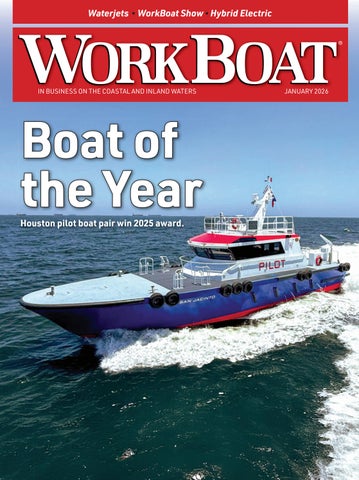
Boat of the Year Houston pilot boat pair win 2025 award.
JANUARY 2026
The Simplified Solution: Expertise, Efficiency, Reliability Welcome to the Simpli�ed Solution. BAE Systems has experienced craftworkers and project managers for all vessel needs. We get the job done right – the �rst time – on time, delivering faster turnarounds and reliable results to keep your operations moving. baesystems.com/maritimesolutions
Contact us for more information and to subscribe to our Maritime Solutions Jacksonville announcements. Jacksonville, Florida | USA +1-904-431-2227 | jaxshiprepair@baesystems.us
Content
January 2026 VOLUME 83, NO. 01
FEATURES 10 Vessel Report: Varsity Player Hybrid-electric propulsion is proven technology.
18 IWBS ’25: Show News Takeaways from the International WorkBoat Show.
34 Focus: 'Very Fast, Very Soon' A status update on Trump’s shipbuilding promise.
18
36 In Business: EV Maritime Scalability is key to zero-emissions savings.
38 Final Word: Roy Breaux Jr. The vision and values behind a family-run shipyard.
BOATS & GEAR 14 On the Ways Curtin’s new clamshell dredge is the largest in the US • Steiner Construction delivers towboat to Terral RiverService • Gunderson-built barge will serve as pier in Antarctica • Great Lakes christens hopper dredge • Mavrik Marine bags multiferry order • Moran christens tug pair • Victoria Marine builds Florida passenger vessel • Derecktor delivers offshore wind crewboat • San Francisco commissions high-speed ferry • Silver Ships delivers Florida fireboat • McAllister’s new tugboat enters service.
36
22 WorkBoat's 2025 Significant Boats WorkBoat’s top boats of 2025 and the Boat of the Year.
32 Scaling Up Waterjet manufacturer HamiltonJet is thrusting to new heights.
AT A GLANCE 4 On the Water: It pays to pay attention, barge accident confirms. 4 Insurance Watch: What mariners can expect in 2026. 5 Legal Talk: Every engineer’s worst nightmare. 5 Health, Safety, and Environment: Data-driven decision making. 6 Rulebook: Cybersecurity requirements loom. 6 Captain's Table: A celebration of our river heritage. 8 Credentialing Insight: Beat the application backlog.
www.workboat.com • JANUARY 2026 • WorkBoat
DEPARTMENTS 2 Editor’s Watch 42 Port of Call 48 Advertisers Index
ON THE COVER
San Jacinto, one of two new pilot boats built by Breaux’s Bay Craft for the Houston Pilots, is WorkBoat’s 2025 Boat of the Year. Breaux’s Bay Craft photo.
1
EDITOR'S WATCH
Congrats, Ken!
Eric Haun, Executive Editor ehaun@divcom.com
W
hen I arrived in New Zealand in October, I couldn’t have imagined the week that awaited me. I had been invited by HamiltonJet to tour the company’s new factory and attend its multicity distributors conference. Sounds great, I thought. But my time spent with the waterjet manufacturer and its partners turned out to be so much more. I returned with enough material for at least a half dozen stories, two of which are in this edition: a feature on HamiltonJet and its plans for growth, and another one on EV Maritime. Look for additional New Zealand stories on WorkBoat.com in the months ahead. I want to use the rest of this space to recognize WorkBoat’s longtime senior editor Ken Hocke, who retired at the end of 2025. Ken’s contributions to this issue are officially his last as a Diversified staff member. Since 1997, Ken has helped to shape this magazine in ways that will be felt
for years to come. He has spent his career sharing the stories of this industry with clarity, integrity, and a genuine respect for the people behind the boats. In November, Ken emailed the WorkBoat editorial team an excerpt from Warren Buffett’s Berkshire Hathaway farewell letter, and I’m sharing it here because it reflects how Ken has led his career: “Greatness does not come about through accumulating great amounts of money, great amounts of publicity, or great power in government. When you help someone in any of thousands of ways, you help the world. Kindness is costless but also priceless. Whether you are religious or not, it’s hard to beat The Golden Rule as a guide to behavior. Don’t beat yourself up over past mistakes — learn at least a little from them and move on. It is never too late to improve. Get the right heroes and copy them.” I’ve had the privilege to work with Ken for just over a year. Whenever I’d ask for advice, he’d explain his point of view and the reasoning behind WorkBoat’s way of doing things. He’d always add, “It’s your magazine now. You can do whatever you want with it.” But I believe the advice Ken shared from Warren Buffett is sound: “Get the right heroes and copy them.” On behalf of the entire WorkBoat team, I want to thank Ken for the years he’s put in, for the countless laughs along the way, for the standards he’s set, and for the many ways he’s strengthened our beloved WorkBoat. Congratulations on an exceptional career! We wish you all the best.
EXECUTIVE EDITOR: Eric Haun / ehaun@divcom.com SENIOR EDITOR: Ken Hocke / khocke@divcom.com SENIOR ASSOCIATE EDITORS: Ben Hayden / bhayden@divcom.com Kirk Moore / kmoore@divcom.com CONTRIBUTING WRITERS: Tim Akpinar • Capt. Alan Bernstein • Stephen Blakely • Dan Bookham • G. Allen Brooks • Bruce Buls • Capt. Eric Colby • Casey Conley • Michael Crowley • Jerry Fraser • Nate Gilman • Pamela Glass • Capt. Arnie Hammerman • Craig Hooper • Joel Milton • Richard Paine Jr. • Chris Richmond DIGITAL & PRINT PROJECT MANAGER: Doug Stewart / dstewart@divcom.com ADVERTISING ACCOUNT EXECUTIVES: Mike Cohen / mcohen@divcom.com Kristin Luke / kluke@divcom.com Krista Randall / krandall@divcom.com Danielle Walters / dwalters@divcom.com ADVERTISING COORDINATOR: Wendy Jalbert / wjalbert@divcom.com Producers of the International WorkBoat Show and Pacific Marine Expo
Vice President: Wes Doane, wdoane@divcom.com Publishing offices: 121 Free St., P.O. Box 7438, Portland, ME 04112-7438 207-842-5608 | Fax 207-842-5609 Subscriptions: cs@e-circ.net / 978-671-0444 Mon–Fri, 10 a.m.–4 p.m. ET
© Diversified 2026 | Printed in the U.S.A.
WORKBOAT® (ISSN 0043-8014)
is published monthly by Diversified Communications
Two Portland Square, Suite 200, P.O. Box 7438, Portland, ME 04112-7438
Annual Subscription Rates: U.S. $39; Canada $55; International $103. 3 When available, extra copies of current issue are $5. For subscription customer service call (978) 671-0444. The publisher reserves the right to sell subscriptions to those who have purchasing power in the industry this publication serves. Periodicals postage paid at Portland, ME. Circulation Office: Two Portland Square, Suite 200, Portland, ME 04101. From time to time, we make your name and address available to other companies whose products and services may interest you. If you prefer not to receive such mailings, please send a copy of your mailing label to: Printed in USA
2
WorkBoat’s Mailing Preference Service, P.O. Box 7438, Portland, ME 04112 POSTMASTER: Send address changes to WORKBOAT, P.O. Box 1792, Lowell, MA 01853.
Copyright 2026 by Diversified Communications
Scan above to update your WorkBoat account, change your address, or manage your subscription.
www.workboat.com • JANUARY 2026 • WorkBoat
Honda. Because Your Business Runs On Reliability. At Honda, we understand that commercial and government outboard applications demand professional-grade performance. For more than 60 years, Honda Marine outboards have delivered reliable, hardworking, fuel-efficient power for boats and crews that depend on our products day after day, job after job, year after year. Backed by Honda’s legendary quality, commercial and government warranties, element-defying Honda corrosion protection, and a nationwide network of servicing dealers, Honda outboards keep your business going strong. Any time, any task, anywhere. Learn more at marine.honda.com.
For Honda Marine warranty information, visit marine.honda.com/support/warranty. © 2025 American Honda Motor Co., Inc. Always wear a personal flotation device while boating and read your owner’s manual. All Honda outboards meet EPA and CARB emission levels.
AT-A-GLANCE
On the Water
It pays to pay attention, barge accident confirms BY JOEL MILTON Joel Milton works on towing vessels. He can be reached at joelmilton@yahoo.com
A
s it turned out, despite how bad things looked for the emissions-reduction barge alongside the Mississippi, the dramatic container avalanche of 95 boxes at Pier G in the Port of Long Beach proved to be not only non-fatal but nearly injury-free. And the one reported injury — a sprained ankle sustained by a crewmember on the barge who was fleeing on deck from the falling boxes — was minor, considering what could easily have happened. I attribute this remarkable fact to three things. First, the spudded-down position of the barge STAX 2 was abeam the ship’s superstructure so the crew could reach the exhaust
Insurance Watch
What mariners can expect in 2026 BY DAN BOOKHAM Dan Bookham is a vice president with Allen Insurance & Financial. He specializes in longshore, offshore and shipyard risk. He can be reached at 1-800-236-4311 or dbookham@allenif.com.
A
s the maritime industry steers into 2026, the insurance landscape is shifting under the influence of economic pressures, climate volatility, and technological change. For marine professionals, understanding these trends is key to managing risk and securing favorable terms. After years of hardening, the property insurance market is showing signs of relief. Rates for properties not vulnerable to catastrophe are expected to decline. Increased capacity and competitive underwriting are driving this softening, but the calm remains fragile. For those with shoreside assets — warehouses, terminals, offices — insurers will reward proactive risk management and resilience measures. Climate volatility remains the biggest wildcard as hurricanes, wildfires, and floods challenge historical loss models, pushing carriers toward advanced predictive analytics. Valuation discipline is also tightening. Accurate property valuations and robust modeling will be essential, while artificial intelligence-driven underwriting and Internet of Things-based monitoring will influence pricing and terms. While property markets soften, liability lines remain strained. General liability and commercial auto continue 4
funnel with their articulated boom. This effectively provided narrow but likely critical protection as the barge wasn’t struck by falling containers simultaneously over its entire length. Second, the barge crew was maintaining enough situational awareness that getting out of the way of the falling boxes was possible. It pays to pay attention. And third, dumb luck — which can never be counted on to save you, and therefore shouldn’t be — but nonetheless will continue to do exactly that, intermittently, completely at random, and without obvious favor. Which of these was the deciding factor? It could have been any or all of them, to varying degrees, and I would bet on all. Any number of known or unknown factors could have easily altered the outcome significantly. Risk analysis is challenging. We can’t know everything that might affect an activity, or how to quantify it. I’ve heard plenty of people say, “I’d rather be lucky than good.” I disagree, because with all the things you can’t control, your knowledge and skills are among the very few things you can. Still, don’t ever discount luck.
to grapple with social inflation and rising nuclear verdicts. Excess liability remains tight, with underwriters demanding cleaner loss histories and stronger controls. Litigation costs and jury awards are rising, especially in the U.S., where verdicts in excess of $10 million are increasingly common. Cyber liability is tightening as threats evolve and businesses rely more on virtual and automated systems. Expect stricter underwriting and higher premiums for companies lacking strong cybersecurity protocols. For maritime operators, liability coverage for crew, cargo, and environmental exposures will remain a priority. Insurers will scrutinize safety programs, training, and contractual risktransfer strategies. After a prolonged hard market, marine hull and liability insurance are cautiously entering a more buyer-friendly phase. Increased capacity from new Lloyd’s syndicates and growth strategies by established carriers are driving lower rates for hull, builders’ risk, and primary marine liability. Competition is intensifying, with many marine-focused carriers offering broader terms, profit sharing, and continuity credits. Digital transformation is also improving efficiency and reducing lossadjustment times by up to 30%. So, what should WorkBoat readers do to benefit from the changing landscape? Markets reward the prepared. Invest in safety, compliance, and cyber resilience to avoid punitive pricing. Where conditions allow, ensure your agent is leveraging competition in the marine market, shopping for enhanced terms, and embracing digital tools for risk management. There is plenty of opportunity ahead in 2026, but volatility remains a constant companion. Those who pair disciplined risk management with technological adoption will be best positioned to navigate the evolving insurance seas. www.workboat.com • JANUARY 2026 • WorkBoat
AT-A-GLANCE
Legal Talk
Every engineer’s worst nightmare BY TIM AKPINAR Tim Akpinar is a Little Neck, N.Y.-based maritime attorney and former marine engineer. He can be reached at 718-224-9824 or t.akpinar@verizon.net.
W
hen it comes to the operation of commercial vessels, attention tends to focus on the bridge. Many decks below, machinery spaces are often “out of sight and out of mind” unless something goes wrong. Unfortunately, a runaway engine aboard the 25-year-old containership MSC Michigan VII on June 5, 2024, brought attention to the engine room for all the wrong reasons. The incident also resulted in the criminal prosecution of the chief engineer by the U.S. Attorney’s Office. The engine overspeed occurred around noon on the Cooper River, shortly after the 74,583-ton containership departed the North Charleston Terminal in South Carolina. The bridge team realized the vessel was not responding to throttle commands. Fortunately, they regained control after the ship reached a speed of about 16 knots. The resulting wake damaged recreational vessels and injured two people.
Health, Safety, and Environment Data-driven decision making BY RICHARD PAINE JR. Richard Paine Jr. is a licensed mariner and certified maritime safety auditor with over 25 years of maritime industry experience. He is currently a senior VP at the Hornblower Group and can be reached at rjpainejr@gmail.com.
A
dvances in modern technology continue to shape the way we run our businesses. New digital datacollection capabilities, from artificial intelligence to algorithms that identify dynamic pricing and shopping trends, provide industries with a wealth of data points. But how does data collection drive certain aspects of your operations, particularly when focusing on operational safety and efficiency? When you consider critical data that impacts real-time decision-making, it’s easy to argue that the most important information relates to vessel operations. When systems process data such as engine temperatures, fuel efficiency, oil pressure, and other equipment-performance indicators, operators gain insight into what’s happening “under the hood.” This allows captains and crew to navigate safely, confident that the vessel is performing at optimal levels. www.workboat.com • JANUARY 2026 • WorkBoat
This was not a spontaneous incident. The ship’s machinery spaces had presented the chief engineer with a host of issues when he first came aboard. There were air compressor problems. The ship’s generators struggled to maintain a 75% power load (bad news for the bowthrusters). But the fundamental issue was with the main engine governor. The crew had made manual adjustments to a linkage between the governor’s electronic mechanism and the fuel rack, adjustments that should only have been made by trained technicians. Prosecutors argued that the chief engineer knew the dangers of this makeshift practice of controlling engine speed by altering the linkage rod’s length. In a plea deal, the chief pleaded guilty to failing to report a hazardous condition and to obstructing an investigation. I agree that the conduct here was wrong. But I believe there is more to consider, and I am saddened to see commercial mariners placed in handcuffs for errors in seamanship or judgment. The chief joined the vessel in April 2024 and was given about five hours to complete a turnover with the outgoing chief. That is not much time for such a complex plant. Commercial mariners tend to be a very intelligent group who usually operate “by the book.” But I also believe crews often find themselves under pressure to “keep this crate running.” Shifting to data collection that influences shoreside business decisions, we see opportunities in vessel and fleet tracking. What was once limited to automatic identification system data or to domestic ports using Coast Guard vessel traffic services is now available to private operations. This expanded access allows businesses to better manage their fleets and overall operations. Building on these two areas is a third data-collection point: the safety and operating performance of the business. Traditionally, this data is used to measure and monitor the performance of vessels, operations, and crew — identifying trends and informing corrective actions to address negative patterns. These insights may lead to new policies, procedures, training requirements, or equipment needs. While modern technology allows businesses to operate more efficiently, one of the most important considerations in any data-collection system comes down to two factors: (1) the accuracy of the data and (2) the timeliness of data input. When either of these elements falters — whether due to inaccurate information or delays — you cannot fully benefit from or rely on the data presented through your portals, dashboards, or reports. Your biggest hurdle in maximizing data collection to drive operational efficiency and performance is overcoming the principle of “garbage in, garbage out.” Clear that hurdle, and you can truly use data to support realtime performance and operational excellence.
5
AT-A-GLANCE
Rulebook
Cybersecurity requirements loom BY FRANK BOYLAND Frank Boyland is Civient’s national accounts director, drawing on three decades of experience in occupational health, safety, and emergency operations to help maritime organizations meet Coast Guard cybersecurity requirements.
T
he U.S. Coast Guard has introduced a new set of cybersecurity regulations — 33 CFR Part 101 Subpart F — that will significantly change how maritime organizations evaluate and safeguard their digital environments. For the first time, vessels and shoreside facilities operating in U.S. waters must follow standardized, enforceable cyberrisk-management practices, and key deadlines are drawing near. Subpart F calls for each covered operator to implement a formal, Coast Guard-approved cybersecurity plan. This includes appointing a cybersecurity officer capable of responding around the clock, conducting routine cyber assessments and annual audits, and embedding cyber incident response procedures into daily operational workflows. The rule also requires ongoing personnel training, documentation of all compliance activities, and timely remediation of any vulnerabilities identified by the Coast Guard or internal reviews.
Captain’s Table
A celebration of our river heritage BY CAPT. ALAN BERNSTEIN Alan Bernstein, owner of BB Riverboats in Cincinnati, is a licensed master and a former president of the Passenger Vessel Association. He can be reached at 859-292-2449 or abernstein@bbriverboats.com.
I
n October, Cincinnati played host to a grand riverboat celebration called America’s River Roots. This exciting event kicked off America’s 250th celebration in grand style, with an array of American riverboats of every shape and size taking center stage as the undisputed stars of the show. Over five full days, America’s River Roots brought Cincinnati’s Ohio River to life with two parades — one during the day and one at night — and filled the city with lights, music, and constant motion. Every riverboat in the event joined at least one race, and several participated in two. And of course, as tradition demands, no riverboat race was complete without a lively dispute over the results. Riverboats have fascinated Americans for generations, and their place in history is significant. They are symbols of American ingenuity and adventure, and the vessels that participated in America’s River Roots are true industry icons. 6
Several compliance dates have already been set. Designated personnel must complete cybersecurity training by January 2026, and full cybersecurity plan submissions are due by July 2027. Organizations that wait too long risk enforcement consequences, delays, or in some cases, operational disruptions if vessels or facilities are found out of compliance. The scope of the rule is extensive. It covers U.S.-flagged vessels, maritime facilities governed by 33 CFR Part 105, offshore energy installations, and any entity responsible for the information or operational technology systems supporting them. Meeting these obligations will require collaboration between operational teams, cybersecurity professionals, and IT departments. Critical positions under the new framework include cybersecurity officers and deputy officers, analysts, incident response engineers, and personnel responsible for training and compliance oversight. Many maritime operators may need outside expertise or supplemental staff to build these capabilities effectively. As the maritime industry prepares for the upcoming deadlines, early action remains the most reliable strategy. Establishing defined cybersecurity roles, documented processes, and tested response procedures now will help organizations meet the Coast Guard’s expectations — and avoid last-minute compliance pressure — as 2027 approaches. Leading the fleet was the steamboat Natchez from New Orleans, magnificent in every respect, from her thunderous whistle and calliope to her fashionable presence along the waterfront. The Dow family and former president Gordon Stevens always operated the Natchez with unmatched pride, and I still recall Wilbur Dow teaching me about Plimsoll markings back in 1980. From Louisville, Ky., came the Belle of Louisville, immaculately maintained and a true credit to her city. Her whistle and calliope playfully competed with the Natchez. The Celebration Belle from Moline, Ill., brought passengers upriver from Indiana to Cincinnati, serving as a reminder of what these riverboats were historically meant to do. The Belle of Memphis ably represented her home state of Tennessee, the Anson Northrup hailed all the way from St. Paul, Minn., and the Three Rivers Queen made the trip from Pittsburgh. The Mary M. Miller was another proud representative of Louisville, and the Belle of Cincinnati and the River Queen were local favorites. Organizing America’s River Roots was a massive undertaking, but one well worth the effort. It marked a moment in time when the river, the riverboats, and the people who love them all came together in the Queen City to celebrate our country’s heritage and its rich riverboat history. www.workboat.com • JANUARY 2026 • WorkBoat
ENGINEERED TO HOLD. BUILT TO LET GO. The Huck BobTail® R delivers the same you expect from Huck—now with a twist: it's fully removable.
®
BOBTAIL R
vibration-resistant, maintenance-free strength
HUCK FASTENING SYSTEMS
Built for heavy-duty applications that demand both staying power and future serviceability, the BobTail® R is your no-weld, no-loosen solution that’s easy to install and just as easy to take apart. No heat. No sparks. No nonsense. + Vibration-resistant, maintenance-free joint + Easy removal with standard torque-type tooling + Installs in seconds—no re-torquing, no retightening
See how the BobTail® R can power your next build. Visit hfindustrial.com
HFSINDUSTRIAL.COM
AT-A-GLANCE
Credentialing Insight Beat the application backlog BY NATE GILMAN
Nate Gilman, president of MM-SEAS USCG Licensing Software, uses his hawsepiping experience to support mariners and workforce development. Connect on LinkedIn.
W
hen the government reopened, the U.S. Coast Guard and the National Maritime Center (NMC) inherited the largest backlog of mariner applications in history. This is a shared challenge for the entire industry, but there is a clear way for mariners and employers to help the NMC process credentials as quickly as possible: submit a perfect Merchant Mariner Credential (MMC) application. A complete application with zero issues will move smoothly through the system. An application with errors, however, will face significant delays. While some initial screening problems — such as an incomplete application for merchant mariner credentials (form CG-719B), missing TWIC information, or incorrect fee payments — can lead to an immediate rejection, a far more common issue causes delays once an application is already in the queue. After reviewing years of NMC performance data and my company’s internal data, one issue stands above all others as the biggest bottleneck in the credentialing process: sea service letters from maritime employers. Errors or omissions in a sea service letter can place your application into “awaiting information” status, pausing the process for an average of 20 to 30 days and potentially triggering a fraud investigation. To help mariners avoid these delays, here are three tips for reviewing your sea service letter before submitting it. Tip 1: Get the vessel and position details exactly right An evaluator needs to know precisely which vessel you were on and what job you performed. A vague or incomplete description guarantees delay. For each vessel, confirm that the following information is present and correct: • Vessel name and official number (official number and International Maritime Organization number being the most common omissions). • Vessel type (e.g., motor vessel, towing vessel). • Tonnage (gross registered tonnage preferred, but gt accepted). • Propulsion type and horsepower (motor, gas turbine, or steam). • Position: Ensure your listed position matches the safemanning document for that vessel and voyage. Many employers use internal job titles not recognized by the Coast Guard, which often results in an “awaiting information” letter. • Route terminology: Your company may use operational
8
terms, but the Coast Guard recognizes only five. Make sure your letter uses only: “Inland,” “Great Lakes,” “Western Rivers,” “Near Coastal,” or “Oceans.” Tip 2: Scrutinize your days at sea — you are responsible This is the most critical check. By signing the CG-719B, you attest that everything is true. An error here — even one made by your company — is your responsibility. • Confirm the “day” count: The Coast Guard defines a “day” as eight hours of work in a 24-hour period on a vessel over 100 grt. A 12-hour shift is still one day. • Verify time-and-a-half credit: The NMC states that 1.5 days of credit for a 12-hour day may be given, but only on specific vessels authorized for a two-watch system on voyages less than 600 nautical miles. The key word is "may." • If your letter claims 12-hour days but you are not working on a towing vessel, OSV, or large commercial fishing vessel, proactively include the vessel’s Certificate of Inspection (COI) showing it is authorized to operate on a two-watch system. Tip 3: Confirm the correct renewal statements For renewal of certain credentials, the NMC requires specific, verbatim statements to prove ongoing proficiency. If missing, your sea time will not be credited, forcing you to obtain an updated letter or complete unexpected training — both of which will significantly delay your application. Confirm the exact wording: • To comply with Standards of Training, Certification and Watchkeeping: “[VESSEL NAME] is required to conduct regular fire, emergency, and abandon-ship drills. [YOUR NAME]’s service includes ongoing participation in training and drills relevant to Basic Training.” • If you hold Master of Towing or Mate (Pilot) of Towing: “[VESSEL NAME] is required to conduct regular fire, emergency, and abandon ship drills. [YOUR NAME]’s service includes ongoing participation in training and drills.” • If you hold any Radar Observer: “[YOUR NAME] carried out Bridge Watch duties in a position that routinely uses radar for navigation and collision avoidance purposes.” Why this matters now more than ever The NMC operates on a strict first-in, first-out basis. When the government reopened, a massive queue of applications awaited processing, each of which is being handled in order of receipt. Submitting a perfect application preserves your place in line. An application requiring an “awaiting information” letter will be paused for weeks, allowing hundreds — if not thousands — of applications to move ahead of yours. Worse, an application rejected during initial screening sends you to the back of the line when you resubmit. As the system recovers in the years ahead, a perfect application isn’t just a good idea. It’s the only way to ensure a timely return to work. www.workboat.com • JANUARY 2026 • WorkBoat
VESSEL REPORT Hybrid Electric Boats
Varsity Player Once seen as an unproven newcomer, hybrid-electric propulsion has arrived.
Lake Superior Research Institute
LAYOUTS
The battery-hybrid research vessel Sadie Ann was built for the Lake Superior Research Institute at the University of Wisconsin-Superior.
By Ken Hocke, Senior Editor
M
arine hybrid-electric propulsion combines more than one power source in place of the standard diesel engine propulsion package. The hybrid-electric combination is designed to burn cleaner and save fuel compared with diesel propulsion alone. Instead of just a diesel engine or engines, the hybrid marries diesel power with an electric motor or motors, depending on how much power is needed, allowing for a mix of energy sources arranged to deliver fuel efficiency, minimize emissions, and improve performance. “In most cases, a standard diesel engine propulsion system will be less expensive than hybrid electric systems. However, as technology evolves, we are seeing the cost of
10
“As technology evolves, we are seeing the cost of electric systems decrease, and we expect this to continue.” — Grant Pecoraro, Incat Crowther managing director, North America
electric systems decrease, and we expect this to continue,” said Grant Pecoraro, Incat Crowther’s managing director, North America. “The reason electric systems are more expensive today is the need to integrate a range of cooling and off-gassing systems, as well as power conversion and control equipment with the battery management systems and electric propulsion equipment.”
Boat owners have their choice of hybrid electric systems, such as parallel hybrid and series hybrid arrangements. The parallel hybrid system features a traditional engine and an electric motor connected to the same shaft, and either one or both can provide power to the propeller or wheel. With the series hybrid, the traditional engine’s sole purpose is to act as a generator, charging onboard batteries or directly powering the electric motors that drive the propulsion system. “Parallel hybrid systems typically utilize diesel engines as the primary means of propulsion with battery-powered electric motors supplementing the primary propulsion system. Generally, batterypowered electric motors are utilized for low-speed operations such as docking, navigating no-wake zones and maneuvering in tight spaces,” Pecoraro said. “Series hybrid systems utilize electric motors as the primary form of propulsion. These electric motors may receive power from either a diesel generator or a battery system. The battery system’s size dictates the duration for which the vessel may operate in battery-electric mode.” These propulsion systems are designed to deliver improved fuel efficiency, reduce emissions, increase power and flexibility, and lower noise levels. Hybrid systems use a combination of power sources to increase performance, leading to lower fuel consumption. And by burning fuel more efficiently and allowing for electric-only operation, hybrid systems help lower emissions. In addition, electric motors can provide high torque, while traditional engines can handle longer-range cruising. Anyone who has been around an
www.workboat.com • JANUARY 2026 • WorkBoat
Hybrid Electric Boats
BOATS
Midship Marine, Harvey, La., launched a new battery-hybrid research vessel in late 2024 for the Lake Superior Research Institute at the University of Wisconsin-Superior. The 65'x24', 49-passenger, eight-crew aluminum catamaran, Sadie Ann, will support the university’s on-water education and research in Lake Superior. The vessel was designed by Incat Crowther and is equipped with a parallel hybrid-battery propulsion system that includes John Deere diesel engines and Esco Power electric motors. Sadie Ann has a maximum speed of 18 knots and has a range of 690 miles at 12 knots. “Sadie Ann’s diesel engines supply the vessel’s primary propulsion power while electric machines are integrated into the transmission system to provide slowspeed propulsion power,” said Pecoraro. “The electric machines can also take power from the diesel engines to charge the onboard battery system, enhancing the operational flexibility, efficiency, and capability of the vessel. Shoreside battery charging is also provided via a standard AC shore-power system and an onboard AC/DC converter.” The new research vessel will be delivered sometime this spring after the winter thaw, when it will travel by barge to Chicago, then under its own power to
the institute. Breaux Brothers Enterprises, New Iberia, La., is building a 73'x28' aluminum catamaran, designed by Incat Crowther, for Port Houston. The vessel will be equipped with a Twin Disc battery-hybrid propulsion system featuring two 265-kW propulsion motors that will drive fixed-pitch propellers through Twin Disc MGE-5065 SC gearboxes. The vessel will have a maximum speed of 12 knots. The new catamaran will be built with an energy storage system with a capacity of 768 kWh, enough to run entirely on battery power during its standard twohour educational tours, offering a quiet, zero-emission ride. It will recharge between trips using a custom shoreside charging system equipped with AC/DC converters. To ensure reliability and extended range when needed, the vessel will also include two Caterpillar C9.3 backup generators, each producing 300 kW, for added operational flexibility. Port Houston offers free tours twice per day Tuesday through Saturday, with additional special tours available as needed. The tours focus on maritime education and industry awareness. “The tour boat we designed for Port Houston utilizes a series hybrid-propulsion system consisting of an onboard battery system, diesel generators, and electric propulsion motors,” said Pecoraro. “The challenge was to design a vessel that could conduct Port Houston’s
Port Houston is retiring its aging tour vessel and introducing a new hybrid-electric boat that will bring modern technology and improved efficiency to the Texas city.
www.workboat.com • JANUARY 2026 • WorkBoat
Incat Crowther
electric car can attest that it’s quieter than a combustion-engine vehicle.
regular two-hour tours in a quiet, allelectric mode while ensuring the vessel has the capability and flexibility to conduct longer tours — which is where the onboard diesel generators help to extend the vessel’s range. Operational flexibility is also enhanced via the installation of shoreside AC charging connections with onboard AC/DC converters.” Would it be possible to use the same hybrid-electric propulsion system on both the research vessel Sadie Ann and the tour boat that’s currently under construction for Port Houston? Pecoraro said no. Each vessel has been tailored to its specific operational requirements and local environmental conditions. “For example, Sadie Ann has longer range requirements and is designed for on-water research and education. This means the vessel needed higher sprint speed capabilities in addition to lowspeed operational requirements, so it was more cost and energy efficient to utilize diesel engines for higher-speed operations and low-power, battery-powered electric motors for shorter duration, slow speed requirements,” he said. “The Port Houston vessel, however, is a tour vessel and will mainly operate on shorter trips with more modest speed requirements. This means we could include larger battery-powered electric motors for vessel propulsion, with the diesel generators serving predominantly as the onboard charging system and then used to power longer trips when needed.” Hybrid electric propulsion systems are also used on retrofits. For owners or operators trying to decide whether to switch out their engine package or start from scratch, Drew Orvieto, director of marine solutions for Siemens Energy, said a boat’s age and responsibilities hold the key to that question. “It starts with the operation of the vessel,” he told his audience during the conference session, “Opportunities and challenges implementing hybrid propulsion for refits and newbuilds,” at the International WorkBoat Show in New Orleans in December. “What’s the why of what you’re doing?” As far as the age of the vessel, Orvieto 11
Washington State Ferries / Jim Culp
VESSEL REPORT Hybrid Electric Boats
Prior to its retrofit, the Wenatchee was using 25% of Washington State Ferries’ total annual fuel allotment.
said that, in general, a retrofit is ideal for midlife (15-25 years) vessels and a newbuild is for boats that are aged out or if a company is going through fleet expansion. One of the most talked about recent conversions involved the 460'2"x90'
Washington State Ferry (WSF) Wenatchee, originally built at Todd Pacific Shipyards, Seattle, in 1998. The vessel is one of WSF’s three Jumbo Mark II-class ferries — the largest in its fleet, with capacity for 2,499 passengers and 202 vehicles. In 2023, as part of
WSF’s $4 billion electrification plan, the Wenatchee entered Vigor Marine’s Seattle shipyard to begin the process of conversion to hybrid-electric propulsion. Design and integration of the new battery-hybrid system and propulsion controls were led by Siemens, which hired naval architects Glosten for the preliminary, contract, and functional design work. In the shipyard, two of the ferry’s four EMD L16-710G7A diesel generators were removed, and new battery rooms were constructed on both ends. Siemens supplied 864 Blue Vault energy storage modules that deliver 5,702 kWh in total, a pair of energy storage switchboards, and a 12.47-kV NXPLUS C switchboard for charging. The vessel also received transformers from TMC as well as thousands of feet of electric and fiber-optic cable. The finished product stubbed its toe
FERNSTRUM GRIDCOOLER®
WHEN CUTTING CORNERS WON’T CUT IT
Setting the Engineered Keel Cooling Standard for 75 Years
GRIDCOOLER®
Keel Cooler
It’s easy to take cost out of a Keel Cooler. Just cut a few corners. While some people are more than willing to make compromises, we only build excellence. Call today or visit our website for a quote.
FERNSTRUM.COM | 906.863.5553 © 2025 R.W. Fernstrum & Company. All rights reserved. FERNSTRUM® and GRIDCOOLER® are registered of R.W. Fernstrum & Company. All other trademarks cited are the property of their respective owners.
12
www.workboat.com • JANUARY 2026 • WorkBoat
several times coming out of the gate this summer but now seems to be operating as advertised. “It’s the largest hybridelectric vessel in the U.S.,” said Orvieto. “That ferry was responsible for using 25% of WSF’s entire fuel allotment.” Another Siemens Energy project that got plenty of attention involved the 190'x62'2"x13'3" newbuild ferry Harbor Charger — New York’s first dieselelectric hybrid ferry. Built at Conrad Shipyard, Morgan City, La., and designed by Elliott Bay Design Group, Seattle, the $33 million double-ended car and passenger vessel is owned by a trust for New York Harbor’s Governors Island. NY Waterway operates the trust’s ferry fleet. The Harbor Charger runs on Siemens Energy’s BlueDrive Eco diesel-electric propulsion system, supported by the company’s battery systems and digital control platform — the “brain” of the ferry.
Siemens Energy
Hybrid Electric Boats
The Siemens Energy hybrid-electric system allows the Harbor Charger's operator to closely monitor power and performance.
Equipped with 870 kWh of Siemens Energy BVES-V3X batteries (split evenly between two battery rooms) and a pair of Cummins QSK 19 diesel generators that provide 656 kWm at 1,800 rpm, the vessel can toggle between three modes of operation: fully battery-
powered, hybrid electric with diesel assist, and diesel backup. In hybrid mode alone, it’s expected to cut carbon emissions by nearly 600 tons annually. Whether retrofit or newbuild, “it’s the people that make the operation work,” said Orvieto. “It comes back to that.”
Imtra is Proud to Have Products On
6 OF THE TOP 10 SIGNIFICANT BOATS!
Congratulations to Top 10 Significant Boats Designers and Owners! We’re proud to play a role in supporting you in your work and your success! -THE IMTRA FAMILY OF BRANDS-
Find Your Ideal Solution at Imtra.com or Call Our Product Experts at 508-995-7000 WIPERS | SOLAR SHADES | JOYSTICKS & CONTROLLERS | DOORS & HATCHES | WINDOWS | SEATING | LIGHTING | INSULATION & MORE
www.workboat.com • JANUARY 2026 • WorkBoat
13
ON THE WAYS CONSTRUCTION ACTIVITY AT WORKBOAT YARDS
Curtin Maritime
New clamshell dredge is the largest in North America
Curtin Maritime’s new large clamshell dredge worked its first job in the Port of Houston.
C
urtin Maritime Corp., Long Beach, Calif., has taken delivery of its new dredge, DB Catalina, adding significant capacity to the Jones Act fleet amid robust demand in the U.S. dredging market. The 254'x86' DB Catalina, built by LAD Services Inc., Morgan City, La., surpasses the company’s 250'x77' DB Avalon — built in 2022 by Conrad Deepwater South, Morgan City — as the largest mechanical clamshell dredge in the Western Hemisphere, according to Curtin Maritime CEO Martin Curtin. When designing the DB Catalina in partnership with The Shearer Group Inc., Houston, Curtin Maritime took cues from its DB Avalon build but amplified its size and capacities. “Ultimately, it’s just a larger version of the same thing,” said Curtin. “The large maintenance bucket on the DB Avalon is a 70-cubic-yard bucket, the DB Catalina’s is 100… The 14
DB Avalon is 110-metric-ton single-line capacity as far as its dredge capacity. This one is 160-metric-ton, so it’s just shy of one-and-a-half times the size.” The dredge’s electric-driven grab dredging crane — which Curtin Maritime calls “Mechagodzilla” — is a SKK1600GE built by SKK Corp. in Japan. The crane has a boom length of 105' and a maximum hoisting load of 352,740 lbs. The hybrid-electric dredge is highly efficient, with automated dredging capabilities and the option to operate as a fully electric plug-in for zero-emissions performance. “Energy is harnessed through regenerative braking as the bucket lowers, charging onboard supercapacitors. The energy is then deployed to assist hoisting of the bucket, alongside the [two main Wabtec 12V250 EPA Tier 4] generators,” said Davlyn Freitas, project manager at Curtin Maritime. “This system results in
lower fuel consumption and allows for smaller generators to be installed due to lower peak energy load demand.” The DB Catalina has been built with a pair of 128' fixed spuds and a 125' walking spud. It features a full commercial galley and air-conditioned accommodations, with 24 berths and 11 heads. The DB Catalina was launched in October and was working its first job in the Port of Houston as of November. Company CEO Martin Curtin told WorkBoat that the increasing number of port-deepening projects worldwide, needed to accommodate larger ships, as well as “an obscene amount of beach nourishment and shoreline resilience projects,” are driving demand across the dredging industry. “We’re seeing a large uptake in the dredging markets wholesale. Every genre — whether it’s cutterhead, suction hopper dredging, or mechanical clamshell — all three are seeing large increases in volume and projects,” he said. “So, you’re seeing a lot of investment across the board between new hopper dredges being built, new cutterhead dredges being built.” “We have not seen a lot of capex” — capital expenditure — “in the clamshell dredging markets,” said Curtin. “Everybody’s building new hopper dredges and new cutterhead dredges. We felt the fleet on the clamshell side was aging and outdated. And so, we thought that, coupled with the difficulty of mechanical dredging and our specific skill set, was the area that we wanted to continue to expand in.” — Eric Haun
Steiner Construction delivers 88' towing vessel to Terral RiverService
S
teiner Construction Co., Bayou La Batre, Ala., recently delivered the 88'x36'x9'6" triple-screw towboat Grant Gattle to Terral RiverService (TRS), Lake Providence, La. The new boat is a sister vessel to the Charlotte Gattle, which was also handed over in 2025.
www.workboat.com • JANUARY 2026 • WorkBoat
Gunderson launched the National Science Foundation’s new barge pier on Nov. 3.
Components, Harvey, La. The pilothouse lift system was supplied by Gulf Coast Air and Hydraulics, Mobile, Ala., and the electronics suite is populated with Furuno products. Capacities include 34,400 gals. of fuel; 10,600 gals. potable water; 1,650 gals. lube oil; 200 gals. hydraulic oil; and a crew of six. While most inland towboats look the same, from the outside, except for size, there are differences on the inside and on deck. Farrell said future designs will be dictated by the owners and operators. “The different options for propulsion are getting better and more competitive in price, but they need to get owners on board before major change will happen,” he said. Grant Gattle was delivered in August. — Ken Hocke
Grant Gattle is the second towboat delivered from Steiner Construction to Terral RiverService in 2025.
www.workboat.com • JANUARY 2026 • WorkBoat
New barge will serve as pier for Antarctica’s McMurdo Station
G
Steiner Construction Co.
Both vessels were built by Steiner and designed by naval architect Tom Farrell of Farrell & Norton Naval Architects, Newcastle, Maine. Farrell said he had not worked with Terral in the past and was introduced to the towing company through the shipyard. “Since the boat was a retractable pilothouse, the space of the boat was limited,” he said. “We work extensively to use all the space efficiently.” Main propulsion comes from three Mitsubishi S6R2-Y3MPTAW-3 engines, each delivering 800 hp at 1,400 rpm. The diesel engines spin 76"x53" Sound propellers through Twin Disc MGX5321DC marine gears with 4.96:1 reduction ratios. The Grant Gattle, which has a draft of 8'6", will serve as a secondary towing vessel for TRS, operating along the Intracoastal Waterway and the Atchafalaya and Red rivers. “The vessel’s lines and production were one of the biggest challenges to the design,” Farrell said. “The vessel was designed with extensive shape to the propeller tunnels, bilges and bow and stern rakes. The structure had to be designed and nested to be able to build in the shape.” Ship’s service power comes from twin John Deere-powered gensets, each of which spark 99 kW of electrical power. The towboat’s controls are from Twin Disc, and its steering system was manufactured by Custom Hydraulic
Gunderson Marine & Iron
ON THE WAYS
underson Marine & Iron, Portland, Ore., has completed construction of a new 328'x100'x18' steel barge pier for the National Science Foundation’s (NSF) McMurdo Station, marking the end of the site’s decades-old tradition of building seasonal ice piers to support annual resupply operations. Gunderson President Dee Burch spoke to WorkBoat about the NSF’s current pier system. “It’s incredibly unique. Nowhere else in the world does somebody moor to a pier made of ice… But with changing ice conditions, that’s become a real problem. It’s labor-intensive, it breaks down early, and it’s getting harder and harder to make it work.” The U.S. Army Corps of Engineers contracted designer Glosten, Seattle, for the build, developing what Burch described as a barge “shaped like a soup bowl.” The raked hull’s sloped design is engineered so that as sea ice grows around the structure, the upward force will lift the barge rather than crush it. “Most of the features are tied to extreme temperature and ice loads,” Burch said. “But that also means the barge sees a lot more force than a normal barge — probably two to three times what we’d 15
ON THE WAYS
BOATBUILDING BITTS
Great Lakes Dredge & Dock
G
reat Lakes Dredge & Dock Corp., Houston, has christened its newest Jones Act–compliant trailing suction hopper dredge, the Amelia Island. The self-propelled vessel was designed by C-Job Naval Architects, Hoofddorp, the Netherlands, and built by Conrad Shipyard, Morgan City, La. The 346'x69'x23' dredge carries 16,500 hp and features two 31.5" trailing suction pipes capable of dredging depths up to 100'. The vessel has a hopper capacity of 6,330 cu. yds. and is equipped with EPA Tier 4 engines and generators. According to Great Lakes, the Amelia Island was built to operate efficiently and safely in shallow and narrow waters across all U.S. coasts. It is designed for a The new dredge Amelia Island was christened range of projects, in Galveston, Texas. including beach renourishment, coastal protection, channel deepening, and maintenance dredging. Mavrik Marine Inc., La Conner, Wash., announced in November that it has been chosen to construct a new series of
typically design for.” The shipyard fabricated the barge and heavy-duty steel struts that will connect the structure to foundations installed by the Corps and U.S. Navy Seabees once the barge arrives in Antarctica. Burch noted the Corps will handle all foundation and installation work on site. “We’ve been focused on the struts and
high-speed passenger ferries for the Golden Gate Bridge, Highway, and Transportation District, operator of the Golden Gate Ferry system. The catamaran ferries, which are being built as part of the agency’s eight-vessel Liwa-class ferry replacement program, will operate on San Francisco Bay, where the district conducts about 20,000 crossings annually, moving approximately two million passengers. The 164' aluminum vessels were designed by Aurora Marine Design, San Diego, with structural design from One2Three Naval Architects, Pyrmont, Australia. Each vessel will carry 500 passengers and 75 bicycles and will feature an Americans with Disabilities Act -compliant elevator, snack bar, and indoor and outdoor seating. Moran Towing Corp., New Canaan, Conn., held a ceremony in November to christen a pair of new tugboats in the Port of New York and New Jersey. The RApport 2800-class tractor tugs, Newt Moran and Thomas C Moran, were designed by Robert Allen Ltd., Vancouver, British Columbia, and built by Master Boat Builders Inc., Coden, Ala. The 90'x40' newbuilds are among the largest and most powerful in the Moran fl eet, each delivering over 80 metric tons of bollard pull for escort and ship-assist duties. Each of the new tugboats is ABS Escort-rated and powered by EPA Tier 4 Caterpillar 3516E engines, producing a combined 6,770 hp. The vessels are low-emissions certified, significantly reducing NOx emissions. The tugs feature twin Kongsberg US255 Z-drive propulsion units.
the barge,” Burch said. “Getting people down there to do construction is a challenge in itself, so it makes sense for the Corps and the Seabees to handle that.” McMurdo Station’s website notes the barge is “equipped with several ballast bins inside the hull — these are to be filled with a heavy iron-ore based slurry (weighing 300 lbs. per cu. ft.) once the
a subsidiary of BioMicrobics, Inc.
Longest Lasting, Best Performing MSD’s
PERIOD!
www.SciencoFAST.com solutions@sciencofast.com 16
Proudly made in the U.S.A.
barge is in place at McMurdo.” Delivery from Portland is set for mid-December. Tradewinds Towing, New Orleans, will handle the tow. Tradewinds vice president of operations Ryan Babcock confirmed with WorkBoat the company will be deploying their 110'x31'x13'" tug Rachel for the transport. The Coast Guard’s heavy icebreaker Polar Star will escort the tow south, though at the time WorkBoat went to press was undetermined when and where it would join the Rachel. The icebreaker routinely opens a channel each year for McMurdo’s resupply vessel and will provide the same support if ice conditions require it. “Last year the ice had mostly broken up by the time ships arrived, so the icebreaker may not have to do much. But it’s there if we need it,” Burch said. According to the station’s website, the contract awarded to Gunderson Marine totaled $43.5 million in November
www.workboat.com • JANUARY 2026 • WorkBoat
ON THE WAYS
2023, while NSF’s total contract award to the Corps for the project was approximately $55 million. McMurdo’s harsh climate underscores the engineering challenge for the pier’s delivery and installation. The station has a mean annual temperature of 0°F, with summer highs near 46°F and winter
Marine Design. The boat’s EPA Tier 4-compliant propulsion package includes quad MAN D2862LE48B diesels that produce 1,450 hp at 2,100 rpm to power four HamiltonJet HTX52 waterjets through Reintjes WVS440 DR DL gears. The ferry, which has 2,000 gals. fuel capacity and runs on R99 renewable diesel, cruises at 40 knots. Silver Ships Inc., Mobile, Ala., has delivered a new firerescue vessel to the Destin (Fla.) Fire Control District. The 52' Coastal Fast Response Boat, identified as M-19, is outfitted with four 425-hp Yamaha outboards, two 1,500gal. Darley fire pumps, and advanced firefighting and patient care technology. The vessel’s standout feature — two fire pumps capable of pushing 3,000 gals. per minute — is accompanied by shock-mitigating decking and seating for personnel safety, a thermal camera for searchand-rescue operations, a full electronics and A new 52' fireboat for Destin, Fla., was built by communication Silver Ships. suite, emergency lighting and other top-of-the-line technology. An enclosed, climate-controlled cabin offers space and equipment to care for patients while transporting them safely to land, including monitors for vitals and IV equipment. Gerard McAllister, the newest tugboat for McAllister Towing and Transportation Co. Inc., New York, has entered service in support of the company’s flagship New York operations. Built by Washburn & Doughty Associates Inc., Boothbay, Maine, the 6,770-hp tractor tug features a pair of EPA Tier 4-compliant Caterpillar 3516E engines that power Schottel SRP 490 FP Z-drive units, offering a bollard pull of 84 metric tons to assist the largest containerships calling the U.S. East Coast. The 93'x38' tug is equipped with 99-kW John Deere 4045 AFM85 EPA Tier 3 generators, Markey Machine winches on the bow and stern, as well as CAT C18 fire pump and FFS monitor with 6,000-gpm foam injection capability. Capacities include 30,000 gals. of fuel oil, 4,000 gals. potable water, and 500 gals. aqueous film-forming foam.
lows reaching -58°F, and averages 12knot winds. According to a Gunderson statement, the journey from the shipyard to the station spans nearly 6,000 miles across the Pacific and the Ross Sea. Despite the extreme logistics, Burch described the project as one of the shipyard’s most fulfilling. “I’m really proud
www.workboat.com • JANUARY 2026 • WorkBoat
Silver Ships
DeJong & Lebet
SunQuest Cruises, Miramar Beach, Fla., recently took delivery of Sol y Luna, a twodeck passenger vessel built for excursion, The passenger vessel Sol y Luna offers tours in sightseeNorthwest Florida. ing, and party cruises from Northwest Florida. The twin-hull aluminum vessel was designed by naval architects DeJong & Lebet Inc., Jacksonville, Fla., and constructed by Victoria Marine, Palatka, Fla. The 54'x16' vessel has a 2'3" draft. The Sol y Luna is certified to Coast Guard Subchapter T and has a capacity of 110 passengers and crew on protected waters and 80 passengers and crew on partially protected waters. Derecktor Shipyards has delivered CREST Wind’s DC1, a high-performance offshore wind crew vessel developed in collaboration with U.K.-based Chartwell Marine and powered by twin Volvo Penta IPS D6-500 propulsion systems. Built at Derecktor’s Mamaroneck, N.Y., shipyard, the 40'x13.7' catamaran is a next-generation platform for offshore energy, research, and other commercial operations across the U.S. maritime market, according to the builder. CREST Wind is a joint venture between Crowley, Jacksonville, Fla., and ESVAGT, Esbjerg, Denmark. Delivered under contract to CREST, the U.S.-built, USCG Subchapter T boat, which has a 2' draft, will support crews operating aboard a service operation vessel. From this, Derecktor and Chartwell Marine are establishing a scalable model for American-built vessels serving a wide range of offshore and coastal missions. San Francisco Bay Ferry celebrated the commissioning of the high-speed ferry Zalophus, the 19 th vessel in the operator’s fleet. Zalophus follows Karl, which entered service in spring 2025. The vessels are the nation’s cleanest high-speed, high-capacity diesel passenger ferries and are powered by four U.S. Tier 4 engines equipped with diesel particulate filters. The new passenger ferry was built by Mavrik Marine, La Conner, Wash., and is the fourth vessel in its class. Zalophus was designed by One2Three Naval Architects and construction management services were provided by Aurora
of our company and the results we’re getting,” he said. “This is a high-risk delivery — anytime you do something that’s never been done before, you don’t know if you’ve covered every angle. But we’re delivering on time. We have no disputes with the Corps. Everyone’s on the same page.” — Ben Hayden 17
IWBS '25
Show News US shipbuilders look to reestablish themselves on a global level
A
year after the SHIPS Act was reintroduced, panelists at the Maritime Breakfast during the 2025 International WorkBoat Show discussed how the U.S. shipbuilding industry can revive itself and compete globally. Moderated by Guillermo Calderon Martinez of ABS, the panel featured retired Rear Adm. Thomas Anderson, president of U.S. shipbuilding at Hanwha Defense; Justin Slater, vice president of business development at Fincantieri Marine Group; and Erik Derecktor, commercial manager at Derecktor Shipyards. All agreed the United States is not viewed as a shipbuilding power compared with South Korea, China, and Japan, though they cited encouraging bipartisan interest in Washington. “The focus on
18
U.S. shipbuilding at all levels is encouraging,” said Anderson. “We’ve started to understand that shipbuilding is seen positively on both sides of the aisle. Countries like China, [South] Korea, and Finland have a maritime ethos. I would love to see that type of ethos in the United States.” The panel noted growing global partnerships, including a recent U.S.-South Korea memorandum of understanding allowing South Korea to build attack submarines with U.S. technical cooperation. The agreement, part of a broader deterrence strategy, could open opportunities for collaboration with other nations on specialized vessels such as icebreakers. Efficiency was a recurring theme. Hanwha’s Philadelphia yard is investing heavily in productivity improvements. “Efficient training of the workforce, technology, using automation and robotics throughout the construction of the ship, using [artificial intelligence] in the assessment of planning and scheduling products, and real-time monitoring of
the processes are all long-term goals,” said Anderson. He added that vessel construction management rather than traditional government oversight can streamline military ship construction: “We’re using more streamlined processes in Philadelphia to get ships built more effectively.” Hanwha is also exploring distributed shipyards to expand modular manufacturing. Cost disparities remain stark. Slater noted that two identical service operation vessels — one built in the U.S., one overseas — revealed a dramatic gap: “The European vessel was built for less than the materials cost of the boat built in the U.S.” Workforce poses persistent challenges. “We need to attract new talent and retain talent and give people a reason to stay,” said Derecktor. He highlighted how technology can broaden skills rather than replace workers, citing his yard’s transition from a manual lathe to a CNC machine: “You can help workers learn
www.workboat.com • JANUARY 2026 • WorkBoat
Doug Stewart photos
Takeaways from four key sessions at the 2025 International WorkBoat Show.
IWBS '25 another skill to keep them engaged.” Supply-chain scale, standardization, and coordinated purchasing were identified as essential to lowering costs. Anderson pointed to the Maritime Industrial Base Program’s 800-plus supplier initiatives as a model. “That’s how the rest of the competitive shipbuilding world thinks,” he said. “How many suppliers in this room would like to be part of building 20 ships per year in a single yard?” — Eric Colby
Industry explores sea-toshore workforce shifts
M
aritime workforce challenges took center stage at the International WorkBoat Show during the panel “Crew Change: Evolving the Maritime Workforce from Offshore to Shoreside.” Moderator Christina Liviakis, director of business development at American Ship Repair, guided a discussion on recruitment, retention, generational divides, and the sea-to-shore transition. Caitlin Hardy, founder and managing director of Ness Sea Consulting, said the profile of new entrants is shifting, with more people arriving from engineering and software backgrounds. “It’s a huge opportunity to diversify the voices that we bring into our industry, but it’s also really important to pair the historical knowledge that we have as a group with these new incumbents coming in to further progress for everyone.” Liviakis asked TowWorks sales manager Laura Lewis about opportunities in today’s “technological revolution.” Lewis said automation is easing transitions and enabling people from other sectors to enter maritime roles. “Technology avails companies the ability to provide better quality of life to mariners,” she said, noting that operators are tailoring schedules around mariner preferences. “Technology makes managing those different, disparate schedules across the workforce a lot easier.” Still, she cautioned, “The silver tsunami makes implementing technology difficult when you have an aging workforce… Over-
The Maritime Breakfast panel, moderated by Guillermo Calderon Martinez (left), featured retired Rear Adm. Thomas Anderson, Erik Derector, and Justin Slater.
all, I think the opportunities certainly outweigh the negatives.” Engaging younger generations emerged as a key theme. Liz Schmidt, executive director of Women Offshore, said outreach must begin early. “We really need to start, of course, in schools. Not only students — we also need to educate the educators about what opportunities there are.” Quality of life remained central as Liviakis asked Lewis about supporting mariners. Lewis said chaplain services are underused. “I’ve been a chaplain for about three years now, and I’ve responded to one incident. One call.” She emphasized reframing support: “Bringing us in doesn’t mean there’s a problem; it means that people matter more to you than the perception in the market.
I believe mariners need help, and we’re here to provide that.” The panel explored difficulties mariners face when moving ashore. Schmidt said many are unprepared: “One of the commonalities I’ve seen is they haven’t educated themselves throughout their career about what that could look like.” While early-career support is robust, she added, “Once they’re there, we don’t really do a whole lot to teach them how to advance in their career.” During audience Q&A, the discussion turned to government engagement. Liviakis stressed advocacy: “One of the most important things is we need to show up and educate them.” She added, “We all need to show up and speak out because no one else is doing it for us.” — Krista Simicich
Speakers at the Women in Maritime Summit included Maggie Moon (left), Glosten; Maryanne Richards, Mass. Maritime Academy; and moderator Amelia Smith, BluSiren.
www.workboat.com • JANUARY 2026 • WorkBoat
19
IWBS '25 The state of the dredging industry
U
.S. dredging leaders at the International WorkBoat Show described an industry facing strong long-term demand but constrained by political and regulatory uncertainty. Great Lakes Dredge & Dock senior vice president David Johanson contrasted today’s environment with last year’s work volume. “If you were here last year, I talked about surge of work, which was factual,” he said. “That market ended up being like $2.8 billion. This year…It’s going to be about $1.7 billion.” He added, “It doesn’t help when there’s no president’s budget. It doesn’t help when there’s a government shutdown. It doesn’t help when there’s two years of running continuing resolutions.” Johanson emphasized that equipment supply is not the issue; instead, contractors are slowed by federal gridlock. Curtin Maritime CEO Martin Curtin said those pressures are contributing to schedule delays tied to environmental reviews. “The environmental pushes, you know, the [environmental impact reports], the paperwork that goes through, the permitting process, and everyone kind of being at odds with each other constantly,” he said. As his company expands beyond California, he added, “We’re starting to see it like California-style permitting politics internally in these other states that we didn’t see.”
Congratulations to the Top 10 Workboats of 2025!
Still, he argued dredging’s importance is unquestioned: “You shut the ports down, and the whole country shuts down very quickly…in the short term, it definitely is a huge pain in the ass.” Dredging Contractors of America CEO Bill Doyle outlined the Senate Subcommittee on Energy and Water Development’s FY26 proposal and its link to the Harbor Maintenance Trust Fund. “[The committee] came out with their FY26 budget. And it’s in the tune of $3.1 billion dollars by FY26,” he said. With $11 billion in unspent funds, the Senate plans to legislate “an additional $1 billion from that $11 billion surplus.” The process is uncertain: “Obviously, it’s got to go through the House. There’s a million different things that happen in D.C.…It is what it is.” Johanson was blunt about unmet needs. “It’s shameful the condition of the U.S. coastal waterway,” he said. He noted that coastal restoration projects continue to back up: “Now there’s actually 30 in backlog… Is it going to be 45?” Looking ahead to the Water Resources Development Act 2026 package, Doyle said outdated environmental windows on the East Coast remain a major constraint. In many ports, “we’re only allowed to dredge four to six months per year,” based on windows “put in place over 50 years ago...wrong science, or no science.” He pointed to 2020 federal findings supporting yearround work, yet litigation still halts projects. Johanson said Great Lakes is partnering with the U.S. Army Corps of Engineers’ Engineer Research and Development Center to test new methods. “There’s this junk science that they set environmental restrictions on…and it drives up the price. It doesn’t protect anything,” he said. — Ben Hayden
An update on green marine power
E
We are proud to have our products onboard 3 of the top 10 workboats! www.centekmarine.com +1 (229) 228-7653 info@centekmarine.com
Engineered to Outlast Since 1962 20
lectric propulsion in the commercial marine sector is progressing quietly, slowed by what panelists described as federal apathy toward green technologies. Projects continue, but the excitement of a few years ago has cooled. “We don’t want to be the laggard electrically on a world view, and we are,” said Elias Van Sickle, COO at SWITCH Maritime, which owns the hydrogen-fueled ferry Sea Change. “It’s to our advantage to push electrification forward.” Van Sickle joined Joe Hudspeth of Elliott Bay Design Group, Minh Tran of San Francisco Bay Ferry, and David Tyler of Artemis Technologies on day two of the International WorkBoat Show. Asked why green technology remains relevant, Hudspeth pointed to continued grant funding and long-term industry needs. “We’re living in a digital and electronic world, and we need to be prepared for it,” he said. For some operations, electric propulsion makes sense. San Francisco Bay Ferry runs repeated, predictable routes. “We’re still proving that, through our transition to battery-electric vessels, we’re reducing emissions and fuel consumption,” said Tran. Tyler noted that Artemis’s foiling systems deliver fuel savings regardless of propulsion choice. “When I’m talking to www.workboat.com • JANUARY 2026 • WorkBoat
IWBS '25
The state of green power session, moderated by Erik Derecktor, featured David Tyler (left), Minh Tran, Joe Hudspeth, and Elias Van Sickle.
customers about our technology, I’m not talking about emissions,” he said, adding that electric systems reduce maintenance. Panelists stressed the importance of moving beyond prototypes. Artemis recently secured Lloyd’s Register ap-
proval for its battery and plans to market the system independently. Hudspeth said modular thinking is essential: “We need to look at what we can do from a modular approach. You have to look at it from the total cost of ownership.”
www.workboat.com • JANUARY 2026 • WorkBoat
Van Sickle said hydrogen offers advantages, particularly because it avoids costly charging infrastructure. Electricity costs are rising, and San Francisco Bay Ferry has had to negotiate rates for future high-speed charging stations. In constrained waterfront areas, Elliott Bay Design Group has explored alternatives such as floating power platforms. Regulations remain a major hurdle, too. Van Sickle contrasted U.S. requirements with Norway’s approach, where hydrogen projects were deemed experimental and faced fewer standards. Artemis used a risk-based certification in the U.K., adding dedicated battery-box fire suppression to reduce other requirements. Hudspeth said the U.S. process needs clarity: “We can use guidelines to shape and modify something… But I would rather have regulations.” Crew acceptance is another factor, said Tran: “Be engaged with the crew and operators from day one.” — E. Colby
21
SAN JACINTO AND JUAN SEGUIN
Houston Pilots’ new launches win WorkBoat’s Boat of the Year.
BOAT OF THE YEAR
T
his year marks the third in a row that sisterships have won WorkBoat’s prestigious Boat of the Year award. The winners are two high-speed launches built by Breaux’s Bay Craft, Loreauville, La., for the Houston Pilots, Deer Park, Texas. The 80'×21' San Jacinto was delivered in May, and its sister, Juan Seguin, is scheduled for delivery in March 2026. Each boat is powered by three MAN D28-62 LE438 Tier 4 engines, each rated at 1,200 hp. The engines are matched to Twin Disc MGX-5204 SC gears and HamiltonJet HTX47 waterjets. Capt. Billy Kern, third executive officer, said the pilots selected MAN engines to maintain consistency with their station boats. “We wanted continuity for our maintenance and repairs,” he said. “We’re trying to streamline our maintenance process. And we wanted fuel efficiency, of course.” The boats are among the first EPA Tier 4 pilot boats in the U.S. and the first using a three-engine MAN configuration. Kern said the group initially debated the setup. “We figured out that running those three engines, but not running them at full power, has given us about four knots faster than our old boat, but burning less fuel,” he said. The contract required 30 knots at roughly 80% load. With an inverted deep-V hull designed by the builder and
22
Designer: ECS Marine Builder: Breaux’s Bay Craft Length: 80' Beam: 21' Main propulsion: (3) MAN D2862 LE438 Tier 4 diesels, 1,200 hp each, Soundown SCR units; three 145gal. DEF tanks Marine gears: (3) Twin Disc MGX5204 SC Propellers / Jets: (3) HamiltonJet HTX47 waterjets with AVX controls Ship’s service power: (2) Northern Lights M944T3FG 38-kW generators Additional equipment: Seakeeper 40, SeaLift rescue system, NorSap 1700 captain’s chair with joystick; (9) NorSap 1600 seats Electronics: (3) Delta19 displays, Furuno 1518 radar, FLIR cameras
ECS Marine, the San Jacinto cruises at 32.5 knots at 1,950 rpm with a 37.5knot top speed. Fuel burn is 43 gph per engine, with a 2,200 gals. fuel capacity. The main engines are fitted with water-cooled exhaust systems and Soundown-built SCR units mounted overhead. Three 145-gal. stainless steel DEF tanks support the emissions system. A fixed CO2 system with dual 100-lb. bottles, auto engine shutdown, and vent closures was supplied by Total Safety and installed by Burner Fire Control. To improve comfort during low-speed
or idle periods offshore, the San Jacinto carries a Seakeeper 40 gyro stabilizer. “A lot of times, the boat’s moving slow or waiting for a pilot,” Kern said. “That Seakeeper just keeps the boat so stable.” The pilot boats use HamiltonJet AVX controls, an update from the pilots’ older boats. “There’s a mouse pad now with kind of a docking mode,” Kern said. “You just move this mouse wherever you want the boat to go, and it does it.” The NorSap 1700 captain’s chair is fitted with a left-arm joystick. “[A helmsman] can sit back and control the steering with their left hand and then control the buckets with their right hand, so they don’t even really have to leave the chair,” he said. Additional seating includes nine NorSap 1600 reclining seats. The cabin features aluminum framing, marinegrade acoustic plywood, and PlasTEAK flooring. Ceilings are marine plywood with black vinyl. Sleeping space is provided for four. Functional finishes were chosen over yacht-style interiors to minimize weight and simplify maintenance, Kern said. Ship’s power comes from two Northern Lights M944T3FG 38-kW generators. HVAC includes dual fourton Dometic variable-speed chillers with titanium coils and five air-handling units. EEG Marine provided insulation. Centek Industries supplied mist eliminators and blowers. Electronics installed by Rio Marine include three Delta19 displays, Furuno 1518 radar, a Furuno FA170 AIS, FE-800 sounder, LH5000 loudhailer, GP170D DGPS, SC-70 sat compass, dual Cobham SAILOR 6248 VHFs, ACR GlobalFix V5 EPIRB, and FLIR thermal/visible cameras. Forward and overhead boarding areas were designed for stable transfer operations. The vessel also carries a SeaLift rescue system on the stern. The pilothouse uses fritted laminated glass with built-in defrosters from B&G Glass. SeaDeck decking from Castaway Customs Texas covers the walkaround areas. Logos and name markings were produced in reflective material by Lipari Sporting.
www.workboat.com • JANUARY 2026 • WorkBoat
2025 WorkBoat Significant Boat Finalist
ENSURING YOUR VISION IS REALIZED. Design is just one aspect of vessel acquisition. Glosten supports clients through shipyard qualification and selection, bid review and contract negotiations, construction management, testing, trials, delivery, and warranty services. As owner’s representative, we are dedicated to guiding you through the construction process—acting as your advocate to not only reduce project risk, but to also ensure your vision is realized. We do more than design. Visit us online to learn how our team can support your next project.
Photo credit: © 2024 Freire Shipyard
DAVID PACKARD
MBARI’s David Packard built for deep-sea research.
T
he Monterey Bay Aquarium Research Institute’s (MBARI) new research vessel David Packard was delivered in March. Designed by Glosten to operate from MBARI’s constrained homeport in Moss Landing, the 164'×42' vessel required a compact footprint while still accommodating extensive underwater vehicle operations. Limited length was offset by increased beam and height, which introduced stability concerns. These were addressed through a weight-saving aluminum deckhouse on the upper two decks, 25 tons of fixed ballast, and a Quantum stabilization system to reduce roll while stationary. A design driver was integration of the 10,500-lb. remotely operated vehicle (ROV) Doc Ricketts. The vessel includes a dedicated hangar, control room, workshop, and launch-and-
24
recovery system. Deployment occurs through a side door using a MacGregor overhead traveling crane. Autonomous underwater vehicle operations are conducted using a MacGregor KN-75 knuckle-boom crane with a constant-tension winch and docking head. Additional deck machinery includes a 170° articulating A-frame; davit for conductivity, temperature and depth sensing equipment; hydrographic winch; and ROV winch. The wet lab features insulated tables, ambient and chilled seawater, and a cold room for sample storage. Propulsion is diesel-electric, powered by three 629-kW EPA Tier 4 MAN generators with waste-heat recovery. The vessel has a 4,000-nautical-mile range, a top speed of 11.5 knots, 21day endurance, and accommodations for 12 crew and 18 scientists.
Owner: Monterey Bay Aquarium Research Institute Designer: Glosten Builder: Freire Shipyard, Galicia, Spain Length: 164' Beam: 42' Depth: 18'6" Main propulsion: Diesel-electric system with (3) MAN D2862 LE427 629-ekW variable-speed generators (EPA Tier 4 / IMO Tier III) Propellers: (2) 4-bladed 5'9" nibral propellers in nozzles (via Schottel SRP-260 L-drives) Ship’s service power: ABB Onboard DC Grid (1,000 VDC) distributing 480/208/120 VAC; dual 400-amp shore power connections Thrusters: Retractable ZF Marine
www.workboat.com • JANUARY 2026 • WorkBoat
W
NE
Workboat Engine MAN D3872 LE V12
Workboat Engine MAN D2862 LE V12
30L displacement available with SCR or DPF+SCR system
24L displacement available with SCR or DPF+SCR system
UNMATCHED & SUSTAINABLE POWER RANGE Reliable Power. Built for the Job.
Our marine engines deliver dependable performance across a wide horsepower range—perfect for tugs, crew boats, and work vessels of all kinds. Designed for tough conditions, they offer maximum uptime, fuel efficiency, and low emissions without sacrificing power. Sustainable. Durable. Ready when you are. For more details, explore www.manengines.com, www.man-engines.com, or www.performancediesel.com. *Golden Gate Pilot Boat powered by MAN D2862LE SCR engines.
West Coast Distributor
East Coast Distributor
HARBOR CHARGER
Hybrid ferry brings new capability to New York Harbor.
T
he Trust for Governors Island has added the Harbor Charger, New York’s first diesel-electric hybrid ferry, to its fleet. Designed by Elliott Bay Design Group and built by Conrad Shipyard, the $33 million Subchapter K ferry measures 190'×62'2"×13'3" with an 8'6" draft and capacity for 1,200 passengers and 30 vehicles. Propulsion is based on Siemens Energy’s BlueDrive Eco diesel-electric system. The ferry is equipped with 870 kWh of Siemens Energy BVES-V3X batteries housed in two battery rooms, supported by two Cummins QSK19 generators rated at 656 kWm at 1,800 rpm. Operators can select among three operating modes: all-battery, hybrid electric with diesel assist, or dieselonly backup. Hybrid operations are
expected to reduce emissions by nearly 600 tons annually. A fully digital control platform enables real-time monitoring of propulsion, power management, and battery health, both onboard and remotely. The ferry features a pair of Schottel SRP 210 LEC FP azimuthing thrusters, each driven by a 560-kW motor, providing 360°maneuverability and improved docking efficiency. The boat cruises at 10-12 knots. Navigation and safety systems include a Furuno bridge suite, Ultra Fog water-mist firefighting, Hiller fire detection, Li-ion Tamer and Consilium gas detection, and IMS PA/GA and CCTV systems. Harbor Charger replaces the dieselpowered Lt. Samuel S. Coursen.
Owner: The Trust for Governors Island Designer: Elliott Bay Design Group Builder: Conrad Shipyard Length: 190’ Beam: 62'2" Depth: 13'3" Main propulsion: Siemens Energy BlueDrive Eco diesel-electric system with two Cummins QSK19 generators (656 kWm @ 1,800 rpm) and 870 kWh Siemens BVES-V3X batteries Thrusters: (2) Schottel SRP 210 LEC FP azimuthing thrusters, each with 560-kW motor
KARL
SF Bay Ferry takes delivery of its cleanest diesel ferry to date.
S
an Francisco Bay Ferry has added Karl, a 137'×36.45' aluminum catamaran, to its Dorado-class fleet as the agency prepares for a shift toward zero-emission vessels. Designed by One2three Naval Architects and built by Mavrik Marine Inc., the ferry is the first U.S. passenger vessel equipped with both selective catalytic reduction (SCR) and diesel particulate filters (DPF) to meet California’s harbor craft emissions regulations. The EPA Tier 4 propulsion system includes four MAN D2862LE48B diesels, each rated at 1,450 hp at 2,100 rpm. The engines drive HamiltonJet HTX-52 waterjets through Reintjes WVS440 DR DL gears. Karl carries 2,000 gals. of R99 renewable diesel and cruises at 40 knots. The SCR units reduce nitrogen-oxide emissions, while the four MAN DPFs remove nearly all soot particulate from the exhaust. Service power comes from two Northern Lights M99C13 gensets.
26
The vessel is fitted with HamiltonJet AVX controls, Furuno electronics, MTU NautIQ alarm and monitoring systems, and a Humphree trim control package. Karl carries a crew of four plus one bartender and has capacity for 320 passengers and 37 bicycles. The ferry includes a fully enclosed upper deck and carries 500 gals. each of potable water and sewage. Karl is the third in the Doradoclass series, following Dorado and Delphinus. It is the first in the class to incorporate DPFs; the final vessel, Zalophus, also delivered in 2025, uses the same engine and emissions control arrangement. SF Bay Ferry selected the propulsion layout early in the program to ensure the hull could accommodate SCR and DPF systems once approved. Federal funding supported the integration of DPF technology, including a $1.52 million earmarked by Rep. John Garamendi, D.-Calif.
Owner: San Francisco Bay Ferry Designer: One2three Naval Architects Builder: Mavrik Marine Inc. Length: 137' Beam: 36.45' Main propulsion: (4) MAN D2862LE48B diesels, 1,450 hp @ 2,100 rpm, EPA Tier 4 with SCR and DPF emission systems Propellers/Jets: HamiltonJet HTX52 waterjets Marine Gears: Reintjes WVS440 DR DL gears Ship’s service power: (2) Northern Lights M99C13 gensets Additional equipment: HamiltonJet AVX controls; Furuno electronics; MTU NautIQ alarm/monitoring
www.workboat.com • JANUARY 2026 • WorkBoat
Setting the standard in innovation
Siemens Energy is a trademark licensed by Siemens AG.
Governors Island Harbor Charger Proudly nominated for the 2025 Significant Boat Awards
Contact our team
LET’S MAKE TOMORROW DIFFERENT TODAY siemens-energy.com
KELLUTUQ
Alaska State Troopers take delivery of new Bristol Bay patrol boat.
B
ay Weld Boats, Homer, Alaska, has delivered a new aluminum patrol vessel for the Alaska State Troopers to operate in Bristol Bay. Designed and constructed in-house, the Kellutuq is purpose-built for law enforcement missions in shallow, remote environments while offering overnight comfort and endurance for extended patrols, Bay Weld said. The 36'×11' vessel draws only 22". The boat has twin Cummins QSB 6.7L diesels, each delivering 425 hp at 3,000 rpm, coupled with MJP twin UJ305 waterjets through ZF 280-1 gears. It cruises between 26 and 30 knots, with a top speed of 35 to 37 knots. Steering and controls are managed by a Glendinning two-station electronic control system, featuring
joystick control and 4" LCD displays at both helm stations. Redundancy is built into the hydraulic system, with twin Eaton 3.8-cu. pumps tied to live power take-offs on each marine gear. Kellutuq carries 500 gals. of fuel, allowing a range of up to 500 nautical miles, and holds 100 gals. of freshwater. Sleeping accommodations include three bunks in the berth and a convertible dinette, allowing overnight capacity for up to four troopers. The boat has a full galley and a head with a shower Electronics include a Garmin navigation suite: three GPSMAP 8616xsv displays, Fantom 24 radar, SideVU and traditional transducers, Garmin autopilot, Starlink connectivity, and both police and VHF radio systems.
Owner: Alaska State Troopers Designer: Bay Weld Boats Builder: Bay Weld Boats Length: 36' Beam: 11' Main propulsion: (2) Cummins QSB 6.7L diesels, 425 hp @ 3,000 rpm Propellers/Jets: (2) MJP UJ305 waterjets Marine Gears: ZF 280-1 gears, 1.056:1 ratios Ship’s service power: Fisher Panda 5 kW marine diesel generator; eight-battery bank system
LONG ISLAND
New passenger-vehicle ferry to operate in Long Island Sound.
E
astern Shipbuilding Group delivered the 303'×52' ferry Long Island to the Bridgeport & Port Jefferson Steamboat Co., a subsidiary of McAllister Towing, in December 2024. The passenger and auto ferry will provide service between Bridgeport, Conn., and Port Jefferson, N.Y., across Long Island Sound. The vessel has capacity for 1,000 passengers and 124 cars, or a combination of cars and up to six trucks, and is capable of operating at 17 knots. “The Long Island has been engineered with the environment in mind,” said Fred Hall, Bridgeport & Port Jefferson Steamboat Co. vice president and general manager. “In 2024, the company took over 500,000 vehicles off the highways on both sides of Long Island Sound thus becoming a substantial and integral part of transportation solutions in our area.” Designed by Gilbert Associates, Braintree, Mass., the ferry is powered 28
by twin EPA Tier 4 Electro-Motive Diesel 12 ME 23B diesel engines, each producing 3,000 hp at 900 rpm and driving Reintjes WAF 3445 3.083:1 reduction gears from Karl Senner LLC that deliver power to fixed-pitch propellers. Two Berg MTT113 FPL bowthrusters, each driven by John Deere 6135 AFM85 diesels rated at 500 hp at 2,000 rpm, are coupled to Reintjes WVS 234 1.50:1 reduction gears. Ship’s service power comes from four additional John Deere 6135 AFM85 diesel generators producing 300 kW at 1,800 rpm. Steering controls are by Jastram. “P.T. Barnum, the founder of the ferry, once said that the noblest art is that of making others happy. All of those who have worked to make the ferry service what it is today can be very proud of their role helping drivers on the I-95 and Long Island Expressway,” Buck McAllister, the president of the ferry company, said.
Owner: Bridgeport & Port Jefferson Steamboat Co. Designer: Gilbert Associates Builder: Eastern Shipbuilding Group Length: 303' Beam: 52' Main propulsion: (2) EMD 12 ME 23B Tier 4 diesels, 3,000 hp @ 900 rpm Marine Gears: (2) Reintjes WAF 3445, 3.083:1 reduction Ship’s service power: (4) John Deere 6135 AFM85 diesel generators, 300 kW @ 1,800 rpm Thrusters: (2) Berg MTT113 FPL bowthrusters powered by John Deere 6135 AFM85 diesels (500 hp @ 2,000 rpm), with Reintjes WVS 234 1.50:1 gears
www.workboat.com • JANUARY 2026 • WorkBoat
MARINER
ACBL adds 11,000-hp towboat to Mississippi River fleet.
A
merican Commercial Barge Line (ACBL), Jeffersonville, Ind., christened its new 200'×50'×12'6" towboat Mariner on the Mississippi River in a ceremony in New Orleans during the 2024 International WorkBoat Show. Company officials said Mariner is the largest, most powerful towboat to be built in the U.S. in 50 years. Constructed by C&C Marine and Repair, Belle Chasse, La., the 11,000hp boat has an operating draft of 11'6", eight 65-ton winches, dual steering and flanking rudders, and can adjust its operating draft by up to 18" to navigate shallow waters during low-river levels The boat was designed by CT Marine, Edgecomb, Maine. The Mariner is the largest twin-screw towboat “on the planet,” said Christian Townsend, CT
Marine’s owner. “We have spent four years and 24,000-plus hours of engineering on this project. She is the largest twin screw ever built for the rivers.” Propulsion comes from twin Caterpillar C280-12 diesel engines connected to Hung Shin 5-bladed wheels through Reintjes WAF 6755 marine gears supplied by Karl Senner. Steering and controls are the responsibility of CT Marine’s TwinDIFF system. Capacities include 117,192 gals. of fuel oil; 17,250 gals. consumable potable water; 161,585 non-consumable water; 506 gals. hydraulic oil; 2,300 gals. coolant; and a 513 gal. genset day tank. Additionally, Mariner has accommodations for a 12-person crew and is fitted with a single guest room. The towboat is ABS-classed.
Owner: American Commercial Barge Line (ACBL) Designer: CT Marine Builder: C&C Marine and Repair Length: 200' Beam: 50' Depth: 12'6" Main propulsion: (2) Caterpillar C280-12 diesels Propellers: (2) Hung Shin 5-bladed wheels Marine Gears: (2) Reintjes WAF 6755 Additional equipment: CT Marine TwinDIFF steering/controls system; (8) 65-ton winches Certification: USCG Subchapter M
MR. BRIAN
Bisso Towboat adds sixth new tractor tug.
B
isso Towboat, New Orleans, has expanded its escort and ship-assist fleet with the delivery of the Mr. Brian, a 96'×38'×13'6" tractor tug built by Main Iron Works, Houma, La. The vessel is the sixth tractor tug the yard has delivered to Bisso in nine years and continues the company’s long-running reliance on the Castleman Maritime design first adopted in the late 1990s. The tug is named for Bisso’s longtime vice president of operations, Brian Cyprowski. The Mr. Brian is powered by twin Caterpillar 3516E main engines producing 2,500 hp each at 1,600 rpm. The engines drive a pair of Kongsberg US205STK2400FP Z-drives with 2,400-mm, 4-bladed stainless-steel propellers set in stainless nozzles. Estimated bollard pull is 68 tons. The Tier 4 package includes selective catalytic reduction aftertreatment. Electrical power comes from two 118-kW Caterpillar C4.4-powered gen-
30
erators. The tug is outfitted with a JonRie Series 240 escort winch spooled with 500' of 2¾" Saturn 12 line. Additional equipment includes Coast Guard-approved engine-room monitoring and alarm systems, a fixed CO2 firefighting system, Simrad navigation electronics, stainless-steel bitts and bow staple, and sound-insulated machinery spaces and crew quarters. Tankage includes 30,162 gals. of diesel fuel, 11,000 gals. potable water, 1,825 gals. each lube and hydraulic oil, and 2,000 gals. diesel exhaust fluid. The vessel carries an ABS International Load Line designation, was built to Subchapter M standards, and has received its Coast Guard COI. Below deck, the engine room reflects the company’s emphasis on maintenance, kept in spotless condition by engineer Dalton Kirk. In October, Bisso was acquired by Moran Towing Corp., New Canaan, Conn.
Owner: Bisso Towboat Designer: Castleman Maritime Builder: Main Iron Works Length: 96' Beam: 38' Depth: 13'6" Main propulsion: (2) Caterpillar 3516E Tier 4F engines, 2,500 hp @ 1,600 rpm (each) Propellers: (2) Kongsberg US205STK2400FP Z-drives with 2,400-mm four-bladed stainlesssteel propellers in stainless nozzles Ship’s service power: (2) 118-kW Caterpillar C4.4 generator sets Additional equipment: JonRie Series 240 escort winch with 500' of 2¾" Saturn 12 line, SCR aftertreatment system, Simrad navigation
www.workboat.com • JANUARY 2026 • WorkBoat
NORTH WIND
Cal Poly receives newest research vessel.
A
ll American Marine (AAM), Bellingham, Wash., has launched a new research vessel built for the California Polytechnical Institute at Humboldt. The new vessel is a 78'x26.7' semidisplacement aluminum catamaran developed by Teknicraft Design, Auckland, New Zealand. Inspected as a U.S. Coast Guard Subchapter T vessel, the newbuild will operate as a multipurpose research vessel in the near-coastal waters of northern California and Oregon and on offshore and ocean routes. “The vessel integrates the signature Teknicraft Design symmetrical and asymmetrical combined hull shape, bow wave piercer, and a patented dynamic hydrofoil-assisted hull design,” AAM said in a statement.
The propulsion package includes two fixed-pitch propellers powered by twin MAN D2862LE438 EPA Tier 4 engines equipped with a diesel particulate filter. The engines, rated at 1,182 hp at 2,100 rpm, meet California emissions requirements. The vessel will carry up to 40 day-trip passengers or 14 live-aboard. Scientists and crew will have comfortable quarters, large wet and dry lab spaces, as well as a range of oceanographic equipment for a variety of missions. The vessel is outfitted with a Kongsberg ADCP electronics suite augmented by a fixed WASSP multibeam system. North Wind replaces the university’s existing research vessel, the 90'x22'4"x9' Coral Sea.
Owner: California Polytechnic Institute at Humboldt Designer: Teknicraft Design Builder: All American Marine Length: 78' Beam: 26.7' Main propulsion: (2) MAN D2862LE438 EPA Tier 4 engines with diesel particulate filters, 1,182 hp @ 2,100 rpm Propellers: (2) fixed-pitch propellers Additional equipment: Kongsberg ADCP suite; WASSP multibeam system; Teknicraft hydrofoil-assisted hull; wet and dry labs Certification: USCG Subchapter T
VOYAGER
Former OSV converted for offshore space launch and recovery.
A
former Gulf of Mexico offshore supply vessel (OSV) has been converted to serve as a mobile spaceport. Guice Offshore’s Voyager, a 294'x56'x18'9" converted OSV, supported Space Perspective’s Sept. 15, 2024, test flight of the unmanned Neptune-Excelsior space capsule. Lifted by a renewable-hydrogen SpaceBalloon, the system reached 100,000', above 99% of Earth’s atmosphere, during a six-hour mission. Built in 1998 at Edison Chouest’s North American Shipyard as the C-Challenger, the vessel underwent extensive modifications at Conrad Shipyard, Morgan City, La., to shift from oil and gas service to offshore space launch and recovery operations. Conrad lengthened the hull to 294', upgraded propulsion and emergency systems, added tankage, and installed a balloon launch system capable of handling a 600' balloon and 150'-200' parachute rigging.
A large Supreme Integrated Technologies A-frame on the stern is used to recover the space capsule after splashdown. “We’ll launch off the deck of the vessel, sending the capsule and balloon into the stratosphere,” Voyager captain Bryan Dietz said in late 2024. “And a couple of hours later, when she returns to the water, we’ll aid in the retrieval of the capsule in the balloon.” Small fast boats assist with recovery work. The vessel has a deck strength of 540 lbs./sq. ft., capacity for 1,250 LT of cargo, 129,466 gals. of fuel, and 36,620 gals. potable water. Propulsion includes twin CAT 3516s (1,710 hp each), two 850-hp controllable pitch tunnel bowthrusters (1,200-hp dropdown), and two azimuthing stern thrusters. The Voyager cruises at 10 knots and makes 13 knots maximum. ABS supported the conversion effort. ABS’s Tyson Breedlove noted that no formal standards for space-support vessels yet exist.
www.workboat.com • JANUARY 2026 • WorkBoat
Owner: Guice Offshore Designer: Conrad Shipyard Builder: Conrad Shipyard Length: 294' Beam: 56' Depth: 18'9" Main propulsion: (2) Caterpillar 3516 diesels, 1,710 hp each Thrusters: (2) bowthrusters (850hp CPP tunnel; 1,200-hp dropdown) and two azimuthing stern thrusters Additional equipment: Supreme Integrated Technologies A-frame; balloon launch system; small-boat recovery capability Certification: USCG Subchapter I
31
BOATS & GEAR Waterjets
Scaling Up
HamiltonJet expands capacity with an eye to rising demand.
M
ore than 60 years after Sir William “Bill” Hamilton’s jetboats clawed their way up the Colorado River, the company that built them faces a new challenge: scaling to meet rising demand for commercial and military waterjets. In October, HamiltonJet welcomed hundreds of its employees and its network of global distributors to its Christchurch, New Zealand, headquarters for the official opening of its new factory, a facility designed to give the storied waterjets manufacturer room to grow. Managing Director Ben Reed said the state-of-the-art facility positions HamiltonJet to increase production in line with rising demand. “We’re at an output level today that is about our maximum on the large jet line,” he said. “And I can see more business coming… anywhere between 30% more and double in the next four or five years.” The new 80,000-sq.-ft. facility is still ramping toward full operation. Today it offers a 40% increase in capacity over HamiltonJet’s existing production levels, with room to expand to nearly double that if the company one day adopts around-the-clock shifts. The expansion marks what Reed described as “a turning point.” But getting to that moment took more than a decade of strategic planning, several pivots, and a steady commitment to quality, innovation, and a particular kind of corporate independence. 32
Eric Haun
By Eric Haun, Executive Editor
Each HamiltonJet waterjet is built to order at the company’s Christchurch, New Zealand, manufacturing facilities.
BUILDING UP Reed joined HamiltonJet in 2013 to lead new product development. He took over as general manager in 2016 and became managing director in 2020. When he took the helm, the company was exploring a full relocation to a new site. Land had been purchased under Reed’s predecessor, but the company had not yet hit go on the expansion. After a year and a half of analysis, the answer became clear, Reed said: a total move didn’t make financial sense. The company already had room to grow on its existing property — more than enough, it turned out. “Why are we moving and losing all the factory space we’ve already got?” he recalled asking. The company reversed course, sold the new parcel for a profit, and reinvested in its original footprint, constructing a new factory next to its existing one. The final push to build came when a surge in post-Covid government spending temporarily jammed the production schedule, pushing lead times to as long as 18 months. “It taught us the lesson that we needed to do it,” Reed said. Staffing the new plant will require HamiltonJet to increase its factory workforce by about 30 people from the current 200, and that number is expected to continue rising in the years ahead if all goes according to plan. www.workboat.com • JANUARY 2026 • WorkBoat
Waterjets The company will also construct new offices for its corporate and engineering staff, which account for another 200 employees in Christchurch. In total, HamiltonJet employs 465, including 65 outside of New Zealand.
HERITAGE HamiltonJet’s origins are well known in New Zealand, and in the world of marine jet propulsion, the Hamilton name is ubiquitous. But the company didn’t get its start in the waterjet business. Kiwi engineer and inventor Bill Hamilton founded CWF Hamilton &
Eric Haun
LEAN PRODUCTION HamiltonJet has long operated on what Reed described as a highly refined, “batch-of-one,” “made-to-order” manufacturing system. Reed, a mechanical engineer, is an expert in lean production, having implemented it at Ford Motor Co. and Caterpillar before joining HamiltonJet. “I’ve got this thing running through me that I love the concepts and processes of lean,” he said. The approach, which is rare for a manufacturer handling such variety, allows the company to produce almost any model in any sequence without stockpiling parts. HamiltonJet produces several series of waterjets, including the HJ, HM, HT, HTX, HJX, and LTX series, offering more than 20 different models across these ranges, from smaller units up to powerful jets for large vessels, covering a power spectrum from 150 kW to 5,500 kW. “I came to HamiltonJet, and I looked at [its lean production model], and I went, ‘Oh my God, this is so clever,’” Reed said. “It could be a case study for somebody in the manufacturing industry.” The new facility, which will help the company boost its large-jet output in particular, extends that system by “straightening the flow,” aligning casting, machining, painting, and assembly into a single, coherent line that is expected to unlock new levels of efficiency, Reed said.
HamiltonJet is experiencing increased global demand for its large jet systems, driven by rising international defense spending.
Co. Ltd. in 1939 to build earthmoving equipment and heavy machinery. He brought an engineer’s pragmatism and an explorer’s drive, constantly pushing both his innovations and himself into uncharted territory. In the 1950s, Hamilton set out to build a boat that could navigate the fast-flowing Waitaki River, waters too shallow for propeller-driven craft, whose props struck the riverbed. The concept was proven in dramatic fashion in 1960, when three Hamilton jetboats became the first — and still the only — to travel up the Colorado River through the Grand Canyon. Hamilton went on to pioneer the modern waterjet, setting the company on a trajectory to become the world’s leading producer of the technology. Today, HamiltonJet officials estimate that the company holds approximately 40% of the world’s waterjet market share, delivering jets to a wide range of commercial and military vessels, from whale-watch boats and ferries to workboats, crewboats, and advanced military patrol ships. All HamiltonJet waterjets are manufactured in Christchurch, with more than 97% bound for export. The United States is the company’s largest market, accounting for about 20% of revenue. Notable recent examples of U.S. vessels equipped with Hamilton jets include the Breaux’s Bay Craft-built pilot boats San Jacinto and Juan Seguin
www.workboat.com • JANUARY 2026 • WorkBoat
— 2025 winners of WorkBoat’s Significant Boat award — as well as the latest ferries built by Mavrik Marine for San Francisco Bay Ferry and Golden Gate Ferry, a new diesel-electric patrol boat being built by Moose Boats for Seattle’s King County, and the Mark VI patrol boats built by SAFE Boats International for the U.S. Navy. Over the past 10 years, the company has invested heavily in technology development, introducing more robust waterjets that deliver efficiency gains up to 7%. It has also focused on electrification, autonomy, and digitization, including the AVX and AVXexpress electronic controls; autonomy products such as the JETanchor positioning system, JETlink autonomous and remotecontrol solution, and the JETfighter firefighting control interface; as well as the Overwatch remote monitoring tool. Internally, despite decades of international growth, the company’s culture still reflects the values of its founder and the family that continues to own it: innovation, quality, and self-reliance. Bill’s grandson Mike Hamilton serves as chairman of the board, and Mike’s son, Sam Hamilton, is both a board member and part of the engineering team. Reed said the new factory was built entirely from retained earnings. “We have not borrowed a cent on it,” he said. Continued on page 40
33
FOCUS Shipbuilding
‘Very Fast, Very Soon’ Gauging progress 10 months into Trump’s shipbuilding promise.
A keel-laying ceremony was held for the offshore patrol cutter USCGC Pickering at Austal USA’s Mobile, Ala., shipyard on Dec. 8
P
resident Trump last March told Congress his administration would jumpstart U.S. shipbuilding, shaking off decades of budget constraints and overwhelming competition from faster and cheaper builders. “We are also going to resurrect the American shipbuilding industry, including commercial shipbuilding and military shipbuilding,” Trump said. “We used to make so many ships. We don’t make them anymore very much, but we’re going to make them very fast, very soon. It will have a huge impact to further enhance our national security.” U.S. shipbuilders and their political allies responded with enthusiasm. “We must stabilize shipbuilding programs, adopt commercial best practices, and incentivize the shipyards to address workforce and productivity issues in a collaborative rather than combative manner,” said Sen. Roger Wicker,
34
R-Miss., chairman of the Senate Armed Services Committee. “And we can quickly inject innovation into naval procurement, particularly on unmanned ships.” Rebuilding U.S. maritime capability has been a bipartisan project for years, but missing has been a consensus on how to achieve this. The question is whether the new promise can be fulfilled by an often-chaotic Trump administration, divided Congress, and an industry anxious for an epic, generational turnaround. The Trump administration’s first moves followed the introduction of the bipartisan Shipbuilding and Harbor Infrastructure for Prosperity and Security (SHIPS) for America Act, in December 2024. Maritime advocate lawmakers sought to revitalize the U.S. shipbuilding industry through federal oversight, funding, workforce development, and incentives for domestic www.workboat.com • JANUARY 2026 • WorkBoat
U.S. Coast Guard photo by Grace McBryde
By Kirk Moore, Senior Associate Editor
Shipbuilding production, which they say have been weakened by decades of neglect. Having grown by dint of furious World War II shipyard production, the U.S. merchant fleet boomed in the postwar years, carrying about 43% of global trade in 1950. The U.S.-flag fleet peaked at 1,288 privately owned ships in 1952 and 10.31 million gross tonnage, according to government records. Foreign competition ate steadily into the U.S. share, even as trade soared in the relatively peaceful world created by the U.S. and its allies. From its No. 1 position, the U.S. fleet slipped to number 13 in rankings by the end of the 1980s. The fleet was down to 320 ships by 1996, according to a report by the Congressional Budget Office. That number now is down to just 178 U.S.-flag cargo ships, or 0.57% of worldwide commercial shipping tonnage, according to the nonprofit think tank Center for Maritime Strategy. An executive order in April called for rebuilding the United States’ onceprominent shipbuilding industry and breaking China’s dominance of the global sector. The order outlined a Maritime Action Plan coordinated by the U.S. Department of Transportation’s Maritime Administration, including a new Maritime Security Trust Fund, shipbuilding tax incentives, and the launch of strategic commercial fleet programs. A proposed 210-day deadline passed Nov. 5, with a full plan still awaited by industry. The basic framework covers financial incentives and subsidies to support shipyards and other infrastructure, as well as workforce development. The Shipbuilders Council of America (SCA) endorsed the executive order as critical to reversing decades of decline. “A strong U.S. shipyard industry is essential not only for our economic security but also for our homeland and national security,” said SCA president Matthew Paxton. Industry innovators responded fast with proposals for autonomous fleets. In August, Saronic held a keel-laying of its first 150' Marauder vessel at the company’s Franklin, La., yard, acquired
“U.S. shipyard industry is essential not only for our economic security but also for our homeland and national security” -Matthew Paxton, SCA President
in April from Gulf Craft. Saronic pitched its venture as a new class of fully autonomous ships for U.S. defense, allied forces, and commercial maritime operations. The Marauder has a payload capacity of 40 metric tons and can travel up to 3,500 nautical miles or loiter for over 30 days. “The keel-laying of our first Marauder marks a significant milestone in autonomous maritime capability,” said Dino Mavrookas, co-founder and CEO of Saronic. In early December, Saronic announced a $300 million investment to increase production capacity and add 1,500 skilled jobs to its workforce by early 2027. Austal USA held a keel-laying ceremony at its Mobile, Ala., facility for Pickering, the first Coast Guard Heritage-class Offshore Patrol Cutter (OPC) to be built at the company’s Mobile shipyard. The cutter is being constructed under a contract covering up to 11 vessels with a potential value of $3.3 billion. The Coast Guard has exercised options for six cutters so far. The 360' OPCs are to become the backbone of the Coast Guard’s offshore presence, performing law enforcement, drug and migrant interdiction, and search-and-rescue missions. With a range of 10,200 nautical miles at 14 knots, and endurance up to 60 days, the cutters can serve as mobile commandand-control platforms for surge operations, including hurricane response and support Arctic mission requirements. The progress comes after months of troubles for the OPC program. In November, the Eastern Shipbuilding Group, Panama City, Fla., said financial constraints forced the company to break off its construction for four of the
www.workboat.com • JANUARY 2026 • WorkBoat
cutters. “Eastern Shipbuilding Group has made the difficult decision to suspend work on the Offshore Patrol Cutter program due to significant financial strain caused by the program’s structure and conditions. Despite our best efforts, continuing under the current circumstances is not sustainable,” Eastern CEO Joey D’Isernia said in a statement to WorkBoat. “Unfortunately, we also had to reduce our workforce — an extremely hard step, as our people are the strength of this company.” Efficiency, automation, robotics, modular construction, and vessel construction management in place of government oversight are being driven by the imperative to move the U.S. industry back to its old rankings. So, too, are new partnerships with international shipbuilders. The Trump administration made a decisive move with an October agreement with Finland to build up to four new Arctic Security Cutters there, and “leveraging … Finnish expertise to construct up to seven new ASCs in shipyards located in the United States,” according to a White House statement. Canadian shipbuilder Davie and its Helsinki Shipyard in Finland will build five ASCs (two in Finland and three in the U.S.). Bollinger Shipyards, Lockport, La., with Rauma Marine Constructions and Aker Arctic Technology Inc. of Finland, and Seaspan Shipyards in Canada were selected to design and build six Arctic cutters (two in Finland and four in the U.S.). It’s a new era, several shipbuilders said Dec. 3 at the International WorkBoat Show in New Orleans. Kai Skvarla, CEO of Davie Defense, announced that Davie had acquired the Gulf Copper shipyard in Galveston, Texas, adding to its yards in Quebec and Finland that build icebreakers and commercial ships. When a question came on the possibility of building a U.S. warship in a foreign yard, Skvarla responded: “As recently as 10 years ago, the thought of building a U.S. ship in another country didn’t compute.” 35
IN BUSINESS EV Maritime
EV Maritime
Electric Economics Economic s Scalability called key to zero-emissions savings. By Eric Haun, Executive Editor
M
ichael Eaglen believes that real progress comes from taking on the hardest problems. The founder and CEO of naval architecture firm and marine systems integrator EV Maritime, Auckland, New Zealand, aims to help harbor cities decarbonize through zeroemissions ferry operations. “The transition is not just electrification for the sake of slapping a green sticker on the side and virtue signaling,” he said. “It’s genuine from a pollution-control and emissions perspective, but it also stacks up economically.” EV Maritime began as an R&D effort inside McMullen & Wing, the New Zealand shipyard Eaglen once ran. As the work expanded, it became clear the company needed to operate as its own entity, said Eaglen, who stepped away from the yard in 2019 to run EV Maritime full time. Eaglen initially owned EV Maritime jointly with the shipyard owners but took 100% ownership earlier this year. Today, the company employs 11 people, including two engineering interns.
ELECTRIFYING SPEED Traditional ferries, which typically operate on short, repeated, and predictable routes, can often be strong candidates for electrification. Fast ferries, however, are not always such an obvious choice. Weight is the enemy of speed, and batteries are heavy. High speeds require more power, and more power demands more batteries. It is easy to end up in a design spiral that never converges, Eaglen said. Through its dual role as naval architect and systems integrator, EV Maritime can engineer hull design and energy systems together, avoiding the compounding small changes that degrade 36
AT1,, the first electric fast ferry designed by EV Maritime, was AT1 built by McMullen & Wing for New Zealand’s Auckland Transport.
performance. “We’re choosing a hard problem to solve because it’s an area in which we can bring special skills,” he said. EV Maritime draws on New Zealand’s marine heritage, particularly in high-performance racing yachts and superyacht innovation — areas in which Eaglen, a naval architect, has many years’ experience. Those industries demand ruthless efficiency, deep understanding of hydrodynamics, and above all, reliability, he said. “Being able to deliver innovation straight out of the box, first try, that works reliably for a long time, is something that the New Zealand industry has a strong reputation for,” Eaglen said, referencing a famous quote from the late round-the-world yachtsman Sir Peter Blake: “To finish first, first you must finish.” EV Maritime pitched its idea for cleaner-running vessels to Auckland Transport, which ultimately signed off on the construction of two EVM200-series battery-electric fast ferries built in lightweight carbon fiber. The first, AT1, was launched from McMullen & Wing in June 2025. The 78'9", 200-passenger vessel will operate the 10-mile route between downtown Auckland and Half Moon Bay, offering a top speed over 30 knots, service speeds up to 25 knots, and a range up to 20 miles. It features a 1,075-kWh Freudenberg liquid-cooled, lithium-ion battery pack that drives four Danfoss Editron 300-kW electric motors connected to four HamiltonJet LTX36 waterjets.
SUCCESS IN THE US When Eaglen first began engaging with the United States’ fast-ferry market, he found that many American vessels were already being designed in New Zealand or Australia. While the www.workboat.com • JANUARY 2026 • WorkBoat
accent may be unfamiliar, the expertise is not, said Eaglen, noting that the reputation helped EV Maritime gain traction in the U.S. market. New Zealand marine companies, Eaglen explained, are known for “not taking anything for granted or doing things simply because they’ve always been done, but instead rigorously interrogating the process and questioning every decision. [This approach] is essential to making high-performance electric boats work, especially given the weight challenge.” In the San Francisco Bay Area, EV Maritime is involved in another landmark electrification project, for Angel IslandTiburon Ferry Co. The firm is designing a plug-in hybrid vessel to replace the 62', 102-passenger luxury charter vessel Tamalpais. Built from carbon-fiber and fiberglass composites, the 63' catamaran newbuild — currently in detailed design and scheduled for delivery in late 2027 — will operate primarily on grid power, with an onboard generator for longer trips or rougher conditions. The new vessel is part of a wider fleet electrification for the small, privately-held Tiburon operator. Largely funded by the California Air Resources Board, the demonstration project also includes retrofit electrification of two existing vessels: the 59', 400-passener ferry Angel Island and the 53', 98-passenger water taxi Bonita, as well as establishing shore charging infrastructure. Eaglen said EV Maritime is also involved in a pair of design projects for another U.S. customer, including a 48-passenger electric fast ferry and an electric water taxi. In addition, EV Maritime performs consultancy work for public transit agencies and ferry operators.
EV Maritime photos
EV Maritime
Battery-electric propulsion aboard the carbon-fiber AT1 cuts maintenance while delivering high speed and efficiency.
EV Maritime integrates electrical systems and hull design to balance speed, weight, reliability, and emissions performance.
spare vessels, which drives up costs. Electric drivetrains, which have far fewer moving parts than diesel engines, change the equation by reducing routine maintenance, said Eaglen, who was careful not to oversimplify. “Even if the electric motor was flawless,” he said, “it’s still a boat. Pumps, steering systems, seawater circuits, all the traditional failure points remain.” Rather than focusing narrowly on propulsion, EV Maritime looks holistically at reliability through smarter system design and better monitoring so that problems can be addressed before they disrupt service. Data became an unexpected contribution to EV Maritime’s business. Electric ferries generate enormous amounts of
information — thousands of sensors tracking energy use, temperatures, pressures, and flows. The company has built systems to stream that data ashore, analyze it, and turn it into practical insight. The opportunities extend beyond electric vessels. Diesel operators often struggle to explain why fuel consumption varies dramatically between similar days. Weather, tides, loading, hull condition, and driving style all play a role. Without data, it becomes guesswork. EV Maritime’s tools help strip away external variables and reveal what crews and operators can actually control, Eaglen said. “If you can’t measure it, you can’t manage it,” he explained. “Fuel is one of the few operating costs operators can meaningfully influence, yet it remains poorly understood.”
STANDARDIZATION
EV Maritime
DELIVERING DATA Eaglen said he views ferries as civic infrastructure. Water-based public transport can relieve congestion, offer direct routes, and improve the quality of urban life, he said, yet ferries are also costly and operationally fragile. “A ferry fleet of twenty boats is considered large,” he said. “A bus fleet of twenty would barely exist.” When one ferry breaks down, the impact is immediate. Operators compensate by holding
The 78'9", 200-passenger ferry AT1 will operate a 10-mile route between downtown Auckland and Half Moon Bay.
www.workboat.com • JANUARY 2026 • WorkBoat
Underlying EV Maritime’s thinking is a belief that electrification will not scale without standardization. Ferries are traditionally custom-built, and many operators tend to prefer starting from a blank page. But Eaglen said that this approach keeps costs high and progress slow. “The key is recognizing what truly needs to be customized and what does not,” he said, noting that boarding arrangements and layouts can vary widely, but can be easily customized. “The complexity lives below decks. Standardize that, and fleets become cheaper, more reliable, and easier to support.” 37
FINAL WORD Roy Breaux Jr. The Juan Seguin undergoes its final phases of construction at Breaux’s Bay Craft before expected delivery in March 2026.
Roy Breaux Jr.
President, Breaux’s Bay Craft By Ben Hayden, Senior Associate Editor
Breaux’s Bay Craft President Roy Breaux Jr. discusses the vision, craftsmanship, and family-driven values behind the Loreauville, La., company founded by his father in the 1940s. He describes what sets a Breaux-built vessel apart, how the company maintains its reputation, and where he sees opportunities in a shifting market. He also shares the challenges of today’s workforce landscape and explains why family involvement remains central to the company’s success. The interview has been edited for length and clarity.
What makes the San Jacinto and Juan Seguin builds stand out as Boat of the Year? I think it had a lot to do with the fact that it’s a series. We’ve built a lot of crewboats in the past, but when it comes to pilot boats, you usually build one. They’re always custom, and every 38
customer makes a little change. In this case, they came to us and said they wanted to build a pair of boats that would work in their operation and that they could rotate back and forth as they build their fleet up. That was different for us, building two identical pilot boats designed specifically to be interchangeable. Without the vision of the Houston Pilots and the boat committee, none of this would have been possible.
How do you define the core values of Breaux’s Bay Craft? When it comes to the integrity of the vessel, the strength and structural design, that’s my design. We work in conjunction with naval architects, but it’s my father’s reputation and design that we base everything off of. Service, dependability, reliability, those are nonnegotiable. We can only do so much when we’re buying engines, gears, and jets. But the hull itself, we stand behind it. I never really put a warranty timeframe on our boats. I’ve always looked at it as, as long as I have air in my lungs, I will help you in any situation possible. Whether you did it or I did it, whatever. We’ll take care of it and figure the rest out later. Serviceability matters. We’re there 24 hours a day, 365 days a year.
www.workboat.com • JANUARY 2026 • WorkBoat
Roy Breaux Jr. Will you please describe your order book? How do you see shifts in market demand, and where do you see opportunities?
What are the biggest challenges facing your business today? Our biggest hurdle right now is workforce. We try to draw from local schools and get people involved early. We lost a lot of good, quality people during Covid and when the oilfield crashed. People moved on, and it’s been hard to get them back. We offer on-the-job training. You can come here with little to no experience. All we ask is that you have a good work ethic. We’ll teach you aluminum welding, fitting — a trade. The downside is that once they learn, it’s on their resume that they worked at Breaux’s Bay Craft and learned aluminum work [making those workers attractive to other boatbuilders].
[Currently] newbuilds are about 80% of our work. On average, I’ll pick up one or two pilot boats a year and refurbish them. I refurbished two Sabine pilot boats completely — one was a Kvichak, and one was our boat. One of them was built in 1984, and we completely gutted it, rebuilt it, and repowered it. Right now, all our work is pilot boats. Over the last year, we turned over three new vessels and have three more under construction. I think moving forward, it’s going to be about a 50-50 deal. I expect more pilot boats. I also want to concentrate more on passenger vessels — Coast Guard, ABS, private — it doesn’t matter. We’re qualified for all of it. I think the market is really in custom-built vessels — passenger boats, pilot boats, individual specialty vessels. I don’t think the oilfield is going to come back as fast as people expect. There are still quite a few vessels that could be put back to work, but regulatory issues with the Coast Guard could stop some of that. Right now, our focus is on custom work. That’s where the opportunity is.
How do you define success at Breaux’s Bay Craft? My biggest goal is family comes first. Getting family involved in the business is hard today with regulations, changes, the pace of the industry, but it’s something we love to do. That’s why it works. We’re family-owned. My daughter works here, and my son works here. Nobody was forced into it, just like I wasn’t. My dad said, “You do whatever you want to do in life, but I can tell you this: if you enjoy doing it, you will have no problem going to work.” I love nothing more than building boats. That matters to customers. I’m 64 years old, and I have no problem getting in an engine room, doing an engine alignment, making repairs, hands-on work. My whole family thinks the same way. That means a lot to boat operators today, knowing they can call somebody and get real help. There’s a downside. When a customer isn’t happy, you take it personally. You have to learn it’s not personal; it’s about making the boat better. That actually makes you work harder. I think we’re losing that in this industry. Too many people just build it, sell it, and once it’s out the door, they’re done. That’s not how we operate. I won’t get into government or military contracts. I’m not interested in cookie-cutter production. Our name has been here since 1946. You don’t stay in business that long without treating customers properly.
Roy Breaux Jr. (second from left), with son Roy “Trey” Breaux III, wife Ella Breaux, and daughter Kamryn Breaux.
Breaux’s Bay Craft photos
Final thoughts?
www.workboat.com • JANUARY 2026 • WorkBoat
There’s something my dad always said: “When you think you have a boat perfected, and you think it’s perfect, you’re wrong.” You can always make improvements on a vessel. If anyone ever tells you they’ve built the perfect boat, they’re mistaken. In the long run, you’ll always find ways to make it better. 39
BOATS & GEAR Waterjets Continued from page 33
STAYING CONNECTED As HamiltonJet prepares to scale further, Reed said preserving a peoplecentric culture is a priority, emphasizing visibility, communication, and employee empowerment. “I’m a stand-at-thefront, at-the-right-moment leader,” he said. “You’ve got to let people do their job. It might be trite to say, ‘You need to hire good people and then get out of their way,’ but that’s absolutely true.” The mindset carries over to how Reed approaches building the HamiltonJet workforce. “I have a philosophy that you only hire crackerjacks,” he said. “You don’t always know when you hire somebody… But every individual you’re going to bring into the company needs to be fantastic. I definitely push that with my team.” Even as managing director, Reed said he meets with every new hire. He also writes a weekly internal newsletter, a practice that began during New Zealand’s Covid lockdowns. “I missed one in five years,” he said. Reed, who spends roughly a quarter of each year on the road, said it’s just as important to stay connected with customers. “Our customer base buys off relationship as much as product,” he said. “They need to trust the people they’re doing business with.” HamiltonJet leans on its regional offices in Seattle, London, and Singapore, along with a network of 53 distributors, to stay close to customers and remain 40
Eric Haun
The quality-first philosophy extends to customer support. Reed recalled a Hinckley yacht with recurring jet bearing failures. When engineers discovered a machining error in the original housing, HamiltonJet replaced the entire unit. “We replaced the jet. It’s 19 years old,” Reed said. “If we’ve done something wrong, we’ll fix it.” This approach is now formalized in HamiltonJet’s newly expanded threeyear warranty, which he contrasted with competitors’ more restrictive terms: “Ours is just anything that goes wrong — we’re going to fix it, if we think it’s our problem.” From left: Business Canterbury chief executive Leeann Watson, HamiltonJet director Mike Hamilton, Minister for Building and Construction Chris Penk, and HamiltonJet managing director Ben Reed at the ribbon-cutting for the company’s new Christchurch factory in October 2025.
ready for market shifts, according to Andy Wyatt, global sales support manager. “It’s a push-pull feedback, constant communication with the network,” he said. Wyatt said that some markets around the world, such as the passenger vessel market in the U.S. Pacific Northwest, are generally steady, providing a predictable baseline for production. Beyond that, maintaining constant dialogue is essential for adjusting factory workflows as needed. “Fifteen years ago, our single biggest market was offshore oil and gas. Now it’s one of the smallest,” Wyatt said. “A few years ago, we were really hot on offshore wind. That is a certain size of vessel, so it tends to drive [demand for] a certain size of jet. There’s a big focus at the moment on patrol and military, and again, that’s tending to equate to a certain size of jet. So, we’re able to prepare and adjust for what’s going to be going through the factory.”
FOLLOWING THE SIGNALS Asked where the biggest market opportunities lie, Reed didn’t hesitate: defense. He added that HamiltonJet has been growing at about 11% annually over the past seven years, a trend that is expected to continue as governments
spend further to bolster their defense capabilities. Demand for large fleets of uncrewed surface vessels in the U.S., for example, appears especially promising. “It is downright obvious at the moment that defense spending across the globe is going up by about double,” he said, pointing to U.S. procurement changes and major increases in the U.K., Australia, New Zealand, and NATO countries. Defense work already accounts for roughly half of HamiltonJet’s business — including police and quasi-military applications. If overall defense volume rises significantly as anticipated, Reed said, the company “will need every bit of the additional capacity now coming online” in its new factory. HamiltonJet is particularly well positioned for the U.S. Navy’s Modular Attack Surface Craft program, having supplied jets for all three prototype Medium Unmanned Surface Vessel boats that recently completed autonomous transits between the U.S. and Australia. Reed believes autonomy is changing defense procurement timelines. “Military has two speeds: glacially slow and canceled,” he said. “But if you take people off the boat, you don’t have to meet a thousand-page specification. You can build much quicker.”
www.workboat.com • JANUARY 2026 • WorkBoat
with
SAVE
THE
DATE
DEC 2-4, 2026 NEW ORLEANS Morial Convention Center, Halls B, C, D, E, F, & G
STAY CONNECTED For more information on the 2026 show, visit workboatshow.com
Produced by
Presented by
PORT OF CALL Employment, Equipment & Services
We Are HAS IMMEDIATE OPENINGS! Derrick Barge Deck Foreman Leadermen Rigger Derrick Crane Operator Deck Crane Operator Tower Operator Welding Foreman Welder (6 GR Certified) Clerk Chief Engineer Chief Electrician Mechanic Oiler Electrician Steward Night Cook Galley Hand Tug Boat Captain Able Body Seamen QMED/OILER
VANUATU FLAGGED TUG CREWS: Able seafarer deck–II/4 or II/5 Chief engineer—III/3 Able seafarer engine—III/4 or III/5 All deck officers must hold valid Vanuatu GMDSS– General Operator’s Certificate (GOC) (IV/2)
Minimum 2 years offshore experience onboard a derrick barge required. Applicants must have a valid TWIC card.
Email resume to:
jobs@shoreoffshore.com
Growing Shoreside Positions:
Risk Manager Product Manager/Engineer New Construction
Mariner Positions: Chief Engineer Assistant Engineer Designated Duty Engineer
APPLY TODAY
www.gandhtowing.com/work/
WM RESOURCES STAFFING L.L.C.
Seeking Offshore Positions Experienced Utilities, Preps, Bakers, Cooks & Painters for Offshore. Must have T.W.I.C. Miniumum 2 years offshore experience. Must pass drug test.
Leadman Leadman Mechanic Mechanic Portland, ttllla aan nd, O Oregon rre eeg ggo o P orrt n Por rtland, Orego on
Unit Tow Captains Towline Captains Offshore Captains Mate/Pilots Tankerman Deckhands
Email Resumes to:
wmresource206@yahoo.com
More Information
985-385-4649
BOOST YOUR HIRING SUCCESS
www.centralboat.com
Don't Miss Out! Advertise Your Open Positions in Our next Issue Today!
To place a port of call ad!
WorkBoat classifieds make it easy and affordable to help you find the right people to fill your open positions. 207-842-5616
WE'RE W E'RE WE'RE HIRING! H IRING! HIRING!
JOIN OUR TEAM
Join our amazing team!
wjalbert@divcom.com
wjalbert@divcom.com
Golden Alaska Seafoods has open positions on the M/V Golden Alaska Wheelhouse positions: Captain, Mate, Purser er Engine Room positions: Chief Engineer, 1st Assistant, 2nd Assistant, Oiler, Fishmeal
WE ARE HIRING! JOIN US.
Technician Galley positions: Chief Steward, Cook, Prep Cook, Galley Assistant, Housekeeper Deck positions: Bosun, Deck Boss, Deckhand, d, Deckhand Trainee Factory positions: Baader Technician, Surimii
See all job positions & apply online at:
https://www.foss.com/ career-opportunities/ 42
DREDGE VESSEL ENGINEERS All Levels CHIEF ENGINEERS ASSISTANT ENGINEERS WATCH ENGINEERS - Equal Opportunity Employer Visit our website to apply
https://www.gldd.com/careers/
Technician, Quality Control, Foreman, Factory ory r ry Mechanic, Processor Benefits: Medical, Dental, Vision, 401(k) EOE and Drug Free Company
Please apply online at:
www.goldenalaska.com
www.workboat.com • JANUARY 2026 • WorkBoat
PORT OF CALL WE ARE HIRING
ALL POSITIONS ABOARD OUR FLEET!
CAPTAINS & MATES LIC. ENGINEERS QMED, AB & OS
WE ARE
HIRING! OFFSHORE WORKERS NEEDED! Cooks, Utility Hands, Galleyhands, Riggers & Tank Cleaners All applicants must have: TWIC card Water Survival T Huet & Safe Guard certification. Positions require travel and set schedules.
All applicants must possess valid MMC, Medical Certificate and TWIC credential
Apply online:
Send resume to
tandnb16@gmail.com
Ferry Maintenance Manager Under general supervision, supports vessel operations and District objectives. Supervises all fleet maintenance and repairs. Assures vessels are operated at highest standards.
For full job description and other open positions go to: www.governmentjobs.com/careers/goldengate
www.dannmarinetowing.com/employment
Exciting Times At Senesco Marine!
We’re kicking off our next big project featuring a oneof its kind vessel d of-its-kind design.
We Want YOU! PROJECT MANAGERS MARINE ENGINEERS ELECTRICAL ENGINEERS Competitive Pay - Outstanding Benefits Work on innovative projects in a beautiful Rhode Island coastal location
Superintendents Foreman Leaderman Mechanics Crane Operators Barge Clerks
BENEFITS INCLUDES HEALTH, DENTAL, VISION, DISABILITY/LIFE AND 401K MUST BE ABLE TO PASS A PHYSICAL AND DRUG SCREEN
Email Resume: employment@morrisonenergy.com
Apply online at www.morrisonenergy.com
Visit our website:
Ferryboat Supervisor ( Captain) Minimum Requirements: Master of 1600GRT GL/Inland
Ferryboat Operator 3 (Marine Engineer) Minimum Requirements: DDE 1000 HP Career progression available with minimum requirements: QMED/Wiper or higher
Cooks Galleyhands AB/Bosun Dive Tenders SAT Tech Life Support Tech
OFFSHORE EXPERIENCE REQUIRED
www.senescomarine.com
We are Hiring!
Dive Supt. Dive Supervisor Divers Tower Operators Riggers Welders
EEO M/F/D/V
SE EK IN G QUA LI FIE D & E X PE RI ENC ED PER SO NNE L to work on our subsea construction fleet.
AVAILABLE POSITIONS
Master Senior Chief Officer Chief Officer Second Officer Chief Engineer Second Engineer Third Engineer Fourth Engineer Electro-Technical Officer Electrician Instrument Technician Bosun Able Seafarer Able Seafarer (Engine) Welder
For job description and to apply go to:
https://jobs.la.gov/
www.workboat.com • JANUARY 2026 • WorkBoat
Crane Operator Crane Technician Materials Coordinator Chief Pipelay Engineer Fitter Technician Supervisor Hydraulic Technician PLC Technician Electrical Technician Mechanical Technician Pipelay Operator Deck Mechanic Deck Coordinator Offshore Const Manager SR Offshore Const Supervisor
Offshore Const Supervisor Offshore Operations Engineer Deck Supervisor Rigging Supervisor Assistant Rigging Supervisor Rigger (incl Lead rigger) Rigger Welder ROV Superintendent ROV Senior Supervisor ROV Supervisor ROV Senior Pilot Technician ROV Pilot Technician HSE Advisor Medic Administrator Offshore Administrator
Send resumes to:
offshorevesseljobs@technipfmc.com 43
PORT OF CALL Employment, Equipment & Services Dann Ocean Towing
NOW HIRING! As our fleet continues to grow, we are looking for experienced wire boat:
- Captain - Mates
- Engineers - AB Deckhands
We Offer: A company committed to safety Competitive Day Rates Equal Time Opportunities Paid Travel
Apply online: www.dannoceantowing.com Email: hiring@dannoceantowing.com Phone: (813) 251-5100
Offshore Positions Wanted Experienced Utilities, Preps, Bakers, Cooks, Painters & Riggers for Offshore. Must have T.W.I.C. Miniumum 2 years offshore experience. Must pass drug test.
JPADD RESOURCES STAFFING Email Resumes to:
j.padd@yahoo.com
Homer is the #1 Alaskan Port jms@jmsnet.com (860) 536-0009 Choose Homer for Your Boat Work
NOW HIRING!
www.homermarinetrades.com
Cooks & Galleyhands
Become a Certified and Accredited Marine Surveyor
For Offshore in U.S. Gulf of Mexico TWIC Required
(985)-851-0727
5450 West Maine St., Houma LA 70360
www.jmsnet.com
Fishing Vessel Qualified. Complete course and examination for all vessel types and uses. 1-800-245-4425 or navsurvey.com
Capital Bedding is Now Grand Bedding NEW NAME, SAME TRUSTED QUALITY.
Known for decades as Capital Bedding, we’ve supplied the marine and industrial markets with durable, code-compliant bedding built for the most challenging environments. Now, as Grand Bedding, we continue that tradition of quality and comfort under a new name
Marine Mattresses Bunks and Curtains Blankets, Pillows, & More
Standard & Custom Sizes Available
44
225-357-2253 www.GrandBedding.com
www.workboat.com • JANUARY 2026 • WorkBoat
PORT OF CALL
Your One-Stop Shop for Your Marine Drive Needs Sales and Service
Sales and Service
• A17, A19, A22 and A22HS • Propeller Shafting Bar Stock lengths up to 36’ • C.N.C. Machined Propeller Shafting • Precision Propeller Shaft straightening & repair
• Custom Machined Shaft Couplings up to 30” diameter • Michigan Wheel Propellers • Propeller Repair
Discover the Power of Rustibus®
rustibus.com
MARINE MACHINING & MANUFACTURING
Rustibus® specializes in the removal of rust and paint from steel surfaces, designed exclusively for the maritime sector.
W O R L D L E A D E R I N B O AT S H A F T I N G World's Largest Stocking Distributor of AQUAMET
33475 Giftos Dr., Clinton Township, MI 48035 ◼ PH. 586-791-8800
www.marinemachining.com - www.aquamet.com
houston@rustibus.com Ph: 832 203 7170
SMITH BROTHERS, Inc.
TUGS/BARGES FOR RENT
Barges sized from 8’ x 18’ to 45’ to 120’. Also “Shugart sectional barges. “Truckable Tugs” here.
www.smithbarge.com Galesville, MD 20765 - (410) 867-1818 Keith Aschenbach keitha@mcleancontracting.com
SERVING THE MARINE INDUSTRY SINCE 1959 Naval Architecture Marine Engineering Design Outfitting Regulatory
904-595-5517
INFO@LAYPITMAN.COM
WWW.LAYPITMAN.COM 3801 State Road 19, Tavares, Florida 32778
www.workboat.com • JANUARY 2026 • WorkBoat
45
PORT OF CALL Employment, Equipment & Services
Keel Coolers
Trouble free marine engine cooling since 1927!
THE WALTER MACHINE CO, INC Tel: 201-656-5654 - Fax: 201-656-0318
www.waltergear.com
Coast Guard & State Pilotage License Insurance License Defense & Wage Loss Group Coverage Available
Agent - MOPS Merchant Officers Protective Syndicate
R.J. Mellusi & Co.
(212) 962-1590 - FAX (212) 385-0920
29 Broadway, Suite 2400, New York, NY 10006
46
www.workboat.com • JANUARY 2026 • WorkBoat
PORT OF CALL
PRESENTS THE
i-FLOW DENSITY METER
An integrated 3-in-1 non-nuclear production measurement solution for the dredging industry
https://pfintell.com/ sales.support@pfintell.com/
Measures slurry density Measures slurry velocity Measures slurry bed-height Easy installation Easy calibration Easy operation Durable PU, POM, or ceramic sensors Fast futureproof technology
Contact us today!
TOGGLE RELEASE Standard design for shackle release. Models from .65 to 600 ton SWL.
Standard Series
LM Series
LM Series for release of line or cable.
sales@seacatch.com
Ken Brooks President
(337-849-4547 ken@spiritmarine.org PO Box 80184 Lafayette, LA 70598
*Hydraulic Power Unit (HPU) not included. Compatible HPU options available depending on pull and line speed requirements.
CONTACT FOR PRICE! 850-255-5266 CGONSOUL@GMAIL.COM WWW.HOSSWINCH.COM
www.workboat.com • JANUARY 2026 • WorkBoat
SKAGIT MODEL HPW-600 WINCH SYSTEM 175 TE ALL LAYERS, HYDRAULIC DRIVE HOLD 2500 FT OF 3" WIRE ROPE LOCATION: LOUISIANA MANUFACTURED OCT. 2013 CAPACITY- 2,500 FEET IN 7 LAYERS LINE PULL- 385,700 LBS ON ALL LAYERS Hydraulic-powered hoisting winch for offshore, towing, or heavy construction use. Smooth, high-torque operation for lifting and pulling large loads.
47
PORT OF CALL Employment, Equipment & Services SIMPLE. RUGGED. RELIABLE. KIENE Cylinder Pressure Indicators for measuring diesel engine firing pressures...
• Easy to use—simple and reliable. • Reduce maintenance costs. • Improve engine availability. • Use to balance cylinders. • Pinpoint engine problems. • Optimize fuel consumption. • Fits any standard indicator valve. • Recommended and used by
major engine builders.
• Minimal investment to monitor
engine condition..
Call or e-mail for info! 1-800-264-5950 info@kienediesel.com www.kienediesel.com
ADVERTISERS INDEX
48
Advantec Global Innovations
21
Karl Senner, LLC
CV4
BAE Systems Ship Repair
CV2
MAN Engines & Components Inc
25
Conrad Shipyard, LLC
29
Maritime Partners LLC
9
Elliott Bay Design Group
29
R W Fernstrum & Company
12
FL Centek Industries Inc
20
Scienco/Fast Systems
17
Freire Shipyard
24
Siemens Industry Inc
27
Glosten
23
Transport Products and Service
Honda Marine
3
Enterprises, Inc
12
Howmet Fastening Systems
7
Twin Disc Incorporated
CV3
Imtra Corp
13 www.workboat.com • JANUARY 2026 • WorkBoat
TWIN DISC FEATURED IN 22 OF WORKBOAT’S ‘SIGNIFICANT BOATS’ SINCE 2012 SAN JACINTO 80' x 21' PILOT BOAT Above: Named a 2026 WorkBoat Significant Boat, powered by Twin Disc MGX-5204SC marine transmissions. CRAFT
RESILIENCE
PRIDE OF MAUI
A TESTAMENT TO TWIN DISC’S PERFORMANCE AND RELIABILITY Since 1918, Twin Disc has equipped distinguished vessels around the world. Workboat’s recognition highlights the superior performance of our products, our commitment to quality, and the trust of our loyal customers. We’re gearing up to celebrate these award-winning vessels, so subscribe to “Bearings” and get on our mailing list to receive special invitations for Twin Disc events at WorkBoat ’26. Stay informed on the latest news and events and follow Twin Disc’s GoElectric initiative to equip vessels for electric and hybrid operation.
WITH OVER 100 YEARS OF PROVEN PERFORMANCE AND RELIABILITY, OUR HISTORY BENEFITS YOUR FUTURE. TWIN DISC.COM
“
We value Karl Senner’s integrity and commitment to providing us with great service, now running three generations strong.
”
- Chas Haun, Executive Vice President | Parker Towing Company
KARL SENNER, LLC IS PROUD TO OUTFIT PARKER TOWING’S VESSELS WITH REINTJES GEARBOXES. M/V OLIVE PARKER EQUIPPED WITH TWO REINTJES WAF 873 HORIZONTAL OFFSET GEARBOXES
M/V CALLOWAY PARKER EQUIPPED WITH TWO REINTJES WAF 573L GEARBOXES
SHIPYARD: C&C MARINE AND REPAIR NAVAL ARCHITECT: CT MARINE
SHIPYARD & DESIGNER: VERRET SHIPYARD
PROPELLING EXCELLENCE 504-469-4000 | KARLSENNER.COM