A year in Wordsworth Country Annual Review 2017/18
CONTENTS
2017/18 in pictures Reimagining Wordsworth Annual report
3-7 8 10 - 19
Objectives and activities 10 Our public benefit in numbers
11
Achievements and performance
12
Financial review
16
Summarised financial statements
18
Future plans
19
Our supporters
20
Governance and Management
23
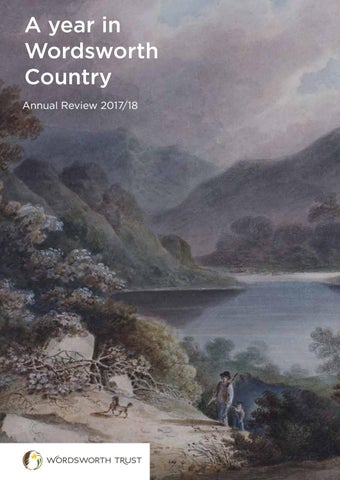
Above: Marian Veevers, Guide, ensures that visitors to Dove Cottage receive a warm welcome. Front cover: William Green, (1760–1823). Lake View with Figure Group Ascending. c.1802-1805, (detail). Watercolour on paper. The Wordsworth Trust, gift of the W.W. Spooner CharitableTrust, 2017 Back cover: The daffodils on the shore of Ullswater on 15 April 2017, 215 years to the day since the Wordsworths saw them. ‘A Fair Trade Walk’ traced the route to Dove Cottage from abolitionist Thomas Clarkson’s home near Pooley Bridge along a new branch of the Fair Trade Way, a 90-mile route across Cumbria and Lancashire.
“To sit in Dove Cottage and read a little of Wordsworth’s poetry was a privilege indeed, and never to be forgotten” Visitor, April 2017
2
2017/18 IN PICTURES Left and Below: Volunteer embroiderers from across the world created pieces in response to the needlework items in our collection as part of the exhibition, Dorothy Wordsworth: A Stitch in Her Time, led by Phillipa Turnbull March–April 2018. Dorothy Wordsworth described sewing as a ‘needful accomplishment’, and the exhibition explored sewing, stitching and mending as a part of daily life in Dove Cottage.
Left and Above: Weather Words in the Community Gallery and the Foyle Room, summer 2017. The exhibition was part of a collaboration with the University of Leeds, and it explored the influence and impact of the weather on the Wordsworths’ lives.
3
2017/18 IN PICTURES Right: Women Behind the Words, February– March 2018. Below: Videos published online brought the exhibition to a worldwide audience. Melissa Mitchell, Assistant Curator (Access) discusses the letter William and Dorothy Wordsworth wrote to their good friend, Samuel Taylor Coleridge, on Christmas Eve 1799, just four days after moving in to Dove Cottage.
Above: A ‘What Are Words Worth?’ session in Burgh by Sands, September 2017 Left: Pop-Up Poetry Café, October 2017
4
Right: ‘Rucksack of Rhymes’ family activities in the Community Centre, Dalton-in-Furness, August 2017. Above: A family ‘Wordsworth Wednesday’ at the Lake District Visitor Centre, Brockhole, August 2017.
I am a member of the Dove Cottage Young Poets - a poetry group funded by the Wordsworth Trust for young people in the Kendal area. … In the last year and a quarter my life has been changed because of my choice to join the group. It’s given me the label of a poet who uses a scooter, rather than just the disabled girl. I honestly don’t know what state my life would be in without this group; my mental health certainly would not be in the good state that it is currently. Hannah Hodgson.
Left: A meeting of the Dove Cottage Young Poets, March 2017.
Taking part in immersive Romanticism courses. Above: Students from Newman University, Birmingham, April 2017. Right: Students from Providence College, Rhode Island, June 2017.
5
2017/18 IN PICTURES
Clockwise from Top Left: Old Hutton Primary School, June 2017. Family activities at Grasmere Show, August 2017. Old Hutton Primary School, June 2017. The Queen Katherine Secondary School, Kendal. Whiter than white? ‘Georgian Wash Day’ with Grasmere Primary School, October 2017.
6
Top Left and Right: Trialling ‘Forest School’ activities for children with special educational needs, one of our aspirations for the Wildwood. To be opened as part of the Reimagining Wordsworth project. Bottom Left: Marie Batty, Senior Project Administrator, with local residents at a public consultation on the Reimagining Wordsworth project at the Buffs Club, Grasmere. Bottom Right: Extract from Dorothy Wordsworth’s Recollections of a Tour Made in Scotland AD 1803, in which she describes the pleasurehouse “all covered with moss” by the Falls of Clyde that inspired the Wordsworths’ own moss hut at Dove Cottage (“It was as snug as a bird’s nest; I wish we had such a one at the top of our orchard”.) As part of Reimagining Wordsworth, we will recreate a moss hut as a place of retreat and recreation.
7
Through the themes of People, Poetry and Place, Reimagining Wordsworth will enhance Dove Cottage and the Wordsworth Museum and create a lively and dynamic destination, a place for creativity, inspiration and enjoyment. What a wonderful way to celebrate Wordsworth’s 250th birthday in 2020! 1. People Individuals from all walks of life can be inspired by the power of poetry. Reimagining Wordsworth will create new spaces and opportunities to bring people closer to poetry, both at Dove Cottage and across Cumbria. An inspiring new programme of activities will take Wordsworth’s poetry out to communities across Cumbria, following Wordsworth’s wish that his poetry will make us “wiser, better and happier”. People of all ages and abilities will be able to take part in a year-round programme of events and workshops in a new learning centre.
3. Place Reimagining Wordsworth will celebrate the powerful connection between Wordsworth’s poetry and the inspirational landscape of the Lake District. You will be able to step back into Wordsworth’s time and become immersed in the unique atmosphere of this special place. A new introductory film will prepare people for the magical moment of entering Dove Cottage. There will be new outside spaces to explore, including a sensory garden and woodland trail, where the spectacle of the changing seasons can be enjoyed throughout the year. A redesigned café and terrace overlooking Dove Cottage will make the hamlet of Town End a place for you to relax and enjoy the unique surroundings. The first ever comprehensive map of Wordsworthian sites across the United Kingdom and beyond will be created by volunteers using digital technology. With grateful thanks to everyone who is giving Reimagining Wordsworth their financial support, including the following organisations.
2. Poetry Wordsworth’s poetry had a huge impact in his own time and is still hugely relevant today. Reimagining Wordsworth will bring his writing to life, shining a light on his creative processes and constant search for perfection. New exhibitions, digital technology and outdoor spaces will combine to bring Wordsworth’s poetry into the 21st century.
Pantone 293 4-colour process: 100%Cyan 57% Magenta 2% Black
a
Wordsworth’s 250th birthday will be celebrated internationally, giving people all over the world a chance to create their own spaces for creativity, conversation and reflection. Dove Cottage will become truly authentic and atmospheric, a step back in time in which you can feel a sense of both the everyday and the inspirational. The Wordsworth Museum will be expanded and modernised, with more windows and a new viewing station. The stunning views of the fells will give you the chance to stop and reflect on the landscape that inspired Wordsworth.
b Pantone 283 4-colour process: 35% Cyan 9% Magenta
c
a
b The John R. Murray Charitable Trust The Band Trustc The Swire Charitable Trust St John’s College, Cambridge The Dr Mortimer & Theresa Sackler Foundation The Charlotte Bonham-Carter Charitable Trust The Derek Hill Foundation The Rothermere Foundation
Black tint 30%
Logo strip. Where the logo appears on a blue strip of pantone 293, there must be equal space from www.reimaginingwordsworth.org.uk top of strip to top of logo and bottom of logo to bottom of strip. Artwork here shows 5mm
8
Company Title set in Aldine 721 Lt BT
Drawings and artists’ impressions courtesy of Purcell (architect) and Nissen Richards Studio (interpretation and design).
9
OBJECTIVES AND ACTIVITIES The Wordsworth Trust was founded in 1891 to secure Dove Cottage, in the words of its first trustees, “for the eternal possession of those who love English poetry all over the world”. Since then, it has acquired many of the other historic buildings that make up the hamlet of Town End, secured the great majority of Wordsworth’s manuscripts, opened the Wordsworth Museum, established an archive, library and fine art collection that celebrate Romanticism and the cultural history of the Lake District, and created a conservation and research centre so that these holdings could remain at Dove Cottage, one of the world’s most important literary sites. The Wordsworth Trust’s purposes are set out in its Memorandum and Articles of Association, and can be summarised as: 1. to provide a living memorial to William Wordsworth and his contemporaries by looking after Dove Cottage and its environs, and by preserving and developing a permanent collection; and 2. to advance public knowledge and enjoyment of the works of Wordsworth and the literature and culture of the Romantic period (c.1750–1850) through a wide range of public activities. The Wordsworth Trust’s aims are the same in their intent as these purposes. They provide public benefit through the advancement of education, heritage, culture and the arts, and thereby meet the definition of ‘charitable purposes’ provided by the 2011 Charities Act. Wordsworth sought through his poetry “to console the afflicted, to add sunshine to daylight by making the happy happier, to teach the young and the gracious of every age, to see, to think and feel”. Our activities are inspired by this vision: of a world in which anyone, anywhere can enrich their life through Wordsworth’s ideas and philosophy, regardless of means or background. In undertaking them, we have therefore taken due regard of the Charity Commission’s public benefit guidance. Our activities, and the criteria that we use to measure their success, are reported in detail in the ‘Achievements and Performance’ section. We use digital technology, publishing and venues in numerous locations to ensure that access is not restricted by geography. While certain activities are aimed at specific beneficiary groups, most are open to anyone. They take place all year round, and some are free of charge.
10
OUR PUBLIC BENEFIT IN NUMBERS 12 months to 31 Dec 2016
15 months to 31 Mar 2018 Visits to Dove Cottage and the Wordsworth Museum i 44,981
Variance
38,872
Onsite Offsite Onsite Offsite Participation in activities for young people in formal education (student-days) 4,712 6,528 Secondary, primary and pre-school 1,927 4,675 6,602 1,816 - 409 Higher education – short courses 1,014 - 1,014 409 273 1,072 Higher education – other 1,051 515 1,566 799 73 105 Teacher development opportunities 18 56 74 32 Total 4,010 5,246 9,256 3,056 5,058 8,114 Participation in activities for families - 122 Events 192 - 192 122 Other activities ii 838 1,664 2,502 760 1,083 1,843 882 1,083 1,965 Total 1,030 1,664 2,694 Participation in community activities Activities specifically for elderly / vulnerable adults 150 2,267 2,417 36 702 738 Activities specifically for young people iii 22 334 356 - 133 133 2,110 Activities for general audiences 197 376 573 363 1,747 399 2,582 2,981 Total 369 2,977 3,346 Attendances at talks, poetry readings and other events 1,414 471 1,885 (excluding family events) 1,555 268 1,823 Interactions via new media Website (unique page views) Viewings of videos (Youtube, Facebook) Social media followers (31 March 2018)
16%
1% 148% 46% -30% 14% 57% 36% 37%
228% 168% -73% 12%
-3%
32% -12% 29%
185,212 14,302 28,797
140,186 16,201 22,266
333
123
171%
Sales of Wordsworth Trust publications New titles 4 Sales 5,258 Distributions 427
1 5,255 150
300% 0% 185%
23
17
35%
19
11
73%
Research visits (research-days)
Participants in vocational training iv Volunteers v
i Includes public tours of the Jerwood Centre. ii On-site activities comprise discovery trails and other self-guided activities. The figure of 838 in 2017/18 (760 in 2016) is therefore also included within general visitors to Dove Cottage and the Wordsworth Museum. iii Meetings of the Dove Cottage Young Poets were previously recorded as schools activity, but they are increasingly independent of the sixth forms through which the group was established and it is now more appropriate to show them here. Our 2016 schools figures have been similarly adjusted. iv Excludes work experience placements. v People who did volunteer work on a regular basis and / or for sustained periods of time.
11
ACHIEVEMENTS & PERFORMANCE We have changed our year-end from 31 December to 31 March, to align our financial year with that of Arts Council England, our principal revenue funder, and make it easier to manage our budgeting, monitoring and reporting. We therefore report here our progress over the fifteen months to 31 March 2018: please note that variances against 2016, our previous financial year, are not a likefor-like comparison. 1. Overview of progress against strategy 2017/18 has been another year of major achievements for the Wordsworth Trust.
both also completed during the year. It received planning permission in December, and, thanks to the many generous funding bodies and individuals who share our vision, we have completed our fundraising for the project in full. A year ago, ‘Reimagining Wordsworth’ was an aspiration; it is now our firm strategic priority. Its completion will be a fitting way to mark Wordsworth’s 250th birthday in April 2020, and it will transform our capacity to provide public benefit for generations to come. 2. Public benefit We monitor our activities by beneficiary group, as shown in the table on page 11. As well as the statistical analysis shown here, we use various qualitative evaluation methods to ensure that our activities meet the needs and aspirations of our beneficiaries.
We continued to use the power of Wordsworth’s poetry to enhance people’s lives, at Dove Cottage, across Cumbria and beyond. Alongside our general activities, we also continued to focus on particular areas, including formal and informal learning, community cohesion, and health & wellbeing. Our capacity to target our work in this way is greatly enhanced by the funding that we receive from Arts Council England through the Cumbria Museum Consortium, and we were delighted to learn in June that the Consortium’s application to be one of the Arts Council’s new ‘National Portfolio’ of regularly funded organisations had been successful. This funding is therefore confirmed at least until March 2022, and we look forward to continuing to work with schools, universities and local communities, and to go on training the museum professionals of the future. Our main strategic focus has been ‘Reimagining Wordsworth’. This c. £6m project will establish Wordsworth’s continuing relevance in the 21st century. It marks the biggest investment in Dove Cottage and the Wordsworth Museum as a visitor attraction in nearly 40 years, and in financial terms it is the Wordsworth Trust’s biggest initiative in our 127-year history. We have made effective use of the development funding that we were awarded by the Heritage Lottery Fund in 2016, and we now have a coherent master plan that will realise our full potential to provide enriching, inspirational experiences at Dove Cottage while resolving our site’s many practical challenges. We also have an activity plan that will take our work in new and exciting directions, significantly increasing our public impact. In summer 2017 we launched a new website, www.reimaginingwordsworth. org.uk, where the project is described in detail. ‘Reimagining Wordsworth’ is informed by a comprehensive survey of our historic buildings and collection, and underpinned by a robust business plan –
12
A full programme of activities and events advanced public knowledge and enjoyment of the works of Wordsworth and the literature and culture of the Romantic period.
a) Visitors to Dove Cottage and the Wordsworth Museum informed this work, with c.200 students from four schools taking part in activities that included an art workshop on Even after over 125 years of providing access to Dove Turner’s approach to painting the weather. Cottage, we still try to find innovations and respond to visitors’ changing interests and expectations. This year, We successfully concluded our two-year creative writing and in anticipation of ‘Reimagining Wordsworth’, we gave project aimed at two schools in Workington whose more prominence to Wordsworth’s poetry and lines from catchment areas have some of the highest areas of the Grasmere Journal on the guided tour; we also created multiple deprivation in Cumbria. The participating poets a new handout about the garden, and by strengthening were Katie Hale and Clare Shaw. We were delighted with the Wi-Fi signal and introducing QR codes, we made it its success, and published an anthology of the pupils’ possible for visitors to use their own devices to listen poems in March. Our work with schools in the early part to poetry and other information about the plants in the of the year was also animated by Holly Corfield Carr and garden. David Tait, the second and third of the poets in residence that we commissioned with Clarissa Luard Award funding In the Wordsworth Museum, Wordsworth’s Lake received from Arts Council England in 2016. The demand District continued to be a key theme, as we continued was clear, and we will respond by commissioning more our successful exhibition Wordsworth Country: Lakes, poets to work with schools from 2018/19 onwards. Mountains and Waterfalls for a second year. Another prominent topic was the weather, as our collaboration We have also included teacher development opportunities with the University of Leeds over its research project, as a performance measure this year, to reflect our ‘British Romantic Writing and Environmental Catastrophe’ involvement in teacher conferences at both primary and informed much of our activity, including our exhibition secondary level, and other teacher training sessions linked Weather Words (July–August), which explored the to poetry and creative writing. influence and impact of the weather on the Wordsworths’ lives at Dove Cottage. We were pleased to see an increase in the take-up of the immersive courses for students that we can uniquely We opened ten other exhibitions during the year, each provide. Courses averaged 2.5 days; the longest took showcasing and responding to Romantic themes and place over a full eight days. Offsite activities benefiting items in our collection. A particular highlight was By students in higher education were boosted by Curator Duddon’s Side (May–June), co-curated with artist Nikki Jeff Cowton’s visit to the University of Texas in October, Pugh, Lancaster University and members of the Duddon where he gave the President’s Address at the International History Group, in which we set out to identify the exact Conference of Romanticism. locations in Wordsworth’s famous sonnet sequence. Displayed alongside manuscripts and early printed c) Families and young people editions were Victorian photographs, contemporary artworks, a hand-built kayak, and a touch-reactive Our ongoing ‘Rucksack of Rhymes’ and other family sound-wall that gave visitors an interactive, multimedia activities, held at Dove Cottage and in towns and villages experience. Wordsworth’s Flowers (March), curated by across Cumbria, were complemented by new initiatives Brandon Chao-Chi Yen, an Early Career Fellow funded including activities with a family literacy group based by the British Association for Romantic Studies, also in Maryport, an outdoor workshop based on ‘Forest incorporated sound recordings, and was linked to the new School’ principles, and a project linked to the Arts Award interpretation in Dove Cottage garden. programme for a group of local families who have young children with Down’s syndrome. These latter two b) Formal education activities formed part of our preparation for ‘Reimagining Wordsworth’, and gave us valuable insights into how By providing workshops for schools visiting Dove Cottage people with special educational needs and disabilities can and making classroom visits to local schools, we put on enjoy our site. We also helped to devise a Wordsworth over two hundred education sessions for nearly a hundred family trail at the Lake District National Park Centre, different schools during the year. 80% of this activity Brockhole, where our ‘Wordsworth Wednesday’ family benefited children in Cumbria, but the schools that visited events during half terms and school holidays continued Dove Cottage came from across the UK and as far afield for a second successful year. as South Africa and Singapore. We continued our support for the Dove Cottage Young Specific initiatives included reading group activities Poets, who meet regularly in Kendal with poet Kim Moore. and an after-school club which we continued to run for Members of the group performed their work at Kendal our two most local primary schools, in Grasmere and Poetry Festival, the Borderlines festival in Carlisle, and in Ambleside. Again, our collaboration with Leeds University Grasmere when Paines Plough brought its Roundabout
13
Theatre to the village in September. Group member Hannah Hodgson won a Personal Achievement Award at the North West Cultural Education Awards in April; the work of the Cumbria Museum Consortium was recognised with a Big Impact Award at the same ceremony. d) Outreach and Community Our ongoing work with local community groups was amongst the activities to be enriched this year by our collaboration with the University of Leeds. Residents of Caldbeck, Fletchertown, Hesket Newmarket and other Cumbrian villages explored the themes of extreme weather with professional poets, artists and photographers; the project led to exhibitions at Dove Cottage and community locations, and a free publication co-published with the Old Courthouse Community Centre in Shap. Our now well-established work with the Parkhill Poets, based at an activity centre for adults with disabilities in Maryport, also resulted in a publication this year. Meanwhile, our regular involvement with the Solway Poetry People, the Grasmere History Group, the West Cumbria Carers and other community groups continued, as did our ‘In the Moment’ sessions in Penrith and Kendal, organised in partnership with the Alzheimer’s Society, and ‘What are Words Worth?’, a drop-in poetry event that this year took place up to three times a week in cafés, care homes, community centres and churches in towns and villages across Cumbria. e) Events New additions to our year-round events programme included Wordsworth walks (in conjunction with the Lake District National Park Authority), events on the themes of mindfulness and on poetry and music, ‘Poetry Sundays’ with Lucy Crispin, ‘Meet the Curator’ events, and ‘Discover Poetry’, a friendly and informal poetry reading group with Grasmere-based poet Polly Atkin. Established features of the programme, such as the ‘Dove Cottage Tuesdays’ fireside talks, the annual Wordsworth Lecture in London (given this year by Professor Sir Drummond Bone) and the literature classes led by Pamela Woof, continued to be popular. f) Digital engagement We continued to harness the potential for digital technology to reach a worldwide audience. We used the StoryMap platform to create our first virtual tour of our exhibition A Celebration of Watercolours (September– December), and in another new initiative we published a series of short films on our YouTube channel linked to our exhibition Women Behind the Words. The films featured curatorial staff and volunteers exploring the roles of Dorothy, Mary and Dora Wordsworth in the creation of the verse manuscripts in our archive, and they helped to maintain the number of views of our online video material,
14
Above: Pop-Up Poetry Café, October 2017.
boosted in 2016 by a one-off Chinese-language broadcast from Dove Cottage garden. We continued to commission and provide free access to thought-provoking articles via the ‘Wordsworth and Romanticism’ blog, and the online catalogue of our collection was significantly enhanced by the digitisation of the Iain Bain collection of Thomas Bewick papers, which we acquired in 2013. g) Other performance measures Our collection is the engine that drives our activities, and a major programme of manuscript conservation, begun in 2011, was completed this year. The programme had been devised by Christopher Clarkson, our advisor for many years and a leader in his field, and we were very saddened by Christopher’s death in March 2017. The access that we provide to our collection through our own programme of changing exhibitions was supplemented by loans to the National Trust (for an exhibition at Wordsworth House, Cockermouth) and the Brontë Society (the Brontë Parsonage Museum, Haworth).
3. Acknowledgements
Manuscripts Conservation Trust, for helping to keep our precious manuscript archive in good repair for future Everything that we do depends upon the financial support beneficiaries; and Tony Reavell, for enabling us to mark the centenary of the death of William Knight, a pioneering that we receive from those funding bodies and people who, just as we do, value Dove Cottage as a special place Wordsworth scholar whose gift of Wordsworth’s lifetime editions remains a cornerstone of our collection, with such where Wordsworth’s memory is kept alive. a handsome publication. We began 2017/18 with a fundraising target of over £5 We are delighted to acknowledge receipt of donations million to make ‘Reimagining Wordsworth’ a reality, and of fine art, manuscripts, books and other material to we are extremely grateful to everyone whose generosity our collection from the W.W. Spooner Charitable Trust, during the year helped us to achieve that target in full. Professor Paul Betz, Dr David Wilson, Lord Smith of We thank the Heritage Lottery Fund, already a major stakeholder in the project, and now its principal supporter. Finsbury, Veronica Finch, Piet de Jong and many others. Our collection continues to grow, and it is gifts such as We thank the Department for Digital, Culture, Media these that make the Wordsworth Trust such a vibrant & Sport, for its support through the Northern Cultural organisation. Regeneration Fund, and for seeing our potential to enhance the Lake District’s new status as a UNESCO Finally, we thank Lord Smith of Finsbury (Chris Smith), World Heritage Site, and we gratefully acknowledge the who stepped down as Chair in November, for his astute bequest from the estate of the late Lord Chorley, a loyal leadership of the Wordsworth Trust over the last sixteen and committed supporter of our work for many years. years, and we welcome his successor, Professor Sir Drummond Bone. Drummond joins the Wordsworth Trust We also thank all those other institutions and individuals at a very exciting time. whose gifts and pledges to ‘Reimagining Wordsworth’ helped us to make such a compelling case for lottery funding: the Wolfson Foundation, the Linbury Trust, the Garfield Weston Foundation and the Foyle Foundation, for so generously endorsing our plans; and the John R. Michael McGregor Murray Charitable Trust, the Wyfold Charitable Trust, the Postcode Local Trust, St John’s College, Cambridge, Director the Dr Mortimer and Theresa Sackler Foundation, the Charlotte Bonham-Carter Charitable Trust, the Swire Charitable Trust, Patricia Grodd and Michael Stone, Harry Williamson, John and Sally Barker, Stephen Gill, Bill Zachs, Peter Brears, Debbie Pfuntner, David McKitterick and the many other institutions and individuals who responded with such enthusiasm to our appeal. As always, we thank our three major funding partners – Arts Council England, South Lakeland District Council and Lancaster University – and our Patrons, Friends and other regular donors, whose support underpins our ongoing work. We also thank everyone who helped us with specific accomplishments during the year: the Sir John Fisher Foundation, for funding the staff that maintain our collection and enabling us to provide a free Reading Room service for researchers; the Michael Marks Charitable Trust, with whose support we promote excellence in contemporary poetry; the University of Leeds, for supporting our exhibitions and work in local communities; the John Ellerman Foundation, for helping the Cumbria Museum Consortium to provide a leadership role for the county’s museum sector; the John S. Cohen Foundation, whose funding has given valuable opportunities to schoolchildren in disadvantaged parts of west Cumbria; the Friends of the National Libraries, for digitising the Thomas Bewick archive, and the Digital Content Unit at Cambridge University Library for their help with equipment and specifications; the National
Michael McGregor at Buckingham Palace for our Royal Patron HRH The Prince of Wales’ 70th Birthday Garden Party, with (from left to right): Alan Hunter of the Parkhill Poets, Maryport; Susan Allen, Community Outreach Officer; Janice Wilson, Dove Cottage Guide; and Pamela Woof, Fellow and former President.
15
FINANCIAL REVIEW 1. Summary The net income for the fifteen months, including investment gains and losses, was £364,000 (year to 31 December 2016: £325,000 net income). We have made the decision to change our financial reporting date from 31 December to 31 March, so these financial statements cover a 15-month period. This inevitably means that comparisons between the years are harder to draw, exacerbated by the inclusion of expenditure on the delivery phase of the Reimagining Wordsworth project, which ran throughout the calendar year of 2017. We increased the admission price in 2017, which helped to increase the income from admissions in the fifteen months. Visitor numbers increased in the calendar year 2017 compared to 2016, which had been heavily impacted by the closure of the main road through the Lake District in the early months of the year, but they fell slightly against the number for 2015. The Catalyst Endowment campaign, supported by Arts Council England, resulted in a large increase in donations and legacies in 2015 and 2016. The campaign has now been completed and there were no donations during the fifteen months to 31 March 2018 (year to 31 December 2016: £691,000). The impact of the Reimagining Wordsworth project can be seen in a number of areas in the financial statements. The development phase ran until early January 2018, when we submitted the application to the Heritage Lottery Fund (HLF) for second round funding to support the delivery phase. Expenditure on the development phase was £517,000, of which £266,000 was capitalised, including £259,000 as assets under construction. The balance was treated as expenditure. £494,000 in grant income was received from the HLF (2016: £51,000) and the remaining expenditure was covered by income that we had raised in earlier years and which was being held in designated or restricted reserves. In March 2018 the HLF announced their support for the delivery phase of the project with a grant of up to £4,094,800 against a project cost of £5,425,800. We have been successful in fundraising for the balance of the project costs and in the accounts for the fifteen months to 31 March 2018, £162,000 of income received and £153,000 of pledged income has been recognised. Salary costs for the fifteen months amounted to £1,045,000 (year to 31 December 2016: £773,000). This
16
has increased as a result of a pay award in April 2017 of 1% plus an increase to the national living wage. There are also increased salary costs as a result of staff being employed directly to support the Reimagining Wordsworth project. The Major Partner Museum grant that we receive from the Arts Council as part of the Cumbria Museum Consortium was renewed with effect from 1 April 2018 for four years. Expenditure against other restricted funds includes £135,000 of depreciation on the Jerwood Centre, which was funded by grants in prior years. There have been difficult trading conditions for our trading subsidiary, Dove Cottage Promotions Ltd. It has seen a loss of £8,000 (2016: £5,000 profit). This has been exacerbated by the 15-month period covering our closed period and two of our weakest trading months at the start of 2018. 2. Investments We own several properties in Town End, Grasmere in the vicinity of Dove Cottage that are held as investment assets. The properties are let to a mix of staff and third parties, and rents are assessed against market rates. One property is a guesthouse and is let on a commercial lease. Rental income for the fifteen months was £141,000 which was a proportionate increase on 2016 (year to 31 December 2016: £107,000). We have four discrete funds managed by Cazenove Capital Management (the wealth management arm of Schroder plc): the Development Fund; the R.S. Woof Memorial Fund, which permanently endows the post of the R.S. Woof Director; the Catalyst Endowment Fund; and the Reserve Fund, which is held in the balance sheet as a current asset investment. There are no ethical restrictions on any of the funds under management. The Development Fund comprises both a permanent endowment and a designated element. Due to the restrictions placed upon the entire Development Fund by the donor of the endowment element, both components of the fund must be treated as permanent endowment. The fund overall is invested on a total return basis, and the managers have investment discretion to meet a target total return of CPI + 2%. Trustees plan to allocate at least £50,000 per year on a regular basis from the entire fund to income in order to aid planning within the organisation. In 2017–18, they decided to allocate £16,250 per quarter. In making this allocation, Trustees have sought the opinion of the investment manager and considered the impact on both current and future beneficiaries. At 31 March 2018 the unapplied total return amounted to £307,000
(31 December 2016: £296,000) in the Endowment Development Fund and £192,000 (31 December 2016: £186,000) in the designated element of the Fund. By the end of the year, the FTSE-100 Total Return Index had risen 3.9% over the fifteen months to 31 March 2018. The Development Fund generated a total return of +8.6% against a target of 5% (CPI + 2% for the fifteen months to 31 March 2018) and a benchmark of +8.6% in the calendar year 2017, and a total return of –4.8% against a benchmark of –3.9% in the three months to 31 March 2018. The purpose of the R.S. Woof Memorial Fund is to endow the position of the Robert Woof Director. To this end, the objective of the fund is to maximise income while maintaining the capital value. As the fundraising for the Catalyst Endowment Fund has now finished, there was no increase in the funds available for investment during the 15-month period. The fund is invested with a prudent approach to risk to maximise income consistent with maintaining the real value of the capital. It has a higher requirement for income than the Development Fund, being set at 3.5%. The smaller R.S. Woof Memorial Fund, which has a more defensive mandate, saw a 2.7% capital appreciation over the fifteen months while generating a yield of 4.17% in the calendar year 2017. The Catalyst Endowment Fund, which reduced in size over the fifteen months by £4,000, generated a yield of 3.56% over the calendar year 2017. All our fixed asset investments are managed for the longer term, and Trustees remain confident that the long-term outlook remains favourable. The Reserve Fund investments are held as current assets which are available to support our operating cash flow should a short-term need arise. Rather than use low return bank deposits, Trustees have decided to invest this surplus cash in a readily tradeable bond fund. This fund generated a yield of 4.1% for the calendar year 2017. During 2016, £25,000 was taken from the fund to support the cash flow for Reimagining Wordsworth (2017–18: nil).
Where the money came from
6%
Investments, including the Catalyst endowment fund
6%
23%
Charitable trusts, individuals, legacies, businesses, clubs and societies
Property rents
7%
Shop and other trading
18%
Admissions, events and courses
2%
University partnerships
38%
Public sector and lottery distributors
How it was spent
26%
Cost of generating funds
25%
Custodianship
3. Reserves The Wordsworth Trust maintains reserves to enable it to fulfil its charitable remit by providing for business continuity, security to its collection, and the maintenance of its properties in circumstances where its revenue requirements may not be covered by short-term income. The reserves are managed to offer the best return for the charity while remaining relatively liquid to meet its needs.
49%
Access and learning
17
SUMMARISED FINANCIAL STATEMENTS 1. Summary group accounts Unrestricted Restricted Endowment Total funds Jan–Dec funds funds & 2016 for development comparison funds Income - Donations and legacies 165 1,309 2 1,476 691 - Investment income 155 – 136 291 234 - Admission fees and other income 605 – – 605 505 TOTAL INCOME 925 1,309 138 2,372 1,430 Expenditure - Custodianship 272 224 2 498 358 - Access and Learning 350 635 3 988 715 - Cost of generating funds 450 61 20 531 407 TOTAL EXPENDITURE 1,072 920 25 2,017 1,480 (147) 389 113 355 (50) Gains/(losses) on investment assets – – 9 9 375 NET INCOME /(EXPENDITURE) (147) 389 122 364 325 Transfers between funds 100 – (100) – – Net movement in funds (47) 389 22 364 325
2. Summary consolidated balance sheet Unrestricted Restricted Total funds Jan–Dec funds Endowment 2016 for and comparison development funds Heritage assets 3,295 – 3,295 3,184 Other tangible assets 950 2,217 3,167 3,051 Investments 5,235 3,519 8,754 8,741 TOTAL 9,480 5,736 15,216 14,976 NET CURRENT ASSETS 289 394 683 561 CREDITORS falling due after more than a year (1,000) – (1,000) (1,002) TOTAL NET ASSETS 8,769 6,130 14,899 14,535
These summarised financial statements are not our statutory accounts, but a summary of information relating to our consolidated statement of financial activities and our consolidated balance sheet derived from our full audited Trustees’ Report and financial statements and approved by Trustees on 2 November 2018. The auditor’s statement as prescribed by the Companies Act 2006 was unmodified. The full financial statements have been filed with the Charity Commission and Companies House. These summarised financial statements may not contain sufficient information to gain a complete understanding of our financial affairs. Our full audited Trustees’ Report and financial statements can be downloaded from our website or obtained from the Company Secretary at our registered address.
18
FUTURE PLANS 2018/19 will be another milestone year, as we start the delivery phase of Reimagining Wordsworth. We will commission detailed plans and drawings, and appoint a contractor in time to complete the building and fit-out work in 2019/20. Working with our partner organisations, we will also continue to plan a programme of activities to celebrate the 250th anniversary of Wordsworth’s birth in 2020. In the meantime, we will continue to diversify our offer, so that our activities can appeal to as diverse a range of people as possible. Specific objectives for 2018/19 include: a) Visitors enhancing the experience of visiting Dove Cottage and its garden by providing opportunities for new ‘meet-and-greet’ volunteers.
d) Digital engagement relaunching the Wordsworth Trust’s website with a simpler, more user-friendly design. contributing to ‘A History of the North in 100 Objects’, an online exhibition linked to the Great Exhibition of the North. e) Other performance measures creating a new brand identity for the Wordsworth Trust. recruiting a Volunteer Coordinator, a new post, to help realise our ambitions to improve the visitor experience and our outreach work through the Reimagining Wordsworth project. working with our partners in the Cumbria Museum Consortium to present ‘Success in the Sticks’, a conference specific to museums in rural locations.
presenting, with guest curator Fiona Sampson, a major new exhibition, In Search of Mary Shelley, to mark the bicentenary of the publication of Frankenstein. presenting further exhibitions and displays on the theme of ‘Women Behind the Words’, to mark 100 years since women secured the right to vote. improving the general presentation of Town End for the benefit of all its visitors, including the exteriors of those historic properties that do not form part of the Reimagining Wordsworth project. b) Formal education increasing (from one to two) our free classroom sessions in local schools, to add value to their visit to Dove Cottage. helping Newman University students present an exhibition in Birmingham Library based on their responses to Wordsworth and Dorothy Wordsworth. c) Outreach and community working with local volunteers to devise and open a sensory garden in an unused part of our site, for the benefit of Grasmere residents, visitors to Dove Cottage and the many walkers who pass through our site.
Exploring Dove Cottage garden to inspire writing and painting.
19
SUPPORTERS Here we thank all those organisations and individuals who have helped us to keep Wordsworth’s memory alive at Dove Cottage in 2017/18.
Mr and Mrs John Forsyth Mr Peter Brears Dr Deborah L. Pfuntner Mr and Mrs Adam Naylor Mr Charles Sebag-Montefiore Mrs Corinna Wiltshire
Funding partners
The American Fund for Charities Mr and Mrs Trevor Smale Mr and Mrs Peter Hensman Mrs Susan Axford The late Sir Henry Brooke Mr and Mrs Stewart Douglas-Mann Miss Veronica Finch Mr and Mrs Timothy Harding Prof. David and Prof. Rosamond McKitterick
Other major funders and donors in 2017–18*
Mrs Diana Matthews Mr John Nicoll
Institutions and individuals
Mr Charles Nugent
The Linbury Trust
The Rothermere Foundation
The W.W. Spooner Charitable Trust
Mr and Mrs John Spedding
The John R. Murray Charitable Trust
The Warner Priory Charitable Trust
Professor Paul Betz
Viscount Windsor
The Sir John Fisher Foundation
Mr and Mrs Nicholas Coulson
The Michael Marks Charitable Trust
Mrs Linda Kelly
The University of Leeds
The Lake District National Park Authority
The John Ellerman Foundation
Professor Peter and Dr Jackie Bettess
Patricia Grodd and Michael Stone
Sir Geoffrey and Dr Lynn Bindman
The Wyfold Charitable Trust
The University of Sunderland
The Postcode Local Trust
Dr Vivienne Painting
St. John’s College, Cambridge
Mr Charles Woodhouse
Mr Harry Williamson FCSI
Mrs Jan Ambler
Dr David Wilson
The Ashfield Trust
Mr and Mrs John Barker
Dr Gordon Bottomley
The John S. Cohen Foundation
Sir John and Lady Boyd
The Dr Mortimer & Theresa Sackler Foundation
James Brockbank and Louise Ronane
Mr Piet de Jong
The Duke of Buccleuch and Queensberry KBE
The Rt Hon Lord Smith of Finsbury PC
Mr and Mrs John Collier
The Friends of the National Libraries
Mrs Diana Delbridge
Mr Tony Reavell
Mrs Sheila Edwards
Dr William Zachs
Lord and Lady Egremont
The Charlotte Bonham-Carter Charitable Trust
Miss Anne E. Elliott
Professor Stephen Gill
The Golden Charitable Trust
The Swire Charitable Trust
The JFR Charitable Trust
Mr Jonathan Wordsworth
The Baroness Kidron OBE and Mr Lee Hall
20
Professor Lucy Newlyn
Patrons of the Wordsworth Trust
Dr Cecilia and Mr Nicholas Powell
(since 1 January 2017)
Dr John Martin Robinson DPhil DLitt FSA Dr Lynn Shepherd
Mrs Jan Ambler
Dr Bruce Graver
Mrs Susan Axford
Mr Tim Roberston
Mr and Mrs John Barker
Mr and Mrs Tony Vaughan
Professor Peter and Dr Jackie Bettess
The British Association for Romantic Studies
Professor Paul Betz and Carol Rosen
Mrs Margaret Thorpe
Dr Lynn Bindman
The Arnside Lecture Group
Dr Gordon Bottomley
Mrs Jenny Uglow
Sir John and Lady Boyd
Sir Eric and Lady Anderson
James Brockbank and Louise Ronane
Professor Sir Drummond Bone
The Duke of Buccleuch and Queensberry KBE
Mr Briain de Buitleir
Mrs Mary Chuck
Mr Stuart Fletcher
Mr and Mrs John Collier
Miss Delia Twamley
Mr and Mrs Nicholas Coulson
Mr Richard Arnold
Rachael Davenhill
Mrs Constance Parrish
Mrs Diana Delbridge
Mr Tim Sturgis
Mrs Sheila Edwards
Mrs Vivian Turnbull
Lord and Lady Egremont
Charlene Townsend
Miss Veronica Finch
Five anonymous donors
Mr and Mrs John Forsyth
* This list reflects grants and donations exceeding ÂŁ200 recognised as received in our 2017/18 accounts. Grants and donations received since 1 April 2018 will be published at a future date.
Patricia Grodd Mr David Heal Mrs Linda Kelly The Baroness Kidron OBE and Mr Lee Hall Mrs Diana Matthews Dr and Mrs Adam Naylor
Legacies
Professor Lucy Newlyn
The late Lord Chorley
Mr John Nicoll
The late Miss Henrietta Richardson Perkins
Dr Cecilia and Mr Nicholas Powell Dr Deborah L. Pfuntner Dr John Martin Robinson DPhil DLitt FSA Mr Charles Sebag-Montefiore Mrs Harriette Smale The Rt Hon Lord Smith of Finsbury PC
We try hard to keep our lists up to date. Please contact Mark Bains, Development Manager, if you find any inaccuracies. Thousands of people benefit from the financial support that we receive. Please contact us to discuss how you or your grant-making trust could make a difference: Mark Bains, Development Manager; 015394 63515; m.bains@wordsworth.org.uk
Mr and Mrs John Spedding Mr Harry Williamson FCSI Mrs Corinna Wiltshire Mr Charles Woodhouse
21
Royal Patron HRH The Prince of Wales President Mrs Pamela Woof FRSL (to 30 June 2018) The Rt Hon Lord Smith of Finsbury PC (from 1 July 2018) Fellows The title of ‘Fellow’ is used to recognise individuals who have made a significant contribution to the Wordsworth Trust, for example as trustees, longstanding supporters or advocates. Fellows are not involved in our governance, but they are important and valued ambassadors for our work. Sir Eric Anderson FRSE Mrs Eileen Ainscough Sir Geoffrey Bindman QC Sir John Boyd KCMG The Rt Hon the Lord Bragg The Rt Hon the Lord Brooke CH PC Mr Michael Broughton Dr David Cohen CBE Mr Stewart Douglas-Mann Professor Stephen Gill The Rt Hon the Earl of Gowrie PC Mr Tony Harrison Mr Laurence Harwood OBE FRICS Mr Peter Jubb Mrs Linda Kelly FRSL Professor John Kerrigan Professor Grevel Lindop Sir Ian McKellen CH CBE Professor David McKitterick FBA D LITT Dr Lucasta Miller Mr John Murdoch Mr John Murray Mrs Virginia Murray The Lady Rupert Nevill Mr Charles Nugent Dr Cecilia Powell FSA Professor Fiona Sampson MBE FRSL Mr John Spedding CBE DL Mr Tim Sturgis Ms Claire Tomalin FRSL Dr David Wilson FCIS FSA Mrs Pamela Woof FRSL
22
GOVERNANCE AND MANAGEMENT Current as of November 2018 Trustees
Assistant Curator (Collection) (job share) Poppy Garrett, Rebecca Turner
Professor Sir Drummond Bone (Chair) Mr John Collier FCA (Treasurer) Mrs Mary Chuck Ms Judith Cooke Mr David Heal Mrs Diana Matthews DL, JP Dr Lucy Peltz Mrs Jenny Uglow OBE, FRSL
Education Officer Catherine Kay
Staff
Engagement Officer Tom Langridge
Director’s Office The Robert Woof Director Michael McGregor FRSA Senior Project Administrator Marie Batty PA to the Director Catherine Foster Dove Cottage and Estate Senior Guide Hazel Clarke Guides and Visitor Experience David Banning, Sylvia Bradley, Peter Coward, Ruth Eastwood, Philip Hartley, Philip Hilborne, Marian Veevers, Alexander Verey, Janice Wilson Estate Manager Stephen Sharp Estate Workers Ben Earnscliffe, Peter Foster Curatorial and Learning Curator and Head of Learning Jeff Cowton MBE Education Development Manager (job share) Bernadette Calvey, ZoÍ McLain Visitor Experience Manager Jane Affleck Deputy Visitor Experience Manager John Coombe Assistant Curator (Access) Melissa Mitchell
Community Outreach Officer Susan Allen Events Officer Hannah Catterall
Assistant to the Curator Poppy Garrett Shop Commercial Manager Alison Magrath Retail Operations Manager Michael Mitchell Retail Supervisors Lee Baker, Dean Hines Finance Finance & Operations Director Amanda Pickup Finance & Administration Officer Diana Hendry Marketing & Communications Marketing Coordinator Emily Burnham Marketing Assistant Dora Anderson-Taylor Fundraising Development Manager Mark Bains Development Officer (Donations) Hannah Stratton Trainees Hannah Britton, Amy Hall, Ellis Huddart, Judy Irabor, Ella Luo, Jen Patterson Regular volunteers Barbara Crossley, Laura Fox, Anne-Marie Holmes, Jane Lee, Robert Vale
23
If my writings are to last … they will please for the single cause, ‘that we have all of us one human heart!’ William Wordsworth. 1835 The Wordsworth Trust has been providing a ‘living memorial’ to William Wordsworth at Dove Cottage since 1891.
The Wordsworth Trust Dove Cottage, Grasmere, Cumbria, LA22 9SH 015394 35544 enquiries@wordsworth.org.uk Registered as a charity in England and Wales: 1066184. Registered as a limited company: 3442086.
To help us to continue bringing great poetry alive for people of all ages, visit www.wordsworth.org.uk/support us/.
www.wordsworth.org.uk