MAY/JUNE 2019
CONNECTION Published for the members of West Kentucky & Tennessee Telecommunications Cooperative
BROADBAND: JOBS EDITION
CASH CROP
Technology takes farming to a different level
THE FAST LANE LIFE Dresden fiber project nearing completion
BUILDING BUSINESSES A faster internet grows the economy job by job
INDUSTRY NEWS
Rural Connections BY SHIRLEY BLOOMFIELD, CEO NTCA–The Rural Broadband Association
Broadband drives rural and urban jobs With this issue’s focus on the impact of broadband on jobs, I was reminded of a report our Foundation for Rural Service and the Hudson Institute released three years ago. Entitled “The Economic Impact of Rural Broadband,” this report estimated the direct and indirect economic effects of the rural broadband industry on gross domestic product. The report showed that rural broadband companies like yours contributed $24.1 billion to the economies of the states in which they operated. Even more interesting is the fact that $17.2 billion of that total was through their own operations. The rest, $6.9 billion, was through the follow-on impact of their operations. Those are impressive numbers under any financial index. Sixty-six percent, or $16 billion, of that total economic impact actually flows to urban areas. That means the U.S. jobs market needs rural broadband to remain strong and healthy. The impact of rural broadband goes far beyond the service areas of rural telcos. The study showed that the rural broadband industry supported 69,600 jobs in 2015 — and I’m sure those numbers are even higher today. These jobs not only come from broadband providers themselves, but also from companies that supply goods and services to the industry. And more than half of those jobs, 54 percent in fact, are actually in urban America. The truth is in the numbers. Rural broadband creates jobs and helps drive our economy — in rural and urban America alike.
2 | May/June 2019
Fighting robocalls BY STEPHEN V. SMITH
TRACED Act would help stop unwanted, illegal calls Your phone rings. Even though you’re in the middle of dinner, you answer because the Caller ID information shows the call is coming from a local number. Maybe it’s someone you know. “Congratulations!” the recorded voice exclaims. “You have been selected to receive a free cruise.” You just answered one of the estimated 130 million automated calls placed every day. While there are legitimate uses of autodialing, illegal robocalls have become a plague that impacts everyone with a phone. Lawmakers have worked on the issue for almost three decades. Yet despite laws and fines designed to stop the practice, criminals — armed with ever-advancing software and technology — continue to find ways to flood our nation’s phone network with unwanted calls. Earlier this year, Sen. John Thune, R-S.D., and Sen. Ed Markey, D-Mass., introduced the TRACED Act, short for Telephone Robocall Abuse Criminal Enforcement and Deterrence Act. It gives the FCC and other agencies more power in enforcing existing laws governing robocalls. “Unwanted robocalls that utilize spoofed phone numbers or falsify information are a problem in urban
and rural America alike,” says Shirley Bloomfield, CEO of NTCA–The Rural Broadband Association. She says the TRACED Act “seeks to tackle this problem while also recognizing the transitions necessary to implement new technologies and network connections that will help achieve this goal.” In March, the attorneys general of all 50 states, plus four territories, signed a letter in unanimous support of the TRACED Act, sending it to the Senate Commerce, Science, and Transportation Committee. A group of 10 U.S. senators representing several states and both political parties later issued a press release pledging their support for the bill as co-sponsors. “With bipartisan support growing, the time to pass legislation to stop the scourge of robocalls has come,” said senators Markey and Thune in that press release. “The groundswell of support for our TRACED Act — from state and territory attorneys general, to FCC and FTC commissioners, to leading consumer groups, to major industry stakeholders — shows just how much the American people want Congress to act to stop harassing robocalls.” As of press time, the bill remained in committee. Before becoming law, it would require support by both houses of Congress and the president.
Attention local business owners:
Hey
telemarketers:
MAKE SURE YOU FOLLOW THE DO NOT CALL RULES
DO NOT CALL!
T
he Federal Trade Commission and the Federal Communications Commission established a National Do Not Call Registry. Joining this registry can drastically reduce the number of telemarketing calls you receive. JUST THE FACTS ABOUT DO NOT CALL: • Once you’ve registered, telemarketers have 31 days to stop calling your number. • Register as many as three nonbusiness telephone numbers. You can also register cellphone numbers — there is not a separate registry for cellphones. • Your number will remain on the list permanently unless you disconnect the number or you choose to remove it. • Some businesses are exempt from the Do Not Call Registry and may still be able to call your number. These include
It’s Easy! Add your number to the
Do Not Call Registry
political organizations, charities, telephone surveyors and businesses with whom you have an existing relationship. Strict Federal Trade Commission rules make it illegal for telemarketers to do any of the following, regardless of whether or not your number is listed on the National Do Not Call Registry: • Call before 8 a.m. • Call after 9 p.m. • Misrepresent what is being offered • Threaten, intimidate or harass you • Call again after you’ve asked them not to
Register online at
www.donotcall.gov or call 888-382-1222. For TTY, call 866-290-4236. You must call from the telephone number you wish to register.
No matter if you’re a one-person shop or a beloved company, local business owners should remember that National Do Not Call Registry rules and regulations apply to you. After all, you don’t want to upset a loyal customer, or frustrate potential new customers, with unwanted phone calls. If you are a company, individual or organization that places telemarketing calls, it is very important that you familiarize yourself with the operations of the National Do Not Call Registry. Unless you fall under one of the established exceptions, such as telemarketing by charitable organizations or for prior business relationships, you may not make telemarketing calls to numbers included in the National Do Not Call Registry. For information regarding National Do Not Call regulations, visit the National Do Not Call Registry at www.telemarketing.donotcall. gov. You can find the Federal Communications Commission and Federal Trade Commission rules governing telemarketing and telephone solicitation at 47 C.F.R. § 64.1200 and 16 C.F.R. Part 310, respectively. OFFICIAL NOTIFICATION: The Do Not Call initiative, regulated by the Federal Trade Commission and the Federal Communications Commission, requires telephone service providers to notify customers of the National Do Not Call rules and regulations.
May/June 2019 | 3
FROM THE CEO
Broadband builds business
A
t WK&T, our daily business is providing reliable service for our customers — but in the big picture, we’re also in the jobs business.
TREVOR BONNSTETTER
Chief Executive Officer
Our broadband network is foundational to our area’s economic well-being and crucial to keeping and growing job opportunities locally. We all want fulfilling and meaningful jobs that provide for ourselves and our families, and broadband is critical to making them possible. WK&T recently received a $2 million Broadband Accessibility Grant from the Tennessee Department of Economic and Community Development. WK&T will match those funds, investing a total of more than $4 million to build a fiber optic broadband network in Henry County. It’s just one more example of the commitment your cooperative has to providing the fastest internet possible, because reliable, high-speed internet access allows our region to remain competitive and viable in four major economic areas.
INDUSTRY
Whether it’s an agricultural operation, an industrial plant or a professional services firm, businesses rely on broadband to order materials, coordinate logistics, manage supply chains and communicate with other facilities. When a manufacturer or other big business considers a rural area like ours for a new facility, they are always concerned about broadband access. I’ve seen more than a few companies surprised by the quality of connections we provide. WK&T can provide a fiber connection to any of our area’s industrial parks. We frequently work with local officials to recruit new businesses and to help existing businesses expand. In fact, that’s our vision for the WK&T Tech Park in Mayfield, Kentucky. This spacious 53-acre campus offers sites for business incubation, retail, residences, a community center and more.
SMALL BUSINESSES
Small businesses are the backbone of our community. Whether it’s providing Wi-Fi for their customers, giving access to online marketplaces or just ordering supplies online, those same small businesses benefit from our broadband and our phone network. It’s easier than ever for small businesses in our community to reach a national or worldwide audience, and WK&T is proud to support their efforts as they serve and grow.
TELECOMMUTERS
According to the Bureau of Labor Statistics, nearly a quarter of Americans do at least some of their work from home. Rural areas like those we serve are increasingly attractive to telecommuters who may not want the expense and stress of living in big cities. While it’s easier to overlook the impact of telecommuters compared to a manufacturing plant spread over several acres, these remote workers play an important role in our area’s economy. These talented folks are able to benefit from good-paying jobs while living a rural lifestyle. Most of these jobs are only possible because of the broadband and phone networks we provide.
ENTREPRENEURS
There was a time when entrepreneurs would have to move to larger cities to find customers, workers or the communications infrastructure to help them launch and grow their businesses. Thanks to our broadband network, they can live here and work all over the world. Those four groups make up a significant portion of our local economy. They do great work producing quality products and services for their customers. As they move forward, I’m happy that they can be confident in having a reliable, supportive communications partner growing right along with them. 4 | May/June 2019
CONNECTION MAY/JUNE 2019
VOL. 11, NO. 3
The WK&T Connection is published by West Kentucky and Tennessee Telecommunications Cooperative, © 2019. It is distributed without charge to all members of the cooperative.
is your cooperative serving West Kentucky and Northwest Tennessee across more than 13,000 network connections. The company is dedicated to using technology to keep its members connected through local and longdistance calling, high-speed internet, digital television and beyond.
Send address corrections to: WK&T Telecommunications Cooperative 100 WK&T Technology Drive Mayfield, KY 42066 Telephone: 877-954-8748 www.mywkt.net
BOARD OF TRUSTEES Tony Goodman President Ricky Littleton Vice President Beverly Taylor Secretary/Treasurer Bill Hainaut Jeff Davis Jerry Holloway Jerry Stephenson Joe Thompson
Produced for WK&T by:
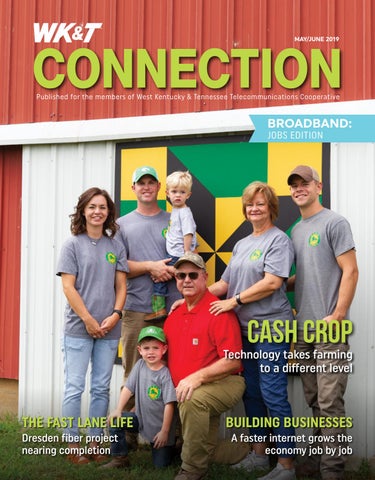
On the Cover: Cash Farms is a familyoperated business that uses new innovations and technology for crops while keeping traditions alive. See story Page 12.
WK&T AWARDED $2 MILLION BROADBAND GRANT The WK&T Telecommunications Cooperative has received $2 million via the Tennessee Department of Economic and Community Development’s Broadband Accessibility Grant program. The cooperative will match these funds, investing a total of more than $4 million to build a fiber optic broadband network in Henry County. The project calls for building a fast broadband network in two sections of Henry County. One area lies east of Highway 79 and west of Kentucky Lake, and the second area is west of Highway 79 and northeast of Paris. When completed, the network will make high-speed broadband internet access available to 912 homes.
Battery backup for your phone WK&T’s fiber optic network provides your home with phone and broadband service, which require electric power. To avoid disruption of home voice service during a power outage — and to maintain the ability to connect to 911 emergency services — WK&T provides an eight-hour battery backup to you at no charge. If you do not have landline service, WK&T makes available for purchase a battery backup power supply. Backup batteries are expected to last up to eight hours on standby power. This means the backup battery should give you about six hours of voice service. If you feel that is not enough time, you may extend your standby battery by purchasing additional batteries to supply backup power for up to 24 hours. Please call WK&T’s customer service for more information. Note: Although the battery backup can support WK&T internet and video services for a short time, the backup is intended to support voice services only.
Thanks, Mom and Dad!
Like and follow WK&T on Facebook. Throughout May and June, WK&T will post videos of children and adults discussing what makes their parents so special.
WK&T Telecommunications Cooperative
Employee Spotlight
Unmatched service Benny Turner started his career at WK&T more than 30 years ago when telephone service was the focus. Over time, technology changed, and with that change came blazing-fast internet. “My major job is a fiber optic splicer,” Turner says. “I do splicing and fiber optic troubleshooting. If a line is cut, I trace it down and repair it.” One thing that hasn’t changed with the times, however, is Turner’s commitment to WK&T and the cooperative’s dedication to its customers. “I have been out at 2 in the morning in pouring-down rain,” Turner says. “The nighttime work, the gratitude of getting it fixed and helping the customer by getting it fixed, I can go home and say I did something.” With retirement in sight, Turner will call it quits in July and focus on his other hobbies. He plans to continue farming as well as hunting and fishing. WK&T congratulates Turner on his retirement and his commitment to his craft.
MEMORIAL DAY OBSERVANCE
WK&T will be closed on Monday, May 27, in observance of Memorial Day.
May/June 2019 | 5
TRAVEL
Seagoing majesty
Visit the centers working to protect sea turtles BY ANNE BRALY
S
They’re among the most imperiled groups of animals that swim our seas, says Dr. David Steen, a research ecologist at the Georgia Sea Turtle Center in Jekyll Island, Georgia. If the baby turtles can make it to adulthood — which is an accomplishment in itself, as most perish before they reach that critical stage — they can live for decades and reproduce many times. “This offsets the high mortality they experience in early life,” Steen says. “But the big problem arises when adults experience higher death rates than normal. It’s tough for populations to recover.” The Georgia Sea Turtle Center is one of several such centers located in coastal states around the South. It opened in 2007 and has educated hundreds of thousands of visitors on the hazards sea turtles face, as well as the important role they play in our ecosystem. 6 | May/June 2019
Crowds gathered for the release of a sea turtle on Jekyll Island, Ga., which is home to the Georgia Sea Turtle Center.
Photos courtesy of the Jekyll Island Authority.
ea turtles are some of the most majestic, longlived animals in the ocean. However, hundreds of thousands of them die each year after being tangled in fishing nets and other man-made gear. They also suffer as a result of climate change, lack of food, contaminated seas and other hazards.
See more sea turtles IN SOUTH CAROLINA: Zucker Family Sea Turtle Recovery at the South Carolina Aquarium 100 Aquarium Wharf, Charleston, S.C. Online: scaquarium.org Zucker Family Sea Turtle Recovery allows guests who visit the South Carolina Aquarium to experience and learn about sea turtles. It’s both a hospital and a guest experience, making the real-life rehabilitation of sick and injured sea turtles visible to all guests through windows into the surgical suite. Experience a turtle’s remarkable journey from rescue to rehabilitation and release. To date, the South Carolina Aquarium has returned 265 rehabilitated sea turtles to the ocean.
IN FLORIDA:
Conservation efforts are helping to increase the number of loggerhead sea turtle nests in Georgia.
The center is a one-of-a-kind experience, Steen says. Visitors can learn about sea turtles in an interactive learning center, peer into a hospital window to see turtles being treated by a veterinarian, and stroll through a pavilion to view turtles as they are rehabilitated in tanks. And during the nesting season, which runs from May to July, visitors can join educators and researchers on night searches for nesting sea turtles. Educating the public about the importance of sea turtle recovery is a focus of the center’s mission. “If your ecosystem has missing pieces, there will inevitably be cascading effects, many of which we can’t even predict,” Steen adds. “There are many philosophical, ecological and spiritual reasons one might consider when discussing why we need to save sea turtles, but there are legal reasons, too. All sea turtles are protected by the Endangered Species Act, and that means we must work to recover their populations.” The effort appears to be working, as the number of loggerhead sea turtle nests in Georgia is gradually increasing, Steen says. “Their numbers are increasing due to a variety of individuals, agencies and organizations in the region, and also because of the state and federal legislation like the Endangered Species Act that protects them.”
Navarre Beach Sea Turtle Conservation Center 8740 Gulf Blvd., Navarre, Fla. Online: navarrebeachseaturtles.org The Navarre Beach Sea Turtle Conservation Center is a small operation with a giant mission to educate the public and protect the beautiful turtles that call the Gulf of Mexico home and nest on its white-sand beaches. Visitors to the center can see Sweet Pea, a green sea turtle that cannot be returned to the wild due to her injuries. Also, guests can take a virtual “journey” through Northwest Florida to learn about the region’s natural resources and the importance of protecting coastal and marine ecosystems critical to sea turtle survival.
IN NORTH CAROLINA: Karen Beasley Sea Turtle Rescue and Rehabilitation Center 302 Tortuga Lane, Surf City, N.C. Online: www.seaturtlehospital.org Hundreds of loggerheads, leatherbacks, ridleys and green sea turtles come to the beaches of North Carolina to lay eggs before returning to the Atlantic Ocean, leaving thousands of hatchlings to potentially emerge and follow their instincts toward the sea. Visitors to the Topsail Beach area can visit the Karen Beasley Sea Turtle Rescue and Rehabilitation Center to learn about turtles’ lives from beach nest to the sea and the center’s effort to improve their odds of survival. The center offers tours to the public during the warm months, beginning in April. Sea turtles are also visible at all three North Carolina aquariums, which are involved in rescue, rehabilitation and release. • The Aquarium on Roanoke Island on the Outer Banks features a Sea Turtle Rescue exhibit. • Visitors to the Aquarium at Pine Knoll Shores on the Crystal Coast can follow the journey of loggerhead sea turtles in the Loggerhead Odyssey exhibit. • In the Wilmington area, The Aquarium at Fort Fisher features turtle exhibits and Turtle Talks at the adjacent Fort Fisher State Recreational Area. May/June 2019 | 7
TECH TIPS
Is your Wi-Fi slowing you down?
A minor adjustment could be the answer
H I’m a technology specialist at WK&T. In this column, in each issue, you’ll learn about technology and read simple tips to get the most out of your electronics.
as this ever happened to you? You’re on the couch ready to enjoy your new ultra-high-definition television, or by your computer set to download a large file, or you’re simply on the porch trying to read on your tablet and … it’s … all … so … slow. You have fast internet service, so what gives? In many cases, it comes down to your router and how well the Wi-Fi signal is reaching your wireless devices.
DEVICE OF THE MONTH
If you’re running into this problem, or just want a little extra speed out of your connection, here are a few tips that can help.
Photo courtesy of Calix.
HI! I’M MATT GARRETT.
Are there parts of your home where your internet connection stalls? The problem may not be your signal, but interferences in the home, such as cordless telephones, building materials or even a microwave. The Calix 804 Mesh Wi-Fi satellite may be just what you need. The satellite works with your WK&T wireless router to give your signal the boost it needs, making worry-free Wi-Fi a reality. No more limitations or dead spots. Call WK&T for pricing information at 877-9548748. 8 | May/June 2019
THE RIGHT SPOT: Location, location, location is not only the No. 1 rule in real estate, but it’s also first when it comes to getting the most out of your router. Ideally, a router should be close to all your internet-connected devices because the signal strength diminishes as distance increases. Also, obstacles such as walls or even doors can cause interference. The router should be positioned near the center of the house and as high as possible since radio waves travel best downward and laterally.
Depending on the layout of your home or where your data connection is physically coming into the house, an ideal router location may not be practical. But even small changes can help, such as putting the router on a high shelf or moving it from behind the TV or out of a cabinet. Also, try to keep your router away from common sources of interference, such as computer wires, wireless phones, microwaves, power cords and baby monitors. FIDDLE WITH IT: If your router has antennas, they are not for show. Move them around and see if they affect the signal strength. If the router doesn’t have an external antenna, then it is inside. If that’s the case, try rotating the router to find the best signal. Another trick is the old computer standby of rebooting, which also works for routers. USE A RANGE EXTENDER: If no flipping, moving or fiddling improves the connection, you may need to buy a range extender or create a “mesh network.” Plug an extender into an outlet between your router and the area you need to reach. For a larger home or property, a mesh network may work best. While an extender simply rebroadcasts the signal it receives from your router, a mesh network’s devices communicate with each other and act as individual wireless routers to provide better coverage.
WK&T Telecommunications Cooperative
UNMATCHED SPEEDS Dresden’s fiber project nearing completion
BY LISA SAVAGE
F
rom using Skype to communicate with overseas customers to offering online sales, a reliable internet connection is a must for most companies. And at least one business considered moving operations out of Dresden, Tennessee, because service wasn’t reliable, says Jennifer Branscum, the Dresden city recorder. Times, however, have changed. “When they found out we were going to be able to offer high-speed fiber internet, they decided to stay,” Branscum says. Dresden officials and WK&T agreed last year to bring a high-speed fiber network to the city. More than 1,700 residents and businesses in Dresden should have access to the high-speed connection by early summer. “This is a great opportunity for Dresden,” Branscum says. The agreement also allows installation of smart water meters so the municipal water department can more efficiently gather accurate readings, with data transmitted directly from the meters to the office. But the benefits of a fiber network go far beyond monitoring water usage data.
WK&T Telecommunications Cooperative
“About 1,350 residential and 320 business customers will be able to access the highspeed internet installed over almost 70 miles of fiber infrastructure,” says Stacey Riley, operations manager at WK&T. The project’s first phase is finished, and the final phase is nearing completion. The fiber network connects to Dresden through the existing fiber network within the city limits of Martin.
FASTER AND MORE RELIABLE INTERNET The fiber expansion by WK&T was necessary because the only other internet service option in Dresden was unreliable, Branscum says. “If it rained, there was a problem,” she says. “There was always a question if it was going to work or not.” The service with WK&T will provide Dresden residents and businesses with dependable internet since fiber networks offer faster speeds and are more reliable than traditional copper wiring. Many telecommunications companies like WK&T are upgrading traditional copper lines to fiber and extending fiber optics to new locations like Dresden.
Fiber technology sends pulses of light through an optical fiber to transmit telephone signals, internet communications and cable television signals. In addition to high-speed internet, WK&T’s fiber network will also bring new voice, security and television offerings to the residents of Dresden. “It’s a great economic development tool,” Branscum says. “It’s just a great way to market our city as a whole.” Internet speeds are available up to 1 Gbps, which allows the streaming of high-definition videos, movies and TV shows. The fiber network will provide homes or businesses the capacity to connect multiple devices — such as laptops, smartphones, tablets and gaming systems — and use them all at once without lowering performance. And uploading and downloading large files, as well as videoconferencing, will be possible. “To be able to say we’re a gig city will have a tremendous impact, and we can build on what that service has to offer,” Branscum says.
May/June 2019 | 9
THE IMPACT OF BROADBAND: JOBS EDITION Now Hiring
Bringing Economic
HOPE W
Broadband networks recharge rural communities
BY JEN CALHOUN
hen Bud Layne engineered a new design for conveyor belts back in 1989, the internet was hardly a thought in most people’s minds. Relatively few had heard of it, and even fewer used it. So, as technical as his Glasgow, Kentucky-based company may have been, internet access didn’t matter. “But all that’s changed. Today, the Span Tech CEO and founder depends on high-speed internet from his local rural telecommunications cooperative to send engineering design files across the world in the time it takes to sip coffee. Without that kind of access, Layne couldn’t sell his conveyor belts to multinational food producers like Kraft. He also couldn’t employ between 80 and 90 people in a town of less than 15,000. “Every design layout we do has to be redone, on average, five times,” he says. “All this stuff moves back and forth digitally over our network. These are some big drawings I’m talking about.” Rural-based companies like Span Tech are still an exception, however. The U.S. Census Bureau’s 2016 American Community Survey found that only 17 percent of businesses operate in rural communities, defined as nonurban towns of fewer than 50,000 residents and sparsely populated
10 | May/June 2019
High-speed internet allows Span Tech, a conveyor system manufacturer, to transfer engineering designs across the world.
regions. The number of companies working in rural areas, however, could increase if high-speed internet networks continue to appear in all regions of the country.
GOING COUNTRY Entrepreneurs are taking note of rural success stories, according to a June 25, 2018, story from the business website Fundera.com. Survey data from the 12 Federal Reserve Banks found that rural communities outperform urban centers on many metrics of successful entrepreneurship. “Rural businesses are smaller and grow
more slowly, the data from the Small Business Credit Survey shows,” the article says. “But they’re also more likely to be profitable than their urban counterparts and have longer survival rates. Plus, entrepreneurs in rural areas have an easier time getting business financing, which is an important factor in scaling a business.” Small and large companies have either popped up in rural regions across the country or, like Span Tech, stayed put thanks to expanded digital access. One example is Above All Aerial in rural Minnesota. The company uses drone technology to
help farmers across the country scout crops and provide damage assessment. Another is Big Tex Trailers, based in Mount Pleasant, Texas. With a workforce of about 2,000, it serves clients throughout the United States and as far north as Western Canada. Also, a U.S. Army veteran turned his love of pop culture into his business, Tennessee Toys and Comics, in a town of about 5,000 people. Now, he sells to collectors around the world.
THE HIGH COST OF DIGITAL DARKNESS If high-speed internet access fails to expand in rural areas, however, jobs and the economy can’t grow, says Wally Tyner, an agricultural economics professor at Purdue University. Tyner is one of the authors of a detailed 2018 policy brief that shows the economic benefits gained from installing broadband networks in rural areas of Indiana. Through intensive research, Tyner’s team found that the economic benefits outweighed the costs of fiber networks at a ratio of 4:1. “I always like to ask my audience this question when I’m presenting this policy brief: ‘Is there anybody in this room who thinks rural electrification was a bad idea?’” Tyner says, referring to the Rural Electrification Act of 1936 that offered low-cost government loans to rural electric cooperatives so people outside of the nation’s cities could have access to safe, reliable and affordable electricity.
The answer, Tyner says, is always no. “I don’t care how conservative or how liberal you are. No one will say it was a bad idea, even though it’s the government getting involved,” he says. Without the initiative, large areas of the country — as well as millions of people — could have gone without electricity for decades, leaving them literally and figuratively in the dark as their city-dwelling counterparts progressed without them. So what does this have to do with highspeed internet access? Everything, says Tyner, who headed a detailed 2018 policy brief that shows the economic benefits gained from installing broadband networks in rural areas of Indiana. The Purdue brief found that if rural communities can access the type of broadband networks available in larger cities, there will be more jobs, more industry, better education, more medical opportunities and a host of other benefits. And while installation of this kind of fiber optic equipment is expensive, the result is that the fiber networks end up paying for themselves many times over. “Today, the economy runs on digits,” Tyner says. “If you’re on the other side of the digital divide, you’re up that creek without a paddle. It’s really important for rural areas to have.”
Digital dollars It’s no secret that almost every business and government entity relies on high-speed internet. Farms, manufacturing firms, schools and cottage industries depend on the internet for everything from relaying and retrieving information to marketing and sales. But high-speed internet also brings money to local, state and federal economies. The Hudson Institute, a research organization, released a report in 2016 called “The Economic Impact of Rural Broadband.” The report found that rural broadband providers across the country directly added $24.1 billion to the states in which they operated in 2015 alone. Of this, $17.2 billion was through their own operations and $6.9 billion was through the follow-on impact of their operations, the report says.
ECONOMIC EFFECTS OF THE RURAL BROADBAND INDUSTRY BY STATE IN 2015
Alabama
Kentucky
South Carolina
Tennessee
DIRECT IMPACT
DIRECT IMPACT
DIRECT IMPACT
DIRECT IMPACT
$241 million
$312 million
$618 million
$532 million
INDIRECT IMPACT
INDIRECT IMPACT
INDIRECT IMPACT
INDIRECT IMPACT
$87 million
$102 million
$230 million
$247 million
TOTAL IMPACT
TOTAL IMPACT
TOTAL IMPACT
TOTAL IMPACT
$328 million
$414 million
$848 million
$779 million
EMPLOYMENT
EMPLOYMENT
EMPLOYMENT
EMPLOYMENT
1,014 jobs
1,239 jobs
2,725 jobs
2,606 jobs
Source: The Hudson Institute’s “The Economic Impact of Rural Broadband,” 2016. May/June 2019 | 11
Family farm,
GLOBAL BUSINESS Canola plants on Cash Farms pique community interest BY PATRICK SMITH
E
ach spring, often around Easter, yellow blooms spread over hundreds of acres, and Cash Farms in Graves County becomes a photo hot spot. No matter the focus — young families, prom couples or wedding parties — the beautiful backdrop of the blooming canola plants is an unbeatable sight.
“We get lots of compliments. It’s a pleasure to grow it, see it in the fields and harvest it,” says Gene Cash, who works with his son, Nick Cash, and son-in-law, Derek Driscoll, on their 3,500-acre farm. “When we grow canola, there are always people stopping and taking pictures in it,” Driscoll says. “It’s hard to describe how beautiful it is. It’s different from any other crop around here when it’s in full bloom. It’s something to see for sure.”
GETTING STARTED A third-generation farmer, Gene Cash took over his grandfather’s farm in 1980. Eventually, Driscoll and Nick Cash followed suit. Driscoll worked as an electrician for 10 years before joining his father-in-law. The younger Cash took pre-veterinary undergraduate courses and earned his master’s degree in wildlife biology at Murray State University. But in the end, he knew working on the family farm was where he belonged. 12 | May/June 2019
All the family pitches in at Cash Farms. From left are Nick Cash, Suzanne Cash, Derek, Natalie and Samuel Driscoll. Seated, from left, are Eugene Cash and Charlie Driscoll.
“It’s nice to be able to contribute to something that’s important to our family,” Nick Cash says. “Farming is something our family does together.” While they don’t dabble in livestock, row crops keep the Cash family plenty busy. They regularly double crops each year with a year-round planting and harvesting schedule. They’ll start for the next year by planting wheat or canola in late fall and harvesting in midsummer. They’ll then follow with soybeans or corn, harvesting in the fall, just in time to plant again.
During the busiest times of the year, the hours working easily outnumber the times of rest. For several weeks straight during the planting and harvesting seasons, Driscoll and both Cashes work 16 or more hours daily. “You’re working from sunup to sundown,” Nick Cash says. “But it doesn’t get as bad as it might sound. It helps that you’re not always in one piece of equipment. You’ll be in the combine one week, then in the tractor discing the next. It’s always enjoyable.”
WK&T Telecommunications Cooperative
While the Cash family has grown double crops for decades, they just started raising canola about three years ago. The yellow flowers’ seeds yield canola oil.
GROWING CANOLA When it’s in bloom, people often misjudge canola. They sometimes ask if it’s a mustard weed. The crop, which is fairly new for both Cash Farms and Kentucky, helps farmers spread their risk and enrich their soil. Additionally, consumers enjoy canola because its oil is lower in saturated fats than any other vegetable oil, making it a popular choice among health-conscious shoppers. For farmers, one of the biggest deciding factors in choosing what to grow is whether they can sell it within a reasonable distance of their farms. The Cash family trucks their canola nearly two hours away to Hopkinsville, Kentucky. “Some people might not jump on because it’s a small seed, and it’s kind of hard to handle, store, truck and harvest,” Gene Cash says. “But we’ve been able to manage that pretty well.” Canola also helps to hold the soil firm against rain or wind during the offseason. “We want to keep and protect the soil we have and be good stewards of the land, so future generations of farmers will benefit as well,” Driscoll says. While the Cash family has done well to overcome some of the challenges with canola, they, like everyone, are not immune to weather troubles. Because of a wet, harsh fall, they were unable to plant a new crop of canola to harvest this summer. But they’ll try to plant again this fall.
WK&T Telecommunications Cooperative
Charlie and Samuel Driscoll
FARMING AND TECHNOLOGY Many technologies have changed farming over the years, Gene Cash says, but he remembers a distinct uptick when autosteer became a popular feature on tractors. Today, planters turn on and off by themselves. Farmers map fields with GPS coordinates and track and analyze yields to see how they can improve for next year. “The growth of technology in farming has really, really changed how we operate,” he says. With increased technology, farming has also become an even larger global economic driver. “We get on the internet to see what other farmers are doing and for news in the ag business,” Driscoll says. “Before becoming a farmer, I never realized I’d care about whether it’s raining
in South America, but it can impact prices for farmers across the world. We need to keep up with that information, and internet from WK&T makes it possible.” Knowing that the grain grown on their farms may end up across international borders helping feed the world also gives Nick Cash a unique perspective on the work farmers do each day. “Whether it’s canola or wheat or corn, you might drive past and never think about it,” he says. “But when people stop and take photos, it’s great that it gets people thinking about what’s growing in the fields. It’s nice to have people appreciate it and understand that you’re growing food for people or animals across the world. It gives our work a greater purpose.”
May/June 2019 | 13
SOUTHERN KITCHENS
The beautiful simplicity of hummus A few basic ingredients create a healthy favorite
H
ummus is proof that the best things in life are often simple. “I make mine with garbanzo beans, lemon, salt, tahini and some olive oil. That’s it,” says Solomon Babylon, owner of Babylon Gyros in Richmond, Kentucky. “It’s really the tahini — sesame paste — that makes it.”
Since opening his restaurant 10 years ago in the charming home of Eastern Kentucky University just a few miles south of Lexington, Babylon has seen a marked increase in the amount of hummus he prepares daily. He serves it as a dip with whole rounds of grilled pita bread or as a garnish for falafel. “It’s interesting,” he says. “In the 1980s, it was Chinese food. In the ’90s, it was Mexican. In the early 2000s, it was Indian food. There were Indian restaurants everywhere. But now, in the 2010s, people have started turning to Middle Eastern food.” Hummus includes lots of good nutrients, such as calcium, folate, fiber, healthy fats and magnesium. When it comes to goodfor-you ingredients and foods to make our lives better, hummus is a tasty option. “You go into any grocery store and see hummus all over the place,” says Babylon, a native of Jordan. At the eatery in downtown Richmond, though, hummus is made from scratch. The restaurant goes through about 50 pounds of dried garbanzo beans every week, and Babylon makes hummus three to four times daily, Monday through Saturday. “I make it batch by batch, every two to three hours,” he says. Though his restaurant serves traditional hummus only, Babylon says there are a number of ingredients you can add to it. “One of the best I’ve ever had is avocado hummus,” he says. “But there’s eggplant hummus and others. You can add spinach 14 | May/June 2019
Hummus is a speciality of Solomon Babylon, owner of Babylon Gyros in Richmond, Ky.
to it, red peppers. But remember, you can’t be stingy with the tahini. Tahini makes the hummus. Taste as you go.” And, he advises, if the recipe calls for it, be sure to add enough lemon. You want a slightly sharp edge to your hummus. “And you know what’s one of the best tastes you’ll ever have?” he asks. “Hummus topped with rice. Hummus is a base for anything you might want to put on it. That’s why I serve hummus with whole pieces of pita. That way, people can tear off a piece of pita, spread some hummus on it and add some gyro meat or shawarma (roasted meat cooked on a spit and shaved) and make a sandwich.” FOOD EDITOR ANNE P. BRALY IS A NATIVE OF CHATTANOOGA, TENNESSEE.
TRADITIONAL HUMMUS 3 cups dry garbanzo beans, soaked overnight 1/2 cup olive oil 3/4 cup tahini paste, or more, to taste 1/4 cup fresh lemon juice, or more, to taste Salt, to taste 1 tablespoon extra virgin olive oil, for drizzling Rinse the beans and place in a pot. Fill with enough water to cover by at least 1 inch. Allow to sit overnight. Drain beans. Then add water to cover by at least an inch. Bring to a boil; then reduce heat and simmer over medium heat until the beans are very soft, 1 to 2 hours. Drain the beans, reserving some of the water to use later. Transfer the beans to a blender and blend the beans until smooth, adding 1/2 cup of olive oil gradually. Add some of the reserved water if needed to help it blend. Add the tahini and blend in along with the lemon juice. Add salt. Taste and correct seasonings, adding more tahini, lemon and salt, as needed. Spread the hummus into a flat serving dish and garnish with a drizzle of olive oil. Serve with pita bread, pita chips, carrots, celery, cucumbers or a combination of any or all of them.
AVOCADO HUMMUS When in a pinch, Solomon Babylon uses canned garbanzo beans, but he recommends using the best you can find, preferably beans from Turkey.
1 (15-ounce) can garbanzo beans, well-rinsed and drained 3 tablespoons extra-virgin olive oil 1 1/2 tablespoons tahini, or more, to taste 3 tablespoons fresh lime juice
Traditional Hummus
Salt and freshly ground black pepper, to taste 1/8 teaspoon cumin 2 medium, ripe avocados, cored and peeled Red pepper flakes, for garnish In a blender or food processor, pulse garbanzo beans, olive oil, tahini and lime juice until smooth, about 2 minutes. Season with salt and pepper, to taste. Add cumin and avocados and pulse mixture until smooth and creamy, 1-2 minutes longer. Serve topped with more olive oil and sprinkle with red pepper flakes, if desired. Serve with pita or tortilla chips.
RED BEET HUMMUS 2 pounds red beets, scrubbed (about 2 large beets) 2 garlic cloves, chopped 2 tablespoons ground coriander 1 tablespoon fresh lemon juice 1/2 cup extra-virgin olive oil 1/2-1 cup tahini, or to taste Kosher salt Heat the oven to 425 degrees. In an ovenproof Dutch oven, cover the beets with water and bring to a boil on the stovetop. Then keep covered and braise in the oven for about 2 hours, until very tender. Use a knife or fork to test for tenderness.
With a slotted spoon, transfer the beets to a cutting board. When cool enough to handle, slip off the skins and cut the beets into small, 1-inch pieces, spread them on a baking sheet and refrigerate until cold, about 1 hour. In a food processor, combine the braised beets with the garlic, coriander and lemon juice and pulse until finely chopped. With the food processor on, slowly drizzle in the olive oil until incorporated and the beet puree is smooth. Scrape into a bowl and whisk in the tahini. Season with salt and serve with pita bread or pita chips. î‚š
May/June 2019 | 15
Presort STD US Postage PAID Permit #21 Freeport OH
100 WK&T Technology Drive Mayfield, KY 42066
— Save the date —
UNMATCHED ANNUAL MEETING Saturday, July 20 | Mayfield, Kentucky Door prizes, refreshments and more! Learn about unmatched services, unmatched customer experience and unmatched loyalty — that’s the WK&T way! Check social media and mywkt.net for more details as the event draws near.