JANUARY/FEBRUARY 2019
CONNECTION Published for the members of West Kentucky & Tennessee Telecommunications Cooperative
BROADBAND:
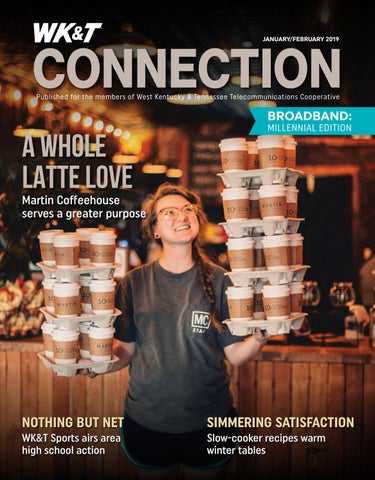
A WHOLE LATTE LOVE
MILLENNIAL EDITION
Martin Coffeehouse serves a greater purpose
NOTHING BUT NET
SIMMERING SATISFACTION
WK&T Sports airs area high school action
Slow-cooker recipes warm winter tables
INDUSTRY NEWS
Rural Connections BY SHIRLEY BLOOMFIELD, CEO NTCA–The Rural Broadband Association
What is your broadband story? We just closed out a year when rural broadband was a continuing news item, and I believe that will hold true in 2019. This is good news for those of you reading this magazine, and even better news for the millions of rural Americans not served by a progressive broadband provider like yours. It’s easy to get caught up in the policy behind the issues. After all, the bills Congress debates become the laws that govern rural broadband. It’s so important that rural broadband providers like yours stay involved in the process to ensure that public policy encourages investment in building reliable broadband service to our rural regions. That’s a key function of NTCA as the unified voice of nearly 850 independent, community-based telecommunications companies. But we must always remind ourselves that the reason we work for good public policy is to help communities build the networks needed to support an improved quality of life for real people. In every issue of this magazine, you read stories of people who are using broadband to make a difference in their lives, businesses, families and communities. That is what drives our work. With funding programs in the news, USDA efforts and FCC initiatives — not to mention new providers getting into the telecom business — 2019 is going to be another big news year for broadband. Help us keep our eyes on the human impact by sharing your broadband stories on social media using the #ruraliscool hashtag.
2 | January/February 2019
Fighting cyberthreats together NTCA continues a collaboration with the Department of Homeland Security to provide telcos with critical cyberthreat information Small telecommunications providers mount a strong defense against advanced security threats from criminal elements and overseas enemies. Beyond the professionals on its local staff, your internet provider benefits from the cybersecurity efforts of hundreds of similar companies across the U.S. NTCA–The Rural Broadband Association represents nearly 850 independent, community-based telecommunications companies, helping them collectively work toward solutions to industry challenges and better serve their members and customers. The association recently announced that, in partnership with the Department of Homeland Security and National Institute for Hometown Security, it will explore creating a forum for small, rural telecom operators from across the country to share and receive timely, actionable and relevant cyber information. Bob Kolasky, director of the National Risk Management Center, presented NTCA with a National Infrastructure Protection Program Security & Resilience Challenge award for 2019 to support the project, which will include the creation and beta test of a daily cyber intelligence report. This will be curated to meet the unique needs and interests of community-based telecommunications broadband providers. This new award follows NTCA’s successful collaboration with DHS to create the 2018 Cyber Wise Program that provided free, industry-focused risk management training to rural telcos. “NTCA is proud to support small, rural operators as they navigate an increasingly complex cyber landscape,” says NTCA Chief Executive Officer Shirley Bloomfield. “As we all know, cyberattacks are truly a matter of ‘when,’ not ‘if,’ and this new partnership with DHS and NIHS will help explore a new forum to ensure rural broadband providers are both aware of threats and equipped with the information and tools that they need to respond. I’m grateful for this continued collaboration and look forward to seeing its results.”
Lifeline is a government assistance program that can help pay a portion of your telephone, mobile phone or internet bill each month. Consumers are allowed only one Lifeline program benefit per household.
Lifeline
SERVICE ?
Guidelines will continue to be eligible for a Lifeline program benefit. (State determinations of income will no longer be accepted.) There are no changes to the eligibility criteria for Tribal programs.
How much will Lifeline save me? If you qualify for Lifeline, you will receive a credit of $9.25 each month on your bill.
?
What services are covered by this credit? You have the choice (where applicable) of applying your benefit to one of three types of service offerings: • Fixed or mobile broadband • Fixed or mobile voice-only • Bundles of fixed or mobile voice and broadband NOTE: Lifeline can only be used for one source of communication from the list above.
?
Can I receive more than one Lifeline credit? No, consumers are allowed only one Lifeline program benefit per household.
?
How do I qualify? You are eligible for Lifeline benefits if you qualify for and receive one of the following benefits: • SNAP • Medicaid • Supplemental Security Income (SSI) • Federal Public Housing Assistance • The Veteran’s Pension or Survivor’s Pension benefit. Additionally, consumers at or below 135 percent of the Federal Poverty
NOTE: Some states have additional qualifying programs, allowances and stipulations. Check with your local telecommunications provider for information about benefits that may be available in your state.
?
How do I enroll in the Lifeline program and start receiving this benefit? To find out whether you qualify for Lifeline assistance, please visit www.lifelinesupport.org or call your local telecommunications provider. NOTE: Your telephone company is not responsible for determining who qualifies for these programs or who receives assistance. Consumers must meet specific criteria in order to obtain assistance with their local telephone and/or broadband service, and qualifying is dependent upon government-established guidelines.
? DO YOU QUALIFY? Stay connected with a Lifeline discount. Apply today!
FRS Youth App Challenge Students, it’s time to start thinking about the Foundation for Rural Service’s challenge and the app that could pave the way to your future.
Who: Students enrolled in grades seven to 12. A single student, or teams with as many as five students, may compete.
What: Develop a concept for a mobile app to address a problem or improve a process in your rural community or in rural America at-large. The challenge is concept-based only, and entries will be judged based on how well-researched and wellpresented the app is. It must be possible and not already an app in existence.
When: The submission deadline is March 1, 2019. Why: The winning team will receive $1,000 in gift cards and Codecademy scholarships.
How: Visit FRS.org for more information about submissions. January/February 2019 | 3
FROM THE CEO
Always improving — and improving our communities
T
CONNECTION JANUARY/FEBRUARY 2019
VOL. 11, NO. 1
The WK&T Connection is published by West Kentucky and Tennessee Telecommunications Cooperative, © 2019. It is distributed without charge to all members of the cooperative.
his is the time of year when many of us plan ways we are going to improve ourselves in the new year.
Maybe you plan to read more books, lose a few pounds, learn that new skill or finish that degree. At WK&T, we’re always seeking to improve — and improve the communities we serve. As you’ll read in the pages of this TREVOR magazine, our cooperative is taking big steps in both of those BONNSTETTER areas: Chief Executive Officer • WK&T recently received a Community Connect Grant to bring broadband to an area of Weakley County, Tennessee, that had subpar connectivity. • The staff from WK&T’s customer service team, computer repair crew and administrative staff recently moved out to our new home at the WK&T Tech Park. I bring up both of these items because both will improve WK&T and the community around us. In a statement announcing the Community Connect Grant that allowed WK&T to connect the Weakley County residents, I noticed a quote from Anne Hazlett, assistant to the Secretary for Rural Development: “In the modern economy, rural broadband is a lifeline to quality of life and economic opportunity.” I don’t think it’s an overstatement to call broadband a “lifeline.” The challenges of running a business or raising a family in 2019 without the option for internet service are significant. So much has moved online, including homework help, banking and accessing government services. For business owners, a lack of connectivity means not only missing out on areas of potential growth, such as new online customers, but also missing out on efficiencies competitors may enjoy, like supply chain management, logistics and human resources systems. The ability to apply for and receive a Community Connect Grant allows us to make sure the residents in this part of Weakley County don’t fall behind. It also allows us to do what we do best: bring world-class communications to the people of rural Kentucky and Tennessee. We are always looking for ways to become more efficient and effective. That’s why it has been important for WK&T to consolidate our operations to the WK&T Tech Park. While this move doesn’t affect our offices in Murray and Martin, we’re seeing benefits from having so much of our staff in one place. But beyond the improvements we’ve seen internally from the move, relocating our staff signifies an important step in our efforts at the WK&T Tech Park. As I’ve stated in this column before, the WK&T Tech Park is committed to efforts that will drive for economic development in our region. Moving our staff is only the beginning. We have plans for solar energy generation, technology startups and of course, world-class broadband infrastructure. WK&T is improving, and we’re working with others in the communities we serve to improve our region. I’m excited about what we can accomplish together.
4 | January/February 2019
is your cooperative serving West Kentucky and Northwest Tennessee across more than 13,000 access lines. The company is dedicated to using technology to keep its members connected through local and longdistance calling, high-speed internet, digital television and beyond.
Send address corrections to: WK&T Telecommunications Cooperative P.O. Box 649 • 100 WK&T Technology Drive Mayfield, KY 42066 Telephone: 877-954-8748 www.mywkt.net
BOARD OF TRUSTEES Tony Goodman President Ricky Littleton Vice President Beverly Taylor Secretary/Treasurer Bill Hainaut Jeff Davis Jerry Holloway Jerry Stephenson Joe Thompson
Produced for WK&T by:
On the Cover: Courtney Sellers, who owns Martin Coffeehouse with her husband, John, donates 10 cents for every cup sold to literacy projects. See story Page 12.
Scholarship opportunities
Each year, the Foundation for Rural Service offers multiple scholarships nationally to help with the rising cost of college tuition. FRS is accepting applications from 2019 graduating seniors, with preference given to those planning to return to work in a rural community after college. Applications and an information packet about the program are available from area high school guidance counselors or at mywkt.net. A parent or guardian of an applicant must have service with WK&T. Since 1994, FRS has worked to help as many people and communities across the nation as possible.
for area seniors
WK&T to receive $3 million grant for broadband in Weakley County WK&T will receive a $3 million grant to construct a 1 gigabit-capable broadband network that will provide fiber for 406 unserved homes and businesses in Weakley County, Tennessee. As part of the grant, a new community center will be constructed to give residents free access to seven computer terminals and Wi-Fi. The grant will serve the areas outside the community of Dukedom, Tennessee. For over two years, WK&T has worked closely with the Weakley County mayor’s office to make the plan a reality.
WK&T, which will contribute $450,000 to the fiberto-the-home project, was chosen from 124 applicants for the Community-Oriented Connectivity Broadband Grant Program administered by the U.S. Department of Agriculture’s Rural Utilities Service. The grant is competitive and includes a lengthy application process. This project will allow the residents and businesses to access high-quality voice, video and broadband services, which will benefit the economy, health care, education and overall quality of life.
Robbye Lucy joins the WK&T sales team Robbye Lucy is one of the newest employees at WK&T, but she’s no stranger to the area. Lucy grew up in Graves County and recently returned to the area from Paducah. Her 5-year-old son attends Mayfield Elementary. Lucy comes to WK&T with a background in wireless sales and does outside sales for WK&T. She works in the Fairdealing, Hardin, Lowes, Cottage Grove and Trimble areas. Lucy can be found going door to door at homes and businesses in the areas she serves, and she can help customers with home phone, internet, TV and security services. “I’m excited about this awesome opportunity to be a part of sharing with these communities the services WK&T has to offer,” she says. You may reach her at 270-970-4441 or rlucy.wk@wk.net. WK&T Telecommunications Cooperative
January/February 2019 | 5
TRAVEL
Take a sip of history
Soda bottling tours offer a tasty treat
G
eorge Fletcher boarded a train in New York near his Long Island home and rode for hours until he arrived in Cincinnati. Then, he rented a car and drove 100 miles to his destination: the Ale-8-One plant in Winchester, Kentucky. He patiently waited until the start of the tour, which had also drawn parents with young children, grandparents and others who love Kentucky’s favorite soda.
“I’ve wanted to do this for a long time,” Fletcher says. “I’ve loved Ale 8 for so long, and it will be fun to see how it’s made. Just to see the process will be so interesting.” Fletcher’s quest is not unusual. Guests come from all around to see where and how their favorite soda is made, says DeAnne Elmore, the company’s public relations and field marketing manager.
Crafting a destination
Ale-8-One is a signature Kentucky soda and part of a family-owned business dating to 1902. Tours are available at its plant in Winchester, Kentucky.
6 | January/February 2019
The building now housing Ale-8-One was originally part of a bowling alley. The first soda was produced in 1926, and the company moved its headquarters in 1966. In 1989, an addition enabled increased soda production. There are now four varieties of Ale-8-One: the original, diet, caffeine-free and cherry. Tours began during the soda’s 75th birthday celebration. “We are limited by space, so we try to keep groups at about 30 people,” Elmore says. “That way, everybody gets a good experience and can see our production facility. People get to see up close and personal who’s really making this brand.” The company embraced Kentucky’s legacy of beverage production, which benefits from the popularity of bourbon and the Bourbon Trail tourism guide. “We are a member of the Kentucky Distiller’s Association and an associate member of the Bourbon Trail as Kentucky’s only soft drink,” Elmore says. Guests on the tour take a seat in a large room where they enjoy a video presentation hosted by the company’s CEO, Fielding Rogers, who is the fourth generation of the Rogers family to hold the post. The video offers a history of the brand and the manufacturing processes that are not part of the tour due to OSHA safety regulations. Following the video, a vial of the secret formula that is part of every bottle of Ale-8-One is passed around for sniffing before the tour takes a turn
through the heart of the facility. Visitors see where bottles are filled, capped and prepared for shipping. “We’re still an operating manufacturing facility, so we can’t guarantee that all the lines will be running, but we try to do our best to make sure they are when we have tours,” Elmore says. Following the tour, guests are treated to tastes of Ale-8-One, and if you want to take some home — or a baseball cap, hoodie, koozie, salsa, barbecue sauce or other Ale-8 gear — there’s a gift shop near the entrance/exit. For tours of Ale-8-One, offered on Thursday and Friday mornings, log on to www.ale8one.com.
HOW IT BEGAN George Lee Wainscott started his soft drink company in 1902, making distilled water and flavored drinks. In 1906, he added Roxa-Cola to his inventory, named for his wife, Roxanne. Coca-Cola sued and lost, but even so, Wainscott wanted something new and unique to him, so he invented a new, unnamed soda — a pleasant blend of ginger and citrus. He introduced his creation at the Clark County Fair and sponsored a “name-that-soda” contest. The winning name was “A Late One,” meaning, in Southern vernacular, “the latest thing” or “something new.” The name “A Late One” was then created into a logo pun, Ale-8-One, that would eventually become the colloquial name. But every bottle still carries the original “A Late One” name above Ale-8-One. Following Wainscott’s death, the company passed into the hands of his second wife, Jane Rogers; then to her brother, Frank Rogers; and on to his son, Frank Jr., who left it to his son, Frank III, who left it to his son and current CEO Fielding Rogers. He still uses his great-great-uncle’s handwritten notes to hand-mix the secret original formula.
Sodas around the South TENNESSEE
Double Cola is as synonymous with Chattanooga, Tennessee, as Moon Pies. Double Cola has been made in the downtown area since 1933 by the company that also produces other soft drinks like Ski, Jumbo Chaser and Oranta. Buy a hoodie and other items online and learn more about it at double-cola.com.
SOUTH CAROLINA Since 1903, Blenheim has produced ginger ale in Hamer, South Carolina. But the drink’s origins go back to the 1700s when a man lost his shoe in a water hole. Thirsty, he sampled the water and found it to be excellent. One hundred years later, ginger was added to the water and Blenheim Ginger Ale was born. The soda now comes in three varieties: mild, hot and diet.
ALABAMA Buffalo Rock Ginger Ale was created in the late 1800s and is instilled in the hearts of Alabamians. The Birmingham company of the same name — Buffalo Rock — continues to make its famous ginger ale. It has added more sodas to its line over the years, including Grapico, Wham and Sunfresh. The company remains family-owned and is under the leadership of founder Sidney Lee’s great-grandson, James C. Lee. Interesting fact: Buffalo Rock developed the first 3-liter soda bottles used by many soft drink companies today.
GEORGIA Coca-Cola was created in Atlanta, and a visit to World of Coke teaches you all about the Coke phenomenon. Learn the story behind it, see Coke artifacts, enjoy interactive exhibits, get a behind-the-scenes look at the bottling process and more. For information, visit www.worldofcoca-cola.com.
NORTH CAROLINA L.D. Peeler created Cheerwine in Salisbury, North Carolina, 102 years ago at the height of a sugar shortage in World War I. The wild cherry cola was an immediate hit and is now marketed across the country. The family-owned company is under the leadership of L.D. Peeler’s great-grandson.
January/February 2019 | 7
We’ve moved!
WK&T customer service in one location at Tech Park BY LISA SAVAGE
W
K&T’s customer service center has a new home at the WK&T Technology Park, a move that puts all customerrelated services in one location. “This is a positive move for the cooperative,” says WK&T CEO Trevor Bonnstetter. “Our operation will be on the campus of what will become the center of technology and innovation for the region.” A visit to the center will allow customers to meet a specialist to determine the best services for their broadband and entertainment needs at home or at a business. Customers can also stop by to pay a bill, and a 24-hour payment drop box is available in front of the building. Online payments are always an option, as well. “We can answer your tech questions and offer guidance on getting the most out of your broadband service,” says Michael Lee, director of sales and marketing at WK&T Telecommunications Cooperative. While WK&T no longer offers retail sales of electronics, computer repair services are available at the customer service center. Customers can take advantage of expert computer diagnostics, repairs and virus removal, says Natalie Morgan, customer operations manager. “You can bring your computer in, but we also do on-site
8 | January/February 2019
An artist’s rendering of WK&T Technology Park gives a glimpse of what the complex eventually will look like.
incubation, retail, residences, a community center and more. When fully developed, the WK&T Tech Park will offer numerous on-site amenities, including a fitness center, community center, storm shelter, data center, on-site hotel, greenway, adjacent safe parking, security and on-site education.
visits for repairs,” she says of the offerings that continue to include the popular computer data retrieval service.
WK&T TECH PARK The WK&T Tech Park is a cutting-edge community of business leaders and innovators connecting tenants with the resources and the environment they need. WK&T pro-
vides the infrastructure with a range of modern communications services made possible through a high-speed fiber optic internet network. The park, a collaboration between WK&T Telecommunications Cooperative and the Graves County Economic Development Office, includes a spacious 53-acre campus that offers sites for business
The WK&T customer service location is open Mon.-Fri. from 8 a.m. to 5:30 p.m. and Sat. from 8 a.m. to 4 p.m. at 100 WK&T Technology Drive, Mayfield. For more information, call 877-954-8748 or visit www.mywkt.net.
WK&T Telecommunications Cooperative
Chris Adams directs the telecast of a high school basketball game covered by WK&T Sports. WK&T Sports uses the latest technology to showcase local student athletes.
Hoops and hardwood WK&T Sports showcases local athletes & local teams BY LISA SAVAGE
W
ith almost 40 regular-season basketball games airing live on WK&T Sports, viewers get a chance to watch standout athletes on the court for Mayfield, Graves County and Marshall County high schools. Also, some other schools will be recorded and their games replayed. “It’s a great opportunity to showcase the area’s athletes,” says Chris Adams, local channel coordinator for WK&T. The televised games are not intended to replace fans going to the games, but the broadcasts give those who can’t attend the event a chance to watch. It’s especially popular for grandparents and other friends and family who can’t make it to the games. “I’ve had lots of people tell me they saw our team play and they watched it on WK&T Sports,” says Mayfield head coach Chris Guhy. “I think our kids love it, too.” This season, expectations are high for the Mayfield Cardinals. Coming off a 26-7 season last year, with nine returning seniors and a retiring coach, this could be their year. “We’ve set our sights on the Sweet 16 and the All ‘A’ tournaments,” Guhy says. Guhy says this team might be one of the top two he has coached, the other being the team that played his first year as head coach at Mayfield 18 years ago. He plans to retire this year. “It’s kind of neat that the best teams I’ve ever coached are my first year and my last,” he says. “This is a real special group of players.” Guhy says he hopes the basketball team also brings home some honors to complement the success of the school’s football program. Mayfield is a small, rural school, but Guhy says he wouldn’t change a thing about his coaching career. “We have a unique community atmosphere,” he says. And that community, like all the small communities served by WK&T, loves sports and the spirit it brings.
WK&T Telecommunications Cooperative
Mayfield head coach Chris Guhy, left, is interviewed by WK&T’s Alex Heath for a segment on WK&T Sports.
WK&T Sports airs live regular-season games and will continue to show games during postseason play. “We do this as a public service,” Adams says. “It’s just another way we bring quality, local content to our viewers.”
WHAT YOU NEED TO KNOW! WK&T Sports Channel 68 brings local high school basketball coverage you won’t find anywhere else. It’s the area’s only 24/7 local sports channel. Check out WK&T Sports at www.wktsports.com, on Facebook or on Twitter for a schedule of games. January/February 2019 | 9
THE IMPACT OF BROADBAND: MILLENNIALS EDITION
Rethinking
rural
How some millennials are re-evaluating life in rural communities
BY DREW WOOLLEY
“Our plan was to stay in the Austin area,” Rushing says. “That’s where the jobs were, and that’s what I was preparing myself for.” That preference for metropolitan areas is typical for a generation that rural communities have had difficulty holding on to: millennials. But there’s reason to believe millennials may find more to like in rural communities as they age. For many, the term millennial has become synonymous with the silly, and derogatory, stereotype of any young person eating avocados while staring at their phone. But the Pew Research Center works with a more precise definition. They define millennials as anyone born from the years 1981 to 1997. That means even the youngest millennials have likely already entered the workforce, while the oldest probably have 10 | January/February 2019
Photo courtesy of Isabel Reyna.
S
ix years ago, Chase Rushing thought he had his future planned. Living in San Marcos, Texas, between San Antonio and Austin, he and his wife had access to all the entertainment a 20-something couple could want — not to mention a burgeoning tech scene.
a mortgage and kids to raise. As Rushing and his wife began considering the latter, the idea of returning to his hometown of Yantis, Texas, lodged itself in Rushing’s mind. “It was important for me that my son got to experience what I did growing up,” he says. “Being around all your family, the friendships, the bonds you form over that time. It’s like nothing else.”
WIDE-OPEN SPACES Even if millennials are no longer the youngest generation, several characteristics set them apart from those before them. They tend to value experiences over
Chase Rushing wants his own family to experience the smalltown lifestyle he grew up with.
possessions, get their news online rather than from TV, and value work-life balance in their careers. Perhaps most importantly, millennials are the first generation to grow up in the internet age, meaning they have a natural comfort with technology previous generations have not had. That could make them a predictor of how future tech-savvy generations will behave. Millennial trends are of particular interest to Dr. Roberto Gallardo, assistant director of the Purdue Center for Regional Development. While the mainstream consensus has been that millennials are flocking to cities, Gallardo
CROSS-GEN COMMUNITIES John Larson moved to a rural community not because he wanted to work remotely, but because his work could only be done from there. As a ceramic sculptor living outside of Milan, Minnesota, Larson is able to run his own business with low overhead and access natural materials that would be costly or inconvenient in a larger city. “Ceramics is a product of its location. If you use local materials, it will be a reflection of its place,” he says. “I’ve built my small business on reusing bent nails and foraging for materials.” Larson’s work also gets a boost from the established market for ceramics in the Midwest, but finding a place in that market isn’t always easy for young artists.
are the challenges we face and what can we do to address them?” he says. “It’s not millennials versus baby boomers or anyone else. It’s about all of us as a community.”
Photo courtesy of Kirstin Lindstrom.
Fostering more rural development programs is one step Larson believes communities like his could take to better promote the culture that already exists, as well as to help business owners collaborate and learn from one another. As the generation that now makes up the majority of the workforce, millennials will have an important say in those efforts. But Rushing believes that if his generation is going to open up rural communities to more young people, they will have to do so without losing sight of what makes the rural lifestyle special. It may be necessary to break down generational divides altogether. “I think we need to be asking what we can do to impact our community. What
Living in a rural community gives John Larson the chance to share the countryside with his daughter.
Rural America online Millennial population change in southeastern states
Population increase or decrease
believes improved internet connectivity could provide new opportunities in rural areas. “If you have a young family, you may consider moving out of an urban area because of rising housing prices,” he says. “Rural areas have a natural ambiance that can attract younger families if their job allows them to telework.” That draw depends heavily on rural communities building a high-speed internet connection, but there is reason to believe doing so could have a significant impact. A population analysis by Gallardo and two colleagues published in The Daily Yonder shows that, while rural counties across the country are seeing declines in millennial populations, those with highspeed internet service saw millennial populations increase by 2.3 percent from 2010 to 2016. That may not sound like much, but Gallardo points out that this is a process just getting started as millennials grow older. “Younger folks always flock to cities, so if you’re a very rural community, broadband is not a silver bullet,” says Gallardo. “But it is a very key ingredient to attract or retain millennials or younger families.”
0%
2.1% -2.3%
FASTEST INTERNET SPEEDS
-2.4%
-5.3%
-6.4%
SLOWER INTERNET SPEEDS
Nationwide population data shows that rural communities are losing younger residents to larger metropolitan areas. When looking at rural counties that have invested in high-speed internet connections, however, the picture changes significantly. The graph above shows how millennial populations changed in the most rural counties in Alabama, Kentucky, South Carolina and Tennessee from 2010 to 2016. Counties were ranked based on their internet connection, with the column on the far left showing those with the fastest internet speeds and the column on the far right showing the slowest. Over that time, counties with the fastest internet connections saw millennial populations grow by more than 2 percent, while counties with slower connections saw their millennial populations drop by more than 6 percent.
January/February 2019 | 11
THE IMPACT OF BROADBAND: MILLENNIALS ISSUE
Recipe for success
Martin Coffeehouse building libraries one cup at a time
BY LISA SAVAGE
A
phrase common to missionaries can describe John and Courtney Sellers: Your mission is wherever you are.
Eighteen months ago, the couple opened the Martin Coffeehouse so the people of the city could enjoy a cup of coffee while raising money for literacy projects in Nepal. For every cup of coffee sold, 10 cents goes to literacy projects. With more than 50,000 cups sold so far, the couple has built their first library in Nepal. “We’re so excited to see the success so far,” John Sellers says. John and Courtney Sellers opened Martin Coffeehouse 18 months ago.
12 | January/February 2019
WHY NEPAL?
Missions are nothing new to the Sellers. John Sellers grew up in a family of missionaries. His aunt and uncle were missionaries to Nepal, and he learned early in life the Nepalese children were doomed to failure without better educational resources. But tragedy changed his family’s course in Nepal. His aunt and uncle were killed in a plane crash several years ago while serving in the third-world country, and his grandparents eventually took over the mission in Nepal. Six years ago, his parents flew to Nepal, and they are now also missionaries. “I grew up hearing about Nepal all my life,” John Sellers says. “I always knew that was going to a big part of my life.” Courtney Sellers, too, grew up in the mission field, going wherever her father’s evangelism took the family. The couple met in college at the University of Tennessee at Martin and learned they had much in common. John Sellers proposed to her while in Nepal, and they were married three years ago. “I wanted Courtney to see Nepal before we married because it’s such a huge part of what defines my life,” he says. While their heart is in Nepal, they also wanted to have an impact at home. “We struggled with how we could make an impact there, while making an impact here, too,” he says. The couple first started a faith-based nonprofit organization, Letters in Motion, to support literacy projects by delivering school supplies and letters of encouragement to children in schools, orphanages and children’s homes. More than 15,000 letters have been delivered. WK&T Telecommunications Cooperative
But the project had no mechanism for raising money for the library projects.
WHY COFFEE?
- A cup of inspiration -
For more about Martin Coffeehouse, visit www.martincoffeehouse.com or check for updates on Facebook and Instagram. For more about Letters in Motion, the faith-based nonprofit organization, visit www.sustainableliteracy.com. WK&T Telecommunications Cooperative
Students at the library at the Collins Children’s Home in Kathmandu, Nepal. The library was built by funds raised through selling cups of coffee at Martin Coffeehouse.
Photos courtesy of Fernweh Fox.
“It just seemed like the perfect way to bring in our community to help with our mission,” he says. “We wanted to serve and inspire our local community by offering organic, fair-trade coffee with a global purpose. We couldn’t think of a better fit.” Many people like the idea of helping others, John Sellers says. “We wanted to make it as easy for people to make an impact as drinking a cup of coffee,” he says. “So we thought ‘What if we donate 10 cents of every cup to literacy projects?’ There’s no pressure, and it’s engaging our community to help others.” The Sellers had no experience in the food service industry. John Sellers was in marketing, and his wife was a schoolteacher. They learned how to brew just the right blend, and John Sellers put his marketing skills to work. Martin Coffeehouse opened in August 2017 on South Lindell Street. The shop is popular with the college crowd, and WK&T’s Wi-Fi is available for customers. It’s a charming addition to the revitalized historic downtown. The success of the coffeehouse allowed Courtney Sellers to leave her teaching position, and the business is now the full-time job of the couple. The focus is on fresh-made natural foods, with some unique items such as tortellini soup, pies with homemade crusts and sandwiches. “We wanted to have a good and thoughtful lunch menu,” John Sellers says. “We have tried our hardest to be intentional in the items we serve.” For instance, they use real pumpkins, apples, and other fruits and vegetables in the fresh-baked recipes. They offer cold brew, French press and other brew types, as well as a wide variety of coffee, espresso, lemonade and imported Nepali teas. “The people of Martin have responded well and are enjoying the coffeehouse,” John Sellers says. “The more the Martin Coffeehouse grows in our local community, the more it is effecting change in a rural community abroad.” So far, Martin Coffeehouse has completed one library, a project for the Collins Children’s Home in Kathmandu, Nepal. A multipurpose room was designated as a space for reading, studying and education for about $5,000. The students are able to use the resources of the library to develop their reading skills and to focus on education. “The people of Martin purchased 50,000 cups of coffee in less than one year, and we were able to complete our first library project,” John Sellers says. “That says a lot about our community, and we’re really glad to be a part of it.”
407 S. Lindell St., Martin, Tennessee 731-281-4028 Martin Coffeehouse hours: 6:30 a.m.-7 p.m. Monday through Friday 8 a.m.-7 p.m. Saturday • Closed Sunday January/February 2019 | 13
SOUTHERN KITCHENS
The joy of
COOKING SLOW
I
n the South, when the weather turns cold and the days are short, we bring our slow cookers out of hibernation to blanket ourselves in comfort food. “Nothing beats a slow-cooked pork butt or roast chicken with all the trimmings,” says Sandra Corbin.
She lives on a farm in Clarksville, Tennessee, and she started using a slow cooker when her children were young and still in school. Her first slow cooker, purchased in the 1970s, was harvest gold with a brown lining and glass top that didn’t seal very well. “It was round and only had two settings — high and low,” she says. But with work on the farm and children’s after-school activities, she appreciated the freedom of not spending time 14 | January/February 2019
laboring over the stove. “A momma is always full time, and a farm momma even more so,” she says. “When my youngest daughter was 16, I worked full time commuting to Nashville five days a week while attending college at night. The Crock-Pot certainly came in handy during that time of my life, too.” Her daughter, Melissa Corbin, a Nashville-based food consultant and freelance journalist, says she remembers coming home to her momma’s
Melissa Corbin learned slow cooker secrets from her mother, Sandra.
cooking. The house would be filled with the smells of delicious foods that had slowcooked for hours. “There were always aromas to be savored in her kitchen,” she says. “She encouraged me from a very early age to cook alongside her. She didn’t
care what mess I might make. It was more important to her that I learn kitchen basics that, to this day, I can remember her teaching me.” Though Sandra Corbin made much use of her slow cooker when she had children in tow, she appreciates it all
SLOW COOKER CANDY Sandra Corbin’s slow cooker candy is adapted from several online sources, such as this favorite from country music star Trisha Yearwood.
2 pounds salted dry-roasted peanuts 4 ounces Baker’s German’s sweet chocolate 1 (12-ounce) package semisweet chocolate chips 2 1/2 pounds white almond bark Put the peanuts in the bottom of a slow cooker. Over these, layer the sweet chocolate, chocolate chips and almond bark. Slow cook on low for about 3 hours. Do not stir the mixture while cooking until after the 3 hours is up. Then, stir with a wooden spoon until smooth. Drop the candy into cupcake pan liners and let cool.
the more as she’s gotten older. “As I’ve aged, I prefer one-pot meals with simple ingredients, like a pot roast, cream of mushroom soup and a package of Lipton Onion Soup Mix with all the veggies simmered on low all day,” she says. As life changes, so do slow cookers. Many come with multiple bells and whistles. “Too many parts prone to breaking,” Melissa Corbin says. “Rather, we have the same slow cookers in different colors from the original Rival Crock-Pot line. Mine is stainless and Momma’s is red. She’s drawn to bright colors.”
FOOD EDITOR ANNE P. BRALY IS A NATIVE OF CHATTANOOGA, TENNESSEE.
POZOLE VERDE A favorite go-to recipe from Melissa Corbin.
3 pounds pork butt, roughly cut into 1-inch pieces Salt and pepper, to taste 1 teaspoon ground cumin 1-2 tablespoons vegetable oil 1/2 cup white wine 1 large onion, diced 3 cloves of garlic, finely chopped 1 poblano pepper, charred and chopped 1 jalapeno pepper, charred and diced 1 pound tomatillo, roughly cut into 1-inch pieces 2 (15.5-ounce) cans hominy, drained Sliced limes, chopped cilantro, freshly sliced jalapeno and chopped red onion for garnish Generously season pork with salt and pepper. Sprinkle with cumin. Heat a large frying pan (preferably cast iron) with 1 tablespoon of vegetable oil, adding extra oil as needed. The pan should be screaming hot to sear the pork without cooking through. Make sure to work in small batches so you do not steam the pork. Look for caramelized edges to the pieces of pork as you brown. Transfer the pork directly into the slow cooker, and then reduce the heat and deglaze the skillet with 1/2 cup white wine and pour over pork. Add to the slow cooker the onion, garlic, peppers and finally tomatillos in the order listed. Cover and cook on high for 3 1/2 hours. Then, stir in the hominy for a final 30 minutes of cooking. Turn the slow cooker to its lowest setting to give the pozole time to rest before serving. Finish with lime, jalapeno, cilantro and red onion. Makes approximately 6 servings.
SLOW COOKER SOUP STARTER This nutrient-rich soup starter recipe will be just what the doctor ordered in the cold months of winter.
3 yellow squash or zucchini, cubed 4 banana peppers or 1 bell pepper, chopped
2 garlic cloves, minced 2 carrots, diced 4 cups chicken or vegetable broth 1 (16-ounce) can tomatoes or 3-4 fresh tomatoes roughly chopped 1/2 tablespoon onion powder 1/2 teaspoon thyme 1 teaspoon salt 1/2 teaspoon pepper 1/2 teaspoon sugar 1 teaspoon olive oil 2 bay leaves Stir all ingredients into a 6-quart slow cooker. After cooking on high for 30 minutes, simmer on low for 4 hours. Remove bay leaves. The starter is ready for immediate canning. Otherwise, let cool thoroughly before freezing in freezersafe bags.
Suggested additions: bb Consider using this starter as a foundation for curry. Heat 1 1/2 cups of full-fat coconut milk with 1 tablespoon curry powder, 1/2 teaspoon powdered ginger, 1/8 teaspoon red pepper flakes, 1 stalk of lemongrass (optional), 1 diced potato and a protein of your choice, such as chicken or shrimp. Stir in 1-2 cups starter and simmer, uncovered, until desired thickness. Remove lemongrass before serving. Garnish with chopped cilantro or green onions. This soup is great on its on but is delicious over a bed of jasmine rice. bb Into a cast-iron skillet, add 1 cup shredded rotisserie chicken, 1/4 cup chopped kalamata olives and 1 teaspoon dried oregano to 1-2 cups of the soup starter. Spoon over grilled bread and top with fresh feta cheese for a Mediterranean twist on bruschetta. bb Minestrone is an Italian soup classic. Combine 1 cup cooked elbow macaroni, 1 (15-ounce) can of drained kidney beans, 2 cups chicken stock, 4 cups soup starter, 1 teaspoon dried oregano and 1 teaspoon dried basil. Simmer on low for 15-20 minutes. Garnish with freshly torn basil leaves and grated parmesan cheese. Drizzle a bit of extra virgin olive oil for the perfect finish. January/February 2019 | 15
Presort STD US Postage PAID Permit #21 Freeport OH
100 WK&T Technology Drive Mayfield, KY 42066
I GIGU YO
WEB
& TS S BI YTE B
-FI
WI
FAST LANE
GIG LOVE!
FALL HEAD OVER HEELS FOR OUR BROADBAND! LET’S STREAM
CALL TODAY!
OUR FASTEST SPEEDS EVER!
Broadband 100
Broadband 250
Broadband 500
Broadband Gig
• Upload/download speeds of 100 Mbps
• Upload/download speeds of 250 Mbps
• Upload/download speeds of 500 Mbps
• Upload and download speeds of 1 Gig
• Unlimited Plus Voice Service (unlimited local & long distance, calling features and voicemail)
• Unlimited Plus Voice Service (unlimited local & long distance, calling features and voicemail)
• Unlimited Plus Voice Service (unlimited local & long distance, calling features and voicemail)
• Unlimited Plus Voice Service (unlimited local & long distance, calling features and voicemail)
877-954-8748 mywkt.net
SO ET E TW