BROADBAND:
HELPING YOU THRIVE
JANUARY/FEBRUARY 2020
CONNECTION Published for the members of West Kentucky & Tennessee Telecommunications Cooperative
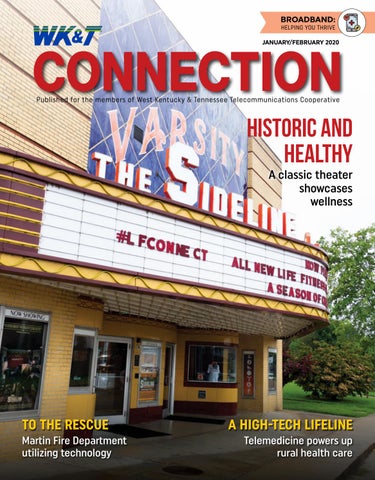
HISTORIC AND HEALTHY A classic theater showcases wellness
TO THE RESCUE Martin Fire Department utilizing technology
A HIGH-TECH LIFELINE Telemedicine powers up rural health care
INDUSTRY NEWS
Rural Connections By SHIRLEY BLOOMFIELD, CEO NTCA–The Rural Broadband Association
A good way to start the New Year
N
TCA members make a real difference in their communities, and in the lives of the people they serve. I was reminded of this a few weeks ago when the Foundation for Rural Service announced it had awarded $100,000 in FRS Community Grants to groups throughout the U.S. FRS is the nonprofit arm of NTCA that supports rural telecom companies, consumers and policymakers with educational information, products and programming. Each year, community organizations apply for FRS grants to help them tackle challenges ranging from accessing technology and improving educational offerings to providing telemedicine and first-responder services to rural areas. Applications are sponsored by their local telco. It was also exciting to see the USDA award several ReConnect grants and loans to NTCA members toward the end of the year. This program represents yet another option for rural broadband funding, as well as an example of public/private partnerships at work to extend broadband to unserved communities. After all, investments by federal and state agencies, coupled with the commitment of rural broadband providers, are key to our nation’s progress in connecting the millions of citizens still without access to fast, reliable internet service. These programs, as well as the engagement we saw among policymakers at our Telecom Executive Policy Summit in November, provide a strong start to 2020 and give me great hope for a strong new year for rural broadband. 2 | January/February 2020
Are you ready for a telehealth future? Story by STEPHEN V. SMITH
T
he presence of reliable broadband service holds great promise for rural America. While it touches many facets of life, broadband’s greatest impact may very well be in the area of health care. Consider this statement from the Federal Communications Commission: “Advances in telemedicine are transforming health care from a service delivered solely through traditional brick and mortar health care facilities to connected care options delivered via a broadband internet access connection directly to the patient’s home or mobile location.” While reliable access to a broadband network is still out of reach for millions of rural Americans, hundreds of cooperative and independent telecommunications companies across the country are delivering world-class internet service, often over a fiber connection. If you received this magazine in the mail, your local telco is one of those leading-edge providers. If access to broadband is becoming less of the challenge to telehealth’s widescale availability, what is the greatest challenge? The FCC recently tasked the Intergovernmental Advisory Committee with studying and reporting on telehealth barriers and incentives. The report stated that “people-based” issues offer the most significant challenges to telehealth adoption. While this includes many factors, such as policy and licensing, broadband adoption is a leading concern. In other words, the technology is there. Now, people need to embrace it. “Increasing support must be given to rural and disadvantaged communities so that digital literacy and adoption does not exacerbate the digital divide,” the IAC report states. Quite simply, the presence of broadband doesn’t mean patients and doctors are ready to put it to use as part of their health care program. Are you ready? Do you understand the implications of telehealth? What steps can you take toward enjoying its benefits? Begin by asking your doctor what programs are available. This could include connected medical devices in your home or something as simple as remote monitoring via an app on your smartphone or tablet. Of course, access to telehealth starts with subscribing to broadband service that will support this life-changing technology. And once in place, broadband has the potential to enhance your life in many other ways as well.
Knowledge is power
Does your digital know-how stand up?
Story by NOBLE SPRAYBERRY
C
onvenience and power. Internet services bring both. Online bill pay eliminates a tedious task. Social media can keep family ties strong or reconnect you with old friends. Streaming services bring a wealth of music, books and more. But when it comes to digital tools, knowledge is power, and the Pew Research Center’s recent “Americans and Digital Knowledge” report found that a majority of adults in the U.S.
Q
If a website uses cookies, it means that the site … A: Cookies allow websites to track user visits and site activity. They are common, and you are often tracked across the websites you visit.
forms. Often advertising is personalized to you by information gathered from not only your activities on a social media site but also your actions on other websites.
Q
Q
Q
Q
Where might someone encounter a phishing scam? A: Phishing scams can occur on social media, websites, email or text messages. Each form of communication offers an avenue for exploitation. For additional tips to improve your online security, visit FCC.gov/consumer-guides. What is the largest source of revenue for most major social media platforms? (Several possible options were listed.) A: Advertising is the largest source of revenue for most social media plat-
could not correctly answer half of the survey’s 10 multiplechoice questions. Questions touched on security and a general understanding of technology. Here are a few of the queries, edited for clarity, focused on security and privacy — good information to know. The answers do include additional context and tips not included in the report.
When a website has a privacy policy, it means that the site … A: Privacy policies are contracts between websites and users about how those sites will use their data. Often long and legalistic, the agreements may outline how your private information can be used to target advertising or whether or not your information can be shared with other companies. What does it mean when a website has “https://” at the beginning of its URL, as opposed to “http://” without the “s”? A: “https://” in a URL means that
Want to see the entire report?
information entered into the site is encrypted. Look for “https://” before completing any financial transaction on a site.
Q
Many web browsers offer a feature known as “private browsing” or “incognito mode.” If someone opens a webpage on their computer at work using incognito mode, who will be able to see their online activities? A: Private browsing mode only prevents someone using the same computer from seeing one’s online activities. In most cases, your internet provider, including your phone wireless provider, can see all digital traffic passing from your device to the internet.
Do a Google search for “Pew Research Center and Americans and Digital Knowledge.” January/February 2020 | 3
FROM THE CEO
We’ve arrived in the future
W
elcome to 2020! I sincerely hope you and those close to you had a superb holiday season and that this new year is off to a wonderful start.
Something about starting not only a new year, but also a new decade makes 2020 feel like a year especially full of promise. For so long, the 2020s have seemed like the distant future. Now, we have arrived! It’s entertaining to look back and see what Hollywood, science fiction authors and big thinkers predicted for the future. While I’m still waiting on the flying car and weekend trips to the moon that science fiction promised us, I catch myself from time to time thinking about how some of the things we take for granted TREVOR every day would seem so futuristic to us just 20 or 30 years ago. BONNSTETTER Here in the future, all of us carry around personal communication Chief Executive Officer devices in our pockets that allow us to make video calls with people all over the world. We can instantly download practically any book, movie or song in the world right to our tablets. While we don’t exactly have Rosie from “The Jetsons,” we do have robots that vacuum our floors, manufacture products and even help perform surgeries. We have software that can share photos around the world, alert us to emergencies and order almost anything we need for home delivery. Our watches can help detect heart problems. Our cars can give us directions to anywhere we want to go. And our homes can turn on lights, lock doors and change the temperature with just the sound of our voice. Many of these things are becoming a normal part of our daily routine, but the 1980 or 1990 version of myself would have seen them as straight out of science fiction. For those of us at WK&T, it’s rewarding to know our network is what brings the future to our part of Kentucky and Tennessee. Whether it’s our broadband service at your home or our network providing vital infrastructure to businesses, we’re right at the heart of all of this futuristic technology. We worked hard to make that network and our company even better in 2019. It was certainly a year of meaningful accomplishments and noteworthy milestones for us. • Launched a new $3.5 million fiber build in the Dukedom, Tennessee, area, passing more than 406 unserved locations. This project is nearing completion. • Awarded a $2 million Tennessee state grant to expand our fiber network in Henry County. This $4 million build passing 912 locations is currently in progress. • Completed the Dresden fiber project. • Completed the construction of a new warehouse at the WK&T Technology Park and for the first time in company history, all employees report to work at the same location. Turning the page to 2020, we have some significant goals in mind in order to serve you better. • Finish both the Dukedom and Henry County fiber projects. • Continue to seek out and evaluate additional expansion projects. Stay tuned! Knowing that the only thing certain about the future is change, I think WK&T is primed to accomplish these things and more. We’re thankful for the opportunity to serve you in 2020 — and in the future.
4 | January/February 2020
CONNECTION JANUARY/FEBRUARY 2020
VOL. 12, NO. 1
The WK&T Connection is published by West Kentucky and Tennessee Telecommunications Cooperative, © 2020. It is distributed without charge to all members of the cooperative.
is your cooperative serving West Kentucky and Northwest Tennessee across more than 14,000 network connections. The company is dedicated to using technology to keep its members connected through local and longdistance calling, high-speed internet, digital television and beyond.
Send address corrections to: WK&T Telecommunications Cooperative 100 WK&T Technology Drive Mayfield, KY 42066 Telephone: 877-954-8748 www.mywkt.net
BOARD OF TRUSTEES Tony Goodman President Ricky Littleton Vice President Beverly Taylor Secretary/Treasurer Bill Hainaut Jeff Davis Jerry Holloway Jerry Stephenson Joe Thompson
Produced for WK&T by:
On the Cover: The Sideline opened in 2005, converting Martin’s historic theater, The Varsity, to a physical therapy and fitness center. See story Page 8.
WK&T NEWS
Broadband Association working on Rural Telehealth Initiative The Tennessee Broadband Association is studying ways to support telehealth. “Our members are building advanced broadband networks into some of Tennessee’s most rural areas,” says Levoy Knowles, executive director of the TNBA.“That infrastructure is a critical first step to enabling telehealth services.” The association, comprised of cooperative and independent broadband providers across the state, is developing the Tennessee Rural Telehealth Initiative as a way to support and encourage telehealth services in the state. The association is working with a health care technology company to help rural health providers connect with and serve their patients. TNBA has met with Department of Economic and Community Development staff to discuss the program, and in November participated in the state’s rural health association annual conference that coincided with National Rural Health Day. “The fiber infrastructure is there,” says Knowles, “and this initiative is the next step toward putting broadband to work to bring better care to rural Tennesseans.”
Lifeline
SERVICE
LIFELINE IS A FEDERAL PROGRAM TO HELP LOW-INCOME AMERICANS PAY FOR PHONE OR BROADBAND SERVICE You are eligible for Lifeline benefits if you qualify for and receive one of the following benefits: • SNAP • Medicaid • Supplemental Security Income (SSI)
• Federal Public Housing Assistance • The Veteran’s Pension or Survivor’s Pension benefit.
DO YOU QUALIFY? Apply today! To find out whether you qualify for Lifeline assistance, please visit www.lifelinesupport.org or call your local telecommunications provider.
FRSSHIP!
SCHOL A
R
WK&T Telecommunications Cooperative
Employee Spotlight
Trip Nadzak Trip Nadzak, director of sales and business development at WK&T, loves telling others about the leading-edge internet technology the company provides. With WK&T’s expansion of its fiber optic network, Nadzak leads the sales team responsible for knocking on doors and sharing information about the fast and affordable high-speed internet. From neighborhoods to rural homes in the region, WK&T provides some of the most robust fiber-to-the-premise available. “This is exciting because it’s changing people’s lives,” he says. “The internet touches our lives in everything we do, and it’s amazing to bring some of the best technology to this region of Kentucky and Tennessee.” Nadzak, a former U.S. Army Ranger, brings knowledge and experience to his role at WK&T. “Our mission is to provide some of the best technology available, excellent customer service and support to our members to achieve complete satisfaction,” Nadzak says.
Each year, the Foundation for Rural Service offers multiple scholarships nationally to help with the rising cost of college tuition. FRS is accepting applications from 2020 graduating seniors, with preference given to those planning to return after college to work in a rural community. Applications and an information packet about the program are available from high school guidance counselors or at www.mywkt.net. A parent or guardian of an applicant must have service with WK&T. Since 1994, FRS has worked to help as many people and communities across the nation as possible.
January/February 2020 | 5
TRAVEL
Take the ride
Follow the Hank Williams Trail Here are some trail highlights T Story by ANNE BRALY
he road between Georgiana and Fort Payne along the Hank Williams Trail is a journey lovers of country music should make at least once in their lifetime. It tells a story of one of Alabama’s most famous sons, from his beginnings as the child of a railroad engineer who was mostly absent from his son’s life to the glamour of stardom and Williams’ tragic demise at the young age of 29. Over the span of Hank Williams’ life, he recorded more than 165 songs. Though he could not read a note of music, he was a wordsmith when it came to writing hits that have become part of the American songbook. The trail is a 250-mile trip through history that includes a visit to Williams’ boyhood home and ends at a barber shop where he made one of his last stops before dying in his car in West Virginia on his way to perform at a concert in Ohio. “The Alabama Tourism Department has done an incredible job with the Hank Williams Trail, and it’s a great way to experience some of my dad’s life story,” says his daughter, Jett Williams.
6 | January/February 2020
GEORGIANA
Thousands of newspaper clippings, photos of family and friends, record albums and 45s, royalty receipts, clothes, one of Williams’ early guitars, the old wooden bench he stood on to sing at Mount Olive Baptist Church in nearby Greenville, Alabama — there are too many items to list, and it will take a couple of hours to take in the scope of the collection at the Hank Williams Boyhood Home & Museum. Williams lived here from 1931 to 1934. It was in this house at 127 Rose St. that he played his first guitar, having bought it by selling peanuts and shining shoes at the town depot. Among the more unusual items in the small house is a stage light used in the Municipal Auditorium for the show “Louisiana Hayride.” The Hank Williams Festival is on the grounds the first Saturday each June. Online: www.hankmuseum.com
MONTGOMERY Montgomery is ground zero for Hank Williams. He called it home from 1937 to 1948 and moved back in 1952. He lived there at the time of his death.
LAKE MARTIN, ALEXANDER CITY Hank Williams’ Cabin on Lake Martin is a small, white frame affair where Williams and Fred Rose, his friend and a giant in the music publishing business, wrote blockbusters “Kaw-Liga” and “Your Cheatin’ Heart.” The cabin is now on the property of Children’s Harbor, a camp for sick and disabled children. The two-bedroom building is available for rent. Online: childrensharbor.com Chris’ Hot Dogs, 138 Dexter Ave. This shotgun-style eatery is the oldest restaurant in the city and was Williams’ favorite place to eat — and drink. “He’d order two hot dogs all the way — mustard, sauerkraut, onions and Chris’ famous chili sauce — and a Budweiser and a shot of Jack,” a server said when asked about Hank Williams’ favorite dog. Williams’ seat isn’t marked, but it was one of 12 stools along the counter. There are also booths and tables, so it’s not hard to find a seat and eat where the Hillbilly Shakespeare once dined. Online: www.chrishotdogs.com D’Road Cafe, 121 Montgomery St. This cafe, the former location of the Elite Cafe, is worth at least a drive-by to see where Williams made his final public performance just four days before he died. The Elite opened in 1911 and was a Montgomery institution before it closed in 1990. Now reopened as the D’Road Cafe, the restaurant allows visitors to sit in the place where Williams last performed. Online: droadcafe.com Hank Williams Museum, 118 Commerce St. This museum is the tell-all of Williams’ life — both public and private. The collection includes thousands of pieces of not only his, but also of his wife’s, Audrey’s, past — furniture from their house in Nashville and suits, including several handmade Nudie suits. There are guitars, bills and other receipts, and artwork. The collection is massive, but its crowning jewel is the baby blue 1953 Cadillac in which Williams died. It’s on loan from his son, Hank Williams Jr. Take your time touring the museum, but when you’re done, browse the gift shop — ticket and shop sales and private donations fund the museum. Online: hankwilliamsmuseum.net
Kowaliga Restaurant, 295 Kowaliga Marina Road This restaurant, now serving a menu of cheeseburgers and catfish, sits at the water’s edge of Lake Martin. Inside, a carved statue of the Indian Kowaliga, whose story was the inspiration for Williams’ song “Kaw-Liga” guards the entrance. Online: www.kowaligarestaurant.com
BIRMINGHAM The Redmont Hotel, 2101 Fifth Ave. N., is the place where Hank Williams spent his last night in 1952 and is also the oldest hotel in Alabama still in operation. Remodeling a few years ago reconfigured many of the guest rooms, but Williams’ room was on what is now the third floor, somewhere around what is now room 304. Step off the elevator on the third floor and you’ll see a wooden plaque with four of Williams’ records. This is the only floor displaying any Hank Williams decor and is a silent tribute to one of the hotel’s most famous guests. Online: www.redmontbirmingham.com
FORT PAYNE On the eve of his death, Hank Williams stopped by Carter’s Barber Shop for a haircut and a shave from barber Howard Simpson. He also had a sip or two or three — maybe more — of moonshine while there. When Simpson died, he left the chair that Williams sat in to local barber Alton Beason, who opened his shop at 1719 Gault Ave. It’s now on display in a corner of the shop, carefully roped off for all to see but not sit in. Carter’s Barber Shop in Fort Payne, Alabama.
Chris’ Hot Dogs in Montgomery, Alabama.
Hank Williams Gravesite, 829 Columbus St. On your way out of town is Oakwood Cemetery. It’s here, high atop a hill, that Hank and Audrey Williams are buried. Inscriptions at the base of Hank’s headstone remind visitors of his most well-known songs, such as “Kaw-Liga,” “I Can’t Help It” and “Jambalaya.”
January/February 2020 | 7
BROADBAND:
HELPING YOU THRIVE
NO BENCHWARMERS HERE THE SIDELINE:
A place for all ages to get healthy Story by LISA SAVAGE Photography by MATT LEDGER
A
s a young boy growing up in Martin, Eddie Hutchens loved watching movies at the Varsity. “When I was 10 years old, it was the place to go,” he says.
Personal trainer Ben Jones knocks out a quick workout.
Now, the old theater has a new lease on life as The Sideline, a physical therapy and fitness center. Hutchens and his wife, Jennie, work out there a few times each week. Hutchens underwent knee replacement three years ago, and now, at 74, he hopes to stay fit using the facility’s bikes and elliptical equipment. His wife, five years younger, attends a Silver Sneakers aerobics class. “When we go, it’s mostly retired folks, but The Sideline has something for all ages,” he says. “It’s a great place.” That’s what Brian Smith hoped to accomplish when he bought the historic Varsity Theatre and opened The Sideline in 2005. After working for other rehabilitation centers, he started a private practice in 2003. Looking for additional space, he learned the church that owned the Varsity Theatre building wanted to sell. “It was a good fit,” he says. 8 | January/February 2020
WK&T Telecommunications Cooperative
Eddie Hutchens exercises three days a week, working on strength and flexibility after knee surgery three years ago.
Physical therapy student Ken Melrose works on rehabilitation exercises with Deica Croom.
Brian Smith, owner of The Sideline, works on balance and agility exercises with patient Lathan Lance.
Renovations were challenging at the theater, which dates back to 1947. It closed in the mid-1980s, reopened briefly as a theater in the mid-1990s, and was home to the Daystar Bible Church until 2004, when Smith purchased the building. The theater’s floor sloped downward, and the marquee needed repairs. Renovations included leveling the floor, adding lighting, upgrading the electrical system and restoring the theater’s marquee, incorporating The Sideline name and keeping Varsity on the facade. “These were the biggest challenges,” Smith says. “We wanted to preserve as much of the building’s history as possible.”
THE SIDELINE Smith knew from the time he injured his knee playing basketball at Westview High School and went through physical therapy that he wanted to do this as a career. He earned a bachelor’s degree and a master’s degree in physical therapy at the University of Tennessee Health Science Center in Memphis. Smith chose the business name after spending time on the sidelines at football games and other sporting events. “The Sideline just seemed like a perfect fit for what we wanted to accomplish,” he says. “We wanted to make sure our patients and clients were active and not having to be on the sidelines and get back to their prior level of function, whether it was following surgery or an injury.” WK&T Telecommunications Cooperative
The goal ranges from returning high school athletes to their sports and healing pediatric patients’ ailments to making sure senior adults can live as independently as possible. “We want to see them be able to play with their grandkids or travel,” Smith says. The Sideline provides progressive, oneon-one physical therapy services. The staff includes physical therapists and physical therapist assistants who provide care for patients of all ages and conditions. They emphasize manual therapy, therapeutic exercise, patient education and orthotics. Smith says if someone requires physical therapy, they can ask their doctor to write treatment orders for The Sideline’s physical therapy clinic. Open from 7 a.m. to 6 p.m. Monday through Friday, the clinic also offers sports medicine outreach coverage and injury assessments for the local school system at no charge.
PHYSICALLY FIT The Sideline fitness center is accessible to members 24 hours a day, every day, and includes classes and programs suitable for most ages at a variety of intensity levels. Anyone can join. Equipment includes a wide range of strength training, fitness equipment and a full line of cardio equipment. Group exercise classes are offered at several different times for the convenience of members, from early in the morning to evenings after work. “There’s a time and class for everyone,” Smith says. Often, a
physical therapy patient can transfer to the fitness center to continue to gain strength and maintain physical health.
TRACKING PROGRESS On the fitness side of things, there are apps to track progress and other options to monitor a member’s activities. About 20 of the cardiovascular machines are connected to Wi-Fi, allowing clients to track their progress and even stream services such as Netflix to the equipment they’re using. “The equipment is set up to allow our members to track their progress over time,” he says. “We need it to move at the speed we’re moving, so we rely on our wireless internet. It’s more efficient for us.” The internet WK&T provides makes utilizing some of the best technology-based equipment possible, Smith says. “Without it, a lot of the equipment and tracking we’re doing wouldn’t be possible,” Smith says. “As a physical therapy provider, we’ve grown more than I ever imagined we could. The internet and technology we have help us to continue to grow.”
ABOUT
THE SIDELINE Location: 104 Oxford St., Martin, Tennessee Call: 731-587-3422 www.thesideline247.com
January/February 2020 | 9
BROADBAND:
HELPING YOU THRIVE
Telemedicine changes the health care landscape Broadband makes a difference daily
I
magine a world with greater health care accessibility, as convenient as contacting a physician from your home. Or consider a medical system where rural communities can easily connect in real time with specialists based dozens, if not hundreds, of miles away. Broadband technology provides the key link between you and medical providers needed to make those innovations and others possible. That more convenient, healthier world is becoming a reality for rural communities across the nation. The systems are not yet what they one day may become, but every day more and more people are receiving the benefits of telemedicine. And the results are often profound.
Kentucky veterans have easier access to important care. Changing laws in states such as Texas allow greater access to telemedicine. Telestroke programs in Minnesota and North Dakota save vital minutes when patients most need care. And those are just a few examples of broadband technology changing health care for the better.
KENTUCKY VETERANS In rural Kentucky, getting to and from an appointment at any medical specialist can often require hours of travel. But when you’re a veteran trying to get to a Veterans Administration Medical Center in a metropolitan area, travel times can increase even more. And a veteran might need multiple doctors and have multiple appointments scheduled on different days. An innovative pilot program in a mountainous section of eastern Kentucky is helping to change that. The Virtual Living Room program, which started in 2017 in McKee, offers vets a comfortable and private room in their local library complete with high-speed internet access to visit with VA health care providers located more than an hour’s drive away.
The program, available for setup at other qualifying sites, not only illustrates the potential of telemedicine but also shows the efforts being made to create a system capable of benefiting as many people as possible. The McKee Virtual Living Room is a collaboration among four organizations: the VA, NTCA–The Rural Broadband Association, the rural telecom provider Peoples Rural Telephone Cooperative and the Jackson County Public Library. The VA has provided telehealth services for several years, but it can’t happen if vets don’t have access to high-speed internet connections either in their homes or nearby. “The rest of the country, like us, really admires our veterans,” says Keith Gabbard, chief executive officer of PRTC. “Before the project, we saw veterans spending the day in a waiting room at the hospital, and when they live an hour and a half away, it’s pretty much an all-day event for a veteran to get health care.” Fast fiber optic internet networks make telemedicine a realistic option for more and more communities, and the cooperative was a leader in establishing the Virtual Living Room at the Jackson County Public Library. “We’ve done a lot to promote it, and the library staff and the veterans are really proud of it,” Gabbard says. “It’s a source of pride for our community, and it continues to grow. The Virtual Living Room is a beautiful area where veterans, even From left, Veterans Donald Barrett, Jim Bryant, Mike Montgomery, Bobby Lakes and Danny Robinson attend the ribbon cutting for Virtual Living Room in McKee, Kentucky.
10 | January/February 2020
if they don’t have a doctor’s appointment, can go and read a book. It feels like it’s their home.”
CHANGING LAWS While faster internet may provide the foundation for telemedicine services, the legal and regulatory framework of each state can play a role in determining the effectiveness of the programs. In May 2017, Texas Gov. Greg Abbott signed a bill into law that leveled the playing field for telemedicine physicians and doctors who work in traditional office settings. In part, the law eliminated a requirement for a patient to first visit a physician in person before receiving care through telemedicine. “The bill removed a lot of barriers, and we’ve seen an increase in queries about telehealth,” says Becky Bounds, program manager for the TexLa Telehealth Resource Center in Lubbock, Texas. The federally funded center works to provide resources and technical assistance to telehealth programs in Texas and Louisiana. Bounds says the internet-based tools offer key services. For example, Lubbock is home to the Timothy J. Harnar Regional Burn Center, which often receives patients injured while working in the industries of West Texas. After treatment and returning home, follow-up visits to Lubbock could require drives of five to six hours. However, a telemedicine-equipped clinic on the campus of Texas Tech University Health Sciences Center in El Paso allows patients to virtually visit with specialists in Lubbock. “About 12% of the state’s population lives in West Texas, and telehealth matters,”
Bounds says. “We are producing cotton, beef, oil and more, and we need health care for the workforce producing those products for the rest of the state and the nation.”
THE GOLDEN HOUR When it comes to treating a stroke, doctors have a saying: Time is brain. It’s a reminder that every minute that passes between the event and treatment can lead to irreversible damage. Fortunately, telemedicine technology already gives doctors a fighting chance to begin treating patients before the critical “golden hour” passes. One of the leaders for this technology in the Midwest is Essentia Health, which established telemedicine capabilities in each of its 17 hospitals, 70 clinics and eight nursing homes throughout Minnesota and North Dakota. With its telestroke program, emergency medical technicians can identify stroke patients on the way to the hospital and even begin treatment. Essentia Director of Telehealth Services Laurie Hall recalls an ambulance picking up a rural patient nearly 90 minutes from the nearest hospital. In the past, serious brain damage would have been a near certainty for such a patient. But thanks to telestroke technology, EMTs diagnosed a stroke and began treatment about 45 minutes after the stroke occurred. “The goal is to shorten that window from the time the patient has the event to the time they actually get those
clot-busting medications or the clot is removed,” Hall says. “Getting that done so quickly is profound when you think about the injury that could happen from just those few extra minutes. It helps these patients get out of the hospital much quicker and to get on with their normal lives.” January/February 2020 | 11
Patrick Tarver, firefighter with the City of Martin, checks response details on an iPad from inside the fire truck.
NEW TECH TOOLS
Martin Fire Department uses dispatch technology
Story by JOHN CLAYTON | Photography by MATT LEDGER
A
t its heart, the job of a firefighter remains largely the same as it ever was. There are fire hoses to dry and roll, time-tested equipment to keep up and flames to extinguish. However, technology continues to make the business of saving property and lives somewhat easier. “We still have to do all the manual labor on the calls and things like that, but as far as the dispatching — the technology of knowing what’s in a building, the layout of the building — it’s come so far. It’s something that can be very beneficial,” says City of Martin Fire Chief Jamie Summers, who celebrated his 20th anniversary with the department on Jan. 3. Martin Fire/Rescue/EMS is made up of 41 full-time professional firefighters and three stations that serve the city of around 11,000 residents, a population that can grow to about 18,000 during the University of Tennessee at Martin’s academic year. Another 18 professionals work for the EMS division. The department opened up its third station in March of last year at the University Plaza Shopping Center to better serve the city’s west side. “We recently changed our services back on Aug. 18, and we started running emergency medical services out of the fire department, so we now have ambulances,” Summers says. “We now go by City of Martin Fire/Rescue/EMS.” With the addition of more EMS personnel and the department’s coverage of about 85 square miles in Weakley County outside of the city limits, the Martin department’s call volume has risen from around 1,600 calls per year to 2,400 or more, Summers says.
12 | January/February 2020
WK&T Telecommunications Cooperative
MORE THAN A NAME While the essential role of firefighters remains largely the same, some of the tools have changed, improving efficiencies that save time and, potentially, lives. Streetwise is a program used by the department that works on the same premise as Google Maps or Waze, giving firefighters an edge and clear directions when they receive a call. It works in conjunction with the Martin department’s cloud-based reporting program, which feeds directly into a national fire database. “It gives us the address and the dispatch time,” Summers says. “It will give you the directions from where your apparatus is to the emergency. We have a lot of streets and a lot of road names that are pretty much the same. For instance, in Martin, we have a Dogwood Lane and a Dogwood Trail, so, with things like that, it can be confusing. With our mapping system, and with Streetwise, we know exactly where it is.” The program also includes visual turn-by-turn maps that appear on the crews’ mobile data terminals. “We know our streets, but it helps to have that extra visual, especially when it’s dark and you’re going out into the county,” Summers says. Martin Fire/ Rescue/EMS relies heavily on high-speed internet at its three stations while depending on cell signals to operate its mobile data terminals and electronic devices, all of which have become critical components of the job. The high-speed internet and Wi-Fi helps firefighters do everything from writing and submitting reports to updating the department’s website. Firefighters have also taken photographs of some of the larger structures in Martin, which are filed with the Streetwise program and can give them a layout of the structure, including entrances, rooms and potential problem areas, before they arrive on the scene. “We have large screen TVs that have this data on them as soon as the call comes. It goes up on the boards, and it’s instantaneous with the call,” Summers says. “We have some technology we didn’t have in the past, and that is making our response times quicker. We’re getting that information and have it right at hand instead of listening through radio traffic. It’s right there on the screen.”
WK&T Telecommunications Cooperative
City of Martin Fire Department: Reaching Out • The Citizens Fire Academy is an eight-week program for Weakley County residents ages 18 and over that provides an in-depth look at the department and its work. The academy includes tours, demonstrations and classes on subjects like fire science, emergency apparatus and equipment, fire ground operations and CPR certification, among others. • The program takes place on weeknights at the Buster Williams Headquarters Station at 106 Neal St. For information, contact Capt. Kory Green at 731-587-4919. • The city's fire stations are open to visitors for prescheduled tours and visits daily from 9-11 a.m. and 1-5 p.m. Visitors must make arrangements for tours and visits ahead of time, and the department must preapprove them. Tours are limited to groups of 25 or fewer. For every five children attending, there must be one adult. Contact Green for information. • School presentations, which can include safety speakers, demonstrations and emergency equipment, are available for schools in Martin. Local daycare visits are also available. Those wanting school visits and speakers must make requests at least two weeks in advance. For information, call Green. • CPR certification classes are available through the department. The programs offered include CPR, CPR/ first aid and basic life support. The CPR and CPR/first aid courses are available to anyone, while the basic life support course is designed for medical and emergency personnel. Costs range from $50-$65. Anyone interested must preregister by calling Green. • The department participates in the statewide "Get Alarmed" program, which offers free smoke alarms to residents across Tennessee. As part of the program, the State Fire Marshal's Office distributed more than 66,300 smoke alarms over two years. • Tennessee once led the nation in fire-related deaths, and in more than 70% of those fires, the buildings had no working smoke alarms. Working smoke alarms can cut the chance of dying in a reported home fire in half. For information, contact Martin Fire/Rescue/EMS at 731587-4919. • The Martin fire department also participates in the Tennessee Yellow DOT program, which provides first responders with motorists' medical information in a roadway emergency. Participants in the program receive a Yellow DOT decal for the driver’s side rear window, a Yellow DOT folder and a medical information sheet to be filled out and stored in the folder in the glove compartment. Packets for the program can be picked up at the Martin Fire/Rescue/EMS Department’s Station 1 on Neal Street. January/February 2020 | 13
SOUTHERN KITCHENS
Ooey gooey chewy —
Pizza
Warm up a cold day with a perfect slice
Here are some helpful hints for home pizza cooks:
P
izza is one of those foods where when a craving hits, nothing else will do. It’s been an American favorite for decades. And now, people in the Rising Fawn area of Lookout Mountain, Georgia, are satisfying those cravings at Lookout Mountain Pizza Company. A pilot for American Airlines for 32-plus years, Chris Stone jettisoned himself into a new career as a pizza maker. And it’s not just any pizza. It’s the artisan pizza that brings people from as far away as Atlanta and Birmingham, and as close by as Chattanooga and Mentone, Alabama. “It’s really become a little destination place,” Stone says. When asked how he jumped from piloting to pizza, Stone says he’s always loved to cook. “Before 9/11, I was based in Washington, D.C., but after 9/11, I ended up in New York for about five years, and one night, I ended up taking a pizza class.” He was hooked then, although he waited to turn it into a career. “It took me about 10 years to figure out exactly what I wanted to do with it,” he says. Stone continues to fly European routes weekly Monday through Wednesday. On Thursdays, he’s home to open his pizzeria with the help of a well-trained staff. They know how to make the pizza dough from scratch and heat up the wood-fired pizza oven to
14 | January/February 2020
Chris Stone and Andrea Clark make the Lookout Mountain Pizza Company a dining destination.
its optimum heat: 750 F at its base and 1,000 degrees at its dome. The oven bakes pizza to perfection in under two minutes. The class he took in New York, under renowned bread baker Jim Lahey, owner of Sullivan Street Bakery, taught the art of making Roman-style pizza crusts. On his many trips to Europe — Italy is on his route — he learned about Neapolitan pizza and began working with the dough at home. “I ended up building a pizza oven in my kitchen at home,” he says. In 2016, he found a location for his pizzeria, an old building that had housed an art shop, church and mechanic’s shed at different times through the years. After spiffing the place up with some paint, a new roof and other renovations, he opened Lookout Mountain Pizza Company in July 2017, and it quickly became the place for pizzas that feature quality ingredients like wheat flour from Naples, Italy, along with canned tomatoes from a town near Italy’s Mount Vesuvius and Wisconsin cheese. “It’s not the cheapest pizza to make, but you need to use good ingredients to make a good pizza,” Stone says. The dough is a simple mixture of flour, water, salt and a little yeast. The pizza sauce is made from scratch. Onions roast in the wood-burning oven and function as a topping for pizzas named after Italian women. Sophia is the house favorite, with
● Use a good flour, such as King Arthur. “Some people use bread flours with plain flour and stuff like that, but I’ve found it really makes no difference. But you’ll need to add a little oil to the dough to get it to brown up,” Stone says. ● Do not overwork the dough. You want the dough to “pop,” and overworking it will make it tough. You want the dough to be airy. Pizza dough is a very dynamic thing. It changes with the humidity and temperature. The texture won’t be the same from one day to the next. ● Get your hands on a copy of Lahey’s book, “My Pizza: The Easy No-Knead Way to Make Spectacular Pizza at Home,” and watch some of his cooking videos on YouTube.
wood-roasted onion tomato sauce, fontina cheese, Italian sausage and Peppadew peppers. The Maria, with pepperoni, onions and portobello mushrooms, is another top seller. All pizzas are 13 inches and have a marvelous crispy, blackened edge to the dough that softens as you reach the center. FOOD EDITOR ANNE P. BRALY IS A NATIVE OF CHATTANOOGA, TENNESSEE.
Artisan Pizza Artisan Pizza
Though this is not Lookout Mountain Pizza Company’s recipe, it’s a good one for beginners. 3 cups plus 3 tablespoons lukewarm water (100 F or below) 1/3 cup olive oil 1 tablespoon granulated yeast 1 1/2 tablespoons kosher salt 7 1/2 cups unbleached all-purpose flour Combine warm water, olive oil, yeast and salt in a 5-quart bowl, preferably a lidded, but not airtight, plastic container. Measure the flour using a “scoop and sweep” method. Reach into the flour bin with your measuring cup, scoop up a full measure all at once, and sweep it level with a knife. Mix until all of the
flour is incorporated (kneading is not necessary) using a wooden spoon or a food processor with a dough attachment. Cover with a non-airtight lid. Allow to rise at room temperature for 2 hours. Do not punch down. You want to retain as much gas in the dough as possible. A reduction in gas will make your pizzas and flatbreads dense. Refrigerate and use over the next 14 days. Refrigerate at least 3 hours before using. To make: A half-hour before you’re ready to bake, place a pizza stone in the bottom third of the oven and heat it at your oven’s highest temperature. Prepare and organize your toppings. Dust a pizza peel or a large cutting board/flat cookie sheet with enough flour or cornmeal to easily transfer the pizza over to the hot stone. Pull up and cut off a
1/2-pound (orange-size) piece of dough. Using a little flour (enough so it won’t stick to your fingers), stretch and shape the dough into a ball. Sprinkle your work area with a little flour. Using your hands or a rolling pin, roll out and stretch the dough until it is approximately 1/8-inch thick and 12 inches wide. Place the finished dough onto the prepared pizza peel. Then, add the toppings of your choice. Carefully slide the pizza onto the hot stone. If it isn’t sliding, sprinkle more flour or cornmeal between the pizza and the pizza peel until the pizza moves. Check for doneness after 8-10 minutes — it may take a few minutes longer. Turn the pizza around if one side is browning faster than the other. Allow to cool slightly on a wire rack before serving.
Lookout Mountain Pizza Company is located at 203 Scenic Highway, Rising Fawn, Georgia. January/February 2020 | 15
Presort STD US Postage PAID Permit #21 Freeport OH
100 WK&T Technology Drive Mayfield, KY 42066
I’M LIV ING MY BEST LIFE.
• Searching healthier recipe alternatives • Streaming my workouts • Checking in with my doctor • Entering my first 5K
UNMATCHED
energy with my healthier lifestyle.
Jess Huff, Mayfield
The impact of internet. Where will it take you?
877-954-8748 | www.mywkt.net