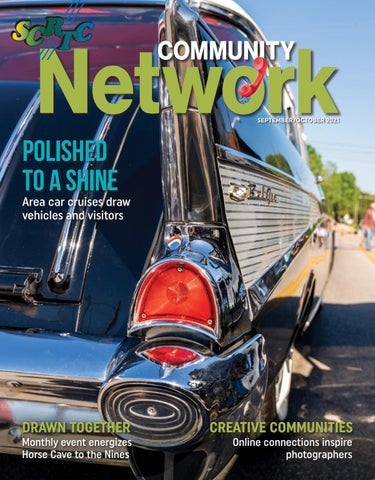
Network COMMUNITY
SEPTEMBER/OCTOBER 2021
POLISHED TO A SHINE
Area car cruises draw vehicles and visitors
DRAWN TOGETHER
Monthly event energizes Horse Cave to the Nines
CREATIVE COMMUNITIES Online connections inspire photographers
INDUSTRY NEWS
Rural Connections By SHIRLEY BLOOMFIELD, CEO NTCA–The Rural Broadband Association
Building a connected future As the nation’s leaders work to improve the infrastructure that supports our economy and our communities, there is a growing understanding of just how vital broadband service is to rural areas. It’s important rural providers have the resources and regulatory stability they need to connect areas that often have no other options for service. The challenges those providers face go beyond simply building an internet network that must keep pace as the demands of users grow from decade to decade. Recently, representatives of several cooperatives — among them, Golden West Telecommunications Cooperative, South Dakota; the Yelcot Telephone Company, Mountain Home, Arkansas; and Totelcom Communications, De Leon, Texas — made sure members of Congress heard this message. Similarly, months of coping with a global pandemic proved the success of rural broadband. Countless households, businesses, schools and others leaned on their local internet providers during these challenging times. However, there is still work to do in deploying networks and delivering robust and affordable services. This is where public policy can continue to play an important role, setting standards for broadband infrastructure and leveraging the know-how of community-based experts, like the company providing your internet service today. I’ve been delighted at the bipartisan nature of these discussions and the understanding that broadband kept the American economy humming during the pandemic. Now, we just need to ensure the lasting investment needed to future-proof this powerful system. 2 | September/October 2021
‘SIX PILLARS’ OF RURAL BROADBAND Fast internet builds successful communities Rural broadband’s influence extends throughout every community where fast internet networks are available. How many of these “six pillars” of rural broadband play a role in your daily life?
1. ECONOMIC DEVELOPMENT Housing values increase and businesses move more product when rural communities have broadband.
2. PUBLIC HEALTH Instead of driving 50 miles to a health center, a telemedicine visit can bring care into the home.
3. TELEWORKING Remote work creates fresh opportunities.
4. EDUCATION
Educators from grade school to colleges and universities are reaching students remotely.
5. PUBLIC SAFETY Broadband networks can improve the communications systems used by emergency responders.
6. QUALITY OF LIFE Thanks to broadband, young people find rural communities more appealing.
These pillars of rural broadband are based on the work of Christopher Ali, an associate professor in the Department of Media Studies at the University of Virginia. He is also the author of “Farm Fresh Broadband: The Politics of Rural Connectivity.” CORRECTION: In the July-August issue of your magazine, the final word of a travel story on Page 7 about the Red River Gorge was omitted. This is the complete sentence: As the Red River continues through the heart of the gorge, it levels out and provides gentle Class I paddling ideal for beginners.
15
16
Film
15
36
T
15A
16
17
Film
36
16A
17
18
Film
36
17A
18
Better-looking videos are just a few steps away
Film
36
18A
hanks to smartphones, recording and sharing videos has never been easier. Whether you’re capturing precious moments to share with friends and family, showcasing your talents or documenting a moment the rest of the world needs to see, a high-quality video helps get your message across loud and clear.
Here are some tips to help make sure your next video is your best one yet.
• Clean the lens — Sometimes it’s easy to overlook the obvious. We’re touching our phones constantly. We’re taking them out of our pockets and purses multiple times a day, so they’re bound to pick up a few fingerprints and smudges along the way. Take a second and give the lens a couple of swipes with a moistened cleaning wipe. No wipes? No worries — a quick breath and a swab with your shirttail can get the job done, too. • Orientation — Make sure to turn your phone horizontally when shooting videos. Shooting horizontally, also called landscape orientation, results in a more aesthetically pleasing experience for viewers, and it looks great across multiple platforms, especially on wide screens. Shooting this way also allows you to capture more of the surroundings in the video.
• Lighting — When recording indoors have the subject face a window if possible. If there is no natural light, consider purchasing an LED light ring. Light rings have become very popular and are an inexpensive way to make your video look professional. Avoid backlit settings, which can erase a person’s features on video and replace them with a dark figure instead. • Zoom cautiously — While the digital zoom option is a nice feature to have, using it while recording can result in an awkward-looking video. Instead, to keep the image crisp, take the time to frame the shot before recording and avoid using the zoom. Unless you’re planning to use the zoom distortion as an effect, get as close to the subject as you safely can to preserve the image quality.
• Stabilization — Nothing is harder to watch than a shaky video. A simple way to make your video better is by using two hands to hold the phone steady. Instead of extending your arms, tuck your elbows in close to your sides and hold the phone closer to your chest. If a professional-quality video is what you’re after, consider investing in a tripod or a gimbal to give your arms a rest. Also, many newer phones now include image stabilization features that can correct for inadvertent movements during shooting. • Composition — Take a moment to compose your shot before pressing the record button. For example, if you are making a video in a controlled environment, perhaps filming a tutorial in your home, look around and make sure the background is clear of anything you wouldn’t want people to see. September/October 2021 | 3
FROM THE GENERAL MANAGER
Competing for jobs
Fast internet service puts us in the game
O
ur world is a competitive place, and not just when it comes to sports. The leaders of every town and county understand they’re in a fight for one of the most desired assets anywhere — jobs. The opposition isn’t just the next county over, either. Every community in the nation is in the game.
Success means bringing any possible advantages onto the playing field, and fast internet service is more than critical. It’s essential because it’s important to businesses of all types and sizes. Small manufacturers benefit from speedy internet service because resources from accounting to customer support often flow through the internet. Similarly, video calls are now just a normal part of business life. For communities hoping to recruit these types of employers, fast internet access is mandatory. Then, think about all the changes we’ve seen in remote work, JEFF EATON which was on the rise even before the pandemic. Remote work General Manager is more common than ever, and if you can work from home, our community is highly attractive. After all, the big-city pace isn’t for everyone. So, why not bring those jobs to rural America? That’s certainly the plan the West Virginia Tourism Office had last spring when it promised to pay remote workers $12,000 to relocate to that state. This shows the level of competition we face and how far some organizations will go. I’m not suggesting we should pay people to relocate here, though, because I believe our communities are enough of a draw. We live in a friendly, affordable and beautiful place. And we have the fast, reliable internet network required to make remote work more than just a possibility. The speed and affordability of our internet service is comparable to — and often greatly exceeds — service in major cities. In many ways, we’re a better place for remote work than metropolitan areas. But it’s about more than just jobs. We’re also building for the future. Our students can learn the skills they need to be competitive, not only for today, but also for tomorrow. A growing number of colleges and universities offer online courses. Students about to enter the workforce can broaden their horizons without ever leaving home. But students aren’t alone in benefiting from classes accessed via the internet. People looking to grow professionally now have similar resources available that allow them to continue their education and open new doors to either advancement or entirely fresh careers. Many of those classes and other resources are best experienced through live video, which needs a highspeed internet connection. While our friends in economic development always keep a watchful eye out for opportunities to attract the attention of large employers, one of the things that excites me most is the entrepreneurs: industrious people putting in the hard work needed to kick-start a business. Our affordable living costs can give young businesses an edge, allowing them to keep overhead lower than their competitors. They can move large amounts of data, share information, hold online meetings and more. Thanks to fast internet access, even home-based startups can link to a worldwide market that was once only accessible to businesses with large staffs in big-city offices. Throughout the nation, there are signs of vitality in rural economies. For all the reasons I’ve described, fast internet service is part of the foundation making it all possible. We’re in the game, and I firmly believe we’re ready to compete.
4 | September/October 2021
Network COMMUNITY
SEPTEMBER/OCTOBER 2021
VOL. 6, NO. 5
The SCRTC Community Network is a bimonthly newsletter published by South Central Rural Telecommunications Cooperative © 2021. It is distributed without charge to all customers of the cooperative. South Central Rural Telecommunications Cooperative is a member-owned corporation dedicated to delivering advanced telecommunications technology to the people of Central Kentucky, including Adair, Allen, Barren, Edmonson, Green, Hart, LaRue, Metcalfe, Monroe and Nelson counties. South Central Rural Telecommunications Cooperative, Inc. 1399 Happy Valley Road • P.O. Box 159 Glasgow, KY 42142-0159 270-678-2111 www.scrtc.com SCRTC BOARD OF TRUSTEES Ralph J. Thompson, District I Bonnieville and Munfordville exchanges Billy Smith, District II Canmer and Horse Cave exchanges Jerry Polson, District III Cave City and Hiseville exchanges Ronnie Tucker, District IV Center, Edmonton and Summer Shade exchanges Kevin Bradshaw, District V Glasgow and Temple Hill exchanges Zack Kender, District VI Fountain Run, Gamaliel and Lucas exchanges Robert E. Thompson, District VII Buffalo and Magnolia exchanges Jeff Eaton General Manager Bobby H. Richardson Attorney Produced for SCRTC by:
On the Cover: Car enthusiasts flock to Cave City and the Glasgow square for events filled with chrome classics and shiny rides from all eras. See story Page 8.
SCRTC NEWS
Employee Spotlight Glaine Percell, a customer service foreman, has helped SCRTC’s members with their services for 21 years. She has a son, Jalil Percell, and stays busy in her spare time with catering events with friend Diane White. Marla Croghan has worked at SCRTC for 21 years as a customer service representative. She and her husband, Jason Croghan, have two sons, Will and Chase. They also have two granddaughters, Indie and Charlee. In her spare time, she likes to ride her motorcycle and go on cruises. Brenda Dixon has enjoyed meeting and helping SCRTC customers through the 18 years she’s been a customer service representative. She married Jimmie Dixon, and they have two children, David Dixon and Toi Carter. They also have 10 grandchildren and two greatgrandchildren. Her hobbies are golf, camping and crafting. Lesa Bragg works in SCRTC’s credit and collections department. She started as a receptionist 22 years ago. She loves horses and rummaging for antiques at estate sales. Her late husband, David Bragg, introduced her to a love of classic cars with a 1969 Z28 Rally Sport Camaro that she still cherishes.
October is Cybersecurity Awareness Month Top five tips to be cyber aware
1 — Keep all software up to date 2 — Strong passwords, or password
management tool
3 — Be careful what you click 4 — Use antivirus protection 5 — Regularly review activity from online accounts
The SCRTC offices will be closed on Monday, Sept. 6, for Labor Day.
What is STIR/SHAKEN Robocall Blocking and why do I want it? STIR/SHAKEN is a protocol developed for telephone companies with the support of the FCC. The service confirms your caller ID is not being spoofed with robocalls that are changed to look like a local or common number that you’d normally answer. According to analysts, U.S. consumers received 4 billion robocalls per month in 2020, several of these led directly to consumers being scammed out of their hard-earned money or personal information. This service from SCRTC allows calls that are being spoofed to be refused. Or, customers with Caller ID and name delivery can see if the caller has a negative rating, with displays such as “Potential Fraud,” “Travel Agent” and “Spam Call.” STIR/SHAKEN enables us to work with government agencies as well as law enforcement to trace these scams back to the source. This service has already resulted in several federal enforcements on spam callers. The service constantly updates global records, responding quicker to the changing strategies of these scams. The best reason to sign up is that it’s totally free for residential customers. To sign up, call 270-678-2111 and ask about our robocall service.
South Central Rural Telecommunications Cooperative
September/October 2021 | 5
TRAVEL
As Mother Nature intended Okefenokee Swamp is a wildlife watcher’s dream
Story by ANNE BRALY
N
estled deep down in Georgia and stretching into Florida, the Okefenokee Swamp is eerie in places, and just plain spooky in others. It’s a mosaic of vast pine islands, cypress forests and water as black as night — all elements that make up this national treasure.
The swamp, one of the world’s healthiest water ecosystems, is protected from human encroachment by the National Wildlife Refuge System, an organization established to oversee a network of lands and waters for conservation, says Susan Heisey, supervisory refuge ranger of the Okefenokee National Wildlife Refuge. The Okefenokee National Wildlife Refuge has 80% of the Okefenokee Swamp under its jurisdiction, as well as close to 40,000 acres of uplands immediately surrounding the swamp. At 407,000 acres it’s the largest national wildlife refuge in the East. Where there is swampland, there are gators. And alligators love this swamp because they’re protected here. The refuge provides them a safe haven — a wealth of food and shelter to sustain a thriving population of the reptiles. 6 | September/October 2021
“There are generally no problems between man and alligators due to the amount of habitat the refuge provides,” Heisey says. “Generally, when an alligator sees a person, it moves in the opposite direction.” The only times that alligators can be confrontational or dangerous is if they identify people with food, Heisey explains. “So, we try to educate our visitors about the dangers of feeding and approaching wildlife so there are no issues with nuisance alligators.” Alligators can basically be found in any portion of the swamp and most adjacent ponds, ditches or other bodies of water. Alligators do live in the water, but they can also be found on land at times. The females will build up their nests adjacent to
the water where they live. Interesting trivia: Female alligators protect their nests and their young for several years, and they are the only reptiles that do this. And their numbers remain pretty stable, although there has been no recent official count. It’s a matter of water level fluctuation, a limited amount of food sources and competition between males for territorial rights. The largest alligator ever documented was in Louisiana in the early 1900s and was more than 19 feet long. “We do not have a record of the largest alligator in the Okefenokee Swamp, but occasionally there can be individuals at around 14 feet or so,” Heisey notes. Gators aren’t the only creatures found among the swamp’s wetlands and woodlands. The refuge is home to 39 fish species, 37 amphibian species, 63 other reptiles, 234 birds and 50 mammals. Most notable among the animals are wood storks, indigo snakes, gopher tortoises, black bears, endangered red-cockaded woodpeckers and sandhill cranes. The refuge is home to both migratory and resident sandhill cranes, and most recent observation found that there are about 100 nesting pairs in residence. The migratory sandhill cranes are usually present from November through February, at which time they’ll migrate up the Atlantic Flyway to their breeding grounds. Wildlife observation is one of the most common types of recreation for visitors to enjoy while on the refuge. Walking the Chesser Island Boardwalk to the 40-foot observation tower at its end and boating the water trails on a prearranged or selfguided tour are the best ways to see the animals. Finding the cranes is easy. Just listen for their loud bugling calls and look among the refuge prairies where the water is relatively shallow — good hunting grounds for the big, long-legged birds. Look down, not up. Sandhills nest on the ground, not in the trees. “Visitors love seeing those cranes,” Heisey says.
Cutline
The ‘Pogo’ connection Some baby boomers may remember “Pogo,” one of the most popular comic strips of their youth. Pogo was a possum that lived in a tree in the Okefenokee Swamp and came to life weekly in newspapers across America, born from the mind of cartoonist Walt Kelly. At its peak, “Pogo” appeared in nearly 500 papers in 14 countries, and close to 300 million copies of books about Pogo and his friends were sold. Kelly died in 1973, and his widow, Selby, continued the internationally syndicated comic strip until July 1975. After 26 years of syndication, “Pogo” the comic was completely discontinued, but the character lives on today in the welcome center at the Okefenokee Swamp Park in Waycross, Georgia. There, a large room has been turned into Kelly’s studio, complete with a likeness of the man himself and his alter ego, Pogo.
Swamp trivia The Okefenokee is OK, for now, but its future is directly tied to maintaining the integrity of the ecosystem’s complex processes. The future of people and communities surrounding the swamp also is dependent on conserving the swamp. • The swamp is the largest intact blackwater swamp in North America and is more than 7,000 years old. • The swamp is a massive, peat-filled bog inside a huge, saucer-shaped depression that was once part of the ocean floor. • Fire is an important part of the Okefenokee ecosystem, and the refuge has a prescribed burn program in place to accomplish what wildfires once did. The fire staff burns an average of 6,000 to 10,000 acres per year. • Most area residents have ancestors who once lived or worked in the swamp as a part of their heritage. • The Okefenokee Swamp, as the headwaters of both the Suwannee and St. Marys rivers, provides clean water to the most pristine rivers in the Southeast. • A National Geographic publication included the Okefenokee Swamp as among the top 100 most beautiful places on Earth. September/October 2021 | 7
Photography by Natasha Wilson.
Shiny chrome and classic lines are the draw for any car show.
Fuel-injected fun Car fanatics give jolt to local economies O Story by JOHN CLAYTON
8 | September/October 2021
The event spilled off Broadway, and side streets opened to accommodate the slew of automobiles. “The mayor, city council, the tourism board were all there, and they were shocked,” Cline says. “It blew everyone’s mind.”
HORSEPOWER AND ECONOMIC POWER Cave City’s proximity to Mammoth Cave has long made it a tourist stop, but even Mammoth Cave couldn’t keep the city from undergoing some of the same struggles other small towns across the U.S. were experiencing. Businesses shuttered, and the downtown area seemed to take the brunt of it all. Classic muscle cars on display during a Cruise into Spring by Renaissance Glasgow.
Photography by Mike Pruitt.
n the first Saturday morning of every month, you can find Todd Johnson rumbling toward Cave City in his 1955 Ford F-100 pickup. Cars and coffee await — and there are plenty of both. The local Cars and Coffee monthly gathering was the brainchild of Leticia Cline, a Cave City business owner and city council member who grew tired of seeing a once-thriving downtown seemingly lost to time and circumstance. Communities across the nation and world host Cars and Coffee events on weekends, welcoming car clubs and visitors to their streets and businesses. Cline says she crossed her fingers that it would do the same for Cave City. “It’s super easy. There’s no registration,” says Cline, who returned to her hometown of Cave City and added city council member to a colorful career that includes motorcycle racer, journalist and model. “It’s really easy. You drive in, park your car, have some coffee, chitchat and listen to some music, and walk around downtown before it gets really hot.” Cline advertised the first Cars and Coffee in April with the hopes that “20 cars” would show up. By 7 a.m., “the car guys,” from those driving collector vehicles to those bringing in hot rods, were arriving, scoping out the best spots on Broadway. By the time Cars and Coffee officially got underway two hours later, about 200 cars and more than 600 people had shown up.
South Central Rural Telecommunications Cooperative
CAR CULTURE MEETS COFFEE CULTURE Johnson felt from the beginning that Cave City would have a hit with Cars and Coffee. Auto enthusiasts from across the region were thirsty — if not for coffee, then for a regular event that would allow them to spend time together, talk and check out one another’s rides. “We’ve all enjoyed having somewhere to go every month that’s local,” Johnson says. “I told Leticia in April that this was going to get so big that you’re not going to have a place to put them. Sure enough, they’re taking up the whole street and all the side streets.” From the initial Cars and Coffee, with estimates of 200 cars and 600 people, the event has grown to more than 300 cars and more than 1,000 people. Visitors are coming to Cave City from as far away as Louisville and Fort Knox. Johnson says the easygoing Saturday morning with no competitions, no trophies and no pressure is exactly what he and other car enthusiasts seek. “You just pull up in your rat rod, your street rod, your hot rod, your racecar — whatever you’ve got,” he says. “You get out your chair and just start talking to everybody.” He says it’s been a welcome addition for the car community in the area, but he also sees the changes in Cave City. “Everybody is remodeling those empty buildings now,” Johnson says. “All of a sudden, it’s bringing back the community.” Cline sees it, too. “Having it downtown is the perfect backdrop,” she says. “People love it. They want to linger a little longer. It just feels so much more intimate and personal. I look at the old pictures of when Cave City was such a happening spot with all the cars on Broadway, and on the first Saturday of every month, that’s what it looks like again. It’s great to see.”
CRUISING GLASGOW This year marked the 10th anniversary of Glasgow’s Cruise into Spring car show, which was June 12. Gleaming street rods and even antique tractors filled the downtown square with donations going toward upgrades for the city’s most popular roundabout. “This was the largest one that we’ve had,” says Becky Barrick, chairperson for Renaissance Glasgow, which sponsors the event. “We had more than 300 vehicles, and we were very pleased with the growth of the event.” Several of the stores and boutiques promoted specials, including restaurants on the square and the weekly farmers market, says Ernie Myers, executive vice-president of Glasgow-Barren County Chamber of Commerce. In the past two years, there has been a 10% increase in the number of businesses on the square. Three remaining buildings are undergoing upgrades to attract more merchants. “This event draws many people who are not downtown on a weekly, or even a monthly, basis,” Glasgow Mayor Harold Armstrong says. “It brings awareness to all that we have to offer. Visitors see the renovations, new businesses and that Glasgow is alive, well and flourishing.” Local photographer Wayne Garmon launched his drone to get a higher perspective of the Cave City Cars and Coffee event.
Photography by Wayne Garmon.
“A big part of it is economic growth,” Cline says. “We estimate about $22,000 was spent within our city limits for that first Cars and Coffee. People shopped and ate in town, and some people stayed over. The farmers market, which consists of 13 local businesses, made up $8,000 of that.” “What it does for downtown businesses is obvious, but having people think about the area for investment is great, too,” she says.
Check out these Facebook pages: CruiseintoGlasgowKY Cavecitycarsandcoffee Mark your Calendar Oct. 9 - Glasgow’s 21st Annual Cruise into Fall Photography by Wayne Garmon
South Central Rural Telecommunications Cooperative
September/October 2021 | 9
NEW PERSPECTIVES
Jason Stitt sees rural Texas through a different lens Story by DREW WOOLLEY
J
ason Stitt has always seen the world a little differently. Through the lens of his camera, he likes to find new views of the places other people might pass every day without a second thought. “Photography helps me to view the world in ways most people don’t get to. To look at things from different angles, different perspectives and to see things in a way that others may not,” he says. “Mostly, it’s an outlet for me to be creative and to show the world the beauty of God’s creation, whether that be people or nature.” Now, with the help of the internet, he can encourage others in his community to find their own individual perspectives. Social media has been a place for Stitt to grow as a photographer by sharing his work, asking questions and engaging in critiques with other professionals. He even runs his own Facebook group, Tyler Area Photography, with more than 600 members dedicated to growing the
10 | September/October 2021
“I am an introvert by nature,” he says. “So I really enjoy the quiet solitude of being out in nature with just my camera gear.”
IN FOCUS photography community in Tyler, Texas. “I’m still learning and growing and will never stop,” Stitt says. “We don’t have lots of photography shops like you might find in bigger cities. So almost all of my continuing education and growing the craft relies on the internet.” Stitt caught the photography bug 18 years ago while living in California. Working as a graphic designer, he started submitting his shots to a stock photo website before becoming a full-time photographer two years later. After moving back home to New Zealand with his family, Stitt discovered his passion for landscape photography. But it was only a few years before the cost of living caught up with them. They didn’t want to give up the opportunity to have his wife, Ruth, home-school their children. So, Stitt took his newfound talent for capturing natural beauty to Tyler, where he could continue pursuing his career while supporting his family.
When Stitt and his family were deciding where to relocate on their move back to the States, there was one must-have for his business: a strong internet connection. “That was one of the most important factors in choosing a place. It had to have a reliable and fast internet connection,” Stitt says. "Ninety-nine percent of my business I get through either my site or social media. So without the internet, I lose all of that.” Photographer Jason Stitt
He isn’t exaggerating. About a year and a half after moving to Tyler and gradually building momentum as a professional photographer, Stitt and his family visited New Zealand for five weeks to see his parents. Stitt stayed away from social media during the trip and returned to find business had ground to a halt. “I felt like I had just lost all the momentum I had built while we were gone and had to start all over again,” he says. “Now, ideally, I try to post something every weekday to keep business relatively steady and keep getting inquiries. If I’m not posting regularly, those inquiries just stop happening.”
TOOLS OF THE TRADE
Getting the shot Whether you’re just starting out or a seasoned pro, Stitt offers some pointers to make your photos stand out. • Shoot, shoot, shoot — As with any learned skill, the best way to hone it is to do it. Get out and take as many photos as you can to develop a better idea of your interests and style. • Be intentional — Ansel Adams said, “You don’t take a photograph, you make it.” Photography is art, and good art requires forethought and planning. Think about what you want to capture and how you want to photograph it. • Study the greats — Look closely at the work of photographers you admire. Figure out what it is about their work that appeals to you and then try to emulate it. • Master the light — Light is the single most important factor in photography. More than determining how bright or dark your photos are, controlling light also decides the tone, mood and atmosphere of your images. • Learn to edit — Don’t neglect learning how to use your editing software. In today’s world, the ability to edit well is one of the elements that makes for a great photographer. • Find your community — Locate a local camera club or Facebook photography group to join. These can be great places to meet like-minded people from whom you can learn and grow.
The internet is full of resources for aspiring photographers and professionals alike. Whether you’re looking to manage your shots or learn a new skill, there’s something for everyone. • Education — Even the best photographers have something to learn. For professional courses, Stitt turns to sites like CreativeLive and Improve Photography. If you’re looking for something to peruse at your leisure for education and inspiration, he recommends Scott Kelby’s blog. • Editing — With Adobe’s Photography package, anyone can get access to professional-grade software like Photoshop and Lightroom to edit and organize your photos on any device — all for little more than some streaming subscriptions. • Website builders — Every photographer needs a place to share their work with the world. Popular website builders like Squarespace and Portfoliobox make it easy to show off your best shots and even to sell your work. • Storage — As all those photos pile up, you’ll need somewhere to keep them. Flickr offers a substantial 1 TB of free storage, while services like Dropbox and Google can provide up to 16 TB of space as your portfolio grows.
September/October 2021 | 11
Horse Cave to the Nines focuses on food and family during a community showcase.
Celebrating downtown businesses Horse Cave to the Nines gives shops a chance to shine Story by ANDREA AGARDY
12 | September/October 2021
Emry Riley also co-hosts “Talkin’ Trash” with Jeremy Birge, discussing local events with guests on a weekly Facebook Live conversation.
Photography by Natasha Wilson.
J
ennifer Sims has fond childhood memories of shopping trips to Horse Cave with her grandfather. She also remembers a time, decades later, when there weren’t many stores left to visit. “In the ’90s, it started dying for various reasons,” Sims says. “It was like a ghost town. You just had empty storefronts.” Now, with a downtown storefront of her own — she runs Sims Studio and Art Shop on Main Street alongside her husband, Jesse — she’s working with other Horse Cave business owners to keep the nowvibrant downtown area hopping. In 2019, business owners launched Horse Cave to the Nines. On the first Friday of every month, from April through December, businesses stay open until 9 p.m. to show off what’s happening downtown. “It’s a way to say, ‘Hey, the sidewalks don’t always roll up at 5 o’clock in the afternoon,’” Sims says. “There are things to be seen and done here.”
South Central Rural Telecommunications Cooperative
“It has been an extremely important effort because it’s bringing more people into our shops, and when you have more people coming into the shops, there’s more things purchased and word of mouth,” Sims says. “It’s almost like that ripple effect that brings more people in just by knowing about it.”
STAYING CONNECTED
Jesse & Jennifer Sims.
Because many businesses only have proprietors working, many are only open from 9 a.m. to 5 p.m. That timeframe doesn’t leave a lot of opportunity for most people to shop. The hope is staying open late one Friday a month will allow locals and visitors alike to find something intriguing that keeps them coming back for more. Emry Riley, owner of A Walk Through Time antiques store, brought the concept for the monthly event to his fellow business owners. He and his wife, Gena, owner of GeeGa’s Home Decor, attended a similar event in Columbia. “On the way home, all we talked about was how to implement this idea in downtown Horse Cave,” Riley says. “We got together with Jennifer and some other business owners and told them what we experienced. We all took the idea, put our own spin on it and made Horse Cave to the Nines what it is today.”
action. The cave, situated under downtown Horse Cave, is home to the longest underground suspension bridge in the world, constructed to make Sunset Dome — a section of the cave with a 185-foot high, colorful, domed ceiling — accessible again. The cave has offered discounts for locals on Nines night, introduced them to Bigfoot and hosted tours by lantern light. Musicians set up on the porch of a historic downtown home and play for tips from audience members seated on the grass. And a portion of Water Street is closed to traffic to allow antiques and other vendors to sell their wares outside. The appeal of Horse Cave to the Nines extends far beyond locals. “We draw in a large crowd from the Bowling Green area, Elizabethtown and Columbia, as well as tourists that come to visit the cave region,” Riley says. “It gives them an opportunity to participate in small-town life on a Friday night.”
A LITTLE BIT OF EVERYTHING
ECONOMIC IMPACT
The small town has a diverse business community, and that variety is proudly on display during “the Nines.” There are clothing boutiques, antique stores, a bookstore, a shoe store, eateries and more. Even Hidden River Cave and the American Cave Museum gets in on the
While businesses certainly benefit from the extra revenue on Nines nights, the economic upside isn’t limited to just nine Fridays a year. The event is generating repeat customers and raising awareness about Horse Cave and its thriving downtown.
South Central Rural Telecommunications Cooperative
The internet plays a huge role in running any small business today, providing business owners with more ways to reach, serve and inform their customers. Businesses all over Horse Cave use fast and reliable broadband service from South Central Rural Telecommunications Cooperative to keep those lines of communication open. “It was a no-brainer to go right to the internet to get the word out about Horse Cave to the Nines,” Riley, an SCRTC customer, says. “We have a Horse Cave to the Nines Facebook page you can go on and see information about the event. We can answer your questions through that page. We post pictures from the events themselves. The internet has been a tremendous help for us.”
MORE TO COME After COVID canceled the 2020 schedule, Horse Cave to the Nines relaunched to an enthusiastic response in April, and organizers plan to keep building on that momentum. “We’re open to anything,” Riley says. “Whatever helps the downtown area and the small businesses here — if we think it’s a good fit we’re open to it.” “Some of the comments locals have had is it’s refreshing to see life breathing back into the downtown area, to see people walking up and down the streets on a Friday evening,” Sims adds. “For some of the older residents, it reminds them of what it used to be. The town has a heartbeat. There’s a vitality that wasn’t there 15 years ago.” Horse Caves to the Nines will take place until 9 p.m. on Sept. 3, Oct. 1, Nov. 5 and Dec. 3 in downtown Horse Cave. For more information, check out the event’s Facebook page. September/October 2021 | 13
SOUTHERN KITCHENS
Palate pleasers
Pears make perfect sweet and savory dishes
P
ears add a dose of seasonality to dishes this time of year with a sweetness that’s nuanced and subtle yet plentiful. But understanding which type of pear is best for what use will help you choose wisely from the fruit you’ll see in the produce section of your local market. Any type of pear is good to eat as long as it’s ripe enough to bring out its sweetness. But when it comes to using pears in cooking, the variety you choose matters. Do you want the pear to retain its shape when poached? Or do you want it to melt into a sauce? Just remember your pear ABCs — Anjou, Bosc and Comice. Anjou is an all-purpose pear that can be grilled, roasted or eaten as a snack. Bosc pears are best for poaching, as they maintain their shape well when cooked.
Comice pears are best used raw, as their tender flesh will not hold up well under heat. They are a sweet pear to pair with cheese. The best way to ripen pears is on the counter at room temperature, a process that requires patience, since the fruit can take up to a week to reach its sweet peak. Once fully ripe, pears may be stored in the refrigerator for up to a week, if they stick around that long before being used in any of the following recipes. FOOD EDITOR ANNE P. BRALY IS A NATIVE OF CHATTANOOGA, TENNESSEE.
Pear & blue cheese salad 12 cups torn romaine lettuce 2/3 cup balsamic vinaigrette (homemade or store-bought), see note 2 medium pears, sliced (Comice suggested) 2/3 cup crumbled blue cheese 2/3 cup glazed or salted pecans Place romaine in a large bowl. Drizzle it with vinaigrette; toss to coat. Top with pears, cheese and pecans. Serve immediately. Makes 10 servings.
Photos by Miller Photography.
Note: If you can’t get enough blue cheese, substitute blue cheese dressing for the balsamic.
14 | September/October 2021
PEAR & GORGONZOLA PIZZA 1 (16-ounce) package refrigerated pizza crust dough 4 ounces sliced provolone cheese 1 Bosc pear, thinly sliced 2 ounces chopped walnuts 2 1/2 ounces Gorgonzola or blue cheese, crumbled 2 tablespoons chopped fresh chives Preheat the oven to 450 F. Spread the pizza crust dough on a medium baking sheet. Layer provolone cheese on the crust and top the cheese with Bosc pear slices. Sprinkle walnuts and Gorgonzola cheese over the pears. Bake for 8-10 minutes, or until the cheese is melted and the crust is lightly browned. Remove the pizza from the oven, top it with chives and slice to serve.
PEAR PANCAKES 1 1/2 cups baking mix (such as Bisquick) 1 medium ripe pear, peeled and finely chopped 2/3 cup old-fashioned oats 2 tablespoons packed brown sugar 1 1/2 teaspoons ground cinnamon 1 cup milk 2 tablespoons butter or margarine, melted 1 egg 1/2 cup butter or margarine, softened 2 teaspoons powdered sugar Maple syrup, if desired Heat a griddle or skillet over medium heat. Grease it with butter or vegetable oil if necessary. In a large bowl, stir the baking mix, chopped pear, oats, brown sugar and 1 teaspoon of the cinnamon until blended. In a medium bowl, beat the milk, melted butter and egg with a fork or wire whisk. Add the milk mixture to the dry ingredients, stirring just until moistened. For each pancake, pour about 1/4 cup batter onto a hot griddle. Cook the pancakes until bubbles form on top and the edges are dry. Flip, then cook the other side until golden brown. While the pancakes are cooking, make cinnamon butter: In a small bowl, mix 1/2 cup butter, the powdered sugar and the remaining 1/2 teaspoon cinnamon. Serve the pancakes with cinnamon butter and syrup.
BAKED PEARS WITH WALNUTS 2 1/4 1/4 2
large ripe Bosc pears teaspoon ground cinnamon cup crushed walnuts teaspoons honey Vanilla ice cream or whipped cream, optional
Preheat the oven to 350 F. Cut the pears in half and place them on a baking sheet. You may want to cut a sliver off the uncut side so that they sit upright. Using a measuring spoon or melon baller, scoop out the seeds. Sprinkle the pear halves with cinnamon, top them with walnuts and drizzle 1/2 teaspoon honey over each one. Bake for 30 minutes. Remove from the oven, let them cool slightly and serve the pears topped with ice cream or whipped cream, if desired.
PEAR CLAFOUTIS
Think pear cobbler, only easier. Salted butter for the dish 2 ripe but slightly firm Anjou pears (about 1 pound total) 1 cup half-and-half 3 eggs 1/3 cup plus 1 tablespoon granulated sugar 1 1/2 teaspoons vanilla extract 1 teaspoon orange zest 1/8 teaspoon nutmeg 1/4 teaspoon kosher salt 1/2 cup flour Powdered sugar Peel, core and slice the pears lengthwise about 1/3-inch thick. Preheat the oven to 350 F. Butter a shallow 3-quart baking dish and arrange the pears over the bottom — they will rise to the top as the batter bakes. Put half-and-half, eggs, granulated sugar, vanilla, orange zest, nutmeg, salt and flour (in this order) in a blender and whirl until very smooth and frothy, 1 minute. Pour the batter over the pears. Bake until the clafoutis is well browned and a little puffed, about 50 minutes. Let it cool on a rack about 15 minutes. Serve warm, sprinkled with powdered sugar.
September/October 2021 | 15
Presort STD US Postage PAID Permit #21 Freeport OH
1399 Happy Valley Road P.O. Box 159 Glasgow, KY 42142-0159
20 21
THURSDAY
OCT. 14
ANNUAL MEETING Connecting with our members Cave City Convention Center Doors open for registration at 6 p.m.
Elections DISTRICT 4 Center, Edmonton and Summer Shade
DISTRICT 7 Buffalo and Magnolia
Business Results of the trustee election
Entertainment CHILDRESS RIGDON FAMILY BAND A gift for ALL members Refreshments A CASH drawing Gifts for children 16 and younger A large-screen HDTV to one LUCKY WINNER