BROADBAND:
HELPING YOU CONNECT
Connected SEPTEMBER/OCTOBER 2020
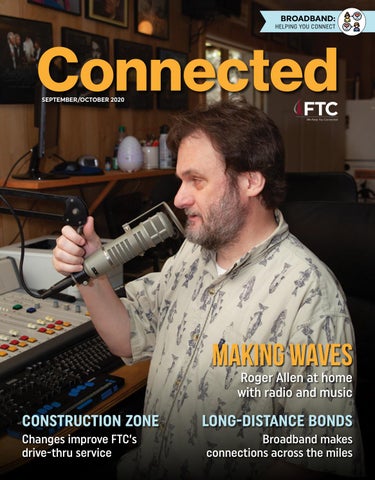
Making waves
Roger Allen at home with radio and music
CONSTRUCTION ZONE Changes improve FTC’s drive-thru service
LONG-DISTANCE BONDS Broadband makes connections across the miles
INDUSTRY NEWS
Rural Connections By SHIRLEY BLOOMFIELD, CEO NTCA–The Rural Broadband Association
Broadband matters now more than ever
R
ural broadband providers are supporting two critical bills making their way through Congress. One would secure present efforts to keep you connected, while the other provides support for future broadband expansion. The Keeping Critical Connections Act was introduced earlier this year by U.S. Sens. Amy Klobuchar, D-Minn., and Kevin Cramer, R-N.D. This bill would appropriate $2 billion to help smaller broadband companies who worked with struggling customers during the pandemic and who did not disconnect those who couldn’t pay. As the health crisis and economic shutdown disrupted millions of lives, internet providers across the country took the Pledge to Keep Americans Connected by waiving late fees, opening community Wi-Fi hot spots, and not terminating service to customers because of their inability to pay their bills. For all this good work, however, our members have seen uncollectibles rise. NTCA members have on average some $80,000 in accumulated nonpayments by customers since the pandemic hit. These are significant amounts, as these broadband providers are often small companies with fewer than 30 employees. Keeping Critical Connections will help them continue serving their communities. In terms of long-term deployment, NTCA also supports the Rural Connectivity Advancement Program Act of 2020, introduced by U.S. Sen. John Thune, R-S.D. This bill would set aside a portion of the proceeds from FCC spectrum auctions to fund rural broadband deployment. These bills will help broadband providers like yours continue their work to ensure every American has access to the communications services necessary in today’s world.
2 | September/October 2020
Listen in!
P
odcast listenership continues to grow as Americans increasingly turn to the audio format for news, entertainment and learning. “Podcasts now reach over 100 million Americans every month,” said Tom Webster, senior vice president of Edison Research, whose Infinite Dial research reveals that 37% of Americans listen to podcasts every month. That’s an increase from 32% just one year ago. That number has climbed steadily as more content becomes available to appeal to a wide range of interests. Two new podcasts have been released this year that address a topic of growing importance: rural broadband. Heading into 2020, rural broadband had become a major point of focus in the U.S., with an increasing number of state and federal programs aimed at solving the lack of broadband access in parts of rural America. When the COVID-19 pandemic disrupted businesses, schools and health care delivery, the need for nationwide broadband access was amplified. In February, NTCA–The Rural Broadband Association launched its “Smart Rural Communities” podcast. The show takes a look at rural broadband providers who are bringing advanced digital infrastructure to small towns and regions through powerful fiber networks. These broadband networks are jumpstarting economic growth, igniting educational opportunities and improving health care in some of A podcast from America’s most remote areas. “Rural Broadband Today” launched in June. This podcast tells the stories of those working to bring broadband internet access within reach of every citizen. The interview-style show presents conversations with elected officials, industry experts and business leaders at the forefront of America’s efforts to solve the rural broadband challenge. It’s produced by WordSouth — A Content Marketing Company. Both podcasts can be found on Spotify, Apple Podcasts, Google Podcasts, or by visiting www.ntca.org/smart and www.ruralbroadbandtoday.com.
Can you see me now?
Three options for effective videoconferencing
Videoconferencing technologies empower remote work
I
f you’ve found yourself logging on for more video meetings at work lately, you’re not alone. According to the 2019 Impact of Video Conferencing Report by Lifesize, 48% of business professionals say their use of videoconferencing at work has increased compared to two years ago. And that study was before a global pandemic drove even more companies to work remotely. Videoconferencing isn’t without limitations, but businesses and workers are finding it an essential tool for empowering remote work.
FLEXIBILITY With videoconferencing, employees and contractors can work from home while still collaborating with their teams and attending important meetings. The flexibility enables individuals in rural communities to not only have more control over their work-life balance but also “telecommute” to urban companies for better opportunities. Companies also benefit from the ability to recruit talent from anywhere. Business owners have the freedom to set up shop in rural communities, for example, then employ or partner with experts from around the world.
CONNECTION Video teleconferencing not only empowers remote productivity but also helps workers overcome some of its challenges. According to Buffer’s 2019 State of Remote Work Study, 19% of remote workers cite loneliness as their biggest struggle when working remotely. Video calls can help. Compared to telephone conferences, video calls make it easier to form connections. The experience more closely reflects face-to-face
encounters. For example, participants can see facial expressions and body language to better identify how others are responding to their ideas as they collaborate on projects.
SAVINGS When teams work over videoconferencing platforms, everyone involved saves time and money. Cutting a commute across town — or in some cases, the globe — benefits people’s schedules, companies’ bottom lines and even the environment. Plus, the work itself can be more efficient online. In the Lifesize study, 89% of respondents agreed that videoconferencing reduces the time it takes to complete projects or tasks. People may be more likely to enter an online meeting with an agenda and honor the scheduled start and end times. Plus, they can avoid the interruptions common to in-office meetings.
OVERCOMING THE CHALLENGES Despite its many benefits, videoconferencing isn’t without challenges. Not all tech tools are secure, so companies must research available options carefully to protect their employees and data. Team leaders must make an effort to coordinate meetings ahead of time to ensure everyone is online and available. And if any employees lack access to fast, reliable internet, technical difficulties can bring meetings to a frustrating halt. Despite their drawbacks, videoconferencing platforms are here to stay. In the Buffer survey, 99% of respondents agreed they’d like to work remotely at least some of the time for the rest of their careers. Thanks to the increasingly widespread use of videoconferencing technology, they just might.
1
ClickMeeting
2
Microsoft Teams
3
Google Meet
For interactive meetings and webinars, try ClickMeeting. Presenters can share their screen, run live Q&A sessions to engage the audience and collect valuable attendee data using polls. With an automated follow-up feature, this platform makes it easy to keep the momentum going after a webinar ends.
For a platform that scales with ease, check out Microsoft Teams. Users can schedule video meetings with a single person or run large webinars and meetings of up to 10,000 participants. A long list of features and functionalities makes it a top choice for many businesses.
For fans of the Google Suite, Google Meet is a convenient choice that smoothly integrates with other applications like Google Calendar and Gmail. Participants can easily join in from their web browser or dial in to listen from anywhere. This platform has big-business capabilities without the big-business price tag, making it a great option for growing companies.
September/October 2020 | 3
FROM THE CEO
Connected Challenges brings perspective, insight and change
A
few years ago, a coach I respect responded to a critic of his play calling with the question, “Do you honestly think I would have deliberately run that play had I known how it would turn out?” I loved it. Throughout this pandemic I’ve been reminded just how FRED JOHNSON often we must run a play not knowing at all how it Chief Executive Officer will turn out. The danger we face is that the fear of failure — of running the wrong play — can easily paralyze us. The harsh truth then follows. If we are so afraid of failure that, in effect, we don’t run any play at all, we do nothing but guarantee the failure of which we are so afraid. By the time you read this, FTC will be finishing up a nontraditional annual meeting. That was another decision we had to make a long time ago hoping for the best. It seems to have been the correct call, and we appreciate the feedback we got from members who understood that our actions were based on doing what was safest for them. As we’ve coped with COVID-19 challenges, we’ve asked ourselves time and again what will happen if we do one thing versus another. More often than not, we essentially keep asking ourselves what decision is likely to cause us the least amount of regret. The more I think about it, the more I’ve decided this approach is a good standard to apply to much of life’s decision making. Questions like that cause us to think; they lead to perspective. I, for one, need all of that I can get. Now that we’re on track to have optical fiber available to every member by the end of next year, we’ve turned our attention to network dependability. In this magazine, we share our next project. At least four times over the last two decades tornados have barely missed our network operations center. One even struck the back corner of our campus. While we’ve made substantial investment distributing the critical components of our network across the service footprint, some things simply must remain close at hand. The importance of our network to the regions’ commerce has become too significant to leave to chance, especially in light of the weather of Northeast Alabama. We’ve asked ourselves in myriad ways what is the most appropriate way, given continuous changes in technology, we can guarantee the security and dependability of our network for generations to come. We believe a new storm-resistant building housing our most critical network components is part of our best option. While making that happen, we are also improving the drive-thru experience for our customers — another lesson learned from the pandemic. This project took several years of thought and a number of lessons learned, but we believe we’ve got it right. Not to oversimplify but, once again, we’ve chosen what we believe will be the path of least potential regret. May I put it another way? We don’t think that building the best possible network we can for you, your children and your grandchildren will be something we ever wish we hadn’t done. That’s what keeping you connected is all about, after all. Thank you for your support.
4 | September/October 2020
SEPTEMBER/OCTOBER 2020
VOL. 24, NO. 5
Connected is a bimonthly magazine published by Farmers Telecommunications Cooperative, © 2020. It is distributed without charge to all customers of FTC.
FTC is the state’s largest member-owned provider of telecommunications services. It serves Northeast Alabama with a robust broadband network using world-class optical fiber technology.
Farmers Telecommunications Cooperative, Inc. P.O. Box 217 • 144 McCurdy Ave. N. Rainsville, AL 35986 Telephone: 256-638-2144 www.farmerstel.com
BOARD OF TRUSTEES Randy Wright, President Flat Rock Exchange Garry Smith, Vice President Fyffe Exchange Danny R. Richey, Secretary Geraldine Exchange Lynn Welden, Treasurer Bryant Exchange Kenneth Gilbert Pisgah Exchange Gregg Griffith Henagar Exchange Randy Tumlin Rainsville Exchange Produced for FTC by:
On the Cover: Roger Allen hosts a daily radio show from his home in Pisgah, all possible with FTC’s fast fiber internet. See story Page 8.
FTC scholarship winners ... Alba Contreras
Alba Contreras, of Fort Payne, was awarded a $3,000 scholarship available to college students. She is a first-generation college student, graduating from Northeast Alabama Community College this summer with an associate degree. She transferred to Jacksonville State University to pursue a degree in elementary education and a minor in psychology and Spanish. Contreras plans to teach at an elementary school. “Ever since I was a little girl, I dreamed about being a teacher,” she says. She is a member of Phi Theta Kappa, Mu Alpha and Sigma Kappa Delta. Her membership in these honor societies is due to her GPA of 3.8. While maintaining a high scholastic record, Contreras has had three part-time jobs. She provides child care for several families, works at DeKalb Regional Medical Center and works in the financial aid office at NACC. Her dedication and attention to her responsibilities are seen in her exemplary scholastic record and ability to hold multiple part-time jobs. Alba is the daughter of Rocio Guerrero.
Cage Cochran
Cage Cochran was awarded a $3,000 scholarship available to high school students. Cochran, of Rainsville, is a 2020 graduate from Fyffe High School. He plans to attend Yale University, where he will study chemistry, history of science, medicine and public health. While at the university, he hopes to participate in undergraduate research and shadow several types of physicians at Yale-New Haven Hospital. After graduating college, Cochran aspires to attend medical school at Emory University in Atlanta before pursuing a career as an orthopedic surgeon, radiologist or primary care physician. He plans to practice medicine in Alabama as a way to help alleviate the physician shortages in rural communities and to improve health care for the impoverished. At Fyffe High School, Cochran served as a class officer for four years. He was a member of the Beta Club, acting as vice president and president, and of the Spanish Club, serving as president and reporter. Cochran participated in varsity football and competitive cheerleading, and he founded three programs at Fyffe High School — The Senior Citizen Program, The Devil’s Brew Coffee Shop and a tutoring program for students who need assistance in their classes. He volunteers at Fyffe Oktoberfest and Fyffe Giving Tree and works at a local gym teaching tumbling and cheerleading. Cochran is also a member of Sigma Kappa Delta at Northeast Alabama Community College. He attended the Rural Health Scholars Program at the University of Alabama, where he received the program’s highest GPA in chemistry and creative writing. Cochran maintained a 4.245 GPA in high school while taking dual enrollment classes at NACC. Cage is the son of Tim and Connie Cochran.
Statement of Nondiscrimination In accordance with Federal civil rights law and U.S. Department of Agriculture (USDA) civil rights regulations and policies, the USDA, its Agencies, offices and employees, and institutions participating in or administering USDA programs are prohibited from discriminating based on race, color, national origin, religion, sex, gender identity (including gender expression), sexual orientation, disability, age, marital status, family/parental status, income derived from a public assistance program, political beliefs, or reprisal or retaliation for prior civil rights activity in any program or activity conducted or funded by USDA (not all bases apply to all programs). Remedies and complaint filing deadlines vary by program or incident. Persons with disabilities who require alternative means of communication for program information (e.g., Braille, large print, audiotape, American Sign Language, etc.) should contact the responsible Farmers Telecommunications Cooperative
Agency or USDA’s TARGET Center at 202-720-2600 (voice and TTY) or USDA through the Federal Relay Service at 800-877-8339. Additionally, program information may be made available in languages other than English. To file a program discrimination complaint, complete the USDA Program Discrimination Complaint Form, AD-3027, found online at How to File a Program Discrimination Complaint and at any USDA office, or write a letter addressed to USDA and provide in the letter all of the information requested in the form. To request a copy of the complaint form, call 866-632-9992. Submit your completed form or letter to USDA by: (1) mail: U.S. Department of Agriculture, Office of the Assistant Secretary for Civil Rights, 1400 Independence Ave. SW, Washington, D.C. 20250-9410; (2) fax: 202-690-7442; or (3) email: program.intake@usda. gov. USDA is an equal opportunity provider, employer and lender. September/October 2020 | 5
GET ORGANIZED It’s easy and fulfilling … really
W
alk into a well-organized home, and you experience a sense of freedom. Freedom from clutter, freedom from chaos and freedom from the claustrophobia that comes from a house in disarray. People become frustrated when they can’t find the things they need, says Liz Jenkins, a certified professional organizer and owner of A Fresh Space in Nashville. “The visual distractions make it hard to be productive because everywhere you look, there is something that needs to be done,” she says. “People who have disorganized homes are often very frazzled people because nothing ever seems to go smoothly for them, and that’s caused by the chaos around them that prevents them from functioning properly.” The key to organization requires letting go of what is not used, loved or functional, says Houston-based Ellen Delap. She is past president of the National Association of Productivity
Creating a well-organized space means letting go of items that are not used often.
6 | September/October 2020
and Organizing and a certified professional organizer at professional-organizer.com. “Work with a partner, and donate those items to a cause that is important to you,” she says. “True editing means that you have decided that you have ‘enough’ and you only need to keep what is essential. This is for all types of organizing in your home, whether it is your kids’ clothes or toys, your kitchen, your garage, or your closet. Think of decluttering as peeling the layers of an onion. Go layer by layer until you have what is needed and precious.” There are several areas around the house that are considered clutter “hot spots,” according to Delap. The garage: This is one of the biggest hot spots, because it’s often the dumping ground for things people don’t know what to do with, as well as the last spot anyone gets organized. Garages are commonly not where we park the car. That is where large items are placed before a final decision is made. Those items sit in the garage over a period of time. When garage-cleaning day arrives, make sure you have plenty of heavy-duty trash bags, basic cleaning supplies, empty boxes for collecting items for donation and plastic containers in varying sizes to categorize and store tools and other items. This type of edit may create space so that you can actually park your car. The kitchen and pantry: This is a challenging area that’s the hub of your home. Get organized by creating zones to help you get meals and snacks easily prepared, such as a coffee zone and areas for keeping knives, cutting boards and bowls together. Create a baking zone with your whisks and other utensils in one drawer. Near your stove, store pots and pans. Pantry organizing starts with editing and decluttering. Empty it all out. Then group items as grocery stores do, in categories like breakfast, snacks, beverages, baking and condiments. Place frequently used items at eye level for adults for easy access. For your kids, use open baskets with food at their level to help them independently access snacks. An organized kitchen and pantry make it a joy to prepare meals together. Master closets: People don’t go through their clothes often enough, so things tend to pile on top of each other. Your closet is where you create the start of a great day. Begin with letting go of clothes that are too big or uncomfortable or clothes you would not want to be seen wearing. This is more easily done with a “clutter buddy” who helps you decide if that’s your best look, what you love or even what fits properly.
Edit out what you have seldom worn, and arrange your clothes in categories that work for you. Some of us prefer color to organize our clothes, while some of us prefer to organize outfits. You know what works best for you. If you have multiple closets, cull down to one closet for each season, or have two closets — one for dressy clothes and one for daily wear. The laundry room: It’s easy for things to pile up in a laundry room, such as clean clothes forgotten on a folding table. It’s important to establish a laundry routine that sets up days of the week for completing a load, meaning that you get it from the dryer back to the closet in one day. If you stick to it, you’ll find your life goes much more smoothly, with no last-minute searching for that matching blue sock. The home office: This is the room in the house that often becomes a dumping ground for all things. Create a command center where you can triage incoming paper into categories: to do, to pay and to file. Next, organize your files by context, such as home, auto, financial and personal. Finally, create an archive section for papers you need to keep. This section could include taxes, legal documents and those papers you want to keep longer than one year. Move papers throughout your process so that there is a flow. Remember your goal when you’re kneedeep in decluttering your life: to restore the rooms in your home to their original use and intended function.
Looking for someone to help? Consider hiring a professional like you would a personal trainer or other service provider to make your home a haven and place to relax. The NAPO website — www.napo.net — has a directory that helps you find a local professional who can help with organizing, decluttering and even productivity.
FIVE EASY ORGANIZING TIPS
Professional home organizer Liz Jenkins often finds that clients who are disorganized lead “frazzled” lives. “Nothing ever seems to go smoothly for them because of the chaos around them that prevents them from functioning properly,” she says. Here are some tips for organizing your living space and, thereby, your life. 1. Create “homes” for groups of items that belong together, ideally in the spaces where you use them. 2. Use containers to corral groups of items on shelves or in drawers. 3. Label everything! 4. Reduce what you bring into the house. The less you have, the less you have to store. 5. Dedicate time every day to getting and staying organized. Even five minutes tossing unwanted items away every day will make a huge impact in the long run.
A neat pantry can simplify meal prep and reduce stress.
Group like items into well-marked containers. Every room can benefit from thoughtful organization. Finding and maintaining tools in a utility area can become much easier.
September/October 2020 | 7
Tuned in Roger Allen still entertaining listeners after 40 years Story by JOHN CLAYTON | Photography by MELISSA GAINES
R
oger Allen was just a boy, and the world was delivered straight to him from his AM radio dial. He heard them all — Merle Haggard, George Jones, Creedence Clearwater Revival, Bob Dylan — and became enamored with not just the singers and musicians but also with the voices, the DJs, that brought them over the airwaves from faraway places. “I grew up listening to radio in the 1960s and ’70s,” Allen says. “Great radio stations like WLS in Chicago and a lot of other great major stations just made me love it. I found out real early on that I love music, and it just tickled me that these guys were having fun playing music.” Those early years shaped a love for radio and for music. “There was so much great new music coming out,” Allen says. “There was what we now call classic country, but the rock ’n’ roll that was out was amazing.” By the time Allen was a teenager, he was picking up his first airshifts at a local radio station. Now, he is celebrating four decades in radio. After working as a program director, DJ and do-it-all radio personality, Allen is now co-host of the “Rick Sisk Morning Show” on WCKA radio in Jacksonville, Alabama. “I’m working with my radio hero, Rick Sisk,” Allen says. “I never dread going to work. I tell people there are two shows that happen when we do the morning show. There’s the show that everybody hears, and then there’s the other show that goes on off the air when we’re talking back and forth, discussing this and that, and just having fun.” And all of it happens from Allen’s home in the Central community, between Henagar and Pisgah, where he lives with his wife of 20 years, Judy. Allen built a state-of-the-art studio, which is just steps from the couple’s house. He uses broadband internet to connect with the WCKA studios and to host “Sam Meyers Classic Country” and other shows aired around the country.
8 | September/October 2020
“I wouldn’t be able to do any of this without Farmers Telecommunications,” Allen says. “It’s high-speed fiber, and it’s some of the best technology that I’ve seen around. The company is great folks, and they’ve allowed me to have the capability of doing this and a lot of other stuff from my house here. I’m working seven days a week, but they are a fun seven days a week.”
OVERCOMING Allen sometimes speaks about “guardian angels” — the ones that have helped him along the way. The one that helped him build his studio. And the ones that have helped him navigate the sighted world. Roger Allen works from his home studio in Pisgah.
Farmers Telecommunications Cooperative
Allen has been blind since birth, a footnote in a life filled with music and accomplishments. “I think my guardian angels had a plan, and part of that plan was to let me be a little bit of everything,” he says. “You play the cards you’re dealt or you can sit on the bench and feel sorry for yourself. But life’s too short, so you’ve got to go out and grab it and go with it. Every day you wake up and God’s giving you that day, so why not go out and make the most of it?” From the beginning, Allen has taken on the sighted world, turning his love and talents for music into his living. He says he has perfect pitch, so much so that Jacksonville State University awarded him a music scholarship. He also was a sound engineer on a Grammy-nominated album, “That’s Why I Sing This Way” by the late country artist Daryle Singletary, in 2002. “I got to work on that album, a Restless Heart comeback album and several other projects like that over the years,” Allen says. “I’m also an ear for radio stations. I come into their markets and tweak their audio to get the best out of their equipment for their needs and to get them sounding the very best they can possibly sound. That’s something I’d like to do more of.” He attributes his talented ear for music and sound to his lack of sight. “They say
Farmers Telecommunications Cooperative
that when you lose one sense, everything else kind of intensifies, and I never had the possibility of having vision. So, I guess my hearing and everything else is just sharper,” Allen says. “I know it’s really weird, but does it bother me? No. I think it’d bother me more if I did have vision now and had to start over.”
SUNRISES Allen is on the air with Sisk on WCKA each Monday through Friday beginning at 6 a.m. Despite the early mornings, Allen says it is his job to be prepared when the mics go live. “You’ve got to have that energy level,” he says. “If you don’t have the energy
level — if you ain’t got that — you’ve failed. You never know what that person on the other end of that radio is going through, so you’ve got to try and make it better if it’s bad. If they’re having a great day, then you want to make it even happier. You have to take everything and make it the very best it can be for all sorts of people in all sorts of situations.” Allen’s days stretch long after the weekday morning show ends at 10 a.m. There is always another show or another project that needs his attention. There is always something on the early morning horizon. “It’s been a fun ride,” he says. “You know, it was worth it, because I’ve done everything except Sirius XM satellite radio, and I would love to have a shot at that, even if it was just for one day just to say I conquered all of the media.”
September/October 2020 | 9
BROADBAND:
HELPING YOU CONNECT
Far from home Broadband connects families across the globe
F
Story by KALEIGH COX
or Joshua and Kate Baker of Minnesota, welcoming their first child in 2019 was a time of joyful celebration and anticipation. Joshua Baker’s parents, however, weren’t close enough to celebrate in person, as they still live in his hometown over 1,000 miles away in New York. Fortunately, the Bakers had broadband internet, so when they found out they would be parents, they turned to FaceTime to share their news. “With FaceTime, you get to see their emotion,” Kate Baker says. “They were very excited!” The Bakers are not alone. With the arrival of fast, reliable broadband, people aren’t just connecting to the internet. They’re connecting to one another. When families find themselves spread across the globe, the ability to connect instantly is a particularly special gift.
10 | September/October 2020
When their son, Micah, was born, the Bakers continued to use online apps and tools to keep his grandparents involved in his life. Planning a trip to meet in person would take significant time, money and coordinated effort. But the internet makes it easy to spontaneously pop on and connect anytime, just as two families living in the same town might do. The Bakers also invited his parents to join Cluster, a social media app that enables users to share photos, videos and other updates with a small, private group of family and friends.
Joshua and Kate Baker use broadband to keep in touch with distant family.
Joshua Baker’s mom, Faith Baker, was delighted. “We love to be as connected as we can,” she says. “I can struggle with the separation and feel that we miss so much. I appreciate how they’ve found ways to overcome that.”
Even 10-month-old Micah seems to appreciate the technology. “He recognizes his grandparents and understands who they are,” Kate Baker says. She says being a new mom is busy, but staying connected online is worth the time and effort. “We’ll send pictures and keep communicating that way. It makes his grandparents feel included,” she says.
STAYING CONNECTED For Jess and Sarah Curry in Texas, broadband wasn’t available in their early days of starting a family. As a military family navigating deployments, it was hard to stay connected. Jess Curry has left on deployment nine times over the past 20 years, and during those times, he would have to wait in line for an opportunity to check his email every few days. Even when videoconferencing technology became available, the inability to use it at home complicated things. “We’d get all dressed up and drive to post to do a scheduled 15-minute video call,” Sarah Curry says. “There was so much pressure, and it seemed the kids would inevitably be melting down during the call. I would drive away feeling like I was supposed to be grateful, but I was miserable knowing my kids had cried through the call — and that seeing their dad for just a few minutes would only make them cry more.” Thanks to advances in technology and a stronger internet connection, the most recent deployment was nothing like those early years. “He has Wi-Fi in his room and office, so we can talk on FaceTime every few days,” Sarah Curry says. “In between calls, the kids love using Marco Polo to record and send video messages
for their dad to watch and reply to when he can. Before, it was hard for the kids to be put on the spot and think of all the things they needed to say to him. Now, they can send what they want to say when they think about it. Especially for my teenagers — that’s been really helpful.” With the steady communication, each kid’s relationship with their dad feels more natural and ongoing, even during deployment. He’s more present for the little moments, like when their 15-yearold daughter’s dance class tried to teach a parent to dance. “We called up Dad and used the screen on the computer,” says Sarah Curry. “She taught him this dance, and they did it together on a split screen. He was in his uniform doing plies and other ballet moves. He’s going to do what it takes to connect with his daughter, even if it means he has to pirouette in his room.”
OPEN COMMUNICATION In many families, the internet allows children to connect with people they may never have met otherwise. When Linda Martin of North Carolina adopted her son Max in 2008, people around her discouraged her from pursuing an open adoption. “We wanted him to be able to ask questions and learn about his family history, but we had a lot of pushback,” Martin says. “People said that birth parents move on and lose interest.” Thankfully, that hasn’t happened, she
says, and connecting online has helped. When Max was an infant, Martin shared photos and updates over email. As he grew, he began to pursue his own relationship with his birth mom, starting with phone calls with Martin present. Now, at 11 years old, Max likes using online apps to stay connected. “We text a lot, and we use Instagram’s video call feature to talk face to face. I tell her everything, and I like to hear what’s going on in her life, too,” Max says. He shares pictures of his cat, gives updates when he loses a tooth and even made an excited video call when he landed the role of the Nutcracker in his ballet company’s production. He also gets to learn about his birth mom’s life. “She told me she went to Coachella the day after she found out she was pregnant with me,” he says. “So, technically, I can say I’ve been to Coachella.” While Martin acknowledges that an open adoption isn’t right for everyone, she’s thankful for the ways her son has been able to know his birth mom. They met in person for his birthday last year, and the foundation of connecting online helped Max overcome any hesitations and enjoy the meeting. “It was really fun!” he says. They hope to meet again when he turns 13, but in the meantime, he’s thankful for opportunities to share his life with her online. “We talk a lot now, and I get to tell her everything,” Max says.
When Jess Curry was on deployment with the U.S. Army, broadband helped his family stay in touch.
After adopting Max, left, Linda Martin of North Carolina used broadband to help him stay in touch with his birth mother.
September/October 2020 | 11
SOUTHERN KITCHENS
Apples
in abundance
A Tennessee sustainable orchard offers many choices
A
pple season around the South turns mountaintops and hillsides into beautiful shades of reds, greens and golds. Through the years, winds have swept across the Cumberland Plateau and deposited minerals into the land, creating topsoil perfect for growing fruits of all kinds — apples, specifically, at Wheeler’s Orchard atop Tennessee’s Fredonia Mountain. It was 1974 when Wade Wheeler and his wife, Ann, left their home in Chattanooga, traveled north to Dunlap, Tennessee, and then on up Fredonia Mountain to settle with their children. Their land was perfect for farming — 50 acres in a gorge where cooler air protects plants from the scorching heat of summer and warm air from the valley guards tender vegetation in early spring. “Dad talked to some old-timers who told him that the man who once owned the property grew the best fruits on the mountain,” says his daughter, and the farm’s manager, Jane Wheeler Mauldin. In 1978, the Wheelers planted their first apple trees — familiar old varieties like Granny Smith, Gala, Red Delicious and Golden Delicious. Fifteen years later, a second planting of newer varieties — Braeburn, Mutsu and Fujis — resulted in 10 acres of apple trees.
14 | September/October 2020
Jane Wheeler Mauldin manages Wheeler’s Orchard in Tennessee.
The Wheelers also lease land near Fall Creek Falls along the Cumberland Plateau where they grow Pink Lady and Arkansas Black apples, as well as a couple of heirloom varieties, Black Twig and Limber Twig. Wheeler’s Orchard, one of the only sustainable orchards in the Southeast, grows 22 varieties of apples, and a third planting is scheduled. The orchard will soon bring some of the latest apples to market, including Harvey Cumberland and Ginger Gold. Braeburn, though, is Mauldin’s favorite. “They’re an amazing apple for cider, to
cook with and to eat,” she says. “I like to pick them a little early — before they’re fully ripe — so they have a little bit more tang to them.” Every apple variety has a slightly different flavor. Some are better for eating, while others are best suited for baking. But some, such as Braeburn, pull double duty. These also include Granny Smith, Jonagold, Honeycrisp, Mutsu and Pink Lady. Visit the orchard and pick your own apples, or buy them prepicked in the orchard’s apple shop where shelves hold everything apple — fruit fresh from the orchard, homemade cider, apple butter, apple jelly and more. There are also local crafts, teas, soaps and honey here. And jelly made from the orchard’s grapes is a favorite each autumn. Bring a picnic, spread out a blanket, and enjoy the cool mountain breeze.
FOOD EDITOR ANNE P. BRALY IS A NATIVE OF CHATTANOOGA, TENNESSEE.
OLD-FASHIONED APPLE CRISP 6 medium Braeburn or other crisp cooking apple, peeled and chopped 2 tablespoons sugar 1 3/4 teaspoons ground cinnamon, divided 1 1/2 teaspoons lemon juice 1 cup light brown sugar 3/4 cup old-fashioned oats 3/4 cup all-purpose flour 1/2 cup cold unsalted butter, diced into small cubes Pinch of kosher salt Heat oven to 350 F. Butter an 8x8” baking dish. Set aside. In a mixing bowl, add apples, sugar, 3/4 teaspoon of the cinnamon and lemon juice. Stir to combine, then transfer to the prepared baking dish. In a separate mixing bowl, add brown sugar, oats, flour, remaining cinnamon, salt and diced cold butter. Use a pastry cutter or two forks to cut the butter into the oat mixture until it resembles pea-sized crumbs. Spread this topping over the apples in the baking dish and gently pat to even it out. Bake 40-50 minutes or until golden brown and bubbly. Serve with a scoop of vanilla ice cream, if desired.
HOMEMADE APPLESAUCE This applesauce is delicious with oatmeal for breakfast or as a side to roasted pork for dinner. 3 Golden Delicious apples, peeled, cored and quartered 3 Fuji apples, peeled, cored and quartered 1 cup unfiltered apple juice 2 tablespoons cognac or brandy (or for a nonalcoholic substitution, apricot juice) 2 tablespoons butter 3 tablespoons honey 1/2 teaspoon ground cinnamon In a large saucepan, combine the apples and remaining ingredients. Bring to a soft boil and continue cooking until the
apples are soft, 20-30 minutes. Using a hand blender or potato masher, blend to desired consistency. Serve warm immediately or chill for later use. Note: For a sweeter applesauce, add 2 tablespoons sugar. And you can use whatever apples are available, although combining two different varieties provides a richer flavor.
FRIED APPLES This is an easy go-to dessert. The Wheeler family especially enjoys it around the holidays. 3 tablespoons butter 10 tart apples, peeled, cored and sliced 1-2 teaspoons cinnamon
2/3 cup brown sugar 1/4 cup water or apple cider Melt butter in a skillet, then add the remaining ingredients. Simmer over medium heat, covered, until the apples are tender. Remove the lid from the pan and continue to cook until the liquid has reduced to a thick syrup, stirring occasionally, about 15 minutes. Delicious over vanilla ice cream.
If you go Where: Wheeler’s Orchard 956 Wheeler Road Dunlap, Tennessee When: The farm is open through December. Information: wheelersorchard.com September/October 2020 | 15
Presort STD US Postage PAID Permit #21 Freeport OH
P.O. Box 217 • 144 McCurdy Ave. N. Rainsville, AL 35986
Want convenience and control at your fingertips? Manage your Wi-Fi network with FTC’s CommandIQ app
• View connected devices • Set parental controls • Create a guest network • Reset passwords • See important notifications and much more
Command IQ puts you in charge! Download the CommandIQ App free of charge from the Apple App Store or the Google Play Store and install onto your phone or tablet. For more information about the Calix Gigaspire Wi-Fi system and the CommandIQ app, visit farmerstel.com/blastwifi.
*Only available with GigaSpire and Gigacenter routers supplied by FTC.
144 McCurdy Ave. N. • Rainsville, AL • 866-638-2144 • www.farmerstel.com FOLLOW US ON SOCIAL MEDIA: @farmerstel