The Mountain Telephone
CONNECTION MAY/JUNE 2018
SHARPENING STEEL Knife making becomes more than a hobby
HEALTHY LIVING
England transplant authors book on toxicity
SWINE SO DIVINE
Regional approaches vary on going hog wild
INDUSTRY NEWS
Youthful trends Rural Connections BY SHIRLEY BLOOMFIELD, CEO NTCA–The Rural Broadband Association
Sustaining our rural broadband dollars
I
t’s exciting to see the attention rural broadband has received the past several months. But as we explore ways to extend broadband to unserved rural areas, it is important to consider how those dollars are spent. The Agriculture and Rural America Task Force in the U.S. House of Representatives held a briefing in March. I was honored to be one of their participants and share insights into rural broadband challenges. We hear a lot about the digital divide, but I spoke with the group about the rural-rural divide — the investments being made by locally-owned broadband providers and the areas where larger carriers are not making the investments their rural communities need. We have seen several promising steps taken by Congress and the FCC in recent months. Our industry applauded the inclusion of $600 million for a new rural broadband pilot program to be administered by RUS in the omnibus funding bill that was signed by President Trump. And the FCC recently acted to address some of the immediate budget shortfalls in the commission’s High Cost Universal Service Fund (USF), the primary support that allows rural broadband providers to make the business case for sustained deployment and service. Telecommunications providers like yours have done a great job delivering broadband to rural America with the help of USF. There is still much work to do, and it will take partnerships as well as reliable, sufficient USF funding to ensure the availability and affordability of robust broadband for unserved areas.
A survey spots the habits of rural teens
P
articipating in social networks, streaming more than five hours of content weekly, and reliance on mobile devices for photos and messaging are some trends defining how rural high school students use modern communications tools and services. Every two years, participants in the Foundation for Rural Service Annual Youth Tour and applicants to the foundation’s College Scholarship Program complete a study about their telecommunication habits. A total of 1,706 high school students, with 80 percent between the ages of 14 and 19, completed the survey. Here are a few of the conclusions:
PRICE AWARENESS Seventy-two percent of respondents have their monthly cellphone bill paid by someone else, and 25 percent have no concept of the size of that bill. When these young people enter the “real world,” they will likely face sticker-shock as they shop for cellphone service.
STAYING SOCIAL Participating in social media is, by far, the most popular online activity among those surveyed. While a mobile phone is still important for the basics, such as personal safety and education, the primary draw is the ability to connect to those similar to themselves. Also, online interaction is the preferred means of personal communication, and losing that link is unthinkable to most.
TEXTING AND DRIVING Young people need more convincing about the dangers of texting while driving — 22 percent of respondents admitted they occasionally texted while driving. While 95 percent have seen at least one public service announcement about the dangers of texting while driving, 75 percent have seen multiple such announcements. The report concluded that “this informational onslaught needs to continue, and should be supplemented by additional, proven methods of getting this life-saving message across, whether in schools, churches or other places where young people can be counseled.”
BULLYING ONLINE Cyberbullying is a significant concern, and more than half of all survey respondents know of a cyberbullying incident involving a personal acquaintance. More than 25 percent reported being personally affected by cyberbullying.
LOSER!
For more information, visit FRS.org. 2 | May/June 2018
New law aims to improve the quality and reliability of calls made to rural America BY STEPHEN V. SMITH
R
ural residents and business owners scored a major legislative victory in February, one that should reduce the rural call completion problems that have long plagued those who live and work in America’s small towns and communities. The Improving Rural Call Quality and Reliability Act was signed into law by President Trump and gives the Federal Communications Commission additional tools to combat call completion failure. For years, rural citizens have reported problems receiving calls that originate outside their area and from wireless callers. Some calls have poor quality, while other calls simply never come through. A leading cause of these issues is substandard service from third-party, intermediate carriers, known as “least-cost routers,” which originating carriers use to route their calls into rural areas. This is done in an effort to lower the costs of delivering a call into a rural community, where terminating costs are higher. The new law gives authority to the FCC to require providers to register with the agency and to meet quality standards. “I will be working closely with my fellow
commissioners to ensure that rural Americans have what every American expects: a telephone system that works,” says FCC Chairman Ajit Pai. Passage of the act was the result of a bipartisan effort in the U.S. House and Senate. “For too long, rural communities across the country have been suffering from unreliable phone service. Without consistent and dependable service, it is challenging to stay connected to loved ones, run a business, and reach first responders in an emergency,” says U.S. Sen. Amy Klobuchar, D-Minn, who sponsored the bill in the Senate. “Enacting these common-sense standards for providers will ensure that every family can trust that their calls will be completed, regardless of where they live.” U.S. Rep. David Young, R-Iowa, sponsored the bill in the House. “Improving rural call completion rates and quality
are important to ensuring the survival of small towns and granting Americans the choice to live and thrive in whatever community is best for them and their family, rural, urban, or anywhere in between,” says Young. The legislation came in part due to combined efforts of America’s rural telecommunications providers, who have worked the past several years with elected officials and regulators to solve the rural call completion problem. “Passage of this bill reaffirms the power of advocacy,” says Shirley Bloomfield, CEO of NTCA–The Rural Broadband Association, which represents nearly 850 cooperative and independent telcos in rural and small-town America. “Rural providers do more than deliver technology to their customers; they take their concerns to Washington and educate lawmakers on bills that impact their lives and livelihoods,” Bloomfield says. “This measure will bring greater transparency to the call routing marketplace and send a bipartisan message about the importance of on-going efforts to solve call completion problems that threaten the general wellbeing of countless Americans.”
Legislation targets cause of many rural call completion problems Originating carrier Where the call begins
Intermediate carrier Often the cause of failed and poorquality calls
Terminating carrier Your local telco
May/June 2018 | 3
FROM THE GENERAL MANAGER The Mountain Telephone
Counting on small businesses
H
ave you ever thought about what our community would be like without small businesses?
For starters, half of us would be out of work because small businesses employ 48 percent of U.S. employees, according to the Small Business Administration. On a national scale, without small businesses the economy SHAYNE ISON would grow stagnant. According to estimates, 64 percent of new General Manager private sector jobs come from small businesses. Our communities would certainly look very different, as small businesses make up the heart of most business communities. And while it may not be so obvious, think of the sports teams, community events and charitable organizations that count on donations and sponsorships from our small-business community. I would even argue that many small businesses are what help give our communities their identities. In short, we need our small businesses. The U.S. Small Business Administration has declared April 29-May 5 as National Small Business Week. It is a designation that goes back to 1963, aiming at celebrating small businesses (defined in most cases as businesses with fewer than 500 employees) locally and around the nation. Please join me in supporting them and commending them for the long hours, dedication and commitment to their customers that have made them a part of the fabric of our communities. At Mountain Telephone, we’re proud to be one of those small businesses, but we’re also proud to support many small businesses throughout our region with our advanced broadband network. As you’ve seen in the pages of recent magazines, there are plenty of examples where local small businesses rely on a broadband connection to place orders, send emails, interact with customers on social media, improve efficiency in their operation and stay competitive regionally and globally. Broadband helps make the world a smaller place, which helps small businesses. Did you know that 98 percent of the companies that export products overseas are small businesses? In fact, according to the Department of Commerce, one-third of U.S. merchandise exports are from small and mid-sized businesses. I think it’s safe to assume that when small businesses communicate with customers or suppliers overseas, they aren’t sending letters — they’re using their broadband connection from providers like Mountain Telephone. A recent report revealed small businesses that access global markets over the internet have a 30 percent higher survival rate than similar businesses that aren’t connected. We live in an exciting time when a small startup company or even a longtime family business has access to a local, regional, national and even global market because of broadband. Our community counts on small businesses, and small businesses can count on Mountain Telephone. We are proud to support them with the technology needed to thrive in today’s economy.
4 | May/June 2018
CONNECTION MAY/JUNE 2018
VOL. 6, NO. 3
The Mountain Telephone Connection is a bimonthly newsletter published by Mountain Rural Telephone Cooperative, © 2018. It is distributed without charge to all member/owners of the cooperative.
Mountain Rural Telephone Cooperative, Inc., is a member-owned cooperative dedicated to providing communications technology to the people of Elliott, Menifee, Morgan, Wolfe and a section of Bath counties. The company covers 1,048 square miles and supplies service to nearly 12,000 members.
Send address corrections to: Mountain Rural Telephone Cooperative P.O. Box 399 • 425 Main St. West Liberty, KY 41472 Telephone: 606-743-3121 BOARD OF DIRECTORS Jimmie Jones, 743 exchange President Katie Ison, 738 exchange Vice-President Jodi Lawson, 768 exchange Secretary Susan Cable, 668 exchange Treasurer Jack Howard, 725 exchange Director Randy Halsey, 743 exchange Director Robert V. Bradley, 522 exchange Director Chris Dickerson, 738 exchange Director Mike Helton, 768 exchange Director Betty Nickell, 662 exchange Director D. Joleen Frederick Attorney Produced for MRTC by:
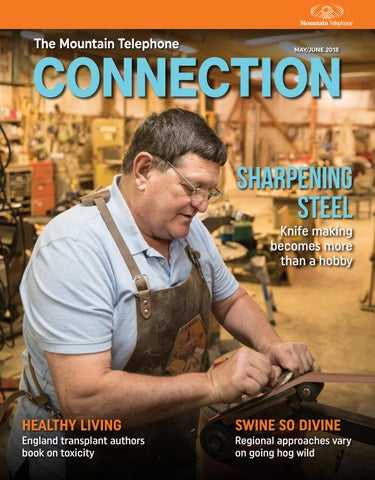
On the Cover: Wolfe County resident Paul Pence uses a homemade belt grinder to shape a knife blade while in his home-based shop. See story Page 8.
Nondiscrimination
Vacation confidently r Keep you RTC home M his secure t ! summer
Sign up and save! We’ll waive the $99 installation fee on any MRTC Security System Plan. We’ll give you a $50 credit on the installation fee of MRTC Surveillance Systems.
Now offering 4K cameras! 606-743-3121 MRTC.com
Residential customers only. Requires a 36-month agreement. Other restrictions may apply. Offer expires June 30, 2018.
Calling all shutterbugs!
Don’t forget to submit your entry by June 1 for the chance to be featured in the 2019 Mountain Telephone directory and calendar. Let your creativity and skill shine in this year’s contest to show the beauty of Bath, Elliott, Menifee, Morgan and Wolfe counties. Visit www.mrtc.com for more information on the contest, rules and the submission form. Mountain Rural Telephone Cooperative
Happy Memorial Day! In honor of those who have given their lives for this country, all Mountain offices will be closed Monday, May 28.
In accordance with the Federal civil rights law and U.S. Department of Agriculture (USDA) civil rights regulations and policies, the USDA, its Agencies, offices, and employees, and institutions participating in or administering USDA programs are prohibited from discriminating based on race, color, national origin, religion, sex, gender identity (including gender expression), sexual orientation, disability, age, marital status, family/parental status, income derived from a public assistance program, political beliefs, or reprisal or retaliation for prior civil rights activity, in any program or activity conducted or funded by USDA (not all bases apply to all programs). Remedies and complaint ling deadlines vary by program or incident. Persons with disabilities who require alternative means of communication for program information (e.g., Braille, large print, audiotape, American Sign Language, etc.) should contact the responsible Agency or USDA’s TARGET Center at (202) 720-2600 (voice and TTY) or contact USDA through the Federal Relay Service at (800) 877-8339. Additionally, program information may be made available in languages other than English. To file a program discrimination complaint, complete the USDA Program Discrimination Complaint Form, AD-3027, found online at https:// www.ascr.usda.gov/filing-programdiscrimination-complaint-usdacustomer and at any USDA office or write a letter addressed to USDA and provide in the letter all of the information requested in the form. To request a copy of the complaint form, call (866) 632-9992. Submit your completed form or letter to USDA by: (1) mail: U.S. Department of Agriculture, Office of the Assistant Secretary for Civil Rights, 1400 Independence Avenue SW, Washington, D.C. 202509410 (2) fax: 202-690-7442 (3) email: program.intake@usda.gov USDA is an equal opportunity provider, employer and lender. May/June 2018 | 5
TRAVEL
Lake Jocassee, South Carolina
Enjoy a refreshing dip
I
f you’re only looking to the Southern coasts to wiggle your toes in the sand and cool off this summer, you’re missing out on glorious watering holes: our lakes. Not only do lakes make the perfect swimming spots with their calm waters, but they’re also often ideal for wetting a line, canoeing, kayaking or camping. Try some of the best lakes in the South. Jump on in, y’all.
6 | May/June 2018
Southern lakes offer a break from the heat
Lake Jocassee, South Carolina Lake Jocassee may not be the largest lake in South Carolina, but what it lacks in size, it makes up for in thrills. Jump off a high cliff, stand beneath a magnificent waterfall, or take a hike along a mountain path. Or, just take it easy and set up your lounge chair on the beach at Devils Fork State Park while the kids swim in water made crystal clear by mountain streams that feed the lake. “With the clarity of the water, the beaches can resemble the Caribbean,” says Ken Sloan, president and CEO of Mountain Lakes Convention and Visitors Bureau. To fully appreciate all the lake has to offer, rent a pontoon boat and take the family on a tour. Or, rent a canoe, paddle board or kayak and take off on your own. The primary outfitter for watercraft rentals is Eclectic Sun (eclecticsun.com). While the lake is secluded — you gain entrance through Devils Fork State Park — there are several restaurants within a short drive. One of them is Keowee Towne Market, a five-minute drive away, where you can order a pizza or a plate of great barbecue and chow down there or pick up the fixings for a picnic to enjoy along a mountain trail. The state park offers villa-style lodging and two campgrounds for both RV and primitive camping. The lake’s clear water also makes it a destination for scuba diving. For more information: lakejocassee.com.
Douglas Lake, Tennessee Douglas Lake winds its way through four scenic Tennessee counties — Jefferson, Cocke, Sevier and Hamblen — all in the Smoky Mountains. Less than 20 percent of the 40-plus miles of shoreline have been developed, making the lake a paradise for boaters and water skiers. It is one of the most popular lakes in the country for fishing for crappie and largemouth bass. Jump in from your boat for a deep swim, or take the family to the sandy beach at Douglas Dam Headwater Campground on the western side of the lake. It not only has more than 60 campsites with water and electricity, but it also boasts a public swimming beach. About 30 acres of hardwood forest back up to the beach and campground. Trails lead to views of the dam, birding areas, wildflower-strewn meadows and limestone sinkholes. There are restrooms and picnic tables at the beach. With the close proximity to Dollywood and Gatlinburg, your restaurant and hotel choices are numerous. However, there are also lake and mountain cabins for rent by the night or the week, allowing you to make your own meals and save some cash. For more information: www.douglas lakeinfo.com or visitsevierville.com.
The park lodge — with a full-service restaurant, hotel rooms and convention center — overlooks the lake and provides a beautiful view. Goosepond Colony Resort near Scottsboro has two 18-hole championship golf courses, lakeside cottages, a lodge, a waterfront campground and a full-service marina. The Docks, a popular restaurant at Goosepond, features waterfront dining. Guntersville’s Top O’ The River is known for some of the best catfish around. For more information: www.alapark. com.
Lake Texoma, Texas The name alone will tell you that this favorite lake lies in two states — Texas and Oklahoma — making it one of the largest reservoirs in the country, as well as one of the most developed. And with a spread of 89,000 acres, there’s room for the more than 6 million people who head to its shores each year. Eisenhower State Park’s beach, tucked away in a beautiful cove surrounded by cliffs, is the ideal spot for swimming. Fish for more than 70 species, golf at one of several nearby courses or sail on an 1800s-style pirate ship. Hike or watch wildlife at Hagerman National Wildlife Refuge, one of two refuges along the lake.
When you get hungry, there are a number of restaurants — some on the waterfront — as well as eateries at most of the local marinas. When it’s time for bed, overnight choices range from cabins at marinas to hotels and resorts dotting the lake. Lake Texoma is an hour’s drive north of Fort Worth. For more information: www.laketexoma online.com.
Rough River Lake, Kentucky The lake at Rough River Dam Resort State Park is open to all during the warm months of summer. The name, Rough River, may sound scary, but fear not. The waters are mostly calm with gentle waves rolling in thanks to a nice breeze on most days. There is a bathhouse open for public use. When hunger strikes, the park restaurant, Grayson Landing, serves massive plates of catfish and other local Kentucky dishes. The neighboring woods offer birding and hiking, or you can wet a line in the lake — the fishing is great this time of year. Overnight accommodations include lodge rooms with views of Rough River Lake and two-bedroom cottages near the lake and in the woods. Resort guests have use of the pool overlooking the lake, too. For more information: parks.ky.gov.
Lake Guntersville, Alabama Lake Texoma, Texas
Photo courtesy of Texoma Destinations.
Lake Guntersville is an ideal aquatic playground close to home for Northeast Alabama residents. With 67,900 acres and nearly 900 miles of shoreline, the lake is known for its fishing, but it also offers activities such as pleasure boating, kayaking and eagle watching. Guntersville Lake Hydrofest, a popular power boat racing event expected to attract thousands to the area, is set for June 22-24. Visit www.guntersvillelake hydrofest.com for more information. Lake Guntersville State Park, a 6,000acre natural playground, offers camping, lodging, hiking, horse trails, boat rentals, zip lines, fishing, swimming at the beach and an 18-hole golf course.
May/June 2018 | 7
CUTTING EDGE Campton man finds satisfaction in knife making hobby BY JEN CALHOUN
P
aul Pence Jr. has always had an eye for detail.
Whether he was serving on an engineering inspection crew for the Kentucky Department of Transportation or building a front porch swing in his woodshop, Pence has always known that the little things make the finished product great. The same goes for his latest hobby, knife making. For the past nine years, the retired KDOT worker and current church pastor has been making knives in his home shop in Campton. The 200 or so blades he’s made range from regular knives to spears to Viking axes. It’s an enjoyable process for Pence, whose curiosity led him to the hobby. “When I was still working (with KDOT), I had made a comment to my wife that when I retired, I’d like to start doing it,” he says. “I had done woodworking through the years, and I already had a shop. So, really, it was just a matter of adding some tools to the shop.”
BLADE MAKER Wolfe County resident Paul Pence fabricates knives from raw materials. 8 | May/June 2018
The more Pence learned, the more interesting knife making became, he says. He started Mountain Rural Telephone Cooperative
checking out the internet to learn more about the craft, and he began talking to other knife makers on various websites. “I made it my business to try to make as good a knife as I possibly can,” he says. He even started emailing Ed Caffrey, a master bladesmith out of Montana who is known internationally for his expertise and designs. “He’s just like family,” Pence says. “He’ll tell you anything he knows.” Pence doesn’t start off by forging his own steel like the bladesmiths on History’s reality show “Forged in Fire.” Instead, he uses steel that’s already annealed, meaning it is already “soft and ready to work,” he says. He generally buys a 4-foot length of 1095 steel bar stock from a company called New Jersey Steel Baron. The 1095 steel is shaped a little like a plank of wood and is a basic form of carbon steel that’s often used in the making of knives, according to Knife Up: The Knife News Magazine. Pence says it’s the kind of steel that was used for most Case knives in the mid-1900s before stainless steel came out. The steel stock he uses comes in varying widths,
Judge Jason Smith and Judge Marcela Valladolid taste Adalberto Diaz Labrada’s completed mini tarts, as seen on “America’s Best Baker,” season one.
Paul Pence uses steel that has already been annealed to create his knives.
depending on the size and type of blade he is going to make. From there, Pence starts a process called “stock removal,” which means he marks out the design of the knife and removes the rest of the stock using a handheld grinder with a cutting wheel on it. Then he heat treats and tempers the blade. His own forge, used for heat-treating, runs on propane and can get up to about 2,000 degrees Fahrenheit. “The process of a complete knife can take two to four days, depending on how much you work,” he says. “You can dress them up and do a lot of polishing, or you can just make a rough one. You can make a rough one a lot quicker. It’s like decorating a cake. You can just
“The process of a complete knife can take two to four days, depending on how much you work. You can dress them up and do a lot of polishing, or you can just make a rough one. You can make a rough one a lot quicker. It’s like decorating a cake. You can just put on some icing, or you can do it up a lot more if you want.” —Paul Pence Jr., Campton knifemaker Mountain Rural Telephone Cooperative
Wolfe County resident Paul Pence uses a homemade belt grinder to shape a knife blade while in his home-based shop.
put on some icing, or you can do it up a lot more if you want.”
“It’s really just word of mouth,” he says.
HOT TICKET
SATISFACTION, NOT TRANSACTIONS
Since he started, Pence’s knife-making skills have grown so much that his knives have been commissioned, sold or traded to people from all over the country. A man from South Dakota, who traveled to Kentucky on a turkey-hunting trip last fall, happened to see one of the Viking axes Pence had made for a friend. “He said he’d be back in the spring and wanted one of those ready when he got here,” Pence said. Another woman from “one of the western states” saw one of his knives and asked him to make her one. In another instance, a church friend asked him to make a specific kind of knife.
Still, Pence is quick to reiterate that making knives is only a hobby. He doesn’t keep a website or promote his product. And he certainly doesn’t want to make his hobby into that three-letter word, “job.” And while he’s happy that others have shown off his knives on social media, Pence is reluctant to push much further than making the occasional blade for fun. “I’m not trying to make a business out of it. I’m a pastor (of Rosedale Community Church) full time, and I’m retired from my regular job,” he says. “I do this for my own satisfaction, and I’ve not really tried to sell them at all.” May/June 2018 | 9
Lifeline is a federal program to help low-income Americans pay for phone or broadband service ?
How much will Lifeline save me? If you qualify for Lifeline, you will receive a credit of $9.25 each month on your bill.
?
Lifeline Service
You have the choice (where applicable) of applying your benefit to one of three types of service offerings: • Fixed or mobile broadband • Fixed or mobile voice-only • Bundles of fixed or mobile voice and broadband NOTE: Lifeline can only be used for one source of communication from the list above.
?
Can I receive more than one Lifeline credit?
?
How do I qualify?
Lifeline is a government assistance program that can help pay a portion of your telephone, mobile phone or internet bill each month. Consumers are allowed only one Lifeline program benefit per household.
Do you qualify? Stay connected with a Lifeline discount.
Apply today! 10 | May/June 2018
What services are covered by this credit?
No, consumers are allowed only one Lifeline program benefit per household.
You are eligible for Lifeline benefits if you qualify for and receive one of the following benefits: • SNAP • Medicaid • Supplemental Security Income (SSI) • Federal Public Housing Assistance • The Veteran’s Pension or Survivor’s Pension benefit. Additionally, consumers at or below 135 percent of the Federal Poverty Guidelines will continue to be eligible for a Lifeline program benefit. (State determinations of income will no longer be accepted.) There are no changes to the eligibility criteria for Tribal programs. NOTE: Some states have additional qualifying programs, allowances and stipulations. Check with your local telecommunications provider for information about benefits that may be available in your state.
?
How do I enroll in the Lifeline program and start receiving this benefit? To find out whether you qualify for Lifeline assistance, please visit www.lifelinesupport.org or call your local telecommunications provider. NOTE: Your telephone company is not responsible for determining who qualifies for these programs or who receives assistance. Consumers must meet specific criteria in order to obtain assistance with their local telephone and/or broadband service, and qualifying is dependent upon government-established guidelines.
TECHNOLOGY IN THE GOLDEN YEARS
Web Crafty Try online tools for creative hobbies
I
have been sharing my stories of technology and doling out advice on how to be more tech-savvy. I hope you feel as if you have gotten to know my family and me during the past couple of years. So now it only seems right to admit the other side of my personality that you may not guess. Whenever I have a free moment, I am usually at my sewing machine working on a quilt, bag or purse. I may also be working away on a cross-stitch wall hanging or embroidering a household item. I’m an old-fashioned, low-tech crafter whenever I get the opportunity. So, how does that fit into this technology column? Well, I suspect many of you reading this article may have similar hobbies. If it isn’t sewing, it may be baking, woodworking or jewelry-making. What I’ve been discovering is there are lots of websites, apps and technology tools available to help you create and sell your masterpieces! Here are some of my favorite “crafty” websites and why I love them:
CRAFTSY Craftsy is one of my newest favorites, accessible through both a website and an app. It gives you access to patterns for
many types of crafts but also includes video instructions. I’m working on a project that takes me step by step with video, written instructions and a pattern. This is a wonderful site if you are looking to learn something new. You’ll find instructions on lots of topics, such as sewing, painting, cooking, cake decorating, photography, gardening and much more!
CUSTOM MADE I’ve promoted this site for many years. If you are looking to sell your craftwork, or if you are looking to buy a very
specific, specially made item, I encourage you to take a look at this website to see if it would be a good fit for you to sell your skills to potential buyers.
CRAFT GOSSIP Craft Gossip is a website that hosts a collection of blogs from crafters in all sorts of categories. You can find fun ideas for oodles of projects no matter what your skill set is. You can also find projects based on holiday themes. New content is added all the time, so you can always find a new project. I believe that technology is
going to help revive the craft and hobby lifestyle. So many of these skills, once passed down through the generations, have been abandoned or forgotten. Now, one person can share his or her skills with millions by putting the instructions online. So try something new today!
CARISSA SWENSON IS A TRAINING AND EDUCATION CONSULTANT FOR CONSORTIA CONSULTING.
Don’t forget about the most common sites, such as YouTube, Pinterest and Etsy for tutorials, patterns and craft buying and selling. These sites are frequented by crafters for a reason! May/June 2018 | 11
Miranda Carey-Jones, a British author living in Cannel City, Ky., spends time with one of her feathered friends that she gains inspiration from.
Ally Carey-Jones is Miranda’s 5-year-old daughter.
Getting well
Local author seeks to bring health to others BY JEN CALHOUN
F
or months, Miranda Carey-Jones felt sick. She was sluggish, and her eyes watered constantly. She even gained some weight, which was especially surprising to the former professional equestrian and exercise buff. At first, she blamed allergies. Maybe it was her birds. Or was it something in the air? The answer, she realized, was right under her nose — and inside the cabinets throughout her home. “Like everybody, I wanted my house to smell good and look good,” says the British transplant. “I was using all these carpet cleaners and air fresheners, but I realized they were basically pollutants. They were toxins that were getting into my respiratory system and making me sick.”
‘TOXIC,’ THE BOOK That discovery spurred Carey-Jones to write the 12 | May/June 2018
2017 book “Toxic: A Guide to Repairing Your Tired and Damaged Body.” The book identifies everyday toxins and how they affect health, fertility and sleep patterns. She also examines the relationship between these chemicals and the rise in diseases like cancer, diabetes and autoimmune ailments. The book also includes several recipes.
ON A MISSION For years, Carey-Jones spent her life working with horses as an elite rider for England. As an international competitor in dressage, showjumping and cross-country events, she was also charged with keeping herself and her horses healthy and drug-free. Before marrying her husband, West Liberty native Rick Jones, in 2010, she spent 15 years running a horse rehabilitation and training yard in Spain.
“The horses I worked with could not be treated with drugs due to competition rules,” she says. “I had to look for everything I could possibly do that was holistic.” But that hadn’t always translated to her own health. “I’m a Chanel girl,” she says. “I love all the Chanel perfumes. But everybody has a choice, and I chose to be well.” After setting out on her own health journey, CareyJones wrote the book because she wanted other people to know more, too. “Everyone has a choice to live in their world of toxins or to remove as many as possible from their lifestyle,” she writes in the book’s foreword. “No one can help you if you won’t help yourself, your animals and your children. So remember, if your body gives you an illness or disease, think, ‘Why?’ and detox ASAP.”
“Toxic,” a book about healthy living was written by Miranda Carey-Jones.
The road to health Want to know more about the toxins that pollute our everyday lives? Miranda Carey-Jones’ book “Toxic: A Guide to Repairing Your Tired and Damaged Body” is available in paperback through Amazon at amazon.com. It costs $8.99. The book acts as a tool to educate readers about what outside influences can make us ill, how to prevent these types of diseases, and how to reverse the symptoms of aging and illness. Carey-Jones is also author of “InSpiration — A Day at a Time: You are Your Thoughts,” also available in paperback through amazon.com for $5.99. For more information, check out her Facebook page at www.facebook.com/happyhealth1000.
Mountain Rural Telephone Cooperative
Dr. Leigh Ann Gunnell opened a new dental office in West Liberty at the end of 2016.
Dr. Leigh Ann Gunnell performs an oral checkup on Christie Conley at her office in West Liberty.
Polish and shine
Local dentist realizes the dream of a solo practice BY JEN CALHOUN
W
hen Leigh Ann Gunnell’s middle school art teacher asked students to draw a picture representing their future careers, Gunnell drew a toothbrush. And in case there was any confusion, she pasted block letters that spelled “dentist.”
It was a dream that would be realized, worked together, and it was very helpful too. After graduating from Morgan County knowing that all that was already in place.” High School in 1993, Gunnell went on to Gunnell and her family worked with sevearn her undergraduate and dental degrees eral contractors to renovate a 1950s home from the University of Kentucky in 1998 for the dental office. It helped that her husand 2002, respectively. From there, she went band, Steve, is a civil engineer and her father on to practice dentistry for 15 years with has a construction and industrial technolDr. Robert Henderogy background. son, a local dentist “There’s definitely a need The process with an established took about three for medical and dental months. The conpractice. Gunnell says tractors knew she care here. I like to know she felt extremely was facing a time lucky to work with crunch, so they that I’m needed.” Henderson, who moved the renova— Dr. Leigh Ann Gunnell served as a mentor tions along quickly. and friend. The team at Mountain Telephone also worked fast to connect all services: phone, GOING SOLO internet, security and TV, Gunnell says. When Henderson retired at the end of She uses the internet for much of the 2016, Gunnell opened her own practice on office’s marketing and electronic billing. Main Street in West Liberty. “It’s fast and makes a big difference in how “It was always something I wanted to do,” quickly we can work,” she says. she says. “There were a lot of financial risks and a lot of startup costs, but I had a great HOME IS WHERE THE HEART IS support system. I also had a great team that Born in Lexington, Gunnell spent part came with me to open the practice. We all of her childhood living away from West
Mountain Rural Telephone Cooperative
Liberty, where her parents were born and raised. She lived in Louisville and northern Ohio before moving to West Liberty around the age of 13. “West Liberty has been home to me for most of my life,” she says. So, when she got the chance to work with Dr. Henderson, she knew it was the right thing to do. “There’s definitely a need for medical and dental care here,” Gunnell says. “I like to know that I’m needed.” But she also likes living in a community where everybody is looking out for one another, says Gunnell, who has three sons: John, 14; Mason, 11; and Adam, 8. “I like knowing my kids go to school with teachers who are friends of mine,” she says. “It’s comforting to know they’re taken care of. I love the sense of community here.”
Leigh Ann Gunnell, DMD Gunnell’s dentistry practice is at 672 Main St. in West Liberty. For more information, or to make an appointment, call 606-743-3030.
May/June 2018 | 13
SOUTHERN KITCHENS
The art of low and slow
BBQ Boot Camp grads now smoked-meat experts
T
here are few foods as American as barbecue, and for true meat lovers, the only question is how to save room for seconds. But when firing up the grill this summer, let’s get one thing straight: Merely throwing meat on a grill does not produce barbecue. Newcomers to the grill may believe that anything covered in barbecue sauce counts, but the real thing is cooked in a smoky universe for a really long time, and that factor, says Chris Huffman, is key to smoking meats. “The name of the game is patience,” he says. Huffman is executive chef at Blair House Inn, a charming bed-and breakfast in Wimberley, Texas. The inn offers intensive, three-day cooking classes every month, drawing both experienced cooks and novices into the kitchen. They work to improve their culinary skills at barbecue, as well as cuisines from around the world, depending on the month they choose. Barbecue varies by region, and in Texas, it’s all about the beef. “Brisket is big around here in the Hill Country,” Huffman says. But side dishes are also a regional thing in Texas, he adds. “My wife is from South Texas, and her family serves pico de gallo, borracho beans and Mexican rice,” he says. A recent BBQ camp at Blair House Inn drew folks with varying backgrounds from all around, but all came with a common interest: to learn how to properly smoke meats. “I’m going to make barbecue sumo wrestlers out of you, so pace yourselves,” Huffman told the class during their first few minutes in the kitchen. “I want you all to come and do all of this yourselves. It’s not a dog and pony show.”
Chef Chris Huffman’s monthly three-day cooking classes provide an intense introduction to the techniques that make barbecue a favorite dish throughout the country.
The menu for the three-day class included eggs Benedict with smoked pork tenderloin as well as cherry cola-glazed pork ribs and other meats. Sides included chayote and jicama salad with mango vinaigrette and warm potato salad with bacon and mustard. BBQ camp began early each morning with students taking on a different element of each recipe, working as a team to prepare their daily meals. “This class is all about me showing you how to make things and having you go home and play and
CULINARY CREATIONS Interested in learning more about cooking classes at Blair House Inn? For a complete list of classes offered, as well as other information, log on to blairhouseinn.com. 14 | May/June 2018
experiment and have many happy accidents,” Huffman says. Students started out as strangers in the kitchen and ended as friends in the dining room, sharing meals and stories. The next BBQ camp is scheduled for June 18-20 and again Aug. 6-8. Here are some of the recipes you may learn to make at home. . FOOD EDITOR ANNE P. BRALY IS A NATIVE OF CHATTANOOGA, TENNESSEE.
is an important “Brining first step for your smoked meats. It imparts flavor and tenderness to chicken and pork.”
—Chris Huffman
ALL-PURPOSE BRINE 1 gallon water 1 cup sea or kosher salt 1/2 cup dark brown sugar 1 bay leaf 1 tablespoon chopped fresh thyme or 1 teaspoon dried thyme 1/2 teaspoon whole black peppercorns 2 cloves 1 clove garlic, crushed 1 teaspoon cayenne pepper Place all ingredients in a large, nonreactive pot and bring to a boil over medium heat while stirring. Reduce heat to simmer, and simmer for 5 minutes. Remove from heat and let cool. After cooling, stir well to ensure that all ingredients are evenly mixed. Make sure meat or poultry is completely
submerged, weighing it down with a plate if necessary. Let soak for at least 2 hours but no more than 8. Lightly rinse meat before placing in smoker.
SMOKED BRISKET
1 3 2 1 2 1
(12-pound) brisket tablespoons kosher salt tablespoons chili powder teaspoon cayenne pepper tablespoons black pepper tablespoon granulated garlic
Prepare smoker, heating to 225 F. Rub spices on brisket and place fat side down in smoker for 8 hours. Add wood chips and more charcoal as needed. Remove from smoker and wrap in heavy-duty aluminum foil; return to smoker or place in 225-degree oven, fat side up, for 8 more hours. Let brisket rest for 30 minutes before slicing. Slice against grain of meat. Makes 8-10 servings.
CHERRY COLA-GLAZED PORK RIBS
2 cups cherry jam 2/3 cup Dijon mustard 1/4 cup soy sauce 2 tablespoons apple cider vinegar 1 tablespoon sriracha sauce Remove silver skin from underside of ribs, if desired. Salt and pepper ribs. Boil cherry cola in a heavy saucepan over medium-high heat until reduced to 1 ½ cups, about 45 minutes. Stir in remaining ingredients, reduce heat to medium, and simmer for 5 minutes. Makes about two cups of glaze. Place ribs onto smoker rack. Do not stack directly on top of each other. Fill the smoker pan with wood chips and bring to 270 F. Smoke for one hour. Brush the ribs with the glaze and continue doing so every 30 to 45 minutes until the meat is no longer pink and begins to shrink back from the bones, 3 to 4 hours. Brush the sauce on the ribs for the last time 30 minutes before the ribs are ready to be taken off the smoker. Once the ribs are done, wrap them in aluminum foil and allow to rest 10 to 15 minutes to allow juices to reabsorb into the meat and make the ribs moist.
2 racks of ribs 4 (12-ounce) cans cherry cola May/June 2018 | 15
Presort STD US Postage PAID Permit #21 Freeport OH
P.O. Box 399 • 425 Main St. West Liberty, KY 41472